Category Archives: Daily Readings

Daily Readings for Saturday, December 13, 2025

SATURDAY OF THE 12TH WEEK

ABSTAIN FROM MEAT, FISH, DAIRY, EGGS

Martyrs Eustratius, Auxentius, Eugene, Mardarius, and Orestes of Greater Armenia, Lucia the Virgin-martyr, Herman the Wonderworker of Alaska & First Saint of America, Gabriel the Hieromartyr, Archbishop of Serbia

ST. PAUL’S LETTER TO THE GALATIANS 5:22-26; 6:1-2

Brethren, the fruit of the Spirit is love, joy, peace, patience, kindness, goodness, faithfulness, gentleness, self-control; against such there is no law. And those who belong to Christ Jesus have crucified the flesh with its passions and desires. If we live by the Spirit, let us also walk by the Spirit. Let us have no self-conceit, no provoking of one another, no envy of one another. Brethren, if a man is overtaken in any trespass, you who are spiritual should restore him in a spirit of gentleness. Look to yourself, lest you too be tempted. Bear one another’s burdens, and so fulfill the law of Christ.

LUKE 13:19-29

The Lord said this parable, "The kingdom of God is like a grain of mustard seed which a man took and sowed in his garden; and it grew and became a tree, and the birds of the air made nests in its branches." And again he said, "To what shall I compare the kingdom of God? It is like leaven which a woman took and hid in three measures of flour, till it was all leavened." He went on his way through towns and villages, teaching, and journeying toward Jerusalem. And some one said to him, "Lord, will those who are saved be few?" And he said to them, "Strive to enter by the narrow door; for many, I tell you, will seek to enter and will not be able. When once the householder has risen up and shut the door, you will begin to stand outside and to knock at the door, saying, 'Lord, open to us.' He will answer you, 'I do not know where you come from.' Then you will begin to say, 'We ate and drank in your presence, and you taught in our streets.' But he will say, 'I tell you, I do not know where you come from; depart from me, all you workers of iniquity!' There you will weep and gnash your teeth when you see Abraham and Isaac and Jacob and all the prophets in the kingdom of God and you yourselves thrust out. And men will come from east and west, and from north and south, and sit at table in the kingdom of God.

Repose of Venerable Herman of Alaska, Wonderworker of All America

A spiritual mission was organized in 1793 with volunteers from the monks of the Valaam Monastery. They were sent to preach the Word of God to the native inhabitants of northwestern America, who had come under the sovereignty of Russia only ten years before. Saint Herman was one of the members of this mission.

Saint Herman came from a family of merchants of Serpukhov, a city of the Moscow diocese. His name before he was tonsured, and his family name are not known. There is a possibility, however, that his baptismal name was Gerasimus. He had a great zeal for piety from his youth, and he entered monastic life at sixteen. (This was in 1772, if we assume that Herman was born in 1756, although sometimes 1760 is given as the date of his birth.) First he entered the Trinity-Sergius Hermitage which was located near the Gulf of Finland on the Peterhof Road, about 15 versts (about 10 miles) from Saint Petersburg. He also spent time at at Sarov, where he first met Father Nazarius, who became his Elder at Valaam. Later, Saint Herman followed him to Sanaxar where Saint Theodore (February 19) was their igumen.

Miraculous Healing

At the Saint Sergius Hermitage there occurred the following incident to Father Herman. On the right side of his throat under his chin there appeared an abscess. The swelling grew rapidly, disfiguring his face. It became difficult for him to swallow, and the odor was unbearable. In this critical condition Father Herman awaited death. He did not appeal to a physician of this world, but locking his cell he fell before an icon of the Mother of God. With fervent tears he prayed, asking of Her that he might be healed. He prayed the whole night. Then he took a wet towel and with it wiped the face of the Most Holy Mother, and with this towel he covered the swelling. He continued to pray with tears until he fell asleep from sheer exhaustion on the floor. In a dream he saw the Virgin Mary healing him.

When Herman awoke in the morning, he found to his great surprise that he was fully healed. The swelling had disappeared, even though the abscess had not broken through, leaving behind but a small mark as though a reminder of the miracle. Physicians to whom this healing was described did not believe it, arguing that it was necessary for the abscess to have either broken through of its own accord or to have been cut open. But the words of the physicians were the words of human experience, for where the grace of God operates there the order of nature is overcome. Such occurrences humble human reason under the strong hand of God’s Mercy.

Life at Valaam

For five or six years Father Herman continued to live in the Saint Sergius Hermitage, and then he transferred to the Valaam Monastery, which was widely scattered on the large islands in the waters of the great Lake Ladoga. He came to love the Valaam haven with all his soul, as he came to love its unforgettable Superior, the pious Elder Nazarius, and all the brethren. He wrote to Father Nazarius later from America, “Your fatherly goodness to me, humble one, will be erased out of my heart neither by the terrible, unpassable Siberian lands, nor by the dark forests. Nor will it be wiped out by the swift flow of the great rivers; nor will the awful ocean quench these feelings. In my mind I imagine my beloved Valaam, looking to it beyond the great ocean.” He praised the Elder Nazarius in his letters as, “the most reverend, and my beloved father,” and the brethren of Valaam he called, “my beloved and dearest.” The place where he lived in America, deserted Spruce Island, he called “New Valaam.” And as we can see, he always remained in spiritual contact with his spiritual homeland, for as late as 1823, that is after thirty years of his life within the borders of America, he wrote letters to the successor of Father Nazarius, the lgumen Innocent.

Father Barlaam, later lgumen of Valaam, and a contemporary of Father Herman, who accepted his tonsure from Father Nazarius, wrote thus of the life of Father Herman.

“Father Herman went through the various obediences here, and being ‘well disposed toward everything’ was in the course of events sent to Serdobol to oversee there the work of quarrying marble. The Brothers loved Father Herman, and awaited impatiently his return to the cloisters from Serdobol. Recognizing the zeal of the young hermit the wise elder, Father Nazarius, released him to take abode in the wilderness. This wilderness was in the deep forest about a mile from the cloister: to this day this place has retained the name ‘Herman’s.’ On holy days, Father Herman returned to the monastery from the wilderness. Then it was that at Little Vespers he would stand in the choir and sing in his pleasant tenor the responses with the brethren from the Canon, ‘O Sweetest Jesus, save us sinners. Most Holy Theotokos, Save us,’ and tears would fall like hail from his eyes.”

The First Mission to America

In the second half of the 18th century the borders of Holy Russia expanded to the north. In those years Russian merchants discovered the Aleutian Islands which formed in the Pacific Ocean a chain from the eastern shores of Kamchatka to the western shores of North America. With the opening of these islands there was revealed the sacred necessity to illumine with the light of the Gospel the native inhabitants. With the blessing of the Holy Synod, Metropolitan Gabriel gave to the Elder Nazarius the task of selecting capable persons from the brethern of Valaam for this holy endeavor. Ten men were selected, and among them was Father Herman. The chosen men left Valaam for the place of their great appointment in 1793. (The members of this historical mission were: Archimandrite Joseph (Bolotoff), the Hieromonks, Juvenal, Macarius, Athanasius, Stephan and Nectarius, Hierodeacons, Nectarius and Stephen, and the monks Joasaph, and Herman.)

As a result of the holy zeal of the preachers the light of the evangelic sermon quickly poured out among the sons of Russia, and several thousand pagans accepted Christianity. A school for the education of newly-baptized children was organized, and a church was built at the place where the missionaries lived. But by the inscrutable providence of God the general progress of the mission was unsatisfactory. After five years of very productive labor, Archimandrite Joasaph, who had just been elevated to the rank of bishop, was drowned with his party. (This occurred on the Pacific Ocean between Kamchatka and the Aleutian Islands. The ship, Phoenix, one of the first sea-going ships built in Alaska, sailed from Okhotsk carrying the first Bishop for the American Mission and his party. The Phoenix was caught in one of the many storms which periodically sweep the northern Pacific, and the ship and all hands perished together with Bishop Joasaph and his party.) Before this the zealous Hieromonk Juvenal was granted the martyr’s crown. The others died one after another until in the end only Father Herman remained. The Lord permitted him to labor longer than any of his brethren in the apostolic task of enlightening the Aleutians.

The New Valaam — Spruce Island

In America, Father Herman chose as his place of habitation Spruce Island, which he called New Valaam. This island is separated by a strait about a mile and a quarter wide from Kodiak Island on which had been built a wooden monastery for the residence of the members of the mission, and a wooden church dedicated to the Resurrection of the Savior. (New Valaam was named for Valaam on Lake Ladoga, the monastery from which Father Herman came to America. It is interesting to note that Valaam is also located on an island, although, this island is in a fresh water lake, whereas, Spruce Island is on the Pacific Ocean, although near other islands and the Alaskan mainland.)

Spruce Island is not large, and is almost completely covered by a forest. Almost through its middle a small brook flows to the sea. Herman selected this picturesque island for the location of his hermitage. He dug a cave out of the ground with his own hands, and in it he lived his first full summer. For winter there was built for him a cell near the cave, in which he lived until his death. The cave was converted by him into a place for his burial. A wooden chapel, and a wooden house to be used as a schoolhouse and a guest house were built not too distant from his cell. A garden was laid out in front of his cell. For more than forty years Father Herman lived here.

Father Herman’s Way of Life

Father Herman himself spaded the garden, planted potatoes and cabbage and various vegetables in it. For winter, he preserved mushrooms, salting or drying them. The salt was obtained by him from ocean water. It is said that a wicker basket in which the Elder carried seaweed from the shore, was so large that it was difficult for one person to carry. The seaweed was used for fertilizing the soil. But to the astonishment of all, Father Herman carried a basket filled with seaweed for a long distance without any help at all. By chance his disciple, Gerasim, saw him one winter night carrying a large log which normally would be carried by four men; and he was bare footed. Thus worked the Elder, and everything that he acquired as a result of his immeasurable labors was used for the feeding and clothing of orphans and also for books for his students.

His clothes were the same for winter as for summer. He did not wear a shirt; instead he wore a smock of deer skin, which he did not take off for several years at a time, nor did he change it, so that the fur in it was completely worn away, and the leather became glossy. Then there were his boots or shoes, cassock (podrasnik), an ancient and faded out cassock (riasa) full of patchwork, and his headdress (klobuk). He went everywhere in these clothes, and at all times; in the rain, in snowstorms, and during the coldest freezing weather. In this, Father Herman followed the example of many Eastern Ascetic Fathers and Monks who showed the greatest concern for the welfare and needs of others. Yet, they themselves wore the oldest possible clothes to show their great humility before God, and their detachment from worldly things.

A small bench covered with a time-worn deerskin served as Father Herman’s bed. He used two bricks for a pillow; these were hidden from visitors by a skin or a shirt. There was no blanket. Instead, he covered himself with a wooden board which lay on the stove. This board Father Herman, himself called his blanket, and he willed that it be used to cover his remains; it was as long as he was tall. “During my stay in the cell of Father Herman,” writes the creole Constantine Larionov, “I, a sinner, sat on his ‘blanket’-and I consider this the acme of my fortune!” (‘creole’ is the name by which the Russians referred to the children of mixed marriages of native Indians of Alaska, Eskimo and Aleuts with Russians.)

On the occasions when Father Herman was the guest of administrators of the American Company and in the course of their soul-saving talks he sat up with them until midnight. He never spent the night with them, but regardless of the weather he always returned to his hermitage. If for some extraordinary reason it was necessary for him to spend the night away from his cell, then in the morning the bed which had been prepared for him would be found untouched; the Elder not having slept at all. The same was true in his hermitage where having spent the night in talks, he never rested.

The Elder ate very little. As a guest, he scarcely tasted the food, and remained without dinner. In his cell his dinner consisted of a very small portion of a small fish or some vegetables. His body, emaciated as a result of his labors, his vigils, and fasting, was crushed by chains which weighed about sixteen pounds. These chains are kept to this day in the chapel. Telling of these deeds of Father Herman, his disciple, the Aleut Ignaty Aligyaga, added, “Yes, Apa led a very hard life, and no one can imitate his life!” (The Aleutian word “Apa” means Elder or grandfather, and it is a name indicative of the great affection in which he was held).

Our writing of the incidents in the life of the Elder deal, so to speak, with the external aspects of his labor. “His most important works,” says the Bishop Peter, “were his exercises in spiritual endeavor in his isolated cell where no one saw him, but outside the cell they heard him singing and celebrating services to God according to the monastic rule.” This witness of the Bishop is supported by the following answers of Father Herman, himself, “How do you manage to live alone in the forest, Father Herman? Don’t you ever become lonesome?” He answered, “No I am not there alone! God is here, as God is everywhere. The Holy Angels are there. With whom is it better to talk, with people, or with Angels? Most certainly with Angels.”

Father Herman and the Native Alaskans

The way in which Father Herman looked upon the natives of America, how he understood his own relations with them, and how he was concerned for their needs he expressed himself in one of his letters to the former administrator of the colony, Simeon Yanovsky. He wrote, “Our Creator granted to our beloved homeland this land which like a newly-born babe does not yet have the strength for knowledge or understanding. It requires not only protection, because of its infantile weakness and impotence, but also his sustenance. Even for this it does not yet have the ability to make an appeal on its own behalf. And since the welfare of this nation by the Providence of God, it is not known for how long, is dependent on and has been entrusted into the hands of the Russian government which has now been given into your own power, therefore I, the most humble servant of these people, and their nurse (nyanka) stand before you in their behalf, write this petition with tears of blood. Be our Father and our Protector. Certainly we do not know how to be eloquent, so with an inarticulate infant’s tongue we say: Wipe away the tears of the defenseless orphans, cool the hearts melting away in the fire of sorrow. Help us to know what consolation means.”

The Elder acted the way he felt. He always interceded before the governors in behalf of those who had transgressed. He defended those who had been offended. He helped those who were in need with whatever means he had available. The Aleuts, men, women and children, often visited him. Some asked for advice, others complained of oppression, others sought out defense, and still others desired help. Each one received the greatest possible satisfaction from the Elder. He discussed their mutual difficulties, and he tried to settle these peacefully. He was especially concerned about reestablishing understanding in families. If he did not succeed in reconciling a husband and wife, the Elder prevailed upon them to separate temporarily. The need for such a procedure he explained thus, “it is better to let them live apart, or believe me, it can be terrible if they are not separated. There have been incidents when a husband killed his wife, or when a wife destroyed her husband.”

Father Herman especially loved children. He made large quantities of biscuits for them, and he baked cookies (krendelki) for them; and the children were fond of the Elder. Father Herman’s love for the Aleuts reached the point of self-denial.

An Epidemic Strikes

A ship from the United States brought to Sitka Island, and from there to Kodiak Island, a contagious disease, a fatal illness. It began with a fever, a heavy cold, and difficult respiration, and it ended with chills; in three days the victim died. On the island there was neither a doctor nor medicine. The illness spread rapidly through the village, and then throughout the nearby areas. The disease affected all, even infants. The fatalities were so great that for three days there was no one to dig graves, and the bodies remained unburied. An eyewitness said, “I cannot imagine anything more tragic and horrible than the sight which struck me when I visited an Aleutian ‘Kazhim’. This was a large building, or barracks, with dividing sections, in which the Aleuts lived with their families; it contained about 100 people. Here some had died, their cold bodies lay near the living; others were dying; there were groans and weeping which tore at one’s soul.”

“I saw mothers over whose bodies cold in death crawled a hungry child, crying and searching in vain for its food…My heart was bursting with compassion! It seemed that if anyone could paint with a worthy brush the full horror of this tragic scene, that he would have successfully aroused fear of death in the most embittered heart.” Father Herman, during this terrible sickness which lasted a whole month, gradually dying out towards the end, visited the sick, never tiring. He admonished them in their fear, prayed, brought them to penance, or prepared them for death. He never spared himself.

Father Herman as a Spiritual Teacher

The Elder was concerned in particular for the moral growth of the Aleuts. With this end in mind a school was built for children-the orphans of the Aleuts. He himself taught them the Law of God and church music. For this same purpose he gathered the Aleuts on Sunday and Holy Days for prayer in the chapel near his cell. Here his disciple read the Hours and the various prayers while the Elder himself read the Epistle and Gospel. He also preached to them. His students sang, and they sang very well. The Aleuts loved to hear his sermons, gathering around him in large numbers. The Elder’s talks were captivating, and his listeners were moved by their wonderous power. He himself writes of one example of the beneficial results of his words.

“Glory to the holy destinies of the Merciful God! He has shown me now through his unfathomable Providence a new occurrence which I, who have lived here for twenty years had never seen before on Kodiak,” he wrote. “Recently after Easter, a young girl about twenty years of age who knows Russian well, came to me. Having heard of the Incarnation of the Son of God and of Eternal Life, she became so inflamed with love for Jesus Christ that she does not wish to leave me. She pleaded eloquently with me. Contrary to my personal inclination and love for solitude, and despite all the hindrances and difficulties which I put forward before accepting her, she has now been living near the school for a month and is not lonesome. I, looking on this with great wonder, remembered the words of the Savior: ‘that which is hidden from the wise and learned is revealed to babes’” (Matthew 11:25).

This woman lived at the school until the death of the Elder. She watched for the good conduct of the children who studied in his school. Father Herman willed that after his death she was to continue to live on Spruce Island. Her name was Sophia Vlasova.

Yanovsky writes about the character and the eloquence of the talks of the Elder thus: “When I met Father Herman I was thirty years old. I must say that I was educated in the naval corps school; that I knew many sciences having read extensively. But to my regret, the Science of sciences, that is the Law of God, I barely remembered the externals—and these only theoretically, not applying them to life. I was a Christian in name only, but in my soul and in reality, I was a freethinker. Furthermore, I did not admit the divinity and holiness of our religion, for I had read through many atheistic works. Father Herman recognized this immediately and he desired to reconvert me. To my great surprise he spoke so convincingly, wisely—and he argued with such conviction—that it seemed to me that no learning or worldly wisdom could stand one’s ground before his words. We conversed with him daily until midnight, and even later, of God’s love, of eternity, of the salvation of souls, and of Christian living. From his lips flowed a ceaseless stream of sweet words! By these continual talks and by the prayers of the holy Elder the Lord returned me completely to the way of Truth, and I became a real Christian. I am indebted for all this to Father Herman he is my true benefactor.

“Several years ago,” continues Yanovsky, “Father Herman converted a certain naval captain G. to Orthodoxy from the Lutheran Faith. This captain was well educated. Besides many sciences, he was well versed in languages. He knew Russian, English, German, French, Italian and also some Spanish. But for all this he could not resist the convictions and proofs of Father Herman. He changed his faith and was united to the Orthodox Church through Chrismation. When he was leaving America, the Elder said to him while they were parting, “Be on guard, if the Lord should take your wife from you then do not marry a German woman under any circumstance. If you do marry a German woman, undoubtedly she will damage your Orthodoxy.” The Captain gave his word, but he failed to keep it. The warning of the Elder was prophetic. Indeed, after several years the Captain’s wife did die, and he married a German woman. There is no doubt that his faith weakened or that he left it; for he died suddenly without penance.”

Further on Yanovsky writes, “Once the Elder was invited aboard a frigate which came from Saint Petersburg. The Captain of the frigate was a highly educated man, who had been sent to America by order of the Emperor to make an inspection of all the colonies. There were more than twenty-five officers with the Captain, and they also were educated men. In the company of this group sat a monk of a hermitage, small in stature and wearing very old clothes. All these educated conversationalists were placed in such a position by his wise talks that they did not know how to answer him. The Captain himself used to say, ‘We were lost for an answer before him.’

“Father Herman gave them all one general question: ‘Gentlemen, What do you love above all, and what will each of you wish for your happiness?’ Various answers were offered … Some desired wealth, others glory, some a beautiful wife, and still others a beautiful ship he would captain; and so forth in the same vein. ‘It is not true,’ Father Herman said to them concerning this, ‘that all your various wishes can bring us to one conclusion—that each of you desires that which in his own understanding he considers the best, and which is most worthy of his love?’ They all answered, ‘Yes, that is so!’ He then continued, ‘Would you not say, Is not that which is best, above all, and surpassing all, and that which by preference is most worthy of love, the Very Lord, our Jesus Christ, who created us, adorned us with such ideals, gave life to all, sustains everything, nurtures and loves all, who is Himself Love and most beautiful of all men? Should we not then love God above every thing, desire Him more than anything, and search Him out?’

“All said, ‘Why, yes! That’s self-evident!’ Then the Elder asked, ‘But do you love God?’ They all answered, ‘Certainly, we love God. How can we not love God?’ ‘And I a sinner have been trying for more than forty years to love God, I cannot say that I love Him completely,’ Father Herman protested to them. He then began to demonstrate to them the way in which we should love God. ‘If we love someone,’ he said, ‘we always remember them; we try to please them. Day and night our heart is concerned with the subject. Is that the way you gentlemen love God? Do you turn to Him often? Do you always remember Him? Do you always pray to Him and fulfill His holy commandments?’ They had to admit that they had not! ‘For our own good, and for our own fortune,’ concluded the Elder, ‘let us at least promise ourselves that from this very minute we will try to love God more than anything and to fulfill His Holy Will!’ Without any doubt this conversation was imprinted in the hearts of the listeners for the rest of their lives.’

“In general, Father Herman liked to talk of eternity, of salvation of the future life, of our destinies under God. He often talked on the lives of the Saints, on the Prologue, but he never spoke about anything frivolous. It was so pleasant to hear him that those who conversed with him, the Aleuts and their wives, were so captivated by his talks that often they did not leave him until dawn, and then they left him with reluctance;” thus witnesses the Creole, Constantine Larionov.

A Description of Father Herman

Yanovsky writes a detailed description of Father Herman. “I have a vivid memory,” he said, “Of all the features of the Elder’s face reflecting goodness; his pleasant smile, his meek and attractive mien, his humble and quiet behavior, and his gracious word. He was short of stature. His face was pale and covered with wrinkles. His eyes were greyish-blue, full of sparkle, and on his head there were a few gray hairs. His voice was not powerful, but it was very pleasant.” Yanovsky relates two incidents from his conversations with the Elder. “Once,” he writes, “I read to Father Herman the ode, ‘God,’ by Derzhavin. The Elder was surprised, and entranced. He asked me to read it again. I read it once more, “Is it possible that a simple, educated man wrote this?” he asked. “Yes, a learned poet,” I answered. “This has been written under God’s inspiration,” said the Elder.

The Martyrdom of Peter

“On another occasion I was relating to him how the Spanish in California had imprisoned fourteen Aleuts, and how the Jesuits were forcing all of them to accept the Catholic Faith. But this Aleut would not agree under any circumstances, saying, ‘We are Christians.’ The Jesuits protested, ‘That’s not true; you are heretics and schismatics. If you do not agree to accept our faith then we will torture all of you.’ Then the Aleuts were placed in cells until evening; two to a cell. At night the Jesuits came to the prison with lanterns and lighted candles. They began to persuade the Aleuts in the cell once again to accept the Catholic Faith. ‘We are Christians,’ was the answer of the Aleuts, ‘and we will not change our Faith.’ Then the Jesuits began to torture them, at first the one while his companion was the witness. They cut the toes off his feet, first one joint and then the other joint. And then they cut the first joint on the fingers of the hands, and then the other joint. Afterwards they cut off his feet, and his hands; the blood flowed. The martyr endured all and steadfastly insisted on one thing: ’I am a Christian.’ In such suffering, he bled to death. The Jesuit promised to torture to death his comrades also on the next day…. But that night an order was received from Monterey stating that the imprisoned Aleuts were to be released immediately, and sent there under escort. Therefore, in the morning all were dispatched to Monterey with the exception of the martyred Aleut. This was related to me by a witness, the same Aleut who was the comrade of the tortured Aleut. Afterwards he escaped from imprisonment, and I reported this incident to the supreme authorities in Saint Petersburg. When I finished my story, Father Herman asked, ‘And how did they call the martyred Aleut?’ I answered, ‘Peter; I do not remember his family name.’ The Elder stood up before an icon reverently, made the sign of the Cross and pronounced, ’Holy newly-martyred Peter, pray to God for us!’”

The Spirit of Father Herman’s Teaching

In order to express the spirit of Father Herman’s teaching, we present here a quotation from a letter that was written by his own hand.

“The empty years of these desires separate us from our heavenly homeland, and our Love for these desires and our habits clothe us, as it were, in an odious dress; it is called by the Apostle ‘the external (earthy) man’ (1 Corinthians 15:47). We who are wanderers in the journey of this life call to God for aid. We must divest ourselves of this repulsiveness, and put on new desires, and a new love for the coming age. Thus, through this we will know either an attraction or a repulsion for the heavenly homeland. It is possible to do this quickly, but we must follow the example of the sick, who wishing for desired health, do not stop searching for means of curing themselves. But I am not speaking clearly.”

Not desiring anything for himself in life, when he first came to America, he refused in his humility the dignity of hieromonk and archimandrite, deciding to remain forever a common monk, Father Herman, without the least fear before the powerful, strove with all sincerity for God. With gentle love, and disregarding the person, he criticized many for intemperate living, for unworthy behavior, and for oppressing the Aleuts. Evil armed itself against him and gave him all sorts of trouble and sorrow. But God protected the Elder. The Administrator of the Colony, Yanovsky, not having yet seen Father Herman, after receiving one of those complaints, had already written to Saint Petersburg of the necessity of his removal. He explained that it seemed that he was arousing the Aleuts against the administration. But this accusation turned out to be unjust, and in the end Yanovsky was numbered among the admirers of Father Herman.

Once an inspector came to Spruce Island with the Administrator of the Colony and with company employees to search through Father Herman’s cell. This party expected to find property of great value in Father Herman’s cell. But when they found nothing of value, an employee of the American Company, Ponomarkhov, began to tear up the floor with an axe, undoubtedly with the consent of his seniors. Then Father Herman said to him, “My friend, you have lifted the axe in vain; this weapon shall deprive you of your life.” Some time later people were needed at Fort Nicholas, and for that reason several Russian employees were sent there from Kodiak; among them was Ponomarkhov; there the natives of Kenai cut off his head while he slept.

The Temptations of Father Herman

Many great sorrows were borne by Father Herman from evil spirits. He himself revealed this to his disciple, Gerasim. Once when he entered Father Herman’s cell without the usual prayer he received no answer from Father Herman to any of his questions. The next day Gerasim asked him the reason for his silence. On that occasion Father Herman said to him, “When I came to this island and settled in this hermitage the evil spirits approached me ostensibly to be helpful. They came in the form of a man, and in the form of animals. I suffered much from them; from various afflictions and temptations. And that is why I do not speak now to anyone who enters into my presence without prayer.” (It is customary among devout laymen, as well as clergy, to say out loud a prayer, and upon hearing a response ending with Amen, to enter and go to the icon in the room to reverence it, and to say a prayer before greeting the host).

Supernatural Gifts from God

Herman dedicated himself fully for the Lord’s service; he strove with zeal solely for the glorification of His Most Holy Name. Far from his homeland in the midst of a variety of afflictions and privations Father Herman spent several decades performing the noblest deeds of self-sacrifice. He was privileged to receive many supernatural gifts from God.

In the midst of Spruce Island down the hill flows a little stream into the sea. The mouth of this stream was always swept by surf. In the spring when the brook fish appeared the Elder raked away some of the sand at its mouth so that the fish could enter, and at their first appearance they rushed up the stream. His disciple, lgnaty, said, “it was so that if ‘Apa’ would tell me, I would go and get fish in the stream!” Father Herman fed the birds with dried fish, and they would gather in great numbers around his cell. Underneath his cell there lived an ermine. This little animal can not be approached when it has had its young, but the Elder fed it from his own hand. “Was not this a miracle that we had seen?” said his disciple, Ignaty. They also saw Father Herman feeding bears. But when Father Herman died the birds and animals left; even the garden would not give any sort of crops even though someone had willingly taken care of it, Ignaty insisted.

On Spruce Island there once occurred a flood. The inhabitants came to the Elder in great fear. Father Herman then took an icon of the Mother of God from the home where his students lived, and placed it on a “laida” (a sandy bank) and began to pray. After his prayer he turned to those present and said,“Have no fear, the water will not go any higher than the place where this holy icon stands.” The words of the Elder were fulfilled. After this he promised the same aid from this holy icon in the future, through the intercessions of the Mother of God. He entrusted the icon to his disciple Sophia; in case of future floods the icon was to be placed on the “laida.” This icon is preserved on the island to this day.

At the request of the Elder, Baron F. P. Wrangel wrote a letter to a Metropolitan (his name is not known) which was dictated by Father Herman. When the letter was completed and read, the Elder congratulated the Baron upon his attaining the rank of admiral. The Baron was taken aback. This was news to him. It was confirmed, but only after some time had passed, and just before he departed for Saint Petersburg.

Father Herman said to the administrator Kashevarov, from whom he accepted his son from the font (during the Sacrament of Baptism), “I am sorry for you, my dear ‘kum.’ It’s a shame; the change will be unpleasant for you.” In two years, during a change of administration, Kashevarov was sent to Sitka in chains.

Once, the forest on Spruce Island caught fire. The Elder, with his disciple Ignaty, in a thicket of the forest made a belt about a yard wide in which they turned over the moss. They extended it to the foot of the hill. The Elder said, “Rest assured, the fire will not pass this line.” On the next day, according to the testimony of Ignaty, there was no hope of salvation (from the fire) and the fire, pushed by a strong wind, reached the place where the moss had been turned over by the Elder. The fire ran over the moss and halted, leaving untouched the thick forest which was beyond the line.

The Elder often said that there would be a Bishop for America; this at a time when no one even thought of it, and there was no hope that there would be a Bishop for America. This was related by Bishop Peter, and his prophecy was fulfilled in time.

“After my death,” said Father Herman, “there will be an epidemic, many people shall die during it, and the Russians shall unite the Aleuts.” And so it happened. It seems that about a half a year after his passing, there was a smallpox epidemic; the death rate in America during the epidemic was tremendous. In some villages, only a few inhabitants remained alive. This led the administration of the colony to unite the Aleuts; the twelve settlements were consolidated into seven.

“Although a long time shall elapse after my death, I will not be forgotten” said Father Herman to his disciples. “My place of habitation will not remain empty. A monk like me, who will be escaping from the glory of men, will come and he will live on Spruce Island, and Spruce Island will not be without people.” (This prophecy has now been fulfilled in its entirety.) Just such a monk as Father Herman described lived on Spruce Island for many years; his name was Archimandrite Gerasim, who died on October 13, 1969. This monk took on himself the responsibility of taking care of the Chapel under which the Elder Herman was first buried. Metropolitan Leonty, soon after his elevation to the primacy of the Russian Orthodox Church in America, made a pilgrimage to Spruce Island, and the grave of Herman.

Prophecies for the Future

The Creole Constantine, when he was not more than twelve years old, was asked by Father Herman, “My beloved one, what do you think; this chapel which they are building now, will it ever stand empty?” The youngster answered, “I do not know, Apa.” “Indeed,” said Constantine, “I did not understand his question at that time, even though the whole conversation with the Elder remains vivid in my memory.” The Elder remained silent for some time, and then said, “My child, remember, in time there will be a monastery in this place.”

Father Herman said to his disciple the Aleut Ignaty Aligyaga, “Thirty years shall pass after my death, and all those living on Spruce Island will have died, but you alone will remain alive. You will be old and poor when I will be remembered.” And indeed after the death of Father Herman thirty years passed when they were reminded of him, and they began to gather information and facts about him, on the basis of which his Life was written. “It is amazing,” exclaims Ignaty, “how a man like us could know all this so long before it happened! However, no, he was no ordinary man! He knew our thoughts, and involuntarily he led us to the point where we revealed them to him, and we received counsel from him.”

“When I die,” the Elder said to his disciple, “you will bury me alongside Father Joasaph. You will bury me by yourself, for you will not wait for the priest. Do not wash my body. Lay it on a board. Clasp my hands over my chest, wrap me in my mantia (the monk’s outer cloak), and with its wings cover my face and place the klobuk (monastic head covering) on my head. If anyone wishes to bid farewell to me, let them kiss the Cross. Do not show my face to anyone….”

The Repose of Father Herman

The time of the Elder’s passing had come. One day he ordered his disciple Gerasim to light a candle before the Icons, and to read the Acts of the Holy Apostles. After some time his face glowed brightly and he said in a loud voice, “Glory to Thee, O Lord!” He then ordered the reading to be halted, and he announced that the Lord had willed that his life would now be spared for another week. A week later, again by his orders, candles were lit, and the Acts of the Holy Apostles were read. Quietly, the Elder bowed his head on Gerasim’s chest; the cell was filled with a sweet-smelling odor; and his face glowed, and Father Herman was no more! Thus he died in blessedness, he passed away in the sleep of a righteous man in the eighty-first year of his life of great labor the 25th day of December 1837. (It was the 13th of December according to the Julian Calendar, although there are some records which state that he died on November 28th and was buried on December 26th).

Those sent with the sad news to the harbor returned to announce that the administrator of the colony Kashevarov had forbidden the burial of the Elder until his own arrival. He also ordered that a finer coffin be made for Father Herman, and that he would come as soon as possible and would bring a priest with him. But then a great wind came up, a rain fell, and a terrible storm broke. The distance from the harbor to Spruce Island is not great—about a two hour journey—but no one would agree to go to sea in such weather. Thus it continued for a full month, and although the body lay in state for a full month in the warm house of his students, his face did not undergo any change at all, and not the slightest odor emanated from his body. Finally, through the efforts of Kuzma Uchilischev, a coffin was obtained. No one arrived from the harbor, and the inhabitants of Spruce Island alone buried the remains of the Elder in the ground. Thus the words which Father Herman uttered before his death were fulfilled. After this the wind quieted down, and the surface of the sea became as smooth as a mirror.

One evening, above the village Katani (on Afognak) an unusual pillar of light which reached up to heaven was seen above Spruce Island. Astonished by the miraculous appearance, experienced elders and the Creole Gerasim Vologdin and his wife Anna said, “It seems that Father Herman has left us,” and they began to pray. After a time, they were informed that the Elder had indeed passed away that very night. This same pillar was seen in various places by others. On the night of his death a vision was seen in another of the settlements on Afognak; it seemed as though a man was rising from Spruce Island into the clouds.

The disciples buried their father, and placed a wooden memorial marker above his grave. Father Peter Kashevarov, the priest on Kodiak, says, “I saw it myself, and I can say that today it seems as though it had never been touched by time; as though it had been cut this day.”

Having witnessed the life of Father Herman glorified by his zealous labors, having seen his miracles, and the fulfillment of his predictions, finally having observed his blessed falling asleep, “in general, all the local inhabitants,” Bishop Peter witnesses, “have the highest esteem for him, as though he was a holy ascetic, and they are fully convinced that he has found favor in the presence of God.”

In 1842, five years after the passing away of the Elder, Archbishop Innocent of Kamchatka and the Aleutians, was near Kodiak on a sailing vessel which was in great distress. He looked to Spruce Island, and said to himself, “If you have found favor in God’s presence, Father Herman then may the wind change.” It seems as though not more than fifteen minutes had passed, said the bishop, when the wind became favorable, and he successfully reached the shore. In thanksgiving for being saved, Archbishop Innocent himself conducted a Memorial Service (Panikhida) over the grave of the blessed Father Herman.

O Holy Father Herman of Alaska, pray unto God for us!

Select Related Resources

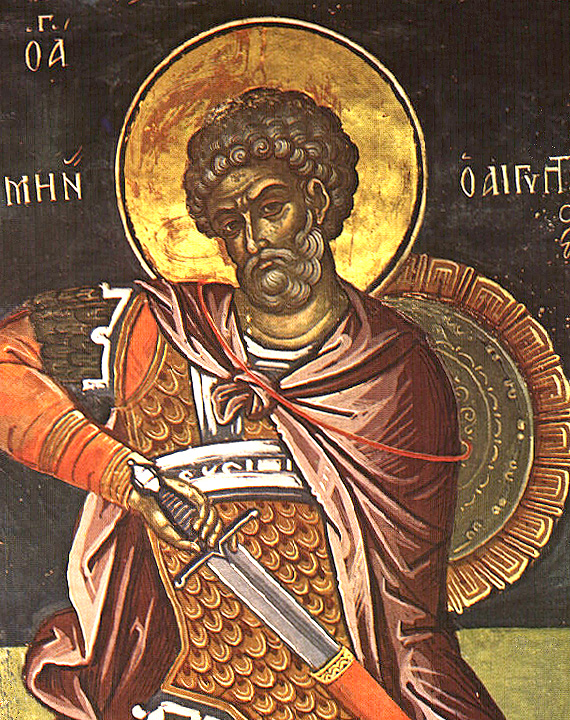
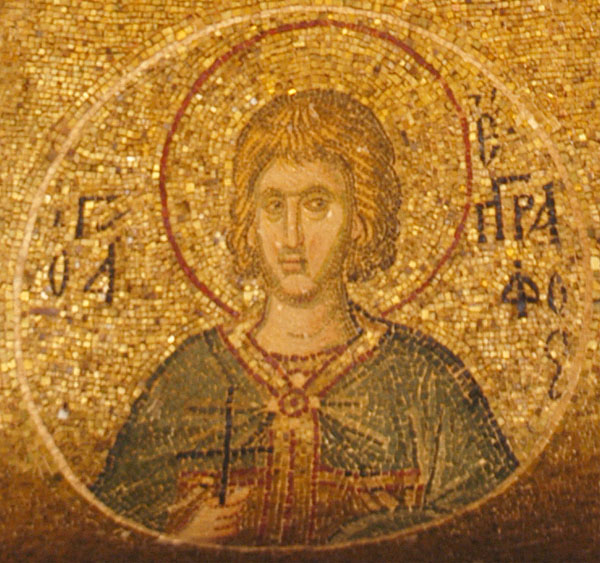
Martyrs Eustratius, Auxentius, Eugene, Mardarius, and Orestes, at Sebaste

The Holy Martyrs Eustratios (Eustrátios), Auxentios (Auxéntios), Eugene, Mardarios (Mardários), and Orestes (the Five Companions) suffered for Christ at Sebaste in Armenia during the reign of Emperor Diocletian (284-305).

Among the first Christians imprisoned and undergoing torture at that time was the presbyterian Saint Auxentios of Syria. One of those who witnessed the steadfastness of the Christians was the noble military commander Saint Eustratios, the city prefect of Satalios, and archivist of the province. He was a secret Christian, and when he confessed his faith openly, he was subjected to torture. He was beaten, and iron sandals studded with sharp nails were placed on his feet, then he was forced to march to the city of Arabrak.

Witnessing the arrival of Saint Eustratios in Arabrak, Saint Mardarios, one of the people in the crowd, confessed that he too was a Christian like Saint Eustratios. He was arrested and cast into prison. Holes were drilled in his ankles, and ropes were passed through them. He was suspended upside down, then heated nails were hammered into his body. He died a short time later. The prayer “O Master Lord God, Father Almighty …” (which is read at the end of the Third Hour), is attributed to him.

As for Saint Eugene, they tore out his tongue, cut off his hands and feet, and then beheaded him with a sword. Saint Auxentios was also arrested and beheaded. The young soldier Saint Orestes confessed himself a Christian and stood trial for this “crime.” He was sentenced to be stretched out upon a red-hot iron bed, and he grew afraid when he approached it. Encouraged by Saint Eustratios, he made the Sign of the Cross and got onto the heated bed, where he surrendered his soul to God.

Saint Eustratios was sentenced to be burnt alive on December 13. As he was being led to his death, he prayed aloud: "I magnify Thee exceedingly, O Lord, for Thou hast regarded my lowliness…” This prayer is still read at the Saturday Midnight Office.

Virgin Martyr Lucy of Syracuse

Saint Lucy was born in Syracuse, Sicily during the reign of Diocletian. She distributed her wealth to the poor, and made a vow of virginity. Since she refused to marry him, a rejected suitor denounced her to the prefect Paschasius as a Christian, and she was arrested. She was sentenced to be defiled in a brothel, but with God’s help she preserved her purity.

Then the pagans attempted to burn her alive, but she was not harmed by the fire. Finally, she was killed by a sword thrust to the throat.

The name Lucy (Lucia) is derived for the Latin word for light (lux), and so she is often invoked for afflictions of the eyes. There is a tradition that she was blinded by her torturers, and the church of San Giovanni Maggiore in Naples even claims to possess her eyes.

Today’s saint should not be confused with Saint Lucy of Campania (July 6).

Venerable Arcadius of Novotorsk

The Venerable Arcadius was born at the beginning of the XI century in the city of Vyazma, and was a member of the Syreishchikov family of merchants, who were distinguished for their fervent piety. From a young age, and loving the Lord with all his heart and soul, he resolved to devote his entire life to His service, and to free his soul from worldly attachments. He was one of the earliest fools for the sake of Christ in Russia, and may have been inspired by reading the Lives of Greek fools such as Saint Symeon of Emesa (July 21) and Saint Andrew of Constantinople (October 2).

These holy fools for Christ tried to live according to the words of Christ: “Do not be anxious for your life, what you shall eat, or what you shall drink, nor for your body, what you shall put on. Is not life more than food, and the body more than clothing?” (Matthew 6:25). The holy fools were also mindful of Saint Paul’s words: “We are fools for Christ, but you are wise in Christ. We are weak, but you are strong. You are held in honor, but we are dishonored. Until the present hour we both hunger and thirst; we are naked and buffeted, and have no fixed abode; we labor with our own hands. When we are reviled, we bless; when persecuted, we endure. When we are maligned, we entreat. We have become as the refuse of the world, the offscouring of all things, until now” (I Corinthians 4:10-13).

During the day, Saint Arcadius concealed his exalted angelic life by foolish behavior, and people mocked his appearance, as well as his child-like simplicity, kindness, and ignorance of the necessities of life. This made him seem strange and incomprehensible to worldly individuals, and his conduct became more unusual with every passing day. At night, however, he devoted his time to prayer, standing atop a stone on a hill in the forest outside of town.

Although the venerable one’s love of solitude helped him to remain unknown for a time, people soon became aware of the Saint’s virtuous life. They noticed that when he prayed in church, his very appearance seemed to change. His face became radiant, and his attention was completely focused on the prayers. Sometimes he would weep, shedding tears of compunction and repentance. It never occurred to anyone who observed him at such times that he might be a madman. Furthermore, his advice always seemed to be good, and his predictions always came to pass. He spoke only rarely, however, preferring to remain silent.

Whenever there was a Cross Procession, Saint Arcadius would take a broom, and for two days ahead of time he swept the streets, starting from the cathedral to the church. In this way he demonstrated that one must have inner purity and keep God’s commandments, especially when preparing for a Church Feast.

At that time, Saint Ephraim of Novotorsk (January 28) would often travel to Kiev to visit the more experienced Elders. Once, on the way from Kiev, he stopped at Vyazma, where he heard about Arcadius. From that moment, the young ascetic became the disciple of Elder Ephraim, who helped him to avoid the spiritual dangers inherent in the difficult and unusual exploit of foolishness for the sake of Christ. Elder Ephraim taught him that being despised by others could lead the mind away from God, because knowing that one was suffering unjustly often leads to pride. Thus, such a way of life could also darken one’s mind and heart, instead of leading one to enlightenment and the renewal of the inner man (2 Corinthians 4:16).

Over time Arcadius strengthened himself by constant spiritual struggles. He joined his Spiritual Father in Novotorsk, where Saint Ephraim tonsured him into the angelic Schema. After this the people of Vyazma witnessed several miracles which were accomplished through the prayers of Blessed Arcadius, but he fled from worldly glory and went to a place along the upper Tvertsa River. Saint Arcadius also participated in founding a church and monastery dedicated to the royal Passion-Bearers Boris and Gleb (May 2).

After moving into the new monastery, Saint Arcadius cut off his own will and obeyed his Spiritual Father, Saint Ephraim, in all things. Saint Arcadius never missed a service; he and his spiritual guide were always the first to come to church for Matins.

After his Elder’s repose, the Venerable Arcadius continued to labor according to his precepts, living a life of prayer, fasting and quietude. When he had lived in the Monastery of Saints Boris and Gleb for several years, he departed peacefully to the Lord on December 13, 1077. His body was buried next to his Spiritual Father, Saint Ephraim.

The inhabitants of Torzhok and the surrounding areas frequently experienced the power of the grace-filled actions of the Venerable Arcadius, and clearly saw in them a sign of God’s favor. Whenever they turned to him with faith and prayer, they always received relief from their illnesses and deliverance from their sorrows through his intercession. The holy monk often appeared to the inhabitants of the city of Vyazma in dreams and visions and delivered them from troubles and sorrows. In their minds there was no doubt concerning his holiness.

The canonization of Saint Arcadius of Novotorsk for local veneration apparently took place around 1584-1587. In Vyazma’s church of the All-Merciful Savior (built in 1594), and a side chapel dedicated to Saint Arcadius was built soon after his glorification.

A combined celebration of Saints Arcadius and Ephraim was established by Metropolitan Dionysius sometime around 1584-1587.

The relics of Saint Arcadius, glorified by miracles of healing, were uncovered on June 11, 1572.

On July 11, 1677, with the blessing of Metropolitan Cornelius of Novgorod and Velikiy Luki, Archimandrite Eustathios of Novotorsk monastery solemnly recovered the incorrupt relics of the Venerable Arcadius of Novotorsk and transferred them to a crypt in Saints Boris and Gleb cathedral at Novotorsk (New Market); and in 1841, the left side chapel of Saints Boris and Gleb cathedral church was dedicated to Saint Arcadius.

On August 14, 1798 the Saint’s holy relics were placed in a stone coffin, which had served as the resting place of Saint Ephraim until 1572.

The solemn celebration of the 300th anniversary of the transfer of the holy relics of Saint Arcadius to the cathedral of Saints Boris and Gleb in 1677 took place in the city of Novotorsk in July of 1977.

On July 21, 2019, a portion of the relics of Saint Arcadius of Novotorsk were presented to the Cathedral church of Saints Boris and Gleb Monastery by Patriarch Kirill of Moscow and All Russia.

Saint Arcadius is also commemorated on August 14 (the day of his blessed repose), July 11 (the transfer of his relics in 1677), and June 11 (the discovery of his relics).

Venerable Mardarios the Recluse of the Kiev Caves

Saint Mardarios (Mardários) the Recluse of the Kiev Caves, lived as an ascetic in the Far Caves of Saint Theodosios during the XIII century, enclosing himself in his cell. There he strove for perfection through prayer, fasting, and obedience. In his Troparion and Kontakion he is described as "non-acquisitive," and according to an inscription over his relics, "without a cell.” He had nothing in his cell except the clothes on his back.

In the Ode 7 of the Service for the Synaxis for the Fathers of the Far Caves (August 28) Saint Mardarios is mentioned along with Saint Ammon (October 4), and he is called a “zealot of poverty.”

Saint Mardarios was buried in the Far Caves. He is also commemorated on August 28, and at the Synaxis of all the Venerable Fathers of the Kiev Caves (movable Feast on the second Sunday of Great Lent).

Venerable Arsenius of Latros

Saint Arsenios lived in Constantinople during the VIII and IX centuries1 and was the son of wealthy, illustrious, and devout parents. He was made Patrician and General of the Kibyrraiote (Κιβυρραιωτῶν)2Military Theme.

Once, while traveling by sea with his soldiers, there was a storm and all the ships sank. Saint Arsenios was the only surviver. Afterward, he became a monk, and mortified his flesh by austere fasting, vigils, and hardships.

Later, he came to a certain place on Mount Latros (in Asia Minor), where he killed a poisonous viper by his prayers and by making the Sign of the Cross. Then he settled in the nearby Kelliboria Monastery (Μονὴ Κελλιβάρων) on the north side of the mountain, where he was chosen as Igoumen. Disturbed by many distractions and by people who wanted to see him, he longed for stillness. Therefore, Saint Arsenios left the Monastery and went to live in a cave, where he drove off the wild beasts with prayer. Saint Arsenios had attained such perfection that he was fed by an Angel. He was also granted the grace of performing miracles. For example, was able to stir bitter water with his staff and change it into sweet water.

The brethren of the Monastery begged him to come back to them. He did return, but not to live with the other monks. He lived alone in a small cell, and for six days of the week he did not eat any food, nor would he converse with anyone. Only on Sundays would he consent to see the brethren and eat with them.

Foreseeing the day of his repose, Saint Arsenios summoned all the monks of the Monastery, and after advising them to put aside all worldly cares and vanities, he went to the Lord in peace.

The Saint continues to work miracles even after his death.


1 Some sources say he reposed in the XI century.

2 The Byzantine Empire was divided into 29 Themes, or districts.

Hieromartyr Gabriel of Serbia

The Holy Patriarch Gabriel was a member of the noble Raich family. In 1655, with the permission of the Turks, he travelled to Vlahὶa and Russia to raise money for the needs of the Serbian Orthodox Church. He also attended a Council in Russia together with the Patriarch of Antioch. This Council was convened by Tsar Alexei in order to correct the Service Books. After receiving generous alms in Russia for Serbia, which at that time was suffering great distress, Patriarch Gabriel returned to his own country.

At that time, he was accused by his representative in Serbia, Maximus the Bulgarian, of insulting the Turkish power. Therefore, when Gabriel returned from Russia, he found Maximus on the archiepiscopal throne, and he took steps to get rid of him. Maximus, however, went before the Sultan and the Vizier, and he repeated his calumnies against Archbishop Gabriel.

Then the Vizier summoned Saint Gabriel from Serbia to Prousa. He convinced the Vizier that all this was slander, but he insisted that the Hierarch must deny Christ in order to receive the honor and dignity befitting his office. He rejected these suggestions, and refused to deny Christ by converting to the Moslem religion.

Therefore, after cruel tortures, he was hanged on December 13. 1659 and went to the Lord, receiving from Him a double crown, that of a Hierarch and of a Martyr.

Saint Gabriel is also commemorated on August 30, the Synaxis of the Serbian Hierarchs.

Daily Readings for Friday, December 12, 2025

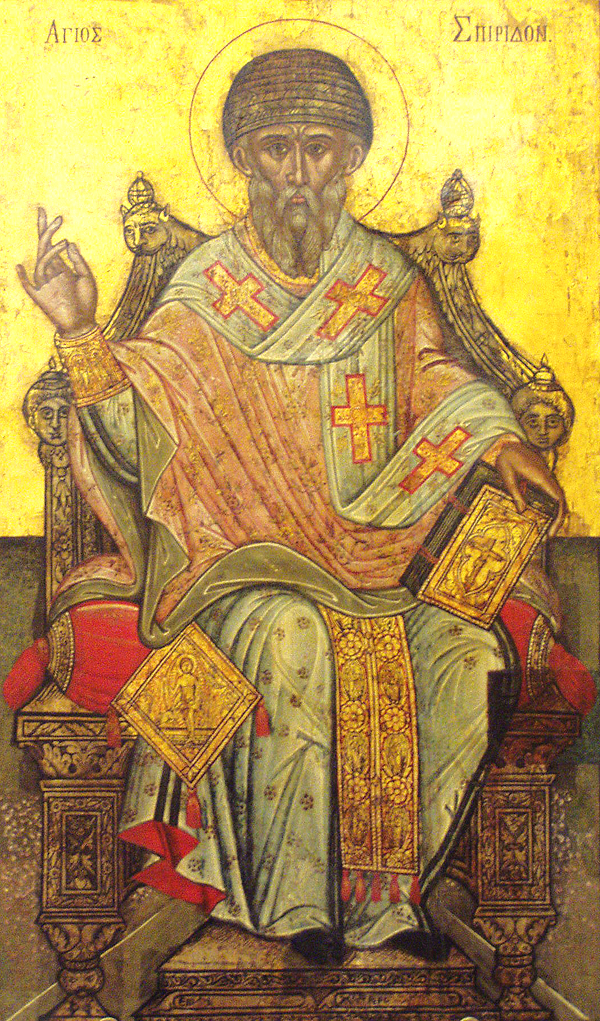
SPYRIDON THE WONDERWORKER OF TRYMITHOUS

ABSTAIN FROM MEAT, FISH, DAIRY, EGGS

Spyridon the Wonderworker of Trymithous, Holy New Martyr Peter the Aleut, John (or Joachim), Bishop of Zichni

ST. PAUL’S LETTER TO THE EPHESIANS 5:8-19

Brethren, walk as children of light (for the fruit of light is found in all that is good and right and true), and try to learn what is pleasing to the Lord. Take no part in the unfruitful works of darkness, but instead expose them. For it is a shame even to speak of the things that they do in secret; but when anything is exposed by the light it becomes visible, for anything that becomes visible is light. Therefore it is said, “Awake, O sleeper, and arise from the dead, and Christ shall give you light.” Look carefully then how you walk, not as unwise men but as wise, making the most of the time, because the days are evil. Therefore do not be foolish, but understand what the will of the Lord is. And do not get drunk with wine, for that is debauchery; but be filled with the Spirit, addressing one another in psalms and hymns and spiritual songs, singing and making melody to the Lord with all your heart.

JOHN 10:9-16

The Lord said, "I am the door; if any one enters by me, he will be saved, and will go in and out and find pasture. The thief comes only to steal and kill and destroy; I came that they may have life, and have it abundantly. I am the good shepherd. The good shepherd lays down his life for the sheep. He who is a hireling and not a shepherd, whose own the sheep are not, sees the wolf coming and leaves the sheep and flees; and the wolf snatches them and scatters them. He flees because he is a hireling and cares nothing for the sheep. I am the good shepherd; I know my own and my own know me, as the Father knows me and I know the Father; and I lay down my life for the sheep. And I have other sheep, that are not of this fold; I must bring them also, and they will heed my voice. So there shall be one flock, one shepherd.

Saint Mardarije (Uskokovic) of Libertyville

No information available at this time.

Saint Spyridon the Wonderworker, Bishop of Tremithus

Saint Spyridon of Tremithus was born towards the end of the third century on the island of Cyprus. He was a shepherd, and had a wife and children. He used all his substance for the needs of his neighbors and the homeless, for which the Lord rewarded him with a gift of wonderworking. He healed those who were incurably sick, and cast out demons.

After the death of his wife, during the reign of Constantine the Great (306-337), he was made Bishop of Tremithus, Cyprus. As a bishop, the saint did not alter his manner of life, but combined pastoral service with deeds of charity.

According to the witness of Church historians, Saint Spyridon participated in the sessions of the First Ecumenical Council in the year 325. At the Council, the saint entered into a dispute with a Greek philosopher who was defending the Arian heresy. The power of Saint Spyridon’s plain, direct speech showed everyone the importance of God’s wisdom before human wisdom: “Listen, philosopher, to what I tell you. There is one God Who created man from dust. He has ordered all things, both visible and invisible, by His Word and His Spirit. The Word is the Son of God, Who came down upon the earth on account of our sins. He was born of a Virgin, He lived among men, and suffered and died for our salvation, and then He arose from the dead, and He has resurrected the human race with Him. We believe that He is one in essence (consubstantial) with the Father, and equal to Him in authority and honor. We believe this without any sly rationalizations, for it is impossible to grasp this mystery by human reason.”

As a result of their discussion, the opponent of Christianity became the saint’s zealous defender and later received holy Baptism. After his conversation with Saint Spyridon, the philosopher turned to his companions and said, “Listen! Until now my rivals have presented their arguments, and I was able to refute their proofs with other proofs. But instead of proofs from reason, the words of this Elder are filled with some sort of special power, and no one can refute them, since it is impossible for man to oppose God. If any of you thinks as I do now, let him believe in Christ and join me in following this man, for God Himself speaks through his lips.”

At this Council, Saint Spyridon displayed the unity of the Holy Trinity in a remarkable way. He took a brick in his hand and squeezed it. At that instant fire shot up from it, water dripped on the ground, and only dust remained in the hands of the wonderworker. “There was only one brick,” Saint Spyridon said, “but it was composed of three elements. In the Holy Trinity there are three Persons, but only one God.”

The saint cared for his flock with great love. Through his prayers, drought was replaced by abundant rains, and incessant rains were replaced by fair weather. Through his prayers the sick were healed and demons cast out.

A woman once came up to him with a dead child in her arms, imploring the intercession of the saint. He prayed, and the infant was restored to life. The mother, overcome with joy, collapsed lifeless. Through the prayers of the saint of God, the mother was restored to life.

Another time, hastening to save his friend, who had been falsely accused and sentenced to death, the saint was hindered on his way by the unanticipated flooding of a stream. The saint commanded the water: “Halt! For the Lord of all the world commands that you permit me to cross so that a man may be saved.” The will of the saint was fulfilled, and he crossed over happily to the other shore. The judge, apprised of the miracle that had occurred, received Saint Spyridon with esteem and set his friend free.

Similar instances are known from the life of the saint. Once, he went into an empty church, and ordered that the lampadas and candles be lit, and then he began the service. When he said, “Peace be unto all,” both he and the deacon heard from above the resounding of a great multitude of voices saying, “And with thy spirit.” This choir was majestic and more sweetly melodious than any human choir. To each petition of the litanies, the invisible choir sang, “Lord, have mercy.” Attracted by the church singing, the people who lived nearby hastened towards it. As they got closer and closer to the church, the wondrous singing filled their ears and gladdened their hearts. But when they entered into the church, they saw no one but the bishop and several church servers, and they no longer heard the singing which had greatly astonished them.

Saint Simeon Metaphrastes (November 9), the author of his Life, likened Saint Spyridon to the Patriarch Abraham in his hospitality. Sozomen, in his Church History, offers an amazing example from the life of the saint of how he received strangers. One time, at the start of the Forty-day Fast, a stranger knocked at his door. Seeing that the traveller was very exhausted, Saint Spyridon said to his daughter, “Wash the feet of this man, so he may recline to dine.” But since it was Lent there were none of the necessary provisions, for the saint “partook of food only on certain days, and on other days he went without food.” His daughter replied that there was no bread or flour in the house. Then Saint Spyridon, apologizing to his guest, ordered his daughter to cook a salted ham from their larder. After seating the stranger at table, he began to eat, urging that man to do the same. When the latter refused, calling himself a Christian, the saint rejoined, “It is not proper to refuse this, for the Word of God proclaims, ‘Unto the pure all things are pure’” (Titus 1:15).

Another historical detail reported by Sozomen, was characteristic of the saint. It was his custom to distribute one part of the gathered harvest to the destitute, and another portion to those having need while in debt. He did not take a portion for himself, but simply showed them the entrance to his storeroom, where each could take as much as was needed, and could later pay it back in the same way, without records or accountings.

There is also the tale by Socrates Scholasticus about how robbers planned to steal the sheep of Saint Spyridon. They broke into the sheepfold at night, but here they found themselves all tied up by some invisible power. When morning came the saint went to his flock, and seeing the tied-up robbers, he prayed and released them. For a long while he advised them to leave their path of iniquity and earn their livelihood by respectable work. Then he made them a gift of a sheep and sending them off, the saint said kindly, “Take this for your trouble, so that you did not spend a sleepless night in vain.”

All the Lives of the saint speak of the amazing simplicity and the gift of wonderworking granted him by God. Through a word of the saint the dead were awakened, the elements of nature tamed, the idols smashed. At one point, a Council had been convened at Alexandria by the Patriarch to discuss what to do about the idols and pagan temples there. Through the prayers of the Fathers of the Council all the idols fell down except one, which was very much revered. It was revealed to the Patriarch in a vision that this idol had to be shattered by Saint Spyridon of Tremithus. Invited by the Council, the saint set sail on a ship, and at the moment the ship touched shore and the saint stepped out on land, the idol in Alexandria with all its offerings turned to dust, which then was reported to the Patriarch and all the bishops.

Saint Spyridon lived his earthly life in righteousness and sanctity, and prayerfully surrendered his soul to the Lord. His relics repose on the island of Corfu (Kerkyra), in a church named after him (His right hand, however, is located in Rome).

His memory is also celebrated on Cheesefare Saturday.

Venerable Therapon, Abbot of Monza

Saint Therapon of Monza was a monk in the monastery of Saint Adrian (May 5) at the River Monza. The monk began his ascetic deeds in Moscow, and then transferred to the city of Kostroma at the Elevation of the Cross monastery, and was tonsured there.

The pious monks Adrian and Paphnutius, from the monastery of Saint Paul of Obnora (January 10), seeking solitude, moved to the Monza and founded a monastery 25 versts from Galich. Saint Therapon transferred to this monastery, where he labored in asceticism until the end of his life. Each day, with the blessing of the igumen, he withdrew into a forest thicket and prayed. By night he read and transcribed copies of spiritually useful books.

In his life he emulated Blessed Basil of Moscow (August 2), whom he called his friend, although personally he never saw him. Even during his life, Saint Therapon was glorified with a gift of wonderworking. Before his death he predicted a year of famine (1601). He surrendered his soul to God in the year 1597. The monastery at the River Monza was called after him the Theraponov.

Hieromartyr Alexander, Bishop of Jerusalem

The Hieromartyr Alexander, Bishop of Jerusalem, was a disciple of the great teacher and writer of the Church, Clement of Alexandria. At the beginning of the third century he was chosen bishop of Flavia, Cappadocia. He was arrested during the reign of the emperor Septimus Severus (193-211) and spent three years in prison.

After his release from prison he went to Jerusalem to venerate the holy places, and was told to remain there through a divine revelation. In 212 he was chosen as coadministrator with the elderly Patriarch Narcissus, an unusually rare occurrence in the ancient Church. Following the death of Saint Narcissus (August 7), Saint Alexander succeeded him and governed the Church of Jerusalem for thirty-eight years, working for the enlightenment of Christians. He also established the first library of Christian theological works at Jerusalem.

Saint Alexander was arrested during the persecution of the Church under the emperor Decius (249-251). The holy martyr was sent to Cappadocia, where he suffered many tortures. He was condemned to be eaten by wild beasts, but they did not harm him. Saint Alexander was cast into prison, where he surrendered his soul to God.

The hieromartyr Alexander is also commemorated on May 16.

Martyr Synetus of Rome

The Holy Martyr Synetus (the name is derived from the Greek word meaning “man of reason”) was a Roman by birth, and was a reader in the Roman Church under Pope Sixtus (257-258). He was subjected to torture, and was beheaded for his brave confession of faith in the time of the emperor Aurelian (270-275).

Martyr John, Abbot of the Zedazeni Monastery

The life of the holy martyr John, Abbot of Zedazeni Monastery, has not been preserved, but the list recalling “the names of the holy fathers who reposed at Zedazeni Monastery after John of Zedazeni,” which was compiled by Catholicos Arsenius II, tells us that Abbot John was “murdered at Zedazeni by Muslims.” Saint John was martyred in the 9th century.

Daily Readings for Thursday, December 11, 2025

THURSDAY OF THE 12TH WEEK

ABSTAIN FROM MEAT, DAIRY, EGGS

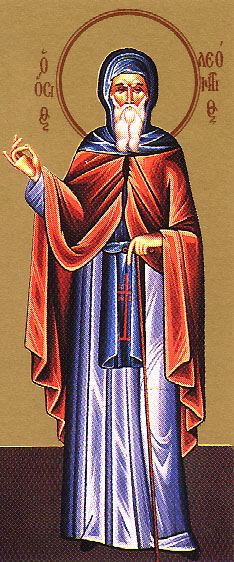
Daniel the Stylite of Constantinople, Luke the New Stylite of Chalcedon, Martyrs Acepsius and Aeithalas, Holy Martyrs Miracus and Barsabas, Leontios the Righteous of Monemvasia, The Glorious King Nikephoros Phokas

ST. PAUL’S FIRST LETTER TO TIMOTHY 6:17-21

Timothy, my son, charge the rich in this world not to be haughty, nor to set their hopes on uncertain riches but on God who richly furnishes us with everything to enjoy. They are to do good, to be rich in good deeds, liberal and generous, thus laying up for themselves a good foundation for the future, so that they may take hold of the life which is life indeed. O Timothy, guard what has been entrusted to you. Avoid the godless chatter and contradictions of what is falsely called knowledge, for by professing it some have missed the mark as regards the faith. Grace be with you. Amen.

LUKE 21:28-33

The Lord said to his disciples, "Look up and raise your heads, because your redemption is drawing near." And he told them a parable: "Look at the fig tree, and all the trees; as soon as they come out in leaf, you see for yourselves and know that the summer is already near. So also, when you see these things taking place, you know that the kingdom of God is near. Truly, I say to you, this generation will not pass away till all has taken place. Heaven and earth will pass away, but my words will not pass away.

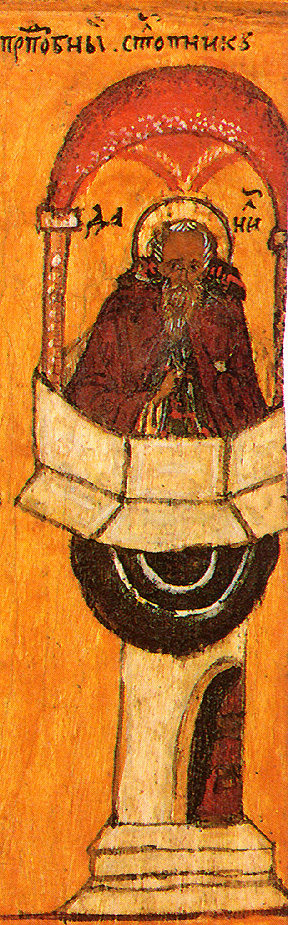
Venerable Daniel the Stylite of Constantinople

Saint Daniel the Stylite was born in the village of Bethara, near the city of Samosata in Mesopotamia. His mother Martha was childless for a long while and in her prayers she vowed that if she had a child, she would dedicate him to the Lord. Her prayers were heard, and Martha soon gave birth to a son, who was without a name until he was five years of age.

The boy’s parents desired that since he was born through the good-will of God, he should also receive his name from God. They took their son to a monastery located nearby and approached the igumen. The igumen gave orders to take down one of the service books, and unrolled it at random. He found the Prophet Daniel (December 17) mentioned in it. Thus did the boy receive his name. The parents asked that he might remain at the monastery, but the igumen would not accept him, since he was still only a small boy. At twelve years of age, saying nothing to anyone, the child left home for the monastery.

His parents were happy when they learned where their son was, and they went to the monastery. Seeing that he was still going about in his worldly clothes, they besought that the igumen should clothe him in the angelic garb. That Sunday the igumen fulfilled their request, but permitted them often to visit their son. The brethren of the monastery were astonished at the saint’s ascetical efforts.

Once, Saint Simeon the Stylite (September 1) visited the monastery. He foretold to the young monk that he too would undertake the feat of pillar-dwelling. Saint Daniel continued with his ascetic life in seclusion. When the place of a new exploit was revealed to him in a vision, he withdrew into the Thracian wilderness together with two disciples. They set up a pillar, upon which Saint Daniel dwelt for 33 years. People thronged to the pillar, the unfortunate and those who were sick, and all received help and healing from Saint Daniel. Byzantine emperors also sought the prayers of the holy ascetic. The most notable of the saint’s predictions was about a great fire in Constantinople. Saint Daniel possessed also the gift of gracious words. He guided many onto the path of correcting their lives. The monk reposed in his eightieth year.

Venerable Nikon the Dry, of the Kiev Near Caves

Saint Nikon the Dry, the son of rich and illustrious parents, gave up everything for Christ and became a monk at the Kiev Caves monastery. In the year 1096, during the incursions of Khan Bonyak, he was taken into captivity with some other monks. The captors treated Saint Nikon harshly, while waiting for a ransom to be paid. When the saint refused to be ransomed, his masters began to torment him with hunger, and left him exposed in the heat of summer and the cold of winter. He was mistreated and beaten every day for about three years, for his captors thought he would change his mind and send word to his relatives, asking to be ransomed.

The saint gave thanks to God for everything, and once said to his tormentor that the Lord, through the prayers of Saints Anthony and Theodosius would return him to his monastery within three days, as Saint Eustratius (March 28) had predicted while appearing to him.

The captor cut the tendons in Saint Nikon’s legs and set a strong guard over him. But suddenly, on the third day at the sixth hour, the holy captive became invisible. At the moment the guard heard the words, “Praise the Lord from the Heavens” (Ps. 148).

Saint Nikon was transported to the Dormition church, where the Divine Liturgy was being served. The brethren surrounded him and began to ask how he got there. Saint Nikon wanted to conceal the miracle, but the brethren implored him to tell the truth.

Saint Nikon did not want to have his fetters removed, but the igumen said, “If the Lord had wanted you to remain fettered, He would not have delivered you from captivity.”

After a long while Saint Nikon’s former master came to the Kiev Caves monastery and recognized his former captive, who was withered from hunger and the loss of blood from his wounds. He came to believe in Christ, and accepted Baptism. After receiving monastic tonsure, he became a novice under Saint Nikon’s direction.

Saint Nikon died at the beginning of the twelfth century and was buried in the Near Caves. Though he did not enjoy good health in this life, his holy relics were glorified by incorruption. His memory is celebrated also on September 28 and on the second Sunday of Great Lent.

Martyr Mirax of Egypt

The Holy Martyr Mirax was born into a Christian family living in the city of Tanis (Egypt) during the seventh century. He was raised in piety, but yielded to demonic temptation and trampled on a cross. He went to the Emir, the ruler of Egypt, and taking his sword in hand, he declared himself a Moslem.

His parents, grieving over the terrible downfall of their son, incessantly prayed for him. And then the grace of God illumined the heart of the prodigal. He deeply repented and returned home. His parents counselled him to acknowledge his fall into darkness and to show his repentance. Saint Mirax obeyed them. He went before the Emir and announced that he had become a Christian once more. The ruler condemned him to tortures, after which the saint was beheaded and cast into the sea (this occurred around the year 640).

Martyrs Akepsimas and Aithalas of Egypt

The Holy Martyrs Akepsimas and Aithalas were from Persia. Akepsimas was a pagan priest in the city of Arbel. Having received healing through the prayers of a Christian bishop, he was converted to the faith in Christ and boldly confessed it. For this they threw Saint Akepsimas into prison.

Soon after, Saint Aithalas, a deacon of the Arbel Church, was imprisoned with him. They brought the martyrs before the ruler, where they again confessed their faith and were beheaded.

Venerable Luke the New Stylite of Chalcedon

Saint Luke the New Stylite was a soldier under the Byzantine emperor Constantine Porphyrogenitos (912-959). During a war with Bulgaria (917), Saint Luke remained unharmed through the Providence of God. After this he became a monk, and having succeeded in his efforts, was ordained as a presbyter. Striving for an even higher degree of perfection, the monk put chains upon himself and ascended a pillar.

After three years standing on the pillar, through divine inspiration, he went to Mount Olympos, and then to Constantinople, and finally to Chalcedon, where he chose a pillar upon which he remained for 45 years, manifesting a gift of wonderworking. He died in about the year 980.

Synaxis of the Saints of Georgia

Having examined the history of Georgia and the hagiographical treasures attesting to the faith of the Georgian nation, we become convinced that Heavenly Georgia— the legion of Georgian saints, extolling the Lord in the Heavenly Kingdom with a single voice—is infinitely glorious. It is unknown how many cleansed themselves of their earthly sins in merciless warfare with the enemy of Christ, or how many purified their souls in unheated cells through prayer, fasting, and ascetic labors.

To God alone are known the names of those ascetics, forgotten by history, who by their humble labors tirelessly forged the future of the Georgian Church and people.

St. George of the Holy Mountain wrote: “From the time we recognized the one true God, we have never renounced Him, nor have our people ever yielded to heresy.”

A decree of the Church Council of Ruisi-Urbnisi states: “We will not depart from thee, the Catholic Church which bore us in holiness, nor will we betray thee, our pride—Orthodoxy—to which we have always been faithful, for we have been granted the honor to know thee, the witness of the Truth Itself!” This relationship to Orthodoxy is the cornerstone of the life of every Georgian believer.

It is impossible to count the names of all those Christians who have been raised up from the earthly Church in Georgia to the heavens, let alone to describe all the godly deeds they have performed. For this reason December 11 has been set aside for the commemoration not only of the saints whose Lives are known to us but also of the nearly three hundred more whose names, but not stories, have been preserved as well.

Most Georgian people bear the name of a saint who is commemorated on this day, and they entreat the saint to intercede before the Lord in their behalf.

Daily Readings for Wednesday, December 10, 2025

WEDNESDAY OF THE 12TH WEEK

ABSTAIN FROM MEAT, FISH, DAIRY, EGGS, WINE, OLIVE OIL

Menas, Hermogenes, & Eugraphos, Martyrs of Alexandria, Thomas the Righteous of Bithynia

ST. PAUL’S FIRST LETTER TO TIMOTHY 5:22-25; 6:1-11

Timothy, my son, do not be hasty in the laying on of hands, nor participate in another man’s sins; keep yourself pure. No longer drink only water, but use a little wine for the sake of your stomach and your frequent ailments. The sins of some men are conspicuous, pointing to judgment, but the sins of others appear later. So also good deeds are conspicuous; and even when they are not, they cannot remain hidden. Let all who are under the yoke of slavery regard their masters as worthy of all honor, so that the name of God and the teaching may not be defamed. Those who have believing masters must not be disrespectful on the ground that they are brethren; rather they must serve all the better since those who benefit by their service are believers and beloved. Teach and urge these duties. If any one teaches otherwise and does not agree with the sound words of our Lord Jesus Christ and the teaching which accords with godliness, he is puffed up with conceit, he knows nothing; he has a morbid craving for controversy and for disputes about words, which produce envy, dissension, slander, base suspicions, and wrangling among men who are depraved in mind and bereft of the truth, imagining that godliness is a means of gain. There is great gain in godliness with contentment; for we brought nothing into the world, and we cannot take anything out of the world; but if we have food and clothing, with these we shall be content. But those who desire to be rich fall into temptation, into a snare, into many senseless and hurtful desires that plunge men into ruin and destruction. For the love of money is the root of all evils; it is through this craving that some have wandered away from the faith and pierced their hearts with many pangs. But as for you, man of God, shun all this.

LUKE 21:5-8, 10-11, 20-24

At that time, as some spoke to Jesus of the temple, how it was adorned with noble stones and offerings, he said, "As for these things, which you see, the days will come when there shall not be left here one stone upon another that will not be thrown down." And they asked him, "Teacher, when will this be, and what will be the sign when this is about to take place?" And he said, "Take heed that you are not led astray; for many will come in my name, saying, 'I am he!' and, 'The time is at hand!' Do not go after them. And when you hear of wars and tumults, do not be terrified; for this must first take place, but the end will not be at once.
Then he said to them, "Nation will rise against nation, and kingdom against kingdom; there will be great earthquakes, and in various places famines and pestilences; and there will be terrors and great signs from heaven.
But when you see Jerusalem surrounded by armies, then know that its desolation has come near. Then let those who are in Judea flee to the mountains, and let those who are inside the city depart, and let not those who are out in the country enter it; for these are days of vengeance, to fulfill all that is written. Alas for those who are with child and for those who give suck in those days! For great distress shall be upon the earth and wrath upon this people; they will fall by the edge of the sword, and be led captive among all nations; and Jerusalem will be trodden down by the Gentiles, until the times of the Gentiles are fulfilled.

Martyrs Menas, Hermogenes, and Eugraphus, of Alexandria

The Holy Martyrs Menas, Hermogenes, and Eugraphus suffered for their faith in Christ under the emperor Maximian (305-313).

Saint Menas was sent by the emperor from Athens to Alexandria to suppress the riots that had arisen between the Christians and the pagans. Distinguished for his gift of eloquence, Menas instead openly began to preach the Christian Faith and he converted many pagans to Christ. Learning of this, Maximian sent Hermogenes to Alexandria to place the saints on trial. Moreover, he gave orders to purge the city of Christians.

hermogenes
Martyr Hermogenes

Hermogenes, although he was a pagan, was distinguished by his reverent bearing. And struck by the endurance of Saint Menas under torture and by his miraculous healing after the cruel torments, he also came to believe in Christ. Maximian himself then arrived in Alexandria. Neither the astonishing stoic endurance of Saints Menas and Hermogenes under torture, nor even the miracles manifested by God in this city, mollified the emperor. Instead, they vexed him all the more. The emperor personally stabbed Saint Eugraphus, the secretary of Saint Menas, who had declared himself a Christian upon witnessing the endurance of Saints Menas and Hermogenes; and then gave orders to behead the holy Martyrs Menas and Hermogenes.

eugraphos
Martyr Eugraphus

The relics of the holy martyrs, cast into the sea in an iron chest, were afterwards found (see February 17) and transferred to Constantinople in the ninth century. The emperor Justinian built a church in the name of the holy Martyr Menas of Alexandria. Saint Joseph the Hymnographer (April 4) composed a Canon in honor of these holy martyrs.

Saint Joasaph, Bishop of Belgorod

Saint Joasaph was born at Proluka, in the former Poltava governance, on September 8, 1705, the Feast of the Nativity of the Most Holy Theotokos. He was descended from the old and venerable Little Russian (Ukrainian) lineage of the Gorlenkovi. At Baptism he was named Joachim.

In 1712, his father enrolled the seven-year-old Joachim in the Kiev Spiritual Academy. Within the walls of the academy he felt attracted to monastic life. For seven years he studied it further, and finally revealed his intention to his parents.

For a long time his mother and father pleaded with their first-born son not to accept monastic tonsure. But in 1725, unknown to them, he became a “rasophore” (“robe-wearing novice”) with the name Hilarion at the Kiev Mezhigorsk monastery, and on 21 November 1727 he was tonsured in the mantya with the name Joasaph at the Kievo-Bratsk monastery. This event coincided with the completion of his studies at the spiritual academy.

After the death of His Grace Barlaam, the See of Kiev was governed by Archbishop Raphael Zaborovsky. Archbishop Raphael noticed the abilities of the young ascetic and assigned him to greater service to the Church. He was entrusted with the responsibility of the office of examiner of the Kiev archbishopric.

In November 1734, Archbishop Raphael ordained the hierodeacon Joasaph as hieromonk, and he was transferred from the Bratsk monastery school to the Kiev-Sophia archbishop’s house. At the same time, he was appointed a member of the Kiev religious consistory.

In fulfilling the office of examiner, he exerted much effort towards the correction of moral deficiencies among the parish clergy. The saint’s service in the consistory office enabled him to develop his administrative abilities. During this time, he made a good study of the needs of clergy-servers, noting both the good points and the failings of the diocese. His talent for administration was combined with his great spiritual effort. He quickly ascended the ladder of spiritual perfection, which can be seen in his work, “The Conflict of the Seven Venerable Virtues with the Seven Deadly Sins.”

On June 24, 1737 Hieromonk Joasaph was appointed head of the Holy Transfiguration Mgarsk monastery, and elevated to the rank of igumen. Here he worked with all his strength to put the monastery in good order, for it was an old bastion of Orthodoxy in the struggle with the Unia. In this monastery were relics of Saint Athanasius, Patriarch of Constantinople and Wonderworker of Lubny (May 2). Several times Saint Athanasius appeared to Igumen Joasaph, as a sign of his patronal protection.

In 1744 Metropolitan Raphael elevated Igumen Joasaph to the dignity of archimandrite. Towards the end of that same year he was called to Moscow and soon, at the direction of the Most Holy Synod, he was appointed vicar of the Holy Trinity Sergiev Lavra monastery. At this monastery of Saint Sergius he also unstintingly fulfilled obedience to the Church (this year required much exertion for the rebuilding of the monastery after a fire).

On June 2, 1748 at the Peter and Paul cathedral in Peterburg, Archimandrite Joasaph was ordained Bishop of Belgorod. Ascending the archbishop’s throne, Saint Joasaph strictly concerned himself with piety and the condition of the churches, with the proper celebration of divine services, and especially with the moral condition of his flock.

The saint devoted great attention to the education of the clergy, and the correct observance of churchly norms and traditions. Just as before, the saint worked with all his strength in his archpastoral service, without regard for his health.

On the eve of his repose, the saint forbade his cell attendant Stephen to aspire to the priesthood, and he predicted that if he did not obey him, he would meet with an untimely end. To another cell attendant Basil, the saint indicated that he would be a deacon, but would never become a priest. Later, this prediction was fulfilled. Saint Joasaph died on December 10, 1754, and was glorified on September 4, 1911.

Martyr Gemellus of Paphlagonia

The Holy Martyr Gemellus of Paphlagonia was subjected to cruel tortures for his staunch denunciation of the emperor Julian the Apostate (361-363) in the city of Ancyra (Galatia). A red-hot iron belt was placed around his waist. Then he was ordered to accompany the impious Julian on his journey. When they reached Edessa in Mesopotamia, he was stretched out on the ground and his limbs were pierced with wooden stakes. Then he was hung on a post and mutilated.

Enduring the tortures, the saint continued to revile the emperor. After being subjected to even more horrible torments, they let him go. He was still able to walk and speak, so he went on his way until he met a priest. He entreated the priest to baptize him, and when he emerged from the water, his wounds were all healed.

Hearing of this miracle, Julian ordered that Saint Gemellus be crucified. The victorious athlete of Christ gave up his soul to God, and his body was secretly taken down and buried by Christians.

Venerable Thomas of Bithynia

Saint Thomas Dephourkinos was born in Bithynia. From his youth he was fond of monastic life and entered one of the area monasteries. Later in his life, when the Byzantine official Galoliktos had founded a monastery at the River Sagarisa, Saint Thomas was already an experienced monk, and the brethren chose him as head of the new monastery.

From there Saint Thomas withdrew into the wilderness, where for a long time he labored in solitude. The monk overcame many snares of the devil in the wilderness. The Lord glorified him with the gift of healing and prophecy.

Once, the emperor Leo the Wise (886-911) came to the monastery to Saint Thomas for advice. Not finding the monk at the monastery, the emperor sent his messenger with a letter for him. And just as the messenger arrived at the the Elder’s hut, the saint carried out to him a sealed answer, resolving the emperor’s question. It is not known when Saint Thomas reposed.

Righteous King John of Serbia, and his parents Righteous Stephen, Despot of Serbia, and Venerable
Angelina of Serbia

Saint Stephen Brankovic (Branković) (October 9 and December 10), the Despot of Serbia, was born in 1417, and belonged to the Branković dynasty. In 1441 he was blinded by order of the Ottoman Sultan Murad II, and so when his father died in 1456, he could not claim the throne; so his younger brother Lazarus became the new Despot.

After the capture of Serbia by the Turks in 1457, Stephen's middle son (then ruler of Serbia) who was distinguished by his gentle disposition and excellent knowledge of the Holy Scriptures, went to the Turkish capital after his sister, who was given to Sultan Murat as a wife. Learning that the Turks had burned down the Mileshevsky Monastery with fanatical cruelty, Blessed Stephen stood up to defend Serbia from its conquerors.

In 1458, Lazarus died without leaving a male heir. The country was ruled by a triumvirate of regents: Stephen Brankovic, the widow Elena Palaiologίna, and Michael Angelovic (Angelović), the governor of Raska (Raška). The supporters of the Turks at the Serbian court proclaimed the voivode Michael Angelovic (whose brother was the vizier of Mehmed II) as the new Despot, but the population of the Serbian capital Smederevo, with the support of a pro-Hungarian party, prevented this coup. Michael Angelovic was imprisoned, and the blind Stephen Brankovic became the ruler.

Then, on the initiative of the Hungarian and Bosnian kings, the son of the Bosnian king, Stephen Tomasevic (Tomašević), was invited to Smederevo, and was supposed to marry the daughter of the late ruler Elena, and assume the title of Despot. The wedding took place on March 21, 1459, and Stephen Tomašević ascended the Serbian throne.

After his deposition from the throne, Blessed Stephen the Blind lived in Buda for some time (his younger sister Katherine was the widow of the Hungarian nobleman Ulrik Tsilley), then in Dubrovnik. Then he went to Albania to the ruler of the principality of Kastrioti Skanderbeg, where in 1460 he married Saint Angelina (July 30 and August 12), the daughter of the Albanian prince George Arianiti. When he married Angelina, the Turks threatened Blessed Stephen and his family. He was forced to go into hiding with his wife and three children, first in Albania and then in Italy.

Blessed Stephen spent the rest of his life in Venice, and reposed in 1476. Blessed Angelina transferred her husband's incorrupt body to Kupinovo. At the end of the XV century, the ruler of Serbia was Blessed John, the son of Righteous Stephen and Angelina. The relics of Righteous John and his parents were later glorified by many signs.

Venerable Leontios of Achaia

Saint Leontios (Leóntios) was born in Monemvasia in the Pelopónnēsos. His parents were Andrew and Theodora, and he received the name Leon at his Baptism. His father was sufficiently wealthy and a prominent man.

Emperor Andronikos II Palaiológos (1283 – 1328) gave him an important position in the central administration of the Moriᾶ. Therefore Leon received much attention from his parents and studied foreign languages, philosophy, and theology at Constantinople. When his father died, Leon returned to Monemvasia and took care of his mother. Then his mother retired to a monastery and, with her blessing, Leon got married.

He was a model husband, the head of his family, and a good worker. But then he faced some great trials. First his wife died, and then his children. So he decided to become a monk. He was tonsured with the name Leontios, and went to live with an experienced ascetic named Menides, and remained close to him for a long time.

Later he went to the Holy Mountain, where he acquired greater experience and returned to the Pelopónnēsos. He chose to live on a mountain close to Aigialeia, and he went to the cities of Achaia, preaching the Word of God. Nearby there were other zealots of the angelic life. Later, many of them excelled as members of the clergy.

Saint Leontios reposed peacefully and his reputation endured after his death. The brothers Thomas and Anthony Palaiológos built a monastery in honor of the Saint in the place of his ascetical contests, and dedicated it to the Archangel Michael.

In Greek usage Saint Leontios is commemorated on December 11. Most of his Holy Relics are located in the Monastery of the Archangels at Aigialeia.

Daily Readings for Tuesday, December 09, 2025

THE CONCEPTION BY ST. ANNA OF THE MOST HOLY THEOTOKOS

ABSTAIN FROM MEAT, DAIRY, EGGS

The Conception by St. Anna of the Most Holy Theotokos, Hannah the Righteous, mother of Samuel the Prophet, Narses the Martyr of Persia, The Consecration of the Church of the Resurrection (Holy Sepulchre) in the Holy City of Jerusalem

ST. PAUL’S LETTER TO THE GALATIANS 4:22-27

Brethren, Abraham had two sons, one by a slave and one by a free woman. But the son of the slave was born according to the flesh, the son of the free woman through promise. Now this is an allegory: these women are two covenants. One is from Mount Sinai, bearing children for slavery; she is Hagar. Now Hagar is Mount Sinai in Arabia; she corresponds to the present Jerusalem, for she is in slavery with her children. But the Jerusalem above is free, and she is our mother. For it is written, “Rejoice, O barren one who does not bear; break forth and shout, you who are not in travail; for the children of the desolate one are many more than the children of her that is married.”

LUKE 8:16-21

The Lord said, "No one after lighting a lamp covers it with a vessel, or puts it under a bed, but puts it on a stand, that those who enter may see the light. For nothing is hid that shall not be made manifest, nor anything secret that shall not be known and come to light. Take heed then how you hear; for to him who has will more be given, and from him who has not, even what he thinks that he has will be taken away.
Then his mother and his brothers came to him, but they could not reach him for the crowd. And he was told, "Your mother and your brothers are standing outside, desiring to see you." But he said to them, "My mother and my brothers are those who hear the word of God and do it.

Conception of the Most Holy Theotokos by Saint Anna

The Gospels and other books of the New Testament do not mention anything about Saint Anna, the mother of the Theotokos. According to Tradition, the priest Matthan (Matthew 1:15), a resident of Bethlehem, had three daughters: Mary,1 Sobe (Sobḗ), and Anna. Mary was married in Bethlehem, where she gave birth to Elizabeth, the mother of Saint John the Baptist.

The Holy Righteous Anna was the youngest daughter of the priest Matthan, who was from the tribe of Levi, of the family of Aaron. Her husband, the Holy Righteous Joachim was from the tribe of Judah, from the house and family of King David. According to the ancient promise, the Messiah was to come from the lineage of King David (Luke 2:4).

The couple lived in Nazareth of Galilee. Every year, they gave two-thirds of their income to the Temple in Jerusalem, and to the poor. By God's Providence, the holy couple had no children until their old age. They were greatly saddened by this, since the Jews considered childlessness a great misfortune and a punishment from God. They prayed fervently for the Lord to give them children.

On a certain feast, when the Israelites were bringing gifts to God in the Temple at Jerusalem, the High Priest, believing that the childless Joachim did not have God's blessing, refused to accept gifts from him. Saint Joachim was grief stricken. He consulted the genealogy of the twelve tribes of Israel and ascertained that all righteous men had offspring, including Abraham, when he was a hundred years old. Without returning home, Saint Joachim went into the wilderness and spent forty days there in strict fasting and prayer, entreating God's mercy for himself, and washing away his disgrace with bitter tears.

Saint Anna thought that she was to blame for their sorrow. One day saw a nest with barely fledged chicks in the branches of a laurel tree, she wept and prayed for the gift of a child, promising to bring the infant to God as an offering. As soon as Saint Anna spoke these words, an Angel of the Lord told her that her prayer had been answered, and revealed that she would have a daughter named Mary, through whom all the peoples of the world would be blessed. Rejoicing, Saint Anna hastened to the Temple in Jerusalem, in order to give thanks to God. She repeated her vow to dedicate the child to Him. An Angel came to Saint Joachim in the wilderness with the same news and commanded him to go to Jerusalem. There, the Righteous Anna conceived and gave birth to the Most Holy Theotokos.

The Orthodox Church does not accept the teaching that the Mother of God was exempted from the consequences of ancestral sin (death, corruption, sin, etc.) at the moment of her conception by virtue of the future merits of her Son. Only Christ was born perfectly holy and sinless, as Saint Ambrose of Milan teaches in Chapter Two of his Commentary on the Gospel of Saint Luke. The Holy Virgin was like everyone else in her mortality, and in being subject to temptation, although she committed no personal sins. She was not a deified creature removed from the rest of humanity. If this were the case, She would not have been truly human, and the nature that Christ took from her would not have been truly human either. If Christ does not truly share our human nature, then the possibility of our salvation is in doubt.

Saint Anna has been honored since ancient times. We infer this from various Fathers of the Church, and also from ancient hymns in honor of the mother of the Theotokos. In the year 550, Emperor Justinian dedicated a temple in Constantinople to Saint Anna.

Part of the Saint's left hand is located in Stavronikita Monastery on Mount Athos. Part of the Saint's incorrupt left foot is located in Saint Anna's Skete on Mount Athos. Part of the Saint's incorrupt right foot is located in the Monastery of Koutloumousiou on Mount Athos.

Fragments of the Saint's Holy Relics are to be found in Saint Anna's Monastery at Lygaria in Lamia, and also in the Monastery of Saint John the Theologian at Sourotis.

Some of the Saint's incorrupt flesh is in the Roman Catholic International Crusaders Collection of Holy Relics. The Saint's wrist is to be found in the Roman Catholic church of Saint Paul "Outside the Walls" in Rome.

Many icons of the Conception by Saint Anna show the Most Holy Theotokos trampling the serpent underfoot. Saints Joachim and Anna are usually depicted with hands folded in prayer; their eyes are also directed upward and they contemplate the Mother of God, who stands in the air with outstretched hands; under her feet is an orb encircled by a serpent (symbolizing the devil), which strives to conquer the universe by its power.”

There are also icons in which Saint Anna holds the Most Holy Virgin on her left arm as an infant. On Saint Anna’s face is a look of reverence. A large ancient icon, painted on canvas, is located in the village of Minkovetsa in the Dubensk district of Volhynia Diocese. From ancient times this Feast was especially venerated by pregnant women in Russia.


1 This Mary is the mother of Saint Anna, and the grandmother of the Theotokos. She is commemorated on the Sunday of the Forefathers.

Prophetess Hannah the mother of the Prophet Samuel

The Holy Prophetess Hannah dwelt in marriage with Elkanah, but she was childless. Elkanah took to himself another wife, Phennena, who bore him children. Hannah grieved strongly over her misfortune, and every day she prayed for an end to her barrenness, and vowed to dedicate her child to God.

Once, as she prayed fervently in the Temple, the priest Heli thought that she was drunk, and he began to reproach her. But the saint poured out her grief, and after she received a blessing, she returned home. After this Hannah conceived and gave birth to a son, whom she named Samuel (which means “Asked from God”).

When the child reached the age of boyhood, the mother herself presented him to the priest Heli, and Samuel remained with him to serve before the Tabernacle (1 Kings/1 Samuel 2: 1-21).

Saint Sophronius, Archbishop of Cyprus

Saint Sophronius, Archbishop of Cyprus, was born into a Christian family on Cyprus, and he studied many sciences, but most of all he devoted himself to the reading of Holy Scripture. He became so accomplished in piety and good works, that he was granted the gift of wonderworking by the Lord. Following the death of Saint Damian, bishop of Cyprus, Saint Sophronius was chosen to replace him. As bishop, he proved himself a true father to his flock.

Saint Stephen the “New Light” of Constantinople

Saint Stephen the “New Light” was born at Constantinople in 838 and received a fine education. Under Patriarch Methodius, Stephen received monastic tonsure and shut himself in a cell attached to the church of Saint Peter in Constantinople. Later he went into seclusion, and over fifty years he constantly increased his ascetic efforts.

Toward the end of his life the saint acquired great grace from the Lord, shining in the constellation of the saints like the ancient ascetics of the Orthodox Church, so that he came to be called the “New Light.” According to the Prologue, he died in the year 912 and was buried in the church of Saint Antipas.

“Unexpected Joy” Icon of the Mother of God

The “Unexpected Joy” Icon of the Most Holy Theotokos is painted in this way: in a room is an icon of the Mother of God, and beneath it a youth is kneeling at prayer. The tradition about the healing of some youth from a bodily affliction through this holy icon is recorded in the book of Saint Demetrius of Rostov, The Fleece of Prayer [See Judges 6: 36-40].

The sinful youth, who was nevertheless devoted to the Theotokos, was praying one day before the icon of the All-Pure Virgin before going out to commit a sin. Suddenly, he saw that wounds appeared on the Lord’s hands, feet, and side, and blood flowed from them. In horror he exclaimed, “O Lady, who has done this?” The Mother of God replied, “You and other sinners, because of your sins, crucify My Son anew.” Only then did he realize how great was the depth of his sinfulness. For a long time he prayed with tears to the All-Pure Mother of God and the Savior for mercy. Finally, he received the unexpected joy of the forgiveness of his sins.

The “Unexpected Joy” icon is also commemorated on January 25 and May 1.

Hieromonk Anthimus the Athonite, “Fool for Christ”

No information available at this time

Daily Readings for Monday, December 08, 2025

MONDAY OF THE 12TH WEEK

ABSTAIN FROM MEAT, DAIRY, EGGS

Forefeast of the Conception by St. Anna of the Most Holy Theotokos, Patapius the Righteous of Thebes, Sosthenes, Apollo, Cephas, Tychikos, Epaphroditos, Caesar, & Onesiphoros, Apostles of the 70

ST. PAUL’S FIRST LETTER TO TIMOTHY 5:1-10

Timothy, my son, do not rebuke an older man but exhort him as you would a father; treat younger men like brothers, older women like mothers, younger women like sisters, in all purity. Honor widows who are real widows. If a widow has children or grandchildren, let them first learn their religious duty to their own family and make some return to their parents; for this is acceptable in the sight of God. She who is a real widow, and is left all alone, has set her hope on God and continues in supplications and prayers night and day; whereas she who is self-indulgent is dead even while she lives. Command this, so that they may be without reproach. If any one does not provide for his relatives, and especially for his own family, he has disowned the faith and is worse than an unbeliever. Let a widow be enrolled if she is not less than sixty years of age, having been the wife of one husband; and she must be well attested for her good deeds, as one who has brought up children, shown hospitality, washed the feet of the saints, relieved the afflicted, and devoted herself to doing good in every way.

LUKE 20:27-44

At that time, there came to Jesus some Sadducees, those who say that there is no resurrection, and they asked him a question, saying, "Teacher, Moses wrote for us that if a man's brother dies, having a wife but no children, the man must take the wife and raise up children for his brother. Now there were seven brothers; the first took a wife, and died without children; and the second and the third took her, and likewise all seven left no children and died. Afterward the woman also died. In the resurrection, therefore, whose wife will the woman be? For the seven had her as wife." And Jesus said to them, "The sons of this age marry and are given in marriage; but those who are accounted worthy to attain to that age and to the resurrection from the dead neither marry nor are given in marriage, for they cannot die any more, because they are equal to angels and are sons of God, being sons of the resurrection. But that the dead are raised, even Moses showed, in the passage about the bush, where he calls the Lord the God of Abraham and the God of Isaac and the God of Jacob. Now he is not God of the dead, but of the living; for all live to him." And some of the scribes answered, "Teacher, you have spoken well." For they no longer dared to ask him any question. But he said to them, "How can they say that the Christ is David's son? For David himself says in the Book of Psalms, 'The Lord said to my Lord, Sit at my right hand, till I make thy enemies a stool for thy feet.' David thus calls him Lord; so how is he his son?

Venerable Patapius of Thebes

Saint Patapios was born at Thebes into a pious Christian family. Reaching the age of maturity, he scorned the vanity of this world, and so he went into the Egyptian desert where he became known for his ascetic deeds. Though he wished to live in silence, people began coming to him for advice.

To every tired pilgrim who visited his cell, he offered rest and hospitality, as well as spiritual instructions and profitable counsel for the salvation of one's soul. The Saint's reputation spread quickly, and every day many arrived at his cell in order to hear these beneficial instructions from his lips.

Later, he went to Constantinople, where he had a cell by the city wall, near the Blachernae church. But even here, he soon became known. The infirm started to gather around Patapios, and because he had been granted the gift of healing, he helped all those in need.

Once a certain woman was afflicted by the terrible disease of cancer, and worms came forth from her breasts. Not only did she suffer a great deal of pain in her chest, but throughout her entire body as well. She was in constant pain, and it reached her heart, so that she was near death. The doctors could not help her, and she felt she was wasting her money without obtaining relief. Therefore, she came to Saint Patapios and fell at his feet, begging him to heal her. The worms were devouring her flesh even before she was in the grave, causing her such pain that she longed for death.

The Saint answered, "If you have faith in the Lord, and have no doubt that you shall be healed, then let it be done according to your faith."

Sighing from the depths of her soul, she said, "I believe, O Lord that You know all things which are hidden and unknown, and that You are all-powerful. Therefore, have mercy on me and heal me."

Then the Saint asked the woman to let him see the effects of her distress. When he saw the ravages of the disease, he was struck with awe, saying, "Your affliction is indeed great, and difficult to cure. Go in peace, for you shall not suffer anymore."

As soon as he said this, the woman was healed and went home rejoicing and glorifying God. She told of this miracle everywhere, and praised Saint Patapios.

After a life adorned with virtue and miracles, Saint Patapios fell asleep in the Lord and was buried in the church of Saint John the Baptist.

Venerable Cyril, Abbot of Chelma Hill

Saint Cyril of Chelma Hill, Enlightener of the Chudian People, was born in the city of White Lake. He was tonsured at the monastery of Saint Anthony the Roman, where for six years he passed through various obediences. Then, after wandering through the wilderness for three years, he settled in a wild region of Kargopolsk. And here, by a command from on high, he chose Chelma Hill for his constant abode. Many of the afflicted from the Chud people came to see Saint Cyril, whose luminous ascetic life and kindly preaching moved many to accept holy Baptism.

Toward the end of his life, Saint Cyril established a monastery and church in honor of the Theophany of the Lord. The monk dwelt upon Chelma Hill for fifty-two years, and died at the advanced age of 82.

Holy Apostles of the Seventy: Sosthenes, Apollos, Cephas, Tychicus, Epaphroditus, Caesar, and Onesiphorus

Saints Sosthenes, Apollos, Cephas, Tychicus, Epaphroditus, Caesar, Onesiphorus, Apostles of the 70 were chosen and sent by the Lord Jesus Christ Himself to preach. They were chosen some time after the selection of the Twelve Apostles (Luke 10:1-24).

Saint Sosthenes, before accepting Christianity, was head of the Jewish synagogue at Corinth. During a riot against the Apostle Paul, he too suffered a beating. He was converted by Paul to faith in Christ and afterwards became bishop at Caesarea.

Saint Apollos (September 10) was a native of Alexandria and was a man of erudition. The chief place of his service was at Corinth. He toiled there for a long time and converted many to Christ. Towards the end of his life he preached on the island of Crete and was Bishop of Caesarea.

Saint Cephas was bishop at Colophon, Pamphylia.

Saint Tychicus, a native of Asia Minor, was a disciple and companion of the holy Apostle Paul. During Saint Paul’s first imprisonment, he delivered the Epistles to the Ephesians and to the Colossians. He replaced Saint Sosthenes on the episcopal throne at Caesarea.

Saint Epaphroditus, one of the Apostle Paul’s closest assistants and companions, was bishop of the Thracian city of Adriaca.

Saint Caesar preached at and was bishop of Dyrrhachium, a district of the Peloponnesos in Greece.

Saint Onesiphorus was bishop at Colophon (Asia Minor), and later at Corinth. He died a martyr in the city of Parium (not far from Ephesus) on the shores of the Hellespont, where he had gone to proclaim Christ among the local pagans.

All of these saints are also commemorated on March 30. The Church also remembers Saint Onesiphorus (September 7) with them.

Martyr Anthusa at Rome

The Holy Martyr Anthusa, the wife of a Roman official, was baptized by Saint Ambrose of Milan (December 7). When the city prefect’s wife Sunilda suggested that Saint Anthusa be baptized by an Arian, she refused. So she was committed to the fire, and received the crown of martyrdom.

362 Martyrs of Africa (62 Clergy and 300 Laypeople)

These faithful servants of Christ suffered martyrdom during the reign of Emperor Zeno (474-491). Guneric, the ruler of the Vandal Kingdom in North Africa, began a savage persecution of the Orthodox, at the instigation of the Arian bishops Cyril and Balinardēs.

The faithful had gathered secretly in one of the churches for the Divine Liturgy, when suddenly barbarian soldiers burst into the church. Some of the worshippers fled, but 300 remained voluntarily, and so they were tortured and beheaded. Of the 62 clergy, two were burnt alive, and sixty had their tongues cut out. By the miraculous power of God, they continued to preach and to refute the Arian heresy. Among them were old men, young men, and heads of families, but all of them remained faithful to Christ and His Holy Church. They were beheaded in the year 477.

In Slavic usage, these holy martyrs are commemorated on December 8; while in Greek usage, they are commemorated on December 7.

Daily Readings for Sunday, December 07, 2025

10TH SUNDAY OF LUKE

ABSTAIN FROM MEAT, DAIRY, EGGS

10th Sunday of Luke, Ambrose, Bishop of Milan, Athenodoros the Martyr of Mesopotamia, Righteous Father Gerasimus, Ascetic of Euboia

ST. PAUL’S LETTER TO THE EPHESIANS 5:8-19

Brethren, walk as children of light (for the fruit of light is found in all that is good and right and true), and try to learn what is pleasing to the Lord. Take no part in the unfruitful works of darkness, but instead expose them. For it is a shame even to speak of the things that they do in secret; but when anything is exposed by the light it becomes visible, for anything that becomes visible is light. Therefore it is said, “Awake, O sleeper, and arise from the dead, and Christ shall give you light.” Look carefully then how you walk, not as unwise men but as wise, making the most of the time, because the days are evil. Therefore do not be foolish, but understand what the will of the Lord is. And do not get drunk with wine, for that is debauchery; but be filled with the Spirit, addressing one another in psalms and hymns and spiritual songs, singing and making melody to the Lord with all your heart.

LUKE 13:10-17

At that time, Jesus was teaching in one of the synagogues on the sabbath. And there was a woman who had a spirit of infirmity for eighteen years; she was bent over and could not fully straighten herself. And when Jesus saw her, he called her and said to her, "Woman, you are freed from your infirmity." And he laid his hands upon her, and immediately she was made straight, and she praised God. But the ruler of the synagogue, indignant because Jesus had healed on the sabbath, said to the people, "There are six days on which work ought to be done; come on those days and be healed, and not on the sabbath day." Then the Lord answered him, "You hypocrites! Does not each of you on the sabbath untie his ox or his donkey from the manger, and lead it away to water it? And ought not this woman, a daughter of Abraham whom Satan bound for eighteen years, be loosed from this bond on the sabbath day?" As he said this, all his adversaries were put to shame; and all the people rejoiced at all the glorious things that were done by him.

Saint Ambrose, Bishop of Milan

Saint Ambrose, Bishop of Milan, was born in the year 340 into the family of the Roman prefect of Gaul (now France). Even in the saint’s childhood there appeared presentiments of his great future. Once, bees covered the face of the sleeping infant. They flew in and out of his mouth, leaving honey on his tongue. Soon they flew away so high that they could no longer be seen. Ambrose’s father said that the child would become something great when he reached manhood.

After the death of the father of the family, Ambrose journeyed to Rome, where the future saint and his brother Satyrius received an excellent education. About the year 370, upon completion of his course of study, Ambrose was appointed to the position of governor (consular prefect) of the districts of Liguria and Aemilia, though he continued to live at Mediolanum (now Milan).

In the year 374 Auxentius, the Arian Bishop of Mediolanum, died. This led to complications between the Orthodox and the Arians, since each side wanted to have its own bishop. Ambrose, as the chief city official, went to the church to resolve the dispute.

While he was speaking to the crowd, suddenly a child cried out, “Ambrose for bishop!” The people took up this chant. Ambrose, who at this time was still a catechumen, considered himself unworthy, and tried to refuse. He disparaged himself, and even tried to flee from Mediolanum. The matter went ultimately before the emperor Valentinian the Elder (364-375), whose orders Ambrose dared not disobey. He accepted holy Baptism from an Orthodox priest and, passing through all the ranks of the Church clergy in just seven days, on December 7, 374 he was consecrated Bishop of Mediolanum. He dispersed all his possessions, money and property for the adornment of churches, the upkeep of orphans and the poor, and he devoted himself to a strict ascetic life.

Ambrose combined strict temperance, intense vigilance and work within the fulfilling of his duties as archpastor. Saint Ambrose, defending the unity of the Church, energetically opposed the spread of heresy. Thus, in the year 379 he traveled off to establish an Orthodox bishop at Sirmium, and in 385-386 he refused to hand over the basilica of Mediolanum to the Arians.

The preaching of Saint Ambrose in defense of Orthodoxy was deeply influential. Another noted Father of the Western Church, Saint Augustine (June 15), bore witness to this, having accepted holy Baptism in the year 387 by the grace of the preaching of the bishop of Mediolanum.

Saint Ambrose also actively participated in civil matters. Thus, the emperor Gracian (375-383), having received from him the “Exposition of the Orthodox Faith” (De Fide), removed, by decree of the saint, the altar of Victory from the halls of the Senate at Rome, on which oaths were wont to be taken. Displaying a pastoral boldness, Saint Ambrose placed a severe penance on the emperor Theodosius I (379-395) for the massacre of innocent inhabitants of Thessalonica. For him there was no difference between emperor and commoner. Though he released Theodosius from the penance, the saint would not permit the emperor to commune at the altar, but compelled him to do public penance.

The fame of Bishop Ambrose and his actions attracted to him many followers from other lands. From far away Persia learned men came to him to ask him questions and absorb his wisdom. Fritigelda (Frigitil), queen of the military Germanic tribe of the Markomanni, which often had attacked Mediolanum, asked the saint to instruct her in the Christian Faith. The saint in his letter to her persuasively stated the dogmas of the Church. And having become a believer, the queen converted her own husband to Christianity and persuaded him to conclude a treaty of peace with the Roman Empire.

The saint combined strictness with an uncommon kindliness. Granted a gift of wonderworking, he healed many from sickness. One time at Florence, while staying at the house of Decentus, he resurrected a dead boy.

The repose of Saint Ambrose, who departed to the Lord on the night of Holy Pascha, was accompanied by many miracles. He even appeared in a vision to the children being baptized that night. The saint was buried in the Ambrosian basilica in Mediolanum, beneath the altar, between the Martyrs Protasius and Gervasius (October 14).

A zealous preacher and valiant defender of the Christian Faith, Saint Ambrose received particular renown as a Church writer. In dogmatic compositions he set forth the Orthodox teaching about the Holy Trinity, the Sacraments, and Repentance: “Five Books on the Faith” (De Fide); “Explication of the Symbol of the Faith” (Explanatio Symboli); “On the Incarnation” (De Incarnationis); “Three Books on the Holy Spirit” (De Spiritu Sancto); “On the Sacraments” (De Sacramento); “Two Books on Repentance” (De Paenitentia). In writings about Christian morality, he explained the excellence of Christian moral teaching compared to pagan moral teaching.

A well-known work of Saint Ambrose, “On the Duties of the Clergy” (De Officiis Ministrorum) evidences his deep awareness of pastoral duty. He stresses that those who serve in the Church should have not only the proper knowledge of Church services, but also the proper knowledge of moral precepts.

Saint Ambrose was also a reformer of Church singing. He introduced antiphonal singing (along the Eastern or Syrian form) into the Western Church, which became known as “Ambrosian Chant.” He also composed twelve hymns which were used during his lifetime. The hymn, “Thee, O God, we praise” (Te Deum), attributed to Saint Ambrose, entered into the divine services of the Orthodox Church (Molieben).

Venerable Anthony, Abbot of Siya, Novgorod

Saint Anthony of Siya, in the world Andrew, was born into a family of rich farmers in the village of Kekhta near the North Dvina river. In childhood he received a fine education, read much and learned iconography. After the death of his parents, Andrew went to Novgorod, and for five years worked for a boyar [nobleman] there. He later married, but his wife died after a year.

Then Andrew decided to devote himself to monasticism. He distributed his goods to the poor and as a wanderer came to the Pachomiev wilderness monastery at the River Kena. Saint Pachomius tonsured him with the name Anthony. Soon he was ordained a hieromonk, and Anthony, with the blessing of the igumen, celebrated the divine services by himself.

He went out with the other monks of the monastery to work for the monastery’s needs. Out of love for solitude Saint Anthony eventually left the Pachomiev wilderness, after choosing two companions from the monastic brethren, and he settled upon Mikhailov Island, on the one side washed by the River Sii, and on the other, by encircling lakes.

In this harsh frontier within the dense thickets Anthony built a chapel in 1520. But to clear the forest required difficult work, and Anthony’s companions began to grumble against him. Then quite unexpectedly an unknown man furnished them with the means of subsistence, offering money for good measure. The Siya monastery became famous, and inhabitants of surrounding villages often visited it. And again Saint Anthony, taking one disciple, withdrew to a still more remote place on Lake Palun. There, in a solitary cell, he dwelt for three years. When the igumen Theoctistus refused to guide the Siya monastery any longer, the brethren tried to persuade Saint Anthony to return to them. He finally acceded to the request of the monks, again became igumen and piously guided the monastery until his death in the year 1556, when he was seventy-nine years old.

Venerable Nilus of Stolbensk Lake

Saint Nilus of Stolobnoye was born into a peasant family in a small village of the Novgorod diocese. In the year 1505 he was tonsured at the monastery of Saint Savva of Krypetsk (August 28) near Pskov. After ten years in ascetic life at the monastery he set out to the River Sereml, on the side of the city of Ostashkova; here for thirteen years he led a strict ascetic life in incessant struggle against the snares of the devil, who took on the appearance of reptiles and wild beasts. Many of the inhabitants of the surrounding area started coming to the monk for instruction, but this became burdensome for him and he prayed God to show him a place for deeds of quietude. Once, after long prayer he heard a voice saying, “Nilus! Go to Lake Seliger. There upon the island of Stolobnoye you can be saved!” Saint Nilus learned the location of this island from people who visited him. When he arrived there, he was astonished by its beauty.

The island, in the middle of the lake, was covered over by dense forest. Saint Nilus found a small hill and dug out a cave, and after a while he built a hut, in which he lived for twenty-six years. To his exploits of strict fasting and stillness [ie. hesychia] he added another—he never lay down to sleep, but permitted himself only a light nap, leaning on a prop set into the wall of the cell.

The pious life of the monk frequently roused the envy of the Enemy of mankind, which evidenced itself through the spiteful action of the local inhabitants. One time someone set fire to the woods on the island where stood the saint’s hut, but the flames went out in miraculous manner upon reaching the hill. Another time robbers forced their way into the hut. The monk said to them: “All my treasure is in the corner of the cell.” In this corner stood an icon of the Mother of God, but the robbers began to search there for money and became blinded. Then with tears of repentance they begged for forgiveness.

Saint Nilus performed many other miracles. He would refuse gifts if the conscience of the one offering it to him was impure, or if they were in bodily impurity.

Aware of his approaching end, Saint Nilus prepared a grave for himself. At the time of his death, an igumen from one of the nearby monasteries came to the island and communed him with the Holy Mysteries. Before the igumen’s departure, Saint Nilus prayed for the last time, censing around the holy icons and the cell, and surrendered his soul to the Lord on December 7, 1554. The translation of his holy relics (now venerated at the church of the Icon of the Mother of God “Of the Sign” in the city of Ostashkova) took place in the year 1667, with feastdays established both on the day of his death, and on May 27.

Venerable John the Faster of the Kiev Near Caves

No information available at this time

Martyr Athenodorus of Mesopotamia

The Holy Martyr Athenodorus, from Syrian Mesopotamia, led a monastic life from his youth. Denounced as a Christian, he was arrested and condemned to fierce tortures by the governor of the land, Eleusius. Miracles accompanied the martyrdom of the saint, which converted many of the pagans to the Christian Faith.

He was beheaded in the year 304.

Venerable Paul the Obedient

We do not know when Saint Paul lived. There is only a short Life which says that he was the son of wealthy parents. He left secular life upon reaching maturity.

The appellation “Obedient” was bestowed upon the monk for his deep humility, and for the complete renunciation of his own will. Once, the monk stirred boiling tar with his hand, and received not the slightest burn from it. Some of the brethren regarded him as a God-bearing ascetic, but others became suspicious of him.

After fervent prayer, the monks received a unique vision proving that their brother was a true ascetic. By night they were all transported to Paradise and they conversed with Saint Paul, who permitted them to take a flower or twig with them as a remembrance. Awakening from sleep, they found in their hands the flowers and twigs from Paradise. After this Saint Paul went to Jerusalem, and then to Cyprus.

Having led a solitary life, he ended his life on Mount Paregoros [Mount Solace]. Before his death the voice of God said to him, “Ascend the mountain, Paul, and accept the end of life.”

Saint Philothea of Thrace, Protectress of Romania

Saint Philothea (Philofthea) of Argesh was born in Trnovo, the old capital of Bulgaria, around 1206. Her father was a farmer, and her mother was from Wallachia. She died when Philothea was still a child, and her father remarried.

The child was often punished by her stepmother, who accused her of being disobedient, and of giving their possesions away to the poor. Her father chastised her for this, but Philothea continued to attend church services and to do good to others, just as her mother had taught her. As she grew older, she was adorned with the virtues of prayer, virginity, and almsgiving.

Saint Philothea used to bring food to her father, who was out working in the fields. Not all of the food reached him, however, because the girl would give some of it to the poor children begging in the street. When he complained to his wife that she did not prepare enough food for him, she replied, “I send you plenty of food. Ask your daughter what she does with it.”

Becoming angry with Philothea, her father decided to spy on her to see what happened to the food. From a place of concealment, he saw her giving food to the poor children who came to her. In a violent rage, he took the axe from his belt and threw it at the twelve-year-old girl, hitting her in the leg. The wound was mortal, and she soon gave her pure soul into God’s hands.

The man was filled with fear and remorse, and tried to lift his daughter’s body from the ground, but it became as heavy as a rock. Then the wretch ran to the Archbishop of Trnovo to confess his sin and explain what had happened. The Archbishop and his clergy went with candles and incense to take up the martyr’s body and bring it to the cathedral, but even they were unable to lift it.

The Archbishop realized that Saint Philothea did not wish to remain in her native land, so he began to name various monasteries, churches, and cathedrals to see where she wished to go. Not until he named the Monastery of Curtea de Argesh in Romania were they able to lift her holy relics and place them in a coffin. The Archbishop wrote to the Romanian Voievode Radu Negru, asking him to accept the saint’s relics.

The Archbishop and his clergy carried the holy relics in procession as far as the Danube, where they were met by Romanian clergy, monastics, and the faithful. Then they were carried to the Curtea de Argesh Monastery.

Many people have been healed at the tomb of Saint Philothea in a small chapel in the belltower behind the monastery church, and those who entreat her intercession receive help from her. Each year on December 7 there is a festal pilgrimage to the Monastery, and people come from all over Romania. The relics of Saint Philothea are carried around the courtyard in procession, and there are prayers for the sick.

The holy Virgin Martyr Philothea is venerated in Romania, Bulgaria, and throughout the Orthodox world.

Venerable Gregory, founder of Grigoriou Monastery, Mount Athos

Saint Gregory of Mount Athos was born in Serbia, and pursued asceticism on Mt Athos. He built and dedicated the monastery of Saint Nicholas, which was later renamed Grigoriou in his honor.

In the records of Mt Athos the saint’s signature dating from 1405 was discovered. According to Tradition, the relics of Saint Gregory were taken from Athos by Serbian monks.

“Vladimir” Icon of the Mother of God of Seliger

The Vladimir Icon of the Most Holy Theotokos of Seliger comes from the island of Seliger in the Tver Province of Russia.

Daily Readings for Saturday, December 06, 2025

NICHOLAS THE WONDERWORKER, ARCHBISHOP OF MYRA

ABSTAIN FROM MEAT, DAIRY, EGGS

Nicholas the Wonderworker, Archbishop of Myra, Nicholas the New Martyr of Asia Minor

ST. PAUL’S LETTER TO THE HEBREWS 13:17-21

Brethren, obey your leaders and submit to them; for they are keeping watch over your souls, as men who will have to give account. Let them do this joyfully, and not sadly, for that would be of no advantage to you. Pray for us, for we are sure that we have a clear conscience, desiring to act honorably in all things. I urge you the more earnestly to do this in order that I may be restored to you the sooner. Now may the God of peace who brought again from the dead our Lord Jesus, the great Shepherd of the sheep, by the blood of the eternal covenant, equip you with everything good that you may do His will, working in you that which is pleasing in His sight, through Jesus Christ; to whom be glory for ever and ever. Amen.

LUKE 6:17-23

At that time, Jesus stood on a level place, with a great crowd of his disciples and a great multitude of people from all Judea and Jerusalem and the seacoast of Tyre and Sidon, who came to hear him and to be healed of their diseases; and those who were troubled with unclean spirits were cured. And all the crowd sought to touch him, for power came forth from him and healed them all. And he lifted up his eyes on His disciples, and said: “Blessed are you poor, for yours is the Kingdom of God. Blessed are you that hunger now, for you shall be satisfied. Blessed are you that weep now, for you shall laugh. Blessed are you when men hate you, and when they exclude you and revile you, and cast out your name as evil, on account of the Son of man! Rejoice in that day, and leap for joy, for behold, your reward is great in heaven.”

Saint Nicholas the Wonderworker, Archbishop of Myra in Lycia

Saint Nicholas, the Wonderworker, Archbishop of Myra in Lycia is famed as a great saint pleasing unto God. He was born in the city of Patara in the region of Lycia (on the south coast of the Asia Minor peninsula), and was the only son of pious parents Theophanes and Nonna, who had vowed to dedicate him to God.

As the fruit of the prayer of his childless parents, the infant Nicholas from the very day of his birth revealed to people the light of his future glory as a wonderworker. His mother, Nonna, after giving birth was immediately healed from illness. The newborn infant, while still in the baptismal font, stood on his feet three hours, without support from anyone, thereby honoring the Most Holy Trinity. Saint Nicholas from his infancy began a life of fasting, and on Wednesdays and Fridays he would not accept milk from his mother until after his parents had finished their evening prayers.

From his childhood Nicholas thrived on the study of Divine Scripture; by day he would not leave church, and by night he prayed and read books, making himself a worthy dwelling place for the Holy Spirit. Bishop Nicholas of Patara rejoiced at the spiritual success and deep piety of his nephew. He ordained him a reader, and then elevated Nicholas to the priesthood, making him his assistant and entrusting him to instruct the flock.

In serving the Lord the youth was fervent of spirit, and in his proficiency with questions of faith he was like an Elder, who aroused the wonder and deep respect of believers. Constantly at work and vivacious, in unceasing prayer, the priest Nicholas displayed great kind-heartedness towards the flock, and towards the afflicted who came to him for help, and he distributed all his inheritance to the poor.

There was a certain formerly rich inhabitant of Patara, whom Saint Nicholas saved from great sin. The man had three grown daughters, and in desperation he planned to sell their bodies so they would have money for food. The saint, learning of the man’s poverty and of his wicked intention, secretly visited him one night and threw a sack of gold through the window. With the money the man arranged an honorable marriage for his daughter. Saint Nicholas also provided gold for the other daughters, thereby saving the family from falling into spiritual destruction. In bestowing charity, Saint Nicholas always strove to do this secretly and to conceal his good deeds.

The Bishop of Patara decided to go on pilgrimage to the holy places at Jerusalem, and entrusted the guidance of his flock to Saint Nicholas, who fulfilled this obedience carefully and with love. When the bishop returned, Nicholas asked his blessing for a pilgrimage to the Holy Land. Along the way the saint predicted a storm would arise and threaten the ship. Saint Nicholas saw the devil get on the ship, intending to sink it and kill all the passengers. At the entreaty of the despairing pilgrims, he calmed the waves of the sea by his prayers. Through his prayer a certain sailor of the ship, who had fallen from the mast and was mortally injured, was also restored to health.

When he reached the ancient city of Jerusalem and came to Golgotha, Saint Nicholas gave thanks to the Savior. He went to all the holy places, worshiping at each one. One night on Mount Sion, the closed doors of the church opened by themselves for the great pilgrim. Going round the holy places connected with the earthly service of the Son of God, Saint Nicholas decided to withdraw into the desert, but he was stopped by a divine voice urging him to return to his native country. He returned to Lycia, and yearning for a life of quietude, the saint entered into the brotherhood of a monastery named Holy Sion, which had been founded by his uncle. But the Lord again indicated another path for him, “Nicholas, this is not the vineyard where you shall bear fruit for Me. Return to the world, and glorify My Name there.” So he left Patara and went to Myra in Lycia.

Upon the death of Archbishop John, Nicholas was chosen as Bishop of Myra after one of the bishops of the Council said that a new archbishop should be revealed by God, not chosen by men. One of the elder bishops had a vision of a radiant Man, Who told him that the one who came to the church that night and was first to enter should be made archbishop. He would be named Nicholas. The bishop went to the church at night to await Nicholas. The saint, always the first to arrive at church, was stopped by the bishop. “What is your name, child?” he asked. God’s chosen one replied, “My name is Nicholas, Master, and I am your servant.”

After his consecration as archbishop, Saint Nicholas remained a great ascetic, appearing to his flock as an image of gentleness, kindness and love for people. This was particularly precious for the Lycian Church during the persecution of Christians under the emperor Diocletian (284-305). Bishop Nicholas, locked up in prison together with other Christians for refusing to worship idols, sustained them and exhorted them to endure the fetters, punishment and torture. The Lord preserved him unharmed. Upon the accession of Saint Constantine (May 21) as emperor, Saint Nicholas was restored to his flock, which joyfully received their guide and intercessor.

Despite his great gentleness of spirit and purity of heart, Saint Nicholas was a zealous and ardent warrior of the Church of Christ. Fighting evil spirits, the saint made the rounds of the pagan temples and shrines in the city of Myra and its surroundings, shattering the idols and turning the temples to dust.

In the year 325 Saint Nicholas was a participant in the First Ecumenical Council. This Council proclaimed the Nicean Symbol of Faith, and he stood up against the heretic Arius with the likes of Saints Sylvester the Bishop of Rome (January 2), Alexander of Alexandria (May 29), Spyridon of Trimythontos (December 12) and other Fathers of the Council.

Saint Nicholas, fired with zeal for the Lord, assailed the heretic Arius with his words, and also struck him upon the face. For this reason, he was deprived of the emblems of his episcopal rank and placed under guard. But several of the holy Fathers had the same vision, seeing the Lord Himself and the Mother of God returning to him the Gospel and omophorion. The Fathers of the Council agreed that the audacity of the saint was pleasing to God, and restored the saint to the office of bishop.

Having returned to his own diocese, the saint brought it peace and blessings, sowing the word of Truth, uprooting heresy, nourishing his flock with sound doctrine, and also providing food for their bodies. The face of Saint Nicholas resembled that of an Angel, resplendent with divine grace. A brilliant ray shone from his face, like that which shone from the face of Moses (Exodus 34:29), so that those who looked at him were astonished. Whoever was oppressed by some affliction or passion of the soul had only to behold the Saint, and his sorrow was eased at once. As for those who conversed with him, they soon found themselves advancing on the path of virtue. Not only were the faithful moved to compassion, but unbelievers as well, and they directed their steps on the path of salvation when they heard him speak. The evil of unbelief which had been implanted in their hearts since childhood was uprooted, and in its place, the word of truth was sown.

Even during his life the saint worked many miracles. One of the greatest was the deliverance from death of three men unjustly condemned by the Governor, who had been bribed. The saint boldly went up to the executioner and took his sword, already suspended over the heads of the condemned. The Governor, denounced by Saint Nicholas for his wrong doing, repented and begged for forgiveness.

Witnessing this remarkable event were three military officers, who were sent to Phrygia by the emperor Constantine to put down a rebellion. They did not suspect that soon they would also be compelled to seek the intercession of Saint Nicholas. Evil men slandered them before the emperor, and the officers were sentenced to death. Appearing to Saint Constantine in a dream, Saint Nicholas called on him to overturn the unjust sentence of the military officers.

He worked many other miracles, and struggled many long years at his labor. Through the prayers of the saint, the city of Myra was rescued from a terrible famine. He appeared to a certain Italian merchant and left him three gold pieces as a pledge of payment. He requested him to sail to Myra and deliver grain there. More than once, the saint saved those drowning in the sea, and provided release from captivity and imprisonment.

Having reached old age, Saint Nicholas peacefully fell asleep in the Lord. His venerable relics were preserved incorrupt in the local cathedral church and flowed with curative myrrh, from which many received healing. In the year 1087, his relics were transferred to the Italian city of Bari, where they rest even now (See May 9).

The name of the great saint of God, the hierarch and wonderworker Nicholas, a speedy helper and suppliant for all hastening to him, is famed in every corner of the earth, in many lands and among many peoples. In Russia there are a multitude of cathedrals, monasteries and churches consecrated in his name. There is, perhaps, not a single city without a church dedicated to him.

The first Russian Christian prince Askold (+ 882) was baptized in 866 by Patriarch Photius (February 6) with the name Nicholas. Over the grave of Askold, Saint Olga (July 11) built the first temple of Saint Nicholas in the Russian Church at Kiev. Primary cathedrals were dedicated to Saint Nicholas at Izborsk, Ostrov, Mozhaisk, and Zaraisk. At Novgorod the Great, one of the main churches of the city, the Nikolo-Dvorischensk church, later became a cathedral.

Famed and venerable churches and monasteries dedicated to Saint Nicholas are found at Kiev, Smolensk, Pskov, Toropetsa, Galich, Archangelsk, Great Ustiug, Tobolsk. Moscow had dozens of churches named for the saint, and also three monasteries in the Moscow diocese: the Nikolo-Greek (Staryi) in the Chinese-quarter, the Nikolo-Perervinsk and the Nikolo-Ugreshsk. One of the chief towers of the Kremlin was named the Nikolsk.

Many of the churches devoted to the saint were those established at market squares by Russian merchants, sea-farers and those who traveled by land, venerating the wonderworker Nicholas as a protector of all those journeying on dry land and sea. They sometimes received the name among the people of “Nicholas soaked.”

Many village churches in Russia were dedicated to the wonderworker Nicholas, venerated by peasants as a merciful intercessor before the Lord for all the people in their work. And in the Russian land Saint Nicholas did not cease his intercession. Ancient Kiev preserves the memory about the miraculous rescue of a drowning infant by the saint. The great wonderworker, hearing the grief-filled prayers of the parents for the loss of their only child, took the infant from the waters, revived him and placed him in the choir-loft of the church of Holy Wisdom (Hagia Sophia) before his wonderworking icon. In the morning the infant was found safe by his thrilled parents, praising Saint Nicholas the Wonderworker.

Many wonderworking icons of Saint Nicholas appeared in Russia and came also from other lands. There is the ancient Byzantine embroidered image of the saint, brought to Moscow from Novgorod, and the large icon painted in the thirteenth century by a Novgorod master.

Two depictions of the wonderworker are especially numerous in the Russian Church: Saint Nicholas of Zaraisk, portrayed in full-length, with his right hand raised in blessing and with a Gospel (this image was brought to Ryazan in 1225 by the future wife of Prince Theodore, the Byzantine Princess Eupraxia, who perished in 1237 with her husband and infant son during the incursion of Batu); and Saint Nicholas of Mozhaisk, also in full stature, with a sword in his right hand and a city in his left. This recalls the miraculous rescue of the city of Mozhaisk from an invasion of enemies, through the prayers of the saint. It is impossible to list all the grace-filled icons of Saint Nicholas, or to enumerate all his miracles.

Saint Nicholas is the patron of travelers, and we pray to him for deliverance from floods, poverty, or any misfortunes. He has promised to help those who remember his parents, Theophanes and Nonna.

Saint Nicholas is also commemorated on May 9 (The transfer of his relics) and on July 29 (his nativity).

In Italy, the relics of Saint Nicholas are in the Roman Catholic Basilica of Saint Nicholas in Bari; and his left arm is in Saint Nicholas Roman Catholic Church of Rimini.

In Russia, relics of Saint Nicholas are to be found in Christ the Savior Cathedral in Moscow, and in the Saint Alexander Nevsky Lavra in St. Petersburg.

The right hand of Saint Nicholas is in the church of Saint George the New in Bucharest, Romania.

In Greece, portions of the Saint's relics are in the Monasteries of Saint Nicholas Apo Bathia in Euboia, and Phaneromenē in Salaminos. A piece of the Saint's left arm is in the Metropolitan church of Volos. One of the Saint's teeth is at Kalabryta Monastery in the Peloponnēsos.

Saint Maximus, Metropolitan of Kiev

Saint Maximus, successor of Metropolitan Cyril III of Kiev (1243-1280), was a Greek by birth, and he arrived in Rus, then suffering under the Mongol (Tatar) Yoke, in 1283 as Metropolitan. The saint decided to remain at Kiev, but the city was completely devastated by the plundering incursions of the Tatars. Metropolitan Maximus withdrew to Briansk, and from there to Suzdal. During his visit to Volhynia the saint met with Saint Peter the igumen of the Rata monastery, (December 21), who would succeed him as metropolitan.

In 1295 the saint deposed James from the bishop’s cathedra at Vladimir and replaced him with Simon. During these terrible times the throne of the Great Prince was first at Vladimir, then at Pereslavl, then at Tver.

Apprehensive lest he insult the South Russian princes by moving to the north, the saint offered fervent prayers to the Mother of God, and She indicated Vladimir as the place of his residence.

In the year 1299 Metropolitan Maximus went to Vladimir, and in the following year he established Saint Theoctistus (December 23) as Bishop of Novgorod. In 1301, Metropolitan Maximus was in Constantinople for a Patriarchal Council, where at the urging of Saint Theognostus, Bishop of Zaraisk, he set forth questions concerning the needs of the Russian Church to be resolved by the Council.

Recognizing the need to build up the strength of subjugated Rus, the saint urged Prince Yuri Danilovich of Moscow to make peace with the holy Prince Michael of Tver. He also advised Yuri to journey to the Horde to receive the throne. In 1304, the saint installed Saint Michael of Tver (November 22) upon the Great-princely throne of Vladimir.

Setting an example of intense spiritual life for others, Metropolitan Maximus was concerned about the spiritual growth of his proverbial flock. Thus, the saint established rules for fasting for other times in addition to Great Lent. He ordained it for the Apostles’, Dormition and Nativity lenten periods, and he defined when fasting on Wednesdays and Fridays is allowed (in Russia until the fourteenth century they did not fast on the Midfeast and Leave-taking of Pascha).

The holy metropolitan was particularly concerned with upholding lawful marriage: “I write, therefore, about this, so that you my children, born and newly-sanctified in the baptismal font, will take your wife from the Holy, Catholic and Apostolic Church, for the woman is for the salvation of the man. If you cleave to them in promiscuity without marriage, does it benefit you? No, but rather beseech and implore them, whether young or old, to be married in the Church.”

The saint reposed on December 6, 1305, and his body was buried in the Dormition cathedral in Vladimir. A gilded covering was built over the saint’s grave.

The Maximov Icon of the Mother of God (April 18) was placed on the wall above the grave of the saint. It was painted in the year 1299 following a vision to Metropolitan Maximus. A description of this vision was inscribed on the left side of the crypt.

Daily Readings for Friday, December 05, 2025

SABBAS THE SANCTIFIED

ABSTAIN FROM MEAT, FISH, DAIRY, EGGS

Sabbas the Sanctified, Holy Martyr Diogenes, Philotheos the Righteous of Mount Athos, Nektarios the Bulgarian

ST. PAUL’S LETTER TO THE GALATIANS 5:22-26; 6:1-2

Brethren, the fruit of the Spirit is love, joy, peace, patience, kindness, goodness, faithfulness, gentleness, self-control; against such there is no law. And those who belong to Christ Jesus have crucified the flesh with its passions and desires. If we live by the Spirit, let us also walk by the Spirit. Let us have no self-conceit, no provoking of one another, no envy of one another. Brethren, if a man is overtaken in any trespass, you who are spiritual should restore him in a spirit of gentleness. Look to yourself, lest you too be tempted. Bear one another’s burdens, and so fulfill the law of Christ.

MATTHEW 11:27-30

The Lord said to his disciples, "All things have been delivered to me by my Father; and no one knows the Son except the Father, and no one knows the Father except the Son and any one to whom the Son chooses to reveal him. Come to me, all who labor and are heavy laden, and I will give you rest. Take my yoke upon you, and learn from me; for I am gentle and lowly in heart, and you will find rest for your souls. For my yoke is easy, and my burden is light.

Venerable Savva the Sanctified

Saint Savva the Sanctified was born in the fifth century at Cappadocia of pious Christian parents, John and Sophia, and his father was a military commander. Journeying to Alexandria on military matters, John and Sophia left their five-year-old son Savva in the care of an uncle. When the boy was eight years old, he entered the nearby Monastery of Saint Flavian. The gifted child quickly learned to read and became an expert on the Holy Scriptures. His parents urged Saint Savva to return to the world and enter into marriage, but all in vain.

When he was seventeen years old he was tonsured as a monk, and attained such perfection in fasting and prayer that God found him worthy of the gift of working miracles. After spending ten years at the Monastery of Saint Flavian, he went to Jerusalem, and from there to the Monastery of Saint Euthymios the Great (January 20). Saint Euthymios, however, sent the young man to Abba Theoktistos, the head of a nearby monastery with a strict cenobitic Rule. Saint Savva lived in obedience at this monastery until the age of thirty.

After the death of Elder Theoktistos, his successor blessed Savva to seclude himself in a cave. But on Saturdays, he left his hermitage and came to the Monastery, where he took part in the Divine Services and ate with the brethren. After a certain time, Saint Savva received permission not to leave his hermitage at all, and he struggled in the cave for five years.

Saint Euthymios directed the young monk's life, and seeing his spiritual maturity, he began to take him to the Rouba wilderness with him. They left on January 14, and remained there until Palm Sunday. Saint Euthymios called Saint Savva a Child-Elder, and encouraged him to grow in the monastic virtues.

When Saint Euthymios fell asleep in the Lord (+ 473), Saint Savva withdrew from the Lavra and moved to a cave near the monastery of Saint Gerasimos of Jordan (March 4). After several years, disciples began to gather around Saint Savva. As the number of monks increased, a Lavra sprang up. Guided by a pillar of fire which appeared before him as he was walking, Saint Savva found a spacious cave in the form of a church.

The holy Elder founded several more monasteries. Many miracles took place through his prayers: at the Lavra, a spring of water welled up, during a time of drought there was abundant rain, and the sick and those possessed by demons were also healed. Saint Savva composed the first monastic Rule of Church Services, the “Jerusalem Typikon," followed by all the Palestinian monasteries. The Saint surrendered his soul to God in the year 532.

Saint Savva is depicted holding a scroll which reads: "He who loves God disdains corruptible things, and prefers the knowledge of Him."

Saint Gurias, Archbishop of Kazan

Saint Gurias, Archbishop of Kazan, (in the world Gregory Rugotin), was the first archbishop of the Kazan diocese, established in 1555. He was born in the town of Radonezh outside Moscow into the family of a courtier. His parents were not wealthy, and so from his early years he had to serve Prince Ivan Penkov as steward of his estates.

From his youth, Gregory was pious, humble and gentle, and he preserved his chastity. Accused of improprieties with the prince’s wife, Gregory was locked up in an underground dungeon for two years. This undermined his health, but it also intensified and deepened his religious fervor. In prison, he wrote a small booklet to teach children how to read and write. He donated the proceeds from his primer to the needy.

Released from prison, Gregory was tonsured with the name Gurias at the Saint Joseph of Volokolamsk monastery, known for its strict monastic rule. In 1543, he was chosen by the brethren as igumen of this monastery. He administered it for almost nine years, and then he resigned as igumen and lived for two years as a simple monk.

Before becoming bishop, Saint Gurias directed the Trinity Selizharov monastery in Tver diocese for one year. He was chosen by lot to the See of Kazan. Assisted by Saint Barsanuphius (April 11), Saint Gurias devoted himself to missionary activity. In his eight years as bishop there, four monasteries were organized, and the Annunciation cathedral church and ten more city churches were built.

In 1561 the saint fell grievously ill and could no longer perform the divine services himself. On feastdays they carried him into the church, and he either sat or lay down, since he did not have the strength to walk or even stand.

Shortly before his death (1563), he received the great schema from Saint Barsanuphius, and he was buried in the Savior-Transfiguration monastery. On October 4, 1595, the incorrupt relics of the holy hierarchs Gurias and Barsanuphius were uncovered. Saint Hermogenes, Metropolitan of Kazan (May 12), was present at the uncovering of their relics, and he described this event in the lives of these saints.

On June 20, 1613, the relics of Saint Gurias were transferred from the Savior-Transfiguration monastery to the Annunciation cathedral church. At present, the relics rest in Kazan in a cemetery church named for the holy Princes Theodore of Murom and his sons David and Constantine (May 21).

Martyr Anastasius the Fuller of Salona in Dalmatia

The Martyr Anastasius the Fuller lived at Salona in Dalmatia during the third century. He was arrested and brought to trial because of his missionary activity in Salona. Saint Anastasius, boldly and without fear, confessed Christ as the true God and Creator of all. He even painted a cross on his door during the persecution of Diocletian (284-311).

Saint Anastasius was sentenced to death by the decision of the court, and the pagans tied a stone around his neck and threw his body into the sea. A righteous Christian, the rich matron Ascalopia, found the body of Saint Anastasius and reverently buried him in her estate church. The relics of the holy martyr were glorified by many miracles.

Saint Anastasius the Fuller is also commemorated on October 25.

Venerable Karion (Cyrion) and his son, Venerable Zachariah, of Egypt

Saint Karion lived in Scetis in Egypt during the fourth century. He became a monk and left his wife and two children behind in the world. When a famine struck Egypt, Saint Karion’s wife brought the children to the monastery and complained of their poverty and difficulties. The saint took his son, Zachariah, and the daughter remained with the mother.

He raised his son at the skete, and everyone knew that Zachariah was his son. When the lad grew up, the brethren began to grumble. The father and his son then went into the Thebaid, but complaints about them arose there, too. Then Saint Zachariah went to Lake Nitria, immersing himself in the foul-smelling water up to his nostrils and he stayed there for an hour. His face and his body were covered with welts, and he looked like a leper. Even his own father hardly recognized him.

The next time Saint Zachariah came for Holy Communion, it was revealed to the Saint Isidore the Presbyter what Zachariah had done. The holy priest said to him, “Child, last Sunday you communed as a man, but now you receive as an angel.”

After the death of his father, Saint Zachariah began to struggle together with Saint Moses the Black (August 28). “What must I do, to be saved?” asked Saint Moses. Hearing this, Saint Zachariah fell to his knees and said: “Why do you ask this of me, Father?”

“Believe me, my child, Zachariah,” Saint Moses continued, “I saw the Holy Spirit come down upon you, and that is why I ask you.”

Saint Zachariah then took the koukoulion (cowl) from his head, trampling it under his feet. After putting it on again he said, “If a man is not willing to be treated this way, he cannot be a monk.”

Saint Moses asked Zachariah just before his death, “What do you see, brother?”

“Isn’t it better if I keep silent, Father?” Saint Zachariah replied.

“Yes, child, remain silent”, agreed Saint Moses.

When the soul of Saint Zachariah was leaving his body, Abba Isidore lifted his gaze toward the heavens and said, “Rejoice, Zachariah my child, for the gates of the Kingdom of Heaven are opened to you.”

Saint Zachariah died towards the end of the fourth century and was buried in Skete with the Fathers.

Venerable Nectarius of Bitolya and Mount Athos

Saint Nectarius of Mount Athos was raised by his father, who became a monk at the monastery of the holy Unmercenaries Cosmas and Damian in Bitolya (Bulgaria). He himself was tonsured on Mount Athos, and performed his obedience under experienced spiritual guides, Saint Philotheus and the Elder Dionysius. Like Job, the monk experienced exceptional bodily afflictions, and he peacefully gave up his soul to the Lord on December 5, 1500. The holy relics of the saint were uncovered four years later, exuding a wondrous fragrance.

Venerable Philotheus of Karyes, Mount Athos

Saint Philotheus of Karyes lived an ascetic life on Athos in the cell of Iagari near Karyes. He was the Spiritual Father of Saint Nectarius. Because of the purity of his life, he was granted the gift of clairvoyance.

Monastic Martyrs of Karyes

The Holy Monastic Martyrs of Karyes were martyred by the Latins who came with fire and sword onto Mount Athos during the reign of the Byzantine Emperor Michael Paleologos (1259-1282), an apostate from Orthodoxy.

Bursting in upon the Karyes monastery, the Latins burned and devastated the Church of the Protaton [the only basilica on the Holy Mountain, built in 965], “leaving no one alive.” The Protos of the Holy Mountain, who had denounced the Latin rationalising as heresy, was after much torture hanged before the Protaton at the place called Chalkhos. Those hidden in caves around Karyes were cut down with swords. See October 10.

Saint Crispina

Saint Crispina lived at Thacora (Tagora) in Africa, and was arrested for professing Christianity. The proconsul Annius Anullinus presided at her trial at Theveste (or Tebessa) in December of 304.

Anullinus asked her if she was aware that she was required by law to offer sacrifice to the gods for the welfare of the emperors Diocletian and Maximian. She said that she did not know of this decree, and that her Christian faith would not allow her to offer sacrifice to false gods.

“Turn away from this superstition,” Anullinus said, “and submit to the sacred rites of the Roman gods.”

Saint Crispina replied that she knew no other god but the God worshiped by Christians. The proconsul threatened her with torture, and the saint said that she would gladly endure this for the sake of Christ.

Anullinus told her to stop being stubborn and to obey the edict. Crispina answered, “I will obey the edict given me by my Lord Jesus Christ.”

The proconsul repeated his threat of torture, saying that she would be forced to obey the edict. He also pointed out that the entire province of Africa had offered sacrifice, but Saint Crispina remained firm in her faith, saying that she would never offer sacrifice to demons.

Enraged that she would not accept the pagan gods, Anullinus said that she would be forced to bow before the idols and to offer incense. The courageous woman retorted that she would never do so as long as she lived.

Then the proconsul sought to persuade her that it would not be a sacrilege to offer sacrifice to the gods as required by law. She said, “May those gods, who have not made heaven and earth, perish.”

Anullinus urged Crispina to respect the Roman religion, but she said, “I have told you again and again that I am ready to endure any tortures rather than worship the idols which are the work of men’s hands.”

Anullinus told her that she spoke blasphemy and was not acting in a way which would ensure her safety. He then tried to humiliate her by ordering her head to be shaved. The holy martyr replied, “If I were not seeking my own well-being, I would not be on trial before you now. Let your gods speak, then I shall believe.”

The proconsul told her she could either live a long life, or die in agony before being beheaded. Saint Crispina told him, “I would thank my God if I obtained this. I would gladly lose my head for the Lord’s sake, for I refuse to offer sacrifice to those ridiculous deaf and dumb statues.”

Anullinus lost patience with her and ordered that the minutes of the trial be read back before he pronounced sentence. “Since Crispina persists in her superstition and refuses to offer sacrifice to the gods in accordance with our law, I order her to be executed by the sword.”

Saint Crispina said, “Thanks be to God, Who has deigned to free me from your hands.” She made the Sign of the Cross and stretched forth her neck to the executioner.

Saint Crispina was beheaded on December 5, 304 in accordance with the fourth edict of Diocletian. Saint Augustine mentions her in Sermons 286 and 354.

Daily Readings for Thursday, December 04, 2025

BARBARA THE GREAT MARTYR

ABSTAIN FROM MEAT, DAIRY, EGGS

Barbara the Great Martyr, John the Righteous of Damascus, New Hieromartyr Seraphim, Bishop of the Phanar in Greece, Juliana the Martyr of Heliopolis, Alexander Hotovitzky, New Hieromartyr of Russia, Missionary to America

ST. PAUL’S LETTER TO THE GALATIANS 3:23-29; 4:1-5

Brethren, before faith came, we were confined under the law, kept under restraint until faith should be revealed. So that the law was our custodian until Christ came, that we might be justified by faith. But now that faith has come, we are no longer under a custodian; for in Christ Jesus you are all sons of God, through faith. For as many of you as were baptized into Christ have put on Christ. There is neither Jew nor Greek, there is neither slave nor free, there is neither male nor female; for you are all one in Christ Jesus. And if you are Christ’s, then you are Abraham’s offspring, heirs according to promise. I mean that the heir, as long as he is a child, is no better than a slave, though he is the owner of all the estate; but he is under guardians and trustees until the date set by the father. So with us; when we were children, we were slaves to the elemental spirits of the universe. But when the time had fully come, God sent forth his Son, born of a woman, born under the law, to redeem those who were under the law, so that we might receive adoption as sons.

MARK 5:24-34

At that time, a great crowd followed Jesus and thronged about him. And there was a woman who had had a flow of blood for twelve years, and who had suffered much under many physicians, and had spent all that she had, and was no better but rather grew worse. She had heard the reports about Jesus, and came up behind him in the crowd and touched his garment. For she said, “If I touch even his garments, I shall be made well.” And immediately the hemorrhage ceased; and she felt in her body that she was healed of her disease. And Jesus, perceiving in himself that power had gone forth from him, immediately turned about in the crowd, and said, “Who touched my garments?” And his disciples said to him, “You see the crowd pressing around you, and yet you say, ‘Who touched me?'” And he looked around to see who had done it. But the woman, knowing what had been done to her, came in fear and trembling and fell down before him, and told him the whole truth. And he said to her, “Daughter, your faith has made you well; go in peace, and be healed of your disease.”

Glorification of the Priestmartyr Alexander Hotovitzky

The New Martyr of Russia Alexander Hotovitzky was born on February 11, 1872 in the city of Kremenetz, into the pious family of Archpriest Alexander, who was Rector of the Volhynia Theological Seminary and would later be long remembered in the hearts of the Orthodox inhabitants of Volhynia as a good shepherd. Young Alexander received a good Christian upbringing from his parents, who instilled in him love for the Orthodox Church and for the people of God.

The future pastor was educated at the Volhynia Seminary and the Saint Petersburg Theological Academy, from which he graduated with a Master’s degree in 1895.

After graduation from the Academy, he was sent for missionary service to the Diocese of the Aleutians and North America, where he was assigned to the position of reader at the newly-established Saint Nicholas Orthodox Church in New York City. Following his marriage to Maria Scherbuhina, a graduate of the Pavlovsk Institute in Saint Petersburg, the Hieromartyr Alexander was ordained to the diaconate, and soon after, on February 25, 1896, to the priesthood by Bishop Nicholas (Ziorov) of the Aleutians, whom Father Alexander would always later remember with gratitude and love.

The ordination took place at the diocesan cathedral in San Francisco. In his address to the newly-ordained Father Alexander, Bishop Nicholas explained his selection of the new priest for ordained ministry in these words:

“Your special sense of decency, your good upbringing, your noble idealism, and your sincere piety immediately caused me to look favorably upon you and compelled me to single you out among the young people, with whom you used to visit me in Saint Petersburg…I could see that you had that special spark from God, which makes any service an action truly done for God’s sake, and without which a vocation becomes soul-less and dead work…Your first experience in preaching has shown you the power of this kind of inspiration: you saw how the people gathered around you and how attentively they stood and listened at length to your discourses… Why did these people listen to you rather than going to hear other preachers? Clearly the spark which burns within you attracts the hearts of these people like a magnet.”

A week after his ordination, the young priest returned to New York to assume the pastorate of the parish where he had previously served as reader. From 1898 to 1907, the New Martyr Alexander served as a pastor under the omophorion of Bishop Tikhon. Saint Tikhon, who, in the tragic year of 1917, was to be elevated by Divine Providence to the primatial see as Patriarch of Moscow, valued highly Father Alexander’s sincere piety, his gift of pastoral love, and his multifaceted theological erudition. The spectrum of his activity in the United States was quite broad and very fruitful. He was successful in missionary service, primarily among Uniates newly-emigrated from Galicia and Carpathian Rus. He was also one of the closest collaborators of the Orthodox archpastors in America and represented the Orthodox Church before American religious institutions and meetings.

Father Alexander’s missionary work was not without many temptations and sorrows. Archbishop, later Metropolitan, Platon (Rozhdestvensky) expressed gratitude for the Passion-bearer Alexander’s labors in America in an address delivered at the Divine Liturgy on February 26, 1914. Bidding farewell to Father Alexander, the Archbishop said, “One morning, during the years we worked together, you came to my room and, without saying much, unbuttoned your shirt, revealing a very large, bluish, bloody abrasion on your chest. That wound from a fanatic, who in a fit of rage attacked you wildly with a stick, followed the meeting of Russian people at which you had encouraged your own ethnic brother to renounce the pernicious Unia with Rome… My entire being was shaken to the core and I was profoundly moved, for before me at that moment was a genuine example of witness for Christ.”

Through Father Alexander’s efforts, Orthodox parishes were established in Philadelphia, Yonkers, and Passaic as well as other large and small towns throughout North America. The parishioners of these churches were cradle Orthodox whom fate had brought to the New World, as well as Carpatho-Russians converted from the Unia and former Protestant converts to the Orthodox Church.

An important contribution to the witness of the truth of Orthodoxy before heterodox American society was made by the American Orthodox Messenger, which was published in English and Russian under Father Alexander’s editorship. Articles by the editor regularly appeared in this journal.

The New Martyr Alexander actively participated in the establishment of an Orthodox diocesan mutual aid society and at various times, he served as treasurer, first secretary, and president of this organization. The society provided material aid to Austrian Carpatho-Russians, Macedonian Slavs, Russian troops in Manchuria, and to Russian prisoners of war in Japanese camps.

Father Alexander also took upon himself the ascetical burden of constructing the architecturally remarkable and majestic Saint Nicholas Cathedral in New York to replace the small parish church. The cathedral was to become an adornment of the city. He visited Orthodox communities throughout America soliciting funds for the construction of the Cathedral. In 1901, he also traveled to his homeland, Russia, for this purpose. In the annals of Saint Nicholas Church, which in 1903 became the diocesan Cathedral, it is recorded that, “This Cathedral was established and constructed in the City of New York in North America, under the supervision and through the efforts and labors of the most honorable Archpriest Father Alexander Hotovitzky in the year of Our Lord 1902.”

On February 26, 1906, Orthodox America celebrated the tenth anniversary of priestly service of Archpriest Alexander, one of its most remarkable pastors. Bishop Tikhon greeted the jubilarian with these words:

“As you remember your ordination as a priest of God at this anniversary, you are doubtless unwillingly contemplating how you have used your God-given talents, and asking yourself if the Grace of God was bestowed on you in vain and how far you have advanced on the path of moral perfection. As you judge yourself in this way, you are at the same time the judge and the accused. In order for a judgment to be fair, the testimony of onlookers, the witnesses, must be heard. Now they are speaking before you—listen to them. Thanks be to the Lord! We just heard their eloquent and heartfelt testimony praising you. For myself as your superior, I can testify that you have proven to be trustworthy, and have justified the expectations which were hoped for at your ordination.”

The sacrificial and dedicated pastoral service of the New Martyr Alexander in America was concluded on February 26, 1914, exactly eighteen years after his ordination to the priesthood. In his farewell address, Father Alexander said, “Farewell, American Orthodox Rus—my dear Mother, the Holy American Church. I, your ever-grateful son, bow fully to the ground before you. You gave birth to me spiritually, you nurtured me, from your depths you inspired me by your strength. Through the shining witness of your founders, through the enlightened apostolic teachings of your preachers, through the fervor of your faithful flock, you have given me the greatest possible joy—to be your son.”

From 1914 to 1917, Father Alexander served as a priest in Helsinki, Finland, where the majority of the population was Protestant. Although Finland was then part of the Russian Empire, the Orthodox clergy there had to exert great efforts to protect the Orthodox Karelians from the proselytic expansionism of the Finnish Lutherans. In Finland, the New Martyr Alexander was a loyal, active, and dedicated assistant to his archpastor—Sergius (Stragorodsky), the future Patriarch.

In August 1917, Archpriest Alexander was transferred to Moscow and assigned as assistant pastor of Christ the Savior Cathedral. Here he was again under the direct guidance of Saint Tikhon, with whom he had already been closely associated in America.

The Passion-bearer Alexander participated in the deliberations of the Church Council of 1917-18. When the Council discussed the drafting of a message to the Orthodox flock concerning elections to the State Council, he stated that, as the fate of Russia was at stake, the Church and the Council in particular should not shy away from the struggle to save the nation. Speaking about the efforts of the Council to upbuild the Church, he outlined his preliminary plans for order and healing in the internal life of the Church and stated with some bitterness, “It seems as if there were builders who were furiously preparing blueprints, plans and so forth for the construction of an edifice and at the same time were calmly observing the destruction brick by brick of this edifice by enemies.”

During the difficult years of the Civil War, the New Martyr Alexander collaborated closely with Saint Tikhon in the administration of the Moscow diocese. In 1918, under the spiritual leadership of the rector, Father Nicholas Arseniev, and the assistant pastor, Father Alexander, a brotherhood affiliated with Christ the Savior Cathedral was established. As its first activity, the brotherhood issued an appeal to the Orthodox flock, which Father Alexander helped write.

This document stated, “People of Russia! Christ the Savior Cathedral, the adornment of Moscow, the pride of Russia, the joy of the Orthodox Church has been condemned to slow destruction. This glorious monument to the great exploits of Russian warriors, who gave their lives for their native land and the Holy Orthodox Faith, has been denied state support…People of Russia! Will you really surrender this wonderful church of the Savior to mockery? Is it really true, as is claimed by the persecutors of the Holy Church, that the people of Russia no longer need holy things—Churches, sacraments, services, because all this is outdated and superstitious? Respond, you faithful! All of you, respond as one! Rise up and protect your holy things! May the generous and well-intentioned donations of the rich be added to the precious pennies of the faithful poor. Moscow, you are the heart of Russia! Preserve your holy shrine—your golden-domed Church of the Savior!…”

In response to this appeal, Orthodox inhabitants of Moscow joined the brotherhood of Christ the Savior Cathedral, and gave their alms to support the majestic church.

Pastoral service at that time was accompanied by much grief and danger. In May 1920 and November 1921 Father Alexander was arrested for brief periods. He was accused of violating the decrees concerning the separation of the Church from the state, and the school from the Church, by holding church school for the children.

In 1922, the Church was subjected to harsh tribulations when, under the pretext of helping the starving, ecclesiastical treasures including sacred vessels, icons, and other holy things were violently confiscated by the state. Heeding the appeal of Her holy primate, the Orthodox Church made generous donations to assist the starving. However, when Saint Tikhon issued a statement to his flock throughout Russia forbidding the cooperation of the clergy in surrendering sacred vessels for non-ecclesiastical use based on canon law, a slanderous campaign against the Church was begun in the press, Her primate was arrested, and a wave of court cases took place throughout Russia, in which servants of the Lord’s altar were accused of counter-revolutionary activity. During these trials many faithful servants of the Church of Christ were sentenced to death and shed their blood as hieromartyrs and martyrs.

During this difficult time for the Church, Father Alexander was unwaveringly guided by the statements of the Holy Patriarch to his flock and also followed his directives. Funds to assist the starving were collected at Christ the Savior Cathedral. At the same time, measures were undertaken to protect the sacred objects of this church. Meetings of the clergy and parishioners of Christ the Savior Cathedral were held at Father Alexander’s apartment in order to draft a resolution of the general parish meeting concerning the state decree.

A draft of the resolution, prepared by Father Alexander, protested against the violent confiscation of church valuables. A general meeting of parishioners was convened on March 23, 1922 at Christ the Savior Cathedral, presided by Archpriest Nicholas Arseniev. Father Alexander had already been arrested. This meeting adopted the final text of the resolution, which demanded guarantees from the state that all donations be used to save the lives of the starving. The participants in the meeting protest the poisonous publications against the Church as well as insults against the hierarchy. The drafting of this document was deemed by the authorities to be criminal counter-revolutionary activity.

After two court cases against the Church, in Petrograd and Moscow, which resulted in the executions of hieromartyrs and martyrs, a new highly visible trial of clergy and laity began in Moscow on November 27, 1922, during which they were accused of supposedly “attempting to retain in their hands possession of church valuables and, through the resulting starvation, to topple the Soviet regime.”

On trial in this case were 105 clergy and laity. Among the main defendants were Archpriest Sergius Uspensky, dean of the second district of forty churches in Prechistenka, Archpriest Nicholas Arseniev, dean of Christ the Savior Cathedral, Archpriest Alexander Hotovitzky, assistant pastor of this Cathedral, Ilya Gromoglasov, priest of Christ the Savior Cathedral, Lev Evgenievich Anohin, warden of this Cathedral, and Archpriest Simeon Golubev, rector of Saint John the Warrior Church.

The most significant part of the indictment submitted to the Court concerned the activity of the clergy and laity of Christ the Savior Cathedral. The indictment stated, “The main organizers and leaders of this criminal activity were Priest Hotovitzky, chairman of the council of parishes in this area, Priest Arseniev, rector of the Cathedral, Priest Zotikov, Priest Gromoglasov, former lawyer Kayutov, former deputy minister Shchepkin, the merchant Golovkin, and engineer Anohin. When the decree of the Supreme Central Executive Committee concerning the confiscation of church valuables was issued, they began their preliminary activities under the leadership of the priest Hotovitzky, who repeated to secretly gather the above named people at his apartment in order to plan with them the measures which they proposed to enact to achieve their criminal intentions.”

The case was in court for two weeks. After the detailed indictment was read, questioning of the defendants began. Father Alexander remained cool and calm during the questioning as he tried to protect the other defendants. He did not admit any guilt, stating, “I consider that it is not counter-revolutionary to ask for a corresponding amount of metal in return for church valuables.”

Following the interrogation of all the defendants and witnesses, at the Court session on December 6, the later infamous, sinister prosecutor Vishinsky delivered the concluding statement for the prosecution. He asked the court for a sentence of capital punishment for thirteen defendants including Archpriests Alexander Hotovitzky, Nicholas Arseniev, Sergius Uspensky, Priest Ilya Gromoglasov, Abbess Vera (Pobedinskaya) of the Novodevichii Women’s Monastery and L.E. Anohin. Vishinsky requested that the other defendants be sentenced to prison terms of varying length.

On December 11, defendants were given an opportunity to say a final word to the court. In his comments, Father Alexander attempted, first of all, to obtain the court’s leniency and mercy for his brother clergy, “I direct your attention to those who were at the meeting in my apartment: some of them are old and the others are very young and guilty of nothing. This was a completely ordinary meeting, it was not counter-revolutionary and it cannot by any means be characterized as a shady plot.”

The lengthiest final comments were delivered by the professor and priest Ilya Gromoglasov. This defendant attempted to gain the favor of the court by expounding on his former opposition to the Holy Synod. Concerning the conclusions of the prosecution, he said that he “knew nothing of the criminal organization headed by Hotovitzky.”

On December 13, the verdict of the revolutionary tribunal was announced. It was milder than the bloodthirsty verdicts delivered at previous trials held in Petrograd and Moscow in conjunction with the confiscation of church valuables. Each of the main defendants—Abbess Vera (Pobedinskaya), Archpriest Sergius Uspensky, and Archpriest Alexander Hotovitzky were sentenced to ten years in prison, the confiscation of their personal property and the deprivation of their civil rights for five years. The others were sentenced to lesser terms of imprisonment. Appeals for pardon, made by those who were sentenced to the longest terms of imprisonment, including that of Archpriest Alexander, were rejected by the presidium of the Supreme Central Executive Committee on February 16, 1923.

After the holy Patriarch Tikhon resumed his administration of the Church and made several statements regarding loyalty to the governmental authorities, many hierarchs, clergy, church leaders and laity, who had previously received sentences from the judiciary in conjunction with the confiscation of church valuables, were granted amnesty. Father Alexander was among those freed in October 1923. Following his liberation, he was not assigned to a parish but served by invitation at various churches in Moscow.

He remained free for only a short time. Already on September 4, 1924, E. Tuchkov, head of the 6th section of the Department of State Political Management, compiled a list of thirteen clergy and church leaders of Moscow and recommended that they be subjected to administrative exile. The New Martyr Alexander, who was included in the list, was characterized as follows in this document, “A priest and preacher with a post-graduate education, very active, zealous and influential among the Tikhonites. His outlook is anti-Soviet.”

On September 9, 1924, the New Martyr Alexander was subjected to an interrogation. “In my religious convictions,” he said at that time, “I consider myself to be a Tikhonite. My relations with the Patriarch are intimate rather than just strictly administrative, but lately, I have avoided meeting with Patriarch Tikhon, as I felt that this might inconvenience him due to my conviction in conjunction with the confiscation of church valuables. I have never expressed an opinion concerning the restoration of the former government and such a thought has not even crossed my mind.”

By a decision of a special meeting of the administration of the Department of State Political Management, the New Martyr Alexander was exiled to the Turuhan region for a period of three years. His already failing health was further weakened by his sojourn in the far north.

Following his return from exile, Father Alexander was raised to the rank of protopresbyter and became one of the closest assistants of the Deputy Locum Tenens of the Patriarchal Throne, Metropolitan (later Patriarch) Sergius, who knew him well since the time of his service in Finland.

In the 1930s, Protopresbyter Alexander served as rector of the Church of the Deposition of the Robe on Donskoy Street. One of the parishioners of this church recalls, “In 1936, Father Alexander did not preach, as he was apparently forbidden to do so. In 1936-7, I was present many times when Father Alexander served. He was a tall, gray-haired priest with gentle facial features, who looked extremely intelligent. Gray, trimmed hair, a small beard, very kind gray eyes, a high-pitched, loud tenor…pronounced exclamations distinctly and with inspiration…His appearance reminded me of many priests who were exiles from the western regions…Father Alexander had many parishioners who greatly revered him…Even today, I remember Father Alexander’s eyes. It seemed as if his glance penetrated your heart and embraced it with affection. I had the same feeling when I saw the holy Patriarch Tikhon…The same light also shining in Father Alexander’s eyes was testimony of his sanctity.”

In the fall of 1937, the New Martyr Alexander was arrested again. The documentary evidence about him at our disposal ends with this; however, a majority of oral reports testify to his death as a martyr. The Orthodox Church in America, on whose territory Protopresbyter Alexander served as a priest until 1914, venerates him as a passion-bearer, whose life as a confessor ended with sufferings for Christ. The place of his burial is unknown.

The Church of Russia also commemorates Saint Alexander on August 7, along with the Archpriests Alexei Vorobiev, Michael Plishevsky, John Voronets, the priests Demetrius Milovidov, and Peter Tokarev, the deacon Elisha Sholder, and Igumen Athanasius Egorov.

A photo gallery of the 1994 Glorification of Saint Alexander may be viewed here.

Greatmartyr Barbara and Martyr Juliana, at Heliopolis in Syria

The Holy Great Martyr Barbara lived and suffered during the reign of the emperor Maximian (305-311). Her father, the pagan Dioscorus, was a rich and illustrious man in the Syrian city of Heliopolis. After the death of his wife, he devoted himself to his only daughter.

Seeing Barbara’s extraordinary beauty, Dioscorus decided to hide her from the eyes of strangers. Therefore, he built a tower for Barbara, where only her pagan teachers were allowed to see her. From the tower there was a view of hills stretching into the distance. By day she was able to gaze upon the wooded hills, the swiftly flowing rivers, and the meadows covered with a mottled blanket of flowers; by night the harmonious and majestic vault of the heavens twinkled and provided a spectacle of inexpressible beauty. Soon the virgin began to ask herself questions about the First Cause and Creator of so harmonious and splendid a world.

Gradually, she became convinced that the souless idols were merely the work of human hands. Although her father and teachers offered them worship, she realized that the idols could not have made the surrounding world. The desire to know the true God so consumed her soul that Barbara decided to devote all her life to this goal, and to spend her life in virginity.

The fame of her beauty spread throughout the city, and many sought her hand in marriage. But despite the entreaties of her father, she refused all of them. Barbara warned her father that his persistence might end tragically and separate them forever. Dioscorus decided that the temperament of his daughter had been affected by her life of seclusion. He therefore permitted her to leave the tower and gave her full freedom in her choice of friends and acquaintances. Thus Barbara met young Christian maidens in the city, and they taught her about the Creator of the world, about the Trinity, and about the Divine Logos. Through the Providence of God, a priest arrived in Heliopolis from Alexandria disguised as a merchant. After instructing her in the mysteries of the Christian Faith, he baptized Barbara, then returned to his own country.

During this time a luxurious bathhouse was being built at the house of Dioscorus. By his orders the workers prepared to put two windows on the south side. But Barbara, taking advantage of her father’s absence, asked them to make a third window, thereby forming a Trinity of light. On one of the walls of the bath-house Barbara traced a cross with her finger. The cross was deeply etched into the marble, as if by an iron instrument. Later, her footprints were imprinted on the stone steps of the bathhouse. The water of the bathhouse had great healing power. Saint Simeon Metaphrastes (November 9) compared the bathhouse to the stream of Jordan and the Pool of Siloam, because by God’s power, many miracles took place there.

When Dioscorus returned and expressed dissatisfaction about the change in his building plans, his daughter told him about how she had come to know the Triune God, about the saving power of the Son of God, and about the futility of worshipping idols. Dioscorus went into a rage, grabbed a sword and was on the point of striking her with it. The holy virgin fled from her father, and he rushed after her in pursuit. His way became blocked by a hill, which opened up and concealed the saint in a crevice. On the other side of the crevice was an entrance leading upwards. Saint Barbara managed then to conceal herself in a cave on the opposite slope of the hill.

After a long and fruitless search for his daughter, Dioscorus saw two shepherds on the hill. One of them showed him the cave where the saint had hidden. Dioscorus beat his daughter terribly, and then placed her under guard and tried to wear her down with hunger. Finally he handed her over to the prefect of the city, named Martianus. They beat Saint Barbara fiercely: they struck her with rawhide, and rubbed her wounds with a hair cloth to increase her pain. By night Saint Barbara prayed fervently to her Heavenly Bridegroom, and the Savior Himself appeared and healed her wounds. Then they subjected the saint to new, and even more frightful torments.

In the crowd where the martyr was tortured was the virtuous Christian woman Juliana, an inhabitant of Heliopolis. Her heart was filled with sympathy for the voluntary martyrdom of the beautiful and illustrious maiden. Juliana also wanted to suffer for Christ. She began to denounce the torturers in a loud voice, and they seized her.

Both martyrs were tortured for a long time. Their bodies were raked and wounded with hooks, and then they were led naked through the city amidst derision and jeers. Through the prayers of Saint Barbara the Lord sent an angel who covered the nakedness of the holy martyrs with a splendid robe. Then the steadfast confessors of Christ, Saints Barbara and Juliana, were beheaded. Dioscorus himself executed Saint Barbara. The wrath of God was not slow to punish both torturers, Martianus and Dioscorus. They were killed after being struck by lightning.

In the sixth century the relics of the holy Great Martyr Barbara were transferred to Constantinople. Six hundred years later, they were transferred to Kiev (July 11) by Barbara, the daughter of the Byzantine Emperor Alexius Comnenos, wife of the Russian prince Michael Izyaslavich. They rest even now at Kiev’s Saint Vladimir cathedral, where an Akathist to the saint is served each Tuesday.

Many pious Orthodox Christians are in the habit of chanting the Troparion of Saint Barbara each day, recalling the Savior’s promise to her that those who remembered her and her sufferings would be preserved from a sudden, unexpected death, and would not depart this life without benefit of the Holy Mysteries of Christ.

Venerable John of Damascus

Saint John of Damascus was born about the year 680 at Damascus, Syria into a Christian family. His father, Sergius Mansur, was a treasurer at the court of the Caliph. John had also a foster brother, the orphaned child Cosmas (October 14), whom Sergius had taken into his own home. When the children were growing up, Sergius saw that they received a good education. At the Damascus slave market he ransomed the learned monk Cosmas of Calabria from captivity and entrusted to him the teaching of his children. The boys displayed uncommon ability and readily mastered their courses of the secular and spiritual sciences. After the death of his father, John occupied ministerial posts at court and became the city prefect.

In Constantinople at that time, the heresy of Iconoclasm had arisen and quickly spread, supported by the emperor Leo III the Isaurian (717-741). Rising up in defense of the Orthodox veneration of icons [Iconodoulia], Saint John wrote three treatises entitled, “Against Those who Revile the Holy Icons.” The wise and God-inspired writings of Saint John enraged the emperor. But since the author was not a Byzantine subject, the emperor was unable to lock him up in prison, or to execute him. The emperor then resorted to slander. A forged letter to the emperor was produced, supposedly from John, in which the Damascus official was supposed to have offered his help to Leo in conquering the Syrian capital.

This letter and another hypocritically flattering note were sent to the Saracen Caliph by Leo the Isaurian. The Caliph immediately ordered that Saint John be removed from his post, that his right hand be cut off, and that he be led through the city in chains.

That same evening, they returned the severed hand to Saint John. The saint pressed it to his wrist and prayed to the Most Holy Theotokos to heal him so that he could defend the Orthodox Faith and write once again in praise of the Most Pure Virgin and Her Son. After a time, he fell asleep before the icon of the Mother of God. He heard Her voice telling him that he had been healed, and commanding him to toil unceasingly with his restored hand. Upon awakening, he found that his hand had been attached to his arm once more. Only a small red mark around his wrist remained as a sign of the miracle.

Later, in thanksgiving for being healed, Saint John had a silver model of his hand attached to the icon, which became known as “Of the Three Hands.” Some unlearned painters have given the Mother of God three hands instead of depicting the silver model of Saint John’s hand. The Icon “Of the Three Hands” is commemorated on June 28 and July 12.

When he learned of the miracle, which demonstrated John’s innocence, the Caliph asked his forgiveness and wanted to restore him to his former office, but the saint refused. He gave away his riches to the poor, and went to Jerusalem with his stepbrother and fellow-student, Cosmas. There he entered the monastery of Saint Savva the Sanctified as a simple novice.

It was not easy for him to find a spiritual guide, because all the monks were daunted by his great learning and by his former rank. Only one very experienced Elder, who had the skill to foster the spirit of obedience and humility in a student, would consent to do this. The Elder forbade John to do anything at all according to his own will. He also instructed him to offer to God all his labors and supplications as a perfect sacrifice, and to shed tears which would wash away the sins of his former life.

Once, he sent the novice to Damascus to sell baskets made at the monastery, and commanded him to sell them at a certain inflated price, far above their actual value. He undertook the long journey under the searing sun, dressed in rags. No one in the city recognized the former official of Damascus, for his appearance had been changed by prolonged fasting and ascetic labors. However, Saint John was recognized by his former house steward, who bought all the baskets at the asking price, showing compassion on him for his apparent poverty.

One of the monks happened to die, and his brother begged Saint John to compose something consoling for the burial service. Saint John refused for a long time, but out of pity he yielded to the petition of the grief-stricken monk, and wrote his renowned funeral troparia (“What earthly delight,” “All human vanity,” and others). For this disobedience the Elder banished him from his cell. John fell at his feet and asked to be forgiven, but the Elder remained unyielding. All the monks began to plead for him to allow John to return, but he refused. Then one of the monks asked the Elder to impose a penance on John, and to forgive him if he fulfilled it. The Elder said, “If John wishes to be forgiven, let him wash out all the chamber pots in the lavra, and clean the monastery latrines with his bare hands.”

John rejoiced and eagerly ran to accomplish his shameful task. After a certain while, the Elder was commanded in a vision by the All-Pure and Most Holy Theotokos to allow Saint John to write again. When the Patriarch of Jerusalem heard of Saint John, he ordained him priest and made him a preacher at his cathedral. But Saint John soon returned to the Lavra of Saint Savva, where he spent the rest of his life writing spiritual books and church hymns. He left the monastery only to denounce the iconoclasts at the Constantinople Council of 754. They subjected him to imprisonment and torture, but he endured everything, and through the mercy of God he remained alive. He died in about the year 780, more than 100 years old.

Saint John of Damascus was a theologian and a zealous defender of Orthodoxy. His most important book is the Fount of Knowledge. The third section of this work, “On the Orthodox Faith,” is a summary of Orthodox doctrine and a refutation of heresy. Since he was known as a hymnographer, we pray to Saint John for help in the study of church singing.

Saint John, Bishop of Polybotum

Saint John, Bishop of Polybotum (in Phrygia), was known as a denouncer of the heresy and impiety of Emperor Leo the Isaurian. Saint John opposed Leo for his iconoclasm, and taught his flock the Orthodox doctrine of the veneration of icons.

The saint died at the beginning of the eighth century. The Lord granted him the gift of healing the infirm and casting out evil spirits.

Saint Gennadius, Archbishop of Novgorod

Saint Gennadius, Archbishop of Novgorod, was descended from the Gonzov family and was, in the testimony of contemporaries, “dignified, intelligent, virtuous and learned in the Holy Scripture.” He was made a monk at the Valaam monastery, under the spiritual guidance of Saint Sabbatius of Solovki (September 27). From the year 1472, he was Archimandrite of the Chudov (Miracle of the Archangel Michael) monastery in Moscow. Zealous for celebrating divine services according to the Typikon, he and Bassian, Archbishop of Rostov, and later his successor Joasaph, fearlessly rose up in defense of the ancient Rule during a dispute at the consecration of the Dormition cathedral in Moscow during the years 1479-1481.

In 1483 Saint Gennadius began construction of a stone church at the Chudov monastery in honor of Saint Alexis, Metropolitan of Moscow (February 12), the founder of the monastery. On December 12, 1484 Saint Gennadius was consecrated as Archbishop of Novgorod. Already in Novgorod, but still honoring the memory of Saint Alexis, Gennadius did not cease to concern himself with the construction of the church, even contributing silver for the completion of this temple.

The time of holy Archbishop Gennadius as hierarch at Novgorod coincided with a terrible period in the history of the Russian Church. In 1470, Judaizing preachers, who traveled to Novgorod in the guise of merchants, had already begun to plant the weeds of heresy and apostasy among the Orthodox.

The first reports about the heresy reached Saint Gennadius in the year 1487. Four members of a secret society, in a state of intoxication, opened up and told the Orthodox of the existence of the impious heresy. As soon as it became known to him, the zealous archpastor immediately began an inquiry and with deep sorrow became convinced that the danger was a threat not only to local Novgorod piety, but also in Moscow, the very capital of Orthodoxy, where the leaders of the Judaizers had journeyed in 1480.

In September 1487 he sent to Metropolitan Gerontius at Moscow all the material from the inquiry, together with a list of the apostates he had discovered, as well as their writings. The struggle with the Judaizers became the main focus of Saint Gennadius’ archpastoral activity. In the words of Saint Joseph of Volokolamsk (September 9), “this archbishop, angered by the malevolent heretics, pounced upon them like a lion from out of the thicket of the Holy Scriptures and the splendid heights of the prophets and the apostolic teachings.”

For twelve years Saint Gennadius and Saint Joseph struggled against the most powerful attempts of the opponents of Orthodoxy to alter the course of history of the Russian Church and the Russian state. By their efforts the Orthodox were victorious. The works of Gennadius in the study of the Bible contributed to this victory. The heretics in their impious cleverness used texts from the Old Testament, but which were different from the texts accepted by the Orthodox. Archbishop Gennadius undertook an enormous task: bringing the correct listings of Holy Scripture together in a single codex. Up until this time Biblical books had been copied in Russia, following the example of Byzantium, not in their entirety, but in separate parts—the Pentateuch (first five books) or Octateuch (first eight books), Kings, Proverbs, the Psalter, the Prophets, the Gospels, the Epistles, and other instructive books.

The holy books of the Old Testament in particular often were subjected to both accidental and intentional errors. Saint Gennadius wrote about this with sorrow in a letter to Archbishop Joasaph: “The Judaizing heretical tradition adheres to the Psalms of David, or prophecies which they have altered.” Gathering around himself learned and industrious Biblical scholars, the saint collected all the books of the Holy Scripture into a single codex, and he gave his blessing for the Holy Books which were not found in manuscripts of the traditional Slavonic Bible to be retranslated from the Latin language. In 1499 the first complete codex of Holy Scripture in Slavonic (“the Gennadius Bible,” as they called it after its compiler) was published in Russia. This work became an integral link in the succession of Slavonic translations of the Word of God. From the God-inspired translation of the Holy Scripture by Saints Cyril and Methodius, through the Bible of Saint Gennadius (1499), reproduced in the first printed Bible (Ostrozh, 1581), the Church has maintained a Slavonic Biblical tradition right through the so-called Elizabethan Bible (1751) and all successive printed editions.

Together with the preparation of the Bible, the circle of church scholars under Archbishop Gennadius also undertook a great literary task: the compilation of the “Fourth Novgorod Chronicle.” Numerous hand-written books were translated, corrected and transcribed, bringing the Chronicle up to the year 1496.

Dositheus, the igumen of the Solovki monastery who was at Novgorod on monastery matters, worked for several years with Saint Gennadius compiling a library for the Solovki monastery. It was at the request of Saint Gennadius that Dositheus wrote the Lives of Saints Zosimas (April 17) and Sabbatius (September 27).

The majority of the books transcribed with the blessing of the Novgorod hierarch (more than 20), were preserved in the collection of Solovki manuscripts. Ever a zealous advocate for spiritual enlightenment, Saint Gennadius founded a school for the preparation of worthy clergy at Novgorod.

The memory of Saint Gennadius is preserved also in his work for the welfare of the Orthodox Church.

At the end of the fifteenth century many Russians were concerned about the impending end of the world, which they believed would take place at the end of the seventh millenium from the creation of the world (in 1492 A.D.). Therefore, in 1408, it was decided not to compute the Paschal dates beyond the year 1491. In September 1491, however, the Archbishops’ Council of the Russian Church at Moscow, with the participation of Saint Gennadius, decreed that the Paschalion for the eighth millenium be calculated.

Metropolitan Zosimas at Moscow on November 27, 1492 “set forth a cathedral Paschalion for twenty years,” and asked Bishop Philotheus of Perm and Archbishop Gennadius of Novgorod each to compile their own Paschalion for conciliar review and confirmation on December 21, 1492. Saint Gennadius finished calculating his Paschalion, which in contrast to that of the Metropolitan, extended for seventy years. It was distributed to the dioceses, with the approval of the Council, as the accepted Paschalion for the next twenty years. Included with the Paschalion was Saint Gennadius’s own commentary upon it in an encyclical entitled, “Source for the Paschalion Transposed to the Eight Thousandth Year.”

In his theological explanation of the Paschalion, based upon the Word of God and the holy Fathers, the saint wrote: “It is proper not to fear the end of the world, but rather to await the coming of Christ at every moment. For just as God might deign to end the world, so also might He deign to prolong the course of time.”

No one knows when the world created by God will end, “not even the angels of heaven, nor the Son, but only the Father “(Mt. 24:36). Therefore, the holy Fathers, inspired by the Holy Spirit, explained the cycle of years from the creation of the world precisely as a cycle. “This occurs in a circular motion, not having an end.” The saint contrasts the heretical methods of calculating the times with the way hallowed by the Church, a constant spiritual sobriety. Saint Gennadius expounded on the theological fundamentals of the Paschalion. He explained that on the basis of the cycle of years from the world’s creation, it is possible to determine a Paschalion for the future, as may be required. The Paschalion of Saint Gennadius, by his own testimony, was not something new that he created, but rather was based on a former tradition; in part, on the basis of the Paschalion for 1360-1492 under Saint Basil Kalika, Archbishop of Novgorod (July 3).

In 1539, under Archbishop Macarius of Novgorod, a Paschalion was compiled for the eighth millenium, based on the principles of the Paschalion of Saint Gennadius.

A prayer to the Most Holy Theotokos, which he composed in 1497, also demonstrates his deep spiritual life and prayerful inspiration. In addition to his letters to Metropolitans Zosimas and Simon, to Archbishop Joasaph, to Bishops Niphon and Prochorus, and a letter to the 1490 Council, Archbishop Gennadius also wrote a church “Small Rule” and the “Tradition for Monks,” who live according to the monastic Rule of skete life.

Leaving his archpastoral service in 1504, the saint lived in retirement at the Chudov monastery, where he peacefully fell asleep in the Lord on December 4, 1505. In the Stepen-Ranks book we read: “Archbishop Gennadius served as archbishop for nineteen years, beautifying the churches, improving the behavior of the clergy, and proclaiming the Orthodox Faith among the heretics. Then he lived at Moscow for a year and a half at the Chudov monastery, dedicated to the Miracle of the Archangel Michael and to Saint Alexis the Metropolitan and wonderworker, where he had been Archimandrite, and then he fell asleep in the Lord.”

The holy relics of Saint Gennadius were put into the church of the Miracle of the Archangel Michael at Chonae (September 6), in that place particularly venerated by him, where the relics of Saint Alexis, Metropolitan of Moscow rested. Saint Gennadius is also commemorated on the third Sunday after Pentecost, when the Church remembers all the Saints who shone forth at Novgorod.

Hieromartyr Seraphim Archbishop of Phanarion and Neochorion

Saint Seraphim (Σεραφεὶμ) was born in the village of Bezoulia in the province of Agrapha, and was raised by his devout parents, Sophronios and Maria, who raised him to be pious as well. He loved the monastic life and entered the Monastery of the Most Holy Theotokos, the so-called Crown or Krya Vrysi (Cold Spring) and contested in the struggle (podvig) for virtue. He was distinguished for his asceticism, and so he became the Igoumen of the Monastery. Later he was consecrated as Archbishop of Phanarion and Neochorion.

Accused of taking part in the revolution of Metropolitan Dionysios the Philosopher of Larissa (October 10), he was arrested by the Turks, who tried in vain to convert him to Islam. The Hagarenes1 were furious at steadfastness of the Holy Martyr's faith, so they subjected him to horrible tortures, which were increased, since Saint Seraphim constantly refused to deny the Orthodox Faith. After his nose was cut off, and he was repeatedly brought before the judge, but he still refused to convert. Thus, he was executed on December 4, 1601 by being impaled.

The wise teacher Christophoros of the Monastery of the Forerunner composed Canons for Saint Seraphim in all eight Tones, with the prosómoia and idiómela, which were printed together with his Akolouthia (Church Service).

The Saint's incorrupt head is found in the Monastery of Panagia Korona in Karditsa.

The honorable head of Saint Seraphim, which was placed in the Monastery of Krya Vrysi, where the Saint had been a monk, despite the abuses and hardships he suffered. This is a miracle, since the head "is covered by the skin, which in some places has been removed by the faithful, as an amulet, and it bears the signs of martyrdom. While the Saint's left eye is serenely closed, the right eye bears visible traces of abuse, and the cutting of his nose is quite obvious."


1 Hagarenes (Moslems) were the descendants of Abraham's concubine Hagar.

Icon of the Mother of God of Damascus

The Damascene Icon of the Mother of God, by ancient tradition, was painted by Saint John of Damascus in gratitude to the Theotokos for the miraculous healing of his right hand, cut off through the perfidy of Emperor Leo the Isaurian. This icon is also known as “Of the Three Hands” Icon of the Mother of God (June 28, and July 12).

In the ninth century in the time of the Iconoclasts, Saint John of Damascus (December 4) was zealous in his veneration of holy icons. Because of this, he was slandered by the emperor and iconoclast Leo III the Isaurian (717-740), who informed the Damascus caliph that Saint John was committing treasonous acts against him. The caliph gave orders to cut off the hand of the monk and take it to the marketplace. Towards evening Saint John, having asked the caliph for the cut-off hand, put it to its joint and fell to the ground before the icon of the Mother of God. The monk begged Our Lady to heal the hand, which had written in defense of Orthodoxy. After long prayer he fell asleep and saw in a dream that the All-Pure Mother of God had turned to him promising him quick healing.

Before this the Mother of God bid him toil without fail with this hand. Having awakened from sleep, Saint John saw that his hand was unharmed. In thankfulness for this healing Saint John placed on the icon a hand fashioned of silver, from which the icon received its name “Of Three Hands.” (Some iconographers, in their ignorance, have mistakenly depicted the Most Holy Theotokos with three arms and three hands.) According to Tradition, Saint John wrote a hymn of thanksgiving to the Mother of God: “All of creation rejoices in You, O Full of Grace,” which appears in place of the hymn “It is Truly Meet” in the Liturgy of Saint Basil the Great.

Saint John Damascene received monasticism at the monastery of Saint Savva the Sanctified and there bestowed his wonderworking icon. The Lavra presented the icon “Of Three Hands” in blessing to Saint Savva, Archbishop of Serbia (+ 1237, January 12). During an invasion of Serbia by the Turks, some Christians who wanted to protect the icon, entrusted it to the safekeeping of the Mother of God Herself. They placed it upon a donkey, which without a driver proceeded to Athos and stopped in front of the Hilandar monastery. The monks put the icon in the monastery’s cathedral church (katholikon). During a time of discord over the choice of igumen, the Mother of God deigned to head the monastery Herself, and from that time Her holy icon has occupied the igumen’s place in the temple. At the Hilandar monastery there is chosen only a vicar, and from the holy icon the monks take a blessing for every obedience.