Category Archives: Daily Readings

Daily Readings for Thursday, March 05, 2026

2ND THURSDAY OF LENT

ABSTAIN FROM MEAT, FISH, DAIRY, EGGS, WINE, OLIVE OIL

Conon the Gardener, Parthenios the New Martyr who contested in Didymoteichos, Mark the Ascetic, Righteous Father Mark of Athens, John the Bulgarian, Mark the Faster, George the New-Martyr of Rapsani, Eulogios the Martyr, Eulabios the Martyr, Conon the Isaurian, Archelaos the Martyr of Egypt

ISAIAH 6:1-12

In the year that King Uzziah died I saw the Lord sitting upon a throne, high and lifted up; and his train filled the temple. Above him stood the seraphim; each had six wings: with two he covered his face, and with two he covered his feet, and with two he flew. And one called to another and said: "Holy, holy, holy is the LORD of hosts; the whole earth is full of his glory." And the foundations of the thresholds shook at the voice of him who called, and the house was filled with smoke. And I said: "Woe is me! For I am lost; for I am a man of unclean lips, and I dwell in the midst of a people of unclean lips; for my eyes have seen the King, the LORD of hosts!" Then flew one of the seraphim to me, having in his hand a burning coal which he had taken with tongs from the altar. And he touched my mouth, and said: "Behold, this has touched your lips; your guilt is taken away, and your sin forgiven." And I heard the voice of the Lord saying, "Whom shall I send, and who will go for us?" Then I said, "Here am I! Send me." And he said, "Go, and say to this people: 'Hear and hear, but do not understand; see and see, but do not perceive.' Make the heart of this people fat, and their ears heavy, and shut their eyes; lest they see with their eyes, and hear with their ears, and understand with their hearts, and turn and be healed." Then I said, "How long, O Lord?" And he said: "Until cities lie waste without inhabitant, and houses without men, and the land is utterly desolate, and the LORD removes men far away, and the forsaken places are many in the midst of the land.

GENESIS 5:1-24

This is the book of the generations of Adam. When God created man, he made him in the likeness of God. Male and female he created them, and he blessed them and named them Man when they were created. When Adam had lived a hundred and thirty years, he became the father of a son in his own likeness, after his image, and named him Seth. The days of Adam after he became the father of Seth were eight hundred years; and he had other sons and daughters. Thus all the days that Adam lived were nine hundred and thirty years; and he died. When Seth had lived a hundred and five years, he became the father of Enosh. Seth lived after the birth of Enosh eight hundred and seven years, and had other sons and daughters. Thus all the days of Seth were nine hundred and twelve years; and he died. When Enosh had lived ninety years, he became the father of Kenan. Enosh lived after the birth of Kenan eight hundred and fifteen years, and had other sons and daughters. Thus all the days of Enosh were nine hundred and five years; and he died. When Kenan had lived seventy years, he became the father of Mahalalel. Kenan lived after the birth of Mahalalel eight hundred and forty years, and had other sons and daughters. Thus all the days of Kenan were nine hundred and ten years; and he died. When Mahalalel had lived sixty-five years, he became the father of Jared. Mahalalel lived after the birth of Jared eight hundred and thirty years, and had other sons and daughters. Thus all the days of Mahalalel were eight hundred and ninety-five years; and he died. When Jared had lived a hundred and sixty-two years he became the father of Enoch. Jared lived after the birth of Enoch eight hundred years, and had other sons and daughters. Thus all the days of Jared were nine hundred and sixty-two years; and he died. When Enoch had lived sixty-five years, he became the father of Methuselah. Enoch walked with God after the birth of Methuselah three hundred years, and had other sons and daughters. Thus all the days of Enoch were three hundred and sixty-five years. Enoch walked with God; and he was not, for God took him.

PROVERBS 6:3-20

Then do this, my son, and save yourself, for you have come into your neighbor's power: go, hasten, and importune your neighbor. Give your eyes no sleep and your eyelids no slumber; save yourself like a gazelle from the hunter, like a bird from the hand of the fowler.
Go to the ant, O sluggard; consider her ways, and be wise. Without having any chief, officer or ruler, she prepares her food in summer, and gathers her sustenance in harvest. How long will you lie there, O sluggard? When will you arise from your sleep? A little sleep, a little slumber, a little folding of the hands to rest, and poverty will come upon you like a vagabond, and want like an armed man. A worthless person, a wicked man, goes about with crooked speech, winks with his eyes, scrapes with his feet, points with his finger, with perverted heart devises evil, continually sowing discord; therefore calamity will come upon him suddenly; in a moment he will be broken beyond healing.
There are six things which the LORD hates, seven which are an abomination to him: haughty eyes, a lying tongue, and hands that shed innocent blood, a heart that devises wicked plans, feet that make haste to run to evil, a false witness who breathes out lies, and a man who sows discord among brothers. My son, keep your father's commandment, and forsake not your mother's teaching.

Martyr Conon of Isauria

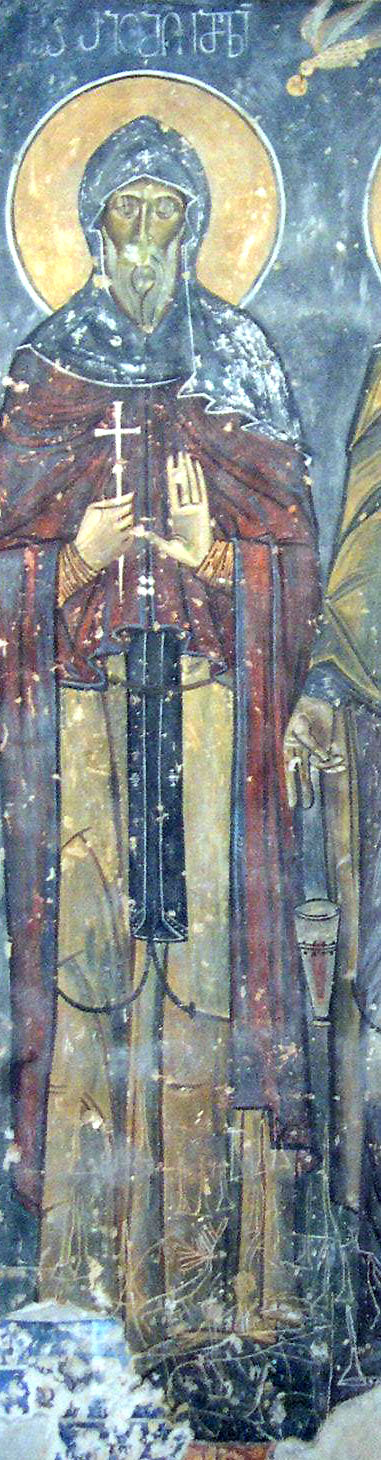
The Holy Martyr Conon of Isauria was born in Badinḗ (Βαδινή), a village near the city of Isauria in Asia Minor, whose inhabitants had received the Christian Faith from the Apostle Paul. From his youth, Saint Conon was protected by the Archangel Michael, who helped him in many difficult situations during his life.

At the insistence of his parents, Conon was betrothed to a girl named Anna, and on their wedding night, he persuaded her that they should remain virgins. He took a candle and put it under a vessel and asked his bride: "Which is better, light or darkness?"

"Light," she replied.

Then he spoke to her about Christ, and how the spiritual life was far superior and more desirable than the physical. Thus, Conon and Anna lived together as brother and sister. Later, Conon brought his wife and her parents to the Christian Faith. His father, Saint Nestor, rebuked the idolaters, but they opposed him, saying that there is no other God but the idols. He converted them and prepared them to confess Christ with a loud voice, and to be baptized. As a result, Saint Nestor was put to death, thereby receiving a Martyr's crown.

Shortly thereafter, Conan's wife and her parents died, and he withdrew completely from this earthly life, devoting himself to the monastic labors of prayer, fasting and divine contemplation.

By the grace of God, Saint Conan received so much power and authority over the demons, that he was able to order some of them to farm the land. Others were sent to protect the fruit, and then he enclosed the rest in clay vessels, which he sealed. He hid and buried these in the foundation of his house.

In his old age, the holy ascetic received the gift of working miracles.Through his preaching and miracles, many pagans were turned to Christ. When a persecution of Christians began in Isauria, Saint Conon was one of the first to suffer. He was tortured severely for refusing to sacrifice to the idols. However, when the inhabitants of Isauria learned of the torments to which the Saint was subjected, they went armed with weapons in order to protect the Martyr. Fearing the people's wrath, the torturers fled, and the Isaurians found the Martyr wounded and bloodied. Those who were sick anointed themselves with his blood, and they were healed. Saint Conon was saddened because he had not been found worthy of being martyred for the Lord. He lived in Isauria for two more years, and then he departed to the Lord in the second century.

After the Saint's repose, some Christians wanted to convert his house into a church. As they were digging, they found the clay vessels containing the evil spirits. When one of the jars was opened the demons came forth in the form of fire. The building collapsed, the wood and the ropes were burnt, and no one was able to approach that place until after sunset. After some time, that place was freed from the influence of the demons, by the prayers of Saint Conon, and through the prayer and fasting of the Christians who lived there.

Finding of the relics of Saint Theodore, Prince of Smolensk and Yaroslavl, and his children

On March 5, 1463, the relics of holy Prince Theodore and his sons, David and Constantine were uncovered at Yaroslavl. The chronicler, an eyewitness to the event, wrote: “At the city of Yaroslavl in the monastery of the Holy Savior they unearthed three Great Princes: Prince Theodore Rostislavich and his sons David and Constantine, and brought them above the ground. The Great Prince Theodore was a man of great stature, and they placed his sons David and Constantine beside him. They were shorter than he was. All three had lain in a single grave.”

The physical appearance of the holy prince so impressed the eyewitnesses and those present at the uncovering of the relics, that an account of this event was entered into the Prologue (lives of saints) in Saint Theodore’s Life, and also into the text of the Manual for Iconographers.

Saints Theodore, David and Constantine are also commemorated on September 19.

Monastic Martyr Adrian of Poshekhonye, Yaroslavl

Saint Adrian of Poshekhonye was born at Rostov the Great at the end of the sixteenth century, of pious parents named Gregory and Irene. Saint Adrian received monastic tonsure at the monastery of Saint Cornelius of Komel (May 19).

Among the brethren gathered around Saint Cornelius were some capable builders and iconographers, so the monastery churches were constructed and adorned by the saints themselves. In the final years of Saint Cornelius’s life, Kazan Tatars invaded the territory around the monastery, and he led all the brethren to the River Ukhtoma. But the Tatars did not touch the monastery, being frightened off by the sight of the many soldiers defending it, and they soon withdrew from the Vologda district. Saint Cornelius returned to the monastery with the brethren and reposed there on May 19, 1537.

Three years after the death of Saint Cornelius, Saint Adrian, then a hierodeacon, greatly desired to go into a wilderness place and found a monastery in honor of the Most Holy Theotokos. The Lord helped him fulfill his intention. A certain unknown Elder of striking appearance came to the Corniliev monastery. Saint Adrian asked him his name, and the Elder referred to himself as “the lowly one.”

When Saint Adrian invited him to his own cell and asked him to say something beneficial for the soul, the Elder said that he would show Saint Adrian the spot where he should build the church and monastery of the Most Holy Theotokos.

Saint Adrian immediately went to the Superior, Igumen Laurence, and sought his blessing to live in the wilderness. Recalling Saint Cornelius’s order that any monks who wished to withdraw into the wilderness should be released from the monastery, Igumen Laurence did not hinder Saint Adrian but gave him his blessing. He also sent with him his assistant, Elder Leonid. After they prayed at the grave of Saint Cornelius, Saint Adrian and Elder Leonid went on their way, led by the mysterious black-robed monk. Saint Adrian carried with him an icon of the Dormition of the Mother of God, which he also painted.

On September 13, 1540, the eve of the Feast of the Exaltation of the Cross of the Lord, Saint Adrian and Elder Leonid arrived in the wild Poshekhonye forest, near the settlements of Belta, Patrabolsha, Shelshedolsk and Ukhorsk.

They halted at the banks of the River Votkha. There the Elder leading them suddenly became invisible. The astonished travelers began to chant the Canon and service of the Feast, with tears of thanks to God. Indeed this was a portent of the future fame of the monastery, a place where God would be glorified.

For three years Saint Adrian and the Elder Leonid survived in the wilderness solitude, suffering want, overcoming temptations from the devil and the whisperings of wicked folk, and then they began to fulfill their intention. Choosing a suitable moment, the ascetics went to Moscow to ask the blessing of Metropolitan Macarius to establish a monastery and church in honor of the Dormition of the Mother of God on the Poshekhonye side of the River Votkha.

Saint Macarius gave his blessing to the ascetics to build the monastery, and he gave them a written document to that effect. He ordained Adrian to the priesthood and elevated him to the rank of igumen. In the document he had given to Saint Adrian, the hierarch bade “priests, deacons, monks and laymen to listen to him and obey him in everything, as befits a pastor and teacher.”

At Moscow the Poshekhonye ascetics found generous benefactors who gave the monks abundant offerings to build their church. Returning to their wilderness spot on May 31, 1543, Saint Adrian laid the foundations for the church with a trapeza, in honor of the Dormition of the Most Holy Theotokos.

Having embellished and consecrated the new church, Saint Adrian began the construction of the monastery. The strict monastic Rule of Saint Cornelius was introduced at the monastery. Having nothing of their own, a little being sufficient for everyone, the saints devoted a large portion of their time to prayer, both in church and in their cells, and no small time was allotted to the reading of Holy Scripture. This reading was done “not in an elegant voice, nor for effect, but in a humble and mild voice. One reads, and another speaks of what is read.” They also read in private.

In addition to his duties as igumen, Saint Adrian also occupied himself with painting icons. When his holy soul longed for complete silence, he withdrew into the depths of the forest into the cell and chapel he had built one verst away from the monastery.

Six years after the founding of the monastery, Elder Leonid reposed. Saint Adrian and the brethren buried him with reverence. The number of the brethren had increased during this time. They built three cells as dwellings, and a fourth for preparing food and baking bread.

Saint Adrian began to make plans for the construction of a large stone church, and he gathered a sum of money for this purpose. One year after the repose of Elder Leonid, during Great Lent of 1550, on the eve of the commemoration of the 42 Ammoreian Martyrs (March 6), armed robbers burst into the monastery and murdered Saint Adrian after beating him.

The holy relics of Saint Martyr Adrian were uncovered on December 17, 1626, solemnly transferred into the monastery church and placed in an open crypt by the right kliros (choir). Many miracles occurred at the grave of Saint Adrian.

Martyr Onesimus of Isauria

The Holy Martyr Onesimus (Onisius) lived in Palestine. He was beheaded with the sword for confessing faith in Christ.

Martyr Conon the Gardener of Pamphylia

The Holy Martyr Conon the Gardener was born in Nazareth of Galilee, but he lived in the city of Mandona, where he occupied himself with gardening. He was a God-fearing man, sincere in heart, and without malice. The saint suffered for his faith in Christ under the emperor Decius (249-251). When they brought him to trial, he unwaveringly and firmly confessed his faith. The torturers drove nails into his feet and dragged him behind a chariot until the sufferer collapsed from exhaustion. With a prayer, he surrendered his spirit to the Lord.

Virgin Martyr Irais (Rhais) of Antinoe in Egypt

No information on the life of this saint is available at this time.

Martyr Eulogius of Palestine

The Holy Martyr Eulogius was a native of Palestine. After the death of his pagan parents he gave away all his inheritance to the poor, and he himself became a wanderer and went through Palestine, converting pagans to Christianity. During the time of a persecution he was arrested, subjected to terrible tortures and beheaded.

Martyr Eulampius of Palestine

The Holy Martyr Eulampius lived in Palestine. He was beheaded for his faith in Christ.

Saint Mark the Ascetic of Egypt

Saint Mark the Ascetic was born in Athens during the fifth century, and became a monk in the Nitrian desert (Lower Egypt). From his youth his fondest pursuit was the reading of Holy Scripture. It is said that he knew the whole Bible by heart.

Nine of his thirty discourses have come down to us. Three of them are in Volume I of the English PHILOKALIA. The Byzantines had such a high regard for his writings that they said, “Sell everything and buy Mark.”

He was noted for his gentleness and purity of soul. He was known as “the Ascetic” because of his abstinence. He lived for ninety years as a solitary, then surrendered his soul to God when he was one hundred and twenty years old.

Saint Hesychius the Faster of Bithynia

Saint Hesychius the Faster was born in the eighth century in the coastal city of Adrineia in Bithynia. Raised since his youth in piety, he left his parental home and practiced asceticism in a wilderness spot on Mount Maionis. Despite the threat of demons and wild animals and robbers living there, the holy ascetic in seeking greater solitude settled there and built himself a cell, digging himself a garden and eating from the fruit of his labors. After a certain while disciples began to throng to him. At a spring of water in a valley not far off Saint Hesychius built a church in the name of the holy Apostle Andrew the First-Called. Even during his lifetime he was granted the gift of wonderworking.

One time they brought a demon-possessed girl to him. Her parents, falling down at the feet of the holy ascetic, implored his holy prayers for her healing. The holy ascetic made prayer for the unfortunate one, and the devils left her. Turning to the parents of the healed girl, Saint Hesychius predicted that a women’s holy monastery would arise at the place their daughter was healed. And actually the prophecy was fulfilled in the future.

An angel appeared to Saint Hesychius three days before his end and predicted to him his approaching demise. He accepted the news with joy. And before his blessed end, the saint summoned his disciples and for a long while he instructed them. At midnight the cell of the saint and the surrounding area suddenly gleamed with a heavenly light, and Saint Hesychius fell asleep in the Lord with the words: “Into Thy hands, O Lord, I commend my spirit.”

At the place of his efforts, in accord with the prediction of Saint Hesychius, was later on built a women’s monastery. The holy relics of Saint Hesychius, buried at the church of the holy Apostle Andrew the First-Called, were later transferred by Theophylactus, Bishop of Amasea, to the city of Amasea (Asia Minor).

Today’s saint should not be confused with Saint Hesychius the Theologian, the priest of Jerusalem (March 28), whose writings are in the Philokalia.

Icon of the Mother of God “The Nurturer”

In the Icon called “Nurturing,” the Mother of God is depicted with her eternal Child sitting on her left arm. Christ’s right hand is extended upward to the face of the All-Pure Virgin.

Before 1917, the holy image was located in the Kazan Cathedral on Red Square, but it was lost after the destruction of that church in 1936. The church was rebuilt in 1993, and it houses a copy of the Nurturing Icon. At that place there is a list of wonderworking icons glorified throughout Russia for their miracles.

The title of the Icon speaks for itself. Parents pray for their children in her presence, asking the Most Holy Theotokos to take them under her protection, to send them understanding, and to fill their hearts with wisdom.

Until our own time, a brief prayer has been associated with this image:

O All-Holy Lady, Virgin Theotokos, save and keep under your protection my children (names), all boys and girls and infants, both those who are baptized and those who are nameless and those being carried in their mother's womb. Cover them with your own maternal mantle. Preserve them in the fear of God and in obedience to their parents. Implore your Son and our Lord to grant them what is needful for their salvation. I entrust them to your maternal providence, for you are the divine protection of your servants. Amen.

Saint John, New Martyr of Bulgaria

The holy New Martyr John was born in Bulgaria in 1775. Since fanatical Moslems believed that they would be assured of an eternal “paradise” where they would enjoy beautiful virgins and an abundance of food if they could force Christians to deny Christ and follow Mohammed, they spared no effort to convert Christians through flattery or by threats of death.

When John was still a boy, he fell in with Moslem companions. Through various ways, he was led to renounce Christ and to follow Islam. He came to his senses when he was about sixteen, and was stricken with grief at his denial of Christ. He fled to Mt. Athos to the Great Lavra. Here he spent his time in repentence under the guidance of an Elder.

He lived a monastic life of great strictness for three years, yet his conscience continued to trouble him. With the blessing of his Elder, he decided to travel to Constantinople to wipe out his apostasy by confessing Christ in a public way and by shedding his blood.

The young monk dressed himself as a Turk, which a Christian was not permitted to do. Arriving in Constantinople, he went directly to the church of Hagia Sophia, which had been turned into a mosque. Right in front of the Moslems, he made the Sign of the Cross and began to recite Christian prayers. Then he said in a loud voice that he had been born a Christian, but had fallen into error and renounced Christ. Now, he declared, he wished to renounce the false religion of Mohammed in order to follow Christ once more.

The Turks fell into a frenzied rage when they heard his words. They seized him and began to torture him in various ways. “Renounce Christ,” they said, “and return to the Moslem faith, or you will be killed.”

Saint John replied, “Without Christ, there is no salvation.”

The furious Hagarenes dragged the saint out to the courtyard to behead him. In this manner, Saint John received the crown of martyrdom in 1784 at the age of nineteen.

Daily Readings for Wednesday, March 04, 2026

2ND WEDNESDAY OF LENT

ABSTAIN FROM MEAT, FISH, DAIRY, EGGS, WINE, OLIVE OIL

Gerasimus the Righteous of Jordan, Paul & his sister Juliana and their Companions, Daniel, Prince of Moscow, Gregory, Bishop of Constance

ISAIAH 5:16-25

But the LORD of hosts is exalted in justice, and the Holy God shows himself holy in righteousness. Then shall the lambs graze as in their pasture, fatlings and kids shall feed among the ruins. Woe to those who draw iniquity with cords of falsehood, who draw sin as with cart ropes, who say: “Let him make haste, let him speed his work that we may see it; let the purpose of the Holy One of Israel draw near, and let it come, that we may know it!” Woe to those who call evil good and good evil, who put darkness for light and light for darkness, who put bitter for sweet and sweet for bitter! Woe to those who are wise in their own eyes, and shrewd in their own sight! Woe to those who are heroes at drinking wine, and valiant men in mixing strong drink, who acquit the guilty for a bribe, and deprive the innocent of his right! Therefore, as the tongue of fire devours the stubble, and as dry grass sinks down in the flame, so their root will be as rottenness, and their blossom go up like dust; for they have rejected the law of the LORD of hosts, and have despised the word of the Holy One of Israel. Therefore the anger of the LORD was kindled against his people, and he stretched out his hand against them and smote them, and the mountains quaked; and their corpses were as refuse in the midst of the streets. For all this his anger is not turned away and his hand is stretched out still.

GENESIS 4:16-26

Then Cain went away from the presence of the LORD, and dwelt in the land of Nod, east of Eden. Cain knew his wife, and she conceived and bore Enoch; and he built a city, and called the name of the city after the name of his son, Enoch. To Enoch was born Irad; and Irad was the father of Mehujael, and Mehujael the father of Methushael, and Methushael the father of Lamech. And Lamech took two wives; the name of the one was Adah, and the name of the other Zillah. Adah bore Jabal; he was the father of those who dwell in tents and have cattle. His brother's name was Jubal; he was the father of all those who play the lyre and pipe. Zillah bore Tubalcain; he was the forger of all instruments of bronze and iron. The sister of Tubalcain was Naamah. Lamech said to his wives: "Adah and Zillah, hear my voice; you wives of Lamech, hearken to what I say: I have slain a man for wounding me, a young man for striking me. If Cain is avenged sevenfold, truly Lamech seventy-sevenfold." And Adam knew his wife again, and she bore a son and called his name Seth, for she said, "God has appointed for me another child instead of Abel, for Cain slew him." To Seth also a son was born, and he called his name Enosh. At that time men began to call upon the name of the LORD.
PROVERBS 5:15-6:3

Drink water from your own cistern, flowing water from your own well. Should your springs be scattered abroad, streams of water in the streets? Let them be for yourself alone, and not for strangers with you. Let your fountain be blessed, and rejoice in the wife of your youth, a lovely hind, a graceful doe. Let her affection fill you at all times with delight, be infatuated always with her love. Why should you be infatuated, my son, with a loose woman and embrace the bosom of an adventuress? For a man's ways are before the eyes of the LORD, and he watches all his paths. The iniquities of the wicked ensnare him, and he is caught in the toils of his sin. He dies for lack of discipline, and because of his great folly he is lost.
My son, if you have become surety for your neighbor, have given your pledge for a stranger; if you are snared in the utterance of your lips, caught in the words of your mouth; then do this, my son, and save yourself, for you have come into your neighbor's power: go, hasten, and importune your neighbor.

Venerable Gerasimus of the Jordan

Saint Gerasimus was a native of Lycia (Asia Minor). From his early years he was distinguished for his piety. Having received monastic tonsure, he withdrew into the desert of the Thebaid (in Egypt). Thereafter, in about the year 450, the monk arrived in Palestine and settled at the Jordan, where he founded a monastery.

For a certain while Saint Gerasimus was tempted by the heresy of Eutyches and Dioscorus, which acknowledged only the divine nature in Jesus Christ, but not His human nature (i.e. the Monophysite heresy). Saint Euthymius the Great (January 20) helped him to return to the true Faith.

Saint Gerasimus established a strict monastic Rule. He spent five days of the week in solitude, occupying himself with handicrafts and prayer. On these days the wilderness dwellers did not eat cooked food, nor did they kindle a fire, but ate only dry bread, roots and water.

On Saturday and Sunday all gathered at the monastery for Divine Liturgy and to partake of the Holy Mysteries of Christ. In the afternoon, taking a supply of bread, tubers, water and an armload of date-palm branches for weaving baskets, the desert-dwellers returned to their own cells. Each had only old clothes and a mat, upon which he slept. When they left their cells, the door was never locked, so that anyone could enter and rest, or take whatever he needed.

Saint Gerasimus himself attained a high level of asceticism. During Great Lent he ate nothing until the very day of the All-Radiant Resurrection of Christ, when he received the Holy Mysteries. Going out into the desert for all of Great Lent, Saint Gerasimus took with him his beloved disciple Saint Cyriacus (September 29), whom Saint Euthymius had sent to him.

When Saint Euthymius the Great died, Saint Gerasimus saw how angels carried the soul of the departed up to Heaven. Taking Cyriacus with him, the monk immediately set off to the monastery of Saint Euthymius and consigned his body to the earth.

Saint Gerasimus died peacefully, mourned by his brethren and disciples. Before his death, a lion had aided Saint Gerasimus in his tasks, and upon the death of the Elder it died at his grave and was buried nearby. Therefore the lion is depicted on icons of the saint, at his feet.

Venerable Gerasimus of Vologda

Saint Gerasimus, First Vologda Wonderworker, accepted monastic tonsure on March 4 (at that time it was customary to give a new monk the name of the saint commemorated on the day of his tonsure) at the Kiev Gniloe Dormition monastery, having been attracted to the Caves where Saint Theodosius (May 3) secluded himself during Great Lent.

Out of obedience to the brethren, Saint Gerasimus accepted the rank of hieromonk. In imitation of the exploits of the Fathers of old, the monk felt drawn to Northern Rus and he arrived at the River Vologda (August 19, 1147). He blessed the emerging settlement on the right bank, “foretelling that here would be a great city.”

The saint chose the dense virgin forest for his dwelling place, separated from the settlement by the Kaisarova creek. There the monk built a hut, and in the tranquil solitude he devoted himself to the contemplation of God, unceasing prayer and work. He built a church in honor of the Most Holy Trinity, and so the first monastery in the north named for the Most Holy Trinity came into being. The monastery served for the spiritual enlightenment of the surrounding peoples.

The monk peacefully fell asleep in the Lord on March 4, 1178, the day of his monastic tonsure, and the Feast of his namesake Saint Gerasimus of the Jordan.

Venerable Joasaph of Snetogorsk, Pskov

The Holy Hieromartyrs Joasaph of Snetogorsk and Basil of Mirozh suffered under the Germans at two of the most ancient of the Pskov monasteries during the thirteenth century. Saint Basil directed the Savior-Transfiguration Mirozh monastery, founded in the year 1156 by Saint Niphon, Bishop of Novgorod (April 8), and by Saint Abraham of Mirozh (September 24).

Saint Joasaph was igumen (and according also to some Pskov Saints’ Lives, the founder) of the monastery of the Nativity of the Most Holy Theotokos on Mount Snatna. The ascetics devoted much labor and concern to both the outer and inner welfare of the monasteries. In accord with the strict rule of cenobitic monastic life, introduced into his monastery by Saint Joasaph, the life of the monks was filled with prayer, abstinence and work. (Almost ninety years after the death of Saint Joasaph, his monastic Rule was reintroduced in the new monastic Rule of the Snetogorsk monastery by Archbishop Dionysius of Suzdal). The Snetogorsk monastery traced its origins from the efforts of Saint Euphrosynus of Pskov (May 15) and Saint Savva of Krypetsk (August 28).

Both these monasteries were outside the city walls and did not have any defenses. On March 4, 1299, the Germans fell upon Pskov and burned the Mirozh and Snetogorsk monasteries. During the burning of the churches, Saints Basil and Joasaph and the other monks endured an agonizing death. There was at that time much suffering in the city, and for the monks of other monasteries, and also for the women and children, but “through the prayers of the holy monk martyrs, the Lord preserved the fighting men.” Under the lead of the Pskov prince, Saint Dovmont-Timothy (May 20), they came out against the enemy and near the church of the holy Apostles Peter and Paul, they defeated the invaders at the banks of the Pskova River.

Saints Basil and Joasaph were buried with their fellow ascetics beneath crypts at the churches of their monasteries. The venerable head and part of the relics of Saint Joasaph were preserved in the open in a special reliquary in the church of the Snetogorsk monastery. Holy Prince Dovmont “out of his rightful inheritance” built a stone church at the Snetogorsk monastery in place of the one that had burned, and he facilitated the restoration of monastic life at the ruined monasteries.

Soon after the martyric death of Saints Basil and Joasaph their churchly glorification took place at Pskov. On the manuscript Pskov Prologue of the fourteenth-fifteenth centuries, they are listed on March 5. But in the Pskov Chronicle and old Pskov Synodikons (Saint lists), the day of the blessed death of the holy monk martyrs is given as March 4, and at present, this is the day of their commemoration. The Chronicle mentions the presbyter Joseph, and the Prologue mentions the presbyter Constantine as their fellow sufferers.

Right-believing Prince Basil (Vasilko) of Rostov

Holy Prince Basil of Rostov belonged in lineage to the Suzdal Monomashichi, famed in Russian history. The saint’s great-grandfather was Yuri Dolgoruky, and his grandfather was Great Prince Vsevolod III “Big-Nest” (+ 1212), brother to Saint Andrew Bogoliubsky (July 4), who had been heir to and continuer of Saint Andrew Bogoliubsky’s work. From Vladimir-on-Klyazma, which became the capital of the old Rostovo-Suzdal principality, Vsevolod “Big-Nest” single-handedly set the course of affairs of the whole of Great Rus. The “Lay of Igor’s Campaign” (“Slovo o polku Igoreve”) says that he could “splash the Volga with oars, and bail out the Don with helmets.”

The oldest grandson of Vsevolod from his oldest son Constantine, Saint Basil was born on December 7, 1208 in Rostov, where his father ruled as prince. He spent his childhood there, and in 1216, when Constantine Vsevolodovich became Great Prince of Vladimir, Rostov was apportioned to Basil (he was then eight years old) as his princely appanage to rule himself.

Military valor, sacred duty of service to country, the sense of justice and the heeding of one’s elders, all these are traditional features of a Russian princely defender of the land, and all were present in Basil. The saint’s father, Great-prince Constantine, died on February 2, 1218, when Basil was not yet ten years of age. The guide of the young Rostov prince then became his uncle, the Great Prince Saint Yuri of Vladimir (February 4).

For twenty years Prince Yuri ruled Vladimir, and for all these years Basil was his closest friend and confidant. The chronicles take note of the vibrantly handsome figure of Basil, his bright and majestic glance, his daring in trapping wild game, his beneficence, his mind and deep studiousness, together with his mildness and good-nature in relations with the nobles: “Whoever served him, whoever ate his bread and drank the cup with him, could never be the servant of another prince.”

In the year 1219 Basil participated in a campaign of the Vladimir-Suzdal forces against the Volga Bulgars, and in 1221 in a campaign to the mouth of the River Oka. Saint Yuri was then held hostage at Nizhni Novgorod.

In 1223 the first Tatars (Mongols) appeared on the southern steppes, “an unknown people”, coming out of Asia. Their first victims were the Polovetsians allied with Rus. The Russian princes, with the Polovetsian khans (many of whom had accepted Holy Baptism), decided to resist the plunderers of the steppes before they reached the Russian Land. Saint Basil headed an auxiliary detachment, sent by Great Prince Yuri to participate in the Russian steppe campaign.

The enemy showed up sooner than they expected. And the centuries-old division of appenage principalities proved incapable of effective action in a large scale war. The detachment of Basil was not in time for the decisive battle, and from Chernigov came the sad news of the destruction of the Russian forces at the River Kalka on June 16, 1223. This was a bad omen, and the storm loomed on the east. Basil and his company returned to Rostov.

In 1227 (or 1228) Basil married, taking Maria, daughter of Saint Michael of Chernigov (September 20) as his wife. Basil’s uncle, Saint Yuri, had previously married Saint Michael’s sister [i.e. Basil’s uncle Yuri had married Maria’s aunt]. In 1231 Basil’s oldest son Boris was born.

The storm clouds thickened over Russia. On May 3, 1230, “the earth shook during Liturgy”, and famine and pestilence came upon Rus that year. In 1232 the Tatars made winter camp, having barely reached the capital of the Volga Bulgars. Life took its course, and Prince Yuri in 1236 married off his sons Vladimir and Mstislav, and Basil rejoiced at their weddings. All of them, however, had little more than a year to live, for the Tatars had already taken the Volga-Bulgarian land.

In 1237 the Tatar whirlwind broke upon Rus. In December Ryazan fell under Batu. Prince Yuri had decided not to send his forces over to provide assistance, since he was faced with the difficult defense of Vladimir. The Tatars offered him peace, and he was prepared to negotiate. But the conditions of the peace, tribute and vassal servitude under the Khan, were unacceptable. “A glorious fight,” said the prince, “is better than a shameful peace.” The first battle with the Tatars was at Kolomna, and Vsevolod Yurievich commanded the troops, but they were cut to pieces. The enemy turned then towards Moscow, which they captured and burned. Yuri’s other son, Vladimir, was captured while leading the defense of Moscow.

Saint Yuri and his faithful companion Saint Basil were determined to fight “for the Orthodox Christian Faith” against the “godlessly vile Tatars.” Having organized his defenses and leaving his sons Vsevolod and Mstislav at Vladimir, Prince Yuri went beyond the Volga to gather new troops to replace those annihilated by Batu.

With him were his nephews, Saint Basil of Rostov and his company, and his brothers, Vsevolod and Vladimir. The Great Prince awaited the arrival of his brothers Yaroslav and Svyatoslav and their forces.

On Meatfare Saturday, February 3, 1238, quickly and without hindrance upon the wintry roads, the Tatar army approached Vladimir. Despite heroic defense, the fate of the city was sealed. Bishop Metrophanes for spiritual strength tonsured all the princes and princesses remaining in the city into the angelic schema. The city fell on February 7.

The final outpost of the Vladimirites was the Dormition cathedral, repository of the most holy object in Russia: the wonderworking Vladimir Icon of the Mother of God. The Tatars piled wood and kindling around the cathedral and made a tremendous fire. Bishop Metrophanes died in the fire and smoke, together with a thousand defenseless women and children, and Prince Yuri’s entire family: his wife Agathia, daughter Theodora, daughters-in-law Maria and Christina, and the infant grandson Demetrius. His sons Vsevolod and Mstislav, together with the previously captured Vladimir, were subjected to tortures and then slaughtered “before the eyes of the Khan”. (In several of the old collections of Saints’ Lives, all of them are listed as saints).

Saint Yuri had been with his forces near Yaroslavl. Learning of the destruction of the capital and the death of those near and dear to him, “he lamented in a loud voice with tears.” He said it would be better for him to die rather than continue to live in this world, since he alone survived. Saint Basil, arriving with the Rostov company, encouraged him to continue with the military effort.

On March 4, 1238 the decisive battle took place at the River Sita. The Tatars unexpectedly managed to encircle the Russian army, and a slaughter ensued. Few Russian warriors remained alive after this terrible battle, but the enemy paid an expensive price for its victory. Saint Yuri was cut down in distinguished combat, and the wounded Basil was brought to Batu’s headquarters.

The Tatars demanded that he “follow their vile customs, be subject to their will and fight for them.” The holy prince angrily refused to betray his homeland or Holy Orthodoxy. “You cannot take the Christian Faith from me” said the holy prince, like one of the ancient Christian confessors. “They tortured him a great deal, and then killed him in the Shernsk woods.” Thus did holy Prince Basil commit his soul to God, resembling in death the holy Passion-Bearer Boris (July 24), the first of the Rostov princes, whom he had imitated in life. Like Saint Boris, Saint Basil was not even thirty years of age.

Bishop Cyril of Rostov, going out on the field of carnage, buried the fallen Orthodox warriors, and he sought the body of holy Prince Yuri (they did not find his cut-off head in the mass of broken bodies). He brought his holy relics to Rostov, to the Dormition cathedral. The body of Saint Basil was found in the Shernsk woods by a priest’s son and was taken to Rostov. There the prince’s wife, his children, Bishop Cyril and all the inhabitants of Rostov met the body of their beloved prince with bitter wailing, and they buried him beneath the arches of the cathedral church.

Describing the burial of Prince Basil, the chronicler said: “The multitude of Orthodox people wept bitterly, when they saw the departed father and nourisher of orphans, the great comforter of the sorrowful, and… the setting of a luminous star…. By his martyr’s blood his transgressions and those of his brethren were washed away.”

The people regarded it as a sign of God’s mercy that the two princely comrades-in-arms were buried side by side in the Rostov cathedral church: “Behold the wonder, in death God has placed their bodies together.” (Later on, the relics of holy Prince Yuri were transferred to the restored Vladimir Dormition cathedral).

The Church venerates Saints Basil and Yuri as Passion-Bearers, and heroic defenders of the Russian Land. Their holy example has inspired Russian soldiers in the fight against hostile invaders. The most detailed account of the life and deeds of holy Princes Basil and Yuri is preserved in the Lavrentiev Chronicle, written by the monk Laurence with the blessing of Saint Dionysius, Archbishop of Suzdal, in the year 1377, three years before the Battle of Kulikovo Pole.

Right-believing Prince Daniel of Moscow

Holy Prince Daniel of Moscow was born at Vladimir in the year 1261. He was the fourth son of Saint Alexander Nevsky (August 30 and November 23) and his second wife Bassa. When he was two years old he lost his father. The date of his mother’s repose is not indicated in the Chronicles; we know only that she was buried in the church of the Nativity of Christ at the Vladimir Dormition monastery (the Princess monastery), and the people in the surroundings venerated her as “Righteous.”

In 1272, Prince Daniel received as his allotted portion the city of Moscow and its adjacent lands. The holy prince built a church (and a monastery beside it) in honor of his patron saint, Saint Daniel the Stylite (December 11) on the banks of the River Moskva.

During this period, the Moscow principality was small and unobtrusive. While growing up, Prince Daniel strengthened and expanded it, not in unjust or coercive ways, but peacefully and with benevolence. It was a time of unrest. Fratricidal strife among the appanage princes was rife. Often bloodshed was averted, thanks to Prince Daniel and his incessant striving for unity and peace in the Russian Land.

In 1293 his brother, the Great Prince Alexander, with Tatars summoned from the Horde and headed by Diuden (“the Diudenev Host”), laid waste to Russian cities: Murom, Suzdal, Kolomna, Dmitrov, Mozhaisk, and Tver. Prince Daniel decided to join them to Moscow to save their people from perishing, for they were not strong enough to resist.

The prince braced himself for terrible destruction and pillaging. Standing up for his rights, Saint Daniel was compelled to come out against his brother near a place called Yurievo Tolchische (“Yurievo Threshing-Mill”), but his desire for peace prevailed, and bloodshed was averted.

In 1300, when the Ryazan prince Constantine was making secret preparations for a sudden assault on the Moscow principality, Prince Daniel went to Ryazan with an army. He defeated the enemy, took Constantine captive,and destroyed a multitude of Tatars. This was a first victory over the Tatars, though not a tremendous victory, but it was noteworthy as a first push towards freedom.

When he had beaten the Ryazan prince and scattered his confederates the Tatars, Prince Daniel did not take advantage of his victory to seize foreign lands or take booty, as was the accepted custom during these times. Instead, he displayed an example of true non-covetousness, love and fraternity. The holy prince never resorted to arms to seize the lands of others, nor did he ever take away the property of other princes either by force or by treachery. And so the Lord saw fit to expand the boundaries of his princely realm.

Prince John of Pereslavl-Zalessk, Daniel’s nephew, was gentle and pious and benevolent towards the poor, and he esteemed and loved his uncle. Dying childless in 1302, he bequeathed his principality to Saint Daniel. The Pereslavl lands together with Dmitrov, had the most inhabitants after Rostov, with the corresponding fortification befitting a major city. Pereslavl-Zalessk was well protected on all sides. But the holy prince remained faithful to Moscow and did not transfer the capital of his princedom to the stronger and more significant seat of Pereslavl. This annexation allowed Moscow to be considered as the most significant principality. Here the principle of the unification of the Russian Land into a single powerful realm was set in place.

Through the ages God’s providence concerning Russia and its destiny was clearly manifest!

Grateful for the constant blessings of the Hodēgḗtria (She who leads the Way) both in his personal life, and also in the life of the Russian realm, Saint Daniel’s father, Saint Alexander Nevsky said, “God is not in might, but in right!”

In 1303 Saint Daniel fell seriously ill. He assumed the great schema and commanded that he be buried at the Danilov monastery. In his deep humility he wanted to be buried not within the church, but in the common monastery cemetery. The holy prince died on March 4.

Less than thirty years after the repose of holy Prince Daniel, the Danilov monastery he founded was transformed into the Moscow Kremlin, the church was transformed into a parish church, and the cemetery became non-monastic.

At the time of Great Prince Ivan III (1462-1505), Saint Daniel gave reminders of himself to his forgetful descendents. He appeared as a stranger to a youth who attended the Great Prince and said: “Don’t be afraid of me. I was a Christian and the master of this place, my name is Daniel Prince of Moscow, and by the will of God I am here. Tell Great Prince John about me saying: you are enjoying yourself while you have forgotten me, but God has not forgotten me.”

After this, the Great Prince ordered panikhidas for his ancestral princes to be sung in the cathedral. During the time of Tsar Ivan the Terrible, the dying son of a barge merchant was healed at the grave of Saint Daniel. The Tsar, struck by the miracle, renovated the ancient Danilov monastery and established a yearly church procession. The Metropolitan led the way to the the holy prince’s tomb, and served a panikhida there.

In 1652 holy Prince Daniel was glorified by the uncovering of his incorrupt relics, which were transferred on August 30 to the church dedicated to the Holy Fathers of the Seventh Ecumenical Council.

The holy relics were placed in a reliquary “to the glory of the Holy Trinity and for the healing of the infirm.” Metropolitan Platon of Moscow (+ 1812), in the Life of the holy prince which he compiled, writes: “The founder laid the foundation of Moscow’s grandeur, modestly making only a small path to it. Just as any edifice, which is not built with excessive haste, but rather with great artistry and skill, receives a particular firmness and stands indestructible for a long time; like a tall tree that grows for many centuries after beginning as a small sapling, then slowly becomes sturdier, with its branches spreading about far around, so this city was to grow from small, but firm beginnings, so that its first sparkle would not bedazzle the eyes of the envious, and so it would not be shaken or felled early on, before it had attained its full height. Thus did this founder prepare the great city given him, giving it a modest but steady radiance, undisturbed by any gusts of the wind. He left the great glory of its rise to his son Great Prince John, called Kalita.”

Martyrs Paul and his sister, Juliana

The Holy Martyr Paul and his sister Juliana were executed under the emperor Aurelian (270-275) in the Phoenician city of Ptolemais. The emperor happened to visit Ptolemais, and among those who met him was Paul, who made the Sign of the Cross. They arrested him and threw him in prison.

On the following day, when they brought him to trial, he openly and boldly confessed his faith in Christ, for which he was subjected to fierce tortures. Juliana, seeing the suffering of her brother, began to denounce the emperor for his injustice and cruelty, for which she was also subjected to torture.

They beat the martyrs, tore their bodies with iron hooks, burned them over red-hot grates, but they were not able to break the wondrous endurance of the Lord’s confessors. Three soldiers torturing the saints were struck by the courageous spirit of the martyrs, and they in turn believed in Christ. These newly chosen of God were named Quadratus, Acacius and Stratonicus, and they were immediately executed.

The tormentor tried to seduce Saint Juliana with a promise to marry her, if she were to renounce Christ, but the saint refused the offer and remained steadfast. By order of the emperor they sent her to a brothel to be defiled. The Lord also preserved her there, and anyone who tried to touch the saint lost his sight. Then the enraged emperor commanded that they again burn the bodies of the saints. Those who saw the suffering of the saints began to murmur loudly, and Aurelian gave orders to behead the martyrs. With gladdened face the brother and sister went to execution singing, “For Thou hast saved us from those who afflicted us and hast shamed those who hated us” (Ps. 43/44:7).

Saint James the Faster of Phoenicia, Syria

Saint James the Faster lived a life of asceticism near the Phoenician city of Porphyrion in the sixth century. For fifteen years, he lived in a cave devoting himself to monastic deeds, and he received the gift of wonderworking from the Lord. Under his influence many of the local inhabitants were converted to the Christian Faith.

News of the ascetic spread everywhere, and so went to another place so that he would not fall into temptation. He found a new cave, and lived there for thirty years. The devil set terrible snares for the ascetic. James healed a young girl from demonic possession, but then fell into sin with her. In order to conceal his sin, he killed the girl and threw her into a river.

Distraught over this sin, he repented for what he had done. For a long time he hid himself away in the wilderness, bereft of shelter and peace, tormented by the pricks of conscience, and he was on the point of forsaking the monastic life and returning to the world. But the immeasurable mercy of God, against which the sins of this world cannot prevail, and which desires salvation for all mankind, would not permit the ruin of this monk who had toiled so many years for the Lord.

The Lord thwarted the devil’s intent to destroy the ascetic, and returned him through repentance to the path of salvation. Wandering about the wilderness, James saw a monastery, and entering it, he confessed his sin before the igumen and the brethren. The igumen urged him to remain with them, fearing that he would ultimately fall into despair. But James went off and again he wandered the wilderness for a long time.

Finally the All-Beneficent Providence of God brought him to a certain desert-dweller filled with grace and wisdom. Lifting the burden from him, the desert-dweller suggested that James remain with him. But James would not remain with the Elder, though encouraged and given hope by him, and he secluded himself in a cave and there for ten years offered repentance to God, weeping and wailing, and asking forgiveness for the sin he committed. The Lord heard the prayers of the penitent monk and granted him His mercy. James reacquired his gift of wonderworking. He remained in the cave until the time of his death. He was also buried there.

Right-believing Prince Wenceslas of the Czech Lands

The Translation of the Relics of the Right-Believing Prince Saint Wenceslas (Vyacheslav) of the Czech Lands.

On September 28, 935, when Saint Wenceslas went to Matins, he was wickedly murdered at the doors of the church by his own brother and his brother’s servants. His body was stabbed and discarded without burial.

The mother, hearing of the murder of her son, found and placed his body in a recently consecrated church at the princely court. They were not able to wash off the blood splashed on the church doors, but after three days it disappeared by itself.

After repenting of his sin, the murderer transferred the relics of Saint Wenceslas to Prague, where they were placed in the church of Saint Vitus, which the martyr himself had constructed. The memory of Prince Wenceslas is honored from of old in the Russian Orthodox Church.

Saint Wenceslas is also commemorated on September 28.

Saint Gregory, Bishop of Constantia, Cyprus

Saint Gregory is mentioned in the Patmos Codex 266 as follows: “The Holy Fathers Gregory of Constantia, Cyprus and Adrian.” Perhaps Saint Adrian was also a Bishop on Cyprus.

Martyr Vyacheslav (Leontiev), the Priest

No information available at this time.

Daily Readings for Tuesday, March 03, 2026

2ND TUESDAY OF LENT

ABSTAIN FROM MEAT, FISH, DAIRY, EGGS, WINE, OLIVE OIL

The Holy Martyrs Eutropius, Cleonicus, and Basiliscus, Theodoretos the Holy Martyr of Antioch, Nonnita, mother of Saint David

ISAIAH 5:7-16

Thus says the Lord: For the vineyard of the LORD of hosts is the house of Israel, and the men of Judah are his pleasant planting; and he looked for justice, but behold, bloodshed; for righteousness, but behold, a cry! Woe to those who join house to house, who add field to field, until there is no more room, and you are made to dwell alone in the midst of the land. The LORD of hosts has sworn in my hearing: “Surely many houses shall be desolate, large and beautiful houses, without inhabitant. For ten acres of vineyard shall yield but one bath, and a homer of seed shall yield but an ephah.” Woe to those who rise early in the morning, that they may run after strong drink, who tarry late into the evening till wine inflames them! They have lyre and harp, timbrel and flute and wine at their feasts; but they do not regard the deeds of the LORD, or see the work of his hands. Therefore my people go into exile for want of knowledge; their honored men are dying of hunger, and their multitude is parched with thirst. Therefore Sheol has enlarged its appetite and opened its mouth beyond measure, and the nobility of Jerusalem and her multitude go down, her throng and he who exults in her. Man is bowed down, and men are brought low, and the eyes of the haughty are humbled. But the LORD of hosts is exalted in justice, and the Holy God shows himself holy in righteousness.

GENESIS 4:8-15

Cain said to Abel his brother, "Let us go out to the field." And when they were in the field, Cain rose up against his brother Abel, and killed him. Then the LORD said to Cain, "Where is Abel your brother?" He said, "I do not know; am I my brother's keeper?" And the LORD said, "What have you done? The voice of your brother's blood is crying to me from the ground. And now you are cursed from the ground, which has opened its mouth to receive your brother's blood from your hand. When you till the ground, it shall no longer yield to you its strength; you shall be a fugitive and a wanderer on the earth." Cain said to the LORD, "My punishment is greater than I can bear. Behold, thou hast driven me this day away from the ground; and from thy face I shall be hidden; and I shall be a fugitive and a wanderer on the earth, and whoever finds me will slay me." Then the LORD said to him, "Not so! If any one slays Cain, vengeance shall be taken on him sevenfold." And the LORD put a mark on Cain, lest any who came upon him should kill him.

PROVERBS 5:1-15

My son, be attentive to my wisdom, incline your ear to my understanding; that you may keep discretion, and your lips may guard knowledge. For the lips of a loose woman drip honey, and her speech is smoother than oil; but in the end she is bitter as wormwood, sharp as a two-edged sword. Her feet go down to death; her steps follow the path to Sheol; she does not take heed to the path of life; her ways wander, and she does not know it.
And now, O sons, listen to me, and do not depart from the words of my mouth. Keep your way far from her, and do not go near the door of her house; lest you give your honor to others and your years to the merciless; lest strangers take their fill of your strength, and your labors go to the house of an alien; and at the end of your life you groan, when your flesh and body are consumed, and you say, "How I hated discipline, and my heart despised reproof! I did not listen to the voice of my teachers or incline my ear to my instructors. I was at the point of utter ruin in the assembled congregation." Drink water from your own cistern, flowing water from your own well.

Martyrs Eutropius, Cleonicus, and Basiliscus of Amasea

The Holy Martyrs Eutropius, Cleonicus and Basiliscus suffered in the city of Pontine Amasea (Asia Minor) in about the year 308.

The brothers Eutropius and Cleonicus, and Basiliscus the nephew of the Great Martyr Theodore the Recruit (February 17), were comrades. After the martyric death of Saint Theodore, they wound up in prison and by their preaching brought many of the pagans in prison with them to the Christian Faith.

When he tortured Saint Theodore, the governor Publius perished shamefully, struck down by divine wrath. Asclepiodotus was chosen as ruler of Amasea, and was more inhumane than his predecessor. Knowing the comrades of Saint Theodore the Recruit were all in prison, the governor commanded that they be brought to him. Saints Eutropius, Cleonicus and Basiliscus thus firmly confessed their faith in Christ before this new governor. They were mercilessly beaten, so that their bodies were entirely bruised.

As he was being tortured Saint Eutropius prayed loudly to the Savior, “Grant us, O Lord, to endure these wounds for the sake of the crown of martyrdom, and help us, as You helped Your servant Theodore.” In answer to the saint’s prayer, the Lord Himself appeared to the martyrs with His angels and the holy Great Martyr Theodore the Recruit, saying to them: “Behold, the Savior has come to help you, that you may know life eternal.”

Soldiers and many of the people standing nearby were also granted to behold the Savior. They urged Asclepiodotus to halt the tortures. Seeing that the people were distraught and ready to believe in the true God, the governor commanded the martyrs to be taken away. The governor then invited Saint Eutropius to supper and urged him to offer public sacrifice to the pagan gods, yet remain a Christian in soul. Eutropius refused this offer.

On the following day they brought the martyrs to a pagan temple, to force them to offer sacrifice. Eutropius entreated the Savior: “Lord, be with us, and destroy the raging of the pagans. Grant that on this place the Bloodless Sacrifice of the Christians be offered to You, the true God.” No sooner had these last words been spoken, than an earthquake began. The walls of the temple collapsed, and the statue of the goddess Artemis was smashed to bits. Everyone fled from the temple to avoid being crushed among the rubble. In the noise of the earthquake a voice was heard from on high: “Your prayer has been heard, and on this place a house of Christian prayer shall be built.”

When the earthquake ended, the governor Asclepiodotus, barely recovered from his fright, gave orders to drive high wooden stakes into the ground, tie the martyrs to them and pour boiling tar over them. The saints began to pray to God, and Eutropius cried out turning to the torturers: “May the Lord turn your deed against you!”

The tar began to flow beside the bodies of the martyrs, like water over marble, scorching the torturers. Those seeing this fled in terror, but the governor in his bitterness gave orders to rake their bodies with iron hooks and to sting their wounds with mustard mixed with salt and vinegar. The saints endured these torments with remarkable firmness.

The night before their execution the saints spent their time at prayer, and again the Lord appeared to them and strengthened them.

On the morning of March 3, Saints Eutropius and Cleonicus were crucified, but Basiliscus was left in prison.

Saint Basiliscus was executed on May 22 in the city of Komana. They beheaded him, and threw his body into a river, but Christians found his relics and buried them in a ploughed field. Later at Komana a church was built and dedicated to Saint Basiliscus.

An account of the life of the holy martyr is found under May 22.

Saint Piamoun

The holy virgin Piamoun (Πιαμούν) was from Egypt, and she lived during the IV century. Her Life is recorded by Palladius in his Lausiac History.

When the Saint was very young her father died, but her Christian mother raised her with discipline and admonition of the Lord (Ephesians 6:4). When she grew up, she and her mother engaged in works of mercy and compassion. They were not wealthy, but out of their meagre income, they were able to help their poor and weak brethren.

Saint Piamoun would eat a little food in the evening, and at night she kept constant vigil. She also labored at weaving linen, and she was found worthy of the gift of foresight.

One day a certain village in Upper Egypt attacked another village because of a quarrel about sharing the waters of the Nile. They fought so violently that many men were killed. This village then moved stealthily against the Saint's village. Men marched with staves and spears, intending to kill the inhabitants.

An Angel of the Lord appeared to Saint Piamoun and warned her that her village would be attacked by the stronger villagers. Summoning the priests of her church, she said, "Go forth to meet the enemy, for they are coming against you, otherwise you and the village will perish. If you beg them not to attack, then perhaps they will spare the village."

The priests were afraid and told her, "We do not dare to face them, for we know their ferocity and their arrogance. However, if you wish to save the village and your own house, then you go out to meet them."

The holy virgin did not go forth, but instead she went up to her roof and stood all night long in prayer. She made many bows and prayed that God would immobilize the enemy where they stood, three miles from her village. Immediately they became paralyzed and were unable to move from that place. It was revealed to them that it was the prayers of Saint Piamoun which hindered them from moving. Therefore, they sent a message to the villagers that they wished to make peace. They also told them to give thanks to God, for it was the prayers of Saint Piamoun which had prevented them from attacking.

When her mother reposed, the venerable one continued the work of ministering to her suffering brothers and sisters by herself. She visited their homes, comforted them, and strengthened their faith.

When Saint Piamoun reposed in 337, there was widespread mourning in her village.

Saints Zenon and Zoilus

It is not known just when or where Saint Zenon and Saint Zoilos lived, but according to the Byzantine verse Synaxarion, they died while living in the world (Paris. Coislin. 223, from the year 1301).1

The names of Saint Zenon and Saint Zoilos and a couplet composed for them were included in the Greek Menaion (printed in Venice in 1596) and in the Synaxaristis. When the Greek Synaxaria were translated into Slavonic, their names and the couplet in their honor were included in the various Prologs. From there, they were incorporated into the Great Reading Menaion (Ве­ли­кие Ми­неи Че­тии) for March, and into the modern calendar of the Russian Orthodox Church.

The couplet reads: "Released from this life, Zenon and Zoilos went forth to a better life" (literally "existence").


1 Le fonds Coislin is a collection of Greek manuscripts acquired by Pierre Séguier, but named for Henri-Charles de Coislin, its second owner. It is now held in the National Library of France.

Icon of the Mother of God of Volokolamsk

The Volokolamsk Icon of the Mother of God is a copy of the Vladimir Icon of the Moscow Dormition cathedral. The icon was brought from Zvenigorod to the Dormition monastery of Saint Joseph of Volokolamsk on March 2, 1572, during the second week of Great Lent and was solemnly met by Igumen Leonid (1563-1566; 1568-1573) and all the monastic brethren.

It is distinguished by its particular depiction on the margins of Saint Cyprian (right) and Saint Gerontius (left), Metropolitans of Moscow.

The name of Metropolitan Cyprian is associated with the first arrival of the ancient Vladimir Icon of the Mother of God from Constantinople to Moscow in the year 1395, and under Metropolitan Gerontius in 1480 the Vladimir Icon came finally to Moscow.

In the year 1588 the Volokolamsk Icon was dedicated atop the gate in the church at the south gates of the Saint Joseph of Volokolamsk monastery in honor of the Meeting of the Vladimir Icon of the Most Holy Theotokos (August 26).

At the end of the seventeenth century, when a church of the same name was built in Moscow at Staraya Basmanna, the church atop the gate of Saint Joseph of Volokolamsk was rededicated in honor of the holy Apostles Peter and Paul. The Volokolamsk Icon was transferred to its proper place on the iconostasis of the new cathedral Dormition church of the monastery of Saint Joseph of Volokolamsk.

In 1578, the icon was recognized as wonderworking.

Saint John (Chrysostom) IV, Catholicos of Georgia

The Holy Catholicos John IV (Chrysostom) led the Apostolic Church of Georgia from approximately 980 to 1001.

Catholicos Basil III’s “Story of Saint Shio’s Miracles” describes how the hitherto childless parents of Saint John prayed at length to Saint Shio of Mgvime. After the birth of John, his God-fearing parents sent him to be raised at Shio-Mgvime Monastery.

There he acquired the sanctity and wisdom for which he would later be called “Chrysostom,” meaning “golden mouth” in Greek. By this name he has been known throughout the history of the Georgian Church.

There is yet another John called “Chrysostom” who was also a Catholicos, from 1033 to 1049. This John was a disciple of Holy Catholicos-Patriarch Melchizedek I and his successor as chief shepherd of the Georgian Church.

His life and labors were full of the same holiness as those of the holy catholicos John who is commemorated on this day. For this reason John IV and John V are often erroneously believed to be one and the same person.

Venerable Shio Mgvime

The Georgian Orthodox Church commemorates Saint Shio of Mgvime several times throughout the year. Saint John of Zedazeni and his twelve disciples, among whom was Saint Shio of Mgvime, are commemorated on May 7; the repose of Saint Shio is celebrated on May 9; and on Cheese-fare Thursday the Church celebrates the miracle that, for centuries, occurred every year at Saint Shio’s grave.

The 19th-century historian Marie Brosset wrote that every year prior to the 18th century, on Cheese-fare Thursday, the relics of Saint Shio rose up out of the ground from the place of their burial. Those who approached them in faith and reverence received healing of their afflictions.

In the 18th century the Persian shah Nadir (1736-1747) invaded Georgia. Hearing about this miracle and becoming convinced of its truth, the enraged shah assailed the monastery and destroyed the shrine containing the saint’s holy relics. A group of Christians later gathered Saint Shio’s holy relics and reburied them in their former place, but to this day they have never risen again.

Daily Readings for Monday, March 02, 2026

2ND MONDAY OF LENT

ABSTAIN FROM MEAT, FISH, DAIRY, EGGS, WINE, OLIVE OIL

Hesychius the Martyr, Our Holy Father Nicholas Planas, Joachim of Vatopedi who was given the name Papoulakis, Andronikos & Athanasia the Martyrs, Theodotos the Holy Martyr, Bishop of Cyrenia, Euthalia the Virgin-Martyr of Sicily, Chad, Bishop of Lichfield

ISAIAH 4:2-5:7

In that day the branch of the LORD shall be beautiful and glorious, and the fruit of the land shall be the pride and glory of the survivors of Israel. And he who is left in Zion and remains in Jerusalem will be called holy, every one who has been recorded for life in Jerusalem, when the Lord shall have washed away the filth of the daughters of Zion and cleansed the bloodstains of Jerusalem from its midst by a spirit of judgment and by a spirit of burning. Then the LORD will create over the whole site of Mount Zion and over her assemblies a cloud by day, and smoke and the shining of a flaming fire by night; for over all the glory there will be a canopy and a pavilion. It will be for a shade by day from the heat, and for a refuge and a shelter from the storm and rain. Let me sing for my beloved a love song concerning his vineyard: My beloved had a vineyard on a very fertile hill. He digged it and cleared it of stones, and planted it with choice vines; he built a watchtower in the midst of it, and hewed out a wine vat in it; and he looked for it to yield grapes, but it yielded wild grapes. And now, O inhabitants of Jerusalem and men of Judah, judge, I pray you, between me and my vineyard. What more was there to do for my vineyard, that I have not done in it? When I looked for it to yield grapes, why did it yield wild grapes? And now I will tell you what I will do to my vineyard. I will remove its hedge, and it shall be devoured; I will break down its wall, and it shall be trampled down. I will make it a waste; it shall not be pruned or hoed, and briers and thorns shall grow up; I will also command the clouds that they rain no rain upon it. For the vineyard of the LORD of hosts is the house of Israel, and the men of Judah are his pleasant planting; and he looked for justice, but behold, bloodshed; for righteousness, but behold, a cry!

GENESIS 3:21-4:7

And the LORD God made for Adam and for his wife garments of skins, and clothed them. Then the LORD God said, “Behold, the man has become like one of us, knowing good and evil; and now, lest he put forth his hand and take also of the tree of life, and eat, and live for ever”- therefore the LORD God sent him forth from the garden of Eden, to till the ground from which he was taken. He drove out the man; and at the east of the garden of Eden he placed the cherubim, and a flaming sword which turned every way, to guard the way to the tree of life. Now Adam knew Eve his wife, and she conceived and bore Cain, saying, “I have gotten a man with the help of the LORD.” And again, she bore his brother Abel. Now Abel was a keeper of sheep, and Cain a tiller of the ground. In the course of time Cain brought to the LORD an offering of the fruit of the ground, and Abel brought of the firstlings of his flock and of their fat portions. And the LORD had regard for Abel and his offering, but for Cain and his offering he had no regard. So Cain was very angry, and his countenance fell. The LORD said to Cain, “Why are you angry, and why has your countenance fallen? If you do well, will you not be accepted? And if you do not do well, sin is couching at the door; its desire is for you, but you must master it.”

PROVERBS 3:34-4:22

Toward the scorners he is scornful, but to the humble he shows favor. The wise will inherit honor, but fools get disgrace.
Hear, O sons, a father's instruction, and be attentive, that you may gain insight; for I give you good precepts: do not forsake my teaching. When I was a son with my father, tender, the only one in the sight of my mother, he taught me, and said to me, "Let your heart hold fast my words; keep my commandments, and live; do not forget, and do not turn away from the words of my mouth. Get wisdom; get insight. Do not forsake her, and she will keep you; love her, and she will guard you. The beginning of wisdom is this: Get wisdom, and whatever you get, get insight. Prize her highly, and she will exalt you; she will honor you if you embrace her. She will place on your head a fair garland; she will bestow on you a beautiful crown." Hear, my son, and accept my words, that the years of your life may be many. I have taught you the way of wisdom; I have led you in the paths of uprightness. When you walk, your step will not be hampered; and if you run, you will not stumble. Keep hold of instruction, do not let go; guard her, for she is your life. Do not enter the path of the wicked, and do not walk in the way of evil men. Avoid it; do not go on it; turn away from it and pass on. For they cannot sleep unless they have done wrong; they are robbed of sleep unless they have made some one stumble. For they eat the bread of wickedness and drink the wine of violence. But the path of the righteous is like the light of dawn, which shines brighter and brighter until full day. The way of the wicked is like deep darkness; they do not know over what they stumble.
My son, be attentive to my words; incline your ear to my sayings. Let them not escape from your sight; keep them within your heart.

Hieromartyr Theodotus, Bishop of Cyrenia

The Hieromartyr Theodotus, a native of Galatia in Asia Minor, was Bishop of Cyrenia in Cyprus. During a time of persecution against Christians under the impious emperor Licinius (311-324), Saint Theodotus openly preached Christ, calling on the pagans to abandon idolatry and turn to the true God. Sabinus, the governor of Cyprus, ordered that Bishop Theodotus be arrested and brought to trial.

When he heard about this order, the saint did not wait for the soldiers to be sent after him, but immediately went to the governor saying, “I, whom you seek, am here. I have shown myself in order to preach Christ my God.”

The governor ordered that the saint be beaten without mercy, suspended from a tree, raked with sharp implements, and then be taken to prison. Five days later Saint Theodotus was brought to the governor, who presumed that after his tortures the bishop would prefer to renounce Christ, rather than endure new sufferings.

However, Saint Theodotus did not cease to preach about Christ. At first they put the saint on an iron grate, under which they lit a fire, and then hammered nails into his feet and let him go. Many witnessed the sufferings of the martyr. Astonished at the saint’s endurance and his divinely-inspired speech, they came to believe in Christ. Learning of this, Sabinus gave orders to stop the torture and throw the saint into prison.

During the reign of Saint Constantine the Great (May 21), the freedom to confess their faith was given to all Christians, and among those set free from prison was Saint Theodotus. The saint returned to Cyrenia and after two years serving as bishop he peacefully fell asleep in the Lord in about the year 326.

Saint Arsenius, Bishop of Tver

Saint Arsenius, Bishop of Tver, was born at Tver, and in his early years received monastic tonsure in the Kiev Caves monastery. Even among the monks of this ancient monastery, distinguished for their piety, Arsenius was noted for his saintly life as well as for his strictness in keeping his monastic vows, his knowledge of the Church typikon, his study of Holy Scripture, and his love for work.

Under Metropolitan Cyprian of Kiev (1380-1382) he served as archdeacon, and when the Metropolitan was absent, he governed the administration of the Kiev metropolitanate. On July 3, 1390 he went with Metropolitan Cyprian to Tver, where at the request of Prince Micjae of Tver, a Council of Russian and Greek hierarchs had been convened to pass judgment upon Bishop Euthymius of Tver.

The prince and the bishop were involved in a lengthy dispute, and many of the people of Tver made serious accusations against the bishop. After unsuccessful attempts to restore peace to the Tver church, Metropolitan Cyprian deposed Euthymius as bishop and sent him off to Moscow to the Chudov monastery.

Saint Arsenius was appointed to the Tver cathedra, but he was both troubled and afraid to accept this position, in view of the great enmity and spite in that place. Upon the return of Metropolitan Cyprian and archdeacon Arsenius to Moscow, the Prince sent his nobles to the Metropolitan with a petition to consecrate Arsenius as Bishop of Tver. This time Arsenius also refused. In the words of the chronicle for the year 1390 “even at the Metropolitan’s entreaty, Archdeacon Arsenius would not go to Tver.”

After threatening Arsenius with suspension, the Metropolitan and the Prince finally got him to agree to accept episcopal consecration, which took place on August 15, 1390. Among the bishops taking part in the laying on of hands was Saint Stephen, Bishop of Perm (April 26).

Bishop Arsenius, as a man of great prayer and peacemaker, was able to end much of the discord in the Tver principality. During his episcopacy, from 1390 to 1409, cathedrals were built and consecrated in honor of the Archangel Michael at Staritsa and Mikulina, and the Savior-Transfiguration cathedral was restored with the construction of a cathedral belltower. The saint founded the Zheltikov monastery on the river Tmaka near Tver, where a church was built in honor of Saints Anthony and Theodosius of the Kiev Caves (1394), and a stone Dormition cathedral.

Desiring that the monks of this new monastery would always be edified by the asceticism of the Fathers of the Caves, Saint Arsenius gave orders to compile a list from the Kiev Caves Paterikon, using the most ancient manuscripts of this precious memorial of Russian literature. This compilation was known as the Arseniev Redaction.

The saint died on March 2, 1409, and was buried in the Zheltikov monastery of the Dormition of the Most Holy Theotokos, which he founded. In 1483 his relics were found incorrupt and were placed in the monastery cathedral. In the same year hieromonk Theodosius composed a Life and a Canon in honor of the holy bishop.

At a Council of 1547 Saint Arsenius’ commemoration was established throughout all the Church.

Virgin Martyr Euthalia of Sicily

The Holy Martyr Euthalia lived with her mother and brother in Leontina on the island of Sicily. Euthalia’s mother, a pagan, suffered for a long while with an issue of blood. Once, the Martyrs Alphaeus, Philadelphus and Cyprian (May 10) appeared to her in a dream and told her she would be healed only if she believed in Christ and was baptized.

After being baptized with her daughter, she was healed of her infirmity. When Euthalia’s pagan brother Sirmianus learned of the baptism, went into a violent rage. The mother succeeded in fleeing, but Saint Euthalia confessed herself a Christian and suffered martyrdom. After fierce tortures, the saint was beheaded with a sword.

Martyr Troadius of Neocaesarea

The Holy Martyr Troadius suffered for Christ in Neocaesarea, Pontus under the emperor Decius (249-251), enduring horrible tortures. Saint Gregory of Neocaesarea (November 17) foretold his martyrdom and witnessed his sufferings in a vision. He also saw the soul of Saint Troadius departing from his body and hastening joyfully to Heaven.

Venerable Agathon of Egypt

Saint Agathon of Egypt, a contemporary of Saint Macarius the Great (January 19) and a disciple of Saint Lot (October 22), he lived in asceticism in a skete in Egypt. He was distinguished by exceptional meekness, accounting himself the most sinful of men.

Once, monks who had heard of his discernment came to Saint Agathon to see if they could make him lose his temper. They asked him, “Are you Abba Agathon, a fornicator and a proud man?”

“Yes, that is true,” the monk replied.

“Are you the Agathon who is always talking nonsense?” the monks inquired.

“I am,” the saint agreed.

“Are you Agathon the heretic?” the monks persisted.

Saint Agathon said, “I am not a heretic.”

They asked the saint why he agreed with them when they accused him of vices, but then denied this last charge. Agathon replied, “I accepted the first accusations, since that was beneficial for my soul. But heresy is separation from God, and I do not wish to be separated from God.”

Astonished at his discernment, they returned to their monastery, edified.

When asked which was more important for salvation, bodily asceticism or interior vigilance, Saint Agathon said, “Man is like a tree. Bodily asceticism is the foliage, but interior vigilance is the fruit. Holy Scripture says that ‘every tree which does not bring forth good fruit shall be cut down and thrown into the fire’ (Mt.3:10). Therefore, we should focus our attention on the fruit. But a tree also needs the protection of its foliage, which is bodily asceticism.”

Saint Agathon died in about the year 435. For three days before his repose the monk sat in silence and concentration, as though disturbed about something. When the monks questioned him, he answered that he saw himself before the Judgment Seat of God. “How is it possible that you, Father, should fear judgment?” they asked him.

“I have done my best to keep the commandments of the Lord, but I am a man. How can I be certain that my deeds have been pleasing to God?”

“Do you not trust that all the good deeds which you have accomplished are pleasing to God?” asked the monks.

“I have no such hope until I see God. His judgment is not man’s judgment.” Having said this, the saint departed to the Lord.

Saint Agathon is commemorated on January 8 on the Greek calendar.

400 Martyrs slain by the Lombards in Sicily

400 Martyrs Slain by the Lombards in Sicily refused to participate in idol worship and were massacred by the Lombards (a Germanic tribe) in the year 579. Among those who perished, the names of the presbyter Sanctulus and the hermit Hospicius have been preserved.

St Gregory Dialogus (March 12) has written of them.

Saint Sabbatius of Tver

Saint Sabbatius of Tver pursued asceticism with the blessing of Saint Arsenius, Bishop of Tver, at a distance 15 versts from Tver. Saint Sabbatius established a monastery there, known for the strictness and holiness of its rule. Such ascetics as Saint Joseph of Volokolamsk (September 9) and Saint Cornelius of Komel (May 19) went there to be instructed in monasticism. The chains found in the cave where Saint Sabbatius practiced silence testify to his ascetic deeds. He died no later than the year 1434.

“Reigning” Icon of the Mother of God

The “Reigning” Icon of the Mother of God appeared on March 2, 1917, the day of Tsar Nicholas’s abdication, in the village of Kolomskoye near Moscow.

In February 1917, an elderly woman named Eudokia saw the Mother of God in a dream telling her to go to Kolomskoye to find a large blackened icon in a church. After the vision was repeated three times, she went to Kolomskoye to search for the icon with the priest Nicholas.

In the basement of the church they found the icon and started wiping off the accumulated dust. Then they were able to see the Most Holy Theotokos wearing a crown and sitting on a throne. Immediately, Father Nicholas celebrated a service of Thanksgiving and an Akathist.

News of the icon’s discovery spread throughout Russia, and there were several miracles of healing from physical and mental infirmities. As time went by, the icon renewed itself and became brighter and brighter. Particularly striking was the blood-red robe of the Virgin.

Since the icon was revealed just as the Tsar abdicated, many people believed that the Queen of Heaven had assumed royal authority over the Russian land, and so the icon became known as the “Reigning” icon. It was discovered that the icon had come from the Ascension convent in Moscow. In 1812, before Napoleon’s invasion, this icon and others were sent to Kolomskoye’s Ascension church for safekeeping. Apparently forgotten, the icons were never returned to Moscow.

A Service and Akathist to the “Reigning” Icon were composed with the assistance of His Holiness Patriarch Tikhon (+ 1925). Many copies of the icon were venerated throughout Russia, but these were confiscated by the Soviets. The Service and Akathist to the icon were also forbidden to be served.

The original icon is said to be in the Novodevichii Museum in Moscow, and there is a copy in the Church of the Kazan Mother of God in Kolomskoye.

The “Reigning” Icon, which belongs to the Panachranta type, shows the Theotokos seated on a throne with Her Son.

Venerable Joachim of Ithaka

Saint Joachim (in the world John Patrikios) was born in 1786 in the village of Kalyvia on the island of Ithaka to devout and virtuous parents, Angelos and Agnes.

John lost his mother when he was young. His father married again, but John's stepmother tormented and tortured him. During those difficult years, the Saint struggled patiently and with humility, finding refuge in prayer in Saint Spyridon's chapel, and by studying holy books.

In his teenage years, he worked as a sailor on his father's boat, which caused the crew to respect and esteem him for his virtues and his character.

On one of his journeys he found refuge on the Holy Mountain. There, at Vatopedi Monastery, he was tonsured as a monk and received the name Joachim.

At the start of the Greek Revolution, the Monastery sent Father Joachim to the Pelopónnēsos as a preacher. The Saint taught, guided, supported, and encouraged the Greeks. Furthermore, with a boat belonging to Papa John
Makrḗ of Kephalonia he transported old men, women, and children from the Pelopónnēsos to the Ionian Islands, thereby saving them from an invasion by Pasha Imbraim.

Around 1827, Saint Joachim arrived in his English-occupied homeland of Ithaka. For 49 years he ministered in the world and protected his flock from sin, delusion, and heresy. There are reports of how Saint Joachim prayed and stood in the air above the ground, bathed in heavenly light. God gave him the gift of clairvoyance, and thus he became a counselor, an educator in Christ, and a physician of the Ithakians.

Saint Joachim reposed peacefully in 1848, and was glorified as a Saint in 1998. He is also commemorated on May 23 (the recovery of his relics).

Daily Readings for Sunday, March 01, 2026

SUNDAY OF ORTHODOXY

ABSTAIN FROM MEAT, FISH, DAIRY, EGGS

Sunday of Orthodoxy, The Holy Righteous Martyr Eudocia the Samaritan, Andonina the New Martyr, David the Archbishop

ST. PAUL’S LETTER TO THE HEBREWS 11:24-26, 32-40

Brethren, by faith Moses, when he was grown up, refused to be called the son of Pharaoh's daughter, choosing rather to share ill-treatment with the people of God than to enjoy the fleeting pleasures of sin. He considered abuse suffered for the Christ greater wealth than the treasures of Egypt, for he looked to the reward.
And what more shall I say? For time would fail me to tell of Gideon, Barak, Samson, Jephthah, of David and Samuel and the prophets — who through faith conquered kingdoms, enforced justice, received promises, stopped the mouths of lions, quenched raging fire, escaped the edge of the sword, won strength out of weakness, became mighty in war, put foreign enemies to flight. Women received their dead by resurrection. Some were tortured, refusing to accept release, that they might rise again to a better life. Others suffered mocking and scourging, and even chains and imprisonment. They were stoned, they were sawn in two, they were killed with the sword; they went about in skins of sheep and goats, destitute, afflicted, ill-treated — of whom the world was not worthy — wandering over deserts and mountains, and in dens and caves of the earth.
And all these, though well attested by their faith, did not receive what was promised, since God had foreseen something better for us, that apart from us they should not be made perfect.

JOHN 1:43-51

At that time, Jesus decided to go to Galilee. And he found Philip and said to him, “Follow me.” Now Philip was from Bethsaida, the city of Andrew and Peter. Philip found Nathanael, and he said to him, “We have found him of whom Moses in the law and also the prophets wrote, Jesus of Nazareth, the son of Joseph.” Nathanael said to him, “Can anything good come out of Nazareth?” Philip said to him, “Come and see.” Jesus saw Nathanael coming to him, and said of him, “Behold, an Israelite indeed, in whom is no guile!” Nathanael said to him, “How do you know me?” Jesus answered him, “Before Philip called you, when you were under the fig tree, I saw you.” Nathanael answered him, “Rabbi, you are the Son of God! You are the King of Israel!” Jesus answered him, “Because I said to you, I saw you under the fig tree, do you believe? You shall see greater things than these.” And he said to him, “Truly, truly, I say to you, you will see heaven opened, and the angels of God ascending and descending upon the Son of man.”

1st Sunday of Great Lent: Sunday of Orthodoxy

The first Sunday of Great Lent is called the Sunday of Orthodoxy because it commemorates the restoration of the Holy Icons and the triumph of the Orthodox Faith against the terrible heresy of the Iconoclasts, i.e. those heretics who refused to honor the Holy Icons. For more than a hundred years the Church was disturbed by the evil doctrine of iconoclasm.

The first Emperor to persecute the Church was Leo the Isaurian, and the last was Theophilos, the spouse of Saint Theodora (February 11), who reigned after her husband's death and re-established Orthodoxy in the time of Patriarch Methodios (June 14). Empress Theodora proclaimed publicly that we do not kiss the Icons as a sign of worship, nor do we honor them as "gods," but as images of their prototypes.

In the year 843, on the first Sunday of the Fast, Saint Theodora and her son, Emperor Michael, venerated the Holy Icons together with the clergy and the people. Since that time this event has been commemorated every year, because it was definitively determined that we do not worship the Icons, but we honor and glorify all the Saints who are depicted on them. We worship only the Triune God: the Father, the Son and the Holy Spirit, and no one else, neither a Saint, nor an Angel.

Originally, the Holy Prophets Moses, Aaron, and Samuel were commemorated on this Sunday. The Alleluia verses appointed for today’s Liturgy reflect this older usage.

Martyr Eudokia of Heliopolis

Holy Monastic Martyr Eudokia was a Samaritan, a native of the city of Heliopolis in Phoenicia (modern Baalbek), who lived during the reign of Trajan (98-117). Her pagan impiety took her off the good path, and for a long time she led a sinful life. Her soul was deadened and her heart hardened.

Eudokia awoke one night at midnight and heard singing from the house of a Christian woman next to hers. A monk was reading from a book which described the Last Judgment, the punishment of sinners, and the reward of the righteous. The grace of God touched Eudokia’s heart, and she grieved because of her great wealth and for her sinful life.

In the morning Eudokia hastened to call on the man whose rule of prayer she heard the previous night. This was a monk named Germanus, returning from pilgrimage to the holy places to his own monastery. Eudokia listened for a long time to the guidance of the Elder, and her soul was filled with joy and love for Christ. She asked Germanus to stay in her home for a week, during which she secluded herself in her room, and spent her time in fasting and prayer.

The Elder Germanus told her to give away her wealth and to forget her previous life. Eudokia received holy Baptism from Bishop Theodotus of Heliopolis. She entered a monastery and took upon herself very strict acts of penitence. The Lord granted forgiveness to the penitent sinner and endowed her with spiritual gifts.

After she had become the head of the monastery, the young pagan Philostrates (one of her former lovers) heard of her conversion to Christ and longed to see her again. Aflame with impious passion, he came into the monastery in the guise of a monk and began to urge Eudokia to return to Heliopolis, and resume her former life. “May God rebuke you and not allow you to leave these premises,” Eudokia cried. Then the impostor fell down dead. Fearing that she had served as an accomplice to murder, the sisters intensified their prayer and besought the Lord to reveal to them His will.

The Lord appeared to Saint Eudokia in a vision and said: “Arise, Eudokia, and pray for the resurrection of the dead man.” Through Eudokia’s prayers, Philostrates revived. Having been restored to life, the pagan begged the nun to forgive him. After he was baptized, he went back to Heliopolis. From that time he never forgot the mercy of God shown him, and he started onto the way of repentance.

Some time passed, and another situation occurred. Inhabitants of Heliopolis reported to the governor Aurelian, that Eudokia had taken gold and silver out of the city and concealed it at the monastery. Aurelian sent a detachment of soldiers to confiscate these supposed treasures. For three days the soldiers tried in vain to approach the walls of the monastery, but an invisible power of God guarded it.

Aurelian again sent soldiers to the monastery, this time under the command of his own son. But on the very first day of the journey Aurelian’s son injured his leg and soon died. Then Philostrates counseled Aurelian to write to Mother Eudokia, imploring her to revive the youth. And the Lord, in His infinite mercy, and through the prayers of Saint Eudokia, restored the youth to life. Having witnessed this great miracle, Aurelian and his close associates believed in Christ and were baptized.

When persecutions against Christians intensified, they arrested Eudokia and brought her to the governor Diogenes to be tortured. While torturing the saint, the military commander Diodorus received news of the sudden death of his wife Firmina. In despair he rushed to Saint Eudokia with a plea to pray for his departed wife. The monastic martyr, filled with great faith, turned to God with prayer and besought Him to return Firmina to life. As eyewitnesses of the power and grace of the Lord, Diodorus and Diogenes believed in Christ and were baptized together with their families. Saint Eudokia lived for awhile at the house of Diodorus and enlightened the newly-illumined Christians.

Once,the only son of a certain widow, who was working in the garden, was bitten by a snake and died. The mother wept bitterly for her dead son, and asked Diodorus to resurrect him. Learning of her grief, Saint Eudokia said to Diodorus, “The time is at hand for you to show faith in the Almighty God, Who hears the prayers of penitent sinners and in His mercy grants them forgiveness.”

Diodorus was distressed, not considering himself worthy of such boldness before the Lord, but he obeyed Saint Eudokia. He prayed and in the name of Christ he commanded the dead one to rise, and before the eyes of everyone present the youth revived.

Saint Eudokia returned to her monastery, where she lived in asceticism for fifty-six years.

After Diogenes died the new governor was Vicentius, a fierce persecutor of Christians. Having learned of the accomplishments of the saint, he gave orders to execute her. The holy martyr was beheaded on March 1, 107.

Venerable Martyrius of Zelenets, Pskov

Saint Martyrius of Zelenets, in the world Menas, was born in the city of Veliki Luki (Great Meadow) in the sixteenth century. His parents, Cosmas and Stephanida, died when he was just ten years old. He was raised by his spiritual Father, a priest of the city’s Annunciation church, and the child’s soul cleaved to God.

The widowed priest Boris became a monk with the name Bogolep at the Trinity-Sergius monastery in Veliki Luki. Menas often visited him at the monastery, and later on he himself received monastic tonsure there taking the name Martyrius. For seven years both teacher and disciple toiled for the Lord unrelentingly in a single cell, encouraging each other in deeds of work and prayer. Saint Martyrius had the obediences of “kellarios” [cellarer], treasurer, and “ponomar” [or altar server].

It was at this time that the Mother of God first showed Her special solicitude for Saint Martyrius. At mid-day he dozed off in the bell tower and beheld the Tikhvin (Hodēgḗtria) icon of the Most Holy Theotokos in a fiery column. The monk venerated it, and it was still hot from the fiery column. When he awoke, he still felt this heat on his forehead.

On the spiritual advice of Saint Martyrius, the grievously ill monk Abramius went to venerate the wonderworking Tikhvin Icon of the Mother of God, and he received healing. Saint Martyrius was filled with intense faith in the intercession of the Mother of God. He began to pray that the Heavenly Queen would show him where he might go for the ascetic feat of complete silence, for which his soul yearned.

The monk secretly withdrew into a desolate place situated 60 versts from Veliki Luki. As he himself writes, “in this wilderness I received fearful visitations from demons, but I prayed to God, and the demons were put to shame.”

In a letter to Elder Bogolep, Saint Martyrius asked his blessing to dwell in the wilderness, but the spiritual father advised him to return to the cenobitic life where he would be of use to the brethren. Not daring to disobey his experienced Elder, and not knowing how to proceed, Saint Martyrius went to Smolensk to venerate the wonderworking Hodēgḗtria [She who leads the way] Icon of the Mother of God and the relics of Saints Abramius and Ephraim (August 21). These saints appeared to Saint Martyrius in a dream, and they reassured him that he would be permitted to live in the wilderness, “wherever God will bless and the Most Holy Theotokos will guide you.”

Saint Martyrius then went to the Tikhvin monastery, hoping that the Mother of God would resolve his dilemma. The monk Abramius, who remained at this monastery in gratitude to the Mother of God for his healing, told Saint Martyrius about a secret place, over which he had seen a radiant Cross of stars. This time he received the blessing of the Elder. Saint Martyrius took with him two small icons: one of the Life-Creating Trinity, and the other of the Tikhvin Mother of God. He then settled in Zelents (the green island), which was a beautiful island in a forested swamp.

Harsh and painful was the life of the monk in the wilderness, but neither cold, nor deprivation, nor wild beasts, nor the wiles of the enemy were able to shake his resolve. He built a small chapel for the glorification of, and in gratitude to, the Lord and the Most Holy Theotokos. He was again deemed worthy to see an icon of the Mother of God in a dream. This time it was floating on the sea. To the right of the icon he saw the Archangel Gabriel who told him to venerate the icon. Saint Martyrius went into the water, and the icon began to sink in the sea. The saint then cried out, and a wave carried him to shore. With that, the icon vanished.

The wilderness was sanctified by the life of the hermit, and many began to arrive, not only to be instructed by the word and example of the monk, but also to settle there with him. The increased number of disciples prompted the monk to build a church dedicated to the Life-Creating Trinity, where he placed his own icons of the Trinity and of the Tikhvin Mother of God. As a sign of the grace of God resting upon the monastery of Saint Martyrius, his disciple Saint Gurias was permitted to see a Cross in the heavens, shining over the cross on top of the church.

This was the beginning of the Trinity Zelenets monastery, “the green wilderness monastery of Martyrius.” The Lord blessed his labors, and the grace of God shone visibly upon him. The fame of his discernment and gift of healing became known to many. Many eminent people of Novgorod began to send gifts to the monastery. With funds provided by the pious boyar Theodore Syrkov, a heated church was built and consecrated in honor of the Annunciation of the Most Holy Theotokos in memory of the first church at Veliki Luki, from which the saint had begun his path to God.

Saint Martyrius continued to receive help from the Mother of God. She appeared to him on a bench in the corner where the icons stood. The saint recalled: “I looked upon Her without lowering my eyes… I gazed upon Her holy face, at her eyes filled with tears, ready to trickle down Her all-pure face. I awoke from the dream and was afraid. I lit a candle from the lampada, in order to see whether or not the Most Pure Virgin sat at the place where I saw Her in the dream. I went up to the icon of the Hodēgḗtria and was convinced that in truth the Mother of God had appeared to me as She is depicted on my icon.”

Soon after this (about the year 1570) Saint Martyrius was ordained priest at Novgorod by the archbishop (Alexander or Leonid). He was already an igumen in 1582.

Later, the Lord granted the Zelenets wilderness monastery an even wealthier benefactor. In 1595 at Tver Saint Martyrius resurrected the son of the former Kasimov ruler Simeon Bekbulatovich, praying in front of his own icons of the Life-Creating Trinity and the Tikhvin Mother of God. He placed both icons upon the chest of the dead child, and he awoke as if from sleep. In gratitude Simeon built a church in honor of the Tikhvin Icon of the Mother of God and of Saint John Chrysostom, the Heavenly patron saint of the ruler’s son John.

In 1595 Tsar Theodore endowed the monastery with a sufficient quantity of land for its support.

Having reached a great old age and preparing for death, Saint Martyrius dug a grave for himself, and near it he placed a coffin fashioned by his own hands. He often came there to weep. Sensing his imminent departure, the monk assembled the brethren and told his children in the Lord to have steadfast hope in the Most Holy Trinity and to trust the Mother of God, as he himself had always trusted in Her. After receiving the Holy Mysteries of Christ, he gave the brethren his blessing with the words: “Peace to all the Orthodox.” With spiritual joy he fell asleep in the Lord on March 1, 1603.

The saint was buried in the grave he dug near the church of the Mother of God. Later, his holy relics rested beneath a crypt in the church of the Most Holy Trinity, beneath the lower temple in honor of Saint John the Theologian. Cornelius, a former monk of the Zelenets monastery, and later Metropolitan of Kazan and Novgorod (+ 1698), compiled a service and wrote the Life of Saint Martyrius, making use of personal notes and the saint’s testament.

The memory of Saint Martyrius of Zelenets and Veliki Luki is celebrated also on November 11.

Martyrs Nestor, Tribimius, and those with them

The Holy Martyrs Nestor, Tribimius, Marcellus, and Anthony of Perge (Pérgē) in Pamphylia (Pamphylίa)1 lived during the reign of the impious Emperor Decius.2 As Christians, they fearlessly preached Christ, therefore the pagans denounced them to the governor of the region. The latter immediately sent a large detachment of soldiers with orders to arrest them and bring him before him for judgement. When the Holy Martyrs were brought to trial, the governor commanded that all the instruments of torture should be laid out before them in order to frighten them and force them to renounce their Christian Faith. But when they saw them, they cried out with a loud voice: "Who shall separate us from the love of Christ" (Romans 8:35), and they did not cease to glorify the Lord.

Then the governor ordered them to be stripped naked and beaten mercilessly with dry ox sinews, after which they were suspended from a tree and their bodies were flayed until their entrails were exposed. Finally, convinced that the Saints were unshakable in their faith in Christ, the governor ordered the executioners to take them down from the tree. After they gave thanks to God, the Saints were beheaded. Thus these Holy Martyrs were executed and thereby inherited the Kingdom of Heaven.

1 The city of Perge was located in the region of Pamphylia, located in the southern part of Asia
Minor on the shores of the Mediterranean Sea.
1 The Roman Emperor Decius reigned from 249-251, and was a fierce persecutor of Christians.

Martyr Antonina of Nicea, in Bithynia

The Holy Martyr Antonina suffered at Nicea during a persecution under the emperor Maximian (284-305). After fierce tortures, Saint Antonina was thrown into prison, but Maximian could not force the saint to renounce Christ and offer sacrifice to idols.

Angels of God appeared to the holy martyr and the executioners took fright. Even when they placed her on a red-hot metal bed, Saint Antonina remained unharmed, by the power of God. Finally, after long torture they sewed the saint into a sack and sank it in a lake.

Martyrs Marcellus and Anthony of Syria

Saint Marcellus and Saint Anthony were thrown into a fire, where they shone forth brighter than gold in a crucible, receiving crowns of martyrdom from Christ our God.

Saint Domnina the Younger of Syria

The Life of Saint Domnina the Younger1 was written by Theodoret of Cyrrhus in his Historia Religiosa (English title: A History of the Monks of Syria), containing the Lives of thirty ascetics.

The holy virgin Domina was born in the city of Cyrrhus in Syria, to pious and God-loving parents. From a young age she envied the life of the holy ascetics and emulated Saint Maron († February 14) by building a shack in a corner of her mother's garden. Her only food was lentils soaked in water. Early in the morning, and again at night, she went to the church, in order to pray and glorify the name of God. She always covered herself with a cloak so that no one would see her face. Theodoret says she spoke "softly and indistinctly, and her words were always accompanied by tears.”

After a long life of austere asceticism, the Venerable Domnina reposed in peace around the year 460.


1 Not to be confused with another Saint Domnina commemorated on October 4.

Venerable Agapius of Vatopedi

Saint Agapius of the Holy Mountain, was a novice in obedience to a virtuous Elder who lived in silence at the Holy Trinity kellia at Kolitsa, within the boundaries of Vatopedi on Mt. Athos. He was taken into captivity by Turks who had landed on the shore of Athos. They took him to Magnesia and there he worked in chains for twelve years. But he did not lose hope for freedom and fervently he prayed to the Mother of God to free him from this bitter captivity.

The Queen of Heaven manifested Her Mercy to the patient sufferer. She appeared to him in a dream and ordered him “to go to his Elder without fear.” When he awoke, he saw that he was free of his bonds, and the doors were open. Without hindrance, Saint Agapius departed from his master and returned to Mount Athos.

The Elder grieved when he saw his novice, for he thought that Agapius had secretly escaped from his master. “You have deceived the Hagarene,” he said, “but no one can deceive God. If you wish to save yourself, return to your master and serve him.” Saint Agapius returned to his master without complaint.

The Moslem was amazed to see Agapius after he had escaped. Hearing the story of what had happened, he was struck by the virtue of Agapius’ Elder and the loftiness of the Christian Faith. The master and his two sons went to the Holy Mountain with Saint Agapius. There they were baptized and became monks, living in asceticism for the rest of their lives.

Saint Agapius lived in the thirteenth century.

Saint David, Bishop of Wales

Saint David, Patron of Wales, said to have been the son of a Welsh chieftain, lived in the latter half of the sixth century. Ordained to the priesthood, he studied under the tutorship of a disciple of Saint Germanus, who later became Bishop of the Isle of Man, and engaged in missionary work and the building of churches in many places. Eventually, he settled in the southwest corner of Wales, at Menevia. There he founded a monastery known for its extreme austerity, in imitation of the desert fathers. Eventually he was consecrated Bishop of the primatial See of Wales, Menevia, afterwards known as Saint David’s in his honor. He reposed in the Lord about the year 601 AD and, through the years, has been venerated as one of the greatest and most beloved saints of the British Isles.

Daily Readings for Saturday, February 28, 2026

FIRST SATURDAY OF LENT: THE COMMEMORATION OF THE MIRACLE OF KOLLYVA WROUGHT BY SAINT THEODORE THE TYRO

ABSTAIN FROM MEAT, FISH, DAIRY, EGGS

First Saturday of Lent: The Commemoration of the Miracle of Kollyva wrought by Saint Theodore the Tyro, Righteous John Cassian the Confessor, Basil the Confessor, Jonah the Righteous Martyr of Lerios, Kyranna the New Martyr of Thessaloniki

ST. PAUL’S SECOND LETTER TO TIMOTHY 2:1-10

Timothy, my son, be strong in the grace that is in Christ Jesus, and what you have heard from me before many witnesses entrust to faithful men who will be able to teach others also. Share in suffering as a good soldier of Christ Jesus. No soldier on service gets entangled in civilian pursuits, since his aim is to satisfy the one who enlisted him. An athlete is not crowned unless he competes according to the rules. It is the hardworking farmer who ought to have the first share of the crops. Think over what I say, for the Lord will grant you understanding in everything.
Remember Jesus Christ, risen from the dead, descended from David, as preached in my gospel, the gospel for which I am suffering and wearing fetters like a criminal. But the word of God is not fettered. Therefore I endure everything for the sake of the elect, that they also may obtain salvation in Christ Jesus with its eternal glory.

MARK 2:23-28; 3:1-5

At that time, Jesus was going through the grainfields; and as they made their way his disciples began to pluck heads of grain. And the Pharisees said to him, "Look, why are they doing what is not lawful on the sabbath?" And he said to them, "Have you never read what David did, when he was in need and was hungry, he and those who were with him: how he entered the house of God, when Abiathar was high priest, and ate the bread of the Presence, which it is not lawful for any but the priests to eat, and also gave it to those who were with him?" And he said to them, "The sabbath was made for man, not man for the sabbath; so the Son of man is lord even of the sabbath.
Again he entered the synagogue, and a man was there who had a withered hand. And they watched him, to see whether he would heal him on the sabbath, so that they might accuse him. And he said to the man who had the withered hand, "Come here." And he said to them, "Is it lawful on the sabbath to do good or to do harm, to save life or to kill?" But they were silent. And he looked around at them with anger, grieved at their hardness of heart, and said to the man, "Stretch it out, " and his hand was restored.

1st Saturday of Great Lent: The Miracle of the Boiled Wheat

Today we remember the miracle of Saint Theodore the Recruit and the boiled wheat. Fifty years after Saint Theodore’s martyrdom, Emperor Julian the Apostate (361-363), devised a plan to corrupt the Christians during the first week of Great Lent. He knew that Christians purify themselves through fasting, especially during this week (which is why it is known as Clean Week). Therefore, he ordered the Polemarch (military leader) of Constantinople to go secretly and sprinkle all the food in the marketplace with the blood of animals which had been offered in sacrifice to idols. Saint Theodore appeared to Archbishop Eudoxios in a dream, telling him to assemble all the Christians on Monday morning and tell them that they must not buy any food from the marketplace; instead they were to boil some kollyva and to eat it with some honey during that week. The hierarch asked Saint Theodore what he meant by kollyva. He replied, “Kollyva is what we call boiled wheat in Euchaita.” Thus the scheme of the idol-worshipping emperor was thwarted and the pious people were preserved undefiled during Clean Week.

Ever since the middle of the fifth century, the Orthodox Church has honored the holy Great Martyr Theodore the Recruit on the first Saturday of Great Lent. On Friday evening, at the Divine Liturgy of the Presanctified Gifts following the prayer at the Ambo, the Canon to the holy Great Martyr Theodore, composed by Saint John of Damascus, is sung. Afterward, kollyva is blessed and distributed to the faithful. The commemoration of the Great Martyr Theodore on the first Saturday of Great Lent was established by Patriarch Nektarios of Constantinople (381-397).

The Troparion to Saint Theodore is quite similar to the Troparion for the Prophet Daniel and the Three Holy Youths (December 17 and Sunday Before the Nativity).1 The Kontakion for Saint Theodore, who suffered martyrdom by fire, reminds us that he also had faith as his breastplate (see 1 Thessalonians 5:8).2

Saint Theodore the Recruit is also commemorated on February 17.


1 The term “water of rest” comes from Psalm 22:2 (LXX). It is also found in the Troparion for the Prophet Daniel (perhaps from Daniel 1:12). The Hypakoe (in Tone 2) for December 17 mentions that an angel “turned the furnace into a place of rest” for the Three Holy Children. In today’s troparion (and that of Feb. 17), we should not say sweet bread, because of the term “sweetbread,” which is made from unappetizing parts of animals.

2 The term “breastplate” is an exact translation from the Greek. It is not a “shield,” or any other thing.

Venerable Basil the Confessor, companion of Venerable Procopius at Decapolis

Saint Basil the Confessor was a monk and suffered during the reign of the iconoclast emperor Leo the Isaurian (717-741). When a persecution started against those who venerated holy icons, Saint Basil and his companion Saint Procopius of Decapolis (February 27) were subjected to much torture and locked up in prison. Here both martyrs languished for a long while, until the death of the impious emperor.

When the holy Confessors Basil and Procopius were set free along with other venerators of holy icons, they continued in their monastic struggles, instructing many in the Orthodox Faith and the virtuous life. Saint Basil died peacefully in the year 750.

Blessed Nicholas (Salos) of Pskov the Fool-For-Christ

Blessed Nicholas of Pskov lived the life of a holy fool for more than three decades. Long before his repose, he acquired the grace of the Holy Spirit and was granted the gifts of wonderworking and of prophecy. During his lifetime, the residents of Pskov called him Mikula [Mikola, Nikola] the Fool, and revered him as a Saint, even calling him Saint Mikula.

In February 1570, after a devastating campaign against Novgorod, Tsar Ivan the Terrible decided to attack Pskov, suspecting the inhabitants of treason. As the Pskov Chronicle relates, “the Tsar came … with great ferocity, like a roaring lion,1 wanting to tear innocent people apart, and to shed much blood.”

On the first Saturday of Great Lent, the whole city prayed to be delivered from the Tsar’s wrath. Hearing the bell ring for Matins in Pskov, the Tsar’s heart was softened when he read the inscription on the XV century wonderworking Liubyatov Tenderness Icon of the Mother of God (March 19) in the Monastery of Saint Nicholas (the Tsar’s army was at the time). “Be merciful,” he told his soldiers. “Blunt your swords upon the stones, and let there be an end to killing.”

All the inhabitants of Pskov came out upon the streets, and each family knelt at the doors of their houses, holding bread and salt to meet the Tsar. On one of the streets Blessed Nicholas ran toward the Tsar astride a stick as if he were riding a horse, and cried out: “Ivanushko, Ivanushko, eat our bread and salt, but not the blood of Christians."

The Tsar commanded that the holy fool be apprehended, but he disappeared.

Though he had forbidden his men to kill, Ivan still intended to sack the city. The Tsar attended a Moleben at Holy Trinity Cathedral, where he venerated the relics of the right-believing Prince Vsevolod-Gabriel (February 11). He also expressed his wish to receive the blessing of the holy fool Nicholas. The Saint taught the Tsar “by many terrible sayings,” to stop the killing and not to plunder God's holy churches.

He prophesied that when the Tsar left Pskov he would not have a horse to ride. "Leave us, you passer-by," the blessed one said in a stern voice, "go quickly from us. If you hesitate, there will be nothing here for you to flee on."

Tsar Ivan did not listen to him, and he ordered his men to remove the bell from Holy Trinity Cathedral. Then, just as the Saint had predicted, the Tsar’s favorite horse fell dead.

Blessed Nicholas invited the Tsar to visit his cell under the bell tower. When the Tsar arrived at the Saint's cell Nicholas said, “Come in and accept a drink of water from us, there is no reason why you should shun it.” Then the holy fool offered the Tsar a piece of raw meat.

“I am a Christian and I do not eat meat during Lent," Ivan objected.

"But you drink human blood,” Nicholas replied.

Frightened by the fulfillment of the Saint's prophecy and denounced for his wicked deeds, Ivan ordered a stop to the looting and fled from the city. The Oprichniki, witnessing this, wrote: “The mighty tyrant … departed beaten and shamed, driven off as though by an enemy. Thus did a worthless beggar terrify and drive off the Tsar with his multitude of a thousand soldiers.”

Blessed Nicholas fell asleep in the Lord on February 28, 1576 and was buried at Holy Trinity Cathedral in the city he had saved. Such honors were granted only to the Pskov Princes, and later on, to Hierarchs.

The local veneration of the Saint began five years after his death. In the year 1581, when Pskov was besieged by the soldiers of the Polish king Stephen Bathory, the Mother of God appeared to the blacksmith Dorotheos, together with a number of Pskov Saints, praying for the city. Among these was Blessed Nicholas, according to an account concerning the Pskov-Protection Icon of the Mother of God (October 1).

At Holy Trinity cathedral the relics of Blessed Nicholas of Pskov are still venerated, for “by feigning foolishness, he was shown as a glorified citizen of the Heavenly Jerusalem" (Troparion). He also “turned the Tsar’s power from wrath to mercy" (Kontakion).


1 I Peter 5:8

Hieromartyr Proterius, Patriarch of Alexandria

The Hieromartyr Proterius, Patriarch of Alexandria, and those with him. The priest Proterius lived in Alexandria during the patriarchal tenure of Dioscorus (444-451), an adherent of the Monophysite heresy of Eutyches. Proterius fearlessly denounced the heretics and confessed the Orthodox Faith.

In 451 at the Fourth Ecumenical Council of Chalcedon, the heresy of Eutyches was condemned and the teaching of Christ as Perfect God and Perfect Man, existing in these two natures “unconfusedly” and “indivisibly” [and “immutably” and “inseparably”] was set forth. The heretic Dioscorus was deposed and exiled, and Proterius, distinguished for his strict and virtuous life, was placed upon the patriarchal throne of Alexandria.

However, many supporters of Dioscorus remained in Alexandria. Rebelling against the election of Proterius, they rioted and burned the soldiers who were sent out to pacify them. The pious emperor Marcian (450-457) deprived the Alexandrians of all the privileges they were accustomed to, and sent new and reinforced detachments of soldiers. The inhabitants of the city then quieted down and begged Patriarch Proterius to intercede with the emperor to restore their former privileges to them. The kindly saint consented and readily obtained their request.

After the death of Marcian the heretics again raised their heads. Presbyter Menignus (“the Cat”), himself striving for the patriarchal dignity, and taking advantage of the absence of the prefect of the city, was at the head of the rioters. Saint Proterius decided to leave Alexandria, but that night he saw in a dream the holy Prophet Isaiah, who said to him, “Return to the city, I am waiting to take you.” The saint realized that this was a prediction of his martyric end. He returned to Alexandria and concealed himself in a baptistry.

The insolent heretics broke into this refuge and killed the Patriarch and six men who were with him. The fact that it was Holy Saturday and the Canon of Pascha was being sung did not stop them. In their insane hatred they tied a rope to the body of the murdered Patriarch, and dragged it through the streets. They beat and lacerated it, and finally they burned it, scattering the ashes to the wind.

The Orthodox reported this to the holy Emperor Leo (457-474) and Saint Anatolius, Patriarch of Constantinople (July 3). An army arrived at Alexandria, the rebellion was crushed, and Menignus was brought to trial and exiled.

Regarding the death of the Hieromartyr Proterius, four Thracian bishops of his time wrote: “We consider His Holiness Proterius to be in the ranks and choir of the saints, and we beseech God to be compassionate and merciful to us through his prayers.”

Hieromartyr Nestor, Bishop of Magydos in Pamphylia

The Hieromartyr Nestor, Bishop of Magydos in Pamphylia During a persecution against Christians under the emperor Decius (249-251), he was arrested while praying in his home. He learned of the suffering awaiting him through a peculiar vision. He saw a lamb prepared for sacrifice.

The ruler of the city of Magydos sent him for trial to Perge. On the way there Saint Nestor was strengthened in spirit when he heard a Voice from Heaven, after which an earthquake occurred. After cruel tortures at Perge the hieromartyr was crucified in the year 250.

Venerable Marina and Kyra of Syria

Saints Marina (Marana) and Kyra (Cyra), sisters by birth, lived during the fourth century in the city of Veria (or Berea) in Syria. Their parents were illustrious and rich, but the sisters left home and departed the city when they had reached maturity.

Having cleared off a small plot of land, the holy virgins sealed up the entrance to their refuge with rocks and clay, leaving only a narrow opening through which food was passed to them. Their little hut had no roof, and so they were exposed to the elements.

On their bodies they wore heavy iron chains and patiently endured hunger. During a three year period, they ate food only once every forty days. Their former servants came to them, wanting to join their ascetic life. The saints put them in a separate hut next to their own enclosure and they spoke to them through a window, exhorting them to deeds of prayer and fasting.

kyra

The life of the holy ascetics Marana and Kyra was described by Bishop Theodoret of Cyrrhus in his Religiosa Historica. Out of respect for his hierarchical dignity, the holy virgins allowed him into their dwelling. Theodoret conversed with them and persuaded them to remove the heavy chains they wore under their clothing. Kyra, who was weak in body, was always stooped under their weight and was unable to sit upright. Once he left, however, they resumed wearing the chains.

So they lived in asceticism for forty years. They disturbed their solitude only to make a pilgrimage to Jerusalem to pray at the Sepulchre of the Lord. During their journey (which took twenty days) they ate no food until they had prayed at the Holy Places. On the way back, they also went without eating. They did the same thing at another time, when they journeyed to the grave of the Protomartyr Thekla (September 24) at Seleucia, Isauria.

Saints Marana and Kyra died in about the year 450. Their ascetical life equaled that of the great male ascetics of the desert, and they received the same crown of victory from Christ the Savior.

Venerable Domnica (Domnina) of Syria

Saint Domnica (Domnina) was a Syrian nun, and a companion of Saints Marana and Kyra.

Venerable John Cassian the Roman

Saint John Cassian the Roman was born around 360, probably in Lesser Scythia (in Dacia Pontica). His pious Christian parents gave him an excellent classical education, and also instructed him in the Holy Scriptures and in the spiritual life.

Saint John entered a monastery in the diocese of Tomis, where his friend and relative Saint Germanus labored as an ascetic. In 380, desiring to venerate the Holy Places, Saint John went to Jerusalem with his sister and his friend Saint Germanus. The two monks stayed at a Bethlehem monastery, not far from where the Savior was born.

After five years at the monastery, Saints John and Germanus traveled through the Thebaid and the desert monasteries of Sketis for seven years, drawing upon the spiritual experience of countless ascetics. The Egyptian monks taught them many useful things about spiritual struggles, prayer, and humility. Like honeybees they journeyed from place to place, gathering the sweet nectar of spiritual wisdom. The notes Saint John made formed the basis of his book called CONFERENCES WITH THE FATHERS in twenty-four chapters.

Returning to Bethlehem for a brief time, the spiritual brothers lived for three years in complete solitude. Then they went back to Egypt and lived there until 399. Because of the disturbances caused by Archbishop Theophilus of Alexandria to the monasteries along the Nile, they decided to go to Constantinople, after hearing of the virtue and holiness of Saint John Chrysostom. The great hierarch ordained Saint John Cassian as a deacon and accepted him as a disciple. John and Germanus remained with Saint John Chrysostom for five years, learning many profitable things from him.

When Chrysostom was exiled from Constantinople in 404, Saints John Cassian and Germanus went to Rome to plead his case before Innocent I. Cassian was ordained to the holy priesthood in Rome, or perhaps later in Gaul. After Chrysostom’s death in 407, Saint John Cassian went to Massilia [Marseilles] in Gaul (now France). There he established two cenobitic monasteries in 415, one for men and another for women, based on the model of Eastern monasticism.

At the request of Bishop Castor of Aptia Julia (in southern Gaul), Cassian wrote THE INSTITUTES OF CENOBITIC LIFE (De Institutis Coenobiorum) in twelve books, describing the life of the Palestinian and Egyptian monks. Written between 417-419, the volume included four books describing the clothing of the monks of Palestine and Egypt, their schedule of prayer and services, and how new monks were received into the monasteries.The last eight books were devoted to the eight deadly sins and how to overcome them. Through his writings, Saint John Cassian provided Christians of the West with examples of cenobitic monasteries, and acquainted them with the asceticism of the Orthodox East.

Cassian speaks as a spiritual guide about the purpose of life, about attaining discernment, about renunciation of the world, about the passions of the flesh and spirit, about the hardships faced by the righteous, and about prayer.

Saint John Cassian also wrote CONFERENCES WITH THE FATHERS (Collationes Patrum) in twenty-four books in the form of conversations about the perfection of love, about purity, about God’s help, about understanding Scripture, about the gifts of God, about friendship, about the use of language, about the four levels of monasticism, about the solitary life and cenobitic life, about repentance, about fasting, about nightly meditations, and about spiritual mortification. This last has the explanatory title “I do what I do not want to do.”

Books 1-10 of the CONFERENCES describe Saint John’s conversations with the Fathers of Sketis between 393-399. Books 11-17 relate conversations with the Fathers of Panephysis, and the last seven books are devoted to conversations with monks from the region of Diolkos.

In 431 Saint John Cassian wrote his final work, ON THE INCARNATION OF THE LORD, AGAINST NESTORIUS (De Incarnationem Domini Contra Nestorium). In seven books he opposed the heresy, citing many Eastern and Western teachers to support his arguments.

In his works, Saint John Cassian was grounded in the spiritual experience of the ascetics, and criticized the abstract reasoning of Saint Augustine (June 15). Saint John said that “grace is defended less adequately by pompous words and loquacious contention, dialectic syllogisms and the eloquence of Cicero (i.e. Augustine), than by the example of the Egyptian ascetics.” In the words of Saint John of the Ladder (March 30), “great Cassian reasons loftily and excellently.” His writings are also praised in the Rule of Saint Benedict.

Saint John Cassian lived in the West for many years, but his spiritual homeland was the Orthodox East. He fell asleep in the Lord in the year 435. His holy relics rest in an underground chapel in the Monastery of Saint Victor in Marseilles. His head and right hand are in the main church.

Venerable John-Barsanuphius, Bishop of Damascus

Saint John, called Barsanuphius, was a native of Palestine. He was baptized when he was eighteen years old, and later became a monk. Because of his ascetic life, Saint John was consecrated Archbishop of Damascus. Because of his love for the solitary life, Saint John gave up his position as hierarch and secretly withdrew to Alexandria, calling himself Barsanuphius. Then he went into the Nitrian desert, arrived at a monastery, and begged the igumen to accept him into the monastery to serve the Elders. He conscientiously fulfilled this obedience by day, and spent his nights in prayer.

Theodore of Nitria saw the monk, and knew that he was a bishop. Saint John concealed himself again and withdrew into Egypt, where he lived in asceticism until the end of his days.

Heiromartyr Theokteristus

The Holy Martyr Theokteristus, Igumen of the Pelekete monastery, suffered for the holy icons under the impious emperor Constantine Copronymos (741-775). Also subjected to tortures were Saint Stephen the New (November 28), and other pious monks. Saint Theokteristus was burned with boiling tar.

The holy martyr was a spiritual writer, and composed a Canon to the Mother of God “Sustainer in Many Misfortunes.”

Saint Leo of Cappadocia

Saint Leo of Cappadocia fulfilled the commandment to love his neighbor by suggesting to the Saracens, who had captured three sickly monks, that he take the place of these infirm captives with himself, since he was healthy and able to work.

While journeying in the desert, Saint Leo weakened and was not able to go any farther. He was beheaded with the sword, thereby laying down his life for his neighbor.

Saint Meletius, Archbishop of Khar'kov and Akhtyrsk

The name of Meletios Leontovich, Archbishop of Khar'kov and Akhtyrsk, who reposed righteously on February 29, 1840 was deeply respected and honored by his former flock. The residents of Khar'kov faithfully visit his grave in the Cave Church of the Protection of the Most Holy Theotokos Monastery. Here Memorial Services are offered for his soul, and at the same time, they ask for his prayers for themselves and their relatives. The memory of his saintly life, his love for the poor, and his meekness, still live among his contemporaries who call him "The Unmercenary Vladika." There are many stories about the meek way he governed his diocese.

The Most Reverend Meletios (Michael, in the world)1 was a teacher of the Greek language in 1814. He was transferred to the (Mogilev) Seminary in Kiev in 1817 as its director, and later became rector of the Kiev Academy. In 1826, he was consecrated as vicar bishop of the Metropolitan of Kiev, and then transferred to Irkutsk in Siberia. He came to Kharkov in 1835, the diocese which he governed for 5 and one half years.

We have the following narrative by a parish priest, concerning Vladika's all night prayer and abstinence. While visiting parishes of his Diocese, the Archbishop stopped for the night in the village of Preobrazhensk, in the Zmievsk region. The local priest, in whose house he was to stay, wanted to do his best for the comfort of his important guest. He prepared a room, furnishing it with rugs and soft furniture for the Archbishop's rest.

After the usual welcome and evening service, His Eminence retired to the room which had been prepared for him. As it later turned out, however, he was not concerned about rest for his body, but for the benefit of the soul, which finds rest in prayer and conversation with God. It happened that the door of the room had a small opening in it, so that by the light of the lampada, the priest who occupied the next room was able to see everything that happened in the Archbishop's room.

Unable to sleep, the priest heard a muffled noise in the next room and, with all possible caution, walked over to the opening in the door and looked. He saw the Archbishop clothed in just a cassock, with his head uncovered, kneeling and fervently praying with his hands raised. After watching him for a long time, the priest finally went to lie down, but some sort of fear would not allow him to go to sleep.

After a while, he went to the door again and saw the same thing. The Archbishop's prayerful conversation with God continued for almost the whole night. Only toward morning did the man of prayer remove his cassock and roll it up to use as a pillow. He lay on the floor and fell asleep, mussing the bedclothes somewhat to make it appear that he had slept in the bed all night. When the priest awoke at dawn, he rushed to the door again and saw the Archbishop at prayer, just as before.

His Father Confessor, Father Sergius, always remembered Vladika's humility and purity of heart. According to his words, the Archbishop's Confession was most touching, detailed, and sincere. Like many children, he regarded his smallest sins as very grave, and humbly repented of them. He confessed every month, and each Confession lasted for a long time. The Archbishop gave an account of all his deeds, and of his most secret thoughts. He would always weep after Confession, when he knelt and received absolution. After this Mystery, his face always shone with unearthly joy.

Once, the Father Confessor was touched by Vladika's great humility, and told him so. "Do you think it is easy to acquire this inner humility?" Archbishop Meletios asked with a meek smile.

In his relationships with everyone, the Archbishop was most welcoming and cordial. His conversations were absorbing, and brought untold pleasure to his listeners. Everyone, the wealthy dignitary, the poor clerk, the wretched widow, all received the same welcome from him.

To the rich he spoke mostly about the incorruptible treasures of everlasting life, and of the perishable nature of earthly treasures. He advised them to exchange worldly goods for the eternal good things.

He comforted the poor worker with the promise of a heavenly reward for his labors. He told the widow that God Himself is the Father of orphans and widows. While comforting everyone with his words, he also extended his hand to the needy with material help. He used up all his income for this purpose.

Vladika himself lived in utter want, even though he appeared before his visitors in garb suited to his rank, usually in something purple (his favorite color). After his death, only eight rubles in paper money and change was found.

Once, during the Divine Liturgy, a young man, who was inclined to piety, was amazed by Archbishop Meletios's reverence and prayerful spirit as he offered the Bloodless Sacrifice. Mentally, he recognized him as a righteous man, and thought to himself: "How fortunate those people who serve such a man must be."

At the end of the Holy Liturgy a monk came up to the young man and asked him to come with him, as the Archbishop had ordered. Amazed, he obeyed. The monk took him to Vladika's reception room, and then left. Soon Archbishop Meletios himself entered. Vladika warmly greeted the confused young man with great love and questioned him in detail. Suddenly, he asked him to become his cell attendant. Shocked by Vladika's clairvoyance, the young man fell at his feet and readily accepted the offer. Afterward, by his way of life, he fully proved the correctness of Vladika's choice, and later still, when he was a monk, he remembered this decisive event in his life with much tenderness.

During his last illness, Archbishop Meletios was so weak that he was unable to stand up to pray, so he performed his Rule of prayer while sitting on his bed, supported on all sides by pillows. Three days before his death, while seated in this position, Archbishop Meletios ordered his cell attendant to lie down in the same room with him, something he had never done before.

The cell attendant himself said later that he felt some sort of fear, and was unable to fall asleep. Noticing this, Vladika told him to cover himself with his (the Archbishop's) rasson, saying, "Now you will not be afraid, and perhaps you will soon fall asleep." Instantly, the cell attendant fell asleep.

While asleep, he had a vision foretelling the Archbishop's death. When the vision ended, the attendant's whole body shook, and he woke up. Before him he saw the Archbishop lying on his back, with his eyes raised up toward Heaven. His face shone with an unearthly radiance. Archbishop Meletios called the now awakened cell attendant to him and said in a quiet voice that he would die in three days, asking him not to say anything about this to anyone. The repose of Archbishop Meletios took place exactly three days later, on February 29, 1840, soon after he received the Holy Mysteries, and his departure was most peaceful and calm.

His much-laboring body rested in the church so the faithful could give him the last kiss, until the Bishop of Kursk could get there for the funeral. At this time, according to the testimony of his Father Confessor Father Sergius, Vladika's body was so soft that, when he came to wash him with rose water, he found it flexible. Noticing that the omophorion had been pushed to one side, Father Sergius bowed to the Archbishop as if he were still alive, then lifted the body and sat it down. After rearranging the omophorion, he laid the body down again, to the great amazement of those who were present.

Archbishop Meletios's body is buried in a crypt located under the lower church of the Protection Monastery. Now, in that section, there is a church dedicated to the Three Hierarchs (January 30), where Memorial Services were being conducted for the Archbishop's soul, as requested by pilgrims. Above the coffin there is an icon with a lampada before it. Now the peace is broken only rarely, by the footsteps of a pilgrim.

Saint Meletios of Khar'kov is also commemorated on February 12 (his Name Day).


1 He was born on November 6, 1784 in the Ekaterinoslav region, and received the name Michael in Holy Baptism. His father died when the child was quite young.

Saint Germanus of Dacia Pontica (Dobrogea)

Saint Germanus the Daco-Roman was born in the mid-fourth century, probably on the borders of Cassian and the Caves in the diocese of Tomis (in what is now Romania), and was related to Saint John Cassian (February 29). Saint Germanus, who was older than Saint John, was tonsured at one of the local monasteries when he was still a young man. The holy bishop Saint Theotimus I (April 20) may have been his Spiritual Father.

In turn, Saint Germanus became the Spiritual Father, friend, and teacher of Saint John Cassian, instructing him in monastic perfection. They both lived at one of the monasteries of Dacia Pontica for a short time, and then worked together in Bethlehem from 380-385. Later, they traveled to Egypt and visited some of its cenobitic monasteries. They also visited the hermits of Nitria and Mount Sinai, seeking to benefit from their holy example and wise counsel.

Saints Germanus and John went to Constantinople in 399 in order to be near Saint John Chrysostom (November 13), and around this time Germanus was deemed worthy of ordination to the holy priesthood. When Chrysostom was deposed and exiled in 404, the two saints journeyed to Rome in order to plead his case before Pope Innocent I.

Saint Germanus completed the course of his life in the early fifth century, perhaps at the monastery estabished by Saint John Cassian at Marseilles, or in one of the monasteries of Dacia Pontica.

The inscription on the saint’s scroll is an abbreviated quotation from Psalm 17/18:1. It reads: The Lord is my strength and deliverer.

Devpeteruv Icon of the Mother of God

This Icon appeared on February 29, 1392. One of the oldest shrines of the Devpeteruv (Девпетерувская) Icon of the Mother of God is now located in the Nikolaev church of the village of Batyushkova, or Batatkova, Dmitrovsky district of Moscow Province. In this image, the child Jesus is shown resting on the Virgin’s right shoulder; His left hand is on His Mother’s left shoulder, and her right hand is on His right shoulder.

In Tambov's Transfiguration Cathedral, above the tomb of St. Pitirim (July 28), there is another list of the miracles of the Devpeteruv Icon of the Mother of God. This image once belonged to St. Pitirim, and before it, he offered his fervent prayers to the Lord God. The Icon became especially famous in 1833 after a miracle took place.

A certain woman, whose husband was falsely accused of a crime and sent to prison, once saw an Elder whom she did not know in a dream. This Elder ordered her to search the cathedral for the Icon from St. Pitirim's cell, and to have a Moleben served before it. He also showed her the Icon itself. The woman found the Saint's Icon and asked for a Moleben to be served before it. Shortly afterward, her husband was acquitted and released from prison.

Daily Readings for Friday, February 27, 2026

FIRST FRIDAY OF LENT

ABSTAIN FROM MEAT, FISH, DAIRY, EGGS

Procopius the Confessor of Decapolis, Ephraim of Katounakia, Raphael of Brooklyn, Stephen the Monk, Gelasios the Actor and Martyr of Heliopolis, Nesios the Martyr

ISAIAH 3:1-14

For, behold, the Lord, the Lord of hosts, is taking away from Jerusalem and from Judah stay and staff, the whole stay of bread, and the whole stay of water; the mighty man and the soldier, the judge and the prophet, the diviner and the elder, the captain of fifty and the man of rank, the counselor and the skillful magician and the expert in charms. And I will make boys their princes, and babes shall rule over them. And the people will oppress one another, every man his fellow and every man his neighbor; the youth will be insolent to the elder, and the base fellow to the honorable.
When a man takes hold of his brother in the house of his father, saying: "You have a mantle; you shall be our leader, and this heap of ruins shall be under your rule"; in that day he will speak out, saying: "I will not be a healer; in my house there is neither bread nor mantle; you shall not make me leader of the people." For Jerusalem has stumbled, and Judah has fallen; because their speech and their deeds are against the Lord, defying his glorious presence.
Their partiality witnesses against them; they proclaim their sin like Sodom, they do not hide it. Woe to them! For they have brought evil upon themselves. Tell the righteous that it shall be well with them, for they shall eat the fruit of their deeds. Woe to the wicked! It shall be ill with him, for what his hands have done shall be done to him. My people — children are their oppressors, and women rule over them. O my people, your leaders mislead you, and confuse the course of your paths.
The Lord has taken his place to contend, he stands to judge his people. The Lord enters into judgment with the elders and princes of his people: "It is you who have devoured the vineyard, the spoil of the poor is in your houses.

GENESIS 2:20-3:20

The man gave names to all cattle, and to the birds of the air, and to every beast of the field; but for the man there was not found a helper fit for him. So the Lord God caused a deep sleep to fall upon the man, and while he slept took one of his ribs and closed up its place with flesh; and the rib which the Lord God had taken from the man he made into a woman and brought her to the man. Then the man said, "This at last is bone of my bones and flesh of my flesh; she shall be called Woman, because she was taken out of Man." Therefore a man leaves his father and his mother and cleaves to his wife, and they become one flesh. And the man and his wife were both naked, and were not ashamed.
Now the serpent was more subtle than any other wild creature that the Lord God had made. He said to the woman, "Did God say, 'You shall not eat of any tree of the garden'?" And the woman said to the serpent, "We may eat of the fruit of the trees of the garden; but God said, 'You shall not eat of the fruit of the tree which is in the midst of the garden, neither shall you touch it, lest you die.'" But the serpent said to the woman, "You will not die. For God knows that when you eat of it your eyes will be opened, and you will be like God, knowing good and evil." So when the woman saw that the tree was good for food, and that it was a delight to the eyes, and that the tree was to be desired to make one wise, she took of its fruit and ate; and she also gave some to her husband, and he ate. Then the eyes of both were opened, and they knew that they were naked; and they sewed fig leaves together and made themselves aprons.
And they heard the sound of the Lord God walking in the garden in the cool of the day, and the man and his wife hid themselves from the presence of the Lord God among the trees of the garden. But the Lord God called to the man, and said to him, "Where are you?" And he said, "I heard the sound of thee in the garden, and I was afraid, because I was naked; and I hid myself." He said, "Who told you that you were naked? Have you eaten of the tree of which I commanded you not to eat?" The man said, "The woman whom thou gavest to be with me, she gave me fruit of the tree, and I ate." Then the Lord God said to the woman, "What is this that you have done?" The woman said, "The serpent beguiled me, and I ate." The Lord God said to the serpent, "Because you have done this, cursed are you above all cattle, and above all wild animals; upon your belly you shall go, and dust you shall eat all the days of your life. I will put enmity between you and the woman, and between your seed and her seed; he shall bruise your head, and you shall bruise his heel." To the woman he said, "I will greatly multiply your pain in childbearing; in pain you shall bring forth children, yet your desire shall be for your husband, and he shall rule over you." And to Adam he said, "Because you have listened to the voice of your wife, and have eaten of the tree of which I commanded you, 'You shall not eat of it, ' cursed is the ground because of you; in toil you shall eat of it all the days of your life; thorns and thistles it shall bring forth to you; and you shall eat the plants of the field. In the sweat of your face you shall eat bread till you return to the ground, for out of it you were taken; you are dust, and to dust you shall return.
The man called his wife's name Eve, because she was the mother of all living.

PROVERBS 3:19-34

The Lord by wisdom founded the earth; by understanding he established the heavens; by his knowledge the deeps broke forth, and the clouds drop down the dew.
My son, keep sound wisdom and discretion; let them not escape from your sight, and they will be life for your soul and adornment for your neck. Then you will walk on your way securely and your foot will not stumble. If you sit down, you will not be afraid; when you lie down, your sleep will be sweet. Do not be afraid of sudden panic, or of the ruin of the wicked, when it comes; for the Lord will be your confidence and will keep your foot from being caught. Do not withhold good from those to whom it is due, when it is in your power to do it.
Do not say to your neighbor, "Go, and come again, tomorrow I will give it" — when you have it with you. Do not plan evil against your neighbor who dwells trustingly beside you. Do not contend with a man for no reason, when he has done you no harm. Do not envy a man of violence and do not choose any of his ways; for the perverse man is an abomination to the Lord, but the upright are in his confidence. The Lord's curse is on the house of the wicked, but he blesses the abode of the righteous. Toward the scorners he is scornful, but to the humble he shows favor.

Repose of Saint Raphael, Bishop of Brooklyn

Saint Raphael, Bishop of Brooklyn (+1915)

Proclamation on the Glorification of Our Holy Father Bishop RAPHAEL (30-Apr-2000)

Our holy Father Raphael was born in Syria in 1860 to pious Orthodox parents, Michael Hawaweeny and his second wife Mariam, the daughter of a priest of Damascus. The exact date of Raphael’s birth is not known, but he estimated it to be on or near his Name Day, the Synaxis of the Holy Archangels Michael and Gabriel and all the Bodiless Powers of Heaven (November 8). Due to the violent persecution of Christians, at which time their parish priest, Saint Joseph of Damascus (July 10) and his companions were martyred, the Hawaweeny family was forced to flee to Beirut for their safety. It was here that the future saint first saw the light of day, and not in the city of his parents. Indeed, as the child’s life unfolded, it was evident that he would have no continuing city in this world, but would seek the city which is to come (Heb 13:14).

On the Feast of Theophany in 1861, he was baptized with the name Rafla, and later that spring the family was able to return to Damascus. The child attended elementary school, where he did very well, but in 1874 it appeared that Michael Hawaweeny would no longer be able to afford his son’s tuition. Fortunately, help came from Deacon Athanasius Atallah (later Metropolitan of Homs), who recommended to Patriarch Hierotheus of Antioch that Rafla be accepted as a student of the Patriarchate in preparation for the priesthood.

He was such a good student that he was selected to be a substitute teaching assistant in 1877. The following year he was appointed as a teacher of Arabic and Turkish. On March 28, 1879 he was tonsured as a monk by Patriarch Hierotheus, and served as His Beatitude’s personal attendant.

Since the Balamand Seminary had been closed in 1840, Patriarch JOACHIM III of Constantinople invited the Patriarch of Antioch to send at least one deserving student to study on scholarship at the School of Theology at Halki, and Saint Raphael was the one who was selected to go.

On December 8, 1885, he was ordained to the diaconate at the school chapel. In July of 1886, the young deacon received his Certificate of Theology, and returned to his homeland in the hope of serving the Church there. Patriarch Gerasimus of Antioch was impressed with Deacon Raphael, and often took him along on his pastoral visitations of his parishes. When His Beatitude could not be present, Deacon Raphael was asked to preach the Word of God to the people.

Deacon Raphael was not satisfied with the extent of his knowledge, and thirsted to learn even more. This did not stem from personal pride or ambition, but came from his fervent desire to benefit others. Truly, the words of King Solomon could be applied to Saint Raphael: “Give an opportunity to a wise man, and he will be wiser; instruct a just man, and he will receive more instruction” (Proverbs 9:9). Therefore, he asked Patriarch Gerasimus to permit him to do graduate studies at a school in Russia, promising to return and serve as the Patriarch’s Russian-language secretary. The Patriarch gave his blessing, and Deacon Raphael was accepted as a student at the Theological Academy of Kiev.

In 1889 Patriarch Gerasimus ordered the young deacon to take over as head of the Antiochian representation church in Moscow. He was ordained to the holy priesthood by Bishop SYLVESTER, the rector of the Academy, at the request of Patriarch Gerasimus. A month later, he was raised to the rank of archimandrite by Metropolitan IOANNIKII of Moscow, and was confirmed as head of the Antiochian representation church. After two years, Archimandrite Raphael was able to reduce the representation’s 65,000 ruble debt by 15,000 rubles. He also arranged for twenty-four Syrian students to come to Russia to further their education, hoping that they would return to Syria and teach others.

When Patriarch Gerasimus resigned in order to accept the See of Jerusalem, Archimandrite Raphael regarded this as an opportunity to free the Church of Antioch from its domination by foreign hierarchs. Burning with love for the Church of Antioch, and wishing to restore the administration of the church to its own native clergy and people, Archimandrite Raphael began a campaign of writing letters to some Antiochian bishops and influential laymen. He also wrote articles in the Russian press, drawing attention to the plight of Antioch. His courageous efforts did not meet with success, however, and there was a price to pay for his outspoken criticism.

In November of 1891 Metropolitan SPYRIDON, a Greek Cypriot, was elected as Patriarch of Antioch. Many Arabs believed that he had purchased the election by distributing 10,000 lira to several notable people in Damascus. Archimandrite Raphael refused to commemorate the new Patriarch during services at the representation church. As a result, he was suspended from his priestly functions by Patriarch SPYRIDON. Saint Raphael accepted his suspension, but continued to write articles in Russian newspapers in defense of the Antiochian cause. The Patriarchs of Antioch, Constantinople, Alexandria, and Jerusalem successfully petitioned the Tsar to forbid Russian newspapers from publishing his articles. With this door closed to him, Saint Raphael began to publish his writings in book form.

Eventually, Patriarch SPYRIDON wrote to the Assistant Overprocurator of Russia, a friend of Saint Raphael’s, asking him to persuade Father Raphael to ask for the Patriarch’s forgiveness. He did so, and the suspension was lifted. Saint Raphael was allowed to transfer from the jurisdiction of Antioch to the Church of Russia, and to remain there. He went to Kazan, taking a position as instructor in Arabic studies at the theological academy. He remained there until 1895 when he was invited by the Syrian Orthodox Benevolent Society of New York to come to that city to be the pastor of the Arab Orthodox community.

When the holy Apostle Paul had a vision of a man entreating him to come to Macedonia to help them (Acts 16:10), he set off on a great missionary journey. When Saint Raphael heard of the needs of his countrymen who were scattered in a strange land, he crossed the ocean to labor in yet another foreign country.

Archimandrite Raphael arrived in New York on November 2, 1895, and was welcomed by a delegation of Arab Christians who were awaiting their leader from Russia. On November 5, his first Sunday in America, he assisted Bishop NICHOLAS in serving the Divine Liturgy at the Russian church in New York city. Less than two weeks after his arrival, Archimandrite Raphael found a suitable place in lower Manhattan to set up a chapel, and furnished it with ecclesiastical items that he had brought with him from Russia. Bishop NICHOLAS blessed the new chapel, which was dedicated to Saint Nicholas of Myra.

This zealous pastor remained in New York teaching, preaching, and celebrating the divine services for his parishioners. It was not long, however, before he heard of smaller communities of Arab Christians scattered throughout the length and breadth of North America. Since these Arab immigrants had no pastor to care for them, it was not surprising that some should turn to other Christian traditions, or completely neglect their religious duties. This was an ongoing concern for Saint Raphael throughout the course of his ministry. Although he was not opposed to dialogue with non-Orthodox Christians, nor to friendly relations based on shared beliefs, Saint Raphael never lost sight of the clear line of distinction that exists between the Orthodox and the heterodox. He always insisted that any church unity must be based on the teachings of the seven Ecumenical Councils.

The Orthodoxy of Saint Raphael’s life and teaching was demonstrated over and over again by his words and his actions. He always upheld and defended the spotless Faith which was “delivered to the saints” (Jude 3). Although at first he did not understand the teachings of the heterodox, he later discovered how far removed they were from Orthodox doctrine. When he realized this, he took steps to protect his flock from harmful influences. He directed his people not to attend heterodox services lest they become confused by “divers and strange doctrines” (Heb 13:9). He believed it would be preferable for the head of the household to read the Hours at home from the Service Book when it was not possible to attend an Orthodox church.

In the summer of 1896, Saint Raphael undertook the first of several pastoral journeys across the continent. He visited thirty cities between New York and San Francisco, seeking out the Master’s lost sheep in cities, towns, and on isolated farms. He fed the spiritually hungry people with the Word of God in each place where he stopped. He performed marriages, baptisms, heard confessions, and celebrated the Divine Liturgy in the homes of the faithful where there was no church building. In other words, he zealously fulfilled his ministry as a preacher of the Gospel, enduring many hardships and afflictions, and he was watchful in all things concerning the care of his flock (2 Tim 4:5).

In 1898, with the blessing of Bishop Nicholas, Saint Raphael produced his first book in the New World — an Arabic language Service Book called The Book of True Consolation in the Divine Prayers. This book of liturgical services and prayers was very useful to priests in celebrating the divine services, and also to the people in their personal prayer life. The English version published by Archimandrite Seraphim Nassar is still being used today.

Between May-November 1898, Saint Raphael set off on his second pastoral tour. During this trip he became convinced of the need for Arabic-speaking priests to serve in the new churches he had established. When he returned to New York, he made a report to Bishop NICHOLAS expressing these concerns. With Bishop NICHOLAS’s blessing Saint Raphael was able to bring qualified priests from Syria. He also sought out educated laymen whom he could recommend for ordination. Both as an archimandrite and later as bishop, Saint Raphael would appoint pastors only after obtaining the blessing of the Russian hierarch who headed the American Mission.

This was the normal state of affairs in America at the time. Archimandrite Raphael welcomed Bishop Tikhon when the latter replaced Bishop NICHOLAS as the ruling bishop in America. On December 15, Saint Tikhon came to serve the Liturgy at the Syrian church of Saint Nicholas. Raphael told his people that their new Archpastor was one who “has been sent here to tend the flock of Christ — Russians, Slavs, Syro-Arabs, and Greeks — which is scattered across the entire North American continent.” At that time, of course, there were no parallel jurisdictions based on nationality. The Church united those of diverse backgrounds under the omophorion of the Russian Archbishop. This was the norm until the Russian Revolution disrupted church life in Russia, and also in America.

In March of 1899, Saint Raphael received permission from Bishop Tikhon to start collecting funds for a cemetery, and for building a new church to replace the chapel which was located in an old building on a dirty street. In the spring he left on another pastoral tour of forty-three cities and towns. Traveling by land and sea, and undeterred by the obstacles and difficulties before him, he spent seven months in the northeastern, southern, and midwestern regions of the United States. Saint Raphael ministered to Greeks and Russians as well as Arabs, performing weddings and baptisms, and regularizing the weddings of Orthodox people who had been married by non-Orthodox clergy. He also chrismated some children who had been baptized by Catholic priests.

In Johnstown, PA he reconciled those whose personal enmity threatened to divide the Arabic community. Although civil courts had been unable to make peace, Saint Raphael restored calm and put an end to the bitter feud. While in Johnstown, he received a telegram informing him that Metropolitan Meletios (Doumani), had been elected Patriarch of Antioch. With great joy Saint Raphael told his people that for the first time in 168 years, a native Arab had been chosen as primate of the Antiochian Church.

After the new Patriarch had been installed, Archimandrite Raphael was proposed to succeed Meletios as Metropolitan of Latakia. The Patriarch, however, stated that the Holy Synod could not elect Father Raphael because of his important work in America. In 1901, Metropolitan GABRIEL of Beirut wrote to Archimandrite Raphael asking him to be his auxiliary bishop, but he declined, saying that he could not leave his American flock. First, he wanted to build a permanent church, and to acquire a parish cemetery. The latter goal was achieved in August of 1901 when Father Raphael purchased a section of Mt Olivet cemetery on Long Island.

In December of 1901 Archimandrite Raphael was elected as Bishop of Zahleh. Patriarch Meletios sent a telegram congratulating him and asking him to return. Father Raphael thanked the Patriarch, but again declined higher office. He said that he wished to complete the project of building a temple for the Syrian community in New York. The following year, he bought an existing church building on Pacific Street in Brooklyn, and had it remodeled for Orthodox worship. Bishop Tikhon consecrated the church to the great joy of the faithful in attendance. Thus, Saint Raphael’s second major project was finished.

Since the number of parishes within the Diocese of North America was growing, Bishop Tikhon found it impossible to visit all of them. The diocese had to be reorganized in order to administer it more efficiently. Therefore, Bishop Tikhon submitted a plan to the Russian Holy Synod which would transfer the See from San Francisco to New York because most parishes and individuals were concentrated in the east. Since various ethnic groups required special attention and pastoral leadership, Bishop Tikhon proposed that Archimandrite Raphael be made his second vicar bishop (the Bishop of Alaska would be his first).

In 1903, the Holy Synod of Russia unanimously elected Archimandrite Raphael to be the Bishop of Brooklyn while retaining him as head of the Syro-Arab Orthodox Mission in North America. The Holy Synod announced the election to Patriarch Meletios, who was pleased by their decision. Bishop Tikhon wrote to Saint Raphael to inform him of his election, and Father Raphael sent him a letter of acceptance. Meanwhile, Father Innocent Pustynsky was consecrated as Tikhon’s first auxiliary bishop at Saint Petersburg’s cathedral of Our Lady of Kazan.

On the third Sunday of Lent in 1904, Saint Raphael became the first Orthodox bishop to be consecrated on American soil. Bishop Tikhon and Bishop Innocent performed the service at Saint Nicholas Cathedral in Brooklyn. The new bishop’s vestments were a gift from Tsar Nicholas II. Following his consecration, Bishop Raphael continued his pastoral labors, ordaining priests and assigning them to parishes, and helping Bishop Tikhon in the administration of the diocese.

At the end of 1904, Bishop Raphael announced his intention to publish a magazine called Al-Kalimat (The Word) as the official publication of the Syro-Arab mission. This would help to link the people and parishes of his diocese more closely together. Bishop Raphael knew that he could not visit all Orthodox Christians across North America in person, but through the ministry of the printed word, he could preach the word of salvation even to people he would never meet. The content was to be spiritual, moral, and churchly so that the magazine could reinforce people in their Faith. The Word would focus on five primary topics: dogmatic truths, ethical teaching, historical and contemporary ecclesiastical subjects, a chronicle of baptisms, weddings, etc., and official pronouncements. The first issue was printed in January 1905, and Saint Raphael considered this milestone as one equal in importance to the acquisition of Saint Nicholas Cathedral and the parish cemetery.

In July of 1905 Bishop Raphael consecrated the grounds for Saint Tikhon’s Monastery and blessed the orphanage at South Canaan, PA. Three days later, he presided at a conference of diocesan clergy at Old Forge, PA, because Archbishop Tikhon was in San Francisco. Among the clergy in attendance were three who would also be numbered among the saints: Father ALEXIS Toth, Father Alexander Hotovitzky, and Father John Kochurov (the last two would die as martyrs in Russia).

For the next ten years Bishop Raphael tended his growing flock. With the growth of his New York community came an increase in the number of children, and he was concerned about their future. He wanted to establish an evening school to educate them in a Christian atmosphere, because the future of the Church in this country depended upon the instruction of the youth. Children who did not speak Arabic were already going to non-Orthodox churches where Sunday school classes were conducted in English. Bishop Raphael saw the absolute necessity for using English in worship and in education for the future progress of the Syro-Arab Mission.

Taking heed of Saint Paul’s words to pray in a language that people understood (1 Cor.14:15-19), Saint Raphael recommended the use of the Service Book of the Holy Orthodox Catholic Apostolic Church (translated by Isabel Hapgood) in all of his parishes.

In March of 1907 Saint Tikhon returned to Russia and was replaced by Archbishop PLATON. Once again Saint Raphael was considered for episcopal office in Syria, being nominated to succeed Patriarch GREGORY as Metropolitan of Tripoli in 1908. The Holy Synod of Antioch removed Bishop Raphael’s name from the list of candidates, citing various canons which forbid a bishop being transferred from one city to another.

On the Sunday of Orthodoxy in 1911, Bishop Raphael was honored for his fifteen years of pastoral ministry in America. Archbishop PLATON presented him with a silver-covered icon of Christ and praised him for his work. In his humility, Bishop Raphael could not understand why he should be honored merely for doing his duty (Luke 17:10). He considered himself an “unworthy servant,” yet he did perfectly the work that fell to him (Saint Ignatius of Antioch, Letter to the Ephesians).

Toward the end of 1912, Bishop Raphael became ill while working in his office. Doctors diagnosed him with a heart ailment that eventually caused his death. After two weeks he felt strong enough to celebrate the Liturgy in his cathedral.

In 1913-1914 this missionary bishop continued to make pastoral visitations to various cities. In 1915 he fell ill again and spent two months at home, bearing his illness with patience. At 12:40 AM on February 14/27 he rested from his labors. They called him, but he did not answer. They shook him, but he was gone.

From his youth, Saint Raphael’s greatest joy was to serve the Church. When he came to America, he found his people scattered abroad, and he called them to unity. He never neglected his flock, but traveled throughout America, Canada, and Mexico in search of them so that he might care for them. He kept them from straying into strange pastures, and he protected them from spiritual harm. During twenty years of faithful ministry he nurtured them and helped them to grow. At the time of his death, the Syro-Arab Mission had thirty parishes with 25,000 faithful.

He was also a scholar, and the author of several books. He wrote many, if not most, of the articles that appeared in The Word. He served his own Arabic community, and also reached out to Greeks and Russians, speaking to them in their own language. He became fluent in English, and encouraged its use in church services and educational programs.

Saint Raphael came into contact with all sorts of people, and was a gentle father to them. He gained their love and respect by first loving them, and also through his charming personality and excellent character. He was always kind and merciful to others, but was strict with himself. He accomplished many good things during his earthly life, and now he joins the holy angels in offering ceaseless prayer and praise to God.

Through the prayers of the holy Bishop Raphael, may we also be made worthy of the heavenly Kingdom. Amen.

Venerable Prokopios the Confessor of Decapolis

Saint Prokopios lived during the VIII century in the region of Dekapolis, east of the Sea of Galilee. Forsaking the vainity of this world, Prokopios was tonsured in a certain monastery, where he labored for his salvation, devoting himself to a life of prayer and fasting. As he grew experienced in ascetical labors, he was adorned with virtue and purity of soul, so that other ascetics began to notice him. Meanwhile, about this time, the heresy of iconoclasm appeared. Prokopios was distressed by the policies of the wicked Emperor Leo the Isaurian, who regarded the Holy Icons as idols, and those who venerated them as idolaters.

The righteous Prokopios, together with other zealots of Orthodoxy, fought against the wicked heresy of the iconoclasts. He refuted their mindless madness and defeated them by declaring that Orthodox Christians do not worship icons, we venerate them, and that veneration passes to the original prototype. This brought upon him the wrath and disfavor of the Emperor. At his command, Saint Prokopios was arrested and subjected to cruel torments: he was flogged, beaten with rods, and raked with iron claws, and then was thrown into a dank dungeon. There Saint Prokopios and Saint Basil (February 28), his co-struggler in the monastic liife, languished until the death of Emperor Leo, when the Holy Confessors were released.

Saint Prokopios the Decapolite spent the remainder of his life in peace, guiding many on the path of virtue and salvation. He reposed at an advanced age, around the year 750.

Venerable Titus the Presbyter of the Kiev Near Caves

Saint Titus, Presbyter of the Near Caves, lived in great friendship with the deacon Evagrius, which later turned into a strong dislike and hostility. Although Hieromonk Titus tried several times to make peace with his former friend, the deacon Evagrius refused to be reconciled (Compare the story of the Martyr Nikēphóros on February 9).

When Saint Titus fell ill with a grievous illness and began to prepare himself for death, he asked for Evagrius to be brought to him in order to ask his forgiveness. The brethren brought Evagrius to the sickbed by force. Saint Titus tearfully begged him for forgiveness, but Evagrius remained obstinate. He declared that he would not forgive Titus in this world, nor in the world to come. As he said this, he fell dead, struck down by an angel. At that very instant, Saint Titus was healed, and got up out of bed. He revealed that the demons were all around him until he forgave Evagrius. When he had done so, the demons left him and attacked Evagrius, while radiant angels surrounded Saint Titus.

After this, Saint Titus increased his ascetic struggles, and received from God the gift of working miracles. He was also known for his great humility.

Saint Titus reposed around 1190. His memory is celebrated also on September 28 at the Synaxis of the Fathers of the Near Caves.

Venerable Titus the Soldier, of the Kiev Caves

Saint Titus was a soldier who was known for his bravery. One day, he was seriously wounded in battle. An illness caused by his wound forced him to leave the military service, so he entered the Kiev Caves Monastery. There he spent the rest of his life in prayer and repentance, and attained the heavenly Kingdom.

Venerable Thalelaios the Hermit of Syria

Saint Thalelaios (Thallélaios) lived during the fifth century, and is one of the Unmercenary Physicians. He was a native of Cilicia in Asia Minor, and entered the Monastery of Saint Savva the Sanctified, and there he was ordained as a presbyter. Later on, he moved to Syria, not far from the city of Gabala, where he found a ruined pagan temple surrounded by pagan graves, and he settled there in a tent. This place had an evil reputation, because the demons inhabiting the place frightened travellers and caused them much harm.

Here Thalelaios lived, praying day and night in complete solitude. The demons attacked the Saint frequently, trying to scare him with frightful apparitions and noises. But by the power of God Thallélaios was ultimately victorious over the Enemy, after which he was no longer troubled. Then he intensified his efforts even more: he built a small cell measuring three feet high and two feet wide. Since he was a tall man, he was unable to sit up in it, but had to rest his head on his knees. He remained in these cramped quarters for about ten years.

Bishop Theodoret of Cyrrhus visited Saint Thalelaios one day and found him reading the Gospel. He asked him why he had chosen live in such a way. The Saint said that he had many sins, and that he might receive eternal punishment, so he hoped to escape those torments by suffering voluntarily in his cell. The Bishop left, greatly edified by this answer.

The Lord granted to the ascetic the gift of wonderworking, and his miracles helped him to enlighten the pagan population. With the help of those he had converted to Christianity, he destroyed the pagan temple, and built a church in which there were daily Services.

Saint Thalelaios reposed at an advanced age around the year 460. In the book entitled Leimonarion, or Pratum [The Meadow], written by the Greek monk John Moskhos (+ 622), Saint Thallélaios is mentioned: “Abba Thalelaios was a monk for sixty years and he never ceased saying with tears, "Brethren, God has given us this time for repentance, and we must seek after Him’” (Chapter 59).

His Life is included in the Church History of Theodoret of Cyrrhus.

Saints Asclepius and James of Syria

Saints Asclepius and James were Syrian ascetics, and lived during the fifth century. Theodoret of Cyrrhus speaks of them. Saint Asclepius led an ascetic life of temperance in his native village and was not hindered by constant association with many people.

He had many imitators and followers. One of them was Saint James, who secluded himself in a small dwelling near the village of Nimuza. Up until the end of his life, the ascetic did not leave his hermitage, but spoke to visitors through a small aperture in the wall, cut at a angle so that no one was able to see him. He never kindled a fire or lit a lamp.

Saint Stephen of Constantinople

Saint Stephen, formerly a courtier under the emperor Mauricius (582-602), left his service, founded a hospice for the elderly at Armatia [Constantinople], and devoted himself totally to taking in strangers. He died peacefully in 614.

Martyrs Julian, Eunos, Beza, and Mekaro of Alexandria

The Holy Martyrs Julian, Eunos [Kronion] his servant, Beza [Bisos] the soldier and Mekaros suffered at the beginning of the reign of Decius (249-251) at Alexandria. Saint Julian, a very old man, suffered from gout and could neither stand nor get about. He was carried to the trial by his servants, one of whom, (Eunos) bravely confessed his faith in Christ, even though a second servant recanted.

They took Julian and Eunos through the city on camels, subjecting them to the jeering of pagans, and finally burned them in a fire. The soldier Saint Beza also suffered with them. Because he tried to defend the holy martyrs from insult, he was beheaded by the sword. Saint Mekaros of Lebanon was also burned.

Saint Leander of Seville

Saint Leander, the Bishop of Seville, teacher of the Church, and enlightener of Spain, lived in the VI century, and was the scion of an aristocratic family. His father Severian was a duke and belonged to an illustrious Byzantine clan, while his mother was the eldest daughter of the Visigoth King Levigid, who reigned in Seville, the capital of the Visigoth Kingdom. At a young age he entered a monastery, and was distinguished for his education and virtues. Therefore, the Church made him a Bishop in the year 579.

He founded a theological school with the aim of spreading Orthodoxy, but also for cultivating the sciences and the arts in general, for the people of that barbaric kingdom. The two royal children Hermenegὶld and Rekared, his nephews on his mother's side, were among the disciples of Saint Leander. Hermenegild was raised in the wellsprings of Orthodoxy. His faith in the Church was strengthened, thanks to his pious wife Ingard, the daughter of Sigebert, the King of the Franks. When his father transferred his capital to Toledo, he chose Seville as his home when a persecution of the Orthodox broke out. The heretic Levegild came into conflict with the Orthodox son of Hermenegild. Such was the intensification of the persecution and the fury of the heretics, as it has been written, that it did not leave anyone free anywhere. Both men, and the land itself, lost their former fertility. The heretical king besieged Seville and threw his son into a dark prison, where he strangled him on the Feast of Pascha in 586.

During this time, shortly before he was exiled along with other confessors of Orthodoxy, Saint Leander fled to Constantinople seeking the Emperor's help. It was there that he met Saint Gregory Dialogus (March 12) and was united to him by strong ties of friendship. When the persecution of the Orthodox reached its peak, King Levegild, afflicted with a fatal illness, changed his attitude, inviting Saint Leander to his deathbed and after he repented, he begged him to bring his successor Rekarὲd to the true Orthodox Faith. The new king, who heeded his former teacher, was converted and immediately undertook to convene the Third Council of Toledo, where he read to everyone the confessions of faith and the decisions of the Ecumenical Synod of Nicaea, and announced that the united peoples of the Goths and Suevians were returning to the unity of the Church. Saint Leander, who presided at the Council of Toledo, then decided to devote the remainder of his life to instructing his flock, first by his own example, and also through his inspired writings. He also prepared his brother, Saint Isidore, to succeed him as Bishop of Seville, and the Church of Spain. He even helped his sister, Saint Florentia, to become the founder and Igoumeness of forty monasteries and thousands of nuns, composing for them a monastic Typikon which was called "The Canons of Saint Leander." He also organized the Divine Services of the Church of Spain, which were called "Mozarabic."

The Holy Bishop of Seville, after enduring many adversities and trials, surrendered his holy soul to the Lord on February 27, 600 (or 601). His scroll reads: "The Orthodox Faith defined by the Council of Nicea is the weapon of the Church against the thorns of heresy."

Daily Readings for Thursday, February 26, 2026

FIRST THURSDAY OF LENT

ABSTAIN FROM MEAT, FISH, DAIRY, EGGS, WINE, OLIVE OIL

Porphyrius, Bishop of Gaza, The Holy Great Martyr Photine, the Samaritan Woman, Holy Martyr Theocletus, John Claphas the new Martyr

ISAIAH 2:11-21

The haughty looks of man shall be brought low, and the pride of men shall be humbled; and the Lord alone will be exalted in that day.
For the Lord of hosts has a day against all that is proud and lofty, against all that is lifted up and high; against all the cedars of Lebanon, lofty and lifted up; and against all the oaks of Bashan; against all the high mountains, and against all the lofty hills; against every high tower, and against every fortified wall; against all the ships of Tarshish, and against all the beautiful craft. And the haughtiness of man shall be humbled, and the pride of men shall be brought low; and the Lord alone will be exalted in that day. And the idols shall utterly pass away. And men shall enter the caves of the rocks and the holes of the ground, from before the terror of the Lord, and from the glory of his majesty, when he rises to terrify the earth.
In that day men will cast forth their idols of silver and their idols of gold, which they made for themselves to worship, to the moles and to the bats, to enter the caverns of the rocks and the clefts of the cliffs, from before the terror of the Lord, and from the glory of his majesty, when he rises to terrify the earth.

GENESIS 2:4-19

These are the generations of the heavens and the earth when they were created.
In the day that the Lord God made the earth and the heavens, when no plant of the field was yet in the earth and no herb of the field had yet sprung up — for the Lord God had not caused it to rain upon the earth, and there was no man to till the ground; but a mist went up from the earth and watered the whole face of the ground — then the Lord God formed man of dust from the ground, and breathed into his nostrils the breath of life; and man became a living being. And the Lord God planted a garden in Eden, in the east; and there he put the man whom he had formed. And out of the ground the Lord God made to grow every tree that is pleasant to the sight and good for food, the tree of life also in the midst of the garden, and the tree of the knowledge of good and evil.
A river flowed out of Eden to water the garden, and there it divided and became four rivers. The name of the first is Pishon; it is the one which flows around the whole land of Hav'ilah, where there is gold; and the gold of that land is good; bdellium and onyx stone are there. The name of the second river is Gihon; it is the one which flows around the whole land of Cush. And the name of the third river is Tigris, which flows east of Assyria. And the fourth river is the Euphra'tes.
The Lord God took the man and put him in the garden of Eden to till it and keep it. And the Lord God commanded the man, saying, "You may freely eat of every tree of the garden; but of the tree of the knowledge of good and evil you shall not eat, for in the day that you eat of it you shall die.
Then the Lord God said, "It is not good that the man should be alone; I will make him a helper fit for him." So out of the ground the Lord God formed every beast of the field and every bird of the air, and brought them to the man to see what he would call them; and whatever the man called every living creature, that was its name.

PROVERBS 3:1-18

My son, do not forget my teaching, but let your heart keep my commandments; for length of days and years of life and abundant welfare will they give you.
Let not loyalty and faithfulness forsake you; bind them about your neck, write them on the tablet of your heart. So you will find favor and good repute in the sight of God and man.
Trust in the Lord with all your heart, and do not rely on your own insight. In all your ways acknowledge him, and he will make straight your paths. Be not wise in your own eyes; fear the Lord, and turn away from evil. It will be healing to your flesh and refreshment to your bones.
Honor the Lord with your substance and with the first fruits of all your produce; then your barns will be filled with plenty, and your vats will be bursting with wine.
My son, do not despise the Lord's discipline or be weary of his reproof, for the Lord reproves him whom he loves, as a father the son in whom he delights.
Happy is the man who finds wisdom, and the man who gets understanding, for the gain from it is better than gain from silver and its profit better than gold. She is more precious than jewels, and nothing you desire can compare with her. Long life is in her right hand; in her left hand are riches and honor. Her ways are ways of pleasantness, and all her paths are peace. She is a tree of life to those who lay hold of her; those who hold her fast are called happy.

Saint Porphyrius, Bishop of Gaza

Saint Porphyrius, Archbishop of Gaza, was born about the year 346 at Thessalonica. His parents were people of substance, and this allowed Saint Porphyrius to receive a fine education. Having the inclination for monastic life, he left his native region at twenty-five years of age and set off for Egypt, where he lived in the Nitrian desert under the guidance of Saint Macarius the Great (January 19). There he also met Saint Jerome (June 15), who was then visiting the Egyptian monasteries. He went to Jerusalem on pilgrimage to the holy places, and to venerate the Life-Creating Cross of the Lord (September 14), then he moved into a cave in the Jordanian wilderness for prayer and ascetic deeds.

After five years, Saint Porphyrius was afflicted with a serious malady of the legs. He decided to go to the holy places of Jerusalem to pray for healing. As he lay half-conscious at the foot of Golgotha, Saint Porphyrius fell into a sort of trance. He beheld Jesus Christ descending from the Cross and saying to him, “Take this Wood and preserve it.”

Coming out of his trance, he found himself healthy and free from pain. Then he gave away all his money to the poor and for the adornment of the churches of God. For a time he supported himself by working as a shoemaker. The words of the Savior were fulfilled when the saint was forty-five years old. The Patriarch of Jerusalem ordained Saint Porphyrius to the holy priesthood and appointed him custodian of the Venerable Wood of the Cross of the Lord.

In 395 the bishop of the city of Gaza (in Palestine) died. The local Christians went to Caesarea to ask Metropolitan John to send them a new bishop who would be able to contend against the pagans, which were predominant in their city and were harassing the Christians there. The Lord inspired the Metropolitan to summon the priest Porphyrius. With fear and trembling the ascetic accepted the office of bishop, and with tears he prostrated himself before the Life-Creating Wood and went to fulfill his new obedience.

In Gaza there were only three Christian churches, but there were a great many pagan temples and idols. During this time there had been a long spell without rain, causing a severe drought. The pagan priests brought offerings to their idols, but the woes did not cease. Saint Porphyrius imposed a fast for all the Christians; he then served an all-night Vigil, followed by a church procession around the city. Immediately the sky covered over with storm clouds, thunder boomed, and abundant rains poured down. Seeing this miracle, many pagans cried out, “Christ is indeed the only true God!” As a result of this, 127 men, thirty-five women and fourteen children were united to the Church through Holy Baptism, and another 110 men soon after this.

The pagans continued to harass the Christians. They passed them over for public office, and burdened them with taxes. Saint Porphyrius and Metropolitan John of Caesarea journeyed to Constantinople to seek redress from the emperor. Saint John Chrysostom (September 14, January 27 and 30) received them and assisted them.

Saints John and Porphyrius were presented to the empress Eudoxia who was expecting a child at that time. “Intercede for us,” said the bishops to the empress, “and the Lord will send you a son, who shall reign during your lifetime”. Eudoxia very much wanted a son, since she had given birth only to daughters. Through the prayer of the saints an heir was born to the imperial family. As a result of this, the emperor issued an edict in 401 ordering the destruction of pagan temples in Gaza and the restoration of privileges to Christians. Moreover, the emperor gave the saints money for the construction of a new church, which was to be built in Gaza on the site of the chief pagan temple.

Saint Porphyrius upheld Christianity in Gaza to the very end of his life, and guarded his flock from the vexatious pagans. Through the prayers of the saint numerous miracles and healings occurred. The holy archpastor guided his flock for twenty-five years, and reposed in 420 at an advanced age.

Venerable Sebastian of Poshekhonye

Saint Sebastian of Sokhota, Poshekhonye, founded a monastery in honor of the Transfiguration of the Lord, located at the River Sokhota, 90 versts from the city of Romanov (now Tutaev) in the Yaroslav district. The monks of the monastery themselves cultivated the soil and ate through the work of their own hands. The founder of the monastery taught the ascetics this by his own example and guidance. Saint Sebastian reposed about the year 1500.

The Transfiguration monastery on the River Sokhota was later annexed to the Cherepovets Ascension monastery, and in 1764 closed down. In the mid-nineteenth century a stone church was built over the relics of Saint Sebastian. The saint is also commemorated on December 18.

Martyr Christodoulos

Saint Christodoulos was martyred with swords. We have no other details about his life. He is mentioned only in the Synaxaristes of Saint Νikόdēmos of the Holy Mountain.

New Martyr John Kalphes, the Apprentice

The Holy New Martyr John Kalphes (the Apprentice) lived in a suburb of Constantinople, called Galata. He was a cabinetmaker by profession, and he had acquired great skill in his craft, so that important officials made use of his services. He was entrusted with the inner adornment of the sultan’s palace.

Saint John Kalphes was distinguished for his Christian charity, he provided for orphans and those locked up in prison, and many turned to him for help. One time a certain dignitary asked Saint John to take on his nephew as an apprentice. He agreed, and the youth received an honorable position at court upon the completion of his apprenticeship.

Once, encountering his former teacher and benefactor, he asked Saint John what it says in the Christian books about their “prophet” Mohammed. Saint John did not want to answer his question, but because of the persistent demands of the youth, he declared that Mohammed was a mere mortal, an uneducated man who did not perform a single miracle during his lifetime. He went on to say that Mohammed was no prophet, but rather an adversary of God. The youth, devoted to Islam, reported to his fellow Moslems that the cabinetmaker had insulted Mohammed.

Saint John was brought to trial, where they demanded that he renounce Christ, but he bravely confessed his faith in Christ. After torture, they sent the holy martyr off to penal servitude, where he spent six months. Then, for the next three months they beat him in the prison. Seeing that they could not coerce him into submitting to their will, they beheaded him in the crowded city square in Ergat-Bazara, near the Bedestan (a covered bazaar) on February 26, 1575.

The suffering of the holy Martyr John Kalphes were recorded by Father Andrew, the Chief Steward (Megas Oikonomos) of the Patriarch of Constantinople, who communed him with the Holy Mysteries in prison.

“Mezhetsk” Icon of the Mother of God

The wonderworking Mezhetsk (Межецкая) or Mezhitsk (Межетская) Icon of the Mother of God appeared near Kiev in 1492 and became renowned because of the numerous miracles which took place when people prayed before it. We have no other details concerning the Icon.

The Mother of God is depicted with a crown on her head and the Child on her left hand.

Daily Readings for Wednesday, February 25, 2026

FIRST WEDNESDAY OF LENT

ABSTAIN FROM MEAT, FISH, DAIRY, EGGS, WINE, OLIVE OIL

Tarasius, Patriarch of Constantinople, Reginos, Bishop of Skopelos, Holy Martyr Alexander of Thrace, Markellos, Bishop of Apamea

ISAIAH 2:3-11

Thus say the people: "Come, let us go up to the mountain of the Lord, to the house of the God of Jacob; that he may teach us his ways and that we may walk in his paths." For out of Zion shall go forth the law, and the word of the Lord from Jerusalem. He shall judge between the nations, and shall decide for many peoples; and they shall beat their swords into plowshares, and their spears into pruning hooks; nation shall not lift up sword against nation, neither shall they learn war any more.
O house of Jacob, come, let us walk in the light of the Lord.
For thou hast rejected thy people, the house of Jacob, because they are full of diviners from the east and of soothsayers like the Philistines, and they strike hands with foreigners. Their land is filled with silver and gold, and there is no end to their treasures; their land is filled with horses, and there is no end to their chariots. Their land is filled with idols; they bow down to the work of their hands, to what their own fingers have made. So man is humbled, and men are brought low — forgive them not! Enter into the rock, and hide in the dust from before the terror of the Lord, and from the glory of his majesty. The haughty looks of man shall be brought low, and the pride of men shall be humbled; and the Lord alone will be exalted in that day.

GENESIS 1:24-2:3

And God said, "Let the earth bring forth living creatures according to their kinds: cattle and creeping things and beasts of the earth according to their kinds." And it was so. And God made the beasts of the earth according to their kinds and the cattle according to their kinds, and everything that creeps upon the ground according to its kind. And God saw that it was good.
Then God said, "Let us make man in our image, after our likeness; and let them have dominion over the fish of the sea, and over the birds of the air, and over the cattle, and over all the earth, and over every creeping thing that creeps upon the earth." So God created man in his own image, in the image of God he created him; male and female he created them. And God blessed them, and God said to them, "Be fruitful and multiply, and fill the earth and subdue it; and have dominion over the fish of the sea and over the birds of the air and over every living thing that moves upon the earth." And God said, "Behold, I have given you every plant yielding seed which is upon the face of all the earth, and every tree with seed in its fruit; you shall have them for food. And to every beast of the earth, and to every bird of the air, and to everything that creeps on the earth, everything that has the breath of life, I have given every green plant for food." And it was so. And God saw everything that he had made, and behold, it was very good. And there was evening and there was morning, a sixth day.
Thus the heavens and the earth were finished, and all the host of them. And on the seventh day God finished his work which he had done, and he rested on the seventh day from all his work which he had done. So God blessed the seventh day and hallowed it, because on it God rested from all his work which he had done in creation.

PROVERBS 2:1-22

My son, if you receive my words and treasure up my commandments with you, making your ear attentive to wisdom and inclining your heart to understanding; yes, if you cry out for insight and raise your voice for understanding, if you seek it like silver and search for it as for hidden treasures; then you will understand the fear of the Lord and find the knowledge of God. For the Lord gives wisdom; from his mouth come knowledge and understanding; he stores up sound wisdom for the upright; he is a shield to those who walk in integrity, guarding the paths of justice and preserving the way of his saints. Then you will understand righteousness and justice and equity, every good path; for wisdom will come into your heart, and knowledge will be pleasant to your soul; discretion will watch over you; understanding will guard you; delivering you from the way of evil, from men of perverted speech, who forsake the paths of uprightness to walk in the ways of darkness, who rejoice in doing evil and delight in the perverseness of evil; men whose paths are crooked, and who are devious in their ways.
You will be saved from the loose woman, from the adventuress with her smooth words, who forsakes the companion of her youth and forgets the covenant of her God; for her house sinks down to death, and her paths to the shades; none who go to her come back nor do they regain the paths of life.
So you will walk in the way of good men and keep to the paths of the righteous. For the upright will inhabit the land, and men of integrity will remain in it; but the wicked will be cut off from the land, and the treacherous will be rooted out of it.

Saint Tarasius, Archbishop of Constantinople

Saint Tarasius, Patriarch of Constantinople was of illustrious lineage. He was born and raised in Constantinople, where he received a fine education. He was rapidly promoted at the court of the emperor Constantine VI Porphyrogenitos (780-797) and Constantine’s mother, the holy Empress Irene (August 7), and the saint attained the rank of senator.

During these times the Church was agitated by the turmoil of the Iconoclast disturbances. The holy Patriarch Paul (August 30) although he had formerly supported Iconoclasm, later repented and resigned his office. He withdrew to a monastery, where he took the schema. When the holy Empress Irene and her son the emperor came to him, Saint Paul told them that the most worthy successor to him would be Saint Tarasius (who at this time was still a layman).

Tarasius refused for a long time, not considering himself worthy of such high office, but he then gave in to the common accord on the condition, that an Ecumenical Council be convened to address the Iconoclast heresy.

Proceeding through all the clerical ranks in a short while, Saint Tarasius was elevated to the patriarchal throne in the year 784. In the year 787 the Seventh Ecumenical Council was convened in the city of Nicea, with Patriarch Tarasius presiding, and 367 bishops attending. The veneration of holy icons was confirmed at the council. Those bishops who repented of their iconoclasm, were again received by the Church.

Saint Tarasius wisely governed the Church for twenty-two years. He led a strict ascetic life. He spent all his money on God-pleasing ends, feeding and giving comfort to the aged, to the impoverished, to widows and orphans, and on Holy Pascha he set out a meal for them, and he served them himself.

The holy Patriarch fearlessly denounced the emperor Constantine Porphyrigenitos when he slandered his spouse, the empress Maria, the granddaughter of Saint Philaretos the Merciful (December 1), so that he could send Maria to a monastery, thus freeing him to marry his own kinswoman. Saint Tarasius resolutely refused to dissolve the marriage of the emperor, for which the saint fell into disgrace. Soon, however, Constantine was deposed by his own mother, the Empress Irene.

Saint Tarasius died in the year 806. Before his death, devils examined his life from the time of his youth, and they tried to get the saint to admit to sins that he had not committed. “I am innocent of that of which you accuse me,” replied the saint, “and you falsely slander me. You have no power over me at all.”

Mourned by the Church, the saint was buried in a monastery he built on the Bosphorus. Many miracles took place at his tomb.

Daily Readings for Tuesday, February 24, 2026

FIRST & SECOND FINDING OF THE VENERABLE HEAD OF JOHN THE BAPTIST

ABSTAIN FROM MEAT, FISH, DAIRY, EGGS

First & Second Finding of the Venerable Head of John the Baptist, Romanos, Prince of Uglich, Boswell, Abbot of Melrose Abbey, Cumine the White, Abbot of Iona

ST. PAUL’S SECOND LETTER TO THE CORINTHIANS 4:6-15

Brethren, it is the God who said, "Let light shine out of darkness, " who has shone in our hearts to give the light of the knowledge of the glory of God in the face of Christ.
But we have this treasure in earthen vessels, to show that the transcendent power belongs to God and not to us. We are afflicted in every way, but not crushed; perplexed, but not driven to despair; persecuted, but not forsaken; struck down, but not destroyed; always carrying in the body the death of Jesus, so that the life of Jesus may also be manifested in our bodies. For while we live we are always being given up to death for Jesus' sake, so that the life of Jesus may be manifested in our mortal flesh. So death is at work in us, but life in you.
Since we have the same spirit of faith as he had who wrote, "I believed, and so I spoke, " we too believe, and so we speak, knowing that he who raised the Lord Jesus will raise us also with Jesus and bring us with you into his presence. For it is all for your sake, so that as grace extends to more and more people it may increase thanksgiving, to the glory of God.

MATTHEW 11:2-15

At that time, when John heard in prison about the deeds of the Christ, he sent word by his disciples and said to him, “Are you he who is to come, or shall we look for another?” And Jesus answered them, “Go and tell John what you hear and see: the blind receive their sight and the lame walk, lepers are cleansed and the deaf hear, and the dead are raised up, and the poor have good news preached to them. And blessed is he who takes no offense at me.” As they went away, Jesus began to speak to the crowds concerning John: “What did you go out into the wilderness to behold? A reed shaken by the wind? What then did you go out to see? A man clothed in soft raiment? Behold, those who wear soft raiment are in kings’ houses. What then did you go out to see? A prophet? Yes, I tell you, and more than a prophet. This is he of whom it is written, ‘Behold, I send my messenger before your face, who shall prepare your way before you.’ Truly, I say to you, among those born of women there has risen no one greater than John the Baptist; yet he who is least in the kingdom of heaven is greater than he. From the days of John the Baptist until now the kingdom of heaven has been coming violently and men of violence take it by force. For all the prophets and the law prophesied until John; and if you are willing to accept it, he is Elijah who is to come. He who has ears to hear, let him hear.”

First and second finding of the Honorable Head of the Holy Glorious Prophet, Forerunner, and Baptist of the Lord, John

After the Beheading of the Holy Prophet, Forerunner and Baptist John (August 29), his body was buried by disciples in the Samarian city of Sebaste, and his venerable head was hidden by Herodias in an unclean place. Saint Joanna (June 27), the wife of King Herod’s steward Chuza (Luke 8:3), secretly took the holy head and placed it into a vessel and buried it on the Mount of Olives in one of Herod’s properties.

After many years, this property passed into the possession of a government official who became a monk with the name of Innocent. He built a church and a cell there. When they started to dig the foundation, the vessel with the venerable head of John the Baptist was uncovered. Innocent recognized its great holiness from the signs of grace emanating from it. Thus occurred the First Finding of the Head. Innocent preserved it with great piety, but fearful that the holy relic might be abused by unbelievers, before his own death he again hid it in that same place, where it was found. Upon his death the church fell into ruin and was destroyed.

During the days of Saint Constantine the Great (May 21), when Christianity began to flourish, the holy Forerunner appeared twice to two monks journeying to Jerusalem on pilgrimage to the holy places, and he revealed the location of his venerable head.

The monks uncovered the holy relic and, placing it into a sack of camel-hair, they proceeded homewards. Along the way they encountered an unnamed potter and gave him the precious burden to carry. Not knowing what he was carrying, the potter continued on his way. But the holy Forerunner appeared to him and ordered him to flee from the careless and lazy monks, with what he held in his hands. The potter concealed himself from the monks and at home he preserved the venerable head with reverence. Before his death he placed it in a water jug and gave it to his sister.

From that time the venerable head was successively preserved by devout Christians, until the priest Eustathius (infected with the Arian heresy) came into possession of it. He beguiled a multitude of the infirm who had been healed by the holy head, ascribing their cures to the fact that it was in the possession of an Arian. When his blasphemy was uncovered, he was compelled to flee. After he buried the holy relic in a cave, near Emesa, the heretic intended to return later and use it for disseminating falsehood. God, however, did not permit this. Pious monks settled in the cave, and then a monastery arose at this place. In the year 452 Saint John the Baptist appeared to Archimandrite Marcellus of this monastery, and indicated where his head was hidden. This became celebrated as the Second Finding. The holy relic was transferred to Emesa, and later to Constantinople.

Venerable Erasmus of the Kiev Near Caves

Saint Erasmus of the Kiev Caves Saint Simon, Bishop of Vladimir (May 10), wrote about him to his friend Saint Polycarp (July 24): “At the Caves was Erasmus the black-robed. He acquired a legacy of fame because he used everything he possessed for the adornment of the monastery church. He donated many icons, which even now may be seen over the altar.

“The saint experienced great temptations after he had given away his wealth. The Evil One began to suggest to him that he should have given the money to the poor, rather than spend it on the beautification of the church. Saint Erasmus did not understand such thoughts, so he fell into despondency and began to live in a careless manner. Because of his former virtue the gracious and merciful God saved him. He sent him a grievous illness, and the monk lay near death.

“In this sickness Erasmus lay for seven days, unable to see or speak, and hardly breathing. On the eighth day the brethren came to him and, seeing the difficulty of his approaching death, said, ‘Woe to the soul of this brother, for he lived in idleness and in sin. Now his soul beholds something and tarries, not having the strength to leave the body.’

“Erasmus suddenly got up, as though he had not been ill, and said to the monks, ‘Fathers and brethren! It is true that I am a sinner, and have not repented, as you said. Today, however, our monastic fathers Anthony and Theodosius have appeared to me, and said: “We have prayed for you, and the Lord has given you time for repentance.” Then I saw the All-Pure Mother of God with Christ in Her arms, and She said to me, “Erasmus, since you adorned My Church with icons, I will also adorn you and exalt you in the Kingdom of my Son! Arise, repent, take the angelic schema, and on the third day you will be taken from this life.”’

“Having said this, Erasmus began to confess his sins before all without shame, then went to church and was clothed in the schema, and on the third day he died.” Saint Erasmus was buried in the Near Caves. His memory is also celebrated on September 28 and on the second Sunday of Great Lent.