Here is the homily for Sunday, December 14, 2025.
You can also download the homily here .

ELEUTHERIOS THE HIEROMARTYR, BISHOP OF ILLYRICUM, AND HIS MOTHER ANTHIA
ABSTAIN FROM MEAT, FISH, DAIRY, EGGS
Eleutherios the Hieromartyr, Bishop of Illyricum, and his mother Anthia, The Martyr Susannah the Deaconess
TIMOTHY, my son, do not be ashamed then of testifying to our Lord, nor of me his prisoner, but share in suffering for the gospel in the power of God, who saved us and called us with a holy calling, not in virtue of our works but in virtue of his own purpose and the grace which he gave us in Christ Jesus ages ago, and now has manifested through the appearing of our Savior Christ Jesus, who abolished death and brought life and immortality to light through the gospel. For this gospel I was appointed a preacher and apostle and teacher, and therefore I suffer as I do. But I am not ashamed, for I know whom I have believed, and I am sure that he is able to guard until that Day what has been entrusted to me. Follow the pattern of the sound words which you have heard from me, in the faith and love which are in Christ Jesus; guard the truth that has been entrusted to you by the Holy Spirit who dwells within us.You are aware that all who are in Asia turned away from me, and among them Phygelos and Hermogenes. May the Lord grant mercy to the household of Onesiphoros, for he often refreshed me; he was not ashamed of my chains, but when he arrived in Rome he searched for me eagerly and found me – may the Lord grant him to find mercy from the Lord on that Day and you well know all the service he rendered at Ephesos.
At that time, Jesus was going through the grainfields; and as they made their way his disciples began to pluck heads of grain. And the Pharisees said to him, "Look, why are they doing what is not lawful on the sabbath?" And he said to them, "Have you never read what David did, when he was in need and was hungry, he and those who were with him: how he entered the house of God, when Abiathar was high priest, and ate the bread of the Presence, which it is not lawful for any but the priests to eat, and also gave it to those who were with him?" And he said to them, "The sabbath was made for man, not man for the sabbath; so the Son of man is lord even of the sabbath.
Again he entered the synagogue, and a man was there who had a withered hand. And they watched him, to see whether he would heal him on the sabbath, so that they might accuse him. And he said to the man who had the withered hand, "Come here." And he said to them, "Is it lawful on the sabbath to do good or to do harm, to save life or to kill?" But they were silent. And he looked around at them with anger, grieved at their hardness of heart, and said to the man, "Stretch it out, " and his hand was restored.

Saint Eleutherius, the son of an illustrious Roman citizen, was raised in Christian piety by his mother. His virtue was such that at the age twenty, he had been elevated to bishop of Illyria. In the reign of the emperor Hadrian, Saint Eleutherius was tortured for his bold preaching about Christ, then was beheaded at Rome with his mother Evanthia. The Eparch Caribus, who had tortured Saint Eleutherius, also came to believe in Christ and was executed.
Saint Paul of Latros was a native of the city of Aelen in Pergamum. Early bereft of his father, he was educated at the monastery of Saint Stephen in Phrygia. After the death of his mother, he devoted himself completely to monastic deeds at a monastery on Mount Latra, near Miletos.
Seeking even loftier accomplishments, he secluded himself in a cave. For his ascetic deeds he gained the gifts of clairvoyance and wonderworking. The emperor Constantine VII Porphyrogenitos (912-959) often wrote to him, asking his prayers and counsel. Saint Paul twice withdrew to the island of Samos, where he established a monastery and restored three monasteries ravaged by the Hagarenes (Arabs). Foretelling his end, the monk reposed in the year 955.
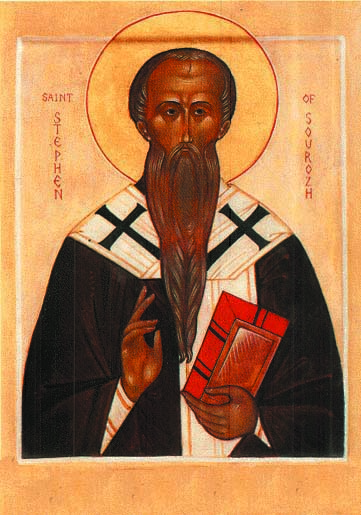
Saint Stephen the Confessor, Archbishop of Surrentium (Sourozh), was a native of Cappadocia and was educated at Constantinople. After receiving the monastic tonsure, he withdrew into the wilderness, where he lived for thirty years in ascetic deeds.
Patriarch Germanus of Constantinople (May 12) heard of Stephen’s humility and virtuous life, and wished to meet him. He was so impressed with Stephen that he consecrated him bishop of the city of Surrentium (presently the city of Sudak in the Crimea). Within five years, Saint Stephen’s ministry was so fruitful that no heretics or unbaptized pagans remained in Surrentium or its environs.
Saint Stephen opposed the iconoclasm of the emperor Leo III the Isaurian (716-741). Since he refused to obey the orders of the emperor and the dishonorable Patriarch Anastasius to remove the holy icons from the churches, he was brought to Constantinople. There he was thrown into prison and tortured. He was released after the death of the emperor. Already quite advanced in years, he returned to his flock in Surrentium, where he died.
There is an account of how the Russian prince Bravlin accepted Baptism at the beginning of the ninth century during a campaign into the Crimea, influenced by miracles at the saint’s crypt.
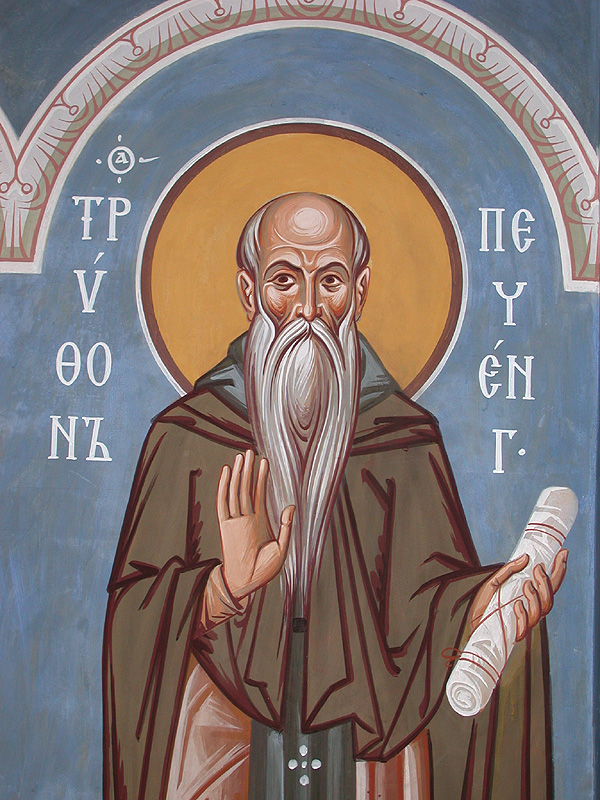
Saint Tryphon of Pechenga and Kola (Mētrophánēs in the world), was born in the Novgorod governia into a priestly family. The pious parents raised their son in the fear of God. From his early years Tryphon had resolved to devote his life to apostolic deeds and to go to the pagan Laplanders to proclaim the Gospel of Christ. He had heard of them only through the accounts of fish vendors.
Once, while praying in the forest he had heard a voice, “Tryphon, this is not your place. An inhospitable and thirsting land awaits you.” Forsaking his parental home, the Saint went out to the Kola Peninsula and halted on the banks of the Pechenga River, where the Lapps lived. There he began to trade with them. First the Saint acquainted himself with the pagan beliefs of those people and studied their language, and then he began to preach the Christian Faith to them. The Lapps listened to his words with great mistrust. He suffered many hardships, enduring hostility and even beatings. But gradually, through his wise and kindly words and meekness, many were converted to Christ.
With the blessing of Archbishop Makarios of Novogord, Saint Tryphon and Saint Theodóretos (August 17) built a church for the new converts. In 1532 he founded the Pechenga-Trinity Monastery for those who were zealous for the monastic life, “on the cold sea, on the frontier of Murmansk.”
Tsar Ivan the Terrible helped him and richly endowed the Monastery. The Enlightener of the Lapps went to the Lord in 1583 at the age of 98, after living in Lapland for almost 70 years. Local veneration of Saint Tryphon began soon after his death.
The Swedes destroyed Pechenga Monastery in 1589, but the Saint's burial place under the altar was not forgotten. In 1708-1709 the Sretensky church was built here, around which the Monastery was revived in 1886. The church was destroyed again in 1944, but after the restoration of the Monastery in 2009-2012 a new church was built over the Saint's relics.
Those who invoke Saint Tryphon with faith have received his miraculous help. Even during his lifetime he rescued shipwrecked sailors, calmed storms at sea, and healed those who suffered from deafness, blindness, and paralysis.
Saint Jonah of Pechenga and Kola was, as tradition tells us, a priest in the city of Kola. After the death of his daughter and wife he went off to the Pechenga-Trinity monastery near Kola, and became a disciple of its founder, Saint Tryphon. After the death of his teacher, he settled in 1583 at the site of what was to become his grave in the neighboring Dormition wilderness, where he was killed by the Swedes in the year 1590.

The Holy Martyr Eleutherius Cubicularius was an illustrious and rich chamberlain [“cubicularius”] at the Byzantine court. With all his courtly privileges, Eleutherius was not beguiled by worldly possessions and honors. Instead, he thought of imperishable and eternal things. Having accepted holy Baptism, he began daily to glorify God with psalmody and to adorn his life with virtuous deeds.
But one of his servants through diabolic promptings, informed against his master to the [then still pagan] emperor. The emperor tried to turn Eleutherius from his faith in Christ, but after the unsuccessful attempts the emperor gave orders to behead him, and to throw his body to be eaten by dogs and vultures. A certain Christian priest took up the saint’s body and buried it.
There is a second commemoration of the martyr on August 4.
Saint Pardus the Hermit, a Roman, was involved in his youth with the teamster’s craft. Once, when he traveled to Jericho, a boy accidentally fell under the legs of his camels. The camels trampled the boy to death. Shaken by this occurrence, Pardus became a monk and withdrew to Mount Arion.
Thinking himself as a murderer, and deserving of death, Saint Pardus entered the den of a lion. He poked the wild beast and prodded it with a spear so that the lion would tear him apart, but the creature would not touch the hermit. Saint Pardus then took off his clothes and lay down upon the path that the lion would take for water. But even here, the lion merely leaped over the hermit. And the Elder then understood that he had been forgiven by the Lord. Returning to his mountain, Saint Pardus dwelt there in fasting and prayer until the end of his days. He died in the sixth century.

The holy New Martyr Archbishop Hilarion (Vladimir Alexievich Troitsky in the world), an outstanding theologian, an eloquent preacher, and a fearless defender of Christ’s holy Church, was born around 1885.
Vladika Hilarion wrote many books and articles on various topics, including “The Unity of the Church.” His Master’s thesis, “An Outline of the History of the Church’s Dogma,” was over five hundred pages long, and was a well-documented analysis of the subject.
During the Council of 1917 he delivered a brilliant address calling for the restoration of the Moscow Patriarchate, which had been dissolved by Tsar Peter I in the eighteenth century. When Saint Tikhon (April 7) was chosen as Patriarch, Saint Hilarion became his fervent supporter.
Saint Hilarion was consecrated as bishop on May 20, 1920, and so the great luminary was placed upon the lampstand (Luke 11:33). From that time, he was to know less than two years of freedom. He spent only six months working with Patriarch Tikhon.
Vladika was arrested and exiled in Archangelsk for a year, then he spent six years (1923-1929) in a labor camp seven versts from Solovki. There at the Filomonov Wharf he and at least two other bishops were employed in catching fish and mending nets. Paraphrasing the hymns of Pentecost, Archbishop Hilarion remarked, “Formerly, the fishermen became theologians. Now the theologians have become fishermen.”
Archbishop Hilarion was one of the most popular inmates of the labor camp. He is remembered as tall, robust, and with brownish hair. Personal possessions meant nothing to him, so he always gave his things away to anyone who asked for them. He never showed annoyance when people disturbed him or insulted him, but remained cheerful.
In the summer of 1925, Vladika was taken from the camp and placed in the Yaroslav prison. There he was treated more leniently, and received certain privileges. For example, he was allowed to receive religious books, and he had pleasant conversations with the warden in his office. Saint Hilarion regarded his time at the Yaroslav Isolated Detention Center as the best part of his imprisonment. The following spring he was back at Solovki.
In 1929 the Communists decided to exile Archbishop Hilarion to Alma-Atu in central Asia. During his trip southward from the far north, Saint Hilarion was robbed and endured many privations. When he arrived in Petrograd, he was ill with typhus, infested with parasites and dressed in rags. When informed that he would have to be shaved, he replied, “You may now do with me whatever you wish.” He wrote from the prison hospital, “My fate will be decided on Saturday, December 15. I doubt I will survive.”
Saint Hilarion died at the age of forty-four in the hospital of a Petrograd prison on December 15, 1929. His body was placed in a coffin hastily made from some boards, and then was released to his family. The once tall and robust Archbishop Hilarion had been transformed by his sufferings into a pitiful white-haired old man. One female relative fainted when she saw the body.
Metropolitan Seraphim (Chichagov) provided a set of white vestments for the late Archbishop. He was also placed in a better coffin.
Metropolitan Seraphim presided at the funeral of Saint Hilarion, assisted by six bishops and several priests. The saint was buried at Novodevichii Monastery.
Saint Hilarion is commemorated on December 15 (his repose in 1929); May 10 (his glorification in 1999); the Third Sunday after Pentecost (All Saints of St. Petersburg); July 11 (The Finding of his relics in 1998); and on the Sunday nearest to August 26 (All Saints of Moscow).
Saint Nectarius of Bitel was born in the small town of Bitel (or Butili) in Bulgaria. In the world he was named Nicholas. Before a Turkish invasion his mother had a vision: the Most Holy Virgin Herself appeared and told her to flee and go into hiding with her husband and children. Nicholas’s father, having taken the boy with him, withdrew to a monastery dedicated to the Holy Unmercenaries (Saints Cosmas and Damian), not far from Bitel, where he became a monk with the name Pachomius.
Nicholas, having reached adolescence, went on to Athos. The clairvoyant Elder Philotheus accepted him and tonsured him into the angelic schema with the name Nectarius. The monk suffered for a long time from the envy and spite of one of the novices, but he displayed complete humility. He was distinguished for his charity. Any money he obtained from his handicraft was distributed to the poor. Saint Nectarius died in the year 1500.
11TH SUNDAY OF LUKE
ABSTAIN FROM MEAT, FISH, DAIRY, EGGS
11th Sunday of Luke, Martyrs Thyrsus, Leucius, and Callinicus of Asia Minor, and Philemon, Apollonius, and Arian of Alexandria
Brethren, when Christ who is our life appears, then you also will appear with him in glory. Put to death therefore what is earthly in you: fornication, impurity, passion, evil desire, and covetousness, which is idolatry. On account of these the wrath of God is coming upon the sons of disobedience. In these you once walked, when you lived in them. But now put them all away: anger, wrath, malice, slander, and foul talk from your mouth. Do not lie to one another, seeing that you have put off the old nature with its practices and have put on the new nature, which is being renewed in knowledge after the image of its creator. Here there cannot be Greek and Jew, circumcised and uncircumcised, barbarian, Scythian, slave, free man, but Christ is all, and in all.
The Lord said this parable: “A man once gave a great banquet, and invited many; and at the time of the banquet he sent his servant to say to those who had been invited, ‘Come; for all is now ready.’ But they all alike began to make excuses. The first said to him, ‘I have bought a field, and I go out and see it; I pray you, have me excused.’ And another said, ‘I have bought five yoke of oxen, and I must go to examine them; I pray you, have me excused.’ And another said, ‘I have married a wife, and therefore I cannot come.’ So the servant came and reported this to his master. Then the householder in anger said to his servant, ‘Go out quickly to the streets and lanes of the city, and bring in the poor and maimed and blind and lame.’ And the servant said, ‘Sir, what you commanded has been done, and there is still room.’ And the master said to the servant, ‘Go out to the highways and hedges, and compel people to come in, that my house may be filled. For I tell you, none of those men who were invited shall taste my banquet. For many are called, but few are chosen.'”

The Sunday that falls between December 11-17 is known as the Sunday of the Holy Forefathers. These are the ancestors of Christ according to the flesh, who lived before the Law and under the Law, especially the Patriarch Abraham, to whom God said, “In thy seed shall all of the nations of the earth be blessed” (Gen. 12:3, 22:18).
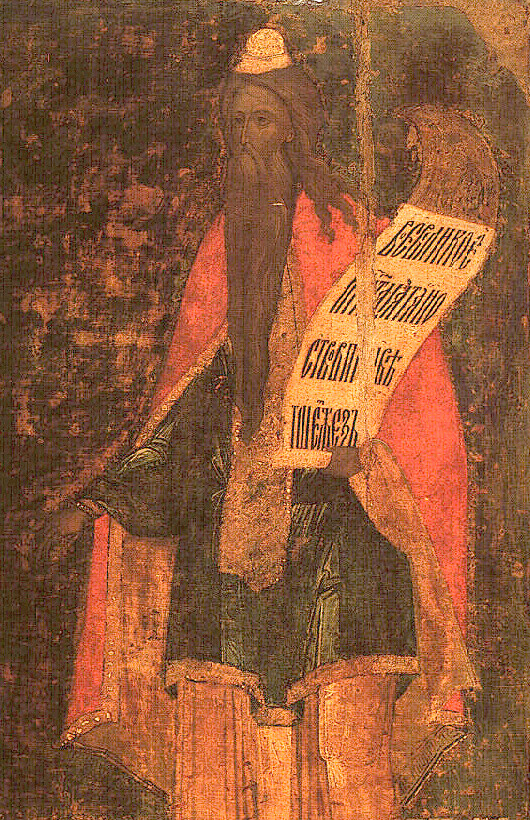
The Righteous Aaron was the son of Amram and Jochebed, and the elder brother of the Prophet Moses the God-seer, and also of Miriam. He was a direct descendent of Levi by both parents. God called him “the Levite” in Exodus 4:14, when He appointed Aaron to be the spokesman for Moses, who was “slow of speech,” before the people. Later, he would also speak on behalf of Moses before Pharaoh in Egypt (Ex. 4:30; 7:2). Aaron was married to Elisheba, the daughter of the Prince of Judah (Ex. 6:23), who bore him four sons.
Moses was eighty years old and Aaron was eighty-three when they spoke to Pharaoh and asked that the Hebrews be released from their slavery. The Lord told Moses that Pharaoh would ask them for a miracle, and that Aaron should throw down his rod before him, and it would become a serpent (Ex. 7:9). When Pharaoh would not allow the Hebrews to leave Egypt, God told Moses to have Aaron stretch forth his rod over the Nile River, and it would turn to blood.
Following a succession of plagues, Pharaoh relented and let the people go, then Moses led them on their long journey to the Promised Land. In Chapter 17 of Exodus, the Hebrews fought Amalek in a battle at Rephidim. Moses stood atop a hill with the rod of God in his hand. As long as he raised his hand, the Hebrews prevailed, but when he became tired and lowered it, Amalek prevailed. Aaron and Hur sat Moses on a rock and held up his hands, one on each side. This was a prefiguration of the suffering of Christ, because the arms of Moses formed a cross. In the Greek Septuagint, the names Aaron and Hur begin with the letters Alpha and Omega, another reference to Christ (Revelation 1:8).
Aaron and his sons were anointed and sanctified to serve God as priests (Exodus chapter 29). In chapter 32, Aaron fell into temptation when Moses went up on Mount Sinai to receive the Commandments. Since Moses was taking a long time, the people grew restless and asked Aaron to make them a golden idol in the form of a calf so that they could offer sacrifices. He gave into them, and Moses was angry when he returned and saw them dancing and singing before the calf. He threw down the tablets on which God had written the Ten Commandments, and then he burned the golden calf and ground it to powder. He scattered the powder on the water, and he made the people drink it. When Moses asked those who were on the Lord’s side to gather around him, the Levites came to him. He ordered them to take their swords and slay their sons, companions, and neighbors. About three thousand people were killed that day.
Later, Aaron and Miriam criticized Moses for marrying a Cushite woman (Num. 12:1). God was angry with them, so He punished Miriam with leprosy. She was healed by God seven days after Moses interceded for her.
In chapter 17 of Numbers, the people murmured against Moses and Aaron, so God commanded that the leaders of the twelve tribes should have their names inscribed on their rods and placed in the tent of testimony. God would reveal His choice to make the people cease their grumbling against Moses and his brother. Aaron’s rod bloomed miraculously in the tent of the testimony, to show that he had been chosen for this purpose.
Aaron reposed atop Mount Hor when he was one hundred and twenty-three years old. One of his descendants was Saint Elizabeth, the mother of Saint John the Baptist (Luke 1:5).

The youngest son of Jacob, he was called Benoni and then Benjamin (Genesis 35:16-18). Before his death Jacob blessed him in a seemingly backhanded way, saying that “Benjamin is a ravenous wolf, devouring his prey in the morning, and dividing the spoil in the evening” (Genesis 49:27). Commentators say this is not a reference to Benjamin himself, but to the warlike nature of the tribe of Benjamin.
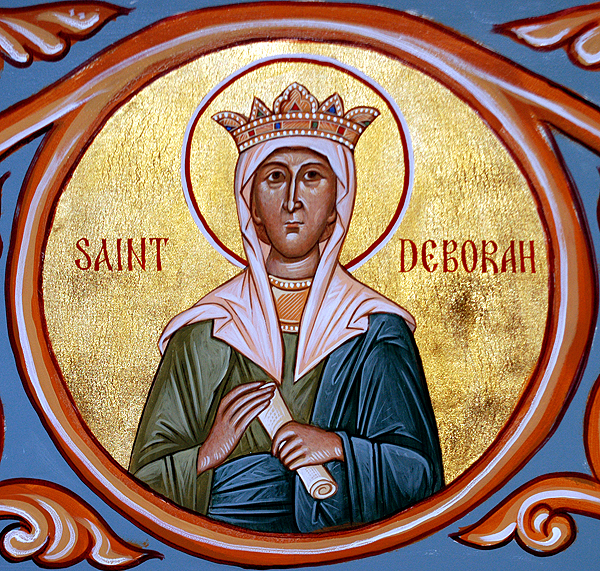
Information about the holy Prophetess and Judge Deborah may be found in the
Book of Judges 4:5-14, and also chapter 5.
The Righteous Hezron (Esrom, or Esron) is mentioned in the Old Testament genealogies: Genesis 46:12, Ruth 4:18, and 1 Chronicles 2:9 (LXX). He was the son of Perez (Phares) and the father of Aram (or Ioram), and an ancestor of the Prophet-King David.
According to the New Testament genealogies (Matthew 1:3; Luke 3:33), Phares begat Esrom; and Esrom begat Aram.

The Righteous Isaac was the second of the Old Testament Patriarchs, and the son of Abraham (Genesis 17:17-22). God tested Abraham to see if he would sacrifice his son (Genesis 22:1-13), and thus Isaac was a type of Christ. He was the husband of Rebecca (Genesis 24:67), and the father of Jacob and Esau (Genesis 25:19-26).
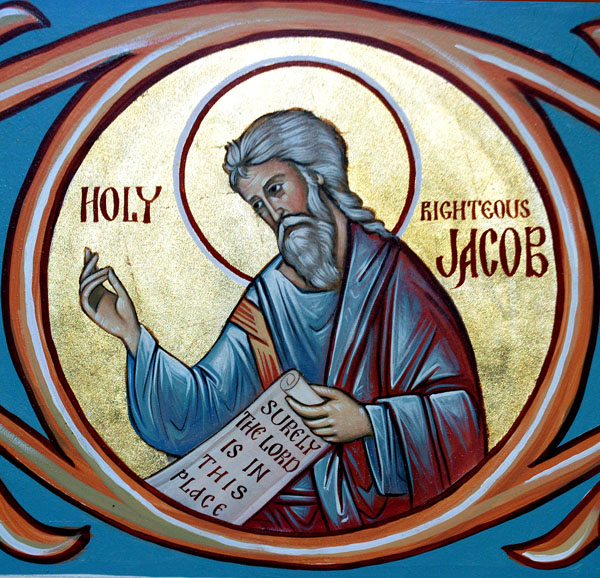
The Righteous Jacob is mentioned in the book of Genesis, chapters 25-50. He had a dream of a ladder (Genesis 28:12-17). Angels were ascending and descending the ladder, and the Lord was above the ladder (a type of the Mother of God, who united earth to Heaven when she consented to become the mother of the Messiah). Later, Jacob wrestled with God (Genesis 32:22-30), who appeared as a man, and Jacob prevailed. Then the Lord gave him the name Israel and blessed him. Jacob called that place Peniel (The face of God), and said, "I have seen God face to face, and yet my life is preserved."

Information about the Righteous Judith may be found in the Old Testament book
bearing her name.
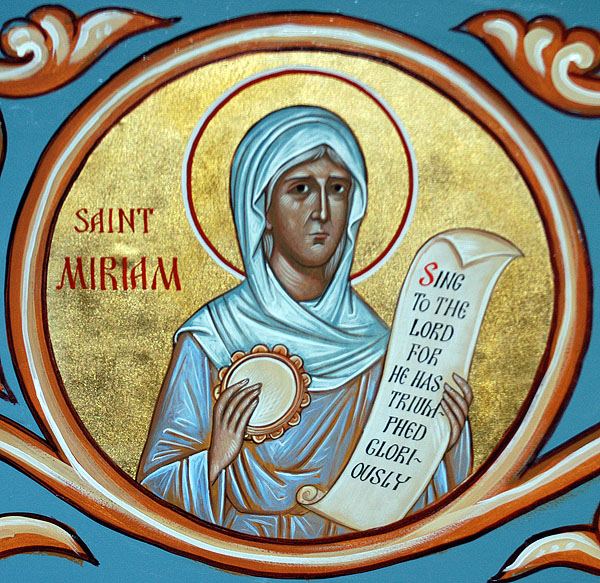
Saint Miriam, like her brothers Moses and Aaron, was descended from the tribe of Levi.
When Moses was an infant, the Hebrew midwives were ordered to kill any male child when they assisted at childbirths, but they refused to obey. Moses was hidden by his mother for three months, and then, when she could no longer do this, he was placed into a basket of reeds and set upon the waters of the Nile. Miriam watched in secret to see what would happen to him. When Pharaoh’s daughter found him, Miriam emerged from her place of concealment and offered to find a wet nurse from among the Hebrew women for the baby. Miriam went to get her mother, who raised her child until he was grown, and then returned him to Pharoah’s daughter (Exodus 2:10).
In the Torah, she is called “Miriam the Prophetess” (Exodus 15:20), while the Prophet Michah (6:4) has God say that He sent Moses, and Aaron, and Miriam before the Hebrews to lead them out of Egypt.
In Chapter 12 of the book of Numbers, Miriam and Aaron apparently criticize Moses for being married to a foreign woman of Cush (or an Ethiopian). This, however, was merely a pretext for their resentment. Actually, they were disturbed by Moses’ position as the sole mediator between God and the people. Miriam was a prophetess, after all. Miriam and Aaron questioned Moses, “Has the Lord spoken only to Moses? Has He not also spoken to us?” God then tells them that He speaks face to face with Moses, but only in visions to Miriam and Aaron while they are asleep. Then, for daring to speak against Moses, Miriam is punished with leprosy. Aaron pleads with Moses not to hold their sin against them, since they had acted out of ignorance. Even so, Miriam was set apart outside the camp for seven days, and then she was healed and allowed to come in.
In one of the stichera on the Praises for the Sunday before the Nativity, Sarah, Rebecca, Anna, and Miriam, “the glory of women,” are said to “exchange glad tidings.”

The Prophet Nathan was an advisor to King David and King Solomon. He is mentioned in the Prayer of Absolution in the Mystery of Confession: “It was God Who pardoned David through the Prophet Nathan when he had confessed his sin….” David had committed adultery with Uriah's wife Bathsheba, and had him killed. Then he took Bathsheba as his wife. David confessed his sin to Nathan (2 Samuel 12:13) and received pardon.

The Old Testament book of Nehemiah tells of how he returned from the Captivity in Babylon in the twentieth year of the Persian King Artaxerxes (445/444 B.C.) to rebuild Jerusalem and to govern the province. He and Ezra purified the Jewish people by making known the Law of Moses, and forcing the men to divorce their pagan wives.

The Righteous Noah is mentioned in the Book of Genesis (chapters 5-9).
Seeing the wicked deeds of men, God decided to destroy man from the earth, and even cattle, reptiles, and birds. But Noah found favor with the Lord, Who spared him, his sons and their wives. Therefore, God commanded Noah to build an ark and take two pairs of every creature into it. Then it rained for forty days and nights, and men and animals perished in the flood. The water remained on the earth for 150 days, then God blessed Noah and his sons, telling them to increase and multiply (Genesis 9:7).
Through Noah's sons Shem, Ham and Japheth, the earth was repopulated, and God promised not to destroy the world by water again. Noah reposed at the age of 950 (Genesis 9:29). The ark is a figure of the Church, which is called the Ark of Salvation.
While speaking about the end of the world, the Savior told His disciples: "As were the days of Noah, so will be the coming of the Son of man. For as in those days before the flood they were eating and drinking, marrying and giving in marriage, until the day when Noah entered the ark, and they did not know until the flood came and swept them all away, so will be the coming of the Son of man" (Matthew 24:37-39).
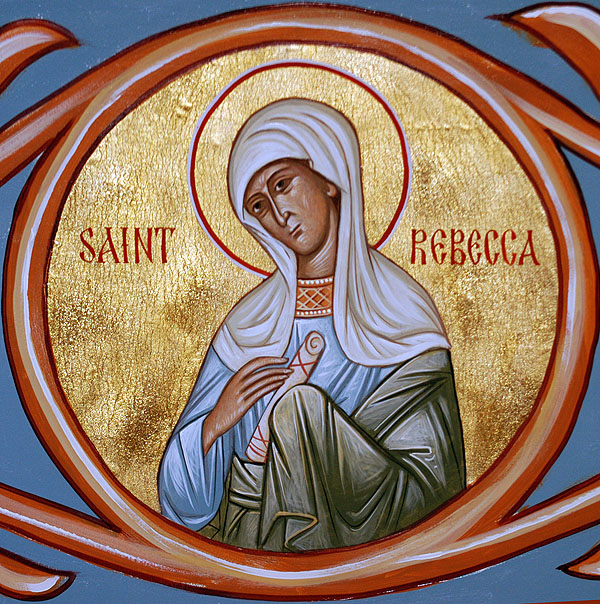
Rebecca was the wife of the Old Testament Patriarch Isaac, and the mother of Jacob and Esau. She is mentioned in Genesis 22:23; Chapters 24-28; and Chapter 49:31. Saint Paul also mentions her (Romans 9:10).

Sarah was the wife of the Old Testament Patriarch Abraham and the mother of Isaac. At first she was called Sarai, and her name was changed to Sarah (Genesis 17:15-16). The three men who visited Abraham at the oak of Mamre told her that she would conceive and have a son (Genesis 18:10). She did not believe them at first, since she and her husband were old, but they insisted that she would bear a son in the spring. Their prediction was fulfilled, and God did as He had promised (Genesis 21:1-3). Saint Andrew Rublev depicts the three men as angels in his most famous icon. Sarah is praised in the New Testament for her faith (Hebrews 11:11) and also for her obedience (I Peter 3:6).

The Prophet-King Solomon (ca. 972 – 932 B.C.) was the son of David and Bathsheba. He succeeded his father as King and reigned for forty years. He built the palace and the Temple at Jerusalem, and was renowned for his wisdom. The Old Testament books of Proverbs, the Song of Songs, and the Wisdom of Solomon are attributed to him. He may have written parts of these books, but much of the material was probably transmitted orally before it was written down.
In the Gospels, Christ mentions Solomon by name, citing his glory and wisdom (Matthew 6:29; 12:42).

The 64-verse story of Susanna is found in the Septuagint Greek as a Preamble to the Book of Daniel. The Latin Vulgate, however, places the story of Susanna at the end of the Book of Daniel, which constitutes the book's thirteenth chapter.
Information about the Righteous Ruth, the wife of Boaz, may be found in the Old Testament book bearing her name.
Saint Mary is the mother of Saint Anna, and the grandmother of the Theotokos.

The Holy Martyrs Thyrsos, Leukios, and Kallinikos, suffered for Christ under Emperor Decius (249-251) at Caesarea in Bithynίa. When Saint Leukios reproached the prefect Cumbricius for his unjust persecution of Christians, he was tortured and then executed.
Saint Thyrsos, who was still a catechumen, was nonetheless eager for martyrdom. He was sentenced to cruel tortures after refusing to offer sacrifice to the idols. Citing the words of the Prophet Jeremiah (2:27), he ridiculed those who worshiped idols made of wood and stone.
The Saint’s arms and legs were pulled out of their sockets, his eyes were plucked out, and his teeth were smashed with a hammer. He was taken to a heathen temple, where, by his prayers, he toppled a statue of Apollo. Cumbricius was outraged by this, and he ordered even greater torments be devised for the athlete of Christ. Saint Thyrsos endured them all, then died after making the Sign of the Cross. The pagan priest Kallinikos, after witnessing the bravery of Saint Thyrsos and the miracle he performed, believed in Christ and boldly confessed the true Faith, for which he was beheaded.

These Saints lived during the reign of Emperor Diocletian (ca. 290). Arrian, the ruler of Thebes in Egypt, arrested 37 Christians, including Saints Askalon and Leonidas (May 20). Arrian gave them the choice of sacrificing to the idols, or being tortured and executed. Most preferred to die rather than deny Christ. One of them, the Reader Apollonios, was afraid of being tortured, so his gave his clothes and four gold coins to a pagan musician named Philemon (Philḗmon) to offer sacrifice to the idols in his place. Philemon wore Apolonnios' clothes and covered his face. As he approached the altar, his heart was illumined with divine grace, and the eyes of his mind were opened. He made the Sign of the Cross and confessed Christ.
The ruler asked what this meant, and Philemon cried aloud, "I am a Christian, and the servant of Christ."
Then Arrian sent for Philemon to come and play his flute, in order to calm "Apollonios" so that he would be more inclined to worship idols. Arrian's servants could not find Philemon, so instead they brought his brother Theonas. Recognizing his disguised brother, Theonas laughed and said, "Philemon stands before you."
Arrian ordered Philemon's face to be uncovered, then told him to take off Apollonios' garments and to offer sacrifice with him. Instead, Philemon ridiculed the pagan "gods." He said that he had truly become a Christian, although he had not been baptized. Philemon prayed fervently, and suddenly a heavy rain fell, which was a Baptism for him.
Since it was Apollonios who caused Philemon to believe, Arrian brought him before him as well, and this time he confessed Christ. As a result, Arrian tortured them cruelly, and then beheaded them.
Immediately, Arrian was stricken with blindness. Saint Philemon appeared to him in a dream and told him to smear some dirt from his grave on his eyes, and he would be cured. That is exactly what happened. Then Arrian and his four bodyguards believed in Christ, and later they were all martyred together circa 305.
Saint Hilarion, Metropolitan of Suzdal and Yuriev (in the world John), was born November 13, 1631 into the family of the lower city priest Ananias. His father, famed for his piety and reading, was one of three candidates for the Patriarchal throne, together with the future Patriarch Nikon (1652-1658).
John entered a monastery in 1653. In 1655, he became founder and builder of the Phlorischev wilderness monastery not far from the city of Gorokhovetsa. In his monastic struggles, the saint wrestled with fleshly passions. When he fell down in exhaustion before the Vladimir Icon of the Mother of God beseeching Her help, the Mother of God shielded him with gracious power and calmed his spirit.
Once, when Saint Hilarion was serving Vespers together with a hierodeacon, robbers burst into the church. They killed the deacon and started to set Saint Hilarion on fire, asking him where the monastery treasure was hid. They did not believe that there was no gold in the monastery. Overcome by the pain, Saint Hilarion turned to the wonderworking icon and said, “O All-Pure Virgin Mary, Mother of our Lord Jesus Christ! If they injure me with the fire, I shall no longer have the ability to glorify Thy Son and Thee.” Suddenly the robbers heard the shouts of people searching for them, and they fled.
Another time, Saint Hilarion in passing by the church heard a voice: “I shall glorify thee throughout all the land.” He trembled, and going into the vestibule, he found no people there. On the portico he found only the Vladimir Icon of the Mother of God. The ascetic fell down before the image with tears and confessed his unworthiness.
Later on, when the saint had begun the construction of a stone church, he was very sad that concerns about the construction and disagreements among the workers were distracting him from prayer. While serving in church with the brethren, he was preoccupied by these thoughts and began to regret undertaking the work. With tears he besought the Mother of God not to abandon him and to deliver him from these worries.
When he finished his prayer, Saint Hilarion remained alone in church and began again to think about the construction. And so he fell asleep. In a dream the Mother of God appeared to him and said, “Transfer My icon, named the Vladimir, from this hot church and put it in the newly-built stone church, and I shall be your Helper there”.
Saint Hilarion awoke and ordered the large bell to be rung. The monks immediately assembled. All went to the hot church and, having prayed before the icon, solemnly transferred it from the portico into the temple. After serving the all night Vigil, Divine Liturgy and a Molieben, the saint told the brethren of his vision. Then in procession they transferred the icon to the church under construction, where they set it in the midst of the woods. From that time the construction went successfully and was soon completed. The saint wanted to dedicate the temple in honor of the icon, but he it was revealed to him in a vision that the temple was to be consecrated in honor of the Dormition of the Most Holy Theotokos.
In the wilderness monastery he maintained a very strict community rule. In 1694, the saint sent a letter to the Phlorischev monastery in which he reminisced about his own monastic Rule at this monastery: “Under me, a sinner, no one possessed anything of his own, but all was shared in common. Many of you may remember that former cenobitic community. And you also remember that I consigned to the fire those possessions which would destroy that cenobitic community.”
On December 11, 1681, the saint was consecrated as Archbishop of Suzdal and Yuriev, and in 1682 he was elevated to the dignity of Metropolitan and remained on the Suzda’ cathedra until February 1705. The saint died peacefully on December 14, 1707 and was buried in the Suzdal cathedral in honor of the Nativity of the Most Holy Theotokos. The saint was known for his unceasing concern for the poor. After his death they found only three coins.
The wonderworking Icon of the Mother of God of Vladimir-Phlorischev (August 26) had been painted by the renowned iconographer John Chirov in 1464 at Nizhni Novgorod in fulfillment of a vow of John Vetoshnikov.
SATURDAY OF THE 12TH WEEK
ABSTAIN FROM MEAT, FISH, DAIRY, EGGS
Martyrs Eustratius, Auxentius, Eugene, Mardarius, and Orestes of Greater Armenia, Lucia the Virgin-martyr, Herman the Wonderworker of Alaska & First Saint of America, Gabriel the Hieromartyr, Archbishop of Serbia
Brethren, the fruit of the Spirit is love, joy, peace, patience, kindness, goodness, faithfulness, gentleness, self-control; against such there is no law. And those who belong to Christ Jesus have crucified the flesh with its passions and desires. If we live by the Spirit, let us also walk by the Spirit. Let us have no self-conceit, no provoking of one another, no envy of one another. Brethren, if a man is overtaken in any trespass, you who are spiritual should restore him in a spirit of gentleness. Look to yourself, lest you too be tempted. Bear one another’s burdens, and so fulfill the law of Christ.
The Lord said this parable, "The kingdom of God is like a grain of mustard seed which a man took and sowed in his garden; and it grew and became a tree, and the birds of the air made nests in its branches." And again he said, "To what shall I compare the kingdom of God? It is like leaven which a woman took and hid in three measures of flour, till it was all leavened." He went on his way through towns and villages, teaching, and journeying toward Jerusalem. And some one said to him, "Lord, will those who are saved be few?" And he said to them, "Strive to enter by the narrow door; for many, I tell you, will seek to enter and will not be able. When once the householder has risen up and shut the door, you will begin to stand outside and to knock at the door, saying, 'Lord, open to us.' He will answer you, 'I do not know where you come from.' Then you will begin to say, 'We ate and drank in your presence, and you taught in our streets.' But he will say, 'I tell you, I do not know where you come from; depart from me, all you workers of iniquity!' There you will weep and gnash your teeth when you see Abraham and Isaac and Jacob and all the prophets in the kingdom of God and you yourselves thrust out. And men will come from east and west, and from north and south, and sit at table in the kingdom of God.

A spiritual mission was organized in 1793 with volunteers from the monks of the Valaam Monastery. They were sent to preach the Word of God to the native inhabitants of northwestern America, who had come under the sovereignty of Russia only ten years before. Saint Herman was one of the members of this mission.
Saint Herman came from a family of merchants of Serpukhov, a city of the Moscow diocese. His name before he was tonsured, and his family name are not known. There is a possibility, however, that his baptismal name was Gerasimus. He had a great zeal for piety from his youth, and he entered monastic life at sixteen. (This was in 1772, if we assume that Herman was born in 1756, although sometimes 1760 is given as the date of his birth.) First he entered the Trinity-Sergius Hermitage which was located near the Gulf of Finland on the Peterhof Road, about 15 versts (about 10 miles) from Saint Petersburg. He also spent time at at Sarov, where he first met Father Nazarius, who became his Elder at Valaam. Later, Saint Herman followed him to Sanaxar where Saint Theodore (February 19) was their igumen.
Miraculous Healing
At the Saint Sergius Hermitage there occurred the following incident to Father Herman. On the right side of his throat under his chin there appeared an abscess. The swelling grew rapidly, disfiguring his face. It became difficult for him to swallow, and the odor was unbearable. In this critical condition Father Herman awaited death. He did not appeal to a physician of this world, but locking his cell he fell before an icon of the Mother of God. With fervent tears he prayed, asking of Her that he might be healed. He prayed the whole night. Then he took a wet towel and with it wiped the face of the Most Holy Mother, and with this towel he covered the swelling. He continued to pray with tears until he fell asleep from sheer exhaustion on the floor. In a dream he saw the Virgin Mary healing him.
When Herman awoke in the morning, he found to his great surprise that he was fully healed. The swelling had disappeared, even though the abscess had not broken through, leaving behind but a small mark as though a reminder of the miracle. Physicians to whom this healing was described did not believe it, arguing that it was necessary for the abscess to have either broken through of its own accord or to have been cut open. But the words of the physicians were the words of human experience, for where the grace of God operates there the order of nature is overcome. Such occurrences humble human reason under the strong hand of God’s Mercy.
Life at Valaam
For five or six years Father Herman continued to live in the Saint Sergius Hermitage, and then he transferred to the Valaam Monastery, which was widely scattered on the large islands in the waters of the great Lake Ladoga. He came to love the Valaam haven with all his soul, as he came to love its unforgettable Superior, the pious Elder Nazarius, and all the brethren. He wrote to Father Nazarius later from America, “Your fatherly goodness to me, humble one, will be erased out of my heart neither by the terrible, unpassable Siberian lands, nor by the dark forests. Nor will it be wiped out by the swift flow of the great rivers; nor will the awful ocean quench these feelings. In my mind I imagine my beloved Valaam, looking to it beyond the great ocean.” He praised the Elder Nazarius in his letters as, “the most reverend, and my beloved father,” and the brethren of Valaam he called, “my beloved and dearest.” The place where he lived in America, deserted Spruce Island, he called “New Valaam.” And as we can see, he always remained in spiritual contact with his spiritual homeland, for as late as 1823, that is after thirty years of his life within the borders of America, he wrote letters to the successor of Father Nazarius, the lgumen Innocent.
Father Barlaam, later lgumen of Valaam, and a contemporary of Father Herman, who accepted his tonsure from Father Nazarius, wrote thus of the life of Father Herman.
“Father Herman went through the various obediences here, and being ‘well disposed toward everything’ was in the course of events sent to Serdobol to oversee there the work of quarrying marble. The Brothers loved Father Herman, and awaited impatiently his return to the cloisters from Serdobol. Recognizing the zeal of the young hermit the wise elder, Father Nazarius, released him to take abode in the wilderness. This wilderness was in the deep forest about a mile from the cloister: to this day this place has retained the name ‘Herman’s.’ On holy days, Father Herman returned to the monastery from the wilderness. Then it was that at Little Vespers he would stand in the choir and sing in his pleasant tenor the responses with the brethren from the Canon, ‘O Sweetest Jesus, save us sinners. Most Holy Theotokos, Save us,’ and tears would fall like hail from his eyes.”
The First Mission to America
In the second half of the 18th century the borders of Holy Russia expanded to the north. In those years Russian merchants discovered the Aleutian Islands which formed in the Pacific Ocean a chain from the eastern shores of Kamchatka to the western shores of North America. With the opening of these islands there was revealed the sacred necessity to illumine with the light of the Gospel the native inhabitants. With the blessing of the Holy Synod, Metropolitan Gabriel gave to the Elder Nazarius the task of selecting capable persons from the brethern of Valaam for this holy endeavor. Ten men were selected, and among them was Father Herman. The chosen men left Valaam for the place of their great appointment in 1793. (The members of this historical mission were: Archimandrite Joseph (Bolotoff), the Hieromonks, Juvenal, Macarius, Athanasius, Stephan and Nectarius, Hierodeacons, Nectarius and Stephen, and the monks Joasaph, and Herman.)
As a result of the holy zeal of the preachers the light of the evangelic sermon quickly poured out among the sons of Russia, and several thousand pagans accepted Christianity. A school for the education of newly-baptized children was organized, and a church was built at the place where the missionaries lived. But by the inscrutable providence of God the general progress of the mission was unsatisfactory. After five years of very productive labor, Archimandrite Joasaph, who had just been elevated to the rank of bishop, was drowned with his party. (This occurred on the Pacific Ocean between Kamchatka and the Aleutian Islands. The ship, Phoenix, one of the first sea-going ships built in Alaska, sailed from Okhotsk carrying the first Bishop for the American Mission and his party. The Phoenix was caught in one of the many storms which periodically sweep the northern Pacific, and the ship and all hands perished together with Bishop Joasaph and his party.) Before this the zealous Hieromonk Juvenal was granted the martyr’s crown. The others died one after another until in the end only Father Herman remained. The Lord permitted him to labor longer than any of his brethren in the apostolic task of enlightening the Aleutians.
The New Valaam — Spruce Island
In America, Father Herman chose as his place of habitation Spruce Island, which he called New Valaam. This island is separated by a strait about a mile and a quarter wide from Kodiak Island on which had been built a wooden monastery for the residence of the members of the mission, and a wooden church dedicated to the Resurrection of the Savior. (New Valaam was named for Valaam on Lake Ladoga, the monastery from which Father Herman came to America. It is interesting to note that Valaam is also located on an island, although, this island is in a fresh water lake, whereas, Spruce Island is on the Pacific Ocean, although near other islands and the Alaskan mainland.)
Spruce Island is not large, and is almost completely covered by a forest. Almost through its middle a small brook flows to the sea. Herman selected this picturesque island for the location of his hermitage. He dug a cave out of the ground with his own hands, and in it he lived his first full summer. For winter there was built for him a cell near the cave, in which he lived until his death. The cave was converted by him into a place for his burial. A wooden chapel, and a wooden house to be used as a schoolhouse and a guest house were built not too distant from his cell. A garden was laid out in front of his cell. For more than forty years Father Herman lived here.
Father Herman’s Way of Life
Father Herman himself spaded the garden, planted potatoes and cabbage and various vegetables in it. For winter, he preserved mushrooms, salting or drying them. The salt was obtained by him from ocean water. It is said that a wicker basket in which the Elder carried seaweed from the shore, was so large that it was difficult for one person to carry. The seaweed was used for fertilizing the soil. But to the astonishment of all, Father Herman carried a basket filled with seaweed for a long distance without any help at all. By chance his disciple, Gerasim, saw him one winter night carrying a large log which normally would be carried by four men; and he was bare footed. Thus worked the Elder, and everything that he acquired as a result of his immeasurable labors was used for the feeding and clothing of orphans and also for books for his students.
His clothes were the same for winter as for summer. He did not wear a shirt; instead he wore a smock of deer skin, which he did not take off for several years at a time, nor did he change it, so that the fur in it was completely worn away, and the leather became glossy. Then there were his boots or shoes, cassock (podrasnik), an ancient and faded out cassock (riasa) full of patchwork, and his headdress (klobuk). He went everywhere in these clothes, and at all times; in the rain, in snowstorms, and during the coldest freezing weather. In this, Father Herman followed the example of many Eastern Ascetic Fathers and Monks who showed the greatest concern for the welfare and needs of others. Yet, they themselves wore the oldest possible clothes to show their great humility before God, and their detachment from worldly things.
A small bench covered with a time-worn deerskin served as Father Herman’s bed. He used two bricks for a pillow; these were hidden from visitors by a skin or a shirt. There was no blanket. Instead, he covered himself with a wooden board which lay on the stove. This board Father Herman, himself called his blanket, and he willed that it be used to cover his remains; it was as long as he was tall. “During my stay in the cell of Father Herman,” writes the creole Constantine Larionov, “I, a sinner, sat on his ‘blanket’-and I consider this the acme of my fortune!” (‘creole’ is the name by which the Russians referred to the children of mixed marriages of native Indians of Alaska, Eskimo and Aleuts with Russians.)
On the occasions when Father Herman was the guest of administrators of the American Company and in the course of their soul-saving talks he sat up with them until midnight. He never spent the night with them, but regardless of the weather he always returned to his hermitage. If for some extraordinary reason it was necessary for him to spend the night away from his cell, then in the morning the bed which had been prepared for him would be found untouched; the Elder not having slept at all. The same was true in his hermitage where having spent the night in talks, he never rested.
The Elder ate very little. As a guest, he scarcely tasted the food, and remained without dinner. In his cell his dinner consisted of a very small portion of a small fish or some vegetables. His body, emaciated as a result of his labors, his vigils, and fasting, was crushed by chains which weighed about sixteen pounds. These chains are kept to this day in the chapel. Telling of these deeds of Father Herman, his disciple, the Aleut Ignaty Aligyaga, added, “Yes, Apa led a very hard life, and no one can imitate his life!” (The Aleutian word “Apa” means Elder or grandfather, and it is a name indicative of the great affection in which he was held).
Our writing of the incidents in the life of the Elder deal, so to speak, with the external aspects of his labor. “His most important works,” says the Bishop Peter, “were his exercises in spiritual endeavor in his isolated cell where no one saw him, but outside the cell they heard him singing and celebrating services to God according to the monastic rule.” This witness of the Bishop is supported by the following answers of Father Herman, himself, “How do you manage to live alone in the forest, Father Herman? Don’t you ever become lonesome?” He answered, “No I am not there alone! God is here, as God is everywhere. The Holy Angels are there. With whom is it better to talk, with people, or with Angels? Most certainly with Angels.”
Father Herman and the Native Alaskans
The way in which Father Herman looked upon the natives of America, how he understood his own relations with them, and how he was concerned for their needs he expressed himself in one of his letters to the former administrator of the colony, Simeon Yanovsky. He wrote, “Our Creator granted to our beloved homeland this land which like a newly-born babe does not yet have the strength for knowledge or understanding. It requires not only protection, because of its infantile weakness and impotence, but also his sustenance. Even for this it does not yet have the ability to make an appeal on its own behalf. And since the welfare of this nation by the Providence of God, it is not known for how long, is dependent on and has been entrusted into the hands of the Russian government which has now been given into your own power, therefore I, the most humble servant of these people, and their nurse (nyanka) stand before you in their behalf, write this petition with tears of blood. Be our Father and our Protector. Certainly we do not know how to be eloquent, so with an inarticulate infant’s tongue we say: Wipe away the tears of the defenseless orphans, cool the hearts melting away in the fire of sorrow. Help us to know what consolation means.”
The Elder acted the way he felt. He always interceded before the governors in behalf of those who had transgressed. He defended those who had been offended. He helped those who were in need with whatever means he had available. The Aleuts, men, women and children, often visited him. Some asked for advice, others complained of oppression, others sought out defense, and still others desired help. Each one received the greatest possible satisfaction from the Elder. He discussed their mutual difficulties, and he tried to settle these peacefully. He was especially concerned about reestablishing understanding in families. If he did not succeed in reconciling a husband and wife, the Elder prevailed upon them to separate temporarily. The need for such a procedure he explained thus, “it is better to let them live apart, or believe me, it can be terrible if they are not separated. There have been incidents when a husband killed his wife, or when a wife destroyed her husband.”
Father Herman especially loved children. He made large quantities of biscuits for them, and he baked cookies (krendelki) for them; and the children were fond of the Elder. Father Herman’s love for the Aleuts reached the point of self-denial.
An Epidemic Strikes
A ship from the United States brought to Sitka Island, and from there to Kodiak Island, a contagious disease, a fatal illness. It began with a fever, a heavy cold, and difficult respiration, and it ended with chills; in three days the victim died. On the island there was neither a doctor nor medicine. The illness spread rapidly through the village, and then throughout the nearby areas. The disease affected all, even infants. The fatalities were so great that for three days there was no one to dig graves, and the bodies remained unburied. An eyewitness said, “I cannot imagine anything more tragic and horrible than the sight which struck me when I visited an Aleutian ‘Kazhim’. This was a large building, or barracks, with dividing sections, in which the Aleuts lived with their families; it contained about 100 people. Here some had died, their cold bodies lay near the living; others were dying; there were groans and weeping which tore at one’s soul.”
“I saw mothers over whose bodies cold in death crawled a hungry child, crying and searching in vain for its food…My heart was bursting with compassion! It seemed that if anyone could paint with a worthy brush the full horror of this tragic scene, that he would have successfully aroused fear of death in the most embittered heart.” Father Herman, during this terrible sickness which lasted a whole month, gradually dying out towards the end, visited the sick, never tiring. He admonished them in their fear, prayed, brought them to penance, or prepared them for death. He never spared himself.
Father Herman as a Spiritual Teacher
The Elder was concerned in particular for the moral growth of the Aleuts. With this end in mind a school was built for children-the orphans of the Aleuts. He himself taught them the Law of God and church music. For this same purpose he gathered the Aleuts on Sunday and Holy Days for prayer in the chapel near his cell. Here his disciple read the Hours and the various prayers while the Elder himself read the Epistle and Gospel. He also preached to them. His students sang, and they sang very well. The Aleuts loved to hear his sermons, gathering around him in large numbers. The Elder’s talks were captivating, and his listeners were moved by their wonderous power. He himself writes of one example of the beneficial results of his words.
“Glory to the holy destinies of the Merciful God! He has shown me now through his unfathomable Providence a new occurrence which I, who have lived here for twenty years had never seen before on Kodiak,” he wrote. “Recently after Easter, a young girl about twenty years of age who knows Russian well, came to me. Having heard of the Incarnation of the Son of God and of Eternal Life, she became so inflamed with love for Jesus Christ that she does not wish to leave me. She pleaded eloquently with me. Contrary to my personal inclination and love for solitude, and despite all the hindrances and difficulties which I put forward before accepting her, she has now been living near the school for a month and is not lonesome. I, looking on this with great wonder, remembered the words of the Savior: ‘that which is hidden from the wise and learned is revealed to babes’” (Matthew 11:25).
This woman lived at the school until the death of the Elder. She watched for the good conduct of the children who studied in his school. Father Herman willed that after his death she was to continue to live on Spruce Island. Her name was Sophia Vlasova.
Yanovsky writes about the character and the eloquence of the talks of the Elder thus: “When I met Father Herman I was thirty years old. I must say that I was educated in the naval corps school; that I knew many sciences having read extensively. But to my regret, the Science of sciences, that is the Law of God, I barely remembered the externals—and these only theoretically, not applying them to life. I was a Christian in name only, but in my soul and in reality, I was a freethinker. Furthermore, I did not admit the divinity and holiness of our religion, for I had read through many atheistic works. Father Herman recognized this immediately and he desired to reconvert me. To my great surprise he spoke so convincingly, wisely—and he argued with such conviction—that it seemed to me that no learning or worldly wisdom could stand one’s ground before his words. We conversed with him daily until midnight, and even later, of God’s love, of eternity, of the salvation of souls, and of Christian living. From his lips flowed a ceaseless stream of sweet words! By these continual talks and by the prayers of the holy Elder the Lord returned me completely to the way of Truth, and I became a real Christian. I am indebted for all this to Father Herman he is my true benefactor.
“Several years ago,” continues Yanovsky, “Father Herman converted a certain naval captain G. to Orthodoxy from the Lutheran Faith. This captain was well educated. Besides many sciences, he was well versed in languages. He knew Russian, English, German, French, Italian and also some Spanish. But for all this he could not resist the convictions and proofs of Father Herman. He changed his faith and was united to the Orthodox Church through Chrismation. When he was leaving America, the Elder said to him while they were parting, “Be on guard, if the Lord should take your wife from you then do not marry a German woman under any circumstance. If you do marry a German woman, undoubtedly she will damage your Orthodoxy.” The Captain gave his word, but he failed to keep it. The warning of the Elder was prophetic. Indeed, after several years the Captain’s wife did die, and he married a German woman. There is no doubt that his faith weakened or that he left it; for he died suddenly without penance.”
Further on Yanovsky writes, “Once the Elder was invited aboard a frigate which came from Saint Petersburg. The Captain of the frigate was a highly educated man, who had been sent to America by order of the Emperor to make an inspection of all the colonies. There were more than twenty-five officers with the Captain, and they also were educated men. In the company of this group sat a monk of a hermitage, small in stature and wearing very old clothes. All these educated conversationalists were placed in such a position by his wise talks that they did not know how to answer him. The Captain himself used to say, ‘We were lost for an answer before him.’
“Father Herman gave them all one general question: ‘Gentlemen, What do you love above all, and what will each of you wish for your happiness?’ Various answers were offered … Some desired wealth, others glory, some a beautiful wife, and still others a beautiful ship he would captain; and so forth in the same vein. ‘It is not true,’ Father Herman said to them concerning this, ‘that all your various wishes can bring us to one conclusion—that each of you desires that which in his own understanding he considers the best, and which is most worthy of his love?’ They all answered, ‘Yes, that is so!’ He then continued, ‘Would you not say, Is not that which is best, above all, and surpassing all, and that which by preference is most worthy of love, the Very Lord, our Jesus Christ, who created us, adorned us with such ideals, gave life to all, sustains everything, nurtures and loves all, who is Himself Love and most beautiful of all men? Should we not then love God above every thing, desire Him more than anything, and search Him out?’
“All said, ‘Why, yes! That’s self-evident!’ Then the Elder asked, ‘But do you love God?’ They all answered, ‘Certainly, we love God. How can we not love God?’ ‘And I a sinner have been trying for more than forty years to love God, I cannot say that I love Him completely,’ Father Herman protested to them. He then began to demonstrate to them the way in which we should love God. ‘If we love someone,’ he said, ‘we always remember them; we try to please them. Day and night our heart is concerned with the subject. Is that the way you gentlemen love God? Do you turn to Him often? Do you always remember Him? Do you always pray to Him and fulfill His holy commandments?’ They had to admit that they had not! ‘For our own good, and for our own fortune,’ concluded the Elder, ‘let us at least promise ourselves that from this very minute we will try to love God more than anything and to fulfill His Holy Will!’ Without any doubt this conversation was imprinted in the hearts of the listeners for the rest of their lives.’
“In general, Father Herman liked to talk of eternity, of salvation of the future life, of our destinies under God. He often talked on the lives of the Saints, on the Prologue, but he never spoke about anything frivolous. It was so pleasant to hear him that those who conversed with him, the Aleuts and their wives, were so captivated by his talks that often they did not leave him until dawn, and then they left him with reluctance;” thus witnesses the Creole, Constantine Larionov.
A Description of Father Herman
Yanovsky writes a detailed description of Father Herman. “I have a vivid memory,” he said, “Of all the features of the Elder’s face reflecting goodness; his pleasant smile, his meek and attractive mien, his humble and quiet behavior, and his gracious word. He was short of stature. His face was pale and covered with wrinkles. His eyes were greyish-blue, full of sparkle, and on his head there were a few gray hairs. His voice was not powerful, but it was very pleasant.” Yanovsky relates two incidents from his conversations with the Elder. “Once,” he writes, “I read to Father Herman the ode, ‘God,’ by Derzhavin. The Elder was surprised, and entranced. He asked me to read it again. I read it once more, “Is it possible that a simple, educated man wrote this?” he asked. “Yes, a learned poet,” I answered. “This has been written under God’s inspiration,” said the Elder.
The Martyrdom of Peter
“On another occasion I was relating to him how the Spanish in California had imprisoned fourteen Aleuts, and how the Jesuits were forcing all of them to accept the Catholic Faith. But this Aleut would not agree under any circumstances, saying, ‘We are Christians.’ The Jesuits protested, ‘That’s not true; you are heretics and schismatics. If you do not agree to accept our faith then we will torture all of you.’ Then the Aleuts were placed in cells until evening; two to a cell. At night the Jesuits came to the prison with lanterns and lighted candles. They began to persuade the Aleuts in the cell once again to accept the Catholic Faith. ‘We are Christians,’ was the answer of the Aleuts, ‘and we will not change our Faith.’ Then the Jesuits began to torture them, at first the one while his companion was the witness. They cut the toes off his feet, first one joint and then the other joint. And then they cut the first joint on the fingers of the hands, and then the other joint. Afterwards they cut off his feet, and his hands; the blood flowed. The martyr endured all and steadfastly insisted on one thing: ’I am a Christian.’ In such suffering, he bled to death. The Jesuit promised to torture to death his comrades also on the next day…. But that night an order was received from Monterey stating that the imprisoned Aleuts were to be released immediately, and sent there under escort. Therefore, in the morning all were dispatched to Monterey with the exception of the martyred Aleut. This was related to me by a witness, the same Aleut who was the comrade of the tortured Aleut. Afterwards he escaped from imprisonment, and I reported this incident to the supreme authorities in Saint Petersburg. When I finished my story, Father Herman asked, ‘And how did they call the martyred Aleut?’ I answered, ‘Peter; I do not remember his family name.’ The Elder stood up before an icon reverently, made the sign of the Cross and pronounced, ’Holy newly-martyred Peter, pray to God for us!’”
The Spirit of Father Herman’s Teaching
In order to express the spirit of Father Herman’s teaching, we present here a quotation from a letter that was written by his own hand.
“The empty years of these desires separate us from our heavenly homeland, and our Love for these desires and our habits clothe us, as it were, in an odious dress; it is called by the Apostle ‘the external (earthy) man’ (1 Corinthians 15:47). We who are wanderers in the journey of this life call to God for aid. We must divest ourselves of this repulsiveness, and put on new desires, and a new love for the coming age. Thus, through this we will know either an attraction or a repulsion for the heavenly homeland. It is possible to do this quickly, but we must follow the example of the sick, who wishing for desired health, do not stop searching for means of curing themselves. But I am not speaking clearly.”
Not desiring anything for himself in life, when he first came to America, he refused in his humility the dignity of hieromonk and archimandrite, deciding to remain forever a common monk, Father Herman, without the least fear before the powerful, strove with all sincerity for God. With gentle love, and disregarding the person, he criticized many for intemperate living, for unworthy behavior, and for oppressing the Aleuts. Evil armed itself against him and gave him all sorts of trouble and sorrow. But God protected the Elder. The Administrator of the Colony, Yanovsky, not having yet seen Father Herman, after receiving one of those complaints, had already written to Saint Petersburg of the necessity of his removal. He explained that it seemed that he was arousing the Aleuts against the administration. But this accusation turned out to be unjust, and in the end Yanovsky was numbered among the admirers of Father Herman.
Once an inspector came to Spruce Island with the Administrator of the Colony and with company employees to search through Father Herman’s cell. This party expected to find property of great value in Father Herman’s cell. But when they found nothing of value, an employee of the American Company, Ponomarkhov, began to tear up the floor with an axe, undoubtedly with the consent of his seniors. Then Father Herman said to him, “My friend, you have lifted the axe in vain; this weapon shall deprive you of your life.” Some time later people were needed at Fort Nicholas, and for that reason several Russian employees were sent there from Kodiak; among them was Ponomarkhov; there the natives of Kenai cut off his head while he slept.
The Temptations of Father Herman
Many great sorrows were borne by Father Herman from evil spirits. He himself revealed this to his disciple, Gerasim. Once when he entered Father Herman’s cell without the usual prayer he received no answer from Father Herman to any of his questions. The next day Gerasim asked him the reason for his silence. On that occasion Father Herman said to him, “When I came to this island and settled in this hermitage the evil spirits approached me ostensibly to be helpful. They came in the form of a man, and in the form of animals. I suffered much from them; from various afflictions and temptations. And that is why I do not speak now to anyone who enters into my presence without prayer.” (It is customary among devout laymen, as well as clergy, to say out loud a prayer, and upon hearing a response ending with Amen, to enter and go to the icon in the room to reverence it, and to say a prayer before greeting the host).
Supernatural Gifts from God
Herman dedicated himself fully for the Lord’s service; he strove with zeal solely for the glorification of His Most Holy Name. Far from his homeland in the midst of a variety of afflictions and privations Father Herman spent several decades performing the noblest deeds of self-sacrifice. He was privileged to receive many supernatural gifts from God.
In the midst of Spruce Island down the hill flows a little stream into the sea. The mouth of this stream was always swept by surf. In the spring when the brook fish appeared the Elder raked away some of the sand at its mouth so that the fish could enter, and at their first appearance they rushed up the stream. His disciple, lgnaty, said, “it was so that if ‘Apa’ would tell me, I would go and get fish in the stream!” Father Herman fed the birds with dried fish, and they would gather in great numbers around his cell. Underneath his cell there lived an ermine. This little animal can not be approached when it has had its young, but the Elder fed it from his own hand. “Was not this a miracle that we had seen?” said his disciple, Ignaty. They also saw Father Herman feeding bears. But when Father Herman died the birds and animals left; even the garden would not give any sort of crops even though someone had willingly taken care of it, Ignaty insisted.
On Spruce Island there once occurred a flood. The inhabitants came to the Elder in great fear. Father Herman then took an icon of the Mother of God from the home where his students lived, and placed it on a “laida” (a sandy bank) and began to pray. After his prayer he turned to those present and said,“Have no fear, the water will not go any higher than the place where this holy icon stands.” The words of the Elder were fulfilled. After this he promised the same aid from this holy icon in the future, through the intercessions of the Mother of God. He entrusted the icon to his disciple Sophia; in case of future floods the icon was to be placed on the “laida.” This icon is preserved on the island to this day.
At the request of the Elder, Baron F. P. Wrangel wrote a letter to a Metropolitan (his name is not known) which was dictated by Father Herman. When the letter was completed and read, the Elder congratulated the Baron upon his attaining the rank of admiral. The Baron was taken aback. This was news to him. It was confirmed, but only after some time had passed, and just before he departed for Saint Petersburg.
Father Herman said to the administrator Kashevarov, from whom he accepted his son from the font (during the Sacrament of Baptism), “I am sorry for you, my dear ‘kum.’ It’s a shame; the change will be unpleasant for you.” In two years, during a change of administration, Kashevarov was sent to Sitka in chains.
Once, the forest on Spruce Island caught fire. The Elder, with his disciple Ignaty, in a thicket of the forest made a belt about a yard wide in which they turned over the moss. They extended it to the foot of the hill. The Elder said, “Rest assured, the fire will not pass this line.” On the next day, according to the testimony of Ignaty, there was no hope of salvation (from the fire) and the fire, pushed by a strong wind, reached the place where the moss had been turned over by the Elder. The fire ran over the moss and halted, leaving untouched the thick forest which was beyond the line.
The Elder often said that there would be a Bishop for America; this at a time when no one even thought of it, and there was no hope that there would be a Bishop for America. This was related by Bishop Peter, and his prophecy was fulfilled in time.
“After my death,” said Father Herman, “there will be an epidemic, many people shall die during it, and the Russians shall unite the Aleuts.” And so it happened. It seems that about a half a year after his passing, there was a smallpox epidemic; the death rate in America during the epidemic was tremendous. In some villages, only a few inhabitants remained alive. This led the administration of the colony to unite the Aleuts; the twelve settlements were consolidated into seven.
“Although a long time shall elapse after my death, I will not be forgotten” said Father Herman to his disciples. “My place of habitation will not remain empty. A monk like me, who will be escaping from the glory of men, will come and he will live on Spruce Island, and Spruce Island will not be without people.” (This prophecy has now been fulfilled in its entirety.) Just such a monk as Father Herman described lived on Spruce Island for many years; his name was Archimandrite Gerasim, who died on October 13, 1969. This monk took on himself the responsibility of taking care of the Chapel under which the Elder Herman was first buried. Metropolitan Leonty, soon after his elevation to the primacy of the Russian Orthodox Church in America, made a pilgrimage to Spruce Island, and the grave of Herman.
Prophecies for the Future
The Creole Constantine, when he was not more than twelve years old, was asked by Father Herman, “My beloved one, what do you think; this chapel which they are building now, will it ever stand empty?” The youngster answered, “I do not know, Apa.” “Indeed,” said Constantine, “I did not understand his question at that time, even though the whole conversation with the Elder remains vivid in my memory.” The Elder remained silent for some time, and then said, “My child, remember, in time there will be a monastery in this place.”
Father Herman said to his disciple the Aleut Ignaty Aligyaga, “Thirty years shall pass after my death, and all those living on Spruce Island will have died, but you alone will remain alive. You will be old and poor when I will be remembered.” And indeed after the death of Father Herman thirty years passed when they were reminded of him, and they began to gather information and facts about him, on the basis of which his Life was written. “It is amazing,” exclaims Ignaty, “how a man like us could know all this so long before it happened! However, no, he was no ordinary man! He knew our thoughts, and involuntarily he led us to the point where we revealed them to him, and we received counsel from him.”
“When I die,” the Elder said to his disciple, “you will bury me alongside Father Joasaph. You will bury me by yourself, for you will not wait for the priest. Do not wash my body. Lay it on a board. Clasp my hands over my chest, wrap me in my mantia (the monk’s outer cloak), and with its wings cover my face and place the klobuk (monastic head covering) on my head. If anyone wishes to bid farewell to me, let them kiss the Cross. Do not show my face to anyone….”
The Repose of Father Herman
The time of the Elder’s passing had come. One day he ordered his disciple Gerasim to light a candle before the Icons, and to read the Acts of the Holy Apostles. After some time his face glowed brightly and he said in a loud voice, “Glory to Thee, O Lord!” He then ordered the reading to be halted, and he announced that the Lord had willed that his life would now be spared for another week. A week later, again by his orders, candles were lit, and the Acts of the Holy Apostles were read. Quietly, the Elder bowed his head on Gerasim’s chest; the cell was filled with a sweet-smelling odor; and his face glowed, and Father Herman was no more! Thus he died in blessedness, he passed away in the sleep of a righteous man in the eighty-first year of his life of great labor the 25th day of December 1837. (It was the 13th of December according to the Julian Calendar, although there are some records which state that he died on November 28th and was buried on December 26th).
Those sent with the sad news to the harbor returned to announce that the administrator of the colony Kashevarov had forbidden the burial of the Elder until his own arrival. He also ordered that a finer coffin be made for Father Herman, and that he would come as soon as possible and would bring a priest with him. But then a great wind came up, a rain fell, and a terrible storm broke. The distance from the harbor to Spruce Island is not great—about a two hour journey—but no one would agree to go to sea in such weather. Thus it continued for a full month, and although the body lay in state for a full month in the warm house of his students, his face did not undergo any change at all, and not the slightest odor emanated from his body. Finally, through the efforts of Kuzma Uchilischev, a coffin was obtained. No one arrived from the harbor, and the inhabitants of Spruce Island alone buried the remains of the Elder in the ground. Thus the words which Father Herman uttered before his death were fulfilled. After this the wind quieted down, and the surface of the sea became as smooth as a mirror.
One evening, above the village Katani (on Afognak) an unusual pillar of light which reached up to heaven was seen above Spruce Island. Astonished by the miraculous appearance, experienced elders and the Creole Gerasim Vologdin and his wife Anna said, “It seems that Father Herman has left us,” and they began to pray. After a time, they were informed that the Elder had indeed passed away that very night. This same pillar was seen in various places by others. On the night of his death a vision was seen in another of the settlements on Afognak; it seemed as though a man was rising from Spruce Island into the clouds.
The disciples buried their father, and placed a wooden memorial marker above his grave. Father Peter Kashevarov, the priest on Kodiak, says, “I saw it myself, and I can say that today it seems as though it had never been touched by time; as though it had been cut this day.”
Having witnessed the life of Father Herman glorified by his zealous labors, having seen his miracles, and the fulfillment of his predictions, finally having observed his blessed falling asleep, “in general, all the local inhabitants,” Bishop Peter witnesses, “have the highest esteem for him, as though he was a holy ascetic, and they are fully convinced that he has found favor in the presence of God.”
In 1842, five years after the passing away of the Elder, Archbishop Innocent of Kamchatka and the Aleutians, was near Kodiak on a sailing vessel which was in great distress. He looked to Spruce Island, and said to himself, “If you have found favor in God’s presence, Father Herman then may the wind change.” It seems as though not more than fifteen minutes had passed, said the bishop, when the wind became favorable, and he successfully reached the shore. In thanksgiving for being saved, Archbishop Innocent himself conducted a Memorial Service (Panikhida) over the grave of the blessed Father Herman.
O Holy Father Herman of Alaska, pray unto God for us!
Select Related Resources

The Holy Martyrs Eustratios (Eustrátios), Auxentios (Auxéntios), Eugene, Mardarios (Mardários), and Orestes (the Five Companions) suffered for Christ at Sebaste in Armenia during the reign of Emperor Diocletian (284-305).
Among the first Christians imprisoned and undergoing torture at that time was the presbyterian Saint Auxentios of Syria. One of those who witnessed the steadfastness of the Christians was the noble military commander Saint Eustratios, the city prefect of Satalios, and archivist of the province. He was a secret Christian, and when he confessed his faith openly, he was subjected to torture. He was beaten, and iron sandals studded with sharp nails were placed on his feet, then he was forced to march to the city of Arabrak.
Witnessing the arrival of Saint Eustratios in Arabrak, Saint Mardarios, one of the people in the crowd, confessed that he too was a Christian like Saint Eustratios. He was arrested and cast into prison. Holes were drilled in his ankles, and ropes were passed through them. He was suspended upside down, then heated nails were hammered into his body. He died a short time later. The prayer “O Master Lord God, Father Almighty …” (which is read at the end of the Third Hour), is attributed to him.
As for Saint Eugene, they tore out his tongue, cut off his hands and feet, and then beheaded him with a sword. Saint Auxentios was also arrested and beheaded. The young soldier Saint Orestes confessed himself a Christian and stood trial for this “crime.” He was sentenced to be stretched out upon a red-hot iron bed, and he grew afraid when he approached it. Encouraged by Saint Eustratios, he made the Sign of the Cross and got onto the heated bed, where he surrendered his soul to God.
Saint Eustratios was sentenced to be burnt alive on December 13. As he was being led to his death, he prayed aloud: "I magnify Thee exceedingly, O Lord, for Thou hast regarded my lowliness…” This prayer is still read at the Saturday Midnight Office.

Saint Lucy was born in Syracuse, Sicily during the reign of Diocletian. She distributed her wealth to the poor, and made a vow of virginity. Since she refused to marry him, a rejected suitor denounced her to the prefect Paschasius as a Christian, and she was arrested. She was sentenced to be defiled in a brothel, but with God’s help she preserved her purity.
Then the pagans attempted to burn her alive, but she was not harmed by the fire. Finally, she was killed by a sword thrust to the throat.
The name Lucy (Lucia) is derived for the Latin word for light (lux), and so she is often invoked for afflictions of the eyes. There is a tradition that she was blinded by her torturers, and the church of San Giovanni Maggiore in Naples even claims to possess her eyes.
Today’s saint should not be confused with Saint Lucy of Campania (July 6).

The Venerable Arcadius was born at the beginning of the XI century in the city of Vyazma, and was a member of the Syreishchikov family of merchants, who were distinguished for their fervent piety. From a young age, and loving the Lord with all his heart and soul, he resolved to devote his entire life to His service, and to free his soul from worldly attachments. He was one of the earliest fools for the sake of Christ in Russia, and may have been inspired by reading the Lives of Greek fools such as Saint Symeon of Emesa (July 21) and Saint Andrew of Constantinople (October 2).
These holy fools for Christ tried to live according to the words of Christ: “Do not be anxious for your life, what you shall eat, or what you shall drink, nor for your body, what you shall put on. Is not life more than food, and the body more than clothing?” (Matthew 6:25). The holy fools were also mindful of Saint Paul’s words: “We are fools for Christ, but you are wise in Christ. We are weak, but you are strong. You are held in honor, but we are dishonored. Until the present hour we both hunger and thirst; we are naked and buffeted, and have no fixed abode; we labor with our own hands. When we are reviled, we bless; when persecuted, we endure. When we are maligned, we entreat. We have become as the refuse of the world, the offscouring of all things, until now” (I Corinthians 4:10-13).
During the day, Saint Arcadius concealed his exalted angelic life by foolish behavior, and people mocked his appearance, as well as his child-like simplicity, kindness, and ignorance of the necessities of life. This made him seem strange and incomprehensible to worldly individuals, and his conduct became more unusual with every passing day. At night, however, he devoted his time to prayer, standing atop a stone on a hill in the forest outside of town.
Although the venerable one’s love of solitude helped him to remain unknown for a time, people soon became aware of the Saint’s virtuous life. They noticed that when he prayed in church, his very appearance seemed to change. His face became radiant, and his attention was completely focused on the prayers. Sometimes he would weep, shedding tears of compunction and repentance. It never occurred to anyone who observed him at such times that he might be a madman. Furthermore, his advice always seemed to be good, and his predictions always came to pass. He spoke only rarely, however, preferring to remain silent.
Whenever there was a Cross Procession, Saint Arcadius would take a broom, and for two days ahead of time he swept the streets, starting from the cathedral to the church. In this way he demonstrated that one must have inner purity and keep God’s commandments, especially when preparing for a Church Feast.
At that time, Saint Ephraim of Novotorsk (January 28) would often travel to Kiev to visit the more experienced Elders. Once, on the way from Kiev, he stopped at Vyazma, where he heard about Arcadius. From that moment, the young ascetic became the disciple of Elder Ephraim, who helped him to avoid the spiritual dangers inherent in the difficult and unusual exploit of foolishness for the sake of Christ. Elder Ephraim taught him that being despised by others could lead the mind away from God, because knowing that one was suffering unjustly often leads to pride. Thus, such a way of life could also darken one’s mind and heart, instead of leading one to enlightenment and the renewal of the inner man (2 Corinthians 4:16).
Over time Arcadius strengthened himself by constant spiritual struggles. He joined his Spiritual Father in Novotorsk, where Saint Ephraim tonsured him into the angelic Schema. After this the people of Vyazma witnessed several miracles which were accomplished through the prayers of Blessed Arcadius, but he fled from worldly glory and went to a place along the upper Tvertsa River. Saint Arcadius also participated in founding a church and monastery dedicated to the royal Passion-Bearers Boris and Gleb (May 2).
After moving into the new monastery, Saint Arcadius cut off his own will and obeyed his Spiritual Father, Saint Ephraim, in all things. Saint Arcadius never missed a service; he and his spiritual guide were always the first to come to church for Matins.
After his Elder’s repose, the Venerable Arcadius continued to labor according to his precepts, living a life of prayer, fasting and quietude. When he had lived in the Monastery of Saints Boris and Gleb for several years, he departed peacefully to the Lord on December 13, 1077. His body was buried next to his Spiritual Father, Saint Ephraim.
The inhabitants of Torzhok and the surrounding areas frequently experienced the power of the grace-filled actions of the Venerable Arcadius, and clearly saw in them a sign of God’s favor. Whenever they turned to him with faith and prayer, they always received relief from their illnesses and deliverance from their sorrows through his intercession. The holy monk often appeared to the inhabitants of the city of Vyazma in dreams and visions and delivered them from troubles and sorrows. In their minds there was no doubt concerning his holiness.
The canonization of Saint Arcadius of Novotorsk for local veneration apparently took place around 1584-1587. In Vyazma’s church of the All-Merciful Savior (built in 1594), and a side chapel dedicated to Saint Arcadius was built soon after his glorification.
A combined celebration of Saints Arcadius and Ephraim was established by Metropolitan Dionysius sometime around 1584-1587.
The relics of Saint Arcadius, glorified by miracles of healing, were uncovered on June 11, 1572.
On July 11, 1677, with the blessing of Metropolitan Cornelius of Novgorod and Velikiy Luki, Archimandrite Eustathios of Novotorsk monastery solemnly recovered the incorrupt relics of the Venerable Arcadius of Novotorsk and transferred them to a crypt in Saints Boris and Gleb cathedral at Novotorsk (New Market); and in 1841, the left side chapel of Saints Boris and Gleb cathedral church was dedicated to Saint Arcadius.
On August 14, 1798 the Saint’s holy relics were placed in a stone coffin, which had served as the resting place of Saint Ephraim until 1572.
The solemn celebration of the 300th anniversary of the transfer of the holy relics of Saint Arcadius to the cathedral of Saints Boris and Gleb in 1677 took place in the city of Novotorsk in July of 1977.
On July 21, 2019, a portion of the relics of Saint Arcadius of Novotorsk were presented to the Cathedral church of Saints Boris and Gleb Monastery by Patriarch Kirill of Moscow and All Russia.
Saint Arcadius is also commemorated on August 14 (the day of his blessed repose), July 11 (the transfer of his relics in 1677), and June 11 (the discovery of his relics).
Saint Mardarios (Mardários) the Recluse of the Kiev Caves, lived as an ascetic in the Far Caves of Saint Theodosios during the XIII century, enclosing himself in his cell. There he strove for perfection through prayer, fasting, and obedience. In his Troparion and Kontakion he is described as "non-acquisitive," and according to an inscription over his relics, "without a cell.” He had nothing in his cell except the clothes on his back.
In the Ode 7 of the Service for the Synaxis for the Fathers of the Far Caves (August 28) Saint Mardarios is mentioned along with Saint Ammon (October 4), and he is called a “zealot of poverty.”
Saint Mardarios was buried in the Far Caves. He is also commemorated on August 28, and at the Synaxis of all the Venerable Fathers of the Kiev Caves (movable Feast on the second Sunday of Great Lent).

Saint Arsenios lived in Constantinople during the VIII and IX centuries1 and was the son of wealthy, illustrious, and devout parents. He was made Patrician and General of the Kibyrraiote (Κιβυρραιωτῶν)2Military Theme.
Once, while traveling by sea with his soldiers, there was a storm and all the ships sank. Saint Arsenios was the only surviver. Afterward, he became a monk, and mortified his flesh by austere fasting, vigils, and hardships.
Later, he came to a certain place on Mount Latros (in Asia Minor), where he killed a poisonous viper by his prayers and by making the Sign of the Cross. Then he settled in the nearby Kelliboria Monastery (Μονὴ Κελλιβάρων) on the north side of the mountain, where he was chosen as Igoumen. Disturbed by many distractions and by people who wanted to see him, he longed for stillness. Therefore, Saint Arsenios left the Monastery and went to live in a cave, where he drove off the wild beasts with prayer. Saint Arsenios had attained such perfection that he was fed by an Angel. He was also granted the grace of performing miracles. For example, was able to stir bitter water with his staff and change it into sweet water.
The brethren of the Monastery begged him to come back to them. He did return, but not to live with the other monks. He lived alone in a small cell, and for six days of the week he did not eat any food, nor would he converse with anyone. Only on Sundays would he consent to see the brethren and eat with them.
Foreseeing the day of his repose, Saint Arsenios summoned all the monks of the Monastery, and after advising them to put aside all worldly cares and vanities, he went to the Lord in peace.
The Saint continues to work miracles even after his death.
1 Some sources say he reposed in the XI century.
2 The Byzantine Empire was divided into 29 Themes, or districts.
The Holy Patriarch Gabriel was a member of the noble Raich family. In 1655, with the permission of the Turks, he travelled to Vlahὶa and Russia to raise money for the needs of the Serbian Orthodox Church. He also attended a Council in Russia together with the Patriarch of Antioch. This Council was convened by Tsar Alexei in order to correct the Service Books. After receiving generous alms in Russia for Serbia, which at that time was suffering great distress, Patriarch Gabriel returned to his own country.
At that time, he was accused by his representative in Serbia, Maximus the Bulgarian, of insulting the Turkish power. Therefore, when Gabriel returned from Russia, he found Maximus on the archiepiscopal throne, and he took steps to get rid of him. Maximus, however, went before the Sultan and the Vizier, and he repeated his calumnies against Archbishop Gabriel.
Then the Vizier summoned Saint Gabriel from Serbia to Prousa. He convinced the Vizier that all this was slander, but he insisted that the Hierarch must deny Christ in order to receive the honor and dignity befitting his office. He rejected these suggestions, and refused to deny Christ by converting to the Moslem religion.
Therefore, after cruel tortures, he was hanged on December 13. 1659 and went to the Lord, receiving from Him a double crown, that of a Hierarch and of a Martyr.
Saint Gabriel is also commemorated on August 30, the Synaxis of the Serbian Hierarchs.
SPYRIDON THE WONDERWORKER OF TRYMITHOUS
ABSTAIN FROM MEAT, FISH, DAIRY, EGGS
Spyridon the Wonderworker of Trymithous, Holy New Martyr Peter the Aleut, John (or Joachim), Bishop of Zichni
Brethren, walk as children of light (for the fruit of light is found in all that is good and right and true), and try to learn what is pleasing to the Lord. Take no part in the unfruitful works of darkness, but instead expose them. For it is a shame even to speak of the things that they do in secret; but when anything is exposed by the light it becomes visible, for anything that becomes visible is light. Therefore it is said, “Awake, O sleeper, and arise from the dead, and Christ shall give you light.” Look carefully then how you walk, not as unwise men but as wise, making the most of the time, because the days are evil. Therefore do not be foolish, but understand what the will of the Lord is. And do not get drunk with wine, for that is debauchery; but be filled with the Spirit, addressing one another in psalms and hymns and spiritual songs, singing and making melody to the Lord with all your heart.
The Lord said, "I am the door; if any one enters by me, he will be saved, and will go in and out and find pasture. The thief comes only to steal and kill and destroy; I came that they may have life, and have it abundantly. I am the good shepherd. The good shepherd lays down his life for the sheep. He who is a hireling and not a shepherd, whose own the sheep are not, sees the wolf coming and leaves the sheep and flees; and the wolf snatches them and scatters them. He flees because he is a hireling and cares nothing for the sheep. I am the good shepherd; I know my own and my own know me, as the Father knows me and I know the Father; and I lay down my life for the sheep. And I have other sheep, that are not of this fold; I must bring them also, and they will heed my voice. So there shall be one flock, one shepherd.

No information available at this time.
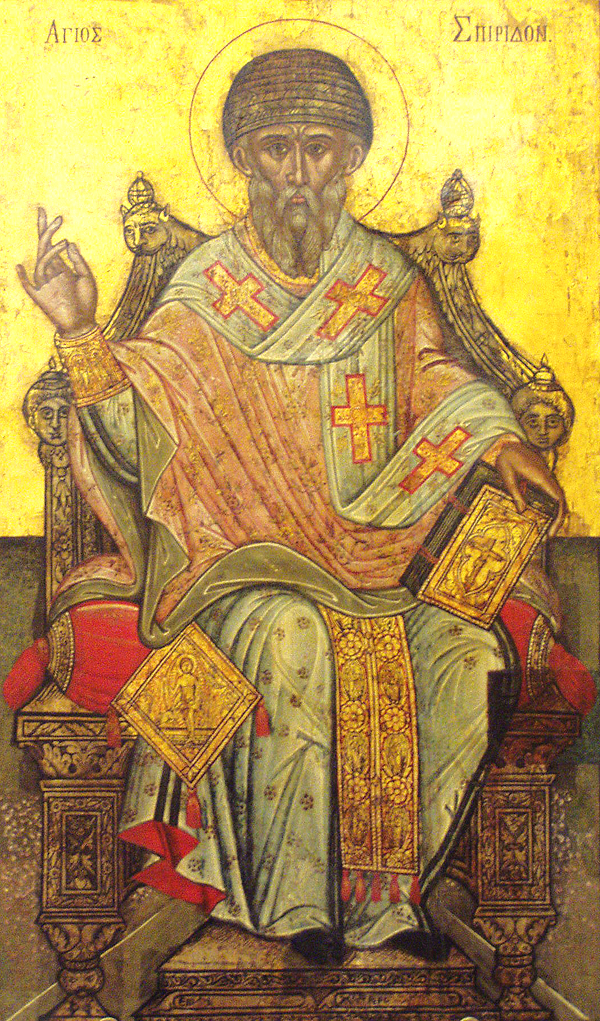
Saint Spyridon of Tremithus was born towards the end of the third century on the island of Cyprus. He was a shepherd, and had a wife and children. He used all his substance for the needs of his neighbors and the homeless, for which the Lord rewarded him with a gift of wonderworking. He healed those who were incurably sick, and cast out demons.
After the death of his wife, during the reign of Constantine the Great (306-337), he was made Bishop of Tremithus, Cyprus. As a bishop, the saint did not alter his manner of life, but combined pastoral service with deeds of charity.
According to the witness of Church historians, Saint Spyridon participated in the sessions of the First Ecumenical Council in the year 325. At the Council, the saint entered into a dispute with a Greek philosopher who was defending the Arian heresy. The power of Saint Spyridon’s plain, direct speech showed everyone the importance of God’s wisdom before human wisdom: “Listen, philosopher, to what I tell you. There is one God Who created man from dust. He has ordered all things, both visible and invisible, by His Word and His Spirit. The Word is the Son of God, Who came down upon the earth on account of our sins. He was born of a Virgin, He lived among men, and suffered and died for our salvation, and then He arose from the dead, and He has resurrected the human race with Him. We believe that He is one in essence (consubstantial) with the Father, and equal to Him in authority and honor. We believe this without any sly rationalizations, for it is impossible to grasp this mystery by human reason.”
As a result of their discussion, the opponent of Christianity became the saint’s zealous defender and later received holy Baptism. After his conversation with Saint Spyridon, the philosopher turned to his companions and said, “Listen! Until now my rivals have presented their arguments, and I was able to refute their proofs with other proofs. But instead of proofs from reason, the words of this Elder are filled with some sort of special power, and no one can refute them, since it is impossible for man to oppose God. If any of you thinks as I do now, let him believe in Christ and join me in following this man, for God Himself speaks through his lips.”
At this Council, Saint Spyridon displayed the unity of the Holy Trinity in a remarkable way. He took a brick in his hand and squeezed it. At that instant fire shot up from it, water dripped on the ground, and only dust remained in the hands of the wonderworker. “There was only one brick,” Saint Spyridon said, “but it was composed of three elements. In the Holy Trinity there are three Persons, but only one God.”
The saint cared for his flock with great love. Through his prayers, drought was replaced by abundant rains, and incessant rains were replaced by fair weather. Through his prayers the sick were healed and demons cast out.
A woman once came up to him with a dead child in her arms, imploring the intercession of the saint. He prayed, and the infant was restored to life. The mother, overcome with joy, collapsed lifeless. Through the prayers of the saint of God, the mother was restored to life.
Another time, hastening to save his friend, who had been falsely accused and sentenced to death, the saint was hindered on his way by the unanticipated flooding of a stream. The saint commanded the water: “Halt! For the Lord of all the world commands that you permit me to cross so that a man may be saved.” The will of the saint was fulfilled, and he crossed over happily to the other shore. The judge, apprised of the miracle that had occurred, received Saint Spyridon with esteem and set his friend free.
Similar instances are known from the life of the saint. Once, he went into an empty church, and ordered that the lampadas and candles be lit, and then he began the service. When he said, “Peace be unto all,” both he and the deacon heard from above the resounding of a great multitude of voices saying, “And with thy spirit.” This choir was majestic and more sweetly melodious than any human choir. To each petition of the litanies, the invisible choir sang, “Lord, have mercy.” Attracted by the church singing, the people who lived nearby hastened towards it. As they got closer and closer to the church, the wondrous singing filled their ears and gladdened their hearts. But when they entered into the church, they saw no one but the bishop and several church servers, and they no longer heard the singing which had greatly astonished them.
Saint Simeon Metaphrastes (November 9), the author of his Life, likened Saint Spyridon to the Patriarch Abraham in his hospitality. Sozomen, in his Church History, offers an amazing example from the life of the saint of how he received strangers. One time, at the start of the Forty-day Fast, a stranger knocked at his door. Seeing that the traveller was very exhausted, Saint Spyridon said to his daughter, “Wash the feet of this man, so he may recline to dine.” But since it was Lent there were none of the necessary provisions, for the saint “partook of food only on certain days, and on other days he went without food.” His daughter replied that there was no bread or flour in the house. Then Saint Spyridon, apologizing to his guest, ordered his daughter to cook a salted ham from their larder. After seating the stranger at table, he began to eat, urging that man to do the same. When the latter refused, calling himself a Christian, the saint rejoined, “It is not proper to refuse this, for the Word of God proclaims, ‘Unto the pure all things are pure’” (Titus 1:15).
Another historical detail reported by Sozomen, was characteristic of the saint. It was his custom to distribute one part of the gathered harvest to the destitute, and another portion to those having need while in debt. He did not take a portion for himself, but simply showed them the entrance to his storeroom, where each could take as much as was needed, and could later pay it back in the same way, without records or accountings.
There is also the tale by Socrates Scholasticus about how robbers planned to steal the sheep of Saint Spyridon. They broke into the sheepfold at night, but here they found themselves all tied up by some invisible power. When morning came the saint went to his flock, and seeing the tied-up robbers, he prayed and released them. For a long while he advised them to leave their path of iniquity and earn their livelihood by respectable work. Then he made them a gift of a sheep and sending them off, the saint said kindly, “Take this for your trouble, so that you did not spend a sleepless night in vain.”
All the Lives of the saint speak of the amazing simplicity and the gift of wonderworking granted him by God. Through a word of the saint the dead were awakened, the elements of nature tamed, the idols smashed. At one point, a Council had been convened at Alexandria by the Patriarch to discuss what to do about the idols and pagan temples there. Through the prayers of the Fathers of the Council all the idols fell down except one, which was very much revered. It was revealed to the Patriarch in a vision that this idol had to be shattered by Saint Spyridon of Tremithus. Invited by the Council, the saint set sail on a ship, and at the moment the ship touched shore and the saint stepped out on land, the idol in Alexandria with all its offerings turned to dust, which then was reported to the Patriarch and all the bishops.
Saint Spyridon lived his earthly life in righteousness and sanctity, and prayerfully surrendered his soul to the Lord. His relics repose on the island of Corfu (Kerkyra), in a church named after him (His right hand, however, is located in Rome).
His memory is also celebrated on Cheesefare Saturday.

Saint Therapon of Monza was a monk in the monastery of Saint Adrian (May 5) at the River Monza. The monk began his ascetic deeds in Moscow, and then transferred to the city of Kostroma at the Elevation of the Cross monastery, and was tonsured there.
The pious monks Adrian and Paphnutius, from the monastery of Saint Paul of Obnora (January 10), seeking solitude, moved to the Monza and founded a monastery 25 versts from Galich. Saint Therapon transferred to this monastery, where he labored in asceticism until the end of his life. Each day, with the blessing of the igumen, he withdrew into a forest thicket and prayed. By night he read and transcribed copies of spiritually useful books.
In his life he emulated Blessed Basil of Moscow (August 2), whom he called his friend, although personally he never saw him. Even during his life, Saint Therapon was glorified with a gift of wonderworking. Before his death he predicted a year of famine (1601). He surrendered his soul to God in the year 1597. The monastery at the River Monza was called after him the Theraponov.
The Hieromartyr Alexander, Bishop of Jerusalem, was a disciple of the great teacher and writer of the Church, Clement of Alexandria. At the beginning of the third century he was chosen bishop of Flavia, Cappadocia. He was arrested during the reign of the emperor Septimus Severus (193-211) and spent three years in prison.
After his release from prison he went to Jerusalem to venerate the holy places, and was told to remain there through a divine revelation. In 212 he was chosen as coadministrator with the elderly Patriarch Narcissus, an unusually rare occurrence in the ancient Church. Following the death of Saint Narcissus (August 7), Saint Alexander succeeded him and governed the Church of Jerusalem for thirty-eight years, working for the enlightenment of Christians. He also established the first library of Christian theological works at Jerusalem.
Saint Alexander was arrested during the persecution of the Church under the emperor Decius (249-251). The holy martyr was sent to Cappadocia, where he suffered many tortures. He was condemned to be eaten by wild beasts, but they did not harm him. Saint Alexander was cast into prison, where he surrendered his soul to God.
The hieromartyr Alexander is also commemorated on May 16.
The Holy Martyr Synetus (the name is derived from the Greek word meaning “man of reason”) was a Roman by birth, and was a reader in the Roman Church under Pope Sixtus (257-258). He was subjected to torture, and was beheaded for his brave confession of faith in the time of the emperor Aurelian (270-275).
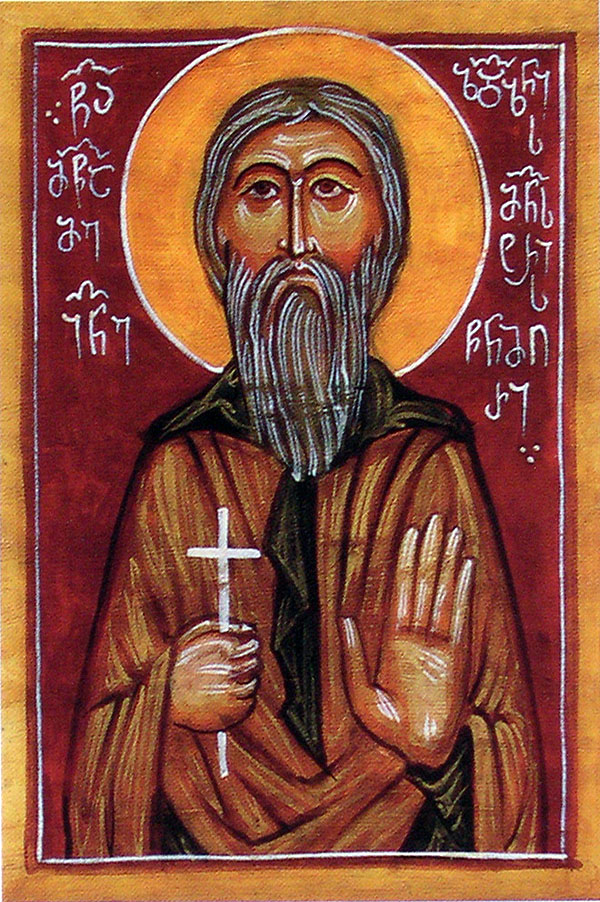
The life of the holy martyr John, Abbot of Zedazeni Monastery, has not been preserved, but the list recalling “the names of the holy fathers who reposed at Zedazeni Monastery after John of Zedazeni,” which was compiled by Catholicos Arsenius II, tells us that Abbot John was “murdered at Zedazeni by Muslims.” Saint John was martyred in the 9th century.
THURSDAY OF THE 12TH WEEK
ABSTAIN FROM MEAT, DAIRY, EGGS
Daniel the Stylite of Constantinople, Luke the New Stylite of Chalcedon, Martyrs Acepsius and Aeithalas, Holy Martyrs Miracus and Barsabas, Leontios the Righteous of Monemvasia, The Glorious King Nikephoros Phokas
Timothy, my son, charge the rich in this world not to be haughty, nor to set their hopes on uncertain riches but on God who richly furnishes us with everything to enjoy. They are to do good, to be rich in good deeds, liberal and generous, thus laying up for themselves a good foundation for the future, so that they may take hold of the life which is life indeed. O Timothy, guard what has been entrusted to you. Avoid the godless chatter and contradictions of what is falsely called knowledge, for by professing it some have missed the mark as regards the faith. Grace be with you. Amen.
The Lord said to his disciples, "Look up and raise your heads, because your redemption is drawing near." And he told them a parable: "Look at the fig tree, and all the trees; as soon as they come out in leaf, you see for yourselves and know that the summer is already near. So also, when you see these things taking place, you know that the kingdom of God is near. Truly, I say to you, this generation will not pass away till all has taken place. Heaven and earth will pass away, but my words will not pass away.
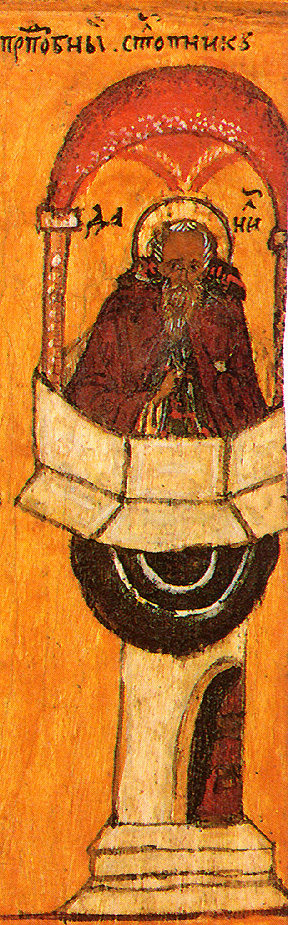
Saint Daniel the Stylite was born in the village of Bethara, near the city of Samosata in Mesopotamia. His mother Martha was childless for a long while and in her prayers she vowed that if she had a child, she would dedicate him to the Lord. Her prayers were heard, and Martha soon gave birth to a son, who was without a name until he was five years of age.
The boy’s parents desired that since he was born through the good-will of God, he should also receive his name from God. They took their son to a monastery located nearby and approached the igumen. The igumen gave orders to take down one of the service books, and unrolled it at random. He found the Prophet Daniel (December 17) mentioned in it. Thus did the boy receive his name. The parents asked that he might remain at the monastery, but the igumen would not accept him, since he was still only a small boy. At twelve years of age, saying nothing to anyone, the child left home for the monastery.
His parents were happy when they learned where their son was, and they went to the monastery. Seeing that he was still going about in his worldly clothes, they besought that the igumen should clothe him in the angelic garb. That Sunday the igumen fulfilled their request, but permitted them often to visit their son. The brethren of the monastery were astonished at the saint’s ascetical efforts.
Once, Saint Simeon the Stylite (September 1) visited the monastery. He foretold to the young monk that he too would undertake the feat of pillar-dwelling. Saint Daniel continued with his ascetic life in seclusion. When the place of a new exploit was revealed to him in a vision, he withdrew into the Thracian wilderness together with two disciples. They set up a pillar, upon which Saint Daniel dwelt for 33 years. People thronged to the pillar, the unfortunate and those who were sick, and all received help and healing from Saint Daniel. Byzantine emperors also sought the prayers of the holy ascetic. The most notable of the saint’s predictions was about a great fire in Constantinople. Saint Daniel possessed also the gift of gracious words. He guided many onto the path of correcting their lives. The monk reposed in his eightieth year.
Saint Nikon the Dry, the son of rich and illustrious parents, gave up everything for Christ and became a monk at the Kiev Caves monastery. In the year 1096, during the incursions of Khan Bonyak, he was taken into captivity with some other monks. The captors treated Saint Nikon harshly, while waiting for a ransom to be paid. When the saint refused to be ransomed, his masters began to torment him with hunger, and left him exposed in the heat of summer and the cold of winter. He was mistreated and beaten every day for about three years, for his captors thought he would change his mind and send word to his relatives, asking to be ransomed.
The saint gave thanks to God for everything, and once said to his tormentor that the Lord, through the prayers of Saints Anthony and Theodosius would return him to his monastery within three days, as Saint Eustratius (March 28) had predicted while appearing to him.
The captor cut the tendons in Saint Nikon’s legs and set a strong guard over him. But suddenly, on the third day at the sixth hour, the holy captive became invisible. At the moment the guard heard the words, “Praise the Lord from the Heavens” (Ps. 148).
Saint Nikon was transported to the Dormition church, where the Divine Liturgy was being served. The brethren surrounded him and began to ask how he got there. Saint Nikon wanted to conceal the miracle, but the brethren implored him to tell the truth.
Saint Nikon did not want to have his fetters removed, but the igumen said, “If the Lord had wanted you to remain fettered, He would not have delivered you from captivity.”
After a long while Saint Nikon’s former master came to the Kiev Caves monastery and recognized his former captive, who was withered from hunger and the loss of blood from his wounds. He came to believe in Christ, and accepted Baptism. After receiving monastic tonsure, he became a novice under Saint Nikon’s direction.
Saint Nikon died at the beginning of the twelfth century and was buried in the Near Caves. Though he did not enjoy good health in this life, his holy relics were glorified by incorruption. His memory is celebrated also on September 28 and on the second Sunday of Great Lent.
The Holy Martyr Mirax was born into a Christian family living in the city of Tanis (Egypt) during the seventh century. He was raised in piety, but yielded to demonic temptation and trampled on a cross. He went to the Emir, the ruler of Egypt, and taking his sword in hand, he declared himself a Moslem.
His parents, grieving over the terrible downfall of their son, incessantly prayed for him. And then the grace of God illumined the heart of the prodigal. He deeply repented and returned home. His parents counselled him to acknowledge his fall into darkness and to show his repentance. Saint Mirax obeyed them. He went before the Emir and announced that he had become a Christian once more. The ruler condemned him to tortures, after which the saint was beheaded and cast into the sea (this occurred around the year 640).

The Holy Martyrs Akepsimas and Aithalas were from Persia. Akepsimas was a pagan priest in the city of Arbel. Having received healing through the prayers of a Christian bishop, he was converted to the faith in Christ and boldly confessed it. For this they threw Saint Akepsimas into prison.
Soon after, Saint Aithalas, a deacon of the Arbel Church, was imprisoned with him. They brought the martyrs before the ruler, where they again confessed their faith and were beheaded.

Saint Luke the New Stylite was a soldier under the Byzantine emperor Constantine Porphyrogenitos (912-959). During a war with Bulgaria (917), Saint Luke remained unharmed through the Providence of God. After this he became a monk, and having succeeded in his efforts, was ordained as a presbyter. Striving for an even higher degree of perfection, the monk put chains upon himself and ascended a pillar.
After three years standing on the pillar, through divine inspiration, he went to Mount Olympos, and then to Constantinople, and finally to Chalcedon, where he chose a pillar upon which he remained for 45 years, manifesting a gift of wonderworking. He died in about the year 980.

Having examined the history of Georgia and the hagiographical treasures attesting to the faith of the Georgian nation, we become convinced that Heavenly Georgia— the legion of Georgian saints, extolling the Lord in the Heavenly Kingdom with a single voice—is infinitely glorious. It is unknown how many cleansed themselves of their earthly sins in merciless warfare with the enemy of Christ, or how many purified their souls in unheated cells through prayer, fasting, and ascetic labors.
To God alone are known the names of those ascetics, forgotten by history, who by their humble labors tirelessly forged the future of the Georgian Church and people.
St. George of the Holy Mountain wrote: “From the time we recognized the one true God, we have never renounced Him, nor have our people ever yielded to heresy.”
A decree of the Church Council of Ruisi-Urbnisi states: “We will not depart from thee, the Catholic Church which bore us in holiness, nor will we betray thee, our pride—Orthodoxy—to which we have always been faithful, for we have been granted the honor to know thee, the witness of the Truth Itself!” This relationship to Orthodoxy is the cornerstone of the life of every Georgian believer.
It is impossible to count the names of all those Christians who have been raised up from the earthly Church in Georgia to the heavens, let alone to describe all the godly deeds they have performed. For this reason December 11 has been set aside for the commemoration not only of the saints whose Lives are known to us but also of the nearly three hundred more whose names, but not stories, have been preserved as well.
Most Georgian people bear the name of a saint who is commemorated on this day, and they entreat the saint to intercede before the Lord in their behalf.
WEDNESDAY OF THE 12TH WEEK
ABSTAIN FROM MEAT, FISH, DAIRY, EGGS, WINE, OLIVE OIL
Menas, Hermogenes, & Eugraphos, Martyrs of Alexandria, Thomas the Righteous of Bithynia
Timothy, my son, do not be hasty in the laying on of hands, nor participate in another man’s sins; keep yourself pure. No longer drink only water, but use a little wine for the sake of your stomach and your frequent ailments. The sins of some men are conspicuous, pointing to judgment, but the sins of others appear later. So also good deeds are conspicuous; and even when they are not, they cannot remain hidden. Let all who are under the yoke of slavery regard their masters as worthy of all honor, so that the name of God and the teaching may not be defamed. Those who have believing masters must not be disrespectful on the ground that they are brethren; rather they must serve all the better since those who benefit by their service are believers and beloved. Teach and urge these duties. If any one teaches otherwise and does not agree with the sound words of our Lord Jesus Christ and the teaching which accords with godliness, he is puffed up with conceit, he knows nothing; he has a morbid craving for controversy and for disputes about words, which produce envy, dissension, slander, base suspicions, and wrangling among men who are depraved in mind and bereft of the truth, imagining that godliness is a means of gain. There is great gain in godliness with contentment; for we brought nothing into the world, and we cannot take anything out of the world; but if we have food and clothing, with these we shall be content. But those who desire to be rich fall into temptation, into a snare, into many senseless and hurtful desires that plunge men into ruin and destruction. For the love of money is the root of all evils; it is through this craving that some have wandered away from the faith and pierced their hearts with many pangs. But as for you, man of God, shun all this.
At that time, as some spoke to Jesus of the temple, how it was adorned with noble stones and offerings, he said, "As for these things, which you see, the days will come when there shall not be left here one stone upon another that will not be thrown down." And they asked him, "Teacher, when will this be, and what will be the sign when this is about to take place?" And he said, "Take heed that you are not led astray; for many will come in my name, saying, 'I am he!' and, 'The time is at hand!' Do not go after them. And when you hear of wars and tumults, do not be terrified; for this must first take place, but the end will not be at once.
Then he said to them, "Nation will rise against nation, and kingdom against kingdom; there will be great earthquakes, and in various places famines and pestilences; and there will be terrors and great signs from heaven.
But when you see Jerusalem surrounded by armies, then know that its desolation has come near. Then let those who are in Judea flee to the mountains, and let those who are inside the city depart, and let not those who are out in the country enter it; for these are days of vengeance, to fulfill all that is written. Alas for those who are with child and for those who give suck in those days! For great distress shall be upon the earth and wrath upon this people; they will fall by the edge of the sword, and be led captive among all nations; and Jerusalem will be trodden down by the Gentiles, until the times of the Gentiles are fulfilled.
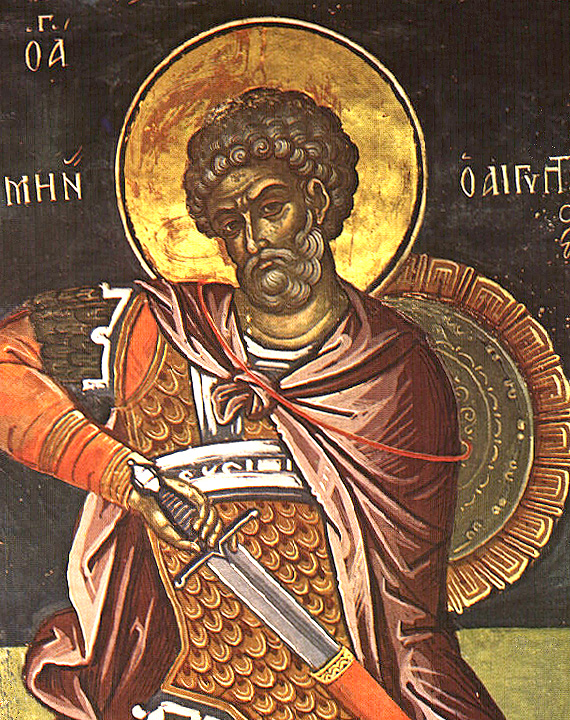
The Holy Martyrs Menas, Hermogenes, and Eugraphus suffered for their faith in Christ under the emperor Maximian (305-313).
Saint Menas was sent by the emperor from Athens to Alexandria to suppress the riots that had arisen between the Christians and the pagans. Distinguished for his gift of eloquence, Menas instead openly began to preach the Christian Faith and he converted many pagans to Christ. Learning of this, Maximian sent Hermogenes to Alexandria to place the saints on trial. Moreover, he gave orders to purge the city of Christians.

Hermogenes, although he was a pagan, was distinguished by his reverent bearing. And struck by the endurance of Saint Menas under torture and by his miraculous healing after the cruel torments, he also came to believe in Christ. Maximian himself then arrived in Alexandria. Neither the astonishing stoic endurance of Saints Menas and Hermogenes under torture, nor even the miracles manifested by God in this city, mollified the emperor. Instead, they vexed him all the more. The emperor personally stabbed Saint Eugraphus, the secretary of Saint Menas, who had declared himself a Christian upon witnessing the endurance of Saints Menas and Hermogenes; and then gave orders to behead the holy Martyrs Menas and Hermogenes.
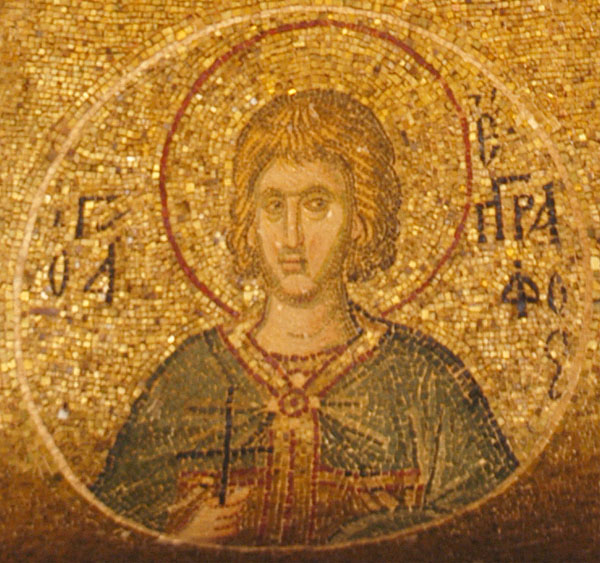
The relics of the holy martyrs, cast into the sea in an iron chest, were afterwards found (see February 17) and transferred to Constantinople in the ninth century. The emperor Justinian built a church in the name of the holy Martyr Menas of Alexandria. Saint Joseph the Hymnographer (April 4) composed a Canon in honor of these holy martyrs.

Saint Joasaph was born at Proluka, in the former Poltava governance, on September 8, 1705, the Feast of the Nativity of the Most Holy Theotokos. He was descended from the old and venerable Little Russian (Ukrainian) lineage of the Gorlenkovi. At Baptism he was named Joachim.
In 1712, his father enrolled the seven-year-old Joachim in the Kiev Spiritual Academy. Within the walls of the academy he felt attracted to monastic life. For seven years he studied it further, and finally revealed his intention to his parents.
For a long time his mother and father pleaded with their first-born son not to accept monastic tonsure. But in 1725, unknown to them, he became a “rasophore” (“robe-wearing novice”) with the name Hilarion at the Kiev Mezhigorsk monastery, and on 21 November 1727 he was tonsured in the mantya with the name Joasaph at the Kievo-Bratsk monastery. This event coincided with the completion of his studies at the spiritual academy.
After the death of His Grace Barlaam, the See of Kiev was governed by Archbishop Raphael Zaborovsky. Archbishop Raphael noticed the abilities of the young ascetic and assigned him to greater service to the Church. He was entrusted with the responsibility of the office of examiner of the Kiev archbishopric.
In November 1734, Archbishop Raphael ordained the hierodeacon Joasaph as hieromonk, and he was transferred from the Bratsk monastery school to the Kiev-Sophia archbishop’s house. At the same time, he was appointed a member of the Kiev religious consistory.
In fulfilling the office of examiner, he exerted much effort towards the correction of moral deficiencies among the parish clergy. The saint’s service in the consistory office enabled him to develop his administrative abilities. During this time, he made a good study of the needs of clergy-servers, noting both the good points and the failings of the diocese. His talent for administration was combined with his great spiritual effort. He quickly ascended the ladder of spiritual perfection, which can be seen in his work, “The Conflict of the Seven Venerable Virtues with the Seven Deadly Sins.”
On June 24, 1737 Hieromonk Joasaph was appointed head of the Holy Transfiguration Mgarsk monastery, and elevated to the rank of igumen. Here he worked with all his strength to put the monastery in good order, for it was an old bastion of Orthodoxy in the struggle with the Unia. In this monastery were relics of Saint Athanasius, Patriarch of Constantinople and Wonderworker of Lubny (May 2). Several times Saint Athanasius appeared to Igumen Joasaph, as a sign of his patronal protection.
In 1744 Metropolitan Raphael elevated Igumen Joasaph to the dignity of archimandrite. Towards the end of that same year he was called to Moscow and soon, at the direction of the Most Holy Synod, he was appointed vicar of the Holy Trinity Sergiev Lavra monastery. At this monastery of Saint Sergius he also unstintingly fulfilled obedience to the Church (this year required much exertion for the rebuilding of the monastery after a fire).
On June 2, 1748 at the Peter and Paul cathedral in Peterburg, Archimandrite Joasaph was ordained Bishop of Belgorod. Ascending the archbishop’s throne, Saint Joasaph strictly concerned himself with piety and the condition of the churches, with the proper celebration of divine services, and especially with the moral condition of his flock.
The saint devoted great attention to the education of the clergy, and the correct observance of churchly norms and traditions. Just as before, the saint worked with all his strength in his archpastoral service, without regard for his health.
On the eve of his repose, the saint forbade his cell attendant Stephen to aspire to the priesthood, and he predicted that if he did not obey him, he would meet with an untimely end. To another cell attendant Basil, the saint indicated that he would be a deacon, but would never become a priest. Later, this prediction was fulfilled. Saint Joasaph died on December 10, 1754, and was glorified on September 4, 1911.
The Holy Martyr Gemellus of Paphlagonia was subjected to cruel tortures for his staunch denunciation of the emperor Julian the Apostate (361-363) in the city of Ancyra (Galatia). A red-hot iron belt was placed around his waist. Then he was ordered to accompany the impious Julian on his journey. When they reached Edessa in Mesopotamia, he was stretched out on the ground and his limbs were pierced with wooden stakes. Then he was hung on a post and mutilated.
Enduring the tortures, the saint continued to revile the emperor. After being subjected to even more horrible torments, they let him go. He was still able to walk and speak, so he went on his way until he met a priest. He entreated the priest to baptize him, and when he emerged from the water, his wounds were all healed.
Hearing of this miracle, Julian ordered that Saint Gemellus be crucified. The victorious athlete of Christ gave up his soul to God, and his body was secretly taken down and buried by Christians.
Saint Thomas Dephourkinos was born in Bithynia. From his youth he was fond of monastic life and entered one of the area monasteries. Later in his life, when the Byzantine official Galoliktos had founded a monastery at the River Sagarisa, Saint Thomas was already an experienced monk, and the brethren chose him as head of the new monastery.
From there Saint Thomas withdrew into the wilderness, where for a long time he labored in solitude. The monk overcame many snares of the devil in the wilderness. The Lord glorified him with the gift of healing and prophecy.
Once, the emperor Leo the Wise (886-911) came to the monastery to Saint Thomas for advice. Not finding the monk at the monastery, the emperor sent his messenger with a letter for him. And just as the messenger arrived at the the Elder’s hut, the saint carried out to him a sealed answer, resolving the emperor’s question. It is not known when Saint Thomas reposed.
Saint Stephen Brankovic (Branković) (October 9 and December 10), the Despot of Serbia, was born in 1417, and belonged to the Branković dynasty. In 1441 he was blinded by order of the Ottoman Sultan Murad II, and so when his father died in 1456, he could not claim the throne; so his younger brother Lazarus became the new Despot.
After the capture of Serbia by the Turks in 1457, Stephen's middle son (then ruler of Serbia) who was distinguished by his gentle disposition and excellent knowledge of the Holy Scriptures, went to the Turkish capital after his sister, who was given to Sultan Murat as a wife. Learning that the Turks had burned down the Mileshevsky Monastery with fanatical cruelty, Blessed Stephen stood up to defend Serbia from its conquerors.
In 1458, Lazarus died without leaving a male heir. The country was ruled by a triumvirate of regents: Stephen Brankovic, the widow Elena Palaiologίna, and Michael Angelovic (Angelović), the governor of Raska (Raška). The supporters of the Turks at the Serbian court proclaimed the voivode Michael Angelovic (whose brother was the vizier of Mehmed II) as the new Despot, but the population of the Serbian capital Smederevo, with the support of a pro-Hungarian party, prevented this coup. Michael Angelovic was imprisoned, and the blind Stephen Brankovic became the ruler.
Then, on the initiative of the Hungarian and Bosnian kings, the son of the Bosnian king, Stephen Tomasevic (Tomašević), was invited to Smederevo, and was supposed to marry the daughter of the late ruler Elena, and assume the title of Despot. The wedding took place on March 21, 1459, and Stephen Tomašević ascended the Serbian throne.
After his deposition from the throne, Blessed Stephen the Blind lived in Buda for some time (his younger sister Katherine was the widow of the Hungarian nobleman Ulrik Tsilley), then in Dubrovnik. Then he went to Albania to the ruler of the principality of Kastrioti Skanderbeg, where in 1460 he married Saint Angelina (July 30 and August 12), the daughter of the Albanian prince George Arianiti. When he married Angelina, the Turks threatened Blessed Stephen and his family. He was forced to go into hiding with his wife and three children, first in Albania and then in Italy.
Blessed Stephen spent the rest of his life in Venice, and reposed in 1476. Blessed Angelina transferred her husband's incorrupt body to Kupinovo. At the end of the XV century, the ruler of Serbia was Blessed John, the son of Righteous Stephen and Angelina. The relics of Righteous John and his parents were later glorified by many signs.
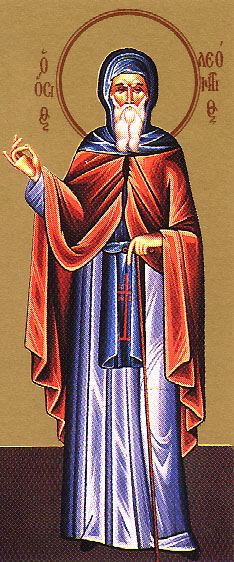
Saint Leontios (Leóntios) was born in Monemvasia in the Pelopónnēsos. His parents were Andrew and Theodora, and he received the name Leon at his Baptism. His father was sufficiently wealthy and a prominent man.
Emperor Andronikos II Palaiológos (1283 – 1328) gave him an important position in the central administration of the Moriᾶ. Therefore Leon received much attention from his parents and studied foreign languages, philosophy, and theology at Constantinople. When his father died, Leon returned to Monemvasia and took care of his mother. Then his mother retired to a monastery and, with her blessing, Leon got married.
He was a model husband, the head of his family, and a good worker. But then he faced some great trials. First his wife died, and then his children. So he decided to become a monk. He was tonsured with the name Leontios, and went to live with an experienced ascetic named Menides, and remained close to him for a long time.
Later he went to the Holy Mountain, where he acquired greater experience and returned to the Pelopónnēsos. He chose to live on a mountain close to Aigialeia, and he went to the cities of Achaia, preaching the Word of God. Nearby there were other zealots of the angelic life. Later, many of them excelled as members of the clergy.
Saint Leontios reposed peacefully and his reputation endured after his death. The brothers Thomas and Anthony Palaiológos built a monastery in honor of the Saint in the place of his ascetical contests, and dedicated it to the Archangel Michael.
In Greek usage Saint Leontios is commemorated on December 11. Most of his Holy Relics are located in the Monastery of the Archangels at Aigialeia.
THE CONCEPTION BY ST. ANNA OF THE MOST HOLY THEOTOKOS
ABSTAIN FROM MEAT, DAIRY, EGGS
The Conception by St. Anna of the Most Holy Theotokos, Hannah the Righteous, mother of Samuel the Prophet, Narses the Martyr of Persia, The Consecration of the Church of the Resurrection (Holy Sepulchre) in the Holy City of Jerusalem
Brethren, Abraham had two sons, one by a slave and one by a free woman. But the son of the slave was born according to the flesh, the son of the free woman through promise. Now this is an allegory: these women are two covenants. One is from Mount Sinai, bearing children for slavery; she is Hagar. Now Hagar is Mount Sinai in Arabia; she corresponds to the present Jerusalem, for she is in slavery with her children. But the Jerusalem above is free, and she is our mother. For it is written, “Rejoice, O barren one who does not bear; break forth and shout, you who are not in travail; for the children of the desolate one are many more than the children of her that is married.”
The Lord said, "No one after lighting a lamp covers it with a vessel, or puts it under a bed, but puts it on a stand, that those who enter may see the light. For nothing is hid that shall not be made manifest, nor anything secret that shall not be known and come to light. Take heed then how you hear; for to him who has will more be given, and from him who has not, even what he thinks that he has will be taken away.
Then his mother and his brothers came to him, but they could not reach him for the crowd. And he was told, "Your mother and your brothers are standing outside, desiring to see you." But he said to them, "My mother and my brothers are those who hear the word of God and do it.
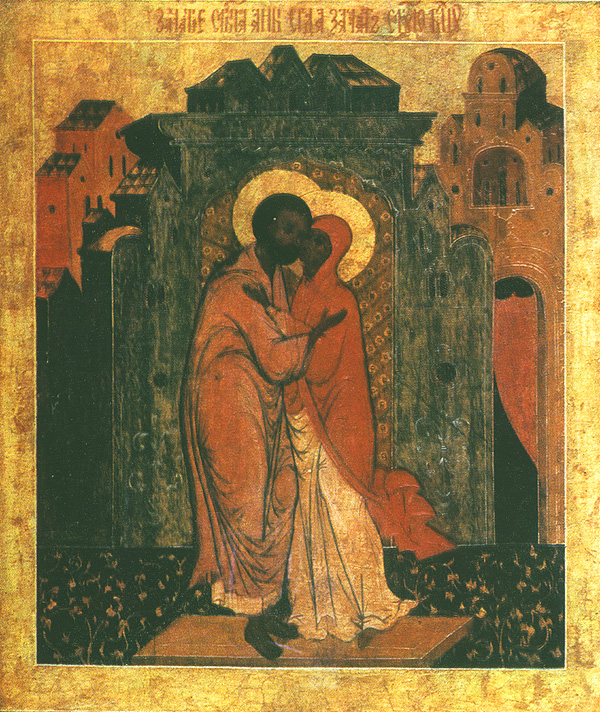
The Gospels and other books of the New Testament do not mention anything about Saint Anna, the mother of the Theotokos. According to Tradition, the priest Matthan (Matthew 1:15), a resident of Bethlehem, had three daughters: Mary,1 Sobe (Sobḗ), and Anna. Mary was married in Bethlehem, where she gave birth to Elizabeth, the mother of Saint John the Baptist.
The Holy Righteous Anna was the youngest daughter of the priest Matthan, who was from the tribe of Levi, of the family of Aaron. Her husband, the Holy Righteous Joachim was from the tribe of Judah, from the house and family of King David. According to the ancient promise, the Messiah was to come from the lineage of King David (Luke 2:4).
The couple lived in Nazareth of Galilee. Every year, they gave two-thirds of their income to the Temple in Jerusalem, and to the poor. By God's Providence, the holy couple had no children until their old age. They were greatly saddened by this, since the Jews considered childlessness a great misfortune and a punishment from God. They prayed fervently for the Lord to give them children.
On a certain feast, when the Israelites were bringing gifts to God in the Temple at Jerusalem, the High Priest, believing that the childless Joachim did not have God's blessing, refused to accept gifts from him. Saint Joachim was grief stricken. He consulted the genealogy of the twelve tribes of Israel and ascertained that all righteous men had offspring, including Abraham, when he was a hundred years old. Without returning home, Saint Joachim went into the wilderness and spent forty days there in strict fasting and prayer, entreating God's mercy for himself, and washing away his disgrace with bitter tears.
Saint Anna thought that she was to blame for their sorrow. One day saw a nest with barely fledged chicks in the branches of a laurel tree, she wept and prayed for the gift of a child, promising to bring the infant to God as an offering. As soon as Saint Anna spoke these words, an Angel of the Lord told her that her prayer had been answered, and revealed that she would have a daughter named Mary, through whom all the peoples of the world would be blessed. Rejoicing, Saint Anna hastened to the Temple in Jerusalem, in order to give thanks to God. She repeated her vow to dedicate the child to Him. An Angel came to Saint Joachim in the wilderness with the same news and commanded him to go to Jerusalem. There, the Righteous Anna conceived and gave birth to the Most Holy Theotokos.
The Orthodox Church does not accept the teaching that the Mother of God was exempted from the consequences of ancestral sin (death, corruption, sin, etc.) at the moment of her conception by virtue of the future merits of her Son. Only Christ was born perfectly holy and sinless, as Saint Ambrose of Milan teaches in Chapter Two of his Commentary on the Gospel of Saint Luke. The Holy Virgin was like everyone else in her mortality, and in being subject to temptation, although she committed no personal sins. She was not a deified creature removed from the rest of humanity. If this were the case, She would not have been truly human, and the nature that Christ took from her would not have been truly human either. If Christ does not truly share our human nature, then the possibility of our salvation is in doubt.
Saint Anna has been honored since ancient times. We infer this from various Fathers of the Church, and also from ancient hymns in honor of the mother of the Theotokos. In the year 550, Emperor Justinian dedicated a temple in Constantinople to Saint Anna.
Part of the Saint's left hand is located in Stavronikita Monastery on Mount Athos. Part of the Saint's incorrupt left foot is located in Saint Anna's Skete on Mount Athos. Part of the Saint's incorrupt right foot is located in the Monastery of Koutloumousiou on Mount Athos.
Fragments of the Saint's Holy Relics are to be found in Saint Anna's Monastery at Lygaria in Lamia, and also in the Monastery of Saint John the Theologian at Sourotis.
Some of the Saint's incorrupt flesh is in the Roman Catholic International Crusaders Collection of Holy Relics. The Saint's wrist is to be found in the Roman Catholic church of Saint Paul "Outside the Walls" in Rome.
Many icons of the Conception by Saint Anna show the Most Holy Theotokos trampling the serpent underfoot. Saints Joachim and Anna are usually depicted with hands folded in prayer; their eyes are also directed upward and they contemplate the Mother of God, who stands in the air with outstretched hands; under her feet is an orb encircled by a serpent (symbolizing the devil), which strives to conquer the universe by its power.”
There are also icons in which Saint Anna holds the Most Holy Virgin on her left arm as an infant. On Saint Anna’s face is a look of reverence. A large ancient icon, painted on canvas, is located in the village of Minkovetsa in the Dubensk district of Volhynia Diocese. From ancient times this Feast was especially venerated by pregnant women in Russia.
1 This Mary is the mother of Saint Anna, and the grandmother of the Theotokos. She is commemorated on the Sunday of the Forefathers.

The Holy Prophetess Hannah dwelt in marriage with Elkanah, but she was childless. Elkanah took to himself another wife, Phennena, who bore him children. Hannah grieved strongly over her misfortune, and every day she prayed for an end to her barrenness, and vowed to dedicate her child to God.
Once, as she prayed fervently in the Temple, the priest Heli thought that she was drunk, and he began to reproach her. But the saint poured out her grief, and after she received a blessing, she returned home. After this Hannah conceived and gave birth to a son, whom she named Samuel (which means “Asked from God”).
When the child reached the age of boyhood, the mother herself presented him to the priest Heli, and Samuel remained with him to serve before the Tabernacle (1 Kings/1 Samuel 2: 1-21).
Saint Sophronius, Archbishop of Cyprus, was born into a Christian family on Cyprus, and he studied many sciences, but most of all he devoted himself to the reading of Holy Scripture. He became so accomplished in piety and good works, that he was granted the gift of wonderworking by the Lord. Following the death of Saint Damian, bishop of Cyprus, Saint Sophronius was chosen to replace him. As bishop, he proved himself a true father to his flock.
Saint Stephen the “New Light” was born at Constantinople in 838 and received a fine education. Under Patriarch Methodius, Stephen received monastic tonsure and shut himself in a cell attached to the church of Saint Peter in Constantinople. Later he went into seclusion, and over fifty years he constantly increased his ascetic efforts.
Toward the end of his life the saint acquired great grace from the Lord, shining in the constellation of the saints like the ancient ascetics of the Orthodox Church, so that he came to be called the “New Light.” According to the Prologue, he died in the year 912 and was buried in the church of Saint Antipas.

The “Unexpected Joy” Icon of the Most Holy Theotokos is painted in this way: in a room is an icon of the Mother of God, and beneath it a youth is kneeling at prayer. The tradition about the healing of some youth from a bodily affliction through this holy icon is recorded in the book of Saint Demetrius of Rostov, The Fleece of Prayer [See Judges 6: 36-40].
The sinful youth, who was nevertheless devoted to the Theotokos, was praying one day before the icon of the All-Pure Virgin before going out to commit a sin. Suddenly, he saw that wounds appeared on the Lord’s hands, feet, and side, and blood flowed from them. In horror he exclaimed, “O Lady, who has done this?” The Mother of God replied, “You and other sinners, because of your sins, crucify My Son anew.” Only then did he realize how great was the depth of his sinfulness. For a long time he prayed with tears to the All-Pure Mother of God and the Savior for mercy. Finally, he received the unexpected joy of the forgiveness of his sins.
The “Unexpected Joy” icon is also commemorated on January 25 and May 1.
No information available at this time
MONDAY OF THE 12TH WEEK
ABSTAIN FROM MEAT, DAIRY, EGGS
Forefeast of the Conception by St. Anna of the Most Holy Theotokos, Patapius the Righteous of Thebes, Sosthenes, Apollo, Cephas, Tychikos, Epaphroditos, Caesar, & Onesiphoros, Apostles of the 70
Timothy, my son, do not rebuke an older man but exhort him as you would a father; treat younger men like brothers, older women like mothers, younger women like sisters, in all purity. Honor widows who are real widows. If a widow has children or grandchildren, let them first learn their religious duty to their own family and make some return to their parents; for this is acceptable in the sight of God. She who is a real widow, and is left all alone, has set her hope on God and continues in supplications and prayers night and day; whereas she who is self-indulgent is dead even while she lives. Command this, so that they may be without reproach. If any one does not provide for his relatives, and especially for his own family, he has disowned the faith and is worse than an unbeliever. Let a widow be enrolled if she is not less than sixty years of age, having been the wife of one husband; and she must be well attested for her good deeds, as one who has brought up children, shown hospitality, washed the feet of the saints, relieved the afflicted, and devoted herself to doing good in every way.
At that time, there came to Jesus some Sadducees, those who say that there is no resurrection, and they asked him a question, saying, "Teacher, Moses wrote for us that if a man's brother dies, having a wife but no children, the man must take the wife and raise up children for his brother. Now there were seven brothers; the first took a wife, and died without children; and the second and the third took her, and likewise all seven left no children and died. Afterward the woman also died. In the resurrection, therefore, whose wife will the woman be? For the seven had her as wife." And Jesus said to them, "The sons of this age marry and are given in marriage; but those who are accounted worthy to attain to that age and to the resurrection from the dead neither marry nor are given in marriage, for they cannot die any more, because they are equal to angels and are sons of God, being sons of the resurrection. But that the dead are raised, even Moses showed, in the passage about the bush, where he calls the Lord the God of Abraham and the God of Isaac and the God of Jacob. Now he is not God of the dead, but of the living; for all live to him." And some of the scribes answered, "Teacher, you have spoken well." For they no longer dared to ask him any question. But he said to them, "How can they say that the Christ is David's son? For David himself says in the Book of Psalms, 'The Lord said to my Lord, Sit at my right hand, till I make thy enemies a stool for thy feet.' David thus calls him Lord; so how is he his son?
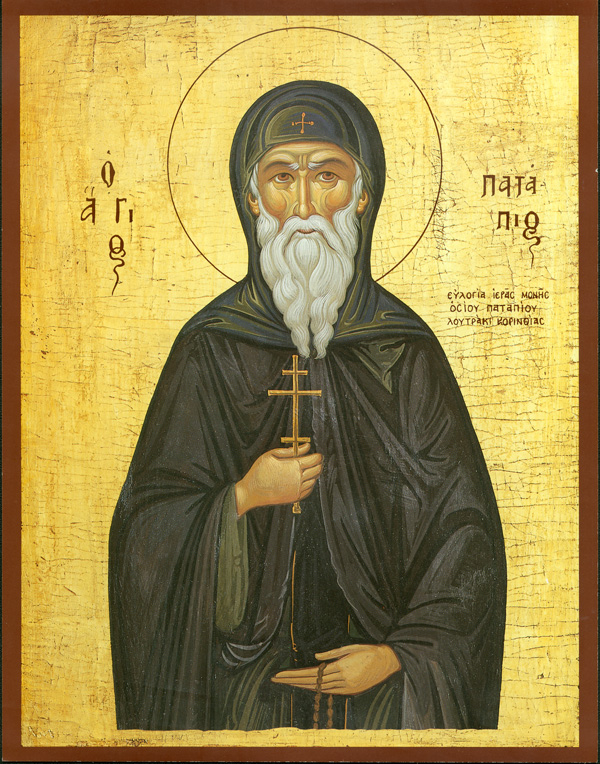
Saint Patapios was born at Thebes into a pious Christian family. Reaching the age of maturity, he scorned the vanity of this world, and so he went into the Egyptian desert where he became known for his ascetic deeds. Though he wished to live in silence, people began coming to him for advice.
To every tired pilgrim who visited his cell, he offered rest and hospitality, as well as spiritual instructions and profitable counsel for the salvation of one's soul. The Saint's reputation spread quickly, and every day many arrived at his cell in order to hear these beneficial instructions from his lips.
Later, he went to Constantinople, where he had a cell by the city wall, near the Blachernae church. But even here, he soon became known. The infirm started to gather around Patapios, and because he had been granted the gift of healing, he helped all those in need.
Once a certain woman was afflicted by the terrible disease of cancer, and worms came forth from her breasts. Not only did she suffer a great deal of pain in her chest, but throughout her entire body as well. She was in constant pain, and it reached her heart, so that she was near death. The doctors could not help her, and she felt she was wasting her money without obtaining relief. Therefore, she came to Saint Patapios and fell at his feet, begging him to heal her. The worms were devouring her flesh even before she was in the grave, causing her such pain that she longed for death.
The Saint answered, "If you have faith in the Lord, and have no doubt that you shall be healed, then let it be done according to your faith."
Sighing from the depths of her soul, she said, "I believe, O Lord that You know all things which are hidden and unknown, and that You are all-powerful. Therefore, have mercy on me and heal me."
Then the Saint asked the woman to let him see the effects of her distress. When he saw the ravages of the disease, he was struck with awe, saying, "Your affliction is indeed great, and difficult to cure. Go in peace, for you shall not suffer anymore."
As soon as he said this, the woman was healed and went home rejoicing and glorifying God. She told of this miracle everywhere, and praised Saint Patapios.
After a life adorned with virtue and miracles, Saint Patapios fell asleep in the Lord and was buried in the church of Saint John the Baptist.
Saint Cyril of Chelma Hill, Enlightener of the Chudian People, was born in the city of White Lake. He was tonsured at the monastery of Saint Anthony the Roman, where for six years he passed through various obediences. Then, after wandering through the wilderness for three years, he settled in a wild region of Kargopolsk. And here, by a command from on high, he chose Chelma Hill for his constant abode. Many of the afflicted from the Chud people came to see Saint Cyril, whose luminous ascetic life and kindly preaching moved many to accept holy Baptism.
Toward the end of his life, Saint Cyril established a monastery and church in honor of the Theophany of the Lord. The monk dwelt upon Chelma Hill for fifty-two years, and died at the advanced age of 82.
Saints Sosthenes, Apollos, Cephas, Tychicus, Epaphroditus, Caesar, Onesiphorus, Apostles of the 70 were chosen and sent by the Lord Jesus Christ Himself to preach. They were chosen some time after the selection of the Twelve Apostles (Luke 10:1-24).
Saint Sosthenes, before accepting Christianity, was head of the Jewish synagogue at Corinth. During a riot against the Apostle Paul, he too suffered a beating. He was converted by Paul to faith in Christ and afterwards became bishop at Caesarea.
Saint Apollos (September 10) was a native of Alexandria and was a man of erudition. The chief place of his service was at Corinth. He toiled there for a long time and converted many to Christ. Towards the end of his life he preached on the island of Crete and was Bishop of Caesarea.
Saint Cephas was bishop at Colophon, Pamphylia.
Saint Tychicus, a native of Asia Minor, was a disciple and companion of the holy Apostle Paul. During Saint Paul’s first imprisonment, he delivered the Epistles to the Ephesians and to the Colossians. He replaced Saint Sosthenes on the episcopal throne at Caesarea.
Saint Epaphroditus, one of the Apostle Paul’s closest assistants and companions, was bishop of the Thracian city of Adriaca.
Saint Caesar preached at and was bishop of Dyrrhachium, a district of the Peloponnesos in Greece.
Saint Onesiphorus was bishop at Colophon (Asia Minor), and later at Corinth. He died a martyr in the city of Parium (not far from Ephesus) on the shores of the Hellespont, where he had gone to proclaim Christ among the local pagans.
All of these saints are also commemorated on March 30. The Church also remembers Saint Onesiphorus (September 7) with them.
The Holy Martyr Anthusa, the wife of a Roman official, was baptized by Saint Ambrose of Milan (December 7). When the city prefect’s wife Sunilda suggested that Saint Anthusa be baptized by an Arian, she refused. So she was committed to the fire, and received the crown of martyrdom.
These faithful servants of Christ suffered martyrdom during the reign of Emperor Zeno (474-491). Guneric, the ruler of the Vandal Kingdom in North Africa, began a savage persecution of the Orthodox, at the instigation of the Arian bishops Cyril and Balinardēs.
The faithful had gathered secretly in one of the churches for the Divine Liturgy, when suddenly barbarian soldiers burst into the church. Some of the worshippers fled, but 300 remained voluntarily, and so they were tortured and beheaded. Of the 62 clergy, two were burnt alive, and sixty had their tongues cut out. By the miraculous power of God, they continued to preach and to refute the Arian heresy. Among them were old men, young men, and heads of families, but all of them remained faithful to Christ and His Holy Church. They were beheaded in the year 477.
In Slavic usage, these holy martyrs are commemorated on December 8; while in Greek usage, they are commemorated on December 7.
 Saint Peter Antiochian Orthodox Church
You must be logged in to post a comment.