
6TH FRIDAY OF LENT
ABSTAIN FROM MEAT, FISH, DAIRY, EGGS, WINE, OLIVE OIL
Nicetas, Abbot of the Monastery of Medicium, Joseph the Hymnographer, Theodosia and Irene the Martyrs
ISAIAH 66:10-24
Rejoice with Jerusalem, and be glad for her, all you who love her; rejoice with her in joy, all you who mourn over her; that you may suck and be satisfied with her consoling breasts; that you may drink deeply with delight from the abundance of her glory." For thus says the LORD: "Behold, I will extend prosperity to her like a river, and the wealth of the nations like an overflowing stream; and you shall suck, you shall be carried upon her hip, and dandled upon her knees. As one whom his mother comforts, so I will comfort you; you shall be comforted in Jerusalem. You shall see, and your heart shall rejoice; your bones shall flourish like the grass; and it shall be known that the hand of the LORD is with his servants, and his indignation is against his enemies. "For behold, the LORD will come in fire, and his chariots like the stormwind, to render his anger in fury, and his rebuke with flames of fire. For by fire will the LORD execute judgment, and by his sword, upon all flesh; and those slain by the LORD shall be many. "Those who sanctify and purify themselves to go into the gardens, following one in the midst, eating swine's flesh and the abomination and mice, shall come to an end together, says the LORD. "For I know their works and their thoughts, and I am coming to gather all nations and tongues; and they shall come and shall see my glory, and I will set a sign among them. And from them I will send survivors to the nations, to Tarshish, Put, and Lud, who draw the bow, to Tubal and Javan, to the coastlands afar off, that have not heard my fame or seen my glory; and they shall declare my glory among the nations. And they shall bring all your brethren from all the nations as an offering to the LORD, upon horses, and in chariots, and in litters, and upon mules, and upon dromedaries, to my holy mountain Jerusalem, says the LORD, just as the Israelites bring their cereal offering in a clean vessel to the house of the LORD. And some of them also I will take for priests and for Levites, says the LORD. "For as the new heavens and the new earth which I will make shall remain before me, says the LORD; so shall your descendants and your name remain. From new moon to new moon, and from sabbath to sabbath, all flesh shall come to worship before me, says the LORD. "And they shall go forth and look on the dead bodies of the men that have rebelled against me; for their worm shall not die, their fire shall not be quenched, and they shall be an abhorrence to all flesh.
GENESIS 49:33-50:26
When Jacob finished charging his sons, he drew up his feet into the bed, and breathed his last, and was gathered to his people. Then Joseph fell on his father's face, and wept over him, and kissed him. And Joseph commanded his servants the physicians to embalm his father. So the physicians embalmed Israel; forty days were required for it, for so many are required for embalming. And the Egyptians wept for him seventy days.
And when the days of weeping for him were past, Joseph spoke to the household of Pharaoh, saying, "If now I have found favor in your eyes, speak, I pray you, in the ears of Pharaoh, saying, My father made me swear, saying, 'I am about to die: in my tomb which I hewed out for myself in the land of Canaan, there shall you bury me.' Now therefore let me go up, I pray you, and bury my father; then I will return." And Pharaoh answered, "Go up, and bury your father, as he made you swear." So Joseph went up to bury his father; and with him went up all the servants of Pharaoh, the elders of his household, and all the elders of the land of Egypt, as well as all the household of Joseph, his brothers, and his father's household; only their children, their flocks, and their herds were left in the land of Goshen. And there went up with him both chariots and horsemen; it was a very great company. When they came to the threshing floor of Atad, which is beyond the Jordan, they lamented there with a very great and sorrowful lamentation; and he made a mourning for his father seven days. When the inhabitants of the land, the Canaanites, saw the mourning on the threshing floor of Atad, they said, "This is a grievous mourning to the Egyptians." Therefore the place was named Abelmizraim; it is beyond the Jordan. Thus his sons did for him as he had commanded them; for his sons carried him to the land of Canaan, and buried him in the cave of the field at Machpelah, to the east of Mamre, which Abraham bought with the field from Ephron the Hittite, to possess as a burying place. After he had buried his father, Joseph returned to Egypt with his brothers and all who had gone up with him to bury his father. When Joseph's brothers saw that their father was dead, they said, "It may be that Joseph will hate us and pay us back for all the evil which we did to him." So they sent a message to Joseph, saying, "Your father gave this command before he died, 'Say to Joseph, Forgive, I pray you, the transgression of your brothers and their sin, because they did evil to you.' And now, we pray you, forgive the transgression of the servants of the God of your father." Joseph wept when they spoke to him. His brothers also came and fell down before him, and said, "Behold, we are your servants." But Joseph said to them, "Fear not, for am I in the place of God? As for you, you meant evil against me; but God meant it for good, to bring it about that many people should be kept alive, as they are today. So do not fear; I will provide for you and your little ones." Thus he reassured them and comforted them.
So Joseph dwelt in Egypt, he and his father's house; and Joseph lived a hundred and ten years. And Joseph saw Ephraim's children of the third generation; the children also of Machir the son of Manasseh were born upon Joseph's knees. And Joseph said to his brothers, "I am about to die; but God will visit you, and bring you up out of this land to the land which he swore to Abraham, to Isaac, and to Jacob." Then Joseph took an oath of the sons of Israel, saying, "God will visit you, and you shall carry up my bones from here." So Joseph died, being a hundred and ten years old; and they embalmed him, and he was put in a coffin in Egypt.
PROVERBS 31:8-31
Open your mouth for the dumb, for the rights of all who are left desolate. Open your mouth, judge righteously, maintain the rights of the poor and needy. A good wife who can find? She is far more precious than jewels. The heart of her husband trusts in her, and he will have no lack of gain. She does him good, and not harm, all the days of her life. She seeks wool and flax, and works with willing hands. She is like the ships of the merchant, she brings her food from afar. She rises while it is yet night and provides food for her household and tasks for her maidens. She considers a field and buys it; with the fruit of her hands she plants a vineyard. She girds her loins with strength and makes her arms strong. She perceives that her merchandise is profitable. Her lamp does not go out at night. She puts her hands to the distaff, and her hands hold the spindle. She opens her hand to the poor, and reaches out her hands to the needy. She is not afraid of snow for her household, for all her household are clothed in scarlet. She makes herself coverings; her clothing is fine linen and purple. Her husband is known in the gates, when he sits among the elders of the land. She makes linen garments and sells them; she delivers girdles to the merchant. Strength and dignity are her clothing, and she laughs at the time to come. She opens her mouth with wisdom, and the teaching of kindness is on her tongue. She looks well to the ways of her household, and does not eat the bread of idleness. Her children rise up and call her blessed; her husband also, and he praises her: “Many women have done excellently, but you surpass them all.” Charm is deceitful, and beauty is vain, but a woman who fears the LORD is to be praised. Give her of the fruit of her hands, and let her works praise her in the gates.
Venerable Niketas the Confessor, Abbot of Medikion
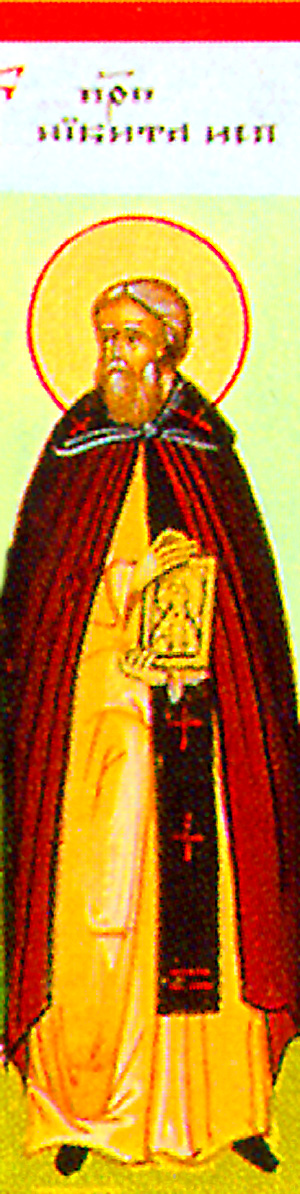
Saint Niketas (Nikḗtas) the Confessor was born in Bithynian Caesarea (northwest Asia Minor) of a pious family. His mother died eight days after his birth, and his father Philaretos became a monk. The child remained in the care of his grandmother, who raised him in a true Christian spirit. From his youth Saint Niketas attended church and was a disciple of the hermit Stephanos. With his blessing, Saint Niketas set off to the Mydicia monastery, where Saint Nikephoros (Nikēphóros) (March 13) was the igumen.
After seven years of virtuous life at the monastery, famed for its strict monastic rule, Saint Niketas was ordained presbyter. Saint Nikephoros, knowing the holy life of the young monk, entrusted to him the guidance of the monastery when he himself became ill.
Not wanting power, Saint Niketas devoted himself to the enlightenment and welfare of the monastery. He guided the brethren by his own example. Soon the fame of the lofty life of its inhabitants of the monastery attracted many seeking salvation. After several years, the number of monks had increased to one hundred.
When Saint Nikephoros departed to the Lord in his old age, the brethren unanimously chose Saint Niketas as igumen.
The Lord granted Saint Niketas the gift of wonderworking. Through his prayer a deaf-mute child received the gift of speech; two demon-possessed women were healed; he restored reason to one who had lost his mind, and many of the sick were healed of their infirmities.
During these years under the emperor Leo the Armenian (813-820), the Iconoclast heresy resurfaced and oppression increased. Orthodox bishops were deposed and banished. At Constantinople a council of heretics was convened in 815, at which they deposed the holy Patriarch Nikephoros (806-815), and in his place they chose the heretical layman Theodotus. They also installed heretics in place of exiled and imprisoned Orthodox bishops.
The emperor summoned all the heads of the monasteries and tried to bring them over to the Iconoclast heresy. Among those summoned was Saint Niketas, who stood firmly for the Orthodox confession. Following his example, all the igumens remained faithful to the veneration of holy icons. Therefore, they threw him into prison. Saint Niketas bravely underwent all the tribulations and encouraged firmness of spirit in the other prisoners.
Then the emperor and the false patriarch Theodotus attempted to trick those who remained faithful to Orthodox teaching. They promised that the emperor would give them their freedom and permit the veneration of the icons on one condition: that they take Communion from the pseudo-patriarch Theodotus.
For a long time the saint had doubts about entering into communion with a heretic, but other prisoners begged him to go along with them. Acceding to their entreaties, Saint Niketas went into the church, where icons were put out to deceive the confessors, and he accepted Communion.
But when he returned to his monastery and saw that the persecution against icons was continuing, he then repented of his deed, returned to Constantinople and fearlessly denounced the Iconoclast heresy. He ignored all the emperor’s threats.
Saint Niketas was again locked up in prison for six years until the death of the emperor Leo the Armenian. Enduring hunger and travail, Saint Niketas worked miracles by the power of his prayers: through his prayer the Phrygian ruler released two captives without ransom; three shipwrecked men for whom Saint Niketas prayed, were thrown up on shore by the waves.
Saint Niketas reposed in the Lord in 824. The saint’s body was buried at the monastery with reverence. Later, his relics became a source of healing for those coming to venerate the holy confessor.
Holy Virgin Martyr Theodosίa of Tyre
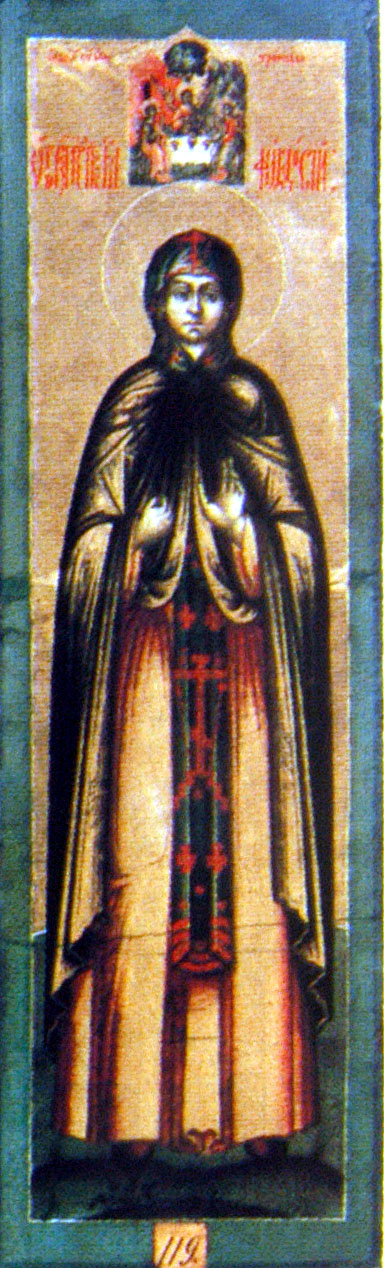
Saint Theodosίa of Tyre lived during the III and IV centuries. Once, during a persecution against Christians, which had already lasted for five years, the seventeen-year-old Theodosίa visited some condemned Christian prisoners in the Praetorium at Caesarea in Palestine. It was the day of Holy Pascha, and the Martyrs were speaking about the Kingdom of God. Saint Theodosίa asked them to remember her when they appeared before the Lord.
When the soldiers saw that the girl had bowed to the prisoners, they seized her and led her before the governor, Urban. The governor urged the Saint to offer sacrifice to the idols, but she refused, professing her faith in Christ. Then she was subjected to cruel tortures; her sides and breasts were raked with iron claws until her bones were exposed. She endured this in silence with astonishing courage. Again Urban told her to sacrifice, but she mocked him saying: “Foolish man, why do you persist? Can you not see that I have received everything I prayed for, and that I am honored to share the fate of these Martyrs for Christ?"
After saying this, she was tormented even more severely than before. The holy virgin was cast into the sea with a stone tied around her neck, but Angels rescued her from the depths. Then they tossed her into the arena to be eaten by wild animals. Seeing that the beasts would not touch her, the soldiers beheaded her.
That night Saint Theodosίa appeared to her parents, who had tried to persuade their daughter not to let herself be tortured. She wore radiant garments, a crown upon her head, and held a luminous gold cross in her hand. She said to them, “Behold the great glory of which you wished to deprive me!”
The Holy Virgin Martyr Theodosίa of Tyre suffered for Christ on April 3 in the year 307 or 308. She is also commemorated on May 29 (the transfer of her relics to Constantinople, and later to Venice).
Martyr Irene
No information available at this time.
Saint Illyricus of Mount Myrsinon in the Peloponnesus

Saint Illyricus the Wonderworker devoted himself to ascetic struggles on Mount Myrsinon in the Peloponnesus. The dates of his birth and death are unknown.
Martyrs Elpidephorus, Dius, Bithonius, and Galycus
The Holy Martyrs Elpidephorus, Dius, Bithonius, and Galycus suffered for their faith in Jesus Christ. They cut off the head of Saint Elpidephorus with a sword, Saint Dius was executed by stoning, Saint Bithonius was drowned in the sea, and Saint Galycus was condemned to be eaten by wild beasts.
“Unfading Flower” Icon of the Mother of God
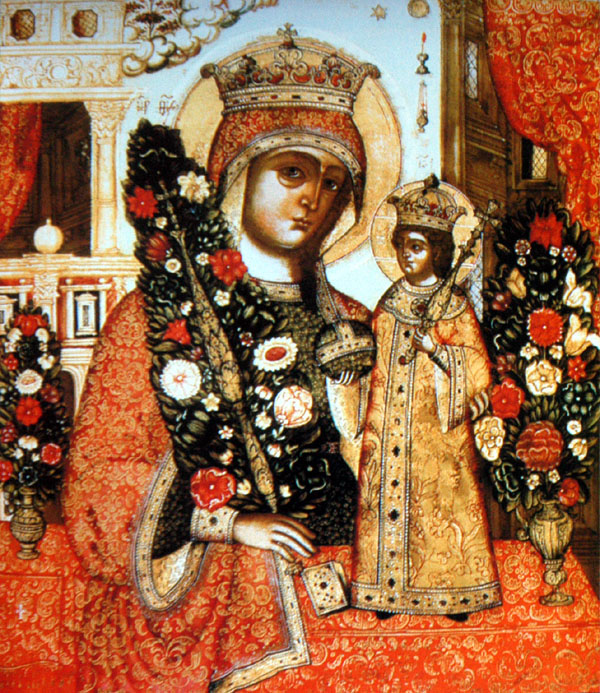
The "Unfading Flower" Icon depicts the Theotokos holding her Divine Son on her right arm, and in her left hand is a bouquet of white lilies. The lilies symbolize the unfading flower of virginity and purity of the Mother of God, to whom the Church sings: “You are the root of virginity and the Unfading Flower of purity.”
In Moscow there are two churches with Icons with this name: the church of the Dormition at Mogil'tsy (December 31), and the Alexeyev Monastery. Other icons of this name are in Kungur (Perm Gubernia); in the former town of Kadome of Tambov Province, namely, in the Merciful Theotokos womens' monastery; and in the Nativity of the Theotokos church of Voronezh.
There is a similar Icon in the church of Saint Nicholas in the village of Budishch (Poltava Gubernia). It resembles a number of very old icons which are also revered in that place. Every year on April 3, many people gather in the village of Budishch to venerate this Icon, along with a copy of the Vladimir Icon of the Mother of God. Several miraculous healings of the sick have occurred before this Icon.
 Saint Peter Antiochian Orthodox Church