
6TH TUESDAY OF LENT
ABSTAIN FROM MEAT, FISH, DAIRY, EGGS, WINE, OLIVE OIL
The Holy Hieromartyr Hypatius, Bishop of Gangra, Theophilos the Martyr and those with him, Innocent, Enlightener of Siberia & Alaska, Akakios the Confessor
ISAIAH 49:6-10
Thus says the LORD: "I will give you as a light to the nations, that my salvation may reach to the end of the earth." Thus says the LORD, the Redeemer of Israel and his Holy One, to one deeply despised, abhorred by the nations, the servant of rulers: "Kings shall see and arise; princes, and they shall prostrate themselves; because of the LORD, who is faithful, the Holy One of Israel, who has chosen you." Thus says the LORD: "In a time of favor I have answered you, in a day of salvation I have helped you; I have kept you and given you as a covenant to the people, to establish the land, to apportion the desolate heritages; saying to the prisoners, 'Come forth, ' to those who are in darkness, 'Appear.' They shall feed along the ways, on all bare heights shall be their pasture; they shall not hunger or thirst, neither scorching wind nor sun shall smite them, for he who has pity on them will lead them, and by springs of water will guide them.
GENESIS 31:3-16
Then the LORD said to Jacob, "Return to the land of your fathers and to your kindred, and I will be with you." So Jacob sent and called Rachel and Leah into the field where his flock was, and said to them, "I see that your father does not regard me with favor as he did before. But the God of my father has been with me. You know that I have served your father with all my strength; yet your father has cheated me and changed my wages ten times, but God did not permit him to harm me. If he said, 'The spotted shall be your wages, ' then all the flock bore spotted; and if he said, 'The striped shall be your wages, ' then all the flock bore striped. Thus God has taken away the cattle of your father, and given them to me. In the mating season of the flock I lifted up my eyes, and saw in a dream that the he-goats which leaped upon the flock were striped, spotted, and mottled. Then the angel of God said to me in the dream, 'Jacob, ' and I said, 'Here I am!' And he said, 'Lift up your eyes and see, all the goats that leap upon the flock are striped, spotted, and mottled; for I have seen all that Laban is doing to you. I am the God of Bethel, where you anointed a pillar and made a vow to me. Now arise, go forth from this land, and return to the land of your birth.'" Then Rachel and Leah answered him, "Is there any portion or inheritance left to us in our father's house? Are we not regarded by him as foreigners? For he has sold us, and he has been using up the money given for us. All the property which God has taken away from our father belongs to us and to our children; now then, whatever God has said to you, do.
PROVERBS 21:3-21
To do righteousness and justice is more acceptable to the LORD than sacrifice. Haughty eyes and a proud heart, the lamp of the wicked, are sin. The plans of the diligent lead surely to abundance, but every one who is hasty comes only to want. The getting of treasures by a lying tongue is a fleeting vapor and a snare of death. The violence of the wicked will sweep them away, because they refuse to do what is just. The way of the guilty is crooked, but the conduct of the pure is right. It is better to live in a corner of the housetop than in a house shared with a contentious woman. The soul of the wicked desires evil; his neighbor finds no mercy in his eyes. When a scoffer is punished, the simple becomes wise; when a wise man is instructed, he gains knowledge. The righteous observes the house of the wicked; the wicked are cast down to ruin. He who closes his ear to the cry of the poor will himself cry out and not be heard. A gift in secret averts anger; and a bribe in the bosom, strong wrath. When justice is done, it is a joy to the righteous, but dismay to evildoers. A man who wanders from the way of understanding will rest in the assembly of the dead. He who loves pleasure will be a poor man; he who loves wine and oil will not be rich. The wicked is a ransom for the righteous, and the faithless for the upright. It is better to live in a desert land than with a contentious and fretful woman. Precious treasure remains in a wise man's dwelling, but a foolish man devours it. He who pursues righteousness and kindness will find life and honor.
Repose of Saint Innocent, Metropolitan of Moscow, Enlightener of the Aleuts, Apostle to the Americas

Saint Innocent (Veniaminov), Metropolitan of Moscow and Kolomensk (August 26, 1797—March 31, 1879), was glorified by the Russian Orthodox Church on October 6, 1977. He was born in the village of Anginsk in the Irkutsk diocese. The Apostle of America and Siberia proclaimed the Gospel “even to the ends of the earth”: in the Aleutian islands (from 1823), in the six dialects of the local tribes on the island of Sitka (from 1834), among the Kolosh (Tlingit); in the remotest settlements of the extensive Kamchatka diocese (from 1853); among the Koryak, Chukchei, Tungus in the Yakutsk region (from 1853) and North America (in 1857); in the Amur and the Usuriisk region (from 1860).
Having spent a large part of his life in journeys, Saint Innocent translated a Catechism and the Gospel into the Aleut language. In 1833, he wrote in this language one of the finest works of Orthodox missionary activity INDICATION OF THE WAY TO THE KINGDOM OF HEAVEN.
In 1859, the Yakut first heard the Word of God and divine services in their native language. Twice (in 1860 and 1861) Saint Innocent met with Saint Nicholas the Apostle to Japan (February 3), sharing with him his spiritual experience.
A remarkable preacher, Saint Innocent said, “Whoever abounds in faith and love, can have mouth and wisdom, and the heart cannot resist their serving it.”
Having begun his apostolic work as a parish priest, Saint Innocent completed it as Metropolitan of Moscow (January 5, 1868—March 31, 1879). He obeyed the will of God all his life, and he left behind a theme for the sermon to be preached at his funeral: “The steps of a man are rightly ordered by the Lord” (Ps 36/37:23).
Saint Innocent is also commemorated on October 5 (Synaxis of the Moscow Hierarchs) and on October 6 (his glorification).
Saint Hypatius the Wonderworker, Bishop of Gangra

Hieromartyr Hypatius, Bishop of Gangra, was bishop of the city of Gangra in Paphlagonia (Asia Minor). In the year 325 he participated in the First Ecumenical Council at Nicea, at which the heresy of Arius was anathematized.
When Saint Hypatius was returning in 326 from Constantinople to Gangra, followers of the schismatics Novatus and Felicissimus fell upon him in a desolate place. The heretics ran him through with swords and spears, and threw him into a swamp. Like the Protomartyr Stephen, Saint Hypatius prayed for his murderers.
An Arian woman struck the saint on the head with a stone, killing him. The murderers hid his body in a cave, where a Christian who kept straw there found his body. Recognizing the bishop’s body, he hastened to the city to report this, and the inhabitants of Gangra piously buried their beloved archpastor.
After his death, the relics of Saint Hypatius were famous for numerous miracles, particularly for casting out demons and for healing the sick.
From of old the hieromartyr Hypatius was particularly venerated in the Russian land. Thus in the year 1330 the Ipatiev monastery was built at Kostroma, on the place where the Mother of God appeared with the Pre-eternal Christ Child, the Apostle Philip, and the hieromartyr Hypatius, Bishop of Gangra. This monastery later occupied a significant place in the spiritual and social life of the nation, particularly during the Time of Troubles.
The ancient copies of the Life of the hieromartyr Hypatius were widely distributed in Russian literature, and one of these was incorporated into THE READING MENAION of Metropolitan Macarius (1542-1564). In this Life there is an account of the appearance of the Savior to Saint Hypatius on the eve of the martyr’s death.
The entry for the saint’s Feast consists of his Life, some prayers, and words of praise and instruction. The pious veneration of Saint Hypatius was also expressed in Russian liturgical compositions. During the nineteenth century a new service was written for the hieromartyr Hypatius, distinct from the services written by Saint Joseph the Studite, contained in the March MENAION.
Repose of Saint Jonah, Metropolitan of Moscow and All Russia
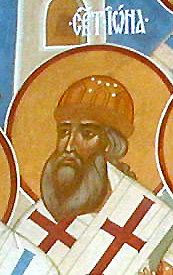
Saint Jonah, Metropolitan of Moscow and Wonderworker of All Russia, was born in the city of Galich into a pious Christian family. The father of the future saint was named Theodore. The youth received monastic tonsure in one of the Galich monasteries when he was only twelve years old. From there, he transferred to the Moscow Simonov monastery, where he fulfilled various obediences for many years.
Once, Saint Photius, Metropolitan of Moscow (May 27 and July 2), visited the Simonov monastery. After the Molieben, he blessed the archimandrite and brethren, and also wished to bless those monks who were fulfilling their obediences in the monastery.
When he came to the bakery, he saw Saint Jonah sleeping, exhausted from his work. The fingers of the saint’s right hand were positioned in a gesture of blessing. Saint Photius said not to wake him. He blessed the sleeping monk and predicted to those present that this monk would be a great hierarch of the Russian Church, and would guide many on the way to salvation.
The prediction of Saint Photius was fulfilled. Several years later, Saint Jonah was made Bishop of Ryazan and Murom.
Saint Photius died in 1431. Five years after his death, Saint Jonah was chosen Metropolitan of All Russia for his virtuous and holy life. The newly-elected Metropolitan journeyed to Constantinople in order to be confirmed as Metropolitan by Patriarch Joseph II (1416-1439). Shortly before this the nefarious Isidore, a Bulgarian, had already been established as Metropolitan. Spending a short time at Kiev and Moscow, Isidore journeyed to the Council of Florence (1438), where he embraced Catholicism.
A Council of Russian hierarchs and clergy deposed Metropolitan Isidore, and he was compelled to flee secretly to Rome (where he died in 1462). Saint Jonah was unanimously chosen Metropolitan of All Russia. He was consecrated by Russian hierarchs in Moscow, with the blessing of Patriarch Gregory III (1445-1450) of Constantinople. This was the first time that Russian bishops consecrated their own Metropolitan. Saint Jonah became Metropolitan on December 15, 1448. With archpastoral zeal he led his flock to virtue and piety, spreading the Orthodox Faith by word and by deed. Despite his lofty position, he continued with his monastic struggles as before.
In 1451 the Tatars unexpectedly advanced on Moscow; they burned the surrounding area and prepared for an assault on the city. Metropolitan Jonah led a procession along the walls of the city, tearfully entreating God to save the city and the people. Seeing the dying monk Anthony of the Chudov monastery, who was noted for his virtuous life, Saint Jonah said, “My son and brother Anthony! Pray to the Merciful God and the All-Pure Mother of God for the deliverance of the city and for all Orthodox Christians.”
The humble Anthony replied, “Great hierarch! We give thanks to God and to His All-Pure Mother. She has heard your prayer and has prayed to Her Son. The city and all Orthodox Christians will be saved through your prayers. The enemy will soon take flight. The Lord has ordained that I alone am to be killed by the enemy.” Just as the Elder said this, an enemy arrow struck him.
The prediction of Elder Anthony was made on July 2, on the Feast of the Placing of the Robe of the Most Holy Theotokos. Confusion broke out among the Tatars, and they fled in fear and terror. In his courtyard, Saint Jonah built a church in honor of the Placing of the Robe of the Most Holy Theotokos, to commemorate the deliverance of Moscow from the enemy.
Saint Jonah reposed in the year 1461, and miraculous healings began to take place at his grave.
In 1472 the incorrupt relics of Metropolitan Jonah were uncovered and placed in the Dormition Cathedral of the Kremlin (the Transfer of the holy Relics is celebrated May 27). A Council of the Russian Church in 1547 established the commemoration of Saint Jonah, Metropolitan of Moscow. In 1596, Patriarch Job added Saint Jonah to the Synaxis of the Moscow Hierarchs (October 5).
Venerable Hypatius the Healer of the Kiev Caves

Saint Hypatius the Healer of the Caves, attained glory through his severe fasting and prayerful vigilance. By night he stood at prayer, slept very little, and ate only bread and water.
Saint Hypatius devoted himself entirely to the service of the sick, and received from God the gift of healing. Those sick with various illnesses often hastened to his prayerful intercession.
The memory of Saint Hypatius is celebrated also on August 28, on the Synaxis of the Saints of the Far Caves.
Venerable Apollonius, Ascetic, of Egypt
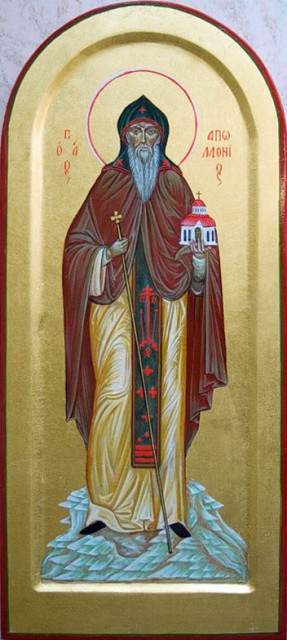
Saint Apollonius, when he was a fifteen-year-old youth, withdrew into the inner Thebaid desert (Lower Egypt), where he spent forty years in monastic struggles. Directed by God, he founded a monastery near Hermopolis, where eventually about five hundred monks gathered. Saint Apollonius was strict in fasting, only on Sundays did he eat cooked food, and on other days he ate wild plants.
All the monks followed the example of Saint Apollonius, engaging in spiritual struggles at the monastery. The holy ascetic died in the fourth century.
Hieromartyr Avdas, Bishop of Persia, and Martyr Benjamin the Deacon
Saint Avdas was Bishop of Bethchasar in Persia. He destroyed a temple of the fire-worshippers, and was brought to trial before the Persian emperor Izdegerd I (401-402), who ordered the saint to rebuild the temple. When Bishop Avdas refused, the emperor ordered soldiers to destroy all the Christian churches, persecute the Christians, and to torture them.
In 418, Saint Avdas was the first to be martyred. He was beheaded after lengthy tortures. After some time, the other martyrs were also executed. Among them was the deacon Benjamin, who suffered particularly cruel torments. They stuck sharp needles under his nails and impaled him on a spear.
The hieromartyrs died in the old Persian city of Suza.
Venerable Hypatius, Abbot of Rufinus in Chalcedon
Saint Hypatius, Igumen of Rufinus in Chalcedon was born in Phrygia (Asia Minor) into the family of a lawyer and he received a fine education. Once, when he was eighteen years old, his father punished him, after which the youth left home and went to Thrace (Balkans).
There he herded cattle for a time, and then he lived with a priest who taught him how to chant the Psalms. Soon the chosen one of God was tonsured in one of the monasteries. Struggling against the temptations of the flesh, the holy ascetic spent fifty days in a strict fast. One night, with the blessing of the igumen, he drank some wine and ate some bread in the presence of the brethren, and was healed of his passions.
In search of a new place for ascetic struggles, Saint Hypatius settled with two other monks in the neglected Rufinus monastery near Chalcedon (Asia Minor). The monastery was rebuilt and soon many monks gathered about the holy ascetic, and the monastery began to flourish spiritually once more.
At the age of forty, Saint Hypatius was chosen igumen and he guided the monastery for forty years. Many monks, imitating their guide, attained spiritual perfection. For his strict ascetic life and love for others, Saint Hypatius was granted the gifts of wonderworking and healing by the Lord. Through his holy prayers bread was multiplied at the monastery. Those afflicted with demons, and the blind, the withered and the hemorrhaging, came to the monastery and were healed.
Saint Hypatius reposed in 446, at eighty years of age. On the eve of his death, he predicted misfortunes to come: a devastating hailstorm, an earthquake, and Attila the Hun’s invasion of Thrace.
Appearance of the Ivḗron Icon of the Mother of God
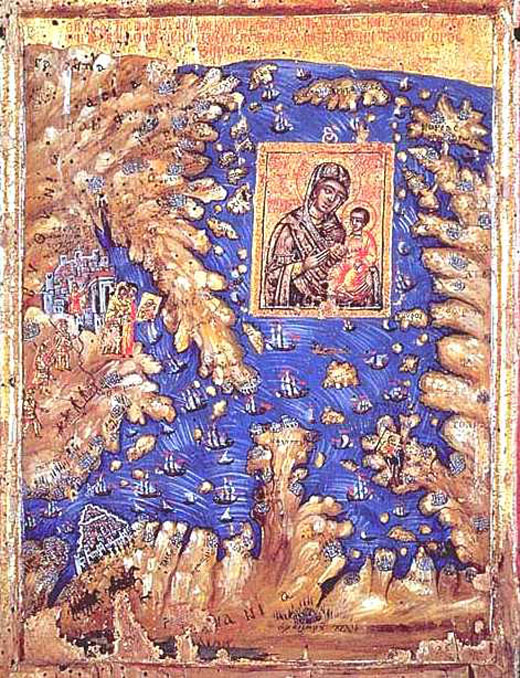
The Ivḗron Icon of the Mother of God (which is preserved on Mt. Athos) was kept in the home of a certain pious widow, who lived near Nicea. During the time of the emperor Theophilus, the Iconoclasts came to the house of this Christian, and one of the soldiers struck the image of the Mother of God with a spear. Blood flowed from the place where it was struck.
The widow, fearing its destruction, promised the imperial soldiers money and implored them not to touch the icon until morning. When the soldiers departed, the woman and her son (later an Athonite monk), sent the holy icon away upon the sea to preserve it. The icon, standing upright upon the water, floated to Athos.
For several days, the Athonite monks had seen a fiery pillar on the sea rising up to the heavens. They came down to the shore and found the holy image, standing upon the waters. After a Molieben of thanksgiving, a pious monk of the Ivḗron monastery, Saint Gabriel (July 12), had a dream in which the Mother of God appeared to him and gave him instructions. So he walked across the water, and taking up the holy icon, he placed it in the church.
On the following day, however, the icon was found not within the church, but on the gates of the monastery. This was repeated several times, until the Most Holy Theotokos revealed to Saint Gabriel Her will, saying that She did not want the icon to be guarded by the monks, but rather She intended to be their Protectress. After this, the icon was installed on the monastery gates. Therefore this icon came to be called “Portaitissa” or “Gate-Keeper” (October 13). This comes from the Akathist “Rejoice, O Blessed Gate-Keeper who opens the gates of Paradise to the righteous.”
There is a tradition that the Mother of God promised Saint Gabriel that the grace and mercy of Her Son toward the monks would continue as long as the Icon remained at the monastery. It is also believed that the disappearance of the Ivḗron Icon from Mt. Athos would be a sign of the end of the world.
The Ivḗron Icon is also commemorated on February 12, October 13 (its arrival in Moscow in 1648), and Bright Tuesday (commemorating the appearance of the Icon in a pillar of fire at Mt. Athos and its recovery by Saint Gabriel).
Saint Acacius the Confessor
Saint Acacius the Confessor lived during the Decian persecution, and was Bishop of Melitene, Armenia.
Arrested as a Christian, Saint Acacius was brought before the governor Marcianus, who ordered that he be tortured. He was not put to death, but was set free after a while, bearing the wounds of Christ on his body. He died in peace.
Saint Acacius the Confessor is also commemorated on September 15. He should not be confused with another Saint Acacius of Melitene (April 17) who lived in the fifth century.
Righteous Joseph the Patriarch

The Righteous Joseph the Fair was the son of the Old Testament Patriarch Jacob and his wife Rachel (Genesis 37:3). He had eleven brothers: Jacob's first wife Leah (the daughter of Laban) gave birth to six sons: 1) Reuben, 2) Simeon, 3) Levi, 4) Judah. Then Leah thought she could not have any more children. His second wife, Leah's sister Rachel, also seemed to be infertile, was jealous of Leah, so she gave her servant girl Bilhah to Jacob “so that she may give birth on my behalf” (Genesis 30:3). The concubine Bilhah bore two sons to Jacob: 5) Dan and 6) Naphtali.
In those days, when a wife could not bear children, it was not uncommon for a female servant to have the husband's child on behalf of the wife. The expression "she shall bear upon my knees and I shall have children by her" (Genesis 30:3) refers to the rite of adoption whereby the new-born child was placed on the lap of the adopting woman to indicate that she had legally borne the child. The fact that Rachel gives the name, rather than Bilhah, demonstrates that she is recognized as the child's mother. When Leah thought she could no longer give Jacob sons, she gave her servant, Zilpah to Jacob, who bore him 7) Gad and 8) Asher. These two, however, were legally Leah's sons when she adopted them, in the manner previously described.
After some time, Leah did conceive two more sons: 9) Issachar and 10) Zebulun, and a daughter: Dinah, who is first mentioned in Genesis 30:21 as the daughter of Leah and Jacob, born to Leah after she had borne six sons to Jacob. Finally, Rachel gave birth to 11) Joseph, and 12) Benjamin.
Joseph's brothers became jealous of him because their father loved him more than his other sons, since he was the son of his old age. They feared him because he revealed his dreams, which foretold his future greatness. One dream was that he and his brothers were binding sheaves in the field. Joseph's sheaf rose up, and the sheaves of his brothers arose and bowed down to it. In another dream the sun, the moon, and eleven stars bowed down to him. Jacob rebuked him for implying that his father, mother, and eleven brothers would also bow before him one day.
The brothers decided to kill Joseph, but the eldest son Reuben persuaded them not to do so. "Do not shed any blood. Cast him into this pit … but do not lay hands upon him" (Genesis 37:32). Reuben intended to come back later and rescue Joseph, but his plans were thwarted. They stripped Joseph of his coat and threw him into the pit, and then sold him for twenty gold coins to merchants who were traveling to Egypt in a caravan. After killing a goat, they smeared its blood on the coat and brought it to Jacob saying that they had found it on the ground. Jacob recognized the coat and concluded that a wild animal must have killed Joseph.
In Egypt Joseph was sold to Potiphar, a captain of the guards. Because his master saw that the Lord was with Joseph, and that he was a successful man, he made him the overseer of his house, placing him in charge of all his possessions. The Righteous Joseph was fair of countenance, and Potiphar's wife wanted him to lie with her. He would not consent to this, but the shameless woman continued pestering him. One day she repeated her request, and he fled from her. She seized his garment as he ran away, and showed it to her husband when he returned home. Out of malice and spite, Potiphar's wife slandered the Righteous Joseph before her husband, saying that he had attempted to rape her. Believing the lie, Potiphar confined the innocent young man in a prison. There, Saint Joseph the Fair gained fame when he interpreted the dreams of two men in the prison (Genesis chapter 40).
After Joseph interpreted Pharaoh's two dreams (Genesis chapter 41), predicting seven years of plenty, and seven years of famine and misfortune for Egypt, he advised Pharaoh to appoint overseers to store one fifth of the grain harvest each year, and to reserve it for the time of famine. The Righteous Joseph was set free and was given charge of Pharaoh's household, and became the Lord of Egypt. Pharaoh was still the ruler, but Joseph answered only to him.
When famine also struck his home in the land of Canaan, ten of Joseph's brothers were sent to Egypt by Jacob in order to buy some grain. Only Benjamin stayed at home with his father. Joseph recognized them, but they did not know him. He threw them into prison for three days, then released them. He gave them provisions and sent them on their way, ordering them to send him their youngest brother.
Later, Joseph revealed himself to them, and he wept. He told them to bring his father and his entire family to Egypt. After Jacob's death, Joseph's brothers feared that he would repay them for all the evil they had done to him, so they asked for forgiveness. He replied, "You meant evil against me, but God meant it for good" (Genesis 50:20).
Before his death around 1700 B. C., the Righteous Joseph ordered that his bones be taken from Egypt to the Promised Land, which was done in the time of the holy Prophet Moses (September 4), 1496 B.C. As the father of Manassah and Ephraim, Saint Joseph is placed at the head of two of the tribes of Israel.
Saint Joseph is also commemorated on the Sunday of the Holy Fathers, and on Great and Holy Monday.
 Saint Peter Antiochian Orthodox Church