
5TH TUESDAY OF LENT
ABSTAIN FROM MEAT, FISH, DAIRY, EGGS, WINE, OLIVE OIL
Forefeast of the Annunciation of the Theotokos, Righteous Artemon, Bishop of Seleucia, Our Holy Father Theonas, Archbishop of Thessolonica, Zachariah the Recluse
ISAIAH 40:18-31
Thus says the LORD: To whom then will you liken God, or what likeness compare with him? The idol! a workman casts it, and a goldsmith overlays it with gold, and casts for it silver chains. He who is impoverished chooses for an offering wood that will not rot; he seeks out a skilful craftsman to set up an image that will not move. Have you not known? Have you not heard? Has it not been told you from the beginning? Have you not understood from the foundations of the earth? It is he who sits above the circle of the earth, and its inhabitants are like grasshoppers; who stretches out the heavens like a curtain, and spreads them like a tent to dwell in; who brings princes to nought, and makes the rulers of the earth as nothing. Scarcely are they planted, scarcely sown, scarcely has their stem taken root in the earth, when he blows upon them, and they wither, and the tempest carries them off like stubble. To whom then will you compare me, that I should be like him? Says the Holy One. Lift up your eyes on high and see: who created these? He who brings out their host by number, calling them all by name; by the greatness of his might, and because he is strong in power not one is missing. Why do you say, O Jacob, and speak, O Israel, “My way is hid from the LORD, and my right is disregarded by my God”? Have you not known? Have you not heard? The LORD is the everlasting God, the Creator of the ends of the earth. He does not faint or grow weary, his understanding is unsearchable. He gives power to the faint, and to him who has no might he increases strength. Even youths shall faint and be weary, and young men shall fall exhausted; but they who wait for the LORD shall renew their strength, they shall mount up with wings like eagles, they shall run and not be weary, they shall walk and not faint.
GENESIS 15:1-15
After these things the word of the LORD came to Abram in a vision, “Fear not, Abram, I am your shield; your reward shall be very great.” But Abram said, “O Lord GOD, what wilt thou give me, for I continue childless, and the heir of my house is Eliezer of Damascus?” And Abram said, “Behold, thou hast given me no offspring; and a slave born in my house will be my heir.” And behold, the word of the LORD came to him, “This man shall not be your heir; your own son shall be your heir.” And he brought him outside and said, “Look toward heaven, and number the stars, if you are able to number them.” Then he said to him, “So shall your descendants be.” And he believed the LORD; and he reckoned it to him as righteousness. And he said to him, “I am the LORD who brought you from Ur of the Chaldeans, to give you this land to possess.” But he said, “O Lord GOD, how am I to know that I shall possess it?” He said to him, “Bring me a heifer three years old, a she-goat three years old, a ram three years old, a turtledove, and a young pigeon.” And he brought him all these, cut them in two, and laid each half over against the other; but he did not cut the birds in two. And when birds of prey came down upon the carcasses, Abram drove them away. As the sun was going down, a deep sleep fell on Abram; and lo, a dread and great darkness fell upon him. Then the LORD said to Abram, “Know of a surety that your descendants will be sojourners in a land that is not theirs, and will be slaves there, and they will be oppressed for four hundred years; but I will bring judgment on the nation which they serve, and afterward they shall come out with great possessions. As for yourself, you shall go to your fathers in peace; you shall be buried in a good old age.
PROVERBS 15:7-19
The lips of the wise spread knowledge; not so the minds of fools. The sacrifice of the wicked is an abomination to the LORD, but the prayer of the upright is his delight. The way of the wicked is an abomination to the LORD, but he loves him who pursues righteousness. There is severe discipline for him who forsakes the way; he who hates reproof will die. Sheol and Abaddon lie open before the LORD, how much more the hearts of men! A scoffer does not like to be reproved; he will not go to the wise. A glad heart makes a cheerful countenance, but by sorrow of heart the spirit is broken. The mind of him who has understanding seeks knowledge, but the mouths of fools feed on folly. All the days of the afflicted are evil, but a cheerful heart has a continual feast. Better is a little with the fear of the LORD than great treasure and trouble with it. Better is a dinner of herbs where love is than a fatted ox and hatred with it. A hot-tempered man stirs up strife, but he who is slow to anger quiets contention. The way of a sluggard is overgrown with thorns, but the path of the upright is a level highway.
Forefeast of the Annunciation
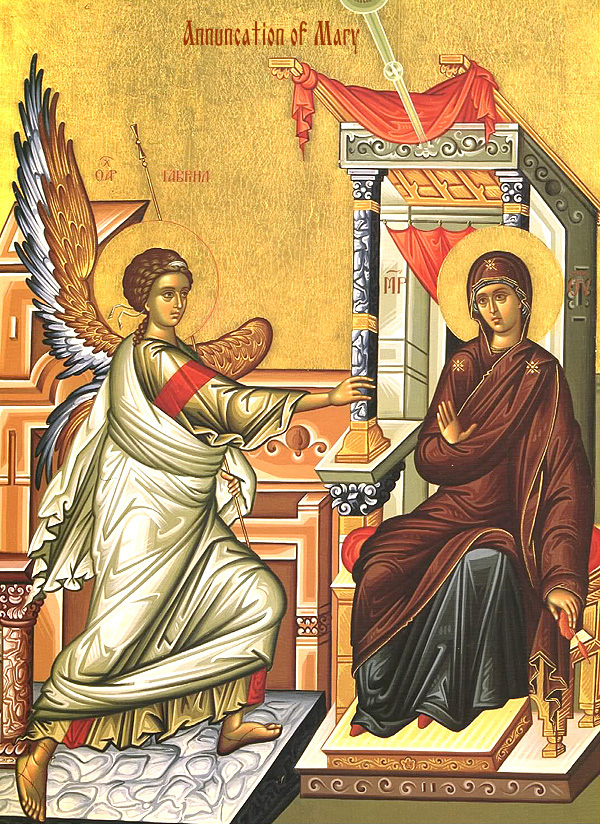
The Feast of the Annunciation to the Most Holy Theotokos is celebrated on one day March 25, exactly nine months before the Nativity of Christ. There is one day of Prefeast (March 24), followed by the Feast itself. On March 26, we celebrate the Synaxis of the Archangel Gabriel.
Because the Feast of the Annunciation falls during Great Lent, there is no Postfeast of the Feast.
Venerable Zachariah the Recluse
Saint Zachariah the Recluse of Egypt because of his concern for the poor and homeless was called “to the outcast.” In the printed Menaion he is known as “our Monastic Father Zachariah,” and so he has been identified erroneously with Saint Zachariah the Monk.
Saint Artemon, Bishop of Seleucia

Saint Artemon, Bishop of Seleucia, was born and lived in Seleucia of Pisidia (Asia Minor). He was pious and virtuous, therefore when the holy Apostle Paul (June 29) came to Seleucia, he established Saint Artemon as the first bishop of this city, since he was the most worthy. Saint Artemon wisely nourished the flock entrusted to him and won glory as a comforter of the poor and oppressed. Saint Artemon died in great old age.
[In the ancient Slavonic Lives of the Saints “Seleucian” was written as “Seleoukinian” or “Seleunian.” However, in several of the Greek memorials the bishop was also called Solunian (i.e., of Thessalonica). Saint Artemon (or Menignus) was listed in the MENAIA as Seleucian or Solunian. In the second half of the eighteenth century, these two names were mistakenly applied to various persons.]
Venerable Zachariah the Ascetic of the Kiev Caves

Saint Zachariah the Faster of the Caves was an ascetic in the Far Caves in the thirteenth-fourteenth centuries. He fasted so strictly that he ate nothing baked nor boiled, and he consumed only greens once a day at the setting of the sun. Demons trembled at the mere mention of his name.
Often the monk saw angels, with which he deserved to live in Heaven.
Martyr Stephen of Kazan
The Holy Martyr Stephen of Kazan was a Tatar. For more than twenty years, he suffered from a weakness of the legs. After the capture of Kazan by Ivan the Terrible (1552), he believed in Christ and received healing. The saint was baptized by Archpriest Menignus of the Moscow cathedral, who had brought a letter from Metropolitan Macarius to the Russian army.
After the Russian army withdrew from Kazan, the Tatars chopped the martyr Stephen into pieces, scattered his body and plundered his house, because he remained faithful to Christ.
Martyr Peter of Kazan
The Holy Martyr Peter of Kazan was a newly-baptized Tatar who suffered because he converted to Christianity from Islam.
After the Russian army left Kazan, the inhabitants dragged Peter from his home by force, and addressed him by his former Moslem name, hoping that he would deny Christ. But to all flattery and persuasion Saint Peter answered, “My father and mother is God Who is glorified in Trinity: Father, Son, and Holy Spirit. If you believe in the Father and the Son and the Holy Spirit, then you are my family. I was named Peter in holy Baptism, and I will not answer to the name by which you address me.”
Seeing that he would remain steadfast in the Faith, his family had him tortured. He endured fierce torments, but he did not cease to confess the Name of Christ, saying, “I am a Christian.” The holy martyr was buried in Kazan on the site where the church of the Resurrection of Christ later stood, at the Zhitny-Grain marketplace.
For the Lives of the holy martyrs Stephen and Peter of Kazan see: “Journal of the Moscow Patriarchate,” 1977, No. 9, p. 79-80.
Icon of the Mother of God of “the Uncut Mount” or “Clouded Mountain”

About 250-300 years ago1 this icon was in one of the men’s monasteries of Tver and the Superior gave it to Cosmas Volchaninov in gratitude for his fine work in the Monastery church. The Icon was passed down from generation to generation, but an irreverent grandson of Cosmas took the darkened Icon and put it in the attic. His daughter-in-law had to endure many insults from her husband and his relatives. In desperation, she decided to commit suicide in a deserted bath-house. On her way there a monk appeared to her and said, “Where are you going, you unhappy woman? Go back, pray to the Theotokos of "The Clouded Mount," and you will live well, and in peace.”
The distressed woman returned home and revealed everything to her family, not concealing what she had intended to do. They searched for the monk, but they did not find him. No one saw him but her. This occurred on the eve of the Feast of the Annunciation to the Most Holy Theotokos.
They found the Icon in the attic, cleaned off the dirt, and put it downstairs, in a place of honor. In the evening, the parish priest served an All-night Vigil before the Icon. From that time, a Vigil was served in the house every year on this day.
For more than 150 years the Icon remained in the Volchaninov family. Katherine, the daughter of Basil, the last of the Volchaninov line, married George Ivanovich Konyaev, taking the Icon of the Mother of God with her as a precious inheritance. Molebens and All-night Vigils were served in the Konyaev house on March 24 and November 7 (perhaps this was the day when the Icon was brought from the monastery to the house of Cosmas Volchaninov).
In 1863, near a cemetery church of the Smolensk Icon of the Mother of God, it was decided to build a chapel in honor of Saint Tikhon and Saint Makarios of Kalyazin (March 17). The owner of the Icon, George Konyaev (who died in 1868 at the age of 97) wanted to donate the Icon of the Mother of God to the church. He asked the clergy to build another chapel for the wonderworking Icon of the Mother of God of "The Clouded Mountain.”
He also said, “I feel the very best place for it is in the temple of the Smolensk Icon of the Mother of God, since formerly the place on which the church was built was called a Mount, because it was the highest place in the city. The inhabitants took their possessions to the Mount and saved themselves from ruin during a flood. Let the 'Clouded Mountain' Icon remain here on the Mount with your blessing, and may all who are buried here be protected by her mercy.” On July 15, 1866 the Icon was transferred into the new chapel, which was consecrated by Bishop Anthony of Staritsk the following day.
For three centuries before the Revolution, the "Clouded Mount" Icon of the Mother of God repeatedly worked several miracles. She was taken into the homes of pious citizens, and children were brought to her to be healed. Copies of the Icon were made, which also turned out to be miraculous.
According to the recollection of Father John Bogoslovsky, from the village of Buylovo, his mother brought him to the wonderworking Icon several times when he was a child. He had severe pain in his eyes, and every time he was anointed with oil from a lamp hanging before her Icon, he obtained relief, then finally the disease left him. Grateful worshippers adorned the Icon with a a silver riza, and later the riza was gilded. Unfortunately, the Icon disappeared after the Smolensk church was closed.
The memory of the "Clouded Mount" Icon did not fade, however. In 1993, with the blessing of Archbishop Victor of Tver and Kashin, a copy of the "Clouded Mount" Icon was painted, and veneration of the Icon resumed. The "Clouded Mount" Icon of the Mother of God is commemorated three times a year: on July 16, in honor of the consecration of the altar; on March 24 in honor of the Icon's first miracle; and on November 7 according to ancient custom. Now there is a venerated copy of the Icon in the Ascension Cathedral at Tver.
In the Icon, the Most Holy Theotokos is depicted standing on a semicircular elevation. In her right hand is a small mountain, the "stone cut out of a mountain without hands" (Daniel 2:44), on top of which a domed church with crosses. On her left arm the Divine Child blesses with His right hand. There is a crown on the head of the Mother of God.
We pray before this Icon when faced with desperate situations; when it seems that everyone around us opposes us; and for the correction of errant or fallen relatives.
1 This account is based on Eugene Poselyanin's book The Mother of God (published in 1914), and other sources.
 Saint Peter Antiochian Orthodox Church