THE THEOPHANY OF OUR LORD AND SAVIOUR JESUS CHRIST
NO FAST
The Theophany of Our Lord and Saviour Jesus Christ, Theophan the Recluse
ST. PAUL’S LETTER TO TITUS 2:11-14; 3:4-7
TITUS, my son, the grace of God has appeared for the salvation of all men, training us to renounce irreligion and worldly passions, and to live sober, upright, and godly lives in this world, awaiting our blessed hope, the appearing of the glory of the great God and Savior Jesus Christ, who gave himself for us to redeem us from all iniquity and to purify for himself a people of his own who are zealous for good deeds.
But when the goodness and loving kindness of God our Savior appeared, he saved us, not because of deeds done by us in righteousness, but in virtue of his own mercy, by the washing of regeneration and renewal in the Holy Spirit, which he poured out upon us richly through Jesus Christ our Savior, so that we might be justified by his grace and become heirs in hope of eternal life.
MATTHEW 3:13-17
At that time, Jesus came from Galilee to the Jordan to John, to be baptized by him. John would have prevented him, saying, "I need to be baptized by you, and do you come to me?" But Jesus answered him, "Let it be so now; for thus it is fitting for us to fulfill all righteousness." Then he consented. And when Jesus was baptized, he went up immediately from the water, and behold, the heavens were opened and he saw the Spirit of God descending like a dove, and alighting on him; and lo, a voice from heaven, saying, "This is my beloved Son, with whom I am well pleased.
Feast of the Theophany of our Lord and Savior Jesus Christ
Theophany is the Feast which reveals the Most Holy Trinity to the world through the Baptism of the Lord (Mt.3:13-17; Mark 1:9-11; Luke 3:21-22). God the Father spoke from Heaven about the Son, the Son was baptized by Saint John the Forerunner, and the Holy Spirit descended upon the Son in the form of a dove. From ancient times this Feast was called the Day of Illumination and the Feast of Lights, since God is Light and has appeared to illumine “those who sat in darkness,” and “in the region of the shadow of death” (Mt.4:16), and to save the fallen race of mankind by grace.
In the ancient Church it was the custom to baptize catechumens at the Vespers of Theophany, so that Baptism also is revealed as the spiritual illumination of mankind.
The origin of the Feast of Theophany goes back to Apostolic times, and it is mentioned in The Apostolic Constitutions (Book V:13). From the second century we have the testimony of Saint Clement of Alexandria concerning the celebration of the Baptism of the Lord, and the night vigil before this Feast.
There is a third century dialogue about the services for Theophany between the holy martyr Hippolytus and Saint Gregory the Wonderworker. In the following centuries, from the fourth to ninth century, all the great Fathers of the Church: Gregory the Theologian, John Chrysostom, Ambrose of Milan, John of Damascus, commented on the Feast of Theophany.
The monks Joseph the Studite, Theophanes and Byzantios composed much liturgical music for this Feast, which is sung at Orthodox services even today. Saint John of Damascus said that the Lord was baptized, not because He Himself had need for cleansing, but “to bury human sin by water,” to fulfill the Law, to reveal the mystery of the Holy Trinity, and finally, to sanctify “the nature of water” and to offer us the form and example of Baptism.
On the Feast of the Baptism of Christ, the Holy Church proclaims our faith in the most sublime mystery, incomprehensible to human intellect, of one God in three Persons. It teaches us to confess and glorify the Holy Trinity, one in Essence and Undivided. It exposes and overthrows the errors of ancient teachings which attempted to explain the Creator of the world by reason, and in human terms.
The Church shows the necessity of Baptism for believers in Christ, and it inspires us with a sense of deep gratitude for the illumination and purification of our sinful nature. The Church teaches that our salvation and cleansing from sin is possible only by the power of the grace of the Holy Spirit, therefore it is necessary to preserve worthily these gifts of the grace of holy Baptism, keeping clean this priceless garb, for “As many as have been baptized into Christ, have put on Christ” (Gal 3:27).
On the day of Theophany, all foods are permitted, even if the Feast falls on a Wednesday or Friday.
Venerable Macarius of Mount Athos
Saint Macarius was born in Thessalonica during the reign of Emperor Manuel II Paleologos, and went to Vatopedi Monastery on Mount Athos when he was young. Later, he went to Constantinople and became igumen of the Monastery of the Pantocrator, and chaplain to the Emperor.
EVE OF THE THEOPHANY OF OUR LORD AND SAVIOUR JESUS CHRIST
ABSTAIN FROM MEAT, FISH, DAIRY, EGGS, WINE, OLIVE OIL
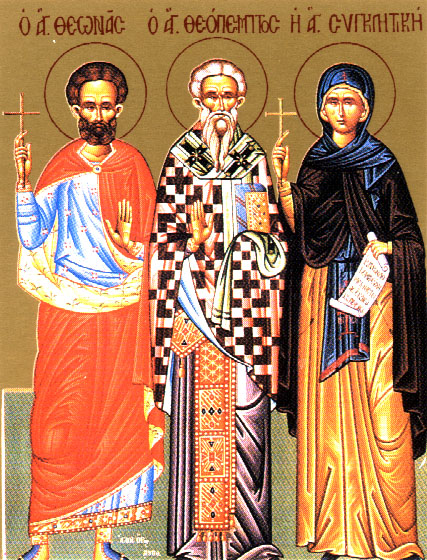
Eve of the Theophany of Our Lord and Saviour Jesus Christ, The Holy Martyrs Theopemptus and Theonas, Righteous Syncletike of Alexandria, Gregory of Akrita, Apollinaria of Egypt
ST. PAUL’S FIRST LETTER TO THE CORINTHIANS 9:19-27
BRETHREN, though I am free from all men, I have made myself a slave to all, that I might win the more. To the Jews I became as a Jew, in order to win Jews; to those under the law I became as one under the law – though not being myself under the law – that I might win those under the law. To those outside the law I became as one outside the law – not being without law toward God but under the law of Christ – that I might win those outside the law. To the weak I became weak, that I might win the weak. I have become all things to all men, that I might by all means save some. I do it all for the sake of the gospel, that I may share in its blessings. Do you not know that in a race all the runners compete, but only one receives the prize? So run that you may obtain it. Every athlete exercises self-control in all things. They do it to receive a perishable wreath, but we an imperishable. Well, I do not run aimlessly, I do not box as one beating the air; but I pommel my body and subdue it, lest after preaching to others I myself should be disqualified.
LUKE 3:1-18
In the fifteenth year of the reign of Tiberius Caesar, Pontius Pilate being governor of Judea, and Herod being tetrarch of Galilee, and his brother Philip tetrarch of the region of Ituraea and Trachonitis, and Lysanias tetrarch of Abilene, in the high-priesthood of Annas and Caiaphas, the word of God came to John the son of Zacharias in the wilderness; and he went into all the region about the Jordan, preaching a baptism of repentance for the forgiveness of sins. As it is written in the book of the words of Isaiah the prophet, "The voice of one crying in the wilderness: Prepare the way of the Lord, make his paths straight. Every valley shall be filled, and every mountain and hill shall be brought low, and the crooked shall be made straight, and the rough ways shall be made smooth; and all flesh shall see the salvation of God." He said therefore to the multitudes that came out to be baptized by him, "You brood of vipers! Who warned you to flee from the wrath to come? Bear fruits that befit repentance, and do not begin to say to yourselves, 'We have Abraham as our father"; for I tell you, God is able from these stones to raise up children to Abraham. Even now the axe is laid to the root of the trees; every tree therefore that does not bear good fruit is cut down and thrown into the fire." And the multitudes asked him, "What then shall we do?" And he answered them, "He who has two coats, let him share with him who has none; and he who has food, let him do likewise." Tax collectors also came to be baptized, and said to him, "Teacher, what shall we do?" And he said to them, "Collect no more than is appointed you." Soldiers also asked him, "And we, what shall we do?" And he said to them, "Rob no one by violence or by false accusation, and be content with your wages." As the people were in expectation, and all men questioned in their hearts concerning John, whether perhaps he were the Christ, John answered them all, "I baptize you with water; but he who is mightier than I is coming, the thong of whose sandals I am not worthy to untie; he will baptize you with the Holy Spirit and with fire. His winnowing fork is in his hand, to clear his threshing floor, and to gather the wheat into his granary, but the chaff he will burn with unquenchable fire." So, with many other exhortations, he preached good news to the people.
Eve of the Theophany of our Lord and Savior Jesus Christ
The fourth day of the Forefeast of Theophany falls on January 5. If January 5th falls on a weekday, the following order is observed:
Vespers on the evening of the 4th, then Matins. The First Hour is not read after Matins.
On the 5th we read the Royal Hours, followed by Vespers and the Liturgy of Saint Basil the Great.
If the Eve of Theophany falls on Saturday:
The Royal Hours are read on Friday, but there is no Liturgy. Vespers on the evening of the 4th, followed by Matins. The Liturgy of Saint John Chrysostom is celebrated on Saturday morning.
If the Eve of Theophany falls on a Sunday:
The Royal Hours are read on Friday, but there is no Liturgy. Vigil is served on Saturday evening, and the Liturgy of Saint John Chrysostom is celebrated on Sunday.
There are thirteen readings at Vespers on the Eve of Theophany, and the entrance is made with the Gospel. There is fasting today, whatever day of the week it may be.
Hieromartyr Theopemptus, Bishop of Nicomedia, and Martyr Theonas
The Holy Martyrs Theopemptus and Theonas suffered in Nicomedia in the year 303. Saint Theopemptus was bishop in Nicomedia in the time of Diocletian. Speaking out against idolatry, he defended the faith in Christ. Because of this, he became one of the first victims of the Diocletian persecution.
The saint refused to obey the emperor’s order to worship an idol of Apollo. Saint Theopemptus was thrown into a red-hot furnace, but by the power of God he remained alive. The emperor came to the furnace by night with a detachment of soldiers, and there he saw the saint alive and praying to God. Ascribing the miracle to magic, Diocletian thought to exhaust Saint Theopemptus by depriving him of food and drink for twenty-two days, but the martyr was preserved by the will of God.
The emperor brought the famous sorcerer Theonas to overcome Bishop Theopemptus’ supposed magical power. Theonas prepared a poison for Saint Theopemptus, put it into a little cake, and offered it to him to eat. The poison did no harm at all to Saint Theopemptus. Then Theonas tried an even stronger poison on the martyr. Seeing that Saint Theopemptus remained unharmed, he came to believe in Christ. They threw him into prison together with the holy bishop, who taught and baptized him, giving him the name Synesios (which means “full of understanding”).
At dawn Diocletian summoned Saint Theopemptus, and again tried to turn him to pagan impiety. Seeing that the bishop remained firm in his faith, he subjected him to many grievous tortures, after which the saint was beheaded. The holy martyr Theonas refused to offer sacrifice to idols, so he was buried alive in a deep ditch. This occurred at Nicomedia in the year 303.
Venerable Synkletika of Alexandria
Saint Syncletica (Synklētikḗ) was a native of Alexandria, the daughter of wealthy parents. She was very beautiful, but from a young age she thought only about the things which are pleasing to God. Loving the purity of virginity, she refused to marry anyone, and spent all her time in fasting and prayer.
After the death of her parents, Syncletica distributed her inheritance to the poor. She left the city with her younger sister, and lived in a crypt for the rest of her life.
News of her ascetic deeds quickly spread throughout the region, and many devout women and girls came to live under her guidance. During the course of her ascetical life the Saint zealously instructed the sisters by word and by deed.
In her eightieth year Saint Syncletica was stricken with an intense and grievous illness. She bore her ordeal with true Christian endurance, and the day of her death was revealed to her in a vision. After giving final instructions to her nuns, she surrendered her soul to God around the year 350.
Prophet Micah
The Holy Prophet Micah was a companion of the holy prophet Elias. He prophesied the ruin of King Ahab in a war with the Assyrians, for which he was cast into prison. Set free after the downfall of Ahab (3 Kings 22: 8-22), the holy prophet Micah died as a martyr in the ninth century B.C.
Saint Apollinaria of Egypt
The renowned Apollinaria (Απολλιναρία) lived during the reign of Leo the Great (457–474), and was the daughter of Anthemius, a former proconsul of Rome during the minority of Theodosius the Younger (408-450). Saint Apollinaria was renowned for her beauty and wisdom, as well as for her fervent faith and whole-hearted devotion to Christ. From a young age she was inclined to live a life of virginity, and she prayed to God night and day that she might achieve her desire, which was to remain a virgin until death. For this reason she entreated her parents to let her go to Jerusalem. When they granted her permission, the blessed one took some male and female servants with her, as well as gold, silver and expensive clothes, and left for Jerusalem. There she distributed everything to the poor. After she venerated the Holy Places, she freed her servants, keeping just one old servant and a eunuch with her. With them, she went to Alexandria. Arriving there at a level and even place, she decided to rest a little from her weary journey. Slipping away from her servants, she changed into monastic garb and hid in a marsh, where she lived a life of asceticism for several years in strict fasting and prayer. One day, an angel appeared to her in a dream and instructed her to go to the monastery of Sketis, which was under the spiritual direction of Saint Macarius of Egypt (January 19), and to call herself Dorotheus. Saint Macarius accepted her as one of the brethren, and she quickly distinguished herself by her ascetical life.
Saint Apollinaria’s parents had another daughter who was possessed by an unclean spirit. They sent her to Saint Macarius at Sketis, who brought the afflicted girl to "Father Dorotheus." Through her prayers, and by divine grace, her sister was healed. Everyone wanted her to remain with them, but she bade all of them farewell and returned to her monastic cell. Soon, her sister was attacked by a violent demon, who made her appear to be pregnant. The demon spoke through the girl’s lips, saying that Dorotheus had forced himself on her. Her outraged parents sent soldiers to the monastery to find the monk who had defiled their daughter. Saint Apollinaria took the blame and accompanied the envoys to the home of her parents in Rome. There she revealed her secret to them, healed her sister, and returned to Sketis. She reposed in the year 470, and was found worthy to dwell in the heavenly abodes (John 14:2). Only after her death, as the monks were preparing her body for burial, was it discovered that “he” was actually a woman. The Saint was buried in a cave in the monastery church of Saint Macarius of Egypt.
Saint Apollinaria is commemorated on January 4 in Greek usage, while the Slavic churches honor her on January 5.
Venerable Phosterius the Hermit
Saint Phosterius the Hermit led an ascetical life on a lofty mountain, where he was fed by an angel. He brought many back to the Church from the heresy of Iconoclasm by his miracles and saintly life.
Venerable Menas of Sinai
Saint Menas lived in asceticism for more than fifty years in the monastery of Sinai, where he died peacefully in the second half of the sixth century. Myrrh flowed from his holy relics. Saint John Climacus speaks of this wonderful man in The Ladder of Divine Ascent (Step 4:34).
Venerable Gregory of Crete
Saint Gregory of Akrita was born on the island of Crete in the year 760, and was raised by pious parents. At this time the iconoclast heretics persecuted the Orthodox. The youth Gregory, wanting to preserve his Orthodox Faith, went to Seleukia and led a life of piety.
At the age of twenty, Saint Gregory went to Jerusalem and lived there for twelve years, enduring fierce persecution from the Jews. From there Saint Gregory journeyed to Rome, where he entered a monastery. He became acquainted with Saint Michael, Bishop of Synnada (May 23), who took him along and settled in a monastery on the Cape of Akrita (Sea of Marmora). The saint accomplished great ascetic deeds and died there around the year 820.
Venerable Romanus the Martyr
New Martyr Romanus of Karpenisi was born in Karpenisi in central Greece. He was a monk on Mount Athos for a time, and suffered for Christ at Constantinople, beheaded by the Turks in the year 1694. His relics were taken by ship to England.
Sunday before Epiphany, Forefeast of the Theophany of Our Lord and Saviour Jesus Christ, Synaxis of the 70 Holy Apostles, Our Righteous Father Theoctistus, Abbot of Cucomo in Sicily, Nikephoros the Leper, Zosimos the Monk and Athanasios the Notary, Righteous Apollinaria the Senator, Martyrs Chrysanthos and Euphemia, Righteous Euthymios the Younger, New Martyr Onuphrios, Righteous Euthymios of Vatopedi, Righteous John Scholarios, Eustathios Archbishop of Serbia
ST. PAUL’S SECOND LETTER TO TIMOTHY 4:5-8
TIMOTHY, my son, always be steady, endure suffering, do the work of an evangelist, fulfil your ministry.For I am already on the point of being sacrificed; the time of my departure has come. I have fought the good fight, I have finished the race, I have kept the faith. Henceforth there is laid up for me the crown of righteousness, which the Lord, the righteous judge, will award to me on that Day, and not only to me but also to all who have loved his appearing.
MARK 1:1-8
The beginning of the Gospel of Jesus Christ, the Son of God. As it is written in the prophets, ‘Behold, I send my messenger before your face, who shall prepare your way; the voice of one crying in the wilderness: prepare the way of the Lord, make his paths straight.’ John was baptizing in the wilderness, preaching a baptism of repentance for the forgiveness of sins. And there went out to him all the country of Judea, and all the people of Jerusalem; and they were baptized by him in the river Jordan, confessing their sins. Now John was clothed with camel’s hair, and had a leather girdle around his waist, and ate locusts and wild honey. And he preached, saying, “After me comes he who is mightier than I, the thong of whose sandals I am not worthy to stoop down and untie. I have baptized you with water; but he will baptize you with the Holy Spirit.”
Forefeast of the Theophany of our Lord and Savior Jesus Christ
The third day of the Forefeast of Theophany falls on January 4. The hymns compare the Feast of the Nativity with the coming Feast. “There shepherds saw the Child and were amazed; here the voice of the Father proclaims the only-begotten Son.”
Synaxis of the Seventy Apostles
The Synaxis of the Seventy Apostles was established by the Orthodox Church to indicate the equal honor of each of the Seventy. They were sent two by two by the Lord Jesus Christ to go before Him into the cities He would visit (Luke 10:1).
Besides the celebration of the Synaxis of the Holy Disciples, the Church celebrates the memory of each of them during the course of the year:
With the Descent of the Holy Spirit the Seventy Apostles preached in various lands. Some accompanied the Twelve Apostles, like the holy Evangelists Mark and Luke, or Saint Paul’s companion Timothy, or Prochorus, the disciple of the holy Evangelist John the Theologian, and others. Many of them were thrown into prison for Christ, and many received the crown of martyrdom.
There are two more Apostles of the Seventy: Saint Cephas, to whom the Lord appeared after the Resurrection (1 Cor. 15:5-6), and Simeon, called Niger (Acts 13:1). They also were glorified by apostolic preaching.
There are discrepancies and errors in some lists of the Seventy Apostles. In a list attributed to Saint Dorotheus of Tyre (June 5) some names are repeated (Rodion, or Herodion, Apollos, Tychicus, Aristarchus), while others are omitted (Timothy, Titus, Epaphras, Archippus, Aquila, Olympas). Saint Demetrius of Rostov consulted the Holy Scripture, the traditions passed down by the Fathers, and the accounts of trustworthy historians when he attempted to correct the mistakes and uncertainties in the list in compiling his collection of Lives of the Saints.
The Church in particular venerates and praises the Seventy Apostles because they taught us to honor the Trinity One in Essence and Undivided.
In the ninth century Saint Joseph the Hymnographer composed the Canon for the Synaxis of the Seventy Apostles of Christ.
Venerable Theoctistus, Abbot at Cucomo, in Sicily
Saint Theoktistos lived in the second half of the eighth century, during a period of widespread iconoclastic heresy. The Venerable One was the founder and Igoumen of Cucomo Monastery on the island of Sicily. During that difficult time for the Church, the Orthodox were persecuted by iconoclastic Emperors. Orthodox churches were closed, and the Holy Icons were desecrated and destroyed. The monks, in particular, were affected by the iconoclastic persecution because they protected the Holy Icons. The monks were expelled from their monasteries, which were destroyed, and they were forced to flee their homeland. Saint Theoktistos sheltered these Greek monks in his monastery.
The Seventh Ecumenical Council, which was convened in 787, condemned the iconoclast heresy, but even after that, the heresy, supported by iconoclastic Emperors, continued to disturb the peace of the Church. Only in the reign of the Holy Empress Theodora, at the Council of 842, was iconoclasm finally condemned. The Triumph of Orthodoxy was appointed to be celebrated every year on the first Sunday of Great Lent.
Saint Theoktistos did not live to see that Triumph, for he fell asleep in the Lord in the year 800.
Repose of Saint Eustathius I, Archbishop of Serbia
Saint Eustathius, Archbishop of Serbia, lived in the second half of the thirteenth century, during the reign of the Serbian king Stephen Urosh (1262-1320).
He was born in the diocese of Budim into a pious Christian family, where he received a spiritual upbringing. Distinguished by remarkable talents, Eustathius was given a tutor by his parents to train him in spiritual wisdom. He studied Holy Scripture with particular diligence, perfecting himself in piety and good deeds. Having finished his education, the youth entered the Monastery of the Archangel Michael in the Zeta district (Montenegro) and led a strict monastic life. Soon he became known as a great ascetic. From thence he undertook a journey to Jerusalem, to venerate the Holy Sepulchre of the Lord. On the return journey he visited Mount Athos and settled there in the Serbian Hilandar monastery.
Saint Eustathius gained general renown and love as a strict ascetic and good teacher, and many came to him for spiritual advice. Later, he became igumen of the monastery.
After several years he was consecrated as Bishop of Zeta, and the saint returned to his native land. Experienced in spiritual life and in churchly matters, he won the love of his fellow countrymen, and continued to set an example for his flock.
Saint Eustathius was chosen as Archbishop of Serbia after the death of Archbishop Joannicius. Saint Eustathius guided the Serbian Church for seven years, and died about the year 1285. His body was buried in the Zhicha monastery, and later it was transferred to Pech and placed in the cathedral church of the Holy Apostles Peter and Paul.
Saint Aquila, Deacon, of the Kiev Caves
Saint Aquila the Deacon of the Kiev Caves (14th Century), became famous as a great faster, having spent a long while as a hermit. He ate neither vareny (pirogi) nor sweet food, he ate vegetables seldom and only in small quantities. During fasting periods, he ate only a single prosphoron.
Those thirsting for deliverance from “the enslavement of the passions of the stomach,” and those wishing to learn temperance turn to Saint Aquila entreating his help (Third Ode of the Canon to the monks venerated in the Far Caves).
Saint Aquila the Deacon is also commemorated on August 28 and on the second Sunday of Great Lent.
Confessors Zosimus the Hermit and Athanasius the Commentarisius (Superintendent of Prisoners), Anchorites, of Cilicia
The Monk Confessor Zosimus came from Cilicia and was an inhabitant of the wilderness. During a time of persecution against Christians under the emperor Diocletian (284-305) Saint Zosimus was seized and subjected to fierce torture for the Faith, but by the power of God he was preserved unharmed.
Having beheld such a miracle of God, the prison warden named Athanasius believed in Christ and was baptized. Saints Zosimus and Athanasius were released and went into the wilderness where they lived in the crevice of a mountain until their death.
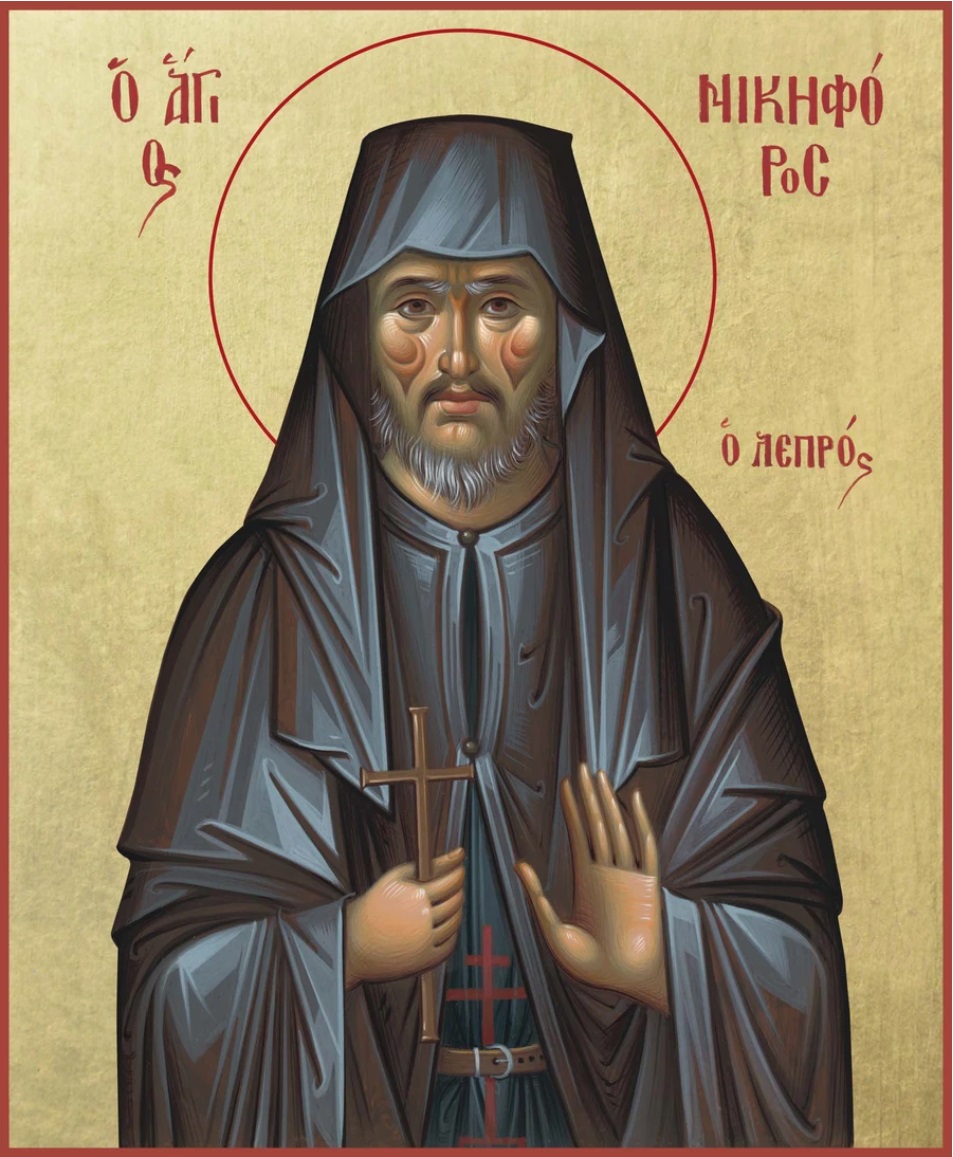
Saint Nikephoros the Leper
Father Nikephoros (Nikēphóros – Nicholas Tzanakakis in the world) was born in 1890 in a mountainous village in Khania, in Sikari, Kastanohori to the west of the prefecture with a healthy climate, with beautiful forests, rich waters, gorges and caves. This village has a peculiarity that we do not often encounter: it is divided into eleven neighborhoods, which have also been named after the families who first settled there. So Saint Nikephoros was born in the neighborhood of Kostoyianides.
His parents were simple and pious villagers, who died when he was still a young child, leaving him as an orphan. So, at the age of thirteen, he left he left his home and his grandfather, who had undertaken to raise him, and he went to Chania to work there. He found work in a barber shop and began to learn a trade. It was then that he first showed signs of of Hansen’s disease, i.e. leprosy. The lepers were isolated on the island of Spinalonga because leprosy was a contagious disease and it was treated with fear and dismay.
Nicholas was sixteen years old when signs of the disease began to become more conspicuous, so he left on a boat to Egypt in order to avoid being confined to Spinalonga. He remained in Alexandria, working in a barber shop again, but the signs of the disease became more and more apparent, especially on his hands and face. That is why, through the intervention of a cleric, he went to Chios, where there was a church for lepers at that time, and the priest was Father Anthimos Vagianos, later Saint Anthimos (February 15).
Nicholas arrived in Chios in 1914 at the age of twenty-four. In the leper hospital of Chios, which was a complex with many homesteads, there was a chapel of Saint Lazarus, where the wonderworking icon of Panagia Ypakoe1 (Feb. 2) was kept. In this space, the course of virtues was opened for Nicholas. Within two years Saint Anthimos considered him ready for the angelic Schema and tonsured him with the name Nikephoros. The disease progressed and evolved in the absence of suitable drugs, causing many large lesions (a drug was found in 1947).
Father Nikephoros lived with unquestioning, genuine obedience to his Spiritual Father, and with austere fasting, working in the gardens. He also recorded the miracles of Saint Anthimos, which he had witnessed with his own eyes (many of these were related to the deliverance of those possessed by demons).
There was a special spiritual relationship between Saint Anthimos and the monk Nikephoros, who always remained close to him, as Father Theoklitos Dionysiatis writes in his book Saint Anthimos of Chios. Father Nikephoros prayed at night for hours on end making countless metanias, he did not quarrel with anyone, nor injure anyone's heart, and he was the master chanter of the temple. Because of his illness, however, he slowly lost his sight, and so he chanted the troparia and the Epistles from memory.
The Chios leprosarium was closed in 1957 and the remaining patients, together with Father Nikephoros, were sent to Saint Barbara’s home for lepers in Athens, in Aigaleo. At that time, Father Nikephoros was about 67 years old. His members and his eyes were completely altered and distorted by the disease.
There, Father Eumenios also lived there at the home for lepers. He also suffered from Hansen’s disease, but with the medication he received, he was completely cured. However, he decided to remain in the home for lepers for the rest of his life near his fellow sufferers, caring for them with much love. Thus he submitted to Father Nikephoros, to whom the Lord had given many gifts as a reward for his patience. A crowd of people gathered in the humble cell of the leper Nikephoros, in Saint Barbara in Aigaleo to obtain his prayers. Here are some testimonies of those who met him:
“While he was prostrate with wounds and pains, he did not complain, but he showed great patience.”
“He had the charisma of consoling those who were sad. His eyes were permanently irritated, and he had limited sight. He also had stiffness in his hands and paralysis in his lower limbs. Nonetheless, he endured all of this in the sweetest, meek, smiling, delightful way, and he was also pleasant and lovable.”
“His face, which was eaten away by the marks of his illness, and his wounds, shone. It was a joy for those who saw this destitute and seemingly feeble man saying, May His holy name be glorified.”
Father Nikephoros reposed on January 4, 1964 at the age of 74. After three years, his holy relics were exhumed and found to be fragrant. Father Eumenios and other believers reported many cases where miracles occurred by calling on Saint Nikephoros to intercede with God.
The life of Saint Nikephoros was a brilliant example and model for everyone. He was pleasing to God because he had endured so much. For this reason, we have many testimonies that our saint received from the Holy Spirit the gift of discernment as and a host of other charisms. We should note that most of the miracles are recorded, and today the saint gives generous help to anyone in need. Surely there will be many more miracles which not have not yet been made manifest.
1 The name of the icon honors the obedience of the Theotokos to God’s will for her to give birth to His Son, so by her obedience people would also obey His will. The Greek word Υπακοή means “obedience.“
Venerable Euthymius and twelve other Monks, martyred at Vatopedi
The Monk Martyr Euthymius, Igumen of the Vatopedi Monastery on Mount Athos, and twelve other monks suffered martyrdom for denouncing the Latinizing Patriarchs Michael Paleologos (1261-1281) and John Bekkos (1275-1282) as heretics. Saint Euthymius was drowned in the sea, and the monks were hanged.
Venerable New Martyr Onuphrius of Hilandar (Mount Athos)
The New Martyr Onuphrius, in the world Matthew, was born in Bulgaria in Gabrovo in the Trnovo diocese. Matthew became angry with his parents one day, and said he wished to become a Moslem. Unfortunately, he was overheard by the Hagarenes, who wished to take him away. He regretted these words as soon as he uttered them, and he went to Athos to the Hilandar monastery as soon as he came of age. There he became a monk with the name Manassas.
Tormented by his conscience, Manassas decided to suffer for Christ. Therefore, he asked the blessing of his Elder Nikēphóros to pursue the path of martyrdom. The Elder tonsured him a schemamonk with the name Onuphrius. After four months of intense prayer, fasting, and spiritual struggle, he went with Gregory of the Peloponnesos to the island of Chios. There the Monk Martyr Onuphrius openly confessed the Christian Faith, for which he was seized and subjected to cruel tortures.
After the torture they beheaded him and threw him into the sea. He died in 1818 at the age of thirty-two.
Holy Fathers of the Shio-Mgvime Monastery
The Thirteen Syrian fathers arrived in Georgia in the 6th century, having received a blessing for their journey from the Most Holy Theotokos. They settled on Zedazeni Mountain, living an ascetic life of prayer and fasting. Their spiritual leader, Ioane, then sent them to perform good works throughout various regions of Georgia. The founding of many monasteries and the revival of monastic life in Georgia today are linked to the names of the Thirteen Syrian Fathers.
Saint Ioane sent one of his disciples, Shio, the son of a God-fearing Antiochian nobleman, to take up his abode in the nearby Sarkineti Mountains. By the grace of God, a dove brought food to Saint Shio in the deserted highlands where he labored.
A certain ruler, Evagre of Tsikhedidi, would often go hunting in the area where Saint Shio lived. On one of his excursions he happened upon venerable Shio and was so awed by his wondrous way of life that he decided to remain there with him. Saint Evagre gave up all his possessions and was found worthy to be appointed abbot at the time of Saint Shio’s death.
Saint Ioane remained on Zedazeni Mountain with only one disciple, the holy deacon Ilia. Fr. Ilia was a great consolation to Saint Ioane in his infirmities. Saint Ilia was also a great ascetic in his own right, laboring in prayer, fasting, and mortification of the flesh.
The mountain on which they lived was completely lacking water. Saint Ilia labored in the sweat of his brow carrying water from the Aragvi River, which flows around the foot of Zedazeni Mountain. Seeing the great ascetic labors of his disciple, Saint Ioane besought God with tears that He would supply them with a spring of water on top of this high mountain. God heard the prayer of His servant and a spring of delicious water began to flow.
Saint Ilia the Deacon often accompanied Saint Ioane on his travels. Fr. Ioane once took him to the monastery of Saint Shio, and Ilia the Deacon, as requested, presented Saint Ioane with a cup of wine in the refectory. The blessed Ioane made the sign of the Cross over the cup, raised it aloft, prayed to God, and left the cup suspended in the air. It remained where he had placed it, as if supported by an invisible hand.
One day Saint Ilia went to the spring to draw water. Glancing up he saw opposite him a bear of enormous size approaching the spring. Ilia was terrified and, leaving his bucket, turned and fled to the great schemamonk Ioane to tell him about the bear. Saint Ioane followed his disciple to the well and saw the bear drinking water. Saint Ioane meekly said, “Drink if you are thirsty and go away from here. But I tell you that henceforth, you and your kind shall never dare to cause any harm to anyone on this mountain.” Hearing the words of the saint and inclining its head like an obedient servant, the bear immediately left the spring. And to this day the animals continue to obey Saint Ioane’s command.
The holy deacon Ilia remained with Saint Ioane the rest of his life. The Georgian Apostolic Church beseeches the protection of the venerable Evagre, Ilia the Deacon, and all the blessed and pious elders who dwelt with the Thirteen Syrian Fathers and continued laboring in holiness to the end of their lives.
Metropolitan Symeon of Smolensk
Saint Symeon (Symeón) the future Metropolitan of Smolensk, was born in the city of Tobolsk in Siberia, and was a descendent of theMolyukov family of merchants.
His love for the monastic life led him to the Monastery of Saints Boris and Gleb in the city of Rostov. After his tonsure, he remained there for some time; and then, distinguished by his talents, he was chosen as Archimandrite of Nizhni Novgorod's Monastery of the Caves in 1672. There, because of his piety and activities for the improvement of the Monastery, he was noticed by the Church hierarchy. In 1674 he was transferred to Moscow as Superior of Andronikov Monastery, where he soon won the special favor of Tsar Alexei and his family.
Saint Symeon was consecrated as Archbishop of Smolensk in Moscow's Dormition Cathedral on April 9, 1676.
From 1612 to 1642 the Smolensk region was under Polish rule. The Catholics and Uniates violently seized Orthodox churches for Catholic and Uniate use in 1639; and so throughout Smolensk and Drohobuzh no Orthodox services were held in the counties.
After the capture of Smolensk by Tsar Alexei, Catholic spirit and Polish morals did not yield their influence at once. A great effort was required to restore Orthodoxy, which had been trampled on by heresies and weapons. Saint Symeon spent twenty-three years toiling in his See.
In a special presentation to the Tsar, Archbishop Symeon reported that it was desirable to have a cathedral in Smolensk which would befit the greatness of Orthodoxy.
In 1676, a design for the construction of the cathedral was sent from Moscow, and the Tsar donated two thousand rubles, as well as the necessary materials.
The foundation of the Dormition Cathedral was laid on August 2, 1677, but the Saint would not complete this undertaking. The consecration of the temple only took place in 1772.
With the blessing of the archpastor, churches were built in other cities of the diocese. Thus, Trinity cathedral was built at Vyazma, and construction of the Dormition church was begun in the city of Krasny.
Metropolitan Symeon participated in Patriarch Nikon's burial in 1681, and received from the Tsar a precious mitre from the patriarchal sacristy.
At the end of the year, he took part in the work of the territorial Council and in the meetings of the local Council, at which it was decided to establish a metropolis in Smolensk and a vicariate in Vyazma and Bryansk.
After the death of Tsar Alexei, who was Saint Symeon's patron, he was deprived of his white klobuk as the result of intrigues, and was exiled to repentance in the Trinity-Sergius Monastery, where he spent two years. Meanwhile, the schism in the Smolensk diocese intensified. Returning from imprisonment, the Archbishop continued his intensive work for the improvement of his diocese. He met repeatedly with Tsar Peter I in Smolensk, but history is silent about whether those meetings were beneficial or not.
In 1695, burdened with old age, the Hierarch began to ask for retirement. However, it was decided to wait until a worthy successor could be found. Saint Symeon, who was renowned for the holiness of his life, reposed on the night of January 4, 1699.
The Saint was buried in Smolensk's Trinity Cathedral. Later, his tomb became the resting place of his successors: Sylvester II (Chernitsky), Sylvester III (Kraisky), and Dorótheos (Korotkevich), until the revolution, pious citizens of Smolensk often visited his tomb. Many people revered Metropolitan Symeon as a Saint, and had panikhidas served for the repose of his soul. They also received healing from their sicknesses, according to their faith.1
Thus, in 1840, by the Saint's prayers, the gravely ill landowner Bogdanovich, who had been treated in Russia for many years, was healed after the tomb (which had fallen into disrepair) was reopened. In 1880, after panikhidas were served for the deceased hierarchs, the son of the tradesman V. Prokhorov was healed.
The Saint's relics were moved to the city cemetery in the 1930s. On March 17, 1996, Metropolitan Symeon's relics were solemnly reburied in Smolensk's Dormition Cathedral. Saint Symeon was canonized as a local Saint of the Novosibirsk diocese; and in 1984 he was also glorified at the Synaxis of the Siberian Saints.
Saint Symeon is also commemorated on June 10 (Synaxis of the Siberian Saints), and on the Sunday before July 28 (Synaxis of the Smolensk Saints). The holy Hierarch Symeon should not be confused with Prince Symeon of Vyazma, who suffered martyrdom on December 21, 1406.
Forefeast of the Theophany of Our Lord and Saviour Jesus Christ, Malachi the Prophet, Gordios the Martyr of Caesarea, Righteous Genevieve of Paris, Righteous Peter of Atroas, Righteous Akakios the Wonderworker, Righteous Thomais of Lesbos
ST. PAUL’S FIRST LETTER TO TIMOTHY 3:13-16; 4:1-5
TIMOTHY, my son, those who serve well as deacons gain a good standing for themselves and also great confidence in the faith which is in Christ Jesus. I hope to come to you soon, but I am writing these instructions to you so that, if I am delayed, you may know how one ought to behave in the household of God, which is the church of the living God, the pillar and bulwark of the truth. Great indeed, we confess, is the mystery of our religion:
God was manifested in the flesh, justified in the Spirit, seen by angels, preached among the nations, believed on in the world, taken up in glory.
Now the Spirit expressly says that in later times some will depart from the faith by giving heed to deceitful spirits and doctrines of demons, through the pretensions of liars whose consciences are seared, who forbid marriage and enjoin abstinence from foods which God created to be received with thanksgiving by those who believe and know the truth. For everything created by God is good, and nothing is to be rejected if it is received with thanksgiving; for then it is consecrated by the word of God and prayer.
MATTHEW 3:1-6
At that time, John the Baptist came preaching in the wilderness of Judea, “Repent, for the kingdom of heaven is at hand.” For this is he who was spoken of by the prophet Isaiah when he said, “The voice of one crying in the wilderness: prepare the way of the Lord, make his paths straight.” Now John wore a garment of camel’s hair, and a leather girdle around his waist; and his food was locusts and wild honey. Then went out to him Jerusalem and all Judea and all the region about the Jordan, and they were baptized by him in the river Jordan, confessing their sins.
Forefeast of the Theophany of our Lord and Savior Jesus Christ
The second day of the Forefeast of Theophany falls on January 3. Today’s hymns invite us to go in spirit to the Jordan River where the Creator comes to be baptized. He is the Light which shines in the darkness (John 1:5), and today He begins to overcome that darkness.
Holy Prophet Malachi
The Holy Prophet Malachi lived 400 years before the Birth of Christ, at the time of the return of the Jews from the Babylonian Captivity. Malachi was the last of the Old Testament prophets, therefore the holy Fathers call him “the seal of the prophets.”
Manifesting himself an image of spiritual goodness and piety, he astounded the nation and was called Malachi, i.e., an angel. His prophetic book is included in the Canon of the Old Testament. In it he upbraids the Jews, foretelling the coming of Jesus Christ and His Forerunner, and also the Last Judgment (Mal 3:1-5; 4:1-6).
Martyr Gordius at Caesarea, in Cappadocia
The Martyr Gordius was born at the end of the third century in the city of Caesarea of Cappadocia into a Christian family. When he came of age, he entered military service. Because of his valor and military skill, he was made a centurion. During the persecution of Christians at the beginning of the fourth century, he left the world and settled in the Sinai desert to prepare himself for the good deed of confessing the Name of Christ the Savior.
In the year 320, Gordius openly appeared before the prefect of a city where pagan games were being held, and identified himself as a Christian. He was arrested, suffered terrible torments, then was beheaded.
Venerable Genevieve of Paris
Saint Genevieve (Geneviève) was born of wealthy parents in Gaul (modern France) in the village of Nanterre, near Paris, around 422. Her father’s name was Severus, and her mother was called Gerontia. According to the custom of the time, she often tended her father’s sheep on Mount Valerien.
When the child was about seven years old, Saint Germanus of Auxerre (July 31) noticed her as he was passing through Nanterre. During the Service that night the Bishop placed his hand on her head and told her parents that she would become great in the sight of God, and would lead many to salvation. When Genevieve told him that she wished to dedicate herself to Christ, he gave her a brass medal with the image of the Cross to wear around her neck. Saint Germanus told her never to wear bracelets, or necklaces made with pearls, gold, or silver, and to avoid wearing any other ornaments around her neck, or on her fingers.
When she was fifteen, Genevieve was taken to Paris to enter the monastic life. Through fasting,vigil and prayer, she progressed in monasticism, and received from God the gifts of clairvoyance and of working miracles. Gradually, the people of Paris and the surrounding area regarded Genevieve as a holy vessel (2 Timothy 2:21).
Years later, Saint Genevieve was told that Attila the Hun was approaching Paris, Genevieve and the other nuns prayed and fasted, entreating God to spare the city. Suddenly, the barbarians turned away from Paris and went off in another direction.
Saint Genevieve considered the Saturday night Vigil service to be very important, since it symbolizes how our entire life should be. “We must keep vigil in prayer and fasting so that the Lord will find us ready when He comes,” she said. She was on her way to church with her nuns one stormy Saturday night when the wind extinguished her lantern. The nuns could not find their way without a light, since it was dark and stormy, and the road was rough and muddy. Saint Genevieve made the Sign of the Cross over the lantern, and the candle within burned with a bright flame. In this manner they were able to make their way to the church for the service.
There is a tradition that the church which Saint Genevieve suggested King Clovis should build in honor of Saints Peter and Paul, would become her own resting place when she fell asleep in the Lord around 512 at the age of eighty-nine. Her holy relics were later transferred to the church of Saint-Étienne-du-Mont in Paris. Most of her relics, and those of other saints, were destroyed at the time of the French Revolution.
During the Middle Ages, Saint Genevieve was regarded as the patron Saint of wine makers.
Saint Euthymius (Takaishvili)
Saint Ekvtime (Euthymius) Takaishvili, called the “Man of God,” was born January 3, 1863, in the village of Likhauri, in the Ozurgeti district of Guria, to the noble family of Svimeon Takaishvili and Gituli Nakashidze. He was orphaned at a young age and raised by his uncle.
From early childhood Saint Ekvtime demonstrated a great passion for learning. Having completed his studies at the village grammar school, he enrolled at Kutaisi Classical High School. In 1883 he graduated with a silver medal and moved to Saint Petersburg to continue his studies in the department of history-philology at Saint Petersburg University. In 1887, having successfully completed his studies and earned a degree in history, Saint Ekvtime returned to Georgia and began working in the field of academia. His profound faith and love for God and his motherland determined his every step in this demanding and admirable profession.
In 1895, Ekvtime married Nino Poltoratskaya, daughter of the famous Tbilisi attorney Ivan Poltoratsky, who was himself a brother in-law and close friend of Saint Ilia Chavchavadze the Righteous. From the very beginning of his career Saint Ekvtime began to collect historical-archaeological and ethnographical materials from all over Georgia. His sphere of scholarly interests was broad, including historiography, archaeology, ethnography, epigraphy, numismatics, philology, folklore, linguistics, and art history. Above all, Saint Ekvtime strove to learn more about Georgian history and culture by applying the theories and methodologies of these various disciplines to his work.
In 1889, Saint Ekvtime established the Exarchate Museum of Georgia, in which were preserved ancient manuscripts, sacred objects, theological books, and copies of many important frescoes that had been removed from ancient churches. This museum played a major role in rediscovering the history of the Georgian Church.
In 1907, Saint Ekvtime founded the Society for Georgian History and Ethnography. Of the many expeditions organized by this society, the journey through Muslim (southwestern) Georgia was one of the most meaningful. Having witnessed firsthand the aftermath of the forced isolation and Islamization of this region, Saint Ekvtime and his fellow pilgrims acquired a greater love for the Faith of their forefathers and became more firmly established in their national identity. Though they no longer spoke the Georgian language, the residents of this region received the venerable Ekvtime with great respect, having sensed from his greeting and kindness that he had come from their far-off motherland.
There was not a single patriotic, social or cultural movement in Georgia during the first quarter of the 20th century in which Saint Ekvtime did not actively take part. Among his other important achievements, he was one of the nine professors who founded Tbilisi University in 1918. Saint Ekvtime also vigorously advocated the restoration of the autocephaly of the Georgian Orthodox Church.
On March 11, 1921, the Georgian government went into exile in France. The government archives and the nation’s spiritual and cultural treasures were also flown to France for protection from the Bolshevik danger. Saint Ekvtime was personally entrusted to keep the treasures safe, and he and his wife accompanied them on their flight to France. Saint Ekvtime bore the hardships of an emigrant’s life and the horrors of World War II with heroism, while boldly resisting the onslaught of European and American scholars and collectors and the claims of other Georgian emigrants to their “family relics.”
In 1931 Saint Ekvtime’s wife, Nino, his faithful friend and companion, died of starvation. The elderly widower himself often drew near to the brink of death from hunger, cold, and stress, but he never faltered in his duty before God and his motherland—he faithfully protected his nation’s treasures.
The perils were great for Saint Ekvtime and the treasures he protected: British and American museums sought to purchase the Georgian national artifacts; a certain Salome Dadiani, the widow of Count Okholevsky, declared herself the sole heir of the Georgian national treasure; during World War II the Nazis searched Saint Ekvtime’s apartment; even the French government claimed ownership of the Georgian treasures.
Finally, the Soviet victory over fascist Germany created conditions favorable for the return of the national treasures to Georgia. According to an agreement between Stalin and De Gaulle, the treasures and their faithful protector were loaded onto an American warplane and flown back to their motherland on April 11, 1945. When he finally stepped off the plane and set foot on Georgian soil, Saint Ekvtime bowed deeply and kissed the earth where he stood. Georgia greeted its long-lost son with great honor. The people overwhelmed Saint Ekvtime with attention and care, restored his university professorship, and recognized him as an active member of the Academy of Sciences. They healed the wounds that had been inflicted on his heart.
Exhausted by the separation from his motherland and the woes of emigration, Saint Ekvtime rejoined society with the last of his strength. But mankind’s enemy became envious of the victory of good over evil and rose up against Saint Ekvtime’s unshakable spirit. In 1951 the Chekists arrested his stepdaughter, Lydia Poltoratskaya. Saint Ekvtime, who by that time was seriously ill, was now left without his caregiver.
In 1952, without any reasonable explanation, Saint Ekvtime was forbidden to lecture at the university he himself had helped to found, and he was secretly placed under house arrest. The people who had reverently greeted him upon his return now trembled in fear of his persecution and imminent death. Many tried to visit and support Saint Ekvtime, but they were forbidden. On February 21, 1953, Saint Ekvtime died of a heart attack, and three days later a group of approximately forty mourners accompanied the virtuous prince to his eternal resting place.
On February 10, 1963, the centennial of Saint Ekvtime’s birth, his body was reburied at the Didube Pantheon in Tbilisi. When his grave was uncovered, it was revealed that not only his body, but even his clothing and footwear had remained incorrupt. Saint Ekvtime’s relics were moved once again, to the Pantheon at the Church of Saint Davit of Gareji on Mtatsminda, where they remain today.
The body of Nino Poltoratskaya-Takaishvili was brought from Leville (France) and buried next to Saint Ekvtime on February 22, 1987.
The Holy Synod of the Georgian Apostolic Orthodox Church canonized Saint Ekvtime on October 17, 2002, and joyously proclaimed him a “Man of God.”
Discovery of the Relics of the Holy Great Martyr Ephraim
After Saint Ephraim (Ephraίm) suffered martyrdom on May 5,1426, he remained forgotten for nearly 500 years, hidden in the depths of silence and oblivion until January 3, 1950. By then a women’s monastery had sprung up on the site of the old monastery. The Igoumeness Makaria († April 23, 1999) was wandering through the ruins of the monastery, thinking of the martyrs whose bones had been scattered over that ground, and whose blood had watered the tree of Orthodoxy. She realized that this was a holy place, and she prayed that God would permit her to behold one of the Fathers who had lived there.
After some time, she seemed to sense an inner voice telling her to dig in a certain spot. She indicated the place to a workman whom she had hired to make repairs at the old monastery. The man was unwilling to dig there, for he wanted to dig somewhere else. Because the man was so insistent, Mother Makaria (Μακαρία) let him go where he wished. She prayed that the man would not be able to dig there, and so he struck rock. Although he tried to dig in three or four places, he met with the same results. Finally, he agreed to dig where the Igoumeness had first indicated.
In the ruins of an old cell, he cleared away the rubble and began to dig in an angry manner. The Igoumeness told him to slow down, for she did not want him to damage the body that she expected to find there. He mocked her because she expected to find the relics of a saint. When he reached the depth of six feet, however, he unearthed the head of the man of God. At that moment an ineffable fragrance filled the air. The workman turned pale and was unable to speak. Mother Makaria told him to go and leave her there by herself. She knelt and reverently kissed the body. As she cleared away more earth, she saw the sleeves of the Saint’s rasson. The cloth was thick and appeared to have been woven on a loom of an earlier time. She uncovered the rest of the body and began to remove the bones, which appeared to be those of a Martyr.
Mother Makaria was still in that holy place when evening fell, so she read the service of Vespers. Suddenly she heard footsteps coming from the grave, moving across the courtyard toward the door of the church. The footsteps were strong and steady, like those of a man of strong character. The nun was afraid to turn around and look, but then she heard a voice say, “How long are you going to leave me here?”
She saw a tall monk with small, round eyes, whose beard reached his chest. In his left hand was a bright light, and he gave a blessing with his right hand. Mother Makaria was filled with joy and her fear disappeared. “Forgive me,” she said, “I will take care of you tomorrow as soon as God makes the day dawn.” The Saint disappeared, and the Igoumeness continued to read Vespers.
In the morning after Matins, Mother Makaria cleaned the bones and placed them in a niche in the altar area of the church, lighting a candle before them. That night Saint Ephraim appeared to her in a dream. He thanked her for caring for his relics, then he said, “My name is Saint Ephraim.” From his own lips, she heard the story of his life and martyrdom.
Since Saint Ephraim glorified God during his life and by his death, the Lord granted him the grace of working miracles. Those who venerate his holy relics with faith and love have been healed of all kinds of illnesses and infirmities, and he is quick to answer the prayers of those who call upon him.






 Saint Peter Antiochian Orthodox Church
You must be logged in to post a comment.