Monthly Archives: December 2025

Daily Readings for Saturday, December 20, 2025

SATURDAY BEFORE NATIVITY

ABSTAIN FROM MEAT, FISH, DAIRY, EGGS

Forefeast of the Nativity of Our Lord and Savior, Jesus Christ, Ignatius the God-Bearer, Bishop of Antioch, Our Righteous Father Philogonius, Bishop of Antioch, John the New Martyr of Thassos, Holy Father John of Kronstadt

ST. PAUL’S LETTER TO THE GALATIANS 3:8-12

Brethren, the scripture, foreseeing that God would justify the Gentiles by faith, preached the gospel beforehand to Abraham, saying, “in you shall all the nations be blessed.” So then, those who are men of faith are blessed with Abraham who had faith. For all who rely on works of the law are under a curse; for it is written, “Cursed be every one who does not abide by all things written in the book of the law, and do them.” Now it is evident that no man is justified before God by the law; for “the righteous shall live by faith”; but the law does not rest on faith, for “He who does them shall live by them.”

LUKE 13:19-29

The Lord said this parable, "The kingdom of God is like a grain of mustard seed which a man took and sowed in his garden; and it grew and became a tree, and the birds of the air made nests in its branches." And again he said, "To what shall I compare the kingdom of God? It is like leaven which a woman took and hid in three measures of flour, till it was all leavened." He went on his way through towns and villages, teaching, and journeying toward Jerusalem. And some one said to him, "Lord, will those who are saved be few?" And he said to them, "Strive to enter by the narrow door; for many, I tell you, will seek to enter and will not be able. When once the householder has risen up and shut the door, you will begin to stand outside and to knock at the door, saying, 'Lord, open to us.' He will answer you, 'I do not know where you come from.' Then you will begin to say, 'We ate and drank in your presence, and you taught in our streets.' But he will say, 'I tell you, I do not know where you come from; depart from me, all you workers of iniquity!' There you will weep and gnash your teeth when you see Abraham and Isaac and Jacob and all the prophets in the kingdom of God and you yourselves thrust out. And men will come from east and west, and from north and south, and sit at table in the kingdom of God.

Forefeast of the Nativity of our Lord
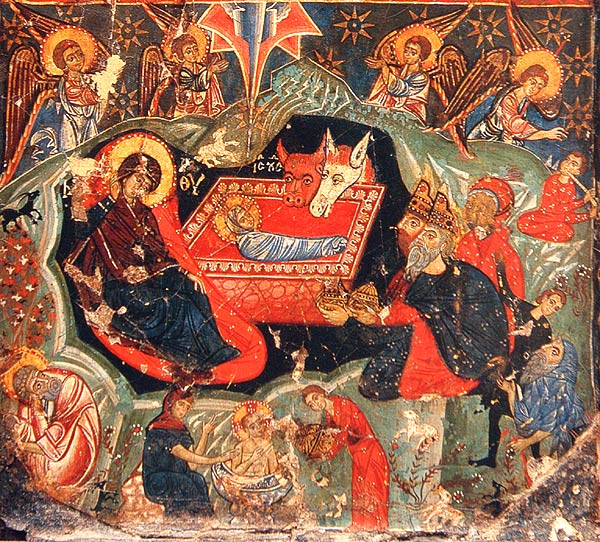
The Forefeast of the Nativity of the Lord begins on December 20. From now on, most of the liturgical hymns will be concerned with the birth of the Savior. Many of the Church’s hymns of this period are slightly modified versions of the hymns of Holy Week.

From December 20-23 we sing the Troparion (Tone 4) “Prepare, O Bethlehem, for Eden has been opened to all. Adorn yourself, O Ephratha, for the Tree of Life blossoms forth from the Virgin in the cave. Her womb is a spiritual paradise planted with the Divine Fruit; if we eat of it we shall live forever and not die like Adam. Christ comes to restore the image which He made in the beginning.”

We also sing the Kontakion (Tone 3) “Today the Virgin comes to the cave to give birth ineffably to the pre-eternal Word. Hearing this, rejoice, O inhabited earth! With the angels and the shepherds glorify the pre-eternal God, Whose will it was to appear as a young child!

Hieromartyr Ignatius the God-Bearer, Bishop of Antioch

The Hieromartyr Ignatius the God-Bearer, was a disciple of the holy Apostle and Evangelist John the Theologian, as was also Saint Polycarp, Bishop of Smyrna (February 23). Saint Ignatius was the second bishop of Antioch, and successor to Bishop Euodius, Apostle of the Seventy (September 7).

Tradition suggests that when Saint Ignatius was a little boy, the Savior hugged him and said: “Unless you turn and become as little children, you shall not enter into the Kingdom of Heaven” (Mt. 18:3). The saint was called “God-Bearer” (Theophoros), because he bore God in his heart and prayed unceasingly to Him. He also had this name because he was held in the arms of Christ, the incarnate Son of God.

Saint Ignatius was a disciple of the Apostle John the Theologian, together with Saint Polycarp of Smyrna. As Bishop of Antioch, Saint Ignatius was zealous and spared no effort to build up the church of Christ. To him is attributed the practice of antiphonal singing (by two choirs) during church services. He had seen a vision of the angels in heaven alternately singing praises to God, and divided his church choir to follow this example. In the time of persecution he was a source of strength to the souls of his flock, and was eager to suffer for Christ.

In the year 106 the emperor Trajan (98-117), after his victory over the Scythians, ordered everyone to give thanks to the pagan gods, and to put to death any Christians who refused to worship the idols. In the year 107, Trajan happened to pass through Antioch. Here they told him that Bishop Ignatius openly confessed Christ, and taught people to scorn riches, to lead a virtuous life, and preserve their virginity. Saint Ignatius came voluntarily before the emperor, so as to avert persecution of the Christians in Antioch. Saint Ignatius rejected the persistent requests of the emperor Trajan to sacrifice to the idols. The emperor then decided to send him to Rome to be thrown to the wild beasts. Saint Ignatius joyfully accepted the sentence imposed upon him. His readiness for martyrdom was attested to by eyewitnesses, who accompanied Saint Ignatius from Antioch to Rome.

On the way to Rome, the ship sailed from Seleucia stopped at Smyrna, where Saint Ignatius met with his friend Bishop Polycarp. Clergy and believers from other cities and towns thronged to see Saint Ignatius. He exhorted everyone not to fear death and not to grieve for him. In his Epistle to the Roman Christians, he asked them to assist him with their prayers, and to pray that God would strengthen him in his impending martyrdom for Christ: “I seek Him Who died for us; I desire Him Who rose for our salvation… In me, desire has been nailed to the cross, and no flame of material longing is left. Only the living water speaks within me, saying, ‘Hasten to the Father.’”

From Smyrna, Saint Ignatius went to Troas. Here he heard the happy news of the end of the persecution against Christians in Antioch. From Troas, Saint Ignatius sailed to Neapolis (in Macedonia) and then to Philippi.

On the way to Rome Saint Ignatius visited several churches, teaching and guiding the Christians there. He also wrote seven epistles: to the churches of Ephesus, Magnesia, Tralles, Rome, Philadelphia, and Smyrna. He also addressed a letter to Saint Polycarp, who mentions a collection of the letters of Saint Ignatius in his letter to the Philippians (Ch. 13). Saint Irenaeus of Lyons quotes from Saint Ignatius’s letter to the Romans (AGAINST HERESIES 5:28:4). All these letters have survived to the present day.

The Roman Christians met Saint Ignatius with great joy and profound sorrow. Some of them hoped to prevent his execution, but Saint Ignatius implored them not to do this. Kneeling down, he prayed together with the believers for the Church, for love between the brethren, and for an end to the persecution against Christians.

On December 20, the day of a pagan festival, they led Saint Ignatius into the arena, and he turned to the people: “Men of Rome, you know that I am sentenced to death, not because of any crime, but because of my love for God, by Whose love I am embraced. I long to be with Him, and offer myself to him as a pure loaf, made of fine wheat ground fine by the teeth of wild beasts.”

After this the lions were released and tore him to pieces, leaving only his heart and a few bones. Tradition says that on his way to execution, Saint Ignatius unceasingly repeated the name of Jesus Christ. When they asked him why he was doing this, Saint Ignatius answered that this Name was written in his heart, and that he confessed with his lips Him Whom he always carried within. When the saint was devoured by the lions, his heart was not touched. When they cut open the heart, the pagans saw an inscription in gold letters: “Jesus Christ.” After his execution Saint Ignatius appeared to many of the faithful in their sleep to comfort them, and some saw him at prayer for the city of Rome.

Hearing of the saint’s great courage, Trajan thought well of him and stopped the persecution against the Christians. The relics of Saint Ignatius were transferred to Antioch (January 29), and on February 1, 637 were returned to Rome and placed in the church of San Clemente.

Venerable Ignatius, Archimandrite of the Kiev Caves

Saint Ignatius, Archimandrite of the Kiev Caves: In the general service to the Kiev Caves saints, it says of him: “Ignatius, monastic pastor and healer of the sick, in our infirmities you help us by your reverence, therefore let us offer song of praise unto your memory” (Ode 1 of the Canon). He was buried in the Far (Theodosiev) Caves, and his memory is celebrated together with the Fathers of these Far Caves, on August 28. The commemoration of the Saint Ignatius was established on December 20 because of his namesake, the Hieromartyr Ignatius the God-Bearer. There is also another commemoration: the Synaxis of all the Fathers of the Kiev Caves monastery on the second Sunday of Great Lent.

Saint Philogonius, Bishop of Antioch

Before becoming a bishop, Saint Philogonius was a laywer who defended the poor, the widowed and the orphaned. When his wife died, he was chosen as Bishop of Antioch.

Distinguished by profound theological knowledge, Saint Philogonius successfully defended Orthodoxy against the Arian heresy and by this prevented unrest in the Church.

During the persecution against Christians under the emperors Maximian (284-305)and Licinius (311-324), Saint Philogonius proved himself a confessor of the Orthodox Faith. He died peacefully in about the year 323. Saint John Chrysostom wrote a eulogy for Saint Philogonius in 386.

Saint Daniel II, Archbishop of Serbia

Saint Daniel of Serbia, the only son of rich and renowned parents, was a close associate of the Serbian king Stephan Urosh Milutin. Having renounced a secular career, he received monastic tonsure from the igumen of the Saint Nicholas monastery at Konchul near the River Ibar. Saint Daniel’s ascetic life was an example for all the brethren.

Archbishop Eustathius of Serbia ordained him presbyter and took him into his cell. When it was time to choose the igumen for the Hilandar monastery on Mount Athos, Saint Daniel received the appointment. The saint was igumen at a most difficult time for the Holy Mountain. After the Crusaders were expelled from Palestine, they joined with the Arabs to plunder and loot the Athonite monasteries, “not sparing anything sacred.”

Saint Daniel remained at the Hilandar monastery, enduring siege and hunger. When peace came to the Holy Mountain, the saint resigned as igumen and withdrew into complete silence in the cell of Saint Savva of Serbia (at Karyes). During the internecine war of Kings Milutin and Dragutin and Stephen of Dechani (November 11), the ascetic was summoned to Serbia, where he reconciled the adversaries.

In his native land Daniel was made Bishop of Banja and head of the renowned monastery of Saint Stephen, a royal treasury. After completing the construction of a cathedral church at Banja in honor of the holy Protomartyr and Archdeacon Stephen, Saint Daniel returned to his monastic labors on the Holy Mountain.

The saint was summoned from Athos again in 1325, when he was elected Archbishop of Serbia. He was consecrated on the Feast of the Elevation of the Cross of the Lord. The Protos [“head”] of the Holy Mountain, Garbasios, and other Athonite Elders took part in the solemnities.

Archbishop Daniel was a model of piety, and a wise archpastor. His tenure as archbishop was marked by complete non-covetousness, concern and toil for the needs of the Church and the flock, and the building of churches. In 1335 the saint built a church at Dechani in honor of the Ascension of the Lord, one of the finest Christian monuments in Serbia. He collected accounts about the Serbian past, and compiled the “Rodoslov” [Account about the homeland], writing about the lives of Serbian rulers and Serbian archpastors.

Even during his lifetime Saint Daniel was granted the gift of wonderworking and healing. After fourteen years as archbishop, Saint Daniel departed to the Lord on December 19, 1338.

Repose of Saint John of Kronstadt
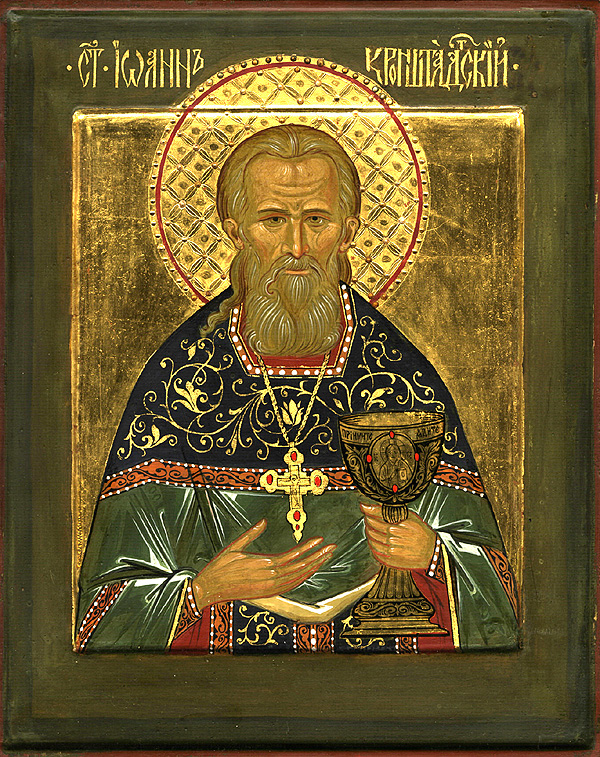
Saint John of Kronstadt was born in the village of Sura in Archangel province on October 19, 1829, and was called John in honor of Saint John of Rila (August 18). His parents were very poor but were very devoted to the Church. Even though he was poor, as a young boy John learned to feel compassion for others in their misfortune. His neighbors frequently asked him to pray for them, as they noticed this special grace-endowed gift in him. When John was ten, his parents were able to raise some money and send him to the local school which was attached to the church. At first, the boy had an extremely difficult time with his studies. He worked for days on end, but still failed to keep up.

Writing about his life he once recalled an evening when everyone had already gone to bed. “I could not sleep, and I still failed to understand anything I was taught. I still read poorly and could not remember anything I was told. I became so depressed I fell to my knees and began to pray. I don’t know whether I had spent a long time in that position or not, but suddenly something shook my whole being. It was as if a veil had fallen from my eyes, and my mind had been opened, and I remembered clearly my teacher of that day and his lesson. I also recalled the topic and the examples he had given. I felt so light and joyous inside.” After this experience he did so well he became one of the first in his class to be chosen to go to seminary, and after seminary to the Theological Academy in Saint Petersburg (a great honor at that time).

Throughout his studies, John thought about the importance of forgiveness, meekness, and love, and came to believe that these were the very center and power of Christianity, and that only one path—the path of humble love—leads to God and the triumph of His righteousness. He also thought a great deal about the Savior’s death on the Cross at Golgotha, and pitied those who did not know Jesus Christ. He wished to preach to them about His death and Resurrection. He dreamed about becoming a missionary to distant China, but saw that there was a great deal of work for a genuine pastor of Christ’s flock both in his own city and the surrounding towns.

When John graduated from the Academy he met Elizabeth Nesvitsky who lived in the town of Kronstadt. They dated, he proposed, and they were married. After his studies, John still desired to learn more about his faith and his Church.

It was in this frame of mind that he prepared to be a priest and to enter public ministry. He was ordained a deacon on December 10, 1855, and then priest on December 12. He was assigned to Saint Andrew’s Cathedral in the city of Kronstadt. He said, “I made myself a rule to be as sincere as possible in my work, and of strictly watching myself and my inner life.”

Father John wanted most of all to earn the love of the people in his care, because only a loving attitude could provide the firm support and help he needed as he faced the difficult work of the priesthood. His constant thought was how he would come before the Last Judgment and have to give an account, not only for his own deeds, but also the deeds of his flock, for whose education and salvation he was responsible. To him no one was a stranger; everyone who came to him for help became a friend and relative. He would tell people “The Church is the best heavenly friend of every sincere Christian.” He conducted divine services daily and offered the prayers of the faithful. He called all who rarely receive Holy Communion to prepare themselves and live their lives in a Christian way so that they could receive more often. Listening to Father John, many people changed their lifestyle, repented sincerely, and joyfully received Holy Communion on a regular basis.

At that time the government exiled murderers, thieves and other criminals to Kronstadt. Life was horrible for the exiles. Even children of exiles would become thieves and criminals. He would go to their dugouts, hovels and shacks to visit with them. Not satisfied with staying for five or ten minutes to administer some rite and then leave, Father John believed he was coming to visit a priceless soul, his brothers and sisters. He would stay for hours, talking, encouraging, comforting, crying, and rejoicing together with them.

From the beginning he also concerned himself with the material needs of the poor. He would shop for food, go to the pharmacy for prescriptions, to the doctor for help, many times giving the poor his last few coins. The inhabitants of Kronstadt would see him returning home barefoot and without his cassock. Often parishioners would bring shoes to his wife, saying to her, “Your husband has given away his shoes to someone, and will come home barefoot.” He would also write articles for the newspaper exhorting the people of Kronstadt to “support the poor morally and materially.” These appeals touched the hearts of many and Father John organized many charitable efforts. Realizing that his individual charity was insufficient for aiding the needy, he founded the Orthodox Christian House Parish Trusteeship of Saint Andrew the First-Called. This brotherhood coordinated many charitable efforts throughout the city and helped many needy people.

In 1857, he began teaching in the local city schools. He would tell people, “If children cannot listen to the Gospel, it is only because it is taught like any other subject, with boredom and indifference. Such teaching defeats the purpose of the Gospel. It fails because it forces students only to read words and memorize them instead of making them live in their lives.” To Father John there were no incapable students. He taught in such a way that poor pupils as well as good ones were able to understand. His attention was aimed not so much at forcing students to memorize as to fill their souls with the joy of living according to Christian values, sharing with them the holy thoughts which filled his soul.

When speaking to other priests about their vocation he would say, “You are a representative of the faith of the Church, O priest; you are a representative of Christ the Lord Himself. You should be a model of meekness, purity, courage, perseverance, patience, and lofty spirit. You are doing the work of God and must not let anything discourage you.”

Saint John has performed more miracles than almost any other saint, with the possible exception of Saint Nicholas. Through his prayers he healed the sick, gave hope to the hopeless, and brought sinners to repentance.

Father John labored endlessly in his work for the Lord preaching, teaching, and helping those in need. Having spent his entire life serving God and His people, Father John fell ill and died on December 20, 1908. Almost immediately, people from near and far began to make pilgrimages to the monastery where he was buried. Even today millions of Orthodox Christians in Russia and around the world pray to him to intercede for them as he had always done from his childhood.

Saint John was glorified by the Russian Orthodox Church on June 8, 1990.

Icon of the Mother of God the “Rescuer of the Drowning”
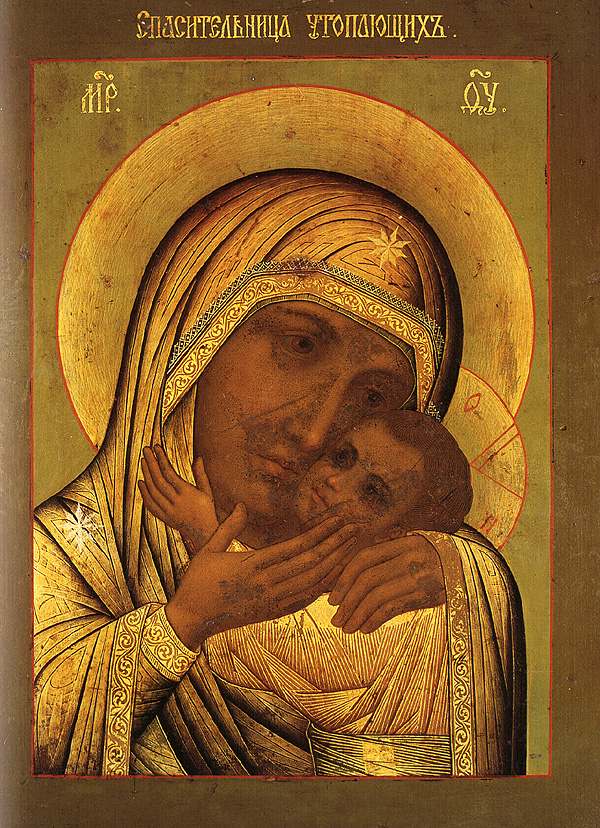
In the village of Lenkov on the bank of the Desno River near Novgorod, Russia, there was a dangerous whirlpool, which made the river difficult to cross. Often, the powerful swirling waters would cause the demise of ships and their passengers. It was at that dangerous site that an Icon of the Mother of God was discovered, resting on the riverbank. In time, a church dedicated to the Mother of God was erected on the site, and the Icon of the Mother of God, the "Rescuer of the Drowning," was enshrined therein. Those who journeyed along the Desno River customarily stopped at Lenkov to offer prayers in the icon's presence, imploring the Mother of God to grant them a safe journey despite the dangerous whirlpool. It had been said that after the icon had been discovered, mishaps to sailors were rare, and later completely ceased.

Lenkov and its church were destroyed during an invasion by the Poles in the 17th century. A new church dedicated to the Archangel Michael soon rose on the site of the former Church of the Mother of God, and the icon was enshrined therein. Many miracles were ascribed to the Mother of God, and the icon came to be revered not only in area of Lenkov, but far beyond, especially in Russia's larger port cities.

In the 18th century, the Icon was transferred to the Monastery of the Transfiguration in Novgorod, where it remained until the Russian Revolution in 1917. History does not record what happened to the miraculous icon during Soviet times. However, in 2003, a pious man named Sergei Babushkin gave to the Church an identical antique copy of the long-lost original "Rescuer of the Drowning" Icon, which was subsequently enshrined in the Transfiguration Monastery, thus marking the beginning of its revival.

The icon is remarkably similar to the much older Korsun Icon of the Mother of God, which was said to have been a copy of an icon by Saint Luke the Evangelist that had been kept in Ephesus until it was brought to Kyiv in 988 AD.

New-martyr John of Thasos

The New Martyr John of Thasos was from the village of Marias on the island of Thasos. In his youth he was brought to Constantinople and apprenticed to a tailor. One day he was seized by the Turks and accused of insulting the Moslem religion. They tried to force him to accept Islam, but he would not agree to renounce the Christian Faith, for which he was beheaded at the age of eighteen in the year 1652.

Icon of the Mother of God of Novgorod

The Novgorod Icon of the Mother of God was painted by Saint Peter, Metropolitan of Moscow (December 21), during his stay as igumen of a monastery on the River Rata at the boundary of the Malyi Dvorets. During a time of persecution, the Uniates plundered the Novgorod monastery, and the icon was transferred by the hieromonk James to the Eletsk Chernigov monastery. Bishop Anthony (Stakovsky) of Chernigov later blessed Simeon, the organizer of the Surozh monastery (Chernigov diocese) with this icon. On August 14, 1677, during a church procession from the old church to a new one, the icon manifested miraculous signs.
Daily Readings for Friday, December 19, 2025

FRIDAY OF THE 13TH WEEK

ABSTAIN FROM MEAT, FISH, DAIRY, EGGS, WINE, OLIVE OIL

Martyrs Boniface, Probus, Ares, Timothy, Polyeuktos, Eutychios and Thessaloniki, Our Righteous Father Gregentius, Bishop of Ethiopia, Aglaia the Righteous of Rome

ST. PAUL’S LETTER TO TITUS 1:15-16; 2:1-10

Titus, my son, to the pure all things are pure, but to the corrupt and unbelieving nothing is pure; their very minds and consciences are corrupted. They profess to know God, but they deny him by their deeds; they are detestable, disobedient, unfit for any good deed.
But as for you, teach what befits sound doctrine. Bid the older men be temperate, serious, sensible, sound in faith, in love, and in steadfastness. Bid the older women likewise to be reverent in behavior, not to be slanderous or slaves to drink; they are to teach what is good, and so train the young women to love their husbands and children, to be sensible, chaste, domestic, kind, and submissive to their husbands, that the word of God may not be discredited. Likewise urge the younger men to control themselves. Show yourself in all respects a model of good deeds, and in your teaching show integrity, gravity, and sound speech that cannot be censured, so that an opponent may be put to shame, having nothing evil to say to us. Bid slaves to be submissive to their masters and to give satisfaction in every respect; they are not to be refractory, nor to pilfer, but to show entire and true fidelity, so that in everything they may adorn the doctrine of God our Savior.

MARK 9:33-41

At that time, Jesus and his disciples came to Capernaum, and when he was in the house he asked them, “What were you discussing on the way?” But they were silent; for on the way they had discussed with one another who was the greatest. And he sat down and called the twelve; and he said to them, “If any one would be first, he must be last of all and servant of all.” And he took a child, and put him in the midst of them; and taking him in his arms, he said to them, “Whoever receives one such child in my name receives me; and whoever receives me, receives not me but him who sent me.” John said to him, “Teacher, we saw a man casting out demons in your name, and we forbade him, because he was not following us.” But Jesus said, “Do not forbid him; for no one who does a mighty work in my name will be able soon after to speak evil of me. For he that is not against us is for us. For truly, I say to you, whoever gives you a cup of water to drink because you bear the name of Christ, will by no means lose his reward.”

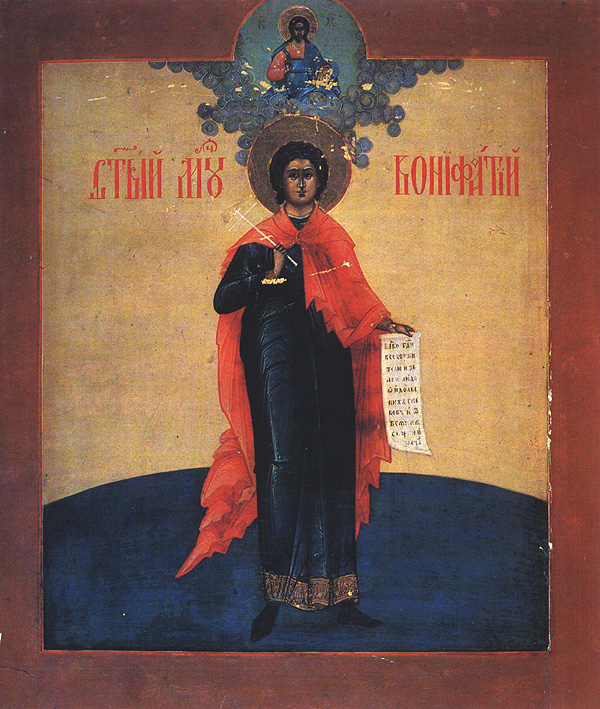
Martyr Boniface at Tarsus in Cilicia, and Righteous Aglaϊa of Rome

The Holy Martyr Boniface was the slave of a rich young Roman woman named Aglaϊa, and he lived with her in iniquitous cohabitation. Both, however, felt the sting of conscience and they wanted to be cleansed of their sin somehow. The Lord granted them the possibility to wash away their sin with their blood and to finish their life in repentance.

Aglaϊa learned that whoever keeps relics of the Holy Martyrs in their home, and venerates them, receives great help in gaining salvation. Through their influence, sin is diminished and virtue prevails. She arranged for Boniface to go to the East, where there was a fierce persecution against Christians, and she asked him to bring back the relics of some Martyr, who would become their guide and protector.

As he was leaving, Boniface laughed and asked, “My lady, if I do not find any relics, and if I myself suffer for Christ, would you accept my relics with reverence?”

Aglaϊa scolded him, saying that he was setting off on a sacred mission, but he was not taking it seriously. Boniface pondered her words, and during the whole journey he thought that he was not worthy to touch the relics of the Martyrs.

Arriving at Tarsus in Cilicia, Boniface left his companions at the inn and proceeded to the city square, where they were torturing Christians. Stricken by the horrible torments, and seeing the faces of the holy Martyrs radiant with the grace of the Lord, Boniface marveled at their courage. He embraced them and kissed their feet, asking them to pray that he might be found worthy to suffer with them.

The judge asked Boniface who he was. He replied, “I am a Christian,” and he refused to offer sacrifice to idols. They stripped him and suspended him upside down, beating him so hard that the flesh fell from his body, exposing his bones. They stuck needles beneath his nails, and finally they poured molten tin down his throat, but by the power of the Lord he remained unharmed. The people who witnessed this miracle shouted, “Great is the God of the Christians!” Then they began to throw stones at the judge, and then they headed for the pagan temple, in order to topple the idols.

On the following morning, when things had quieted down somewhat, the judge directed that the Martyr be thrown into a cauldron of boiling tar, but this also caused the sufferer no harm. An Angel come down from Heaven and bedewed him as he stepped into the cauldron. The tar overflowed the cauldron, splattering and burning the torturers. Saint Boniface was then sentenced to be decapitated with a sword. Blood and a milky fluid flowed from his wounds. After witnessing such a miracle, about 550 men believed in Christ.

Saint Boniface’s companions waited two days for him at the inn, but in vain, so they began to search for him, thinking that he had gotten drunk somewhere. At first their search was unsuccessful, but finally they met a man who had been an eyewitness to the Martyr's death. The man also led them to the place where the decapitated body lay. Saint Boniface’s companions wept and begged his forgiveness for their unseemly thoughts about him. After ransoming his relics, they brought them back to Rome.

On the eve of their arrival, an Angel appeared to Aglaϊa in her sleep and told her to prepare herself to receive her former slave, now the brother and fellow servant of the Angels. Aglaϊa summoned the clergy, and she received the holy relics with great reverence. Then she built a church on the site of his grave and dedicated it to the Holy Martyr. There she enshrined his relics, which were glorified by numerous miracles.

After distributing all her wealth to the poor, Aglaϊa withdrew to a monastery, where she spent fifteen years in repentance, then she fell asleep in the Lord. She was buried beside Saint Boniface. The sins of the one were washed away by his blood, while the other was purified by her tears and asceticism. Both were found worthy to appear unsullied before our Lord Jesus Christ, Who desires not the death of a sinner, but that he should turn from his wickedness and live (Ezekiel 33:11).

We pray to Saint Boniface for deliverance from drunkenness.

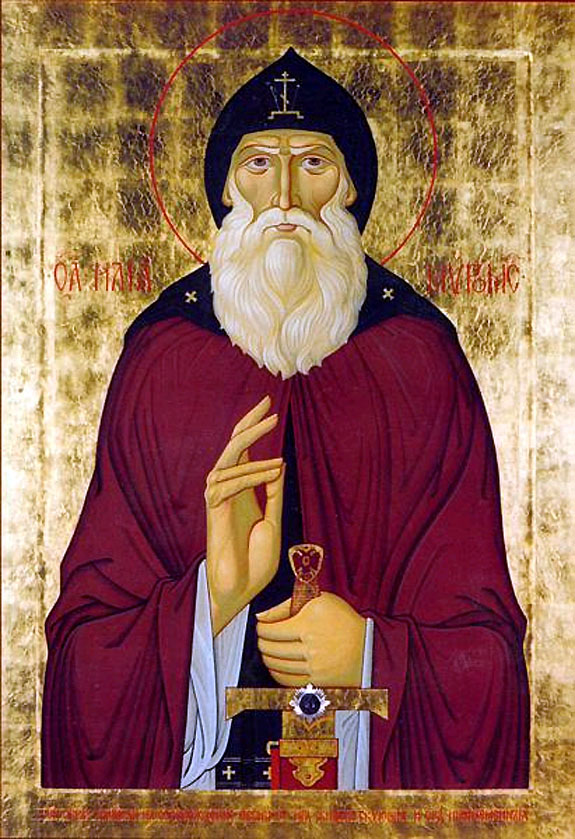
Venerable Elias of Murom, Wonderworker of the Kiev Near Caves

Saint Elias was a monk in the Near Caves Monastery in Kiev. He was from the city of Murom, and was called “Shoemaker” or “Cobbler." Popular legend identifies him with the famous warrior Elias of Murom, who was the subject of Russian ballads, and of Gliere’s Symphony No. 3. However, there is no strong basis for the validity of such an assumption.

Saint Elias reposed with the fingers of his right hand formed to make the Sign of the Cross in the position used even today in the Orthodox Church: the first three fingers together, and the two outermost fingers folded onto the palm [in contrast to the Sign of the Cross used by the “Old Ritualists”]. During the struggle with the Old Ritualist Schism (XVII – XIX centuries), this information about the Saint served as a powerful proof in favor of the present positioning of the fingers.

Saint Elias is also commemorated on the Second Sunday of Great Lent (Synaxis of all the Venerable Fathers of the Kiev Caves); June 10 (Synaxis of All Saints of Ryazan and Siberia); June 23 (Synaxis of the Saints of Vladimir); and September 28 (Synaxis of the Holy Fathers of Kiev, whose relics lie in the Near Caves of Saint Anthony).

Martyrs Elias, Probus, and Ares in Cilicia

The Martyrs Elias, Probus, and Ares, natives of Egypt, and heedless of their own safety, cared for Christians locked up in prison during the persecution of Maximian (305-313). For this they were arrested, subjected to torture and given over to death (+308).

Saint Boniface the Merciful, Bishop of Ferentino

From his very childhood, Saint Boniface was distinguished by his non-covetousness and love for the poor. When he saw a destitute man on the street, he took his own clothes and gave them away to those in need, to the chagrin of his widowed mother.

Once, he gave away a year’s supply of grain, but the Lord worked a miracle through his prayer, and the family’s granary was filled again. Saint Boniface became bishop of the city of Ferentino (Florence), north of Rome (in Tuscany). Even in his lofty position as bishop he remained completely non-covetous and merciful towards people, and he directed his flock wisely, exhorting them to attend to even the least among their neighbors.

Saint Gregory, Archbishop of Omirits

Saint Gregory, Bishop of Homer (Omirits), the son of Agapius and Theodota, was filled with the grace of God and possessed gifts of healing and wonderworking even in his youth. The Providence of God led him to hierarchical service. While still a deacon at Mediolanum (Milan) he heard the foretelling of his destiny from a hermit, and then he received confirmation of these words from another spirit-bearing Elder who lived an ascetic life in the mountains.

When Gregory went to this holy schemamonk for guidance, a miracle occurred. As he approached the mountain, he saw a fiery column in the air. He soon realized that the fiery column was actually the man of God coming toward him. That night he saw the Elder standing in the air above the ground. The Elder revealed to Saint Gregory that he must go to Rome to pray in the church of Saints Boniface and Aglaida. Then he would go to Alexandria and to become a bishop. Then he would arrive in the city of Negran in the land of Homer (in southern Arabia) to proclaim the Gospel.

Saint Gregory felt himself unworthy of this, and wished to remain with the ascetic as his disciple. So that Gregory should have no doubts of the veracity of his words, the Elder revealed that he knew a secret about him. In a vision, Gregory had seen the First-Ranked Apostles Peter and Paul, and they had placed a bishop’s omophorion upon him.

Saint Gregory stayed a short time in Carthage (North Africa) serving as a deacon, then arrived in Rome. He went to the church of Saints Boniface and Aglaida, then to the tomb of Saint Peter. There he was granted a vision of the holy Apostle, who told him to walk the path of virtue and to live according to God’s will. That night he saw the Apostle Paul in a dream bringing to him a cup filled with oil, foretelling that he should receive the grace of the priesthood and the episcopacy.

During this time the armies of the Ethiopian emperor Elesbaan (October 24) vanquished the Himyarite king Dunaan, who was of Jewish background. The city of Negran was liberated, and Christianity restored in the land of Homer. But all the clergy had been cruelly exterminated by Dunaan, and therefore Elesbaan sent emissaries to the Patriarch of Alexandria asking him to send a bishop to Negran, and clergy for the churches. While he was praying, the holy Apostle Mark appeared to the patriarch, bidding him to find a deacon named Gregory, who was to be ordained to the priesthood, consecrated as a bishop, and then to be sent to Elesbaan. The patriarch did this. During the service a miracle took place. Saint Gregory’s face shone with the grace of the Holy Spirit, and from his vestments came a sweet fragrance like myrrh or incense, filling the whole church with the scent.

Arriving in Homer, Saint Gregory began to set the Church in order, preaching to both pagans and Jews. After three years Elesbaan returned to Ethiopia, leaving the noble Abramius behind as King of Homer. Saint Gregory crowned and anointed Abramius as king. Soon he issued a decree that all his subjects be baptized. Then certain prominent Jews turned to the emperor saying that it was better for people to believe willingly rather than under compulsion. They requested that he should permit a debate on faith to be held between them and the Christians, vowing that if the Christians proved victorious in this debate, the Jews would then accept Baptism.

The Jews were given forty days to prepare for the debate, which lasted for several days. Saint Gregory refuted all the arguments of the head Hebrew elder, Rabbi Ervan, using only texts from the Old Testament. In a vision Ervan beheld the holy Prophet Moses, who worshipped the Lord Jesus Christ. The prophet told Ervan that Ervan was in opposition to the truth and would be defeated.

By the grace of God Christian truth prevailed in the debate, but Ervan would not acknowledge his defeat. He made a last desperate attempt. He said, “If you want me to believe in your Christ, and to acknowledge that yours is the true God, then show Him to me, bishop!” The saint replied: “Your request is impertinent. It is not with man that you contend now, but with God. However, the Lord can do what you have asked in order to convince you.

Everyone waited to see what would happen. Saint Gregory, having steadfast faith in God and trusting in Him, began to pray aloud. He recalled the mystery of the Incarnation of God the Word, the miracles of His earthly life, the Three-day Resurrection and the Ascension into Heaven, and he invoked the power of the Life-Creating Cross. “Show Thyself to these people, O Lord,” he prayed, “and glorify Thy holy Name!”

When he finished the prayer, the earth quaked, and in the east the heavens were opened, and in a radiant cloud of light the Lord Jesus Christ came down on earth, and the Voice of the Lord was heard: “Through the prayers of Bishop Gregory, He Whom your fathers put to death will heal you.”

Like Saul, who was struck blind by the Heavenly light on the road to Damascus, the Jews were struck blind. Then they believed in Christ and they implored the holy bishop to heal them. Upon receiving holy Baptism, all of them were healed. Rabbi Ervan received the Christian name Leo (meaning “lion”).

After this most extraordinary miracle, Saint Gregory guided the flock of Homer for another thirty years. He reposed in the year 552 and was buried in a crypt in the cathedral of Afar.

Venerable George the Scribe, and Venerable Savva, of Khakhuli

Saints George and Savva of Khakhuli were brothers of Jacob, the father of Saint George of the Holy Mountain. George and Savva labored as monks at Khakhuli Monastery in southern Georgia.

The holy fathers were filled with divine grace. The elder brother, George, was a spiritual adviser in the court of King Bagrat III Kuropalates and, along with the king, he became an active participant in the production of ecclesiastical literature. (This period is known as the Golden Age of Georgian Letters, when many translations and copies of ecclesiastical writings were made.) The younger brother, Savva, is remembered as a righteous and blameless man by the renowned Church figure George the Lesser. According to George the Lesser, the brothers were generously endowed with both spiritual blessings and material wealth.

When the holy fathers heard about the piety of their nephew, the young George (later of the Holy Mountain), they suggested that Jacob bring him to them in Khakhuli in Klarjeti. With exceeding gladness Jacob brought his son to the God-fearing brothers.

At that time a certain Peris Jojikisdze, a nobleman married to the daughter of King Bagrat III, governed the village of Tvartsatapi. Peris thought it wise to invite an intelligent and experienced monk to his palace to serve as an instructor and spiritual guide, and he selected Saint George to fill this role. With great reluctance the venerable father consented, and he was entrusted with responsibility for all the spiritual and earthly affairs at the palace.

George of Khakhuli took the young George with him to the palace of Peris Jojikisdze. A year later, the Byzantine Emperor Basil II brought false accusations against Peris and ordered his execution. His wife and those in his court, among whom were Saint George and the young George of the Holy Mountain, were captured and escorted to Constantinople.

After twelve years in Byzantium, the captives were finally permitted to return home. Upon his return to Georgia, George of Khakhuli sent his nephew to Khakhuli Monastery, entrusting him to the care of his brother Savva.

The holy fathers reposed peacefully in the mid-11th century.

Daily Readings for Thursday, December 18, 2025

THURSDAY OF THE 13TH WEEK

ABSTAIN FROM MEAT, FISH, DAIRY, EGGS, WINE, OLIVE OIL

Sebastian the Martyr & his Companions, Our Righteous Father Michael Syngellon the Confessor

ST. PAUL’S LETTER TO TITUS 1:5-14

Titus, my son, appoint elders in every town as I directed you, if any man is blameless, the husband of one wife, and his children are believers and not open to the charge of being profligate or insubordinate. For a bishop, as God’s steward, must be blameless; he must not be arrogant or quick-tempered or a drunkard or violent or greedy for gain, but hospitable, a lover of goodness, master of himself, upright, holy, and self-controlled; he must hold firm to the sure word as taught, so that he may be able to give instruction in sound doctrine and also to confute those who contradict it. For there are many insubordinate men, empty talkers and deceivers especially the circumcision party; they must be silenced, since they are upsetting whole families by teaching for base gain what they have no right to teach. One of themselves, a prophet of their own, said, “Cretans are always liars, evil beasts, lazy gluttons.” This testimony is true. Therefore rebuke them sharply, that they may be sound in the faith, instead of giving heed to Jewish myths or to commands of men who reject the truth.

MARK 9:10-15

At that time, the disciples kept the word of Jesus to themselves, questioning what the rising from the dead meant. And they asked him, "Why do the scribes say that first Elijah must come?" And he said to them, "Elijah does come first to restore all things; and how is it written of the Son of man, that he should suffer many things and be treated with contempt? But I tell you that Elijah has come, and they did to him whatever they pleased, as it is written of him." And when they came to the disciples, they saw a great crowd about them, and scribes arguing with them. And immediately all the crowd, when they saw him, were greatly amazed, and ran up to him and greeted him.

Martyr Sebastian at Rome, and his companions

The Holy Martyr Sebastian was born in the city of Narbonum in Gaul (modern France), and he received his education at Mediolanum (now Milan). Under the co-reigning emperors Diocletian and Maximian (284-305) he occupied the position of head of the imperial guards. Saint Sebastian was respected for his authority, and was loved by the soldiers and those at court. He was a brave man filled with wisdom; his word was honest, his judgment just. He was insightful in advice and faithful in his service and in everything entrusted to him. He was a secret Christian, not out of fear, but so that he could provide help to the brethren in a time of persecution.

The noble Christian brothers Marcellinus and Mark had been locked up in prison, and at first they firmly confessed the true Faith. But under the influence of the tearful entreaties of their pagan parents (Tranquillinus and Marcia), and also their own wives and children, they began to waver in their intent to suffer for Christ. Saint Sebastian went to the imperial treasurer, at whose house Marcellinus and Mark were held in confinement, and addressed the brothers who were on the verge of yielding to the entreaties of their family.

“O valiant warriors of Christ! Do not cast away your everlasting crowns of victory because of the tears of your relatives. Do not remove your feet from the necks of your enemies who lie prostrate before you, lest they regain their strength and attack you more fiercely than before. Raise your banner high over every earthly attachment. If those whom you see weeping knew that there is another life where there is neither sickness nor death, where there is unceasing gladness and everything is beautiful, then assuredly they would wish to enter it with you. Anyone who fears to exchange this brief earthly life for the unending joys of the heavenly Kingdom is foolish indeed. For he who rejects eternity wastes the brief time of his existence, and will be delivered to everlasting torment in Hades.”

Then Saint Sebastian said that if necessary, he would be willing to endure torment and death in order to show them how to give their lives for Christ.

So Saint Sebastian persuaded the brothers to go through with their act of martyrdom, and his speech stirred everyone present. They saw how his face shone like that of an angel, and they saw how seven angels clothed him in a radiant garment, and heard a fair Youth say, “You shall be with Me always.”

Zoe, the wife of the jailer Nicostratus, had lost her ability to speak six years previously. She fell down at the feet of Saint Sebastian, by her gestures imploring him to heal her. The saint made the Sign of the Cross over the woman, and she immediately began to speak and she glorified the Lord Jesus Christ. She said that she had seen an angel holding an open book in which everything Saint Sebastian said was written. Then all who saw the miracle also came to believe in the Savior of the world. Nicostratus removed the chains from Marcellinus and Mark and offered to hide them, but the brothers refused.

Mark said, “Let them tear the flesh from our bodies with cruel torments. They can kill the body, but they cannot conquer the soul which contends for the Faith.” Nicostratus and his wife asked for Baptism, and Saint Sebastian advised Nicostratus to serve Christ rather than the Eparch. He also told him to assemble the prisoners so that those who believed in Christ could be baptized. Nicostratus then requested his clerk Claudius to send all the prisoners to his house. Sebastian spoke to them of Christ, and became convinced that they were all inclined to be baptized. He summoned the priest Polycarp, who prepared them for the Mystery, instructing them to fast in preparation for Baptism that evening.

Then Claudius informed Nicostratus that the Roman eparch Arestius Chromatus wanted to know why the prisoners were gathered at his house. Nicostratus told Claudius about the healing of his wife, and Claudius brought his own sick sons, Symphorian and Felix to Saint Sebastian. In the evening the priest Polycarp baptized Tranquillinus with his relatives and friends, and Nicostratus and all his family, Claudius and his sons, and also sixteen condemned prisoners. The newly-baptized numbered 64 in all.

Appearing before the eparch Chromatus, Nicostratus told him how Saint Sebastian had converted them to Christianity and healed many from sickness. The words of Nicostratus persuaded the eparch. He summoned Saint Sebastian and the presbyter Polycarp, and was enlightened by them, and became a believer in Christ. Nicostratus and Chromatus, his son Tiburtius and all his household accepted holy Baptism. The number of the newly-enlightened increased to 1400. Upon becoming a Christian, Chromatus resigned his office of eparch.

During this time the Bishop of Rome was Saint Gaius (August 11). He blessed Chromatus to go to his estates in southern Italy with the priest Polycarp. Christians unable to endure martyrdom also went with them. Father Polycarp went to strengthen the newly-converted in the Faith.

Tiburtius, the son of Chromatus, desired to accept martyrdom and he remained in Rome with Saint Sebastian. Of those remaining, Saint Gaius ordained Tranquillinus as a presbyter, and his sons Marcellinus and Mark were ordained deacons. Nicostratus, his wife Zoe and brother Castorius, and Claudius, his son Symphorian and brother Victorinus also remained in Rome. They gathered for divine services at the court of the emperor together with a secret Christian named Castulus, but soon the time came for them to suffer for the Faith.

The pagans arrested Saint Zoe first, praying at the grave of the Apostle Peter. At the trial she bravely confessed her faith in Christ. She died, hung by her hair over the foul smoke from a great fire of dung. Her body then was thrown into the River Tiber. Appearing in a vision to Saint Sebastian, she told him about her death.

The priest Tranquillinus was the next to suffer: pagans pelted him with stones at the grave of the holy Apostle Peter, and his body was also thrown into the Tiber.

Saints Nicostratus, Castorius, Claudius, Victorinus, and Symphorian were seized at the riverbank, when they were searching for the bodies of the martyrs. They were led to the eparch, and the saints refused his command to offer sacrifice to idols. They tied stones to the necks of the martyrs and then drowned them in the sea.

The false Christian Torquatus betrayed Saint Tiburtius. When the saint refused to sacrifice to the idols, the judge ordered Tiburtius to walk barefoot on red-hot coals, but the Lord preserved him. Tiburtius walked through the burning coals without feeling the heat. The torturers then beheaded Saint Tiburtius, and his body was buried by unknown Christians.

Torquatus also betrayed the holy Deacons Marcellinus and Mark, and Saint Castulus (March 26). After torture, they threw Castulus into a pit and buried him alive, but Marcellinus and Mark had their feet nailed to the same tree stump. They stood all night in prayer, and in the morning they were stabbed with spears.

Saint Sebastian was the last one to be tortured. The emperor Diocletian personally interrogated him, and seeing the determination of the holy martyr, he ordered him taken out of the city, tied to a tree and shot with arrows. Irene, the wife of Saint Castulus, went at night in order to bury Saint Sebastian, but found him alive and took him to her home.

Saint Sebastian soon recovered from his wounds. Christians urged him to leave Rome, but he refused. Coming near a pagan temple, the saint saw the emperors approaching and he publicly denounced them for their impiety. Diocletian ordered the holy martyr to be taken to the Circus Maximus to be executed. They clubbed Saint Sebastian to death, and cast his body into the sewer. The holy martyr appeared to a pious woman named Lucina in a vision, and told her to take his body and bury it in the catacombs. This she did with the help of her slaves. Today his basilica stands on the site of his tomb.

Venerable Sebastian, Abbot of Pshekhonye Monastery, Vologda

Saint Sebastian of Sokhota, Pshekhonye, founded a monastery in honor of the Transfiguration of the Lord, located at the River Sokhota, 90 versts from the city of Romanov (now Tutaev) in the Yaroslav district. The monks of the monastery themselves cultivated the soil and ate through the work of their own hands. The founder of the monastery taught the ascetics this by his own example and guidance. Saint Sebastian reposed about the year 1500.

The Transfiguration monastery on the River Sokhota was later annexed to the Cherepovets Ascension monastery, and in 1764 closed down. In the mid-nineteenth century a stone church was built over the relics of Saint Sebastian. The saint is also commemorated on February 26.

Righteous Simeon, Wonderworker of Verkhoturye

Saint Simeon of Verkhoturye was a nobleman, but he concealed his origin and led the life of a beggar. He walked through the villages and for free sewed half-coats and other clothes, primarily for the poor. While doing this he deliberately failed to sew something, either a glove, or a scarf, for which he endured abuse from his customers.

The ascetic wandered much, but most often he lived at a churchyard of the village of Merkushinsk not far from the city of Verkhoturye (on the outskirts of Perm). Saint Simeon loved nature in the Urals, and while joyfully contemplated its majestic beauty, he would raise up a thoughtful glance towards the Creator of the world. In his free time, the saint loved to go fishing in the tranquility of solitude. This reminded him of the disciples of Christ, whose work he continued, guiding the local people in the true Faith. His conversations were a seed of grace, from which gradually grew the abundant fruits of the Spirit in the Urals and in Siberia, where the saint is especially revered.

Saint Simeon of Verkhoturye died in 1642, when he was 35 years of age. He was buried in the Merkushinsk graveyard by the church of the Archangel Michael.

On September 12, 1704, with the blessing of Metropolitan Philotheus of Tobolsk, the holy relics of Saint Simeon were transferred from the church of the Archangel Michael to the Verkhoturye monastery in the name of Saint Nicholas.

Saint Simeon worked many miracles after his death. He frequently appeared to the sick in dreams and healed them, and he brought to their senses those fallen into the disease of drunkenness. A peculiarity of the saint’s appearances was that with the healing of bodily infirmities, he also gave instruction and guidance for the soul.

The memory of Saint Simeon of Verkhoturye is celebrated also on September 12, on the day of the translation of his relics (1704).

Saint Modestos, Archbishop of Jerusalem

Saint Modestos (Módestos) was born into a Christian family at Sebásteia in Cappadocia (Asia Minor). Inclined toward a strict monastic life from his youth, the Saint was tonsured on Mount Sinai. Later, he became the Superior of the Monastery of Saint Theodosios the Great in Palestine. In the year 614, Syria and Palestine were attacked by the the army of the Persian king Chosroes. 90,000 Christians were killed, and many Christian churches were destroyed. Patriarch Zachariah of Jerusalem and a multitude of Christians were taken into captivity, along with the Cross of the Lord. Saint Modestos was appointed to govern the Jerusalem Church temporarily as locum tenens of the patriarchal kathedra.

With the help of Patriarch John the Merciful of Alexandria (November 12), Saint Modestos restored the devastated Christian shrines, among which was the Lord's Tomb. He also buried the murdered monks from the Monastery of Saint Savva the Sanctified. After fourteen years, Patriarch Zacharias returned from captivity with the Lord's Cross, and after his death, Saint Modestos became the Patriarch of Jerusalem. Saint Modestos reposed at the age of 97 in the year 634.

The head of Saint Modestós is located in the Athonite Monastery of Simonopetra.

Saint Florus, Bishop of Amisus

Saint Florus, Bishop of Amisus, was the son of the Christians Florus and Euphemia, who provided him a fine education. He entered courtly service for the Byzantine Emperor and was elevated to the rank of patrician; he was also married and had children. After his wife and children died from smallpox, he left the world and withdrew to the outskirts of Constantinople, where he led a solitary and pious life. Later on he was chosen Bishop of Amisus (in Asia Minor). Saint Florus wisely guided his flock and died peacefully at the beginning of the seventh century.

Saint Michael the Confessor at Constantinople

Saint Michael the Confessor was born at Jerusalem into a family of zealous Christians and at an early age devoted himself to monastic life. After the death of his father, his mother and sisters went to a monastery, and Saint Michael was ordained as a priest. He was famed as a strong preacher, and therefore the Jerusalem Patriarch Thomas I took him under his wing and advanced him in the calling of “synkellos” (dealing in matters of church governance).

At this time there reigned the Iconoclast emperor Leo the Armenian (813-820). The patriarch sent Saint Michael to him, together with the holy brothers Saints Theodore (December 27) and Theophanes (October 11), with the hope that they might persuade the emperor to cease his persecution against the Orthodox. The emperor subjected Saint Michael to beatings and sent him off into exile.

Later having returned from exile, the monk again suffered for the veneration of holy icons under the emperor Theophilus (829-842). The companions of Saint Michael, Saints Theodore and Theophanes, were subjected to horrible torments: upon their faces was put red-hot brands with an inscription slandering them. They received the title “the Branded.” Again condemned, Saint Michael was sent with his disciple Job to the Pabeida monastery.

After the death of Theophilus, the empress Theodora (842-855) restored the veneration of holy icons, and ordered the return of Christians banished by the Iconoclasts. She made the offer that Saint Michael might occupy the patriarchal throne in place of the deposed iconoclast, Grammatikos. But the holy martyr declined this. Thus upon the patriarchal throne entered Saint Methodius.

Saint Michael the Confessor to the end of his days toiled in the position of “synkellos.” He died peacefully in about the year 845.

New Hieromartyr Archbishop Thaddeus of Tver

The New Hieromartyr Thaddeus (Uspensky) was the Archbishop of Tver. He was executed in 1937.

Venerable Daniel the Hesychast

Saint Daniel the Hesychast, the great wonderworker and instructor of monastics, was born in Moldavia at the beginning of the fifteenth century. He was baptized with the name Dumitru. When he was sixteen, he became a monk of the monastery of Saint Nicholas at Radauti and received the name David. His spiritual Father was Saint Leontius of Radauti (July 1). After many years of ascetical struggles, he became a chosen vessel of the Spirit and was ordained to the holy priesthood.

He lived for some years at the monastery of Saint Laurence in the Civoul de Sus district. There he fulfilled his obediences during the day, and at night he kept vigil, prayed, and wove baskets. He received the Great Schema and the new name Daniel. He obtained the igumen’s blessing to live in the wilderness in solitude, where he devoted himself to spiritual struggles. Around 1450, he lived near the Neamts Monastery by Secu creek for fourteen years. In time, people discovered where he lived and came to visit him. Longing for solitude, he moved to northern Moldavia and chiseled out a cell for himself in the face of a cliff near Putna creek. Next to it, he carved out a small chapel for prayer.

After his spiritual child Saint Stephen the Great (July 2) built the Putna Monastery, which was consecrated in 1470, Saint Daniel moved near the Voronets Monastery. Here too, he carved a small cell out of the rock under Soim (Falcon) Cliff and lived a God-pleasing life for the next twenty years. He guided many disciples in the principles of the spiritual life, and he also had the gift of healing the sick of their physical infirmities.

In 1488, when he was over eighty years old, Saint Daniel went to live at the Voronets Monastery, where he was chosen to be the igumen.

Saint Daniel was a great ascetic and wonderworker, wise and clairvoyant. People from near and far visited him seeking his spiritual advice, or to confess their sins. He died in 1496 and was buried at the Voronets Monastery, where people continue to venerate his tomb.

Saint Daniel was glorified by the Romanian Orthodox Church in 1992.

Daily Readings for Wednesday, December 17, 2025

WEDNESDAY OF THE 13TH WEEK

ABSTAIN FROM MEAT, FISH, DAIRY, EGGS, WINE, OLIVE OIL

Daniel the Prophet & Ananias, Azarias, & Misail, the Three Holy Youths, Dionysius of Zakynthos

ST. PAUL’S LETTER TO THE HEBREWS 11:33-40; 12:1-2

Brethren, all the saints through faith conquered kingdoms, enforced justice, received promises, stopped the mouths of lions, quenched raging fire, escaped the edge of the sword, won strength out of weakness, became mighty in war, put foreign armies to flight. Women received their dead by resurrection. Some were tortured, refusing to accept release, that they might rise again to a better life. Others suffered mocking and scourging, and even chains and imprisonment. They were stoned, they were sawn in two, they were tempted, they were killed with the sword; they went about in skins of sheep and goats, destitute, afflicted, ill-treated – of whom the world was not worthy – wandering over deserts and mountains and in dens and caves of the earth. And all these, though well attested by their faith, did not receive what was promised, since God had foreseen something better for us, that apart from us they should not be made perfect. Therefore, since we are surrounded by so great a cloud of witnesses, let us also lay aside every weight, and sin which clings so closely, and let us run with perseverance the race that is set before us, looking to Jesus the pioneer and perfecter of our faith.

MARK 8:30-34

At that time, Jesus charged his disciples to tell no one about him, that he is the Christ. And he began to teach them that the Son of man must suffer many things, and be rejected by the elders and the chief priests and the scribes, and be killed, and after three days rise again. And he said this plainly. And Peter took him, and began to rebuke him. But turning and seeing his disciples, he rebuked Peter, and said, “Get behind me, Satan! For you are not on the side of God, but of men.” And he called to him the multitude with his disciples, and said to them, “If any man would come after me, let him deny himself and take up his cross and follow me.”

Prophet Daniel

The Holy Prophet Daniel is the fourth of the major prophets.

In the years following 600 B.C. Jerusalem was conquered by the Babylonians, the Temple built by Solomon was destroyed, and many of the Israelite people were led away into the Babylonian Captivity. Among the captives were also the illustrious youths Daniel, Ananias, Azarias and Misael.

King Nebuchadnezzar of Babylon ordered that they be instructed in the Chaldean language and wisdom, and dressed them in finery. Handsome children of princely lineage were often chosen to serve as pages in the palace. For three years, they would be fed from food from the king’s table. After this they would be allowed to stand before his throne. Daniel was renamed Baltasar, Ananias was called Shadrach, Misael was called Mishach, and Azarias was known as Abednego. But they, cleaving to their faith, disdained the extravagance of court, refusing to defile themselves by eating from the king’s table and drinking his wine. Instead, they lived on vegetables and water.

The Lord granted them wisdom, and to Saint Daniel the gift of insight and the interpretation of dreams. The holy Prophet Daniel preserved his faith in the one God and trusted in His almighty help. He surpassed all the Chaldean astrologers and sorcerers in his wisdom, and was made a confidant to King Nebuchadnezzar.

Once, Nebuchadnezzar had a strange dream which terrified him (Daniel 2:1-6). He summoned magicians, sorcerers, and Chaldeans before him to interpret the dream. When they asked him what he had dreamt, the king refused to tell them. He said, “If you do not make known to me the dream and its interpretation, you shall be torn limb from limb, and your houses shall be laid in ruins.” The Babylonian wise men protested that no magician or sorcerer could be expected to do this. Only the gods could reveal the dream and its meaning, they told him.

The king ordered all the wise men of Babylon to be executed. When they sought Daniel and his companions to put them to death, Daniel asked that the king’s sentence not be carried out. He said that he could tell the king what he dreamt, for it had been revealed to him in a vision. Daniel was brought before the king and was able to reveal not only the content of the dream, but also its prophetic significance. After this, the king elevated Daniel to be ruler of the whole province of Babylon, and the chief of all the wise men.

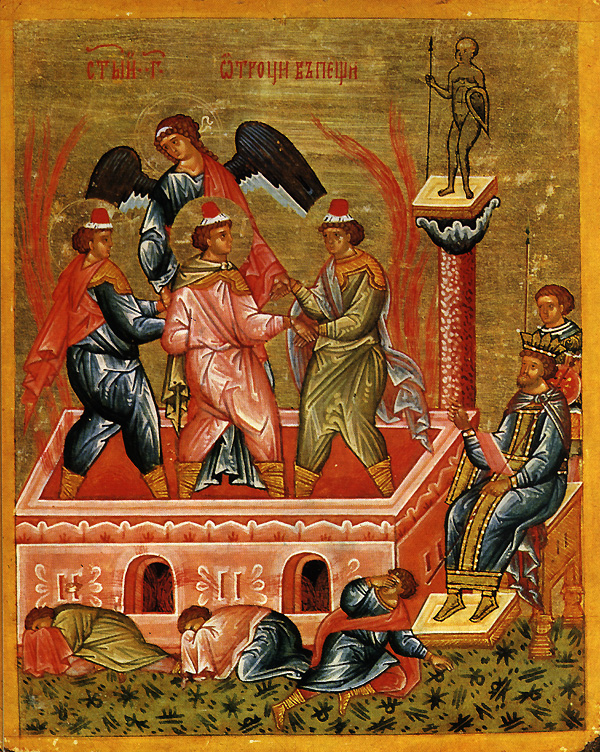
During these times King Nebuchadnezzar ordered a huge statue to be made in his likeness. It was decreed that when people heard the sound of trumpets and other instruments, they should fall down and worship the golden idol. Because they refused to do this, the three holy youths Ananias, Azarias and Misael were cast into a fiery furnace. The flames shot out over the furnace forty-nine cubits, felling the Chaldeans standing about, but the holy youths walked in the midst of the flames, offering prayer and psalmody to the Lord (Daniel 3:26-90).

The Angel of the Lord appeared in the furnace and cooled the flames, and the young men remained unharmed. This “Angel of Great Counsel,” as he is called in iconography, is identified with the Son of God (Daniel 3:25, Isaiah 9:6). In the first Canon for the Nativity of the Lord (Ode 5), the Church sings: “Thou hast sent us Thine Angel of Great Counsel.” The emperor, upon seeing this, commanded them to come out, and was converted to the true God.

Under King Baltasar, Saint Daniel interpreted a mysterious inscription (“Mane, Thekel, Phares”), which had appeared on the wall of the palace during a banquet (Daniel 5:1-31), foretelling the downfall of the Babylonian kingdom. Under the Persian emperor Darius, Saint Daniel was slandered by his enemies, and was thrown into a den with hungry lions, but they did not touch him, and he was not harmed. The emperor Darius then rejoiced over Daniel and ordered people throughout his realm to worship the God of Daniel, “since He is the living and eternal God, and His Kingdom shall not be destroyed, and His dominion is forever” (Daniel 6:26).

The holy Prophet Daniel grieved deeply for his people, who then were undergoing righteous chastisement for a multitude of sins and offenses, for transgressing the laws of God, resulting in the grievous Babylonian Captivity and the destruction of Jerusalem: “My God, incline Thine ear and hearken; open Thine eyes and look upon our desolation and that of Thy city, in which Thy Name is spoken; for we do not make our supplication before Thee because of our own righteousness, but because of Thy great mercy” (Dan 9:18). Because of Daniel’s righteous life and his prayers for the people’s iniquity, the destiny of the nation of Israel and the fate of all the world was revealed to the holy prophet.

While interpreting the dream of King Nebuchadnezzar, the holy, glorious Prophet Daniel spoke of a great and final kingdom, the Kingdom of our Lord Jesus Christ (Dan 2:44). The prophetic vision about the seventy weeks (Dan 9:24-27) speaks about the signs of the First and the Second Comings of the Lord Jesus Christ, and is connected with those events (Daniel 12:1-12).

Saint Daniel interceded for his people before King Cyrus, who esteemed him highly, and who decreed freedom for the Israelite people. Daniel himself and his fellows Ananias, Azarias and Misael, all survived into old age, but died in captivity. According to the testimony of Saint Cyril of Alexandria (June 9), Saints Ananias, Azarias and Misael were beheaded on orders of the Persian emperor Chambyses.

Saint Daniel and the three holy youths are also commemorated on the Sunday of the Holy Forefathers, and on the Sunday of the Holy Fathers (Sunday before the Nativity).

The Three Holy Youths: Ananias, Azarias and Misael

The Holy Youths Ananias (“God is gracious”), Azarias (“whom God helps”), and Misael (“Who is what God is?”) were companions of the Holy Prophet Daniel. They were chosen to serve in the king’s palace with Daniel (Daniel 1:6) and were all from the tribe of Judah. They gave Ananias the Chaldean name Shadrach (“royal”), Azarias the Chaldean name Abednego (“servant of Nego”), and Misael the Chaldean name Meshach (“guest”). They were thrown into a fiery furnace when they refused to worship the golden idol set up by King Nebuchadnezzar, but the angel of the Lord preserved them (Daniel 3:25).

The Seventh and Eighth Odes of the nine Biblical Odes at the back of the Psalter are taken from The Song of the Three Holy Youths (found in the Septuagint text of the Old Testament used by the Orthodox Church).

The Three Holy Youths and the Prophet Daniel are also commemorated on the Sunday of the Holy Forefathers and the Sunday of the Holy Fathers.

Venerable Daniel the Confessor (in Schema Stephen) of Spain, and Egypt

Saint Daniel the Confessor, (in the schema Stephen) lived in the tenth century. He was a Spanish dignitary, and prefect of the island of Niverta. Disdaining worldly glory, he became a monk in Rome and went on pilgrimage to the holy places at Constantinople and Jerusalem, where he received the Great Schema and the name Stephen. He received the crown of martyrdom after he refused the Saracens’ demand that he renounce Christ and become a Moslem.

Venerable Dionysius of Aegina

Saint Dionysius of Zakynthos, the Bishop of Aegina was born in 1547 on the island of Zakynthos. Though born into a noble family, he was determined to flee the world and set his mind upon heavenly things. He entered the monastery of Strophada, and after the prescribed time, he was clothed in the angelic schema by the abbot. Though young in years, he surpassed many of his elders in virtue, and was found worthy of ordination to the holy priesthood.

Although he protested his unworthiness, Saint Dionysius was consecrated Bishop of Aegina. In that office he never ceased to teach and admonish his flock, and many were drawn to him in order to profit from his wisdom. He feared the praise of men, lest he should fall into the sin of vainglory, so he resigned his See and returned to Zakynthos.

In 1579 the diocese of Zakynthos was widowed (when a bishop dies, his diocese is described as “widowed”), and Dionysius agreed to care for it until a new bishop could be elected. Then he fled from the worldly life which gave him no peace, and went to the Monastery of the Most Holy Theotokos Anaphonitria, twenty miles from the main village.

A certain stranger murdered the saint’s brother Constantine, an illustrious nobleman. Fearing his victim’s relatives, the stranger, by chance or by God’s will, sought refuge in the monastery where Saint Dionysius was the abbot. When the saint asked the fugitive why he was so frightened, he confessed his sin and revealed the name of the man he had murdered, asking to be protected from the family’s vengeance. Saint Dionysius wept for his only brother, as was natural. Then he comforted the murderer and hid him, showing him great compassion and love.

Soon the saint’s relatives came to the monastery with a group of armed men and told him what had happened. He pretended to know nothing about it. After weeping with them and trying to console them, he sent them off in the wrong direction. Then he told the murderer that he was the brother of the man he had killed. He admonished him as a father, and brought him to repentance. After forgiving him, Saint Dionysius brought him down to the shore and helped him to escape to another place in order to save his life. Because of the saint’s Christ-like virtue, he was granted the gift of working miracles.

Having passed his life in holiness, Saint Dionysius reached a great age, then departed to the Lord on December 17, 1624. Not only are the saint’s relics incorrupt, but he is also one of Greece’s “walking saints” (Saint Gerasimus and Saint Spyridon are the others). He is said to leave his reliquary and walk about performing miracles for those who seek his aid. In fact, the soles of his slippers wear out and must be replaced with a new pair from time to time. The old slippers are cut up, and the pieces are distributed to pilgims. On August 24, we celebrate the Transfer of his Holy Relics. Through the prayers of Saint Dionysius, may Christ our God have mercy upon us and save us.

Martyr Avakum the Deacon of Serbia

The holy New Martyr Avakum (Habakkuk) was born in Bosnia in 1794, and was named Lepoje by his parents. Lepoje’s father died when he was still a young boy, so his mother took him to the Mostanica monastery, where his uncle was the spiritual Father. He grew up in the monastery, and later became a monk with the name Avakum. When he was eighteen, he was ordained a deacon by Metropolitan Joseph (Sakabenta).

In 1809, the monks took part in an unsuccessful revolt against the Turks, and had to flee for their lives. They settled in the Annunciation monastery in Trnava near Cacak, where the igumen was Saint Paisius.

After the collapse of Karageorge’s revolt in 1813, the Turks began a reign of terror against the Serbs. Disease also swept the area because of the many bodies left unburied. The people attempted another revolt under Hadj-Prodan Gligorijevic, and the monks of Trnava became involved in it. The rebellion took place on the Feast of the Cross (September 14), but it was crushed by the Turks. Many people were captured, and some were executed on the spot as a warning to others.

Some of the prisoners were sent to Suleiman Pasha in Belgrade, among whom were Saints Paisius and Avakum. The holy deacon Avakum sang “God is with us” (from Compline) in the prison cell, while Saint Paisius prayed. The Turks offered to free anyone who would convert to Islam. Some of the prisoners agreed to this, but the majority refused to deny Christ, and so they were put to death.

The Turks tried to pressure Avakum to save himself by embracing their religion, but he refused even to consider it. His former spiritual Father, Gennadius, accepted the offer of the Turks and urged Avakum to follow his example. The courageous deacon declared that he was a warrior of Christ, and preferred to die rather than deny Christ.

Saint Avakum was sentenced to be impaled on a stake, which he was forced to carry to the place of execution. His own mother urged him to embrace Islam, then to seek forgiveness later because he had been forced into it. The saint thanked her for giving him life, but not for her advice.

At the place of execution, the Turks asked him one more time to consider his youth and not to die before his time. Avakum laughed and asked, “Don’t even Turks eventually die?”

They replied, “Of course they do.”

“Well then,” he said, “the sooner I die, the fewer sins I will have.”

Because of his courage and steadfastness in his faith, the Turks decided not to impale him. They killed him quickly by stabbing him in the heart with a sword on January 27, 1815.

Saint Avakum the deacon is commemorated on December 17 with Saint Paisius.

Saint Paisius

The holy New Martyr Paisius was igumen of the Annunciation monastery in Trnava near Cacak, Serbia. After the collapse of Karageorge’s revolt in 1813, the Turks began a reign of terror against the Serbs. Disease also swept the area because of the many bodies left unburied. The people attempted another revolt under Hadj-Prodan Gligorijevic, and the monks of Trnava became involved in it. The rebellion took place on the Feast of the Cross (September 14), but it was crushed by the Turks. Many people were captured, and some were executed on the spot as a warning to others.

Some of the prisoners were sent to Suleiman Pasha in Belgrade, among whom were Saints Paisius and Avakum. The holy deacon Avakum sang “God is with us” (from Compline) in the prison cell, while Saint Paisius prayed. The Turks offered to free anyone who would convert to Islam. Some of the prisoners agreed to this, but the majority refused to deny Christ, and so they were put to death.

Saint Paisius was taken from prison and forced to carry a stake to the place of execution. He was impaled, and the stake was set into the ground. The holy martyr exclaimed, “Glory to God.” Then the vizier clapped his hands to signal his soldiers to draw their swords and begin killing some of the other prisoners. Forty-eight people were killed, and their bodies were raised up on posts. After suffering for some time, Saint Paisius surrendered his soul to God, thereby obtaining the crown of martyrdom on December 17, 1814.

Daily Readings for Tuesday, December 16, 2025

TUESDAY OF THE 13TH WEEK

ABSTAIN FROM MEAT, FISH, DAIRY, EGGS, WINE, OLIVE OIL

The Holy Prophet Aggaeus (Haggai), Modestos, Archbishop of Jerusalem, Our Righteous Mother Blessed Empress Theophania, Nicholas Chrysoberges, Patriarch of Constantinople, Memnonus, Archbishop of Ephesus

ST. PAUL’S SECOND LETTER TO TIMOTHY 3:16-17; 4:1-4

Timothy, my son, all scripture is inspired by God and profitable for teaching, for reproof, for correction, and for training in righteousness, that the man of God may be complete, equipped for every good work.
I charge you in the presence of God and of Christ Jesus who is to judge the living and the dead, and by his appearing and his kingdom: preach the word, be urgent in season and out of season, convince, rebuke, and exhort, be unfailing in patience and in teaching. For the time is coming when people will not endure sound teaching, but having itching ears they will accumulate for themselves teachers to suit their own likings, and will turn away from listening to the truth and wander into myths.

MARK 8:22-26

At that time, Jesus came to Bethsaida. And some people brought to him a blind man, and begged him to touch him. And he took the blind man by the hand, and led him out of the village; and when he had spit on his eyes and laid his hands upon him, he asked him, "Do you see anything?" And he looked up and said, "I see men; but they look like trees, walking." Then again he laid his hands upon his eyes; and he looked intently and was restored, and saw everything clearly. And he sent him away to his home, saying, "Do not even enter the village.

Prophet Haggai

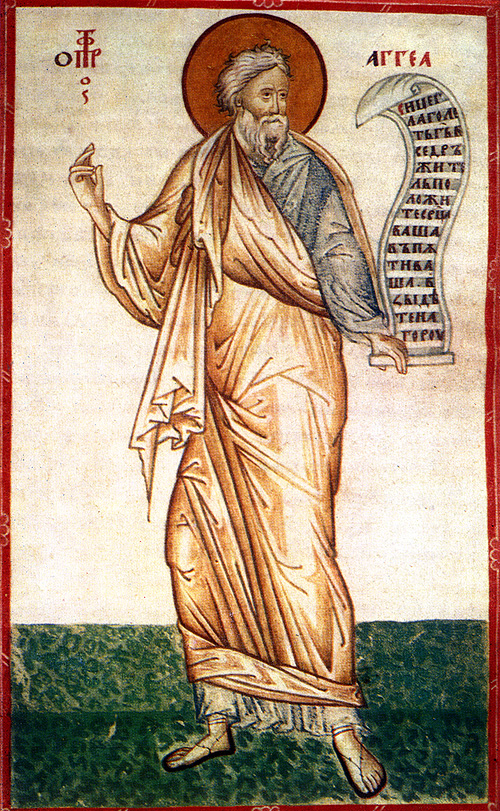
The Holy Prophet Haggai was the tenth of the Twelve Minor Prophets. He was of the Tribe of Levi and he prophesied during the times of the Persian emperor Darius Hystaspis (prior to 500 B.C.). Upon the return of the Jews from the Babylonian Captivity, he persuaded the people to build the Second Temple at Jerusalem, and he proclaimed that the Messiah would appear in this Temple in the last times.

It is believed that Haggai was buried with the priests at Jerusalem, since he was descended from Aaron.

Martyr Marinus of Rome

The Martyr Marinus was a soldier who suffered in Caesarea of Palestine in the third century. When he was about to be promoted to centurion, he refused to swear the customary oath invoking the pagan gods, or to offer sacrifice to idols. Saint Marinus was beheaded after cruel tortures, and buried by Saint Asterius (August 7).

Saint Theophanó the Wonderworker, wife of Emperor Leo the Wise

Saint Theophanó was a pious and virtuous Empress, who was greatly praised by the chroniclers of her time because of her evangelical life, her almsgiving, and her exceptional piety. She born in Constantinople, the daughter of Constantine Martinakios and his wife Anna, who raised their daughter with diligence. When she was of a marriageable age, Emperor Basil the Macedonian chose her to be the wife of his son Leo the Wise (886 – 912), with whom she dwelt in marital fidelity for twelve years.

The Holy Empress Theophanó and her husband Leo were imprisoned for three years, because Leo was falsely accused of plotting to assassinate his father, Emperor Basil. After obtaining her freedom,Theophanó spent her life in prayer and fasting, earnestly struggling for her salvation. She was recognized as a Saint and a wonderworker, even during her lifetime, because of the many good works which she performed out of love for her neighbor.

Though she lived in the world, she renounced everything worldly, and became a benefactor of the poor. She also built churches and monasteries, or restored those in need of repair. She was a true mother to her subjects, caring for widows and orphans, and consoling the sorrowful.

Despite all the grandeur and wealth surrounding her, she preserved her customary humility and modesty. She preferred to dress in simple clothing so that she would not recognized. Accompanied by two trusted servants, she would visit the homes of the poor and the persecuted, offering her assistance. Her faith was such that she was found worthy of the gift of performing miracles. When medical science gave up on a patient because it could not heal him, Saint Theophanó restored him to health. In spite of all the bitterness she had experienced in her life, Saint Theophanó could still sing praises to the Lord, according to the words of the Prophet King David: "Sing praises to the Lord, sing praises; sing praises to our King, sing praises" (Psalm 46/47:6).

Saint Theophanó reposed circa 893-894. Even before her death, her husband started to build a church, intending to dedicate it to Theophanó, but she forbade him to do so. It was Emperor Leo who decreed that the Sunday after Pentecost be dedicated to All Saints. Believing his wife to be one of the righteous, he knew that she would also be honored whenever the Feast of All Saints was celebrated.

The incorrupt relics of Saint Theophanó are preserved in the Patriarchal Church of Saint George, at the Phanar in Constantinople. A particle from her relics is in Dionysiou Monastery on Mount Athos.

Venerable Sophia of Suzdal, the Wonderworker

Saint Sophia (in the world Great Princess Solomonia Yurievna) was born around 1490, the daughter of the noble Yuri Saburov. Her mother died when she was young, and she was raised by her aunt Eudokia (her father's sister). In the year 1505 she was chosen as the bride of the heir to the throne, the future Great Prince Basil III. She was selected from among 500 girls from all over the country, who were presented at court for this purpose.

The wedding of Prince Basil and Solomonia took place on September 4, 1505, in the presence of the groom's father, Ivan III. Metropolitan Simon blessed the couple at the Dormition Cathedral in the Moscow Kremlin. When she married Basil, her father was raised to the rank of boyar. For the first time in Moscow's history, a Great Prince took neither a foreign princess nor a Russian princess as his wife, but a bride who came from a boyar family.

After twenty years, it became apparent that Solomonia was unable to conceive a child. Basil understood perfectly that if he died childless his brothers would inherit the throne. In order to preclude that possibility, they were imprisoned or forbidden to marry until his own son was born. In the end, this led to the extinction of the Rurikid dynasty, and to the succession crisis known as the Time of Troubles.

Despite her radiant beauty, exemplary morals, and mild character, Solomonia's failure to produce an heir must have weighed upon Basil's relations with his wife, who turned to foreign doctors for help. In 1525, the Great Prince decided to divorce Solomonia, with the approval of Metropolitan Daniel and the boyars, although other Church authorities declared the divorce was unlawful.

In order to obtain an heir, Great Prince Basil decided to marry Elena Glinska, the daughter of the Lithuanian prince Basil Glinsky. This action of the Great Prince Basil was condemned by all the Patriarchs, and Patriarch Mark of Jerusalem even predicted that of this second marriage a "cruel child" would be born, who would fill Russia with blood and horrors. Ivan the Terrible was born in 1530, and Basil's second son, Yuri, was feeble-minded. All the best Russian people of that time stood up for the blameless and miserable Great Princess: i.e. Metropolitan Barlaam, Saint Maximos the Greek (January 21) and others. But all their protests were in vain. For the first time in Russian history, a Great Prince removed a Metropolitan from office and imprisoned him in a monastery. Saint Maximos was not allowed to serve, and others were persecuted as well. Prince Andrew Kurbsky called Princess Solomonia "innocent and holy."

On November 25, 1525 Basil ordered Solomonia to become a nun. Forcibly tonsured with the name Sophia, she was sent under guard to the Nativity Monastery in Moscow. Later, she was moved to the Protection Monastery in Suzdal, one of the many churches established by Basil and his wife, where prayers were offered for the birth of an heir.

Through her ascetical struggles, Saint Sophia banished all worldly thoughts from her heart, and dedicated herself entirely to God. She reposed on December 18, 1542, after living as a nun for seventeen years.

Rumors concerning Sophia's holiness quickly spread throughout Russia. In a letter to Tsar Ivan, Prince Andrew Kurbsky calls the Right-believing Princess “a Monastic Martyr.” In a manuscript of the Lives of the Saints she is called “Holy Venerable Princess Sophia the Nun, the Wonderworker, who dwelt in the Protection Monastery.” In the reign of Tsar Theodore (the son of Ivan the Terrible) she was revered as a Saint. Tsaritsa Irene sent to Suzdal, “to the Great Princess Solomonia, also called Sophia, a velvet veil depicting the Savior and other Saints.” Patriarch Joseph wrote to Archbishop Serapion of Suzdal instructing him to have Panikhidas and Molebens served for the Nun Sophia.

The sacristan Ananias of Suzdal speaks of several miraculous cures at her grave. In 1609, during an invasion by the Poles, she saved Suzdal from destruction, appearing in a frightful form to the Polish military commander Lisovsky. Paralyzed with fear, he swore to spare the city and monastery. In 1610 a peasant woman named Theodosia was healed after being afflicted with blindness for a year and a half. In 1646 a girl, Irene Popova, was healed after being paralyzed for several years. That same summer a woman named Juliana was cured of amnesia. The Nun Theodora was healed in 1647 after being blind for two and a half months. That same year Julitta Ivanova, a resident of the village of Kideksha, was healed after being deaf for two years. Febronia of Suzdal was healed of paralysis in 1648 after several years. In 1649 the Nun Alexandra (Trusov) of the Protection Monastery was healed after losing her sight. Many other miracles took place, and continue to take place, through the intercession of Saint Sophia.

In 1650, Patriarch Joseph told the Archbishop of Suzdal to permit her local veneration as a Saint. In the middle of the XVIII century, the question of her canonization arose. Her icon, painted in the XVII century, has survived to this day and is considered a wonderworking icon. Finally, with the blessing of the Holy Synod, her name was included in the Orthodox Church Calendar in 1916. In 2007, her Church-wide veneration took place, and her Service was included in the Menaion.

Saint Sophia's tomb in the Protection Monastery was highly revered. On August 14, 1995, the solemn uncovering of her relics took place. On that day, a Moleben was served at her tomb. With the blessing of Metropolitan Eulogios, the Church Archaeological Commission made excavations, and the Saint's relics were found and transferred to the Protection Cathedral.

Saint Sophia is also commemorated on June 23, the Synaxis of the Saints of Vladimir.

Daily Readings for Monday, December 15, 2025

ELEUTHERIOS THE HIEROMARTYR, BISHOP OF ILLYRICUM, AND HIS MOTHER ANTHIA

ABSTAIN FROM MEAT, FISH, DAIRY, EGGS

Eleutherios the Hieromartyr, Bishop of Illyricum, and his mother Anthia, The Martyr Susannah the Deaconess

ST. PAUL’S SECOND LETTER TO TIMOTHY 1:8-18

TIMOTHY, my son, do not be ashamed then of testifying to our Lord, nor of me his prisoner, but share in suffering for the gospel in the power of God, who saved us and called us with a holy calling, not in virtue of our works but in virtue of his own purpose and the grace which he gave us in Christ Jesus ages ago, and now has manifested through the appearing of our Savior Christ Jesus, who abolished death and brought life and immortality to light through the gospel. For this gospel I was appointed a preacher and apostle and teacher, and therefore I suffer as I do. But I am not ashamed, for I know whom I have believed, and I am sure that he is able to guard until that Day what has been entrusted to me. Follow the pattern of the sound words which you have heard from me, in the faith and love which are in Christ Jesus; guard the truth that has been entrusted to you by the Holy Spirit who dwells within us.You are aware that all who are in Asia turned away from me, and among them Phygelos and Hermogenes. May the Lord grant mercy to the household of Onesiphoros, for he often refreshed me; he was not ashamed of my chains, but when he arrived in Rome he searched for me eagerly and found me – may the Lord grant him to find mercy from the Lord on that Day and you well know all the service he rendered at Ephesos.

MARK 2:23-28; 3:1-5

At that time, Jesus was going through the grainfields; and as they made their way his disciples began to pluck heads of grain. And the Pharisees said to him, "Look, why are they doing what is not lawful on the sabbath?" And he said to them, "Have you never read what David did, when he was in need and was hungry, he and those who were with him: how he entered the house of God, when Abiathar was high priest, and ate the bread of the Presence, which it is not lawful for any but the priests to eat, and also gave it to those who were with him?" And he said to them, "The sabbath was made for man, not man for the sabbath; so the Son of man is lord even of the sabbath.
Again he entered the synagogue, and a man was there who had a withered hand. And they watched him, to see whether he would heal him on the sabbath, so that they might accuse him. And he said to the man who had the withered hand, "Come here." And he said to them, "Is it lawful on the sabbath to do good or to do harm, to save life or to kill?" But they were silent. And he looked around at them with anger, grieved at their hardness of heart, and said to the man, "Stretch it out, " and his hand was restored.

Hieromartyr Eleutherius, Bishop of Illyria, his mother, Martyr Evanthia, and Caribus the Eparch

Saint Eleutherius, the son of an illustrious Roman citizen, was raised in Christian piety by his mother. His virtue was such that at the age twenty, he had been elevated to bishop of Illyria. In the reign of the emperor Hadrian, Saint Eleutherius was tortured for his bold preaching about Christ, then was beheaded at Rome with his mother Evanthia. The Eparch Caribus, who had tortured Saint Eleutherius, also came to believe in Christ and was executed.

Venerable Paul of Latros

Saint Paul of Latros was a native of the city of Aelen in Pergamum. Early bereft of his father, he was educated at the monastery of Saint Stephen in Phrygia. After the death of his mother, he devoted himself completely to monastic deeds at a monastery on Mount Latra, near Miletos.

Seeking even loftier accomplishments, he secluded himself in a cave. For his ascetic deeds he gained the gifts of clairvoyance and wonderworking. The emperor Constantine VII Porphyrogenitos (912-959) often wrote to him, asking his prayers and counsel. Saint Paul twice withdrew to the island of Samos, where he established a monastery and restored three monasteries ravaged by the Hagarenes (Arabs). Foretelling his end, the monk reposed in the year 955.

Saint Stephen the Confessor, Archbishop of Sourozh, Crimea

Saint Stephen the Confessor, Archbishop of Surrentium (Sourozh), was a native of Cappadocia and was educated at Constantinople. After receiving the monastic tonsure, he withdrew into the wilderness, where he lived for thirty years in ascetic deeds.

Patriarch Germanus of Constantinople (May 12) heard of Stephen’s humility and virtuous life, and wished to meet him. He was so impressed with Stephen that he consecrated him bishop of the city of Surrentium (presently the city of Sudak in the Crimea). Within five years, Saint Stephen’s ministry was so fruitful that no heretics or unbaptized pagans remained in Surrentium or its environs.

Saint Stephen opposed the iconoclasm of the emperor Leo III the Isaurian (716-741). Since he refused to obey the orders of the emperor and the dishonorable Patriarch Anastasius to remove the holy icons from the churches, he was brought to Constantinople. There he was thrown into prison and tortured. He was released after the death of the emperor. Already quite advanced in years, he returned to his flock in Surrentium, where he died.

There is an account of how the Russian prince Bravlin accepted Baptism at the beginning of the ninth century during a campaign into the Crimea, influenced by miracles at the saint’s crypt.

Venerable Tryphon, Abbot of Pechenga

Saint Tryphon of Pechenga and Kola (Mētrophánēs in the world), was born in the Novgorod governia into a priestly family. The pious parents raised their son in the fear of God. From his early years Tryphon had resolved to devote his life to apostolic deeds and to go to the pagan Laplanders to proclaim the Gospel of Christ. He had heard of them only through the accounts of fish vendors.

Once, while praying in the forest he had heard a voice, “Tryphon, this is not your place. An inhospitable and thirsting land awaits you.” Forsaking his parental home, the Saint went out to the Kola Peninsula and halted on the banks of the Pechenga River, where the Lapps lived. There he began to trade with them. First the Saint acquainted himself with the pagan beliefs of those people and studied their language, and then he began to preach the Christian Faith to them. The Lapps listened to his words with great mistrust. He suffered many hardships, enduring hostility and even beatings. But gradually, through his wise and kindly words and meekness, many were converted to Christ.

With the blessing of Archbishop Makarios of Novogord, Saint Tryphon and Saint Theodóretos (August 17) built a church for the new converts. In 1532 he founded the Pechenga-Trinity Monastery for those who were zealous for the monastic life, “on the cold sea, on the frontier of Murmansk.”

Tsar Ivan the Terrible helped him and richly endowed the Monastery. The Enlightener of the Lapps went to the Lord in 1583 at the age of 98, after living in Lapland for almost 70 years. Local veneration of Saint Tryphon began soon after his death.

The Swedes destroyed Pechenga Monastery in 1589, but the Saint's burial place under the altar was not forgotten. In 1708-1709 the Sretensky church was built here, around which the Monastery was revived in 1886. The church was destroyed again in 1944, but after the restoration of the Monastery in 2009-2012 a new church was built over the Saint's relics.

Those who invoke Saint Tryphon with faith have received his miraculous help. Even during his lifetime he rescued shipwrecked sailors, calmed storms at sea, and healed those who suffered from deafness, blindness, and paralysis.

Martyr Jonah, disciple of Tryphon of Pechenga

Saint Jonah of Pechenga and Kola was, as tradition tells us, a priest in the city of Kola. After the death of his daughter and wife he went off to the Pechenga-Trinity monastery near Kola, and became a disciple of its founder, Saint Tryphon. After the death of his teacher, he settled in 1583 at the site of what was to become his grave in the neighboring Dormition wilderness, where he was killed by the Swedes in the year 1590.

Martyr Eleutherius at Constantinople

The Holy Martyr Eleutherius Cubicularius was an illustrious and rich chamberlain [“cubicularius”] at the Byzantine court. With all his courtly privileges, Eleutherius was not beguiled by worldly possessions and honors. Instead, he thought of imperishable and eternal things. Having accepted holy Baptism, he began daily to glorify God with psalmody and to adorn his life with virtuous deeds.

But one of his servants through diabolic promptings, informed against his master to the [then still pagan] emperor. The emperor tried to turn Eleutherius from his faith in Christ, but after the unsuccessful attempts the emperor gave orders to behead him, and to throw his body to be eaten by dogs and vultures. A certain Christian priest took up the saint’s body and buried it.

There is a second commemoration of the martyr on August 4.

Venerable Pardus the Hermit, of Palestine

Saint Pardus the Hermit, a Roman, was involved in his youth with the teamster’s craft. Once, when he traveled to Jericho, a boy accidentally fell under the legs of his camels. The camels trampled the boy to death. Shaken by this occurrence, Pardus became a monk and withdrew to Mount Arion.

Thinking himself as a murderer, and deserving of death, Saint Pardus entered the den of a lion. He poked the wild beast and prodded it with a spear so that the lion would tear him apart, but the creature would not touch the hermit. Saint Pardus then took off his clothes and lay down upon the path that the lion would take for water. But even here, the lion merely leaped over the hermit. And the Elder then understood that he had been forgiven by the Lord. Returning to his mountain, Saint Pardus dwelt there in fasting and prayer until the end of his days. He died in the sixth century.

Hieromartyr Hilarion, Archbishop of Verey

The holy New Martyr Archbishop Hilarion (Vladimir Alexievich Troitsky in the world), an outstanding theologian, an eloquent preacher, and a fearless defender of Christ’s holy Church, was born around 1885.

Vladika Hilarion wrote many books and articles on various topics, including “The Unity of the Church.” His Master’s thesis, “An Outline of the History of the Church’s Dogma,” was over five hundred pages long, and was a well-documented analysis of the subject.

During the Council of 1917 he delivered a brilliant address calling for the restoration of the Moscow Patriarchate, which had been dissolved by Tsar Peter I in the eighteenth century. When Saint Tikhon (April 7) was chosen as Patriarch, Saint Hilarion became his fervent supporter.

Saint Hilarion was consecrated as bishop on May 20, 1920, and so the great luminary was placed upon the lampstand (Luke 11:33). From that time, he was to know less than two years of freedom. He spent only six months working with Patriarch Tikhon.

Vladika was arrested and exiled in Archangelsk for a year, then he spent six years (1923-1929) in a labor camp seven versts from Solovki. There at the Filomonov Wharf he and at least two other bishops were employed in catching fish and mending nets. Paraphrasing the hymns of Pentecost, Archbishop Hilarion remarked, “Formerly, the fishermen became theologians. Now the theologians have become fishermen.”

Archbishop Hilarion was one of the most popular inmates of the labor camp. He is remembered as tall, robust, and with brownish hair. Personal possessions meant nothing to him, so he always gave his things away to anyone who asked for them. He never showed annoyance when people disturbed him or insulted him, but remained cheerful.

In the summer of 1925, Vladika was taken from the camp and placed in the Yaroslav prison. There he was treated more leniently, and received certain privileges. For example, he was allowed to receive religious books, and he had pleasant conversations with the warden in his office. Saint Hilarion regarded his time at the Yaroslav Isolated Detention Center as the best part of his imprisonment. The following spring he was back at Solovki.

In 1929 the Communists decided to exile Archbishop Hilarion to Alma-Atu in central Asia. During his trip southward from the far north, Saint Hilarion was robbed and endured many privations. When he arrived in Petrograd, he was ill with typhus, infested with parasites and dressed in rags. When informed that he would have to be shaved, he replied, “You may now do with me whatever you wish.” He wrote from the prison hospital, “My fate will be decided on Saturday, December 15. I doubt I will survive.”

Saint Hilarion died at the age of forty-four in the hospital of a Petrograd prison on December 15, 1929. His body was placed in a coffin hastily made from some boards, and then was released to his family. The once tall and robust Archbishop Hilarion had been transformed by his sufferings into a pitiful white-haired old man. One female relative fainted when she saw the body.

Metropolitan Seraphim (Chichagov) provided a set of white vestments for the late Archbishop. He was also placed in a better coffin.

Metropolitan Seraphim presided at the funeral of Saint Hilarion, assisted by six bishops and several priests. The saint was buried at Novodevichii Monastery.

Saint Hilarion is commemorated on December 15 (his repose in 1929); May 10 (his glorification in 1999); the Third Sunday after Pentecost (All Saints of St. Petersburg); July 11 (The Finding of his relics in 1998); and on the Sunday nearest to August 26 (All Saints of Moscow).

Saint Nectarius of Bitel

Saint Nectarius of Bitel was born in the small town of Bitel (or Butili) in Bulgaria. In the world he was named Nicholas. Before a Turkish invasion his mother had a vision: the Most Holy Virgin Herself appeared and told her to flee and go into hiding with her husband and children. Nicholas’s father, having taken the boy with him, withdrew to a monastery dedicated to the Holy Unmercenaries (Saints Cosmas and Damian), not far from Bitel, where he became a monk with the name Pachomius.

Nicholas, having reached adolescence, went on to Athos. The clairvoyant Elder Philotheus accepted him and tonsured him into the angelic schema with the name Nectarius. The monk suffered for a long time from the envy and spite of one of the novices, but he displayed complete humility. He was distinguished for his charity. Any money he obtained from his handicraft was distributed to the poor. Saint Nectarius died in the year 1500.

Daily Readings for Sunday, December 14, 2025

11TH SUNDAY OF LUKE

ABSTAIN FROM MEAT, FISH, DAIRY, EGGS

11th Sunday of Luke, Martyrs Thyrsus, Leucius, and Callinicus of Asia Minor, and Philemon, Apollonius, and Arian of Alexandria

ST. PAUL’S LETTER TO THE COLOSSIANS 3:4-11

Brethren, when Christ who is our life appears, then you also will appear with him in glory. Put to death therefore what is earthly in you: fornication, impurity, passion, evil desire, and covetousness, which is idolatry. On account of these the wrath of God is coming upon the sons of disobedience. In these you once walked, when you lived in them. But now put them all away: anger, wrath, malice, slander, and foul talk from your mouth. Do not lie to one another, seeing that you have put off the old nature with its practices and have put on the new nature, which is being renewed in knowledge after the image of its creator. Here there cannot be Greek and Jew, circumcised and uncircumcised, barbarian, Scythian, slave, free man, but Christ is all, and in all.

LUKE 14:16-24

The Lord said this parable: “A man once gave a great banquet, and invited many; and at the time of the banquet he sent his servant to say to those who had been invited, ‘Come; for all is now ready.’ But they all alike began to make excuses. The first said to him, ‘I have bought a field, and I go out and see it; I pray you, have me excused.’ And another said, ‘I have bought five yoke of oxen, and I must go to examine them; I pray you, have me excused.’ And another said, ‘I have married a wife, and therefore I cannot come.’ So the servant came and reported this to his master. Then the householder in anger said to his servant, ‘Go out quickly to the streets and lanes of the city, and bring in the poor and maimed and blind and lame.’ And the servant said, ‘Sir, what you commanded has been done, and there is still room.’ And the master said to the servant, ‘Go out to the highways and hedges, and compel people to come in, that my house may be filled. For I tell you, none of those men who were invited shall taste my banquet. For many are called, but few are chosen.'”

Sunday of the Forefathers

The Sunday that falls between December 11-17 is known as the Sunday of the Holy Forefathers. These are the ancestors of Christ according to the flesh, who lived before the Law and under the Law, especially the Patriarch Abraham, to whom God said, “In thy seed shall all of the nations of the earth be blessed” (Gen. 12:3, 22:18).

Righteous Priest Aaron

The Righteous Aaron was the son of Amram and Jochebed, and the elder brother of the Prophet Moses the God-seer, and also of Miriam. He was a direct descendent of Levi by both parents. God called him “the Levite” in Exodus 4:14, when He appointed Aaron to be the spokesman for Moses, who was “slow of speech,” before the people. Later, he would also speak on behalf of Moses before Pharaoh in Egypt (Ex. 4:30; 7:2). Aaron was married to Elisheba, the daughter of the Prince of Judah (Ex. 6:23), who bore him four sons.

Moses was eighty years old and Aaron was eighty-three when they spoke to Pharaoh and asked that the Hebrews be released from their slavery. The Lord told Moses that Pharaoh would ask them for a miracle, and that Aaron should throw down his rod before him, and it would become a serpent (Ex. 7:9). When Pharaoh would not allow the Hebrews to leave Egypt, God told Moses to have Aaron stretch forth his rod over the Nile River, and it would turn to blood.

Following a succession of plagues, Pharaoh relented and let the people go, then Moses led them on their long journey to the Promised Land. In Chapter 17 of Exodus, the Hebrews fought Amalek in a battle at Rephidim. Moses stood atop a hill with the rod of God in his hand. As long as he raised his hand, the Hebrews prevailed, but when he became tired and lowered it, Amalek prevailed. Aaron and Hur sat Moses on a rock and held up his hands, one on each side. This was a prefiguration of the suffering of Christ, because the arms of Moses formed a cross. In the Greek Septuagint, the names Aaron and Hur begin with the letters Alpha and Omega, another reference to Christ (Revelation 1:8).

Aaron and his sons were anointed and sanctified to serve God as priests (Exodus chapter 29). In chapter 32, Aaron fell into temptation when Moses went up on Mount Sinai to receive the Commandments. Since Moses was taking a long time, the people grew restless and asked Aaron to make them a golden idol in the form of a calf so that they could offer sacrifices. He gave into them, and Moses was angry when he returned and saw them dancing and singing before the calf. He threw down the tablets on which God had written the Ten Commandments, and then he burned the golden calf and ground it to powder. He scattered the powder on the water, and he made the people drink it. When Moses asked those who were on the Lord’s side to gather around him, the Levites came to him. He ordered them to take their swords and slay their sons, companions, and neighbors. About three thousand people were killed that day.

Later, Aaron and Miriam criticized Moses for marrying a Cushite woman (Num. 12:1). God was angry with them, so He punished Miriam with leprosy. She was healed by God seven days after Moses interceded for her.

In chapter 17 of Numbers, the people murmured against Moses and Aaron, so God commanded that the leaders of the twelve tribes should have their names inscribed on their rods and placed in the tent of testimony. God would reveal His choice to make the people cease their grumbling against Moses and his brother. Aaron’s rod bloomed miraculously in the tent of the testimony, to show that he had been chosen for this purpose.

Aaron reposed atop Mount Hor when he was one hundred and twenty-three years old. One of his descendants was Saint Elizabeth, the mother of Saint John the Baptist (Luke 1:5).

Righteous Benjamin

The youngest son of Jacob, he was called Benoni and then Benjamin (Genesis 35:16-18). Before his death Jacob blessed him in a seemingly backhanded way, saying that “Benjamin is a ravenous wolf, devouring his prey in the morning, and dividing the spoil in the evening” (Genesis 49:27). Commentators say this is not a reference to Benjamin himself, but to the warlike nature of the tribe of Benjamin.

Righteous Deborah

Information about the holy Prophetess and Judge Deborah may be found in the
Book of Judges 4:5-14, and also chapter 5.

Righteous Hezron

The Righteous Hezron (Esrom, or Esron) is mentioned in the Old Testament genealogies: Genesis 46:12, Ruth 4:18, and 1 Chronicles 2:9 (LXX). He was the son of Perez (Phares) and the father of Aram (or Ioram), and an ancestor of the Prophet-King David.

According to the New Testament genealogies (Matthew 1:3; Luke 3:33), Phares begat Esrom; and Esrom begat Aram.

Righteous Isaac

The Righteous Isaac was the second of the Old Testament Patriarchs, and the son of Abraham (Genesis 17:17-22). God tested Abraham to see if he would sacrifice his son (Genesis 22:1-13), and thus Isaac was a type of Christ. He was the husband of Rebecca (Genesis 24:67), and the father of Jacob and Esau (Genesis 25:19-26).

Righteous Jacob

The Righteous Jacob is mentioned in the book of Genesis, chapters 25-50. He had a dream of a ladder (Genesis 28:12-17). Angels were ascending and descending the ladder, and the Lord was above the ladder (a type of the Mother of God, who united earth to Heaven when she consented to become the mother of the Messiah). Later, Jacob wrestled with God (Genesis 32:22-30), who appeared as a man, and Jacob prevailed. Then the Lord gave him the name Israel and blessed him. Jacob called that place Peniel (The face of God), and said, "I have seen God face to face, and yet my life is preserved."

Righteous Judith

Information about the Righteous Judith may be found in the Old Testament book
bearing her name.

Righteous Miriam

Saint Miriam, like her brothers Moses and Aaron, was descended from the tribe of Levi.

When Moses was an infant, the Hebrew midwives were ordered to kill any male child when they assisted at childbirths, but they refused to obey. Moses was hidden by his mother for three months, and then, when she could no longer do this, he was placed into a basket of reeds and set upon the waters of the Nile. Miriam watched in secret to see what would happen to him. When Pharaoh’s daughter found him, Miriam emerged from her place of concealment and offered to find a wet nurse from among the Hebrew women for the baby. Miriam went to get her mother, who raised her child until he was grown, and then returned him to Pharoah’s daughter (Exodus 2:10).

In the Torah, she is called “Miriam the Prophetess” (Exodus 15:20), while the Prophet Michah (6:4) has God say that He sent Moses, and Aaron, and Miriam before the Hebrews to lead them out of Egypt.

In Chapter 12 of the book of Numbers, Miriam and Aaron apparently criticize Moses for being married to a foreign woman of Cush (or an Ethiopian). This, however, was merely a pretext for their resentment. Actually, they were disturbed by Moses’ position as the sole mediator between God and the people. Miriam was a prophetess, after all. Miriam and Aaron questioned Moses, “Has the Lord spoken only to Moses? Has He not also spoken to us?” God then tells them that He speaks face to face with Moses, but only in visions to Miriam and Aaron while they are asleep. Then, for daring to speak against Moses, Miriam is punished with leprosy. Aaron pleads with Moses not to hold their sin against them, since they had acted out of ignorance. Even so, Miriam was set apart outside the camp for seven days, and then she was healed and allowed to come in.

In one of the stichera on the Praises for the Sunday before the Nativity, Sarah, Rebecca, Anna, and Miriam, “the glory of women,” are said to “exchange glad tidings.”

Prophet Nathan

The Prophet Nathan was an advisor to King David and King Solomon. He is mentioned in the Prayer of Absolution in the Mystery of Confession: “It was God Who pardoned David through the Prophet Nathan when he had confessed his sin….” David had committed adultery with Uriah's wife Bathsheba, and had him killed. Then he took Bathsheba as his wife. David confessed his sin to Nathan (2 Samuel 12:13) and received pardon.

Prophet Nehemiah

The Old Testament book of Nehemiah tells of how he returned from the Captivity in Babylon in the twentieth year of the Persian King Artaxerxes (445/444 B.C.) to rebuild Jerusalem and to govern the province. He and Ezra purified the Jewish people by making known the Law of Moses, and forcing the men to divorce their pagan wives.

Righteous Noah

The Righteous Noah is mentioned in the Book of Genesis (chapters 5-9).

Seeing the wicked deeds of men, God decided to destroy man from the earth, and even cattle, reptiles, and birds. But Noah found favor with the Lord, Who spared him, his sons and their wives. Therefore, God commanded Noah to build an ark and take two pairs of every creature into it. Then it rained for forty days and nights, and men and animals perished in the flood. The water remained on the earth for 150 days, then God blessed Noah and his sons, telling them to increase and multiply (Genesis 9:7).

Through Noah's sons Shem, Ham and Japheth, the earth was repopulated, and God promised not to destroy the world by water again. Noah reposed at the age of 950 (Genesis 9:29). The ark is a figure of the Church, which is called the Ark of Salvation.

While speaking about the end of the world, the Savior told His disciples: "As were the days of Noah, so will be the coming of the Son of man. For as in those days before the flood they were eating and drinking, marrying and giving in marriage, until the day when Noah entered the ark, and they did not know until the flood came and swept them all away, so will be the coming of the Son of man" (Matthew 24:37-39).

Righteous Rebecca

Rebecca was the wife of the Old Testament Patriarch Isaac, and the mother of Jacob and Esau. She is mentioned in Genesis 22:23; Chapters 24-28; and Chapter 49:31. Saint Paul also mentions her (Romans 9:10).

Righteous Sarah

Sarah was the wife of the Old Testament Patriarch Abraham and the mother of Isaac. At first she was called Sarai, and her name was changed to Sarah (Genesis 17:15-16). The three men who visited Abraham at the oak of Mamre told her that she would conceive and have a son (Genesis 18:10). She did not believe them at first, since she and her husband were old, but they insisted that she would bear a son in the spring. Their prediction was fulfilled, and God did as He had promised (Genesis 21:1-3). Saint Andrew Rublev depicts the three men as angels in his most famous icon. Sarah is praised in the New Testament for her faith (Hebrews 11:11) and also for her obedience (I Peter 3:6).

Prophet Solomon

The Prophet-King Solomon (ca. 972 – 932 B.C.) was the son of David and Bathsheba. He succeeded his father as King and reigned for forty years. He built the palace and the Temple at Jerusalem, and was renowned for his wisdom. The Old Testament books of Proverbs, the Song of Songs, and the Wisdom of Solomon are attributed to him. He may have written parts of these books, but much of the material was probably transmitted orally before it was written down.

In the Gospels, Christ mentions Solomon by name, citing his glory and wisdom (Matthew 6:29; 12:42).

Righteous Susanna

The 64-verse story of Susanna is found in the Septuagint Greek as a Preamble to the Book of Daniel. The Latin Vulgate, however, places the story of Susanna at the end of the Book of Daniel, which constitutes the book's thirteenth chapter.

Righteous Ruth

Information about the Righteous Ruth, the wife of Boaz, may be found in the Old Testament book bearing her name.

Righteous Mary

Saint Mary is the mother of Saint Anna, and the grandmother of the Theotokos.

Martyrs Thyrsos, Leukios, and Kallinikos

The Holy Martyrs Thyrsos, Leukios, and Kallinikos, suffered for Christ under Emperor Decius (249-251) at Caesarea in Bithynίa. When Saint Leukios reproached the prefect Cumbricius for his unjust persecution of Christians, he was tortured and then executed.

Saint Thyrsos, who was still a catechumen, was nonetheless eager for martyrdom. He was sentenced to cruel tortures after refusing to offer sacrifice to the idols. Citing the words of the Prophet Jeremiah (2:27), he ridiculed those who worshiped idols made of wood and stone.

The Saint’s arms and legs were pulled out of their sockets, his eyes were plucked out, and his teeth were smashed with a hammer. He was taken to a heathen temple, where, by his prayers, he toppled a statue of Apollo. Cumbricius was outraged by this, and he ordered even greater torments be devised for the athlete of Christ. Saint Thyrsos endured them all, then died after making the Sign of the Cross. The pagan priest Kallinikos, after witnessing the bravery of Saint Thyrsos and the miracle he performed, believed in Christ and boldly confessed the true Faith, for which he was beheaded.

Martyrs Philemon, Apollonios, Arrian, and Theonas of Alexandria

These Saints lived during the reign of Emperor Diocletian (ca. 290). Arrian, the ruler of Thebes in Egypt, arrested 37 Christians, including Saints Askalon and Leonidas (May 20). Arrian gave them the choice of sacrificing to the idols, or being tortured and executed. Most preferred to die rather than deny Christ. One of them, the Reader Apollonios, was afraid of being tortured, so his gave his clothes and four gold coins to a pagan musician named Philemon (Philḗmon) to offer sacrifice to the idols in his place. Philemon wore Apolonnios' clothes and covered his face. As he approached the altar, his heart was illumined with divine grace, and the eyes of his mind were opened. He made the Sign of the Cross and confessed Christ.

The ruler asked what this meant, and Philemon cried aloud, "I am a Christian, and the servant of Christ."

Then Arrian sent for Philemon to come and play his flute, in order to calm "Apollonios" so that he would be more inclined to worship idols. Arrian's servants could not find Philemon, so instead they brought his brother Theonas. Recognizing his disguised brother, Theonas laughed and said, "Philemon stands before you."

Arrian ordered Philemon's face to be uncovered, then told him to take off Apollonios' garments and to offer sacrifice with him. Instead, Philemon ridiculed the pagan "gods." He said that he had truly become a Christian, although he had not been baptized. Philemon prayed fervently, and suddenly a heavy rain fell, which was a Baptism for him.

Since it was Apollonios who caused Philemon to believe, Arrian brought him before him as well, and this time he confessed Christ. As a result, Arrian tortured them cruelly, and then beheaded them.

Immediately, Arrian was stricken with blindness. Saint Philemon appeared to him in a dream and told him to smear some dirt from his grave on his eyes, and he would be cured. That is exactly what happened. Then Arrian and his four bodyguards believed in Christ, and later they were all martyred together circa 305.

Saint Hilarion, Metropolitan of Suzdal and Yuriev

Saint Hilarion, Metropolitan of Suzdal and Yuriev (in the world John), was born November 13, 1631 into the family of the lower city priest Ananias. His father, famed for his piety and reading, was one of three candidates for the Patriarchal throne, together with the future Patriarch Nikon (1652-1658).

John entered a monastery in 1653. In 1655, he became founder and builder of the Phlorischev wilderness monastery not far from the city of Gorokhovetsa. In his monastic struggles, the saint wrestled with fleshly passions. When he fell down in exhaustion before the Vladimir Icon of the Mother of God beseeching Her help, the Mother of God shielded him with gracious power and calmed his spirit.

Once, when Saint Hilarion was serving Vespers together with a hierodeacon, robbers burst into the church. They killed the deacon and started to set Saint Hilarion on fire, asking him where the monastery treasure was hid. They did not believe that there was no gold in the monastery. Overcome by the pain, Saint Hilarion turned to the wonderworking icon and said, “O All-Pure Virgin Mary, Mother of our Lord Jesus Christ! If they injure me with the fire, I shall no longer have the ability to glorify Thy Son and Thee.” Suddenly the robbers heard the shouts of people searching for them, and they fled.

Another time, Saint Hilarion in passing by the church heard a voice: “I shall glorify thee throughout all the land.” He trembled, and going into the vestibule, he found no people there. On the portico he found only the Vladimir Icon of the Mother of God. The ascetic fell down before the image with tears and confessed his unworthiness.

Later on, when the saint had begun the construction of a stone church, he was very sad that concerns about the construction and disagreements among the workers were distracting him from prayer. While serving in church with the brethren, he was preoccupied by these thoughts and began to regret undertaking the work. With tears he besought the Mother of God not to abandon him and to deliver him from these worries.

When he finished his prayer, Saint Hilarion remained alone in church and began again to think about the construction. And so he fell asleep. In a dream the Mother of God appeared to him and said, “Transfer My icon, named the Vladimir, from this hot church and put it in the newly-built stone church, and I shall be your Helper there”.

Saint Hilarion awoke and ordered the large bell to be rung. The monks immediately assembled. All went to the hot church and, having prayed before the icon, solemnly transferred it from the portico into the temple. After serving the all night Vigil, Divine Liturgy and a Molieben, the saint told the brethren of his vision. Then in procession they transferred the icon to the church under construction, where they set it in the midst of the woods. From that time the construction went successfully and was soon completed. The saint wanted to dedicate the temple in honor of the icon, but he it was revealed to him in a vision that the temple was to be consecrated in honor of the Dormition of the Most Holy Theotokos.

In the wilderness monastery he maintained a very strict community rule. In 1694, the saint sent a letter to the Phlorischev monastery in which he reminisced about his own monastic Rule at this monastery: “Under me, a sinner, no one possessed anything of his own, but all was shared in common. Many of you may remember that former cenobitic community. And you also remember that I consigned to the fire those possessions which would destroy that cenobitic community.”

On December 11, 1681, the saint was consecrated as Archbishop of Suzdal and Yuriev, and in 1682 he was elevated to the dignity of Metropolitan and remained on the Suzda’ cathedra until February 1705. The saint died peacefully on December 14, 1707 and was buried in the Suzdal cathedral in honor of the Nativity of the Most Holy Theotokos. The saint was known for his unceasing concern for the poor. After his death they found only three coins.

The wonderworking Icon of the Mother of God of Vladimir-Phlorischev (August 26) had been painted by the renowned iconographer John Chirov in 1464 at Nizhni Novgorod in fulfillment of a vow of John Vetoshnikov.