
TUESDAY OF THE 14TH WEEK
ABSTAIN FROM MEAT, FISH, DAIRY, EGGS, WINE, OLIVE OIL
Forefeast of the Nativity of Our Lord and Savior, Jesus Christ, Ten Martyrs of Crete, Paul, Archbishop of Neo-Caesarea, Rememberance of the Founding of the Holy and Great Church of Christ, Hagia Sophia in Constantinople, Naoum the Illuminator of The Bulgarians, Nicholas & John the New Martyrs
ST. PAUL’S LETTER TO THE HEBREWS 4:1-13
Brethren, while the promise of entering his rest remains, let us fear lest any of you be judged to have failed to reach it. For good news came to us just as to them; but the message which they heard did not benefit them, because it did not meet with faith in the hearers. For we who have believed enter that rest, as he has said, “As I swore in my wrath, ‘They shall never enter my rest, ‘” although his works were finished from the foundation of the world. For he has somewhere spoken of the seventh day in this way, “And God rested on the seventh day from all his works.” And again in this place he said, “They shall never enter my rest.” Since therefore it remains for some to enter it, and those who formerly received the good news failed to enter because of disobedience, again he sets a certain day, “Today, ” saying through David so long afterward, in the words already quoted, “Today, when you hear his voice, do not harden your hearts.” For if Joshua had given them rest, God would not speak later of another day. So then, there remains a sabbath rest for the people of God; for whoever enters God’s rest also ceases from his labors as God did from his. Let us therefore strive to enter that rest, that no one fall by the same sort of disobedience. For the word of God is living and active, sharper than any two-edged sword, piercing to the division of soul and spirit, of joints and marrow, and discerning the thoughts and intentions of the heart. And before him no creature is hidden, but all are open and laid bare to the eyes of him with whom we have to do.
MARK 10:2-12
At that time, the Pharisees came up to Jesus and in order to test him, asked, "Is it lawful for a man to divorce his wife?" He answered them, "What did Moses command you?" They said, "Moses allowed a man to write a certificate of divorce, and to put her away." But Jesus said to them, "For your hardness of heart he wrote you this commandment. But from the beginning of creation, 'God made them male and female. For this reason a man shall leave his father and mother and be joined to his wife, and the two shall become one flesh.' So they are no longer two but one flesh. What therefore God has joined together, let not man put asunder." And in the house the disciples asked him again about this matter. And he said to them, "Whoever divorces his wife and marries another commits adultery against her; and if she divorces her husband and marries another, she commits adultery.
Forefeast of the Nativity of our Lord
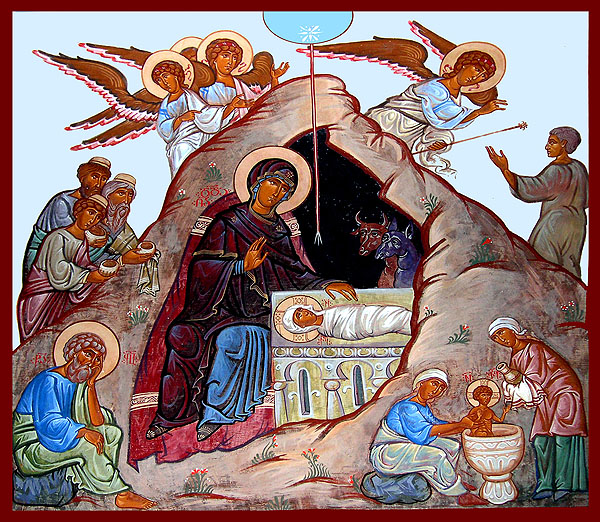
The Forefeast of the Nativity of the Lord begins on December 20. From now on, most of the liturgical hymns will be concerned with the birth of the Savior.
At Compline on this fourth day of the prefeast of the Nativity we sing, “Let us purify our minds, washing ourselves with the divine Mysteries; let us draw near in soul and body to Bethlehem, that we may behold the fearful dispensation of the birth of the Lord” (Ode Five of the Canon).
10 Holy Martyrs of Crete

The Ten Holy Martyrs of Crete: Theodulus, Saturninus, Euporus, Gelasius, Eunician, Zoticus, Pompius, Agathopus, Basilides and Evaristus suffered for Christ during the third century under the emperor Decius (249-251). The governor of Crete, also named Decius, fiercely persecuted the Church, and arrested anyone who believed in Christ. Once, ten Christians were brought before him from various cities of Crete, who at the trial steadfastly confessed their faith in Christ and refused to worship idols.
For thirty days they were subjected to cruel tortures, and with the help of God they all persevered, glorifying God. Before their death they prayed that the Lord would enlighten their torturers with the light of the true Faith. Since pain did not influence them, the saints were beheaded.
Saint Paul of Constantinople (November 6) visited Crete about a hundred years later. He took the relics of the holy martyrs to Constantinople to serve as a protection for the city, and a source of blessings for the faithful.
Repose of Saint Theoktistos, Archbishop of Novgorod
Before Saint Theoktistos (Theóktistos) became a bishop, he was the Igoumen of Annunciation Monastery near Novgorod. After the repose of Archbishop Clement in the year 1300, the people of Novgorod chose him as their Archbishop. Metropolitan Maximus and Bishops Simeon of Rostov and Andrew of Tver consecrated Saint Theoktistos as Archbishop of Novgorod on June 29, 1300.
One of the Hierarch's concerns was the renovation and building of churches. He consecrated cathedrals in honor of Saints Boris and Gleb (July 24), and in honor of the Holy Fathers of the First Ecumenical Council (Seventh Sunday after Pascha). Valaam Monastery was set in good order during this time.
Because of his poor health, the Hierarch retired to Annunciation Monastery in 1307, devoting himself to the ascetical feat (podvig) of silence until his blessed repose on December 23,1310.
Saint Theoktistos was glorified in 1664, because of the many miraculous cures which took place before his relics. His relics were transferred to Yuriev in 1786, where Archimandrite Photios built a chapel in the local cathedral and dedicated it to Saint Theoktistos.
On July 10, 2015, as a result of the opening of an XVIII century tomb by an archaeological team led by Vladimir Sedov, Corresponding Member of the Russian Academy of Sciences, and Doctor of Art History, in the presence of Metropolitan Leo of Novgorod and Staraya Rus, the holy relics of Archbishop Theoktistos of Novgorod were discovered. His relics were solemnly transferred to the Cathedral of the Savior at Saint George's Monastery, and placed in a reliquary for the faithful to venerate. At the same time, the first Moleben was served in honor of the discovery of the holy relics of Saint Theoktistos.
Saint Theoktistos is also commemorated on the following dates: January 23 (The recovery of his Holy Relics); and on the third Sunday after Pentecost (Synaxis of the Novgorod Saints).
Saint Niphon, Bishop of Constantia, Cyprus

Saint Niphon (Nḗphon), the Bishop of Constantia on the island of Cyprus, was born in Paphlagonia in the IV century, and was educated in Constantinople. As a child, he was gentle and kind, and he often attended Church Services. But in in his youth, he began to lead a wild and sinful life. Sometimes, when he came to his senses, he was horrified at the extent of his fall, but believing that he was lost and could not be forgiven, he continued his wicked life.
One day he met a friend who gazed at his face for a long time in astonishment. When Niphon asked why he was staring, the friend replied, “I have never seen your face like this before. It is black, like that of an Ethiopian.” These words made Niphon realize how far he had fallen, and he began to cry out to the Mother of God, asking for her intercession.
After praying for a long time, he saw that the face of the Mother of God on the Icon had become radiant, and she smiled. From that time, Niphon prayed incessantly to the Queen of Heaven. If he fell into sin, the face of the Mother of God turned away from him, but after he prayed with fervent tears of repentance, she seemed to show mercy and she looked at him again.
Finally, Niphon completely turned his life around, and he began to spend his time in prayer and repentance. After an illness, from which he was healed by the Mother of God, he partook of the Holy Mysteries. Then he was tonsured as a monk and intensified his ascetical labors, exhausting his body in his struggle with the passions.
That struggle lasted several years, and Saint Niphon was attacked many times by demons, but with God's help he was able to overcome them. Furthermore, he received from the Lord the gift of discerning the machinations of evil spirits, and how to defeat them. He was even able to see the departure of souls after death.
When he was already an old man, he journeyed to Alexandria. At that time a delegation from Constantia was in the city to ask Patriarch Alexander (May 29) to consecrate a new Bishop for them, because their Bishop Christopher had reposed.
That night Saint Paul appeared to Saint Alexander in a vision and told him to go to the church the next day with his clergy. The Apostle said, "When you see someone who resembles me (except for being bald), consecrate him as the Bishop of Christ's flock, even if he does not wish it."
In the morning Patriarch Alexander told Niphon that he must not refuse to do what the Lord had appointed for him. Niphon protested that he was not worthy to be a Hierarch, yet he did not dare to oppose God's will. Preparations were made and Niphon was ordained as a deacon, then shortly afterward he was ordained to the priesthood; and finally, he was consecrated as a Bishop. Three days later, he set out for his diocese.
After governing his flock for a short time, Saint Niphon foresaw that he would die in three days. Before his repose he was visited by Saint Athanasios the Great. On his deathbed, he was accounted worthy to behold the Holy Angels and various Saints: Martyrs, Prophets, Priests, Monks, and the Most Holy Theotokos.
When his flock learned of their Bishop's death there was weeping and lamentation throughout the city. The Patriarch asked them to give thanks to God instead, for letting them have such a holy man as their Bishop. After the funeral, Saint Niphon was laid to rest in the church of the Holy Apostles, and then everyone glorified God, Who is wondrous in His Saints.
Saint Paul, Bishop of Neocaesarea
Saint Paul, Bishop of Neocaesarea, suffered under the emperor Licinius (311-324). At his trial he firmly confessed his faith, and was subjected to beatings. They tortured him also with hunger, but he remained steadfast. Then they scorched his hands with red-hot iron and locked him in a prison at the banks of the Euphrates.
After Licinius was executed in the year 324, when Saint Constantine became the sole ruler of the Roman Empire, and Christians in prison received their freedom, Saint Paul returned to his flock. He was a participant at the First Ecmenical Council at Nicea, convened in the year 325, at which the Arian heresy was condemned and the Symbol of Faith adopted. At the end of the Council, the Emperor Constantine solemnly received the Council participants and kissed Saint Paul’s burned hand. After long years of guiding his flock, Saint Paul peacefully fell asleep in the Lord.
Saint Nahum of Ochrid, disciple of Saints Cyril and Methodius, Equal of the Apostles

Saint Nahum was a disciple of Saints Cyril and Methodius (May 11), one of their coworkers known as the Five Followers.
Saint Nahum was a man of great learning, and he spoke several languages. After a visit to Rome, he settled on the shores of Lake Ochrid. There he built a monastery at the time when Saint Clement of Ochrid (July 27) was serving as a bishop.
Many monks gathered around Saint Nahum, who was known as a great wonderworker and a man of prayer. He also labored to translate the Holy Scriptures from Greek into Slavonic.
Saint Nahum fell asleep in the Lord in 910, and his holy relics continue to work miracles of healing for those who venerate them in faith.
 Saint Peter Antiochian Orthodox Church