
MONDAY OF THE 12TH WEEK
ABSTAIN FROM MEAT, DAIRY, EGGS
Forefeast of the Conception by St. Anna of the Most Holy Theotokos, Patapius the Righteous of Thebes, Sosthenes, Apollo, Cephas, Tychikos, Epaphroditos, Caesar, & Onesiphoros, Apostles of the 70
ST. PAUL’S FIRST LETTER TO TIMOTHY 5:1-10
Timothy, my son, do not rebuke an older man but exhort him as you would a father; treat younger men like brothers, older women like mothers, younger women like sisters, in all purity. Honor widows who are real widows. If a widow has children or grandchildren, let them first learn their religious duty to their own family and make some return to their parents; for this is acceptable in the sight of God. She who is a real widow, and is left all alone, has set her hope on God and continues in supplications and prayers night and day; whereas she who is self-indulgent is dead even while she lives. Command this, so that they may be without reproach. If any one does not provide for his relatives, and especially for his own family, he has disowned the faith and is worse than an unbeliever. Let a widow be enrolled if she is not less than sixty years of age, having been the wife of one husband; and she must be well attested for her good deeds, as one who has brought up children, shown hospitality, washed the feet of the saints, relieved the afflicted, and devoted herself to doing good in every way.
LUKE 20:27-44
At that time, there came to Jesus some Sadducees, those who say that there is no resurrection, and they asked him a question, saying, "Teacher, Moses wrote for us that if a man's brother dies, having a wife but no children, the man must take the wife and raise up children for his brother. Now there were seven brothers; the first took a wife, and died without children; and the second and the third took her, and likewise all seven left no children and died. Afterward the woman also died. In the resurrection, therefore, whose wife will the woman be? For the seven had her as wife." And Jesus said to them, "The sons of this age marry and are given in marriage; but those who are accounted worthy to attain to that age and to the resurrection from the dead neither marry nor are given in marriage, for they cannot die any more, because they are equal to angels and are sons of God, being sons of the resurrection. But that the dead are raised, even Moses showed, in the passage about the bush, where he calls the Lord the God of Abraham and the God of Isaac and the God of Jacob. Now he is not God of the dead, but of the living; for all live to him." And some of the scribes answered, "Teacher, you have spoken well." For they no longer dared to ask him any question. But he said to them, "How can they say that the Christ is David's son? For David himself says in the Book of Psalms, 'The Lord said to my Lord, Sit at my right hand, till I make thy enemies a stool for thy feet.' David thus calls him Lord; so how is he his son?
Venerable Patapius of Thebes
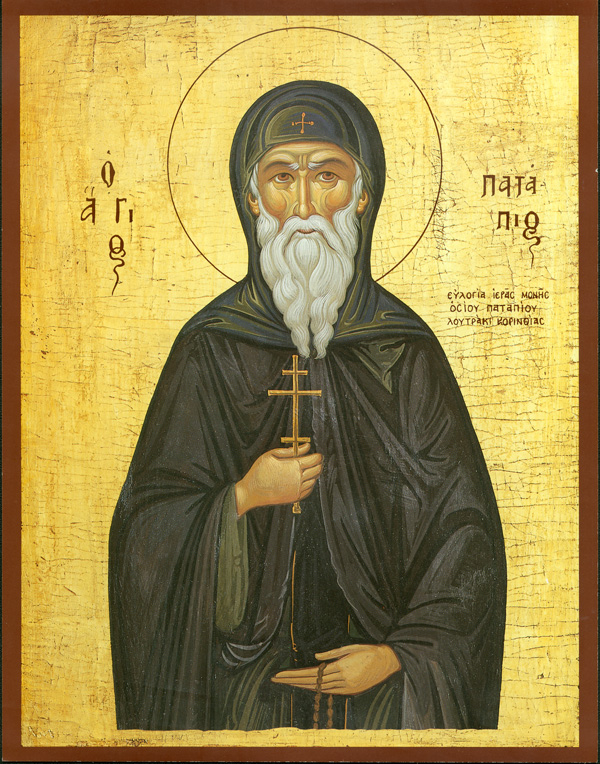
Saint Patapios was born at Thebes into a pious Christian family. Reaching the age of maturity, he scorned the vanity of this world, and so he went into the Egyptian desert where he became known for his ascetic deeds. Though he wished to live in silence, people began coming to him for advice.
To every tired pilgrim who visited his cell, he offered rest and hospitality, as well as spiritual instructions and profitable counsel for the salvation of one's soul. The Saint's reputation spread quickly, and every day many arrived at his cell in order to hear these beneficial instructions from his lips.
Later, he went to Constantinople, where he had a cell by the city wall, near the Blachernae church. But even here, he soon became known. The infirm started to gather around Patapios, and because he had been granted the gift of healing, he helped all those in need.
Once a certain woman was afflicted by the terrible disease of cancer, and worms came forth from her breasts. Not only did she suffer a great deal of pain in her chest, but throughout her entire body as well. She was in constant pain, and it reached her heart, so that she was near death. The doctors could not help her, and she felt she was wasting her money without obtaining relief. Therefore, she came to Saint Patapios and fell at his feet, begging him to heal her. The worms were devouring her flesh even before she was in the grave, causing her such pain that she longed for death.
The Saint answered, "If you have faith in the Lord, and have no doubt that you shall be healed, then let it be done according to your faith."
Sighing from the depths of her soul, she said, "I believe, O Lord that You know all things which are hidden and unknown, and that You are all-powerful. Therefore, have mercy on me and heal me."
Then the Saint asked the woman to let him see the effects of her distress. When he saw the ravages of the disease, he was struck with awe, saying, "Your affliction is indeed great, and difficult to cure. Go in peace, for you shall not suffer anymore."
As soon as he said this, the woman was healed and went home rejoicing and glorifying God. She told of this miracle everywhere, and praised Saint Patapios.
After a life adorned with virtue and miracles, Saint Patapios fell asleep in the Lord and was buried in the church of Saint John the Baptist.
Venerable Cyril, Abbot of Chelma Hill
Saint Cyril of Chelma Hill, Enlightener of the Chudian People, was born in the city of White Lake. He was tonsured at the monastery of Saint Anthony the Roman, where for six years he passed through various obediences. Then, after wandering through the wilderness for three years, he settled in a wild region of Kargopolsk. And here, by a command from on high, he chose Chelma Hill for his constant abode. Many of the afflicted from the Chud people came to see Saint Cyril, whose luminous ascetic life and kindly preaching moved many to accept holy Baptism.
Toward the end of his life, Saint Cyril established a monastery and church in honor of the Theophany of the Lord. The monk dwelt upon Chelma Hill for fifty-two years, and died at the advanced age of 82.
Holy Apostles of the Seventy: Sosthenes, Apollos, Cephas, Tychicus, Epaphroditus, Caesar, and Onesiphorus
Saints Sosthenes, Apollos, Cephas, Tychicus, Epaphroditus, Caesar, Onesiphorus, Apostles of the 70 were chosen and sent by the Lord Jesus Christ Himself to preach. They were chosen some time after the selection of the Twelve Apostles (Luke 10:1-24).
Saint Sosthenes, before accepting Christianity, was head of the Jewish synagogue at Corinth. During a riot against the Apostle Paul, he too suffered a beating. He was converted by Paul to faith in Christ and afterwards became bishop at Caesarea.
Saint Apollos (September 10) was a native of Alexandria and was a man of erudition. The chief place of his service was at Corinth. He toiled there for a long time and converted many to Christ. Towards the end of his life he preached on the island of Crete and was Bishop of Caesarea.
Saint Cephas was bishop at Colophon, Pamphylia.
Saint Tychicus, a native of Asia Minor, was a disciple and companion of the holy Apostle Paul. During Saint Paul’s first imprisonment, he delivered the Epistles to the Ephesians and to the Colossians. He replaced Saint Sosthenes on the episcopal throne at Caesarea.
Saint Epaphroditus, one of the Apostle Paul’s closest assistants and companions, was bishop of the Thracian city of Adriaca.
Saint Caesar preached at and was bishop of Dyrrhachium, a district of the Peloponnesos in Greece.
Saint Onesiphorus was bishop at Colophon (Asia Minor), and later at Corinth. He died a martyr in the city of Parium (not far from Ephesus) on the shores of the Hellespont, where he had gone to proclaim Christ among the local pagans.
All of these saints are also commemorated on March 30. The Church also remembers Saint Onesiphorus (September 7) with them.
Martyr Anthusa at Rome
The Holy Martyr Anthusa, the wife of a Roman official, was baptized by Saint Ambrose of Milan (December 7). When the city prefect’s wife Sunilda suggested that Saint Anthusa be baptized by an Arian, she refused. So she was committed to the fire, and received the crown of martyrdom.
362 Martyrs of Africa (62 Clergy and 300 Laypeople)
These faithful servants of Christ suffered martyrdom during the reign of Emperor Zeno (474-491). Guneric, the ruler of the Vandal Kingdom in North Africa, began a savage persecution of the Orthodox, at the instigation of the Arian bishops Cyril and Balinardēs.
The faithful had gathered secretly in one of the churches for the Divine Liturgy, when suddenly barbarian soldiers burst into the church. Some of the worshippers fled, but 300 remained voluntarily, and so they were tortured and beheaded. Of the 62 clergy, two were burnt alive, and sixty had their tongues cut out. By the miraculous power of God, they continued to preach and to refute the Arian heresy. Among them were old men, young men, and heads of families, but all of them remained faithful to Christ and His Holy Church. They were beheaded in the year 477.
In Slavic usage, these holy martyrs are commemorated on December 8; while in Greek usage, they are commemorated on December 7.
 Saint Peter Antiochian Orthodox Church