Monthly Archives: November 2025

Daily Readings for Thursday, November 06, 2025

PAUL THE CONFESSOR, PATRIARCH OF CONSTANTINOPLE

NO FAST

Paul the Confessor, Patriarch of Constantinople, Luke the Monk of Taormina

ST. PAUL’S LETTER TO THE HEBREWS 8:1-6

Brethren, we have such a high priest, one who is seated at the right hand of the throne of the Majesty in heaven, a minister in the sanctuary and the true tent which is set up not by man but by the Lord. For every high priest is appointed to offer gifts and sacrifices; hence it is necessary for this priest also to have something to offer. Now if he were on earth, he would not be a priest at all, since there are priests who offer gifts according to the law. They serve a copy and shadow of the heavenly sanctuary; for when Moses was about to erect the tent, he was instructed by God, saying, “See that you make everything according to the pattern which was shown you on the mountain.” But as it is, he has obtained a ministry which is as much more excellent than the old as the covenant he mediates is better, since it is enacted on better promises.

LUKE 12:8-12

The Lord said to His disciples, "Every one who acknowledges me before men, the Son of Man also will acknowledge before the angels of God; but he who denies me before men will be denied before the angels of God. And every one who speaks a word against the Son of Man will be forgiven; but he who blasphemes against the Holy Spirit will not be forgiven. And when they bring you before the synagogues and the rulers and the authorities, do not be anxious how or what you are to answer or what you are to say; for the Holy Spirit will teach you in that very hour what you ought to say.

Saint Paul the Confessor, Archbishop of Constantinople

Saint Paul the Confessor, Archbishop of Constantinople, was chosen to the patriarchal throne after the death of Patriarch Alexander (+ 340), when the Arian heresy had again flared up. Many of the Arians were present at the Council which selected the new Archbishop of Constantinople. They revolted in opposition to the choice of Saint Paul, but the Orthodox at the Council were in the majority.

The emperor Constantius, ruling over the Eastern half of the Roman Empire, was an Arian. He was not in Constantinople for the election of the Archbishop, and so it took place without his consent. Upon his return, he convened a council which illegally deposed Saint Paul, and the emperor banished him from the capital. In place of the saint they elevated Eusebius of Nicomedia, an impious heretic. Archbishop Paul withdrew to Rome, where other Orthodox bishops were also banished by Eusebius.

Eusebius did not rule the Church of Constantinople for long. When he died, Saint Paul returned to Constantinople, and was greeted by his flock with love. But Constantius exiled the saint a second time, and so he returned to Rome. The Western emperor Constans wrote a harsh letter to his Eastern co-ruler, which he sent to Constantinople along with the holy exiled archpastor. The threats worked, and Saint Paul was reinstated upon the archepiscopal throne.

But soon the pious emperor Constans, a defender of the Orthodox, was treacherously murdered during a palace coup. They again banished Saint Paul from Constantinople and this time sent him off in exile to Armenia, to the city of Cucusus, where he endured a martyr’s death.

When the Archbishop was celebrating the Divine Liturgy, Arians rushed upon him by force and strangled him with his own omophorion. This occurred in the year 350. In 381, the holy Emperor Theodosius the Great solemnly transferred the relics of Saint Paul the Confessor from Cucusus to Constantinople. In 1326, the relics of Saint Paul were transferred to Venice.

Saint Athanasius the Great, a contemporary of Saint Paul, writes briefly about his exiles, “Saint Paul the first time was sent by Constantine to Pontus, the second time he was fettered with chains by Constantius, and then he was locked up in Mesopotamian Syngara and from there moved to Emesus, and the fourth time to Cappadocian Cucusus in the Taurian wilderness.”

Part of the Saint's skull is located in the Holy Monastery of Simonópetra on Mount Athos. The Saint's incorrupt relics are to be found in the Roman Catholic church of Saint George of Greater Venice. A fragment of the Saint's relics is located in the Saint Alexander Nevsky Lavra at Saint Petersburg.

Venerable Barlaam, Abbot of Khutyn, Novgorod

Saint Barlaam of Khutyn lived in the XII century, and was the son of a noble Novgorodian and spent his childhood in Novgorod. In his youth, retiring to the Lisich Monastery near the city, Barlaam was tonsured as a monk. Then he settled on a secluded hill above Volkhov, in an area called Khutyn, 10 versts from Novgorod. In his seclusion, Saint Barlaam led an austere solitary life, occupying himself with unceasing prayer, and keeping a very strict fast. He was a zealous ascetic in his labors: cutting timber in the forest, chopping firewood, and tilling the soil, fulfilling the words of the Holy Scriptures: "If anyone does not wish to work, neither let him eat" (2 Thessalonians 3:10).

Some of the inhabitants of Novgorod gathered around him, desiring to share the Saint's works and ascetical struggles. Instructing those who came to him, Saint Barlaam said, "My children, beware of all unrighteousness, and do not give in to envy or slander, don't be jealous, do not slander anyone. Refrain from anger, and do not practice usury. Beware of unjust judgment. Do not swear an oath falsely, but rather fulfill it. Do not indulge in carnal appetites. Always be meek and endure all things with love. This virtue is the beginning and the root of all goodness."

Soon a church was built in honor of the Transfiguration of the Lord, and a Monastery was founded. The Lord granted him the gift of miracles and clairvoyance in order to serve his neighbors. As Saint Barlaam’s life was drawing to a close, by God's will, Hieromonk Anthony came from Constantinople. He was the contemporary and friend of Saint Barlaam. The Saint turned to him and said, “My beloved brother, God’s blessings rest upon this Monastery. Now I leave it in your hands. Watch over it and care for it. Although in the body I am leaving you, I shall always be with you in spirit.”

After giving his final counsels to the brethren, commanding them to preserve the Orthodox Faith, and to abide in humility, Saint Barlaam fell asleep in the Lord on November 6, 1192.

The Church remembers Saint Barlaam three times during the year: on the day of his blessed repose (November 6), on the first Friday of the Apostles' Fast, and on the third Sunday after Pentecost (Synaxis of the Novgorod Saints).

In Slavonic practice, Saint Barlaam is commemorated during the Proskomedia along with the venerable God-bearing Fathers who have shone forth in asceticism (sixth particle).

Venerable Luke the Steward of the Kiev Caves

Saint Luke labored in asceticism at the Kiev Caves Monastery (Near Caves) in the XIII century, where he fulfilled the obedience of Steward. Nothing is known about his life before he came to the Kiev Caves Lavra.

In Ode 7 of the Canon for the Holy Fathers of the Near Caves, Saint Luke is praised as an "icon," and as one who kept the Lord's commandments.

Saint Luke is commemorated on November 6, and again with the Holy Fathers of the Near Caves of Saint Anthony (September 28) where his incorrupt relics lie.

Those who serve in the office of Steward at the Kiev Caves Lavra, honor him as their patron, and keep the icon of Saint Luke in their cell.

Repose of Saint Herman, Archbishop of Kazan
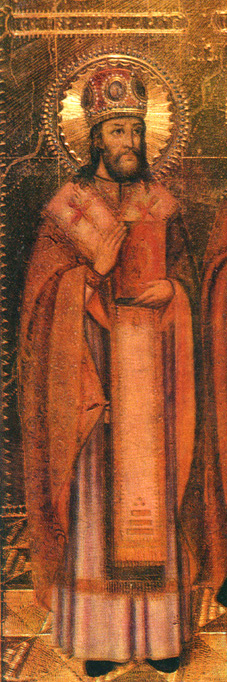
Saint Herman, Archbishop of Kazan, lived during the sixteenth century. He was born in the city of Staritsa, and was descended from the old boyar nobility of the Polevi. In his youth Gregory (his baptismal name) was tonsured at the Joseph-Volokolamsk monastery under Igumen Gurias, who later became Archbishop of Kazan (December 5). (Saint Gurias was head of the monastery from 1542 to 1551).

At the monastery Saint Herman occupied himself with copying books, and he was a close friend of Saint Maximus the Greek (January 21), who was living there in confinement. In 1551 the brethren of the Staritsa Dormition monastery, seeing his piety, chose him as their archimandrite.

Taking up the governance of this monastery with a pastoral zeal, Saint Herman concerned himself with its internal and external order, for he himself was a model of humility and meekness. He exhorted all to observe their monastic commitment strictly, and he introduced into his monastery the Rule of Saint Joseph of Volokolamsk (October 18).

But after two and a half years Archimandrite Herman left the Staritsa monastery, leaving its direction to the hieromonk Job (June 19), who afterwards was to become the first Patriarch of Moscow, and was an ascetic and sufferer for the Russian Land.

Saint Herman’s love for solitary struggles brought him to return to his original Volokolamsk monastery, where he strove toward salvation as a simple monk. However, when the new heretic Matthew Bashkin (who refused to acknowledge the Holy Mysteries and denied faith in the Holy Trinity) appeared at Moscow, Saint Herman and his own father (who had received tonsure at the Volokolamsk monastery with the name Philotheus) were summoned to the Moscow Council of 1553. The Council censured the heretic Bashkin and resolved to send him for correction to Saint Herman at the Volokolamsk monastery, since Saint Herman was known for his holy life and zeal for the faith in Christ.

In 1555, after the taking of Kazan, an archepiscopal See was established there. Saint Gurias, the former igumen of Volokolamsk monastery, was chosen as archbishop. He was entrusted with building the Dormition monastery in the city of Sviyazhsk for missionary purposes. By decree of Saint Gurias, Saint Herman was appointed as head of this new monastery in Sviyazhsk. A stone cathedral was built with a belltower and monastic cells. The igumen of the monastery lived very frugally in a cramped cell beneath the cathedral belltower. Saint Herman particularly concerned himself with acquiring a library for the monastery.

Soon his monastery became famous for its good works, and it became a center of enlightenment for the Kazan region.

On March 12, 1564, after the repose of Saint Gurias, Saint Herman was consecrated Bishop of Kazan. The short duration of his tenure there was marked nonetheless by his efforts to build churches and to enlighten the people of the region with the light of Christ.

In 1566, Ivan the Terrible summoned Saint Herman to Moscow and ordered that he be elected to the Metropolitan cathedra. At first, Saint Herman refused to have this burden imposed upon him. The Tsar would not tolerate any objection, however, and the saint was obliged to settle into the Metropolitan’s quarters until his elevation to the position of Metropolitan.

Seeing injustice among those of the Tsar’s inner circle, Saint Herman, true to his pastoral duty, attempted to admonish the Tsar. “You are not yet elevated to Metropolitan, and already you place constraints upon my freedom,” the Tsar told him through his aides. He ordered Saint Herman expelled from the Metropolitan’s quarters and that he be kept under surveillance.

The saint lived in disgrace for about two years, and died on November 6, 1567. They buried him in the church of Saint Nicholas the Hospitable. In 1595, at the request of the inhabitants of Sviyazhsk, the relics of the saint were transferred from Moscow to the Sviyazhsk Dormition monastery. Saint Hermogenes, then Metropolitan of Kazan, visited his grave.

Saint Herman is also commemorated on September 25 (first translation of his relics in 1595) and June 23 (second translation of his relics in 1714).

Venerable Barlaam of Keret Lake

No information available at this time.

Martyrs Tecusa, Alexandra, Claudia, Matrona, Polactia, Euphrosynē, and Athanasia, of Ancyra

No information available at this time.

Venerable Luke of Sicily

Saint Luke of Sicily was a native of the Sicilian city of Tauromenium. In his youth he left his parents and fiancée and went into the wilderness, where he spent many years in fasting and prayer. He lived the ascetic life at Mount Aetna.

Towards the end of his life Saint Luke, because of a revelation to him, founded a monastery. In order to become familiar with the rule and life of other monasteries, he visited many other cities. He died at Corinth in 820.

Holy Virgin Martyr Manatho

Saint Manathó (Μαναθῶ) suffered for Christ during the reign of Emperor Maximianus (286 – 305).

She was arrested with other martyrs and endured many torments because she was a Christian. Later she was led through the city naked and was mocked. Finally, she was burnt alive.

In Greek usage the Holy Virgin Martyr Manathó is commemorated on October 20

Announcements, November 9, 2025

Sunday, November 9, 2025

Nektarios of Aegina and Pentapolis, the Wonderworker

Ephesians 5:8-19: Brethren, walk as children of light (for the fruit of light is found in all that is good and right and true), and try to learn what is pleasing to the Lord. Take no part in the unfruitful works of darkness, but instead expose them. For it is a shame even to speak of the things that they do in secret; but when anything is exposed by the light it becomes visible, for anything that becomes visible is light. Therefore it is said, “Awake, O sleeper, and arise from the dead, and Christ shall give you light.” Look carefully then how you walk, not as unwise men but as wise, making the most of the time, because the days are evil. Therefore, do not be foolish, but understand what the will of the Lord is. And do not get drunk with wine, for that is debauchery; but be filled with the Spirit, addressing one another in psalms and hymns and spiritual songs, singing and making melody to the Lord with all your heart.

Luke 8:41-56: At that time, there came to Jesus a man named Jairus, who was a ruler of the synagogue; and falling at Jesus’ feet, he besought Him to come to his house, for he had an only daughter, about twelve years of age, and she was dying. As Jesus went, the people pressed round Him. And a woman, who had had a flow of blood for twelve years, and had spent all her living upon physicians, and could not be healed by anyone, came up behind Him, and touched the fringe of His garment; and immediately her flow of blood ceased. And Jesus said, “Who was it that touched Me?” When all denied it, Peter said, “Master, the multitudes surround Thee and press upon Thee! And Thou sayest, ‘Who touched Me?’” But Jesus said, “Someone touched Me; for I perceive that power has gone forth from Me.” And when the woman saw that she was not hidden, she came trembling, and falling down before Him declared in the presence of all the people why she had touched Him, and how she had been immediately healed. And Jesus said to her, “Daughter, your faith has made you well; go in peace.” While Jesus was still speaking, a man from the ruler’s house came and said, “Your daughter is dead; do not trouble the Teacher anymore.” But Jesus on hearing this answered him, “Do not fear; only believe, and she shall be well.” And when Jesus came to the house, He permitted no one to enter with Him, except Peter and James and John, and the father and mother of the child. And all were weeping and bewailing her; but Jesus said, “Do not weep; for she is not dead but sleeping.” And they laughed at him, knowing that she was dead. But taking her by the hand Jesus called, saying, “Child, arise.” And her spirit returned, and she got up at once; and Jesus directed that something should be given her to eat. And her parents were amazed; but He charged them to tell no one what had happened.

Troparion of the Resurrection: Let us believers praise and worship the Word; coeternal with the Father and the Spirit, born of the Virgin for our salvation. For, He took pleasure in ascending the Cross in the flesh to suffer death; and to raise the dead by His glorious Resurrection.

Troparion of ST. Nektarios of Aegina: The offspring of Selyvria and the guardian of Aegina, the true friend of virtue who didst appear in the last years, O Nektarios, we faithful honor thee as a Godly servant of Christ, for thou pourest forth healings of every kind for those who piously cry out: Glory to Christ Who hath glorified thee. Glory to Him Who hath made thee wondrous. Glory to Him Who worketh healings for all through thee.

Troparion of the Chains of St. Peter: O Holy Apostle, Peter, thou dost preside over the Apostles by the precious chains which thou didst bear. We venerate them with faith and beseech thee that by thine intercessions we be granted the great mercy.

Kontakion of the Theotokos: The sacred treasury of God’s holy glory, * the greatly precious bridal chamber and Virgin, * the Savior’s most pure temple, free of stain and undefiled, * into the House of the Lord * on this day is brought forward * and bringeth with herself the grace * of the Most Divine Spirit; * her do God’s Angels hymn with songs of praise, * for she is truly the heavenly tabernacle.

Calendar

Sunday, November 9, 2025 (Nektarios of Aegina and Pentapolis, the Wonderworker)

8:50 AM – Orthros

9:00 AM – Christian Education

10:00 AM – Divine Liturgy

12:00 PM – Potluck

Monday, November 10, 2025

Father Herman off

Tuesday, November 11, 2025

No Services

Wednesday, November 12, 2025

5:30 PM – Tenn Meeting

6:30 PM – Daily Vespers

Thursday, November 13, 2025

NO Services

Friday, November 14, 2025

No Services

Saturday, November 15, 2025 (Fast of the Nativity begins)

6:00 PM – Great Vespers

Sunday, November 16, 2025 (The Holy Apostle and Evangelist Matthew)

8:50 AM – Orthros

9:00 AM – Christian Education

10:00 AM – Divine Liturgy

Special Announcements

The Eucharist Bread was provided by the Pacuraris for the Divine Liturgy this morning.

Eucharist Bread Schedule:

Eucharist Bread Coffee Hour

November 9 Pacurari Lasseter/Pacurari/Lavric

POTLUCK

November 16 Lasseter Lockhart/Karam/Snell

November 20 (Thurs PM) Milnor Algood/Meadows/YAF

Entrance of the Theotokos POTLUCK

into the Temple

November 23 YAF Baker/Jimmy Jones/Rodriguez

November 30 Henderson Pigott/Ian Jones

Schedule for Epistle Readers – Page numbers refer to the Apostolos (book of Epistles) located on the chanters’ stand at the front of the nave. Please be sure to use book when you read.

Reader Reading Page#

November 9 Katie Miller Eph 5:8-19 78

November 16 Mary Martha Ellis I Cor 4:9-16 135

November 20 Ian Jones Heb 9:1-11 337

Entrance of the Theotokos

into the Temple

November 23 Grady Fisher Eph 2:14-22 207

November 30 Walt Wood I Cor 4:9-19 135

Please remember the following in your prayers: Aidan Milnor, the Milnor family; Lamia Dabit and her family; Mary Greene (Lee and Kh. Sharon’s sister); Jay and Joanna Davis; Fr. Leo and Kh. Be’Be’ Schelver and their family; Marilyn (Kyriake) Snell; Jack and Jill Weatherly; Dn.Terry Algood and their family; Fr. Joseph Bittle; Rick Carlton; Very Rev. Fr. Nicholas and Kh. Jan Speier; Lee Greene; Fr. John and Kh. Janet Henderson and their family; Galina Singletary; Emily and Cole Parker.

WAMP! Registration for winter camp has opened for ages 12-17. If your teen would like to attend, please see Fr. Herman for registration information if you do not already have it. Winter camp will be held back at Asbury Hills in Cleveland, SC again this year. Transportation to and from camp will be the responsibility of the parents as the church will not be providing vans for winter camp.

WINTER RETREAT! A Save the Date email has been sent out regarding the upcoming dates for the 2026 DOMSE Winter Retreat. The retreat will, again, be hosted by St. Elias Antiochian parish in Atlanta, GA. The dates for the retreat are January 30-31. Registration has not yet opened but once it does an email will be sent out with this information. Hope to see you there!

Please remember that we still need your tithes and offerings which may be placed in the tray that is passed during Divine Liturgy, in the tithe box at the back of the nave or be mailed to: St. Peter Orthodox Church, P.O. Box 2084, Madison, MS 39130-2084.

Potluck Meals: Everyone who attends the potluck meals during the month is encouraged to bring a dish to share with everyone. This is to ensure that there is enough food for all to partake. Over the past several months we have been running out of food before everyone has an opportunity to go through the line. This also applies to the Festal Liturgies that may be served during the week and the Soup Suppers after Presanctified Liturgies during Lent. Parents, please accompany your children through the line. Thank you all for your help with this.

As a friendly reminder, in regards to coffee hour, the church will provide beef sticks, cheese cubes, crackers, cookies, and orange juice. For sponsors of baptisms/chrismations a reception may be held after the service and may have whatever food the sponsors would like to provide in celebration of this occasion. If you wish to bring a snack for your children, please be responsible for the clean up of those items. Coffee hour is not meant to be a meal, but a means to break the fast with a snack and visit with each other. Also, as a friendly reminder, please make sure kids are not getting ice in the kitchen without adult supervision.

Calendar Items

* The men of the parish meet for lunch at 11:00 a.m. on the first Thursday of the month

* The Ladies meet for dining on the last Tuesday of the month. Times will vary.

* The Ladies meet at the church at 10:00 a.m. on the second Saturday of the month to pray the

Akathist. Alternating on behalf of our children and our sick.

* The Ladies of St Peter will meet every third Sunday during Coffee Hour.

* The Young Adult Fellowship (YAF) meets on alternating Mondays for Book Study.

Please see Brandon Strain for questions.

* Fast of the Nativity begins on November 15th and runs through December 24th.

* We will celebrate the Entrance of the Theotokos with Divine Liturgy on Thursday, November

20th at 6:00 p.m. followed by a Potluck meal afterwards.

* There will be no Daily Vespers on Wednesday, November 26th.

Fasting Discipline for November

The traditional fasting discipline (no meat, dairy, eggs, fish, wine or oil) is observed on all Wednesdays and Fridays through November 15th when the Fast of the Nativity begins. During the fast, we will abstain from meat, dairy, and eggs, except on the 19th, 26th and 28th of November when we will also abstain from fish, olive oil, and wine.

Major Commemorations for November

November 9 Nektarios of Pentapolis

November 13 John Chrysostom (repose)

November 14 Apostle Phillip

November 16 Apostle Matthew

November 21 Entrance of the Theotokos into the Temple

November 25 Great martyrs Catherine and Mercurios

November 30 Apostle Andrew, the First-called

Quotable: “Never confuse the person, formed in the image of God, with the evil that lies within: because evil is but a chance misfortune, an illness, a devilish attack. But the very essence of the person is the image of God, and this remains despite every disfigurement.”

– St John of Kronstadt

Worship: November 16, 2025 (The Holy Apostle and Evangelist Matthew)

Scripture: I Cor. 4:9-16; Matthew 9:9-13

Epistle Reader: Mary Martha Ellis

Prosphora: Lasseter

Coffee Hour: Lockhart/Karam/Snell

Daily Readings for Wednesday, November 05, 2025

WEDNESDAY OF THE 7TH WEEK

ABSTAIN FROM MEAT, FISH, DAIRY, EGGS, WINE, OLIVE OIL

Galaktion & his wife Episteme, the Martyrs of Emesa, Hermas, Patrobos, Gaios, Linos, & Philologos, Apostles of the 70

ST. PAUL’S LETTER TO THE COLOSSIANS 3:17-25; 4:1

Brethren, whatever you do, in word or deed, do everything in the name of the Lord Jesus, giving thanks to God the Father through him. Wives, be subject to your husbands, as is fitting in the Lord. Husbands, love your wives, and do not be harsh with them. Children, obey your parents in everything, for this pleases the Lord. Fathers, do not provoke your children, lest they become discouraged. Slaves, obey in everything those who are your earthly masters, not with eyeservice, as men-pleasers, but in singleness of heart, fearing the Lord. Whatever your task, work heartily, as serving the Lord and not men, knowing that from the Lord you will receive the inheritance as your reward; you are serving the Lord Christ. For the wrongdoer will be paid back for the wrong he has done, and there is no partiality. Masters, treat your slaves justly and fairly, knowing that you also have a Master in heaven.

LUKE 11:42-46

The Lord said to the Jews who had come to him, "Woe to you Pharisees! For you tithe mint and rue and every herb, and neglect justice and the love of God; these you ought to have done, without neglecting the others. Woe to you Pharisees! For you love the best seat in the synagogues and salutations in the market places. Woe to you! For you are like graves which are not seen, and men walk over them without knowing it." One of the lawyers answered him, "Teacher, in saying this you reproach us also." And he said, "Woe to you lawyers also! For you load men with burdens hard to bear, and you yourselves do not touch the burdens with one of your fingers.

Daily Readings for Tuesday, November 04, 2025

TUESDAY OF THE 7TH WEEK

NO FAST

Joannicius the Great, The Holy Hieromartyrs Nicander, Bishop of Myra, and Hermias the Presbyter, Porphyrios the Mime, Emperor John Batatze the Merciful, George Karslidis of Pontos

ST. PAUL’S LETTER TO THE COLOSSIANS 2:20-23; 3:1-3

Brethren, if with Christ you died to the elemental spirits of the universe, why do you live as if you still belonged to the world? Why do you submit to regulations, “Do not handle, Do not taste, Do not touch” (referring to things which all perish as they are used), according to human precepts and doctrines? These have indeed an appearance of wisdom in promoting rigor of devotion and self-abasement and severity to the body, but they are of no value in checking the indulgence of the flesh. If then you have been raised with Christ, seek the things that are above, where Christ is, seated at the right hand of God. Set your minds on things that are above, not on things that are on earth. For you have died, and your life is hid with Christ in God.

LUKE 11:34-41

The Lord said, "Your eye is the lamp of your body; when your eye is sound, your whole body is full of light; but when it is not sound, your body is full of darkness. Therefore be careful lest the light in you be darkness. If then your whole body is full of light, having no part dark, it will be wholly bright, as when a lamp with its rays gives you light." While he was speaking, a Pharisee asked him to dine with him; so he went in and sat at table. The Pharisee was astonished to see that he did not first wash before dinner. And the Lord said to him, "Now you Pharisees cleanse the outside of the cup and of the dish, but inside you are full of extortion and wickedness. You fools! Did not he who made the outside make the inside also? But give for alms those things which are within and behold, everything is clean for you.

Hieromartyr Seraphim (Samoilovich), Archbishop of Uglich

Hieromartyr Seraphim, Archbishop of Uglich (in the world Semyon N. Samoylovich) was born on July 19, 1881 in the city of Myrgorod, Poltava governorate.

Semyon graduated from the Poltava Theological Seminary in 1902 and received a place as a teacher of Unalashkinskaya, a two-year school in Alaska. In 1905 he held the same position at Sitka, where he was tonsured into the mantiya by Bishop Innocent (Pustynsky) and a month later he was ordained as a Hieromonk. In 1906, Father Seraphim was rector of the Nugek Spiritual Mission in North America. In 1907-1908 he taught at Sitka Theological Seminary. In America, Vladyka was the associate of His Eminence Archbishop Tikhon, the future Patriarch, who valued the zealous missionary-ascetic highly.

In 1908, Father Seraphim was an assistant to the Vladikavkaz diocesan missionary, and in 1909 he was the Father Confessor of the Alexander Ardon Theological Seminary. In 1910, he was appointed first Vicar of the Mogilev Brotherhood First-Class Monastery, and then, at the request of His Eminence Archbishop Tikhon, who then held the Yaroslavl kathedra, he was transferred to the post of viceroy of Tolzhsk Yaroslavl Monastery.

There, Father Seraphim wrote a serious work on the history of the Tolzhsk Monastery, timed to coincide with its 600th anniversary. He started a beekeeping school for orphan boys, and at the beginning of the war he established an infirmary.

From 1915, Father Seraphim was the vicar of the Uglich Protection Monastery. In February 1920 he was consecrated as Bishop of Uglich, and vicar of the Yaroslavl Diocese.

Vladyka was a member of the so-called "Parallel Synod", which existed with the tacit approval of His Holiness Patriarch Tikhon in the Danilov Monastery. It was founded by the Hieromartyr Archbishop Theodore (Pozdeevsky) and it included prominent bishops: Archbishop Andrew (Ukhtomsky), Bishop Arseny (Zhadanovsky), Bishop Seraphim (Zvezdinsky), and Bishop Gouria (Stepanov).

The reason for the emergence of the "Parallel Synod" was that in the opinion of its members, the Patriarchal Synod, which was under the tight control of the G. P. U, was ineffective and was forced to stand in a conciliatory position. It was conceived as a "permanent Pre-Conciliar Conference" but its main purpose was the preparation of a secret Local Council capable of resolving Church problems without pressure from the authorities. The fundamental decisions of "Danilovtsy" were:

1. Affirmation of the principles of decentralization of Church life as the most effective way to resist the Bolsheviks' control over the Church;

2. Secret installations of bishops and priests. Thus, the "Parallel Synod" was the cornerstone on which the Catacomb Church began to be established.

From July 1922 Vladyka was in prison at Yaroslavl, and after his release in 1924 he was elevated to the rank of Archbishop by His Holiness Patriarch Tikhon. In 1925, Vladyka became the temporary administrator of the Yaroslavl Diocese.

Hieromartyr Metropolitan Joseph (Petrov), as one of the Deputies of the Patriarchal Locum Tenens, in case of his arrest, he appointed temporary Deputies in 1925, including Bishop Seraphim. In 1926, on December 16 (29), after the arrest of the Hieromartyr Metropolitan Joseph (Petrov), Vladyka issued an Epistle on assuming the office of Deputy Patriarchal Locum Tenens. He ran the Church until April 1927, then handed over the administration to Metropolitan Sergius (Stragorodsky), who had been released from prison.

It is known that in 1927 Vladyka was summoned to G. P. U. headquarters in Moscow, where he was offered to accept compromising conditions for the legalization of the Church, indicating who to appoint as members of the Synod. The Saint refused to do this, proposing its members of the Synod and among them Metropolitan Kirill (Smirnov). "After all, he's sitting there," the Chekists said.

"But you have him, free him," the Saint replied. After such a reply, he was soon arrested.

After the publication of Metropolitan Sergius' Declaration, the Saint joined the Yaroslavl Opposition, headed by the Hieromartyr Metropolitan Agathangel (commemorated on October 3). With regret, he wrote in January 1928 that he had "hastily and unconditionally" handed over the Deputy Rights to Metropolitan Sergius. He pleaded with Metropolitan Sergius to be courageous and publish another Declaration "to correct the first," which "detracts from service to the Truth, and God does not help lies."

He called on the Metropolitan to look to the oldest hierarch, Metropolitan Agathangel of Yaroslavl, and transfer the Deputy Rights to him. In April 1928, Metropolitan Sergius deprived Vladyka of his kathedra and suspended him from the priesthood. He was arrested and then expelled from Yaroslavl to Mogilev in the Buynichi Holy Spirit Monastery.

In his January 1929 Epistle to the Entire Church, the Saint continued to denounce the politics of Metropolitan Sergius and the grave sin of "the infatuation of our faint-hearted and weak brethren into the new renewal," for which he was soon arrested again (in February 1929) and sentenced to five years in a prison camp. But the Saint's Message was widely circulated throughout the country, and was published in Belgrade.

He was released from the camp and exiled for three years to the Northern Territory, where he headed the secret Church, assigning priests, and performing tonsures. According to the memoirs of his spiritual children, "he weakened physically, but he was strong in spirit." He believed that in an era of persecution there should be no centralized Church Administration. The Bishop must govern his Diocese himself.

Around 1934, Vladyka wrote another Epistle, in which Metropolitan Sergius was suspended from the priesthood for his uncanonical activities beginning in 1927. To approve this Epistle, a "small catacomb council" was held at Arkhangelsk, the decisions of which were to be the basis for all exiled bishops and clergy. There is evidence that the Patriarchal Deputy Metropolitan Peter (Polyansky) wrote from exile that the Russian Bishops themselves must rebuke Metropolitan Sergius for his uncanonical actions.

In May 1934, the Saint was arrested once again in Arkhangelsk on charges of creating a new "counter-revolutionary organization of supporters of the true Orthodox Church" and he was sentenced to five years in the Camps. He served his sentence in the Suslov branch of Siblaga. Vladyka was shot in the camp on October 22, 1937 (November 4 New Style).

He was canonized as a Saint with the New Martyrs and Confessors of Russia at the Jubilee Bishops' Council of Russia. In August of 2000, the Hieromartyr Seraphim was approved by the Orthodox Church for general Church veneration.

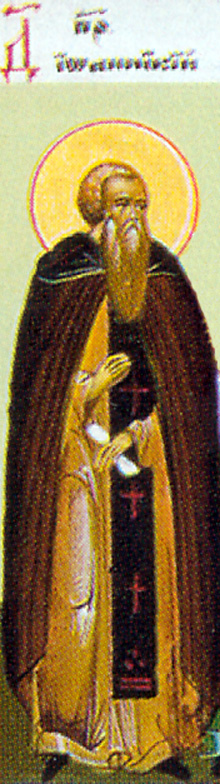
Venerable Joannicius the Great

Saint Joannicius the Great was born in Bithynia in the year 752 in the village of Marikat. His parents were destitute and could not provide him even the basics of an education. From childhood he had to tend the family cattle, their sole wealth. Love for God and prayer completely dominated the soul of the child Joannicius. Often, having shielded the herd with the Sign of the Cross, he went to a secluded place and spent the whole day praying, and neither thieves nor wild beasts came near his herd.

By order of the emperor Leo IV (775-780), a multitude of officials went through the cities and towns to draft young men for military service. Young Joannicius was also drafted into the imperial army. He earned the respect of his fellow soldiers for his good disposition, but he was also a brave soldier who struck fear in the hearts of his enemies. Saint Joannicius served in the imperial army for six years. More than once he was rewarded by his commanders and the emperor. But military service weighed heavily on him; his soul thirsted for spiritual deeds and solitude.

Saint Joannicius, having renounced the world, longed to go at once into the wilderness. However, on the advice of an Elder experienced in monastic life, he spent a further two years at the monastery. Here the saint became accustomed to monastic obedience, to monastic rules and practices. He studied reading and writing, and he learned thirty Psalms of David by heart.

After this, commanded by God to go to a certain mountain, the monk withdrew into the wilderness. For three years he remained in deep solitude in the wilderness, and only once a month a shepherd brought him some bread and water. The ascetic spent day and night in prayer and psalmody. After each verse of singing the Psalms Saint Joannicius made a prayer, which the Orthodox Church keeps to this day in a somewhat altered form, “The Father is my hope, the Son is my refuge, the Holy Spirit is my protection.”

By chance, he encountered some of his former companions from military service. The saint fled the wilderness and withdrew to Mount Kountourea to hide himself from everyone. Only after twelve years of ascetic life did the hermit accept monastic tonsure. The saint spent three years in seclusion after being tonsured. Then he went to a place called Chelidon to see the great ascetic Saint George (February 21). The ascetics spent three years together. During this time Saint Joannicius learned the entire Psalter by heart. As he grew older, Saint Joannicius settled in the Antidiev monastery and dwelt there in seclusion until his death.

Saint Joannicius spent seventy years in ascetic deeds and attained to a high degree of spiritual perfection. Through the mercy of God the saint acquired the gift of prophecy, as his disciple Pachomius has related. The Elder also levitated above the ground when he prayed. Once, he crossed a river flooded to overflowing. The saint could make himself invisible for people and make others also hidden from sight.

Once, Saint Joannicius led Greek captives out of prison under the very eyes of the guards. Poison and fire, with which the envious wanted to destroy the saint, did him no harm, and predatory beasts did not touch him. He freed the island of Thasos from a multitude of snakes. Saint Joannicius also saved a young nun who was preparing to leave the monastery to marry; he took upon himself the agonized maiden’s suffering of passion, and by fasting and prayer, he overcame the seductive assault of the devil.

Foreseeing his death, Saint Joannicius fell asleep in the Lord on November 4, 846, at the age of 94.

Hieromartyrs Nicander, Bishop of Myra, and Hermas, the Presbyter

The Hieromartyrs Nicander, Bishop of Myra, and Hermas the Presbyter, were disciples of the holy Apostle Paul’s follower and fellow ascetic, the holy Apostle Titus of the Seventy (August 25), and they were ordained by him to the priesthood.

Living the ascetic life amid incessant pastoral works, the saints converted many pagans to Christ. For this they were arrested and brought before the city prefect, Libanius. Neither flattery nor threats swayed the holy martyrs to renounce Christ. Then Libanius gave orders that they be tortured.

The saints endured fierce and inhuman torments: they were tied to horses and dragged over stones, their bodies were raked with iron hooks, and they were cast into a hot oven. The Lord helped them endure things that a mere man by his own strength could not endure. Towards the end, iron nails were hammered into their heads and hearts. They were thrown into a pit, then covered over with earth.

After enduring such a cruel death, now they live forever in the joy of the Lord (Mt. 25:21).

Venerable Mercurius the Faster of the Kiev Caves

No information available at this time.

Venerable Nicander, Abbot of Gorodensk, Novgorod

No information available at this time.

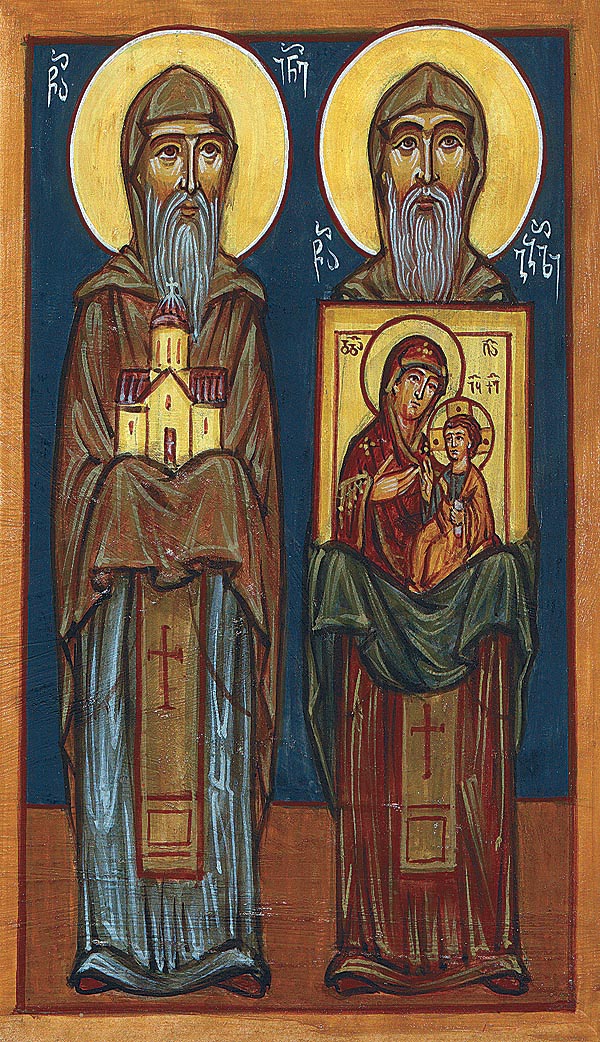
Saints John, Stephen, and Isaiah of Georgia

Among the multitude of saints we remember those Christians who dedicated their earthly lives to glorifying God and serving others. In a single lifetime they performed all the spiritual feats of the venerable and devout fathers, confessors, and martyrs.

Among the saints canonized by the Georgian Church, only four have been called “Righteous.” They are Saint Ilia Chavchavadze, well known as the “father” and “uncrowned king” of the Georgian nation, and Saints John, Steven, and Isaiah the Georgians.

It is believed that Holy John, Steven, and Isaiah lived in Jerusalem and guarded the Tomb of our Lord. It is probable that the Georgian Orthodox Church proclaimed them deserving of exceptional honor in recognition of their dedicated service at the Tomb of the Savior.

For several centuries the Georgian Church has glorified the Righteous John, Steven, and Isaiah and asked for their intercessions before the Lord.

Blessed Simon of Yurievets

Blessed Simon of Yurievets was born in the city of Yurievets in the Povolzhsk or Volga region. Forsaken by his parents, the saint took upon himself the exploit of foolishness for Christ. Both winter and summer he went barefoot, dressed only in a shirt, so that his skin became blackened and withered from fasting.

Thoughtless people often were cruel to him, sometimes beating him. The holy fool never complained, but prayed for those who mistreated him. Blessed Simon was fond of praying on the porches of various churches. The ascetic exploit of self-denial cleansed his soul, and he received from God the gift of clairvoyance: he foresaw many things and predicted the future. Contemporaries, mentioning his name, beheld various miraculous signs.

Just before his death, the saint went to the house of the military commander Theodore Petelin. He, not knowing the saint, in a fit of anger gave orders to beat him. Saint Simon fell grievously ill. He summoned a priest, made his confession, received the Holy Mysteries of Christ and commended his soul to God. The commander later repented of his sin.

The city gathered for the saint’s funeral, and the body of Blessed Simon was buried in Theophany monastery. This occurred on November 4, 1584. In the year 1635, Patriarch Joasaph ordered the Theophany monastery’s Igumen Dionysius to compile an account of the life and miracles of Blessed Simon and gave a blessing to paint his icon. The Feast of Blessed Simon was established in the year 1635.

Venerable Gabriel of Atonelni

No information available at this time.

Daily Readings for Monday, November 03, 2025

MONDAY OF THE 7TH WEEK

NO FAST

Acepsimas the Bishop, Joseph the Presbyter, & Aeithalas the Deacon, Martyrs of Persia, Dedication of the Temple of the Holy Great Martyr George in Lydda, George of Neapolis the New Martyr, Holy Father and New Hieromartyr Gregory of Neapolis, Theodore the Confessor, Bishop of Ancyra, Winifred of Treffynnon

ST. PAUL’S LETTER TO THE COLOSSIANS 2:13-20

Brethren, you who were dead in trespasses and the uncircumcision of your flesh, Christ made alive together with him, having forgiven us all our trespasses, having canceled the bond which stood against us with its legal demands; this he set aside, nailing it to the cross. He disarmed the principalities and powers and made a public example of them, triumphing over them in him. Therefore let no one pass judgment on you in questions of food and drink or with regard to a festival or a new moon or a sabbath. These are only a shadow of what is to come; but the substance belongs to Christ. Let no one disqualify you, insisting on self-abasement and worship of angels, taking his stand on visions, puffed up without reason by his sensuous mind, and not holding fast to the Head, from whom the whole body, nourished and knit together through its joints and ligaments, grows with a growth that is from God. If with Christ you died to the elemental spirits of the universe, why do you live as if you still belonged to the world?

LUKE 11:29-33

At that time, when the crowds were increasing, Jesus began to say, “This generation is an evil generation; it seeks a sign, but no sign shall be given to it except the sign of Jonah. For as Jonah became a sign to the men of Nineveh, so will the Son of man be to this generation. The queen of the South will arise at the judgment with the men of this generation and condemn them; for she came from the ends of the earth to hear the wisdom of Solomon, and behold, something greater than Solomon is here. The men of Nineveh will arise at the judgment with this generation and condemn it; for they repented at the preaching of Jonah, and behold, something greater than Jonah is here. No one after lighting a lamp puts it in a cellar or under a bushel, but on a stand, that those who enter may see the light.”

Hieromartyrs Akepsimas, Bishop in Persia, Presbyter Joseph, and Deacon Aeithalas

Martyrs Akepsimas the Bishop, Joseph the Presbyter and Aeithalas (Aeithalás) the Deacon of Persia were leaders of the Christian Church in the Persian city of Naesson. His flock devotedly loved their hierarch for his ascetic life and tireless pastoral work.

The emperor Sapor ordered his men to seek out and kill Christian clergy. Saint Akepsimas also was arrested, even though he was already an eighty-year-old man. They took him to the city of Arbela, where he came before the judge Ardarkh, a pagan priest of the sun god. The holy Elder refused to offer sacrifice to the Persian gods. For this he was fiercely beaten and thrown into prison, where on the following day the seventy-year-old priest Joseph and the deacon Aeithalas were severely beaten and thrown into jail with him. For three years the saints were held in confinement, and suffered from hunger and thirst.

Emperor Sapor came to the temple of the god of fire, located not far from Arbela, and wanted to take a look at the three holy martyrs. Exhausted and covered with festering wounds, the saints were brought before the emperor. When he asked them to worship the pagan gods they firmly refused, confessing their faith in Christ instead.

The holy bishop was beheaded, but the presbyter and deacon were taken into the city to be stoned.

The execution of the presbyter Joseph was prolonged for several hours. A guard was placed near the place of execution, so that Christians would not take the body of the holy martyr. On the fourth night a strong windstorm raged near the city, lightning killed the guard, the wind tossed stones about, and the body of Saint Joseph disappeared.

Deacon Aeithalas was taken to the village of Patrias, where he was stoned. Christians secretly buried his body. A tree grew on the saint’s grave, and its fruit brought healings.

Consecration of the Church of the Holy Great Martyr George in Lydda

The city of Lydda (Lod) is the birthplace of the Great Martyr George the Victorious. His mother's house was there, where he spent his childhood. The Holy Great Martyr George was a Roman soldier, he suffered under Emperor Diocletian in Nicomedia at the beginning of the IV century. His relics were transferred by Christians to their homeland, Lydda, and there he was buried.

The tomb where the relics of the Great Martyr were laid is now located in an Orthodox church dedicated to the Great Martyr George. In the temple itself there is a piece of the relics of Saint George, as well as the chain with which the Great Martyr was bound.

The first church was built here in the VI century. The temple was destroyed several times and was restored in its present form only in 1872, thanks to donations from Russia. The consecration of the restored temple took place on November 3, 1872, the anniversary of the day when it was first consecrated. The Russian Church remembers and celebrates this event until the present day. This Feast is included in the Menaion, in honor of the churches built and dedicated to Saint George in Russia.

It was also in Lydda that the Apostle Peter healed Aeneas, who had been lying paralyzed for eight years (Acts 9:32-35).

Martyrs Eudoxios, Agapios, Atticus, and those with them, at Sebaste

The glorious Martyrs Eudoxios, Agapios, Atticus, Marinus, Oceanus, Eustratios, Karterios, Nikopolitianos, Styrax, and Tobias were all soldiers in the city of Sebaste during the reign of Emperor Licinius. When they were examined by the lord of Seville, by Duke Marcellus, and also by Marcus Agricola, they boldly confessed that they were Christians, and were severely tortured in various ways. In the end they were thrown into the fire and burnt alive, thus they all received the unfading crown of martyrdom in the year 315.

These saints are commemorated on November 2 in Greek usage.

Venerable Akepsimas the Hermit of Cyrrhus in Syria

Saint Akepsimas, Hermit of Cyrrhus in Syria lived for sixty years in the desert, not far from Cairo. He devoted himself to fasting, silence and prayer. At the command of the patriarch, he came out of solitude and was consecrated a bishop. He died at a venerable old age.

Saint Snandulia of Persia

Saint Snandulia of Persia is mentioned in the account of the martyrdom of Saints Joseph the priest and Aethalas the deacon. The historian Sozomen also describes their sufferings in his Church History (Book 2, ch. 13).

Snandulia was a devout Christian of the city of Arbela who visited those who suffered in prison for the sake of Christ. When she learned that Saints Joseph and Aethalas were in the prison, she went with her servants by night and bribed the guards with gold. They allowed her to take the saints to her home until daybreak. They were barely alive and unable to speak. She took them home and put them to bed, tending their wounds, and kissing their shattered hands and feet.

Saint Joseph recovered consciousness and saw Snandulia weeping. He told her that the compassion she had shown for him and for Aethalas was pleasing to God, but he thought that her bitter lamentations were contrary to Christian hope.

She replied, “When one is moved by compassion, it is natural to weep.”

“Nevertheless,” Saint Joseph said, “you should not weep for us, for tortures borne for the sake of Christ are followed by eternal joy.”

The two saints were returned to prison the next morning, as promised. After six months their wounds had healed to some extent. They could stand and walk a little, but Aethalas’s hands hung at his side limp and useless.

Zerothus was appointed as a judge, and he entered the city offering sacrifice to the gods in the various temples. Some of the priests told him about Saints Joseph and Aethalas, who had been tortured on the orders of Prince Ardasabor, the head of all the Magi of Persia. They explained to Zerothus that their execution was being delayed until they recovered from their wounds.

When he heard this, Zerothus ordered that the martyrs be brought before him. He used flattery and then threats in an attempt to persuade them to offer sacrifice to the pagan gods. When this proved unsuccessful, the judge had them beaten for a long time.

When they were brought before the judge again, Zerothus tried to get the saints to eat food which had been offered to the idols, but they refused. Then the judge had them beaten again, and ordered other Christians to stone them. Soldiers went to the homes of the Christians to force them to come to the judgment hall. They dug a hole and placed Saint Joseph in it, then put stones in the hands of the Christians and compelled them to stone him.

Saint Snandulia was among these Christians, but she refused to throw stones at the aged priest. Then they gave her a lance and told her to kill Saint Joseph. She said that she would rather drive the lance into her own heart than to wound the saint with it.

Saint Joseph was eventually killed by all the stones that were thrown at him, and the holy deacon Aethalas was also stoned in the same way.

Saint Snandulia stretched forth her arms to needful works and opened her hands to the needy (Proverbs 31:19-20), but she refused to lift her hands to do evil against Saint Joseph.

Venerable Pimen the Bulgarian of the Zographou Monastery, Mount Athos

No information available at this time.

Princess Anna Vsevolodna

The Holy Princess Anna Vsevolodna was daughter of the Kievan Great Prince Vsevolod Yaroslavich (1078-1093) whose wife was daughter of the Byzantine Emperor Constantine Monomachos. She did not wish to marry, and as a virgin she took monastic tonsure in 1082 at the Andreiev Yanchinov monastery built for her at Kiev, but later destroyed under the Tatar invasion. The nun and princess Anna journeyed to Constantinople, from which she returned in the company of the newly-consecrated Metropolitan John the Eunuch. She died in the year 1112.

Venerable Nicholas, Radiant Star of the Georgians

Saint Nicholas was the author of many church services, but little else about his life is known. He lived in the second half of the 13th century, and the last years of his life coincided with the reign of King Vakhtang III, the son of the holy king Demetre the Devoted.

Saint Nicholas was one of the greatest hymnographers and spiritual figures of his time, but few of his works have been preserved. Catholicos Anton I writes that Nicholas composed numerous canons and services, including a “Canon of Supplication for Rain.” Saint Nicholas enriched the spiritual literature of Georgia with his translations as well. Scholars and historians believe that, as the greatest liturgist of his time, he was probably asked to translate many prayers and services from Greek to Georgian.

Among them, they believe, was the “Canon for the Blessing of Holy Water.”

The famous 19th-century historian Platon Ioseliani writes that other church services belonging to the pen of Saint Nicholas are included among the manuscripts of the Ivḗron Monastery on Mt. Athos.

Saint Nicholas reposed peacefully in the year 1308.

Saint Akepsimas

Saint Akepsimas (Ἀκεψιμᾶς) lived in the IV century, during the reign of Emperor Theodosios the Great. After living a cenobitic life in which he was distinguished for his piety, he sought refuge in the desert. He made his home in a cave, and was fed by the meager gifts which nature provided. Sometimes pious people passed by and brought him food. The Saint kept a little, but only that which was necessary for his food, giving the rest to the poor. He would invite his benefactors into the cave where he lived. There he returned their kindness by teaching them the Word of God.

Saint Akepsimas performed many miracles, and departed peacefully to the Lord.

Daily Readings for Sunday, November 02, 2025

5TH SUNDAY OF LUKE

NO FAST

5th Sunday of Luke, The Holy Martyrs Acindynos, Pegasios, Aphthonios, Elpidophoros, and Anempodistos, Domnina, Domna, & Kyriaki, the Martyrs

ST. PAUL’S LETTER TO THE GALATIANS 2:16-20

Brethren, knowing that a man is not justified by works of the law but through faith in Jesus Christ, even we have believed in Christ Jesus, in order to be justified by faith in Christ, and not by works of the law, because by works of the law shall no one be justified. But if, in our endeavor to be justified in Christ, we ourselves were found to be sinners, is Christ then an agent of sin? Certainly not! But if I build up again those things which I tore down, then I prove myself a transgressor. For I through the law died to the law, that I might live to God. I have been crucified with Christ; it is no longer I who live, but Christ who lives in me; and the life I now live in the flesh I live by faith in the Son of God, who loved me and gave himself for me.

LUKE 16:19-31

The Lord said, "There was a rich man, who was clothed in purple and fine linen and who feasted sumptuously every day. And at his gate lay a poor man named Lazaros, full of sores, who desired to be fed with what fell from the rich man's table; moreover the dogs came and licked his sores. The poor man died and was carried by the angels to Abraham's bosom. The rich man also died and was buried; and in Hades, being in torment, he lifted up his eyes, and saw Abraham far off and Lazaros in his bosom. And he called out, 'Father Abraham, have mercy upon me, and send Lazaros to dip the end of his finger in water and cool my tongue; for I am in anguish in this flame.' But Abraham said, 'Son, remember that you in your lifetime received your good things, and Lazaros in like manner evil things; but now he is comforted here, and you are in anguish. And besides all this, between us and you a great chasm has been fixed, in order that those who would pass from here to you may not be able, and none may cross from there to us.' And he said, 'Then I beg you, father, to send him to my father's house, for I have five brothers, so that he may warn them, lest they also come into this place of torment.' But Abraham said, 'They have Moses, and the prophets; let them hear them.' And he said, 'No, father Abraham; but if some one goes to them from the dead, they will repent.' He said to them, 'If they do not hear Moses and the prophets, neither will they be convinced if some one should rise from the dead.'

Martyrs Acindynus, Pegasius, Aphthonius, Elpidephorus, Anempodistus, and 7,000 with them, of Persia

Saint Acindynus suffered martyrdom in Persia along with Saints Pegasias, Aphthonius, Elpidephorus, Anempodistus, and 7,000 other Christians at the time of King Sapor II (310-381). These saints were Sapor’s courtiers, and were secret Christians. When the king began his persecution against Christians, envious pagans denounced them to him. Summoned to Sapor’s presence for trial, the holy martyrs fearlessly confessed their faith in the Holy Trinity. The king ordered them to be beaten with whips.

Sapor told the people that Saints Acindynus, Pegasias, Anempodistus and Elpidephorus would have their heads cut off, and that he would not permit the Christians to bury their bodies.

A tremendous crowd accompanied these saints as they were led outside the city walls for execution, glorifying Christ. On Sapor’s orders, soldiers massacred all the Christians in the procession (about 7,000), including Saint Elpidephorus.

Acindynus, Pegasias, and Anempodistus were burned on the following day with the mother of the emperor. Christians came secretly by night to the place of execution, found the bodies of the holy martyrs unharmed by the fire, and they buried them with reverence.

Saint Marcian of Cyrrhus

Saint Marcian of Cyrrhus lived during the fourth century. He went into the desert, where he lived for many years in solitude, unceasing prayer, and strict fasting. He built a small cell, and settled in it. The saint never lit candles for reading at night when he fulfilled his Rule of prayer, for the cell was filled with a divine light.

After several years the monk accepted two disciples, settling them beside him, but he continued to live as a hermit. The Patriarch Flavian of Antioch (February 18) and other bishops entreated the monk to abandon his strict solitude for the benefit of Christians, but he would not agree.

However, while not quitting his cell, he taught those coming to him for instruction and he turned many away from heresy and led them to the Orthodox Faith. Before his end, Saint Marcian instructed his disciple Eusebius to bury him secretly far from his cell, in order to shun posthumous glory and avoid contention among those wanting his relics for nearby churches. Saint Marcian died in the year 388.

“Ozerianka” Icon of the Mother of God of Shuiu-Smolensk

The Shuiu-Smolensk Wonderworking Icon of the Mother of God was painted in the years 1654-1655 in the Resurrection parish of the city of Shuiu, where an unrelenting pestilence raged. Trusting in the mercy of God and the intercession of the Mother of God, the parishioners of the Resurrection church commissioned a certain pious monk to paint the icon of the Smolensk Mother of God, an icon long attributed with being a rescuer of the Russian people from enemies and misfortune.

The parishioners spent the whole week in prayer and fasting while the image was being painted. When the icon was finished, the priest and the people took it to the church and set it in a specially built place. From that time the pestilence began to ease, at first in the area of the Resurrection parish, and then also in all the city.

From the Icon of the Mother of God many miracles of healing took place, especially of eye diseases. The icon is also celebrated on July 11, July 28, and Bright Tuesday.