
FRIDAY OF THE 7TH WEEK
ABSTAIN FROM MEAT, FISH, DAIRY, EGGS, WINE, OLIVE OIL
33 Martyrs of Melitene, Lazarus the Wonderworker, Martyr Athenodorus, Alexander the Martyr of Thessaloniki
ST. PAUL’S LETTER TO THE COLOSSIANS 4:10-18
Brethren, Aristarchos my fellow prisoner greets you, and Mark the cousin of Barnabas (concerning whom you have received instructions — if he comes to you, receive him), and Jesus who is called Justos. These are the only men of the circumcision among my fellow workers for the kingdom of God, and they have been a comfort to me. Epaphras, who is one of yourselves, a servant of Christ Jesus, greets you, always remembering you earnestly in his prayers, that you may stand mature and fully assured in all the will of God. For I bear him witness that he has worked hard for you and for those in Laodicea and in Hierapolis. Luke the beloved physician and Demas greet you. Give my greetings to the brethren at Laodicea, and Nympha and the church in her house. And when this letter has been read among you, have it read also in the church of the Laodiceans; and see that you read also the letter from Laodicea. And say to Archippos, “See that you fulfill the ministry which you have received in the Lord.” I, Paul, write this greeting with my own hand. Remember my fetters. Grace be with you. Amen.
LUKE 12:2-12
The Lord said to his disciples, "Nothing is covered up that will not be revealed, or hidden that will not be known. Therefore whatever you have said in the dark shall be heard in the light, and what you have whispered in private rooms shall be proclaimed upon the housetops. I tell you, my friends, do not fear those who kill the body, and after that have no more that they can do. But I will warn you whom to fear: fear him who, after he has killed, has power to cast into Gehenna; yes, I tell you, fear him! Are not five sparrows sold for two pennies? And not one of them is forgotten before God. Why, even the hairs of your head are all numbered. Fear not; you are of more value than many sparrows. And I tell you, every one who acknowledges me before men, the Son of man also will acknowledge before the angels of God; but he who denies me before men will be denied before the angels of God. And every one who speaks a word against the Son of man will be forgiven; but he who blasphemes against the Holy Spirit will not be forgiven. And when they bring you before the synagogues and the rulers and the authorities, do not be anxious how or what you are to answer or what you are to say; for the Holy Spirit will teach you in that very hour what you ought to say.
33 Holy Martyrs of Melitene
The holy martyr Hieron was born in the city of Tiana in great Cappadocia. Raised by a pious mother, he was a kindly and good Christian.
The co-ruling emperors Diocletian (284-305) and Maximian (284-305) sent a large military detachment headed by Lysias to Cappadocia to eradicate Christianity there, and also to conscript healthy and strong men into the imperial army. Among those pressed into service, Lysias also ordered his men to draft Hieron, who was distinguished by his great physical strength and dexterity. But Hieron refused to serve emperors who persecuted Christians. When they attempted to seize him by force and bring him to Lysias, he took a stick and started beating the soldiers who had been sent to bring him. The soldiers scattered, ashamed of being defeated by a single man. Hieron then hid himself in a cave with eighteen other Christians. Lysias would not risk losing his soldiers by storming the cave.
Upon the advice of Cyriacus, one of Hieron’s friends, Lysias lifted the siege of the cave and withdrew his detachment. Then Cyriacus persuaded Hieron not to offer resistance to the authorities. He and the other new conscripts and accompanying soldiers were sent to the nearby city of Melitene.
Soon Hieron had a vision in his sleep, in which his impending martyrdom was foretold. Lysias told the soldiers gathered at Melitene to offer sacrifice to the pagan gods. Hieron and another thirty-two soldiers refused to do this, and openly confessed their faith in Christ. Then the persecutor gave orders to beat the martyrs, and to cut off Hieron’s arm at the elbow. After cruel tortures they threw the martyrs into prison barely alive, and they beheaded them four days later.
A certain rich and illustrious Christian by the name of Chrysanthus ransomed Hieron’s head from Lysias. When the persecutions finally ceased, he built a church on the place where they executed the holy martyrs, and he placed the venerable head in it. The bodies of all the executed saints were secretly buried by Christians. In reign of the emperor Justinian, during the construction of the church of Hagia Eirene (Holy Peace), the venerable relics were uncovered and found incorrupt.
The other martyrs are: Hesychius, Nicander, Athanasius, Mamas, Barachius, Callinicus, Theogenes, Nikon, Longinus, Theodore, Valerius, Xanthius, Theodoulus, Callimachus, Eugene, Theodochus, Ostrychius, Epiphanius, Maximian, Ducitius, Claudian, Theophilus, Gigantius, Dorotheus, Theodotus, Castrichius, Anicletus, Themelius, Eutychius, Hilarion, Diodotus and Amonitus.
Venerable Lazarus, Wonderworker of Mount Galesius Near Ephesus
Saint Lazarus the Wonderworker of Mt Galesius near Ephesus was born in Lydia, in the city of Magnesium. An educated young man who loved God, Lazarus became a monk at the monastery of Saint Savva, the founder of great ascetic piety in Palestine. He spent ten years within the walls of the monastery, winning the love and respect of the brethren for his intense monastic struggles.
Ordained to the holy priesthood by the Patriarch of Jerusalem, Saint Lazarus returned to his native country and settled near Ephesus, on desolate Mount Galesius. Here he saw a wondrous vision: a fiery pillar, rising up to the heavens, was encircled by angels singing, “Let God arise and let His enemies be scattered.”
On the place where the saint beheld this vision, he built a church in honor of the Resurrection of Christ and took upon himself the feat of pillar-dwelling. Monks soon began to flock to the great ascetic, thirsting for spiritual nourishment by the divinely-inspired words and blessed example of the saint, and a monastery was established there.
Having received a revelation about the day of his death, the saint told the brethren. Through the tearful prayers of all the monks, the Lord prolonged the earthly life of Saint Lazarus for another fifteen years.
Saint Lazarus died at 72 years of age, in the year 1053. The brethren buried the body of the saint at the pillar upon which he had struggled in asceticism. He was glorified by many miracles after his death.
Saint Lazarus is also commemorated on July 17.
The Discovery of the Relics of Venerable Zosimas, Abbot of Vorbozomsk
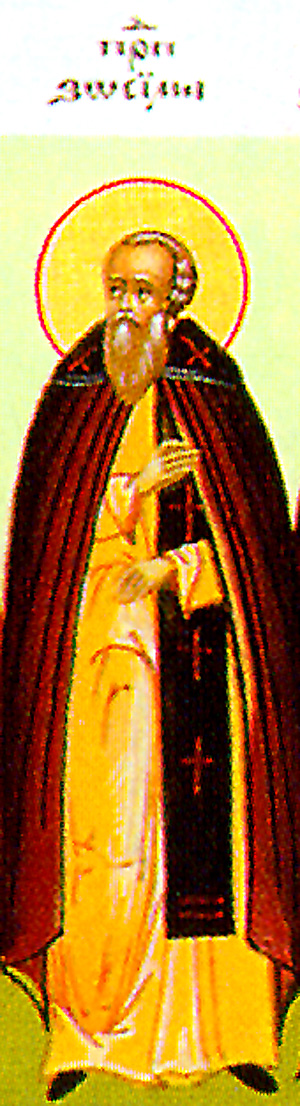
No information available at this time.
Finding of the relics of Venerable Cyril, Abbot of Novoezersk, Vologda

Saint Cyril the wonderworker of New Lake reposed on February 4, 1532.
In May 1648, during the reign of Alexei Mihailovich, a popular rebellion against Moscow broke out among some of those who were members of the Tsar's retinue. Peter Trahanitov, the head of the artillery, the Deacon Eleazar, and many others were killed and robbed. The rebellious crowd proceeded to the Beautiful Porch and demanded the extradition of the boyar Boris Morozov, the royal tutor and kinsman. They had already broken into his house and looted the property. The boyar, with some difficulty, managed to hide from the hands of the angry mob, and soon he took refuge in the Saint Cyril of White Lake Monastery. When Igoumen Amphilokhios and the brethren learned he would be staying with them, he sent the monk Jonah to him with the icon and the Life of Saint Cyril. The boyar graciously accepted the icon and was moved by the Saint's Life. After that, his soul was filled with joy and delight, but then his tormenting fears and grief returned, and he wanted to venerate Saint Cyril's grave.
After having a Moleben served at the grave and praying to the Saint with tears, the boyar said to the Igoumen and the brotherhood: "Holy Fathers, pray to God and His Most Pure Mother, and the venerable wonderworker Cyril for me. If God is merciful to me, by the prayers of Saint Cyril, and if I return to the royal city, and the great sovereign and his royal council take pity on me and restore me to my former rank, then I will build a stone church here in honor of the glorious Resurrection of Christ and in honor of Saint Cyril."
The delighted Igoumen and the brotherhood responded with their fervent good wishes. After distributing alms, the boyar returned to the Saint Cyril of White Lake Monastery. After a short time, after the excitement in Moscow subsided, the boyar was summoned by the Tsar and restored to his former position. The following year, in 1649, Morozov began to fulfill his promise. On September 4, at his orders, the Archimandrite Athanasios of the Saint Cyril of White Lake Monastery and the Elder Sabbatius Yushkov were at the foundation of the stone temple. In their presence they began to dig ditches, and when they came to the place where Saint Cyril's tomb was, a completely intact coffin was found among the roots of a tree.
Without a patriarchal decree and the blessing of the Metropolitan and the Archimandrite, Elder Sabbatius did not dare to take the coffin from the earth in order to open and to examine It. The coffin was placed on some boards, and the discovery was reported to Metropolitan Barlaam of Rostov, Patriarch Joseph, and the boyar Morozov. Morozov, after receiving the news, told the Tsar all this and informed him about the Life and miracles of the venerable Cyril. In October, the Patriarch, at the Tsar's suggestion, sent Archbishop Marcellus of Vologda with a Gramota instructing him to go to New Lake and examine the relics of the Saint, and move the relics to a temporary room, arrange a celebration, and report everything to the Tsar and Patriarch.
Archbishop Marcellus arrived at New Lake Monastery with Archimandrite Athanasios of Saint Cyril of White Lake Monastery and, from the same monastery, the cellarer Sabbatius with the Elders of the cathedral. On November 7, Igoumen Amphilokhios ordered them to remove the coffin from the earth, and then open it in order to inspect the Saint's relics and clothing. After the hierarch completed his inspection he placed the relics in a new coffin and moved it into the wooden church of the Resurrection of Christ.
On the Feast of the Dormition of the Theotokos Vespers was served at the cathedral in the evening. In the morning, before the Liturgy, a Moleben to the All-Merciful Savior, the Theotokos, and All Saints was served, with the blessing of water. Many sick persons were healed at the celebration. People took pieces of wood from the old coffin and brought them home because they had faith in their healing power.
Saint Cyril is commemorated on November 7 (the discovery of his relics), on January 23 (Synaxis of All Saints of Kostroma), and on the third Sunday after Pentecost (Synaxis of All Saints of Novgorod).
Martyrs Melasippus, Karina, their son, Antoninus, and forty children converted by their martyrdom, at Ancyra

The Martyrs Melasippus and Karina and their son Antoninus, and 40 children converted by their martyrdom at Ancyra suffered during the reign of the emperor Julian the Apostate in the city of Ancyra in Phrygia in the year 363. The holy Martyrs Melasippus and Karina, lacerated by iron hooks and exhausted, died under torture.
Their son Antoninus, whom the persecutor forced to watch the torture of his parents, spat in the face of the apostate emperor. For this he was subjected to cruel tortures, but he remained unharmed, and then he was beheaded. Forty other youths, seeing that the Lord had preserved His confessor Antoninus unharmed by tortures, believed in Christ, and they openly confessed their faith and endured martyrdom..
Martyrs Auctus, Taurion, and Thessalonica, at Amphipolis, in Macedonia
Saints Auctus and Taurion suffered martyrdom with Saint Thessalonica, the daughter of a pagan priest. When the impious father learned that his daughter had become a Christian, he ruthlessly beat her and threw her out of the house, with no means of providing for herself. Saints Auctus and Taurion attempted to intercede for the girl, and to reason with the embittered father. The pagan priest denounced them both to the authorities, and they were arrested.
After confessing their faith in Christ before the torturers and undergoing cruel torments, the saints were then beheaded. Soon after their martyric death, Saint Thessalonica also died. Her body was reverently buried in the city of Amphypolis in Macedonia, together with the holy Martyrs Auctus and Taurion.
“Joyful” Icon of the Mother of God

The “Joyful” (Взыграние) Icon of the Most Holy Theotokos appeared near Moscow on November 7, 1795. Nothing is known of the Icon's history, except that many miracles have taken place before it.
For many years, the Icon was one of the symbols of the Saint Nicholas – Ugresh Monastery (now called Dzerzhinsk). The history of the Monastery is associated with the name of the Holy Prince Dēmḗtrios of the Don, and the Battle of Kulikovo, 15 versts from Moscow. On his way there, he saw an icon of Saint Nicholas the Wonderworker in the branches of a tree. Not knowing where it came from, the Prince took it as a sign of God's blessing and vowed to establish a monastery on the site if he were victorious.
Thus, the Saint Nicholas – Ugresh Monastery was built, and also a cathedral church dedicated to Saint Nicholas, where the miraculous Icon of the Mother of God known as "Joyful" was later kept.
After the Revolution, the Icon disappeared when the Monastery was looted. By the mercy of God, one of the copies of the wonderworking Icon painted in 1814 has been preserved. Today, this ancient image is part of the collection of the Moscow State Museum.
However, in the Saint Nicholas – Ugresh Monastery there is another "Joyful" Icon of the Mother of God. At the beginning of the XXI century, believing Christians, who wished to remain anonymous, transferred a copy of that icon which they found at the Monastery in the 1990s. It belongs to the same iconographic type, but there are some differences from the original. There was Cross Procession as the brethren of the Monastery and its parishioners met the Icon at the gates, and it was placed in the Monastery's Holy Transfiguration Cathedral, where it is kept for the faithful to venerate.
Icons of this name are to be found in the Novodevichii Monastery in Moscow, and at Vatopedi Monastery on Mount Athos. In appearance, the “Joyful” Icon resembles the Πελαγονιτίσσα Icon, a variant of the Glykophylousa (“Sweet-Kissing”), or Eleousa (Merciful) type.
The Icon is sometimes called “Child Jumping for Joy.”
Martyr Theodotus of Ancyra
Saint Theodotus was an innkeeper. When seven virgins who lived near Corinth were drowned in a lake, he buried their bodies under the cover of night. For this reason, he was tortured and beheaded.
 Saint Peter Antiochian Orthodox Church