The Holy and Glorious Apostle Thomas, Eroteis the Martyr of Cappadocia, Makarios the Righteous of Chios
ST. PAUL’S FIRST LETTER TO THE CORINTHIANS 4:9-16
Brethren, God has exhibited us apostles as last of all, like men sentenced to death; because we have become a spectacle to the world, to angels and to men. We are fools for Christ’s sake, but you are wise in Christ. We are weak, but you are strong. You are held in honor, but we in disrepute. To the present hour we hunger and thirst, we are ill-clad and buffeted and homeless, and we labor, working with our own hands. When reviled, we bless; when persecuted, we endure; when slandered, we try to conciliate; we have become, and are now, as the refuse of the world, the off-scouring of all things. I do not write this to make you ashamed, but to admonish you as my beloved children. For though you have countless guides in Christ, you do not have many fathers. For I became your father in Christ Jesus through the gospel. I urge you, then, be imitators of me.
JOHN 20:19-31
On the evening of that day, the first day of the week, the doors being shut where the disciples were for fear of the Jews, Jesus came and stood among them and said to them, “Peace be with you.” When He had said this, He showed them His hands and His side. Then the disciples were glad when they saw the Lord. Jesus said to them again, “Peace be with you. As the Father has sent Me, even so I send you.” And when He had said this, He breathed on them and said to them, “Receive the Holy Spirit. If you forgive the sins of any, they are forgiven; if you retain the sins of any, they are retained.” Now Thomas, one of the twelve, called the Twin, was not with them when Jesus came. So the other disciples told him, “We have seen the Lord.” But he said to them, “Unless I see in His hands the print of the nails, and place my finger in the mark of the nails, and place my hand in His side, I will not believe.” Eight days later, His disciples were again in the house, and Thomas was with them. The doors were shut, but Jesus came and stood among them and said, “Peace be with you.” Then He said to Thomas, “Put your finger here, and see My hands; and put out your hand, and place it in My side; do not be faithless, but believing.” Thomas answered Him, “My Lord and My God!” Jesus said to him, “Have you believed because you have seen Me? Blessed are those who have not seen and yet believe.” Now Jesus did many other signs in the presence of the disciples, which are not written in this book; but these are written that you may believe that Jesus is the Christ, the Son of God, and that believing, you may have life in His name.
Glorification of Saint Innocent, Metropolitan of Moscow, Enlightener of the Aleuts, Apostle to the Americas
Saint Innocent, Metropolitan of Moscow, Enlightener of the Aleuts and Apostle to America (in the world John Popov-Veniaminov), was born on August 26, 1797 in the village of Anginsk in the Irkutsk diocese, into the family of a sacristan. The boy mastered his studies at an early age and by age seven, he was reading the Epistle in church. In 1806 they sent him to the Irkutsk seminary. In 1814, the new rector thought it proper to change the surnames of some of the students. John Popov received the surname Veniaminov in honor of the deceased Archbishop Benjamin of Irkutsk (+ July 8, 1814). On May 13, 1817 he was ordained deacon for the Irkutsk Annunciation church, and on May 18, 1821, he was ordained priest.
The missionary service of the future Apostle of America and Siberia began with the year 1823. Father John spent 45 years laboring for the enlightenment of the peoples of Kamchatka, the Aleutian Islands, North America, Yakutsk, the Khabarov frontier, performing his apostolic exploit in severe conditions and at great risks to life. Saint Innocent baptized ten thousand people, and built churches, beside which he founded schools and he himself taught the fundamentals of the Christian life. His knowledge of various crafts and arts aided him in his work.
Father John was a remarkable preacher. During the celebration of the Liturgy, memorial services and the all-night Vigil, he incessantly guided his flock. During his time of endless travels, Father John studied the languages, customs and habits of the peoples, among whom he preached. His work in geography, ethnography and linguistics received worldwide acclaim. He composed an alphabet and grammar for the Aleut language and translated the Catechism, the Gospel and many prayers into that language. One of the finest of his works was the Indication of the Way into the Kingdom of Heaven (1833), translated into the various languages of the peoples of Siberia and appearing in more than 40 editions. Thanks to the toil of Father John, the Yakut people in 1859 first heard the Word of God and divine services in their own native language.
On November 29, 1840, after the death of his wife, Father John was tonsured a monk with the name Innocent by Saint Philaret, the Metropolitan of Moscow, in honor of Saint Innocent of Irkutsk. On December 15, Archimandrite Innocent was consecrated Bishop of Kamchatka, the Kurile and Aleutian Islands. On April 21, 1850 Bishop Innocent was elevated to the rank of archbishop.
By the Providence of God on January 5, 1868, Saint Innocent succeeded Metropolitan Philaret on the Moscow cathedra. Through the Holy Synod, Metropolitan Innocent consolidated the secular missionary efforts of the Russian Church (already in 1839 he had proposed a project for improving the organization of missionary service).
Under the care of Metropolitan Innocent a Missionary Society was created, and the Protection monastery was reorganized for missionary work. In 1870 the Japanese Orthodox Spiritual Mission headed by Archimandrite Nicholas Kasatkin [afterwards Saint Nicholas of Japan, (February 3)] was set up, with whom Saint Innocent had shared much of his own spiritual experience. The guidance by Saint Innocent of the Moscow diocese was also fruitful, by his efforts, the church of the Protection of the Most Holy Theotokos was built up into the Moscow Spiritual Academy.
Saint Innocent fell asleep in the Lord on March 31, 1879, on Holy Saturday, and was buried at the Holy Spirit Church of the Trinity-Saint Sergius Lavra. On October 6, 1977, Saint Innocent was glorified by the Russian Orthodox Church. His memory is celebrated three times during the year: on March 31, the day of his blessed repose, on October 5 (Synaxis of the Moscow Hierarchs), and on October 6, the day of his glorification.
Holy, Glorious Apostle Thomas
The Holy and Glorious Apostle Thomas was born in the Galilean city of Pansada and was a fisherman. Hearing the good tidings of Jesus Christ, he left all and followed after Him. The Apostle Thomas is included in the number of the holy Twelve Apostles of the Savior.
According to Holy Scripture, the holy Apostle Thomas did not believe the reports of the other disciples about the Resurrection of Jesus Christ: “Unless I see in His hands the print of the nails, and put my finger into the print of the nails, and thrust my hand into His side, I will not believe” (John 20:25).
On the eighth day after the Resurrection, the Lord appeared to the Apostle Thomas and showed him His wounds. “My Lord and my God,” the Apostle cried out (John 20:28). “Thomas, being once weaker in faith than the other apostles,” says Saint John Chrysostom, “toiled through the grace of God more bravely, more zealously and tirelessly than them all, so that he went preaching over nearly all the earth, not fearing to proclaim the Word of God to savage nations.”
Some icons depicting this event are inscribed “The Doubting Thomas.” This is incorrect. In Greek, the inscription reads, “The Touching of Thomas.” In Slavonic, it says, “The Belief of Thomas.” When Saint Thomas touched the Life-giving side of the Lord, he no longer had any doubts.
According to Church Tradition, the holy Apostle Thomas founded Christian churches in Palestine, Mesopotamia, Parthia, Ethiopia and India. Preaching the Gospel earned him a martyr’s death. For having converted the wife and son of the prefect of the Indian city of Meliapur [Melipur], the holy apostle was locked up in prison, suffered torture, and finally, pierced with five spears, he departed to the Lord. Part of the relics of the holy Apostle Thomas are in India, in Hungary and on Mt. Athos. The name of the Apostle Thomas is associated with the Arabian (or Arapet) Icon of the Mother of God (September 6).
Monastic Martyr Macarius of Saint Anne Skete, Mount Athos
No information available at this time.
“O All-Hymned Mother” Icon of the Mother of God
The Icon “O All-Hymned Mother” derives its title from the thirteenth Kontakion of the Akathist to the Most Holy Theotokos. “O All-Hymned Mother who bore the Word, holiest of all the saints….”
The Mother of God wears a crown, and clasps Her child to Her breast with both hands. Christ is held in Her left arm, and rests on Her left shoulder. He is facing Her, and both of His hands are placed below Her neck.
Instead of the usual stars on Her head and shoulders, the faces of angels appear in three circles. This is similar to the Arabian Icon (September 6) and the “Stone of the Mountain not cut by Hands” Icon on the iconostasis of the cathedral of the Transfiguration at Solovki.
2nd Sunday of Luke, Charitina the Martyr, Methodia the Righteous of Kimolos, Eudokimos the Unknown of Mount Athos, Peter, Alexis, Jonah, Hermogenes & Tikhon, Metropolitans of Moscow
ST. PAUL’S SECOND LETTER TO THE CORINTHIANS 6:16-18; 7:1
Brethren, you are the temple of the living God; as God said, "I will live in them and move among them, and I will be their God, and they shall be my people. Therefore come out from them, and be separate from them, says the Lord, and touch nothing unclean; then I will welcome you, and I will be a father to you, and you shall be my sons and daughters, says the Lord Almighty.
Since we have these promises, beloved, let us cleanse ourselves from every defilement of body and spirit, and make holiness perfect in the fear of God.
LUKE 6:31-36
The Lord said, “As you wish that men would do to you, do so to them. If you love those who love you, what credit is that to you? For even sinners love those who love them. And if you do good to those who do good to you, what credit is that to you? For even sinners do the same. And if you lend to those from whom you hope to receive, what credit is that to you? Even sinners lend to sinners, to receive as much again. But love your enemies, and do good, and lend, expecting nothing in return; and your reward will be great, and you will be sons of the Most High; for he is kind to the ungrateful and the selfish. Be merciful, even as your Father is merciful.”
Martyr Charitina of Amisos
Saint Charitina (Charitίnē) was from Amisos (Amisós) in Pontus and lived during the reign of Emperor Diocletian (284-305). Orphaned at a young age, she became the servant of a noble Roman Christian named Claudianus, or Claudius, who brought her up as his own daughter. The young girl was very pretty, sensible, and kind. She imparted her love for Christ to others, and brought many to the path of salvation. Saint Charitina was meek, humble, obedient and silent. Although she was not yet baptized, she was a Christian at heart. She studied the Law of God day and night, and vowed to preserve her virginity as a true bride of Christ.
Because Saint Charitina brought many others to the Christian Faith, Dometius, one of Emperor Diocletian's governors, came to hear of her and sent a letter to Claudius, ordering him to send Charitina to him so that he might question her. Claudius had no doubts about the result of this interrogation. Grieved at the prospect of losing her, he put on sackcloth and wept bitter tears. Charitina comforted him, saying: "Do not grieve, my Master, but rejoice, for I am to become an acceptable sacrifice to God, for my sins and for yours."
Claudius replied: "O Servant of God, remember me when you stand before the heavenly King in the ranks of the Holy Martyrs."
The Saint was brought before a judge at the tribunal. He asked her: "Is it true that you are a Christian, and that you delude others by bringing them to your impious faith?"
Charitina replied: "It is true that I am a Christian, but it is a lie that I delude others. On the contrary, I lead them from deception to the path of truth, bringing them to my Christ."
Then the judge ordered her hair to be cut off, but by the power of God, her hair grew back even longer than before. Then burning coals were placed on her head, and vinegar was poured over her scorched flesh, increasing her pain. They drove flaming sticks through her breasts, and burnt her sides with candles. Finally, they tied a stone around her neck and threw her into the sea. She cried out: "This is my Baptism." Suddenly, the stone was loosened and sank, and God delivered her from the sea unharmed.
When the judge saw her on the shore, he ordered his men to seize her and strip her naked, and then tie her to a wheel which turned over burning coals, but an Angel of God stopped the wheel and once again Saint Charitina remained unharmed. The judge became furious and ordered that the nails of her hands and her feet be torn out, and that all her teeth be broken.
Then the wicked judge sent many dissolute men to rape her. Fearing this dishonor, Saint Charitina prayed that God would receive her soul before these vile men could defile her virginal body; and so, as she prayed, she surrendered her pure soul to God.
When the judge saw that she was dead, he had her body placed in a sack weighted with stones, and tossed it into the sea. By Divine Providence, her body was brought to the shore three days later. Her master Claudius found her body and buried her with appropriate honor and reverence.
Fragments of Saint Charitina's Holy Relics are found in the Monasteries of Kykkos, Cyprus, and Jerusalem of Boeotia.
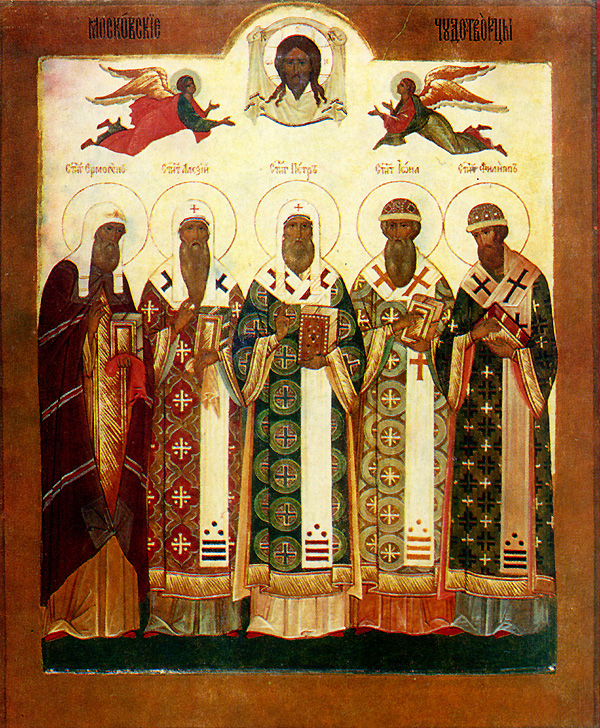
Synaxis of the Hierarchs of Moscow
The celebration of a special Feast Day to honor Saints Peter, Alexei, and Jonah, Metropolitans and Wonderworkers of All Russia, was established by Patriarch Job on October 5, 1596. In 1875, Saint Innocent, Metropolitan of Moscow, proposed that Saint Philip be included with the others. Saint Ermogénes was added in the year 1913.
Just as the Three Hierarchs Saints Basil the Great, Gregory the Theologian and John Chrysostom have their individual Feast Days, they are also commemorated together on January 30. Similarly, on October 5 the Russian Church honors the First Hierarchs of Moscow, Saints Peter, Alexei, Jonah, Philip, and Ermogenes (Ermogénes), who also have their own separate Feast Days as well. In this manner, the Russian Church honors them separately, and collectively today, glorifying them as guardians of the Church, and heavenly intercessors before the Throne of God.
In 2005, the names of Saint Innocent, Saint Makarios, Saint Job, Saint Tikhon, Saint Philaret, Saint Peter (Polyansky), and Saint Makarios (Nevsky) were added to the list of the other Hierarchs who are commemorated on October 5. These seven names, however, have not been added to the Menaion Service by the Russian Orthodox Church.
Information about the lives of these holy Hierarchs is to be found under the dates of their commemoration:
Venerable Damian the Healer, Jeremiah, and Matthew, Clairvoyants, of the Kiev Caves
Saints Damian the Presbyter and Healer, Jeremiah and Matthew, Clairvoyants of the Kiev Caves, Near Caves, were described by Saint Nestor the Chronicler (October 27).
Saint Damian (+1071) remembered the Baptism of Rus (in year 988). The zealous imitator of Saint Theodosius (May 3) was gentle, industrious and obedient, to the joy of all the brethren. He spent the entire night at prayer and reading the Divine Scriptures. Saint Damian was strict in fasting, and ate nothing but bread and water. The Lord rewarded him with the gift of treating ailments.
Saint Jeremiah had the gift of the Lord to see into the future, and to see into the moral condition of a person. He died at an old age (+ ca. 1070).
In the Iconographers’ Manual it says, “Matthew has the appearance of a clairvoyant Elder, with a black greyish beard like Vlas, in black klobuk, a monastic robe, hands pressed to the heart.”
The general troparion to these saints is: “Your hearts were enlightened with the light of Christ’s commandments, and you dispelled the dread darkness. Like an abode of the Trinity, from whom we receive grace, O Fathers Damian, Jeremiah and Matthew, you heal the infirm, and you announce the future in the communion with the angels. We pray to you to intercede with Christ God to grant to us the communion of the saints.”
They are also commemorated on September 28 and the second Sunday of Great Lent
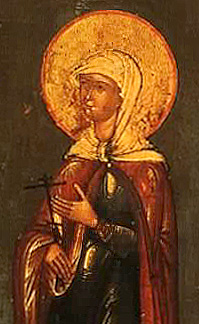
Saint Charitina, Princess of Lithuania
Saint Charitina, Princess of Lithuania, nun of Novgorod, pursued asceticism in a Novgorod women’s monastery in honor of the holy apostles Peter and Paul, built on Sinich hill.
Having resolved to dedicate her life to the Lord, she became a nun. For her virtuous life she was made Abbess of the monastery. Until the time of her death, she was a sister to all through her humility, purity and strict temperance. She fell asleep in the Lord in the year 1281 and was buried in the Peter and Paul monastery church.
In the Iconographers’ Manual it says, “The holy and righteous Charitina, Abbess of the Peter and Paul women’s monastery at Novgorod. She was born of Lithuanian royalty, yet appears as a maiden in a single garb without the mantiya.”
Hieromartyr Dionysius, Bishop of Alexandria
Saint Dionysius, Bishop of Alexandria, was the son of wealthy pagan parents. He converted to Christianity at a mature age, and became a pupil of Origen. Later, he was appointed as the head of Alexandria’s Catechetical School, and then became Bishop of Alexandria in the year 247.
Saint Dionysius devoted much effort to defend the Church from heresy, and he encouraged his flock in the firm confession of Orthodoxy during the persecution under the emperors Decius (249-251) and Valerian (253-259).
The holy bishop endured much suffering in his lifetime. When the Decian persecution broke out, Saint Dionysius was forced to flee Alexandria, but returned when the Emperor died. He was later exiled to Libya during the reign of Valerian.
When he was able to resume his duties in Alexandria in 261, Saint Dionysius had to contend with civil war, famine, plague, and other difficulties. The saint called upon his flock to tend sick Christians and pagans alike, and to bury the dead. Concerning the death of his spiritual children he wrote, “In such a manner the best of our brethren have departed this life. This generation of the dead, a deed of great piety and firm faith, is no less of a martyrdom.”
Saint Dionysius illumined his flock through his preaching, and with deeds of love and charity. An illness prevented him from attending the Council of Antioch (264- 265), and he fell asleep in the Lord while it was in session.
The influence of Saint Dionysius extended beyond the limits of his diocese, and his writings dealt with practical as well as theological subjects (“On Nature,” “On Temptations,” “On the Promises,” etc.). He was also familiar with Greek philosophy. Only fragments of his writings survive today, most of them preserved in Eusebius, who mentions him in his CHURCH HISTORY ( Book 7) and calls him “Dionysius the Great.”
Two complete letters of Saint Dionysius are extant, one addressed to Novatian, and the other to Basilides.
Martyr Memelchtha of Persia
The Martyr Memelchtha of Persia was, before her conversion to the Christian Faith, a pagan priestess of the goddess Artemis.
The saint’s sister convinced her to accept Baptism. When the pagans saw Memelchtha in her white baptismal robe, they stoned her. The saint suffered in the year 344. Later, a church was dedicated to her on the site of the temple of Artemis.
Saint Gregory of Chandzoe, Georgia
Our Holy Father Gregory of Khandzta was raised in the court of the Kartlian ruler Nerse. His family was part of the Meskhetian aristocracy. He received an education befitting his family’s noble rank and displayed a special aptitude for the sciences and theology.
The youth chosen by God was extraordinarily dedicated to his studies. In a short time he memorized the Psalms and familiarized himself with the doctrines of the Church. He also learned several languages and knew many theological works by heart.
While Gregory was still young, his loved ones expressed a wish to see him enter the priesthood. The wise youth had aspired to the spiritual life from early on, but he considered himself unprepared to bear such an enormous responsibility. “My pride prevents me from fulfilling your desire,” he told them.
Finally he consented to be ordained a priest, but the local princes sought to consecrate him a bishop. Frightened at the prospect, Gregory secretly fled to southwestern Georgia with three like-minded companions: his cousin Saba (a future bishop and the reviver of Ishkhani Monastery), Theodore (the builder of Nedzvi [Akhaldaba] Monastery), and Christopher (the builder of the Dviri Monastery of Saint Cyricus). The four brothers were unified by faith and love of God and bound by a single desire, as though they were one soul existing in four bodies.
The brothers arrived at the Monastery of Saint John the Baptist in Opiza and presented themselves before the abbot George. With his blessing they labored there for two years. Then Saint Gregory visited the monk Khvedios, the righteous hermit of Khandzta. Prior to Gregory’s arrival, Khvedios had received a sign from God indicating that a monastery would be built in Khandzta by the hands of the priest Gregory. It was revealed to him that Fr. Gregory’s prayers were so holy that their sweet-smelling fragrance rose up before God like incense. The monk showed Saint Gregory the environs, and he was so drawn to this area that he soon returned there with the other brothers and began to build a monastery.
The monks were forced to construct the monastery in difficult conditions, since the earth was rocky and mountainous and they were not equipped with the proper tools. First they built a wooden church, and later four cells and a dining hall.
A certain aristocrat by the name of Gabriel Dapanchuli lived nearby, and Gregory turned to him for help with construction of the monastery. With great joy he donated the stone, labor and food necessary for this worthy project to be realized. In such a way the first monastery church in Khandzta was established.
Gabriel informed Holy King Ashot Kuropalates about the brothers’ activity, and the king invited their leader, Saint Gregory, to the palace.
There he received him with great honor, asked him to bless the royal family, and inquired in detail about the life and labors of the holy monks. Then he presented Gregory with a generous donation to the monastery and, having learned that the land in Khandzta could not be cultivated, bestowed upon the monastery a large plot of fertile land in Shatberdi. King Ashot’s sons, the princes Adarnerse, Bagrat, and Guaram, also donated generously to the monastery.
And so, during the bloody Arab-Muslim period of rule, when the Georgian people had sunk into deep despair, the Klarjeti Wilderness was transformed into a life-giving oasis to which the greatest sons of the nation flocked.
The rules of the monastery were strict. In each monk’s cell was nothing but a short, stiff bed and a small pitcher for water. Neither fires nor candles were lit inside.
Saint Gregory was known throughout all of Georgia. At the request of King Demetre II of Abkhazeti (837-872), Fr. Gregory built a monastery in the village of Ubisi in Imereti and appointed his disciple Ilarion of Jerusalem as abbot. He built this monastery on the border of western and eastern Georgia and in so doing foresaw the unification of the two kingdoms.
The Lord performed many miracles through Saint Gregory. Once the church bell-ringer was approaching the abbot’s cell and saw a light issuing forth from inside. He knew that Saint Gregory had lit neither a fire nor his oil lamp, and he became frightened, believing that a fire might have started in the abbot’s cell. As it turned out, others had witnessed similar wonders: when the saint stood praying, he would light up like the sun, and beams of light would emanate from his body in the shape of a cross.
Venerable Gregory stood firmly in defense of morality, and he even confronted King Ashot Kuropalates when his conduct was at odds with the values of the Georgian people. Gregory had united his companions in their love of God, but among the roses there appeared a thorn. A certain Tskir, a protégé of the Tbilisi emir Sahak, schemed to obtain the episocopal see of Anchi.
He forcibly took control of Anchi Cathedral and committed many blasphemies. The clergy, and venerable Gregory in particular, condemned his behavior, but Tskir was consumed by pride and hired a killer to eliminate Saint Gregory. Like a prophet, Saint Gregory foresaw the imminent danger but went out to meet it nevertheless. Approaching his victim, while still at a distance from him, the murderer saw a bright light enveloping the holy father. He froze in fear, and his hand immediately withered. Only the prayers of Saint Gregory could heal him and permit him to return home.
The Church excommunicated Tskir, and he fled to the emir for refuge. With Sahak’s help he returned to the throne of Anchi and sent a military detachment to destroy Khandzta Monastery.
The monks of Khandzta and their abbot met the attackers in meekness and requested time to celebrate the Sunday Liturgy. The whole brotherhood prayed tearfully to the Lord to save the monastery.
The Liturgy had not yet been completed when a messenger arrived from Anchi to report that Tskir had died suddenly.
Near the end of his life Saint Gregory spent most of his time at Shatberdi Monastery, which he himself had built. When he received a sign that his death was approaching, he distributed candles throughout all the monasteries in the Klarjeti Wilderness and requested that they be burned on the day of his death. He asked all to remember him and bade farewell to Khandzta.
On the day of his repose, holy fathers from all over Klarjeti gathered to receive a final blessing from their teacher. Gregory blessed them, admonished them for the last time, and gave up his soul to God. When he breathed his last, a voice was heard from heaven, calling him: “Do not be afraid to come, O Venerable Servant of Christ, for Christ, the King of heaven, has Himself anointed you an earthly angel and a heavenly man. Now come and approach thy Lord with great joy and prepare for exaltation, for you are blessed among the saints and your everlasting glory has been prepared!”
Abounding in blessings and perfect in wisdom, justly ruling the inhabitants of the wilderness, Saint Gregory of Khandzta reposed on October 5, 861, at the age of 102. In accordance with his will, he was buried among his brothers at Khandzta Monastery.
Venerable Eudokimos of Vatopedi Monastery on Mount Athos
Nothing is known about the life and deeds of Venerable Eudokimos (Eudókimos) of Vatopedi.
On October 5, 1840,1 the monks of the Athonite Monastery of Vatopedi were renovating the burial vault for the brethren. Suddenly, the roof collapsed, covering one of the corners of the vault. The monks began to clear the blocked corner and suddenly they smelled a wondrous fragrance.
After clearing the rubble from the vault, the monks found a human skeleton clothed in a cloth chiton. The skeleton was in a kneeling position, his hands were folded on his chest and held an icon of the Most Holy Theotokos. His holy relics exuded such a fragrance that it filled everything around. The brethren of the monastery considered this as a sign that the Saint had pleased the Lord.2 Judging by his clothes, he reposed during the first half of the XVII century.
Archbishop Chrysanthos of Smyrna (who was living in retirement at the Monastery), addressed Metropolitan Gregory of Adrianople and the brethren, saying: "With the dissolution of the flesh, our very bones give a certain tribute to the earth with a stench; but the relics of this unknown Saint exude a paradisiacal fragrance. Should we not conclude from this that the Spirit of God, Who dwelt in this Saint during his lifetime, has not forsaken him after his death? Therefore, let us glorify God, Who is wondrous in His Saints, and let us honor His holy servant."
The fragrant relics were transferred to the katholikon on the evening of October 4, and soon healings took place from them. With the blessing of the Patriarch of Constantinople, the brethren gave the Saint the symbolic name of Eudokimos. it was decided that if he did not wish to be glorified with that name, he would appear to the monks and reveal his true name.
It remained a mystery exactly how the relics of the unknown monk got into the tomb, because a deceased monk is first buried; and after three years, only his bones are placed in the vault. According to one version, the Saint foresaw the hour of his death, but he said nothing to anyone and, taking an icon of the Mother of God, he hid in a remote place in the burial vault, where he departed quietly and humbly to the Lord.
Since then, the Venerable Newly-Appeared Eudokimos has been honored on Mount Athos. His relics continue to emit a fragrance, and they are renowned for their numerous miraculous healings. By praying to the Saint, one of the monks on the Holy Mountain, who suffered from consumption and was near death, was healed. Another monk, Gabriel, was also healed by praying to the Saint, and in gratitude he donated a precious silver reliquary for the venerable head of Venerable Eudokimos.
Some time after the discovery of the relics, a certain monk from Vatopedi had a vision, in which the Saint said that his true name was Savva. Monastic tradition continues to identify Saint Eudokimos with a monk who lived during the XIV century: Saint Savva of Vatopedi. However, doubts were expressed about this, and the Church did not pronounce its judgment on this occasion.
Through the prayers of our Venerable Father Eudokimos, may we all be delivered from the afflictions of body and soul which we may encounter, and may we also inherit the Heavenly Kingdom. Amen.
1 An article in Orthodox Life # 5, 1979 says that in September 1841 renovations were being carried out on the dilapidated burial vault at Vatopedi Monastery during the tenure of Archimandrite Philaret, where the bones of the Fathers and brethren were kept. When the workers started to dismantle the roof, it caved in, due to their negligence, and one corner of the vault was filled with rubble.
2 Greek, εὐδοκία: i.e., "good will, glorified, pleasant, or given by grace."
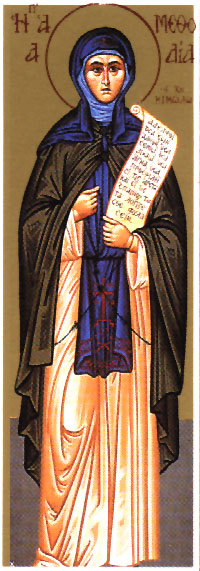
Righteous Methodia of Kimolos
Saint Methodίa was born on the island of Kίmolos on November 10, 1865, to devout parents. Her father's name was Jacob Sardēs, and her mother's name was Maria. They had three sons and five daughters, the second of whom was called Irene.
From childhood the Saint was drawn to divine things and always frequented the church. When she reached a suitable age, she married a sailor, in order to please her parents. Although she was married, her zeal for the Church remained unabated. One day, however, while her husband was out on a voyage, he was shipwrecked and drowned near Asia Minor.
Later Irene was tonsured in the church of Panagia Hodēgḗtria on Kίmolos by Archbishop Methodios of Syros, who renamed her Methodίa. Her joy knew no bounds, and she followed the evangelic commandments of the Lord with all her soul. Her ascetical struggles were severe, and she was a living example for all. Therefore, Christ, Who dwells in pure hearts, also came to dwell in her, and she became a chosen vessel (Acts 9:15). The report of her great virtue spread everywhere and a multitude of women went to stay with her, in order to find a spiritual refuge and a safe harbor from the storms of life. The Saint's inspired words were a source of refreshment and healing for the afflicted souls of these women, and she guided them on the path of repentance. In addition to her other gifts, God gave Saint Methodίa the grace to work miracles.
Venerable Methodίa reposed peacefully on Sunday, October 5, 1908 at the age of 43. She was glorified as a Saint on October 5, 1991.
Venerable Fathers and Mothers of the Klarjeti Wilderness
For centuries the region of Tao-Klarjeti in southwestern Georgia was known for its holiness, unity and spiritual strength. The cultural life and faith of Kartli were nearly extinguished by the Arab-Muslim domination from the 8th to 10th centuries. Tao-Klarjeti, however, which had been emptied by a cholera epidemic and the aftermath of the Islamic invasions, filled with new churches and monasteries, becoming a destination for many Christian ascetics. Saint Ekvtime Taqaishvili wrote that “Every monastery included a school and a seminary where the Christian Faith, philosophy, Greek and other foreign languages, chant, calligraphy, fine arts, jewelry making, and other disciplines were taught. Countless priests, translators, miniaturists, and jewelry makers developed their craft in these schools.”
The prayers of the Tao-Klarjeti monastics multiplied and were lifted up to the heavens like holy incense. Hagiographical works were written, original hymns composed, and theological texts translated.
The literature of this period was thoroughly infused with the spirit of the Georgian people. Tao-Klarjeti reinvigorated the soul of the Georgian people and redirected the lost back to the true path.
Saint Gregory of Khandzta, a priest of great virtue and wisdom, spearheaded this spiritual revival. He was a good shepherd to his flock and the builder of many churches. The Lives of Saint Gregory of Khandzta and the other holy fathers and mothers of Tao-Klarjeti are recounted in Saint George Merchule’s work The Life of Saint Gregory of Khandzta. George Merchule labored in the Khandzta wilderness in the 10th century. His epithet, “Merchule,” means “the theologian” or literally “the knower of the law.”
George Merchule also provided the Church with the Life of Holy Catholicos Nerse III, an Armenian by descent. Nerse confessed the Orthodox Faith and labored in Tao-Klarjeti with the Georgian fathers. (At that time many Orthodox Armenians fled to Tao-Klarjeti after being exiled from their homeland.) In the first half of the 7th century Saint Nerse laid the foundations of Ishkhani Church and labored there in holiness.
Holy Catholicos Hilarion was the founder and abbot of Tsqarostavi Church and a disciple of Gregory of Khandzta. He arrived at Khandzta Monastery with his spiritual father, Saint David, Abbot of Midznadzori Monastery, and Saint Zachariah, the builder of Beretelta Church. Those who witnessed the fathers’ unity and piety abandoned the world to join them in offering their lives to God. In the middle of the 9th century Saint Hilarion was enthroned as Catholicos of Kartli in recognition of his wisdom and holiness. He followed Gabriel II (ca. 830-850) and was succeeded by Arsenius I “the Great” (ca. 860-887) in this most honorable role.
Saint Stephen of Tbeti was the first bishop of Tbeti. He was a major writer and hagiographer in the Church of his time and a brilliant figure of the Tao-Klarjeti literary school. Saint Stephen is credited with authoring the narrative The Martyrdom of Saint Gobron.
From his childhood Saint Zachariah of Anchi was filled with love and fear of God. Strict in his discipline but free from every constraint of this world, he led the life of a shepherd like St.David the Psalmist. As a child, Saint Zachariah would gather his friends and relate with precision the words and scenes he had witnessed in churches and monasteries. Once the bishop of Anchi observed this unusual pastime and reported seeing a pillar of light descend fromthe heavens and alight atop St.Zachariah’s head.
When he reached a mature age, Saint Zachariah became the spiritual leader of his brothers. Through his prayers many miracles were performed: he stopped the stone wall of a collapsing building from crashing to the ground, eliminated the troublesome birds and grasshoppers from the monastery’s vineyard, and killed two venomous snakes that were keeping his frightened brothers from the vineyard. Filled with good faith and virtue, Saint Zachariah was later consecrated bishop of Anchi.
Saint Macarius of Anchi served as bishop of Anchi following the repose of Saint Gregory of Khandzta in 861.
Saint Ezra of Anchi, of the noble Dapanchuli family, labored in holiness during the 10th century.
Saint Savva of Ishkhani was a cousin and one of the closest companions of St.Gregory of Khandzta. Along with two other friends, Christopher and Theodore, the young Savva accompanied Gregory of Khandzta to Klarjeti on a quest for the ascetic life. At first the young monks settled at Opiza Monastery and labored there with great zeal, and afterwards they moved to Khandzta.
Once Saint Savva made a pilgrimage with Saint Gregory to Byzantium, and there he learned the typica of the local monasteries. On the way back to Tao-Klarjeti, God revealed to them His will for Savva to restore Ishkhani Church, which had been destroyed by Arab-Muslim invaders. Saint Savva desired to begin this holy task at once, but he continued on the way with Saint Gregory at the latter’s insistence.
Later, Gregory assigned two monks to help Savva restore the church and sent the three of them to Ishkhani. By God’s grace, the brothers restored the church and monastery and the number of monks who labored there multiplied. Before long their abbot, Saint Savva, was consecrated bishop of Ishkhani.
Saint John the New Martyr for Christ labored at Khandzta Monastery. While he was journeying to Jerusalem on a pilgrimage, the Saracens captured him in Baghdad and attempted to torture him into a denial of the Christian Faith. But by shedding his blood Saint John demonstrated his immutable fidelity to the Faith of our Savior.
Saint Theodore, Founder of Nedzvi Monastery, and Saint Christopher, Founder of the Dviri Monastery of Saint Cyricus, were spiritual sons of Saint Gregory of Khandzta and the first men to join him in his holy labors.
With Saint Gregory they labored first at Opiza and later at Khandzta Monastery. These holy fathers journeyed to Abkhazeti to increase the fullness of the Faith in that region, and on their way, in Samtskhe, an aristocrat named Mirian entrusted them with the care and upbringing of his son, the six-year-old Arsenius (later Holy Catholicos Arsenius the Great).
Eventually Saint Gregory of Khandzta desired the return of Theodore and Christopher, and he traveled to Abkhazeti to find them. Saint Gregory took with him his young disciple Ephraim (later the bishop and wonderworker of Atsquri). When he met the brothers in Abkhazeti, Saint Gregory entrusted them with Ephraim’s upbringing and made them vow not to leave Khandzta Monastery until Ephraim and Arsenius had reached maturity.
When Ephraim and Arsenius reached manhood they were “perfected in wisdom,” and Theodore and Christopher left Khandzta to establish the Nedzvi and Dviri Monasteries. There each father labored until the day of his repose.
Holy Fathers George, Amona, Peter, and Macarius labored in the wilderness of Opiza. Abba George was abbot of Opiza’s Saint John the Baptist Monastery during the two years Saint Gregory of Khandzta and his companions labored there. Fr. George was the third abbot of the monastery (he was succeeded by Saint Andria and Saint Samuel).
Through God’s grace Abba George recognized the pilgrims’ faith and received them, not as pupils, but as honorable and wise elders. Witnessing the ascetic feats of the venerable fathers of Opiza, Saint Gregory increased in virtue and humility, and acquired inner peace. (History has preserved a Holy Gospel from the Opiza Wilderness that has been dated to the year 913, around the time that Abba George was laboring there.)
In the second part of the 9th century Saint Serapion of Zarzma founded Zarzma Monastery in Samtskhe. Saint Serapion’s nephew, Saint Basil, later performed great ascetic feats and worked miracles at that monastery. Saint Basil authored The Life of Serapion of Zarzma and recounted the lives of the other venerable fathers of Zarzma as well.
Saint George, “a brilliant and kindhearted man of great virtue,” succeeded Saint Serapion as abbot of Zarzma Monastery. After Saint George, the Venerable Abbot Michael began building a second church in Zarzma, in fulfillment of Saint Serapion’s prophecy. Saint Paul, who followed Michael as abbot of the monastery, completed construction of this second church.
The holy and righteous Saint Khvedios labored as a hermit in the caves of the Khandzta Wilderness. God revealed to him the news of Saint Gregory’s arrival, and he received Gregory and his brothers with great joy.
He blessed them, while receiving a blessing himself from Saint Gregory of Khandzta. Then, rather than journeying on with Saint Gregory and the other brothers, Saint Khvedios retired to his secluded cave, since he had taken a vow before God to live his whole life in solitude. After the holy father reposed, his dwelling place filled with a sweet fragrance.
Saint Epiphanius was a wonderworker and a spiritual son of Saint Gregory of Khandzta. This venerable father was truly clad in the armor of righteousness, and he was an inspiration to many. According to Saint Gregory’s instructions, he became an example of obedience for the other brothers of the monastery. Saint Epiphanius’s prayers healed many who were afflicted by terminal illnesses.
Saint Matthew labored in the Khandzta Wilderness. After the abbess of Mere Monastery reposed, he took upon himself leadership of the women’s monastery and for forty years set an example of life lived in the fullness of the Faith. He was so strict in his asceticism that, for those forty years, he never once shared a meal with the mothers, nor did he receive a single object from any of their hands. When Saint Matthew reached an advanced age, he became diseased in the flesh, but he declined the nuns’ offers to care for him. Instead he asked his relative, also a monk, to attend to him in his time of need.
Saint Zenon was born in Samtskhe to a family of aristocrats. He was raised in the fear of God, and he desired from his youth to enter the monastic life. Before this desire was fulfilled, however, his sister was kidnapped by a certain godless man. Zenon set off to pursue the abductor on horseback, but while he was riding the devil began to assault him with anxieties. “I am a respectable man,” he thought, “but the one whom I am following is dishonorable. If I catch and kill him, I will destroy my soul, but if I turn back, shame will come upon me.”
And so, at that very moment, Saint Zenon turned back to fulfill his lifelong desire. He was tonsured a monk and later became a disciple of Saint Gregory of Khandzta.
Saint Zenon, the “Treasure of Virtue, Holy Model of Asceticism and Gate of the Klarjeti Wilderness,” reposed at an advanced age.
Saint John, Abbot of Khandzta, is celebrated for having completed construction of the new church at Khandzta that was begun by his predecessor, Saint Arsenius. Both holy fathers reposed in the Khandzta Wilderness.
Saint Theodore the Abbot and his brother Saint John both labored at Khandzta Monastery. Saint George Merchule recognizes the brothers as co-authors, with him, of the work The Life of Saint Gregory of Khandzta; historians, however, believe that they were contributors, rather than coauthors, of this work.
The monk Saint Gabriel ministered to the infirm and elderly monks of Khandzta Monastery. Saint Gabriel verbally recounted the Lives of the great Church Fathers and admonished his brothers to follow the same strict disciplines as the fathers who had gone before them.
Saint Demetrius was raised by the blessed Saint Febronia and later became one of Saint Gregory of Khandzta’s first disciples. He is commemorated among the holy fathers for having attaining the heights of the monastic struggle and for working wonders, both in this life and after he had been received into the bosom of Abraham.
SS. Arsenius and Macarius, “good monks full of wisdom and the gift of wonderworking,” were relatives of Saint Ephraim of Atsquri. They labored together at Saint Savva Monastery in Jerusalem and corresponded regularly with the monks of Khandzta. Saints Arsenius and Macarius possessed a profound love for Christ and a longing to serve their motherland and mother Church.
Saint Shio the Wonderworker “shone upon the land of Kartli like the North Star in the morning sky.” According to Basil of Zarzma, Saint Shio was the spiritual father of Saint Michael of Parekhi.
SS. Basil and Markelus, “abounding and brilliant in virtue,” were disciples of Saint Michael of Parekhi. Saint Basil was buried in Parekhi next to his spiritual father. Both fathers worked miracles from their graves and healed the infirmities of the faithful who came to seek their blessings.
Venerable Father David, “an image of the angels” and builder of many monasteries, labored as abbot of Midznadzori Monastery. He was the spiritual father of the holy catholicos Hilarion.
Endowed with many gifts of grace, Saint Jacob was a prominent figure in the tenth-century Georgian Church. He labored first in Shatberdi, and later near Midznadzori Gorge, where he shone forth as the brightest of stars.
Venerable Sophronius the Great was the restorer of the Shatberdi Church and a famous writer, but his literary works have not been preserved.
Saint George Merchule numbers him among the wise and holy fathers whose stories are worthy to be told. Saint Gregory of Shatberdi labored at the same monastery. Several of the tenth-century manuscripts copied by him at Shatberdi Monastery have been preserved, including the Notebooks of the Shatberdi Wilderness and the Gospels of Hadishi, Jruchi, and Parekhi.
Saint Zachariah built the famous Beretelta Monastery and set an example of wisdom and holiness for the fathers who labored there after him.
Saint George Merchule honors the venerable and God-fearing Saint Hilarion of Parekhi as one of the greatest writers and figures in the Church of his time.
Saint Hilarion, Abbot of Ubisi, labored for many years at the Lavra of Saint Savva in Jerusalem, where the Georgians had their own chapel for many centuries (See Archimandrite Gregory Peradze, “An Account of the Georgian Monks and Monasteries in Palestine,” Georgica, Autumn 1937, nos. 4-5, pp. 181-246.). After he had reached an advanced age, the venerable father moved to Georgia and settled at Khandzta Monastery. Later this clever and learned father began construction of Ubisi Church in Imereti, where he labored until his death.
Saint Febronia labored at Mere Monastery in Samtskhe. She was a close friend of Saint Gregory of Khandzta. He sent to her a certain woman whom King Ashot Kuropalates (later the holy martyr) had taken as his mistress, to instruct her in the Christian Faith. Saint Febronia denied the king’s pleas to return the woman to the royal palace.
Angels often visited Saint Febronia to inform her of God’s holy will. Saint Temestia labored with Saint Febronia at Mere Monastery. For forty years she ministered to Saint Matthew, the spiritual father of the monastery. Saint Temestia herself remarked that her relationship with Father Matthew was so chaste and innocent that the holy father would not even permit himself to receive the holy incense directly from her hands.
Saint Anatole (also called Antonios) labored in seclusion at Mere Monastery. Angels often appeared to the holy mother, who herself led a life equal to that of the bodiless powers. Both venerable Temestia and Anatole were informed by angels of the repose of their abbot, St.Matthew.
Saint Anastasia labored among the holy mothers in remarkable sanctity and humility. She descended from an Abkhaz family and was known as Bevreli in the world. As queen (the wife of King Adarnerse) she was often called upon to protect the interests of Mere Monastery.
King Adarnerse later grew cold towards Bevreli, so she left the world and was tonsured a nun with the name Anastasia. Saint Anastasia bore the most difficult labor at the monastery: she gathered the firewood and carried it from the forest. She wore only rags and prayed constantly.
Once King Adarnerse suddenly fell ill, and he sent messengers to Persati Monastery, where Anastasia was laboring, asking forgiveness on his behalf. Saint Anastasia prayed for the sick king: “May Christ forgive all his sins and heal him in soul and body.” King Adarnerse was soon healed of his infirmity.
Abounding in holiness and humility, Saint Anastasia labored at Persati Monastery to the end of her days on earth. God granted her the gift of wonderworking both during her life on earth and after her repose.
Saint Anastasia’s own sons, Gurgen and Sumbat, were cured of their diseases at her grave, and afterwards many more who came with faith received healing from the holy mother.
The historical region of Tao-Klarjeti has throughout history, and even up to the present day, been inhabited by ethnic Georgians. However, since 1921, when the Communists annulled the independence of the Georgian Republic, Tao-Klarjeti has been a Turkish possession.
God endowed this region with abundant sunshine and clear air, free from cruel heat and bitter frost. The local climate heightens the beauty of this wondrous region.
But Tao-Klarjeti has been transformed into a battlefield countless times throughout history: it has witnessed victory and defeat, destruction and restoration, treason and selfless loyalty. Through all these trials it has remained an inseparable part of the unified Georgian nation. In spite of the fact that, today, Tao-Klarjeti is located within the borders of a foreign government and its Georgian dioceses are often referred to as belonging to the Armenian Church, the historical truth must be upheld.
On October 17, 2002, the Georgian Apostolic Church nominally restored the dioceses of Klarjeti and Lazeti to its own jurisdiction and declared the incumbent bishop of Akhaltsikhe to be their spiritual leader. On the same day, the Georgian Church canonized the holy and venerable fathers and mothers who labored in those regions under the leadership of Saint Gregory of Khandzta. Only a few of the God-fearing laborers, among them Holy Catholicos Nerse II, were Armenian by descent, but they had converted to Orthodoxy and preached the true Faith in the wilderness with the Georgian fathers.
Hierotheus, Bishop of Athens, Domnina the Martyr and her daughters, John the Hermit
ST. PAUL’S FIRST LETTER TO THE CORINTHIANS 14:20-25
Brethren, do not be children in your thinking; be babes in evil, but in thinking be mature. In the law it is written, “By men of strange tongues and by the lips of foreigners will I speak to this people, and even then they will not listen to me, says the Lord.” Thus, tongues are a sign not for believers but for unbelievers, while prophecy is not for unbelievers but for believers. If, therefore, the whole church assembles and all speak in tongues, and outsiders or unbelievers enter, will they not say that you are mad? But if all prophesy, and an unbeliever or outsider enters, he is convicted by all, he is called to account by all, the secrets of his heart are disclosed; and so falling on his face, he will worship God and declare that God is really among you.
LUKE 5:17-26
At that time, as Jesus was teaching, there were Pharisees and teachers of the law sitting by, who had come from every village of Galilee and Judea and from Jerusalem; and the power of the Lord was present to heal them. And behold, men were bringing on a bed a man who was paralyzed, and they sought to bring him in and lay him before him; but finding no way to bring him in, because of the crowd, they went up on the roof and let him down with his bed through the tiles into the midst before Jesus. And when he saw their faith he said, “Man, your sins are forgiven you.” And the scribes and the Pharisees began to question, saying, “Who is this that speaks blasphemies? Who can forgive sins but God only?” When Jesus perceived their questionings, he answered them, “Why do you question in your hearts? Which is easier, to say, ‘Your sins are forgiven you, ‘ or to say, ‘Rise and walk’? But that you may know that the Son of man has authority on earth to forgive sins” — he said to the man who was paralyzed — “I say to you, rise, take up your bed and go home.” And immediately he rose before them, and took up that on which he lay, and went home, glorifying God. And amazement seized them all, and they glorified God and were filled with awe, saying, “We have seen strange things today.”
Hieromartyr Hierotheus, Bishop of Athens
Hieromartyr Hierotheus, the first Bishop of Athens, was a member of the Athenian Areopagos and was converted to Christ by the Apostle Paul together with Saint Dionysius the Areopagite (October 3).
The saint was consecrated by the Apostle Paul to the rank of bishop. According to Tradition, Bishop Hierotheus was present with Saint Dionysius at the funeral of the Most Holy Theotokos.
Saint Hierotheus died a martyr’s death in the first century.
Uncovering of the relics of Saint Gurias, first Archbishop of Kazan, and Saint Barsanuphius, Bishop of Tver
The Uncovering of the relics of Saint Gurias, First Archbishop of Kazan, and Saint Barsanuphius, Bishop of Tver, occurred at Kazan in the year 1595. During the construction of a new stone church in honor of the Transfiguration of the Lord at the Savior-Transfiguration monastery, which had been founded by Saint Barsanuphius, graves with the bodies of the holy hierarchs in the altar-wall were uncovered beneath the former wooden church. The unusual aspect of incorrupt graves filled Saint Hermogenes (February 17) with a pious desire to open the graves before a large crowd of the people.
Saint Hermogenes described this event, “We beheld a marvel we had not hoped for. The coffin of the saint was full of fragrant myrrh, like pure water, and the relics of Saint Gurias were above the myrrh, like a sponge. God gave his venerable and hard-working body incorruption, as is now seen by all. Decay touched only very little of the upper lip, his other limbs were whole, and nothing has disappeared. We touched his burial robe and it held up very firm. Then we opened up the coffin of Saint Barsanuphius and we looked upon the relics of Saint Barsanuphius which were blessed by God with little corruption. Decay had touched the feet of the monk, however the bones were not destroyed, and held up quite well. There was no other sign of corruption in the condition of the rest of his relics, the same was for the relics of Saint Gurias. The burial robe of both saints was strong and like new.”
Many sick were healed, having been anointed with the holy myrrh flowing from the relics of Saint Gurias.
There is a description of the saints in the Iconographer’s Manual under October 4: “In appearance Gurias is grey and bearded, like Basil of Caesarea, with a mitre, omophorion, holding a Gospel in his hands, and dressed in the robes of a hierarch. Barsanuphius is grey and bearded like Gurias, but his is parted at the end. He wears a mitre, the robes of a hierarch, an omophorion and carries the Gospel.”
The Life Saint Gurias is found on December 5; and the Life of Saint Barsanuphius on April 11.
In the correspondence from a report of the Archbishop of Cheboksarsk and Chuvash Benjamin (Novitsky), + 14 October 1976, His Holiness Pimen, Patriarch of Moscow gave a blessing to commemorate the Synaxis of all the Kazan hierarchs on the first Sunday after October 4th.
Synaxis of the Hierarchs of Kazan
Today the Church honors the holy hierarchs of Kazan:
Bishop Barsanuphius of Tver (April 11 and October 4)
Archbishop Herman (June 23, September 25, and November 6)
Archbishop Gurias (June 20, October 4, and December 5).
Right-believing Prince Vladimir Yaroslavich of Novgorod
The holy right-believing Prince Vladimir Yaroslavich of Novgorod, the Wonderworker, was the eldest son of Great Prince Yaroslav the Wise, and was born in the year 1020. At age fourteen, his father made him administrator of Novgorod. The military commander Vyshata and the holy Bishop Menignus Zhidyata (February 10) assisted in guiding the prince.
When he matured, the prince became a brave defender of the land and a pious Christian. Saint Vladimir built the Sophia cathedral at Novgorod, which was begun in the year 1045 and consecrated on September 14, 1052 by Bishop Luke. The holy prince was not only concerned about the strengthening of the princedom (by his decree a stone fortress was built at Novgorod) but he also zealously instructed himself in the law of the Lord. In 1047 the prophetic books with commentaries were copied out for him.
The holy prince died at age thirty-two on October 4, 1052, twenty days after the consecration of the Sophia cathedral, and his relics were placed in the church he built. His wife, Princess Alexandra, is mentioned in the Novgorod Synodikon. Commemoration of the holy prince Vladimir was established in the year 1439 by Saint Euthymius, Archbishop of Novgorod (March 11).
Venerable Helladius of the Kiev Near Caves
No information available at this time.
Venerable Onesimus of the Kiev Near Caves
No information available at this time.
Venerable Ammon the recluse of the Kiev Caves
Saints Ammon the Recluse of the Kiev Caves, Far Caves, was given the title “Lover of Labor.” The saint went to Athos and to Jerusalem. Upon his return, he became famous for his exploits, and he was an image of holy life for the brethren. He was buried in the Far Caves. His memory is also celebrated on August 28 and on the second Sunday of Great Lent.
Martyrs Gaius, Faustus, Eusebius, and Chaeremon, of Alexandria
Saints Gaius, Faustus, Eusebius, and Chaeremon were deacons and disciples of Saint Dionysius of Alexandria (October 5). They were arrested and banished from from Alexandria along with with Saint Dionysius.
They were tortured and beheaded during the persecution of Valerian (253-259).
Martyr Peter of Capitolias
Saint Peter was born and raised in the city of Capitolias (an ancient city in eastern Jordan, on the way to Damascus), and he was both wise and very prudent. He was married with three children, and after his wife died he became a monk.
He was ordained to the holy priesthood by the Bishop of Busra (an ancient Syrian city in Choran, 80 km. east of Lake Gennesaret, and 90 km. south of Damascus, where Job's tomb is located). As a Christian teacher, he was denounced to the Saracen ethnarch. Because Saint Peter courageously confessed his faith before the ethnarch, his hands and feet were cut off. Then they gouged his eyes out and crucified him. Finally, he was beheaded. After his martyrdom, his body was burnt in a fire, and then it was thrown into the river.
Some sources say that the Hieromartyr Peter received his crown of martyrdom during the III or IV century; it is more probable, however, that his martyrdom occurred in the VIII century.
Martyr Domnina with her daughters of Syria
Saint Domnina was a woman with two daughters named Verine (Saint John Chrysostom calls her Vernike, or Berenice) and Prosdoce. Leaving their home and family, they settled in Edessa on the plain of Mesopotamia.
Berenice’s father and her husband, who were pagans, took the women to Hieropolis in Syria. When the soldiers stopped to rest and eat, they became drunk with wine. Taking advantage of this opportunity, the women fled and were drowned in the river.
According to Saint John Chrysostom (PG 50, 629-640), Domnina stood in the middle of the river and pulled her daughters under the water with her, for she was afraid that the soldiers were going to rape them. Saint John praises Domnina for her courage, and Berenice and Prosdoce for their obedience.
Venerable Ammon
Saint Ammon of Egypt was raised in Christian piety. He entered into marriage at the urging of his parents, but by agreement with his spouse preserved his virginity and they lived as brother and sister. The spiritual spouses pursued asceticism in fasting, prayer and joint effort for twenty years. Having matured in piety, the spouses separately continued their ascetic deeds. Ammon’s wife remained home and established a women’s monastery. Ammon went out into the Nitrian desert, where he dwelt for twenty-two years and attained the high spiritual accomplishments of wonderworking and discernment.
Saint Ammon often came to Saint Anthony the Great (January 17) for his blessing. At the time of Saint Ammon’s death, Saint Anthony saw angels bearing the soul of the righteous one to heaven. Saint Ammon died in the mid-fourth century.
Venerable Paul the Simple of Egypt
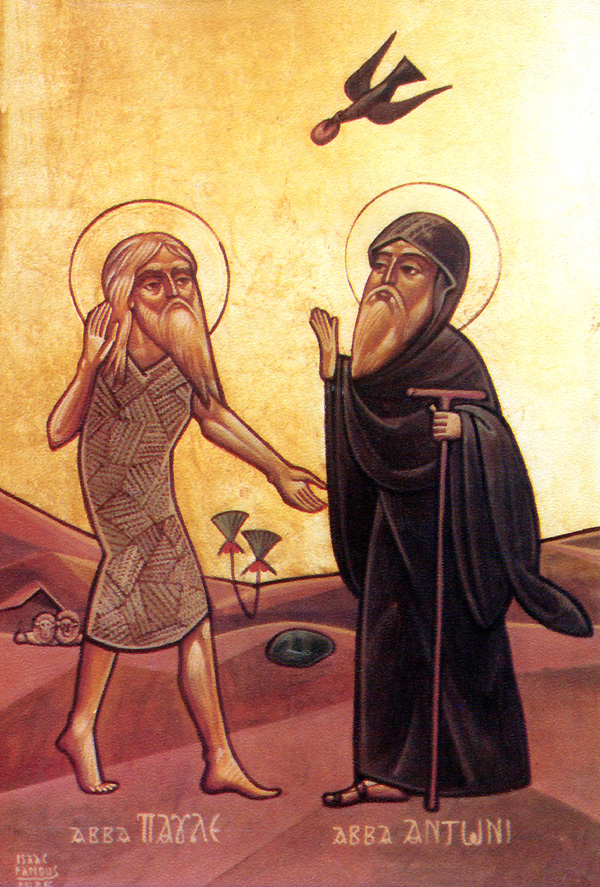
Saint Paul the Simple of Egypt also lived in the fourth century and was called the Simple for his simplicity of heart and gentleness. He had been married, but when he discovered his wife’s infidelity, he left her and went into the desert to Saint Anthony the Great (January 17). Paul was already 60 years old, and at first Saint Anthony would not accept Paul, saying that he was unfit for the harshness of the hermit’s life. Paul stood outside the cell of the ascetic for three days, saying that he would sooner die than go from there. Then Saint Anthony took Paul into his cell, and tested his endurance and humility by hard work, severe fasting, with nightly vigils, constant singing of Psalms and prostrations. Finally, Saint Anthony decided to settle Paul into a separate cell.
During the many years of ascetic exploits the Lord granted Saint Paul both discernment, and the power to cast out demons. When they brought a possessed youth to Saint Anthony, he guided the afflicted one to Saint Paul saying, “I cannot help the boy, for I have not received power over the Prince of the demons. Paul the Simple, however, does have this gift.” Saint Paul expelled the demon by his simplicity and humility.
After living for many years, performing numerous miracles, he departed to the Lord. He is mentioned by Saint John, the Abbot of Sinai (Ladder 24:30): “The thrice-blessed Paul the Simple was a clear example for us, for he was the rule and type of blessed simplicity….”
Saint Paul is also commemorated on March 7.
Martyr Callisthene and her father Audactus of Ephesus
The holy martyr Callisthene was born in Ephesus, and her father was the eparch Audactus. She was to marry the emperor Maximian Galerius (305-311), but her father would not consent to the match because the emperor was a pagan. Therefore, Audactus was deprived of his wealth and position, and was exiled to Melitene, Armenia where he was beheaded.
Callisthene hid for a time in Nicomedia with a certain woman, and healed the woman’s daughter of an eye ailment. After the death of Maximian, Licinius (311-324) became the last pagan emperor. Callisthene became friendly with his Christian wife Constantia, the daughter of Saint Constantine (May 21). She told Constantia of all that had happened to her, and Constantia helped Callisthene to regain her father’s wealth and possessions. She did not want these things for herself, but gave everything away to the poor.
She also brought her father’s body back to Ephesus and built a church which was dedicated to him.
Saint Callisthene devoted the rest of her life to Christ, and died in Ephesus in the first half of the fourth century.
Saint Stephen Stiljianovitch of Serbia
Saint Stephen Stiljianovich of Serbia was born into a pious Christian family in the Serbian city of Zhupa (south of Zakholmya). During this time Serbia was often subjected to invasions by the Turks, who devastated the land. Saint Stephen defended his native land, did military service in the army of the Serbian ruler. When famine began in the country, the kindly Saint Stephen distributed his own bread to the hungry.
The patriotic activity of the saintly soldier was indissolubly bound up with his truly Christian life. “In virtue, he lived as an ascetic with charity, purity, prayer, the Orthodox Faith and unhypocritical love of neighbor.”
The saint fell asleep in the Lord on October 4, 1515. After a time, the Turks saw a light shining over his grave. Thinking that they had found a hidden treasure, they opened the grave and found the incorrupt body of Saint Stephen. Serbian monks ransomed the relics from the Turkish Pasha and transferred them to the Shishatovets monastery on Mount Phrushtsk.
The Serbian Church prays to him as a glorious righteous defender of his native land, “Glory in the struggles, warrior Stephen Stiljianovich, great healer of those who pray to you in faith.”
Martyr Evdemoz, Catholicos of Georgia
Saint Evdemoz led the Georgian Orthodox Church in the mid-17th century during the reign of King Rostom-Khan (1632-1658), a Georgian who had converted to Islam.
Having murdered King Luarsab II of Kartli and chased out King Teimuraz I of Kakheti, the Persian shah Abbas I had declared Rostom-Khan ruler of a unified Kartli-Kakheti kingdom.
Rostom tried to be accommodating in his policies and protect the beliefs and traditions of both the Persian shah and the Georgian people: he set a standard salary for the Georgian clergy and even built churches, but society deteriorated rapidly nevertheless. Human vices became commonplace, and sins like those of Sodom and Gomorrah were multiplied. The nation was so overtaken by sin that even the clergy ceased to conduct themselves in a manner befitting their God-given role.
But the chief shepherd of the Georgian nation would not yield to the moral decline of his flock, and he confronted this crisis with conviction and fearlessness. Several times he led his most valiant military leaders in revolt against Persia. Following the example of Catholicos Evdemoz, several Georgian princes rebelled against the pro-Persian policies of Rostom-Khan and cast out the Islamic influence from their territories.
Catholicos Evdemoz resisted the Islamic custom of raising the king’s heirs in the shah’s court from a young age. He was never too intimidated by the king to expose his wrongdoing and tell him at every convenient opportunity: “You are the natural father of the Muslims, but the stepfather of the Christians!”
Evdemoz was the spiritual father of Rostom-Khan’s wife, the faithful Queen Mariam, the daughter of Manuchar Dadiani, Prince of Samegrelo.
As a result of the holy labors of Catholicos Evdemoz and Queen Mariam, the Christian soul of the Georgian people was not entirely extinguished. The Georgians built churches, wrote spiritual literature, and gradually regained their national consciousness. Catholicos Evdemoz preached throughout the country and developed and implemented a plan to bring King Teimuraz, who had been driven out by Shah Abbas, back to the throne.
Naturally Rostom-Khan felt threatened by the strong influence Catholicos Evdemoz had on the people. In 1642 he arrested the chief shepherd of the Georgian people and tried to win him over, but neither his feigned tenderness nor his threats could break the firm will of the man who loved Christ and his motherland above all else. After his arrest, Saint Evdemoz criticized the king even more harshly and called on the people to rise up against him. Finally Rostom-Khan ordered that Catholicos Evdemoz be strangled to death in his prison cell, and as a further insult, his body was cast off Nariqala Fortress (in Tbilisi) in the direction of the Turkish baths.
That night, a group of Christians stole the body of the holy hieromartyr Catholicos-Patriarch Evdemoz and buried it in the northwest corner of Anchiskhati Church in Tbilisi.
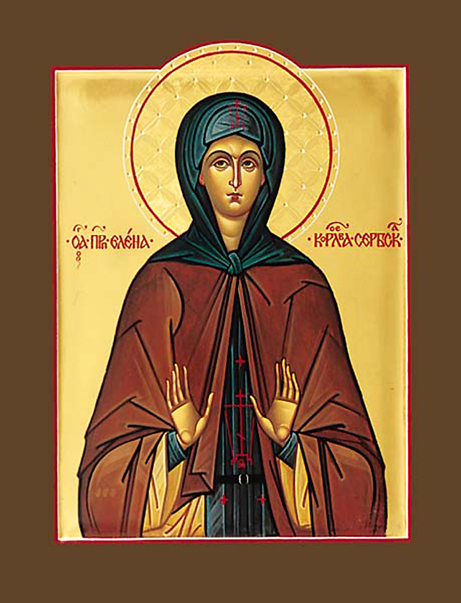
Saint Elena of Serbia
Princess Elena was the wife of the Despot Stephen Štiljanović who is also venerated as a Saint. After his death around 1515, she fled to Germany in order to escape from the Turks.
Later, a light appeared at his grave by night, which led to the discovery of his holy relics. The Saint's body was kept for a long time in the monastery of Šišatovacnto at Fruška Gora. When she learned that her husband's incorrupt relics had been uncovered, Saint Elena went to the monastery to venerate them. After witnessing the miracles which took place at his grave, she decided to remain there with the monastic name Jelisaveta. According to Tradition, she founded the Monastery of Petkovica in 1522.
After a life of asceticism, Saint Elena reposed in 1546. There is reason to believe that she was buried at the Convent of the Most Holy Theotokos in Sremski Karlovci.
Saints Jonah and Nectarius of Kazan
Saints Jonah and Nectarius of Kazan were called John and Nestor Zastolsky before they received monastic tonsure. When Saint Gurias (December 5 ) was sent to the newly established Kazan diocese, the boyar John Zastolsky went with him. Under the spiritual guidance of Saint Gurias, John led a virtuous and pious life. He avoided sin, loved truth, and was strictly honest.
John raised his son Nestor in the fear of God. The gentle youth was an ascetic from childhood. He wore a hair-shirt, kept the fasts, and he loved to pray in church. With his father’s consent, Nestor became a monk with the new name Nectarius. He died at a young age, and was buried near the grave of Saint Gurias.
John was tonsured into monasticism with the name Jonah. Before his death, he left instructions that he also be buried near Saint Gurias.
At the uncovering of the relics of Saints Gurias and Barsanuphius in 1595, the incorrupt bodies and clothing of Saints Jonah and Nectarius were also found. They were left beneath a crypt in a chapel of the Kazan Savior-Transfiguration monastery. The chapel had been built by Jonah over the grave of Saint Gurias.
The saints are mentioned in the service to Saint Gurias, “Two monks, Jonah and Nectarius, ascetics well-pleasing to God, one born of the other, faithfully served you in the world. Upon your death, O Gurias, keeping sincere faith for you, they built a chapel over your grave. These saints are buried here beside you, honored with incorruption from God above. Saint Gurias, pray with them unto Christ God, to grant us peace and great mercy.”








 Saint Peter Antiochian Orthodox Church
You must be logged in to post a comment.