Monthly Archives: October 2025

Daily Readings for Sunday, October 12, 2025

SUNDAY OF THE 7TH ECUMENICAL COUNCIL

NO FAST

Sunday of the 7th Ecumenical Council, Probus, Andronicus, & Tarachus, Martyrs of Tarsus, Symeon the New Theologian, Cosmas the Hymnographer, Bishop of Maiuma, Domnina the Martyr, Wilfrid of York

ST. PAUL’S LETTER TO TITUS 3:8-15

Titus, my son, the saying is sure. I desire you to insist on these things, so that those who have believed in God may be careful to apply themselves to good deeds; these are excellent and profitable to men. But avoid stupid controversies, genealogies, dissensions, and quarrels over the law, for they are unprofitable and futile. As for a man who is factious, after admonishing him once or twice, have nothing more to do with him, knowing that such a person is perverted and sinful; he is self-condemned.
When I send Artemas or Tychicos to you, do your best to come to me at Nicopolis, for I have decided to spend the winter there. Do your best to speed Zenas the lawyer and Apollos on their way; see that they lack nothing. And let our people learn to apply themselves to good deeds, so as to help cases of urgent need, and not to be unfruitful.
All who are with me send greeting to you. Greet those who love us in the faith. Grace be with you all. Amen.

LUKE 8:5-15

The Lord said this parable: "A sower went out to sow his seed; and as he sowed, some fell along the path, and was trodden under foot, and the birds of the air devoured it. And some fell on the rock; and as it grew up, it withered away, because it had no moisture. And some fell among thorns; and the thorns grew with it and choked it. And some fell into good soil and grew, and yielded a hundredfold." And when his disciples asked him what this parable meant, he said, "To you it has been given to know the secrets of the kingdom of God; but for others they are in parables, so that seeing they may not see, and hearing they may not understand. Now the parable is this: The seed is the word of God. The ones along the path are those who have heard; then the devil comes and takes away the word from their hearts, that they may not believe and be saved. And the ones on the rock are those who, when they hear the word, receive it with joy; but these have no root, they believe for a while and in time of temptation fall away. And as for what fell among the thorns, they are those who hear, but as they go on their way they are choked by the cares and riches and pleasures of life, and their fruit does not mature. And as for that in the good soil, they are those who, hearing the word, hold it fast in an honest and good heart, and bring forth fruit with patience." As he said these things, he cried out "He who has ears to hear, let him hear.

Commemoration of the Holy Fathers of the Seventh Ecumenical Council
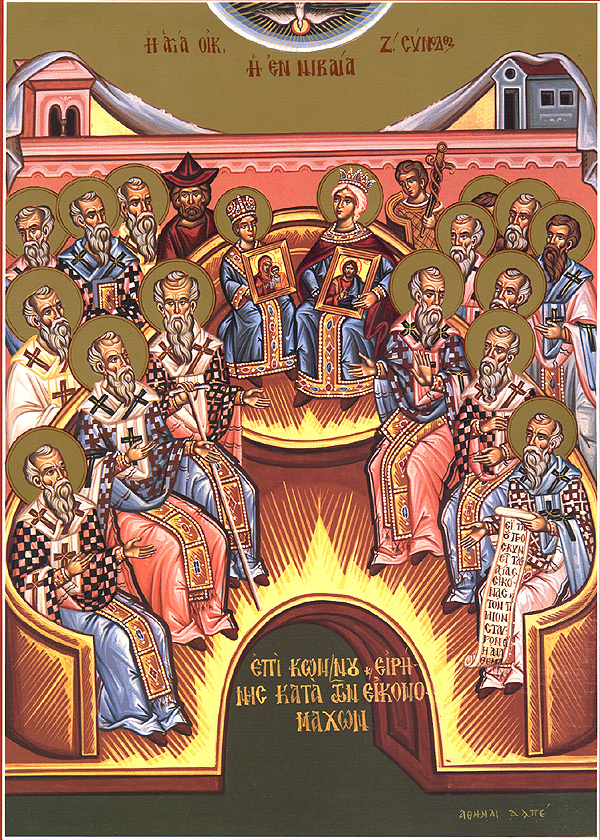
Today the Church remembers the 350 holy Fathers of the Seventh Ecumenical Council under the holy Patriarch Tarasius (February 25).

The Synod of 787, the second to meet at Nicea, refuted the Iconoclast heresy during the reign of Empress Irene and her son Constantine VI.

The Council decreed that the veneration of icons was not idolatry (Exodus 20:4-5), because the honor shown to them is not directed to the wood or paint, but passes to the prototype (the person depicted). It also upheld the possibility of depicting Christ, Who became man and took flesh at His Incarnation. The Father, on the other hand, cannot be represented in His eternal nature, because “no man has seen God at any time” (John 1:18).

In Greek practice, the holy God-bearing Fathers of the Seventh Ecumenical Council are commemorated on October 11 (if it is a Sunday), or on the Sunday which follows October 11. According to the Slavic menaion, however, if the eleventh falls on Monday, Tuesday, or Wednesday, the service is moved to the preceding Sunday.

Martyrs Probus, Tarachus, and Andronicus, at Tarsus in Cilicia
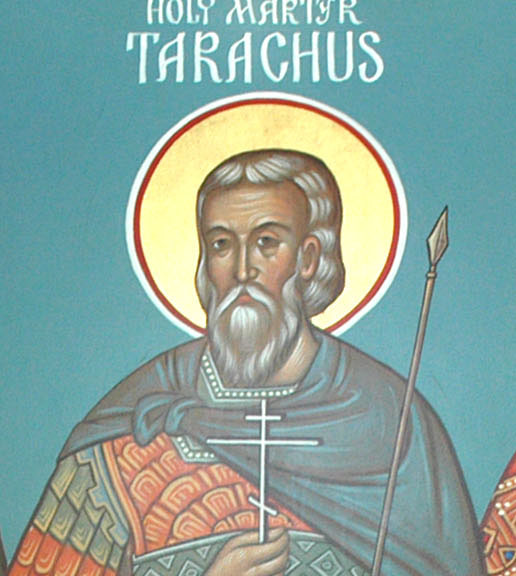
The Martyrs Tarachus, Probus, and Andronicus suffered for Christ in the year 304 at Tarsus in Cilicia. When the pagans ordered him to offer sacrifice to idols, the old soldier Tarachus replied that he would offer a pure heart to the one true God instead of sacrifices of blood. Seeing the firmness of the saint’s confession the true Faith, the proconsul gave them all over to torture.

“When my body suffers,” Saint Probus said to the idol worshippers, “then my soul is healed and invigorated.” The tormentors refined their tortures, such as their rage could invent, and then they tore the bodies of the saints apart. Christians secretly took up the relics of the saints and buried them.

Saint Cosmas the Hymnographer, Bishop of Maiuma
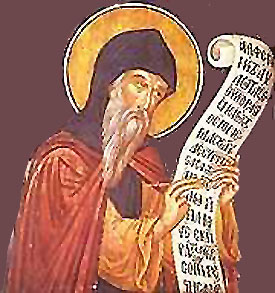
Saint Cosmas the Hymnographer, Bishop of Maiuma, was a native of Jerusalem. He was raised by the parents of Saint John of Damascus (December 4) together with their son, and he received a fine education. When Saint Cosmas came of age, he set out to one of the monasteries of Palestine, where he attained renown for his monastic exploits.

During a time of persecution against holy icons Saint Cosmas, and the venerable John, came forward to defend Orthodoxy. In the year 743 Cosmas was made Bishop of Maiuma. He died in old age, leaving behind many canons for feast days and a Triodion for four days of Holy Week.

In Slavic usage Saint Cosmas the Hymnographer is commemorated on October 12, but on October 14, according to Greek usage.

Venerable Amphilochius, Abbot of Glushetsa

Saint Amphilochius, Abbot of Glushetsa, already a monk of priestly rank, came from Ustiug to Saint Dionysius of Glushetsa (July 1) in the year 1417. Saint Dionysius, learning of the wish of Amphilochius to become an ascetic, told him of the severity and harshness of life in his monastery, but this did not deter the newcomer. Then Saint Dionysius said, “If you wish to dwell here, then we shall make an accord not to be distinct one from another while we dwell upon the earth.” Amphilochius joyfully agreed and vowed to fulfill the rule of the monastery.

The venerable Amphilochius spent twenty years in deeds of fasting, prayer and obedience under the guidance of Saint Dionysius, striving to imitate him in all things and assisting in the work of building up the monastery.

After the death of Saint Dionysius, Saint Amphilochius was the abbot of the Glushetsa monastery for fifteen years. He died peacefully in the year 1452, and was buried alongside his mentor.

Martyr Domnina of Anazarbus

The Martyr Domnina of Anazarbus lived in the region of Cilicia, and suffered for confessing Christianity. She was beaten for a long time, by order of the governor Licius, and they also burned her with fire. After many tortures, Saint Domnina was thrown into prison, where she died in 286.

Saint Martin the Merciful, Bishop of Tours

Saint Martin the Merciful, Bishop of Tours, was born at Sabaria in Pannonia (modern Hungary) in 316. Since his father was a Roman officer, he also was obliged to serve in the army. Martin did so unwillingly, for he considered himself a soldier of Christ, though he was still a catechumen.

At the gates of Amiens, he saw a beggar shivering in the severe winter cold, so he cut his cloak in two and gave half to the beggar. That night, the Lord Jesus Christ appeared to the saint wearing Martin’s cloak. He heard the Savior say to the angels surrounding Him, “Martin is only a catechumen, but he has clothed Me with this garment.” The saint was baptized soon after this, and reluctantly remained in the army.

Two years later, the barbarians invaded Gaul and Martin asked permission to resign his commission for religious reasons. The commander charged him with cowardice. Saint Martin demonstrated his courage by offering to stand unarmed in the front line of battle, trusting in the power of the Cross to protect him. The next day, the barbarians surrendered without a fight, and Martin was allowed to leave the army.

He traveled to various places during the next few years, spending some time as a hermit on an island off Italy. He became friendly with Saint Hilary, Bishop of Poitiers (January 14), who made Martin an exorcist. After several years of the ascetic life, Saint Martin was chosen to be Bishop of Tours in 371. As bishop, Saint Martin did not give up his monastic life, and the place where he settled outside Tours became a monastery. In fact, he is regarded as the founder of monasticism in France. He conversed with angels, and had visions of Saints Peter and Paul (June 29) and of other saints. He is called the Merciful because of his generosity and care for the poor, and he received the grace to work miracles.

After a life of devoted service to Christ and His Church, the saint fell ill at Candes, a village in his diocese, where he died on November 8, 397. He was buried three days later (his present Feast) at Tours. During the Middle Ages, many Western churches were dedicated to Saint Martin, including Saint Martin’s in Canterbury, and Saint Martin-in-the-Fields in London.

In 1008, a cathedral was built at Tours over the relics of Saint Martin. This cathedral was destroyed in 1793 during the French Revolution, together with the relics of Saint Martin and Saint Gregory of Tours (November 17). A new cathedral was built on the site many years later. Some fragments of the relics of Saint Martin were recovered and placed in the cathedral, but nothing remains of Saint Gregory’s relics.

Saint Martin’s name appears on many Greek and Russian calendars. His commemoration on October 12 in the Russian calendar appears to be an error, since ancient sources give the November date.

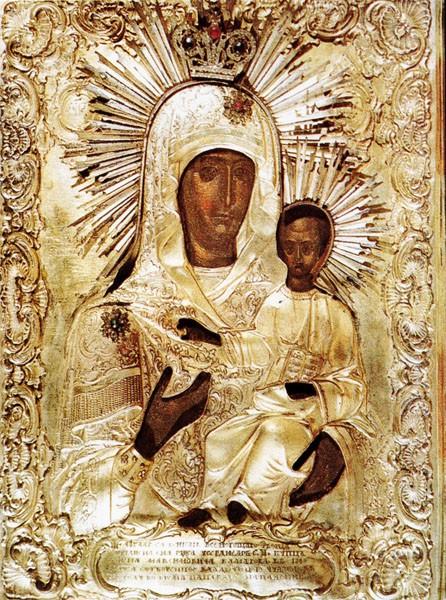
“Jerusalem” Icon of the Mother of God
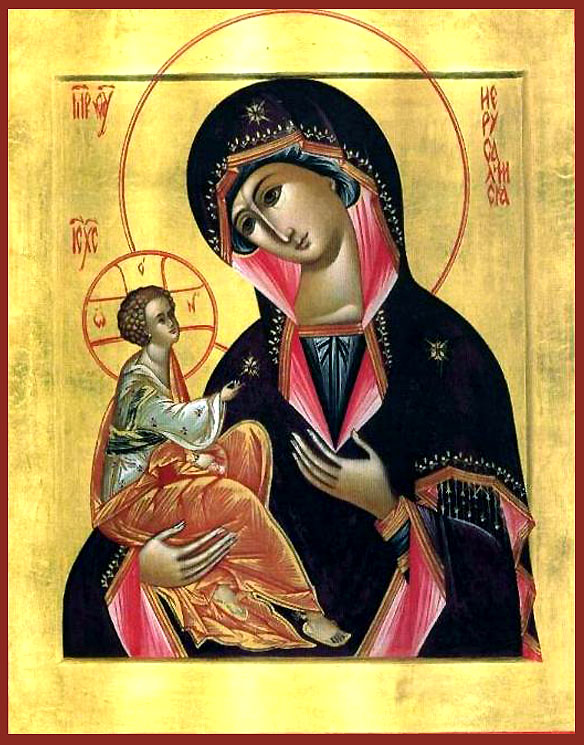
The Jerusalem Icon of the Mother of God, by tradition, was painted by the holy Evangelist Luke fifteen years after the Ascension of the Lord at Gethsemane.

In the year 463, the icon was transferred to Constantinople. The Byzantine army carried the Jerusalem Icon into battle when they turned back an invasion of the Scythians. In 988 the icon was transferred to Korsun and given to the holy Prince Vladimir. When the people of Novgorod accepted Christianity, Saint Vladimir sent them this icon. In 1571, Ivan the Terrible transferred the icon to the Moscow Dormition cathedral. During the Napoleonic invasion of 1812, the original was stolen by the French and brought to Paris. An authenticated copy was placed in the Dormition cathedral.

The Jerusalem Icon is also commemorated on November 13, and on the Fifth Saturday of Great Lent.

Saint Edwin, King and Martyr

Saint Edwin (Eadwine) was the son of Alla, King of Deira, and was born around 584. When his father died, Edwin was cheated out of his kingdom by King Ethelred of Bernicia, who united Bernicia and Deira into a single kingdom of Northumbria.

Edwin fled to East Anglia and took refuge with King Redwald. Redwald, because of the threats and promises he had received, was persuaded to give Edwin up to his enemies. Edwin was warned by a friend of the danger he faced. That night, a stranger promised that his kingdom would be restored to him if Edwin would do as he taught him. Edwin agreed, and the stranger laid his hand on Edwin’s head, telling him to remember the gesture.

In time, Edwin became ruler of the entire north of England and, by force of arms, obliged the other kings to acknowledge him as sovereign. He married Ethelburga, the daughter of Saint Ethelbert (February 25), the first Christian king in England. Ethelburga was also the sister of King Ealbald of Kent.

There was an attempt on Edwin’s life in 626, on the eve of Pascha. That night the queen gave birth to a baby girl, and King Quichelm of the West Saxons sent an assassin named Eumer to kill Edwin with a poisoned dagger. Eumer was admitted to Edwin’s presence and tried to stab him. He would have succeeded if it had not been for Lilla, King Edwin’s faithful minister, who placed himself between the king and the assassin. The blade passed through his body, however, and wounded the king. The assassin was killed, and Lilla saved Edwin’s life at the cost of his own. This event is commemorated by a stone cross which stands on Lilla Howe near Fylingdales Ballistic Missile Early Warning System on the North Yorkshire Moors. Before the Pickering-Whitby road was built in 1759, this cross served as a guide for those who walked across the moors from Robin Hood’s Bay to Saltergate.

Edwin thanked his gods that he had been spared, but he was told by Bishop Paulinus of York (October 10) that he had been saved by the prayers of his queen. The bishop said that he should show his gratitude to the true God by allowing his newborn daughter to be baptized. The child was baptized on Pentecost, and was given the name Eanfleda.

The king, who had been slightly wounded in the attack, promised Bishop Paulinus that he would become a Christian if he were restored to health, and if he would triumph over those who conspired to kill him.

As soon as his wound healed, King Edwin marched against the King of the West Saxons with an army. He vanquished the opposing army, killing or capturing those involved in the plot against him. He no longer followed the pagan religion, but he put off his promise to embrace Christianity, and it was many years before Edwin converted. He would sit alone for hours trying to decide which religion he should follow. Saint Paulinus, informed by a revelation about the stranger’s promise to the king, went to Edwin and laid his hand upon his head. “Do you remember this gesture?” he asked.

The king trembled with astonishment, and would have fallen at the bishop’s feet. Saint Paulinus gently raised him up and said, “You see that God has delivered you from your enemies. Moreover, He offers you His everlasting Kingdom. See that you fulfill your promise to become a Christian and keep the commandments of God.”

King Edwin said that he would seek the counsel of his advisers and urge them to convert with him. He asked them what he should do. Coifi, a pagan priest, said it was readily apparent that their gods had no power. Another person said that this brief life was inconsequential, compared to eternity.

Saint Paulinus addressed the gathering, and when he had finished, Coifi told the king that the altars and temples of their false gods should be burned. The king asked him who should be the first to profane them. Coifi replied that he should be the first, since he had been foremost in leading their worship. The chief priest of the pagans was not permitted to bear arms or to ride a horse. It was customary that he ride a mare. Coifi, however, asked for a horse and for arms. Mounted on the king’s own horse, Coifi threw a spear into their temple, commanding the others to pull it down and set it afire. This place was not far from York, and today it is known as Godmanham.

In 627, the eleventh year of his reign, Saint Edwin was baptized by Saint Paulinus of York in the wooden church of Saint Peter. Saint Edwin began the construction of a new stone church, which was completed by his successor Saint Oswald (August 5).

Saint Edwin ruled his kingdom in peace for six more years, and continued to practice and promote Christianity. He was killed in a battle with Penda of Mercia and Cadwalla of Wales in 633, when he was forty-eight years old, at a place now known as Hatfield.

Saint Edwin’s body was buried at Whitby, but his head was buried at York in the church he had built. Most of the early English calendars list Saint Edwin as a martyr.

After the death of Saint Edwin, his wife Saint Ethelburga (April 5) returned to Kent, where she became the abbess of a monastery which she founded at Lyminge.

Icon of the Mother of God of Rudens

The Rudens Icon of the Mother of God appeared in the year 1687 in the Rudno locale of Mogilevsk diocese. In 1712 the icon was transferred to the Florovsk Ascension monastery in Kiev, where now it is located.

Translation from Malta to Gatchina: of a Particle of the Life Giving Cross, the Filersk Icon of the Mother of God, and the relic of the Right Hand of John the Baptist
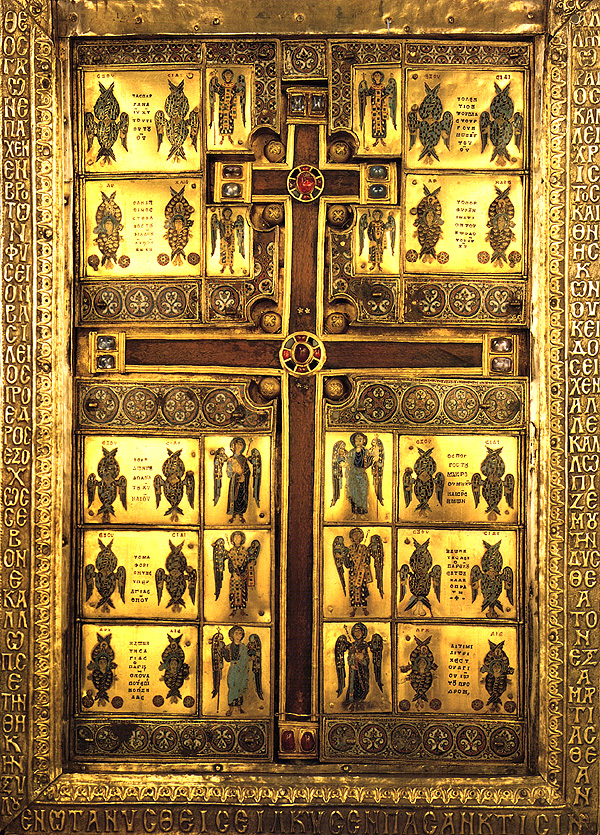
The Translation from Malta to Gatchina of a Portion of the Life-Creating Cross of the Lord, together with the Philermos Icon of the Mother of God (from Mount Philermos on the Greek island of Rhodes), and the right hand of Saint John the Baptist took place in the year 1799. These holy things were preserved on the island of Malta by the Knights of the Catholic Order of Saint John of Jerusalem. In 1798, when the French seized the island, the Maltese knights turned to Russia for defense and protection. On October 12, 1799 they offered these ancient holy things to the emperor Paul I, who at this time was at Gatchina. In the autumn of 1799 the holy items were transferred to Saint Petersburg and placed in the Winter Palace within the church dedicated to the Icon of the Savior Not-Made-by-Hands. The Feast for this event was established in 1800.

By ancient tradition, the Philermos Icon of the Mother of God was painted by the holy Evangelist Luke. From Jerusalem it was transferred to Constantinople, where it was situated in the Blachernae church. In the thirteenth century it was taken from there by crusaders, and from that time was kept by the Knights of the Order of Saint John.

New Martyr John, Archbishop of Riga and Latvia

No information available at this time.

Saint Tarasius of Glushetsa

Saint Tarasius of Glushetsa was abbot of a monastery built by Saint Stephen of Perm (April 26), and he zealously spread and affirmed the Orthodox Faith among the Zyryani people.

In 1427, under the successor of Saint Stephen, Bishop Gerasimus (January 29), Saint Tarasius voluntarily gave up leading the monastery and went to the Glushetsa monastery under the guidance of Saint Dionysius (June 1).

Saint Dionysius, seeing Tarasius’ deep humility, accepted him. The former igumen Tarasius toiled alongside the novices as an equal at the monastery and he led a strict ascetic life. He was buried at the Dionysiev monastery in 1440.

Saint Macarius, Abbot of Glushetsa

Saint Macarius, Abbot of Glushetsa (in the world Matthew), was born in Rostov. As a twelve-year-old boy he was given to Saint Dionysius (June 1) to be raised. Growing up under the guidance of the great Elder, the saint was distinguished by a rare purity of soul. Saint Macarius, already a hieromonk, was chosen by the brethren as igumen of the monastery after the death of Saint Amphilochius. Saint Macarius fell asleep in the Lord on May 13 (not earlier than 1462).

Icon of the Mother of God of Yaroslav-Smolensk

The Yaroslav-Smolensk Icon of the Mother of God was the cell icon of the archimandrite of the Trinity-St Sergius Lavra, Anthony. On October 12, 1642 while he was praying, he heard a voice from the Smolensk Hodēgḗtria (Directress) icon saying, “Go, go to the limits of the city of Yaroslavl, to a newly-made monastery in My name.” Archimandrite Anthony sent this icon with the Venerable Gersaim to the indicated monastery, being built in the forest, not far from Yaroslavl. The wonderworking icon was set in the monastery church in the altar area.

Icon of the Mother of God of Kaluga

The Kaluga Icon of the Mother of God appeared in the year 1748 (September 2). In 1812 many Russian and French soldiers beheld the Kaluga icon of the Mother of God, standing in the air. Thus also it was around Kaluga and Maloyaroslavl. During such appearances the Russian armies were always victorious. This vision was also granted to the peasant Paraskevḗ Alekseeva.

Daily Readings for Saturday, October 11, 2025

SATURDAY OF THE 3RD WEEK

NO FAST

Philip the Apostle of the 70, one of the 7 Deacons, Theophanes the Confessor, Bishop of Nicaea, Holy Martyrs Zenais and Philonilla, Nectarios, Arsakios, Sisinios and Philotheos Kokkinos, Patriarchs of Constantinople, Ethelburga, Abbess of Barking, Our righteous Father Kenneth, Founder of the Monastery of Aghaboe in Ireland.

ACTS OF THE APOSTLES 8:26-39

In those days, an angel of the Lord said to Philip, “Rise and go toward the south to the road that goes down from Jerusalem to Gaza.” This is a desert road. And he rose and went. And behold, an Ethiopian, a eunuch, a minister of the Candace, queen of the Ethiopians, in charge of all her treasure, had come to Jerusalem to worship and was returning; seated in his chariot, he was reading the prophet Isaiah. And the Spirit said to Philip, “Go up and join this chariot.” So Philip ran to him, and heard him reading Isaiah the prophet, and asked, “Do you understand what you are reading?” And he said, “How can I, unless some one guides me?” And he invited Philip to come up and sit with him. Now the passage of the scripture which he was reading was this: “As a sheep led to the slaughter or a lamb before its shearer is dumb, so he opens not his mouth. In his humiliation justice was denied him. Who can describe his generation? For his life is taken up from the earth.” And the eunuch said to Philip, “About whom, pray, does the prophet say this, about himself or about some one else?” Then Philip opened his mouth, and beginning with this scripture he told him the good news of Jesus. And as they went along the road they came to some water, and the eunuch said, “See, here is water! What is to prevent my being baptized?” And Philip said, “If you believe with all your heart, you may.” And he replied, “I believe that Jesus Christ is the Son of God.” And he commanded the chariot to stop, and they both went down into the water, Philip and the eunuch, and he baptized him. And when they came up out of the water, the Spirit of the Lord caught up Philip; and the eunuch saw him no more, and went on his way rejoicing.

LUKE 5:27-32

At that time, as Jesus passed by, he saw a tax collector, named Levi, sitting at the tax office; and he said to him, “Follow me.” And he left everything, and rose and followed him. And Levi made him a great feast in his house; and there was a large company of tax collectors and others sitting at table with them. And the Pharisees and their scribes murmured against his disciples, saying, “Why do you eat and drink with tax collectors and sinners?” And Jesus answered them, “Those who are well have no need of a physician, but those who are sick; I have not come to call the righteous, but sinners to repentance.”

Venerable Philotheus, Patriarch of Constantinople

Saint Philotheus was a native of Thessalonica, and received the monastic tonsure at an early age. After living for a time at Mt Sinai, he went to Mt Athos and became the igumen of the Great Lavra.

In 1347 he became Metropolitan of Heraclea, Thrace. Later, he served as Patriarch of Constantinople from 1354-1355, and again from 1364-1376.

While living on the Holy Mountain and even after he left there, Saint Philotheus wrote religious books which reveal his great learning and spirituality. Many of his works are directed against the anti-hesychasts, and he also wrote on liturgical and hagiographical themes.

Saint Philotheus ordained that Saint Gregory Palamas (November 14) be commemorated on the second Sunday of Great Lent, presided at his glorification as a saint, and even composed the Service in his honor.

Saint Philotheus fell asleep in the Lord in 1379.

Apostle Philip of the Seventy, One of the Seven Deacons

Holy Apostle Philip of the Seventy, one of the 7 Deacons is not to be confused with Saint Philip one of the Twelve Apostles (November 14). This Philip was born in Palestine, was married and had children.

After the Descent of the Holy Spirit, the Twelve Apostles made Philip a deacon in the Church of Jerusalem. Along with the other six deacons, they appointed him to deal with the offerings of the faithful and attend to the concerns of the widowed, the orphaned and the needy. The eldest among the seven deacons was the holy Archdeacon Stephen. When the persecution of Christians began, the Jews stoned the Protomartyr Stephen. The Apostle Philip left Jerusalem and settled in Samaria. There he successfully preached Christianity. Among the disciple’s converts was the noted magician Simon, who “after being baptized, continued with Philip.” (Acts 8:9-13)

At the command of an angel of the Lord, Saint Philip set out upon the road connecting Jerusalem with Gaza. There he met an official of the empress of Ethiopia, whom also he converted to Christianity (Acts 8:26-39). The holy disciple Philip tirelessly preached the Word of God in many of the lands of the Near East adjoining Palestine. At Jerusalem the Apostles made him a bishop and sent him to Tralles in Asia Minor, where he also baptized many. Saint Philip died in old age.

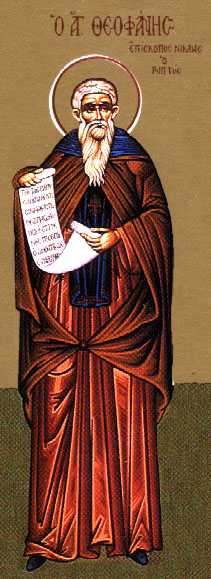
Saint Theophanes the Confessor and Hymnographer, Bishop of Nicea

Saint Theophanes, Confessor and Hymnographer, Bishop of Nicea was the younger brother of the Saint Theodore the Branded (December 27). The brothers received an excellent education and were particularly involved in philosophy. Striving towards the knowledge of God, they settled in the Lavra of Saint Savva. Here Saint Theophanes was tonsured, and later became a hieromonk.

The holy brothers were famed as advocates of icon veneration. They boldly fulfilled the mission entrusted them by the Patriarch of Jerusalem and went to Constantinople to denounce the iconoclast emperor Leo the Armenian (813-820). Afterwards, they also denounced the iconoclast emperors Michael Balbos (820-829) and Theophilus (829-842).

The saints had to endure imprisonment, hunger, even torture. The emperor Theophilus gave orders to inscribe a phrase insulting to the glorious confessors upon their faces with red-hot needles. Therefore, they are called “Branded”. “Write whatever you wish, but at the Last Judgment you shall read your own writing,” said the agonized brothers to the emperor. They sent Theodore to prison, where also he died (+ 833), but Theophanes was sent into exile. With the restoration of Icon veneration Saint Theophanes was returned from exile and consecrated Bishop of Nicea. The saint wrote about 150 canons, among which is a beautiful canon in defense of holy icons. He died peacefully around the year 850.

Venerable Theophanes the Faster of the Kiev Near Caves

The epithet "Faster," by which the Venerable Theophanes is known, indicates that he drew closer to the Lord by means of his strict fasting. The relics of Saint Theophanes lie in the Near Caves of Saint Anthony. He lived during the XII century, but the details of his Life are not described in the commemoration books of the Kiev Caves Lavra.

Saint Theophanes is also commemorated on the Synaxis of the Venerable Fathers of the Near Caves of Saint Anthony (September 28), and on the Synaxis of All the Venerable Fathers of the Kiev Caves (The second Sunday of Great Lent).

Venerable Leonid of Optina

Leo Nagolkin, the future Saint Leonid, was born in Karachev in the Orlov Province in 1768. As a young man he worked for a merchant, making long and frequent trips on his employer’s business. He met all sorts of people, and this experience helped him later in life when visitors of diverse backgrounds would come to him for spiritual advice.

Leo first entered Optina Monastery in 1797, but remained for only two years. Then he went to White Bluff monastery in the Orlov diocese, where Hieromonk Basil (Kiskin) was igumen. He tonsured Leo as a monk in 1801, giving him the new name Leonid. In December of that year, Father Leonid was ordained as a deacon and then as a priest.

Father Leonid’s rise to prominence was unusually rapid. He was an example to others in the way he fulfilled his obediences, and this attracted the notice of his superiors. In 1804, after only five years at White Bluff, he was appointed by Bishop Dorotheus of Orlov and Svensk to succeed Father Basil as igumen.

Before assuming his new duties, Father Leonid spent some time at Cholnsk monastery, where he met Schemamonk Theodore, a disciple of Saint Paisius Velichkovsky (November 15). Father Theodore, who was about ten years older than Father Leonid, was also from Karachev. Under his direction, Father Leonid learned a great deal about spiritual struggles and how to acquire the grace of the Holy Spirit.

Father Leonid was saddened when he had to leave his wise Elder in order to assume his responsibilities at White Bluff. Their separation was not long, however, because Father Theodore moved to White Bluff in 1805. Their frequent conversations inspired him to even greater progress in the spiritual life.

Father Theodore longed for solitude, and was permitted to live in a cell about a mile from the monastery with his disciple Father Cleopas. Father Leonid joined them after resigning as igumen in 1808. It is possible that Father Leonid may have been tonsured into the Great Schema with the name Leo during this time.

The fame of these ascetics soon spread throughout the area, and many visitors came to seek their advice. They found these distractions detrimental to their spiritual struggles, and they resolved to move to a more remote place.

Father Theodore was the first to leave. In 1809 he stayed briefly at New Lake Monastery. Then Metropolitan Ambrose of Saint Petersburg sent him to the Palei Island Hermitage, where he remained for three years. Father Theodore moved to the All Saints Skete of Valaam Monastery in 1812. Father Leonid and Father Cleopas also moved there in 1812, and were reunited with Father Theodore. Hieroschemamonk Cleopas died in 1816, and Father Leonid and Father Theodore moved to the Saint Alexander of Svir monastery.

Tsar Alexander I visited the monastery in 1820 in order to meet these Elders, of whom he had heard. They replied to the Sovereign’s questions with the briefest of answers, since they did not want to seem too talkative. When he asked for their blessing, Father Theodore told him that he was not an ordained monk. The Tsar bowed and went on his way.

Father Theodore went to the Lord on April 7, 1822 (Bright Friday). After this Father Leonid left the monastery to live in a more secluded place with some like-minded disciples. Archbishop Ambrose (Podobedev) of Kazan knew about Father Leonid, and was willing to receive him in his diocese. Father Leonid was also invited to live at the Ploschansk Hermitage in the Orlov diocese. Father Leonid, however, chose to accept the invitation of Saint Moses (June 16) to live at Optina. Bishop Philaret of Kaluga also wanted Father Leonid to live at Optina, but it was not possible for him to do so just then.

Father Leonid had to remain at the Svir monastery for five more years before he was allowed to leave. In April of 1829 he arrived at Optina with six of his disciples. He was given a cell in the Skete, near the apiary. Cells were also found in the Skete for his disciples.

The arrival of Father Leonid marked a new chapter in Optina’s history, for it was he who introduced eldership at this monastery. Guidance by an Elder has always been recognized as a sure and reliable path to salvation. It spread from the deserts of Egypt and Palestine to Mt Athos, and later to Russia. Father Leonid received this teaching from Father Theodore, the disciple of Saint Paisius Velichkovsky. Through Father Leonid and his disciple Saint Macarius (September 7) eldership was established at Optina.

With the arrival of Father Leonid, the whole way of life at Optina was changed. Nothing important was ever done without his knowledge and blessing. Each evening the brethren came to him to discuss their spiritual needs and to reveal how they had sinned in thought, word, or deed during the day. He offered consolation in their sorrows, advice in their spiritual struggles, and help in resolving their problems.

Saint Leonid’s wisdom and spiritual counsels made him known outside of Optina. People from cities and villages, of all social classes, flocked to Optina seeking his help. He treated their spiritual afflictions with the knowledge and experience he had gained after thirty years of living in asceticism. Sometimes he healed their physical infirmities as well, anointing them with oil from the lamp that always burned before the Vladimir Icon of the Mother of God in his cell.

Father Macarius (Ivanov) moved to Optina Skete from Ploschansk in 1834. He had been under the guidance of an Elder who had been a disciple of Saint Paisius Velichkovsky. After the Elder’s death Father Macarius felt orphaned, and prayed that God would send him an experienced spiritual guide. His prayers were answered when Father Leonid came to Ploschansk in 1828. Even after Father Leonid left Ploschansk Father Macarius stayed in touch with him through letters.

At Optina Father Macarius assisted the Elder with his correspondence, and in the spiritual care of the brethren and those who visited Father Leonid. After 1836 Father Macarius became the spiritual Father of the Monastery. Although he had been the spiritual Father of the Sevsk convent for more than seven years, he regarded himself as nothing. Disdaining human glory, he was content to submit his will to Father Leonid in all things. Father Leonid, in turn, showed similar humility toward Father Macarius, regarding him as a friend and fellow laborer rather than a disciple.

Even though he had a high regard for Father Macarius, he was mindful of the saying of Saint John of the Ladder that in the first place, a spiritual guide would be deprived of a reward himself if he did not correct those under them. Secondly, the spiritual guide acts unjustly when he might bring profit to others, but does not do so. Thirdly, even those who are hard-working and patient might suffer harm if they are left for a time without reproaches from the Superior, for then they can lose the meekness and patience they once had (Step 4:27). Therefore, he gave Father Macarius many opportunities to win the crown of victory by testing his patience so that others might benefit by the example of his humility.

One day Father Macarius was summoned by the igumen Father Moses, who asked him to sponsor some of the brethren at their tonsure. Regarding the igumen’s request as a command, he merely bowed and left. He went to see Father Leonid, who was surrounded many people seeking his advice, and informed him why Father Moses had sent for him.

Father Leonid gazed at him sternly and asked, “What did you do? Did you agree to it?”

“I almost agreed,” Father Macarius replied, “or perhaps it is better to say that I did not dare to refuse.”

“That is typical of your pride,” the Elder said. Then he raised his voice and reprimanded Father Macarius as though he were really angry with him.

Father Macarius bowed continually, asking forgiveness. Those who were present were astounded by this. Finally, when Father Leonid fell silent, he bowed and said, “Forgive me, Father. Do you bless me to refuse?”

“How can you refuse?” he demanded. “You asked for this yourself, and now you wish to refuse? You cannot refuse, it has been settled.”

On the other hand, Father Leonid showed his love and respect for Father Macarius by confiding him, and by making him his helper and coworker.

Father Leonid’s spiritual influence extended beyond Optina, and he established eldership in two other monasteries of the Kaluga diocese. There were also nuns from other dioceses who were guided by Father Leonid. In three women’s monasteries (in Belev, Sevsk, and Borisov), some of his disciples were more advanced in the spiritual life than others. These became Eldresses for the other sisters both during Father Leonid’s lifetime and after his repose.

Father Leonid endured persecution during 1835-1836 over the institution of eldership at Optina. Those who instigated the persecution were unlearned people who did not understand the concept of eldership, regarding it as an innovation. Even some of the monks complained to the bishop about Father Leonid, but they were not always successful.

Bishop Gabriel of Kaluga visited Optina and was favorably disposed toward Father Moses. In the presence of all the brethren, he reprimanded the malcontents and ordered them to correct themselves.

Some of the monks, however, remained unhappy with Father Leonid because of the many visitors who came to him. They sent reports to the bishop complaining that the peaceful routine of the monastery was being disrupted. Nicholas, the new Bishop of Kaluga ignored these reports at first. Then a false accusation against Father Moses and Father Leonid was sent anonymously to the bishop. Bishop Nicholas, for whatever reason, ordered that Father Leonid leave his cell near the apiary and go to live in the Monastery. He would not allow Father Leonid to receive the laity of either sex. Since there was no cell available in the Monastery, Father Leonid moved to a cell in the Skete. A directive was sent in 1836 ordering Father Leonid to move to the Monastery without fail. The igumen Fr. Moses and the Skete Superior Father Anthony were caught in the middle. They knew Father Leonid was innocent, yet they had to obey the bishop.

In 1837 Metropolitan Philaret of Kiev visited Optina accompanied by Bishop Nicholas of Kaluga. The Metropolitan had known Father Leonid previously at White Bluff Monastery, and he showed his respect for the Elder and for the igumen Father Moses. The detractors of Father Leonid and Father Moses were taken aback by this. Even Bishop Nicholas began to give less weight to the complaints, and Father Leonid’s position began to improve.

In the years before his death, Father Leonid had to endure another trial. This time it affected his spiritual children at the Belev Convent of the Exaltation of the Cross.

The nuns of Belev were under the Eldress Anthia, who had advanced under the guidance of Elder Leonid. Abbess Epaphrodite was pleased to see how Mother Anthia and those close to her had cut off their own will, purified their thoughts, and uprooted the passions. Seeing that the abbess loved these nuns for their spiritual progress, some of the other nuns became jealous. One in particular complained to her spiritual Father and spread false stories about Mother Anthia and the sisters.

The priest was already inclined to believe evil against Mother Anthia, and he also resented the fact that they went to Father Leonid for spiritual counsel. He began spreading accusations and slanders against Father Leonid, for he did not understand the nature of eldership. Hearing rumors that the priest had uncovered a new heresy at the Belev Convent, Bishop Damascene of Tula summoned him and Mother Epaphrodite in order to question them. He believed the priest’s erroneous opinions and decided to take action. In February of 1841 he ordered the expulsion of Mother Anthia and one of the other sisters from the convent.

Father Leonid was labeled as a troublemaker and a rebel against authority, but he bore everything with patience. He was ordered to leave his cell by the apiary and move to a cell as far as possible from the monastery gates. He was also forbidden to receive lay visitors.

In the end it was Metropolitan Philaret of Kiev who interceded with the Bishop of Tula on behalf of Father Leonid. He also helped Mother Anthia and the other nun. Metropolitan Philaret of Moscow also wrote to Bishop Damascene, who came to realize that he had been deceived by the priest’s misguided zeal which was not according to knowledge (Romans 10:2). Both of the expelled sisters were received back into the convent on October 4, 1841, just a week before Saint Leonid’s death.

Father Leonid’s health began to decline in September of 1841, and he was ill for five weeks. He refused to see a doctor or to take any medicine, however. He received Holy Unction on September 15, and from that time he began to prepare for death. He said farewell to the brothers who came to him, and blessed them. He also gave each one something as a remembrance, an icon, a book, etc.

He received Holy Communion on September 28, and requested that the Canon for the Departure of the Soul be read. The brethren were grieved by this, but the Elder told them that perhaps they would have to read the Canon several times for him. In fact, it was read eight times before his death.

Between September 28 and October 11, he took no food, but only a little water. He was strengthened by the life-giving Mysteries of Christ, however. During the last two weeks of his life, Father Leonid received Holy Communion twelve times. After October 6 he could no longer stand up, and he asked the brethren to pray that the Lord would shorten his sufferings.

On the morning of October 11, 1841 Saint Leonid received the Holy Mysteries, and was visited by Basil Braguzin, who was known in the area as a fool for the sake of Christ. Braguzin had foreseen the Elder’s repose and had journeyed more than 180 kilometers to bid him farewell.

At ten o’clock that morning, the Elder began to cross himself and say, “Glory to God.” After repeating this many times, he became quiet. Later, he spoke again to those around him saying, “Now the mercy of God will be with me.” After an hour or so, he became very joyful despite his physical pain. He could not hide his happiness at the blessings he was about to receive, and his face grew more radiant.

That evening he said farewell to those who were with him and silently blessed them. They left the room, and only one disciple remained with the Elder. At 7:30 he closed his eyes and surrendered his soul to God.

The saint’s body remained in the church for three days with no sign of an odor. His body was warm, and his hands remained soft. From morning until night the church was filled with people who came to pay their respects. Saint Moses served the funeral on October 13 with all the hieromonks and the hierodeacons who were present. Father Leonid was buried near the main church of the Entrance of the Theotokos, opposite the chapel of Saint Nicholas.

Bishop Nicholas of Kaluga visited Optina in 1843 and served a panikhida at the grave of Saint Leonid. He told the igumen and the brethren he regretted the fact that he had not properly appreciated the Elder during his lifetime, and had even believed some unsubstantiated rumors about him, which caused him to regard Father Leonid with suspicion and distrust. He acknowledged that he was wrong to believe what certain people had told him, and expressed a hope that the Elder’s biography would be published someday.

The Moscow Patriarchate authorized local veneration of the Optina Elders on June 13,1996. The work of uncovering the relics of Saints Leonid, Macarius, Hilarion, Ambrose, Anatole I, Barsanuphius and Anatole II began on June 24/July 7, 1998 and was concluded the next day. However, because of the church Feasts (Nativity of Saint John the Baptist, etc.) associated with the actual dates of the uncovering of the relics, Patriarch Alexey II of Moscow designated June 27/July 10 as the date for commemorating this event. The relics of the holy Elders now rest in the new church of the Vladimir Icon of the Mother of God.

The Optina Elders were glorified by the Moscow Patriarchate for universal veneration on August 7, 2000.

Synaxis of the Venerable Fathers of Optina

Today the Church honors the memory of the Holy Elders of Optina Monastery:

Leonid (October 11, 1841)

Makarios (September 7, 1860)

Moses (June 16, 1862)

Anthony (August 7, 1865)

Hilarion (September 18, 1873)

Ambrose (October 10, 1891)

Anatole I (January 25, 1894)

Isaac I (August 22,1894)

Joseph (May 9, 1911)

Barsanuphios (April 1, 1913)

Anatole II (July 30, 1922)

Nektarios (April 29, 1928)

Nikon (June 25, 1931)

Isaac II (December 26, 1938)

Virgin Martyrs Zenaΐda and Philonίlla, of Tarsus in Cilicia

The Martyrs Zenaida (Zenais) and Philonilla lived in Tarsus in Cilicia during the first century, and were related to the holy Apostle Paul. They were pious Christian women, and both of them shared a love of learning. By whatever means were available to them at that time, they acquired medical knowledge.

The two sisters left their home and settled in a cave near the city of Demetriada, where they lived in constant prayer and work. The citizens of Demetriada soon learned that there were two women doctors who gladly treated everyone who turned to them for help, yet did not require payment for their services. They also healed people’s souls by converting them to Christ.

One night, some pagans went to their cave and stoned them. Saints Zenaida and Philonilla suffered martyrdom for Christ, thereby receiving incorruptible crowns of glory from the Lord.

Commemoration of the Miracle of the Icon of Our Lord Jesus Christ in Beret

Commemoration of the Miracle of the Icon of Our Lord Jesus Christ in Beret: At the fourth session of the Seventh Ecumenical Council (in 787), Saint Peter, Bishop of Nicomedia, in defending the necessity of icon veneration, presented an account of Saint Athanasius about a miracle which occurred in the city of Beret, Phoenecia.

In this city, near the Jewish synagogue, lived a certain Christian. When he moved to another place, he left behind an icon of the Lord Jesus Christ. A Jew, who moved into the house, paid no attention to the icon. Once, his friend noticed of the image of Jesus Christ on the wall and said to the homeowner, “Why do you, a Jew, have an icon in your house?” He then went to the synagogue and reported this transgression of Jewish law.

The Jews expelled the owner of the house from the synagogue.They took the icon from the wall and began to scoff at it, “As once our fathers mocked Him, so we also mock Him.” They spit at the face of the Lord. Hurling abuses, they lashed at the icon, they placed thorns around the head, nailed it to a tree, and put a sponge with vinegar to the mouth. Finally, they took a spear, and one of the Jews thrust it into the side of the Savior. Suddenly, from the hole in the icon made by the spear, blood and water flowed. The Jewish rabbis, seeing the miracle, said, “The followers of Jesus Christ say that He could heal the sick. Let us take this blood and water into the synagogue and anoint those afflicted with infirmities. Then we shall see whether what is spoken of Him is true.”

A vessel with the blood was put in the synagogue. The inhabitants of Beret, once they learned of the miracle, began to bring those suffering from various illnesses into the synagogue. They all were healed, after being anointed with the blood from the icon of the Savior. Then the Jewish people believed in Christ and exclaimed, “Glory to You, O Christ, Whom our fathers crucified, Whom we also crucified in the form of Your icon. Glory to You, O Son of God, for having worked such a miracle! We believe in You, therefore be merciful to us and receive us!”

The Jews went to the Bishop of Beret. After showing him the wonderworking icon and the blood and water that flowed from it, they told him of their misdeed. The bishop, seeing their sincere repentance, accepted them, catechized them for many days and then baptized them. Then he consecrated the synagogue into a church of our Savior Jesus Christ. At the request of the Jews, he also consecrated other synagogues into churches dedicated to the holy martyrs. There was great joy in that city, not only because many people were healed, but because many were baptized due to the miracles worked by the icon of the Savior.

Venerable Ethelburga

Saint Ethelburga (Aethelburh) was born into the royal family of East Anglia in the seventh century. She was the sister of Saint Erconwald (May 13), who founded the monastery of Barking (Berecingum) in Essex. Saint Ethelburga became the first abbess of this monastery.

Saint Bede (May 27) says (History of the English Church and People, Book IV, Chapters. 6-9) that she was worthy of her holy brother in every way. She led a virtuous life and guided those who were under her. It is said that many miracles took place at the monastery during her time.

Shortly before Saint Ethelburga’s death, a nun called Tortgith had a vision in which she saw a body wrapped in a shroud, and shining with a bright light. She watched as the body was drawn up to Heaven on cords which seemed brighter than gold. Sister Tortgith had no doubt that this vision signified the imminent death of one of the nuns. Not many days later, Saint Ethelburga fell asleep in the Lord.

Years later, when the nun Tortgith was dying, Saint Ethelburga appeared to her and told her that the hour of her passing was at hand.

This Saint Ethelburga should not be confused with another saint of the same name (April 5), who was married to the holy martyred King Edwin of Northumbria (October 12).

Daily Readings for Friday, October 10, 2025

FRIDAY OF THE 3RD WEEK

ABSTAIN FROM MEAT, FISH, DAIRY, EGGS, WINE, OLIVE OIL

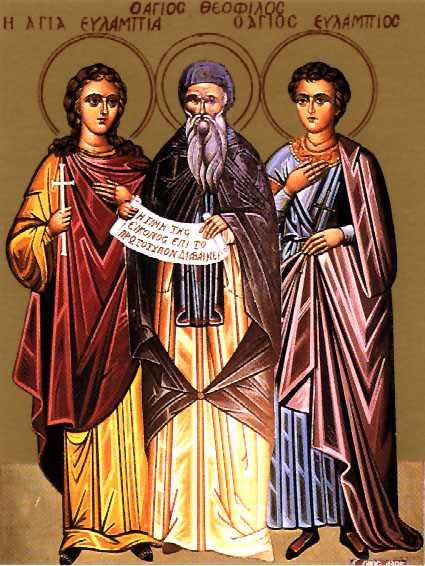
Eulampius & Eulampia the Martyrs, Our Righteous Father Theophilus the Confessor, Pinytos, Bishop of Knossos, The 200 Monk-martyrs of Nicomedia, Vassianos the Righteous of Constantinople, The 14 Holy Elders of Optina Monastery, Paulinus, Archbishop of York

ST. PAUL’S LETTER TO THE EPHESIANS 6:18-24

Brethren, pray at all times in the Spirit, with all prayer and supplication. To that end keep alert with all perseverance, making supplication for all the saints, and also for me, that utterance may be given me in opening my mouth boldly to proclaim the mystery of the gospel, for which I am an ambassador in chains; that I may declare it boldly, as I ought to speak.
Now that you also may know how I am and what I am doing, Tychicos the beloved brother and faithful minister in the Lord will tell you everything. I have sent him to you for this very purpose, that you may know how we are, and that he may encourage your hearts.
Peace be to the brethren, and love with faith, from God the Father and the Lord Jesus Christ. Grace be with all who love our Lord Jesus Christ with love undying. Amen.

LUKE 7:31-35

The Lord said, “To what shall I compare the men of this generation, and what are they like? They are like children sitting in the market place and calling to one another, ‘We piped to you, and you did not dance; we wailed, and you did not weep.’ For John the Baptist has come eating no bread and drinking no wine; and you say, ‘He has a demon.’ The Son of man has come eating and drinking; and you say, ‘Behold, a glutton and a drunkard, a friend of tax collectors and sinners!’ Yet wisdom is justified by all her children.”

Martyrs Eulampius and Eulampia, at Nicomedia, and 200 Martyrs with them

Saints Eulampius and Eulampia were brother and sister. They lived at the beginning of the fourth century in the city of Nicomedia. Eulampius became upset after reading the decree of the emperor Maximian (284-305) sentencing all Christians to execution. Eulampius was horrified that the emperor was taking up arms against his own subjects rather than fighting the enemies of his country.

The youth was brought to trial and commanded to renounce the Christian Faith. When he refused, they first raked him with iron hooks, and then placed him upon a red-hot bed of coals. All of a sudden the sufferer expressed a wish to visit the pagan temple. The judges were delighted, supposing that they had turned him from Christianity. In the pagan temple of Mars the saint approached the idol and cried out, “In the Name of the Lord Jesus Christ I command you to fall to the floor and crumble into dust!” The idol immediately crashed down to the floor and was destroyed.

The people exclaimed, “The Supreme God is the Christian God, Who is great and mighty!” Saint Eulampius was again taken away for torture. This time his sister, Eulampia, appeared before the judges and declared that she also was a Christian. Eulampius told her, “Sister, do not fear those who kill the body but are unable to kill the soul” (Mt.10:28).

The martyrs were tortured and thrown into a red-hot furnace, but the Lord protected them from the fire. Finally, they beheaded Eulampius, but Eulampia died from her torments before she could be beheaded.

Two hundred martyrs were converted to Christ after seeing the miracles of Saint Eulampius and Saint Eulampia as they were being tortured. They were also put to death and received the crown of martyrdom.

Saint Amphilochius, Bishop of Vladimir, Volhynia

Saint Amphilochius, Bishop of Vladimir-Volhynia was the third bishop of one of the oldest of Russian dioceses, Vladimir-Volhynia, which was established in the time of Saint Vladimir. The first Vladimir-Volhynia bishop was Stephen, elected under Saint Vladimir himself; the next in succession was Igumen Stephen of the Kiev Caves (April 27), who became the igumen after Saint Theodosius (May 3). Saint Amphilochius was consecrated bishop on August 27, 1105 by the Metropolitan of Kiev, Nikēphóros (1103-1121).

For seventeen years Bishop Amphilochius guided the Vladimir-Volhynia flock. Only a couple of generations separate his time from that of the Baptism of Kievan Rus, and the saint toiled tirelessly for the conversion of pagans to Christ. He also worked to root out pagan superstitions among the newly-baptized, while pacifying the strife among the princes of the region.

Resigning as hierarch, he continued his service to God in the Kiev Caves monastery, where he died in the year 1122. The October 10 celebration of his memory, together with the other holy hierarchs of the Volhynia region, was established in the year 1831, after the restoration of the Pochaev Lavra in Volhynia to Orthodoxy.

Synaxis of the Saints of Volhynia

The Synaxis of the Saints of Volhynia commemorates all the saints of that region, including

Saint Amphilochius, Bishop of Vladimir in Volhynia (October 10)

Saint Job of Pochaev (August 28, October 28)

Saint Juliana Olshanskaya (July 6)

Saint Macarius of Kanev (May 13, September 7)

Saint Stephen, Bishop of Vladimir in Volhynia (April 27)

Saint Theodore (Theodosius, in monasticism) (August 11)

Saint Yaropolk, prince of Vladimir, Volhynia (November 22)

Blessed Andrew of Totma the Fool-For-Christ

Blessed Andrew of Totma, the Fool-for-Christ was born in the year 1638 in the village of Ust-Totma and chose to leave the world while still a child. With the blessing of Stephen, igumen of the Resurrection monastery in Galich, Andrew took upon himself the arduous calling of fool-for-Christ. He lived at the church of the Resurrection of Christ in the city of Totma on the banks of the River Sukhona.

Walking barefoot in both winter and summer, Andrew wore tattered clothing, and ate only bread and water, and that in such a small quantity that it just barely kept him from starving. He prayed both day and night, and if anyone gave him anything, he would give it away to the poor. For his efforts and toil the Blessed Andrew acquired the gift of wonderworking.

One winter a blind man by the name of Azhibokai came to the blessed fool, asking for healing while offering him a large sum of money. But the fool fled away. Azhibokai then washed his eyes with snow from where the saint had stood. In doing so, he was able to see.

The time of his own death was revealed to the Blessed Andrew. He made his confession, received the Holy Mysteries and peacefully fell asleep in the Lord in 1673. Over his grave was built the bell-tower church of the holy Martyr Andrew Stratelates (August 19), whose name he bore. Many miracles were witnessed at the grave of the Blessed Andrew.

Martyr Theotecnus of Antioch

Saint Theotecnus of Antioch was a renowned military commander at Antioch under the emperor Maximian (305-311). One time the emperor arrived in Antioch, demanding that all the inhabitants offer sacrifice to the pagan gods. As a Christian, Theotecnus refused to fulfill the order. The emperor, scoffing at the Christian Faith, gave orders to dress Theotecnus in women’s clothing and put him among the slave women. Three weeks later the emperor summoned Theoteknos to him, thinking that the humiliation would break his spirit, but again he heard the martyr confess Christ.

“You put your life in peril, if you do not submit”, growled Maximian. Theotecnus was silent. In a fury, the emperor, gave orders to cut the tendons and burn the feet of the martyr, and then throw him in a kettle of boiling tar. But just as soon as Theotecnus went into the kettle, the flames beneath it went out, and the heat of the kettle went cool instantly. Terror seized the emperor. Not wanting to torture the martyr further, he sent him to prison and entrusted his own centurion to deal with the saint.

In prison with Theotecnus was a Christian confessor named Alexander. Theotecnus helped him escape from the prison. Learning of this, the centurion subjected Theotecnus to brutal torments, and eventually gave orders to throw the saint into the sea with a stone about his neck. After a while, the relics of Saint Theotecnus were found, near the city of Rusob on the Cilician seacoast, and given Christian burial.

Saint Bassian of Constantinople

Saint Bassian of Constantinople was born in eastern Syria and became an ascetic in Constantinople, where the pious emperor Marcian (450-457) ruled. The venerable Bassian was the igumen at a monastery where there were three hundred monks. Among them also was Saint Matrona (November 9), who dressed in men’s attire. Saint Bassian lived in his monastery to an old age, famed for his virtuous life and numerous miracles, and peacefully fell asleep in the Lord.

Saint Theophilus the Confessor of Bulgaria

Saint Theophilus the Confessor of Bulgaria came from the area surrounding Tiberiada. When he was thirteen, the saint secretly left his home to go off to the monastery on Mount Selenteia. There he matured spiritually under the guidance of the Elder, Saint Stephen. After three years Saint Theophilus was tonsured into monasticism. When the parents of the saint learned where their son was, they went to the monastery and asked the igumen to send Theophilus and several of the brethren to establish a new monastery closer to the their home. The igumen bade all the monks to fast and to pray, so that a sign might be received. On the third day a voice was heard in the church giving the blessing for Theophilus to start a new monastery, since he would become renowned for his many spiritual exploits.

During the period of the iconoclast controversy culminating in the reign of the iniquitous iconoclast emperor, Leo the Isaurian (717-741), Saint Theophilus openly revolted against the iconoclast folly. In accord with the emperor’s orders, the saint was subjected to beatings and led through the city tied up like a criminal. The emperor then gave Theophilus over into the charge of the official, Hypatius who tried repeatedly to compel the confessor to renounce holy icons. Theophilus remained steadfast. Instead, he succeeded in converting Hypatius.

As proof of the validity of icons, Theophilus cited the brass serpent set up by Moses (Num 21:9), the corroboration of the Cherubim atop the Ark of the Covenant, and finally how the Savior Himself had given to Abgar, the Prince of Edessa, His Icon Not Made by Hands (August 16). Persuaded by this evidence, Hypatius gained the emperor’s permission to set the saint free. The confessor returned to his monastery. He lived only a short time longer, and in the year 716 Saint Theophilus fell asleep peacefully in the Lord.

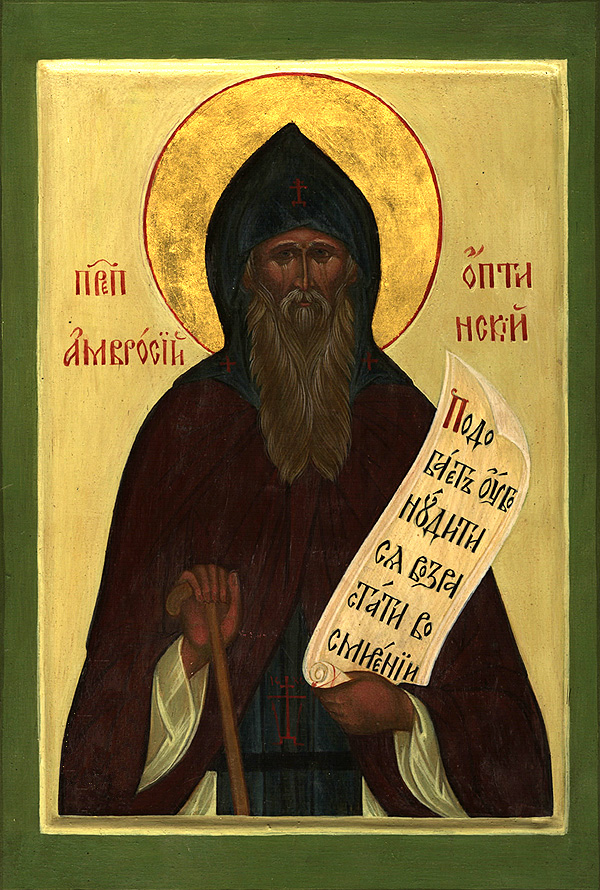
Venerable Ambrose of Optina

Alexander Michailovich Grenkov was born Nov. 23, 1812 in the Russian province of Tambov. His parents raised him strictly and with fervent piety. Since he was of a priestly family, it was no surprise when he entered the Tambov theological seminary in 1830. He did well in his studies and was ranked among the top students.

About a year before graduation Alexander became seriously ill. He promised that if God healed him, he would become a monk. Although his prayer was answered, Alexander seemed to forget his promise.

After graduation from the seminary he took a position as tutor to the children of a certain landowner and remained with this family for a year and a half. After this he became a teacher at the local parochial school.

One day in 1839 Alexander and a friend visited the famous hermit Father Hilarion to ask him what they should do with their lives. Alexander was surprised when he was told to go to the monastery of Optina Pustin, where they had great need of him. In September of that same year, however, he seemed to be prepared to continue with his teaching career.

One night he was invited to spend a pleasant evening with some friends. His conversation was witty and brilliant, and all his jokes and puns were on the mark. Although his hosts were amused and impressed by him, Alexander was disgusted by his own frivolity. Perhaps his unfulfilled promise to become a monk weighed on his conscience.

The next morning he quit his job and arrived at Optina in October of 1839. After a trial period he decided to remain in the monastery and dedicate his life to God. He received the monastic tonsure in 1842, and was given the name Ambrose in honor of Saint Ambrose of Milan (December 7). Ambrose knew the famous spiritual directors Elder Leonid and Elder Macarius. He was the cell attendant of Elder Macarius, who undoubtedly influenced the young monk’s spiritual development.

Ordained as a priest in 1845, Father Ambrose’s reverence and piety in celebrating the divine services were noticed by the other monks. His health began to decline shortly afterward, and he had to ask to be relieved of all duties. In 1846 he was so ill that the Mystery of Holy Unction was administered to him. He bore his illness without complaint and slowly regained his strength. By 1848 he was able to walk with the aid of a cane.

Father Ambrose began to help Elder Macarius with his correspondence and in preparing the Russian edition of Saint John Climacus’s LADDER OF DIVINE ASCENT, which was published by the monastery.

When Father Macarius had to go to Moscow in 1852, he designated Father Ambrose to take his place until his return. Father Ambrose never gave his personal opinions when he was asked for advice, but always referred people to the writings of the Fathers. If someone did not understand the text he was given to read, Father Ambrose would explain it in simple terms.

Father Macarius died in 1860 without naming anyone to succeed him as Elder. By divine providence, all the other possible candidates either died or were appointed as abbots of other monasteries. This left Father Ambrose as the undisputed spiritual director of the monastery. In his role as Elder, Father Ambrose had to receive many people each day to hear confessions and give advice. He used to say, “The Lord has arranged it so that I would have to talk to people all my life. Now I would be happy to remain silent, but I cannot.”

An average day in Saint Ambrose’s life began at 4 A.M. when his cell attendant came into his cell to read the morning Rule of prayer for him. After this he would wash and have some tea, then he would dictate replies to the many letters he received every day. Visitors would be lining up even as he was having breakfast. Sometimes he would take a break after two hours, but more often he would continue seeing people until noon when he had his lunch.

After lunch he would go out into the next room and greet more visitors. People would call out questions and he would give an appropriate response. He took a short rest at 3 P.M. then talked to people until the evening. At 8 P.M. he had dinner then received more visitors until 11 P.M. At that hour the evening Rule of prayer was read, and Father Ambrose begged forgiveness of the brethren whom he may have offended by thought, word, or deed. After three or four hours of sleep it would all begin again. This routine would fatigue a strong man. It is remarkable that Saint Ambrose, who was often in poor health, was able to keep it up for so many years.

From all over Russia, people flocked to the venerable Elder. The writer Tolstoy visited him on at least three occasions, and left impressed by the wisdom of the holy monk. Fyodor Dostoevsky came to Optina in 1878 after the death of his son Alyosha and was profoundly affected by his meeting with Saint Ambrose. The novelist used Father Ambrose as a model for Starets Zosima in The Brothers Karamazov.

The saint founded Shamordino convent in 1884. This convent, which was near Optina, opened its doors to women who were poor, sickly, or even blind. Most convents were very poor and had to rely on the incomes of women who had a certain personal wealth in order to remain open. Saint Ambrose made it possible for any woman who wished to become a nun to follow this path of salvation.

Shamordino began to decline after the death of the first abbess, Mother Sophia. Saint Ambrose went there in June 1890 to straighten out the convent’s affairs. He was unable to return to Optina due to illness, then winter made it impossible for him to travel. Father Ambrose continued to see visitors at Shamordino, even though his health continued to deteriorate in 1891.

By September, it was clear that he had not long to live. He fell asleep in the Lord at 11:30 A.M. on the morning of October 10 1891. Throngs of people attended his funeral and also his burial at Optina. Fathers Joseph, Anthony, Benedict, and Anatole succeeded him as Elder until the monastery was closed after the Russian Revolution.

The Moscow Patriarchate authorized local veneration of the Optina Elders on June 13,1996. The work of uncovering the relics of Saints Leonid, Macarius, Hilarion, Ambrose, Anatole I, Barsanuphius and Anatole II began on June 24/July 7, 1998 and was concluded the next day. However, because of the church Feasts (Nativity of Saint John the Baptist, etc.) associated with the actual dates of the uncovering of the relics, Patriarch Alexey II designated June 27/July 10 as the date for commemorating this event. The relics of the holy Elders now rest in the new church of the Vladimir Icon of the Mother of God.

The Optina Elders were glorified by the Moscow Patriarchate for universal veneration on August 7, 2000.

Saint Ambrose was glorified in 1988 by the Patriarchate of Moscow as part of the Millennium celebration of the Baptism of Rus.

Hieromartyr and Metropolitan of Moscow and Krutitsy, Peter Polyansky

New Hieromartyr Peter, Metropolitan of Krutitsy was glorified by the Russian Orthodox Church at the Synod of Bishops of the Russian Orthodox Church on February 23, 1997.

Saint Peter was born in the Voronezh region, and studied at the Moscow Theological Academy, graduating in 1892, where he then continued as inspector. After a short stay at the seminary of Zhirovits in Belarus as inspector, he was appointed secretary of the Synodal Education Committee becoming de facto inspector of all the theological schools of the Russian Orthodox Church.

Unlike many of his contemporaries who had graduated from a theological academy, Peter Polyansky did not seek ordination, and for a long time remained a layman. As secretary of the Synodal Education Committee he traveled widely, visiting innumerable theological establishments, meeting and knowing many people. Gifted with an outstanding intellect, a firm character and a sociable nature, he was widely known and made many friends. He exercised a beneficial influence on the religious education of future priests.

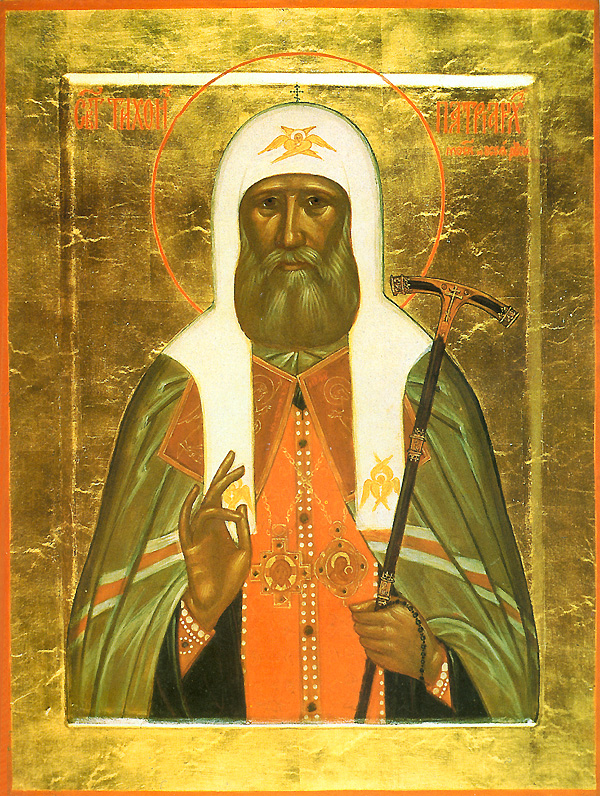
In 1917-18, Peter Polyansky took part in the work of the local Council of the Russian Orthodox Church, when Saint Tikhon (April 7) was elected Patriarch. The latter made Peter Polyansky one of his closest aides, and persuaded him to become bishop; the Patriarch wished to consolidate the leadership of the Church in what was fast becoming the darkest time for the Church in many centuries. In 1920 Peter Polyansky was made a monk and auxiliary bishop for the diocese of Moscow; in a matter of months he was appointed Metropolitan of Krutitsy, one of the highest ranking bishops of the Russian Orthodox Church.

Patriarch Tikhon died on April 7, 1925, the day of the Annunciation (March 25). Foreseeing increasing troubles and uncertainty for the Church, thinking that the government would not allow a Church council to assemble and elect the next patriarch, Saint Tikhon took an administrative decision aimed at securing a smooth succession when he died. He nominated three bishops in order of priority, as locum tenens; the third was Metropolitan Peter Polyansky. When the first two choices were found to be in prison and thus unable to assume the leadership of the Church, this heavy task befell Metropolitan Peter.

Persecution against the Church was raging, the government gave its support to the splinter group “The Living Church” in an attempt to discredit and destroy the official Orthodox Church. A great number of bishops had been imprisoned or exiled to remote parts of the country, and were unable to have a clear understanding of the prevailing situation. The whole country was in turmoil; the so-called Living Church energetically tried to replace the true Church.

In the absence of a patriarch, people did not know whom to believe and to whom to give their allegiance. Metropolitan Peter then issued an uncompromisingly firm “Letter to the Russian Church” where he described the position of the Church vis a vis the authorities and vis a vis the “Living Church.” He made no compromises with anybody, and stood firm in the truth of Christ. This letter helped the Church to strengthen itself but caused the Metropolitan to be arrested.

The history of the few months in which a campaign was master-minded by the Commissar for religious affairs, Tuchkov, to compromise and weaken Saint Peter, shows how determined the government was to defeat the head of the Church, but this did not break him. On December 10, 1925, Saint Peter was put under house arrest, and two days later sent to the Lubianka prison; in May 1926 he was transferred to the Suzdal fortress, then back to the Lubianka, and finally, in December, he was sent to Siberia, first to Tobolsk, then to the village of Abalak on the banks of the river Irtysh which he reached in 1927. Many of the other bishops had experienced a similar fate, the dioceses remaining without their shepherds.

In August 1927, Metropolitan Peter was taken to another destination beyond the Arctic Circle, a place called Khe on the mouth of the Ob, in the frozen tundra. For a little while he lived there peacefully, recovering from the arduous journey. However, on August 29, the day of the Beheading of the Saint John the Baptist, he suffered his first attack of angina and had to stay in bed. Two paramedics who came from a far distance by river in a boat manned by a native, advised him to be seen by a doctor and be transferred to a hospital. The Metropolitan wrote to the authorities at the GPU, but never got a reply, or money, or provisions, although he knew that several parcels had arrived in Tobolsk addressed to him.

The damp, cold climate of this northern region was extremely harmful to him in his condition. Eventually, towards the end of September, he was taken back to Tobolsk. Unexpectedly, he had an interview with Tuchkov who offered him freedom if he surrendered his title of locum tenens, but he remained firm and refused to compromise. He was then sent back to Khe for another three years of exile, but he was never granted his freedom. In Moscow in 1936, ten years after his first imprisonment, believers were waiting for his return, counting on the end of his ten-year term of exile. They never saw him again. He may have been moved for the last time to a monastery nearer central Russia where he was a little less constrained, but with no freedom to write or communicate with the world. He was shot by decision of the Soviet authorities after years of prison and exile.

Icon of the Mother of God “of the Akathist” of Zographou Monastery

In the XIII century, there was a certain Elder who spent his life in ascetical struggles on Mount Athos. He had the pious custom of reading the Akathist Hymn before the Icon of the Mother of God every day.

One day, while reading the Akathist, and silently repeating the word "rejoice," the Elder suddenly heard a voice coming from the Icon, "Rejoice also, Elder of God!"

The ascetic trembled in horror, but the voice continued: "Do not be afraid, but go to the monastery as soon as possible and announce to the brethren and to the Igoumen that the monastery is in danger from enemies who are already close by. Whoever is weak in patience, let him hide until the temptation passes; but as for those who are seeking crowns, let them stay."

The Elder left the cell right away and hurried to the monastery. As soon as he entered the gate, his eyes beheld the very Icon from his cell, before which he had just read the Akathist. An invisible, miraculous power had brought it there from the ascetic's cell.

The Elder fell down before the Icon with ardent prayer, and then with the Icon in his hands, he went to the Igoumen. The brotherhood, learning of the impending danger, was very worried. The more faint-hearted monks hastened to hide in the mountains, while twenty-six brave monks, including the Igoumen himself, remained in the monastery. The Elder, who received the heavenly revelation, also remained with them, so that he might comfort them during the coming trial.

It did not take long for their enemies to reach the monastery. These were Latins who at that time were trying to convert Orthodox Christians to Catholicism. Arriving at the monastery and approaching the tower in which the monks had locked themselves, they tried to persuade them to renounce Orthodoxy. In an effort to convince them to recognize the pope as the head of the Universal Church, the Latins promised the champions of Orthodoxy all sorts of favors and monetary rewards. But these faithful sons of the Orthodox Church remained adamant.

Then the enemies of Orthodoxy piled wood around the tower and lit it. As they prayed to the Lord, the monks gave thanks to the Almighty for making them worthy of receiving the crown of martyrdom, and then all of them surrendered their spotless souls to the Heavenly Father. Their martyric death occurred on October 10, 1274. The names of the victims were added to the Synodikon of Zographou Monastery, as well as to the official calendar of the Bulgarian Orthodox Church.

The wonderworking Icon of the Mother of God, who warned the Elder about the impending disaster, was subsequently found unscathed under the ashes in the ruins of the monastery. Today this Icon is in the monastery, and an unsleeping lampada burns before it.

There is another Icon with the same name "of the Akathist" at Hilandar Monastery on Mount Athos. Information about that Icon may be found under January 12.

26 Monastic Martyrs of Zographou Monastery on Mount Athos

In the year 1274 at the Council of Lyons (in France), the Byzantine Emperor Michael VIII Paleologos decided to buttress his waning power by forming a union with Rome. This policy aroused universal discontent. In 1278, the Emperor issued a decree to introduce the Union at Constantinople by forceful measures if necessary.

Mount Athos stood in firm opposition to the Union. The monks sent a letter to Michael pointing out that accepting the primacy of the Pope, commemorating him in the churches, celebrating the Eucharist with unleavened bread, the insertion of the “filioque” [“and from the Son”] into the Creed, could not be accepted by the Orthodox, and they begged the Emperor to change his mind. In their letter they wrote, “We see clearly that you are becoming a heretic, but we implore you to forsake all this and to abide in the teachings which have been handed down to you…. Reject the unholy and novel teachings of false knowledge, speculations, and additions to the Faith.”

Crusaders left Palestine, and finding refuge in the Byzantine Empire, declared to the Emperor their readiness to uphold the power of the Pope by fire and sword. Furthermore, Michael hired mercenaries, both Turks and Tatars, to enforce his decree.

The Emperor hated the monks of Mount Athos for their opposition. Since he did not want to provoke the Greeks, he decided to attack the Slavic monks on Mount Athos. By Michael’s orders, the servants of the Pope descended upon the Bulgarian Monastery of Zographou. When their demand to accept the Union was presented to the Zographou monks, they refused to listen. They held fast to the doctrines of the Fathers, and fearlessly censured those who accepted the Latin teachings. The majority of the Zographou monks left the Monastery, but twenty-six of the most steadfast remained within the Monastery tower.

Their names are: Igoumen Thomas, Barsanouphios, Cyril, Michaios (or Micah), Simon, Hilarion, James, another James, Job, Cyprian, Savva, Martinian, Kosmás, Sergius, Mēnás, Ioásaph, Ioannίkios, Paul, Anthony, Euthymios, Dometius, Parthénios, and four more whose names are not known.

The holy Martyrs for their Orthodox Faith, were burnt alive in the Monastery tower on October 10, 1284.1

The Martyrs of Zographou are also commemorated on September 22.


1 Some sources say 1276.

Daily Readings for Thursday, October 09, 2025

JAMES THE APOSTLE, SON OF ALPHAEUS

NO FAST

James the Apostle, son of Alphaeus, Andronicus & his wife Athanasia of Egypt, Poplia the Confessor of Antioch, The Righteous Patriarch Abraham and his nephew Lot

ST. PAUL’S FIRST LETTER TO THE CORINTHIANS 4:9-16

Brethren, God has exhibited us apostles as last of all, like men sentenced to death; because we have become a spectacle to the world, to angels and to men. We are fools for Christ’s sake, but you are wise in Christ. We are weak, but you are strong. You are held in honor, but we in disrepute. To the present hour we hunger and thirst, we are ill-clad and buffeted and homeless, and we labor, working with our own hands. When reviled, we bless; when persecuted, we endure; when slandered, we try to conciliate; we have become, and are now, as the refuse of the world, the off-scouring of all things. I do not write this to make you ashamed, but to admonish you as my beloved children. For though you have countless guides in Christ, you do not have many fathers. For I became your father in Christ Jesus through the gospel. I urge you, then, be imitators of me.

MATTHEW 9:36-38; 10:1-8

At that time, when Jesus saw the crowds, he had compassion for them, because they were harassed and helpless, like sheep without a shepherd. Then he said to his disciples, "The harvest is plentiful, but the laborers are few; pray therefore the Lord of the harvest to send out laborers into his harvest.
And he called to him his twelve disciples and gave them authority over unclean spirits, to cast them out, and to heal every disease and every infirmity. The names of the twelve apostles are these: first, Simon, who is called Peter, and Andrew his brother; James the son of Zebedee, and John his brother; Philip and Bartholomew; Thomas and Matthew the tax collector; James the son of Alphaios, and Lebbaeos called Thaddaios; Simon the Cananaean, and Judas Iscariot, who betrayed him. These twelve Jesus sent out, charging them, "Go nowhere among the Gentiles, and enter no town of the Samaritans, but go rather to the lost sheep of the house of Israel. And preach as you go, saying, 'The kingdom of heaven is at hand.' Heal the sick, raise the dead, cleanse lepers, cast out demons. You received without paying, give without pay.

Glorification of Saint Tikhon, Apostle to America

Saint Tikhon, Patriarch of Moscow and Apostle to America was born as Vasily Ivanovich Belavin on January 19, 1865 into the family of Ioann Belavin, a rural priest of the Toropetz district of the Pskov diocese. His childhood and adolescence were spent in the village in direct contact with peasants and their labor. From his early years he displayed a particular religious disposition, love for the Church as well as rare meekness and humility.

When Vasily was still a boy, his father had a revelation about each of his children. One night, when he and his three sons slept in the hayloft, he suddenly woke up and roused them. He had seen his dead mother in a dream, who foretold to him his imminent death, and the fate of his three sons. She said that one would be unfortunate throughout his entire life, another would die young, while the third, Vasily, would be a great man. The prophecy of the dead woman proved to be entirely accurate in regard to all three brothers.

From 1878 to 1883, Vasily studied at the Pskov Theological Seminary. The modest seminarian was tender and affectionate by nature. He was fair-haired and tall of stature. His fellow students liked and respected him for his piety, brilliant progress in studies, and constant readiness to help comrades, who often turned to him for explanations of lessons, especially for help in drawing up and correcting numerous compositions. Vasily was called “bishop” and “patriarch” by his classmates.

In 1888, at the age of 23, Vasily Belavin graduated from the Saint Petersburg Theological Academy as a layman, and returned to the Pskov Seminary as an instructor of Moral and Dogmatic Theology. The whole seminary and the town of Pskov became very fond of him. He led an austere and chaste life, and in 1891, when he turned 26, he took monastic vows. Nearly the whole town gathered for the ceremony. He embarked on this new way of life consciously and deliberately, desiring to dedicate himself entirely to the service of the Church. The meek and humble young man was given the name Tikhon in honor of Saint Tikhon of Zadonsk.

He was transferred from the Pskov Seminary to the Kholm Theological Seminary in 1892, and was raised to the rank of archimandrite. Archimandrite Tikhon was consecrated Bishop of Lublin on October 19, 1897, and returned to Kholm for a year as Vicar Bishop of the Kholm Diocese. Bishop Tikhon zealously devoted his energy to the establishment of the new vicariate. His attractive moral make-up won the general affection, of not only the Russian population, but also of the Lithuanians and Poles. On September 14, 1898, Bishop Tikhon was made Bishop of the Aleutians and Alaska. As head of the Orthodox Church in America, Bishop Tikhon was a zealous laborer in the Lord’s vineyard.

He did much to promote the spread of Orthodoxy, and to improve his vast diocese. He reorganized the diocesan structure, and changed its name from “Diocese of the Aleutians and Alaska” to “Diocese of the Aleutians and North America” in 1900. Both clergy and laity loved their archpastor, and held him in such esteem that the Americans made Archbishop Tikhon an honorary citizen of the United States.

On May 22, 1901, he blessed the cornerstone for Saint Nicholas Cathedral in New York, and was also involved in establishing other churches. On November 9, 1902, he consecrated the church of Saint Nicholas in Brooklyn for the Syrian Orthodox immigrants. Two weeks later, he consecrated Saint Nicholas Cathedral in NY.

In 1905, the American Mission was made an Archdiocese, and Saint Tikhon was elevated to the rank of Archbishop. He had two vicar bishops: Bishop Innocent (Pustynsky) in Alaska, and Saint Raphael (Hawaweeny) in Brooklyn to assist him in administering his large, ethnically diverse diocese. In June of 1905, Saint Tikhon gave his blessing for the establishment of Saint Tikhon’s Monastery.

In 1907, he returned to Russia, and was appointed to Yaroslavl, where he quickly won the affection of his flock. They came to love him as a friendly, communicative, and wise archpastor. He spoke simply to his subordinates, never resorting to a peremptory or overbearing tone. When he had to reprimand someone, he did so in a good-natured, sometimes joking manner, which encouraged the person to correct his mistakes.

When Saint Tikhon was transferred to Lithuania on December 22, 1913, the people of Yaroslavl voted him an honorary citizen of their town. After his transfer to Vilnius, he did much in terms of material support for various charitable institutions. There too, his generous soul and love of people clearly manifested themselves. World War I broke out when His Eminence was in Vilnius. He spared no effort to help the poor residents of the Vilnius region who were left without a roof over their heads or means of subsistence as a result of the war with the Germans, and who flocked to their archpastor in droves.

After the February Revolution and formation of a new Synod, Saint Tikhon became one of its members. On June 21, 1917, the Moscow Diocesan Congress of clergy and laity elected him as their ruling bishop. He was a zealous and educated archpastor, widely known even outside his country.

On August 15, 1917, a local council was opened in Moscow, and Archbishop Tikhon was raised to the dignity of Metropolitan, and then elected as chairman of the council. The council had as its aim to restore the life of Russian Orthodox Church on strictly canonical principles, and its primary concern was the restoration of the Patriarchate. All council members would select three candidates, and then a lot would reveal the will of God. The council members chose three candidates: Archbishop Anthony of Kharkov, the wisest, Archbishop Arseny of Novgorod, the strictest, and Metropolitan Tikhon of Moscow, the kindest of the Russian hierarchs.

On November 5, following the Divine Liturgy and a Molieben in the Cathedral of Christ the Savior, a monk removed one of the three ballots from the ballot box, which stood before the Vladimir Icon of the Mother of God. Metropolitan Vladimir of Kiev announced Metropolitan Tikhon as the newly elected Patriarch. Saint Tikhon did not change after becoming the primate of the Russian Orthodox Church. In accepting the will of the council, Patriarch Tikhon referred to the scroll that the Prophet Ezekiel had to eat, on which was written, “Lamentations, mourning, and woe.” He foresaw that his ministry would be filled with affliction and tears, but through all his suffering, he remained the same accessible, unassuming, and kindly person.

All who met Saint Tikhon were surprised by his accessibility, simplicity and modesty. His gentle disposition did not prevent him from showing firmness in Church matters, however, particularly when he had to defend the Church from her enemies. He bore a very heavy cross. He had to administer and direct the Church amidst wholesale church disorganization, without auxiliary administrative bodies, in conditions of internal schisms and upheavals by various adherents of the Living Church, renovationists, and autocephalists.

The situation was complicated by external circumstances: the change of the political system, by the accession to power of the godless regime, by hunger, and civil war. This was a time when Church property was being confiscated, when clergy were subjected to court trials and persecutions, and Christ’s Church endured repression. News of this came to the Patriarch from all ends of Russia. His exceptionally high moral and religious authority helped him to unite the scattered and enfeebled flock. At a crucial time for the church, his unblemished name was a bright beacon pointing the way to the truth of Orthodoxy. In his messages, he called on people to fulfill the commandments of Christ, and to attain spiritual rebirth through repentance. His irreproachable life was an example to all.

In order to save thousands of lives and to improve the general position of the church, the Patriarch took measures to prevent clergy from making purely political statements. On September 25, 1919, when the civil war was at its height, he issued a message to the clergy urging them to stay away from political struggle.

The summer of 1921 brought a severe famine to the Volga region. In August, Patriarch Tikhon issued a message to the Russian people and to the people of the world, calling them to help famine victims. He gave his blessing for voluntary donations of church valuables, which were not directly used in liturgical services. However, on February 23, 1922, the All-Russian Central Executive Committee published a decree making all valuables subject to confiscation.

According to the 73rd Apostolic Canon, such actions were regarded as sacrilege, and the Patriarch could not approve such total confiscation, especially since many doubted that the valuables would be used to combat famine. This forcible confiscation aroused popular indignation everywhere. Nearly two thousand trials were staged all over Russia, and more than ten thousand believers were shot. The Patriarch’s message was viewed as sabotage, for which he was imprisoned from April 1922 until June 1923.

His Holiness, Patriarch Tikhon did much on behalf of the Russian Orthodox Church during the crucial time of the so-called Renovationist schism. He showed himself to be a faithful servant and custodian of the undistorted precepts of the true Orthodox Church. He was the living embodiment of Orthodoxy, which was unconsciously recognized even by enemies of the church, who called its members “Tikhonites.”

When Renovationist priests and hierarchs repented and returned to the church, they were met with tenderness and love by Saint Tikhon. This, however, did not represent any deviation from his strictly Orthodox policy. “I ask you to believe me that I will not come to agreement or make concessions which could lead to the loss of the purity and strength of Orthodoxy,” the Patriarch said in 1924.

Being a good pastor, who devoted himself entirely to the church’s cause, he called upon the clergy to do the same: “Devote all your energy to preaching the word of God and the truth of Christ, especially today, when unbelief and atheism are audaciously attacking the Church of Christ. May the God of peace and love be with all of you!”

It was extremely painful and hard for the Patriarch’s loving, responsive heart to endure all the Church’s misfortunes. Upheavals in and outside the church, the Renovationist schism, his primatial labors, his concern for the organization and tranquility of Church life, sleepless nights and heavy thoughts, his confinement that lasted more than a year, the spiteful and wicked baiting of his enemies, and the unrelenting criticism sometimes even from the Orthodox, combined to undermine his strength and health.

In 1924, Patriarch Tikhon began to feel unwell. He checked into a hospital, but would leave it on Sundays and Feast Days in order to conduct services. On Sunday, April 5, 1925, he served his last Liturgy, and died two days later. On March 25/April 7, 1925 the Patriarch received Metropolitan Peter and had a long talk with him. In the evening, the Patriarch slept a little, then he woke up and asked what time it was. When he was told it was 11:45 P.M., he made the Sign of the Cross twice and said, “Glory to Thee, O Lord, glory to Thee.” He did not have time to cross himself a third time.

Almost a million people came to say farewell to the Patriarch. The large cathedral of the Donskoy Monastery in Moscow could not contain the crowd, which overflowed the monastery property into the square and adjacent streets. Saint Tikhon, the eleventh Patriarch of Moscow, was primate of the Russian Church for seven and a half years.

On September 26/October 9, 1989, the Council of Bishops of the Russian Orthodox Church glorified Patriarch Tikhon and numbered him among the saints. For nearly seventy years, Saint Tikhon’s relics were believed lost, but in February 1992, they were discovered in a concealed place in the Donskoy Monastery.

It would be difficult to imagine the Russian Orthodox Church without Patriarch Tikhon during those years. He did so much for the Church and for the strengthening of the Faith itself during those difficult years of trial. Perhaps the saint’s own words can best sum up his life: “May God teach every one of us to strive for His truth, and for the good of the Holy Church, rather than something for our own sake.”

Apostle James, son of Alphaeus

Holy Apostle James the son of Alphaeus one of the Twelve Apostles, was the brother of the holy Evangelist Matthew. He heard the Lord’s words and witnessed His miracles. After the Descent of the Holy Spirit, the Apostle James Alphaeus and the Apostle Andrew the First-Called (November 30), made missionary journeys preaching in Judea, Edessa, Gaza, Eleutheropolis, proclaiming the Gospel, healing all sorts of sickness and disease, and converting many to the path of salvation. Saint James finished his apostolic work In the Egyptian city of Ostrachina, where he was crucified by the pagans.

Venerable Andronicus, and his wife Athanasia, of Egypt

Saint Andronicus and his wife Athanasia of Egypt lived in Antioch in the fifth century. Saint Andronicus was a craftsman who divided his earnings into three portions. One part he gave to the Church, the second to the poor, and the third he used for his family. When the Lord took the son and daughter of Andronicus and Athanasia, the pious couple decided to devote themselves fully to the service of God, helping the poor and the sick. Soon the saintly spouses set out for Alexandria, where Andronicus entered a skete monastery, and Athanasia entered the women’s Tabennisiota monastery.

After twelve years of ascetic life Saint Andronicus went to Jerusalem to pray at the holy places. He met a co-pilgrim, Saint Athanasia, who, foreseeing the difficulties of the journey, had donned men’s attire. They did not recognize each other, since long ascetic effort had altered their appearance. When they returned from Jerusalem, both monks settled into a single cell and for many years lived the ascetic life in silence. Saint Athanasia wrote a note to be read after her death, revealing her secret.. Saint Andronicus died soon after Saint Athanasia.

Righteous Forefather Abraham

The Righteous Forefather Abraham lived around 2000 B.C. His story is found in the Book of Genesis, Chapters 12-25.

God told Abraham that all the nations of the earth would be blessed in his seed (Genesis 22:18), and ordered him to leave his home and his relatives and go to Canaan, the country between the Mediterranean and Jordan. Because God gave this land to Abraham and his posterity (Genesis 12:7), it became known as “the Promised Land.”

Abraham and Lot are also commemorated with Christ’s ancestors according to the flesh on the Sunday of the Holy Forefathers (between December 11 and 17).

Righteous Lot

The Righteous Forefather Abraham (“Father of a multitude”) and his nephew Lot (“veil”) lived around 2000 B.C.

The Righteous Lot is regarded as the progenitor of the Moabites and the Ammonites.He lived in Sodom with his wife and two daughters, a righteous man living in the midst of wicked people. The citizens of Sodom despised him as a newcomer, and also hated him for his upright life, hospitality, and obedience to God.

Lot’s efforts to turn them from their wickedness only increased their wrath. As fire consumed the city, Lot and his family were led to safety by an angel.

Abraham and Lot are also commemorated with Christ’s ancestors according to the flesh on the Sunday of the Holy Forefathers (between December 11 and 17).

Martyrs Juventius and Maximus at Antioch

Martyrs Juventinus and Maximus at Antioch were bodyguards of the emperor Julian the Apostate (361-363). Having arrived in Antioch, the emperor gave orders to sprinkle all the foodstuffs in the marketplace and the water in the wells with blood offered to idols. Saints Juventinus and Maximus opposed this edict, and Julian ordered them executed.

Saint Publia the Confessor, Deaconess of Antioch

The holy Martyr Publia the Confessor, a deaconess of Antioch, became a widow at a young age and devoted all her strength to raising her son John in the Christian Faith. John became a presbyter, and Publia, for her prudent and ascetic life, was found worthy of becoming a deaconess. She undertook the guidance of widows and young women who wished to devote themselves to the service of God, and she organized a monastery in her home. During the persecution of Christians under the emperor Julian the Apostate (361-363), Saint Publia and the sisters denounced the reprobate.

When the emperor made his way to Publia’s house, the sisters loudly sang Psalm 113/114, denouncing idol-worship. The emperor’s soldiers fiercely beat the venerable abbess, but she endured the beating with forbearance.

Saint Publia did not live long after this, but peacefully fell asleep in the Lord.

Venerable Peter the former soldier

Saint Peter lived in the IX century, during the reign of the iconoclast Emperor Theophilos (829), and was from the province of Galatia in Asia Minor. He was the son of Theophilos and Eudokia, and at first his name was Leo. Since he was handsome and possessed physical strength as well as good judgement, the Emperor made him a Count.

For many years he fought in various wars but was weighed down by many tragedies. Then he came to despise it all and became a monk at Daphnί Monastery, with the name Peter.

Later he went to Olympus and to Jerusalem. He did not remain permanently, but fled to Laodίkeia and Attalya. Courageously, he endured the difficulties of the journey, his spiritual struggles, and the wild ferocity of the Ishmaelites, whom he encountered on the road, then at last he returned to Olympus.

In 867, his lofty virtues became known to Emperor Basil the Macedonian, who persuaded him to dwell in the Monastery of Saint Phokás. There, after many spiritual contests, he surrendered his soul to the Lord.

This Saint Peter should not be confused with another Saint Peter of Galatia who lived in the V century (February 1).

Hieromartyr Dionysius of Paris, Bishop

Saint Dionysius (or Denis) has, for many centuries, been regarded as the patron saint of France.

It is believed that Saint Dionysius was sent to preach the Gospel at Lutetia Parisiorum (modern Paris) in Gaul around 250. He was beheaded in 258 with the priest Rusticus and the deacon Eleutherius at Montmartre (Hill of the Martyrs). A later legend claims that Saint Dionysius carried his severed head from Montmartre to his burial place at Vicus Catulliacus, now known as Saint Denis. The abbey of Saint-Denis, where French kings were interred, was built on the site of their martyrdom.

The identification of this Saint Dionysius with Saint Dionysius the Areopagite (October 3) appears to be an error made by a ninth century writer.

Icon of the Mother of God of Korsun

The Korsun Icon of the Mother of God is believed to be one of those painted by the holy Evangelist Luke, and it had been preserved in Ephesus. On October 9, 988, a copy of this icon was transferred from Korsun to Kiev by the holy Great Prince Vladimir (July 15), and it came to be called the Korsun Icon. Later this icon was transferred to Novgorod, and from there to Moscow to the Dormition cathedral in the Kremlin. Another copy of the Korsun Icon of the Mother of God was brought from Greece to Russia by Saint Euphrosynē of Polotsk (May 23) in 1162.

Saint Euphrosynē founded the Savior monastery at Polotsk. When she learned that there was an icon painted by Saint Luke at Menignus in Greece, she sent rich presents to the Byzantine Emperor and the Patriarch Chrysovergos asking them to send her this icon.

The icon was sent to Rus from Ephesus, and passed through Korsun. At the request of the inhabitants of that city it remained there about a year, thus it became known as the Korsun Icon.

In 1239, Alexandra, the daughter of Prince Bryachislav of Polotsk, brought this icon to the city of Toropets on her way to be married to the holy Great Prince Alexander Nevsky (November 23).

The Korsun Icon is also mentioned in the Life of Saint Dorothy of Kashin (September 24).

“Assuage My Sorrows” Icon of the Mother of God

Today we commemorate a copy of the “Assuage My Sorrows” Icon (January 25) which is treasured in the Saint Nicholas Odrino Monastery in the Orel Diocese, Karachev district.

Until 1784, this icon belonged to Count Nicholas Borisovitch Samoilov, who regarded it as a holy icon. At first, it was at the Count’s home in Moscow, where it was renowned for many miraculous healings. Later, N.B. Samoilov moved it to his estate adjoining the Saint Nicholas Odrino Monastery. He constructed, at his own expense, a heated chapel in honor of the “Assuage My Sorrows” Icon as part of the Saint Nicholas katholikon (main church).The Count later donated the icon to the monastery.

This wonderworking icon is celebrated locally twice a year: on January 25, and on October 9. Many people visit the Saint Nicholas Odrino Monastery on both days.

Saint Stephen of Serbia, “the blind one”

Saint Stephen Brancovich was the son of the Despot George and Queen Irene, and lived in the fifteenth century.

He and his sister Mara lived in the court of Sultan Murat II. Saint Stephen and his brother Gregory were blinded at Jedrene by the Turkish Sultan for some perceived offense. Since he was innocent, he bore his affliction with courage.

Stephen became ruler of Serbia in 1458, but was soon forced to flee to Albania. Saint Stephen was not only Prince George Skenderbeg’s guest, but he was also treated as a member of his family. There he met Saint Angelina (July 1 & 30 and December 10), the daughter of Prince George . Not surprisingly, Stephen and Angelina eventually fell in love. With her parents’ blessing, they were married in church. After a few years, they were blessed with two sons: George and John.

When the boys were grown, Saint Stephen and his family were forced to flee to Italy for their safety, because the Turks invaded Albania and began to slaughter men, women, and even children.

He died as an exile in Italy in 1468. He was buried in Serbia in the monastery of Krushedol in Frushka Gora, which was founded by his son the monk Maximus. After eight years, Saint Steven’s relics were uncovered and were found incorrupt and fragrant. Many miracles took place at his tomb.

Saint Stephen is also commemorated on December 10 with Saint Angelina and Saint John.

John was married, but had no sons. He died in 1503 at a young age, and many miracles took place before his holy relics.

Saint Angelina survived her husband and both of her sons. Mindful of her soul’s salvation, she entered a women’s monastery. She departed to the Lord in peace, and her body was buried in the same tomb as her sons in the monastery of Krushedol.

Saint Angelina is also commemorated on December 10 with her husband Saint Stephen and her son Saint John.

Announcements October 12, 2025

Sunday, October 12, 2025

Sunday of Holy Fathers of Seventh Ecumenical Council

Titus 3:8-15: Titus, my son, faithful is the saying, and concerning these things I desire you to affirm confidently, that those who have believed in God may be thoughtful of how to preside in honorable occupations. These things are good and profitable to men. But avoid foolish disputes, and genealogies, and contentions, and controversies about the Law; for they are unprofitable and vain. A man who is a heretic after the first and second admonition reject, knowing that such a one is subverted, and sins, being self-condemned. When I send Artemas to you, or Tychicós, give diligence to come to me to Nicopolis; for I have determined to winter there. Set forward Zenas the lawyer and Apollos on their journey diligently, that they may be lacking in nothing. And let our people also learn how to preside in honorable occupations, so as to help in cases of urgent need, that they should not be unfruitful. All who are with me salute you. Salute those who love us in the faith. Grace be with you all. Amen.

Luke 8:5-15: The Lord spoke this parable: “A sower went out to sow his seed; and as he sowed, some fell along the path, and was trodden under foot, and the birds of the air devoured it. And some fell on the rock; and as it grew up, it withered away, because it had no moisture. And some fell among thorns; and the thorns grew with it and choked it. And some fell into good soil and grew, and yielded a hundredfold.” And when His Disciples asked Him what this parable meant, Jesus said, “To you it has been given to know the secrets of the kingdom of God; but for others they are in parables, so that seeing they may not see, and hearing they may not understand. Now the parable is this: The seed is the word of God. The ones along the path are those who have heard; then the devil comes and takes away the word from their hearts that they may not believe and be saved. And the ones on the rock are those who, when they hear the word, receive it with joy; but these have no root, they believe for a while and in time of temptation fall away. And as for what fell among the thorns, they are those who hear, but as they go on their way, they are choked by the cares and riches and pleasures of life, and their fruit does not mature. And as for that in the good soil, they are those who, hearing the word, hold it fast in an honest and good heart, and bring forth fruit with patience.” As Jesus said this, He called out, “He who has ears to hear, let him hear.”

Troparion of the Resurrection: While the stone was sealed by the Jews, and the soldiers were guarding Thy most pure body, Thou didst arise on the third day, O Savior, granting life to the world. For which cause the heavenly powers cried aloud unto Thee, O giver of life. Glory to Thy Resurrection, O Christ, glory to Thy kingdom, glory to Thy providence, O Thou Who alone art the lover of mankind.

Troparion of the Holy Fathers: Thou, O Christ, art our God of exceeding praise Who didst establish our Holy Fathers as luminous stars upon earth, and through them didst guide us unto the true Faith, O most merciful One, glory to Thee.

Troparion of the Chains of St. Peter: O Holy Apostle, Peter, thou dost preside over the Apostles by the precious chains which thou didst bear. We venerate them with faith and beseech thee that by thine intercessions we be granted the great mercy.
Kontakion of the Theotokos: O protection of Christians that cannot be put to shame, mediation unto the Creator most constant, O despise not the suppliant voices of those who have sinned; but be thou quick, O good one, to come unto our aid, who in faith cry unto thee: Hasten to intercession, and speed thou to make supplication, thou who dost ever protect, O Theotokos, them that honor thee.

Calendar

Sunday, October 12, 2025 (Sunday of Holy Fathers of Seventh Ecumenical Council)
8:50 AM – Orthros
9:00 AM – Christian Education
10:00 AM – Divine Liturgy
12:00 PM – Ladies Meeting

Monday, October 13, 2025
Father Herman off

Tuesday, October 14, 2025
No Services

Wednesday, October 15, 2025
5:30 PM – Teen Meeting
6:30 PM – Daily Vespers CANCELLED

Thursday, October 16, 2025
NO Services

Friday, October 17, 2025
No Services

Saturday, October 18, 2025
6:00 PM – Great Vespers

Sunday, October 19, 2025 (Nineteenth Sunday after Pentecost)
8:50 AM – Orthros
9:00 AM – Christian Education
10:00 AM – Divine Liturgy
12:00 pm – POTLUCK

Special Announcements
The Eucharist Bread was provided by the Davises for the Divine Liturgy this morning.

Eucharist Bread Schedule:

Eucharist Bread Coffee Hour
October 12 Davis Ken Jones/Stewart
October 19 D. Root Meadows/Brock
POT LUCK
October 26 Karam Dansereau/Alaeetawi

Schedule for Epistle Readers – Page numbers refer to the Apostolos (book of Epistles) located on the chanters’ stand at the front of the nave. Please be sure to use book when you read.

Reader Reading Page#
October 12 Michael Root Titus 3:8-15 322
October 19 Aaron Franklin II Cor 11:31-12:9 183
October 26 Simeon Root II Tim 2:1-10 328

Please remember the following in your prayers:
Aidan Milnor, the Milnor family; Lamia Dabit and her family; Mary Greene (Lee and Kh. Sharon’s sister); Jay and Joanna Davis; Fr. Leo and Kh. Be’Be’ Schelver and their family; Marilyn (Kyriake) Snell; Jack and Jill Weatherly; Dn.Terry Algood and their family; Fr. Joseph Bittle; Rick Carlton; Very Rev. Fr. Nicholas and Kh. Jan Speier; Lee Greene; Fr. John and Kh. Janet Henderson and their family; Galina Singletary; Emily and Cole Parker.

October is Teen Month and as such our teens will be reading the Epistle during the Divine Liturgy. Also, on October 19 the teens will be taking up a special donation for Special Olympics Awareness Day which is observed throughout the Archdiocese. On this Sunday the teens will read a pastoral letter from His Eminence Metropolitan SABA and have a basket in the Fellowship Hall should you wish to make a donation toward this blessed cause.

On Friday October 24 and Saturday October 25 Holy Resurrection in Clinton will be having Drs. David and Mary Ford speak on varying topics as it pertains to the Church’s teaching on marriage. The Fords have authored numerous works, such as “The Souls Longing” and “Glory and Honor, Orthodox Christian Resources on Marriage”. Friday’s talk will begin at 6:00pm and there will be two talks on Saturday at 10:00am and 1:30pm. This is an adult only event-no childcare will be provided. If you are interested in attending please see Fr. Herman and he will provide Fr. Michael Rehmet’s contact information should you need more information on the event.

The Ladies of St Peter are collecting new and gently used towels for Shower Power through the month of October. Please place your donations in the drop-off box located in the Fellowship Hall.
The Fall Festival is scheduled for Saturday November 1 at 4:00pm. As is our custom, there will be no Great Vespers that evening. Please see Anna Kathryn Stewart if you have any questions.

Please remember that we still need your tithes and offerings which may be placed in the tray that is passed during Divine Liturgy, in the tithe box at the back of the nave or be mailed to: St. Peter Orthodox Church, P.O. Box 2084, Madison, MS 39130-2084.

Potluck Meals: Everyone who attends the potluck meals during the month is encouraged to bring a dish to share with everyone. This is to ensure that there is enough food for all to partake. Over the past several months we have been running out of food before everyone has an opportunity to go through the line. This also applies to the Festal Liturgies that may be served during the week and the Soup Suppers after Presanctified Liturgies during Lent. Thank you all for your help with this.

As a friendly reminder, in regards to coffee hour, the church will provide beef sticks, cheese cubes, crackers, cookies, and orange juice. For sponsors of baptisms/chrismations a reception may be held after the service and may have whatever food the sponsors would like to provide in celebration of this occasion. If you wish to bring a snack for your children, please be responsible for the clean up of those items. Coffee hour is not meant to be a meal, but a means to break the fast with a snack and visit with each other. Also, as a friendly reminder, please make sure kids are not getting ice in the kitchen without adult supervision.

Calendar Items
* The men of the parish meet for lunch at 11:00 a.m. on the first Thursday of the month
* The Ladies meet for dining on the last Tuesday of the month. Times will vary.
* The Ladies meet at the church at 10:00 a.m. on the second Saturday of the month to pray the
Akathist. Alternating on behalf of our children and our sick.
* The Ladies of St Peter will meet every third Sunday during Coffee Hour.
* The Young Adult Fellowship (YAF) meets on alternating Mondays for Book Study.
Please see Brandon Strain for questions.
* The next Parish Council meeting is scheduled on Wednesday, Oct 22
* The Fall Festival will be on Saturday, November 1 starting at 4:00 p.m. There will be no Great
Vespers for that day.

Fasting Discipline for October
The traditional fasting discipline (no meat, dairy, eggs, fish, wine or oil) is observed on all Wednesdays and Fridays of the month.

Major Commemorations for October
October 18 Holy Apostle Luke
October 23 Holy Apostle James, Brother of the Lord
October 26 Great-martyr Demetrios

Quotable: “If you want to help the Church, it is better to try to correct yourself rather than looking to correct others. You see, judging others is easy, whereas working on yourself takes effort.”
– St. Paisios

Worship
: October 19, 2025 (Nineteenth Sunday after Pentecost)
Scripture: II Corinthians 11:31-12:9; Luke 7:11-16
Epistle Reader: Aaron Franklin
Prosphora: D. Root
Coffee Hour: Meadows/Brock (POT LUC

Daily Readings for Wednesday, October 08, 2025

WEDNESDAY OF THE 3RD WEEK

ABSTAIN FROM MEAT, FISH, DAIRY, EGGS, WINE, OLIVE OIL

Pelagia the Righteous, Pelagia the Virgin-martyr of Antioch, Phillip, Bishop of Gortyna, Taisia the Harlot of Egypt

ST. PAUL’S LETTER TO THE EPHESIANS 5:25-33

Brethren, husbands, love your wives, as Christ loved the church and gave himself up for her, that he might sanctify her, having cleansed her by the washing of water with the word, that he might present the church to himself in splendor, without spot or wrinkle or any such thing, that she might be holy and without blemish. Even so husbands should love their wives as their own bodies. He who loves his wife loves himself. For no man ever hates his own flesh, but nourishes and cherishes it, as Christ does the church, because we are members of his body. “For this reason a man shall leave his father and mother and be joined to his wife, and the two shall become one flesh.” This mystery is a profound one, and I am saying that it refers to Christ and the church; however, let each one of you love his wife as himself, and let the wife see that she respects her husband.

LUKE 6:46-49, 7:1

The Lord said, “Why do you call me ‘Lord, Lord, ‘ and not do what I tell you? Every one who comes to me and hears my words and does them, I will show you what he is like: he is like a man building a house, who dug deep, and laid the foundation upon rock; and when a flood arose, the stream broke against that house, and could not shake it, because it had been founded upon the rock. But he who hears and does not do them is like a man who built a house on the ground without a foundation; against which the stream broke, and immediately it fell, and the ruin of that house was great.” After he had ended all his sayings in the hearing of the people he entered Capernaum.

Venerable Pelagia the Penitent

Saint Pelagia the Penitent was converted to Christianity by Saint Nonnus, Bishop of Edessa (Saturday of Cheesefare Week). Before her acceptance of Christianity through Baptism, Pelagia was head of a dance troupe in Palestinian Antioch, living a life of frivolity and prostitution.

One day Pelagia, elegantly dressed, was making her way past a church where Saint Nonnus was preaching a sermon. Believers turned their faces away from the sinner, but the bishop glanced after her. Struck by the outer beauty of Pelagia and having foreseen the spiritual greatness within her, the saint prayed in his cell for a long time to the Lord for the sinner. He told his fellow bishops that the prostitute put them all to shame. He explained that she took great care to adorn her body in order to appear beautiful in the eyes of men. “We… take no thought for the adornment of our wretched souls,” he said.

pelagia
Saint Pelagia with Saint Nonnus

On the following day, when Saint Nonnus was teaching in the church about the dread Last Judgment and its consequences, Pelagia came. The teaching made a tremendous impression upon her. With the fear of God and weeping tears of repentance, she asked the saint for Baptism. Seeing her sincere and full repentance, Bishop Nonnus baptized her.

By night the devil appeared to Pelagia, urging her to return to her former life. The saint prayed, signed herself with the Sign of the Cross, and the devil vanished.

Three days after her baptism, Saint Pelagia gathered up her valuables and took them to Bishop Nonnus. The bishop ordered that they be distributed among the poor saying, “Let this be wisely dispersed, so that these riches gained by sin may become a wealth of righteousness.” After this Saint Pelagia journeyed to Jerusalem to the Mount of Olives. She lived there in a cell, disguised as the monk Pelagius, living in ascetic seclusion, and attaining great spiritual gifts. When she died, she was buried in her cell.

Venerable Dositheus, Abbot of Verkneostrov, Pskov

Venerable Dositheos, the first Igoumen of the Peter and Paul Verkhneostrov (Upper Island) Monastery at Pskov, was a disciple of Venerable Euphrosynos of the Savior-Eleazar Monastery of Pskov (+ May 15). In 1470, Saint Dositheos founded the Peter and Paul Monastery on Lake Pskov, where he was the Igoumen.

According to the chronicles, at that time the Talab Islands were an impenetrable forest and served as a haven for robbers.

Venerable Dositheos reposed in 1482. His relics rest in the Verkhneostrov Monastery, which was abolished by Emperess Catherine in 1764, and became the parish church of Saints Peter and Paul. After the October Revolution, the church was closed by the Bolsheviks, many clergymen were arrested and exiled. After their release, they were not permitted to return to the church. Some of them were shot.

In 1987, the name of Dositheos Verkhneostrov was added to the Synaxis of the Pskov Saints. The Venerable Dositheos is commemorated on October 8, and at the Synaxis of the Pskov Saints (third Sunday after Pentecost).

Venerable Tryphon, Abbot of Vyatka

Saint Tryphon, Archimandrite of Vyatka, was born in the middle of the XVI century in the remote northern province of Mezen, in the village of Malaya Nemyushka (or Nemigozhka) in the Pinega District. He was the youngest son of the wealthy peasants Demetrios and Pelagia, who lived in the Diocese of Archangelsk. At his Baptism he was named Trophimos. His father reposed at a young age, and the boy was obedient to his mother and older brothers.

When Trophimos grew up they wanted him to marry a wife, but from his youth, he desired the monastic life, so he left his home for the city of Orlov, founded by merchants from Stroganov, and he lived with the pious priest John under his guidance. Then he lived in the town of Orletsa near a church, enduring hunger and cold. From there he moved on to Holy Transfiguration Monastery at Pyshkor in the province of Perm at the Kama River. There, at the age of twenty-two, he was tonsured by the Superior Father Varlaam with the name Tryphon under Igoumen Barlaam. The new monk did not miss a single Church Service, and he fulfilled his obedience in the bakery. His ascetical struggles (podvigs) made him grievously ill, and he lapsed into unconsciousness. In this state he saw an Angel who wanted to carry him up to Heaven, and he heard a voice ordering the Angel to leave him on earth. When Tryphon regained consciousness he saw an old man in a light colored robe standing at his bedside with a cross in his hands. It was Saint Nicholas who appeared to him and healed him, saying, "Arise and walk." The Saint also encouraged him in his ascetical struggles.

Fleeing human glory, Father Tryphon secretly left the Monastery in search of solitude. He stopped at a settlement of pagan Ostrakovs went to the Mulyanka River and settled at the place where the city Perm is now. There he converted the pagan Ostyaks and Voguli to Christianity. Then Saint Tryphon withdrew to the Chusova River and established a monastery in honor of the Dormition of the Most Holy Theotokos.

In 1580 he arrived in the city of Khynov in Vyatka diocese, and he also founded a monastery there in honor of the Dormition and was made Archimandrite. Being a strict ascetic, he wore a hairshirt on his body and also heavy chains. The Elder's soul longed to enlighten the lost with the light of faith in Christ, and he devoted all his energy to this holy effort.

Before his death, Saint Tryphon wrote a last testament to the brethren, in which he says, “Fathers and brethren, the flock gathered about Christ! Heed me, a sinner. Though I am coarse and worse than anyone, God and His Most Pure Mother have permitted me, a sinner, to manage His household. I beseech you, for the sake of the Lord and His Mother, to have spiritual love among yourselves. Without this no virtue is complete before God. Christ spoke to the disciples, 'Love one another’ (John 13: 34). And in the words of the Apostle Paul, ‘Bear one another’s burdens’ (Galatians 6: 2). Do not condemn one another before God, whether in the temple or in the cell, either alone or in common with the brethren. Pray with the fear of God. And by no means neglect church singing; although there are other matters, hasten to church to God for spiritual song. First render to God what is God’s, and then fulfill the other matters.”

Saint Tryphon, by inspiration from on high, went to Vyatka to found a monastery there. This had been a cherished wish of the citizens, about which he had not known. At first they rejoiced, but later their zeal cooled, and for this they were chastened with a pouring rain which did not cease from August 15 to September 8. On this day, the Most Holy Theotokos appeared to a pious citizen and commanded that their promise be fulfilled, so that the city might escape the wrath of God. Finally, the monastery was finished and dedicated to the Dormition of the Mother of God. Saint Tryphon was elevated to the rank of Archimandrite, and became its first Superior.

He traveled, on monastery business, to Moscow and Kazan where he foretold to Metropolitan Germogenes that he would become Patriarch, and would suffer a martyric end. At the end of his life, Venerable Father Tryphon had to endure a grievous sorrow. Some members of the brotherhood, dissatisfied with the strict Rule he had introduced, rose up against him. They were led by his beloved disciple Jonah, whom he had groomed to be his successor. They rose up against him, and had him deposed and expelled.

Then the holy Elder left to journey through various cities and monasteries of Russia. Everywhere he held Cross Processions and distributed alms. In the town of Slobodsk, he founded the Theophany Monastery. However, he wished to die in his own monastery, so when he began to feel ill, he returned to Vyatka.

Deacon Maximos found him sick in a boat. Under the influence of all the clergy of the town, Archimandrite Jonah repented and sent a request to his Spiritual Father to rejoin the monastery. The Saint's joy was great. At the monastery gates he was met by Archimandrite Jonah with the brotherhood, on their knees, and asking forgiveness. The Saint replied, “May God forgive you, my child Jonah. The ancient Enemy of our salvation is to blame for everything.”

Within a few days, on October 8, 1612, Saint Tryphon peacefully reposed and was buried with great honor. In his Testament, he left Archimandrite Jonah as his successor, but entreated him to preserve the monastery Rule.

In 1648 the relics of St. Tryphon were found to be incorrupt. There is a special Service to Saint Tryphon with an Akathist in his honor.

Saint Tryphon fell asleep in the Lord at an advanced age in 1612. He was buried in the Vyatka Monastery he founded.

Venerable Thais of Egypt

Saint Thais of Egypt, raised by her mother in a spirit far removed from Christian piety, led a depraved and dissolute life. She was famed for her beauty, leading many on the path to perdition.

The account about the prodigal Thais spread throughout all Egypt and reached even Saint Paphnutius, a strict ascetic who had converted many to salvation. Paphnutius dressed himself in worldly attire and went to Thais, giving her money as though he wished to pay for her favors. He pretended to be afraid that someone would see them, so he asked her if there were a place they would not be discovered. Thais said that they could lock the door and enjoy complete privacy. “But if you fear God,” she said, “there is no place where you can hide from Him.” Seeing that she knew about God and the punishment of the wicked, the Elder asked why she led a sinful life and enticed others to ruin their souls. He told her about the eternal punishment she would have to face for her own sins, and for the people who had been corrupted and destroyed by her.

The words of Saint Paphnutius so affected the sinner that she gathered up all her riches acquired through her shameful life, then set them afire in the city square. Then Saint Paphnutius shut her up in a small cell, where for three years she dwelt in seclusion. Turning toward the East, Thais constantly repeated the short prayer, “My Creator, have mercy on me!”

“From the moment I entered into the cell,” said Thais to the Elder before her death, “all my sins constantly were before my eyes, and I wept when I remembered them.”

Saint Paphnutius replied “It is for your tears, and not for the austerity of your seclusion, that the Lord has granted you mercy.”

Saint Thais was ill for three days, then fell asleep in the Lord. So this woman, who had been a harlot and a sinner, has entered the Kingdom of God before us (Mt. 21:31). Saint Paul the Simple (October 4) saw in a vision the place prepared for the penitant Thais in Paradise.

Virgin Martyr Pelagia of Antioch

The Holy Virgin Martyr Pelagia (Πελαγία) came from Antioch in Syria and was descended from a prominent family during the reign of Emperor Numerian (282- 284). When the ruler of Antioch discovered that Pelagia was a Christian, he sent soldiers to rape her. They had surrounded her house and were about to seize her.

When the Saint learned of this, she asked the soldiers to let her go and change her clothes. Lifting her hands and her eyes to heaven, she prayed fervently to God not to allow the soldiers to rape her, but that she might depart this life as a pure virgin. Then she opened a window and jumped out, sustaining fatal injuries. Thus, she delivered her pure soul to God, in order to preserve herself from being defiled by the boorish soldiers. She was just fifteen years old.

Saint John Chrysostom has written a famous encomium for this Saint, in which he suggests that when Saint Pelagia threw herself out of the window, she was probably hoping to escape in that way, even though she was risking her life because of the danger she was in, and not because she wanted to commit suicide.

There was a church at Antioch, and another in Constantinople, which were dedicated to Saint Pelagia.

Monastic Martyr Ignatius the Monk of Bulgaria

The holy New Martyr Ignatius was born in the village of Eski Zagora in the Trnovo region of Bulgaria, and was named John in Baptism. While he was still a young child, his parents George and Maria moved to the city of Philippopolis and enrolled him in a school there.

Although he did well at school, he had a strong desire for the monastic life. Upon reaching adulthood, he entered the Rila monastery in western Bulgaria. There he was assigned to an Elder, with whom he lived in obedience for six years. When the Elder’s strictness became unbearable, John returned home.

About that time the Serbs rose in revolt against the Moslem government. John’s father was asked to take command of an Ottoman brigade, but he refused to fight against other Orthodox Christians.

The Moslems attacked George with furious anger. He was stabbed and then beheaded. John’s mother and sisters were also taken by the Hagarenes, and they ultimately agreed to convert to Islam.

John fled and hid in the home of an elderly Orthodox woman. His mother and sisters learned where he was hiding, and they told the Moslems. Those sent to capture him did not know what he looked like, so the old woman told them she did not know him. The woman helped him escape to Bucharest, Romania, where he became acquainted with Saint Euthymius, who would also endure martyrdom.

John did not wish to stay in Bucharest, however, and so he left for Mt. Athos. On the way he visited the village of Soumla, where he ran into his friend Father Euthymius again. Learning that Euthymius had denied Christ and beome a Moslem, John became very sad and left the village.

He had not gotten very far when Turkish soldiers stopped him and took all his possessions. They demanded that he convert to Islam, and in his fright he told them that he would do so. Satisfied with this reply, they let him go.

John reached the village of Eski Zagora, where he met an Athonite monk from the monastery of Grigoriou. They journeyed to the Holy Mountain together, and John settled in the Skete of Saint Anna. There he met Father Basil.

One day John and Father Basil traveled to Thessalonica on monastery business. While they were there the monks David and Euthymius of Demetsana suffered martyrdom because they were Christians. John was inflamed with the desire for martyrdom. Father Basil, however, urged him to postpone his intention, and so they returned to the Holy Mountain. A short time after this, Father Basil died.

When a monk from the Skete of Saint Anna told him of the martyrdom of the New Martyr Euthymius (March 22), John was once more filled with zeal for martyrdom. He was placed under the spiritual direction of the Elder Acacius, who prescribed for him prayer, prostrations, and reading the Gospel.

In time, John was found worthy of monastic tonsure, and was given the new name Ignatius. The Elder Acacius blessed him to travel to Constantinople with the monk Gregory in order to bear witness to Christ. After receiving the Holy Mysteries in Constantinople, Ignatius felt he was ready for his ordeal.

Dressed in Moslem garb, Ignatius went before the kadi and proclaimed his faith in Christ. He told him how he had promised to become a Moslem when he was younger, but now he threw his turban at the kadi’s feet and said that he would never deny Christ.

Thinking that Ignatius was insane, the kadi warned him that if he did not come to his senses he would endure horrible torments before being put to death. On the other hand, if he embraced Islam, he would receive rich gifts and great honor from them.

The courageous martyr told the kadi to keep his gifts, for they were merely temporal gifts. “Your threats of torture and death are nothing new,” he said, “and I knew of them before I came here. In fact, I came here because of them, so that I might die for my Christ.”

Saint Ignatius went on to call Mohammed “a false prophet, a teacher of perdition, and a friend of the devil.” Then he invited the Moslems to believe in Christ, the only true God.

The kadi then became so angry he could not speak, so he motioned for a servant to lead Saint Ignatius out of the room. Ignatius turned and struck the servant, then knelt before the kadi and bent his neck, as if inviting him to behead him then and there. Other servants entered the room, however, and dragged him off to prison.

Later, Ignatius was brought before the kadi for questioning. When asked who had brought him to Constantinople, he replied, “My Lord Jesus Christ brought me here.”

Again the kadi urged him to reconsider, for he was about to experience unimaginable tortures. “Do not expect to be beheaded so that the Christians can collect your blood as a blessing,” he said, “for I intend to hang you.”

Ignatius replied, “You will be doing me a great service whether you hang me or put me to the sword. I accept everything for the love of Christ.”

Seeing that he could not turn Ignatius from his Christian Faith, the kadi ordered him to be hanged. He was taken to a place called Daktyloporta, where the sentence was carried out. The martyr’s body remained hanging there for three days, then some pious Christians paid a ransom for it and took it to the island of Prote for burial.

Saint Ignatius gave his life for Christ on October 8, 1814. He is also commemorated on May 1 with Saints Acacius and Euthymius.

The head of Saint Ignatius is in the Monastery of Saint Panteleimon on Mt Athos.

Daily Readings for Tuesday, October 07, 2025

TUESDAY OF THE 3RD WEEK

NO FAST

Sergius & Bacchus the Great Martyrs of Syria, Polychronios the Martyr, Julian the Presbyter & Caesarius the Deacon, John the Hermit of Crete, Jonah of Manchuria

ST. PAUL’S LETTER TO THE EPHESIANS 5:20-25

Brethren, always and for everything give thanks in the name of our Lord Jesus Christ to God the Father. Be subject to one another out of reverence for Christ. Wives, be subject to your husbands, as to the Lord. For the husband is the head of the wife as Christ is the head of the church, his body, and is himself its Savior. As the church is subject to Christ, so let wives also be subject in everything to their husbands. Husbands, love your wives, as Christ loved the church and gave himself up for her.

LUKE 6:37-45

The Lord said, "Judge not, and you will not be judged; condemn not, and you will not be condemned; forgive, and you will be forgiven; give, and it will be given to you; good measure, pressed down, shaken together, running over, will be put into your lap. For the measure you give will be the measure you get back.
He also told them a parable: "Can a blind man lead a blind man? Will they not both fall into a pit? A disciple is not above his teacher, but every one when he is fully taught will be like his teacher. Why do you see the speck that is in your brother's eye, but do not notice the log that is in your own eye? Or how can you say to your brother, 'Brother, let me take out the speck that is in your eye, ' when you yourself do not see the log that is in your own eye? You hypocrite, first take the log out of your own eye, and then you will see clearly to take out the speck that is in your brother's eye.
For no good tree bears bad fruit, nor again does a bad tree bear good fruit; for each tree is known by its own fruit. For figs are not gathered from thorns, nor are grapes picked from a bramble bush. The good man out of the good treasure of his heart produces good, and the evil man out of his evil treasure produces evil; for out of the abundance of the heart his mouth speaks.

Martyrs Sergius and Bacchus in Syria

The Martyrs Sergius and Bacchus in Syria were appointed to high positions in the army by the emperor Maximian (284-305), who did not know that they were Christians. Envious people informed Maximian that his two trusted counsellors did not honor the pagan gods. This was considered to be a crime against the state.

The emperor, wanting to convince himself of the truth of the accusation, ordered Sergius and Bacchus to offer sacrifice to the idols, but they replied that they honored the One God and worshiped only Him.

bacchus

Maximian commanded that the martyrs be stripped of the insignia of military rank (their belts, gold pendants, and rings), and then dressed them in feminine clothing. They were led through the city with an iron chains around their necks, and the people mocked them. Then he summoned Sergius and Bacchus to him again and in a friendly manner advised them not to be swayed by Christian fables, but to return to the Roman gods. The saints refuted the emperor’s words, and demonstrated the folly of worshiping the pagan gods.

The emperor commanded that they be sent to the governor of the eastern part of Syria, Antiochus, a fierce hater of Christians. Antiochus had received his position with the help of Sergius and Bacchus. “My fathers and benefactors!” he said. “Have pity on yourselves, and also on me. I do not want to condemn my benefactors to cruel tortures.” The holy martyrs replied, “For us life is Christ, and to die is gain.” The enraged Antiochus ordered Bacchus to be mercilessly beaten, and the holy martyr surrendered his soul to the Lord. They shod Sergius with iron sandals with nails in their soles and sent him to another city, where he was beheaded with the sword.

Venerable Sergius, Abbot of Nurma, disciple of Venerable Sergius of Radonezh, Vologda

Saint Sergius, the Wonderworker of Nurma, was from Greece, and traveled from Mount Athos in order to consult with Saint Sergius of Radonezh (September 25), and to ask his advice on spiritual matters, even though he himself was already an experienced Elder.

After spending some time as the disciple of the Great Sergius of Radonezh, Saint Sergius of Athos went to the Vologda region near the Nurma River, a tributary of the Obnora River, in order to live in solitude. Twice, he was attacked by thieves. The first time they beat him nearly to death. The second time, however, they were driven away by the power of his prayers.

Soon, monks and laymen came to join him, attracted by the holiness of his life. When forty ascetics had joined Saint Sergius in the wilderness, he established a cenobitic monastery and built a church dedicated to the Transfiguration of the Lord.

One day, Saint Sergius encountered Saint Paul of Obnora (January 10) in the forest near his monastery, and saw birds perched on his head and shoulders, feeding from his hands. A bear stood nearby, waiting patiently to be fed. Foxes, rabbits, and other animals ran about, and were not afraid of the bear. All these creatures obeyed Saint Paul, just as they had obeyed Adam in Paradise.

The two Saints became very close and counseled one another in their spiritual endeavors. Saint Paul chose Saint Sergius, who had been ordained to the holy priesthood on Mount Athos, as his Spiritual Father. Saint Paul would confess his thoughts to the Elder, and also received Holy Communion from him. They visited one another frequently, strengthening each other in their advanced ascetical endeavors. Saint Sergius also disclosed to Saint Paul what was in his heart, for they helped each other to endure the tribulations of life in the wilderness.

Whenever Saint Sergius would leave for his own cell three miles away, Saint Paul accompanied him for two thirds of the way. Later, a chapel was built on the spot where the two Saints parted.

Saint Paul heard church bells ringing one night as he was praying in the forest by the Nurma River, and he also beheld a bright light. This occurred again on another occasion. Then the phenomenon was repeated more and more often. To the Elder's astonishment, on week days he would hear the ringing of small bells, while on Feast Days, there would be a louder pealing. The greater the Feast Day, the more triumphant the ringing became.

For a long time, Saint Paul ignored the ringing of the bells, considering it to be a delusion and a trick of the devil, so he did not mention it to anyone. Then something happened which convinced him that the opposite was true. As the Feast of Pascha came, he began an all-night Vigil, praying most fervently, and with many tears. Suddenly, just at midnight, he heard a triumphant ringing. Opening the window of his cell, the Elder looked downhill toward the Nurma. There he saw an extraordinary light shining in the forest beyond the river on the very spot where the Monastery church of the Holy Trinity would stand. Saint Paul felt peace and an inexpressible joy in his heart, and spent the entire night glorifying God and His Most Holy Mother. When he told the brethren of this vision, they all confirmed his opinion and urged him to build a church and a monastery at that place. He realized that after such a vision it would be unforgivable for him to hesitate in fulfilling God's will, so he decided to seek the advice of his Elder, Saint Sergius. Regarding this as a revelation from God. Saint Sergius prophesied that someday a monastery would be established there, and that many would find salvation in it. He urged Saint Paul to build a church dedicated to the Holy Trinity. This was the last meeting of the two Elders in this world.

Weighed down by advanced age, Saint Sergius began to prepare for his departure from this life, which occurred on October 7, 1412. The Church-wide veneration of Saint Sergius of Nurma began in 1546.

Saint Sergius of Nurma is also commemorated on May 7 (Synaxis of the Venerable Fathers of Saint Panteleimon Monastery on Mount Athos); July 6 (Synaxis of the Saints of Radonezh); Synaxis of the Saints of Mount Athos (Second Sunday after Pentecost); and the Synaxis of the Saints of Vologda (Third Sunday after Pentecost).

Uncovering of the relics of Venerable Martinian, Abbot of Belozersk

Saint Martinian of White Lake, in the world Michael, was born in the year 1370 in the village of Berezniko, not far from the Cyrilov monastery. At age thirteen he left his parents and went secretly to Saint Cyril of White Lake (June 9), whom many described as a great ascetic.

The young Martinian began zealously to imitate his teacher, with whom he dwelt in complete obedience. At the monastery he studied reading and writing, and with the blessing of Saint Cyril, he occupied himself with the copying of books. In time Martinian was ordained deacon and then hieromonk.

After the death of Saint Cyril (+ 1427), Martinian withdrew to a deserted island on Lake Vozha. Several monks gradually gathered around him. Saint Martinian established for them the church of the Transfiguration of the Lord and introduced a general Rule for the inhabitants. Yielding to the persistent requests of the brethren of Therapon monastery, he consented to become igumen of the monastery and brought it into an improved condition.

Saint Martinian gave spiritual support to Great Prince Basil in the difficulties of his time, when his first-cousin Demetrius Shemyaka illicitly sought the Moscow throne. He was always an advocate of truth and justice. Afterwards, upon the entreaty of the Great Prince, the saint accepted the governance of the monastery of Saint Sergius of Radonezh.

In 1455, Saint Martinian returned to the Therapon monastery. In his last years he was grievously ill and not able to walk, so the brethren carried him to church. He died at age 85. His relics were uncovered in the year 1514, and this event is celebrated on October 7.

Martyrs Julian the Presbyter and Caesarius the Deacon at Terracina

The Martyr Julian the Presbyter suffered martyrdom for Christ with Saint Caesarius the Deacon at Terracina, Italy in the first century.

Saint Caesarius was thrown into prison for insulting the pagan gods. They later took him in bonds to the temple of Apollo, but before they got him near the pagan temple it collapsed, killing the pagan priests and many of the people.

About the same time the idolaters arrested the Christian priest Julian. At the emperor’s orders, the holy martyrs were cast into the sea, but their bodies floated to the surface, and Christians buried the sufferers.

The relics of Saint Caesarius are kept in Rome.

Martyr Pelagia of Tarsus

Saint Pelagia of Tarsus in Cilicia (southeastern Asia Minor) lived in the third century, during the reign of Diocletian (284-305), and was the daughter of illustrious pagans. When she heard about Jesus Christ from her Christian friends, she believed in Him and desired to preserve her virginity, dedicating her whole life to the Lord.

Emperor Diocletian’s heir (a boy he adopted), saw the maiden Pelagia, was captivated by her beauty and wanted her to be his wife. The holy virgin told the youth that she was betrothed to Christ the Immortal Bridegroom, and had renounced earthly marriage.

Pelagia’s reply greatly angered the young man, but he decided to leave her in peace for awhile, hoping that she would change her mind. At the same time, Pelagia convinced her mother to let her visit the nurse who had raised her in childhood. She secretly hoped to find Bishop Linus of Tarsus, who had fled to a mountain during a persecution against Christians, and to be baptized by him. She had seen the face of Bishop Linus in a dream, which made a profound impression upon her. The holy bishop told her to be baptized. Saint Pelagia traveled in a chariot to visit her nurse, dressed in rich clothes and accompanied by a whole retinue of servants, as her mother wished.

Along the way Saint Pelagia, by the grace of God, met Bishop Linus. Pelagia immediately recognized the bishop who had appeared to her in the dream. She fell at his feet, requesting Baptism. At the bishop’s prayer a spring of water flowed from the ground.

Bishop Linus made the Sign of the Cross over Saint Pelagia, and during the Mystery of Baptism, angels appeared and covered the chosen one of God with a bright mantle. After giving the pious virgin Holy Communion, Bishop Linus offered a prayer of thanksgiving to the Lord with her, and then sent her to continue her journey. She then exchanged her expensive clothing for a simple white garment, and distributed her possessions to the poor. Returning to her servants, Saint Pelagia told them about Christ, and many of them were converted and believed.

She tried to convert her own mother to Christ, but the obdurate woman sent a message to Diocletian’s son that Pelagia was a Christian and did not wish to be his wife. The youth realized that Pelagia was lost to him, and he fell upon his sword in his despair. Pelagia’s mother feared the emperor’s wrath, so she tied her daughter up and led her to Diocletian’s court as a Christian who was also responsible for the death of the heir to the throne. The emperor was captivated by the unusual beauty of the virgin and tried to turn her from her faith in Christ, promising her every earthly blessing if she would become his wife.

The holy virgin refused the emperor’s offer with contempt and said, “You are insane, Emperor, saying such things to me. I will not do your bidding, and I loathe your vile marriage, since I have Christ, the King of Heaven, as my Bridegroom. I do not desire your worldly crowns which last only a short while. The Lord in His heavenly Kingdom has prepared three imperishable crowns for me. The first is for faith, since I have believed in the true God with all my heart; the second is for purity, because I have dedicated my virginity to Him; the third is for martyrdom, since I want to accept every suffering for Him and offer up my soul because of my love for Him.”

Diocletian sentenced Pelagia to be burned in a red-hot bronze bull. Not permitting the executioners to touch her body, the holy martyr signed herself with the Sign of the Cross, and went into the brazen bull and her flesh melted like myrrh, filling the whole city with fragrance. Saint Pelagia’s bones remained unharmed and were removed by the pagans to a place outside the city. Four lions then came out of the wilderness and sat around the bones letting neither bird nor wild beast get at them. The lions protected the relics of the saint until Bishop Linus came to that place. He gathered them up and buried them with honor. Later, a church was built over her holy relics.

The Service to the holy Virgin Martyr Pelagia of Tarsus says that she was “deemed worthy of most strange and divine visions.” She is also commemorated on May 4.

Martyr Polychronius the Presbyter

The Martyr Polychronius the Presbyter was the son of a landowner, raised with a love for work and in Christian piety. Reaching maturity, Polychronius left his parents’ home for Constantinople and began to work for one of the rich vineyard owners.

The vineyard owner was amazed at the youth’s love for toil and the ascetic life. For his fine work the saint received much money, with which he built a church. Soon he was ordained to the priesthood. According to Tradition, Saint Polychronius participated in the First Ecumenical Council. He was martyred by Arian heretics at the altar of the church (4th Century).

99 Martyred Fathers of Crete

These 99 martyrs were from Crete. The most prominent among them was called John, and he was known as a wonderworker. He knelt so much in prayer that he was not able to walk, and had to move about on his knees.

One day a woodsman saw him going about in this way. Thinking that it was some wild animal, he shot the saint with an arrow. It is said that the other ninety-eight Fathers also died on that same day.

It is not known when these holy ascetics lived.

“Tenderness” Icon of the Mother of God

The “Tenderness” Icon of the Most Holy Mother of God was found in the monastery of the caves in 1521, and was transferred to the city of Pskov by the pious Christians Basil and Theodore. The Icon is particularly renowned for the deliverance of Pskov and the Pskov Caves monastery from the army of Stephen Bathory (1533-1586) in 1581. It is commemorated on May 21, June 23, August 26, October 7, and on the Seventh Sunday of Pascha.

The Tenderness Icon of the Mother of God is of the Eleousa (Umilenie) type, and is regarded as the patroness of the city of Pskov.

The October 7 commemoration was established in thanksgiving for the deliverance of Pskov from the invading army of Napoleon in 1812.

Venerable Joseph the Elder and Wonderworker of Khevi, Georgia

Little is known about the life of Saint Joseph of Khevi. The Church is certain only that he was a native of Khevi (in northern Georgia) and served as a priest in that village. In addition to being great warriors, the people of Khevi have throughout history been remarkably steadfast in the Christian Faith. The churches and monasteries in Khevi are extraordinary in both beauty and inaccessibility. They were deliberately built in mountainous places, as if reaching them should demand the greatest of zeal.

The most important ornament and symbol of Khevi is the ice that perpetually caps the peak of Mt. Kazbegi. On the slope of this mountain stands Trinity Monastery, where at one time Saint Nino’s cross was preserved (it is presently kept in Tbilisi, in the northern section of the iconostasis at Sioni Cathedral).

Located above Trinity Monastery, on the ice-covered, vertical cliff of Mt. Kazbegi, is a cave hermitage at 13,450 feet, known as the Bethlehem Cave. It is possible to reach this hermitage only by climbing chains let down from its height. According to the chronicle Life of Kartli, this cave has throughout history been used to store sacred objects and treasures of the Church.

The historian David Batonishvili records that Saint Joseph was especially known for his love of holy objects, for keeping the strictest of fasts, and for his outstanding virtues. He climbed to the Bethlehem Hermitage and returned with a piece of the tent of the patriarch Abraham, which he presented to King Erekle. Georgian tradition relates that both the tent of the Patriarch Abraham and the manger of Christ were kept in the Bethlehem Cave for many centuries. Having attained the heights of clairvoyance and miracle-working, Saint Joseph reposed peacefully in the year 1763.