
Here is the live stream for Orthros and Divine Liturgy for Sunday, October 19, 2025 If you need, here are instructions for accessing this content from your phone, tablet, computer, or TV.
Monthly Archives: October 2025
Daily Readings for Sunday, October 19, 2025
3RD SUNDAY OF LUKE
NO FAST
3rd Sunday of Luke, Joel the Prophet, Varys the Martyr, John of Rilas, Felix the Hieromartyr & Eusebius the Deacon, John the Wonderworker of Kronstadt
ST. PAUL’S SECOND LETTER TO THE CORINTHIANS 11:31-33; 12:1-9
Brethren, the God and Father of the Lord Jesus, he who is blessed for ever, knows that I do not lie. At Damascus, the governor under King Aretas guarded the city of Damascus in order to seize me, but I was let down in a basket through a window in the wall, and escaped his hands.
I must boast; there is nothing to be gained by it, but I will go on to visions and revelations of the Lord. I know a man in Christ who fourteen years ago was caught up to the third heaven — whether in the body or out of the body I do not know, God knows. And I know that this man was caught up into Paradise –whether in the body or out of the body I do not know, God knows — and he heard things that cannot be told, which man may not utter. On behalf of this man I will boast, but on my own behalf I will not boast, except of my weaknesses. Though if I wish to boast, I shall not be a fool, for I shall be speaking the truth. But I refrain from it, so that no one may think more of me than he sees in me or hears from me. And to keep me from being too elated by the abundance of revelations, a thorn was given me in the flesh, a messenger of Satan, to harass me, to keep me from being too elated. Three times I besought the Lord about this, that it should leave me; but he said to me, "My grace is sufficient for you, for my power is made perfect in weakness." I will all the more gladly boast of my weaknesses, that the power of Christ may rest upon me.
LUKE 7:11-16
At that time, Jesus went to a city called Nain, and his disciples and a great crowd went with him. As he drew near to the gate of the city, behold, a man who had died was being carried out, the only son of his mother, and she was a widow; and a large crowd from the city was with her. And when the Lord saw her, he had compassion on her and said to her, "Do not weep." And he came and touched the bier, and the bearers stood still. And he said, "Young man, I say to you, arise." And the dead man sat up, and began to speak. And he gave him to his mother. Fear seized them all; and they glorified God, saying, "A great prophet has arisen among us!" and "God has visited his people!
Prophet Joel

The Prophet Joel (800 B.C.) predicted the desolation of Jerusalem. He also prophesied that the Holy Spirit would be poured out upon all people, through the Savior of the world (Joel 2:28-32).
The hymnographer Anatolius links Joel’s prophecy to the Nativity of the Lord. In the Praises at Matins on the Sunday following the Nativity, he refers to Joel 2:30, saying that the blood refers to the Incarnation, the fire to the Divinity, and the pillars of smoke to the Holy Spirit.
Martyr Varus, and seven Monastic Martyrs with him

Martyr Varus lived in Egypt during the period of several persecutions against Christians (late third to early fourth century). Varus (Ouaros) was a military commander and secretly a Christian. He gave assistance to many of the persecuted and imprisoned Christians, and he visited the prisoners at night. He also brought food to the prisoners, dressed their wounds, and gave them encouragement.
Once Varus spent a whole night talking with seven imprisoned monks. These men were Christian teachers who had been beaten and starved. Varus marched with the teachers when they were led to their execution. The judge, seeing Varus’ strong faith, had him fiercely beaten. Varus died during the beating. After his death, the monks were beheaded.
Translation of the relics of Venerable John, Abbot of Rila, Bulgaria

Today we commemorate the transfer of the relics of Saint John, Abbot of Rila in Bulgaria (1238).
The relics of Saint John were transferred from the city of Sredets [Sofia] to Trnovo, the capital of the Bulgarian realm, in the year 1238. See August 18 for his Life.
Blessed Cleopatra with her son John, in Egypt
Saint Cleopatra and her son John came from the village of Edra near Mount Tabor in Palestine. She was a contemporary of the holy Martyr Varus and witnessed his voluntary suffering. After the execution, Saint Cleopatra brought the body of the holy martyr to her own country and buried him with reverence. Cleopatra had one beloved son, John, who had attained the honorable rank of officer. To the great sorrow of his mother, John suddenly died. Cleopatra with tears of grief turned to the relics of the holy Martyr Varus, begging him for the return of her son.
Varus and her son appeared to Cleopatra in a dream, radiant in bright attire with crowns upon their heads. She realized that the Lord had received her son into the heavenly Kingdom, and was comforted. After this vision blessed Cleopatra started to live by a church she built over the relics of the holy martyr Varus and her son John, and performed many good deeds. She distributed her property to the poor and spent her time in prayer and fasting. After seven years she fell asleep in the Lord.
Hieromartyr Sadoc (Sadoth), Bishop of Persia, and 128 Martyrs with him
Hieromartyr Sadoc was the hierarch of a Persian district. When the Persian emperor Sapor learned that Sadoc was preaching faith in Christ, he gave orders to arrest and imprison him together with 128 Christian believers. For several months they attempted to persuade the righteous martyrs to repudiate the holy Faith, but unable to accomplish this, they executed them.
Venerable Prochorus of Pcinja

No information available at this time.
Great Vespers for Saturday, October 18, 2025
Here is the live stream for Great Vespers for Saturday, October 18, 2025 If you need, here are instructions for accessing this content from your phone, tablet, computer, or TV.
Daily Readings for Saturday, October 18, 2025
LUKE THE EVANGELIST
NO FAST
Luke the Evangelist, Marinos the Martyr
ST. PAUL’S LETTER TO THE COLOSSIANS 4:5-11, 14-18
Brethren, conduct yourselves wisely toward outsiders, making the most of the time. Let your speech always be gracious, seasoned with salt, so that you may know how you ought to answer every one. Tychicos will tell you all about my affairs; he is a beloved brother and faithful minister and fellow servant in the Lord. I have sent him to you for this very purpose, that you may know how we are and that he may encourage your hearts, and with him Onesimos, the faithful and beloved brother, who is one of yourselves. They will tell you of everything that has taken place. Aristarchos my fellow prisoner greets you, and Mark the cousin of Barnabas (concerning whom you have received instructions if he comes to you, receive him), and Jesus who is called Justos. These are the only men of the circumcision among my fellow workers for the kingdom of God, and they have been a comfort to me. Luke the beloved physician and Demas greet you. Give my greetings to the brethren at Laodicea, and to Nympha and the church in her house. And when this letter has been read among you, have it read also in the church of the Laodiceans; and see that you read also the letter from Laodicea. And say to Archippos, “See that you fulfill the ministry which you have received in the Lord.” I, Paul, write this greeting with my own hand. Remember my fetters. Grace be with you. Amen.
LUKE 10:16-21
The Lord said to his disciples, “He who hears you hears me, and he who rejects you rejects me, and he who rejects me rejects him who sent me.” The seventy returned with joy, saying, “Lord, even the demons are subject to us in your name!” And he said to them, “I saw Satan fall like lightning from heaven. Behold, I have given you authority to tread upon serpents and scorpions, and over all the power of the enemy; and nothing shall hurt you. Nevertheless do not rejoice in this, that the spirits are subject to you; but rejoice that your names are written in heaven.” In that same hour he rejoiced in the Holy Spirit and said, “I thank you, Father, Lord of heaven and earth, that you have hidden these things from the wise and understanding and revealed them to babes; yes, Father, for such was your gracious will.”
Apostle and Evangelist Luke

The Holy Apostle and Evangelist Luke, was a native of Syrian Antioch, a companion of the holy Apostle Paul (Phil.1:24, 2 Tim. 4:10-11), and a physician enlightened in the Greek medical arts. Hearing about Christ, Luke arrived in Palestine and fervently accepted the preaching of salvation from the Lord Himself. As one of the Seventy Apostles, Saint Luke was sent by the Lord with the others to preach the Kingdom of Heaven during the Savior’s earthly life (Luke 10:1-3). After the Resurrection, the Lord Jesus Christ appeared to Saints Luke and Cleopas on the road to Emmaus.
Luke accompanied Saint Paul on his second missionary journey, and from that time they were inseparable. When Paul’s coworkers had forsaken him, only Luke remained to assist him in his ministry (2 Tim. 4:10-11). After the martyric death of the First-Ranked Apostles Peter and Paul, Saint Luke left Rome to preach in Achaia, Libya, Egypt and the Thebaid. He ended his life by suffering martyrdom in the city of Thebes.
Tradition credits Saint Luke with painting the first icons of the Mother of God. “Let the grace of Him Who was born of Me and My mercy be with these Icons,” said the All-Pure Virgin after seeing the icons. Saint Luke also painted icons of the First-Ranked Apostles Peter and Paul. Saint Luke’s Gospel was written in the years 62-63 at Rome, under the guidance of the Apostle Paul. In the preliminary verses (1:1-3), Saint Luke precisely sets forth the purpose of his work. He proposes to record, in chronological order, everything known by Christians about Jesus Christ and His teachings. By doing this, he provided a firmer historical basis for Christian teaching (1:4). He carefully investigated the facts, and made generous use of the oral tradition of the Church and of what the All-Pure Virgin Mary Herself had told him (2:19, 51).
In Saint Luke’s Gospel, the message of the salvation made possible by the Lord Jesus Christ, and the preaching of the Gospel, are of primary importance.
Saint Luke also wrote the Acts of the Holy Apostles at Rome around 62-63 A.D. The Book of Acts, which is a continuation of the four Gospels, speaks about the works and the fruits of the holy Apostles after the Ascension of the Savior. At the center of the narrative is the Council of the holy Apostles at Jerusalem in the year 51, a Church event of great significance, which resulted in the separation of Christianity from Judaism and its independent dissemination into the world (Acts 15:6-29). The theological focus of the Book of Acts is the coming of the Holy Spirit, Who will guide the Church “into all truth” (John 16:13) until the Second Coming of Christ.
The holy relics of Saint Luke were taken from Constantinople and brought to Padua, Italy at some point in history. Perhaps this was during the infamous Crusade of 1204. In 1992, Metropolitan Hieronymus (Jerome) of Thebes requested the Roman Catholic bishop in Thebes to obtain a portion of Saint Luke’s relics for the saint’s empty sepulchre in the Orthodox cathedral in Thebes.
The Roman Catholic bishop Antonio Mattiazzo of Padua, noting that Orthodox pilgrims came to Padua to venerate the relics while many Catholics did not even know that the relics were there, appointed a committee to investigate the relics in Padua, and the skull of Saint Luke in the Catholic Cathedral of Saint Vico in Prague.
The skeleton was determined to be that of an elderly man of strong build. In 2001, a tooth found in the coffin was judged to be consistent with the DNA of Syrians living near the area of Antioch dating from 72-416 A.D. The skull in Prague perfectly fit the neck bone of the skelton. The tooth found in the coffin in Padua was also found to fit the jawbone of the skull.
Bishop Mattiazzo sent a rib from the relics to Metropolitan Hieronymus to be venerated in Saint Luke’s original tomb in the Orthodox cathedral at Thebes.
Saint Luke is also commemorated on April 22.
Martyr Marinus the Elder at Anazarbus
The Martyr Marinus the Elder at Anazarbus was from Cilicia (Asia Minor). For his confession of faith in Christ the Elder was subjected to fierce beatings, and then killed on the orders of Lysias, governor of Tarsus, during the reign of the emperor Diocletian (284-305).
Venerable Julian the Hermit of Mesopotamia
Saint Julian the Hermit of Mesopotamia lived an ascetic life of fasting and prayer near the River Euphrates.
Once, as he was praying, he heard a voice saying that the emperor Julian the Apostate would soon perish. Soon the prophecy was fulfilled. Through the efforts of Saint Julian, a church was built on Mount Sinai in memory of the obtaining of the tablets of the Law by the holy Prophet Moses on the spot where Moses was standing when he received the tablets.
Venerable Joseph the Wonderworker, Igumen of Volokolamsk
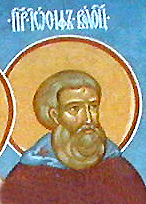
Saint Joseph of Volokolamsk, in the world John Sanin, was born on November 14, 1440 (1439 according to another source) in the village of Yazvisch-Pokrov, not far from the city of Volokolamsk. He was born into a pious family with his father named John (in monasticism Joannicius) and his mother Marina (in schema Maria). The seven-year-old boy John was sent to the pious and enlightened Elder Arsenius of the Volokolamsk-Exaltation of the Cross monastery to be educated.
Distinguished by rare qualities and extraordinary aptitude for church service, for one year the talented youth studied the Psalter, and, the following year, the entire Holy Scripture. He became a reader and singer in the monastery church. Contemporaries were astonished at his exceptional memory. Often, without having a single book in his cell, he would do the monastic rule, reciting from memory from the Psalter, the Gospel, the Epistles, and all that was required.
Even before becoming a monk, John lived a monastic lifestyle. Thanks to his reading and studying of Holy Scripture and the works of the holy Fathers, he dwelt constantly in contemplation of God. As his biographer notes, he “disdained obscene and blasphemous talk and endless mirth from his childhood years.”
At twenty years of age John chose the path of monastic striving and, leaving his parents’ home, he went off into the wilderness nigh to the Tver Savvin monastery, to the renowned Elder and strict ascetic, Barsanuphius. But the monastic rule seemed insufficiently strict to the young ascetic. With the blessing of Elder Barsanuphius, he set off to Borov to Saint Paphnutius of Borov (May 1), who had been a novice of Elder Nikḗtas of the Vysotsk monastery, who in turn was a disciple of Saint Sergius of Radonezh and Athanasius of Vysotsk.
The simple life of the holy Elder, the tasks which he shared with the brethren, and the strict fulfilling of the monastic rule suited John’s spiritual state. Saint Paphnutius lovingly accepted the young ascetic who had come to him, and on February 13, 1460 he tonsured him into monasticism with the name Joseph, thus realizing John’s greatest wish. With love and with zeal the young monk shouldered the heavy obediences imposed upon him, in the kitchen, the bakery, the infirmary. Saint Joseph fulfilled this latter obedience with special care, “giving food and drink to the sick, taking up and arranging the bedding, so very anxious and concerned with everything, working, as though attending to Christ Himself.”
The great spiritual abilities of the young monk were evidenced in the Church reading and singing. He was musically talented and possessed a voice that “in church singing and reading was like that of a swallow and wondrously harmonious, delighting the hearing of listeners, as much as anyone anywhere.” Saint Paphnutius made Joseph ecclesiarch in church, so that he would observe the fulfilling of the Church rule.
Joseph spent about seventeen years in the monastery of Saint Paphnutius. The strict efforts of monastic obedience under the direct guidance of the experienced abbot was for him an excellent spiritual schooling, having educated him into a future instructor and guide of monastic life. Towards the end of the life of Saint Paphnutius, Joseph was ordained hieromonk and, in accord with the final wishes of Saint Paphnutius, he was appointed Igumen of the Borov monastery.
Saint Joseph decided to transform the monastic life along strictly coenobitic principles, following the example of the Kiev Caves, Trinity-Saint Sergius, and Saint Cyril of White Lake monasteries. But this met with strong opposition from a majority of the brethren. Only seven pious monks were of one mind with the igumen. Saint Joseph decided to visit Russian coenobitic monasteries, to investigate the best arrangement for monastic life. He arrived together with the Elder Gerasimus at the Saint Cyril of White Lake monastery, which itself presented a model of strict asceticism on the principles of a coenobitic monastery rule.
His acquaintance with the life of these monasteries strengthened Saint Joseph’s views. But, after he returned to Borov monastery at the wish of the prince, Saint Joseph encountered again the former staunch resistance of the brethren to change from their customary rule. Therefore, he resolved to found a new monastery with a strict coenobitic rule, so he took seven like-minded monks to Volokolamsk, his native region, to a forest known to him since childhood.
In Volokolamsk at the time, the prince was Boris Vasilievich, the pious brother of Great Prince Ivan III. Hearing of the virtuous life of the great ascetic Joseph, he gladly received him and allowed him to settle on the outskirts of his principality, at the confluence of the Rivers Struga and Sestra. The selection of this spot was accompanied by a remarkable occurrence: a storm blew down the trees before the eyes of the astonished travelers, as though clearing the place for the future monastery. Here the ascetics set up a cross and built a wooden church in honor of the Dormition of the Mother of God in June 1479, which was consecrated on August 15, 1479. This day and year stand in history as the date of the founding of the monastery of the Dormition of the Most Holy Mother of God as “volok’ lamsk” [“broken-up peninsula”], later named after its founder.
The monastery was built rather quickly. Much of the work in the construction of the monastery was done by the founder himself. “He was skilled in every human craft: he felled trees, carried logs, he chopped and sawed wood.” By day he toiled with everyone at the construction of the monastery, but spent his nights in solitary cell prayer, remembering always that “Desires kill the sluggard, for his hands do not choose to do anything” (Prov 21:25).
Good reports about the new ascetic attracted disciples to him. The number of monks soon increased to a hundred men, and the venerable Joseph strove to be a good example for his monks in everything. Preaching temperance and spiritual sobriety in all things, his external appearance was no different than the others. His simple, cold-weather rags were his constant clothing, and bast shoes (made from bark) served as his footwear.
He was the first one to appear in church, he read and sang in the choir beside the others, he gave instruction and was the last to leave church. At nights the holy igumen walked around the monastery and the cells, safeguarding the peace and prayerful sobriety of the brethren entrusted him by God. If he chanced to hear a frivolous conversation, he rapped on the door and quietly withdrew.
Saint Joseph devoted much attention to the inner ordering of the life of the monks. He himself led a strict cenobitic life in accord with the Rule he compiled, to which all the services and obediences of the monks were subordinated, and it governed their whole life, “whether in their comings or goings, their words or their deeds.” At the core of the rule was total non-covetousness, detachment from one’s own will, and constant work. The brethren possessed everything in common: clothing, footwear, food and other things.
None of the brethren could take anything into their cell without the blessing of the igumen, not even a book or an icon. Part of the trapeza meal of the monks, by general consent, was given away to the poor. Work, prayer, spiritual efforts filled the life of the brethren. The Jesus Prayer never vanished from their lips. Festivity was viewed by Saint Joseph as a chief weapon for demonic seduction. Saint Joseph invariably imposed upon himself quite burdensome obediences. The monastery was occupied with the copying and transcription of Service Books and the writings of the holy Fathers, so that the Volokolamsk book collection soon became one of the finest of Russian monastic libraries.
With each passing year the monastery of Saint Joseph flourished all the more. In the years 1484-1485 a stone church of the Dormition of the Mother of God was built in place of the wooden one. In the Summer of 1485 “artistic masters of the Russian land” painted within it, Dionysius the Iconographer with his sons Vladimir and Theodosius. Saint Joseph’s nephews, Dositheus and Bassian Toporkov, participated in the adornment of the new Church. In 1504 a heated church in honor of the Holy Theophany was set up, followed by the establishment of a bell-tower and next to the bell tower, a church named in honor of the Hodēgḗtria (Directress)Icon of the Most Holy Theotokos.
Saint Joseph trained a whole school of renowned monks, some of whom gained notoriety in the arena of church-historical activity since they were “good pastors,” while others gained fame with works of enlightenment. Some were remembered as worthy examples of pious monastic struggles. History has preserved for us the names of many disciples and co-ascetics of the holy Volokolamsk igumen, who continued to develop his ideas.
Among the disciples and followers of Saint Joseph were: the Metropolitans of Moscow and All Rus Daniel (+ 1539) and Macarius (+1563); the Archbishop of Rostov Bassian (+1515); the Bishops of Suzdal Simeon (+1515), Dositheus of Krutitsa (+1544), Savva of Krutitsa (called “the Black”), Acacius of Tver, Bassian of Kolomets, and many others. Monastics of the Volokolamsk monastery occupied the most important Archepiscopal sees of the Russian Church: the holy hierarchs of Kazan Gurias (December 5) and Germanus (November 6 ), and Saint Barsanuphius, Bishop of Tver (April 11).
The activity and influence of Saint Joseph were not limited to the monastery. Many laypeople went to him to receive advice. With a pure spiritual insight he penetrated into the deep secrets of the souls of questioners and clairvoyantly revealed to them the will of God. Everyone living around the monastery considered him their spiritual Father and protector. Eminent nobles and princes asked him to be godfather for their children. They revealed their souls to him in confession, they asked for letters of guidance to help them fulfill his directives.
The common folk found at the monastery the means for sustaining their existence on occasions of extreme need. The number of those fed through monastery resources sometimes approached 700 people. “All of the Volotsk land are inclined to good, enjoying peace and quiet. And the name Joseph, as something sacred, is on everyone’s lips.”
The monastery was famed not only for its piety and help for the suffering, but also for its manifestations of the grace of God. During Matins of Holy Saturday, the righteous monk Bessarion once saw the Holy Spirit in the form of a white dove, sitting upon the Shroud of the Lord, which was being carried by Saint Joseph. The Abbot, bidding the monk to keep silent about the vision, himself rejoiced in spirit, hoping that God would not forsake the monastery. This monk had seen the souls of dying brethren, white as snow, issuing forth from their mouths. To Saint Joseph himself was revealed the day of his end, and he fell asleep in the Lord with joy, having received the Holy Mysteries and assuming the schema.
The saintly life of Saint Joseph was neither easy nor placid. In these difficult times for the Church in Russia, the Lord raised him up as a zealous defender of Orthodoxy in the struggle with heresies and churchly disputes. Saint Joseph exerted quite a great effort in denouncing the Judaizers, who tried to poison and distort the foundations of Russian spiritual life. Just as the holy Fathers and teachers of the Ecumenical Councils had elaborated on the teachings of Orthodoxy in responding to the ancient heresies (which contended against the Spirit, Christ, or icons), so also Saint Joseph was summoned forth by God to oppose the false teachings of the Judaizers and to compile the first manual of Russian Orthodox theology, his large book The Enlightener.
Even earlier, preachers from the Khozars had come to Saint Vladimir (July 15), trying to convert him to Judaism. But the great Baptizer of Rus repudiated the pretensions of the rabbis. After this, Saint Joseph writes, “the Great Russian land dwelt for five centuries in the Orthodox Faith, until the Enemy of salvation the devil, should bring the cunning Jew to the city of Novgorod.”
Along with the retinue of the Lithuanian prince Michael Olelkovich, who came to Novgorod in 1470, the Jewish preacher Skhariya (Zachariah) accompanied them. Playing upon the deficiencies of faith and of learning on the part of certain clergy, Skhariya and his accomplices sowed distrust among the petty-minded towards the church hierarchy, inclining them towards a revolt against the spiritual authorities, tempting them with the idea of “self-authority,” i.e. a capricious self-determination of each individual in matters of faith and salvation. Those they tempted gradually pushed towards a full break with the Church: they disdained the holy icons, and repudiated the veneration of the saints, basic elements of Orthodox popular morality.
Ultimately, they led the religiously blind and deluded to a denial of the saving Mysteries and the fundamental teachings of Orthodoxy, outside of which there is no knowledge of God: the teaching of the Most Holy Trinity and the teaching of the Incarnation of the God-man our Lord Jesus Christ. If decisive measures were not taken, “all of Orthodox Christianity would be doomed by heretical teachings.” So the question was posed for history. The Great Prince Ivan III, enticed by the Judaizers, invited them to Moscow. He had two of the most prominent of the heretics made archpriests, one at the Dormition, the other at the Archangel Michael cathedrals of the Kremlin, and he summoned to Moscow even the arch-heretic Skhariya himself.
All those close to the prince were led astray by the heresy, beginning with the clerk heading the government, Theodore Kuritsyn, whose brother became a ringleader of the heretics. Even the in-law of the great prince, Elena Voloshanka, accepted the Judaizers. And finally, the heretical Metropolitan Zosimas was installed upon the bishop’s Throne of the great Moscow Hierarchs Peter, Alexis and Jonah.
Saint Joseph and Saint Gennadius, Bishop of Novgorod (December 4), called for a struggle against the spread of the heresy. Saint Joseph wrote his first epistle “Concerning the Mystery of the Most Holy Trinity” while still a monk at the Paphnutiev Borov monastery in the year 1477. From the very beginning the Dormition Volokolamsk monastery became a bulwark of Orthodoxy in the struggle against the heresy. Here Saint Joseph wrote his chief works, The Enlightener, engendered with his fiery anti-heretical epistles, or as the monk himself unassumingly called them, “book exercises.” The works of Saint Joseph and Archbishop Gennadius were crowned with success. In 1494 the heretic Zosimas was deposed from the bishop’s Throne, and in the years 1502-04 the malicious and unrepentant Judaizers, who blasphemed against the Holy Trinity, Christ the Savior, the Most Holy Theotokos and the Church,were condemned at a church council.
Saint Joseph had many other trials and tribulations, but each time the Lord tried him according to the measure of his spiritual strength. The saint angered the Great Prince Ivan III, who only towards the end of his life reconciled with the saint and repented of his former weakness for the Judaizers. The saint also angered the Volotsk appenage prince Theodore, on whose lands Joseph’s monastery was situated. In 1508 the saint suffered wrongful interdiction from Saint Serapion, Archbishop of Novgorod (March 16), with whom, however, he soon reconciled.
In 1503, a Council at Moscow, under the auspices of Saint Joseph and his disciples, adopted a “Conciliar Reply” concerning the indissolubility of church properties, “therefore all church-acquired property is essentially the acquired property of God, pledged, entrusted, and given to God.” The legacy of the canonical works of Igumen Joseph is notably in “The Nomocanon Codex,” a vast codex of canonical rules of the Orthodox Church, begun by Saint Joseph and completed by Metropolitan Macarius.
There are opinions about the differences of outlook and discord between the two great pedagogues of Russian monasticism at the end of the fifteenth and beginning of the sixteenth centuries: Saint Joseph of Volotsk and Saint Nilus of Sora (May 7). In the historical literature these views usually present them as proclaiming two “contrary” currents within Russian spiritual life: external action and inner contemplation. This is profoundly incorrect. Saint Joseph in his Rule synthesized these two aspects of the Russian monastic tradition, proceeding without interruption from the Athonite blessing given to Saint Anthony of the Kiev Caves, through Saint Sergius, and down to our own day.
The Rule presupposes the need for a full inner regeneration of man, submitting one’s whole life to the task of salvation and deification [Greek theosis] not only for each individual monk, but also for the collective salvation of the whole human race. A great emphasis in the Rule is put on the demand to monastics for constant work in connection with inward and churchly prayer, “the monk should never be on holiday.” Work, as “a collective deed,” comprised for Joseph the very essence of church life: faith, embodied in good works, is the realization of prayer.
On the other hand, Saint Nilus of Sora had lived the ascetic life for a number of years on Mt. Athos, and he brought from there the teaching about the contemplative life and “the Jesus Prayer” as a means of a hesychastic service of monks to the world, as a constant spiritual activity, in connection with the physical work necessary for sustaining one’s life.
But spiritual work and physical work are but two aspects of the same Christian vocation: a vital continuation of the creative activity of God in the world, encompassing as much the ideal as well as the material spheres. In this regard Saints Joseph and Nilus are spiritual brothers, varied in continuing the Church Tradition of the holy Fathers, and are heirs to the precepts of Saint Sergius of Radonezh. Saint Joseph highly regarded the spiritual experience of Saint Nilus and sent his own disciples to him to study inner prayer.
Saint Joseph was also an active proponent of a strong centralized Moscow realm. He was one of the originators of the teaching about the Russian Church as the recipient and bearer of the piety of the Byzantine Empire, “the Russian land has now surpassed all in piety.” The ideas of Saint Joseph, possessing tremendous historical significance, were further developed later by his disciples and followers. From them came the Pskov Spaso-Eleazarov monastery Elder Philotheus with his own teaching about Moscow as the Third Rome. He declared, “Two Romes have fallen, Moscow is the third, and a fourth there shall not be.”
These views of the Josephites on the significance of monasteries possessing properties for church building, and the participation of the Church in social life, were set amidst the conditions of the struggle for centralized power by the Moscow prince. His opponents were separatists who tried to disparage these views for their own political ends, surreptitiously using the teaching of Saint Nilus of Sora about “non-acquisitiveness,” the withdrawal of monastics from worldly matters and possessions.
This supposed opposition engendered a false view on the hostility between the trends of Saints Joseph and Nilus. In actuality, both trends legitimately coexisted within the Russian monastic Tradition, complementing each other. As is evidenced from the Rule of Saint Joseph, its basis was complete non-acquisitiveness, and renunciation of the very concepts of “yours-mine.”
The years passed. The monastery flourished with the construction work and efforts of Saint Joseph, and as he got old, he prepared himself for life eternal. Before his end he received the Holy Mysteries, then summoned all the brethren. He gave them his peace and blessing, and peacefully fell asleep in the Lord on September 9, 1515.
The funeral oration to Saint Joseph was composed by his nephew and disciple, the monk Dositheus Toporkov.
The first Life of the saint was written in the 1540s by a disciple of Saint Joseph, Bishop Savva the Black of Krutitsa, with the blessing of Macarius, Metropolitan of Moscow and all Rus (+ 1564). It entered into the Great Menaion Readings compiled by Macarius. A second redaction of the Life was written by the Russified Bulgarian writer Lev the Philolog with the assistance of Saint Zenobios of Otensk (October 30).
Local celebration of Saint Joseph was established at the Volokolamsk monastery in December of 1578, on the hundred year anniversary of the founding of the monastery. On June 1, 1591, the church-wide celebration of his memory was established under Patriarch Job. Saint Job, a disciple of the Volokolamsk saint, tonsured Saint Germanus of Kazan, and was a great admirer of Saint Joseph and was author of the Service to him, which was included in the MENAION. Another disciple of Saints Germanus and Barsanuphius was also the companion and successor to Patriarch Job, the Hieromartyr Patriarch Hermogenes (February 17), a spiritual leader of the Russian people in the struggle for liberation under the Polish incursion.
The theological works of Saint Joseph comprise an undeniable contribution within the treasury of the Orthodox Tradition. As with all Church writings inspired by the grace of the Holy Spirit, they continue to be a source of spiritual life and knowledge, and they have their own theological significance and pertinence.
Saint Joseph’s chief book was written in sections. Its original form, completed at the time of the 1503-1504 councils, included eleven sections. In the final redaction, compiled after the death of the saint and involving a tremendous quantity of scrolls, The Book against the Heretics or The Enlightener includes sixteen sections, prefaced by An Account of the Newly-Appeared Heresies. The first section expounds the Church teaching about the teaching of the Most Holy Trinity; the second, about Jesus Christ, the True Messiah; the third, about the significance within the Church of the prophecies of the Old Testament; the fourth, about the Incarnation of God; the fifth through seventh, about the veneration of icons. In the eighth through tenth sections, Saint Joseph expounds on the fundamentals of Christian eschatology. The eleventh section is devoted to monasticism. In the twelfth the ineffectiveness of the anathemas and sanctions imposed by heretics is demonstrated. The final four sections consider methods of the Church’s struggle with the heretics, and the means for their correction and repentance.
Saint Joseph is also commemorated on September 9 and February 13.
Saint James the Deacon
Saint James lived in the seventh century, and assisted Saint Paulinus of York (October 10) in evangelizing the north of England.
Following the death of Saint Edwin (October 12) in 633, the northern kingdom experienced many trials, including military defeats, famine, and plague. The year 633-634 was so fraught with misfortune that it became known as “The Hateful Year.” Saint Paulinus accompanied Saint Ethelburga (April 5) back to her native Kent after the death of her husband King Edwin, leaving Saint James behind to care for the new converts in northern England.
Saint James has been described as “faithful and undismayed,” even though the secular power which supported the Church had been overthrown. Even so, he would not abandon the people in his care, nor would he cease his missionary labors.
This faithful servant of the Lord established himself near the village of Catterick in Yorkshire, teaching, comforting, and encouraging his flock. Even in such difficult times, Saint James was able to win many converts to Christ. He had a talent for music, and was skilled in the Roman chants composed by Saint Gregory Dialogus (March 12) which were being used in Kent. James taught these chants to the Christians of the north. When peace returned and the churches reopened, their services were beautified with the chants which Saint James had given them.
We do not know exactly when Saint James died, but it is believed that he survived for at least thirty years after “The Hateful Year,” and participated in the Synod of Whitby in 664.
Saint James does not appear to have been ordained to the holy priesthood, but through his tireless labors he built up the Church in the north. Saint Bede (May 27) calls him “a man of great energy and repute in Christ’s Church” (History of the English Church and People, Book II, chapter 16).
Saint Peter of Cetinje

Saint Peter was born in Njegushi, Montenegro on April 1, 1747. He was tonsured a monk and ordained to the diaconate when he was only seventeen. He accompanied his uncle Bishop Basil to Russia the following year in order to study there. His uncle died within a year after arriving in Russia, and so Peter was obliged to return to Montenegro.
The young deacon was ordained to the holy priesthood, and was later elevated to the rank of archimandrite. Saint Peter assisted Metropolitan Savva in the administration of the diocese until that hierarch died in 1781. Saint Peter seemed the logical choice to succeed him.
As Metropolitan of Montenegro, Saint Peter also became the secular leader (governor) of the Montenegran Serbs. For the rest of his life he devoted himself to promoting peace and unity among warring tribes and clans, and to helping his flock rise above petty quarrels and animosity at a difficult time in their history.
Saint Peter also defended his nation against the onslaught of enemies. He successfully opposed Napoleon’s army at Dalmatia, and took part in the first Serbian uprising against the Turks.
Although he enjoyed a certain prominence as the archpastor and governor of the Serbs, Saint Peter continued to live as a simple monk in a small cell where he lived in asceticism. He fasted, prayed, and read books in French, Italian and Russian in order to increase his knowledge of Orthodox doctrine and secular culture. While he was strict with himself, the holy bishop was merciful toward others.
Saint Peter contributed to the welfare of his country through his good works. As a bishop he promoted love and peace. As governor he never sentenced a criminal to death.
Saint Peter, the Metropolitan and governor of Cetinje and all Montenegro, fell asleep in the Lord on October 18, 1830. He was succeeded by his nephew Bishop Peter II (Njegos).
Saint Peter’s holy and grace-filled relics were uncovered in 1834. They were found incorrupt and streaming with myrrh, and still rest in the monastery at Cetinje. He is honored as a powerful intercessor for his people, and for the whole Church.
Saint David of Serpukhov
Saint David of Serpukhov, a disciple of Saint Paphnutius of Borov (May 1), lived as a hermit at the River Lopasna, 23 versts from Serpukhov. In 1515, on the right bank of the river, he built a church dedicated to the Ascension, and laid the foundations of the Davidov wilderness monastery.
"Machairotissa" Icon of the Mother of God
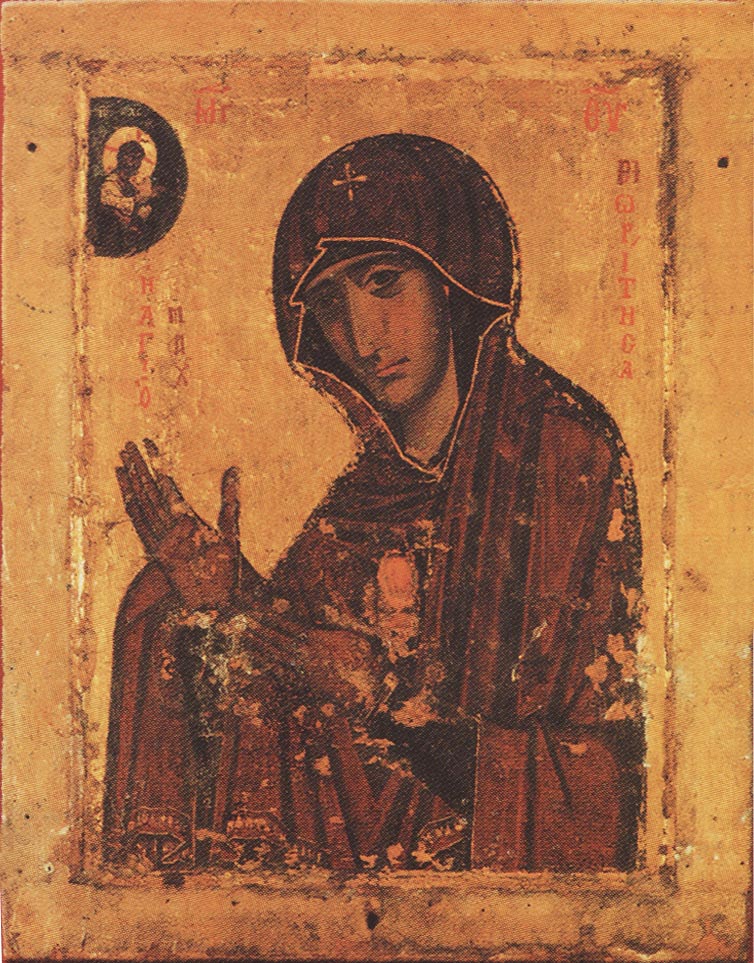
The Machairotissa (Μαχαιριώτισσα) Icon is a wonderworking icon of the Mother of God in the Holy Machaira Monastery on Cyprus. This Icon is historically and spiritually linked to the Monastery, which owes its name to the history of the Icon.
This Icon is believed to be one of the 70 icons of the Theotokos painted by Saint Luke, and at the time it was located above the Holy Soros (a chest containing the Robe and the Sash of the Theotokos) in the church of the Mother of God at Blachernae (See July 2 and August 31). This is reinforced by the inscription "Hagiosoritissa" on the Icon, which was later changed to "Machairiotissa," from the Greek word for "knife" (μαχαίρι).
According to oral tradition, an ascetic brought the Hagiosoritissa Icon to Cyprus from Constantinople during the Iconoclastic period (716 – 843), and settled in a cave on the site where the monastery stands today. After the ascetic went to the Lord, the Icon was forgotten and the entrance of the cave was sealed until the XII century, when the Theotokos gave a knife to the Holy Ascetics Neophytos and Ignatius (December 13), so that they could cut the bushes away and find the Icon. When Saint Neophytos reposed, another old monk, Father Prokopios, joined Ignatius.
The brotherhood grew too large, and so these two Fathers decided to build a monastery which would be governed according to the cenobitic Rule followed by the great monastic centers of the time. The Holy, Royal and Stavropigial Monastery of Panagia Machairotissa, is located at the eastern end of the Troodos mountain range near the peak of Kionia, at an altitude of 870 meters. It is built on a beautiful mountainside overgrown with pine trees, ending in the Pediaios torrent. It is called a Basilica because it was built with royal assistance, and Stavropegial,1 because the Patriarch had affixed a cross on the side of the building.
The Synaxis of the Machairotissa Icon is celebrated on October 18th, the Feast of the Holy Apostle and Evangelist Luke who, according to Tradition, painted the Machairiotissa Icon. It is kept in the katholikon of the Machaira Monastery. The Icon is also commemorated on November 21, the Feast of the Entry of the Theotokos into the Temple.
1omophorion of the primate of a Church rather than under the local diocesan bishop.
Daily Readings for Friday, October 17, 2025
FRIDAY OF THE 4TH WEEK
ABSTAIN FROM MEAT, FISH, DAIRY, EGGS, WINE, OLIVE OIL
Hosea the Prophet, Holy Martyrs Cosmas and Damian of Arabia, Andrew the Righteous Monk-martyr of Crete, Removal and Placing of the Sacred Relics of the Holy and Righteous Lazarus
ST. PAUL’S LETTER TO THE ROMANS 9:18-33
Brethren, God has mercy on whomever he wills, and he hardens the heart of whomever he wills. You will say to me then, “Why does he still find fault? For who can resist his will?” But who are you, a man, to answer back to God? Will what is molded say to its molder, “Why have you made me thus?” Has the potter no right over the clay, to make out of the same lump one vessel for beauty and another for menial use? What if God, desiring to show his wrath and to make known his power, has endured with much patience the vessels of wrath made for destruction, in order to make known the riches of his glory for the vessels of mercy, which he has prepared beforehand for glory, even us whom he has called, not from the Jews only but also from the Gentiles? As indeed he says in Hosea, “Those who were not my people I will call ‘my people, ‘ and her who was not beloved I will call ‘my beloved.'” “And in the very place where it was said to them, ‘You are not my people, ‘ they will be called ‘sons of the living God.'” And Isaiah cries out concerning Israel: “Though the number of the sons of Israel be as the sand of the sea, only a remnant of them will be saved; for the Lord will execute his sentence upon the earth with rigor and dispatch.” And as Isaiah predicted, “if the Lord of hosts had not left us children, we would have fared like Sodom and been made like Gomorrah.” What shall we say, then? That Gentiles who did not pursue righteousness have attained it, that is, righteousness through faith; but that Israel who pursued the righteousness which is based on law did not succeed in fulfilling that law. Why? Because they did not pursue it through faith, but as if it were based on works. They have stumbled over the stumbling stone, as it is written, “Behold, I am laying in Zion a stone that will make men stumble, a rock that will make them fall; and he who believes in him will not be put to shame.”
LUKE 9:12-18
At that time, the twelve disciples came to Jesus and said to him, “Send the crowd away, to go into the villages and country round about, to lodge and get provisions; for we are here in a lonely place.” But he said to them, “You give them something to eat.” They said, “We have no more than five loaves and two fish — unless we are to go and buy food for all these people.” For there were about five thousand men. And he said to his disciples, “Make them sit down in companies, about fifty each.” And they did so, and made them all sit down. And taking the five loaves and the two fish he looked up to heaven, and blessed and broke them, and gave them to the disciples to set before the crowd. And all ate and were satisfied. And they took up what was left over, twelve baskets of broken pieces. Now it happened that as he was praying alone the disciples were with him.
Prophet Hosea

The Holy Prophet Hosea the first of the minor prophets, belonged to the tribe of Issachar. He lived during the ninth Century before Christ, in the kingdom of Israel. He was a contemporary of the holy Prophets Isaiah, Micah and Amos. During this time, many of his fellow Israelites had forgotten the true God, and worshipped idols. The holy Prophet Hosea attempted to turn them again to the faith of their Fathers by his wise counsels. Denouncing the iniquities of the people of Israel (i.e. the northern kingdom Israel), the prophet proclaimed to them great misfortunes from a foreign people and their removal into captivity by Assyria.
Almost a thousand years before the coming of the Savior, and through the inspiration of the Holy Spirit, the prophet foretold the end of sacrificial offerings and of the priesthood of Aaron (Hos. 3:4-5), and that the knowledge of the True God would spread through all the earth (Hos. 2:20-23). Hosea spoke also about Christ, how He would return from out of Egypt (Hos. 11:1; compare Mt. 2:15), that He would be resurrected on the third day (Hos. 6 and especially Hos.6:2; compare with 1 Cor.15:4), and that He would conquer death (Hos.13-14. Compare 1 Cor.15:54-55).
The prophesies of Saint Hosea are included in the book that bears his name. The prophetic service of Saint Hosea continued for more than sixty years. The God-inspired prophet died in deep old age, having devoted all his life to fulfilling the Will of God.
Monastic Martyr Andrew of Crete
The Hieromartyr Andrew of Crete lived during the reign of the iconoclast emperor Constantine Kopronymos (741-775), who ordered Christians, under penalty of death, to remove the holy icons from their churches and homes. Believers, who fearlessly resisted the impious iconoclast, and held firmly to the traditions of the holy Fathers, were locked in prison. When the venerable Andrew heard that the emperor was throwing virtuous and pious Christians into prison instead of thieves and robbers, he went to the Church of the Great Martyr Mamas (September 2) in Constantinople and in front of everyone, denounced the heretic for persecuting the true Faith.
In an attempt to justify himself the emperor said that it was folly to bestow veneration on wood and paint. To this the monk replied that whoever suffers for holy icons suffers for Christ, but whoever reviles the icon upon which Christ is depicted, offers insult to Christ Himself. The enraged iconoclast gave orders to torture Saint Andrew without mercy.
As he was being dragged through the streets to the place of execution, someone cut off the saint’s feet. As a result, Saint Andrew was freed from his torments by death. A hundred years later a Canon was written to the saint by Saint Joseph the Hymnographer (April 4). The saint heals those afflicted with seizures.
Venerable Anthony, Abbot of Leokhnov, Novgorod
Saint Anthony of Leokhnov, Novgorod, was from the Tver lineage of the Veniaminov nobles. The monk lived as a hermit not far from Novgorod, in the Rublev wilderness at the River Perekhoda. In about the year 1556 he resettled with the wilderness-dweller Tarasius, who lived beyond Lake Ilmen at Leokhnov, near Stara Rus, and received monastic tonsure from him. Thus began the wilderness monastery in honor of the Transfiguration of the Lord, afterwards called the Leokhnov or Ivetsk-Antoniev monastery. Saint Anthony lived to old age, having acquired the gift of clairvoyance.
In the year 1611, when the Swedes had laid waste the area around Novgorod, the monk on the invitation of Metropolitan Isidore moved to Novgorod. He died on September 14, 1611 at age 85 and was buried near the church of the holy Evangelist Luke, on the side towards the church of Holy Wisdom (Hagia Sophia). Before his death, and in the presence of many of the monks, he said that his body would rest in his wilderness-monastery. A disciple of the monk, named Gregory, returned to the site of the monastery that had been laid waste and burned by the Swedes, built a cell and a chapel, and remained there to live.
Saint Anthony appeared to him three times in a dream and said, “Brother Gregory, go to Novgorod, tell Metropolitan Cyprian and the elders of the city that they should put me in the place of my monastery.” After Gregory’s report, the Metropolitan led a church procession to the grave of Saint Anthony. The incorrupt relics were transferred to the Leokhnov monastery on July 13, 1620. At the uncovering of the relics, a blind man named Joseph gained his sight, and many other miracles occurred.
There is a special order of commemorations, celebrated by the churches in the name of Saint Anthony of Leokhnov, both in the village of Leokhnov and in the Rublev wilderness-monastery. On the second Friday after the Feast of the Foremost Apostles Peter and Paul (June 29), we celebrate the Uncovering and Transfer of the Relics of Saint Anthony from Novgorod to the Leokhnov monastery. On the Ascension of the Lord, the coming of Saint Anthony from the Rublev wilderness to Leokhnovo is remembered. On October 17 the Repose of the saint, who died on the Feast of the Exaltation of the Holy Cross, in the ninth hour of the evening, is commemorated. At the Rublev wilderness monastery the memory of the Consecration of the church in the name of the venerable Anthony on August 30 (1873) is also celebrated.
Martyrs and Unmercenaries Cosmas and Damian in Cilicia, and their brothers, Leontius, Anthimus, and Eutropius

The Martyrs and Unmercenaries Cosmas and Damian in Cilicia (Arabia), and the Martyrs Leontius, Anthimus and Eutropius. The holy brothers Cosmas and Damian were physicians in Arabia, who believed in Christ. They traveled through the cities and the villages, preaching Christ and healing the sick. The saints would not take any sort of payment for the help they rendered. In Cilicia, pagans seized the holy physicians and led them before the governor, Lysias. Since they refused to renounce Christianity, the governor ordered the saints to be brutally beaten, and then cast into the sea.
An angel of God rescued them from the sea and brought them to shore. Then the pagans beheaded the saints and three other Christians: Leontius, Anthimus, and Eutropius.
The Unmercenary Saints Cosmas and Damian of Arabia should not be confused with the Unmercenary Saints Cosmas and Damian of Asia Minor (November 1), or the Unmercenary Saints Cosmas and Damian of Rome (July 1).
Translation of the relics of Saint Lazarus “of the Four Days in the Tomb”, Bishop of Kiteia, Cyprus

The Transfer of the relics of Righteous Lazarus of the Four Days, Bishop of Kiteia on Cyprus, took place in the ninth century. The Righteous Saint Lazarus, the brother of Martha and Mary, lived in the village of Bethany, not far from Jerusalem. During His earthly life the Lord Jesus Christ often visited the house of Lazarus, whom He much loved and called His friend (John 11:3,11), and when Lazarus had died and lain four days already in the grave, the Lord raised him from the dead (John 11:1-44). (The Church remembers Saint Lazarus on the Saturday of the Sixth Week of Great Lent, “Lazarus Saturday.”)
Many of the Jews, when they heard about this, came to Bethany. Being persuaded of the reality of this most remarkable wonder, they became followers of Christ. Because of this the High Priests also wanted to kill Lazarus. Righteous Lazarus is mentioned in the Holy Gospel once more: when the Lord had come again to Bethany six days before the Passover, Lazarus was also there (John 12:1-2, 12:9-11). After his raising, Saint Lazarus lived another thirty years as a bishop on the island of Cyprus, where he spread Christianity and peacefully fell asleep in the Lord.
The holy relics of Saint Lazarus were discovered in Kiteia. They were within a marble coffin, upon which was inscribed: “Lazarus of the Four-Days, the friend of Christ.” The Byzantine emperor Leo the Wise (886-911) gave orders to transfer the relics of Saint Lazarus to Constantinople in the year 898 and place them within the church of the Righteous Lazarus.
“A Virgin Before and After Giving Birth” Icon of the Mother of God
This wonderworking Icon of the Mother of God "A Virgin Before and After Giving Birth” is located in Saint Nicholas Monastery, Dmitrovsky County, Moscow. It was transferred to Saint Nicholas Monastery by the Moscow merchant Alexei Grigorievich Mokeyev. Around the year 1780 Alexei joined the Monastery brotherhood, giving all his wealth to Archimandrite Makarios, the Igoumen of the Monastery, but kept the holy Icon in his cell.
After Alexei's repose, the Icon was brought to the Archimandrite, who noticed that the Icon had been painted with oils on canvas, and not according to the prescribed rules of iconography (using egg tempera on wood), so he placed it over the door of the chapel dedicated to the Monastery's founder, Saint Methodios of Peshnosha († June 4 or 14, 1392), which was on a street not far from the Monastery.
The Icon was glorified with numerous miracles in 1827. One night, as Captain Platon Osipovich Shabashev of the Jäger Infantry Regiment (which was camped near Peshnosha Monastery) was passing by the chapel, he saw an extraordinary light coming from the Icon of the Most Holy Theotokos. Later, Captain Shabashev received the first blessing from the Queen of Heaven when he had a vision of the Icon at a time in his life when he found himself in difficult circumstances.
At that time, Shabashev was unjustly accused of some offense which served as a reason to remove him from his position. Not finding any presumption of innocence concerning his case on the part of earthly rulers, the Captain decided to seek the truth from the Queen of Heaven. With fervent tears, he bowed down before her most pure Icon in the Monastery. Later, in a dream, he beheld the radiant Icon of the Mother of God in the clouds over the chapel of Saint Methodios, and he heard a voice saying "If you want to be delivered from temptation, have a silver riza made for the Icon."
Captain Shabashev obeyed the instructions of the Mother of God. He was acquitted and his sorrows ended.
The Icon has been behind the klēros since 1848. In that year of cholera, numerous miracles of healing occurred before it.
This Icon of the Mother of God is of the Hodēgḗtria type. The Mother of God and the Christ Child appear with crowns on their heads. At the top of the Icon is the inscription "A Virgin Before and After Giving Birth," and the Lord of Hosts is depicted with two Angels supporting the crown of the Mother of God. The Holy Righteous Joseph the Betrothed is also depicted.
The Icon "A Virgin Before and After Giving Birth” is a beautiful painting measuring 12 verts high and 9 verts wide. The Most Holy Theotokos is depicted frontally to the waist, and holds the Pre-Eternal Child on her left arm.
The Divine Child is painted in regal majesty, with a crown, a scepter, and an orb in His hands. The Mother of God holds the scepter from below, as if to help Him.
The liturgical basis for Icons of this type is a liturgical text for the Theotokos (Tone 7): "A Virgin before giving birth, in giving birth, and after giving birth, you still remained a virgin." Moreover, the Troparion for the Feast of the Dormition says: "In giving birth, you preserved your virginity, in falling asleep you did not forsake the world, O Theotokos. You were translated to life, O Mother of Life, and by your prayers, you deliver our souls from death."
The iconography has been influenced by such Western patterns as an image common in medieval Germany: "Dreimal wunderbare Mutter" (Thrice-Wondrous Mother).
Of the other well-known images in Russia the most closely related are the icons of Lomovskaya, Czestochowa (March 6), Mishkovskaya, and Chubkovskaya from Starodubye.
“Deliverer” Icon of the Mother of God
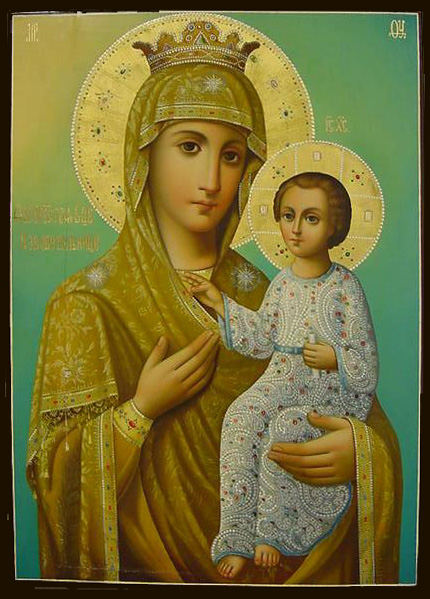
At the beginning of the XIX century the remarkable ascetic Constantine Theodoulos was a monk on Mount Athos. This Elder had a wonderworking Icon of the Theotokos, which had been painted about 150 years before. After this ascetic's repose, the Icon was passed on to Constantine's disciple, Schema-monk Martinian, who arrived on Mount Athos from Greece in 1821.
Early in 1841 Father Martinian left the Holy Mountain and went to the town of Mavrovonē in the diocese of Sparta, where many miracles were about to take place.
The residents of that place were afflicted by a terrible disaster: their fields, forests and almost all the vegetation was devastated by locusts. Moving forward in a solid mass, they destroyed everything in their path. Their flight took them right to the city of Marathon. The local authorities drove the residents out of their homes into the fields, forcing them to collect the destructive insects, dump them into pits, and then burn them, but all these measures were ineffective. It seemed that the more locusts they killed, the more their numbers increased.
People lost all hope for human assistance, so they chanted a Moleben, but the disaster did not end. Terrified, the villagers turned to Father Alexis, a man of God, who lived in a monastery near that unfortunate district. Taking some holy relics, this God-pleaser advised them to have a Moleben with a Cross Procession to their fields. The locusts, as if irritated by such actions, focused their attention on the worshippers. Countless insects attacked people, especially in their eyes. Both the residents and priests fled to their homes in horror.
Elder Martinian also learned about this disaster. After serving a Moleben, he spoke to the villagers: "Is our faith so weak that we cannot ask the Lord to help us? Let us intensify our prayers; at least let us gather the old men, and we will resort to the powerful intercession of the Queen of Heaven and Earth. Let us take her holy Icon and pray together, trusting in the Lord. He will not reject our humble prayer to Him, and, through the intercessions of His Mother, He will save this district from a great calamity."
The inhabitants followed the pious Elder's suggestion, with confidence in the merciful intercession of the Mother of God, they gathered not only old men, but also husbands, wives and even children. There were also four priests. The Cross Procession followed the Elder, who carried the holy Icon, and went into the field. There Father Martinian placed the Icon on the ground, and all the villagers bowed before it in supplication. The Sovereign Lady did not reject the prayers of the faithful servants of her Son and our God. She drove the locusts away. Suddenly, a great flock of birds appeared, rushing swiftly at the insects. The locusts rose from the fields and flew in such a thick mass that they obscured the sunlight.
Later, in the village of Mavrovonē there was a boy who was very sick, and his illness was getting worse. His parents asked the priest to bring him Communion. For some reason, however, the visiting priest did not hurry, and he did not arrive for a long time. He took the Holy Gifts and went to the boy's house. He had invited Elder Martinian to come with him. When they arrived at the house, they were shocked by the news that boy was already dead. The priest was filled with deep remorse, since his procrastination had deprived the child of his final spiritual consolation. The only hope left to them was to trust in God's mercy.
The priest asked Father Martinian to bring his Icon so they could pray to the Queen of Heaven for the boy. The Elder, seeing the deep faith of the priest and the devastated parents, took out the holy Icon which he always kept with him and placed it over the child's bed. Confident that nothing is impossible for the Sovereign Lady, the Elder, the priest, and parents bowed before the Icon, begging her to restore the child to life. After praying for a time, the Elder touched the dying boy three times with the Icon, and suddenly the child opened his eyes. At Father Martinian's request, the boy was given Holy Communion, and then got up perfectly well. The next day he went to school, where he had been sent shortly before this for his primary education. Later, the boy who returned to life was tonsured in a foreign country with the name Alexis, and for a long time he lived an ascetical life on Mount Athos.
News of this glorious miracle spread far through the neighborhood. Many people who suffered from physical and spiritual infirmities flocked to the Icon of the Mother of God with faith. The Elder's tiny home was always crowded with people and he decided to hide from them, but they found him again.
Father Martinian would not have minded visiting the sick with the Icon if their reverence for the Mother of God had not been mixed with a desire to glorify the Elder as well. He thought he should retire to a place where no one would find him. Therefore, he went by the sea shore and soon, above the ocean, he found a sheer rock with a cave, which was quite suitable for his ascetical struggles. Father Martinian thought he was completely secluded there. However, the good will of the Most Pure Virgin had arranged things otherwise.
One night the ascetic was praying in the cave. Suddenly, he heard a voice ordering him not to hide the Icon, but to minister to the needs of others. He tried to protest his unworthiness, and his infirmity, but the voice told him even more insistently to be obedient, saying that all this was for the glory of the Mother of God. When the Elder had finished his prayer, he decided to rest for a short time. Suddenly, at that moment, the cave was illumined with an extraordinary light. Surprised, the Elder came out onto the rock, desiring to know the source of such extraordinary radiance. The ascetic beheld a wondrous sight. He saw a pillar of light stretching from the sky to the ground, and in doing so, he heard again the same voice commanding him to leave his solitude and to go serve his neighbors. Thus, the ascetic opened his door to the residents of that vicinity.
There was a possessed woman named Elena, who used to shout all the time that she knew where the Elder was hiding. At the same time, she declared that only his Icon could heal her. The demon who possessed the woman was very fierce. He exposed the secret sins of all those who came to see Elena. One devout priest decided to read the prayers of exorcism over her no matter what happened. For that reason he went to Elena's house. Immediately, the woman attacked the priest and began to vilify the one who served at the altar, saying: "Aha! So you want to expel me? Are you thinking of casting me out? No, you cannot expel me, you will never drive me out. Look to yourself!"
Despite all the demon's words the priest continued to read the prayers, and asked the demon possessing the woman to reveal who could banish him. Against his will, the impure spirit spoke of a solitary Elder with an Icon, calling the ascetic a ragamuffin, an evil monk, and so on. Then the priest asked the demon where he might find this Elder. Then the demon, forced by the priest's prayers and by the power of God, revealed where Father Martinian was hiding.
The morning after the vision the Elder heard the sound of a large crowd of people gathered before the rock and begging him to come down to them to help the suffering. Seeing God's will in all this, the Elder obeyed and went to the homes of the villagers. First of all, he went to see Elena. As he approached her dwelling, she fell down unconscious and began to scream. When the Elder entered the house, he put down the Icon of the Mother of God and bowed before the Icon. At once, the demon came out of the woman with great moaning. She returned to her senses and fervently thanked the Theotokos. After this she felt quite well. Many other demoniacs were also healed by praying before her Icon.
Because of all the miracles taking place before the Icon, people were always in Father Martinian's home. The Elder finally decided to return to his monastery. When the people learned of his departure, they followed him for some distance. With a great cry they parted from the Elder as he walked away from them, carrying the Icon of the Mother of God, who had poured forth so much grace on their district.
In 1884, soon after he arrived on the Holy Mountain and entered the monastery of the Great Martyr Panteleimon, Father Martinian went to the Lord. Then the holy Icon of the Mother of God became the monastery's precious heritage. The revered Icon remained there until July 20, 1889, when Archimandrite Makarios, the Superior of Saint Panteleimon's Monastery, gave the Deliverer Icon as a blessing to the newly-built New Athos Monastery of Saint Simon the Canaanite in the Caucasus The Icon has been there from 1889 until the present day.
The first celebration of the transfer of the Icon to New Athos Monastery took place on October 17, 1889. That is why the Feast Day in honor of this Icon was established on this day. About that time a storm cast more than a ton of fish ashore at the monastery.
In this Icon the Most Holy Theotokos holds the Divine Child on her right arm, and He blesses with His right hand.
The Deliverer Icon of the Mother of God is commemorated on October 17, and on April 4.
Saint Joseph, Catholicos of Georgia

Saint Joseph (Jandierishvili) received his spiritual education at David-Gareji Monastery. He was endowed by the Lord with the gift of wonderworking. His prayers healed the terminally ill and demon-possessed. For his wisdom and virtue, he was consecrated bishop of Rustavi, and in 1755 enthroned as Catholicos-Patriarch. Saint Joseph remained a monk-ascetic in spite of his hierarchical rank.
In 1764 Holy Catholicos Joseph, like Saint Gregory the Theologian, humbly stepped down from the archpastor’s throne and withdrew to Akhmeta in northeastern Georgia. With his own hands he cultivated a vineyard and distributed his harvest to the poor. The climate in that region was capricious—droughts were frequent, and hail would devastate the fragile crops, laying waste to the farmers’ labors. But while Saint Joseph was laboring there, the region suffered neither drought nor hail.
Through Saint Joseph’s prayers, the sick were healed and the blind received sight. Those who dwelt near him loved him deeply and put their hope in him. Saint Gabriel the Lesser remarked joyfully in one of his writings: “Once I saw and two times I kissed the hand of this holy man.”
Having lived in godliness to a ripe old age, Catholicos Joseph reposed peacefully in the year 1770.
Martyr Kozman
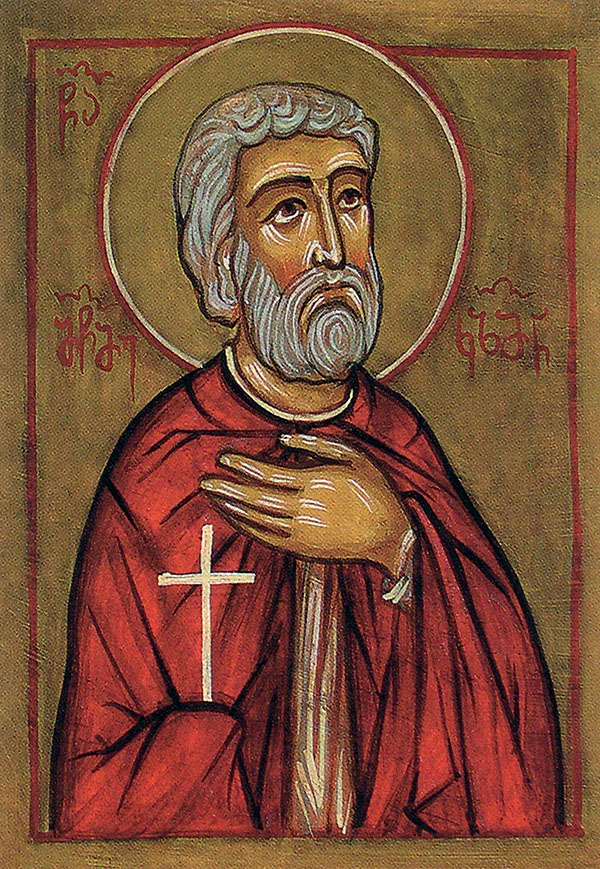
The Life of Saint Kozman has not been preserved. In the commemorations for this day it is mentioned only that he died a martyr’s death in the region of Kartli.
Here it is fitting to note that, due to its geopolitical circumstances, Georgia has throughout history been a constant victim of foreign aggression. To give one’s life for his motherland and Faith became so customary for the Georgian people that the Georgian Church is unable to commemorate all of its martyrs by name. Unfortunately, errors of faith and time have erased from the pages of history the lives and virtues of many of the elect. Today, the Church calendar and the prayers with which the faithful honor the martyrs remain the sole means for the Church to acknowledge the lives of these holy men and women.
Martyr Susanna, Queen of Georgia

Saint Shushanik (Susanna) was the wife of the Georgian prince Varsken, the ruler of Hereti (a province of southeastern Georgia). Hereti was under Persian control at that time; Varsken was essentially the viceroy for the Persians. Having been raised in a pious Christian family, she was deeply penetrated with love and the fear of God.
At that time Kartli was under heavy political pressure from Persia, and Prince Varsken visited the Persian king Peroz in hopes of encouraging more friendly relations between the two countries. He willingly denied the true Faith, converted to the worship of fire, and promised the king to convert his wife and children upon his return to Hereti.
Having approached the border of Hereti, Varsken sent messengers to Tsurtavi, the city in which he ruled, to ensure that his subjects met him with due respect. The blessed Shushanik, having learned of her husband’s betrayal, fell to the ground and wept over him with bitter tears. Then she took her four children, deserted the palace, and sought refuge in a nearby church.
That evening Shushanik was visited by her spiritual father, the elder Jacob, who predicted, “Varsken’s cruelty and mercilessness are unmistakable. Know that terrible trials await you. Will you be firm and unbending in your position?”
“I would rather die than unite with him and destroy my soul!” she answered.
Three days later the prince arrived in Tsurtavi. As promised, he tried to persuade his wife to convert, but Saint Shushanik firmly answered, “As you have renounced your Creator, so I am renouncing you. I will no longer take part in your affairs, no matter what suffering I must endure!”
The next time, Varsken sent his younger brother Jojik and Bishop Apots to convince Shushanik to return to the palace. Shushanik refused for some time, but in the end she yielded to their persuasion. She set off for the palace with the Holy Gospel and the Lives of the holy martyrs, and when she arrived she locked herself in a squalid cell. Two days later Varsken returned to the palace and invited Shushanik, his brother Jojik, and his sister-in-law for supper. The queen, however, could not bring herself to share a meal with one who had betrayed Christ: she pushed away the cup that Jojik’s wife had offered her, thus further angering her husband.
The furious Varsken beat his wife mercilessly, fettered her in irons, locked her in prison, and forbade the guards to let anyone in to see her.
Saint Shushanik spent six years in captivity. While she was serving her sentence, she helped the poor that came to her. Through her prayers the sick were healed and children were born to the childless. Before her death, Holy Martyr Shushanik blessed those around her and requested that she be buried at the place from which her unbelieving husband had dragged her out of the palace.
This happened in the year 475. The clergy and people alike wept bitterly over Shushanik’s tragic fate. Her holy relics were buried in accordance with her will.
In 578, with the blessing of Catholicos Kirion I, Saint Shushanik’s holy relics were translated to Tbilisi, where they remain today, in the Metekhi Church of the Most Holy Theotokos.
Saint Susanna of Georgia is also commemorated on August 28.
Daily Readings for Thursday, October 16, 2025
LONGINUS THE CENTURION
NO FAST
Longinus the Centurion, The Two Soldiers martyred with Saint Longinus
ST. PAUL’S LETTER TO THE PHILIPPIANS 1:20-27
Brethren, I shall not be at all ashamed, but that with full courage now as always Christ will be honored in my body, whether by life or by death. For to me to live is Christ, and to die is gain. If it is to be life in the flesh, that means fruitful labor for me. Yet which I shall choose I cannot tell. I am hard pressed between the two. My desire is to depart and be with Christ, for that is far better. But to remain in the flesh is more necessary on your account. Convinced of this, I know that I shall remain and continue with you all, for your progress and joy in the faith, so that in me you may have ample cause to glory in Christ Jesus, because of my coming to you again. Only let your manner of life be worthy of the gospel of Christ.
MATTHEW 27:33-54
At that time, when the soldiers came to a place called Golgotha (which means the place of a skull), they offered him wine to drink, mingled with gall; but when he tasted it, he would not drink it. And when they had crucified him, they divided his garments among them by casting lots; then they sat down and kept watch over him there. And over his head they put the charge against him, which read, "This is Jesus the King of the Jews." Then two robbers were crucified with him, one on the right and one on the left. And those who passed by derided him, wagging their heads and saying, "You who would destroy the temple and build it in three days, save yourself! If you are the Son of God, come down from the cross." So also the chief priests, with the scribes and elders, mocked him, saying, "He saved others; he cannot save himself. He is the King of Israel; let him come down now from the cross, and we will believe in him. He trusts in God; let God deliver him now, if he desires him; for he said, 'I am the Son of God.'" And the robbers who were crucified with him also reviled him in the same way. Now from the sixth hour there was darkness over all the land until the ninth hour. And about the ninth hour Jesus cried with a loud voice, "Eli, Eli, lama sabachthani?" that is, "My God, my God, why have you forsaken me?" And some of the bystanders hearing it said, "This man is calling Elijah." And one of them at once ran and took a sponge, filled it with vinegar, and put it on a reed, and gave it to him to drink. But the others said, "Wait, let us see whether Elijah will come to save him." And Jesus cried again with a loud voice and yielded up his spirit. And behold, the curtain of the temple was torn in two, from top to bottom; and the earth shook, and the rocks were split; the tombs also were opened, and many bodies of the saints who had fallen asleep were raised, and coming out of the tombs after his resurrection they went into the holy city and appeared to many. When the centurion and those who were with him, keeping watch over Jesus, saw the earthquake and what took place, they were filled with awe, and said, "Truly this was the Son of God!
Martyr Longinus the Centurion, who stood at the Cross of the Lord

The Holy Martyr Longinus the Centurion, a Roman soldier, served in Judea under the command of the Governor, Pontius Pilate. When our Savior Jesus Christ was crucified, it was the detachment of soldiers under the command of Longinus which stood watch on Golgotha, at the very foot of the holy Cross. Longinus and his soldiers were eyewitnesses of the final moments of the earthly life of the Lord, and of the great and awesome portents that appeared at His death. These events shook the centurion’s soul. Longinus believed in Christ and confessed before everyone, “Truly this was the Son of God” (Mt. 27:54).
According to Church Tradition, Longinus was the soldier who pierced the side of the Crucified Savior with a spear, and received healing from an eye affliction when blood and water poured forth from the wound.
After the Crucifixion and Burial of the Savior, Longinus stood watch with his company at the Sepulchre of the Lord. These soldiers were present at the All-Radiant Resurrection of Christ. The Jews bribed them to lie and say that His disciples had stolen away the Body of Christ, but Longinus and two of his comrades refused to be seduced by the Jewish gold. They also refused to remain silent about the miracle of the Resurrection.
Having come to believe in the Savior, the soldiers received Baptism from the apostles and decided to leave military service. Saint Longinus left Judea to preach about Jesus Christ the Son of God in his native land (Cappadocia), and his two comrades followed him.
The fiery words of those who had actually participated in the great events in Judea swayed the hearts and minds of the Cappadocians; Christianity began quickly to spread throughout the city and the surrounding villages. When they learned of this, the Jewish elders persuaded Pilate to send a company of soldiers to Cappadocia to kill Longinus and his comrades. When the soldiers arrived at Longinus’s village, the former centurion himself came out to meet the soldiers and took them to his home. After a meal, the soldiers revealed the purpose of their visit, not knowing that the master of the house was the very man whom they were seeking. Then Longinus and his friends identified themselves and told the startled soldiers to carry out their duty.
The soldiers wanted to let the saints go and advised them to flee, but they refused to do this, showing their firm intention to suffer for Christ. The holy martyrs were beheaded, and their bodies were buried at the place where the saints were martyred. The head of Saint Longinus, however, was sent to Pilate.
Pilate gave orders to cast the martyr’s head on a trash-heap outside the city walls. After a while a certain blind widow from Cappadocia arrived in Jerusalem with her son to pray at the holy places, and to ask that her sight be restored. After becoming blind, she had sought the help of physicians to cure her, but all their efforts were in vain.
The woman’s son became ill shortly after reaching Jerusalem, and he died a few days later. The widow grieved for the loss of her son, who had served as her guide.
Saint Longinus appeared to her in a dream and comforted her. He told her that she would see her son in heavenly glory, and also receive her sight. He told her to go outside the city walls and there she would find his head in a great pile of refuse. Guides led the blind woman to the rubbish heap, and she began to dig with her hands. As soon as she touched the martyr’s head, the woman received her sight, and she glorified God and Saint Longinus.
Taking up the head, she brought it to the place she was staying and washed it. The next night, Saint Longinus appeared to her again, this time with her son. They were surrounded by a bright light, and Saint Longinus said, “Woman, behold the son for whom you grieve. See what glory and honor are his now, and be consoled. God has numbered him with those in His heavenly Kingdom. Now take my head and your son’s body, and bury them in the same casket. Do not weep for your son, for he will rejoice forever in great glory and happiness.”
The woman carried out the saint’s instructions and returned to her home in Cappadocia. There she buried her son and the head of Saint Longinus. Once, she had been overcome by grief for her son, but her weeping was transformed into joy when she saw him with Saint Longinus. She had sought healing for her eyes, and also received healing of her soul.
Venerable Longinus the Gatekeeper of the Kiev Caves
Saint Longinus, the Gate-Keeper of the Kiev Caves, Far Caves, made his monastic obedience at the Kiev Caves monastery. His prayerful fervor and humble love for work were rewarded by the Lord. The venerable gatesman was granted the gift of discernment. He encouraged the people who came to the Lavra with good intent, but he denounced those inclined to wickedness and urged them to repentance. He was buried in the Far Caves.
St Longinus is also commemorated on August 28 and on the second Sunday of Great Lent.
Venerable Longinus of Yarenga
Saint Longinus, the wonderworker of Yarenga, is also commemorated on July 3.
Martyr Longinus of Asistavi
No information available at this time.
Saint Eupraxia, Princess of Pskov
Saint Eupraxia, Princess of Pskov (Euphrosynē in the world), was the daughter of Prince Rogvol'd Borisovich of Polotsk, and the aunt of the holy Prince Dovmont-Timothy (May 20). She was also the wife of Prince Yaroslav Vladimirovich of Pskov. Prince Yaroslav fled from Pskov to Livonia, and there he married a German woman. Together with the Teutonic knights he made several incursions into the Russian lands, and in 1231 he captured Izborsk. After her husband's departure, Euphrosynē devoted herself to works of piety. In the year 1243, she built a monastery on the banks of the Velika River and dedicated it to Saint John the Forerunner. It is believed that she became its Superior.
Invited to Livonia to meet with her former husband in the city of Odenpa (Bear’s Head), Saint Eupraxίa was murdered (May 8, 1243) by a stepson, more accurately, Yaroslav's son by his German wife. She was buried in the church of the monastery that she founded.
Ten days after Saint Eupraxia's martyrdom, a miracle occurred over her grave, when myrrh issued from an icon of the Savior. The icon was called “The myrrh-streaming Savior."1 Saint Eupraxίa appears on two icons. In one, she is depicted at prayer with Saint John the Forerunner and the Holy Apostle Andrew the First-Called. The other icon is beside the wonderworking icon of the Savior.
Saint Eupraxίa is commemorated on October 16, the day of martyrdom, and on the Third Sunday after Pentecost (Synaxis of the Pskov Saints).
1 "Спаситель Мироточивый."
Saint Domna of Tomsk

The holy fool Saint Domna (Karpovna) was born into a noble family in the central Ukraine around the beginning of the nineteenth century. Orphaned at an early age, Saint Domna grew up in her aunt’s house. She received an excellent education, and was able to speak several languages. She was a beautiful girl, and therefore she had many suitors who hoped to marry her. The righteous one, however, desired to preserve her virginity for the Lord’s sake. When she discovered that her relatives wished to force her to be married, she left the house in secret, dressed in plain clothing, and she went on pilgrimage to the holy places. Since she had no documents to prove her identity, she was arrested and exiled to Siberia, where she settled in the city of Tomsk. There she undertook the exploit of foolishness for the sake of Christ.
Saint Domna had no permanent home, and she often spent her days and nights in the open air. Her clothes consisted of various items in different sizes, which hung from her almost naked body. Bags of all sorts hung from her body, filled with bits of glass, incense, bread, sugar, shoes, ropes, stones, and other things. Saint Domna often counted them instead of the knots on a prayer rope, thereby concealing her unceasing prayer from human sight. When compassionate people gave her coats during the severe winters, she accepted them with gratitude, but a few hours later she would give them to some other beggar, while she continued to suffer from the cold. Knowing about the difficult stay of the prisoners in the Tomsk police station, Domna began to walk among them and sing spiritual songs, for which she herself was detained. Upon learning of this, the Tomsk merchants, who revered Domna, carried her loads of cakes, bliny, tea and sugar, which she meted out to the distressed prisoners.
Remembering the words of Holy Scripture: “A righteous man pities the lives of his animals” (Proverbs 12:10, Septuagint), the saint also took care of stray animals and watchdogs. She often fed them, and she was fond of the dogs, about whom the owners did not care, turning them loose at will. Animals also loved the righteous one and by night a multitude of them surrounded her. But even among dumb animals Domna Karpovna did not forget about God. The residents of Tomsk, amid the howling of dogs, often heard her prayer in the darkness: “Most Holy Theotokos, save us!”
The blessed one prayed intensely and fervently in the temple, but only when there were just a few people present. One eyewitness described her prayer: “Once I glanced into the side chapel of the church, and there I saw Domna Karpovna, kneeling, and praying. Oh, how she prayed! And the tears, the tears! They flowed from her eyes in two streams.” But as soon as she noticed someone was looking at her, she began to behave like a fool again, moving from place to place, talking, and extinguishing candles.
Through her exploit of foolishness Saint Domna preserved her virginity, voluntarily enduring poverty, suffering from the heat and cold, and putting the sinful passions to death. At the end of her life she received the gift of clairvoyance from the Lord, which served for the spiritual benefit of others. She surrendered her soul to God on October 16, 1872, and she was buried in the convent of Saint John the Baptist in Tomsk.
The Church of Russia glorified Saint Domna in 1984. She is also commemorated on June 10, the Synaxis of All Saints of Siberia. Some sources give December 16 as the day of her repose. Today, not far from Saint Domna’s burial place, a chapel was built and dedicated to her.
Announcements – October 19, 2025
Sunday, October 19, 2025
Nineteenth Sunday after Pentecost
II Corinthians 11:31-12:9: Brethren, the God and Father of the Lord Jesus, He Who is blessed forever, knows that I do not lie. At Damascus, the governor under King Aretas guarded the city of Damascus in order to seize me, but I was let down in a basket through a window in the wall, and escaped his hands. I must boast; there is nothing to be gained by it, but I will go on to visions and revelations of the Lord. I know a man in Christ who 14 years ago was caught up to the third heaven—whether in the body or out of the body I do not know, God knows. And I know that this man was caught up into Paradise—whether in the body or out of the body I do not know, God knows—and he heard things that cannot be told, which man may not utter. On behalf of this man I will boast, but on my own behalf I will not boast, except of my weaknesses. Though if I wish to boast, I shall not be a fool, for I shall be speaking the truth. But I refrain from it, so that no one may think more of me than he sees in me or hears from me. And to keep me from being too elated by the abundance of revelations, a thorn was given me in the flesh, a messenger of Satan, to harass me, to keep me from being too elated. Three times I besought the Lord about this, that it should leave me; but He said to me, “My grace is sufficient for you, for My power is made perfect in weakness.” I will all the more gladly boast of my weaknesses, that the power of Christ may rest upon me.
Luke 7:11-16: At that time, Jesus went to a city called Nain, and many of His disciples and a great crowd went with Him. As He drew near to the gate of the city, behold, a man who had died was being carried out, the only son of his mother, and she was a widow; and a large crowd from the city was with her. And when the Lord saw her, He had compassion on her and said to her, “Do not weep.” And He came and touched the bier, and the bearers stood still. And Jesus said, “Young man, I say to you: arise.” And the dead man sat up, and began to speak. And Jesus gave him to his mother. Fear seized them all; and they glorified God, saying, “A great prophet has arisen among us!” and “God has visited His people!”
Troparion of the Resurrection: When Thou didst submit Thyself unto death, O Thou deathless and immortal One, then Thou didst destroy hades with Thy Godly power. And when Thou didst raise the dead from beneath the earth, all the powers of Heaven did cry aloud unto Thee: O Christ, Thou giver of life, glory to Thee.
Troparion of the Chains of St. Peter: O Holy Apostle, Peter, thou dost preside over the Apostles by the precious chains which thou didst bear. We venerate them with faith and beseech thee that by thine intercessions we be granted the great mercy.
Kontakion of the Theotokos: O protection of Christians that cannot be put to shame, mediation unto the Creator most constant, O despise not the suppliant voices of those who have sinned; but be thou quick, O good one, to come unto our aid, who in faith cry unto thee: Hasten to intercession, and speed thou to make supplication, thou who dost ever protect, O Theotokos, them that honor thee.
Calendar
Sunday, October 19, 2025 (Nineteenth Sunday after Pentecost)
8:50 AM – Orthros
9:00 AM – Christian Education
10:00 AM – Divine Liturgy
12:00 pm – POT LUCK
Monday, October 20, 2025
Father Herman off
5:45 PM – YAF Book Study
Tuesday, October 21, 2025
No Services
Wednesday, October 22, 2025
5:20 PM – Catechesis
6:30 PM – Daily Vespers
7:30 PM – Parish Council Meeting
Thursday, October 23, 2025
NO Services
Friday, October 24, 2025
No Services
Saturday, October 25, 2025
5:00 PM – Catechesis
6:00 PM – Great Vespers
Sunday, October 26, 2025 (Great-Martyr Demetrios the Myrrh-Streaming)
8:50 AM – Orthros
9:00 AM – Christian Education
10:00 AM – Divine Liturgy
Special Announcements
The Eucharist Bread was provided by the D. Roots for the Divine Liturgy this morning.
Eucharist Bread Schedule:
Eucharist Bread Coffee Hour
October 19 D. Root Meadows/Brock
POT LUCK
October 26 Karam Dansereau/Alaeetawi
November 1 (Sat. AM) Brock Ellis/Zouboukos
Raphael, Bishop of Brooklyn
November 2 R. Root Miller/D. Root
November 9 Pacuari Lasseter/Pacuari/Lavric
POTLUCK
November 16 Lasseter Lockhart/Karam/Snell
November 20 (Thurs PM) Milnor Algood/Schelver
Entrance of the Theotokos POTLUCK
into the Temple
November 23 YAF Baker/Jimmy Jones/Rodriguez
November 30 Henderson Pigott/Ian Jones
Schedule for Epistle Readers – Page numbers refer to the Apostolos (book of Epistles) located on the chanters’ stand at the front of the nave. Please be sure to use book when you read.
Reader Reading Page#
October 19 Aaron Franklin II Cor 11:31-12:9 183
October 26 Simeon Root II Tim 2:1-10 328
November 1 (Sat AM) Athena Zouboukos Heb 7:26-8:2 334
Raphael, Bishop of Brooklyn
November 2 Gabrielle Jones Gal 2:16-20 193
November 9 Katie Miller Eph 5:8-19 78
November 16 Mary Martha Ellis I Cor 4:9-16 135
November 20 Ian Jones Heb 9:1-11 337
Entrance of the Theotokos
into the Temple
November 23 Grady Fisher Eph 2:14-22 207
November 30 Walt Wood I Cor 4:9-19 135
October is Teen Month and as such our teens will be reading the Epistle during the Divine Liturgy. Also, on October 19 the teens will be taking up a special donation for Special Olympics Awareness Day which is observed throughout the Archdiocese. On this Sunday the teens will read a pastoral letter from His Eminence Metropolitan SABA and have a basket in the Fellowship Hall should you wish to make a donation toward this blessed cause.
On Friday October 24 and Saturday October 25 Holy Resurrection in Clinton will be having Drs. David and Mary Ford speak on varying topics as it pertains to the Church’s teaching on marriage. The Fords have authored numerous works, such as “The Souls Longing” and “Glory and Honor, Orthodox Christian Resources on Marriage”. Friday’s talk will begin at 6:00pm and there will be two talks on Saturday at 10:00am and 1:30pm. This is an adult only event-no childcare will be provided. If you are interested in attending please see Fr. Herman and he will provide Fr. Michael Rehmet’s contact information should you need more information on the event.
The Ladies of St Peter are collecting new and gently used towels for Shower Power through the month of October. Please place your donations in the drop-off box located in the Fellowship Hall
The Fall Festival is scheduled for Saturday November 1 at 4:00pm. As is our custom, there will be no Great Vespers that evening. Please see Anna Kathryn Stewart if you have any questions.
Please remember that we still need your tithes and offerings which may be placed in the tray that is passed during Divine Liturgy, in the tithe box at the back of the nave or be mailed to: St. Peter Orthodox Church, P.O. Box 2084, Madison, MS 39130-2084.
Potluck Meals: Everyone who attends the potluck meals during the month is encouraged to bring a dish to share with everyone. This is to ensure that there is enough food for all to partake. Over the past several months we have been running out of food before everyone has an opportunity to go through the line. This also applies to the Festal Liturgies that may be served during the week and the Soup Suppers after Presanctified Liturgies during Lent. Thank you all for your help with this.
As a friendly reminder, in regards to coffee hour, the church will provide beef sticks, cheese cubes, crackers, cookies, and orange juice. For sponsors of baptisms/chrismations a reception may be held after the service and may have whatever food the sponsors would like to provide in celebration of this occasion. If you wish to bring a snack for your children, please be responsible for the clean up of those items. Coffee hour is not meant to be a meal, but a means to break the fast with a snack and visit with each other. Also, as a friendly reminder, please make sure kids are not getting ice in the kitchen without adult supervision.
Please remember the following in your prayers: Aidan Milnor, the Milnor family; Lamia Dabit and her family; Mary Greene (Lee and Kh. Sharon’s sister); Jay and Joanna Davis; Fr. Leo and Kh. Be’Be’ Schelver and their family; Marilyn (Kyriake) Snell; Jack and Jill Weatherly; Dn.Terry Algood and their family; Fr. Joseph Bittle; Rick Carlton; Very Rev. Fr. Nicholas and Kh. Jan Speier; Lee Greene; Fr. John and Kh. Janet Henderson and their family; Galina Singletary; Emily and Cole Parker.
Calendar Items
* The men of the parish meet for lunch at 11:00 a.m. on the first Thursday of the month
* The Ladies meet for dining on the last Tuesday of the month. Times will vary.
* The Ladies meet at the church at 10:00 a.m. on the second Saturday of the month to pray the
Akathist. Alternating on behalf of our children and our sick.
* The Ladies of St Peter will meet every third Sunday during Coffee Hour.
* The Young Adult Fellowship (YAF) meets on alternating Mondays for Book Study.
Please see Brandon Strain for questions.
* The next Parish Council meeting is scheduled on Wednesday, Oct 22
* The Fall Festival will be on Saturday, November 1 starting at 4:00 p.m. There will be no Great
Vespers for that day.
Fasting Discipline for October/November
The traditional fasting discipline (no meat, dairy, eggs, fish, wine or oil) is observed on all Wednesdays and Fridays through November 15th when the Fast of the Nativity begins. During the fast, we will abstain from meat, dairy, and eggs, except on the 19th, 26th and 28th when we will also abstain from fish, olive oil, and wine.
Major Commemorations for October
October 23 Holy Apostle James, Brother of the Lord
October 26 Great-martyr Demetrios
November 1 Cosmas and Damian of Asia
November 2 Raphael, Bishop of Brooklyn
November 3 Dedication of the Church of St. George
November 8 Archangels Michael and Gabriel
November 9 Nektarios of Pentapolis
November 13 John Chrysostom (repose)
November 14 Apostle Phillip
November 16 Apostle Matthew
November 21 Entrance of the Theotokos into the Temple
November 25 Great martyrs Catherine and Mercurios
November 30 Apostle Andrew, the First-called
Quotable: “No matter how much we may study, it is not possible to come to know God unless we live according to His commandments, for God is not known by science, but by the Holy Spirit. Many philosophers and learned men came to the belief that God exists, but they did not know God. It is one thing to believe that God exists and another to know Him. If someone has come to know God by the Holy Spirit, his soul will burn with love for God day and night, and his soul cannot be bound to any earthly thing.”
+St. Siluoan the Athonite
Worship: October 26, 2025 (Great-Martyr Demetrios the Myrrh-Streaming)
Scripture: II Timothy 2:1-10; Luke 8:26-39
Epistle Reader: Simeon Root
Prosphora: Karam
Coffee Hour: Dansereau/Aaeetawi
Daily Readings for Wednesday, October 15, 2025
WEDNESDAY OF THE 4TH WEEK
ABSTAIN FROM MEAT, FISH, DAIRY, EGGS, WINE, OLIVE OIL
Lucian the Martyr of Antioch, Savinos the Bishop of Catania, Barsus the Confessor, Euthymios the New
ST. PAUL’S LETTER TO THE PHILIPPIANS 1:12-20
Brethren, I want you to know that what has happened to me has really served to advance the gospel, so that it has become known throughout the praetorian guard and to all the rest that my imprisonment is for Christ; and most of the brethren have been made confident in the Lord because of my imprisonment, and are much more bold to speak the word of God without fear. Some indeed preach Christ from envy and rivalry, but others from good will. The latter do it out of love, knowing that I am put here for the defense of the gospel; the former proclaim Christ out of partisanship, not sincerely but thinking to afflict me in my imprisonment. What then? Only that in every way, whether in pretense or in truth, Christ is proclaimed; and in that I rejoice. Yes, and I shall rejoice. For I know that through your prayers and the help of the Spirit of Jesus Christ this will turn out for my deliverance, as it is my eager expectation and hope.
LUKE 8:22-25
At that time, Jesus entered a boat with his disciples, and he said to them, "Let us go across to the other side of the lake." So they set out, and as they sailed he fell asleep. And a storm of wind came down on the lake, and they were filling with water, and were in danger. And they went and woke him, saying, "Master, Master, we are perishing!" And he awoke and rebuked the wind and the raging waves; and they ceased, and there was a calm. He said to them, "Where is your faith?" And they were afraid, and they marveled, saying to one another, "Who then is this, that he commands even wind and water, and they obey him?
Venerable Euthymius the New of Thessalonica, and Monk of Mount Athos
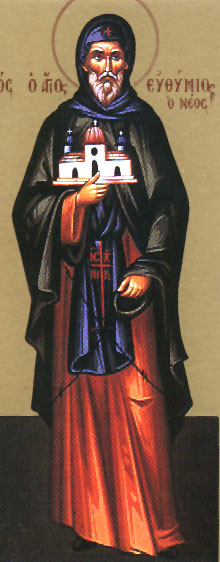
Saint Euthymius the New of Thessalonica and Mt Athos, in the world was named Nicetas, and he was a native of the city of Ancyra in Galatia. His parents, Epiphanius and Anna, led virtuous Christian lives, and from childhood their son was meek, pious and obedient. At age seven he was left fatherless and he soon became the sole support of his mother in all matters. Having entered military service, Nicetas married, on the insistence of his mother. After the birth of a daughter, he secretly left home in order to enter a monastery. For fifteen years the venerable Euthymius lived the ascetic life on Mount Olympus, where he learned monastic deeds from the Elders.
The monk went to resettle on Mount Athos. On the way he learned that his mother and wife were in good health. He informed them that he had become a monk, and he sent them a cross, calling on them to follow his example. On Mt Athos he was tonsured into the Great Schema and lived for three years in a cave in total silence, struggling with temptations. Saint Euthymius also lived for a long time as a stylite, not far from Thessalonica, instructing those coming to him for advice and healing the sick.
The monk cleansed his mind and heart to such an extent that he was granted divine visions and revelations. At the command of the Lord, Saint Euthymius founded two monasteries in 863 on Mount Peristeros, not far from Thessalonica, which he guided for 14 years, with the rank of deacon. In one of these his wife and mother received monastic tonsure. Before his death he settled on Hiera, an island of Mt Athos, where he reposed in 898. His relics were transferred to Thessalonica. Saint Euthymius is called “the New” to distinguish him from Saint Euthymius the Great (January 20).
Martyr Lucian the Presbyter of Antioch

The Hieromartyr Lucian, Presbyter of Antioch, was born in the Syrian city of Samosata. At twelve years of age he was left orphaned. Lucian distributed his possessions to the poor, and went to the city of Edessa to the confessor Macarius, under the guidance of whom he diligently read Holy Scripture and learned the ascetic life. For his pious and zealous spreading of Christianity among the Jews and pagans, Lucian was made a presbyter.
In Antioch Saint Lucian opened a school where many students gathered. He taught them how to understand the Holy Scriptures, and how to live a virtuous life. Saint Lucian occupied himself with teaching, and he corrected the Greek text of the Septuagint, which had been corrupted in many places by copyists and by heretics who deliberately distorted it in order to support their false teachings. The entire Greek text of the Bible which he corrected was hidden in a wall at the time of his confession of Christ, and it was found during the lifetime of Saint Constantine the Great.
During the persecution of Diocletian, Saint Lucian was arrested and was sent to prison in Nicomedia, where for nine years he encouraged other Christians with him to remain steadfast in their confession of Christ, urging them not to fear tortures or death.
Saint Lucian died in prison from many terrible tortures and from hunger. Before his death, he wished to partake of the Holy Mysteries of Christ on the Feast of Theophany. Certain Christians who visited him brought bread and wine for the Eucharist. The hieromartyr, bound by chains and lying on a bed of sharp potsherds, was compelled to offer the Bloodless Sacrifice upon his chest, and all the Christians there in prison received Communion. The next day the emperor sent people to see if the saint was still alive. Saint Lucian said three times, “I am a Christian,” then surrendered his soul to God. The body of the holy martyr was thrown into the sea, but after thirty days dolphins brought it to shore. Believers reverently buried the body of the much-suffering Saint Lucian.
Saint Lucian was originally commemorated on January 7, the day of his death. Later, when the celebration of the Synaxis of Saint John the Baptist was appointed for this day, the feast of Saint Lucian was transferred to October 15.
The October date may be associated with the dedication of a church which was built in Antioch by Saint Helen (May 21) over Saint Lucian’s holy relics.

Although he was only a priest, sometimes Saint Lucian is depicted in the vestments of a bishop. The Stroganov Guide for Iconographers was published in Russia in 1869, based on a 1606 manuscript. There Saint Lucian is depicted wearing a phelonion and holding a Gospel. He does not wear the omophorion of a bishop, however. Another handbook, the Litsevoy Podlinnik, states that Saint Lucian is to be depicted with the omophorion.
It may be that the Russians thought of Saint Lucian as a bishop because of his importance to the Church, and so that is how they depicted him. Similarly, Saint Charalampus (February 10) is depicted as a priest in Greek icons, and as a bishop in Russian icons.
Saint John, Bishop of Suzdal

Saint John, Bishop of Suzdal, entered one of the monasteries of Suzdal while a youth. For his virtuous and humble life, the saint was made the first Bishop of Suzdal and Nizhegorod in 1350. Bishop John merited a great mercy of God: Prince Boris of Suzdal saw how an angel of God attended the saint during the Divine Liturgy.
Saint John was known for his love towards the destitute and the sick; he interceded for the poor before the princes to lower their taxes. He also built poor houses and hospices for the sick. The saint was very concerned about enlightening the pagan Mordvians with the Christian Faith. After the annexation of Suzdal to the Moscow Diocese, Saint John took the monastic schema and withdrew to the Bogoliub monastery. He lived there in seclusion and died in peace. Numerous miracles took place at his grave.
Hieromartyr Lucian the Presbyter of the Kiev Caves

Saint Lucian the Presbyter lived in the XIII century, and suffered martyrdom under Batu around 1243. Nothing else is known about him.
Saint Lucian's relics are in the Far Caves of Saint Theodosios, and his Feast Day is on October 15, because of his Patron Saint, Hieromartyr Lucian, the Presbyter of Antioch. He is also commemorated on August 28 (Synaxis of the Saints of the Kiev Caves, whose relics repose in the Far Caves of Saint Theodosios); and again on the second Sunday of Great Lent (Synaxis of all the Venerable Fathers of the Kiev Caves Monastery).
Martyrs Sarbelius and Bebaia of Edessa
The Holy Martyrs Sarbelus and Bebaia (Barbea) of Edessa were brother and sister, suffering in the second century under the emperor Trajan for confessing Christianity. Saint Sarbelus was a priest of the idols at Edessa, but was converted to Christ by a certain bishop, then he and his sister were baptized. Pagans tortured the saints for a long while, and then beheaded them.
These saints are also commemorated on January 29. Saint Sarbelus may be the same one who is commemorated on September 5.
Saint Sabinus, Bishop of Catania
Saint Sabinus, Bishop of Catania in Sicily, fervently desiring to serve the Lord, withdrew into the wilderness. Here he led a strict ascetic life and received from the Lord gifts of wonderworking and discernment.
“Multiplier of Wheat” Icon of the Mother of God

The Icon of the Mother of God, the “Multiplier of Wheat”, was painted at the blessing of the Elder Ambrose (October 10) of the Visitation Optina wilderness monastery. Saint Ambrose, a great Russian ascetic of the nineteenth century, was ardent with a childlike faith towards the Mother of God. In particular, he revered all the Feastdays of the Mother of God, and on these days he redoubled his prayer. With the icon, “Multiplier of Wheat,” Saint Ambrose blessed the Shamordino women’s monastery established in honor of the Kazan Icon of the Mother of God, which he had founded not far from the Optina monastery.
On this icon, the Mother of God is depicted sitting upon the clouds, and Her hands are extended in blessing. Beneath her is a compressed field, and on it amidst the grass and flowers stand and lay sheaves of rye. Elder Ambrose himself decreed the day of celebration, October 15, and called the icon “Multiplier of Wheat”, indicating by this, that the Most Holy Theotokos “is a Helper for people in their labors for the acquiring of their daily bread.”
Before his blessed repose, Saint Ambrose ordered many copies of this icon and sent them to his spiritual children. For the Akathist to this icon, the Elder composed a particular response, “Hail, Full of Grace, the Lord is with You! Grant unto us unworthy ones the dew of Your grace and the showing forth of Your mercy!”
Saint Ambrose’s burial took place on October 15, the Feastday of the icon. The first miracle from the holy icon was witnessed in 1891, when throughout Russia there was a famine because of crop failure. In the Kaluga district and on the fields of the Shamordino monastery, however, grain was produced. In 1892, already after the death of Saint Ambrose, his attendant John Cherepanov sent a copy of the icon to the Pyatnitsa women’s monastery in Voronezh district. In this locale there was a threat of drought and famine, but soon after a Molieben was celebrated before the icon “The Multiplier of Wheat”, rain fell and ended the drought.
Daily Readings for Tuesday, October 14, 2025
TUESDAY OF THE 4TH WEEK
NO FAST
Martyrs Nazarius, Gervasius, Protasius, & Celsus, Cosmas the Hagiopolite, Praised Ignatius, Archbishop of Methymna, Righteous Paraskeve of Serbia
ST. PAUL’S LETTER TO THE PHILIPPIANS 1:8-14
Brethren, God is my witness, how I yearn for you all with the affection of Christ Jesus. And it is my prayer that your love may abound more and more, with knowledge and all discernment, so that you may approve what is excellent, and may be pure and blameless for the day of Christ, filled with the fruits of righteousness which come through Jesus Christ, to the glory and praise of God. I want you to know, brethren, that what has happened to me has really served to advance the gospel, so that it has become known throughout the whole praetorian guard and to all the rest that my imprisonment is for Christ; and most of the brethren have been made confident in the Lord because of my imprisonment, and are much more bold to speak the word of God without fear.
LUKE 8:1-3
At that time Jesus went on through cities and villages, preaching and bringing the good news of the kingdom of God. And the twelve were with him, and also some women who had been healed of evil spirits and infirmities: Mary, called Magdalene, from whom seven demons had gone out, and Joanna, the wife of Chuza, Herod’s steward, and Susanna, and many others, who provided for him out of their means.
Martyrs Gervasius, Nazarius, Protasius, and Celsus of Milan

The Holy Martyrs Nazarius, Gervasius, Protasius and Celsus of Milan suffered during the reign of the emperor Nero (54-68). Saint Nazarius (son of the Christian Perpetua and the Jew Africanus) was born at Rome and was baptized by Bishop Linus. From his youth Nazarius decided to devote his life to preaching Christ and to aid wandering Christians. With this intent he left Rome and arrived in Mediolanum (Milan).
Saints Protasius and Gervasius were twin brothers from Mediolanum (Milan), the sons of wealthy Roman citizens, Vitalius and Valeria. When they received their inheritance from their parents, they distributed the money to the poor, freed their slaves, and occupied themselves with fasting and prayer. The pagans locked them up in prison because they were Christians. Saint Nazarius met Protasius and Gervasius when he was visiting Christians in the Mediolanum prison. He so loved the twins that he wanted to suffer and die with them. The ruler heard that he was visiting the prisoners, so he had Saint Nazarius beaten with rods, then driven from the city.
Saint Nazarius proceeded to Gaul (modern France), and there he successfully preached Christianity and converted many pagans. In the city of Kimel he baptized Celsus, the son of a Christian woman who entrusted her child to the saint. Nazarius raised the boy in piety, and acquired a faithful disciple and coworker in his missionary labors.
The pagans threw the saints to wild animals to be eaten, but the beasts would not touch them. Afterwards, they tried to drown the martyrs in the sea, but they walked upon the water as if on dry land. The soldiers who carried out the orders were so amazed that they themselves accepted Christianity and released the holy martyrs.
Saints Nazarius and Celsus went to Milan and visited Gervasius and Protasius in prison. For this, they were brought before Nero, who ordered that Saints Nazarius and Celsus be beheaded. Soon after this the holy brothers Gervasius and Protasius were also executed. The relics of all four martyrs were stolen by a Christian named Philip, and were buried in his house.
Many years later, during the reign of the holy Emperor Theodosius (408-450), Saint Ambrose, Bishop of Milan (December 7), discovered the relics of Saints Gervasius and Protasius through a revelation from God.
In the reign of Arcadius and Honorius, Saint Ambrose also discovered the relics of Saints Nazarius and Celsus. The holy relics, glorified by many healings, were solemnly transferred to the Milan cathedral.
Venerable Paraskevi (Petka) of Serbia

Saint Paraskevi (Paraskevḗ) the New was born into a pious family, living during the eleventh century in the village of Epivato, between Silistra and Constantinople. Her older brother Euthymius became a monk, and later he was consecrated as Bishop of Matidia. One day, while attending the divine services, the words of the Lord pierced her heart like an arrow, “If any man will come after Me, let him deny himself” (Mt. 16:24). From that time she began to distribute her clothing to the needy, for which reason she endured much grief from her family.
Upon the death of her parents, the saint was tonsured into monasticism at the age of fifteen. She withdrew to the Jordanian desert where she lived the ascetic life until she reached the age of twenty-five. An angel of the Lord ordered her to return to her homeland, so she stayed at Epivato for two years.
Saint Paraskevi departed to the Lord at the age of twenty-seven, and was buried near the sea. Because of the many miracles which took place at her grave, her relics were uncovered and found to be incorrupt. They were placed in the church of the Holy Apostles at Epivato, where they remained for about 175 years.
Saint Paraskevi’s relics were moved to Trnovo, Bulgaria in 1223 and placed in the cathedral. Patriarch Euthymius wrote her Life and established the day of her commemoration as October 14. The Turks occupied Bulgaria in 1391, and her relics were given to Mircea the Elder, Prince of the Romanian Land (one of the districts of Romania). In 1394 the relics were given to Princess Angelina of Serbia (July 30), who brought them to Belgrade. For 120 years Saint Paraskevi’s relics rested in Constantinople in the patriarchal cathedral.
On June 13, 1641, her incorrupt relics were transferred to the monastery of the Three Hierarchs at Jassy in Rumania, where many healings took place. On December 26, 1888, after being rescued from a fire, Saint Paraskevi’s relics were moved again. This time they were placed in the new cathedral at Jassy, where they remain until the present day.
Venerable Nicholas Sviatosha Prince of Chernigov, and Wonderworker of the Kiev Near Caves

Saint Nicholas Sviatosha, Prince of Chernigov, and Wonderworker of the Kiev Caves, Near Caves, was a great-grandson of Great Prince Yaroslav the Wise and son of Prince David Svyatoslavich of Chernigov (+ 1123). Nicholas was the Prince of Lutsk, and he had a wife and children (his daughter was later married to the Novgorod prince Saint Vsevolod-Gabriel (February 11).
On February 17, 1106 the holy prince left his family and was tonsured at the Kiev Caves monastery. Nicholas Sviatosha carried out his obediences with great humility. For three years he worked in the kitchen, for which he chopped wood and carried water. For the next three years, he was gatekeeper at the monastery. The saint had a garden around his cell. Out of his own means he built at the monastery the temple of the Holy Trinity and the infirmary church in the name of Saint Nicholas, his patron saint.
Saint Nicholas was the first of the Russian princes to accept monasticism, patiently enduring the reproaches of his brothers for his decision to lead a life of humble obedience. The saint’s doctor, Peter, pointed out to the royal ascetic that such exploits of obedience had injured his health. But suddenly the doctor himself fell sick, and was healed only by the prayer of Saint Nicholas. Then Peter himself was tonsured.
After he had progressed through various obediences, Saint Nicholas took upon himself the vow of silence. When the saint received money, he used it to beautify the church and to procure books (because he loved reading), or he distributed it to the poor. Saint Nicholas was a zealous peacemaker; in 1142 he reconciled the Prince of Chernigov with the Great Prince Vsevolod.
Soon after the death of the saint, his brother Prince Izyaslav fell grievously ill. The igumen of the monastery sent the sick man the saint’s hairshirt. Izyaslav put it on and was healed.
Hieromartyr Silvanus of Gaza
The Holy Hieromartyr Silvanus of Gaza was a native of the city of Gaza. He was first a soldier, then a priest. He was falsely accused of a crime and sentenced to labor in the copper mines. In spite of many tribulations, the saint did not renounce Christ. In his old age, he was beheaded together with forty other Christians.
Icon of the Mother of God of Yakhrom
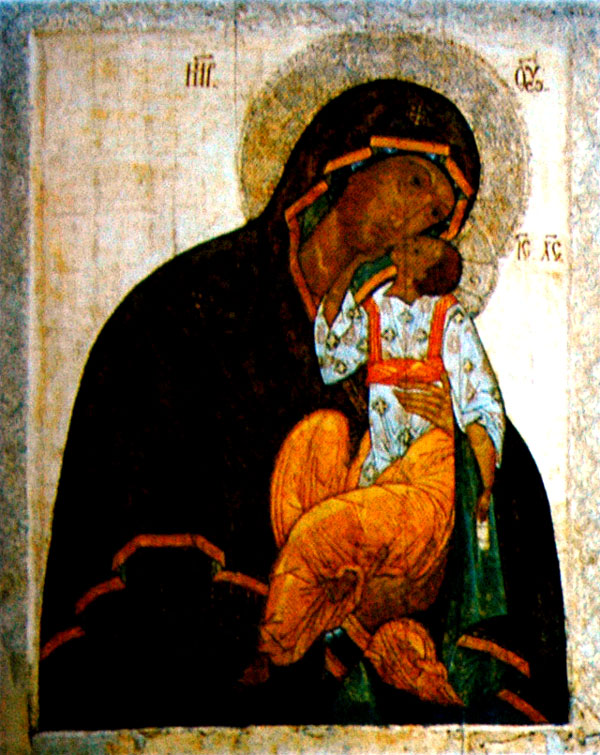
The Yakhrom Icon of the Mother of God appeared to the holy youth Cosmas (February 18), while he was accompanying his master, a sick landowner. Cosmas had stopped at the bank of the Yakhrom River, not far from Vladimir, and the sick man fell asleep. Cosmas suddenly saw a bright light coming from a nearby tree, and heard a voice, “Attend and understand the words of life. Live a God-pleasing life and seek the joy of the righteous, and then you will delight in eternal blessings.” The light had come from an icon of the Dormition of the Most Holy Theotokos.
Saint Cosmas (February 18) took the icon and placed it on his master, who was immediately healed. After this, Cosmas’s term of servitude expired, so he went to the Kiev Caves monastery. After he was tonsured, he amazed even the experienced monks by his own spiritual efforts.
Years later, Saint Cosmas was told by an angel to return to the place where he had found the icon. He took the wonderworking icon with him to the bank of the Yakhrom River where he had found the icon. At once, the place was again filled with light. Saint Cosmas built a monastery in honor of the Dormition of the Mother of God, and placed the Yakhrom Icon within it.
Daily Readings for Monday, October 13, 2025
MONDAY OF THE 4TH WEEK
NO FAST
Carpus, Papylus, Agathodorus, & Agathonica, the Martyrs of Pergamus, Benjamin the Deacon, Chryssi the New Martyr of Greece, Meletios of Pegas, Patriarch of Alexandria, Florentios the Martyr of Thessaloniki, Hieromartyr Jacob of Hamatoura
ST. PAUL’S LETTER TO THE PHILIPPIANS 1:1-7
Paul and Timothy, servants of Christ Jesus, to all the saints in Christ Jesus who are at Philippi, with the bishops and deacons: Grace to you and peace from God our Father and the Lord Jesus Christ. I thank my God in all my remembrance of you, always in every prayer of mine for you all making my prayer with joy, thankful for your partnership in the gospel from the first day until now. And I am sure that he who began a good work in you will bring it to completion at the day of Jesus Christ. It is right for me to feel thus about you all, because I hold you in my heart, for you are all partakers with me of grace, both in my imprisonment and in the defense and confirmation of the gospel.
LUKE 7:36-50
At that time, one of the Pharisees asked Jesus to eat with him, and he went into the Pharisee’s house, and took his place at table. And behold, a woman of the city, who was a sinner, when she learned that he was at table in the Pharisee’s house, brought an alabaster flask of ointment, and standing behind him at his feet, weeping, she began to wet his feet with her tears, and wiped them with the hair of her head, and kissed his feet, and anointed them with the ointment. Now when the Pharisee who had invited him saw it, he said to himself, “If this man were a prophet, he would have known who and what sort of woman this is who is touching him, for she is a sinner.” And Jesus answering said to him, “Simon, I have something to say to you.” And he answered, “What is it, Teacher?” “A certain creditor had two debtors; one owed five hundred denarii, and the other fifty. When they could not pay, he forgave them both. Now which of them will love him more?” Simon answered, “The one, I suppose, to whom he forgave more.” And he said to him, “You have judged rightly.” Then turning toward the woman he said to Simon, “Do you see this woman? I entered your house, you gave me no water for my feet, but she has wet my feet with her tears and wiped them with her hair. You gave me no kiss, but from the time I came in she has not ceased to kiss my feet. You did not anoint my head with oil, but she has anointed my feet with ointment. Therefore I tell you, her sins, which are many, are forgiven, for she loved much; but he who is forgiven little, loves little.” And he said to her, “Your sins are forgiven.” Then those who were at table with him began to say among themselves, “Who is this, who even forgives sins?” And he said to the woman, “Your faith has saved you; go in peace.”
Martyrs Carpus, Papylus, Agathadorus, and Agathonica, at Pergamum
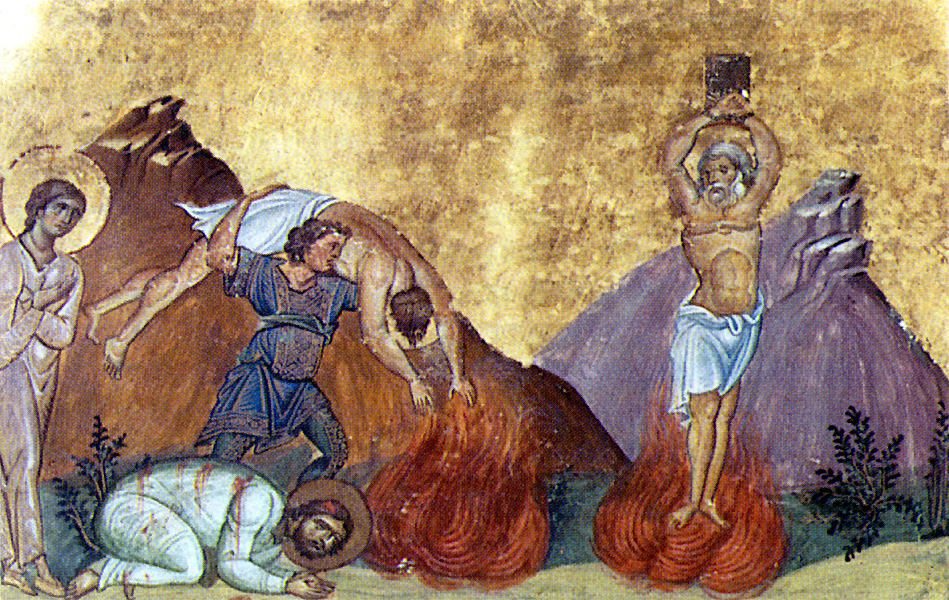
The Martyrs Carpus, Papylus, Agathodorus and Agathonike suffered at Pergamum during the persecution of Decius in the third century.
The governor of the district where the saints lived discovered that Carpus and Papylus did not celebrate the pagan festivals. He ordered that the transgressors be arrested and persuaded to accept the Roman pagan religion. The saints replied that they would never worship false gods. The judge then ordered them to be bound in iron chains and led through the city, and then to be tied to horses and dragged to the nearby city of Sardis.
Agathodorus and Agathonike voluntarily followed after Carpus and Papylus. Saint Agathonike was choked to death with ox sinews and Saints Carpus, Papylus and Agathodorus were beheaded in Sardis.
During his life Saint Papylus was known for his gift of curing the sick. Since his martyrdom, he has granted healing to all who pray to him with faith.
Venerable Benjamin of the Kiev Caves
Saint Benjamin of the Kiev Caves, Far Caves lived during the fourteenth century and before accepting monasticism was “an important merchant.” Once at the time of divine services Saint Benjamin felt deeply in his heart the words of the Savior: a rich man shall hardly enter into the Kingdom of God (Mt. 19:23). After distributing his wealth to the needy, Saint Benjamin became a monk, “pleasing the Lord by fasting and prayers even unto death.” He was buried in the Caves of Saint Theodosius. His memory is also celebrated on August 28 and the second Sunday of Great Lent.
Martyr Florentius of Thessalonica
The Martyr Florentius was a native of Thessalonica. Zealous for the glory of God, he fearlessly unmasked the darkness of idolatry and led many to the light of true knowledge of God. He taught faith in Christ and fulfilled the will of God. For this the pagans subjected him to cruel tortures, and then burned him.
Martyr Benjamin the Deacon of Persia
The Martyr Benjamin the Deacon of Persia converted many pagan Persians to Christianity, and for his zeal and evangelic preaching he suffered in Persia during the fifth century.
Saint Nikḗtas the Confessor of Paphlagonia
Saint Nikḗtas the Confessor of Paphlagonia was a patrician at the imperial court during the reigns of the empress Irene and her son Constantine. He represented the empress Irene at the Seventh Ecumenical Council in 787, though his name does not appear in the Acts of the Council. He also assisted at the transfer of the relics of Saint Euphemia (September 16).
Renouncing all positions and honors, Nikḗtas decided to become a monk. At the request of the emperor, he did not go into the wilderness, but rather remained in a monastery in the capital. When the Iconoclast Theophilus occupied the imperial throne, the venerable Nikḗtas was banished from the monastery by the heretics for opposing the heresy. He wandered for a long time throughout the country.
Saint Nikḗtas died at the age of seventy-five about the year 838. During his life and after his death he worked many miracles.
New Martyr Zlata of Meglena, Bulgaria
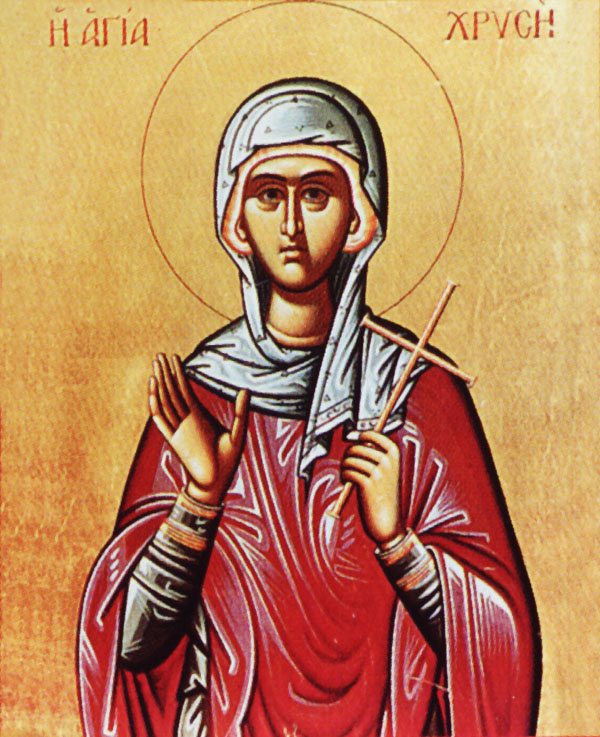
The Holy Virgin Martyr Zlata (Chrysḗ), that “golden vessel of virginity, and undefiled bride of Christ,” was born in the village of Slatena, in the Meglena diocese, on the border of Bulgaria and Serbia, when Bulgaria was under the Turkish Yoke. Her father was poor and he had four daughters. Saint Zlata was beautiful in appearance, and her soul was beautiful as well. From childhood she displayed an unusually strong character, and an unshakeable faith in Christ.
A certain Turk became obsessed with her, and kidnapped her one day as she was gathering wood with some other women. He brought her to his house, and repeatedly tried to seduce the maiden, and persuade her to convert to Islam, saying that he would make her his wife. Zlata, however, resisted and asserted: "I know only Christ as my Bridegroom, Whom I shall not deny, even if you tear me to to shreds."
Since persuasion and flattery proved unsuccessful, the Turk began to threaten her with grievous torments. The glorious martyr was not frightened by these threats, however. For six months the impious Hagarenes1 tried to make Zlata accept their religion, but she remained steadfast. Then they ordered the saint’s parents and sisters to convince her to become a Moslem. Otherwise, they would kill Zlata and torture them.
The Saint's parents and sisters wept and urged her to deny Christ “just for the sake of appearances,” so that they might be spared torture and death. Saint Zlata was unmoved by their pleas, and replied, “You who now urge me to deny Christ are no longer my parents and sisters. Instead, I have the Lord Jesus Christ as my father, the Lady Theotokos as my mother, and the Saints of our Church as my brothers and sisters!”
When the Moslems saw that they could not weaken the Saint's resolve, they tortured her for three months, beating her with clubs. Later, they peeled strips of skin from her body so that the earth was reddened by her blood. Then they heated a skewer and passed it through her ears.
Standing nearby was her Spiritual Father, Hieromonk Timothy of Stavronikḗta Monastery on Mount Athos, She sent word to him to pray that she would persevere until the end. It was he who recorded her martyrdom.
Finally, the Moslems fell into a rage at having been defeated by a woman, so they tied her to a tree and cut her virginal body to pieces with their knives. Her pure soul was received by Christ, Who bestowed on her the double crowns of virginity and martyrdom. Certain Christians gathered her relics secretly and buried them with great reverence. Saint Zlata suffered for Christ on October 13, 1795.
1 The descendants of Hagar, the concubine of the Old Testament Patriarch Abraham.
Translation of the Ivḗron Icon of the Mother of God to Moscow
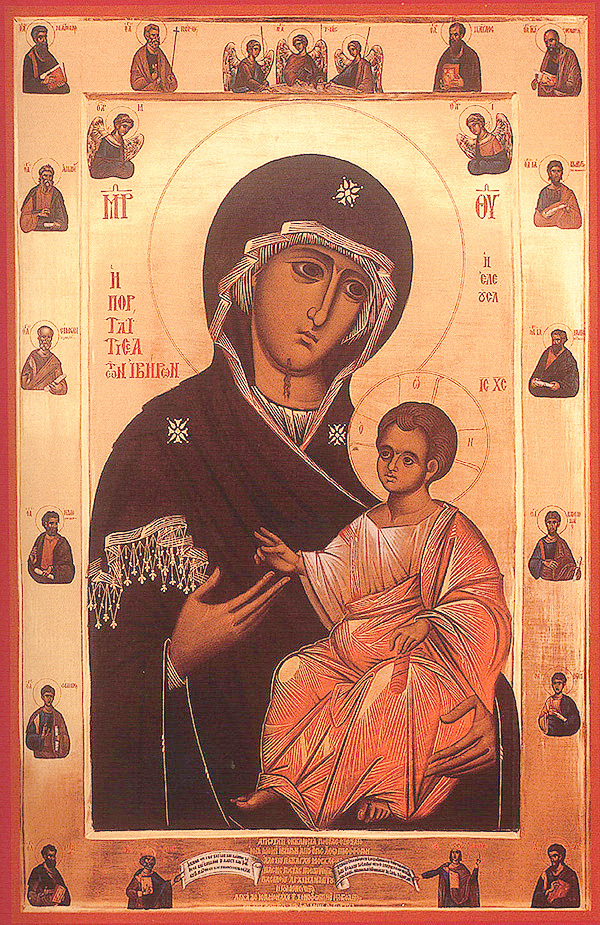
The Ivḗron Icon of the Mother of God, located on Mount Athos, has been glorified by many miracles. Accounts of the wonderworking image were spread throughout Russia by pilgrims. His Holiness Patriarch Nikon (then still Abbot of the Novospasky monastery) asked Abbot Pachomius of the Ivḗron Monastery on Mt Athos, (who was in Moscow collecting alms for the Athonite monasteries) to supply a copy of the wonderworking Ivḗron Icon of the Most Holy Theotokos.
The Athonite monk Iamblichos painted the copy of the Ivḗron Icon, and after a year the icon was taken to Moscow, accompanied by monks of Athos. On October 13, 1648 it was solemnly greeted by a multitude of the people. The Ivḗron Icon of the Russian Orthodox Church was also glorified by the Lord with many miracles (February 12).
The Ivḗron Icon is also commemorated on February 12, March 31, and Bright Tuesday.
“Seven Lakes” Icon of the Mother of God

The Seven Lakes Icon of the Mother of God was brought from Ustiug near Kazan on October 13, 1615 by the monk Euthymius, founder of the Seven Lakes Mother of God monastery. He blessed the place of the future monastery with this icon.
Feastdays of the Seven Lakes Icon were established in memory of its transfer from Ustiug, in memory of the deliverance of Kazan from a plague epidemic in 1654 and 1655 (June 26), and again from pestilence in 1771 (July 28).
Saint Anthony, Metropolitan of Chqondidi, and Saint Jacob, Elder of Chqondidi

Saint Anthony of Chqondidi was born to the family of Otia Dadiani, the prince of Egrisi (now Samegrelo). Anthony’s mother, Gulkan, was the daughter of the prince Shoshita III of Racha. There were six children in the family: five boys and one girl. Anthony’s sister, Mariam, later married King Solomon the Great of Imereti.
The children received their primary education from their mother, who was raised in the Christian Faith and transmitted the Faith to her children. Her vibrant faith and valorous labors were an example for all who surrounded her. After his father’s death, young Anthony was raised by his older brother Katsia. His family was preparing Anthony for a diplomatic career, and therefore they devoted special attention to his study of philosophy, literature, the fundamentals of poetry and art, and foreign languages (particularly Turkish and Persian).
From the beginning of the 17th century, the rulers of Egrisi appointed only their own relatives to the Chqondidi diocese. Nicholas, one of Anthony’s older brothers, was prepared for the bishopric, but he was too attached to the world to commit to the heavy yoke of asceticism. The young Anthony, however, was zealous for the monastic life, and soon he was tonsured.
The new monk Anthony sensed the imperfection of his spiritual education and asked the monks of Martvili Monastery in Egrisi to help him make up for his insufficient knowledge. A group of French missionaries arrived to instruct him in the foundations of Scholastic philosophy, which was very fashionable in Europe at that time. Anthony, however, recognized that his foreign tutors had tainted Orthodox doctrine with the poison of heresy. Once, during a meal, Anthony turned to a certain Frenchman and asked, “Can you pour wine into this water-filled cup and keep it from mixing with the water?”
The Catholic priest answered that it was impossible, and Anthony replied, “As it is impossible to pour water and wine into a single vessel and keep them from mixing, so it is impossible to accommodate both Orthodox doctrine and heresy!” From that day Anthony parted with the French missionaries.
The thirst for learning would not give the young monk any rest. To deepen his knowledge, Saint Anthony traveled to Tbilisi, to the court of King Erekle II. The king’s wife, Queen Darejan, was Anthony’s cousin—a child of his uncle, Katsia Dadiani.
In 1761 Saint Anthony was consecrated bishop of Tsageri (in lower Svaneti). He soon became famous for his eloquent sermons, which inspired even the Catholicos of Georgia himself.
Grown weary from fasting, Saint Anthony’s face began to resemble that of an angel. In accordance with his orders, a daily meal was prepared for the poor at the Chqondidi residence. Every subsequent bishop of Chqondidi has continued this practice.
In the 18th century many feudal lords in western Georgia (in Egrisi especially) began to trade slaves for profit. Bishop Anthony boldly opposed this immoral activity, and in the years 1792 to 1794 he convened a series of Church councils to publicly condemn the slave traders.
In 1788 Anthony approved vast land grants to the monasteries of Martvili, Nakharebou, and Sairme. He persuaded the Dadianis to exempt these lands from taxation.
In 1789 Anthony, now a metropolitan, left Chqondidi for Nakharebou Monastery, which he had built. He enriched the monastery with sacred objects, ancient icons and lands. There he spent the remainder of his days.
Saint Anthony of Chqondidi reposed in 1815 at a very old age and was buried at Nakharebou Monastery.
Saint Anthony’s spiritual son, devoted friend, and helper, Hieromonk Jacob, also dwelt as a saint in this world and was received into the Heavenly Kingdom.
 Saint Peter Antiochian Orthodox Church
You must be logged in to post a comment.