
Here is the live stream for Orthros and Divine Liturgy for Sunday, October 26, 2025 If you need, here are instructions for accessing this content from your phone, tablet, computer, or TV.
Monthly Archives: October 2025
Great Vespers for Saturday, October 25, 2025
Here is the live stream for Great Vespers for Saturday, October 25, 2025 If you need, here are instructions for accessing this content from your phone, tablet, computer, or TV.
Daily Readings for Saturday, October 25, 2025
SATURDAY OF THE 5TH WEEK
NO FAST
The Holy Martyrs Marcian and Martyrius the Notaries, Tabitha, who was raised from the dead by Peter the Apostle, Chrysaphios (or Chrysaphos) the Martyr, Martyr Chrysanthe
ST. PAUL’S SECOND LETTER TO THE CORINTHIANS 1:8-11
Brethren, we do not want you to be ignorant of the affliction we experienced in Asia; for we were so utterly, unbearably crushed that we despaired of life itself. Why, we felt that we had received the sentence of death; but that was to make us rely not on ourselves but on God who raises the dead; he delivered us from so deadly a peril, and he will deliver us; on him we have set our hope that he will deliver us again. You also must help us by prayer, so that many will give thanks on our behalf for the blessing granted us in answer to many prayers.
LUKE 7:1-10
At that time, Jesus entered Capernaum. Now a centurion had a slave who was dear to him, who was sick and at the point of death. When he heard of Jesus, he sent to him elders of the Jews, asking him to come and heal his slave. And when they came to Jesus, they besought him earnestly, saying, "He is worthy to have you do this for him, for he loves our nation, and he built us our synagogue." And Jesus went with them. When he was not far from the house, the centurion sent friends to him, saying to him, "Lord, do not trouble yourself, for I am not worthy to have you come under my roof; therefore I did not presume to come to you. But say the word, and let my servant be healed. For I am a man set under authority, with soldiers under me: and I say to one, 'Go, ' and he goes; and to another, 'Come, ' and he comes; and to my slave, 'Do this, ' and he does it." When Jesus heard this he marveled at him, and turned and said to the multitude that followed him, "I tell you, not even in Israel have I found such faith." And when those who had been sent returned to the house, they found the slave well.
Memorial Saturday of Saint Demetrius

In the spiritual experience of the Russian Church, veneration of the holy Great Martyr Demetrius of Thessalonica is closely linked with the memory of the defense of the nation and Church by the Great Prince of Moscow, Demetrius of the Don (May 19).
Saint Demetrius of the Don smashed the military might of the Golden Horde at the Battle of Kulikovo Field on September 8, 1380 (the Feast of the Nativity of the Most Holy Theotokos), set between the Rivers Don and Nepryadva. The Battle of Kulikovo, for which the nation calls him Demetrius of the Don, became the first Russian national deed, rallying the spiritual power of the Russian nation around Moscow. The “Zadonschina,” an inspiring historic poem written by the priest Sophronius of Ryazem (1381), is devoted to this event.
Prince Demetrius of the Don was greatly devoted to the holy Great Martyr Demetrius. In 1380, on the eve of the Battle of Kulikovo, he solemnly transferred from Vladimir to Moscow the most holy object in the Dimitriev cathedral of Vladimir: the icon of the Great Martyr Demetrius of Thessalonica, painted on a piece of wood from the saint’s grave. A chapel in honor of the Great Martyr Demetrius was built at Moscow’s Dormition Cathedral.
The Saint Demetrius Memorial Saturday was established for the churchwide remembrance of the soldiers who fell in the Battle of Kulikovo. This memorial service was held for the first time at the Trinity-Saint Sergius monastery on October 20, 1380 by Saint Sergius of Radonezh, in the presence of Great Prince Demetrius of the Don. It is an annual remembrance of the heroes of the Battle of Kulikovo, among whom are the schemamonks Alexander (Peresvet) and Andrew (Oslyab).
Martyrs Marcian and Martyrius, the Notaries of Constantinople
The Martyrs Marcian and Martyrius, Notaries of Constantinople served in a Constantinople cathedral. Marcian was a reader and Martyrius a subdeacon. They both performed in the capacity of notaries, i.e. secretaries, for Patriarch Paul the Confessor (November 6).
Arian heretics expelled and secretly executed the righteous Patriarch Paul. His throne was given to the heretic Macedonius. The heretics attempted to entice Saints Marcian and Martyrius over to their side by flattery. They offered them gold and promised to consecrate them as archbishops, but all the efforts of the Arians were in vain.
Then the impious threatened to slander them before the emperor, and sought to intimidate them with torture and death. But the saints steadfastly confessed Orthodoxy, as handed down by the Fathers of the Church. Marcian and Martyrius were sentenced to death. Before death, the martyrs prayed, “Lord God, Who has invisibly created our hearts, and directed all our deeds, accept with peace the souls of Your servants, since we perish for You and are considered as sheep for the slaughter (Ps 32/33:15; 43/44:22). We rejoice that by such a death we shall depart this life for Your Name. Grant us to be partakers of life eternal with You, the Source of life.” After their prayer the martyrs, with quiet rejoicing, bent their necks beneath the sword of the impious (+ ca. 335).
Their holy bodies were reverently buried by Orthodox Christians. Later, by decree of Saint John Chrysostom, the relics of the holy martyrs were transferred to a church built in their honor. Believers here were healed of many infirmities through the prayers of the saints, to the glory of the One Life-Creating Trinity.
Venerable Martyrius the Deacon, Recluse of the Kiev Caves
Saint Martyrius the Deacon is remembered in the Seventh Ode of the Canon to the Fathers of the Kiev Far Caves. Here his love of toil, justice and ardent purity, and even his gift of expelling demons and healing infirmities are praised. His memory is celebrated also on August 28 and on the second Sunday of Great Lent.
Martyr Anastasius the Fuller at Salona in Dalmatia
The Martyr Anastasius the Fuller lived at Salona in Dalmatia during the third century. He was arrested and brought to trial because of his missionary activity in Salona. Saint Anastasius, boldly and without fear, confessed Christ as the true God and Creator of all. He even painted a cross on his door during the persecution of Diocletian (284-311).
Saint Anastasius was sentenced to death by the decision of the court, and the pagans tied a stone around his neck and threw his body into the sea. A righteous Christian, the rich matron Ascalopia, found the body of Saint Anastasius and reverently buried him in her estate church. The relics of the holy martyr were glorified by many miracles.
Saint Anastasius the Fuller is also commemorated on December 5.
Saint Tabitha the Widow, raised from the dead by the Apostle Peter

Saint Tabitha, the widow raised from the dead by the Apostle Peter, was a virtuous and kindly woman who belonged to the Christian community in Joppa. Being grievously ill, she suddenly died. At the time, the Apostle Peter was preaching at Lydda, not far from Joppa. Messengers were sent to him with an urgent request for help. When the Apostle arrived at Joppa, Tabitha was already dead. On bended knee, Saint Peter made a fervent prayer to the Lord. Then he went to the bed and called out, “Tabitha, get up!” She arose, completely healed (Acts 9:36).
Saint Tabitha is considered the patron saint of tailors and seamstresses, since she was known for sewing coats and other garments (Acts 9:39).
Daily Readings for Friday, October 24, 2025
FRIDAY OF THE 5TH WEEK
ABSTAIN FROM MEAT, FISH, DAIRY, EGGS, WINE, OLIVE OIL
Arethas the Great Martyr and His Fellow Martyrs, Sebastiane the Martyr, Maglorious of Sark
ST. PAUL’S LETTER TO THE PHILIPPIANS 3:8-19
Brethren, I count everything as loss because of the surpassing worth of knowing Christ Jesus my Lord. For his sake I have suffered the loss of all things, and count them as refuse, in order that I may gain Christ, and be found in him, not having a righteousness of my own, based on law, but that which is through faith in Christ, the righteousness from God that depends on faith; that I may know him and the power of his resurrection, and may share his sufferings, becoming like him in his death, that if possible I may attain that resurrection from the dead. Not that I have already obtained this or am already perfect; but I press on to make it my own, because Christ Jesus has made me his own. Brethren, I do not consider that I have made it my own; but one thing I do, forgetting what lies behind and straining forward to what lies ahead, I press on toward the goal for the prize of the upward call of God in Christ Jesus. Let those of us who are mature be thus minded; and if in anything you are otherwise minded, God will reveal that also to you. Only let us hold true to what we have attained. Brethren, join in imitating me, and mark those who so live as you have an example in us. For many, of whom I have often told you and now tell you even with tears, live as enemies of the cross of Christ. Their end is destruction, their god is the belly, and they glory in their shame, with minds set on earthly things.
LUKE 10:1-15
At that time, the Lord appointed seventy other disciples, and sent them on ahead of him, two by two, into every town and place where he himself was about to come. And he said to them, "The harvest is plentiful, but the laborers are few; pray therefore the Lord of the harvest to send out laborers into his harvest. Go your way; behold, I send you out as lambs in the midst of wolves. Carry no purse, no bag, no sandals; and salute no one on the road. Whatever house you enter, first say, 'Peace be to this house!' And if a son of peace is there, your peace shall rest upon him; but if not, it shall return to you. And remain in the same house, eating and drinking what they provide, for the laborer deserves his wages; do not go from house to house. Whenever you enter a town and they receive you, eat what is set before you; heal the sick in it and say to them, 'The kingdom of God has come near to you.' But whenever you enter a town and they do not receive you, go into its streets and say, 'Even the dust of your town that clings to our feet, we wipe off against you; nevertheless know this, that the kingdom of God has come near.' I tell you, it shall be more tolerable on that day for Sodom than for that town.
'Woe to you, Chorazin! woe to you, Bethsaida! for if the mighty works done in you had been done in Tyre and Sidon, they would have repented long ago, sitting in sackcloth and ashes. But it shall be more tolerable in the judgment for Tyre and Sidon than for you. And you, Capernaum, will you be exalted to heaven? You shall be brought down to Hades.
Martyr Arethas and 4,299 Martyrs with him

The Martyr Arethas and with him 4299 Martyrs suffered for the Lord Jesus Christ in the sixth century. Arethas was prefect of the Christian city of Negran in Arabia. The Arabian (or Omirite) king, Dunaan, who was Jewish, decided to eliminate Christianity from the land. He issued an edict that all followers of Christ were to be put to death.
Because the inhabitants of Negran remained faithful to the Lord, Dunaan came with a large army to destroy the city. At the city walls of Negran the king’s heralds announced that Dunaan would only spare those who renounced Christ and referred to His Cross as a “sign of malediction.”
Not daring to assault the Christian city by force, Dunaan resorted to a ruse. Dunaan swore an oath that he would not force the Christians into Judaism, but would merely collect a tribute from Negran. The inhabitants of the city would not heed the advice of Saint Arethas, and putting their trust in Dunaan, they opened the city gates.
The very next day Dunaan gave orders to light an immense fire and throw all the clergy of the city into it in order to frighten the rest of the Christians. 427 men were burned. He also threw the prefect Arethas and the other chief men into prison. Then the oppressor sent his messengers through the city to convert the Christians to Judaism. Dunaan himself conversed with those inhabitants brought from the prisons, saying, “I do not demand that you should renounce the God of heaven and earth, nor do I want you to worship idols, I want merely that you do not believe in Jesus Christ, since the Crucified One was a man, and not God.”
The holy martyrs replied that Jesus is God the Word, the Second Person of the Holy Trinity, Who for the salvation of mankind was incarnate of the Holy Spirit and the Virgin Mary. Those suffering said, “We shall not abjure Christ, since He is Life for us. To die for Him is to find Life.”
More than four thousand Christians, men, women, both the aged and children, from the city of Negran and surrounding villages suffered martyrdom for Christ.
Venerable Arethus the Recluse of the Kiev Near Caves
Saint Arethas (12th century) was a hermit of the Near Caves in Kiev. He struggled at the Kiev Caves monastery and was buried in the Near Caves.
Saint Arethas was from Polotsk. While living at the monastery, he kept many possessions in his cell. One day robbers made off with it. Grieving over his lost riches, Saint Arethas began to murmur against God, for which he was stricken with a serious illness. Being at the very brink of death, he saw how both angels and devils had come for him and were arguing between them. The devils asserted that he ought to be given over to them because of his avarice and complaints against God. Then the angels said to him, “You hapless man, if you had given thanks to God for the pilfered riches, this would have been accounted as charity for you.”
After this vision, the saint recovered. He spent his final days as a hermit, in distress and repentance over his sins, having renounced all earthly possessions. Saint Arethas died not later than 1190. In the Iconographic Manuals, the saint is described in this way: “In appearance stooped over, his beard the same length as Kozmina, dressed in monastic garb.”
The general commemoration of all the Fathers of the Near Caves takes place on September 28 and on the second Sunday of Great Lent.
Venerable Sisoes the Recluse of the Kiev Near Caves
Saint Sisoes (13th century) was a hermit of the Near Caves in Kiev. He struggled at the Kiev Caves monastery and was buried in the Near Caves.
In the general service for the Fathers of the Kiev Caves, Saint Sisoes is called “radiant in fasting.”
The general commemoration of all the Fathers of the Near Caves takes place on September 28 and on the second Sunday of Great Lent.
Venerable Theophilus the Recluse of the Kiev Near Caves
Saint Theophilus (12th-13th century) was a hermit of the Near Caves in Kiev. He struggled at the Kiev Caves monastery and was buried in the Near Caves.
Saint Theophilus, in the general service to the Fathers of the Kiev Caves, is called “resplendent in miracles.”
The general commemoration of all the Fathers of the Near Caves takes place on September 28 and on the second Sunday of Great Lent.
Blessed Elesbaan, King of Ethiopia
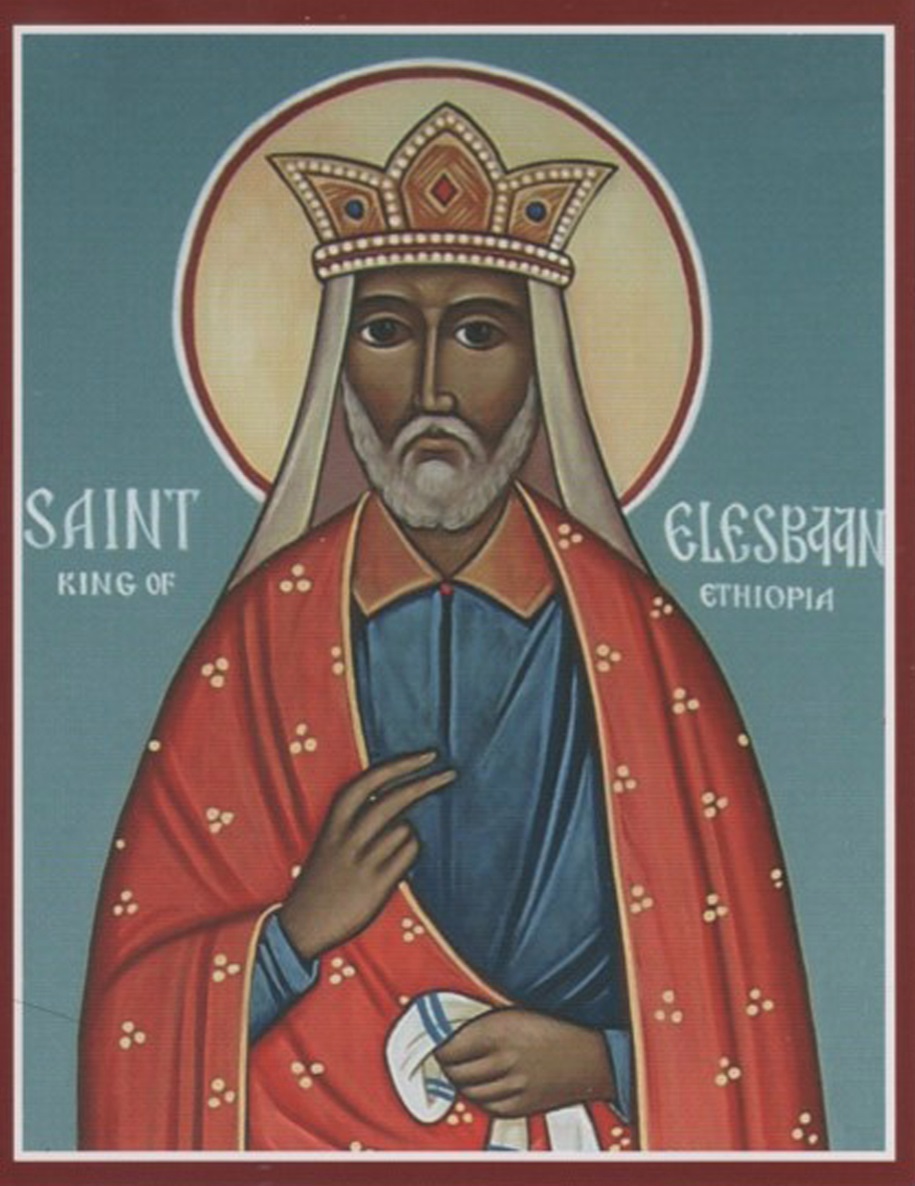
Blessed Elesbaan1 was the Emperor of what is now Ethiopia, and lived when Arabia was ruled by Dunaan, an oppressor of Christians. The pious Elesbaan was unable to stand by while those who believed in Christ were being massacred. He declared war on Dunaan, but his first military campaign was not successful.
Desiring to learn the reason for his defeat, Elesbaan, inspired by a revelation from above, visited a recluse named Zenon. He revealed to the Emperor that he had acted unrighteously in his desire to take revenge against Dunaan, for the Lord has said, “Vengeance is mine, I shall repay!” (Hebrews 10:30).
The holy ascetic urged Elesbaan to promise that he would devote the rest of his life to God, if he wished to escape His wrath for his self-willed revenge, and then he would defeat Dunaan. Saint Elesbaan made that vow to the Lord, and in 520 he and his army confronted the enemy. This time, he defeated, captured, and executed Dunaan. According to the Roman Martyrology, after Elesbaan defeated the enemies of Christ, he sent his royal diadem to Jerusalem to be hung near the Life-Giving tomb of Christ, during the reign of Emperor Justin.
Following his victory, the Saint kept his word and abdicated as Emperor, secluding himself in a monastery. For the next fifteen years he lived a life of strict fasting and asceticism.
Emperor Elesbaan reposed around 553-555.
1 His name is given as Kaleb on his coins and inscriptions.
Martyr Syncletica and her two daughters
The Martyr Syncletica and her two daughters suffered under the Arabian king Dunaan. Saint Syncletica was a descendant of an illustrious family. Left widowed while still quite young, she devoted herself to the Christian upbringing of her daughters, and she herself led a life both chaste and virtuous.
Dunaan in the meantime had begun a persecution, intending to eliminate Christians from his realm. He summoned Saint Syncletica and her daughters before him, and in urging her to forsake her “folly,” he promised as reward to take her into the retinue of his wife.
“How can you not be afraid, O King, to speak evil of Him Who has given you both royal crown and life?” replied the holy martyr.
Dunaan gave orders to lead Saint Syncletica and her daughters through the city as though they were criminals. Women, looking on at the disgrace of the saint, started crying, but she told them that this “shame” for her was dearer than any earthly honor.
Again they brought the martyr before Dunaan, and he said, “If you wish to remain alive, you must renounce Christ.”
“If I do, then who will deliver me from eternal death?” the saint asked. In a rage, the tormentor ordered that Saint Syncletica’s daughters be killed first, and then for the mother to be beheaded with a sword.
Saint Athanasius, Patriarch of Constantinople
Saint Athanasius I, Patriarch of Constantinople (1289-1293; 1303-1311), in the world Alexius, was from Adrianopolis. While still in his youth, thriving upon the knowledge of the wisdom of Christ, he left his home and went to Thessalonica, where he was tonsured in one of the monasteries with the name Acacius. He soon withdrew to Mount Athos and joined the brotherhood of the Esphigmenou monastery, where for three years he served in the trapeza. In his works and his ascetic deeds he acquired the gift of tears, and by his virtuous acts he won the overall goodwill of the brethren.
Shunning praise, Acacius humbly left Mt. Athos at first for the holy places in Jerusalem, and then to Mount Patra, where for a long time he lived ascetically as an hermit. From there the ascetic transferred to the Auxention monastery, and then to Mount Galanteia to the monastery of Blessed Lazarus, where he accepted the great angelic schema with the name Athanasius, was ordained a priest and became ecclesiarch (monk in charge of the sacred relics and vessels in the church). Here the saint was granted a divine revelation: he heard the Voice of the Lord from a crucifix, summoning him to pastoral service.
Wishing to strengthen his spirit still more in silence and prayer, Saint Athanasius again settled on Mount Athos after ten years. But because of disorders arising there he returned to Mount Galanteia. Here also he was not long to remain in solitude. Many people thronged to him for pastoral guidance, and so he organized a women’s monastery there.
During this time the throne of the Church of Constantinople fell vacant after the disturbances and disorder of the period of the Patriarch John Bekkos. At the suggestion of the pious emperor Andronicus Paleologos, a council of hierarchs and clergy unanimously chose Saint Athanasius to the Patriarchal throne of the Church in 1289.
Patriarch Athanasius began fervently to fulfill his new obedience and did much for strengthening the Church. His strictness of conviction roused the dissatisfaction of influential clergy, and in 1293 he was compelled to resign the throne and to retire again to his own monastery, where he lived an ascetic life in solitude. In 1303 he was again entrusted with the staff of patriarchal service, which he worthily fulfilled for another seven years. In 1308 Saint Athanasius established Saint Peter as Metropolitan of Kiev and All Rus (December 21).
Again, because of some sort of dissatisfaction, and not wanting to be the cause of church discord, Saint Athanasius resigned the governance of the Church in 1311. He departed to his own monastery, devoting himself fully to monastic deeds.
Toward the end of his life, the saint was again found worthy to behold Christ. The Lord reproached him because Athanasius had not carried out his pastoral duty to the end. Weeping, the saint repented of his cowardice and received from the Lord both forgiveness and the gift of wonderworking. Saint Athanasius died at the age of 100.
In Greek usage, Saint Athanasios is commemorated on October 28.
“Joy of All Who Sorrow” Icon of the Mother of God

How much consolation is contained in just the name of this Icon – awakening, strengthening the people's faith in the Mother of God, as a wondrous helper, who hastens everywhere where the groan of human suffering is heard, who wipes away the tears of those who mourn, and in sorrow itself, bestows moments of delight and heavenly joy. Rejoice always, O Heavenly Joy of all who Sorrow.
In accordance with the faith of the people in the loving kindness of the Mother of God toward the human race, it has been customary to depict the Theotokos in a way which conforms to what is heard in the words of the prayer: "O Most Holy Sovereign Lady Theotokos, you are higher than all the Angels and Archangels, and more honorable than all creation. You are the helper of the oppressed, the hope of the hopeless, the aid of the poor, the consolation of the grieving, the nourisher of the hungry, the clothing of the naked, the healing of the sick, the salvation of the sinful, the help and succor of all Christians."
Therefore, the Mother of God is depicted in full stature, sometimes with the Divine Child in her arms (as in the Moscow prototype), sometimes without the Child (as in the Icon with coins, which was glorified in St. Petersburg on July 23, 1888. She is surrounded by all sorts of distressed people – the naked, the offended, and the hungry. Around these poor unfortunates Angels are often depicted, sent by the Sovereign Lady to alleviate human suffering. The Angels, coming close to the people, point to the Mother of God, who is depicted on the "Joy of All Who Sorrow" Icons, either in glory, with a crown on her head and in royal vesture, or in the usual garments of her earthly sojourn, and in a white cloth on her head.
In Moscow, in the XVII century, a certain Icon of the Mother of God of this name became famous. The first miracle occurred in 1688 for the ailing Euphemia, the sister of Patriarch Joachim, who lived on Ordynka. She experienced terrible suffering from a wound in her side. This wound was so great that her intestines were visible. The patient was waiting for death, but at the same time, she did not lose hope in Divine help. One day, after asking to partake of the Holy Mysteries, she began to cry out to the Most Holy Theotokos with great faith: "Hear me, All-Merciful Sovereign Lady! The entire world boasts of you, and all receive your abundant mercies. I deserve to be punished for my iniquities, but do not punish me in your wrath. Behold my harsh infirmity, and have mercy on me."
After this prayer, the patient heard a voice: "Euphemia, in your suffering, why do you not resort to the universal Healer of all?"
Astonished by the voice Euphemia replied, "Where may I find such a Healer?"
The answer came: "There is an image of me in the church of my Son's Transfiguration, called "Joy of all who Sorrow." It stands on the left side in the trapeza, where the women usually stand. Summon the priest from that church to come to your house with the Icon, and when he has served a Moleben with the Sanctification of Water, you shall receive healing. Do not forget my mercy toward you, and proclaim it for the glorification of my name."
When Euphemia recovered from the excitement of this vision, she learned from her relatives that in the church of the Transfiguration, on Ordynka, there really was a "Joy of All Who Sorrow" Icon of the Mother of God, so she summoned the priest to come to her house with the Icon. After serving a Moleben with the Sanctification of Water, Euphemia was healed on October 24, 1688. Later, a Feast was established in honor of this Icon in remembrance of her healing which took place on this day.
Some think that the original "Joy of All Who Sorrow" Icon of the Mother of God was brought to St. Petersburg, to Princess Natalia Alekseevna, and that it is precisely the image that stands in the Sorrowful Church, on Shpalerna. However, it is more probable that the original Icon remained in Moscow.
Saint John, Hermit of Pskov
Saint John, Hermit of Pskov (+1616) lived an ascetic life during a terrible time of military troubles. In 1592 the Swedes besieged the city of Pskov. From 1608, for seven years, Polish forces attacked under the leadership of Lisovski. It was only in the week before the death of the monk, through the intercession of the Pskov Caves Icon of the Mother of God and the Pskov Saints, that Pskov was delivered from the besieging army of the Swedish king Gustavus Adolphus.
St John, as the chronicle relates, “lived within the city walls for 23 years; his fish was rancid and he did not eat bread. He lived within the city as though in a wilderness, in great silence,” and he died on October 24, 1616.
Announcements October 26, 2025
Great-Martyr Demetrios the Myrrh-Streaming
Timothy 2:1-10: Timothy, my son, be strong in the grace that is in Christ Jesus; and what you have heard from me before many witnesses entrust to faithful men who will be able to teach others also. Share in suffering as a good soldier of Christ Jesus. No soldier on service gets entangled in civilian pursuits, since his aim is to satisfy the one who enlisted him. An athlete is not crowned unless he competes according to the rules. It is the hard-working farmer who ought to have the first share of the crops. Think over what I say, for the Lord will grant you understanding in everything. Remember Jesus Christ, risen from the dead, descended from David, as preached in my gospel, the gospel for which I am suffering and wearing fetters like a criminal. But the word of God is not fettered. Therefore, I endure everything for the sake of the elect, that they also may obtain salvation in Christ Jesus with its eternal glory
Luke 8:26-39: At that time, Jesus arrived at the country of the Gadarenes, which is opposite Galilee. And as He stepped out on land, there met Him a man from the city who had demons; for a long time he had worn no clothes, and he lived not in a house but among the tombs. When he saw Jesus, he cried out and fell down before him, and said with a loud voice, “What hast Thou to do with me, Jesus, Son of the Most High God? I beseech Thee, do not torment me.” For Jesus had commanded the unclean spirit to come out of the man. [For many a time it had seized him; he was kept
under guard, and bound with chains and fetters, but he broke the bonds and was
driven by the demon into the desert.] Jesus then asked him, “What is your name?” And he said, “Legion”; for many demons had entered him. And they begged Jesus not to command them to depart into the abyss. Now a large herd of swine was feeding there on the hillside; and they begged Jesus to let them enter these. So He gave them leave. Then the demons came out of the man and entered the swine, and the herd rushed down the steep bank into the lake and was drowned. When the herdsmen saw what had happened, they fled, and told it in the city and in the country. Then people went out to see what had happened, and they came to Jesus, and found the man from whom the demons had gone, sitting at the feet of Jesus, clothed and in his right mind; and they were afraid. And those who had seen it told them how he who had been possessed with demons was healed. Then all the people of the surrounding country of the Gadarenes asked Jesus to depart from them; for they were seized with great fear; so He got into the boat and returned. The man from whom the demons had gone begged that he might be with Jesus; but Jesus sent him away, saying, “Return to your home, and declare all that God has done for you.” And he went away, proclaiming throughout the whole city all that Jesus had done for him.
Troparion of the Resurrection: Let the heavens rejoice and the earth be glad, for the Lord hath done a mighty act with His own arm. He hath trampled down death by death, and become the first-born from the dead. He hath delivered us from the depths of Hades, granting the world the Great Mercy.
Troparion of the Earthquake: O Thou Who lookest upon the earth and makest it tremble, deliver us from the fearful menace of earthquake, O Christ our God, and by the intercessions of the Theotokos, send down upon us Thy mercies in abundance, O only Friend of man.
Troparion of St Demetrios the Myrrh-Streaming: A great champion hath the whole world found thee to be when in grave perils; for thou dost put to flight the heathen, O victorious one. As thou didst humble Lyaeus’ arrogance and gavest boldness to Nestor in the stadium, thus, O holy Great Martyr Demetrios, do thou entreat Christ God that we be granted Great Mercy.
Troparion of the Chains of St. Peter: O Holy Apostle, Peter, thou dost preside over the Apostles by the precious chains which thou didst bear. We venerate them with faith and beseech thee that by thine intercessions we be granted the great mercy.
Kontakion of the Theotokos: O protection of Christians that cannot be put to shame, mediation unto the Creator most constant, O despise not the suppliant voices of those who have sinned; but be thou quick, O good one, to come unto our aid, who in faith cry unto thee: Hasten to intercession, and speed thou to make supplication, thou who dost ever protect, O Theotokos, them that honor thee.
Calendar
Sunday, October 26, 2025 (Great-Martyr Demetrios the Myrrh-Streaming)
8:50 AM – Orthros
9:00 AM – Christian Education
10:00 AM – Divine Liturgy
Monday, October 27, 2025
Father Herman off
Tuesday, October 28, 2025
Ladies Lunch
No Services
Wednesday, October 29, 2025
5:30 PM – Teen Meeting
6:30 PM – Daily Vespers
Thursday, October 30, 2025
NO Services
Friday, October 31, 2025
No Services
Saturday, November 1, 2025 (Raphael, Bishop of Broklyn)
9:00 AM – Festal Orthros & Divine Liturgy
4:00 PM – Fall Festival
6:00 PM – Great Vespers CANCELLED
Sunday, November 2, 2025 (21ST Sunday after Pentecost)
8:50 AM – Orthros
9:00 AM – Christian Education
10:00 AM – Divine Liturgy
Special Announcements
Please remember the following in your prayers: Aidan Milnor, the Milnor family; Lamia Dabit and her family; Mary Greene (Lee and Kh. Sharon’s sister); Jay and Joanna Davis; Fr. Leo and Kh. Be’Be’ Schelver and their family; Marilyn (Kyriake) Snell; Jack and Jill Weatherly; Dn.Terry Algood and their family; Fr. Joseph Bittle; Rick Carlton; Very Rev. Fr. Nicholas and Kh. Jan Speier; Lee Greene; Fr. John and Kh. Janet Henderson and their family; Galina Singletary; Emily and Cole Parker.
The Eucharist Bread was provided by the Karams for the Divine Liturgy this morning.
Eucharist Bread Schedule:
Eucharist Bread Coffee Hour
October 26 Karam Dansereau/Alaeetawi
November 1 (Sat. AM) Brock Ellis/Zouboukos
Raphael, Bishop of Brooklyn
November 2 R. Root Miller/D. Root
November 9 Pacuari Lasseter/Pacuari/Lavric
POTLUCK
November 16 Lasseter Lockhart/Karam/Snell
November 20 (Thurs PM) Milnor Algood/Meadows/YAF
Entrance of the Theotokos POTLUCK
into the Temple
November 23 YAF Baker/Jimmy Jones/Rodriguez
November 30 Henderson Pigott/Ian Jones
Schedule for Epistle Readers – Page numbers refer to the Apostolos (book of Epistles) located on the chanters’ stand at the front of the nave. Please be sure to use book when you read.
Reader Reading Page#
October 26 Simeon Root II Tim 2:1-10 328
November 1 (Sat AM) Athena Zouboukos Heb 7:26-8:2 334
Raphael, Bishop of Brooklyn
November 2 Gabrielle Jones Gal 2:16-20 193
November 9 Katie Miller Eph 5:8-19 78
November 16 Mary Martha Ellis I Cor 4:9-16 135
November 20 Ian Jones Heb 9:1-11 337
Entrance of the Theotokos
into the Temple
November 23 Grady Fisher Eph 2:14-22 207
November 30 Walt Wood I Cor 4:9-19 135
October is Teen Month and as such our teens will be reading the Epistle during the Divine Liturgy. Also, on October 19 the teens will be taking up a special donation for Special Olympics Awareness Day which is observed throughout the Archdiocese. On this Sunday the teens will read a pastoral letter from His Eminence Metropolitan SABA and have a basket in the Fellowship Hall should you wish to make a donation toward this blessed cause.
The Ladies of St Peter are collecting new and gently used towels for Shower Power through the month of October. Please place your donations in the drop-off box located in the Fellowship Hall
The Fall Festival is scheduled for Saturday November 1 at 4:00pm. As is our custom, there will be no Great Vespers that evening. Please see Anna Kathryn Stewart if you have any questions.
Potluck Meals: Everyone who attends the potluck meals during the month is encouraged to bring a dish to share with everyone. This is to ensure that there is enough food for all to partake. Over the past several months we have been running out of food before everyone has an opportunity to go through the line. This also applies to the Festal Liturgies that may be served during the week and the Soup Suppers after Presanctified Liturgies during Lent. Parents, please accompany your children through the line. Thank you all for your help with this.
As a friendly reminder, in regards to coffee hour, the church will provide beef sticks, cheese cubes, crackers, cookies, and orange juice. For sponsors of baptisms/chrismations a reception may be held after the service and may have whatever food the sponsors would like to provide in celebration of this occasion. If you wish to bring a snack for your children, please be responsible for the clean up of those items. Coffee hour is not meant to be a meal, but a means to break the fast with a snack and visit with each other. Also, as a friendly reminder, please make sure kids are not getting ice in the kitchen without adult supervision.
Please remember that we still need your tithes and offerings which may be placed in the tray that is passed during Divine Liturgy, in the tithe box at the back of the nave or be mailed to: St. Peter Orthodox Church, P.O. Box 2084, Madison, MS 39130-2084.
Calendar Items
* The men of the parish meet for lunch at 11:00 a.m. on the first Thursday of the month
* The Ladies meet for dining on the last Tuesday of the month. Times will vary.
* The Ladies meet at the church at 10:00 a.m. on the second Saturday of the month to pray the
Akathist. Alternating on behalf of our children and our sick.
* The Ladies of St Peter will meet every third Sunday during Coffee Hour.
* The Young Adult Fellowship (YAF) meets on alternating Mondays for Book Study.
Please see Brandon Strain for questions.
* The Fall Festival will be on Saturday, November 1 starting at 4:00 p.m. There will be no Great
Vespers for that day.
Fasting Discipline for October/November
The traditional fasting discipline (no meat, dairy, eggs, fish, wine or oil) is observed on all Wednesdays and Fridays through November 15th when the Fast of the Nativity begins. During the fast, we will abstain from meat, dairy, and eggs, except on the 19th, 26th and 28th of November when we will also abstain from fish, olive oil, and wine.
Major Commemorations for October
October 26 Great-martyr Demetrios
November 1 Cosmas and Damian of Asia
November 2 Raphael, Bishop of Brooklyn
November 3 Dedication of the Church of St. George
November 8 Archangels Michael and Gabriel
November 9 Nektarios of Pentapolis
November 13 John Chrysostom (repose)
November 14 Apostle Phillip
November 16 Apostle Matthew
November 21 Entrance of the Theotokos into the Temple
November 25 Great martyrs Catherine and Mercurios
November 30 Apostle Andrew, the First-called
Quotable: "O woe! You are in the Divine Liturgy, and while the Royal Table is prepared, while the Lamb of God is sacrificed for your sake, while the priest is struggling for your salvation, you are indifferent. At the time when the six-winged Seraphim cover their faces from awe and all the heavenly powers together with the priest beseech God for you, at the moment the fire of the Holy Spirit descends from Heaven and the blood of Christ is shed from His immaculate side in the holy Chalice, at this moment, I wonder, doesn’t your conscience censure you for your lack of attention? "
St. John Chrysostom, ‘On Church Attendance’
Worship: November 2, 2025 (21ST Sunday after Pentecost)
Scripture: Gal 2:16-20; Luke 16:19-31
Epistle Reader: Gabrielle Jones
Prosphora: R. Root
Coffee Hour: Miller/D. Root
Daily Readings for Thursday, October 23, 2025
JAMES (IAKOVOS) THE APOSTLE, BROTHER OF OUR LORD
NO FAST
James (Iakovos) the Apostle, brother of Our Lord, Our Righteous Father Ignatius, Patriarch of Constantinople
ST. PAUL’S LETTER TO THE GALATIANS 1:11-19
Brethren, I would have you know that the gospel which was preached by me is not man’s gospel. For I did not receive it from man, nor was I taught it, but it came through a revelation of Jesus Christ. For you have heard of my former life in Judaism, how I persecuted the church of God violently and tried to destroy it; and I advanced in Judaism beyond many of my own age among my people, so extremely zealous was I for the traditions of my fathers. But when he who had set me apart before I was born, and had called me through his grace, was pleased to reveal his Son to me, in order that I might preach him among the Gentiles, I did not confer with flesh and blood, nor did I go up to Jerusalem to those who were apostles before me, but I went away into Arabia; and again I returned to Damascus. Then after three years I went up to Jerusalem to visit Cephas, and remained with him fifteen days. But I saw none of the other apostles except James the Lord’s brother.
MATTHEW 13:54-58
At that time, Jesus came to his own country, and taught the people in their synagogue so that they were astonished, and said, "Where did this man get this wisdom and these mighty works? Is not this the carpenter's son? Is not his mother called Mary? And are not his brothers James and Joseph and Simon and Judas? And are not all his sisters with us? Where then did this man get all this?" And they took offense at him. But Jesus said to them, "A prophet is not without honor except in his own country and in his own house." And he did not do many mighty works there, because of their unbelief.
Saint Macarius the Roman of Mesopotamia

One day, the cave where holy ascetic Makarios lived was found by three monks from the Monastery of Saint Asclepius in Mesopotamia. Sergius, Hyginos and Theophilos had left the monastery in order to wander through the world, seeking a sign from God which would be beneficial for their salvation. Suddenly, as they approached the cave, they noticed a marvelous fragrance issuing forth from it. Then they saw an old man walking toward them, covered only by his hair and a beard which reached his knees. He threw himself to the ground and remained there for several minutes, until he was sure the three strangers were not really demons. When he was satisfied that he was not experiencing some sort of delusion, he invited them into his cave. The oldest monk asked him to relate his story, which he did.
Saint Makarios told them that he was born in Rome and was the son of a wealthy Senator named John. When he was old enough to be married, his parents betrothed him against his will. There was a celebration following the wedding, but instead of entering the bridal chamber, he fled to the home of a pious widow, where he spent seven days secretly weeping and entreating God to help him. When he left her house, Makarios met a well-dressed old man of noble demeanor. This man ordered Makarios to accompany him. Makarios did follow him for three years, until one day they came to a cave, and then the old man vanished. He appeared to Makarios in a dream soon afterward and revealed that he was the Archangel Raphael, who had guided Tobias in his travels. Before he vanished, the Archangel entrusted him to God’s mercy.
Soon after he first moved into the cave, Makarios saw a most beautiful young woman standing before him, who said that she also had fled from an unwanted marriage in Rome. In spite of his caution, Saint Makarios did not have sufficient discernment to escape the devil’s snare, and so he allowed the girl to spend the night in his cave. For the first time in his life, he was assaulted by the fiery darts of carnal desire, and he sinned with the girl. Suddenly she disappeared, and the devil rejoiced because he had tempted the ascetic to sin.
At that moment Saint Makarios realized the seriousness of his fall. Weeping bitterly, he decided to leave the cave and find another place where he might do penance. Along the way, the Archangel Raphael appeared to him once again and urged him to return. He told him that God would hear his prayers if he remained in the cave. So he went back and subjected his flesh to severe fasting, vigils and absolute self-denial for many years, so that he might recover the purity of his soul in order to contemplate God.
After he had edified the three brethren with the story of his struggles, Saint Makarios sent them on their way in peace. His sin was very great, but so was his repentance; therefore, he fell asleep in the Lord in the presence of the angels and the saints.
The precise date of the saint’s repose is not known, but it was probably at the end of the fourth century, or the beginning of the fifth.
Apostle James, the Brother of the Lord

The Holy Apostle James, the Brother of God (Adelphótheos) was the son of the Righteous Joseph before he was betrothed to the Most Holy Theotokos. Tradition says that Joseph had other sons with his first wife. Thus, James was called the Lord's brother. Saint James had been a Nazirite, a man or woman consecrated to God for a limited time. During the period of consecration the Nazirites vowed to to abstain from wine and other intoxicating beverages, they could not cut their hair, and all contact with a corpse was forbidden (Numbers 6:1-21).
When the Savior began to proclaim the Kingdom of God, Saint James believed in Christ and became His Apostle. Later, he was chosen as the first Bishop of Jerusalem.
Saint James presided over the Council of Jerusalem and his word was decisive (Acts 15). In his thirty years as bishop, Saint James converted many Jews to Christianity. Angered by this, the Pharisees and the Scribes plotted together to kill the holy bishop. They led him up on the pinnacle of the Jerusalem Temple and asked him what he thought of Jesus. The holy Apostle bore witness that Christ is the Messiah, which was not the response the Pharisees were expecting. Enraged, the Jewish leaders threw him off the roof. He did not die at once, but gathering his final strength, he prayed to the Lord for his enemies while they were stoning him. Saint James’ martyrdom occurred about 63 A.D.
The holy Apostle James composed a Divine Liturgy, which formed the basis of the Liturgies of Saints Basil the Great and John Chrysostom. The Church has preserved an Epistle of Saint James, one of the books of the New Testament. In it Saint James advises: "Let every man be swift to hear, slow to speak, and slow to wrath" James 1:19) and "Be doers of the word, and not just hearers, deceiving yourselves" (James 1:22).
In 1853, Patriarch Hierótheos of Alexandria sent a portion of the relics of Saint James to Moscow.
The Church distinguishes between the Holy Apostle James the Brother of God, Saint James the son of Zebedee (April 30), and Saint James the son of Alphaeus (October 9).
Saint James the Apostle is also commemorated on the Sunday after the Nativity of Christ, with the Prophet-King David and Saint Joseph the Betrothed.
Translation of the relics of Blessed James of Borovichi, Wonderworker of Novgorod

Translation of the relics of Blessed James of Borovichi, Wonderworker of Novgorod Saint James took upon himself the arduous task of foolishness for Christ in his youth. Most of the details of his life are unknown, but the Lord glorified him after death.
In the year 1540, on the third day of Pascha, a large block of ice floated up against the current along the River Msta to the village of Borovichi (in Novgorod district), and on this block of ice stood the coffin (made from an oak log) without cover, in which the body of the youth lay. Shunning the holy relics, peasants with poles pushed the block of ice back into the river, but it returned to the shore. This was repeated three times. That night the youth appeared in a dream to the elders of the village, who had seen him upon the ice-floe, and said, “I am also a Christian just like you. Don’t push me away. My name is James. I am the namesake of Saint James, the Brother of God.”
The relics of the holy youth were first placed in a chapel, then in 1544 were transferred to the Descent of the Holy Spirit church. Then the annual commemoration of the saint every year on October 23 was established. The Lord, having glorified his God-pleasing one, granted the relics of Saint James a curative power. A Feastday with Matins was established in 1572. The Iconographic Manuals describe Saint James: “A youth, bare, girded with a piece of cloth.” In 1657 Patriarch Nikon sent part of the relics to Valdai, to the Ivḗron Monastery.
Saint Ignatius, Patriarch of Constantinople
Saint Ignatius, Patriarch of Constantinople (847-857; 867-877), in the world Nicetas, was of imperial lineage. When his father, the emperor Michael I (811-813), was deposed from the imperial throne by Leo the Armenian (813-820), the fifteen-year-old youth Ignatius was imprisoned in a monastery. Life in the monastery strengthened Saint Ignatius in faith and in piety. Soon he was made igumen of the monastery, and later he was chosen Patriarch of Constantinople.
When Michael III (855-867) ascended the throne he was still a minor, so the country was actually governed by his uncle, Bardas, an impious and unchaste man. Patriarch Ignatius urged Bardas to forsake his sinful life and when he refused, Ignatius boldly denounced him for his iniquity.
Bardas attempted to force Saint Ignatius to tonsure the holy Empress Theodora, mother of the emperor, in order to remove her from governance of the realm. Patriarch Ignatius did not consent to this, and also publicly excommunicated Bardas. Bardas had Ignatius tortured for fifteen days to force him to resign, and then they sent him into exile. When the new emperor came to power, Saint Ignatius was recalled from prison and was Patriarch for another ten years. He died in the year 877 in a monastery.
Venerable Elisha of Lavreshev
Archimandrite Nicholas in the "Historical and Statistical Description of the Minsk Diocese" reports that under Novogrudok in the place where the Dormition parish church now stands, a men's monastery was founded by Saint Elisha and dedicated to Saint Laurence around 1225.1 He also says that according to the Saint's Life in the Slavonic language, Elisha was the son of Prince Troinat, and occupied a high position at the court of Prince Mindovg. After he became a Christian, he left the court and retired to the wilderness, where he was discovered by an Orthodox monk (Saint Laurence?) with whom Elisha founded the Lavra. Among the brethren was Prince Voyshelk, who lived in a special place, however.
In those days, princes often killed each other and many died themselves at the hands of their treacherous servants or hired killers. It was during those bloody times that Igoumen Elisha was killed by his disciple, his young servant, on the night of October 23, around 1250.
After his death, the Saint's relics were glorified by miracles. According to an ancient legend, it was said that a demoniac was healed after accidentally touching Saint Elisha's relics.
Around 1505, when the Tatars, who had devastated the outskirts of Novogrudok, approached the monastery, the Lord worked another miracle through His Saint. It appeared to the Tatars that the monastery yard was filled with a squad of cavalry, and so they fled in terror.
This miracle was probably the reason for the canonization of the Saint Elisha by Metropolitan Joseph Soltan at a Council held in Vilna in 1514. The Saint's relics, which previously rested in the church ,were hidden in the ground during one of the wars, and after the monastery was burnt, they could not be found again. It is not known whether Saint Elisha was venerated only locally, or if his Feast Day was a general celebration.
Saint Elisha and Saint Laurence are also commemorated on the third Sunday of Pentecost (Synaxis of the Saints of Belorus).
1 Saint Laurence the Recluse of the Kiev Caves, and Bishop of Turov (+ January 29, 1194).
Daily Readings for Wednesday, October 22, 2025
WEDNESDAY OF THE 5TH WEEK
ABSTAIN FROM MEAT, FISH, DAIRY, EGGS, WINE, OLIVE OIL
Averkios, Equal-to-the-Apostles and Wonderworker, Bishop of Hierapolis, Seven Holy Martyred Youths of Ephesus
ST. PAUL’S LETTER TO THE PHILIPPIANS 2:24-30
Brethren, I trust in the Lord that shortly I myself shall come also. I have thought it necessary to send to you Epaphroditos my brother and fellow worker and fellow soldier, and your messenger and minister to my need, for he has been longing for you all, and has been distressed because you heard that he was ill. Indeed he was ill, near to death. But God had mercy on him, and not only on him but on me also, lest I should have sorrow upon sorrow. I am the more eager to send him, therefore, that you may rejoice at seeing him again, and that I may be less anxious. So receive him in the Lord with all joy; and honor such men, for he nearly died for the work of Christ, risking his life to complete your service to me.
LUKE 9:44-50
The Lord said to his disciples, “Let these words sink into your ears; for the Son of man is to be delivered into the hands of men.” But they did not understand this saying, and it was concealed from them, that they should not perceive it; and they were afraid to ask him about this saying. And an argument arose among them as to which of them was the greatest. But when Jesus perceived the thought of their hearts, he took a child and put him by his side, and said to them, “Whoever receives this child in my name receives me, and whoever receives me receives him who sent me; for he who is least among you all is the one who is great.” John answered, “Master, we saw a man casting out demons in your name, and we forbade him, because he does not follow with us.” But Jesus said to him, “Do not forbid him; for he that is not against you is for you.”
Saint Averkios the Wonderworker, Bishop of Hieropolis, Equal of the Apostles

The Holy Hierarch Averkios of Hieropolis lived in Phrygia during the second century. The city of Hieropolis was inhabited by many pagans and very few Christians. The Saint prayed to the Lord for the salvation of their souls, and that they might be numbered among God’s chosen flock. An Angel appeared and bade Saint Averkios to destroy the idols in the pagan temple. He obeyed this command with zeal. Hearing that the idol-worshippers wanted to kill him, the Saint went to a place where people had gathered and openly denounced the failure of the pagans when they attempted to seize him.
At that moment three demon-possessed youths in the crowd cried out. The people were dumbfounded as the Hierarch expelled demons from them by his prayers. Seeing the youths restored to normal, the people of Hieropolis asked Saint Averkios to instruct them in the Christian Faith, and then they received Holy Baptism.
After this Saint Averkios went to the surrounding cities and villages, healing the sick and preaching the Kingdom of God. With his preaching he made the rounds of Syria, Cilicia, Mesopotamia, he also visited Rome. Everywhere he went he converted multitudes of people to Christ. For many years he guarded the Church against heretics, confirming Christians in the Faith, and setting the prodigal upon the path of righteousness. He also healed the sick and proclaimed the glory of Christ. Because of his great works, Saint Averkios is called an “Equal of the Apostles.”
Saint Averkios returned home to Hieropolis, where he soon rested from his labors. After his repose, many miracles took place at his tomb. He wrote his own epitaph, and it was carved on his tombstone, which is now in the Lateran Museum.
The skull of Saint Averkios is located in the Monastery of Most Pure Theotokos on the island of Andros. Fragments from the Holy Relic of Saint Averkios are also found in the Monasteries of Karakalou on the Holy Mountain, at Proussos in Evritania, and Phaneromeni in Salamis.
7 Holy Youths “Seven Sleepers” of Ephesus

The Seven Youths of Ephesus: Maximilian, Iamblicus, Martinian, John, Dionysius, Exacustodianus (Constantine) and Antoninus, lived in the third century. Saint Maximilian was the son of the Ephesus city administrator, and the other six youths were sons of illustrious citizens of Ephesus. The youths were friends from childhood, and all were in military service together.
When the emperor Decius (249-251) arrived in Ephesus, he commanded all the citizens to offer sacrifice to the pagan gods. Torture and death awaited anyone who disobeyed. The seven youths were denounced by informants, and were summoned to reply to the charges. Appearing before the emperor, the young men confessed their faith in Christ.
Their military belts and insignia were quickly taken from them. Decius permitted them to go free, however, hoping that they would change their minds while he was off on a military campaign. The youths fled from the city and hid in a cave on Mount Ochlon, where they passed their time in prayer, preparing for martyrdom.
The youngest of them, Saint Iamblicus, dressed as a beggar and went into the city to buy bread. On one of his excursions into the city, he heard that the emperor had returned and was looking for them. Saint Maximilian urged his companions to come out of the cave and present themselves for trial.
Learning where the young men were hidden, the emperor ordered that the entrance of the cave be sealed with stones so that the saints would perish from hunger and thirst. Two of the dignitaries at the blocked entrance to the cave were secret Christians. Desiring to preserve the memory of the saints, they placed in the cave a sealed container containing two metal plaques. On them were inscribed the names of the seven youths and the details of their suffering and death.
The Lord placed the youths into a miraculous sleep lasting almost two centuries. In the meantime, the persecutions against Christians had ceased. During the reign of the holy emperor Theodosius the Younger (408-450) there were heretics who denied that there would be a general resurrection of the dead at the Second Coming of our Lord Jesus Christ. Some of them said, “How can there be a resurrection of the dead when there will be neither soul nor body, since they are disintegrated?” Others affirmed, “The souls alone will have a restoration, since it would be impossible for bodies to arise and live after a thousand years, when even their dust would not remain.” Therefore, the Lord revealed the mystery of the Resurrection of the Dead and of the future life through His seven saints.
The owner of the land on which Mount Ochlon was situated, discovered the stone construction, and his workers opened up the entrance to the cave. The Lord had kept the youths alive, and they awoke from their sleep, unaware that almost two hundred years had passed. Their bodies and clothing were completely undecayed.
Preparing to accept torture, the youths once again asked Saint Iamblicus to buy bread for them in the city. Going toward the city, the youth was astonished to see a cross on the gates. Hearing the name of Jesus Christ freely spoken, he began to doubt that he was approaching his own city.
When he paid for the bread, Iamblicus gave the merchant coins with the image of the emperor Decius on it. He was detained, as someone who might be concealing a horde of old money. They took Saint Iamblicus to the city administrator, who also happened to be the Bishop of Ephesus. Hearing the bewildering answers of the young man, the bishop perceived that God was revealing some sort of mystery through him, and went with other people to the cave.
At the entrance to the cave the bishop found the sealed container and opened it. He read upon the metal plaques the names of the seven youths and the details of the sealing of the cave on the orders of the emperor Decius. Going into the cave and seeing the saints alive, everyone rejoiced and perceived that the Lord, by waking them from their long sleep, was demonstrating to the Church the mystery of the Resurrection of the Dead.
Soon the emperor himself arrived in Ephesus and spoke with the young men in the cave. Then the holy youths, in sight of everyone, lay their heads upon the ground and fell asleep again, this time until the General Resurrection.
The emperor wanted to place each of the youths into a jeweled coffin, but they appeared to him in a dream and said that their bodies were to be left upon the ground in the cave. In the twelfth century the Russian pilgrim Igumen Daniel saw the holy relics of the seven youths in the cave.
There is a second commemoration of the seven youths on August 4. According to one tradition, which entered into the Russian PROLOGUE (of Saints’ Lives), the youths fell asleep for the second time on this day. The Greek MENAION of 1870 says that they first fell asleep on August 4, and woke up on October 22.
There is a prayer of the Seven Sleepers of Ephesus in the GREAT BOOK OF NEEDS (Trebnik) for those who are ill and cannot sleep. The Seven Sleepers are also mentioned in the service for the Church New Year, September 1.
Hieromartyr Alexander, Bishop of Adrianopolis, and the Martyrs Heraclius, Anna, Elizabeth, Theodota, and Glyceria

The third century century was a time when Christianity experienced significant growth among those who worshipped idols. Many of these were killed simply because they believed in Christ and refused to worship idols.
Saint Alexander was the Bishop of Adrianopolis, who proclaimed the Gospel with great zeal to crowds of idolaters, and his preaching attracted many pagans to Christ. In spite of the persecution of Christians, Bishop Alexander fearlessly converted and baptized many pagans into the divine Faith. This so infuriated the ruler of that place that he ordered the Saint's arrest and subjected him to torture in order to force him to offer sacrifice to the idols. Saint Alexander endured horrible tortures with exemplary patience because he refused to worship the lifeless idols fashioned by men, preferring to offer himself as a sacrifice to Christ, the true God Who said: "Whoever loses his life for my sake shall find it" (Matthew 16:25).
A soldier named Herakleios, after witnessing Bishop Alexander's fortitude, came to believe in Christ. He was tortured before being beheaded.
By the grace of God, Saint Alexander was healed of the wounds he sustained from being tortured. When this miracle was made known, four women, Theodótē, Glykerίa, Anna, and Elizabeth also confessed their faith in Christ before the archon, refuting the delusion of idolatry. Therefore, they were led to the place of execution, where they were put to death by the sword.
After the other martyrs were killed, Saint Alexander was beheaded with a sword, obtaining an unfading crown from Christ.
Commemoration of the Kazan Icon of the Mother of God and the deliverance from the Poles
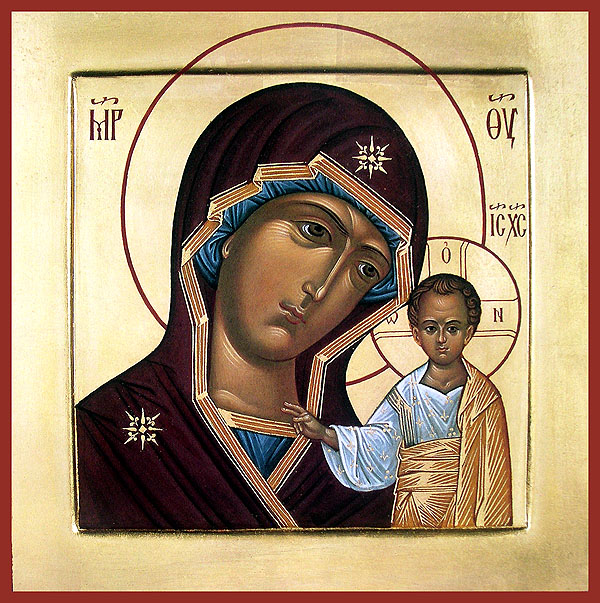
The Commemoration of the Deliverance of Moscow From the Poles by the Kazan Icon was established in gratitude for the deliverance of Moscow and all Russia from the incursion of the Polish in 1612. The end of the sixteenth and beginning of the seventeenth centuries is known in Russian history as “the Time of Troubles.” The country suffered the onslaught of Polish armies, which scoffed at the Orthodox Faith, plundering and burning churches, cities and villages. Through deceit they succeeded in taking Moscow. In response to the appeal of His Holiness Patriarch Hermogenes (May 12), the Russian people rose up in defense of its native land. From Kazan, the wonderworking icon of the Mother of God was sent to the army headed by Prince Demetrius Pozharsky.
Saint Demetrius of Rostov (September 21), in his Discourse on the Day of Appearance of the Icon of the Mother of God at Kazan (July 8), said:
“The Mother of God delivered from misfortune and woe not only the righteous, but also sinners, but which sinners? those who turn themselves to the Heavenly Father like the Prodigal Son, they make lamentation beating their bosom, like the Publican, they weep at the feet of Christ, like the Sinful Woman washing His feet with her tears, and they offer forth confession of Him, like the Thief upon the Cross. It is such sinners whom the All-Pure Mother of God heeds and hastens to aid, delivering them from great misfortunes and woe.”
Knowing that they suffered such misfortunes for their sins, the whole nation and the militia imposed upon themselves a three-day fast. With prayer, they turned to the Lord and His All-Pure Mother for help. The prayer was heard. Saint Sergius of Radonezh appeared to Saint Arsenius (afterwards Bishop of Suzdal) and said that if Moscow were to be saved, then people must pray to the Most Holy Virgin. Emboldened by the news, Russian forces on October 22, 1612 liberated Moscow from the Polish usurpers. A celebration in honor of the Kazan Icon of the Most Holy Theotokos was established in 1649. Even in our day this icon is especially revered by the Russian Orthodox nation.
The Kazan Icon is also commemorated on July 8.
Icon of the Mother of God of Andronicus

The Andronicus Icon of the Mother of God was a family icon of the Byzantine emperor Andronicus III. In 1347 he gave the icon to the Monemvasia monastery at Morea in the Peloponnesos. From here the image was sent to Russia in 1839. In 1877 the holy icon was placed in a temple of the Kazan women’s monastery near Vyshnii Volochek. Other Feast days of this icon are May 1 and July 8.
Saints Paul and Theodore of Rostov
Saints Paul and Theodore of Rostov founded a monastery at the River Ust, not far from Rostov, in honor of the holy Martyrs Boris and Gleb (May 2). Saint Theodore (November 28) first came to the site of the future monastery from the Novgorod region. Saint Paul came three years later for ascetic struggles.
Saint Sergius of Radonezh (September 25 and July 5) came to Rostov, his native region, in 1363. Learning of this, Saints Theodore and Paul went to the great ascetic for spiritual counsel. Saint Sergius visited their wilderness monastery and blessed them to build a church there named for the holy Passion-Bearers Boris and Gleb. Already during the construction of this first church, monks began gathering around the ascetics. The igumen, Saint Theodore, joyfully accepted all who came. Soon a second temple was built in honor of the Annunciation of the Theotokos.
Setting the Borisoglebsk monastery in order, Saint Theodore entrusted its direction to Saint Paul. Then he himself took several disciples and withdrew into the Vologda forest. Here at White Lake, near to the confluence of the River Kouzha into it, he founded a monastery and lived an ascetic life for several years. He built a church dedicated to Saint Nicholas, set the monastery in order, and appointed an igumen for it.
After receiving a revelation about his impending death, he returned to the Boris and Gleb monastery, where he died on October 22, 1409. Saint Paul directed the two monasteries for a certain time, then he also died at the Monastery of Saints Boris and Gleb.
Venerable Lot of Egypt
Saint Lot was a wise ascetic of the desert who reposed in peace in the early fifth century. Some of his sayings are to be found in the "Paradise of the Fathers," which describes the life of the anchorites, recluses, monks, coenobites and ascetic Fathers of the deserts of Egypt compiled by Saint Athanasios of Alexandria, Saint Palladius, Bishop of Helenopolis, Saint Jerome and others.
Saint Nikodemos (Νikόdēmos) of the Holy Mountain writes: "In the Paradise of the Fathers, it is said that Saint Lot asked Abba Joseph of Panephysis the following question: 'Abba, as much as I am able, I pray a little, fast a little, study, and keep silent. According to my strength, I keep my mind free of evil thoughts. What else should I do?' "
Then Abba Joseph stood up and lifted his hands to heaven. And – O the miracle – the ten fingers of his hands became like ten lit candles, then he said to Abba Lot. "Strive, if you will, so that in prayer you may become entirely like a flame."
In Greek usage Abba Lot is commemorated on October 22. He is also commemorated with the Holy God-bearing Fathers who shone forth in the ascetic life, on Cheesefare Saturday at Matins (Ode 4 of the Canon).
Daily Readings for Tuesday, October 21, 2025
TUESDAY OF THE 5TH WEEK
NO FAST
Hilarion the Great, Our Righteous Father Christodoulus, the Wonderworker of Patmos, Martyrs Theodote and Socrates, John the New Martyr of Peleponnesos, Righteous Philotheus
ST. PAUL’S SECOND LETTER TO THE CORINTHIANS 9:6-11
Brethren, he who sows sparingly will also reap sparingly, and he who sows bountifully will also reap bountifully. Each one must do as he has made up his mind, not reluctantly or under compulsion, for God loves a cheerful giver. And God is able to provide you with every blessing in abundance, so that you may always have enough of everything and may provide in abundance for every good work. As it is written, “He scatters abroad, he gives to the poor; his righteousness endures for ever.” He who supplies seed to the sower and bread for food will supply and multiply your resources and increase the harvest of your righteousness. You will be enriched in every way for great generosity, which through us will produce thanksgiving to God.
LUKE 9:23-27
The Lord said to his disciples, "If any man would come after me, let him deny himself and take up his cross daily and follow me. For whoever would save his life will lose it; and whoever loses his life for my sake, he will save it. For what does it profit a man if he gains the whole world and loses or forfeits himself? For whoever is ashamed of me and of my words, of him will the Son of man be ashamed when he comes in his glory and the glory of the Father and of the holy angels. But I tell you truly, there are some standing here who will not taste death before they see the kingdom of God.
Venerable Hilarion the Great

Saint Hilarion the Great was born to pagan parents in the year 291 in the Palestinian village of Thabatha near Gaza. As a young man, he was sent to Alexandria for his education. There he became acquainted with Christianity and was baptized. After hearing an account of the angelic life of Saint Anthony the Great (January 17), Hilarion went to meet him, desiring to study with him and learn what is pleasing to God. Hilarion soon returned to his native land to find that his parents had died. After distributing his family’s inheritance to the poor, Saint Hilarion went forth into the desert surrounding the city of Maium.
In the desert the Saint endured violent struggles with impure thoughts, vexations of the mind, and the burning passions of the flesh, but he defeated them through heavy labor, fasting and fervent prayer. The devil sought to frighten him with phantoms and apparitions. While he was praying Saint Hilarion would sometimes hear children crying, women wailing, and the roaring of lions and other wild beasts. He understood that the demons were causing these terrors in order to drive him out of the wilderness. He overcame his fear by resorting to fervent prayer. Once, some thieves fell upon Saint Hilarion, and he persuaded them to forsake their lawless life by the power of his words.
Soon all of Palestine heard about Saint Hilarion and of the miracles he worked. The Lord granted the holy ascetic the power to cast out unclean spirits. With this gift of grace he loosed the bonds of many of those who were afflicted. The sick came for healing, and the Saint cured them without asking for any payment, saying that the grace of God is freely received, and must be freely given (Matthew 10:8).
Such was the grace that he received from God that he could tell by the smell of someone’s body or clothing which passion was afflicting his soul. They came to Saint Hilarion desiring to save their souls under his guidance. With his blessing, monasteries began to spring up throughout Palestine. Going from one monastery to another, he instituted a strict ascetic manner of life.
About seven years before his death (+ 371-372) Saint Hilarion moved back to Cyprus, where the ascetic lived in a solitary place until the Lord summoned him to Himself.
Saint Hilarion is sometimes depicted holding a scroll which reads: "The tools of a monk are steadfastness, humility, and love according to God." In iconography, is depicted as an old man with a brown, rush-like beard divided into three points.
Translation of the relics of Saint Hilarion, Bishop of Meglin in Bulgaria

The Transfer of the Relics of Saint Hilarion, Bishop of Meglin, to the Bulgarian city of Trnovo, occurred in the year 1206. Prior to this event, the body of the saint rested in the city of Meglin.
Saint Hilarion received a fine Christian upbringing. At eighteen, he entered a monastery. Because of his virtuous and strict life he was chosen to be igumen of the monastery. He was very concerned about the salvation of the monks’ souls. He unceasingly exhorted those souls entrusted to him not to waste precious time intended to prepare for salvation, and eradicated drunkenness in the monastery.
In 1134, when the Bogomil heresy was spreading through Bulgaria, he was consecrated bishop of Meglin. The followers of the heresy believed that “good and evil manifest themselves as independent principles, and a struggle between the two ensues.” Saint Hilarion tirelessly fought against the Bogomils with apostolic zeal and fervent prayer. He continually unmasked their heresy and exposed their hypocritical guise of piety. In refuting the teaching of the heretics, Saint Hilarion said:
“You are not Christians at all, since you are hostile to the Cross of Christ the Savior. You do not acknowledge the One God, you slander the teachings of the Old Testament venerated by Christians. You deceive people by hypocritical meekness while full of pride. True piety is not possible in those who do not see their own heart’s corruption, but by those who ask God’s grace with prayer and humility. Evil thoughts, envy, vanity, greed, lies are not the deed of some evil thing within man to be conquered by mere fasting. These vices are the fruit of self- love which demands rooting out by spiritual efforts.”
Because of the saint’s exhortations many of the heretics abandoned their false teaching and returned to the holy Church. Saint Hilarion also successfully struggled against the rise of the Armenian Monophysite heretics in Bulgaria, who acknowledged only the divine nature of Christ. The saint fell asleep in the Lord in 1164.
Venerable Hilarion the Schemamonk of the Kiev Caves
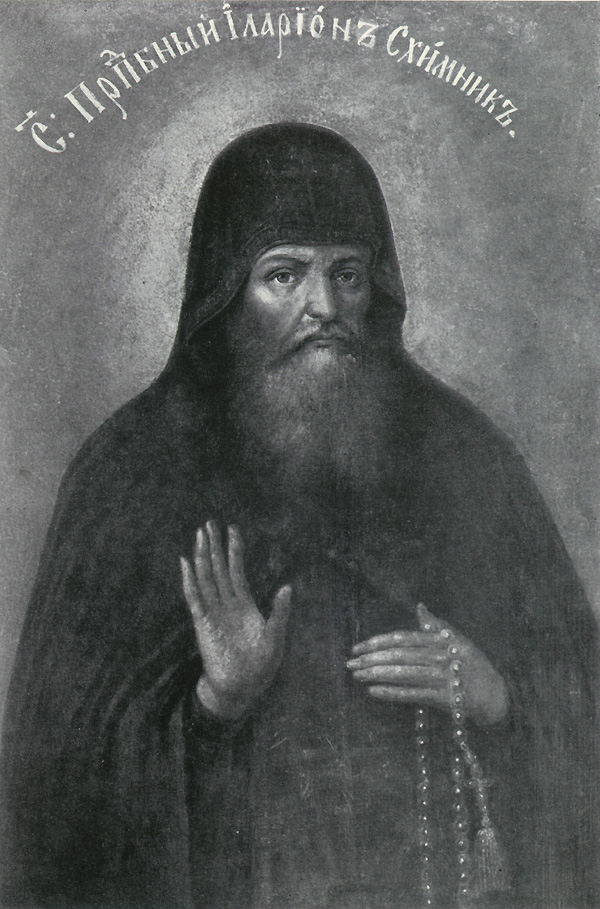
Saint Hilarion, Schemamonk of Kiev Caves, a strict ascetic, was a disciple and co-ascetic with Saint Theodosius (May 3). Imitating the example of his teacher, Saint Hilarion prayed to God with tears day and night, while observing a strict fast. His contemporaries knew him as a chronicler, who toiled over the copying of books in the cell of Saint Theodosius. During this time his teacher chanted Psalms and spun wool. Saint Hilarion lived an ascetic life during the eleventh century. His memory is also celebrated on August 28 and on the second Sunday of Great Lent.
Venerable Hilarion, Abbot of Gdov and Pskov Lake
Saint Hilarion of Gdov and Pskov Lake, was a disciple of Saint Euphrosynus of Pskov (May 15). In 1460 on the banks of the River Zhelcha, not far from Gdov, he founded the Ozersk [Lake] Monastery of the Protection of the Mother of God. The monastery bordered the territory of the Livonian Knights, and the monks constantly suffered the incursions of that military order. Despite harsh conditions and insufficient means, Saint Hilarion maintained a high level of pious and ascetic life at the monastery, and made great efforts to adorn and build up the monastery.
Saint Hilarion reposed on March 28, 1476 and was buried in the church of the Protection of the Most Holy Theotokos in the monastery he founded. Afterwards, a church was built at the monastery in honor of the Nativity of Christ. The left chapel was dedicated to the founder of the Gdov monastery. Saint Hilarion of Gdov is also commemorated on October 21, on the Feast of his heavenly patron and namesake.
Venerable Theophilus and Jacob, Abbots of Omutch, Pskov
Saint Theophilus and James, Abbots of Omutch in Pskov, lived the ascetic life on the island of Konev together with Saint Arsenius (June 12). In the year 1396, in the Pskov diocese at the River Omutch, not far from the city of Porkhov, Saints Theophilus and James established a wilderness monastery in honor of the Dormition of the Most Holy Theotokos. They fell asleep in the Lord about the year 1412.
Martyrs Gaius, Dasius, and Zoticus at Nicomedia

The Martyrs Gaius, Dasius, and Zoticus of Nicomedia suffered martyrdom in the year 303, under the emperor Diocletian (284-305), because they destroyed a pagan temple. After enduring many tortures, they had stones tied around their necks, and were drowned in the sea.
Venerable Philotheus of Dionysiou of Mount Athos
Saint Philotheos of Dionysiou Monastery on Mount Athos was a native of Elateia, and was born in 1526. Fearing the Turks, his parents moved away to Chrysoupolis in Macedonia, where his father soon died. The child Philotheos and his brother were seized by the Turks and then thrown into prison.
They were delivered in a miraculous manner by the Mother of God. She appeared to the children in the likeness of their mother and led them to the monastery of the Most Holy Theotokos in the city of Neapolis in Asia Minor. At this monastery the brothers received the monastic tonsure. By progressing through all the obediences assigned by the Igoumen they attained the position of ecclesiarchs.
Meanwhile, Eudokia, the mother of Saint Philotheos, had also settled into a women’s monastery in this same city, through the mysterious guidance of Divine Providence. For many years she knew absolutely nothing of the fate of her children. Visiting a men’s monastery with several other nuns for the Feast Day of its church, Eudokia recognized her sons. In answer to her question about how they chanced to be there they replied, “You ought to know, for you yourself freed us from the Turks and led us from the prison.” Thus Eudokia became convinced of the intercession of the Mother of God, for it had only been in praying to the Theotokos that she had found any consolation. When the brethren learned of the joyous reunion of the mother and her sons, as well as their miraculous deliverance, they gathered around them and glorified the Lord.
In 1551, after his mother’s repose, Saint Philotheos went to the Holy Mountain at the age of 25. He joined the brethren of Dionysiou Monastery, where his ascetic struggles were an example to many. Later, seeking greater quietude, he pretended to have suffered from an illness and become deaf, and then he retired to a cave outside the monastery. There he emerged as an admirable ascetic and a conqueror of demons. When his feigned illness was revealed, he was forced to change his place of residence, so that people would not honor him. In his new home he acquired three disciples. Devoting himself to deeds of prayer, Saint Philotheos attained high spiritual perfection and was granted the gift of clairvoyance.
In 1610 the venerable one peacefully fell asleep in the Lord at the age of eighty-four. Before his death he bade his disciples not to bury his body, but rather to cast it dishonorably into the forest to be eaten by beasts and birds. His disciples fulfilled the wish of their Elder, but the All-Good God glorified the saint’s relics with a wondrous radiance. A monk took his skull and gave it to the saint’s disciples.
The life of the venerable one was written by the monk Daniel of Dionysiou, copying an older codex, which was compiled by the monk Agapios Lantos in 1802, which was later published in Venice in 1872.
Venerable Bessarion Sarai the Confessor in Romania
Saint Bessarion (Sarai) was a Serb who was born in Bosnia in 1714. Longing for the monastic life, he was tonsured at the Monastery of Saint Savva in the Holy Land in 1738. He returned to Serbia and lived in a cave for several years as a hesychast, and received from God the grace of working miracles.
About this time there was a great deal of unrest in the regions of the Banat and Transylvania because many Romanian Orthodox Christians had been forced into union with Rome. At Karlovits, Patriarch Arsenius had heard of Saint Bessarion’s holy and ascetical life, and asked to see him. After ordaining him to the holy priesthood, he sent him to defend the Orthodox Faith northwest of the Carpathian Mountains.
Saint Bessarion left for the Banat in January of 1774, and was warmly received by the local people. Hundreds of people came to hear him preach, and many of them returned to the Orthodox Church. He encouraged his listeners not to abandon the faith which their fathers had passed down to them, but to remain firm and steadfast in it.
Preaching at Timishoara, Lipova-Arad, Deva, Orashtie, Salishtea of Sibiu, and other places, he would set up a wooden cross in the middle of each village, and people would gather to hear him. In each place, he was able to bring most of the people back into the fold of the Orthodox Church. This, of course, did not please the Roman Catholic authorities.
On April 26, 1744, Saint Bessarion was arrested by the Austrian army while on his way to Sibiu. They took him to Vienna, where he was placed on trial, and then thrown into the Kufstein prison on the orders of Empress Maria Teresa. There he endured much suffering because of his confession of the Orthodox Faith. After about a year in chains and tortures, he surrendered his soul to God.
Saint Bessarion the Confessor was glorified by the Holy Synod of the Romanian Orthodox Church in 1950, and the date of his annual commemoration was designated as October 21.
Saint Sophronius, Confessor of Ciorara, Romania
Saint Sophronius was originally from Ciorara-Sebesh in Alba county in Romania. From his childhood, he demonstrated a great love for Christ and the Church, so it was not surprising that he eventually received the monastic tonsure.
He returned to his village in 1756, and established a small hermitage called Cioara Skete in the forest. Several disciples came to join him there, drawn by reports of his holy life. Seeing the persecution of the Orthodox by the Catholic authorities at that time, Saint Sophronius traveled through many villages of Ardeal, encouraging people to remain firm in the Orthodox Faith.
Saint Sophronius was so effective in his preaching that the Crai of Ardeal ordered him thrown into prison, where he was beaten. After his release from prison, he went to preach in the villages of the Apuseni Mountains, and once again he was incarcerated and tortured for Christ.
After being freed on February 14, 1761, Saint Sophronius assembled a great crowd of people in the city of Alba Iulia, and demanded equal rights under the law for Romanians. He also demanded an Orthodox bishop for Ardeal. That very year his demands were granted, and he retired to the Curtea de Argesh Monastery. He departed to the Lord not long afterward.
The Orthodox Church of Romania numbered Saint Sophronius among the saints in 1955, appointing October 21 as the date of his annual commemoration.
Martyr Oprea of Salistie in Romania
Saint Oprea Nicholas of Salistie suffered martyrdom in Romania at the hands of Roman Catholics in 1776.
Saint Hilarion, Metropolitan of Kiev
Saint Hilarion, Metropolitan of Kiev, lived during the era of the Great Prince Yaroslav the Wise (+ 1054), son of Saint Vladimir. In the history of the Russian Church he is remembered as the first Russian installed as Metropolitan by a Council of Russian bishops. The Russian Church up to that time had been a Metropolitan See, under the patriarchate of Constantinople. Russia’s first metropolitans were Greeks, and they were appointed by Constantinople.
Saint Hilarion, priest of the prince’s village of Berestovo near Kiev, was the spiritual Father and companion of Prince Yaroslav. Saint Nestor the Chronicler relates:
“God-loving prince Yaroslav loved Berestovo, and built the church of the Holy Apostles there, and he honored many priests. Among them was the presbyter Hilarion, a man of virtue, knowledge, and given to fasting. He made his way from Berestovo to the Dniepr, where the old Kiev Caves monastery is now, and he made his prayer in the deep forest there. Having dug out a shallow 14 foot cave, he chanted the Hours and prayed in solitude to God….”
Saint Hilarion, as his works attest, was not simply a “man of books”, but was endowed with great spiritual gifts and profound theological knowledge. He devoted all his efforts to the service of the Russian Church. When Metropolitan Theopemptus died, Rus was in a state of war against Byzantium. By decision of a Council of the Russian hierarchs, a resolution was made to establish a Metropolitanate at Kiev, not subject to Constantinople.
Saint Hilarion was famed among the Russian clergy for his heightened spiritual life and gift for preaching. Prior to this, he gave a eulogy in the “Tithe” church of Kiev to the holy Prince Vladimir with his acclaimed “Discourse Concerning Law and Grace,” in which he provided a theological explanation of the place of the Russian Church in the history of the divine economy of Salvation.
The choice of the Council hierarchs was dear to the heart of Yaroslav the Wise. Saint Hilarion was installed as Metropolitan at the Holy Wisdom (Hagia Sophia) cathedral in the year 1051 and was later confirmed by the Patriarch of Constantinople. He was not the primate of the Russian Church for long. The chronicle does not mention the year of his death, but the saint was not at the death of Prince Yaroslav the Wise (February 20, 1054), and in the year 1055 a new metropolitan had arrived at Kiev. Evidently, Saint Hilarion had died in 1053.
His spiritual legacy lives on in the Russian Church especially in a fine example of Russian church literature, the “Discourse Concerning Law and Grace.” Its content is profound and multi-faceted. At the heart of the “Discourse” is the teaching concerning salvation and grace. Secondly, great attention is devoted to the question of the superiority of Christianity over Judaism. This theme was essential during those times in Kievan Rus. The Jews had approached Saint Vladimir, hoping to convert him to their faith, and Saint Theodosius of the Kiev Caves (May 3) had gone to the “Jewish Quarter” in Kiev to preach Christ Crucified. It is also known that the Jews had attempted to convert the holy hierarch Nikḗtas the Hermit to Judaism when he was still a monk of the Kiev Caves monastery (1088). Saint Simon relates this in the Kiev Caves Paterikon. This explains the attention which Saint Hilarion devotes to the question “about the Law given to Moses, and about grace and truth, through the coming of Jesus Christ.”
And finally, the third theme, the occasion of the uttering of the “Discourse” was the glorification of the apostolic work of holy Prince Vladimir. The kingdom of nature, the kingdom of grace and the future Kingdom of Glory are perceived in the spiritual experience of the Church as inseparably connected. The Law is only the forerunner and servant of grace and truth. Truth and grace are but servants of the future age and true life. Saint Hilarion teaches thus about the superiority of the Church: “Moses and the prophets foretold the Coming of Christ, whereas Christ and His Apostles bore witness to the Resurrection and the future age.”
The saint explains that from the moment the Savior came into he world, the Old Covenant of man with God ceased to be in effect. With the theological symbols of the Old and New Covenants the saint employs images borrowed from the holy Apostle Paul (Gal. 4:22-31) relating to the two wives of Abraham: the freeborn Sarah and the maidservant Hagar. “Hagar was cast out, a slave, together with her son Ishmael; and Isaac, the free son, was heir to Abraham. Thus also were the Jews cast out and dispersed through the lands, whereas the sons of grace, the Christians, have become heirs to God the Father. As the light of the moon fades at the shining of the sun, so also the Law fades at the shining forth of grace. The cold of night vanishes when the warmth of the sun heats the earth, and mankind is no longer bent over under the burden of the Law, but instead walks freely in grace.”
The joy of Christ fills the holy preacher when he speaks about the entry of his native Rus into the host of Christian peoples. “The grace of Christ has filled all the earth,” and especially, the youthfully alive peoples, to which the Russian people also belong. “It becomes grace and truth to shine forth in new peoples. They do not, in the words of the Lord, pour new wine (this being the teaching of grace) into old wineskins (referring to the Jews) but the rather put the new teaching, into new wineskins, into new peoples,” Thus the faith “throughout all the earth has spread and reached our Russian tongue. Here now we too, glorify the Holy Trinity with all Christians, and the Jews be silent. Pagans are accepted, but the Jews are spurned.”
Now the Orthodox Russians “are not termed idolaters, but rather Christians. No longer do we build heathen temples, but rather the churches of Christ. No longer do we sacrifice others to the demons (Varangian Martyrs, July 12), but instead, Christ has been slain for us in sacrifice to God the Father. The Blessed God has had mercy on all lands, and has not despised us, for He also desired to save us and bring us to our senses in truth.”
The great apostolic exploit of the enlightening of the Russian Land was made by holy Prince Vladimir (15 July 15), “like Saint Constantine,” who “commanded throughout all his land that they be baptized in the Name of the Father, and the Son, and the Holy Spirit. In a clear and loud voice, he ordered all in the cities to glorify the Holy Trinity and to be Christians, the small and great, slave and free, young and old, rich and poor.” Saint Hilarion speaks with pride about his native land, “Saint Vladimir did not exercise sovereignty in a bad or ignorant land, but the rather in Russia, which is known and heard of by all the ends of the earth.”
The “Discourse Concerning Law and Grace” was the first work of its time in the Russian Church in which the holy Baptizer of Rus is acclaimed blessed among the ranks of the equals-to-the-Apostles. “Rejoice in the midst of sovereigns, O apostle, not in having dead bodies resurrected, but our deadened souls resurrecting: for by you have we been made alive in God and given to know life in Christ.” Such is the content of this remarkable memorial of ancient Russian theology. Among the other works of Saint Hilarion is his episcopal “Confession,” having become the model for a bishop’s vow in the Russian Church. Usually appended to the manuscripts of the “Discourse Concerning Law and Grace” is the “Prayer of Saint Hilarion.” This work of the saint also possesses a long history within the tradition of his native church. In the year 1555, upon his journey to the newly-formed Kazan diocese, Saint Gurias ordered that there be read to him the prayer, “The Work of Metropolitan Hilarion the Russian”, at Moscow and in the other cities, through which he was to travel.
Saint Hilarion was buried in the Kiev caves. In the inscribed titles to his works, in the manuscripts of saintly literature and lists of holy hierarchs, Saint Hilarion is invariably termed a saint and described as a wonderworker. His assured literary veneration as a saint is evidenced in the services to the Fathers of the Kiev Caves. Both in the service of the Synaxis of Fathers of the Near Caves (September 28), and also in the service to all the Kiev Caves Saints (second Sunday of Great Lent), Saint Hilarion is numbered among the saintly hierarchs of the Russian Orthodox Church.
Martyr Moses (Macinic) the Confessor
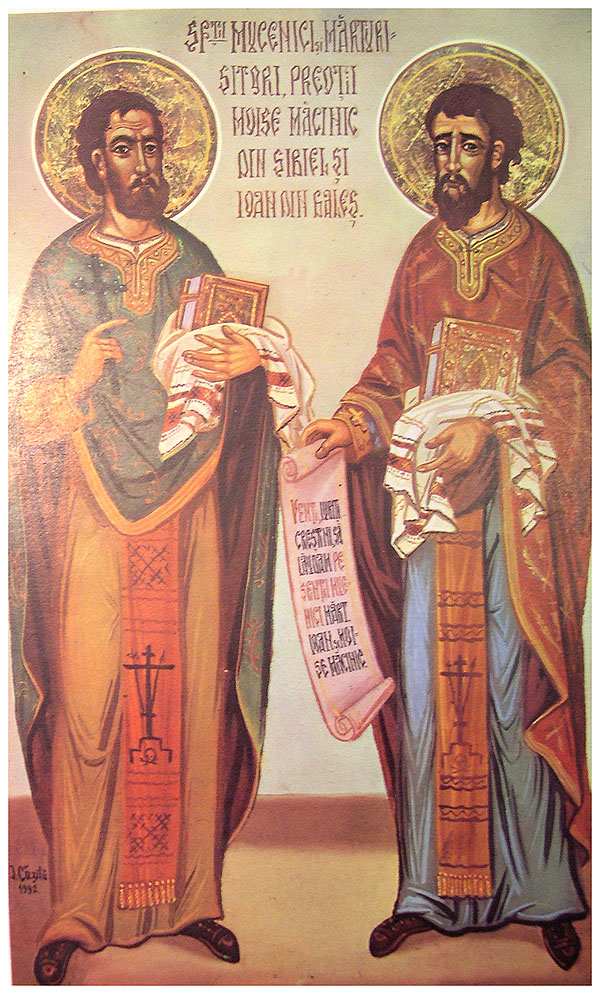
Saint Moses Macinic was ordained to the holy priesthood in Bucharest around 1746, and worked to oppose the Unia. Because of his activities he was arrested and jailed in Sibiu for seventeen months. Ultimately, he was released with the understanding that he would cease to function as a priest, and live as an ordinary peasant.
In 1752 he was chosen to go to Vienna with Saint Oprea Nicholas of Salistie to deliver a petition to Empress Maria Theresa. The petition asked her to recognize the rights of the Orthodox Church in Transylvania. She received them, but she had them thrown into the Kufstein Prison in the Tyrolean Mountains.
Although representatives from Transylvania repeatedly asked the Hapsburg rulers to free the two saints, they denied all knowledge of them.
Saint Moses Macinic was glorified as a martyr by the Orthodox Church of Romania in 1992.
Saint John of Galesh

Saint John of Galesh was a priest who was consecrated bishop at Bucharest, since there was no bishop for Transylvania. He resisted the plans of the Hapsburg authorities to persuade Orthodox Christians to convert to Catholicism. He was arrested and thrown into prison at Sibiu in 1756, then Empress Maria Theresa ordered him confined in the prison of Deva Castle until he died.
Saint John was transferred to a prison in Graz, Austria at the end of 1757. Later, he was brought to the notorious Kufstein Prison, where many Orthodox from Transylvania ended their lives.
In 1780, Gennady Vassie, a Serb who was incarcerated there, was able to send a letter to Empress Catherine II of Russia asking her to intervene on behalf of the Orthodox prisoners. In his letter he mentioned a Romanian priest named John, who had been kept there for twenty-four years because of his Orthodox faith.
Saint John of Galesh died in prison, and was glorified as a martyr by the Orthodox Church of Romania in 1992.
New Martyr John of Monemvasia
Saint John was born in 1758 near the city of Monemvasia. His father was a priest from Geraki, and his mother was from the neighboring village of Gouves. It was in Gouves that John's father was assigned as a priest, and there John was born. From a young age John tried to emulate his father by helping him work in the church. He was known for his exemplary behavior, and referred to by other children as the "priest's son."
In the year 1770 the army of the Albanian Hatzi Osman defeated the Greek resistance, and arriving in Monemvasia they killed John's father and enslaved both him and his mother. They were taken to Larisa, where they were sold separately two or three times.
After two years they were bought by the same man, a Turkish landowner. This Turk had no children, and recognizing John's good qualities (he was exceptionally intelligent for his age, obedient, and a hard worker), the man wanted to adopt John after converting him to Islam. Every day they tried to persuade him to abandon the Christian Faith and become a Turk. Initially, they used flattery and promises, but later they used terrible tortures to overcome John's steadfastness (he was only 15 years old), but he remained unwavering in his Christian faith.
One day his master, tired of trying to convince him to convert, and in anger led him to the courtyard of the mosque. Many Muslims were gathered there, and with blows and terrible threats they urged him to convert and become a Turk. John's response was clear: "I am not a Turk, I am a Christian and I shall die as a Christian."
In addition, the Turk and his wife tried every day with magic and evil spells to make the Saint lose his mind and give in to carnal desires, and then to become a Turk. But John remained pure, for the grace of Christ protected him from all of the diabolical devices of the Turk's wife.
Soon came the fifteen days of fasting before the Dormition of the Theotokos. The Turk realized that John did not wish to break the fast, so he locked him up in a barn. He kept him there for the entire fifteen days and hung him up, lighting a fire in the straw beneath him to cause smoke, and struck him with the flat of his sword, all the while trying to make him eat their abominable foods and break the fast. But Saint John did not even taste the food, but prayed to the Mother of God, in whose honor the Fast is observed, asking her to help him keep the fast, for he preferred to die rather than break his fast.
The master, seeing that he remained unconvinced, left him without food for two and three days at a time. His mother, seeing him weakened by the tortures and the fasting, tried to convince him to give in, saying: "Eat these foods, my son, so that you do not perish. God and the Panagia will forgive you, because you would not be doing this voluntarily, but out of necessity. Pity me, your poor mother. Do not die and leave me alone in this foreign land, for by having you here, I feel as if I am not a slave."
John replied: "Why are you doing this, Mother, and why are you crying? Why don't you emulate the Patriarch Abraham, who for the love of God wanted to sacrifice his only son, yet you only cry and weep. I am a priest's son and I should be keeping the laws and customs of our Church more than the sons of laymen, for if we don't keep the small things [of the faith], how can we keep the larger things?"
Soon after this response the furious Turk stabbed him in the heart on October 19, 1773. After two days Saint John died and received the crown of martyrdom.
Saint John's skull and portions of his hand and feet are located at the Zermbitsa Monastery in Sparta, and other portions of his relics are in the churches of the Forty Martyrs of Sebaste in Larisa and Voulkanou Monastery in Messenia.
Paraklesis Service for Wednesday, October 22, 2025
Here is the live stream for Paraklesis Service for Wednesday, October 22, 2025 If you need, here are instructions for accessing this content from your phone, tablet, computer, or TV.
Daily Readings for Monday, October 20, 2025
MONDAY OF THE 5TH WEEK
NO FAST
Artemius the Great Martyr of Antioch, Matrona the Righteous of Chios, Gerasimus of Cephalonia, Andronicus the Righteous Martyr
ST. PAUL’S SECOND LETTER TO TIMOTHY 2:1-10
Timothy, my son, be strong in the grace that is in Christ Jesus, and what you have heard from me before many witnesses entrust to faithful men who will be able to teach others also. Share in suffering as a good soldier of Christ Jesus. No soldier on service gets entangled in civilian pursuits, since his aim is to satisfy the one who enlisted him. An athlete is not crowned unless he competes according to the rules. It is the hardworking farmer who ought to have the first share of the crops. Think over what I say, for the Lord will grant you understanding in everything.
Remember Jesus Christ, risen from the dead, descended from David, as preached in my gospel, the gospel for which I am suffering and wearing fetters like a criminal. But the word of God is not fettered. Therefore I endure everything for the sake of the elect, that they also may obtain salvation in Christ Jesus with its eternal glory.
LUKE 9:18-22
At that time, it happened that as Jesus was praying alone the disciples were with him; and he asked them, “Who do the people say that I am?” And they answered, “John the Baptist; but others say, Elijah; and others, that one of the old prophets has risen.” And he said to them, “But who do you say that I am?” And Peter answered, “The Christ of God.” But he charged and commanded them to tell this to no one, saying, “The Son of man must suffer many things, and be rejected by the elders and chief priests and scribes, and be killed, and on the third day be raised.”
Greatmartyr Artemius at Antioch
Holy Great Martyr Artemius of Antioch was a prominent military leader during the reigns of the emperor Constantine the Great (May 21), and his son and successor Constantius (337-361). Artemius received many awards for distinguished service and courage. He was appointed viceroy of Egypt. In this official position he did much for the spreading and strengthening Christianity in Egypt.
Saint Artemius was sent by the emperor Constantius to bring the relics of the holy Apostle Andrew from Patras, and the relics of the holy Apostle Luke from Thebes of Boeotia, to Constantinople. The holy relics were placed in the Church of the Holy Apostles beneath the table of oblation. The emperor rewarded him by making him ruler of Egypt.
The emperor Constantius was succeeded on the throne by Julian the Apostate (361-363). Julian in his desire to restore paganism was extremely antagonistic towards Christians, sending hundreds to their death. At Antioch he ordered the torture of two bishops unwilling to forsake the Christian Faith.
During this time, Saint Artemius arrived in Antioch and publicly denounced Julian for his impiety. The enraged Julian subjected the saint to terrible tortures and threw the Great Martyr Artemius into prison. While Artemius was praying, Christ, surrounded by angels, appeared to him and said, “Take courage, Artemius! I am with you and will preserve you from every hurt which is inflicted upon you, and I already have prepared your crown of glory. Since you have confessed Me before the people on earth, so shall I confess you before My Heavenly Father. Therefore, take courage and rejoice, you shall be with Me in My Kingdom.” Hearing this, Artemius rejoiced and offered up glory and thanksgiving to Him.
On the following day, Julian demanded that Saint Artemius honor the pagan gods. Meeting with steadfast refusal, the emperor resorted to further tortures. The saint endured all without a single moan. The saint told Julian that he would be justly recompensed for his persecution of Christians. Julian became furious and resorted to even more savage tortures, but they did not break the will of the saint. Finally the Great Martyr Artemius was beheaded.
His relics were buried by Christians. After the death of Saint Artemius, his prophecy about Julian the Apostate’s impending death came true.
Julian left Antioch for a war with the Persians. Near the Persian city of Ctesiphon, Julian came upon an elderly Persian, who agreed to betray his countrymen and guide Julian’s army. The old man deceived Julian and led his army into the Karmanite wilderness, where there was neither food nor water. Tired from hunger and thirst, Julian’s army battled against fresh Persian forces.
Divine retribution caught up with Julian the Apostate. During the battle he was mortally wounded by an unseen hand and an unseen weapon. Julian groaned deeply said, “You have conquered, Galilean!” After the death of the apostate emperor, the relics of the Great Martyr Artemius were transferred with honor from Antioch to Constantinople.
Saint Artemius is invoked by those suffering from hernias.
Righteous Child Artemius of Verkola

Holy Righteous Artemius of Verkola was born in the village of Dvina Verkhol around the year 1532. The son of pious parents, Artemius was a child who was courageous, meek and diligent for every good deed. On June 23, 1545 the twelve-year-old Artemius and his father were taken by surprise in a field by a thunderstorm. A clap of thunder broke right over their heads, and the child Artemius fell dead. People thought that this was a sign of God’s judgment, therefore they left the body in a pine forest without a funeral, and without burial.
Some years later, the village reader beheld a light over the place where the incorrupt body of the Righteous Artemius lay. Taken to the church of Saint Nicholas in 1577, the holy relics were shown to be a source of numerous healings. In this village a monastery was later built, called the Verkhol. In 1918, the impious Soviets chopped the holy relics into pieces and threw them into a well. The memory of Saint Artemius is also celebrated on October 20.
Venerable Gerasimus the New Ascetic of Cephalonia

Saint Gerasimus the New Ascetic of Cephalonia was born in the village of Trikkala in the Peloponessos. As a young adult, he became a monk on the island of Zakynthos. On the Holy Mountain he became a schemamonk and studied with the ascetics of Mt Athos. Receiving a blessing from the Elders, the monk went to Jerusalem to worship at the Life-bearing Tomb of the Savior. After visiting many holy places in Jerusalem, Mount Sinai, Antioch, Damascus, Alexandria and Egypt, he returned to Jerusalem where he became a lamp-lighter at the Sepulchre of the Lord.
The monk was ordained a deacon and then a priest by the Patriarch of Jerusalem, Germanus (1534-1579). Saint Gerasimus maintained the discipline of an ascetic. For solitude he withdrew to the Jordan, where he spent forty days without respite. Having received the Patriarch’s blessing for a life of silence, Saint Gerasimus withdrew to Zakynthos in solitude, eating only vegetation.
After five years he was inspired to go the island of Cephalonia, where he lived in a cave. He restored a church at Omala, and he founded a women’s monastery where he lived in constant toil and vigil for thirty years. He prayed on bent knees stretched out on the ground. For his exalted life he was granted a miraculous gift: the ability to heal the sick and cast out unclean spirits.
At 71 years of age, the venerable Gerasimus knew that he would soon die. He gave his blessing to the nuns and peacefully fell asleep in the Lord on August 15, 1579. Two years later, his grave was opened and his holy relics were found fragrant and incorrupt with a healing power.
Since the Feast of the Dormition falls on August 15, Saint Gerasimus is commemorated on August 16th. Today’s Feast celebrates the uncovering of his holy relics in 1581.
Venerable Matrona of Chios
Saint Matrona was born in the village of Volissos on Chios of wealthy and pious parents, Leon and Anna sometime in the fourteenth century. From her youth she showed an inclination for monasticism. One day she left her parents and went to live in an unpopulated area, where she founded a small monastery for women. Soon other nuns joined her in her ascetical struggles.
Saint Matrona worked many miracles both during her life and after her death, and was revered throughout Chios for her virtuous life and holiness. She showed charity to the poor, and was able to heal the sick.
The service to Saint Matrona was composed by Metropolitan Nikḗtas of Rhodes. It was found in a codex from 1455, which would indicate that she died sometime before this date.
Saint Matrona is also commemorated on July 15 (the finding of her head).
Icon of the Mother of God of Filersk

No information available at this time.
The Uncovering of the Relics of the Hieromartyr Νikόdēmos, Bishop of Belgorod
In Belogorod, an event of great spiritual significance occurred: the recovery of the relics of the Hieromartyr Νikόdēmos of Belgorod. Now, in the Cathedral of the Transfiguration of the Savior at Belgorod, the relics of two Belgorod Saints are buried. The shrine of Saint Joasaph of Belgorod (December 10) is under a canopy on the south side of the altar, and on the north side is a wooden chest with the newly-discovered relics of Bishop Νikόdēmos. His incorrupt relics were recovered from his burial place on October 20/November 2, 2012.
During the first week of Lent there were solemn services in the Transfiguration Cathedral, which were led by Metropolitan John of Belgorod and Stary Oskol. While the Magnification was being sung for the Hieromartyr Νikόdēmos, his revered relics were taken from the altar and placed on the kathedra, after which Vladyka knelt and read prayers before them. He also read the resolution of His Holiness Patriarch Kirill of Moscow and All Russia: “At the anniversary Bishops' Council in 2000 Bishop Νikόdēmos (Kononov) of Belgorod was numbered among the Holy New Martyrs and Confessors of the Russian Orthodox Church."
After identifying the remains, Patriarch Kirill determined: “Having recognized these remains as the relics of the Holy Martyr Νikόdēmos (Kononov), Bishop of Belgorod, let the Uncovering of the relics of the Holy Martyr Νikόdēmos be included in the Menaion of the Russian Orthodox Church.”
When the crypt was opened, the Hierarch's episcopal vestments were intact, but his miter and the Gospel were missing.
Saint Νikόdēmos is also commemorated on December 28.
 Saint Peter Antiochian Orthodox Church
You must be logged in to post a comment.