
HOLY PROPHET ZACHARIAS, FATHER OF THE VENERABLE FORERUNNER
ABSTAIN FROM MEAT, FISH, DAIRY, EGGS, WINE, OLIVE OIL
Holy Prophet Zacharias, Father of the Venerable Forerunner, Elizabeth, Mother of the Forerunner, Urban, Theodore, & Medimnos the Hieromartyrs and the 77 Companions at Nicomedea
ST. PAUL’S SECOND LETTER TO THE CORINTHIANS 11:5-21
Brethren, I think that I am not in the least inferior to these superlative apostles. Even if I am unskilled in speaking, I am not in knowledge; in every way we have made this plain to you in all things.
Did I commit a sin in abasing myself so that you might be exalted, because I preached God's gospel without cost to you? I robbed other churches by accepting support from them in order to serve you. And when I was with you and was in want, I did not burden any one, for my needs were supplied by the brethren who came from Macedonia. So I refrained and will refrain from burdening you in any way. As the truth of Christ is in me, this boast of mine shall not be silenced in the regions of Achaia. And why? Because I do not love you? God knows I do!
And what I do I will continue to do, in order to undermine the claim of those who would like to claim that in their boasted mission they work on the same terms as we do. For such men are false apostles, deceitful workmen, disguising themselves as apostles of Christ. And no wonder, for even Satan disguises himself as an angel of light. So it is not strange if his servants also disguise themselves as servants of righteousness. Their end will correspond to their deeds.
I repeat, let no one think me foolish; but even if you do, accept me as a fool, so that I too may boast a little. (What I am saying I say not with the Lord's authority but as a fool, in this boastful confidence; since many boast of worldly things, I too will boast.) For you gladly bear with fools, being wise yourselves! For you bear it if a man makes slaves of you, or preys upon you, or takes advantage of you, or puts on airs, or strikes you in the face. To my shame, I must say, we were too weak for that!
MATTHEW 23:29-39
The Lord said to the Jews who had come to him, "Woe to you, scribes and Pharisees, hypocrites! for you build the tombs of the prophets and adorn the monuments of the righteous, saying, 'If we had lived in the days of our fathers, we would not have taken part with them in shedding the blood of the prophets.' Thus you witness against yourselves, that you are sons of those who murdered the prophets. Fill up, then, the measure of your fathers. You serpents, you brood of vipers, how are you to escape being sentenced to hell? Therefore I send you prophets and wise men and scribes, some of whom you will kill and crucify, and some you will scourge in your synagogues and persecute from town to town, that upon you may come all the righteous blood shed on earth, from the blood of innocent Abel to the blood of Zacharias the son of Barachiah, whom you murdered between the sanctuary and the altar. Truly, I say to you, all this will come upon this generation.
O Jerusalem, Jerusalem, killing the prophets and stoning those who are sent to you! How often would I have gathered your children together as a hen gathers her brood under her wings, and you would not! Behold, your house is forsaken and desolate. For I tell you, you will not see me again, until you say, 'Blessed is he who comes in the name of the Lord.'
Holy Prophet Zachariah and Righteous Elizabeth, parents of Saint John the Baptist

The Holy Prophet Zachariah and the Righteous Elizabeth were the parents of the holy Prophet, Forerunner and Baptist of the Lord, John. They were descended from the lineage of Aaron: Saint Zachariah, son of Barach, was a priest in the Jerusalem Temple, and Saint Elizabeth was the sister of Saint Anna, the mother of the Most Holy Theotokos. The righteous spouses, “walking in all the commandments of the Lord” (Luke 1:6), suffered barrenness, which in those times was considered a punishment from God.
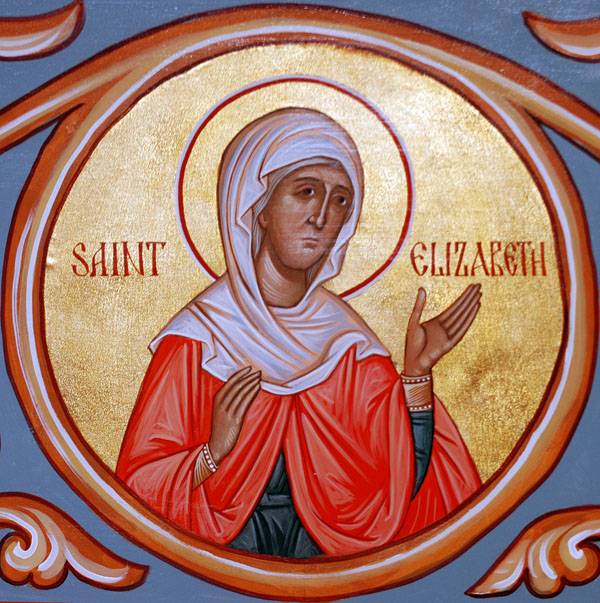
Once, during his turn of priestly service in the Temple, Saint Zachariah was told by an angel that his aged wife would bear him a son, who “will be great in the sight of the Lord” (Luke 1:15) and “will go before Him in the spirit and power of Elias” (Luke 1:17).
Zachariah doubted that this prediction would come true, and for his weakness of faith he was punished by becoming mute. When Elizabeth gave birth to a son, through the inspiration of the Holy Spirit she announced that his name was John, although no one in their family had this name.
They asked Zachariah and he also wrote the name John down on a tablet. Immediately the gift of speech returned to him, and inspired by the Holy Spirit, he began to prophesy about his son as the Forerunner of the Lord.
When King Herod heard from the Magi about the birth of the Messiah, he decided to kill all the infants up to two years old at Bethlehem and the surrounding area, hoping that the new-born Messiah would be among them.
Herod knew about John’s unusual birth and he wanted to kill him, fearing that he was the foretold King of the Jews. But Elizabeth hid herself and the infant in the hills. The murderers searched everywhere for John. Elizabeth, when she saw her pursuers, began to implore God for their safety, and immediately the hill opened up and concealed her and the infant from their pursuers.
In these tragic days Saint Zachariah was taking his turn at the services in the Temple. Soldiers sent by Herod tried in vain to learn from him the whereabouts of his son. Then, by command of Herod, they murdered this holy prophet, having stabbed him between the temple and the altar (MT 23: 35). Elizabeth died forty days after her husband, and Saint John, preserved by the Lord, dwelt in the wilderness until the day of his appearance to the nation of Israel.
On the Greek calendar, Saints Zachariah and Elizabeth are also commemorated on June 24, the Feast of the Nativity of Saint John the Baptist.
Martyr Athanasius, Abbot of Bretsk

The Hieromartyr Athansius of Bretsk was Belorussian and was born in about the year 1597 into a pious Christian family named Philippovich. He received a serious upbringing, and he knew the theological and historical literature, as is evidenced in the diary of the saint, which has been preserved.
In his youth, Saint Athanasius for a while was a teacher in the houses of Polish merchants. In the year 1627, he accepted tonsure under Igumen Joseph at the Vilensk monastery of the Holy Spirit. Saint Athanasius was ordained hieromonk in the year 1632, and made head of the Duboisk [Dubovsk] monastery near Pinsk.
Saint Athanasius, with a special blessing of the Theotokos, re-established Orthodoxy within the boundaries of the ancient Russian territories that had been seized by the Polish Reche. Between the years 1638-1648 Saint Athanasius fulfilled his obedience as igumen of the Bretsk-Simeonov monastery. The monk endured much abuse from the Uniates and illegal persecution from the civil authorities. Three times he endured being locked up in prison.
The saint was sent to the authorities at Kiev to appear before a religious tribunal, but he was acquitted, and returned to his own monastery. For ten years Saint Athanasius, finding himself among persons maliciously disposed towards him, led a constant struggle for Holy Orthodoxy, his faithfulness to which is evidenced by his sufferings.
Attempts to wear down the spiritual endurance of the saint were to no avail. He again went to trial, after which the monk was sentenced to death by execution, for his cursing of the Unia. Saint Athanasius died as a martyr on the night of September 4-5, 1648 (the Uncovering of Relics was on July 20, 1679).
Passion-Bearer Gleb (in Baptism David)
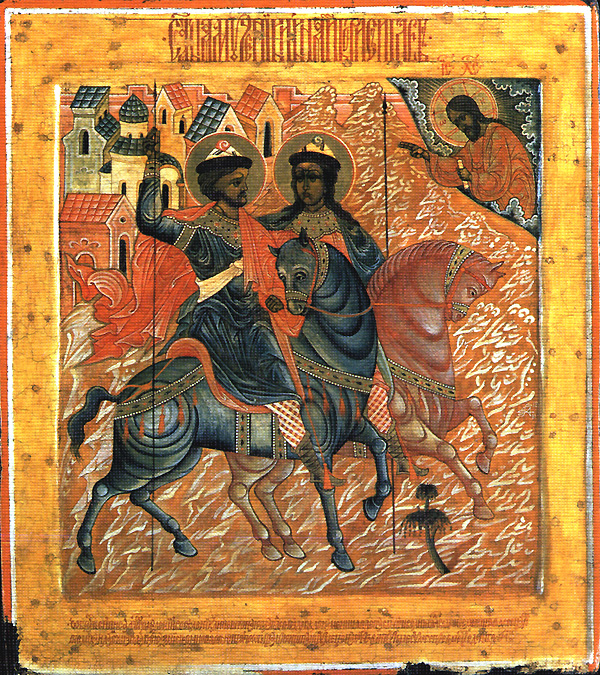
The Holy Prince Gleb, in Holy Baptism David, was one of the first Russian martyrs called “Passion-Bearers.” He suffered together with his brother Prince Boris (Roman in Holy Baptism). After the murder of Saint Boris, Svyatopolk the Accursed sent to his younger brother Prince Gleb a messenger with false information about their father, Great Prince Vladimir, who had died from illness, thereby using deceit to murder another possible claimant to the Kievan throne.
The deceived Prince Gleb hastened off to Kiev with a small company. His apprehensive brother Yaroslav, having caught up with him at Smolensk, was unable to delay the saint, who did not suspect such wickedness on the part of his brother Svyatopolk.
Not far from Smolensk the assassins came upon the boat of Saint Gleb, who made no resistance, but asked meekly that they should spare him because of his young age. At the command of the murderers Gleb’s cook slit his throat. The body of the prince was buried in a desolate place not far from Smolensk, “between two tree-trunks,” i.e., in a simple wooden coffin (+1015). In the year 1019-1020 his brother Yaroslav found the grave of Saint Gleb. The body, being incorrupt, was transferred to Vyshgorod near Kiev and buried beside holy Prince Boris.
Later on, the relics of the brothers were transferred (May 2) into the church of Saint Basil the Great, and there at the crypts of these holy Passion-Bearers many miracles were worked. Metropolitan John of Kiev compiled a service to the Passion-Bearer princes and also established a feastday for them together on July 24, which dates from the first half of the eleventh century.
The Russian Church from of old has venerated these brothers, who unceasingly have rendered prayerful assistance to their native land, particularly in years of grievous tribulation. Thus, just before the Battle of the Neva in 1240, the Passion-Bearers Boris and Gleb appeared in a vision to one of the soldiers of holy Prince Alexander Nevsky (November 23, August 30, and May 23), and they aided the Russians during the combat.
The chronicles are filled with the accounts of the various manifestations of mercy, witnessed at their tombs, and of the victories gained through their help. Many churches and monasteries were built throughout Russia in honor of the holy Passion-Bearers Boris and Gleb.
Martyr Tathuil, and his sister, Bebaia
The Martyrs Tathuil (Thiphael) and his sister Bebaia (or Thivea) suffered for their bold and effective preaching of Christianity among the pagans. After long and intense torture, the pagans suspended the holy Martyr Thiphael on a tree and cut him with a saw. His sister Saint Bebaia was killed with a spear thrust in the neck.
Martyr Sarbelus of Edessa
The Holy Martyr Sarbelus was a pagan priest who lived during the reign of the emperor Trajan (98-117) He and his sister Bebaia were converted by Saint Barsimaius, the Bishop of Edessa (January 29). They both received the crown of martyrdom.
This Saint Sarbelus appears to be the same one who is commemorated on January 29 and October 15.
Martyrs Juventinus and Maximus the soldiers, at Antioch
The martyred soldiers Juventinus and Maximus suffered during the reign of the emperor Julian the Apostate, whom they served as bodyguards. Once, while he was at Antioch, Julian decided to defile the food of the Christians by sprinkling all the food in the marketplaces with blood offered to idols. Saints Juventinus and Maximus openly condemned the emperor’s course of action and they boldly denounced him for his apostasy from the Christian Faith. After merciless beatings they were both put to death on orders of the impious emperor.
Martyrs Urban, Theodore, Medimnus, and 77 companions, at Nicomedia
The Martyrs Urban, Theodore, Medimnus and seventy-seven companions suffered at Nicomedia during the reign of the Arian emperor Valentus (Valens) (364-378 or 379). The Orthodox bishop Evagrius was banished from the Church of Constantinople, and Christians not wishing to accept the Arian heresy were locked up in prison and subjected to various outrages.
Driven to the point of despair, the Orthodox Christians decided to ask for protection from the emperor and they sent 80 chosen men of religious rank, headed by Saints Urban, Theodore and Medimnus.
Hearing their justified complaints, the emperor flew into a rage, but he knew how to hide his wrath. He quietly summoned the eparch Modestus and ordered him to put the delegates to death. Modestus put them upon a ship, telling them that they all would be sent to prison. Instead, he ordered the ship’s officers to burn the ship on the open sea. The ship was set afire and for a while, it floated upon the sea. Finally, reaching a place called Dakizis, the ship burned up with all the holy martyrs on board.
Martyr Abdias (Abidas) of Persia
The Martyr Abdias [or Abidas] suffered in Persia during the reign of the emperor Izdegerd I for his refusal to renounce Christ and instead worship the sun and fire. He died after many tortures, and until his final breath, he gave thanks to God for permitting His chosen one to die for His Holy Name.
 Saint Peter Antiochian Orthodox Church