
TRANSLATION OF THE RELICS OF STEPHEN THE PROTOMARTYR
ABSTAIN FROM MEAT, FISH, DAIRY, EGGS
Translation of the Relics of Stephen the Protomartyr, Holy Glorious New Martyr Theodore of Dardanelles, Phocas the Martyr, Plegmund, Archbishop of Canterbury
ACTS OF THE APOSTLES 6:8-15; 7:1-5, 47-60
In those days, Stephen, full of grace and power, did great wonders and signs among the people. Then some of those who belonged to the synagogue of the Freedmen (as it was called), and of the Cyrenians, and of the Alexandrians, and of those from Cilicia and Asia, arose and disputed with Stephen. But they could not withstand the wisdom and the Spirit with which he spoke. Then they secretly instigated men, who said, "We have heard him speak blasphemous words against Moses and God." And they stirred up the people and the elders and the scribes, and they came upon him and seized him and brought him before the council, and set up false witnesses who said, "This man never ceases to speak words against this holy place and the law; for we have heard him say that this Jesus of Nazareth will destroy this place, and will change the customs which Moses delivered to us." And gazing at him, all who sat in the council saw that his face was like the face of an angel.
And the high priest said, "Is this so?" And Stephen said: "Brethren and fathers, hear me. The God of glory appeared to our father Abraham, when he was in Mesopotamia, before he lived in Haran, and said to him, 'Depart from your land and from your kindred and go into the land which I will show you.' Then he departed from the land of the Chaldeans, and lived in Haran. And after his father died, God removed him from there into this land in which you are now living; yet he gave him no inheritance in it, not even a foot's length, but promised to give it to him in possession and to his posterity after him, though he had no child.
But it was Solomon who built a house for him. Yet the Most High does not dwell in houses made with hands; as the prophet says, 'Heaven is my throne, and earth my footstool. What house will you build for me, says the Lord, or what is the place of my rest? Did not my hand make all these things?'
You stiff-necked people, uncircumcised in heart and ears, you always resist the Holy Spirit. As your fathers did, so do you. Which of the prophets did not your fathers persecute? And they killed those who announced beforehand the coming of the Righteous One, whom you have now betrayed and murdered, you who received the law as delivered by angels and did not keep it.
Now when they heard these things they were enraged, and they ground their teeth against him. But he, full of the Holy Spirit, gazed into heaven and saw the glory of God, and Jesus standing at the right hand of God; and he said, "Behold, I see the heavens opened, and the Son of man standing at the right hand of God." But they cried out with a loud voice and stopped their ears and rushed together upon him. Then they cast him out of the city and stoned him; and the witnesses laid down their garments at the feet of a young man named Saul. And as they were stoning Stephen, he prayed, "Lord Jesus, receive my spirit." And he knelt down and cried with a loud voice, "Lord, do not hold this sin against them." And when he had said this, he fell asleep.
MARK 12:1-12
The Lord said this parable, "A man planted a vineyard, and set a hedge around it, and dug a pit for the wine press, and built a tower, and let it out to tenants, and went into another country. When the time came, he sent a servant to the tenants, to get from them some of the fruit of the vineyard. And they took him and beat him, and sent him away empty handed. Again he sent to them another servant, and they wounded him in the head, and treated him shamefully. And he sent another, and him they killed; and so with many others, some they beat and some they killed. He had still one other, a beloved son; finally he sent him to them, saying, 'They will respect my son.' But those tenants said to one another, 'This is the heir; come, let us kill him, and the inheritance will be ours.' And they took him and killed him, and cast him out of the vineyard. What will the owner of the vineyard do? He will come and destroy the tenants, and give the vineyard to others. Have you not read this scripture: 'The very stone which the builders rejected has become the head of the corner; this was the Lord's doing, and it is marvelous in our eyes'?" And they tried to arrest him, but feared the multitude, for they perceived that he had told the parable against them; so they left him and went away.
Translation of the relics of the Protomartyr and Archdeacon Stephen from Jerusalem to Constantinople
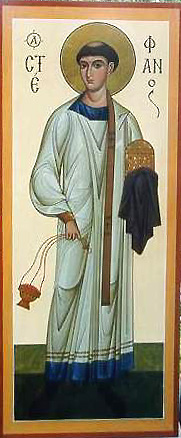
The Transfer of the Relics of the Holy Protomartyr Stephen from Jerusalem to Constantinople took place about the year 428.
After the holy Protomartyr Archdeacon Stephen was stoned by the Jews, they left his holy body unburied to be devoured by the beasts and birds. After a day and a night the renowned Jewish teacher of the Law, Gamaliel sent people to take up the body of the Protomartyr. Gamaliel buried him on his own property, in his own tomb, not far from Jerusalem.
When Lord’s secret disciple Νikόdēmos died, Gamaliel also buried him near the grave of Saint Stephen. Afterwards Gamaliel himself, who had been baptized with his son Abibas, was buried near the grave of the Protomartyr Stephen and Saint Νikόdēmos.
In the year 415 the relics of the saint were uncovered in a miraculous manner and solemnly transferred to Jerusalem by Bishop John and the bishops Eutonius of Sebaste and Eleutherius of Jericho. From that time healings took place from the relics.
Afterwards, during the reign of holy Emperor Theodosius the Younger (408-450), the relics of the holy Protomartyr Stephen were transferred from Jerusalem to Constantinople and placed in the church of the holy deacon Laurence (August 10). When a church dedicated to the Protomartyr Stephen was built, the relics were transferred there on August 2. Saint Stephen’s right hand is preserved in the Serapionov chamber of the Trinity-Sergius Lavra.
Finding of the relics of Righteous Saint Νikόdēmos
Saint Νikόdēmos was a prominent Pharisee who believed in Christ. The Savior explained to him how man is regenerated through Baptism, but he did not understand how a man could be born again. When the Lord reproved him for his ignorance, he accepted it with humility (John 3:1-21).
Νikόdēmos came back to Christ from time to time, defended Him to the Pharisees (John 7:50-52), and brought spices to anoint His body (John 19:39). After being cast out of the synagogue for his belief in Christ, Saint Νikόdēmos went to live with Saint Gamaliel at his country house, remaining there until his death.
The relics of Saints Stephen, Gamaliel, Abibas, and Νikόdēmos were transferred from Jerusalem to Constantinople in 428 and placed in the church of the holy deacon Laurence (August 10).
Finding of the relics of Saint Gamaliel
Saint Gamaliel was a Pharisee, a doctor of the Law (Acts 5:34), and the teacher of Saint Paul (Acts 22:3).
In the year 415, Saint Gamaliel appeared to a priest named Lucian. He was a tall, venerable man with a long white beard. He was dressed in white clothing which was edged with gold and marked with crosses, and held a gold wand in his hand.
Gamaliel called Father Lucian by name three times, then told him to go to Jerusalem and inform Bishop John to open the tomb where his relics and those of other saints were resting. The priest asked the stranger who he was.
“I am Gamaliel, who instructed the apostle Paul in the Law,” he replied. Then he told the priest where to find the relics of Saint Stephen. He also revealed that he had taken Saint Stephen’s body and laid it in his own tomb after it had been lying exposed for a day and a night.
Saint Gamaliel also mentioned that Saint Νikόdēmos was buried at the same spot. “I received him into my house in the country,” he said, “and maintained him there until the end of his life. After his death, I buried him honorably near Stephen.”
Saint Gamaliel informed the priest that he and his twenty-year-old son Abibas were also buried there. Father Lucian was afraid to believe this vision right away, lest it be a temptation from the Evil One. However, when Saint Gamaliel appeared again and commanded him to obey his instructions, he did so.
A monk named Migetius also had a vision of Saint Gamaliel and told Father Lucian to search for the relics in a place called Debatalia. When the relics were uncovered, an ineffable fragrance was noticed.
The relics of Saints Stephen, Gamaliel, Abibas, and Νikόdēmos were transferred from Jerusalem to Constantinople in 428 and placed in the church of the holy deacon Laurence (August 10).
Finding of the relics of Saint Abibas
Saint Abibas was the twenty-year-old son of Saint Gamaliel, who died before his father. His relics were uncovered along with those of Saints Stephen, Gamaliel, and Νikόdēmos in 415.
The relics of Saints Stephen, Gamaliel, Abibas, and Νikόdēmos were transferred from Jerusalem to Constantinople in 428 and placed in the church of the holy deacon Laurence (August 10).
Blessed Basil of Moscow the Fool-For-Christ

Saint Basil the Blessed, Wonderworker of Moscow, was born in December 1468 on the portico of the Elokhov church in honor of the Vladimir Icon of the Most Holy Theotokos outside Moscow. His parents were commoners and sent their son to be trained as a cobbler.
During Basil’s apprenticeship, the master happened to witness a remarkable occurrence, which showed him that his student was no ordinary man. A certain merchant had brought grain to Moscow on a barge and then went to order boots, specifying that they be made in a particular way, since he would not pick them up for a year. Blessed Basil wept and said, “I wish you would cancel the order, since you will never wear them.”
When the perplexed master questioned his apprentice he explained that the man would not wear the boots, for he would soon die. After several days the prediction came true.
When he was sixteen, the saint arrived in Moscow and began the difficult exploit of foolishness for Christ. In the burning summer heat and in the winter’s harsh frost, he walked about barefoot through the streets of Moscow. His actions were strange: here he would upset a stand with kalachi, and there he would spill a jug with kvas. Angry merchants throttled the blessed one, but he endured the beatings with joy and he thanked God for them. Then it was discovered that the kalachi were poorly cooked, and the kvas was badly prepared. The reputation of Saint Basil quickly grew, and people saw him as a holy fool, a man of God, and a denouncer of wrong.
A certain merchant wanted to build a stone church on Pokrovna in Moscow, but its arches collapsed three times. The merchant turned to the saint for advice, and he pointed him toward Kiev. “Find there John the Cripple,” he said. “He will advise you how to construct the church.”
Traveling to Kiev, the merchant sought out John, who sat in a poor hut and rocked an empty cradle. “Whom do you rock?” asked the merchant. “I weep for my beloved mother, who was made poor by my birth and upbringing.” Only then did the merchant remember his own mother, whom he had thrown out of the house. Then it became clear to him why he was not able to build the church. Returning to Moscow, he brought his mother home, begged her forgiveness, and built the church.
Preaching mercy, the blessed one helped those who were ashamed to ask for alms, but who were more in need of help than others. Once, he gave away a rich imperial present to a foreign merchant who was left without anything at all. Although the man had eaten nothing for three days, he was not able to beg for food, since he wore fine clothing.
The saint harshly condemned those who gave alms for selfish reasons, not out of compassion for the poor and destitute, but hoping for an easy way to attract God’s blessings upon their affairs. Once, the saint saw a devil in the guise of a beggar. He sat at the gates of the All-Pure Virgin’s church, and he gave speedy help in their affairs to everyone who gave alms. The saint exposed the wicked trick and drove the devil away.
For the salvation of his neighbor, Saint Basil also visited the taverns, where he tried to see a grain of goodness, even in people very much gone to ruin, and to strengthen and encourage them by kindness. Many observed that when the saint passed by a house in which they made merry and drank, he wept and clutched the corners of that house. They inquired of the fool what this meant, and he answered: “Angels stand in sorrow at the house and are distressed by the sins of the people, but I entreat them with tears to pray to the Lord for the conversion of sinners.”
Purified by great deeds and by the prayer of his soul, the saint was also given the gift of foreseeing the future. In 1547 he predicted the great fire of Moscow; through prayer he extinguished a fire at Novgorod; and once he reproached Tsar Ivan the Terrible, because during the divine services he was preoccupied with thoughts of building a palace on the Vorobiev hills.
Saint Basil died on August 2, 1557. Saint Macarius, Metropolitan of Moscow served the saint’s funeral with many clergy. His body was buried in the cemetery of Trinity church, where in 1554, the Protection cathedral was built in memory of the conquest of Kazan. His Holiness Patriarch Job glorified Saint Basil the Blessed at a Council on August 2, 1588.
In an early icon, Saint Basil is portrayed as old, with white hair curling at the ears, and a short, curly white beard. He is completely naked, and holds a handkerchief in his hand. The veneration of Saint Basil the Blessed was always so strong that the Trinity temple and the attached Protection church were renamed for him [the famous Saint Basil’s Cathedral in Moscow].
The saint’s chains are preserved at the Moscow Spiritual Academy.
Holy Fool Basil of Kamen
Venerable Basil of Kamen, a holy fool for the sake of Christ (2nd half of the XVII – 1st half of the XVIII century?), was a monk in the Savior–Kamen Monastery, located on an island in Lake Kuben (near Vologda). At the shrine of his relics, later placed in the church dedicated to Saint Basil of Moscow, there is a full-length icon depicting Saint Basil of Kuben with heavy iron chains and a cap made from strips of iron.
In 1774, when everything was consumed in a fire, the wooden reliquary and the icon remained undamaged.
The Holy Fool Basil of Kamen is commemorated on August 2, his Name Day; and also on the third Sunday after Pentecost (Synaxis of the Vologda Saints).
Hieromartyr Stephen, Pope of Rome, and those with him
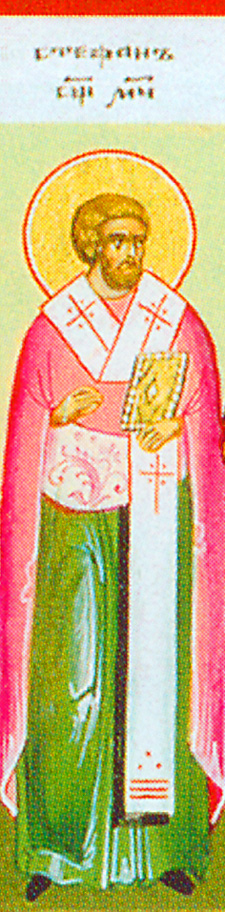
The Hieromartyr Stephen, Pope of Rome, suffered in the year 257 during the reign of the emperor Valerian (253-259). Saint Stephen, occupying the throne (253-257) of the holy First Bishop of Rome, zealously contended against the heresy of Novatus, which taught that it is not proper to receive back those returning from heresy.
While hiding during a persecution against Christians, Saint Stephen baptized many pagans, including the military tribune Nemesius. He converted to Christ after the saint healed his daughter Lucilla. Nemesius, who was ordained as a deacon, was beheaded along with his daughter.
Their steward Symphronius was brought by the tribune Olympius into the temple of Mars for torture. His prayer shattered the golden idol, after which the tribune with his wife Exuperia and his son Theodolus believed and were baptized. They were all burned alive, and their remains were buried by holy Pope Stephen.
Then twelve of his clergy were beheaded: Bonus, Faustus, Maurus, Primitivus, Calumniosus, John, Exuperantus, Cyril, Theodore, Basil, Castelus, Honoratus and Tertullinus, all converted by Saint Stephen. Finally, Saint Stephen himself was led before the emperor Valerian (253-259) , who condemned him to beheading with a sword in the temple of Mars.
By the prayers of the saint, a large part of the pagan temple was destroyed, and the soldiers fled. The saint concealed himself in the catacombs (the resting place of Saint Lucina or Lucy), where he was later killed by soldiers while he was teaching Christians.
Saint Photeine of Cyprus, Wonderworker
It is not known just when Saint Photeini [Photeinḗ – known on Cyprus as Saint Photou (Phótou) the wonderworker] lived, nor is there any information about her early life. Tradition tells us that she was born in Rizokarpaso to simple, but pious parents.
From a young age, Photou stood out from her peers for her kindness, her attitude, her willingness to serve others, and her virtue. Her large bright eyes reflected the richness of her heart and they spread trust and joy everywhere. Photou was taught her first letters at the village school. She learned to read by memorizing the various Psalms and hymns of our Church.
When she reached marriageable age, the Saint left her home and went to a cave to live a life of asceticism. In that cave the pure and heroic daughter spent the rest of her life: a life of perseverance and prayer, a life of self-control and complete dedication to Christ the heavenly Bridegroom.
Her holy relics were buried and then discovered in the cave between 1718 – 1732 with a carved inscription on her reliquary: "Photeini, the Virgin Bride of Christ." Today she continues to offer healing to the sick, sight to the blind, as well as spiritual rest and joy to the afflicted.
Saint Photeinis hermitage still exists today and is located in the village of Saint Andronikos. One enters through a narrow opening and descends a staircase of twenty-three steps made from domestic stones. The cave looks like a catacomb, like those used by the early Christians. At the bottom of the cave there is a spring of holy water. The sick take this water and wash their limbs so they might be healed.
The Saint is particularly invoked for curing diseases of the eyes. Finally, during the dark years of the Turkish Yoke, the cave of the Venerable one was also used as a church.
A piece of the Saint's holy relics is to be found in Kykkos Monastery, on Cyprus.
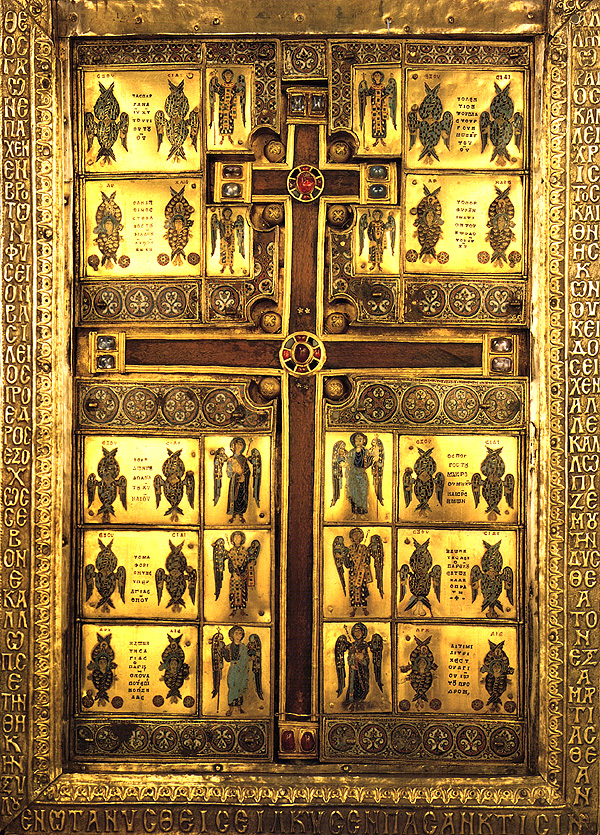


 Saint Peter Antiochian Orthodox Church