Here is the homily for Sunday, July 06, 2025.
You can also download the homily here .

TRANSFIGURATION OF OUR LORD AND SAVIOR JESUS CHRIST
ABSTAIN FROM MEAT, DAIRY, EGGS
Transfiguration of our Lord and Savior Jesus Christ
BRETHREN, be more zealous to confirm your call and election, for if you do this you will never fall; so there will be richly provided for you an entrance into the eternal kingdom of our Lord and Savior Jesus Christ.
Therefore I intend always to remind you of these things, though you know them and are established in the truth that you have. I think it right, as long as I am in this body, to arouse you by way of reminder, since I know that the putting off of my body will be soon, as our Lord Jesus Christ showed me. And I will see to it that after my departure you may be able at any time to recall these things.
For we did not follow cleverly devised myths when we made known to you the power and coming of our Lord Jesus Christ, but we were eyewitnesses of his majesty. For when he received honor and glory from God the Father and the voice was borne to him by the Majestic Glory, "This is my beloved Son, with whom I am well pleased, " we heard this voice borne from heaven, for we were with him on the holy mountain. And we have the prophetic word made more sure. You will do well to pay attention to this as to a lamp shining in a dark place, until the day dawns and the morning star rises in your hearts.
At that time, Jesus took with him Peter and James and John his brother, and led them up a high mountain apart. And he was transfigured before them, and his face shone like the sun, and his garments became white as light. And behold, there appeared to them Moses and Elijah, talking with him. And Peter said to Jesus, “Lord, it is well that we are here; if you wish, I will make three booths here, one for you and one for Moses and one for Elijah.” He was still speaking, when lo, a bright cloud overshadowed them, and a voice from the cloud said, “This is my beloved Son, with whom I am well pleased; listen to him.” When the disciples heard this, they fell on their faces, and were filled with awe. But Jesus came and touched them, saying, “Rise, and have no fear.” And when they lifted up their eyes, they saw no one but Jesus only. And as they were coming down the mountain, Jesus commanded them, “Tell no one the vision, until the Son of man is raised from the dead.”

Discourse on the Holy Transfiguration of Our Lord God and Savior Jesus Christ of Saint Gregory Palamas, Archbishop of Thessalonica
For an explanation of the present Feast and understanding of its truth, it is necessary for us to turn to the very start of today’s reading from the Gospel: “Now after six days Jesus took Peter, James and John his brother, and led them up onto a high mountain by themselves” (Mt.17:1).
First of all we must ask, from whence does the Evangelist Matthew begin to reckon with six days? From what sort of day is it? What does the preceding turn of speech indicate, where the Savior, in teaching His disciples, said to them: “For the Son of Man shall come with his angels in the glory of His Father,” and further: “Amen I say to you, there are some standing here who shall not taste death, until they have seen the Son of Man coming in His Kingdom” (Mt.16:27-28)? That is to say, it is the Light of His own forthcoming Transfiguration which He terms the Glory of His Father and of His Kingdom.
The Evangelist Luke points this out and reveals this more clearly saying: “Now it came to pass about eight days after these words, that He took Peter and John and James, and went up the mountain to pray. And as He prayed, His countenance was altered, and His raiment became a radiant white” (Luke 9:28-29). But how can the two be reconciled, when one of them speaks definitively about the interval of time as being eight days between the sayings and the manifestation, whereas the other (says): “after six days?”
There were eight on the mountain, but only six were visible. Three, Peter, James and John, had come up with Jesus, and they saw Moses and Elias standing there and conversing with Him, so altogether there were six of them. However, the Father and the Holy Spirit were invisibly with the Lord: the Father, with His Voice testifying that this was His Beloved Son, and the Holy Spirit shining forth with Him in the radiant cloud. Thus, the six are actually eight, and there is no contradiction regarding the eight. Similarly, there is no contradiction with the Evangelists when one says “after six days,” and the other says “eight days after these words.”
But these twofold sayings as it were present is a certain format set in mystery, and together with it that of those actually present upon the Mount. It stands to reason, and everyone rationally studying in accordance with Scripture knows that the Evangelists are in agreement one with another. Luke spoke of eight days without contradicting Matthew, who declared “after six days.” There is not another day added on to represent the day on which these sayings were uttered, nor is the day on which the Lord was transfigured added on (which a rational person might reasonably imagine to be added to the days of Matthew).
The Evangelist Luke does not say “after eight days” (like the Evangelist Matthew says “after six days”), but rather “it came to pass eight days after these words.” But where the Evangelists seem to contradict one another, they actually point out to us something great and mysterious. In actual fact, why did the one say “after six days,” but the other, in ignoring the seventh day, have in mind the eighth day? It is because the great vision of the Light of the Transfiguration of the Lord is the mystery of the Eighth Day, i.e., of the future age, coming to be revealed after the passing away of the world created in six days.
About the power of the Divine Spirit, through Whom the Kingdom of God is to be revealed, the Lord predicted: “There are some standing here who shall not taste death, until they have seen the Son of Man coming in His Kingdom” (Mt.16:28). Everywhere and in every way the King will be present, and everywhere will be His Kingdom, since the advent of His Kingdom does not signify the passing over from one place to another, but rather the revelation of its power of the Divine Spirit. That is why it is said: “come in power.” And this power is not manifest to simply ordinary people, but to those standing with the Lord, that is to say, those who have affirmed their faith in Him like Peter, James and John, and especially those who are free of our natural abasement. Therefore, and precisely because of this, God manifests Himself upon the Mount, on the one hand coming down from His heights, and on the other, raising us up from the depths of abasement, since the Transcendent One takes on mortal nature. Certainly, such a manifest appearance by far transcends the utmost limits of the mind’s grasp, as effectualized by the power of the Divine Spirit.
Thus, the Light of the Transfiguration of the Lord is not something that comes to be and then vanishes, nor is it subject to the sensory faculties, although it was contemplated by corporeal eyes for a short while upon an inconsequential mountaintop. But the initiates of the Mystery, (the disciples) of the Lord at this time passed beyond mere flesh into spirit through a transformation of their senses, effectualized within them by the Spirit, and in such a way that they beheld what, and to what extent, the Divine Spirit had wrought blessedness in them to behold the Ineffable Light.
Those not grasping this point have conjectured that the chosen from among the Apostles beheld the Light of the Transfiguration of the Lord by a sensual and creaturely faculty, and through this they attempt to reduce to a creaturely level (i.e., as something “created”) not only this Light, the Kingdom and the Glory of God, but also the Power of the Divine Spirit, through Whom it is meet for Divine Mysteries to be revealed. In all likelihood, such persons have not heeded the words of the Apostle Paul: “Eye has not seen, nor ear heard, nor has it entered into the heart of man, what things God has prepared for those who love Him. But to us God has revealed them through His Spirit. For the Spirit searches all things, even the deep things of God” (1 Cor.2:9-10).
So, with the onset of the Eighth Day, the Lord, taking Peter, James and John, went up on the Mount to pray. He always prayed alone, withdrawing from everyone, even from the Apostles themselves, as for example when with five loaves and two fish He fed the five thousand men, besides women and children (Mt.14:19-23). Or, taking with Him those who excelled others, as at the approach of His Saving Passion, when He said to the other disciples: “Sit here while I go over there and pray” (Mt.26:36). Then He took with Him Peter, James and John. But in our instance right here and now, having taken only these same three, the Lord led them up onto a high mountain by themselves and was transfigured before them, that is to say, before their very eyes.
“What does it mean to say: He was transfigured?” asks the Golden-Mouthed Theologian (Chrysostom). He answers this by saying: “It revealed something of His Divinity to them, as much and insofar as they were able to apprehend it, and it showed the indwelling of God within Him.” The Evangelist Luke says: “And as He prayed, His countenance was altered” (Luke 9:29); and from the Evangelist Matthew we read: “And His face shone as the sun” (Mt.17:2). But the Evangelist said this, not in the context that this Light be thought of as subsistent for the senses (let us put aside the blindness of mind of those who can conceive of nothing higher than what is known through the senses). Rather, it is to show that Christ God, for those living and contemplating by the Spirit, is the same as the sun is for those living in the flesh and contemplating by the senses. Therefore, some other Light for the knowing the Divinity is not necessary for those who are enriched by Divine gifts.
That same Inscrutable Light shone and was mysteriously manifest to the Apostles and the foremost of the Prophets at that moment, when (the Lord) was praying. This shows that what brought forth this blessed sight was prayer, and that the radiance occured and was manifest by uniting the mind with God, and that it is granted to all who, with constant exercise in efforts of virtue and prayer, strive with their mind towards God. True beauty, essentially, can be contemplated only with a purified mind. To gaze upon its luminance assumes a sort of participation in it, as though some bright ray etches itself upon the face.
Even the face of Moses was illumined by his association with God. Do you not know that Moses was transfigured when he went up the mountain, and there beheld the Glory of God? But he (Moses) did not effect this, but rather he underwent a transfiguration. However, our Lord Jesus Christ possessed that Light Himself. In this regard, actually, He did not need prayer for His flesh to radiate with the Divine Light; it was but to show from whence that Light descends upon the saints of God, and how to contemplate it. For it is written that even the saints “will shine forth like the sun” (Mt.13:43), which is to say, entirely permeated by Divine Light as they gaze upon Christ, divinely and inexpressibly shining forth His Radiance, issuing from His Divine Nature. On Mount Tabor it was manifest also in His Flesh, by reason of the Hypostatic Union (i.e., the union of the two perfect natures, divine and human, within the divine Person [Hypostasis] of Christ, the Second Person of the Most Holy Trinity). The Fourth Ecumenical Council at Chalcedon defined this Hypostatic union of Christ’s two natures, divine and human, as “without mingling, without change, without division, without separation.”
We believe that at the Transfiguration He manifested not some other sort of light, but only that which was concealed beneath His fleshly exterior. This Light was the Light of the Divine Nature, and as such, it was Uncreated and Divine. So also, in the teachings of the Fathers, Jesus Christ was transfigured on the Mount, not taking upon Himself something new nor being changed into something new, nor something which formerly He did not possess. Rather, it was to show His disciples that which He already was, opening their eyes and bringing them from blindness to sight. For do you not see that eyes that can perceive natural things would be blind to this Light?
Thus, this Light is not a light of the senses, and those contemplating it do not simply see with sensual eyes, but rather they are changed by the power of the Divine Spirit. They were transformed, and only in this way did they see the transformation taking place amidst the very assumption of our perishability, with the deification through union with the Word of God in place of this.
So also she who miraculously conceived and gave birth recognized that the One born of her is God Incarnate. So it was also for Simeon, who only received this Infant into his arms, and the aged Anna, coming out [from the Jerusalem Temple] for the Meeting, since the Divine Power illumined, as through a glass windowpane, giving light for those having pure eyes of heart.
And why did the Lord, before the beginning of the Transfiguration, choose the foremost of the Apostles and lead them up onto the Mount with Him? Certainly, it was to show them something great and mysterious. What is particularly great or mysterious in showing a sensory light, which not only the foremost, but all the other Apostles already abundantly possessed? Why would they need a transforming of their eyes by the power of the Holy Spirit for a contemplation of this Light, if it were merely sensory and created? How could the Glory and the Kingdom of the Father and the Holy Spirit project forth in some sort of sensory light? Indeed, in what sort of Glory and Kingdom would Christ the Lord come at the end of the ages, when there would not be necessary anything in the air, nor in expanse, nor anything similar, but when, in the words of the Apostle, “God will be all in all” (1 Cor.15: 28)? That is to say, will He alter everything for all? If so, then it follows that light is included.
Hence it is clear that the Light of Tabor was a Divine Light. And the Evangelist John, inspired by Divine Revelation, says clearly that the future eternal and enduring city “has no need of the sun or moon to shine upon it. For the Glory of God lights it up, and the Lamb will be its lamp” (Rev 21:23). Is it not clear, that he points out here that this [Lamb] is Jesus, Who is divinely transfigured now upon Tabor, and the flesh of Whom shines, is the lamp manifesting the Glory of divinity for those ascending the mountain with Him?
John the Theologian also says about the inhabitants of this city: “they will not need light from lamps, nor the light of the sun, for the Lord God will shed light upon them, and night shall be no more” (Rev 22:5). But how, we might ask, is there this other light, in which “there is no change, nor shadow of alteration” (Jas 1:17)? What light is there that is constant and unsetting, unless it be the Light of God? Moreover, could Moses and Elias (and particularly the former, who clearly was present only in spirit, and not in flesh [Elias having ascended bodily to Heaven on the fiery chariot]) be shining with any sort of sensory light, and be seen and known? Especially since it was written of them: “they appeared in glory, and spoke of his death, which he was about to fulfill at Jerusalem” (Luke 9:30-31). And how otherwise could the Apostles recognize those whom they had never seen before, unless through the mysterious power of the Divine Light, opening their mental eyes?
But let us not tire our attention with the furthermost interpretations of the words of the Gospel. We shall believe thus, as those same ones have taught us, who themselves were enlightened by the Lord Himself, insofar as they alone know this well: the Mysteries of God, in the words of a prophet, are known to God alone and His perpetual proximity. Let us, considering the Mystery of the Transfiguration of the Lord in accord with their teaching, strive to be illumined by this Light ourselves and encourage in ourselves love and striving towards the Unfading Glory and Beauty, purifying our spiritual eyes of worldly thoughts and refraining from perishable and quickly passing delights and beauty which darken the garb of the soul and lead to the fire of Gehenna and everlasting darkness. Let us be freed from these by the illumination and knowledge of the incorporeal and ever-existing Light of our Savior transfigured on Tabor, in His Glory, and of His Father from all eternity, and His Life-Creating Spirit, Whom are One Radiance, One Godhead, and Glory, and Kingdom, and Power now and ever and unto ages of ages. Amen.
The name of the New Martyr Habakkuk (Abbakoum) is not mentioned in the Synaxaristes of New Martyrs nor in the printed Synaxaristes, since no record of his martyrdom has survived. It is known only from his remembrance in codex M. Lavra Ω 89, f. 155 from the XVII century, according to which Habakkuk died on August 6, 1628 at Thessaloniki: "In the month of August the Venerable New Martyr Habakkuk bore witness to Christ in the great city of Thessaloniki to the glory and pride of the Orthodox Christians."
From his designation as "Venerable" it may be assumed that Habakkuk was a monk, probably on Mount Athos.
The name of the Holy Martyr Habakkuk was first written in the Hagiologion of Metropolitan Sophronios Eustratiádēs, who also published a catalogue of manuscripts in the Greatest Lavra Monastery, where the remembrance of Abbakoum's martyrdom is found.
Pieces of the relics of the Holy Martyr Habakkuk are kept in the monastery of Nativity in Akarnania.
Here is the live stream for Festal Orthros and Divine Liturgy for the Transfiguration – Tuesday, August 05, 2025 If you need, here are instructions for accessing this content from your phone, tablet, computer, or TV.
9TH TUESDAY AFTER PENTECOST
ABSTAIN FROM MEAT, FISH, DAIRY, EGGS, WINE, OLIVE OIL
Forefeast of the Transfiguration of our Lord and Savior Jesus Christ, Eusignius the Martyr of Antioch, Our Righteous Father Eugene of Aitola, Euthymios, Patriarch of Constantinople, Christos the New Martyr of Prevezis, Oswald the Martyr, King of Northumbria
Peter, an apostle of Jesus Christ, to the exiles of the Dispersion in Pontos, Galatia, Cappadocia, Asia, and Bithynia, chosen and destined by God the Father and sanctified by the Spirit for obedience to Jesus Christ and for sprinkling with his blood:
May grace and peace be multiplied to you. Blessed be the God and Father of our Lord Jesus Christ! By his great mercy we have been born anew to a living hope through the resurrection of Jesus Christ from the dead, and to an inheritance which is imperishable, undefiled, and unfading, kept in heaven for you, who by God's power are guarded through faith for a salvation ready to be revealed in the last time. In this you rejoice, though now for a little while you may have to suffer various trials, so that the genuineness of your faith, more precious than gold which though perishable is tested by fire, may redound to praise and glory and honor at the revelation of Jesus Christ. Without having known him you love him; though you do not now see him you believe in him and rejoice with unutterable and exalted joy. As the outcome of your faith you obtain the salvation of your souls.
The prophets who prophesied of the grace that was to be yours searched and inquired about this salvation; they inquired what person or time was indicated by the Spirit of Christ within them when predicting the sufferings of Christ and the subsequent glory. It was revealed to them that they were serving not themselves but you, in the things which have now been announced to you by those who preached the good news to you through the Holy Spirit sent from heaven, things into which angels long to look.
Therefore gird up your minds, be sober, set your hope fully upon the grace that is coming to you at the revelation of Jesus Christ. As obedient children, do not be conformed to the passions of your former ignorance, but as he who called you is holy, be holy yourselves in all your conduct; since it is written, "You shall be holy, for I am holy." And if you invoke as Father him who judges each one impartially according to his deeds, conduct yourselves with fear throughout the time of your exile. You know that you were ransomed from the futile ways inherited from your fathers, not with perishable things such as silver or gold, but with the precious blood of Christ, like that of a lamb without blemish or spot. He was destined before the foundation of the world but was made manifest at the end of the times for your sake. Through him you have confidence in God, who raised him from the dead and gave him glory, so that your faith and hope are in God.
Having purified your souls by your obedience to the truth for a sincere love of the brethren, love one another earnestly from the heart. You have been born anew, not of perishable seed but of imperishable, through the living and abiding word of God; for "All flesh is like grass and all its glory like the flower of grass. The grass withers, and the flower falls, but the word of the Lord abides for ever." That word is the good news which was preached to you.
So put away all malice and all guile and insincerity and envy and all slander. Like newborn babes, long for the pure spiritual milk, that by it you may grow up to salvation; for you have tasted the kindness of the Lord.
Come to him, to that living stone, rejected by men but in God's sight chosen and precious; and like living stones be yourselves built into a spiritual house, to be a holy priesthood, to offer spiritual sacrifices acceptable to God through Jesus Christ. For it stands in scripture: "Behold, I am laying in Zion a stone, a cornerstone chosen and precious, and he who believes in him will not be put to shame." To you therefore who believe, he is precious, but for those who do not believe, "The very stone which the builders rejected has become the head of the corner, " and "A stone that will make men stumble, a rock that will make them fall"; for they stumble because they disobey the word, as they were destined to do. But you are a chosen race, a royal priesthood, a holy nation, God's own people, that you may declare the wonderful deeds of him who called you out of darkness into his marvelous light. Once you were no people but now you are God's people; once you had not received mercy but now you have received mercy.
The Lord said to his disciples, "Truly, I say to you, whatever you bind on earth shall be bound in heaven, and whatever you loose on earth shall be loosed in heaven. Again I say to you, if two of you agree on earth about anything they ask, it will be done for them by my Father in heaven. For where two or three are gathered in my name, there am I in the midst of them.
Then Peter came up and said to him, "Lord, how often shall my brother sin against me, and I forgive him? As many as seven times?" Jesus said to him, "I do not say to you seven times, but seventy times seven.
Now when Jesus had finished these sayings, he went away from Galilee and entered the region of Judea beyond the Jordan; and large crowds followed him, and he healed them there.
Then children were brought to him that he might lay his hands on them and pray. The disciples rebuked the people; but Jesus said, "Let the children come to me, and do not hinder them; for to such belongs the kingdom of heaven." And he laid his hands on them and went away.

The Lord had begun warning his disciples about the dangers they would face, and also about His Passion and death. He also told them that they would be persecuted by pagans and enemies of the Gospel. He explained that these things pertain to the present life, but what is essential is eternal life. Desiring to give His disciples a foretaste of eternal life, he took three of them, Peter, James and John, and brought them up to Mount Tabor.
There He was transfigured before them and His face shone like light. Moses and Elias appeared and spoke with Jesus. The Lord took only those disciples because they were more pre-eminent than the others. Peter was chosen because he loved Christ very much, John because he also loved Christ, and James because he was able to drink the cup that Christ drank (Matthew 20:23). The Lord showed them Moses and
Elias in order to correct their erroneous ideas of who He was, as though He were Saint John the Baptist, or some great prophet. That is why He revealed His glory to them ‘as far as they could bear it.’ All this took place during the Transfiguration of our Lord Jesus Christ on Mount Tabor.

The Martyr Eusignius was born at Antioch in the mid-third century. For sixty years he served in the Roman armies of the emperors Diocletian, Maximian Hercules, Constantius Chlorus, Constantine the Great and his sons. Saint Eusignius was a companion of Saint Basiliscus (March 3 and May 22), and he provided an account of his martyrdom. At the beginning of the reign of Saint Constantine the Great, Saint Eusignius was a witness to the appearance of the Cross in the sky, a prediction of victory.
Saint Eusignius retired in his old age from military service and returned to his own country. There he spent his time in prayer, fasting, and attending the church of God. So he lived until the reign of Julian the Apostate (361-363), who yearned for a return to paganism. Through the denunciation of one of the Antiochian citizens, Saint Eusignius stood trial as a Christian before the emperor Julian in the year 362. He fearlessly accused the emperor of apostasy from Christ, and reproached him with the example of his relative, Constantine the Great, and he described in detail how he himself had been an eyewitness to the appearance of the sign of the Cross in the sky. Julian did not spare the aged Saint Eusignius, then 110 years old, but ordered him beheaded.
Saint Job the Gorge-dweller was a monk of the Solovki Monastery (his father's name was Patrick Mazovsky). On November 10, 1608 Venerable Job was ordained as a Hieromonk by Metropolitan Isidore of Novgorod. In 1614 Saint Job was sent to the Mezen region, where at the confluence of the Rivers Ezeg and Vazhka into the River Mezen, he built a chapel in honor of the Nativity of Christ. The Monastery was so poor that the first monks to gather around him lived in the homes of their lay kinsmen. After Tsar Michael (1613-1645) donated lands to the Monastery with fishing rights, Saint Job built a church and monastic cells for the brethren.
On August 5, 1628, when all the brethren were in the hayfield, the Monastery was attacked by robbers. After torturing Saint Job in order to force him to open the monastic treasury, the robbers beheaded him. Finding nothing, they went away. When the brethren returned they buried the Martyr's body with honor.
Local veneration of the Venerable one as a Saint began soon after his death, because of numerous miracles (about fifty occurred in the XVII century). The first icon was painted in 1658, and his Life written in the 1660s. Around that time a chapel was built over the relics of the Venerable one. Later, with the blessing of Archbishop Athanasios of Kholmogorsk, it was rebuilt as a church in honor of his patron Saint, the Righteous Job the Much-Suffering (May 6). On the same day the Church established the commemoration of Saint Job the Gorge-dweller.
On November 3, 1739, the relics of Saint Job were examined by Archbishop Barsanuphios, and it was blessed to chant a Moleben to the Saint. Thus his glorification took place. In iconography, Saint Job is depicted in this manner: “Greyish, with a beard like Saint Alexander of Svir, dressed as Schema-monk, and in his hands is a scroll upon which is written: “Fear not those who kill the body, but are not able to kill the soul” (Matthew 10:28).

Saint Antherus was elected Bishop of Rome in place of Saint Pontian, and he too soon accepted suffering and death for Christ in the year 236.
Saint Fabian, as a presbyter, fearlessly gave burial to the bodies of martyrs. After the death of Hieromartyr Antherus (Antheros) Pope of Rome, Saint Fabian succeeded him as Pope.
Saint Fabian loved Saint Pontius as though he were his own son. Saint Pontius distributed with Saint Fabian all his substance on the needs of the poor. After the death of the impious Maximian, the new emperor Gordian (238-244) did not persecute Christians. The emperor Philip (244-249), together with his son and co-regent Philip, was persuaded by the conversations and preaching of Saint Pontius to believe in Christ and to accept Baptism from Saint Fabian.
With the permission of the emperors, Saints Pontius and Fabian destroyed the statue of Jupiter in the pagan temple and built a church on this place. For four years the Church of Christ dwelt in peace and tranquility. Then Decius (249-251) ascended the throne, after organizing a rebellion and murdering the emperor Philip and his son.
And during this time Saint Fabian, Bishop of Rome (+ 250), accepted death for Christ. Saint Pontius left Rome for the city of Cimelum (on the border of Italy and Gaul) and lived there as a stranger. During the time of the emperor Valerian (253-259), cruel torturers were sent out with full authority to seek out and kill Christians. Thus Claudius and Anubius arrived in the city of Cimelum for this purpose.
Saint Pontius fearlessly confessed himself a Christian and refused to offer sacrifice to idols. They shackled him in irons and threw him in prison. From the very beginning of the torture the saint calmly admonished the torturers, saying that the Lord would bring the torture to naught, and they would see the power of God. As soon as the servants attempted to tie Saint Pontius to the rack, it fell to pieces, and the torturers fell on the ground as though dead.
“Be convinced, O man of little faith, of the power of my Lord,” said Saint Pontius to Claudius, but on the advice of Anubius he gave Saint Pontius over to be eaten by two bears in the circus. The wild beasts, while not touching the saint, fell instead upon their keepers and mauled them. The spectators began to shout: “The only God is the Christian God, in Whom Pontius believes.” By order of the torturers a fire was built, but it burned out and the saint remained alive. Not even his clothes were burnt. The crowd shouted all the more strongly: “Great is the God of the Christians!” Saint Pontius then was sentenced to beheading by the sword, and his execution took place in the year 257. The body of Saint Pontius was given burial by his friend Valerian.
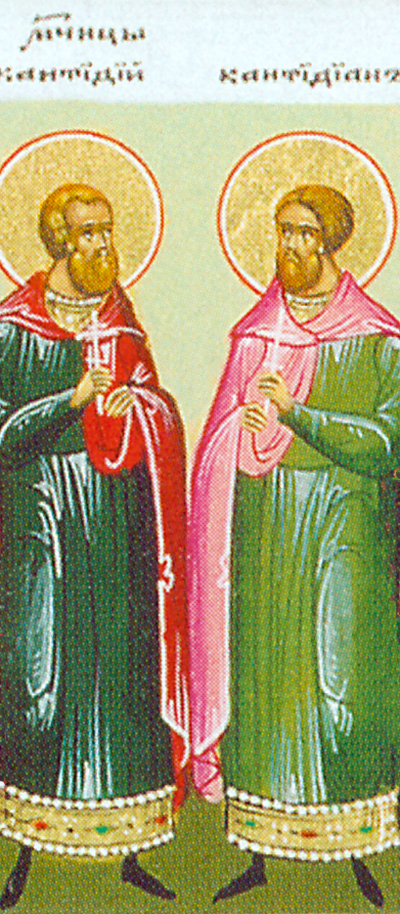
Saints Cantidius and Cantidian were brothers who lived in Egypt during the fourth century. They were put to death by stoning. Saint Sibelius (Soleb) was shot with arrows. All three suffered martyrdom because they were Christians who refused to deny Christ.

Saint Nonna, the mother of Saint Gregory the Theologian (January 25, 389), was the daughter of Christians named Philotatos and Gorgonia, who raised her in Christian piety. Saint Nonna was also an aunt of Saint Amphilochius, Bishop of Iconium (November 23).
Saint Nonna entered into marriage with Gregory of Arianzus (January 1), the rich landowner of an estate in the Arianzus and Nazianzos districts. The marriage was advantageous by earthly considerations, but grievous for the pious soul of Nonna. Her husband Gregory was a pagan, a follower of the sect of the Supremists (Hypsistarii), who venerated a supreme god and observed certain Jewish rituals, while at the same time they worshipped fire.
Saint Nonna prayed that her spouse would turn to the holy truth. Saint Nonna’s son, Saint Gregory the Theologian, wrote about this: “She could not bear this, being half united to God, because he who was part of her remained apart from God. She wanted a spiritual union in addition to the bodily union. Day and night she turned to God with fasting and many tears, entreating Him to grant salvation to her husband.”
Through the prayers of Saint Nonna, her husband Gregory had a vision in his sleep. “It seemed to my father,” writes Saint Gregory, “as though he was singing the following verse of David: ‘I was glad when they said to me, let us go into the house of the Lord’ (Ps. 121/122: 1). He had never done this before, though his wife had often offered her supplications and prayers for it.”
The Psalm was strange to him, but along with its words, the desire also came to him to go to church. When she heard about this, Saint Nonna told her husband that the vision would bring the greatest pleasure if it were fulfilled.
The elder Gregory went to the First Ecumenical Council at Nicea, where he made known his conversion to Christ. He was baptized, ordained presbyter, and then Bishop of Nazianzos devoting himself totally to the Church. At the same time as his consecration as bishop, his wife Saint Nonna was made a deaconness. With the same zeal with which she had raised her children, she now occupied herself in performing works of charity.
“She knew,” says Saint Gregory the Theologian, “one thing to be truly noble: to be pious and to know from where we have come and where we are going; and that there is one innate and trusty wealth: to use one’s substance on God and on the poor, especially the impoverished kin.
“One woman may be distinguished for frugality, and another for piety, while she, difficult as it is to combine both qualities, excelled all others in both of them. In each she attained the height of perfection, and both were combined in her. She did not permit one duty to interfere with the other, but rather each supported the other.
“What time and place of prayer ever eluded her? She was drawn to this each day before anything else, and she had complete faith that her prayers would be answered. Although greatly moved by the sorrows of strangers, she never yielded to grief to the extent that she allowed any sound of woe to escape her lips before the Eucharist, or a tear to fall from her eye, or for any trace of mourning to remain on a Feast day, though she repeatedly endured many sorrows. She subjected every human thing to God.”
Her final years brought Saint Nonna many sorrows. In the year 368 her younger son Caesarios died, a young man of brilliant expectations; and in the following year, her daughter died. The brave old woman bore these losses submitting to the will of God.
In the year 370 Bishop Gregory, then already an old man, participated in the consecration of Saint Basil the Great as Bishop of Caesarea. Saint Nonna, who was somewhat younger than her husband, was also ready to enter into the next life, but through the prayers of her beloved son her time on earth was prolonged.
“My mother,” wrote her son, “was always strong and vigorous, and free from sickness all her life, but then she became ill. Because of much distress… caused by her inability to eat, her life was in danger for many days, and no cure could be found. How then did God sustain her? He did not send down manna, as for Israel of old; He did not split open a rock, in order to provide water for the thirsty people; nor did He send food by ravens, as with Elias, nor did He feed her…, as He once fed Daniel, who felt hunger in the pit. But how?
“It seemed to her that I, her favorite son (not even in dreams did she prefer anyone else), had appeared to her suddenly by night with a basket of the whitest bread. Then I blessed these loaves with the Sign of the Cross, as is my custom, and I gave her to eat, and with this her strength increased.”
Saint Nonna believed the vision was real. She became stronger, and more like her old self.
Saint Gregory visited her early the next morning and, as usual, asked what sort of night she had, and if she required anything. “She replied, ‘My son, you have fed me and now you ask about my health. I am well.’ At this moment her maids made signs to me that I should not contradict her, but to accept her words so that the actual truth should not distress her.”
Early in the year 374 the hundred-year-old Saint Gregory the Elder reposed. After this, Saint Nonna almost never emerged from the church. Soon after his death, she died at prayer in the temple on August 5, 374.
Saint Nonna was a model wife and mother, a remarkable woman who devoted her life to God and the Church without neglecting her other responsibilities. Because of her spiritual, social, and domestic concerns, Saint Nonna would be a most fitting patron for Orthodox women’s organizations.
Saint Theoctistus, Bishop of Chernigov, before assuming the episcopal office, pursued an ascetic life at the Kiev Caves monastery. He was one of the great Elders, healing Saint Nikḗtas, the future Bishop of Novgorod (January 31), by his prayers.
In the year 1103, Saint Theoctistus was made igumen of the Kiev Caves monastery. In the year 1108 he built a stone trapeza (dining hall) through the generosity of the pious prince Gleb Vseslavich. Saint Theoctistus particularly insisted that the name of Saint Theodosius (May 3) be included in the Synodikon of the saints of all Russia.
On February 11, 1110, there was a heavenly apparition at the Caves monastery. A pillar of fire appeared, stretching from the ground to the sky, and lightning lighted up all the earth, At the first hour of the night, there was a crash of thunder. The fiery pillar stood over the stone trapeza so that its cross was not visible. Later, it proceeded to the church and settled over the grave of Saint Theodosius, and then, turning to the East, it disappeared.
“This was not a pillar of fire, but rather an angelic face,” wrote Saint Nestor the Chronicler, “because an angel appears thus when there is a pillar of fire, a flaming, as says the Prophet David: Who makes His angels spirits and His servants flames of fire” (Ps. 103 [104]: 4).
In the year 1113, Saint Theoctistus was consecrated Bishop of Chernigov. The Hieromartyr Monk Kuksha (August 27), enlightening the Vyatichi at this time, belonged to the Chernigov diocese. On May 2, 1115 Saint Theoctistus participated in the transfer of the relics of holy Princes Boris and Gleb to Vyshgorod, and later in Chernigov near his cathedral he consecrated a church in the name of the holy Princes Boris and Gleb, built in the year 1120 by Prince David of Chernigov. And to the noble Prince Passion-Bearers Boris and Gleb the saint made a sermon on the day of their memory. On August 6, 1123, the Feast of the Transfiguration, Saint Theoctistus died, and because of the feastday, his memory is kept on August 5.
On one of the lists of the Saints it is said, that he was buried at the Caves monastery. Saint Theoctistus is also commemorated on September 28, when he is remembered in the 9th ode of the Canon of the Synaxis of the Monastic Fathers of the Near Caves.
The Martyr Pontius lived during the third century, the son of the pagan Roman senator Marcus and his wife Julia. While with child, Julia had gone with her husband to the temple of Jupiter. The devil, inhabiting the temple, shouted through the lips of the pagan priest that the boy in Julia’s womb would destroy Jupiter and his pagan temple. When the boy was born, his mother wanted to kill him out of fear of the prediction, but his father opposed this and the child was left to live. He was named Pontius, and he grew up sharp of mind and eager for study.
On his way to the pagan school Pontius happened to go past a house, where Christians were attending the morning services. Hearing the words of the Psalm which the Christians were singing: “the idols of the heathen are silver and gold, the works of men’s hands” (Ps. 114/115: 4 and Ps. 134 /135: 15 ). Pontius became very interested in this verse and he paused at the gate.
Saint Pontian, who was celebrating the service, invited Pontius and his companion Valerian to come in. After the service, the bishop talked for a long while with the youths, revealing to them the Gospel teachings, and after a certain while he baptized them. Saint Pontius, in turn, converted his father to Christ, whom Saint Pontian also baptized, together with his whole household.
After the death of his father, Saint Pontius, then 20 years old, was appointed by the emperor Alexander Severus (222-235) as a senator, to take the place of his deceased father. In the Senate and the surroundings of the emperor, Saint Pontius enjoyed universal esteem for his good nature, sound sense and fairness. Under the successor to the emperor Alexander Severus, Maximian (235-238), Saint Pontian finished his life as a martyr.

Saint Oswald was born around 605, the second of the seven sons of the Anglo-Saxon king Aethelfrith, who was the first ruler to unite the provinces of Bernicia and Deira into the kingdom of Northumbria.
King Edwin of Deira refused to accept the Bernician control of both provinces, so he attempted a coup while Aethelfrith was away in the north. Edwin was defeated and driven into exile. When Aethelfrith was killed later, Edwin became King of Northumbria.
Oswald’s mother Acha (Edwin’s sister) fled to Ireland (then called Scotland) with her children. It is believed that during his seventeen years of exile, Saint Oswald received Christian baptism at Iona and also learned the Gaelic language.
Edwin was killed in 633 while fighting King Penda of Mercia and King Caedwalla of Cwynedd (North Wales). Eanfrith, Oswald’s older brother, returned to paganism and was killed in battle against Caedwalla. Now Oswald had to lead the struggle against the Britons.
In 634 Oswald assembled an army and prepared to meet the forces of Penda and Caedwalla at Heavenfield (Hefenfelth) near the Roman Wall seven miles north of Hexham. On the eve of the battle, Saint Oswald set up a great wooden cross on the field. With his own hands, the king steadied the cross while his men filled in the hole which had been dug to receive it. Although only a few of his men were Christians, Oswald ordered the army to kneel and pray to the true and living God to grant them victory.
“Let us now kneel down and pray to the omnipotent and only true God, that He will mercifully defend us from our proud enemy,” he told them, “for He knows that we fight in a just war in defense of our lives and our country.”
A modern replica of this cross now stands on the site, near the church of Saint Oswald.
The night before the battle, King Oswald had a vision of Saint Columba of Iona (June 9), who stretched his cloak over the sleeping soldiers and promised that the Saxon army would defeat Caedwalla the next day. Following the battle, Oswald established his supremacy in Northumbria and his right to the title of Bretwalda (High King of England). He was godfather to King Cynegils of Wessex at his baptism, and married his daughter in 635. By 637, Oswald’s authority was recognized by almost everyone.
For the next five years Britain was blessed with a rare period of stability. While governing his earthly realm, Saint Oswald also labored to attain a heavenly crown and to bring his people into the Kingdom of God. Turning to the Celtic monks of Iona, rather than the Roman clergy at Canterbury, Oswald invited missionaries to proclaim the Gospel to his subjects. The first bishop sent to lead the mission proved unsuitable, for he alienated many people by his harshness. The bishop was recalled, and an ideal candidate was found to replace him.
Saint Aidan (August 31) was consecrated bishop and sent to Northumbria to take charge of the mission. King Oswald gave him the island of Lindisfarne near the royal residence of Bamburg for his episcopal see. Saint Aidan also founded the famous monastery on Lindisfarne.
Since Bishop Aidan was not yet fluent in the Anglo-Saxon tongue, Saint Oswald would accompany him on his missionary journeys. The king translated the bishop’s words and explained the Word of God to his subjects, playing an active role in the evangelization of his kingdom. People flocked to receive baptism, drawn partly by Aidan’s preaching, and partly by King Oswald’s example of godliness and virtue.
Saint Oswald was a devout and sincere Christian who was often seen sitting with his hands resting palms upwards on his knees in a gesture of prayer. He granted land and money for the establishment of monasteries, and he was famous for his generosity to the poor.
One year, after attending the services of Pascha, King Oswald sat down to a meal with Bishop Aidan. Just as the bishop was about to bless the food, a servant came in and informed the king that a great number of needy folk were outside begging for alms. The king ordered that his own food be served to the poor on silver platters, and that the silver serving dishes be broken up and distributed to them.There is a charming illustration of this incident in the thirteenth century Berthold Missal in New York’s Pierpont Morgan Library (Morgan MS 710, fol. 101v). Aidan, deeply moved by Saint Oswald’s charity, took him by the right hand and said, “May this hand never perish.” According to tradition, Saint Oswald’s hand remained incorrupt for centuries after his death. Saint Bede (May 27) says that the hand was kept in the church of Saint Peter at Bamburgh, where it was venerated by all. The present location of the hand, if it still survives, is not known.
Saint Oswald was killed in battle against the superior forces of King Penda on August 5, 642 at a place called Maserfield. He was only thirty-eight years old. Before his death, Saint Oswald prayed for the souls of his soldiers.This has become almost proverbial: “‘O God, be merciful to their souls,’ said Oswald when he fell.”
Some identify the battle site with Oswestry (Oswald’s tree, or cross) in Shropshire, but this seems an unlikely place for a battle between Mercians and Northumbrians. Others believe that Lichfield is the probable site. Lichfield means “field of the body,” and was founded by Oswald’s brother Oswy. The city was an archbishopric for seventeen years under Offa, who had a particular veneration for Saint Oswald.
Following the Battle of Maserfield, Saint Oswald’s body was dismembered, and his head and arms were displayed on poles. Many miraculous healings took place at the site of the battle. This is not surprising, for during his lifetime Saint Oswald always helped the sick and the needy. Pilgrims took earth from the place where Saint Oswald fell, and many sick people were healed by mixing some of the dust with water and drinking it.
A year after his death, Saint Oswald’s arms were brought to Bamburgh by Oswy, and his head was brought to Lindisfarne. There the grief-stricken Bishop Aidan interred it in the monastery church.
According to William of Malmesbury (twelfth century), Saint Oswald is the first English saint whose relics worked miracles. Portions of his relics were distributed to several churches in England in Europe. Today Saint Oswald’s head is in Durham Cathedral in Saint Cuthbert’s coffin, but the rest of his relics seem to have been lost.
In December of 1069 a clergyman named Earnan had a vision of Saints Cuthbert (March 20) and Oswald. He described the king as being clad in a scarlet cloak, tall in stature, with a thin beard and boyish face. This is recorded by the historian Simeon of Durham.
In the Middle Ages, devotion to Saint Oswald spread from Britain to Spain, Italy, and Germany. Unfortunately, the fame of this most Christian king is somewhat obscured today, and his popularity diminished after the Norman Conquest in 1066. Before that, the Danish invaders destroyed many Anglo-Saxon political and legal institutions, as well as written records and oral traditions which had been preserved in the monasteries.
Though King Alfred the Great and even William the Conquerer were anxious to link themselves with Saint Oswald, the kings who reigned after the Conquest were less inclined to associate themselves to Saint Oswald’s reputation as king. For three centuries the Norman kings of England spoke French, which became the language of the court, and they showed little interest in English history.
There were significant changes to the monastic culture after the Conquest as well. A number of monks were brought over from France, and they began to populate the English monasteries. By this time the English Church had become more solidly allied with Rome, and the old Celtic traditions began to disappear.
Saint Oswald deserves to be better known, but he has not been completely forgotten. There are over sixty churches dedicated to him in England, and his name is also associated with several place names and holy wells.
Saint Oswald is also commemorated on June 20 (the Transfer of his Relics).

Saint John the Chozebite, the son of Maxim and Catherine Jacob, was born July 23, 1913 in the Horodistea district of Moldavia. He was named for the holy prophet Elias (July 20). In 1914, his father died in the war, and his mother succumbed to a disease, leaving Elias as an orphan. His grandmother Maria raised him until he was eleven. She was a nun, so she was able to educate him in spiritual matters. She died in 1924, so young Elias went to live with other relatives. He had a great love for Christ and His Church, and longed for the monastic life.
He entered Neamts Monastery on August 15, 1933 when he was twenty years old. Here his soul was nourished by the beauty of the services, the experienced spiritual instructors, and the silence of the mountains. The young monk loved prayer, vigils, spiritual reading, and solitude, and soon he surpassed many experienced monks in obedience, humility, and patience. Seeing his great love for spiritual books, the igumen made him the monastery’s librarian. Elias gave comfort to many of the brethren by recommending specific books for each one to read. Then he would advise them to read the book carefully, make their confession, and not miss the services if they wanted to find peace.
His spiritual efforts attracted the notice of Archimandrite Valerie Moglan, who recommended that Elias be permitted to receive monastic tonsure. He was tonsured on April 8, 1936 and received the name John. From that time, the young monk intensified his spiritual efforts, conquering the temptations of the demons, and progressing on the path of salvation.
Saint John made a pilgrimage to the Holy Land with two other monks in 1936, and they decided to remain there. The monk Damascene fell ill, however, and had to be taken back to Romania by the monk Claudius after eight months.
At first, Saint John lived in Bethlehem near Saint Savva’s Monastery. Romanian monks had lived at Saint Savva’s since the sixteenth century, and John struggled there for almost ten years. He was made librarian of the monastery, and he fulfilled this obedience for about seven years.
In 1945 Saint John longed for the peace and solitude of the desert, and so he went to live as a hermit. He was ordained as a priest in 1947, and became igumen of the Romanian Skete of Saint John the Baptist by the Jordan. Pilgrims often came to him for Confession, Communion, and consolation. In his free time he composed religious poems and hymns.
After five years, he and his disciple went into the desert of Chozeba near Jericho. Here they lived in asceticism for eight years in the cave where, according to Tradition, Saint Anna had prayed.
Saint John Jacob died on August 5, 1960 at the age of forty-seven and was buried in his cave. On August 8, 1980 his relics were found incorrupt and fragrant. They now rest in the Saint George the Chozebite Monastery.
In 1968 and 1970, Saint John’s book Spiritual Nourishment was published in two volumes, with the blessing of Patriarch Benedict of Jerusalem.
Saint John Jacob was glorified by the Romanian Orthodox Church in 1992.

No information available at this time.
Here is the live stream for Dormition Paraklesis – Monday, August 04, 2025 If you need, here are instructions for accessing this content from your phone, tablet, computer, or TV.
9TH MONDAY AFTER PENTECOST
ABSTAIN FROM MEAT, FISH, DAIRY, EGGS, WINE, OLIVE OIL
Seven Holy Youths of Ephesus
Brethren, if we judged ourselves truly, we should not be judged. But when we are judged by the Lord, we are chastened so that we may not be condemned along with the world. So then, my brethren, when you come together to eat, wait for one another – if any one is hungry, let him eat at home – lest you come together to be condemned. About the other things I will give directions when I come. Now concerning the spiritual gifts, brethren, I do not want you to be uninformed. You know that when you were heathen, you were led astray to dumb idols, however you may have been moved. Therefore I want you to understand that no one speaking by the Spirit of God ever says “Jesus be cursed!” and no one can say “Jesus is Lord” except by the Holy Spirit. Now there are varieties of gifts, but the same spirit; and there are varieties of service, but the same Lord; and there are varieties of working, but it is the same God who inspires them all in every one.
At that time, the disciples came to Jesus, saying, "Who is the greatest in the kingdom of heaven?" And calling to him a child, he put him in the midst of them and said, "Truly, I say to you, unless you turn and become like children, you will never enter the kingdom of heaven. Whoever humbles himself like this child, he is the greatest in the kingdom of heaven.
Whoever receives one such child in my name receives me; but whoever causes one of these little ones who believe in me to sin, it would be better for him to have a great millstone fastened round his neck and to be drowned in the depth of the sea.
Woe to the world for temptations to sin! For it is necessary that temptations come, but woe to the man by whom the temptation comes! And if your hand or your foot causes you to sin, cut it off and throw it away; it is better for you to enter life maimed or lame than with two hands or two feet to be thrown into the eternal fire. And if your eye causes you to sin, pluck it out and throw it away; it is better for you to enter life with one eye than with two eyes to be thrown into the Gehenna of fire.
See that you do not despise one of these little ones; for I tell you that in heaven their angels always behold the face of my Father who is in heaven. For the Son of man came to save the lost.

The Seven Youths of Ephesus: Maximilian, Iamblicus, Martinian, John, Dionysius, Exacustodianus (Constantine) and Antoninus, lived in the third century. Saint Maximilian was the son of the Ephesus city administrator, and the other six youths were sons of illustrious citizens of Ephesus. The youths were friends from childhood, and all were in military service together.
When the emperor Decius (249-251) arrived in Ephesus, he commanded all the citizens to offer sacrifice to the pagan gods. Torture and death awaited anyone who disobeyed. The seven youths were denounced by informants, and were summoned to reply to the charges. Appearing before the emperor, the young men confessed their faith in Christ.
Their military belts and insignia were quickly taken from them. Decius permitted them to go free, however, hoping that they would change their minds while he was off on a military campaign. The youths fled from the city and hid in a cave on Mount Ochlon, where they passed their time in prayer, preparing for martyrdom.
The youngest of them, Saint Iamblicus, dressed as a beggar and went into the city to buy bread. On one of his excursions into the city, he heard that the emperor had returned and was looking for them. Saint Maximilian urged his companions to come out of the cave and present themselves for trial.
Learning where the young men were hidden, the emperor ordered that the entrance of the cave be sealed with stones so that the saints would perish from hunger and thirst. Two of the dignitaries at the blocked entrance to the cave were secret Christians. Desiring to preserve the memory of the saints, they placed in the cave a sealed container containing two metal plaques. On them were inscribed the names of the seven youths and the details of their suffering and death.
The Lord placed the youths into a miraculous sleep lasting almost two centuries. In the meantime, the persecutions against Christians had ceased. During the reign of the holy emperor Theodosius the Younger (408-450) there were heretics who denied that there would be a general resurrection of the dead at the Second Coming of our Lord Jesus Christ. Some of them said, “How can there be a resurrection of the dead when there will be neither soul nor body, since they are disintegrated?” Others affirmed, “The souls alone will have a restoration, since it would be impossible for bodies to arise and live after a thousand years, when even their dust would not remain.” Therefore, the Lord revealed the mystery of the Resurrection of the Dead and of the future life through His seven saints.
The owner of the land on which Mount Ochlon was situated, discovered the stone construction, and his workers opened up the entrance to the cave. The Lord had kept the youths alive, and they awoke from their sleep, unaware that almost two hundred years had passed. Their bodies and clothing were completely undecayed.
Preparing to accept torture, the youths once again asked Saint Iamblicus to buy bread for them in the city. Going toward the city, the youth was astonished to see a cross on the gates. Hearing the name of Jesus Christ freely spoken, he began to doubt that he was approaching his own city.
When he paid for the bread, Iamblicus gave the merchant coins with the image of the emperor Decius on it. He was detained, as someone who might be concealing a horde of old money. They took Saint Iamblicus to the city administrator, who also happened to be the Bishop of Ephesus. Hearing the bewildering answers of the young man, the bishop perceived that God was revealing some sort of mystery through him, and went with other people to the cave.
At the entrance to the cave the bishop found the sealed container and opened it. He read upon the metal plaques the names of the seven youths and the details of the sealing of the cave on the orders of the emperor Decius. Going into the cave and seeing the saints alive, everyone rejoiced and perceived that the Lord, by waking them from their long sleep, was demonstrating to the Church the mystery of the Resurrection of the Dead.
Soon the emperor himself arrived in Ephesus and spoke with the young men in the cave. Then the holy youths, in sight of everyone, lay their heads upon the ground and fell asleep again, this time until the General Resurrection.
The emperor wanted to place each of the youths into a jeweled coffin, but they appeared to him in a dream and said that their bodies were to be left upon the ground in the cave. In the twelfth century the Russian pilgrim Igumen Daniel saw the holy relics of the seven youths in the cave.
There is a second commemoration of the seven youths on October 22. According to one tradition, which entered into the Russian Prologue (of Saints’ Lives), the youths fell asleep for the second time on this day. The Greek Menaion of 1870 says that they first fell asleep on August 4, and woke up on October 22.
There is a prayer of the Seven Sleepers of Ephesus in the Great Book of Needs (Trebnik) for those who are ill and cannot sleep. The Seven Sleepers are also mentioned in the service for the Church New Year, September 1.

The Holy Martyr Eudokia was a native of Anatolia, living in the fourth century. The army of the Persian emperor Sapor took her into captivity with 9,000 Christians. Since she knew the Holy Scriptures well, she instructed the prisoners. The saint also preached to the Persian women and converted many of them to Christianity. For this she was subjected to lengthy and fierce tortures and then beheaded.

The Holy Martyr Eleutherius served as the cubicularius (chamberlain) at the court of the emperor Maximian Hercules (284-305). When he accepted Christianity, he then settled on a country estate, and built a church at his home. One of the servants reported to the emperor that Eleutherius had become a Christian. The emperor ordered the saint to offer pagan sacrifice. The saint refused and for this he was beheaded. The relics of Saint Eleutherius were at Constantinople, and afterwards transferred to Italy, to the city of Theato.
9TH MONDAY AFTER PENTECOST
ABSTAIN FROM MEAT, FISH, DAIRY, EGGS, WINE, OLIVE OIL
Seven Holy Youths of Ephesus
Brethren, if we judged ourselves truly, we should not be judged. But when we are judged by the Lord, we are chastened so that we may not be condemned along with the world. So then, my brethren, when you come together to eat, wait for one another – if any one is hungry, let him eat at home – lest you come together to be condemned. About the other things I will give directions when I come. Now concerning the spiritual gifts, brethren, I do not want you to be uninformed. You know that when you were heathen, you were led astray to dumb idols, however you may have been moved. Therefore I want you to understand that no one speaking by the Spirit of God ever says “Jesus be cursed!” and no one can say “Jesus is Lord” except by the Holy Spirit. Now there are varieties of gifts, but the same spirit; and there are varieties of service, but the same Lord; and there are varieties of working, but it is the same God who inspires them all in every one.
At that time, the disciples came to Jesus, saying, "Who is the greatest in the kingdom of heaven?" And calling to him a child, he put him in the midst of them and said, "Truly, I say to you, unless you turn and become like children, you will never enter the kingdom of heaven. Whoever humbles himself like this child, he is the greatest in the kingdom of heaven.
Whoever receives one such child in my name receives me; but whoever causes one of these little ones who believe in me to sin, it would be better for him to have a great millstone fastened round his neck and to be drowned in the depth of the sea.
Woe to the world for temptations to sin! For it is necessary that temptations come, but woe to the man by whom the temptation comes! And if your hand or your foot causes you to sin, cut it off and throw it away; it is better for you to enter life maimed or lame than with two hands or two feet to be thrown into the eternal fire. And if your eye causes you to sin, pluck it out and throw it away; it is better for you to enter life with one eye than with two eyes to be thrown into the Gehenna of fire.
See that you do not despise one of these little ones; for I tell you that in heaven their angels always behold the face of my Father who is in heaven. For the Son of man came to save the lost.
The Seven Youths of Ephesus: Maximilian, Iamblicus, Martinian, John, Dionysius, Exacustodianus (Constantine) and Antoninus, lived in the third century. Saint Maximilian was the son of the Ephesus city administrator, and the other six youths were sons of illustrious citizens of Ephesus. The youths were friends from childhood, and all were in military service together.
When the emperor Decius (249-251) arrived in Ephesus, he commanded all the citizens to offer sacrifice to the pagan gods. Torture and death awaited anyone who disobeyed. The seven youths were denounced by informants, and were summoned to reply to the charges. Appearing before the emperor, the young men confessed their faith in Christ.
Their military belts and insignia were quickly taken from them. Decius permitted them to go free, however, hoping that they would change their minds while he was off on a military campaign. The youths fled from the city and hid in a cave on Mount Ochlon, where they passed their time in prayer, preparing for martyrdom.
The youngest of them, Saint Iamblicus, dressed as a beggar and went into the city to buy bread. On one of his excursions into the city, he heard that the emperor had returned and was looking for them. Saint Maximilian urged his companions to come out of the cave and present themselves for trial.
Learning where the young men were hidden, the emperor ordered that the entrance of the cave be sealed with stones so that the saints would perish from hunger and thirst. Two of the dignitaries at the blocked entrance to the cave were secret Christians. Desiring to preserve the memory of the saints, they placed in the cave a sealed container containing two metal plaques. On them were inscribed the names of the seven youths and the details of their suffering and death.
The Lord placed the youths into a miraculous sleep lasting almost two centuries. In the meantime, the persecutions against Christians had ceased. During the reign of the holy emperor Theodosius the Younger (408-450) there were heretics who denied that there would be a general resurrection of the dead at the Second Coming of our Lord Jesus Christ. Some of them said, “How can there be a resurrection of the dead when there will be neither soul nor body, since they are disintegrated?” Others affirmed, “The souls alone will have a restoration, since it would be impossible for bodies to arise and live after a thousand years, when even their dust would not remain.” Therefore, the Lord revealed the mystery of the Resurrection of the Dead and of the future life through His seven saints.
The owner of the land on which Mount Ochlon was situated, discovered the stone construction, and his workers opened up the entrance to the cave. The Lord had kept the youths alive, and they awoke from their sleep, unaware that almost two hundred years had passed. Their bodies and clothing were completely undecayed.
Preparing to accept torture, the youths once again asked Saint Iamblicus to buy bread for them in the city. Going toward the city, the youth was astonished to see a cross on the gates. Hearing the name of Jesus Christ freely spoken, he began to doubt that he was approaching his own city.
When he paid for the bread, Iamblicus gave the merchant coins with the image of the emperor Decius on it. He was detained, as someone who might be concealing a horde of old money. They took Saint Iamblicus to the city administrator, who also happened to be the Bishop of Ephesus. Hearing the bewildering answers of the young man, the bishop perceived that God was revealing some sort of mystery through him, and went with other people to the cave.
At the entrance to the cave the bishop found the sealed container and opened it. He read upon the metal plaques the names of the seven youths and the details of the sealing of the cave on the orders of the emperor Decius. Going into the cave and seeing the saints alive, everyone rejoiced and perceived that the Lord, by waking them from their long sleep, was demonstrating to the Church the mystery of the Resurrection of the Dead.
Soon the emperor himself arrived in Ephesus and spoke with the young men in the cave. Then the holy youths, in sight of everyone, lay their heads upon the ground and fell asleep again, this time until the General Resurrection.
The emperor wanted to place each of the youths into a jeweled coffin, but they appeared to him in a dream and said that their bodies were to be left upon the ground in the cave. In the twelfth century the Russian pilgrim Igumen Daniel saw the holy relics of the seven youths in the cave.
There is a second commemoration of the seven youths on October 22. According to one tradition, which entered into the Russian Prologue (of Saints’ Lives), the youths fell asleep for the second time on this day. The Greek Menaion of 1870 says that they first fell asleep on August 4, and woke up on October 22.
There is a prayer of the Seven Sleepers of Ephesus in the Great Book of Needs (Trebnik) for those who are ill and cannot sleep. The Seven Sleepers are also mentioned in the service for the Church New Year, September 1.
The Holy Martyr Eudokia was a native of Anatolia, living in the fourth century. The army of the Persian emperor Sapor took her into captivity with 9,000 Christians. Since she knew the Holy Scriptures well, she instructed the prisoners. The saint also preached to the Persian women and converted many of them to Christianity. For this she was subjected to lengthy and fierce tortures and then beheaded.
The Holy Martyr Eleutherius served as the cubicularius (chamberlain) at the court of the emperor Maximian Hercules (284-305). When he accepted Christianity, he then settled on a country estate, and built a church at his home. One of the servants reported to the emperor that Eleutherius had become a Christian. The emperor ordered the saint to offer pagan sacrifice. The saint refused and for this he was beheaded. The relics of Saint Eleutherius were at Constantinople, and afterwards transferred to Italy, to the city of Theato.
9TH MONDAY AFTER PENTECOST
ABSTAIN FROM MEAT, FISH, DAIRY, EGGS, WINE, OLIVE OIL
Seven Holy Youths of Ephesus
Brethren, if we judged ourselves truly, we should not be judged. But when we are judged by the Lord, we are chastened so that we may not be condemned along with the world. So then, my brethren, when you come together to eat, wait for one another – if any one is hungry, let him eat at home – lest you come together to be condemned. About the other things I will give directions when I come. Now concerning the spiritual gifts, brethren, I do not want you to be uninformed. You know that when you were heathen, you were led astray to dumb idols, however you may have been moved. Therefore I want you to understand that no one speaking by the Spirit of God ever says “Jesus be cursed!” and no one can say “Jesus is Lord” except by the Holy Spirit. Now there are varieties of gifts, but the same spirit; and there are varieties of service, but the same Lord; and there are varieties of working, but it is the same God who inspires them all in every one.
At that time, the disciples came to Jesus, saying, "Who is the greatest in the kingdom of heaven?" And calling to him a child, he put him in the midst of them and said, "Truly, I say to you, unless you turn and become like children, you will never enter the kingdom of heaven. Whoever humbles himself like this child, he is the greatest in the kingdom of heaven.
Whoever receives one such child in my name receives me; but whoever causes one of these little ones who believe in me to sin, it would be better for him to have a great millstone fastened round his neck and to be drowned in the depth of the sea.
Woe to the world for temptations to sin! For it is necessary that temptations come, but woe to the man by whom the temptation comes! And if your hand or your foot causes you to sin, cut it off and throw it away; it is better for you to enter life maimed or lame than with two hands or two feet to be thrown into the eternal fire. And if your eye causes you to sin, pluck it out and throw it away; it is better for you to enter life with one eye than with two eyes to be thrown into the Gehenna of fire.
See that you do not despise one of these little ones; for I tell you that in heaven their angels always behold the face of my Father who is in heaven. For the Son of man came to save the lost.
The Seven Youths of Ephesus: Maximilian, Iamblicus, Martinian, John, Dionysius, Exacustodianus (Constantine) and Antoninus, lived in the third century. Saint Maximilian was the son of the Ephesus city administrator, and the other six youths were sons of illustrious citizens of Ephesus. The youths were friends from childhood, and all were in military service together.
When the emperor Decius (249-251) arrived in Ephesus, he commanded all the citizens to offer sacrifice to the pagan gods. Torture and death awaited anyone who disobeyed. The seven youths were denounced by informants, and were summoned to reply to the charges. Appearing before the emperor, the young men confessed their faith in Christ.
Their military belts and insignia were quickly taken from them. Decius permitted them to go free, however, hoping that they would change their minds while he was off on a military campaign. The youths fled from the city and hid in a cave on Mount Ochlon, where they passed their time in prayer, preparing for martyrdom.
The youngest of them, Saint Iamblicus, dressed as a beggar and went into the city to buy bread. On one of his excursions into the city, he heard that the emperor had returned and was looking for them. Saint Maximilian urged his companions to come out of the cave and present themselves for trial.
Learning where the young men were hidden, the emperor ordered that the entrance of the cave be sealed with stones so that the saints would perish from hunger and thirst. Two of the dignitaries at the blocked entrance to the cave were secret Christians. Desiring to preserve the memory of the saints, they placed in the cave a sealed container containing two metal plaques. On them were inscribed the names of the seven youths and the details of their suffering and death.
The Lord placed the youths into a miraculous sleep lasting almost two centuries. In the meantime, the persecutions against Christians had ceased. During the reign of the holy emperor Theodosius the Younger (408-450) there were heretics who denied that there would be a general resurrection of the dead at the Second Coming of our Lord Jesus Christ. Some of them said, “How can there be a resurrection of the dead when there will be neither soul nor body, since they are disintegrated?” Others affirmed, “The souls alone will have a restoration, since it would be impossible for bodies to arise and live after a thousand years, when even their dust would not remain.” Therefore, the Lord revealed the mystery of the Resurrection of the Dead and of the future life through His seven saints.
The owner of the land on which Mount Ochlon was situated, discovered the stone construction, and his workers opened up the entrance to the cave. The Lord had kept the youths alive, and they awoke from their sleep, unaware that almost two hundred years had passed. Their bodies and clothing were completely undecayed.
Preparing to accept torture, the youths once again asked Saint Iamblicus to buy bread for them in the city. Going toward the city, the youth was astonished to see a cross on the gates. Hearing the name of Jesus Christ freely spoken, he began to doubt that he was approaching his own city.
When he paid for the bread, Iamblicus gave the merchant coins with the image of the emperor Decius on it. He was detained, as someone who might be concealing a horde of old money. They took Saint Iamblicus to the city administrator, who also happened to be the Bishop of Ephesus. Hearing the bewildering answers of the young man, the bishop perceived that God was revealing some sort of mystery through him, and went with other people to the cave.
At the entrance to the cave the bishop found the sealed container and opened it. He read upon the metal plaques the names of the seven youths and the details of the sealing of the cave on the orders of the emperor Decius. Going into the cave and seeing the saints alive, everyone rejoiced and perceived that the Lord, by waking them from their long sleep, was demonstrating to the Church the mystery of the Resurrection of the Dead.
Soon the emperor himself arrived in Ephesus and spoke with the young men in the cave. Then the holy youths, in sight of everyone, lay their heads upon the ground and fell asleep again, this time until the General Resurrection.
The emperor wanted to place each of the youths into a jeweled coffin, but they appeared to him in a dream and said that their bodies were to be left upon the ground in the cave. In the twelfth century the Russian pilgrim Igumen Daniel saw the holy relics of the seven youths in the cave.
There is a second commemoration of the seven youths on October 22. According to one tradition, which entered into the Russian Prologue (of Saints’ Lives), the youths fell asleep for the second time on this day. The Greek Menaion of 1870 says that they first fell asleep on August 4, and woke up on October 22.
There is a prayer of the Seven Sleepers of Ephesus in the Great Book of Needs (Trebnik) for those who are ill and cannot sleep. The Seven Sleepers are also mentioned in the service for the Church New Year, September 1.
The Holy Martyr Eudokia was a native of Anatolia, living in the fourth century. The army of the Persian emperor Sapor took her into captivity with 9,000 Christians. Since she knew the Holy Scriptures well, she instructed the prisoners. The saint also preached to the Persian women and converted many of them to Christianity. For this she was subjected to lengthy and fierce tortures and then beheaded.
The Holy Martyr Eleutherius served as the cubicularius (chamberlain) at the court of the emperor Maximian Hercules (284-305). When he accepted Christianity, he then settled on a country estate, and built a church at his home. One of the servants reported to the emperor that Eleutherius had become a Christian. The emperor ordered the saint to offer pagan sacrifice. The saint refused and for this he was beheaded. The relics of Saint Eleutherius were at Constantinople, and afterwards transferred to Italy, to the city of Theato.
8TH SUNDAY OF MATTHEW
ABSTAIN FROM MEAT, FISH, DAIRY, EGGS
8th Sunday of Matthew, Isaacius, Dalmatus, & Faustus, Ascetics of the Dalmation Monastery, Salome the Holy Myrrhbearer, Theoctistus the Wonderworker
Brethren, I appeal to you by the name of our Lord Jesus Christ, that all of you agree and that there be no dissensions among you, but that you be united in the same mind and the same judgment. For it has been reported to me by Chloe’s people that there is quarreling among you, my brethren. What I mean is that each one of you says, “I belong to Paul, ” or “I belong to Apollos, ” or “I belong to Cephas, ” or “I belong to Christ.” Is Christ divided? Was Paul crucified for you? Or were you baptized in the name of Paul? I thank God that I baptized none of you except Crispos and Gaius; lest any one should say that you were baptized in my name. (I did baptize also the household of Stephanas. Beyond that, I do not know whether I baptized any one else.) For Christ did not send me to baptize but to preach the gospel, and not with eloquent wisdom, lest the cross of Christ be emptied of its power.
At that time, Jesus saw a great throng; and he had compassion on them, and healed their sick. When it was evening, the disciples came to him and said, “This is a lonely place, and the day is now over; send the crowds away to go into the villages and buy food for themselves.” Jesus said, “They need not go away; you give them something to eat.” They said to him, “We have only five loaves here and two fish.” And he said, “Bring them here to me.” Then he ordered the crowds to sit down on the grass; and taking the five loaves and the two fish he looked up to heaven, and blessed, and broke and gave the loaves to the crowds. And they all ate and were satisfied. And they took up twelve baskets full of the broken pieces left over. And those who ate were about five thousand men, besides women and children. Then he made the disciples get into the boat and go before him to the other side, while he dismissed the crowds.

Saint Isaac (May 30) was a soldier before he became a monk. After he was tonsured, he attained such a degree of spiritual perfection that he was accounted worthy of beholding divine visions.
When Saint Isaac heard about how the Emperor Valens had fallen into the Arian heresy and was persecuting the Orthodox Christians, he left his monastery and traveled to Constantinople to confront the emperor. At that time Valens was planning a campaign against the Goths. Saint Isaac tried to change the emperor’s mind several times, but was unable to convince him. He prophesied that Valens would die in flames because of his actions. The emperor ordered that Saint Isaac be thrown into prison, and promised to deal with him when he returned from his expedition. On August 9, 378 Valens was defeated at Adrianople and died in a fire after hiding in a barn, just as the saint had predicted.
Emperor Theodosius the Great, who had a great love for the saint, released him from prison and banned Arianism. Saint Isaac attended the Second Ecumenical Council (381), where he defended the Orthodox Faith against the Arian heresy.
Saint Isaac hoped to return to his monastic life in the wilderness, but a wealthy man built a monastery for him at Constantinople, and he became its first igumen. The monastery was later named for his disciple Dalmatus.
When Saint Isaac was approaching the end of his earthly life, he named Saint Dalmatus to succeed him as igumen. He lived to a ripe old age and reposed in the year 383.

Saint Dalmatus served in the army of the holy emperor Theodosius the Great (379-395) and attracted his notice. The saint was soon filled with the desire to dedicate himself to his Lord and Creator. Therefore, sometime between the years 381-383, he left the service of an earthly ruler in order to serve the King of Heaven. He went with his son Faustus to Saint Isaac’s monastery near Constantinople in order to speak with him. Saint Isaac (May 30) tonsured both father and son into monasticism, and they both began to lead a strict ascetic life.
Saint Dalmatus excelled all the other monks in virtue. Once, during Great Lent, Saint Dalmatus did not eat any food for the forty days. Later he regained his strength and was found worthy of a divine vision.
The holy ascetic was chosen to be the igumen after the death of the most devout Isaac. In fact, at the Third Ecumenical Council which met in Ephesus in 431 A. D. which condemned the heresy of Nestorius, Saint Dalmatus was honored for his defense of the Orthodox Faith.
After the Council the holy Fathers elevated Saint Dalmatus to be the archimandrite of his monastery, where he died peacefully at the age of ninety (after 446). He was succeeded by his son Faustus, who proved to be a worthy successor of his father.
Saint Faustus and his father Dalmatus received the monastic tonsure from Saint Isaac (May 30) at his monastery near Constantinople.
Saint Faustus, like his father, had attained the heights of monasticism, and excelled at fasting. Following the death of his father, he succeeded him as igumen of the monastery. The details of his ascetical life are not known.

Saint Anthony the Roman was born at Rome in 1067 to rich parents who adhered to the Orthodox Faith, and they raised him in piety. After losing his parents at age 17, he took up the study of the Fathers in the Greek language. Afterwards, he distributed part of his inheritance to the poor, and the other portion he put into a wooden barrel and threw it into the sea. Then he was tonsured at one of the wilderness monasteries, where he lived for 20 years.
A persecution of the Latins against the Orthodox forced the brethren to separate. Saint Anthony wandered from place to place until he came upon a large rock upon the shore of the sea, where he lived for a whole year in fasting and prayer. On September 5, 1105 a terrible storm tore away the stone on which Saint Anthony stood, and threw it into the sea. By divine Providence, the stone floated to Novgorod. On the Feast of the Nativity of the Most Holy Theotokos, the stone halted 3 versts from Novgorod on the banks of the River Volkhov near the village of Volkhov. This event is testified to in the Novgorod Chronicles.
At this place the monk, with the blessing of Saint Nikḗtas the Hermit (May 14), founded a monastery in honor of the Nativity of the Most Holy Theotokos. In another year, fishermen recovered the barrel containing Saint Anthony’s inheritance, cast into the sea many years before. The saint recognized his barrel, but the fishermen did not want to give it to him. Before a judge, Saint Anthony described the contents of the barrel, and it was returned to him. The saint used the money to buy land for the monastery. Spiritual asceticism was combined at the monastery with intense physical labor.
Saint Anthony was concerned that help should be given to the needy, orphans and widows from monastery funds. In 1117, the saint built a stone church in honor of the Nativity of the Most Holy Theotokos. The church, built during the lifetime of Saint Anthony in the years 1117-1119 by the renowned Novgorod architect Peter, and adorned with frescoes in the year 1125, has been preserved to the present time. In 1131, Saint Niphon of Novgorod made Saint Anthony igumen of the monastery. He died on August 3, 1147 and was buried by Saint Niphon.
Saint Anthony was glorified in 1597. His memory is also celebrated (uncovering of his relics) on the first Friday after the Feast of the Foremost Apostles Peter and Paul (June 29), and on January 17, on the same day that Saint Anthony the Great is commemorated. The first Life of Saint Anthony the Roman was written soon after his death by his disciple and successor as igumen, the hieromonk Andrew. A Life, with an account of the uncovering of the relics, was written by a novice of the Antoniev monastery, the monk Niphon, in the year 1598.
Saint Razhden the Protomartyr was descended from a noble Persian family. When Holy King Vakhtang Gorgasali married the daughter of the Persian king Hormuzd III Balunducht, the queen took Razhden with her to Georgia.
In Kartli Razhden converted to the Christian Faith, and King Vakhtang presented him with an estate and appointed him as a military adviser and commander.
At that time Georgia was under heavy political pressure from Persia. Enraged at King Vakhtang’s clearly Christian convictions, the Persian king Peroz (Son of Yazgard III.)(457-484) attacked Georgia with an enormous army. His accomplishments in this battle earned Razhden his distinction as a brave and virtuous warrior.
Before long the furious King Peroz ordered that “a certain Persian aristocrat who had converted to Christianity and survived the battle” be taken captive. The Persians surrounded Razhden, bound his hands and feet, and delivered him to their king. Peroz received him with feigned tenderness, saying, “Greetings, my virtuous Razhden! Peace be to you! Where have you been all this time, and for what reason have you turned from the faith of your fathers to confess a creed in which your fathers did not instruct you?”
Razhden fearlessly asserted that Christianity is the only true faith and that Christ is the only true Savior of mankind. King Peroz tried to conceal his anger and cunningly lure Razhden to his side, but his attempt was in vain. Convinced that his efforts were futile, Peroz finally ordered that the saint be beaten without mercy. The expert executioners trampled Saint Razhden, battered him, knocked out his teeth, dragged him across jagged cliffs, then chained him in heavy irons and cast him into prison.
When the news of Razhden’s suffering and captivity spread to Mtskheta, the Georgian nobility came to Peroz and requested that he free the holy man. Peroz consented to their request, but made Razhden vow to return.
Razhden arrived in Mtskheta, bid farewell to his family and the beloved king Vakhtang Gorgasali and, despite his loved ones’ admonitions to the contrary, returned to Peroz. The Persian king tried again to return Razhden to the religion of the fire-worshippers. But seeing that he would not be broken, Peroz instead ordered his exile to a military camp at Tsromi in central Georgia. Then he secretly ordered the chief of the Persian camp to turn him away from Christianity and to execute him if he refused. “Your flattery and bribes are insulting to me. With joy I am prepared to endure every suffering for the sake of Christ!”
Razhden replied to his appeals, “If he hopes in the Crucified One, then he also is fit to suffer crucifixion!” Such was the Persians’ verdict. They erected a cross, crucified Christ’s humble servant, and prepared to shoot at the pious man with bow and arrow. “Into Thy hands, O Lord, I commit my spirit!” were the last words of Saint Razhden.
That night a group of Christians stole the Persians’ cross, took the holy martyr’s body down from it, and buried his holy relics in secret. A few years later Vakhtang Gorgasali translated Saint Razhden’s relics from Tsromi to Nikozi (in central Georgia) and interred them in a cathedral that he had built there not long before. Holy King Vakhtang later erected churches in honor of Georgia’s first martyr in Ujarma and Samgori in eastern Georgia.
Saint Cosmas the Hermit lived during the sixth century in the Pharan wilderness of Palestine. An account of the Bikaneia presbyter Abba Basil about Saint Cosmas is located in the book Spiritual Meadow (Ch. 40) compiled by Saint John Moschus. He was strict of fasting, a firm defender of the Orthodox Faith and Church dogmas, and profoundly knowledgeable in Holy Scripture and the works of the Church Fathers.
Saint Cosmas particularly revered the works of Saint Athanasius the Great and told those to whom he spoke: “If you come across a word of Saint Athanasius and have no paper, write it upon your clothing.” He had the habit to stand at prayer all night Saturday through Sunday.
Having once come to Antioch, he died there, and the patriarch buried his body at his monastery. Abba Basil relates that when he came to venerate the grave of Saint Cosmas, he found there a beggar, who told him: “It is a great Elder whom you have buried here!” He explained that he had been paralyzed for twelve years, and received healing through the prayers of Saint Cosmas.

On the Feast of the Annunciation in the year 1625, the Georgians annihilated the army of the Persian shah Abbas I in the Battle of Martqopi. The victory unified Georgia’s eastern provinces of Kartli and Kakheti. It also instilled hope in other enslaved peoples of the Transcaucasus, and rebellions began to break out everywhere.
Soon the enraged Shah Abbas marched his finest and largest army toward Georgia under the leadership of Isa-Khan Qurchibash. A Georgian army of some twenty thousand men encamped near Kojori-Tabakhmela in preparation for the attack, while the enemy’s army, which numbered in excess of fifty thousand men, encamped at Marabda. According to tradition, the Georgian soldiers received Holy Communion at dawn before the battle.
Bishop Domenti (Avalishvili) of Ruisi prepared to serve the Holy Gifts to the soldiers but they cried out with a single voice: “If you will join us and take up your sword and fight, then do so. We can receive Holy Communion from another!”
Inspired by these words, the bishop joined in, proclaiming, “Today we will fight a battle for faith and for Christ; therefore my blood must be spilled before yours!” With his vestments as armor, the bishop blessed the soldiers and took his place in the front line.
The banner of the Georgian army was entrusted to the nine Kherkheulidze brothers.
The Persians panicked upon coming face-to-face with the courage and fortitude of the Georgian soldiers, but the experienced commander Isa-Khan Qurchibash would not yield in battle. Help arrived from Beglerbeg Shaybani-Khan, and with the extra forces the Persians soon gained the advantage over the Georgian army. The Georgian colonel Teimuraz Mukhranbatoni was fatally wounded, and rumors of his death threw the soldiers into a frenzy, since they erroneously believed that the dead man was King Teimuraz I of Kakheti, the commander of their army.
Believing that their leader had fallen, the Georgian soldiers became anxious and their army was enfeebled. Before long they recognized their mistake, but it was too late—the fate of the battle had already been decided.
The military leaders Davit Jandieri, Aghatang Kherkheulidze and Baadur Tsitsishvili and the bishops of Rustavi and Kharchasho all fell in the battle at Marabda. The nine banner-bearing Kherkheulidze brothers were also killed. When the banner that had led their army through the battles at Didgori and Basiani fell from the hands of the youngest brother, their sister grabbed hold of it immediately, and when she also fell, the banner and symbol of Georgian invincibility was raised up again by their mother.
King Teimuraz fought until sunset, when every sword he had held in his hands had been broken. Even his rings were broken in the combat. The uniform of the brilliant military leader Giorgi Saakadze was stained with blood from top to bottom. Atabeg Manuchar of Samtskhe and his sons also fought bravely in this battle.
Utterly exhausted and debilitated by the heat, the Georgians fought heroically to the last moment. But the battle that had begun at dawn finally ended late that night with the defeat of the Georgian army. Nine thousand Georgians gave their lives for Christ and their motherland on the battlefield at Marabda.
Saint Theodora was born in Aegina. After her marriage, she and her husband moved to Thessaloniki because of the raids of the Saracens. After her husband's death she entered the Monastery of Saint Stephen with her daughter Theopiste. She lived a life of great virtue and reposed in the year 892.
Although the commemoration of these saints is on August 29, their celebration was moved to August 3 because of the Feast of the Beheading of Saint John the Baptist.
Saint Salome (Salómē) was the first cousin of the Virgin Mary, the mother of our Lord Jesus Christ. She was the wife of Zebedee and the mother of James (April 30) and John (September 26). She was one of the women who followed Christ and ministered to Him from their own means, even until His Crucifixion and Burial. On the third day they went to the tomb to anoint His body, they did not lose their faith in Him, nor did they fear the Jewish rulers.
It was Salome who asked the Lord to let her two sons sit, one at His right hand, and one at His left (Matthew 20:20-21), for she thought that Jesus was about to restore the throne of David at Jerusalem. During the Lord's Passion, when His disciples and friends hid themselves from fear, Salome and the other faithful women remained by the Cross, beating their breasts in sorrow (Matthew 27:55-56; Mark 15:40; Mark 16:1-8).
Salome was also one of the Myrrhbearering women to whom the Angel revealed Christ's Resurrection. After the Descent of the Holy Spirit on the day of Pentecost, Salómē continued to distinguish herself by her zeal and her almsgiving.
The persecution of the Jerusalem Church caused Salome great sorrow. Her final heartbreak was when Herod beheaded her eldest son James (Acts 12:2). But Christ strengthened her, and in the hope of resurrection to everlasting life, she surrendered her soul in peace.
Here is the live stream for Orthros and Divine Liturgy for Sunday, August 03, 2025 If you need, here are instructions for accessing this content from your phone, tablet, computer, or TV.
 Saint Peter Antiochian Orthodox Church
You must be logged in to post a comment.