Monthly Archives: August 2025

Daily Readings for Saturday, August 09, 2025

9TH SATURDAY AFTER PENTECOST

ABSTAIN FROM MEAT, FISH, DAIRY, EGGS

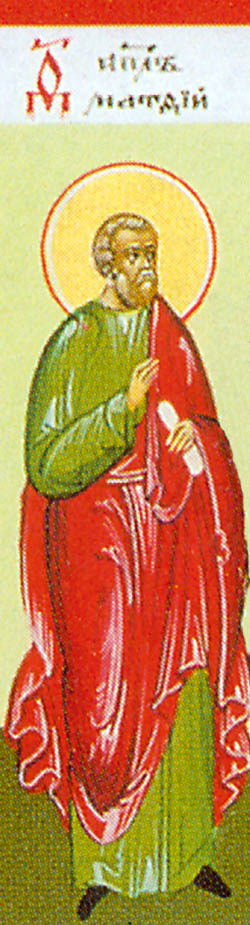
The Holy Apostle Matthias , Constantine, Patriarch of Constantinople, Euthymios the Hieromartyr, Metropolitan of Rhodes, Afterfeast of the Transfiguration of our Lord and Savior Jesus Christ, Anthony the Martyr of Alexandria

ACTS OF THE APOSTLES 1:12-17, 21-26

In those days, the apostles returned to Jerusalem from the mount called Olivet, which is near Jerusalem, a sabbath day's journey away; and when they had entered, they went up to the upper room, where they were staying, Peter and John and James and Andrew, Philip and Thomas, Bartholomew and Matthew, James the son of Alphaios and Simon the Zealot and Judas the son of James. All these with one accord devoted themselves to prayer, together with the women and Mary the mother of Jesus, and with his brothers.
In those days Peter stood up among the brethren (the company of persons was in all about a hundred and twenty), and said, "Brethren, the scripture had to be fulfilled, which the Holy Spirit spoke beforehand by the mouth of David, concerning Judas who was guide to those who arrested Jesus. For he was numbered among us, and was allotted his share in this ministry. "So one of the men who have accompanied us during all the time that the Lord Jesus went in and out among us, beginning from the baptism of John until the day when he was taken up from us — one of these men must become with us a witness to his resurrection.
And they put forward two, Joseph called Barsabbas, who was surnamed Justos, and Matthias. And they prayed and said, "Lord, who knowest the hearts of all men, show which one of these two thou hast chosen to take the place in this ministry and apostleship from which Judas turned aside, to go to his own place." And they cast lots for them, and the lot fell on Matthias; and he was enrolled with the eleven apostles.

MATTHEW 15:32-39

At that time, Jesus called his disciples to him and said, "I have compassion on the crowd, because they have been with me now three days, and have nothing to eat; and I am unwilling to send them away hungry, lest they faint on the way." And the disciples said to him, "Where are we to get bread enough in the desert to feed so great a crowd?" And Jesus said to them, "How many loaves have you?" They said, "Seven, and a few small fish." And commanding the crowd to sit down on the ground, he took the seven loaves and the fish, and having given thanks he broke them and gave them to the disciples, and the disciples gave them to the crowds. And they all ate and were satisfied; and they took up seven baskets full of the broken pieces left over. Those who ate were four thousand men, besides women and children. And sending away the crowds, he got into the boat and went to the region of Magadan.

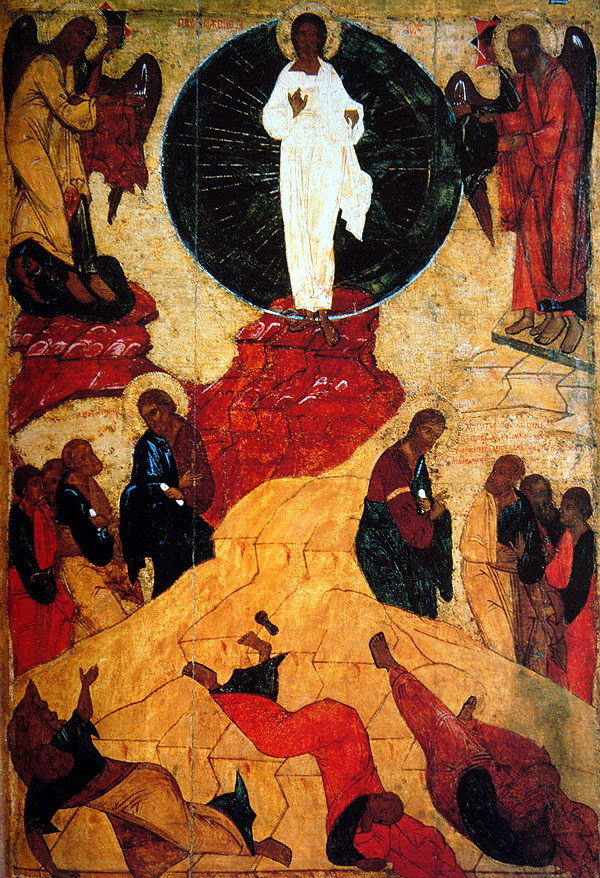
Afterfeast of the Transfiguration of our Lord

The Church’s hymns today invite us to “ascend the holy mountain” and “with the eyes of faith,” to “behold the radiant Transfiguration of the Lord.” Christ has transformed our fallen human nature and restored its original beauty “by the burning radiance of His divinity.”

Glorification of Venerable Herman of Alaska, Wonderworker of All America
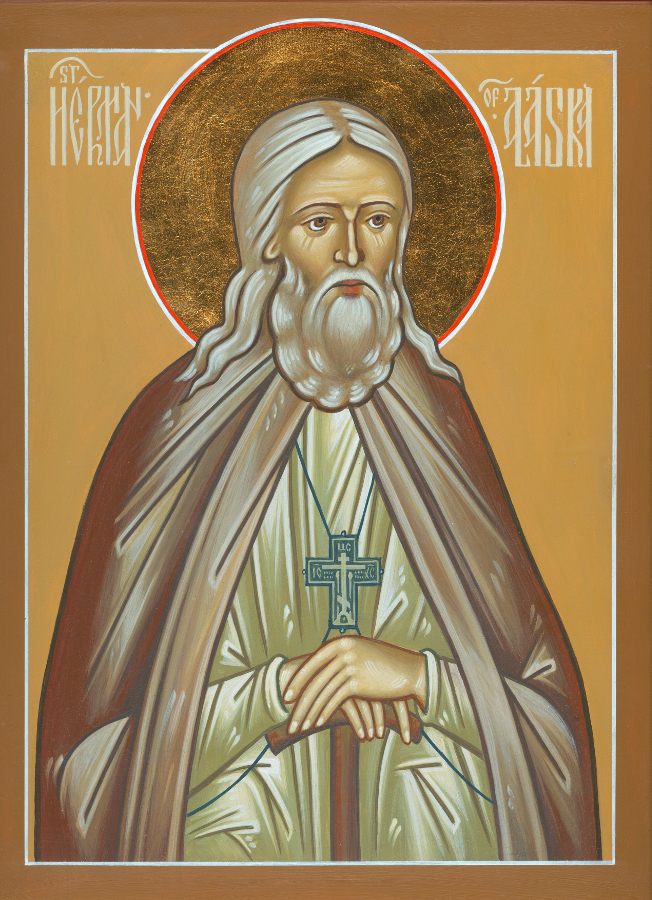
A spiritual mission was organized in 1793, made up of monks of the Valaam Monastery. They were sent to preach the Word of God to the native inhabitants of northwestern America, who only ten years before had come under the sovereignty of Russia. Saint Herman was among the members of this Mission.

Saint Herman came from a family of merchants of Serpukhov, a city of the Moscow Diocese. His name before he was tonsured, and his family name are not known. (The monastic name is given when a monk takes his vows). He had a great zeal for piety from youth, and at sixteen he entered monastic life. (This was in 1772, if we assume that Herman was born in 1756, although sometimes 1760 is given as the date of his birth.) First he entered the Trinity-Sergius Hermitage which was located near the Gulf of Finland on the Peterhof Road, about 15 versts (about 10 miles) from Saint Petersburg.

Miraculous Healing

At the Saint Sergius Hermitage there occurred the following incident to Father Herman. On the right side of his throat under his chin there appeared an abscess. The swelling grew rapidly, disfiguring his face. It became difficult for him to swallow, and the odor was unbearable. In this critical condition Father Herman awaited death. He did not appeal to a physician of this world, but locking his cell he fell before an icon of the Mother of God. With fervent tears he prayed, asking of Her that he might be healed. He prayed the whole night. Then he took a wet towel and with it wiped the face of the Most Holy Mother, and with this towel he covered the swelling. He continued to pray with tears until he fell asleep from sheer exhaustion on the floor. In a dream he saw the Virgin Mary healing him.

When Herman awoke in the morning, he found to his great surprise that he was fully healed. The swelling had disappeared, even though the abscess had not broken through, leaving behind but a small mark as though a reminder of the miracle. Physicians to whom this healing was described did not believe it, arguing that it was necessary for the abscess to have either broken through of its own accord or to have been cut open. But the words of the physicians were the words of human experience, for where the grace of God operates there the order of nature is overcome. Such occurrences humble human reason under the strong hand of God’s Mercy.

Life at Valaam

For five or six years Father Herman continued to live in the Saint Sergius Hermitage, and then he transferred to the Valaam Monastery, which was widely scattered on the large islands in the waters of the great Lake Ladoga. He came to love the Valaam haven with all his soul, as he came to love its unforgettable Superior, the pious Elder Nazarius, and all the brethren. He wrote to Father Nazarius later from America, “Your fatherly goodness to me, humble one, will be erased out of my heart neither by the terrible, unpassable Siberian lands, nor by the dark forests. Nor will it be wiped out by the swift flow of the great rivers; nor will the awful ocean quench these feelings. In my mind I imagine my beloved Valaam, looking to it beyond the great ocean.” He praised the Elder Nazarius in his letters as, “the most reverend, and my beloved father,” and the brethren of Valaam he called, “my beloved and dearest.” The place where he lived in America, deserted Spruce Island, he called “New Valaam.” And as we can see, he always remained in spiritual contact with his spiritual homeland, for as late as 1823, that is after thirty years of his life within the borders of America, he wrote letters to the successor of Father Nazarius, the lgumen Innocent.

Father Barlaam, later lgumen of Valaam, and a contemporary of Father Herman, who accepted his tonsure from Father Nazarius, wrote thus of the life of Father Herman.

“Father Herman went through the various obediences here, and being ‘well disposed toward every thing’ was in the course of events sent to Serdobol to oversee there the work of quarrying marble. The Brothers loved Father Herman, and awaited impatiently his return to the cloisters from Serdobol. Recognizing the zeal of the young hermit the wise elder, Father Nazarius, released him to take abode in the wilderness. This wilderness was in the deep forest about a mile from the cloister: to this day this place has retained the name ‘Herman’s.’ On holy days, Father Herman returned to the monastery from the wilderness. Then it was that at Little Vespers he would stand in the choir and sing in his pleasant tenor the responses with the brethren from the Canon, ‘O Sweetest Jesus, save us sinners. Most Holy Theotokos, Save us,’ and tears would fall like hail from his eyes.”

The First Mission to America

In the second half of the 18th century the borders of Holy Russia expanded to the north. In those years Russian merchants discovered the Aleutian Islands which formed in the Pacific Ocean a chain from the eastern shores of Kamchatka to the western shores of North America. With the opening of these islands there was revealed the sacred necessity to illumine with the light of the Gospel the native inhabitants. With the blessing of the Holy Synod, Metropolitan Gabriel gave to the Elder Nazarius the task of selecting capable persons from the brethern of Valaam for this holy endeavor. Ten men were selected, and among them was Father Herman. The chosen men left Valaam for the place of their great appointment in 1793. (The members of this historical mission were: Archimandrite Joseph (Bolotoff); the hieromonks Juvenal, Macarius, Athanasius, Stephan, and Nectarius; hierodeacons Nectarius and Stephen; and the monks Joasaph and Herman.)

As a result of the holy zeal of the preachers the light of the evangelic sermon quickly poured out among the sons of Russia, and several thousand pagans accepted Christianity. A school for the education of newly-baptized children was organized, and a church was built at the place where the missionaries lived. But by the inscrutable providence of God the general progress of the mission was unsatisfactory. After five years of very productive labor, Archimandrite Joasaph, who had just been elevated to the rank of bishop, was drowned with his party. (This occurred on the Pacific Ocean between Kamchatka and the Aleutian Islands. The ship, Phoenix, one of the first sea-going ships built in Alaska, sailed from Okhotsk carrying the first Bishop for the American Mission and his party. The Phoenix was caught in one of the many storms which periodically sweep the northern Pacific, and the ship and all hands perished together with Bishop Joasaph and his party.) Before this the zealous Hieromonk Juvenal was granted the martyr’s crown. The others died one after another until in the end only Father Herman remained. The Lord permitted him to labor longer than any of his brethren in the apostolic task of enlightening the Aleutians.

The New Valaam — Spruce Island

In America, Father Herman chose as his place of habitation Spruce Island, which he called New Valaam. This island is separated by a strait about a mile and a quarter wide from Kodiak Island on which had been built a wooden monastery for the residence of the members of the mission, and a wooden church dedicated to the Resurrection of the Savior. (New Valaam was named for Valaam on Lake Ladoga, the monastery from which Father Herman came to America. It is interesting to note that Valaam is also located on an island, although, this island is in a fresh water lake, whereas, Spruce Island is on the Pacific Ocean, although near other islands and the Alaskan mainland.)

Spruce Island is not large, and is almost completely covered by a forest. Almost through its middle a small brook flows to the sea. Herman selected this picturesque island for the location of his hermitage. He dug a cave out of the ground with his own hands, and in it he lived his first full summer. For winter there was built for him a cell near the cave, in which he lived until his death. The cave was converted by him into a place for his burial. A wooden chapel, and a wooden house to be used as a schoolhouse and a guest house were built not too distant from his cell. A garden was laid out in front of his cell. For more than forty years Father Herman lived here.

Father Herman’s Way of Life

Father Herman himself spaded the garden, planted potatoes and cabbage and various vegetables in it. For winter, he preserved mushrooms, salting or drying them. The salt was obtained by him from ocean water. It is said that a wicker basket in which the Elder carried seaweed from the shore, was so large that it was difficult for one person to carry. The seaweed was used for fertilizing the soil. But to the astonishment of all, Father Herman carried a basket filled with seaweed for a long distance without any help at all. By chance his disciple, Gerasim, saw him one winter night carrying a large log which normally would be carried by four men; and he was bare footed. Thus worked the Elder, and everything that he acquired as a result of his immeasurable labors was used for the feeding and clothing of orphans and also for books for his students.

His clothes were the same for winter as for summer. He did not wear a shirt; instead he wore a smock of deer skin, which he did not take off for several years at a time, nor did he change it, so that the fur in it was completely worn away, and the leather became glossy. Then there were his boots or shoes, cassock (podrasnik), an ancient and faded out cassock (riasa) full of patchwork, and his headdress (klobuk). He went everywhere in these clothes, and at all times; in the rain, in snowstorms, and during the coldest freezing weather. In this, Father Herman followed the example of many Eastern Ascetic Fathers and Monks who showed the greatest concern for the welfare and needs of others. Yet, they themselves wore the oldest possible clothes to show their great humility before God, and their detachment from worldly things.

A small bench covered with a time-worn deerskin served as Father Herman’s bed. He used two bricks for a pillow; these were hidden from visitors by a skin or a shirt. There was no blanket. Instead, he covered himself with a wooden board which lay on the stove. This board Father Herman himself called his blanket, and he willed that it be used to cover his remains; it was as long as he was tall. “During my stay in the cell of Father Herman,” writes the creole Constantine Larionov, “I, a sinner, sat on his ‘blanket’-and I consider this the acme of my fortune!” (‘creole’ is the name by which the Russians referred to the children of mixed marriages of native Indians of Alaska, Eskimo and Aleuts with Russians.)

On the occasions when Father Herman was the guest of administrators of the American Company and in the course of their soul-saving talks he sat up with them until midnight. He never spent the night with them, but regardless of the weather he always returned to his hermitage. If for some extraordinary reason it was necessary for him to spend the night away from his cell, then in the morning the bed which had been prepared for him would be found untouched; the Elder not having slept at all. The same was true in his hermitage where having spent the night in talks, he never rested.

The Elder ate very little. As a guest, he scarcely tasted the food, and remained without dinner. In his cell his dinner consisted of a very small portion of a small fish or some vegetables. His body, emaciated as a result of his labors, his vigils, and fasting, was crushed by chains which weighed about sixteen pounds. These chains are kept to this day in the chapel. Telling of these deeds of Father Herman, his disciple, the Aleut Ignaty Aligyaga, added, “Yes, Apa led a very hard life, and no one can imitate his life!” (The Aleutian word “Apa” means Elder or grandfather, and it is a name indicative of the great affection in which he was held).

Our writing of the incidents in the life of the Elder deal, so to speak, with the external aspects of his labor. “His most important works,” says the Bishop Peter, “were his exercises in spiritual endeavor in his isolated cell where no one saw him, but outside the cell they heard him singing and celebrating services to God according to the monastic rule.” This witness of the Bishop is supported by the following answers of Father Herman, himself: “How do you manage to live alone in the forest, Father Herman? Don’t you ever become lonesome?” He answered, “No I am not there alone! God is here, as God is everywhere. The Holy Angels are there. With whom is it better to talk, with people, or with Angels? Most certainly with Angels.”

Father Herman and the Native Alaskans

The way in which Father Herman looked upon the natives of America, how he understood his own relations with them, and how he was concerned for their needs he expressed himself in one of his letters to the former administrator of the colony, Simeon Yanovsky. He wrote, “Our Creator granted to our beloved homeland this land which like a newly-born babe does not yet have the strength for knowledge or understanding. It requires not only protection, because of its infantile weakness and impotence, but also his sustenance. Even for this it does not yet have the ability to make an appeal on its own behalf. And since the welfare of this nation by the Providence of God, it is not known for how long, is dependent on and has been entrusted into the hands of the Russian government which has now been given into your own power, therefore I, the most humble servant of these people, and their nurse (nyanka) stand before you in their behalf, write this petition with tears of blood. Be our Father and our Protector. Certainly we do not know how to be eloquent, so with an inarticulate infant’s tongue we say: Wipe away the tears of the defenseless orphans, cool the hearts melting away in the fire of sorrow. Help us to know what consolation means.”

The Elder acted the way he felt. He always interceded before the governors on behalf of those who had transgressed. He defended those who had been offended. He helped those who were in need with whatever means he had available. The Aleuts, men, women and children, often visited him. Some asked for advice, others complained of oppression, others sought out defense, and still others desired help. Each one received the greatest possible satisfaction from the Elder. He discussed their mutual difficulties, and he tried to settle these peacefully. He was especially concerned about reestablishing understanding in families. If he did not succeed in reconciling a husband and wife, the Elder prevailed upon them to separate temporarily. The need for such a procedure he explained thus, “it is better to let them live apart, or believe me, it can be terrible if they are not separated. There have been incidents when a husband killed his wife, or when a wife destroyed her husband.”

Father Herman especially loved children. He made large quantities of biscuits for them, and he baked cookies (krendelki) for them; and the children were fond of the Elder. Father Herman’s love for the Aleuts reached the point of self-denial.

An Epidemic Strikes

A ship from the United States brought to Sitka Island, and from there to Kodiak Island, a contagious disease, a fatal illness. It began with a fever, a heavy cold, and difficult respiration, and it ended with chills; in three days the victim died. On the island there was neither a doctor nor medicine. The illness spread rapidly through the village, and then throughout the nearby areas. The disease affected all, even infants. The fatalities were so great that for three days there was no one to dig graves, and the bodies remained unburied. An eyewitness said, “I cannot imagine anything more tragic and horrible than the sight which struck me when I visited an Aleutian ‘Kazhim’. This was a large building, or barracks, with dividing sections, in which the Aleuts lived with their families; it contained about 100 people. Here some had died, their cold bodies lay near the living; others were dying; there were groans and weeping which tore at one’s soul.”

“I saw mothers over whose bodies cold in death crawled a hungry child, crying and searching in vain for its food…My heart was bursting with compassion! It seemed that if anyone could paint with a worthy brush the full horror of this tragic scene, that he would have successfully aroused fear of death in the most embittered heart.” Father Herman, during this terrible sickness which lasted a whole month, gradually dying out towards the end, visited the sick, never tiring. He admonished them in their fear, prayed, brought them to penance, or prepared them for death. He never spared himself.

Father Herman as a Spiritual Teacher

The Elder was concerned in particular for the moral growth of the Aleuts. With this end in mind a school was built for children-the orphans of the Aleuts. He himself taught them the Law of God and church music. For this same purpose he gathered the Aleuts on Sunday and Holy Days for prayer in the chapel near his cell. Here his disciple read the Hours and the various prayers while the Elder himself read the Epistle and Gospel. He also preached to them. His students sang, and they sang very well. The Aleuts loved to hear his sermons, gathering around him in large numbers. The Elder’s talks were captivating, and his listeners were moved by their wonderous power. He himself writes of one example of the beneficial results of his words.

“Glory to the holy destinies of the Merciful God! He has shown me now through his unfathomable Providence a new occurrence which I, who have lived here for twenty years had never seen before on Kodiak,” he wrote. “Recently after Easter, a young girl about twenty years of age who knows Russian well, came to me. Having heard of the Incarnation of the Son of God and of Eternal Life, she became so inflamed with love for Jesus Christ that she does not wish to leave me. She pleaded eloquently with me. Contrary to my personal inclination and love for solitude, and despite all the hindrances and difficulties which I put forward before accepting her, she has now been living near the school for a month and is not lonesome. I, looking on this with great wonder, remembered the words of the Savior: ‘that which is hidden from the wise and learned is revealed to babes’” (Matthew 11:25).

This woman lived at the school until the death of the Elder. She watched for the good conduct of the children who studied in his school. Father Herman willed that after his death she was to continue to live on Spruce Island. Her name was Sophia Vlasova.

Yanovsky writes about the character and the eloquence of the talks of the Elder thus: “When I met Father Herman I was thirty years old. I must say that I was educated in the naval corps school; that I knew many sciences having read extensively. But to my regret, the Science of sciences, that is the Law of God, I barely remembered the externals—and these only theoretically, not applying them to life. I was a Christian in name only, but in my soul and in reality, I was a freethinker. Furthermore, I did not admit the divinity and holiness of our religion, for I had read through many atheistic works. Father Herman recognized this immediately and he desired to reconvert me. To my great surprise he spoke so convincingly, wisely—and he argued with such conviction—that it seemed to me that no learning or worldly wisdom could stand one’s ground before his words. We conversed with him daily until midnight, and even later, of God’s love, of eternity, of the salvation of souls, and of Christian living. From his lips flowed a ceaseless stream of sweet words! By these continual talks and by the prayers of the holy Elder the Lord returned me completely to the way of Truth, and I became a real Christian. I am indebted for all this to Father Herman; he is my true benefactor.

“Several years ago,” continues Yanovsky, “Father Herman converted a certain naval captain G. to Orthodoxy from the Lutheran Faith. This captain was well educated. Besides many sciences, he was well versed in languages. He knew Russian, English, German, French, Italian and also some Spanish. But for all this he could not resist the convictions and proofs of Father Herman. He changed his faith and was united to the Orthodox Church through Chrismation. When he was leaving America, the Elder said to him while they were parting, “Be on guard, if the Lord should take your wife from you then do not marry a German woman under any circumstance. If you do marry a German woman, undoubtedly she will damage your Orthodoxy.” The Captain gave his word, but he failed to keep it. The warning of the Elder was prophetic. Indeed, after several years the Captain’s wife did die, and he married a German woman. There is no doubt that his faith weakened or that he left it; for he died suddenly without penance.”

Further on Yanovsky writes, “Once the Elder was invited aboard a frigate which came from Saint Petersburg. The Captain of the frigate was a highly educated man, who had been sent to America by order of the Emperor to make an inspection of all the colonies. There were more than twenty-five officers with the Captain, and they also were educated men. In the company of this group sat a monk of a hermitage, small in stature and wearing very old clothes. All these educated conversationalists were placed in such a position by his wise talks that they did not know how to answer him. The Captain himself used to say, ‘We were lost for an answer before him.’

“Father Herman gave them all one general question: ‘Gentlemen, What do you love above all, and what will each of you wish for your happiness?’ Various answers were offered … Some desired wealth, others glory, some a beautiful wife, and still others a beautiful ship he would captain; and so forth in the same vein. ‘Is it not true,’ Father Herman said to them concerning this, ‘that all your various wishes can bring us to one conclusion—that each of you desires that which in his own understanding he considers the best, and which is most worthy of his love?’ They all answered, ‘Yes, that is so!’ He then continued, ‘Would you not say, Is not that which is best, above all, and surpassing all, and that which by preference is most worthy of love, the Very Lord, our Jesus Christ, who created us, adorned us with such ideals, gave life to all, sustains everything, nurtures and loves all, who is Himself Love and most beautiful of all men? Should we not then love God above every thing, desire Him more than anything, and search Him out?’

“All said, ‘Why, yes! That’s self-evident!’ Then the Elder asked, ‘But do you love God?’ They all answered, ‘Certainly, we love God. How can we not love God?’ ‘And I a sinner have been trying for more than forty years to love God, I cannot say that I love Him completely,’ Father Herman protested to them. He then began to demonstrate to them the way in which we should love God. ‘If we love someone,’ he said, ‘we always remember them; we try to please them. Day and night our heart is concerned with the subject. Is that the way you gentlemen love God? Do you turn to Him often? Do you always remember Him? Do you always pray to Him and fulfill His holy commandments?’ They had to admit that they had not! ‘For our own good, and for our own fortune,’ concluded the Elder, ‘let us at least promise ourselves that from this very minute we will try to love God more than anything and to fulfill His Holy Will!’ Without any doubt this conversation was imprinted in the hearts of the listeners for the rest of their lives.’

“In general, Father Herman liked to talk of eternity, of salvation of the future life, of our destinies under God. He often talked on the lives of the Saints, on the Prologue, but he never spoke about anything frivolous. It was so pleasant to hear him that those who conversed with him, the Aleuts and their wives, were so captivated by his talks that often they did not leave him until dawn, and then they left him with reluctance;” thus witnesses the Creole, Constantine Larionov.

A Description of Father Herman

Yanovsky writes a detailed description of Father Herman. “I have a vivid memory,” he said, “Of all the features of the Elder’s face reflecting goodness; his pleasant smile, his meek and attractive mien, his humble and quiet behavior, and his gracious word. He was short of stature. His face was pale and covered with wrinkles. His eyes were greyish-blue, full of sparkle, and on his head there were a few gray hairs. His voice was not powerful, but it was very pleasant.” Yanovsky relates two incidents from his conversations with the Elder. “Once,” he writes, “I read to Father Herman the ode, ‘God,’ by Derzhavin. The Elder was surprised, and entranced. He asked me to read it again. I read it once more, “Is it possible that a simple, educated man wrote this?” he asked. “Yes, a learned poet,” I answered. “This has been written under God’s inspiration,” said the Elder.

The Martyrdom of Peter

“On another occasion I was relating to him how the Spanish in California had imprisoned fourteen Aleuts, and how the Jesuits were forcing all of them to accept the Catholic Faith. But this Aleut would not agree under any circumstances, saying, ‘We are Christians.’ The Jesuits protested, ‘That’s not true; you are heretics and schismatics. If you do not agree to accept our faith then we will torture all of you.’ Then the Aleuts were placed in cells until evening; two to a cell. At night the Jesuits came to the prison with lanterns and lighted candles. They began to persuade the Aleuts in the cell once again to accept the Catholic Faith. ‘We are Christians,’ was the answer of the Aleuts, ‘and we will not change our Faith.’ Then the Jesuits began to torture them, at first the one while his companion was the witness. They cut the toes off his feet, first one joint and then the other joint. And then they cut the first joint on the fingers of the hands, and then the other joint. Afterwards they cut off his feet, and his hands; the blood flowed. The martyr endured all and steadfastly insisted on one thing: ’I am a Christian.’ In such suffering, he bled to death. The Jesuit promised to torture to death his comrades also on the next day…. But that night an order was received from Monterey stating that the imprisoned Aleuts were to be released immediately, and sent there under escort. Therefore, in the morning all were dispatched to Monterey with the exception of the martyred Aleut. This was related to me by a witness, the same Aleut who was the comrade of the tortured Aleut. Afterwards he escaped from imprisonment, and I reported this incident to the supreme authorities in Saint Petersburg. When I finished my story, Father Herman asked, ‘And how did they call the martyred Aleut?’ I answered, ‘Peter; I do not remember his family name.’ The Elder stood up before an icon reverently, made the sign of the Cross and pronounced, ’Holy newly-martyred Peter, pray to God for us!’”

The Spirit of Father Herman’s Teaching

In order to express the spirit of Father Herman’s teaching, we present here a quotation from a letter that was written by his own hand.

“The empty years of these desires separate us from our heavenly homeland, and our Love for these desires and our habits clothe us, as it were, in an odious dress; it is called by the Apostle ‘the external (earthy) man’ (1 Corinthians 15:47). We who are wanderers in the journey of this life call to God for aid. We must divest ourselves of this repulsiveness, and put on new desires, and a new love for the coming age. Thus, through this we will know either an attraction or a repulsion for the heavenly homeland. It is possible to do this quickly, but we must follow the example of the sick, who wishing for desired health, do not stop searching for means of curing themselves. But I am not speaking clearly.”

Not desiring anything for himself in life, when he first came to America, he refused in his humility the dignity of hieromonk and archimandrite, deciding to remain forever a common monk, Father Herman, without the least fear before the powerful, strove with all sincerity for God. With gentle love, and disregarding the person, he criticized many for intemperate living, for unworthy behavior, and for oppressing the Aleuts. Evil armed itself against him and gave him all sorts of trouble and sorrow. But God protected the Elder. The Administrator of the Colony, Yanovsky, not having yet seen Father Herman, after receiving one of those complaints, had already written to Saint Petersburg of the necessity of his removal. He explained that it seemed that he was arousing the Aleuts against the administration. But this accusation turned out to be unjust, and in the end Yanovsky was numbered among the admirers of Father Herman.

Once an inspector came to Spruce Island with the Administrator of the Colony and with company employees to search through Father Herman’s cell. This party expected to find property of great value in Father Herman’s cell. But when they found nothing of value, an employee of the American Company, Ponomarkhov, began to tear up the floor with an axe, undoubtedly with the consent of his seniors. Then Father Herman said to him, “My friend, you have lifted the axe in vain; this weapon shall deprive you of your life.” Some time later people were needed at Fort Nicholas, and for that reason several Russian employees were sent there from Kodiak; among them was Ponomarkhov; there the natives of Kenai cut off his head while he slept.

The Temptations of Father Herman

Many great sorrows were borne by Father Herman from evil spirits. He himself revealed this to his disciple, Gerasim. Once when he entered Father Herman’s cell without the usual prayer he received no answer from Father Herman to any of his questions. The next day Gerasim asked him the reason for his silence. On that occasion Father Herman said to him, “When I came to this island and settled in this hermitage the evil spirits approached me ostensibly to be helpful. They came in the form of a man, and in the form of animals. I suffered much from them; from various afflictions and temptations. And that is why I do not speak now to anyone who enters into my presence without prayer.” (It is customary among devout laymen, as well as clergy, to say out loud a prayer, and upon hearing a response ending with Amen, to enter and go to the icon in the room to reverence it, and to say a prayer before greeting the host).

Supernatural Gifts from God

Herman dedicated himself fully for the Lord’s service; he strove with zeal solely for the glorification of His Most Holy Name. Far from his homeland in the midst of a variety of afflictions and privations Father Herman spent several decades performing the noblest deeds of self-sacrifice. He was privileged to receive many supernatural gifts from God.

In the midst of Spruce Island down the hill flows a little stream into the sea. The mouth of this stream was always swept by surf. In the spring when the brook fish appeared the Elder raked away some of the sand at its mouth so that the fish could enter, and at their first appearance they rushed up the stream. His disciple, lgnaty, said, “it was so that if ‘Apa’ would tell me, I would go and get fish in the stream!” Father Herman fed the birds with dried fish, and they would gather in great numbers around his cell. Underneath his cell there lived an ermine. This little animal can not be approached when it has had its young, but the Elder fed it from his own hand. “Was not this a miracle that we had seen?” said his disciple, Ignaty. They also saw Father Herman feeding bears. But when Father Herman died the birds and animals left; even the garden would not give any sort of crops even though someone had willingly taken care of it, Ignaty insisted.

On Spruce Island there once occurred a flood. The inhabitants came to the Elder in great fear. Father Herman then took an icon of the Mother of God from the home where his students lived, and placed it on a “laida” (a sandy bank) and began to pray. After his prayer he turned to those present and said,“Have no fear, the water will not go any higher than the place where this holy icon stands.” The words of the Elder were fulfilled. After this he promised the same aid from this holy icon in the future, through the intercessions of the Mother of God. He entrusted the icon to his disciple Sophia; in case of future floods the icon was to be placed on the “laida.” This icon is preserved on the island to this day.

At the request of the Elder, Baron F. P. Wrangel wrote a letter to a Metropolitan (his name is not known) which was dictated by Father Herman. When the letter was completed and read, the Elder congratulated the Baron upon his attaining the rank of admiral. The Baron was taken aback. This was news to him. It was confirmed, but only after an elapse of some time, and just before he departed for Saint Petersburg.

Father Herman said to the administrator Kashevarov, from whom he accepted his son from the font (during the Sacrament of Baptism), “I am sorry for you, my dear ‘kum.’ It’s a shame; the change will be unpleasant for you.” In two years, during a change of administration, Kashevarov was sent to Sitka in chains.

Once, the forest on Spruce Island caught fire. The Elder, with his disciple Ignaty, in a thicket of the forest made a belt about a yard wide in which they turned over the moss. They extended it to the foot of the hill. The Elder said, “Rest assured, the fire will not pass this line.” On the next day, according to the testimony of Ignaty, there was no hope of salvation (from the fire) and the fire, pushed by a strong wind, reached the place where the moss had been turned over by the Elder. The fire ran over the moss and halted, leaving untouched the thick forest which was beyond the line.

The Elder often said that there would be a Bishop for America; this at a time when no one even thought of it, and there was no hope that there would be a Bishop for America. This was related by Bishop Peter, and his prophecy was fulfilled in time.

“After my death,” said Father Herman, “there will be an epidemic, many people shall die during it, and the Russians shall unite the Aleuts.” And so it happened. It seems that about a half a year after his passing, there was a smallpox epidemic; the death rate in America during the epidemic was tremendous. In some villages, only a few inhabitants remained alive. This led the administration of the colony to unite the Aleuts; the twelve settlements were consolidated into seven.

“Although a long time shall elapse after my death, I will not be forgotten” said Father Herman to his disciples. “My place of habitation will not remain empty. A monk like me, who will be escaping from the glory of men, will come and he will live on Spruce Island, and Spruce Island will not be without people.” (This prophecy has now been fulfilled in its entirety. Just such a monk as Father Herman described lived on Spruce Island for many years; his name was Archimandrite Gerasim, who died on October 13, 1969. This monk took on himself the responsibility of taking care of the Chapel under which the Elder Herman was first buried. Metropolitan Leonty, soon after his elevation to the primacy of the Russian Orthodox Church in America, made a pilgrimage to Spruce Island, and the grave of Saint Herman.)

Prophecies for the Future

The Creole Constantine, when he was not more than twelve years old, was asked by Father Herman, “My beloved one, what do you think; this chapel which they are building now, will it ever stand empty?” The youngster answered, “I do not know, Apa.” “Indeed,” said Constantine, “I did not understand his question at that time, even though the whole conversation with the Elder remains vivid in my memory.” The Elder remained silent for some time, and then said, “My child, remember, in time there will be a monastery in this place.”

Father Herman said to his disciple the Aleut Ignaty Aligyaga, “Thirty years shall pass after my death, and all those living on Spruce Island will have died, but you alone will remain alive. You will be old and poor when I will be remembered.” And indeed after the death of Father Herman thirty years passed when they were reminded of him, and they began to gather information and facts about him, on the basis of which his Life was written. “It is amazing,” exclaims Ignaty, “how a man like us could know all this so long before it happened! However, no, he was no ordinary man! He knew our thoughts, and involuntarily he led us to the point where we revealed them to him, and we received counsel from him.”

“When I die,” the Elder said to his disciple, “you will bury me alongside Father Joasaph. You will bury me by yourself, for you will not wait for the priest. Do not wash my body. Lay it on a board. Clasp my hands over my chest, wrap me in my mantia (the monk’s outer cloak), and with its wings cover my face and place the klobuk (monastic head covering) on my head. If anyone wishes to bid farewell to me, let them kiss the Cross. Do not show my face to anyone….”

The Repose of Father Herman

The time of the Elder’s passing had come. One day he ordered his disciple Gerasim to light a candle before the Icons, and to read the Acts of the Holy Apostles. After some time his face glowed brightly and he said in a loud voice, “Glory to Thee, O Lord!” He then ordered the reading to be halted, and he announced that the Lord had willed that his life would now be spared for another week. A week later, again by his orders, candles were lit, and the Acts of the Holy Apostles were read. Quietly, the Elder bowed his head on Gerasim’s chest; the cell was filled with a sweet-smelling odor; and his face glowed, and Father Herman was no more! Thus he died in blessedness, he passed away in the sleep of a righteous man in the eighty-first year of his life of great labor the 25th day of December 1837. (It was the 13th of December according to the Julian Calendar, although there are some records which state that he died on November 28th and was buried on December 26th).

Those sent with the sad news to the harbor returned to announce that the administrator of the colony Kashevarov had forbidden the burial of the Elder until his own arrival. He also ordered that a finer coffin be made for Father Herman, and that he would come as soon as possible and would bring a priest with him. But then a great wind came up, a rain fell, and a terrible storm broke. The distance from the harbor to Spruce Island is not great—about a two hour journey—but no one would agree to go to sea in such weather. Thus it continued for a full month, and although the body lay in state for a full month in the warm house of his students, his face did not undergo any change at all, and not the slightest odor emanated from his body. Finally, through the efforts of Kuzma Uchilischev, a coffin was obtained. No one arrived from the harbor, and the inhabitants of Spruce Island alone buried the remains of the Elder in the ground. Thus the words which Father Herman uttered before his death were fulfilled. After this the wind quieted down, and the surface of the sea became as smooth as a mirror.

One evening, above the village Katani (on Afognak) an unusual pillar of light which reached up to heaven was seen above Spruce Island. Astonished by the miraculous appearance, experienced elders and the Creole Gerasim Vologdin and his wife Anna said, “It seems that Father Herman has left us,” and they began to pray. After a time, they were informed that the Elder had indeed passed away that very night. This same pillar was seen in various places by others. On the night of his death a vision was seen in another of the settlements on Afognak; it seemed as though a man was rising from Spruce Island into the clouds.

The disciples buried their father, and placed a wooden memorial marker above his grave. Father Peter Kashevarov, the priest on Kodiak, says, “I saw it myself, and I can say that today it seems as though it had never been touched by time; as though it had been cut this day.”

Having witnessed the life of Father Herman glorified by his zealous labors, having seen his miracles, and the fulfillment of his predictions, finally having observed his blessed falling asleep, “in general, all the local inhabitants,” Bishop Peter witnesses, “have the highest esteem for him, as though he was a holy ascetic, and they are fully convinced that he has found favor in the presence of God.”

In 1842, five years after the passing away of the Elder, Archbishop Innocent of Kamchatka and the Aleutians, was near Kodiak on a sailing vessel which was in great distress. He looked to Spruce Island, and said to himself, “If you have found favor in God’s presence, Father Herman, then may the wind change.” It seems as though not more than fifteen minutes had passed, said the bishop, when the wind became favorable, and he successfully reached the shore. In thanksgiving for being saved, Archbishop Innocent himself conducted a Memorial Service (Panikhida) over the grave of the blessed Father Herman.

O Holy Father Herman of Alaska, pray unto God for us!

Select Related Resources

Apostle Matthias of the Seventy

The Holy Apostle Matthias was born at Bethlehem of the Tribe of Judah. From his early childhood he studied the Law of God under the guidance of Saint Simeon the God-Receiver (February 3).

When the Lord Jesus Christ revealed Himself to the world, Saint Matthias believed in Him as the Messiah, followed constantly after Him and was numbered among the Seventy Apostles, whom the Lord “sent them two by two before His face” (Luke 10:1).

After the Ascension of the Savior, Saint Matthias was chosen by lot to replace Judas Iscariot as one of the Twelve Apostles (Acts 1:15-26). After the Descent of the Holy Spirit, the Apostle Matthias preached the Gospel at Jerusalem and in Judea together with the other Apostles (Acts 6:2, 8:14). From Jerusalem he went with the Apostles Peter and Andrew to Syrian Antioch, and was in the Cappadocian city of Tianum and Sinope. Here the Apostle Matthias was locked into prison, from which he was miraculously freed by Saint Andrew the First-Called.

The Apostle Matthias journeyed after this to Amasea, a city on the shore of the sea. During a three year journey of the Apostle Andrew, Saint Matthias was with him at Edessa and Sebaste. According to Church Tradition, he was preaching at Pontine Ethiopia (presently Western Georgia) and Macedonia. He was frequently subjected to deadly peril, but the Lord preserved him to preach the Gospel.

Once, pagans forced the saint to drink a poison potion. He drank it, and not only did he himself remain unharmed, but he also healed other prisoners who had been blinded by the potion. When Saint Matthias left the prison, the pagans searched for him in vain, for he had become invisible to them. Another time, when the pagans had become enraged intending to kill the Apostle, the earth opened up and engulfed them.

The Apostle Matthias returned to Judea and did not cease to enlighten his countrymen with the light of Christ’s teachings. He worked great miracles in the Name of the Lord Jesus and he converted a great many to faith in Christ.

The Jewish High Priest Ananias hated Christ and earlier had commanded the Apostle James, Brother of the Lord, to be flung down from the heights of the Temple, and now he ordered that the Apostle Matthias be arrested and brought for judgment before the Sanhedrin at Jerusalem.

The impious Ananias uttered a speech in which he blasphemously slandered the Lord. Using the prophecies of the Old Testament, the Apostle Matthias demonstrated that Jesus Christ is the True God, the promised Messiah, the Son of God, Consubstantial and Coeternal with God the Father. After these words the Apostle Matthias was sentenced to death by the Sanhedrin and stoned.

When Saint Matthias was already dead, the Jews, to hide their malefaction, cut off his head as an enemy of Caesar. (According to several historians, the Apostle Matthias was crucified, and indicate that he instead died at Colchis.) The Apostle Matthias received the martyr’s crown of glory in the year 63.

Martyr Anthony of Alexandria

The Martyr Anthony, a native of the city of Alexandria, was a Christian. For his confession of faith they tied him to a tree and tore at his body with iron hooks, and then sentenced him to burning. Standing in the fire, he calmly exhorted those standing about to toil not for the body but for the soul in aspiring towards God. After the fire flared up, the body of the saint remained unharmed. The time of his death is unknown.

Venerable Psoi of Egypt

Saint Psoi was the disciple of Saint Pachomios the Great (May 15), and lived during the IV century in the desert of Skḗtis (Σκήτις), also known as Wadi El-Natroun.

Saint Psoi was born in the Egyptian village of Shansa early in the IV century, and his father died when the boy was young. He had been raised in the spirit of Christian piety, and he was inflamed with a desire to devote his life to God. One night, the mother of the future monk beheld an Angel in a dream, who told her that God wanted one of her sons to serve Him. The woman had seven sons, so she told the Angel to choose whichever one he wished. The Angel pointed to her youngest son, Psoi. She protested that he was too weak, and asked the Angel to select one of her stronger sons, who would be able to serve God better. The Angel replied, "The power of God is made perfect in weakness" (2 Corinthians 12:9).

When Psoi grew to adulthood, he retired into the desert. At first, he settled by the cave of Abba John of Egypt, who later blessed him to go to the Nitrian desert. There Saint Psoi lived in a cave 15 km from the cell of Saint Makarios the Great (January 19). Soon his fame spread among those who were eager for salvation. People began coming to Psoi from various places, wishing to be instructed by him. Among these was Saint Ephraim the Syrian (January 28), from whose staff, according to Tradition, a tamarind tree grew, and which still grows at the monastery.
However, some researchers deny that Saints Psoi and Ephraim the Syrian ever met.1

When there were many disciples and a monastery, Saint Psoi retired to a deserted place, where now there is a monastery bearing his name. According to Tradition, he was found worthy of beholding Christ several times in his life.

Saint Psoi met all the travelers who came to the monastery, and washed their feet. Once, on the feet of a certain stranger, he saw some wounds made by nails. "I think I know you," Psoi said. The traveler disappeared, and then an Angel declared to Psoi that it was Christ. In gratitude for His mercy, the Saint drank the water that washed the Savior's feet.

Saint Psoi is also called the beloved of Christ. One day, his disciples began to ask him if they could meet Christ, too. He prayed and a voice from above called them to climb the mountain together. On the way they met an old cripple, who, when he learned where they were going, asked to go with them. The disciples refused to take the old man. Saint Psoi was behind them, so the old man made the same request to him. The venerable one took pity on the cripple and carried him on his shoulders. Soon Saint Psoi became exhausted and fell far behind the disciples.

"You know," he said to the cripple, "you are getting heavier and heavier. I don't understand why this is happening."

Suddenly, he noticed that the old man's feet had the imprint of nails. Psoi said, "I think I've washed your feet before!"

The cripple disappeared, and when Saint Psois finally reached the top, he found his disciples there.

"Where have you been? Where is Christ?" they asked.

He answered, "It is not necessary to seek Him on the mountain, but in one's neighbor."

Saint Psoi reposed in the year 417, while he was praying. His relics are incorrupt and rest in the monastery of Al-Sirian in the V century church, on the left side of the iconostasis. His body has been preserved completely incorrupt, just as it was in his lifetime.


1 Sebastian P. Brock, in his book Singer of the Word of God: Ephrem the Syrian and His Significance in Late Antiquity, states that Saint Ephraim lived east of the Euphrates River in the second and third quarters of the IV century, and that he never visited Saint Basil, or Saint Psoi.

Martyr Julian of Constantinople and those with him
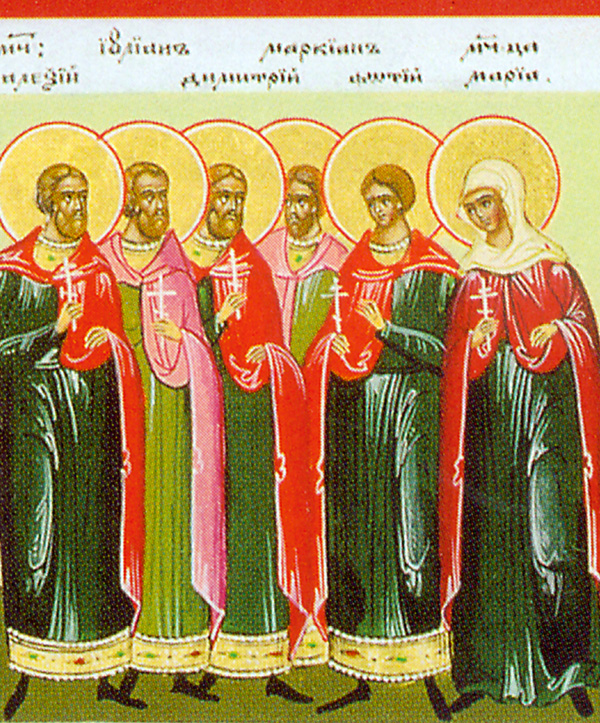
The Martyrs Julian, Marcian, John, James, Alexius, Demetrius, Photius, Peter, Leontius, Maria the Patrician, the Protospatharios (“Sword-Captain”) Gregory and Others suffered for holy icons in the year 730 under the Iconoclast emperor Leo the Isaurian (717-741). The emperor deposed the holy Patriarch Germanus (715-730) from the patriarchal throne and sent him off to prison, raising up onto the patriarchal throne the iconoclast Athanasius (730-753).

By decree of the emperor, all icons were to be confiscated from homes and churches and then destroyed. At Constantinople from the time of the holy Emperor Constantine the Great (324-337) there was over the so-called “Copper Gates” a wonderworking icon of the Savior, made of copper.

The emperor and heretical Patriarch Anastasius gave orders to seize this icon. The gathered crowd became outraged at this sacrilege. In the crowd was the Patrician Maria, a woman of illustrious family, who with many others rushed to the ladder and pulled it from the wall to keep the soldier from touching the icon. The ladder came down, and the soldier standing on it fell to his death. This occurred on January 19, 730. The Protospatherios (“Sword-Captain”) Gregory and the nun Saint Theodosia (May 29) also took part in the defense of the icon.

Learning of this, the emperor executed a multitude of the faithful, the names of whom are known only to the Lord. The Protospatherios Gregory also received a martyr’s death. Some of the Orthodox are known, however: Julian, Marcian, John, James, Alexius, Demetrius, Leontius, Photius and Peter, who were locked up in prison and kept there for about eight months, each day receiving 500 blows. In these torments they remained alive by the power of Christ and bravely endured their sufferings.

By order of the emperor they were burned with a red-hot iron and their heads cut off. Saint Maria the Patrician, who had not been locked up in prison, learning about the executions, voluntarily accepted a martyr’s death. The bodies of the martyrs were buried in a coastal area near the church of the holy Martyr Theodore, and were discovered incorrupt 139 years later.

Synaxis of the Saints of Solovki Monastery
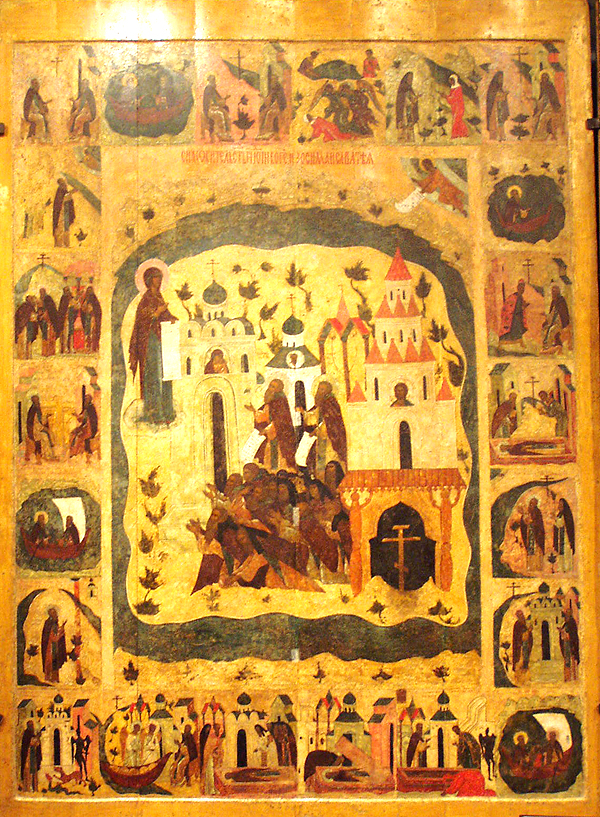
No information available at this time.

Saint Macarius of Oredezhsk

Venerable Makarios of Oredezh was a disciple of Saint Alexander of Svir (+ August 30, 1533). He contested on the Oredezha River near Lake Ladoga, where he founded a Monastery. He reposed in 1532.

Saint Makarios is commemorated at the Synaxis of the Karelian Saints (the Saturday between October 31 and November 6); and also at the Synaxis of the Novgorod and St. Petersburg Saints (the third Sunday after Pentecost).

Restoration of the Temple of the 40 Martyrs

The Restoration of the Temple of the 40 Martyrs (March 9) is celebrated on this day. There were two churches dedicated to them at Constantinople: one, built by the emperor Anastasius I (491-518), and the other, by the emperor Tiberius (578-582). There is a service for this Feastday in a Greek Menaion of the thirteenth century.

Holy New Martyr Ignatius (Bazyluk)

The holy New Martyr Ignatius (Bazyluk) was born in Poland sometime in 1860s, and received the name Jacob at his Baptism. Very little is known of his early life or where he was born, but in the period between the First and the Second World Wars he was a monk at Saint Onuphrios Monastery in Jabłeczna. At his tonsure he received the monastic name Ignatius.

Father Ignatius was one of the oldest monks in the monastery, and he fulfilled the obedience of ringing the bells for church services.

In September of 1939, the monastery buildings were occupied by German soldiers, and they confiscated the monastery’s food supplies and livestock. In spite of this, the monks did not close the monastery, but wrote a letter of protest to the commander of the occupying army. This no effect whatsoever upon the Germans.

On the night of August 9-10, 1942 the guards set fire to the monastery, destroying the inner section. The monks fled from the buildings and gathered in the courtyard. The Germans would not allow the fire to be put out, and they threatened to shoot the monks.

A few of the monks were able to escape, but Saint Ignatius ran to the bell tower and began ringing the bell to warn the residents of the area of the danger. He was attacked and beaten to death by some of the soldiers.

Residents of Jabłeczna arrived at the monastery to help, and they were also detained. The Germans forced the monks to dig graves, and then they shot everyone in the courtyard. There were no survivors. Saint Ignatius was buried in the monastery cemetery, but his holy relics were later transferred to the Saint Alexander Nevsky Cathedral.

Saint Ignatius is regarded as one of the martyrs of Chelm and Podlasie. He is commemorated on August 9, the date of his martyrdom, and on March 20, the date of his glorification by the Orthodox Church of Poland in 2003.

Hieromartyr Euthymios of Rhodes

The glorious Hieromartyr Euthymios was elected as the Metropolitan of Rhodes, when the Ottomans occupied the island in 1523. During those difficult years, Saint Euthymios shepherded his flock in a God-pleasing manner. In 1529, he was arrested as the leader of a conspiracy against the Turks and was impaled on a stake along with other clergymen and leading citizens of Rhodes.

Metropolitan Euthymios was honored as a martyr by the Christians immediately after his death. The Latin Missionary Peter Fangonis, Vicar General of the Latin Archbishop Alfonso Gonzaga, states in his report to the Roman Catholic Congregation for the Propagation of the Faith that the tomb of the blessed Euthymios had become the most prominent site of pilgrimage on Rhodes, and that those who went there suffering from the quaternary fever "malaria," and the chills and fever that went with it, were healed.

Daily Readings for Friday, August 08, 2025

9TH FRIDAY AFTER PENTECOST

ABSTAIN FROM MEAT, FISH, DAIRY, EGGS, WINE, OLIVE OIL

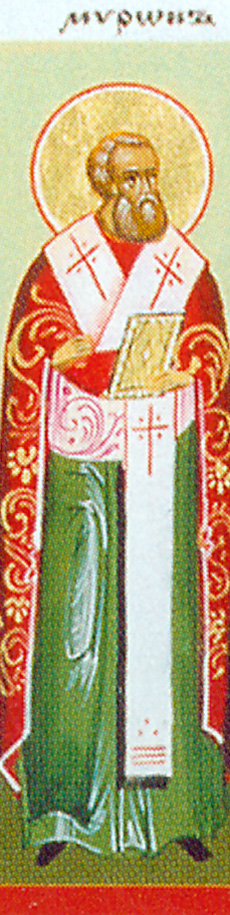
Emilian the Confessor & Bishop of Cyzikos, Our Holy Father Myronus the Wonderworker, Bishop of Crete, Holy New Martyrs Triantaphillus of Zagoras and Anastasius of Thessolonica, Gregory of Sinai and Mount Athos, Kallinikos, Metropolitan of Edessa and Pella, Afterfeast of the Transfiguration of our Lord and Savior Jesus Christ, Anastatios the Martyr from Bulgaria

ST. PAUL’S FIRST LETTER TO THE CORINTHIANS 14:26-40

BRETHREN, when you come together, each one has a hymn, a lesson, a revelation, a tongue, or an interpretation. Let all things be done for edification. If any speak in a tongue, let there be only two or at most three, and each in turn; and let one interpret. But if there is no one to interpret, let each one of them keep silence in church and speak to himself and to God. Let two or three prophets speak, and let the others weigh what is said. If a revelation is made to another by sitting by, let the first be silent. For you can all prophesy one by one, so that all may learn and all be encouraged; and the spirits of prophets are subject to prophets. But God is not a God of confusion but of peace. As in all the churches of the saints, the women should keep silence in the churches. For they are not permitted to speak, but should be subordinate, as even the law says. If there is anything they desire to know, let them ask their husbands at home. For it is shameful for a woman to speak in church. What! Did the word of God originate with you, or are you the only one it has reached? If any one thinks that he is a prophet, or spiritual, he should acknowledge that what I am writing to you is a command of the Lord. If any one does not recognize this, he is not recognized. So, my brethren, earnestly desire to prophesy, and do not forbid speaking in tongues; but all things should be done decently and in order.

MATTHEW 21:12-14; 17-20

At that time, Jesus entered the temple of God and drove out all who sold and bought in the temple, and he overturned the tables of the moneychangers and the seats of those who sold pigeons. He said to them, "It is written, 'My house shall be called a house of prayer'; but you make it a den of robbers." And the blind and the lame came to him in the temple, and he healed them. And leaving them, he went out of the city to Bethany and lodged there.
In the morning, as he was returning to the city, he was hungry. And seeing a fig tree by the wayside he went to it, and found nothing on it but leaves only. And he said to it, "May no fruit ever come from you again!" And the fig tree withered at once. When the disciples saw it they marveled, saying, "How did the fig tree wither at once?

Afterfeast of the Transfiguration of our Lord

The hymns at Vespers today speak of the sun appearing dim compared to the divine light of the Transfiguration. In His compassion for humanity, Christ took on mortal flesh, yet Peter, James and John saw the radiance of His glory. The incarnate Lord “made Adam’s darkened image to shine again” when He appeared on earth “arrayed in the original beauty of the Image (Genesis 1:26).

Holy Confessor Emilian, Bishop of Kyzikos

The Holy Confessor Emilian (Amilianos), the Bishop of Kyzikos, succeeded Bishop Nicholas, and remained in his See from 787 – 815. Saint Emilian suffered many afflictions and sorrows during the reign of the Iconoclast Emperor Leo the Armenian (813-820). He and other bishops were summoned to the Emperor's tribunal, and Leo ordered the bishops to refrain from teaching their flocks to venerate the Holy Icons. Saint Emilian told the Emperor that the question of venerating icons ought to be discussed and decided only within the Church, by its spiritual leaders, and not at the imperial court. During this time he continued to strengthen his flock by his own example and his unwavering confession of the true Faith.

In the year 815 the Hierarch was banished for five years, enduring much pain and humiliation for the sake of Christ. Saint Emilian went to the Lord in the year 820, and received an unfading crown of glory for his defense of the Holy Icons.

Venerable Gregory the Iconographer of the Kiev Near Caves

Saint Gregory, Iconographer of the Caves, was a colleague of Saint Alypius of the Caves (August 17). In the “Accounts of the holy Iconographers” it says that he painted many wonderworking icons throughout the Russian Land.

In the Ninth Ode of the Canon of the Service of the Synaxis of the Kiev Caves Monastics, Venerated in the Near Caves (September 28), Saint Gregory is called a “Byzantine.” This probably means that he was among the number of iconographers who had come from Constantinople to Kiev to embellish the Great Church of the monastery, dedicated in honor of the Dormition of the Most Holy Theotokos.

Translation of the relics of Venerable Zosimas and Sabbatius of Solovki

The Transfer of the Relics of Saints Zosimas and Sabbatius of Solovki took place on August 8, 1566, on the third day of the altar-feast of the Solovki monastery of the Transfiguration of the Lord. The relics of the saints were transferred into a chapel of the Transfiguration cathedral, built in their honor.

Beekeepers pray to these saints for an increase of bees.

The Life of Saint Zosimas is found under April 17; the Life of Saint Sabbatius on September 27.

Saint Myron the Wonderworker, Bishop of Crete

Saint Myron, Bishop of Crete, a wonderworker, in his youth was a family man, and worked as a farmer. He was known for his goodness, and he assisted everyone who turned to him for help. Once, thieves burst in upon his threshing floor, and Saint Myron himself helped them lift a sack of grain upon their shoulders. By his generosity the saint so shamed the thieves, that in future they began to lead honorable lives.

Out of profound respect for the saint, the Cretan people urged him to accept ordination to the priesthood in his native city of Raucia, and afterwards they chose him Bishop of Crete.

Wisely ruling his flock, Saint Myron received from the Lord the gift of wonderworking. At the time of a flood on the River Triton, the saint stopped its flow and went upon it as upon dry land, and then he sent a man back to the river with his staff to command the river to resume its course. Saint Myron fell asleep in the Lord at the age of 100, around the year 350.

Martyrs Eleutherius and Leonidas of Constantinople, and many infants martyred with them

The Martyrs Eleutherius, Leonides, along with many infants, were cast into a fire at a youthful age during one of the persecutions against Christians.

Venerable Gregory of Sinai

Saint Gregory of Sinai was born around the year 1268 in the seacoast village of Clazomenia near the city of Smyrna (Asia Minor), of rich parents. In about the year 1290, he was taken into captivity by the Hagarenes and sent off to Laodicea.

After gaining his freedom, the saint arrived on the island of Cyprus, where he was tonsured a monk. He set off afterwards to Mount Sinai and there assumed the great schema. Having fulfilled his obediences of cook and baker, and then as copyist, he surpassed all in reading and knowledge of Scriptural and patristic books.

The strictness of his life (fasting, vigil, psalmody, standing at prayer) brought some to astonishment and others to envy. Departing the monastery, the monk visited Jerusalem. For some time he lived on the island of Crete, and afterwards he visited Mt. Athos with its monasteries and ascetics. In this way, he acquired the experience of many centuries of the monastic life from the ancient monasteries. Only after this did Saint Gregory the Sinaite settle himself in a solitary place for “hesychia” [stillness doing the Jesus Prayer], a cell for silence and the unhindered pursuit of mental prayer, combined with hard work.

The precious legacy of Saint Gregory is in his teaching about the inner life, 15 texts “On Stillness,” and 137 texts “On Commandments and Doctrines,” where he says that “trying to comprehend the commandments through study and reading without fulfilling them, is like mistaking a shadow of something for its reality” (“On Commandments and Doctrines,” section 22).

He is renowned also as a remarkable hymnographer (“It is Truly Meet” is ascribed to him), and a canon to the Most Holy Trinity read at Sunday Vigil, and a canon to the Holy Cross. In a book of canons (from the year 1407) of Saint Cyril of White Lake (June 9) is found the “Canon of Supplication to the Lord Jesus Christ, the work of Gregory the Sinaite.”

Because of his concern for the spreading of monasticism, the saint founded several cells on Athos, and also four monasteries in Thrace. Saint Gregory the Sinaite died in the year 1310 (some historians suggest the year 1346) at his so-called “Concealed” (“Parariseia”) monastery, founded on Mt. Paroria on the west coast of the Black Sea for the strict followers of his life.

Saint Gregory is also commemorated on November 27 (his repose), February 11, and April 6.

Icon of the Mother of God of Tolga

The Tolga Icon of the Most Holy Theotokos appeared on August 8, 1314 to the Rostov hierarch Prochorus (Tryphon in schema). Going about his diocese, the saint visited the environs of White Lake and from there traveled along the banks of the Rivers Sheksna and Volga, to Yaroslavl. He stopped with the approach of night 7 versts distant from Yaroslavl, at the right bank of the Volga River where there flows opposite into it the River Tolga.

At midnight, when everyone was asleep, the saint awoke and saw a bright light illuminating the area. The light proceeded from a fiery column on the other bank of the river, to which there stretched a bridge. Taking up his staff, the saint went across to the other bank, and having approached the fiery column, he beheld on it the icon of the Most Holy Theotokos, suspended in the air. Astonished at the miracle, the saint prayed for a long time, and when he went back, he forgot to take his staff.

The next day, after serving Matins, when Saint Prochorus was preparing to continue his journey by boat, they began to search for his staff, but they were not able to find it anywhere. The saint then remembered that he had forgotten his staff on the other side of the river, where he had gone across on the miraculous bridge. He then revealed what had occurred, and sent servants across on a boat to the other shore. They came back and reported that in the forest they had seen an icon of the Mother of God suspended in the branches of a tree, next to his bishop’s staff.

The saint quickly crossed over with all his retinue to the opposite shore, and he recognized the icon that had appeared to him. Then after fervent prayer before the icon, they cleared the forest at that place, and put down the foundations of a church. When the people of Yaroslavl learned of this, they came out to the indicated spot. By midday the church was already built, and in the evening the saint consecrated it in honor of the Entrance into the Temple of the Most Holy Theotokos, and having installed the icon there he established a Feast on the day of its appearance. Saint Prochorus later built the Tolga monastery near this church. Saint Prochorus died on September 7, 1328.

The Tolga Icon of the Most Holy Theotokos is also commemorated on July 18.

Saint Euthymius the Elder of Saint John the Baptist Monastery

Saint Euthymius was abbot of the Monastery of Saint John the Baptist in the Davit-Gareji Wilderness. In the chronicles of the monastery he is commemorated as a “man of many labors.”

According to the 19th-century historian Prince John Bagrationi, Euthymius was a philosopher and theologian and an outstanding preacher. He dedicated his life to improving the monastery and rebuilt the nearby village of Khashmi, which had been utterly razed by Dagestani thieves. In Khashmi he constructed a mill and planted a vineyard with a rare variety of grapes. He adorned the monastery and expanded the estate surrounding the complex. At his instruction, a great number of theological works were translated, and many rare books were recopied. Saint Euthymius instructed several of his pupils in philosophy and theology as well.

After receiving a commission from Bishop Saba of Ninotsminda, Saint Euthymius composed an Akathist hymn to Saint Nino the Equal to-the-Apostles and Enlightener of Georgia.

In 1797 the black plague broke out in Tbilisi and residents fled from the city. Like true guardian angels, monastics and hermits abandoned their isolated cells and arrived to minister to the sick and the suffering. As he had in so many other worthy endeavors, Saint Euthymius served as the leader and inspiration behind these works of mercy.

The pious Euthymius reposed peacefully in the year 1804.

New Martyr Triandaphyllus of Stara Zagora

The New Martyr Triandaphyllus, a native of Zagora, Magnesia (in Thessaly), was beheaded by the Turks at Constantinople in the year 1680 for his refusal to reject Christ and accept Islam. He was only fifteen years old when he received the crown of victory from Christ.

Venerable Zosimas of Tuman

No information available at this time.

10 Egyptian Ascetics and Two Martyrs of Tyre

On this day we also commemorate ten Egyptian ascetics who died at sea, and two martyrs of Tyre, who were dragged over the ground.

Daily Readings for Thursday, August 07, 2025

AFTERFEAST OF THE TRANSFIGURATION OF OUR LORD AND SAVIOR JESUS CHRIST

ABSTAIN FROM MEAT, FISH, DAIRY, EGGS, WINE, OLIVE OIL

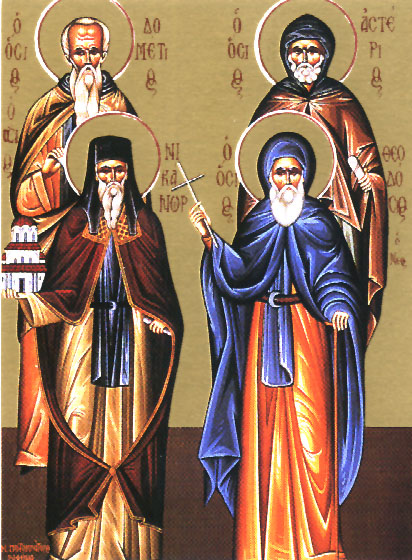
Afterfeast of the Transfiguration of our Lord and Savior Jesus Christ, Sixtus of Athens, Bishop of Rome, The Holy Righteous Martyr Dometius, Our Holy Father Nicanorus the Wonderworker, Theodosius the New, Joseph Gerontogiannis of Lithines Sitia, Sozon of Nicomedea, The Holy Ten Thousand Ascetics of Thebes, Narcissus the Hieromartyr of Jerusalem

ST. PAUL’S FIRST LETTER TO THE CORINTHIANS 14:6-19

Brethren, if I come to you speaking in tongues, how shall I benefit you unless I bring you some revelation or knowledge or prophecy or teaching? If even lifeless instruments, such as the flute or the harp, do not give distinct notes, how will any one know what is played? And if the bugle gives an indistinct sound, who will get ready for battle? So with yourselves; if you in a tongue utter speech that is not intelligible, how will any one know what is said? For you will be speaking into the air. There are doubtless many different languages in the world, and none is without meaning; but if I do not know the meaning of the language, I shall be a foreigner to the speaker and the speaker a foreigner to me. So with yourselves; since you are eager for manifestations of the Spirit, strive to excell in building up the church. Therefore, he who speaks in a tongue should pray for the power to interpret. For if I pray in a tongue, my spirit prays but my mind is unfruitful. What am I to do? I will pray with spirit and I will sing with the mind also. Otherwise, if you bless with the spirit, how can any one in the position of an outsider say the “Amen” to your thanksgiving when he does not know what you are saying? For you may give thanks well enough, but the other man is not edified. I thank God that I speak in tongues more than you all; nevertheless, in church I would rather speak five words with my mind, in order to instruct others, than ten thousand words in a tongue.

MARK 9:2-9

At that time, Jesus took with him Peter and James and John, and led them up a high mountain apart by themselves; and he was transfigured before them, and his garments became glistening, intensely white, as no fuller on earth could bleach them. And there appeared to them Elijah with Moses; and they were talking to Jesus. And Peter said to Jesus, "Master, it is well that we are here; let us make three booths, one for you and one for Moses and one for Elijah." For he did not know what to say, for they were exceedingly afraid. And a cloud overshadowed them, and a voice came out of the cloud, "This is my beloved son; listen to him." And suddenly, looking around they no longer saw any one with them but Jesus only. And as they were coming down the mountain he charged them to tell no one what they had seen, until the Son of man should have risen from the dead.

Afterfeast of the Transfiguration of our Lord

On the first day of the Afterfeast of the Transfiguration, the hymns of Vespers speak of the amazement of the Apostles when they saw Christ transfigured before them. The Savior’s equality with the Father is also stressed, for He who covers Himself with light as with a garment is now transfigured before His disciples, “shining more brightly than the sun.”

Martyr Dometius of Persia and his two disciples

Saint Dometius lived in Persia during the fourth century. In his youth he was converted to the Faith by a Christian named Uaros. Forsaking Persia, he withdrew to the frontier city of Nisibis (in Mesopotamia), where he was baptized in one of the monasteries, and also received the monastic tonsure.

Fleeing the ill-will of some of the monks, Saint Dometius moved to the monastery of Saints Sergius and Bacchus in the city of Theodosiopolis. The monastery was under the guidance of an archimandrite named Urbelos, a strict ascetic, of whom it was said that for sixty years he did not taste cooked food, nor did he lay down for sleep, but rather took his rest standing up, supporting himself upon his staff.

In this monastery Saint Dometius was ordained a deacon, but when the archimandrite decided to have him made a presbyter, the saint, considering himself unworthy, hid himself on a desolate mountain in Syria, in the region of Cyrrhus.

Stories about him constantly spread among the local inhabitants. They began to come to him for healing and for help. Many pagans were brought to faith in Christ by Dometius. And one time, in the locality where Saint Dometius struggled with his disciples, the emperor Julian the Apostate (361-363) arrived, traveling on his campaign against the Persians. By order of the emperor, soldiers found Saint Dometius praying with his disciples in a cave, and walled them up alive inside.

First finding of the relics of Saint Metrophanes, first Bishop of Voronezh

The Uncovering of the Relics of Saint Metrophanes, Bishop of Voronezh (1832): The memory of the deep piety and pastoral virtues of Saint Metrophanes (Macarius, in the schema) was revered at Voronezh from the time of his death (November 23, 1703). His successors, the Voronezh hierarchs, considered it their sacred duty to make annual remembrance of the first hierarch of their flock, together with his parents, the priest Basil and Maria.

The people of Voronezh and its environs came to the Annunciation cathedral, where memorial services were offered at his tomb. Contributing to the intense remembrance of Saint Metrophanes was also his dying request that prayers be said for him. For this purpose the saint, even during his lifetime, had built a chapel at the cathedral in honor of the holy Archangel Michael (his patron saint), and in it a special priest served the Liturgy. Although succeeding generations did not know the saint, they also revered his memory.

The veracity of the sainthood of the first hierarch of the Voronezh diocese was also confirmed by his incorrupt relics, attested during their repeated transfers from one temple to another. In the year 1718, Metropolitan Pachomius of Voronezh, about to begin the construction of a new cathedral, gave orders to demolish the old Annunciation cathedral. The body of Saint Metrophanes was temporarily transferred into the church of the Unburnt Bush. In 1735, the body of Saint Metrophanes was transferred into the new cathedral, during which time the incorrupt state of his relics was again observed. At the place of the burial of the saint, panikhidas were customarily served for him.

By 1820 it was noticed that the number of those venerating Saint Metrophanes and thronging to Voronezh, had extraordinarily increased. Grace-filled signs also increased. Archbishop Anthony II of Voronezh made repeated reports to the Holy Synod about the miracles, and he petitioned for a resolution for the glorification of the saint. The Holy Synod then prescribed that records be kept of miracles at the grave of Saint Metrophanes. In the year 1831, after seeing the incorrupt body of the saint, Archbishop Anthony together with commission members of the Holy Synod, Archbishop Eugenius of Yaroslavl and Archimandrite Hermogenes of the Moscow Savior-Androniev monastery, became convinced in the miraculous intercession of Saint Metrophanes before the Throne of God. The Holy Synod then issued its resolution adding Saint Metrophanes to the ranks of the Saints. Since then, the Russian Church celebrates the memory of the saint twice during the year: November 23, the day of his repose, and August 7, the day of his glorification.

Archbishop Anthony II (1827-1846) established in the Voronezh also the following feastdays in honor of Saint Metrophanes: June 4, the Feast of his namesake Saint Metrophanes, Patriarch of Constantinople; April 2, the saint’s day of consecration as bishop in 1682; and December 11, the day of the transfer of the relics of Saint Metrophanes in 1831.

Saint Metrophanes left behind a Spiritual Testament. Its original is preserved in the State Historical Museum. Upon the testament is the unique authoritative signature of the saint: “This spiritual dictate is attested to by me… Bishop Metrophanes of Voronezh.”

On the lower cover (inside) is an inscription from the eighteenth century: “This is the book of testament or last will of the Voronezh schemamonk Macarius, written in the God-saved city of Voronezh, in the house of His Grace the bishop and schemamonk Macarius, who reposed in the month of November on the 23rd day in the year 1703, and was buried on the 4th day of December.”

On the day preceding the Uncovering of the Relics of Saint Metrophanes, Archbishop Anthony of Voronezh went to church, so as to lay out the new vestments prepared for the relics. Suddenly, he felt so weak that he was barely able to go about his cell. Troubled by this, he sat and pondered and then he heard a quiet voice: “ Do not transgress my legacy.”

This he did not understand right away, and instead thinking about his own plans, he gathered up his strength and opened the closet where the vestments were, and there he caught sight of the monastic schema, brought shortly before this by an unknown monk who had entrusted it to him and said that it soon would be needed.

Seeing this monastic schema, the hierarch then realized that the words, “Do not transgress my legacy,” was actually the will of Saint Metrophanes, that they not place upon his relics bishop’s vestments, but rather to clothe them in the schema. By this and by his extreme humility, he indicated the deep spiritual connection with his patronal saint (in schema), Saint Macarius of Unzhensk.

Venerable Pimen the Much-Ailing of the Kiev Near Caves

Saint Pimen the Much-ailing attained the Kingdom of Heaven by enduring grievous illness. This Russian ascetic was both born and grew up sickly, but his illness preserved him from illness of the soul.

For a long time he besought his parents to send him to the Kiev Caves monastery. When they brought their son to the famed monastery, they then began to pray for him to be healthy. But the sufferer himself, conscious of the high value of suffering, instead asked the Lord both for the continuation of his sickness, and also his tonsuring into monasticism.

One night, radiant angels appeared in the guise of monks, and tonsured him. They told him that he would receive his health only on the day of his death. Several of the brethren heard the sound of singing, and coming to Saint Pimen, they found him attired in monastic garb. In his hand he held a lit candle, and his tonsured hair could be seen at the crypt of Saint Theodosius. Saint Pimen spent many years in sickness, so that those attending to him could not tolerate it. They often left him without food and water for two or three days at a time, but he endured everything with joy.

Compassionate towards the brethren, Saint Pimen healed a certain crippled brother, who promised to serve him until death if he were healed. But after a while the brother grew lax in his service, and his former ailment overtook him. Saint Pimen again healed him with the advice, that both the sick and those attending the sick receive equal reward.

Saint Pimen spent twenty years in grievous sufferings. One day, as the angels had predicted, he became healthy. In church, the monk took leave of all the brethren and partook of the Holy Mysteries. Then, having bowed down before the grave of Abba Anthony, Saint Pimen indicated the place for his burial, and he himself carried his bed there.

Pointing to those buried there, one after the other of the monks, he predicted that the brethren would find one buried in the schema to be without it, since this monk had led a life unworthy of it. Another monk, who had been buried without the schema, would be found clothed in it after death, since he had greatly desired it during his life, and he was worthy.

Then Saint Pimen lay down upon his bed and fell asleep in the Lord. The brethren buried him with great honor, glorifying God.

After the death of Saint Pimen, the brethren were persuaded of the truth of his words. On the day of Saint Pimen’s repose, three fiery columns appeared over the trapeza, and moved atop the church. A similar event was described in the chronicles under February 11, 1110 (See the August 5 commemoration of Saint Theoctistus of Chernigov), therefore the day of demise of Saint Pimen is surmised as also occurring on February 11, 1110.

The relics of Saint Pimen rest in the Antoniev Cave.

A second commemoration of the saint is made on September 28, the Synaxis of the Monks of the Near Caves.

Venerable Pimen the Faster of the Kiev Caves

Saint Pimen, Faster of the Caves, labored in the Far Caves. His abstinence was such that he ate food only once a day, and only in the most necessary quantity. His outward fasting corresponded to an inward abstemiousness from any actions, thoughts or feelings, displeasing to God. Saint Pimen was igumen of the Kiev Caves monastery from 1132 to 1141. A second commemoration of the saint occurs on August 28.

Saint Mercurius, Bishop of Smolensk, Kiev Near Caves

Saint Mercurius of Kiev Caves Lavra was an ascetic in the Far Caves of Saint Theodosios during the XIV century, and was a strict observer of the Church's fasts.

He probably succeeded Bishop Lazarus as the Bishop of Smolensk, and with his flock, he experienced the horrors of Batu's invasion in 1347, during which he was killed. As he was dying, he ordered that the coffin containing his body should be sent down the Dnieper River and carried wherever it happened to land. Miraculously, the coffin came to rest at the Kiev Caves Monastery, and the Saint was buried in the Near Caves of Saint Anthony.

During his lifetime, Saint Mercurius had a deep spiritual bond with Saint Paisios of the Far Caves (July 19). When they died, they were buried in the same grave, but now their holy relics are in separate reliquaries.

Saint Mercurius, who glorified God by his words and his actions while on earth, now glorifies Him before His heavenly Throne.

The Church remembers Saint Mercurius on November 24 because of his patron Saint, the holy Great Martyr Mercurius. He is also commemorated on August 28 (the Synaxis of the Saints of the Far Caves); and on the second Sunday of Great Lent (the Synaxis of all the monastic Fathers of the Kiev Caves).

Martyr Marinus the Soldier at Caesarea in Palestine

The Holy Martyr Marinus (December 16) was a soldier during the reign of the pagan emperors Valerian (253-259) and his son Gallienus (260-268).

When he was about to be promoted to centurion, Marinus refused to swear the customary oath invoking the pagan gods, or to offer sacrifice to idols. Saint Marinus was beheaded in Caesarea Philippi after cruel tortures.

Saint Asterius also happened to be present at the sufferings of the Martyr Marinus. When the execution was over, he took off his senatorial garb, spread it upon the ground and wrapped the head and body of Saint Marinus in it. On his own shoulders he carried the martyr’s relics to the grave and reverently consigned them to earth. For doing this, he was himself sentenced to death and beheaded in the year 260.

Martyr Asterius the Senator at Caesarea, in Palestine

The Holy Martyr Asterius the Senator lived during the reign of the pagan emperors Valerian (253-259) and his son Gallienus (260-268). Although he was a Roman senator, Asterius nonetheless held firmly to the Christian Faith, in spite of the persecutions occurring during those times.

Once, while in Palestine, he came to the city of Caesarea Philippi, where by custom a pagan feast was made with the offering of sacrifice to an idol. The demon residing in the idol made the sacrifice disappear, and this was looked upon as a great wonder. Saint Asterius expelled the demon by prayer. The sacrifice ceased to be invisible, and the pagans ceased to celebrate this impious festival.

Saint Asterius also happened to be present at the sufferings of the Martyr Marinus (December 16). When the execution was over, he took off his senatorial garb, spread it upon the ground and wrapped the head and body of Saint Marinus in it. On his own shoulders he carried the martyr’s relics to the grave and reverently consigned them to earth. For doing this, he was himself sentenced to death and beheaded in the year 260.

Venerable Horus of the Thebaid, Egypt

Saint Horus in his youth withdrew into the Thebaid desert and struggled in complete solitude for many years, leading the life of a strict hermit. Having advanced in years, Saint Horus was granted to see an angel, who announced that the Lord had destined him for the salvation of the many people who would seek his guidance.

After this, the monk began to accept everyone who came to him for advice and help. The Lord granted him a gift of reading the Holy Scriptures, despite the fact that the saint since childhood had not been taught reading and writing.

Gradually, a large monastery formed around Saint Horus, in which the holy Elder was the spiritual guide. The monk never entered the trapeza for food, nor did he eat on the day of partaking of the Holy Mysteries. He often taught the brethren by means of stories about the temptations which might beset a monk living in solitude. But he always told them in such a way that everyone would know that he was speaking of desert-dwellers personally known to him. The saint concealed his own ascetic exploits.

Once, when the saint still lived with only one disciple, he brought to the Elder’s attention the approach of Holy Pascha. Saint Horus immediately stood up at prayer, and raising his hands, he stood thus for three days under the open sky, in unceasing prayer. He then explained to his disciple that for a monk every feastday, and especially Pascha, is celebrated by removing oneself from everything mundane, and lifting up one’s mind to unity with God.

All the thoughts and deeds of his disciples was revealed to Saint Horus, and no one dared to lie to him. Having survived well into old age, Saint Horus founded several monasteries, comprising altogether as many as 1,000 monastics. He died at age 90 in about the year 390.

Virgin Martyr Potamia the Wonderworker

The Holy Martyr Potamia the Wonderworker died under the sword. Sometimes the saint is incorrectly listed as Saint Potamius the Wonderworker.

Venerable Dometius of Philotheou, Mount Athos

Saint Dometius was an Athonite Elder. He pursued silence at the Philotheou monastery together with the Hieromartyr Damian of Philotheou (February 23), who suffered under cruel tortures by the Turks in the year 1568.

Valaam Icon of the Mother of God

One of the greatest treasures in the possession of the Monastery of New Valamo in Heinävesi, Finland is the wonderworking icon of the Mother of God of Valaam. Painted on lime wood, the 132 x 79.5 cm icon depicts the Virgin Mary as a full-length figure standing on a cloud with lowered gaze, clothed in a bright red cloak and a dark turquoise undergarment. She is holding the Christ child, who is dressed in a thin, pale yellow smock, on her left arm. With her right hand, she points to Christ, in the style of the “Hodēgḗtria” icons of the Mother of God. Christ blesses with His right hand and holds an orb, surmounted by a cross, in His left hand, signifying that He is the Creator of the world and King of all.

According to the inscription, the icon was painted in 1878, “the work of the monks of Valaam.” It is customarily attributed, however, to Father Alipy, one of the leading iconographers at the original Valaam Monastery in Lake Ladoga in Russian Karelia. Father Alipy painted the icon only a few years after he arrived at the monastery, before he had become a novice there. He was tonsured to monastic orders in 1884 and ordained as priestmonk in 1893.

Following the conventions of the late 19th century, the icon was painted in a “naturalistic” style, employing a technique that combined the use of tempera and oils.

Originally, the icon was to have been placed in the Valaam Monastery’s Church of the Dormition. This never occurred, however, and subsequently the icon was misplaced. In 1897, the icon was rediscovered and gained its miracle-working reputation on the strength of a succession of visions of the Mother of God experienced by an elderly woman with serious rheumatoid arthritis, Natalia Andreyevna Andreyeva, who was cured of her illness.

Despite the Valaam Monastery’s long history, it had never had an icon of the Mother of God of its own design, although Father Alipy’s icon came to occupy such a position in subsequent years. In the turmoil of World War II, the icon was transported to safety in Finland, along with many other treasures from Valaam and the majority of the monks. It now occupies a prominent position in the Church of the Transfiguration of Our Lord at the New Valaam Monastery.

In 1987, the bishops of the autonomous Orthodox Church of Finland established an annual feast in the Valaam Icon’s honor on August 7. The troparion and kontakion for the feast were written by the late Archbishop Paul of Finland.

On July 29, 2005, the Valaam Icon of the Mother of God was brought for the first time to North America by His Eminence, Archbishop Leo of Karelia and All Finland.

——————————————————————————–

“Mother dear, is it true that you live at Valaam?”

The story of the icon of the Mother of God of Valaam, as recorded in 1897

In a corner behind the choir enclosure on the south side of the lower main church at the monastery of Valaam, where the miracle-working remains of the monastery’s founders, the Saints Sergei and Herman of Valaam, lie at rest interred in the rock, stands an icon of the All-Holy Mother of God. This full length image of the Queen of Heaven holding the divine child in her arms is known as the icon of the Mother of God of Valaam. It is a work of considerable artistic merit that was painted by a local artist-monk and later hieromonk, Father Alipi, in 1878. Nowadays this icon is one of the most cherished objects of reverence at Valaam.

As if by some divine providence, no suitable place could be found for the icon at first when it was finished, and it was placed in the entrance hall to the upper main church, where it remained until that church was demolished to make way for a new one. At that stage the majority of the icons, including this one, were taken to the Church of the Dormition of the Mother of God, where the monastery held its regular services until the lower main church was completed. The icon was hung in a relatively high position on a pillar to the left of the entrance to the church.

When the lower main church was ready for consecration, all the icons that had been moved to the Church of the Dormition were returned to it, but again, for some inexplicable reason known only to God, no place could be found for this one. As scarcely any services were held in the Church of the Dormition any longer, this icon, along with some others, was placed in temporary storage in the Church of Saint Nicholas the Miracle-Worker. There it lay forgotten for many years, until it was moved to its present place in response to a vision experienced by a holy woman servant of God. The story of the indescribable act of grace bestowed upon this woman by the Queen of Heaven is recounted below in her own words.

‘I am a member of the peasant estate from the village of Zarino in the parish of Paskina, part of the district of Korchevski within the province of Tver. My name is Natalia Andreyevna Andreyeva. I am now sixty-four years of age and live in Saint Petersburg, in the Brusnitsyn old peoples’ home, at Kosaya Line no. 15 on Vasili Island. I was placed in this home, through the grace of God, by the lady in whose service I was a serf in former days.

In the year 1878 or 1879 I caught a bad cold on one occasion when washing clothes and developed rheumatism in my arms and legs. I began to seek treatment for this, but my health became worse year by year. I went to the Mariski Hospital for massage for a long time, but it didn’t help, and I went to the Grand Duchess Elena Pavlovna’s clinic opposite the Tauria gardens for as long as I could. I was more or less a cripple for most of the winter. All my money went on doctors’ fees and medicines, but the Lord God didn’t look kindly on my afflictions. In the end I was told that my illness had reached the stage of serious rheumatoid arthritis and that the only way of curing it was to go to a spa and take warm water baths.

What could I do? By that time I could scarcely afford to eat, so how could I find the money for treatment at a spa? And so, sinner that I am, I began to pray ardently to the Mother of God that in her mercy she would help me in my sufferings. I could walk only with great difficulty, leaning on a stick, and I had such pains in my hands and arms from time to time that I could no longer hold on to the stick. Sometimes I could make my way into the Church of the Sign only by crawling up the steps on all fours. I lived as a beggar, on food that people gave me as alms. This went on until 1887.

At that point my former mistress heard about my pitiful state and invited me to come and live with her at Käkisalmi in the province of Viipuri in Finland and look after her children as far as my health would permit. There was no other work that I could think of doing in the condition that I was in. The family was not a rich one, and so I was not to receive any wages for this – but, thank God, at least I was sure of food and a roof over my head.

While I was at Käkisalmi I heard many accounts of the miraculous cures that had taken place at the tomb of the Saints Sergei and Herman of Valaam, and this aroused a powerful desire in me to visit Valaam and prostrate myself before the tomb of these saints who had been acceptable unto the Lord and entreat their help in my serious state of illness. I had heard a lot about Valaam earlier, while I was living in Saint Petersburg, and I had often thought of visiting the monastery to pay reverence to its founder saints, but in all the vanities of life I had never got round to it. The main reason had been the cost of the journey, of course, but now the monastery was closer. Also, there was an inner voice speaking to me all the time, “Go to Valaam and be cured!”

I could no longer resist this desire, and I asked the lady of the house for leave to go there. As I had no money at all, I pawned my warm scarf for four roubles and started to make preparations for the journey.

As the day of departure approached I began to feel uneasy and distressed. I was an old woman who was utterly sick and lacking in strength. How could I travel alone? I had very little money, only just enough for the journey. How could I set out at all on such a journey? And if something were to happen, what would a poor creature like me do then? Thoughts like this began to haunt me until I was quite distraught.

The night before I set out I just lay on my bed and wept. What should I do? I wanted so much to make this journey, but still I was frightened for some reason. Then – I don’t know whether I was asleep or awake – I saw quite clearly a tall woman clad in pink velvet and with a child in her arms, surrounded by an amazing light. The thought immediately struck me, could this be the Mother of God? I didn’t dare to call out to her by that name, though. I wanted to go to her, but she stepped back and said, “Don’t weep. The Saviour is coming, and I am coming to you!”

Then I said to her, “Mother dear, how beautiful and good you are! Is it true that you live at Valaam?”

“Yes, I live there. You will see me at Valaam!” After that the vision disappeared, but now that the Mother of God had spoken to me it was as if a stone had been lifted from my heart. My mind was at ease and all my fears had been swept away.

The next day the ship came and I set out joyfully on my journey. The old ladies sitting beside me began to offer me food and drink, one bread, another tea and yet another coffee, so that I was not short of anything all the way. It was a happy journey. The only problem was that my legs were very painful because of the rocking of the ship. At Valaam they were celebrating not only the annual feast of the Saints Sergei and Herman but also the laying of the foundation stone for a new church. There were a huge number of pilgrims there, and also the Grand Duke Vladimir Alexandrovich and his wife the Duchess. There were throngs of people everywhere.

Once I had arrived and rested after the strenuous journey, I made my way to the tomb of the Saints Sergei and Herman and prayed there ardently so that the tears streamed from my eyes. I asked the saints who had been acceptable unto God to help me, to grant me, sinful as I was, relief from my illness. I spent the last coins that I had on a short service of prayer to them, so that I had nothing left but twenty kopecks and my return fare.

The evening service was held in the Church of the Dormition, and the crowd was so enormous that with my illness, I stood no chance of pushing my way into the church but had to stand, or rather sit, in the entrance.

The following day I had to return home. I would have liked to stay there longer to pray, but I couldn’t, as even a few days would have cost so much that I would not have had any money for the fare home.

Just before the ship was due to leave, some unseen force began to drive me back to the Church of the Dormition once more to pray. Although I was frightened of missing the ship, I didn’t dare to resist this inner voice which ordered me into the church, so I gathered up all my strength and practically ran back there.

As soon as I stepped into the church I involuntarily looked to the left – and stood rooted to the spot. My legs went weak beneath me, and I would certainly have fallen down if it hadn’t been for the railings beside the stairs leading to the upper church.

The reason for my surprise and bewilderment was something quite miraculous. Hanging on the pillar to the left of the door, in a golden frame, and looking at me was the Mother of God! And what was more, I recognised in Her the same figure who had appeared to me in a dream on the eve of my departure for Valaam and strengthened my failing spirit for the journey. I couldn’t take my eyes off the icon, and I became more and more convinced that this was the same dear mother who had been gracious enough to visit me in a dream. I recognised Her radiant face and Her merciful gaze. Even Her clothing was the same, and She held the Child in just the same way as I had seen in my dream.

As soon as I had recalled all this I wanted to have a service of prayer for the Mother of God and to kiss Her holy icon, but this was evidently not a suitable moment for Her, as our defender, to receive my unworthy prayers. The ship’s siren sounded in the distance, announcing its departure, and the icon was hung so high up that it was impossible for me to kiss it. I just had time to buy a candle with my last twenty kopecks and place it in front of the icon. Then, with tears in my eyes, I had to leave for the ship.

It was only during the voyage that I recovered my composure. I was delighted beyond words with this miracle that had been granted to me, a sinner, although I was also saddened by the fact that I had seen the icon of the All-Holy Mother of God only in the last few minutes before leaving Valaam. This had evidently been Her wish.

* * * * * * * *

A few days after I arrived back in Käkisalmi I began to feel much better. I could walk without a stick and do little jobs around the house. I resolved at once to go back to the monastery again at the first opportunity to thank God and the holy fathers and definitely to have a service of prayer said in front of the icon of the Mother of God. But the Lord determined otherwise.

The lady in whose house I was living decided to move into the country, and I had to go back to Saint Petersburg again and rely on assistance from the good people there. The years went by. My life was a hard one, and I was often facing hunger. My illness became worse, and I again had to walk with a stick. I prayed ardently to the Mother of God for help. Then, in 1896, nine years after my visit to Valaam, I came home from Vespers one Saturday evening, said my prayers and went to bed. Again I had a dream. The Mother of God appeared to me in exactly the same form as on the first occasion, and said, “So your enthusiasm has waned and you’ve forgotten your promise to return to Valaam. You were shown the way, but you didn’t follow it.”

“I am poor,” I answered, “I haven’t the money.”

“You find money for everything else, but not for this. Alas, this is a bitter disappointment for me,” the Mother of God complained.

I was horrified at this vision. I had evidently offended our dear mother. What was I to do now? Suddenly I heard that my former mistress had recently returned to Saint Petersburg, and so I went to her and told her the reason for my sorrow. She again came to my rescue – may God grant her all his goodness – and unexpectedly gave me five roubles. With these I was able to travel to Valaam at once.

As soon as I reached the monastery I went to the new church to pray at the tomb of the founder saints, and then to the Church of the Dormition to pray to the Mother of God. To my great sorrow, however, I couldn’t find Her icon where it had been on the first occasion. I began to ask the monks where it was, and the former treasurer Father Evgeni advised me to ask the master of the church furnishings, Father Pafnuti, who was responsible for all the icons. Even he couldn’t tell me exactly where the icon of the Mother of God that had been in the Church of the Dormition now was, and thought it might have been sent to the monastery’s chapel on Vasili Island in Saint Petersburg. I was very, very upset that I had not found my Queen of Heaven, and shed many bitter tears as I prayed to the Mother of God and the Saints Sergei and Herman that they would not abandon me in my sin.

I stayed at Valaam for two and a half weeks, looking everywhere for the icon, but I couldn’t find it. My health was poor, and my soul weighed heavy within me. Eventually I went back to Saint Petersburg and called at the Valaam chapel on Vasili Island, but the icon was not there, either. I was more grief-stricken than ever.

Another year passed, and my illness began to grow worse again, so that I could scarcely walk even with a stick. I had scrimped and saved all year and gradually collected the kopecks together for another journey to Valaam. I set out to spend the feast of Saint Peter at the monastery and to look for the icon of the Mother of God once again.

Although I was exhausted by the time I arrived, I prayed earnestly at the tomb of the founder saints and with tears in my eyes prayed to the Mother of God that she would show me where I could find Her blessed icon. And my prayer was answered.

That night I had another dream. I was walking through the yard of the monastery and past the now abandoned Church of Saint Nicholas. I was crying and praying to the Mother of God, “Oh mother dear, if only I could see you once more!” I was greatly surprised, but I went on praying.

Again I heard a voice, but this time it was someone else’s. “What are you so sad about? What are you looking for?” I turned round and there was a grey-bearded old monk in a blue biretta standing behind me.

“I am looking for the Mother of God,” I replied.

“Wait. We will find Her.”

“How can you find Her so quickly,” I asked, “when Father Pafnuti searched for three weeks without finding her?”

“He searched in the wrong places. He had forgotten where She is,” the old monk said.

I followed him to a door. “This door is closed,” I said.

He opened it. “She is in here.”

I looked into the inside of the church, and in one corner, amidst a heap of furnishings and old icons, was the icon of the Mother of God, half wrapped in a linen cloth and sacking. I recognised it at once as the icon I was looking for. “Here She is!” I exclaimed in a loud voice. It was then that the other women in the same room woke me up.

The next day, a Wednesday, I went to the Liturgy early in the morning, after which Father Pafnuti conducted a service of prayer at the tomb of the founder saints. I told him about my dream. “In the name of God, forgive me,” he said. “I looked for the icon at first and then forgot all about it. I will go and search for it at once. Now I remember. I’m sure it’s in the Church of Saint Nicholas the Miracle-Worker.”

I intended to take Communion on the Saturday, and the night before I had another dream. It was as if I were standing alone in the lower church. There were just two monks beside the founders’ tomb, Father Seraphim and Father Nikolai. I was waiting impatiently for something and could not take my eyes off the outer door. Suddenly the door opened and the icon of the Mother of God was carried in by Father Pafnuti and a young monk in a short, grey cassock. “There She is, my dear mother!” I cried, and threw myself on the floor, thinking that the icon would be carried over me and I would be made well. But Father Pufnuti said, “There is nothing ready for you here. We have to hold a short service to bless the holy water before a sick person can be made well.” And at that I awoke.

In the morning I took Communion. I told Father Pafnuti of my dream and, sobbing, entreated him to go and look for the icon. Before the later Liturgy I was in a chapel when I suddenly saw a crowd of people hurrying from the hotel to the church. “What is happening?” I asked. They told me that the missing icon of the Mother of God had been found and that it was being taken to the lower church. I went into the church and saw the icon on the steps in front of the iconostasis.

“Is this the icon you meant?” Father Pafnuti asked me.

“Yes, this is the one,” I replied.

“Then be comforted and pray to the Holy Mother of God,” he said. I asked him to hold a service of prayer to the Mother of God, and he did so, with a blessing of water as well, and lit a lamp in front of the icon.

Hieromonk Alipi was reading a service of prayer at the tomb of the founder saints just then, and I was told that it was he who had painted the icon. I went to him and bowed down to the ground before him. My breath stuck in my throat and tears streamed down my cheeks from the sheer joy of finding at last the icon of the Mother of God who had appeared to me, and I gave thanks to the Lord with all my heart for the unspeakable mercy he had shown to me.

The holy water was poured into a bottle for me, and when I drank it I felt my strength return. I took some oil from the lamp and went to my room. There I spread it on my hands and feet. The pain abated, and for the first time for many years I was able to sleep peacefully. I week later I could walk without a stick.

After giving thanks with all my soul and from the bottom of my heart to the Mother of God for the miracle that She had worked on me in my unworthiness, I returned to Saint Petersburg. I began to gain in strength all the time without any medicine, and by Easter I had completely recovered. It was then that I decided that I would buy a lamp for the icon. By the grace of God I managed to gather together eight roubles from the little that I had, but a lamp cost ten roubles. Then a friend of mine who had bought a charity lottery ticket promised that if she won she would give me the two roubles I needed, and she did win a gold watch, so that I was able to buy the lamp and send it to the monastery. Many people asked me to give them a photograph of the icon. Now I am in perfect health. I can do washing and scrub floors, and I have even been helping with the haymaking at the Konevits Monastery. I have no pain at all in my legs. Altogether the illness lasted twelve years. At one time I couldn’t even get my arms into the sleeves of my clothes, and sometimes I could only climb steps by crawling on my hands and knees. I shed countless tears at such times and prayed to the Mother of God that I might be cured. Now I am healthy again and have everything that I need. There are even good people around me who have put me in an old people’s home. Glory be to the Queen of Heaven!’

Natalia Andreyevna’s story of the discovery of the icon in the abandoned Church of Saint Nicholas is thoroughly plausible. It would have been impossible for her to know anything about the contents of the church or about the objects stored there beforehand. The church is kept closed and no people other than the monastery staff are allowed into it. Everything really happened as she had seen in her dream. Following her instructions, Father Pafnuti went into the church, found the icon in a corner and brought it to the lower main church. There he placed it on the right-hand side of the church, on a pillar behind the right-hand choir enclosure, where it has been to this day. And by some miraculous means the person who helped Father Pufnuti carry the icon was indeed dressed in a short, grey cassock.

Natalia Andreyevna released this account of her visions on 7th August 1897, and it was written down in the present form on 26th July 1898.

Venerable Anthony of Optina

Saint Anthony (Putilov) was born on March 9, 1795 in the town of Romanov in the Yaroslavl province, and was baptized with the name Alexander. His siblings were called Timothy, Jonah, Basil, Cyril, and Anysia. John Putilov named all his children after the saint commemorated on the eighth day after their birth, so the future Saint Anthony was named for the holy hieromartyr Alexander the Bishop of Rome (March 16). The children were educated at home, since their parents feared they would be corrupted in some way if they were sent away to school.

From an early age, Alexander was quiet and modest, disdaining the noisy games of other children. It is not surprising that he should be inclined toward monasticism even as a child, because his great-grandfather Joel had been a hierodeacon at the Serpukhov Monastery, and his cousin Maximilla was a nun in the Annunciation women’s monastery in Moscow.

When Alexander was ten years old, his brothers Timothy and Jonah entered the Sarov Monastery. They wrote to him and sent him spiritual books, which he enjoyed reading. When he was only thirteen, he wrote to them expressing the wish to become a monk like them.

The young Alexander endured many trials and illnesses during his childhood, and on ten separate occasions he was in danger of losing his life. Once he nearly drowned, another time he fell and fractured his skull. He had several other close calls, yet God spared his life, forseeing something better for him (Hebrews 11:40).

After his father’s death in 1809, Alexander went to work for the merchant Karpishev in Moscow, for whom his older brothers had also worked. He lived in Moscow only three years, but he remembered the location of all the city’s holy places and wonderworking icons for the rest of his life.

On September 2, 1812, he tried to flee Moscow during Napoleon’s invasion, but it was too late to escape. A Pole on horseback pointed a pistol at Alexander and stole his money. Later, French soldiers robbed him of his watch and most of his clothing, and held him prisoner for ten days. During his captivity he consoled himself with the words of Saint John Chrysostom, who said that the worst sufferings on earth are nothing compared to the least sufferings in hell.

After learning that there were Russian soldiers outside of Moscow, Alexander escaped on September 12 while it was raining. He found a group of Russians, including some of his relatives. They walked through forests and swamps by night, and hid from the French by day. Eventually, Alexander arrived at the home of some relatives in Rostov. Not knowing what had become of his brothers, he took a job similar to the one he had in Moscow.

Alexander loved to visit the Saint James Monastery in Rostov, where the relics of Saint Demetrius of Rostov (October 28) were enshrined. By the end of 1815, circumstances finally permitted him to withdraw from the world. First, however, he arranged for his older brother Basil to marry, choosing a suitable and pious bride for him.

At the end of 1815, Alexander went to Moscow to visit the various churches and monasteries. He prayed to the Most Holy Theotokos and to all the saints, asking that his intention to become a monk might be blessed. From Moscow, he traveled to Kaluga, and then to the Roslavl forests in Smolensk province where his brother Father Moses had been living for about five years.

Alexander consulted with his brother about his desire to enter the monastery at Sarov, and decided to remain with Father Moses until spring. He was made a novice on January 15, 1816. In the spring, Alexander decided he would remain a while longer. Several months later, he went with Father Moses on pilgrimage to Kiev. On their return trip the brothers stopped at several monasteries, conversing with many Elders about the spiritual life. Alexander was not inclined to enter any of them, however.

Back in the Roslavl forests, Alexander realized that he did not want to leave his brother. He had come only for a brief visit, but ended up staying with Father Moses for the next twenty-four years.

Despite the many illnesses of his childhood, Alexander was blessed with great physical strength, and devoted himself to seemingly impossible ascetic labors. The brothers would get up at midnight and read through the cycle of services without omissions, and so Alexander became familiar with the church Typikon. He copied out patristic texts by hand, and helped his brother compile extracts from various sources in order to provide a system of rules for the Christian life. Out of reverence for these spiritual books, the brothers remained standing when they read or copied them. Alexander spent so much time standing on his feet that he damaged his legs, which caused him pain for the rest of his life.

As the youngest member of the community, Alexander had to get up before the others in order to wake them. He chopped wood, carried water, worked in the vegetable garden, and still fulfilled his daily rule of prayer.

After a trial period of four years, Alexander was tonsured by Father Athanasius on February 2, 1820 and was given the name Anthony. He was also placed under the spiritual guidance of Father Moses.

In 1821 Bishop Philaret of Kaluga (later Metropolitan of Kiev) decided to establish a skete at Optina Monastery for experienced ascetics who wished to live in silence. He had met Father Moses at Optina in 1820 where they were introduced by Igumen Daniel. The bishop offered him the opportunity to move to his diocese and establish a skete at Optina, and Father Moses accepted.

On June 3, 1821 Father Moses left the Roslavl forests with Father Anthony, and the monks Hilarion and Sabbatius. The Elders Athanasius and Dorotheus decided to remain behind until the skete was completely ready. For the rest of his life Father Anthony would always remember his five years in the Roslavl forests with a special joy.

On June 6 Saint Anthony arrived at Optina with the other monks. The site they selected for the skete was 400 yards from the monastery’s eastern side. They cleared the land of trees and built a cell and a church dedicated to Saint John the Baptist. Saint Moses was appointed igumen, and on August 24, 1823 Anthony was ordained as a deacon.

Saint Anthony was placed in charge of the skete when his brother was made Superior of Optina Monastery in 1825. For the next fourteen years the skete flourished under Anthony. Wise Elders and experienced ascetics were attracted to the hesychast skete by the fame of Father Moses. Saint Leonid (October 11) came from the Saint Anthony of Svir monastery with five of his disciples in 1829. Saint Macarius (September 7) came from Ploschansk monastery in 1834 at the invitation of Father Moses.

With the help of Father Leonid and Father Macarius, Father Moses and Father Anthony introduced the ancient monastic tradition of eldership at the skete and monastery. Saint Anthony was an example of obedience to others. Though he was Superior of the skete, he never made any decisions or gave any orders without the blessing of his own Elder, Father Moses.

At first, life in the skete was very difficult. There were not enough monks to do all the work, so Father Anthony carried his own water and firewood. He also worked on the grounds, cleared paths, took his turn serving in church, and greeted visitors. The hard work made him appreciate the simple food served in the trapeza. Sometimes a benefactor would donate wheat loaves for the brethren, but most days they ate black bread.

Father Anthony suffered from various afflictions throughout his life. His legs pained him because of his continual standing. He also had eye trouble, and even lost his sight for a brief time. In 1836, while hurrying to the monastery along a forest path for the midnight paschal service, Father Anthony stubbed his right foot on a tree stump. His legs were already sore from years of standing, and now they developed open sores.The inflammation in his legs prevented him from leaving his cell for six months.

He bore all these trials with patience and humility, believing that illness is sometimes given to us by God in order to heal the infirmities of the soul. When anything unpleasant happened to him, he remained meek and calm. He offered thanks to God because his sickness gave him more time for reading spiritual books for the benefit of his soul.

On November 30, 1839 Bishop Nicholas of Kaluga summoned Father Anthony, and appointed him as igumen of the Maloyaroslavets Monastery. He had hoped to remain at the skete for the rest of his lfe, but in spite of his sorrow at leaving Optina, he went obediently to his new assignment.

By the mercy of God, three Putilov brothers were now serving as igumens of monasteries: Moses at Optina, Anthony at Maloyaroslavets, and Isaiah at Sarov. Father Moses seemed to have the least difficulty in bearing the sorrows and labors of his office. The others sometimes found it difficult to fulfill their duties and provide for the needs of the monastery.

After five years in the forest and eighteen years at the skete, Father Anthony found life at Maloyaroslavets monastery like living in the midst of a noisy city. The monks did not share the same oneness of mind as the Optina monks. Besides this, Father Anthony was so ill that he was not able to observe what was going on in the monastery, and he had to issue his orders through others. After only a few days he became depressed at his situation. One night Saint Metrophanes of Voronezh (November 23) appeared to him in a dream and blessed him. He said, “You have been in Paradise and you know it. Now work, pray, and don’t be lazy.” From that time, Father Anthony felt himself to be under the saint’s special care.

Father Anthony zealously devoted himself to improving the spiritual life of the monastery, but he was not happy there. More than once he wrote to the bishop and asked to be allowed to retire. The bishop, however, would not hear of it. Father Anthony also wrote to Father Moses to express his sorrow and his desire to be relieved of his duties. Father Moses told him that he could not abandon his responsibilities, for that would insult the monastery, and would also grieve the bishop and Father Moses himself. He chastised his brother, saying that in seeking deliverance from his sorrows, Anthony was placing his own will in opposition to the will of God.

Father Anthony accepted the rebuke of Father Moses and learned to bear his cross with meekness, and to place all his trust in God. Finally, in 1853, Bishop Gregory of Kaluga relieved Father Anthony of his duties, and permitted him to retire to Optina.

Father Anthony arrived back at his beloved Optina on February 12, 1853, and was given a cell near Father Moses. Although he continued to suffer from physical ailments, he bore them with exemplary patience. He went to church for all the services, and took his meals with the brethren. Since he continued his prolonged standing, his legs became covered with sores. The writer I.V. Kieryevsky told Father Anthony that he fulfilled the words of Scripture: “Whom the Lord loves, He chastises” (Hebrews 12:6). Father Anthony retorted, “Many are the scourges of the sinner” (Psalm 31/32:10).

He never complained about his sufferings, even though they prevented him from leaving his cell for weeks at a time. If he could not be at the church services, he would read his rule of prayer in his cell at the very time the services were taking place.

Only those experienced in the spiritual life themselves could understand what spiritual gifts God had granted Father Anthony, which he tried to conceal from everyone. There is reason to believe that he saw visions, and attained great spiritual heights. When he was serving the Liturgy, his face seemed to radiate such grace that those who merely looked at him felt that their souls were transformed.

After services in the church and prayers in his cell, Father Anthony devoted himself to his favorite occupation—reading. He loved the Holy Scriptures and the writings of the Fathers, and also enjoyed other books of a spiritual or historical nature. He gave over 2,000 of his books to the monastery library, and he had read every single one. He made notes on what he read, and also copied excerpts from books and magazines for the benefit of his spiritual children.

The Elder was blessed with a remarkable memory. Not only could he remember everything he had read for many years afterward, he also remembered who had visited him on a particular day, and what their conversation had been about.

Saint Anthony knew how to balance strictness with a certain amount of compassion for human weakness. He would not bless anyone to depart from the Church’s norms, however. He was very strict concerning spiritual matters in general, and especially the teachings and canons of the Church. He himself believed in the Church’s teachings and kept its precepts, and he required the same faith and obedience from his spiritual children.

Father Anthony’s retirement at Optina lasted for twelve years. When Father Moses reposed in 1862, Father Anthony was stricken with grief. For the first forty days he secluded himself in his cell, constantly reading the Psalter for his newly-departed brother. For about a year, he avoided people as much as he could, and prayed for Father Moses. He refused to speak to anyone about the hidden spiritual life of Father Moses, but he did reveal to a few people that he remained in spiritual contact with his brother even after his death.

In 1863, Father Anthony went on a pilgrimage to venerate the relics of the newly-glorified Saint Tikhon of Zadonsk (August 13) and Saint Metrophanes of Voronezh. He also visited several other monasteries, and some families who loved him. Upon returning to Optina, Father Anthony began to prepare for his departure from this world, and on March 9, 1865, at the age of seventy, he received the Great Schema.

On June 24, 1865, the Nativity of Saint John the Baptist and the Skete’s Feast Day, Igumen Anthony attended Liturgy in the skete church for the last time. He was growing weaker day by day, and in July he began to suffer from typhoid fever. As a result, he was able to sleep only for brief periods.Still, he continued to receive visitors, giving advice and instructions, and revealing to some that he was about to die.

The Elder received Holy Unction on July 21 and received Holy Communion every day. In his last days he asked to be sprinkled with holy water from Theophany, and requested that his bed and his room also be sprinkled. This brought him great comfort. He said, “How necessary is this sprinkling. The grace of God is present.”

Saint Anthony was not afraid of death, but awaited it in a spirit of joy and peace, surrendering himself to the will of God. He asked that his schema and the other garments in which he wanted to be buried be laid out and ready. He also started distributing his belongings to others as a remembrance.

After Liturgy on August 6, some of the brethren came to his cell to sing the troparion and kontakion for the Transfiguration. The next day he asked to be clothed in the full garb of a schemamonk. Due to his weakness, however, this could not be done. They placed the schema over him, and that satisfied him.

That evening Saint Anthony asked to see the Superior, and sought his blessing for his final journey. Father Isaac blessed him and took leave of him. Then the Elder asked Father Isaac to ring the bell three times. In monasteries this is normally done after someone has died, so his request seemed rather unusual. However, in 1863 Saint Anthony had compiled a collection of prayers for those who were incurably ill, with prayers for the departed. In this collection he stipulated that the bell be rung three or more times “to announce to the brethren that the sick brother is departing” so that they might pray for him.

The Canon for the Departure of a Soul was read for him, and when it was completed he lay silent for a while. Suddenly he looked to the right and to the left in a threatening manner, and even raised his left fist. Those present became fearful, for they believed that he saw something which their eyes could not see. Perhaps they recalled that many of the saints had seen demons just before they died. One of the spiritual Fathers of the monastery blessed him three times with a hand cross. The holy Elder sighed three times, then departed to the Lord.

The funeral took place on August 10, and was attended by many people. Although Saint Anthony wanted to be buried in the new cemetery, the Archishop ordered that he be buried next to his brother Saint Moses in the side altar of the monastery’s Cathedral (katholikon).

The Moscow Patriarchate authorized local veneration of the Optina Elders on June 13,1996. The work of uncovering the relics of Saints Leonid, Macarius, Hilarion, Ambrose, Anatole I, Barsanuphius and Anatole II began on June 24/July 7, 1998 and was concluded the next day. However, because of the church Feasts (Nativity of Saint John the Baptist, etc.) associated with the actual dates of the uncovering of the relics, Patriarch Alexey II designated June 27/July 10 as the date for commemorating this event. The relics of the holy Elders now rest in the new church of the Vladimir Icon of the Mother of God.

The Optina Elders were glorified by the Moscow Patriarchate for universal veneration on August 7, 2000.

Saint Theodora of Sihla

Saint Theodora of Sihla, who is one of the greatest of Romania’s women ascetics, was born in the village of Vânatori in Neamts County in the first half of the seventeenth century, and was one of the two daughters of Stephen Joldea and his wife.

In her youth, Saint Theodora experienced a great trial in her family. Her sister, Marghiolitsa, died in a tragic way. This event deeply affected the saint. At this time, the thought of abandoning the world blossomed in her heart. She wished to do penance for her parents, for her sister, and for herself. Her grieving parents, however, did not agree with her decision, because now Theodora was their only child. They pleaded with her, and, at the proper time, they married her to a young man who was working in their vicinity, and who went frequently to venerate the holy sites. After entering into a lawful marriage, they lived together in her husband’s house.

Since Saint Theodora and her husband did not have any children, they both decided to enter monasteries in the Buzau valley. Her husband went to the Skete of Poiana Mărului, where he was tonsured with the name Eleutherios. He was also found worthy of ordination to the holy priesthood. Saint Theodora also received the monastic tonsure in the Skete of Poiana Mărului. In just a few short years, she advanced in obedience, prayer, and asceticism, acquiring the grace of unceasing prayer of the heart. She also had to endure many temptations from the Enemy.

When the Buzau valley was invaded by the Turks, Saint Theodora fled to the mountains with her Spiritual Mother, Schema-nun Paisia. They lived for several years in fasting, vigil and prayer, enduring cold, hunger, and other trials from the devil. When her Spiritual Mother fell asleep in the Lord (sometime between 1670 – 1675), Saint Theodora was led by God to the mountains of Neamț. After venerating the wonderworking Neamts Icon of the Mother of God (June 26) at the monastery, she was told to seek the advice of Hieromonk Barsanuphios of Sihăstria Skete. Seeing her desire for the eremetical life, and recognizing her great virtues, he gave her Holy Communion and assigned Hieromonk Paul as her Father Confessor and spiritual guide.

Father Barsanuphios advised Mother Theodora to go and live alone in the wilderness for a year. “If, by the grace of Christ, you are able to endure the difficulties and trials of the wilderness, then remain there until you die. If you cannot endure, however, then go to a women’s monastery, and struggle there in humility for the salvation of your soul.”

Father Paul searched in vain for an abandoned hermitage where the saint might live. Then they met an old hermit living beneath the cliffs of Sihla. This clairvoyant Elder greeted them and said, “Mother Theodora, remain in my cell, because I am moving to another hermitage.”

Father Paul left the nun on Mount Sihla, blessing her before he returned to the Sihăstria Skete. Saint Theodora lived in that cell for thirty years, glorifying God. Strengthened with power from on high, she vanquished all the attacks of the Enemy through patience and humility. She never left the mountain, and never saw another person except for Father Paul, who visited her from time to time to bring her the Spotless Mysteries of Christ and the supplies she needed in order to survive.

Saint Theodora made such progress in asceticism that she was able to keep vigil all night long with her arms lifted up toward heaven. When the morning sun touched her face, she would eat some herbs and other vegetation to break her fast. She drank the rain water which she collected from a channel cut into the cliff, which is still known as Saint Theodora’s spring. After Father Paul’s repose, she remained solely in God’s care.

When Turks attacked the villages and monasteries around Neamts, the woods became filled with people from nearby villages and refugees from the monasteries. Some nuns discovered Saint Theodora’s cell and she told them, “Remain here in my cell, for I have another place of refuge.” Then she moved into a nearby cave, living there completely alone. At night she would rest a little on the flagstones, which still can be seen to this day. An army of Turks discovered the cave, and were about to kill the saint. Lifting up her hands, she cried out, “O Lord, deliver me from the hands of these murderers.” The wall of the cave opened up, and she was able to escape into the woods.

As Saint Theodora grew old, she was completely forgotten and there was no one to care for her. Placing all her hope in God, she continued her spiritual struggles, and reached great heights of perfection. When she prayed her mind was raised up to Heaven, and her body was lifted up off the ground. Like the great saints of earlier times, her face shone with a radiant light, and a flame came forth from her mouth when she prayed.

Eventually her clothes became mere rags, and when her food ran out, she was fed by birds just as the Prophet Elias (July 20) was. The bread that they brought to her came from the Sihăstria Skete. Seeing the birds come to the Skete and then fly away with pieces of bread in their beaks, the Hegumen sent two monks to follow them, thinking that some ascetic was living there and that God was providing food for him. Night fell as they walked toward Sihla, and they lost their way in the woods. They decided to wait for daylight, and so they began to pray. One of them climbed a tree and looked for a place where someone might be living. Suddenly, they saw a bright light rising up into the sky, and went to investigate. As they approached, they saw a woman shining with light and levitating above the ground while she prayed.

Sensing their presence, Saint Theodora said, “Brethren, do not be afraid, for I am a humble handmaiden of Christ. Throw me something to wear, for I am naked.’ The monks were amazed when she addressed them by name. Then she prayed: “I thank Thee, O Lord, that Thou hast heard me.” She said to the monks, “Brothers, I have lived for many years in these parts, and, behold, it has been forty days since I prayed for God to send me a Confessor to come and impart unto me the Holy Mysteries of our Lord Jesus Christ, because it is almost time for me to depart from this life. So, please, go straight to the Skete and ask Father Hegumen to send Father Anthony and Hierodeacon Laurence to me tomorrow morning with Holy Communion.”

They asked her how they could find their way to the Skete at night, for they did not know the way. She said that they would be guided to the Skete by a light which would go before them.

The next day at dawn, Father Anthony went to Sihla with the deacon and two other monks. When they found Saint Theodora, she was praying by a fir tree in front of her cave. She made a Confession of her entire life to Father Anthony, and then she received the Holy Mysteries of Christ and gave her soul to God. Her last words were, “Glory to God for all things.’ The monks buried Saint Theodora in her cave with great reverence sometime during the first decade of the eighteenth century.

News of her death spread quickly, and people came from all over to venerate her tomb. Her holy relics remained incorrupt, and many miracles took place before them. Some kissed the relics; others touched the reliquary, while others washed in her spring. All who entreated Saint Theodora’s intercession received healing and consolation.

Saint Theodore’s former husband, Hieromonk Eleutherios, heard that she had been living at Sihla, and decided to go there. He found her cave shortly after her death and burial. Grieving for his beloved wife, Eleutherios did not return to his monastery, but made a small cell for himself below the cliffs of Sihla. He remained close to her cave, fasting, praying, and serving the Divine Liturgy. He lived there for about ten years before his blessed repose. He was buried in the hermits’ cemetery and the Skete of Saint John the Baptist was built over his grave.

Saint Theodora’s relics were taken to the Kiev Caves Monastery between 1828 and 1834. There she is known as Saint Theodora of the Carpathians. Our Venerable Mother Theodora was glorified by the Romanian Orthodox Church on June 20, 1992.

The inscription of Saint Theodora’s scroll reads: “Life is blessed for those in the wilderness as they fly upon the wings of Divine love” (Sunday Matins, Hymn of Degrees, first Antiphon).

Saint Nicanor, Wonderworker of Mount Calistratus

No information available at this time.

Saint Theodosius the New, Healer of Peloponnesus

No information available at this time.

Holy Мartyr Mercurius of Smolensk

When the hordes of Batu Khan approached Smolensk in 1238, in the service of the Prince of Smolensk was a Roman soldier from a noble Orthodox family, who was Orthodox himself. His name was Mercurius. He was tall, courageous, and strong. It saddened him to see the destruction of so many churches, and he wished to lay down his life for Christ.

One day, during evening prayers in the temple before the wonderworking Smolensk Icon of the Mother of God, the sacristan of the Cathedral heard a voice say, "Go to my servant Mercurius at Podol and quietly say to him: 'Mercurius, the Sovereign Lady is calling you. Go and meet the enemy in your military armor.'

The sacristan went to his house and found Mercurius in the yard, praying in his armor. He had a miraculous premonition, and was waiting for him. The sacristan said, "Mercurius, go at once. The Sovereign Lady is calling you."

They entered the cathedral, and Mercurius made a prostration. Once again, a voice came from the Icon: "My servant, Mercurius, I am sending you to drive the enemy from this city, and to defend this temple. It is for this reason that I have called you from your country. Tonight the enemy has plotted in secret to attack the city, and to destroy it. However, I shall not leave this city; by my prayers, it shall not fall into the hands of its enemies. Go at once to the place called Dolgomoste. An armed host of evil enemies is waiting there. Do not worry; you shall defeat the enemy Voevod. I shall not abandon you. You shall defeat the enemy in battle and obtain a crown of victory from God, and eternal blessedness."

Dolgomoste was 14 versts from Smolensk. There was an enemy force, ready to attack the city in the morning. As he left the cathedral, Mercurius quietly and discreetly passed by the city guards, and with the words, "Most Holy Theotokos help me," he rushed at the enemy. The first soldier was a giant who was proud of his strength, and he was followed by others. The Tatars ran when they saw a radiant Woman, and lightning-fast warriors, who struck them, and so they retreated permanently from the boundaries of Smolensk. Saint Mercurius, however, died in battle, and his head had been cut off.

The next morning, the citizens were surprised to see that the entire field was littered with enemy corpses. They found the body of their protector and buried it in the cathedral church. They hung his armor above his coffin, in accordance with his final wishes, as expressed by the sacristan.

The relics of Saint Mercurius rest in the cathedral church, which is dedicated to the Dormition of the Mother of God.

Saint Mercurius is also commemorated on November 24, the day of his patron Saint, the Great Martyr Mercurius, and on the Sunday before July 15 (Synaxis of the Smolensk Saints).

Saint Narcissus, Bishop of Jerusalem

Saint Narcissus (Nárcissus) was the thirtieth (or thirty-first) Bishop of Jerusalem after Saint James the Brother of the Lord (October 23). He was a temperate, philanthropic, instructive, and uncompromising man in the performance of his duties, without being hindered by his enemies. The Church historian Eusebius describes two miraculous events (History of the Church, Book 6, 9.8).

On the night of Pascha, the lamps of the church ran out of oil, and the entire congregation was distressed by this. Saint Narcissus told the deacons to bring him water. After praying over the water, the Bishop instructed them to pour the water into the lamps, and to trust in the Lord. They obeyed him without question, and found that the water had been turned into oil. Many of those present kept some of the oil in remembrance of this miracle.

Although most of his flock loved their Archpastor, the Saint's energy and conscientiousness as a bishop disturbed some who were not as attentive to their own duties. Knowing that they were guilty of many transgressions, they feared that these might be discovered, and that they would be punished. To avoid this, they brought various accusations against the Hierarch. In order to convince people that they spoke the truth, they swore oaths. The first said, 'If this is not true, may I be burnt to death." Another said, "May my body be wasted by leprosy." A third said, "May I lose my sight."

None of the faithful believed these malicious lies, for they knew of the Saint's character and integrity. The blameless one, however, was so distressed by their contemptible allegations, that he went to a remote desert, remaining there for several years. It was not long before the Lord justified His faithful servant and punished those false witnesses as they deserved. The first perjurer's house caught fire during the night from a small spark which landed on the roof. That man and his family were were burnt to ashes. The second was stricken by the very disease that he had named, and so his entire body, from head to toe, was ravaged by it. Seeing what had happened to the others, and realizing that he could not escape God's judgment, the third prevaricator publicly confessed his part in the intrigue. He exhausted himself with lamentations and a flood of tears, so much so that he lost the sight in both eyes. This was the price these evil men paid for their lies.

So that the Church of Jerusalem would not remain without an Archpastor, the neighboring bishops of the province, appointed Pius, and then Germanion, who reposed after a short time, and was succeeded by Gordius. While the latter occupied the See, Saint Narcissus appeared again like one from the dead. All the faithful rejoiced at his return, and after he was vindicated, they begged him to resume his office. He agreed, but later, due to his advanced age, he made Saint Alexander (May 16) his vicar. Thus, Saint Narcissus ascended the throne twice, serving as Bishop of Jerusalem for a total of 26 years. He reposed peacefully at the age of 116.

This Saint Narcissus should not be confused with Saint Narcissus of the 70, Bishop of Athens (October 31).

Announcements: August 10, 2025

Sunday, August 10, 2025

Ninth Sunday after Pentecost

I Corinthians 3:9-17: Brethren, we are God’s fellow workers; you are God’s husbandry, God’s building. According to the grace of God which was given to me, as a wise architect I laid a foundation, and another builds upon it. Let each one take heed how he builds upon it. For no other foundation can anyone lay than that which is laid, which is Jesus Christ. Now if anyone builds on this foundation gold, silver, precious stones, wood, hay, stubble; everyone’s work will become manifest; for the Day will declare it, because it will be revealed by fire, and the fire itself will test each one’s work of what sort it is. If anyone’s work which was built on the foundation survives, he will receive a reward. If anyone’s work is burned up, he will suffer loss, but he himself will be saved, yet so as by fire. Do you not know that you are a temple of God and that the Spirit of God dwells in you? If anyone corrupts the temple of God, God will corrupt him. For the temple of God is holy, whose temple you are.

Matthew 14:22-34: At that time, Jesus made the Disciples get into the boat and go before Him to the other side, while He dismissed the crowds. And after He had dismissed the crowds, He went up on the mountain by Himself to pray. When evening came, He was there alone, but the Disciples’ boat by this time was many furlongs distant from the land, beaten by the waves; for the wind was against them. And in the fourth watch of the night He came to them, walking on the sea. But when the Disciples saw Jesus walking on the sea, they were terrified, saying, “It is a ghost!” And they cried out for fear. But immediately He spoke to them, saying, “Take heart, it is I; have no fear.” And Peter answered Him, “Lord, if it is Thee, bid me come to Thee on the water.” He said, “Come.” So Peter got out of the boat and walked on the water and came to Jesus; but when he saw the wind, he was afraid, and beginning to sink he cried out, “Lord, save me!” Jesus immediately reached out His hand and caught him, saying to him, “O man of little faith, why did you doubt?” And when they got into the boat, the wind ceased. And those in the boat worshiped Him, saying, “Truly, Thou art the Son of God.” And when they had crossed over, they came to land at Gennesaret.

Troparion of the Resurrection: O compassionate One, thou didst descend from the heights; thou didst submit to the three-day burial, that thou might deliver us from passion. Thou art our Life and our Resurrection, O Lord, glory to thee.

Troparion of the Transfiguration: When, O Christ our God, thou wast transfigured on the mountain, thou didst reveal thy glory to thy Disciples in proportion as they could bear it. Let thine everlasting light also enlighten us sinners, through the intercessions of the Theotokos, O Bestower of light, glory to thee.

Troparion of the Chains of St. Peter: O Holy Apostle, Peter, thou dost preside over the Apostles by the precious chains which thou didst bear. We venerate them with faith and beseech thee that by thine intercessions we be granted the great mercy.

Kontakion of the Transfiguration: Thou wast transfigured on the mount, and thy Disciples, in so far as they were able, beheld thy glory, O Christ our God; so that, when they should see thee crucified, they would remember that thy suffering was voluntary, and could declare to all the world that thou art truly the effulgent Splendor of the Father.

Calendar

Sunday, August 10, 2025 (9th Sunday after Pentecost)

Amanda and Sadhanna Kumar Baptism

8:50 AM – Orthros

10:00 AM – Divine Liturgy

Monday, August 11, 2025

6:30 PM – Dormition Paraklesis

Tuesday, August 12, 2025

No Services

Wednesday, August 13, 2025

5:20 PM – Catechesis

6:30 PM – Dormition Paraklesiss

Thursday, August 14, 2025

6:00 PM – Dormition Orthros and Liturgy

8:30 PM – Pot Luck

Friday, August 15, 2025 (Feast of the Dormition of the Theotokos)

We celebrate this month the Feast of the Dormition (or "Falling Asleep") of the Theotokos. Church Tradition states that the Virgin Mary died in her early fifties. The icon shows her lying upon her funeral bier. On either side of the bier stand the Apostles; the group on the left is led by St. Peter who stands at the head of the bier; the group on the right is led by St. Paul who stands at the foot of the bier. At the time of her death many of the Apostles were scattered throughout the world preaching the Gospel. However, they all returned to Jerusalem upon learning of her death. All arrived in time for the burial except St. Thomas. Standing by the bier is her Son, who had come to receive His Mother’s soul into heaven. He holds in His arms an infant in white symbolizing the soul of the Theotokos. The Orthodox Church, although it has never had the need to make it a dogma (as has the Roman Catholic Church), also believes in the Virgin Mary’s "assumption" or bodily resurrection into heaven. Tradition relates that when the other disciples showed St. Thomas (who arrived in Jerusalem after the burial) the tomb in Gethsemane where the Theotokos had been buried near her parents, they discovered that the tomb was empty.

Our Church bids us to prepare for the Feast of the Dormition with the Dormition Fast (one of the four major fasting periods of our Church).

-No Services

Saturday, August 16, 2025

5:00 PM – Catechesis

6:00 PM – Great Vespers

Sunday, August 17, 2025 (10th Sunday after Pentecost)

8:50 AM – Orthros

10:00 AM – Divine Liturgy

Special Announcements

The Eucharist Bread…was provided the Brocks on Tuesday for the Feast of Transfiguration and by R. Root for the Divine Liturgy this morning.

Eucharist Bread Schedule:

Eucharist Bread Coffee Hour

August 10 R. Root Ken Jones/Stewart

August 14 (Thurs PM) Pacurari POTLUCK

(Feast of the Dormition of the Theotkos) Meadows/Brock

August 17 Lasseter Dansereau/Alaeetawi

August 24 Milnor Ellis/Zouboukos/Waites

August 31 YAF Miller/D. Root

Schedule for Epistle Readers – Page numbers refer to the Apostolos (book of Epistles) located on the chanters’ stand at the front of the nave. Please be sure to use book when you read.

Reader Reading Page#

August 10 Gabrielle Jones 1 Cor 3:9-17 130

August 14 (Thurs PM) Mary Martha Ellis Phil 2:5-11 403

(Feast of the Dormition of the Theotokos)

August 17 Ian Jones 1Cor 4:9-16 135

August 24 Grady Fisher 1 Cor 9:2-12 141

August 31 Kh. Sharon Meadows Heb 9:1-7 337

Potluck Meals: Everyone who attends the potluck meals during the month is encouraged to bring a dish to share with everyone. This is to ensure that there is enough food for all to partake. Over the past several months we have been running out of food before everyone has an opportunity to go through the line. This also applies to the Festal Liturgies that may be served during the week and the Soup Suppers after Presanctified Liturgies during Lent. Thank you all for your help with this.

Any lady who is interested in setting up a weekly time to visit with Kh. Janet please see Sh. Charlotte. The hope is these weekly visits will help Fr. John to be able to get out to run errands or do anything he would like to do. This will also give an opportunity for Kh. Janet to stay connected to the fellowship of the parish through these visits. We would like to set up for two people to fellowship with Kh. Janet for three hours once every week. The day and time will be contingent upon Kh. Janet’s doctor and therapy appointments. These will be worked out with Fr. John through text message. So, if eight ladies are involved, this will occur one time a month, if more ladies become involved it will be less frequent. Thank you or your prayerful consideration

Please remember that we still need your tithes and offerings which may be placed in the tray that is passed during Divine Liturgy, in the tithe box at the back of the nave or be mailed to: St. Peter Orthodox Church, P.O. Box 2084, Madison, MS 39130-2084.

The dates for the upcoming Fall Retreat at St. Ignatius in Franklin, TN are September 19-20. An email containing this information has been emailed out. Registration has not yet opened for the retreat. Once it is available this will be emailed out as well.

Congratulations and Many Years to Amanda and Sadhanna Kumar who were baptized today!

We are gauging interest in two new ministries for the parish. If you are interested in being a part of the Gardening Team or the Greeter Team please sign up on the respective notepad on the bureau in the foyer of the parish.

As a friendly reminder, in regards to coffee hour, the church will provide beef sticks, cheese cubes, crackers, cookies, and orange juice. For sponsors of baptisms/chrismations a reception may be held after the service and may have whatever food the sponsors would like to provide in celebration of this occasion. If you wish to bring a snack for your children, please be responsible for the clean up of those items. Coffee hour is not meant to be a meal, but a means to break the fast with a snack and visit with each other. Also, as a friendly reminder, please make sure kids are not getting ice in the kitchen without adult supervision.

Upcoming dates for Catechumen classes:

Wednesday, August 13 at 5:20pm

Saturday, August 16 at 5:00pm

Please remember the following in your prayers: Aidan Milnor, the Milnor family; Lamia Dabit and her family; Mary Greene (Lee and Kh. Sharon’s sister); Jay and Joanna Davis; Fr. Leo and Kh. Be’Be’ Schelver and their family; Marilyn (Kyriake) Snell; Jack and Jill Weatherly; Dn.Terry Algood and their family; Fr. Joseph Bittle; Rick Carlton; Very Rev. Fr. Nicholas and Kh. Jan Speier; Lee Greene; Fr. John and Kh. Janet Henderson and their family; Galina Singletary; Emily and Cole Parker.

Calendar Items

* The men of the parish meet for lunch at 11:00 a.m. on the first Thursday of the month.

* The Ladies meet at the church at 10:00 a.m. on the second Saturday of the month to pray the

Akathist to the Mother of God, Nurturer of Children on behalf of our children.

* The Ladies meet for lunch at 1:00 p.m. on the last Tuesday of the month.

* The Dormition Fast began August 1st and runs through August 15. During this time, we will

pray the Paraklesis Service on Monday, Wednesday and Friday evenings beginning at 6:30 PM.

* We will celebrate the Feast of the Dormition of the Theotokos with Orthros followed by Divine

Liturgy on Thursday evening August 14th beginning at 6 PM. There will be a Pot Luck meal

afterwards.

* The remaining date for serving at Stewpot Ministries is Saturday, September 27th.

Fasting Discipline for August

The Fast of the Dormition begins on August 1st and runs through August 15th. During this tie, the traditional fasting discipline (no meat, dairy, eggs, fish, wine, and oil) will be observed on all days of the week (except for the Feast of Transfiguration when fish, wine, and oil are allowed). Following the 15th, the traditional fasting discipline is observed the remaining Wednesdays and Fridays of the month. The Feast of the Beheading of the Forerunner on August 29th is also a strict fast day.

Major Commemorations for August

August 15 Feast of the Dormition of the Theotokos

August 25 Apostles Bartholomew and Titus

August 29 Beheading of the Forerunner

August 31 Deposition of the Belt of the Theotokos

Quotable: “No matter how much we may study, it is not possible to come to know God unless we live according to His commandments, for God is not known by science, but by the Holy Spirit. Many philosophers and learned men came to the belief that God exists, but they did not

know God. It is one thing to believe that God exists and another to know Him. If someone

has come to know God by the Holy Spirit, his soul will burn with love for God Day and night,

and his soul cannot be bound to any earthly thing.”

St. Silouan the Athonite, Writings, VIII.3

Worship: August 17, 2025 (10th Sunday after Pentecost)

Scripture: 1 Cor 4:9-16; Matthew 17:14-23

Epistle Reader: Ian Jones

Prosphora: Lasseter

Coffee Hour: Baker / Alaeetawi