I Corinthians 4:9-16: Brethren, God has exhibited us Apostles as last of all, like men sentenced to death; because we have become a spectacle to the world, to angels and to men. We are fools for Christ’s sake, but you are wise in Christ. We are weak, but you are strong. You are held in honor, but we in disrepute. To the present hour we hunger and thirst, we are ill clad and buffeted and homeless; and we labor, working with our own hands. When reviled, we bless; when persecuted, we endure; when slandered, we try to conciliate; we have become, and are now, as the refuse of the world, the off scouring of all things. I do not write this to make you ashamed, but to admonish you as my beloved children. For though you have countless guides in Christ, you do not have many fathers. For I became your father in Christ Jesus through the Gospel. I urge you, then, be imitators of me.
Matthew 17:14-23: At that time, a man came up to Jesus and kneeling before Him said, “Lord, have mercy on my son, for he is an epileptic and he suffers terribly; for often he falls into the fire, and often into the water. And I brought him to Thy disciples, and they could not heal him.” And Jesus answered, “O faithless and perverse generation, how long am I to be with you? How long am I to bear with you? Bring him here to me.” And Jesus rebuked him, and the demon came out of him, and the boy was cured instantly. Then the disciples came to Jesus privately and said, “Why could we not cast it out?” Jesus said to them, “Because you have no faith. For truly, I say to you, if you have faith as a grain of mustard seed, you will say to this mountain, ‘Move from here to there,’ and it will move; and nothing will be impossible to you. This kind never comes out except by prayer and fasting.” As they were traveling together through Galilee, Jesus said to them, “The Son of man is to be delivered into the hands of men, and they will kill Him, and He will rise on the third day.”
Troparion of the Resurrection: The stone being sealed by the Jews, and thy pure body being guarded by the soldiers, thou didst arise on the third day, O Saviour, granting life to the world. Wherefore, the heavenly powers acclaimed thee, O Giver of life, crying, Glory to thy Resurrection, O Christ! Glory to thy kingdom! Glory to thy gracious providence, O only Lover of mankind.
Troparion of the Dormition: In thy birth-giving, O Theotokos, thou didst keep and preserve virginity; and in thy falling-asleep thou hast not forsaken the world; for living thou wast translated, being the Mother of Life. Wherefore, by thine intercessions, deliver our souls from death.
Troparion of the Chains of St. Peter: O Holy Apostle, Peter, thou dost preside over the Apostles by the precious chains which thou didst bear. We venerate them with faith and beseech thee that by thine intercessions we be granted the great mercy.
Kontakion of the Dormition: Verily, the Theotokos, who is ever watchful in intercessions, who is never rejected, neither tomb nor death could control. But being the Mother of Life, he who dwelt in her ever-virgin womb didst translate her to life.
Calendar
Sunday, August 17, 2025 (10th Sunday after Pentecost)
The Eucharist Bread…was provided by the Pacuraris on Thursday for the Feast of the Dormition of Theotokos and by the Lasseters for the Divine Liturgy this morning.
Eucharist Bread Schedule:
Eucharist Bread Coffee Hour
August 17 Lasseter Dansereau/Alaeetawi
August 24 Milnor Ellis/Zouboukos/Waites
August 31 YAF Miller/D. Root
Schedule for Epistle Readers – Page numbers refer to the Apostolos (book of Epistles) located on the chanters’ stand at the front of the nave. Please be sure to use book when you read.
Reader Reading Page#
August 17 Ian Jones 1Cor 4:9-16 135
August 24 Grady Fisher 1 Cor 9:2-12 141
August 31 Kh. Sharon Meadows Heb 9:1-7 337
Potluck Meals: Everyone who attends the potluck meals during the month is encouraged to bring a dish to share with everyone. This is to ensure that there is enough food for all to partake. Over the past several months we have been running out of food before everyone has an opportunity to go through the line. This also applies to the Festal Liturgies that may be served during the week and the Soup Suppers after Presanctified Liturgies during Lent. Thank you all for your help with this.
Any lady who is interested in setting up a weekly time to visit with Kh. Janet please see Sh. Charlotte. The hope is these weekly visits will help Fr. John to be able to get out to run errands or do anything he would like to do. This will also give an opportunity for Kh. Janet to stay connected to the fellowship of the parish through these visits. We would like to set up for two people to fellowship with Kh. Janet for three hours once every week. The day and time will be contingent upon Kh. Janet’s doctor and therapy appointments. These will be worked out with Fr. John through text message. So, if eight ladies are involved, this will occur one time a month, if more ladies become involved it will be less frequent. Thank you or your prayerful consideration
Please remember that we still need your tithes and offerings which may be placed in the tray that is passed during Divine Liturgy, in the tithe box at the back of the nave or be mailed to: St. Peter Orthodox Church, P.O. Box 2084, Madison, MS 39130-2084.
The dates for the upcoming Fall Retreat at St. Ignatius in Franklin, TN are September 19-20. An email containing this information has been emailed out. Registration has not yet opened for the retreat. Once it is available this will be emailed out as well.
We are gauging interest in two new ministries for the parish. If you are interested in being a part of the Gardening Team or the Greeter Team please sign up on the respective notepad on the bureau in the foyer of the parish.
As a friendly reminder, in regards to coffee hour, the church will provide beef sticks, cheese cubes, crackers, cookies, and orange juice. For sponsors of baptisms/chrismations a reception may be held after the service and may have whatever food the sponsors would like to provide in celebration of this occasion. If you wish to bring a snack for your children, please be responsible for the clean up of those items. Coffee hour is not meant to be a meal, but a means to break the fast with a snack and visit with each other. Also, as a friendly reminder, please make sure kids are not getting ice in the kitchen without adult supervision.
Please remember the following in your prayers: Aidan Milnor, the Milnor family; Lamia Dabit and her family; Mary Greene (Lee and Kh. Sharon’s sister); Jay and Joanna Davis; Fr. Leo and Kh. Be’Be’ Schelver and their family; Marilyn (Kyriake) Snell; Jack and Jill Weatherly; Dn.Terry Algood and their family; Fr. Joseph Bittle; Rick Carlton; Very Rev. Fr. Nicholas and Kh. Jan Speier; Lee Greene; Fr. John and Kh. Janet Henderson and their family; Galina Singletary; Emily and Cole Parker.
Calendar Items
* The men of the parish meet for lunch at 11:00 a.m. on the first Thursday of the month.
* The Ladies meet at the church at 10:00 a.m. on the second Saturday of the month to pray the
Akathist to the Mother of God, Nurturer of Children on behalf of our children.
* The Ladies will meet for lunch on Sunday, August 24 at 1:00 p.m.
* The remaining date for serving at Stewpot Ministries is Saturday, September 27th.
Fasting Discipline for August
The traditional fasting discipline is observed on Wednesdays and Fridays. The Feast of the Beheading of the Forerunner on Friday, August 29th is also a strict fast day.
Major Commemorations for August
August 25 Apostles Bartholomew and Titus
August 29 Beheading of the Forerunner
August 31 Deposition of the Belt of the Theotokos
Quotable: “A man who is wrathful with us is a sick man; we must apply a plaster to his heart – love; we must treat him kindly, speak to him gently, lovingly. And if there is not deeply-rooted malice against us within him, but only a temporary fit of anger, you will see how his heart, or his malice, will melt away through your kindness and love – how good will conquer evil. A Christian must always be kind, gracious, and wise in order to conquer evil by good.”
St. John of Kronstadt, My Life in Christ
Worship: August 24, 2025 (10th Sunday after Pentecost)
ABSTAIN FROM MEAT, FISH, DAIRY, EGGS, WINE, OLIVE OIL
Apodosis of the Transfiguration, Maximus the Confessor, Our Righteous Fathers Sergius, Stephanus, Castor and Palamonus, Dorotheus, Abba of Gaza, Tikhon of Zadonsk
ST. PAUL’S FIRST LETTER TO THE CORINTHIANS 16:4-12
Brethren, if it seems advisable that I should go also, they will accompany me. I will visit you after passing through Macedonia, for I intend to pass through Macedonia, and perhaps I will stay with you or even spend the winter, so that you may speed me on my journey, wherever I go. For I do not want to see you now just in passing; I hope to spend some time with you, if the Lord permits. But I will stay in Ephesos until Pentecost, for a wide door for effective work has opened to me, and there are many adversaries. When Timothy comes, see that you put him at ease among you, for he is doing the work of the Lord, as I am. So let no one despise him. Speed him on his way in peace, that he may return to me; for I am expecting him with the brethren. As for our brother Apollos, I strongly urge him to visit you with the other brethren, but it was not at all his will to come now. He will come when he has the opportunity.
MATTHEW 21:28-32
The Lord said this parable, “A man had two sons; and he went to the first and said, ‘Son, go and work in the vineyard today.’ And he answered, ‘I will not’; but afterward he repented and went. And he went to the second and said the same; and he answered, ‘I go, sir, ‘ but did not go. Which of the two did the will of his father?” They said, “The first.” Jesus said to them, “Truly, I say to you, the tax collectors and the harlots go into the kingdom of God before you. For John came to you in the way of righteousness, and you did not believe him, but the tax collectors and the harlots believed him and even when you saw it, you did not afterward repent and believe him.”
Leavetaking of the Transfiguration of our Lord
On the Leavetaking of the Transfiguration, all of the service for the Feast is repeated, except for the Entrance at Vespers, the Old Testament readings, Litya, the Polyeleos and Gospel at Matins, and the blessing of grapes at Liturgy. The Gospel and Epistle readings at Liturgy are those prescribed for the day.
The Typikon should be consulted for any possible variations.
Saint Tikhon, Bishop of Voronezh, Wonderworker of Zadonsk and All Russia
Saint Tikhon of Zadonsk, Bishop of Voronezh (in the world Timothy), was born in the year 1724 in the village of Korotsk in the Novgorod diocese, into the family of the cantor Sabellius Kirillov. (Afterward, a new family name, Sokolov, was given him by the head of the Novgorod Seminary). His father died when Timothy was a young child, leaving the family in such poverty that his mother was barely able to make ends meet. She wanted to give him to be raised by a neighbor, a coachman, since there was no other way to feed the family, but his brother Peter would not permit this. Timothy often worked a whole day with the peasants for a single piece of black bread.
As a thirteen-year-old boy, he was sent to a clergy school near the Archbishop of Novgorod's residence, and earned his keep by working with the vegetable gardeners. In 1740, he was accepted under a state grant set up for the Novgorod Seminary. The youth excelled at his studies. Upon finishing seminary in 1754, he became a teacher there, first in Greek, and later in Rhetoric and Philosophy. In the year 1758, he was tonsured with the name Tikhon. That same year he was appointed as prefect of the Seminary.
In 1759, he was transferred to Tver, and was elevated to the rank of Archimandrite of Zheltikov Monastery. Later, he was appointed Rector of the Tver Seminary and, at the same time, Superior of Otroch Monastery.
His election as bishop was providential. Metropolitan Demetrios, the presiding member of the Holy Synod, had intended to transfer the young Archimandrite to the Trinity-Sergiev Lavra. On the day of Pascha, at Peterburg, Archimandrite Tikhon was one of eight candidates being considered for selection as vicar bishop for Novogorod. Metropolitan Demetrios thought he was too young for that position, but agreed to submit his name. The lot fell on Archimandrite Tikhon three times.
On the same day, during the Cherubic Hymn, Bishop Athanasios of Tver, without realizing it, commemorated him as a bishop while cutting particles from the prosphora at the Table of Oblation. On May 13, 1761 he was consecrated as Bishop of Keksgolma and Ladoga (i.e., vicar bishop of the Novgorod diocese).
In 1763, Saint Tikhon was transferred to the See of Voronezh. For the four and a half years that he administered the diocese of Voronezh, Vladyka provided constant edification, both by his life and by his numerous pastoral counsels and soul-profiting books. He also wrote a whole series of works for pastors:
Concerning the Seven Holy Mysteries
A Supplement to the Priestly Office
Concerning the Mystery of Repentance
An Instruction Concerning Marriage
The Hierarch considered it essential that each priest, deacon and monk have a New Testament, and that he should read it daily. In an Encyclical, he called on pastors to serve the Holy Mysteries with reverence, with the fear of God, and love for one’s neighbor. (An Explanation of Christian Duties was often republished in Moscow and Peterburg during the XVIII century).
At Voronezh the Saint abolished an ancient pagan custom: the celebration in honor of Yarila (a pagan god associated with the fertility of grain and cattle). In the outlying districts where military units of the Don Cossacks were dispersed, he formed a missionary commission to bring sectarians back to the Orthodox Church.
In 1765, Saint Tikhon transformed the Voronezh Slavic-Latin school into a seminary. He invited experienced instructors from Kiev and Kharkhov, and planned the curriculum. He devoted much attention and effort to building up both the churches and the school, and making pastors understand the need for education.
The Saint was unflagging in his efforts to administer his vast diocese, and he often spent nights without sleep. In 1767, poor health compelled him to give up running the diocese and withdraw for rest to the Tolshev Monastery, a distance 40 versts from Voronezh.
In 1769, Bishop Tikhon was transferred to the Monastery of the Theotokos in the city of Zadonsk. After settling into this Monastery, he became a great teacher of the Christian life. With profound wisdom he set forth the ideal of true monasticism in his Rule of Monastic Living and his Guidance to Turn from the Vanity of the World, and he fulfilled this ideal in his own life. He kept strictly to the Church's precepts. He visited the church almost every day, and he often sang and read in the choir. In time, out of humility, he altogether ceased participating and serving, but merely stood in the altar, reverently making the Sign of the Cross upon himself. He loved to read the Lives of the Saints and the works of the Holy Fathers. He knew the Psalter by heart, and he usually read or sang the Psalms on his journeys.
Vladyka endured a great deal of tribulation because he had to leave his flock. When he recovered his health, he thought of returning to the Novgorod diocese, where Metropolitan Gabriel had invited him to head the Ivḗron Vallai Monastery. But when his cell attendant mentioned this to Elder Aaron, he declared: “Are you mad? The Mother of God does not direct him to move away from here.”
The cell attendant conveyed these words to His Grace. “If that is so,” he said, “I shall not move away from here,” and he tore up the invitation. Sometimes he journeyed to the village of Lipovka, where he celebrated Church Services at the Bekhteev house. The Saint also journeyed to Tolshev Monastery, which he loved for its solitude.
The fruition of all his spiritual life were the books that the Saint wrote while in retirement: A Spiritual Treasury, Gathered from the World (1770), and On True Christianity (1776).
Bishop Tikhon lived in very simple circumstances: he slept on straw, covered by a sheepskin coat. His humility was so great that he paid no attention to the workers who laughed at him as he walked about the Monastery, pretending that he did not hear them. He used to say, “It is pleasing to God that even the Monastery workers mock me, and I deserve it because of my sins.” He often said, “Forgiveness is better than revenge.”
Once, a Holy Fool named Kamenev struck the Hierarch on the cheek saying, “Don’t be so haughty.” He accepted this with gratitude, and gave the Fool three kopeks every day for the rest of his life.
All his life the Saint “endured troubles, sorrows, and insults joyfully, mindful that there can be no crown without victory, nor victory without effort, nor effort without struggle, nor struggle without enemies” (Ode 6 of the Canon).
Strict with himself, Vladyka was lenient toward others. On the Friday before Palm Sunday, he entered the cell of his friend Schema-monk Mētrophánēs, and he saw him at table together with Cosmas Ignatievich, of whom he was also fond. There was fish on the table, and his friends were upset (fish is not permitted during Lent, except for Feast days). The Saint said, “Sit down, for I know you. Love is higher than fasting.” He even ate some of their fish soup in order to calm them.
He especially loved the common folk, and comforted them in their grievous lot, interceding with the landowners, and moving them to compassion. He gave away his pension, as well as gifts from his admirers, to the poor.
By his deeds of self-denial and love of soul, the Saint advanced in contemplation of Heaven and foresaw the future. In 1778, he had a vision in his sleep: the Mother of God stood in the clouds, and near her were the Apostles Peter and Paul. On his knees, the Hierarch prayed to the Most Pure Virgin for the peace of the whole world. The Apostle Paul loudly exclaimed: “When they shall say, peace and safety; then sudden destruction will come upon them” (I Thessalonians 5:3). Bishop Tikhon fell asleep with trembling and with tears.
The following year, he saw the Mother of God in the air again and several people near her. The Saint knelt down, and near him four others in white garments also fell to their knees. The Hierarch entreated the Most Pure Virgin for someone, that she would not abandn him (he did not tell his cell attendant who the four people were, nor for whom the request was made). She replied, “Let it be as you ask.”
Saint Tikhon prophesied a great deal about the future, particularly Russia's victory over the French in 1812. More than once they saw him in a state of spiritual rapture, with a transformed and radiant face, but he forbade them to speak about this.
For three years before his repose he prayed each day, “Tell me, O Lord, of my end.” And a quiet voice in the morning dawn said, “It shall be on a Sunday.” In that same year, he saw in a dream a beautiful meadow with wondrous palaces upon it. He wanted to go inside, but they said to him: “In three years, you may enter. For now, continue your labors.” After this the Saint shut himself in his cell and admitted just a few friends.
Both vestments and a grave were prepared for the time of his death. He often came to weep over his coffin, while standing hidden from people in a closet. A year and three months before his death, in a vivid dream, it seemed to him that he was standing in the Monastery church. A priest of his acquaintance was carrying the Divine Infant, covered with a veil, out of the altar through the Royal Doors. Vladyka approached and kissed the Infant on the right cheek, and he felt himself stricken on his left. Awakening, the Saint felt a numbness in his left cheek, his left leg, and a trembling in his left hand. He accepted this affliction with joy.
Shortly before his repose, Saint Tikhon saw a high and twisting ladder in a dream, and he was ordered to climb it. “At first, I was afraid because of my weakness,” he told his friend Cosmas. “But when I started to go climb, the people standing around the ladder lifted me higher and higher, up to the very clouds.”
“The ladder,” said Cosmas, “is the way to the Heavenly Kingdom. Those who helped were those whom you have helped by your advice, and so they remember you.” The Saint said with tears, “I thought so, too. I feel that my end is near.” He partook of the Holy Mysteries frequently during his final illness.
Vladyka reposed, as was revealed to him, on Sunday August 13, 1783, at the age of fifty-nine. The first uncovering of his relics occurred on May 14, 1846. Saint Tikhon was glorified on Sunday August 13, 1861.
Translation of the relics of Saint Maximus the Confessor
Saint Maximus the Confessor was born in Constantinople around 580 and raised in a pious Christian family. He received an excellent education, studying philosophy, grammar, and rhetoric. He was well-read in the authors of antiquity and he also mastered philosophy and theology. When Saint Maximus entered into government service, he became first secretary (asekretis) and chief counselor to the emperor Heraclius (611-641), who was impressed by his knowledge and virtuous life.
Saint Maximus soon realized that the emperor and many others had been corrupted by the Monothelite heresy, which was spreading rapidly through the East. He resigned from his duties at court, and went to the Chrysopolis monastery (at Skutari on the opposite shore of the Bosphorus), where he received monastic tonsure. Because of his humility and wisdom, he soon won the love of the brethren and was chosen igumen of the monastery after a few years. Even in this position, he remained a simple monk.
In 638, the emperor Heraclius and Patriarch Sergius tried to minimize the importance of differences in belief, and they issued an edict, the “Ekthesis” (“Ekthesis tes pisteos” or “Exposition of Faith”), which decreed that everyone must accept the teaching of one will in the two natures of the Savior. In defending Orthodoxy against the “Ekthesis,” Saint Maximus spoke to people in various occupations and positions, and these conversations were successful. Not only the clergy and the bishops, but also the people and the secular officials felt some sort of invisible attraction to him, as we read in his Life.
When Saint Maximus saw what turmoil this heresy caused in Constantinople and in the East, he decided to leave his monstery and seek refuge in the West, where Monothelitism had been completely rejected. On the way, he visited the bishops of Africa, strengthening them in Orthodoxy, and encouraging them not to be deceived by the cunning arguments of the heretics.
The Fourth Ecumenical Council had condemned the Monophysite heresy, which falsely taught that in the Lord Jesus Christ there was only one nature (the divine). Influenced by this erroneous opinion, the Monothelite heretics said that in Christ there was only one divine will (“thelema”) and only one divine energy (“energia”). Adherents of Monothelitism sought to return by another path to the repudiated Monophysite heresy. Monothelitism found numerous adherents in Armenia, Syria, and Egypt. The heresy, fanned also by nationalistic animosities, became a serious threat to Church unity in the East. The struggle of Orthodoxy with heresy was particularly difficult because in the year 630, three of the patriarchal thrones in the Orthodox East were occupied by Monothelites: Constantinople by Sergius, Antioch by Athanasius, and Alexandria by Cyrus.
Saint Maximus traveled from Alexandria to Crete, where he began his preaching activity. He clashed there with a bishop, who adhered to the heretical opinions of Severus and Nestorius. The saint spent six years in Alexandria and the surrounding area.
Patriarch Sergius died at the end of 638, and the emperor Heraclius also died in 641. The imperial throne was eventually occupied by his grandson Constans II (642-668), an open adherent of the Monothelite heresy. The assaults of the heretics against Orthodoxy intensified. Saint Maximus went to Carthage and he preached there for about five years. When the Monothelite Pyrrhus, the successor of Patriarch Sergius, arrived there after fleeing from Constantinople because of court intrigues, he and Saint Maximus spent many hours in debate. As a result, Pyrrhus publicly acknowledged his error, and was permitted to retain the title of “Patriarch.” He even wrote a book confessing the Orthodox Faith. Saint Maximus and Pyrrhus traveled to Rome to visit Pope Theodore, who received Pyrrhus as the Patriarch of Constantinople.
In the year 647 Saint Maximus returned to Africa. There, at a council of bishops Monotheletism was condemned as a heresy. In 648, a new edict was issued, commissioned by Constans and compiled by Patriarch Paul of Constantinople: the “Typos” (“Typos tes pisteos” or “Pattern of the Faith”), which forbade any further disputes about one will or two wills in the Lord Jesus Christ. Saint Maximus then asked Saint Martin the Confessor (April 14), the successor of Pope Theodore, to examine the question of Monothelitism at a Church Council. The Lateran Council was convened in October of 649. One hundred and fifty Western bishops and thirty-seven representatives from the Orthodox East were present, among them Saint Maximus the Confessor. The Council condemned Monothelitism, and the Typos. The false teachings of Patriarchs Sergius, Paul and Pyrrhus of Constantinople, were also anathematized.
When Constans II received the decisions of the Council, he gave orders to arrest both Pope Martin and Saint Maximus. The emperor’s order was fulfilled only in the year 654. Saint Maximus was accused of treason and locked up in prison. In 656 he was sent to Thrace, and was later brought back to a Constantinople prison.
The saint and two of his disciples were subjected to the cruelest torments. Each one’s tongue was cut out, and his right hand was cut off. Then they were exiled to Skemarum in Scythia, enduring many sufferings and difficulties on the journey.
After three years, the Lord revaled to Saint Maximus the time of his death (August 13, 662). Three candles appeared over the grave of Saint Maximus and burned miraculously. This was a sign that Saint Maximus was a beacon of Orthodoxy during his lifetime, and continues to shine forth as an example of virtue for all. Many healings occurred at his tomb.
In the Greek Prologue, August 13 commemorates the Transfer of the Relics of Saint Maximus from Lazika on the southeast shore of the Black Sea to Constantinople, to the Monastery of the Theotokos at Chrysopolis (where he had been the igumen), across the Bosphoros from Constantinople. This transfer took place after the Sixth Ecumenical Council.
August 13 could also be the date of the saint’s death, however. It is possible that his main commemoration was moved to January 21 because August 13 is the Leavetaking of the Feast of the Transfiguration of the Lord.
Saint Maximus has left to the Church a great theological legacy. His exegetical works contain explanations of difficult passages of Holy Scripture, and include a Commentary on the Lord’s Prayer and on Psalm 59, various “scholia” or “marginalia” (commentaries written in the margin of manuscripts), on treatises of the Hieromartyr Dionysius the Areopagite (October 3) and Saint Gregory the Theologian (January 25). Among the exegetical works of Saint Maximus are his explanation of divine services, entitled “Mystagogia” (“Introduction Concerning the Mystery”).
The dogmatic works of Saint Maximus include the Exposition of his dispute with Pyrrhus, and several tracts and letters to various people. In them are contained explanations of the Orthodox teaching on the Divine Essence and the Persons of the Holy Trinity, on the Incarnation of the Word of God, and on “theosis” (“deification”) of human nature.
“Nothing in theosis is the product of human nature,” Saint Maximus writes in a letter to his friend Thalassius, “for nature cannot comprehend God. It is only the mercy of God that has the capacity to endow theosis unto the existing… In theosis man (the image of God) becomes likened to God, he rejoices in all the plenitude that does not belong to him by nature, because the grace of the Spirit triumphs within him, and because God acts in him” (Letter 22).
Saint Maximus also wrote anthropological works (i.e. concerning man). He deliberates on the nature of the soul and its conscious existence after death. Among his moral compositions, especially important is his “Chapters on Love.” Saint Maximus the Confessor also wrote three hymns in the finest traditions of church hymnography, following the example of Saint Gregory the Theologian.
The theology of Saint Maximus the Confessor, based on the spiritual experience of the knowledge of the great Desert Fathers, and utilizing the skilled art of dialectics worked out by pre-Christian philosophy, was continued and developed in the works of Saint Simeon the New Theologian (March 12), and Saint Gregory Palamas (November 14).
Uncovering of the relics of Venerable Maximus of Moscow the Fool-for-Christ
Saint Maximus of Moscow, the Fool for Christ. Nothing is known about his parents, or the time and place of birth. Saint Maximus chose one of the most difficult and thorny paths to salvation, having taken upon himself the guise of a fool for the sake of Christ. Summer and winter Maximus walked about almost naked, enduring both heat and cold. He had a saying, “The winter is fierce, but Paradise is sweet.”
Russia loved its holy fools, it esteemed their deep humility, it heeded their wisdom, expressed in the proverbial sayings of the people’s language. And everyone heeded the holy fools, from the Great Princes down to the least beggar.
Blessed Maximus lived at a difficult time for the Russian people. Tatar incursions, droughts, and epidemics were endemic and people perished. The saint said to the unfortunate, “Not everything is by the weave of the wool, some is opposite… They have won the fight, submit, and bow lower. Weep not, you who are beaten; but weep, you who are unbeaten. Let us show tolerance, and in this at least, we shall be human. Gradually, even green wood will burn. God will grant salvation if we bear all with patience.”
But the saint did not only speak words of consolation. His angry denunciations frightened the mighty of his world. Blessed Maximus would often say to the rich and illustrious, “The house has an icon corner, but the conscience is for sale. Everyone makes the Sign of the Cross, not everyone prays. God sees every wrong. He will not deceive you, nor will you deceive Him.”
Blessed Maximus died on November 11, 1434 and is buried at the church of the holy Princes Boris and Gleb. Miraculous healings began occurring from the relics of God’s saint. In an encyclical of 1547, Metropolitan Macarius enjoined “the singing and celebration at Moscow for the new Wonderworker Maximus, Fool-for-Christ.” That same year on August 13 the incorrupt relics of Blessed Maximus were uncovered. The church of Saints Boris and Gleb, where the saint was buried, burned in the year 1568. On the site a new church was built, which they consecrated in the name of Saint Maximus, Fool-for-Christ. The venerable relics of Saint Maximus were placed in this church.
Martyr Hippolytus of Rome and those with him: Martyr Concordia, Irenaeus, and Abundius
The Martyr Hippolytus was a chief prison guard at Rome under the emperors Decius (249-251) and Valerian (253-259). He was converted to Christ by the Martyr Laurence (August 10), and he buried the martyr’s body.
They informed the emperor of this, and Saint Hippolytus was arrested. Valerian asked: “Are you then a sorcerer, to have stolen away the body of Laurence?” The saint confessed himself a Christian, and they beat him fiercely with rods. His only response was, “I am a Christian.”
The emperor gave orders to clothe Saint Hippolytus in his soldier’s garb, saying, “Be mindful of your calling and be our friend. Offer sacrifice to the gods together with us, just as before.” But the martyr answered, “I am a soldier of Christ, my Savior, and I desire to die for Him.”
They then confiscated all his property, and whipped his foster mother, the Martyr Concordia, with olive switches, and they beheaded all his household before his very eyes. The saint himself was tied to wild horses, which dragged him over the stones to his death. This occurred on August 13, 258, the third day after the martyr’s death of Archdeacon Laurence, just as he had foretold to Saint Hippolytus.
By night the priest Justin buried all the martyrs at the place of execution. However, the body of Saint Concordia had been thrown into an unclean place at Rome. After a while two Christians, the Martyrs Irenaeus and Abundius, learned from a soldier where the body of the martyr had been thrown, and they buried her beside Saint Hippolytus. For this reason, they were drowned on August 26, just as the martyr had been. Christians took up the bodies of the martyrs by night and buried them near the relics of the holy Archdeacon Laurence.
Icon of the Mother of God “of the Passion”
On Tverskaya Street in Moscow there are beautiful buildings, a cathedral, high walls, and a small bell tower with the sonorous bells of the Passion Monastery. This Icon received its name because on either side of the Mother of God two Angels are depicted with the implements of the Lord’s Passion: the Cross, the spear, and the sponge.
A certain pious woman named Katherine1 was the victim of demonic possession after her marriage, After seven years she fell into such despair that she ran off into the forest and more than once she attempted suicide.
Somehow, she came to her senses and begged the Mother of God to deliver her from her affliction. She promised that if she recovered, she would enter a convent. She was healed, but then she forgot her vow for a long time, and remained married, had children and raised them. When she remembered her broken promise at last, she became ill again and took to her bed. At that time, someone approached the doors and made the usual prayer. The doors opened, and the Mother of God entered the room. She was wearing a crimson robe with gold crosses. A young girl accompanied the Sovereign Lady.
The Mother of God said, "Katherine, why didn't you keep your promise to enter a convent and serve my Son and God? Go now and tell everyone about my appearance, and tell them to abstain from malice, envy, drunkenness, and every impurity, and to live in chastity, and to have unfeigned love for one another, and to observe Sundays and Feast Days."
The woman did not obey this order. Then the Mother of God appeared to her twice more, and then Katherine was punished: her head turned to the side, her mouth was twisted, and her body was paralyzed. After this punishment, the Mother of God ordered her to go to Nizhny Novgorod and find a certain iconographer named Gregory, who had painted a Hodēgḗtria Icon. Katherine told Gregory about the apparitions of the Mother of God and, after she saved seven silver coins, she gave them to the iconographer to adorn the Icon. The Theotokos promised to heal her if she did this. Katherine found the iconographer and the Icon, and she was healed.
From that time on, miracles have occurred before this Icon. After this first miracle, it was transferred to the village of Palitsa, in the Nizhny Novgorod Diocese.
In 1641, by command of Tsar Alexei, the Icon was transferred to Moscow. A church was built at the spot where it was met at the Tver gates, and the Icon was placed in it. Then, in 1654, the Passion Convent was built.
The Icon's Feast Day is on August 13, in remembrance its transfer from the village of Palitsa to Moscow in 1641.
The Icon is also commemorated the sixth Sunday after Pascha (Sunday of the Blind Man) in remembrance of the miracles which took place on that day. Copies of the Icon "of the Passion" have been glorified in Moscow's church of the Conception of Saint Anna, and also in the village of Enkaeva in Tambov Diocese.
Lipetsk Icon "of the Passion"
In the city of Lipetsk, Tambov province, in the Nativity of Christ Cathedral, there is a very ancient and revered Icon of the Mother of God "of the Passion" In honor of this Icon, a chapel was built in the cathedral, where it is kept. In bygone years, the inhabitants of Lipetsk often flocked to this shrine with fervent prayer and often received healing from bodily illnesses and consolation in their mental afflictions. But later, they almost forgot their pious custom, and the blessings which the Queen of Heaven bestowed on them, were preserved only in a vague and dark tradition.
In 1831, in the Lipetsk district and in the city of Lipetsk itself, there was severe outbreak of cholera. Then everyone remembered the wonderworking Icon of the Mother of God and appealed to the Mother of God with tears, asking for her help and intercession. As soon as the Icon was taken from the church, it was carried through the city in a Cross Procession and brought into homes, there were not so many deaths, and soon the cholera stopped altogether.
The inhabitants of the city, in gratitude for their deliverance, made a silver riza for the Icon of the Mother of God, and adorned it with various precious stones.
Moscow Icon "of the Passion" in the church of the Conception of the Most Holy Theotokos by the Righteous Anna
On February 20, 1547, during the reign of Ivan the Terrible, near the Conception of the Most Holy Theotokos by the Righteous Anna2 church in Moscow at the corner called Kitai Town, two fires broke out. These fires destroyed many homes, except for one wooden house which remained undamaged by the fire, where the Icon of the Mother of God "of the Passion was kept. Contemporaries and eyewitnesses of this event had no doubt that this wooden house had been preserved only by God's special providence, and that grace was bestowed on it from above, by the Icon of the Mother of God. Soon the news of such a miraculous event reached Ivan the Terrible. The Tsar had the Icon of the Mother of God "of the Passion" brought to the palace, where it became famous because of its many miracles.
Soon, at the Tsar's command, it was moved from the palace to the church of the Conception of the Most Holy Theotokos and placed on the iconostasis, to the left of the royal gates, where it is kept to this day.
"Of the Passion" Icon in the village of Enkaev
Once, during the flooding of Eremshi, or Ermish River, in the village of Enkaev, Temnikovsky district, Tambov province, a serf named Ivan, who belonged to the landowner Nesterov, happened to see an icon floating on the water. It is not known where the Icon of the Mother of God "of the Passion" came from. He took it out of the water and brought it to the landowner Nesterov, who ordered it to be placed on the gates of the manor house. Here those who were blind or somewhat paralyzed received healing after praying before the Icon. After these miraculous events, the Icon of the Mother of God "of the Passion" was moved to the church of the Annunciation at Enkaev. Since that time the Icon has been revealed as wonderworking.
Priluki Icon of the Mother of God "of the Passion"
During his lifetime, Venerable Demetrios († February 11, 1392), founded the famous Savior-Priluki Monastery five versts from Vologda, near a bend in the river of the same name. Now his shrine is in the Monastery he founded, and over it, in a kiot behind glass, there is an ancient Icon of the Mother of God "of the Passion." It is considered to be the Saint's cell icon.
Among other local icons of the Mother of God "of the Passion," we may mention an icon located in the city of Orel, in the church of the Archangel Michael, and another, in the city of Kolomna, Moscow province in the chapel, on Popovskaya Street. All these icons are accurate copies of the ancient wonderworking Icon of the Theotokos, which is now located in Moscow's Passion Monastery.
1 Some sources say the woman's name was Eudoxia. 2 The church's Altar Feast is December 9.
"Seven Arrows" Icon of the Mother of God
On the Seven Arrows Icon, the Most Holy Theotokos is depicted without the Divine Infant. She inclines her head toward her right shoulder, and her heart is pierced with seven arrows or swords, of which four are on the left side and three on the right. A similar image of the Mother of God is also found on the icons "Softener of Evil Hearts," and "Simeon's Prophecy," on which the swords are placed somewhat differently: three on the right and left, and the seventh at the bottom.
The "Seven Arrows" Icon is at least 600 years old. For a long time, the holy image was at the landing in the bell tower of the church of the Apostle John the Theologian (near Vologda). The Icon, facing downward, was mistaken for an ordinary board on which people walked, until a paralyzed man in the city of Kadnikov had a vision in which it was revealed that he would receive healing after praying before this Icon. A Moleben was served before the Icon, and the man recovered.
The Icon became especially famous in 1830 during an outbreak of cholera in Vologda.
The real, authentic image (the "Seven Arrows" Icon) is now in the church of Saint Lazarus, in Vologda. The Icon has been in that temple since 1945, after the Great Patriotic War.
Muscovites can pray before the wonderworking copies located in the Moscow region. There are two images of the "Seven Arrows" Mother of God. Both exude an amazing myrrh – an oily liquid which inexplicably appeared on them.
The first copy of the "Seven Arrows" Icon is now in the church dedicated to the Holy Archangel Michael, located in Moscow. The second copy is in the village of Bachurino in the Moscow region.
The Feast Day of this Icon is celebrated on August 13, and on the Sunday of All Saints (First Sunday after Pentecost).
The same Troparion and Kontakion are used for the "Seven Arrows" Icon (August 13), and the "Softener of Evil Hearts" Icon (Sunday of All Saints).
Second Finding of the relics of Saint Tikhon, Wonderworker of Zadonsk
No information available at this time.
Icon of the Mother of God of Minsk
The Minsk Icon of the Most Holy Theotokos was brought by the holy Prince Vladimir from Korsun in the Crimea, and placed in Kiev’s Cathedral of the Tithes, where it remained for more than 500 years. The consecration of that church in 996 is commemorated on May 12.
In the year 1500, during the capture of Kiev by Khan Mengli-Gyr, a certain Tatar stripped the riza and other adornments from the Icon, and threw it into the Dniepr River. After a while it was found floating in the Svisloch River near Minsk. Surrounded by an extraordinary light, the Icon was brought to shore and taken to the church of the Nativity of the Most Holy Theotokos, in the castle of the Minsk appanage1 Princes. This occurred on August 13, 1500.
The Minsk Icon was taken to the Uniate Monastery of the Descent of the Holy Spirit in 1616, and was returned to the Orthodox in 1839. The church of the Holy Spirit Monastery then became an Orthodox cathedral, which was dedicated to Saints Peter and Paul. Every Friday, an Akathist is served before the holy Icon, and many miracles have been recorded.2
On the Icon, which is on the left side of the iconostasis, the Mother of God is depicted with the Pre-eternal Child on her left arm. The Icon is painted with egg tempra on a wooden board, and in 1852 it was covered with a silver riza, over the faces of the Mother of God and the Savior, Who holds an orb in His left hand. In some icons, both wear gilded crowns with precious stones. At the bottom of the riza is the following inscription:
"This Icon of the Mother of God with the Child Jesus, was provided by the Great Prince of the Russian land, Saint Vladimir in Kiev, in the Church of the Tithes, and after the devastation of Kiev by the Tatars, it appeared in Minsk on August 13, 1500 on the Svisloch River, and placed in the castle church. Later, it was transferred to the cathedral. In 1852, by the diligence of the Orthodox, it was covered with a new silver riza."
The Minsk Icon, which belongs to the Hodēgḗtria type, is more than four and a half feet tall, and three feet wide.
1 Land or money given by a King or Prince to his younger children as a means of support.
2 In his book БОГОМАТРЬ (The Mother of God), Eugene Poselyanin states that the Akathist to the "Joy of All Who Sorrow" Icon is read before the Minsk Icon every Saturday.
Holy Empress Irene (Schema-nun Xenia)
Saint Irene lived in the XII century and was a beautiful and virtuous daughter. The Emperor Alexios Komnenos noticed her and married her to his son John, who was called Kalioannis because of his many virtues. The virtuous Empress Irene, therefore, spent generously on charitable works. She even went to poor homes by herself in order to give not only money, but also greater aid and comfort: hope in Christ. She also built homes for the aged and left large sums of money for their safety and comfort.
Later, Saint Irene experienced great sorrows. Her husband died during an expedition to Syria in 1143. Later the same thing happened to two of her four children. Then Irene wanted to seek relief from her sorrows in the monastic life. After obtaining the consent of her son Emperor Manuel, she retired to Pantokrator Monastery, where she became a nun. The Holy Empress Irene was renamed Xenia when she was tonsured into the Holy Angelic Schema.
Death found her in the Monastery, and she was buried with great simplicity, as she herself wished. Shortly before her blessed repose, she said that Empress Irene had already died long before, and now only the nun Xenia remained.
ABSTAIN FROM MEAT, FISH, DAIRY, EGGS, WINE, OLIVE OIL
The Holy Martyrs Photius and Anicetus of Nicomedia, Sergios, Stephen and Kastor, Palamon, Elder of Saint Pachomius the Great, Soldier-martyrs of Crete, Afterfeast of the Transfiguration of our Lord and Savior Jesus Christ
ST. PAUL’S FIRST LETTER TO THE CORINTHIANS 15:29-38
Brethren, what do people mean by being baptized on behalf of the dead? If the dead are not raised at all, why are people baptized on their behalf? Why am I in peril every hour? I protest, brethren, by my pride in you which I have in Christ Jesus our Lord, I die every day! What do I gain if, humanly speaking, I fought with beasts at Ephesos? If the dead are not raised, “Let us eat and drink, for tomorrow we die.” Do not be deceived: “Bad company ruins good morals.” Come to your right mind, and sin no more. For some have no knowledge of God. I say this to your shame. But some one will ask, “How are the dead raised? With what kind of body do they come?” You foolish man! What you sow does not come to life unless it dies. And what you sow is not the body which is to be, but a bare kernel, perhaps of wheat or some other grain. But God gives it a body as he has chosen, and to each kind of seed its own body.
MATTHEW 21:23-27
At that time, when Jesus entered the temple, the chief priests and the elders of the people came up to him as he was teaching, and said, "By what authority are you doing these things, and who gave you this authority?" Jesus answered them, "I also will ask you a question; and if you tell me the answer, then I also will tell you by what authority I do these things. The baptism of John, whence was it? From heaven or from men?" And they argued with one another, "If we say, 'From heaven, ' he will say to us, 'Why then did you not believe him?' But if we say, 'From men, ' we are afraid of the multitude; for all hold that John was a prophet." So they answered Jesus, "We do not know." And he said to them, "Neither will I tell you by what authority I do these things.
Afterfeast of the Transfiguration of our Lord
Today’s hymns speak of how Christ made those who ascended Mt Tabor with Him “partakers of (His) otherworldly glory.” The Apostles, “overcome with fear, fell headlong upon the earth.”
Martyrs Anicletus and Photius of Nicomedia, and those with them
The Martyrs Anicetus and Photius (his nephew) were natives of Nicomedia. Anicetus, a military official, denounced the emperor Diocletian (284-305) for setting up in the city square an implement of execution for frightening Christians. The enraged emperor ordered Saint Anicetus to be tortured, and later condemned him to be devoured by wild beasts. But the lions they set loose became gentle and fawned at his feet.
Suddenly there was a strong earthquake, resulting in the collapse of the pagan temple of Hercules, and many pagans perished beneath the demolished city walls. The executioner took up a sword to cut off the saint’s head, but he fell down insensible. They tried to break Saint Anicetus on the wheel and burn him with fire, but the wheel stopped and the fire went out. They threw the martyr into a furnace with boiling tin, but the tin became cold. Thus the Lord preserved His servant for the edification of many.
The martyr’s nephew, Saint Photius, saluted the sufferer and turned to the emperor, saying, “O idol-worshipper, your gods are nothing!” The sword, held over the new confessor, struck the executioner instead. Then the martyrs were thrown into prison.
After three days Diocletian urged them, “Worship our gods, and I shall give you glory and riches.” The martyrs answered, “May you perish with your honor and riches!” Then they tied them by the legs to wild horses. Though the saints were dragged along the ground, they remained unharmed. They did not suffer in the heated bath house, which fell apart. Finally, Diocletian ordered a great furnace to be fired up, and many Christians, inspired by the deeds of Saints Anicetus and Photius, went in themselves saying, “We are Christians!” They all died with a prayer on their lips. The bodies of Saints Anicetus and Photius were not harmed by the fire, and even their hair remained whole. Seeing this, many of the pagans came to believe in Christ. This occurred in the year 305.
Saints Anicetus and Photius are mentioned in the prayers for the Blessing of Oil and the Lesser Blessing of Water (Book of Needs 1987, p. 230).
Hieromartyr Alexander, Bishop of Comana
Saint Alexander, Bishop of Comana, lived in the III century not far from Neocaesarea. He studied the Holy Scriptures, and knew many sciences. Having taken upon himself the exploit (podvig) of foolishness, the Saint lived in poverty, selling coal in the city square. Many, seeing his face always black with charcoal dust, treated him with contempt. When the Bishop of Comana reposed, some proposed to elect a new primate from the nobility, others wanted a learned or eloquent man, and still others a wealthy one.
Then Saint Gregory of Neocaesarea (November 17), who was invited for the consecration of the chosen one, pointed out that a Bishop should have not only external merits and distinctions, but first of all, a pure heart and a holy life. These words caused some to smile: "If you don't look at his appearance or nobility of origin, then Alexander the charcoal-burner could also be made a bishop."
Saint Gregory realized that it was not without God's providence that this man had been mentioned, and asked that he be summoned. The Saint's appearance among those who had gathered caused laughter. Turning respectfully to Saint Gregory, Saint Alexander stood, absorbed in himself, paying no attention to the mockery; the Hierarch tested him, and the charcoal-burner was forced to reveal that he had previously been a philosopher, and had studied Holy Scripture, but for the Lord's sake he took upon himself voluntary poverty and humility. Then the Hierarch Gregory took the charcoal-burner to his house, where he was washed and then dressed in clean clothes. Returning to the Council, Saint Gregory began to put some questions to him about the Holy Scriptures before everyone, which Saint Alexander answered as a knowledgeable and wise pastor.
Seeing this, those present were astonished by his humility, and unanimously elected Saint Alexander as their Bishop. Saint Gregory ordained him as a Presbyter, and then consecrated him as a Bishop. After his consecration the new Hierarch spoke a word to the people, filled with the power and grace of God. Everyone rejoiced that the Lord had sent them such a wise shepherd. Under Emperor Diocletian (284-305) the Hierarch courageously confessed Christ, refusing to worship idols. After torturing him they threw him into the fire, and there he surrendered his soul to God.
According to some sources, Saint Alexander suffered during the reign of Emperor Decius (249-251).
Martyr Gerontius, and those with him, of Saint David Gareji Monastery, Georgia
Throughout the 18th and 19th centuries the Dagestanis were continually raiding and pillaging the Davit-Gareji Wilderness. They destroyed churches and monasteries, stole sacred objects, and tortured and killed many of the monks who labored there.
A Dagestani army invaded the Davit-Gareji Wilderness in the summer of 1851. They looted the Davit-Gareji Lavra and carried off many of the monastery’s sacred treasures and books. Then they took many of the monks captive and tortured a few of the most pious.
First they stabbed Hierodeacon Otar to death, then they beheaded Hieromonk Gerontius. The unbelievers battered Hieromonk Serapion to death with their swords. Monk Herman was stabbed in the stomach, then beheaded. Monk Besarion was also beheaded. The eighteen-year-old Simeon tried to flee on foot but was shot at with bows and arrows, then caught and beheaded. Monk Michael, the most outstanding among the brothers in humility and silence, was subjected to the harshest tortures.
After their martyrdom the bodies of these holy men were illumined with a divine light.
The martyrdom of the holy fathers of the Davit-Gareji Monastery was described in 1853 by Hieromonk Isaac of Gaenati, who witnessed the tragedy. Hieromonk Isaac himself was captured and led away to Dagestan by the merciless bandits. He was later freed through the mediation of Tsar Nicholas I (1825-1855).
Martyrs Pamphilus and Capiton
The Martyrs Pamphilus and Capiton were beheaded by the sword in the area of Oliurea near Constantinople.
ABSTAIN FROM MEAT, FISH, DAIRY, EGGS, WINE, OLIVE OIL
Euplus the Holy Martyr & Archdeacon of Catania, Our Holy Father Niphonus, Patriarch of Constantinople, Commemoration of St. Spyridon’s Miracle in Corfu against the Turkish invasion of 1716, Afterfeast of the Transfiguration of our Lord and Savior Jesus Christ, Blane, Bishop of Bute
ST. PAUL’S FIRST LETTER TO THE CORINTHIANS 15:12-19
Brethren, if Christ is preached as raised from the dead, how can some of you say that there is no resurrection of the dead? But if there is no resurrection of the dead, then Christ has not been raised; if Christ has not been raised, then our preaching is in vain. We are even found to be misrepresenting God, because we testified of God that he raised Christ, whom he did not raise if it is true that the dead are not raised. For if the dead are not raised, then Christ has not been raised. If Christ has not been raised, your faith is futile and you are still in your sins. Then those also who have fallen asleep in Christ have perished. If for this life only we have hoped in Christ, we are of all men most to be pitied.
MATTHEW 21:18-22
At that time, as Jesus was returning to the city, he was hungry. And seeing a fig tree by the wayside he went to it, and found nothing on it but leaves only. And he said to it, “May no fruit ever come from you again!” And the fig tree withered at once. When the disciples saw it they marveled, saying, “How did the fig tree wither at once?” And Jesus answered them, “Truly, I say to you, if you have faith and never doubt, you will not only do what has been done to the fig tree, but even if you say to this mountain, ‘Be taken up and cast into the sea, ‘ it will be done. And whatever you ask in prayer, you will receive, if you have faith.”
Afterfeast of the Transfiguration of our Lord
The hymns of the fifth day of the Afterfeast of the Transfiguration invite us to acquire the virtues and become radiant so that we may stand upon the holy mountain and behold the Lord’s Transfiguration as He shines with glory, “filling the world with light.”
We are also assured that those who excel in virtue “shall be made worthy of divine glory.”
Martyr and Archdeacon Euplus of Catania
The Martyr Archdeacon Euplus suffered in the year 304 under the emperors Diocletian (284-305) and Maximian (305-311). He served in the Sicilian city of Catania. Always carrying the Gospel with him, Saint Euplus preached constantly to the pagans about Christ.
Once, while he read and explained the Gospel to the gathered crowd, they arrested him and took him to the governor of the city, Calvisianus. Saint Euplus confessed himself a Christian and denounced the impiety of idol-worship. For this they sentenced him to torture.
They threw the injured saint into prison, where he remained in prayer for seven days. The Lord made a spring of water flow into the prison for the martyr to quench his thirst. Brought to trial a second time, strengthened and rejoicing, he again confessed his faith in Christ and denounced the torturer for spilling the blood of innocent Christians.
The judge commanded that the saint’s ears be torn off, and that he be beheaded. When they led the saint to execution, they hung the Gospel around his neck. Having asked time for prayer, the archdeacon began to read and explain the Gospel to the people, and many of the pagans believed in Christ. The soldiers beheaded the saint with a sword.
His holy relics are in the village of Vico della Batonia, near Naples.
Martyrs Basil and Theodore of the Kiev Caves
The Hieromartyrs Basil and Theodore of the Caves pursued asceticism in the eleventh century in the Near Caves of Kiev. Saint Theodore distributed his riches to the poor, went to the monastery and settled into the Varangian Cave, adjoining the Caves of Saint Theodosius. He dwelt here many years in strict temperance.
When the enemy aroused sorrow in him for giving away his possessions, Saint Basil comforted him: “I implore you, brother Theodore, do not forget the reward. If you want to have possessions, take everything that is mine.” Saint Theodore repented and dearly loved Saint Basil, with whom he lived in the cell.
Once, Saint Basil was on an errand outside the monastery for three months. The devil, having assumed his form, appeared to Saint Theodore and indicated that there was a treasure hidden somewhere in the cave by robbers. The monk still wanted to leave the monastery to buy possessions to live in the world. When Saint Basil returned, the demonic illusion disappeared. From that time, Saint Theodore started to be more attentive to himself. In order not to be distracted by idle thoughts during moments of inactivity, he set up a millstone, and by night he ground grain. Thus, by long and zealous ascetic action he freed himself from the passion of avarice.
A report reached Prince Mstislav Svyatopolkovich that Saint Theodore had found much treasure in the cave. He summoned the monk to him and commanded him to show him the spot where the valuables were hidden. Saint Theodore told the prince that indeed he had once seen gold and precious vessels in the cave, but fearing temptation, he and Saint Basil had buried the treasure, and God took from him the memory of where it was hidden.
Not believing the saint, the prince gave orders to torture him to death. They beat Saint Theodore so much, that his hair-shirt was wet with blood, and then they hung him head-downwards, lighting a fire beneath him. In a drunken condition the prince commanded them to torture Saint Basil also, and then to kill him with an arrow. Dying, the martyr Basil threw the arrow at the feet of Prince Mstislav and predicted that he himself would soon be mortally wounded by it. The prophecy was fulfilled on July 15, 1099 during an internecine war with David Igorevich. On the wall of the Vladimir fortress, Prince Mstislav was suddenly struck in the chest by an arrow through an opening in the timbers, and on the following night he died. Recognizing his own arrow, the prince said: “I die because of the monastic martyrs Basil and Theodore.”
Saint Theodosius (Prince Theodore of Ostrog) of the Kiev Caves
Saint Theodore, Prince of Ostrog, gained fame with the construction of churches and by his defense of Orthodoxy in Volhynia against the enroachment of Papism. He was descended from Saint Vladimir (July 15), through a great-grandson Svyatopolk-Michael, prince of Turov (1080-1093) and later Great Prince of Kiev (+1113).
The first time the name of the holy Prince Theodore is mentioned is in the year 1386, when the Polish king Jagiello and the Lithuanian prince Vitovt affirmed his hereditary possession of the Ostrog district, and they augmented the Zaslavsk and Koretsk surroundings.
In 1410 Saint Theodore participated in the defeat of the Teutonic Knights of the Catholic Order at the Battle of Gruenwald. In 1422 the holy prince, because of sympathy for the Orthodox in Bohemia, supported the Hussites in their struggle with the German emperor Sigismund. Theodore introduced the Hussite formation (i.e., the Taborite, adopted by the Ukrainian Cossacks) into Russian military strategy.
In 1432, after winning a series of victories over the Polish forces, Saint Theodore compelled Prince Jagiello to guarantee the freedom of Orthodoxy in Volhynia under the law. Prince Svidrigailo, apprehensive of the strengthening of his ally, locked Saint Theodore into prison, but the people who loved the saint rose up in rebellion, and he was freed.
Saint Theodore was reconciled with the offender and went to him for help in the struggle against the Lithuanians and the Poles. In 1438, the holy prince took part in a battle with the Tatars. In 1440, with the accession to the Polish throne of Cazimir, youngest son of Prince Jagiello, Saint Theodore received the rights of administration of the city of Vladimir, Dubno, Ostrog, and he was granted extensive holdings in the best regions of Podolia and Volhynia.
Saint Theodore left all this behind, together with princely power and fame. After 1441 he entered the Kiev Caves monastery, where he received the monastic tonsure with the name Theodosius, he struggled there for the salvation of his soul until the time of his blessed repose.
The year of Saint Theodore’s death is unknown, but it is probable that he died in the second half of the fifteenth century at a great old age (S. M. Soloviev in his History of Russia gives the year of his death as 1483). The saint was buried in the Far Caves of Saint Theodosius. His glorification apparently took place at the end of the sixteenth century, since in the year 1638 the hieromonk Athanasius Kal’nophysky testified that “Saint Theodore rests in the Theodosiev Cave, where his body was discovered incorrupt.”
Saint Theodore is also commemorated on the Synaxis of the Monastic Fathers of the Far Caves on August 28.
Virgin Martyr Susanna, and those with her, at Rome
The Holy Martyr Susanna the Virgin was the daughter of Presbyter Gavinius and a niece of the Holy Bishop Caius of Rome (283-296). She was raised in strict Christian piety and in her youthful years dedicated herself to God. The family of the saint was related to the emperor Diocletian (284-305), who heard reports of her virtue and beauty.
Having decided to give Saint Susanna in marriage to his co-emperor Maximian (305-311), Diocletian sent his own kinsman, the dignitary Claudius, to the priest Gavinius, and then his own brother Maximus. Both of them, together with the wife of Claudius Prepedigna and her sons Alexander and Cythius, accepted Baptism after conversation with the pious family. Having learned that the entire family of his relatives had been converted to Christianity, Diocletian sent them into exile.
Soon they burned the martyrs at Ostia, not far from Rome, and threw the ashes into the sea. They took the holy virgin Susanna to the palace, and the empress tried to persuade her to submit. But the empress, secretly a Christian, supported the martyr in her intention to preserve her virginity for the sake of the Lord. She explained to the emperor about the virgin’s unwillingness to enter into marriage with a pagan. Diocletian gave permission to his co-ruler to defile the holy virgin, but an angel defended her.
Macedonius began to urge the martyr to offer sacrifice to the idols. “I offer myself in sacrifice to my Lord,” she answered. Then Macedonius cut off the martyr’s head. The empress secretly buried the body of the saint. The room where the murder occurred was consecrated into a church by the holy Bishop Caius. Soon the father of Saint Susanna, Presbyter Gavinius, accepted a martyr’s end, as did Saint Caius in the year 296.
Saint Nḗphon, Patriarch of Constantinople
Saint Nḗphon II, the Patriarch of Constantinople, was from the Peloponnesos. His parents were named Manuel and Maria, and he was named Nicholas in Holy Baptism. Later, he was tonsured as a monk at Epidauros, receiving the new name Nḗphon.
After the death of his Elder Anthony, he went to Mount Athos, where he occupied himself by copying books. Afterward, he was chosen as Metropolitan of Thessaloniki. In 1486 he occupied the Patriarchal throne of Constantinople.
Banished in 1488, the Saint went to the Holy Mountain, at first to Vatopedi Monastery, and then to the monastery of Saint John the Forerunner (Dionysiou). He concealed his rank and occupied the lowliest position. By God’s providence, his rank was revealed to the brethren of the monastery. Once, when the Saint was returning from the forest where he had gone for firewood, all the brethren went out to meet him, greeting him as Patriarch. But even after this, the Saint continued to share various tasks with the brethren.
In all, he served three times as Patriarch of Constantinople: 1486-1488; 1497-1498; and 1502.
Saint Nḗphon reposed on September 3, 1508 at the age of 90. Immediately after his death, he was honored as a Saint in many places. On August 16, 1517, in the newly-established monastery of Curtea de Argeş, Patriarch Theoleptos of Constantinople, together with the Synod of the Romanian Lands, and the Igoumens of the Athonite monasteries, performed the solemn glorification of Saint Nḗphon, decreeing that his Feast Day be celebrated on August 11th.
His relics are kept in a shrine at the Monastery of Dionysiou, where there is also a chapel dedicated to him. In gratitude, the Athonite monks gave the Saint's head and hand to Nyagoe Basarab, who placed them in the Monastery he built at Curtea de Argeş in what is now Romania. In the XVIII century, these relics were placed in a silver reliquary.
At the behest of the Holy Synod of the Romanian Orthodox Church, they were brought to Craiova, to the church of Saint Dēmḗtrios, the Metropolitan cathedral of Oltenia on October 25, 1949.
In 2009, the relics of Saint Nḗphon were moved to the Cathedral of the Ascension of the Lord at Târgovişte.
Icon of the Mother of God of Constantinople
In the Constantinople Icon of the Mother of God, the child Christ is naked to the waist, and is carried in His Mother’s right hand. Her left hand rests on His knees.
Saint Passarion
Saint Passarion pursued asceticism in the first half of the fifth century. He founded a monastery in Jerusalem. He was “chorepiskopos” [vicar-bishop] of Palestine, and a converser with Saint Euthymius the Great (January 20).
Saint Mary Syncletica
Saint Mary Syncletica [i.e., of Senate Rank] was healed by the Icon of the Savior Not-Made-by-Hands, which appeared during the reign of the emperor Tiberias (578-582).
9th Sunday of Matthew, Laurence the Holy Martyr & Archdeacon of Rome, Hippolytus the Martyr of Rome, Afterfeast of the Transfiguration of our Lord and Savior Jesus Christ
ST. PAUL’S FIRST LETTER TO THE CORINTHIANS 3:9-17
Brethren, we are God’s fellow workers; you are God’s field, God’s building. According to the grace of God given to me, like a skilled master builder I laid a foundation, and another man is building upon it. Let each man take care how he builds upon it. For no other foundation can any one lay than that which is laid, which is Jesus Christ. Now if any one builds on the foundation with gold, silver, precious stones, wood, hay, straw – each man’s work will become manifest; for the Day will disclose it, because it will be revealed with fire, and the fire will test what sort of work each one has done. If the work which any man has built on the foundation survives, he will receive a reward. If any man’s work is burned up, he will suffer loss, though he himself will be saved, but only as through fire. Do you not know that you are God’s temple and that God’s Spirit dwells in you? If any one destroys God’s temple, God will destroy him. For God’s temple is holy, and that temple you are.
MATTHEW 14:22-34
At that time, Jesus made the disciples get into the boat and go before him to the other side, while he dismissed the crowds. And after he had dismissed the crowds, he went up into the hills by himself to pray. When evening came, he was there alone, but the boat by this time was many furlongs distant from the land, beaten by the waves; for the wind was against them. And in the fourth watch of the night he came to them, walking on the sea. But when the disciples saw him walking on the sea, they were terrified, saying, "It is a ghost!" And they cried out for fear. But immediately he spoke to them, saying "Take heart, it is I; have no fear." And Peter answered him, "Lord, if it is you, bid me come to you on the water." He said, "Come." So Peter got out of the boat and walked on the water and came to Jesus; but when he saw the wind, he was afraid, and beginning to sink he cried out, "Lord, save me." Jesus immediately reached out his hand and caught him, saying to him, "O man of little faith, why did you doubt?" And when they entered the boat, the wind ceased. And those in the boat worshiped him, saying, "Truly you are the Son of God." And when they had crossed over, they came to land at Gennesaret.
Afterfeast of the Transfiguration of our Lord
The hymns of Vespers remind us that the Transfiguration is not merely a historical event, but something which also has implications for us. Those who “desire to see and hear things past understanding” must ascend from earthly concerns to “the height of the contemplation of the virtues.” This may be achieved by “directing our minds to heavenly things” and by “being formed anew in piety into the image of Christ.”
Martyr and Archdeacon Laurence, and those with him, of Rome
The Martyrs Archdeacon Laurence, Pope Sixtus, Deacons Felicissimus and Agapitus, and the soldier Romanus were citizens of Rome, and suffered in the year 258 during the reign of Emperor Valerian (253-260). Saint Sixtus was born in the city of Athens, and at first he was a philosopher, but later he became a follower of Christ. When he arrived in Rome, he showed himself to be a wise and devout member of the Church. Over a period of time, he passed through the various ranks of the clergy, and became the Bishop of Rome following the martyric death of Saint Stephen (August 2). Several Roman Hierarchs preferred to die rather than offer sacrifice to idols. Soon, Saint Sixtus was also arrested and imprisoned together with his deacons Felicissimus and Agapitus.
When Archdeacon Laurence visited Saint Sixtus in prison, he cried out with tears, "Where are you going, Father, without your son? Where do you hasten without your Archdeacon? Never have you offered the Bloodless Sacrifice without me. Take me with you, so that I may join you in shedding our blood for Christ!”
Saint Sixtus replied, "I am not forsaking you, my son. I am old and I accept the lesser battle, but greater suffering awaits you. You must achieve the greater victory and triumph over your tormentors. Three days after my death, you shall follow after me."
Then he entrusted Archdeacon Laurence with the Church's treasures and sacred vessels, telling him to distribute these to the poor. He gathered them up and went around the city on foot, to the clergy and impoverished Christians who were in hiding, helping them according to their needs.
When he heard that Saint Sixtus had been brought to trial with his deacons, Saint Laurence went there in order to witness the outcome. Seeing that the martyrs were obstinate in their refusal to offer sacrifice to the idols, Valerian ordered them to be taken to the temple of Mars outside the city walls, and put to death if they did not offer incense to the idols. When he saw the pagan temple, Saint Sixtus prayed for it to be destroyed. There was an earthquake which caused part of the temple to collapse, and the statue of Mars was shattered to pieces. Saint Laurence cried out, “Father, I have fulfilled your command, and have distributed the treasures of the Church which you entrusted to me."
After hearing about treasure, the soldiers placed him under guard. Saint Sixtus and the other martyrs were beheaded in front of the temple on August 6, 258. Afterward, the soldiers brought Saint Laurence to the Emperor, informing him that they had heard the Archdeacon mention something about the Church's hidden treasures. The Emperor ordered him to reveal where the treasures were, and the Archdeacon asked for three days in order to collect them. Then Saint Laurence gathered all the poor and the needy, and brought them to the Prefect, saying, "Behold the treasures of the Church."
The ruler became very angry at this and ordered Hippolytos (Iππόλυτος) who was in charge of the prison, to throw the Archdeacon into the dungeon with other prisoners. There the Saint restored the sight of a man named Lucillus. Hippolytos was amazed at this, and asked to see the Church's treasures. Saint Laurence told him that if he believed in Christ and was baptized, he would find true wealth and everlasting life. Hippolytos said that if this was true, he would do as he asked.
Hippolytos took Saint Laurence to his home, where he instructed and baptized the jailer and all his household, consisting of nineteen persons. Soon afterward, Hippolytos was ordered to bring the Archdeacon to Emperor Valerian. Seeing that the Saint had not agreed to offer sacrifice, he ordered that Saint Laurence be tortured. Still, the Archdeacon refused to sacrifice to the idols. As the Martyr endured these torments, a soldier named Romanus cried, "Laurence, I see a radiant youth standing by you, and wiping your wounds. Entreat Christ, Who has sent His Angel to you, not to abandon me."
Then Valerian commanded Hippolytos to return the Saint to prison. Romanus brought a pitcher of water and asked the Martyr to baptize him. Immediately after the soldier was baptized, he was seized by other soldiers and taken to the Emperor. Before anyone could question him, Romanus shouted, "I am a Christian."
The Emperor ordered him to be taken outside the city and beheaded on August 9.
The next day, Saint Laurence was placed on a rack, scourged with whips with sharp iron points attached to them, and then was stretched out naked on a red-hot iron gridiron with burning coals underneath it. The Holy Martyr glanced at the ruler and said, “You have already roasted one side of my body, now turn me over to the other side so you may taste what you have roasted."
Then he glorified God, saying, “I thank You, Lord Jesus Christ, that You have found me worthy to enter Your gates."
Saint Laurence received the unfading crown of martyrdom on August 10, 258.
That night, Saint Hippolytos took the Saint's body he wrapped it in a shroud with spices. Then he and the priest Justin brought the relics to the home of a widow named Kyriake, where it remained until evening. Later, many Christians escorted the Saint's body to a cave on the widow's property. After praying all night, they buried the Martyr there with honor. Then Father Justin served the Divine Liturgy, and everyone partook of the Holy Mysteries.
Saint Hippolytos and the other Christians suffered martyrdom three days after the death of Saint Laurence, on August 13.
A large part of Saint Laurence's relics are located in the church of Saint Laurence "outside the walls" in Rome. Other pieces of the holy relics are to be found in the Monasteries of Saint Panteleimon on Mount Athos, and at Kykkos, Cyprus.
Blessed Laurence the Fool-For-Christ at Kaluga
Blessed Laurence, the Fool-for-Christ and Wonderworker of Kaluga, lived at the beginning of the XVI century at a distance of half a verst from old Kaluga, near a forest church dedicated to the Nativity of Christ, set upon a high hill.
There was a long underground entrance from his dwelling place to the church, where he attended services. He also lived at the home of the Kaluga Prince Simeon. It is thought that Blessed Laurence was descended from the noble Khitrov family, since his name is at the head of their memorial at the Peremyshl’sk Liutykov Monastery in the Kaluga diocese.
Blessed Laurence went barefoot both winter and summer, dressed in a shirt and sheepskin coat. By his ascetical struggles he had risen to such heights of virtue that during his lifetime, he was glorified by gifts of grace. He healed many diseases of the eyes through his prayers.
When the Crimean Tatars attacked Kaluga in May 1512, Blessed Laurence, then in the Prince's home, suddenly shouted in a loud voice: “Give me my sharp axe, for the curs are attacking Prince Simeon and I must defend him!” Saying this, he grabbed the axe and left. Suddenly, he was on board a ship next to the Prince. The Holy Fool Laurence inspired and encouraged the soldiers, and at that very hour they defeated the enemy.
Sometimes, he is depicted on icons with an axe in his right hand, set upon a long handle. It is certain that Prince Simeon (+ 1518), who owed his life to Blessed Laurence, built a monastery on the site of the Saint’s ascetical struggles and dedicated it to him.
Blessed Laurence reposed on August 10, 1515, on his Name Day. The Saint is also commemorated on July 8, perhaps in remembrance of his first posthumous miracle in Kaluga in 1621.1
In that year, the paralyzed boyar Lev Andreevich Kologrivov, who could not move his hands and legs, and was unable to speak, was placed near the tomb of Saint Laurence. During a Moleben, as the Gospel was read, the paralyzed man spoke and began to believe. Raising his right hand, he made the Sign of the Cross; then he stood up, went to the tomb and attached himself to it. By the end of the Moleben, he was able to speak normally, and became perfectly healthy.
Blessed Laurence seems to have been glorified in the second half of the XVI century. Tsar Ivan the Terrible wrote the following on a deed granting land to the monastery in 1565: “To the Monastery of the Nativity of Christ, where Laurence, the Fool-for-Christ lies."
During the Napoleonic invasion of Russia, the intercession of Blessed Lawrence for his native land was shown in a vivid manner. Kaluga became "the limit of the (French) offensive and the beginning of the enemy's retreat and destruction," according to an inscription on the Maloyaroslavets monument commemorating the battle on October 12, 1812.
In August 2018, some of Saint Laurence's relics were discovered in a storeroom of the Moscow Central Museum of the Armed Forces. On August 10/23, a portion of the holy relics was given to the Monastery in Kaluga where the body of Saint Laurence was once buried.
1 The latter commemoration does not seem to be listed on the Calendar of the Russian Orthodox Church.


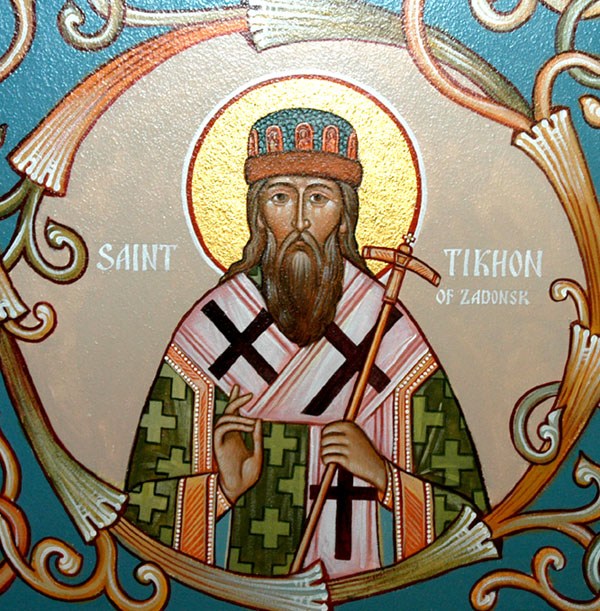
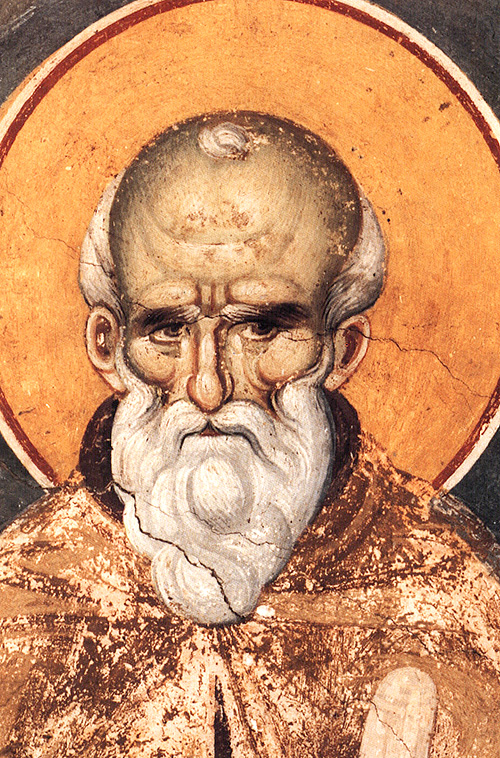

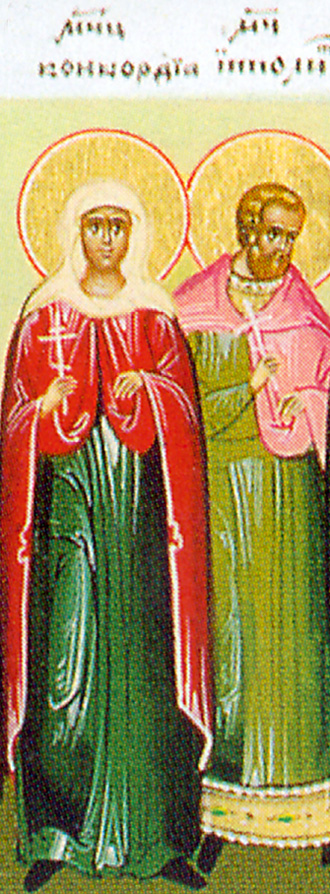


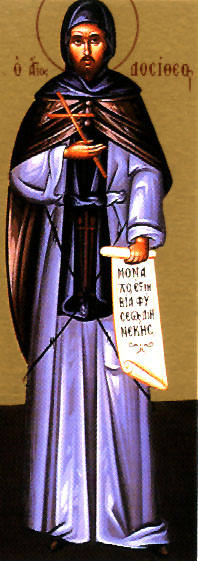


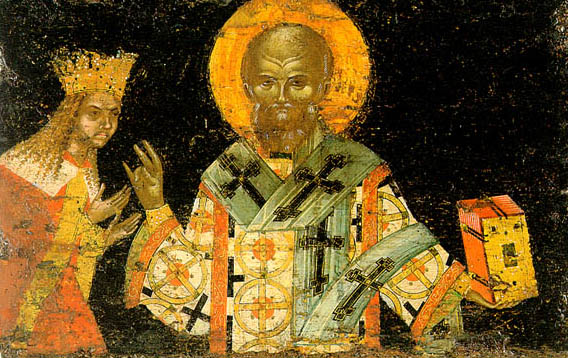
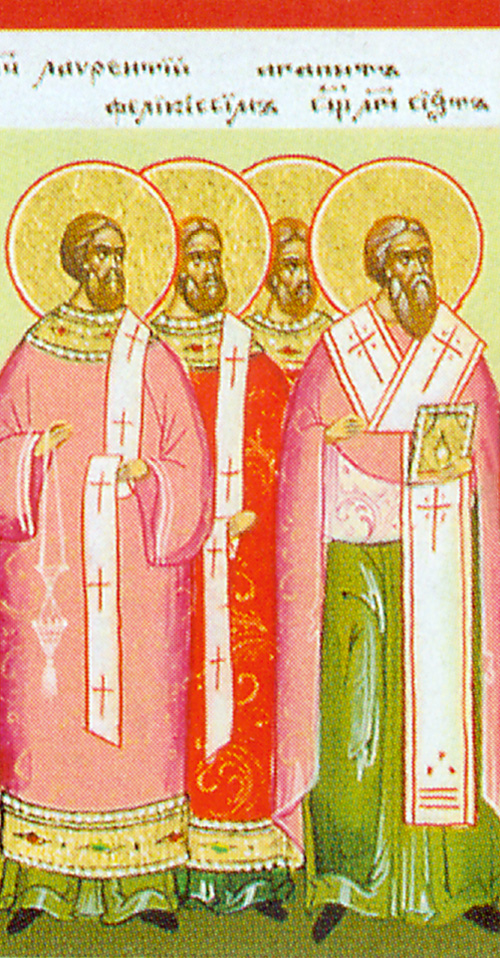

 Saint Peter Antiochian Orthodox Church
You must be logged in to post a comment.