
9TH SUNDAY OF MATTHEW
ABSTAIN FROM MEAT, FISH, DAIRY, EGGS
9th Sunday of Matthew, Laurence the Holy Martyr & Archdeacon of Rome, Hippolytus the Martyr of Rome, Afterfeast of the Transfiguration of our Lord and Savior Jesus Christ
ST. PAUL’S FIRST LETTER TO THE CORINTHIANS 3:9-17
Brethren, we are God’s fellow workers; you are God’s field, God’s building. According to the grace of God given to me, like a skilled master builder I laid a foundation, and another man is building upon it. Let each man take care how he builds upon it. For no other foundation can any one lay than that which is laid, which is Jesus Christ. Now if any one builds on the foundation with gold, silver, precious stones, wood, hay, straw – each man’s work will become manifest; for the Day will disclose it, because it will be revealed with fire, and the fire will test what sort of work each one has done. If the work which any man has built on the foundation survives, he will receive a reward. If any man’s work is burned up, he will suffer loss, though he himself will be saved, but only as through fire. Do you not know that you are God’s temple and that God’s Spirit dwells in you? If any one destroys God’s temple, God will destroy him. For God’s temple is holy, and that temple you are.
MATTHEW 14:22-34
At that time, Jesus made the disciples get into the boat and go before him to the other side, while he dismissed the crowds. And after he had dismissed the crowds, he went up into the hills by himself to pray. When evening came, he was there alone, but the boat by this time was many furlongs distant from the land, beaten by the waves; for the wind was against them. And in the fourth watch of the night he came to them, walking on the sea. But when the disciples saw him walking on the sea, they were terrified, saying, "It is a ghost!" And they cried out for fear. But immediately he spoke to them, saying "Take heart, it is I; have no fear." And Peter answered him, "Lord, if it is you, bid me come to you on the water." He said, "Come." So Peter got out of the boat and walked on the water and came to Jesus; but when he saw the wind, he was afraid, and beginning to sink he cried out, "Lord, save me." Jesus immediately reached out his hand and caught him, saying to him, "O man of little faith, why did you doubt?" And when they entered the boat, the wind ceased. And those in the boat worshiped him, saying, "Truly you are the Son of God." And when they had crossed over, they came to land at Gennesaret.
Afterfeast of the Transfiguration of our Lord

The hymns of Vespers remind us that the Transfiguration is not merely a historical event, but something which also has implications for us. Those who “desire to see and hear things past understanding” must ascend from earthly concerns to “the height of the contemplation of the virtues.” This may be achieved by “directing our minds to heavenly things” and by “being formed anew in piety into the image of Christ.”
Martyr and Archdeacon Laurence, and those with him, of Rome
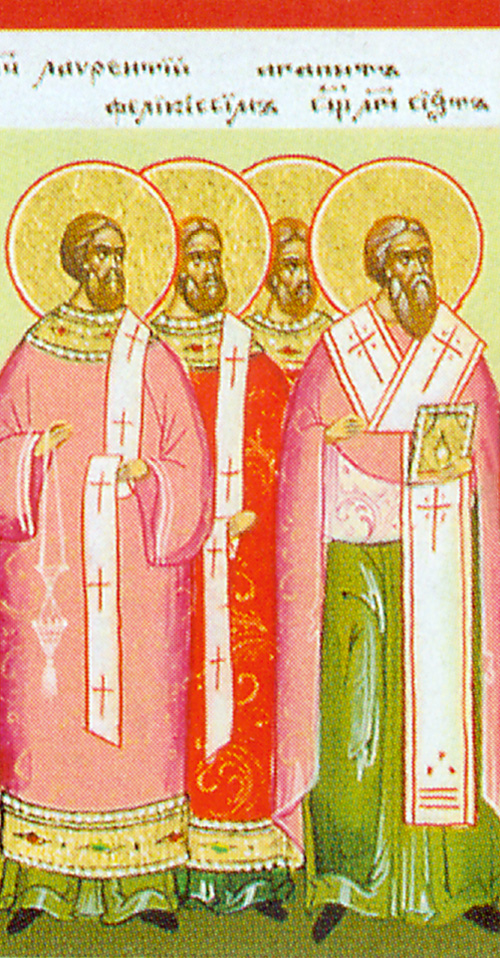
The Martyrs Archdeacon Laurence, Pope Sixtus, Deacons Felicissimus and Agapitus, and the soldier Romanus were citizens of Rome, and suffered in the year 258 during the reign of Emperor Valerian (253-260). Saint Sixtus was born in the city of Athens, and at first he was a philosopher, but later he became a follower of Christ. When he arrived in Rome, he showed himself to be a wise and devout member of the Church. Over a period of time, he passed through the various ranks of the clergy, and became the Bishop of Rome following the martyric death of Saint Stephen (August 2). Several Roman Hierarchs preferred to die rather than offer sacrifice to idols. Soon, Saint Sixtus was also arrested and imprisoned together with his deacons Felicissimus and Agapitus.
When Archdeacon Laurence visited Saint Sixtus in prison, he cried out with tears, "Where are you going, Father, without your son? Where do you hasten without your Archdeacon? Never have you offered the Bloodless Sacrifice without me. Take me with you, so that I may join you in shedding our blood for Christ!”
Saint Sixtus replied, "I am not forsaking you, my son. I am old and I accept the lesser battle, but greater suffering awaits you. You must achieve the greater victory and triumph over your tormentors. Three days after my death, you shall follow after me."
Then he entrusted Archdeacon Laurence with the Church's treasures and sacred vessels, telling him to distribute these to the poor. He gathered them up and went around the city on foot, to the clergy and impoverished Christians who were in hiding, helping them according to their needs.
When he heard that Saint Sixtus had been brought to trial with his deacons, Saint Laurence went there in order to witness the outcome. Seeing that the martyrs were obstinate in their refusal to offer sacrifice to the idols, Valerian ordered them to be taken to the temple of Mars outside the city walls, and put to death if they did not offer incense to the idols. When he saw the pagan temple, Saint Sixtus prayed for it to be destroyed. There was an earthquake which caused part of the temple to collapse, and the statue of Mars was shattered to pieces. Saint Laurence cried out, “Father, I have fulfilled your command, and have distributed the treasures of the Church which you entrusted to me."
After hearing about treasure, the soldiers placed him under guard. Saint Sixtus and the other martyrs were beheaded in front of the temple on August 6, 258. Afterward, the soldiers brought Saint Laurence to the Emperor, informing him that they had heard the Archdeacon mention something about the Church's hidden treasures. The Emperor ordered him to reveal where the treasures were, and the Archdeacon asked for three days in order to collect them. Then Saint Laurence gathered all the poor and the needy, and brought them to the Prefect, saying, "Behold the treasures of the Church."
The ruler became very angry at this and ordered Hippolytos (Iππόλυτος) who was in charge of the prison, to throw the Archdeacon into the dungeon with other prisoners. There the Saint restored the sight of a man named Lucillus. Hippolytos was amazed at this, and asked to see the Church's treasures. Saint Laurence told him that if he believed in Christ and was baptized, he would find true wealth and everlasting life. Hippolytos said that if this was true, he would do as he asked.
Hippolytos took Saint Laurence to his home, where he instructed and baptized the jailer and all his household, consisting of nineteen persons. Soon afterward, Hippolytos was ordered to bring the Archdeacon to Emperor Valerian. Seeing that the Saint had not agreed to offer sacrifice, he ordered that Saint Laurence be tortured. Still, the Archdeacon refused to sacrifice to the idols. As the Martyr endured these torments, a soldier named Romanus cried, "Laurence, I see a radiant youth standing by you, and wiping your wounds. Entreat Christ, Who has sent His Angel to you, not to abandon me."
Then Valerian commanded Hippolytos to return the Saint to prison. Romanus brought a pitcher of water and asked the Martyr to baptize him. Immediately after the soldier was baptized, he was seized by other soldiers and taken to the Emperor. Before anyone could question him, Romanus shouted, "I am a Christian."
The Emperor ordered him to be taken outside the city and beheaded on August 9.
The next day, Saint Laurence was placed on a rack, scourged with whips with sharp iron points attached to them, and then was stretched out naked on a red-hot iron gridiron with burning coals underneath it. The Holy Martyr glanced at the ruler and said, “You have already roasted one side of my body, now turn me over to the other side so you may taste what you have roasted."
Then he glorified God, saying, “I thank You, Lord Jesus Christ, that You have found me worthy to enter Your gates."
Saint Laurence received the unfading crown of martyrdom on August 10, 258.
That night, Saint Hippolytos took the Saint's body he wrapped it in a shroud with spices. Then he and the priest Justin brought the relics to the home of a widow named Kyriake, where it remained until evening. Later, many Christians escorted the Saint's body to a cave on the widow's property. After praying all night, they buried the Martyr there with honor. Then Father Justin served the Divine Liturgy, and everyone partook of the Holy Mysteries.
Saint Hippolytos and the other Christians suffered martyrdom three days after the death of Saint Laurence, on August 13.
A large part of Saint Laurence's relics are located in the church of Saint Laurence "outside the walls" in Rome. Other pieces of the holy relics are to be found in the Monasteries of Saint Panteleimon on Mount Athos, and at Kykkos, Cyprus.
Blessed Laurence the Fool-For-Christ at Kaluga

Blessed Laurence, the Fool-for-Christ and Wonderworker of Kaluga, lived at the beginning of the XVI century at a distance of half a verst from old Kaluga, near a forest church dedicated to the Nativity of Christ, set upon a high hill.
There was a long underground entrance from his dwelling place to the church, where he attended services. He also lived at the home of the Kaluga Prince Simeon. It is thought that Blessed Laurence was descended from the noble Khitrov family, since his name is at the head of their memorial at the Peremyshl’sk Liutykov Monastery in the Kaluga diocese.
Blessed Laurence went barefoot both winter and summer, dressed in a shirt and sheepskin coat. By his ascetical struggles he had risen to such heights of virtue that during his lifetime, he was glorified by gifts of grace. He healed many diseases of the eyes through his prayers.
When the Crimean Tatars attacked Kaluga in May 1512, Blessed Laurence, then in the Prince's home, suddenly shouted in a loud voice: “Give me my sharp axe, for the curs are attacking Prince Simeon and I must defend him!” Saying this, he grabbed the axe and left. Suddenly, he was on board a ship next to the Prince. The Holy Fool Laurence inspired and encouraged the soldiers, and at that very hour they defeated the enemy.
Sometimes, he is depicted on icons with an axe in his right hand, set upon a long handle. It is certain that Prince Simeon (+ 1518), who owed his life to Blessed Laurence, built a monastery on the site of the Saint’s ascetical struggles and dedicated it to him.
Blessed Laurence reposed on August 10, 1515, on his Name Day. The Saint is also commemorated on July 8, perhaps in remembrance of his first posthumous miracle in Kaluga in 1621.1
In that year, the paralyzed boyar Lev Andreevich Kologrivov, who could not move his hands and legs, and was unable to speak, was placed near the tomb of Saint Laurence. During a Moleben, as the Gospel was read, the paralyzed man spoke and began to believe. Raising his right hand, he made the Sign of the Cross; then he stood up, went to the tomb and attached himself to it. By the end of the Moleben, he was able to speak normally, and became perfectly healthy.
Blessed Laurence seems to have been glorified in the second half of the XVI century. Tsar Ivan the Terrible wrote the following on a deed granting land to the monastery in 1565: “To the Monastery of the Nativity of Christ, where Laurence, the Fool-for-Christ lies."
During the Napoleonic invasion of Russia, the intercession of Blessed Lawrence for his native land was shown in a vivid manner. Kaluga became "the limit of the (French) offensive and the beginning of the enemy's retreat and destruction," according to an inscription on the Maloyaroslavets monument commemorating the battle on October 12, 1812.
In August 2018, some of Saint Laurence's relics were discovered in a storeroom of the Moscow Central Museum of the Armed Forces. On August 10/23, a portion of the holy relics was given to the Monastery in Kaluga where the body of Saint Laurence was once buried.
1 The latter commemoration does not seem to be listed on the Calendar of the Russian Orthodox Church.
 Saint Peter Antiochian Orthodox Church