
6TH WEDNESDAY AFTER PENTECOST
ABSTAIN FROM MEAT, FISH, DAIRY, EGGS
Athenogenes the Holy Martyr of Heracleopolis, Julia the Virgin-martyr of Carthage, 1, 015 Martyrs in Pisidia, Helier the Hermit, Martyr of Jersey
ST. PAUL’S FIRST LETTER TO THE CORINTHIANS 2:9-16; 3:1-8
Brethren, “What no eye has seen, nor ear heard, nor the heart of man conceived, what God has prepared for those who love him, ” God has revealed to us through the Spirit. For the Spirit searches everything, even the depths of God. For what person knows a man’s thoughts except the spirit of the man which is in him? So also no one comprehends the thoughts of God except the Spirit of God. Now we have received not the spirit of the world, but the Spirit which is from God, that we might understand the gifts bestowed on us by God. And we impart this in words not taught by human wisdom but taught by the Spirit, comparing spiritual things with spiritual truths to those who possess the Spirit. The unspiritual man does not receive the gifts of the Spirit of God, for they are folly to him, and he is not able to understand them because they are spiritually discerned. The spiritual man judges all things, but is himself to be judged by no one. “For who has known the mind of the Lord so as to instruct him?” But we have the mind of Christ. But I, brethren, could not address you as spiritual men, but as men of the flesh, as babes in Christ. I fed you with milk, not solid food; for you were not ready for it; and even yet you are not ready, for you are still of the flesh. For while there is jealousy and strife among you, are you not of the flesh, and behaving like ordinary men? For when one says, “I belong to Paul, ” and another, “I belong to Apollos, ” are you not merely men? What then is Apollos? What is Paul? Servants through whom you believed, as the Lord assigned to each. I planted, Apollos watered, but God gave the growth. So neither he who plants nor he who waters is anything, but only God who gives the growth. He who plants and he who waters are equal, and each shall receive his wages according to his labor.
MATTHEW 13:31-36
The Lord said this parable, "The kingdom of heaven is like a grain of mustard seed which a man took and sowed in his field; it is the smallest of all seeds, but when it has grown it is the greatest of shrubs and becomes a tree, so that the birds of the air come and make nests in its branches." He told them another parable. "The kingdom of heaven is like leaven which a woman took and hid in three measures of flour, till it was all leavened.
All this Jesus said to the crowds in parables; indeed he said nothing to them without a parable. This was to fulfill what was spoken by the prophet: "I will open my mouth in parables, I will utter what has been hidden since the foundation of the world." Then Jesus left the crowds and went into the house.
Hieromartyr Athenogenes, Bishop of Heracleopolis, and his ten disciples

Hieromartyr Athenogenes and his Ten Disciples suffered for Christ during the persecution of Christians in the city of Sebastea in Cappadocia. The governor Philomachos arranged a large festival in honor of the pagan gods and called upon the citizens of Sebastea to offer sacrifice to the idols. Most of the inhabitants of Sebastea were Christians, and refused to participate in the impious celebration. Soldiers were ordered to kill those who resisted, and so many Christians received a martyr’s crown.
It came to the governor’s attention that Christianity was spreading because of the grace-filled preaching of Bishop Athenogenes. Soldiers were ordered to find the Elder and arrest him. Bishop Athenogenes and ten of his disciples lived in a small monastery not far from the city. The soldiers did not find the bishop there, so they arrested his disciples. The governor ordered that they be bound with chains and thrown into prison.
Saint Athenogenes was arrested when he came to Sebastea to inform the judge that those who had been jailed were innocent. While in prison, Saint Athenogenes encouraged his spiritual children for their impending struggle. Led forth to trial, all the holy martyrs confessed themselves Christians and refused to offer sacrifice to idols.
After undergoing fierce tortures, the disciples of the holy bishop were beheaded. After the execution of the disciples, the executioners were ordered to torture the bishop. Strengthened by the Lord, Saint Athenogenes underwent the tortures with dignity. His only request was that he be executed in the monastery.
Taken to his own monastery, the saint gave thanks to God, and he rejoiced in the sufferings that he had undergone for Him. Saint Athenogenes asked that the Lord would forgive the sins of all those who would remember both him and his disciples.
The Lord granted the saint to hear His Voice before death, announcing the promise given to the penitent thief: “Today you shall be with Me in Paradise.” The hieromartyr willingly bent his neck beneath the sword.
Martyrs Paul and two sisters, Chionia (Thea) and Alevtina (Valentina), at Cæsarea in Palestine
The Holy Martyrs Paul, Alevtina, and Chionia were from Egypt. During the persecution against Christians under the emperor Maximian (305-313), they were taken to Palestinian Caesarea. Without the slightest fear they confessed themselves as followers of Christ. In the year 308 the sisters Alevtina and Chionia were burned, and Paul was beheaded.
Martyr Antiochus the Physician of Sebaste
The Holy Martyr Antiochus, a native of Cappadocian Sebastea, was the brother of the holy Martyr Platon (November 18), and he was a physician. The pagans learned that he was a Christian, and they brought him to trial and subjected him to fierce tortures. Thrown into boiling water, the saint remained unharmed. He was then given over to be eaten by wild beasts, but they did not harm him. Instead, the beasts lay peacefully at his feet.
Through the prayers of the martyr many miracles were worked and the idols crumbled into dust. The pagans beheaded Saint Antiochus. Seeing the guiltless suffering of the saint, Cyriacus, a participant in the execution, was converted to Christ. He confessed his faith in front of everyone and was also beheaded. They buried the martyrs side by side.
Virgin Martyr Julia of Carthage

The Virgin Martyr Julia was born in Carthage into a Christian family. While still a girl she was captured by the Persians. They carried her off to Syria and sold her into slavery. Fulfilling the Christian commandments, Saint Julia faithfully served her master. She preserved herself in purity, kept the fasts and prayed much to God. No amount of urging by her pagan master could turn her to idolatry.
Once the master set off with merchandise for Gaul and took Saint Julia with him. Along the way the ship stopped over at the island of Corsica, and the master decided to take part in a pagan festival, but Julia remained on the ship. The Corsicans plied the merchant and his companions with wine, and when they had fallen into a drunken sleep, they took Julia from the ship. Saint Julia was not afraid to acknowledge that she was a Christian, and the savage pagans crucified her.
An angel of the Lord reported the death of the holy martyr to the monks of a monastery, located on a nearby island. The monks took the body of the saint and buried it in a church in their monastery.
In about the year 763 the relics of the holy Martyr Julia were transferred to a women’s monastery in the city of Breschia (historians give conflicting years of the death of the saint: as either the fifth or seventh century).
New Martyr John of Trnovo
No information available at this time.
Icon of the Mother of God of Chirsk-Pskov
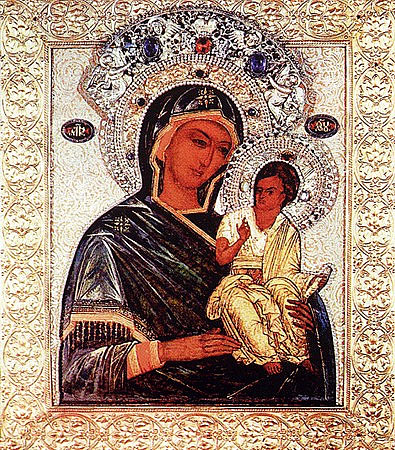
In the XV century, in the territory of the Pskov principality, there was a certain village called Chirsk, or Chersk, where, in the church of the Nativity of Christ, there was a Hodēgḗtria Icon of the Mother of God. In 1420, during the reign of Tsar Basil I of Moscow, and when Archbishop Simeon occupied the See of Novgorod and Pskov, a great disaster broke out over the Pskov region – the plague. People were despondent and sought solace and comfort by praying to God and the Queen of Heaven for help.
On July 16, 1420, as a consolation for the faithful and the encouragement of the faint-hearted, a great Sign took place in the church of the Nativity of Christ at Chirsk: tears flowed from the eyes of the Mother of God on the Icon. News of the miracle spread quickly among the inhabitants of that region, and they began to flock in large numbers to venerate the newly glorified Icon.
Soon Prince Theodore of Pskov was informed of this, so he sent priests to Chirsk, along with many noble and devout persons, with orders to take this Icon and bring it to Pskov. With reverence and solemnity, they obeyed the command of their Prince. At Pskov, when it was learned that the holy Icon was nearing the city, Prince Theodore went out to meet it, with all the clergy and people.
This moment of the meeting was marked by an amazing new miracle: tears began to flow again from the eyes of the Mother of God, even more copiously than before, which was witnessed by all those who were present. The people, trembling at the sight, fell to the ground with tears, crying out: "Lord, have mercy! O Most Holy Sovereign Lady Theotokos, do not forsake us, but help us, your sinful and unworthy servants, and save us!"
The Cross Procession came to a halt, and the priests who carried the Icon served a Moleben of thanksgiving. This wonderworking Icon was brought into the city of Pskov and was placed in the cathedral church of the Life-Giving Trinity, where it remains to this day. Every year, on the Feast of Mid-Pentecost, the Icon is taken from Holy Trinity Cathedral and carried around the city.
The Holy Apostle and Evangelist Luke and Saint Theodosios of the Kiev Caves are depicted on the reverse of the Icon.
 Saint Peter Antiochian Orthodox Church