Monthly Archives: June 2025

Daily Readings for Tuesday, June 24, 2025

NATIVITY OF THE FORERUNNER JOHN THE BAPTIST

ABSTAIN FROM MEAT, DAIRY, EGGS

Nativity of the Forerunner John the Baptist, Elizabeth, Mother of the Forerunner, Athanasios Parios, Panagiotis the New Martyr

ST. PAUL’S LETTER TO THE ROMANS 13:11-14; 14:1-4

Brethren, salvation is nearer to us now than when we first believed; the night is far gone, the day is at hand. Let us then cast off the works of darkness and put on the armor of light; let us conduct ourselves becomingly as in the day, not in reveling and drunkenness, not in debauchery and licentiousness, not in quarreling and jealousy. But put on the Lord Jesus Christ, and make no provision for the flesh, to gratify its desires.
As for the man who is weak in faith, welcome him, but not for disputes over opinions. One believes he may eat anything, while the weak man eats only vegetables. Let not him who eats despise him who abstains, and let not him who abstains pass judgment on him who eats; for God has welcomed him. Who are you to pass judgment on the servant of another? It is before his own master that he stands or falls. And he will be upheld, for God is able to make him stand.

LUKE 1:1-25, 57-68, 76, 80

Inasmuch as many have undertaken to compile a narrative of the things which have been accomplished among us, just as they were delivered to us by those who from the beginning were eyewitnesses and ministers of the word, it seemed good to me also, having followed all things closely for some time past, to write an orderly account for you, most excellent Theophilos, that you may know the truth concerning the things of which you have been informed. In the days of Herod, king of Judea, there was a priest named Zacharias, of the division of Abijah; and he had a wife of the daughters of Aaron, and her name was Elizabeth. And they were both righteous before God, walking in all the commandments and ordinances of the Lord blameless. But they had no child, because Elizabeth was barren, and both were advanced in years. Now while he was serving as priest before God when his division was on duty, according to the custom of the priesthood, it fell to him by lot to enter the temple of the Lord and burn incense. And the whole multitude of the people were praying outside at the hour of incense. And there appeared to him an angel of the Lord standing on the right side of the altar of incense. And Zacharias was troubled when he saw him, and fear fell upon him. But the angel said to him, “Do not be afraid, Zacharias, for your prayer is heard, and your wife Elizabeth will bear you a son, and you shall call his name John. And you will have joy and gladness, and many will rejoice at his birth; for he will be great before the Lord, and he shall drink no wine nor strong drink, and he will be filled with the Holy Spirit, even from his mother’s womb. And he will turn many of the sons of Israel to the Lord their God, and he will go before him in the spirit and power of Elijah, to turn the hearts of the fathers to the children, and the disobedient to the wisdom of the just, to make ready for the Lord a people prepared.” And Zacharias said to the angel, “How shall I know this? For I am an old man, and my wife is advanced in years.” And the angel answered him, “I am Gabriel, who stands in the presence of God; and I was sent to speak to you, and to bring you this good news. And behold, you will be silent and unable to speak until the day that these things come to pass, because you did not believe my words, which will be fulfilled in their time.” And the people were waiting for Zacharias, and they wondered at his delay in the temple. And when he came out, he could not speak to them, and they perceived that he had seen a vision in the temple; and he made signs to them and remained dumb. And when his time of service was ended, he went to his home.After these days his wife Elizabeth conceived, and for five months she hid herself, saying, “Thus the Lord has done to me in the days when he looked on me, to take away my reproach among men.” Now the time came for Elizabeth to be delivered, and she gave birth to a son. And her neighbors and kinsfolk heard that the Lord had shown great mercy to her, and they rejoiced with her. And on the eighth day they came to circumcise the child; and they would have named him Zacharias after his father, but his mother said, “Not so; he shall be called John.” And they said to her, “None of your kindred is called by this name.” And they made signs to his father, inquiring what he would have him called. And he asked for a writing tablet, and wrote, “His name is John.” And they all marveled. And immediately his mouth was opened and his tongue loosed, and he spoke, blessing God. And fear came on all their neighbors. And all these things were talked about through all the hill country of Judea; and all who heard them laid them up in their hearts, saying, “What then will this child be?” For the hand of the Lord was with him. And his father Zacharias was filled with the Holy Spirit, and prophesied, saying, “Blessed be the Lord God of Israel, for he has visited and redeemed his people. And you, child, will be called the prophet of the Most High; for you will go before the Lord to prepare his ways.” And the child grew and became strong in spirit, and he was in the wilderness till the day of his manifestation to Israel.

Nativity of the Holy Glorious Prophet, Forerunner and Baptist, John

The Nativity of the Holy Forerunner and Baptist of the Lord, John: The Gospel (Luke. 1: 5) relates that the righteous parents of Saint John the Baptist, the Priest Zachariah and Elizabeth (September 5), lived in the ancient city of Hebron. They reached old age without having children, since Elizabeth was barren. Once, Saint Zachariah was serving in the Temple at Jerusalem and saw the Archangel Gabriel, standing on the right side of the altar of incense. He predicted that Saint Zachariah would father a son, who would announce the Savior, the Messiah, awaited by the Old Testament Church. Zachariah was troubled, and fear fell upon him. He had doubts that in old age it was possible to have a son, and he asked for a sign. It was given to him, and it was also a chastisement for his unbelief. Zachariah was struck speechless until the time of the fulfillment of the archangel’s words.

Saint Elizabeth came to be with child, and fearing derision at being pregnant so late in life, she kept it secret for five months. Then her relative, the Virgin Mary, came to share with her Her own joy. Elizabeth, “filled with the Holy Spirit,” was the first to greet the Virgin Mary as the Mother of God. Saint John leaped in his mother’s womb at the visit of the Most Holy Virgin Mary and the Son of God incarnate within Her.

Soon Saint Elizabeth gave birth to a son, and all the relatives and acquaintances rejoiced together with her. On the eighth day, in accordance with the Law of Moses, he was circumcised and was called John. Everyone was amazed, since no one in the family had this name. When they asked Saint Zachariah about this, he motioned for a tablet and wrote on it: “His name is John.” Immediately his tongue was loosed, and Saint Zachariah glorified God. He also prophesied about the Coming into the world of the Messiah, and of his own son John, the Forerunner of the Lord (Luke. 1: 68-79).

After the Nativity of our Lord Jesus Christ and the worship of the shepherds and the Magi, wicked king Herod gave orders to kill all male infants. Hearing about this, Saint Elizabeth fled into the wilderness and hid in a cave. Saint Zachariah was at Jerusalem and was doing his priestly service in the Temple. Herod sent soldiers to him to find out the abode of the infant John and his mother. Zachariah answered that their whereabouts were unknown to him, and he was killed right there in the Temple. Righteous Elizabeth continued to live in the wilderness with her son and she died there. The child John, protected by an angel, dwelt in the wilderness until the time when he came preaching repentance, and was accounted worthy to baptize the Lord.

Venerable Anthony, Abbot of Dymsk, Novgorod

Saint Anthony of Dymsk was born at Novgorod about the year 1157. Once in church he heard the words of Christ: “If anyone would come after Me, let him deny himself and take up his cross and follow Me” (Mt.16:24), the saint resolved to leave the world and receive monastic tonsure under Saint Barlaam of Khutyn (November 6) at his monastery.

When he was dying, Saint Barlaam appointed Saint Anthony as igumen in his place; but Anthony, shunning glory, left the monastery and settled at the shores of Lake Dyma, on the outskirts of the city of Tikhvin. Here he founded a monastery and struggled there until the end of his own life.

According to Tradition, Saint Anthony made a journey to Constantinople, and returned to his monastery on the day that the igumen Barlaam died. Saint Anthony fell asleep in the Lord on June 24, 1224. In the year 1330 his relics were found incorrupt, and from that time they were glorified by many miracles.

Saint Anthony of Dymsk is also commemorated on January 17.

Righteous Youths John and Jacob (James) of Meniugi

The Righteous Youths James and John of Meniugi were brothers by birth, children of the pious couple Isidore and Barbara. They were killed by miscreants (James at three years of age, and John at five years of age).

Between the years 1682-1689 their relics were found incorrupt and were placed in a reliquary at the Trinity church in Meniugi village, Novgorod diocese, on the site of the former Trinity monastery.

Seven Martyred Brothers: Orentius, Pharnacius, Eros, Firmus, Firminus, Cyriacus, and Longinus, in Georgia

Saints Orentios, Pharnakios, Erotas, Phirmos, Phirminos, Kyriakos, and Longinus were brothers, who were known for their courage and served as soldiers in Thrace during the reign of Emperor Diocletian.

During a battle with the Scythians, Saint Orentios killed their fierce and intrepid leader, Mararon. He received many honors for this achievement, but then he was asked to participate in a sacrifice that was being offered to the idols in thanksgiving for his victory. The Christian hero absolutely refused to do this, declaring that he had defeated his foe by the power of Jesus Christ, whom he worshiped as the one true God. They did not punish him right away, because of his bravery, but he and his brothers were detained.

After some time, they were questioned. All seven declared, as with one mouth, that they would remain faithful to Christ until their last breath,
and that the Savior would judge them on the Last Day. After saying this, they were sentenced to exile in the Caucasus.

One after another, the seven brothers died on the journey from their hardships and suffering. but they endured their afflictions without complaint. Erotas was the first to depart this life; he perished at Parembol on June 22. Next, Orentios was thrown into the sea with a stone tied around his neck. Pharnakios reposed on July 3 at Kordila. Phirmos and Phirminos received their heavenly crowns on July 7 at Aspara on the eastern shores of the Black Sea. Kyriakos went to the Lord on July 14 at Ziganeia, and Longinus gave his soul into God's hands on July 28 while on board a ship. The storm-tossed vessel went aground at Pitinda (Pitsnda), and so the last holy martyr was buried there.

We pray to these holy martyrs to protect us from our enemies. In Greek usage these saints are commemorated on June 25.

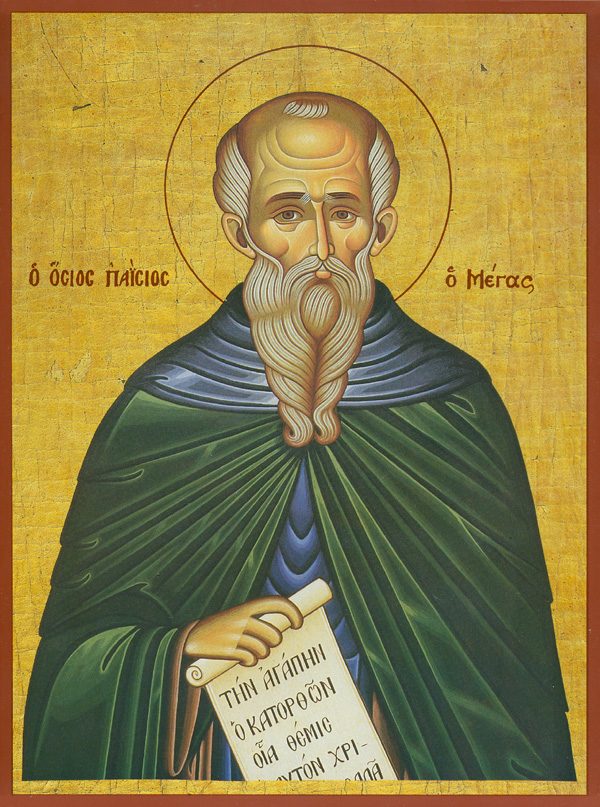
Saint Athanasius Parios

Saint Athanasius Parios, the distinguished theologian and great teacher of the Greek nation, was born in the village of Kostos on the island of Paros around 1721—1722. His father, Apostolos Toulios, was from Siphnos, and his mother was a native of Paros.

The future saint was a leading member of the Kollyvades movement which began on Mount Athos in the middle of the eighteenth century. The movement derives its name from the koliva (boiled wheat) which is used during memorial services. Its proponents were Athonite monks who adhered strictly to holy Tradition, and were opposed to unwarranted innovations. They were in favor of the frequent reception of Holy Communion, and they practiced unceasing prayer of the heart. They insisted that memorial services should not be performed on Sundays, because that is the day of the Lord’s Resurrection. In the Orthodox Church Saturday is the usual day for the commemoration of the dead.

Saint Athanasius went to Mount Athos in 1752. There he was ordained to the holy priesthood by Saint Macarius of Corinth (April 17), but was forced to leave the Holy Mountain when some of the monks rose in opposition to the Kollyvades. The righteous one was unjustly slandered for his views on frequent Communion and for his opposition to memorial services on Sundays.

As the result of personal attacks and intrigues against him, Saint Athanasius was suspended from exercising his priestly office from 1776—1781, and was even accused of being a heretic. When the charges against him were later proven to be absurd and unfounded, his suspension was lifted, and he was restored to his former rank.

Saint Athanasius knew and influenced many of his fellow Kollyvades, such as Saint Macarius of Corinth, Saint Nikēphóros of Chios (May 1), Saint Arsenius of Paros (January 31), and Saint Νikόdēmos of the Holy Mountain (July 14). He taught Saint Nikēphóros, and he encouraged Saint Νikόdēmos to publish a collection of the writings of Saint Gregory Palamas (November 14). Unfortunately, his manuscript was lost before it could be printed.

After teaching at the Athonias Academy and in Thessalonica, Saint Athanasius journeyed to the island of Chios in 1788, where he taught in the gymnasium for twenty-five years, and also served as Director of schools. He was a leading educator and distinguished theologian who revived the art of eloquent speech on Chios by teaching logic, rhetoric, metaphysics, and theology. His TREATISE ON RHETORIC, an analysis of some of the orations of Demosthenes, was a most influential work.

Saint Athanasius wrote many other useful books and treatises on various topics such as A HANDBOOK OF APOLOGETICS, “The Great Blessing of Water,” “On the Second Sunday of Great Lent,” “The Kneeling Prayers on Pentecost,” “On the Holy Icons,” “On Memorial Services,” “On the New Martyrs,” “On the Angels and Divine Beauty,” as well as numerous letters dealing with diverse subjects. His most important book was the EPITOME, which deals with Orthodox dogma.

Saint Athanasius was also a prolific writer of saints’ Lives and of liturgical services in their honor. He wrote the lives of Saint Mark the New (June 5) and Saint Macarius of Corinth, among others. He also wrote the Preface for the NEW LEIMONARION (New Spiritual Meadow), a collection of saints’ lives and services begun by Saint Macarius, with additional material contributed by Saint Nikēphóros of Chios and by Saint Athanasius himself.

Saint Athanasius retired as Director of schools in 1812, and went to join Saint Nikēphóros at the Hermitage of Saint George at Resta, Chios where he spent his final days. He departed to the Lord on June 24, 1813 at the age of ninety.

Saint Athanasius was very zealous for the teachings of Christ and His Church, and patiently endured persecution and suffering during his life because of his beliefs. Since he was opposed to the so-called Age of Enlightenment and fought against the “progressive” spirit of his time, he was censured by some of his contemporaries. Although his detractors enjoyed a certain fame during their lifetime, they are all but forgotten today. On the other hand, Saint Athanasius has been glorified by God and was officially recognized as a saint of the Orthodox Church in 1995.

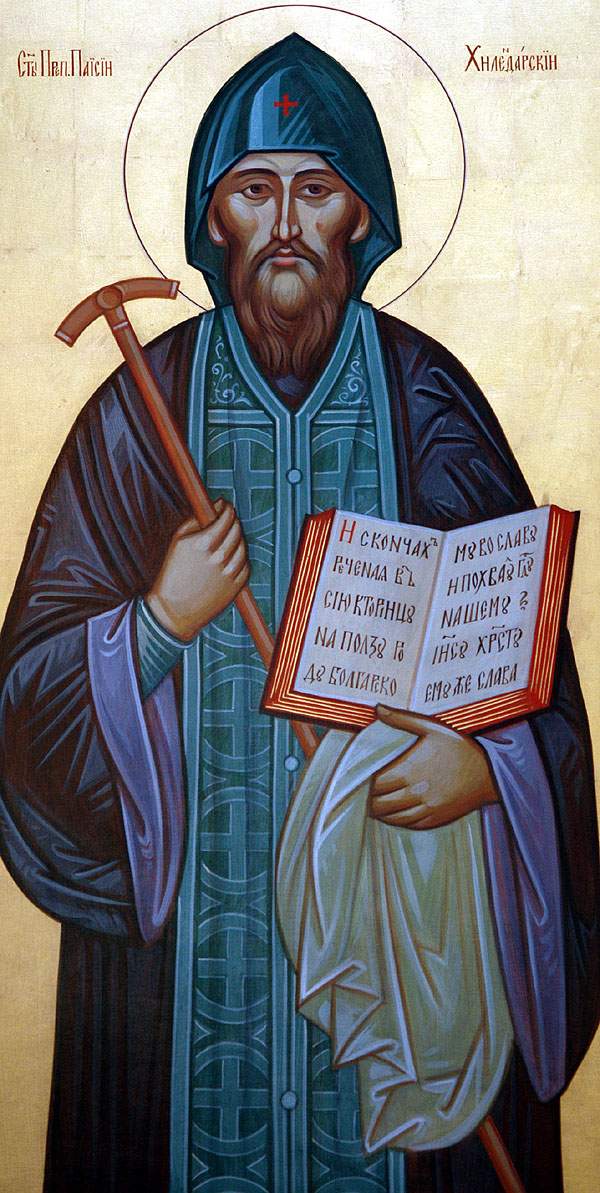
Venerable Barlaam of Khutin

In Slavonic practice, Saint Barlaam is commemorated during the Proskomedia along with the venerable and God-bearing Fathers who shone forth in asceticism (sixth particle).

Saint Barlaam is also commemorated on November 6 and February 10.
Daily Readings for Monday, June 23, 2025

3RD MONDAY AFTER PENTECOST

ABSTAIN FROM MEAT, DAIRY, EGGS

Agrippina the Martyr of Rome, Holy Martyrs Aristocleus the Priest, Demetrius the Deacon and Athanasius the Reader, The Holy New Bishop Martyrs Gerasimus of Crete, Neophytos of Knossos, Joachim of Cherronisos, Hierotheos of Lampi, Zachariah of Sitia, Joachim of Petra, Gerasimos of Rethymno, Kallinikos of Kydonia, Melchizedek of Kissamos, Kallinikos of Diopolos, and those Martyred with them (1821-1822), Mark, Bishop of Ephesus, Etheldreda the Queen

ST. PAUL’S LETTER TO THE ROMANS 7:1-14

Brethren, I am speaking to those who know the law. Do you not know that the law is binding on a person only during his life? Thus a married woman is bound by law to her husband as long as he lives; but if her husband dies she is discharged from the law concerning the husband. Accordingly, she will be called an adulteress if she lives with another man while her husband is alive. But if her husband dies she is free from that law, and if she marries another man she is not an adulteress.
Likewise, my brethren, you have died to the law through the body of Christ, so that you may belong to another, to him who has been raised from the dead in order that we may bear fruit for God. While we were living in the flesh, our sinful passions, aroused by the law, were at work in our members to bear fruit for death. But now we are discharged from the law, dead to that which held us captive, so that we serve not under the old written code but in the new life of the Spirit.
What then shall we say? That the law is sin? By no means! Yet, if it had not been for the law, I should not have known sin. I should not have known what it is to covet if the law had not said, "You shall not covet." But sin, finding opportunity in the commandment, wrought in me all kinds of covetousness. Apart from the law sin lies dead. I was once alive apart from the law, but when the commandment came, sin revived and I died; the very commandment which promised life proved to be death to me. For sin, finding opportunity in the commandment, deceived me and by it killed me. So the law is holy, and the commandment is holy and just and good.
Did that which is good, then, bring death to me? By no means! It was sin, working death in me through what is good, in order that sin might be shown to be sin, and through the commandment might become sinful beyond measure.

MATTHEW 9:36-38; 10:1-8

At that time, when Jesus saw the crowds, he had compassion for them, because they were harassed and helpless, like sheep without a shepherd. Then he said to his disciples, "The harvest is plentiful, but the laborers are few; pray therefore the Lord of the harvest to send out laborers into his harvest.
And he called to him his twelve disciples and gave them authority over unclean spirits, to cast them out, and to heal every disease and every infirmity. The names of the twelve apostles are these: first, Simon, who is called Peter, and Andrew his brother; James the son of Zebedee, and John his brother; Philip and Bartholomew; Thomas and Matthew the tax collector; James the son of Alphaios, and Lebbaeos called Thaddaios; Simon the Cananaean, and Judas Iscariot, who betrayed him. These twelve Jesus sent out, charging them, "Go nowhere among the Gentiles, and enter no town of the Samaritans, but go rather to the lost sheep of the house of Israel. And preach as you go, saying, 'The kingdom of heaven is at hand.' Heal the sick, raise the dead, cleanse lepers, cast out demons. You received without paying, give without pay.

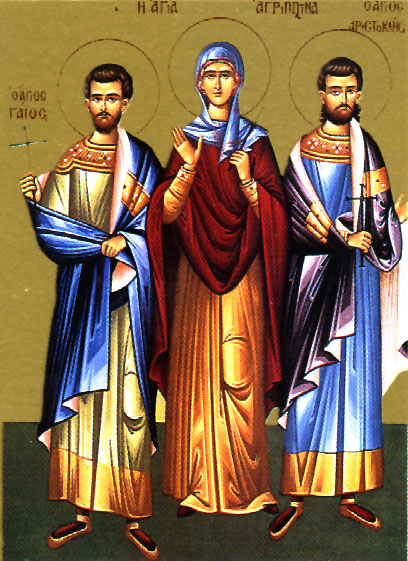
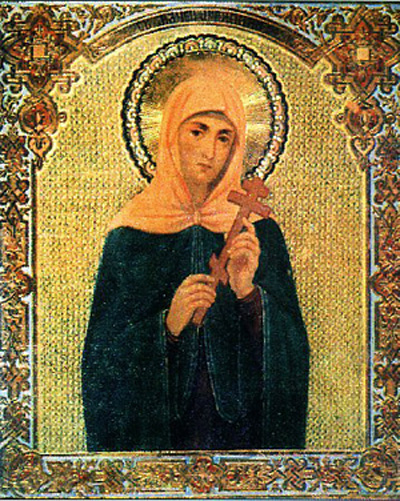
Martyr Agrippina of Rome

The Holy Martyr Agrippina, was by birth a Roman. She did not wish to enter into marriage, and totally dedicated her life to God. During the time of persecution against Christians under the emperor Valerian (253-259) the saint went before the court and bravely confessed her faith in Christ, for which she was given over to torture. They beat the holy virgin with sticks so severely that her bones broke. Afterwards they put Saint Agrippina in chains, but an angel freed her from her bonds.

The holy confessor died from the tortures she endured. The Christians Bassa, Paula and Agathonike secretly took the body of the holy martyr and transported it to Sicily, where many miracles were worked at her grave. In the eleventh century the relics of the holy Martyr Agrippina were transferred to Constantinople.

Righteous Artemius of Verkola

Holy Righteous Artemius of Verkola was born in the village of Dvina Verkola around the year 1532. The son of pious parents, Artemius was a child who was courageous, meek and diligent for every good deed. On June 23, 1545 the twelve-year-old Artemius and his father were taken by surprise in a field by a thunderstorm. A clap of thunder broke right over their heads, and the child Artemius fell dead. People thought that this was a sign of God’s judgment, therefore they left the body in a pine forest without a funeral, and without burial.

Some years later, the village reader beheld a light over the place where the incorrupt body of the Righteous Artemius lay. Taken to the church of Saint Nicholas in 1577, the holy relics were shown to be a source of numerous healings. In this village a monastery was later built, called the Verkola. In 1918, the impious Soviets chopped the holy relics into pieces and threw them into a well. The memory of Saint Artemius is also celebrated on October 20.

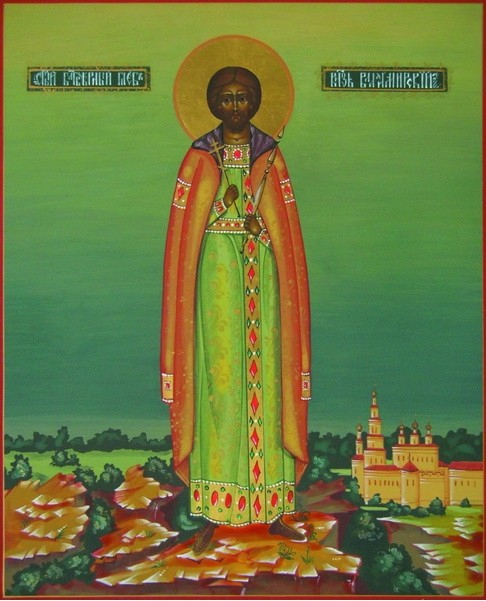
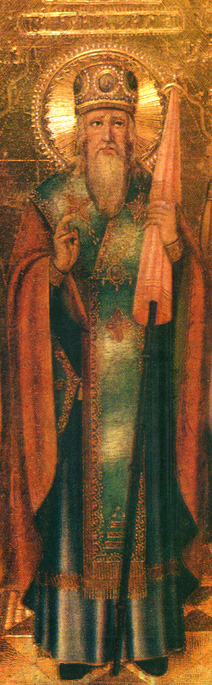
Second Translation of the relics of Saint Herman, Archbishop of Kazan

Today we commemorate the second translation of the relics of Saint Herman, Archbishop of Kazan, in 1714.

St Herman is also commemorated on November 6 (his repose) and on September 25 (transfer of his relics in 1595).

Martyrs Eustochius, Gaius, Probus, Lollius, and Urban, of Ancyra

The Holy Martyrs Eustochius, Gaius, Probus, Lollia and Urban suffered for Christ during the time of a persecution under the emperor Maximian (286-310).

Saint Eustochius was a pagan priest, but seeing the unyielding courage of the Christian martyrs, and the miracles worked by them, he converted to Christ. He went to Bishop Eudoxius of Antioch, was baptized by him, and was ordained to the priesthood. In the city of Lystra Saint Eustochius converted his nephew Gaius and all his household, among which included the children Probus, Lollia and Urban. Soldiers of the emperor arrested Saint Eustochius and took him for trial, but tortures could not turn Eustochius from his faith. They then sent the saint to the governor Agrippinus in the Galatian city of Ancyra. The newly-converted Gaius was also sent with him with his household. All of them, even the women and children, underwent fierce torture, but the martyrs did not deny Christ and so were beheaded.

Synaxis of the Saints of Vladimir

The Synaxis of the Saints of Vladimir was established in 1982 with the blessing of Patriarch Pimen on the Feast Day of the Vladimir Icon of the Mother of God.

Martyrs:

Abram the Bulgarian (+ March 6, 1229)
Archbishop Mētrophánēs (+ February 4, 1238)
Holy Martyr Patrick (+ 1411)

Monks:

Nikḗtas of Pereyaslavl (+ May 24, 1186)
Elijah Muromets of the Caves (+ December 19, 1188)
Archimandrite Pakhomios and Igoumen Theodosios (+ 1237)
Igoumen Daniel of Uspensk (+ 1238)
Michael Vepizhnik (+ 1333)
Sergius of Radonezh (+ September 25, 1392)
Roman of Kirzhach (+ July 29, 1392)
Pakhomios of Nerekhta (+ May 15, 1384)
Euthymios of Suzdal (+ April 1, 1404)
Stephen of Makhra (+ July 14,1406)
Nikon of Radonezh (+ November 17,1426)
Kosmas of Yakhroma (+ February 18, 1492)
Archimandrite Job of Vladimir (+ XV century)
Arkadios of Vyaznikov (+ 1592)
Prokhor and Vassian of Zayastrebye (+ 1592)
Dionysios of Pereyaslavl (+ April 15, 1645)
Lukian of Aleksandrov (+ 1654)
Cornelius of Aleksandrov (+ 1681)
Zosima of Aleksandrov (+ circa 1713)

Nuns:

Maria (Martha in monasticism) (+ 1206)
Theodosia (monastic name: Euphrosyne) (+ May 4, 1244)
Euphrosynē of Suzdal (+ September 1250)
Vassa (in the monastery of Theodore) Nizhny Novgorod (+ 1378)
Sophia of Suzdal (+ December 16, 1542)
Theodosios of Murom (+ XII century)

Hierarchs:

Metropolitans

Maxim of Kiev (+ 1305)
Alexei (Byakont) (+ 1378)
Jonah of Moscow (+ 1461)
Hilarion of Suzdal (+ 1707)

Archbishops

Dionysios of Suzdal († June 26,1385)
Arsenios of Elasson († 1625)

Bishops

Theodore of Rostov (+ 1023)
John of Rostov (+ 1214)
Simon of Pechersk (+ 1226)
Cyril of Rostov (+ 1262)
Serapion of Vladimir (+ 1275)
Theodore of Vladimir (+ 1286)
Basil of Ryazan (+ 1295)
Archbishop Sophronios of Suzdal (+ 1654)
Mētrophánēs of Voronezh (+ 1703)

Right-believing Princes

Gleb of Murom (+ 1015)
Constantine of Murom (+ 1129)
Michael and Theodore of Murom (XII century)
Boris of Turov (+ circa 1160)
Izyaslav Andreevich (+ 1165)
Mstislav Iziaslavich (+ 1172)
Andrew of Bogolyubovo (+ July 4, 1174)
Gleb of Vladimir (+ June 20, 1174)
Michael of Vladimir († 1176)
Peter of Murom (+ June 25, 1228)
Yuri Vsevolodovich (+ February 4, 1238)
Basil (Basilko) of Rostov (+ March 4, 1238)
Vsevolod Yuriyevich of Vladimir (+ February 4, 1246)
Mstislav Yuriyevich (+ February 4, 1238)
Vladimir of Vladimir (+ February 4, 1238)
Demetrios of Vladimir (+ 1238)
Theodore Yaroslavich of Vladimir (+ February 4, 1246)
Svyatoslav Vsevolodovich (+ 1253)
Alexander Nevsky (+ November 23, 1263)
Demetrios Svyatoslavich of Yuryev (+ 1269)
Demetrios Aleksandrovich (+ 1294)
Theodore of Starodub (+ June 21, 1330)

Right-believing Princesses

Irene of Murom (+ circa 1129)
Febronia of Murom (+ 1228)
Agatha, Theodora, Maria and Christina (+ February 4, 1238)
Eudokia of Vladimir (+ XIII century)

Righteous

George (+ February, 1238) and Juliana Lazareva of Murom († January 2, 1604)
Karp of Medush (+ XVII century)
Savva of Moshok (+ 1592)

Fools for Christ

Cyprian of Suzdal (+ 1622)
Eudokia of Suzdal (+ 1776)
Parthenios of Suzdal (+ second half of the XVI century)

Meeting of the Vladimir Icon of the Mother of God in memory of the Saving of Moscow from the Invasion of Khan Achmed

Today the church celebrates the miracle of the Vladimir Icon of the Mother of God, which led to the saving of Moscow from the invasion of Khan Achmed in 1480.

The Vladimir Icon of the Most Holy Theotokos is also commemorated on May 21 and August 26.

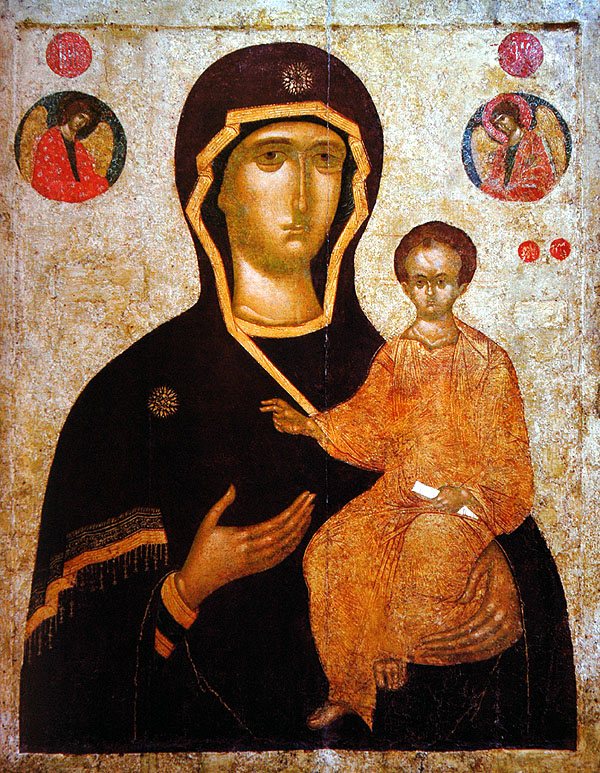
“Tenderness” Icon of the Mother of God of the Pskov Caves

According to Tradition, a copy of the Vladimir Icon of the Mother of God was painted in 1521 by the devout Hieromonk Arsenios Khitrosh. Between 1529-1570 the Icon was brought to the Pskov Caves Monastery by the merchants Basil and Theodore, when Saint Cornelius († February 20, 1571) was the Igoumen. Since then, the Icon has repeatedly shown its mercy and miraculous assistance to the Russian Orthodox people.

Not just once have blind persons been cured while praying before the Icon. On May 28, 1587, when the Icon was in Pskov, Maria Terent'eva, a widow who was blind for about three years, was healed after she prayed before the Tenderness Icon in Holy Trinity Cathedral. Another miracle occurred on March 26, 1603, when the peasant Patapios Grigor'ev was cured after six years of blindness. At the same time, Ivan Supitsyn, a young man from a noble family, was healed of his ailment: the muscles of his left hand had been paralyzed for two years.

An ancient chronicle of the Monastery says: "Not only are the Orthodox healed by the Mother of God, but even non-believers, who come to the Most Pure Theotokos and to her wonderworking Icon with faith."

The Pskov Caves Tenderness Icon of the Mother of God was especially venerated during the reign of Ivan the Terrible in 1581, when Pskov and the Pskov Caves Monastery were besieged by the army of the Polish king Stephen Bathory. Several days before the siege, the Mother of God appeared to the pious Elder Father Dorótheos. The Most Holy Theotokos warned him of the impending disaster and explained that the people's sins were the cause of the misfortune which had befallen them, and told him how they might escape it. Then the Archbishop summoned Igoumen Tikhon of the Pskov Caves Monastery and ordered him to take the wonderworking Dormition (August 15) and Tenderness (June 23) Icons from the Caves, and to serve Molebens in the places which the Mother of God herself had chosen at the time of her appearance.

Stephen Bathory's 100,000 man army went to Pskov, because if he succeeded there, the king planned to go even farther in order to conquer Novgorod and Moscow. The wonderworking Tenderness Icon was brought from the Monastery to the city of Pskov. The Polish army shelled the city and the Monastery with heated cannonballs from the bell tower of Mirozh Monastery. One of the cannonballs struck the Icon of the Mother of God, which was in an opening of the wall, but it did not harm the Icon, nor the people who stood around it. The siege lasted for five months, and thirty times the Poles attempted to take Pskov, but they were unable to do so.

At the beginning of the XVII century the Monastery was attacked by several armies of Swedish, Lithuanian, and Polish invaders. In 1812 the French army threatened Russia. Napoleon's soldiers captured Polotsk on August 17-18, 1812, and the city of Pskov was endangered as well. The citizens asked for the Tenderness and Dormition Icons of the Mother of God to be brought from the Monastery, and also a banner depicting the Icon Not-made-by-hands. On October 7, a procession with the miraculous icons went through the city, and that very day the Russian army retook the city of Polotsk. A church in honor of Holy Archangel Michael was built there (1815-1827) to commemorate the event, and the Tenderness Icon of the Mother of God is kept there now.

In the XX century the Pskov Caves Monastery had to endure two World Wars. But the ancient traditions faithfully preserved in the Monastery were not forgotten, even at that difficult time for Russian monasticism. On February 2, 1920, the Monastery and the city of Pechora were annexed to the territory of Estonia until 1940. For that reason, the Holy Dormition Pskov Caves Monastery was not subjected to ruin or desecration during the Soviet anti-Christian campaign. The Pskov Caves Monastery was one of few XX century Russian Orthodox monasteries which did not cease its prayerful service to God. Although neither the revolution nor the wars spared the Monastery (in May 1945 it lay in ruins), work and the prayer of the monastic brethren overcame further devastation, and again restored the Monastery to its beauty and splendor.

The Pskov Caves Tenderness Icon of the Mother of God belongs to the iconographic type "Eleousa," which comes from the Greek word for mercy. The Theotokos is depicted holding the Child Christ in her right hand, with His cheek pressed to hers. On the Eleousa Icons of the Theotokos (the symbol and ideal of the human race) there is no distance between the Virgin and the Son of God, their love is boundless. The Icon is a prototype of Christ's sacrifice on the Cross, as the highest expression of God's love for His people.

The Pskov Caves Tenderness Icon is commemorated on the following days: May 21 (Meeting of the Vladimir Icon, 1521); August 26 (Meeting of the Vladimir Icon, 1395); June 23 (Main Feast Day); October 7 (Procession around Pskov with the Tenderness and Dormition icons of the Mother of God, 1812); and on the Seventh Sunday of Pascha, the Holy Fathers of the First Ecumenical Synod (Movable Feast).

Nikḗtas of Thebes and those with him

Saint Nikḗtas of Thebes was a resident of the seven-gated (Επτάπυλη) city of Thebes in Boetia. At the age of sixteen, he was tonsured as a monk, and other ascetics were drawn to him by reports of his spiritual character and moral purity. Among these were the monks Daniel, Theodore, and Gregory.

The Venerable Nikḗtas was deemed worthy of the charism of working miracles. He reposed in the Lord, full of days, in the year 1079.

In the Life of Saint Nikḗtas it is said that he once traveled to Patras, where he met Saint Daniel, a great ascetic and a man of prayer. He had received from God the gift of hospitality, like that of Abraham; that is, to receive people, offering them rest by giving them spiritual guidance.

Saint Etheldreda of Ely

No information available at this time.

Úglich Portaίtissa (Gatekeeper) Icon of the Mother of God

The Most Holy Theotokos first appeared to Igoumen Evangelos, who was the Superior of the Monastery from 1864-1872. The late XIX century researcher I. Vinogradov dates the Icon's presence in the Monastery to
that period. If he was correct in thinking that the Icon was painted during that time, then it was lost for almost thirty years.

The Icon was found in the Monastery storeroom in 1894. On June 23 of that year, a sick merchant from St. Petersburg arrived alone at the Monastery. Speaking to the Igoumen, he told him in detail about his illness, and of the vision he had in a dream. The Mother of God told the merchant to go to Úglich, where her Icon was located, and to pray before it, promising that he would be healed.

The Igoumen ordered that a search be made for the Icon. This was done, and the Icon was moved into the Monastery's Dormition church in great triumph. When the sick merchant prayed before the Icon, he soon recovered. In gratitude for the healing he had received, he covered the Icon with a silver gilded riza.

Since that time, the wonderworking Úglich Portaίtissa Icon of the Theotokos has granted healing and consolation to those who resort to the Queen of Heaven with faith in her intercession before God.

In this Icon the Mother of God is depicted as a nun with a staff and a prayer rope in her left hand, and a candle in her right hand. This image is located in the Alekseev Women's Monastery in Úglich, Yaroslavl Province, and it is also known as the "Inextinguishable Candle."

The Úglich Portaίtissa Icon of the Mother of God bears a striking resemblance to the Igoumeness of Mount Athos Icon, which is commemorated on the second Sunday after Pentecost, along with All Saints of Mount Athos.

Daily Readings for Sunday, June 22, 2025

2ND SUNDAY OF MATTHEW

ABSTAIN FROM MEAT, DAIRY, EGGS

2nd Sunday of Matthew, Eusebius, Bishop of Samosata, Zenon the Martyr & his servant Zenas of Philadelphia, Anastasia the Serbian, Alban the Protomartyr of Britain

ST. PAUL’S LETTER TO THE ROMANS 2:10-16

Brethren, glory and honor and peace for every one who does good, the Jew first and also the Greek. For God shows no partiality. All who have sinned without the law will also perish without the law, and all who have sinned under the law will be judged by the law. For it is not the hearers of the law who are righteous before God, but the doers of the law who will be justified. When Gentiles who have not the law do by nature what the law requires, they are a law to themselves, even though they do not have the law. They show that what the law requires is written on their hearts, while their conscience also bears witness and their conflicting thoughts accuse or perhaps excuse them on that day when, according to my gospel, God judges the secrets of men by Christ Jesus.

MATTHEW 4:18-23

At that time, as Jesus walked by the Sea of Galilee, he saw two brothers, Simon who is called Peter and Andrew his brother, casting a net into the sea; for they were fishermen. And he said to them, "Follow me, and I will make you fishers of men." Immediately they left their nets and followed him. And going on from there he saw two other brothers, James the son of Zebedee and John his brother, in the boat with Zebedee their father, mending their nets, and he called them. Immediately they left their boat and their father, and followed him. And he went about all Galilee, teaching in their synagogues and preaching the gospel of the kingdom and healing every disease and every infirmity among the people.

Synaxis of the Saints of North America

On the second Sunday after Pentecost, each local Orthodox Church commemorates all the saints, known and unknown, who have shone forth in its territory. Accordingly, the Orthodox Church in America remembers the saints of North America on this day.

Saints of all times, and in every country are seen as the fulfillment of God’s promise to redeem fallen humanity. Their example encourages us to “lay aside every weight, and the sin which so easily besets us” and to “run with patience the race that is set before us” (Hebrews 12:1). The saints of North America also teach us how we should live, and what we must expect to endure as Christians

Although it is a relatively young church, the Orthodox Church in America has produced saints in nearly all of the six major categories of saints: Apostles (and Equals of the Apostles); Martyrs (and Confessors); Prophets; Hierarchs; Monastic Saints; and the Righteous. Prophets, of course, lived in Old Testament times and predicted the coming of Christ.

The first Divine Liturgy in what is now American territory (northern latitude 58 degrees, 14 minutes, western longitude 141 degrees) was celebrated on July 20, 1741, the Feast of the Prophet Elias, aboard the ship Peter under the command of Vitus Bering. Hieromonk Hilarion Trusov and the priest Ignatius Kozirevsky served together on that occasion. Several years later, the Russian merchant Gregory I. Shelikov visited Valaam monastery, suggesting to the abbot that it would be desirable to send missionaries to Russian America.

On September 24, 1794, after a journey of 7,327 miles (the longest missionary journey in Orthodox history) and 293 days, a group of monks from Valaam arrived on Kodiak Island in Alaska. The mission was headed by Archimandrite Joasaph, and included Hieromonks Juvenal, Macarius, and Athanasius, the Hierodeacons Nectarius and Stephen, and the monks Herman and Joasaph. Saint Herman of Alaska (December 13, August 9), the last surviving member of the mission, fell asleep in the Lord in 1837.

Throughout the Church’s history, the seeds of faith have always been watered by the blood of the martyrs. The Protomartyr Juvenal was killed near Lake Iliamna by natives in 1799, thus becoming the first Orthodox Christian to shed his blood for Christ in the New World. In 1816, Saint Peter the Aleut was put to death by Spanish missionaries in California when he refused to convert to Roman Catholicism.

Missionary efforts continued in the nineteenth century, with outreach to the native peoples of Alaska. Two of the most prominent laborers in Christ’s Vineyard were Saint Innocent Veniaminov (March 31 and October 6) and Saint Jacob Netsvetov (July 26), who translated Orthodox services and books into the native languages. Father Jacob Netsvetev died in Sitka in 1864 after a life of devoted service to the Church. Father John Veniaminov, after his wife’s death, received monastic tonsure with the name Innocent. He died in 1879 as the Metropolitan of Moscow.

As the nineteenth century was drawing to a close, an event of enormous significance for the North American Church took place. On March 25, 1891, Bishop Vladimir went to Minneapolis to receive Saint Alexis Toth (May 7) and 361 of his parishioners into the Orthodox Church. This was the beginning of the return of many Uniates to Orthodoxy.

Saint Tikhon (Bellavin), the future Patriarch of Moscow (April 7, October 9), came to America as bishop of the diocese of the Aleutians and Alaska in September 1898. As the only Orthodox bishop on the continent, Saint Tikhon traveled extensively throughout North America in order to minister to his widely scattered and diverse flock. He realized that the local church here could not be a permanent extension of the Russian Church. Therefore, he focused his efforts on giving the American Church a diocesan and parish structure which would help it mature and grow.

Saint Tikhon returned to Russia in 1907, and was elected as Patriarch of Moscow ten years later. He died in 1925, and for many years his exact burial place remained unknown. Saint Tikhon’s grave was discovered on February 22, 1992 in the smaller cathedral of Our Lady of the Don in the Don Monastery when a fire made renovation of the church necessary.

Saint Raphael of Brooklyn (February 27) was the first Orthodox bishop to be consecrated in North America. Archimandrite Raphael Hawaweeny was consecrated by Bishop Tikhon and Bishop Innocent (Pustynsky) at Saint Nicholas Cathedral in New York on March 13, 1904. As Bishop of Brooklyn, Saint Raphael was a trusted and capable assistant to Saint Tikhon in his archpastoral ministry. Saint Raphael reposed on February 27, 1915.

The first All American Council took place March 5-7, 1907 at Mayfield, PA, and the main topic was “How to expand the mission.” Guidelines and directions for missionary activity, and statutes for the administrative structure of parishes were also set forth.

In the twentieth century, in the aftermath of the Russian Revolution, countless men, women, and children received the crown of martyrdom rather than renounce Christ. Saints John Kochurov (October 31) and Alexander Hotovitzky (December 4 and August 7) both served the Church in North America before going back to Russia. Saint John became the first clergyman to be martyred in Russia on October 31, 1917 in Saint Petersburg. Saint Alexander Hotovitzky, who served in America until 1914, was killed in 1937.

In addition to the saints listed above, we also honor those saints who are known only to God, and have not been recognized officially by the Church. As we contemplate the lives of these saints, let us remember that we are also called by God to a life of holiness.

Hieromartyr Eusebius, Bishop of Samosata

The Hieromartyr Eusebios (his name means pious) the Bishop of Samosata, stood firmly for the Orthodox Confession of Faith, proclaimed at the First Ecumenical Synod at Nicea in the year 325. Therefore, he suffered persecution by the Arians, and was repeatedly deprived of his See and banished. Emperor Constantius (337-361), who supported the Arians, learned that Saint Eusebios kept a conciliar decree regarding the election of the Orthodox Archbishop Meletios (February 12) to the See of Antioch. He was ordered to surrender the decree, but the Saint boldly refused to obey him. The enraged Emperor sent a message that if he did not surrender the decree, then his right hand would be cut off. Saint Eusebios stretched forth both hands to the emissary saying, “Cut them off, but I will not give up the conciliar decree, which denounces the wickedness and iniquity of the Arians.”

Emperor Constantius marveled at the hierarch's audacity, but did not harm him.

During the reign of Emperor Julian the Apostate (361-363), even more difficult times ensued, and an open persecution against Christians began. Saint Eusebios concealed his identity and went about in the garb of a soldier all across Syria, Phoenicia and Palestine, urging Christians not to abandon the Orthodox Faith. He ordained priests and deacons for the desolated churches, and he consecrated hierarchs who renounced the Arian heresy. After Julian the Apostate’s death, he was succeeded by the devout Emperor Jovian (363-364), during whose reign the persecutions stopped. Returning from exile, Saint Meletios convened a local Council at Antioch in the year 379 on the advice of Saint Eusebios. Twenty-seven hierarchs participated, and the Council reaffirmed the Orthodox teaching of the First Ecumenical Council. The Arians signed the conciliar decree, fearing the steadfast defenders of Orthodoxy: the holy hierarchs Meletios, Eusebios and Pelagios, who had great influence with the Emperor. After Jovian's death, the Arian Valentinian (364-378) came to power.

The Orthodox were again subjected to persecution. Saint Meletios was banished to Armenia, Saint Pelagios to Arabia, and Saint Eusebios was condemned to exile in Thrace. After receiving the imperial decree, Saint Eusebios left Samosata by night, in order to prevent tumult among the people who esteemed him. When they learned of the hierarch's departure, the faithful followed after him with tears and begged him to return. The Saint refused the entreaty of those who had come, saying that he had to obey the authorities. The Saint urged his flock to hold fast to Orthodoxy, then blessed them and went to the place of his exile. The Arian Eunomios became Bishop of Samosata, but the people did not accept this heretic. The Orthodox would not go to his church and avoided meeting with him. The heretical Arian perceived that it was impossible to induce the Orthodox flock to follow him.

Emperor Gratian (375-383) succeeded to the throne, and all the Orthodox hierarchs who had been banished under the Arians were brought back from exile. Saint Eusebios also returned to Samosata and continued with the task of building up the Church. Along with Saint Meletios, he appointed Orthodox hierarchs and clergy to the Arian parishes. In the year 380 he arrived in the Arian city of Dolikhina to establish the Orthodox Bishop Marinus there. An Arian woman threw a roof tile at the holy hierarch’s head. As he lay dying, Saint Eusebios asked her for wine and begged those around not to harm her. The Saint's body was taken to Samosata and was buried by his flock. The Saint’s nephew Antiokhos succeeded him and the Church of Samosata continued to confess the Orthodox Faith, which was firmly spread by the efforts of the holy Hieromartyr Eusebios

Martyrs Zeno and his servant, Zenas, of Philadelphia

The Holy Martyrs Zeno and Zenas lived in the Arabian city of Philadelphia, and led a pious life. Saint Zeno possessed a large fortune, but he distributed his substance to the poor and manumitted slaves. Together with his devoted servant Zenas, he went to the governor and urged him to give up idolatry and accept Christ. They were tied to pillars, struck with iron hooks, and their wounds were rubbed with vinegar and salt.

Their sides and chests were scorched with fire, they were thrown in a pit, and boiling oil was poured over the sufferers. The saints endured all the tortures with forbearance and by the power of God they remained alive. Finally, the martyrs were beheaded with a sword (+ 304).

Martyrs Galacteon, Juliana, and Saturninus, of Constantinople

Saint Galacteon was drowned in the sea for confessing faith in Christ. Saint Juliana was burned together with her son Saturninus because they were Christians.

Saint Alban, Protomartyr of Britain

Saint Alban (or Albanus), the protomartyr of Britain, was a Roman citizen who lived at Verulamium (modern Saint Albans), a few miles northwest of London, during a time of persecution. Nothing is known about his family or his occupation.

The chief magistrate of the city had orders to arrest all Christian clergy. One of them, a priest named Amphibalus, fled to Alban’s home in order to hide from the soldiers who wished to kill him. Alban was impressed by the priest’s constant prayer and vigil, and so he questioned Amphibalus about his beliefs. As a result, Alban came to believe in Christ and asked to be baptized.

Eventually, Amphibalus was forced to move on, and Alban changed clothes with him so that he could get away. The soldiers heard there was a priest hiding in Alban’s house, so they came to search it. Seeing Alban dressed in the priest’s clothes, they arrested him and brought him before the judge.

The magistrate was offering sacrifice to idols when Saint Alban appeared before him. After questioning him, he discovered how Alban and the priest had switched clothes. Furious because Alban had allowed a fugitive to escape, the magistrate threatened him with death unless he returned to paganism and revealed where Amphibalus had gone. Saint Alban replied, “I am also a Christian, and I worship the true God.”

After having the saint beaten and tortured, the magistrate threatened him with execution. Saint Alban rejoiced and glorified God. The magistrate ordered the soldiers to take Saint Alban to the Holmhurst Hill to be beheaded. When they came to the river Ver, they saw that the bridge was crowded with people who had come to witness Alban’s martyrdom. Since they could not proceed because of the multitude of people, Saint Alban prayed and made the Sign of the Cross over the river. At once, the waters parted so that they were able to cross over to the other side.

The executioner was so astonished by the miracle that he threw down his sword and refused to behead the saint. He was arrested, and another man was found to behead them both. There is a tradition that Saint Alban became thirsty while climbing the hill and asked for water. A small spring gushed forth near the top of the hill, and he was able to drink from it. Pilgrims used to come and drink from Saint Alban’s well, but it is now dry.

The date of Saint Alban’s martyrdom is uncertain, but it is believed that it took place during the reign of Decius (ca. 251) or Valerian (ca. 257). The eighteenth century Turin manuscript (which may be based on a fifth century source) suggests that Saint Alban may have been executed as early as 209, when the emperor Septimus Severus and his two sons were in Britain. The name of the executioner who was converted has not been preserved. The priest Amphibalus was ultimately caught and put to death at a place called Redbourn, four miles from Verulamium.

When people began to cry out against the magistrate, he put an end to the persecution. In later years a cathedral was built on the site of the martyrdom, and the relics of Saint Alban, the priest Amphibalus, and perhaps even the executioner were enshrined within. Saint Bede (May 27) tells us that miracles frequently took place at Saint Alban’s tomb. When the Danes invaded England in 860, the relics were removed for safekeeping, then later returned.

A new chapel and shrine were built for the relics in the early fourteenth century. Two hundred years later, during the dissolution of the monasteries under Henry VIII, the marble shrine was destroyed. Much later, the fragments of the shrine were reassembled on its former site. What happened to the relics is uncertain, but it is probable that they were either destroyed or buried in an unmarked spot.

Although Saint Alban is sometimes depicted in military garb, there is no evidence that he was a soldier. After all, he was living in a private home when he was arrested, and not in a barracks. There is a medieval painting in the south aisle beside the Choir in the Abbey which depicts Saint Alban with red hair. A medieval seal, now in the Durham Cathedral Chapter Library, shows him with a thick beard. He is stocky, with a high, round and balding forehead, and a cloak covers his left side and right shoulder.

Hieromartyr Nikḗtas of Remesiana

No information on the life of this saint is available at this time.

Martyr Nikḗtas the Dacian

No information on the life of this saint is available at this time.

Saint Gregory, Metropolitan of Wallachia

Saint Gregory (Dascalu) was Metropolitan of Wallachia.

St Gregory was glorified by the Romanian Orthodox Church in 2005, and is commemorated on June 22.

Daily Readings for Saturday, June 21, 2025

2ND SATURDAY AFTER PENTECOST

ABSTAIN FROM MEAT, DAIRY, EGGS

Julian the Martyr of Tarsus, Terentios, Bishop of Iconium, Nikitas the New Martyr of Nisyros

ST. PAUL’S LETTER TO THE ROMANS 3:19-24

Brethren, we know that whatever the law says it speaks to those who are under the law, so that every mouth may be stopped, and the whole world may be held accountable to God. For no human being will be justified in his sight by works of the law, since through the law comes knowledge of sin. But now the righteousness of God has been manifested apart from law, although the law and the prophets bear witness to it, the righteousness of God through faith in Jesus Christ for all who believe. For there is no distinction; since all have sinned and fall short of the glory of God, they are justified by his grace as a gift, through the redemption which is in Christ Jesus.

MATTHEW 7:1-8

The Lord said, "Judge not, that you be not judged. For with the judgment you pronounce you will be judged, and the measure you give will be the measure you get. Why do you see the speck that is in your brother's eye, but do not notice the log that is in your own eye? Or how can you say to your brother, 'Let me take the speck out of your eye, ' when there is the log in your own eye? You hypocrite, first take the log out of your own eye, and then you will see clearly to take the speck out of your brother's eye. Do not give dogs what is holy; and do not throw your pearls before swine, lest they trample them under foot and turn to attack you. Ask, and it will be given you; seek, and you will find; knock, and it will be opened to you. For every one who asks receives, and he who seeks finds, and to him who knocks it will be opened.

Martyr Julian of Tarsus, in Cilicia

The Holy Martyr Julian of Tarsus was born at Diocesarea in the province of Cilicia. He was the son of a pagan senator, but his mother was a Christian. After the death of her husband, she and Julian moved to Tarsus, where her son was baptized and raised in Christian piety. When Julian reached the age of eighteen, Emperor Diocletian (284-305) began to persecute Christians, issuing a decree that everyone had to offer sacrifice to the idols. If they refused, they would be tortured. Among those arrested was Saint Julian. They brought him before the eparch Marcian to be tried, and for a long time they urged him to renounce Christ. Neither tortures nor threats, nor promises of gifts or honors could convince the devout young man to sacrifice to the idols and deny Christ, and so the holy confessor remained steadfast in his faith.

For a whole year they led the martyr through the cities of Cilicia, everywhere subjecting him to interrogation and torture, after which they threw him in prison. Saint Julian’s mother followed her son and prayed that the Lord would strengthen him. In the city of Aegea, she besought the eparch to let her to visit the prison, ostensibly to persuade her son to offer sacrifice to the idols. When she saw him, she did just the opposite. She spent three days in prison with Saint Julian, exhorting him to remain strong until the end.

Once again, Saint Julian was brought before the eparch. Thinking that his mother had persuaded her son to obey the imperial decree, Marcian tried to convince her to offer sacrifice, but she continued to confess Jesus Christ, and boldly denounced polytheism. Marcian then ordered that her feet be cut off, since she had followed her son from Tarsus.

Then Saint Julian was placed into a sack filled with sand and poisonous snakes, and it was thrown into the sea. The Martyr's body was carried by the waves to the shores of Alexandria. There his body was buried by a certain pious Christian. Saint Julian's death occurred around the year 305. Afterward, his relics were transferred to Antioch.

Saint John Chrysostom honored the holy Martyr Julian with an encomium, and fragments of the Saint's relics are found in the Monasteries of Pantokrator and Saint Panteleimon on Mount Athos.

We pray to Saint Julian to protect gardens and fields from creeping things, snakes, and harmful insects.

Hieromartyr Terence, Bishop of Iconium

Saint Terence was Bishop of Iconium in Lycaonia in the first century. He was tortured and beheaded for his faith in Christ.

Saint Julius, Presbyter of Novara, and his brother, Saint Julian the Deacon

Saints Julius the presbyter and Julian the Deacon, brothers by birth, were natives of Myrmidonia. For his virtuous life Saint Julius was ordained to the priesthood, and his brother as a deacon. Inspired with zeal for the spreading of the Christian Faith, the holy brothers received permission for the building of churches and set off preaching to remote sections East and West within the Roman Empire, where pagan temples still existed and where offering of sacrifice to idols was still made. Visiting several lands, they converted many pagans to Christianity, persuading them not only by word, but also by numerous miracles. At Constantinople they turned to the pious emperor Theodosius the Younger (408-450) requesting permission to build churches upon the sites of pagan temples.

Having received the blessing of the patriarch and the permission of the emperor, the holy brothers built many churches. The people considered it their duty to assist them in this matter. Once, some people went past a church under construction. Fearing that they would be talked into taking part in this work, they engaged in a deception, in order to get away. One of them feigned being dead, and when Saint Julius invited them to take part in the work, they excused themselves, saying that they had to bury a dead person. The saint asked, “You’re not lying, are you?” The passers-by persisted in their ruse. Then Saint Julian said to them, “Let it be according to your words.” Having continued on farther, they discovered that the one pretending to be dead really was dead. After this, no one else dared to lie to the holy brothers.

Foreseeing his own impending end, Saint Julius set off in search of a place to build his one hundredth church, which he believed would be his last. Reaching Lake Mukoros, he saw a beautiful island. Because of the huge quantity of snakes on it, no one was able to settle there. Saint Julius decided to build a church upon this island. Having prayed, he sailed off to the island on his mantle as though on a boat, and set up a cross on it. In the Name of God, the holy ascetic ordered all the snakes to gather together and leave the island. All the venomous vipers slithered into the lake and re-established themselves upon Mount Kamunkin.

On the island Saint Julius built a church in honor of the holy Twelve Apostles. At this time his brother, Saint Julian, finished construction on a church near the city of Gaudiana and decided to build a crypt for his brother Julius by the church. Saint Julius paid his brother a visit and advised him to hurry with the construction of the crypt, prophetically foretelling that he would lie in it. Indeed, Saint Julian the Deacon soon died and was buried in the crypt built by him. Saint Julius the Presbyter reverently buried his brother and returned to the island, where he soon died and was buried in the church of the Twelve Apostles he had built. From his grave many of the sick received healing. The blessed end of the holy brothers occurred after the first half of the fifth century.

Martyr Archil II, King of Georgia

The Holy Martyr Archil II, King of Georgia belonged to the dynasty of the Chosroidoi, and he was a direct descendant of the holy emperor Saint Mirian (+ 342).

During the reign of Archil II, Georgia was subjected to a devastating invasion by Murvana-Kru (“the Wild”), so called by the Georgian people for his inexorable cruelty. The position of the Georgian people was desperate, and the emperor Archil II, together with his brother Myro, the ruler of Western Georgia, tearfully implored the intercession of the Most Holy Theotokos, and She showed forth Her mercy.

At a battle by the Rivers Abasha and Tskhenis-Tskhali the Georgian forces miraculously gained the victory over the significantly superior forces of Murvana-Kru.

After this victory the emperor Archil II was occupied with the restoration of the Georgian kingdom. He rebuilt the city of Nukhpatis, rebuilt ruined churches in Mtskheta and furthered the acceptance of Christianity by many of the mountain tribes. But soon Georgia suffered a new Arab invasion with the sudden appearance of Dzhidzhum-Asim (Jijum-Asim). Having paid a tribute to the Arabs, the emperor did not expect this invasion. In order to deliver the land from new devastation and avert the intrusion of Islam upon it, he deemed it beneficial to go himself to Dzhizhum-Asim, and subject formerly independent Georgia to the Arabs, and ask for peace. Placing all his hope on the mercy of God and ready to offer up his soul for his holy Faith and for his nation, Saint Archil went to the camp of the Arabs. Dzhidzhum-Asim received him hospitably and promised his suzerainty, but insisted on acceptance of Mohammedanism. As the “Georgian Chronicle” relates, the holy emperor Archil calmly said, “It will not be, that I should forsake Christ, the True God, Who for our salvation took upon Himself human flesh. I know, if I obey you, then I shall die a spiritual death and shall suffer eternally. If for my firmness you put me to death, I shall then rise as did my Lord, and I shall go to Him”.

Hearing these words, Dzhidzhum-Asim gave orders to seize the confessor and take him off to prison. But neither tortures nor promises could make the eighty-year-old emperor Archil apostasize.

On March 20, 744 the holy emperor Archil was beheaded. The body of the martyr was secretly taken by Georgian Christians to the locale Ertso and buried in Kakhetia, in the Notkor church built by the holy emperor himself.

Martyr Luarsab II, King of Georgia

The Holy Martyr Luarsab II, Emperor of Georgia was born in 1587. He was the son of George X (1600-1603), poisoned by the Persian shah Abbas I (1584-1628). After the death of his father Luarsab remained with his two sisters, Choreshan and Helen. He was still a child, but distinguished himself by his intellect and piety. Despite his youthful age, he was crowned with the name Luarsab II. In 1609 Georgia suffered invasion by a Turkish army under the leadership of Deli-Mamad-khan. The young emperor gave decisive battle to the Turks near the village of Kvenadkotsi (between Gori and Surami). On the eve of battle the 14,000 Georgians spent all night in prayer. In the morning after Divine Liturgy and having received the Holy Mysteries, the Georgian forces put 60,000 enemy soldiers to flight in a heroic battle.

The Persian shah Abbas I, alarmed over this victory by the Georgians, and bearing enmity towards Luarsab II, sought for an opportunity to destroy him. Because he saved Kartli (Central Georgia) from destruction Saint Luarsab was forced to give his sister Helen in marriage to the Moslem shah Abbas. But even this did not stop the shah. Several times he entered Georgia with a large army. Because of the treachery of several feudal lords, the emperor Luarsab and the Kakhetian emperor Teimuraz I were compelled at the end of 1615 to withdraw to Imeretia (Western Georgia) to the Imeretian emperor George III (1605-1639).

Shah Abbas I laid waste to Kakhetia and, threatening Kartli with ruin, he demanded that he should have Luarsab II, promising that if he came, he would conclude a peace. The emperor Luarsab II, trying to preserve the churches of Kartli from devastation, set out to shah Abbas with the words, “I place all my hope in Christ, and whatever fate awaits me, life or death, blessed be the Lord God!”

Shah Abbas I received Saint Luarsab II amicably and, it would seem, was prepared to fulfill his promise. After a hunt together Shah Abbas invited him to Mazandaran, but Luarsab II refused to eat fish (since it was Great Lent), despite the threats and demands of the shah. The enraged shah began to insist that the Georgian emperor accept Islam, in return for which he promised to let him go with great treasures to Kartli, threatening death by torture if he did not. The emperor Luarsab II, having from his youth kept strict fast and constantly at prayer, without hesitation refused the demands of the shah. They seized him and imprisoned him in the impenetrable fortress of Gulab-Kala, near Shiraz. The Mrovel Bishop Nicholas relates, that the emperor Luarsab spent seven years imprisoned in chains, undergoing cruel torments and frequent beatings to force him to accept Islam. But the holy confessor remained faithful to the Holy Church of Christ and accepted a martyr’s death in the year 1622 at 35 years of age. Two of his faithful retainers were martyred with him.

By night the bodies of the holy martyrs were cast out of the prison without burial, but on the next day Christians committed them to earth in a common grave.

Venerable Anastasia of Serbia

Saint Anastasia was the mother of Saint Savva of Serbia (January 12). She was the daughter of the Byzantine Emperor Romanus, and received the name Anna when she was baptized. Later, she married the Serbian king Stephen Nemanya (September 24).

She finished her life as a nun, receiving the name Anastasia.

New Martyr Nikḗtas of Nisyros near Rhodes

The Holy New Martyr Nikḗtas was born in the town of Mandraki on the Aegean island of Nisyros (Νίσυρος), and his father was one of the town's leaders. The father had committed some crime for which he was arrested, and was put on trial by the Moslems. Afraid that he would be executed, he decided to save his life by becoming a Moslem along with his family. Nikḗtas, who was too young to understand the significance of this change, was given the name Mehmed. The Christians of Nisyros despised them for denying Christ, so the family had to move to the island of Rhodes.

One day Nikḗtas got into a fight with a Muslim boy with whom he was playing. When the boy's mother heard about it, she started to yell at Nikḗtas and called him an infidel. Puzzled by this, Nikḗtas asked his mother what it meant. She ignored his questions but Nikḗtas was persistent in his attempts to discover the truth. At last his mother relented and told him how they had become Moslems. Then he wished to know what his Christian name was, the one he had received at his Baptism. When he was told it was Nikḗtas, he was determined to return to his ancestral faith, and waited for an opportunity to escape from the island.

Nikḗtas took a ship to the island of Chios and landed at the harbor of Lithe. He walked without knowing where he was going, and soon he arrived at the Byzantine Monastery of Nea Moni. There he told his story to the Igoumen and asked for some advice concerning his salvation. The Igoumen told him to visit Makarios, the former Metropolitan of Corinth,1 who was living on the island as an ascetic at that time. When Makarios heard his Confession, he was received back into the Church through Holy Chrism, and he also received spiritual guidance.

Nikḗtas decided to remain at the Monastery of Nea Moni, where he began to live an ascetical life. Wishing to undertake even greater struggles, Nikḗtas went to live in the Cave of the Holy Fathers near the Monastery. There he met the ascetic Anthimos. He was told that a Christian who has denied Christ must return to the place of his denial, and confess his faith in Jesus Christ, reject Islam and suffer martyrdom. Nikḗtas rejoiced when he heard this, and then he returned to the Monastery, where he told the Fathers of his desire. Seeing his determination, they chanted the Canon of Supplication to the Theotokos (Paraklesis), and he received a blessing to carry out his intention.

When the young man arrived at the port of Chora on Chios, he was arrested by a Moslem tax collector from the Crimea, because he had no proof that he paid the head tax, which was required of all Orthodox Christians in the Ottoman Empire. As he was being led to prison, the tax collector stopped at a place called Bounaki, where he looked for other tax evaders. Just then a priest named Daniel, who knew Nikḗtas, happened to come by and called out to Nikḗtas using his Moslem name Mehmed. When he asked Nikḗtas why he was being detained, he was told it was because he did not pay the head tax. Then Father Daniel shouted: "Here is something new! Are Moslems now obliged to pay the head tax?"

When Nikḗtas explained to him that he was a Christian named Nikḗtas, the Moslem from the Crimea overheard their conversation and came to investigate. Then Nikḗtas was taken to the Turkish judge and was interrogated.

Nikḗtas admitted to the judge that he had been a Moslem and was circumcised, but then he decided to return to the Christian faith which is the true faith. He also wished to be called by his baptismal name Nikḗtas. The judge therefore ordered that Nikḗtas be imprisoned and tortured for ten days so he might come to his senses and return to Islam. Nikḗtas remained steadfast and was not afraid, even though they cursed him and beat him without mercy. They brought him food to eat, but he chose not to eat, saying: "I am being fed with food which you do not have, and I rejoice with joy which you cannot experience." He was also placed in a stable so he would be trampled by the wild horses, but when it was discovered that he was unharmed, he was returned to the prison.

After the ten days had passed, the Turks realized that Nikḗtas had no desire to return to Islam, and was even more steadfast in his Orthodox Christian faith. They led Nikḗtas to the edge of the city, to a Metochion (Dependency) of the Athonite Monastery of Ivḗron. Once again, he was urged by the executioners to become a Moslem again and thereby escape death. Nikḗtas replied: "I am a Christian; my name is Nikḗtas, and I shall die as Nikḗtas."

The executioners made Nikḗtas kneel several times, trying to frighten him, but he said to them: "Why do you delay? Kill me quickly that I may enjoy the blessedness of Paradise." The executioner repeatedly struck his neck with the sword in order to cause him greater pain. After several blows, the seventeen-year-old Nikḗtas was decapitated and received the crown of martyrdom on June 21, 1732. Christians dipped cloths in his martyric blood, and when it was applied to the eyes of the blind, they received their sight. Although the Turks threw dirt over his body to dishonor it, the body would remain clean for many days. In order to prevent the Christians from taking his sacred relics, they were thrown into the sea.

The head of Saint Nikḗtas was preserved in a box with a glass cover in the Monastery of Saint Mark the Evangelist on Chios. It is thought that Christians bribed the guards, or stole the head. The next day, when the Saint's relics were tossed into the sea, the guards, hoping to avoid punishment, did not bother to inform the authorities that the head was missing. Later, the skull was given to Saint Parthenios of Chios (December 8), who founded the Monastery. There was no mention of where the holy relic was, so that the monks would not be punished for having it.

The Saint's holy relics are in the church of Saint Nikḗtas at Nisyros. His head is kept at Ivḗron Monastery on Mount Athos.


1 This Makarios is not to be confused with Saint Makarios of Corinth (April 17), who lived from 1731-1805.

Daily Readings for Friday, June 20, 2025

2ND FRIDAY AFTER PENTECOST

ABSTAIN FROM MEAT, FISH, DAIRY, EGGS, WINE, OLIVE OIL

Methodios the Martyr, Bishop of Olympus, Kallistos I, Patriarch of Constantinople, Nicholas Cabasilas of Thessaloniki

ST. PAUL’S LETTER TO THE ROMANS 5:17-21; 6:1-2

Brethren, if, because of one man's trespass, death reigned through that one man, much more will those who receive the abundance of grace and the free gift of righteousness reign in life through the one man Jesus Christ.
Then as one man's trespass led to condemnation for all men, so one man's act of righteousness leads to acquittal and life for all men. For as by one man's disobedience many were made sinners, so by one man's obedience many will be made righteous. Law came in, to increase the trespass; but where sin increased, grace abounded all the more, so that, as sin reigned in death, grace also might reign through righteousness to eternal life through Jesus Christ our Lord.
What shall we say then? Are we to continue in sin that grace may abound? By no means! How can we who died to sin still live in it?

MATTHEW 9:14-17

At that time, the disciples of John came to Jesus, saying, “Why do we and the Pharisees fast, but your disciples do not fast?” And Jesus said to them, “Can the wedding guests mourn as long as the bridegroom is with them? The days will come, when the bridegroom is taken away from them, and then they will fast. And no one puts a piece of unshrunk cloth on an old garment, for the patch tears away from the garment, and a worse tear is made. Neither is new wine put into old wineskins; if it is, the skins burst, and the wine is spilled, and the skins are destroyed; but new wine is put into fresh wineskins, and so both are preserved.”

Hieromartyr Methodius, Bishop of Patara

The Hieromartyr Methodius, Bishop of Patara (Lycia in Asia Minor), was distinguished for his genuine monastic humility. Calmly and with mildness he instructed his flock, but he firmly defended the purity of Orthodoxy and he energetically contended against heresies, especially the widespread heresy of the Origenists. He left behind him a rich literary legacy: works in defense of Christianity against paganism, explications of Orthodox dogmas against the heresy of Origen, moral discourses, and explanations of Holy Scripture.

Saint Methodius was arrested by the pagans, steadfastly confessed before them his faith in Christ, and he was sentenced to death by beheading in the year 312.

Blessed Prince Gleb Andreevich, son of Saint Andrew Bogoliubsky

Holy Prince Gleb of Vladimir, named George in holy Baptism, was a younger son of the holy Prince Andrew Bogoliubsky (July 4). Under the influence of his pious parents he grew up with a deep faith, and from twelve years of age he led a solitary spiritual life. The parents did not hinder their son and even assisted him in spiritual growth. The prince especially loved the reading of holy books, he esteemed the clergy and he was charitable to all. Despite his young age, he chose for himself the exploit of strict fasting and prayerful vigilance. Prince Gleb died in the year 1174, at age nineteen.

His incorrupt relics were preserved and glorified by miracles. In the year 1238, during the time of the incursion of Batu upon the Russian Land, the Tatars burned the cathedral at Vladimir. In this conflagration perished Bishop Metrophanes, Great-princess Agatha, wife of Great-prince George Vsevolodovich (+ 1238), and many inhabitants of the city of Vladimir, who were locked in the cathedral church. The fire, however, did not even touch the tomb of Saint Gleb. Years later, in July 1410, Tatars again descended upon Vladimir. In plundering the city, they began to sack the cathedral church treasury, having murdered the door-keeper Patrick. Supposing that treasure was hidden in the saint’s tomb, they set about to break it open. Just as the Tatars touched the stone crypt of Saint Gleb, flames shot forth from it, and the Tatars fled the city in terror.

Through the prayers of the holy prince the city was saved from an incursion of Polish-Lithuanian plunderers in 1613.

The celebration of Saint Gleb was established in the year 1702, and then also a service was written to him, and somewhat later, a Life. His relics rest in the Dormition cathedral in Vladimir. In the year 1774 the south chapel of the cathedral was dedicated to him. Prince Gleb is revered as the special patron and defender of the city of Vladimir.

Translation of the relics of Saint Gurias, Archbishop of Kazan

The Transfer of Relics of Saint Gurias, Archbishop of Kazan, from the Savior-Transfiguration monastery to the cathedral church of the city of Kazan occurred in the year 1630.

His Life is recorded under December 5, the day of his repose.

Martyrs Inna, Pinna, and Rimma, disciples of Apostle Andrew in Scythia

The transfer of the relics of Saints Inna, Pinna, and Rimma to Alushta took place during the first-second centuries. These holy martyrs are also commemorated on January 20.

Martyrs Aristocles the Presbyter, Demetrian the Deacon, and Athanasius the Reader, of Cyprus

The Holy Martyrs Aristocles the Presbyter, Demetrian, and Athanasius suffered for the Christian Faith during the persecution under the emperor Maximian Galerius (305-311).

The presbyter Aristocles, a native of the Cypriot city of Tamasa, served in the cathedral church during the time of the persecution against Christians. He became terrified of the tortures, and he left the city and hid in a mountain cave. Once during prayer a light shone upon him, and he heard a command from the Lord to return to the island of Cyprus and suffer for Christ. Saint Aristocles obediently set out to return, and on the way he visited the church of the holy Apostle Barnabas (June 11), where he met Deacon Demetrian and Athanasius the Reader. He told them of his vision, and Saints Demetrian and Athanasius decided to endure martyrdom together with him.

Having arrived in the city of Salamis, all three began to preach to the people about the Lord Jesus Christ, and denounced the folly of idol-worship. The pagans arrested them, and the governor, seeing that they were steadfast in their faith in Christ, gave orders to behead Saint Aristocles, and to burn Saints Demetrian and Athanasius. But even in the fire, the martyrs remained unharmed. After this they were beheaded by the sword in the year 306.

In Greek usage, these saints are commemorated on June 23.

Saint Leucius, Bishop of Brindisi

Saint Leucius the Confessor was born in the city of Alexandria of pious parents named Eudykius and Euphrosynē. They gave their son the name Eutropius. The mother died when the lad was 11 years old, and his father took monastic tonsure at the monastery of Saint Hermias, taking along his son with him to the monastery. The boy was raised under the spiritual guidance of the Igumen Nicetas and also experienced monastic elders. The boy showed himself to be very capable, and assiduously he studied Holy Scripture. Eutropius grew up into a quiet, meek and obedient lad. When he reached age 18, the Igumen Nicetas died.

The brethren of the monastery unanimously chose Eutropius as Igumen, even though he was not yet tonsured into monasticism. Reckoning himself unworthy to guide monks when he was not a monk himself, Eutropius refused. For seven years the monastery of Saint Hermias remained without a head. During these years Eutropius, struggling at monastic labors, attained to an high degree of spiritual life.

One time Eutropius set off on the feast of the Dormition of the Mother of God to visit all the churches of the Dormition around the city of Alexandria. At the celebrations Hellius, Bishop of Heliopolis, presided together with his clergy. At the same time he visited the monastery headed by the Igumen Theodore. It was at this monastery that both father and son then remained. By night the father Eudykios had a revelation about his own approaching end, and also that his son would become a bishop and enlighten with the light of the Christian Faith the city and region of Brundisium (now Brindisi in Calabria-Apuleia) in Italy.

And in this same vision a new name for Eutropius was revealed: Leucius, meaning “the Spirit of the Lord is come upon him.” And it was on the feast of the Dormition in the church of the Mother of God that Bishop Hellius heard a voice from Heaven, blessing Leucius for archpastoral service, and he directed the archdeacon to enquire of those praying who it was that bore this name. Then with love he blessed Saint Leucius and his father.

The monks of the Hermias monastery earnestly besought the bishop to install Saint Leucius as Igumen of the monastery. Although the ascetic initially refused, considering himself unworthy, he then submitted himself to the bishop and was ordained to the priesthood and was made Igumen.

From this time Saint Leucius intensified his efforts, and God granted him the grace of working miracles, and casting out demons. Once a devil assumed the form of an immense serpent, and killed many in the nearby villages. The holy ascetic hastened to come to the aid of the villagers and he delivered them from the power of the devil. Seeing this, about three thousand pagans in the vicinity accepted Baptism.

During this period Philip, Bishop of Alexandria, died a martyr, and Saint Leucius was chosen in his place. Seeing that Saint Leucius was converting many pagans to Christianity, the eparch Saturninus decided to kill him. Wishing to defend their archpastor, some of the Christians wanted to kill the eparch. Learning of this, the saint forbade them to cause the eparch any harm. Saint Leucius told his flock that the Lord had commanded him to go to a pagan land and to enlighten with the light of the Christian Faith the city of Brundisium and its surrounding region.

The holy archpastor established a worthy bishop in his place, and he then took with him the deacons Eusebius and Dionysius and five students, and they hastened onto a ship sailing for Italy. Along the way they were joined by the priests Leon and Sabinus. On their journey to Brundisium the saint met up with the tribune Armaleon and his 67 soldiers, all whom he converted to Christianity. In the city he began to preach to the people about Jesus Christ. The head of the city, named Antiochus, learned that the tribune Armaleon had converted to Christianity, and so he summoned him and questioned him about the Christian teaching for a long time. Learning about Saint Leucius, the governor wished to meet him.

At the meeting the governor said: “If you want us to believe in the God that you preach, beseech Him to send down rain upon our land, which we have not seen for two years already.” The saint summoned his clergy and all the newly-baptized Christians, and made fervent supplication. Then rain poured down in abundance, soaking the parched earth. Seeing this miracle, Antiochus and all the city of Brundisium (27,000 people) accepted Baptism. In memory of this event, a church was built in honor of the Mother of God, and at the place where the people were baptized, a second church in honor of Saint John the Baptist.

Soon the saint fell ill, and it was revealed to him in a vision that he would die of the sickness. Summoning his spiritual son Antiochus, Saint Leucius gave final instructions to bury him at the place where the ship carrying him from Alexandria had landed. Antiochus fulfilled the request of the archpastor and built a church dedicated to Saint Leucius. The relics of the saint were transferred to it, and numerous miracles occurred there.

Saint Callistus, Patriarch of Constantinople

Saint Callistus I, Patriarch of Constantinople, at first struggled on Athos under the spiritual guidance of Saint Gregory of Sinai (August 8), whose Life he wrote. In 1350, he was elected as Patriarch of Constantinople, serving in that position during the reign of the emperors John Kantakuzenos (1341-1355) and John Paleologos (1341-1376).

In 1354, he withdrew to live in silence at the monastery he had built in honor of Saint Mamas at Tenedos. Later, he was elevated to the Patriarchal throne once again (1355-1363). The holy Patriarch Callistus reposed in the year 1363 in Serbia, where he had travelled with an embassy of Emperor John Paleologos. Saint Callistus is also known as a spiritual writer, and his edifying works appear in the PHILOKALIA with the writings of his close friend Ignatius of Xanthopoulos.

Saint Menas, Bishop of Polotsk

Saint Menas, Bishop of Polotsk led an ascetical life at the Kiev Caves monastery. On December 13, 1105 he was consecrated Bishop of Polotsk. The name of Saint Menas is mentioned in the service of the Holy Fathers of the Kiev Caves, since prior to his elevation to the episcopate, he was a monk at the monastery. Remembrance of him is contained in the Kiev Caves Paterikon. Saint Menas is renowned as one of the first Russian archpastors, continuing the spreading of the grace of faith in Christ after the Baptism of Russia.

Venerable Nicholas Cabasilas

The Venerable (Ὅσιος) Nicholas Cabasilas was born in Thessaloniki in 1322, and was the nephew of Neilos Cabasilas, who was the Archbishop of Thessaloniki. His father's surname was Khamaetos, but he preferred to use his uncle's name – Cabasilas.

Saint Nicholas received an excellent education, both at Thessaloniki and Constantinople, studying rhetoric, theology, philosophy, etc. For a time, he served as an advisor to Emperor John VI Cantacuzenos (reigned 1347-1354), who entrusted him with several important missions in this time of civil war (1341–1347) and religious strife. In the last year of his life, the Emperor abdicated and was tonsured as a monk with the name Joasaph. He remained in the renowned Manganon Monastery (Μονή των Μαγγάνων) until his death. Saint Nicholas seems to have become a monk at Manganon at the same time, and it is possible that he was ordained as a Hieromonk.

He was a disciple of Saint Gregory of Sinai (August 8), and a supporter of Saint Gregory Palamas (November 14), both of whom were proponents of hesychasm (stillness), involving the unceasing prayer of the heart, which can lead to a vision of the Uncreated Light of Tabor. Saint Nicholas took part in the Hesychast controversies of his time, which ended when the Council of 1351 proclaimed the teachings of Saint Gregory Palamas as Orthodox.

The fame of Saint Nicholas rests mainly on his two books: Explanation of the Divine Liturgy (Ἑρμηνεία τῆς θείας Λειτουργίας), and Concerning the Life in Christ (Περί της εν Χριστώ ζωής), which describes the Church's Holy Mysteries, divine grace, and perfection in the divine virtues.

In his writings Saint Nicholas expounds the hesychastic (and Patristic) teaching that the life in Christ, which begins in this life, is perfected in the Kingdom. Sanctification comes only from Christ, but sanctity is achieved when our wills are in harmony with Christ's will.

Book 6 of Concerning the Life in Christ contains some very instructive comments on the Beatitudes. Saint Nicholas points out that those who study and meditate on these sayings of Christ shall become truly happy. He compares the Beatitudes to "a ladder by which we may ascend to (the life of blessedness)."

Some of his sermons have survived: on the Ascension, on the Annunciation, etc. There are also encomia in honor of Saint Demetrios, Saint Theodora, Saint Nicholas, and the Three Hierarchs.

The date of Saint Nicholas's blessed repose is uncertain, but it probably occurred before 1391. If that is true, then he must have been aware of the fall of Thessaloniki to the Turks in 1387.

Saint Nicholas Cabasilas was glorified as a saint on July 19,1983. The Troparion composed in his honor describes him as "a divine teacher, a wise interpreter of the dogmas of faith, and of the divine virtues."

Saint Nahum of Ochrid, disciple of Saints Cyril and Methodius, Equals of the Apostles

Saint Naum of Ochrid, a Bulgarian by descent, was one of the disciples of the holy Equals of the Apostles Cyril and Methodius (May 11), and he accompanied Saint Clement of Ochrid (July 27) when he preached the Gospel in Bulgaria. When Saint Clement set off to the southwestern regions, Saint Naum remained in the then capital city of Plisk. Afterwards Saint Naum succeeded Saint Clement in a monastery on the shores of Lake Ochrida, where he labored for ten years.

Saint Naum reposed on December 23, 910, and his relics were glorified by numerous miracles, especially healings of spiritual infirmities. The memory of the saint is also celebrated on December 23.

Hodegetria Icon of the Mother of God (Παναγία Οδηγήτρια)

The Hodegetria (Hodēgḗtria) Icon of the Mother of God is historically the first icon of the Church, painted by the Holy Evangelist Luke, as we sing in the Megalynarion1 of the Canon of Supplication to the Most Holy Theotokos: "May the lips of all the ungodly who do not venerate your sacred Hodegetria Icon, which the Holy Evangelist Luke has depicted for us, be silenced."

According to the tradition of the Synaxaristés, Saint Luke painted the Icon of the Most Holy Theotokos from life, and she received it with great joy and blessed it saying, "May the grace of Him Who was born of me be with this Icon."

The Icon, which was rescued from Palestine, was sent to Constantinople, during the reign of Theodosios II the Younger by Empress Eudokίa, as a gift to the Emperor's sister, Saint Poulkherίa,2 who placed it in the Monastery of the Guides (Μονή των Οδηγών), which she founded. Later it was moved to the Blachernae church.

The Icon performed countless miracles, such as the rescue of Constantinople from the Arabs in the year 717. It was destroyed by the Ottomans during the Fall of Constantinople in 1453.

A copy of the Icon can be found in the Monastery of Xenophontos on Mount Athos.

The Mother of God holds her Divine Child with her left hand, and with her right hand she indicates that the way we must follow on our earthly pilgrimage is that which leads us to Christ, Who said: "I am the way (οδός), and the truth, and the life; no one comes to the Father, except through me" (John 14:6).


1 Chanted after Ode 9.
2 Saint Poulkherίa is commemorated on February 17 in Greek usage, and on September 10 by the Slavic churches.

Daily Readings for Thursday, June 19, 2025

THADDEUS (JUDE) THE APOSTLE & BROTHER OF OUR LORD

ABSTAIN FROM MEAT, DAIRY, EGGS

Thaddeus (Jude) the Apostle & Brother of Our Lord, Holy Martyr Zosima, Our Righteous Father Zenonus, Paisius the Great of Egypt

ST. JUDE’S FIRST UNIVERSAL LETTER 1:1-25

JUDE, a servant of Jesus Christ, and brother of James, To those who are called, beloved in God the Father and kept for Jesus Christ: May mercy, peace, and love be multiplied to you. Beloved, being very eager to write to you of our common salvation, I found it necessary to write appealing to you to contend for the faith which was once for all delivered to the saints. For admission has been secretly gained by some who long ago were designated for this condemnation, ungodly persons who pervert the grace of our God into licentiousness and deny the only Master and our Lord Jesus Christ. Now I desire to remind you, though you were once for all fully informed, that the Lord saved a people out of the land of Egypt, afterward destroyed those who did not believe. And the angels that did not keep their own position but left their proper dwelling have been kept by him in eternal chains in the nether gloom until the judgment of the great day; just as Sodom and Gomorrah and the surrounding cities, which likewise acted immorally and indulged in unnatural lust, serve as an example by undergoing a punishment of eternal fire. Yet in like manner these men in their dreamings defile the flesh, reject authority, and revile the glorious ones. But when the archangel Michael, contending with the devil, disputed about the body of Moses, he did not presume to pronounce a reviling judgment upon him, but said, ‘The Lord rebuke you.’ But these men revile whatever they do not understand, and by those things that they know by instinct as irrational animals, they are destroyed. Woe to the ungodly, for they walk in the way of Cain, and abandon themselves for the sake of gain to Balaam’s error, and perish in Korah’s rebellion. These are blemishes on your love feasts, as they boldly carouse together, looking after themselves; waterless clouds, carried along by winds; fruitless trees in late autumn, twice dead, uprooted; wild waves of the sea, casting up the foam of their own shame; wandering stars for whom the nether gloom of darkness has been reserved for ever. It was of these also that Enoch in the seventh generation from Adam prophesied, saying, ‘Behold, the Lord came with his holy myriads, to execute judgment on all, and to convict all the ungodly of all their deeds of ungodliness which they have committed in such an ungodly way, and of all the harsh things which ungodly sinners have spoken against him.’ These are grumblers, malcontents, following their own passions, loud-mouthed boasters, flattering people to gain advantage. But you must remember, beloved, the predictions of the apostles of our Lord Jesus Christ; they said to you, ‘in the last time there will be scoffers, following their own ungodly passions.’ It is these who set up divisions, worldly people, devoid of the Spirit. But you, beloved, build yourselves up on your most holy faith; pray in the Holy Spirit; keep yourselves in the love of God; wait for the mercy of our Lord Jesus Christ unto eternal life. And convince some, who doubt; save some, by snatching them out of the fire; on some have mercy with fear, hating even the garment spotted by the flesh. Now to him who is able to keep you from falling and to present you without blemish before the presence of his glory with rejoicing, to the only God, our Savior through Jesus Christ our Lord, be glory, majesty, dominion, and authority, before all time and now and for ever. Amen.

JOHN 14:21-24

The Lord said to his disciples, “He who has my commandments and keeps them, he it is who loves me; and he who loves me will be loved by my Father, and I will love him and manifest myself to him.” Judas (not Iscariot) said to him, “Lord, how is it that you will manifest yourself to us, and not to the world?” Jesus answered him, “If a man loves me, he will keep my word, and my Father will love him, and we will come to him and make our home with him. He who does not love me does not keep my words; and the word which you hear is not mine but the Father’s who sent me.”

Apostle Jude the Brother of the Lord

The Holy Apostle Jude, one of the twelve apostles of Christ, is descended from King David and Solomon, and was the son of Righteous Joseph the Betrothed (Sunday after the Nativity of the Lord) by his first wife.

The Holy Apostle John the Theologian writes in his Gospel, “… neither did his brethren believe in Him” (John. 7:5). Saint Theophylact, Archbishop of Bulgaria, explains this passage. He says that at the beginning of the Lord Jesus Christ’s earthly ministry, Joseph’s sons, Jude among them, did not believe in His divine nature. Tradition says that when Saint Joseph returned from Egypt, he began to divide his possessions among his sons. He wanted to allot a share to Christ the Savior, born miraculously and incorruptibly from the All-Pure Virgin Mary. The brothers were opposed to this because Jesus was born of another mother. Only James, later called “The Brother of God,” offered to share his portion with Him.

Jude came to believe in Christ the Savior as the awaited Messiah, and he followed Him and was chosen as one of the twelve Apostles. Mindful of his sin, the Apostle Jude considered himself unworthy to be called the Lord’s brother, and in his Epistle he calls himself merely the brother of James.

The Holy Apostle Jude also had other names: the Evangelist Matthew terms him “Lebbaeus, whose surname was Thaddeus” (Mt. 10:3). The Holy Evangelist Mark also calls him Thaddeus (Mark 3:18), and in the Acts of the Holy Apostles he is called Barsabas (Acts 15: 22). This was customary at that time.

After the Ascension of the Lord Jesus Christ, Saint Jude traveled about preaching the Gospel. He propagated the faith in Christ at first in Judea, Galilee, Samaria and Idumaia, and later in the lands of Arabia, Syria and Mesopotamia. Finally, he went to the city of Edessa. Here he finished the work that was not completed by his predecessor, Saint Thaddeus, Apostle of the Seventy (August 21). There is a tradition that Saint Jude went to Persia, where he wrote his catholic Epistle in Greek. In the Epistle much profound truth was expressed in a few words.

Saint Jude’s Epistle speaks about the Holy Trinity, about the Incarnation of the Lord Jesus Christ, about the good and bad angels, and about the dread Last Judgment. The Apostle urges believers to guard themselves against fleshly impurity, to be diligent in prayer, faith and love, to convert the lost to the path of salvation, and to guard themselves from the teachings of heretics. He also says that it is not enough just to be converted to Christianity, but faith must be demonstrated by good works. He cites the rebellious angels and men punished by God (verse 6) to support this.

The Holy Apostle Jude died as a martyr around the year 80 near Mt. Ararat in Armenia, where he was crucified and pierced by arrows.

Venerable Barlaam of Shenkursk

Saint Varlaam was known as Vasily Stepanovich Svoezemtsev in life, in monasticism he was given the name Varlaam Vazhsky.

Vasily Stepanovich was born around 1390 into the family of the Novgorod Boyar (his father was Stepan Vasilyevich). At baptism he received the name Vasily. He was married and had two sons, Ivan and Semyon. According to another version of his life, he had two daughters and eight sons. Vasily served as mayor of Novgorod until 1445. He also served as a representative of the Boyar family of Svoezemtsev, Novgorod.

In 1426, he founded Varlaamiev Vazhsky Monastery, where subsequently the town of Pinezhsky was founded. In 1456, Vasily Stepanovich was tonsured a monk and given the name Barlaam Vazhsky by the first Hegumen of St. John Theological Monastery. Saint Varlaam lived as a monastic for six years, and upon his death on June 19, 1462, he was buried next to the church of John the Theologian, which he had built.

Martyr Zosimus the Soldier at Antioch, in Pisidia

The Holy Martyr Zosimos the Soldier lived in the city of Apollonia in Thrace during the reign of Emperor Trajan, a fierce persecutor of Christians (89-117). The Saint was consumed with the desire to become a Christian. When he heard that the persecution of Christians had begun, he forsook the military, was baptized, and devoted himself to prayer and good works.

It was reported to the prefect Domitian of Antioch that Zosimos had betrayed the Emperor by removing his military insignia and allying himself with the Christians. At his trial, Saint Zosimos confessed his faith in Christ and refused to offer sacrifice to the pagan "gods." He was subjected to fierce torments, but strengthened by God's grace, he did not feel any pain. Then the prefect ordered a copper bed to be heated red-hot, and to place the Saint upon it. The Martyr made the Sign of the Cross, lay down on the bed, but remained unharmed.

Departing the city, Domitian ordered soldiers to place the Martyr’s feet in iron sandals with sharp nails sticking up in the soles, and to make Zosimos follow after him. The Lord strengthened Saint Zosimos to follow after the horses.

The Holy Martyr was locked in prison, where he was tormented with hunger and thirst, but an Angel of the Lord fortified him with bread and water, and Saint Zosimos still refused to offer sacrifice to the idols. When these did not work, he was beheaded, and thus he received the imperishable crown of martyrdom.

Venerable Paisius the Great

Saint Paisius the Great lived in Egypt. His parents, Christians, distributed generous alms to all the needy.

After the death of her husband his mother, on the suggestion of an angel, gave her young son Paisius to the clergy of the church.

The youth Paisius loved monastic life and spent his time in one of the Egyptian sketes. Renouncing his own will, he lived under the spiritual guidance of Saint Pambo (July 18), finishing all the tasks assigned him. The Elder said that a new monk in particular needs to preserve his sight, in order to guard his senses from temptation. Paisius, heeding the instruction, went for three years with his eyes cast downwards. The saintly ascetic read spiritual books, and he was known for his ascetic fasting and prayer. At first he did not eat any food for a week, then two weeks. Sometimes, after partaking of the Holy Mysteries of Christ, he survived without food for seventy days.

Saint Paisius went into the Nitrian desert in search of solitude. There he lived in a cave carved out by his own hands. The saint was granted a wondrous vision: the Lord Jesus Christ revealed to him that through his labors the Nitrian wilderness would become inhabited by ascetics. He asked the Lord where the monks would obtain the necessities of life in the desert. The Lord said that if they would fulfill all His commandments, He Himself would provide all their necessities, and would deliver them from demonic temptations and cunning.

In time, a number of monks and laymen gathered around Saint Paisius, and a monastery was established. The most important rule of Saint Paisius was that no one would do anything by his own will, but in all things would fulfill the will of his elders.

Since his tranquility was being disturbed by so many people, the saint withdrew to another cave farther away. Once, he was transported to a paradisical monastery and partook of the immaterial divine food. After his ascetic labors for salvation, the Lord granted His saint the gift of prescience and healing the souls of men.

One of his disciples, with the saint’s blessing, went to sell his handicrafts in Egypt. On the way he encountered a Jew, who told the simple-minded monk that Christ the Savior is not the Messiah, and that another Messiah will come. Confused, the monk said, “Maybe what you say is true,” but he did not attribute any particular significance to his words. When he returned, he saw that Saint Paisius would not acknowledge his arrival, and he asked the reason for his anger. The saint said, “My disciple was a Christian. You are not a Christian, for the grace of Baptism has departed from you.” The monk repented with tears, and begged to have his sin forgiven. Only then did the holy Elder pray and ask the Lord to forgive the monk.

A certain monk on his own initiative left the desert and moved near a city. There he had encounters with a woman, who hated and blasphemed Christ the Savior. Under her influence, he not only left the monastery, but also scorned faith in Christ, and finally he reached a state of total disbelief.

Once, through the blessed Providence of God, Nitrian monks came by his home. Seeing them, the sinner remembered his own former life and he asked the monks to ask Saint Paisius to pray for him to the Lord. On hearing the request, the saint prayed fervently, and his prayer was heard. The Lord, appearing to His saint, promised to forgive the sinner. Soon the seduced monk’s woman companion died, and he returned to the desert where, weeping and distressed for his sins, he began to labor at deeds of repentance.

Saint Paisius distinguished himself by his great humility, and performed ascetic deeds of fasting and prayer, but he concealed them from others as far as possible. When the monks asked which virtue is the highest of all, the saint replied, “Those which are done in secret, and about which no one knows.”

Saint Paisius died in the fifth century at a great old age, and he was buried by the monks. After some time his relics were transferred by Saint Isidore of Pelusium (February 4) to his own monastery and placed beside the relics of his friend Saint Paul, with whom Saint Paisius was particularly close during his life.

Saint John the Solitary of Jerusalem

Saint John the Hermit was an ascetic in Palestine. He passed his days in fasting and prayer in a cave near Jerusalem. The uncovetous ascetic had only an icon of the Most Holy Theotokos, before which a lampada was always lit.

The holy Elder often visited the holy places of Jerusalem, and Mount Sinai, and he went to pray at the graves of the holy martyrs and ascetics. Whenever he went out, the saint left the lampada burning before the icon of the Queen of Heaven and he asked Her blessing for the journey. When he returned after a month, or even after six months, the Elder found the lampada burning and filled with oil.

Once, he happened to go on a narrow trail, with two sides so overgrown with bushes, that it was impossible for two people on foot to pass each other. Suddenly, the saint saw a lion coming toward him. The beast stood up on its hind legs and cleared the way for the saint.

Once, a monk came to the cave to visit Saint John. Since he did not notice even the bare necessities, he asked Abba John why he lived in such poverty. The holy Elder said that his cave contained spiritual riches greater than any earthly treasures.

Saint John the Hermit reposed in the sixth century in extreme old age, and was numbered with the saints.

Venerable Paisius of Hilandar, Bulgaria

Saint Paisius of Hilandar was born in the year 1722 in Bansko into a pious family. One of his brothers, Laurence, was igumen of Hilandar Monastery, and another was noted as a generous benefactor of Orthodox temples and monasteries. Saint Paisius himself went through his obedience at Rila Monastery.

In 1745 at age twenty-three, Saint Paisius went to his brother in the Hilandar Monastery on Mount Athos, where he received monastic tonsure. The ascetic matured spiritually on the Holy Mountain. He studied Holy Scripture and he was found worthy of ordination to the holy priesthood.

In the year 1762 Saint Paisius wrote The History of the Slavo-Bulgarians, a book upholding the Christian Faith and awakening the national self-awareness of the subjugated Bulgarian nation.

Amid the darkness of foreign oppression the saint rekindled the lamp of Orthodoxy, lit formerly by Saints Cyril and Methodius (May 11). The time and place of the saint’s blessed end is unknown.

On June 26, 1962 the Holy Synod of the Bulgarian Orthodox Church under the presidency of His Holiness Patriarch Cyril, and with the participation of all the Metropolitans, expressed the indebtedness of the Church and country to Saint Paisius. They decreed that Paisius of Hilandar and Bulgaria be glorified as a saint, and directed that his memory be celebrated on June 19, “when, according to the Orthodox calendar, Saint Paisius the Great is commemorated.”

The name of Saint Paisius is borne by a state university in Plovdiv, and by many institutes and schools in other cities and villages of Bulgaria. This testifies to the deep veneration of the saint by the Bulgarian nation.

Repose of Saint Job, Patriarch of Moscow and all Russia

Saint Job, the first Patriarch of Moscow, was born into the family of pious tradesmen in Staritsa near Tver in the 1530s. His baptismal name was John.

After his death in 1607, the relics of Patriarch Job were buried by the western doors of the Dormition Church of the monastery in Staritsa. Many miracles took place at his grave.

In 1652, on the recommendation of Metropolitan Nikon of Novgorod, Tsar Alexei ordered that the relics of Saint Job and Saint Philip (January 9) be transferred to Moscow.

Metropolitan Barlaam of Rostov presided at the uncovering of Saint Job’s relics in Staritsa. The Patriarch’s incorrupt and fragrant relics became the source of healing for many who were afflicted by physical and mental illnesses.

On March 27 a procession set off for Moscow with the relics. On Monday of the sixth week of Lent (April 5), the relics of Patriarch Job were brought to the Passions Monastery. From there, the procession proceeded to the Kremlin, and the relics of the saint were placed in the Dormition cathedral. A few days later, Patriarch Joseph died and was buried next to Saint Job.

Saint Job has long been revered as a worker of miracles. The Altar Crosses in the churches of the Staritsa monastery and the Tver cathedral contained particles of his holy relics.

Announcements: June 22, 2025

Sunday, June 22, 2025

Second Sunday of Pentecost

Sunday of All Saints of Antioch

Acts 11:19-30: In those days, when the apostles were scattered because of the tribulation that arose over Stephen, they traveled as far as Phoenicia and Cyprus and Antioch, speaking the word to no one, except to Jews only. But there were some of them, men of Cyprus and Cyrene, who upon coming to Antioch spoke to the Hellenists also, preaching the Lord Jesus. And the hand of the Lord was with them, and a great number that believed turned to the Lord. The report concerning them reached the ears of the church in Jerusalem, and they sent out Barnabas, to go as far out as Antioch. When he came and saw the grace of God, he was glad; and he exhorted them all, that with purpose of heart they should cleave to the Lord; for he was a good man, full of the Holy Spirit and of faith. And a great multitude was added unto the Lord. Then Barnabas went to Tarsus to look for Saul; and when he had found him, he brought him to Antioch. For a whole year, they were gathered together in the church, and they taught a great multitude of people, and the disciples were called June 22, 2025 Liturgy Variables 2 2nd Sun. of Pentecost Christians first in Antioch. Now in these days prophets came down from Jerusalem to Antioch. And one of them named Agabos stood up and signified by the Spirit that there would be a great famine over the whole world; and this took place in the days of Claudius Caesar. And the disciples, every one according to his ability, determined to send relief to the brethren who dwelt in Judaea; and they did so, sending it to the elders by the hand of Barnabas and Saul.

Matthew 4:18-23: At that time, as Jesus was walking by the Sea of Galilee, He saw two brothers, Simon who is called Peter and Andrew his brother, casting a net into the sea; for they were fishermen. And He said to them, “Follow Me, and I will make you fishers of men.” Immediately they left their nets and followed Him. And going on from there He saw two other brothers, James the son of Zebedee and John his brother, in the boat with Zebedee their father, mending their nets, and He called them. Immediately they left the boat and their father, and followed Him. And He went about all Galilee, teaching in their synagogues and preaching the gospel of the Kingdom and healing every disease and every infirmity among the people.

Troparion of the Resurrection: The stone being sealed by the Jews, and thy pure body being guarded by the soldiers, thou didst arise on the third day, O Saviour, granting life to the world. Wherefore, the heavenly powers acclaimed thee, O Giver of life, crying, Glory to thy Resurrection, O Christ! Glory to thy kingdom! Glory to thy gracious providence, O only Lover of mankind.

Troparion of All Saints of Antioch: (**Thou Who wast raised up**) O fellow trav’lers in the way of the faithful, * the saints of Antioch now let us all honor: * the pure and blest Apostles with the hierarchs, * martyrs with the righteous ones, * their worn path wisely walking, * wond’ring at their holy lives * overflowing with wonders; * thus let us walk in peace and fear of God * so that we all win * the dwelling in Paradise.

Troparion of the Chains of St. Peter: O Holy Apostle, Peter, thou dost preside over the Apostles by the precious chains which thou didst bear. We venerate them with faith and beseech thee that by thine intercessions we be granted the great mercy.

Kontakion of the Theotokos: O protection of Christians that cannot be put to shame, mediation unto the Creator most constant: O despise not the suppliant voices of those who have sinned; but be thou quick, O good one, to come unto our aid, who in faith cry unto thee: Hasten to intercession, and speed thou to make supplication, thou who dost ever protect, O Theotokos, them that honour thee.

Calendar

Sunday, June 22 (Second Sunday after Pentecost; Sunday of All Saints of Antioch)

8:50 AM – Orthros

10:00 AM – Divine Liturgy

Monday, June 23

Father Herman off

Tuesday, June 24

1:00 PM -Ladies Lunch

No Services

Wednesday, June 25

6:30 PM – Daily Vespers

7:30 PM – Parish Council Meeting

Thursday, June 26

No Services

Friday, June 27

No Services

Saturday, June 28

6:00 pm – Great Vespers

Sunday, June 29 (Second of Apostles Peter and Paul)

8:50 AM -Orthros

10:00 AM -Divine Liturgy

Special Announcements

The Eucharist Bread…was provided by the Algoods for the Divine Liturgy this morning.

Eucharist Bread Schedule:

Eucharist Bread Coffee Hour

June 22 Algood Ellis/Zouboukos/Waites

June 29 Schelver Baker/Lively

July 6 Jones Miller/ D. Root

July 13 Meadows POT LUCK

Lasseter/Pacurari/ Lavric

July 20 Davis Karam/Snell/Meadows

July 27 D. Root Algood/Schelver

Schedule for Epistle Readers – Page numbers refer to the Apostolos (book of Epistles) located on the chanters’ stand at the front of the nave. Please be sure to use book when you read.

Reader Reading Page#

June 22 Ian Jones Rom. 2:10-16 90

June 29 Brenda Baker II Cor 11:21-12:9 389

July 6 Kh. Sharon Meadows Rom 6:18-23 102

July 13 Reader Basil Baker Titus 3:8-15 322

July 20 Reader Chad Miller James 5:10-20 395

July 27 Branson Strain II Tim 2:1-10 328

Please remember the following in your prayers: Aidan Milnor, the Milnor family; Lamia Dabit and her family; Mary Greene (Lee and Kh. Sharon’s sister); Jay and Joanna Davis; Fr. Leo and Kh. Be’Be’ Schelver and their family; Marilyn (Kyriake) Snell; Jack and Jill Weatherly; Dn.Terry Algood and their family; Fr. Joseph Bittle; Rick Carlton; Very Rev. Fr. Nicholas and Kh. Jan Speier; Lee Greene; Fr. John and Kh. Janet Henderson and their family; Galina Singletary; Emily and Cole Parker.

Also Please remember that we still need your tithes and offerings which may be placed in the tray that is passed during Divine Liturgy, in the tithe box at the back of the nave or be mailed to: St. Peter Orthodox Church, P.O. Box 2084, Madison, MS 39130-2084.

Prayers for Fr. Paul Yerger from Holy Resurrection: Please continue to keep in your God-pleasing prayers Fr. Paul. He is slowly recovering from the injuries he suffered several weeks ago due to a fall. He is currently attending physical therapy at Methodist Rehabilitation and continues to improve each day. Glory to God for all things!

Prayers for His Grace Bp. Nicholas: Please keep in your God-pleasing prayers Bp. Nicholas who underwent a “preventive measure” procedure on his heart last week. He will be recovering over the next several weeks and hopes, by your prayers, to make a speedy recovery. May God grant him many years!

Registration for the Archdiocese National Convention has also opened. It is being hosted by St George Parish in Cicero, IL (just outside of Chicago) July 20-27th. If you are interested in attending, please see Father Herman and he will get you the registration information and link

Potluck Meals: Everyone who attends the potluck meals during the month is encouraged to bring a dish to share with everyone. This is to ensure that there is enough food for all to partake. Over the past several months we have been running out of food before everyone has an opportunity to go through the line. This also applies to the Festal Liturgies that may be served during the week and the Soup Suppers after Presanctified Liturgies during Lent. Thank you all for your help with this.

Congratulations and many years to Zach “Nektarios” Koenigsberger who was baptized yesterday morning. May God bless him and keep him always!

Will and Lisa Lively will be moving to PA next week and have provided their new address for us to keep in touch. (4841 Spruce Creek Rd, Spruce Creek, PA 16683). May God continue to bless them and their growing family!

Calendar Items

* The men of the parish meet for lunch at 11:00 a.m. on the first Thursday of the month.

* The Ladies meet at the church at 10:00 a.m. on the second Saturday of the month to pray the

Akathist to the Mother of God, Nurturer of Children on behalf of our children.

* The Ladies meet for lunch at 1:00 p.m. on the last Tuesday of the month.

* The next Parish Council Meeting will be held after vespers on Wednesday, June 18th.

* The remaining date for serving at Stewpot Ministries is Saturday, September 27th.

Fasting Discipline for June

The traditional fasting discipline (no meat, dairy, eggs, fish, wine or oil) will be observed on the first Wednesday and Friday of the month. There will be no fasting the week following Pentecost (June 9-13). The Fast of the Apostles begins Monday, June 16th and runs through Saturday, June 28th. During this time the traditional fasting discipline will be observed on all days of the week. (However, we are permitted fish and olive oil except on Wednesdays and Fridays during the Fast)

Major Commemorations for June

June 22 Sunday of All Saints of Antioch

June 24 Nativity of the Forerunner

June 29 Chief Apostles Peter and Paul

June 30 Synaxis of the Twelve Apostles

Quotable: "The secret essence of the soul that knows the truth is calling out to God: Beloved, strip me of the consolations of my complacent spirituality. Plunge me into the darkness where I cannot rely on any of my old tricks for maintaining my separation. Let me give up on trying to convince myself that my own spiritual deeds are bound to be pleasing to you. Take all my juicy spiritual feelings, Beloved, and dry them up, and then please light them on fire. Take my lofty spiritual concepts and plunge them into darkness, and then burn them. Let me only love you, Beloved. Let me quietly and with unutterable simplicity just love you.”

– St. John of the Cross

Worship: Sunday, June 29, 2025 (Sunday of Apostles Peter and Paul)

Scripture: II Cor 11:21-12:9; Matthew 16:13-19

Epistle Reader: Brenda Baker

Prosphora: Schelver

Coffee Hour: Baker/Lively