
2ND WEDNESDAY AFTER PENTECOST
ABSTAIN FROM MEAT, FISH, DAIRY, EGGS, WINE, OLIVE OIL
Leontius, Hypatius, & Theodulus the Martyrs of Syria, Leontios the Myrrh-Streamer of Argos, Aitherios the Martyr of Nicomedia
ST. PAUL’S LETTER TO THE ROMANS 4:13-25
Brethren, the promise to Abraham and his descendants, that they should inherit the world, did not come through the law but through the righteousness of faith. If it is the adherents of the law who are to be the heirs, faith is null and the promise is void. For the law brings wrath, but where there is no law there is no transgression. That is why it depends on faith, in order that the promise may rest on grace and be guaranteed to all his descendants — not only to the adherents of the law but also to those who share the faith of Abraham, for he is the father of us all, as it is written, “I have made you the father of many nations” — in the presence of the God in whom he believed, who gives life to the dead and calls into existence the things that do not exist. In hope he believed against hope, that he should become the father of many nations; as he had been told, “So shall your descendants be.” He did not weaken in faith when he considered his own body, which was as good as dead because he was about a hundred years old, or when he considered the barrenness of Sarah’s womb. No distrust made him waver concerning the promise of God, but he grew strong in his faith as he gave glory to God, fully convinced that God was able to do what he had promised. That is why his faith was “reckoned to him as righteousness.” But the words, “it was reckoned to him, ” were written not for his sake alone, but for ours also. It will be reckoned to us who believe in him that raised from the dead Jesus our Lord, who was put to death for our trespasses and raised for our justification.
MATTHEW 7:21-23
The Lord said, "Not every one who says to me, 'Lord, Lord, ' shall enter the kingdom of heaven, but he who does the will of my Father who is in heaven. On that day many will say to me, 'Lord, Lord, did we not prophesy in your name, and cast out demons in your name, and do many mighty works in your name?' And then will I declare to them, 'I never knew you; depart from me, you evildoers.'
Martyrs Leontius, Hypatius, and Theodulus at Tripoli in Syria
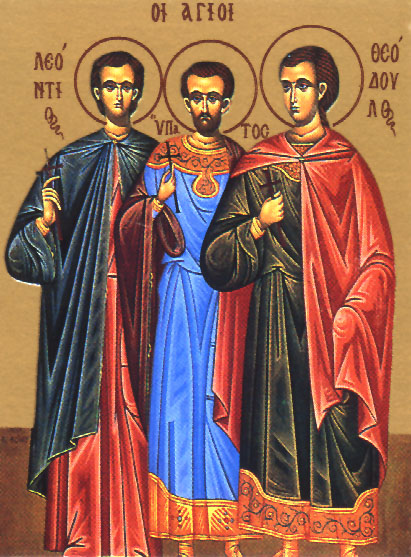
The Holy Martyrs Leontius, Hypatius, and Theodulus were Roman soldiers. The holy Martyr Leontius, a Greek by origin, served as a military-chief in the imperial army in the Phoenician city of Tripoli during the reign of Vespasian (70-79). Leontius was distinguished for his bravery and good sense, and the people of Tripoli held him in deep respect because of his virtue.
The emperor appointed the Roman senator Adrian as governor of the Phoenician district, with full powers to hunt out Christians, and in case of their refusal to offer sacrifice to the Roman gods, to give them over to torture and death. And on his way to Phoenicia Adrian received a report that Saint Leontius had turned many away from worshipping the pagan gods. The governor sent the tribune Hypatius with a detachment of soldiers to Tripoli so as to find and arrest the Christian Leontius. Along the way the tribune Hypatius fell seriously ill, and being near death, he saw in a dream an angel, which said: “If you wish to be healed, you and your soldiers should say three times: ‘God of Leontius, help me.’”
Opening his eyes Hypatius beheld the angel and said: “I was sent to arrest Leontius, how is it that I should appeal to his God?” At this moment the angel became invisible. Hypatius told his dream to the soldiers, among whom was his friend Theodulus, and all of them together asked for help from the God Whom Saint Leontius confessed. Hypatius was immediately healed to the great joy of his soldiers, but only Theodulus sat aside, pondering the miracle. His soul was filled with love for God, and he told Hypatius to proceed twice as quickly to the city in search of Saint Leontius.
Upon their arrival in the city, a stranger met them and invited them to his house, where he lavishly hosted the travellers. Learning that their hospitable host was Saint Leontius, they fell on their knees and asked him to enlighten them with faith in the True God. They were baptized here, and when Saint Leontius prayed over them calling on the Name of the Most Holy Trinity, a luminous cloud overshadowed the newly-baptized and poured forth rain. The remaining soldiers in search of their commander arrived in Tripoli, where the governor Adrian had also arrived. Learning what had happened, he ordered Saints Leontius, Hypatius, and Theodulus to be brought to him. After threatening them with torture and death, he demanded that they renounce Christ and offer sacrifice to the Roman gods.
All the martyrs firmly confessed their faith in Christ. Saint Hypatius was put under a column and raked with iron claws, and Saint Theodulus was mercilessly beaten with rods. Seeing the steadfastness of the saints, they beheaded them. And after torture, they sent Saint Leontius to prison. In the morning he came before the governor. Adrian tried to entice the holy martyr with honors and rewards, and accomplishing nothing, he gave him over to new tortures. The holy martyr was suspended head downwards from a pillar with a heavy stone about his neck, but nothing could make him renounce Christ. The governor gave orders to beat the sufferer with rods until he died. They then threw the body of the holy Martyr Leontius outside the city, but Christians reverently gave it burial near Tripoli. The death of the holy martyrs occurred between 70-79.
The accusation against Saint Leontius, and his sufferings and death are recorded on tin tablets prepared by the court scribe [commentarisius]. These tablets were placed at the grave of the holy martyr.
Venerable Leontius of the Kiev Far Caves
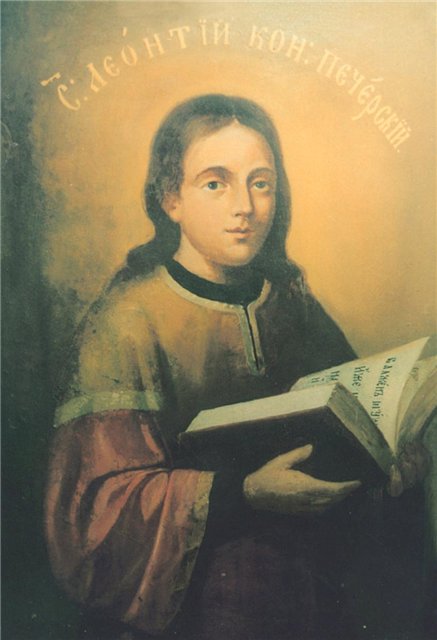
Saint Leontius, Canonarch of the Kiev Caves In his youth he entered the Kiev Caves monastery, where he received tonsure. He was endowed with a fine voice, and when he learned his letters, he fulfilled the obedience of canonarch (leader of church singing). Saint Leontius died at a young age in the fourteenth century. He was glorified by the Lord for his selfless deeds with the gift of miracles. The relics of the holy ascetic are located in the Far Caves, and he is also commemorated on August 28, the Synaxis of the Saints of the Kiev Caves.
Venerable Leontius the Hagiorite
Saint Leontius the Clairvoyant of Mt. Athos, was born in Peloponnesian Argos. He labored on Mount Athos for a long time at the monastery of Dionysiou. He spent sixty years at the monastery, and not once did the holy ascetic leave the monastery. For his deep faith and deeds God granted him the gift of clairvoyance and prophecy.
St Leontius departed to the Lord on March 16, 1605 at age 85. The saint’s holy relics were glorified by a flow of healing myrrh.
“Bogolyubov” Icon of the Mother of God

The Bogolyubov Icon of the Mother of God, one of the most ancient wonderworking icons of Russia, was painted in the twelfth century at the request of Prince Andrew Bogolyubsky (July 4), to commemorate the appearance of the Mother of God to him. Painted on cypress wood, the Icon is remarkable because of its large size.
In the year 1131, an Icon was sent from Constantinople to the Holy Prince Mstislav (Theodore in Baptism, commemorated April 15) in Russia, and was placed in the Devichii monastery in Vyshgorod, the ancient appanage (land given by kings and princes to their younger children for their support) city of Saint Olga (July 11).
One night in the summer of 1155, Prince Andrew secretly removed the wonderworking Icon of the Mother of God from the Vyshgorod church without the blessing of his father, Prince George Dolgoruky, and started northward toward Suzdal'. Some sources say that his father bequeathed the Icon to Prince Andrew. Later, this Icon would be known as the Vladimir Icon (August 26, June 23, May 21). Tradition says it was one of the Icons painted by the Holy Evangelist Luke (October 18), or a copy made from the original.
Seven versts from Vladimir, the cart carrying the wonderworking Icon stopped and could not be moved from that spot. Prince Andrew asked the priest Nicholas, who accompanied him, to serve a Moleben before the Icon. For a long time Andrew prayed before the holy image with tears. Later, he went into his tent and continued his fervent prayers. The Most Holy Theotokos appeared to him holding a small scroll in her right hand, and said: "I do not wish you to take my Icon to Rostov, but to the city of Vladimir. Here, in this place (the site of her miraculous appearance), you shall build a stone church and a monastery in honor of my Nativity."
Then the All-Holy Virgin lifted one hand toward Heaven, and received a blessing from Christ the Savior, and the vision ended.
In obedience to the will of the Mother of God, Prince Andrew built a stone church dedicated to her Nativity, as well as a monastery. After this, the Prince commissioned skilled iconographers to depict the All-Holy Virgin just as he had seen her in his vision: in full stature, with a scroll1 in her right hand, and her face turned toward the Savior in the upper right hand corner. When the church was completed, the Icon he had commissioned was placed inside, and June 18 was designated as the annual commemoration of the appearance of the Mother of God. The Icon depicting the appearance of the Most Holy Theotokos remained at Bogolyubov and was called the Bogolyubov Icon.
Saint Andrew named both the monastery and the city which sprang up around it Bogolyubov because as he himself said, "the Mother of God loves this place." The Prince also became known as Bogolyubsky ("the lover of God"). The Vladimir Icon remained in the convent until work was completed on the Dormition Cathedral at Vladimir, then it was solemly transferred to the cathedral.
The Bogolyubov Icon of the Mother of God has been glorified by countless miracles, and over the course of many centuries she has consoled the pious Christians of Russia, and has healed their infirmities. The fame of the miracles which took place before her Icon have inspired the faithful in many places to make copies of this holy Icon, some of which are also wonderworking.
The Moscow Bogolyubov Icon (1157) shows several saints gathered before the Theotokos: the Metropolitans of Moscow Peter, Alexis, Jonah, and Philip; The blessed Basil and Maxim, fools for Christ; Venerable Paraskeve; Saint Basil the Great; Saint Alexis the Man of God; Symeon, the kinsman of the Lord; the Apostle Peter; the monastic martyr Eudokia; and the Martyr Paraskeve. In some variants of the Icon the following Saints are also included: Saint Onouphrios, Venerable Mary of Egypt, Zosimas and Sabbatius, and the Great Martyrs Barbara and Katherine.
In 1771 an annual feast day was established in in honor of the Bogolyubov Icon to commemorate the deliverance of the city of Vladimir and the surrounding area from plague. As soon as the Icon was brought to Vladimir, the plague disappeared. It became customary to bring the Icon from Bogolyubovo to Vladimir on May 21. As many people as possible took turns in carrying the Icon at different times to and from Vladimir Province. The Icon stayed at Bogolyubovo Monastery, 10 versts from the city. In 1820, the inhabitants of the city of Vladimir adorned the Icon with an expensive riza.
Before the Bolshevik Revolution, the Icon was customarily brought to the city of Vladimir on May 21, where it remained until July 16, when it was returned to the monastery.
1 The scroll on the Icon reads: O Most Gracious Master, Lord Jesus Christ, my Son and my God, hear the prayer of Your Mother, for she is praying for the world.
 Saint Peter Antiochian Orthodox Church