Synaxis of the Twelve Holy Apostles, Michael the New Martyr of Athens
ST. PAUL’S FIRST LETTER TO THE CORINTHIANS 4:9-16
Brethren, God has exhibited us apostles as last of all, like men sentenced to death; because we have become a spectacle to the world, to angels and to men. We are fools for Christ’s sake, but you are wise in Christ. We are weak, but you are strong. You are held in honor, but we in disrepute. To the present hour we hunger and thirst, we are ill-clad and buffeted and homeless, and we labor, working with our own hands. When reviled, we bless; when persecuted, we endure; when slandered, we try to conciliate; we have become, and are now, as the refuse of the world, the off-scouring of all things. I do not write this to make you ashamed, but to admonish you as my beloved children. For though you have countless guides in Christ, you do not have many fathers. For I became your father in Christ Jesus through the gospel. I urge you, then, be imitators of me.
MATTHEW 9:36, 10:1-8
At that time, when Jesus saw the crowds, he had compassion for them, because they were harassed and helpless, like sheep without a shepherd. And he called to him his twelve disciples and gave them authority over unclean spirits, to cast them out, and to heal every disease and every infirmity. The names of the twelve apostles are these: first, Simon, who is called Peter, and Andrew his brother; James the son of Zebedee, and John his brother; Philip and Bartholomew; Thomas and Matthew the tax collector; James the son of Alphaios, and Thaddaios; Simon the Cananaean. and Judas Iscariot, who betrayed him. These twelve Jesus sent out, charging them, “Go nowhere among the Gentiles, and enter no town of the Samaritans, but go rather to the lost sheep of the house of Israel. And preach as you go, saying, ‘The kingdom of heaven is at hand.’ Heal the sick, raise the dead, cleanse lepers, cast out demons. You received without paying, give without pay.”
Synaxis of the Holy, Glorious and All-Praised Twelve Apostles
The Synaxis of the Glorious and All-Praiseworthy Twelve Apostles of Christ appears to be an ancient Feast. The Church honors each of the Twelve Apostles on separate dates during the year, and has established a general commemoration for all of them on the day after the commemoration of the Glorious and First-Ranked among the Apostles Peter and Paul.
The holy God-crowned Emperor Constantine the Great (May 21) built a church in Constantinople in honor of the Twelve Apostles. There are instructions for celebrating this Feast which date from the fourth century. For lists of the Apostles' names, see: Mt.10:2, Mark 3:14, Luke 6:12, Acts 1:13, 26.
The holy, glorious, all-laudable Apostle Andrew the First-called is also commemorated on November 30. He was the brother of Saint Peter (June 29).
The holy, glorious, all-laudable Apostle James is also commemorated on April 30. He and his brother John are the sons of Zebedee, and were called “sons of Thunder” (Mark 3: 17).
The holy, glorious, all-laudable Apostle and Evangelist, virgin, and beloved friend of Christ, John the Theologian is also commemorated on September 26 and May 8. He and his brother James are the sons of Zebedee, and were called “sons of Thunder” (Mark 3:17).
The holy, glorious, all-laudable Apostle Philip is also commemorated on November 14.
The holy, glorious, all-laudable Apostle Bartholomew is also commemorated on June 11 and August 25.
The holy, glorious, all-laudable Apostle Thomas is also commemorated on October 6 and on the Sunday after Pascha.
The holy, glorious, all-laudable Apostle and Evangelist Matthew is also commemorated on November 16.
The holy, glorious, all-laudable Apostle James, the son of Alphaeus, is also commemorated on October 9.
The holy, glorious, all-laudable Apostle Jude is also commemorated on June 19. He is also known as Thaddeus (but should not be confused with Saint Thaddeus of the Seventy, who is commemorated on August 21), and was the brother of Saint James (October 23).
The holy, glorious, all-laudable Apostle Simon the Zealot is also commemorated on May 10.
The holy, glorious, all-laudable Apostle Matthias is also commemorated on August 9.
Saint Peter, Prince of Ordinsk, Rostov
Saint Peter, Prince of the Horde, was the nephew of Bergai Khan of the Golden Horde. In the year 1253 Saint Cyril, Bishop of Rostov (May 21), went to the Horde to petition for church needs in his diocese and he told the khan about the Christian Faith, and of the miracles and healings worked by the relics of Saint Leontius of Rostov (May 23). Among the retinue was the young nephew of the khan, upon whom the holy bishop made a very strong impression. After some length of time the son of Bergai fell ill. Remembering the account of the Russian bishop about the healings, he summoned Saint Cyril, and through his prayers the sick one was healed. The khan richly rewarded Saint Cyril and sent him off to his diocese.
Along the way the lad, the nephew of Bergai Khan, overtook the holy hierarch, and entreated him to take him along to Rostov. At Rostov the boy was baptized with the name Peter, and he married. Saint Peter distinguished himself with a love for silence, contemplation, and prayer. After a miraculous appearance to him of the Apostles Peter and Paul he built a monastery near Lake Nera in their honor. After the death of his wife, shortly before his own death in 1290, the saint embraced monasticism at the monastery he had founded.
Local veneration of the holy Prince Peter began in the fourteenth century. A general celebration was established at the Council of 1547.
Translation of the relics of Saint Sophronius, Bishop of Irkutsk
Saint Sophronius, Bishop of Irkutsk and All Siberia, reposed on March 30, 1771, the second day of Holy Pascha. While they awaited a decision of the Holy Synod concerning the burial, his body remained unburied for six months, and during this time it was not subject to decay. Then, in view of this circumstance, and also knowing about the strict ascetic life of Saint Sophronius, the flock began to venerate him as a saint of God. Frequently (in 1833, 1854, 1870, 1909) his relics were seen to be incorrupt, and a source of grace-filled miracles. A fire occurring on April 18, 1917 at the Theophany Cathedral at Irkutsk left only the bones of the holy bishop. This did not diminish, but on the contrary, it increased the reverent veneration of the saint by the faithful of the nation.
A local Council of the Russian Orthodox Church in its deliberations of April 10/23, 1918 decided to glorify Bishop Sophronius, numbering him among the holy saints of God. This solemnity of adding Saint Sophronius to the list of the saints was done on June 30. At a second session of this Council under the presidency of His Holiness Patriarch Tikhon (now Saint Tikhon) a Service to Saint Sophronius was approved, with a Troparion composed by Archbishop John, who at that time guided the Irkutsk diocese, so that all believers would have the possibility of adding prayer to the holy saint into the voice of the Siberian churches, deeply venerating the memory of their illuminator and intercessor.
And at the present time believers turn for help to Saint Sophronius. Prayers witness to this, having been composed on the day of the 40th year celebration of the glorification of the holy hierarch on July 13,1958, by Metropolitan Nestor (Anisimov), then Metropolitan of Novosibirsk and Barnaulsk, and a solemn feast of the 200 year anniversary of the day of death of Saint Sophronius took place at the Zolotonoshsk Krasnogorsk women’s monastery and in the Irkutsk diocese (Journal of the Moscow Patriarchate, 1971, No. 9), and he is venerated by all believers of the Russian Orthodox Church.
Icon of the Mother of God of Balikin
The Balikin Icon of the Mother of God is from the Chernigov Province. The child Christ is clothed only around the waist, and rests in His Mother’s lap. The hands of the Theotokos are joined in prayer.
Saint Gelasius of Rimet
Saint Gelasius was the igumen of the Rimet Monastery in Transylvania. He had lived as a solitary near Rimet creek, and he was granted the grace of working miracles.
The saint fasted on weekdays, eating only on Saturdays and Sundays, and his only food was the Eucharist. During the day he fulfilled his monastic obediences, and at night he kept vigil.
Saint Gelasius was the spiritual Father of many hermits of Rimet Mountain, whom he would visit during Great Lent. He healed the sick, and cast out demons from those who were possessed. It is said that a spring of water appeared through his holy prayers.
His later years were spent as a bishop, and he departed to the Lord after many labors on behalf of his flock.
Saint Gelasius was glorified by the Orthodox Church of Romania in 1992.
Holy Queen Dinar
The Russian Church has preserved chronicles of the life of Queen Dinar, a woman who achieved much on behalf of the Christian Faith. For years scholars have disputed about the historical figure discussed in great depth in the Russian Church. Many believed that the sources described Holy Queen Tamar, but the period of Tamar’s rule does not match that of the figure described in the chronicles. The Georgian chronicle Life of Kartli, however, has preserved information about a certain Dinar, Queen of Hereti (southeastern Georgia), who, along with her son Ishkhanik, converted Hereti to the Orthodox Faith and delivered its people from the Monophysite heresy in the 10th century. Queen Dinar’s story resembles that recounted in the Russian Chronicles more closely than any other.
According to the Armenian historian Moses of Kalankaytuk, Slavic tribes that carried out incursions in the southernmost Caucasus often journeyed through the Transcaucasus, and it was with these tribes that the story of Queen Dinar made its way to Russia. The Georgian Church renders great honor to Holy Queen Dinar. As a result of her zealous labors and achievements, a large part of the eastern Transcaucasus was saved from the Monophysite heresy that dominated the region.
Today, on the north wall of the Throne Hall in the Moscow Kremlin, there hangs an image of Holy Queen Dinar mounted on a white horse, victorious over the enemy.
ST. PAUL’S SECOND LETTER TO THE CORINTHIANS 11:21-33; 12:1-9
Brethren, whatever anyone dares to boast of — I am speaking as a fool — I also dare to boast of that. Are they Hebrews? So am I. Are they Israelites? So am I. Are they descendants of Abraham? So am I. Are they servants of Christ? I am a better one — I am talking like a madman — with far greater labors, far more imprisonments, with countless beatings, and often near death. Five times I have received at the hands of the Jews the forty lashes less one. Three times I have been beaten with rods; once I was stoned. Three times I have been shipwrecked; a night and a day I have been adrift at sea; on frequent journeys, in danger from rivers, danger from robbers, danger from my own people, danger from Gentiles, danger in the city, danger in the wilderness, danger at sea, danger from false brethren; in toil and hardship, through many a sleepless night, in hunger and thirst, often without food, in cold and exposure. And, apart from other things, there is the daily pressure upon me of my anxiety for all the churches. Who is weak, and I am not weak? Who is made to fall, and I am not indignant?
If I must boast, I will boast of the things that show my weakness. The God and Father of the Lord Jesus, he who is blessed for ever, knows that I do not lie. At Damascus, the governor under King Aretas guarded the city of Damascus in order to seize me, but I was let down in a basket through a window in the wall, and escaped his hands.
I must boast; there is nothing to be gained by it, but I will go on to visions and revelations of the Lord. I know a man in Christ who fourteen years ago was caught up to the third heaven — whether in the body or out of the body I do not know, God knows. And I know that this man was caught up into Paradise — whether in the body or out of the body I do not know, God knows — and he heard things that cannot be told, which man may not utter. On behalf of this man I will boast, but on my own behalf I will not boast, except of my weaknesses. Though if I wish to boast, I shall not be a fool, for I shall be speaking the truth. But I refrain from it, so that no one may think more of me than he sees in me or hears from me. And to keep me from being too elated by the abundance of revelations, a thorn was given me in the flesh, a messenger of Satan, to harass me, to keep me from being too elated. Three times I besought the Lord about this, that it should leave me; but he said to me, "My grace is sufficient for you, for my power is made perfect in weakness." I will all the more gladly boast of my weaknesses, that the power of Christ may rest upon me.
MATTHEW 16:13-19
At that time, when Jesus came into the district of Caesarea Philippi, he asked his disciples, “Who do men say that the Son of man is?” And they said, “Some say John the Baptist, others say Elijah, and others Jeremiah or one of the prophets.” He said to them, “But who do you say that I am?” Simon Peter replied, “You are the Christ, the Son of the living God.” And Jesus answered him, “Blessed are you, Simon Bar Jona! For flesh and blood has not revealed this to you, but my Father who is in heaven. And I tell you, you are Peter, and on this rock I will build my church, and the gates of Hades shall not prevail against it. I will give you the keys of the kingdom of heaven, and whatever you bind on earth shall be bound in heaven, and whatever you loose on earth shall be loosed in heaven.”
Venerable Ananias the Iconographer
Saint Ananias was born in Russia and was tonsured in the Monastery of Saint Antony the Roman at Novgorod. God endowed him with a gift for painting icons, and he exercised this talent for the glory of the Lord. The Venerable Ananias painted "marvelous icons of many holy wonderworkers." For thirty-three years, he never went beyond the Monastery fence.
Historical records do not agree about the year of his repose. Some say that he went to the Lord in 1521, 1561, or 1581. His relics are buried in a hidden place at the Monastery.
Saint Ananias is commemorated on June 17 and on the third Sunday after Pentecost (Synaxis of the Novgorod Saints). (Movable Feast).
The Holy Glorious and All-Praised Leaders of the Apostles, Peter and Paul
Sermon of Saint Augustine, Bishop of Hippo
Today the Holy Church piously remembers the sufferings of the Holy Glorious and All-Praised Apostles Peter and Paul.
Saint Peter, the fervent follower of Jesus Christ, for the profound confession of His Divinity: “Thou art the Christ, the Son of the Living God,” was deemed worthy by the Savior to hear in answer, “Blessed art thou, Simon … I tell thee, that thou art Peter [Petrus], and on this stone [petra] I build My Church” (Mt.16:16-18). On “this stone” [petra], is on that which thou sayest: “Thou art the Christ, the Son of the Living God” it is on this thy confession I build My Church. Wherefore the “thou art Peter”: it is from the “stone” [petra] that Peter [Petrus] is, and not from Peter [Petrus] that the “stone” [petra] is, just as the Christian is from Christ, and not Christ from the Christian. Do you want to know, from what sort of “rock” [petra] the Apostle Peter [Petrus] was named? Hear the Apostle Paul: “Brethren, I do not want ye to be ignorant,” says the Apostle of Christ, “how all our fathers were all under the cloud, and all passed through the sea; and all were baptized unto Moses in the cloud and in the sea; and did all drink the same spiritual drink: for they drank of that spiritual Rock that followed them: and that Rock was Christ” (1 Cor.10: 1-4)….
Our Lord Jesus Christ, in the final days of His earthly life, in the days of His mission to the race of man, chose from among the disciples His twelve Apostles to preach the Word of God. Among them, the Apostle Peter for his fiery ardor was vouchsafed to occupy the first place (Mt.10:2) and to be as it were the representative person for all the Church. Therefore it is said to him, preferentially, after the confession: “I will give unto thee the keys of the Kingdom of Heaven: and whatsoever thou shalt bind on earth, shall be bound in the heaven: and whatsoever thou shalt loose on earth: shall be loosed in heaven” (Mt.16: 19). Therefore it was not one man, but rather the One Universal Church, that received these “keys” and the right “to bind and loosen.” And that it was actually the Church that received this right, and not exclusively a single person, turn your attention to another place of the Scriptures, where the same Lord says to all His Apostles, “Receive ye the Holy Spirit” and further after this, “Whose soever sins ye remit, they are remitted unto them: and whose soever sins ye retain, are retained” (John 20: 22-23); or: “whatsoever ye bind upon the earth, shall be bound in Heaven: and whatsoever ye shall loose on earth, shall be loosened in heaven” (Mt.18:18). Thus, it is the Church that binds, the Church that loosens; the Church, built upon the foundational cornerstone, Jesus Christ Himself (Eph 2:20), doth bind and loosen. Let both the binding and the loosening be feared: the loosening, in order not to fall under this again; the binding, in order not to remain forever in this condition. Therefore “Iniquities ensnare a man, and everyone is bound in the chains of his own sins,” says Wisdom (Prov 5:22); and except for Holy Church nowhere is it possible to receive the loosening.
After His Resurrection the Lord entrusted the Apostle Peter to shepherd His spiritual flock not because, that among the disciples only Peter alone was pre-deserved to shepherd the flock of Christ, but Christ addresses Himself chiefly to Peter because, that Peter was first among the Apostles and as such the representative of the Church; besides which, having turned in this instance to Peter alone, as to the top Apostle, Christ by this confirms the unity of the Church. “Simon of John” — says the Lord to Peter — “lovest thou Me?” — and the Apostle answered: “Yea, Lord, Thou knowest that I love Thee”; and a second time it was thus asked, and a second time he thus answered; being asked a third time, seeing that as it were not believed, he was saddened. But how is it possible for him not to believe That One, Who knew his heart? And wherefore then Peter answered: “Lord, Thou knowest all; Thou knowest that I love Thee.” “And sayeth Jesus to him” all three times “Feed My sheep” (John 20:15-17).
Besides this, the triple appealing of the Savior to Peter and the triple confession of Peter before the Lord had a particular beneficial purpose for the Apostle. That one, to whom was given “the keys of the kingdom” and the right “to bind and to loose,” bound himself thrice by fear and cowardice (Mt.26:69-75), and the Lord thrice loosens him by His appeal and in turn by his confession of strong love. And to shepherd literally the flock of Christ was acquired by all the Apostles and their successors. “Take heed, therefore unto yourselves, and to all the flock,” the Apostle Paul urges church presbyters, “over which the Holy Spirit hath made you overseers, to feed the Church of God, which He hath purchased with His own blood” (Acts 20:28); and the Apostle Peter to the elders: “Feed the flock of God which is among you, taking the oversight thereof not by constraint, but willingly: not for filthy lucre, but of a ready mind: neither as being lords over God’s heritage, but being examples to the flock. And when is appeared the Prince of pastors, ye will receive unfading crowns of glory” (1 Pet. 5:2-4).
It is remarkable that Christ, having said to Peter: “Feed My sheep,” did not say: “Feed thy sheep,” but rather to feed, good servant, the sheep of the Lord. “Is Christ divided? was Paul crucified for you? or were ye baptized in the name of Paul?” (1 Cor.1:13). “Feed My sheep”. Wherefore “wolfish robbers, wolfish oppressors, deceitful teachers and mercenaries, not being concerned about the flock” (Mt.7:15; Acts 20:29; 2 Pet 2:1; John 10:12), having plundered a strange flock and making of the spoils as though it be of their own particular gain, they think that they feed their flock. Such are not good pastors, as pastors of the Lord. “The good shepherd giveth his life for the sheep” (John 10:11), entrusted to Him by the chief Shepherd Himself (1 Pet 5:4). And the Apostle Peter, true to his calling, gave his soul for the very flock of Christ, having sealed his apostleship by a martyr’s death, is now glorified throughout all the world.
The Apostle Paul, formerly Saul, was changed from a robbing wolf into a meek lamb. Formerly he was an enemy of the Church, then is manifest as an Apostle. Formerly he stalked it, then preached it. Having received from the high priests the authority at large to throw all Christians in chains for execution, he was already on the way, he breathed out “threatenings and slaughter against the disciples of the Lord” (Acts 9:1), he thirsted for blood, but “He that dwells in the Heavens shall laugh him to scorn” (Ps 2:4). When he, “having persecuted and vexed” in such manner “the Church of God” (1Cor.15:9; Acts 8:5), he came near Damascus, and the Lord from Heaven called to him: “Saul, Saul, why persecutest thou Me?” and I am here, and I am there, I am everywhere: here is My head; there is My body. There becomes nothing of a surprise in this; we ourselves are members of the Body of Christ. “Saul, Saul, why persecutest thou Me; it is hard for thee to kick against the goad” (Acts 9:4-5). Saul, however, “trembling and frightened”, cried out: “Who art Thou, Lord?” The Lord answered him, “I am Jesus Whom thou persecutest.”
And Saul suddenly undergoes a change: “What wantest Thou me to do?” — he cries out. And suddenly for him there is the Voice: “Arise, and go to the city, and it shall be told thee what thou must do” (Acts 9:6). Here the Lord sends Ananias: “Arise and go into the street” to a man, “by the name of Saul,” and baptize him, “for this one is a chosen vessel unto Me, to bear My name before the Gentiles, and kings, and the children of Israel” (Acts 9: 11, 15, 18). This vessel must be filled with My Grace. “Ananias, however, answered: Lord, I have heard from many about this man, how much evil he hath done to Thy saints in Jerusalem: and here he hath authority from the chief priests to bind all who call on Thy Name” (Acts 9:13-14). But the Lord urgently commands Ananias: “Search for and fetch him, for this vessel is chosen by Me: for I shall show him what great things he must suffer for My name’s sake” (Acts 9:11, 15-16).
And actually the Lord did show the Apostle Paul what things he had to suffer for His Name. He instructed him the deeds; He did not stop at the chains, the fetters, the prisons and shipwrecks; He Himself felt for him in his sufferings, He Himself guided him towards this day. On a single day the memory of the sufferings of both these Apostles is celebrated, though they suffered on separate days, but by the spirit and the closeness of their suffering they constitute one. Peter went first, and Paul followed soon after him. Formerly called Saul, and then Paul, having transformed his pride into humility. His very name (Paulus), meaning “small, little, less,” demonstrates this. What is the Apostle Paul after this? Ask him, and he himself gives answer to this: “I am,” says he, “the least of the Apostles… but I have labored more abundantly than all of them: yet not I, but the grace of God, which was with me” (1 Cor.15:9-10).
And so, brethren, celebrating now the memory of the holy Apostles Peter and Paul, remembering their venerable sufferings, we esteem their true faith and holy life, we esteem the innocence of their sufferings and pure confession. Loving in them the sublime quality and imitating them by great exploits, “in which to be likened to them” (2 Thess 3: 5-9), and we shall attain to that eternal bliss which is prepared for all the saints. The path of our life before was more grievous, thornier, harder, but “we also are compassed about with so great a cloud of witnesses” (Heb 12: 1), having passed by along it, made now for us easier, and lighter, and more readily passable. First there passed along it “the author and finisher of our faith,” our Lord Jesus Christ Himself (Heb 12: 2); His daring Apostles followed after Him; then the martyrs, children, women, virgins and a great multitude of witnesses. Who acted in them and helped them on this path? He Who said, “Without Me ye can do nothing” (John 15: 5).
The Holy Glorious and All-Praised Leader of the Apostles, Peter
The hymns for their Feast speak of Saints Peter and Paul as leaders (koryphaioi), and chiefs of the Apostles. They are, without a doubt, the foremost in the ranks of the Apostles.
The koryphaioi were leaders of the chorus in ancient Greek tragedy. They set the pattern for the singing, and also for the dance movements and gestures of the chorus. Before Sophocles, there were twelve members of the chorus, and Saints Peter and Paul were the leaders of the twelve Apostles.
Both Saint Peter and Saint Paul received new names, indicating a new relationship with God. Simon the fisherman became known as Cephas (John 1:42), or Peter after confessing Jesus as the Son of God (Mt.16:18).
Saint Peter, the brother of Saint Andrew, was a fisherman on the sea of Galilee. He was married, and Christ healed his mother-in-law of a fever (Mt.8:14). He, with James and John, witnessed the most important miracles of the Savior’s earthly life.
Despite his earlier recognition of Christ as the Son of God, he denied Him three times on the night before the Crucifixion. Therefore, after His Resurrection, the Lord asked Peter three times if he loved Him. Then He told Peter to feed His sheep (John 21:15-17).
After the descent of the Holy Spirit at Pentecost, Saint Peter addressed the crowd (Acts 2:14), and performed many miracles in Christ’s name. He baptized Cornelius, the first Gentile convert (Acts 10:48). He was cast into prison, but escaped with the help of an angel (Acts 5:19). Saint Peter also traveled to many places in order to proclaim the Gospel message. He wrote two Epistles, which are part of the New Testament.
Saint Peter was put to death in Rome during the reign of Nero. According to Tradition, he asked to be crucified upside down, since he did not feel worthy to die in the same manner as his Lord.
The Holy Glorious and All-Praised Leader of the Apostles, Paul
The hymns for their Feast speak of Saints Peter and Paul as the leaders (koryphaioi), and chiefs of the Apostles. They are, without a doubt, the foremost in the ranks of the Apostles.
The koryphaioi were leaders of the chorus in ancient Greek tragedy. They set the pattern for the singing, and also for the dance movements and gestures of the chorus. Before Sophocles, there were twelve members of the chorus, and Saints Peter and Paul were the leaders of the twelve Apostles.
Saint Paul was of the tribe of Benjamin, and lived in Tarsus in Cilicia. He once described himself as a Hebrew, an Israelite of the seed of Abraham (2 Cor. 11:22). He was also a Pharisee and a tent-maker (Acts 18:3) who had studied the Law with Gamaliel at Jerusalem.
At first, he was called Saul, and had persecuted the Church. He was present at the stoning of Saint Stephen (Acts 7: 58). Then, on the road to Damascus, he was converted when Christ appeared to him. Blinded by the vision, he was healed when Ananias laid his hands on him. After his cure, he was baptized (Acts 9:18).
Saint Paul preached the Gospel in Greece, Asia Minor, and in Rome, and wrote fourteen Epistles. Tradition says that he was martyred in Rome about the year 68.
Icon of the Mother of God of Kasperov
The Kasperov Icon of the Most Holy Theotokos. Tradition says that this holy icon had been brought to Cherson from Transylvania by a Serb at the end of the sixteenth century. Passing down from parent and child, the icon had come to a certain Mrs. Kasperova of Cherson in 1809.
One night in February of 1840 she was praying, seeking consolation in her many sorrows. Looking at the icon of the Virgin, she noticed that the features of the icon, darkened by age, had suddenly become bright. Soon the icon was glorified by many miracles, and people regarded it as wonderworking.
During the Crimean War (1853-1856), the icon was carried in procession through the city of Odessa, which was besieged by enemy forces. On Great and Holy Friday, the city was spared. Since that time, an Akathist has been served before the icon in the Dormition Cathedral of Odessa every Friday.
The icon is painted with oils on a canvas mounted on wood. The Mother of God holds Her Son on her left arm. The Child is holding a scroll. Saint John the Baptist (Janurary 7) is depicted on one side of the icon, and Saint Tatiana (January 12) on the other. These were probably the patron saints of the original owners of the icon.
The Kasperov Icon is commemorated on October 1, June 29, and Bright Wednesday.
Finding of the Relics of Cyrus and John the Unmercenaries, Sergios the Magister, Pappias the Martyr, Righteous Fathers Sergius and Herman, Founders of Valaam Monastery, Synaxis of the Icon of our Most Holy Lady the Theotokos , Paul the Physician of Corinth
ST. PAUL’S LETTER TO THE ROMANS 3:28-31; 4:1-3
Brethren, we hold that a man is justified by faith apart from works of law. Or is God the God of Jews only? Is he not the God of Gentiles also? Yes, of Gentiles also, since God is one; and he will justify the circumcised on the ground of their faith and the uncircumcised through their faith. Do we then overthrow the law by this faith? By no means! On the contrary, we uphold the law. What then shall we say about Abraham, our forefather according to the flesh? For if Abraham was justified by works, he has something to boast about, but not before God. For what does the scripture say? “Abraham believed God, and it was reckoned to him as righteousness.”
MATTHEW 7:24-29; 8:1-4
The Lord said, “Every one who hears these words of mine and does them will be like a wise man who built his house upon the rock; and the rain fell, and the floods came, and the winds blew and beat upon that house, but it did not fall, because it had been founded on the rock. And every one who hears these words of mine and does not do them will be like a foolish man who built his house upon the sand; and the rain fell, and the floods came, and the winds blew and beat against that house, and it fell; and great was the fall of it.” And when Jesus finished these sayings, the crowds were astonished at his teaching, for he taught them as one who had authority, and not as their scribes. When he came down from the mountain, great crowds followed him; and behold, a leper came to him and knelt before him saying, “Lord, if you will, you can make me clean.” And he stretched out his hand and touched him, saying, “I will; be clean.” And immediately his leprosy was cleansed. And Jesus said to him, “See that you say nothing to any one; but go, show yourself to the priest, and offer the gift that Moses commanded, for a proof to them.”
Translation of the Relics of the holy and wonderworking Unmercenaries Cyrus and John
The Transfer of the Relics of the Holy Martyrs, Unmercenaries and Wonderworkers, Cyrus and John from the city of Konopa, near Alexandria (where they suffered in the year 311) to the nearby village of Manuphin, took place in the year 412. This Egyptian village prompted fear in everyone, since in a former time there was a pagan temple inhabited by evil spirits. Patriarch Theophilus (385-412) wanted to cleanse this place of demons, but he died. His wish was fulfilled by his successor in the See of Alexandria, the holy Patriarch Cyril (412-444). He prayed fervently in carrying out this project. An angel of the Lord appeared in a vision to the hierarch and commanded the venerable relics of Saints Cyrus and John be transferred to Manuphin. His Holiness Patriarch Cyril did the angel’s bidding and built a church at Manuphin in the name of the holy martyrs.
From that time this place was purified of the Enemy’s influence, and by the prayers of the holy Martyrs Cyrus and John there began to occur many miracles, healings of the sick and infirm. An account of Saints Cyrus and John is located under January 31.
Venerable Xenophon, Abbot of Robeika, Novgorod
Our holy Father Xenophon of Robeika was the disciple of Saint Barlaam of Khutyn (November 6). He became the third Igoumen of the Khutyn monastery after Igoumen Isidore (+1243), and at the insistence of Saint Anthony of Dymsk (June 24). After resigning as Igoumen, Saint Xenophon would later establish Holy Trinity Monastery on the banks of the Robeika River (not far from Novgorod).
Saint Xenophon's pious disposition was apparent from his earliest years, for he knew that this world will soon pass away. He also knew that this life is filled with sorrow, but after it there shall be everlasting life, which is true, filled with joy and spiritual consolations. With all his heart, mind, and soul, the Venerable one was drawn to the attainment of this eternal, joyous life with the Lord. He tried his best to avoid the sensuality of worldly life, striving only for its higher meaning.
Saint Xenophon settled with Saint Barlaam of Khutyn in the wilderness at the place where Xenophon would shine forth like a pillar of fire. There they put up a cross, built a chapel and a humble dwelling. By the Lord's will, however, the disciple went far away from his Elder to another spot where he could live an ascetical life under harsh conditions. This occurred while they were inspecting the site where they wanted to establish their dwelling. A terrible storm sprang up, and Saint Xenophon called his Elder to come into the cell and take cover; but the Elder became angry at his disciple, telling him to go on a raft in search of another place for his ascetical struggles, and he gave him a quarter of a loaf of bread.
Saint Xenophon set off on the raft upon the Robeika River, miraculously sailing against the current, and soon he stood upon the shore. He stopped at the place where the raft had stuck, and there he fished, praying that the Lord would strengthen him.
After some time, Saint Xenophon went back to his Spiritual Father Saint Barlaam, asking for forgiveness. He received the Elder's blessing to build a chapel at the place where he now lived. Saint Barlaam blessed him, and in all humility, the disciple went back, set up a cross, and then built a chapel and a small hut for his cell.
Later, after the consecration of the church of Saint Nicholas, Saint Xenophon's monastic community was established in the same remote marshland. Other ascetics of piety began to flock there, but the number of monks was small.
In 1251, Saint Xenophon became the Igoumen of the monastery. Although the monastery was neither wealthy nor distinguished, the monks labored to make it beautiful.
Saint Xenophon reposed peacefully on June 28, 1262. His holy relics rested for many years in the monastery church, which later became a parish.
Venerable Sergius and Herman, Wonderworkers of Valaam
Saints Sergius and Herman settled on the island of Valaam in 1329. The brethren gathered by them spread the light of Orthodoxy in this frontier land. The Karelian people began to regard Christianity with renewed suspicion, with its authority in the fourteenth century being undermined by the Swedes, who sought to spread Catholicism by means of the sword.
Saints Sergius and Herman died about the year 1353. They are also commemorated on September 11 (the translation of their holy relics).
Saint Paul, Physician of Corinth
Saint Paul the Physician, from the city of Corinth, in his youth took monastic tonsure at one of the monasteries. Here the saint toiled much and became an experienced ascetic.
Once Paul, through demonic malice, was slandered by a woman. She came to the monastery with a newborn infant and said, that Saint Paul was the father. The Elder with humility and joy endured the slander, he did not deny it and he took the infant, as though it were his own son. When they began to reproach the saint for breaking his monastic vows, Saint Paul said, “Brethren, let us ask the infant who his father is!” The newborn, pointing his hand at the blacksmith, said, “Here is my father and not the monk Paul.” Seeing this miracle, people bowed down to the Elder, asking forgiveness. From this time Saint Paul received from God the gift of healing the sick, whereby he received the name physician. Saint Paul died at age 70.
Icon of the Mother of God “Of the Three Hands”
The Icon of the Mother of God, “Of the Three Hands”: In the eighth century during the time of the Iconoclasts, Saint John of Damascus (December 4) was zealous in his veneration of holy icons. Because of this, he was slandered by the emperor and iconoclast Leo III the Isaurian (717-740), who informed the Damascus caliph that Saint John was committing treasonous acts against him. The caliph gave orders to cut off the hand of the monk and take it to the marketplace. Towards evening Saint John, having asked the caliph for the cut-off hand, put it to its joint and fell to the ground before the icon of the Mother of God. The monk begged Our Lady to heal the hand, which had written in defense of Orthodoxy. After long prayer he fell asleep and saw in a dream that the All-Pure Mother of God had turned to him promising him quick healing.
Before this the Mother of God bid him toil without fail with this hand. Having awakened from sleep, Saint John saw that his hand was unharmed. In thankfulness for this healing Saint John placed on the icon a hand fashioned of silver, from which the icon received its name “Of Three Hands.” (Some iconographers, in their ignorance, have mistakenly depicted the Most Holy Theotokos with three arms and three hands.) According to Tradition, Saint John wrote a hymn of thanksgiving to the Mother of God: “All of creation rejoices in You, O Full of Grace,” which appears in place of the hymn “It is Truly Meet” in the Liturgy of Saint Basil the Great.
Saint John Damascene accepted monasticism at the monastery of Saint Savva the Sanctified and there bestowed his wonderworking icon. The Lavra presented the icon “Of Three Hands” in blessing to Saint Savva, Archbishop of Serbia (+ 1237, January 12). During the time of an invasion of Serbia by the Turks, some Christians who wanted to protect the icon, entrusted it to the safekeeping of the Mother of God Herself. They placed it upon a donkey, which without a driver proceeded to Athos and stopped in front of the Hilandar monastery. The monks put the icon in the monastery’s cathedral church (katholikon). During a time of discord over the choice of igumen, the Mother of God deigned to head the monastery Herself, and from that time Her holy icon has occupied the igumen’s place in the temple. At the Hilandar monastery there is chosen only a vicar, and from the holy icon the monks take a blessing for every obedience.
In Greek usage, this Icon is commemorated on June 28; but on July 12 in Slavic usage.
Hieromartyr Basil
The Hieromartyr Basil (Sitnikov) was a deacon of the Dalmatov – Saint Nicholas Church in the province of Perm. He graduated from the three classes of the religious school, and beginning in 1885, he served as a Reader. In 1898, he was ordained as a deacon, serving first at Saint John the Baptist Church in the village of Izyeduga in the Shadrinsk district of the Yekaterinburg diocese. Later, he served in the Church of the Nativity of the Theotokos in the village of Baklanskoye in that same district.
On November 5, 1913, he was transferred to the Saint Nicholas Church in the city of Dalmatov, where he was put to death by the atheists who had come to power. In 1918, after the priests Vladimir Sergeiev and Alexander Sidorov were arrested, Deacon Basil began to reproach the atheists for plundering the property of these arrested shepherds. They took note of this and got their revenge. Deacon Basil Sitnikov was killed on the day after the priests with whom he served, on June 28, 1918.
Holy Martyr Pappias
Numerous Christians were slaughtered during the persecution under Diocletian and Maximian in the early IV century,
and Saint Pappias was one of those arrested for preaching the Gospel. The idol-worshippers tried to force him to
sacrifice to the pagan gods, but he refused to deny Christ. Therefore, he was imprisoned and tortured for several days.
When he remained unshakeable in his faith, he was beheaded, and his soul ascended victoriously into Heaven.
Venerable Confessor Sergius of Paphlagonia
The Holy and Venerable Sergius of Paphlagonia came from the town of Niketia (Nikḗtia) in Amastrisos on the Black Sea. He belonged to an aristocratic family, and was related to the family of Empress Theodora, the wife of the iconoclastic Emperor Theophilos. Saint Sergius excelled in his studies and soon attained high military and political posts.
Although Theophilos was a staunch supporter of the iconoclasts, Sergius remained a Confessor of the Orthodox Faith, making great efforts to restore the Holy Icons. He also became the protector of many who defended the Holy Icons, and were being persecuted by Theophilos. After the Emperor's death, Saint Sergius made great contributions and used all of his influence to strengthen Theodora's decision to convene an Ecumenical Council for the restoration of the Icons.
Saint Sergius is particularly honored in Crete, where he reposed peacefully in the year 866, and was buried in the Monastery of the Magistrate. Later his holy relics were transferred with great honor, and were buried in the Monastery of the Most Holy Theotokos on the gulf of Nikomedia, which was called Niketianos (Nikētiános) because its founder was from the town of Niketia.
ABSTAIN FROM MEAT, FISH, DAIRY, EGGS, WINE, OLIVE OIL
Samson the Hospitable, Joanna the Myrrhbearer, Anektos the Martyr, Luke the Hermit
ST. PAUL’S LETTER TO THE ROMANS 9:6-19
Brethren, it is not as though the word of God has failed. For not all who are descended from Israel belong to Israel, and not all are children of Abraham because they are his descendants; but “Through Isaac shall your descendants be named.” This means that it is not the children of the flesh who are the children of God, but the children of the promise are reckoned as descendants. For this is what the promise said, “About this time I will return and Sarah shall have a son.” And not only so, but also when Rebecca had conceived children by one man, our forefather Isaac, though they were not yet born and had done nothing either good or bad, in order that God’s purpose of election might continue, not because of works but because of his call, she was told, “The elder will serve the younger.” As it is written, “Jacob I loved, but Esau I hated.” What shall we say then? Is there injustice on God’s part? By no means! For he says to Moses, “I will have mercy on whom I have mercy, and I will have compassion on whom I have compassion.” So it depends not upon man’s will or exertion, but upon God’s mercy. For the scripture says to Pharoah, “I have raised you up for the very purpose of showing my power in you, so that my name may be proclaimed in all the earth.” So then he has mercy upon whomever he wills, and he hardens the heart of whomever he wills. You will say to me then, “Why does he still find fault? For who can resist his will?”
MATTHEW 10:32-36; 11:1
The Lord said to his disciples, "Every one who acknowledges me before men, I also will acknowledge before my Father who is in heaven; but whoever denies me before men, I also will deny before my Father who is in heaven. Do not think that I have come to bring peace on earth; I have not come to bring peace but a sword. For I have come to set a man against his father, and a daughter against her mother, and a daughter-in-law against her mother-in-law; and a man's foes will be those of his own household.
And when Jesus had finished instructing his twelve disciples, he went on from there to teach and preach in their cities.
Saint Sampson the Hospitable of Constantinople
Saint Sampson (Σαμψών) was born in Rome, the son of wealthy, but devout and virtuous parents. He received an excellent education, studying philosophy and medicine, among other subjects. From his earliest childhood, he lived an exemplary Christian life. After the death of his parents he transformed the family estate into a clinic for the sick. Word of his healing skills spread, and so many people came to him that he had to hire a staff to care for the increasing numbers of people who sought his help. When he had an adequate staff, he donated all of his wealth to the clinic, and was content to live in poverty (Luke 12:33-34).
Saint Sampson went to Constantinople, where he hoped to spend the rest of his life in asceticism. He found, however, that there was just as much need for his skill in Constantinople as there had been in Rome. He bought a modest home and began to treat the sick. God blessed Saint Sampson's work and gave him the grace of working miracles. He healed the sick not only by his medical skill, but also as one filled with the grace of God. News of Saint Sampson spread rapidly throughout the Queen of Cities.
His piety and love for his neighbor brought him to the attention of Patriarch Menas of Constantinople (August 25), who ordained him to the holy priesthood. When Emperor Justinian became ill, and his physicians were unable to provide any relief for him, Patriarch Menas suggested that he send for Sampson, who healed the Emperor. Justinian offered him gold and silver to show his gratitude, but the saint refused, saying that he had already given all his wealth away. Instead, he asked Justinian to build a hospice for travelers.
His Life was written by Saint Symeon Metaphrastes. The historian Procopius, however, implies that Sampson lived before the sixth century, and that the hospice had existed before his own time (Buildings, I, 2, 14). When Sampson's hospice (xenon) was burnt and destroyed in 532, Justinian rebuilt it and endowed it with a generous annual income. It was intended for the destitute, and those who suffered from serious illnesses, as well as those who had lost their property or their health.
Saint Sampson reposed quietly, following a brief illness, in the year 530 at a ripe old age. He was buried in the church of Saint Mokios (Μώκιος), which was built by Saint Constantine the Great. Many miracles of healing took place at the tomb of Saint Sampson.
Even after his death, the Saint continued to watch over his hospice. Twice he appeared to a lazy worker, and chastised him for his negligence. Later, the hospice became a church, and a new building for the homeless was constructed beside it. A terrible fire once raged in Constantinople, but did not damage the church or the new building. Through the prayers of Saint Sampson, a heavy rain extinguished the flames.
The appointed Scriptural readings for his Feast are from Galatians 5:23-6:2 and from Luke 12:32-40.
Through the prayers of Saint Sampson, may we also find the treasure which does not fail, in Heaven.
Saint Joanna the Myrrhbearer
Saint Joanna was the wife of Herod's household stewart Khouza (Χουζά) and she served the
Lord during His public ministry, along with some other women. She is mentioned in Luke 8:3 and 24:10.
According to Tradition, she recovered the head of Saint John the Baptist after Herodias had disposed of it (February 24).
Saint Joanna recovering the head of Saint John the Baptist.
Saint Joanna went to the Sepulchre with the other Myrrh-bearing Women, in order to anoint the Holy Body of the Lord with myrrh after His death on the Cross. She also heard from the angels the joyful proclamation of His All-Glorious Resurrection.
Saint Joanna reposed peacefully in the first century. She is also commemorated on the Sunday of the Myrrh-bearing Women.
Venerable Serapion of Kozhe Lake
Among the captives whom the Kazan Tatars brought to Moscow in 1551 was the myrza (Tatar Prince) Turtas Gravirovich. He was baptized with the name Sergius and lived in the home of the Moscow boyar Zachariah Plescheev. Sergius embraced the Christian Faith so sincerely, that he decided to dedicate himself wholly to God.
On a desert peninsula of Kozhe Lake in 1560, he met the anchorite Niphon, who became his Elder. Together they began to share the struggle of a harsh reclusive life, and their food consisted of grass and berries. Sergius obeyed all of Niphon's instructions to the letter. After a trial period, Sergius asked the Elder if he might receive the monastic tonsure. Seeing his sincerity and the purity of his wishes, the Elder tonsured him with the name Serapion.
Little by little the hermits became known, and stories about them began to attract spiritual zealots to their spiritual life. Serapion's reclusive life lasted almost eighteen years. When Niphon and Serapion has a fair number of monks, Father Niphon went to Moscow to ask for some land for the monastery, but he reposed in Moscow before he could conduct his business there. The monastic community was not yet aware of Father Niphon's fate.
At the time, because of the the lack of food supplies, people began to get hungry, and out of compassion for the suffering, Father Serapion went to seek donations. He was given some grain to make bread, and a millstone. He carried all this by himself to the monastic community and saved the brethren from dying of starvation.
Upon learning of Niphon's passing, Saint Serapion went to Moscow. There he received a document from Tsar Theodore (1584-1598) dated September 30, 1584 which provided the land for the new monastic community: four versts in all directions; A Metropolitan gave him a gramota with his blessing for the establishment of a monastery. Returning to his place, Saint Serapion and the monks cleared the forest in order to have land for growing crops. They put up fences around the monastery and built two temples: one dedicated to the Holy Theophany, and the other to Saint Nicholas. Patriarch Job (1589-1605; † 1607) gave Saint Serapion two antimensia for the churches.
In 1608, when Saint Serapion had grown quite old, he made his disciple Abramius Igoumen in his place. Saint Serapion reposed on June 27, 1611 and was buried in the church of the Kozhe Lake Monastery, leaving behind as many as forty monks in that community.
In 1613 the monk Bogolep of Kozhe Lake wrote an account of the founding of the monastery, and of its initial construction under Saint Serapion. He also compiled a Life of Saint Serapion.
Saint Severus the Presbyter of Interocrea, Italy
Saint Severus the Presbyter during the sixth century served in a church of the Most Holy Theotokos in the village of Interocrea in Central Italy. He was noted for his virtuous and God-pleasing life. One time, when the saint was working in his garden, cutting grapes in the vineyard, they summoned him to administer the Holy Mysteries for the dying. Saint Severus said: “Go back, and I’ll catch up with you soon.”
There remained only but a few more grapes to cut off, and Saint Severus dallied for awhile in the garden to finish the work. When he arrived at the sick person’s home, they told him that the person was already dead. Saint Severus, regarding himself as guilty in the death of a man without absolution, started to tremble and loudly he began to weep. He went into the house where the deceased lay.
With loud groans and calling himself a murderer, in tears he fell down before the dead person. Suddenly the dead man came alive and related to everyone that the demons wanted to seize his soul, but one of the angels said, “Give him back, since the priest Severus weeps over him, and on account of his tears the Lord has granted him this man.” Saint Severus, giving thanks to the Lord, confessed and communed the resurrected man with the Holy Mysteries. That man survived for another seven days, then joyfully went to the Lord.
Venerable George of Mount Athos
Saint George’s family had its roots in the region of Samtskhe in southern Georgia. George was born in Trialeti to the pious Jacob and Mariam.
When George reached the age of seven, the God-fearing and wise Abbess Sabiana of Tadzrisi Monastery in Samtskhe took him under her care. George spent three years at Tadzrisi, and when he was ten his father sent him to Khakhuli Monastery, to his own brothers Saints George the Scribe and Saba.
Soon after, Prince Peris Jojikisdze of Trialeti invited George’s uncle, George the Scribe, to stay with him, and George’s uncle took his young nephew with him. But the Byzantine emperor Basil II subsequently summoned Peris and his family to Constantinople, accused him of conspiring against the throne, and had him beheaded. (At that time Trialeti was under the jurisdiction of Byzantium.) Peris’ faithful wife remained in Constantinople for twelve years and sent the young George to study with the finest philosophers and rhetoricians of that time.
Eventually Emperor Basil was moved with compassion for the prince’s family and permitted them to return to Georgia. The twenty-five-year-old George returned to Khakhuli Monastery and “bowed his neck to the sweet yoke of monastic life.”
Later George secretly left the monastery and, clad in beggars’ rags, journeyed to Jerusalem. After enduring many deprivations and overcoming a great number of obstacles, he reached the Black Mountains near Antioch and, after venerating the holy places and visiting several elders, began to search for a spiritual father and guide. He found the great Georgian elder Saint George the Recluse (the God-bearer) in an isolated cave and remained there with him for three years.
Then Saint George the Recluse tonsured his disciple, “who had reached perfection of age, wisdom and understanding,” into the great schema and sent him to Jerusalem on a pilgrimage. According to his teacher’s counsel, George then moved from Jerusalem to the Ivḗron Monastery on Mt. Athos to continue the work of Saint Ekvtime—the translation of theological texts from the Greek to the Georgian language. George considered himself unworthy and unqualified to continue Saint Ekvtime’s great work, but Saint George the Recluse was insistent, so he set off for the Holy Mountain in humble obedience.
The monks of the Ivḗron Monastery received Saint George with great joy. But instead of translating the patristic texts as his spiritual father had advised him, George soon grew slothful and for seven years performed only the work of a novice. When Saint George the Recluse heard this, he sent his disciple Tevdore to Mt. Athos to rebuke him and remind him of the reason he had been sent there. Finally George of the Holy Mountain obeyed the will of his teacher, and soon he was enthroned as abbot of the monastery.
From that time on Saint George of the Holy Mountain pursued his work with great earnestness. He gathered information on Saints Ekvtime and John, compiled their Lives, translated their holy relics to ornate burial vaults covered in precious jewels, and enhanced the life of the monastery in many other ways.
During a visit to the Byzantine emperor Constantine Monomachus, the Georgian king Bagrat IV Kuropalates offered George the opportunity to return to Georgia to be consecrated bishop of Chqondidi and serve as his own spiritual adviser. But George declined, having already been drawn far from the vanity of the world.
Leadership of the monastery was demanding, and George was forced to choose between his literary work and the life of the monastery.
He resigned as abbot and returned to Saint George the Recluse for counsel. But his teacher blessed him to return to the Ivḗron Monastery, so George set off again for Mt. Athos.
The God-fearing king Bagrat IV Kuropalates continued to ask Saint George to return to Georgia, and he finally consented to the will of the king and the catholicos. In accordance with their request, the pious father instituted general guidelines for the qualifications and conduct of the clergy and wisely administered the affairs of the Church. Five years later Saint George returned to the Ivḗron Monastery. Before he departed, King Bagrat bestowed upon him much of his own wealth and saw him off with great respect.
Departing for Mt. Athos, Blessed George took with him eighty orphans. En route he stopped in Constantinople, and sensing that the day of his repose was near, he arranged for the orphans to be received in the emperor’s court. He personally requested that the emperor make provision for the orphaned children.
Venerable George of the Holy Mountain reposed peacefully the next day, the Feast of the Holy Apostles Peter and Paul. His Athonite brothers buried him on the monastery grounds with great reverence.
Finding of the relics of Venerable Ambrose of Optina
No information available at this time.
Venerable Martin of Turov
Saint Martin of Turov served as a cook under the Turov bishops Simeon, Ignatius, Joachim (1144-1146), and George. This last hierarch made Saint Martin retire because of his age. But the old man did not want to leave the monastery (the bishops lived at the monastery of Saints Boris and Gleb), and so he accepted monasticism.
In his former work he had often overexerted himself and therefore often fell ill.
One time Saint Martin lay motionless and in moaning with sickness. He fervently called on Saints Boris and Gleb for help, and on the third day the saints appeared to him, gave him a sip of water, and healed him of his illness. After this miraculous healing, Saint Martin survived for another year.
Hieromartyr Kirion II, Catholicos-Patriarch of All Georgia
The holy Hieromartyr Kirion II (known in the world as George Sadzaglishvili) was born in 1855 in the village of Nikozi in the Gori district. His father was a priest.
He enrolled at the parochial school in Ananuri, then at the theological school in Gori, and finally at Tbilisi Seminary.
In 1880 he graduated from the Kiev Theological Academy and was appointed assistant dean of the Odessa Theological Seminary. From 1883 to 1886 Saint Kirion was active in the educational life of Gori, Telavi, Kutaisi, and Tbilisi. In 1886 he was appointed supervisor of the Georgian monasteries and dean of the schools of the Society for the Renewal of Christianity in the Caucasus. He directed the parochial schools, established libraries and rare book collections within them, and published articles on the history of the Georgian Church, folklore and literature under the pseudonyms Iverieli, Sadzagelov, and Liakhveli (the Liakhvi River flows through his native region of Shida [Inner] Kartli, the central part of eastern Georgia).
In 1886 God’s chosen, George, was tonsured a monk with the name Kirion, and he was enthroned as abbot of Kvabtakhevi Monastery. Kirion continued his scholarly pursuits and intensified his spiritual labors. He collected folklore and ethnographic materials and studied artifacts from ancient Georgian churches. He generously donated the reliquaries and rare manuscripts he found to the antiquities collections at the Church Museum of Tbilisi and the Society for the Propagation of Literacy among the Georgians.
In 1898 Kirion published a description of the historical monuments of Liakhvi Gorge. His publication is an important resource for scholars and historians, since most of the monuments he describes were toppled by Georgia’s ideological and national enemies in subsequent years. (Kirion would later join the Moscow Archaeological Society.)
In August of 1898 Archimandrite Kirion was consecrated bishop of Alaverdi.
Saint Kirion began at once to rebuild Alaverdi Church, and he offered his own resources for this momentous task. At the same time, he began to study the ancient artifacts of Kakheti and Hereti in eastern Georgia. Among the manuscripts he turned over to the Church Museum of Tbilisi was a Holy Gospel from the year 1098, unknown to scholars until that time.
Bishop Kirion was a tireless researcher, with a broad range of scholarly interests. To his pen belong more than forty monographs on various themes relating to the history of the Georgian Church and Christian culture in Georgia. He compiled a short terminological dictionary of the ancient Georgian language and, with the linguist Grigol Qipshidze, a History of Georgian Philology.
Kirion fought the appropriation of Georgian churches by the Armenian Monophysites. He sent a detailed memorandum to the Russian exarch in Georgia demanding that the confiscated Orthodox churches be returned.
In 1901 Kirion was installed as bishop of Gori. By that time it had become clear to the Georgian exarchate that the educated and progressive clergymen were endorsing the holy hierarch Kirion and contesting the abolition of the autocephaly of the Georgian Church. But the government found a way out of this “dangerous situation” by frequently reassigning Saint Kirion to serve in different parts of the Russian Empire: in 1903 he was reassigned to Cherson, in 1904 to Orel, and in 1906 to Sokhumi. In Sokhumi Saint Kirion exerted every effort to restore and revive the historical Georgian churches and monasteries, though he would soon be reassigned to the Kovno diocese.
In 1905, at the demand of Georgia’s intelligentsia (under the leadership of Saint Ilia the Righteous), the regime formed an extraordinary commission to formally consider the question of the autocephaly of the Georgian Church. Saint Kirion delivered two lectures to the commission: one on the reasons behind Georgia’s struggle for the restoration of an autocephalous Church, and the other on the role of nationality in the life of the Church. The commission rejected the Georgian claims to autocephaly and subjected the leaders of the movement to harsh repression.
In 1907 Saint Ilia the Righteous was killed, and the government forbade Saint Kirion to travel to Georgia to pay his last respects. Saint Kirion managed only to send a letter of condolence to Saint Ilia’s loved ones. In the months that followed, the regime tightened down even more severely on Saint Kirion. In 1908 he was accused of conspiring in the murder of Exarch Nikon, deprived of the rank of bishop, and arrested. This treacherous deed roused the indignation not only of the Georgian people but of the faithful of Russia as well. Even the democratic forces in Europe founded a society for the protection of the rights of Bishop Kirion and gathered signatures to demand his release from prison. The bishop himself humbly carried the cross of his persecution and consoled his sympathizers with the words of the great Georgian poet Shota Rustaveli: “‘Not a single rose is plucked from this world without thorns.’ We must bear our suffering with love, since suffering is the fruit of love and in suffering we will find our strength!”
By the year 1915 the regime had ceased to persecute Saint Kirion. They restored him to the bishopric and elevated him as archbishop of Polotsk and Vitebsk in western Russia. He was not, however, permitted to return to his motherland.
In March of 1917 the Georgian Apostolic Orthodox Church declared its autocephaly restored. At the incessant demands of the Georgian people, Saint Kirion finally returned to his motherland. One hundred and twenty cavalrymen met him in Aragvi Gorge (along the Georgian Military Highway) and reverently escorted him to the capital. In Tbilisi Saint Kirion was met with great honor.
In September of 1917 the Holy Synod of the Georgian Orthodox Church enthroned Bishop Kirion as Catholicos-Patriarch of All Georgia. During the enthronement ceremony at Svetitskhoveli Cathedral, Saint Kirion addressed the faithful: “My beloved motherland, the nation protected by the Most Holy Theotokos, purified in the furnace by tribulations and suffering, washed in its own tears: I return to you, having been separated from you, having sought after you, having grieved over you, having sought for you and now having returned not as a prodigal son, but as your confidant and the conscience of your Church.
“I know that in your minds you are all inquiring, ‘What has he brought back with him? With what ointment will he heal his wounds? How will he comfort himself in his sadness?’ Consider my words: He came not to be ministered unto, but to minister, and to give His life a ransom for many (Matt. 20:28). I, likewise, have come not as a hired servant, but as a faithful and obedient son!”
Soon after he was enthroned, Saint Kirion sent an appeal to all the Orthodox patriarchs of the world in which he described in detail the history of the Georgian Church and requested an official recognition of her autocephaly.
On May 26, 1918, Georgia declared its independence. The next day Catholicos-Patriarch Kirion II presided during a service of thanksgiving. The chief shepherd and his flock rejoiced at the restoration of the autocephaly of the Georgian Church and the independence of the Georgian state, though from the beginning they perceived the imminence of the Bolshevik danger. The socialist revolution, now showing its true face, posed an enormous threat to the young republic and her Church.
On June 27, 1918, Catholicos-Patriarch Kirion II was found murdered in the patriarchal residence at Martqopi Monastery. The investigation was a mere formality and the guilty were never found.
Rumors were even spread that Saint Kirion had shot himself. When the Holy Synod of the Georgian Apostolic Orthodox Church convened on October 17, 2002, it canonized Holy Hieromartyr Kirion and numbered him among the saints.
David the Righteous of Thessalonika, Appearance of the Icon of Our Most Holy Lady the Theotokos of Tikhvin
ST. PAUL’S LETTER TO THE ROMANS 8:22-27
Brethren, we know that the whole creation has been groaning in travail together until now; and not only the creation, but we ourselves, who have the first fruits of the Spirit, groan inwardly as we wait for adoption as sons, the redemption of our bodies. For in this hope we were saved. Now hope that is seen is not hope. For who hopes for what he sees? But if we hope for what we do not see, we wait for it with patience.
Likewise the Spirit helps us in our weakness; for we do not know how to pray as we ought, but the Spirit himself intercedes for us with sighs too deep for words. And he who searches the Spirit intercedes for the saints according to the will of God.
MATTHEW 10:23-31
The Lord said to his disciples, "When they persecute you in one town, flee to the next; for truly, I say to you, you will not have gone through all the towns of Israel before the Son of man comes. A disciple is not above his teacher, nor a servant above his master; it is enough for the disciple to be like his teacher, and the servant like his master. If they have called the master of the house Beelzebul, how much more will they malign those of his household. So have no fear of them; for nothing is covered that will not be revealed, or hidden that will not be known. What I tell you in the dark, utter in the light; and what you hear whispered, proclaim upon the housetops. And do not fear those who kill the body but cannot kill the soul; rather fear him who can destroy both soul and body in Gehenna. Are not two sparrows sold for a penny? And not one of them will fall to the ground without your Father's will. But even the hairs of your head are all numbered. Fear not, therefore; you are of more value than many sparrows.
Saint David of Thessaloniki
Saint David of Thessalonica pursued asceticism at the monastery of the holy Martyrs Theodore and Mercurius. Inspired by the example of the holy stylites, he lived in an almond tree in constant prayer, keeping strict fast, and enduring heat and cold. He remained there for three years until an angel told him to come down.
Saint David received from God the gift of wonderworking, and he healed many from sickness. The holy ascetic gave spiritual counsel to all who came to him. Having attained to passionlessness, he was like an angel in the flesh, and he was able to take hot coals into his hands without harm. He died the year 540.
Saint Dionysius, Archbishop of Suzdal
Dionysius, Archbishop of Suzdal, in the world David, was tonsured at the Kiev Caves monastery. He arrived at the Volga with an icon of the Mother of God that he had received as a blessing from Saints Anthony and Theodosius. Saint Dionysius dug out a cave not far from Nizhni-Novgorod and struggled in total solitude. Brethren constantly thronged to the holy ascetic and in the year 1335 he founded a monastery in honor of the Ascension of the Lord. Among the students of Saint Dionysius were Saints Euthymius of Suzdal (April 1) and Macarius of Zheltovod and Unzha (July 25). In the year 1352 the holy Elder sent twelve of his brethren to “the upper cities and countryside, whom God would bless” for the spiritual enlightenment of the people and the organizing of new monasteries. The monastery of Saint Dionysius exerted a deep charitable influence on the inhabitants of Nizhni-Novgorod. In the year 1371 the saint tonsured into monasticism the forty-year-old widow of Prince Andrew Constantinovich, an example of how he accepted into monasticism “various dignitaries: women, widowers, and virgins.”
In the year 1374 Saint Dionysius was deemed worthy of the office of bishop. His years of service as bishop occurred during a remarkable period, for Russia was rising to cast off the Mongol-Tatar Yoke. On March 31, 1375 the Tatar military-chief, having been shown to the bishop’s court by the enslaved inhabitants of Nizhni-Novgorod, shot an arrow at Saint Dionysius, but the Lord preserved his chosen one, and the arrow struck only the bishop’s mantle. In 1377, through the blessing of Saint Dionysius (who may have edited the document), the Lavrentian Chronicle was compiled by Saint Laurence, inspiring Russia in its struggle for freedom.
In 1379, preserving the integrity of the first hierarch’s cathedra, Saint Dionysius was one of the bishops gathered in Moscow by order of the prince, and he came out against the election of the prince’s protegee, the ill-reputed archimandrite Mityaya as Metropolitan.
In the same year of 1379 Saint Dionysius journeyed to Constantinople with a protest against the choice of Mityaya on grounds of his complicity with the heretical Strigolniki. The saint made a strong impression upon the Greeks by his sublime spiritual frame of mind and his profound knowledge of Holy Scripture. Patriarch Nilus, having termed the saint “a warrior of God and a spiritual man,” wrote that he himself saw him “at fasting and charity, and vigil, and prayers, and tears, and every other virtue.” From Constantinople Saint Dionysius sent two copies of the Hodēgḗtria Icon of the Mother of God to a Council at Suzdal. In 1382 the bishop received the title of archbishop from the patriarch. Returning to Russia, the saint travelled to Pskov and Novgorod to struggle against the heresy of the Strigolniki.
He visited Constantinople a second time in 1383 for discussion with the patriarch on questions about the governance of the Russian metropolitanate. In the year 1384 Saint Dionysius was made “metropolitan for Russia” by Patriarch Nilus. But upon his return to Kiev the saint was arrested on orders of the Kiev prince Vladimir Olgerdovich and subjected to imprisonment, where he died on October 15, 1385. The burial of the saint was in “the Kiev Cave of the Great Anthony.” Saint Dionysius is commemorated on June 26 because it is the Feast of his patron saint, Saint David of Thessalonica, whose name he was given in Baptism. In the Synodikon of the 1552 Nizhni-Novgorod Caves monastery, Saint Dionysius is called a “wonderworking monk”.
Translation of the relics of Saint Tikhon of Luchov, Kostroma
In the year 1569 the healing of many sick persons began at the tomb of Saint Tikhon of Lukhov, and his holy relics were found to be incorrupt. However, Igumen Constantine, who uncovered the relics, was struck blind. After repenting and then recovering his sight, he placed Saint Tikhon’s relics back into the ground. The veneration of Saint Tikhon dates from this time. His Life with a description of 70 posthumous miracles was compiled in the year 1649.
Saint Tikhon of Lukhov is also commemorated on June 16 (his blessed repose in 1503).
Saint John, Bishop of the Goths in the Crimea
Saint John, Bishop of the Goths, lived during the eighth century. The future saint was born in answer to the fervent prayer of his parents. From an early age, he lived a life of asceticism.
The saint made a pilgrimage to Jerusalem, and spent three years visiting all the holy places. Then he returned to his native country. At that time the emperor Constantine Copronymos the Iconoclast (741-775) banished the Gothic bishop, and the Goths fervently entreated Saint John to become their bishop.
Saint John went to Georgia, which was isolated from the Iconoclast heresy. There he was ordained. Upon his return to the Goths he was soon compelled to depart from them. Hidden away from the pursuing Khazars, he settled at Amastridia, where he dwelt for four years.
Hearing about the death of the Khazar kagan (ruler), the saint said, “After forty days I shall go to be judged with him before Christ the Savior.” Indeed, the saint died forty days later. This took place when he returned to his people, in the year 790.
The saint’s body was conveyed to the Parthenit monastery in the Crimea, at the foot of Mount Ayu-Dag, where the saint once lived in the large church he built in honor of the holy Apostles Peter and Paul.
Saint John, Bishop of the Goths is also commemorated on May 19.
Appearance of the Tikhvin Icon of the Mother of God
According to ancient tradition, the wonderworking icon of Tikhvin is one of several painted by Saint Luke the Evangelist. The icon was taken from Jerusalem to Constantinople in the fifth century, where it was enshrined in the Church of Blachernae, which was built especially for this purpose.
In 1383, seventy years before the fall of Constantinople at the hands of the Turks, fishermen on Lake Ladoga in the principality of Novgorod the Great witnessed the icon miraculously hovering over the lake’s waters amidst a radiant light. According to an early sixteenth century Russian manuscript, “The Tale of Miracles of the Icon of the Tikhvin Mother of God,” the Theotokos herself decided that her image should leave Constantinople, perhaps in anticipation of the impending fall of the Byzantine Empire.
Shortly after its miraculous appearance, the icon was discovered in several neighboring towns, including the village of Motchenitsy on the bank of the Tikhvinka River, before it finally appeared near the town of Tikhvin. A wooden church dedicated to the Dormition of the Theotokos was built on the site of the icon’s final resting place. Miraculously, the icon survived a number of fires.
In the early sixteenth century, through the zeal of Great Prince Basil Ivanovich, a stone church was built to replace the original wooden structure. In 1560, by order of Tsar Ivan the Terrible, a men’s monastery was established near the church and enclosed with a stone wall.
In 1613-1614, the Swedish army, having seized Novgorod, made several attempts to destroy the monastery. The countless prayers offered to the Theotokos before the icon were heard, and the monastery was spared. On one occasion, after monks had been alerted to the approaching Swedish army, they decided to flee and to take the icon with them. But the monks soon discovered that they could not remove the icon from its shrine. Seeing this as a sign of the Theotokos’ protection, the monks decided not to abandon the monastery, begging the Theotokos to spare them and their beloved spiritual home. To their amazement, a large Muscovite army appeared to defend the monastery.
When the Swedes encountered the army, they retreated immediately. Word of this miracle spread rapidly, and imperial emissaries soon visited the monastery. Accompanied by a copy of the wonderworking icon, they set off for the village of Stolbovo, 33 miles from Tikhvin, where they concluded a peace treaty with the Swedes on February 10, 1617. Afterwards, the copy of the icon was taken to Moscow and enshrined in the Kremlin’s Dormition Cathedral. Later, the same icon was placed in the Holy Wisdom (Hagia Sophia) cathedral in Novgorod at the request of the city’s faithful, who also found themselves under attack by the Swedes. Once again, through the intercession of the Theotokos, the city was spared.
Over the centuries, the icon’s fame spread far and wide. Copies of the wonderworking icon began to adorn churches throughout the land. Some of these copies also proved to be sources of miracles, and it was not uncommon to find the faithful praying before the icon to seek healing for children who were ill.
No fewer than 24 processions with the icon were celebrated each year at the Tikhvin Monastery, where the icon was enshrined. A decorative cover, or “riza,” adorned the icon, exposing only the faces and hands of the Holy Virgin and Christ child. Numerous precious stones studded the riza, and many of the faithful, desiring to express thanksgiving for prayers answered through the Theotokos’ intercession, affixed precious jewelry to the riza.
Most miraculous is the fact that the icon was preserved from destruction or sale after the Russian Revolution, which ushered in a 74-year persecution of the Church. During the 1920s, the communist government demanded that the Russian Orthodox Church turn over countless icons and other precious liturgical items, which through the nationalization of private property were considered the property of “the people.” Many of these sacred items were sold, allegedly to raise money to feed the Russian and Ukrainian population which was afflicted by famine.
During the World War II German occupation, the Nazis removed the icon from the Tikhvin Monastery, from where it was taken to Pskov and subsequently to Riga, Latvia. When the city was evacuated, Bishop John [Garklavs] of Riga, in whose care the icon was placed, took the icon to Bavaria, where it was venerated by Orthodox faithful who had been displaced because of the war. While Soviet agents had spotted the icon, Bishop John was permitted to take the icon to the United States in 1949, under the pretext that the icon in his care was a reproduction, the work of a simple monk, and that it was of little historic or monetary value. Shortly after his arrival in the United States, Bishop John, who was later elevated to the rank of Archbishop, was elected to oversee the Diocese of Chicago, and the icon was regularly displayed and venerated in Chicago’s Holy Trinity Cathedral.
Bishop John frequently took the icon on pilgrimage to various places throughout the United States and Canada. After his retirement in the late 1970s and death on Palm Sunday in 1982, Archpriest Sergei Garklavs, Bishop John’s adopted son, became the caretaker of the icon. In 2003, over a decade after the fall of communism and the resurrection of the Russian Orthodox Church, the decision was made to return the precious icon to its original home.
The icon began its year-long journey to Russia at the 99th annual Pilgrimage to Saint Tikhon Monastery, South Canaan, Pennsylvania, May 23-26, 2003. His Beatitude, Metropolitan Herman, Primate of the Orthodox Church in America, together with members of the Holy Synod of Bishops and guest hierarchs, greeted the icon, which was available for veneration by the faithful.
The icon follows the “Hodegetria” (Hodēgḗtria) model and is similar in style to the ancient Ivḗron icon of Our Lady. It differs in that the Christ child’s legs are crossed, while the sole of His foot is turned to the viewer. Several historic sources note that several other Hodēgḗtria icons of the Theotokos had been brought to Russia in the 1380s, during the rule of the saintly prince Demetrius Donskoy.
— Archpriest John Matusiak
“Seven Lakes” Icon of the Mother of God
The Seven Lakes Icon is one of the icons which enjoy extraordinary veneration in the places where it is located. The day of celebration in her honor is a celebration not only for the Seven Lakes Hermitage and Kazan, but also for the entire Prikama Volga region.
At the end of the XVI century, in the city of Ústiug, Vologda province, the monk Euthymios was born into a poor family. From a young age, he felt within himself a striving for spiritual feats (podvigs). Early he left his father's house and then withdrew to a monastery. After burying his parents, he moved with his only inheritance – the Smolensk Icon of the Mother of God – to Kazan, where his brother also moved. 17 versts from the city, he chose a secluded place surrounded by seven lakes, which later merged into one. From these seven lakes, the Hermitage he founded and his cell Icon were named the Seven Lakes (Smolensk) Icon of the Mother of God.
After choosing this place, Euthymios fervently prayed to God and fell asleep at nightfall. In a dream, he saw fire rising into the sky from the place where he slept. Father Euthymios considered the dream a good sign and set up a cross there, and he made a cell for himself beside it.
Not far from it was an oak, which was revered by the surrounding cheremis as sacred. Here they made sacrifices — they slaughtered horses and oxen and hung skins on a tree. Father Euthymios prayed to God to put an end to this abomination, and a storm destroyed the oak.
Rumors about the devout life of the monk Euthymios drew the brethren to him. Father Euthymios himself was taken to the residence of the Metropolitan of Kazan, and he took the Icon with him. The brethren continued to turn to him for advice, so that he, not living in the wilderness, was still the ruler and guardian of their needs.
No matter how much Father Euthymios treasured the Smolensk Icon, a blessing from his parents, out of love for the brethren, he decided to part with it and to bless the Hermitage with it. At the request of Metropolitan Matthew, the Kazan clergy gathered to escort the Icon. When a Moleben was served, the Metropolitan, kneeling, exclaimed: "You are departing from us, our Lady!" Bless the wilderness into which Thou goest, and save those who dwell in it. But look upon us mercifully with them, for our whole country, O Sovereign Lady, trusts in Thy name!"
The Metropolitan ordered a priest and two deacons to accompany the Icon to the wilderness, and many citizens followed them, both out of zeal for the Queen of Heaven and out of a desire to see the newly emerging monastery. During the journey, some got tired, but as soon as they began to carry the Icon, their fatigue disappeared. The Icon was greeted joyously by the brethren of the Monastery. After that, people began to go to venerate the Icon and bring donations to the Hermitage. The wooden church was replaced by a stone one, an Igoumen was appointed, and another church was built and dedicated to the Smolensk Icon, which was placed there to the left of the royal doors, where it is located to this day.
In June 1654, a pestilence or plague began in Russia, devastating entire villages. The corpses remained unburied and were devoured by dogs. In Kazan, a pestilence was also raging. The citizens decided to bring the Seven Lakes Icon to the city, and on June 24 they arrived at the Hermitage with the Igoumen Pakhomios. The next day, after the celebration of the Liturgy, the Icon was taken up and they went to Kazan. On the night of that day, an Elder appeared in a dream to the nun Maura of the Kazan Monastery in the vestments of a Hierarch, similar in all respects to Saint Nicholas the Wonderworker, and, touching her hand, he said: "Arise quickly and tell the clerk Michael Patrikeev what you see, and he will tell the city officials to order the inhabitants to fast for a week, repent of their sins and call upon God and His Most-Pure Mother for help. Having said this, the man who appeared became invisible. The nun Maura, awakening from her sleep, was horrified and could not tell anyone about her vision, because it was night then. The next day, having stood for Matins, she did not fulfill the commission given to her, but, after praying, she lay down calmed down a little and fell asleep. And then again in a dream the same Elder appeared to her and said to her angrily: "Should you have slept, Maura?" Or do you not know that hail can perish from a fierce plague? Get up quickly, and go to him whom I have shown you, and say to him, 'Someone appeared to me twice in the past night, and said that the Queen of all is coming to deliver the city from the Seven Lake Wilderness.' Let the city governors and all the inhabitants of Kazan go out to meet her Icon. The Lord, for the sake of the prayers of His Most Pure Mother, wants to show mercy upon this city.
The nun Maura then hastened to tell the city officials about her dream. After announcing this, the inhabitants of Kazan, taking the wonderworking Kazan Icon of the Mother of God, with a Cross Procession, everyone, young and old, left the city to meet the Smolensk Icon of the Mother of God, and two versts from Kazan they met it at the place where the Kizichesky Monastery now stands. Kneeling down, they prayed with tears, saying: "O Sovereign Lady of the world, save us, we perish from the multitude of our sins; we have angered your Son, Christ our God, with the multitude of our iniquities."
It was a touching sight when the clergy and people, kneeling, wept and prayed before the Icon of the Mother of God. On the same day, a chapel was built at this place in remembrance of the meeting of the Icon, and a cross was set up, and later the Kizichesky Monastery was founded. The Icon of the Mother of God was brought by the inhabitants to the city at the Resurrection Gate and surrounded the entire stone city. People came to venerate the holy Icon, and at the consecration they bowed their heads so that the holy Icon would be carried over them. During the Cross Procession all the bells in Kazan did not stop ringing. After they went around the city with the holy Icon, they brought it to the Annunciation Cathedral.
Through the prayers of the Most Pure Virgin, the deadly disease in the city subsided. Seeing their deliverance from death, the people gave thanks to the Queen of Heaven, their Deliverer.
In the evening of that day, an All-night Vigil was served. The next day, in the morning, they took the wonderworking icon of the Mother of God with a Cross Procession and walked around the wooden city. During the Cross Procession they saw that gloomy clouds had gathered outside the city, and it was quite clear over the city. This was seen as an omen of God's mercy through the intercession of the Sovereign Lady, the Mother of God. Then they began to carry the Icon of the Mother of God from house to house, offering prayers, and wherever there were sick people, when the holy Icon was brought to their homes, they received complete healing. When the Smolensk Icon was carried throughout the city and into all the houses, the plague ceased completely.
From that time, the citizens of Kazan have had a special faith and love for the Smolensk Icon of the Mother of God, which is kept in the Seven Lakes Hermitage.
The holy Icon remained in the city for seven days. After this time, the monks of Seven Lakes Hermitage asked the city officials to return the holy Icon to the Hermitage. The city officials consulted with the clergy and citizens, although they did not wish to part with the wonderworking Icon of the Mother of God, by the grace of which they were delivered from a deadly disease, nevertheless, taking into account that this wonderworking Icon was destined by Divine providence to dwell in the Seven Lakes Hermitage, they decided to let it go from Kazan.
On the eve of the departure of the Icon of the Mother of God, an All-night vigil was served in the cathedral and in all the churches of the city; and in the morning the inhabitants of Kazan gathered in great numbers to see their Protectress off. As soon as they lifted the holy Icon after the celebration of the Divine Liturgy, a terrible storm broke out over the city, darkness fell, and it began to rain and snow, so that it was impossible to leave the cathedral. This extraordinary phenomenon lasted for not one, but three days.
From this they all drew the conclusion that the Most Holy Virgin did not wish to leave the city, so they decided to keep the, Icon for a little longer, then the Icon was returned to the Hermitage. There people began to flock to it with even greater zeal.
Metropolitan Cornelius, who arrived in Kazan at the end of 1654, seeing his flock preserved from a deadly disease by the intercession of the Mother of God , thanked the Lord and His Most Pure Mother, and approved of the citizen's intention to bring him the wonderworking Smolensk Icon of the Mother of God, and left it in Kazan for a whole year, after which, on his return from the Moscow Council, he solemnly escorted it to the Seven Lakes Hermitage.
But soon afterward, on June 25, 1656, the deadly disease reappeared in Kazan and began to rage more intensely than before. The citizens brought the holy Icon from the Hermitage to Kazan once again, believing in the speedy help and intercession of the Most Pure Sovereign Lady. Indeed, after the Icon was brought, the illness stopped. Since 1658, it was decided to bring the holy Icon to Kazan each year on June 26, which still takes place.
A multitude of people flocked for the celebration of the transfer of the Seven Lakes Icon from the Hermitage to Kazan, not just from the surrounding provinces, but also from distant places. The Icon is taken from the Hermitage on June 25 after Liturgy; they stopped for the night at the Kizichesk Monastery and perform further in the morning after church. In Kazan, another Cross Procession with icons and banners and a multitude of people, leaders and clergy await the arrival of the Icon beyond the Kazanka River. The fortress wall, the boulevard and both banks of the Kazanka River were covered by the crowds. Upon meeting the Icon, a Moleben was served, and the hierarch blessed the east and west, south and north with it, and then, with the ringing of bells in all the churches of the city, the beating of drums and military music at the Ivanovskaya Mountain, the procession goes to the cathedral, and on the same day in a certain sequence the icon begins to be carried around the city. On July 27, the Icon is solemnly returned to the Seven Lakes Hermitage.
In addition to the cessation of the plague, the Seven Lakes Icon was also famous for healing the sick with various diseases, and the blind.The Kazan commandant, General Kastelliy suffered from pains in his legs, so that he could not walk without the help of four people. After trying medical remedies in vain, he decided to seek help from the Queen of Heaven. In his position, he could leave the city only with a special permission from the Highest Authority (The Tsar), which he received on January 24, 1804. That same day he was brought to the Hermitage. Four people carried him to the Icon, which he venerated.
In his room at the monastery, where he spent the night, the Igoumen suggested that he anoint his feet with oil from the "Unsleeping" lampadas before the wonderworking Icon. The next day, he was in church for Matins, Liturgy, and an Akathist, standing on his feet. His condition improved more and more, and in a few days he had the same use of his legs as before his illness.
The Seven Lakes Icon is commemorated on June 26; July 28; October 13 (XVII century).
The Seven Lakes Icon differs from the Smolensk Icon of the Mother of God in that the Theotokos is depicted blessing with the fingers of her right hand. The size of the Icon is 71.4 × 61.4 cm.
Unfortunately, the original icon was lost during the years of persecution of the Russian Orthodox Church in the Soviet period.
“Neamts” Icon of the Mother of God
The Neamts Icon of the Mother of God was given as a gift by the Byzantine emperor Andronicus Paleologos to the Moldavian ruler Alexander the Voevod in 1399, and then placed into the Moldavian Neamts Ascension monastery.
One of the Moldavian princes gave a copy of the icon to a Russian landowner by the name of Chertkov. One of Chertkov’s descendants presented this copy to his village church in 1846. An inscription on the icon says that this is a faithful copy of the icon sent by the Byzantine Emperor Andronicus. However, the Emperor in 1399 was Manuel II Paleologos. One of his sons was named Andronicus, and perhaps he sent the icon to Moldavia.
At the Ascension monastery, many ascetics of the Russian Church became saints under the holy Elder, schema-archimandrite Paisius Velichkovsky (November 15), and also through the guidance of the Mother of God.
Icon of the Mother of God of Lydda or “the Roman”
The wonderworking Lydda Icon is mentioned in the service for the Kazan Icon (July 8 & October 22) in the third Ode of the Canon.
According to Tradition, the Apostles Peter and John were preaching in Lydda (later called Diospolis) near Jerusalem. There they built a church dedicated to the Most Holy Theotokos, then went to Jerusalem and asked her to come and sanctify the church by her presence. She sent them back to Lydda and said, “Go in peace, and I shall be there with you.”
Arriving at Lydda, they found an icon of the Virgin imprinted in color on the wall of the church (some sources say the image was on a pillar). Then the Mother of God appeared and rejoiced at the number of people who had gathered there. She blessed the icon and gave it the power to work miracles. This icon was not made by the hand of man, but by a divine power.
Julian the Apostate (reigned 361-363) heard about the icon and tried to eradicate it. Masons with sharp tools chipped away at the image, but the paint and lines just seemed to penetrate deeper into the stone. Those whom the emperor had sent were unable to destroy the icon. As word of this miracle spread, millions of people came to venerate the icon.
In the eighth century, Saint Germanus, the future Patriarch of Constantinople (May 12) passed through Lydda. He had a copy of the icon made, and sent it to Rome during the iconoclastic controversy. It was placed in the church of Saint Peter, and was the source of many healings. In 842, the reproduction was returned to Constantinople and was known as the Roman Icon (June 26).
The oldest sources of information for the Lydda Icon are a document attributed to Saint Andrew of Crete in 726, a letter written by three eastern Patriarchs to the iconoclast emperor Theophilus in 839, and a work of George the Monk in 886.
The icon still existed as late as the ninth century.
The Lydda Icon of the Mother of God is also commemorated on March 12.
Feast of All Saints of Georgia
Having examined the history of Georgia and the hagiographical treasures attesting to the faith of the Georgian nation, we become convinced that Heavenly Georgia— the legion of Georgian saints, extolling the Lord in the Heavenly Kingdom with a single voice—is infinitely glorious. It is unknown how many cleansed themselves of their earthly sins in merciless warfare with the enemy of Christ, or how many purified their souls in unheated cells through prayer, fasting, and ascetic labors.
To God alone are known the names of those ascetics, forgotten by history, who by their humble labors tirelessly forged the future of the Georgian Church and people.
St. George of the Holy Mountain wrote: “From the time we recognized the one true God, we have never renounced Him, nor have our people ever yielded to heresy.”
A decree of the Church Council of Ruisi-Urbnisi states: “We will not depart from thee, the Catholic Church which bore us in holiness, nor will we betray thee, our pride—Orthodoxy—to which we have always been faithful, for we have been granted the honor to know thee, the witness of the Truth Itself!” This relationship to Orthodoxy is the cornerstone of the life of every Georgian believer.
It is impossible to count the names of all those Christians who have been raised up from the earthly Church in Georgia to the heavens, let alone to describe all the godly deeds they have performed. For this reason December 11 has been set aside for the commemoration not only of the saints whose Lives are known to us but also of the nearly three hundred more whose names, but not stories, have been preserved as well.
Most Georgian people bear the name of a saint who is commemorated on this day, and they entreat the saint to intercede before the Lord in their behalf.
New Martyr David of Saint Anne's Skete
The Holy Monastic Martyr David was descended from the Kydonians of the town of Aivali (Αϊβαλί) in Asia Minor. The inhabitants of the town had a special relationship with Mount Athos, because there were two Athonite embassy churches in their city, one belonging to Ivḗron Monastery, and the other to Pantokrator Monastery. When Saint David left his hometown, he went to Mount Athos and lived near a fellow countryman, a brother of Saint Anne’s Skete, who later became a monk.
During his monastic life, Saint David was moved by divine zeal. He took the initiative, after receiving the blessing of his Elder, and visited Smyrna in order to collect money for the reconstruction of the ruined churches of the Transfiguration of the Savior and that of the Theotokos on Mount Athos. After completing the work on the two temples, he built two water tanks as well as a number of cells for the worshipers. He did not remain on Mount Athos, for he burned with the desire for martyrdom. He went to Magnesia in Asia Minor, where he bore witness to Christ, and mocked the Turks for their religion. They arrested him and beat him severely, and then he was expelled from their city.
Thus, without fulfilling his desire, he returned to the Holy Skete of Saint Anne, where he confessed to his Elder his earnest desire for martyrdom. His Spiritual Father, fearing the outcome of such an act, tried to dissuade him, but he did not succeed. Saint David went to Karyes and saw Metropolitan Pankratios, the former Bishop of Christopoulos, from whom he received a blessing to seek martyrdom.
Saint David traveled to Thessaloniki, where he was told of a monk from the Vatopaidi embassy church of Saint Demetrios, who had converted to Islam. Saint David attempted to confront this monk, but somehow the Turks had learned of his intention. The Turks arrested the Saint, and after they had beaten him, they handed him over to the judge for trial. The judge, fearing that Saint David might persuade the monk to abandon Islam and to confess Christ, ordered the Saint to be executed at once. That same night, June 26, 1813, Saint David suffered a martyric death by hanging.
The Monastic Martyr David is particularly honored at the Skete of Saint Anne on the Holy Mountain.
II Corinthians 11:21-12:9: Brethren, whatever anyone dares to boast of—I am speaking as a fool—I also dare to boast of that. Are they Hebrews? So am I. Are they Israelites? So am I. Are they descendants of Abraham? So am I. Are they servants of Christ? I am a better one—I am talking like a madman— with far greater labors, far more imprisonments, with countless beatings, and often near death. Five times I have received at the hands of the Jews the forty lashes less one. Three times I have been beaten with rods; once I was stoned. Three times I have been shipwrecked; a night and a day I have been adrift at sea; on frequent journeys, in danger from rivers, danger from robbers, danger from my own people, danger from Gentiles, danger in the city, danger in the wilderness, danger at sea, danger from false brethren; in toil and hardship, through many a sleepless night, in hunger and thirst, often without food, in cold and exposure. And, apart from other things, there is the daily pressure upon me of my anxiety for all the churches. Who is weak, and I am not weak? Who is made to fall, and I am not indignant? If I must boast, I will boast of the things that show my weakness. The God and Father of the Lord Jesus, He Who is blessed forever, knows that I do not lie. At Damascus, the governor under King Aretas guarded the city of Damascus in order to seize me, but I was let down in a basket through a window in the wall, and escaped his hands. I must boast; there is nothing to be gained by it, but I will go on to visions and revelations of the Lord. I know a man in Christ who fourteen years ago was caught up to the third heaven—whether in the body or out of the body I do not know, God knows. And I know that this man was caught up into June 29, 2025 Liturgy Variables 2 Peter and Paul Paradise—whether in the body or out of the body I do not know, God knows—and he heard things that cannot be told, which man may not utter. On behalf of this man I will boast, but on my own behalf I will not boast, except of my weaknesses. Though if I wish to boast, I shall not be a fool, for I shall be speaking the truth. But I refrain from it, so that no one may think more of me than he sees in me or hears from me. And to keep me from being too elated by the abundance of revelations, a thorn was given me in the flesh, a messenger of Satan, to harass me, to keep me from being too elated. Three times I besought the Lord about this, that it should leave me; but He said to me, “My grace is sufficient for you, for My power is made perfect in weakness.” I will all the more gladly boast of my weaknesses, that the power of Christ may rest upon me.
Matthew 16:13-19: At that time, when Jesus came into the district of Caesarea Philippi, He asked His Disciples, “Who do men say that the Son of man is?” And they said, “Some say John the Baptist, others say Elijah, and others Jeremiah or one of the prophets.” He said to them, “But who do you say that I am?” Simon Peter replied, “You are the Christ, the Son of the living God.” And Jesus answered him, “Blessed are you, Simon Bar-Jonah! For flesh and blood has not revealed this to you, but My Father Who is in Heaven. And I tell you, you are Peter, and on this rock I will build my Church, and the gates of hades shall not prevail against it. I will give you the keys of the Kingdom of Heaven, and whatever you bind on earth shall be bound in Heaven, and whatever you loose on earth shall be loosed in Heaven.”
Troparion of the Resurrection: When thou, O immortal Life, didst humble thyself unto death, then didst thou destroy death by the brightness of thy Godhead; and when thou didst raise the bowels of the earth, then all the heavenly powers exclaimed, O Christ, thou art the Giver of life! Glory to thee, O our God!
Troparion of Sts. Peter and Paul: O foremost in the ranks of the Apostles and teachers of the world, intercede with the Master of all to grant safety to the world and to the souls the great mercy.
Troparion of the Chains of St. Peter: O Holy Apostle, Peter, thou dost preside over the Apostles by the precious chains which thou didst bear. We venerate them with faith and beseech thee that by thine intercessions we be granted the great mercy.
Kontakion of the Theotokos: O protection of Christians that cannot be put to shame, mediation unto the Creator most constant: O despise not the suppliant voices of those who have sinned; but be thou quick, O good one, to come unto our aid, who in faith cry unto thee: Hasten to intercession, and speed thou to make supplication, thou who dost ever protect, O Theotokos, them that honour thee.
Sunday, July 6 (4th Sunday after Pentecost; 4th of Matthew)
8:50 AM -Orthros
10:00 AM -Divine Liturgy
-Judith White will be baptized during Divine Liturgy
Special Announcements
The Eucharist Bread…was provided by the Schelvers for the Divine Liturgy this morning.
Eucharist Bread Schedule:
Eucharist Bread Coffee Hour
June 29 Schelver Baker/Lively
July 6 Jones Miller/Lockhart/Snell/Meadows
July 13 Meadows POT LUCK
Lasseter/Pacurari/ Lavric
July 20 Davis Karam/D. Root
July 27 D. Root Algood/Schelver
Schedule for Epistle Readers – Page numbers refer to the Apostolos (book of Epistles) located on the chanters’ stand at the front of the nave. Please be sure to use book when you read.
Reader Reading Page#
June 29 Brenda Baker II Cor 11:21-12:9 389
July 6 Kh. Sharon Meadows Rom 6:18-23 102
July 13 Reader Basil Baker Titus 3:8-15 322
July 20 Reader Chad Miller James 5:10-20 395
July 27 Brandon Strain II Tim 2:1-10 328
His Eminence Metropolitan SABA has directed that the Trisagion Prayers of Mercy be said for the victims of the deadly terrorist attack on St. Elias Orthodox Church in Damascus, Syria. May God remember these martyrs in His Heavenly Kingdom!
Judith White will be baptized Sunday, July 6 during Divine Liturgy. Please come help celebrate this sacrament with the soon to be illumined Judith. May God grant her Many Years!
Please remember that we still need your tithes and offerings which may be placed in the tray that is passed during Divine Liturgy, in the tithe box at the back of the nave or be mailed to: St. Peter Orthodox Church, P.O. Box 2084, Madison, MS 39130-2084.
Please remember the following in your prayers: Aidan Milnor, the Milnor family; Lamia Dabit and her family; Mary Greene (Lee and Kh. Sharon’s sister); Jay and Joanna Davis; Fr. Leo and Kh. Be’Be’ Schelver and their family; Marilyn (Kyriake) Snell; Jack and Jill Weatherly; Dn.Terry Algood and their family; Fr. Joseph Bittle; Rick Carlton; Very Rev. Fr. Nicholas and Kh. Jan Speier; Lee Greene; Fr. John and Kh. Janet Henderson and their family; Galina Singletary; Emily and Cole Parker.
Potluck Meals: Everyone who attends the potluck meals during the month is encouraged to bring a dish to share with everyone. This is to ensure that there is enough food for all to partake. Over the past several months we have been running out of food before everyone has an opportunity to go through the line. This also applies to the Festal Liturgies that may be served during the week and the Soup Suppers after Presanctified Liturgies during Lent. Thank you all for your help with this.
Calendar Items
* The men of the parish meet for lunch at 11:00 a.m. on the first Thursday of the month.
* The Ladies meet at the church at 10:00 a.m. on the second Saturday of the month to pray the
Akathist to the Mother of God, Nurturer of Children on behalf of our children.
* The Ladies meet for lunch at 1:00 p.m. on the last Tuesday of the month.
* The remaining date for serving at Stewpot Ministries is Saturday, September 27th.
Fasting Discipline for June / July
The traditional fasting discipline (no meat, dairy, eggs, fish, wine or oil) will be observed on the first Wednesday and Friday of the month.
Major Commemorations for June/July
June 29 Chief Apostles Peter and Paul
June 30 Synaxis of the Twelve Apostles
July1 Cosmas and Damien of Rome
July2 Deposition of the Robe of the Theotokos
July 5 Athanasios of Athos
July11 Great-martyr Kyriaki
July 13 Fathers of the 4th Ecumenical Council
July 17 Great-martyr Marina
July 20 Prophet Elias
July27 Great-martyr Panteleimon
Quotable: "We have a popular belief, fairly widespread, that holds that as soon as you occupy yourself with work around the house or at your place of business, you have already left the sphere of Godly things and things pleasing to God. Thinking this, when you get the desire to live in a God-pleasing way or begin to talk about it, there is usually a thought that accompanies it that says you must run away from society, leave home, and go to the desert or the forest. This is not the case at all. Life’s everyday affairs, upon which the foundation of the home and society depend, are appointed by God, and carrying them out is not a desertion to the sphere of the ungodly, but a continuation of Godly affairs."
-St. Theophan the Recluse, The Spiritual Life
Worship: Sunday, July 6, 2025 (4th Sunday after Pentecost; 4th of Matthew)
ABSTAIN FROM MEAT, FISH, DAIRY, EGGS, WINE, OLIVE OIL
Leavetaking of the Nativity of the Forerunner John the Baptist, The Righteous Martyr Febronia, Methodius of Nevritos, Prokopios the New Martyr, Dionysius & Dometios the Righteous of Mount Athos, Orentios, Pharmakios, Eros, Phirmos, Phirminos, Kyriakos, and Longinos the Martyrs and Brothers
ST. PAUL’S LETTER TO THE ROMANS 8:2-13
Brethren, the law of the Spirit of life in Christ Jesus has set me free from the law of sin and death. For God has done what the law, weakened by the flesh, could not do: sending his own Son in the likeness of sinful flesh and for sin, he condemned sin in the flesh, in order that the just requirement of the law might be fulfilled in us, who walk not according to the flesh but according to the Spirit. For those who live according to the flesh set their minds on the things of the flesh, but those who live according to the Spirit set their minds on the things of the Spirit. To set the mind on the flesh is death, but to set the mind on the Spirit is life and peace. For the mind that is set on the flesh is hostile to God; it does not submit to God's law, indeed it cannot; and those who are in the flesh cannot please God.
But you are not in the flesh, you are in the Spirit, if in fact the Spirit of God dwells in you. Any one who does not have the Spirit of Christ does not belong to him. But if Christ is in you, although your bodies are dead because of sin, your spirits are alive because of righteousness. If the Spirit of him who raised Jesus from the dead dwells in you, he who raised Christ Jesus from the dead will give life to your mortal bodies also through his Spirit which dwells in you.
So then, brethren, we are debtors, not to the flesh, to live according to the flesh-for if you live according to the flesh you will die, but if by the Spirit you put to death the deeds of the body you will live.
MATTHEW 10:16-22
The Lord said to his disciples, “Behold, I send you out as sheep in the midst of wolves; so be wise as serpents and innocent as doves. Beware of men; for they will deliver you up to councils, and flog you in their synagogues, and you will be dragged before governors and kings for my sake, to bear testimony before them and the Gentiles. When they deliver you up, do not be anxious how you are to speak or what you are to say; for what you are to say will be given to you in that hour; for it is not you who speak, but the Spirit of your Father speaking through you. Brother will deliver up brother to death, and the father his child, and children will rise against parents and have them put to death; and you will be hated by all for my name’s sake. But he who endures to the end will be saved.”
Virgin Martyr Febronia of Nisibis
The Virgin Martyr Febronia suffered during the reign of Diocletian (284-305). She was raised at a monastery in the city of Sivapolis (Assyria). The head of the women’s monastery was the abbess Bryaίnē, the aunt of Saint Febronia. Being concerned about her niece’s salvation, she assigned her a stricter form of life than the other nuns. According to their monastic rule, on Fridays the sisters put aside their other duties and spent the whole day in prayer and the reading of Holy Scripture. The abbess usually assigned the reading to Saint Febronia.
News of her pious life spread throughout the city. The illustrious young widow Hieria, a pagan, began to visit her, and under the influence of her guidance and prayer she accepted holy Baptism, bringing her parents and kinsfolk to the Christian Faith.
Diocletian sent a detachment of soldiers to Assyria under the command of Lysimachus, Selinus and Primus for the destruction of Christians. Selenos, the uncle of Lysimachus, was noted for his fierce attitude against Christians, but Lysimachus was of a different frame of mind from him, since his mother had sought to inspire love for the Christian faith in her son, and she had died a Christian. Lysimachus had discussed with his kinsman Primus how it would be possible to deliver Christians from the hands of the torturer. When the detachment of soldiers approached the convent, its inhabitants hid. There remained only the abbess Bryaίnē, her helper Thomais and Saint Febronia, who was seriously ill at the time.
It grieved the abbess terribly that her niece might fall into the hands of the torturers, who might defile her. She prayed fervently that the Lord would preserve her and strengthen her in the confession of Christ the Savior. Selinus gave orders to bring him all the nuns of the convent. Primus with the detachment of soldiers found no one, except the two old women and Saint Febronia. He regretted that they had not hidden, and he suggested to the nuns that they flee. But the nuns decided not to leave the place of their labors and they entrusted themselves to the will of the Lord.
Primus told Lysimachus about the particular beauty of Saint Febronia and advised him to take her for himself. Lysimachus said that he would not seduce a virgin dedicated to God, and he asked Primus to hide the other nuns somewhere so that they would not fall into the hands of Selinus. One of the soldiers overheard the conversation and told Selinus. They led Saint Febronia off to the military commander with her hands bound and a chain around her neck. Selinus urged her to deny Christ, promising her honors, rewards, and marriage with Lysimachus. The holy virgin firmly and fearlessly answered that she had an Immortal Bridegroom, and she would not exchange Him for any mortal man. Selinus subjected her to fierce torture. The saint prayed, “My Savior, do not abandon me in this terrible hour!”
They beat the martyr for a long time, and blood flowed from her wounds. In order to intensify the suffering of Saint Febronia, they tied her to a tree and set a fire under it. The tortures were so inhuman, that the people began to demand an end to the torture, since there was no confession of guilt by the girl. Selinus continued to mock and jeer at the martyr, but Saint Febronia became silent. Because of weakness she was unable to utter a word. In a rage Selinus gave orders to tear out her tongue, smash her teeth, and finally, to cut off both hands and feet. The people were unable to bear such a horrid spectacle and they left the scene of the torture, cursing Diocletian and his gods.
Among the crowd was the nun Thomais, who afterwards recorded Saint Febronia’s martyrdom in detail, and also her student Hieria. She came forth out of the crowd and in the hearing of all reproached Selinus for his boundless cruelty. He gave orders to arrest her, but learning that Hieria was of illustrious standing whom he could not readily subject to torture, he said, “By your speech you have brought on Febronia even greater torment.” Finally, they beheaded the holy Martyr Febronia.
Departing the place of execution, Lysimachus wept and withdrew to his quarters. Selinus made ready to eat, but he was not able to take food, and went off to the quiet of his own chambers. Suddenly, he became like one deranged. Looking up to the heavens, he raved and bellowed like a bull, then fell down and struck his head on a marble column and died. When Lysimachus learned of this, he said, “ Great is the God of the Christians, Who has avenged Febronia’s blood, so unrighteously shed!” He prepared a coffin, placed the martyr’s body in it, and took it to the convent.
Abbess Bryaίnē fell senseless, seeing the mutilated remains of Saint Febronia. Later, she recovered her senses and gave orders to open the convent gates so that all would be able to come and venerate the holy martyr and glorify God Who had given her such endurance in suffering for Christ. Lysimachus and Primus renounced their idol worship and accepted both Baptism and monasticism. Hieria gave her wealth to the convent and petitioned Abbess Bryaίnē to accept her at the convent in place of Saint Febronia.
Every year, on the day of the martyric death of Saint Febronia, a solemn feast was celebrated at the convent. During the time of the all-night Vigil the nuns always saw Saint Febronia, at her usual place in church. From the relics of Saint Febronia occurred numerous miracles and healings. The Life of Saint Febronia was recorded by the nun Thomais, an eyewitness to her deeds.
In the year 363 the relics of Saint Febronia were transferred to Constantinople.
Soon after the death of Saint Febronia, Saint James the Bishop of Nisibis (January 13) built a church and transferred into it a portion of the of the holy martyr’s relics.
Saints Peter and Fevronia (tonsured David and Euphrosyne), Wonderworkers of Murom
Holy Prince Peter (David in monasticism) and Holy Princess Febronia (Euphrosyne – Euphrosynē – in monasticism), Wonderworkers of Murom. Prince Peter was the second son of the Murom prince Yuri Vladimirovich. He entered upon the throne of Murom in the year 1203. Several years before this Saint Peter had fallen ill with leprosy, from which no one was able to heal him. In a vision it was revealed to the prince that the daughter of a bee-keeper would be able to heal him: the pious maiden Febronia, a peasant of Laskova village in Ryazan gubernia. Saint Peter sent his emissaries to this village.
When the prince saw Saint Febronia, he fell in love with her because of her piety, wisdom and virtue, and vowed to marry her after being healed. Saint Febronia healed the prince and became his wife. The holy couple loved each other through all their ordeals. The haughty boyars did not wish to have a princess of common origin, and they urged that the prince leave her. Saint Peter refused, and so they banished the couple. They sailed off on a boat from their native city along the River Oka, and Saint Febronia continued to console Saint Peter. Soon the wrath of God fell upon the city of Murom, and the people begged the prince return together with Saint Febronia.
The holy couple was famous for their piety and charity. They died on the same day and hour, June 25, 1228, having received the monastic tonsure with the names David and Evphrosyne. The bodies of the saints were put in the same grave.
Sts Peter and Febronia showed themselves exemplary models of Christian marriage, and are considered as the patron saints of newly-weds.
Saint Dionysios, the builder of Prodromou Monastery, Mount Athos
Saint Dionysios was born in the village of Korissos, Kastoria, to pious parents who were farmers. At a young age, he went to Mount Athos near his brother Theodosios. Dionysios, with the help of his brother’s own teacher, learned to study the Holy Scriptures, and quickly became distinguished for his humble mind and his charitable character.
A few years later, Emperor Alexios Komnenos III (1350 – 1390), Theodosios became a Metropolitan in Trebizond. Dionysios was very pleased when he learned of this, first out of brotherly love, and second because now he could more easily carry out a plan of his own.
After his ordination to the priesthood, Saint Dionysios transferred his place of asceticism to the steep mountain of little Athos or Antiathos, the so-called Old Prodromos and the Panagia. Shortly thereafter, he wanted to build a church and a suitable monastery. That plan eventually succeeded by the grace of God. Thus, in 1375, Alexios III, through the intercession of his brother, Metropolitan Theodosios, approved the building of the Monastery of the honorable Forerunner and Baptist John. The emperor in Dionysios gave 50 somia (400,000 grosia), and then three thousand komninata for his work. Thus Saint Dionysios built the Monastery of the honorable Forerunner, which was known afterwards by the name given by her builder.
Saint Dionysius reposed in Trebizond, where he had gone to ask for further help from the emperor for the iconography of the
monastery.
Venerable Dometius of Dionysiou
No information on the life of this saint is available at this time.
Monastic Martyr Procopius of the Ivḗron Monastery on Mount Athos
No information on the life of this saint is available at this time.
New Martyr Procopius of Varna
No information available at this time.
Venerable Nikon of Optina
Saint Nikon was born on September 26, 1888, the son of Metrophanes and Vera Belyaev, and was named Nicholas at his Baptism. His parents, who were both very devout, belonged to one of Moscow’s merchant families.
The Belyaev family received a visit from Saint John of Kronstadt when Nicholas was in his first year. He blessed Vera and gave her a signed photograph of himself.
Both Nicholas and his brother John loved going to church and reading the Holy Scriptures and other spiritual books. When John and Nicholas decided to embrace monasticism, they cut up a list of Russia’s monasteries from an old book, and Nicholas was asked to pick one of the strips after praying to God. The strip he selected read, “The Optina Hermitage of the Entry of the Theotokos into the Temple, Kozelsk.” Until that moment, neither of them had ever heard of this monastery.
The brothers traveled to Optina on February 24, 1907 with their mother’s blessing, and were accepted into the monastery on December 9, the commemoration of the “Unexpected Joy” Icon of the Most Holy Theotokos.
Nicholas was assigned as secretary to Father Barsanuphius, the Superior of the Skete, in October 1908. Except for reading and serving in church, this became his chief monastic obedience for the rest of his life. Saint Barsanuphius (April 1) foresaw that he would become an excellent monk as well as a worthy disciple. Nicholas was devoted to the Elder, and followed his will in all matters. Father Barsanuphius gave him the benefit of his knowledge and experience, guiding him to ascend the spiritual ladder of virtues.
Nicholas was tonsured into the Lesser Schema on May 24, 1915 with the new name Nikon in honor of the martyr Saint Nikon (September 28). He was ordained as a deacon on April 30, 1916, and as a priest on November 3, 1917. Father Nikon could not help but remember the prophecy of Father Barsanuphius made several years before the Russian Revolution. Saint Barsanuphius foresaw times of difficulty for monasteries when Christians would be persecuted and suffer martyrdom. He predicted that he himself would be dead before this happened, and that Father Nikon would live through those terrible times.
Father Nikon was arrested and jailed on September 18, 1919 without the benefit of a trial, just because he was a monk. He was later released and permitted to return to Optina, where the monks had formed a farming cooperative.
The Soviets closed the cooperative in 1923, and the monastery was turned into a museum. Two monks were allowed to stay and work in the museum, while the others were expelled and told to go wherever they wished. Father Nikon was blessed by Father Isaac to serve in the church dedicated to the Kazan Icon and to receive visitors. When people came to him for advice, he always quoted the words of the Optina Elders.
The last church at Optina was closed early in 1924, and Father Nikon was obliged to leave in June. He went to live at Kozelsk with Father Cyril Zlenko. There he continued to receive visitors and offer spiritual counsel, sharing money and food with those who were too old, or too sick to work. Father Nikon was a wise spiritual Father, who was able to help people overcome their shame and reveal the sins which had troubled them for a long time. People would leave Father Nikon feeling cleansed and renewed.
Father Nikon, Father Cyril, and Father Agapitus Taub were arrested and thrown into prison in June of 1927. Father Nikon and Father Agapitus were sent to the “Kemperpunkt” camp, where Father Nikon was assigned the duty of guarding the storehouses.
Saint Nikon wrote to his spiritual children from the camp with cheerful words of encouragement. Although he accepted his imprisonment as God’s will, it was nevertheless difficult for him to endure. When their prison term ended, the two monks were sent into exile at Archangelsk. Before leaving the camp, Father Nikon was examined and found to have tuberculosis. The doctors advised him to request that his place of exile be changed to a place with a more suitable climate.
He asked the advice of Father Agapitus, who told him not to make such a request. At Archangels, Father Nikon lodged in the home of an elderly woman who gave him little rest or peace. Every week he had to travel three kilometers to present himself before the authorities in the city of Pinyega.
While shoveling snow at the beginning of Great Lent, Father Nikon’s leg began to hemorrhage, and he developed a high fever. His landlady did not feel any pity for him, but told him that he must leave her house so that the others would not become infected with tuberculosis.
Soon, Father Nikon was visited by Father Peter, who had once lived at Optina. He begged Father Peter to take him in, which he did. Father Peter cared for the Elder to the best of his ability. For the last two months of his life, Father Nikon received Holy Communion almost every day, and his sufferings seemed to grow less severe. He often dictated letters to his spiritual children to Father Peter. One day, Father Nikon saw Saint Macarius of Optina (September 7) in a vision and told Sister Irene to pull up a chair for him. She was slow to obey him so he said, “Forgive her, Father, for she is not very experienced.”
On June 25, 1931 Father Nikon was so weak that he could not speak. Archimandrite Nikḗtas was called to bring him Communion, and to read the Canon for the Departure of the Soul. That night the Elder fell asleep in the Lord at the age of forty-two.
The Moscow Patriarchate authorized local veneration of the Optina Elders on June 13,1996, glorifying them for universal veneration on August 7, 2000.


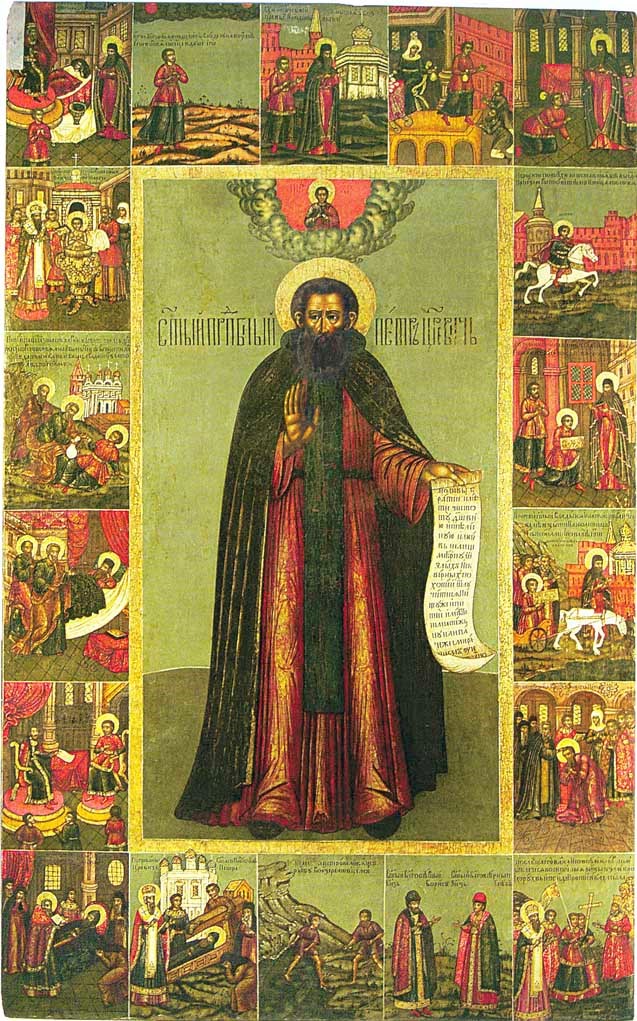
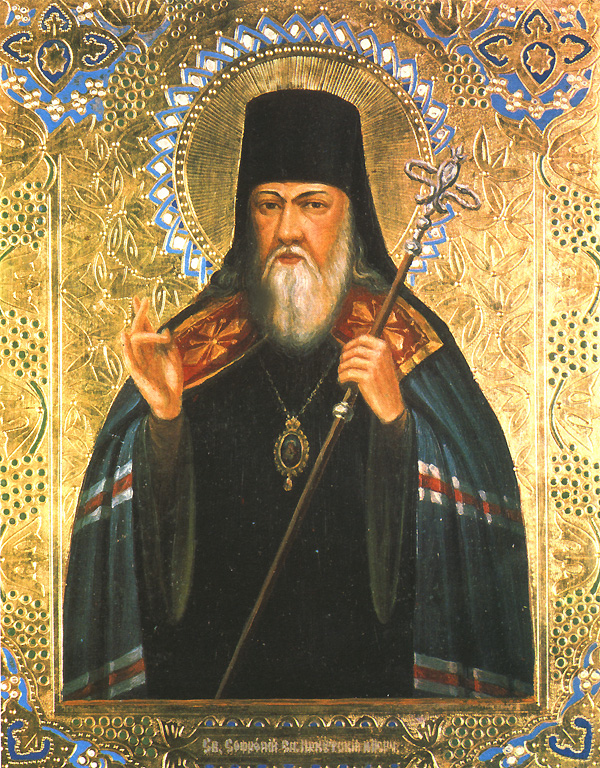


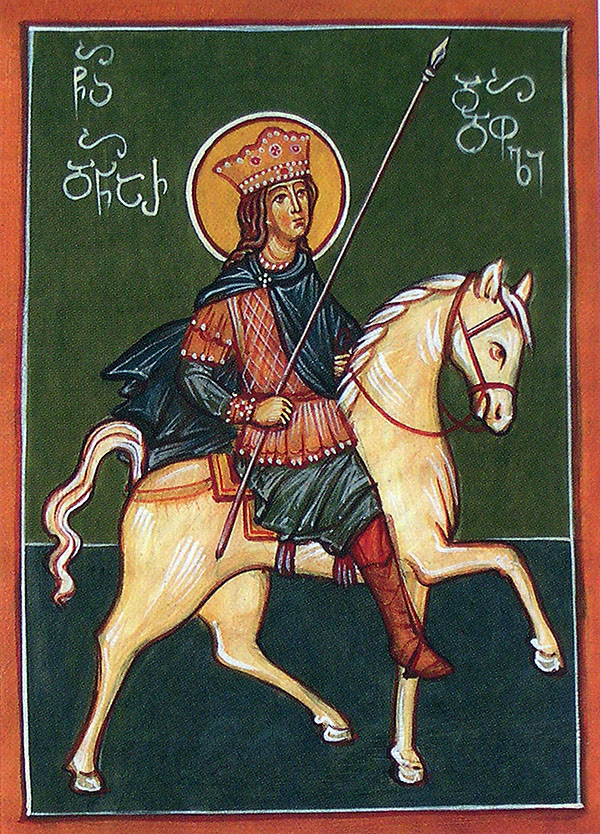

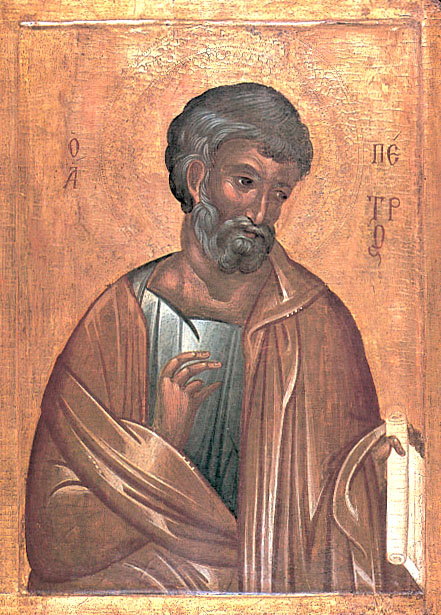


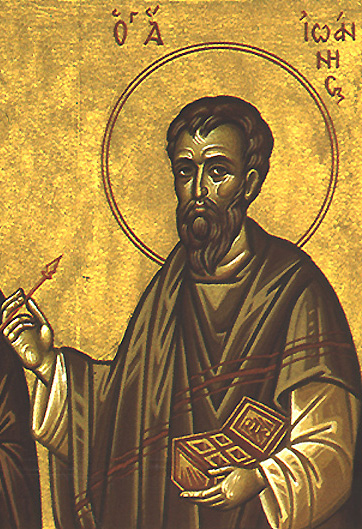


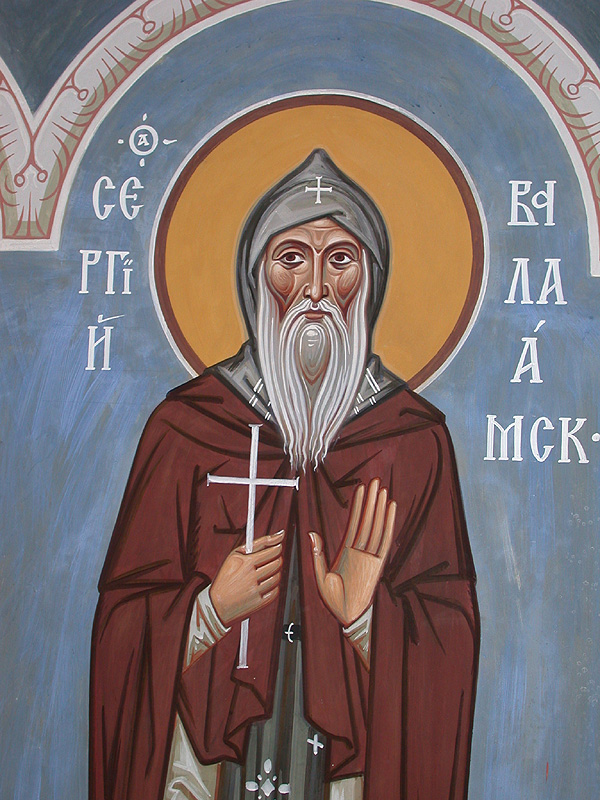


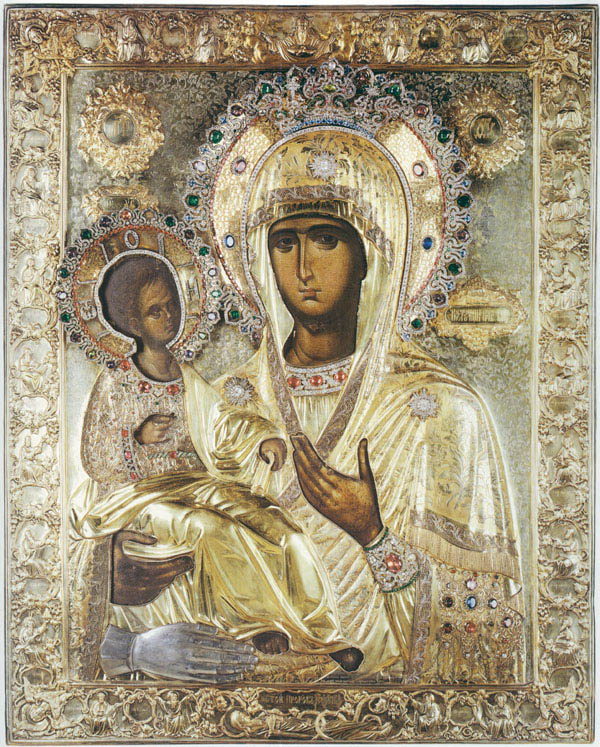


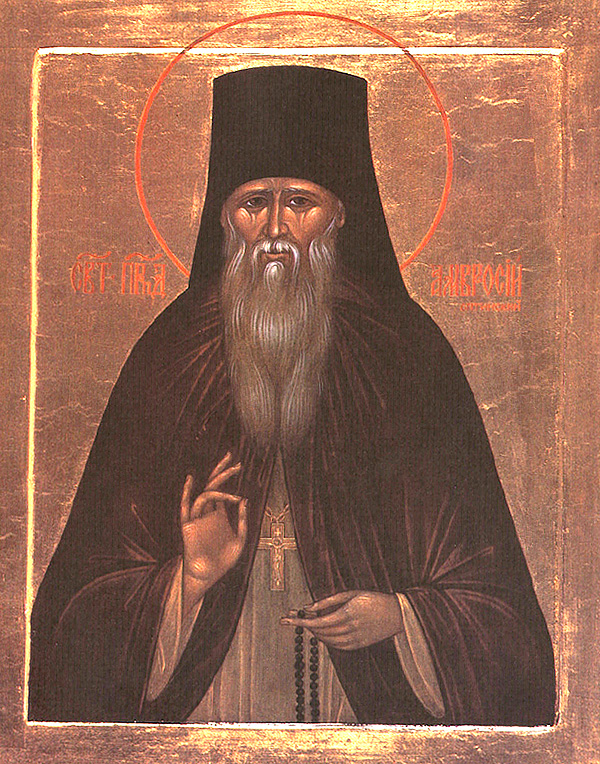
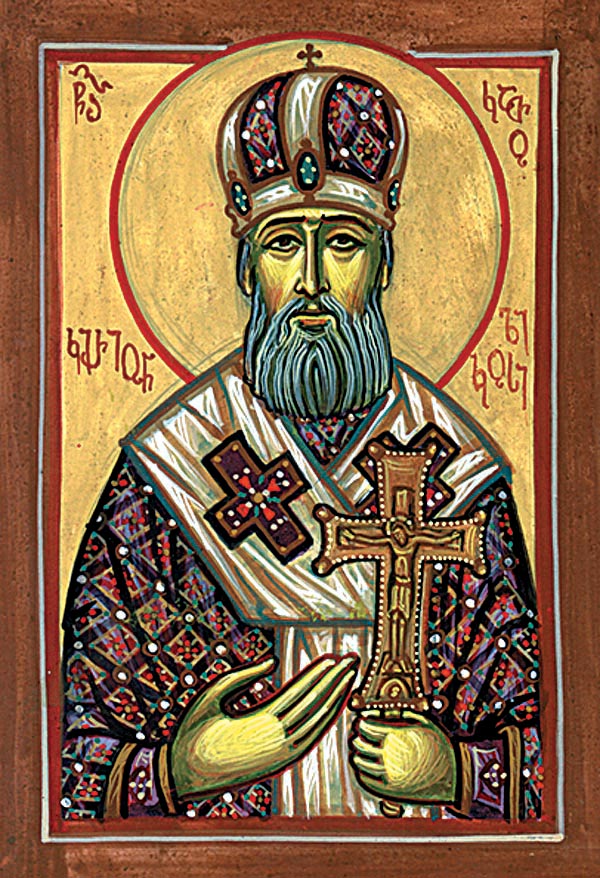
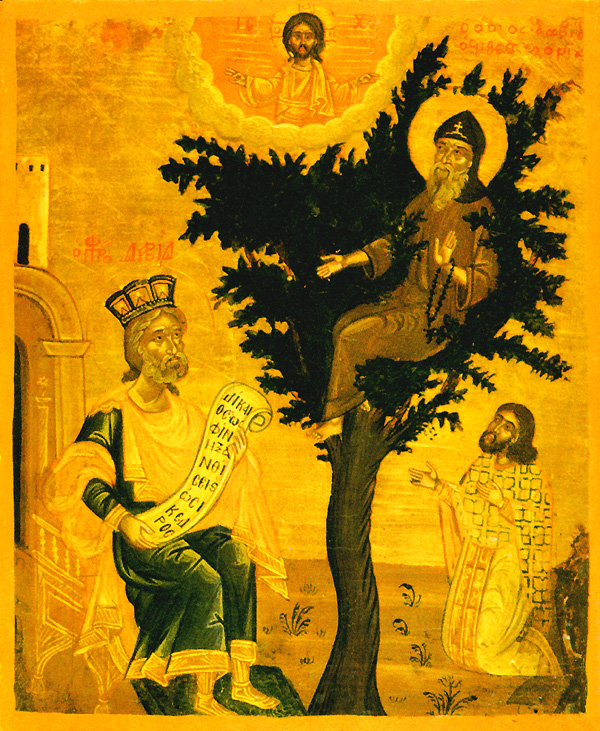


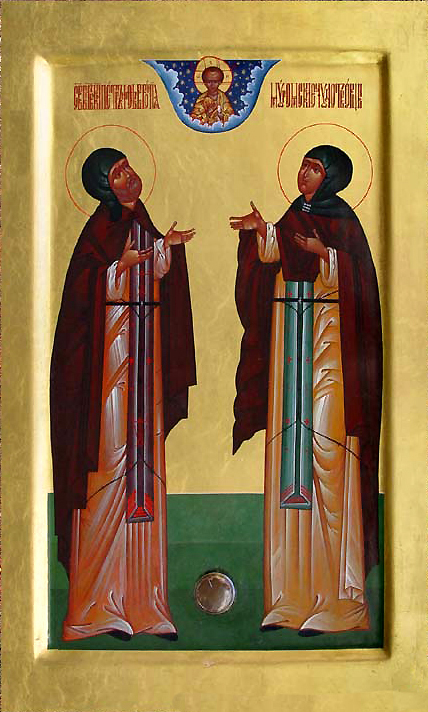


 Saint Peter Antiochian Orthodox Church
You must be logged in to post a comment.