Monthly Archives: May 2025

Daily Readings for Sunday, May 11, 2025

SUNDAY OF THE PARALYTIC

NO FAST

Sunday of the Paralytic, Renewal of Constantinople, Hieromartyr Mocius, Methodius & Cyril, Equal-to-the Apostles Illuminators of the Slavs, Theopemptos the Martyr & his Companions, Dioscoros the New Martyr, Argyrios the New-Martyr of Epanomi

ACTS OF THE APOSTLES 9:32-42

In those days, as Peter went here and there among them all, he came down also to the saints that lived at Lydda. There he found a man named Aeneas, who had been bedridden for eight years and was paralyzed. And Peter said to him, “Aeneas, Jesus Christ heals you; rise and make your bed.” And immediately he rose. And all the residents of Lydda and Sharon saw him, and they turned to the Lord. Now there was at Joppa a disciple named Tabitha, which means Dorcas. She was full of good works and acts of charity. In those days she fell sick and died; and when they had washed her, they laid her in an upper room. Since Lydda was near Joppa, the disciples, hearing that Peter was there, sent two men to him entreating him, “Please come to us without delay.” So Peter rose and went with them. And when he had come, they took him to the upper room. All the widows stood beside him weeping, and showing tunics and other garments which Dorcas made while she was with them. But Peter put them all outside and knelt down and prayed; then turning to the body he said, “Tabitha, rise.” And she opened her eyes, and when she saw Peter she sat up. And he gave her his hand and lifted her up. Then calling the saints and widows he presented her alive. And it became known throughout all Joppa, and many believed in the Lord.

JOHN 5:1-15

At that time, Jesus went up to Jerusalem. Now there is in Jerusalem by the Sheep Gate a pool, in Hebrew called Bethesda which has five porticoes. In these lay a multitude of invalids, blind, lame, paralyzed, waiting for the moving of the water; for an angel of the Lord went down at certain seasons into the pool, and troubled the water; whoever stepped in first after the troubling of the water was healed of whatever disease he had. One man was there, who had been ill for thirty-eight years. When Jesus saw him and knew that he had been lying there a long time, he said to him, "Do you want to be healed?" The sick man answered him, "Sir, I have no man to put me into the pool when the water is troubled, and while I am going another steps down before me." Jesus said to him, "Rise, take up your pallet, and walk." And at once the man was healed, and he took up his pallet and walked.
Now that day was the sabbath. So the Jews said to the man who was cured, "It is the sabbath, it is not lawful for you to carry your pallet." But he answered them, "The man who healed me said to me, 'Take up your pallet, and walk.' "They asked him, "Who is the man who said to you, 'Take up your pallet, and walk'?" Now the man who had been healed did not know who it was, for Jesus had withdrawn, as there was a crowd in the place. Afterward, Jesus found him in the temple, and said to him, "See, you are well! Sin no more, that nothing worse befall you." The man went away and told the Jews that it was Jesus who had healed him.

Sunday of the Paralytic

Many miracles in the Old Testament involve water. To name but a few, the water of the Nile turned to blood after Moses lifted his rod and struck the water before Pharaoh and His servants (Exodus 7:20). Not only was the Nile turned to blood, but also "their rivers, their canals, their ponds, and all their pools of water, that they may become blood; and there shall be blood throughout the land of Egypt, both in vessels of wood and in vessels of stone" (Exodus 7:19).

In chapter 14 of Exodus, Moses divided the waters of the Red Sea, and the Hebrews passed over as if on dry land. When they were safely across, the waters came together, and their Egyptian pursuers were drowned.

On their forty year journey to the Promised Land, the Hebrews camped at Rephidem, but there was no water for them to drink. The people murmured against Moses, asking him why he had led them out of Egypt. God told Moses to strike the rock at Horeb. Then water came out of it so that everyone could drink (Exodus 17:6).

In Judges 6:36-40 we read about Gideon and the dew on the fleece. When Gideon squeezed the fleece, there was enough to fill a bowl with water.

On the Fourth Sunday of Pascha, the Church remembers the man who lay paralyzed at the Sheep Pool in Jerusalem for thirty-eight years, waiting for someone to put him into the pool. The first person to enter the pool after an Angel troubled the water would be healed of his infirmities, but someone always entered the pool before him. Seeing the man, the Lord felt compassion for him and healed him.

The Lord healed the paralytic during the days of the Passover, when He had gone to Jerusalem for the Feast, and He remained there teaching and working miracles. According to Saint John the Theologian, this miracle took place on the Sabbath.

Like some Old Testament miracles, many of Christ's miracles also involved water, and they prefigure the Church's Baptism, which cleanses us of every sin. In the Sheep Pool, once a year, only one person was healed, but Christ saves endless multitudes by divine Baptism. Sometimes, as in the case of Saint Vladimir (July 15), Baptism can also heal our bodily infirmities.

In the Canon for the Paralytic, the Angel who stirred the water in the Sheep Pool is identified as the Archangel Michael. Some of the Troparia call him "Leader of the Angels," and "Supreme Commander" (Ode 1). In Ode 3 we ask him to "protect us from falling into the passions of life." In Ode 6, we ask Saint Michael to guide us on the paths of life." In Ode 8, we ask him to pray with all the Bodiless Hosts, that we may be granted deliverance from our offenses, correction of our life, and the enjoyment of eternal blessings.

As we remember the paralytic, let us ask Christ to "raise up our souls, paralyzed by sins and thoughtless acts" (Kontakion of the paralytic).

Commemoration of the Founding of Constantinople
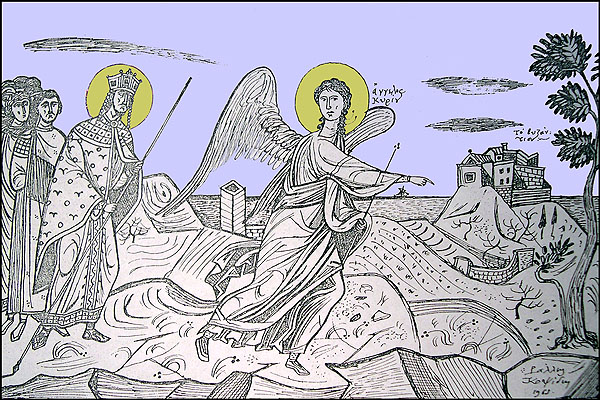
In 324 the holy Emperor Constantine (May 21) decided that the imperial capital had to be closer to the Eastern provinces, and yet have direct communication with the West. The city of Byzantium fulfilled these requirements, and on November 8, 324 the site of the new capital was consecrated.

Tradition tells us that the Emperor was tracing the boundaries of the city with a spear, when his courtiers became astonished by the magnitude of the new dimensions of the capital. “Lord,” they asked, “how long will you keep going?”

Constantine replied, “I shall keep going until the one who walks ahead of me stops.”

Then they understood that the emperor was being guided by some divine power. There is an iconographic sketch by Rallis Kopsides showing an angel of the Lord going before Saint Constantine as he traces the new boundaries of the city.

Construction of the main buildings was begun in 325, and pagan monuments from Rome, Athens, and other cities were used to beautify the new capital. The need for the new city is partially explained by the changing requirements of government, the Germanic invasion of the West, and commercial benefits, but the new city was also to be a Christian capital. For this, a new foundation was required.

In 330, the work had progressed to the point where it was possible for Constantine to dedicate the new capital. The dedication took place on May 11, followed by forty days of joyous celebration. Christian Constantinople was placed under the protection of the Most Holy Theotokos, and overshadowed pagan Byzantium. Saint Constantine was the first Emperor to submit voluntarily to Christ, and Constantinople became the symbol of a Christian Empire which lasted for a thousand years.

Hieromartyr Mocius the Presbyter of Amphipolis in Macedonia

Saint Mocius was a presbyter in Macedonia in the city of Amphipolis. During a persecution against Christians under the emperor Diocletian (284-305), Saint Mocius exhorted the pagans who had assembled for the pagan festival of Dionysus (Bacchus), to abandon iniquity and the vile customs which accompanied this celebration. He urged them to repent and be converted to the Lord Jesus Christ, and be cleansed through holy Baptism.

The saint was brought to trial before the governor of Laodicea. When threatened with torture, he replied, “My death for Christ is a great accomplishment for me.” Saint Mocius was subjected to torture, which he bore with marvelous endurance, and did not cease to denounce the idol-worshippers.

Taken to the pagan temple of Dionysus, the saint shattered the idols when he called upon Jesus Christ. After this he was put into a red-hot oven, where he remained unharmed, but the flames coming out of the oven scorched the governor.

Again the commander subjected Saint Mocius to fierce torture, which he endured with the help of God. He was given to wild beasts to be eaten, but they did not touch him. The lions lay down at his feet. The people, seeing such miracles, urged that the saint be set free. The governor ordered the saint to be sent to the city of Perinth, and from there to Byzantium, where Saint Mocius was executed.

Before his death he gave thanks to the Lord for giving him the strength to persevere to the very end. His last words were, “Lord, receive my spirit in peace.” Then he was beheaded. Saint Mocius died about the year 295. Later, the emperor Constantine built a church in honor of the hieromartyr Mocius and transferred his holy passion-bearing relics into it.

Equals of the Apostles and Teachers of the Slavs, Cyril and Methodius

Saints Cyril and Methodius, Equals of the Apostles, and Enlighteners of the Slavs came from an illustrious and pious family living in the Greek city of Thessalonica. Saint Methodius was the oldest of seven brothers, Saint Constantine [Cyril was his monastic name] was the youngest. At first Saint Methodius was in the military and was governor in one of the Slavic principalities dependent on the Byzantine Empire, probably Bulgaria, which made it possible for him to learn the Slavic language. After living there for about ten years, Saint Methodius later received monastic tonsure at one of the monasteries on Mount Olympus (Asia Minor).

Saint Constantine distinguished himself by his great aptitude, and he studied with the emperor Michael under the finest teachers in Constantinople, including Saint Photius, the future Patriarch of Constantinople (February 6).

Saint Constantine studied all the sciences of his time, and also knew several languages. He also studied the works of Saint Gregory the Theologian. Because of his keen mind and penetrating intellect, Saint Constantine was called “Philosopher” (wise). Upon the completion of his education, Saint Constantine was ordained to the holy priesthood and was appointed curator of the patriarchal library at the church of Hagia Sophia. He soon left the capital and went secretly to a monastery.

Discovered there, he returned to Constantinople, where he was appointed as instructor in philosophy. The young Constantine’s wisdom and faith were so great that he won a debate with Ananias, the leader of the heretical iconclasts. After this victory Constantine was sent by the emperor to discuss the Holy Trinity with the Saracens, and again he gained the victory. When he returned, Saint Constantine went to his brother Saint Methodius on Olympus, spending his time in unceasing prayer and reading the works of the holy Fathers.

The emperor soon summoned both of the holy brothers from the monastery and sent them to preach the Gospel to the Khazars. Along the way they stayed in the city of Korsun, making preparations for their missionary activity. There the holy brothers miraculously discovered the relics of the hieromartyr Clement, Pope of Rome (November 25).

There in Korsun Saint Constantine found a Gospel and Psalter written in Russian letters [i.e. Slavonic], and a man speaking the Slavic tongue, and he learned from this man how to read and speak this language. After this, the holy brothers went to the Khazars, where they won a debate with Jews and Moslems by preaching the Gospel. On the way home, the brothers again visited Korsun and, taking up the relics of Saint Clement, they returned to Constantinople. Saint Constantine remained in the capital, but Saint Methodius was made igumen of the small Polychronion monastery near Mount Olympus, where he lived a life of asceticism as before.

Soon messengers came to the emperor from the Moravian prince Rostislav, who was under pressure from German bishops, with a request to send teachers to Moravia who would be able to preach in the Slavic tongue. The emperor summoned Saint Constantine and said to him, “You must go there, but it would be better if no one knows about this.”

Saint Constantine prepared for the new task with fasting and prayer. With the help of his brother Saint Methodius and the disciples Gorazd, Clement, Savva, Naum and Angelyar, he devised a Slavonic alphabet and translated the books which were necessary for the celebration of the divine services: the Gospel, Epistles, Psalter, and collected services, into the Slavic tongue. This occurred in the year 863.

After completing the translation, the holy brothers went to Moravia, where they were received with great honor, and they began to teach the services in the Slavic language. This aroused the malice of the German bishops, who celebrated divine services in the Moravian churches in Latin. They rose up against the holy brothers, convinced that divine services must be done in one of three languages: Hebrew, Greek or Latin.

Saint Constantine said, “You only recognize three languages in which God may be glorified. But David sang, ‘Praise the Lord, all nations, praise the Lord all peoples (Ps 116/117:1).’ And the Gospel of Saint Matthew (28:18) says, ‘Go and teach all nations….’” The German bishops were humiliated, but they became bitter and complained to Rome.

The holy brothers were summoned to Rome for a decision on this matter. Taking with them the relics of Saint Clement, Saints Constantine and Methodius set off to Rome. Knowing that the holy brothers were bringing these relics with them, Pope Adrian met them along the way with his clergy. The holy brothers were greeted with honor, the Pope gave permission to have divine services in the Slavonic language, and he ordered the books translated by the brothers to be placed in the Latin churches, and to serve the Liturgy in the Slavonic language.

At Rome Saint Constantine fell ill, and the Lord revealed to him his approaching death. He was tonsured into the monastic schema with the name of Cyril. On February 14, 869, fifty days after receiving the schema, Saint Cyril died at the age of forty-two.

Saint Cyril commanded his brother Saint Methodius to continue with their task of enlightening the Slavic peoples with the light of the true Faith. Saint Methodius entreated the Pope to send the body of his brother for burial in their native land, but the Pope ordered the relics of Saint Cyril to be placed in the church of Saint Clement, where miracles began to occur from them.

After the death of Saint Cyril, the Pope sent Saint Methodius to Pannonia, after consecrating him as Archbishop of Moravia and Pannonia, on the ancient throne of Saint Andronicus (July 30). In Pannonia Saint Methodius and his disciples continued to distribute services books written in the Slavonic language. This again aroused the wrath of the German bishops. They arrested and tried Saint Methodius, who was sent in chains to Swabia, where he endured many sufferings for two and a half years.

After being set free by order of Pope John VIII of Rome, and restored to his archdiocese, Saint Methodius continued to preach the Gospel among the Slavs. He baptized the Czech prince Borivoi and his wife Ludmilla (September 16), and also one of the Polish princes. The German bishops began to persecute the saint for a third time, because he did not accept the erroneous teaching about the procession of the Holy Spirit from both the Father and the Son. Saint Methodius was summoned to Rome, but he justified himself before the Pope, and preserved the Orthodox teaching in its purity, and was sent again to the capital of Moravia, Velehrad.

Here in the remaining years of his life Saint Methodius, assisted by two of his former pupils, translated the entire Old Testament into Slavonic, except for the Book of Maccabbees, and even the Nomocanon (Rule of the Holy Fathers) and Paterikon (book of the Holy Fathers).

Sensing the nearness of death, Saint Methodius designated one of his students, Gorazd, as a worthy successor to himself. The holy bishop predicted the day of his death and died on April 6, 885 when he was about sixty years old. The saint’s burial service was chanted in three languages, Slavonic, Greek, and Latin. He was buried in the cathedral church of Velehrad.

Venerable Sophronius the Recluse of the Kiev Far Caves

The Relics of Saint Sophronius were buried in the Far Caves of the Kiev Caves monastery. In the Canon to the monks of the Far Caves the saint’s solitary ascetical struggles are mentioned. He was deemed worthy to hear angels singing. The memory of Saint Sophronius is also celebrated on March 11.

Saint Joseph, Metropolitan of Astrakhan

The Hieromartyr Joseph, First Metropolitan of Astrakhan, was born at Astrakhan in 1579. After becoming a monk, Saint Joseph was made Archimandrite of the Astrakhan Trinity monastery at the age of fifty-two.

In 1656 he was at Moscow, after which he was chosen to be Metropolitan of Astrakhan. On May 11,1672, during an uprising of the townspeople, Saint Joseph suffered martyrdom at Astrakhan. This sad event was recorded in detail by two eyewitnesses, priests of the Astrakhan cathedral, Cyril and Peter.

The priests took the body of the martyr, dressed it in bishop’s vestments, and placed it in a prepared grave. On the following day, after serving a Panikhida, the saint’s body was taken to a chapel, and it remained unburied for nine days. The relics of the holy hierarch were placed into the grave, and were soon glorified by miracles.

Saint Joseph was glorified at the Council of the Russian Orthodox Church in April 1918.

Saint Nikodemos, Archbishop of Serbia

Saint Nikodemos (Νikόdēmos) the Archbishop of Serbia, a gifted ecclesiastical writer and learned theologian, like many Serbian bishops, first contested on Holy Mount Athos where he was tonsured, and then he was chosen as Igoumen of Hilandar Monastery (1312–1316). The Hieromonk Gervasius wrote that the Saint was a native of "a western country, the land of Raska, called Serbia."

After the death of the Serbian Archbishop Sava III, Saint Nikodemos was elected as Archbishop of All Serbia and the Land of Pomor, and ascended the primatial throne in 1317.

The Hierarch translated the Rule of Saint Savva the Sanctified from Greek into Serbian. In the Synaxarion he included the dates of the repose of the Serbian rulers and Archbishops in order to commemorate the departed with festive services (if they were glorified as Saints). In his translation of the Jerusalem Typikon, Archbishop Nikodemos reminds us that even Saint Savva of Serbia wanted his churches to be built like the churches of Jerusalem, and the Lavra of Savva the Sanctified. In the preface to this work, he says: "Almighty God, Who knows our weakness, gives us spiritual strength if we first show our work." In a note dating back to the year 1319, the Saint indicates that he undertook the translation of the Typikon, fulfilling the will of Saint Savva. He concludes his exhortation with the following words: "I beseech those who come after me to complete that which remains unfinished because of the shortness of my life."

While he was still the Igoumen of Hilandar, Blessed Nikodemos, at the request of Kings Milutin and Dragutin, and the entire council of the Serbian land, went to Constantinople to Patriarch Nikon and Emperor Andronikos, in order to promote the reconciliation of the warring brothers. As Archbishop, the Saint stood at the head of the embassy of Hilandar Monastery, which had arrived in Serbia to ask King Milutin for forgiveness and his son, Stephen of Decani (Dečani), was returned from exile. This was reported by the Church writer Archbishop Daniel II, who also took part in the reconciliation process. "And this Bishop," writing about Saint Nikodemos, "truly had boldness… approaching him, he began to speak sweet and prudent words, by which it was possible to turn his great wrath into meekness."

On January 6, 1321, Saint Nikodemos crowned Stephen Uros (Uroš) III of Decani with the royal crown. George Tsamblak described this event as follows: "He was met by the Hierarch Archbishop Nikodemos… with great joy and royal honors. In the temple, Archbishop Nikodemos took the royal crown of the kingdom and placed it on Stephen's head, showing him to be the rightful king.

Saint Nikodemos was the builder of the church of Saint Demetrios in the Patriarchate of Pec (Peč), and the church of Saint Savva of Serbia at Lizitsya. He restored Zicha (Žiča) Monastery and took special care of the cell of Saint Savva in Karyes on Mount Athos. The Saint left a testament that the Serbian Archbishops should deliver to this cell everything that Saint Savva himself once specified.

Sincerely devoted to Christ's teachings, and to his people, the Hierarch was an irreconcilable fighter against false teachings and heresies, especially the Bogomils1. In the Church Service in honor of Saint Nikodemos, composed by Bishop Mark between 1404 and 1412, it is reported that the Saint waged a fierce struggle against heretics, including the Latins. The hymnographer likened the Hierarch to an axe cutting down the intentions of heretics who came from foreign countries.

The Hierarch's biographer reports that he was Archbishop "for only eight years of his short life," and departed to the Lord as a relatively old man. This occurred on May 11, 1324. The relics of Saint Nikodemos were placed in the church of Saint Demetrios at Pec. The exact date of their discovery unknown, but already by 1391 they had been placed in a special ark. The glorification of Nikodemos as a Saint happened quite early. Just as early, the Church veneration of this Saint appeared in Russia. Icons of Saint Nikodemos can be found in the frescoes in the monastery of Morača, the church of Saint Nicholas near Moraca (Morača), and in the monastery of Orahovica.

Saint Nikodemos reposed on May 11, 1325. He is also commemorated on August 30, the Synaxis of the Serbian Hierarchs, and at the Synaxis of All Saints of Mount Athos (a movable Feast on the Second Sunday after Pentecost).


1They were dualists, or Gnostics, who believed in a world within the body and a world outside the body. They rejected the Christian hierarchy, the Cross, and they did not build churches, since they regarded their body as a temple. This gave rise to various practices to cleanse themselves through fasting or dancing.

Saint Rostislav, Prince of Great Moravia

Saint Rostislav (Rastislav) the Prince of Great Moravia, and Equal of the Apostles, became Prince in 846, following the death of his uncle Mojmir I. At that time, missionaries from Greece, the Balkans, and Germany were already preaching in the territory of Great Moravia. Prince Rostislav was among those who received Holy Baptism, and soon afterward he decided to enlighten the entire country with the light of the Christian Faith.

Wary of the German missionaries, who were subject to Louis the German, the King of East Francia, Prince Rostislav understood that for the preaching of the Gospel to be successful, it must be proclaimed in the language of the people.

At first, Rostislav asked the Roman Pope Nicholas I to send him some missionaries who knew the Slavic language. When his request was refused, he turned to the Byzantine Emperor Michael III. On the advice of Patriarch Photios of Constantinople (February 6), Michael sent Prince Rostislav two brothers, Saints Cyril and Methodios, who translated the Bible, the Divine Liturgy, and other books into Slavonic. Icons and other items which were required for the Church Services were also provided, and Christian schools were established. Christianity spread rapidly throughout Great Moravia with the full support of Prince Rostislav.

In 870, Prince Rostislav's nephew Svatopluk betrayed him to Carloman, the son of King Louis, after acknowledging him as his overlord. In return, Carloman promised that Svatopluk would rule in Great Moravia. Prince Rostislav was blinded and confined in a castle at Regensburg in the State of Bavaria, where he reposed that same year.

Saint Rostislav was glorified by the Orthodox Church of the Czech Lands and Slovakia at Prešov in October of 1994.

New Martyr Dioscorus

No information available at this time.

New Martyr Argyrus

No information available at this time.

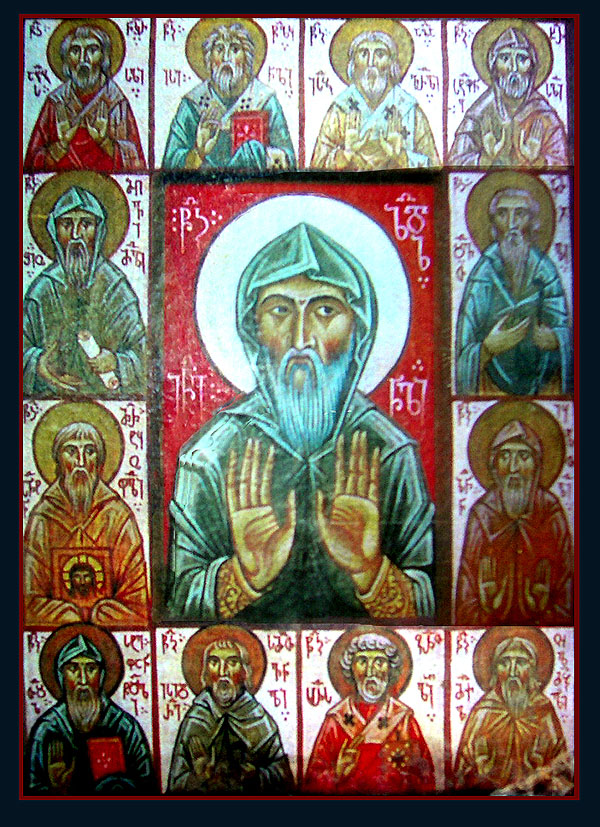
Blessed Christopher, called Christesia

Blessed Christesia’s family was from Egrisi in western Georgia. From his youth Christesia longed for the divine services and the solitary life, but he was forced by his master to marry, and by this marriage he begot a son. Later, when both his wife and son had died, his master insisted that he marry again, but the pious Christesia would not heed his master’s order.

Instead he related the order to his spiritual father, who advised him to depart from the world and journey to the Davit-Gareji Wilderness. Deeply inspired by his spiritual father’s counsel, Christesia abandoned his possessions and his life in the world and withdrew to the Monastery of Saint John the Baptist in the Davit-Gareji Wilderness.

The holy father spent many years in humble service to the Lord. He was assigned to gather firewood and bring water for the monastery, and he performed these tasks obediently and in perfect meekness. Every day he walked over four miles to fill a pitcher with water and then carried it to a small hut nearby. He hung the pitcher at the entrance to make it visible from a distance, and travelers who passed by would come to quench their thirst.

He also kept a small vegetable garden to feed the passers-by. Every Saturday he prepared kolio (a dish of wheat and honey traditionally offered to commemorate the departed) and divided it in three parts: one part commemorated the family and loved ones of those who had donated the wheat and honey; the second, the deceased fathers of the monastery; and the last, all departed Orthodox Christians.

It always disturbed Saint Christesia to see his brothers and sisters at odds with one another, so when he heard that two people were quarreling, he would go and reconcile them. “My children!” he would say, “If you do not heed my words, I will leave in sorrow, and the devil, who is always resistant to peace, will rejoice and send more tribulations upon you. I came to you hungry, and I will depart hungry!” His words warmed the hearts of those whom he counseled and helped them to be reconciled with one another.

One hot evening after Vespers, Saint Christesia set off on foot for a certain village. He left during twilight, and when night fell the sky was without a moon and extraordinarily dark. Before long it became difficult to walk any farther, so Saint Christesia stopped to pray, and a bright light appeared before him to light the way. The divine light guided him all through the night, until he reached the village of Sartichala.

Saint Christesia’s cell was poor and cramped. He slept on a bed of wooden planks that he covered in sheepskin, and instead of a pillow he rested his head on a stone. The pious ascetic wore a sheepskin coat and sandals made of bark. Whatever he received he gave to the poor. Having placed complete trust in God, he would not permit himself to worry about the morrow, nor did he bother to store up food or supplies for the harsh winter months.

Father Christesia was already advanced in age when he was tonsured a monk and given the new name Christopher. He reposed peacefully in 1771, at the age of eighty.

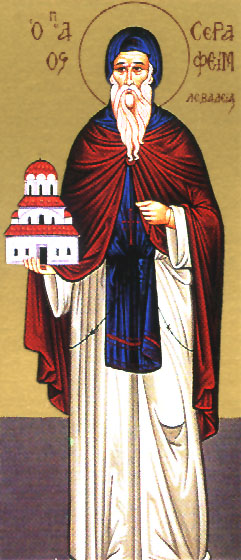
Holy Monastic Martyrs Olympia and Euphrosynē

Saint Olympia (Ολυμπία) was born to devout parents who were from Constantinople. Her father was a priest, and her mother was the daughter of a priest. They fled Constantinople for some unknown reason and went to the Peloponnesos. At the age of ten, Saint Olympia lost her parents, and her relatives sent her to Karyes Monastery at Therme on the island of Lesbos, where her aunt Dorothy was the Igoumeness. Originally this was a womens' monastery, but today it is Saint Raphael's Monastery.

At the age of nineteen, Saint Olympia was tonsured as a nun. When she was twenty-five, she succeeded her aunt as Igoumeness. About ten years later, on May 11, 1235, pirates arrived on Lesbos and went to the monastery where there were thirty nuns. Some of them were raped by the pirates, but others fled to the mountains.

Igoumeness Olympia and Eldress Euphrosynē (Ευφροσύνη) were subjected to frightful torments. Saint Euphrosynē was hanged from a tree and was burnt. Saint Olympia was burnt all over her body with torches, and after that they took a red-hot iron rod and passed it from one ear and out through the other. Finally, her tortured body was nailed to a board with twenty nails, and this board was buried with her. Then the pirates went away.

The account of the lives and martyrdom of these two holy women became known in 1959 when, by divine revelation, the relics of these saints were found at Therme. Twenty nails were found in Saint Olympia's tomb. Sometimes she has appeared together with Saint Raphael.

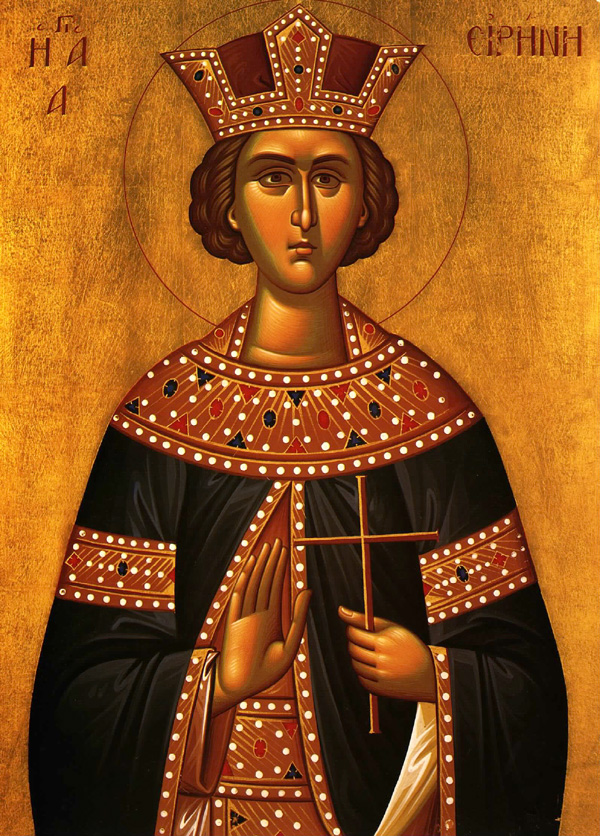
Saint Olympia and Saint Euphrosynē are commemorated on May 11 and also on Bright Tuesday with Saints Raphael, Nicholas, and Irene.
Daily Readings for Saturday, May 10, 2025

SIMON THE ZEALOT & APOSTLE

NO FAST

Simon the Zealot & Apostle, Laurence of Egypt, Isodora of Egypt

ST. PAUL’S FIRST LETTER TO THE CORINTHIANS 4:9-16

Brethren, God has exhibited us apostles as last of all, like men sentenced to death; because we have become a spectacle to the world, to angels and to men. We are fools for Christ’s sake, but you are wise in Christ. We are weak, but you are strong. You are held in honor, but we in disrepute. To the present hour we hunger and thirst, we are ill-clad and buffeted and homeless, and we labor, working with our own hands. When reviled, we bless; when persecuted, we endure; when slandered, we try to conciliate; we have become, and are now, as the refuse of the world, the off-scouring of all things. I do not write this to make you ashamed, but to admonish you as my beloved children. For though you have countless guides in Christ, you do not have many fathers. For I became your father in Christ Jesus through the gospel. I urge you, then, be imitators of me.

LUKE 6:12-19

At that time, Jesus went out to the mountain to pray; and all night he continued in prayer to God. And when it was day, he called his disciples, and chose from them twelve, whom he named apostles; Simon, whom he named Peter, and Andrew his brother, and James and John, and Philip, and Bartholomew, and Matthew, and Thomas, and James the son of Alphaios, and Simon who was called the Zealot, and Judas the son of James, and Judas Iscariot, who became a traitor. And he came down with them and stood on a level place, with a great crowd of his disciples and a great multitude of people from all Judea and Jerusalem and the seacoast of Tyre and Sidon, who came to hear him and to be healed of their diseases; and those who were troubled with unclean spirits were cured. And all the crowd sought to touch him, for power came forth from him and healed them all.

Apostle Simon the Zealot

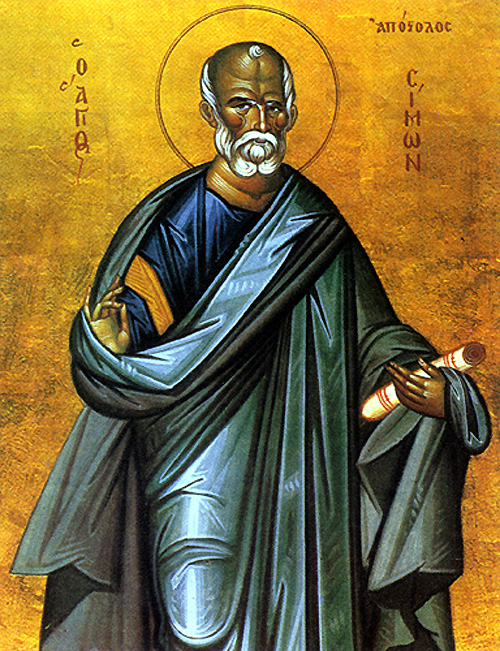
Saint Simon was from Cana in Galilee, and was known to the Lord and His Mother. Tradition says that he was the bridegroom at the wedding where the Savior performed His first miracle. After witnessing the miracle of the water which had been turned into wine, he became a zealous follower of Christ. For this reason, he is known as Saint Simon the Zealot.

Saint Simon was one of the twelve Apostles, and received the Holy Spirit with the others on Pentecost. He traveled to many places from Britain to the Black Sea, proclaiming the Gospel of Christ. After winning many pagans to the Lord, Saint Simon suffered martyrdom by crucifixion.

Saint Demetrius of Rostov says that this Saint Simon is to be distinguished from the Apostle Simon Peter, and from the Lord’s relative Simon (Mt.13:55), who was the second Bishop of Jerusalem.

Saint Simon is also commemorated on June 30 with the other Apostles.

Saint Simon, Bishop of Vladimir and Suzdal of the Kiev Near Caves

Saint Simon, Bishop of Vladimir and Suzdal was an author of the Kiev Caves Paterikon, and he became a monk at the Monastery of the Caves, sometime in the second half of the twelfth century.

In the year 1206 he was appointed igumen of the Vladimir Monastery of the Nativity of the Theotokos, and in 1214, at the wish of Prince George Vsevolodovich (+ 1238), he was made the first bishop of Vladimir-on-the-Klyazma and Suzdal.

In 1218 he consecrated a church at the Nativity monastery, and in the year 1225, a cathedral church at Suzdal. The Great Prince, who deeply respected Saint Simon, was prepared to establish a new bishop’s See at Suzdal for his friend, the monk Polycarp of the Kiev Caves monastery, who sought after spiritual glory. Saint Simon, seeing that Polycarp was not yet ready to assume such an office, talked the Great Prince out of his idea, and he wrote a deeply moving letter to Polycarp, in which he offered his friend advice on overcoming his spiritual shortcomings. Saint Simon’s own inner life, character, and virtue are also revealed in the epistle.

Saint Simon was known as a learned teacher, and his epistle to Polycarp was placed at the beginning of the Kiev Caves Paterikon. On the eve of his repose in 1226, the saint received the schema.

Initially his body was buried at Vladimir, but later, in accordance with the saint’s last wishes, his body was transferred to the Kiev Caves Lavra, where it rests in the Antoniev Caves.

Martyrs Philadelphus, Cyprian, Alphius, Onesimus, Erasmus, and 14 others, in Sicily

The Holy Martyrs Philadelphus, Alphaeus, Cyprian, Onesimus, Erasmus and 14 others with them, lived during the third century and came from Italy. Alphaeus, Philadelphus and Cyprian were sons of a governor in Italy, named Vitalius. They were enlightened by faith in Christ and baptized by Saint Onesimus.

During this period the emperor Licinius issued orders to seek out and hand over the Christians for torture. The brothers went to Rome together with Onesimus, Erasmus and fourteen other Christians. At Rome the pagans crushed the chest of Saint Onesimus with a heavy stone, which killed him. Erasmus and the fourteen Martyrs were beheaded.

The brothers Alphaeus, Philadelphus and Cyprian suffered in the city of Mesopolis Leontini in Sicily, where they had been sent from Rome. Saint Philadelphus was burned over an iron lattice in the year 251, in the reign of the emperor Decius.

In the year 1517 their incorrupt relics were discovered at Leontini [Lentini]. Saints Alphaeus, Philadelphus and Cyprian appeared to Saint Euthalia (March 2) and told her that she would be healed of an affliction after she was baptized.

Martyr Hesychius of Antioch

The Holy Martyr Hesychius of Antioch lived in Antioch during the reign of Maximian Galerius (305-311), and he occupied a high official position. Maximian issued an edict by which all Christians were to be deprived of military rank and expelled from military service. Those who would not renounce Christianity were stripped of their soldier’s belt and military insignia, and degraded to the level of hired servants. Saint Hesychius was one of these.

Maximian ordered Hesychius to remove his robes of office, put on common attire, and to be placed among the women servants. After several days he summoned Hesychius and asked, “Are you not ashamed to remain in such dishonor?” Saint Hesychius answered, “The honors which I had from you were only temporal.”

Then Maximian gave orders to drown Saint Hesychius in a river, with a millstone tied about his neck. The exact year of the martyr’s death is not known.

Blessed Isidora the Fool of Tabenna in Egypt

Saint Isidora, Fool-for-Christ, struggled in the Tabenna monastery in Egypt during the sixth century. Taking upon herself the feat of folly, she acted like one insane, and did not eat food with the other sisters of the monastery. Many of them regarded her with contempt, but Isidora bore all this with great patience and meekness, blessing God for everything.

She worked in the kitchen and fulfilled the dirtiest, most difficult tasks at the monastery, cleaning the monastery of every impurity. Isidora covered her head with a plain rag, and instead of cooked food she drank the dirty wash water from the pots and dishes. She never became angry, never insulted anyone with a word, never grumbled against God or the sisters, and was given to silence.

Once, a desert monk, Saint Pitirim, had a vision. An angel of God appeared to him and said, “Go to the Tabenna monastery. There you will see a sister wearing a rag on her head. She serves them all with love, and endures their contempt without complaint. Her heart and her thoughts rest always with God. You, on the other hand, sit in solitude, but your thoughts flit about all over the world.”

The Elder set out for the Tabenna monastery, but he did not see the one indicated to him in the vision among the sisters. Then they led Isidora to him, considering her a demoniac. Isidora fell down at the knees of the Elder, asking his blessing. Saint Pitirim bowed down to the ground to her and said, “Bless me first, venerable Mother!”

To the astonished questions of the sisters the Elder replied, “Before God, Isidora is higher than all of us!” Then the sisters began to repent, confessing their mistreatment of Isidora, and they asked her forgiveness. The saint, however, distressed over her fame, secretly hid herself away from the monastery, and her ultimate fate remained unknown. It is believed that she died around the year 365.

Blessed Thais of Egypt

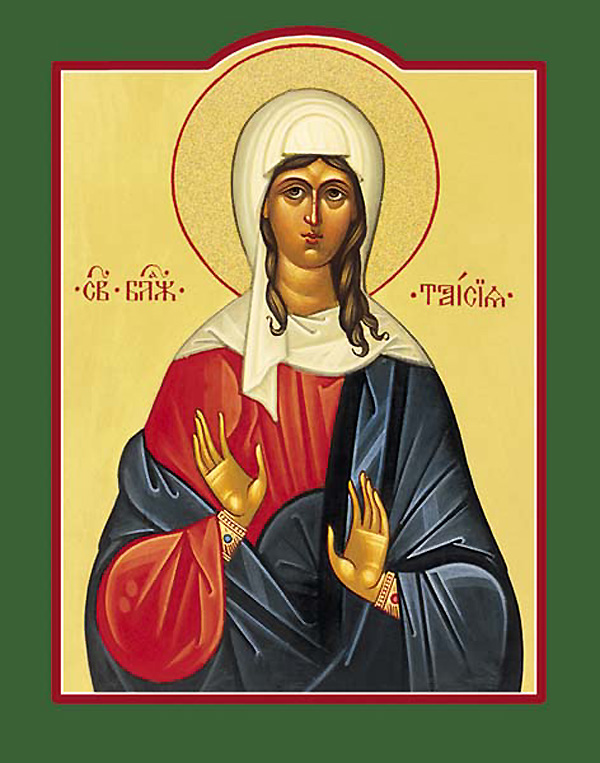
Saint Thais lived in Egypt in the fifth century. Left an orphan after the death of her wealthy parents, she led a pious life, distributing her wealth to the poor, and she gave shelter to pilgrims on her estate. She decided that she would never marry, but would devote her life to serving Christ.

After spending all her inheritance, Thais was tempted to acquire more money by any means, and began to lead a sinful life. The Elders of Sketis near Alexandria heard of her fall, and asked Saint John the Dwarf (November 9) to go to Thais and persuade her to repent. “She was kind to us,” they said, “now perhaps we can help her. You, Father, are wise. Go and try to save her soul, and we will pray that the Lord will help you.”

The Elder went to her home, but Thais’s servant did not want to allow him into the house. Saint John said, “Tell your mistress that I have brought her something very precious.” Thais, knowing that the monks sometimes found pearls at the shore, told her servant to admit the visitor. Saint John sat down and looked her in the face, and then began to weep. Thais asked him why he was crying. “How can I not weep,” he asked, “when you have forsaken your Bridegroom, the Lord Jesus Christ, and are pleasing Satan by your deeds?”

The Elder’s words pierced the soul of Thais like a fiery arrow, and at once she realized how sinful her present life had become. In fear, she asked him if God would accept the repentance of a sinner like her. Saint John replied that the Savior awaited her repentance. That is why He came, to seek and to save the perishing. “He will welcome you with love,” he said, “and the angels will rejoice over you. As the Savior said Himself, one repentant sinner causes the powers of Heaven to rejoice” (Luke 15:7).

A feeling of repentance enveloped her, and regarding the Elder’s words as a call from the Lord Himself to return to Him, Thais trembled and thought only of finding the path of salvation. She stood up and left her house without speaking to her servants, and without making any sort of disposition of her property, so that even Saint John was amazed.

Following Saint John into the wilderness, she hastened to return to God through penitence and prayer. Night fell, and the Elder prepared a place for Thais to lay down and sleep. He made a pillow for her from the sand, and he went off somewhat farther, and went to sleep after his evening prayers.

In the middle of the night, he was wakened by a light coming down from the heavens to the place where Thais was at rest. In the radiant light he saw holy angels bearing her soul to Paradise. When he went over to Thais, he found her dead.

Saint John prayed and asked God to reveal to him whether Thais had been saved. An angel of God appeared and told him, “Abba John, her one hour of repentance was equal to many years, because she repented with all her soul, and a compunctionate heart.”

After burying the body of the saint, Saint John returned to Sketis and told the monks what had happened. All offered thanks to God for His mercy toward Thais who, like the wise thief, repented in a single moment.

“Kiev-Bratsk” Icon of the Mother of God

The wonderworking Kiev-Bratsk (i.e. "Brotherhood") Icon of the Mother of God was revealed in 1654, and was originally kept in the church of Saints Boris and Gleb in the city of Vyshgorod (Kiev), and was placed in a shrine to the left of the Royal Doors on the iconostasis.

On May 10, 1662, during a war with Poland (1659–1667), the city suffered great damage from the Poles and Crimean Tatars who fought against Russia. The church of the Holy Passion-Bearers Boris and Gleb was ravaged and looted by enemy soldiers, who took all the jewels and icons, but the relics of the Saints were hidden under a crypt. By God's Providence, the wonderworking Icon of the Mother of God was preserved.

Some devout Christians, at the risk of their very lives, rescued the Icon of the Mother of God from the unclean hands of those who had stolen it. Since they were unable to hide the Icon, they had to consign it to the Dnieper River, praying that God's will would be done. To their amazement, the Icon did not sink, but floated upright down the river.

Leaving Vyshgorod, the Tatars began to cross the Dnieper, but they were drowned during a storm. Only one of them escaped by clinging to the Icon of the Mother of God as though it were a raft. The river carried the holy Icon to the bank of the Podil in Kiev, where it stopped before the Bratsk Monastery. The Tatar was afraid of drowning, and cried desperately for help. A boat was sent from the Monastery, into which the monks received the Icon and the Tatar.

The Tatar, whose life was spared by God, believed in Jesus Christ and was baptized. The Icon was placed in the wooden church of Saints Boris and Gleb, where it remained for a long time. An inventory of the church property in the Kiev-Bratsk Monastery, compiled in 1807, gives a description of the miraculous Icon.

In 1919, the Bratsk Monastery was closed, and the Kiev-Bratsk Icon of the Mother of God was thought to be lost. For a long time, the lack of information about the shrines of the Monastery until the 90s of the XX century was perceived as confirmation that the Icon was lost. In recent years, however, studies have shown that the Icon is one of the five most valuable icons in the Monastery. It was transferred to the Kiev Caves Lavra in 1926.

In 1948, this group of icons was first recorded in the ledger of the National Art Museum of Ukraine (NHMU) with a note saying their fate before they came to the museum was unknown. The reacquisition of the Kiev-Bratsk Icon occurred in the early 2000s, when employees of the NHMU established a connection between these monuments and the Bratsk Monastery.

Currently the Kiev-Bratsk Icon is in the collection of NHMU. It's reacquisition is regarded as confirmation of the Icon's miraculous qualities.

There is an exact copy of the Icon, which is located in the Kievan Monastery of the Protection of the Mother of God.

The Kiev-Bratsk Icon of the Mother of God is commemorated on September 6, May 10, June 2, and on Saturday of the Fifth Week of Great Lent.

Venerable Comgall of Bangor

Saint Comgall (Comhghall), “the Father of Monks,” was born in Ireland at Dalaradia, Co. Ulster sometime between 510 and 520. Unlike many of the early Irish saints, Saint Comgall was not of noble birth. He served as a soldier, then studied with Saint Finnian of Moville (September 10). He was ordained to the holy priesthood by Bishop Lugaid before the age of forty.

Saint Comgall and several companions lived for a time on an island in Lough Erne in the county of Ulster, where they lived a very strict ascetical life. Although his desire was to be a missionary in Scotland, Bishop Lugaid asked him to stay in Ireland and establish a monastery at Bangor (Bennchor) on the southern shore of Belfast Loch (in modern Co. Down). The monastery was founded sometime between 552-555.

It is believed that over four thousand monks were trained by Saint Comgall at Bangor, including Saint Columbanus of Luxeuil (November 21, or 23) and Saint Moluag (June 25). Saint Comgall often prayed while standing in the water for several hours. Sometimes at night his cell seemed to be ablaze with a heavenly radiance.

Later Saint Comgall did visit Scotland, where he became very close to Saint Columba of Iona (June 9), by whose prayers Comgall was once saved from drowning.

Saint Comgall lived to an advanced age, then suffered from a prolonged illness. He completed the course of his earthly life at Bangor on May 10, 602, after receiving Holy Communion from Saint Fiacre (August 30).

Daily Readings for Friday, May 09, 2025

3RD FRIDAY AFTER PASCHA

NO FAST

3rd Friday after Pascha, The Holy Prophet Esaias (Isaiah), Christopher the Martyr of Lycea, Elder Hieronymos of Simonopetra, Monk-martyr Nicholas who lived in Vuneni, of Larissa in Thessaly, Epimachos the New Martyr of Alexandria, The New Martyrs of Novo Selo, Bulgaria

ACTS OF THE APOSTLES 8:40; 9:1-19

In those days, Philip was found at Azotos, and passing on he preached the gospel to all the towns till he came to Caesarea. But Saul, still breathing threats and murder against the disciples of the Lord, went to the high priest and asked him for letters to the synagogues at Damascus, so that if he found any belonging to the Way, men or women, he might bring them bound to Jerusalem. Now as he journeyed he approached Damascus, and suddenly a light from heaven flashed about him. And he fell to the ground and heard a voice saying to him, "Saul, Saul, why do you persecute me?" And he said, "Who are you, Lord?" And he said, " I am Jesus, whom you are persecuting; but rise and enter the city, and you will be told what you are to do." The men who were traveling with him stood speechless, hearing the voice but seeing no one. Saul arose from the ground; and when his eyes were opened, he could see nothing; so they led him by the hand and brought him into Damascus. And for three days he was without sight, and neither ate nor drank.
Now there was a disciple at Damascus named Ananias. The Lord said to him in a vision, "Ananias." And he said, "Here I am, Lord." And the Lord said to him, "Rise and go to the street called Straight, and inquire in the house of Judas for a man of Tarsus named Saul; for behold, he is praying, and he has seen a man named Ananias come in and lay his hands on him so that he might regain his sight." But Ananias answered, "Lord, I have heard from many about this man, how much evil he has done to thy saints at Jerusalem; and here he has authority from the chief priests to bind all who call upon thy name." But the Lord said to him, "Go, for he is a chosen instrument of mine to carry my name before the Gentiles and kings and the sons of Israel; for I will show him how much he must suffer for the sake of my name." So Ananias departed and entered the house. And laying his hands on him he said, "Brother Saul, the Lord Jesus who appeared to you on the road by which you came, has sent me that you may regain your sight and be filled with the Holy Spirit." And immediately something like scales fell from his eyes and he regained his sight. Then he rose and was baptized, and took food and was strengthened.

JOHN 6:48-54

The Lord said to the Jews who believed in him: "I am the bread of life. Your fathers ate the manna in the wilderness, and they died. This is the bread which comes down from heaven, that a man may eat of it and not die. I am the living bread which came down from heaven; if any one eats of this bread, he will live forever; and the bread which I shall give for the life of the world is my flesh.
The Jews then disputed among themselves, saying, "How can this man give us his flesh to eat?" So Jesus said to them, "Truly, truly, I say to you, unless you eat the flesh of the Son of man and drink his blood, you have no life in you; he who eats my flesh and drinks my blood has eternal life, and I will raise him up at the last day.

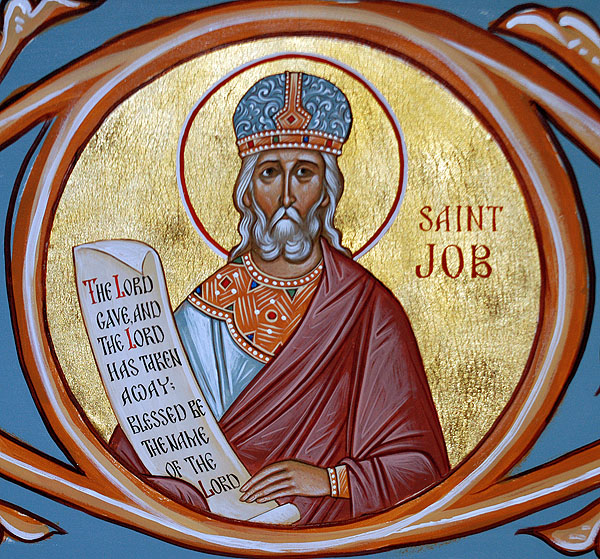
Prophet Isaiah

The Holy Prophet Isaiah lived 700 years before the birth of Christ, and was of royal lineage. Isaiah’s father Amos raised his son in the fear of God and in the law of the Lord. Having attained the age of maturity, the Prophet Isaiah entered into marriage with a pious prophetess (Is 8:3) and had a son Jashub (Is 8:18).

Saint Isaiah was called to prophetic service during the reign of Oziah [Uzziah], king of Judea, and he prophesied for 60 years during the reign of kings Joatham, Achaz [Ahaz], Hezekiah and Manasseh. The start of his service was marked by the following vision: he beheld the Lord God, sitting in a majestic heavenly temple upon a high throne. Six-winged Seraphim encircled Him. With two wings they covered their faces, and with two wings they covered their feet, and with two wings they flew about crying out one to another, “Holy, Holy, Holy Lord Sabaoth, heaven and earth are filled with His glory!” The pillars of the heavenly temple shook from their shouts, and in the temple arose the smoke of incense.

The prophet cried out in terror, “Oh, an accursed man am I, granted to behold the Lord Sabaoth, and having impure lips and living amidst an impure people!” Then was sent him one of the Seraphim, having in hand a red-hot coal, which he took with tongs from the altar of the Lord. He touched it to the mouth of the Prophet Isaiah and said, “Lo, this has touched thy lips, and will take away with thine iniquities, and will cleanse thy sins.” After this Isaiah heard the voice of the Lord, directed towards him, “Whom shall I send, and who will go to this people?” Isaiah answered, “Here am I, send me” (Is 6:1 ff). And the Lord sent him to the Jews to exhort them to turn from the ways of impiety and idol worship, and to offer repentance.

To those that repent and turn to the true God, the Lord promised mercy and forgiveness, but punishment and the judgment of God are appointed for the unrepentant. Then Isaiah asked the Lord, how long would the falling away of the Jewish nation from God continue. The Lord answered, “Until the cities be deserted, by reason of there being no people, and the land shall be made desolate. Just as when a tree be felled and from the stump come forth new shoots, so also from the destruction of the nation a holy remnant will remain, from which will emerge a new tribe.”

Isaiah left behind him a book of prophecy in which he denounces the Jews for their unfaithfulness to the God of their Fathers. He predicted the captivity of the Jews and their return from captivity during the time of the emperor Cyrus, the destruction and renewal of Jerusalem and of the Temple. Together with this he predicts the historical fate also of the other nations bordering the Jews. But what is most important of all for us, the Prophet Isaiah with particular clarity and detail prophesies about the coming of the Messiah, Christ the Savior. The prophet names the Messiah as God and Man, teacher of all the nations, founder of the Kingdom of peace and love.

The prophet foretells the birth of the Messiah from a Virgin, and with particular clarity he describes the Suffering of the Messiah for the sins of the world. He foresees His Resurrection and the universal spreading of His Church. By his clear foretelling of Christ the Savior, the Prophet Isaiah deserves to be called an Old Testament Evangelist. To him belong the words, “He beareth our sins and is smitten for us…. He was wounded for our sins and tortured for our transgressions. The chastisement of our world was upon Him, and by His wounds we were healed….” (Is 53:4-5. Vide Isaiah: 7:14, 11:1, 9:6, 53:4, 60:13, etc.).

The holy Prophet Isaiah had also a gift of wonderworking. And so, when during the time of a siege of Jerusalem by enemies the besieged had become exhausted with thirst, he by his prayer drew out from beneath Mount Sion a spring of water, which was called Siloam, i.e. “sent from God.” It was to this spring afterwards that the Savior sent the man blind from birth to wash, and He restored his sight. By the prayer of the Prophet Isaiah, the Lord prolonged the life of Hezekiah for 15 years.

The Prophet Isaiah died a martyr’s death. By order of the Jewish king Manasseh he was sawn through by a wood-saw. The prophet was buried not far from the Pool of Siloam. The relics of the holy Prophet Isaiah were afterwards transferred by the emperor Theodosius the Younger to Constantinople and installed in the church of Saint Laurence at Blachernae. At the present time part of the head of the Prophet Isaiah is preserved at Athos in the Hilandar monastery.

For the times and the events which occurred during the life of the Prophet Isaiah, see the 4th Book of Kings [alt. 2 Kings] (Ch 16, 17, 19, 20, 23, etc.), and likewise 2 Chr 26-32.

Martyr Christopher of Lycia, and, with him, the Martyrs Callinika and Aquilina

The Holy Martyr Christopher lived during the third century and suffered about the year 250, during the reign of the emperor Decius (249-251). There are various accounts of his life and miracles, and he is widely venerated throughout the world. Saint Christopher is especially venerated in Italy, where people pray to him in times of contagious diseases.

There are various suggestions about his descent. Some historians believe that he was descended from the Canaanites, while others say from the “Cynoscephalai” [literally “dog-heads”] of Thessaly.

Saint Christopher was a man of great stature and unusual strength. According to tradition, Saint Christopher was very handsome, but wishing to avoid temptation for himself and others, he asked the Lord to give him an unattractive face, which was done. Before Baptism he was named Reprebus [Reprobate] because his disfigured appearance. Even before Baptism, Reprebus confessed his faith in Christ and denounced those who persecuted Christians. Consequently, a certain Bacchus gave him a beating, which he endured with humility.

Because of his renowned strength, 200 soldiers were assigned to bring him before the emperor Decius. Reprebus submitted without resistance. Several miracles occurred along the way; a dry stick blossomed in the saint’s hand, loaves of bread were multiplied through his prayers, and the travellers had no lack thereof. This is similar to the multiplication of loaves in the wilderness by the Savior. The soldiers surrounding Reprebus were astonished at these miracles. They came to believe in Christ and they were baptized along with Reprebus by Saint Babylus of Antioch (September 4).

Christopher once made a vow to serve the greatest king in the world, so he first offered to serve the local king. Seeing that the king feared the devil, Christopher thought he would leave the king to serve Satan. Learning that the devil feared Christ, Christopher went in search of Him. Saint Babylas of Antioch told him that he could best serve Christ by doing well the task for which he was best suited. Therefore, he became a ferryman, carrying people across a river on his shoulders. One stormy night, Christopher carried a Child Who insisted on being taken across at that very moment. With every step Christopher took, the Child seemed to become heavier. Halfway across the stream, Christopher felt that his strength would give out, and that he and the Child would be drowned in the river. As they reached the other side, the Child told him that he had just carried all the sins of the world on his shoulders. Then He ordered Christopher to plant his walking stick in the ground. As he did so, the stick grew into a giant tree. Then he recognized Christ, the King Whom he had vowed to serve.

Saint Christopher was brought before the emperor, who tried to make him renounce Christ, not by force but by cunning. He summoned two profligate women, Callinika and Aquilina, and commanded them to persuade Christopher to deny Christ, and to offer sacrifice to idols. Instead, the women were converted to Christ by Saint Christopher. When they returned to the emperor, they declared themselves to be Christians. Therefore, they were subjected to fierce beatings, and so they received the crown of martyrdom.

Decius also sentenced to execution the soldiers who had been sent after Saint Christopher, but who now believed in Christ. The emperor ordered that the martyr be thrown into a red-hot metal box. Saint Christopher, however, did not experience any suffering and he remained unharmed. After many fierce torments they finally beheaded the martyr with a sword. This occurred in the year 250 in Lycia. By his miracles the holy Martyr Christopher converted as many as 50,000 pagans to Christ, as Saint Ambrose of Milan testifies. The relics of Saint Christopher were later transferred to Toledo (Spain), and still later to the abbey of Saint Denis in France.

In Greece, many churches place the icon of Saint Christopher at the entrance so that people can see it as they enter and leave the building. There is a rhyming couplet in Greek which says, “When you see Christopher, you can walk in safety.” This reflects the belief that whoever gazes upon the icon of Saint Christopher will not meet with sudden or accidental death that day.

The name Christopher means “Christ-bearer.” This can refer to the saint carrying the Savior across the river, and it may also refer to Saint Christopher bearing Christ within himself (Galatians 2:20).

The skull of Saint Christopher is located in the Monastery of Karakalou on Mount Athos. Pieces of the Holy Relics of Saint Christopher are found in the Monasteries of Prousos in Evritania, Nativity of the Theotokos on Aegina, the Holy Unmercenary Physicians in Kastoria, and Kykkos on Cyprus.

Translation of the relics of Saint Nicholas the Wonderworker from Myra to Bari

The Transfer of the Relics of Saint Nicholas to Bari in Italy. His Life is found under December 6.

In the eleventh century the Byzantine Empire was going through some terrible times. The Turks put an end to its influence in Asia Minor, they destroyed cities and villages, they murdered the inhabitants, and they accompanied their cruel outrage with the desecration of churches, holy relics, icons and books. The Mussulmen also attempted to destroy the relics of Saint Nicholas, deeply venerated by the whole Christian world.

In the year 792 the caliph Aaron Al’-Rashid sent Khumeid at the head of a fleet to pillage the island of Rhodes. Having lain waste this island, Khumeid set off to Myra in Lycia with the intent to rob the tomb of Saint Nicholas. But instead he robbed another tomb standing alongside the crypt of the saint. Just as they succeeded in committing this sacrilege, a terrible storm lifted upon the sea and almost all the ships were shattered into pieces.

The desecration of holy things shocked not only Eastern, but also Western Christians. Christians in Italy were particularly apprehensive for the relics of Saint Nicholas, and among them were many Greeks. The inhabitants of the city of Bari, located on the shores of the Adriatic Sea, decided to save the relics of Saint Nicholas.

In the year 1087 merchants from Bari and Venice went to Antioch to trade. Both these and others also proposed to take up the relics of Saint Nicholas and transport them to Italy on the return trip. In this plan the men of Bari commissioned the Venetians to land them at Myra. At first two men were sent in, who in returning reported that in the city all was quiet. In the church where the glorified relics rested, they encountered only four monks. Immediately forty-seven men, having armed themselves, set out for the church of Saint Nicholas. The guards, suspecting nothing, showed them the raised platform, beneath which the tomb of the saint was concealed, and where they anointed foreigners with myrrh from the relics of the saint.

At this time the monks told them about an appearance of Saint Nicholas that evening to a certain Elder. In this vision Saint Nicholas ordered the careful preservation of his relics. This account encouraged the barons, they saw an avowal for them in this vision and, as it were, a decree from the saint. In order to facilitate their activity, they revealed their intent to the monks and offered them money, 300 gold coins. The guards refused the money and wanted to warn the inhabitants about the misfortune threatening them. But the newcomers bound them and put their own guards at the doorway.

They took apart the church platform above the tomb with the relics. In this effort the youth Matthew was excessive in his zeal, wanting to find the relics of Saint Nicholas as quickly as possible. In his impatience he broke the cover and the barons saw that the sarcophagus was filled with fragrant holy myrrh. The compatriots of the barons, the priests Luppus and Drogus, offered a litany, after which the break made by Matthew began to flow with myrrh from the saint’s sarcophagus. This occurred on April 20, 1087.

Seeing the absence of a container chest, the priest Drogus wrapped the relics in the cloth, and in the company of the barons he carried them to the ship. The monks, having been set free, alerted the city with the sad news about the abduction of the relics of the Wonderworker Nicholas by foreigners. A crowd of people gathered at the shore, but it was too late.

On May 8 the ships arrived in Bari, and soon the joyous news made the rounds of all the city. On the following day, May 9, 1087, they solemnly transported the relics of Saint Nicholas into the church of Saint Stephen, not far from the sea. The solemn bearing of the relics was accompanied by numerous healings of the sick, which inspired still greater reverence for God’s saint. A year afterwards, a church was built in the name of Saint Nicholas and consecrated by Pope Urban II.

This event, connected with the transfer of the relics of Saint Nicholas, evoked a particular veneration for the Wonderworker Nicholas and was marked by the establishment of a special Feast day on May 9. At first the Feast day of the Transfer of the Relics of Saint Nicholas was observed only by the people of the city of Bari. It was not adopted in the other lands of the Christian East and West, despite the fact that the transfer of the relics was widely known. This circumstance is explained by the custom in the Middle Ages of venerating primarily the relics of local saints. Moreover, the Greek Church did not establish the celebration of this remembrance, since they regarded the loss of the relics of Saint Nicholas as a sad event.

The Russian Orthodox Church celebration of the memory of the Transfer of the Relics of Saint Nicholas from Myra in Lycia to Bari in Italy on May 9 was established soon after the year 1087, on the basis of an already established veneration by the Russian people of the great saint of God, brought from Greece simultaneously with the acceptance of Christianity. The glorious accounts of the miracles performed by the saint on both land and sea, were widely known to the Russian people. Their boundless power and abundance testify to the help of the great saint of God for suffering mankind. The image of Saint Nicholas, a mighty wonderworker and benefactor, became especially dear to the heart of the Russian people, since it inspired deep faith and hope for his intercession. The faith of the Russian people in the abundant aid of God’s saint was marked by numerous miracles.

A significant body of literature was compiled about him very early in Russian writings. Accounts of the miracles of Saint Nicholas done in the Russian land were recorded at an early date. Soon after the Transfer of the Relics of Saint Nicholas from Myra to Bari, a Russian version of his Life and an account of the Transfer of his holy relics were written by a contemporary to this event. Earlier still, an encomium to the Wonderworker was written. Each week on Thursday, the Russian Orthodox Church honors his memory in particular.

Numerous churches and monasteries were built in honor of Saint Nicholas, and Russian people are wont to name their children after him at Baptism. In Russia are preserved numerous wonderworking icons of the saint. Most renowned among them are the icons of Mozhaisk, Zaraisk, Volokolamsk, Ugreshsk and Ratny. There was no house or temple in the Russian land in which there was not an icon of Saint Nicholas the Wonderworker.

The significance of the intercession of the great saint of God is expressed by the ancient compiler of the Life, in the words of whom Saint Nicholas “did work many glorious miracles both on land and on sea, aiding those downtrodden in misfortune and rescuing the drowning, carrying to dry land from the depths of the sea, raising up others from corruption and bringing them home, liberating from chains and imprisonment, averting felling by the sword and freeing from death, and granting healing to many; sight to the blind, walking to the lame, hearing to the deaf, and speech to the mute. He brought riches to many suffering in abject poverty and want, he provided the hungry food, and for each in their need he appeared a ready helper, an avid defender and speedy intercessor and protector, and such as appeal to him he doth help and deliver from adversity. Both the East and the West know of this great Wonderworker, and all the ends of the earth know his miracle-working.”

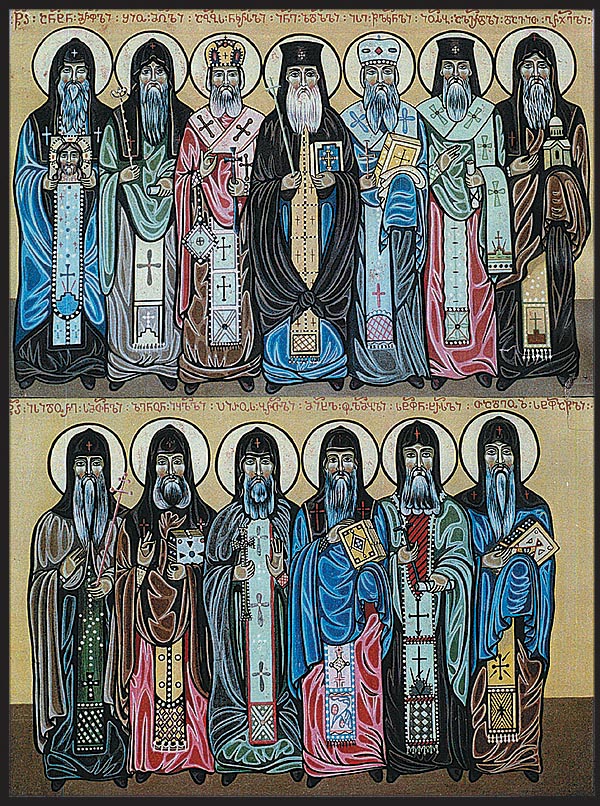
Repose of Venerable Shio the Anchorite of Georgia

An Antiochian by birth, Saint Shio of Mgvime was among the Thirteen Syrian Fathers who preached the Christian Faith in Georgia. His parents were pious nobles who provided their son with a sound education.

When the twenty-year-old Shio heard about the great ascetic labors of Saint John of Zedazeni and his disciples who labored in the wilderness, he went in secret to visit them. Saint John promised to receive Shio as a disciple, provided his parents agreed to his decision.

But when Shio returned home he said nothing to his parents about what had transpired.

Time passed and Shio’s parents both entered the monastic life.

Then Shio sold all his possessions, distributed the profits to the poor, widows, orphans, and hermits, freed all his family’s slaves, and returned to Fr. John.

Saint John received Shio joyfully, tonsured him a monk, and blessed him to remain in the wilderness. He labored there with Saint John for twenty years. Then John was told in a divine revelation to choose twelve disciples and travel to Georgia to increase the faith of its people. Shio was one of the disciples chosen to follow him on this holy mission.

The holy fathers arrived in Georgia and settled on Zedazeni Mountain. Then, with the blessings of Catholicos Evlavios and Fr. John, they dispersed throughout the country to preach the Word of God.

At his instructor’s command, Saint Shio settled in the Sarkineti caves near Mtskheta and began to lead a strict ascetic life. There was no water there and many wild animals made their home in the caves, but the privations and tribulations he encountered did not shake Saint Shio’s great faith. Like the Prophet Elijah, Shio received his food from the mouths of birds that carried it to him.

Once, after Saint Shio had prayed at length, a radiant light appeared suddenly in the place where he was, and the Most Holy Theotokos and Saint John the Baptist stood before him. After this miraculous visitation Saint Shio began to pray with even greater zeal, and he would spend hours alone in the wilderness.

Another time, Saint Evagre (at that time ruler of Tsikhedidi and military adviser to King Parsman) went hunting in the Sarkineti Mountains. There he encountered Saint Shio and, astonished by his piety, resolved to remain there with him. The news of the ruler’s conversion soon spread through all of Georgia, and many people flocked to witness the venerable father’s miraculous deeds. Many remained there with them, following Saint Evagre’s example.

Once Saint Shio prayed to God to reveal to him the place where He desired a church to be built. He placed a lump of hot coal in his hand and sprinkled incense on it, as though his hand were a censer. Then he followed the smoke as it swirled up from the hot coal. In the place where it rose straight up like a pillar, he took his staff and marked the ground where the church would be built.

When King Parsman heard about his military adviser’s radical change of life, he was deeply disturbed and wandered into the wilderness to find him. But when he witnessed the divine grace shining on Saint Shio’s face, he took off his crown and knelt humbly before him. Fr. Shio reverently blessed the king, helped him to stand up, and replaced the crown on his head. Following the king’s example, all the royal court came to receive Shio’s blessing. A certain nobleman with an injured eye knelt before Saint Shio, touched his eye to the holy father’s foot, and received healing at once.

At another time King Parsman asked Saint Shio if there was anything he needed, and he answered, “O Sovereign King, God enlightens the hearts of kings. Do that which your heart tells you!” In response, the king donated much wealth for the construction of a church in the wilderness: the lands of four villages, a holy chalice and diskos, a gold cross, and an ornately decorated Gospel that had belonged to the holy king Vakhtang Gorgasali (†502).

When construction of the church was complete, the king traveled there in the company of the catholicos, several bishops and Saint John of Zedazeni. The hierarchs consecrated the newly built church, and a monastic community soon grew up on its grounds. Eventually, the number of monks laboring at King Parsman’s monastery grew to nearly two thousand. Many people visited this place to receive Saint Shio’s wonderworking blessings, and they were healed from many diseases.

Saint Shio performed many miracles: Once a wolf that had been prowling the monastery grounds ravaged a herd of donkeys. When Saint Shio heard this, he prayed to God to transform the wolf into the protector of the herd. From that time on the wolf grazed peacefully among the other animals.

With the blessings of both his teacher, John of Zedazeni, and the catholicos of Georgia, Saint Shio gathered his disciples, advised them on the path they should follow, appointed Evagre his successor as abbot, and went into reclusion in a well that he had dug for himself. There Saint Shio spent fifteen years in prayer and fasting. Finally, when God revealed to him that his death was approaching, Saint Shio partook of the Holy Gifts and lifted up his hands, saying, “O Lord, receive the soul of Thy servant!”

Later, during one of the Persian invasions, the soldiers of Shah Abbas uncovered the holy father’s relics and carried them back to Persia. In the same year Persia was ravaged by a terrible plague, and the frightened invaders returned the holy relics to the Shio-Mgvime Monastery.

Venerable Joseph of Optina

Saint Joseph of Optina was born on November 2, 1837 in the village of Gorodishcha in the province of Kharkov. His name in the world was John Litovkin, and his parents Euthymius and Maria were simple but pious people. They were generous to the poor, and often lent money to those in need even when there seemed little chance that it would be repaid. Euthymius also loved to receive monks who came to his door collecting alms for their monasteries. Invariably, he would give each one five rubles for the needs of the monastery.

The Litovkins had six children, and they often read to them from spiritual books, especially from the Lives of the Saints. The second of their three sons (the future Saint Joseph) was baptized with the name John in honor of Saint John the Merciful (November 12). Instead of providing them with earthly wealth, the couple endowed their children with heavenly treasures, raising them in piety, obedience, and in the fear of God.

John learned to read even before he started school, taught by his older sister Alexandra at home. He was a sickly child, nearsighted and hard of hearing in one ear. He also met with various accidents. Once he was knocked down by another child and bit off the tip of his own tongue. Another time he was scalded with boiling water. In spite of all this, he was a happy and affectionate child. His father knew there was something special about John, and others also believed that God’s special favor was upon the boy.

When he was only four, John’s beloved father died, and his mother had to raise the children herself. When he was eight, John was playing with some friends, and suddenly froze on the spot. He raised his arms and his head toward the sky, then fell down unconscious. They carried him home and put him to bed. When he awoke, they asked him what had happened. He told them that he had seen the Queen of Heaven in the air.

“What makes you think you saw the Queen?” they asked.

“Because she had a crown with a cross,” he replied.

From that time on, the boy became more quiet and thoughtful, and started to avoid children’s games. Soon after this, the family moved into a new home. There was a great fire in the village, and John prayed that the Mother of God would protect their house from the flames. The Livotkin home was spared, even though everything around it was burned.

In 1848, their mother died during an outbreak of cholera. John was only eleven at the time. His older brother Simeon and his sister Anna were both married before their mother passed away, and his sister Alexandra had gone to the Borisovsk monastery in Kursk Province to become a nun. Simeon became the head of the family, although his drinking problem made him rather unreliable. Simeon took care of John for a while, and their younger brother Peter went to live with Anna. Simeon decided to leave home, and so John was placed in the care of various people, including a tavern keeper and a grocer.

Unable to endure conditions in the homes of such people, John went to live with a cousin who was a deacon in Novocherkassk. He ate nothing on his journey, for he was ashamed to beg, and people did not offer him any food on their own. When he arrived at the church where his cousin served, John sat down outside and waited for the Liturgy to end. Two women with rolls passed by and took pity upon him. One of them gave him a warm roll, which the boy regarded as manna from heaven.

John stayed with his cousin for a brief time, then moved on to other places, taking various jobs to support himself. Later in life he was asked whether he had ever had a girlfriend when he was living in the world. He shook his head and said, “Since I was nearsighted, I couldn’t really see anyone at a distance, and I was too shy to approach anyone up close.”

While living in the world John was often unhappy, and he found consolation in prayer and in church services. One day he received a letter from his sister, Mother Leonida, suggesting that he enter the skete at Optina, which was blessed with experienced Elders. Then the desire to leave the world and embrace the monastic life began to grow within him.

Learning that John was planning to make a pilgrimage to the Kiev Caves, the man for whom he was working offered him his daughter in marriage. Years later Father Joseph would say, “It’s always that way. As soon as one begins to think of following the path to salvation, obstacles and temptations begin to appear.”

With his employer’s permission, John started out for Kiev. On the way, he stopped to visit his parents’ graves and the place where he had spent a happy childhood. He stayed briefly at the Dormition Monastery in Kharkov’s Holy Mountains, but he did not wish to remain there. Finally he went to the Borisovsk Women’s Hermitage to visit his sister, Mother Leonida. She had spoken to Saint Macarius of Optina (September 7) of her concern for John. He told her not to worry, because John would become a monk.

Mother Leonida’s Eldress, Schemanun Alypia, overheard some of their conversation and said to John, “Forget about Kiev. Go to the Elders at Optina.” Mother Leonida gave him a look indicating that John should obey.

He traveled to Optina with some nuns of the women’s monastery at Belev, driving the cart for them. Saint Macarius had already departed to the Lord in 1860, and was succeeded as Elder by his disciple, Saint Ambrose (October 10). Knowing of John’s monastic inclinations, the nuns jokingly introduced him as “Brother John.” Saint Ambrose replied solemnly, “This Brother John will prove useful to us, and to you.”

On March 1, 1861 John found himself standing before the Elder Ambrose, telling him of his life, and asking for a blessing to go to Kiev. Father Ambrose told him to remain at Optina, forseeing the blessings he would bring to Optina, and to the women’s monasteries which were under the guidance of the Optina Elders. Taking Saint Ambrose’s words as an indication of God’s will, John murmured, “May it be blessed.”

John, like all new novices, was given an obedience in the kitchen. He was assigned to help the cook in the skete. From the very start, John demonstrated perfect obedience and humility. Life in the monastery was everything he had hoped it would be, and he was glad to leave the tumult of the world behind.

In June the Superior of the Skete, Father Paphnutius, asked John if he would like to move in with the Elder Ambrose as his cell-attendant. The next day he moved to the Elder’s quarters, where he remained for the next fifty years. As happy as he was to be near the Elder, he was disturbed by the constant flow of visitors. He felt that there was no time to pray or go to church, and began to have misgivings. He was tempted by the thought that perhaps he would be better off in Kiev or on Mount Athos, and did not notice that Father Ambrose had entered the cell. Suddenly he felt a hand on his shoulder and heard the Elder say, “Brother John, it’s better here than it is on Athos. Stay with us.”

John realized that his thoughts had been sent by the Enemy of our salvation, and he fell down at Father Ambrose’s feet in repentance.

On April 15, 1872 he was tonsured as a rassophore (wearer of the rassa), then on June 16, 1872 he was tonsured as a monk, receiving the name Joseph in honor of Saint Joseph the Hymnographer (April 4). He was unexpectedly ordained as a deacon in 1877 in a way which demonstrated that God was directing the course of his life.

On December 7 (Father Ambrose’s nameday), Igumen Isaac served Liturgy in the skete church. Later, he visited Father Ambrose to offer his congratulations, and the cell-attendants Father Joseph and Father Michael served them tea. The Superior asked Father Ambrose about a monk whom he proposed to recommend for ordination to the diaconate. The Elder said that the time was not right for that particular monk, recommending someone else instead. Noticing Father Joseph standing nearby with a tray, Father Isaac smiled and said, “Well Father, you don’t want my candidate, and I don’t want yours. Let’s ordain Father Joseph.”

So it was that Father Joseph was sent to Kaluga, where he was ordained by Bishop Gregory on December 9. It was customary at Optina that a newly-ordained deacon or priest would serve every day for forty days. Father Joseph’s health did not permit him to fulfill the forty days, however. He developed an inflammation on his right side, and he nearly died.

Father Joseph’s life continued as it had before, but with more responsibilities. He had no cell of his own, but continued to sleep in the reception room, which the Elder used each day until almost 11 P.M. Father Ambrose frequently tested his cell-attendant in order to give him the opportunity to acquire patience and humility, following the instructions of Saint John of the Ladder (Book 4, paragraphs 27 and 28).

Father Ambrose built the Shamordino Convent about eight miles from Optina, and on October 1, 1884 Bishop Vladimir of Kaluga came for its opening. At the Liturgy that day, Father Joseph was ordained as a priest and from that day forward the nuns regarded him as their priest, and he became the spiritual director of the convent after the repose of Father Ambrose.

Father Joseph now became the Elder’s senior cell-attendant, and tried to protect him and also to placate the visitors who grumbled about having to wait for so long to see Father Ambrose. In spite of his duties, Father Joseph found time to read spiritual books. He particularly loved the PHILOKALIA and the writings of the Fathers. In these books he found spiritual wisdom, which he shared with those who came to him for advice.

Saint Joseph’s inner life was known only to God, but his advice to others indicates that he practiced unceasing prayer of the heart. Forseeing that Father Joseph would serve as Elder after him, Father Ambrose blessed some people to start going to Father Joseph for their spiritual needs.

Father Joseph attended Saint Ambrose for thirty years, until the Elder’s death on October 10, 1891. Father Ambrose prepared Father Joseph for eldership, teaching him by word and by example. He would also refer some visitors to Father Joseph for advice. There was such oneness of mind between them that when people would ask Father Joseph about something and then ask Father Ambrose about the same thing, they would receive the very same answer.

Father Joseph’s health was not good, and he was susceptible to colds in winter. In February 1888 he became very ill and took to his bed, and he received the Mystey of Holy Unction. The doctor recommended that he be moved to the infirmary for treatment, but Father Joseph did not wish to leave Father Ambrose. The Superior of the skete insisted on the transfer, however. The ride to the monastery in a sleigh during cold weather only made his illness worse.

Father Joseph was tonsured into the schema (the highest level of monasticism) during the Liturgy on February 14. The next day, prayers for the Departure of the Soul were read for him, and people came to bid him farewell. A novice, sitting behind a screen, heard Father Joseph praying aloud. Peering through a slit in the screen, he saw Father Joseph gazing at an icon of Christ and lifting up his hands. This novice went to the infirmary later and heard someone behind the screen say, “Be patient, my dear one, only a little remains.” He looked behind the screen, but saw no one there except Father Joseph. Later, Father Ambrose told people that Father Joseph had seen the Mother of God during his illness. Though he had been quite near death, he got well.

After his recovery, Father Joseph began to hear confessions on a regular basis, since this was becoming too difficult for Father Ambrose. He blessed people to go to Father Joseph “not just once, but always.”

In the summer of 1888, Father Ambrose blessed Father Joseph to go on a pilgrimage to Kiev. After nearly thirty years, he was able to fulfill his desire to visit the holy places of Kiev. On his way back to Optina, he stopped to visit his sister Mother Leonida at Borisovsk.

Father Ambrose usually spent three weeks during the summer at the Shamordino Convent, accompanied by Father Joseph. In June of 1890 Father Joseph began to prepare for the journey, but Father Ambrose said, “I’m not taking you this time, you’re needed here.” He ordered Father Joseph to move into his cell and to transfer a large “Surety of Sinners” Icon (March 7 and May 29) into the reception room. Father Joseph had a premonition that Father Ambrose would never return.

Although he missed the Elder, Father Joseph resigned himself to the situation. He did go to Shamordino once a month to visit Father Ambrose, however. In the absence of Father Ambrose, many monks who confessed to him began to go to Father Joseph. During the Nativity Fast Father Ambrose started sending his spiritual children at Shamordino to confess to Father Joseph as well. This was difficult for the nuns, who were used to Father Ambrose. Even when he heard a nun’s confession himself, Father Ambrose would send her to Father Joseph for the prayers of absolution. In this manner, he indicated that he was entrusting his spiritual children to no one but Father Joseph.

In September 1891 Father Ambrose became ill, but no one thought it was serious. On October 8, he was so critical that they sent for Father Joseph. That evening the service of Holy Unction was performed, and the next morning Father Joseph gave Father Ambrose Communion for the last time. Saint Ambrose reposed on the morning of October 10, and no one grieved more than Father Joseph. Even in his sorrow, however, he comforted and consoled others.

Without any outside influence or pressure, the monks of Optina began coming to Father Joseph just as they had come to Father Ambrose. When the nuns of Shamordino asked to whom they should go for spiritual direction, Father Isaac told them, “At Optina all we have Father Joseph as our common Elder, and he must be yours as well.”

For the next twenty years, Saint Joseph received visitors, gave spiritual counsel to those who asked for his advice, and even performed miracles of healing for the afflicted. Out of humility, Father Joseph never said anything on his own authority, but quoted the words of Father Ambrose, or gave examples from his life. He spoke very little, and then only to answer a question which had been put to him. Some laymen, and even some of the monks, were annoyed with him because he did not say more.

One monk had the thought that since Father Joseph was filled with spiritual wisdom and was so familiar with the writings of the Fathers, he could have said many beneficial things to people. The Elder explained this to him, quoting Saint Peter of Damascus, who said that one should not say anything helpful unless asked by the brethren, because then the resulting benefit would come from their free choice. Even concerning something which might be useful for salvation, the ancient Fathers would not speak without being asked, considering unsolicited advice as idle talk (Vol. 3 of the English PHILOKALIA, p. 186).

His greatest care was for the Shamordino Convent, which remained unfinished, and for the spiritual welfare of its nuns. The Superior of the convent now turned to Father Joseph to consult him about everything related to the life of the convent, and would do nothing without his blessing. He went there twice a year, during the Apostles’ Fast, and during the Dormition Fast, to hear the confessions of the sisters. In the winter, they would visit him at Optina for Confession. Soon he was obliged to give up traveling to Shamordino because of his health.

Father Joseph was officially appointed as confessor for the Optina brotherhood near the end of 1893 when Father Anatole became ill and could not fulfill this duty. Many of the monks had already been confessing to Father Joseph, but now they all came to him.

On January 25, 1894 Saint Anatole, the head of the skete, fell asleep in the Lord. Archimandrite Isaac and the bretheren unanimously chose Father Joseph to succeed Father Anatole as Superior of the skete. Although he never sought this honor, Father Joseph accepted his election with all humility. He discharged his duties, not by issuing orders, but with paternal love and humility.

As Superior, he could have chosen to serve only on major Feast Days when the priests concelebrated, and designated one of the priests of the skete to serve on other days. He often served as a simple monk, however, with only one deacon to assist him.

During the last years of his life, Father Joseph grew weaker and was often ill. In May of 1905 he felt that he lacked the strength to carry out his duties, and he asked to retire as Superior of the skete. He also had to give up hearing the confessions of visitors, since this exhausted him. His spiritual children were saddened by his decision, but the monks and nuns continued to come to him with their spiritual wounds and afflictions.

In 1911 Father Joseph was weak and ill, but began to feel somewhat better during Great Lent. He was unusually joyful during Holy Week, which led some to believe that he had had some sort of vision. On April 11, the third day of Pascha, Father Joseph developed a fever and stopped seeing visitors. The following week, a doctor diagnosed him with maleria, declaring that there was no hope for recovery.

On April 20 the wonderworking Icon “of the Sign” was brought to his cell and a molieben was served. In the afternoon, the Kazan Icon and the rassa of Saint Seraphim were brought to him. Two days later, he requested that the skete brotherhood be permitted to come to him so that he could bid them farewell and ask their forgiveness. Then he asked that the Shamordino nuns also be allowed to come.

Father Joseph stopped taking food from April 28 on, nourishing himself only with the Holy Mysteries of Christ. Up until the time of his death, he was conscious and lucid, answering questions and dictating replies to letters. On May 8 he felt a little better, then became weak again. On the morning of May 9 he received Holy Communion, then at four in the afternoon he received some people for a final blessing.

That evening the Elder lay resting on his bed with his eyes closed, and his face shone with an unearthly radiance. At 10:45 he drew his last breath and departed to the Lord with a smile on his face.

After the body was prepared for burial, panikhidas were served one after another for the departed Elder. The saint appeared to some of the brethren in dreams both that night and on subsequent days.

The body was placed in a coffin at six o’clock the next morning and was carried to the skete church. Following the Liturgy, a panikhida was served, then the casket was brought to the monastery church of Saint Mary of Egypt. The monks began taking turns serving panikhidas for Father Joseph until his burial.

Several miracles took place on the day Saint Joseph was laid to rest at the feet of Father Ambrose. Even today, he continues to intercede with God and to work miracles for those who entreat him with faith.

Saint Joseph became a great Elder because first he had been a great disciple. He was obedient to his Elder Father Ambrose in all things, and never contradicted him. Because he renounced his own will, refrained from judging others, and reproached himself for his own sins, Father Joseph acquired humility and the grace of God. He also obtained from the Lord the discernment to recognize every sort of spiritual illness, and how to treat it.

The Moscow Patriarchate authorized local veneration of the Optina Elders on June 13,1996. The work of uncovering the relics of Saints Leonid, Macarius, Hilarion, Ambrose, Anatole I, Barsanuphius and Anatole II began on June 24/July 7, 1998 and was concluded the next day. However, because of the church Feasts (Nativity of Saint John the Baptist, etc.) associated with the actual dates of the uncovering of the relics, Patriarch Alexey II designated June 27/July 10 as the date for commemorating this event. The relics of the holy Elders now rest in the new church of the Vladimir Icon of the Mother of God.

The Optina Elders were glorified by the Moscow Patriarchate for universal veneration on August 7, 2000.

Daily Readings for Thursday, May 08, 2025

SYNAXIS OF THE HOLY POWDER (OR MANNA) WHICH EMITTED FROM THE TOMB OF SAINT JOHN THE THEOLOGIAN

NO FAST

Synaxis of the Holy Powder (or manna) which emitted from the tomb of Saint John the Theologian , Arsenios the Great

ST. JOHN’S FIRST UNIVERSAL LETTER 1:1-7

THAT WHICH WAS from the beginning, which we have heard, which we have seen with our eyes, which we have looked upon and touched with our hands, concerning the word of life – the life was made manifest, and we saw it, and testify to it, and proclaim to you the eternal life which was with the Father and was made manifest to us – that which we have seen and heard we proclaim also to you, so that you may have fellowship with us; and our fellowship is with the Father and with his Son Jesus Christ. And we are writing this that our joy may be complete.

This is the message we have heard from him and proclaim to you, that God is light and in him is no darkness at all. If we say we have fellowship with him while we walk in darkness, we lie and do not live according to the truth; but if we walk in the light, as he is in the light, we have fellowship with one another, and the blood of Jesus his Son cleanses us from all sin.

JOHN 19:25-28, 21:24-25

At that time, standing by the cross of Jesus were his mother, and his mother's sister, Mary the wife of Clopas, and Mary Magdalene. When Jesus saw his mother, and the disciple whom he loved standing near, he said to his mother, "Woman, behold, your son!" Then he said to the disciple, "Behold, your mother!" And from that hour the disciple took her to his own home. This is the disciple who is bearing witness to these things, and who has written these things; and we know that his testimony is true. But there are also many other things which Jesus did; were every one of them to be written, I suppose that the world itself could not contain the books that would be written.

Apostle and Evangelist John the Theologian

When Saint John was more than one hundred years old, he told seven of his disciples to take spades and follow him to a certain place outside the city of Ephesus, and then he told everyone to sit down while he went off to pray by himself for a while. When he returned, he told his disciples to dig a grave as long as he was tall, in the form of a cross. After giving them instructions and kissing them, he climbed into the grave and said: "Take some earth, my mother earth, and cover me."

They covered him with earth up to his knees, and he said: "Now take some more earth and cover me up to my neck."

As soon as he they had done this, Saint John spoke again: "Bring a linen cloth and place it on my face, then kiss me again for the last time, because you shall not see me anymore in this life."

After the Apostle dismissed them, they buried him and wept bitterly. Later, they returned and opened the grave, but the Saint's body was not there. They wept and returned to the city.

Every year, on May 8, a red dust appears on his grave, which heals the sick, through the prayers of the Holy Apostle John. People call this dust "manna from the earth."

Saint Augustine knew about this dust, and Saint Gregory of Tours also wrote about it. Some sources call this Feast "rodismos" (ροδισμός) i.e. Day of the Roses. Some think that this manna is called ροδής (a pink ointment, or a rose-colored dust). Others say that by this name they celebrate the roses of spring, just as we decorate the church with greenery and flowers on Pentecost.

Saint John’s principal Feast Day is September 26, but today the Church commemorates Saint John because of the annual pilgrimage to his grave.

There is a special title to be used when commemorating Saint John at the Dismissal: “The holy, glorious Apostle and Evangelist, Virgin, Beloved friend of Christ, John the Theologian.”1


1 John M. Fountoulis, Apanteseis Eis Leitourgikas Aporias (Thessalonike, 1973) pages 12 – 17.

Venerable Arsenius the Great

Saint Arsenius the Great was born in the year 354 at Rome into a pious Christian family, which provided him a fine education and upbringing. He studied rhetoric and philosophy, and mastered the Latin and Greek languages. Saint Arsenius gave up philosophy and the vanity of worldly life, seeking instead the true wisdom praised by Saint James “pure, peaceable, gentle, and easy to be entreated, full of mercy and good fruits” (Jas. 3:17). He entered the ranks of the clergy as a deacon in one of the Roman churches, dedicating himself to the service of God.

The emperor Theodosius (379-395), who ruled the eastern half of the Roman Empire, heard about his erudition and piety, and he wished to entrust Arsenius with the education of his sons Arcadius and Honorius. Arsenius, however, protested that he had given up secular studies in order to serve God. Against his will, but in obedience to the will of Pope Damasus (December 11), Saint Arsenius agreed to teach the imperial children, hoping to teach them Christian piety as well.

When he arrived at Constantinople, Arsenius was received with great honor by the emperor Theodosius, who charged him to educate his sons not only in wisdom, but also in piety, guarding them from the temptations of youth. “Forget that they are the emperor’s sons,” said Theodosius, “for I want them to submit to you in all things, as to their father and teacher.”

With fervor the saint devoted himself to the education of the youths, but the high esteem in which he was held troubled his spirit, which yearned for the quietude of monastic life. Saint Arsenius entreated the Lord to show him the way to salvation. The Lord heard his prayer and one time he heard a voice telling him, “Arsenius, flee from men, and you shall be saved.” And then, removing his rich clothing and replacing it with old and tattered garments, he secretly left the palace, boarded a ship for Alexandria, and he made his way to Sketis, a monastery in the midst of the desert.

Arriving at the church, he asked the priests to accept him into the monastic brotherhood, calling himself a wretched wanderer, though his very manner betrayed him as a cultivated man. The brethren led him to Abba John the Dwarf (November 9), famed for his holiness of life. He, wishing to test the newcomer’s humility, did not seat Arsenius with the monks for the trapeza meal. He threw him a piece of dry bread saying, “Eat if you wish.” Saint Arsenius got down on his hands and knees, and picked up the bread with his mouth. Then he crawled off into a corner and ate it. Seeing this, Elder John said, “He will be a great ascetic!” Then accepting Arsenius with love, he tonsured him into monasticism.

Saint Arsenius zealously passed through his obediences and soon he surpassed many of the desert Fathers in asceticism. The saint again heard the Voice while he was praying, “Arsenius, hide from people and dwell in silence, this is the root of virtue.” From that moment Saint Arsenius settled in a solitary cell deep in the desert.

Having taken on the struggle of silence he seldom left his seclusion. He came to church only on Sundays and Feast days, observing complete silence and conversing with no one. When Abba Moses asked him why he hid himself from people, Saint Arsenius replied, “God knows that I love you, but I cannot remain with God and with men at the same time. The Heavenly Powers all have one will and praise God together. On earth, however, there are many human wills, and each man has his own thoughts. I cannot leave God in order to live with people.”

Though absorbed in constant prayer, the saint did not refuse visiting monks with his counsel and guidance, giving short, but perceptive answers to their questions. Once, a monk from Sketis saw the great Elder through a window standing at prayer, surrounded by a flame.

The handicraft of Saint Arsenius was to weave baskets, for which he used the fronds of date palms soaked in water. For a whole year Saint Arsenius did not change the water in the container, but merely added a little water to it from time to time. This caused his cell to be permeated with a foul stench. When asked why he did this, the saint replied that it was fitting for him to humble himself in this way, because in the world he had used incense and fragrant oils. He prayed that after death he would not experience the stench of hell.

The fame of the great ascetic spread far, and many wanted to see him, and they disturbed his tranquility. As a result, the saint was forced to move around from place to place. But those thirsting to receive his guidance and blessing still found him.

Saint Arsenius taught that many take upon themselves great deeds of repentance, fasting, and vigil, but it is rare for someone to guard his soul from pride, greed, jealousy, hatred of one’s brother, remembrance of wrongs, and judgment. In this they resemble graves which are decorated outwardly, but filled with stinking bones.

A certain monk once asked Saint Arsenius what he should do when he read the Holy Scriptures and did not comprehend their meaning. The Elder answered, “My child, you must study and learn the Holy Scriptures constantly, even if you do not understand their power… For when we have the words of the Holy Scriptures on our lips, the demons hear them and are terrified. Then they flee from us, unable to bear the words of the Holy Spirit Who speaks through His apostles and prophets.”

The monks heard how the saint often urged himself on in his efforts with the words, “Rouse yourself, Arsenius, work! Do not remain idle! You have not come here to rest, but to labor.” He also said, “I have often regretted the words I have spoken, but I have never regretted my silence.”

The great ascetic and keeper of silence was given the gift of tears with which his eyes were constantly filled. He spent fifty-five years at monastic labors and struggles. He spent forty years at Sketis, and ten years on the mountain of Troe near Memphis. Then he spent three years at Canopus, and two more years at Troe, where he fell asleep in the Lord.

Our holy, God-bearing Father Arsenius reposed when he was nearly one hundred years old, in the year 449 or 450.

His only disciples seem to have been Alexander, Zoilos, and Daniel (June 7).

Venerable Arsenius the Lover-of-Labor of the Kiev Far Caves

Saint Arsenius the Lover of Labor lived during the fourteenth century. This ascetic was distinguished by his love for toil, and living in asceticism in the Kiev Caves monastery of the Dormition of the Most Holy Theotokos, he knew no rest. He prayed constantly and partook of food only at the setting of the sun. For his humility and love of labor the Lord gave him the gift of wonderworking. His memory is also celebrated together with the Saints of the Far Caves on August 28.

Venerable Pimen the Ascetic of the Kiev Far Caves

Saint Pimen, Faster of the Caves, won fame by his exploit of fasting. The relics of the saint rest in the Far Caves. He is also commemorated on August 28.

5/11 announcements

Sunday, May 11, 2025

Sunday of the Paralytic

In the miracle of the healing of the paralytic at the pool of Bethesda, we see the Son’s power over life and sin, power which becomes fully evident in the Resurrection. The paralytic is a man crippled in body and spirit, for, even as He heals the body, Jesus warns against results of further sin. Christ frees us from our bodies of corruption and grants us flesh glorified in Him; He also frees us from the power of sin and grants us perfection in His Spirit. As the man at the pool accepted God’s grace and found life, so let us walk in His light and come into His presence.

Acts 9:32-42: In those days, as Peter went throughout all regions, he came down also to the saints who dwelt at Lydda. There he found a certain man named Aeneas, who was bedridden for eight years and paralyzed. And Peter said to him: “Aeneas, Jesus Christ heals you; arise and make your bed.” And immediately he arose. And all who dwelt at Lydda and Sharon saw him, and they turned back to the Lord. Now there was at Joppa a certain disciple named Tabitha (which means Gazelle). She was full of good works and of charitable deeds which she did. And it came to pass in those days that she fell sick and died; and when they had washed her, they placed her in an upper chamber. Since Lydda was near Joppa, the disciples, hearing that Peter was there, sent two men to him entreating him: “Come to us without delay!” So Peter arose and went with them. And when he arrived, they took him into the upper chamber. All the widows stood by him weeping, showing the tunics and other garments which Tabitha made while she was with them. But Peter put them all outside and knelt down and prayed; then turning to the body, he said: “Tabitha, arise!” And she opened her eyes, and when she saw Peter, she sat up. And he gave her his hand, and raised her up. Then he called the saints and widows and presented her alive. And it became known throughout all Joppa, and many believed in the Lord.

John 5:1-15: At that time, Jesus went up to Jerusalem. Now there is in Jerusalem by the Sheep Gate a pool, in Hebrew called Bethesda, which has five porticoes. In these lay a multitude of invalids, blind, lame, paralyzed, waiting for the moving of the water. For an angel of the Lord went down at certain seasons into the pool and troubled the water; whoever stepped in first, after the troubling of the water was healed of whatever disease he had. One man was there, who had been ill for 38 years. When Jesus saw him and knew that he had been lying there a long time, He said to him, “Do you want to be healed?” The sick man answered Him, “Sir, I have no man to put me into the May 11, 2025 Liturgy Variables 3 Fourth Sunday of Pascha pool when the water is troubled, and while I am going another steps down before me.” Jesus said to him, “Rise, take up your pallet, and walk.” And at once the man was healed, and he took up his pallet and walked. Now that day was the Sabbath. So the Jews said to the man who was cured, “It is the Sabbath, it is not lawful for you to carry your pallet.” But he answered them, “The man who healed me said to me, ‘Take up your pallet, and walk.’” They asked him, “Who is the man who said to you, ‘Take up your pallet, and walk’?” Now the man who had been healed did not know who it was, for Jesus had withdrawn, as there was a crowd in the place. Afterward, Jesus found him in the temple, and said to him, “See, you are well! Sin no more, that nothing worse befalls you.” The man went away and told the Jews that it was Jesus Who had healed him.

Resurrectional Troparion: Let the heavens rejoice and the earth be glad; for the Lord hath done a mighty act with his own arm. He hath trampled down death and become the First-born from the dead. He hath delivered us from the depths of hades, granting the world the Great Mercy.

Troparion of the Chains of St. Peter: O Holy Apostle, Peter, thou dost preside over the Apostles by the precious chains which thou didst bear. We venerate them with faith and beseech thee that by thine intercessions we be granted the great mercy.

Kontakion of Pascha: When Thou didst descend into the grave, O Immortal, Thou didst destroy the power of Hades. In victory didst Thou arise, O Christ God, proclaiming Rejoice! to the myrrh-bearing women, granting peace to Thine apostles and bestowing resurrection on the fallen.

Calendar

Sunday, May 11

8:50 am – Orthros

9:00 am – Christian Education

10:00 am – Divine Liturgy

Monday, May 12

Father Herman off

Tuesday, May 13

No services

Wednesday, May 14

6:30 PM – Daily Vespers

Thursday, May 15

No Services

Friday, May 16

No Services

Saturday, May 17

6:00 pm – Daily Vespers

Sunday, May 18

8:50 AM -Orthros

9:00 AM – Christian Education

10:00 AM – Divine Liturgy

12 pm – Pot Luck Dinner

Special Announcements

The Eucharist Bread…was provided by the Karams for the Divine Liturgy this morning.

Eucharist Bread Schedule:

Eucharist Bread Coffee Hour

May 11 Karam Meadows/Brock

May 18 Brock POT LUCK MEAL

Lasseter/Pacurari/Lavric

May 25 R. Root Lockhart/Karam/Snell

May 28 (Wed PM) Pacurari Algood/Schever

(Feast of the Ascension)

Schedule for Epistle Readers – Page numbers refer to the Apostolos (book of Epistles) located on the chanters’ stand at the front of the nave. Please be sure to use book when you read.

Reader Reading Page#

May 11 Kh. Sharon Meadows Acts 9:32-42 45

May 18 Reader Basil Baker Acts 11:19-30- 52

May 25 Brandon Strain Acts 16:16-34 58

May 28 (Wed PM) Reader Chad Miller Acts 1:1-12 63

Also Please remember that we still need your tithes and offerings which may be placed in the tray that is passed during Divine Liturgy, in the tithe box at the back of the nave or be mailed to: St. Peter Orthodox Church, P.O. Box 2084, Madison, MS 39130-2084.

Food for Hungry People: Thank you to all who donated toward this ministry. The total collected in April was $770.00.

Please remember the following in your prayers Aidan Milnor, the Milnor family; Lamia Dabit and her family; Mary Greene (Lee and Kh. Sharon’s sister); Jay and Joanna Davis; Fr. Leo and Kh. Be’Be’ Schelver and their family; Marilyn (Kyriake) Snell; Jack and Jill Weatherly; Dn. Terry Algood and their family; Reader Basil and Brenda Baker and their family; Fr. Joseph Bittle; Rick Carlton; Very Rev. Fr. Nicholas and Kh. Jan Speier; Lee Greene; Fr. John and Kh. Janet Henderson and their family; Galina Singletary; Emily and Cole Parker.

Prayers for Fr. Paul Yerger from Holy Resurrection: Please keep in you God-pleasing prayers Fr. Paul. This past Thursday he suffered a terrible fall in the driveway of his home in Clinton and had to be rushed to the ER at UMMC. As a result of the fall he sustained a substantial gash to the back of his head, bruising to the front of his brain, and a cracked vertebrae. He is still currently at UMMC being treated. The family appreciates your prayers during this time.

Agape Vespers: A huge thank you to all who helped the Agape meal go as smoothly as it did. So many of you chipped in to help with varying aspects and it was truly a blessing.

Calendar Items

* The men of the parish meet for lunch at 11:00 a.m. on the first Thursday of the month.
* The Ladies meet at the church at 10:00 a.m. on the second Saturday of the month to pray the Akathist to the Mother of God, Nurturer of Children on behalf of our children.

* The Ladies meet for lunch at 1:00 p.m. on the last Tuesday of the month.

* The remaining date for serving at Stewpot Ministries is Saturday, September 27th.
* We will celebrate the leave-taking of Pascha with Paschal Vespers on Tuesday, May 27th, beginning at 6:30 p.m.

* The Feast of the Ascension of the Lord will be celebrated with Orthros followed by

Divine Liturgy on Wednesday, May 28th beginning at 6:00 p.m. We will have a Pot Luck meal following the liturgy.

We are continuing the process of updating our church directory. On the bureau in the foyer there are information sheets to be filled out by each family and individual. We are asking EVERYONE to please fill out these information sheets and get it back to Fr. Herman or Kh. Sharon. (please be sure to PRINT as neatly as you can). Thank you for your timely cooperation with this.

Fasting Discipline for May

The Holy Synod of Antioch has given instructions that there will be no fasting during the entirety of the Paschal Season.

Major Commemorations for May

May 8 Apostle John the Theologian

May 10 Simon the Zealot

May 11 Sunday of the Paralytic

May 18 Sunday of the Samaritan Woman

May 21 Sts Constantine and Helen

May 25 Sunday of the Blind Man

The Forerunner (3rd Discovery)

May 29 Feast of the Ascension

Registration for the 2025 DOMSE Parish Life Conference has opened and was emailed out to the parish. If you did not receive this email and would like to attend, please see Father Herman for registration information. This year’s conference will be hosted by St. George Parish in Jacksonville, FL. June 11-14th.

Registration for the Archdiocese National Convention has also opened. It is being hosted by St George Parish in Cicero, IL (just outside of Chicago) July 20-27th. If you are interested in attending, please see Father Herman and he will get you the registration information and link.

Quotable: “The goal of reading is the application, in our lives, of what we read. Not to learn it by heart, but to take it to heart. Not to practice using our tongues, but to be able to receive the tongues of fire and to live the mysteries of God. If one studies a great deal in order to acquire knowledge and to teach others, without living the things he teaches, he does not more than fill his head with hot air. At most, he will manage to ascend to the moon using machines. The goal of the Christian is to rise to God without machines.”

St. Paisios the Athonite

Worship: Sunday, May 18, 2025 (Sunday of the Samaritan Woman)

Scripture: Acts 11:19-30; John 4:5-42

Epistle Reader: Reader Basil Baker

Prosphora: Brock

Coffee Hour: Lasseter/Pacurari/Lavric

Daily Readings for Wednesday, May 07, 2025

3RD WEDNESDAY AFTER PASCHA

NO FAST

3rd Wednesday after Pascha, Commemoration of the Precious Cross that appeared in the sky over Jerusalem in 351 A.D., Cyril, Archbishop of Jerusalem, Akakios the Centurion of Byzantium, Repose of St. Nilus, abbot of Sora, Pachomios the New Martyr of Patmos

ACTS OF THE APOSTLES 26:1, 12-20

IN THOSE DAYS, King Agrippa said to Paul, "You have permission to speak for yourself." Then Paul stretched out his hand and made his defense: "I journeyed to Damascus with the authority and commission of the chief priests. At midday, O king, I saw on the way a light from heaven, brighter than the sun, shining round me and those who journeyed with me. And when we had all fallen to the ground, I heard a voice saying to me in the Hebrew language, 'Saul, Saul, why do you persecute me? It hurts you to kick against the goads.' And I said, 'Who are you, Lord?' And the Lord said, 'I am Jesus whom you are persecuting. But rise and stand upon your feet; for I have appeared to you for this purpose, to appoint you to serve and bear witness to the things in which you have seen me and to those in which I will appear to you, delivering you from the people and from the Gentiles-to whom I send you to open their eyes, that they may turn from darkness to light and from the power of Satan to God, that they may receive forgiveness of sins and a place among those who are sanctified by faith in me.' "Wherefore, O King Agrippa, I was not disobedient to the heavenly vision, but declared first to those at Damascus, then at Jerusalem and throughout all the country of Judea, and also to the Gentiles, that they should repent and turn to God and perform deeds worthy of their repentance."

JOHN 6:35-39

The Lord said to the Jews who believed in him: "I am the bread of life; he who comes to me shall not hunger, and he who believes in me shall never thirst. But I said to you that you have seen me and yet do not believe. All that the Father gives me will come to me; and him who comes to me I will not cast out. For I have come down from heaven, not to do my own will, but the will of him who sent me; and this is the will of him who sent me, that I should lose nothing of all that he has given me, but raise it up at the last day.

Commemoration of the Apparition of the Sign of the Precious Cross Over Jerusalem, in 351 AD

The Precious Cross appeared in the sky over Jerusalem on the morning of May 7, 351 during the reign of the emperor Constantius, the son of Saint Constantine (May 21).

At that time the heresy of Arianism, which taught that Christ was merely a creature and not God, was causing great turmoil and division throughout the Empire. Even after the First Ecumenical Council at Nicea in 325, many people were drawn to this false teaching, and the Orthodox found themselves in the minority in many places.

Constantius, the ruler of the eastern part of the Empire, was a fervent supporter of Arianism. His brothers Constantine II and Constans, who were pious Orthodox Christians, ruled in the west. They were both killed in separate battles around 350, leaving Constantius as sole ruler. Also in 350, Saint Cyril (March 18) became Patriarch of Jerusalem and began his zealous struggle against Arianism.

In May of 351 a luminous Cross appeared over Jerusalem, stretching from Golgotha to the Mount of Olives, a distance of about five and a half miles. The Cross was wide as it was long, and shone more brightly than the sun. Many people left their homes and workplaces to gather in the church and glorify Christ. The historian Sozomen says that this wondrous sign led to the conversion of multitudes of pagans and Jews to Christianity.

A letter from Saint Cyril to the emperor describing this phenomenon, and admonishing him to become Orthodox, has been preserved. The apparition of the Cross remained over the city for a whole week.

The vision of the Cross over Jerusalem strengthened the Orthodox faithful and contributed to the return of many Arians to the Church. It is also a reminder of the awesome Second Coming of Christ, when “the sign of the Son of man shall appear in heaven” (Matthew 24:30).

Repose of Saint Alexis Toth, Confessor and Defender of Orthodoxy in America

Our holy Father Alexis, the defender of the Orthodox Faith and zealous worker in the Lord’s vineyard, was born in Austro-Hungary on March 18, 1854 into a poor Carpatho-Russian family. Like many others in the Austro-Hungarian empire, the Toths were Eastern Rite Catholics. Alexis’ father and brother were priests and his uncle was a bishop in the Uniate church. He received an excellent education and knew several languages (Carpatho-Russian, Hungarian, Russian, German, Latin, and a reading knowledge of Greek). He married Rosalie Mihalich, a priest’s daughter, and was ordained on April 18, 1878 to serve as second priest in a Uniate parish. His wife died soon afterwards, followed by their only child—losses which the saint endured with the patience of Job.

In May, 1879, Father Alexis was appointed secretary to the Bishop of Presov and also Administrator of the Diocesan Administration. He was also entrusted with the directorship of an orphanage. At Presov Seminary, Father Toth taught Church History and Canon Law, which served him well in his later life in America. Saint Alexis did not serve long as a professor or an administrator, for the Lord had a different future planned for him. In October, 1889 he was appointed to serve as pastor of a Uniate parish in Minneapolis, Minnesota. Like another Abraham, he left his country and his relatives to fulfill the will of God (Gen 12:1).

Upon his arrival in America, Father Alexis presented himself to the local Roman Catholic diocesan authority, Archbishop John Ireland, since there was no Uniate bishop in America at that time. Archbishop Ireland belonged to the party of American Catholics who favored the “Americanization” of all Roman Catholics. His vision for the future was founded on a common faith, customs, and the use of the English language for everything except liturgical celebrations. Naturally, ethnic parishes and non-Latin rite clergy did not fit into this vision. Thus, when Father Toth came to present his credentials, Archbishop Ireland greeted him with open hostility. He refused to recognize him as a legitimate Catholic priest or to grant permission for him to serve in his diocese.

As a historian and professor of Canon Law, Father Toth knew his rights under the terms of the Unia and would not accept Archbishop Ireland’s unjust decisions. In October of 1890, there was a meeting of eight of the ten Uniate priests in America at Wilkes-Barre, Pennsylvania under the chairmanship of Father Toth. By this time the American bishops had written to Rome demanding the recall to Europe of all Uniate priests in America, fearing that Uniate priests and parishes would hinder the assimilation of immigrants into American culture. Uniate bishops in Europe refused to listen to the priests’ pleas for help.

Archbishop Ireland sent a letter to his parishes ordering their members not to attend Father Toth’s parish nor to accept any priestly ministrations from him. Expecting imminent deportation, Father Toth explained the situation to his parishioners and suggested it might be best for him to leave and return to Europe.

“No,” they said. “Let’s go to the Russian bishop. Why should we always submit ourselves to foreigners?” It was decided to write to the Russian consul in San Francisco in order to ask for the name and address of the Russian bishop. Ivan Mlinar went to San Francisco to make initial contact with Bishop Vladimir; then in February, 1891 Father Toth and his church warden, Paul Podany, also made the journey. Subsequently, Bishop Vladimir came to Minneapolis and on March 25, 1891 received Father Toth and 361 parishioners into the Orthodox Church of their ancestors. The parishioners regarded this event as a new Triumph of Orthodoxy, crying out with joy: “Glory to God for His great mercy!”

This initiative came from the people themselves, and was not the result of any coercion from outsiders. The Russian Orthodox Church was unaware of the existence of these Slavic Uniate immigrants to America, but responded positively to their petition to be reunited to the Orthodox Church.

The example of Saint Alexis and his parish in returning to Orthodoxy was an encouragement to hundreds of other Uniates. The ever-memorable one was like a candle upon a candlestick giving light to others (Mt.5:15), and his flock may be likened to the leaven mixed with meal which leavened the whole (Mt.13:33). Through his fearless preaching he uprooted the tares which had sprung up in the wheat of true doctrine, and exposed the false teachings which had led his people astray. Although he did not hesitate to point out errors in the doctrines of other denominations, he was careful to warn his flock against intolerance. His writings and sermons are filled with admonitions to respect other people and to refrain from attacking their faith.

While it is true that he made some strong comments, especially in his private correspondence with the church administration, it must be remembered that this was done while defending the Orthodox Church and the American Mission from unfounded accusations by people who used much harsher language than Father Toth. His opponents may be characterized by intolerance, rude behaviour, unethical methods and threats against him and his parishioners. Yet, when Father Alexis was offended or deceived by other people he forgave them, and he would often ask his bishop to forgive his omissions and mistakes.

In the midst of great hardships, this herald of godly theology and sound doctrine poured forth an inexhaustible stream of Orthodox writings for new converts, and gave practical advice on how to live in an Orthodox manner. For example, his article “How We should Live in America” stresses the importance of education, cleanliness, sobriety, and the presence of children in church on Sundays and Holy Days.

Although the Minneapolis parish was received into the Orthodox Church in March, 1891, it was not until July, 1892 that the Holy Synod of Russia recognized and accepted the parish into the Diocese of Alaska and the Aleutians. This resolution reached America only in October, 1892. During that time there was a climate of religious and ethnic hostility against the new converts. Father Alexis was accused of selling out his own Carpatho-Russian people and his religion to the “Muscovites” for financial gain.

In reality he did not receive any financial support for a long time, for his parish was very poor. Until his priestly salary began to arrive from Russia, the righteous one was obliged to work in a bakery in order to support himself. Even though his funds were meager, he did not neglect to give alms to the poor and needy. He shared his money with other clergy worse off than himself, and contributed to the building of churches and to the education of seminarians in Minneapolis. He was not anxious about his life (Mt.6:25), what he would eat or drink or wear. Trusting in God to take care of him, Saint Alexis followed the admonition of Our Savior to “seek first the kingdom of God and His righteousness, and all these things shall be added to you” (Mt.6:33). So he bore the tribulation, slander, and physical attacks with patience and spiritual joy, reminding us that “godliness is stronger than all” (Wisdom of Solomon 10:12).

Bishops Vladimir, Nicholas, Saint Tikhon, and Platon recognized the special gifts of Father Toth, so they often sent him forth to preach and teach wherever there were people of Slavic background. Even though he was aware of his shortcomings and inadequacies, yet he was obedient to the instructions of the bishops. He did not hesitate or make excuses, but went immediately to fulfill his mission. Saint Alexis visited many Uniate parishes, explaining the differences between Orthodoxy, Protestantism, Roman Catholicism and Uniatism, stressing that the true way to salvation is in Orthodoxy.

Like Josiah, “he behaved himself uprightly in the conversion of his people” (Sir 49:2). He was instrumental in the formation or return of seventeen parishes, planting a vineyard of Christ in America, and increasing its fruitful yield many times over. By 1909, the time of his blessed repose, many thousands of Carpatho-Russian and Galician Uniates had returned to Orthodoxy. This was a major event in the history of the North American Mission, which would continue to shape the future of Orthodoxy in this country for many generations to come. Any future growth or success may truly be regarded as the result of Father Toth’s apostolic labors.

Who can tell of the saint’s spiritual struggles? Who can speak of the prayers which his pious soul poured forth unto God? He did not make a public display of his piety, but prayed to God in secret with all modesty, with contrition and inward tears. God, Who sees everything done in secret, openly rewarded the saint (Mt.6:6). It is inconceivable that Saint Alexis could have accomplished his apostolic labors unless God had blessed and strengthened him for such work. Today the Church continues to reap the fruits of his teaching and preaching.

Father Toth’s efforts did not go unrecognized in his own lifetime. He received a jeweled miter from the Holy Synod, as well as the Order of Saint Vladimir and the Order of Saint Anna from Czar Nicholas II for distinguished service and devotion to God and country. In 1907, he was considered as a candidate for the episcopal office. He declined this honor, however, humbly pointing out that this responsibility should be given to a younger, healthier man.

At the end of 1908, Saint Alexis’ health began to decline due to a complication of illneses. He went to the seashore in southern New Jersey in an attempt to regain his health, but soon returned to Wilkes-Barre, where he was confined to bed for two months. The righteous one reposed on Friday, May 7, 1909 (April 24 on the Old Calendar), the feast of Saints Savva and Alexius the Hermit of the Kiev Caves. Saint Alexis’ love and concern for his spiritual children did not cease with his death. Before closing the account of his life, it would be most appropriate to reveal but one example of his heavenly intercession:

In January, 1993 a certain man prayed to Saint Alexis to help him obtain information about his son from whom he had been separated for twenty-eight years. Placing his confidence in the saint’s boldness before God, he awaited an answer to his prayer. The very next day the man’s son telephoned him. It seems the young man was in church when he was suddenly filled with an overwhelming desire to contact his father. He had been taken to another state by his mother, and she changed his name when he was a child. This is why his father was unable to locate him. Having learned from his mother that his father was an Orthodox Christian, he was able with the help of an Orthodox priest to obtain his father’s phone number in a distant city. As a result of that telephone call, the young man later visited his father, who rejoiced to see what sort of man his son had become. The father gave thanks to God and to Saint Alexis for reuniting him with his son.

Saint Alexis was a true man of God who guided many Carpatho-Russian and Galician immigrants through the dark confusion of religious challenges in the New World and back to the unity of the Orthodox Church through his grace-filled words and by his holy example. In his last will and testament Saint Alexis commended his soul to God’s mercy, asking forgiveness from everyone and forgiving everybody. His holy relics now rest at Saint Tikhon Monastery in South Canaan, Pennsylvania where the faithful may come to venerate them and to entreat Saint Alexis’ intercessions on their behalf.

Martyr Acacius the Centurion at Byzantium

The Holy Martyr Acacius, who lived mostly in the third century, was born at Cappadocia and was a centurion of the Martesian regiment under the military officer Firmus. When the persecution against Christians began on orders from the emperor Maximian Galerius (305-311), Firmus interrogated his soldiers one after the other about their faith. Saint Acacius firmly and openly confessed himself a Christian. Seeing the steadfastness of Saint Acacius, Firmus sent him to his superior officer, who was named Vivianus. Vivianus gave the saint over to fierce torture.

After the tortures they put him in heavy chains and locked him up in prison. A while later they led the martyr and other prisoners to Byzantium, to the prefect. The soldiers marched quickly, showing the prisoners no mercy. Saint Acacius weakened along the way from his wounds, from his chains, and from hunger and thirst. When finally they halted for the night, Saint Acacius offered thanks to God, for permitting him to suffer for His holy Name. As he prayed the saint heard a voice from the heavens, “Courage, Acacius, and be strong!” This voice was heard also by the other prisoners, and many of them believed in Christ and asked the saint to instruct them in the Christian Faith.

At Byzantium they placed the holy martyr in jail, while the other prisoners were held under less severe conditions. At night the other prisoners saw how radiant youths appeared to Saint Acacius and attended to him, washing his wounds and bringing him food. After seven days, Vivianus again summoned Saint Acacius before him and was struck by his fresh appearance. Supposing that the prison guard was bribed to give the prisoner both respite and food, he summoned the guard to question him. Since he did not believe his answers, Vivianus had the guard severely beaten. Saint Acacius himself then answered Vivianus, “My power and strength are given me by the Lord Jesus Christ, Who has healed my wounds.” Vivianus gave orders to beat the martyr about the face and to smash his teeth for his words.

Determined to intensify and prolong the torture of Saint Acacius, Vivianus sent him to the prefect Flaccinus with a letter. When he read the letter, Flaccinus became annoyed that Vivianus had tortured a centurion for so long and so cruelly, and he gave orders to behead the martyr without further delay.

At the place of execution Saint Acacius lifted up his eyes to the heavens, giving thanks to God for being granted a martyr’s death for His sake. Then he bowed his head beneath the sword. This occurred in the year 303.

Under Constantine the Great the relics of the holy martyr Acacius rested at Constantinople in a church built in his honor, and later they were transferred to Calabria, to the city of Scillatio. The holy martyr Acacius particularly helps those who struggle against temptations of the flesh, as attested by Saint Epiphanius, a disciple of Saint Andrew the Fool-for-Christ.

Repose of Venerable Nilus, Abbot of Sora

Saint Nilus of Sora, a great ascetic of the Russian Church, was descended from the Maikov nobility. He accepted monasticism at the monastery of Saint Cyril of White Lake (June 9). Here he made use of the counsels of the pious Elder Paisius Yaroslavov, who was afterwards igumen of the Trinity-Sergiev Lavra.

Saint Nilus journeyed much through the East, studying the monastic life in Palestine and on Mt. Athos. Returning to Rus, he withdrew to the River Sora in the Vologda lands, and built a cell and a chapel, where there soon grew up a monastery with a new (for that time in Rus) skete Rule adopted by Saint Nilus from Mt. Athos. Following the command of Saint Nilus, the monks had to sustain themselves by the work of their own hands, to accept charity only in extreme need, and to shun the love of things and splendor even in church. Women were not permitted in the skete, monks was not allowed to leave the skete under any pretext, and the possession of lands or estates was forbidden.

The monks lived in the forest around the small church in honor of the Meeting of the Lord, in separate cells of one or two but not more than three men. They gathered together in church for divine services. Moreover, readings from the holy Fathers were prescribed at the All-Night Vigil, which actually lasted the whole night. On other days, each one prayed and worked in his own cell.

The saint struggled constantly with his own thoughts and passions. Then peace would be born in his soul, clarity in his mind, contrition and love in his heart. In his written works, “A Tradition for my Disciple, Wishing to Live in the Wilderness,” and the “Rule,” Saint Nilus describes the steps of this salvific mental activity in detail. The first step is renunciation of the world, particularly, from every worldly distraction. The second is unceasing prayer, accompanied by the remembrance of death.

The saint was distinguished for his non-possessiveness and love for work. He dug a pond and a well, whose water had healing power. For his sanctity of life the Elder Nilus was deeply venerated by the Russian hierarchs of his time. He participated in the Councils of 1490 and 1503. Disdaining the honors and glories of this world, he told his disciples before his death either to throw his body to be eaten by beasts and birds, or to bury it without honor at the place of his struggles.

The saint died in his seventy-sixth year of life, on May 7, 1508. His relics, buried in the monastery he founded, were glorified by many miracles. The Russian Church has numbered him among the saints.

[In English, fragments of his “Tradition” and “Rule” may be found in G. Fedotov’s TREASURY OF RUSSIAN SPIRITUALITY.]

Saint John Zedazeni of Zaden, Georgia, with his 12 disciples

Our Holy Father John of Zedazeni and his twelve disciples, Abibus of Nekresi, Anthony of Martqopi, David of Gareji, Zenon of Iqalto, Thaddeus of Stepantsminda, Jesse of Tsilkani, Joseph of Alaverdi, Isidore of Samtavisi, Michael of Ulumbo, Pyrrhus of Breti, Stephen of Khirsa, and Shio of Mgvime, were Syrian ascetics and the founding fathers of Georgian monastic life.

Saint John received his spiritual education in Antioch. Early in his youth he was tonsured a monk and withdrew to the wilderness. The Lord, recognizing his humility, diligence in fasting, and devout watchfulness, blessed His faithful servant with the gift of healing the sick and casting out demons. Saint John was celebrated for his holy deeds and miracles. Curious crowds would swarm around him, and after some time he found it necessary to withdraw into even deeper seclusion.

Taking with him several of his disciples, he chose a remote area, fashioned for himself a cell, and began to labor as a hermit. Once the Most Holy Theotokos appeared to Saint John and told him, “Take twelve monks and go with them to Georgia, the nation enlightened by the Equal-to-the-Apostles Nino, and strengthen the Christian soul of its people.”

Saint John related the vision to his disciples, and after much fasting and prayer he chose twelve of them: Abibus, Anthony, David, Zenon, Thaddeus, Isidore, Joseph, Jesse, Michael, Pyrrhus, Stephen, and Shio. He left his remaining disciples in the wilderness in the care of the abbot, the blessed elder Euthymius, and set off for Georgia with the twelve he had chosen.

By divine revelation the Georgian king Parsman and Catholicos Evlavios received the good news that the venerable fathers were in Mesopotamia, on their way to Georgia, and they hurried to greet them with the proper honors. King Parsman and Catholicos Evlavios met the holy fathers as they were approaching Mtskheta.

The holy fathers venerated the myrrh-streaming wood of the Living Pillar and the Robe of Christ at Svetitskhoveli Cathedral. From there Saint John and his disciples traveled throughout Georgia, visiting its many holy sites.

With the blessing of Catholicos Evlavios, Saint John and his disciples settled on Zedazeni Mountain, where a pagan temple to the idol Zadeni had previously stood. The monks lived in wretched cells, eating only plants and praying ceaselessly.

Having heard of the spiritual endeavors of Saint John and his disciples, Christian believers began to flock to Zedazeni Mountain. Many burned with longing for the monastic life, and some abandoned the world to join the holy fathers at Zedazeni. In such a way, Zedazeni Mountain was transformed into an abode of hermits.

One night the Most Holy Theotokos appeared again to Saint John and instructed him to send his disciples throughout the country to preach the Word of God. In the morning, having related the vision to his disciples, Saint John advised them: “Our Lord Jesus Christ sent us to perform good deeds for this country and its people, for they are newly planted seeds in the Christian Faith. Therefore, let us go forth, each in his own direction, to preach the Word of God!”

Saint John remained at Zedazeni and went about his usual labors in the company of the Deacon Ilia. Zedazeni Mountain was without water, but Saint John prayed to God for a spring, and the Lord sent him a healing spring at the mountain’s peak. Through Saint John’s holy prayers, a bear that often came to the spring to drink was tamed and became a guard and protector of Zedazeni Monastery.

(To this day, the beasts of Zedazeni forest have never disturbed a single soul). Through Saint John’s intercessions, a man mute and paralyzed from his childhood began to speak and walk.

After earnestly serving God for many years, Saint John received a sign that his death was approaching. He called his disciples, blessed them, bade them farewell, and left them to bury him in the cave where he had dwelt. After receiving Holy Communion, Saint John beheld the heavens open and the incorporeal powers with the armies of saints shining forth.

The Lord called Saint John to Himself, saying: “I am the Lord, the God of your father Abraham. Come and I will give you rest from your labors.”

The holy father prayed and gave up his soul to the Lord. After his repose Saint John’s disciples reasoned among themselves that a dismal cave was unfit to serve as their holy father’s burial place, and with great reverence they buried his remains in a church at the foot of the mountain. But suddenly a violent earthquake shook the ground where they stood. The earth ceased to quake only after the frightened disciples remembered their shepherd’s will and realized that the tremors were a sign from God. So the disciples, a priest, and a deacon uncovered the holy relics and reburied Saint John according to his will. While they were being translated, Saint John’s holy relics healed many sick and demon-possessed people.

In the 10th century, during the time of Catholicos Clement (908-923), a church in honor of Saint John the Baptist was built on the south side of Saint John’s cave. The holy father’s grave is located near the altar of this church.

The Holy Martyr Abibus of Nekresi was consecrated bishop of Nekresi at the request of Parsman VI, King of Kartli, and Catholicos Evlavios. Filled with holy zeal, Bishop Abibus converted many pagans to the Christian Faith.

In the 6th century the Persians forced many Georgians to deny Christ and worship fire in accordance with their own custom. When Saint Abibus poured water on their altar of sacrifice to extinguish the “holy fire,” the enraged Persians beat him cruelly, then stoned him to death.

By order of the marzban (Persian viceroy), the holy relics of Martyr Abibus remained for three days under the open sky. But to the marzban’s great amazement, neither beast nor bird would touch them.

On the fourth night, monks from Rechi Monastery arrived and translated the holy relics to Samtavisi Monastery for proper burial. Later, by order of Stepanoz (600-619), the rightful ruler of Kartli, the holy relics of Saint Abibus were translated again, to Samtavro Monastery in Mtskheta, and buried in the sanctuary under the altar table.

Saint Anthony of Martqopi always carried with him an icon of the Savior “Not-Made-By-Hands” which he had brought from Edessa in Asia Minor.

A lover of solitude, Saint Anthony settled in Lonoati Gorge, but the many curious Christians, drawn by his prayers and miracles, disturbed his seclusion. So the holy father built a monastery for his faithful followers, withdrew in reclusion beyond the Alazani River, and later settled on Akriani Mountain. In his new hermitage, he ate mostly plants and the bark of trees, and God sent a bear to bring him food. Later Saint Anthony erected a pillar at the top of the mountain and dwelt upon it for eighteen years.

The venerable father received a sign from God when his death was imminent, and at the moment of his repose he was kneeling in prayer before the icon of the Savior. His disciples carried his holy relics down from the pillar and buried them in the monastery he had founded, in front of the icon of the Mother of God.

Saint David of Gareji first settled in the outskirts of Tbilisi, the new capital of Georgia. Through his wondrous preaching, Saint David converted many fire-worshippers and brought people of many creeds to the Christian Faith.

One day the fire-worshippers took revenge: they bribed a pregnant woman to agree to their scheme and accuse Saint David of adultery. But the wonderworker Saint David touched his staff to the woman’s womb and said, “In the name of the Lord Jesus Christ, I command you, infant, tell us who your real father is!” The infant uttered the name of his true father from inside his mother’s womb. The crowd of bystanders was outraged and began to stone the pagan slanderers.

Deeply disturbed by the rioting and unable to stop the bloodshed, Saint David departed with his disciple Lukiane.

Saints David and Lukiane settled in the Gareji Wilderness in southeastern Georgia. The Lord provided them with food in abundance: every day, except Wednesdays and Fridays, a herd of deer came to visit them. Lukiane milked the animals, and when David made the sign of the Cross over the milk, it was miraculously transformed into cheese.

News of the wonders performed by the holy fathers spread quickly, and soon the Gareji Wilderness became a refuge for the many Christians who hungered to lead a true ascetic life.

After some time a pious monk called Dodo came from Ninotsminda, a village in eastern Georgia, and, having received a blessing from his spiritual father, established the Monastery of the Most Holy Theotokos on the eastern side of the Gareji mountains. Since that time the eastern range has been called “Dodo’s Range.”

Saint David went to Jerusalem on pilgrimage, but when he arrived there, he suddenly judged himself unworthy and dared not enter the gates of the city. He prayed fervently before the city gates, then, in his profound humility, chose three stones to take with him as treasures and departed. That same night an angel appeared to Patriarch Elias of Jerusalem and told him that a monk named David, who had arrived from Georgia, was taking away all the grace of the Holy Land. The patriarch’s messengers found Saint David and seized from him two of the stones. The third stone he carried back to Gareji Monastery.

Having served the Lord his whole life, through much suffering and many tribulations, the God-pleasing Saint David reposed peacefully and was buried at David-Gareji Monastery.

Saint Jesse of Tsilkani was consecrated bishop of Tsilkani by Catholicos Evlavios, at the suggestion of Saint John of Zedazeni. The holy father preached to many crowds and converted many unbelievers. Before long, many followers had gathered around him. Saint Jesse, like Saint John’s other disciples, was endowed with the ability to work miracles.

Once Saint John decided to test the faith of his disciples, and he required each of them to perform a miracle. When it was Saint Isidore’s turn, he descended to the Ksani River, crossed over it, then touched his staff to the water and cried out, “In the name of the Lord, I command you to follow me!” Immediately the river began to flow in the opposite direction, and it followed every move of the venerable father’s staff. Saint Isidore led the river to Tsilkani Monastery.

Having witnessed this miracle, many people were converted to the true Faith.

Saint Isidore received a sign from heaven when his repose was near. He partook of the Holy Gifts and prayerfully gave up his soul to God. Saint Isidore is buried in the Tsilkani Church of the Most Holy Theotokos.

Saint Joseph of Alaverdi always carried with him a cross that had been formed from the wood of the Life-giving Cross of our Savior. With the blessing of his teacher, Saint Joseph preached the Gospel of Christ throughout the region of Kartli in eastern Georgia and later settled in the Alaverdi wilderness.

Once Saint Joseph encountered a pagan nobleman and preached to him the Word of God. Deeply inspired by Fr. Joseph’s grace-filled preaching, the nobleman founded a monastery in Alaverdi. Villagers from the surrounding region heard about the holy father’s great spiritual feats, and many of them left the world to labor with him. The number of ascetics in the region began to increase steadily from that time.

When his long and labor-filled life was drawing to an end, Saint Joseph appointed a new abbot for the monastery and reposed peacefully in the Lord. To this day many miracles have taken place over his grave at Alaverdi Monastery.

From his youth Saint Shio of Mgvime (of the cave) was a disciple of Saint John of Zedazeni, and he followed him to Georgia. Saint Shio settled in Sarkineti, a region northwest of Mtskheta. The Most Holy Theotokos blessed the monk, and he carried out his labors in accordance with her revelations.

A dove would bring food to the blessed father, and Saint Evagre (at that time the ruler of Tsikhedidi) witnessed this miracle one day while hunting in the area. Deeply inspired by his unceasing labors, the prince left the world to become Saint Shio’s disciple. It was not long before Saint Shio’s wilderness was filled with people who longed for the ascetic life. Saint Shio founded a monastery in Sarkineti, gathered nearly two thousand monks to labor there with him, and instructed them in a strict ascetic life.

Having performed countless miracles, Saint Shio finally vowed to God that he would spend the remainder of his life in a well that he had dug for himself. He appointed Evagre abbot of the monastery and went into reclusion at the bottom of the well. There he spent fifteen years and reposed peacefully in the Lord. Saint Shio’s holy relics are buried in that well, and to this day many miracles have taken place over his grave.

Saint Pyrrhus of Breti, called the “Divine Image of Repentance,” founded a monastery in Breti, on the bank of the Jvaristsqali River. His holy relics are buried in the church at that monastery.

Saint Isidore of Samtavisi preached the Christian Faith in Kartli for many years, in accordance with his teacher’s instruction. On the eastern bank of the Rekhula River, he founded Samtavisi Monastery of the Icon of the Savior “Not-Made-By-Hands.” He reposed and was buried at that monastery.

Saint Thaddeus of Stepantsminda first preached in Mtskheta, and later he founded a monastery at the foot of Zedazeni Mountain. After Saint John’s repose, Saint Thaddeus continued to preach throughout Kartli and erected many new churches. Among them, the Church of the Protomartyr Stephen in Urbnisi is a glorious example. Near the end of his life Saint Thaddeus withdrew to a cave at Tsleva Mountain not far from the city of Kaspi. He reposed peacefully and is buried in that place.

Saint Stephen of Khirsa and his companions preached throughout the region of Kakheti in eastern Georgia. Later Saint Stephen founded Khirsa Monastery near Kharnabuji Castle. He is buried in the sanctuary of the Church of the Protomartyr Stephen at Khirsa.

Saint Zenon of Iqalto preached the Christian Faith in northern Kakheti and founded Iqalto Monastery. He reposed peacefully, after accomplishing many good works on behalf of the true Faith. Saint Zenon is buried at Iqalto in the Church of the Icon of the Savior “Not-Made-By-Hands.”

Saint Michael of Ulumbo preached the Christian Faith in northern Kartli and Ossetia. He founded a monastery in the Ulumbo area (named after Mt. Olympus, a center of monasticism in Bythinia, Asia Minor), where his wonderworking relics were later buried.

Many Georgian children have been raised at the monasteries founded by the Thirteen Syrian Fathers. For centuries the Divine grace of the holy ascetics has spread among the Georgian people and throughout their land.

These monasteries and the holy fathers who founded them continue to protect the Georgian people against all manner of sin and unbelief.

Venerable Nilus the Myrrhgusher of Lavra of Mount Athos

Today we commemorate the uncovering of the relics of Saint Nilus in 1815.

On his deathbed, Saint Nilus told his disciples to bury his body in a small cave beneath the cave where he lived, sternly forbidding anyone to disturb his body. Although the saint did not seek human glory during his life or after his death, the Lord glorified him in the following way. From his grave, a fragrant myrrh began to flow through a small opening in the cave and down the side of the cliff into the sea. Soon this miracle became widely known, and ships would come to collect the myrrh. The myrrh had curative properties, and many people were healed of their illnesses.

Once, two monks came to the cave and tried to find the relics of Saint Nilus. While they were digging, a large rock fell from above, crushing the foot of one monk. Unable to help his companion, the other monk went to get a mule and someone to help him carry the injured brother from that place.

As he lay there in agony, the monk saw Saint Nilus before him. He asked the monk what was the matter. The monk explained what they intended to do and how he had been injured. The saint said, “How dare you, poor man, attempt something so dangerous without the saint’s express wish? Take care in future that you do not attempt a task beyond your ability, and without the will of God.”

Saint Nilus touched the monk’s leg, and he was made well. With great joy he started back to his cell. On the way, he met his companion who was leading a mule. The monk who was healed told the other how he had been healed by Saint Nilus. Then they both glorified God and Saint Nilus. After this, no one dared to disturb the saint’s relics.

In 1815, a certain monk called “Prisoner” was troubled by a demon, and he also had a hernia. Saint Nilus appeared to him several times and healed him. The saint predicted the Greek Revolution (1821), and many dangers which the Holy Mountain would face from the Turks. Then Saint Nilus told him he wanted a path made to his cave so that monks could go there to pray. He also wanted the Liturgy to be served in the cave church he himself had built.

When the Fathers heard this, they wished to build a new church in honor of Saint Nilus. As they were digging the foundation, they found the saint’s grave. From his relics an ineffable fragrance came forth. This took place on May 7, 1815.

Then the monks informed the Fathers of the Great Lavra of their discovery. They came and transferred the relics to the Lavra, leaving only a portion of the saint’s jaw at the cave to be venerated by those who came there.

See November 12 for the Life of Saint Nilus.

Monastic Martyr Pachomius of Mount Athos

The holy New Martyr Pachomius was from Little Russia, and was captured by Moslem Tatars who made him a slave. He was taken to Usaki, near the ancient city of Philadelphia in Asia Minor, where he was sold to a Moslem tanner.

While teaching Pachomius his occupation, the tanner also tried to instruct the young man in the Islamic religion and convert him. Although Pachomius was eager to learn his new master’s trade, he had no desire to become a Moslem. Since he would not deny Christ, he was sometimes beaten and denied food.

This faithful warrior of Christ lived for twenty-seven years as a slave, working for his master in the tannery. The tanner was so pleased by the work of his servant that he offered to give him his own daughter in marriage and make him his heir, even though the righteous one would not convert to Islam. Since he would have to become a Moslem in order to marry the tanner’s daughter and to inherit anything from him, Pachomius declined the offer. Impressed by the principled stand of his servant, the tanner freed the Saint and told him that he could go wherever he wished.

Saint Pachomius became ill just before he was to leave his master. Some Moslems spread the rumor that he had already denied Christ and accepted their religion. Due to his illness they did not circumcise him, but dressed him in green clothing such as Moslems wear. Christians were not permitted to wear green. When he recovered Pachomius traveled to Smyrna and became a merchant.

After some time had passed, the saint discarded his Moslem clothes and went to Saint Paul’s Monastery on Mount Athos. There he met Hieromonk Joseph, confessed the secrets of his heart to him, and told him he wished to become a monk. He lived with Elder Joseph for the next twelve years living the monastic life, and acquiring the virtues.

After hearing of Saint Acacius of Kavsokalyvia (April 12), he transferred to that monastery and became a disciple of Elder Acacius. For six years he devoted himself to the life of unceasing prayer, and became the very type and paradigm of a virtuous monk.

Day by day, the desire to become a martyr for Christ grew within him, because he feared that he might have spoken a careless word and denied the Lord when he was sick and not in his right mind. Saint Acacius tried to persuade him not to follow this course, because he thought that this desire might have arisen from Pachomius’s pride.

Saint Acacius did not want to let Pachomius go, and so he decided to test his resolve. For the next year, he imposed various rules and obediences on him, and both of them prayed that God would make His will known to them. They also consulted the most virtuous Fathers on the Holy Mountain, who all agreed that Pachomius should be blessed to leave the monastery and to seek martyrdom. He removed his monastic garb and dressed in the clothes of an ordinary Christian. He did this so that his actions would not lead to reprisals against the Athonite monasteries.

Accompanied by Elder Joseph, Pachomius returned to Usaki, the site of his supposed denial of Christ. Elder Joseph stayed at an inn, while Pachomius went to the home of his former master, and then walked through the marketplace, hoping to be recognized. It did not take long for him to be arrested and brought before the kadi. He was charged with accepting Islam, and then returning to the Christian faith, a “crime” which was punishable by death. His accusers pointed to the saint’s Christian clothing as evidence. “Behold what sort of garments he is wearing,” they shouted.

The kadi told Pachomius that he was not allowed to wear Christian garb, because he had previously denied Christ. He urged Pachomius to go back to being a Moslem, or to be put to death. With resolute courage, Saint Pachomius replied that he abhorred their religion, and that he would never deny the Savior. Furthermore, he declared that he was quite willing to endure any torture, and to die for Christ many times over, if such a thing were possible.

The holy one was thrown into prison, where he was deprived of food, sleep, and also of any sort of comfort. During this time he was sustained only by his trust in the Lord. After three days, he was sentenced to death. The martyr rejoiced, and told the kadi to carry out the sentence without delay.

Bound and dragged to the place of execution, Saint Pachomius was cursed and spat upon by some of the Turks in the crowd, while others urged him to return to Islam. As the holy athlete of Christ knelt for his beheading, even the executioner entreated him to save himself accepting the Moslem religion. Saint Pachomius remained firm in his resolve, and told the executioner to do as he was ordered without delay. The victorious martyr was beheaded on May 7, 1730 (which happened to be the Feast of the Ascension), thereby receiving an incorruptible crown from Christ.

The body of Saint Pachomius remained exposed to the elements for three days, and then the Orthodox were granted permission to bury him. After the burial, the executioner was possessed by demons, and ran through the city, shouting and foaming at the mouth. He died a few days afterward.

Elder Joseph left the inn where he was hiding, and went to the place where the saint’s body was. He spoke to Saint Pachomius as if he were still alive. “My dear Pachomius”, he said, “you have achieved what you desired. Intercede with the Lord for me, and for all who call upon you.”

Father Joseph was troubled at the thought of trying to leave the area without being captured. Saint Pachomius appeared to him in a dream and said, “Do not be afraid, O Elder, for no harm shall come to you.” Trusting in the words of the saint, he left the city and went back to the Holy Mountain without any trouble.

A local Christian woman, who had been suffering from severe headaches for many years, prayed to Saint Pachomius and asked for his help. She placed some of his blood on her head, and she was healed. She wrote to the monks on Mount Athos, asking them to paint an icon of the martyr for her. Since they had known him when he lived there, they remembered how he looked, and were able to paint the icon. The woman received the icon, and reverently honored the memory of Saint Pachomius every year on the anniversary of his martyrdom.

Later, his holy relics were taken to the Monastery of Saint John on the island of Patmos. On January 26, 1953 the Monastery of Saint John gave a piece of the relics of Saint Pachomius to the Monastery of Saint Paul on Mount Athos, where the saint had lived for a time.

Through the prayers of the holy New Martyr Pachomius, may we also be accounted worthy of the Kingdom of Heaven.

Icon of the Mother of God of Zhirovits

The Zhirovits Icon of the Mother of God appeared in the year 1470 in the vicinity of Zhirovits on the Grodnensk frontier. In the forest, belonging to the Orthodox Lithuanian dignitary Alexander Solton, shepherds beheld an extraordinarily bright light, while peering through the branches of a pear tree that stood over a brook at the foot of a hill. The shepherds came closer and saw a radiant icon of the Mother of God on the tree. With reverence, the shepherds took the icon to Alexander Solton. Alexander Solton did not pay any attention to the report of the shepherds, but he took the icon and placed it in a chest.

On the following day Solton had guests, and he wanted to show them what had been found. To his amazement, he did not find the icon in the chest, although he had seen it shortly before this. After a certain time the shepherds again found the icon in the same place, and again they brought it to Alexander Solton. This time, however, he received the icon with great reverence and vowed to build a church in honor of the Most Holy Theotokos at the place of the icon’s discovery. Around the wooden church a settlement soon gathered and a parish was formed.

Around the year 1520 the church was completely burned, despite the efforts of the inhabitants to extinguish the blaze and save the icon. Everyone thought that the icon had been destroyed. However, some peasant children returning from school beheld a miraculous vision. The Virgin, extraordinarily beautiful and radiant, sat upon a stone at the burned church, and in Her hands was the icon which everyone believed had been destroyed. The children did not dare approach Her, but they hastened to tell their relatives and acquaintances about the vision.

Everyone accepted the story about the vision as a divine revelation and they went to the hill with the priest.The Zhirovits Icon of the Mother of God, totally unharmed by the fire, stood on a stone with a burning candle before it. For awhile they placed the icon in the priest’s house, and the stone was fenced in. When they built a stone church, they placed the wonderworking icon there. A men’s monastery later grew up around the church. Its brethren headed the struggle for Orthodoxy against the Unia and Latinism.

In 1609, the monastery was seized by the Uniates and remained in their hands until 1839. During this time the Zhirovits Icon of the Mother of God was venerated by both Uniates and Catholics. In 1839, the monastery was returned to the Orthodox and became the first place where Orthodox services were restored on the West Russian frontier.

During the First World War, they brought the Zhirovits Icon of the Mother of God to Moscow, and at the beginning of the 1920s it was returned to the monastery. At present it is in the Dormition cathedral of the Zhirovits monastery, Minsk diocese, and it is deeply revered for its grace-filled help. The icon was carved in stone and measured 43×56 cm.

Icon of the Mother of God of Lubech

The Lubech Icon of the Mother of God received its name from the city of Lubech, on the outskirts of Chernigov. The icon manifested itself during the eleventh century. The miracles of this icon were described by Saint Demetrius of Rostov. In 1653, when an invasion of the Poles against Lubech was imminent, they sent the icon to Kiev. In 1701 after the restoration, they returned the icon to the Lubech church in honor of the Resurrection of Christ, and an exact copy was left in the cathedral of Holy Wisdom (Hagia Sophia) in Kiev.

Saint Akaki Asistavi of Georgia

No information available at this time.

Martyr Quadratus and his companions

No information available at this time.

Daily Readings for Tuesday, May 06, 2025

3RD TUESDAY AFTER PASCHA

NO FAST

3rd Tuesday after Pascha, Job the Prophet, Our Holy Father Seraphim the Struggler of Mt. Domvu, Sophia of Kleisoura

ACTS OF THE APOSTLES 8:5-17

In those days, Philip went down to a city of Samaria, and proclaimed to them the Christ. And the multitudes with one accord gave heed to what was said by Philip, when they heard him and saw the signs which he did. For unclean spirits came out of many who were possessed, crying with a loud voice; and many who were paralyzed or lame were healed. So there was much joy in the city.
But there was a man named Simon who had previously practiced magic in the city and amazed the nation of Samaria, saying that he himself was somebody great. They all gave heed to him, from the least to the greatest, saying, "This man is that power of God which is called Great." And they gave heed to him, because for a long time he had amazed them with his magic. But when they believed Philip as he preached good news about the kingdom of God and the name of Jesus Christ, they were baptized, both men and women. Even Simon himself believed, and after being baptized he continued with Philip. And seeing signs and great miracles performed, he was amazed.
Now when the apostles at Jerusalem heard that Samaria had received the word of God, they sent to them Peter and John, who came down and prayed for them that they might receive the Holy Spirit; for it had not yet fallen on any of them, but they had only been baptized in the name of the Lord Jesus. Then they laid their hands on them and they received the Holy Spirit.

JOHN 6:27-33

The Lord said to the Jews who came to him: "Do not labor for the food which perishes, but for the food which endures to eternal life, which the Son of man will give to you; for on him has God the Father set his seal." Then they said to him, "What must we do, to be doing the works of God?" Jesus answered them, "This is the work of God, that you believe in him whom he has sent." So they said to him, "Then what sign do you do, that we may see, and believe you? What work do you perform? Our fathers ate the manna in the wilderness; as it is written, 'He gave them bread from heaven to eat.'" Jesus then said to them, "Truly, truly, I say to you, it was not Moses who gave you the bread from heaven; my Father gives you the true bread from heaven. For the bread of God is that which comes down from heaven and gives life to the world.

Righteous Job the Long-Suffering

The righteous Job (whose name means “persecuted”), God’s faithful servant, was the perfect image of every virtue. The son of Zarah and Bossorha (Job 42), Job was a fifth-generation descendent of Abraham. He was a truthful, righteous, patient and pious man who abstained from every evil thing. Job was very rich and blessed by God in all things, as was no other son of Ausis (his country, which lay between Idoumea and Arabia). However, divine condescension permitted him to be tested.

Job lost his children, his wealth, his glory, and every consolation all at once. His entire body became a terrible wound covered with boils. Yet he remained steadfast and patient in the face of his misfortune for seven years, always giving thanks to God.

Later, God restored his former prosperity, and he had twice as much as before. Job lived for 170 years after his misfortune, completing his earthly life in 1350 B.C. at the age of 240. Some authorities say that Job’s afflictions lasted only one year, and that afterwards he lived for 140 years, reaching the age of 210.

Job’s explanations are among the most poetic writings in the Old Testament book which bears his name. It is one of the most edifying portions of Holy Scripture. Job teaches us that we must endure life’s adversities patiently and with trust in God. As Saint Anthony the Great (January 17) says, without temptations, it is impossible for the faithful to be saved.

The Orthodox Church reads the book of Job, the first of the seven wisdom books of the Old Testament, during Holy Week, drawing a parallel between Job and Christ as righteous men who suffered through no fault of their own. God allowed Satan to afflict Job so that his faithfulness would be proven. Christ, the only sinless one, suffered voluntarily for our sins. The Septuagint text of Job 42:17 says that Job “will rise again with those whom the Lord raises up.” This passage is read on Great and Holy Friday, when the composite Gospel at Vespers speaks of the tombs being opened at the moment the Savior died on the Cross, and the bodies of the saints were raised, and they appeared to many after Christ’s Resurrection (Mt.27:52).

Venerable Micah, disciple of Venerable Sergius of Radonezh

Saint Micah of Radonezh was one of the first disciples of Saint Sergius of Radonezh, and lived with him in the same cell, and under his guidance he attained a high degree of spiritual perfection. For his meekness of soul and purity of heart, Saint Micah was permitted to witness the appearance of the Mother of God to his great teacher. Once, after Saint Sergius had completed the morning Rule of prayer, he sat down to rest for awhile; but suddenly he said to his disciple, “Be alert, my child, for we shall have a wondrous visitation.”

Hardly had he uttered these words when a voice was heard, “The All-Pure One draws near.” Suddenly there shone a light brighter than the sun. Saint Micah fell down upon the ground in fear, and lay there as if he were dead. When Saint Sergius lifted up his disciple, he asked, “Tell me, Father, what is the reason for this wondrous vision? My soul has nearly parted from my body from fright.” Saint Sergius then informed his disciple about the appearance of the Most Holy Theotokos.

Saint Micah fell asleep in the Lord in the year 1385.

Saint Micah’s relics rest in a crypt at the Trinity-Sergiev Lavra. On December 10, 1734, over Saint Micah’s tomb, a church was consecrated in honor of the Appearance of the Most Holy Theotokos and the Holy Apostles Peter and John the Theologian to Saint Sergius of Radonezh.

Martyr Barbarus the Soldier, and those with him, in Morea

The Holy Martyrs Barbarus the Soldier, Bacchus, Callimachus and Dionysius lived during the fourth century and served in the army of the emperor Julian the Apostate.

Saint Barbarus was secretly a Christian, and in a war with the Franks he gained victory in single combat against a mighty enemy soldier. For this he received great honor in the army and the acclamation of the emperor, and was given the title of comitus (imperial bodyguard).

After the victory over the Franks, Bacchus wanted to offer sacrifice to the pagan gods, and he deferred to Barbarus as the victor, allowing him to have the honor of making the first sacrificial offering.

Saint Barbarus openly confessed himself a Christian and refused to offer the sacrifice. He was subjected to much torture for this, by order of Julian the Apostate. They suspended the saint and tore his body until his insides were falling out. Saint Barbarus called out to the Lord for help, and then an angel of God appeared and healed his wounds, so that not a trace of them remained.

Seeing this miracle, the military commander Bacchus and two soldiers, Callimachus and Dionysius, believed in Christ and repudiated the pagan gods. For this, they were immediately beheaded. They continued to torture Saint Barbarus. They tied him to a wheel and lit a fire under it, and they sprinkled the body of the sufferer with oil. But here also the power of God preserved the holy martyr unharmed. The fire burned many of the torturers, however, killing two. After this they continued to torment the holy Martyr Barbarus for another seven days.

Through miraculous help from on high, the saint remained unharmed. Seeing in this miracle the manifest power of God, many pagans were converted to the true God. Saint Barbarus finally completed his glorious endeavor by being beheaded by the sword in the year 362. The martyr’s body was buried in the city of Methona in the Peloponnesus by the pious Bishop Philikios.

Martyr Barbarus in Thessaly, who was a robber

The Holy Martyr Barbarus, formerly a robber, lived in Greece and for a long time he committed robberies, extortions and murders. But the Lord, Who does not desire the death of a sinner, turned him to repentance. Once, when Barbarus was sitting in a cave and gazing upon his stolen possessions, the grace of God touched his heart. He thought about the inevitability of death, and about the dread Last Judgment. Pondering over the multitude of his wicked deeds, he was distressed in his heart and he decided to make a beginning of repentance, saying, “The Lord did not despise the prayer of the robber hanging beside Him. May He spare me through His ineffable mercy.”

Barbarus left all his treasures behind in the cave and he went to the nearest church. He did not conceal his wicked deeds from the priest, and he asked to be accepted for repentance. The priest gave him a place in his own home, and Saint Barbarus followed him, going about on his hands and knees like a four-legged animal, since he considered himself unworthy to be called a man. In the household of the priest he lived with the cattle, eating with the animals and considering himself more wicked than any creature. Having received absolution from his sins from the priest, Barbarus went into the woods and lived there for twelve years, naked and without clothing, suffering from the cold and heat. His body became dirty and blackened all over.

Finally, Saint Barbarus received a sign from on high that his sins were forgiven, and that he would die a martyr’s death. Once, merchants came to the place where Saint Barbarus labored. In the deep grass before them they saw something moving. Thinking that this was an animal, they shot several arrows from their bows. Coming closer, they were terrified to see that they had mortally wounded a man. Saint Barbarus begged them not to grieve. He told them about himself and he asked that they relate what had happened to the priest at whose house he had once lived.

After this, Saint Barbarus yielded up his spirit to God. The priest, who had accepted the repentance of the former robber, found his body shining with a heavenly light. The priest buried the body of Saint Barbarus at the place where he was killed. Afterwards, a curative myrrh began to issue forth from the grave of the saint, which healed various maladies. His relics are located at the monastery of Kellios in Thessaly, near the city of Larissa.

Translation of the relics of Saint Savva, first Archbishop of Serbia

No information available at this time.

Saint Seraphim of Labodeia

Saint Seraphim, who struggled on Dobou mountain in Lebadeia in central Greece, was born in the village of Zeli in Boeotia in 1527, and his name in the world was Sotiris. He was the son of pious and virtuous parents, who nurtured him with the living water of the Gospel (John 4:10). From the time he was very little, he was inclined toward the study of the Holy Scriptures and toward the ascetic life. At an early age and despite the temporary refusal of his parents to give their blessing, he went to the monastery of the Prophet Elias on Mount Karkaras, where he built a church dedicated to the Savior Christ, and lived a life of asceticism.

The Saint’s reputation spread quickly, and there were frequent visits by his parents, his friends, and other pious believers, who sought him out so that he might counsel and help them. Because of these distractions, he was obliged to abandon his beloved cave, and so he went to the monastery of the Holy Unmercenaries.

He soon left this monastery as well, and went to the Monastery of the Transfiguration of the Savior on Mount Sagmation, between Boeotia and Euboia. There he quickly shone forth as a spiritual star of the first magnitude, and the igumen tonsured him as a monk with the name Seraphim. Later, he was ordained as a deacon and then as a priest.

Shortly afterward, in order to avoid vanity because of his reputation for virtue, St. Seraphim asked for the Igumen’s blessing to live elsewhere. He left the monastery of his repentance and arrived west of Helicon, at Dobou, where he built a church of the Savior, a few cells, and then he called some monks to dwell near him. He struggled there for ten years, teaching the other monks the saving precepts of the monastic life.

Saint Seraphim reposed in a godly manner at the age of 75, on May 6, 1602, on the Feast of Mid-Pentecost, at 6 o’clock in the afternoon, after foreseeing his own death and partaking of the spotless Mysteries. He performed many miracles during his lifetime.

The Saint’s head and a portion of his holy relics are found in the Monastery of Boeotia which is named for him. Another portion of the Saint's holy relics is honored at the Agathonos Monastery at Phthiotis in central Greece.

Daily Readings for Monday, May 05, 2025

3RD MONDAY AFTER PASCHA

NO FAST

3rd Monday after Pascha, Irene the Great Martyr, Neophytos, Gaius, & Caianus the Monk-martyrs, The Righteous Martyr Ephraim the Younger, Euthymios the Wonderworker, Bishop of Madytos

ACTS OF THE APOSTLES 6:8-15; 7:1-5, 47-60

In those days, Stephen, full of grace and power, did great wonders and signs among the people. Then some of those who belonged to the synagogue of the Freedmen (as it was called), and of the Cyrenians, and of the Alexandrians, and of those from Cilicia and Asia, arose and disputed with Stephen. But they could not withstand the wisdom and the Spirit with which he spoke. Then they secretly instigated men, who said, "We have heard him speak blasphemous words against Moses and God." And they stirred up the people and the elders and the scribes, and they came upon him and seized him and brought him before the council, and set up false witnesses who said, "This man never ceases to speak words against this holy place and the law; for we have heard him say that this Jesus of Nazareth will destroy this place, and will change the customs which Moses delivered to us." And gazing at him, all who sat in the council saw that his face was like the face of an angel.
And the high priest said, "Is this so?" And Stephen said: "Brethren and fathers, hear me. The God of glory appeared to our father Abraham, when he was in Mesopotamia, before he lived in Haran, and said to him, 'Depart from your land and from your kindred and go into the land which I will show you.' Then he departed from the land of the Chaldeans, and lived in Haran. And after his father died, God removed him from there into this land in which you are now living; yet he gave him no inheritance in it, not even a foot's length, but promised to give it to him in possession and to his posterity after him, though he had no child.
But it was Solomon who built a house for him. Yet the Most High does not dwell in houses made with hands; as the prophet says, 'Heaven is my throne, and earth my footstool. What house will you build for me, says the Lord, or what is the place of my rest? Did not my hand make all these things?'
You stiff-necked people, uncircumcised in heart and ears, you always resist the Holy Spirit. As your fathers did, so do you. Which of the prophets did not your fathers persecute? And they killed those who announced beforehand the coming of the Righteous One, whom you have now betrayed and murdered, you who received the law as delivered by angels and did not keep it.
Now when they heard these things they were enraged, and they ground their teeth against him. But he, full of the Holy Spirit, gazed into heaven and saw the glory of God, and Jesus standing at the right hand of God; and he said, "Behold, I see the heavens opened, and the Son of man standing at the right hand of God." But they cried out with a loud voice and stopped their ears and rushed together upon him. Then they cast him out of the city and stoned him; and the witnesses laid down their garments at the feet of a young man named Saul. And as they were stoning Stephen, he prayed, "Lord Jesus, receive my spirit." And he knelt down and cried with a loud voice, "Lord, do not hold this sin against them." And when he had said this, he fell asleep.

JOHN 4:46-54

At that time, there was an official whose son was ill. When he heard that Jesus had come from Judea to Galilee, he went and begged him to come down and heal his son, for he was at the point of death. Jesus therefore said to him, "Unless you see signs and wonders you will not believe." The official said to him, "Sir, come down before my child dies." Jesus said to him, "Go; your son will live." The man believed the word that Jesus spoke to him and went his way. As he was going down, his servants met him and told him that his son was living. So he asked them the hour when he began to mend, and they said to him, "Yesterday at the seventh hour the fever left him." The father knew that was the hour when Jesus had said to him, "Your son will live"; and he himself believed, and all his household. This was now the second sign that Jesus did when he had come from Judea to Galilee.

Great Martyr Irene

The holy Great Martyr Irene was born in the city of Magedon in Persia during the fourth century. She was the daughter of Licinius, the pagan ruler of a certain small kingdom, and his wife Licinia, and at birth her parents named her Penelope.

Penelope was very beautiful, and her father kept her isolated in a high tower from the time she was six so that she would not be exposed to Christianity. He also placed thirteen young maidens in the tower with her. An old tutor by the name of Apellian was appointed to give her the best possible education. Apellian was a Christian, and during her lessons, he told the girl about Christ the Savior and taught her about the Christian Faith and Christian virtues.

When Penelope reached adolescence, her parents began to think about her marriage. One night Penelope beheld the following vision: a dove entered the tower with an olive branch in its beak, depositing it on the table. An eagle also flew in carrying a wreath of flowers, and left it on the table. Then a raven flew in through another window and dropped a snake on the table. In the morning Penelope woke up and wondered about the meaning of the things she had seen. She related them to her tutor Apellian and he explained that the dove symbolized her superior education, and that the olive branch represented the grace of God which is received in Baptism. The eagle and the olive branch indicated success in her future life. The snake signified that she would experience suffering and sorrow.

At the end of the conversation Apellian said that the Lord wished to betroth her to Himself and that Penelope would undergo much suffering for her heavenly Bridegroom. After this Penelope refused marriage, was baptized by the priest Timothy, and he named her Irene (peace). She even urged her own parents to become Christians. Shortly after being baptized, she smashed all her father’s idols to pieces.

Since Saint Irene had dedicated herself to Christ, she refused to marry any of the suitors her father had chosen for her. When Licinius learned that his daughter refused to worship the pagan gods, he was furious. He attempted to turn her from Christ by having her tortured. She was tied up and thrown beneath the hooves of wild horses so that they might trample her to death, but the horses remained motionless. Instead of harming the saint, one of the horses charged Licinius, seized his right hand and tore it from his arm. Then it knocked Licinius down and began to trample him to death. This caused a great deal of confusion among the people there but Irene consoled them with the words of Christ: “All things are possible to the one who believes” (Mark 9: 23). And indeed, with wondrous faith, she prayed and through her prayers Licinius rose unharmed in the presence of many eyewitnesses with his hand intact. Then, Licinius and his wife were baptized as Christians, along with almost 3000 others who turned away from the worship of inanimate idols. Licinius abandoned his domain and lived in the tower he had built for his daughter. There he spent the rest of his life in repentance.

Saint Irene lived in the house of her teacher Apellian, and she began to preach Christ among the pagans, leading them to the path of salvation.

When Sedekias (Yesdegerd), the new prefect of the city, heard of the miracles performed by the saint, he summoned Apellian and questioned him about Irene’s manner of life. Apellian replied that Irene, like other Christians, lived in strict temperance, devoting herself to constant prayer and reading holy books. Sedekias summoned the saint to him and urged her to stop preaching about Christ. He also attempted to force her to sacrifice to the idols. Saint Irene staunchly confessed her faith before the prefect, not fearing his wrath, and prepared to undergo suffering for Christ. By order of Sedekias she was thrown into a pit filled with vipers and serpents. The saint spent ten days in the pit and remained unharmed, for an angel of the Lord protected her and brought her food. Sedekias ascribed this miracle to sorcery, and he subjected Saint Irene to many other tortures, but she remained unharmed. Under the influence of her preaching and miracles even more people were converted to Christ, and turned away from the worship of inanimate idols.

Sedekias was deposed by his son Sapor, who persecuted Christians with an even greater zeal than his father had done. Saint Irene went to her home town of Magedon in Persia to meet Sapor and his army, and ask him to end the persecution. When he refused, Saint Irene prayed and his entire army was blinded. She prayed again and they received their sight once more. In spite of this, Sapor refused to recognize the power of God. Because of his insolence, he was struck and killed by a bolt of lightning.

After this, Saint Irene walked into the city and performed many miracles. She returned to the tower built by her father, accompanied by the priest Timothy. Through her teaching, she converted five thousand people to Christ.

Next, the saint went to the city of Callinicus, or Callinicum (possibly on the Euphrates River in Syria). The ruler of that place was King Numerian, the son of Sebastian. When she began to teach about Christ, she was arrested and tortured by the pagan authorities. They enclosed her inside three bronze oxen, one after another, which were heated until they were red-hot. When the Great Martyr was placed within the third ox, it began to walk about, and then it split asunder. Saint Irene emerged from it as if from the fires of hell. This resulted in thousands of souls converting to the faith of Christ.

Sensing the approach of death, Numerian instructed his eparch Babdonus to continue torturing the saint in order to force her to sacrifice to idols. Once again, the tortures were ineffective, and many people turned to Christ.

Christ’s holy martyr then traveled to the city of Constantina, forty miles northeast of Edessa. By 330, the Persian king Sapor II (309-379) had heard of Saint Irene’s great miracles. To prevent her from winning more people to Christ, she was arrested, beheaded, and then buried. However, God sent an angel to raise her up again, and she went into the city of Mesembria. After seeing her alive and hearing her preach, the local king was baptized with many of his subjects.

Wishing to convert even more pagans to Christianity, Saint Irene went to Ephesus, where she taught the people and performed many miracles. The Lord revealed to her that the end of her life was approaching. Then Saint Irene left the city accompanied by six people, including her former teacher Apellian. On the outskirts of the town, she found a new tomb in which no one had ever been buried. After making the Sign of the Cross, she went inside, directing her companions to seal the entrance to the cave with a large stone, which they did. She also told them that that no one should move the stone until four days had passed.

Apellian returned after only two days, and found that the stone had been rolled away and the tomb was empty. There are conflicting accounts about her holy relics being taken to Constantinople and other places, including Patras, Samos, and Patmos. According to the Western Martyrologies, Saint Irene was martyred in Thessaloniki after being thrown into the fire, while according to the Menologion of Emperor Basil II, Saint Irene completed her martyric contest by being beheaded.

Saint Irene led thousands of people to Christ through her preaching, and by her example. The Church continues to honor her memory and to seek her heavenly intercession. She is invoked by those wishing to effect a swift and happy marriage. In Greece, she is also the patron saint of policemen. Saint Irene is also one of the twelve Virgin Martyrs who appeared to Saint Seraphim of Sarov (January 2) and the Diveyevo nun Eupraxia on the Feast of the Annunciation in 1831. By her holy prayers, may the Lord have mercy upon us and save us. Amen.

Fragments of Saint Irene's Holy Relics are located at Kykkos Monastery on Cyprus, and
in the Greek church of Saint George in Venice.

Uncovering of the relics of Venerable James, Abbot of Zhelezny Bor

Saint James of Zhelezny Bor. Today we celebrate the Uncovering of the Relics of the Kostroma Wonderworker. See his Life under April 11, the day of his repose.

New Martyr Ephraim

The holy New Martyr and wonderworker Ephraim was born in Greece on September 14, 1384. His father died when the saint was young, and his pious mother was left to care for seven children by herself.

When Ephraim reached the age of fourteen, the all-good God directed his steps to a monastery on the mountain of Amoman near Nea Makri in Attica. The monastery was dedicated to the Annunciation and also to Saint Paraskevḗ. Here he took on his shoulders the Cross of Christ, which all His followers must bear (Matt. 16:24). Being enflamed with love for God, Saint Ephraim eagerly placed himself under the monastic discipline. For nearly twenty-seven years he imitated the life of the great Fathers and ascetics of the desert. With divine zeal, he followed Christ and turned away from the attractions of this world. By the grace of God, he purified himself from soul-destroying passions and became an abode of the All-Holy Spirit. He was also found worthy to receive the grace of the priesthood, and served at the altar with great reverence and compunction.

On September 14, 1425, the barbarous Turks launched an invasion by sea, destroying the monastery and and looting the surrounding area. Saint Ephraim was one of the victims of their frenzied hatred. Many of the monks had been tortured and beheaded, but Saint Ephraim remained calm. This infuriated the Turks, so they imprisoned him in order to torture him and force him to deny Christ.

They locked him in a small cell without food or water, and they beat him every day, hoping to convince him to become a Moslem. For several months, he endured horrible torments. When the Turks realized that the saint remained faithful to Christ, they decided to put him to death. On Tuesday May 5, 1426, they led him from his cell. They turned him upside down and tied him to a mulberry tree, then they beat him and mocked him. “Where is your God,” they asked, “and why doesn’t he help you?” The saint did not lose courage, but prayed, “O God, do not listen to the words of these men, but may Thy will be done as Thou hast ordained.”

The barbarians pulled the saint’s beard and tortured him until his strength ebbed. His blood flowed, and his clothes were in tatters. His body was almost naked and covered with many wounds. Still the Hagarenes were not satisfied, but wished to torture him even more. One of them took a flaming stick and plunged it violently into the saint’s navel. His screams were heart-rending, so great was his pain. The blood flowed from his stomach, but the Turks did not stop. They repeated the same painful torments many times. His body writhed, and all his limbs were convulsed. Soon, the saint grew too weak to speak, so he prayed silently asking God to forgive his sins. Blood and saliva ran from his mouth, and the ground was soaked with his blood. Then he lapsed into unconsciousness.

Thinking that he had died, the Turks cut the ropes which bound him to the tree, and the saint’s body fell to the ground. Their rage was still not diminished, so they continued to kick and beat him. After a while, the saint opened his eyes and prayed, “Lord, I give up my spirit to Thee.” About nine o’clock in the morning, the martyr’s soul was separated from his body.

These things remained forgotten for nearly 500 years, hidden in the depths of silence and oblivion until January 3, 1950. By then a women’s monastery had sprung up on the site of the old monastery. Abbess Makaria (+ April 23, 1999) was wandering through the ruins of the monastery, thinking of the martyrs whose bones had been scattered over that ground, and whose blood had watered the tree of Orthodoxy. She realized that this was a holy place, and she prayed that God would permit her to behold one of the Fathers who had lived there.

After some time, she seemed to sense an inner voice telling her to dig in a certain spot. She indicated the place to a workman whom she had hired to make repairs at the old monastery. The man was unwilling to dig there, for he wanted to dig somewhere else. Because the man was so insistent, Mother Makaria let him go where he wished. She prayed that the man would not be able to dig there, and so he struck rock. Although he tried to dig in three or four places, he met with the same results. Finally, he agreed to dig where the abbess had first indicated.

In the ruins of an old cell, he cleared away the rubble and began to dig in an angry manner. The abbess told him to slow down, for she did not want him to damage the body that she expected to find there. He mocked her because she expected to find the relics of a saint. When he reached the depth of six feet, however, he unearthed the head of the man of God. At that moment an ineffable fragrance filled the air. The workman turned pale and was unable to speak. Mother Makaria told him to go and leave her there by herself. She knelt and reverently kissed the body. As she cleared away more earth, she saw the sleeves of the saint’s rasson. The cloth was thick and appeared to have been woven on the loom of an earlier time. She uncovered the rest of the body and began to remove the bones, which appeared to be those of a martyr.

Mother Makaria was still in that holy place when evening fell, so she read the service of Vespers. Suddenly she heard footsteps coming from the grave, moving across the courtyard toward the door of the church. The footsteps were strong and steady, like those of a man of strong character. The nun was afraid to turn around and look, but then she heard a voice say, “How long are you going to leave me here?”

She saw a tall monk with small, round eyes, whose beard reached his chest. In his left hand was a bright light, and he gave a blessing with his right hand. Mother Makaria was filled with joy and her fear disappeared. “Forgive me,” she said, “I will take care of you tomorrow as soon as God makes the day dawn.” The saint disappeared, and the abbess continued to read Vespers.

In the morning after Matins, Mother Makaria cleaned the bones and placed them in a niche in the altar area of the church, lighting a candle before them. That night Saint Ephraim appeared to her in a dream. He thanked her for caring for his relics, then he said, “My name is Saint Ephraim.” From his own lips, she heard the story of his life and martyrdom.

Since Saint Ephraim glorified God in his life and by his death, the Lord granted him the grace of working miracles. Those who venerate his holy relics with faith and love have been healed of all kinds of illnesses and infirmities, and he is quick to answer the prayers of those who call upon him.

Saint Ephraim is also commemorated on January 3.

Inexhastible Chalice Icon of the Mother of God

According to the iconographic models, the Inexhaustible Chalice Icon of the Mother of God belongs to the Orans type -the Mother of God is depicted with her hands upraised, before her is the Divine Infant standing in the chalice. This is the Communion Chalice – an inexhaustible source of spiritual joy and consolation. The Most Holy Theotokos prays for all sinners, and declares that the Inexhaustible Chalice of heavenly help and mercy is prepared for every sufferer.

The Icon's appearance was preceded by an unusual incident which occurred in 1878 in Tula Province. A retired soldier was possessed by the passion of drunkenness. He drank everything that he had, and soon he became a beggar. His legs were paralyzed from abusing alcohol, but that didn't stop him, and he continued to drink. Once, in a dream, the former soldier, now a peasant, saw an Elder who ordered him to go to the city of Serpukhov to the Monastery of the Sovereign Lady Theotokos, where the Inexhaustible Chalice Icon of the Mother of God was located, and to have a Moleben served before it.

Since he had no money, and his legs were paralyzed, the peasant was unable to go. Then the Holy Elder appeared to him a second and a third time, menacingly commanding him to do as he was told. The retired soldier crawled to Serpukhov on all fours, stopping in one of the villages along the way to rest. To alleviate the man's pain and suffering, the old landlady rubbed his legs and laid him on the stove. The next day the soldier felt better, but the woman kept him for another night, rubbing his sore legs again. Leaning on two sticks, and then just one, the peasant slowly reached Serpukhov.

In the Monastery of the Sovereign Lady, he told the nuns about his wondrous dreams and asked that a Moleben be served before the Inexhaustible Chalice Icon of the Mother of God. His request confused the nuns, for no one in the Monastery knew of such an icon. Only after some time did they find the Icon hanging in the passage from the temple to the sacristy. On the reverse side was the inscription "Inexhaustible Chalice." In the countenence of Saint Barlaam of Serpukhov (May 5), the disciple of the Metropolitan Alexei, the peasant recognized the Holy Elder who had appeared to him in his dreams. The former soldier returned home from Serpukhov already freed from his pernicious passion.

News of the wonderworking Icon quickly spread throughout Russia. People suffering from drunkenness, as well as their relatives and friends, hastened to offer prayers to the Most Holy Theotokos asking her to heal them of their affliction. Many came afterward to thank the Sovereign Lady for her great mercy.

The wonderworking Inexhaustible Chalice Icon was kept in the Monastery of the Sovereign Lady until 1919, and after its closure, it was moved to the Cathedral of Saint Nicholas the White on Kaluzhskaya Street. The further fate of the original Icon is unknown.

In 1993, in Serpukhov's Vysotsk Monastery, and in 1995 in the revived Monastery of the Sovereign Lady, copies of the wonderworking Icon were made, and all the proportions and style characteristic of the original were preserved. All this marked the beginning of the revival of the Icon's veneration after many years of atheism.

People come from all over Russia, and from other countries, to venerate the Inexhaustible Chalice Icon. The wonderworking Icon is renowned as a speedy healier of those suffering from the ailments of drug addiction, alcoholism, and smoking. Notice that the Icon not only heals, but also helps to change a person's way of life, leading him to acknowledge his sins, repent, and return to a godly life.

Unfortunately, the exact day on which the Icon was revealed is not known. In the XIX century, the celebration in honor of the Inexhaustible Chalice Icon took place on November 27 (the same day as the icon of the Mother of God of the Sign) since both of these icons are similar in appearance.

At the end of the XX century, after the restoration of veneration of the Inexhaustible Chalice Icon, its celebration was made to coincide with the Feast Day of Venerable Barlaam of Serpukhov (May 5), since the revelation of the wonderworking Icon occurred through the intercession of that Saint. In 1997, with the blessing of His Holiness Patriarch Alexei II, it was decided to celebrate the Church-wide Feast of the Inexhaustible Chalice Icon of the Mother of God on May 5.

Venerable Barlaam of Serpukhov

No information available at this time.