Monthly Archives: May 2025

Daily Readings for Saturday, May 24, 2025

5TH SATURDAY AFTER PASCHA

NO FAST

Symeon the Stylite of the Mountain, Saint Vincent of Lerins, Meletios the Commander & his Companion Martyrs, Gregory, Archbishop of Novgorod

ACTS OF THE APOSTLES 15:35-41

IN THOSE DAYS, Paul and Barnabas remained in Antioch, teaching and preaching the word of the Lord, with many others also. And after some days Paul said to Barnabas, ‘Come, let us return and visit the brethren in every city where we proclaimed the word of the Lord, and see how they are.’ And Barnabas wanted to take with them John called Mark. But Paul thought best not to take with them one who had withdrawn from them in Pamphylia, and had not gone with them to the work. And there arose a sharp contention, so that they separated from each other; Barnabas took Mark with him and sailed away to Cyprus, but Paul chose Silas and departed, being commended by the brethren to the grace of the Lord. And he went through Syria and Cilicia, strengthening the churches.

JOHN 10:27-38

The Lord said to the Jews who came to him, "My sheep hear my voice, and I know them, and they follow me; and I give them eternal life, and they shall never perish, and no one shall snatch them out of my hand. My Father, who has given them to me, is greater than all, and no one is able to snatch them out of the Father's hand. I and the Father are one.
The Jews took up stones again to stone him. Jesus answered them, "I have shown you many good works from the Father; for which of these do you stone me?" The Jews answered him, "It is not for a good work that we stone you but for blasphemy; because you, being a man, make yourself God." Jesus answered them, "Is it not written in your law, 'I said, you are gods?' If he called them gods to whom the word of God came (and scripture cannot be broken), do you say of him whom the Father consecrated and sent into the world, 'You are blaspheming, ' because I said, 'I am the Son of God'? If I am not doing the works of my Father, then do not believe me; but if I do them, even though you do not believe me, believe my works, that you may know and understand that the Father is in me and I am in the Father.

Venerable Simeon Stylites the Younger of Wonderful Mountain

Saint Simeon the Stylite was born in the year 521 in Antioch, Syria of pious parents John and Martha. From her youth Saint Martha (July 4) prepared herself for a life of virginity and longed for monasticism, but her parents insisted that she marry John. After ardent prayer in a church dedicated to Saint John the Forerunner, the future nun was directed in a vision to submit to the will of her parents and enter into marriage.

As a married woman, Saint Martha strove to please God and her husband in everything. She often prayed for a baby and promised to dedicate him to the service of God. Saint John the Forerunner revealed to Martha that she would have a son who would serve God. When the infant was born, he was named Simeon and baptized at two years of age.

When Simeon was six years old, an earthquake occurred in the city of Antioch, in which his father perished. Simeon was in church at the time of the earthquake. Leaving the church, he became lost and spent seven days sheltered by a pious woman. Saint John the Baptist again appeared to Saint Martha, and indicated where to find the lost boy. The saint’s mother found her lost son, and moved to the outskirts of Antioch after the earthquake. Already during his childhood the Lord Jesus Christ appeared several times to Saint Simeon, foretelling his future exploits and the reward for them.

The six-year-old child Simeon went into the wilderness, where he lived in complete isolation. During this time a light-bearing angel guarded and fed him. Finally, he arrived at a monastery, headed by the igumen Abba John, who lived in asceticism upon a pillar. He accepted the boy with love.

After a time, Saint Simeon asked the Elder John to permit him also to struggle upon a pillar. A new pillar was raised by the brethren of the monastery with the blessing of the igumen, near his pillar. Having completed the initiation of the seven-year-old boy into monasticism, Abba John placed him upon this pillar. The young ascetic, strengthened by the Lord, quickly grew spiritually, in his efforts surpassing even his experienced instructor. For his efforts, Saint Simeon received from God the gift of healing.

The fame of the young monk’s deeds began to spread beyond the bounds of the monastery. Monks and laypeople began to come to him from various places, desiring to hear his counsel and receive healing from their infirmities. The humble ascetic continued to pursue asceticism with instructions from his spiritual mentor Abba John.

When he was eleven, Simeon decided to pursue asceticism upon a higher pillar, the top of which was forty feet from the ground. The bishops of Antioch and Seleukia came to the place of the monk’s endeavors, and ordained him as a deacon. Then they permitted him to ascend the new pillar, on which Saint Simeon labored for eight years.

Saint Simeon prayed ardently for the Holy Spirit to descend upon him, and the holy prayer of the ascetic was heard. The Holy Spirit came upon him in the form of a blazing light, filling the ascetic with divine wisdom. Along with oral instructions, Saint Simeon wrote letters about repentance, monasticism, about the Incarnation of Christ, and about the future Judgment.

After the death of his Elder, Saint Simeon’s life followed a certain pattern. From the rising of the sun until mid-afternoon he read books and copied Holy Scripture. Then he rose and prayed all night. When the new day began, he rested somewhat, then began his usual Rule of prayer.

Saint Simeon concluded his efforts on the second column, and by God’s dispensation, settled upon the Wonderful Mountain, having become an experienced Elder to the monks in his monastery. The ascent to Wonderful Mountain was marked by a vision of the Lord, standing atop a column. Saint Simeon continued his efforts at this place where he saw the Lord, at first upon a stone, and then upon a pillar.

Future events were revealed to Saint Simeon, and so he foretold the death of Archbishop Ephraim of Antioch, and the illness of Bishop Domnus, which overtook him as punishment for his lack of pity. Finally, Saint Simeon predicted an earthquake for the city of Antioch and urged all the inhabitants to repent of their sins.

Saint Simeon established a monastery on Wonderful Mountain,where the sick people he healed built a church in gratitude for the mercy shown them. The saint prayed for a spring of water for the needs of the monastery, and once during a shortage of grain, the granaries of the monastery were filled with wheat by his prayers.

In the year 560 the holy ascetic was ordained to the priesthood by Dionysius, Bishop of Seleukia. At age seventy-five Saint Simeon was warned by the Lord of his impending end. He summoned the brethren of the monastery, instructed them in a farewell talk, and peacefully fell asleep in the Lord in the year 596, having toiled as a stylite for sixty-eight years.

After death, the saint worked miracles just as he had when alive. He healed the blind, the lame and the leprous, saving many from wild beasts, casting out devils and raising the dead.

Venerable Niketas the Stylite, Wonderworker of Pereyaslavl, Zalesski
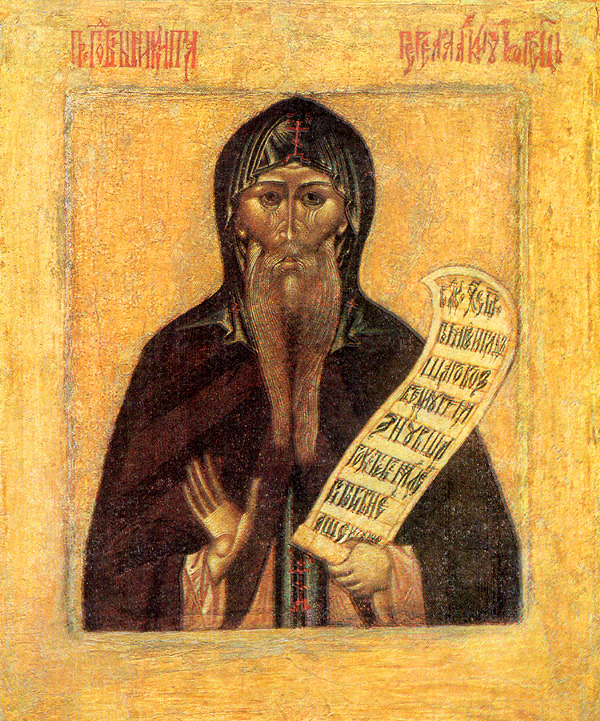
Saint Niketas (Nikḗtas) the Stylite of Pereyaslavl was a native of the city of Pereyaslavl-Zalessky, and he was in charge of collecting taxes. In 1152, Prince Yuri Dolgorukiy founded the city of Pereyaslavl and built a stone church dedicated to the All-Merciful Savior in that new place. Because of the cost of building the city and the church, more taxes had to be collected from the residents of the city. Niketas mercilessly overcharged people, keeping a large portion of the money for himself. This went on for many years. But the merciful Lord, Who desires that all sinners might be saved, led Niketas to repentance.

One day, he went to church and heard the words of the Prophet Isaiah: "Wash, and make yourselves clean, remove the iniquities from your souls before my eyes; cease your wickedness, learn to do good; diligently seek judgment; deliver those who suffer wrongs; defend the orphan, and obtain justice for the widow" (Isaiah 1:16-17).

He was shaken, as if by thunder, by these words which penetrated into the depths of his heart. Niketas did not sleep all night, remembering the words: "Wash, and make yourselves clean." In the morning, however, he decided to invite some friends to his home for some cheerful conversation, and to forget the horrors of the previous night. Once again, the Lord called Niketas to repentance. While his wife was preparing a meal for their guests, suddenly she saw some things rising to the surface in the boiling pot: blood, human heads, hands, and feet. Horrified, she called out to her husband, and Niketas saw the same thing. Suddenly, his sleeping conscience was awakened, and he realized that by overcharging people he was acting like a robber and a murderer. "Alas," he cried, "I have sinned much! O God, lead me on Your path!" With these words, he ran out of the house.

Three versts from Pereyaslavl there was a monastery dedicated to the Great Martyr Niketas (September 15) where Niketas went, shaken by the terrible vision. With tears he fell at the feet of the Igoumen saying: "Save a perishing soul."

Then the Igoumen decided to test the sincerity of his repentance, giving him his first obedience: to stand at the monastery gates for three days, confessing his sins to everyone who passed. With profound humility, Niketas fulfilled his first obedience. Three days later, the Igoumen remembered him and sent a monk to see what he was doing at the monastery gates. But the monk did not find Niketas there. He found him lying in a swamp, covered with mosquitoes and midges, and he was bleeding from their bites. Then the Igoumen came to the sufferer and said, "My son! what are you doing to yourself?"

"Father! Save a perishing soul," Niketas replied.

The Igoumen clothed Niketas in a hair shirt, received him into the monastery, and tonsured him as a monk. Embracing the monastic vows with all his heart, Saint Niketas spent his days and nights in prayer, chanting Psalms, and reading the Lives of the holy ascetics. With the Igoumen's blessing, he wore heavy chains, and there in the place of his monastic struggles, he dug two deep wells. Soon he increased his struggles. He dug a deep round pit and there he placed a stone upon which he stood, becoming a man of ardent prayer, like the ancient stylites. Only the blue sky and the night stars saw him at the bottom of his pillar-well, but there was a narrow underground passage beneath the wall of the church, and through it Niketas went to church for the Services.

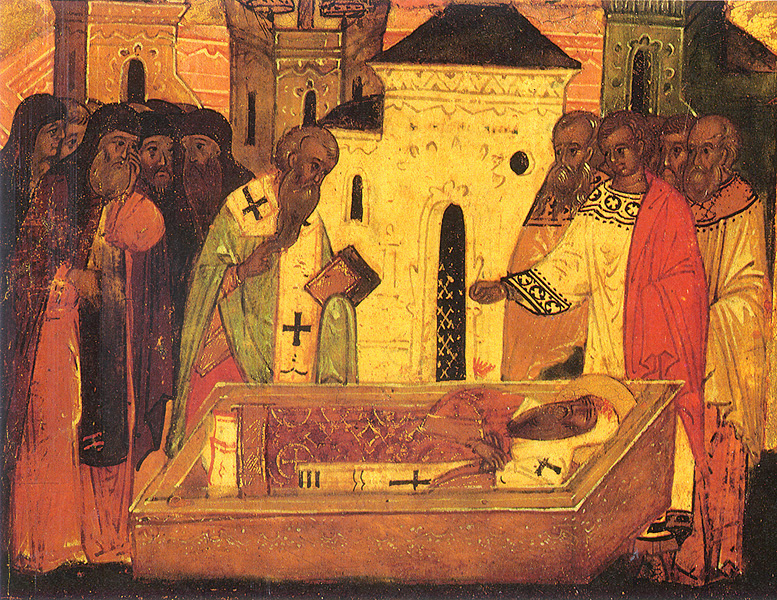
Thus, by struggling well in the monastery of the Great Martyr Niketas , the Venerable Niketas also ended his life with a martyr's death. One night, some of the Saint's relatives came to him for his blessing, and were attracted by the glitter of his chains and crosses. They mistook them for silver, and decided to steal them. On the night of May 24, 1186, they removed part of the roof, killed the ascetic, took his crosses and chains, wrapped them in a rough canvas, and then ran away.

Before Matins, the sacristan, who came to Saint Niketas for the blessing, found the damaged roof and reported it to the Igoumen. The Igoumen and the brethren hurried to the Venerable Stylite and saw that he had been murdered, and his body was fragrant.

Meanwhile the killers stopped on the banks of the Volga River, and decided to divide their loot, but they were astonished to see that it was not made of silver but of iron, and threw the chains into the Volga. The Lord glorified these visible signs of the Saint's hidden struggles and works.

That night Simeon, a pious Elder of the Yaroslavl Monastery of Saints Peter and Paul, saw three bright rays of light over the Volga. He informed the Igoumen of the Monastery and the city officials. The assembled priests and numerous townspeople, who had come down to the river, saw three crosses and chains floating in the waters of the Volga. With reverence and prayers they were brought to the Monastery of the Great Martyr Niketas and laid on the grave of Saint Niketas. At the same time, there were miracles of healing.

Around 1420 – 1425, Saint Photios, the Metropolitan of Kiev (July 2), gave his blessing to uncover the relics of Saint Niketas. The Igoumen of the Monastery served a Moleben with the brethren, and then he opened the coffin, in which was an incorrupt body. Suddenly, the grave filled up with earth, and the relics remained in the ground.

Between 1511-1522 a chapel was built in honor of the Monastic Martyr Niketas, and in the XIX century Archpriest A. Svirelin composed an Akathist to the Saint.

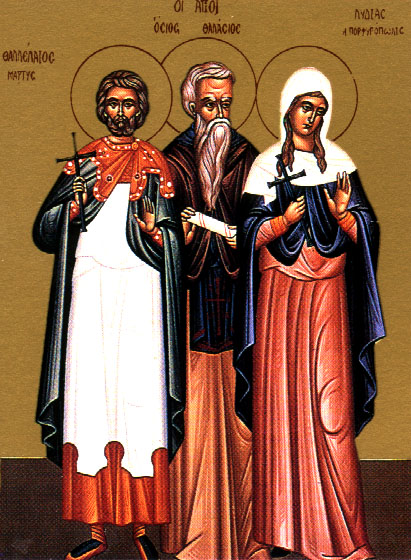
Martyr Meletius Stratelates who suffered in Galatia, and those with him

Saint Meletius the General, Stephen, John, Serapion the Egyptian, Callinicus the Sorcerer, Theodore, Faustus and 1218 soldiers, women and children with them.

The holy martyr Meletius was a military commander of the Galatia district of Asia Minor during the reign of the Roman emperor Antoninus Pius (138-161). He was a Christian and he prayed fervently that the Lord would put an end to the pagan error. Terrified by his prayer, the devils inhabiting the pagan temples entered into dogs, which frightened the inhabitants of the district with their howling.

Saint Meletius and his soldiers got rid of the mad dogs, and destroyed the temples. He was arrested and brought to trial before the governor Maximian. Since he refused to offer sacrifice to idols, Saint Meletius was tortured and he died confessing his faith in Christ. The tribunes of his regiment, the holy martyrs Stephen and John, were beheaded for their confession of Christ as true God.

The remaining soldiers of the regiment, also declaring themselves Christians, were beheaded by the sword, together with their wives and children. One thousand, two hundred eighteen men perished, although some historians put the number at 11,000.

The holy martyrs Theodore and Faustus were burned along with many others. Among the women and children who suffered are the holy martyrs Marciana, Susanna, Palladia, and the infants Kyriakos and Christian. Saint Callinicus, a former sorcerer, also suffered martyrdom. The names of some of the soldiers, and of the twelve tribunes are known: the holy martyrs Faustus, Festus, Marcellus, Theodore, Meletius, Sergius, Marcellinus, Felix, Photinus, Theodoriscus, Mercurius and Didymus.

The holy martyr Serapion was born in Egypt. He had come to Galatia and witnessed the martyrdom of Saint Meletius and his comrades. Seeing the bravery with which those who believed in Christ died for Him, Saint Serapion also believed, for which he was imprisoned. An angel of God visited Saint Serapion in prison and made him a bishop.

Saint Vincent of Lerins

Information about the life of Saint Vincent is very scarce. Our primary source for him is the work of Gennadius of Massilia "On Famous Men" (Latin: De viris illustribus), composed about 495 as a continuation of the work of the same title by Saint Jerome of Stridon (June 15).

Vincent was born in the city of Toul, in the northeast of what is now France, and was the brother of Saint Lupus.of Troyes (July 29). After serving in the army (Latin: secularis militia), he entered the monastery of Saint Honoratus (January 16) at Lerins (Lérins), where he was tonsured and ordained to the priesthood.

In 434, under the pseudonym Peregrinus, Saint Vincent wrote his most famous work: "Commentary Against Heretics" (Latin: Commonitorium adversus Hæreticos) which he composed in 434, three years after the Third Ecumenical Council of Ephesus had condemned the Nestorians. In this book he differentiated between the Church's teachings and the heresies of his time. He is remembered for saying that Christians must follow the true Faith which has been held “everywhere, always, and by all.” He also defended the term “Theotokos” being applied to the Mother of God, in opposition to the teachings of Nestorius which were condemned at the Third Ecumenical Council.

He reposed during the reign of Emperors Theodosios II and Valentinian III, i.e. in the year 450 or earlier. Saint Vincent was much appreciated by his contemporaries. Saint Eucherius of Lyons (November 16) calls him a holy man, conspicuous for his eloquence and knowledge. On the other hand, Saint Vincent humbly describes himself as "the least of all the servants of God, and less than the least of all the Saints, and unworthy to bear the holy name of a Christian."

Saint Vincent fell asleep in the Lord about 445.. His holy relics are preserved at Lerins.
Daily Readings for Friday, May 23, 2025

5TH FRIDAY AFTER PASCHA

NO FAST

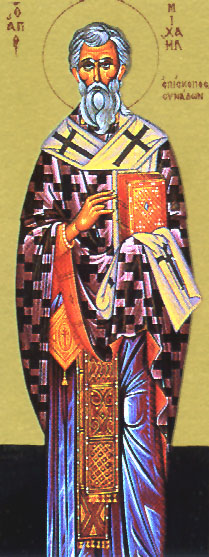
Michael the Confessor, Bishop of Synnada, Mary the Myrrhbearer & wife of Cleopas

ACTS OF THE APOSTLES 15:5-12

IN THOSE DAYS, some believers who belonged to the party of the Pharisees rose up, and said, "it is necessary to circumcise them, and to charge them to keep the law of Moses." The apostles and the elders were gathered together to consider this matter. And after there had been much debate, Peter rose and said to them, "Brethren, you know that in the early days God made choice among you, that by my mouth the Gentiles should hear the word of the gospel and believe. And God who knows the heart bore witness to them, giving them the Holy Spirit just as he did to us; and he made no distinction between us and them, but cleansed their hearts by faith. Now therefore why do you make trial of God by putting a yoke upon the neck of the disciples which neither our fathers nor we have been able to bear? But we believe that we shall be saved through the grace of the Lord Jesus, just as they will." And all the assembly kept silence; and they listened to Barnabas and Paul as they related what signs and wonders God had done through them among the Gentiles.

JOHN 10:17-28

The Lord said to the Jews who came to him, "For this reason the Father loves me, because I lay down my life, that I may take it again. No one takes it from me, but I lay it down of my own accord. I have power to lay it down, and I have power to take it again; this charge I have received from my Father."
There was again a division among the Jews because of these words. Many of them said, "He has a demon, and he is mad; why listen to him?" Others said, "These are not the sayings of one who has a demon. Can a demon open the eyes of the blind?
It was the feast of the Dedication at Jerusalem; it was winter, and Jesus was walking in the temple, in the portico of Solomon. So the Jews gathered round him and said to him, "How long will you keep us in suspense? If you are the Christ, tell us plainly." Jesus answered them, "I told you, and you do not believe. The works that I do in my Father's name, they bear witness to me; but you do not believe, because you do not belong to my sheep. My sheep hear my voice, and I know them, and they follow me; and I give them eternal life.

Saint Michael the Confessor, Bishop of Synnada

Saint Michael the Confessor From his youth he longed for the monastic life and was sent by Patriarch Tarasius (784-806) to a monastery on the coast of the Black Sea. Saint Theophylactus (March 8), the future Bishop of Nicomedia also entered the monastery together with him.

At the monastery both monks engaged in spiritual struggles and were soon glorified by gifts from the Lord. Once, during a harvest, when the people were weakened by thirst, an empty metal vessel was filled with water by the prayer of the monks.

Patriarch Tarasius consecrated Saint Michael as bishop of the city of Synnada. Through his holy life and wisdom, Saint Michael won the love of believers, and the notice of the emperors Nikēphóros I (802-811) and Michael I Rangabe (811-813). Saint Michael was present at the Seventh Ecumenical Council at Nicea in 787.

When the Iconoclast heretic Leo the Armenian (813-820) assumed the throne, he began to expel Orthodox hierarchs from their Sees, appointing heretics in their place.

Saint Michael defended Orthodoxy, bravely opposing the heretics and denouncing their error. Leo the Armenian brought Saint Michael to trial, but not fearing torture he answered resolutely, “I venerate the holy icons of my Savior Jesus Christ and the All-Pure Virgin, His Mother, and all the saints, and it is to them I bow down. I shall not obey your decrees to remove icons from churches.”

Leo then banished Saint Michael to the city of Eudokiada, where the confessor died about the year 821. The head of Saint Michael is preserved in the Great Lavra of Saint Athanasius on Mount Athos, and part of the relics are at the Ivḗron monastery.

Synaxis of the Saints of Rostov

The celebration of the Synaxis of the Rostov and Yaroslav Saints on May 23 was established by resolution of His Holiness Patriarch Alexis I (+ 1970) and the Holy Synod of the Russian Orthodox Church, on March 10, 1964.

Archimandrite Abraham the Wonderworker (October 29, 1073-1077)

Prince Basil (+ 1238)

Metropolitan Demetrius (+ October 28, 1709 and September 21)

Bishop Ignatius (+ May 28, 1288)

Monk Irenarchus the Hermit (+ 1616)

Bishop Isaiah, wonderworker (+ May 15, 1090)

Blessed Isidore, Fool-for-Christ (+ 1474)

Bishop James (+ November 27, 1391)

Blessed John of the Hair-Shirt (the Merciful), Fool-for-Christ (+ 1580)

Bishop Leontius (+ May 23, 1073)

Peter, Tsarevich of Ordynsk (+ 1290)

Archbishop Theodore (+ November 28, 1394)

Yaroslav Wonderworkers:

Princes Basil (+ 1249), Constantine (+ 1257), Theodore (+ 1299) and his sons David (+ 1321) and Constantine (XIV)

Pereslavl Wonderworkers:

Prince Alexander Nevsky (+ 1263)

Prince Andrew of Smolensk (15th c.)

Monk Daniel the Archimandrite (+ 1540)

Monk Nikḗtas the Stylite (+ 1186)

Uglich Wonderworkers:

Monk Cassian (+ 1504)

Tsarevich Demetrius (+ 1591)

Monk Ignatius of Lomsk (+ 1591)

Monk Paisius (+ 1504)

Prince Roman (+ 1285)

Poshekhonsk Wonderworkers:

Hieromartyr Adrian (+ 1550)

Monk Gennadius of Liubimograd and Kostroma (+ 1565)

Monk Sebastian (+ 1542)

Monk Sylvester of Obnora (+ 1379)

Venerable Euphrosyne, Abbess of Polotsk

Saint Euphrosyne (Euphrosynē), Abbess of Polotsk, was named Predslava in the world, and was the daughter of Prince George Vseslavich. From her childhood she was noted for her love of prayer and book learning. After turning down a proposal of marriage, Predslava received monastic tonsure with the name Euphrosyne. With the blessing of Bishop Elias of Polotsk, she began to live near the Sophia cathedral, where she occupied herself by the copying of books.

Around the year 1128 Bishop Elias entrusted the nun with the task of organizing a women’s monastery. Setting out for Seltso, the site of the future monastery, the ascetic took only her holy books. At the newly constructed Savior-Transfiguration monastery the saint taught the girls to copy books, singing, sewing and other handicrafts.

Through her efforts, a cathedral was built in 1161, which survives to the present day. Saint Euphrosyne also founded a men’s monastery dedicated to the Mother of God. Patriarch Luke of Constantinople sent a copy of the wonderworking Ephesus Icon of the Mother of God at her request. Shortly before her death, Saint Euphrosyne journeyed on pilgrimage to the Holy Places with her nephew David and sister Eupraxia.

After venerating the holy things at Constantinople, she arrived in Jerusalem, where at the Russian monastery of the Most Holy Theotokos the Lord granted her a peaceful end on May 24, 1173.

In 1187 the body of the saint was transferred to the Kiev Caves monastery, and the relics were transferred to Polotsk in 1910 to the monastery she founded.

Saint Euphrosyne of Polotsk was glorified in the Russian Church as a patroness of women’s monasticism.

Venerable Paisius, Abbot of Galich

No information is available at this time.

Martyr Michael “the Black-Robed” of Saint Savva Monastery

The Venerable Michael lived in the ninth century, and was from the city of Edessa in Mesopotamia, the son of Christian parents. After their death he distributed his inheritance to the poor, then went to Jerusalem to venerate the Holy Places. The Holy Land at that time was under Moslem rule.

Michael remained in Palestine and settled in the Lavra of Saint Savva, where he became the disciple of his relative, Saint Theodore of Edessa (July 9), who spent his time both in the monastery and living as an anchorite in the Judean desert. Saint Theodore accepted him and tonsured him right away. The two made baskets of reeds together in order to support themselves. Saint Michael would take the baskets to the marketplace in Jerusalem in order to sell them.

One day while at the marketplace, the eunuch of the Muslim Queen Seida, seeing that the baskets were both fine and well-made, took him along to the Queen, who was visiting the city with her husband King al-Ma’mun (813-833). The handsome monk aroused the desire of the Queen, who tried to lead him into the sin of adultery, but he did not accept her suggestions. The enraged Seida told her husband to have the monk beaten with rods because he had insulted her, and accused him of being an enemy of Islam.

There was a debate about which faith is the true one, Christianity or Islam, and the king said, “Do as I tell you, and confess that Mohammed is a prophet and an apostle of Christ, then I will adopt you as my son.” Saint Michael said, “Mohammad is neither an apostle nor a prophet, but a deceiver and the forerunner of the antichrist. Either send me back to my Elder at the monastery, or be baptized into our Christian faith and reign forever in the heavens, or send me to Christ through martyrdom.”

The king gave the Saint a cup with deadly poison to drink. Saint Michael made the Sign of the Cross over the cup, and he drank it, but he remained unharmed, according to the promise of the Lord (Mark16:18). After this the king ordered that he be decapitated. The monks of the Lavra of Saint Savva wanted to take the Saint’s relics to their Lavra, but the Christians of Jerusalem would not permit this. They said that since he was martyred in Jerusalem, his relics ought to remain there.The monks of the Lavra disagreed with them, saying that he was nurtured in the Lavra and so he should be buried there. There was such a heated argument that the king decided that the relics would go to the Lavra.

On the same day that Saint Michael was put to death, the Lord revealed this to Saint Theodore. After informing the brethren, he sent some monks to bring the relics to the Lavra. As the relics were carried to the Lavra, there was a pillar of fire from Heaven accompanying the relics, and it remained until they reached the Lavra. Saint Theodore and the monks came out to meet the procession with lit candles, and singing hymns. The holy relics were buried with the other holy Fathers who had endured martyrdom. Many miracles took place before the relics of Saint Michael, as a sign that he had found favor with God.

At the beginning of the twelfth century the relics of Saint Michael were seen by Daniel, the Igoumen of the Kiev Caves Monastery, while on pilgrimage to the Holy Land.

Saint Michael is commemorated twice during the year: on May 23 (his repose) and July 29 (the transfer of his relics).

Saint Damiane (Demetrius), King and Hymnographer

Saint Damiane (in the world King Demetre I) was the son of Holy King Davit the Restorer.

King Davit proclaimed his son co-ruler of Georgia and crowned him with his own hands. He declared that his son Demetre, through his wisdom, chastity, bravery, and handsome appearance, would rule Georgia better than he himself had. Demetre acquired great glory while his father was still alive. In 1117 Davit sent him to Shirvan to fight, and the young commander astonished the people with his deftness in battle. Demetre seized Kaladzori Castle and returned home with many captives and much wealth.

King Demetre I struggled tirelessly to protect the inheritance he had received from his father: he guarded Georgia’s borders and fought to enlarge its frontiers. Many regions, including Hereti, Somkhiti, Tashiri, Javakheti, Artaani and the Tao border, were repopulated during King Demetre’s rule. These regions had been largely deserted after King Davit joined Tbilisi to the region of Heret-Kakheti.

King Demetre was never shaken by the evil intrigues plotted against him. First his noblemen revolted, demanding that his stepbrother, Vakhtang (Tsuata), replace him as king. (Ioane of Abuleti was the leader of this conspiracy.) Then Demetre’s own son Davit rebelled against him. Deeply disturbed by the behavior of his first-born son, the pious king could no longer bear the vanity of the world—he was tonsured a monk in the Davit-Gareji Wilderness and given the new name Damiane. He abdicated to his son, but Davit ruled just six months before he reposed.

While laboring at Davit-Gareji Monastery, Damiane composed many great hymns for the Church. His hymn to the Theotokos, “Thou Art the Vineyard,” is outstanding among these works. In order to protect the interests of the Georgian kingdom after his son’s death, Damiane was obliged to leave the monastery. He returned to the throne and intervened in the affairs of the government. At the same time he named another of his sons, George, co-ruler.

King Damiane-Demetre completed construction of Gelati Monastery, which had been started by his father, Holy King Davit the Restorer.

Saint Damiane reposed in 1157; he was buried at Gelati Monastery. A 12th-century image of Saint Damiane-Demetre was among the frescoes at the Davit-Gareji Monastery. In the 19th century the Russian traveler Andrew Muraviev reported seeing the fresco intact, but today only a narrow upper band of the image remains. A fresco of the pious king and monk Demetre has been preserved in the church at Matskhvarishi (now Latali) in the Svaneti region.

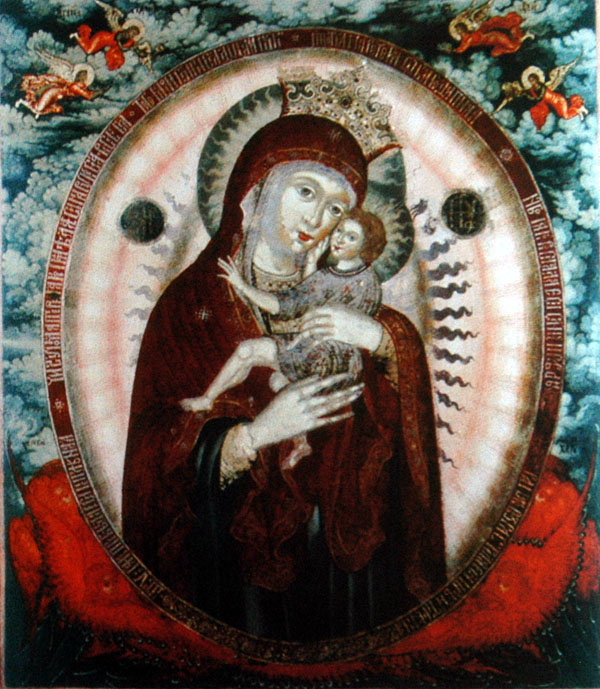
Icon of the Mother of God “You are a Vineyard” (Georgian: Shen khar venakhi)

The name of this Icon is derived from a poem to the Mother of God which was composed by Saint Damiane (King Demetre I before his monastic tonsure): "You are a vineyard newly-blossomed…."

Similar imagery may be found in other liturgical texts, such as the Theotokion of the Third Hour: (Tone 6) "You are the true vine who has blossomed forth the fruit of life. We beseech you, intercede, O Lady, together with the Apostles, and all the Saints, that mercy may be shown to our souls." and The Akathist to the Kursk Root Icon of the Theotokos (November 27), Ikos 4: "Hail, fruitful vine which quenches the thirst of all with the wine of compunction."

The Virgin is depicted holding the Divine Child on her left arm, with her left hand on His head. In her right hand, she holds a cluster of grapes. Both Saint Damiane and the Icon are commemorated today.

This Icon is also commemorated on January 1, the Feast of Saint Basil the Great, because on that day, through her Icon, the Most Holy Theotokos healed an unbelieving man of an incurable disease. After he was healed, he began to believe. Later, the Icon flowed with myrrh, and a multitude of healing miracles occurred.

Holy Myrrh-bearer Mary, the wife of Cleopas

According to Church Tradition, Saint Mary was the daughter of Saint Joseph the Betrothed by his first wife. She was still very young when the Most Holy Virgin Mary was betrothed to the Righteous Joseph and brought to his house. Thus, Saint Mary became the childhood friend of the Most Holy Theotokos.

After the Righteous Joseph returned to Nazareth from Egypt with the Savior and the Mother of God, he married his daughter to his younger brother Cleopas, so she is known as Mary, the wife of Cleopas.

The blessed fruit of that marriage was the Holy Hieromartyr Symeon (April 27), an Apostle of the Seventy, a kinsman of the Lord, and the second Bishop of the Church of Jerusalem.

Saint Mary, the wife of Cleopas, along with other pious women, accompanied the Lord during His public ministry. She was present during His suffering on the Cross, and at His burial. After the Sabbath had passed, she went to the tomb with other Myrrh-bearers to anoint the body of Jesus. There, she and the others heard the joyous news of the Lord's Resurrection from an Angel (Matthew 27:56; Mark 15:40; Luke 24:4-11; John 19:25).

Saint Mary, the wife of Cleopas, is also commemorated on the Sunday of the Myrrh-bearers, the third Sunday of Pascha.

Saint Leontius, Bishop of Rostov

No information available at this time.

Daily Readings for Thursday, May 22, 2025

5TH THURSDAY AFTER PASCHA

NO FAST

5th Thursday after Pascha, Basiliscus the Martyr, Bishop of Comana, Holy New Martyrs Demetrius and Paul of Tripoli, John-Vladimir, Ruler of Serbia

ACTS OF THE APOSTLES 14:20-28; 15:1-4

IN THOSE DAYS, Paul went on with Barnabas to Derbe. When they had preached the gospel to that city and had made many disciples, they returned to Lystra and to lconion and to Antioch, strengthening the souls of the disciples, exhorting them to continue in the faith, and saying that through many tribulations we must enter the kingdom of God. And when they had appointed elders for them in every church, with prayer and fasting they committed them to the Lord in whom they believed. Then they passed through Pisidia, and came to Pamphylia. And when they had spoken the word in Perga, they went down to Attalia; and from there they sailed to Antioch, where they had been commended to the grace of God for the work which they had fulfilled. And when they arrived, they gathered the church together and declared all that God had done with them, and how he had opened a door of faith to the Gentiles. And they remained no little time with the disciples. But some men came down from Judea and were teaching the brethren, "Unless you are circumcised according to the custom of Moses, you cannot be saved." And when Paul and Barnabas had no small dissension and debate with them, Paul and Barnabas and some of the others were appointed to go up to Jerusalem to the apostles and the elders about this question. So, being sent on their way by the church, they passed through both Phoenicia and Samaria, reporting the conversion of the Gentiles, and they gave great joy to all the brethren. And when they came to Jerusalem, they were welcomed by the church and the apostles and the elders, and they declared all that God had done with them.

JOHN 9:39-10:9

The Lord said to the Jews who came to him, "For judgment I came into this world, that those who do not see may see, and that those who see may become blind." Some of the Pharisees near him heard this, and they said to him, "Are we also blind?" Jesus said to them, "If you were blind, you would have no guilt; but now that you say, 'We see, ' your guilt remains.
Truly, truly, I say to you, he who does not enter the sheepfold by the door but climbs in by another way, that man is a thief and a robber; but he who enters by the door is the shepherd of the sheep. To him the gatekeeper opens; the sheep hear his voice, and he calls his own sheep by name and leads them out. When he has brought out all his own, he goes before them, and the sheep follow him, for they know his voice. A stranger they will not follow, but they will flee from him, for they do not know the voice of strangers." This figure Jesus used with them, but they did not understand what he was saying to them.
So Jesus again said to them, "Truly, truly, I say to you, I am the door of the sheep. All who came before me are thieves and robbers; but the sheep did not heed them. I am the door; if any one enters by me, he will be saved, and will go in and out and find pasture.

Martyr Basiliscus, Bishop of Comana

The Holy Martyr Basiliscus was a nephew of the Great Martyr Theodore the Recruit (February 17), and he suffered together with his brothers Eutropius and Kleonikos during the persecution of the emperor Maximian Galerius (305-311). The holy martyrs Kleonikos and Eutropius (March 3) were crucified, but the martyr Basiliscus was sent to Comana where he was detained in prison.

The governor Agrippa arrived in the city of Amasea, and started a persecution against Christians. Saint Basiliscus in prison prepared himself for his impending ordeal. The Lord appeared to him in a dream, promising the martyr His help, and foretold his martyric death at Comana. Saint Basiliscus asked the prison guards to let him go to his native village to bid his relatives farewell. They let him go, since they respected him for his holy life and working of miracles. Arriving home, Saint Basiliscus saw his family one last time, and urged them to stand firmly in the Faith.

When Agrippa learned that Saint Basiliscus had gone to see his relatives, he went into a rage. He chastized the prison guards, and he sent a detachment of soldiers after the martyr, headed by a cruel magistrianum (adjutant of the governor). Meeting Saint Basiliscus, who was actually on his way back, the magistrianum placed heavy chains on him, and shod him with metal sandals with nails driven into the soles, and set off to Comana.

Arriving at a certain village during the hot afternoon, the travellers stayed at the house of a woman named Troana. The soldiers went into the house to relax and refresh themselves with food, and they tied the martyr Basiliscus to a dry tree. Standing in the heavy chains beneath the scorching sun, the saint prayed to God. Suddenly a Voice was heard from above, “Fear not, for I am with you.”

The earth shook, and a spring of water came forth from the resulting fissure. The magistrianum, the soldiers and Troana, rushed out of the house, frightened by the earthquake. Shaken by the miracle which had taken place, they set the martyr free. Sick people from the village came to the holy martyr and received healing through his prayers.

When the saint finally stood before Agrippa, he was commanded to offer sacrifice to the pagan gods. He replied, “I offer to God a sacrifice of praise and thanksgiving every hour.” They led him into a pagan temple. In an instant fire came down from Heaven, which burned the temple, and reduced the idols to dust. Then in a blind rage Agrippa gave orders to behead Saint Basiliscus and throw his body into the river. The death of the martyr occurred in the year 308.

Christians quickly gathered the remains of the holy martyr, and buried them by night in a ploughed field. Upon this spot a church was built in honor of Saint Basiliscus, into which they transferred his relics. Through the prayers of the holy martyr healings began to occur. The saint appeared in a dream to Saint John Chrysostom (November 13) before his death at Comana and said to him, “Tomorrow we shall be together.” Saint Eusignius (August 5) was an eyewitness to his sufferings and told the world about the struggles of Saint Basiliscus.

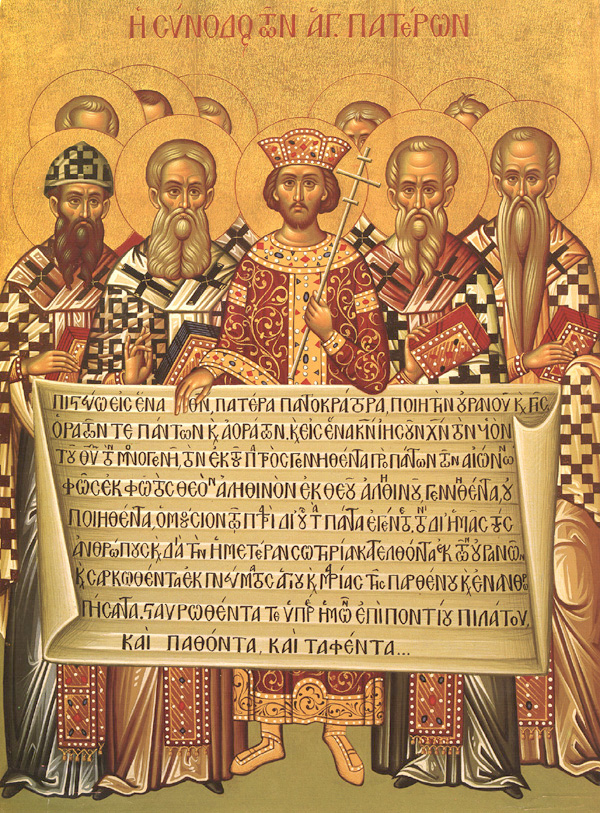
Commemoration of the Holy Fathers of the Second Ecumenical Council

The Second Ecumenical Council was convened in the year 381 and consolidated the victory of Orthodoxy attained in the year 325 at the First Ecumenical Council.

During the difficult years which passed after the acceptance of the Nicene Symbol of Faith (Creed), the Arian heresy developed new offshoots. Under the guise of struggle against the Sabellian heresy, which taught about a blending of the Hypostatic Persons of the Father and the Son [as mere aspects or modalities within the Trinity], Macedonius began to employ the word “homoiousios” “of similar essence” [in contrast to the Orthodox teaching of “homoousios”, “of the same essence”] regarding the essence of the Son and that of the Father.

This formula still presented a danger because Macedonius presented himself as a struggler against the Arians, who used the term “like the Father.” Besides this, the Macedonians, being semi-Arians, depending on conditions and advantages of the moment, sometimes inclined towards Orthodoxy, sometimes towards Arianism. They blasphemed the Holy Spirit by suggesting that He was not “of the same essence” with the Father and the Son.

A second heretic, Aetius, introduced the concept “anomoion” (“different in essence.”) He said that the Father has a completely different essence from that of the Son. His disciple Eunomios taught a hierarchical subordination of the Son to the Father, and of the Holy Spirit to the Son. Everyone who came to him was rebaptized into the “death of Christ,” denying Baptism in the Name of the Father and of the Son and of the Holy Spirit, which is commanded us by the Savior Himself (Mt. 28:19).

A third heresy arose from the teachings of Valentius and Ursacius at the Arimonian Council. They attempted to deceive the Orthodox bishops, proclaiming that the Son of God is from God, and is in the likeness of God the Father, and is not a created being as the Arians taught. The heretics did not wish to use the term “one in essence” in describing the relation of the Son to the Father, saying that the word “essence” is not found within the Holy Scripture. Besides these three main heresies, there were also many other false teachings. The heretic Apollinarios said, “The flesh of the Savior did not have a human soul or reason. The Word of God took the place of the absent soul; and Divinity remained dead for three days.”

In order to refute these heretical opinions, the holy Emperor Theodosius the Great (379-395) convened an Ecumenical Council at Constantinople, at which 150 bishops were present. Upon investigation by the Holy Fathers it was proposed that a Creed which holy Pope Damasus had sent to Bishop Paulinus of Antioch should be read. This appears to be the so-called Sirmean Creed, drawn up by Potamius of Lisbon, who participated in a pro-Arian Council at Sirmium in 357, but changed his opinions two years later. The document was a vain attempt to please everyone by not mentioning the terms ousia (essence, or substance), homoousios (identical in essence, or substance), and homoiousion (similar in essence, or substance), "by which the minds of many are perturbed." It said that there "ought to be no mention of any of them at all, nor any exposition of them in the Church." By not defining the Church's teaching clearly, the document is ambiguous, neither endorsing the various heresies it contained, nor the teaching of the Church.

An Ecumenical Synod is convened primarily to deal with false teachings and refute them by proclaiming the faith handed down to us by the Apostles and the Holy Fathers. To use the definition of St. Vincent of Lérins: "that which has been believed everywhere, always, by everyone." There can be no compromise between truth and falsehood.

After the document was read aloud, the Holy Fathers rejected the false teaching of Macedonius, and unanimously affirmed the Apostolic teaching that the Holy Spirit is not a creature, but is rather the Life-Creating Lord, Who proceeds from the Father, and is worshipped and glorified with the Father and the Son. In order to combat other heresies, of the Eunomians, Arians and Semi-Arians, the Holy Fathers reaffirmed the Nicene Symbol of Faith.

In the Symbol (Creed), accepted by the First Ecumenical Council, the divine nature of the Holy Spirit was not addressed, since at that earlier time [in 325] heresies against the Holy Spirit had not become widespread. Therefore, the holy Fathers of the Second Ecumenical Council added to the Nicean Symbol its eighth, ninth, tenth, eleventh and twelfth sections. They definitively formulated and affirmed the Nicene-Constantinople Symbol of Faith, which is used even now by all the Orthodox Churches.

The Second Ecumenical Council also established the norms for ecclesiastical courts [Canon VI], and it decided to receive those repentant heretics who were properly baptized in the name of the Holy Trinity through Chrismation, but those baptized with a single immersion were to be received as pagans.

Saint John-Vladimir, Prince of Bulgaria, Greatmartyr, and Miracle-worker

The Holy Martyr John-Vladimir, a Serbian prince, was born in the tenth century. From his childhood he was raised in piety, and at maturity he wisely governed his holdings Illyria and Dalmatia, preserving the holy Faith in purity.

The noble prince was married to Kosara, a daughter of the Bulgarian Tsar Samuel. Summoned for talks with the Bulgarian Tsar John-Vladislav, he was treacherously murdered by the Tsar on May 22, 1015, at the entrance to a church. Kosara, the pious spouse of the holy prince, entered a women’s monastery that she built, and where also she died, not leaving the church until the very end of her life. The relics of the holy prince are located near Elbosan.

Monastic Martyr Paul of the Lavra, Mount Athos

No information on the life of this saint is available at this time.

Icon of the Mother of God of Cyprus

The Cyprus Icon of the Most Holy Theotokos is also commemorated on the Sunday of Orthodoxy, Pentecost Monday, April 20 and July 9.

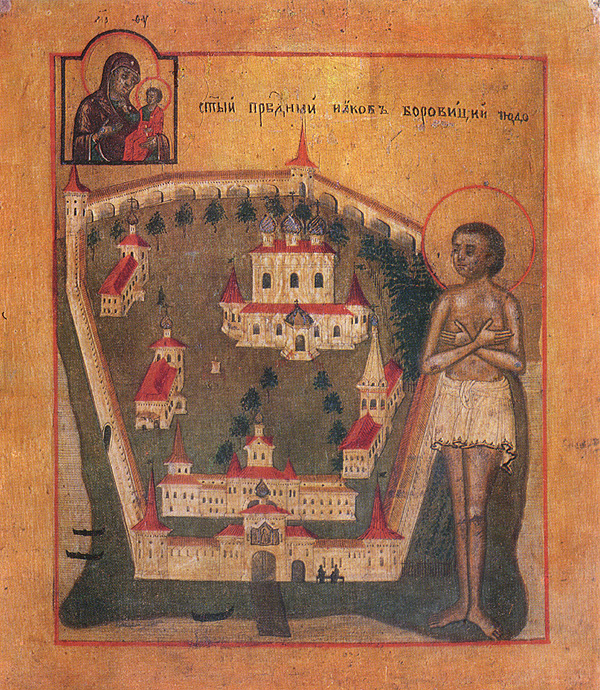
Blessed James of Borovichi, Wonderworker of Novgorod

Many ancient Russian cities have their own patron Saint, whose name is associated with miraculous healings and the protection of their city from enemies. The patron Saint of Borovichi in the Novgorod region is the Righteous James, a Wonderworker and a Fool for Christ.

Saint James is the patron Saint of the Borovichi region and of the Iveron (Ivḗron) Valdai Monastery. In a manuscript of the XVI century, kept at Holy Trinity-Sergius Lavra, stories about this Saint are set forth.

On April 11, 1452, on Bright Tuesday, a great event took place near the Holy Spirit Monastery. A spring flood; the fast-flowing Msta River rolled its waves through the rapids in a loud stream; The life-giving warmth of the spring sun melted all the ice in the river. Suddenly, a large ice floe appeared, moving against the rapid flow of the river; thick steam rose from it like smoke from a fire. It landed on the right bank, a hundred fathoms above the Monastery. Those who witnessed this saw a rather darkened pine block on the ice floe, as if had been scorched by fire, this was the lower part of the coffin, without a lid, and in it was the poorly covered body of a certain youth. Seized with horror, the faint-hearted people of Borovichi took the floating body for an ordinary corpse of a drowned man.

In order to avoid trouble, they tried hard to push the ice floe with its strange burden away from the shore with a special long staves. However, the ice floe returned to its former place. Then, after tying the log with ropes, they dragged it along with the ice floe, along the course of the Msta River, and took it two versts from the Monastery. At dawn the next day, the ice floe returned with its burden again. This was repeated for a third time.

Finally, the Lord brought the foolish men to their senses. A certain youth appeared in a dream to several well-intentioned elderly men of Borovichi and said to them: "Orthodox Christians, why do you drive away a fellow Christian? Why do you resist the Lord, Who has sent my body to you? Is it because you do not know my name? Well then, know that I am called James; named for Saint James, the Lord's brother according to the flesh."

The simple-minded and God-fearing men awoke from their sleep, and told one another about the wondrous dream, and their hearts were touched. The rumor spread quickly, and then the residents of Borovichi regretted their unreasonable attitude toward the relics of the Servant of God revealed by his voyage. Many bitter tears were shed at the same time; the staves, with which the relics had been pushed off, were burned. The old men, accompanied by a crowd, hastened to the bank of the Msta River, with a firm intention to remove the honorable relics from the ice floe at once, and to place them right there on the bank. On the ground a log framework was built, which resembled a small chapel. For 93 years after his voyage and burial, the incorrupt relics of Saint James, which had been placed under a bushel (Matthew 5:15), unceasingly exuded grace-filled healing for all who came to him with faith.

After the many signs and miracles which occurred at the grave of the Righteous James, in 1544 the inhabitants of the region brought this to the attention of Archbishop Theodosios of Novgorod with a special petition from the clergy and laity. expressing their sincere desire and earnest request that the honorable relics of this new wonderworker be opened, as a most precious treasure given by God. This great celebration took place on October 23, 1545, on the Feast Day of the Apostle James, the brother of the Lord. Soon after the burial of the relics of the Righteous James, a healing spring sprang up.The pious inhabitants of the neighborhood, zealous for the glory of the name of the Lord, Who is wondrous in His Saints, a small wooden church was built there and dedicated to the Tenderness (i.e. Sweet-Kissing) Icon of the Mother of God.

During the reign of the most pious sovereign, Tsar Alexei, His Holiness Nikon, the great Patriarch of All Russia, aware of the miracles which occurred at the relics of the Righteous James, and at the same time, he was told that the holy relics were pgreatly neglected because of the poverty of Holy Spirit Monastery, he intended to transfer the holy relics to the Ivḗron Monastery, which was then on one of the islands of Lake Valdai. This transfer took place on February 23, 1654.

Who exactly is the God-pleasing youth, the Righteous James, who is called the Wonderworker of Borovichi, in his short life on earth; who were his parents, and from where did his incorrupt relics sail to the Borovichi shore? There are no reliable details concerning these things, neither written nor oral.

The miracles of Saint James are described in the book "The Legend of Saint James the Righteous Wonderworker of Borovichi," published in 1901 in St. Petersburg. The residents of Borovichi remember that at the beginning of World War II, Saint James appeared in a dream to a deeply believing Elder and said: "Let the faithful go around the city three times with my icon, and I will spare my city." Indeed, a group of believers walked around the city for three nights with the cross, chanting prayers, and carrying the icon of Saint James and a particle of his relics. The Cross Procession took place secretly, at night, because the faithful feared persecution by the godless authorities. Soon the front approached the city. Borovichi was only 70 kilometers away, but the city was not damaged.

On October 23, the Feast of Saint James, Orthodox Christians all over the world offer prayers to this Saint, and unite spiritually with the faithful of Borovichi.

The Righteous James is commemorated three times a year: on May 22; on October 23 (the transfer of his honorable relics); and on the Third Sunday after Pentecost (Synaxis of the Novgorod Saints).

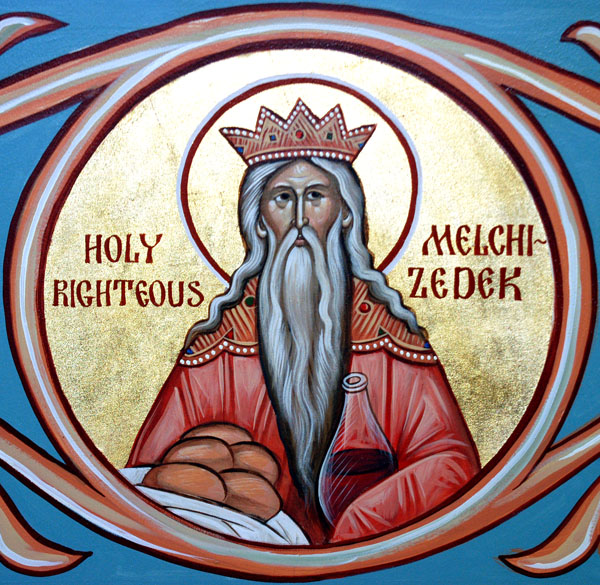
Righteous Melchizedek, King of Salem

The Righteous Melchizedek was the King of Salem (Jerusalem). He was both a king and a priest, laying the foundations of the city where the Messiah would appear. According to Mar Jacob of Serugh, Melchizedek was a Canaanite, asserting that the very site of his kingdom bears witness to this. Therefore, his genealogy is not recorded. He must have been born, and he must have died, but the Scriptures deliberately conceal both events, assigning him neither beginning nor end, so that he might be called a priest forever. Melchizedek (who appears in the Scriptures suddenly, and then disappears) is regarded as a type of Christ (Hebrews 5:6, 10; Hebrews 6:20; Hebrews 7:2). He did not receive his priesthood from any other priest, nor did he pass on his priesthood to anyone else. In his homily "On Melchizedek, Priest of the Most High God," Mar Jacob of Serugh states that the priests of the past shed the blood of animals when offering sacrifices to God. By contrast, Melchizedek was made a priest "by the sacrifices of his soul," and did not sacrifice animals, nor did he offer anything but himself to God. Melchizedek did not adorn himself with splendid robes as Aaron did; and instead of offering bulls and rams, Melchizedek offered his holy prayers from a pure heart. The Son of God also resembles Melchizedek, because there is no beginning or end to His priesthood, and He offered Himself to the Father as a perfect sacrifice. As Priest, Christ brought Himself to the place of sacrifice, placing His body on the altar of the Cross, and shedding His blood for us.

In chapter 7 of the Epistle to the Hebrews, the Righteous Melchizedek is called the King of Salem, and also a "priest of the Most High God." By the interpretation of his name, he is called the King of righteousness and the King of Salem, in other words, "the King of peace" (Hebrews 7:2).

Melchizedek met the Patriarch Abraham as he was returning from his victory over the kings (Genesis 14:18-24). He brought bread and wine to Abraham and blessed him, saying: "Blessed be Abram of the Most High God, Who made heaven and earth, and blessed be the Most High God, Who delivered thine enemies into thy power." By offering Abraham bread and wine, Melchizedek foreshadows the Church's Liturgy.

Thus, the Righteous Melchizedek was shown to be greater than Abraham, because he blessed Abraham. Abraham, the lesser of the two, did not presume to bless one who was greater than himself (Homily of Mar Jacob, line 299). Abraham accepted the blessing and offered him a tithe of his spoils, and he also showed him reverence (Homily, line 310).

The priesthood of Melchizedek is superior to the priesthood of Aaron, because Melchizedek blessed Abraham. By giving Melchizedek a tithe, Abraham, the ancestor of Aaron, showed that he recognized him as a priest. Through Abraham, Levi's tribe offered first fruits to the image of the Son of God which was seen in Melchizedek. Nevertheless, the Lord did not choose to come forth from the tribe of Levi, but from the family of Kings.

Melchizedek did not serve "according to the priesthood that was to be dissolved, but according to that which unto the ages abides spiritually; and since his priesthood was never annulled, with respect to service; behold how he is spoken of as living, through his priesthood." (Homily, lines 361-364).

The Holy Prophet-King David speaks of him as a priest who would never die (Psalm 109/110:4). When he thought about the Messiah, in order to compare Him to someone whom He ought to resemble, he did not think of anyone from the priesthood of Aaron. Instead, he selected Melchizedek, who provided for his liturgy without any sacrificial victims. The spiritual ministry of this man, who was in the likeness of the Son, is incomprehensible. He wore two crowns, one hidden, and the other manifest. He had authority in two different realms. He was an earthly King who never engaged in battles with those on his borders, because of his peacefulness (Homily, line 538). He desired nothing but peace and righteousness (Homily, line 542).

The Church recalls Melchizedek at the beginning of Great Lent: "Imitate that Priest of God and solitary King (Hebrews 7:3), who was an image of the life of Christ in the world among men." (Thursday of the first week of Great Lent, the Great Canon of St. Andrew of Crete, Ode 3).

The Righteous Melchizedek is also commemorated on the Sunday of the Forefathers.

Announcements: May 25, 2025

Sunday, May 25, 2025

Third finding of the Baptist’s Head & Sunday of the Blindman

Today is the Sunday of the Blind Man. Though the Gospel account of the healing of the blind man touches many subjects, there is but one theme: Christ is the divine Light which illuminates the hearts of those who behold Him in faith. Despite the intimidation of the authorities, despite the confusion of the people who know him, despite the fear of his parents, the blind man given sight refuses to deny what he knows is the truth: Jesus has given him sight, has healed the affliction he has born from birth, and one who does such good is from God. To deny his healer is to deny the truth, and he prefers persecution and rejection to that denial. More than his eyes have been opened; his heart has been opened to true and eternal Light. As were the Israelites cast into the dark despair of his fear, as are we all blinded by the frustration of sin and of our weakness, so this man was trapped by his closed eyes; and, as may all be, he was freed by the coming of the Messiah. In faith we open our eyes to the radiant glory of our Lord and King

.

II Corinthians 4:6-15: Brethren, it is the God Who said, “Let light shine out of darkness,” Who has shone in our hearts to give the light of the knowledge of the glory of God in the face of Christ. But we have this treasure in earthen vessels, to show that the transcendent power belongs to God and not to us. We are afflicted in every way, but not crushed; perplexed, but not driven to despair; persecuted, but not forsaken; struck down, but not destroyed; always carrying in the body the death of Jesus, so that the life of Jesus may also be manifested in our bodies. While we live we are always being given up to death for Jesus’ sake, so that the life of Jesus may be manifested in our mortal flesh. So, death is at work in us, but life in you. Since we have the same spirit of faith as he had who wrote, “I believed, and so I spoke,” we too believe, and so we speak, knowing that He Who raised the Lord Jesus will raise us also with Jesus and bring us with you into His presence. For it is all for your sake, so that as grace extends to more and more people it may increase thanksgiving, to the glory of God.

John 9:1-38: At that time, when Jesus was passing, he saw a man blind from his birth. And His disciples asked Him, “Rabbi, who sinned, this man or his parents, that he was born blind?” Jesus answered, “It was not that this man sinned, or his parents, but that the works of God might be made manifest in him. I must work the works of Him who sent Me, while it is day; night comes, when no one can work. As long as I am in the world, I am the light of the world.” As he said this, he spat on the ground and made clay of the spittle and anointed the man’s eyes with the clay, saying to him, “Go, wash in the pool of Siloam,” which means “Sent.” So he went and washed and came back seeing. The neighbors and those who had seen him before as a beggar, said, “Is not this the man who used to sit and beg?” Some said, “It is he;” others said, “No, but he is like him.” He said, “I am the man.” They said to him, “Then how were your eyes opened?” He answered, “The man called Jesus made clay and anointed my eyes and said to me, ‘Go to Siloam and wash’; so I went and washed and received my sight.” They said to him, “Where is he?” He said, “I do not know.” They brought to the Pharisees the man who had formerly been blind. Now it was a Sabbath day when Jesus made the clay and opened his eyes. The Pharisees again asked him how he had received his sight. And he said to them, “He put clay on my eyes, and I washed, and I see.” Some of the Pharisees said, “This man is not from God, for He does not keep the Sabbath.” But others said, “How can a man who is a sinner do such signs?” There was a division among them. So they again said to the blind man, “What do you say about Him, since He has opened your eyes?” He said, “He is a prophet.” The Jews did not believe that he had been blind and had received his sight, until they called the parents of the man who had received his sight, and asked them, “Is this your son, who you say was born blind? How then does he now see?” His parents answered, “We know that this is our son, and that he was born blind; but how he now sees we do not know, nor do we know who opened his eyes. Ask him; he is of age, he will speak for himself.” His parents said this because they feared the Jews, for the Jews had already agreed that if anyone should confess him to be Christ, he was to be put out of the synagogue. Therefore, his parents said, “He is of age, ask him.” So for the second time they called the man who had been blind, and said to him, “Give God the praise; we know that this man is a sinner.” He answered, “Whether he is a sinner, I do not know; one thing I know, that though I was blind, now I see.” They said to him, “What did He do to you? How did He open your eyes?” He answered them, “I have told you already, and you would not listen. Why do you want to hear it again? Do you too want to become His disciples?” And they reviled him, saying, “You are His disciple, but we are disciples of Moses. We know that God has spoken to Moses, but as for this man, we do not know where He comes from.” The man answered, “Why, this is a marvel! You do not know where He comes from, and yet He opened my eyes. We know that God does not listen to sinners, but if anyone is a worshiper of God and does His will, God listens to him. Never since the world began has it been heard that anyone opened the eyes of a man born blind. If this man were not from God, He could do nothing.” They answered him, “You were born in utter sin, and would you teach us?” And they cast him out. Jesus heard that they had cast him out, and having found him He said, “Do you believe in the Son of God?” He answered, “And who is He, Sir, that I may believe in Him?” Jesus said to him, “You have seen Him, and it is He who speaks to you.” He said, “Lord, I believe.” And he worshiped Him.

Resurrectional Troparion Let us believers praise and worship the Word; coeternal with the Father and the Spirit, born of the Virgin for our salvation. For, He took pleasure in ascending the Cross in the flesh to suffer death; and to raise the dead by His glorious Resurrection.

Troparion of the Forerunner’s Head Discovery: Christ God hath revealed to us thy truly ven’rable head * as a divine treasure that had been concealed in the earth, O Prophet and Forerunner. * Wherefore, as we gather on the feast of its finding, * with our hymns inspired of God, we praise Christ the Savior, * Who by thy mighty prayers saveth us from every kind of harm.

Troparion of the Chains of St. Peter: O Holy Apostle, Peter, thou dost preside over the Apostles by the precious chains which thou didst bear. We venerate them with faith and beseech thee that by thine intercessions we be granted the great mercy.

Kontakion of Pascha: When Thou didst descend into the grave, O Immortal, Thou didst destroy the power of Hades. In victory didst Thou arise, O Christ God, proclaiming Rejoice! to the myrrh-bearing women, granting peace to Thine apostles and bestowing resurrection on the fallen.

Calendar

Sunday, May 25

8:50 AM -Orthros

10:00 AM – Divine Liturgy

Monday, May 26

Father Herman off

Tuesday, May 27

6:30 pm – Paschal Vespers for the Leave-taking of Pacha

Wednesday, May 28

6:00 pm – Ascension: Orthros and Divine Liturgy

Thursday, May 29

No Services

Friday, May 30

No Services

Saturday, May 31

6:00 pm – Great Vespers

Sunday, June 1

8:50 AM -Orthros

10:00 AM – Divine Liturgy

Special Announcements

The Eucharist Bread…was provided by the R. Root for the Divine Liturgy this morning.

Eucharist Bread Schedule:

Eucharist Bread Coffee Hour

May 28 (Wed PM) Pacurari Algood/Schever

(Feast of the Ascension)

June 1 Lasseter Baker/Jimmy Jones/Rodriguez

June 7 (Sat AM)

(Saturday of the Souls) Milnor Ken Jones/Stewart

June 8 Baker PICNIC POT LUCK

Pigott/Ian Jones/Meadows/Brock

June 15 Henderson Dansereau/Alaeetawi

June 22 Algood Ellis/Zouboukos/Waites

June 29 Schelver D. Root/Miller/Weatherly

Schedule for Epistle Readers – Page numbers refer to the Apostolos (book of Epistles) located on the chanters’ stand at the front of the nave. Please be sure to use book when you read.

Reader Reading Page#

May 28 (Wed PM) Reader Chad Miller Acts 1:1-12 63

June 1 Katie Miller Act 20:16-18;28-36 66

June 7 (Sat AM) Mary Martha Ellis 1 Thess 4:13-17 412

June 8 Ian Jones Acts 2:1-11 77

June 15 Grady Fisher Heb 11:33;12:2 84

June 22 Walt Wood Rom. 2:10-16 90

June 29 Kh Sharon Meadows II Cor 11:21;12:9 389

Also Please remember that we still need your tithes and offerings which may be placed in the tray that is passed during Divine Liturgy, in the tithe box at the back of the nave or be mailed to: St. Peter Orthodox Church, P.O. Box 2084, Madison, MS 39130-2084.

Food for Hungry People: Thank you to all who donated toward this ministry. The total collected as $1,500.00. Food for hungry People have sent a very nice letter to the parish that is posted on the bulletin board in the Fellowship Hall.

Please remember the following in your prayers: Aidan Milnor, the Milnor family; Lamia Dabit and her family; Mary Greene (Lee and Kh. Sharon’s sister); Jay and Joanna Davis; Fr. Leo and Kh. Be’Be’ Schelver and their family; Marilyn (Kyriake) Snell; Jack and Jill Weatherly; Dn.Terry Algood and their family; Fr. Joseph Bittle; Rick Carlton; Very Rev. Fr. Nicholas and Kh. Jan Speier; Lee Greene; Fr. John and Kh. Janet Henderson and their family; Galina Singletary; Emily and Cole Parker.

Prayers for Fr. Paul Yerger from Holy Resurrection: Please continue to keep in your God-pleasing prayers Fr. Paul. He is slowly recovering from the injuries he suffered several weeks ago due to a fall. He is currently attending physical therapy at Methodist Rehabilitation and continues to improve each day. Glory to God for all things!

Prayers for His Grace Bp. Nicholas: Please keep in your God-pleasing prayers Bp. Nicholas who underwent a “preventive measure” procedure on his heart last week. He will be recovering over the next several weeks and hopes, by your prayers, to make a speedy recovery. May God grant him many years!

Registration for the 2025 DOMSE Parish Life Conference has opened and was emailed out to the parish. If you did not receive this email and would like to attend, please see Father Herman for registration information. This year’s conference will be hosted by St. George Parish in Jacksonville, FL. June 11-14th.

Registration for the Archdiocese National Convention has also opened. It is being hosted by St George Parish in Cicero, IL (just outside of Chicago) July 20-27th. If you are interested in attending, please see Father Herman and he will get you the registration information and link.

Calendar Items

* The men of the parish meet for lunch at 11:00 a.m. on the first Thursday of the month.

* The Ladies meet at the church at 10:00 a.m. on the second Saturday of the month to pray the Akathist to the Mother of God, Nurturer of Children on behalf of our children.

* The Ladies meet for lunch at 1:00 p.m. on the last Tuesday of the month.

* The remaining date for serving at Stewpot Ministries is Saturday, September 27th.

* We will celebrate the leave-taking of Pascha with Paschal Vespers on Tuesday, May 27th, beginning at 6:30 p.m.

* The Feast of the Ascension of the Lord will be celebrated with Orthros followed by

* Divine Liturgy on Wednesday, May 28th beginning at 6:00 p.m. We will have a Pot Luck meal following the liturgy.

* We will celebrate Saturday of the souls on Saturday morning, June 7 beginning at 9:00 am.

*The Feast of Pentecost will be celebrated on Sunday, June 8 with a PICNIC POT LUCK following the Liturgy.

Fasting Discipline for June

The Holy Synod of Antioch has given instructions that there will be no fasting during the entirety of the Paschal Season. June 16-28, the Fast of the Apostles is observed. The traditional fasting discipline (no meat, dairy, eggs, fish, wine or oil) will be observed for the remainder of the month on all Wednesdays and Fridays.

Major Commemorations for June

May 29 Feast of the Ascension

June 1 Sunday of the Holy Fathers of the First Ecumenical Council /

Justin Martyr

June 4 Metrophanes of Constantinople

June 7 Saturday of the Souls

June 8 Pentecost /

Theodore the General (transfer of relics)

June 11 Apostles Bartholomew & Barnabas

June 15 Sunday of All Saints

June 24 Nativity of the Forerunner

June 29 Chief Apostles Peter and Paul

June 30 Synaxis of the Twelve Apostles

Dates Fr. Herman will be out:

May 26-June 6-vacation

June 10-13-PLC in Jacksonville, FL

July 21-26-National Convention in Chicago, IL

Quotable: “Do not grow despondent and enfeebled in spirit, seeing the constant struggle within you of evil against good, but like a good and valiant soldier of Jesus Christ, our great Founder, struggle courageously against evil, looking at the crown, prepared by the Lord for all who conquer evil in this world and in their flesh. ‘To him that overcometh, will I grant to sit with Me in My Throne’ (Rev. 3:21).”

St. John of Kronstadt

Worship: Sunday, June 1, 2025 (Sunday of the Fathers of the First Ecumenical Council)

Scripture: Acts 20:16-18, 28-36

Epistle Reader: Katie Miller

Prosphora: Lasseter

Coffee Hour: Baker/Jimmy Jones

Daily Readings for Wednesday, May 21, 2025

CONSTANTINE AND HELEN, EQUAL-TO-THE APOSTLES

NO FAST

Constantine and Helen, Equal-to-the Apostles, Pachomios the Righteous New Martyr

ACTS OF THE APOSTLES 26:1, 12-20

IN THOSE DAYS, King Agrippa said to Paul, "You have permission to speak for yourself." Then Paul stretched out his hand and made his defense: "I journeyed to Damascus with the authority and commission of the chief priests. At midday, O king, I saw on the way a light from heaven, brighter than the sun, shining round me and those who journeyed with me. And when we had all fallen to the ground, I heard a voice saying to me in the Hebrew language, 'Saul, Saul, why do you persecute me? It hurts you to kick against the goads.' And I said, 'Who are you, Lord?' And the Lord said, 'I am Jesus whom you are persecuting. But rise and stand upon your feet; for I have appeared to you for this purpose, to appoint you to serve and bear witness to the things in which you have seen me and to those in which I will appear to you, delivering you from the people and from the Gentiles-to whom I send you to open their eyes, that they may turn from darkness to light and from the power of Satan to God, that they may receive forgiveness of sins and a place among those who are sanctified by faith in me.' "Wherefore, O King Agrippa, I was not disobedient to the heavenly vision, but declared first to those at Damascus, then at Jerusalem and throughout all the country of Judea, and also to the Gentiles, that they should repent and turn to God and perform deeds worthy of their repentance."

JOHN 10:1-9

The Lord said to the Jews who had come to him, "Truly, truly, I say to you, he who does not enter the sheepfold by the door but climbs in by another way, that man is a thief and a robber; but he who enters by the door is the shepherd of the sheep. To him the gatekeeper opens; the sheep hear his voice, and he calls his own sheep by name and leads them out. When he has brought out all his own, he goes before them, and the sheep follow him, for they know his voice. A stranger they will not follow, but they will flee from him, for they do not know the voice of strangers." This figure Jesus used with them, but they did not understand what he was saying to them. So Jesus again said to them, "Truly, truly, I say to you, I am the door of the sheep. All who came before me are thieves and robbers; but the sheep did not heed them. I am the door; if any one enters by me, he will be saved, and will go in and out and find pasture.

Equal of the Apostles and Emperor Constantine with his Mother Helen

The Church calls Saint Constantine (306-337) “the Equal of the Apostles,” and historians call him “the Great.” He was the son of the Caesar Constantius Chlorus (305-306), who governed the lands of Gaul and Britain. His mother was Saint Helen, a Christian of humble birth.

At this time the immense Roman Empire was divided into Western and Eastern halves, governed by two independent emperors and their corulers called “Caesars.” Constantius Chlorus was Caesar in the Western Roman Empire. Saint Constantine was born in 274, possibly at Nish in Serbia. In 294, Constantius divorced Helen in order to further his political ambition by marrying a woman of noble rank. After he became emperor, Constantine showed his mother great honor and respect, granting her the imperial title “Augusta.”

Constantine, the future ruler of all the whole Roman Empire, was raised to respect Christianity. His father did not persecute Christians in the lands he governed. This was at a time when Christians were persecuted throughout the Roman Empire by the emperors Diocletian (284-305) and his corulers Maximian Galerius (305-311) in the East, and the emperor Maximian Hercules (284-305) in the West.

After the death of Constantius Chlorus in 306, Constantine was acclaimed by the army at York as emperor of Gaul and Britain. The first act of the new emperor was to grant the freedom to practice Christianity in the lands subject to him. The pagan Maximian Galerius in the East and the fierce tyrant Maxentius in the West hated Constantine and they plotted to overthrow and kill him, but Constantine bested them in a series of battles, defeating his opponents with the help of God. He prayed to God to give him a sign which would inspire his army to fight valiantly, and the Lord showed him a radiant Sign of the Cross in the heavens with the inscription “In this Sign, conquer.”

After Constantine became the sole ruler of the Western Roman Empire, he issued the Edict of Milan in 313 which guaranteed religious tolerance for Christians. Saint Helen, who was a Christian, may have influenced him in this decision. In 323, when he became the sole ruler of the entire Roman Empire, he extended the provisions of the Edict of Milan to the Eastern half of the Empire. After three hundred years of persecution, Christians could finally practice their faith without fear.

Renouncing paganism, the Emperor did not let his capital remain in ancient Rome, the former center of the pagan realm. He transferred his capital to the East, to the city of Byzantium, which was renamed Constantinople, the city of Constantine (May 11). Constantine was deeply convinced that only Christianity could unify the immense Roman Empire with its diverse peoples. He supported the Church in every way. He recalled Christian confessors from banishment, he built churches, and he showed concern for the clergy.

The emperor deeply revered the victory-bearing Sign of the Cross of the Lord, and also wanted to find the actual Cross upon which our Lord Jesus Christ was crucified. For this purpose he sent his own mother, the holy Empress Helen, to Jerusalem, granting her both power and money. Patriarch Macarius of Jerusalem and Saint Helen began the search, and through the will of God, the Life-Creating Cross was miraculously discovered in 326. (The account of the finding of the Cross of the Lord is found under the Feast of the Exaltation of the Cross, September 14). The Orthodox Church commemorates the Uncovering of the Precious Cross and the Precious Nails by the Holy Empress Helen on March 6.

While in Palestine, the holy empress did much of benefit for the Church. She ordered that all places connected with the earthly life of the Lord and His All-Pure Mother, should be freed of all traces of paganism, and she commanded that churches should be built at these places.

The emperor Constantine ordered a magnificent church in honor of Christ’s Resurrection to be built over His tomb. Saint Helen gave the Life-Creating Cross to the Patriarch for safe-keeping, and took part of the Cross with her for the emperor. After distributing generous alms at Jerusalem and feeding the needy (at times she even served them herself), the holy Empress Helen returned to Constantinople, where she died in the year 327.

Because of her great services to the Church and her efforts in finding the Life-Creating Cross, the empress Helen is called “the Equal of the Apostles.”

The peaceful state of the Christian Church was disturbed by quarrels, dissensions and heresies which had appeared within the Church. Already at the beginning of Saint Constantine’s reign the heresies of the Donatists and the Novatians had arisen in the West. They demanded a second baptism for those who lapsed during the persecutions against Christians. These heresies, repudiated by two local Church councils, were finally condemned at the Council of Milan in 316.

Particularly ruinous for the Church was the rise of the Arian heresy in the East, which denied the Divine Nature of the Son of God, and taught that Jesus Christ was a mere creature. By order of the emperor, the First Ecumenical Council was convened in the city of Nicea in 325.

318 bishops attended this Council. Among its participants were confessor-bishops from the period of the persecutions and many other luminaries of the Church, among whom was Saint Nicholas of Myra in Lycia. (The account about the Council is found under May 29). The emperor was present at the sessions of the Council. The heresy of Arius was condemned and a Symbol of Faith (Creed) composed, in which was included the term “consubstantial with the Father,” at the insistence of the Emperor, confirming the truth of the divinity of Jesus Christ, Who assumed human nature for the redemption of all the human race.

After the Council of Nicea, Saint Constantine continued with his active role in the welfare of the Church. He accepted holy Baptism on his deathbed, having prepared for it all his whole life. Saint Constantine died on the day of Pentecost in the year 337 and was buried in the church of the Holy Apostles, in a crypt he had prepared for himself.

A shoulder blade of Saint Constantine is located in the Monastery of Konstamonίtou on Mount Athos. Pieces of the Holy Relics of Saint Constantine are also found in Kykkos Monastery on Cyprus; in Moscow's Holy Trinity – Saint Sergius Lavra; and Saint Alexander Nevsky Lavra in Saint Petersburg.

Venerable Constantine, (in baptism Yaroslav), with his children Michael and Theodore, Wonderworkers of Murom

The Holy Princes Constantine and his sons Michael and Theodore of Murom lived during the eleventh-twelfth centuries.

Prince Constantine, a descendant of Saint Vladimir, asked his father, Prince Svyatoslav of Chernigov, to give him the city of Murom, which was inhabited by pagans, so he might enlighten this land with the light of the Christian Faith.

The prince sent his son Michael as emissary to the Murom people, but the pagans murdered him. When Prince Constantine arrived in the city with his retinue, the people quieted down and accepted him, but for a long time they would not give up paganism.

Once, they went to the prince’s home, intending to kill him, but the prince came out to the crowd holding the Murom Icon of the Mother of God (April 12). The mutinous people unexpectedly quieted down and agreed to accept holy Baptism at the River Oka.

At the place of the murder of his son Michael, Saint Constantine built a church in honor of the Annunciation, and later on another church named for the holy Passion-Bearers Boris and Gleb. Prince Constantine zealously assisted his son, Prince Theodore in spreading the Christian Faith among the people of Murom.

Saint Constantine died in 1129, and was buried in the church of the Annunciation beside his sons, Saints Michael and Theodore.

Venerable Cassian the Greek of Uglich

Today we commemorate Saint Cassian's patron Saint: the Holy Emperor Constantine the Great, Equal-of-the-Apostles, who received the name Constantine at his Baptism. When Saint Cassian became a monk, he was tonsured with the new name Cassian, in honor of Saint John Cassian (February 28), (February 29 in Leap Years). Sometimes, though not very often, a prominent Saint's own patron Saint is listed on the Church Calendar. Perhaps this is because someone like Venerable Cassian of Uglich (Úglich) was so profoundly influenced by the virtues of his patron Saint, that he tried to acquire those virtues as well.

Orthodox Christians are urged to celebrate their Name Day by attending church on that day, and, if possible, to receive the Holy and Life-giving Mysteries. Moreover, they should be familiar with the Life of their Saint so that they too may acquire the virtues of their heavenly intercessor.

In the Holy Scriptures, God commands: "I am the Lord thy God; consecrate yourselves therefore and be holy, for I am holy" (Leviticus 11:44; 19:2; 20:26). In the New Testament, the Apostle Peter quotes God's words: "Ye shall be holy, for I am holy" (1 Peter 1:16).

Saint Cassian of Uglich was familiar with these quotations and he understood that our true vocation in this life is to become Saints, and that our worldly occupations are only secondary.

For the .Life of Saint Cassian of Uglich see October 2 (his blessed repose). He is also commemorated on May 21 (his Name Day); and again on May 23 (the Synaxis of the Rostov and Yaroslavl Saints)

Meeting of the Vladimir Icon of the Mother of God

The Celebration of the Vladimir Icon of the Mother of God was established to commemorate the deliverance of Moscow from an invasion of Tatars led by Khan Makhmet-Girei in 1521. The Tatar hordes approached Moscow, burning and destroying Russian cities and villages, and exterminating their inhabitants.

Great Prince Basil raised an army against the Tatars, while Metropolitan Barlaam and the people of Moscow prayed fervently for deliverance. At this time a certain pious blind nun had a vision. She saw Moscow’s bishop-saints exiting from the Savior gates of the Kremlin, forsaking the city and taking with them the Vladimir Icon of the Mother of God, the holiest object in the city of Moscow. This was God’s chastisement for the sins of its inhabitants.

At the Savior gates the holy hierarchs were met by Saints Sergius of Radonezh (Sept. 25) and Barlaam of Khutyn (Nov. 6), tearfully imploring them not to leave Moscow. All of them offered intense prayer to the Lord for the forgivness of their transgressions and the deliverance of Moscow from its enemies. After this prayer the bishop-saints returned to the Kremlin, and they carried back the holy Vladimir Icon.

St Basil the Blessed (August 2) saw a similar vision. It was revealed to him that Moscow would be saved, through the intercession of the Theotokos and the prayers of the saints. The Tatar Khan also had a vision of the Mother of God with a fearsome host, contending against his forces. The Tatars fled in fear, and the capital of the Russian realm was saved.

The Vladimir Icon of the Mother of God is also commemorated on June 23 and August 26.

“Tenderness” Icon of the Mother of God from the Pskov Caves

The sacred Tenderness Icon of the Most Holy Theotokos was painted and brought to the Pskov Caves monastery through the efforts of the devout Pskov merchants Basil and Theodore. It was transferred it to the town of Pskov in the year 1521, and was glorified by miracles of healing in 1524. The Tenderness Icon is especially honored as the protector of the city when it was besieged by the Polish King Stephen Bathory (1533-1586) in the year 1581. Both the Tenderness Icon and the Dormition Icon were glorified at that time.

The Tenderness Icon is also honored on October 7, the day when Pskov was liberated from Napoleon's invasion in 1812. Other days on which the Tenderness Icon is commemorated are: June 23, August 26, and on the Seventh Sunday of Pascha.

Daily Readings for Tuesday, May 20, 2025

5TH TUESDAY AFTER PASCHA

NO FAST

The Holy Martyr Thalleleus, Lydia of Philippi, Equal to the Apostles, Mark the Hermit, Father Alexis, Metropolitan of Moscow, John, Joseph, and Nikitas the Monks of Chios

ACTS OF THE APOSTLES 12:25; 13:1-12

In those days, Barnabas and Saul returned from Jerusalem when they had fulfilled their mission, bringing with them John whose other name was Mark. Now in the Church at Antioch there were prophets and teachers, Barnabas, Simeon who was called Niger, Lucius of Cyrene, Manaen a member of the court of Herod the tetrarch, and Saul. While they were worshipping the Lord and fasting, the Holy Spirit said, “Set apart for me Barnabas and Saul for the work to which I have called them.” Then after fasting and praying they laid their hands on them and sent them off. So, being sent out by the Holy Spirit, they went down to Seleucia; and from there they sailed to Cyprus. When they arrived at Salamis, they proclaimed the word of God in the synagogues of the Jews. And they had John to assist them. When they had gone through the whole island as far as Paphos, they came upon a certain magician, a Jewish false prophet, named Bar-Jesus. He was with the proconsul, Sergius Paulus, a man of intelligence, who summoned Barnabas and Saul and sought to hear the word of God. But Elymas the magician (for that is the meaning of his name) withstood them, seeking to turn away the proconsul from the faith. But Saul, who is also called Paul, filled with the Holy Spirit, looked intently at him and said, “You son of the devil, you enemy of all righteousness, full of all deceit and villainy, will you not stop making crooked the straight paths of the Lord? And now, behold, the hand of the Lord is upon you, and you shall be blind and unable to see the sun for a time.” Immediately mist and darkness fell upon him and he went about seeking people to lead him by the hand. Then the proconsul believed, when he saw what had occurred, for he was astonished at the teaching of the Lord.

JOHN 8:51-59

The Lord said to the Jews who came to him, "Truly, truly, I say to you, if any one keeps my word, he will never see death." The Jews said to him, "Now we know that you have a demon. Abraham died, as did the prophets; and you say, 'If any one keeps my word, he will never taste death.' Are you greater than our father Abraham, who died? And the prophets died! Who do you claim to be?" Jesus answered, "If I glorify myself, my glory is nothing; it is my Father who glorifies me, of whom you say that he is your God. But you have not known him; I know him. If I said, I do not know him, I should be a liar like you; but I do know him and I keep his word. Your father Abraham rejoiced that he was to see my day; and he saw it and was glad." The Jews then said to him, "You are not yet fifty years old, and have you seen Abraham?" Jesus said to them, "Truly, truly, I say to you, before Abraham was, I am." So they took up stones to throw at him; but Jesus hid himself, and went out of the temple.

Unmercenary Physician Thallelaios at Aegae in Cilicia and his companions, Martyrs Alexander and Asterios

The Martyrs Thallelaios (Thallélaios), Alexander, and Asterios (Astérios) lived during the reign of Emperor Numerian (283-284). The prefect Theodore of the city of Aegea in Cilicia sent soldiers out to search for Christians. They brought him an eighteen-year-old young man named Thallelaios. In answer to the prefect’s questions Saint Thallelaios said, “I am a Christian from Lebanon. My father, Beroukias was a military commander, and my mother was called Romylίa. My brother is a subdeacon, and I am studying medicine under the physician Makarios. During a former persecution against Christians in Lebanon, I was brought before the prefect Tiberius, and barely escaped execution. Now that I stand before this tribunal, you may do with me as you will. I want to die for Christ, my Savior and my God, and I hope to endure all torments with His help.”

The enraged prefect ordered the two torturers Alexander and Asterios to bore through the Martyr's knees, and pass a rope through the bone, and then suspend him head downward. But the executioners, by God’s design, bored into a block of wood, which they hung up in place of the Martyr. When the prefect Theodore saw that they had deceived him, he ordered that Alexander and Asterios be whipped. They confessed themselves to be Christians and glorified God, and so the prefect ordered them to be beheaded at once. Twice he attempted to carry out the execution and to bore through the Saint’s knees, but God's grace prevented him from doing so. Then he commanded that Saint Thallelaios be drowned.

Theodore's servants told the prefect that they had carried out the execution, but just as they finished their report, Saint Thallelaios appeared in a white garment. For a long time, everyone was numb with terror, but finally the prefect said, “Behold, this sorcerer has bewitched even the sea.”

Then one of his advisers, the magician Urbician, told the prefect to have the Saint thrown to the wild beasts. But neither the vicious bear, nor the hungry lion and lioness, would touch the Saint. Instead, all the animals meekly lay down at his feet. Seeing this marvel, the people began to shout, “Great is the God of the Christians. O God of Thallelaios, have mercy on us!”

The crowd seized Urbician and threw him to the beasts, which tore the magician apart. Finally, the prefect told his men to kill the holy Martyr with a sword. They led Saint Thallelaios to the place of execution, where he prayed to God, and then bent his neck beneath the sword. This took place in the year 284.

The Martyr Thallelaios was beheaded at Aegea, in the autumn of the year 284 (according to others in May of 289) and received the unfading crown of martyrdom. Some Monasteries celebrated the memory of Saint Thallelaios on September 3, while others did so on August 23, the day on which he was brought in for interrogation.

The relics of the holy Martyr Thallelaios were placed in the church of Saint Agathonikos (Agathónikos) in Constantinople and have worked many miracles. Saint Thallelaios treated the sick without payment, and for this reason, the Church calls him an Unmercenary Physician. He is invoked in prayers for the sick in the Mystery of Holy Unction, and during the Blessing of Water.

Portions of the Saint's holy relics are in the Monasteries of Dionysίou and Konstamonίtou on Mount Athos.

Uncovering of the relics of Saint Alexis, Metropolitan of Moscow and Wonderworker of All Russia

The Uncovering of the Relics of Saint Alexis, Metropolitan of Moscow and All Rus. Before his blessed repose in 1378 Saint Alexis, Metropolitan of Moscow, left instructions to place his body in the Chudov (Miracle of the Archangel Michael) monastery in the Kremlin. He designated a burial place outside the altar of the church, since in his humility he did not want to be buried in the temple. But the pious Great Prince Demetrius Ivanovich Donskoy (1363-1389), greatly esteeming the holy hierarch, gave orders to place the body of Metropolitan Alexis inside the church, near the altar.

On May 20, 1431 the stairway of the temple where the saint rested crumbled from old age. During the construction of a new temple, the incorrupt relics of Saint Alexis were uncovered. At a Council of Russian hierarchs the commemoration of Metropolitan Alexis was established on the day of his repose, February 12, and on the day of the uncovering of his relics, May 20. He is also commemorated on October 5.

In 1485, the relics of the saint were transferred into a church dedicated to him. At present, they rest at the Patriarchal Theophany cathedral in Moscow. The Life of Saint Alexis is found under February 12.

Blessed Dovmont (Timothy), Prince of Pskov

The Holy Prince Dovmont (Domant) of Pskov, prince of Nalshinaisk (Nalshensk), was a native of Lithuania, and at first he was a pagan. In 1265, escaping from internecine strife among the Lithuanian princes, he was forced to flee Lithuania and he arrived in Pskov with 300 families. The land of Pskov became his second country.

Here, in the expression of the Chronicler, “the grace of God was breathed upon him,” when he accepted Holy Baptism with the name Timothy and received the great gifts of the Lord. Within a year’s time, the people of Pskov chose him as their prince for his bravery and his true Christian virtues. For thirty-three years he ruled the city and was the only prince in the history of Pskov who died after living for so long in peace and in harmony with the Pskov veche (city-council).

He was just and strict in pursuing justice for others, he gave alms generously, took in the poor and strangers, he observed the church feasts, he was a patron of the churches and monasteries and he founded a monastery in honor of the Nativity of the Most Holy Theotokos.

After his marriage to the daughter of Great Prince Demetrius, the grandson of Saint Alexander Nevsky (November 23 and August 30), he became related to the Russian princely line. Prince Dovmont, like Saint Alexander Nevsky, was a glorious defender of the Russian Land. The prime importance of Prince Dovmont as a military leader and activist for the realm is that for many years he defended the northwest boundaries of the Russian realm from hostile incursions.

In 1268, Prince Dovmont was one of the heroes of the historic battle before Rakovor, where Russian forces won the victory over the Danish and German armies. Before each battle, Saint Dovmont went into church, set down his sword at the steps of the holy altar and received a blessing from the priest, who girded on his sword for him.

Saint Dovmont made the Pskov fortress impregnable. In memory of the glorious defender of the city, a stone wall, built by the holy prince beside the Krom at the end of the thirteenth century, was named the Dovmontov, and the territory enclosed by the wall, to the present day is called Dovmontov town.

The saintly defender’s “House of the Holy Trinity” was another pious matter. In gratitude to the Lord in Whose Name he had gained victory unharmed, holy Prince Dovmont built a church beside the Pskov Kremlin in honor of the feastday on which he won the victory. Other inhabitants of Pskov also built churches there in fulfillment of vows. The territory of present day Dovmontov town was completely covered with churches (the first temple in honor of Saint Dovmont-Timothy was built in Dovmontov town in 1574).

The brave warrior-prince won his final victory on March 5, 1299 on the banks of the River Velika, where he defeated a large German army with a small company. Meanwhile, the Livonian Knights unexpectedly invaded the suburbs of Pskov, they seized the Snetnogor and Mirozh monasteries and burned them, cruelly murdering the inhabitants. They killed the founder of the Snetnogor monastery, Saint Joasaph, and seventeen monks, and also Saint Basil, igumen of Murozh (March 4). Holy Prince Dovmont, not waiting to raise a large army, went to engage the enemy with his retainers and he expelled the sacrilegious defilers from the boundaries of the Russian Land.

Several months later, holy Prince Dovmont-Timothy died and was buried in the Trinity cathedral of Pskov. The Chronicler relates that “there was then great sadness in Pleskov for the men and woman and small children on account of their good lord, the noble Prince Timothy.” The people of Pskov remembered how the holy prince had cared for them during peaceful times, and when the city was threatened by danger, how he led them into battle saying, “Good men of Pskov! Whoever is old among you is my father, whoever is young is my brother. Stand fast for the Holy Trinity!”

Soon after the Prince’s death he began to be venerated as a holy intercessor before God, guarding the land from enemies and misfortune. The holy prince defended Pskov more than once after his death. In the year 1480, when more than a hundred thousand Germans besieged the city, he appeared in a dream to a certain citizen and said, “Take my grave cover, carry it three times around the city with a cross, and do not be afraid.”

The people of Pskov fulfilled his instructions and the Germans departed from the city. A service to the holy prince was composed after this miraculous deliverance from enemies. Along with the relics of the saint, his battle sword was preserved (now the sword is in a Pskov museum). Thereafter, the sword was handed to the Pskov princes upon their elevation to the princely throne.

Holy Prince Dovmont-Timothy and his wife, the future Schemanun Martha (November 8), were depicted upon the wonderworking Murozh Icon of the Mother of God (September 24): “You have bestown a blessing on the all-pure image of Your icon, O Mother of God, by portraying the likeness of our steadfast intercessor Prince Dovmont and his pious spouse” (Service to the holy Prince Dovmont-Timothy).

When the Mother of God appeared to the Elder Dorotheus during a siege of Pskov by the Poles on August 27, 1581, holy Prince Dovmont-Timothy was among the saints accompanying the heavenly Protectress of Pskov (the related account about the Pskov Protection Icon of the Mother of God is found under October 1).

The relics of holy Prince Dovmont-Timothy rest in the Pskov cathedral of the Life-Creating Trinity.

The holy Princes Vsevolod and Dovmont aided Russian armies more than once in defense of the country’s western borders. Then came the hour when they were sent by the Leader of the Heavenly Hosts to rise up in defense of the eastern frontiers.

In the year 1640, the great national movement to the east, “the meeting of the sun,” resulted in the Russian explorers arriving at the mouth of the Amur River and the Pacific Ocean. Rus bordered pagan China on these frontiers. The bulwark of Orthodoxy became the Russian fortress of Albazin, famous for the wonderworking Albazin Icon of the Mother of God (March 9) and the heroic “defense of Albazin” (1685-1686).

In the summer of 1679, during the Apostles’ Fast, Gabriel Florov and a company of cossacks set out from Albazin to explore the Zea River valley. For three years the cossacks did patrol duty on the Zea, making the rounds of the surrounding settlements. They brought the Tungus settlers under Russian rule, and they established winter quarters and a stockade.

Once, cossack riders encountered two men on white horses, clad in armor and armed with bows and swords. These were Saints Vsevolod and Dovmont. Speaking with the cossacks and learning that they were from Albazin, the holy warrior-princes predicted the approach of Chinese armies upon the Amur soon afterwards. They said the battle would be difficult, but predicted the ultimate triumph of Russian arms. “The Chinese will come again, and enter into a great battle, and we shall aid the Russian people in these struggles. The Chinese will not trouble the city.”

Several times during 1684-1686 the Chinese horde advanced towards Albazin, but did not take the city. By the miraculous help of the Albazin Icon of the Mother of God and the holy Princes Vsevolod and Dovmont of Pskov, the enemy was rendered powerless against the Orthodox fortress.

“The Account of the Miracles of Holy Princes Vsevolod and Dovmont” was written by Gabriel Florov at Yakutsk on October 23, 1689. The fealty of these saints has not ceased. New generations arise to change the face of the earth, but the Russian warriors Saints Vsevolod and Dovmont stand steadfast in sacred patrol of their country.

Martyr Asclas of Egypt

The Holy Martyr Asclas was a Christian, born in the city of Great Hermopolis (Middle Egypt). The saint suffered under Diocletian (284-305). Brought before the governor Arrian, Saint Asclas boldly confessed his faith and refused to offer sacrifice to the pagan gods. The saint predicted to Arrian that there would come a time when he himself would be forced to call on Jesus Christ as the one true God.

By Arrian’s order, they began to torture the saint cruelly, they suspended him and raked him with iron instruments, so that pieces of his flesh fell to the ground. Saint Asclas quietly endured the torments. When one of those present said, “Look, he is already unconscious and near to death,” the holy martyr answered, “I have not lost consciousness, and unceasingly do I glorify my God and Savior.”

The governor Arrian gave orders to to resume the martyr’s tortures in the city of Antinoe, on the opposite bank of the Nile, where he himself soon intended to go. But the martyr prayed to God, beseeching Him to hold back Arrian’s boat until he confessed the Lord Jesus Christ before all the people.

The boat suddenly halted in the middle of the river, and not even oars could move it from the spot. Arrian ascribed the miracle to sorcery. In drawing up the sentence of the saint, the governor happened to say something about the one true God, and then the boat sailed on to shore. Going into the city, Arrian again gave orders to suspend Saint Asclas and scorch him with fire.

Finally, the saint was sentenced to be drowned in the river. The martyr said to the Christians accompanying him, “Strive, brethren, to receive the rewards of the Lord God. My children, come to the north part of the city in three days and find my body. Bury it with the stone that will be tied to it.”

The martyrdom of Saint Asclas occurred around the year 287, not far from the city of Antinoe. On the third day, Christians found the body of the martyr and buried it with the stone.

Glorification of Venerable Zabulon and Sosanna, parents of Saint Nino, Enlightener of Georgia

According to Holy Tradition, Saint Nino and Great-martyr George were blood relatives. At the same time as Saint George’s martyrdom, a certain nobleman, the servant of God Zabulon, arrived in Rome from Cappadocia. Zabulon began to serve in the emperor’s army, and before long he was widely recognized as a courageous cavalryman and a fine soldier.

During a battle with the Franks the Lord granted victory to Zabulon—he captured the Frankish king and his suite and delivered them to the Roman emperor. The emperor sentenced the captives to death, but before they were executed they confessed their desire to be baptized into the Christian Faith. Zabulon relayed this to the emperor, and Zabulon himself became their godfather. Then he pleaded with the emperor to have mercy on his godchildren, and the emperor set them free.

Nearly all the Franks were converted to Christianity as a result of Zabulon’s struggles on behalf of the Faith. A 9th-century Georgian hymnographer wrote, “Her father Zabulon converted Gaul with his sword, and blessed Nino converted Georgia with the Life-giving Cross.”

Some time later, Saint Zabulon journeyed to Jerusalem on a pilgrimage. While he was there he distributed all his possessions to the poor and began to serve Patriarch Juvenal of Jerusalem. There he met Sosana, the sister of the patriarch. Shortly thereafter they were joined in marriage by the patriarch.

The newly wedded couple moved to Cappadocia, where they had a baby girl whom they named Nino. While raising Nino, Saint Sosana served God and the needy with great dedication.

When Nino reached the age of twelve, her parents sold all their possessions and moved back to Jerusalem. With the blessing of Patriarch Juvenal, Zabulon departed for the wilderness to begin a life of asceticism. The place where he labored is known only to God. With the patriarch’s blessing, Sosana ministered to the poor and infirm. On December 10, 1996, the Georgian Orthodox Church declared Zabulon and Sosana, the parents of Saint Nino, confessors of the Christian Faith. Living during a time when pagan religions were still widely practiced and Christians were often persecuted, they converted many people and then abandoned worldly things to follow God alone.

Venerable Stephen of Piperi, Serbia

No information available at this time.

Saint Lydia of Philippi

While Saint Paul was at Troas, he beheld a certain Macedonian in a dream (Acts 16:9), who entreated him, “Come over to Macedonia and help us.” He heeded this voice as if it were the voice of God, and he decided to journey to Macedonia without delay, accompanied by Saints Timothy, Silas, and Luke.

They disembarked at Neapolis and made their way to Philippi. On the outskirts of Philippi, on the banks of a river, there was a Jewish place of prayer. It was the Sabbath and, to the women who had gathered there, the Apostle of the Gentiles preached the Word of God in Europe for the first time.

The God-fearing women listened to the words of this unknown Jew carefully and with reverence. The one who was most enthusiastic was Saint Lydia, a proselyte and a seller of purple from Thyatira. As she listened, the Lord opened her heart to heed the words that were being spoken by Saint Paul. When she heard him talk about the Messiah, she accepted the truth of what he said and she believed in Christ.

Saint Lydia and her entire household were baptized in the waters of the river. Thus, she became the first woman of Macedonia to be enrolled as a citizen of the Kingdom of Heaven. Her heart was filled with gratitude toward those who had opened the eyes of her soul, and so she asked them to accept the hospitality of her house. “If you have judged me to be a believer in the Lord, come to my house and remain there.” And she insisted that they should come (Acts 16:15).

The Orthodox Church honors Saint Lydia as an Equal of the Apostles, and at the holy place of her baptism on the banks of the Zygaktos River, a baptistery has been built, which is similar to the early Christian basilicas of Philippi.

Saint Lydia is commemorated on March 23 (Slavic usage) and on May 20 (Greek usage). She was glorified by the Church of Constantinople on May 23, 1972.

Daily Readings for Monday, May 19, 2025

5TH MONDAY AFTER PASCHA

NO FAST

Patrick the Hieromartyr and Bishop of Prusa and His Fellow Martyrs Acacius, Menander, and Polyaenus, Our Righteous Father Memnonus the Wonderworker, Theotima & Kyriake the Martyrs

ACTS OF THE APOSTLES 12:12-17

In those days, Peter went to the house of Mary, the mother of John whose other name was Mark, where many were gathered together and were praying. And when he knocked at the door of the gateway, a maid named Rhoda came to answer. Recognizing Peter’s voice, in her joy she did not open the gate but ran and told that Peter was standing at the gate. They said to her, “You are mad.” But she insisted that it was so. They said, “It is his angel!” But Peter continued knocking; and when they opened, they saw him and were amazed. But motioning to them with his hand to be silent, he described to them how the Lord had brought him out of the prison. And he said, “Tell this to James and to the brethren.” Then he departed and went to another place.

JOHN 8:42-51

The Lord said to the Jews who came to him, "If God were your Father, you would love me, for I proceeded and came forth from God; I came not of my own accord, but he sent me. Why do you not understand what I say? It is because you cannot bear to hear my word. You are of your father the devil, and your will is to do your father's desires. He was a murderer from the beginning, and has nothing to do with the truth, because there is no truth in him. When he lies, he speaks according to his own nature, for he is a liar and the father of lies. But, because I tell the truth, you do not believe me. Which of you convicts me of sin? If I tell the truth, why do you not believe me? He who is of God hears the words of God; the reason why you do not hear them is that you are not of God.
The Jews answered him, "Are we not right in saying that you are a Samaritan and have a demon?" Jesus answered, "I have not a demon; but I honor my Father, and you dishonor me. Yet I do not seek my own glory; there is One who seeks it and he will be the judge. Truly, truly, I say to you, if any one keeps my word, he will never see death.

Hieromartyr Patrick, Bishop of Prusa, and his companions

Saint Patrick lived during the first century and was bishop of the city of Prusa in Bythnia (Asia Minor). He openly and boldly preached Christ the Savior, and denounced the error of the pagans. Therefore, he and the priests, Acacius, Menander and Polyainus were arrested, and brought to Julius, the prefect of the city for interrogation.

Julius was going to the hot springs for treatment, and he ordered that the Christian bishop and the priests be brought along after him, bound in iron chains. After he washed in the hot springs, Julius offered sacrifice to his gods. He had Saint Patrick and the other prisoners brought before him, ordering them to offer sacrifice to the pagan gods, threatening punishment if they refused.

Saint Patrick replied, “I am a Christian and I worship the one true God, Jesus Christ, Who has created the heavens and the earth, and these warm springs for the benefit of all mankind.”

Julius had the saint thrown into the hot spring, and with firm faith the martyr prayed, “Lord, Jesus Christ, help Your servant,” and he remained unharmed.

In an impotent rage, Julius ordered Saint Patrick and his three presbyters beheaded. They received their crowns of unfading glory from Christ around the year 100.

Venerable Cornelius, Abbot of Komel, Vologda

Saint Cornelius of Komel was descended from the boyar (noble) family Kriukov. His brother Lukian served at the court of the Great Prince of Moscow. When Lukian, who was getting old, decided to go to the monastery of Saint Cyril of White Lake, he was followed by Cornelius, who longed for the solitary life from a young age.

After he was tonsured, the young Cornelius began his monastic endeavors with a difficult obedience: he wore heavy chains in the bakery. In his spare time he occupied himself with copying church books. Because of his love for solitude, Saint Cornelius later left the White Lake monastery, and he visited Rostov.

At Novgorod, Saint Gennadius (December 4) attempted to hold on to him, but the ascetic settled in a desolate spot near Novgorod. When people began to visit here also, he moved to the Tver Sabbatiev wilderness monastery. Later, in 1497, he settled in the Komel forest, not far from Vologda, where he built a cell. Monks began to gather around the cell of Saint Cornelius. In 1501 he built a wooden church in honor of the Entry into the Temple of the Most Holy Theotokos. In that year Metropolitan Simon ordained him as hieromonk.

In 1512, when the number of brethren had grown, the saint built a stone church and he compiled a Rule for the brethren, based on the Rules of Saints Joseph of Volokolamsk and Nilus of Sora. This was the third monastic Rule written by Russian saints.

Saint Cornelius of Komel was distinguished by his charity toward the unfortunate, and during a famine he built an orphanage in the monastery courtyard. Because of his love for the poor and orphaned, Saint Cornelius was often granted visions of Saint Anthony the Great (January 17), for whom he had a special reverence. He constructed a church at his monastery in honor of this great ascetic.

The saint’s strictness of life provoked some of the brethren to grumbling, and Saint Cornelius was compelled to leave the monastery. He settled at Lake Sursk, 70 versts from his monastery. At times he also lived at the Trinity-Sergiev Lavra. Interceding for the monks of the Korniliev monastery, Great Prince Basil Ivanovich urged the saint to return to his own monastery. The ascetic gave in, and having returned to his own monastery, he transferred its guidance to his disciple Laurence and shut himself in his cell.

During a Tatar incursion into the Vologda region Saint Cornelius went with the monks to the outskirts of White Lake. The saint died at the age of eighty-two on May 19, 1537. Many disciples of Saint Cornelius were also glorified for their holiness of life: Saints Gennadius of Liubimograd (January 23), Cyril of New Lake (February 4), Herodion of Iloezersk (September 28), Adrian of Poshekhonye (March 5), Laurence and Cassian of Komel (May 16).

The commemoration of Saint Cornelius (May 19) was established on January 25, 1600 by Patriarch Job and a council of bishops. The Life of the saint was written by his disciple Nathaniel in the year 1589. There is a service and an encomium to the saint, and the Rule of Saint Cornelius has been preserved.

Saint Cornelius is also commemorated at the Synaxis of the Saints of Vologda (Third Sunday after Pentecost); and at the Synaxis of the Saints of Tver (the Sunday after June 28).

Venerable Cornelius, Abbot of Paleostrov

Saint Cornelius of Paleostrov and Olonets, born at Pskov, was the founder of monastic life on Pali island in Lake Onega at the end of the fourteenth century. Despite the desolation of the island, brethren soon gathered near him. He built for them a church in honor of the Nativity of the Most Holy Theotokos, and a trapeza church in honor of the holy Prophet Elias.

The saint spent the final years of his life in a cave half a verst from the monastery, in unceasing prayer. The ascetic added the wearing of heavy chains to his struggles.

The saint’s blessed repose occurred around the year 1420. His relics were transferred to the monastery church by his disciple, Saint Abramius of Paleostrov (August 21), who was also glorified by his ascetical life, and was buried in the Paleostrov monastery beside his Elder.

Right-believing John, Prince of Uglich, tonsured as Ignatius

The holy Prince John of Uglich was a devout and God-fearing Christian from his youth. He and his brother Demetrius were thrown into prison by their uncle John, and remained there for thirty-two years.

Before his death, Prince John received monastic tonsure with the name Ignatius. He was known as a wonderworker.

Venerable Sergius of Shukhtom

Saint Sergius (Stephen, in the world) was a Schema-monk of Shukhtom (or Shukhtov) Monastery, located in the village of Shukhtom 50 km from the city of Cherepovets. His Holy Relics were buried under the floor of the monastery church, which later became the Protection parish church when the monastery was abolished.

Some information about the devout and ascetical life of Saint Sergius is given in a lengthy inscription on his tomb. It states that on May 19, 1609, the Feast of the Holy Martyr Patrick, the Bishop of Prussia, the servant of God, Schema-monk Sergius, reposed during the reign of Tsar Basil IV Shuisky, when His Holiness Ermogen (February 17 and May 12) was Patriarch of Moscow. The labor-loving body of Saint Sergius was buried in the chapel of the church of the Life-creating Trinity and the Protection of the Theotokos at Shukhtom, in the region of White Lake.

The Saint was born and raised in Kazan, and from his youth he had a profound reverence for the monastic Life, but considered himself unworthy of it. He spent three years wandering through Palestine, Constantinople, and Greece, worshipping at the holy places, and learning about the monastic life in various countries.

He visited Orthodox shrines from the Holy Land to Solovki Monastery, and his life was very austere. He fasted constantly, allowing himself to sleep only while sitting. Therefore, he received from God the great spiritual gifts of unceasing prayer, clairvoyance, and working miracles.

In 1603, the man of God came to the Vologda region, where he was tonsured with the name Sergius by the Superior, Archimandrite Isaiah of the Cherepovets Monastery of the Resurrection. Later, Father Isaiah painted an icon depicting the Saint's tonsure.

Saint Sergius reposed on May 19, 1609 at the age of seventy-nine, after fifty years of asceticism.

Saint John, Bishop of the Goths in the Crimea

Saint John, Bishop of the Goths, lived during the eighth century. The future saint was born in answer to the fervent prayer of his parents. From an early age, he lived a life of asceticism.

The saint made a pilgrimage to Jerusalem, and spent three years visiting all the holy places. Then he returned to his native country. At that time the emperor Constantine Copronymos the Iconoclast (741-775) banished the Gothic bishop, and the Goths fervently entreated Saint John to become their bishop.

Saint John went to Georgia, which was isolated from the Iconoclast heresy. There he was ordained. Upon his return to the Goths he was soon compelled to depart from them. Hidden away from the pursuing Khazars, he settled at Amastridia, where he dwelt for four years.

Hearing about the death of the Khazar kagan (ruler), the saint said, “After forty days I shall go to be judged with him before Christ the Savior.” Indeed, the saint died forty days later. This took place when he returned to his people, in the year 790.

The saint’s body was conveyed to the Parthenit monastery in the Crimea, at the foot of Mount Ayu-Dag, where the saint once lived in the large church he built in honor of the holy Apostles Peter and Paul.

Saint John, Bishop of the Goths, is also celebrated on June 26.

Right-believing Demetrios Donskoy, Grand Prince of Moscow

The right-believing Great Prince Demetrios of Moscow was born in 1350. His father died when Demetrios was just a young child, and so he was entrusted to the guidance of Saint Alexis of Moscow (February 12). The holy Prince Demetrios combined Christian piety with his remarkable political talents, devoting himself to the unification of the land of Russia and to the emancipation of Russia from the Tatar-Mongol Yoke.

On August 18, 1380, after gathering his forces for a decisive battle with Mamai of the Golden Horde, Saint Demetrios visited Saint Sergius of Radonezh (September 25) in order to receive his blessing. The Elder blessed two monks from his monastery, Schema-monk Andrew [Oslyaba] and Schema-monk Alexander [Peresvet], to go along and help the Prince. He also predicted that Saint Demetrios would be victorious. The Prince left Moscow with his army on August 20, and marched toward Kolomna.

One day, as they made camp before the Battle of Kulikovo, an Icon of St. Nicholas appeared in the air, hovering over a pine tree, and it descended into the hands of Saint Demetrios. There is a later Icon depicting this event, with Saint Demetrios kneeling before the Icon of Saint Nicholas, and laying his gold crown at the roots of the tree.

One of those who fought in the Battle of Kulikovo was a Lithuanian Prince by the name of Montvid Montvilo, who saved the life of Saint Demetrios by shielding him from a Tatar sword with his own body. That night he beheld Saint Nicholas in a dream. The holy wonderworker told him that he had cushioned the blow because Prince Montvilo wore on his chest an Icon of Saint Nicholas, which was a family heirloom. In return for saving the Prince's life, Saint Nicholas told Prince Montvilo that one of his descendants would render great service to Russia.

Over the years, the Lithuanian name Montvilo became the Russian Motovilov. Alexander Motovilov, a descendant of Prince Montvilo, proposed and was rejected by his intended bride Maria, and so he entered a monastery. His obedience was to work in the prosphora bakery, but one day he felt so exhausted that he fell asleep at noon. Saint Nicholas appeared to him and said, "Alexander, your path does not lie in the monastery, but in family life. You will find your happiness with Maria, who turned you down. She will bear you a son, whom you shall name Nicholas. God requires him! I am Saint Nicholas, and I shall be the patron saint of the Motovilov family. I have been so since your ancestor, Prince Montvid Montvilo, served in the army of Prince Demetrios of the Don. During the Battle of Kulikovo, the Tatar warrior who struck down the monks Alexander and Andrew rushed at the Great Prince with his sword, but your ancestor took the blow, and the sword struck my Icon, which he wore on his chest. He would have been killed if I had not cushioned the blow, and then struck down the Tatar by Montvid's hand."

The Icon of Saint Nicholas, which was damaged by the Tatar's sword, was treasured as a holy relic in the family of George Nikolaevich Motovilov.

Nicholas Alexandrovich Motovilov was born on May 3, 1809, and reposed on January 14, 1879. His great service to Russia, of course, was to write down his conversation with Saint Seraphim of Sarov (January 2) about the aim of the Christian life, and how to acquire the grace of the Holy Spirit.

After winning the battle, the Prince ordered a Moleben of Thanksgiving to God and to Saint Nicholas to be served. Later, he built a church and a monastery dedicated to St. Nicholas on that site.

Following his victory at Kulikovo Field, between the Don and Nepryadva Rivers (on September 8, the Great Feast of the Nativity of the Most Holy Theotokos), Prince Demetrios received the honorific "of the Don." He established the Dormition Monastery at the Dubenka River, and the church of the Nativity of the Most Holy Theotokos near the graves of those who died for their country. The Memorial Saturday before the Feast of Saint Demetrios of Thessalonika (October 26) was established in memory of the Orthodox warriors who were killed at Kulikovo Field in the great battle against the Horde.

Saint Demetrios fell asleep in the Lord on May 19, 1389. He was buried in the cathedral of the Archangels in the Moscow Kremlin.

Martyr Caluf of Egypt

The Holy Martyr Caluf the Egyptian lived during the third century, and was from the city of Thebes. For his confession of faith in Christ he was arrested and taken before the prefect of the city. He was suspended head downward, and received a cruel beating. The sufferer repeated, “I endure everything in expectation of the future life.”

They then untied him and urged him to offer sacrifice to idols, but the saint did not consent. Finally, he was thrown into a fire and surrendered his soul to God. This occurred in the year 303.

The holy martyr Caluf suffered during the persecution by the emperor Maximian Hercules, who ruled jointly with Diocletian (284-305).

Entrance of Saint Nino (Nina) the Enlightener into Georgia

The holy Apostles Andrew the First-called and Simon the Canaanite first preached the Christian Faith in Georgia in the 1st century, but at the beginning of the 4th century most of the country was still pagan.

After the Theotokos revealed God’s will for her future, the Equal-to-the-Apostles Nino set off for Georgia to enlighten the Iberian people. She arrived in Armenia with the holy martyrs and virgins Rhipsimia, Gaiana and their fifty companions. The holy virgins were martyred in Armenia and, according to God’s will, Saint Nino journeyed on alone to Lake Paravani, entering Georgia from the Javakheti Mountains. She arrived in the spring, but the weather was unseasonably cold.

The Apostolic Church of Georgia has honored the Entrance of the holy Equal-to-the-Apostles Nino as a major feast day. The Church also commemorates her on January 14, the day of her repose.

Martyr Theotime

There is very little information about Saint Theotime (Θεοτίμη) except that
she was beheaded ca. 311, thereby receiving an incorruptible crown from Christ.

Daily Readings for Sunday, May 18, 2025

SUNDAY OF THE SAMARITAN WOMAN

NO FAST

Sunday of the Samaritan Woman, Holy Martyrs: Peter, Dionysius, Andrew, Paul, Christina, Heraclius, Paulinus and Benedimus, Stephen I, Patriarch of Constantinople, Julian the Martyr, Euphrasia the Martyr of Nicea

ACTS OF THE APOSTLES 11:19-30

In those days, those apostles who were scattered because of the persecution that arose over Stephen traveled as far as Phoenicia and Cyprus and Antioch, speaking the word to none except Jews. But there were some of them, men of Cyprus and Cyrene, who on coming to Antioch spoke to the Greeks also, preaching the Lord Jesus. And the hand of the Lord was with them, and a great number that believed turned to the Lord. News of this came to the ears of the church in Jerusalem, and they sent Barnabas to Antioch. When he came and saw the grace of God, he was glad; and he exhorted them all to remain faithful to the Lord with steadfast purpose; for he was a good man, full of the Holy Spirit and of faith. And a large company was added to the Lord. So Barnabas went to Tarsus to look for Saul; and when he had found him, he brought him to Antioch. For a whole year they met with the church, and taught a large company of people; and in Antioch the disciples were for the first time called Christians. Now in these days prophets came down from Jerusalem to Antioch. And one of them named Agabos stood up and foretold by the Spirit that there would be a great famine over all the world; and this took place in the days of Claudius. And the disciples determined, every one according to his ability, to send relief to the brethren who lived in Judea, and they did so, sending it to the elders by the hand of Barnabas and Saul.

JOHN 4:5-42

At that time, Jesus came to a city of Samaria, called Sychar, near the field that Jacob gave to his son Joseph. Jacob's well was there, and so Jesus, wearied as he was with his journey, sat down beside the well. It was about the sixth hour.
There came a woman of Samaria to draw water. Jesus said to her, "Give me a drink." For his disciples had gone away into the city to buy food. The Samaritan woman said to him, "How is it that you, a Jew, ask a drink of me, a woman of Samaria?" For Jews have no dealings with Samaritans. Jesus answered her, "If you knew the gift of God, and who it is that is saying to you, 'Give me a drink, ' you would have asked him and he would have given you living water." The woman said to him, "Sir, you have nothing to draw with, and the well is deep; where do you get that living water? Are you greater than our father Jacob, who gave us the well, and drank from it himself, and his sons, and his cattle?" Jesus said to her, "Everyone who drinks of this water will thirst again, but whoever drinks of the water that I shall give him will never thirst; the water that I shall give him will become in him a spring of water welling up to eternal life." The woman said to him, "Sir, give me this water, that I may not thirst, nor come here to draw.
Jesus said to her, "Go, call your husband, and come here." The woman answered him, "I have no husband." Jesus said to her, "You are right in saying, 'I have no husband'; for you have had five husbands, and he whom you now have is not your husband; this you said truly." The woman said to him, "Sir, I perceive that you are a prophet. Our fathers worshiped on this mountain; and you say that Jerusalem is the place where men ought to worship." Jesus said to her, "Woman, believe me, the hour is coming when neither on this mountain nor in Jerusalem will you worship the Father. You worship what you do not know; we worship what we know, for salvation is from the Jews. But the hour is coming, and now is, when the true worshipers will worship the Father in spirit and truth, for such the Father seeks to worship him. God is spirit, and those who worship him must worship in spirit and truth." The woman said to him, "I know that the Messiah is coming (he who is called Christ); when he comes, he will show us all things." Jesus said to her, "I who speak to you am he.
Just then his disciples came. They marveled that he was talking with a woman, but none said, "What do you wish?" or, "Why are you talking with her?" So the woman left her water jar, and went away into the city and said to the people, "Come, see a man who told me all that I ever did. Can this be the Christ?" They went out of the city and were coming to him.
Meanwhile the disciples besought him, saying "Rabbi, eat." But he said to them, "I have food to eat of which you do not know." So the disciples said to one another, "Has anyone brought him food?" Jesus said to them, "My food is to do the will of him who sent me, and to accomplish his work. Do you not say, 'There are yet four months, then comes the harvest'? I tell you, lift up your eyes, and see how the fields are already white for harvest. He who reaps receives wages, and gathers fruit for eternal life, so that sower and reaper may rejoice together. For here the saying holds true, 'One sows and another reaps.' I sent you to reap that for which you did not labor; others have labored, and you have entered into their labor.
Many Samaritans from that city believed in him because of the woman's testimony. "He told me all that I ever did." So when the Samaritans came to him, they asked him to stay with them; and he stayed there two days. And many more believed because of his word. They said to the woman, "It is no longer because of your words that we believe, for we have heard ourselves, and we know that this is indeed Christ the Savior of the world.

Sunday of the Samaritan Woman

The Holy Martyr Photina (Svetlana) the Samaritan Woman, her sons Victor (named Photinus) and Joses; and her sisters Anatola, Phota, Photis, Paraskevḗ, Kyriake; Nero’s daughter Domnina; and the Martyr Sebastian: The holy Martyr Photina was the Samaritan Woman, with whom the Savior conversed at Jacob’s Well (John. 4:5-42).

During the time of the emperor Nero (54-68), who displayed excessive cruelty against Christians, Saint Photina lived in Carthage with her younger son Joses and fearlessly preached the Gospel there. Her eldest son Victor fought bravely in the Roman army against barbarians, and was appointed military commander in the city of Attalia (Asia Minor). Later, Nero called him to Italy to arrest and punish Christians.

Sebastian, an official in Italy, said to Saint Victor, “I know that you, your mother and your brother, are followers of Christ. As a friend I advise you to submit to the will of the emperor. If you inform on any Christians, you will receive their wealth. I shall write to your mother and brother, asking them not to preach Christ in public. Let them practice their faith in secret.”

Saint Victor replied, “I want to be a preacher of Christianity like my mother and brother.” Sebastian said, “O Victor, we all know what woes await you, your mother and brother.” Then Sebastian suddenly felt a sharp pain in his eyes. He was dumbfounded, and his face was somber.

For three days he lay there blind, without uttering a word. On the fourth day he declared, “The God of the Christians is the only true God.” Saint Victor asked why Sebastian had suddenly changed his mind. Sebastian replied, “Because Christ is calling me.” Soon he was baptized, and immediately regained his sight. Saint Sebastian’s servants, after witnessing the miracle, were also baptized.

Reports of this reached Nero, and he commanded that the Christians be brought to him at Rome. Then the Lord Himself appeared to the confessors and said, “Fear not, for I am with you. Nero, and all who serve him, will be vanquished.” The Lord said to Saint Victor, “From this day forward, your name will be Photinus, because through you, many will be enlightened and will believe in Me.” The Lord then told the Christians to strengthen and encourage Saint Sebastian to peresevere until the end.

All these things, and even future events, were revealed to Saint Photina. She left Carthage in the company of several Christians and joined the confessors in Rome.

At Rome the emperor ordered the saints to be brought before him and he asked them whether they truly believed in Christ. All the confessors refused to renounce the Savior. Then the emperor gave orders to smash the martyrs’ finger joints. During the torments, the confessors felt no pain, and their hands remained unharmed.

Nero ordered that Saints Sebastian, Photinus and Joses be blinded and locked up in prison, and Saint Photina and her five sisters Anatola, Phota, Photis, Paraskevḗ and Kyriake were sent to the imperial court under the supervision of Nero’s daughter Domnina. Saint Photina converted both Domnina and all her servants to Christ. She also converted a sorcerer, who had brought her poisoned food to kill her.

Three years passed, and Nero sent to the prison for one of his servants, who had been locked up. The messengers reported to him that Saints Sebastian, Photinus and Joses, who had been blinded, had completely recovered, and that people were visiting them to hear their preaching, and indeed the whole prison had been transformed into a bright and fragrant place where God was glorified.

Nero then gave orders to crucify the saints, and to beat their naked bodies with straps. On the fourth day the emperor sent servants to see whether the martyrs were still alive. But, approaching the place of the tortures, the servants fell blind. An angel of the Lord freed the martyrs from their crosses and healed them. The saints took pity on the blinded servants, and restored their sight by their prayers to the Lord. Those who were healed came to believe in Christ and were soon baptized.

In an impotent rage Nero gave orders to flay the skin from Saint Photina and to throw the martyr down a well. Sebastian, Photinus and Joses had their legs cut off, and they were thrown to dogs, and then had their skin flayed off. The sisters of Saint Photina also suffered terrible torments. Nero gave orders to cut off their breasts and then to flay their skin. An expert in cruelty, the emperor readied the fiercest execution for Saint Photis: they tied her by the feet to the tops of two bent-over trees. When the ropes were cut the trees sprang upright and tore the martyr apart. The emperor ordered the others beheaded. Saint Photina was removed from the well and locked up in prison for twenty days.

After this Nero had her brought to him and asked if she would now relent and offer sacrifice to the idols. Saint Photina spit in the face of the emperor, and laughing at him, said, “O most impious of the blind, you profligate and stupid man! Do you think me so deluded that I would consent to renounce my Lord Christ and instead offer sacrifice to idols as blind as you?”

Hearing such words, Nero gave orders to again throw the martyr down the well, where she surrendered her soul to God (ca. 66).

On the Greek Calendar, Saint Photina is commemorated on February 26.

Martyr Theodotus of Ancyra, and with him the seven Virgin Martyrs: Alexandra, Tecusa, Claudia, Phaine, Euphraisa, Matrona, and Julia, who suffered under Decius

The Holy Martyr Theodotus and the Holy Seven Virgins Tecusa, Phaine, Claudia, Matrona, Julia, Alexandra and Euphrasia lived during the second half of the third century in the city of Ancyra, Galatia, and died as martyrs for Christ at the beginning of the fourth century. Saint Theodotus was an innkeeper and was married.

Theoteknos, prefect of Ancyra, issued a proclamation informing Christians that they were obliged to offer sacrifice to idols, and if they refused, they would be tortured and killed. Pagans would deliver Christians over to torture, and then divide up their property.

Theodotus was not afraid to bury the remains of holy martyrs, either carrying them off secretly or ransoming them from the soldiers. When the Christian churches at Ancyra were destroyed and closed, the Divine Liturgy was celebrated in his inn. Knowing that martyrdom awaited him, Saint Theodotus predicted to the priest Phrontonos that soon they would bring him the relics of martyrs, at a place chosen by both of them. In surety of his words, Saint Theodotus gave the priest his ring.

At this time, seven holy virgins died for Christ. The eldest, Saint Tecusa, was the aunt of Saint Theodotus. The holy virgins Tecusa, Phaine, Claudia, Matrona, Julia, Alexandra and Euphrasia had dedicated themselves to God from their youth, living in constant prayer, fasting, temperance and good deeds. All of them had attained to an advanced age.

Brought to trial as Christians, the holy virgins bravely confessed their faith in Christ before Theoteknos and were given over to torture, yet remained steadfast. The prefect then gave them to shameless youths for defilement. The holy virgins prayed intensely, asking help from God. Saint Tecusa fell down at the feet of a youth, and pushing back her veil she showed him her grey hair. The young men were startled, and ran off weeping. The prefect then ordered that the saints take part in offering sacrifice to the idols, but again the holy virgins refused. For this they were sentenced to death. A heavy stone was tied to the legs of each, and all seven of the holy virgins were drowned in a lake.

On the following night Saint Tecusa appeared in a dream to Saint Theodotus, asking him to take her body and give it Christian burial. Saint Theodotus, taking with him his friend Polychronius and several other Christians, went to the lake. It was dark, and a torch illumined their way. The holy martyr Sosander appeared in front of the guard who was posted by the pagans at the shore of the lake. The frightened guard ran off in terror.

The Christians found the bodies of the holy martyrs and carried them to church, where they were buried. Learning that the bodies of the holy martyrs had been stolen, the prefect flew into a rage and gave orders to arrest all Christians and torture them. Polychronius also was seized. Unable to endure the torture, he accused Saint Theodotus of stealing the bodies. Saint Theodotus was prepared to die for Christ. Speaking with other Christians, he bequeathed his body to the priest Phrontonos, to whom he had given his ring.

The account of the life and martyrdom of Saint Theodotus and the suffering of the holy virgins was compiled by Nilus, a contemporary and companion of Saint Theodotus. Nilus lived in the city of Ancyra during the persecution of Christians under the emperor Diocletian, and witnessed the saint’s death.

Saint Theodotus is also commemorated on June 7.

Martyrs Peter, Dionysius, Andrew, Paul, and Christina who suffered under Decius

The Holy Martyrs Peter, Dionysius, Andrew, Paul, and Christina suffered under emperor Decius (249-251). Peter suffered in the city of Lampsaka. Brought to trial before the prefect Optimines, he bravely confessed his faith in Christ. They tried to force the youth to deny the Lord and worship the goddess Venus. The martyr refused to do this, declaring for everyone to hear, that a Christian would not bow to the idol of a lecherous woman.

Saint Peter was subjected to fierce tortures, but he endured them with courage, giving thanks to the Lord Jesus Christ for giving him His all-powerful help. Then he was beheaded.

Dionysius, Nikomachus, and two soldiers, Andrew and Paul, who had been transferred from Mesopotamia, were put on trial. They all confessed their faith in Christ and refused to offer sacrifice to idols, so they were tortured. To the great sorrow of all the Christians, Nikomachus did not persevere. He denied the Lord Jesus Christ, and entered a pagan temple to offer sacrifice. He fell down in a terrible frenzy and died foaming at the mouth, tearing the skin from his body with his teeth.

On the following morning, Saints Dionysius, Andrew and Paul were again brought before the prefect. For confessing faith in Christ they were given to the pagans to be put to death. They bound the saints by the feet, dragged them to the place of execution, and stoned them to death.

Saint Christina watched the trial of Dionysius, Nikomachus, Andrew, and Paul, and all that happened. The sixteen-year-old Christina shouted, “Nikomachus, you cursed and lost man! Instead of enduring pain for a single hour, you have made yourself worthy of eternal torment!” The prefect gave orders to seize the holy virgin. Learning that she was a Christian, he gave her to dissolute men for their pleasure.

An angel appeared at the house where they had taken the holy virgin. Frightened by his terrible visage, the men tearfully begged the holy virgin’s forgiveness and asked her to pray that the Lord’s chastisement might not befall them. She was then beheaded by order of the prefect.

Martyrs Simeon, Isaac and Bachtisius, of Persia

The Holy Martyrs Simeon, Isaac and Bachtisius were Christians and lived during the third century in Persia under the emperor Sapor, a fierce persecutor of Christians. They tried to force the saints to deny Christ and be converted to fire-worship. They refused and said, “We will not turn away from the Creator of all, and we will not worship fire or the sun.”

They cruelly tortured the holy martyrs, then threw them into prison, where they were not given food for seven days. Finally, the martyrs were beheaded.

Martyrs Heraclius, Paulinus, and Benedimus

The Holy Martyrs Heraclius, Paulinus and Benedimus suffered for Christ in the city of Athens. They taught the pagans about Christ and urged them to abandon the worship of senseless idols. These chosen vessels of God were brought to trial with their followers who had discerned the true path. After many torments they were thrown into a fiery oven, in which they surrendered their souls to God.

Martyrs David and Tarichan of Georgia

The holy martyrs David and Tarichan were born to Vardan and Tagine, pious Christians and relatives of the king. Vardan died while his sons were still young, and Tagine’s pagan brother Theodosius seized all the family’s possessions.

Concerned that the brothers would eventually claim their legal inheritance, Theodosius resolved to convert his sister and nephews to his own creed. “Leave behind the Faith of the crucified Christ and receive mine and I will adopt your children,” he told Tagine. But Tagine firmly guarded the family against her brother’s evil intent. “It is enough that you have seized my sons’ estate,” she said. “But you cannot seize the inheritance they will receive from their Father in heaven!”

Theodosius was thwarted by his sister’s resoluteness. So instead, he tried to convert his nephews directly. He called them, embraced them warmly, and tempted them with sweets. “Now you are my sons, and everything I have belongs to you,” he told them. “Trust me like obedient sons of a beloved father. Turn from the Faith of your father, and I will show you a better way!”

After a brief silence, the holy youths answered, “We are perfectly content with our father’s Faith and will remain loyal to this Faith until the day our souls depart from our flesh. We are prepared to suffer everything for the love of our Lord and Heavenly Father!”

Theodosius dared not try to sway his nephews since he feared the revenge of the Christian community, so he left them in peace and plotted to murder them in secret. But Tagine sensed that danger was near and escaped with her sons to the region of Tao in the south.

From his spies Theodosius learned that the brothers were now herding sheep at the top of a mountain, and he ordered an ambush. But the brothers heard the noise and saw the armed soldiers before they attacked. David rejoiced upon seeing his uncle and ran toward him, but Theodosius stabbed him before he could embrace him. The holy martyr released his staff from his hand, and when it fell to the ground it was miraculously transformed into a large tree. Two hundred years later a group of Christians chopped the tree down and divided the holy wood among themselves.

Having just witnessed his own brother’s murder, Tarichan raced toward the village of Divri for help. But his pursuers overtook him, stabbed him to death, and ran off. When they returned to Theodosius, they saw that God had punished him by taking away his sight. The soldiers were stunned, and they could neither utter a word nor move from the place of this miracle. After some time Theodosius’ eyes filled with bitter tears, and he was finally moved to repentance.

At first Tagine denounced her brother in a rage, and those who heard the cries of the inconsolable mother wept along with her. But while she was stroking the lifeless bodies of her sons, Theodosius turned to her, saying, “On you has shone the Inextinguishable Light from the Unapproachable and True Light, the Eternal Light. Pray to the holy martyrs that the Lord have mercy on me and make me, the unworthy, worthy of the seal of Christ, the All-merciful God, Who came into the world. Indeed, He is the One True God!” When Tagine heard these words, she recognized that God had received her sons as a holy sacrifice. Filled with new joy, she told her brother, “May God forgive you the murder of my sons!”

Then she took a piece of the earth that had been stained by her son David’s blood and anointed her brother’s eyes. Immediately his sight was restored.

This happened in the year 693. As a witness to the sanctity of His martyrs, our God, Who loves mankind, illumined their bodies with a radiant light each evening when night fell.

Theodosius repented before the catholicos himself. He was baptized into the Christian Faith and erected a church in honor of his nephew Saint David. The mayor of Divri took Saint Tarichan’s holy relics and built a church over them in his name. Blessed Tagine began a new life in the village of Tadzarani and later reposed there.