
SUNDAY OF THE BLIND MAN
NO FAST
Sunday of the Blind Man, Third Finding of the Precious Head of St. John the Baptist, Therapon the Hieromartyr, Bishop of Cyprus, Finding of the Icon of St. Demetrios the Great-Martyr and Myrrh-Streamer on Syros, Aldhelm, Bishop of Sherborne
ST. PAUL’S SECOND LETTER TO THE CORINTHIANS 4:6-15
Brethren, it is the God who said, "Let light shine out of darkness, " who has shone in our hearts to give the light of the knowledge of the glory of God in the face of Christ.
But we have this treasure in earthen vessels, to show that the transcendent power belongs to God and not to us. We are afflicted in every way, but not crushed; perplexed, but not driven to despair; persecuted, but not forsaken; struck down, but not destroyed; always carrying in the body the death of Jesus, so that the life of Jesus may also be manifested in our bodies. For while we live we are always being given up to death for Jesus' sake, so that the life of Jesus may be manifested in our mortal flesh. So death is at work in us, but life in you.
Since we have the same spirit of faith as he had who wrote, "I believed, and so I spoke, " we too believe, and so we speak, knowing that he who raised the Lord Jesus will raise us also with Jesus and bring us with you into his presence. For it is all for your sake, so that as grace extends to more and more people it may increase thanksgiving, to the glory of God.
JOHN 9:1-38
At that time, as Jesus passed by, he saw a man blind from his birth. And his disciples asked him, "Rabbi, who sinned, this man or his parents, that he was born blind?" Jesus answered, "It was not that this man sinned, or his parents, but that the works of God might be made manifest in him. We must work the works of him who sent me, while it is day; night comes, when no one can work. As long as I am in the world, I am the light of the world." As he said this, he spat on the ground and made clay of the spittle and anointed the man's eyes with the clay, saying to him, "Go, wash in the pool of Siloam" (which means Sent). So he went and washed and came back seeing. The neighbors and those who had seen him before as a beggar, said, "Is not this the man who used to sit and beg?" Some said, "It is he"; others said, "No, but he is like him." He said, "I am the man." They said to him, "Then how were your eyes opened?" He answered, "The man called Jesus made clay and anointed my eyes and said to me, 'Go to Siloam and wash'; so I went and washed and received my sight." They said to him, "Where is he?" He said, "I do not know.
They brought to the Pharisees the man who had formerly been blind. Now it was a sabbath day when Jesus made the clay and opened his eyes. The Pharisees again asked him how he had received his sight. And he said to them, "He put clay on my eyes and I washed, and I see." Some of the Pharisees said, "This man is not from God, for he does not keep the sabbath." But others said, "How can a man who is a sinner do such signs?" There was a division among them. So they again said to the blind man, "What do you say about him, since he has opened your eyes?" He said, "He is a prophet.
The Jews did not believe that he had been blind and had received his sight, until they called the parents of the man who had received his sight, and asked them, "Is this your son, who you say was born blind? How then does he now see?" His parents answered, "We know that this is our son, and that he was born blind; but how he now sees we do not know, nor do we know who opened his eyes. Ask him; he is of age, he will speak for himself." His parents said this because they feared the Jews, for the Jews had already agreed that if anyone should confess him to be Christ he was to be put out of the synagogue. Therefore his parents said, "He is of age, ask him.
So for the second time they called the man who had been blind, and said to him, "Give God the praise; we know that this man is a sinner." He answered, "Whether he is a sinner, I do not know; one thing I know, that though I was blind, now I see." They said to him, "What did he do to you? How did he open your eyes?" He answered them, "I have told you already and you would not listen. Why do you want to hear it again? Do you too want to become his disciples?" And they reviled him, saying, "You are his disciple, but we are disciples of Moses. We know that God has spoken to Moses, but as for this man, we do not know where he comes from." The man answered, "Why, this is a marvel! You do not know where he comes from, and yet he opened my eyes. We know that God does not listen to sinners, but if anyone is a worshiper of God and does his will, God listens to him. Never since the world began has it been heard that anyone opened the eyes of a man born blind. If this man were not from God, he could do nothing." They answered him, "You were born in utter sin, and would you teach us?" And they cast him out.
Jesus heard that they had cast him out, and having found him he said, "Do you believe in the Son of man?" He answered, "And who is he, sir, that I may believe in him?" Jesus said to him, "You have seen him, and it is he who speaks to you." He said, "Lord, I believe"; and he worshiped him.
Sunday of the Blind Man

At the end of Chapter 8 in Gospel of Saint John, the Savior was disputing with the Pharisees in the Temple during the Feast of Tabernacles. He told them, "Your father Abraham was glad that he should see my day; and he saw it and rejoiced" (John 8:56). The Jews said that Jesus was not even fifty years old, so how could He claim to have seen Abraham? The Lord replied, "Before Abraham was, I am." I am, of course, is the name that God revealed to Moses in the Burning Bush. When the Jews picked up stones to throw at Him, He hid Himself and went out of the Temple.
We read in SaInt John's Gospel (9:1-38): "As He passed by, he saw a man who was blind from birth." It might appear that Jesus was on His way to something or someone else, but in his Commentary on the Gospel of Saint John, the ever-memorable Archbishop Dmitri of Dallas, quotes from Homily LVI of Saint John Chrysostom: "that on going out of the Temple, He proceeded intentionally to the work, is clear from this: it was He who saw the blind man, and not the blind man who came to Him…."
Christ's disciples asked Him who had sinned, the blind man or his parents that he had been born blind. Jesus answered, "Neither this man nor his parents sinned, but that the works of God might be manifested in him" (John 9:3). It was thought that a person who had some affliction must have sinned (or his parents did) to deserve such punishment. In the Book of Exodus (20:5), God said that he would visit "the iniquity of the fathers upon the children unto the third and fourth generation." This, however, applied to the sin of idolatry, if the children emulated their parents' behavior.
The blind man was not born blind just so the miracle could be performed, but seeing the man in such a condition, the Lord decided to use him in a way that would manifest God's glory. He Who is the Light of the world healed the blind man and enlightened him. Giving sight to the blind was one of the signs which would identify the Messiah (Matthew 11:4-6).
The Lord made clay when He spat on the ground, and placed it in the man’s empty eye sockets and sent him to the pool of Siloam to wash. Most versions of the Gospels translate the word επεθηκεν as "anointed," but it can also mean "to spread on," or "to smear." Siloam means "sent," and in Saint John's Gospel Christ says about forty times that He Himself had been sent by the Father."
This manner of healing reminds us of the way God created man by fashioning him from the dust of the earth. In the Old Testament God created man from the dust of the earth, now Christ, the same God, fashions eyes from the clay and places them in the blind man’s empty sockets. Here are some quotes from the Pentecostarion:
At the Oikos of Matins: "He receives physical eyes as well as those of the soul."
In the Verses of the Synaxarion: O Bestower of light. Who are Light coming forth from Light; You gave eyes to the man who was blind from birth, O Word."
In the second exapostilarion: "Along the way, the Savior found a man who lacked both sight and eyes."
At Monday Vespers (stikheron of the Feast) we sing, "With his whole soul, and mind, and his tongue, the man who in times not long passed had been blind, confessed Him Who had fashioned eyes for him out of spittle and clay…"
Saint Theophylaktos says in his Commentary that "Jesus our Lord fashioned all the members of the blind man's body except for the eyes, which He omitted. By healing them now, he completes the divine act of creating and demonstrates that He is the Creator."
Jesus tests the faith of the blind man by sending him to the Pool of Siloam (which means “sent”). He respects the man’s freedom, but asks for his voluntary and free participation in the miracle. The blind man, with faith, obeys God’s command. He goes and washes in the pool, and he returns seeing.
The former blind man’s life was not made easier, however. He becomes the object of the Scribes' and Pharisees' evil and hatred, those who believed in God and in the observance of His Law. They themselves were blind, yet they were suspicious of the formerly blind man, imagining that he only pretended to be blind and now was able to see. "They willingly were made blind by the dark letter of the Law, in which Christ, the resplendent Sun shines."1
They questioned the man who was blind, but when they see the miracle before their eyes, instead of believing, they shut the eyes of their souls. Then the man's parents were questioned. They were afraid to confirm the miracle that happened to their son who was born blind, because they did not want to be expelled from the synagogue. They tried to avoid trouble by concealing the truth. Therefore, they said, "He is of age, ask him!"
We who receive benefits from God every day are ashamed or afraid to confess God because of our lack of trust. We put our own interests above God, knowing that He will understand us! He will understand us, but He will also see our faith and what priorities we have in our lives. Christ will see what "gods" we have put in His place, but He will not cease to remind us that He is the light of the world.
The blind man was healed, not only in the eyes of his body but eventually in his soul as well. He recognizes Jesus as God, and does not hesitate to confess it before the religious rulers with courage that many of us would envy. Faith alone is not enough, we also need to confess our faith in order to become genuine children of God. When we confess Christ before men, He will confess us before His Father, as the Lord has promised us: "Everyone who shall confess me before men, I also shall confess him before my Father who is in Heaven; and whoever denies me before men I also will deny him before my Father who is in Heaven" (Matthew 10:32).
In addition to the Sunday of the Blind Man, today the Church also commemorates the Icon of the Mother of God "Of the Passion" (see August 13) in remembrance of the miracles which occurred on this day.
In the Moscow church of the Unburnt Bush in the Khamovniki district, there is an Icon which was once in the Palace. The ancient writing is beautiful. The size of the Icon measures 1 arshin 12 vershkov long, and 1 arshin 7 vershkov wide. This Icon is commemorated twice: on September 4, the Feast Day of the Prophet Moses, and also on the Sixth Sunday After Pascha (the Sunday of the Blind Man), because according to Tradition, the Icon was transferred from the Kremlin to the newly-consecrated Khamovniki church on this day.
At Khamovniki is the Novodevichii Convent (founded in 1524) and the Zachatievsky convent (founded in 1584), the rebuilt cathedral of Christ the Savior, the church of Saint Nicholas the Wonderworker at Khamovniki and others. More than ten Orthodox churches in Khamovniki were destroyed during the Soviet era. Memorial chapels and memorial signs have now been placed on the site of some of the destroyed temples. Khamovniki is also the working residence of the Patriarch of Moscow and All Russia, and the Publishing Council of the Russian Orthodox Church.
1 Sunday of the Blind man, at Vespers, fourth stikheron on "Lord, I Call."
Icon of the Mother of God “of the Passion”

The Icon of the Mother of God “Of the Passion” The icon received its name because on either side of the Mother of God are two angels with the implements of the Lord’s suffering: the Cross, the lance, and the sponge.
There was a certain pious woman, Katherine, who began to suffer seizures and madness after her marriage. She ran off into the forest and attempted suicide more than once.
In a moment of clarity she prayed to the Mother of God and vowed that if she were healed, she would enter a monastery. After recovering her health, she only remembered her vow after a long time. Afraid and mentally afflicted, she took to her bed. Three times the Most Holy Theotokos appeared to her, commanding the sick woman to go to Nizhni-Novgorod and to buy Her icon from the iconographer Gregory.
After she had done this, Katherine received healing. From that time on, miracles have occurred from this icon. The Feast day of this icon is on August 13, commemorating its transfer from the village of Palitsa to Moscow in 1641. A church was built at the place where it was met at the Tver gates, and in 1654, the Strastna monastery was built.
The icon is also commemorated on April 30, and on the sixth Sunday after Pascha (the Sunday of the Blind Man) in memory of the miracles which occurred on this day. Other “Passion” icons of the Mother of God have been glorified in the Moscow church of the Conception of Saint Anna, and also in the village of Enkaeva in Tambov diocese.
Third Finding of the Honorable Head of the Holy Glorious Prophet, Forerunner and Baptist John

The Third Discovery of the Venerable Head of the Holy Prophet, Forerunner and Baptist John occurred in about the year 850 (see the account of the First and Second Discoveries on February 24). The head of Saint John the Forerunner was first found on the Mount of Olives, where it had been hidden by Joanna, wife of Chusa, after the Saint's beheading; and found the second time in the city of Emesia during a time of unrest at Constantinople connected with the exile of Saint John Chrysostom (November 13).
It was transferred to Komana during the Saracen raids (about 810-820) and it was hidden in the ground during a period of iconoclastic persecution. When the veneration of icons was restored, Patriarch Ignatius (847-857) saw in a vision the place where the head of Saint John the Forerunner was hidden. The patriarch communicated this to the emperor, who sent a delegation to Komana. There the head was found a third time around the year 850.
Afterwards the head was again transferred to Constantinople, and here on May 25 it was placed in a church at the court. Part of the head is on Mt. Athos. The Third Discovery of the Head of John the Baptist is commemorated on May 25.
Hieromartyr Therapon, Bishop of Cyprus
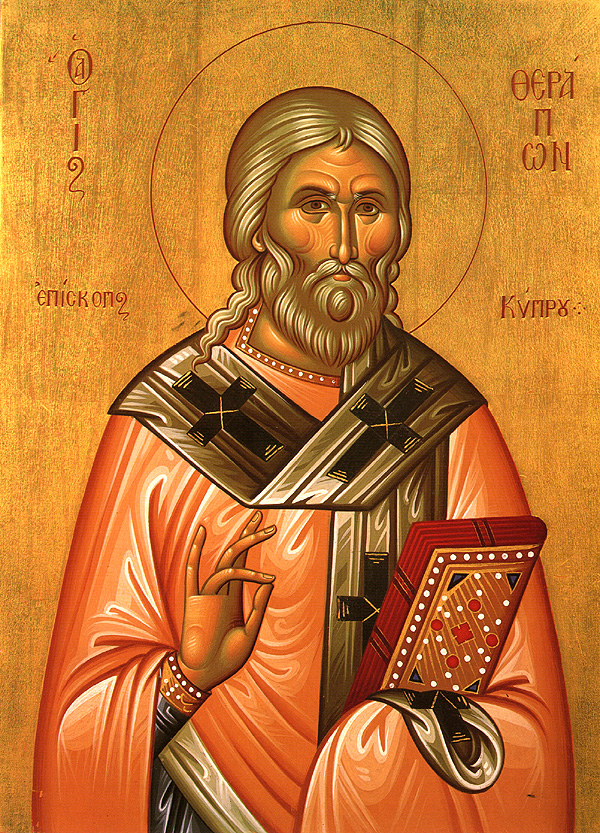
The Hieromartyr Therapon, Bishop of Cyprus, lived a life of asceticism in a monastery, and afterwards he served as a bishop on the island of Cyprus. At the time of the persecution under Diocletian (284-305), Saint Therapon bravely confessed the name of Christ and died a martyric death.
The relics of the hieromartyr were at first located on Cyprus and were glorified by numerous miracles. Later, in the year 806, they were transferred to Constantinople. The relics were moved because of a danger of invasion by the Saracens. As the ship sailed to Constantinople, myrrh began to flow from the relics, and travellers on the ship were miraculously saved during a storm by their prayers to Saint Therapon.
Upon arrival at Constantinople, the relics of the hieromartyr were placed in a temple built in honor of the Icon of the Mother of God of Eleousa or “the Merciful” (November 12).
In the year 806 the relics were again transferred into a temple built in honor of the Hieromartyr Therapon, myrrh flowed from them, and miracles took place. Through the prayers of Saint Therapon, those who are seriously ill are healed, and the dying restored to life.
Hieromartyr Urban, Pope of Rome
No information on the life of this saint is available at this time.
 Saint Peter Antiochian Orthodox Church