Monthly Archives: May 2025

Daily Readings for Saturday, May 31, 2025

6TH SATURDAY AFTER PASCHA

NO FAST

Hermias the Martyr at Comana, Eustathios, Patriarch of Constantinople, Eusebius and Haralambos the Monk-martyrs

ACTS OF THE APOSTLES 20:7-12

IN THOSE DAYS, when the apostles were gathered together to break bread, Paul talked with them, intending to depart on the morrow; and he prolonged his speech until midnight. There were many lights in the upper chamber where we were gathered. And a young man named Euthychos was sitting in the window. He sank into a deep sleep as Paul talked still longer; and being overcome by sleep, he fell down from the third story and was taken up dead. But Paul went down and bent over him, and embracing him said, "Do not be alarmed, for his life is in him." And when Paul had gone up and had broken bread and eaten, he conversed with them a long while, until daybreak, and so departed. And they took the lad away alive, and were not a little comforted.

JOHN 14:10-21

The Lord said to his disciples, "The words that I say to you I do not speak on my own authority; but the Father who dwells in me does his works. Believe me that I am in the Father and the Father in me; or else believe me for the sake of the works themselves.
Truly, truly, I say to you, he who believes in me will also do the works that I do; and greater works than these will he do, because I go to the Father. Whatever you ask in my name, I will do it, that the Father may be glorified in the Son; if you ask anything in my name, I will do it. "If you love me, you will keep my commandments. And I will pray to the Father, and he will give you another Counselor, to be with you for ever, even the Spirit of truth, whom the world cannot receive, because it neither sees him nor knows him; you know him, for he dwells with you, and will be in you.
I will not leave you desolate; I will come to you. Yet a little while, and the world will see me no more, but you will see me; because I live, you will live also. In that day you will know that I am in my Father, and you in me, and I in you. He who has my commandments and keeps them, he it is who loves me; and he who loves me will be loved by my Father, and I will love him and manifest myself to him.

Apostle Hermas of the Seventy

The Holy Apostle Hermas was a bishop in Philippopolis, Thrace. He was a Greek, but he spent some time in Rome. The holy Apostle Paul greets him in the Epistle to the Romans (Rom 16:14). The Apostle Hermas endured much grief from the pagans for preaching the Gospel, but he died in peace.

According to Tradition, Saint Hermas is the author of The Shepherd, an instructive book based on revelations from angels.

Martyr Hermias at Comana

Holy Martyr Hermias suffered for Christ in the city of Comana during the persecution under the emperor Antoninus Pius (138-161). The governor Sebastian, who was in Cappadocia to arrest Christians, urged the saint to offer sacrifice to the pagan gods, promising him honors and mercy from the emperor.

The old soldier bravely confessed his faith in Christ. After long exhortation, the governor gave orders to torture the saint. They beat him on the face so that the skin peeled from his face, and they threw him into a red-hot oven. When the oven was opened after three days, the martyr Hermias emerged from it unharmed.

The governor Sebastian ordered the sorcerer Marus to poison Saint Hermias with a potion. The poisonous drink did the saint no harm. A second goblet with even stronger poison also failed to kill the saint. The sorcerer believed in Christ the Savior, and was immediately beheaded. Saint Marus was baptized in his own blood, and received a martyr’s crown.

Saint Hermias was subjected to even more terrible tortures. They raked his body with sharp instruments, threw him in boiling oil, and gouged out his eyes, but he gave thanks to the Lord Jesus Christ. Then they suspended the martyr head downward. For three days he hung in this position.

People sent by the governor to verify his death found him alive. Struck by the miracle, they were blinded with fright and began to call out to the saint to help them. The holy martyr ordered the blind to approach him, and healed them in the Name of Jesus Christ.

In anger the governor ordered the skin flayed from the saint’s body, but he remained alive. Then the crazed Sebastian beheaded him with his own sword. Christians secretly buried the body of the martyr Hermias, whose relics bestowed numerous healings.

Martyr Philosophus at Alexandria

Holy Martyr Philosophus suffered for Christ in Alexandria during the persecution by the emperor Decius (249-251). They urged the youth to deny Christ, but he remained steadfast.

After suffering various tortures, he was placed on a soft bed, bound hand and foot, and a harlot was put in the room with him to tempt him to sin. In order not to yield to sin, the saint bit off his tongue and spit it in the harlot’s face. She was so horrified that she fled from him. The executioners, seeing the martyr’s bravery and fearlessness, beheaded the saint with a sword.

Hieromartyr Philosophos of St. Petersburg

The Hieromartyr Archpriest Philosophos (Philósophos) N. Ornatsky was born on May 21, 1860 in the churchyard of Novaya Yerga, Cherepovets County, Novgorod Governorate,1 into the family of a village priest. One of his brothers was married to the niece of Saint John of Kronstadt. Philosophos studied first in Kirillov Theological School, and then in the Novgorod Theological Seminary. In 1885 he graduated from the St. Petersburg Theological Academy with the degree of Candidate. In the summer of 1885, Philosophos married Elena Zaozerskaya, the daughter of the former subdeacon of Metropolitan Isidore, and soon he was ordained to the priesthood.

Initially, the young priest served as rector in the church of the orphanage of the Prince of Oldenburg, where he had once taught the Law of God (catechism). From 1892 to 1912, he served as the rector of the church at the Expedition for the Procurement of State Papers. For twenty-six years he was the chairman of the Society for the Dissemination of Religious and Moral Education in the Spirit of the Orthodox Church, successfully counteracting anti-church movements.

In 1893, Father Ornatsky was elected as a member of the St. Petersburg City Duma from the clergy and held this office until 1917. He took part in the establishment of shelters in the city: orphanages and almshouses. Through his efforts in St. Petersburg and the surrounding area, twelve churches were built, the largest of which was the church of the Resurrection of Christ at the Varshavsky railway station. In addition, we should also mention the churches of Saints Peter and Paul in Lesnoy, Saint Sergius of Radonezh on Novosivkovskaya Street, Saint Seraphim of Sarov behind the Narva outpost, the church of the Forerunner on the Vyborg side, Saint Gerasimos church, and Saint Isidore of Yuriev church.

The Saint lived quite modestly, though his was a large family (he had ten children). The whole array of public titles and offices which he held for the glory of God, did not bring in any means of subsistence. As Chairman of the Temple Building Committees, large sums of money passed through his hands, yet he was obliged to give private lessons in order to feed his family.

Father Ornatsky was also the editor and censor of such metropolitan spiritual magazines as "St. Petersburg Spiritual Herald" (published from 1894), "The Christian's Rest" (1901), and "Orthodox-Russian Word" (1902).

Father Philosophos was one of the closest companions of the Hieromartyr Metropolitan Benjamin (Kazansky), of Petrograd and Gdovsk, who, when he was a student of the Theological Academy, was actively engaged in preaching activities in the working neighborhoods of St. Petersburg. Bonds of spiritual friendship also sprang up between him and His Holiness Patriarch Tikhon.

For almost twenty years, Father Philosophos was the spiritual son of Saint John of Kronstadt, who often visited him at home and blessed all his undertakings for the good of the Church. The holy pastor entrusted Father Philosophos with being an intermediary in his correspondence with Saint Theophánēs, the Recluse of Vysha.

In 1913, the Archpriest was appointed to the post of rector of the Kazan Cathedral in St. Petersburg. During the First World War, Father Philosophos gave up his apartment to be used as an infirmary for wounded soldiers, and he and his family moved to a small state-owned room. Repeatedly, he went to the areas of hostilities, accompanying the transports with needed supplies for the soldiers, and trying with all his might to inspire and support the defenders of Russia.

His son Nicholas (born in 1886) was a military doctor who was part of the Ninth Russian Army; another son, Boris (born in 1887), was a staff captain of the 23rd Artillery Brigade, who graduated from the Konstantinov Artillery School, and fought heroically on the Austro-Hungarian front. Father Ornatsky's gift of preaching attracted those who were seeking the words of life, and he repeatedly urged his flock not to accept the corrupting ideas of Bolshevism. Knowing that Orthodoxy is at the heart of Russian life, Batiushka urged the intelligentsia to realize this. He never tired of repeating: "Our intellectuals have to become Russian."

During the Revolution, he saw his wife's sister's husband, Peter Skipetrov (+ January 20) shot before his eyes. At the funeral service, Father Philosophos gave a sermon, fearlessly denouncing the Bolsheviks. He repeatedly called upon his flock to surround the churches and to protect the shrines of their land. In January 1918, when Father Peter Skipetrov was killed at the Lavra, Father Philosophos organized a defense of the shrines of Saint Alexander Nevsky Lavra, organizing Cross Processions to it from all the churches of the capital.

On August 9, 1918, he was arrested, along with his two eldest sons, Nicholas and Boris. At the time of his arrest he was absolutely impassive and calm. Parishioners gathered by the thousands and walked along Nevsky Prospekt, demanding the release of their shepherd. The Chekists received the delegation of believers, promising to do what they asked. But on the same night (July 20, 1918), Father Philosophos was transported to prison in the city of Kronstadt. Around October 30, 1918, thirty-two men were brought from different prisons, all officers of the Imperial Army, who were being taken to be shot. Some were young, and others were older. One said he was a Colonel of the Guards. He told their escorts, "You will all perish, perhaps in twenty years, but you will perish like dogs. Russia will be Russia again, but you will perish." Their escorts said nothing. As they were being led to the place of execution, Father Philosophos read aloud the prayer for the departure of the soul over his two sons and the rest of the convicts.

Some say the place of execution was in Kronstadt, while others say it was not far from the Gulf of Finland, between Ligovo and Oranienbaum. The bodies of those who were shot were dumped into the bay. Father Ornatsky's body did not sink, but was tossed onto the shore by the waves near Oranienbaum. There it was buried secretly by the inhabitants.

Metropolitan Philotheos of Tobolsk, Enlightener of Siberia

The Most Reverend hierarch, the renowned Metropolitan of Siberia and Tobolsk, was from a noble, but poor family and received a theological degree at the then famous Kiev Theological Academy.

At the end of the course, he was ordained as a priest for one of the rural churches, but he was soon widowed. He was tonsured as a monk with the name Philotheos, and joined the brotherhood of the Kiev Caves Lavra.

In Siberia Christianity began to spread among the native pagans and Mohammedans from the very conquest of this country by the Russian state (in 1581), but conversions of the Siberian non-Russians to faith in Christ were generally insignificant and mostly individual.

The newly-baptized aliens left their former places of residence and their compatriots and, settling in Russian cities and villages, they entered into the Russian population, so their conversion did not influence the masses, who still remained solid pagans or Mohammedans. All this was known to the great converter of Russia, Tsar Peter I, who decided to take measures to enlighten the Siberian aliens with the light of Christianity and with them their neighbors, the Mongols and Chinese. To implement this wise plan, by a decree of June 18, 1700, the Sovereign commanded Metropolitan Barlaam Yasinsky of Kiev to “find” in the Russian cities and monasteries Archimandrites, Igumens, and other monks to occupy the cathedra of Tobolsk, which had remained vacant after Metropolitan Ignatius. He wanted “Pastors who are not only good and adorned with a blameless life, but also scholars who would take with them to Siberia any educated monks who were capable of learning the local languages. With God’s help, and with their help, the Metropolitan of Tobolsk could gradually lead the blind inhabitants of Siberia, Mongolia and China, who were stagnating in idolatry, to the knowledge of the true God. ”

Metropolitan Barlaam’s choice fell on the Novgorod-Seversk Archimandrite Demetrios Tuptalo, later Saint Demetrios, the wonderworker of Rostov, who was summoned to Moscow in early 1700. On March 23, at the age of 50, he was consecrated as the Metropolitan of Siberia and Tobolsk. Saint Demetrios ruled his Siberian flock for only nine months, but he did not live in Siberia.

When Saint Demetrios of Rostov was appointed to the Siberian Diocese, primarily for missionary purposes, he refused to go to Siberia for good and was transferred to the cathedra of Rostov. Then Archimandrite Philotheos Leschinsky was appointed as someone who was well-known for his pious life, high education and energy. He was consecrated as Metropolitan of Siberia and Tobolsk on January 4, 1702.

The Diocese of Tobolsk and Siberia is extensive today; but in the 17th and early 18th centuries it was incomparably more extensive; its borders were then in the north – the Arctic Sea, in the east – the Pacific Ocean, in the south – lands under the Chinese emperor, i.e. Dauria and so on, and the Kirghiz-kaysati steppe, in the west – the Urals and even part of European Russia, to the fortress of Beerskaya and Achitskaya. In general, the diocese occupied more than 300,000 square miles, a space in which there are currently more than nine independent dioceses with several vicariates.

The difficulty of administering such a huge diocese was increased by its complete lack of organization. But the new bishop of Siberia, Metropolitan Philotheos, energetically set to work. In the very first year of his stay in Siberia he followed the example of the pastors of the first centuries of Christianity, and decided to assemble a spiritual council from representatives of the Siberian clergy for the improvement of the Siberian Church.

Such a council took place in Tobolsk in December 1702. It developed a number of rules and instructions to the clergy regarding the streamlining of their pastoral work.

Then, the new Metropolitan of Siberia occupied himself with the Tobolsk episcopal residence, multiplying churches in Siberia, increasing the number of clergy, improving their condition, etc. They paid great attention to widespread education, and he first set an example by teaching foreign children in the religious schools he established.

In order to provide the diocese with good pastors, Metropolitan Philotheos started a “Slavic-Russian” school in the episcopal residence, and paid for it with his own money. This became the progenitor of all educational institutions in the city of Tobolsk. He also got several learned monks from Kiev as teachers for the school. When Metropolitan Philotheos took over the administration of the Tobolsk diocese, there were only 160 churches throughout its vast area. The saint made tremendous efforts to multiply of the churches of God in Siberia, and the Lord blessed these works with success. By the time he left the diocese there were already up to 448 churches and 37 monasteries.

Building new churches, he also took care of maintaining their well-being and beauty: he asked the government for permission to renovate some of the monasteries; he stopped issuing “wax, incense, and red wine” to the congregational and unpaid churches. At the cathedral, permission was given to form a choir of singers from the exiled Little Russians.

The missionary activity of Metropolitan Philotheos among the Siberian pagans was the main subject of his cares and labors and was crowned with good success, which the archpastor achieved, however, not during his administration of the diocese, but after his release from it, when he devoted himself entirely to the apostolic ministry. The hierarch began his educational activity from Kamchatka, where in 1705 he sent a missionary, Archimandrite Martinian, and after him the missionary monk Ignatius Kozyrevsky, but the preaching of these missionaries was not particularly successful, since the missionaries had to experience many obstacles. The hierarch’s second mission was sent in 1707 to the Ostyaks of the Berezovsky Territory, and the third to Mongolia, to the Kutuhta (high priest) of the Buddhists, to the town of Khalkhas.

The preaching of the Tobolsk Metropolitan among the Ostyaks, Voguls and other Siberian aliens was particularly successful. Accompanied by an insignificant retinue, with the then impossible ways of communication, the ever-memorable missionary spent most of his archpastoral ministry in Siberia in constant journeys among savages, teaching the Samoyeds, Voguls, Ostyaks, building churches in the far north, in the Kyrgyz territory in the Altai, then enlightening the distant sons of the outskirts of Siberia, Laplanders and Chukchi, helping them spiritually and materially. During all the time of his archpastoral ministry, he enlightened and baptized up to 400,000 foreigners, not to mention how many churches this great architect built across Siberia, how many parishes he founded, how many cornerstones he laid, so to speak, for the spread of Christianity among the pagans. It was not easy for Metropolitan Philotheos. Not to mention the incredible difficulties traveling along the wild outskirts, across steppes and marshes, taiga and northern tundra; not to mention all sorts of hardships associated with traveling under such conditions; the very life of the Metropolitan was repeatedly endangered.

Once he came to the Ostyaks of Burinsky. Those who were invited to be baptized replied that they were Muslims and no one had the right to baptize them. They left him and locked themselves in one large yurt.1 His Eminence nevertheless remained in their territory and from time to time he sent them missionaries who were with him to summon the Ostyaks. These same savages, in order to put an end to the matter all at once, according to the suggestion of the Tatar preacher hiding from them, seized their weapons, and fiercely rushed at the Orthodox missionaries. One of them was wounded in the head with an arrow, the other in the shoulder, and the third was punctured through and through by their hands. In fright, the unarmed Russians all fled from the shore onto the ships. The Metropolitan, who was then praying for the restraint of his enemies, was left alone on the shore. Then the Ostyak foreman Uman fired a rifle at the Metropolitan, but God preserved His Apostle-Preacher. The bullet passed through his clothing without touching his body.

On another occasion, the Metropolitan was threatened with danger in Konda. When he stayed in the Katyshev yurts to rest, a messenger came to him from Vogulsky Prince Satyga inviting him to hasten to the nomad camp because a lot of people had gathered there, desiring to be baptized. In fact, as it turned out, Satyga was deceived by a Tatar from Tobolsk, as though the Tsar himself wanted the Metropolitan’s death, and that there would be no punishment for the murderers. He intended to kill Philotheos and all those with him. But for now, the Metropolitan avoided danger. Sataga’s envoys were received kindly by the Metropolitan, and after receiving generous gifts, they informed Philotheos of the danger that threatened him. Horror overtook the missionaries, and many advised him to flee to Tobolsk. Some, however, argued that such cowardice would impair the future work of preaching the Word of God. The Metropolitan agreed with those who wished to stay, and it was decided to sail down to the nomad camp. Satyga was frightened when he learned that his plans were known to the Metropolitan. The intruders fled into the forest, and the remaining Voguls were willingly baptized.

Metropolitan Philotheos not only cared about the spiritual enlightenment of the pagans who converted, but he also tried to deliver those or other benefits to the converts in civil matters. At his request, those who were persecuted by the unbaptized were protected from being chased by guards; newly-baptized slaves were given their freedom, and those who were included in the head tax were exempted from it. Everyone was relieved of the obligation to supply carts, and received benefits in the payment of the yasak, and they were protected from insults and harassment by the Cossacks and minor officials. The Metropolitan distributed a significant amount of bread and money to the newly-baptized poor, and, in general, he helped as much as he could, anyway. The newly-baptized loved the Metropolitan as a father. When he visited them, they immediately went out to meet him and greeted him with cordiality and pleasure clearly written on their faces; willingly they heeded his instructions, and gave a firm promise to put his advice into practice. In general, they accepted the Metropolitan as their benefactor and their protector, as a man sent from God. The memory of Metropolitan Philotheos still lives among the aliens who were enlightened by him. For example, the Ostyaks, when they were asked about him, usually said: “He was a kindly old man; the people did not give offense; he loved the Ostyaks very, very much…. ”

In 1711, Metropolitan Philotheos was relieved of the administration of the diocese “due to illness,” and retired to the Tyumen Holy Trinity Monastery, where he received the schema and the name Theodore. The Metropolitan did not give up his archiepiscopal cathedra for rest and peace, now that he was burdened with age and illnesses, but for even more difficult feats of missionary work in the harsh north of Siberia. In June 1712, Metropolitan Schema-monk Theodore, with the blessing of the then Siberian archpastor, Metropolitan John Maximovitch (June 10), by his own desire and inclination, and at the suggestion of Prince M. Gagarin, who was then the governor of Siberia, who fulfilled the command of Peter I to begin preaching the Gospel among Siberians, and personally entered into this apostolic spiritual exploit(подвиг). In that year, the hierarch made his first missionary journey to Berezovsky territory along the rivers Irtysh, Ob and Sosve. Metropolitan John, who ruled the diocese, gave him capable employees, and Prince Gagarin supplied him from the treasury with a vessel for sailing, rowers, interpreters of the native languages, a guard for preserving the mission, the sum of 2000 rubles, and various gifts for newly-baptized.

According to the ukaz of Peter the Great, the evangelizer of Siberia wished to prepare the ground of this field on his previous journey; that is, to destroy the pagan places of worship with their idols, and to show the pagans how powerless their imaginary gods are to protect even themselves. With the help of God, Metropolitan Schema-monk Theodore managed to convince the Ostyaks, who lived near Samarov and in the yurts of Sherkal, to destroy the idols which were especially honored in those districts.

On June 10, 1715, Metropolitan John Maximovich of Tobolsk reposed, and the aged Metropolitan Schema-monk Theodore was again entrusted with the administration of the Siberian Diocese, but he did not stop his favorite missionary activity. Metropolitan Schema-monk Theodore was so fond of the enlightened Ostyaks that, a year before his death, being retired and ill for the second time, the patient visited Nizovsky territory again in 1726 and even reached far off Obdorsk. But this was to be the last journey of the ever-memorable hierarch.

During his second administration of the diocese, Metropolitan Theodore paid attention to the overseas Beijing mission, which from 1714 was headed by Archimandrite Hilarion of Lezhaysk, who was sent to the capital of China by imperial command, under Metropolitan John Maximovich. Upon the death of this Archimandrite, his successor Anthony Platkovsky was appointed head of the mission, and returned to Russia in 1721, because according to the suggestion of the Most Reverend Theodore and the Siberian governor, as well as the highest levels of government, it was decided to send a bishop to Beijing.

Even during his first administration of the Tobolsk diocese, he had a vicar bishop, Barlaam Kossovsky, the Bishop of Irkutsk from 1706. He lived in Irkutsk until 1714, when he returned to Moscow, and he was soon appointed to the archiepiscopal cathedra of Tver. Metropolitan Theodore’s second tenure in the Siberian Diocese lasted for five years. In 1720, at his own request, Tsar Peter I sent him a letter granting him retirement, in which he gave thanks to the holy hierarch of God for his zealous pastoral service, especially for his tireless and successful work in the missionary field. In addition, the archpastor received a retirement pension: 200 rubles in cash, 50 quarters of bread (3000 bushels of grain) per year. The exhausted hierarch settled in the Tyumen monastery which he himself had built. On May 31, 1727, he reposed at the age of 76, among the brethren and children of the newly-baptized.

Judging by his portraits, Metropolitan Philotheos was tall, lean, with a long nose, and gray hair. As to his character, in the words of the Siberian Chronicle of Cherepanov, “he was quiet, very indulgent to all, and had very little vanity.” His life was most active and simple; in the summertime, he often used to go on foot to Tobolsk to the Ivanov monastery and fished there in the Shantalyne River.

Living alone, he taught the children of the newly-baptized to read, write, and sing in his leisure hours. Many of them lived in his cell. Sometimes he composed Church hymns; for example – the Troparion and Kontakion of the wonderworker Saint Simeon of Verkhoturye (December 18), a Canon to the martyr Basil of Mangazea (March 23),2 and others, as well as poems of religious content. With his own hand, he wrote many of the documents which he issued, especially those concerning the newly-baptized, or pertaining to the episcopal estates.

Not only the residents of Tyumen, but also those from other places in Siberia, visit the grave of the pious archpastor with reverence and offer memorial services for him.3 After the Russian Revolution, his relics were secretly reburied. On October 21, 2006, the incorrupt relics of Saint Philotheos were found in Tyumen in the Ascension-Saint George Church.

Saint Philotheos is commemorated on May 31, and also on June 10, the Synaxis of Siberian saints.


1 A yurt was a sort of tepee made from animal skins.
2 See Orthodox Life # 2, 1972.
3 Source: The Russian Pilgrim, 1900 (Русский Паломник, 1900 г.)

Saint Apollonios (Apollo) of the Egyptian Thebaid

The Venerable Apollonios was the son of the pious parents, Aisi and Amani. According to one version, he had an elder brother, a monk, who died before his birth, who appeared to him in a dream. According to other sources, his parents were childless before the birth of Apollonios.

At the age of fifteen, the Saint retired to the inner desert of the Thebaïd (in Lower Egypt), along with his kinsman Abib. After fourteen years of the solitary life, Saint Apollonios was granted a Divine Revelation. A Voice said: “Apollonios, by your hands I will destroy the wisdom of the wise men of Egypt, and I will remove their knowledge, which is not true knowledge. You will also overthrow those who are reputed to be the wise men of Babel (the Babylon of Egypt), and all their service to devils (idolatry). Now go quickly to the desert, to the region which is near the habitations of men. There you shall beget for me a holy people, who will be exalted by their good works.”

Soon he became known for the multitude of miracles which he performed. He was the head of many monks; and he directed them profitably by his spiritual instructions.

During the reign of Julian the Apostate, God commanded the Saint to go to the near desert. In a spot close to Hermopolis he founded a monastery in which about five hundred monks would gather in the future.The brethren of the Monastery partook of the Holy Mysteries in the morning, and then in the afternoon they studied the Holy Scriptures. Only after sunset did they eat a little food, and then they went off into the desert alone, “in the darkness of the night, devoting themselves to the contemplation of God and His Holy Word,” while some of the monks remained in the monastery.

The monks would eat food just once a day. Apollonios condemned those who adhered to the harsher forms of austerity – these did not cut their hair and wore chains – regarding such things as a sign of vanity. At the same time, Apollonios himself was a strict faster, he ate boiled food on Sundays, and on other days he ate only wild plants.

Once one of the monks was forcibly recruited for military service and was locked up in a prison for refusing to serve. Apollonios and some other monks visited him in the prison. They comforted him and advised him to remain steadfast. When the centurion heard about this, he became very angry and locked Apollonios and his companions in prison, posting many guards. However, an angel of the Lord appeared at midnight, to open the doors of the prison, and the monks left unhindered.

Near the monastery were ten pagan settlements. Saint Apollonios was once a witness to a pagan ritual: priests of the idols, accompanied by a crowd, carried an idol around to the villages, “raging like bacchants.” By the Saint’s prayers, the idolaters were halted and could not continue the procession. Upon learning of the cause of the incident, many of them followed Apollonios, and the idol was destroyed. After this miracle, many pagans became Christians, and some of them even remained in the monastery. Soon there were almost no pagans left in the vicinity of the monastery.

When there was strife between two villages near the monastery, Saint Apollonios managed to convert a robber (who may have been the instigator of the quarrel) to Christ, and so peace was restored.

On another occasion, Apollonios was able to prevent bloodshed between the Christian and pagan villages, punishing the leader of the pagans with a terrible death. When famine occurred at the Thebaid, Apollonios supplied the inhabitants with food.

Saint Apollonios reposed in peace around the year 395, at very advanced age.

Much of the information about Saint Apollonios was recorded in chapter 9 of Saint Jerome’s History of the Monks of Egypt. The author had visited Apollonios shortly before the latter’s repose, along with his companions. They lived in his monastery for about a week.

Sozomon also provides some details about Apollonios in Book VI, chapter 29 of his Church History, citing Timothy, the primate of the Church of Alexandria, as the source for what we know about Saint Apollonios’s personal discipline as well as his “divine and marvelous deeds.” The Coptic Church has also preserved an ancient testimony of Saint Apollonios in a description of Abba Paul’s journey from Antinoë through the monasteries of Egypt, and another account from a Jacobite Synaxarion (in Arabic). This Synaxarion under 5 Amshire (January 30) calls Apollonios “an Equal of the angels.” The Coptic Church commemorates Saint Apollonios on 25 Papo (October 22).

Daily Readings for Friday, May 30, 2025

6TH FRIDAY AFTER PASCHA

ABSTAIN FROM MEAT, FISH, DAIRY, EGGS, WINE, OLIVE OIL

Isaacius, Abbot of the Monastery of Dalmatus, Macrina, grandmother of St. Basil the Great, Barlaam the Monk of Caesarea, Natalios the Martyr, Emilia, mother of Saint Basil the Great

ACTS OF THE APOSTLES 19:1-8

In those days, while Apollos was at Corinth, Paul passed through the upper country and came to Ephesus. There he found some disciples. And he said to them, "Did you receive the Holy Spirit when you believed?" And they said, "No, we have never even heard that there is a Holy Spirit." And he said, "Into what then were you baptized?" They said, "Into John's baptism." And Paul said, "John baptized with the baptism of repentance, telling the people to believe in the one who was to come after him, that is, Jesus." On hearing this, they were baptized in the name of the Lord Jesus. And when Paul had laid his hands upon them, the Holy Spirit came on them; and they spoke with tongues and prophesied. There were about twelve of them in all. And he entered the synagogue and for three months spoke boldly, arguing and pleading about the kingdom of God.

JOHN 14:1-11

The Lord said to his disciples, "Let not your hearts be troubled; believe in God, believe also in me. In my Father's house there are many rooms; if it were not so, would I have told you that I go to prepare a place for you? And when I go and prepare a place for you, I will come again and will take you to myself, that where I am you may be also. And you know the way where I am going." Thomas said to him, "Lord, we do not know where you are going; how can we know the way?" Jesus said to him, "I am the way, and the truth, and the life; no one comes to the Father, but by me. If you had known me, you would have known my Father also; henceforth you know him and have seen him.
Philip said to him, "Lord, show us the Father, and we shall be satisfied." Jesus said to him, "Have I been with you so long, and yet you do not know me, Philip? He who has seen me has seen the Father; how can you say, 'Show us the Father?' Do you not believe that I am in the Father and the Father in me? The words that I say to you I do not speak on my own authority; but the Father who dwells in me does his works. Believe me that I am in the Father and the Father in me.

Venerable Isaac, Founder of Dalmátos Monastery at Constantinople

Saint Isaac lived during the IV century, received the monastic tonsure and pursued ascetic labors in the desert. During the reign of Emperor Valens (364-378), a zealous adherent of the Arian heresy, there was a persecution of the Orthodox, and churches were closed and destroyed.

Hearing of the persecution, Saint Isaac left the wilderness and went to Constantinople to console and encourage the Orthodox, and to fight against the heretics. At that time, barbarian Goths along the Danube River were making war against the Empire. They seized Thrace and advanced toward Constantinople.

When Emperor Valens was leaving the capital with his soldiers, Saint Isaac cried out, “Emperor, reopen the churches of the Orthodox, and then the Lord will aid you!” But the Emperor, disdaining the Saint's words, continued confidently on his way. The Saint repeated his request and prophecy three times. The angry Emperor ordered Saint Isaac to be thrown into a deep ravine, filled with thorns and mud, from which it was impossible to escape.

Saint Isaac remained alive by God’s help, and when he emerged he overtook the Emperor and said, “You wanted to destroy me, but three Angels pulled me from the mire. Hear me, reopen the churches for the Orthodox and you shall defeat the enemy. If you do not heed me, then you shall not return. You will be captured and burnt alive.” The Emperor was astonished at the Saint's boldness and ordered his attendants Saturninus and Victor to seize him and hold him in prison until his return.

Saint Isaac’s prophecy was soon fulfilled. The Goths defeated and pursued the Greek army. The Emperor and his Arian generals took refuge in a barn filled with straw, and the attackers set it ablaze. After news of the Emperor's death was received in Constantinople, Saint Isaac was released and honored as a prophet.

Then the holy Emperor Theodosios the Great (379-395) came to the throne. On the advice of Saturninus and Victor, he summoned the Elder, treating him with great respect. Obeying his instructions, he banished the Arians from Constantinople and restored the churches to the Orthodox. Saint Isaac wanted to return to his desert, but Saturninus and Victor begged him not to leave the city, but to remain and protect it by his prayers.

Saturninus built a monastery for Saint Isaac in Constantinople, where monks gathered around him. Saint Isaac was the Monastery’s Igoumen and spiritual guide. He also nourished laypeople, and helped many of the poor and suffering.

When he had reached an advanced age, Saint Isaac made Saint Dalmátos (August 3) Igoumen. The Monastery was later named for Dalmátos.

Saint Isaac reposed in the year 383, and his memory is also celebrated on March 22.

The Monastery of Saint Isaac in Saint Petersburg is dedicated to this Saint.

Saint Emmeleίa

Saint Emmeleia was from a pious family of Caesarea in Cappadocia. Her father became a Martyr during the last persecutions. Her life was a good root which produced sweet fruits (her children) who emerged as prominent members of society, and most of them were also Saints of the Church, such as Basil the Great, Gregory of Nyssa, Peter of Sebasteίa, the nun Makrina, and the monk Naukratios. From a holy root come holy shoots; that is, from holy parents come blessed and holy children.

Saint Emmeleίa experienced many sorrows in her life, as is usually the case with the elect. Some of these were the death of her parents, even before she married, the death of her husband, as soon as their son Peter was born, the untimely death of her son Naukratios, and raising her children alone in the discipline and admonition of the Lord, but she faced these with exemplary faith, courage, and patience. She taught her children mainly by her own example. Along with her milk, she gave them the unadulterated milk of faith, and taught them the mysteries of the Church.

She ended her days in a Monastery, where her daughter Saint Makrina (July 19) was the Igoumeness.

Saint Emmeleίa is commemorated on January 1 in Slavic usage, and on May 30 in Greek usage.

Daily Readings for Wednesday, May 28, 2025

APODOSIS OF PASCHA

NO FAST

Apodosis of Pascha, Hieromartyr Eutychius, Bishop of Melitene, Nikitas, Bishop of Chalcedon, Helikonis the Martyr, Heladios the Hieromartyr of the East, Zacharias the New Martyr

ACTS OF THE APOSTLES 18:22-28

IN THOSE DAYS, when Paul had landed at Caesarea, he went up and greeted the church, and then went down to Antioch. After spending some time there he departed and went from place to place through the region of Galatia and Phrygia, strengthening all the disciples. Now a Jew named Apollos, a native of Alexandria, came to Ephesos. He was an eloquent man, well versed in the scriptures. He had been instructed in the way of the Lord; and being fervent in the spirit, he spoke and taught accurately the things concerning Jesus, though he knew only the baptism of John. He began to speak boldly in the synagogue; but when Priscilla and Aquila heard him, they took him and expounded to him the way of God more accurately. And when he wished to cross to Achaia, the brethren encouraged him, and wrote to the disciples to receive him. When he arrived, he greatly helped those who through grace had believed, for he powerfully confuted the Jews in public, showing by the scriptures that the Christ was Jesus.

JOHN 12:36-47

The Lord said to the Jews who came to him, "While you have the light, believe in the light, that you may become sons of light. When Jesus had said this, he departed and hid himself from them. Though he had done so many signs before them, yet they did not believe in him; it was that the word spoken by the prophet Isaiah might be fulfilled: "Lord, who has believed our report, and to whom has the arm of the Lord been revealed?" Therefore they could not believe. For Isaiah again said, "He has blinded their eyes and hardened their heart, lest they should see with their eyes and perceive with their heart, and turn for me to heal them." Isaiah said this because he saw his glory and spoke of him. Nevertheless, many even of the authorities believed in him, but for fear of the Pharisees they did not confess it, lest they should be put out of the synagogue: for they loved the praise of men more than the praise of God.
And Jesus cried out and said, "He who believes in me, believes not in me but in him who sent me. And he who sees me sees him who sent me. I have come as light into the world, that whoever believes in me may not remain in darkness. If any one hears my sayings and does not keep them, I do not judge him; for I did not come to judge the world but to save the world.

Leavetaking of Pascha

On Wednesday of the sixth week of Pascha, we celebrate the Leavetaking of the Feast. While most Feasts have their Leavetaking on the eighth day, Pascha, the Feast of Feasts, has its Leavetaking on the thirty-ninth day. The fortieth day is the Feast of the Lord’s Ascension, which marks the end of the Lord’s physical presence on earth. He does not abandon us, however. He has promised to be with us always, even until the end of the age (MT 20:28). As we sing in the Kontakion for Ascension, “Thou didst ascend in glory, O Christ our God, not being parted from those who love Thee, but remaining with them and crying: I am with you and no one will be against you.” There is a similar thought expressed in the Troparion for the Dormition: “In falling asleep, you did not forsake the world, O Theotokos.”

The services today are celebrated just as on the day of Pascha itself. The daily readings from Holy Scripture, of course, will differ. After the Dismissal at Liturgy, the paschal hymns are no longer sung. The prayer “O Heavenly King” is not said or sung until Pentecost.The Winding Sheet (Plaschanitsa) is taken from the altar and is put in its proper place. Even though today is a Wednesday, fish, wine, and oil are permitted.

Today we also commemorate the Finding of the Icon of the Mother of God “Of the Meeting” in Kalamata in the Peloponnesus.

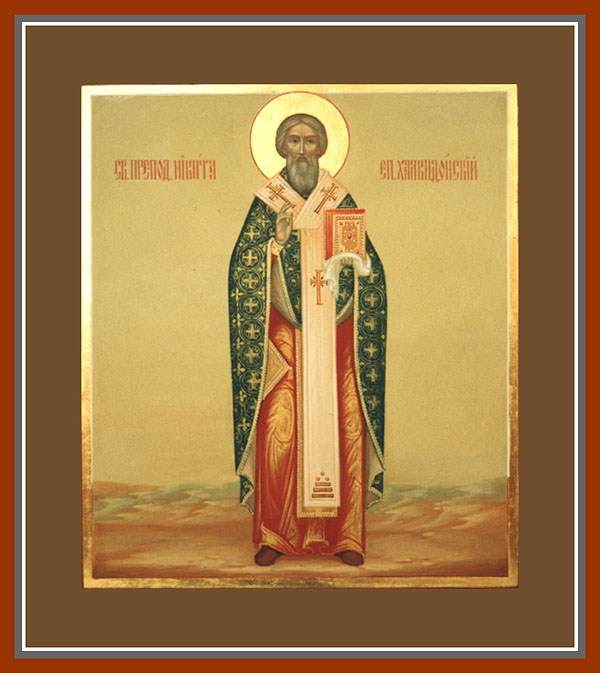
Saint Niketas, Bishop of Chalcedon

Saint Niketas (Nikḗtas), Bishop of Chalcedon, lived during the second half of the eighth century. For his God-pleasing life he was consecrated as Bishop of Chalcedon.

Saint Niketas distinguished himself by his charity, he always helped the poor, he lodged travelers in his home, he cared for orphans and widows, and he interceded for those who had been wronged.

During the reign of the iconoclast Leo the Armenian (813-820), Saint Niketas bravely denounced the Iconoclast heresy and urged his flock to venerate the holy icons of Christ, the Theotokos, and the saints. Saint Niketas endured much suffering from the impious emperor and his like-minded cohorts. He was subjected to tortures and sent off to exile.

The holy confessor Niketas died at the beginning of the ninth century. From his relics occurred many miracles of healing. The Canon of the service, written by the priest Joseph of Constantinople, also includes Saint Niketas’s brother, Saint Ignatius, among the saints.

Saint Ignatius the Wonderworker, Bishop of Rostov

Saint Ignatius was Bishop of Rostov, and shepherded his flock for twenty-six years. After his death on May 28, 1288, his body was brought to the church. Some people saw him leave his coffin, and float in the air above the church. He blessed the people and the city, then went back to his coffin.

Many miracles took place at his grave.

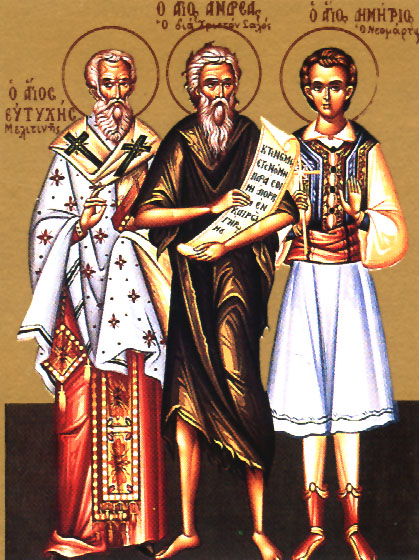
Saint Eutychius, Bishop of Melitene

The Hieromartyr Eutychius, Bishop of Melitene, was a co-worker with the Holy Apostles, and he suffered for Christ in the city of Melitene during the first century.

Martyr Heliconis of Thessalonica

The Holy Martyr Heliconis lived during the third century in the city of Thessalonica. Saint Heliconis arrived in the city of Corinth during a persecution of Christians, and urged the pagans to stop serving senseless idols and instead to worship the one true God, the Creator of the universe.

She was arrested and brought before the governor Perinus, who vainly attempted to persuade the saint to offer sacrifice to idols, both by flattery and by threats. The holy martyr was subjected to tortures, but she bravely endured them. Then they threw her into a hot furnace, but she emerged from it unharmed, because an angel of the Lord had cooled the flames.

Thinking the saint was a sorceress, the governor invented new torments for her. They tore the skin from her head, and burned her breasts and head with fire. After halting the torture, the judge again attempted to urge Saint Heliconis to offer sacrifice to the idols, promising her honors and the title of priestess. The saint seemed to consent, and the pagan priests and the people led her to the pagan temple with the sounds of trumpet and drum.

At the saint’s request, they left her there alone. Saint Heliconis, filled with heroic strength, cast down and smashed all the idols. When some time had passed, the pagan priests entered their temple. Seeing the destruction, they were even more enraged and cursed the holy virgin shouting, “Put the sorceress to death!” They beat the holy martyr, and then they threw her into prison, where she spent five days.

Christ the Savior and the holy Archangels Michael and Gabriel appeared to the holy martyr in prison and healed her of her wounds. Finally, they sent the saint to be torn apart by wild beasts. They set loose three hungry lions upon her, but the beasts came up to the martyr meekly and lay down at her feet. The pagan mob shouted and cried, “Death to the sorceress.”

But at this point the lions jumped out of the arena and pounced on the people, who fled in terror. Not knowing what else to do, the governor ordered that Saint Heliconis be beheaded. The saint went to execution with joy and heard a Voice summoning her to the heavenly habitations.

She contested in the year 244, and her body was reverently buried by Christians.

Hieromartyr Helladius, Bishop in the East

The Hieromartyr Helladius the Bishop was thrown into fire because of his faith in Christ, but he remained unharmed. He died as a martyr from the terrible beating inflicted upon him.

In the Service to Saint Helladius it is said that the Lord Jesus Christ visited him in prison and healed him of his wounds. According to certain sources, Saint Helladius suffered under the Persians during their invasion into the Eastern part of the Roman Empire in the fourth century.

Saint Germanus, Bishop of Paris

Saint Germanus was born near Autun in 496. He was abbot of Saint Symphorian’s monastery at Autun, and was made Bishop of Paris around 536. He was tireless and courageous in his efforts to end civil strife and to restrain the viciousness of the Frankish kings, though he was not very successful in this. Saint Radegund (August 13) appealed to him for protection from her cruel husband King Chlotar I.

Saint Germanus founded a monastery at Paris, and was buried in its church after his death in 576. This is the renowned monastery of Saint Germaine-des-Pres.

Saint Sophronius the Bulgarian

The Venerable Sophronios (Stephen in the world) was from the village of Penkovts (Пенкьовци) in Bulgaria, and lived during the XV and XVI centuries. He was a Hieromonk at the Penkovsky Monastery near Sofia. Learning that Turkish invaders were about to attack the monastery, he fled to Vlahia (in what is now Romania) and lived in a monastery near the Danube River.

Later, the Saint devoted himself to continual ascetical labors of fasting, vigil, and prayer, in the monastic community of Rusensk, which may have been founded by Saint Joachim (January 18), the Patriarch of Trnovo.

Saint Sophronios reposed peacefully on May 28, 1510, and was known for his philanthropy and almsgiving. Some sources say that he was murdered by a servant, and that after three years his relics were found incorrupt.

New Martyr Demetrius

No information available at this time.

Icon of the Mother of God of Nicea

The Nicaea Icon of the Mother of God appeared in the city of Nicaea in Asia Minor in the year 304, as the city was under siege. One of the soldiers, whose name was Constantine, saw the Icon of the Theotokos and threw a stone at it. Then he began to trample it underfoot. That night, the Mother of God appeared in a dream to the soldier who had perpetrated this sacrilege and said: "You have insulted me most grievously, and it shall lead to your death."

The following day, during the battle, the impious man was struck in the head with a stone and fell down dead.

This event was mentioned by the Fathers of the First Ecumenical Council in 325, and they ordained that the following hymn, "Your womb has become a Holy Table, which held the Heavenly Bread. Those who partake of it shall not die, as the Nourisher of all has said, O Theotokos." should be sung before the Nicaea Icon of the Mother of God.

Christ stated that He is the Bread of Life which had come down from Heaven when He spoke to the crowd at Capernaum (John 6:50).

This Theotokion is sung at Mid-Pentecost during Ode 5 of the Second Canon (Tone 8), which was composed by Saint Andrew of Crete. In some Orthodox Prayer Books, it is one of the Prayers After the Evening Meal.

The Nicaea Icon is very similar in appearance to the “Inexhaustible Chalice” Icon (May 5).

Saint William of Gellone

No information available at this time.

Daily Readings for Tuesday, May 27, 2025

6TH TUESDAY AFTER PASCHA

NO FAST

The Holy Hieromartyr Helladius, John the Russian of Evia, Theodora the Virgin-martyr & Didymos the Martyr, Venerable Bede

ACTS OF THE APOSTLES 17:19-28

IN THOSE DAYS, the Athenians took hold of Paul and brought him to the Areopagos, saying, “May we know what this new teaching is which you present? For you bring some strange things to our ears; we wish to know therefore what these things mean.” Now all the Athenians and the foreigners who lived there spent their time in nothing except telling or hearing something new. So Paul, standing in the middle of the Areopagos, said: “Men of Athens, I perceive that in every way you are very religious. For as I passed along, and observed the objects of your worship, I found also an altar with this inscription, ‘To an unknown god.’ What therefore you worship as unknown, this I proclaim to you. The God who made the world and everything in it, being Lord of heaven and earth, does not live in shrines made by man, nor is he served by human hands, as though he needed anything, since he himself gives to all men life and breath and everything. And he made from one every nation of men to live on all the face of the earth, having determined allotted periods and the boundaries of their habitation, that they should seek God, in the hope that they might feel after him and find him. Yet he is not far from each one of us, for ‘In him we live and move and have our being.’

JOHN 12:19-36

At that time, the Pharisees took counsel against Jesus and said to one another, "You see that you can do nothing; look, the world has gone after him.
Now among those who went up to worship at the feast were some Greeks. So these came to Philip, who was from Bethsaida in Galilee, and said to him, "Sir, we wish to see Jesus." Philip went and told Andrew; Andrew went with Philip and they told Jesus. And Jesus answered them, "The hour has come for the Son of man to be glorified. Truly, truly, I say to you, unless a grain of wheat falls into the earth and dies, it remains alone; but if it dies, it bears much fruit. He who loves his life loses it, and he who hates his life in this world will keep it for eternal life. If any one serves me, he must follow me; and where I am, there shall my servant be also; if any one serves me, the Father will honor him.
Now is my soul troubled. And what shall I say? 'Father, save me from this hour?' No, for this purpose I have come to this hour. Father, glorify your name." Then a voice came from heaven, "I have glorified it, and I will glorify it again." The crowd standing by heard it and said that it had thundered. Others said, "An angel has spoken to him." Jesus answered, "This voice has come for your sake, not for mine. Now is the judgment of this world, now shall the ruler of this world be cast out; and I, when I am lifted up from the earth, will draw all men to myself." He said this to show by what death he was to die. The crowd answered him, "We have heard from the law that the Christ remains for ever. How can you say that the Son of man must be lifted up? Who is this Son of man?" Jesus said to them, "The light is with you for a little longer. Walk while you have the light, lest the darkness overtake you; he who walks in the darkness does not know where he goes. While you have the light, believe in the light, that you may become sons of light.

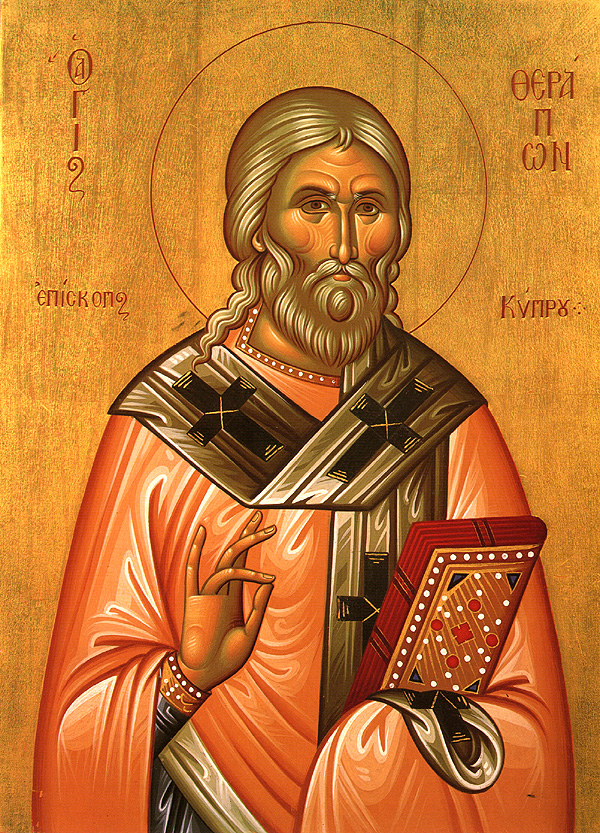
Hieromartyr Therapon, Bishop of Sardis

The Hieromartyr Therapon, Bishop of Sardis suffered for Christ during the third century (the city of Sardis was in Lydia, Asia Minor). In fulfilling his priestly service, Saint Therapon enlightened many of the pagan Greeks with the light of the Christian Faith and baptized them. For this, he was brought to trial before the governor Julian and fearlessly declared himself a Christian bishop.

They threw him into prison, where he languished with hunger and thirst, and then they gave him over to cruel tortures. These torments did not break the saint’s valiant confession of faith. They led the saint off in chains to the city of Sinaion in Phrygia, and then to Ancyra.

In these cities they tortured him again. They took him to the River Astala, where they stretched him naked upon the ground, fastened to four stakes, and fiercely beat him. After this torture, they took the passion-bearer to the outskirts of the Satalia diocese, part of the Sardis metropolitanate, and here after long beatings Saint Therapon ended his martyric contest.

The stakes to which the saint had been tied, and which were soaked with his blood, put forth green shoots and grew into large trees, whose leaves were found to have curative powers. Many people received healing through them.

Translation of the relics of Venerable Nilus of Stolobensk

Saint Nilus of Stolobensk reposed on December 7, 1554 (see his Life under December 7).

Many years afterwards, hieromonk Germanus came to the island of Lake Seliger, where the holy ascetic had struggled, and immediately after him the hill-dweller and wanderer Boris. They settled together on the island and built a church in honor of the Theophany, with a chapel dedicated to Saint Basil of Moscow (August 2).

On the site where Saint Nilus had struggled, a monastery named for him was built. An icon of Saint Nilus was painted by the monks of the Orshin monastery, and numerous miracles of healings of the sick began to occur at the saint’s grave.

Later, Saint Nectarius, Archbishop of Sibirsk and Tobolsk lived at the monastery, and he decided to build a stone church to replace the former wooden one. When the foundations were dug, the earth crumbled away and revealed the incorrupt relics of Saint Nilus. The Uncovering of the Relics occurred on May 27, 1667, and a Feast day was established in honor of the event.

Saint John the Russian and Confessor, whose relics are on the island of Euboia

The Holy Confessor John the Russian was born in Little Russia around 1690, and was raised in piety and love for the Church of God. Upon attaining the age of maturity he was called to military service, and he served as a simple soldier in the army of Peter I and took part in the Russo-Turkish War. During the Prutsk Campaign of 1711 he and other soldiers were captured by the Tatars, who handed him over to the commander of the Turkish cavalry. He took his Russian captive home with him to Asia Minor, to the village of Prokopion.

The Turks tried to convert the Christian soldiers to the Moslem faith with threats and flattery, but those who resisted were beaten and tortured. Some, alas, denied Christ and became Moslems, hoping to improve their lot. Saint John was not swayed by the promise of earthly delights, and he bravely endured the humiliation and beatings.

His master tortured him often in the hope that his slave would accept Islam. Saint John resolutely resisted the will of his master saying, “You cannot turn me from my holy Faith by threats, nor with promises of riches and pleasures. I will obey your orders willingly, if you will leave me free to follow my religion. I would rather surrender my head to you than to change my faith. I was born a Christian, and I shall die a Christian.”

Saint John’s bold words and firm faith, as well as his humility and meekness, finally softened the fierce heart of his master. He left John in peace, and no longer tried to make him renounce Christianity. The saint lived in the stable and took care of his master’s animals, rejoicing because his bed was a manger such as the one in which the Savior was born.

From morning until late evening the saint served his Turkish master, fulfilling all his commands. He performed his duties in the winter cold and summer heat, half naked and barefoot. Other slaves frequently mocked him, seeing his zeal. Saint John never became angry with them, but on the contrary, he helped them when he could, and comforted them in their misfortune.

The saint’s kindness and gentle nature had its effect on the souls of both the master and the slaves. The Agha and his wife came to love him, and offered him a small room near the hayloft. Saint John did not accept it, preferring to remain in the stable with the animals. Here he slept on the hay, covered only by an old coat. So the stable became his hermitage, where he prayed and chanted Psalms.

Saint John brought a blessing to his master simply by living in his household. The cavalry officer became rich, and was soon one of the most powerful men in Prokopion. He knew very well why his home had been blessed, and he did not hesitate to tell others.

Sometimes Saint John left the stable at night and went to the church of the Great Martyr George, where he kept vigil in the narthex. On Saturdays and Feast days, he received the Holy Mysteries of Christ.

During this time Saint John continued to serve his master as before, and despite his own poverty, he always helped the needy and the sick, and shared his meager food with them.

One day, the officer left Prokopion and went to Mecca on pilgrimage. A few days later, his wife gave a banquet and invited her husband’s friends and relatives, asking them to pray for her husband’s safe return. Saint John served at the table, and he put down a dish of pilaf, his master’s favorite food. The hostess said, “How much pleasure your master would have if he could be here to eat this pilaf with us.” Saint John asked for a dish of pilaf, saying that he would send it to his master in Mecca. The guests laughed when they heard his words. The mistress, however, ordered the cook to give him a dish of pilaf, thinking he would eat it himself, or give it to some poor family.

Taking the dish, Saint John went into the stable and prayed that God would send it to his master. He had no doubt that God would send the pilaf to his master in a supernatual manner. The plate disappeared before his eyes, and he went into the house to tell his mistress that he had sent the pilaf to his master.

After some time, the master returned home with the copper plate which had held the pilaf. He told his household that on a certain day (the very day of the banquet), he returned from the mosque to the home where he was staying. Although the room was locked, he found a plate of steaming pilaf on the table. Unable to explain who had brought the food, or how anyone could enter the locked room, the officer examined the plate. To his amazement, he saw his own name engraved on the copper plate. In spite of his confusion, he ate the meal with great relish.

When the officer’s family heard this story, they marveled. His wife told him of how John had asked for a plate of pilaf to send to his master in Mecca, and how they all laughed when John came back and said that it had been sent. Now they saw that what the saint had said was true (Compare the story of Habakkuk, who miraculously brought a dish of pottage to Daniel in the lions’ den [Dan. 14:33-39], in the Septuagint).

Toward the end of his difficult life Saint John fell ill, and sensed the nearness of his end. He summoned the priest so that he could receive Holy Communion. The priest, fearing to go to the residence of the Turkish commander openly with the Holy Gifts, enclosed the life-giving Mysteries in an apple and brought them to Saint John.

Saint John glorified the Lord, received the Body and Blood of Christ, and then reposed. The holy Confessor John the Russian went to the Lord Whom he loved on May 27, 1730. When they reported to the master that his servant John had died, he summoned the priests and gave them the body of Saint John for Christian burial. Almost all the Christian inhabitants of Prokopion came to the funeral, and they accompanied the body of the saint to the Christian cemetery.

Three and a half years later the priest was miraculously informed in a dream that the relics of Saint John had remained incorrupt. Soon the relics of the saint were transferred to the church of the holy Great Martyr George and placed in a special reliquary. The new saint of God began to be glorified by countless miracles of grace, accounts of which spread to the remote cities and villages. Christian believers from various places came to Prokopion to venerate the holy relics of Saint John the Russian and they received healing through his prayers. The new saint came to be venerated not only by Orthodox Christians, but also by Armenians, and even Turks, who prayed to the Russian saint, “Servant of God, in your mercy, do not disdain us.”

In the year 1881 a portion of the relics of Saint John were transferred to the Russian monastery of the holy Great Martyr Panteleimon by the monks of Mount Athos, after they were miraculously saved by the saint during a dangerous journey.

Construction of a new church was begun in 1886, through the contributions of the monastery and the inhabitants of Prokopion. This was necessary because the church of the holy Great Martyr George, where the relics of Saint John were enshrined, had fallen into disrepair.

On August 15, 1898 the new church dedicated to Saint John the Russian was consecrated by the Metropolitan John of Caesarea, with the blessing of the Ecumenical Patriarch Constantine V.

In 1924, an exchange of the populations of Greece and Turkey took place. Many Moslems moved out of Greece, and many Christians moved out of Turkey. The inhabitants of Prokopion, when they moved to the island of Euboia, took with them part of the relics of Saint John the Russian.

For several decades the relics were in the church of Saints Constantine and Helen at New Prokopion on Euboia, and in 1951 they were transferred into a new church dedicated to Saint John the Russian. Thousands of pilgrims flocked here from all the corners of Greece, particularly on his Feast, May 27. Saint John the Russian is widely venerated on Mount Athos, particularly in the Russian monastery of Saint Panteleimon.

Saint John’s help is sought by travelers, and by those transporting things.

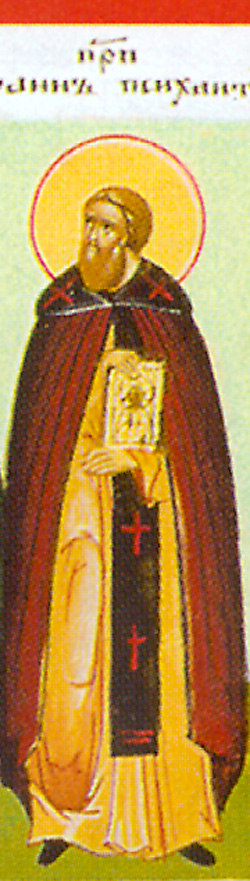
Venerable Therapon, Abbot of White Lake

Saint Therapon of White Lake, Wonderworker of Luzhetsk, in the world Theodore, was born in the year 1337 at Volokolamsk into the noble Poskochin family. From his childhood, he was raised in faith and piety, which he displayed throughout his life as a holy ascetic.

At the age of forty he was tonsured a monk by the igumen of Moscow’s Simonov monastery, Saint Theodore, a nephew of Saint Sergius (November 28). As a monk in this monastery Therapon became close to Saint Cyril of White Lake (June 9). Together they passed through their ascetic struggles of prayer and fasting. They were under the spiritual guidance of Saint Sergius of Radonezh (September 25 and July 5), who visited the monastery to instruct the brethren. Saint Therapon went north, to the frontier of White Lake, on monastery matters. The harsh northern land attracted the ascetic, and he decided to remain there for his ascetic endeavors.

After returning with Saint Cyril, to whom the Mother of God had appeared, also ordering him to go to the north, Saint Therapon received the blessing of the igumen to go to White Lake. For a while the ascetics lived together in a cell that they had built, but later and by mutual consent, Saint Therapon moved to another place fifteen versts away from Cyril, between two lakes, Borodava and Pava.

Having cleared a small plot for a garden, and building a cell in the deep forest near a river, Saint Therapon continued his ascetic efforts as a hermit in silence. At first he endured much deprivation and tribulation in his solitude. More than once he was set upon by robbers, who tried to chase away or even kill the ascetic. In time monks began to gather to the saint, and the wilderness place was gradually transformed into a monastery, afterwards called the Theraponov.

In 1398 Saint Therapon built a wooden church in honor of the Nativity of the Most Holy Theotokos, and the monastery was gradually set in order. The monks toiled together with their saintly guide building cells, copying books, and adorning the church. (At the end of the fifteenth century on the place of the former wooden church a stone cathedral was built in honor of the Nativity of the Most Holy Theotokos. It was painted in the years 1500-1501 by the renowned Russian iconographer Dionysius and his sons, Vladimir and Theodosius. The frescoes are devoted to the Praise of the Most Holy Theotokos. The unique frescoes of the Saint Therapon monastery have been preserved up to the present time and are an outstanding memorial of Russian church art and painting, having world significance).

A cenobitic monastic rule was introduced at the monastery, strictly observed by the monks. Saint Therapon declined to head the monastery out of humility, and instead entrusted the position of igumen to one of his disciples. The holy ascetic, endowed with the gift of counsel, turned to his friend, Saint Cyril of White Lake for spiritual guidance just as before. News about the ascetic deeds of the saint spread far beyond the White Lake frontier.

At the beginning of the fifteenth century, the lands on which the Saint Cyril and Saint Therapon monasteries were built, were part of the holdings of the Mozhaisk prince Andrew (1382-1432), son of Great Prince Demetrius Donskoy (1363-1389). In the year 1408 Prince Andrew Dimitrievich, learning of the high level of spiritual life of the White Lake ascetic, asked the monastic Elder Therapon to establish a monastery in the city of Mozhaisk.

It was difficult for the saint to leave his own monastery, where he had labored for more than ten years. Saint Therapon was met at Mozhaisk with great honor. Soon, not far from Mozhaisk, in the locality of Lushko, Saint Therapon founded his second monastery on a hilly part of the right bank of the Moscow River. Its chief temple was in honor of the Nativity of the Most Holy Theotokos, in memory of the White Lake monastery. Prince Andrew, esteeming the saint for his true humility, provided generous help in the construction and establishment of the monastery. With the blessing of Saint Photius, Metropolitan of Moscow (July 2 and May 27), the monastery was to be headed by an archimandrite, and Saint Therapon was elevated to the rank of archimandrite.

Saint Therapon dwelt at this new monastery for eighteen years. He reposed at an advanced age, on May 27, 1426. His body was buried at the north wall of the cathedral of the Nativity of the Most Holy Theotokos. Over his grave a church was built in honor of Saint John of the Ladder (March 30), and renamed in 1730 for Saint Therapon.

Veneration of the saint began soon after his death. In 1514, the incorrupt relics of the holy ascetic were uncovered and glorified by numerous miracles. After the Moscow Council of 1547 the canonization of Saint Therapon of Mozhaisk took place after the igumen of the Saint Therapon monastery brought to Metropolitan Macarius (1543-1564) a Life of the saint.

Among the numerous disciples and conversers of Saint Sergius of Radonezh, the Russian Church venerates the memory of Saint Therapon, who in following the counsel of his great teacher and guide, combined the ascetic feats of silence and solitude with active service to his neighbor and the spiritual enlightenment of his Fatherland.

The memory of Saint Therapon is celebrated twice, May 27 (his repose in 1426), and December 27 (Uncovering of his relics, 1514).

Translation of the relics of Saints Cyprian, Photius, and Jonah, Metropolitans of Moscow and All Russia

The Uncovering and Transfer of Relics of Holy Hierarchs Cyprian, Photius and Jonah occured on May 27, 1472 during the construction of the new stone Dormition cathedral in the Kremlin, under Metropolitan Philip (January 9) and Great Prince Ivan III (1462-1505). The saints are also commemorated separately: Metropolitan Cyprian (September 16), Metropolitan Photius (July 2), Metropolitan Jonah (March 31).

Venerable Therapon, Abbot of Monza

There is no information about the Saint's birth and early years of his life. He began his contests (podvigs) in Moscow (it is likely that he was a Holy Fool, emulating Blessed Basil of Moscow), then he went to the Monastery of the Universal Exaltation of the Holy Cross at Kostroma, where, after his monastic tonsure, he lived for thirteen years. Even during his lifetime, the Saint was renowned for his miracles.

One day the Venerable Therapon (Therápon) appeared in a dream to two monks of the Saint Paul of Obnora Monastery, Paphnoutios and Addrian. and ordered them to found a Monastery on the banks of the Monza River (near Soligalich). Avoiding the glory of man, Father Therapon retired from the Holy Cross Monastery and lived for some time as a hermit. When the Monastery on the Monza River was built by Elder Adrian (May 5), the monk glorified him by two miracles: appearing in a dream to a fisherman from Soligalich and to the blacksmith from Bui, whose sons were sick, he predicted that their children would be healed in the newly built Monastery of the Annunciation on the Monza River. And, indeed, brought to the monastery, both young men were healed.

After some time Father Therapon himself came to the Annunciation Monastery and asked the Igoumen, Elder Adrian, to become his Spiritual Father. During Confession, Adrian was shocked by Therapon's spiritual purity and by the power of his faith. The two years of Therápon's sojourn in the Monastery of Monza were a time of great humility, meekness and ascetic feats. Annunciation Monastery was always dear to Father Therapon: he was wondrous, he contributed to his arrangement and transfer to a new place, protected him from ill-wishers, miraculously sought him out means for its maintenance.

Foreseeing the day of his death, the Saint bade farewell to the brethren and reposed peacefully on December 12, 1597. He asked that he, who had already died, be given the Holy Water from Theophany. Granting the Saint's request, he was given the Holy Water, and he swallowed it. The Monastery Chronicle describes numerous healings which took place at the Saint's tomb. Once the Saint saved some ships from destruction while they were passing through the rapids on the Kostroma River, directly opposite Annunciation Monastery, and some saw a handsome old man sitting on the stern every plow and ruler in a dangerous place. Saint Therapon also appeared in a dream to the Igoumen of the Monastery, and predicted the famine of 1601 and ordered that more bread to be stored.

Twenty years after the Saint's repose, his incorrupt relics were discovered, and even his vestments were intact.

Saint Therapon is commemorated on May 27 (His Name Day), February 5 (Synaxis of the Kostroma Saints), and December 12 (Repose).

Virgin Martyr Theodora and Martyr Didymus the Soldier, of Alexandria

The Holy Martyrs Theodora the Virgin and Didymus the Soldier suffered for Christ during the persecution against Christians under the emperor Diocletian (284-305), in the city of Alexandria in either the year 303 or 304.

The Virgin Martyr Theodora, standing trial before the prefect Eustratius of Alexandria, bravely confessed herself a Christian. When the prefect asked why she had not married, the saint replied that she had dedicated herself to God, and had resolved to remain a virgin for the name of Christ.

Eustratius ordered the holy virgin to be taken to prison, giving her three days to make up her mind, and he threatened to have her taken to a brothel if she persisted in her disobedience. Brought again to trial three days later, Saint Theodora remained as resolute in her faith as before.

The saint was taken to the brothel, where dissolute youths began to argue which of them should be the first to have her. At this moment the Christian Didymus, dressed in soldier’s garb, entered the brothel without hindrance. He chased the frightened profligates out and saved the holy virgin, giving her his clothes so she could escape.

Upon learning what had happened, Eustratius interrogated Saint Didymus. Brought before the angry judge, Saint Didymus told how he had set the holy virgin free, and for this he was sentenced to death. Saint Theodora appeared at the place of execution, and said that she wanted to die with Saint Didymus. The prefect gave orders to execute both of them . The first to bend the neck beneath the sword was the holy martyr Theodora, and then the holy Martyr Didymus. The bodies of the martyrs were then burned.

Venerable Bede, the Church Historian

Saint Bede was a church historian who recorded the history of Christianity in England up to his own time. He was probably born around 673 in Northumbria. We do not know exactly where he was born, but it is likely that it was somewhere near Jarrow.

When he was seven, Bede was sent to Saint Benedict Biscop (January 12) at the monastery of Saint Peter at Wearmouth to be educated and raised. Then he was sent to the new monastery of Saint Paul founded at Jarrow in 682, where he remained until his death. There he was guided by the abbot Saint Ceolfrith (September 25), who succeeded Saint Benedict in 690, ruling both Wearmouth and Jarrow.

There is an incident in the anonymous Life of Ceolfrith which may refer to the young Bede. A plague swept through Ceolfrith’s monastery in 686, taking most of the monks who sang in the choir for the church services. Only the abbot and a young boy raised and educated by him remained. This young boy “is now a priest of the same monastery and commends the abbot’s admirable deeds both verbally and in writing to all who desire to learn them.”

Grieved by this catastrophe, Ceolfrith decided that they should sing the Psalms without antiphons, except at Matins and Vespers. After a week of this, he went back to chanting the antiphons in their proper place. With the help of the boy and the surviving monks, the services were performed with difficulty until other monks could be brought in and trained to sing.

Saint Bede was ordained as a deacon when he was nineteen, and to the holy priesthood at the age of thirty by Saint John of Beverley (May 7), the holy Bishop of Hexham (687), and later (705) of York. Bede had a great love for the church services, and believed that since the angels were present with the monks during the services, that he should also be there. “What if they do not find me among the brethren when they assemble? Will they not say, ‘Where is Bede?’

Bede began as a pupil of Saint Benedict Biscop, who had been a monk of the famous monastery at Lerins, and had founded monasteries himself. Saint Benedict had brought many books with him to England from Lerins and from other European monasteries. This library enabled Bede to write his own books, which include biblical commentary, ecclesiastical history, and hagiography.

Bede was not an objective historian. He is squarely on the Roman side in the debate with Celtic Christianity, for example. He was, however, fair and thorough. His books, derived from “ancient documents, from the traditions of our ancestors, and from my own personal knowledge” (Book V, 24) give us great insight into the religious and secular life of early Britain. To read Saint Bede is to enter a world shaped by spiritual traditions very similar to those cherished by Orthodox Christians. These saints engage in the same heroic asceticism shown by saints in the East, and their holiness fills us with love and admiration. Christians were expected to fast on Wednesdays and Fridays, and there was a forty day Nativity Fast (Book IV, 30).

Saint Bede became ill in 735. For about two weeks before Pascha, he was weak and had trouble breathing, but experienced little pain. He remained cheerful and gave daily lessons to his students, then spent the rest of the day singing Psalms and giving thanks to God. He would often quote the words of Saint Ambrose, “I have not lived in such a way that I am ashamed to live among you, and I do not fear to die, for God is gracious” (Paulinus, Life of Saint Ambrose, Ch. 45).

In addition to giving daily lessons and chanting the Psalms, Saint Bede was also working on an Anglo-Saxon translation of the Gospel of Saint John, and also a book of extracts from the writings of Saint Isidore of Seville (April 4). On the Tuesday before the Feast of the Lord’s Ascension, the saint’s breathing became more labored, and his feet began to swell. “Learn quickly,” he told those who were taking dictation from him, “for I do not know how long I can continue. The Lord may call me in a short while.”

After a sleepless night, Saint Bede continued his dictation on Wednesday morning. At the Third Hour, there was a procession with the relics of the saints in the monastery, and the brethren went to attend this service, leaving a monk named Wilbert with Bede. The monk reminded him that there remained one more chapter to be written in the book which he was dictating. Wilbert was reluctant to disturb the dying Bede, however. Saint Bede said, “It is no trouble. Take your pen and write quickly.”

At the Ninth Hour, Bede paused and told Wilbert that he had some items in his chest, such as pepper, incense, and linen. He asked the monk to bring the priests of the monastery so that he could distribute these items to them. When they arrived, he spoke to each of them in turn, requesting them to pray for him and to remember him in the services. Then he said, “The time of my departure is at hand, and my soul longs to see Christ my King in His beauty.”

That evening, Wilbert said to him, “Dear Master, there is one sentence left unfinished.”

Bede said, “Very well, write it down.”

Then the young monk said, “It is finished now.”

Saint Bede replied, “You have spoken truly, it is well finished.” Then he asked Wilbert to raise his head so that he could see the church where he used to pray. After chanting, “Glory to the Father, and to the Son, and to the Holy Spirit” to its ending, Saint Bede fell asleep in the Lord Whom he had loved.

Although Saint Bede reposed on May 25, the eve of the Ascension, he is commemorated on the 27th, since the Feast of Saint Augustine of Canterbury is appointed for the 26th. His body was first buried in the south porch of the monastery church, then later transferred to a place near the altar. Today his holy relics lie in Durham Cathedral, in the Galilee chapel. Saint Bede is the only Englishman mentioned by Dante in the DIVINE COMEDY (Paradiso).

Saint Basil of Georgia, son of King Bagrat III

Saint Basil, the son of King Bagrat III, lived in the 11th century and labored at Khakhuli Monastery (in southwestern Georgia, present-day Turkey). He was a major figure in the spiritual and educational life of southern Georgia.

The famous 19th-century scholar Prince John Bagrationi describes Saint Basil in his work Kalmasoba: (the tradition of monks journeying throughout the land to collect alms for the Church. In his book Prince John follows a fictional monk traveling throughout the country on kalmasoba. With this literary device he describes the contemporary situation, the life of the people, diverse branches of knowledge, and Georgian literature and folk culture, creating a veritable Georgian encyclopedia.) “Basil Bagrationi was highly educated in philosophy and theology. He was fluent in several languages and translated many books. He was the composer of many distinguished rhetorical works. Perfected in the monastic life and in the spiritual learning of the Church, our Holy Father Basil was known among the people as the ‘Jewel of the Georgian Church.’”

The 18th-century historian and geographer Prince Vakhushti Bagrationi examined the cultural development of Georgia during the rule of King Bagrat IV in his book The Ancient History of Georgia, and Basil is among the major Church figures he mentions: “The great translators of the time were Basil, son of Bagrat….” In his work The Life of Saint Giorgi of the Holy Mountain, Giorgi the Lesser recalls the pious laborer of Khakhuli Monastery: “The great Basil, son of King Bagrat III, shepherd and enlightener of our country at that time.”

Saint Basil eventually moved from Georgia to Mt. Athos and labored there until his death. It was there that he composed his “Praises to Holy Father Ekvtime.”

Venerable Michael of Parekhi

Saint Michael of Parekhi was a native of the village of Norgiali in the Shavsheti region of southern Georgia. He was tonsured a monk in the Midznadzori Wilderness.

Fr. Michael journeyed to Khandzta Monastery, and with the blessing of the brotherhood, he built a small chapel and dwelling for the monks nearby. Built in a cave on the side of a cliff, Saint Michael’s establishment was difficult to reach (the new monastery was called “Parekhi,” or “Cave”). God was pleased with his good works, and He granted Saint Michael the gift of working wonders. In a divine revelation, Saint Michael was instructed to send his disciples Serapion and John to the region of Samtskhe. There they established a beautiful monastery in the village of Zarzma.

After some time Father Michael abandoned his cell and settled at the top of a large boulder. Once the devil caused him to stumble off the rock, but the Lord protected him and he remained unharmed.

Frightened by the incident, Michael sent his disciples to bring Saint Gregory of Khandzta, and he related to him all that had happened. The blessed Gregory assuaged his brother’s fears, erected a cross on either side of Michael’s cell, and told him, “These two crosses of Christ will protect you, and the mercy of the Most Holy Trinity and the Precious Cross will be upon you.”

Saint Michael lived to an old age, and he was buried at Parekhi Monastery. Many faithful pilgrims who have visited his grave have been healed of their infirmities.

According to Basil of Zarzma, Saint Michael’s disciples wrote accounts of his labors, wisdom, and miracles after his repose, but these works have unfortunately not been preserved. What we know about the life of Saint Michael of Parekhi was preserved in the hagiographical writings of the 10th and 11th centuries.

Venerable Matthew of Zaransk

Venerable Matthew of Zaransk (in the world Mētrophánēs Kuzmich Svetov) was born in 1861, in the city of Vyatka. His father was a shoemaker and the Saint engaged in commerce when he was young.

In 1891, Mētrophánēs was tonsured in the monastery of Saint Alexander and received the name Matthew. Here he labored in asceticism and obedience, and taught unceasing prayer. God bestowed upon him the gift of working miracles, and the Saint became a spiritual refuge and consolation for the people of God.

Thus, after a godly life, the Saint reposed peacefully in 1927.

Announcements 6/1

Sunday, June 1, 2025

Sunday of the Holy Fathers of the First Ecumenical Council

After-feast of the Ascension

Today is the Sunday of the Holy Fathers of Nicea. This day commemorates the Holy Fathers who sat in council at Nicea, the first of the ecumenical councils. Through them we see the commitment to the immutable truth of God for all the faithful, especially those who lead in the faith. The men of this council bear special note by the significance of their creed, for it is the fundamental statement of orthodox Christology and an enduring guide to our faith. The events of the ascension and the scriptures of this day emphasize to us the nature and action of Christ, and the history of these fathers puts us in mind of the work of the Holy Spirit in the church, work proclaimed by the glorious events which we now anticipate in the preparation for Pentecost.

Acts 20:16-18, 28-36: In those days, Paul was determined to sail past Ephesus, so that he might not have to spend time in Asia; for he was hastening, if possible, to be at Jerusalem on the Day of Pentecost. And from Miletus he sent to Ephesus and called to him the priests of the church. And when they came to him, he said to them: “Take heed to yourselves and to all the flock, in which the Holy Spirit has made you bishops, to shepherd the church of the Lord and God, which He purchased with His own blood. For I know that after my departure ravenous wolves will enter among you, not sparing the flock; and from among your own selves will arise men speaking perverse things, to draw away the disciples after them. Therefore, remain watchful, remembering that for three years I did not cease to admonish every one, night and day with tears. And now, brethren, I commend you to God and to the word of His grace, which is able to build you up and to give you the inheritance among all those who are sanctified. I coveted no one’s silver or gold or apparel. You yourselves know that these hands ministered to my necessities, and to those who were with me. In all things I have shown you that by such laboring we ought to help the weak, and to remember the words of the Lord Jesus, how He Himself said: ‘It is more blessed to give than to receive.’” And when he had spoken thus, he knelt down on his knees with them all, and prayed.

John 17:1-13: At that time, Jesus lifted up His eyes to heaven and said, “Father, the hour has come; glorify Thy Son that the Son may glorify Thee, since Thou hast given Him power over all flesh, to give eternal life to all whom Thou hast given Him. And this is eternal life, that they know Thee the only true God, and Jesus Christ Whom Thou hast sent. I glorified Thee on earth, having accomplished the work which Thou gavest Me to do; and now, Father, glorify Thou Me in Thy own presence with the glory which I had with Thee before the world was made. I have manifested Thy Name to the men whom Thou gavest Me out of the world; Thine they were, and Thou gavest them to Me, and they have kept Thy word. Now they know that everything that Thou hast given Me is from Thee; for I have given them the words which Thou gavest Me, and they have received them and know in truth that I came from Thee; and they have believed that Thou didst send Me. I am praying for them; I am not praying for the world but for those whom Thou hast given Me, for they are Thine; all Mine are Thine, and Thine are Mine, and I am glorified in them. And now I am no more in the world, but they are in the world, and I am coming to Thee. Holy Father, keep them in Thy Name, which Thou hast given Me, that they may be one, even as We are one. While June 01, 2025 Liturgy Variables 3 Holy Fathers of Nicaea I was with them, I kept them in Thy Name, which Thou have given Me; I have guarded them, and none of them is lost but the son of perdition, that the scripture might be fulfilled. But now I am coming to Thee; and these things I speak in the world, that they may have My joy fulfilled in themselves.”

Troparion of the Resurrection: When Mary stood at thy grave looking for thy sacred body, angelic powers shone above thy revered tomb, and the soldiers who were to keep guard became as dead men. Thou led hades captive and wast not tempted thereby. Thou didst meet the Virgin and didst give life to the world; O thou who art risen from the dead! O Lord, glory to thee.

Troparion of the Ascension: Thou hast ascended in glory, O Christ our God, and gladdened thy disciples with the promise of the Holy Spirit, having become confident of the blessing. Verily, thou art the Son of God, and Deliverer of the world.

Troparion of the Holy Fathers: Thou, O Christ, art our God of exceeding praise who didst establish our holy Fathers as luminous stars upon earth, and through them didst guide us unto the true Faith, O most merciful One, glory to thee.

Troparion of the Chains of St. Peter: O Holy Apostle, Peter, thou dost preside over the Apostles by the precious chains which thou didst bear. We venerate them with faith and beseech thee that by thine intercessions we be granted the great mercy.

Kontakion of the Ascension: When thou didst fulfill thy dispensation for our sakes, uniting the terrestrials with the celestials, thou didst ascend in glory, O Christ our God, inseparable in space, but constant without separation, and crying unto thy beloved, I am with you, and no one shall be against you.

Calendar

Sunday, June 1

8:50 AM -Orthros

10:00 AM – Divine Liturgy

Monday, June 2

Father Herman off

Tuesday, June 3

No Services

Wednesday, June 4

6:30 PM -Daily Vespers

Thursday, June 5

No Services

11:00 AM -Men’s Lunch

Friday, June 6

No Services

Saturday, June 7

9:00 AM -Saturday of Souls Orthros and Divine Liturgy

6:00 pm -Great Vespers

Sunday, June 8

8:50 AM -Orthros

10:00 AM – Divine Liturgy

Special Announcements

The Eucharist Bread…was provided by the Lasseters for the Divine Liturgy this morning.

Eucharist Bread Schedule:

Eucharist Bread Coffee Hour

June 1 Lasseter D. Root/Jimmy Jones

June 7 (Sat AM) Milnor Ken Jones/Stewart

(Saturday of the Souls) Koliva: R. Root

June 8 Baker PICNIC POT LUCK

Pigott/Ian Jones/Meadows/Brock

June 15 Henderson Dansereau/Alaeetawi

June 22 Algood Ellis/Zouboukos/Waites

June 29 Schelver Baker/Lively

Please remember the following in your prayers: Aidan Milnor, the Milnor family; Lamia Dabit and her family; Mary Greene (Lee and Kh. Sharon’s sister); Jay and Joanna Davis; Fr. Leo and Kh. Be’Be’ Schelver and their family; Marilyn (Kyriake) Snell; Jack and Jill Weatherly; Dn.Terry Algood and their family; Fr. Joseph Bittle; Rick Carlton; Very Rev. Fr. Nicholas and Kh. Jan Speier; Lee Greene; Fr. John and Kh. Janet Henderson and their family; Galina Singletary; Emily and Cole Parker.

Schedule for Epistle Readers – Page numbers refer to the Apostolos (book of Epistles) located on the chanters’ stand at the front of the nave. Please be sure to use book when you read.

Reader Reading Page#

June 1 Katie Miller Acts 20:16-18, 28-36 66

June 7 (Sat AM) Mary Martha Ellis 1 Thess 4:13-17 412

June 8 Grady Fisher Acts 2:1-11 77

June 15 Ian Jones Heb 11:33;12:2 84

June 22 Walt Wood Rom. 2:10-16 90

June 29 Kh Sharon Meadows II Cor 11:21;12:9 389

Also Please remember that we still need your tithes and offerings which may be placed in the tray that is passed during Divine Liturgy, in the tithe box at the back of the nave or be mailed to: St. Peter Orthodox Church, P.O. Box 2084, Madison, MS 39130-2084.

Prayers for Fr. Paul Yerger from Holy Resurrection: Please continue to keep in your God-pleasing prayers Fr. Paul. He is slowly recovering from the injuries he suffered several weeks ago due to a fall. He is currently attending physical therapy at Methodist Rehabilitation and continues to improve each day. Glory to God for all things!

Prayers for His Grace Bp. Nicholas: Please keep in your God-pleasing prayers Bp. Nicholas who underwent a “preventive measure” procedure on his heart last week. He will be recovering over the next several weeks and hopes, by your prayers, to make a speedy recovery. May God grant him many years!

Calendar Items

* The men of the parish meet for lunch at 11:00 a.m. on the first Thursday of the month.

* The Ladies meet at the church at 10:00 a.m. on the second Saturday of the month to pray the

Akathist to the Mother of God, Nurturer of Children on behalf of our children.

* The Ladies meet for lunch at 1:00 p.m. on the last Tuesday of the month.

* The remaining date for serving at Stewpot Ministries is Saturday, September 27th.

* We will celebrate Saturday of the souls on Saturday morning, June 7 beginning at 9:00 am.

* The Feast of Pentecost will be celebrated on Sunday, June 8 with a PICNIC POT LUCK

following the Liturgy.

Registration for the 2025 DOMSE Parish Life Conference has opened and was emailed out to the parish. If you did not receive this email and would like to attend, please see Father Herman for registration information. This year’s conference will be hosted by St. George Parish in Jacksonville, FL. June 11-14th.

Registration for the Archdiocese National Convention has also opened. It is being hosted by St George Parish in Cicero, IL (just outside of Chicago) July 20-27th. If you are interested in attending, please see Father Herman and he will get you the registration information and link.

Fasting Discipline for June

The traditional fasting discipline (no meat, dairy, eggs, fish, wine or oil) will be observed on the first Wednesday and Friday of the month. There will be no fasting the week following Pentecost (June 9-13). The Fast of the Apostles begins Monday, June 16th and runs through Saturday, June 28th. During this time the traditional fasting discipline will be observed on all days of the week. (However we are permitted fish and olive oil except on Wednesdays and Fridays during the Fast)

Major Commemorations for June

June 1 Sunday of the Holy Fathers of the First Ecumenical Council /

Justin Martyr

June 4 Metrophanes of Constantinople

June 7 Saturday of the Souls

June 8 Pentecost/

Theodore the General (transfer of relics)

June 11 Apostles Bartholomew & Barnabas

June 15 Sunday of All Saints

June 24 Nativity of the Forerunner

June 29 Chief Apostles Peter and Paul

June 30 Synaxis of the Twelve Apostles

Quotable: "When we call upon the Saints in prayer, if we pronounce their names from the heart, it already means that we bring them near our heart itself. Therefore ask their prayers and intercession undoubtingly for yourself. They will hear you, and will speedily lay your prayers before the Lord, in the twinkling of an eye, for He is omnipresent and omniscient."

St. John of Kronstadt

Worship: Sunday, June 8, 2025 (Holy Pentecost)

Scripture: Acts 2:1-11; John 7:37-52, 8:12

Epistle Reader: Ian Jones

Prosphora: Baker

Coffee Hour: PICNIC POT LUCK

Pigott/Ian Jones/Meadows/Brock

Daily Readings for Monday, May 26, 2025

6TH MONDAY AFTER PASCHA

NO FAST

6th Monday after Pascha, Carpos and Alphaeus, Apostles of the 70, Alexandros the New Martyr of Thessaloniki, George the New of Sofia, Augustine, Archbishop of Canterbury

ACTS OF THE APOSTLES 17:1-9

IN THOSE DAYS, when the apostles had passed through Amphipolis and Apollonia, they came to Thessalonica, where there was a synagogue of the Jews. And Paul went in, as was his custom, and for three weeks he argued with them from the scriptures, explaining and proving that it was necessary for the Christ to suffer and to rise from the dead, and saying, “This Jesus, whom I proclaim to you, is the Christ.” And some of them were persuaded, and joined Paul and Silas; as did a great many of the devout Greeks and not a few of the leading women. But the Jews were jealous, and taking some wicked fellows of the rabble, they gathered a crowd, set the city in an uproar, and attacked the house of Jason, seeking to bring them out to the people. And when they could not find them, they dragged Jason and some of the brethren before the city authorities, crying, “These men who have turned the world upside down have come here also, and Jason has received them; and they are all acting against the decrees of Caesar, saying that there is another king, Jesus.” And the people and the city authorities were disturbed when they heard this. And when they had taken security from Jason and the rest, they let them go.

JOHN 11:47-54

At that time, the chief priests and the Pharisees gathered the council, and said, "What are we to do? For this man performs many signs. If we let him go on thus, every one will believe in him, and the Romans will come and destroy both our place and our nation." But one of them, Caiaphas, who was high priest that year, said to them, "You know nothing at all; you do not understand that it is expedient for you that one man should die for the people, and that the whole nation should not perish." He did not say this of his own accord, but being high priest that year he prophesied that Jesus should die for the nation, and not for the nation only, but to gather into one the children of God who are scattered abroad. So from that day on they took counsel how to put him to death.
Jesus therefore no longer went about openly among the Jews, but went from there to the country near the wilderness, to a town called Ephraim; and there he stayed with the disciples.

Apostle Carpus of the Seventy

Saint Carpus was one of the Seventy Apostles chosen and sent forth to preach by Christ (Luke 10:1). He was bishop of Verria in Macedonia.

Apostle Alphaeus of the Seventy

The Holy Apostle Alphaeus of the Seventy came from the Galilean city of Capernaum and was the father of the Apostles James and Matthew.

Greatmartyr George the New at Sofia, Bulgaria

The Holy Martyr George the New was born into an illustrious Bulgarian family, living in the capital city of Bulgaria, Sredets (now the city of Sofia). Saint George’s childless parents, John and Mary, in their declining years entreated the Lord to send them a child. Their prayer was answered, and they baptized the infant with the name of the holy Great Martyr George (April 23).

Young George received a fine upbringing, he attentively studied the Holy Scriptures, and he was pious and chaste. His parents died when George was twenty-five. At that time Bulgaria found itself under the rule of the Turks, who forcibly converted Christians to Islam.

Once, several Moslems tried to convert George. They put a fez on the saint’s head. This is a red circular hat which Moslems wear to enter their house of prayer. But George threw the fez on the ground. The Turks brought the martyr to their governor with beatings and abuse.

The governor was impressed with Saint George’s appearance and bearing, and he urged him to accept Islam, promising honors and wealth from Sultan Selim (1512-1520). The saint boldly and steadfastly confessed his faith in the Lord Jesus Christ, and reproached the errors of Islam. The governor in a rage gave orders to beat Saint George with rods, but the saint persevered in his confession of faith in Christ.

The governor ordered the tortures to be increased. The passion-bearer bore all his sufferings, calling on the Lord Jesus Christ for help. Then they led the martyr through the city to the beat of a drum and shouts: “Do not insult Mohammed nor abase the Moslem faith”.

Finally, a large fire was lit in the city, to burn Saint George. Weakened by his wounds, the saint fell to the ground. They threw him into the fire still alive, and they threw corpses of dogs on top of him so that Christians would not be able to find the relics of the martyr.

Suddenly, a heavy rain fell and extinguished the fire. With the onset of darkness, the place where the body of the martyr was thrown was illumined with a bright light. They gave permission to a certain Christian priest to take the venerable relics of the martyr for burial. Informed about the occurrence, Metropolitan Jeremiah and his clergy went to the place of execution. In the ashes of the fire they located the body of the holy Martyr George and carried it to the church of Saint George the Great Martyr in the city of Sredets.

On May 26, 1515 the holy relics of Saint George were removed from the grave, placed in a coffin, and then brought into the church, where they have remained ever since. The Church honors Saint George twice during the year: on February 11, the day of his martyrdom, and on May 26, the uncovering of his holy relics.

Uncovering of the relics of Venerable Macarius, Abbot of Kalyazin

The Uncovering of the Relics of Saint Macarius of Kalyazin occurred on May 26, 1521. A merchant from the city of Dmitrov, Michael Voronkov, offered the means for the construction of a stone church to replace the decaying wooden one at the Kalyazin monastery.

The igumen of the monastery, Joasaph, set up a cross at the spot designated for the altar, and gave a blessing to dig the trench for the foundation. During the work a grave was discovered, exuding an ineffable fragrance. Igumen Joasaph immediately recognized the grave of the monastery’s founder, Saint Macarius, who reposed in the year 1483.

The brethren of the monastery and a crowd of people sang a Panikhida during the transfer of the coffin to the church. From that day the incorrupt relics of the saint began to work healings. A report about this was made to Metropolitan Daniel of Moscow (1522-1539), who convened a Council at Moscow. After examining testimony about the sanctity of Macarius, he established a Feast day for the newly-appeared saint. The relics were solemnly transferred to the church of the Holy Trinity.

Theodosius of Tver composed the service for the Uncovering of the Relics. Until 1547, Saint Macarius was venerated only at this monastery. During the Moscow Council of 1547 under Metropolitan Macarius (1543-1564), Saint Macarius of Kalyazin was numbered among the saints, and his name added to the calendar of other Russian saints to be celebrated throughout all of Russia.

The Life of Saint Macarius of Kalyazin is found under March 17, the day of his blessed repose.

Martyrs Abercius and Helen, children of the Apostle Alphæus

According to Tradition, the Holy Martyrs Abercius and Helen were children of the holy Apostle Alphaeus. For confessing his faith in Christ, Saint Abercius was tied naked to a beehive and died from the bees’ sting. For confessing her faith in Christ, Saint Helen was pelted with stones.

Venenerable Confessor John Psykhaϊtēs

The Venerable Confessor John Psykhaϊtēs lived at the end of the VIII or the beginning of the IX century. Nothing is known about his early life, but he lived during the reign of Emperor Leo V (813 – 820). As a young man, he forsook the world and became a monk at the Psykhaϊtē Monastery (in the suburbs of Constantinople). The Saint was an ascetic who subdued the desires of the flesh by fasting, prayer, and austerity. Because of his holy life and deeds, he received from God the gift of casting out demons and healing diseases. The iconoclast heresy was raging at that time, and those who venerated holy icons were subjected to persecution.

Saint John was led away for interrogation, and they tried to force him to sign a document repudiating the veneration of the holy icons. Instead of repudiating the holy icons, the Saint denounced his persecutors, calling Emperor Leo the Isaurian (813 – 820) a heretic; therefore, he was sent into exile. He was a vigorous defender of the holy icons, and he fought against the impious iconoclasts. For this reason, he was arrested and exiled many times.

After every persecution, he returned more energetic and more aggressive than before, defeating the audacity of the iconoclasts, who despised the revered image of Christ. Saint John had tremendous spiritual strength and great boldness. His very appearance shook his opponents and strengthened his friends. Therefore, he was highly respected and honored by all. This was enhanced by the miraculous grace with which he had been endowed by God.

After living a godly life, and contesting mightily for the Orthodox Faith, Saint John reposed in peace

Saint John is commemorated on May 7 in Greek usage.

Saint Augustine of Canterbury, Evangelizer of England

Saint Augustine was from Italy, and a disciple of Saint Felix, Bishop of Messana. Saint Gregory Dialogus (March 12) chose him to lead a mission of forty monks to evangelize the people of Britain. They arrived at Ebbsfleet (on the isle of Thanet) in Kent in 597.

King Ethelbert, whose Frankish wife Bertha was a Christian, welcomed them. They were allowed to base their mission at the ancient church of Saint Martin in Canterbury, which was restored for their use. This church had been built during the Roman occupation of Britain, and the queen often went there to pray. At first, the king was reluctant to give up his pagan beliefs, but he promised not to harm them, and to supply them with whatever they needed. He also promised that he would not prevent them from preaching Christianity. Saint Augustine later converted the king to Christianity, along with thousands of his subjects. The holy right-believing King Ethelbert is commemorated on February 25.

Bede says that Saint Augustine was consecrated as Archbishop of Britain by Archbishop Etherius of Arles (others say that it was his successor Saint Virgilius of Arles [March 5] who consecrated Saint Augustine). Returning to Britain, he threw himself into the work of evangelizing the country with renewed zeal. Saint Augustine built Christ Church, predecessor of the present cathedral at Canterbury, and consecrated it on June 9, 603 (according to the Anglo-Saxon Chronicle). He also founded the monastery of Saints Peter and Paul east of the city. Here Saint Augustine, the Archbishops of Canterbury, and the Kings of Kent were buried. The monastery, now in ruins, was later known as Saint Augustine’s Monastery.

The saint was instrumental in founding the dioceses of Rochester and London. In 604 he consecrated Saint Justus (November 10) and Saint Mellitus (April 24) as bishops for those Sees. Saint Augustine also helped the king draft the earliest Anglo-Saxon laws, and founded a school in Canterbury.

Saint Augustine was not completely successful in all his efforts, however. He was not able to achieve unity with the already existing Christian communities who followed Celtic practices. He met with some of their bishops to urge them to abandon their Celtic traditions and to accept the Roman practices. He invited them to cooperate with him in evangelizing the country, but they refused to give up their ancient traditions. Before meeting with Saint Augustine in 603, the Celtic bishops asked a holy hermit whether or not to accept Augustine as their leader. The hermit replied, “If he rises to greet you, then accept him. If he remains seated, then he is arrogant and unfit to be your leader, and you should reject him.” Unfortunately, Saint Augustine did not rise to greet them. Perhaps Saint Augustine was, to some degree, a bit tactless and too insistent on conformity to Roman customs. On the other hand, Celtic resentment against Roman authority also contributed to the stormy relationship.

Known in his lifetime as a wonderworker, Saint Augustine fell asleep in the Lord on May 26, 604. He was laid to rest at the entrance of the unfinished church of Saints Peter and Paul. When the church was dedicated in 613, his holy relics were placed inside. An epitaph was composed for his tomb. In part, it reads: “Here lies the Lord Augustine, first Archbishop of Canterbury, sent here by blessed Gregory, bishop of the city of Rome, who with the help of God, and aided by miracles, guided King Ethelbert and his people from the worship of idols to the Faith of Christ.”

Saint Bede (May 27) gives detailed information about Saint Augustine’s mission to Britain in his History of the English Church and People (Book I, 23-33. Book II, 1-3).

Daily Readings for Sunday, May 25, 2025

SUNDAY OF THE BLIND MAN

NO FAST

Sunday of the Blind Man, Third Finding of the Precious Head of St. John the Baptist, Therapon the Hieromartyr, Bishop of Cyprus, Finding of the Icon of St. Demetrios the Great-Martyr and Myrrh-Streamer on Syros, Aldhelm, Bishop of Sherborne

ST. PAUL’S SECOND LETTER TO THE CORINTHIANS 4:6-15

Brethren, it is the God who said, "Let light shine out of darkness, " who has shone in our hearts to give the light of the knowledge of the glory of God in the face of Christ.
But we have this treasure in earthen vessels, to show that the transcendent power belongs to God and not to us. We are afflicted in every way, but not crushed; perplexed, but not driven to despair; persecuted, but not forsaken; struck down, but not destroyed; always carrying in the body the death of Jesus, so that the life of Jesus may also be manifested in our bodies. For while we live we are always being given up to death for Jesus' sake, so that the life of Jesus may be manifested in our mortal flesh. So death is at work in us, but life in you.
Since we have the same spirit of faith as he had who wrote, "I believed, and so I spoke, " we too believe, and so we speak, knowing that he who raised the Lord Jesus will raise us also with Jesus and bring us with you into his presence. For it is all for your sake, so that as grace extends to more and more people it may increase thanksgiving, to the glory of God.

JOHN 9:1-38

At that time, as Jesus passed by, he saw a man blind from his birth. And his disciples asked him, "Rabbi, who sinned, this man or his parents, that he was born blind?" Jesus answered, "It was not that this man sinned, or his parents, but that the works of God might be made manifest in him. We must work the works of him who sent me, while it is day; night comes, when no one can work. As long as I am in the world, I am the light of the world." As he said this, he spat on the ground and made clay of the spittle and anointed the man's eyes with the clay, saying to him, "Go, wash in the pool of Siloam" (which means Sent). So he went and washed and came back seeing. The neighbors and those who had seen him before as a beggar, said, "Is not this the man who used to sit and beg?" Some said, "It is he"; others said, "No, but he is like him." He said, "I am the man." They said to him, "Then how were your eyes opened?" He answered, "The man called Jesus made clay and anointed my eyes and said to me, 'Go to Siloam and wash'; so I went and washed and received my sight." They said to him, "Where is he?" He said, "I do not know.
They brought to the Pharisees the man who had formerly been blind. Now it was a sabbath day when Jesus made the clay and opened his eyes. The Pharisees again asked him how he had received his sight. And he said to them, "He put clay on my eyes and I washed, and I see." Some of the Pharisees said, "This man is not from God, for he does not keep the sabbath." But others said, "How can a man who is a sinner do such signs?" There was a division among them. So they again said to the blind man, "What do you say about him, since he has opened your eyes?" He said, "He is a prophet.
The Jews did not believe that he had been blind and had received his sight, until they called the parents of the man who had received his sight, and asked them, "Is this your son, who you say was born blind? How then does he now see?" His parents answered, "We know that this is our son, and that he was born blind; but how he now sees we do not know, nor do we know who opened his eyes. Ask him; he is of age, he will speak for himself." His parents said this because they feared the Jews, for the Jews had already agreed that if anyone should confess him to be Christ he was to be put out of the synagogue. Therefore his parents said, "He is of age, ask him.
So for the second time they called the man who had been blind, and said to him, "Give God the praise; we know that this man is a sinner." He answered, "Whether he is a sinner, I do not know; one thing I know, that though I was blind, now I see." They said to him, "What did he do to you? How did he open your eyes?" He answered them, "I have told you already and you would not listen. Why do you want to hear it again? Do you too want to become his disciples?" And they reviled him, saying, "You are his disciple, but we are disciples of Moses. We know that God has spoken to Moses, but as for this man, we do not know where he comes from." The man answered, "Why, this is a marvel! You do not know where he comes from, and yet he opened my eyes. We know that God does not listen to sinners, but if anyone is a worshiper of God and does his will, God listens to him. Never since the world began has it been heard that anyone opened the eyes of a man born blind. If this man were not from God, he could do nothing." They answered him, "You were born in utter sin, and would you teach us?" And they cast him out.
Jesus heard that they had cast him out, and having found him he said, "Do you believe in the Son of man?" He answered, "And who is he, sir, that I may believe in him?" Jesus said to him, "You have seen him, and it is he who speaks to you." He said, "Lord, I believe"; and he worshiped him.

Sunday of the Blind Man

At the end of Chapter 8 in Gospel of Saint John, the Savior was disputing with the Pharisees in the Temple during the Feast of Tabernacles. He told them, "Your father Abraham was glad that he should see my day; and he saw it and rejoiced" (John 8:56). The Jews said that Jesus was not even fifty years old, so how could He claim to have seen Abraham? The Lord replied, "Before Abraham was, I am." I am, of course, is the name that God revealed to Moses in the Burning Bush. When the Jews picked up stones to throw at Him, He hid Himself and went out of the Temple.

We read in SaInt John's Gospel (9:1-38): "As He passed by, he saw a man who was blind from birth." It might appear that Jesus was on His way to something or someone else, but in his Commentary on the Gospel of Saint John, the ever-memorable Archbishop Dmitri of Dallas, quotes from Homily LVI of Saint John Chrysostom: "that on going out of the Temple, He proceeded intentionally to the work, is clear from this: it was He who saw the blind man, and not the blind man who came to Him…."

Christ's disciples asked Him who had sinned, the blind man or his parents that he had been born blind. Jesus answered, "Neither this man nor his parents sinned, but that the works of God might be manifested in him" (John 9:3). It was thought that a person who had some affliction must have sinned (or his parents did) to deserve such punishment. In the Book of Exodus (20:5), God said that he would visit "the iniquity of the fathers upon the children unto the third and fourth generation." This, however, applied to the sin of idolatry, if the children emulated their parents' behavior.

The blind man was not born blind just so the miracle could be performed, but seeing the man in such a condition, the Lord decided to use him in a way that would manifest God's glory. He Who is the Light of the world healed the blind man and enlightened him. Giving sight to the blind was one of the signs which would identify the Messiah (Matthew 11:4-6).

The Lord made clay when He spat on the ground, and placed it in the man’s empty eye sockets and sent him to the pool of Siloam to wash. Most versions of the Gospels translate the word επεθηκεν as "anointed," but it can also mean "to spread on," or "to smear." Siloam means "sent," and in Saint John's Gospel Christ says about forty times that He Himself had been sent by the Father."

This manner of healing reminds us of the way God created man by fashioning him from the dust of the earth. In the Old Testament God created man from the dust of the earth, now Christ, the same God, fashions eyes from the clay and places them in the blind man’s empty sockets. Here are some quotes from the Pentecostarion:

At the Oikos of Matins: "He receives physical eyes as well as those of the soul."

In the Verses of the Synaxarion: O Bestower of light. Who are Light coming forth from Light; You gave eyes to the man who was blind from birth, O Word."

In the second exapostilarion: "Along the way, the Savior found a man who lacked both sight and eyes."

At Monday Vespers (stikheron of the Feast) we sing, "With his whole soul, and mind, and his tongue, the man who in times not long passed had been blind, confessed Him Who had fashioned eyes for him out of spittle and clay…"

Saint Theophylaktos says in his Commentary that "Jesus our Lord fashioned all the members of the blind man's body except for the eyes, which He omitted. By healing them now, he completes the divine act of creating and demonstrates that He is the Creator."

Jesus tests the faith of the blind man by sending him to the Pool of Siloam (which means “sent”). He respects the man’s freedom, but asks for his voluntary and free participation in the miracle. The blind man, with faith, obeys God’s command. He goes and washes in the pool, and he returns seeing.

The former blind man’s life was not made easier, however. He becomes the object of the Scribes' and Pharisees' evil and hatred, those who believed in God and in the observance of His Law. They themselves were blind, yet they were suspicious of the formerly blind man, imagining that he only pretended to be blind and now was able to see. "They willingly were made blind by the dark letter of the Law, in which Christ, the resplendent Sun shines."1

They questioned the man who was blind, but when they see the miracle before their eyes, instead of believing, they shut the eyes of their souls. Then the man's parents were questioned. They were afraid to confirm the miracle that happened to their son who was born blind, because they did not want to be expelled from the synagogue. They tried to avoid trouble by concealing the truth. Therefore, they said, "He is of age, ask him!"

We who receive benefits from God every day are ashamed or afraid to confess God because of our lack of trust. We put our own interests above God, knowing that He will understand us! He will understand us, but He will also see our faith and what priorities we have in our lives. Christ will see what "gods" we have put in His place, but He will not cease to remind us that He is the light of the world.

The blind man was healed, not only in the eyes of his body but eventually in his soul as well. He recognizes Jesus as God, and does not hesitate to confess it before the religious rulers with courage that many of us would envy. Faith alone is not enough, we also need to confess our faith in order to become genuine children of God. When we confess Christ before men, He will confess us before His Father, as the Lord has promised us: "Everyone who shall confess me before men, I also shall confess him before my Father who is in Heaven; and whoever denies me before men I also will deny him before my Father who is in Heaven" (Matthew 10:32).

In addition to the Sunday of the Blind Man, today the Church also commemorates the Icon of the Mother of God "Of the Passion" (see August 13) in remembrance of the miracles which occurred on this day.

In the Moscow church of the Unburnt Bush in the Khamovniki district, there is an Icon which was once in the Palace. The ancient writing is beautiful. The size of the Icon measures 1 arshin 12 vershkov long, and 1 arshin 7 vershkov wide. This Icon is commemorated twice: on September 4, the Feast Day of the Prophet Moses, and also on the Sixth Sunday After Pascha (the Sunday of the Blind Man), because according to Tradition, the Icon was transferred from the Kremlin to the newly-consecrated Khamovniki church on this day.

At Khamovniki is the Novodevichii Convent (founded in 1524) and the Zachatievsky convent (founded in 1584), the rebuilt cathedral of Christ the Savior, the church of Saint Nicholas the Wonderworker at Khamovniki and others. More than ten Orthodox churches in Khamovniki were destroyed during the Soviet era. Memorial chapels and memorial signs have now been placed on the site of some of the destroyed temples. Khamovniki is also the working residence of the Patriarch of Moscow and All Russia, and the Publishing Council of the Russian Orthodox Church.


1 Sunday of the Blind man, at Vespers, fourth stikheron on "Lord, I Call."

Icon of the Mother of God “of the Passion”

The Icon of the Mother of God “Of the Passion” The icon received its name because on either side of the Mother of God are two angels with the implements of the Lord’s suffering: the Cross, the lance, and the sponge.

There was a certain pious woman, Katherine, who began to suffer seizures and madness after her marriage. She ran off into the forest and attempted suicide more than once.

In a moment of clarity she prayed to the Mother of God and vowed that if she were healed, she would enter a monastery. After recovering her health, she only remembered her vow after a long time. Afraid and mentally afflicted, she took to her bed. Three times the Most Holy Theotokos appeared to her, commanding the sick woman to go to Nizhni-Novgorod and to buy Her icon from the iconographer Gregory.

After she had done this, Katherine received healing. From that time on, miracles have occurred from this icon. The Feast day of this icon is on August 13, commemorating its transfer from the village of Palitsa to Moscow in 1641. A church was built at the place where it was met at the Tver gates, and in 1654, the Strastna monastery was built.

The icon is also commemorated on April 30, and on the sixth Sunday after Pascha (the Sunday of the Blind Man) in memory of the miracles which occurred on this day. Other “Passion” icons of the Mother of God have been glorified in the Moscow church of the Conception of Saint Anna, and also in the village of Enkaeva in Tambov diocese.

Third Finding of the Honorable Head of the Holy Glorious Prophet, Forerunner and Baptist John

The Third Discovery of the Venerable Head of the Holy Prophet, Forerunner and Baptist John occurred in about the year 850 (see the account of the First and Second Discoveries on February 24). The head of Saint John the Forerunner was first found on the Mount of Olives, where it had been hidden by Joanna, wife of Chusa, after the Saint's beheading; and found the second time in the city of Emesia during a time of unrest at Constantinople connected with the exile of Saint John Chrysostom (November 13).

It was transferred to Komana during the Saracen raids (about 810-820) and it was hidden in the ground during a period of iconoclastic persecution. When the veneration of icons was restored, Patriarch Ignatius (847-857) saw in a vision the place where the head of Saint John the Forerunner was hidden. The patriarch communicated this to the emperor, who sent a delegation to Komana. There the head was found a third time around the year 850.

Afterwards the head was again transferred to Constantinople, and here on May 25 it was placed in a church at the court. Part of the head is on Mt. Athos. The Third Discovery of the Head of John the Baptist is commemorated on May 25.

Hieromartyr Therapon, Bishop of Cyprus

The Hieromartyr Therapon, Bishop of Cyprus, lived a life of asceticism in a monastery, and afterwards he served as a bishop on the island of Cyprus. At the time of the persecution under Diocletian (284-305), Saint Therapon bravely confessed the name of Christ and died a martyric death.

The relics of the hieromartyr were at first located on Cyprus and were glorified by numerous miracles. Later, in the year 806, they were transferred to Constantinople. The relics were moved because of a danger of invasion by the Saracens. As the ship sailed to Constantinople, myrrh began to flow from the relics, and travellers on the ship were miraculously saved during a storm by their prayers to Saint Therapon.

Upon arrival at Constantinople, the relics of the hieromartyr were placed in a temple built in honor of the Icon of the Mother of God of Eleousa or “the Merciful” (November 12).

In the year 806 the relics were again transferred into a temple built in honor of the Hieromartyr Therapon, myrrh flowed from them, and miracles took place. Through the prayers of Saint Therapon, those who are seriously ill are healed, and the dying restored to life.

Hieromartyr Urban, Pope of Rome

No information on the life of this saint is available at this time.