
Here is the live stream for Orthros and Divine Liturgy for Palm Sunday – Sun. Apr 13, 2025 If you need, here are instructions for accessing this content from your phone, tablet, computer, or TV.
Monthly Archives: April 2025
Daily Readings for Sunday, April 13, 2025
PALM SUNDAY
ABSTAIN FROM MEAT, DAIRY, EGGS
Palm Sunday, Martin the Confessor, Pope of Rome, Theodosios the Martyr, Zoilos the Martyr
ST. PAUL’S LETTER TO THE PHILIPPIANS 4:4-9
BRETHREN, rejoice in the Lord always; again I will say, Rejoice. Let all men know your forbearance. The Lord is at hand. Have no anxiety about anything, but in everything by prayer and supplication with thanksgiving let your requests be made known to God. And the peace of God, which passes all understanding, will keep your hearts and your minds in Christ Jesus. Finally, brethren, whatever is true, whatever is honorable, whatever is just, whatever is pure, whatever is lovely, whatever is gracious, if there is any excellence, if there is anything worthy of praise, think about these things. What you have learned and received and heard and seen in me, do; and the God of peace will be with you.
JOHN 12:1-18
Six days before Passover, Jesus came to Bethany, where Lazaros was, whom Jesus had raised from the dead. There they made him a supper; Martha served, and Lazaros was one of those at table with him. Mary took a pound of costly ointment of pure nard and anointed the feet of Jesus and wiped his feet with her hair; and the house was filled with the fragrance of the ointment. But Judas Iscariot, one of his disciples (he who was to betray him), said "Why was this ointment not sold for three hundred denarii and given to the poor?" This he said, not that he cared for the poor but because he was a thief, and as he had the money box he used to take what was put into it. Jesus said, "Let her alone, let her keep it for the day of my burial. The poor you always have with you, but you do not always have me."
When the great crowd of the Jews learned that he was there, they came, not only on account of Jesus but also to see Lazaros, whom he had raised from the dead. So the chief priests planned to put Lazaros also to death, because on account of him many of the Jews were going away and believing in Jesus.
The next day a great crowd who had come to the feast heard that Jesus was coming to Jerusalem. So they took branches of palm trees and went out to meet him, crying, "Hosanna! Blessed is he who comes in the name of the Lord, even the King of Israel!" And Jesus found a young donkey and sat upon it; as it is written, "Fear not, daughter of Zion; behold, your king is coming, sitting on a donkey's colt!" His disciples did not understand this at first; but when Jesus was glorified, then they remembered that this had been written of him and had been done to him. The crowd that had been with him when he called Lazaros out of the tomb and raised him from the dead bore witness. The reason why the crowd went to meet him was that they heard he had done this sign.
Entry of Our Lord into Jerusalem (Palm Sunday)

Palm Sunday
Palm Sunday is the celebration of the triumphant entrance of Christ into the royal city of Jerusalem. He rode on a colt for which He Himself had sent, and He permitted the people to hail Him publicly as a king. A large crowd met Him in a manner befitting royalty, waving palm branches and placing their garments in His path. They greeted Him with these words: “Hosanna! Blessed is he who comes in the name of the Lord, even the King of Israel! (John 12:13).
This day together with the raising of Lazarus are signs pointing beyond themselves to the mighty deeds and events which consummate Christ’s earthly ministry. The time of fulfillment was at hand. Christ’s raising of Lazarus points to the destruction of death and the joy of resurrection which will be accessible to all through His own death and resurrection. His entrance into Jerusalem is a fulfillment of the messianic prophecies about the king who will enter his holy city to establish a final kingdom. “Behold, your king is coming to you, humble, and mounted on an ass, and on a colt, the foal of an ass” (Zech 9:9).
Finally, the events of these triumphant two days are but the passage to Holy Week: the “hour” of suffering and death for which Christ came. Thus the triumph in a earthly sense is extremely short-lived. Jesus enters openly into the midst of His enemies, publicly saying and doing those things which mostly enrage them. The people themselves will soon reject Him. They misread His brief earthly triumph as a sign of something else: His emergence as a political messiah who will lead them to the glories of an earthly kingdom.
Our Pledge
The liturgy of the Church is more than meditation or praise concerning past events. It communicates to us the eternal presence and power of the events being celebrated and makes us participants in those events. Thus the services of Lazarus Saturday and Palm Sunday bring us to our own moment of life and death and entrance into the Kingdom of God: a Kingdom not of this world, a Kingdom accessible in the Church through repentance and baptism.
On Palm Sunday palm and willow branches are blessed in the Church. We take them in order to raise them up and greet the King and Ruler of our life: Jesus Christ. We take them in order to reaffirm our baptismal pledges. As the One who raised Lazarus and entered Jerusalem to go to His voluntary Passion stands in our midst, we are faced with the same question addressed to us at baptism: “Do you accept Christ?” We give our answer by daring to take the branch and raise it up: “I accept Him as King and God!”
Thus, on the eve of Christ’s Passion, in the celebration of the joyful cycle of the triumphant days of Lazarus Saturday and Palm Sunday, we reunite ourselves to Christ, affirm His Lordship over the totality of our life, and express our readiness to follow Him to His Kingdom:
… that I may know him and the power of his resurrection, and may share his sufferings, becoming like him in his death, that if possible I may attain the resurrection from the dead (Philippians 3:10-11).
Very Rev. Paul Lazor
Hieromartyr Artemon of Laodikeia

The Hieromartyr Artemon (Artémon) was born of Christian parents in Laodikeia (Laodίkeia), Syria in the III century. From his youth, he devoted himself to the service of the Church, and was a Reader for sixteen years. For his zeal, Bishop Sisίnnius ordained him as a Deacon. Saint Artemon also carried out this service with fervor and diligence for twenty-eight years, then he was ordained to the priesthood. In that position, Saint Artemon served the Church of God for another thirty-three years, preaching Christianity among pagans. When Emperor Diocletian (reigned 284-305) began his fierce persecution of the Church, issuing an edict ordering Christians to offer sacrifice to the idols, Saint Artemon was already quite old.
Knowing of the impending arrival of the military commander Patricius at Laodikeia, Saint Sisίnnius went with the priest Artemon and some other Christians into the temple of the "goddess" Artemis. There they smashed and burned the idols, reducing them all to dust.
Afterward, Saint Sisίnnius and Saint Artemon gathered the flock into the church and fervently exhorted the Christians to remain firm in the Faith, and not to fear the threats of torturers.
When he arrived in Laodikeia, Patricius celebrated a five-day festival in honor of the pagan "gods," and then entered the temple of Artemis to offer sacrifice. When he was told who had destroyed the temple, he went with a detachment of soldiers to the church where the Christians were praying.
As he approached the church, Patricius suddenly felt a chill, and then developed a fever, which left him scarcely alive. He was carried him home and put to bed. “The Christians have put a curse on me, and their God torments me,” he said to those around him. Although Patricius prayed to the idols, they did not relieve his sufferings. He sent a messenger to Bishop Sisίnnius, asking for his help, and promised to set up a gold statue of that Hierarch in the middle of the city. The Saint replied, “Keep your gold, but if you believe in Christ, He will heal you.”
Patricius was afraid of death, so he declared that he believed in Christ, and the affliction left him. But even this miracle did not affect the obdurate pagan's soul. Although he did not raise a hand against Bishop Sisίnnius, he did enforce the imperial edict against other Christians in the city of Caesarea.
Along the way he encountered Saint Artemon, who was followed by six wild donkeys and two deer. When Patricius asked how he was able to control these wild beasts, Saint Artemon replied that he held them with the Word of Christ. Patricius learned from the idolaters that it was Artemon who had destroyed the pagan temple of Artemis, so he ordered that Artemon be arrested and taken to the city of Caesarea. The Saint went with the soldiers without fear, but he told the animals to go to Saint Sisίnnius. Seeing the animals, Bishop Sisίnnius asked, “Why have these animals come here?”
A doe received the gift of speech from God and said, “The servant of God Artemon is being held by the impious Patricius, and is being brought to Caesarea in chains. He commanded us to come here to give you this news.”
Do not be astonished that the Lord, Who opened the mouth of Balaam’s ass (Numbers 22:28), also permitted the doe to speak. The Bishop sent Deacon Phileas to Caesarea to verify what he had been told.
At Caesarea, Patricius brought Saint Artemon to trial and tried to force him to offer sacrifice in the temple of Asclepius. In that pagan temple there were many poisonous vipers. The pagan priest never opened the doors, nor did he place the sacrifice before the idol. But Saint Artemon, calling on the Name of Jesus Christ, went into the temple and drove the snakes out. The pagans fled, but the Saint stopped them and killed the snakes by his breath. Vitalius, one of the pagan priests, believed in Christ and asked Saint Artemon to baptize him.
Patricius thought that Saint Artemon killed the snakes by sorcery, and again he interrogated and tortured him. Then the doe which had spoken arrived at Caesarea. She lay down at the Martyr's feet, licking his wounds. By God’s command the doe spoke again, denouncing the impious pagans. Addressing Patricius, the doe predicted that he would be seized by two birds of prey, and dropped into a cauldron of burning pitch. Patricius was enraged because he had been censured by a wild beast. He commanded his soldiers to shoot the doe with arrows, but she escaped. Afraid that the miracles performed by Saint Artemon would attract more people to him, Patricius ordered his execution.
An enormous cauldron was filled with boiling pitch, and the soldiers intended to throw Saint Artemon into it. But when Patricius rode up to the cauldron on horseback to see if the pitch was indeed boiling, two Angels in the form of eagles seized him and dropped him into the cauldron. His body was consumed so that not a single bone remained, but Saint Artemon survived.
Seeing this miracle, everyone ran away except Saint Artemon, who blessed and glorified God. When the Saint finished his prayer, a spring of water gushed forth from the ground. Saint Artemon baptized the pagan priest Vitalius and many pagans, who had come to believe in Christ. On the following morning, Saint Artemon communed the newly-baptized with the Holy Mysteries. Many of the baptized were ordained to the diaconate and the priesthood, and Vitalius was made Bishop of Palestine.
The Bishop of Caesarea came to visit Saint Artemon, noting the place where he had suffered. Subsequently, a church was built on that site.
Instructed by God's voice, Saint Artemon preached the Gospel in Asia Minor. Then an Angel appeared and transported him to the place which had been revealed to him, and there he converted many to Christ. The pagans arrested the Saint and beheaded him († 303).
In the Roman Martyrology, Saint Artemon is listed under October 8, while in Greek usage he is commemorated on April 12.
Saint Artémon the Presbyter of Laodikeia should not be confused with Saint Artemon the Bishop of Seleukeia (March 24).
Martyr Crescens of Myra in Lycia
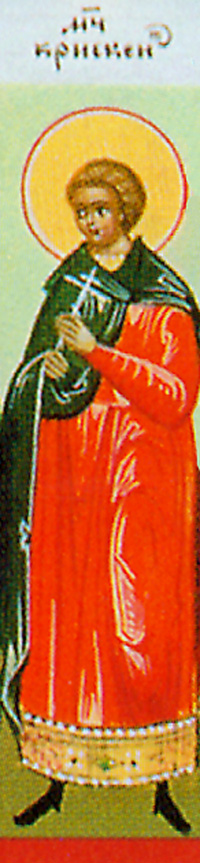
The Holy Martyr Crescens (Kreskes) was descended from an illustrious family and lived in Myra of Lycia. When a throng of city inhabitants were on the way to the pagan temple, he urged them to forsake paganism and come to Christ. This incident became known to the city prefect.
When the prefect asked the saint about his parentage, the saint, not wishing to bring unpleasantness to his parents, said nothing except that he was a Christian. The prefect knew Saint Crescens’ father and wanted to do him a favor. He suggested that Saint Crescens only appear to offer sacrifice to idols, while remaining a Christian.
The holy martyr replied, “It is impossible for the body not to do as the soul thinks, since the soul governs and moves the body.” They beat the holy martyr Crescens and raked him with iron claws, and then burned him in a fire.
Saint Andrew of Crete (July 4) mentions the Martyr Crescens in his Sermon on the Feast of Saint Nicholas the Wonderworker (December 6), who also came from Myra of Lycia.
Martyr Thomais of Alexandria
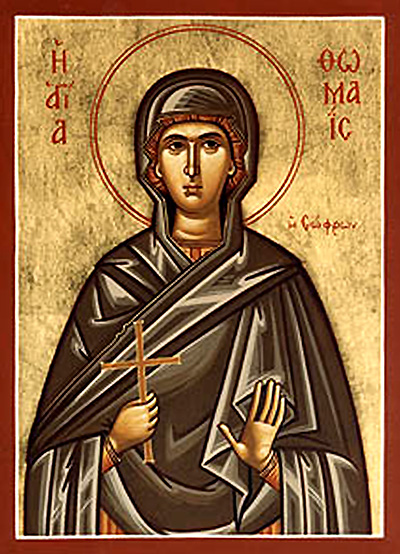
The Holy Martyr Thomais (Thomaίs) was born into a Christian family in the city of Alexandria. She was raised in piety, and loved to read spiritual books.
When she was fifteen, Thomais married a fisherman, who was also a Christian. The young couple lived in the home of her husband’s family, where Saint Thomaίs was loved for her mild and gentle disposition, and for her other good traits.
Her father-in-law, at the prompting of the devil, was captivated by her beauty. One night, when his son went out fishing, he attempted to lead his daughter-in-law into sin. Horrified, Saint Thomais admonished the senseless old man, reminding him of the Last Judgment and the penalty for sin. Infuriated by her steadfastness, he grabbed a sword and threatened to cut off her head. Saint Thomaίs replied: “Even if you cut me to pieces, I shall not stray from the Lord's commandments.” Overcome with passion, the old man cut Saint Thomais in two with the sword. Thus, the Saint received the crown of martyrdom in the year 476.
Divine punishment overtook the murderer. He was struck blind and could not find the door in order to escape. The next morning, the friends of the Saint’s husband came to the door. They saw her body, and the blind old man covered with blood. The murderer confessed his evil deed and asked to be taken to the judge for punishment. He was then beheaded for his crime.
At this time, Saint Daniel of Skete (Skḗtē) (June 7) happened to be in Alexandria. He told the monks of the Oktokaidekaton Monastery (at the eighteenth milestone on the road leading west from Alexandria) to bring the Martyr's body to the Monastery and bury her in the cemetery with the departed Fathers. Some of the monks were scandalized because he wanted to bury a woman’s body with the monks. Saint Daniel replied, “She is a mother to me and to you, because she died for her chastity.”
After the funeral Saint Daniel returned to Skete. Soon one of the young monks confessed to him that he was being tormented by carnal passions. Saint Daniel ordered him to go and pray at the grave of the Holy Martyr Thomais. The monk obeyed the Elder. As he prayed at the grave, he fell into a light sleep. Saint Thomaίs appeared to him and said, “Father, receive my blessing and go in peace.”
When he awakened, the monk felt joy and peace in his soul. After this, he told Saint Daniel that he was no longer bothered by the temptations of the flesh. Abba Daniel exclaimed, “Great is the boldness of those who have struggled for chastity.”
Many found both spiritual joy and release from their passions at the grave of Saint Thomais. Her holy relics were transferred to Constantinople to one of the women’s monasteries. The Russian pilgrim Archdeacon Zosimas venerated them in 1420.
Saint Thomais is invoked by those seeking deliverance from sexual impurity. Other Saints whose intercession we seek for this purpose are: Saint John the Much-Suffering (July 18), and Saint Moses the Hungarian (July 26).
Part of the Saint's Holy Skull is located in the Holy Monastery of Dionysiou on Mount Athos.
In Greek usage, Saint Thomaίs is commemorated on April 14.
Great Vespers – Sat. Apr 12, 2025
Here is the live stream for Great Vespers – Sat. Apr 12, 2025 If you need, here are instructions for accessing this content from your phone, tablet, computer, or TV.
Orthros and Divine Liturgy for Saturday of St. Lazarus – Sat. Apr 12, 2025
Here is the live stream for Orthros and Divine Liturgy for Saturday of St. Lazarus – Sat. Apr 12, 2025 If you need, here are instructions for accessing this content from your phone, tablet, computer, or TV.
Daily Readings for Saturday, April 12, 2025
LAZARUS SATURDAY
ABSTAIN FROM MEAT, FISH, DAIRY, EGGS
Lazarus Saturday, Basil the Confessor, Bishop of Parium, Sergius II, Patriarch of Constantinople, Anthousa the Righteous of Constantinople, Akakios of Kavsokalyvia
ST. PAUL’S LETTER TO THE HEBREWS 12:28-29; 13:1-8
BRETHREN, let us be grateful for receiving a kingdom that cannot be shaken, and thus let us offer to God acceptable worship, with reverence and awe; for our God is a consuming fire. Let brotherly love continue. Do not neglect to show hospitality to strangers, for thereby some have entertained angels unawares. Remember those who are in prison, as though in prison with them; and those who are ill-treated, since you also are in the body. Let marriage be held in honor among all, and let the marriage bed be undefiled; for God will judge the immoral and adulterous. Keep your life free from love of money, and be content with what you have; for he has said, ‘I will never fail you nor forsake you.’ Hence we can confidently say, ‘The Lord is my helper, I will not be afraid; what can man do to me?’ Remember your leaders, those who spoke to you the word of God; consider the outcome of their life, and imitate their faith. Jesus Christ is the same yesterday and today and for ever.
JOHN 11:1-45
At that time, a certain man was ill, Lazaros of Bethany, from the village of Mary and her sister Martha. It was Mary who anointed the Lord with ointment and wiped his feet with her hair, whose brother Lazaros was ill. So the sisters sent to him, saying, "Lord, he whom you love is ill." But when Jesus heard it he said, "This illness is not unto death; it is for the glory of God, so that the Son of God may be glorified by means of it."
Now Jesus loved Martha and her sister and Lazaros. So when he heard that he was ill, he stayed two days longer in the place where he was. Then after this he said to the disciples, "Let us go into Judea again." The disciples said to him, "Rabbi, the Jews were but now seeking to stone you, and are you going there again?" Jesus answered, "Are there not twelve hours in the day? If any one walks in the day, he does not stumble, because he sees the light of this world. But if any one walks in the night, he stumbles, because the light is not in him." Thus he spoke, and then he said to them, "Our friend Lazaros has fallen asleep, but I go to awake him out of sleep." The disciples said to him, "Lord, if he has fallen asleep, he will recover." Now Jesus had spoken of his death, but they thought that he meant taking rest in sleep. Then Jesus told them plainly, "Lazaros is dead; and for your sake I am glad that I was not there, so that you may believe. But let us go to him." Thomas, called the Twin, said to his fellow disciples, "Let us also go, that we may die with him."
Now when Jesus came, he found that Lazaros had already been in the tomb four days. Bethany was near Jerusalem, about two miles off, and many of the Jews had come to Martha and Mary to console them concerning their brother. When Martha heard that Jesus was coming, she went and met him, while Mary sat in the house. Martha said to Jesus, "Lord, if you had been here, my brother would not have died. And even now I know that whatever you ask from God, God will give you." Jesus said to her, "Your brother will rise again." Martha said to him, "I know that he will rise again in the resurrection at the last day." Jesus said to her, "I am the resurrection and the life; he who believes in me, though he die, yet shall he live, and whoever lives and believes in me shall never die. Do you believe this?" She said to him, "Yes, Lord; I believe that you are the Christ, the Son of God, he who is coming into the world."
When she had said this, she went and called her sister Mary, saying quietly, "The Teacher is here and is calling for you." And when she heard it, she rose quickly and went to him. Now Jesus had not yet come to the village, but was still in the place where Martha had met him. When the Jews who were with her in the house, consoling her, saw Mary rise quickly and go out, they followed her, supposing that she was going to the tomb to weep there. Then Mary, when she came where Jesus was and saw him, fell at his feet, saying to him, "Lord, if you had been here, my brother would not have died." When Jesus saw her weeping, and the Jews who came with her also weeping, he was deeply moved in spirit and troubled; and he said, "Where have you laid him?" They said to him, "Lord, come and see." Jesus wept. So the Jews said, "See how he loved him!" But some of them said, "Could not he who opened the eyes of the blind man have kept this man from dying?"
Then Jesus, deeply moved again, came to the tomb; it was a cave, and a stone lay upon it. Jesus said, "Take away the stone." Martha, the sister of the dead man, said to him, "Lord, by this time there will be an odor, for he has been dead four days." Jesus said to her, "Did I not tell you that if you would believe you would see the glory of God?" So they took away the stone. And Jesus lifted up his eyes and said, "Father, I thank you that you have heard me. I knew that you have heard me always, but I have said this on account of the people standing by, that they may believe that you did send me." When he had said this, he cried with a loud voice, "Lazaros, come out." The dead man came out, his hands and feet bound with bandages, and his face wrapped with a cloth. Jesus said to them, "Unbind him, and let him go." Many of the Jews therefore, who had come with Mary and had seen what he did, believed in him.
The Raising of Lazarus (Lazarus Saturday)

Lazarus Saturday and Palm Sunday
Visible triumphs are few in the earthly life of our Lord Jesus Christ. He preached a kingdom “not of this world.” At His nativity in the flesh there was “no room at the inn.” For nearly thirty years, while He grew “in wisdom and in stature, and in favor with God and man” (Luke 2:52), He lived in obscurity as “the son of Mary.” When He appeared from Nazareth to begin His public ministry, one of the first to hear of Him asked: “Can anything good come out of Nazareth?” (John 1:46). In the end He was crucified between two thieves and laid to rest in the tomb of another man.
Two brief days stand out as sharp exceptions to the above—days of clearly observable triumph. These days are known in the Church today as Lazarus Saturday and Palm Sunday. Together they form a unified liturgical cycle which serves as the passage from the forty days of Great Lent to Holy Week. They are the unique and paradoxical days before the Lord’s Passion. They are days of visible, earthly triumph, of resurrectional and messianic joy in which Christ Himself is a deliberate and active participant. At the same time they are days which point beyond themselves to an ultimate victory and final kingship which Christ will attain not by raising one dead man or entering a particular city, but by His own imminent suffering, death and resurrection.
By raising Lazarus from the dead before Thy Passion,
Thou didst confirm the universal resurrection, 0 Christ God!
Like the children with the palms of victory,
we cry out to Thee, 0 Vanquisher of Death:
Hosanna in the highest!
Blessed is He that comes in the name of the Lord!
(Troparion of the Feast, sung on both Lazarus Saturday and Palm Sunday)
Lazarus Saturday
In a carefully detailed narrative the Gospel relates how Christ, six days before His own death, and with particular mindfulness of the people “standing by, that they may believe that thou didst send me” (John 11:42), went to His dead friend Lazarus at Bethany outside of Jerusalem. He was aware of the approaching death of Lazarus but deliberately delayed His coming, saying to His disciples at the news of His friend’s death: “For your sake I am glad that I was not there, so that you may believe” (John 11:14).
When Jesus arrived at Bethany, Lazarus was already dead four days. This fact is repeatedly emphasized by the Gospel narrative and the liturgical hymns of the feast. The four-day burial underscores the horrible reality of death. Man, created by God in His own image and likeness, is a spiritual-material being, a unity of soul and body. Death is destruction; it is the separation of soul and body. The soul without the body is a ghost, as one Orthodox theologian puts it, and the body without the soul is a decaying corpse. “I weep and I wail, when I think upon death, and behold our beauty, fashioned after the image of God, lying in the tomb dishonored, disfigured, bereft of form.” This is a hymn of Saint John of Damascus sung at the Church’s burial services. This “mystery” of death is the inevitable fate of man fallen from God and blinded by his own prideful pursuits.
With epic simplicity the Gospel records that, on coming to the scene of the horrible end of His friend, “Jesus wept” (John 11:35). At this moment Lazarus, the friend of Christ, stands for all men, and Bethany is the mystical center of the world. Jesus wept as He saw the “very good” creation and its king, man, “made through Him” (John 1:3) to be filled with joy, life and light, now a burial ground in which man is sealed up in a tomb outside the city, removed from the fullness of life for which he was created, and decomposing in darkness, despair and death. Again as the Gospel says, the people were hesitant to open the tomb, for “by this time there will be an odor, for he has been dead four days” (John 11:39).
When the stone was removed from the tomb, Jesus prayed to His Father and then cried with a loud voice: “Lazarus, come out.” The icon of the feast shows the particular moment when Lazarus appears at the entrance to the tomb. He is still wrapped in his grave clothes and his friends, who are holding their noses because of the stench of his decaying body, must unwrap him. In everything stress is laid on the audible, the visible and the tangible. Christ presents the world with this observable fact: on the eve of His own suffering and death He raises a man dead four days! The people were astonished. Many immediately believed on Jesus and a great crowd began to assemble around Him as the news of the raising of Lazarus spread. The regal entry into Jerusalem followed.
Lazarus Saturday is a unique day: on a Saturday a Matins and Divine Liturgy bearing the basic marks of festal, resurrectional services, normally proper to Sundays, are celebrated. Even the baptismal hymn is sung at the Liturgy instead of Holy God: “As many as have been baptized into Christ, have put on Christ.”
Very Rev. Paul Lazor
Saint Basil the Confessor, Bishop of Parium

Saint Basil the Confessor, Bishop of Parium, lived during the eighth century. He was elected as bishop by the inhabitants of Parium, who venerated the saint as a true pastor of the flock of Christ.
When the Iconoclast heresy broke out, Saint Basil resolutely came out on the side of icon veneration and refused to sign the orders for their abolition (the “Iniquitous Scroll”) of the Council of 754 which was convened under the emperor Constantine V Copronymos (741-775). The saint avoided any contact with the heretics and did not permit them into his diocese. For his zeal he suffered much persecution, hunger and deprivation.
Saint Basil remained faithful to the Orthodox Church until his death.
Hieromartyr Zeno, Bishop of Verona
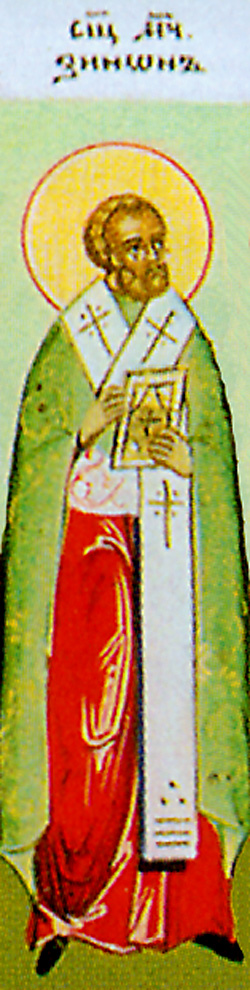
Saint Zeno, Bishop of Verona, was born a Greek and came from Syria. In his youth he became a monk and devoted himself to the study of Holy Scripture. Visiting several monasteries, the saint came to the city of Verona and settled there. The people chose him as bishop of the city.
The emperors Constantius (353-361) and Valens (364-378), were advocates of the Arian heresy, which had been condemned at the First Ecumenical Council at Nicea in the year 325. Under their patronage the Arians began a persecution against the Orthodox. Saint Zeno bravely endured all the oppression from the heretics.
In his sermons and letters he firmly asserted the Orthodox teaching about the Lord Jesus Christ as the Only-Begotten Son of God, born of the Father before all ages. Saint Zeno wrote sixteen long and seventy-seven short discourses and directives. He died around the year 360.
Saint Gregory Dialogus (March 12) speaks of a miracle in the year 558 on Saint Zeno’s Feast day. There were spring floods in Italy. The River Tiber overflowed its banks and inundated the surrounding area. The River Atesis flowing past Verona also flooded. The water reached the church built in honor of the hieromartyr Zeno, and came up to the windows of the church. The doors of the temple were open, but the water did not rush inside. It stopped at the wall, and did not harm the church.
Saint Isaac the Syrian, Abbot of Spoleto

Saint Isaac the Syrian lived during the mid-sixth century. He came to the Italian city of Spoleto from Syria. The saint asked permission of the church wardens to remain in the temple, and he prayed in it for two and a half days. One of the church wardens began to reproach him with hypocrisy and struck him on the cheek. Then the punishment of God came upon the church warden. The devil threw him down at the feet of the saint and cried out, “Isaac, cast me out!” Just as the saint bent over the man, the unclean spirit fled.
News of this quickly spread throughout the city. People began to flock to the saint, offering him help and the means to build a monastery. The humble monk refused all this. He left the city and settled in a desolate place, where he built a small cell. Disciples gathered around the ascetic, and so a monastery was formed. When his disciples asked the Elder why he had declined the gifts, he replied, “A monk who acquires possessions is no longer a monk.”
Saint Isaac was endowed with the gift of clairvoyance. Saint Gregory Dialogus (March 12) speaks of this in his “Dialogues About the Lives and Miracles of the Italian Fathers.” Once, Saint Isaac bade the monks to leave their spades in the garden for the night, and in the morning he asked them to prepare food for the workers. Some robbers, equal to the number of spades, had come to rob the monastery, but the power of God forced them to abandon their evil intent. They took the spades and began to work. When the monks arrived in the garden, all the ground had been dug up. The saint greeted the toilers and invited them to refresh themselves with food. Then he admonished them to stop their thievery, and gave them permission to come openly and pick the fruits of the monastery garden.
Another time, two almost naked men came to the saint and asked him for clothing. He told them to wait a bit, and sent a monk into the forest. In the hollow of a tree he found the fine clothes the travelers had hidden in order to to deceive the holy igumen. The monk brought back the clothes, and Saint Isaac gave them to the wanderers. Seeing that their fraud was exposed, they fell into great distress and shame.
It happened that a certain man sent his servant to the saint with two beehives. The servant hid one of these hives along the way. The saint said to the servant, “I accept the gift, but be careful when you go back for the beehive that you hid. Poisonous snakes have entered into it. If you stretch forth your hand, they will bite you.” Thus the saint unmasked the sins of people wisely and without malice, desiring salvation for all.
Saint Isaac died in 550. This saint should not be confused with the other Saint Isaac the Syrian, Bishop of Ninevah, who lived during the seventh century (January 28).
Monastic Martyrs Menas, David, and John, of Palestine
The Monk Martyrs Menas, David and John lived in Palestine. They were martyred in the seventh century by Arabs, who shot them through with arrows (+ post 636, when Jerusalem was captured by the Arabs).
Venerable Anthusa of Constantinople

The holy princess Anthusa of Constantinople was the daughter of the Iconoclast emperor Constantine Copronymos (reigned 741-775) and his third wife Eudokia. She and her twin brother, the future emperor Leo the Khazar (775-780), were born on January 25, 750.
Constantine had tortured the holy Abbess Anthusa of Mantinea (July 27) because she venerated the holy icons. During a campaign in Paphlagonia, he had her brought before him again, promising her even harsher torments if she did not come around to his way of thinking. She remained steadfast in defending the icons, however. Constantine told her that his wife was having difficulty in her pregnancy, and he asked her to pray for the empress. She agreed to do so, and told him that the children would be born safely, and even spoke about their future life.
Empress Eudokia's daughter was given the name Anthusa, in thanksgiving for the safe delivery of the twins. When Saint Anthusa's prediction was fulfilled, she was allowed to return to her convent, where she died at a ripe old age.
When she grew up, the emperor began to urge his daughter to marry. But from her youth Saint Anthusa yearned for monasticism and refused to consider his suggestions. After the death of her father, she shared her possessions with the poor, and used her wealth to adorn many churches. She became a mother to orphans, and was also a protector of widows. She devoted herself entirely to a life of piety, constantly offering prayers to the Lord and reading the Holy Scriptures. The devout empress Irene (780-802), wife of Leo the Khazar, regarded Saint Anthusa with love and esteem and invited her to be a co-regent. Saint Anthusa, however, did not desire any worldly honors. Since she lived at the palace, she wore clothes befitting her position as an emperor's daughter, but underneath her finery she wore a hair-shirt.
Desiring a life of solitary asceticism, Anthusa entered the monastery of Saint Euthymia, and received the monastic tonsure from Saint Tarasius, the Patriarch of Constantinople (Feb. 25). She founded the Omonia (Concord, or Charity) monastery at Constantinople, which was known for its strict Rule. Saint Anthusa was an example of humility to the other nuns. She did hard work, she cleaned the church, and carried water. She never sat at the table during meals, but served the sisters instead. She made sure that no one left the monastery in need.
The humble and gentle ascetic lived until the age of fifty-two, and died peacefully in 801. Other sources say she reposed in 808 when she was fifty-seven.
Venerable Athanasia, Abbess of Aegina

Saint Athanasia was abbess of a monastery on the island of Aegina in the ninth century. She was born into a pious Christian family, and her parents were named Nicetas and Marina. Already at seven years of age the girl studied the Psalter, which she read constantly and with feeling. Once, while working at the weaver’s loom, Saint Athanasia saw a shining star coming down to her from above, which touched her bosom and lightened all her being, and then disappeared. From that moment, the maiden was illumined in soul and she firmly resolved to enter a monastery.
When Saint Athanasia reached the age of sixteen, her parents entreated her to marry. She consented, but after sixteen days her husband was killed by barbarians who invaded Aegina.
Saint Athanasia decided to take advantage of her unexpected freedom and dedicate herself to God. Then the emperor Michael the Stammerer (820-829) issued a decree ordering all young widows and virgins to take husbands. Therefore, Saint Athanasia was forced to marry again. It is said that her second husband was a Moslem, whom she converted by her holy way of life.
She led a pious and virtuous life. She did housework, helped the sick and those in need, and took in wanderers. On Sundays and feastdays she invited family and acquaintances to her home and read the Holy Scriptures to them. Under her influence, her husband entered a monastery, and progressed in virtue and holiness. Soon, he departed to the Lord.
The saint gave away her property, became a nun, and founded a women’s monastery in a remote place. After four years, the sisters asked Saint Athanasia to become the abbess of the small community. In spite of her position, the saint surpassed all the others in meekness and humility. She asked about the infractions of the sisters with love, not anger.
Although Saint Athanasia had the title of abbess, she regarded herself as the least of the sisters and always had in mind the commandment of the Savior: “Whoever would be first among you, let him be your servant” (Mt. 20:27). The saint never permitted the sisters to wait on her, not even to pour water over her hands.
Saint Athanasia wore a hair-shirt, and over it clothes of coarse sheep’s wool. She slept very little, and prayed most of the night. By day she labored together with the sisters. On most days she ate only bread and water, and that in moderation, and only after the ninth hour of the day. She never ate cheese or fish except on Pascha and on the twelve Great Feasts. During Lent, she did not eat bread or drink water. She would only eat some vegetables every other day.
On the island of Aegina lived a certain monk named Matthew, who had been an igumen. Each night he read the whole PSALTER, and also read prayers. The saint slept sitting up and only for a short time. He could not refrain from tears when the Psalms were chanted, while reading prayers, or offering the Bloodless Sacrifice.
He wore only a coarse hair-shirt, and through his temperance and struggles his body became completely withered. He had a special love for Saint John the Theologian. Once, during the the Divine Liturgy he saw the Apostle standing by the altar table.
The saint healed a paralytic with his mantle; by making the Sign of the Cross he corrected the face of a man distorted by the actions of the devil; he cast out demons and worked many other miracles. Saint Matthew blessed Saint Athanasia to go to a more isolated place with her sisters. She built a monastery on a desolate hill of the island near an ancient church of the Protomartyr Stephen.
Saint Athanasia was granted the gift of healing by God. After she healed a man afflicted with a malady of the eyes, a crowd of people began to flock to her in order to receive healing from their infirmities of soul and body. From the abundant gifts brought to the monastery, she built three churches at the monastery: one dedicated to the Most Holy Theotokos, another to the holy Prophet John the Forerunner, and the third to Saint Nicholas the Wonderworker.
Her increasing celebrity distressed the saint, and she took the two sisters closest to her in spirit (Maria and Eupraxia) and went secretly to Constantinople. There, as a simple nun, she entered one of the women’s monasteries, where she lived for seven years.
Again, her holy life attracted attention. The sisters of the Aegina monastery learned where their abbess had gone, and they went to her imploring her to return. Submitting to the will of God, she returned to the monastery she founded. Soon after this she had a vision of two radiant men, giving her a document which said: “Here is your freedom, take it and rejoice.”
Saint Athanasia spent the twelve days before her death in unceasing prayer. On the eve of the Dormition of the Most Holy Theotokos she summoned the sisters and said that she was able to read the PSALTER only as far as the twelfth Psalm. The saint asked them to continue reading the PSALTER for her in church. The sisters went to church and there fulfilled her request, and then they came to bid the saint farewell. She blessed them and asked them to celebrate the Feast of the Dormition of the Most Holy Theotokos solemnly and joyfully, and also to provide a meal for the poor and destitute. Then, after Divine Liturgy, they could bury her body. With these words, Saint Athanasia fell asleep in the Lord on August 14, 860.
The saint predicted that she would receive glory in Heaven forty days after her death. On the fortieth day, two devout sisters were granted to see Saint Athanasia and two radiant men standing before the royal doors of the iconostasis. They clothed her with a purple robe embroidered with gold, pearls, and precious stones. They set a crown on her head, handed her a gleaming staff, and led her through the royal doors into the altar.
Before her death, Saint Athanasia ordered the nuns to feed the poor for forty days. The sisters, however, did not fulfill her request and set out the memorial meal for only ten days. The saint appeared to some of the sisters and said, “Let everyone know that alms given for a departed soul for forty days after death, and food offered to the hungry, appease God. If the departed souls are sinful, they receive forgiveness from God. If they are righteous, then the good deeds bring God’s mercy on the souls of those who perform them.”
Then she thrust her staff into the ground and became invisible. The staff left behind sprouted the next day and became a live tree. A year after the saint’s death, they led a possessed woman to the grave. When they dug up the ground, they then noticed a fragrance and removed the coffin. After she touched it, the demoniac was immediately healed. Then they opened the lid of the coffin and saw the saint’s incorrupt body, from which myrrh flowed.
Saint Athanasia looked like she was asleep. Her face shone brightly, her body was preserved incorrupt and soft, and even her hands were supple. The priests decided to place her body in church. When they transferred the body into a new coffin, the nuns removed the hair-shirt from her holy relics and wanted to dress her in silken clothes, but the hands of Saint Athanasia were so firmly clasped to her bosom, that the nuns could not dress her in the silken garb. Even in death the saint displayed her love for poverty. Then one of the sisters knelt down and began to pray to the saint, saying, “O lady, hear us as you heard us when you lived with us. Now consent to be dressed in these clothes, our humble gift to you.” Saint Athanasia, as though alive, lifted and extended her hands into the clothing.
The holy relics of Saint Athanasia were put into a crypt and became a source of healings.
The Life of Saint Athanasia is found in Vatican codex 1660, which dates from the year 916.
Saint Athanasia of Aegina is commemorated on April 12 (Slavic usage), and on April 18 (Greek usage).
Venerable Acacius the Younger of Mount Athos
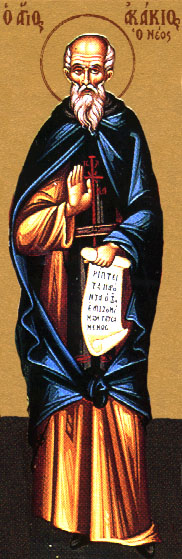
Saint Acacius the New was a monk at the Holy Trinity monastery of Saint Dionysius of Olympus (January 24) at Zagora. After visiting several monasteries on Mount Athos, the saint on the advice of his father-confessor, Father Galacteon, settled in the skete monastery of Saint Maximus the Hut-Burner (“Kavsokalyvites”, January 13), who repeatedly appeared to the ascetic.
The exploits of Saint Acacius were extremely severe: in place of bread he ate dry grass, which he crushed with a piece of marble. When asked how much a monk ought to sleep, he said that for a true monk half an hour even was sufficient. He said, “In order to conquer the flesh, a monk must practice two virtues: fasting and vigil.” In spite of his age and illness, he was an example of this.
Once, when Saint Acacius had come on a Sunday to the skete church, the igumen Neophytus handed him his own staff and said, “Father, take the staff, and be the Superior for all these brethren until your last breath.” Saint Acacius kissed the hand of the igumen, and accepted the staff with all humility. Although previously he had walked with a staff because of his age, from that time forward the righteous one no longer held a staff in his hand.
For his exalted exploits Saint Acacius was granted the gifts of unceasing mental prayer and divine revelations. He fell asleep in the Lord on April 12, 1730, being nearly a hundred years old.
Murom Icon of the Mother of God
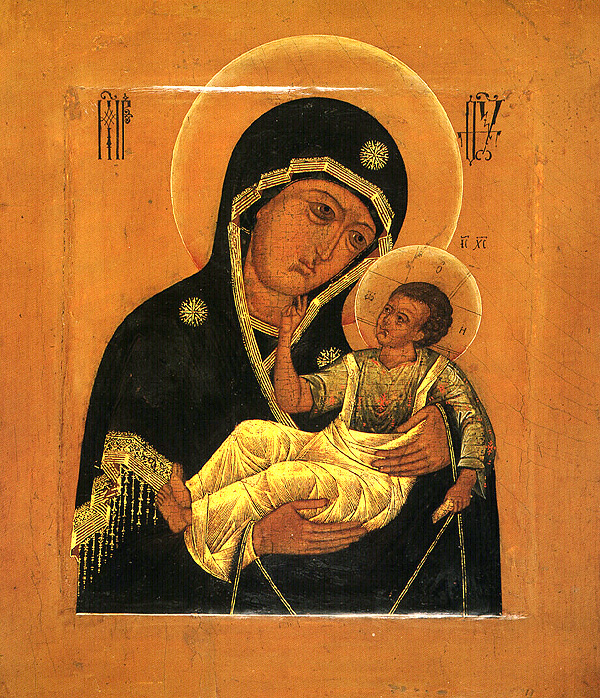
This icon was brought from Kiev to Murom by the Holy Prince Constantine of Murom (May 21) early in the XII century. For a long time, but quite unsuccessfully, Saint Constantine tried to attract the pagan inhabitants of the Murom principality to Christianity. His counsels met with no sympathy; moreover, they filled the people with hatred and contempt.
The more fanatical pagans plotted and swore to kill the Prince, or drive him out of Murom. When Constantine discovered the plot he prayed fervently to God. Then taking with him the Icon of the Mother of God, which he brought from Kiev, he went to confront the conspirators, trusting in the intercession and the help of the Queen of Heaven. When the pagans saw the Icon, they were so overcome with astonishment that they begged the Prince to forgive them. Then they agreed to be baptized into the Christian Faith.
The Murom icon is renowned for many other miracles, the most remarkable of which is the following. At the end of the XII century, Saint Basil was the Bishop of Murom. The people, mistakenly suspecting him of living in a way which was not appropriate for his high episcopal rank, intended to kill him. When Saint Basil learned of this decision, he asked his enemies to postpone his death until morning. All night long he prayed in the Church of Saints Boris and Gleb. After serving the Divine Liturgy, he went to the temple of the Annunciation and there he served a Moleben before the Icon of the Most Holy Theotokos, which he brought from Kiev. Placing all his hope in the Queen of Heaven, Saint Basil took the miraculous Icon and went to the Oke River. Removing his mantya, he spread it upon the water and stood upon it holding the Icon of the Mother of God. Suddenly there was a strong wind and Saint Basil was carried upstream against the current. Six hours later, the Bishop sailed to a place called Old Ryazan. There the people and the Prince received the Saint with honor. However, since Old Ryazan was poorly protected from the invasion of the Tatars, under whose yoke Russia was at that time, Saint Basil decided to look for another, safer place.
In 1291 he moved to New Ryazan, taking with him the Icon of the Mother of God. Since then, all his successors have lived in New Ryazan. Thus, with the abolition of the Murom cathedra, a new episcopal cathedra was established – that of New Ryazan.
Originally, the commemoration of the Murom-Ryazan Icon of the Mother of God took place on the second Sunday of the Apostle's Fast, then in 1810 (1814?) the Holy Synod, at the request of the residents of Ryazan, changed the Feast Day to April 12, when Saint Basil is commemorated.
The Murom Icon bears a certain resemblance to the Yakhrom Icon (October 14), in which the Divine Child is cradled on His Mother's left arm; His right hand touches her chin, while His left hand hangs down holding a scroll representing the Scriptures. In the Murom Icon, however, the head of the Divine Child leans back against His Mother's shoulder, and the scroll is open to reveal the words, "The Spirit of the Lord is upon me" (Luke 4:18).
The original Icon has not been preserved (all traces of it were lost when it was transferred from Murom to Ryazan). Frequently, copies of the Murom Icon were made, many of which are now found in various churches and museum collections. One of the copies was kept in the Cathedral of the Nativity of the Theotokos in Murom until its destruction in the XX century.
Belynich Icon of the Mother of God

The Belynich Icon of the Mother of God initially was in one of the Orthodox churches of the Mogilev district. After the emergence of the Unia (1596) the icon passed into the hands of the Catholics and was placed in a church of the Belynich Catholic monastery, founded in 1622-1624 by the hetman of Great Lithuania, Lev Sapega, on the banks of the River Druta, 45 versts from Mogilev. The icon was venerated both by Catholics and by Orthodox. In 1832 the monastery was dissolved, and the Catholic church became a parish church.
In 1876 the icon was given to the Orthodox after the restoration of the monastery. On April 12 of that year the first Divine Liturgy was served in the church of the Nativity of the Most Holy Theotokos on the altar table consecrated by an Orthodox bishop.
The Belynich Icon of the Mother of God is venerated throughout the Christian world.
On this day we also remember the Transfer of the Venerable Belt of the Mother of God from Zila to Constantinople in the year 942.
Transfer of the Holy Zone of Theotokos to Constantinople
The journey was made from the diocese of Zḗla (in Cappadocia) to Constantinople in the year 942, when the Emperors were Constantine and Romanos, the Porphyrogénnētoi.1 The Zone (Sash) was then placed in the Holy Soros2 of Chalkopratia on April 12.
1 Born in the purple. This refers to a room in the Palace where the Empress gave birth to her children. The walls were hung with purple draperies, a color reserved for royalty.
2 The Holy Soros was a chest containing the Robe and the Sash (Zone) of the Theotokos.
Small Complines with Canon of St. Lazarus – Friday Apr 11, 2025
Here is the live stream for Small Complines with Canon of St. Lazarus – Friday Apr 11, 2025 If you need, here are instructions for accessing this content from your phone, tablet, computer, or TV.
Daily Readings for Friday, April 11, 2025
6TH FRIDAY OF LENT
ABSTAIN FROM MEAT, FISH, DAIRY, EGGS, WINE, OLIVE OIL
Hieromartyr Antipas, Bishop of Pergamum, Pharmuthios the Anchorite, Guthlac the Hermit of Crowland
ISAIAH 66:10-24
Rejoice with Jerusalem, and be glad for her, all you who love her; rejoice with her in joy, all you who mourn over her; that you may suck and be satisfied with her consoling breasts; that you may drink deeply with delight from the abundance of her glory." For thus says the LORD: "Behold, I will extend prosperity to her like a river, and the wealth of the nations like an overflowing stream; and you shall suck, you shall be carried upon her hip, and dandled upon her knees. As one whom his mother comforts, so I will comfort you; you shall be comforted in Jerusalem. You shall see, and your heart shall rejoice; your bones shall flourish like the grass; and it shall be known that the hand of the LORD is with his servants, and his indignation is against his enemies. "For behold, the LORD will come in fire, and his chariots like the stormwind, to render his anger in fury, and his rebuke with flames of fire. For by fire will the LORD execute judgment, and by his sword, upon all flesh; and those slain by the LORD shall be many. "Those who sanctify and purify themselves to go into the gardens, following one in the midst, eating swine's flesh and the abomination and mice, shall come to an end together, says the LORD. "For I know their works and their thoughts, and I am coming to gather all nations and tongues; and they shall come and shall see my glory, and I will set a sign among them. And from them I will send survivors to the nations, to Tarshish, Put, and Lud, who draw the bow, to Tubal and Javan, to the coastlands afar off, that have not heard my fame or seen my glory; and they shall declare my glory among the nations. And they shall bring all your brethren from all the nations as an offering to the LORD, upon horses, and in chariots, and in litters, and upon mules, and upon dromedaries, to my holy mountain Jerusalem, says the LORD, just as the Israelites bring their cereal offering in a clean vessel to the house of the LORD. And some of them also I will take for priests and for Levites, says the LORD. "For as the new heavens and the new earth which I will make shall remain before me, says the LORD; so shall your descendants and your name remain. From new moon to new moon, and from sabbath to sabbath, all flesh shall come to worship before me, says the LORD. "And they shall go forth and look on the dead bodies of the men that have rebelled against me; for their worm shall not die, their fire shall not be quenched, and they shall be an abhorrence to all flesh.
GENESIS 49:33-50:26
When Jacob finished charging his sons, he drew up his feet into the bed, and breathed his last, and was gathered to his people. Then Joseph fell on his father's face, and wept over him, and kissed him. And Joseph commanded his servants the physicians to embalm his father. So the physicians embalmed Israel; forty days were required for it, for so many are required for embalming. And the Egyptians wept for him seventy days.
And when the days of weeping for him were past, Joseph spoke to the household of Pharaoh, saying, "If now I have found favor in your eyes, speak, I pray you, in the ears of Pharaoh, saying, My father made me swear, saying, 'I am about to die: in my tomb which I hewed out for myself in the land of Canaan, there shall you bury me.' Now therefore let me go up, I pray you, and bury my father; then I will return." And Pharaoh answered, "Go up, and bury your father, as he made you swear." So Joseph went up to bury his father; and with him went up all the servants of Pharaoh, the elders of his household, and all the elders of the land of Egypt, as well as all the household of Joseph, his brothers, and his father's household; only their children, their flocks, and their herds were left in the land of Goshen. And there went up with him both chariots and horsemen; it was a very great company. When they came to the threshing floor of Atad, which is beyond the Jordan, they lamented there with a very great and sorrowful lamentation; and he made a mourning for his father seven days. When the inhabitants of the land, the Canaanites, saw the mourning on the threshing floor of Atad, they said, "This is a grievous mourning to the Egyptians." Therefore the place was named Abelmizraim; it is beyond the Jordan. Thus his sons did for him as he had commanded them; for his sons carried him to the land of Canaan, and buried him in the cave of the field at Machpelah, to the east of Mamre, which Abraham bought with the field from Ephron the Hittite, to possess as a burying place. After he had buried his father, Joseph returned to Egypt with his brothers and all who had gone up with him to bury his father. When Joseph's brothers saw that their father was dead, they said, "It may be that Joseph will hate us and pay us back for all the evil which we did to him." So they sent a message to Joseph, saying, "Your father gave this command before he died, 'Say to Joseph, Forgive, I pray you, the transgression of your brothers and their sin, because they did evil to you.' And now, we pray you, forgive the transgression of the servants of the God of your father." Joseph wept when they spoke to him. His brothers also came and fell down before him, and said, "Behold, we are your servants." But Joseph said to them, "Fear not, for am I in the place of God? As for you, you meant evil against me; but God meant it for good, to bring it about that many people should be kept alive, as they are today. So do not fear; I will provide for you and your little ones." Thus he reassured them and comforted them.
So Joseph dwelt in Egypt, he and his father's house; and Joseph lived a hundred and ten years. And Joseph saw Ephraim's children of the third generation; the children also of Machir the son of Manasseh were born upon Joseph's knees. And Joseph said to his brothers, "I am about to die; but God will visit you, and bring you up out of this land to the land which he swore to Abraham, to Isaac, and to Jacob." Then Joseph took an oath of the sons of Israel, saying, "God will visit you, and you shall carry up my bones from here." So Joseph died, being a hundred and ten years old; and they embalmed him, and he was put in a coffin in Egypt.
PROVERBS 31:8-31
Open your mouth for the dumb, for the rights of all who are left desolate. Open your mouth, judge righteously, maintain the rights of the poor and needy. A good wife who can find? She is far more precious than jewels. The heart of her husband trusts in her, and he will have no lack of gain. She does him good, and not harm, all the days of her life. She seeks wool and flax, and works with willing hands. She is like the ships of the merchant, she brings her food from afar. She rises while it is yet night and provides food for her household and tasks for her maidens. She considers a field and buys it; with the fruit of her hands she plants a vineyard. She girds her loins with strength and makes her arms strong. She perceives that her merchandise is profitable. Her lamp does not go out at night. She puts her hands to the distaff, and her hands hold the spindle. She opens her hand to the poor, and reaches out her hands to the needy. She is not afraid of snow for her household, for all her household are clothed in scarlet. She makes herself coverings; her clothing is fine linen and purple. Her husband is known in the gates, when he sits among the elders of the land. She makes linen garments and sells them; she delivers girdles to the merchant. Strength and dignity are her clothing, and she laughs at the time to come. She opens her mouth with wisdom, and the teaching of kindness is on her tongue. She looks well to the ways of her household, and does not eat the bread of idleness. Her children rise up and call her blessed; her husband also, and he praises her: “Many women have done excellently, but you surpass them all.” Charm is deceitful, and beauty is vain, but a woman who fears the LORD is to be praised. Give her of the fruit of her hands, and let her works praise her in the gates.
Hieromartyr Antipas, Bishop of Pergamum and Disciple of Saint John the Theologian

The Hieromartyr Antipas, a disciple of the holy Apostle John the Theologian (September 26), was bishop of the Church of Pergamum during the reign of the emperor Nero (54-68).
During these times, everyone who would not offer sacrifice to the idols lived under threat of either exile or execution by order of the emperor. On the island of Patmos (in the Aegean Sea) the holy Apostle John the Theologian was imprisoned, he to whom the Lord revealed the future judgment of the world and of Holy Church.
“And to the angel of the Church of Pergamum write: the words of him who has the sharp two-edged sword. I know where you live, where the throne of Satan is, and you cleave unto My Name, and have not renounced My faith, even in those days when Antipas was My faithful martyr, who was slain among you, where Satan dwells” (Rev 2:12-13).
By his personal example, firm faith and constant preaching about Christ, Saint Antipas began to turn the people of Pergamum from offering sacrifice to idols. The pagan priests reproached the bishop for leading the people away from their ancestral gods, and they demanded that he stop preaching about Christ and offer sacrifice to the idols instead.
Saint Antipas calmly answered that he was not about to serve the demons that fled from him, a mere mortal. He said he worshiped the Lord Almighty, and he would continue to worship the Creator of all, with His Only-Begotten Son, and the Holy Spirit. The pagan priests retorted that their gods existed from of old, whereas Christ was not from of old but was crucified under Pontius Pilate as a criminal. The saint replied that the pagan gods were the work of human hands and that everything said about them was filled with iniquities and vices. He steadfastly confessed his faith in the Son of God, incarnate of the Most Holy Virgin.
The enraged pagan priests dragged the Hieromartyr Antipas to the temple of Artemis and threw him into a red-hot copper bull, where usually they put the sacrifices to the idols. In the red-hot furnace the martyr prayed loudly to God, imploring Him to receive his soul and to strengthen the faith of the Christians. He went to the Lord peacefully, as if he were going to sleep (+ ca. 68).
At night Christians took the body of the Hieromartyr Antipas, which was untouched by the fire. They buried him at Pergamum. The tomb of the hieromartyr became a font of miracles and of healings from various sicknesses.
We pray to the Hieromartyr Antipas for relief from toothache, and diseases of the teeth.
Venerable James, Abbot of Zheleznoborov

Saint James of Zheleznoborov was born in the second half of the XIV century, a son of the noble Anosov (or Amosov) line, which had their lands at Galich (Kostroma Province) As a young man he became the disciple of Saint Sergius of Radonezh, who tonsured him, and he remained at Holy Trinity Monastery for several years. In 1392, with his Elder's blessing, Saint James retreated into the forest, seeking solitude at a place on the banks of the Tebza River, which was known as Iron Pines (Железный Борок) because of the deposits of iron ore in the Kostroma region.
The sanctity of his life, worthy of admiration, was already known during his lifetime. In 1415 Sophia (Synklētikḗ in monasticism, + 1453), the wife of Great Prince Basil (1389-1425), became seriously ill before giving birth. The Prince sent a message to Saint James begging him to pray for his wife, and asking him if she would live. The Saint advised him to pray to the Holy Martyr Longinus, and predicted the birth of his son, Basil the Dark. In 1450, that child, Great Prince Basil the Dark (1425-1462), visited the Monastery of Saint James and prayed there to give thanks for his victory over Prince Dēmḗtrios Shemyaka.
The grateful Prince Basil the Dark rewarded Saint James and gave him money to build a Monastery dedicated to the Entry of the Theotokos into the Temple, with a church in honor of the Holy Prophet and Forerunner John. Then the Tatars lay waste to the area around Galich. Saint James went deep into the forest with his disciples. When they returned, they found the Monastery in ruins. Everything had to be rebuilt.
The Saint built a church dedicated to Saint Nicholas, and he dug out ponds with the brethren. Following the example of the Trinity-Saint Sergius Monastery a strict cenobitic Rule was introduced. Many of the hungry and destitute people, displaced by the Tatars, were fed at the Monastery.
After many years of common ascetical labors, the monks entreated Saint James to be their Igoumen. With great humility, he agreed to their request and journeyed to Moscow, where he was ordained as a priest. Soon after his return to the Monastery, he became severely ill. Sensing that his death was near, Saint James appointed his disciple Dosίtheos to succeed him as Igoumen of the Monastery.
After partaking of the Holy Mysteries and giving the monks his final blessing, Saint James reposed on April 11, 1442 and was buried in the church of Saint John the Forerunner at the Monastery he had founded. On his tomb the monks placed his stone cross, hair shirt, and chains – evidence of his ascetical labors.
The relics of Saint James were found to be incorrupt on May 5, 1613. Now he is buried behind the left choir of the Monastery's cathedral church.
Official Church approval for the local veneration of Saint James of Zheleznoborov was granted before 1628; and the first chapel dedicated to Saint James existed as early as 1635 (in Borisoglebsky church in the city of Galich). There have been about fifty cases of sick people being healed at the relics of Saint James, including the demoniac Néphon, and the monk Theodosios, who lay paralyzed for three years, and recovered only after vowing before the Saint's relics that he would not leave the Monastery. Following these events a special icon of Saint James, with fifteen scenes from his life, was commissioned. On the side panels of the Icon some of the most famous healings were depicted (this Icon disappeared after the closure of the Monastery during the Soviet period).
The last miracles were recorded in the early twenties of the XX century, when Hieromonk Joasaph (Sazonov) served a Moleben before the Saint's relics. These events served as an excuse for Hieromonk Joasaph's arrest in 1924, when he was accused of committing "deceptive acts using the religious prejudices of the believing masses."
Saint James is commemorated on April 11, the day of his repose, on May 5, the discovery of his relics in 1613, on July 6 (Synaxis of the Radonezh Saints), and on January 23 (Synaxis of Kostroma Saints).
Saint Barsanuphius, Bishop of Tver
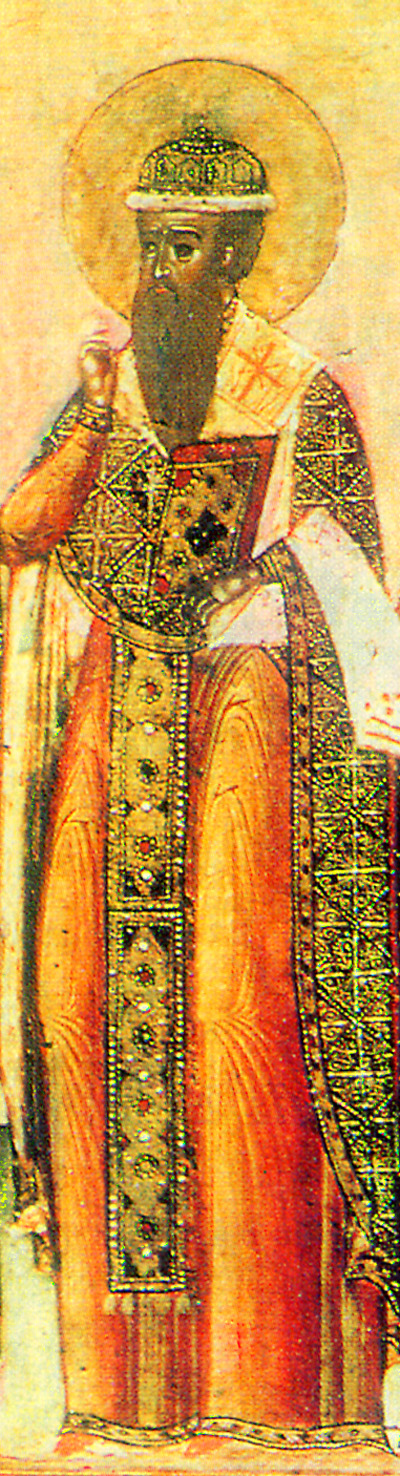
Saint Barsanuphius of Tver was born in the year 1495, and was from Serpukhov. He was named John in Baptism, and he was taught to read and write. While still a youth, he was captured by the Crimean Tatars. Accepting this as the Lord’s will, he meekly submitted to his masters, and dutifully accomplished the work they assigned him to do. After three years, John’s father ransomed him. He then went to Moscow and became a monk in the Andronikov Monastery, where he received the monastic name Barsanuphius.
Devoting himself to the ascetical life, he became proficient in virtue and piety. In 1544, he was appointed as igumen of the Pesnosha Monastery. Later, he went to Kazan and founded a monastery dedicated to the Transfiguration of the Lord.
While in Kazan, Archimandrite Barsanuphius was able to help Saint Gurias (December 5) in spreading Christianity among the Moslems and pagans. His knowledge of the Tatar language proved to be very useful in this work.
In 1567, Saint Barsanuphius was consecrated Bishop of Tver. He healed many sick people with his knowledge of medicine, but he also healed those suffering from infirmities of the soul.
When the God-pleaser reached old age, he returned to Kazan and to the Transfiguration Monastery which he founded. There he received the Great Schema, and he died at the monastery in 1576.
The holy relics of Saints Gurias and Barsanuphius were uncovered on October 4, 1596. They were placed in shrines in a side chapel of the church at the orders of Patriarch Job. On June 20, 1630 their grace-filled relics were transferred from the Transfiguration Monastery to the Cathedral of the Annunciation.
Martyrs Processus and Martinian of Rome
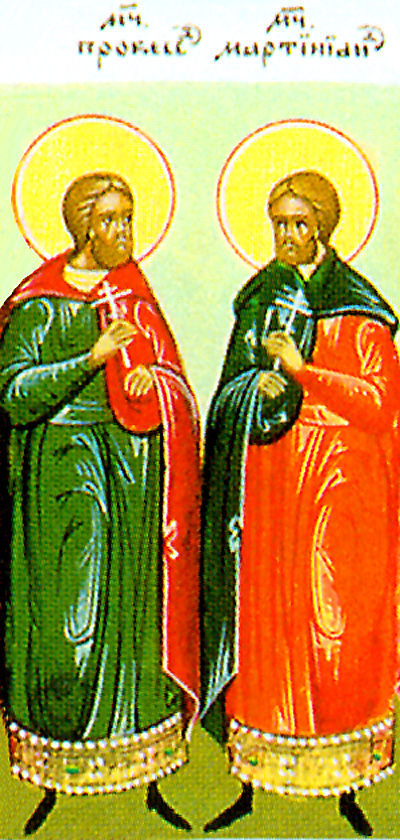
The Holy Martyrs Processus and Martinian were pagans and they served as guards at the Mamertine prison in Rome.
State criminals were held in this prison, among them some Christians. Watching the Christian prisoners and listening to their preaching, Processus and Martinian gradually came to the knowledge of the Savior. When the holy Apostle Peter was locked up at the Mamertine prison, Processus and Martinian came to believe in Christ. They accepted holy Baptism from the apostle and released him from prison.
The jailer Paulinus learned about this, and he demanded that Saints Processus and Martinian renounce Christ. But they fearlessly confessed Christ, and they spat at the golden statue of Jupiter. Paulinus ordered that they be slapped on the face, and then seeing the resolute stance of the holy martyrs, he subjected them to torture. The martyrs were beaten with iron rods, scorched with fire, and finally, thrown into prison.
A certain illustrious and pious woman by the name of Lucina visited them in prison and gave them help and encouragement. The torturer Paulinus was soon punished by God. He fell blind and died three days later. The son of Paulinus went to the city ruler demanding that the martyrs be put to death. Saints Processus and Martinian were beheaded by the sword (+ ca. 67).
Lucina buried the bodies of the martyrs. Today their tomb is in the south transept of Saint Peter’s Basilica in Rome.
Venerable Pharmuthius the Anchorite of Egypt

Saint Pharmuthius lived during the fourth century at the same desert monastery where Saint John (March 29) lived in asceticism within a well, to whom Saint Pharmuthius gave food.
Venerable John, disciple of Venerable Gregory of Decapolis
Saint John was a disciple of Saint Gregory the Decapolite (November 20). See April 18.
Saint Callinicus of Cernica, Bishop of Rimnicului in Romania
Our holy Father Callinicus (Calinic) of Cernica, who served as bishop of Ramnicu Valcea in Romania was born in Bucharest on October 7, 1787, near the church of Saint Bessarion. His parents, Anthony and Flora (Floarea) Antonescu, were honest and pious people. In holy Baptism he received the name Constantine.
Constantine’s mother brought her son to church and taught him his prayers, instilling in him a deep love for the Most Holy Theotokos. When he was old enough, he was sent to school in Bucharest. In addition to the usual subjects taught at that time, he also learned Greek.
After raising her children, Flora became a nun in the monastery of Pasarea, and was given the new name Philothea. Her first son became a priest, and later he received the monastic tonsure, taking the name Acacius. It is not surprising that the younger son, Constantine, became attracted to the monastic life and wished to follow their example.
On Feast Days, Constantine loved to visit the monastery of Cernica. The igumen at that time was the most devout George, who was a disciple of Saint Paisius Velichkovsky (November 15). The Cernica monastery also followed the Rule of Saint Paisius.
In 1807, when he was twenty years old, Constantine left his home and entered the monastery. He was given into the care of Father Pimen, a master woodcarver, and one of the Spiritual Fathers of the monastery. In a short time, Constantine surprised the rest of the monks by the way he fulfilled his monastic obediences, by his prayer and fasting, and by his exceptional love and innate goodness.
The young monk continued to fulfill his obediences, and amazed the brethren with his purity, knowledge, long-suffering, kindness, and unfeigned love (2 Cor. 6:6-7). Therefore, Father Pimen decided not to wait for the full three years of monastic trial for Constantine. On November 9, 1808, with the blessing of Igumen Timothy, Brother Constantine was tonsured with the name Callinicus.
Father Callinicus prayed, fasted, fulfilled all the rules, and permitted himself only three hours of sleep each day. Because of the strictness of his life, and his good example to others, he was ordained to the diaconate on December 3, 1808. He remained under the supervision of Father Pimen, for no one may enter the Kingdom of Heaven without obedience.
Hierodeacon Callinicus, because of the strictness of his life, soon attracted the notice of Igumen Timothy. In 1813, after many of the priests at the monastery had died from cholera, Deacon Callinicus was found worthy of the holy priesthood. His ordination took place on February 4, 1813. Though at twenty-six he was younger than most of the other monks, they respected his wisdom and asked him to become their Confessor and Spiritual Father. So it was that on September 20, 1815 Metropolitan Nectarius himself made him the Spiritual Father of the monastery.
So great were his spiritual qualities that many people came to him for Confession, not only monks and laymen from various lands, but even the Metropolitan himself. They all found in him the consolation and tenderness of God. Since the humble Callinicus knew the monastery’s rules so well, Igumen Timothy also made him the Ecclesiarch.
Elder Timothy reposed on March 3, 1816, departing this life with his soul at peace. He had built a large church on the island of Saint Nicholas, and dedicated it to that saint. Although the work of painting icons in the church was only half finished, he knew that others would complete the work he had begun.
Saint Callinicus took part in this work himself. In 1812 he and his Spiritual Father Pimen went to Moldavia looking for help. Upon their return, Father Pimen went to the Holy Mountain for greater tranquility. Saint Callinicus found himself under obedience to Father Dorotheus, who was elected to replace Father Timothy as Igumen in 1816.
Since Father Dorotheus was quite old, most of the cares of the monastery rested on the shoulders of Saint Callinicus. These responsibilities did not interfere with his work of enlightening his own soul, however.
In 1817, Father Dorotheus, feeling that his end was near, sent Saint Callincus and the monk Dionysius (who spoke Turkish) to bring Father Pimen back from Mount Athos so that he could replace him as igumen. Saint Callinicus was happy to undertake this journey. Arriving on the Holy Mountain, Saint Callinicus and Father Pimen visited many of the monasteries there, observing the life of the monks. He learned many things which he later applied when he was the igumen of the monastery, and even as bishop. He listened to the counsels of the Athonite monks, both the learned and those who were humble.
After helping the monasteries with whatever they had, they celebrated the Feast of the Dormition of the Theotokos. Then Saint Callinicus and Father Pimen returned to Romania in 1818. When they got to Cernica, they found Father Dorotheus still alive, and he told Father Pimen to take his place. The Lord, however, decreed otherwise.
The ever-memorable Father Dorotheus fell asleep in the Lord on December 13, 1818. On the following day, the monks of Cernica elected Saint Callinicus as the next igumen. Father Pimen was not saddened by this at all. He remained as the Spiritual Father of Saint Callinicus, and until his death he continued to advise and to love his former disciple. Father Pimen was placed in charge of the monastery’s vestments, and of all the monastery’s business. He introduced some new rules to Cernica, which were similar to those he found on Mount Athos. The monks of Cernica found these rules very difficult to follow. Perhaps that is the reason why Saint Callinicus was chosen as igumen, rather than Father Pimen.
Eleven years had passed since the saint entered the monastery, and now he was thirty years old. In less than two years he had completed the iconography work in the church of Saint Nicholas on the island. He also finished the exterior of the church, and furnished it with everything needful. Seeing the zeal which Saint Callinicus had for God’s house, Metropolitan Dionysius Lupu raised him to the rank of Archimandrite.
Saint Callinicus was very patient and kind with people, but he could also be very strict when it was necessary. He counseled those who were lazy or disobedient, and he sent some of them away to other monasteries so that his monks would not be influenced by their bad example. He would not allow slander in the monastery, considering this vice to be “the death of the soul.” Abba Or says something similar. See SAYINGS OF THE DESERT FATHERS, transl. Benedicta Ward London, 1975, p. 207, # 15.
The saint fulfilled his responsibilities as igumen with great fervor, though he knew what a difficult task it was to govern men. He believed that the igumen should be “the heart of all hearts who seek him or ask him for instruction or consolation. He is the path to perfection for all the believing souls around him.”
Just as Saints Anthony the Great (January 17), Pachomius (May 15) and Macarius (Jan. 19) were responsible for many monasteries in the desert of Egypt, so was Saint Callinicus responsible for several monasteries and sketes in addition to his own: the monasteries of Pasarea, Tiganesti, Caldarusani, and the Sketes of Saint John of Tigia, Poiana Marului, Ratesti, and Ciorogirla.
The parish churches at Campina, Ghenoaia, and Tohani Buzaului were also under his authority. In the latter church, it was the prerogative of the Spiritual Father of Cernica to choose the chief priest.
Saint Callinicus was the igumen of Cernica during difficult times. In March of 1821 the uprising of Tudor Vladimirescu began. After this, the Turks attacked the country, and many of the citizens of Bucharest sought shelter in the monastery of Cernica.
Saint Callinicus received everyone with paternal love, hiding them in the cells of the church of Saint Nicholas. At this time he sent monks to the island of Saint George. On May 15 of the same year, the Turks came to the town of Catsela, which was close to the monastery. Someone informed the Turks that some rebels were hiding in the monastery. The Turks surrounded the buildings and placed cannons everywhere, intending to raze the monastery.
Learning of this danger, Saint Callinicus assembled the people and the monks in the church. After encouraging them, he prayed all night in the church with them, asking that they and the monastery might be spared. The next day he sent a monk to the Pasha at Catsela to assure him that there were only simple folk from Bucharest with women and children in the monastery. The Pasha changed his mind, and sent soldiers to protect the monastery from danger.
The supply of food for those staying in the monastery began to run low, but the monks had no more provisions. Deeply saddened, Saint Callinicus prostrated himself in front of an icon of the Most Holy Theotokos and Saint Nicholas, and prayed for assistance. When he finished praying, a miracle took place. Five carts loaded with bread and drawn by two bulls came through the monastery gates.
Another Pasha came to the monastery of Pasarea in the village of Panteleimon, and kidnapped one of the nuns. Saint Callinicus moved the rest of the nuns from Pasarea to the monastery of Snagov for their safety. He then wrote a letter of protest to the governor, who ordered the Pasha to release the nun. The Pasha swore that he would destroy the monastery of Cernica and take revenge upon Saint Callinicus. Once again, the saint learned of the Pasha’s intentions, and he prayed all night long with his clergy for the monastery to be spared.
At midnight, the Pasha was prepared to attack the monastery, but first he asked for a cup of coffee. A servant handed him the coffee, and as he did so, he shot the Pasha. The bullet struck the bag of gold coins which he wore under his shirt, and so he was not killed. In gratitude for his deliverance, he sent the gold to Saint Callinicus saying that it should be used to build a well for the monastery.
Fearing some sort of trickery, the saint told the Turks, “If you wish, and if you are telling the truth, then you yourselves should build the well next to the bridge.” Workmen built the well on the north shore of Saint George’s Island, and it is known as the Well of the Turk, to this very day.
On another occasion, the monastery cook told Saint Callinicus that they had no more flour. He replied, “Let us place our hope in the Mother of God and in Saint Nicholas, and we shall want for nothing.” The saint went to his cell to pray before the holy icons, asking Saint Nicholas to help them.
A miracle took place that evening after Vespers. A cart with two drivers came to the monastery with a load of flour. They asked Father Charalampus, the ecclesiarch, where to unload the flour which their master had sent as a gift. When the monk asked for the name of their master, they said that he wished to remain anonymous. Saint Callinicus served a Molieben of Thanksgiving to Saint Nicholas, and then went to bless the flour, which was used to bake bread for the consolation of the brethren.
In 1827, a certain man came to the monastery when Saint Callinicus was speaking to his Spiritual Father, Pimen. The man asked if he might borrow fifty lei (Romanian currency). An hour after this man had left; a young man came to Saint Callinicus and kissed his hand saying, “Holy Father, my father has died. Before his death he told me to give one thousand lei to the monastery. I do not have the full amount now, but here are five hundred lei, and later on I will bring you another five hundred lei.”
Saint Callinicus realized that the person who had requested the loan of fifty lei had been sent by God to test his mercy and his love, and so he received ten times that amount in return. Father Pimen asked him, “What were you thinking, Father Callinicus, when you gave alms to that man?”
The saint replied, “I wanted to give one hundred lei, but I did not have that much. I gave him fifty and received five hundred. As the Gospel says, ‘Blessed are the merciful, for they shall obtain mercy’ (Matt. 5:7).”
After Matins one morning in July of 1829, Saint Callinicus was in his cell reading the Life of Saint Nicholas. When he got to the sixth chapter, he fell asleep from weariness after the all-night Vigil. Suddenly, Saint George appeared in his armor and Saint Nicholas in the vestments of a bishop. Behind them was Father George, the late igumen of Cernica.
“Arise,” said Saint Nicholas, “and on this island build a church dedicated to the Holy Great Martyr George.” Saint George told him, “We will send you everything that you require.” Then Igumen George said, “Do not doubt in your heart.” They departed after saying these things.
When he woke up, Father Callinicus continued reading the Life of Saint Nicholas until he reached the end. Then he went out to visit his Spiritual Father Pimen on the small island of Saint George in order to ask him whether this vision might have been some sort of temptation from the Devil. “No, my child,” Father Pimen replied, “this is not demonic, but is really something from God. These same three individuals also appeared to me three times tonight, ordering the work to begin at once. I have just finished getting dressed so that I could pass on their instructions to you.”
At that time there were only a few cells on Saint George’s Island, among them was the cell of the late Igumen George, where Father Pimen had now taken up his residence. There was also a small church dedicated to Saint George, a gift from Bratovian. Next to this, Saint Callinicus built a large and beautiful church.
In time, the words of Saint George were fulfilled, and indeed all that was necessary was provided. Several years after the uprising of Tudor Vladimirescu, a certain Romanian noble made a secret agreement to banish the Phanariots from the country and to choose a Romanian king. They collected money and other necessities for this purpose. The funds were to be held by Bishop Ioannicius, who lived in Bucharest. The nobles told him that if their plan failed, and if they had to flee the country, that the money should be used to build a church. The holy bishop also contributed some of his own money to this sum.
In 1831, during an outbreak of cholera, Bishop Ioannicius came to Cernica and entrusted all the money to Saint Callinicus. The building of the church had already begun in 1823. It was completed in 1836 and consecrated that year on the Feast of the Transfiguration (Aug. 6).
In January of 1838, the church was destroyed by a great earthquake. The saint restored it and built cells nearby, surrounding the buildings with strong walls. This work was completed in 1842. In 1846, he began construction of a church at the Skete of Pasarea, which was consecrated the following year.
Saint Callinicus also built a church in Buesti on the Baragan River, and he built stone houses in the village for the overseers. He also built barns for Cernica Monastery’s animals. Many people were surprised when he tilled the land and planted willow trees in the middle of the field.
Several times when Alexander Ghica was governor, Saint Callinicus was selected to become Metropolitan, but he always declined. He had no wish to leave the monastery where he had labored for so many years.
About this time, someone in the monastery poisoned the saint. The brethren of the monastery were much saddened by this evil deed. Since he was near death, he advised the monks to select someone to replace him as Igumen. They chose the most devout Benjamin Katulos.
One night, as Saint Callinicus lay in bed waiting for the Lord to take him, he entreated, “O Lord my God, I did not think. I do not wish to die from poison.” At that moment he seemed to hear a voice say to him, “You will not die from poison. Arise and be well, for soon you shall become the Bishop of Ramnicu Valcea. There you will guide the church on a true course, for some have caused it to deviate from the right path.”
At once, he felt himself to be completely well. He got up and went into the church, where the monks were chanting the midnight service. They were amazed to see him fully recovered and standing in his usual place. They went to his cell after the service to ask him how he had become well all of a sudden. He shared with them everything that the voice had told him. They all rejoiced, giving glory to God.
The assigned governor of Romania, Barbu Demetrius Stirbei had just returned from the Sublime Porte (this was the official name of the gate leading to a block of buildings in Constantinople which housed government offices). He was an intelligent man and a good ruler. As such, he decided to put the Church’s affairs in order, as well. So he had bishops elected to fill sees which were vacant.
Saint Callinicus was elected Bishop of Ramnicu Valcea (a city located north and west of Bucharest) on September 14, 1850, and only with great reluctance did he accept the position. He accepted only because he did not wish to make the sovereign sad. Since he would have to leave his monastery in order to fulfill the responsibilities of a bishop, the monks elected Archimandrite Nikander to replace him.
The monks loved their Spiritual Father who had guided them on the path to salvation by his words and by his example. When he left Cernica, the great bell was rung until everyone had gathered in the church to bid the saint farewell. There were about 350 monks in the monastery at that time, and even those who were ill got up from their beds in order to receive his blessing one last time.
Saint Callinicus entered the church and read the Prayer of Forgiveness, asking them to maintain the rules of the Church and of the monastery. When the service had concluded, everyone left and went outside and walked to the waiting carriage, to the sound of the monastery’s bells. Many were weeping, and even the hardest hearts were softened. Saint Callinicus took several monks with him so that they might assist at the Divine Services in the diocese. In this manner the saint left the monastery of Cernica where he had lived for almost 43 years, serving as Igumen for 32 of those years. As the carriage bore him away, Saint Callinicus looked out the window at the domes of the monastery’s two churches. As he remembered his life in this place, his eyes filled with tears.
Ramnicu Valcea, the see of the diocese, was in Craiova, the capital of the province of Olteni. During the long journey, he would stop at several towns and villages, where the people greeted him with the traditional bread and salt. At Craiova the church bells rang, and many people sang songs written in his honor. So many people came to see him that the church of the holy Great Martyr Demetrius could not contain them all. Prayers were offered for the new bishop’s health, and official representatives of the city’s clergy and lay leaders congratulated him and wished him success in his archpastoral ministry.
Saint Callinicus began his work the next day, visiting churches and monasteries, and correcting those things that were not according to the proper order of the Church. His door was always open to the poor and downtrodden, and he taught his flock by word and by personal example.
Things continued in this way until 1854 when war broke out between Russia and the Turks. These were also difficult times for Romania, because the Turks entered the province of Olteni on July 18. Even though Saint Callinicus had been ordered to return to Bucharest with his clergy and staff, he went instead to Ramnicu Valcea, the former See of the diocese. The church and its surrounding buildings had been damaged when a fire broke out there on March 27, 1847. Saint Callinicus was able to restore everything in two years.
The holy bishop was also a writer. He composed a “Lamentation,” various poems, and an “Instruction” for monks, in addition to a Chronicle of the events of 1821. At the same time that the See was returned to Ramnicu Valcea from Craiova, Saint Callinicus set up a printing press so that he could print service books for the churches, and spiritual books for the benefit of the faithful.
The saint had the gift of working miracles, and many people were aware of this at the time. A young monk who was close to him and was able to observe his holy life said of him, “I was struck by his spiritual life, because I had read a great deal concerning the lives of other Holy Fathers. I understood then that I was serving a living saint.”
Saint Callinicus also knew the thoughts of others. The same young monk recalled that after evening prayers the bishop would call him and talk to him about faith and about his obligations as a monk. One time he was listening to the bishop and thought that His Grace might be glorified as a saint after his death. Saint Callinicus answered his unspoken thoughts, “Why do you think so highly of me? I ask God that after my death my sinful body might be returned to the earth, and not what you are thinking, my pious one.”
The monk asked his forgiveness because he had this thought about him. Then the bishop told him not to speak of his gift of discerning thoughts during his lifetime. “My son,” he said, “there are monks and laymen who are believers only in word. Their thoughts, however, are far from Christian righteousness; thus, they do not need to know what you know of me. After my death, you may tell those who are true Christians about me, through both the spoken and written word.”
Saint Callinicus once made the body of a person who was long dead turn to dust. In the summer of 1854 he went up the river Valea Jiului to the skete of Lainici. Many of the faithful from all the villages came out to receive his blessing. Among these were the sons of a certain wealthy man who had died some time before. They asked the bishop to stay in their home that night, because the next day was a Saturday and they wanted him to serve a Memorial Service for their father.
The saint agreed to stay at their home that night. With great sadness they told him that their father had reposed a long time before, but that his body had not yet turned to dust. They opened his grave three times, and had bishops and priests conduct Memorial Services for him. Since the body still had not decayed, they thought that some sort of curse had been placed on him.
The next day Saint Callinicus served the Divine Liturgy in the village church, then went to the man’s grave, which had been opened for the fourth time. The body was taken from the grave and placed by the church wall. All of his clothes looked as if they were new.
After the service the bishop read the prayer of forgiveness of all sins. As he was reading, the body began turning to dust, starting with the feet. When the prayer was finished, nothing was left of the body but a pile of dust and some white bones. Those present began to glorify God, Who had endowed Bishop Callinicus with such miraculous power.
After three days at the Skete of Lainici, Saint Callinicus set off along a mountain path for his metochion. At a certain hill, he suddenly stopped, sat down on the ground, and started to weep. One of his disciples asked if he felt ill. “No, my son,” he replied, “but I did not think that I would outlive the Elder of Cernica. Elder Nikander has fallen asleep.”
The disciple noted the exact day and time of this conversation. Later, when he went to Bucharest on business, he stopped at Cernica. There he was told that Elder Nikander had indeed reposed on the very day and at the very hour that he had spoken to Saint Callinicus in the mountains.
On another occasion, Saint Callinicus healed a woman who had been possessed by a demon. He performed this miracle in one of the churches of Ramnicu Valcea. This took place in the presence of Father Kostako, the Archpriest of that city, Archimandrite Anastasius Baldovin, and the land owner Kostako, who built the Skete of Frasinei and other sketes.
Saint Callinicus had just finished serving the Divine Liturgy when he was asked to read a prayer for a woman who was quite ill. Possessed by an evil spirit, she was restrained by four men. Her clothes were tattered and torn, and she screamed and foamed at the mouth. It was only with great difficulty that they brought her to the bishop and had her kneel.
The saint read the prayer, blessed her three times and said, “Arise, in the name of our Lord Jesus Christ.” At once the woman got up, completely healed in soul and in body. She bowed before the holy icons and gave thanks to God. She asked for some clothes, since she could not go out in the rags she was wearing.
Saint Callinicus also healed the son of the land owner Kostako, who showed signs of epilepsy. Each day he seemed to get worse. When the young man fell to the ground foaming at the mouth the land owner went to the bishop and told him about his son. “Go home,” the saint told him, “and pray to the Mother of God.”
When Kostako reached his home he found his son praying before an icon of the Theotokos. The young man told his father and his family, “You should pray to the Mother of God, as well. Do you not see how the bishop is praying? Now I shall not be sick any more.”
Kostako went back to the bishop to thank him for this miracle. At the gate to his home Kostako met Archimandrite Anastasius Baldovin, who carried a silver reliquary containing the head of the holy Martyr Mercurius (November 24). The monk asked him where he was going. “I am going to thank the bishop, because my son has become well,” he answered.
“His Grace has sent me here with the relic of Saint Mercurius so that your son may venerate it,” said Father Anastasius. From that hour the young man was completely well.
A certain peasant in the village of Muereasca-Valcea had a daughter who was ill. She could not be brought to the bishop at the nearby Skete of Frasinei because Saint Callinicus did not allow women there. He followed the example of Saint Athanasius of Athos (July 5), who did not permit women to set foot on Mount Athos, the Garden of the All-Holy Theotokos.
A tablet had been placed at the boundary between the Skete and Muioriaska-Vylcha. The inscription read: “Callinicus, by the mercy of God Bishop of Ramnicu Valcea and Noul Severin, orders that no woman should set foot beyond this place.”
No one disobeyed the order, because the people were afraid to do so. In the summer of 1862 or 1863 a girl from Muereasca unknowingly crossed the boundary line while chasing a cow. She became ill and had fits. Her parents asked the village priest to ask for Saint Callinicus to forgive and heal her. When the bishop heard of this he agreed to go and see the girl.
Upon entering the girl’s house, Saint Callinicus found her in bed and in great pain. He asked her, “Do you recognize me?” The afflicted one nodded her head. As he caressed her head the saint told her, “You will become well; yes, you will become well. I have forgiven you; now let us pray to the Lord that He may also forgive you.” He read the Prayer of Forgiveness, and told her again, “Yes, you will be well.” The girl, of course, was healed, and news of the miracle spread throughout the district.
Saint Callinicus performed similar miracles during the seventeen years he served as Bishop of Ramnicu Valcea. When he reached the age of 80, he began to feel the approach of death. He had served the Lord for sixty-two years, and he was much weakened by all his labors, and thought that he should retire from his Episcopal duties. He decided to return to the monastery of Cernica, where he wanted to be buried.
On May 24, 1867, the saint arrived at the monastery, where he saw some of the monks he had known in his younger days. As he looked around him, he saw many reminders of his earlier accomplishments. There was Saint George’s Island, and the church of Saint George which he had built, and surrounded with strong walls. Everything in this place was dear to him, and it was fitting that he should come here to rest, and also to die.
On the second day after his arrival, Saint Callinicus went into the church and prayed for a long time in front of the holy icons. After the service, he gave out prosphora to everyone and gave them his blessing. After this, he returned to his cell, and he never left it again until the end of his life.
For nearly a year, the saint remained in his cell. On Great and Holy Thursday in 1868, he called seven priests to come and administer to him the Mystery of Holy Unction. At the end of the service he said to them, “Fathers, pray to the Lord for me, for soon we will be parted.”
On the radiant day of Christ’s Resurrection, he asked one of the priests to bring him Holy Communion. After partaking of the Holy Mysteries, he received one of the monks who wanted to obtain his blessing to travel to Ramnicu Valcea, where he was being sent.
“You will go on April the eleventh,” he told the monk, “but until then, please read the Prayer Rule for me, since in my weakness I cannot read it for myself.”
At five o’clock on the morning of the date specified, the saint asked his disciple Germanus to give him a clean shirt, for several high-ranking individuals had come to bid him farewell. Saint Callinicus also asked that a cross be placed in his hand. He kissed it and said, “Holy Cross, help me.” Placing his head on the breast of Father Germanus, he sighed three times and gave his soul to God.
Saint Callinicus had lived almost eighty-one years. He had lived for forty-three years at Cernica, spent seventeen years as bishop, and returned to Cernica in the last year of his life. About two weeks before his repose, he told the pious Anastasius Baldovin, “I have fourteen days to live, and then I shall leave you. Do not forget to clothe me in the garments which I have shown you.”
Saint Callinicus fell asleep in the Lord on April 11, 1868. Not only did he know the time of his own death, but also foresaw the date of the repose of Metropolitan Niphon, his spiritual child. When the Metropolitan came to confess to him, the saint spoke with him for some time. When the Metropolitan left, Father Germanus entered the cell of Saint Callinicus. The saint told him that there was hope that Niphon would live for another seven years. “My son,” he continued, “seven years after they dig me up, Metropolitan Niphon himself will be placed in the grave.”
So it came to pass. Seven years later, on May 5, 1875, Metropolitan Niphon reposed.
Saint Callinicus also made predictions concerning the Romanian land. He prophesied that a foreign prince would be placed on the throne, that in 1877 the Russian Tsar would cross the Danube with his army and do battle with the Turks, and that there would be a great war, “such as there has never been upon the earth (World War I).”
News of the saint’s repose spread quickly to Bucharest, and to other cities and towns. Many people came to Cernica to see the holy bishop for the last time.
Saint Callinicus was dressed in the vestments he had received as a gift from Savva Brancoveanu when he was consecrated as bishop. He was brought to the church seated in a chair, holding the Gospel and a staff in his hands. He remained there for two days.
On Saturday, April 16, 1868, Metropolitan Niphon arrived at Cernica with four bishops, and chanted the service for the departure of a soul together with all the clergy of the monastery. Afterward, Saint Callinicus was buried in the narthex of the church of Saint George.
Saint Callinicus died in poverty, for he gave everything away to widows and orphans, donated funds for the building of churches, and also for other charitable purposes. Though he renounced worldly riches, he had acquired great spiritual treasures during the course of his holy and God-pleasing life. Through the prayers of Saint Callinicus, let us strive to lay up for ourselves similar spiritual treasures, holy and incorruptible, in the Kingdom of Heaven (Matthew 6:19-21). Amen.
4/13 announcements
April 13, 2025
Palm Sunday
Palm Sunday begins the observance of the eight days that encapsulate all of time and eternity as relates to man. The days begin with the proclamation on earth of the entry of the Messiah into Jerusalem and end with the Eternal King rising in incomprehensible victory to establish the heavenly Jerusalem and His eternal reign. On Palm Sunday, we begin the days of the full exhibition of the awful corruption sin has spread in mankind and the measureless love that heals and deifies our humanity. Today we thrill at the picture of Christ and the praises of the people, the object of adoration yet the perfection of humility. The imagery of the scene is beyond description: the King amidst His people, the palm and olive branches symbolizing His victory, His anointing, His peace; the cloaks and garments cast before Him symbolizing our complete submission to His will; the cries of adoration, of “Hosanna,” the coming of the Lord. Yet, on this day we are also near enough to feel acutely the dread of His passion, the desolation of the trial and Golgotha. This day also begins the week of the Eighth Day, the entry to eternity. As we observe Palm Sunday, we observe all history and the fulfillment of all history.
Philippians 4:4-9: Brethren, rejoice in the Lord always; again, I will say, Rejoice! Let your forbearance be known to all people. The Lord is at hand. Be anxious for nothing, but in everything by prayer and supplication with thanksgiving let your petitions be made known to God. And the peace of God, which surpasses all understanding, will guard your hearts and your minds in Christ Jesus. Finally, brethren, whatever things are true, whatever things are honorable, whatever things are just, whatever things are pure, whatever things are lovely, whatever things are of good report; if there is any virtue, and if there is any praise, think about these things. The things which you both learned and received, and heard and saw in me, these things do; and the God of peace will be with you.
John 12:1-18: Six days before the Passover, Jesus came to Bethany, where Lazarus who had died was, whom Jesus had raised from the dead. There they made Him a supper; Martha served, and Lazarus was one of those at table with Him. Mary took a pound of costly ointment of pure nard and anointed the feet of Jesus and wiped His feet with her hair; and the house was filled with the fragrance of the ointment. But Judas Iscariot, Simon’s son, one of His Disciples (he who was to betray Jesus), said, “Why was this ointment not sold for three hundred denarii and given to the poor?” This he said, not because he cared for the poor but because he was a thief, and as he had the moneybox he used to take what was put into it. Jesus said, “Let her alone, let her keep it for the day of My burial. The poor you always have with you, but you do not always have Me.” When the great crowd of the Jews learned that He was there, they came, not only on account of Jesus but also to see Lazarus, whom Jesus had raised from the dead. So the chief priests planned to put Lazarus also to death, because on account of him many of the Jews were going away and believing in Jesus. The next day a great crowd who had come to the feast heard that Jesus was coming to Jerusalem. So they took branches of palm trees and went out to meet him, crying, “Hosanna! Blessed is He Who cometh in the Name of the Lord, the King of Israel!” And Jesus found a young ass and sat upon it; as it is written, “Fear not, daughter of Zion; behold, your king is coming, sitting on an ass’s colt!” His Disciples did not understand this at first; but when Jesus was glorified, then they remembered that this had been written of Him and had been done to Him. The crowd that had been with Jesus when He called Lazarus out of the tomb and raised him from the dead bore witness. The reason why the crowd went to meet Jesus was that they heard He had done this sign.
Troparion of Lazarus Saturday: In confirming the common Resurrection, O Christ God, Thou didst raise up Lazarus from the dead before Thy Passion. Wherefore, we also, like the children, bearing the symbols of victory, cry to Thee, the Vanquisher of death: Hosanna in the highest; blessed is He that cometh in the Name of the Lord
Troparion of Palm Sunday: As by baptism we were buried with Thee, O Christ our God, so by Thy Resurrection we were deemed worthy of immortal life; and praising Thee, we cry: Hosanna in the highest; blessed is He that cometh in the Name of the Lord.
Kontakion of Palm Sunday: Being borne upon a throne in Heaven, and upon a colt on the earth, O Christ God, Thou didst accept the praise of the angels and the laudation of the children as they cried to Thee: Blessed art Thou Who comest to recall Adam.
CALENDAR
UNTIL FURTHER NOTICE: All services listed on the calendar will be available through streaming and webcast. (Instructions can be found on the parish website.)
Sunday, April 13 (Palm Sunday)
8:50 a.m. – Orthros
9:00 a.m. – Christian Education
10:00 a.m. – Divine Liturgy (webcast)
12:00 p.m. – Fish Fry Meal, catered by Sal and Phil’s
6:30 p.m. – Bridegroom Matins (webcast)
Monday, April 14
6:30 p.m. – Bridegroom Matins
Tuesday, April 15
6:30 p.m. – Bridegroom Matins
Wednesday, April 16
6:30 p.m. – Holy Unction
Thursday, April 17
7:00 a.m. – Vesperal Liturgy of St Basil the Great
6:30 p.m. – Twelve passion Gospels
Friday, April 18
7:00 a.m. – Vesperal Liturgy of St. Basil the Great
3:00 p.m. – Great Vespers – Taking Down from the cross
6:30 p.m. – Lamentations
Saturday, April 19
9:00 a.m. – Vesperal Liturgy of St. Basil the Great
10:30 p.m. – Pascha Service – Midnight Office, Matins
Sunday, April 20 (Pascha)
4:00 p.m. – Agape Vespers
SPECIAL ANNOUNCEMENTS
The Eucharist Bread …was offered on behalf of the Hendersons for the Feast of Lazarus Saturday yesterday morning and by the Algoods for the Divine Liturgy this morning.
Eucharist Bread Schedule:
Eucharist Bread Coffee Hour
April 13 Algood Lasseter/Pacurari/Lavric
(Palm Sunday) Baker/Jimmy Jones
April 17 (Thurs. a.m.) Schelver Meadows
(Great & Holy Thursday)
April 19 (Sat. a.m.) Jones Pigott/Ian Jones
(Great & Holy Saturday)
April 19 (Sat. p.m.) Meadows Ellis/Zouboukos/Waites
(PASCHA) D. Root/Meadows
Miller/Weatherly
April 27 Davis Ken Jones/Stewart
Schedule for Epistle Readers – Page numbers refer to the Apostolos (book of the Epistles) located on the Chanters’ stand at the front of the nave. Please be sure to use this book when you read.
Reader Reading Page#
April 13 Walt Wood Phil. 4:4-9 294
April 17 (Thurs. a.m.) Reader Basil Baker I Cor. 11:23-32 295
April 19 (Sat. a.m.) Reader Chad Miller Rom. 6:3-11 300
April 19 (sat. p.m.) Brandon Strain Acts 1:1-8 25
April 27 Ian Jones Acts 5:12-20 32
Also, please remember that we still need your tithes and offerings which may be placed in the tray that is passed during the Divine Liturgy, in the tithe box at the back of the nave or be mailed to: St. Peter Orthodox Church, P.O. Box 2084, Madison, MS 39130-2084.
Please remember the following in your prayers: Aidan Milnor, the Milnor family; Lamia Dabit and her family; Mary Greene (Lee and Kh. Sharon’s sister); Jay and Joanna Davis; Fr. Leo and Kh. Be’Be’ Schelver and their family; Marilyn (Kyriake) Snell; Jack and Jill Weatherly; Dn. Terry Algood and their family; Reader Basil and Brenda Baker and their family; Fr. Joseph Bittle; Rick Carlton; Very Rev. Fr. Nicholas and Kh. Jan Speier; Lee Greene; Fr. John and Kh. Janet Henderson and their family; Galina Singletary; Emily and Cole Parker.
Please keep in your humble prayers Clayton Fairchild and KC Barrett who will be chrismated on Great and Holy Saturday. May God grant them Many years!
Today we will have the Palm Sunday fish meal catered by Sal and Phil’s, as has been done in the past. The cost for those 12 years and older will be $10.00 and $6 for those under 12 years of age.
Calendar Items:
* The men of the parish meet for lunch at 11:00 a.m. on the first Thursday of the month.
* The Ladies meet at the church at 10:00 a.m. on the second Saturday of the month to pray the Akathist to the Mother of God, Nurturer of Children on behalf of our children.
* The Ladies meet for lunch at 1:00 p.m. on the last Tuesday of the month.
* The schedule for the services of Holy Week are as follows:
Sunday, April 13 – Bridegroom Matins, beginning at 6:30 p.m.
Monday, April 14 – Bridegroom Matins, beginning at 6:30 p.m.
Tuesday, April 15 – Bridegroom Matins, beginning at 6:30 p.m.
Wednesday, April 16 – Holy Unction Service, beginning at 6:30 p.m.
Thursday, April 17 – Vesperal Liturgy of St. Basil the Great, beginning at 7:00 a.m.
– Reading of the Twelve Passion Gospels, beginning at 6:30 p.m.
Friday, April 18 – Royal Hours of Pascha, beginning at 7:00 a.m.
– Taking down from the Cross, beginning at 3:00 p.m.
– Lamentations Service, beginning at 6:30 p.m.
Saturday, April 19 – Vesperal Liturgy of St. Basil the Great, beginning at 9:00 a.m.
– PASCHA Service, beginning at 10:30 p.m.
Sunday, April 20 – Agape Vespers at St. Peter’s, beginning at 4:00 p.m.
* This year’s remaining date for serving at Stewpot Ministries is Saturday, September 27th.
Every year during this time of the Liturgical year, the Archdiocese has an outreach campaign for Food for Hungry People. If you would like to make a monetary donation to this campaign please mark your donation as Food for Hungry People. We will collect these donations until after Bright Week (the deadline for donations will be April 27th). The church will then write one check and send it to the appropriate location. Please consider making a donation toward this blessed cause. If you would like more information on this outreach please see Father Herman.
We are continuing the process of updating our Church directory. On the bureau in the foyer there are information sheets to be filled out by each family and individual. We are asking EVERYONE to please fill out one of these information sheets and get it back to Fr. Herman or Kh. Sharon. (Please be sure to PRINT as neatly as you can.) Thank you for your timely cooperation with this.
We will be hosting the Agape Vespers on Pascha this year with our sister churches in the area. Paschal Vespers will begin at 4:00 p.m. that afternoon.
Registration for the 2025 DOMSE Parish Life Conference has opened and was emailed out to the parish. If you did not receive this email and would like to attend, please see Father Herman for registration information. This year’s conference will be hosted by St. George Parish in Jacksonville, June 11-14th.
Pasha Baskets – As has been our custom at Pascha for several years now, we will again do Pascha Baskets for our feast after the Divine Liturgy. Traditionally the basket itself is a large wicker basket with a handle for each family or individual. If you do not already have a large wicker basket these can be found at most thrift stores for decent prices, at any home decor store, Amazon, or Whole Foods (sometimes). Traditionally, the contents of the basket are covered by a cloth cover; a Google search for Pascha basket covers will bring up many options. The cover reminds us of Christ’s burial shroud. You can also make your own if you would like. A cover is not required though.
In traditional Orthodox cultures Pascha baskets consist of traditional foods that were abstained from during Lent. These consist of Paska, Kulich, Tsoureki, dyed eggs, Paska cheese, sausage, bacon, ham, butter (often in the shape of a Lamb or cross), salt, wine, etc. Although these particular items in the basket have a long standing tradition, they are in no way required! Each family or individual will put together a Pascha basket that is unique and special. It is common that you will include items that you have been abstaining from during the fast, and items you are most looking forward to breaking the fast with after Pascha! So what you put in your Pascha basket is up to you! One of the most profound things about our tradition is the Church takes ordinary food, blesses it, and it is used as an aid in making us holy. So enjoy curating the perfect Pascha basket for you and your family!
When you arrive at the Church for service Saturday night, you will bring your Pascha basket to the Solea (front) and lay it on the floor around the icon of Christ and the Theotokos on the stands. Please be mindful to not place any baskets directly in the center so that the clergy can make the entrances as needed. The baskets will be blessed at the Divine Liturgy. Once the Liturgy has ended you may come forward, take a red egg from Fr. Herman, pick up your basket and proceed to the fellowship hall for the feast. Since the blessing of the baskets has taken place, there is no need to have a further blessing upon the food, so you are free to begin eating once entering the fellowship hall. If you have any questions please see Fr. Herman.
Fasting Discipline for April
The traditional fasting discipline (no meat, dairy, eggs, fish, wine or oil) is observed on all days of the week until Pascha. (except for Palm Sunday on April 13th, when fish, wine, and oil are permitted) There will be no fasting of any kind during Bright Week, April 28 thru May 3.
Major Commemorations for April
April 13 Palm Sunday
April 14-19 Holy Week
April 20 PASCHA
April 21-25 Bright Week
April 27 Thomas Sunday; Anti-Pascha
Registration for the Archdiocese National Convention has also opened. It is being hosted by St. George Parish in Cicero, IL (just outside of Chicago) July 20-27th. If you are interested in attending, please see Father Herman and he will get you the registration information and link.
Quotable: “Having accomplished the forty days for the benefit of our souls, we pray to Thee, O Lover of Man, that we may see the holy week of Thy passion, that in it we may glorify Thy greatness and Thine unspeakable plan of salvation for our sake”
Vespers Hymn
Worship: Sunday, April 20, 2025 (Pascha)
Scripture: Acts 1:1-8; John 1:1-17
Epistle Reader: Brandon Strain
Prosphora: Meadows
Coffee Hour: Ellis / Zouboukos / Waites / D. Root /
Meadows / Miller / Weatherly
Daily Readings for Thursday, April 10, 2025
6TH THURSDAY OF LENT
ABSTAIN FROM MEAT, FISH, DAIRY, EGGS, WINE, OLIVE OIL
Terence and his Companions beheaded at Carthage, 150 and more Righteous Martyr Fathers of the Sacred Monastery of Pantocrator Daou Pentelis, Gregory V, the Holy Martyr and Patriarch of Constantinople, Holy Father Theonas, Archbishop of Thessolonica, Miltiades, Pope of Rome
ISAIAH 65:8-16
Thus says the LORD: “As the wine is found in the cluster, and they say, ‘Do not destroy it, for there is a blessing in it, ‘ so I will do for my servants’ sake, and not destroy them all. I will bring forth descendants from Jacob, and from Judah inheritors of my mountains; my chosen shall inherit it, and my servants shall dwell there. Sharon shall become a pasture for flocks, and the Valley of Achor a place for herds to lie down, for my people who have sought me. But you who forsake the LORD, who forget my holy mountain, who set a table for Fortune and fill cups of mixed wine for Destiny; I will destine you to the sword, and all of you shall bow down to the slaughter; because, when I called, you did not answer, when I spoke, you did not listen, but you did what was evil in my eyes, and chose what I did not delight in.” Therefore thus says the Lord GOD: “Behold, my servants shall eat, but you shall be hungry; behold, my servants shall drink, but you shall be thirsty; behold, my servants shall rejoice, but you shall be put to shame; behold, my servants shall sing for gladness of heart, but you shall cry out for pain of heart, and shall wail for anguish of spirit. You shall leave your name to my chosen for a curse, and the Lord GOD will slay you; but his servants he will call by a different name. So that he who blesses himself in the land shall bless himself by the God of truth, and he who takes an oath in the land shall swear by the God of truth; because the former troubles are forgotten and are hid from my eyes.
GENESIS 46:1-7
So Israel took his journey with all that he had, and came to Beersheba, and offered sacrifices to the God of his father Isaac. And God spoke to Israel in visions of the night, and said, “Jacob, Jacob.” And he said, “Here am I.” Then he said, “I am God, the God of your father; do not be afraid to go down to Egypt; for I will there make of you a great nation. I will go down with you to Egypt, and I will also bring you up again; and Joseph’s hand shall close your eyes.” Then Jacob set out from Beersheba; and the sons of Israel carried Jacob their father, their little ones, and their wives, in the wagons which Pharaoh had sent to carry him. They also took their cattle and their goods, which they had gained in the land of Canaan, and came into Egypt, Jacob and all his offspring with him, his sons, and his sons’ sons with him, his daughters, and his sons’ daughters; all his offspring he brought with him into Egypt.
PROVERBS 23:15-24:5
My son, if your heart is wise, my heart too will be glad. My soul will rejoice when your lips speak what is right. Let not your heart envy sinners, but continue in the fear of the LORD all the day. Surely there is a future, and your hope will not be cut off. Hear, my son, and be wise, and direct your mind in the way. Be not among winebibbers, or among gluttonous eaters of meat; for the drunkard and the glutton will come to poverty, and drowsiness will clothe a man with rags. Hearken to your father who begot you, and do not despise your mother when she is old. Buy truth, and do not sell it; buy wisdom, instruction, and understanding. The father of the righteous will greatly rejoice; he who begets a wise son will be glad in him. Let your father and mother be glad, let her who bore you rejoice. My son, give me your heart, and let your eyes observe my ways. For a harlot is a deep pit; an adventuress is a narrow well. She lies in wait like a robber and increases the faithless among men. Who has woe? Who has sorrow? Who has strife? Who has complaining? Who has wounds without cause? Who has redness of eyes? Those who tarry long over wine, those who go to try mixed wine. Do not look at wine when it is red, when it sparkles in the cup and goes down smoothly. At the last it bites like a serpent, and stings like an adder. Your eyes will see strange things, and your mind utter perverse things. You will be like one who lies down in the midst of the sea, like one who lies on the top of a mast. "They struck me, " you will say, "but I was not hurt; they beat me, but I did not feel it. When shall I awake? I will seek another drink." Be not envious of evil men, nor desire to be with them; for their minds devise violence, and their lips talk of mischief. By wisdom a house is built, and by understanding it is established; by knowledge the rooms are filled with all precious and pleasant riches. A wise man is mightier than a strong man, and a man of knowledge than he who has strength.
Martyr Terence and 40 others beheaded at Carthage
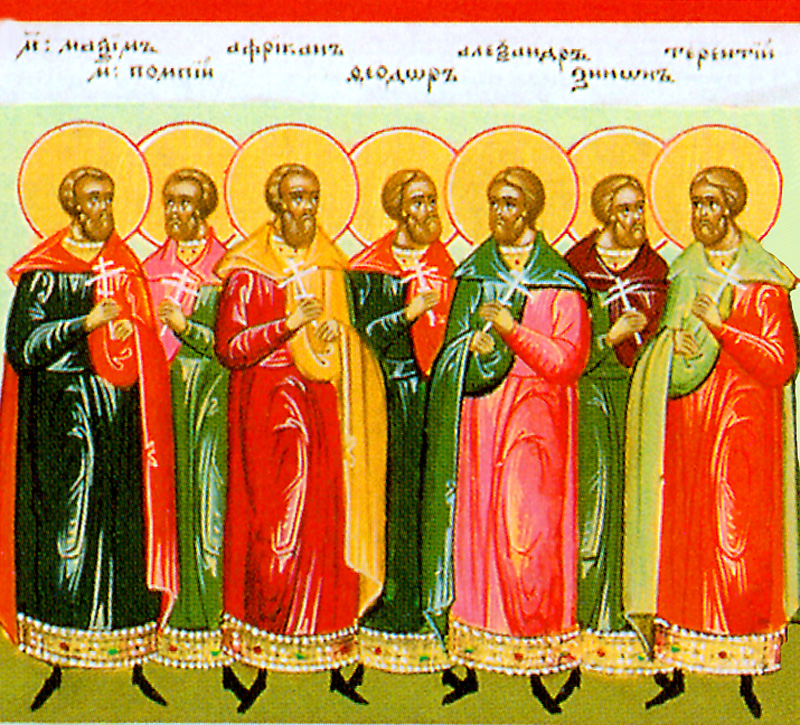
The Holy Martyr Terence and his companions suffered under the emperor Decius (249-251). The emperor issued an edict commanding all subjects to offer sacrifice to the pagan idols.
When the governor of Africa Fortunianus received this edict, he gathered the people into the city square, set out cruel instruments of torture and declared that everyone without exception had to offer the sacrifice to the idols.
Many, afraid of torture, complied. However, Saint Terence and forty other Christians bravely affirmed their faith in the Savior and ridiculed the idols. Fortunianus was amazed at their boldness and he asked how they as rational people, could confess as God, One Whom the Jews crucified as a malefactor.
Saint Terence answered that their belief was in the Savior, Who voluntarily endured death on the Cross and rose on the third day. Fortunianus saw that Terence inspired the others by his example, and so he ordered him to be isolated in prison with his three closest companions: Africanus, Maximus, and Pompeius. Fortunianus was determined to force the rest of the martyrs, including Zeno, Alexander and Theodore, to renounce Christ.
Neither threats nor terrible tortures could sway the holy martyrs. They burned them with red-hot iron, they poured vinegar on the wounds, they sprinkled on salt, and they raked them with iron claws. In spite of their sufferings, the saints did not weaken in their confession of Christ, and the Lord gave them strength.
Fortunianus gave orders to lead the martyrs into the pagan temple, and once again he urged them to offer sacrifice to the idols. The valiant warriors of Christ cried out, “O Almighty God, Who once sent down fire on Sodom for its iniquity, destroy this impious temple of idolatry.” The idols fell down with a crash, and then the temple lay in ruins. The enraged governor gave orders to execute them, and the martyrs, glorifying God, bowed their necks beneath the executioner’s sword.
After the execution of the thirty-six martyrs, Fortunianus summoned Terence, Maximus, Africanus and Pompeius before him. He showed them the martyrs’ bodies and again urged them to offer sacrifice to the idols. The martyrs refused. The governor put heavy chains on them, and gave orders to starve them to death. By night, an angel of the Lord removed the martyrs’ chains and fed them.
In the morning, the guards found the saints cheerful and strong. Then Fortunianus ordered sorcerers and conjurers to carry snakes and all kinds of poisonous creatures into the prison. The guards looked into the cell through an opening in the ceiling and saw the martyrs unharmed, praying, and the snakes crawling at their feet. When the sorcerers opened the door of the prison cell, the snakes bit them. The furious Fortunianus gave orders to behead the holy martyrs. Christians took up their holy bodies and buried them with reverence outside the city.
Martyrs James (Jacob) the Presbyter, and Azadanes and Abdicius, Deacons, of Persia
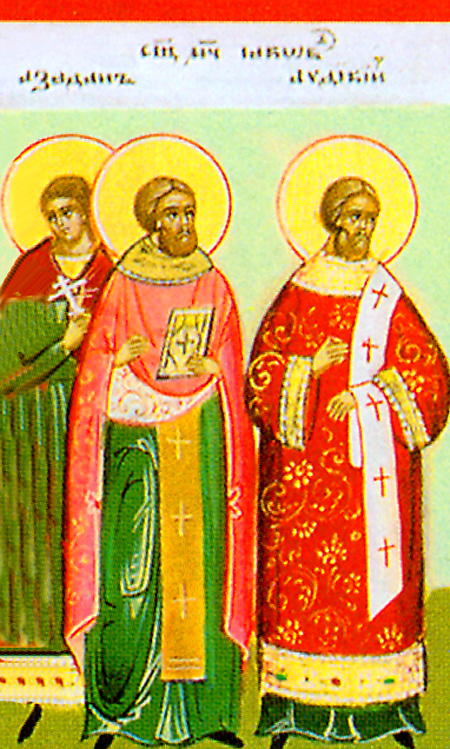
The Holy Martyrs James the Presbyter and the deacons Azadanes and Abdikius died in Persia under the emperor Sapor in about the year 380. They were arrested together with Bishop Akepsimas (November 3). Weak from hunger, the sufferers had mustard and vinegar inserted into their nostrils. Then they were stripped and led out to stand all night in the cold.
In the morning, after new torments, the martyrs were returned to prison and beheaded.
Martyrs of the Kvabtakhevi Monastery in Georgia

In the 14th century, during the reign of King Bagrat V (1360-1394), Timur (Tamerlane) invaded Georgia seven times. His troops inflicted irreparable damage on the country, seizing centuries-old treasures and razing ancient churches and monasteries.
Timur’s armies ravaged Kartli, then took the king, queen, and the entire royal court captive and sent them to Karabakh (in present-day Azerbaijan). Later Timur attempted to entice King Bagrat to renounce the Christian Faith in exchange for permission to return to the throne and for the release of the other Georgian prisoners.
For some time Timur was unable to subjugate King Bagrat, but in the end, being powerless and isolated from his kinsmen, the king began to falter. He devised a sly scheme: to confess Islam before the enemy, but to remain a Christian at heart. Satisfied with King Bagrat’s decision to “convert to Islam,” Timur permitted the king to return to the throne of Kartli. At the request of King Bagrat, Timur sent twelve thousand troops with him to complete Georgia’s forcible conversion to Islam.
When they were approaching the village of Khunani in southeastern Georgia, Bagrat secretly informed his son Giorgi of everything that had happened and called upon him and his army to massacre the invaders.
The news of Bagrat’s betrayal and the ruin of his army infuriated Timur, and he called for immediate revenge. At their leader’s command, his followers destroyed everything in their path, set fire to cities and villages, devastated churches, and thus forced their way through to Kvabtakhevi Monastery.
Monastics and laymen alike were gathered in Kvabtakhevi when the enemy came thundering in. Having forced open the gate, the attackers burst into the monastery, then plundered and seized all its treasures. They captured the young and strong, carrying them away.
The old and infirm were put to the sword. As the greatest humiliation, they mocked the clergy and monastics by strapping them with sleigh bells and jumping and dancing around them.
Already drunk on the blood they had shed, the barbarians posed an ultimatum to those who remained: to renounce Christ and live or to be driven into the church and burned alive.
Faced with these terms, the faithful cried out: “Go ahead and burn our flesh—in the Heavenly Kingdom our souls will burn with a divine flame more radiant than the sun!” And in their exceeding humility, the martyrs requested that their martyrdom not be put on display: “We ask only that you not commit this sin before the eyes of men and angels. The Lord alone knows the sincerity of our will and comforts us in our righteous afflictions!”
Having been driven like beasts into the church, the martyrs raised up a final prayer to God: “In the multitude of Thy mercy shall I go into Thy house; I shall worship toward Thy holy temple in fear of Thee. O Lord, guide me in the way of Thy righteousness; because of mine enemies, make straight my way before Thee (Ps. 5:6-7) that with a pure mind I may glorify Thee forever….”
The executioners hauled in more and more wood, until the flames enveloping the church blazed as high as the heavens and the echo of crackling timber resounded through the mountains. Ensnared in a ring of fire, the blissful martyrs chanted psalms as they gave up their spirits to the Lord.
The massacre at Kvabtakhevi took place in 1386. The imprints of the martyrs’ charred bodies remain on the floor of the church to this day.
Hieromartyr Patriarch Gregory V of Constantinople
The Holy Patriarch Gregory (George Angelopoulos in the world) was born in 1745 at Dēmētsána in the Pelopónnēsos. He began his education in the village schools, since his father could not afford to send him to better schools. In 1765, he went to Athens to study under the renowned teacher Dēmḗtrios Vodas, and in 1767, he went to Smyrna to attend an ecclesiastical school. Later, he went to Patmos for further study, and was ordained as a Deacon in 1775 at Smyrna. Soon after, he was ordained as a Hieromonk.
In 1785 he was consecrated as a Bishop, and was chosen as the Metropolitan of Smyrna. His ministry produced much spiritual fruit, and he edified his flock by his eloquent sermons, by building schools, and by writing books. On May 1,1797 he was elected as Patriarch of Constantinople. From that day forward, he concerned himself with the internal and external order of the Patriarchate. He established rules for his household and staff, called regular meetings, and set agendas for the Synod of Bishops.
In the early XIX century, Greece was suffering under the heavy Turkish yoke, though many Greek patriots hoped to regain their independence. They found support from the Holy Patriarch, whose connections with Greek patriots were revealed only after Alexander Ypsilantis crossed the Prut River with his army against Sultan Mahmud.
The Patriarch was an ascetic who kept the fasts and devoted himself to the unceasing Prayer of the Heart. Such traits did not endear him to everyone, and he had many enemies. The Saint's austerity annoyed some bishops, who slandered him, resulting in his removal and exile to Mount Athos from 1798-1806, where he lived in the Greatest Lavra.
His second tenure as Patriarch began amid political turmoil. Once more he began a program of building churches and schools. Turkey declared war in 1807 as the result of Russian activity in the Balkans. The Sultan ordered Saint Gregory to issue an encyclical against Russia in order to prevent the Greeks from cooperating with them. He bore no malice toward Russia, but he was trying to avoid massacres and insurrections. Three times during his second Patriarchate, Saint Gregory was forced to quell Greek attempts to revolt. Nevertheless, he was deposed and exiled to the Holy Mountain in 1808.
In January 1819, the Holy Hierarch ascended the Patriarchal throne for the final time. He established a fund to help the poor of Constantinople and reorganized the Patriarchal printing press, which published many spiritual books. In March, several bishops were imprisoned or executed because of the failed insurrection of Alexander Ypsilantis in Moldavia. When the Greek Revolution began on March 25, 1821, the Turks ordered the Patriarch and his Synod to issue an anathema against Ypsilantis and those who had cooperated with him. The anathema was ignored, because the Greeks knew that it had been issued under duress.
During that Lent, jailings and executions were common. One of the Patriarch's friends advised him to flee from Constantinople to the Morea. Saint Gregory replied: "I have a premonition that the fish of the Bosphorus will eat my body, but I will die calmly, for the sake of of saving my nation."
On Holy Pascha, April 10, 1821, the Patriarch was seized at 10:00 A.M. and hanged at the gate of the Patriarchate, and then his body was thrown into the sea. That gate has remained shut ever since.
Greek sailors noticed the place where the Hieromartyr's body was abandoned, and placed it on a ship from Kephalonia under the command of Captain Macri Sklavos, and then it was taken to Odessa under the Russian flag. The Hierarch's relics were buried in the Greek church of the Holy Trinity on June 19, 1821. Patriarchal vestments were sent from Moscow for the Saint's relics, as well as a mitre and a cross, which had belonged to His Holiness Patriarch Nikon (1652-1658). The Hieromartyr Gregory V of Constantinople, held the See of Constantinople three times (1797-1799, 1806-1808, 1819-1821).
In 1871, at the request of the Greek government, permission was granted to transfer Patriarch Gregory's relics from Odessa to Athens for the celebration of the fiftieth anniversary of Greek independence. A special Service was composed in Athens in honor of the Hierarch, whose martyrdom heralded the triumph of Christianity in Greece.
The Hieromartyr Gregory was glorified as a Saint in 1921. The scroll on his Icon reads: "For freedom Christ has set us free; stand fast therefore, and do not be entangled again with the yoke of slavery" (Galatians 5:1).
The Presanctified Divine Liturgy – Wednesday Apr 9, 2025
Here is the live stream for The Presanctified Divine Liturgy – Wednesday Apr 9, 2025 If you need, here are instructions for accessing this content from your phone, tablet, computer, or TV.
 Saint Peter Antiochian Orthodox Church
You must be logged in to post a comment.