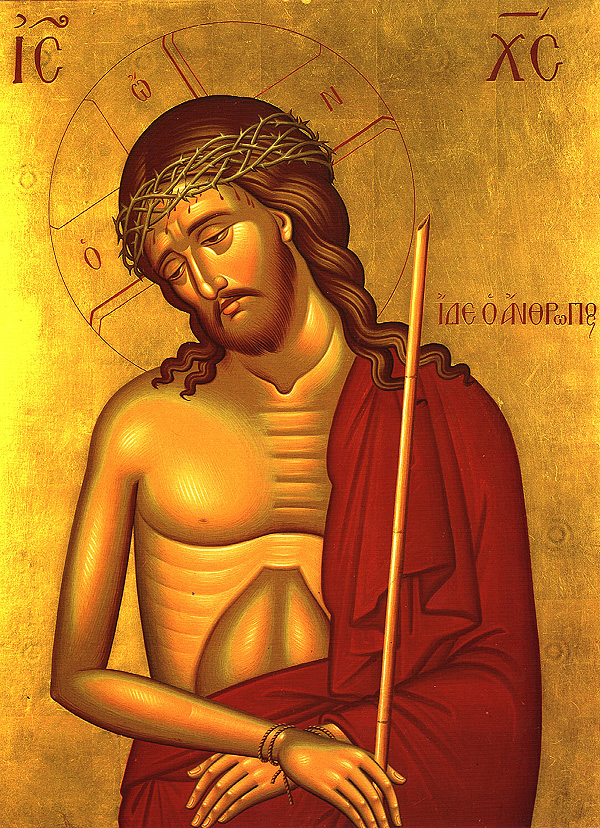
Monthly Archives: April 2025

Daily Readings for Wednesday, April 16, 2025

HOLY WEDNESDAY

ABSTAIN FROM MEAT, FISH, DAIRY, EGGS, WINE, OLIVE OIL

Holy Wednesday, Agape, Chionia, and Irene, the Holy Martyrs, Righteous Amphilochios of Patmos, Leonidas and Charissa, Nike, Galene, Kallida, Nounenchia, Vasilissa, and Theodora the Martyrs

JOHN 12:17-50

At that time, the crowd that had been with Jesus when he called Lazarus out of the tomb and raised him from the dead bore witness. The reason why the crowd went to meet him was that they heard he had done this sign. The Pharisees then said to one another, "You see that you can do nothing; look, the world has gone after him.
Now among those who went up to worship at the feast were some Greeks. So these came to Philip, who was from Bethsaida in Galilee, and said to him, "Sir, we wish to see Jesus." Philip went and told Andrew; Andrew went with Philip and they told Jesus. And Jesus answered them, "The hour has come for the Son of man to be glorified. Truly, truly, I say to you, unless a grain of wheat falls into the earth and dies, it remains alone; but if it dies, it bears much fruit. He who loves his life loses it, and he who hates his life in this world will keep it for eternal life. If any one serves me, he must follow me; and where I am, there shall my servant be also; if any one serves me, the Father will honor him.
Now is my soul troubled. And what shall I say? 'Father, save me from this hour'? No, for this purpose I have come to this hour. Father, glorify your name." Then a voice came from heaven, "I have glorified it, and I will glorify it again." The crowd standing by heard it and said that it had thundered. Others said, "An angel has spoken to him." Jesus answered, "This voice has come for your sake, not for mine. Now is the judgment of this world, now shall the ruler of this world be cast out; and I, when I am lifted up from the earth, will draw all men to myself." He said this to show by what death he was to die. The crowd answered him, "We have heard from the law that the Christ remains for ever. How can you say that the Son of man must be lifted up? Who is this Son of man?" Jesus said to them, "The light is with you for a little longer. Walk while you have the light, lest the darkness overtake you; he who walks in the darkness does not know where he goes. While you have the light, believe in the light, that you may become sons of light.
When Jesus had said this, he departed and hid himself from them. Though he had done so many signs before them, yet they did not believe in him; it was that the word spoken by the prophet Isaiah might be fulfilled: "Lord, who has believed our report, and to whom has the arm of the Lord been revealed?" Therefore they could not believe. For Isaiah again said, "He has blinded their eyes and hardened their heart, lest they should see with their eyes and perceive with their heart, and turn for me to heal them." Isaiah said this because he saw his glory and spoke of him. Nevertheless many even of the authorities believed in him, but for fear of the Pharisees they did not confess it, lest they should be put out of the synagogue: for they loved the praise of men more than the praise of God.
And Jesus cried out and said, "He who believes in me, believes not in me but in him who sent me. And he who sees me sees him who sent me. I have come as light into the world, that whoever believes in me may not remain in darkness. If any one hears my sayings and does not keep them, I do not judge him; for I did not come to judge the world but to save the world. He who rejects me and does not receive my sayings has a judge; the word that I have spoken will be his judge on the last day. For I have not spoken on my own authority; the Father who sent me has himself given me commandment what to say and what to speak. And I know that his commandment is eternal life. What I say, therefore, I say as the Father has bidden me.

MATTHEW 26:6-16

When Jesus was at Bethany at the house of Simon the leper, a woman came up to him with an alabaster flask of very expensive ointment and she poured it on his head, as he sat at table. But when the disciples saw it, they were indignant, saying, "Why this waste? For this ointment might have been sold for a large sum, and given to the poor." But Jesus, aware of this, said to them, "Why do you trouble the woman? For she has done a beautiful thing to me. For you always have the poor with you, but you will not always have me. In pouring this ointment on my body she has done it to prepare me for burial. Truly, I say to you wherever this gospel is preached in the whole world, what she has done will be told in memory of her." Then one of the twelve, who was called Judas Iscariot, went to the chief priests and said, "What will you give me if I deliver him to you?" And they paid him thirty pieces of silver. And from that moment he sought an opportunity to betray him.

Great and Holy Wednesday
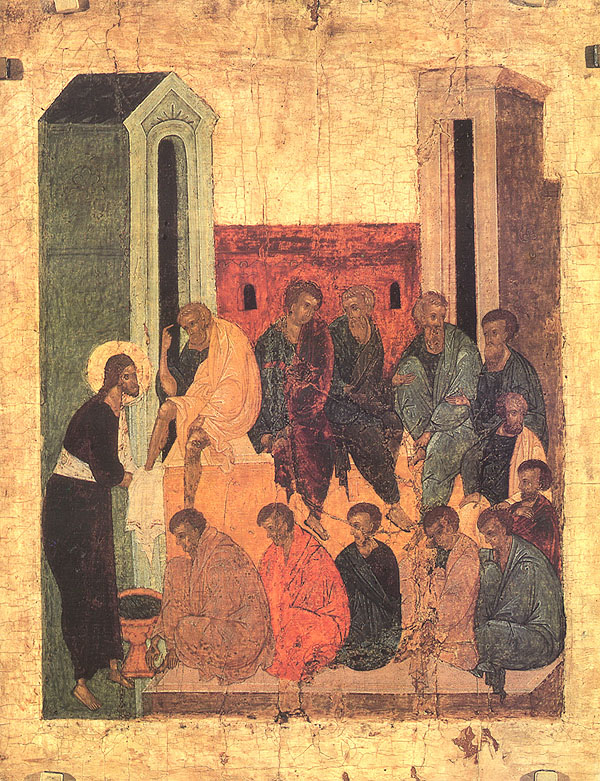
On Great and Holy Wednesday, the hymns of the Bridegroom Service remind us of the sinful woman who poured precious ointment on Christ’s head at Simon the leper’s house (Mt. 26:7).

The disciples complained about the wasteful extravagance, for the myrrh could have been sold and the money given to the poor. On this same day Judas agreed to betray the Lord for thirty pieces of silver. Because the betrayal took place on Wednesday, Orthodox Christians fast on most Wednesdays during the year.

On the other hand, the Savior declared that the woman’s actions would be remembered wherever the Gospel is preached (Mt. 26:13), for she had anointed Him in preparation for His burial (Mt. 26:12).

Virgin Martyrs Agape, Irene and Chionia, in Illyria

The Holy Martyrs Agape, Irene, and Chionia were sisters who lived at the end of the third century to the beginning of the fourth century, near the Italian city of Aquilea. They were left orphaned at an early age.

The young women led a pious Christian life and they turned down many offers of marriage. Their spiritual guide was the priest Xeno. It was revealed to him in a vision that he would die very soon, and that the holy virgins would suffer martyrdom. Also at Aquilea and having a similar vision was the Great Martyr Anastasia (December 22), who is called “Deliverer from Potions,” because she fearlessly visited Christians in prison, encouraging them and healing them from potions, poisons, and other harmful things. The Great Martyr Anastasia visited the sisters and urged them to endure all things for Christ. Soon what was predicted in the vision came to pass. The priest Zeno died, and the three virgins were arrested and brought to trial before the emperor Diocletian (284-305).

Saint Chionia (“snow” in Greek) preserved the purity of her baptism according to the words of the Prophet-King David, “You will wash me, and I shall be whiter than snow” (Ps. 50/51:7).

Saint Irene (“peace” in Greek) preserved the peace of Christ within herself and manifested it to others, according to the Savior’s word, “My peace I give you” (John 14:27).

Saint Agape (“love” in Greek) loved God with all her heart, and her neighbor as herself (Mt.22:37-39).

Seeing the youthful beauty of the sisters, the emperor urged them to deny Christ and he promised to find them illustrious bridegrooms from his entourage. The holy sisters replied that their only Bridegroom was Christ, for Whom they were ready to suffer. The emperor demanded they renounce Christ, but neither the elder sisters, nor the youngest, would consent. They called the pagan gods mere idols made by human hands, and they preached faith in the true God.

By order of Diocletian, who was leaving for Macedonia, the holy sisters were also to be brought there. And they brought them to the court of the governor Dulcititus.

When he saw the beauty of the holy martyrs, he was aroused with impure passion. He put the sisters under guard, and he told them that they would receive their freedom if they agreed to fulfill his desires. But the holy martyrs replied that they were prepared to die for their Heavenly Bridegroom, Christ.

Then Dulcititus decided to have his way by force. When the holy sisters arose at night to glorify the Lord in prayer, Dulcititus came to the door and tried to enter, but an invisible force prevented him. He staggered about, unable to find his way out. Then he fell down in the kitchen among the cooking utensils, the pots and pans, and he was covered all over with soot. The servants and the soldiers recognized him only with difficulty. When he saw himself in a mirror, he then realized that the holy martyrs had made a fool of him, and he decided to take his revenge on them.

At his court, Dulcititus gave orders to strip the holy martyrs. But the soldiers were not able to do this, no matter how much they tried. Their clothing seemed to be stuck to the bodies of the holy virgins. During the trial Dulcititus suddenly fell asleep, and no one could rouse him. Just as they carried him into his house, he immediately awoke.

When they reported to the emperor Diocletian everything that had happened, he became angry with Dulcititus and he gave the holy virgins over to Sisinius for trial. He began with the youngest sister, Irene. Seeing that she remained unyielding, he sent her to prison and then attempted to sway Saints Chionia and Agape. He also failed to make them renounce Christ, and Sisinius ordered that Saints Agape and Chionia be burned. On hearing the sentence, the sisters gave thanks to the Lord for their crowns of martyrdom. In the fire, Agape and Chionia surrendered their pure souls to the Lord.

When the fire went out, everyone saw that the bodies of the holy martyrs and their clothing had not been scorched by the fire, and their faces were beautiful and peaceful, as if they were asleep. On the day following, Sisinius gave orders to bring Saint Irene to court. He threatened her with the fate of her older sisters and he urged her to renounce Christ. Then he threatened to hand her over for defilement in a brothel. But the holy martyr answered, “Even if my body is defiled by force, my soul will never be defiled by renouncing Christ.”

When the soldiers of Sisinius led Saint Irene to the brothel, two luminous soldiers overtook them and said, “Your master Sisinius commands you to take this virgin to a high mountain and leave her there, and then return to him and report to him that you have fulfilled his command.” And the soldiers did so.

When they reported back to Sisinius, he flew into a rage, since he had given no such orders. The luminous soldiers were angels of God, saving the holy martyr from defilement. Sisinius went to the mountain with a detachment of soldiers and saw Saint Irene on the summit. For a long while they searched for the way to the top, but they could not find it. Then one of the soldiers wounded Saint Irene with an arrow. The martyr cried out to Sisinius, “I mock your impotent malice, and I go my Lord Jesus Christ pure and undefiled.” Having given thanks to the Lord, she lay down upon the ground and surrendered her soul to God on the very day of Holy Pascha (+ 304).

The Great Martyr Anastasia heard about the end of the holy sisters, and she buried their bodies with reverence.

Martyrs Leonidas, Chariessa, Nice, Galina, Kalista, Nunechia, Basilissa, Theodora, and Irene, of Corinth
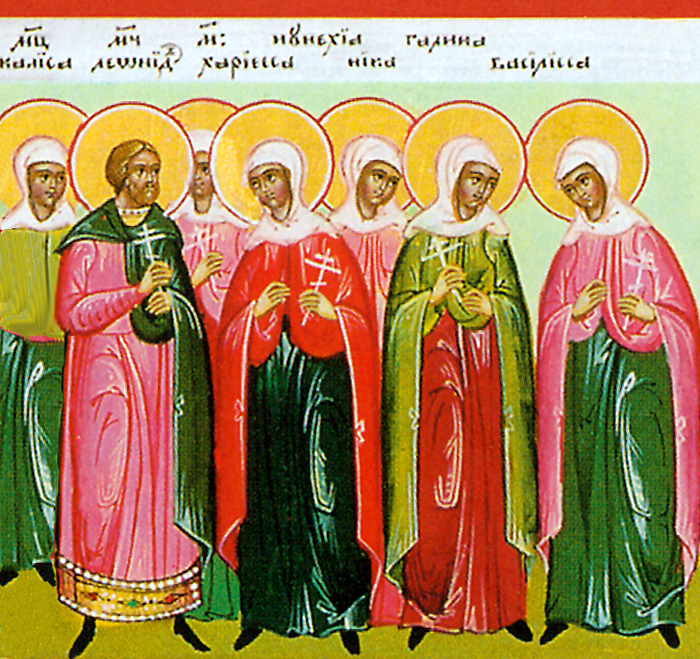
The Holy Martyr Leonidas and the Holy Martyrs Charissa, Nike (Nika, Victoria), Galina, Kalista (Kalida), Nunekhia, Basilissa, Irene, and Theodora suffered at Corinth in the year 258. They threw them into the sea, but they did not drown. Instead, they walked upon the water as if on dry land, singing spiritual hymns. The torturers overtook them in a ship, tied stones around their necks and drowned them.

Monastic Martyr Christopher of Dionysiou, Mount Athos

No information available at this time.

Hieromartyr Nikḗtas

No information available at this time.

Weeping “Ilyin Chernigov” Icon of the Mother of God

The Il'insk (Prophet Elias)-Chernigov Icon of the Mother of God was painted in 1658 by the iconographer Gregory Dubensky (Gennadios in monasticism). The history of the Icon's creation and its miracles are described by a witness of these events, Saint Demetrios, Metropolitan of Rostov, in the works "A Miracle of the Most Holy and Most Blessed Virgin Mary," and "The Bedewed Fleece" (Руно орошенное). Some miracles are also mentioned by Saint John (Maximovich), Metropolitan of Tobolsk (June 10) in a poem "To the Virgin Theotokos." In 1662 there was a miraculous flow of tears from the Il'insk-Chernigov Icon, which continued from April 16-24, in connection with which a Feast Day was appointed for the Icon. In the same year, Chernigov was attacked by the Tatars, who ravaged the city and its environs, including the Holy Trinity-Il'insk Monastery, but, as Saint Demetrios testifies, the Icon and its precious oklad remained unharmed. The brethren who had taken refuge in the underground caves were also spared.

From the XVII century, cases of miracles from the Il'insk-Chernigov Icon were recorded with particular care. In "The Bedewed Fleece," Saint Demetrios described in detail 24 miraculous healings (one every hour) from all sorts of ailments of the residents of Chernigov and its environs. The list of miracles was augmented when the book was reprinted. Thus, by 1696, there were 56 cases of healing (5 from blindness, 3 from a disease of the legs, 3 from "gostza" (rheumatism). 1 from paralysis, 15 from demonic possession, 14 from clouding of the mind, 15 from various chronic diseases, and 1 instance of a boy raised from the dead. In the XIX century, several healings were observed: a Romny bourgeois from a fever (1865), a Chernigov girl from a mental disorder (on the Icon's Feast Day in 1874), and an infant from a high fever (1887 or 1888), the son of a Poltava landowner from diphtheria (until 1898), and a staff captain from Sveaborg from a chronic illness (until 1898), and several others.

Before HolyTrinity Cathedral was built in the Monastery (1679-1695), the Icon was kept in the church of the Prophet Elias near the caves, to the right near the pillar closest to the iconostasis. In 1786-1794, in connection with the planned opening of the University of Holy Trinity-Il'insk Monastery at Chernigov, but this did not occur, so the Icon was placed in the Dormition Cathedral of the Yelets Chernigov Convent, which was dedicated to the Dormition of the Most Holy Theotokos. In the XIX century, the Icon was in the cathedral, but only during the summertime. In winter, the Icon was transferred to the heated church of the Nativity of Christ, and placed in a special case behind the right kliros. At the beginning of the XX century, in winter, the Il'insk-Chernigov Icon of the Mother of God was kept in the Sretensky church in the Bishop's residence, and a substitute icon was left in the cathedral. The wonderworking Icon disappeared after the closure of Holy Trinity-Il'insk Monastery in 1924.

At the end of the XVII century, by the initiative of Archbishop Lazarus (Baranovich) and at the expense of Hetman I. S. Mazepa (whose initials and coat of arms were on the case), a silver oklad and a kiot were made (these have not been preserved). A crown with precious stones was donated by the Chernigov Colonel V. Dunin-Borkovsky, who received healing from the Icon in 1687 The dimensions of the Icon (1 arshin, 5 vershkas by 14.5 vershts – 93.37×64.45 cm) were increased when placed in the kiot because it was overlaid with a frame covered with silver plates with additional images engraved on them (2 arshins 2 vershkas by 1 arshin 6 vershks (151.24×97.8 cm) together with the frame). Attached to the case were plaques with inscriptions: "This holy image of the Mother of God, called Il'insk-Chernigov, was painted in 1658" and "The miraculous flow of tears from the Icon apparently occurred in 1662, from the 16th to the 24th day of the month of April." "In 1662 the Tatars invaded the city of Chernigov, but the hands of the impious Saracens could not touch this wonderworking Icon." In 1897 the oklad was replaced by a new one, made in Moscow by M. N. Ryndin with donations from the residents of Chernigov. There was an inscription on it: "This silver riza was made to replace the old one, which had fallen into disrepair, with the blessing of Bishop Anthony of Chernigov and Nizhyn, with the zeal of the benevolent donors of Chernigov. Hierodeacon Varlaam was sent to Moscow to order this riza from the master M. N. Ryndin, 1897, the weight of this riza is 33 ф. 29 з."

Revered copies of the Il'insk-Chernigov Icon, made at the end of the XVII-XVIII centuries, were in all the churches of Chernigov. At present, two copies are venerated in the Yelets Dormition Monastery in Chernigov.

The wonderworking copy of the Chernigov Icon of the Mother of God, which was kept in the Gethsemane Skete of Holy Trinity-Saint Sergius Lavra, became famous in 1869.

The Icon belongs to the traditional Hodegetria type. The Child blesses with His right hand, and a scroll in his left. He sits on the left hand of His Mother. The heads of the Mother of God and the Child are slightly inclined toward each other, the Child's legs are tightly together. The figure of the Mother of God has an almost generational edge, characteristic of the southern and western Russian iconography of the Mother of God of the XVII century. The Child is dressed in a white shirt with a collar. A distinctive feature of Il'insk-Chernigov iconography. The Icon is a gesture of the Infant's hand stretched forward. Identical or fairly similar compositional solutions are present in a number of other wonderworking Icons of the Mother of God associated with Belarus and Ukraine (Borkolabovskaya, Trigorskaya, Poddubetska, Gerbovetskaya Icons of the Mother of God).

In copies of the wonderworking Icon, crowns were often depicted on the heads of the Mother of God and her Child, which were absent on the Icon itself, but were present on its oklad. For the first time, crowns were depicted in an engraving of 1683 in Saint Demetrios of Rostov's book "The Bedewed Fleece." Obviously, this engraving became a model for Ukrainian and Russian icons, and on such copies the identifying inscription at the bottom was usually repeated (icon of 1778, Chernigov State Icon, Historical and Architectural Museum-Reserve).

Tambov (Utkino) Icon of the Mother of God

In 1686, Saint Pitirim (July 28) came to Tambov and, along with other relics, he brought with him a copy of the Il'insk-Chernigov Icon of the Mother of God, considered to be the patroness of the southwestern region. For this reason, the Icon was placed at the southwestern gate of the city. Over time, the Icon began to be called Tambov, especially since there were some differences between it and the Il'insk-Chernigov Icon of the Mother of God.

On the borders of the Icon, on the right and on the left, were depicted: Saint Alexei, the Man of God, and Saint Eudoxia. It is assumed that these were the heavenly patrons of Bishop Pitirim's parents, and it is quite possible that he himself painted the images of those Saints.

Later, on the site of the southwestern city gate, a small wooden church was built and dedicated to the Holy Apostles Peter and Paul. It was in this church that the Icon was kept. And when the merchant Ivan Utkin built the stone church of the Holy Protomartyr Stephen at his own expense in 1771-1778, the Tambov Icon was transferred there and placed in the altar above the altar. People began to call the church by the name of the builder Utkinskaya, and the Icon was later completely forgotten.

But the Queen of Heaven reminded people of herself. At the beginning of the XIX century, a priest in Kaluga, was suffering from a malady of his legs and could not walk. He saw this Icon of the Mother of God in a dream. She told him: "Find this icon. Pray before it and you shall be healed." After the dream, the priest received some relief from his illness, so that he was able to walk, and immediately he began to search for the Icon he had seen in the dream. After visiting various villages and towns, he finally reached Tambov, where, after inspecting all the churches, he found the Icon he had seen in his dream in the altar of the Utkin church. After praying before it, he received complete healing. This incident became widely known in the city, and afterward there were several more miraculous healings of the townspeople.

The Tambov Icon became famous again, and when in 1835 the old Utkin church was severely damaged. At the request of the townspeople, the right side altar was consecrated in honor of the Tambov Icon of the Mother of God. With the passage of time, the grateful Tambov residents adorned the Icon with a luxurious silver-gilt riza with many precious stones. There were so many cures from the Icon that there was no time to record all of them. In 1888, by decree of the Holy Synod, a Cross Procession took place in all the churches of the city on April 16 in honor of the Tambov Icon, and in 1900 the church was once again called the church of the Theotokos.

After the 1917 revolution, Tambov's churches were devastated, and the wonderworking Icon also suffered. The riza was removed and the stones were pried out, and then it disappeared without a trace. There are revered copies of the wonderworking Icon in the city.

The Tambov Icon is commemorated on April 16, and again on July 28 (the repose of Bishop Pitirim).
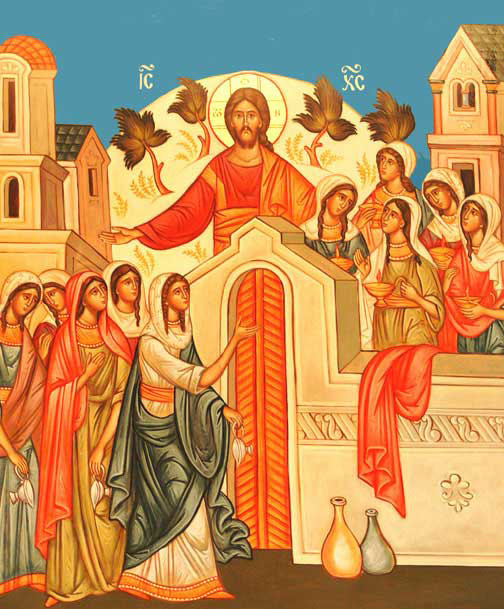
Daily Readings for Wednesday, April 16, 2025

HOLY WEDNESDAY

ABSTAIN FROM MEAT, FISH, DAIRY, EGGS, WINE, OLIVE OIL

Holy Wednesday, Agape, Chionia, and Irene, the Holy Martyrs, Righteous Amphilochios of Patmos, Leonidas and Charissa, Nike, Galene, Kallida, Nounenchia, Vasilissa, and Theodora the Martyrs

JOHN 12:17-50

At that time, the crowd that had been with Jesus when he called Lazarus out of the tomb and raised him from the dead bore witness. The reason why the crowd went to meet him was that they heard he had done this sign. The Pharisees then said to one another, "You see that you can do nothing; look, the world has gone after him.
Now among those who went up to worship at the feast were some Greeks. So these came to Philip, who was from Bethsaida in Galilee, and said to him, "Sir, we wish to see Jesus." Philip went and told Andrew; Andrew went with Philip and they told Jesus. And Jesus answered them, "The hour has come for the Son of man to be glorified. Truly, truly, I say to you, unless a grain of wheat falls into the earth and dies, it remains alone; but if it dies, it bears much fruit. He who loves his life loses it, and he who hates his life in this world will keep it for eternal life. If any one serves me, he must follow me; and where I am, there shall my servant be also; if any one serves me, the Father will honor him.
Now is my soul troubled. And what shall I say? 'Father, save me from this hour'? No, for this purpose I have come to this hour. Father, glorify your name." Then a voice came from heaven, "I have glorified it, and I will glorify it again." The crowd standing by heard it and said that it had thundered. Others said, "An angel has spoken to him." Jesus answered, "This voice has come for your sake, not for mine. Now is the judgment of this world, now shall the ruler of this world be cast out; and I, when I am lifted up from the earth, will draw all men to myself." He said this to show by what death he was to die. The crowd answered him, "We have heard from the law that the Christ remains for ever. How can you say that the Son of man must be lifted up? Who is this Son of man?" Jesus said to them, "The light is with you for a little longer. Walk while you have the light, lest the darkness overtake you; he who walks in the darkness does not know where he goes. While you have the light, believe in the light, that you may become sons of light.
When Jesus had said this, he departed and hid himself from them. Though he had done so many signs before them, yet they did not believe in him; it was that the word spoken by the prophet Isaiah might be fulfilled: "Lord, who has believed our report, and to whom has the arm of the Lord been revealed?" Therefore they could not believe. For Isaiah again said, "He has blinded their eyes and hardened their heart, lest they should see with their eyes and perceive with their heart, and turn for me to heal them." Isaiah said this because he saw his glory and spoke of him. Nevertheless many even of the authorities believed in him, but for fear of the Pharisees they did not confess it, lest they should be put out of the synagogue: for they loved the praise of men more than the praise of God.
And Jesus cried out and said, "He who believes in me, believes not in me but in him who sent me. And he who sees me sees him who sent me. I have come as light into the world, that whoever believes in me may not remain in darkness. If any one hears my sayings and does not keep them, I do not judge him; for I did not come to judge the world but to save the world. He who rejects me and does not receive my sayings has a judge; the word that I have spoken will be his judge on the last day. For I have not spoken on my own authority; the Father who sent me has himself given me commandment what to say and what to speak. And I know that his commandment is eternal life. What I say, therefore, I say as the Father has bidden me.

MATTHEW 26:6-16

When Jesus was at Bethany at the house of Simon the leper, a woman came up to him with an alabaster flask of very expensive ointment and she poured it on his head, as he sat at table. But when the disciples saw it, they were indignant, saying, "Why this waste? For this ointment might have been sold for a large sum, and given to the poor." But Jesus, aware of this, said to them, "Why do you trouble the woman? For she has done a beautiful thing to me. For you always have the poor with you, but you will not always have me. In pouring this ointment on my body she has done it to prepare me for burial. Truly, I say to you wherever this gospel is preached in the whole world, what she has done will be told in memory of her." Then one of the twelve, who was called Judas Iscariot, went to the chief priests and said, "What will you give me if I deliver him to you?" And they paid him thirty pieces of silver. And from that moment he sought an opportunity to betray him.

Great and Holy Wednesday

On Great and Holy Wednesday, the hymns of the Bridegroom Service remind us of the sinful woman who poured precious ointment on Christ’s head at Simon the leper’s house (Mt. 26:7).

The disciples complained about the wasteful extravagance, for the myrrh could have been sold and the money given to the poor. On this same day Judas agreed to betray the Lord for thirty pieces of silver. Because the betrayal took place on Wednesday, Orthodox Christians fast on most Wednesdays during the year.

On the other hand, the Savior declared that the woman’s actions would be remembered wherever the Gospel is preached (Mt. 26:13), for she had anointed Him in preparation for His burial (Mt. 26:12).

Virgin Martyrs Agape, Irene and Chionia, in Illyria

The Holy Martyrs Agape, Irene, and Chionia were sisters who lived at the end of the third century to the beginning of the fourth century, near the Italian city of Aquilea. They were left orphaned at an early age.

The young women led a pious Christian life and they turned down many offers of marriage. Their spiritual guide was the priest Xeno. It was revealed to him in a vision that he would die very soon, and that the holy virgins would suffer martyrdom. Also at Aquilea and having a similar vision was the Great Martyr Anastasia (December 22), who is called “Deliverer from Potions,” because she fearlessly visited Christians in prison, encouraging them and healing them from potions, poisons, and other harmful things. The Great Martyr Anastasia visited the sisters and urged them to endure all things for Christ. Soon what was predicted in the vision came to pass. The priest Zeno died, and the three virgins were arrested and brought to trial before the emperor Diocletian (284-305).

Saint Chionia (“snow” in Greek) preserved the purity of her baptism according to the words of the Prophet-King David, “You will wash me, and I shall be whiter than snow” (Ps. 50/51:7).

Saint Irene (“peace” in Greek) preserved the peace of Christ within herself and manifested it to others, according to the Savior’s word, “My peace I give you” (John 14:27).

Saint Agape (“love” in Greek) loved God with all her heart, and her neighbor as herself (Mt.22:37-39).

Seeing the youthful beauty of the sisters, the emperor urged them to deny Christ and he promised to find them illustrious bridegrooms from his entourage. The holy sisters replied that their only Bridegroom was Christ, for Whom they were ready to suffer. The emperor demanded they renounce Christ, but neither the elder sisters, nor the youngest, would consent. They called the pagan gods mere idols made by human hands, and they preached faith in the true God.

By order of Diocletian, who was leaving for Macedonia, the holy sisters were also to be brought there. And they brought them to the court of the governor Dulcititus.

When he saw the beauty of the holy martyrs, he was aroused with impure passion. He put the sisters under guard, and he told them that they would receive their freedom if they agreed to fulfill his desires. But the holy martyrs replied that they were prepared to die for their Heavenly Bridegroom, Christ.

Then Dulcititus decided to have his way by force. When the holy sisters arose at night to glorify the Lord in prayer, Dulcititus came to the door and tried to enter, but an invisible force prevented him. He staggered about, unable to find his way out. Then he fell down in the kitchen among the cooking utensils, the pots and pans, and he was covered all over with soot. The servants and the soldiers recognized him only with difficulty. When he saw himself in a mirror, he then realized that the holy martyrs had made a fool of him, and he decided to take his revenge on them.

At his court, Dulcititus gave orders to strip the holy martyrs. But the soldiers were not able to do this, no matter how much they tried. Their clothing seemed to be stuck to the bodies of the holy virgins. During the trial Dulcititus suddenly fell asleep, and no one could rouse him. Just as they carried him into his house, he immediately awoke.

When they reported to the emperor Diocletian everything that had happened, he became angry with Dulcititus and he gave the holy virgins over to Sisinius for trial. He began with the youngest sister, Irene. Seeing that she remained unyielding, he sent her to prison and then attempted to sway Saints Chionia and Agape. He also failed to make them renounce Christ, and Sisinius ordered that Saints Agape and Chionia be burned. On hearing the sentence, the sisters gave thanks to the Lord for their crowns of martyrdom. In the fire, Agape and Chionia surrendered their pure souls to the Lord.

When the fire went out, everyone saw that the bodies of the holy martyrs and their clothing had not been scorched by the fire, and their faces were beautiful and peaceful, as if they were asleep. On the day following, Sisinius gave orders to bring Saint Irene to court. He threatened her with the fate of her older sisters and he urged her to renounce Christ. Then he threatened to hand her over for defilement in a brothel. But the holy martyr answered, “Even if my body is defiled by force, my soul will never be defiled by renouncing Christ.”

When the soldiers of Sisinius led Saint Irene to the brothel, two luminous soldiers overtook them and said, “Your master Sisinius commands you to take this virgin to a high mountain and leave her there, and then return to him and report to him that you have fulfilled his command.” And the soldiers did so.

When they reported back to Sisinius, he flew into a rage, since he had given no such orders. The luminous soldiers were angels of God, saving the holy martyr from defilement. Sisinius went to the mountain with a detachment of soldiers and saw Saint Irene on the summit. For a long while they searched for the way to the top, but they could not find it. Then one of the soldiers wounded Saint Irene with an arrow. The martyr cried out to Sisinius, “I mock your impotent malice, and I go my Lord Jesus Christ pure and undefiled.” Having given thanks to the Lord, she lay down upon the ground and surrendered her soul to God on the very day of Holy Pascha (+ 304).

The Great Martyr Anastasia heard about the end of the holy sisters, and she buried their bodies with reverence.

Martyrs Leonidas, Chariessa, Nice, Galina, Kalista, Nunechia, Basilissa, Theodora, and Irene, of Corinth

The Holy Martyr Leonidas and the Holy Martyrs Charissa, Nike (Nika, Victoria), Galina, Kalista (Kalida), Nunekhia, Basilissa, Irene, and Theodora suffered at Corinth in the year 258. They threw them into the sea, but they did not drown. Instead, they walked upon the water as if on dry land, singing spiritual hymns. The torturers overtook them in a ship, tied stones around their necks and drowned them.

Monastic Martyr Christopher of Dionysiou, Mount Athos

No information available at this time.

Hieromartyr Nikḗtas

No information available at this time.

Weeping “Ilyin Chernigov” Icon of the Mother of God

The Il'insk (Prophet Elias)-Chernigov Icon of the Mother of God was painted in 1658 by the iconographer Gregory Dubensky (Gennadios in monasticism). The history of the Icon's creation and its miracles are described by a witness of these events, Saint Demetrios, Metropolitan of Rostov, in the works "A Miracle of the Most Holy and Most Blessed Virgin Mary," and "The Bedewed Fleece" (Руно орошенное). Some miracles are also mentioned by Saint John (Maximovich), Metropolitan of Tobolsk (June 10) in a poem "To the Virgin Theotokos." In 1662 there was a miraculous flow of tears from the Il'insk-Chernigov Icon, which continued from April 16-24, in connection with which a Feast Day was appointed for the Icon. In the same year, Chernigov was attacked by the Tatars, who ravaged the city and its environs, including the Holy Trinity-Il'insk Monastery, but, as Saint Demetrios testifies, the Icon and its precious oklad remained unharmed. The brethren who had taken refuge in the underground caves were also spared.

From the XVII century, cases of miracles from the Il'insk-Chernigov Icon were recorded with particular care. In "The Bedewed Fleece," Saint Demetrios described in detail 24 miraculous healings (one every hour) from all sorts of ailments of the residents of Chernigov and its environs. The list of miracles was augmented when the book was reprinted. Thus, by 1696, there were 56 cases of healing (5 from blindness, 3 from a disease of the legs, 3 from "gostza" (rheumatism). 1 from paralysis, 15 from demonic possession, 14 from clouding of the mind, 15 from various chronic diseases, and 1 instance of a boy raised from the dead. In the XIX century, several healings were observed: a Romny bourgeois from a fever (1865), a Chernigov girl from a mental disorder (on the Icon's Feast Day in 1874), and an infant from a high fever (1887 or 1888), the son of a Poltava landowner from diphtheria (until 1898), and a staff captain from Sveaborg from a chronic illness (until 1898), and several others.

Before HolyTrinity Cathedral was built in the Monastery (1679-1695), the Icon was kept in the church of the Prophet Elias near the caves, to the right near the pillar closest to the iconostasis. In 1786-1794, in connection with the planned opening of the University of Holy Trinity-Il'insk Monastery at Chernigov, but this did not occur, so the Icon was placed in the Dormition Cathedral of the Yelets Chernigov Convent, which was dedicated to the Dormition of the Most Holy Theotokos. In the XIX century, the Icon was in the cathedral, but only during the summertime. In winter, the Icon was transferred to the heated church of the Nativity of Christ, and placed in a special case behind the right kliros. At the beginning of the XX century, in winter, the Il'insk-Chernigov Icon of the Mother of God was kept in the Sretensky church in the Bishop's residence, and a substitute icon was left in the cathedral. The wonderworking Icon disappeared after the closure of Holy Trinity-Il'insk Monastery in 1924.

At the end of the XVII century, by the initiative of Archbishop Lazarus (Baranovich) and at the expense of Hetman I. S. Mazepa (whose initials and coat of arms were on the case), a silver oklad and a kiot were made (these have not been preserved). A crown with precious stones was donated by the Chernigov Colonel V. Dunin-Borkovsky, who received healing from the Icon in 1687 The dimensions of the Icon (1 arshin, 5 vershkas by 14.5 vershts – 93.37×64.45 cm) were increased when placed in the kiot because it was overlaid with a frame covered with silver plates with additional images engraved on them (2 arshins 2 vershkas by 1 arshin 6 vershks (151.24×97.8 cm) together with the frame). Attached to the case were plaques with inscriptions: "This holy image of the Mother of God, called Il'insk-Chernigov, was painted in 1658" and "The miraculous flow of tears from the Icon apparently occurred in 1662, from the 16th to the 24th day of the month of April." "In 1662 the Tatars invaded the city of Chernigov, but the hands of the impious Saracens could not touch this wonderworking Icon." In 1897 the oklad was replaced by a new one, made in Moscow by M. N. Ryndin with donations from the residents of Chernigov. There was an inscription on it: "This silver riza was made to replace the old one, which had fallen into disrepair, with the blessing of Bishop Anthony of Chernigov and Nizhyn, with the zeal of the benevolent donors of Chernigov. Hierodeacon Varlaam was sent to Moscow to order this riza from the master M. N. Ryndin, 1897, the weight of this riza is 33 ф. 29 з."

Revered copies of the Il'insk-Chernigov Icon, made at the end of the XVII-XVIII centuries, were in all the churches of Chernigov. At present, two copies are venerated in the Yelets Dormition Monastery in Chernigov.

The wonderworking copy of the Chernigov Icon of the Mother of God, which was kept in the Gethsemane Skete of Holy Trinity-Saint Sergius Lavra, became famous in 1869.

The Icon belongs to the traditional Hodegetria type. The Child blesses with His right hand, and a scroll in his left. He sits on the left hand of His Mother. The heads of the Mother of God and the Child are slightly inclined toward each other, the Child's legs are tightly together. The figure of the Mother of God has an almost generational edge, characteristic of the southern and western Russian iconography of the Mother of God of the XVII century. The Child is dressed in a white shirt with a collar. A distinctive feature of Il'insk-Chernigov iconography. The Icon is a gesture of the Infant's hand stretched forward. Identical or fairly similar compositional solutions are present in a number of other wonderworking Icons of the Mother of God associated with Belarus and Ukraine (Borkolabovskaya, Trigorskaya, Poddubetska, Gerbovetskaya Icons of the Mother of God).

In copies of the wonderworking Icon, crowns were often depicted on the heads of the Mother of God and her Child, which were absent on the Icon itself, but were present on its oklad. For the first time, crowns were depicted in an engraving of 1683 in Saint Demetrios of Rostov's book "The Bedewed Fleece." Obviously, this engraving became a model for Ukrainian and Russian icons, and on such copies the identifying inscription at the bottom was usually repeated (icon of 1778, Chernigov State Icon, Historical and Architectural Museum-Reserve).

Tambov (Utkino) Icon of the Mother of God

In 1686, Saint Pitirim (July 28) came to Tambov and, along with other relics, he brought with him a copy of the Il'insk-Chernigov Icon of the Mother of God, considered to be the patroness of the southwestern region. For this reason, the Icon was placed at the southwestern gate of the city. Over time, the Icon began to be called Tambov, especially since there were some differences between it and the Il'insk-Chernigov Icon of the Mother of God.

On the borders of the Icon, on the right and on the left, were depicted: Saint Alexei, the Man of God, and Saint Eudoxia. It is assumed that these were the heavenly patrons of Bishop Pitirim's parents, and it is quite possible that he himself painted the images of those Saints.

Later, on the site of the southwestern city gate, a small wooden church was built and dedicated to the Holy Apostles Peter and Paul. It was in this church that the Icon was kept. And when the merchant Ivan Utkin built the stone church of the Holy Protomartyr Stephen at his own expense in 1771-1778, the Tambov Icon was transferred there and placed in the altar above the altar. People began to call the church by the name of the builder Utkinskaya, and the Icon was later completely forgotten.

But the Queen of Heaven reminded people of herself. At the beginning of the XIX century, a priest in Kaluga, was suffering from a malady of his legs and could not walk. He saw this Icon of the Mother of God in a dream. She told him: "Find this icon. Pray before it and you shall be healed." After the dream, the priest received some relief from his illness, so that he was able to walk, and immediately he began to search for the Icon he had seen in the dream. After visiting various villages and towns, he finally reached Tambov, where, after inspecting all the churches, he found the Icon he had seen in his dream in the altar of the Utkin church. After praying before it, he received complete healing. This incident became widely known in the city, and afterward there were several more miraculous healings of the townspeople.

The Tambov Icon became famous again, and when in 1835 the old Utkin church was severely damaged. At the request of the townspeople, the right side altar was consecrated in honor of the Tambov Icon of the Mother of God. With the passage of time, the grateful Tambov residents adorned the Icon with a luxurious silver-gilt riza with many precious stones. There were so many cures from the Icon that there was no time to record all of them. In 1888, by decree of the Holy Synod, a Cross Procession took place in all the churches of the city on April 16 in honor of the Tambov Icon, and in 1900 the church was once again called the church of the Theotokos.

After the 1917 revolution, Tambov's churches were devastated, and the wonderworking Icon also suffered. The riza was removed and the stones were pried out, and then it disappeared without a trace. There are revered copies of the wonderworking Icon in the city.

The Tambov Icon is commemorated on April 16, and again on July 28 (the repose of Bishop Pitirim).

Daily Readings for Tuesday, April 15, 2025

HOLY TUESDAY

ABSTAIN FROM MEAT, FISH, DAIRY, EGGS, WINE, OLIVE OIL

Holy Tuesday, Crescens the Martyr, Leonidas, Bishop of Athens, Michael the New Martyr of Smyrna, The 9 Monk-martyrs of Corinth, Padarn, Bishop and Founder of Llandabarn Fawr

MATTHEW 22:15-46; 23:1-39

At that time, the Pharisees went and took counsel against Jesus, how to entangle him in his talk. And they sent their disciples to him, along with the Herodians, saying, "Teacher, we know that you are true, and teach the way of God truthfully, and care for no man; for you do not regard the position of men. Tell us, then, what you think. Is it lawful to pay taxes to Caesar, or not?" But Jesus, aware of their malice, said, "Why put me to the test, you hypocrites? Show me the money for the tax." And they brought him a coin. And Jesus said to them, "Whose likeness and inscription is this?" They said, "Caesar's." Then he said to them, "Render, therefore to Caesar the things that are Caesar's, and to God the things that are God's. " When they heard it, they marveled; and they left him and went away.
The same day the Sadducees came to him, who say that there is no resurrection; and they asked him a question saying, "Teacher, Moses said, 'If a man dies, having no children, his brother must marry the widow, and raise up children for his brother.' Now there were seven brothers among us; the first married, and died, and having no children left his wife to his brother. So too the second and third, down to the seventh. After them all, the woman died. In the resurrection, therefore, to which of the seven will she be wife? For they all had her.
But Jesus answered them, "You are wrong, because you know neither the scriptures nor the power of God. For in the resurrection they neither marry nor are given in marriage, but are like angels of God in heaven. And as for the resurrection of the dead, have you not read what was said to you by God, 'I am the God of Abraham, and the God of Isaac, and the God of Jacob'? He is not God of the dead, but of the living." And when the crowd heard it, they were astonished at his teaching.
But when the Pharisees heard that he had silenced the Sadducees, they came together. And one of them, a lawyer, asked him a question, to test him. "Teacher, which is the great commandment in the law?" And he said to him, "You shall love the Lord your God with all your heart, and with all your soul, and with all your mind. This is the great and first commandment. And a second is like it. You shall love your neighbor as yourself. On these two commandments depend all the law and the prophets.
Now while the Pharisees were gathered together, Jesus asked them a question, saying: "What do you think of the Christ? Whose son is he?" They said to him, "The son of David." He said to them, "How is it then that David, inspired by the Spirit, calls him Lord, saying, 'The Lord said to my Lord, sit at my right hand, till I put your enemies under your feet'? If David thus calls him Lord, how is he his son?" And no one was able to answer him a word, nor from that day did any one dare to ask him any more questions.
Then said Jesus to the crowds and to his disciples, "The scribes and the Pharisees sit on Moses' seat; so practice and observe whatever they tell you, but not what they do; for they preach but do not practice. They bind heavy burdens, hard to bear, and lay them on men's shoulders; but they themselves will not move them with their finger. They do all their deeds to be seen by men; for they make their phylacteries broad and their fringes long, and they love the place of honor at feasts and the best seats in the synagogues, and salutations in the market places, and being called rabbi by men, but you are not to be called rabbi, for you have one teacher, and you are all brethren. And call no man your father on earth, for you have one Father, who is in heaven. Neither be called masters, for you have one master, the Christ. He who is greatest among you shall be your servant; whoever exalts himself will be humbled, and whoever humbles himself will be exalted.
But woe to you, scribes and Pharisees, hypocrites! for you devour widows' houses and for a pretense you make long prayers; therefore you will receive the greater condemnation. Woe to you, scribes and Pharisees, hypocrites! because you shut the kingdom of heaven against men; for you neither enter yourselves, nor allow those who would enter to go in. Woe to you, scribes and Pharisees, hypocrites! for you traverse sea and land to make a single proselyte, and when he becomes a proselyte, you make him twice as much a child of Gehenna as yourselves.
Woe to you, blind guides, who say, 'If any one swears by the temple, it is nothing; but if any one swears by the gold of the temple, he is bound by his oath.' You blind fools! For which is greater, the gold or the temple that has made the gold sacred? And you say, 'If any one swears by the altar, it is nothing; but if any one swears by the gift that is on the altar, he is bound by his oath.' You blind men! For which is greater, the gift or the altar that makes the gift sacred? So he who swears by the altar, swears by it and by everything on it; and he who swears by the temple, swears by it and by him who dwells in it; and he who swears by heaven, swears by the throne of God and by him who sits upon it.
Woe to you, scribes and Pharisees, hypocrites! for you tithe mint and dill and cumin, and have neglected the weightier matters of the law, justice and mercy and faith; these you ought to have done without neglecting the others. You blind guides, straining out a gnat and swallowing a camel! "Woe to you, scribes and Pharisees, hypocrites! for you cleanse the outside of the cup and of the plate, but inside they are full of extortion and rapacity. You blind Pharisee! first cleanse the inside of the cup and of the plate, that the outside also may be clean. Woe to you, scribes and Pharisees, hypocrites! for you are like white-washed tombs, which outwardly appear beautiful, but within they are full of dead men's bones and all uncleanness. So you also outwardly appear to men, but within you are full of hypocrisy and iniquity. Woe to you, scribes and Pharisees, hypocrites! for you build the tombs of the prophets and adorn the monuments of the righteous, saying, 'If we had lived in the days of our fathers, we would not have taken part with them in shedding the blood of the prophets.' Thus you witness against yourselves, that you are sons of those who murdered the prophets. Fill up, then, the measure of your fathers. You serpents, you brood of vipers, how are you to escape being sentenced to Gehenna? Therefore I send you prophets and wise men and scribes, some of whom you will kill and crucify, and some you will scourge in your synagogues and persecute from town to town, that upon you may come all the righteous blood shed on earth, from the blood of innocent Abel to the blood of Zacharias the son of Barachiah, whom you murdered between the sanctuary and the altar. Truly, I say to you, all this will come upon this generation.
O Jerusalem, Jerusalem, killing the prophets and stoning those who are sent to you! How often would I have gathered your children together as a hen gathers her brood under her wings, and you would not! Behold, your house is forsaken and desolate. For I tell you, you will not see me again, until you say, 'Blessed is he who comes in the name of the Lord.'

MATTHEW 24:36-51; 25:1-46; 26:1-2

The Lord said to his disciples, "Of that day and hour no one knows, not even the angels of heaven, but the Father only. As were the days of Noah, so will be the coming of the Son of man. For as in those days before the flood they were eating and drinking, marrying and giving in marriage, until the day when Noah entered the ark, and they did not know until the flood came and swept them all away, so will be the coming of the Son of man. Then two men will be in the field; one is taken and one is left. Two women will be grinding at the mill; one is taken and one is left. Watch therefore, for you do not know on what day your Lord is coming. But know this, that if the householder had known in what part of the night the thief was coming, he would have watched and would not have let his house be broken into. Therefore you also must be ready; for the Son of man is coming at an hour you do not expect.
Who then is the faithful and wise servant, whom his master has set over his household, to give them their food at the proper time? Blessed is that servant whom his master when he comes will find so doing. Truly, I say to you, he will set him over all his possessions. But if that wicked servant says to himself, 'My master is delayed, ' and begins to beat his fellow servants, and eats and drinks with the drunken, the master of that servant will come on a day when he does not expect him and at an hour he does not know, and will cut him in pieces, and put him with the hypocrites; there men will weep and gnash their teeth.
Then the kingdom of heaven shall be compared to ten maidens who took their lamps and went to meet the bridegroom. Five of them were foolish, and five were wise. For when the foolish took their lamps, they took no oil with them; but the wise took flasks of oil with their lamps. As the bridegroom was delayed, they all slumbered and slept. But at midnight there was a cry, 'Behold, the bridegroom! Come out to meet him.' Then all those maidens rose and trimmed their lamps. And the foolish said to the wise, 'Give us some of your oil, for our lamps are going out.' But the wise replied, 'Perhaps there will not be enough for us and for you; go rather to the dealers and buy for yourselves.' And while they went to buy, the bridegroom came, and those who were ready went in with him to the marriage feast; and the door was shut. Afterward the other maidens came also, saying, 'Lord, Lord, open to us.' But he replied, 'Truly, I say to you, I do not know you.' Watch therefore, for you know neither the day nor the hour when the Son of man shall come.
For it will be as when a man going on a journey called his servants and entrusted to them his property; to one he gave five talents, to another two, to another one, to each according to his ability. Then he went away. He who had received the five talents went at once and traded with them; and he made five talents more. So also, he who had the two talents made two talents more. But he who had received the one talent went and dug in the ground and hid his master's money. Now after a long time the master of those servants came and settled accounts with them. And he who had received the five talents came forward, bringing five talents more, saying, 'Master, you delivered to me five talents; here I have made five talents more.' His master said to him, 'Well done, good and faithful servant; you have been faithful over a little, I will set you over much; enter into the joy of your master.' And he also who had the two talents came forward, saying, 'Master, you delivered to me two talents; here I have made two talents more.' His master said to him, 'Well done, good and faithful servant; you have been faithful over a little, I will set you over much; enter into the joy of your master.' He also who had received the one talent came forward, saying, 'Master, I knew you to be a hard man, reaping where you did not sow, and gathering where you did not winnow; so I was afraid, and I went and hid your talent in the ground. Here you have what is yours.' But his master answered him, 'You wicked and slothful servant! You knew that I reap where I have not sowed, and gather where I have not winnowed? Then you ought to have invested my money with the bankers, and at my coming I should have received what was my own with interest. So take the talent from him, and give it to him who has the ten talents. For to every one who has will more be given, and he will have abundance; but from him who has not, even what he has will be taken away. And cast the worthless servant into the outer darkness; there men will weep and gnash their teeth.'
When the Son of man comes in his glory, and all the angels with him, then he will sit on his glorious throne. Before him will be gathered all the nations, and he will separate them one from another as a shepherd separates the sheep from the goats, and he will place the sheep at his right hand, but the goats at the left. Then the King will say to those at his right hand, 'Come, O blessed of my Father, inherit the kingdom prepared for you from the foundation of the world; for I was hungry and you gave me food, I was thirsty and you gave me drink, I was a stranger and you welcomed me, I was naked and you clothed me, I was sick and you visited me, I was in prison and you came to me.' Then the righteous will answer him, 'Lord, when did we see you hungry and feed you, or thirsty and give you drink? And when did we see you a stranger and welcome you, or naked and clothe you? And when did we see you sick or in prison and visit you?' And the King will answer them, 'Truly, I say to you, as you did it to one of the least of these my brethren, you did it to me.' Then he will say to those at his left hand, 'Depart from me, you cursed, into the eternal fire prepared for the devil and his angels; for I was hungry and you gave me no food, I was thirsty and you gave me no drink, I was a stranger and you did not welcome me, naked and you did not clothe me, sick and in prison and you did not visit me.' Then they also will answer, 'Lord, when did we see you hungry or thirsty or a stranger or naked or sick or in prison, and did not minister to you?' Then he will answer them, 'Truly, I say to you, as you did it not to one of the least of these, you did it not to me.' And they will go away into eternal punishment, but the righteous into eternal life.
When Jesus had finished all these sayings, he said to his disciples, "You know that after two days the Passover is coming, and the Son of man will be delivered up to be crucified.

Great and Holy Tuesday

Holy Week: A Liturgical Explanation for the Days of Holy Week

3. MONDAY, TUESDAY, WEDNESDAY: THE END

These three days, which the Church calls Great and Holy have within the liturgical development of the Holy Week a very definite purpose. They place all its celebrations in the perspective of End Times; they remind us of the eschatological meaning of Pascha. So often Holy Week is considered one of the “beautiful traditions” or “customs,” a self-evident “part” of our calendar. We take it for granted and enjoy it as a cherished annual event which we have “observed” since childhood, we admire the beauty of its services, the pageantry of its rites and, last but not least, we like the fuss about the Paschal table. And then, when all this is done we resume our normal life. But do we understand that when the world rejected its Savior, when “Jesus began to be sorrowful and very heavy… and his soul was exceedingly sorrowful even unto death,” when He died on the Cross, “normal life” came to its end and is no longer possible. For there were “normal” men who shouted “Crucify Him” who spat at Him and nailed Him to the Cross. And they hated and killed Him precisely because He was troubling their normal life. It was indeed a perfectly “normal” world which preferred darkness and death to light and life…. By the death of Jesus the “normal” world, and “normal” life were irrevocably condemned. Or rather they revealed their true and abnormal inability to receive the Light, the terrible power of evil in them. “Now is the Judgment of this world” (John 12:31). The Pascha of Jesus signified its end to “this world” and it has been at its end since then. This end can last for hundreds of centuries, but this does not alter the nature of time in which we live as the “last time.” “The fashion of this world passeth away…” (I Cor. 7:31).

Pascha means passover, passage. The feast of Passover was for the Jews the annual commemoration of their whole history as salvation, and of salvation as passage from the slavery of Egypt into freedom, from exile into the promised land. It was also the anticipation of the ultimate passage—into the Kingdom of God. And Christ was the fulfillment of Pascha. He performed the ultimate passage: from death into life, from this “old world” into the new world into the new time of the Kingdom. And he opened the possibility of this passage to us. Living in “this world” we can already be “not of this world,” i.e. be free from slavery to death and sin, partakers of the “world to come.” But for this we must also perform our own passage, we must condemn the old Adam in us, we must put on Christ in the baptismal death and have our true life hidden in God with Christ, in the “world to come….”

And thus Easter is not an annual commemoration, solemn and beautiful, of a past event. It is this Event itself shown, given to us, as always efficient, always revealing our world, our time, our life as being at their end, and announcing the Beginning of the new life…. And the function of the three first days of Holy Week is precisely to challenge us with this ultimate meaning of Pascha and to prepare us to the understanding and acceptance of it.

1. This eschatological (which means ultimate, decisive, final) challenge is revealed, first, in the common troparion of these days:

Troparion—Tone 8

Behold the Bridegroom comes at midnight,
And blessed is the servant whom He shall find watching,
And again unworthy is the servant whom He shall find heedless.
Beware, therefore, O my soul, do not be weighed down with sleep,
Lest you be given up to death and lest you be shut out of the Kingdom.
But rouse yourself crying: Holy, Holy, Holy, are You, O our God!
Through the Theotokos have mercy on us!

Midnight is the moment when the old day comes to its end and a new day begins. It is thus the symbol of the time in which we live as Christians. For, on the one hand, the Church is still in this world, sharing in its weaknesses and tragedies. Yet, on the other hand, her true being is not of this world, for she is the Bride of Christ and her mission is to announce and to reveal the coming of the Kingdom and of the new day. Her life is a perpetual watching and expectation, a vigil pointed at the dawn of this new day. But we know how strong is still our attachment to the “old day,” to the world with its passions and sins. We know how deeply we still belong to “this world.” We have seen the light, we know Christ, we have heard about the peace and joy of the new life in Him, and yet the world holds us in its slavery. This weakness, this constant betrayal of Christ, this incapacity to give the totality of our love to the only true object of love are wonderfully expressed in the exapostilarion of these three days:

“Thy Bridal Chamber I see adorned, O my Savior
And I have no wedding garment that I may enter,
O Giver of life, enlighten the vesture of my soul
And save me.”

2. The same theme develops further in the Gospel readings of these days. First of all, the entire text of the four Gospels (up to John 13: 31) is read at the Hours. This recapitulation shows that the Cross is the climax of the whole life and ministry of Jesus, the Key to their proper understanding. Everything in the Gospel leads to this ultimate hour of Jesus and everything is to be understood in its light. Then, each service has its special Gospel lesson.

On Tuesday:

At Matins: Matthew 22: 15-23, 39. Condemnation of Pharisees, i.e. of the blind and hypocritical religion, of those who think they are the leaders of man and the light of the world, but who in fact “shut up the Kingdom of heaven to men.”

At the Presanctified Liturgy: Matthew 24: 36-26, 2. The End again and the parables of the End: the ten wise virgins who had enough oil in their lamps and the ten foolish ones who were not admitted to the bridal banquet; the parable of ten talents “. . . Therefore be ye also ready, for in such an hour as ye think not the Son of Man cometh.” And, finally the Last Judgment.

3. These Gospel lessons are explained and elaborated in the hymnology of these days: the stichiras and the triodia (short canons of three odes each sung at Matins). One warning, one exhortation runs through all of them: the end and the judgment are approaching, let us prepare for them:

“Behold, O my soul, the Master has conferred on thee a talent
Receive the gift with fear;
Lend to him who gave; distribute to the poor
And acquire for thyself thy Lord as thy Friend;
That when He shall come in glory,
Thou mayest stand on His right hand
And hear His blessed voice:
Enter, my servant, into the joy of thy Lord.”
(Tuesday Matins)

4. Throughout the whole Lent the two books of the Old Testament read at Vespers were Genesis and Proverbs. With the beginning of Holy Week they are replaced by Exodus and Job. Exodus is the story of Israel’s liberation from Egyptian slavery, of their Passover. It prepares us for the understanding of Christ’s exodus to His Father, of His fulfillment of the whole history of salvation. Job, the Sufferer, is the Old Testament icon of Christ. This reading announces the great mystery of Christ’s sufferings, obedience and sacrifice.

5. The liturgical structure of these three days is still of the Lenten type. It includes, therefore, the prayer of Saint Ephrem the Syrian with prostrations, the augmented reading of the Psalter, the Liturgy of the Presanctified Gifts and the Lenten liturgical chant. We are still in the time of repentance, for repentance alone makes us partakers of the Pascha of Our Lord, opens to us the doors of the Paschal banquet. And then, on Great and Holy Wednesday, as the last Liturgy of the Presanctified Gifts is about to be completed, after the Holy Gifts have been removed from the altar, the priest reads for the last time the Prayer of Saint Ephrem. At this moment, the preparation comes to an end. The Lord summons us now to His Last Supper.

by THE VERY REV. ALEXANDER SCHMEMANN

Apostle Aristarchus of the Seventy

Saint Aristarchus was one of the Seventy Apostles, whom the Lord Jesus Christ sent to proclaim the good news of the Gospel (Luke. 10:1-24).

Saint Aristarchus, a co-worker of the holy Apostle Paul, became bishop of the Syrian city of Apamea. His name is repeatedly mentioned in the Acts of the Holy Apostles (Acts 19:29, 20:4, 27:2) and in the Epistles of Saint Paul (Col. 4:10, Philemon 1:24). He accompanied Saint Paul on his travels (Acts 16:29), and was Bishop of Apamea, Syria.

Saint Aristarchus is commemorated on April 15 with Saints Pudens and Trophimus and on September 27 together with Saints Mark and Zenas.

Apostle Pudens of the Seventy

Saint Pudens was one of the Seventy Apostles whom the Lord Jesus Christ sent before him with the good news of the Gospel (Luke 10:1-24).

Saint Pudens is mentioned in Saint Paul’s second Epistle to Timothy (2 Tim. 4:21). He occupied high position as a member of the Roman Senate. The saint received the foremost Apostles Peter and Paul in his home, where believing Christians gathered. His house was converted into a church, receiving the name “Pastorum”. According to Tradition, the holy Apostle Peter himself served in it as priest.

Saint Pudens suffered martyrdom at Rome under the emperor Nero (54-68). He is also commemorated on January 4.

Apostle Trophimus of the Seventy

Saint Trophimus was one of the Seventy Apostles, whom the Lord Jesus Christ sent to proclaim the good news of the Gospel (Luke. 10:1-24).

Saint Trophimus hailed from the city of Edessa. His name is mentioned in the Acts of the Holy Apostles (Acts 20:4) and in Saint Paul’s second Epistle to Timothy (2 Tim. 4:20). He was a disciple and companion of the Apostle Paul, sharing with him all the sorrows and persecution.

Saint Trophimus is also commemorated on January 4.

Martyrs Basilissa and Anastasia of Rome, disciples of Apostles Peter and Paul

The Holy Women Martyrs Basilissa (Vasilissa) and Anastasia lived in Rome and were converted to Christianity by the holy Apostles Peter and Paul. They devoted themselves to the service of the Lord.

When the emperor Nero (54-68) persecuted Christians and gave them over to torture and execution, Saints Basilissa and Anastasia took the bodies of the holy martyrs and gave them reverent burial. Rumors of this reached Nero, so Saints Basilissa and Anastasia were locked up in prison. They subjected them to cruel tortures: they scourged them with whips, scraped their skin with hooks, and burned them with fire. The holy martyrs remained unyielding, however, and bravely confessed their faith in Christ the Savior. By Nero’s command, they were beheaded with the sword (+ ca. 68).

Martyr Suchias and his Soldiers in Georgia

The Holy Martyr Suchias and his 16 Georgian Companions were illustrious dignitaries who served at the court of the Albanian (Hagbanite) ruler (i.e. “Caucasian Albania” on the present day territory of Azerbaizhan).

Escorting the Albanian ruler’s daughter Satenika, wife of the Armenian emperor Artaxar (88-123), Saint Suchias and his sixteen companions arrived in Artashat, the ancient capital of Armenia (the city was later destroyed by the Romans in the year 163).

Preaching there at the time was a Greek Christian named Chrysos, who had been enlightened and ordained by the holy Apostle Thaddeus (August 21). The Georgian dignitaries came to believe in Christ the Savior, and they resolved to devote their lives to the service of God. All seventeen of the newly-converted followed Chrysos into Mesopotamia. When Bishop Chrysos baptized them in the waters of the Euphrates, they were permitted to behold the Lord of Glory, Jesus Christ.

The holy martyrs set up a cross at the place of their Baptism and named it the “Cross of the Annunciation.” Bishop Chrysos gave all the saints new names: the eldest was called Suchias (replacing his old name Bagadras), and his companions were named Andrew, Anastasius, Talale, Theodoritus, Ivherion, Jordan, Kondrat, Lukian, Mimnenus, Nerangius, Polyeuctus, James, Phoka, Domentian, Victor and Zosimas.

After the martyric death of Bishop Chrysos, Saint Suchias became the spiritual leader of the brethren. All soon resettled in a wild locality on Mount Sukaketi, not far from the mountain village of Bagrevandi. Here the former dignitaries led very strict ascetic lives. The scant mountain vegetation served as their food, and they drank from a cold spring of water.

The new ruler of pagan Albania, Datianos, learned that his former officials had accepted Christianity and had gone into solitude. He sent his associate Barnapas with a detachment of soldiers to persuade them to return to court and return also to their former faith. Barnapas searched for Saint Suchias and his companions, but keeping their vow of service to God, they refused all entreaties.

Then by order of Barnapas, Saint Suchias and his companions were stretched out and nailed to the ground, and then burned. After this, their bodies were dismembered and scattered all about Mount Sukaketi, from which the martyrs received also the title the “Mesukevians” (more correctly, “Sukaketians”). This occurred in the year 123 (by another account, in the year 130; although an Athos manuscript of the eleventh century from the Ivḗron monastery gives the year as 100).

The holy relics of the martyrs remained incorrupt and unburied until the fourth century, when they were placed in graves and consigned to the earth by local Christians (the names of the holy martyrs were found written on a cliff).

The holy hieromartyr Gregory, Enlightener of Armenia (September 30), built a church on this spot and established a monastery. And afterwards, a curative spring of water was discovered there.

Martyr Savva the Goth of Wallachia

The Holy Martyr Savva, a Goth, lived during the fourth century. At this time the Arian bishop Wulfilas preached Christianity among the Goths, and Saint Savva was among those who were baptized.

Saint Savva led a virtuous life, devout, peaceful, temperate, simple, and quiet. He avoided women, and spent all his days in prayer. He often sang in church and devoted himself to its welfare, boldly preaching Christianity.

The Gothic princes and judges, under the influence of the pagan priests, began a persecution against the Christians and demanded that they eat meat offered to idols. Many of the pagans, to save the lives of their friends and relatives who had accepted Christianity, gave them ordinary meat instead of meat offered to idols.

Some Christians agreed to such a ruse, but Saint Savva refused and declared that Christians ought to confess their faith without dissimulation. After this, Saint Savva was driven out by those who lived in his village, but they later asked him to return. When the persecution of Christians had intensified, the fellow villagers of Saint Savva decided to go to the judge and swear that there were no Christians among them. Saint Savva declared, “Do not swear for me, because I am a Christian.”

The inhabitants then swore that there was only one Christian in their village. On the judge’s orders, Saint Savva was brought to him. The judge, seeing his poverty, decided that he could neither help nor harm anyone, so he set him free.

Meanwhile, the persecution continued. Soon, Atharid, one of the Gothic military commanders, descended on the village during the Feast of Holy Pascha. Saint Savva was preparing to greet the Great Feast with Bishop Guthik, but along the way an angel returned him to his own village. The priest Sapsal had recently arrived there from Greece. Soldiers arrested Sapsal and Saint Savva, whom they did not even allow to get dressed.

The priest rode on a cart, but Saint Savva had to walk naked behind the cart through the thorns, and they beat him with rods and switches. The Lord preserved the martyr, so that in the morning when they reached the city, Saint Savva said to his oppressors, “Look at my body, and see whether there are any traces of the thorns or of your blows.”

The soldiers were astonished, seeing the martyr healthy and unharmed, without the slightest trace of injury. Then they stretched Saint Savva on the axles of a cart, and they beat him the whole day. During the night, a certain pious woman got up to prepare food for the household, and seeing the martyr, she set him free. He began to help her with the housework.

During the day, by Atharid’s order, they suspended Saint Savva from the lintel of the house. They placed meat offered to idols before him and the priest, offering to set them free if they ate it. The priest Sapsal replied, “We would prefer that Atharid crucify us, than to eat meat defiled by devils.”

Saint Savva asked, “Who has sent this food?”

“Master Atharid,” the servant replied.

“There is only one Master, God, Who is in Heaven,” said the martyr. In anger one of the servants struck Saint Savva in the chest with a spear. Everyone thought that the martyr was dead, but the saint did not feel any pain. He said to the one who had struck him, “Your blow felt as if you had struck me with soft wool.”

Atharid gave orders to put Saint Savva to death. They left the priest Sapsal tied up, and led Saint Savva to the River Mussova to drown him. Along the way the saint gave thanks to God for allowing him to suffer for His Holy Name.

During all this the servants said, “Why shouldn’t we free this innocent man? Atharid will not find out if we free him.” Saint Savva heard them and cried out, “Do as you are commanded! For I see angels coming with glory to receive my soul!” Then they threw the martyr into the river, after they tied a large beam of wood to his neck.

Saint Savva suffered on April 12, 372, when he was thirty-eight years old. The executioners recovered the body of the martyr and threw it on shore, but Christians later hid it. Still later, one of the Scythian leaders, the Christian Junius Saran, brought the relics of Saint Savva to Cappadocia, where they were reverently received by Saint Basil the Great (January 1).

On June 20, 1992, the Romanian Orthodox Church glorified the Holy Martyr Savva of Buzău. This was the third canonization in its history, following those in 1517 and 1955-56.

The Romanian Orthodox Church has established the annual Feast Day of Saint Savva as April 12th. His Feast Day is on April 15 according to Slavic usage, but on April 18 in Greek practice.

Saint Ephraim the Great of Atsquri

Saint Ephraim the Great of Atsquri—one of the most important figures in the Georgian Church of the 8th and 9th centuries—was a disciple and companion of Saint Grigol of Khandzta.

On his way from Klarjeti in southern Georgia to Abkhazeti in the northwest, Saint Grigol met the young Ephraim and immediately perceived in him a like-minded companion and the future wonderworker and bishop of Atsquri.

Grigol promised to take the young man as his disciple. On his way back to Klarjeti Saint Grigol accompanied Ephraim and another youth, Arsenius, the future Catholicos of Georgia. He entrusted the upbringing of these two holy youths to his spiritual sons Christopher and Theodore.

The brothers of Khandzta Monastery objected to the arrival of the youths, since the monastery rules prohibited young visitors. But Saint Grigol told them that God had revealed this as His will and that, after being raised at the monastery, these young men would be like spiritual successors of Saint Ephraim the Syrian and Saint Arsenius the Great.

Saint Ephraim was later consecrated bishop of Atsquri and became a major figure in the Church of his time. He significantly contributed to the definitive strengthening of the autocephaly of the Georgian Church. As a result of his labors, the Georgian Church received a blessing from Antioch to prepare its own chrism in Mtskheta.

Saint Ephraim administered the diocese of Atsquri for forty years. God endowed him with the gifts of prophecy, wonderworking, and healing. He lived to an advanced age and reposed peacefully. Even today, those who approach his holy relics are healed of their infirmities.

Saint Ephraim of Atsquri is also mentioned in the Life of Saint Arsenius the Great [commemorated September 25].

Daily Readings for Tuesday, April 15, 2025

HOLY TUESDAY

ABSTAIN FROM MEAT, FISH, DAIRY, EGGS, WINE, OLIVE OIL

Holy Tuesday, Crescens the Martyr, Leonidas, Bishop of Athens, Michael the New Martyr of Smyrna, The 9 Monk-martyrs of Corinth, Padarn, Bishop and Founder of Llandabarn Fawr

MATTHEW 22:15-46; 23:1-39

At that time, the Pharisees went and took counsel against Jesus, how to entangle him in his talk. And they sent their disciples to him, along with the Herodians, saying, "Teacher, we know that you are true, and teach the way of God truthfully, and care for no man; for you do not regard the position of men. Tell us, then, what you think. Is it lawful to pay taxes to Caesar, or not?" But Jesus, aware of their malice, said, "Why put me to the test, you hypocrites? Show me the money for the tax." And they brought him a coin. And Jesus said to them, "Whose likeness and inscription is this?" They said, "Caesar's." Then he said to them, "Render, therefore to Caesar the things that are Caesar's, and to God the things that are God's. " When they heard it, they marveled; and they left him and went away.
The same day the Sadducees came to him, who say that there is no resurrection; and they asked him a question saying, "Teacher, Moses said, 'If a man dies, having no children, his brother must marry the widow, and raise up children for his brother.' Now there were seven brothers among us; the first married, and died, and having no children left his wife to his brother. So too the second and third, down to the seventh. After them all, the woman died. In the resurrection, therefore, to which of the seven will she be wife? For they all had her.
But Jesus answered them, "You are wrong, because you know neither the scriptures nor the power of God. For in the resurrection they neither marry nor are given in marriage, but are like angels of God in heaven. And as for the resurrection of the dead, have you not read what was said to you by God, 'I am the God of Abraham, and the God of Isaac, and the God of Jacob'? He is not God of the dead, but of the living." And when the crowd heard it, they were astonished at his teaching.
But when the Pharisees heard that he had silenced the Sadducees, they came together. And one of them, a lawyer, asked him a question, to test him. "Teacher, which is the great commandment in the law?" And he said to him, "You shall love the Lord your God with all your heart, and with all your soul, and with all your mind. This is the great and first commandment. And a second is like it. You shall love your neighbor as yourself. On these two commandments depend all the law and the prophets.
Now while the Pharisees were gathered together, Jesus asked them a question, saying: "What do you think of the Christ? Whose son is he?" They said to him, "The son of David." He said to them, "How is it then that David, inspired by the Spirit, calls him Lord, saying, 'The Lord said to my Lord, sit at my right hand, till I put your enemies under your feet'? If David thus calls him Lord, how is he his son?" And no one was able to answer him a word, nor from that day did any one dare to ask him any more questions.
Then said Jesus to the crowds and to his disciples, "The scribes and the Pharisees sit on Moses' seat; so practice and observe whatever they tell you, but not what they do; for they preach but do not practice. They bind heavy burdens, hard to bear, and lay them on men's shoulders; but they themselves will not move them with their finger. They do all their deeds to be seen by men; for they make their phylacteries broad and their fringes long, and they love the place of honor at feasts and the best seats in the synagogues, and salutations in the market places, and being called rabbi by men, but you are not to be called rabbi, for you have one teacher, and you are all brethren. And call no man your father on earth, for you have one Father, who is in heaven. Neither be called masters, for you have one master, the Christ. He who is greatest among you shall be your servant; whoever exalts himself will be humbled, and whoever humbles himself will be exalted.
But woe to you, scribes and Pharisees, hypocrites! for you devour widows' houses and for a pretense you make long prayers; therefore you will receive the greater condemnation. Woe to you, scribes and Pharisees, hypocrites! because you shut the kingdom of heaven against men; for you neither enter yourselves, nor allow those who would enter to go in. Woe to you, scribes and Pharisees, hypocrites! for you traverse sea and land to make a single proselyte, and when he becomes a proselyte, you make him twice as much a child of Gehenna as yourselves.
Woe to you, blind guides, who say, 'If any one swears by the temple, it is nothing; but if any one swears by the gold of the temple, he is bound by his oath.' You blind fools! For which is greater, the gold or the temple that has made the gold sacred? And you say, 'If any one swears by the altar, it is nothing; but if any one swears by the gift that is on the altar, he is bound by his oath.' You blind men! For which is greater, the gift or the altar that makes the gift sacred? So he who swears by the altar, swears by it and by everything on it; and he who swears by the temple, swears by it and by him who dwells in it; and he who swears by heaven, swears by the throne of God and by him who sits upon it.
Woe to you, scribes and Pharisees, hypocrites! for you tithe mint and dill and cumin, and have neglected the weightier matters of the law, justice and mercy and faith; these you ought to have done without neglecting the others. You blind guides, straining out a gnat and swallowing a camel! "Woe to you, scribes and Pharisees, hypocrites! for you cleanse the outside of the cup and of the plate, but inside they are full of extortion and rapacity. You blind Pharisee! first cleanse the inside of the cup and of the plate, that the outside also may be clean. Woe to you, scribes and Pharisees, hypocrites! for you are like white-washed tombs, which outwardly appear beautiful, but within they are full of dead men's bones and all uncleanness. So you also outwardly appear to men, but within you are full of hypocrisy and iniquity. Woe to you, scribes and Pharisees, hypocrites! for you build the tombs of the prophets and adorn the monuments of the righteous, saying, 'If we had lived in the days of our fathers, we would not have taken part with them in shedding the blood of the prophets.' Thus you witness against yourselves, that you are sons of those who murdered the prophets. Fill up, then, the measure of your fathers. You serpents, you brood of vipers, how are you to escape being sentenced to Gehenna? Therefore I send you prophets and wise men and scribes, some of whom you will kill and crucify, and some you will scourge in your synagogues and persecute from town to town, that upon you may come all the righteous blood shed on earth, from the blood of innocent Abel to the blood of Zacharias the son of Barachiah, whom you murdered between the sanctuary and the altar. Truly, I say to you, all this will come upon this generation.
O Jerusalem, Jerusalem, killing the prophets and stoning those who are sent to you! How often would I have gathered your children together as a hen gathers her brood under her wings, and you would not! Behold, your house is forsaken and desolate. For I tell you, you will not see me again, until you say, 'Blessed is he who comes in the name of the Lord.'

MATTHEW 24:36-51; 25:1-46; 26:1-2

The Lord said to his disciples, "Of that day and hour no one knows, not even the angels of heaven, but the Father only. As were the days of Noah, so will be the coming of the Son of man. For as in those days before the flood they were eating and drinking, marrying and giving in marriage, until the day when Noah entered the ark, and they did not know until the flood came and swept them all away, so will be the coming of the Son of man. Then two men will be in the field; one is taken and one is left. Two women will be grinding at the mill; one is taken and one is left. Watch therefore, for you do not know on what day your Lord is coming. But know this, that if the householder had known in what part of the night the thief was coming, he would have watched and would not have let his house be broken into. Therefore you also must be ready; for the Son of man is coming at an hour you do not expect.
Who then is the faithful and wise servant, whom his master has set over his household, to give them their food at the proper time? Blessed is that servant whom his master when he comes will find so doing. Truly, I say to you, he will set him over all his possessions. But if that wicked servant says to himself, 'My master is delayed, ' and begins to beat his fellow servants, and eats and drinks with the drunken, the master of that servant will come on a day when he does not expect him and at an hour he does not know, and will cut him in pieces, and put him with the hypocrites; there men will weep and gnash their teeth.
Then the kingdom of heaven shall be compared to ten maidens who took their lamps and went to meet the bridegroom. Five of them were foolish, and five were wise. For when the foolish took their lamps, they took no oil with them; but the wise took flasks of oil with their lamps. As the bridegroom was delayed, they all slumbered and slept. But at midnight there was a cry, 'Behold, the bridegroom! Come out to meet him.' Then all those maidens rose and trimmed their lamps. And the foolish said to the wise, 'Give us some of your oil, for our lamps are going out.' But the wise replied, 'Perhaps there will not be enough for us and for you; go rather to the dealers and buy for yourselves.' And while they went to buy, the bridegroom came, and those who were ready went in with him to the marriage feast; and the door was shut. Afterward the other maidens came also, saying, 'Lord, Lord, open to us.' But he replied, 'Truly, I say to you, I do not know you.' Watch therefore, for you know neither the day nor the hour when the Son of man shall come.
For it will be as when a man going on a journey called his servants and entrusted to them his property; to one he gave five talents, to another two, to another one, to each according to his ability. Then he went away. He who had received the five talents went at once and traded with them; and he made five talents more. So also, he who had the two talents made two talents more. But he who had received the one talent went and dug in the ground and hid his master's money. Now after a long time the master of those servants came and settled accounts with them. And he who had received the five talents came forward, bringing five talents more, saying, 'Master, you delivered to me five talents; here I have made five talents more.' His master said to him, 'Well done, good and faithful servant; you have been faithful over a little, I will set you over much; enter into the joy of your master.' And he also who had the two talents came forward, saying, 'Master, you delivered to me two talents; here I have made two talents more.' His master said to him, 'Well done, good and faithful servant; you have been faithful over a little, I will set you over much; enter into the joy of your master.' He also who had received the one talent came forward, saying, 'Master, I knew you to be a hard man, reaping where you did not sow, and gathering where you did not winnow; so I was afraid, and I went and hid your talent in the ground. Here you have what is yours.' But his master answered him, 'You wicked and slothful servant! You knew that I reap where I have not sowed, and gather where I have not winnowed? Then you ought to have invested my money with the bankers, and at my coming I should have received what was my own with interest. So take the talent from him, and give it to him who has the ten talents. For to every one who has will more be given, and he will have abundance; but from him who has not, even what he has will be taken away. And cast the worthless servant into the outer darkness; there men will weep and gnash their teeth.'
When the Son of man comes in his glory, and all the angels with him, then he will sit on his glorious throne. Before him will be gathered all the nations, and he will separate them one from another as a shepherd separates the sheep from the goats, and he will place the sheep at his right hand, but the goats at the left. Then the King will say to those at his right hand, 'Come, O blessed of my Father, inherit the kingdom prepared for you from the foundation of the world; for I was hungry and you gave me food, I was thirsty and you gave me drink, I was a stranger and you welcomed me, I was naked and you clothed me, I was sick and you visited me, I was in prison and you came to me.' Then the righteous will answer him, 'Lord, when did we see you hungry and feed you, or thirsty and give you drink? And when did we see you a stranger and welcome you, or naked and clothe you? And when did we see you sick or in prison and visit you?' And the King will answer them, 'Truly, I say to you, as you did it to one of the least of these my brethren, you did it to me.' Then he will say to those at his left hand, 'Depart from me, you cursed, into the eternal fire prepared for the devil and his angels; for I was hungry and you gave me no food, I was thirsty and you gave me no drink, I was a stranger and you did not welcome me, naked and you did not clothe me, sick and in prison and you did not visit me.' Then they also will answer, 'Lord, when did we see you hungry or thirsty or a stranger or naked or sick or in prison, and did not minister to you?' Then he will answer them, 'Truly, I say to you, as you did it not to one of the least of these, you did it not to me.' And they will go away into eternal punishment, but the righteous into eternal life.
When Jesus had finished all these sayings, he said to his disciples, "You know that after two days the Passover is coming, and the Son of man will be delivered up to be crucified.

Great and Holy Tuesday

Holy Week: A Liturgical Explanation for the Days of Holy Week

3. MONDAY, TUESDAY, WEDNESDAY: THE END

These three days, which the Church calls Great and Holy have within the liturgical development of the Holy Week a very definite purpose. They place all its celebrations in the perspective of End Times; they remind us of the eschatological meaning of Pascha. So often Holy Week is considered one of the “beautiful traditions” or “customs,” a self-evident “part” of our calendar. We take it for granted and enjoy it as a cherished annual event which we have “observed” since childhood, we admire the beauty of its services, the pageantry of its rites and, last but not least, we like the fuss about the Paschal table. And then, when all this is done we resume our normal life. But do we understand that when the world rejected its Savior, when “Jesus began to be sorrowful and very heavy… and his soul was exceedingly sorrowful even unto death,” when He died on the Cross, “normal life” came to its end and is no longer possible. For there were “normal” men who shouted “Crucify Him” who spat at Him and nailed Him to the Cross. And they hated and killed Him precisely because He was troubling their normal life. It was indeed a perfectly “normal” world which preferred darkness and death to light and life…. By the death of Jesus the “normal” world, and “normal” life were irrevocably condemned. Or rather they revealed their true and abnormal inability to receive the Light, the terrible power of evil in them. “Now is the Judgment of this world” (John 12:31). The Pascha of Jesus signified its end to “this world” and it has been at its end since then. This end can last for hundreds of centuries, but this does not alter the nature of time in which we live as the “last time.” “The fashion of this world passeth away…” (I Cor. 7:31).

Pascha means passover, passage. The feast of Passover was for the Jews the annual commemoration of their whole history as salvation, and of salvation as passage from the slavery of Egypt into freedom, from exile into the promised land. It was also the anticipation of the ultimate passage—into the Kingdom of God. And Christ was the fulfillment of Pascha. He performed the ultimate passage: from death into life, from this “old world” into the new world into the new time of the Kingdom. And he opened the possibility of this passage to us. Living in “this world” we can already be “not of this world,” i.e. be free from slavery to death and sin, partakers of the “world to come.” But for this we must also perform our own passage, we must condemn the old Adam in us, we must put on Christ in the baptismal death and have our true life hidden in God with Christ, in the “world to come….”

And thus Easter is not an annual commemoration, solemn and beautiful, of a past event. It is this Event itself shown, given to us, as always efficient, always revealing our world, our time, our life as being at their end, and announcing the Beginning of the new life…. And the function of the three first days of Holy Week is precisely to challenge us with this ultimate meaning of Pascha and to prepare us to the understanding and acceptance of it.

1. This eschatological (which means ultimate, decisive, final) challenge is revealed, first, in the common troparion of these days:

Troparion—Tone 8

Behold the Bridegroom comes at midnight,
And blessed is the servant whom He shall find watching,
And again unworthy is the servant whom He shall find heedless.
Beware, therefore, O my soul, do not be weighed down with sleep,
Lest you be given up to death and lest you be shut out of the Kingdom.
But rouse yourself crying: Holy, Holy, Holy, are You, O our God!
Through the Theotokos have mercy on us!

Midnight is the moment when the old day comes to its end and a new day begins. It is thus the symbol of the time in which we live as Christians. For, on the one hand, the Church is still in this world, sharing in its weaknesses and tragedies. Yet, on the other hand, her true being is not of this world, for she is the Bride of Christ and her mission is to announce and to reveal the coming of the Kingdom and of the new day. Her life is a perpetual watching and expectation, a vigil pointed at the dawn of this new day. But we know how strong is still our attachment to the “old day,” to the world with its passions and sins. We know how deeply we still belong to “this world.” We have seen the light, we know Christ, we have heard about the peace and joy of the new life in Him, and yet the world holds us in its slavery. This weakness, this constant betrayal of Christ, this incapacity to give the totality of our love to the only true object of love are wonderfully expressed in the exapostilarion of these three days:

“Thy Bridal Chamber I see adorned, O my Savior
And I have no wedding garment that I may enter,
O Giver of life, enlighten the vesture of my soul
And save me.”

2. The same theme develops further in the Gospel readings of these days. First of all, the entire text of the four Gospels (up to John 13: 31) is read at the Hours. This recapitulation shows that the Cross is the climax of the whole life and ministry of Jesus, the Key to their proper understanding. Everything in the Gospel leads to this ultimate hour of Jesus and everything is to be understood in its light. Then, each service has its special Gospel lesson.

On Tuesday:

At Matins: Matthew 22: 15-23, 39. Condemnation of Pharisees, i.e. of the blind and hypocritical religion, of those who think they are the leaders of man and the light of the world, but who in fact “shut up the Kingdom of heaven to men.”

At the Presanctified Liturgy: Matthew 24: 36-26, 2. The End again and the parables of the End: the ten wise virgins who had enough oil in their lamps and the ten foolish ones who were not admitted to the bridal banquet; the parable of ten talents “. . . Therefore be ye also ready, for in such an hour as ye think not the Son of Man cometh.” And, finally the Last Judgment.

3. These Gospel lessons are explained and elaborated in the hymnology of these days: the stichiras and the triodia (short canons of three odes each sung at Matins). One warning, one exhortation runs through all of them: the end and the judgment are approaching, let us prepare for them:

“Behold, O my soul, the Master has conferred on thee a talent
Receive the gift with fear;
Lend to him who gave; distribute to the poor
And acquire for thyself thy Lord as thy Friend;
That when He shall come in glory,
Thou mayest stand on His right hand
And hear His blessed voice:
Enter, my servant, into the joy of thy Lord.”
(Tuesday Matins)

4. Throughout the whole Lent the two books of the Old Testament read at Vespers were Genesis and Proverbs. With the beginning of Holy Week they are replaced by Exodus and Job. Exodus is the story of Israel’s liberation from Egyptian slavery, of their Passover. It prepares us for the understanding of Christ’s exodus to His Father, of His fulfillment of the whole history of salvation. Job, the Sufferer, is the Old Testament icon of Christ. This reading announces the great mystery of Christ’s sufferings, obedience and sacrifice.

5. The liturgical structure of these three days is still of the Lenten type. It includes, therefore, the prayer of Saint Ephrem the Syrian with prostrations, the augmented reading of the Psalter, the Liturgy of the Presanctified Gifts and the Lenten liturgical chant. We are still in the time of repentance, for repentance alone makes us partakers of the Pascha of Our Lord, opens to us the doors of the Paschal banquet. And then, on Great and Holy Wednesday, as the last Liturgy of the Presanctified Gifts is about to be completed, after the Holy Gifts have been removed from the altar, the priest reads for the last time the Prayer of Saint Ephrem. At this moment, the preparation comes to an end. The Lord summons us now to His Last Supper.

by THE VERY REV. ALEXANDER SCHMEMANN

Apostle Aristarchus of the Seventy

Saint Aristarchus was one of the Seventy Apostles, whom the Lord Jesus Christ sent to proclaim the good news of the Gospel (Luke. 10:1-24).

Saint Aristarchus, a co-worker of the holy Apostle Paul, became bishop of the Syrian city of Apamea. His name is repeatedly mentioned in the Acts of the Holy Apostles (Acts 19:29, 20:4, 27:2) and in the Epistles of Saint Paul (Col. 4:10, Philemon 1:24). He accompanied Saint Paul on his travels (Acts 16:29), and was Bishop of Apamea, Syria.

Saint Aristarchus is commemorated on April 15 with Saints Pudens and Trophimus and on September 27 together with Saints Mark and Zenas.

Apostle Pudens of the Seventy

Saint Pudens was one of the Seventy Apostles whom the Lord Jesus Christ sent before him with the good news of the Gospel (Luke 10:1-24).

Saint Pudens is mentioned in Saint Paul’s second Epistle to Timothy (2 Tim. 4:21). He occupied high position as a member of the Roman Senate. The saint received the foremost Apostles Peter and Paul in his home, where believing Christians gathered. His house was converted into a church, receiving the name “Pastorum”. According to Tradition, the holy Apostle Peter himself served in it as priest.

Saint Pudens suffered martyrdom at Rome under the emperor Nero (54-68). He is also commemorated on January 4.

Apostle Trophimus of the Seventy

Saint Trophimus was one of the Seventy Apostles, whom the Lord Jesus Christ sent to proclaim the good news of the Gospel (Luke. 10:1-24).

Saint Trophimus hailed from the city of Edessa. His name is mentioned in the Acts of the Holy Apostles (Acts 20:4) and in Saint Paul’s second Epistle to Timothy (2 Tim. 4:20). He was a disciple and companion of the Apostle Paul, sharing with him all the sorrows and persecution.

Saint Trophimus is also commemorated on January 4.

Martyrs Basilissa and Anastasia of Rome, disciples of Apostles Peter and Paul

The Holy Women Martyrs Basilissa (Vasilissa) and Anastasia lived in Rome and were converted to Christianity by the holy Apostles Peter and Paul. They devoted themselves to the service of the Lord.

When the emperor Nero (54-68) persecuted Christians and gave them over to torture and execution, Saints Basilissa and Anastasia took the bodies of the holy martyrs and gave them reverent burial. Rumors of this reached Nero, so Saints Basilissa and Anastasia were locked up in prison. They subjected them to cruel tortures: they scourged them with whips, scraped their skin with hooks, and burned them with fire. The holy martyrs remained unyielding, however, and bravely confessed their faith in Christ the Savior. By Nero’s command, they were beheaded with the sword (+ ca. 68).

Martyr Suchias and his Soldiers in Georgia

The Holy Martyr Suchias and his 16 Georgian Companions were illustrious dignitaries who served at the court of the Albanian (Hagbanite) ruler (i.e. “Caucasian Albania” on the present day territory of Azerbaizhan).

Escorting the Albanian ruler’s daughter Satenika, wife of the Armenian emperor Artaxar (88-123), Saint Suchias and his sixteen companions arrived in Artashat, the ancient capital of Armenia (the city was later destroyed by the Romans in the year 163).

Preaching there at the time was a Greek Christian named Chrysos, who had been enlightened and ordained by the holy Apostle Thaddeus (August 21). The Georgian dignitaries came to believe in Christ the Savior, and they resolved to devote their lives to the service of God. All seventeen of the newly-converted followed Chrysos into Mesopotamia. When Bishop Chrysos baptized them in the waters of the Euphrates, they were permitted to behold the Lord of Glory, Jesus Christ.

The holy martyrs set up a cross at the place of their Baptism and named it the “Cross of the Annunciation.” Bishop Chrysos gave all the saints new names: the eldest was called Suchias (replacing his old name Bagadras), and his companions were named Andrew, Anastasius, Talale, Theodoritus, Ivherion, Jordan, Kondrat, Lukian, Mimnenus, Nerangius, Polyeuctus, James, Phoka, Domentian, Victor and Zosimas.

After the martyric death of Bishop Chrysos, Saint Suchias became the spiritual leader of the brethren. All soon resettled in a wild locality on Mount Sukaketi, not far from the mountain village of Bagrevandi. Here the former dignitaries led very strict ascetic lives. The scant mountain vegetation served as their food, and they drank from a cold spring of water.

The new ruler of pagan Albania, Datianos, learned that his former officials had accepted Christianity and had gone into solitude. He sent his associate Barnapas with a detachment of soldiers to persuade them to return to court and return also to their former faith. Barnapas searched for Saint Suchias and his companions, but keeping their vow of service to God, they refused all entreaties.

Then by order of Barnapas, Saint Suchias and his companions were stretched out and nailed to the ground, and then burned. After this, their bodies were dismembered and scattered all about Mount Sukaketi, from which the martyrs received also the title the “Mesukevians” (more correctly, “Sukaketians”). This occurred in the year 123 (by another account, in the year 130; although an Athos manuscript of the eleventh century from the Ivḗron monastery gives the year as 100).

The holy relics of the martyrs remained incorrupt and unburied until the fourth century, when they were placed in graves and consigned to the earth by local Christians (the names of the holy martyrs were found written on a cliff).

The holy hieromartyr Gregory, Enlightener of Armenia (September 30), built a church on this spot and established a monastery. And afterwards, a curative spring of water was discovered there.

Martyr Savva the Goth of Wallachia

The Holy Martyr Savva, a Goth, lived during the fourth century. At this time the Arian bishop Wulfilas preached Christianity among the Goths, and Saint Savva was among those who were baptized.

Saint Savva led a virtuous life, devout, peaceful, temperate, simple, and quiet. He avoided women, and spent all his days in prayer. He often sang in church and devoted himself to its welfare, boldly preaching Christianity.

The Gothic princes and judges, under the influence of the pagan priests, began a persecution against the Christians and demanded that they eat meat offered to idols. Many of the pagans, to save the lives of their friends and relatives who had accepted Christianity, gave them ordinary meat instead of meat offered to idols.

Some Christians agreed to such a ruse, but Saint Savva refused and declared that Christians ought to confess their faith without dissimulation. After this, Saint Savva was driven out by those who lived in his village, but they later asked him to return. When the persecution of Christians had intensified, the fellow villagers of Saint Savva decided to go to the judge and swear that there were no Christians among them. Saint Savva declared, “Do not swear for me, because I am a Christian.”

The inhabitants then swore that there was only one Christian in their village. On the judge’s orders, Saint Savva was brought to him. The judge, seeing his poverty, decided that he could neither help nor harm anyone, so he set him free.

Meanwhile, the persecution continued. Soon, Atharid, one of the Gothic military commanders, descended on the village during the Feast of Holy Pascha. Saint Savva was preparing to greet the Great Feast with Bishop Guthik, but along the way an angel returned him to his own village. The priest Sapsal had recently arrived there from Greece. Soldiers arrested Sapsal and Saint Savva, whom they did not even allow to get dressed.

The priest rode on a cart, but Saint Savva had to walk naked behind the cart through the thorns, and they beat him with rods and switches. The Lord preserved the martyr, so that in the morning when they reached the city, Saint Savva said to his oppressors, “Look at my body, and see whether there are any traces of the thorns or of your blows.”

The soldiers were astonished, seeing the martyr healthy and unharmed, without the slightest trace of injury. Then they stretched Saint Savva on the axles of a cart, and they beat him the whole day. During the night, a certain pious woman got up to prepare food for the household, and seeing the martyr, she set him free. He began to help her with the housework.

During the day, by Atharid’s order, they suspended Saint Savva from the lintel of the house. They placed meat offered to idols before him and the priest, offering to set them free if they ate it. The priest Sapsal replied, “We would prefer that Atharid crucify us, than to eat meat defiled by devils.”

Saint Savva asked, “Who has sent this food?”

“Master Atharid,” the servant replied.

“There is only one Master, God, Who is in Heaven,” said the martyr. In anger one of the servants struck Saint Savva in the chest with a spear. Everyone thought that the martyr was dead, but the saint did not feel any pain. He said to the one who had struck him, “Your blow felt as if you had struck me with soft wool.”

Atharid gave orders to put Saint Savva to death. They left the priest Sapsal tied up, and led Saint Savva to the River Mussova to drown him. Along the way the saint gave thanks to God for allowing him to suffer for His Holy Name.

During all this the servants said, “Why shouldn’t we free this innocent man? Atharid will not find out if we free him.” Saint Savva heard them and cried out, “Do as you are commanded! For I see angels coming with glory to receive my soul!” Then they threw the martyr into the river, after they tied a large beam of wood to his neck.

Saint Savva suffered on April 12, 372, when he was thirty-eight years old. The executioners recovered the body of the martyr and threw it on shore, but Christians later hid it. Still later, one of the Scythian leaders, the Christian Junius Saran, brought the relics of Saint Savva to Cappadocia, where they were reverently received by Saint Basil the Great (January 1).

On June 20, 1992, the Romanian Orthodox Church glorified the Holy Martyr Savva of Buzău. This was the third canonization in its history, following those in 1517 and 1955-56.

The Romanian Orthodox Church has established the annual Feast Day of Saint Savva as April 12th. His Feast Day is on April 15 according to Slavic usage, but on April 18 in Greek practice.

Saint Ephraim the Great of Atsquri

Saint Ephraim the Great of Atsquri—one of the most important figures in the Georgian Church of the 8th and 9th centuries—was a disciple and companion of Saint Grigol of Khandzta.

On his way from Klarjeti in southern Georgia to Abkhazeti in the northwest, Saint Grigol met the young Ephraim and immediately perceived in him a like-minded companion and the future wonderworker and bishop of Atsquri.

Grigol promised to take the young man as his disciple. On his way back to Klarjeti Saint Grigol accompanied Ephraim and another youth, Arsenius, the future Catholicos of Georgia. He entrusted the upbringing of these two holy youths to his spiritual sons Christopher and Theodore.

The brothers of Khandzta Monastery objected to the arrival of the youths, since the monastery rules prohibited young visitors. But Saint Grigol told them that God had revealed this as His will and that, after being raised at the monastery, these young men would be like spiritual successors of Saint Ephraim the Syrian and Saint Arsenius the Great.

Saint Ephraim was later consecrated bishop of Atsquri and became a major figure in the Church of his time. He significantly contributed to the definitive strengthening of the autocephaly of the Georgian Church. As a result of his labors, the Georgian Church received a blessing from Antioch to prepare its own chrism in Mtskheta.

Saint Ephraim administered the diocese of Atsquri for forty years. God endowed him with the gifts of prophecy, wonderworking, and healing. He lived to an advanced age and reposed peacefully. Even today, those who approach his holy relics are healed of their infirmities.

Saint Ephraim of Atsquri is also mentioned in the Life of Saint Arsenius the Great [commemorated September 25].

Daily Readings for Monday, April 14, 2025

HOLY MONDAY

ABSTAIN FROM MEAT, FISH, DAIRY, EGGS, WINE, OLIVE OIL

Holy Monday, Aristarchus, Pudens, Trophimus the Apostles of the 70, Thomais the Martyr of Alexandria, Ardalion the Actor and Martyr, Demetrios the New-Martyr of Arcadia

MATTHEW 21:18-43

At that time, as Jesus was returning to the city, he was hungry. And seeing a fig tree by the wayside he went to it, and found nothing on it but leaves only. And he said to it, "May no fruit ever come from you again!" And the fig tree withered at once. When the disciples saw it they marveled, saying, "How did the fig tree wither at once?" And Jesus answered them, "Truly, I say to you, if you have faith and never doubt, you will not only do what has been done to the fig tree, but even if you say to this mountain, 'Be taken up and cast into the sea, ' it will be done. And whatever you ask in prayer, you will receive, if you have faith. " And when he entered the temple, the chief priests and the elders of the people came up to him as he was teaching, and said, "By what authority are you doing these things, and who gave you this authority?" Jesus answered them, "I also will ask you a question; and if you tell me the answer, then I also will tell you by what authority I do these things. The baptism of John, whence was it? From heaven or from men?" And they argued with one another, "If we say, 'From heaven, ' he will say to us, 'Why then did you not believe him?' But if we say, 'From men, ' we are afraid of the multitude; for all hold that John was a prophet." So they answered Jesus, "We do not know." And he said to them, "Neither will I tell you by what authority I do these things. What do you think? A man had two sons; and he went to the first and said, 'Son, go and work in the vineyard today.' And he answered, 'I will not'; but afterward he repented and went. And he went to the second and said the same; and he answered, 'I go, sir, ' but did not go. Which of the two did the will of his father?" They said, "The first." Jesus said to them, "Truly, I say to you, the tax collectors and the harlots go into the kingdom of God before you. For John came to you in the way of righteousness, and you did not believe him, but the tax collectors and the harlots believed him; and even when you saw it, you did not afterward repent and believe him.
Hear another parable. There was a householder who planted a vineyard and set a hedge around it, and dug a wine press in it, and built a tower, and let it out to tenants, and went into another country. When the season of fruit drew near, he sent his servants to the tenants, to get his fruit; and the tenants took his servants and beat one, killed another, and stoned another. Again he sent other servants, more than the first; and they did the same to them. Afterward he sent his son to them, saying, 'They will respect my son.' But when the tenants saw the son, they said to themselves, 'This is the heir; come, let us kill him and have his inheritance.' And they took him and cast him out of the vineyard, and killed him. When therefore the owner of the vineyard comes, what will he do to those tenants?" They said to him, "He will put those wretches to a miserable death, and let out the vineyard to other tenants who will give him the fruits in their seasons." Jesus said to them, "Have you never read in the scriptures: 'The very stone which the builders rejected has become the head of the corner; this was the Lord's doing, and it is marvelous in our eyes'? Therefore I tell you, the kingdom of God will be taken away from you and given to a nation producing the fruits of it.

MATTHEW 24:3-35

At that time, as Jesus sat on the Mount of Olives, the disciples came to him privately, saying, "Tell us, when will this be, and what will be the sign of your coming and of the close of the age?" And Jesus answered them, "Take heed that no one leads you astray. For many will come in my name, saying, 'I am the Christ, ' and they will lead many astray. And you will hear of wars and rumors of wars; see that you are not alarmed; for this must take place, but the end is not yet. For nation will rise against nation, and kingdom against kingdom, and there will be famines and earthquakes in various places: all this is but the beginning of the sufferings.
Then they will deliver you up to tribulation, and put you to death; and you will be hated by all nations for my name's sake. And then many will fall away, and betray one another, and hate one another. And many false prophets will arise and lead many astray. And because wickedness is multiplied, most men's love will grow cold. But he who endures to the end will be saved. And this gospel of the kingdom will be preached throughout the whole world, as a testimony to all nations; and then the end will come.
So when you see the desolating sacrilege spoken of by the prophet Daniel, standing in the holy place (let the reader understand), then let those who are in Judea flee to the mountains; let him who is on the housetop not go down to take what is in his house; and let him who is in the field not turn back to take his mantle. And alas for those who are with child and for those who give suck in those days! Pray that your flight may not be in winter or on a sabbath. For then there will be great tribulation, such as has not been from the beginning of the world until now, no, and never will be. And if those days had not been shortened, no human being would be saved; but for the sake of the elect those days will be shortened. Then if anyone says to you, 'Lo, here is the Christ!' or 'There he is!' do not believe it. For false Christs and false prophets will arise and show great signs and wonders, so as to lead astray, if possible, even the elect. Lo, I have told you beforehand. So, if they say to you, 'Lo, he is in the wilderness, ' do not go out; if they say, 'Lo, he is in the inner rooms, ' do not believe it. For as the lightning comes from the east and shines as far as the west, so will be the coming of the Son of man. Wherever the body is, there the eagles will be gathered together. Immediately after the tribulation of those days the sun will be darkened, and the moon will not give its light, and the stars will fall from heaven, and the powers of the heavens will be shaken; then will appear the sign of the Son of man in heaven, and then all the tribes of the earth will mourn, and they will see the Son of man coming on the clouds of heaven with power and great glory; and he will send out his angels with a loud trumpet call, and they will gather his elect from the four winds, from one end of heaven to the other.
From the fig tree learn its lesson: as soon as its branch becomes tender and puts forth its leaves, you know that summer is near. So also, when you see all these things, you know that he is near, at the very gates. Truly, I say to you, this generation will not pass away till all these things take place. Heaven and earth will pass away, but my words will not pass away.

Great and Holy Monday

Holy Week: A Liturgical Explanation for the Days of Holy Week

3. MONDAY, TUESDAY, WEDNESDAY: THE END

These three days, which the Church calls Great and Holy have within the liturgical development of the Holy Week a very definite purpose. They place all its celebrations in the perspective of End Times; they remind us of the eschatological meaning of Pascha. So often Holy Week is considered one of the “beautiful traditions” or “customs,” a self-evident “part” of our calendar. We take it for granted and enjoy it as a cherished annual event which we have “observed” since childhood, we admire the beauty of its services, the pageantry of its rites and, last but not least, we like the fuss about the Paschal table. And then, when all this is done we resume our normal life. But do we understand that when the world rejected its Savior, when “Jesus began to be sorrowful and very heavy… and his soul was exceedingly sorrowful even unto death,” when He died on the Cross, “normal life” came to its end and is no longer possible. For there were “normal” men who shouted “Crucify Him” who spat at Him and nailed Him to the Cross. And they hated and killed Him precisely because He was troubling their normal life. It was indeed a perfectly “normal” world which preferred darkness and death to light and life…. By the death of Jesus the “normal” world, and “normal” life were irrevocably condemned. Or rather they revealed their true and abnormal inability to receive the Light, the terrible power of evil in them. “Now is the Judgment of this world” (John 12:31). The Pascha of Jesus signified its end to “this world” and it has been at its end since then. This end can last for hundreds of centuries, but this does not alter the nature of time in which we live as the “last time.” “The fashion of this world passeth away…” (I Cor. 7:31).

Pascha means passover, passage. The feast of Passover was for the Jews the annual commemoration of their whole history as salvation, and of salvation as passage from the slavery of Egypt into freedom, from exile into the promised land. It was also the anticipation of the ultimate passage—into the Kingdom of God. And Christ was the fulfillment of Pascha. He performed the ultimate passage: from death into life, from this “old world” into the new world into the new time of the Kingdom. And he opened the possibility of this passage to us. Living in “this world” we can already be “not of this world,” i.e. be free from slavery to death and sin, partakers of the “world to come.” But for this we must also perform our own passage, we must condemn the old Adam in us, we must put on Christ in the baptismal death and have our true life hidden in God with Christ, in the “world to come….”

And thus Easter is not an annual commemoration, solemn and beautiful, of a past event. It is this Event itself shown, given to us, as always efficient, always revealing our world, our time, our life as being at their end, and announcing the Beginning of the new life…. And the function of the three first days of Holy Week is precisely to challenge us with this ultimate meaning of Pascha and to prepare us to the understanding and acceptance of it.

1. This eschatological (which means ultimate, decisive, final) challenge is revealed, first, in the common troparion of these days:

Troparion—Tone 8

Behold the Bridegroom comes at midnight,
And blessed is the servant whom He shall find watching,
And again unworthy is the servant whom He shall find heedless.
Beware, therefore, O my soul, do not be weighed down with sleep,
Lest you be given up to death and lest you be shut out of the Kingdom.
But rouse yourself crying: Holy, Holy, Holy, are You, O our God!
Through the Theotokos have mercy on us!

Midnight is the moment when the old day comes to its end and a new day begins. It is thus the symbol of the time in which we live as Christians. For, on the one hand, the Church is still in this world, sharing in its weaknesses and tragedies. Yet, on the other hand, her true being is not of this world, for she is the Bride of Christ and her mission is to announce and to reveal the coming of the Kingdom and of the new day. Her life is a perpetual watching and expectation, a vigil pointed at the dawn of this new day. But we know how strong is still our attachment to the “old day,” to the world with its passions and sins. We know how deeply we still belong to “this world.” We have seen the light, we know Christ, we have heard about the peace and joy of the new life in Him, and yet the world holds us in its slavery. This weakness, this constant betrayal of Christ, this incapacity to give the totality of our love to the only true object of love are wonderfully expressed in the exapostilarion of these three days:

“Thy Bridal Chamber I see adorned, O my Savior
And I have no wedding garment that I may enter,
O Giver of life, enlighten the vesture of my soul
And save me.”

2. The same theme develops further in the Gospel readings of these days. First of all, the entire text of the four Gospels (up to John 13: 31) is read at the Hours (1, 3, 6 and 9). This recapitulation shows that the Cross is the climax of the whole life and ministry of Jesus, the Key to their proper understanding. Everything in the Gospel leads to this ultimate hour of Jesus and everything is to be understood in its light. Then, each service has its special Gospel lesson :

On Monday:

At Matins: Matthew 21: 18-43—the story of the fig tree, the symbol of the world created to bear spiritual fruits and failing in its response to God.

At the Liturgy of the Presanctified Gifts: Matthew 24: 3-35: the great eschatological discourse of Jesus. The signs and announcement of the End. “Heaven and earth shall pass away, but my words shall not pass away….”

“When the Lord was going to His voluntary Passion,
He said to His Apostles on the way:
Behold, we go up to Jerusalem,
And the Son of Man shall be delivered up
As it is written of Him.
Come, therefore, and let us accompany Him,
With minds purified from the pleasures of this life,
And let us be crucified and die with Him,
That we may live with Him,
And that we may hear Him say to us:
I go now, not to the earthly Jerusalem to suffer,
But unto My Father and your Father
And My God and your God,
And I will gather you up into the heavenly Jerusalem,
Into the Kingdom of Heaven….”
(Monday Matins)

by: The Very Reverend Alexander Schmemann

Saint Martin the Confessor, Pope of Rome

Saint Martin the Confessor, Pope of Rome, was a native of the Tuscany region of Italy. He received a fine education and entered into the clergy of the Roman Church. After the death of Pope Theodore I (642-649), Martin was chosen to succeed him.

At this time the peace of the Church was disturbed by the Monothelite heresy (the false doctrine that in Christ there is only one will, whereas in fact He has a divine, and a human will). The endless disputes of the Monothelites with the Orthodox took place in all levels of the population. Even the emperor Constans (641-668) and Patriarch Paul of Constantinople (641-654) were adherents of the Monothelite heresy. The emperor Constans II published the heretical “Pattern of Faith” (Typos), obligatory for all the population. In it all further disputes were forbidden.

The heretical “Pattern of Faith” was received at Rome in the year 649. Saint Martin, a firm supporter of Orthodoxy, convened the Lateran Council at Rome to condemn the Monothelite heresy. At the same time Saint Martin sent a letter to Patriarch Paul, persuading him to return to the Orthodox confession of faith. The enraged emperor ordered the military commander Olympius to bring Saint Martin to trial. But Olympius feared the clergy and the people of Rome who had descended upon the Council, and he sent a soldier to murder the holy hierarch. When the assassin approached Saint Martin, he was blinded. The terrified Olympius fled to Sicily and was soon killed in battle.

In 654 the emperor sent another military commander, Theodore, to Rome. He accused Saint Martin of being in secret correspondence with the enemies of the Empire, the Saracens, and of blaspheming the Most Holy Theotokos, and of uncanonically assuming the papal throne.

Despite the proofs offered by the Roman clergy and laity of Saint Martin’s innocence, the military commander Theodore with a detachment of soldiers seized Saint Martin by night and took him to Naxos, one of the Cyclades islands in the Aegean Sea. Saint Martin spent an entire year on this almost unpopulated island, suffering deprivation and abuse from the guards. Then they sent the exhausted confessor to Constantinople for trial.

They carried the sick man on a stretcher, but the judges callously ordered him to stand up and answer their questions. The soldiers propped up the saint, who was weakened by illness. False witnesses came forward slandering the saint and accusing him of treasonous relations with the Saracens. The biased judges did not even bother to hear the saint’s defense. In sorrow he said, “The Lord knows what a great kindness you would show me if you would deliver me quickly over to death.”

After such a trial they brought the saint out in tattered clothes to a jeering crowd. They shouted, “Anathema to Pope Martin!” But those who knew the holy Pope was suffering unjustly, withdrew in tears. Finally the sentence was announced: Saint Martin was to be deposed from his rank and executed. They bound the half-naked saint with chains and dragged him to prison, where they locked him up with thieves. These were more merciful to the saint than the heretics.

In the midst of all this the emperor went to the dying Patriarch Paul and told him of the trial of Saint Martin. He turned away from the emperor and said, “Woe is me! This is another reason for my judgment.” He asked that Saint Martin’s torments be stopped. The emperor again sent a notary and other persons to the saint in prison to interrogate him. The saint answered, “Even if they cripple me, I will not have relations with the Church of Constantinople while it remains in its evil doctrines.” The torturers were astonished at the confessor’s boldness, and they commuted his death sentence to exile at Cherson in the Crimea.

Saint Martin departed to the Lord, exhausted by sickness, hunger and deprivations on September 16, 655. Two other bishops, who were banished to Cherson, also died after many hardships. The Saint was buried just outside the city of Cherson, in the Blachernae church of the Most Holy Theotokos. Great crowds of people visited his tomb because of the many miracles which took place there. Later, his relics were transferred to Rome, and placed in a church dedicated to Martin of Tours (November 11). The transfer of his relics is commemorated on November 12.

The Monothelite heresy was condemned at the Sixth Ecumenical Council in 680.

In Greek usage, the holy Confessor Martin is commemorated on April 13 and on September 20, while the Slavic churches commemorate him on April 14.

Martyrs Anthony, John, and Eustathius of Vilnius

The Holy Martyrs Anthony, John, and Eustathius [Kumetis, Nezilas (Nežilas), and Krulis] were brothers who suffered for Christ under the Lithuanian Great Prince Algirdas (1345-1377). The prince was married to the Orthodox princess Maria Yaroslavna (+ 1346). He was baptized and during his wife’s lifetime he allowed the preaching of Christianity. Two brothers, Nezilas and Kumetis (Nezhilo and Kumets), received holy Baptism from the priest Nestor, and they received the names Anthony and John. And at the request of Maria Yaroslavna an Orthodox church was built at Vilnius (Vilna).

After the death of his spouse, Prince Algirdas began to support the pagan priests of the fire-worshippers, who started a persecution against Christians. Saints John and Anthony endeavored not to flaunt their Christianity, but they did not observe pagan customs. They did not cut their hair as the pagans did, and on fast days they did not eat forbidden foods.

The prince soon became suspicious of the brothers, so he interrogated them and they confessed themselves Christians. Then he demanded that they eat meat (it was a fast day). The holy brothers refused, and the prince locked them up in prison. The brothers spent an entire year behind bars. John took fright at the impending tortures and declared that he would obey all the demands of the Great Prince. The delighted Algirdas released the brothers and brought them to himself.

But Anthony did not betray Christ. When he refused to eat meat on a fast day, the prince again locked him up in prison and subjected him to brutal tortures. The other brother remained free, but both Christians and pagans regarded him as a traitor and would not associate with him.

Repenting of his sin, John went to the priest Nestor and entreated him to ask his brother to forgive him. “When he openly confesses Christ, we will be reconciled,” Anthony replied. Once, while serving the prince at the bath, Saint John spoke privately with him about his reconciliation with the Church. Algirdas did not display any anger and said that he could believe in Christ, but must conduct himself like all the pagans. Then Saint John confessed himself a Christian in the presence of numerous courtiers. They beat him fiercely with rods and sent him to his brother in prison. The martyrs met with joy, and received the Holy Mysteries that same day.

Many people went to the prison to see the new confessor. The brothers converted many to Christ by their preaching. The prison was transformed into a Christian school. The frightened pagan priests demanded the execution of the brothers, but they did not fear death.

On the morning of April 14, 1347 the Martyr Anthony was hanged on a tree after receiving the Holy Mysteries. This oak, which the pagans considered sacred, became truly sacred for Orthodox Christians.

The pagan priests who hoped that Christian preaching would stop with the death of Saint Anthony, were disappointed. A multitude of the people gathered before the walls of the prison where Saint John was being held. On April 24, 1347 they strangled him and hanged his dead body upon the same oak. The venerable bodies of both martyrs were buried by Christians in the church of Saint Nicholas the Wonderworker.

A third sufferer for Christ was their relative Krulis (Kruglets). At Baptism the priest Nestor named him Eustathius. Krulis stood out because of his comeliness, valor and bravery, but even more because of his mind and virtue of soul. A favorite of Algirdas, he could count on a very promising future. However, he also refused to eat meat at the festal table. Saint Eustathius openly declared that he was a Christian and would not eat meat because of the Nativity Fast.

They began to beat him with iron rods, but the youth did not make a sound. The prince tried refining the torture. Algirdas gave orders to strip the martyr naked, take him out on the street and to pour icy water in his mouth. But this did not break his spirit. Then they broke his ankle bones, and ripped the hair and skin from his head, and cut off his ears and nose. Saint Eustathius endured the torments with such gladness and courage, that the very torturers themselves were astounded by the divine power which strengthened him. The martyr Eustathius was sentenced to death and hanged on the same oak where Saints John and Anthony received a martyr’s death (December 13, 1347).

For three days no one was permitted to take down the body of the martyr, and a column of cloud protected it from birds and beasts of prey. A church was later built on the hill where the holy martyrs suffered. The trinity of venerable passion bearers glorified the true God worshiped in the Holy Trinity, Father and Son and Holy Spirit. The church was dedicated to the Most Holy Trinity. The altar table was built on the stump of the sacred oak on which the martyrs died.

Soon their relics were found to be incorrupt. In 1364 Patriarch Philotheus of Constantinople (1354-1355, 1364-1376) sent a cross with the relics of the holy martyrs to Saint Sergius of Radonezh (September 25). The Church established the celebration of all three martyrs on April 14.

The holy martyrs were of immense significance for all the Western frontier. Vilnius’s monastery of the Holy Trinity, where the holy relics are kept, became a stronghold of Orthodoxy on this frontier. In 1915 during the invasion of the Germans, these relics were taken to Moscow.

The relics of the holy passion-bearers were returned to the Vilnius Holy Spirit monastery in 1946. The commemoration of their return (July 13) is solemnly observed at the monastery each year.

Martyr Ardalion the Actor

The Holy Martyr Ardalion suffered for Christ under the emperor Maximian Galerius (305-311). Saint Ardalion was a talented actor.

Once, he played the role of a Christian. In the play, the actor at first refused to offer sacrifice to idols, but then consented to renounce Christ. Suddenly the saint ordered everyone to be quiet and declared that he actually was a Christian.

Saint Ardalion continued to confess his faith in Christ. Then the governor ordered the martyr to be thrown onto a red-hot iron grill. So Saint Ardalion attained a martyr’s crown.

Martyr Azades the Eunuch and 1,000 Martyrs of Persia

Saint Azades (Azat) was a wealthy man who served in the household of King Shapur II of Persia, and enjoyed his confidence. He was arrested for professing Christianity, and then suffered martyrdom with 1000 other Christians. After this, the king repented and ordered an end to the persecution of Christians.

Vil'na Icon of the Mother of God

The Vil'na Icon of the Mother of God is one of those attributed to the Holy Evangelist Luke. For a long time it was a sacred heirloom of the Byzantine Emperors in Constantinople.

In 1472, this Holy Icon was taken to Moscow by Sophia Palaiologos, the wife of Great Prince John III of Moscow (1462–1505). In 1495, the Great Prince gave the Icon as a blessing to his daughter Elena when she married the Lithuanian King Alexander. Later, the Holy Icon was placed in the church of the Most Pure (Theotokos), where Princess Elena was buried.

Tsar Ivan the Terrible, hoping to bring the wonderworking Icon back to Moscow, offered King Sigismund fifty noble Lithuanian captives in exchange for it, but he refused, because all the clergy, both the Orthodox and the Uniates, did not want to lose this treasure.

The Icon remained in the Cathedral of the Mother of God until the XVIII century, Later, it was moved to the church of Saint John the Forerunner. Afterward, the Icon was transferred to Vil'na's Holy Trinity Monastery, which was then in the possession of the Uniates, and the Cathedral of the Mother of God was also given to them.

Only in 1839 were Holy Trinity Monastery and the Vil'na Icon returned to the Orthodox. Since that time, the Icon of the Mother of God has remained there with other local icons, and is venerated by all Orthodox Christians. It replaced the lost Ostro Bram (Dawn Gates) Icon (commemorated on December 26 and April 14).

During the First World War, many sacred objects were evacuated from the frontline zones of Lithuania and Belarus, including the Vil'na Icon. In 1915, the Icon was brought to the Donskoy Monastery in Moscow, along with the relics of the Vil'na Martyrs. Its later fate is unknown.

The Vil'na Hodēgḗtria Icon is painted on four boards which have been joined together. Some are made of cypress wood, and the others of birch. It was restored in 1864.

The Vil'na Icon is commemorated on April 14, the day it was brought to Moscow in 1472, and also on February 15, the day it was brought from Moscow to Vil'na (the former capital of Lithuania) in 1495.

Daily Readings for Monday, April 14, 2025

HOLY MONDAY

ABSTAIN FROM MEAT, FISH, DAIRY, EGGS, WINE, OLIVE OIL

Holy Monday, Aristarchus, Pudens, Trophimus the Apostles of the 70, Thomais the Martyr of Alexandria, Ardalion the Actor and Martyr, Demetrios the New-Martyr of Arcadia

MATTHEW 21:18-43

At that time, as Jesus was returning to the city, he was hungry. And seeing a fig tree by the wayside he went to it, and found nothing on it but leaves only. And he said to it, "May no fruit ever come from you again!" And the fig tree withered at once. When the disciples saw it they marveled, saying, "How did the fig tree wither at once?" And Jesus answered them, "Truly, I say to you, if you have faith and never doubt, you will not only do what has been done to the fig tree, but even if you say to this mountain, 'Be taken up and cast into the sea, ' it will be done. And whatever you ask in prayer, you will receive, if you have faith. " And when he entered the temple, the chief priests and the elders of the people came up to him as he was teaching, and said, "By what authority are you doing these things, and who gave you this authority?" Jesus answered them, "I also will ask you a question; and if you tell me the answer, then I also will tell you by what authority I do these things. The baptism of John, whence was it? From heaven or from men?" And they argued with one another, "If we say, 'From heaven, ' he will say to us, 'Why then did you not believe him?' But if we say, 'From men, ' we are afraid of the multitude; for all hold that John was a prophet." So they answered Jesus, "We do not know." And he said to them, "Neither will I tell you by what authority I do these things. What do you think? A man had two sons; and he went to the first and said, 'Son, go and work in the vineyard today.' And he answered, 'I will not'; but afterward he repented and went. And he went to the second and said the same; and he answered, 'I go, sir, ' but did not go. Which of the two did the will of his father?" They said, "The first." Jesus said to them, "Truly, I say to you, the tax collectors and the harlots go into the kingdom of God before you. For John came to you in the way of righteousness, and you did not believe him, but the tax collectors and the harlots believed him; and even when you saw it, you did not afterward repent and believe him.
Hear another parable. There was a householder who planted a vineyard and set a hedge around it, and dug a wine press in it, and built a tower, and let it out to tenants, and went into another country. When the season of fruit drew near, he sent his servants to the tenants, to get his fruit; and the tenants took his servants and beat one, killed another, and stoned another. Again he sent other servants, more than the first; and they did the same to them. Afterward he sent his son to them, saying, 'They will respect my son.' But when the tenants saw the son, they said to themselves, 'This is the heir; come, let us kill him and have his inheritance.' And they took him and cast him out of the vineyard, and killed him. When therefore the owner of the vineyard comes, what will he do to those tenants?" They said to him, "He will put those wretches to a miserable death, and let out the vineyard to other tenants who will give him the fruits in their seasons." Jesus said to them, "Have you never read in the scriptures: 'The very stone which the builders rejected has become the head of the corner; this was the Lord's doing, and it is marvelous in our eyes'? Therefore I tell you, the kingdom of God will be taken away from you and given to a nation producing the fruits of it.

MATTHEW 24:3-35

At that time, as Jesus sat on the Mount of Olives, the disciples came to him privately, saying, "Tell us, when will this be, and what will be the sign of your coming and of the close of the age?" And Jesus answered them, "Take heed that no one leads you astray. For many will come in my name, saying, 'I am the Christ, ' and they will lead many astray. And you will hear of wars and rumors of wars; see that you are not alarmed; for this must take place, but the end is not yet. For nation will rise against nation, and kingdom against kingdom, and there will be famines and earthquakes in various places: all this is but the beginning of the sufferings.
Then they will deliver you up to tribulation, and put you to death; and you will be hated by all nations for my name's sake. And then many will fall away, and betray one another, and hate one another. And many false prophets will arise and lead many astray. And because wickedness is multiplied, most men's love will grow cold. But he who endures to the end will be saved. And this gospel of the kingdom will be preached throughout the whole world, as a testimony to all nations; and then the end will come.
So when you see the desolating sacrilege spoken of by the prophet Daniel, standing in the holy place (let the reader understand), then let those who are in Judea flee to the mountains; let him who is on the housetop not go down to take what is in his house; and let him who is in the field not turn back to take his mantle. And alas for those who are with child and for those who give suck in those days! Pray that your flight may not be in winter or on a sabbath. For then there will be great tribulation, such as has not been from the beginning of the world until now, no, and never will be. And if those days had not been shortened, no human being would be saved; but for the sake of the elect those days will be shortened. Then if anyone says to you, 'Lo, here is the Christ!' or 'There he is!' do not believe it. For false Christs and false prophets will arise and show great signs and wonders, so as to lead astray, if possible, even the elect. Lo, I have told you beforehand. So, if they say to you, 'Lo, he is in the wilderness, ' do not go out; if they say, 'Lo, he is in the inner rooms, ' do not believe it. For as the lightning comes from the east and shines as far as the west, so will be the coming of the Son of man. Wherever the body is, there the eagles will be gathered together. Immediately after the tribulation of those days the sun will be darkened, and the moon will not give its light, and the stars will fall from heaven, and the powers of the heavens will be shaken; then will appear the sign of the Son of man in heaven, and then all the tribes of the earth will mourn, and they will see the Son of man coming on the clouds of heaven with power and great glory; and he will send out his angels with a loud trumpet call, and they will gather his elect from the four winds, from one end of heaven to the other.
From the fig tree learn its lesson: as soon as its branch becomes tender and puts forth its leaves, you know that summer is near. So also, when you see all these things, you know that he is near, at the very gates. Truly, I say to you, this generation will not pass away till all these things take place. Heaven and earth will pass away, but my words will not pass away.

Great and Holy Monday

Holy Week: A Liturgical Explanation for the Days of Holy Week

3. MONDAY, TUESDAY, WEDNESDAY: THE END

These three days, which the Church calls Great and Holy have within the liturgical development of the Holy Week a very definite purpose. They place all its celebrations in the perspective of End Times; they remind us of the eschatological meaning of Pascha. So often Holy Week is considered one of the “beautiful traditions” or “customs,” a self-evident “part” of our calendar. We take it for granted and enjoy it as a cherished annual event which we have “observed” since childhood, we admire the beauty of its services, the pageantry of its rites and, last but not least, we like the fuss about the Paschal table. And then, when all this is done we resume our normal life. But do we understand that when the world rejected its Savior, when “Jesus began to be sorrowful and very heavy… and his soul was exceedingly sorrowful even unto death,” when He died on the Cross, “normal life” came to its end and is no longer possible. For there were “normal” men who shouted “Crucify Him” who spat at Him and nailed Him to the Cross. And they hated and killed Him precisely because He was troubling their normal life. It was indeed a perfectly “normal” world which preferred darkness and death to light and life…. By the death of Jesus the “normal” world, and “normal” life were irrevocably condemned. Or rather they revealed their true and abnormal inability to receive the Light, the terrible power of evil in them. “Now is the Judgment of this world” (John 12:31). The Pascha of Jesus signified its end to “this world” and it has been at its end since then. This end can last for hundreds of centuries, but this does not alter the nature of time in which we live as the “last time.” “The fashion of this world passeth away…” (I Cor. 7:31).

Pascha means passover, passage. The feast of Passover was for the Jews the annual commemoration of their whole history as salvation, and of salvation as passage from the slavery of Egypt into freedom, from exile into the promised land. It was also the anticipation of the ultimate passage—into the Kingdom of God. And Christ was the fulfillment of Pascha. He performed the ultimate passage: from death into life, from this “old world” into the new world into the new time of the Kingdom. And he opened the possibility of this passage to us. Living in “this world” we can already be “not of this world,” i.e. be free from slavery to death and sin, partakers of the “world to come.” But for this we must also perform our own passage, we must condemn the old Adam in us, we must put on Christ in the baptismal death and have our true life hidden in God with Christ, in the “world to come….”

And thus Easter is not an annual commemoration, solemn and beautiful, of a past event. It is this Event itself shown, given to us, as always efficient, always revealing our world, our time, our life as being at their end, and announcing the Beginning of the new life…. And the function of the three first days of Holy Week is precisely to challenge us with this ultimate meaning of Pascha and to prepare us to the understanding and acceptance of it.

1. This eschatological (which means ultimate, decisive, final) challenge is revealed, first, in the common troparion of these days:

Troparion—Tone 8

Behold the Bridegroom comes at midnight,
And blessed is the servant whom He shall find watching,
And again unworthy is the servant whom He shall find heedless.
Beware, therefore, O my soul, do not be weighed down with sleep,
Lest you be given up to death and lest you be shut out of the Kingdom.
But rouse yourself crying: Holy, Holy, Holy, are You, O our God!
Through the Theotokos have mercy on us!

Midnight is the moment when the old day comes to its end and a new day begins. It is thus the symbol of the time in which we live as Christians. For, on the one hand, the Church is still in this world, sharing in its weaknesses and tragedies. Yet, on the other hand, her true being is not of this world, for she is the Bride of Christ and her mission is to announce and to reveal the coming of the Kingdom and of the new day. Her life is a perpetual watching and expectation, a vigil pointed at the dawn of this new day. But we know how strong is still our attachment to the “old day,” to the world with its passions and sins. We know how deeply we still belong to “this world.” We have seen the light, we know Christ, we have heard about the peace and joy of the new life in Him, and yet the world holds us in its slavery. This weakness, this constant betrayal of Christ, this incapacity to give the totality of our love to the only true object of love are wonderfully expressed in the exapostilarion of these three days:

“Thy Bridal Chamber I see adorned, O my Savior
And I have no wedding garment that I may enter,
O Giver of life, enlighten the vesture of my soul
And save me.”

2. The same theme develops further in the Gospel readings of these days. First of all, the entire text of the four Gospels (up to John 13: 31) is read at the Hours (1, 3, 6 and 9). This recapitulation shows that the Cross is the climax of the whole life and ministry of Jesus, the Key to their proper understanding. Everything in the Gospel leads to this ultimate hour of Jesus and everything is to be understood in its light. Then, each service has its special Gospel lesson :

On Monday:

At Matins: Matthew 21: 18-43—the story of the fig tree, the symbol of the world created to bear spiritual fruits and failing in its response to God.

At the Liturgy of the Presanctified Gifts: Matthew 24: 3-35: the great eschatological discourse of Jesus. The signs and announcement of the End. “Heaven and earth shall pass away, but my words shall not pass away….”

“When the Lord was going to His voluntary Passion,
He said to His Apostles on the way:
Behold, we go up to Jerusalem,
And the Son of Man shall be delivered up
As it is written of Him.
Come, therefore, and let us accompany Him,
With minds purified from the pleasures of this life,
And let us be crucified and die with Him,
That we may live with Him,
And that we may hear Him say to us:
I go now, not to the earthly Jerusalem to suffer,
But unto My Father and your Father
And My God and your God,
And I will gather you up into the heavenly Jerusalem,
Into the Kingdom of Heaven….”
(Monday Matins)

by: The Very Reverend Alexander Schmemann

Saint Martin the Confessor, Pope of Rome

Saint Martin the Confessor, Pope of Rome, was a native of the Tuscany region of Italy. He received a fine education and entered into the clergy of the Roman Church. After the death of Pope Theodore I (642-649), Martin was chosen to succeed him.

At this time the peace of the Church was disturbed by the Monothelite heresy (the false doctrine that in Christ there is only one will, whereas in fact He has a divine, and a human will). The endless disputes of the Monothelites with the Orthodox took place in all levels of the population. Even the emperor Constans (641-668) and Patriarch Paul of Constantinople (641-654) were adherents of the Monothelite heresy. The emperor Constans II published the heretical “Pattern of Faith” (Typos), obligatory for all the population. In it all further disputes were forbidden.

The heretical “Pattern of Faith” was received at Rome in the year 649. Saint Martin, a firm supporter of Orthodoxy, convened the Lateran Council at Rome to condemn the Monothelite heresy. At the same time Saint Martin sent a letter to Patriarch Paul, persuading him to return to the Orthodox confession of faith. The enraged emperor ordered the military commander Olympius to bring Saint Martin to trial. But Olympius feared the clergy and the people of Rome who had descended upon the Council, and he sent a soldier to murder the holy hierarch. When the assassin approached Saint Martin, he was blinded. The terrified Olympius fled to Sicily and was soon killed in battle.

In 654 the emperor sent another military commander, Theodore, to Rome. He accused Saint Martin of being in secret correspondence with the enemies of the Empire, the Saracens, and of blaspheming the Most Holy Theotokos, and of uncanonically assuming the papal throne.

Despite the proofs offered by the Roman clergy and laity of Saint Martin’s innocence, the military commander Theodore with a detachment of soldiers seized Saint Martin by night and took him to Naxos, one of the Cyclades islands in the Aegean Sea. Saint Martin spent an entire year on this almost unpopulated island, suffering deprivation and abuse from the guards. Then they sent the exhausted confessor to Constantinople for trial.

They carried the sick man on a stretcher, but the judges callously ordered him to stand up and answer their questions. The soldiers propped up the saint, who was weakened by illness. False witnesses came forward slandering the saint and accusing him of treasonous relations with the Saracens. The biased judges did not even bother to hear the saint’s defense. In sorrow he said, “The Lord knows what a great kindness you would show me if you would deliver me quickly over to death.”

After such a trial they brought the saint out in tattered clothes to a jeering crowd. They shouted, “Anathema to Pope Martin!” But those who knew the holy Pope was suffering unjustly, withdrew in tears. Finally the sentence was announced: Saint Martin was to be deposed from his rank and executed. They bound the half-naked saint with chains and dragged him to prison, where they locked him up with thieves. These were more merciful to the saint than the heretics.

In the midst of all this the emperor went to the dying Patriarch Paul and told him of the trial of Saint Martin. He turned away from the emperor and said, “Woe is me! This is another reason for my judgment.” He asked that Saint Martin’s torments be stopped. The emperor again sent a notary and other persons to the saint in prison to interrogate him. The saint answered, “Even if they cripple me, I will not have relations with the Church of Constantinople while it remains in its evil doctrines.” The torturers were astonished at the confessor’s boldness, and they commuted his death sentence to exile at Cherson in the Crimea.

Saint Martin departed to the Lord, exhausted by sickness, hunger and deprivations on September 16, 655. Two other bishops, who were banished to Cherson, also died after many hardships. The Saint was buried just outside the city of Cherson, in the Blachernae church of the Most Holy Theotokos. Great crowds of people visited his tomb because of the many miracles which took place there. Later, his relics were transferred to Rome, and placed in a church dedicated to Martin of Tours (November 11). The transfer of his relics is commemorated on November 12.

The Monothelite heresy was condemned at the Sixth Ecumenical Council in 680.

In Greek usage, the holy Confessor Martin is commemorated on April 13 and on September 20, while the Slavic churches commemorate him on April 14.

Martyrs Anthony, John, and Eustathius of Vilnius

The Holy Martyrs Anthony, John, and Eustathius [Kumetis, Nezilas (Nežilas), and Krulis] were brothers who suffered for Christ under the Lithuanian Great Prince Algirdas (1345-1377). The prince was married to the Orthodox princess Maria Yaroslavna (+ 1346). He was baptized and during his wife’s lifetime he allowed the preaching of Christianity. Two brothers, Nezilas and Kumetis (Nezhilo and Kumets), received holy Baptism from the priest Nestor, and they received the names Anthony and John. And at the request of Maria Yaroslavna an Orthodox church was built at Vilnius (Vilna).

After the death of his spouse, Prince Algirdas began to support the pagan priests of the fire-worshippers, who started a persecution against Christians. Saints John and Anthony endeavored not to flaunt their Christianity, but they did not observe pagan customs. They did not cut their hair as the pagans did, and on fast days they did not eat forbidden foods.

The prince soon became suspicious of the brothers, so he interrogated them and they confessed themselves Christians. Then he demanded that they eat meat (it was a fast day). The holy brothers refused, and the prince locked them up in prison. The brothers spent an entire year behind bars. John took fright at the impending tortures and declared that he would obey all the demands of the Great Prince. The delighted Algirdas released the brothers and brought them to himself.

But Anthony did not betray Christ. When he refused to eat meat on a fast day, the prince again locked him up in prison and subjected him to brutal tortures. The other brother remained free, but both Christians and pagans regarded him as a traitor and would not associate with him.

Repenting of his sin, John went to the priest Nestor and entreated him to ask his brother to forgive him. “When he openly confesses Christ, we will be reconciled,” Anthony replied. Once, while serving the prince at the bath, Saint John spoke privately with him about his reconciliation with the Church. Algirdas did not display any anger and said that he could believe in Christ, but must conduct himself like all the pagans. Then Saint John confessed himself a Christian in the presence of numerous courtiers. They beat him fiercely with rods and sent him to his brother in prison. The martyrs met with joy, and received the Holy Mysteries that same day.

Many people went to the prison to see the new confessor. The brothers converted many to Christ by their preaching. The prison was transformed into a Christian school. The frightened pagan priests demanded the execution of the brothers, but they did not fear death.

On the morning of April 14, 1347 the Martyr Anthony was hanged on a tree after receiving the Holy Mysteries. This oak, which the pagans considered sacred, became truly sacred for Orthodox Christians.

The pagan priests who hoped that Christian preaching would stop with the death of Saint Anthony, were disappointed. A multitude of the people gathered before the walls of the prison where Saint John was being held. On April 24, 1347 they strangled him and hanged his dead body upon the same oak. The venerable bodies of both martyrs were buried by Christians in the church of Saint Nicholas the Wonderworker.

A third sufferer for Christ was their relative Krulis (Kruglets). At Baptism the priest Nestor named him Eustathius. Krulis stood out because of his comeliness, valor and bravery, but even more because of his mind and virtue of soul. A favorite of Algirdas, he could count on a very promising future. However, he also refused to eat meat at the festal table. Saint Eustathius openly declared that he was a Christian and would not eat meat because of the Nativity Fast.

They began to beat him with iron rods, but the youth did not make a sound. The prince tried refining the torture. Algirdas gave orders to strip the martyr naked, take him out on the street and to pour icy water in his mouth. But this did not break his spirit. Then they broke his ankle bones, and ripped the hair and skin from his head, and cut off his ears and nose. Saint Eustathius endured the torments with such gladness and courage, that the very torturers themselves were astounded by the divine power which strengthened him. The martyr Eustathius was sentenced to death and hanged on the same oak where Saints John and Anthony received a martyr’s death (December 13, 1347).

For three days no one was permitted to take down the body of the martyr, and a column of cloud protected it from birds and beasts of prey. A church was later built on the hill where the holy martyrs suffered. The trinity of venerable passion bearers glorified the true God worshiped in the Holy Trinity, Father and Son and Holy Spirit. The church was dedicated to the Most Holy Trinity. The altar table was built on the stump of the sacred oak on which the martyrs died.

Soon their relics were found to be incorrupt. In 1364 Patriarch Philotheus of Constantinople (1354-1355, 1364-1376) sent a cross with the relics of the holy martyrs to Saint Sergius of Radonezh (September 25). The Church established the celebration of all three martyrs on April 14.

The holy martyrs were of immense significance for all the Western frontier. Vilnius’s monastery of the Holy Trinity, where the holy relics are kept, became a stronghold of Orthodoxy on this frontier. In 1915 during the invasion of the Germans, these relics were taken to Moscow.

The relics of the holy passion-bearers were returned to the Vilnius Holy Spirit monastery in 1946. The commemoration of their return (July 13) is solemnly observed at the monastery each year.

Martyr Ardalion the Actor

The Holy Martyr Ardalion suffered for Christ under the emperor Maximian Galerius (305-311). Saint Ardalion was a talented actor.

Once, he played the role of a Christian. In the play, the actor at first refused to offer sacrifice to idols, but then consented to renounce Christ. Suddenly the saint ordered everyone to be quiet and declared that he actually was a Christian.

Saint Ardalion continued to confess his faith in Christ. Then the governor ordered the martyr to be thrown onto a red-hot iron grill. So Saint Ardalion attained a martyr’s crown.

Martyr Azades the Eunuch and 1,000 Martyrs of Persia

Saint Azades (Azat) was a wealthy man who served in the household of King Shapur II of Persia, and enjoyed his confidence. He was arrested for professing Christianity, and then suffered martyrdom with 1000 other Christians. After this, the king repented and ordered an end to the persecution of Christians.

Vil'na Icon of the Mother of God

The Vil'na Icon of the Mother of God is one of those attributed to the Holy Evangelist Luke. For a long time it was a sacred heirloom of the Byzantine Emperors in Constantinople.

In 1472, this Holy Icon was taken to Moscow by Sophia Palaiologos, the wife of Great Prince John III of Moscow (1462–1505). In 1495, the Great Prince gave the Icon as a blessing to his daughter Elena when she married the Lithuanian King Alexander. Later, the Holy Icon was placed in the church of the Most Pure (Theotokos), where Princess Elena was buried.

Tsar Ivan the Terrible, hoping to bring the wonderworking Icon back to Moscow, offered King Sigismund fifty noble Lithuanian captives in exchange for it, but he refused, because all the clergy, both the Orthodox and the Uniates, did not want to lose this treasure.

The Icon remained in the Cathedral of the Mother of God until the XVIII century, Later, it was moved to the church of Saint John the Forerunner. Afterward, the Icon was transferred to Vil'na's Holy Trinity Monastery, which was then in the possession of the Uniates, and the Cathedral of the Mother of God was also given to them.

Only in 1839 were Holy Trinity Monastery and the Vil'na Icon returned to the Orthodox. Since that time, the Icon of the Mother of God has remained there with other local icons, and is venerated by all Orthodox Christians. It replaced the lost Ostro Bram (Dawn Gates) Icon (commemorated on December 26 and April 14).

During the First World War, many sacred objects were evacuated from the frontline zones of Lithuania and Belarus, including the Vil'na Icon. In 1915, the Icon was brought to the Donskoy Monastery in Moscow, along with the relics of the Vil'na Martyrs. Its later fate is unknown.

The Vil'na Hodēgḗtria Icon is painted on four boards which have been joined together. Some are made of cypress wood, and the others of birch. It was restored in 1864.

The Vil'na Icon is commemorated on April 14, the day it was brought to Moscow in 1472, and also on February 15, the day it was brought from Moscow to Vil'na (the former capital of Lithuania) in 1495.