
Here is the live stream for The Lamentations Service – Fri. Apr 18, 2025 If you need, here are instructions for accessing this content from your phone, tablet, computer, or TV.
Monthly Archives: April 2025
Great Vespers – Taking Down from the Cross – Fri. Apr 18, 2025
Here is the live stream for Great Vespers – Taking Down from the Cross – Fri. Apr 18, 2025 If you need, here are instructions for accessing this content from your phone, tablet, computer, or TV.
Royal Hours – Fri. Apr 18, 2025
Here is the live stream for Royal Hours – Fri. Apr 18, 2025 If you need, here are instructions for accessing this content from your phone, tablet, computer, or TV.
Daily Readings for Friday, April 18, 2025
HOLY FRIDAY
ABSTAIN FROM MEAT, FISH, DAIRY, EGGS, WINE, OLIVE OIL
Holy Friday, Holy Father John the Righteous, disciple of St. Gregory of Decapolis, Euthemios the Enlightener of Karelia, Cosmas, Bishop of Calcydon, John the New Martyr of Epiros, Athanasia the Wonderworker of Aegina
ST. PAUL’S FIRST LETTER TO THE CORINTHIANS 5:6-8
BRETHREN, a little leaven leavens the whole lump. Cleanse out the old leaven that you may be a new lump, as you really are unleavened. For Christ, our paschal lamb, has been sacrificed. Let us, therefore, celebrate the festival, not with the old leaven, the leaven of malice and evil, but with the unleavened bread of sincerity and truth. (Galatians 3.13-14) Christ redeemed us from the curse of the law, having become a curse for us – for it is written, "Cursed be everyone who hangs on a tree" – that in Christ Jesus the blessing of Abraham might come upon the Gentiles, that we might receive the promise of the Spirit through faith.
MATTHEW 27:62-66
On the next day, that is, after the day of Preparation, the chief priests and the Pharisees gathered before Pilate and said, “Sir, we remember how that impostor said, while he was still alive, ‘After three days I will rise again.’ Therefore order the sepulcher to be made secure until the third day, lest his disciples go and steal him away, and tell the people, ‘He has risen from the dead, ‘ and the last fraud will be worse than the first.” Pilate said to them, “You have a guard of soldiers; go, make it as secure as you can.” So they went and made the sepulcher secure by sealing the stone and setting a guard.
Great and Holy Friday

Great and Holy Friday
On Great and Holy Friday, Christ died on the Cross. He gave up His spirit with the words: “It is finished” (John 19:30). These words are better understood when rendered: “It is consummated.” He had accomplished the work for which His heavenly Father had sent Him into the world. He became a man in the fullest sense of the word. He accepted the baptism of repentance from John in the Jordan River. He assumed the whole human condition, experiencing all its alienation, agony, and suffering, concluding with the lowly death on the Cross. He perfectly fulfilled the prophecy of Isaiah:
“Therefore I will divide him a portion with the great, and he shall divide the spoil with the strong; because he has poured out his soul to death, and was numbered with the transgressors; yet he bore the sins of many, and made intercession for the transgressors.”
(Isaiah 53:12)
The Man of Sorrows
On the Cross Jesus thus became “the man of sorrows; acquainted with grief” whom the prophet Isaiah had foretold. He was “despised and forsaken by men” and “smitten by God, and afflicted” (Isaiah 53:3-4). He became the one with “no form or comeliness that we should look at him, and no beauty that we should desire him” (Isaiah 53:2). His appearance was “marred beyond human semblance, and his form beyond that of the sons of men” (Isaiah 52:14). All these Messianic prophecies were fulfilled in Jesus as he hung from the Cross.
As the end approached, He cried: “My God, my God, why hast Thou forsaken me?” (Matthew 27:46). This cry indicated His complete identification with the human condition. He had totally embraced the despised, forsaken and smitten condition of suffering and death—alienation from God. He was truly the man of sorrows.
Yet, it is important to note that Jesus’ cry of anguish from the Cross was not a sign of His loss of faith in His Father. The words which He exclaimed are the first verse of Psalm 22, a messianic Psalm. The first part of the Psalm foretells the anguish, suffering and death of the Messiah. The second part is a song of praise to God. It predicts the final victory of the Messiah.
The Formal Charges
The death of Christ had been sought by the religious leaders in Jerusalem from the earliest days of His public ministry. The formal charges made against Him usually fell into the following two categories:
1) violation of the Law of the Old Testament, e.g., breaking the Sabbath rest;
2) blasphemy: making Himself equal with God.
Matters were hastened (consummated) by the moment of truth which followed His entrance into Jerusalem on Palm Sunday. He had the people behind Him. He spoke plainly. He said that the Sabbath was made for man, and not man for the Sabbath. He chastised the scribes and Pharisees for reducing religion to a purely external affair;
“You are like whitewashed tombs, which outwardly appear beautiful, but within are full of dead men’s bones and all uncleanness. So you also outwardly appear righteous to men, but within you are full of hypocrisy and iniquity” (Matthew 23:27-28).
It was the second formal charge; however, that became the basis for His conviction.
The Religious Trial
Christ’s conviction and death sentence required two trials: religious and political. The religious trial was first and took place during the night immediately after His arrest. After considerable difficulty in finding witnesses for the prosecution who actually agreed in their testimony, Caiaphas, the high priest, asked Jesus the essential question: “Are you Christ, the Son of the Blessed?” Jesus, who had remained silent to this point, now responded directly:
“I am; and you will see the Son of man sitting at the right hand of power, and coming with the clouds of heaven” (Mark 14:61-62).
Jesus’ reply recalled the many other statements He had made beginning with the words, “I am.” “I am the bread of life . . . I am the light of the world. . . I am the way, the truth, and the life. . . before Abraham was, I am.” (John 6 through 15). The use of these words themselves was considered blasphemous by the religious leaders. The words were the Name of God. By using them as His own Name, Jesus positively identified Himself with God. From the burning bush the voice of God had disclosed these words to Moses as the Divine Name:
“Say this to the people of Israel, ‘I AM has sent me to you’” (Exodus 3:13-14).
Now Jesus, as He had done on many other occasions, used them as His own Name. The high priest immediately tore his mantle and “they all condemned Him as deserving death” (Mark 14:64). In their view He had violated the Law of the Old Testament:
“He who blasphemes the name of the Lord shall be put to death” (Leviticus 24:16).
The Political Trial
The Jewish religious leaders lacked the actual authority to carry out the above law: to put a man to death. Such authority belonged to the Roman civil administration. Jesus had carefully kept His activity free of political implications. He refused the temptation of Satan to rule the kingdoms of the world by the sword (Luke 4: 1-12). He often charged His disciples and others to tell no one that He was , the Christ, because of the political overtones that this title carried for many (Matthew 16: 13-20). He rebuked Peter, calling him Satan, when the disciple hinted at His swerving from the true nature of His mission (Matthew 16:23). To Pilate, the spineless and indifferent Roman Governor, He said plainly: “My kingdom is not of this world” (John 18:36). Jesus was not a political revolutionary who came to free the people from Roman control and establish a new kingdom based on worldly power.
Nevertheless, the religious leaders, acting in agreement with the masses, devised political charges against Him in order to get their way. They presented Christ to the Romans as a political , leader, the “King of the Jews” in a worldly sense, a threat to Roman rule and a challenge to Caesar. Pilate became fearful of his own position as he heard the charges and saw the seething mobs. Therefore, despite his avowed testimony to Jesus’ innocence, he passed formal sentence, “washed his hands” of the matter, and turned Jesus over to be crucified (John 19:16).
Crucifixion—The Triumph of Evil
Before succumbing to this cruel Roman method of executing political criminals, Jesus suffered still other injustices. He was stripped, mocked and beaten. He wore a “kingly” crown of thorns on His head. He carried His own cross. He was finally nailed to the cross between two thieves at a place called Golgotha (the place of the skull) outside Jerusalem. An inscription was placed above His head on the Cross to indicate the nature of His crime: “Jesus of Nazareth, the King of the Jews.” He yielded up His spirit at about the ninth hour (3 p.m.), after hanging on the Cross for about six hours.
On Holy Friday evil triumphed. “It was night” (John 13:30) when Judas departed from the Last Supper to complete his act of betrayal, and “there was darkness over all the land” (Matthew 27:45) when Jesus was hanging on the Cross. The evil forces of this world had been massed against Christ. Unjust trials convicted Him. A criminal was released to the people instead of Him. Nails and a spear pierced His body. Bitter vinegar was given to Him to quench His thirst. Only one disciple remained faithful to Him. Finally, the tomb of another man became His place of repose after death.
The innocent Jesus was put to death on the basis of both religious and political charges. Both Jews and Gentile Romans participated in His death sentence.
“The rulers of the people have assembled against the Lord and His Christ.” (Psalm 2—the Prokeimenon of the Holy Thursday Vesperal Liturgy)
We, also, in many ways continue to participate in the death sentence given to Christ. The formal charges outlined above do not exhaust the reasons for the crucifixion. Behind the formal charges lay a host of injustices brought, on by hidden and personal motivations. Jesus openly spoke the truth about God and man. He thereby exposed the false character of the righteousness and smug security, both religious and material, claimed by many especially those in high places. The constantly occurring expositions of such smugness in our own day teach us the truly illusory nature of much so-called righteousness and security. In the deepest sense, the death of Christ was brought about by hardened, personal sin—the refusal of people to change themselves in the light of reality, which is Christ.
“He came to His very own, and His own received Him not” (John 1:11).
Especially we, the Christian people, are Christ’s very own. He continues to come to us in His Church. Each time we attempt to make the Church into something other than the eternal coming of Christ into our midst, each time we refuse to repent for our wrongs; we, too, reject Christ and participate in His death sentence.
The Vespers
The Vespers, celebrated in the Church on Holy Friday afternoon, brings to mind all of the final events of the life of Christ as mentioned above: the trial, the sentence, the scourging and mocking, the crucifixion, the death, the taking down of His body from the Cross, and the burial. As the hymnography indicates, these events remain ever-present in the Church; they constitute the today of its life.
The service is replete with readings from Scripture: three from the Old Testament and two from the New. The first of the Old Testament readings, from Exodus, speaks of Moses beholding the “back” of the glory of God—for no man can see the glory of God face to face and live. The Church uses this reading to emphasize that now, in the crucifixion and death of Christ, God is making the ultimate condescension to reveal His glory to man—from within man himself.
The death of Christ was of a wholly voluntary character. He dies not because of some necessity in His being: as the Son of God He has life in Himself! Yet, He voluntarily gave up His life as the greatest sign of God’s love for man, as the ultimate revelation of the Divine glory:
“Greater love has no man than this, that a man lay down his life for his friends” (John 15:13).
The vesperal hymnography further develops the fact that God reveals His glory to us in this condescending love. The Crucifixion is the heart of such love, for the One being crucified is none other than He through whom all things have been created:
Today the Master of creation stands before Pilate. Today the Creator of all is condemned to die on the cross. . . The Redeemer of the world is slapped on the face. The Maker of all is mocked by His own servants. Glory to Thy condescension, 0 Lover of man! (Verse on “Lord I call”, and the Apostikha)
The verses also underscore the cosmic dimensions of the event taking place on the Cross. Just as God who revealed Himself to Moses is not a god, but the God of “heaven and earth, and of all things visible and invisible,” so the death of Jesus is not the culmination of a petty struggle in the domestic life of Palestine. Rather, it is the very center of the epic struggle between God and the Evil One, involving the whole universe:
All creation was changed by fear
when it saw Thee hanging on the cross, 0 Christ! The sun was darkened,
and the foundations of the earth were shaken.
All things suffered with the Creator of all.
0 Lord, who didst willingly endure this for us, glory to Thee!
(Verse I on “Lord, I Call”)
The second Reading from the Old Testament (Job 42:12 to the end) manifests Job as a prophetic figure of the Messiah Himself. The plight of Job is followed in the services throughout Holy Week, and is concluded with this reading. Job is the righteous servant who remains faithful to God despite trial, humiliation, and the loss of all his possessions and family. Because of his faithfulness, however, “The Lord blessed the latter days of Job more than his beginning” (Job 42: 12)
The third of the Old Testamental readings is by far the most substantial (Isaiah 52:13 to 54:1). It is a prototype of the Gospel itself. Read at this moment, it positively identifies Jesus of Nazareth as the Suffering Servant, the Man of Sorrows; the Messiah of Israel.
The Epistle Reading (I Corinthians 1:18 to 2:2) speaks of Jesus crucified, a folly for the world, as the real center of our Faith. The Gospel reading, a lengthy composite taken from Matthew, Luke and John, simply narrates all the events associated with the crucifixion and burial of Christ.
All the readings obviously focus on the theme of hope. As the Lord of Glory, the fulfillment of the righteous Job, and the Messiah Himself, humiliation and death will have no final hold over Jesus. Even the parental mourning of Mary is transformed in the light of this hope:
When she who bore Thee without seed
saw Thee suspended upon the Tree,
0 Christ, the Creator and God of all,
she cried bitterly: “Where is the beauty of Thy countenance, my Son?
I cannot bear to see Thee unjustly crucified. Hasten and arise,
that I too may see Thy resurrection from the dead on the third day!
(Verse IV on “Lord I call.”)
Near the end of the Vespers, the priest vests fully in dark vestments. At the appointed time he lifts the Holy Shroud, a large icon depicting Christ lying in the tomb, from the altar table. Together with selected laymen and servers, a procession is formed and the Holy Shroud is carried to a specially prepared tomb in the center of the church. As the procession moves, the troparion is sung:
The Noble Joseph, when he had taken down Thy most pure body from the tree, wrapped it in fine linen and anointed it with spices, and placed it in a new tomb.
At this ultimate solemn moment of Vespers, the theme of hope once again occurs—this time more strongly and clearly than ever. As knees are bent and heads are bowed, and often tears are shed, another troparion is sung which penetrates through this triumph of evil, to the new day which is contained in its very midst:
The Angel came to the myrrh-bearing women at the tomb and said: “Myrrh is fitting for the dead, but Christ has shown Himself a stranger to corruption.
A new Age is dawning. Our salvation is taking place. The One who died is the same One who will rise on the third day, to “trample down death by death,” and to free us from corruption.
Therefore, at the conclusion of Holy Friday Vespers, at the end of this long day of darkness, when all things are apparently ended, our eternal hope for salvation springs forth. For Christ is indeed a stranger to corruption:
“As by a man came death, by a man has come also the resurrection of the dead. For as in Adam all die, so also in Christ shall all be made alive. But each in his own order: Christ the first fruits, then at his coming those who belong to Christ.” (I Cor. 15:21-32)
“If any man would come after me, let him deny himself and take up his cross and follow me. For whoever would save his life will lose it, and whoever loses his life for my sake and the gospel’s will save it.” (Mark 8:35)
– Father Paul Lazor
Venerable John, disciple of Venerable Gregory of Decapolis

Saint John was born at the end of the eighth century. At a young age he became a disciple of Saint Gregory of Decapolis (November 20) and accepted monastic tonsure from him at a monastery in Thessalonica. Under the guidance of this experienced teacher, Saint John attained great spiritual perfection.
When the emperor Leo the Armenian (813-820) renewed the persecution against Orthodox Christians because they venerated the holy icons, Saint Gregory of Decapolis and Saint Joseph the Hymnographer (April 4) and his disciple Saint John went from Thessalonica to Constantinople, to raise opposition to the Iconoclast heresy.
In spite of persecution, Saints Gregory and John fearlessly defended Orthodoxy for several years, and preached the veneration of icons. After many hardships Saint Gregory died (around 820), and soon after, his faithful disciple John also departed to the Lord. Saint Joseph the Hymnographer transferred the relics of Saints Gregory and John and placed them in the church of Saint Nicholas the Wonderworker.
Martyr Victor, and his companions, of Nicomedia

The Holy Martyrs Victor, Zoticus, Acindynus, Zeno, Severian and Caesarius suffered under the emperor Diocletian (284-305) when he began a fierce persecution against Christians. One of the first to suffer was the holy Great Martyr and Victory-Bearer George (April 23). Saint George’s unshakable faith and bravery during his suffering led many pagans to Christ.
The saints were struck with astonishment that Saint George suffered no harm from the wheel of torture, and they declared in the hearing of all that they also believed in Christ. At the judge’s order, the holy martyrs were beheaded at Nicomedia in 303.
Saint Cosmas, Bishop of Chalcedon, and his fellow ascetic, Saint Auxentius

Saint Cosmas, Bishop of Chalcedon, and his companion Saint Auxentius, lived during the ninth century, at a time when the Iconoclasts oppressed the Orthodox. Saint Cosmas while still in his youth had entered a monastery and received monastic tonsure. Later, he was consecrated as Bishop of Chalcedon, and zealously defended the Orthodox Faith against the Iconoclast heretics. Saint Auxentius helped the saint in this struggle.
The Iconoclasts tried in many ways to win the saint over to their side, but he remained faithful to Orthodoxy until the very end. Saint Cosmas did not obey the decree of Emperor Leo the Armenian (813-820) ordering the removal of the holy icons from the churches. For this he was expelled from his See and exiled to prison.
When the saint returned from exile, he and Saint Auxentius continued to defend the veneration of holy icons. At the end of the persecution, Saint Cosmas was weak in body, but remained strong in spirit. Saint Cosmas and Saint Auxentius steadfastly preserved the Orthodox Faith until the end of their lives.
New Martyr John the New of Epirus
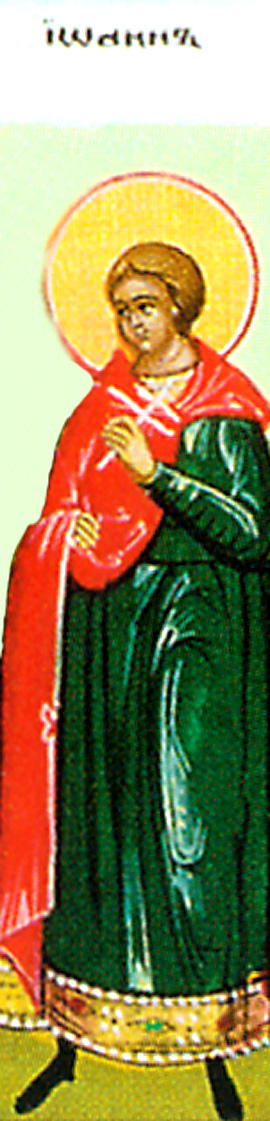
The holy martyr John Kulikos was born in the Greek district of Epirus, in the city of Ioannina. His parents were pious, but he was orphaned at an early age, and he went to Constantinople. With the means left him by his parents, he built a small stall in the city bazaar and was occupied with trade.
He loved to work, he honorably filled all his orders, and his business was successful. However, his soul did not yearn for earthly blessings, but for the Kingdom of Heaven.
Saint John lived during difficult times. Constantinople was under the dominion of the Turks, and Christians were subjected to oppressions. Many Christian tradesmen and merchants went over to the Moslem religion. Saint John reproached them for their betrayal of Christ, and he also sustained the unwavering in their faith. The apostates were filled with hatred for Saint John, and they desired his ruin. The saint knew this, but was not afraid. He was willing to suffer for Christ.
On Great and Holy Friday he went to his spiritual Father and asked his blessing to seek martyrdom. The priest counselled the youth to examine himself and to prepare himself by fasting and prayer, so that at the time of torture he would not deny Christ. Saint John prayed ardently to the Lord to strengthen him. At night on Great and Holy Saturday he saw himself in a dream, standing in a fiery furnace and singing praises to the Lord. Interpreting this vision as an indication to go to martyrdom, Saint John received the Holy Mysteries and asked the priest’s blessing.
When Saint John arrived at the market, the vexed tradesmen began to reproach him that he had promised to renounce Christ, but that he was not fulfilling his word. In reply, the martyr declared that he was a Christian and had never renounced, nor would he ever renounce Christ.
Then the envious merchants had him arrested. The judge tried to persuade Saint John to accept Islam, for he respected him as a skilled master craftsman. But the martyr steadfastly confessed himself a Christian. For several days, they wearied him with hunger and thirst, and beat him without mercy. They sentenced the martyr to be burned alive.
Saint John met his sentence with joy. When they led him to the blazing fire, he went boldly into the midst of the flames. The torturers, seeing that Saint John was prepared to die in the fire, pulled him out and beheaded him with the sword (+ 1526). They then threw the martyr’s head and body into the fire.
Christians gathered up the bones of the martyr which remained from the fire, and reverently brought them to the cathedral church.
Venerable Euthymius, Enlightener of Karelia, Finland and the Righteous Anthony and Felix

According to an ancient manuscript Hemerologion (Ημερολογιον), Saint Euthymios was born in the
second half of the XIV century. From his youth, he felt drawn to the monastic life, so when he reached adulthood, he travelled north around the year 1400, in order to live as an Anchorite. Later, about 1410, several disciples came to him, begging him to guide them in the monastic life. On the shores of the White Sea in Karelia, 34 versts from Archangelsk, they built a monastery dedicated to the Holy Wonderworker Saint Nicholas of Myra in Lycia (December 6), with cells for the monks.
At first, nothing seemed to go well for the monks, who had settled in an area inhabited by pagans. Saint Euthymius knew, however, that in the place where they labored, one day the monastic life would be firmly established, and the Faith would flourish.
In 1418, the Venerable Anthony and Felix, the two devout sons of Martha Boretska, the wife of a government official (посадница) from Novgorod, were drowned at the mouth of the North Dvina River while exploring the land. These young brothers were buried at Saint Nicholas monastery. In life, they were distinguished for their works of charity, and their grief-stricken mother asked Saint Euthymius to pray for the sons who had been taken from her. Subsequently, their names were included in the manuscript Lives of the Saints of Saint Nicholas Monastery.
In 1419, the monastery was destroyed by Norwegian invaders, who descended upon the monastery, burned the church, and killed several of the monks. Saint Euthymius decided that he would rebuild the monastery, and Martha Boretska gave a large sum of money for the monastery to be rebuilt over the graves of her sons.
Saint Euthymius reposed peacefully in 1435, and was buried at the monastery in Karelia, as were his disciples Stephen the Ascetic, Isaiah, and Nikanor.
In 1641, Saint Euthymios of Karelia was glorified for his apostolic labors in Karelia, and his holy relics were uncovered in 1647. Now they rest in a hidden place within the monastery.
A Church Service has been composed for Saints Euthymius, Anthony and Felix. They are commemorated on April 18, and again on May 21, the Synaxis of All Saints of Karelia.
“Maximov” Icon of the Mother of God

The Saint Maximus Icon is in the cathedral church of the city of Vladimir. Metropolitan Maximus (December 6), a Greek by birth, painted the Icon in 1299, as he was told to do in a vision while he slept in his cell. When St. Maximus arrived in Vladimir from Kiev, the Mother of God appeared to him in a dream and gave him an omophorion saying, "My servant Maximus, it is good that you have come to visit my city. Take this omophorion and shepherd the rational flock of my city."
When he awoke, he found he was holding an omophorion. The appearance of the Mother of God was regarded as a sign of approval for the transfer of the metropolitan See from Kiev to Vladimir.
A description of this vision was inscribed on the left side of his crypt. The Mother of God is shown in full stature, holding the Divine Child on her left arm. With her right hand, she offers the omophorion to Saint Maximus, who is standing on a pillar. The contrast in the size of their figures is meant to show the difference in their spiritual states. A variant Icon depicts Saint Maximus kneeling at the feet of the Theotokos.
Later, a golden coffer was made, and the omophorion was placed inside. This omophorion was kept in the Vladimir cathedral as a relic for 112 years. It was hidden by the cathedral’s doorkeeper Patrick in 1412 during an invasion by the Tartars, Patrick was killed when he refused to show them where the cathedral's treasures were hidden. The coffer has not yet been found.
This Icon, which measures five feet by two and a half feet, has been glorified by many miracles.
Saint Basil Ratishvili of Georgia
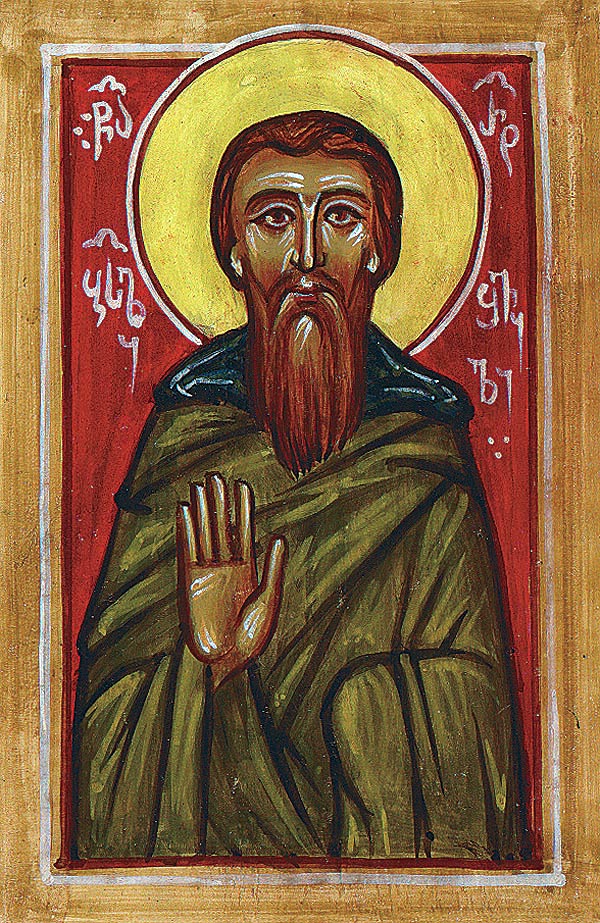
Saint Basil Ratishvili, one of the most prominent figures of the 13th-century Church, was the uncle of Catholicos Ekvtime III. He labored with the other Georgian fathers at the Ivḗron Monastery on Mt. Athos. Endowed with the gift of prophecy, Saint Basil beheld a vision in which the Most Holy Theotokos called upon him to censure King Demetre’s impious rule. (This is actually Saint Demetre the Devoted, who in his youth lived profligately but later laid down his life for his nation.)
Having arrived in Georgia and been brought before the king, the God-fearing father denounced the sovereign’s uncrowned marriage [i.e., a conjugal union without the blessing of the Church]. He promised the king that if he abandoned his present way of life, he would find great happiness and success. Saint Basil also condemned the ungodly ways of Georgia’s apostate feudal lords.
But the king and his court disregarded the virtuous elder’s admonitions, and in response Saint Basil prophesied: “A vicious enemy will kill you, and your kingdom will remain without refuge. Your children will be scattered, your kingdom conquered, and all your wealth seized. Know that, according to the will of the Most Holy Theotokos, everything I have told you will come to pass unless you repent and turn from this way of life. Now I will depart from you in peace.”
Saint Basil returned to Mt. Athos and peacefully reposed at the Ivḗron Monastery.
His vision was fulfilled.
The Twelve Passion Gospels – Thurs.. Apr 17, 2025
Here is the live stream for The Twelve Passion Gospels – Thurs.. Apr 17, 2025 If you need, here are instructions for accessing this content from your phone, tablet, computer, or TV.
Vesperal Divine Liturgy – Thurs.. Apr 17, 2025
Here is the live stream for Vesperal Divine Liturgy – Thurs.. Apr 17, 2025 If you need, here are instructions for accessing this content from your phone, tablet, computer, or TV.
Daily Readings for Thursday, April 17, 2025
HOLY THURSDAY
ABSTAIN FROM MEAT, FISH, DAIRY, EGGS, OLIVE OIL
Holy Thursday, Symeon the Holy Martyr, Bishop of Persepolis, and those with him, Makarios, Bishop of Corinth, Agapetos of Rome, Hadrian the New-Martyr, Donnan, Abbot of Eigg, and the Monk-Martyrs with him
ST. PAUL’S FIRST LETTER TO THE CORINTHIANS 11:23-32
BRETHREN, I received from the Lord what I also delivered to you, that the Lord Jesus on the night when he was betrayed took bread, and when he had given thanks, he broke it, and said, "This is my body which is for you. Do this in remembrance of me." In the same way also the cup, after supper, saying, "This cup is the new covenant in my blood. Do this, as often as you drink it, in remembrance of me." For as often as you eat this bread and drink the cup, you proclaim the Lord's death until he comes.
Whoever, therefore, eats the bread or drinks the cup of the Lord in an unworthy manner will be guilty of profaning the body and blood of the Lord. Let a man examine himself, and so eat of the bread and drink of the cup. For any one who eats and drinks without discerning the body eats and drinks judgment upon himself. That is why many of you are weak and ill, and some have died. But if we judged ourselves truly, we should not be judged. But when we are judged by the Lord, we are chastened so that we may not be condemned along with the world.
MATTHEW 26:1-20; JOHN 13:3-17; MATTHEW 26:21-39; LUKE 22:43-44; MATTHEW 26:40-75; 27:1-2
The Lord said to his disciples, "You know that after two days the Passover is coming, and the Son of man will be delivered up to be crucified.
Then the chief priests and the elders of the people gathered in the palace of the high priest, who was called Caiaphas, and took counsel together in order to arrest Jesus by stealth and kill him. But they said, "Not during the feast, lest there be a tumult among the people.
Now when Jesus was at Bethany in the house of Simon the leper, a woman came up to him with an alabaster flask of very expensive ointment, and she poured it on his head, as he sat at table. But when the disciples saw it, they were indignant, saying, "Why this waste? For this ointment might have been sold for a large sum, and given to the poor.
But Jesus, aware of this, said to them, "Why do you trouble the woman? For she has done a beautiful thing to me.
For you always have the poor with you, but you will not always have me.
In pouring this ointment on my body she has done it to prepare me for burial. Truly, I say to you, wherever this gospel is preached in the whole world, what she has done will be told in memory of her.
Then one of the twelve, who was called Judas Iscariot, went to the chief priests and said, "What will you give me if I deliver him to you?" And they paid him thirty pieces of silver. And from that moment he sought an opportunity to betray him.
Now on the first day of Unleavened Bread the disciples came to Jesus, saying, "Where will you have us prepare for you to eat the Passover?" He said, "Go into the city to a certain one, and say to him, 'The Teacher says, My time is at hand; I will keep the Passover at your house with my disciples.'" And the disciples did as Jesus had directed them, and they prepared the Passover. When it was evening, he sat at table with the twelve disciples.
Jesus, knowing that the Father had given all things into his hands, and that he had come from God and was going to God, rose from supper, laid aside his garments, and girded himself with a towel. Then he poured water into a basin, and began to wash the disciples' feet, and to wipe them with the towel with which he was girded.
He came to Simon Peter; and Peter said to him, "Lord, do you wash my feet?" Jesus answered him, "What I am doing you do not know now, but afterward you will understand." Peter said to him, "You shall never wash my feet." Jesus answered him, "If I do not wash you, you have no part in me." Simon Peter said to him, "Lord, not my feet only but also my hands and my head!" Jesus said to him, "He who has bathed does not need to wash, except for his feet, but he is clean all over; and you are clean, but not every one of you." For he knew who was to betray him; that was why he said, "You are not all clean.
When he had washed their feet, and taken his garments, and resumed his place, he said to them, "Do you know what I have done to you? You call me Teacher and Lord; and you are right, for so I am. If I then, your Lord and Teacher, have washed your feet, you also ought to wash one another's feet. For I have given you an example, that you also should do as I have done to you. Truly, truly, I say to you, a servant is not greater than his master; nor is he who is sent greater than he who sent him. If you know these things, blessed are you if you do them.
And as they were eating, he said, "Truly, I say to you, one of you will betray me." And they were very sorrowful, and began to say to him one after another, "Is it I, Lord?" He answered, "He who has dipped his hand in the dish with me, will betray me. The Son of man goes as it is written of him, but woe to that man by whom the Son of man is betrayed! It would have been better for that man if he had not been born." Judas, who betrayed him, said, "Is it I, Master?" He said to him, "You have said so.
Now as they were eating, Jesus took bread, and blessed, and broke it, and gave it to the disciples and said, "Take, eat; this is my body." And he took a cup, and when he had given thanks he gave it to them, saying, "Drink of it, all of you; for this is my blood of the new covenant, which is poured out for many for the forgiveness of sins. I tell you I shall not drink again of this fruit of the vine until that day when I drink it new with you in my Father's kingdom.
And when they had sung a hymn, they went out to the Mount of Olives. Then Jesus said to them, "You will all fall away because of me this night; for it is written, 'I will strike the shepherd, and the sheep of the flock will be scattered.' But after I am raised up, I will go before you to Galilee." Peter declared to him, "Though they all fall away because of you, I will never fall away." Jesus said to him, "Truly, I say to you, this very night, before the cock crows, you will deny me three times." Peter said to him, "Even if I must die with you, I will not deny you." And so said all the disciples.
Then Jesus went with them to a place called Gethsemane, and he said to his disciples, "Sit here, while I go yonder and pray." And taking with him Peter and the two sons of Zebedee, he began to be sorrowful and troubled. Then he said to them, "My soul is very sorrowful, even to death; remain here, and watch with me." And going a little farther he fell on his face and prayed, "My Father, if it be possible, let this cup pass from me; nevertheless, not as I will, but as you will.
And there appeared to him an angel from heaven, strengthening him. And being in an agony he prayed more earnestly; and his sweat became like great drops of blood falling down upon the ground.
And rising from prayer, he came to the disciples and found them sleeping; and he said to Peter, "So, could you not watch with me one hour? Watch and pray that you may not enter into temptation; the spirit indeed is willing, but the flesh is weak." Again, for the second time, he went away and prayed, "My Father, if this cannot pass unless I drink it, your will be done." And again he came and found them sleeping, for their eyes were heavy. So, leaving them again, he went away and prayed for the third time, saying the same words. Then he came to the disciples and said to them, "Are you still sleeping and taking your rest? Behold, the hour is at hand, and the Son of man is betrayed into the hands of sinners. Rise, let us be going; see, my betrayer is at hand.
While he was still speaking, Judas came, one of the twelve, and with him a great crowd with swords and clubs, from the chief priests and the elders of the people. Now the betrayer had given them a sign, saying, "The one I shall kiss is the man; seize him." And he came up to Jesus at once and said, "Hail, Rabbi!" And he kissed him. Jesus said to him, "Friend, why are you here?" Then they came up and laid hands on Jesus and seized him. And behold, one of those who were with Jesus stretched out his hand and drew his sword, and struck the slave of the high priest, and cut off his ear.
Then Jesus said to him, "Put your sword back into its place; for all who take the sword will perish by the sword. Do you think that I cannot appeal to my Father, and he will at once send me more than twelve legions of angels? But how then should the scriptures be fulfilled, that it must be so?
At that hour Jesus said to the crowds, "Have you come out as against a robber, with swords and clubs to capture me? Day after day I sat in the temple teaching, and you did not seize me. But all this has taken place, that the scriptures of the prophets might be fulfilled." Then all the disciples forsook him and fled.
Then those who had seized Jesus led him to Caiaphas the high priest, where the scribes and the elders had gathered. But Peter followed him at a distance, as far as the courtyard of the high priest, and going inside he sat with the guards to see the end. Now the chief priests and the whole council sought false testimony against Jesus that they might put him to death, but they found none, though many false witnesses came forward. At last two came forward and said, "This fellow said, 'I am able to destroy the temple of God, and to build it in three days.'
And the high priest stood up and said, "Have you no answer to make? What is it that these men testify against you?" But Jesus was silent. And the high priest said to him, "I adjure you by the living God, tell us if you are the Christ, the Son of God.
Jesus said to him, "You have said so. But I tell you, hereafter you will see the Son of man seated at the right hand of Power, and coming on the clouds of heaven." Then the high priest tore his robes, and said, "He has uttered blasphemy. Why do we still need witnesses? You have now heard his blasphemy. What is your judgment?" They answered, "He deserves death." Then they spat in his face, and struck him; and some slapped him, saying, "Prophesy to us, you Christ! Who is it that struck you?
Now Peter was sitting outside in the courtyard. And a maid came up to him, and said, "You also were with Jesus the Galilean." But he denied it before them all, saying, "I do not know what you mean." And when he went out to the porch, another maid saw him, and she said to the bystanders, "This man was with Jesus of Nazareth." And again he denied it with an oath, "I do not know the man." After a little while the bystanders came up and said to Peter, "Certainly you are also one of them, for your accent betrays you.
Then he began to invoke a curse on himself and to swear, "I do not know the man." And immediately the cock crowed. And Peter remembered the saying of Jesus, "Before the cock crows, you will deny me three times." And he went out and wept bitterly.
When morning came, all the chief priests and the elders of the people took counsel against Jesus to put him to death; and they bound him and led him away and delivered him to Pilate the governor.
TWELVE GOSPELS
The Lord said to his disciples, "Now is the Son of man glorified, and in him God is glorified; if God is glorified in him, God will also glorify him in himself, and glorify him at once. Little children, yet a little while I am with you. You will seek me; and as I said to the Jews so now I say to you, 'Where I am going you cannot come.' A new commandment I give to you, that you love one another; even as I have loved you, that you also love one another. By this all men will know that you are my disciples, if you have love for one another." Simon Peter said to him, "Lord, where are you going?" Jesus answered, "Where I am going you cannot follow me now; but you shall follow afterward." Peter said to him, "Lord, why cannot I follow you now? I will lay down my life for you." Jesus answered, "Will you lay down your life for me? Truly, truly, I say to you, the cock will not crow, till you have denied me three times.
Let not your hearts be troubled; believe in God, believe also in me. In my Father's house are many rooms; if it were not so, would I have told you that I go to prepare a place for you? And when I go and prepare a place for you, I will come again and will take you to myself, that where I am you may be also. And where I am going you know, and the way you know." Thomas said to him, "Lord, we do not know where you are going; how can we know the way?" Jesus said to him, "I am the way, and the truth, and the life; no one comes to the Father, but by me. If you had known me, you would have known my Father also; henceforth you know him and have seen him." Philip said to him, "Lord, show us the Father, and we shall be satisfied." Jesus said to him, "Have I been with you so long, and yet you do not know me, Philip? He who has seen me has seen the Father; how can you say, 'Show us the Father'? Do you not believe that I am in the Father and the Father in me? The words that I say to you I do not speak on my own authority; but the Father who dwells in me does his works. Believe me that I am in the Father and the Father in me; or else believe me for the sake of the works themselves. Truly, truly, I say to you, he who believes in me will also do the works that I do; and greater works than these will he do, because I go to the Father. Whatever you ask in my name, I will do it, that the Father may be glorified in the Son; if you ask anything in my name, I will do it. If you love me, you will keep my commandments. And I will ask the Father, and he will give you another Counselor, to be with you for ever, even the Spirit of truth, whom the world cannot receive, because it neither sees him nor knows him; you know him, for he dwells with you, and will be in you. I will not leave you desolate; I will come to you. Yet a little while, and the world will see me no more, but you will see me; because I live, you will live also. In that day you will know that I am in my Father, and you in me, and I in you. He who has my commandments and keeps them, he it is who loves me; and he who loves me will be loved by my Father, and I will love him and manifest myself to him." Judas (not Iscariot) said to him, "Lord, how is it that you will manifest yourself to us, and not to the world?" Jesus answered him, "If a man loves me, he will keep my word, and my Father will love him, and we will come to him and make our home with him. He who does not love me does not keep my words; and the word which you hear is not mine but the Father's who sent me. These things I have spoken to you, while I am still with you. But the Counselor, the Holy Spirit, whom the Father will send in my name, he will teach you all things, and bring to your remembrance all that I have said to you. Peace I leave with you; my peace I give to you; not as the world gives do I give to you. Let not your hearts be troubled, neither let them be afraid. You heard me say to you, 'I go away, and I will come to you.' If you loved me, you would have rejoiced, because I go to the Father; for the Father is greater than I. And now I have told you before it takes place, so that when it does take place, you may believe. I will no longer talk much with you, for the ruler of this world is coming. He has no power over me; but I do as the Father has commanded me, so that the world may know that I love the Father. Rise, let us go hence.
I am the true vine, and my Father is the vinedresser. Every branch of mine that bears no fruit, he takes away, and every branch that does bear fruit he prunes, that it may bear more fruit. You are already made clean by the word which I have spoken to you. Abide in me, and I in you. As the branch cannot bear fruit by itself, unless it abides in the vine, neither can you, unless you abide in me. I am the vine, you are the branches. He who abides in me, and I in him, he it is that bears much fruit, for apart from me you can do nothing. If a man does not abide in me, he is cast forth as a branch and withers; and the branches are gathered, thrown into the fire and burned. If you abide in me, and my words abide in you, ask whatever you will, and it shall be done for you. By this my Father is glorified, that you bear much fruit, and so prove to be my disciples. As the Father has loved me, so have I loved you; abide in my love. If you keep my commandments, you will abide in my love, just as I have kept my Father's commandments and abide in his love. These things I have spoken to you, that my joy may be in you, and that your joy may be full. This is my commandment, that you love one another as I have loved you. Greater love has no man than this, that a man lay down his life for his friends. You are my friends if you do what I command you. No longer do I call you servants, for the servant does not know what his master is doing; but I have called you friends, for all that I have heard from my Father I have made known to you. You did not choose me, but I chose you and appointed you that you should go and bear fruit and that your fruit should abide; so that whatever you ask the Father in my name, he may give it to you. This I command you, to love one another. If the world hates you, know that it has hated me before it hated you. If you were of the world, the world would love its own; but because you are not of the world, but I chose you out of the world, therefore the world hates you. Remember the word that I said to you, 'A servant is not greater than his master.' If they persecuted me, they will persecute you; if they kept my word, they will keep yours also. But all this they will do to you on my account, because they do not know him who sent me. If I had not come and spoken to them, they would not have sin; but now they have no excuse for their sin. He who hates me hates my Father also. If I had not done among them the works which no one else did, they would not have sin; but now they have seen and hated both me and my Father. It is to fulfill the word that is written in their law, 'They hated me without a cause.' But when the Counselor comes, whom I shall send to you from the Father, even the Spirit of truth, who proceeds from the Father, he will bear witness to me; and you also are witnesses, because you have been with me from the beginning.
I have said all this to you to keep you from falling away. They will put you out of the synagogues; indeed, the hour is coming when whoever kills you will think he is offering service to God. And they will do this because they have not known the Father, nor me. But I have said these things to you, that when their hour comes you may remember that I told you of them. I did not say these things to you from the beginning, because I was with you. But now I am going to him who sent me; yet none of you asks me, 'Where are you going?' But because I have said these things to you, sorrow has filled your hearts. Nevertheless I tell you the truth: it is to your advantage that I go away, for if I do not go away, the Counselor will not come to you; but if I go, I will send him to you. And when he comes, he will convince the world concerning sin and righteousness and judgment: concerning sin, because they do not believe in me; concerning righteousness, because I go to the Father, and you will see me no more; concerning judgment, because the ruler of this world is judged. I have yet many things to say to you, but you cannot bear them now. When the Spirit of truth comes, he will guide you into all the truth; for he will not speak on his own authority, but whatever he hears he will speak, and he will declare to you the things that are to come. He will glorify me, for he will take what is mine and declare it to you. All that the Father has is mine; therefore I said that he will take what is mine and declare it to you. A little while, and you will see me no more; again a little while, and you will see me." Some of his disciples said to one another, "What is this that he says to us, 'A little while, and you will not see me, and again a little while, and you will see me'; and, 'because I go to the Father'? " They said, "What does he mean by 'a little while"? We do not know what he means." Jesus knew that they wanted to ask him; so he said to them, "Is this what you are asking yourselves, what I meant by saying, 'A little while, and you will not see me, and again a little while, and you will see me'? Truly, truly, I say to you, you will weep and lament, but the world will rejoice; you will be sorrowful, but your sorrow will turn into joy. When a woman is in travail she has sorrow, because her hour has come; but when she is delivered of the child, she no longer remembers the anguish, for joy that a human being is born into the world. So you have sorrow now, but I will see you again and your hearts will rejoice, and no one will take your joy from you. In that day you will ask nothing of me. Truly, truly, I say to you, if you ask anything of the Father, he will give it to you in my name. Hitherto you have asked nothing in my name; ask, and you will receive, that your joy may be full. I have said this to you in figures; the hour is coming when I shall no longer speak to you in figures but tell you plainly of the Father. In that day you will ask in my name; and I do not say to you that I shall ask the Father for you; for the Father himself loves you, because you have loved me and have believed that I came from the Father. I came from the Father and have come into the world; again, I am leaving the world and going to the Father." His disciples said, "Ah, now you are speaking plainly, not in any figure! Now we know that you know all things, and need none to question you; by this we believe that you came from God." Jesus answered them, "Do you now believe? The hour is coming, indeed it has come, when you will be scattered, every man to his home, and will leave me alone; yet I am not alone, for the Father is with me. I have said this to you, that in me you may have peace. In the world you have tribulation; but be of good cheer, I have overcome the world.
When Jesus had spoken these words, he lifted up his eyes to heaven and said, "Father, the hour has come; glorify your Son that the Son may glorify you, since you have given him power over all flesh, to give eternal life to all whom you have given him. And this is eternal life, that they know you the only true God, and Jesus Christ whom you have sent. I glorified you on earth, having accomplished the work which you gave me to do; and now, Father, glorify me in your own presence with the glory which I had with you before the world was made. I have manifested your name to the men whom you gave me out of the world; yours they were, and you gave them to me, and they have kept your word. Now they know that everything that you have given me is from you; for I have given them the words which you gave me, and they have received them and know in truth that I came from you; and they have believed that you did send me. I am praying for them; I am not praying for the world but for those whom you have given me, for they are yours; all mine are yours, and yours are mine, and I am glorified in them. And now I am no more in the world, but they are in the world, and I am coming to you. Holy Father, keep them in your name, which you have given me, that they may be one, even as we are one. While I was with them, I kept them in your name, which you have given me; I have guarded them, and none of them is lost but the son of perdition, that the scripture might be fulfilled. But now I am coming to you; and these things I speak in the world, that they may have my joy fulfilled in themselves. I have given them your word; and the world has hated them because they are not of the world, even as I am not of the world. I do not pray that you should take them out of the world, but that you should keep them from the evil one. They are not of the world, even as I am not of the world. Sanctify them in the truth; your word is truth. As you did send me into the world, so I have sent them into the world. And for their sake I consecrate myself, that they also may be consecrated in truth. I do not pray for these only, but also for those who believe in me through their word, that they may all be one; even as you, Father, are in me, and I in you, that they also may be in us, so that the world may believe that you have sent me. The glory which you have given me I have given to them, that they may be one even as we are one, I in them and you in me, that they may become perfectly one, so that the world may know that you have sent me and have loved them even as you have loved me. Father, I desire that they also, whom you have given me, may be with me where I am, to behold my glory which you have given me in your love for me before the foundation of the world. O righteous Father, the world has not known you, but I have known you; and these know that you have sent me. I made known to them your name, and I will make it known, that the love with which you have loved me may be in them, and I in them." When Jesus had spoken these words, he went forth with his disciples across the Kidron valley, where there was a garden, which he and his disciples entered.
Great and Holy Thursday

THURSDAY: The Last Supper
Two events shape the liturgy of Great and Holy Thursday: the Last Supper of Christ with His disciples, and the betrayal of Judas. The meaning of both is in love. The Last Supper is the ultimate revelation of God’s redeeming love for man, of love as the very essence of salvation. And the betrayal of Judas reveals that sin, death and self-destruction are also due to love, but to deviated and distorted love, love directed at that which does not deserve love. Here is the mystery of this unique day, and its liturgy, where light and darkness, joy and sorrow are so strangely mixed, challenges us with the choice on which depends the eternal destiny of each one of us. “Now before the feast of the Passover, when Jesus knew that His hour was come… having loved His own which were in the world, He loved them unto the end…” (John 13:1). To understand the meaning of the Last Supper we must see it as the very end of the great movement of Divine Love which began with the creation of the world and is now to be consummated in the death and resurrection of Christ.
God is Love (1 John 4:8). And the first gift of Love was life. The meaning, the content of life was communion. To be alive man was to eat and to drink, to partake of the world. The world was thus Divine love made food, made Body of man. And being alive, i.e. partaking of the world, man was to be in communion with God, to have God as the meaning, the content and the end of his life. Communion with the God-given world was indeed communion with God. Man received his food from God and making it his body and his life, he offered the whole world to God, transformed it into life in God and with God. The love of God gave life to man, the love of man for God transformed this life into communion with God. This was paradise. Life in it was, indeed, eucharistic. Through man and his love for God the whole creation was to be sanctified and transformed into one all-embracing sacrament of Divine Presence and man was the priest of this sacrament.
But in sin man lost this eucharistic life. He lost it because he ceased to see the world as a means of Communion with God and his life as eucharist, as adoration and thanksgiving. . . He loves himself and the world for their own sake; he made himself the content and the end of his life. He thought that his hunger and thirst, i.e. his dependence of his life on the world—can be satisfied by the world as such, by food as such. But world and food, once they are deprived of their initial sacramental meaning—as means of communion with God, once they are not received for God’s sake and filled with hunger and thirst for God, once, in other words, God is no longer their real “content,” can give no life, satisfy no hunger, for they have no life in themselves… And thus by putting his love in them, man deviated his love from the only object of all love, of all hunger, of all desires. And he died. For death is the inescapable “decomposition” of life cut from its only source and content. Man thought to find life in the world and in food, but he found death. His life became communion with death, for instead of transforming the world by faith, love, and adoration into communion with God, he submitted himself entirely to the world, he ceased to be its priest and became its slave. And by his sin the whole world was made a cemetery, where people condemned to death partook of death and “sat in the region and shadow of death” (Matt. 4:16).
But if man betrayed, God remained faithful to man. He did not “turn Himself away forever from His creature whom He had made, neither did He forget the works of His hands, but He visited him in diverse manners, through the tender compassion of His mercy” (Liturgy of Saint Basil). A new Divine work began, that of redemption and salvation. And it was fulfilled in Christ, the Son of God Who in order to restore man to his pristine beauty and to restore life as communion with God, became Man, took upon Himself our nature, with its thirst and hunger, with its desire for and love of, life. And in Him life was revealed, given, accepted and fulfilled as total and perfect Eucharist, as total and perfect communion with God. He rejected the basic human temptation: to live “by bread alone”; He revealed that God and His kingdom are the real food, the real life of man. And this perfect eucharistic Life, filled with God, and, therefore Divine and immortal, He gave to all those who would believe in Him, i,e. find in Him the meaning and the content of their lives. Such is the wonderful meaning of the Last Supper. He offered Himself as the true food of man, because the Life revealed in Him is the true Life. And thus the movement of Divine Love which began in paradise with a Divine “take, eat. ..” (for eating is life for man) comes now “unto the end” with the Divine “take, eat, this is My Body…” (for God is life of man). The Last Supper is the restoration of the paradise of bliss, of life as Eucharist and Communion.
But this hour of ultimate love is also that of the ultimate betrayal. Judas leaves the light of the Upper Room and goes into darkness. “And it was night” (John 13:30). Why does he leave? Because he loves, answers the Gospel, and his fateful love is stressed again and again in the hymns of Holy Thursday. It does not matter indeed, that he loves the “silver.” Money stands here for all the deviated and distorted love which leads man into betraying God. It is, indeed, love stolen from God and Judas, therefore, is the Thief. When he does not love God and in God, man still loves and desires, for he was created to love and love is his nature, but it is then a dark and self-destroying passion and death is at its end. And each year, as we immerse ourselves into the unfathomable light and depth of Holy Thursday, the same decisive question is addressed to each one of us: do I respond to Christ’s love and accept it as my life, do I follow Judas into the darkness of his night?
The liturgy of Holy Thursday includes: a) Matins, b) Vespers and, following Vespers, the Liturgy of Saint Basil the Great. In the Cathedral Churches the special service of the Washing of Feet takes place after the Liturgy; while the deacon reads the Gospel, the Bishop washes the feet of twelve priests, reminding us that Christ’s love is the foundation of life in the Church and shapes all relations within it. It is also on Holy Thursday that Holy Chrism is consecrated by the primates of autocephalous Churches, and this also means that the new love of Christ is the gift we receive from the Holy Spirit on the day of our entrance into the Church.
At Matins the Troparion sets the theme of the day: the opposition between the love of Christ and the “insatiable desire” of Judas.
“When the glorious disciples were illumined by washing at the Supper,
Then was the impious Judas darkened with the love of silver
And to the unjust judges does he betray Thee, the just Judge.
Consider, 0 Lover of money, him who hanged himself because of it.
Do not follow the insatiable desire which dared this against the Master,
0 Lord, good to all, glory to Thee.”
After the Gospel reading (Luke 12:1-40) we are given the contemplation, the mystical and eternal meaning of the Last Supper in the beautiful canon of Saint Cosmas. Its last “irmos,” (Ninth Ode) invites us to share in the hospitality of the Lord’s banquet:
“Come, 0 ye faithful
Let us enjoy the hospitality of the Lord and the banquet of immortality
In the upper chamber with minds uplifted….”
At Vespers, the stichira on “Lord, I have cried” stress the spiritual anticlimax of Holy Thursday, the betrayal of Judas:
“Judas the slave and Knave,
The disciple and traitor,
The friend and fiend,
Was proved by his deeds,
For, as he followed the Master,
Within himself he contemplated His betrayal….”
After the Entrance, three lessons from the Old Testament:
1) Exodus 19: 10-19. God’s descent from Mount Sinai to His people as the image of God’s coming in the Eucharist.
2) Job 38:1-23, 42:1-5, God’s conversation with Job and Job’s answer: “who will utter to me what I understand not? Things too great and wonderful for me, which I knew not…”—and these “great and wonderful things” are fulfilled in the gift of Christ’s Body and Blood.
3) Isaiah 50:4-11. The beginning of the prophecies on the suffering servant of God,
The Epistle reading is from I Corinthians 11:23-32: Saint Paul’s account of the Last Supper and the meaning of communion.
The Gospel reading (the longest of the year is taken from all four Gospels and is the full story of the Last Supper, the betrayal of Judas and Christ’s arrest in the garden.
The Cherubic hymn and the hymn of Communion are replaced by the words of the prayer before Communion:
“Of Thy Mystical Supper, O Son of God, accept me today as a communicant,
For I will not speak of Thy Mystery to Thine enemies,
Neither like Judas will I give Thee a kiss;
But like the thief will I confess Thee:
Remember me, O Lord, in Thy Kingdom.”
by The Very Rev. Alexander Schmemann, S.T.D.
Professor of Liturgical Theology, Saint Vladimir’s Seminary
Hieromartyr Simeon, Bishop in Persia, and those with him

The Hieromartyr Simeon, Bishop of Persia, suffered during a persecution against Christians under the Persian emperor Sapor II (310-381). They accused the saint of collaborating with the Roman Empire and of subversive activities against the Persian emperor.
In the year 344, the emperor issued an edict which imposed a heavy tax upon Christians. When some of them refused to pay it, this was regarded as an act of rebellion, so the emperor began a fierce persecution against Christians.
Saint Simeon was brought to trial in iron fetters as a supposed enemy of the Persian realm, together with the two hieromartyrs Habdelai and Ananias. The holy bishop would not even bow to the emperor, who asked why he would not show him the proper respect. The saint answered, “Formerly, I bowed because of your rank, but now, when you ask me to renounce my God and abandon my faith, it is not proper for me to bow to you.”
The emperor urged him to worship the sun, and he threatened to eradicate Christianity in his land if he refused. But neither urgings nor threats could shake the steadfast saint, and they led him off to prison. Along the way the eunuch Usphazanes, a counsellor of the emperor, saw the saint. He stood up and bowed to the bishop, but the saint turned away from him because he, a former Christian, out of fear of the emperor, now worshipped the sun.
The eunuch repented with all his heart, he exchanged his fine attire for coarse garb, and sitting at the doors of the court, he cried out bitterly, “Woe to me, when I stand before my God, from Whom I am cut off. Here was Simeon, and he has turned his back on me!”
The emperor Sapor learned about the grief of his beloved tutor and asked him what had happened. He told the emperor that he bitterly regretted his apostasy and would no more worship the sun, but only the one true God. The emperor was surprised at the old man’s sudden decision, and he urged him not to abjure the gods whom their fathers had reverenced. But Usphazanes was unyielding, and they condemned him to death. Saint Usphazanes asked that the city heralds report that he died not for crimes against the emperor, but for being a Christian. The emperor granted his request.
Saint Simeon also learned about the death of Usphazanes, and he gave thanks to the Lord. When they brought him before the emperor a second time, Saint Simeon again refused to worship the pagan gods and confessed his faith in Christ. The enraged emperor gave orders to behead all the Christians in the prison before the saint’s eyes.
Without fear the Christians went to execution, blessed by the holy hierarch, and they bent their heads beneath the sword. Saint Simeon’s companion, the Priest Habdelai, was also beheaded. When they came to the Priest Ananias, he suddenly trembled. Then one of the dignitaries, Saint Phusicus (Pusicius), a secret Christian, was afraid that Ananias would renounce Christ, and he cried out, “Do not fear the sword, Elder, and you will see the divine light of our Lord Jesus Christ.”
Saint Phusicus betrayed himself by this outburst. The emperor gave orders to pluck out his tongue and to flay the skin off him. Along with Saint Phusicus, his daughter Askitrea was also martyred. Saint Simeon was the last to go before the executioner, and he placed his head on the chopping-block (April 13, 344). Executions continued all during Bright Week until April 23.
Saint Azates the Eunuch, a close official to the emperor, also received the crown of martyrdom, along with Saints Abdechalas, Usthazanes, and Azades. The sources indicate that 1,150 Martyrs perished because they refused to accept the Persian religion.
Saint Akakios, Bishop of Melitēnḗ
Saint Akakios was born into a pious family in the Armenian city of Melitēnḗ. His parents had been childless for a long time. They had prayed for a son, and vowed to dedicate him to God. Therefore, Akakios was given to Bishop Oustrykhios1 of Melitēnḗ (November 7) to serve the Church. Saint Oustrykhios was a firm supporter of Orthodoxy. When the heresy of Macedonius arose, it was Saint Oustrykhios who set forth the Orthodox teaching about the Holy Spirit as the third person of the Holy Trinity, one in essence and indivisible, at the Third Ecumenical Council, which met at Ephesus in the year 381.
The holy hierarch raised Akakios with love, made him a Reader, and later ordained him as a deacon, and then to the holy priesthood. Saint Akakios served the Church well, instructing both adults and children in the Holy Scripture, and in the Orthodox Confession of faith. Among his disciples was Saint Euthymios the Great (January 20).
After the death of Saint Oustrykhios, Saint Akakios was elevated to the hierarchal throne of Melitēnḗ by general acclamation. He governed his diocese wisely, and because of his firm faith, humility and deeds, the Saint received the grace of working miracles. Once, during a dry summer, the Saint served the Liturgy in an open field, suddenly the wine in the Holy Chalice was mixed with the falling rain, which fell throughout the land.
The holy Bishop prayed when the river flooded, and it turned back, rising no higher than the stone which the Saint had placed at the riverbank. On one of the islands of the River Azar, the Saint built a temple in honor of the Most Holy Theotokos, despite opposition from the pagans.
The builders of the church, either by their carelessness or malice, were not diligent in building the dome. During the Liturgy the dome was ready to collapse, and people rushed out of the church in terror. But the Saint halted their flight saying, “The Lord is the defender of my life, of whom shall I be afraid?” (Psalm 26/27:1). The dome remained suspended in the air. Only when the service had ended, and the Saint was the last one to leave the church, did the dome collapse, causing harm to no one. After this, the church was rebuilt.
Saint Akakios participated in the Third Ecumenical Council (431) and he defended the Orthodox teaching of Christ's two natures (divine and human), and of His seedless birth from the Most Holy Virgin Theotokos.
Saint Akakios reposed peacefully around the year 435. He should not be confused with Saint Akakios the Confessor (March 31), who was also a Bishop of Melitēnḗ.
1 Saint Oustrykhios (or Bostrykhios) was one of the 33 Martyrs of Melitēnḗ.
Venerable Zosimas, Abbot of Solovki

Saint Zosimas, the Igumen of Solovki and great luminary of the Russian North, was the founder of cenobitic monasticism on Solovki Island. He was born in the Novgorod diocese, in the village of Tolvui near Lake Onega. From his early years he was raised in piety, and after the death of his parents Gabriel and Barbara, he gave away his possessions and received the monastic tonsure.
In search of a solitary place, he journeyed to the shores of the White Sea, and at the mouth of the Suma he met Saint Herman (July 30), who told him of a desolate sea island, where he had spent six years with Saint Sabbatius (September 27).
About the year 1436, the ascetics crossed the sea and, providentially, they arrived at the Solovki islands. There Saint Zosimas beheld a vision of a beautiful church in the sky. With their own hands the monks built cells and an enclosure, and they began to cultivate the land and to plant seeds.
Once, in late autumn, Saint Herman had to go to the mainland for provisions. Because of the autumn weather he was unable to return. Saint Zosimas remained alone on the island all winter, enduring many temptations in his struggles with the demons. Death by starvation threatened him, but miraculously two strangers appeared and left him a supply of bread, flour and oil. In the spring Saint Herman returned to Solovki with a fisherman named Mark, and he brought supplies of food and some materials to make fishing nets.
When several hermits had gathered on the island, Saint Zosimas built a small wooden church in honor of the Transfiguration of the Lord, and a trapeza. At Saint Zosimas's request, an Igoumen was sent from Novgorod to the newly-formed monastery with an antimension for the church. Thus the renowned Solovki Monastery had its beginning. In the severe conditions of the remote island the monks knew how to economize. But the Igoumens who were sent from Novgorod to Solovki could not endure life under such harsh conditions, and so the brethren chose Saint Zosimas as their Igoumen.
Saint Zosimas occupied himself with building up the inner life of the monastery, and he introduced a strict cenobitic Rule. In 1465 he transferred the relics of Saint Sabbatius to Solovki from the River Vyg. The monastery suffered from the nobles of Novgorod, who confiscated the fish caught by the monks. The saint was obliged to go to Novgorod in order to seek the Archbishop's protection.
Following the Archbishop's advice, he visited the homes of the nobles and asked them not to allow the monastery to suffer harm. The influential and wealthy Martha Boretskaya impiously ordered Saint Zosimas to be thrown out, but then she repented and invited him to a meal. At this meal he suddenly saw that six of the illustrious nobles sat there without their heads. Saint Zosimas told his disciple Daniel about this vision, and predicted the impending death of the nobles. His prediction came to pass in the year 1478, when the six boyars were executed during the capture of Novgorod by Ivan III (1462-1505).
Shortly before his repose, the Saint prepared his own grave, in which he was buried beyond the altar of the Transfiguration church (+ April 17, 1478). Later on, a chapel was built over his relics. His relics and those of Saint Sabbatius were moved to the chapel which was dedicated to them at the Transfiguration cathedral on August 8, 1566.
Many miracles took place when Saint Zosimas and Saint Sabbatius appeared to fishermen who were perishing in the depths of the sea. Saint Zosimas is also considered a patron of bee-keeping and a guardian of beehives; and he is even known as "The Bee-keeper.” Those who are sick often hasten to Saint Zosimas, asking to be healed. The many hospital churches dedicated to him attest to the great healing power of his prayers to God.
Saint Zosimas is also commemorated on August 8, and on the First (1566) and Second (1992) transfers of the relics of Saints Zosimas and Sabbatius.
Uncovering of the relics of Venerable Alexander, Abbot of Svir

Saint Alexander of Svir died on August 30, 1533. His incorrupt relics were uncovered in 1641 during the reconstruction of the Transfiguration cathedral.
On April 17, 1641, the relics of Saint Alexander of Svir were found and examined. The discovery was accompanied by special signs; on April 15 and 16 there was extraordinary thunder and lightning, which ran along the ground above the grave of the holy founder of the monastery. Then during the Divine Liturgy on April 17 (the Saturday of the Righteous Lazarus) the workers were digging a hole for the walls of the new stone church of the Transfiguration of the Lord; and in the altar of the old church they found the Saint's coffin. The ground above it was in the shape of a cave, with nothing to support it.
All the monks came down to see the decayed coffin (only the lower board was well preserved). When Igoumen Abraham removed the top board, a strong fragrance was noticed. The Saint's body was intact, and was clothed in a mantya and the schema. His face was covered, and beneath the schema, part of his beard could be seen; both legs lay as if he were recently deceased, with the right foot upward, and the left foot facing to the side, both feet were in sandals.
From his body emanated a fragrance like myrrh, or flowers. Metropolitan Aphthonios of Novgorod was present at the uncovering of the relics. With reverence and joy, the relics were placed in a new coffin and were taken to the temple of Saint Nicholas the Wonderworker in that same Hermitage.
The monks, who had seen the incorrupt flesh of their heavenly patron, were amazed, and they made a detailed description of the shrine. Particularly surprising was the face, which was so life-like that the Saint seemed asleep. The face matched the icons which had been painted by his contemporaries. The authors of the description also noted the unusual position of the Saint's hands and feet and the amber-yellow color of his skin. Soon the relics were placed in a silver reliquary donated by Tsar Michael, and were moved to the newly rebuilt Transfiguration Cathedral.
At the same time, the commemoration of Saint Alexander was appointed on two dates: August 30, the day of his blessed repose, and April 17, the day of the uncovering of his relics.
The incorrupt relics of the saint were removed from the Svir Monastery by the Bolsheviks on December 20, 1918 after several unsuccessful attempts to confiscate them. There was an infamous campaign to liquidate the relics of the saints which continued from 1919 to 1922. Many relics of Russsian saints were stolen and subjected to “scientific examination” or displayed in antireligious museums. Some were completely destroyed.
Hoping to prove that the relics were fakes, the Soviets conducted many tests. However, the tests only confirmed that the relics were genuine. Finally, the holy relics were sent to Petrograd’s Military Medical Academy. There they remained for nearly eighty years.
A second uncovering of Saint Alexander’s relics took place in December 1997.
The relics were found to be incorrupt, just as they were when they were confiscated. The saint’s appearance matched the description in the records from 1641. Once it was determined that these were in fact the relics of Saint Alexander, Metropolitan Vladimir of Saint Petersburg permitted them to be taken to the church of Saint Sophia and her three daughters Faith, Hope, and Love (September 17) for four months before their return to the Svir Monastery. As people venerated Saint Alexander’s relics they noticed a fragrant myrrh flowing from them.
The holy relics were taken to the Saint Alexander of Svir Monastery in November 1998, and miraculous healings continue to take place before them.
See August 30 for the Life of Saint Alexander.
Martyr Adrian of Corinth
The Holy Martyr Adrian suffered during the time of the reign of the emperor Decius (249-251). Like many other Christians at that time, Saint Adrian was locked up in prison. During a pagan festival they brought out all the Christian prisoners to offer sacrifice to the idols. They ordered Saint Adrian to throw some incense on the coals, but the holy martyr scattered the fire and wrecked the sacrifice. The pagans fell upon him in a rage, beating him with sticks and iron rods, and striking him with stones. Finally, they threw him into a fire, and he won the crown of martyrdom.
Saint Agapitus, Pope of Rome

Saint Agapitus, Bishop of Rome, was a zealous adherent of Orthodoxy. By his pious life he won the general esteem and was elevated to the See of Rome in the year 535.
The Gothic king Theodoric the Great sent Agapitus to Constantinople for peace negotiations. Along the way, Saint Agapitus encountered a man who was lame and mute. He healed him of his lameness, and after receiving the Holy Mysteries the mute one spoke. After arriving in Constantinople, the saint healed a blind beggar.
At that time, a local Council was convened in Constantinople. Saint Agapitus participated in it and zealously defended the Orthodox teaching against the heretic Severus, who taught that the Body of the Lord Jesus Christ was subject to decay similar to every man’s body.
Saint Agapitus died at Constantinople in the year 536.
Venerable Makarius of Corinth

Saint Makarios was born in Trikala, of Corinth in 1731, to devout parents who were descended from the famous Notaras family of Constantinople. His father’s name was George and his mother’s was Anastasia. In Baptism he received the name Michael. His teacher in Kephalonia was named Eustathios. Young Michael was very zealous for the solitary life, and so he left his parents’ house in secret, and went to the Great Cave (Μέγα Σπήλαιον) Monastery. The Monastery was so named because it is the largest monastery of the Peloponnesos, and it was built in front of a cave. His father discovered where he was, however, and had Michael sent back home, where he spent much of his time studying the Divine Scriptures and other edifying books.
Since Corinth had lacked a teacher for a long time, Michael taught the young people for six years without payment. Even when he was very young, it was apparent that he did not care for the material things of this world, but only for spiritual treasures. When his father appointed him as the supervisor of an area where he could become very wealthy, he gave his money to the poor, and his father scolded him.
He excelled as a teacher, and the Corinthians loved him for his exemplary way of life. After the death of His godfather Archbishop Parthenios of Corinth in 1764, they suggested to Patriarch Samuel of Constantinople that he appoint Michael, who was then a layman, as his successor. Thus, he passed through the various degrees of ordination and was consecrated as Archbishop of Corinth by Patriarch Samuel.
The blessed one did not seek the hierarchal office for power, or as a means of acquiring wealth, but out of his paternal concern for the security and the salvation of his flock, for which he would have to render an account to the Lord and God of all. He rid the Church of corrupt and ineffectual priests and replaced them with priests who were virtuous and qualified. Those who were not qualified were sent to monasteries to be educated and trained how to serve.
When the Russo-Turkish War began in 1768, Archbishop Makarios was forced to flee to Zakynthos with his family, and from there to Hydra, where he lived in a monastery. When things settled down, the Holy Synod of Constantinople chose a new Archbishop of Corinth, perhaps because Archbishop Makarios had abandoned his See.1
He visited Hydra and from there he went to Chios. From Chios he went to Mount Athos, fulfilling his persistent and praiseworthy desire to visit the Holy Mountain and to experience its way of life. When the divine Makarios arrived on Mount Athos in 1777, he settled in the kelli2 of Saint Anthony, which belonged to his compatriot Elder David. There he met Saint Νikόdēmos the Hagiorite once again. At that time, the Athonite community was divided by quarrels and controversies over Memorial Services and kollyva. The reason for the dispute was a disagreement about when the departed ought to be commemorated in church.
The Church’s Tradition is to have services for the departed on Saturdays, and that Memorial Services are not permitted on Sundays or Feast Days. Hence, disputes arose out of the intense quarrels and contradictions which also extended to other areas of Church life. The situation there saddened the hierarch. Because of the riots and disturbances on the Holy Mountain, he feared for his own life, and so he returned to Chios. After remaining there for a brief time, he departed for Patmos.
During his stay in Patmos, the Saint sought a permanent residence, and since he was attracted by the location, he founded the Sacred Kathisma3 of All Saints (Ιερό Κάθισμα των Αγίων Πάντων) in 1782.
After the Saint’s father reposed, his two brothers wanted him to act as executor of his will. Saint Makarios gave everything to his brothers without keeping anything for himself. Then he returned to Chios to obtain some letters of recommendation, and went to Smyrna to meet with Prince John Maurogordatos of Moldovo-Vlakhia.4 The Prince knew Saint Makarios by reputation, and therefore he received him with reverence and respect for him as a man of God. Not only was he happy to show him hospitality in his home, but Maurogordatos also contributed money for the publication of The Philokalia, and for the publication of the Holy Catechism of Metropolitan Platon of Moscow.
From Smyrna the Saint returned to Chios. He chose his place of residence at the church of the Holy Apostles Peter and Paul in the north-northwestern edges of Vrontados at the foot of Aippus. He found spiritual peace with Saint Athanasios Parios (who wrote his Life), Saints Nikephoros and Niphon of Chios, Gregory of Nisyros, and Athanasios of Armenia, all of whom had left the Holy Mountain several years earlier, because of the disturbances and scandals over Memorial Services.
Saint Makarios remained in his hermitage on Chios for the rest of his life (1790-1805), engaging in severe ascetical struggles, practicing interior prayer, writing books, confessing and counseling people, instructing them in the Faith, inspiring them to virtue, and helping those in need.
He also prepared several individuals who had denied Christ to go back to the place where they had done this, and confess that they only worshiped Christ, the true God. Of course, the Turks put these New Martyrs to death when they heard such talk, so he encouraged the martyrs by his words, and strengthened them by prayer and fasting, so that they would not lose their courage and deny Christ again.
Saint Makarios departed to the Lord on April 17, 1805. His honorable body was buried in the courtyard of the church of the Holy Apostles Peter and Paul on the south side. The recovery of his relics took place in 1808.
1 It has been suggested that Saint Makarios was replaced because the Turks thought that he encouraged the Greeks in their desire to revolt. In any case, the Saint retained his rank and was permitted to serve unhindered anywhere he wished.
2 A Kelli is a monk’s cell, or a monastic establishment consisting of a building with a chapel in it, and some surrounding land. Usually it is occupied by three monks.
3 In an Orthodox context, a Kathisma refers to a division of the Psalter, a chair or seat, or a monastic establishment, perhaps a type of hermitage.
4 This region is now part of modern Romania.
Daily Readings for Thursday, April 17, 2025
HOLY THURSDAY
ABSTAIN FROM MEAT, FISH, DAIRY, EGGS, OLIVE OIL
Holy Thursday, Symeon the Holy Martyr, Bishop of Persepolis, and those with him, Makarios, Bishop of Corinth, Agapetos of Rome, Hadrian the New-Martyr, Donnan, Abbot of Eigg, and the Monk-Martyrs with him
ST. PAUL’S FIRST LETTER TO THE CORINTHIANS 11:23-32
BRETHREN, I received from the Lord what I also delivered to you, that the Lord Jesus on the night when he was betrayed took bread, and when he had given thanks, he broke it, and said, "This is my body which is for you. Do this in remembrance of me." In the same way also the cup, after supper, saying, "This cup is the new covenant in my blood. Do this, as often as you drink it, in remembrance of me." For as often as you eat this bread and drink the cup, you proclaim the Lord's death until he comes.
Whoever, therefore, eats the bread or drinks the cup of the Lord in an unworthy manner will be guilty of profaning the body and blood of the Lord. Let a man examine himself, and so eat of the bread and drink of the cup. For any one who eats and drinks without discerning the body eats and drinks judgment upon himself. That is why many of you are weak and ill, and some have died. But if we judged ourselves truly, we should not be judged. But when we are judged by the Lord, we are chastened so that we may not be condemned along with the world.
MATTHEW 26:1-20; JOHN 13:3-17; MATTHEW 26:21-39; LUKE 22:43-44; MATTHEW 26:40-75; 27:1-2
The Lord said to his disciples, "You know that after two days the Passover is coming, and the Son of man will be delivered up to be crucified.
Then the chief priests and the elders of the people gathered in the palace of the high priest, who was called Caiaphas, and took counsel together in order to arrest Jesus by stealth and kill him. But they said, "Not during the feast, lest there be a tumult among the people.
Now when Jesus was at Bethany in the house of Simon the leper, a woman came up to him with an alabaster flask of very expensive ointment, and she poured it on his head, as he sat at table. But when the disciples saw it, they were indignant, saying, "Why this waste? For this ointment might have been sold for a large sum, and given to the poor.
But Jesus, aware of this, said to them, "Why do you trouble the woman? For she has done a beautiful thing to me.
For you always have the poor with you, but you will not always have me.
In pouring this ointment on my body she has done it to prepare me for burial. Truly, I say to you, wherever this gospel is preached in the whole world, what she has done will be told in memory of her.
Then one of the twelve, who was called Judas Iscariot, went to the chief priests and said, "What will you give me if I deliver him to you?" And they paid him thirty pieces of silver. And from that moment he sought an opportunity to betray him.
Now on the first day of Unleavened Bread the disciples came to Jesus, saying, "Where will you have us prepare for you to eat the Passover?" He said, "Go into the city to a certain one, and say to him, 'The Teacher says, My time is at hand; I will keep the Passover at your house with my disciples.'" And the disciples did as Jesus had directed them, and they prepared the Passover. When it was evening, he sat at table with the twelve disciples.
Jesus, knowing that the Father had given all things into his hands, and that he had come from God and was going to God, rose from supper, laid aside his garments, and girded himself with a towel. Then he poured water into a basin, and began to wash the disciples' feet, and to wipe them with the towel with which he was girded.
He came to Simon Peter; and Peter said to him, "Lord, do you wash my feet?" Jesus answered him, "What I am doing you do not know now, but afterward you will understand." Peter said to him, "You shall never wash my feet." Jesus answered him, "If I do not wash you, you have no part in me." Simon Peter said to him, "Lord, not my feet only but also my hands and my head!" Jesus said to him, "He who has bathed does not need to wash, except for his feet, but he is clean all over; and you are clean, but not every one of you." For he knew who was to betray him; that was why he said, "You are not all clean.
When he had washed their feet, and taken his garments, and resumed his place, he said to them, "Do you know what I have done to you? You call me Teacher and Lord; and you are right, for so I am. If I then, your Lord and Teacher, have washed your feet, you also ought to wash one another's feet. For I have given you an example, that you also should do as I have done to you. Truly, truly, I say to you, a servant is not greater than his master; nor is he who is sent greater than he who sent him. If you know these things, blessed are you if you do them.
And as they were eating, he said, "Truly, I say to you, one of you will betray me." And they were very sorrowful, and began to say to him one after another, "Is it I, Lord?" He answered, "He who has dipped his hand in the dish with me, will betray me. The Son of man goes as it is written of him, but woe to that man by whom the Son of man is betrayed! It would have been better for that man if he had not been born." Judas, who betrayed him, said, "Is it I, Master?" He said to him, "You have said so.
Now as they were eating, Jesus took bread, and blessed, and broke it, and gave it to the disciples and said, "Take, eat; this is my body." And he took a cup, and when he had given thanks he gave it to them, saying, "Drink of it, all of you; for this is my blood of the new covenant, which is poured out for many for the forgiveness of sins. I tell you I shall not drink again of this fruit of the vine until that day when I drink it new with you in my Father's kingdom.
And when they had sung a hymn, they went out to the Mount of Olives. Then Jesus said to them, "You will all fall away because of me this night; for it is written, 'I will strike the shepherd, and the sheep of the flock will be scattered.' But after I am raised up, I will go before you to Galilee." Peter declared to him, "Though they all fall away because of you, I will never fall away." Jesus said to him, "Truly, I say to you, this very night, before the cock crows, you will deny me three times." Peter said to him, "Even if I must die with you, I will not deny you." And so said all the disciples.
Then Jesus went with them to a place called Gethsemane, and he said to his disciples, "Sit here, while I go yonder and pray." And taking with him Peter and the two sons of Zebedee, he began to be sorrowful and troubled. Then he said to them, "My soul is very sorrowful, even to death; remain here, and watch with me." And going a little farther he fell on his face and prayed, "My Father, if it be possible, let this cup pass from me; nevertheless, not as I will, but as you will.
And there appeared to him an angel from heaven, strengthening him. And being in an agony he prayed more earnestly; and his sweat became like great drops of blood falling down upon the ground.
And rising from prayer, he came to the disciples and found them sleeping; and he said to Peter, "So, could you not watch with me one hour? Watch and pray that you may not enter into temptation; the spirit indeed is willing, but the flesh is weak." Again, for the second time, he went away and prayed, "My Father, if this cannot pass unless I drink it, your will be done." And again he came and found them sleeping, for their eyes were heavy. So, leaving them again, he went away and prayed for the third time, saying the same words. Then he came to the disciples and said to them, "Are you still sleeping and taking your rest? Behold, the hour is at hand, and the Son of man is betrayed into the hands of sinners. Rise, let us be going; see, my betrayer is at hand.
While he was still speaking, Judas came, one of the twelve, and with him a great crowd with swords and clubs, from the chief priests and the elders of the people. Now the betrayer had given them a sign, saying, "The one I shall kiss is the man; seize him." And he came up to Jesus at once and said, "Hail, Rabbi!" And he kissed him. Jesus said to him, "Friend, why are you here?" Then they came up and laid hands on Jesus and seized him. And behold, one of those who were with Jesus stretched out his hand and drew his sword, and struck the slave of the high priest, and cut off his ear.
Then Jesus said to him, "Put your sword back into its place; for all who take the sword will perish by the sword. Do you think that I cannot appeal to my Father, and he will at once send me more than twelve legions of angels? But how then should the scriptures be fulfilled, that it must be so?
At that hour Jesus said to the crowds, "Have you come out as against a robber, with swords and clubs to capture me? Day after day I sat in the temple teaching, and you did not seize me. But all this has taken place, that the scriptures of the prophets might be fulfilled." Then all the disciples forsook him and fled.
Then those who had seized Jesus led him to Caiaphas the high priest, where the scribes and the elders had gathered. But Peter followed him at a distance, as far as the courtyard of the high priest, and going inside he sat with the guards to see the end. Now the chief priests and the whole council sought false testimony against Jesus that they might put him to death, but they found none, though many false witnesses came forward. At last two came forward and said, "This fellow said, 'I am able to destroy the temple of God, and to build it in three days.'
And the high priest stood up and said, "Have you no answer to make? What is it that these men testify against you?" But Jesus was silent. And the high priest said to him, "I adjure you by the living God, tell us if you are the Christ, the Son of God.
Jesus said to him, "You have said so. But I tell you, hereafter you will see the Son of man seated at the right hand of Power, and coming on the clouds of heaven." Then the high priest tore his robes, and said, "He has uttered blasphemy. Why do we still need witnesses? You have now heard his blasphemy. What is your judgment?" They answered, "He deserves death." Then they spat in his face, and struck him; and some slapped him, saying, "Prophesy to us, you Christ! Who is it that struck you?
Now Peter was sitting outside in the courtyard. And a maid came up to him, and said, "You also were with Jesus the Galilean." But he denied it before them all, saying, "I do not know what you mean." And when he went out to the porch, another maid saw him, and she said to the bystanders, "This man was with Jesus of Nazareth." And again he denied it with an oath, "I do not know the man." After a little while the bystanders came up and said to Peter, "Certainly you are also one of them, for your accent betrays you.
Then he began to invoke a curse on himself and to swear, "I do not know the man." And immediately the cock crowed. And Peter remembered the saying of Jesus, "Before the cock crows, you will deny me three times." And he went out and wept bitterly.
When morning came, all the chief priests and the elders of the people took counsel against Jesus to put him to death; and they bound him and led him away and delivered him to Pilate the governor.
TWELVE GOSPELS
The Lord said to his disciples, "Now is the Son of man glorified, and in him God is glorified; if God is glorified in him, God will also glorify him in himself, and glorify him at once. Little children, yet a little while I am with you. You will seek me; and as I said to the Jews so now I say to you, 'Where I am going you cannot come.' A new commandment I give to you, that you love one another; even as I have loved you, that you also love one another. By this all men will know that you are my disciples, if you have love for one another." Simon Peter said to him, "Lord, where are you going?" Jesus answered, "Where I am going you cannot follow me now; but you shall follow afterward." Peter said to him, "Lord, why cannot I follow you now? I will lay down my life for you." Jesus answered, "Will you lay down your life for me? Truly, truly, I say to you, the cock will not crow, till you have denied me three times.
Let not your hearts be troubled; believe in God, believe also in me. In my Father's house are many rooms; if it were not so, would I have told you that I go to prepare a place for you? And when I go and prepare a place for you, I will come again and will take you to myself, that where I am you may be also. And where I am going you know, and the way you know." Thomas said to him, "Lord, we do not know where you are going; how can we know the way?" Jesus said to him, "I am the way, and the truth, and the life; no one comes to the Father, but by me. If you had known me, you would have known my Father also; henceforth you know him and have seen him." Philip said to him, "Lord, show us the Father, and we shall be satisfied." Jesus said to him, "Have I been with you so long, and yet you do not know me, Philip? He who has seen me has seen the Father; how can you say, 'Show us the Father'? Do you not believe that I am in the Father and the Father in me? The words that I say to you I do not speak on my own authority; but the Father who dwells in me does his works. Believe me that I am in the Father and the Father in me; or else believe me for the sake of the works themselves. Truly, truly, I say to you, he who believes in me will also do the works that I do; and greater works than these will he do, because I go to the Father. Whatever you ask in my name, I will do it, that the Father may be glorified in the Son; if you ask anything in my name, I will do it. If you love me, you will keep my commandments. And I will ask the Father, and he will give you another Counselor, to be with you for ever, even the Spirit of truth, whom the world cannot receive, because it neither sees him nor knows him; you know him, for he dwells with you, and will be in you. I will not leave you desolate; I will come to you. Yet a little while, and the world will see me no more, but you will see me; because I live, you will live also. In that day you will know that I am in my Father, and you in me, and I in you. He who has my commandments and keeps them, he it is who loves me; and he who loves me will be loved by my Father, and I will love him and manifest myself to him." Judas (not Iscariot) said to him, "Lord, how is it that you will manifest yourself to us, and not to the world?" Jesus answered him, "If a man loves me, he will keep my word, and my Father will love him, and we will come to him and make our home with him. He who does not love me does not keep my words; and the word which you hear is not mine but the Father's who sent me. These things I have spoken to you, while I am still with you. But the Counselor, the Holy Spirit, whom the Father will send in my name, he will teach you all things, and bring to your remembrance all that I have said to you. Peace I leave with you; my peace I give to you; not as the world gives do I give to you. Let not your hearts be troubled, neither let them be afraid. You heard me say to you, 'I go away, and I will come to you.' If you loved me, you would have rejoiced, because I go to the Father; for the Father is greater than I. And now I have told you before it takes place, so that when it does take place, you may believe. I will no longer talk much with you, for the ruler of this world is coming. He has no power over me; but I do as the Father has commanded me, so that the world may know that I love the Father. Rise, let us go hence.
I am the true vine, and my Father is the vinedresser. Every branch of mine that bears no fruit, he takes away, and every branch that does bear fruit he prunes, that it may bear more fruit. You are already made clean by the word which I have spoken to you. Abide in me, and I in you. As the branch cannot bear fruit by itself, unless it abides in the vine, neither can you, unless you abide in me. I am the vine, you are the branches. He who abides in me, and I in him, he it is that bears much fruit, for apart from me you can do nothing. If a man does not abide in me, he is cast forth as a branch and withers; and the branches are gathered, thrown into the fire and burned. If you abide in me, and my words abide in you, ask whatever you will, and it shall be done for you. By this my Father is glorified, that you bear much fruit, and so prove to be my disciples. As the Father has loved me, so have I loved you; abide in my love. If you keep my commandments, you will abide in my love, just as I have kept my Father's commandments and abide in his love. These things I have spoken to you, that my joy may be in you, and that your joy may be full. This is my commandment, that you love one another as I have loved you. Greater love has no man than this, that a man lay down his life for his friends. You are my friends if you do what I command you. No longer do I call you servants, for the servant does not know what his master is doing; but I have called you friends, for all that I have heard from my Father I have made known to you. You did not choose me, but I chose you and appointed you that you should go and bear fruit and that your fruit should abide; so that whatever you ask the Father in my name, he may give it to you. This I command you, to love one another. If the world hates you, know that it has hated me before it hated you. If you were of the world, the world would love its own; but because you are not of the world, but I chose you out of the world, therefore the world hates you. Remember the word that I said to you, 'A servant is not greater than his master.' If they persecuted me, they will persecute you; if they kept my word, they will keep yours also. But all this they will do to you on my account, because they do not know him who sent me. If I had not come and spoken to them, they would not have sin; but now they have no excuse for their sin. He who hates me hates my Father also. If I had not done among them the works which no one else did, they would not have sin; but now they have seen and hated both me and my Father. It is to fulfill the word that is written in their law, 'They hated me without a cause.' But when the Counselor comes, whom I shall send to you from the Father, even the Spirit of truth, who proceeds from the Father, he will bear witness to me; and you also are witnesses, because you have been with me from the beginning.
I have said all this to you to keep you from falling away. They will put you out of the synagogues; indeed, the hour is coming when whoever kills you will think he is offering service to God. And they will do this because they have not known the Father, nor me. But I have said these things to you, that when their hour comes you may remember that I told you of them. I did not say these things to you from the beginning, because I was with you. But now I am going to him who sent me; yet none of you asks me, 'Where are you going?' But because I have said these things to you, sorrow has filled your hearts. Nevertheless I tell you the truth: it is to your advantage that I go away, for if I do not go away, the Counselor will not come to you; but if I go, I will send him to you. And when he comes, he will convince the world concerning sin and righteousness and judgment: concerning sin, because they do not believe in me; concerning righteousness, because I go to the Father, and you will see me no more; concerning judgment, because the ruler of this world is judged. I have yet many things to say to you, but you cannot bear them now. When the Spirit of truth comes, he will guide you into all the truth; for he will not speak on his own authority, but whatever he hears he will speak, and he will declare to you the things that are to come. He will glorify me, for he will take what is mine and declare it to you. All that the Father has is mine; therefore I said that he will take what is mine and declare it to you. A little while, and you will see me no more; again a little while, and you will see me." Some of his disciples said to one another, "What is this that he says to us, 'A little while, and you will not see me, and again a little while, and you will see me'; and, 'because I go to the Father'? " They said, "What does he mean by 'a little while"? We do not know what he means." Jesus knew that they wanted to ask him; so he said to them, "Is this what you are asking yourselves, what I meant by saying, 'A little while, and you will not see me, and again a little while, and you will see me'? Truly, truly, I say to you, you will weep and lament, but the world will rejoice; you will be sorrowful, but your sorrow will turn into joy. When a woman is in travail she has sorrow, because her hour has come; but when she is delivered of the child, she no longer remembers the anguish, for joy that a human being is born into the world. So you have sorrow now, but I will see you again and your hearts will rejoice, and no one will take your joy from you. In that day you will ask nothing of me. Truly, truly, I say to you, if you ask anything of the Father, he will give it to you in my name. Hitherto you have asked nothing in my name; ask, and you will receive, that your joy may be full. I have said this to you in figures; the hour is coming when I shall no longer speak to you in figures but tell you plainly of the Father. In that day you will ask in my name; and I do not say to you that I shall ask the Father for you; for the Father himself loves you, because you have loved me and have believed that I came from the Father. I came from the Father and have come into the world; again, I am leaving the world and going to the Father." His disciples said, "Ah, now you are speaking plainly, not in any figure! Now we know that you know all things, and need none to question you; by this we believe that you came from God." Jesus answered them, "Do you now believe? The hour is coming, indeed it has come, when you will be scattered, every man to his home, and will leave me alone; yet I am not alone, for the Father is with me. I have said this to you, that in me you may have peace. In the world you have tribulation; but be of good cheer, I have overcome the world.
When Jesus had spoken these words, he lifted up his eyes to heaven and said, "Father, the hour has come; glorify your Son that the Son may glorify you, since you have given him power over all flesh, to give eternal life to all whom you have given him. And this is eternal life, that they know you the only true God, and Jesus Christ whom you have sent. I glorified you on earth, having accomplished the work which you gave me to do; and now, Father, glorify me in your own presence with the glory which I had with you before the world was made. I have manifested your name to the men whom you gave me out of the world; yours they were, and you gave them to me, and they have kept your word. Now they know that everything that you have given me is from you; for I have given them the words which you gave me, and they have received them and know in truth that I came from you; and they have believed that you did send me. I am praying for them; I am not praying for the world but for those whom you have given me, for they are yours; all mine are yours, and yours are mine, and I am glorified in them. And now I am no more in the world, but they are in the world, and I am coming to you. Holy Father, keep them in your name, which you have given me, that they may be one, even as we are one. While I was with them, I kept them in your name, which you have given me; I have guarded them, and none of them is lost but the son of perdition, that the scripture might be fulfilled. But now I am coming to you; and these things I speak in the world, that they may have my joy fulfilled in themselves. I have given them your word; and the world has hated them because they are not of the world, even as I am not of the world. I do not pray that you should take them out of the world, but that you should keep them from the evil one. They are not of the world, even as I am not of the world. Sanctify them in the truth; your word is truth. As you did send me into the world, so I have sent them into the world. And for their sake I consecrate myself, that they also may be consecrated in truth. I do not pray for these only, but also for those who believe in me through their word, that they may all be one; even as you, Father, are in me, and I in you, that they also may be in us, so that the world may believe that you have sent me. The glory which you have given me I have given to them, that they may be one even as we are one, I in them and you in me, that they may become perfectly one, so that the world may know that you have sent me and have loved them even as you have loved me. Father, I desire that they also, whom you have given me, may be with me where I am, to behold my glory which you have given me in your love for me before the foundation of the world. O righteous Father, the world has not known you, but I have known you; and these know that you have sent me. I made known to them your name, and I will make it known, that the love with which you have loved me may be in them, and I in them." When Jesus had spoken these words, he went forth with his disciples across the Kidron valley, where there was a garden, which he and his disciples entered.
Great and Holy Thursday
THURSDAY: The Last Supper
Two events shape the liturgy of Great and Holy Thursday: the Last Supper of Christ with His disciples, and the betrayal of Judas. The meaning of both is in love. The Last Supper is the ultimate revelation of God’s redeeming love for man, of love as the very essence of salvation. And the betrayal of Judas reveals that sin, death and self-destruction are also due to love, but to deviated and distorted love, love directed at that which does not deserve love. Here is the mystery of this unique day, and its liturgy, where light and darkness, joy and sorrow are so strangely mixed, challenges us with the choice on which depends the eternal destiny of each one of us. “Now before the feast of the Passover, when Jesus knew that His hour was come… having loved His own which were in the world, He loved them unto the end…” (John 13:1). To understand the meaning of the Last Supper we must see it as the very end of the great movement of Divine Love which began with the creation of the world and is now to be consummated in the death and resurrection of Christ.
God is Love (1 John 4:8). And the first gift of Love was life. The meaning, the content of life was communion. To be alive man was to eat and to drink, to partake of the world. The world was thus Divine love made food, made Body of man. And being alive, i.e. partaking of the world, man was to be in communion with God, to have God as the meaning, the content and the end of his life. Communion with the God-given world was indeed communion with God. Man received his food from God and making it his body and his life, he offered the whole world to God, transformed it into life in God and with God. The love of God gave life to man, the love of man for God transformed this life into communion with God. This was paradise. Life in it was, indeed, eucharistic. Through man and his love for God the whole creation was to be sanctified and transformed into one all-embracing sacrament of Divine Presence and man was the priest of this sacrament.
But in sin man lost this eucharistic life. He lost it because he ceased to see the world as a means of Communion with God and his life as eucharist, as adoration and thanksgiving. . . He loves himself and the world for their own sake; he made himself the content and the end of his life. He thought that his hunger and thirst, i.e. his dependence of his life on the world—can be satisfied by the world as such, by food as such. But world and food, once they are deprived of their initial sacramental meaning—as means of communion with God, once they are not received for God’s sake and filled with hunger and thirst for God, once, in other words, God is no longer their real “content,” can give no life, satisfy no hunger, for they have no life in themselves… And thus by putting his love in them, man deviated his love from the only object of all love, of all hunger, of all desires. And he died. For death is the inescapable “decomposition” of life cut from its only source and content. Man thought to find life in the world and in food, but he found death. His life became communion with death, for instead of transforming the world by faith, love, and adoration into communion with God, he submitted himself entirely to the world, he ceased to be its priest and became its slave. And by his sin the whole world was made a cemetery, where people condemned to death partook of death and “sat in the region and shadow of death” (Matt. 4:16).
But if man betrayed, God remained faithful to man. He did not “turn Himself away forever from His creature whom He had made, neither did He forget the works of His hands, but He visited him in diverse manners, through the tender compassion of His mercy” (Liturgy of Saint Basil). A new Divine work began, that of redemption and salvation. And it was fulfilled in Christ, the Son of God Who in order to restore man to his pristine beauty and to restore life as communion with God, became Man, took upon Himself our nature, with its thirst and hunger, with its desire for and love of, life. And in Him life was revealed, given, accepted and fulfilled as total and perfect Eucharist, as total and perfect communion with God. He rejected the basic human temptation: to live “by bread alone”; He revealed that God and His kingdom are the real food, the real life of man. And this perfect eucharistic Life, filled with God, and, therefore Divine and immortal, He gave to all those who would believe in Him, i,e. find in Him the meaning and the content of their lives. Such is the wonderful meaning of the Last Supper. He offered Himself as the true food of man, because the Life revealed in Him is the true Life. And thus the movement of Divine Love which began in paradise with a Divine “take, eat. ..” (for eating is life for man) comes now “unto the end” with the Divine “take, eat, this is My Body…” (for God is life of man). The Last Supper is the restoration of the paradise of bliss, of life as Eucharist and Communion.
But this hour of ultimate love is also that of the ultimate betrayal. Judas leaves the light of the Upper Room and goes into darkness. “And it was night” (John 13:30). Why does he leave? Because he loves, answers the Gospel, and his fateful love is stressed again and again in the hymns of Holy Thursday. It does not matter indeed, that he loves the “silver.” Money stands here for all the deviated and distorted love which leads man into betraying God. It is, indeed, love stolen from God and Judas, therefore, is the Thief. When he does not love God and in God, man still loves and desires, for he was created to love and love is his nature, but it is then a dark and self-destroying passion and death is at its end. And each year, as we immerse ourselves into the unfathomable light and depth of Holy Thursday, the same decisive question is addressed to each one of us: do I respond to Christ’s love and accept it as my life, do I follow Judas into the darkness of his night?
The liturgy of Holy Thursday includes: a) Matins, b) Vespers and, following Vespers, the Liturgy of Saint Basil the Great. In the Cathedral Churches the special service of the Washing of Feet takes place after the Liturgy; while the deacon reads the Gospel, the Bishop washes the feet of twelve priests, reminding us that Christ’s love is the foundation of life in the Church and shapes all relations within it. It is also on Holy Thursday that Holy Chrism is consecrated by the primates of autocephalous Churches, and this also means that the new love of Christ is the gift we receive from the Holy Spirit on the day of our entrance into the Church.
At Matins the Troparion sets the theme of the day: the opposition between the love of Christ and the “insatiable desire” of Judas.
“When the glorious disciples were illumined by washing at the Supper,
Then was the impious Judas darkened with the love of silver
And to the unjust judges does he betray Thee, the just Judge.
Consider, 0 Lover of money, him who hanged himself because of it.
Do not follow the insatiable desire which dared this against the Master,
0 Lord, good to all, glory to Thee.”
After the Gospel reading (Luke 12:1-40) we are given the contemplation, the mystical and eternal meaning of the Last Supper in the beautiful canon of Saint Cosmas. Its last “irmos,” (Ninth Ode) invites us to share in the hospitality of the Lord’s banquet:
“Come, 0 ye faithful
Let us enjoy the hospitality of the Lord and the banquet of immortality
In the upper chamber with minds uplifted….”
At Vespers, the stichira on “Lord, I have cried” stress the spiritual anticlimax of Holy Thursday, the betrayal of Judas:
“Judas the slave and Knave,
The disciple and traitor,
The friend and fiend,
Was proved by his deeds,
For, as he followed the Master,
Within himself he contemplated His betrayal….”
After the Entrance, three lessons from the Old Testament:
1) Exodus 19: 10-19. God’s descent from Mount Sinai to His people as the image of God’s coming in the Eucharist.
2) Job 38:1-23, 42:1-5, God’s conversation with Job and Job’s answer: “who will utter to me what I understand not? Things too great and wonderful for me, which I knew not…”—and these “great and wonderful things” are fulfilled in the gift of Christ’s Body and Blood.
3) Isaiah 50:4-11. The beginning of the prophecies on the suffering servant of God,
The Epistle reading is from I Corinthians 11:23-32: Saint Paul’s account of the Last Supper and the meaning of communion.
The Gospel reading (the longest of the year is taken from all four Gospels and is the full story of the Last Supper, the betrayal of Judas and Christ’s arrest in the garden.
The Cherubic hymn and the hymn of Communion are replaced by the words of the prayer before Communion:
“Of Thy Mystical Supper, O Son of God, accept me today as a communicant,
For I will not speak of Thy Mystery to Thine enemies,
Neither like Judas will I give Thee a kiss;
But like the thief will I confess Thee:
Remember me, O Lord, in Thy Kingdom.”
by The Very Rev. Alexander Schmemann, S.T.D.
Professor of Liturgical Theology, Saint Vladimir’s Seminary
Hieromartyr Simeon, Bishop in Persia, and those with him
The Hieromartyr Simeon, Bishop of Persia, suffered during a persecution against Christians under the Persian emperor Sapor II (310-381). They accused the saint of collaborating with the Roman Empire and of subversive activities against the Persian emperor.
In the year 344, the emperor issued an edict which imposed a heavy tax upon Christians. When some of them refused to pay it, this was regarded as an act of rebellion, so the emperor began a fierce persecution against Christians.
Saint Simeon was brought to trial in iron fetters as a supposed enemy of the Persian realm, together with the two hieromartyrs Habdelai and Ananias. The holy bishop would not even bow to the emperor, who asked why he would not show him the proper respect. The saint answered, “Formerly, I bowed because of your rank, but now, when you ask me to renounce my God and abandon my faith, it is not proper for me to bow to you.”
The emperor urged him to worship the sun, and he threatened to eradicate Christianity in his land if he refused. But neither urgings nor threats could shake the steadfast saint, and they led him off to prison. Along the way the eunuch Usphazanes, a counsellor of the emperor, saw the saint. He stood up and bowed to the bishop, but the saint turned away from him because he, a former Christian, out of fear of the emperor, now worshipped the sun.
The eunuch repented with all his heart, he exchanged his fine attire for coarse garb, and sitting at the doors of the court, he cried out bitterly, “Woe to me, when I stand before my God, from Whom I am cut off. Here was Simeon, and he has turned his back on me!”
The emperor Sapor learned about the grief of his beloved tutor and asked him what had happened. He told the emperor that he bitterly regretted his apostasy and would no more worship the sun, but only the one true God. The emperor was surprised at the old man’s sudden decision, and he urged him not to abjure the gods whom their fathers had reverenced. But Usphazanes was unyielding, and they condemned him to death. Saint Usphazanes asked that the city heralds report that he died not for crimes against the emperor, but for being a Christian. The emperor granted his request.
Saint Simeon also learned about the death of Usphazanes, and he gave thanks to the Lord. When they brought him before the emperor a second time, Saint Simeon again refused to worship the pagan gods and confessed his faith in Christ. The enraged emperor gave orders to behead all the Christians in the prison before the saint’s eyes.
Without fear the Christians went to execution, blessed by the holy hierarch, and they bent their heads beneath the sword. Saint Simeon’s companion, the Priest Habdelai, was also beheaded. When they came to the Priest Ananias, he suddenly trembled. Then one of the dignitaries, Saint Phusicus (Pusicius), a secret Christian, was afraid that Ananias would renounce Christ, and he cried out, “Do not fear the sword, Elder, and you will see the divine light of our Lord Jesus Christ.”
Saint Phusicus betrayed himself by this outburst. The emperor gave orders to pluck out his tongue and to flay the skin off him. Along with Saint Phusicus, his daughter Askitrea was also martyred. Saint Simeon was the last to go before the executioner, and he placed his head on the chopping-block (April 13, 344). Executions continued all during Bright Week until April 23.
Saint Azates the Eunuch, a close official to the emperor, also received the crown of martyrdom, along with Saints Abdechalas, Usthazanes, and Azades. The sources indicate that 1,150 Martyrs perished because they refused to accept the Persian religion.
Saint Akakios, Bishop of Melitēnḗ
Saint Akakios was born into a pious family in the Armenian city of Melitēnḗ. His parents had been childless for a long time. They had prayed for a son, and vowed to dedicate him to God. Therefore, Akakios was given to Bishop Oustrykhios1 of Melitēnḗ (November 7) to serve the Church. Saint Oustrykhios was a firm supporter of Orthodoxy. When the heresy of Macedonius arose, it was Saint Oustrykhios who set forth the Orthodox teaching about the Holy Spirit as the third person of the Holy Trinity, one in essence and indivisible, at the Third Ecumenical Council, which met at Ephesus in the year 381.
The holy hierarch raised Akakios with love, made him a Reader, and later ordained him as a deacon, and then to the holy priesthood. Saint Akakios served the Church well, instructing both adults and children in the Holy Scripture, and in the Orthodox Confession of faith. Among his disciples was Saint Euthymios the Great (January 20).
After the death of Saint Oustrykhios, Saint Akakios was elevated to the hierarchal throne of Melitēnḗ by general acclamation. He governed his diocese wisely, and because of his firm faith, humility and deeds, the Saint received the grace of working miracles. Once, during a dry summer, the Saint served the Liturgy in an open field, suddenly the wine in the Holy Chalice was mixed with the falling rain, which fell throughout the land.
The holy Bishop prayed when the river flooded, and it turned back, rising no higher than the stone which the Saint had placed at the riverbank. On one of the islands of the River Azar, the Saint built a temple in honor of the Most Holy Theotokos, despite opposition from the pagans.
The builders of the church, either by their carelessness or malice, were not diligent in building the dome. During the Liturgy the dome was ready to collapse, and people rushed out of the church in terror. But the Saint halted their flight saying, “The Lord is the defender of my life, of whom shall I be afraid?” (Psalm 26/27:1). The dome remained suspended in the air. Only when the service had ended, and the Saint was the last one to leave the church, did the dome collapse, causing harm to no one. After this, the church was rebuilt.
Saint Akakios participated in the Third Ecumenical Council (431) and he defended the Orthodox teaching of Christ's two natures (divine and human), and of His seedless birth from the Most Holy Virgin Theotokos.
Saint Akakios reposed peacefully around the year 435. He should not be confused with Saint Akakios the Confessor (March 31), who was also a Bishop of Melitēnḗ.
1 Saint Oustrykhios (or Bostrykhios) was one of the 33 Martyrs of Melitēnḗ.
Venerable Zosimas, Abbot of Solovki
Saint Zosimas, the Igumen of Solovki and great luminary of the Russian North, was the founder of cenobitic monasticism on Solovki Island. He was born in the Novgorod diocese, in the village of Tolvui near Lake Onega. From his early years he was raised in piety, and after the death of his parents Gabriel and Barbara, he gave away his possessions and received the monastic tonsure.
In search of a solitary place, he journeyed to the shores of the White Sea, and at the mouth of the Suma he met Saint Herman (July 30), who told him of a desolate sea island, where he had spent six years with Saint Sabbatius (September 27).
About the year 1436, the ascetics crossed the sea and, providentially, they arrived at the Solovki islands. There Saint Zosimas beheld a vision of a beautiful church in the sky. With their own hands the monks built cells and an enclosure, and they began to cultivate the land and to plant seeds.
Once, in late autumn, Saint Herman had to go to the mainland for provisions. Because of the autumn weather he was unable to return. Saint Zosimas remained alone on the island all winter, enduring many temptations in his struggles with the demons. Death by starvation threatened him, but miraculously two strangers appeared and left him a supply of bread, flour and oil. In the spring Saint Herman returned to Solovki with a fisherman named Mark, and he brought supplies of food and some materials to make fishing nets.
When several hermits had gathered on the island, Saint Zosimas built a small wooden church in honor of the Transfiguration of the Lord, and a trapeza. At Saint Zosimas's request, an Igoumen was sent from Novgorod to the newly-formed monastery with an antimension for the church. Thus the renowned Solovki Monastery had its beginning. In the severe conditions of the remote island the monks knew how to economize. But the Igoumens who were sent from Novgorod to Solovki could not endure life under such harsh conditions, and so the brethren chose Saint Zosimas as their Igoumen.
Saint Zosimas occupied himself with building up the inner life of the monastery, and he introduced a strict cenobitic Rule. In 1465 he transferred the relics of Saint Sabbatius to Solovki from the River Vyg. The monastery suffered from the nobles of Novgorod, who confiscated the fish caught by the monks. The saint was obliged to go to Novgorod in order to seek the Archbishop's protection.
Following the Archbishop's advice, he visited the homes of the nobles and asked them not to allow the monastery to suffer harm. The influential and wealthy Martha Boretskaya impiously ordered Saint Zosimas to be thrown out, but then she repented and invited him to a meal. At this meal he suddenly saw that six of the illustrious nobles sat there without their heads. Saint Zosimas told his disciple Daniel about this vision, and predicted the impending death of the nobles. His prediction came to pass in the year 1478, when the six boyars were executed during the capture of Novgorod by Ivan III (1462-1505).
Shortly before his repose, the Saint prepared his own grave, in which he was buried beyond the altar of the Transfiguration church (+ April 17, 1478). Later on, a chapel was built over his relics. His relics and those of Saint Sabbatius were moved to the chapel which was dedicated to them at the Transfiguration cathedral on August 8, 1566.
Many miracles took place when Saint Zosimas and Saint Sabbatius appeared to fishermen who were perishing in the depths of the sea. Saint Zosimas is also considered a patron of bee-keeping and a guardian of beehives; and he is even known as "The Bee-keeper.” Those who are sick often hasten to Saint Zosimas, asking to be healed. The many hospital churches dedicated to him attest to the great healing power of his prayers to God.
Saint Zosimas is also commemorated on August 8, and on the First (1566) and Second (1992) transfers of the relics of Saints Zosimas and Sabbatius.
Uncovering of the relics of Venerable Alexander, Abbot of Svir
Saint Alexander of Svir died on August 30, 1533. His incorrupt relics were uncovered in 1641 during the reconstruction of the Transfiguration cathedral.
On April 17, 1641, the relics of Saint Alexander of Svir were found and examined. The discovery was accompanied by special signs; on April 15 and 16 there was extraordinary thunder and lightning, which ran along the ground above the grave of the holy founder of the monastery. Then during the Divine Liturgy on April 17 (the Saturday of the Righteous Lazarus) the workers were digging a hole for the walls of the new stone church of the Transfiguration of the Lord; and in the altar of the old church they found the Saint's coffin. The ground above it was in the shape of a cave, with nothing to support it.
All the monks came down to see the decayed coffin (only the lower board was well preserved). When Igoumen Abraham removed the top board, a strong fragrance was noticed. The Saint's body was intact, and was clothed in a mantya and the schema. His face was covered, and beneath the schema, part of his beard could be seen; both legs lay as if he were recently deceased, with the right foot upward, and the left foot facing to the side, both feet were in sandals.
From his body emanated a fragrance like myrrh, or flowers. Metropolitan Aphthonios of Novgorod was present at the uncovering of the relics. With reverence and joy, the relics were placed in a new coffin and were taken to the temple of Saint Nicholas the Wonderworker in that same Hermitage.
The monks, who had seen the incorrupt flesh of their heavenly patron, were amazed, and they made a detailed description of the shrine. Particularly surprising was the face, which was so life-like that the Saint seemed asleep. The face matched the icons which had been painted by his contemporaries. The authors of the description also noted the unusual position of the Saint's hands and feet and the amber-yellow color of his skin. Soon the relics were placed in a silver reliquary donated by Tsar Michael, and were moved to the newly rebuilt Transfiguration Cathedral.
At the same time, the commemoration of Saint Alexander was appointed on two dates: August 30, the day of his blessed repose, and April 17, the day of the uncovering of his relics.
The incorrupt relics of the saint were removed from the Svir Monastery by the Bolsheviks on December 20, 1918 after several unsuccessful attempts to confiscate them. There was an infamous campaign to liquidate the relics of the saints which continued from 1919 to 1922. Many relics of Russsian saints were stolen and subjected to “scientific examination” or displayed in antireligious museums. Some were completely destroyed.
Hoping to prove that the relics were fakes, the Soviets conducted many tests. However, the tests only confirmed that the relics were genuine. Finally, the holy relics were sent to Petrograd’s Military Medical Academy. There they remained for nearly eighty years.
A second uncovering of Saint Alexander’s relics took place in December 1997.
The relics were found to be incorrupt, just as they were when they were confiscated. The saint’s appearance matched the description in the records from 1641. Once it was determined that these were in fact the relics of Saint Alexander, Metropolitan Vladimir of Saint Petersburg permitted them to be taken to the church of Saint Sophia and her three daughters Faith, Hope, and Love (September 17) for four months before their return to the Svir Monastery. As people venerated Saint Alexander’s relics they noticed a fragrant myrrh flowing from them.
The holy relics were taken to the Saint Alexander of Svir Monastery in November 1998, and miraculous healings continue to take place before them.
See August 30 for the Life of Saint Alexander.
Martyr Adrian of Corinth
The Holy Martyr Adrian suffered during the time of the reign of the emperor Decius (249-251). Like many other Christians at that time, Saint Adrian was locked up in prison. During a pagan festival they brought out all the Christian prisoners to offer sacrifice to the idols. They ordered Saint Adrian to throw some incense on the coals, but the holy martyr scattered the fire and wrecked the sacrifice. The pagans fell upon him in a rage, beating him with sticks and iron rods, and striking him with stones. Finally, they threw him into a fire, and he won the crown of martyrdom.
Saint Agapitus, Pope of Rome
Saint Agapitus, Bishop of Rome, was a zealous adherent of Orthodoxy. By his pious life he won the general esteem and was elevated to the See of Rome in the year 535.
The Gothic king Theodoric the Great sent Agapitus to Constantinople for peace negotiations. Along the way, Saint Agapitus encountered a man who was lame and mute. He healed him of his lameness, and after receiving the Holy Mysteries the mute one spoke. After arriving in Constantinople, the saint healed a blind beggar.
At that time, a local Council was convened in Constantinople. Saint Agapitus participated in it and zealously defended the Orthodox teaching against the heretic Severus, who taught that the Body of the Lord Jesus Christ was subject to decay similar to every man’s body.
Saint Agapitus died at Constantinople in the year 536.
Venerable Makarius of Corinth
Saint Makarios was born in Trikala, of Corinth in 1731, to devout parents who were descended from the famous Notaras family of Constantinople. His father’s name was George and his mother’s was Anastasia. In Baptism he received the name Michael. His teacher in Kephalonia was named Eustathios. Young Michael was very zealous for the solitary life, and so he left his parents’ house in secret, and went to the Great Cave (Μέγα Σπήλαιον) Monastery. The Monastery was so named because it is the largest monastery of the Peloponnesos, and it was built in front of a cave. His father discovered where he was, however, and had Michael sent back home, where he spent much of his time studying the Divine Scriptures and other edifying books.
Since Corinth had lacked a teacher for a long time, Michael taught the young people for six years without payment. Even when he was very young, it was apparent that he did not care for the material things of this world, but only for spiritual treasures. When his father appointed him as the supervisor of an area where he could become very wealthy, he gave his money to the poor, and his father scolded him.
He excelled as a teacher, and the Corinthians loved him for his exemplary way of life. After the death of His godfather Archbishop Parthenios of Corinth in 1764, they suggested to Patriarch Samuel of Constantinople that he appoint Michael, who was then a layman, as his successor. Thus, he passed through the various degrees of ordination and was consecrated as Archbishop of Corinth by Patriarch Samuel.
The blessed one did not seek the hierarchal office for power, or as a means of acquiring wealth, but out of his paternal concern for the security and the salvation of his flock, for which he would have to render an account to the Lord and God of all. He rid the Church of corrupt and ineffectual priests and replaced them with priests who were virtuous and qualified. Those who were not qualified were sent to monasteries to be educated and trained how to serve.
When the Russo-Turkish War began in 1768, Archbishop Makarios was forced to flee to Zakynthos with his family, and from there to Hydra, where he lived in a monastery. When things settled down, the Holy Synod of Constantinople chose a new Archbishop of Corinth, perhaps because Archbishop Makarios had abandoned his See.1
He visited Hydra and from there he went to Chios. From Chios he went to Mount Athos, fulfilling his persistent and praiseworthy desire to visit the Holy Mountain and to experience its way of life. When the divine Makarios arrived on Mount Athos in 1777, he settled in the kelli2 of Saint Anthony, which belonged to his compatriot Elder David. There he met Saint Νikόdēmos the Hagiorite once again. At that time, the Athonite community was divided by quarrels and controversies over Memorial Services and kollyva. The reason for the dispute was a disagreement about when the departed ought to be commemorated in church.
The Church’s Tradition is to have services for the departed on Saturdays, and that Memorial Services are not permitted on Sundays or Feast Days. Hence, disputes arose out of the intense quarrels and contradictions which also extended to other areas of Church life. The situation there saddened the hierarch. Because of the riots and disturbances on the Holy Mountain, he feared for his own life, and so he returned to Chios. After remaining there for a brief time, he departed for Patmos.
During his stay in Patmos, the Saint sought a permanent residence, and since he was attracted by the location, he founded the Sacred Kathisma3 of All Saints (Ιερό Κάθισμα των Αγίων Πάντων) in 1782.
After the Saint’s father reposed, his two brothers wanted him to act as executor of his will. Saint Makarios gave everything to his brothers without keeping anything for himself. Then he returned to Chios to obtain some letters of recommendation, and went to Smyrna to meet with Prince John Maurogordatos of Moldovo-Vlakhia.4 The Prince knew Saint Makarios by reputation, and therefore he received him with reverence and respect for him as a man of God. Not only was he happy to show him hospitality in his home, but Maurogordatos also contributed money for the publication of The Philokalia, and for the publication of the Holy Catechism of Metropolitan Platon of Moscow.
From Smyrna the Saint returned to Chios. He chose his place of residence at the church of the Holy Apostles Peter and Paul in the north-northwestern edges of Vrontados at the foot of Aippus. He found spiritual peace with Saint Athanasios Parios (who wrote his Life), Saints Nikephoros and Niphon of Chios, Gregory of Nisyros, and Athanasios of Armenia, all of whom had left the Holy Mountain several years earlier, because of the disturbances and scandals over Memorial Services.
Saint Makarios remained in his hermitage on Chios for the rest of his life (1790-1805), engaging in severe ascetical struggles, practicing interior prayer, writing books, confessing and counseling people, instructing them in the Faith, inspiring them to virtue, and helping those in need.
He also prepared several individuals who had denied Christ to go back to the place where they had done this, and confess that they only worshiped Christ, the true God. Of course, the Turks put these New Martyrs to death when they heard such talk, so he encouraged the martyrs by his words, and strengthened them by prayer and fasting, so that they would not lose their courage and deny Christ again.
Saint Makarios departed to the Lord on April 17, 1805. His honorable body was buried in the courtyard of the church of the Holy Apostles Peter and Paul on the south side. The recovery of his relics took place in 1808.
1 It has been suggested that Saint Makarios was replaced because the Turks thought that he encouraged the Greeks in their desire to revolt. In any case, the Saint retained his rank and was permitted to serve unhindered anywhere he wished.
2 A Kelli is a monk’s cell, or a monastic establishment consisting of a building with a chapel in it, and some surrounding land. Usually it is occupied by three monks.
3 In an Orthodox context, a Kathisma refers to a division of the Psalter, a chair or seat, or a monastic establishment, perhaps a type of hermitage.
4 This region is now part of modern Romania.
Sacrament of Holy Unction – Wed. Apr 16, 2025
Here is the live stream for Sacrament of Holy Unction – Wed. Apr 16, 2025 If you need, here are instructions for accessing this content from your phone, tablet, computer, or TV.
4/20 annnouncements
Sunday, April 20, 2025
GREAT AND HOLY PASCHA
Acts 1:1-8 In the first book, O Theophilus, I have dealt with all that Jesus began to do and teach, until the day when He was taken up, after He had given commandment through the Holy Spirit to the Apostles whom He had chosen. To them He presented Himself alive after His passion by many proofs, appearing to them during forty days, and speaking of the kingdom of God. And while staying with them He charged them not to depart from Jerusalem, but to wait for the promise of the Father, which, He said, “You heard from Me; for John baptized with water, but before many days you shall be baptized with the Holy Spirit.” So when they had come together, they asked Him, “Lord, will you at this time restore the kingdom to Israel?” He said to them, “It is not for you to know times or seasons which the Father has fixed by His own authority. But you shall receive power when the Holy Spirit has come upon you; and you shall be my witnesses in Jerusalem and in all Judea and Samaria and to the end of the earth.” the blood of Christ, who through the eternal Spirit offered himself without blemish to God, purify your conscience from dead works to serve the living God.
John 1:1-17 In the beginning was the Word, and the Word was with God, and the Word was God. He was in the beginning with God; all things were made through Him, and without Him was not anything made that was made. In Him was life, and the life was the light of men. The light shines in the darkness, and the darkness has not overcome it. There was a man sent from God, whose name was John. He came for testimony, to bear witness to the light, that all might believe through him. He was not the light, but came to bear witness to the light. The true light that enlightens every man was coming into the world. He was in the world, and the world was made through Him, yet the world knew Him not. He came to His own home, and His own people received Him not. But to all who received Him, who believed in His Name, He gave power to become children of God; who were born, not of blood, nor of the will of the flesh, nor of the will of man, but of God. And the Word became flesh and dwelt among us, full of grace and truth; we have beheld His glory, glory as of the only Son from the Father. (John bore witness to Him, and cried, “This was He of Whom I said, ‘He Who comes after me ranks before me, for He was before me.’”) And from His Great & Holy Pascha Liturgy Variables 4 Great & Holy Pascha fullness have we all received, grace upon grace. For the law was given through Moses; grace and truth came through Jesus Christ.
Paschal Troparion Christ is risen from the dead, trampling down death by death, and upon those in the tombs bestowing life! (once)
Hypakoe of Pascha When they who were with Mary came, anticipating the dawn, and found the stone rolled away from the sepulcher, they heard from the Angel: Why seek ye among the dead, as though He were mortal man, Him Who abideth in everlasting light? Behold the grave-clothes. Go quickly and proclaim to the world that the Lord is risen, and hath put death to death. For He is the Son of God, Who saveth the race of man.
Kontakion of Pascha Though Thou didst descend into the grave, O Immortal One, yet didst Thou destroy the power of Hades, and didst arise as victor, O Christ God, calling to the myrrh- bearing women, Rejoice, and giving peace unto Thine Apostles, O Thou Who dost grant resurrection to the fallen.
Calendar
Sunday, April 20
4:00 PM – Agape Vespers followed by meal
Monday, April 21
Father Herman off
Tuesday, April 22
No services
Wednesday, April 23
6:30 PM – Vespers of Bright Week
Thursday, April 24
No Services
Friday, April 25
No Services
Saturday, April 26
6:00 PM – Great Vespers
Sunday, April 27
8:50 AM – Orthros
9:00 AM – Christian Education
10:00 AM – Divine Liturgy
Special Announcements
The Eucharist Bread…was provided by the Schelvers for the Vesperal Divine Liturgy for Great and Holy Thursday and by the Ken Jones for the Vesperal Divine Liturgy this morning for Great and Holy Saturday and by the Meadows for the Paschal Liturgy tonight.
Eucharist Bread Schedule:
Eucharist Bread Coffee Hour
April 27 Davis Ken Jones/Stewart
May 4 D. Root Dansereau/Alaeetawi
May 11 Karam Meadows/Brock
May 18 Brock POT LUCK MEAL
Lasseter/Pacurari/Lavric
May 25 R. Root Lockhart/Karam/Snell
May 28 (Wed PM) Pacurari Algood/Schever
(Feast of the Ascension)
Schedule for Epistle Readers – Page numbers refer to the Apostolos (book of Epistles) located on the chanters’ stand at the front of the nave. Please be sure to use book when you read.
Reader Reading Page#
April 27 Ian Jones Acts 5:12-20 32
May 4 Brenda Baker Acts 6:1-7 38
May 11 Kh. Sharon Meadows Acts 9:32-42 45
May 18 Reader Basil Baker Acts 11:19-30- 52
May 25 Brandon Strain Acts 16:16-34 58
May 28 (Wed PM) Reader Chad Miller Acts 1:1-12 63
(Feast of the Ascension)
Also Please remember that we still need your tithes and offerings which may be placed in the tray that is passed during Divine Liturgy, in the tithe box at the back of the nave or be mailed to: St. Peter Orthodox Church, P.O. Box 2084, Madison, MS 39130-2084.
Please remember the following in your prayers Aidan Milnor, the Milnor family; Lamia Dabit and her family; Mary Greene (Lee and Kh. Sharon’s sister); Jay and Joanna Davis; Fr. Leo and Kh. Be’Be’ Schelver and their family; Marilyn (Kyriake) Snell; Jack and Jill Weatherly; Dn. Terry Algood and their family; Reader Basil and Brenda Baker and their family; Fr. Joseph Bittle; Rick Carlton; Very Rev. Fr. Nicholas and Kh. Jan Speier; Lee Greene; Fr. John and Kh. Janet Henderson and their family; Galina Singletary; Emily and Cole Parker.
Many Years and Welcome to Clayton Fairchild and KC Barrett who were chrismated this morning and to Tyson Moore (grandson of Emad and Natalia Alaeetawi) who was baptized this morning. Please continue to keep them in your prayers.
Fasting Discipline for April/May
There is no fasting of any kind during Bright Week which follows Pascha (April 21-25). The Holy Synod of Antioch has given instructions that there will be no fasting during the entirety of the Paschal Season.
Major Commemorations for April/May
April 27 Thomas Sunday
May 4 Sunday of Holy Myrrh-Bearers
May 8 Apostle John the Theologian
May 10 Simon the Zealot
May 11 Sunday of the Paralytic
May 18 Sunday of the Samaritan Woman
May 21 Sts Constantine and Helen
May 25 Sunday of the Blind Man
The Forerunner (3rd Discovery)
May 29 Feast of the Ascension
Calendar Items
• The men of the parish meet for lunch at 11:00 a.m. on the first Thursday of the month.
• The Ladies meet at the church at 10:00 a.m. on the second Saturday of the month to pray the Akathist to the Mother of God, Nurturer of Children on behalf of our children.
• The Ladies meet for lunch at 1:00 p.m. on the last Tuesday of the month.
• Agape Vespers will be held at 4:00PM this afternoon at St Peter. A light meal will be provided afterwards.
• The remaining date for serving at Stewpot Ministries is Saturday, September 27th.
 Saint Peter Antiochian Orthodox Church
You must be logged in to post a comment.