
2ND TUESDAY AFTER PASCHA
NO FAST
2nd Tuesday after Pascha, Jason and Sosipater the Apostles of the 70 and their Companions, Holy Martyr Cercyra, Our Holy Father John of Kaloktenos, Metropolitan of Thebes, Basil, Bishop of Montenegro, Nektarios the New Martyr of Optina
ACTS OF THE APOSTLES 4:1-10
In those days, while the apostles were speaking to the people, the priests and the captain of the temple and the Sadducees came upon them, annoyed because they were teaching the people and proclaiming in Jesus the resurrection from the dead. And they arrested them and put them in custody until the morrow, for it was already evening. But many of those who heard the word believed; and the number of the men came to about five thousand.
On the morrow their rulers and elders and scribes were gathered together in Jerusalem, with Annas the high priest and Caiaphas and John and Alexander, and all who were of the high-priestly family. And when they had set them in the midst, they inquired, "By what power or by what name did you do this?" Then Peter, filled with the Holy Spirit, said to them, "Rulers of the people and elders, if we are being examined today concerning a good deed done to a cripple, by what means this man has been healed, be it known to you all, and to all the people of Israel, that by the name of Jesus Christ of Nazareth, whom you crucified, whom God raised from the dead, by him this man is standing before you well.
JOHN 3:16-21
The Lord said to his disciples: “God so loved the world that he gave his only Son, that whoever believes in him should not perish but have eternal life. For God sent the Son into the world, not to condemn the world, but that the world might be saved through him. He who believes in him is not condemned; he who does not believe is condemned already, because he has not believed in the name of the only Son of God. And this is the judgment, that the light has come into the world, and men loved darkness rather than light, because their deeds were evil. For every one who does evil hates the light, and does not come to the light, lest his deeds should be exposed. But he who does what is true comes to the light, that it may be clearly seen that his deeds have been wrought in God.”
Day of Rejoicing

On Tuesday of Saint Thomas week we remember those Orthodox Christians from all ages who have died in faith, and in the hope of resurrection.
There are indications of this commemoration in the sermons of the Fathers of the Church. Saint John Chrysostom, for example, mentions it in his homily “On the Cemetery and the Cross.”
In pre-Revolutionary Russia bars remained closed and alcoholic beverages were not sold until this Day of Rejoicing so that the joy people felt would be because of the Resurrection, and not an artificial joy brought on by alcohol.
Today the Church remembers its faithful members at Liturgy, and koliva is offered in remembrance of those who have fallen asleep. Priests visit cemeteries to bless the graves of Orthodox Christians, and to share the paschal joy with the departed. It is also customary to give alms to the poor on this day.
Nine Martyrs at Cyzicus: Theognes, Rufus, Antipater, Theostichus, Artemas, Magnus, Theodotus, Thaumasius, and Philemon

The city of Cyzicus is in Asia Minor on the coast of the Dardenelles (Hellespont). Christianity already began to spread there through the preaching of Saint Paul (June 29). During the persecutions by the pagans, some of the Christians fled the city, while others kept their faith in Christ in secret.
At the end of the third century Cyzicus was still basically a pagan city, although there was a Christian church there. The situation in the city distressed the Christians, who sought to uphold Christianity. The nine holy martyrs Thaumasius, Theognes, Rufus, Antipater, Theostichus, Artemas, Magnus, Theodotus, and Philemon were also from Cyzicus. They came from various places, and were of different ages: the young like Saint Antipater, and the very old like Saint Rufus. They came from various positions in society: some were soldiers, countryfolk, city people, and clergy. All of them declared their faith in Christ, and prayed for the spread of Christianity.
The saints boldly confessed Christ and fearlessly denounced the pagan impiety. They were arrested and brought to trial before the ruler of the city. Over several days they were tortured, locked in prison and brought out again. They were promised their freedom if they renounced Christ. But the valiant martyrs of Christ continued to glorify the Lord. All nine martyrs were beheaded by the sword (+ ca. 286-299), and their bodies buried near the city.
In the year 324, when the Eastern half of the Roman Empire was ruled by Saint Constantine the Great (May 21), and the persecutions against Christians ended, the Christians of Cyzicus removed the incorrupt bodies of the martyrs from the ground and placed them in a church built in their honor.
Various miracles occurred from the holy relics: the sick were healed, and the mentally deranged were brought to their senses. The faith of Christ grew within the city through the intercession of the holy martyrs, and many of the pagans were converted to Christianity.
When Julian the Apostate (361-363) came to rule, the pagans of Cyzicus complained to him that the Christians were destroying pagan temples. Julian gave orders to rebuild the pagan temples and to jail Bishop Eleusius. Bishop Eleusius was set free after Julian’s death, and the light of the Christian Faith shone anew through the assistance of the holy martyrs.
In Russia, not far from the city of Kazan, a monastery was built in honor of the Nine Martyrs of Cyzicus. It was built by the hierodeacon Stephen, who brought part of the relics of the saints with him from Palestine. This monastery was built in the hope that through their intercession and prayers people would be delivered from various infirmities and ills, particularly a fever which raged through Kazan in 1687.
Saint Demetrius of Rostov (September 21), who composed the service to the Nine Martyrs, writes, “through the intercession of these saints, abundant grace was given to dispel fevers and trembling sicknesses.” Saint Demetrius also described the sufferings of the holy martyrs and wrote a sermon for their Feast day.
Venerable Memnon the Wonderworker
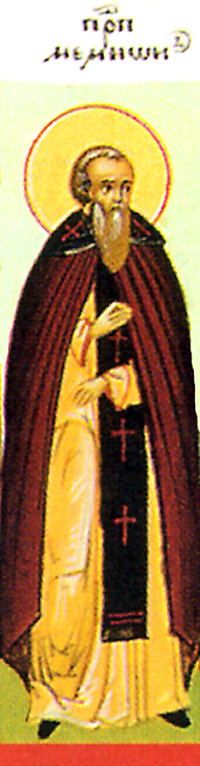
Saint Memnon the Wonderworker from his youth lived in the Egyptian desert. By his arduous ascetical efforts, he attained a victory of spirit over the flesh.
As Igumen of one of the Egyptian monasteries, he wisely and carefully guided the brethren. Even while aiding them through prayer and counsel, the saint did not waver in his efforts in the struggle against temptation.
He received the gift of clairvoyance through unceasing prayer and toil. At his prayer a spring of water gushed forth in the wilderness, locusts destroying the harvest perished, and the shipwrecked who called on his name were saved. After his death, the mere mention of his name dispelled a plague of locusts and undid the cunning wiles of evil spirits.
Martyrs Diodorus and Rhodopianus—Deacons, at Aphrodisia in Anatolia
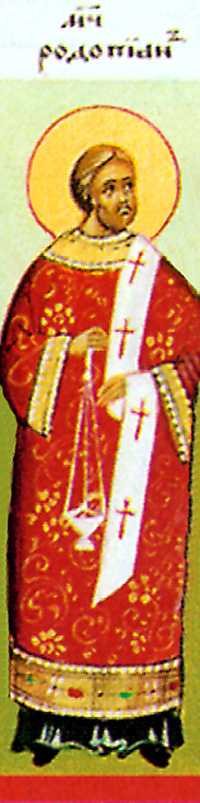
The Holy Martyrs, Deacons Diodorus and Rhodopianus suffered under the emperor Diocletian (284-305) in Aphrodisias, Caria. They were stoned to death for spreading Christianity among the pagans.
Saint Basil, Bishop of Zakholmsk in Montenegro, Serbia

Saint Basil, Bishop of Zakholmsk, was born of pious parents in the sixteenth century in the Popov district of Herzegovina. At the age of maturity he left his parental home and settled in the Trebinsk monastery in honor of the Dormition of the Most Holy Theotokos, and became a monk.
For his virtuous life the saint was elevated to be Bishop of Zakholm and Skenderia. He occupied the bishop’s cathedra in the second half of the sixteenth century, a successor to Bishop Paul and predecessor of Bishop Νikόdēmos. Saint Basil was a good pastor of the flock of Christ, and the Lord strengthened his discourse with various miracles. For the sanctifying of soul with the wisdom of holy ascetic fathers, the saint journeyed to Athos. Saint Basil died peacefully and was buried in the city of Ostrog in Chernogoria on the border with Herzegovina.
Venerable Nectarius of Optina
Saint Nectarius was born in the city of Elets in the Orel province in 1853, the son of Basil and Elena Tikhonov. At his baptism, he was named Nicholas.
Saint Nectarius completed the course of his earthly life on April 29, 1928.
The Moscow Patriarchate authorized local veneration of the Optina Elders on June 13,1996, glorifying them for universal veneration on August 7, 2000.
Martyrs of Lazeti

Lazeti is a region in southern Kolkheti (Colchis), the ancient kingdom located in what is now southwestern Georgia and northeastern Turkey. In ancient times, Lazeti was a center of Georgian culture. The holy Apostle Andrew began the conversion of the Georgian nation from this very region.
After the fall of Byzantium in 1453, the Ottomans sought for three centuries to destroy the Christian-Georgian consciousness of the Laz people. At the same time, Rome increased its presence in the region by dispatching ever greater numbers of Catholic missionaries.
The Laz, caught in the crossfire, boldly defended and preserved their Orthodox Faith. Those that were forcibly converted to Islam struggled to preserve their national culture, the memory of their ancestors, and the love of their homeland.
As time progressed, however, some grew weak and converted to Catholicism (in word, if not in mind and heart) or allowed themselves to be won over by the Monophysite heresy.
In our own time, with the blessing of Catholicos-Patriarch Ilia II, people from several Georgian regions have reestablished lines of communication with the Laz who currently reside within Turkish borders.
Further, many of the Laz currently residing within Georgian borders have converted from Islam back to the Orthodox Christianity of their ancestors. They have recounted to the Holy Synod of the Georgian Church stories of the martyrdom of their Christian ancestors at the hands of the Ottomans: the beheading of some three hundred Laz warriors on a single mountain between the years 1600 and 1620 and the martyrdom of the clergy at one local monastery. The martyrdoms took place on Mt. Dudikvati (“the place of beheading”) and on Mt. Papati (“the place of the clergy”) respectively.
Based on the information provided by the martyrs’ descendants, the Holy Synod of the Georgian Church declared all the clergy and laymen martyred on Dudikvati and Papati and all the Laz martyred for Christ’s sake worthy to be numbered among the saints. They were canonized on September 18, 2003.
Saint Endellion, recluse of Cornwall

No information available at this time.
 Saint Peter Antiochian Orthodox Church