
HOLY WEDNESDAY
ABSTAIN FROM MEAT, FISH, DAIRY, EGGS, WINE, OLIVE OIL
Holy Wednesday, Agape, Chionia, and Irene, the Holy Martyrs, Righteous Amphilochios of Patmos, Leonidas and Charissa, Nike, Galene, Kallida, Nounenchia, Vasilissa, and Theodora the Martyrs
JOHN 12:17-50
At that time, the crowd that had been with Jesus when he called Lazarus out of the tomb and raised him from the dead bore witness. The reason why the crowd went to meet him was that they heard he had done this sign. The Pharisees then said to one another, "You see that you can do nothing; look, the world has gone after him.
Now among those who went up to worship at the feast were some Greeks. So these came to Philip, who was from Bethsaida in Galilee, and said to him, "Sir, we wish to see Jesus." Philip went and told Andrew; Andrew went with Philip and they told Jesus. And Jesus answered them, "The hour has come for the Son of man to be glorified. Truly, truly, I say to you, unless a grain of wheat falls into the earth and dies, it remains alone; but if it dies, it bears much fruit. He who loves his life loses it, and he who hates his life in this world will keep it for eternal life. If any one serves me, he must follow me; and where I am, there shall my servant be also; if any one serves me, the Father will honor him.
Now is my soul troubled. And what shall I say? 'Father, save me from this hour'? No, for this purpose I have come to this hour. Father, glorify your name." Then a voice came from heaven, "I have glorified it, and I will glorify it again." The crowd standing by heard it and said that it had thundered. Others said, "An angel has spoken to him." Jesus answered, "This voice has come for your sake, not for mine. Now is the judgment of this world, now shall the ruler of this world be cast out; and I, when I am lifted up from the earth, will draw all men to myself." He said this to show by what death he was to die. The crowd answered him, "We have heard from the law that the Christ remains for ever. How can you say that the Son of man must be lifted up? Who is this Son of man?" Jesus said to them, "The light is with you for a little longer. Walk while you have the light, lest the darkness overtake you; he who walks in the darkness does not know where he goes. While you have the light, believe in the light, that you may become sons of light.
When Jesus had said this, he departed and hid himself from them. Though he had done so many signs before them, yet they did not believe in him; it was that the word spoken by the prophet Isaiah might be fulfilled: "Lord, who has believed our report, and to whom has the arm of the Lord been revealed?" Therefore they could not believe. For Isaiah again said, "He has blinded their eyes and hardened their heart, lest they should see with their eyes and perceive with their heart, and turn for me to heal them." Isaiah said this because he saw his glory and spoke of him. Nevertheless many even of the authorities believed in him, but for fear of the Pharisees they did not confess it, lest they should be put out of the synagogue: for they loved the praise of men more than the praise of God.
And Jesus cried out and said, "He who believes in me, believes not in me but in him who sent me. And he who sees me sees him who sent me. I have come as light into the world, that whoever believes in me may not remain in darkness. If any one hears my sayings and does not keep them, I do not judge him; for I did not come to judge the world but to save the world. He who rejects me and does not receive my sayings has a judge; the word that I have spoken will be his judge on the last day. For I have not spoken on my own authority; the Father who sent me has himself given me commandment what to say and what to speak. And I know that his commandment is eternal life. What I say, therefore, I say as the Father has bidden me.
MATTHEW 26:6-16
When Jesus was at Bethany at the house of Simon the leper, a woman came up to him with an alabaster flask of very expensive ointment and she poured it on his head, as he sat at table. But when the disciples saw it, they were indignant, saying, "Why this waste? For this ointment might have been sold for a large sum, and given to the poor." But Jesus, aware of this, said to them, "Why do you trouble the woman? For she has done a beautiful thing to me. For you always have the poor with you, but you will not always have me. In pouring this ointment on my body she has done it to prepare me for burial. Truly, I say to you wherever this gospel is preached in the whole world, what she has done will be told in memory of her." Then one of the twelve, who was called Judas Iscariot, went to the chief priests and said, "What will you give me if I deliver him to you?" And they paid him thirty pieces of silver. And from that moment he sought an opportunity to betray him.
Great and Holy Wednesday
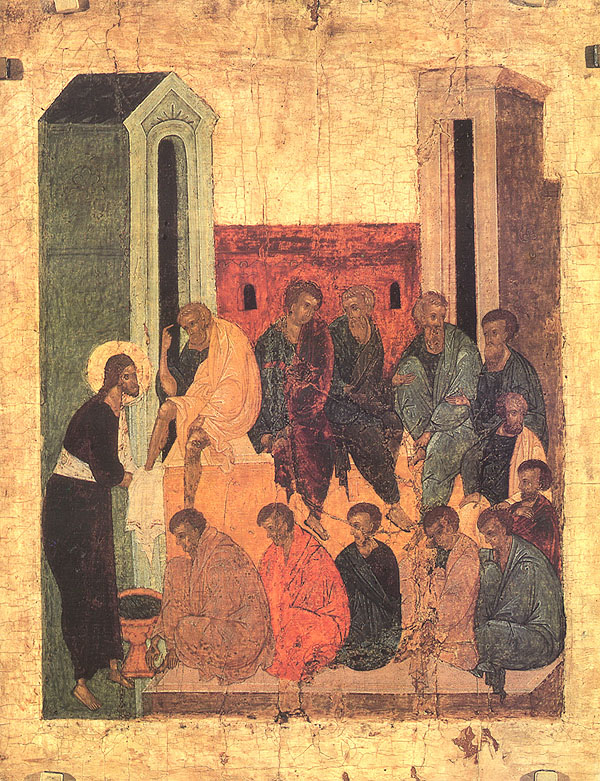
On Great and Holy Wednesday, the hymns of the Bridegroom Service remind us of the sinful woman who poured precious ointment on Christ’s head at Simon the leper’s house (Mt. 26:7).
The disciples complained about the wasteful extravagance, for the myrrh could have been sold and the money given to the poor. On this same day Judas agreed to betray the Lord for thirty pieces of silver. Because the betrayal took place on Wednesday, Orthodox Christians fast on most Wednesdays during the year.
On the other hand, the Savior declared that the woman’s actions would be remembered wherever the Gospel is preached (Mt. 26:13), for she had anointed Him in preparation for His burial (Mt. 26:12).
Virgin Martyrs Agape, Irene and Chionia, in Illyria

The Holy Martyrs Agape, Irene, and Chionia were sisters who lived at the end of the third century to the beginning of the fourth century, near the Italian city of Aquilea. They were left orphaned at an early age.
The young women led a pious Christian life and they turned down many offers of marriage. Their spiritual guide was the priest Xeno. It was revealed to him in a vision that he would die very soon, and that the holy virgins would suffer martyrdom. Also at Aquilea and having a similar vision was the Great Martyr Anastasia (December 22), who is called “Deliverer from Potions,” because she fearlessly visited Christians in prison, encouraging them and healing them from potions, poisons, and other harmful things. The Great Martyr Anastasia visited the sisters and urged them to endure all things for Christ. Soon what was predicted in the vision came to pass. The priest Zeno died, and the three virgins were arrested and brought to trial before the emperor Diocletian (284-305).
Saint Chionia (“snow” in Greek) preserved the purity of her baptism according to the words of the Prophet-King David, “You will wash me, and I shall be whiter than snow” (Ps. 50/51:7).
Saint Irene (“peace” in Greek) preserved the peace of Christ within herself and manifested it to others, according to the Savior’s word, “My peace I give you” (John 14:27).
Saint Agape (“love” in Greek) loved God with all her heart, and her neighbor as herself (Mt.22:37-39).
Seeing the youthful beauty of the sisters, the emperor urged them to deny Christ and he promised to find them illustrious bridegrooms from his entourage. The holy sisters replied that their only Bridegroom was Christ, for Whom they were ready to suffer. The emperor demanded they renounce Christ, but neither the elder sisters, nor the youngest, would consent. They called the pagan gods mere idols made by human hands, and they preached faith in the true God.
By order of Diocletian, who was leaving for Macedonia, the holy sisters were also to be brought there. And they brought them to the court of the governor Dulcititus.
When he saw the beauty of the holy martyrs, he was aroused with impure passion. He put the sisters under guard, and he told them that they would receive their freedom if they agreed to fulfill his desires. But the holy martyrs replied that they were prepared to die for their Heavenly Bridegroom, Christ.
Then Dulcititus decided to have his way by force. When the holy sisters arose at night to glorify the Lord in prayer, Dulcititus came to the door and tried to enter, but an invisible force prevented him. He staggered about, unable to find his way out. Then he fell down in the kitchen among the cooking utensils, the pots and pans, and he was covered all over with soot. The servants and the soldiers recognized him only with difficulty. When he saw himself in a mirror, he then realized that the holy martyrs had made a fool of him, and he decided to take his revenge on them.
At his court, Dulcititus gave orders to strip the holy martyrs. But the soldiers were not able to do this, no matter how much they tried. Their clothing seemed to be stuck to the bodies of the holy virgins. During the trial Dulcititus suddenly fell asleep, and no one could rouse him. Just as they carried him into his house, he immediately awoke.
When they reported to the emperor Diocletian everything that had happened, he became angry with Dulcititus and he gave the holy virgins over to Sisinius for trial. He began with the youngest sister, Irene. Seeing that she remained unyielding, he sent her to prison and then attempted to sway Saints Chionia and Agape. He also failed to make them renounce Christ, and Sisinius ordered that Saints Agape and Chionia be burned. On hearing the sentence, the sisters gave thanks to the Lord for their crowns of martyrdom. In the fire, Agape and Chionia surrendered their pure souls to the Lord.
When the fire went out, everyone saw that the bodies of the holy martyrs and their clothing had not been scorched by the fire, and their faces were beautiful and peaceful, as if they were asleep. On the day following, Sisinius gave orders to bring Saint Irene to court. He threatened her with the fate of her older sisters and he urged her to renounce Christ. Then he threatened to hand her over for defilement in a brothel. But the holy martyr answered, “Even if my body is defiled by force, my soul will never be defiled by renouncing Christ.”
When the soldiers of Sisinius led Saint Irene to the brothel, two luminous soldiers overtook them and said, “Your master Sisinius commands you to take this virgin to a high mountain and leave her there, and then return to him and report to him that you have fulfilled his command.” And the soldiers did so.
When they reported back to Sisinius, he flew into a rage, since he had given no such orders. The luminous soldiers were angels of God, saving the holy martyr from defilement. Sisinius went to the mountain with a detachment of soldiers and saw Saint Irene on the summit. For a long while they searched for the way to the top, but they could not find it. Then one of the soldiers wounded Saint Irene with an arrow. The martyr cried out to Sisinius, “I mock your impotent malice, and I go my Lord Jesus Christ pure and undefiled.” Having given thanks to the Lord, she lay down upon the ground and surrendered her soul to God on the very day of Holy Pascha (+ 304).
The Great Martyr Anastasia heard about the end of the holy sisters, and she buried their bodies with reverence.
Martyrs Leonidas, Chariessa, Nice, Galina, Kalista, Nunechia, Basilissa, Theodora, and Irene, of Corinth
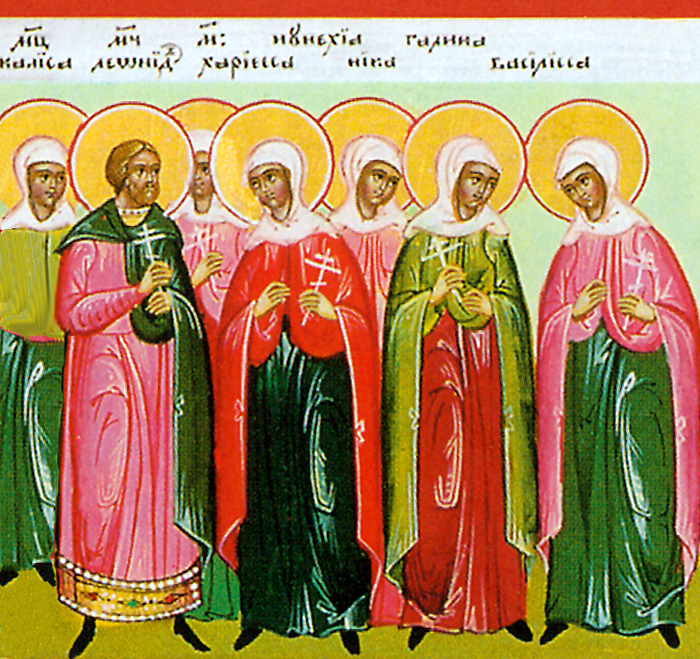
The Holy Martyr Leonidas and the Holy Martyrs Charissa, Nike (Nika, Victoria), Galina, Kalista (Kalida), Nunekhia, Basilissa, Irene, and Theodora suffered at Corinth in the year 258. They threw them into the sea, but they did not drown. Instead, they walked upon the water as if on dry land, singing spiritual hymns. The torturers overtook them in a ship, tied stones around their necks and drowned them.
Monastic Martyr Christopher of Dionysiou, Mount Athos
No information available at this time.
Hieromartyr Nikḗtas
No information available at this time.
Weeping “Ilyin Chernigov” Icon of the Mother of God
The Il'insk (Prophet Elias)-Chernigov Icon of the Mother of God was painted in 1658 by the iconographer Gregory Dubensky (Gennadios in monasticism). The history of the Icon's creation and its miracles are described by a witness of these events, Saint Demetrios, Metropolitan of Rostov, in the works "A Miracle of the Most Holy and Most Blessed Virgin Mary," and "The Bedewed Fleece" (Руно орошенное). Some miracles are also mentioned by Saint John (Maximovich), Metropolitan of Tobolsk (June 10) in a poem "To the Virgin Theotokos." In 1662 there was a miraculous flow of tears from the Il'insk-Chernigov Icon, which continued from April 16-24, in connection with which a Feast Day was appointed for the Icon. In the same year, Chernigov was attacked by the Tatars, who ravaged the city and its environs, including the Holy Trinity-Il'insk Monastery, but, as Saint Demetrios testifies, the Icon and its precious oklad remained unharmed. The brethren who had taken refuge in the underground caves were also spared.
From the XVII century, cases of miracles from the Il'insk-Chernigov Icon were recorded with particular care. In "The Bedewed Fleece," Saint Demetrios described in detail 24 miraculous healings (one every hour) from all sorts of ailments of the residents of Chernigov and its environs. The list of miracles was augmented when the book was reprinted. Thus, by 1696, there were 56 cases of healing (5 from blindness, 3 from a disease of the legs, 3 from "gostza" (rheumatism). 1 from paralysis, 15 from demonic possession, 14 from clouding of the mind, 15 from various chronic diseases, and 1 instance of a boy raised from the dead. In the XIX century, several healings were observed: a Romny bourgeois from a fever (1865), a Chernigov girl from a mental disorder (on the Icon's Feast Day in 1874), and an infant from a high fever (1887 or 1888), the son of a Poltava landowner from diphtheria (until 1898), and a staff captain from Sveaborg from a chronic illness (until 1898), and several others.
Before HolyTrinity Cathedral was built in the Monastery (1679-1695), the Icon was kept in the church of the Prophet Elias near the caves, to the right near the pillar closest to the iconostasis. In 1786-1794, in connection with the planned opening of the University of Holy Trinity-Il'insk Monastery at Chernigov, but this did not occur, so the Icon was placed in the Dormition Cathedral of the Yelets Chernigov Convent, which was dedicated to the Dormition of the Most Holy Theotokos. In the XIX century, the Icon was in the cathedral, but only during the summertime. In winter, the Icon was transferred to the heated church of the Nativity of Christ, and placed in a special case behind the right kliros. At the beginning of the XX century, in winter, the Il'insk-Chernigov Icon of the Mother of God was kept in the Sretensky church in the Bishop's residence, and a substitute icon was left in the cathedral. The wonderworking Icon disappeared after the closure of Holy Trinity-Il'insk Monastery in 1924.
At the end of the XVII century, by the initiative of Archbishop Lazarus (Baranovich) and at the expense of Hetman I. S. Mazepa (whose initials and coat of arms were on the case), a silver oklad and a kiot were made (these have not been preserved). A crown with precious stones was donated by the Chernigov Colonel V. Dunin-Borkovsky, who received healing from the Icon in 1687 The dimensions of the Icon (1 arshin, 5 vershkas by 14.5 vershts – 93.37×64.45 cm) were increased when placed in the kiot because it was overlaid with a frame covered with silver plates with additional images engraved on them (2 arshins 2 vershkas by 1 arshin 6 vershks (151.24×97.8 cm) together with the frame). Attached to the case were plaques with inscriptions: "This holy image of the Mother of God, called Il'insk-Chernigov, was painted in 1658" and "The miraculous flow of tears from the Icon apparently occurred in 1662, from the 16th to the 24th day of the month of April." "In 1662 the Tatars invaded the city of Chernigov, but the hands of the impious Saracens could not touch this wonderworking Icon." In 1897 the oklad was replaced by a new one, made in Moscow by M. N. Ryndin with donations from the residents of Chernigov. There was an inscription on it: "This silver riza was made to replace the old one, which had fallen into disrepair, with the blessing of Bishop Anthony of Chernigov and Nizhyn, with the zeal of the benevolent donors of Chernigov. Hierodeacon Varlaam was sent to Moscow to order this riza from the master M. N. Ryndin, 1897, the weight of this riza is 33 ф. 29 з."
Revered copies of the Il'insk-Chernigov Icon, made at the end of the XVII-XVIII centuries, were in all the churches of Chernigov. At present, two copies are venerated in the Yelets Dormition Monastery in Chernigov.
The wonderworking copy of the Chernigov Icon of the Mother of God, which was kept in the Gethsemane Skete of Holy Trinity-Saint Sergius Lavra, became famous in 1869.
The Icon belongs to the traditional Hodegetria type. The Child blesses with His right hand, and a scroll in his left. He sits on the left hand of His Mother. The heads of the Mother of God and the Child are slightly inclined toward each other, the Child's legs are tightly together. The figure of the Mother of God has an almost generational edge, characteristic of the southern and western Russian iconography of the Mother of God of the XVII century. The Child is dressed in a white shirt with a collar. A distinctive feature of Il'insk-Chernigov iconography. The Icon is a gesture of the Infant's hand stretched forward. Identical or fairly similar compositional solutions are present in a number of other wonderworking Icons of the Mother of God associated with Belarus and Ukraine (Borkolabovskaya, Trigorskaya, Poddubetska, Gerbovetskaya Icons of the Mother of God).
In copies of the wonderworking Icon, crowns were often depicted on the heads of the Mother of God and her Child, which were absent on the Icon itself, but were present on its oklad. For the first time, crowns were depicted in an engraving of 1683 in Saint Demetrios of Rostov's book "The Bedewed Fleece." Obviously, this engraving became a model for Ukrainian and Russian icons, and on such copies the identifying inscription at the bottom was usually repeated (icon of 1778, Chernigov State Icon, Historical and Architectural Museum-Reserve).
Tambov (Utkino) Icon of the Mother of God

In 1686, Saint Pitirim (July 28) came to Tambov and, along with other relics, he brought with him a copy of the Il'insk-Chernigov Icon of the Mother of God, considered to be the patroness of the southwestern region. For this reason, the Icon was placed at the southwestern gate of the city. Over time, the Icon began to be called Tambov, especially since there were some differences between it and the Il'insk-Chernigov Icon of the Mother of God.
On the borders of the Icon, on the right and on the left, were depicted: Saint Alexei, the Man of God, and Saint Eudoxia. It is assumed that these were the heavenly patrons of Bishop Pitirim's parents, and it is quite possible that he himself painted the images of those Saints.
Later, on the site of the southwestern city gate, a small wooden church was built and dedicated to the Holy Apostles Peter and Paul. It was in this church that the Icon was kept. And when the merchant Ivan Utkin built the stone church of the Holy Protomartyr Stephen at his own expense in 1771-1778, the Tambov Icon was transferred there and placed in the altar above the altar. People began to call the church by the name of the builder Utkinskaya, and the Icon was later completely forgotten.
But the Queen of Heaven reminded people of herself. At the beginning of the XIX century, a priest in Kaluga, was suffering from a malady of his legs and could not walk. He saw this Icon of the Mother of God in a dream. She told him: "Find this icon. Pray before it and you shall be healed." After the dream, the priest received some relief from his illness, so that he was able to walk, and immediately he began to search for the Icon he had seen in the dream. After visiting various villages and towns, he finally reached Tambov, where, after inspecting all the churches, he found the Icon he had seen in his dream in the altar of the Utkin church. After praying before it, he received complete healing. This incident became widely known in the city, and afterward there were several more miraculous healings of the townspeople.
The Tambov Icon became famous again, and when in 1835 the old Utkin church was severely damaged. At the request of the townspeople, the right side altar was consecrated in honor of the Tambov Icon of the Mother of God. With the passage of time, the grateful Tambov residents adorned the Icon with a luxurious silver-gilt riza with many precious stones. There were so many cures from the Icon that there was no time to record all of them. In 1888, by decree of the Holy Synod, a Cross Procession took place in all the churches of the city on April 16 in honor of the Tambov Icon, and in 1900 the church was once again called the church of the Theotokos.
After the 1917 revolution, Tambov's churches were devastated, and the wonderworking Icon also suffered. The riza was removed and the stones were pried out, and then it disappeared without a trace. There are revered copies of the wonderworking Icon in the city.
The Tambov Icon is commemorated on April 16, and again on July 28 (the repose of Bishop Pitirim).
 Saint Peter Antiochian Orthodox Church