
5TH THURSDAY OF LENT: THE GREAT CANON OF SAINT ANDREW OF CRETE
ABSTAIN FROM MEAT, FISH, DAIRY, EGGS
5th Thursday of Lent: The Great Canon of Saint Andrew of Crete, Nicetas, Abbot of the Monastery of Medicium, Joseph the Hymnographer, Theodosia and Irene the Martyrs
ISAIAH 42:5-16
Thus says God, the LORD, who created the heavens and stretched them out, who spread forth the earth and what comes from it, who gives breath to the people upon it and spirit to those who walk in it: "I am the LORD, I have called you in righteousness, I have taken you by the hand and kept you; I have given you as a covenant to the people, a light to the nations, to open the eyes that are blind, to bring out the prisoners from the dungeon, from the prison those who sit in darkness. I am the LORD, that is my name; my glory I give to no other, nor my praise to graven images. Behold, the former things have come to pass, and new things I now declare; before they spring forth I tell you of them." Sing to the LORD a new song, his praise from the end of the earth! Let the sea roar and all that fills it, the coastlands and their inhabitants. Let the desert and its cities lift up their voice, the villages that Kedar inhabits; let the inhabitants of Sela sing for joy, let them shout from the top of the mountains. Let them give glory to the LORD, and declare his praise in the coastlands. The LORD goes forth like a mighty man, like a man of war he stirs up his fury; he cries out, he shouts aloud, he shows himself mighty against his foes. For a long time I have held my peace, I have kept still and restrained myself; now I will cry out like a woman in travail, I will gasp and pant. I will lay waste mountains and hills, and dry up all their herbage; I will turn the rivers into islands, and dry up the pools. And I will lead the blind in a way that they know not, in paths that they have not known I will guide them. I will turn the darkness before them into light, the rough places into level ground. These are the things I will do, and I will not forsake them.
GENESIS 18:20-33
Then the LORD said, “Because the outcry against Sodom and Gomorrah is great and their sin is very grave, I will go down to see whether they have done altogether according to the outcry which has come to me; and if not, I will know.” So the men turned from there, and went toward Sodom; but Abraham still stood before the LORD. Then Abraham drew near, and said, “Wilt thou indeed destroy the righteous with the wicked? Suppose there are fifty righteous within the city; wilt thou then destroy the place and not spare it for the fifty righteous who are in it? Far be it from thee to do such a thing, to slay the righteous with the wicked, so that the righteous fare as the wicked! Far be that from thee! Shall not the Judge of all the earth do right?” And the LORD said, “If I find at Sodom fifty righteous in the city, I will spare the whole place for their sake.” Abraham answered, “Behold, I have taken upon myself to speak to the Lord, I who am but dust and ashes. Suppose five of the fifty righteous are lacking? Wilt thou destroy the whole city for lack of five?” And he said, “I will not destroy it if I find forty-five there.” Again he spoke to him, and said, “Suppose forty are found there.” He answered, “For the sake of forty I will not do it.” Then he said, “Oh let not the Lord be angry, and I will speak. Suppose thirty are found there.” He answered, “I will not do it, if I find thirty there.” He said, “Behold, I have taken upon myself to speak to the Lord. Suppose twenty are found there.” He answered, “For the sake of twenty I will not destroy it.” Then he said, “Oh let not the Lord be angry, and I will speak again but this once. Suppose ten are found there.” He answered, “For the sake of ten I will not destroy it.” And the LORD went his way, when he had finished speaking to Abraham; and Abraham returned to his place.
PROVERBS 16:17-17:17
The highway of the upright turns aside from evil; he who guards his way preserves his life. Pride goes before destruction, and a haughty spirit before a fall. It is better to be of a lowly spirit with the poor than to divide the spoil with the proud. He who gives heed to the word will prosper, and happy is he who trusts in the LORD. The wise of heart is called a man of discernment, and pleasant speech increases persuasiveness. Wisdom is a fountain of life to him who has it, but folly is the chastisement of fools. The mind of the wise makes his speech judicious, and adds persuasiveness to his lips. Pleasant words are like a honeycomb, sweetness to the soul and health to the body. There is a way which seems right to a man, but its end is the way to death. A worker's appetite works for him; his mouth urges him on. A worthless man plots evil, and his speech is like a scorching fire. A perverse man spreads strife, and a whisperer separates close friends. A man of violence entices his neighbor and leads him in a way that is not good. He who winks his eyes plans perverse things, he who compresses his lips brings evil to pass. A hoary head is a crown of glory; it is gained in a righteous life. He who is slow to anger is better than the mighty, and he who rules his spirit than he who takes a city. The lot is cast into the lap, but the decision is wholly from the LORD.
Better is a dry morsel with quiet than a house full of feasting with strife. A slave who deals wisely will rule over a son who acts shamefully, and will share the inheritance as one of the brothers. The crucible is for silver, and the furnace is for gold, and the LORD tries hearts. An evildoer listens to wicked lips; and a liar gives heed to a mischievous tongue. He who mocks the poor insults his Maker; he who is glad at calamity will not go unpunished. Grandchildren are the crown of the aged, and the glory of sons is their fathers. Fine speech is not becoming to a fool; still less is false speech to a prince. A bribe is like a magic stone in the eyes of him who gives it; wherever he turns he prospers. He who forgives an offense seeks love, but he who repeats a matter alienates a friend. A rebuke goes deeper into a man of understanding than a hundred blows into a fool. An evil man seeks only rebellion, and a cruel messenger will be sent against him. Let a man meet a she-bear robbed of her cubs, rather than a fool in his folly. If a man returns evil for good, evil will not depart from his house. The beginning of strife is like letting out water; so quit before the quarrel breaks out. He who justifies the wicked and he who condemns the righteous are both alike an abomination to the LORD. Why should a fool have a price in his hand to buy wisdom, when he has no mind? A friend loves at all times, and a brother is born for adversity.
Venerable Niketas the Confessor, Abbot of Medikion
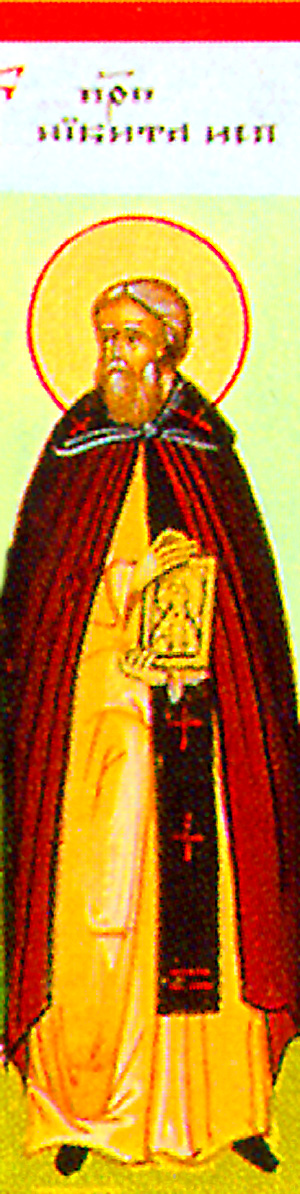
Saint Niketas (Nikḗtas) the Confessor was born in Bithynian Caesarea (northwest Asia Minor) of a pious family. His mother died eight days after his birth, and his father Philaretos became a monk. The child remained in the care of his grandmother, who raised him in a true Christian spirit. From his youth Saint Niketas attended church and was a disciple of the hermit Stephanos. With his blessing, Saint Niketas set off to the Mydicia monastery, where Saint Nikephoros (Nikēphóros) (March 13) was the igumen.
After seven years of virtuous life at the monastery, famed for its strict monastic rule, Saint Niketas was ordained presbyter. Saint Nikephoros, knowing the holy life of the young monk, entrusted to him the guidance of the monastery when he himself became ill.
Not wanting power, Saint Niketas devoted himself to the enlightenment and welfare of the monastery. He guided the brethren by his own example. Soon the fame of the lofty life of its inhabitants of the monastery attracted many seeking salvation. After several years, the number of monks had increased to one hundred.
When Saint Nikephoros departed to the Lord in his old age, the brethren unanimously chose Saint Niketas as igumen.
The Lord granted Saint Niketas the gift of wonderworking. Through his prayer a deaf-mute child received the gift of speech; two demon-possessed women were healed; he restored reason to one who had lost his mind, and many of the sick were healed of their infirmities.
During these years under the emperor Leo the Armenian (813-820), the Iconoclast heresy resurfaced and oppression increased. Orthodox bishops were deposed and banished. At Constantinople a council of heretics was convened in 815, at which they deposed the holy Patriarch Nikephoros (806-815), and in his place they chose the heretical layman Theodotus. They also installed heretics in place of exiled and imprisoned Orthodox bishops.
The emperor summoned all the heads of the monasteries and tried to bring them over to the Iconoclast heresy. Among those summoned was Saint Niketas, who stood firmly for the Orthodox confession. Following his example, all the igumens remained faithful to the veneration of holy icons. Therefore, they threw him into prison. Saint Niketas bravely underwent all the tribulations and encouraged firmness of spirit in the other prisoners.
Then the emperor and the false patriarch Theodotus attempted to trick those who remained faithful to Orthodox teaching. They promised that the emperor would give them their freedom and permit the veneration of the icons on one condition: that they take Communion from the pseudo-patriarch Theodotus.
For a long time the saint had doubts about entering into communion with a heretic, but other prisoners begged him to go along with them. Acceding to their entreaties, Saint Niketas went into the church, where icons were put out to deceive the confessors, and he accepted Communion.
But when he returned to his monastery and saw that the persecution against icons was continuing, he then repented of his deed, returned to Constantinople and fearlessly denounced the Iconoclast heresy. He ignored all the emperor’s threats.
Saint Niketas was again locked up in prison for six years until the death of the emperor Leo the Armenian. Enduring hunger and travail, Saint Niketas worked miracles by the power of his prayers: through his prayer the Phrygian ruler released two captives without ransom; three shipwrecked men for whom Saint Niketas prayed, were thrown up on shore by the waves.
Saint Niketas reposed in the Lord in 824. The saint’s body was buried at the monastery with reverence. Later, his relics became a source of healing for those coming to venerate the holy confessor.
Holy Virgin Martyr Theodosίa of Tyre
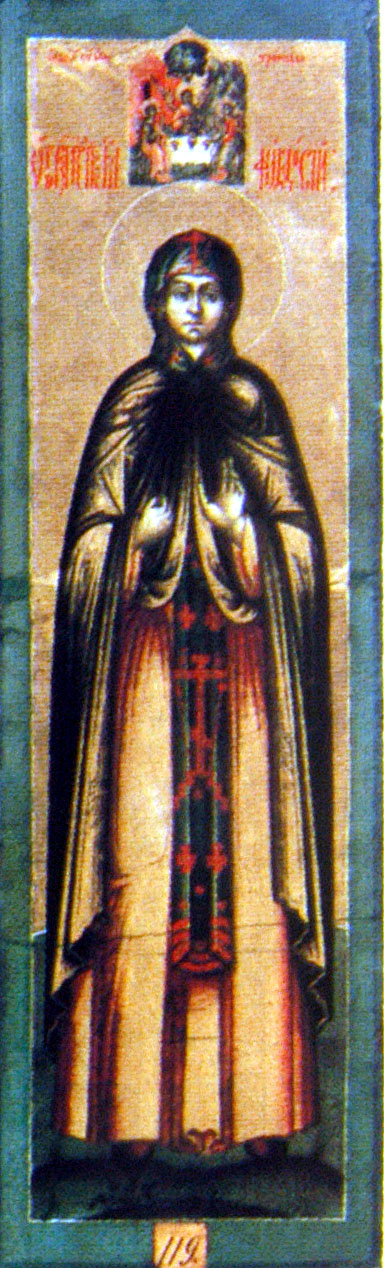
Saint Theodosίa of Tyre lived during the III and IV centuries. Once, during a persecution against Christians, which had already lasted for five years, the seventeen-year-old Theodosίa visited some condemned Christian prisoners in the Praetorium at Caesarea in Palestine. It was the day of Holy Pascha, and the Martyrs were speaking about the Kingdom of God. Saint Theodosίa asked them to remember her when they appeared before the Lord.
When the soldiers saw that the girl had bowed to the prisoners, they seized her and led her before the governor, Urban. The governor urged the Saint to offer sacrifice to the idols, but she refused, professing her faith in Christ. Then she was subjected to cruel tortures; her sides and breasts were raked with iron claws until her bones were exposed. She endured this in silence with astonishing courage. Again Urban told her to sacrifice, but she mocked him saying: “Foolish man, why do you persist? Can you not see that I have received everything I prayed for, and that I am honored to share the fate of these Martyrs for Christ?"
After saying this, she was tormented even more severely than before. The holy virgin was cast into the sea with a stone tied around her neck, but Angels rescued her from the depths. Then they tossed her into the arena to be eaten by wild animals. Seeing that the beasts would not touch her, the soldiers beheaded her.
That night Saint Theodosίa appeared to her parents, who had tried to persuade their daughter not to let herself be tortured. She wore radiant garments, a crown upon her head, and held a luminous gold cross in her hand. She said to them, “Behold the great glory of which you wished to deprive me!”
The Holy Virgin Martyr Theodosίa of Tyre suffered for Christ on April 3 in the year 307 or 308. She is also commemorated on May 29 (the transfer of her relics to Constantinople, and later to Venice).
Martyr Irene
No information available at this time.
Saint Illyricus of Mount Myrsinon in the Peloponnesus

Saint Illyricus the Wonderworker devoted himself to ascetic struggles on Mount Myrsinon in the Peloponnesus. The dates of his birth and death are unknown.
Martyrs Elpidephorus, Dius, Bithonius, and Galycus
The Holy Martyrs Elpidephorus, Dius, Bithonius, and Galycus suffered for their faith in Jesus Christ. They cut off the head of Saint Elpidephorus with a sword, Saint Dius was executed by stoning, Saint Bithonius was drowned in the sea, and Saint Galycus was condemned to be eaten by wild beasts.
“Unfading Flower” Icon of the Mother of God
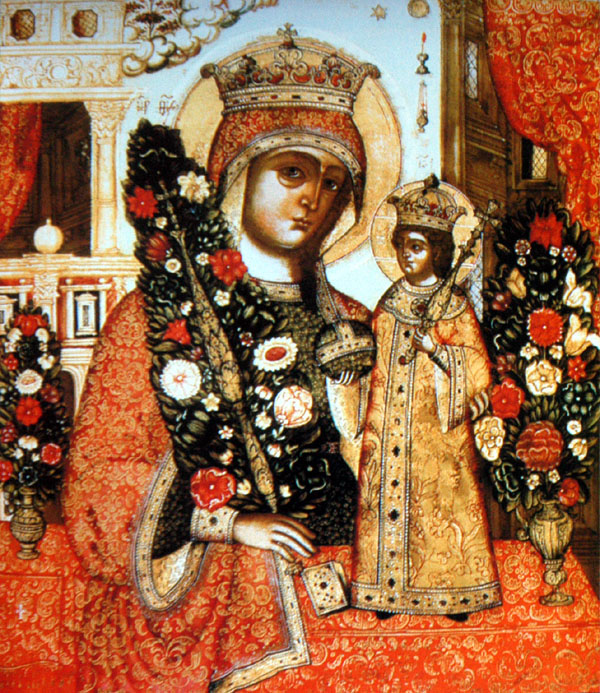
The "Unfading Flower" Icon depicts the Theotokos holding her Divine Son on her right arm, and in her left hand is a bouquet of white lilies. The lilies symbolize the unfading flower of virginity and purity of the Mother of God, to whom the Church sings: “You are the root of virginity and the Unfading Flower of purity.”
In Moscow there are two churches with Icons with this name: the church of the Dormition at Mogil'tsy (December 31), and the Alexeyev Monastery. Other icons of this name are in Kungur (Perm Gubernia); in the former town of Kadome of Tambov Province, namely, in the Merciful Theotokos womens' monastery; and in the Nativity of the Theotokos church of Voronezh.
There is a similar Icon in the church of Saint Nicholas in the village of Budishch (Poltava Gubernia). It resembles a number of very old icons which are also revered in that place. Every year on April 3, many people gather in the village of Budishch to venerate this Icon, along with a copy of the Vladimir Icon of the Mother of God. Several miraculous healings of the sick have occurred before this Icon.
 Saint Peter Antiochian Orthodox Church