
Due to weather in the area the service for the Canon of St. Andrew has been cancelled this evening.
Monthly Archives: March 2025
Daily Readings for Tuesday, March 04, 2025
FIRST TUESDAY OF LENT
ABSTAIN FROM MEAT, FISH, DAIRY, EGGS, WINE, OLIVE OIL
Gerasimus the Righteous of Jordan, Paul & his sister Juliana and their Companions, Daniel, Prince of Moscow, Gregory, Bishop of Constance
ISAIAH 1:19-2:3
If you are willing and obedient, you shall eat the good of the land; but if you refuse and rebel, you shall be devoured by the sword; for the mouth of the Lord has spoken.
How the faithful city has become a harlot, she that was full of justice! Righteousness lodged in her, but now murderers. Your silver has become dross, your wine mixed with water. Your princes are rebels and companions of thieves. Every one loves a bribe and runs after gifts. They do not defend the fatherless, and the widow's cause does not come to them.
Therefore the Lord says, the Lord of hosts, the Mighty One of Israel: "Ah, I will vent my wrath on my enemies, and avenge myself on my foes. I will turn my hand against you and will smelt away your dross as with lye and remove all your alloy. And I will restore your judges as at the first, and your counselors as at the beginning. Afterward you shall be called the city of righteousness, the faithful city.
Zion shall be redeemed by justice, and those in her who repent, by righteousness. But rebels and sinners shall be destroyed together, and those who forsake the Lord shall be consumed. For you shall be ashamed of the oaks in which you delighted; and you shall blush for the gardens which you have chosen. For you shall be like an oak whose leaf withers, and like a garden without water. And the strong shall become tow, and his work a spark, and both of them shall burn together, with none to quench them.
The word which Isaiah the son of Amoz saw concerning Judah and Jerusalem. It shall come to pass in the latter days that the mountain of the house of the Lord shall be established as the highest of the mountains, and shall be raised above the hills; and all the nations shall flow to it, and many peoples shall come, and say: "Come, let us go up to the mountain of the Lord, to the house of the God of Jacob; that he may teach us his ways and that we may walk in his paths." For out of Zion shall go forth the law, and the word of the Lord from Jerusalem.
GENESIS 1:14-23
And God said, "Let there be lights in the firmament of the heavens to separate the day from the night; and let them be for signs and for seasons and for days and years, and let them be lights in the firmament of the heavens to give light upon the earth." And it was so. And God made the two great lights, the greater light to rule the day, and the lesser light to rule the night; he made the stars also. And God set them in the firmament of the heavens to give light upon the earth, to rule over the day and over the night, and to separate the light from the darkness. And God saw that it was good. And there was evening and there was morning, a fourth day.
And God said, "Let the waters bring forth swarms of living creatures, and let birds fly above the earth across the firmament of the heavens." So God created the great sea monsters and every living creature that moves, with which the waters swarm, according to their kinds, and every winged bird according to its kind. And God saw that it was good. And God blessed them, saying, "Be fruitful and multiply and fill the waters in the seas, and let birds multiply on the earth." And there was evening and there was morning, a fifth day.
PROVERBS 1:20-33
Wisdom cries aloud in the street; in the markets she raises her voice; on the top of the walls she cries out; at the entrance of the city gates she speaks: "How long, O simple ones, will you love being simple? How long will scoffers delight in their scoffing and fools hate knowledge?
Give heed to my reproof; behold, I will pour out my thoughts to you; I will make my words known to you. Because I have called and you refused to listen, have stretched out my hand and no one has heeded, and you have ignored all my counsel and would have none of my reproof, I also will laugh at your calamity; I will mock when panic strikes you, when panic strikes you like a storm, and your calamity comes like a whirlwind, when distress and anguish come upon you.
Then they will call upon me, but I will not answer; they will seek me diligently but will not find me.
Because they hated knowledge and did not choose the fear of the Lord, would have none of my counsel, and despised all my reproof, therefore they shall eat the fruit of their way and be sated with their own devices.
For the simple are killed by their turning away, and the complacence of fools destroys them; but he who listens to me will dwell secure and will be at ease, without dread of evil.
Venerable Gerasimus of the Jordan

Saint Gerasimus was a native of Lycia (Asia Minor). From his early years he was distinguished for his piety. Having received monastic tonsure, he withdrew into the desert of the Thebaid (in Egypt). Thereafter, in about the year 450, the monk arrived in Palestine and settled at the Jordan, where he founded a monastery.
For a certain while Saint Gerasimus was tempted by the heresy of Eutyches and Dioscorus, which acknowledged only the divine nature in Jesus Christ, but not His human nature (i.e. the Monophysite heresy). Saint Euthymius the Great (January 20) helped him to return to the true Faith.
Saint Gerasimus established a strict monastic Rule. He spent five days of the week in solitude, occupying himself with handicrafts and prayer. On these days the wilderness dwellers did not eat cooked food, nor did they kindle a fire, but ate only dry bread, roots and water.
On Saturday and Sunday all gathered at the monastery for Divine Liturgy and to partake of the Holy Mysteries of Christ. In the afternoon, taking a supply of bread, tubers, water and an armload of date-palm branches for weaving baskets, the desert-dwellers returned to their own cells. Each had only old clothes and a mat, upon which he slept. When they left their cells, the door was never locked, so that anyone could enter and rest, or take whatever he needed.
Saint Gerasimus himself attained a high level of asceticism. During Great Lent he ate nothing until the very day of the All-Radiant Resurrection of Christ, when he received the Holy Mysteries. Going out into the desert for all of Great Lent, Saint Gerasimus took with him his beloved disciple Saint Cyriacus (September 29), whom Saint Euthymius had sent to him.
When Saint Euthymius the Great died, Saint Gerasimus saw how angels carried the soul of the departed up to Heaven. Taking Cyriacus with him, the monk immediately set off to the monastery of Saint Euthymius and consigned his body to the earth.
Saint Gerasimus died peacefully, mourned by his brethren and disciples. Before his death, a lion had aided Saint Gerasimus in his tasks, and upon the death of the Elder it died at his grave and was buried nearby. Therefore the lion is depicted on icons of the saint, at his feet.
Venerable Gerasimus of Vologda

Saint Gerasimus, First Vologda Wonderworker, accepted monastic tonsure on March 4 (at that time it was customary to give a new monk the name of the saint commemorated on the day of his tonsure) at the Kiev Gniloe Dormition monastery, having been attracted to the Caves where Saint Theodosius (May 3) secluded himself during Great Lent.
Out of obedience to the brethren, Saint Gerasimus accepted the rank of hieromonk. In imitation of the exploits of the Fathers of old, the monk felt drawn to Northern Rus and he arrived at the River Vologda (August 19, 1147). He blessed the emerging settlement on the right bank, “foretelling that here would be a great city.”
The saint chose the dense virgin forest for his dwelling place, separated from the settlement by the Kaisarova creek. There the monk built a hut, and in the tranquil solitude he devoted himself to the contemplation of God, unceasing prayer and work. He built a church in honor of the Most Holy Trinity, and so the first monastery in the north named for the Most Holy Trinity came into being. The monastery served for the spiritual enlightenment of the surrounding peoples.
The monk peacefully fell asleep in the Lord on March 4, 1178, the day of his monastic tonsure, and the Feast of his namesake Saint Gerasimus of the Jordan.
Venerable Joasaph of Snetogorsk, Pskov
The Holy Hieromartyrs Joasaph of Snetogorsk and Basil of Mirozh suffered under the Germans at two of the most ancient of the Pskov monasteries during the thirteenth century. Saint Basil directed the Savior-Transfiguration Mirozh monastery, founded in the year 1156 by Saint Niphon, Bishop of Novgorod (April 8), and by Saint Abraham of Mirozh (September 24).
Saint Joasaph was igumen (and according also to some Pskov Saints’ Lives, the founder) of the monastery of the Nativity of the Most Holy Theotokos on Mount Snatna. The ascetics devoted much labor and concern to both the outer and inner welfare of the monasteries. In accord with the strict rule of cenobitic monastic life, introduced into his monastery by Saint Joasaph, the life of the monks was filled with prayer, abstinence and work. (Almost ninety years after the death of Saint Joasaph, his monastic Rule was reintroduced in the new monastic Rule of the Snetogorsk monastery by Archbishop Dionysius of Suzdal). The Snetogorsk monastery traced its origins from the efforts of Saint Euphrosynus of Pskov (May 15) and Saint Savva of Krypetsk (August 28).
Both these monasteries were outside the city walls and did not have any defenses. On March 4, 1299, the Germans fell upon Pskov and burned the Mirozh and Snetogorsk monasteries. During the burning of the churches, Saints Basil and Joasaph and the other monks endured an agonizing death. There was at that time much suffering in the city, and for the monks of other monasteries, and also for the women and children, but “through the prayers of the holy monk martyrs, the Lord preserved the fighting men.” Under the lead of the Pskov prince, Saint Dovmont-Timothy (May 20), they came out against the enemy and near the church of the holy Apostles Peter and Paul, they defeated the invaders at the banks of the Pskova River.
Saints Basil and Joasaph were buried with their fellow ascetics beneath crypts at the churches of their monasteries. The venerable head and part of the relics of Saint Joasaph were preserved in the open in a special reliquary in the church of the Snetogorsk monastery. Holy Prince Dovmont “out of his rightful inheritance” built a stone church at the Snetogorsk monastery in place of the one that had burned, and he facilitated the restoration of monastic life at the ruined monasteries.
Soon after the martyric death of Saints Basil and Joasaph their churchly glorification took place at Pskov. On the manuscript Pskov Prologue of the fourteenth-fifteenth centuries, they are listed on March 5. But in the Pskov Chronicle and old Pskov Synodikons (Saint lists), the day of the blessed death of the holy monk martyrs is given as March 4, and at present, this is the day of their commemoration. The Chronicle mentions the presbyter Joseph, and the Prologue mentions the presbyter Constantine as their fellow sufferers.
Right-believing Prince Basil (Vasilko) of Rostov
Holy Prince Basil of Rostov belonged in lineage to the Suzdal Monomashichi, famed in Russian history. The saint’s great-grandfather was Yuri Dolgoruky, and his grandfather was Great Prince Vsevolod III “Big-Nest” (+ 1212), brother to Saint Andrew Bogoliubsky (July 4), who had been heir to and continuer of Saint Andrew Bogoliubsky’s work. From Vladimir-on-Klyazma, which became the capital of the old Rostovo-Suzdal principality, Vsevolod “Big-Nest” single-handedly set the course of affairs of the whole of Great Rus. The “Lay of Igor’s Campaign” (“Slovo o polku Igoreve”) says that he could “splash the Volga with oars, and bail out the Don with helmets.”
The oldest grandson of Vsevolod from his oldest son Constantine, Saint Basil was born on December 7, 1208 in Rostov, where his father ruled as prince. He spent his childhood there, and in 1216, when Constantine Vsevolodovich became Great Prince of Vladimir, Rostov was apportioned to Basil (he was then eight years old) as his princely appanage to rule himself.
Military valor, sacred duty of service to country, the sense of justice and the heeding of one’s elders, all these are traditional features of a Russian princely defender of the land, and all were present in Basil. The saint’s father, Great-prince Constantine, died on February 2, 1218, when Basil was not yet ten years of age. The guide of the young Rostov prince then became his uncle, the Great Prince Saint Yuri of Vladimir (February 4).
For twenty years Prince Yuri ruled Vladimir, and for all these years Basil was his closest friend and confidant. The chronicles take note of the vibrantly handsome figure of Basil, his bright and majestic glance, his daring in trapping wild game, his beneficence, his mind and deep studiousness, together with his mildness and good-nature in relations with the nobles: “Whoever served him, whoever ate his bread and drank the cup with him, could never be the servant of another prince.”
In the year 1219 Basil participated in a campaign of the Vladimir-Suzdal forces against the Volga Bulgars, and in 1221 in a campaign to the mouth of the River Oka. Saint Yuri was then held hostage at Nizhni Novgorod.
In 1223 the first Tatars (Mongols) appeared on the southern steppes, “an unknown people”, coming out of Asia. Their first victims were the Polovetsians allied with Rus. The Russian princes, with the Polovetsian khans (many of whom had accepted Holy Baptism), decided to resist the plunderers of the steppes before they reached the Russian Land. Saint Basil headed an auxiliary detachment, sent by Great Prince Yuri to participate in the Russian steppe campaign.
The enemy showed up sooner than they expected. And the centuries-old division of appenage principalities proved incapable of effective action in a large scale war. The detachment of Basil was not in time for the decisive battle, and from Chernigov came the sad news of the destruction of the Russian forces at the River Kalka on June 16, 1223. This was a bad omen, and the storm loomed on the east. Basil and his company returned to Rostov.
In 1227 (or 1228) Basil married, taking Maria, daughter of Saint Michael of Chernigov (September 20) as his wife. Basil’s uncle, Saint Yuri, had previously married Saint Michael’s sister [i.e. Basil’s uncle Yuri had married Maria’s aunt]. In 1231 Basil’s oldest son Boris was born.
The storm clouds thickened over Russia. On May 3, 1230, “the earth shook during Liturgy”, and famine and pestilence came upon Rus that year. In 1232 the Tatars made winter camp, having barely reached the capital of the Volga Bulgars. Life took its course, and Prince Yuri in 1236 married off his sons Vladimir and Mstislav, and Basil rejoiced at their weddings. All of them, however, had little more than a year to live, for the Tatars had already taken the Volga-Bulgarian land.
In 1237 the Tatar whirlwind broke upon Rus. In December Ryazan fell under Batu. Prince Yuri had decided not to send his forces over to provide assistance, since he was faced with the difficult defense of Vladimir. The Tatars offered him peace, and he was prepared to negotiate. But the conditions of the peace, tribute and vassal servitude under the Khan, were unacceptable. “A glorious fight,” said the prince, “is better than a shameful peace.” The first battle with the Tatars was at Kolomna, and Vsevolod Yurievich commanded the troops, but they were cut to pieces. The enemy turned then towards Moscow, which they captured and burned. Yuri’s other son, Vladimir, was captured while leading the defense of Moscow.
Saint Yuri and his faithful companion Saint Basil were determined to fight “for the Orthodox Christian Faith” against the “godlessly vile Tatars.” Having organized his defenses and leaving his sons Vsevolod and Mstislav at Vladimir, Prince Yuri went beyond the Volga to gather new troops to replace those annihilated by Batu.
With him were his nephews, Saint Basil of Rostov and his company, and his brothers, Vsevolod and Vladimir. The Great Prince awaited the arrival of his brothers Yaroslav and Svyatoslav and their forces.
On Meatfare Saturday, February 3, 1238, quickly and without hindrance upon the wintry roads, the Tatar army approached Vladimir. Despite heroic defense, the fate of the city was sealed. Bishop Metrophanes for spiritual strength tonsured all the princes and princesses remaining in the city into the angelic schema. The city fell on February 7.
The final outpost of the Vladimirites was the Dormition cathedral, repository of the most holy object in Russia: the wonderworking Vladimir Icon of the Mother of God. The Tatars piled wood and kindling around the cathedral and made a tremendous fire. Bishop Metrophanes died in the fire and smoke, together with a thousand defenseless women and children, and Prince Yuri’s entire family: his wife Agathia, daughter Theodora, daughters-in-law Maria and Christina, and the infant grandson Demetrius. His sons Vsevolod and Mstislav, together with the previously captured Vladimir, were subjected to tortures and then slaughtered “before the eyes of the Khan”. (In several of the old collections of Saints’ Lives, all of them are listed as saints).
Saint Yuri had been with his forces near Yaroslavl. Learning of the destruction of the capital and the death of those near and dear to him, “he lamented in a loud voice with tears.” He said it would be better for him to die rather than continue to live in this world, since he alone survived. Saint Basil, arriving with the Rostov company, encouraged him to continue with the military effort.
On March 4, 1238 the decisive battle took place at the River Sita. The Tatars unexpectedly managed to encircle the Russian army, and a slaughter ensued. Few Russian warriors remained alive after this terrible battle, but the enemy paid an expensive price for its victory. Saint Yuri was cut down in distinguished combat, and the wounded Basil was brought to Batu’s headquarters.
The Tatars demanded that he “follow their vile customs, be subject to their will and fight for them.” The holy prince angrily refused to betray his homeland or Holy Orthodoxy. “You cannot take the Christian Faith from me” said the holy prince, like one of the ancient Christian confessors. “They tortured him a great deal, and then killed him in the Shernsk woods.” Thus did holy Prince Basil commit his soul to God, resembling in death the holy Passion-Bearer Boris (July 24), the first of the Rostov princes, whom he had imitated in life. Like Saint Boris, Saint Basil was not even thirty years of age.
Bishop Cyril of Rostov, going out on the field of carnage, buried the fallen Orthodox warriors, and he sought the body of holy Prince Yuri (they did not find his cut-off head in the mass of broken bodies). He brought his holy relics to Rostov, to the Dormition cathedral. The body of Saint Basil was found in the Shernsk woods by a priest’s son and was taken to Rostov. There the prince’s wife, his children, Bishop Cyril and all the inhabitants of Rostov met the body of their beloved prince with bitter wailing, and they buried him beneath the arches of the cathedral church.
Describing the burial of Prince Basil, the chronicler said: “The multitude of Orthodox people wept bitterly, when they saw the departed father and nourisher of orphans, the great comforter of the sorrowful, and… the setting of a luminous star…. By his martyr’s blood his transgressions and those of his brethren were washed away.”
The people regarded it as a sign of God’s mercy that the two princely comrades-in-arms were buried side by side in the Rostov cathedral church: “Behold the wonder, in death God has placed their bodies together.” (Later on, the relics of holy Prince Yuri were transferred to the restored Vladimir Dormition cathedral).
The Church venerates Saints Basil and Yuri as Passion-Bearers, and heroic defenders of the Russian Land. Their holy example has inspired Russian soldiers in the fight against hostile invaders. The most detailed account of the life and deeds of holy Princes Basil and Yuri is preserved in the Lavrentiev Chronicle, written by the monk Laurence with the blessing of Saint Dionysius, Archbishop of Suzdal, in the year 1377, three years before the Battle of Kulikovo Pole.
Right-believing Prince Daniel of Moscow

Holy Prince Daniel of Moscow was born at Vladimir in the year 1261. He was the fourth son of Saint Alexander Nevsky (August 30 and November 23) and his second wife Bassa. When he was two years old he lost his father. The date of his mother’s repose is not indicated in the Chronicles; we know only that she was buried in the church of the Nativity of Christ at the Vladimir Dormition monastery (the Princess monastery), and the people in the surroundings venerated her as “Righteous.”
In 1272, Prince Daniel received as his allotted portion the city of Moscow and its adjacent lands. The holy prince built a church (and a monastery beside it) in honor of his patron saint, Saint Daniel the Stylite (December 11) on the banks of the River Moskva.
During this period, the Moscow principality was small and unobtrusive. While growing up, Prince Daniel strengthened and expanded it, not in unjust or coercive ways, but peacefully and with benevolence. It was a time of unrest. Fratricidal strife among the appanage princes was rife. Often bloodshed was averted, thanks to Prince Daniel and his incessant striving for unity and peace in the Russian Land.
In 1293 his brother, the Great Prince Alexander, with Tatars summoned from the Horde and headed by Diuden (“the Diudenev Host”), laid waste to Russian cities: Murom, Suzdal, Kolomna, Dmitrov, Mozhaisk, and Tver. Prince Daniel decided to join them to Moscow to save their people from perishing, for they were not strong enough to resist.
The prince braced himself for terrible destruction and pillaging. Standing up for his rights, Saint Daniel was compelled to come out against his brother near a place called Yurievo Tolchische (“Yurievo Threshing-Mill”), but his desire for peace prevailed, and bloodshed was averted.
In 1300, when the Ryazan prince Constantine was making secret preparations for a sudden assault on the Moscow principality, Prince Daniel went to Ryazan with an army. He defeated the enemy, took Constantine captive,and destroyed a multitude of Tatars. This was a first victory over the Tatars, though not a tremendous victory, but it was noteworthy as a first push towards freedom.
When he had beaten the Ryazan prince and scattered his confederates the Tatars, Prince Daniel did not take advantage of his victory to seize foreign lands or take booty, as was the accepted custom during these times. Instead, he displayed an example of true non-covetousness, love and fraternity. The holy prince never resorted to arms to seize the lands of others, nor did he ever take away the property of other princes either by force or by treachery. And so the Lord saw fit to expand the boundaries of his princely realm.
Prince John of Pereslavl-Zalessk, Daniel’s nephew, was gentle and pious and benevolent towards the poor, and he esteemed and loved his uncle. Dying childless in 1302, he bequeathed his principality to Saint Daniel. The Pereslavl lands together with Dmitrov, had the most inhabitants after Rostov, with the corresponding fortification befitting a major city. Pereslavl-Zalessk was well protected on all sides. But the holy prince remained faithful to Moscow and did not transfer the capital of his princedom to the stronger and more significant seat of Pereslavl. This annexation allowed Moscow to be considered as the most significant principality. Here the principle of the unification of the Russian Land into a single powerful realm was set in place.
Through the ages God’s providence concerning Russia and its destiny was clearly manifest!
Grateful for the constant blessings of the Hodēgḗtria (She who leads the Way) both in his personal life, and also in the life of the Russian realm, Saint Daniel’s father, Saint Alexander Nevsky said, “God is not in might, but in right!”
In 1303 Saint Daniel fell seriously ill. He assumed the great schema and commanded that he be buried at the Danilov monastery. In his deep humility he wanted to be buried not within the church, but in the common monastery cemetery. The holy prince died on March 4.
Less than thirty years after the repose of holy Prince Daniel, the Danilov monastery he founded was transformed into the Moscow Kremlin, the church was transformed into a parish church, and the cemetery became non-monastic.
At the time of Great Prince Ivan III (1462-1505), Saint Daniel gave reminders of himself to his forgetful descendents. He appeared as a stranger to a youth who attended the Great Prince and said: “Don’t be afraid of me. I was a Christian and the master of this place, my name is Daniel Prince of Moscow, and by the will of God I am here. Tell Great Prince John about me saying: you are enjoying yourself while you have forgotten me, but God has not forgotten me.”
After this, the Great Prince ordered panikhidas for his ancestral princes to be sung in the cathedral. During the time of Tsar Ivan the Terrible, the dying son of a barge merchant was healed at the grave of Saint Daniel. The Tsar, struck by the miracle, renovated the ancient Danilov monastery and established a yearly church procession. The Metropolitan led the way to the the holy prince’s tomb, and served a panikhida there.
In 1652 holy Prince Daniel was glorified by the uncovering of his incorrupt relics, which were transferred on August 30 to the church dedicated to the Holy Fathers of the Seventh Ecumenical Council.
The holy relics were placed in a reliquary “to the glory of the Holy Trinity and for the healing of the infirm.” Metropolitan Platon of Moscow (+ 1812), in the Life of the holy prince which he compiled, writes: “The founder laid the foundation of Moscow’s grandeur, modestly making only a small path to it. Just as any edifice, which is not built with excessive haste, but rather with great artistry and skill, receives a particular firmness and stands indestructible for a long time; like a tall tree that grows for many centuries after beginning as a small sapling, then slowly becomes sturdier, with its branches spreading about far around, so this city was to grow from small, but firm beginnings, so that its first sparkle would not bedazzle the eyes of the envious, and so it would not be shaken or felled early on, before it had attained its full height. Thus did this founder prepare the great city given him, giving it a modest but steady radiance, undisturbed by any gusts of the wind. He left the great glory of its rise to his son Great Prince John, called Kalita.”
Martyrs Paul and his sister, Juliana
The Holy Martyr Paul and his sister Juliana were executed under the emperor Aurelian (270-275) in the Phoenician city of Ptolemais. The emperor happened to visit Ptolemais, and among those who met him was Paul, who made the Sign of the Cross. They arrested him and threw him in prison.
On the following day, when they brought him to trial, he openly and boldly confessed his faith in Christ, for which he was subjected to fierce tortures. Juliana, seeing the suffering of her brother, began to denounce the emperor for his injustice and cruelty, for which she was also subjected to torture.
They beat the martyrs, tore their bodies with iron hooks, burned them over red-hot grates, but they were not able to break the wondrous endurance of the Lord’s confessors. Three soldiers torturing the saints were struck by the courageous spirit of the martyrs, and they in turn believed in Christ. These newly chosen of God were named Quadratus, Acacius and Stratonicus, and they were immediately executed.
The tormentor tried to seduce Saint Juliana with a promise to marry her, if she were to renounce Christ, but the saint refused the offer and remained steadfast. By order of the emperor they sent her to a brothel to be defiled. The Lord also preserved her there, and anyone who tried to touch the saint lost his sight. Then the enraged emperor commanded that they again burn the bodies of the saints. Those who saw the suffering of the saints began to murmur loudly, and Aurelian gave orders to behead the martyrs. With gladdened face the brother and sister went to execution singing, “For Thou hast saved us from those who afflicted us and hast shamed those who hated us” (Ps. 43/44:7).
Saint James the Faster of Phoenicia, Syria
Saint James the Faster lived a life of asceticism near the Phoenician city of Porphyrion in the sixth century. For fifteen years, he lived in a cave devoting himself to monastic deeds, and he received the gift of wonderworking from the Lord. Under his influence many of the local inhabitants were converted to the Christian Faith.
News of the ascetic spread everywhere, and so went to another place so that he would not fall into temptation. He found a new cave, and lived there for thirty years. The devil set terrible snares for the ascetic. James healed a young girl from demonic possession, but then fell into sin with her. In order to conceal his sin, he killed the girl and threw her into a river.
Distraught over this sin, he repented for what he had done. For a long time he hid himself away in the wilderness, bereft of shelter and peace, tormented by the pricks of conscience, and he was on the point of forsaking the monastic life and returning to the world. But the immeasurable mercy of God, against which the sins of this world cannot prevail, and which desires salvation for all mankind, would not permit the ruin of this monk who had toiled so many years for the Lord.
The Lord thwarted the devil’s intent to destroy the ascetic, and returned him through repentance to the path of salvation. Wandering about the wilderness, James saw a monastery, and entering it, he confessed his sin before the igumen and the brethren. The igumen urged him to remain with them, fearing that he would ultimately fall into despair. But James went off and again he wandered the wilderness for a long time.
Finally the All-Beneficent Providence of God brought him to a certain desert-dweller filled with grace and wisdom. Lifting the burden from him, the desert-dweller suggested that James remain with him. But James would not remain with the Elder, though encouraged and given hope by him, and he secluded himself in a cave and there for ten years offered repentance to God, weeping and wailing, and asking forgiveness for the sin he committed. The Lord heard the prayers of the penitent monk and granted him His mercy. James reacquired his gift of wonderworking. He remained in the cave until the time of his death. He was also buried there.
Right-believing Prince Wenceslas of the Czech Lands

The Translation of the Relics of the Right-Believing Prince Saint Wenceslas (Vyacheslav) of the Czech Lands.
On September 28, 935, when Saint Wenceslas went to Matins, he was wickedly murdered at the doors of the church by his own brother and his brother’s servants. His body was stabbed and discarded without burial.
The mother, hearing of the murder of her son, found and placed his body in a recently consecrated church at the princely court. They were not able to wash off the blood splashed on the church doors, but after three days it disappeared by itself.
After repenting of his sin, the murderer transferred the relics of Saint Wenceslas to Prague, where they were placed in the church of Saint Vitus, which the martyr himself had constructed. The memory of Prince Wenceslas is honored from of old in the Russian Orthodox Church.
Saint Wenceslas is also commemorated on September 28.
Saint Gregory, Bishop of Constantia, Cyprus
Saint Gregory is mentioned in the Patmos Codex 266 as follows: “The Holy Fathers Gregory of Constantia, Cyprus and Adrian.” Perhaps Saint Adrian was also a Bishop on Cyprus.
Martyr Vyacheslav (Leontiev), the Priest
No information available at this time.
Canon of St. Andrew of Crete – Mon. March 3, 2025
Here is the live stream for Canon of St. Andrew of Crete – Mon. March 3, 2025 If you need, here are instructions for accessing this content from your phone, tablet, computer, or TV.
Daily Readings for Monday, March 03, 2025
FIRST MONDAY OF LENT – CLEAN MONDAY
ABSTAIN FROM MEAT, FISH, DAIRY, EGGS, WINE, OLIVE OIL
The Holy Martyrs Eutropius, Cleonicus, and Basiliscus, Theodoretos the Holy Martyr of Antioch, Nonnita, mother of Saint David
ISAIAH 1:1-20
The vision of Isaiah the son of Amoz, which he saw concerning Judah and Jerusalem in the days of Uzzi'ah, Jotham, Ahaz, and Hezeki'ah, kings of Judah. Hear, O heavens, and give ear, O earth; for the Lord has spoken: "Sons have I reared and brought up, but they have rebelled against me. The ox knows its owner, and the ass its master's crib; but Israel does not know, my people does not understand.
Ah, sinful nation, a people laden with iniquity, offspring of evildoers, sons who deal corruptly! They have forsaken the Lord, they have despised the Holy One of Israel, they are utterly estranged.
Why will you still be smitten, that you continue to rebel? The whole head is sick, and the whole heart faint. From the sole of the foot even to the head, there is no soundness in it, but bruises and sores and bleeding wounds; they are not pressed out, or bound up, or softened with oil.
Your country lies desolate, your cities are burned with fire; in your very presence aliens devour your land; it is desolate, as overthrown by aliens. And the daughter of Zion is left like a booth in a vineyard, like a lodge in a cucumber field, like a besieged city.
If the Lord of hosts had not left us a few survivors, we should have been like Sodom, and become like Gomor'rah.
Hear the word of the Lord, you rulers of Sodom! Give ear to the teaching of our God, you people of Gomor'rah! "What to me is the multitude of your sacrifices? says the Lord; I have had enough of burnt offerings of rams and the fat of fed beasts; I do not delight in the blood of bulls, or of lambs, or of he-goats.
When you come to appear before me, who requires of you this trampling of my courts? Bring no more vain offerings; incense is an abomination to me. New moon and sabbath and the calling of assemblies — I cannot endure iniquity and solemn assembly. Your new moons and your appointed feasts my soul hates; they have become a burden to me, I am weary of bearing them. When you spread forth your hands, I will hide my eyes from you; even though you make many prayers, I will not listen; your hands are full of blood. Wash yourselves; make yourselves clean; remove the evil of your doings from before my eyes; cease to do evil, learn to do good; seek justice, correct oppression; defend the fatherless, plead for the widow.
Come now, let us reason together, says the Lord: though your sins are like scarlet, they shall be as white as snow; though they are red like crimson, they shall become like wool. If you are willing and obedient, you shall eat the good of the land; But if you refuse and rebel, you shall be devoured by the sword; for the mouth of the Lord has spoken.
GENESIS 1:1-13
In the beginning God created the heavens and the earth. The earth was without form and void, and darkness was upon the face of the deep; and the Spirit of God was moving over the face of the waters.
And God said, "Let there be light"; and there was light. And God saw that the light was good; and God separated the light from the darkness. God called the light Day, and the darkness he called Night. And there was evening and there was morning, one day.
And God said, "Let there be a firmament in the midst of the waters, and let it separate the waters from the waters." And God made the firmament and separated the waters which were under the firmament from the waters which were above the firmament. And it was so. And God called the firmament Heaven. And there was evening and there was morning, a second day.
And God said, "Let the waters under the heavens be gathered together into one place, and let the dry land appear." And it was so. God called the dry land Earth, and the waters that were gathered together he called Seas. And God saw that it was good. And God said, "Let the earth put forth vegetation, plants yielding seed, and fruit trees bearing fruit in which is their seed, each according to its kind, upon the earth." And it was so. The earth brought forth vegetation, plants yielding seed according to their own kinds, and trees bearing fruit in which is their seed, each according to its kind. And God saw that it was good. And there was evening and there was morning, a third day.
PROVERBS 1:1-20
The proverbs of Solomon, son of David, king of Israel:
That men may know wisdom and instruction, understand words of insight, receive instruction in wise dealing, righteousness, justice, and equity; that prudence may be given to the simple, knowledge and discretion to the youth — the wise man also may hear and increase in learning, and the man of understanding acquire skill, to understand a proverb and a figure, the words of the wise and their riddles. The fear of the Lord is the beginning of knowledge; fools despise wisdom and instruction.
Hear, my son, your father's instruction, and reject not your mother's teaching; for they are a fair garland for your head, and pendants for your neck. My son, if sinners entice you, do not consent. If they say, "Come with us, let us lie in wait for blood, let us wantonly ambush the innocent; like Sheol let us swallow them alive and whole, like those who go down to the Pit; we shall find all precious goods, we shall fill our houses with spoil; throw in your lot among us, we will all have one purse" — my son, do not walk in the way with them, hold back your foot from their paths; for their feet run to evil, and they make haste to shed blood. For in vain is a net spread in the sight of any bird; but these men lie in wait for their own blood, they set an ambush for their own lives. Such are the ways of all who get gain by violence; it takes away the life of its possessors.
Wisdom cries aloud in the street; in the markets she raises her voice.
Beginning of Great Lent
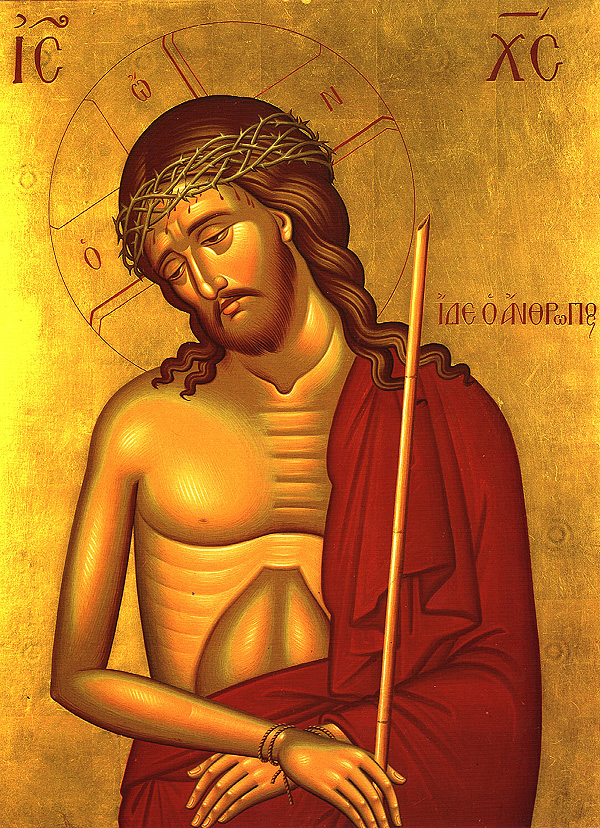
In the Orthodox Church, the last Sunday before Great Lent—the day on which, at Vespers, Lent is liturgically announced and inaugurated—is called Forgiveness Sunday. On the morning of that Sunday, at the Divine Liturgy, we hear the words of Christ:
“If you forgive men their trespasses, your heavenly Father will also forgive you, but if you forgive not men their trespasses, neither will your Father forgive your trespasses…” (Mark 6:14-15).
Then after Vespers—after hearing the announcement of Lent in the Great Prokeimenon: “Turn not away Thy face from Thy child, for I am afflicted! Hear me speedily! Draw near unto my soul and deliver it!”, after making our entrance into Lenten worship, with its special melodies, with the prayer of Saint Ephraim the Syrian, with its prostrations—we ask forgiveness from each other, we perform the rite of forgiveness and reconciliation. And as we approach each other with words of reconciliation, the choir intones the Paschal hymns, filling the church with the anticipation of Paschal joy.
What is the meaning of this rite? Why is it that the Church wants us to begin the Lenten season with forgiveness and reconciliation? These questions are in order because for too many people Lent means primarily, and almost exclusively, a change of diet, the compliance with ecclesiastical regulations concerning fasting. They understand fasting as an end in itself, as a “good deed” required by God and carrying in itself its merit and its reward. But the Church spares no effort in revealing to us that fasting is but a means, one among many, towards a higher goal: the spiritual renewal of man, his return to God, true repentance and, therefore, true reconciliation. The Church spares no effort in warning us against a hypocritical and pharisaic fasting, against the reduction of religion to mere external obligations. As a Lenten hymn says:
“In vain do you rejoice in not eating, O soul!
For you abstain from food,
But from passions you are not purified.
If you persevere in sin, you will perform a useless fast!”
Now, forgiveness stands at the very center of Christian faith and of Christian life because Christianity itself is, above all, the religion of forgiveness. God forgives us, and His forgiveness is in Christ, His Son, whom He sends to us so that by sharing in His humanity we may share in His love and be truly reconciled with God. Indeed, Christianity has no other content but love. And it is primarily the renewal of that love, a growth in it, that we seek in Great Lent, in fasting and prayer, in the entire spirit and the entire effort of that season. Thus, truly forgiveness is both the beginning of, and the proper condition for, the Lenten season.
One may ask, however: Why should I perform this rite when I have no “enemies?” Why should I ask forgiveness from people who have done nothing to me, and whom I hardly know? To ask these questions is to misunderstand the Orthodox teaching concerning forgiveness. It is true that open enmity, personal hatred, real animosity may be absent from our life, though if we experience them, it may be easier for us to repent, for these feelings openly contradict Divine commandments. But the Church reveals to us that there are much subtler ways of offending Divine Love. These are indifference, selfishness, lack of interest in other people, of any real concern for them—in short, that wall which we usually erect around ourselves, thinking that by being “polite” and “friendly” we fulfill God’s commandments. The rite of forgiveness is so important precisely because it makes us realize—be it only for one minute—that our entire relationship to other men is wrong, makes us experience that encounter of one child of God with another, of one person created by God with another, makes us feel that mutual “recognition” which is so terribly lacking in our cold and dehumanized world.
On that unique evening, listening to the joyful Paschal hymns we are called to make a spiritual discovery: to taste of another mode of life and relationship with people, of life whose essence is love. We can discover that always and everywhere Christ, the Divine Love Himself, stands in the midst of us, transforming our mutual alienation into brotherhood. As I advance towards the other, as the other comes to me—we begin to realize that it is Christ who brings us together by His love for both of us.
And because we make this discovery—and because this discovery is that of the Kingdom of God itself: the Kingdom of Peace and Love, of reconciliation with God and, in Him, with all that exists—we hear the hymns of that Feast, which once a year “opens to us the doors of Paradise.” We know why we shall fast and pray, what we shall seek during the long Lenten pilgrimage.
Forgiveness Sunday: the day on which we acquire the power to make our fasting—true fasting; our effort—true effort; our reconciliation with God—true reconciliation.
—Father Alexander Schmemann
Martyrs Eutropius, Cleonicus, and Basiliscus of Amasea

The Holy Martyrs Eutropius, Cleonicus and Basiliscus suffered in the city of Pontine Amasea (Asia Minor) in about the year 308.
The brothers Eutropius and Cleonicus, and Basiliscus the nephew of the Great Martyr Theodore the Recruit (February 17), were comrades. After the martyric death of Saint Theodore, they wound up in prison and by their preaching brought many of the pagans in prison with them to the Christian Faith.
When he tortured Saint Theodore, the governor Publius perished shamefully, struck down by divine wrath. Asclepiodotus was chosen as ruler of Amasea, and was more inhumane than his predecessor. Knowing the comrades of Saint Theodore the Recruit were all in prison, the governor commanded that they be brought to him. Saints Eutropius, Cleonicus and Basiliscus thus firmly confessed their faith in Christ before this new governor. They were mercilessly beaten, so that their bodies were entirely bruised.
As he was being tortured Saint Eutropius prayed loudly to the Savior, “Grant us, O Lord, to endure these wounds for the sake of the crown of martyrdom, and help us, as You helped Your servant Theodore.” In answer to the saint’s prayer, the Lord Himself appeared to the martyrs with His angels and the holy Great Martyr Theodore the Recruit, saying to them: “Behold, the Savior has come to help you, that you may know life eternal.”
Soldiers and many of the people standing nearby were also granted to behold the Savior. They urged Asclepiodotus to halt the tortures. Seeing that the people were distraught and ready to believe in the true God, the governor commanded the martyrs to be taken away. The governor then invited Saint Eutropius to supper and urged him to offer public sacrifice to the pagan gods, yet remain a Christian in soul. Eutropius refused this offer.
On the following day they brought the martyrs to a pagan temple, to force them to offer sacrifice. Eutropius entreated the Savior: “Lord, be with us, and destroy the raging of the pagans. Grant that on this place the Bloodless Sacrifice of the Christians be offered to You, the true God.” No sooner had these last words been spoken, than an earthquake began. The walls of the temple collapsed, and the statue of the goddess Artemis was smashed to bits. Everyone fled from the temple to avoid being crushed among the rubble. In the noise of the earthquake a voice was heard from on high: “Your prayer has been heard, and on this place a house of Christian prayer shall be built.”
When the earthquake ended, the governor Asclepiodotus, barely recovered from his fright, gave orders to drive high wooden stakes into the ground, tie the martyrs to them and pour boiling tar over them. The saints began to pray to God, and Eutropius cried out turning to the torturers: “May the Lord turn your deed against you!”
The tar began to flow beside the bodies of the martyrs, like water over marble, scorching the torturers. Those seeing this fled in terror, but the governor in his bitterness gave orders to rake their bodies with iron hooks and to sting their wounds with mustard mixed with salt and vinegar. The saints endured these torments with remarkable firmness.
The night before their execution the saints spent their time at prayer, and again the Lord appeared to them and strengthened them.
On the morning of March 3, Saints Eutropius and Cleonicus were crucified, but Basiliscus was left in prison.
Saint Basiliscus was executed on May 22 in the city of Komana. They beheaded him, and threw his body into a river, but Christians found his relics and buried them in a ploughed field. Later at Komana a church was built and dedicated to Saint Basiliscus.
An account of the life of the holy martyr is found under May 22.
Saint Piamoun
The holy virgin Piamoun (Πιαμούν) was from Egypt, and she lived during the IV century. Her Life is recorded by Palladius in his Lausiac History.
When the Saint was very young her father died, but her Christian mother raised her with discipline and admonition of the Lord (Ephesians 6:4). When she grew up, she and her mother engaged in works of mercy and compassion. They were not wealthy, but out of their meagre income, they were able to help their poor and weak brethren.
Saint Piamoun would eat a little food in the evening, and at night she kept constant vigil. She also labored at weaving linen, and she was found worthy of the gift of foresight.
One day a certain village in Upper Egypt attacked another village because of a quarrel about sharing the waters of the Nile. They fought so violently that many men were killed. This village then moved stealthily against the Saint's village. Men marched with staves and spears, intending to kill the inhabitants.
An Angel of the Lord appeared to Saint Piamoun and warned her that her village would be attacked by the stronger villagers. Summoning the priests of her church, she said, "Go forth to meet the enemy, for they are coming against you, otherwise you and the village will perish. If you beg them not to attack, then perhaps they will spare the village."
The priests were afraid and told her, "We do not dare to face them, for we know their ferocity and their arrogance. However, if you wish to save the village and your own house, then you go out to meet them."
The holy virgin did not go forth, but instead she went up to her roof and stood all night long in prayer. She made many bows and prayed that God would immobilize the enemy where they stood, three miles from her village. Immediately they became paralyzed and were unable to move from that place. It was revealed to them that it was the prayers of Saint Piamoun which hindered them from moving. Therefore, they sent a message to the villagers that they wished to make peace. They also told them to give thanks to God, for it was the prayers of Saint Piamoun which had prevented them from attacking.
When her mother reposed, the venerable one continued the work of ministering to her suffering brothers and sisters by herself. She visited their homes, comforted them, and strengthened their faith.
When Saint Piamoun reposed in 337, there was widespread mourning in her village.
Saints Zenon and Zoilus
It is not known just when or where Saint Zenon and Saint Zoilos lived, but according to the Byzantine verse Synaxarion, they died while living in the world (Paris. Coislin. 223, from the year 1301).1
The names of Saint Zenon and Saint Zoilos and a couplet composed for them were included in the Greek Menaion (printed in Venice in 1596) and in the Synaxaristis. When the Greek Synaxaria were translated into Slavonic, their names and the couplet in their honor were included in the various Prologs. From there, they were incorporated into the Great Reading Menaion (Великие Минеи Четии) for March, and into the modern calendar of the Russian Orthodox Church.
The couplet reads: "Released from this life, Zenon and Zoilos went forth to a better life" (literally "existence").
1 Le fonds Coislin is a collection of Greek manuscripts acquired by Pierre Séguier, but named for Henri-Charles de Coislin, its second owner. It is now held in the National Library of France.
Icon of the Mother of God of Volokolamsk

The Volokolamsk Icon of the Mother of God is a copy of the Vladimir Icon of the Moscow Dormition cathedral. The icon was brought from Zvenigorod to the Dormition monastery of Saint Joseph of Volokolamsk on March 2, 1572, during the second week of Great Lent and was solemnly met by Igumen Leonid (1563-1566; 1568-1573) and all the monastic brethren.
It is distinguished by its particular depiction on the margins of Saint Cyprian (right) and Saint Gerontius (left), Metropolitans of Moscow.
The name of Metropolitan Cyprian is associated with the first arrival of the ancient Vladimir Icon of the Mother of God from Constantinople to Moscow in the year 1395, and under Metropolitan Gerontius in 1480 the Vladimir Icon came finally to Moscow.
In the year 1588 the Volokolamsk Icon was dedicated atop the gate in the church at the south gates of the Saint Joseph of Volokolamsk monastery in honor of the Meeting of the Vladimir Icon of the Most Holy Theotokos (August 26).
At the end of the seventeenth century, when a church of the same name was built in Moscow at Staraya Basmanna, the church atop the gate of Saint Joseph of Volokolamsk was rededicated in honor of the holy Apostles Peter and Paul. The Volokolamsk Icon was transferred to its proper place on the iconostasis of the new cathedral Dormition church of the monastery of Saint Joseph of Volokolamsk.
In 1578, the icon was recognized as wonderworking.
Saint John (Chrysostom) IV, Catholicos of Georgia

The Holy Catholicos John IV (Chrysostom) led the Apostolic Church of Georgia from approximately 980 to 1001.
Catholicos Basil III’s “Story of Saint Shio’s Miracles” describes how the hitherto childless parents of Saint John prayed at length to Saint Shio of Mgvime. After the birth of John, his God-fearing parents sent him to be raised at Shio-Mgvime Monastery.
There he acquired the sanctity and wisdom for which he would later be called “Chrysostom,” meaning “golden mouth” in Greek. By this name he has been known throughout the history of the Georgian Church.
There is yet another John called “Chrysostom” who was also a Catholicos, from 1033 to 1049. This John was a disciple of Holy Catholicos-Patriarch Melchizedek I and his successor as chief shepherd of the Georgian Church.
His life and labors were full of the same holiness as those of the holy catholicos John who is commemorated on this day. For this reason John IV and John V are often erroneously believed to be one and the same person.
Venerable Shio Mgvime
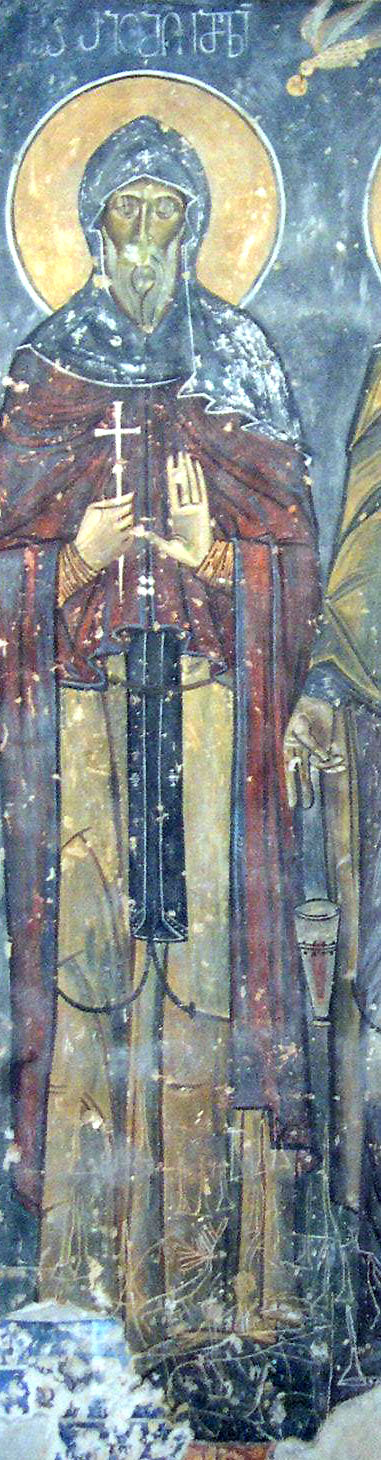
The Georgian Orthodox Church commemorates Saint Shio of Mgvime several times throughout the year. Saint John of Zedazeni and his twelve disciples, among whom was Saint Shio of Mgvime, are commemorated on May 7; the repose of Saint Shio is celebrated on May 9; and on Cheese-fare Thursday the Church celebrates the miracle that, for centuries, occurred every year at Saint Shio’s grave.
The 19th-century historian Marie Brosset wrote that every year prior to the 18th century, on Cheese-fare Thursday, the relics of Saint Shio rose up out of the ground from the place of their burial. Those who approached them in faith and reverence received healing of their afflictions.
In the 18th century the Persian shah Nadir (1736-1747) invaded Georgia. Hearing about this miracle and becoming convinced of its truth, the enraged shah assailed the monastery and destroyed the shrine containing the saint’s holy relics. A group of Christians later gathered Saint Shio’s holy relics and reburied them in their former place, but to this day they have never risen again.
Forgiveness Vespers – Sun. March 2, 2025
Here is the live stream for Forgiveness Vespers – Sun. March 2, 2025 If you need, here are instructions for accessing this content from your phone, tablet, computer, or TV.
Orthros and Divine Liturgy – Sun. March 2, 2025
Here is the live stream for Orthros and Divine Liturgy – Sun. March 2, 2025 If you need, here are instructions for accessing this content from your phone, tablet, computer, or TV.
Daily Readings for Sunday, March 02, 2025
FORGIVENESS SUNDAY
ABSTAIN FROM MEAT
Forgiveness Sunday, Hesychius the Martyr, Our Holy Father Nicholas Planas, Joachim of Vatopedi who was given the name Papoulakis, Andronikos & Athanasia the Martyrs, Theodotos the Holy Martyr, Bishop of Cyrenia, Euthalia the Virgin-Martyr of Sicily, Chad, Bishop of Lichfield
ST. PAUL’S LETTER TO THE ROMANS 13:11-14; 14:1-4
Brethren, salvation is nearer to us now than when we first believed; the night is far gone, the day is at hand. Let us then cast off the works of darkness and put on the armor of light; let us conduct ourselves becomingly as in the day, not in reveling and drunkenness, not in debauchery and licentiousness, not in quarreling and jealousy. But put on the Lord Jesus Christ, and make no provision for the flesh, to gratify its desires.
As for the man who is weak in faith, welcome him, but not for disputes over opinions. One believes he may eat anything, while the weak man eats only vegetables. Let not him who eats despise him who abstains, and let not him who abstains pass judgment on him who eats; for God has welcomed him. Who are you to pass judgment on the servant of another? It is before his own master that he stands or falls. And he will be upheld, for God is able to make him stand.
MATTHEW 6:14-21
The Lord said, "If you forgive men their trespasses, your heavenly Father also will forgive you; but if you do not forgive men their trespasses, neither will your Father forgive your trespasses.
And when you fast, do not look dismal, like the hypocrites, for they disfigure their faces that their fasting may be seen by men. Truly, I say to you, they have received their reward. But when you fast, anoint your head and wash your face, that your fasting may not be seen by men but by your Father who is in secret; and your Father who sees in secret will reward you.
Do not lay up for yourselves treasures on earth, where moth and rust consume and where thieves break in and steal, but lay up for yourselves treasures in heaven, where neither moth nor rust consumes and where thieves do not break in and steal. For where your treasure is, there will your heart be also.
Sunday of Cheesefare: Expulsion of Adam from Paradise
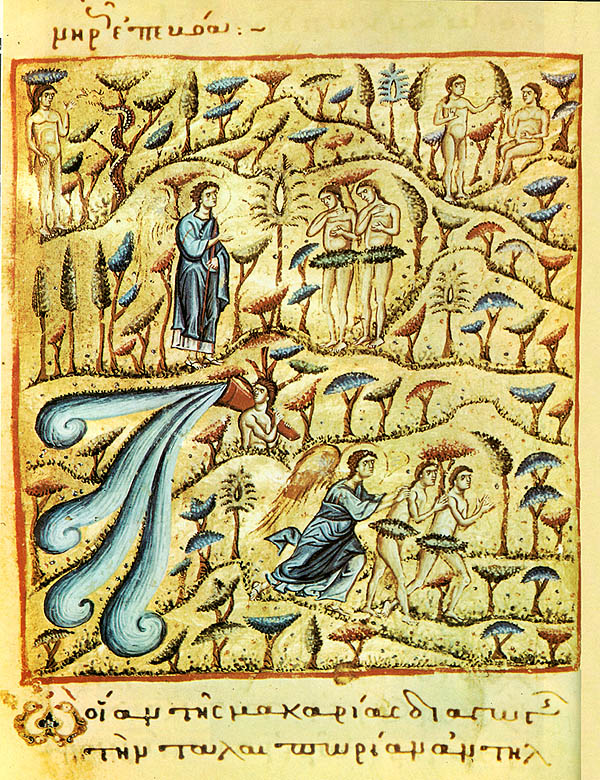
As we begin the Great Fast, the Church reminds us of Adam’s expulsion from Paradise. God commanded Adam to fast (Gen. 2:16), but he did not obey. Because of their disobedience, Adam and Eve were cast out of Eden and lost the life of blessedness, knowledge of God, and communion with Him, for which they were created. Both they and their descendents became heirs of death and corruption.
Let us consider the benefits of fasting, the consequences of disobedience, and recall our fallen state. Today we are invited to cleanse ourselves of evil through fasting and obedience to God. Our fasting should not be a negative thing, a mere abstention from certain foods. It is an opportunity to free ourselves from the sinful desires and urges of our fallen nature, and to nourish our souls with prayer, repentance, to participate in church services, and partake of the life-giving Mysteries of Christ.
At Forgiveness Vespers we sing: “Let us begin the time of fasting in light, preparing ourselves for spiritual efforts. Let us purify our soul, let us purify our body. As we abstain from food, let us abstain from all passion and enjoy the virtues of the spirit….”
Hieromartyr Theodotus, Bishop of Cyrenia

The Hieromartyr Theodotus, a native of Galatia in Asia Minor, was Bishop of Cyrenia in Cyprus. During a time of persecution against Christians under the impious emperor Licinius (311-324), Saint Theodotus openly preached Christ, calling on the pagans to abandon idolatry and turn to the true God. Sabinus, the governor of Cyprus, ordered that Bishop Theodotus be arrested and brought to trial.
When he heard about this order, the saint did not wait for the soldiers to be sent after him, but immediately went to the governor saying, “I, whom you seek, am here. I have shown myself in order to preach Christ my God.”
The governor ordered that the saint be beaten without mercy, suspended from a tree, raked with sharp implements, and then be taken to prison. Five days later Saint Theodotus was brought to the governor, who presumed that after his tortures the bishop would prefer to renounce Christ, rather than endure new sufferings.
However, Saint Theodotus did not cease to preach about Christ. At first they put the saint on an iron grate, under which they lit a fire, and then hammered nails into his feet and let him go. Many witnessed the sufferings of the martyr. Astonished at the saint’s endurance and his divinely-inspired speech, they came to believe in Christ. Learning of this, Sabinus gave orders to stop the torture and throw the saint into prison.
During the reign of Saint Constantine the Great (May 21), the freedom to confess their faith was given to all Christians, and among those set free from prison was Saint Theodotus. The saint returned to Cyrenia and after two years serving as bishop he peacefully fell asleep in the Lord in about the year 326.
Saint Arsenius, Bishop of Tver

Saint Arsenius, Bishop of Tver, was born at Tver, and in his early years received monastic tonsure in the Kiev Caves monastery. Even among the monks of this ancient monastery, distinguished for their piety, Arsenius was noted for his saintly life as well as for his strictness in keeping his monastic vows, his knowledge of the Church typikon, his study of Holy Scripture, and his love for work.
Under Metropolitan Cyprian of Kiev (1380-1382) he served as archdeacon, and when the Metropolitan was absent, he governed the administration of the Kiev metropolitanate. On July 3, 1390 he went with Metropolitan Cyprian to Tver, where at the request of Prince Micjae of Tver, a Council of Russian and Greek hierarchs had been convened to pass judgment upon Bishop Euthymius of Tver.
The prince and the bishop were involved in a lengthy dispute, and many of the people of Tver made serious accusations against the bishop. After unsuccessful attempts to restore peace to the Tver church, Metropolitan Cyprian deposed Euthymius as bishop and sent him off to Moscow to the Chudov monastery.
Saint Arsenius was appointed to the Tver cathedra, but he was both troubled and afraid to accept this position, in view of the great enmity and spite in that place. Upon the return of Metropolitan Cyprian and archdeacon Arsenius to Moscow, the Prince sent his nobles to the Metropolitan with a petition to consecrate Arsenius as Bishop of Tver. This time Arsenius also refused. In the words of the chronicle for the year 1390 “even at the Metropolitan’s entreaty, Archdeacon Arsenius would not go to Tver.”
After threatening Arsenius with suspension, the Metropolitan and the Prince finally got him to agree to accept episcopal consecration, which took place on August 15, 1390. Among the bishops taking part in the laying on of hands was Saint Stephen, Bishop of Perm (April 26).
Bishop Arsenius, as a man of great prayer and peacemaker, was able to end much of the discord in the Tver principality. During his episcopacy, from 1390 to 1409, cathedrals were built and consecrated in honor of the Archangel Michael at Staritsa and Mikulina, and the Savior-Transfiguration cathedral was restored with the construction of a cathedral belltower. The saint founded the Zheltikov monastery on the river Tmaka near Tver, where a church was built in honor of Saints Anthony and Theodosius of the Kiev Caves (1394), and a stone Dormition cathedral.
Desiring that the monks of this new monastery would always be edified by the asceticism of the Fathers of the Caves, Saint Arsenius gave orders to compile a list from the Kiev Caves Paterikon, using the most ancient manuscripts of this precious memorial of Russian literature. This compilation was known as the Arseniev Redaction.
The saint died on March 2, 1409, and was buried in the Zheltikov monastery of the Dormition of the Most Holy Theotokos, which he founded. In 1483 his relics were found incorrupt and were placed in the monastery cathedral. In the same year hieromonk Theodosius composed a Life and a Canon in honor of the holy bishop.
At a Council of 1547 Saint Arsenius’ commemoration was established throughout all the Church.
Virgin Martyr Euthalia of Sicily
The Holy Martyr Euthalia lived with her mother and brother in Leontina on the island of Sicily. Euthalia’s mother, a pagan, suffered for a long while with an issue of blood. Once, the Martyrs Alphaeus, Philadelphus and Cyprian (May 10) appeared to her in a dream and told her she would be healed only if she believed in Christ and was baptized.
After being baptized with her daughter, she was healed of her infirmity. When Euthalia’s pagan brother Sirmianus learned of the baptism, went into a violent rage. The mother succeeded in fleeing, but Saint Euthalia confessed herself a Christian and suffered martyrdom. After fierce tortures, the saint was beheaded with a sword.
Martyr Troadius of Neocaesarea
The Holy Martyr Troadius suffered for Christ in Neocaesarea, Pontus under the emperor Decius (249-251), enduring horrible tortures. Saint Gregory of Neocaesarea (November 17) foretold his martyrdom and witnessed his sufferings in a vision. He also saw the soul of Saint Troadius departing from his body and hastening joyfully to Heaven.
Venerable Agathon of Egypt
Saint Agathon of Egypt, a contemporary of Saint Macarius the Great (January 19) and a disciple of Saint Lot (October 22), he lived in asceticism in a skete in Egypt. He was distinguished by exceptional meekness, accounting himself the most sinful of men.
Once, monks who had heard of his discernment came to Saint Agathon to see if they could make him lose his temper. They asked him, “Are you Abba Agathon, a fornicator and a proud man?”
“Yes, that is true,” the monk replied.
“Are you the Agathon who is always talking nonsense?” the monks inquired.
“I am,” the saint agreed.
“Are you Agathon the heretic?” the monks persisted.
Saint Agathon said, “I am not a heretic.”
They asked the saint why he agreed with them when they accused him of vices, but then denied this last charge. Agathon replied, “I accepted the first accusations, since that was beneficial for my soul. But heresy is separation from God, and I do not wish to be separated from God.”
Astonished at his discernment, they returned to their monastery, edified.
When asked which was more important for salvation, bodily asceticism or interior vigilance, Saint Agathon said, “Man is like a tree. Bodily asceticism is the foliage, but interior vigilance is the fruit. Holy Scripture says that ‘every tree which does not bring forth good fruit shall be cut down and thrown into the fire’ (Mt.3:10). Therefore, we should focus our attention on the fruit. But a tree also needs the protection of its foliage, which is bodily asceticism.”
Saint Agathon died in about the year 435. For three days before his repose the monk sat in silence and concentration, as though disturbed about something. When the monks questioned him, he answered that he saw himself before the Judgment Seat of God. “How is it possible that you, Father, should fear judgment?” they asked him.
“I have done my best to keep the commandments of the Lord, but I am a man. How can I be certain that my deeds have been pleasing to God?”
“Do you not trust that all the good deeds which you have accomplished are pleasing to God?” asked the monks.
“I have no such hope until I see God. His judgment is not man’s judgment.” Having said this, the saint departed to the Lord.
Saint Agathon is commemorated on January 8 on the Greek calendar.
400 Martyrs slain by the Lombards in Sicily
400 Martyrs Slain by the Lombards in Sicily refused to participate in idol worship and were massacred by the Lombards (a Germanic tribe) in the year 579. Among those who perished, the names of the presbyter Sanctulus and the hermit Hospicius have been preserved.
St Gregory Dialogus (March 12) has written of them.
Saint Sabbatius of Tver

Saint Sabbatius of Tver pursued asceticism with the blessing of Saint Arsenius, Bishop of Tver, at a distance 15 versts from Tver. Saint Sabbatius established a monastery there, known for the strictness and holiness of its rule. Such ascetics as Saint Joseph of Volokolamsk (September 9) and Saint Cornelius of Komel (May 19) went there to be instructed in monasticism. The chains found in the cave where Saint Sabbatius practiced silence testify to his ascetic deeds. He died no later than the year 1434.
“Reigning” Icon of the Mother of God

The “Reigning” Icon of the Mother of God appeared on March 2, 1917, the day of Tsar Nicholas’s abdication, in the village of Kolomskoye near Moscow.
In February 1917, an elderly woman named Eudokia saw the Mother of God in a dream telling her to go to Kolomskoye to find a large blackened icon in a church. After the vision was repeated three times, she went to Kolomskoye to search for the icon with the priest Nicholas.
In the basement of the church they found the icon and started wiping off the accumulated dust. Then they were able to see the Most Holy Theotokos wearing a crown and sitting on a throne. Immediately, Father Nicholas celebrated a service of Thanksgiving and an Akathist.
News of the icon’s discovery spread throughout Russia, and there were several miracles of healing from physical and mental infirmities. As time went by, the icon renewed itself and became brighter and brighter. Particularly striking was the blood-red robe of the Virgin.
Since the icon was revealed just as the Tsar abdicated, many people believed that the Queen of Heaven had assumed royal authority over the Russian land, and so the icon became known as the “Reigning” icon. It was discovered that the icon had come from the Ascension convent in Moscow. In 1812, before Napoleon’s invasion, this icon and others were sent to Kolomskoye’s Ascension church for safekeeping. Apparently forgotten, the icons were never returned to Moscow.
A Service and Akathist to the “Reigning” Icon were composed with the assistance of His Holiness Patriarch Tikhon (+ 1925). Many copies of the icon were venerated throughout Russia, but these were confiscated by the Soviets. The Service and Akathist to the icon were also forbidden to be served.
The original icon is said to be in the Novodevichii Museum in Moscow, and there is a copy in the Church of the Kazan Mother of God in Kolomskoye.
The “Reigning” Icon, which belongs to the Panachranta type, shows the Theotokos seated on a throne with Her Son.
Venerable Joachim of Ithaka
Saint Joachim (in the world John Patrikios) was born in 1786 in the village of Kalyvia on the island of Ithaka to devout and virtuous parents, Angelos and Agnes.
John lost his mother when he was young. His father married again, but John's stepmother tormented and tortured him. During those difficult years, the Saint struggled patiently and with humility, finding refuge in prayer in Saint Spyridon's chapel, and by studying holy books.
In his teenage years, he worked as a sailor on his father's boat, which caused the crew to respect and esteem him for his virtues and his character.
On one of his journeys he found refuge on the Holy Mountain. There, at Vatopedi Monastery, he was tonsured as a monk and received the name Joachim.
At the start of the Greek Revolution, the Monastery sent Father Joachim to the Pelopónnēsos as a preacher. The Saint taught, guided, supported, and encouraged the Greeks. Furthermore, with a boat belonging to Papa John
Makrḗ of Kephalonia he transported old men, women, and children from the Pelopónnēsos to the Ionian Islands, thereby saving them from an invasion by Pasha Imbraim.
Around 1827, Saint Joachim arrived in his English-occupied homeland of Ithaka. For 49 years he ministered in the world and protected his flock from sin, delusion, and heresy. There are reports of how Saint Joachim prayed and stood in the air above the ground, bathed in heavenly light. God gave him the gift of clairvoyance, and thus he became a counselor, an educator in Christ, and a physician of the Ithakians.
Saint Joachim reposed peacefully in 1848, and was glorified as a Saint in 1998. He is also commemorated on May 23 (the recovery of his relics).
Great Vespers – Sat. March 1, 2025
Here is the live stream for Great Vespers – Sat. March 1, 2025 If you need, here are instructions for accessing this content from your phone, tablet, computer, or TV.
3/2 announcements
March 2, 2025
Forgiveness Sunday
Sunday of Cheese Fare
The theme of the Sunday before Lent is FORGIVENESS (cheese fare) and the Gospel lesson is Matthew 6:14-21 which teaches us both of forgiveness and of fasting. “To forgive is to put between me and my enemy the radiant forgiveness of God Himself. To forgive is to reject the hopeless dead-ends of human relations and to refer them to Christ. Forgiveness is truly a breakthrough of the Kingdom into this sinful and fallen world” (Great Lent, Page 28). And to fast is to first fast before God and not men so as to curb the desires and cravings of our fallen nature. This effort can help free us from the dictatorship of the flesh over our spirit, so we can more fully love and forgive.
Romans 13:11-14:4: Brethren, now is our salvation nearer than when we believed. The night is far spent, the day is at hand. Let us therefore cast off the works of darkness, and let us put on the armor of light. Let us walk becomingly, as in the day, not in reveling and drunkenness, not in chambering and licentiousness, not in strife and jealousy. But put on the Lord Jesus Christ, and make no provision for the flesh to fulfill its lusts. But as for the one who is weak in faith, receive him, but not for disputes over opinions. For one believes he may eat anything; but the weak person eats herbs. Let not him who eats despise him who does not eat, and let not him who does not eat judge him who eats; for God has received him. Who are you to be the judge over the servant of a stranger? To his own master he either stands or falls; but he will be made to stand; for God is able to make him stand.
Matthew 6:14-21: The Lord said to His Disciples: If you forgive men their trespasses, your heavenly Father also will forgive you; but if you do not forgive men their trespasses, neither will your Father forgive your trespasses. And when you fast, do not look dismal, like the hypocrites, for they disfigure their faces that their fasting may be seen by men. Truly, I say to you, they have received their reward. But when you fast, anoint your head and wash your face, that your fasting may not be seen by men but by your Father Who is in secret; and your Father Who sees in secret will reward you. Do not lay up for yourselves treasures on earth, where moth and rust consume and where thieves break in and steal, but lay up for yourselves treasures in heaven, where neither moth nor rust consumes and where thieves do not break in and steal. For where your treasure is, there will your heart be also.
Troparion of the Resurrection: Let the heavens rejoice and the earth be glad; for the Lord hath done a mighty act with his own arm. He hath trampled down death and become the First-born from the dead. He hath delivered us from the depths of hades, granting the world the Great Mercy.
Troparion of the Chains of St. Peter: O Holy Apostle, Peter, thou dost preside over the Apostles by the precious chains which thou didst bear. We venerate them with faith and beseech thee that by thine intercessions we be granted the great mercy.
Kontakion of Cheese Fare Sunday: O thou who guidest to wisdom, and givest understanding and intelligence, the Instructor of the ignorant and Helper of the poor, strengthen my heart and grant it understanding, O Master. Give me word, O Word of the Father; for behold, I shall not refrain my lips from crying to thee, O merciful One, have mercy upon me who am fallen.
CALENDAR
UNTIL FURTHER NOTICE: All services listed on the calendar will be available through streaming and webcast. (Instructions can be found on the parish website.)
Sunday, March 2 (Sunday of Cheese Fare)
8:50 a.m. – Orthros
9:00 a.m. – Christian Education
10:00 a.m. – Divine Liturgy (webcast)
12:00 p.m. – TEENS Fundraising Meal
6:30 p.m. – Forgiveness Vespers
Monday, March 3
Father Herman off
6:30 p.m. – Canon of St. Andrew of Crete
Tuesday, March 4
6:30 p.m. – Canon of St. Andrew of Crete
Wednesday, March 5
5:20 p.m. – Catechism Class
6:30 p.m. – Presanctified Liturgy followed by Soup Supper
Thursday, March 6
6:30 p.m. – Canon of St. Andrew of Crete
Friday, March 7
6:30 p.m. – Akathist Hymn to the Theotokos
Saturday, March 8
11:00 a.m. – Ladies of St. Peter Lenten Retreat with Lenten Lunch
4:30 p.m. – Choir Practice
6:00 p.m. – Great Vespers
Sunday, March 9 (First Sunday of Lent; Sunday of Orthodoxy)
8:50 a.m. – Orthros
9:00 a.m. – Christian Education
10:00 a.m. – Divine Liturgy (webcast)
4:00 p.m. – Sunday of Orthodoxy Vespers with sister churches
5:15 p.m. – Pot Luck Soup Supper
SPECIAL ANNOUNCEMENTS
The Eucharist Bread …was offered by the Karams for the Divine Liturgy this morning.
Eucharist Bread Schedule:
Eucharist Bread Coffee Hour
March 2 Karam TEENS FUNDRAISER MEAL
March 9 Brock Meadows/Brock
March 16 R. Root Dansereau/Alaeetawi
March 23 Pacurari Ellis/Zouboukos/Waites
March 24 (Mon. p.m.) Lasseter D. Root/Meadows
(Feast of the Annunciation)
March 30 Milnor Miller/Weatherly
Also, please remember that we still need your tithes and offerings which may be placed in the tray that is passed during the Divine Liturgy, in the tithe box at the back of the nave or be mailed to: St. Peter Orthodox Church, P.O. Box 2084, Madison, MS 39130-2084.
Schedule for Epistle Readers – Page numbers refer to the Apostolos (book of the Epistles) located on the Chanters’ stand at the front of the nave. Please be sure to use this book when you read.
Reader Reading Page#
March 2 Brenda Baker Rom. 13:11-14:4 279
March 9 Katie Miller Heb. 11:24-26, 32-40 281
March 16 Mary Martha Ellis Heb. 1:10-2:3 283
March 23 Kh. Sharon Meadows Heb. 4:14-5:6 285
March 24 (Mon. p.m.) Brenda Baker Heb. 2:11-18 376
March 30 Katie Miller Heb. 6:13-20 287
Please remember the following in your prayers: Aidan Milnor, the Milnor family; Lamia Dabit and her family; Mary Greene (Lee and Kh. Sharon’s sister); Jay and Joanna Davis; Fr. Leo and Kh. Be’Be’ Schelver and their family; Marilyn (Kyriake) Snell; Jack and Jill Weatherly; Dn. Terry Algood and their family; Reader Basil and Brenda Baker and their family; Fr. Joseph Bittle; Rick Carlton; Very Rev. Fr. Nicholas and Kh. Jan Speier; Lee Greene; Fr. John and Kh. Janet Henderson and their family; Galina Singletary; Emily and Cole Parker.
Thank you to Jenny Rodriquez who is now serving as the new church secretary. Also, a huge thank you to Kh. Sharon Meadows for her service to the church in this position for so many years. Please keep them both in your God-pleasing prayers!
Calendar Items:
* The men of the parish meet for lunch at 11:00 a.m. on the first Thursday of the month.
* The Ladies meet at the church at 10:00 a.m. on the second Saturday of the month to pray the Akathist to the Mother of God, Nurturer of Children on behalf of our children.
* The Ladies meet for lunch at 1:00 p.m. on the last Tuesday of the month.
* Great Lent begins this year on Clean Monday, March 3rd.
* The Schedule for Services for the first week of Lent are as follows:
Sunday, March 2nd – Forgiveness Vespers, beginning at 6:30 p.m.
Monday, March 3rd – 1st part of the Canon of St. Andrew of Crete, 6:30 p.m.
Tuesday, March 4th – 2nd part of the Canon of St. Andrew of Crete, 6:30 p.m.
Wednesday, March 5th – Presanctified Liturgy with Soup Supper, 6:30 p.m.
Thursday, March 6th – 4th part of the Canon of St. Andrew of Crete, 6:30 p.m.
Friday, March 7th – Akathist Hymn to the Theotokos, 6:30 p.m.
Sunday, March 9th – Sunday of Orthodoxy Vespers with sister churches followed by
Pot luck soup supper, beginning at 4:00 p.m.
* This year’s dates for serving at Stewpot Ministries are Saturday, March 1st and Saturday, September 27th.
The Ladies of St. Peter will have a Lenten Retreat and Lenten Lunch with Father Herman as our speaker NEXT Saturday, beginning at 11:00 a.m. We will not have Akathist that morning.
We are currently in the beginning process of updating our Church directory. On the bureau in the foyer there are information sheets to be filled out by each family and individual. We are asking EVERYONE to please fill out one of these information sheets and get it back to Fr. Herman or Kh. Sharon by March 10. (Please be sure to PRINT as neatly as you can.) Thank you for your timely cooperation with this.
Seating spaces in the Nave: As a gentle reminder, please be mindful of seating spaces in the Nave during Sunday Divine Liturgy. Due to our growth over the past few years seating has become a little more limited and there has been an overflow toward the back of the Nave near the Narthex, which makes it “tight” for the clergy to make the Great Entrance. While this is a good problem to have, and until we can begin work on the new Temple, please make sure there are enough spaces available in the “seating” area of the Nave for as many people as possible. This means we may have “squtch in” on the rows. Thank you for your help in this.
Fasting Discipline for March
The traditional fasting discipline (no meat, dairy, eggs, fish, wine or oil) is observed on all days of the week. However, there is a katlysis on Saturdays and Sundays when wine and oil are allowed and on March 25th (Feast of the Annunciation), when fish, wine and oil are allowed.
Major Commemorations for March
March 2 Forgiveness Sunday; Sunday of Cheese Fare
March 9 1st Sunday of Lent; Sunday of Orthodoxy
40 Martyrs of Sebaste
March 16 2nd Sunday of Lent; Commemoration of Gregory Palamas
March 23 3rd Sunday of Lent; Adoration of the Holy Cross
March 25 Feast of the Annunciation
March 26 Synaxis of the Archangel Gabriel
March 30 4th Sunday of Lent; Commemoration of John Climacus
Quotable: “Fasting gradually disperses and drives away spiritual darkness and the veil of sin that lies on the soul, just as the sun dispels the mist. Fasting enables us spiritually to see that spiritual air in which Christ, the Sun who knows no setting, does not rise, but shines without ceasing. Fasting, aided by vigil, penetrates and softens hardness of heart. Where once were the vapors of drunkenness it causes fountains of compunction to spring forth.”
St. Symeon the New Theologian
Worship: Sunday, March 9, 2025 (First Sunday of Lent; Sunday of Orthodoxy)
Scripture: Hebrews 11:24-26, 32-40; John 1:43-51
Epistle Reader: Katie Miller
Prosphora: Brock
Coffee Hour: Meadows/Brock
Daily Readings for Saturday, March 01, 2025
CHEESEFARE SATURDAY
ABSTAIN FROM MEAT
Cheesefare Saturday, The Holy Righteous Martyr Eudocia the Samaritan, Andonina the New Martyr, David the Archbishop
ST. PAUL’S LETTER TO THE GALATIANS 5:22-26; 6:1-2
Brethren, the fruit of the Spirit is love, joy, peace, patience, kindness, goodness, faithfulness, gentleness, self-control; against such there is no law. And those who belong to Christ Jesus have crucified the flesh with its passions and desires. If we live by the Spirit, let us also walk by the Spirit. Let us have no self-conceit, no provoking of one another, no envy of one another. Brethren, if a man is overtaken in any trespass, you who are spiritual should restore him in a spirit of gentleness. Look to yourself, lest you too be tempted. Bear one another’s burdens, and so fulfill the law of Christ.
MATTHEW 6:1-13
The Lord said, "Beware of practicing your piety before men in order to be seen by them; for then you will have no reward from your Father who is in heaven.
Thus, when you give alms, sound no trumpet before you, as the hypocrites do in the synagogues and in the streets, that they may be praised by men. Truly, I say to you, they have received their reward. But when you give alms, do not let your left hand know what your right hand is doing, so that your alms may be in secret; and your Father who sees in secret will reward you.
And when you pray, you must not be like the hypocrites; for they love to stand and pray in the synagogues and at the street corners, that they may be seen by men. Truly, I say to you, they have received their reward. But when you pray, go into your room and shut the door and pray to your Father who is in secret; and your Father who sees in secret will reward you.
And in praying do not heap up empty phrases as the Gentiles do; for they think they will be heard for their many words. Do not be like them, for your Father knows what you need before you ask him. Pray then like this:
Our Father who are in heaven, Hallowed be your name, Your kingdom come, Your will be done, On earth as it is in heaven. Give us this day our daily bread, And forgive us our debts, As we also have forgiven our debtors; And lead us not into temptation, But deliver us from evil. For yours is the kingdom and the power and the glory, for ever. Amen.
Saturday of Cheesefare Commemoration of all our God-bearing Fathers and Mothers who shone forth in asceticism

On this day, we commemorate all the righteous and God-bearing Fathers and Mothers, both known and unknown, who shone forth in asceticism. With these two weeks of Meatfare and Cheesefare, the Church gradually eases us into the full fasting which begins on Monday.
The holy acetics are virtuous men and women who contended against the devil and their own passions. By examining their lives and their struggles against the Enemy, we take courage from the victory they have achieved, and are inspired to imitate their God-pleasing conduct. They also teach us that fasting is not merely abstinence from food, but involves refraining from inappropriate speech and unseemly actions.
Since these holy ascetics share the same human nature that we have, their example is an encouragement to us as we embark on our own spiritual struggles. Their lives are a model for us to follow as we seek to acquire and practice the various virtues and to turn away from everything evil. If we undertake these same struggles of prayer, fasting, and good works, we shall receive from God the same reward they did.
Most of the holy ascetics commemorated today have their own separate Feast Day during the year, while some are remembered only on this day.
Martyr Eudokia of Heliopolis
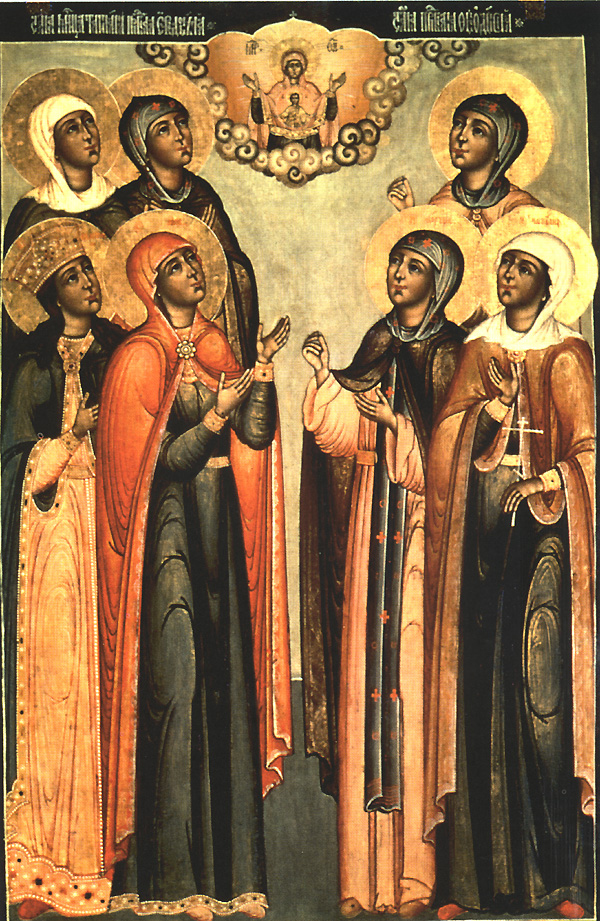
Holy Monastic Martyr Eudokia was a Samaritan, a native of the city of Heliopolis in Phoenicia (modern Baalbek), who lived during the reign of Trajan (98-117). Her pagan impiety took her off the good path, and for a long time she led a sinful life. Her soul was deadened and her heart hardened.
Eudokia awoke one night at midnight and heard singing from the house of a Christian woman next to hers. A monk was reading from a book which described the Last Judgment, the punishment of sinners, and the reward of the righteous. The grace of God touched Eudokia’s heart, and she grieved because of her great wealth and for her sinful life.
In the morning Eudokia hastened to call on the man whose rule of prayer she heard the previous night. This was a monk named Germanus, returning from pilgrimage to the holy places to his own monastery. Eudokia listened for a long time to the guidance of the Elder, and her soul was filled with joy and love for Christ. She asked Germanus to stay in her home for a week, during which she secluded herself in her room, and spent her time in fasting and prayer.
The Elder Germanus told her to give away her wealth and to forget her previous life. Eudokia received holy Baptism from Bishop Theodotus of Heliopolis. She entered a monastery and took upon herself very strict acts of penitence. The Lord granted forgiveness to the penitent sinner and endowed her with spiritual gifts.
After she had become the head of the monastery, the young pagan Philostrates (one of her former lovers) heard of her conversion to Christ and longed to see her again. Aflame with impious passion, he came into the monastery in the guise of a monk and began to urge Eudokia to return to Heliopolis, and resume her former life. “May God rebuke you and not allow you to leave these premises,” Eudokia cried. Then the impostor fell down dead. Fearing that she had served as an accomplice to murder, the sisters intensified their prayer and besought the Lord to reveal to them His will.
The Lord appeared to Saint Eudokia in a vision and said: “Arise, Eudokia, and pray for the resurrection of the dead man.” Through Eudokia’s prayers, Philostrates revived. Having been restored to life, the pagan begged the nun to forgive him. After he was baptized, he went back to Heliopolis. From that time he never forgot the mercy of God shown him, and he started onto the way of repentance.
Some time passed, and another situation occurred. Inhabitants of Heliopolis reported to the governor Aurelian, that Eudokia had taken gold and silver out of the city and concealed it at the monastery. Aurelian sent a detachment of soldiers to confiscate these supposed treasures. For three days the soldiers tried in vain to approach the walls of the monastery, but an invisible power of God guarded it.
Aurelian again sent soldiers to the monastery, this time under the command of his own son. But on the very first day of the journey Aurelian’s son injured his leg and soon died. Then Philostrates counseled Aurelian to write to Mother Eudokia, imploring her to revive the youth. And the Lord, in His infinite mercy, and through the prayers of Saint Eudokia, restored the youth to life. Having witnessed this great miracle, Aurelian and his close associates believed in Christ and were baptized.
When persecutions against Christians intensified, they arrested Eudokia and brought her to the governor Diogenes to be tortured. While torturing the saint, the military commander Diodorus received news of the sudden death of his wife Firmina. In despair he rushed to Saint Eudokia with a plea to pray for his departed wife. The monastic martyr, filled with great faith, turned to God with prayer and besought Him to return Firmina to life. As eyewitnesses of the power and grace of the Lord, Diodorus and Diogenes believed in Christ and were baptized together with their families. Saint Eudokia lived for awhile at the house of Diodorus and enlightened the newly-illumined Christians.
Once,the only son of a certain widow, who was working in the garden, was bitten by a snake and died. The mother wept bitterly for her dead son, and asked Diodorus to resurrect him. Learning of her grief, Saint Eudokia said to Diodorus, “The time is at hand for you to show faith in the Almighty God, Who hears the prayers of penitent sinners and in His mercy grants them forgiveness.”
Diodorus was distressed, not considering himself worthy of such boldness before the Lord, but he obeyed Saint Eudokia. He prayed and in the name of Christ he commanded the dead one to rise, and before the eyes of everyone present the youth revived.
Saint Eudokia returned to her monastery, where she lived in asceticism for fifty-six years.
After Diogenes died the new governor was Vicentius, a fierce persecutor of Christians. Having learned of the accomplishments of the saint, he gave orders to execute her. The holy martyr was beheaded on March 1, 107.
Venerable Martyrius of Zelenets, Pskov

Saint Martyrius of Zelenets, in the world Menas, was born in the city of Veliki Luki (Great Meadow) in the sixteenth century. His parents, Cosmas and Stephanida, died when he was just ten years old. He was raised by his spiritual Father, a priest of the city’s Annunciation church, and the child’s soul cleaved to God.
The widowed priest Boris became a monk with the name Bogolep at the Trinity-Sergius monastery in Veliki Luki. Menas often visited him at the monastery, and later on he himself received monastic tonsure there taking the name Martyrius. For seven years both teacher and disciple toiled for the Lord unrelentingly in a single cell, encouraging each other in deeds of work and prayer. Saint Martyrius had the obediences of “kellarios” [cellarer], treasurer, and “ponomar” [or altar server].
It was at this time that the Mother of God first showed Her special solicitude for Saint Martyrius. At mid-day he dozed off in the bell tower and beheld the Tikhvin (Hodēgḗtria) icon of the Most Holy Theotokos in a fiery column. The monk venerated it, and it was still hot from the fiery column. When he awoke, he still felt this heat on his forehead.
On the spiritual advice of Saint Martyrius, the grievously ill monk Abramius went to venerate the wonderworking Tikhvin Icon of the Mother of God, and he received healing. Saint Martyrius was filled with intense faith in the intercession of the Mother of God. He began to pray that the Heavenly Queen would show him where he might go for the ascetic feat of complete silence, for which his soul yearned.
The monk secretly withdrew into a desolate place situated 60 versts from Veliki Luki. As he himself writes, “in this wilderness I received fearful visitations from demons, but I prayed to God, and the demons were put to shame.”
In a letter to Elder Bogolep, Saint Martyrius asked his blessing to dwell in the wilderness, but the spiritual father advised him to return to the cenobitic life where he would be of use to the brethren. Not daring to disobey his experienced Elder, and not knowing how to proceed, Saint Martyrius went to Smolensk to venerate the wonderworking Hodēgḗtria [She who leads the way] Icon of the Mother of God and the relics of Saints Abramius and Ephraim (August 21). These saints appeared to Saint Martyrius in a dream, and they reassured him that he would be permitted to live in the wilderness, “wherever God will bless and the Most Holy Theotokos will guide you.”
Saint Martyrius then went to the Tikhvin monastery, hoping that the Mother of God would resolve his dilemma. The monk Abramius, who remained at this monastery in gratitude to the Mother of God for his healing, told Saint Martyrius about a secret place, over which he had seen a radiant Cross of stars. This time he received the blessing of the Elder. Saint Martyrius took with him two small icons: one of the Life-Creating Trinity, and the other of the Tikhvin Mother of God. He then settled in Zelents (the green island), which was a beautiful island in a forested swamp.
Harsh and painful was the life of the monk in the wilderness, but neither cold, nor deprivation, nor wild beasts, nor the wiles of the enemy were able to shake his resolve. He built a small chapel for the glorification of, and in gratitude to, the Lord and the Most Holy Theotokos. He was again deemed worthy to see an icon of the Mother of God in a dream. This time it was floating on the sea. To the right of the icon he saw the Archangel Gabriel who told him to venerate the icon. Saint Martyrius went into the water, and the icon began to sink in the sea. The saint then cried out, and a wave carried him to shore. With that, the icon vanished.
The wilderness was sanctified by the life of the hermit, and many began to arrive, not only to be instructed by the word and example of the monk, but also to settle there with him. The increased number of disciples prompted the monk to build a church dedicated to the Life-Creating Trinity, where he placed his own icons of the Trinity and of the Tikhvin Mother of God. As a sign of the grace of God resting upon the monastery of Saint Martyrius, his disciple Saint Gurias was permitted to see a Cross in the heavens, shining over the cross on top of the church.
This was the beginning of the Trinity Zelenets monastery, “the green wilderness monastery of Martyrius.” The Lord blessed his labors, and the grace of God shone visibly upon him. The fame of his discernment and gift of healing became known to many. Many eminent people of Novgorod began to send gifts to the monastery. With funds provided by the pious boyar Theodore Syrkov, a heated church was built and consecrated in honor of the Annunciation of the Most Holy Theotokos in memory of the first church at Veliki Luki, from which the saint had begun his path to God.
Saint Martyrius continued to receive help from the Mother of God. She appeared to him on a bench in the corner where the icons stood. The saint recalled: “I looked upon Her without lowering my eyes… I gazed upon Her holy face, at her eyes filled with tears, ready to trickle down Her all-pure face. I awoke from the dream and was afraid. I lit a candle from the lampada, in order to see whether or not the Most Pure Virgin sat at the place where I saw Her in the dream. I went up to the icon of the Hodēgḗtria and was convinced that in truth the Mother of God had appeared to me as She is depicted on my icon.”
Soon after this (about the year 1570) Saint Martyrius was ordained priest at Novgorod by the archbishop (Alexander or Leonid). He was already an igumen in 1582.
Later, the Lord granted the Zelenets wilderness monastery an even wealthier benefactor. In 1595 at Tver Saint Martyrius resurrected the son of the former Kasimov ruler Simeon Bekbulatovich, praying in front of his own icons of the Life-Creating Trinity and the Tikhvin Mother of God. He placed both icons upon the chest of the dead child, and he awoke as if from sleep. In gratitude Simeon built a church in honor of the Tikhvin Icon of the Mother of God and of Saint John Chrysostom, the Heavenly patron saint of the ruler’s son John.
In 1595 Tsar Theodore endowed the monastery with a sufficient quantity of land for its support.
Having reached a great old age and preparing for death, Saint Martyrius dug a grave for himself, and near it he placed a coffin fashioned by his own hands. He often came there to weep. Sensing his imminent departure, the monk assembled the brethren and told his children in the Lord to have steadfast hope in the Most Holy Trinity and to trust the Mother of God, as he himself had always trusted in Her. After receiving the Holy Mysteries of Christ, he gave the brethren his blessing with the words: “Peace to all the Orthodox.” With spiritual joy he fell asleep in the Lord on March 1, 1603.
The saint was buried in the grave he dug near the church of the Mother of God. Later, his holy relics rested beneath a crypt in the church of the Most Holy Trinity, beneath the lower temple in honor of Saint John the Theologian. Cornelius, a former monk of the Zelenets monastery, and later Metropolitan of Kazan and Novgorod (+ 1698), compiled a service and wrote the Life of Saint Martyrius, making use of personal notes and the saint’s testament.
The memory of Saint Martyrius of Zelenets and Veliki Luki is celebrated also on November 11.
Martyrs Nestor, Tribimius, and those with them
The Holy Martyrs Nestor, Tribimius, Marcellus, and Anthony of Perge (Pérgē) in Pamphylia (Pamphylίa)1 lived during the reign of the impious Emperor Decius.2 As Christians, they fearlessly preached Christ, therefore the pagans denounced them to the governor of the region. The latter immediately sent a large detachment of soldiers with orders to arrest them and bring him before him for judgement. When the Holy Martyrs were brought to trial, the governor commanded that all the instruments of torture should be laid out before them in order to frighten them and force them to renounce their Christian Faith. But when they saw them, they cried out with a loud voice: "Who shall separate us from the love of Christ" (Romans 8:35), and they did not cease to glorify the Lord.
Then the governor ordered them to be stripped naked and beaten mercilessly with dry ox sinews, after which they were suspended from a tree and their bodies were flayed until their entrails were exposed. Finally, convinced that the Saints were unshakable in their faith in Christ, the governor ordered the executioners to take them down from the tree. After they gave thanks to God, the Saints were beheaded. Thus these Holy Martyrs were executed and thereby inherited the Kingdom of Heaven.
1 The city of Perge was located in the region of Pamphylia, located in the southern part of Asia
Minor on the shores of the Mediterranean Sea.
1 The Roman Emperor Decius reigned from 249-251, and was a fierce persecutor of Christians.
Martyr Antonina of Nicea, in Bithynia

The Holy Martyr Antonina suffered at Nicea during a persecution under the emperor Maximian (284-305). After fierce tortures, Saint Antonina was thrown into prison, but Maximian could not force the saint to renounce Christ and offer sacrifice to idols.
Angels of God appeared to the holy martyr and the executioners took fright. Even when they placed her on a red-hot metal bed, Saint Antonina remained unharmed, by the power of God. Finally, after long torture they sewed the saint into a sack and sank it in a lake.
Martyrs Marcellus and Anthony of Syria
Saint Marcellus and Saint Anthony were thrown into a fire, where they shone forth brighter than gold in a crucible, receiving crowns of martyrdom from Christ our God.
Saint Domnina the Younger of Syria
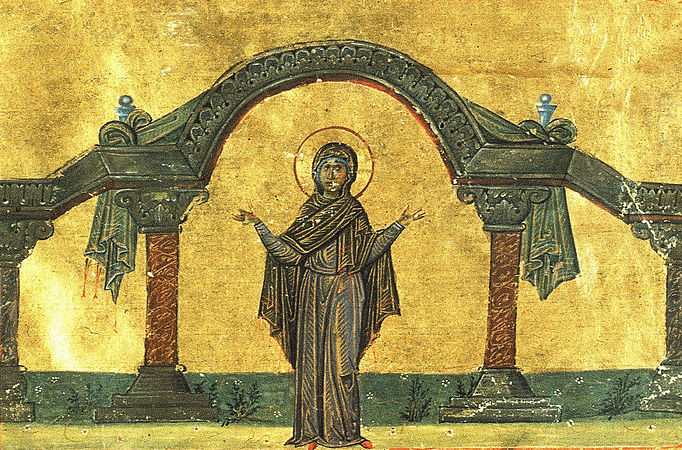
The Life of Saint Domnina the Younger1 was written by Theodoret of Cyrrhus in his Historia Religiosa (English title: A History of the Monks of Syria), containing the Lives of thirty ascetics.
The holy virgin Domina was born in the city of Cyrrhus in Syria, to pious and God-loving parents. From a young age she envied the life of the holy ascetics and emulated Saint Maron († February 14) by building a shack in a corner of her mother's garden. Her only food was lentils soaked in water. Early in the morning, and again at night, she went to the church, in order to pray and glorify the name of God. She always covered herself with a cloak so that no one would see her face. Theodoret says she spoke "softly and indistinctly, and her words were always accompanied by tears.”
After a long life of austere asceticism, the Venerable Domnina reposed in peace around the year 460.
1 Not to be confused with another Saint Domnina commemorated on October 4.
Venerable Agapius of Vatopedi
Saint Agapius of the Holy Mountain, was a novice in obedience to a virtuous Elder who lived in silence at the Holy Trinity kellia at Kolitsa, within the boundaries of Vatopedi on Mt. Athos. He was taken into captivity by Turks who had landed on the shore of Athos. They took him to Magnesia and there he worked in chains for twelve years. But he did not lose hope for freedom and fervently he prayed to the Mother of God to free him from this bitter captivity.
The Queen of Heaven manifested Her Mercy to the patient sufferer. She appeared to him in a dream and ordered him “to go to his Elder without fear.” When he awoke, he saw that he was free of his bonds, and the doors were open. Without hindrance, Saint Agapius departed from his master and returned to Mount Athos.
The Elder grieved when he saw his novice, for he thought that Agapius had secretly escaped from his master. “You have deceived the Hagarene,” he said, “but no one can deceive God. If you wish to save yourself, return to your master and serve him.” Saint Agapius returned to his master without complaint.
The Moslem was amazed to see Agapius after he had escaped. Hearing the story of what had happened, he was struck by the virtue of Agapius’ Elder and the loftiness of the Christian Faith. The master and his two sons went to the Holy Mountain with Saint Agapius. There they were baptized and became monks, living in asceticism for the rest of their lives.
Saint Agapius lived in the thirteenth century.
Saint David, Bishop of Wales

Saint David, Patron of Wales, said to have been the son of a Welsh chieftain, lived in the latter half of the sixth century. Ordained to the priesthood, he studied under the tutorship of a disciple of Saint Germanus, who later became Bishop of the Isle of Man, and engaged in missionary work and the building of churches in many places. Eventually, he settled in the southwest corner of Wales, at Menevia. There he founded a monastery known for its extreme austerity, in imitation of the desert fathers. Eventually he was consecrated Bishop of the primatial See of Wales, Menevia, afterwards known as Saint David’s in his honor. He reposed in the Lord about the year 601 AD and, through the years, has been venerated as one of the greatest and most beloved saints of the British Isles.
 Saint Peter Antiochian Orthodox Church