Monthly Archives: March 2025

Daily Readings for Wednesday, March 26, 2025

4TH WEDNESDAY OF LENT

ABSTAIN FROM MEAT, FISH, DAIRY, EGGS

Synaxis in honor of the Archangel Gabriel, 26 Martyrs in Crimea, Irenaeus the Hieromartyr of Hungary

ISAIAH 26:21-27:9

For behold, the LORD is coming forth out of his place to punish the inhabitants of the earth for their iniquity, and the earth will disclose the blood shed upon her, and will no more cover her slain. In that day the LORD with his hard and great and strong sword will punish Leviathan the fleeing serpent, Leviathan the twisting serpent, and he will slay the dragon that is in the sea. In that day: “A pleasant vineyard, sing of it! I, the LORD, am its keeper; every moment I water it. Lest any one harm it, I guard it night and day; I have no wrath. Would that I had thorns and briers to battle! I would set out against them, I would burn them up together. Or let them lay hold of my protection, let them make peace with me, let them make peace with me.” In days to come Jacob shall take root, Israel shall blossom and put forth shoots, and fill the whole world with fruit. Has he smitten them as he smote those who smote them? Or have they been slain as their slayers were slain? Measure by measure, by exile thou didst contend with them; he removed them with his fierce blast in the day of the east wind. Therefore by this the guilt of Jacob will be expiated, and this will be the full fruit of the removal of his sin: when he makes all the stones of the altars like chalkstones crushed to pieces, no Asherim or incense altars will remain standing.

GENESIS 9:18-10:1

The sons of Noah who went forth from the ark were Shem, Ham, and Japheth. Ham was the father of Canaan. These three were the sons of Noah; and from these the whole earth was peopled.
Noah was the first tiller of the soil. He planted a vineyard; and he drank of the wine, and became drunk, and lay uncovered in his tent. And Ham, the father of Canaan, saw the nakedness of his father, and told his two brothers outside. Then Shem and Japheth took a garment, laid it upon both their shoulders, and walked backward and covered the nakedness of their father; their faces were turned away, and they did not see their father's nakedness. When Noah awoke from his wine and knew what his youngest son had done to him, he said, "Cursed be Canaan; a slave of slaves shall he be to his brothers." He also said, "Blessed by the LORD my God be Shem; and let Canaan be his slave. God enlarge Japheth, and let him dwell in the tents of Shem; and let Canaan be his slave." After the flood Noah lived three hundred and fifty years. All the days of Noah were nine hundred and fifty years; and he died. These are the generations of the sons of Noah, Shem, Ham, and Japheth; sons were born to them after the flood.

PROVERBS 12:23-13:9

A prudent man conceals his knowledge, but fools proclaim their folly. The hand of the diligent will rule, while the slothful will be put to forced labor. Anxiety in a man’s heart weighs him down, but a good word makes him glad. A righteous man turns away from evil, but the way of the wicked leads them astray. A slothful man will not catch his prey, but the diligent man will get precious wealth. In the path of righteousness is life, but the way of error leads to death. A wise son hears his father’s instruction, but a scoffer does not listen to rebuke. From the fruit of his mouth a good man eats good, but the desire of the treacherous is for violence. He who guards his mouth preserves his life; he who opens wide his lips comes to ruin. The soul of the sluggard craves, and gets nothing, while the soul of the diligent is richly supplied. A righteous man hates falsehood, but a wicked man acts shamefully and disgracefully. Righteousness guards him whose way is upright, but sin overthrows the wicked. One man pretends to be rich, yet has nothing; another pretends to be poor, yet has great wealth. The ransom of a man’s life is his wealth, but a poor man has no means of redemption. The light of the righteous rejoices, but the lamp of the wicked will be put out.

Leavetaking of the Annunciation

On the Leavetaking of the Feast of the Annunciation, the Church commemorates the Archangel Gabriel, who announced the great mystery of the Incarnation of Christ to the Virgin Mary. There is no period of Afterfeast due to Great Lent.

Synaxis of the Archangel Gabriel
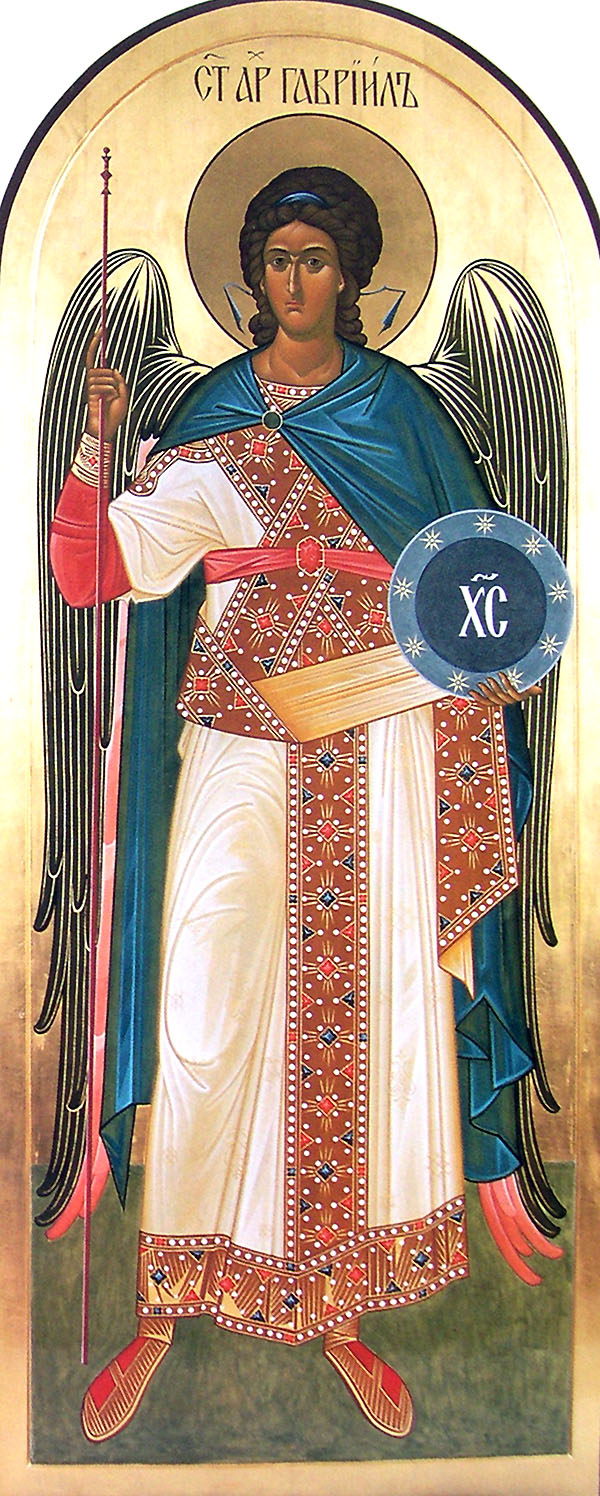
The Archangel Gabriel was chosen by the Lord to announce to the Virgin Mary about the Incarnation of the Son of God from Her, to the great rejoicing of all mankind. Therefore, on the day after the Feast of the Annunciation, the day on which the All-Pure Virgin is glorified, we give thanks to the Lord and we venerate His messenger Gabriel, who contributed to the mystery of our salvation.

Gabriel, the holy Archistrategos (Leader of the Heavenly Hosts), is a faithful servant of the Almighty God. He announced the future Incarnation of the Son of God to those of the Old Testament; he inspired the Prophet Moses to write the Pentateuch (first five books of the Old Testament), he announced the coming tribulations of the Chosen People to the Prophet Daniel (Dan. 8:16, 9:21-24); he appeared to Saint Anna (July 25) with the news that she would give birth to the Virgin Mary.

The holy Archangel Gabriel remained with the Holy Virgin Mary when She was a child in the Temple of Jerusalem, and watched over Her throughout Her earthly life. He appeared to the Priest Zachariah, foretelling the birth of the Forerunner of the Lord, Saint John the Baptist.

The Lord sent him to Saint Joseph the Betrothed in a dream, to reveal to him the mystery of the Incarnation of the Son of God from the All-Pure Virgin Mary, and warned him of the wicked intentions of Herod, ordering him to flee into Egypt with the divine Infant and His Mother.

When the Lord prayed in the Garden of Gethsemane before His Passion, the Archangel Gabriel, whose very name signifies “Man of God” (Luke. 22:43), was sent from Heaven to strengthen Him.

The Myrrh-Bearing Women heard from the Archangel the joyous news of Christ’s Resurrection (Mt.28:1-7, Mark 16:1-8).

Mindful of the manifold appearances of the holy Archangel Gabriel and of his zealous fulfilling of God’s will, and confessing his intercession for Christians before the Lord, the Orthodox Church calls upon its children to pray to the great Archangel with faith and love.

The Synaxis of the Holy Archangel Gabriel is also celebrated on July 13. All the angels are commemorated on November 8.

Hieromartyr Irenaeus, Bishop of Sirmium

Hieromartyr Irenaeus suffered during the persecution against Christians under the Roman emperors Diocletian and Maximian (284-305).

He was a presbyter, and he and his wife raised their children in Christian piety. Saint Irenaeus was greatly respected for his education and strict manner of life.

He was later made Bishop of Sirmium in Pannonia. Because of his fervent preaching of the Gospel he was arrested and brought before an official named Probus. Refusing to deny Christ and offer sacrifice to the pagan gods, the saint was handed over for torture. Witnessing his torments were the saint’s parents, relatives and friends, who attempted to persuade him to submit, but the martyr remained steadfast.

After cruel tortures, the holy confessor spent a long time in prison. Probus tried to persuade the martyr, urging him to spare his life for the sake of his sons. Saint Irenaeus replied, “My sons believe in God, Who will care for them. As for me, nothing will force me to renounce my Christ.”

The governor ordered the saint to be thrown into a river. They led the martyr on the bridge crossing the River Savva, where he knelt and prayed to the Lord for his flock. Then they beheaded the Hieromartyr Irenaeus, and threw his body into the river.

26 Martyrs in the Crimea

Presbyter Bercus; Monk Arpilus; laymen and women Abibus, Agnus, Reasus, Igathrax, Iscoeus (Iskous), Silas, Signicus, Sonirilus, Suimbalus, Thermus, Phillus (Philgas), Bathusius, Anna, Alla, Larissa, Monco (Manca), Uirko (Virko), Animais (Animaida), Queen Gaatha, and Princess Duklida, were among twenty-six martyrs who were killed by the Goths around the year 375 under Jungerich, a persecutor of Christians. Ancient synaxaria of the Gothic Church recount the martyrdom of twenty-six Christians in the time of the emperors Valentinian, Valens, and Gratian. The historian Sozomen says that King Athanaric was enraged to see his subjects embracing Christianity because of the preaching of the Arian bishop Ulfilas. So, he ordered many of them to be tortured and executed, often without a trial.

King Athanaric’s ministers placed a statue in a chariot and paraded it before the tents which Christians used for church services. Those who worshiped the idol and offered sacrifice were spared, the rest were burned alive in the tent. Jungerich gave orders to burn down a church during divine services. In the fiery inferno 308 people perished, of whom only twenty-one are known by name. There was also an anonymous man who came to the tent and confessed Christ. He was martyred with the others. Different manuscripts give variants of their names.

In the reign of Valentinian and Theodosius (383-392), the Gothic king’s widow Gaatha (who was an Orthodox Christian) and her daughter Duclida gathered up the relics of the holy martyrs and brought them to Syria with the help of some priests and a layman named Thyellas. Gaatha later returned to her native land, where she was stoned and died as a martyr, along with her son Agathon.

The relics of the holy martyrs were left to Duclida, who went to Cyzicus in Asia Minor and gave some of the relics for the founding of a church. Saint Duclida died in peace.

The holy martyrs were commemorated on October 23 on the Gothic calendars.

Saint Malchus of Chalcis, Syria

Saint Malchus was the only son of a farmer, and lived near Antioch, Syria. Upon his attaining the age of maturity, his parents had arranged a marriage for him, but Malchus secretly left home and received monastic tonsure in one of the monasteries, where he fulfilled various obediences for many years.

Upon learning of the death of his father, he wished to visit his mother. The igumen of the monastery would not bless him to go, but Malchus disobeyed him. He joined a group of pilgrims, and set out for his native district.

Along the way, Saracens attacked them, and enslaved them. Malchus’ s master compelled him to marry one of his slaves. With the consent of his wife, Saint Malchus kept his vow of chastity, and eventually converted her to Christianity.

One day, Saint Malchus and his wife ran away. The master pursued them, but they hid in a cave, which proved to be the den of a lioness. The lioness did not harm the fugitives, but killed one of the pursuers who tried to enter the cave and capture them.

Saint Malchus sent his wife to a women’s monastery as she requested, while he returned to his own monastery. By then the igumen was no longer alive, and Saint Malchus never left the monastery again. For the edification of monks he often recounted his trials, which were the result of his disobedience. Saint Malchus labored in asceticism in the monastery until the end of his life. He died in peace in the fourth century.

Venerable Basil the New, Anchorite, Near Constantinople

Saint Basil the New left the world in his youth, and struggled in a desolate place. Once, courtiers of the Byzantine Emperor were passing by and saw him dressed in rags, and were alarmed by his strange appearance. Suspicious of the holy ascetic, they captured him and brought him to the city, where the patrician Samon questioned him. When asked who he was, the saint merely said that he was a stranger in the land.

They subjected the monk to terrible tortures, but he endured it in silence, not wishing to reveal the details of his ascetic life to them. Samon lost his patience and asked Saint Basil, “Impious one, how long will you hide, who are you, and from where do you come?”

The saint replied, “It is more appropriate to call impious those who, like yourself, lead a life of impurity.” After his public humiliation, Samon ordered his men to hang the saint upside down with his hands and feet tied. These torments were so cruel that those witnessing them murmured against Samon.

When they released the holy ascetic after three days of torture, they found him alive and unharmed. Samon attributed this miracle to sorcery and had Saint Basil thrown to a lion. However, the lion did not touch the saint, and lay peacefully at his feet. Samon ordered Saint Basil to be drowned in the sea, but two dolphins brought him to shore.

The saint went into the city, where he met a sick man named John, who was suffering from fever. Saint Basil healed the sick man in the name of the Savior, and accepted John’s invitation to stay in his home.

Numerous believers came to the saint for advice and guidance, and also to receive healing from sickness through his prayers. Saint Basil, endowed with the gift of discernment, guided sinners on the path of repentance, and he could predict future events.

Among those who visited Saint Basil was a certain Gregory, who became his disciple and later wrote a detailed Life of his teacher. Gregory once found an expensive sash at an inn, which had been dropped by the inn-keeper’s daughter. He hid it on his person, intending to sell it and give the money to the poor. On the way home, he lost the sash and some other things.

Saint Basil admonished him in a dream, showed him a broken pot and said, “If anyone steals such a worthless thing, they will be chastized four times over. You hid a valuable sash, and you will be condemned as a thief. You should return what you found.”

After the death of Saint Theodora, who had attended Saint Basil, Gregory very much wanted to learn about her life beyond the grave, and he often asked the holy ascetic to reveal this to him. Through the saint’s prayers, Gregory saw Saint Theodora in a dream. She told him how her soul underwent tribulations after death, and how the power of the prayers of Saint Basil had helped her (The Feast Day of Saint Theodora of Constantinople is December 30).

Saint Basil died in about the year 944 at the age of 110.

The Church calls him Basil the New to distinguish him from other ascetics of the same name.

Martyr Montanus the Presbyter of Singidunum, and his wife Maxima

Saint Maxima and her priest-husband, Saint Montanus, lived in Singidunum (present-day Belgrade) in the fourth century during the time of Emperor Diocletian’s persecution of Christians. The Emperor’s deputy, Galerius, issued an edict requiring Christians to offer sacrifices to the idols. The pious couple refused, and continued to conduct their lives according to the Gospel of Jesus Christ. They traveled to the west, to Sirmium, in order to distance themselves from the seat of power. However, in the year 304, they were seized by Roman soldiers and brought to stand trial before Governor Probus.

As they stood before the governor on a bridge overlooking the Savva River, the captives were given the choice of sacrifice to the idols or death. Saint Montanus showed great heroism and explained that if he were to sacrifice to the idols, it would be tantamount to rejecting Jesus Christ as God and Lord of heaven and earth, and he refused to comply.

Frustrated, Probus tried to persuade Saint Maxima to deny Christ. Much to the surprise of the crowd, her fidelity and apostolic courage proved to be as great, if not greater, than her husband’s. Saint Maxima defended her faith so convincingly and with such eloquent zeal that Probus cut the trial short, fearing mass conversions to Christianity.

Saints Maxima and Montanus were beheaded by the sword, and their remains were thrown into the Savva River. The faithful, and those converted by the zeal of the holy couple, willingly endangered their lives in order to rescue the bodies and heads of the martyrs from the river. The relics were transported to Rome and interred in the Catacombs of Saint Priscilla on the Salarian Way where they remained for 1,500 years.

New Martyr George of Sofia

Saint George came from Sofia, Bulgaria, and was a soldier who served in the Ottoman army along with some other Christians. In March of 1437, he was stationed in Adrianople, in Thrace. One day, when he took his bow to be repaired, he overheard some Muslim soldiers mocking Christ. George became angry and declared, “Only One is holy, One is Lord, only One is worshiped – Jesus Christ, to the glory of God the Father. ” He also said some rather unflattering things about their beliefs.

Of course, this enraged the Muslims, who attacked George and punched him in the face. The saint did not keep
quiet, but repeated his previous statement in an even louder voice. He was seized by the Muslims, who tied a bow string around his neck. His hands were bound and then he was brought before the ruler.

When the ruler asked if he had said the things which his accusers had reported to him, George admitted that this was true, and then he said similar things to the ruler. After receiving a beating, George was sent to another official.

Once again, he was asked the same questions and he gave the same responses. The crowd became angry and demanded that George be punished. The martyr became somewhat apprehensive, but replied, “What good would it do to deny the truth? Yes, I did say all the things you heard. ”

One of the officials ordered him to take back what he said, and to become a Muslim, promising him honors and many gifts if he did. Courageously, George reiterated his faith in Christ and refused to convert. The crowd began to call for his death, but the ruler said that he would decide what to do with him. As George was led to the prison, he was beaten and spat upon, but he remained calm. When he arrived at the prison he was mocked and tortured, but he bore these things with great patience.

The next day some of their religious leaders arrived and ordered George to be brought before them. The saint did not seem to be afraid, but rather joyful, as he bore witness to Christ and mocked their faith. One of the leaders suggested that under their law George deserved to be beaten, but not put to death. The crowd began shouting for him burned by fire, so the frightened officials turned him over to the mob. A fire was prepared, and George approached it bravely, knowing that those who kill the body cannot kill the soul (Matthew 10:28).

Again they promised George great rewards if he would accept their faith, but he refused. He was placed into a basket and it was put on the fire. As the basket caught fire, someone stabbed him in the stomach with a spear so that his intestines fell out. More fuel was added to the flames, which burned from five o’clock in the afternoon until dawn. The saint’s body was almost completely reduced to dust, which the Muslims scattered so that the Christians would not be able to gather it. For some days following Saint George’s martyrdom, various forms of light appeared at the place of execution. This light took the form of a flame, a beam, etc.

The holy New Martyr George suffered for Christ on Tuesday March 26, 1437, at the age of thirty, thereby receiving an incorruptible crown of glory from Christ God, Who is worshiped and glorified together with the Father and the Holy Spirit throughout all ages. An eyewitness to these events has left a written account, which he declares is accurate and truthful, without any extraneous additions.

Daily Readings for Tuesday, March 25, 2025

ANNUNCIATION OF THE THEOTOKOS

ABSTAIN FROM MEAT, DAIRY, EGGS

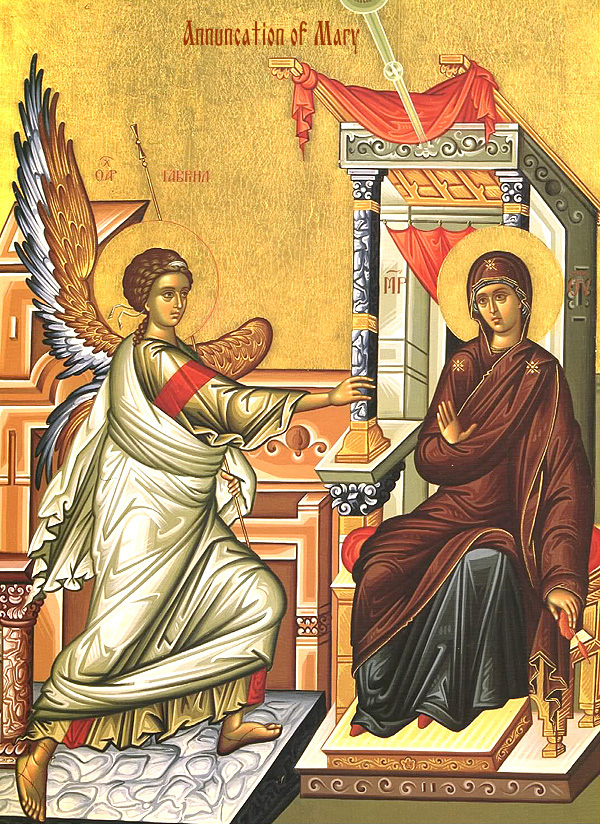
Annunciation of the Theotokos

ST. PAUL’S LETTER TO THE HEBREWS 2:11-18

BRETHREN, he who sanctifies and those who are sanctified have all one origin. That is why he is not ashamed to call them brethren, saying, ‘I will proclaim thy name to my brethren, in the midst of the congregation I will praise thee.’ And again, ‘I will put my trust in him.’ And again, ‘Here am I, and the children God has given me. Since therefore the children share in flesh and blood, he himself likewise partook of the same nature, that through death he might destroy him who has the power of death, that is, the devil, and deliver all those who through fear of death were subject to lifelong bondage. For surely it is not with angels that he is concerned but with the descendants of Abraham. Therefore he had to be made like his brethren in every respect, so that he might become a merciful and faithful high priest in the service of God, to make expiation for the sins of the people. For because he himself has suffered and been tempted, he is able to help those who are tempted.

LUKE 1:24-38

In those days, Elizabeth the wife of Zacharias conceived and for five months she hid herself, saying, "Thus the Lord had done to me in the days when he looked on me, to take away my reproach among men." In the sixth month the angel Gabriel was sent from God to a city of Galilee named Nazareth, to a virgin betrothed to a man whose name was Joseph, of the house of David; and the virgin's name was Mary. And he came to her and said, "Hail, O favored one, the Lord is with you! Blessed are you among women!" But she was greatly troubled at the saying, and considered in her mind what sort of greeting this might be. And the angel said to her, "Do not be afraid, Mary, for you have found favor with God. And behold, you will conceive in your womb and bear a son, and you shall call his name Jesus. He will be great, and will be called the Son of the Most High; and the Lord God will give to him the throne of his father David, and he will reign over the house of Jacob for ever; and of his kingdom there will be no end." And Mary said to the angel, "How shall this be, since I have no husband?" And the angel said to her, "The Holy Spirit will come upon you, and the power of the Most High will overshadow you; therefore the child to be born will be called holy, the Son of God.
And behold, your kinswoman Elizabeth in her old age has also conceived a son; and this is the sixth month with her who was called barren. For with God nothing will be impossible." And Mary said, "Behold, I am the handmaid of the Lord; let it be to me according to your word." And the angel departed from her.

The Annunciation of our Most Holy Lady, the Theotokos and Ever-Virgin Mary

The Feast of the Annunciation is one of the earliest Christian feasts, and was already being celebrated in the fourth century. There is a painting of the Annunciation in the catacomb of Priscilla in Rome dating from the second century. The Council of Toledo in 656 mentions the Feast, and the Council in Trullo in 692 says that the Annunciation was celebrated during Great Lent.

The Greek and Slavonic names for the Feast may be translated as “good tidings.” This, of course, refers to the Incarnation of the Son of God and the salvation He brings. The background of the Annunciation is found in the Gospel of Saint Luke (1:26-38). The troparion describes this as the “beginning of our salvation, and the revelation of the eternal mystery,” for on this day the Son of God became the Son of Man.

There are two main components to the Annunciation: the message itself, and the response of the Virgin. The message fulfills God’s promise to send a Redeemer (Genesis 3:15): “I will put enmity between you and the woman, between your seed and her seed; he shall crush your head, and you shall lie in wait for his heel.” The Fathers of the Church understand “her seed” to refer to Christ. The prophets hinted at His coming, which they saw dimly, but the Archangel Gabriel now proclaims that the promise is about to be fulfilled.

We see this echoed in the Liturgy of Saint Basil, as well: “When man disobeyed Thee, the only true God who had created him, and was deceived by the guile of the serpent, becoming subject to death by his own transgressions, Thou, O God, in Thy righteous judgment, didst send him forth from Paradise into this world, returning him to the earth from which he was taken, yet providing for him the salvation of regeneration in Thy Christ Himself.”

The Archangel Gabriel was sent by God to Nazareth in Galilee. There he spoke to the undefiled Virgin who was betrothed to Saint Joseph: “Hail, thou who art highly favoured, the Lord is with thee: blessed art thou among women. And, behold, thou shalt conceive in thy womb, and bring forth a son, and shalt call his name Jesus. He shall be great, and shall be called the Son of the Most High: and the Lord God shall give unto him the throne of his father David: And he shall reign over the house of Jacob for ever; and of his kingdom there shall be no end.”

In contrast to Eve, who was readily deceived by the serpent, the Virgin did not immediately accept the Angel’s message. In her humility, she did not think she was deserving of such words, but was actually troubled by them. The fact that she asked for an explanation reveals her sobriety and prudence. She did not disbelieve the words of the angel, but could not understand how they would be fulfilled, for they spoke of something which was beyond nature.

Then said Mary unto the angel, “How shall this be, seeing I know not a man?” (Luke 1:34).

“And the angel answered and said unto her, ‘The Holy Ghost shall come upon thee, and the power of the Most High shall overshadow thee: therefore also that which shall be born of thee shall be called the Son of God. And, behold, thy cousin Elisabeth hath also conceived a son in her old age: and this is the sixth month with her, who was called barren. For with God nothing shall be impossible.’ And Mary said, ‘Behold the handmaid of the Lord; be it unto me according to thy word.’ And the angel departed from her.” (Luke 1: 35-38)

In his Sermon 23 on the day of the Annunciation, Saint Philaret of Moscow boldly stated that “the word of the creature brought the Creator down into the world.” He explains that salvation is not merely an act of God’s will, but also involves the Virgin’s free will. She could have refused, but she accepted God’s will and chose to cooperate without complaint or further questions.

The icon of the Feast shows the Archangel with a staff in his left hand, indicating his role as a messenger. Sometimes one wing is upraised, as if to show his swift descent from heaven. His right hand is stretched toward the holy Virgin as he delivers his message.

The Virgin is depicted either standing or sitting, usually holding yarn in her left hand. Sometimes she is shown holding a scroll. Her right hand may be raised to indicate her surprise at the message she is hearing. Her head is bowed, showing her consent and obedience. The descent of the Holy Spirit upon her is depicted by a ray of light issuing from a small sphere at the top of the icon, which symbolizes heaven. In a famous icon from Sinai, a white dove is shown in the ray of light.

There are several famous icons of the Annunciation. One is in the Moscow Kremlin in the church of the Annunciation. This icon appeared in connection with the rescue of a prisoner by the Mother of God during the reign of Ivan the Terrible. Another is to be found in the Dormition Cathedral in Moscow (July 8). It was originally located in Ustiug, and was the icon before which Saint Procopius the fool (July 8) prayed to save the city from destruction in 1290. One of the most highly revered icons in Greece is the Tinos icon of the Annunciation (January 30).

The Annunciation falls during Lent, but it is always celebrated with great joy. The Liturgy of Saint Basil or Saint John Chrysostom is served, even on the weekdays of Lent. It is one of the two days of Great Lent on which the fast is relaxed and fish is permitted (Palm Sunday is the other).

Daily Readings for Monday, March 24, 2025

4TH MONDAY OF LENT

ABSTAIN FROM MEAT, FISH, DAIRY, EGGS, WINE, OLIVE OIL

Forefeast of the Annunciation of the Theotokos, Righteous Artemon, Bishop of Seleucia, Our Holy Father Theonas, Archbishop of Thessolonica, Zachariah the Recluse

ISAIAH 14:24-32

The LORD of hosts has sworn: "As I have planned, so shall it be, and as I have purposed, so shall it stand, that I will break the Assyrian in my land, and upon my mountains trample him under foot; and his yoke shall depart from them, and his burden from their shoulder." This is the purpose that is purposed concerning the whole earth; and this is the hand that is stretched out over all the nations. For the LORD of hosts has purposed, and who will annul it? His hand is stretched out, and who will turn it back? In the year that King Ahaz died came this oracle: "Rejoice not, O Philistia, all of you, that the rod which smote you is broken, for from the serpent's root will come forth an adder, and its fruit will be a flying serpent. And the first-born of the poor will feed, and the needy lie down in safety; but I will kill your root with famine, and your remnant I will slay. Wail, O gate; cry, O city; melt in fear, O Philistia, all of you! For smoke comes out of the north, and there is no straggler in his ranks." What will one answer the messengers of the nation? "The LORD has founded Zion, and in her the afflicted of his people find refuge.

GENESIS 8:21-9:7

And when the LORD smelled the pleasing odor, the LORD said in his heart, "I will never again curse the ground because of man, for the imagination of man's heart is evil from his youth; neither will I ever again destroy every living creature as I have done. While the earth remains, seedtime and harvest, cold and heat, summer and winter, day and night, shall not cease." And God blessed Noah and his sons, and said to them, "Be fruitful and multiply, and fill the earth. The fear of you and the dread of you shall be upon every beast of the earth, and upon every bird of the air, upon everything that creeps on the ground and all the fish of the sea; into your hand they are delivered. Every moving thing that lives shall be food for you; and as I gave you the green plants, I give you everything. Only you shall not eat flesh with its life, that is, its blood. For your lifeblood I will surely require a reckoning; of every beast I will require it and of man; of every man's brother I will require the life of man. Whoever sheds the blood of man, by man shall his blood be shed; for God made man in his own image. And you, be fruitful and multiply, bring forth abundantly on the earth and multiply in it.

PROVERBS 11:19-12:6

He who is steadfast in righteousness will live, but he who pursues evil will die. Men of perverse mind are an abomination to the LORD, but those of blameless ways are his delight. Be assured, an evil man will not go unpunished, but those who are righteous will be delivered. Like a gold ring in a swine's snout is a beautiful woman without discretion. The desire of the righteous ends only in good; the expectation of the wicked in wrath. One man gives freely, yet grows all the richer; another withholds what he should give, and only suffers want. A liberal man will be enriched, and one who waters will himself be watered. The people curse him who holds back grain, but a blessing is on the head of him who sells it. He who diligently seeks good seeks favor, but evil comes to him who searches for it. He who trusts in his riches will wither, but the righteous will flourish like a green leaf. He who troubles his household will inherit wind, and the fool will be servant to the wise. The fruit of the righteous is a tree of life, but lawlessness takes away lives. If the righteous is requited on earth, how much more the wicked and the sinner! Whoever loves discipline loves knowledge, but he who hates reproof is stupid. A good man obtains favor from the LORD, but a man of evil devices he condemns. A man is not established by wickedness, but the root of the righteous will never be moved. A good wife is the crown of her husband, but she who brings shame is like rottenness in his bones. The thoughts of the righteous are just; the counsels of the wicked are treacherous. The words of the wicked lie in wait for blood, but the mouth of the upright delivers men.

Forefeast of the Annunciation

The Feast of the Annunciation to the Most Holy Theotokos is celebrated on one day March 25, exactly nine months before the Nativity of Christ. There is one day of Prefeast (March 24), followed by the Feast itself. On March 26, we celebrate the Synaxis of the Archangel Gabriel.

Because the Feast of the Annunciation falls during Great Lent, there is no Postfeast of the Feast.

Venerable Zachariah the Recluse

Saint Zachariah the Recluse of Egypt because of his concern for the poor and homeless was called “to the outcast.” In the printed Menaion he is known as “our Monastic Father Zachariah,” and so he has been identified erroneously with Saint Zachariah the Monk.

Saint Artemon, Bishop of Seleucia

Saint Artemon, Bishop of Seleucia, was born and lived in Seleucia of Pisidia (Asia Minor). He was pious and virtuous, therefore when the holy Apostle Paul (June 29) came to Seleucia, he established Saint Artemon as the first bishop of this city, since he was the most worthy. Saint Artemon wisely nourished the flock entrusted to him and won glory as a comforter of the poor and oppressed. Saint Artemon died in great old age.

[In the ancient Slavonic Lives of the Saints “Seleucian” was written as “Seleoukinian” or “Seleunian.” However, in several of the Greek memorials the bishop was also called Solunian (i.e., of Thessalonica). Saint Artemon (or Menignus) was listed in the MENAIA as Seleucian or Solunian. In the second half of the eighteenth century, these two names were mistakenly applied to various persons.]

Venerable Zachariah the Ascetic of the Kiev Caves

Saint Zachariah the Faster of the Caves was an ascetic in the Far Caves in the thirteenth-fourteenth centuries. He fasted so strictly that he ate nothing baked nor boiled, and he consumed only greens once a day at the setting of the sun. Demons trembled at the mere mention of his name.

Often the monk saw angels, with which he deserved to live in Heaven.

Martyr Stephen of Kazan

The Holy Martyr Stephen of Kazan was a Tatar. For more than twenty years, he suffered from a weakness of the legs. After the capture of Kazan by Ivan the Terrible (1552), he believed in Christ and received healing. The saint was baptized by Archpriest Menignus of the Moscow cathedral, who had brought a letter from Metropolitan Macarius to the Russian army.

After the Russian army withdrew from Kazan, the Tatars chopped the martyr Stephen into pieces, scattered his body and plundered his house, because he remained faithful to Christ.

Martyr Peter of Kazan

The Holy Martyr Peter of Kazan was a newly-baptized Tatar who suffered because he converted to Christianity from Islam.

After the Russian army left Kazan, the inhabitants dragged Peter from his home by force, and addressed him by his former Moslem name, hoping that he would deny Christ. But to all flattery and persuasion Saint Peter answered, “My father and mother is God Who is glorified in Trinity: Father, Son, and Holy Spirit. If you believe in the Father and the Son and the Holy Spirit, then you are my family. I was named Peter in holy Baptism, and I will not answer to the name by which you address me.”

Seeing that he would remain steadfast in the Faith, his family had him tortured. He endured fierce torments, but he did not cease to confess the Name of Christ, saying, “I am a Christian.” The holy martyr was buried in Kazan on the site where the church of the Resurrection of Christ later stood, at the Zhitny-Grain marketplace.

For the Lives of the holy martyrs Stephen and Peter of Kazan see: “Journal of the Moscow Patriarchate,” 1977, No. 9, p. 79-80.

Icon of the Mother of God of “the Uncut Mount” or “Clouded Mountain”

About 250-300 years ago1 this icon was in one of the men’s monasteries of Tver and the Superior gave it to Cosmas Volchaninov in gratitude for his fine work in the Monastery church. The Icon was passed down from generation to generation, but an irreverent grandson of Cosmas took the darkened Icon and put it in the attic. His daughter-in-law had to endure many insults from her husband and his relatives. In desperation, she decided to commit suicide in a deserted bath-house. On her way there a monk appeared to her and said, “Where are you going, you unhappy woman? Go back, pray to the Theotokos of "The Clouded Mount," and you will live well, and in peace.”

The distressed woman returned home and revealed everything to her family, not concealing what she had intended to do. They searched for the monk, but they did not find him. No one saw him but her. This occurred on the eve of the Feast of the Annunciation to the Most Holy Theotokos.

They found the Icon in the attic, cleaned off the dirt, and put it downstairs, in a place of honor. In the evening, the parish priest served an All-night Vigil before the Icon. From that time, a Vigil was served in the house every year on this day.

For more than 150 years the Icon remained in the Volchaninov family. Katherine, the daughter of Basil, the last of the Volchaninov line, married George Ivanovich Konyaev, taking the Icon of the Mother of God with her as a precious inheritance. Molebens and All-night Vigils were served in the Konyaev house on March 24 and November 7 (perhaps this was the day when the Icon was brought from the monastery to the house of Cosmas Volchaninov).

In 1863, near a cemetery church of the Smolensk Icon of the Mother of God, it was decided to build a chapel in honor of Saint Tikhon and Saint Makarios of Kalyazin (March 17). The owner of the Icon, George Konyaev (who died in 1868 at the age of 97) wanted to donate the Icon of the Mother of God to the church. He asked the clergy to build another chapel for the wonderworking Icon of the Mother of God of "The Clouded Mountain.”

He also said, “I feel the very best place for it is in the temple of the Smolensk Icon of the Mother of God, since formerly the place on which the church was built was called a Mount, because it was the highest place in the city. The inhabitants took their possessions to the Mount and saved themselves from ruin during a flood. Let the 'Clouded Mountain' Icon remain here on the Mount with your blessing, and may all who are buried here be protected by her mercy.” On July 15, 1866 the Icon was transferred into the new chapel, which was consecrated by Bishop Anthony of Staritsk the following day.

For three centuries before the Revolution, the "Clouded Mount" Icon of the Mother of God repeatedly worked several miracles. She was taken into the homes of pious citizens, and children were brought to her to be healed. Copies of the Icon were made, which also turned out to be miraculous.

According to the recollection of Father John Bogoslovsky, from the village of Buylovo, his mother brought him to the wonderworking Icon several times when he was a child. He had severe pain in his eyes, and every time he was anointed with oil from a lamp hanging before her Icon, he obtained relief, then finally the disease left him. Grateful worshippers adorned the Icon with a a silver riza, and later the riza was gilded. Unfortunately, the Icon disappeared after the Smolensk church was closed.

The memory of the "Clouded Mount" Icon did not fade, however. In 1993, with the blessing of Archbishop Victor of Tver and Kashin, a copy of the "Clouded Mount" Icon was painted, and veneration of the Icon resumed. The "Clouded Mount" Icon of the Mother of God is commemorated three times a year: on July 16, in honor of the consecration of the altar; on March 24 in honor of the Icon's first miracle; and on November 7 according to ancient custom. Now there is a venerated copy of the Icon in the Ascension Cathedral at Tver.

In the Icon, the Most Holy Theotokos is depicted standing on a semicircular elevation. In her right hand is a small mountain, the "stone cut out of a mountain without hands" (Daniel 2:44), on top of which a domed church with crosses. On her left arm the Divine Child blesses with His right hand. There is a crown on the head of the Mother of God.

We pray before this Icon when faced with desperate situations; when it seems that everyone around us opposes us; and for the correction of errant or fallen relatives.


1 This account is based on Eugene Poselyanin's book The Mother of God (published in 1914), and other sources.

Daily Readings for Sunday, March 23, 2025

SUNDAY OF THE HOLY CROSS

ABSTAIN FROM MEAT, FISH, DAIRY, EGGS

Sunday of the Holy Cross, The Holy Righteous Martyr Nicon and His 199 Disciples, Anatolios & Protoleon the Martyrs converted by the martyrdom of St. George, Luke the New Martyr of Mytilene

ST. PAUL’S LETTER TO THE HEBREWS 4:14-16; 5:1-6

BRETHREN, since we have a high priest who has passed through the heavens, Jesus, the Son of God, let us hold fast our confession. For we have not a high priest who is unable to sympathize with our weaknesses, but one who in every respect has been tempted as we are, yet without sin. Let us then with confidence draw near to the throne of grace, that we may receive mercy and find grace to help in time of need. For every high priest chosen from among men is appointed to act on behalf of men in relation to God, to offer gifts and sacrifices for sins. He can deal gently with the ignorant and wayward, since he himself is beset with weakness. Because of this he is bound to offer sacrifice for his own sins as well as for those of the people. And one does not take the honor upon himself, but he is called by God, just as Aaron was. So also Christ did not exalt himself to be made a high priest, but was appointed by him who said to him, ‘Thou art my Son, today I have begotten thee’; as he says also in another place, ‘Thou art a priest for ever, after the order of Melchizedek.’

MARK 8:34-38; 9:1

The Lord said: "If anyone wishes to come after me, let him deny himself and take up his cross and follow me. For whoever would save his life will lose it; and whoever loses his life for my sake and the gospel's will save it. For what does it profit a man, to gain the whole world and forfeit his life? For what can a man give in return for his life? For whoever is ashamed of me and my words in this adulterous and sinful generation, of him will the Son of man also be ashamed, when he comes in the glory of his Father with the holy angels." And he said to them, "Truly, I say to you, there are some standing here who will not taste death before they see the kingdom of God come with power.

3rd Sunday of Great Lent: Veneration of the Cross

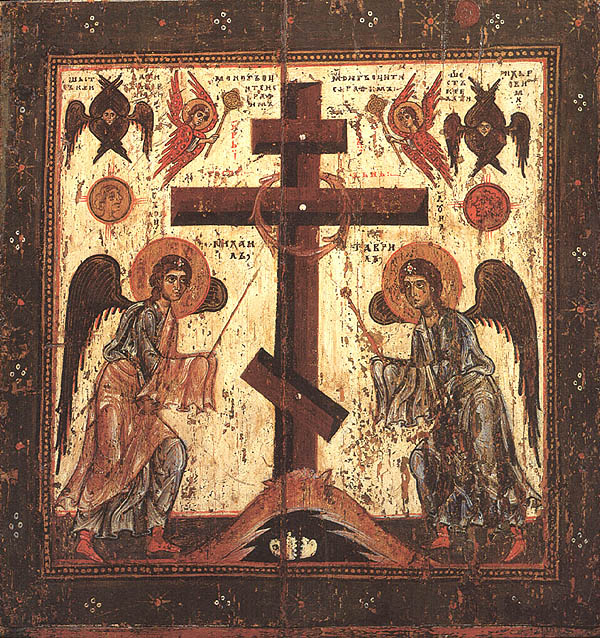
The Third Sunday of Lent is that of the Veneration of the Cross. The cross stands in the midst of the church in the middle of the lenten season not merely to remind men of Christ’s redemption and to keep before them the goal of their efforts, but also to be venerated as that reality by which man must live to be saved. “He who does not take up his cross and follow me is not worthy of me” (Mt.10:38). For in the Cross of Christ Crucified lies both “the power of God and the wisdom of God” for those being saved (1 Cor.1:24).

Martyr Nikon and 199 disciples with him in Sicily

The Monk Martyr Nikon was born at Neapolis (Naples). His father was a pagan, and his mother a Christian. He was not baptized, but his mother secretly instructed him in the tenets of Christianity. Nikon was still a pagan when he reached adulthood. He served as a soldier, and showed unusual courage and strength.

Once, Nikon and his military company were surrounded by enemies. In deadly peril, he remembered the Christian precepts of his mother and, signing himself with the Sign of the Cross, he prayed to God, vowing to be baptized if he were saved. Filled with unusual strength, he killed many of the enemy, and put the rest to flight.

He managed to return home, giving thanks to God for preserving his life. With the blessing of his mother, he set off in search of a priest. This was no easy thing to do in a time of persecution. Saint Nikon took a ship to the island of Chios. He went up on a high mountain and spent eight days in fasting and prayer, entreating the Lord to help him.

An angel of God appeared to Saint Nikon in a dream, showing him the way. Saint Nikon went to Mount Ganos, where many monks were hidden, headed by Theodosius the Bishop of Cyzicus. Saint Nikon received from the bishop both the mystery of Baptism and the angelic schema (i.e., monastic tonsure). Living in the cave church, Saint Nikon became an example for all the brethren.

When Saint Nikon had lived on the mountain for three years, an angel revealed to the bishop that Saint Nikon should be consecrated bishop, and should move to the province of Sicily with all the monks. Bishop Theodosius obeyed the angel, and then died after he had entrusted the 190 monks to Saint Nikon. After he buried Bishop Theodosius, Saint Nikon sailed to Sicily with the brethren, and so was saved from approaching barbarians.

By God’s grace, Saint Nikon came to his native city Neapolis. He found his mother still alive, and he remained with her for the final day of her life. His mother collapsed on his chest with tears of joy and kissed him. Making a prostration to the ground, she said, “I give thanks to You, O Lord, for You have permitted me to see my son as a monk, and as a bishop. Now, my Lord, hear Your servant, and receive my soul.” When she had finished this prayer, the righteous woman died. Those present glorified God and buried her with psalmody.

Rumors of Saint Nikon’s arrival spread through the city, and ten soldiers, his former companions, came to see him. After conversing with the saint they believed and were baptized, and went with him to Sicily. Having arrived on the island, Saint Nikon settled with the monks in a desolate area, called Gigia, near the river Asinum.

Many years passed, and there was another persecution against Christians. Quintilian, the governor of Sicily, was informed that Bishop Nikon was living nearby with many monks. All 199 monks were seized and beheaded, but they left Saint Nikon alive in order to torture him.

They burned him with fire, yet he remained unharmed. They tied him to the tails of wild horses to be dragged over the ground, but the horses would not budge from the spot. They cut out the saint’s tongue, threw him off a high cliff, and finally beheaded him. The body of the hieromartyr Nikon was left in a field to be eaten by wild beasts and birds.

A certain shepherd, possessed by an evil spirit, went to that place, and finding the body of the saint, he immediately fell to the ground on his face. The unclean spirit, vanquished by the power of the saint, had thrown him to the ground and gone out from him with a loud shriek: “Woe is me, woe is me, where can I flee from Nikon?”

The healed shepherd related this to the people. The bishop of the city of Messina also learned of this, then he and his clergy buried the bodies of Saint Nikon and his disciples.

Venerable Nikon, Abbot of the Kiev Far Caves

Saint Nikon of the Kiev Caves was the first disciple and fellow-ascetic of Saint Anthony (July 10), the founder of the Kiev Caves monastery, to which he came as a priest. At the monastery he tonsured all the new monks, and among their number was Saint Theodosius of the Caves (May 3 and August 14).

For tonsuring the favorites of the Great Prince Izyaslav, Saints Barlaam (November 19) and Ephraim (January 28 ), Saint Nikon brought the wrath of the prince down upon himself, but he refused to force the new monks to leave the monastery. The princess calmed Izyaslav, and he left Saint Nikon in peace.

When the number of brethren in the monastery had increased, Saint Nikon desired to go into seclusion and live as a hesychast. He went to the Tmutarakan peninsula (on the eastern banks of the Kerchensk straits) and settled in an unpopulated spot. When news of his holy life and spiritual gifts spread throughout the region, many gathered about him, wishing to follow his example. Thus a monastery and a church were founded in the name of the Most Holy Theotokos.

When he returned to the Kiev Caves monastery, Saint Nikon was obedient to Saint Theodosius as his spiritual Father. According to Saint Nestor the Chronicler (October 27), when Saint Theodosius had to go somewhere, he entrusted all the brethren to the care of Saint Nikon. Sometimes he asked Saint Nikon to offer instruction to the brethren in place of himself. Often, when Saint Nikon was binding books, Saint Theodosius sat near him and spun the thread for the binding.

When Prince Svyatoslav drove out his brother Izyaslav from Kiev, Saint Nikon returned to the monastery he founded. He returned under the igumen Stephen. When Saint Stephen (April 27) left the Kiev Caves monastery, Saint Nikon was chosen as igumen of the monastery. He toiled much to adorn his monastery with spiritual books and icons. He died at a great old age (+ 1088) and was buried in the Near Caves of Saint Anthony.

Martyr Philetus the Senator, his wife and sons, and those with them in Illyria

Saint Philetus was a dignitary at the court of the emperor Hadrian (117-138), a persecutor of Christians. For openly confessing his faith in Christ the Savior, Saint Philetus was brought to trial with his wife Saint Lydia and their sons Macedonius and Theoprepius. By Hadrian’s order, Saint Philetus was sent with his family to Illyria to the military governor Amphilochius to be tortured.

Amphilochius gave orders to suspend them from a tree and to torture them with knives. After this, they were locked up in prison with the jailer Cronides, who believed in Christ and was also thrown in jail. An angel came to them by night and eased their sufferings.

On the following day the martyrs were plunged into a cauldron of boiling oil, but the oil cooled instantly, and the saints remained unharmed. The military governor Amphilochius was so astonished at this miracle that he himself believed in Christ and went into the boiling oil saying, “Lord, Jesus Christ, help me!” and he remained unharmed. The tortures were repeated when the emperor Hadrian came to Illyria. They threw the holy martyrs into the boiling oil again and again, but by the power of God they remained alive.

The humiliated emperor returned to Rome, and the holy martyrs gave thanks to God, then they surrendered their holy souls to Him.

Righteous Basil of Mangazea in Siberia

Righteous Basil of Mangazea: Saint Basil was born in the town of Yaroslavl around 1587. His father was a merchant, but the family was very poor. As a child, Basil spent much of his time in church, praying fervently and participating in the divine services.

When he was twelve, the boy set out to earn his living. After a difficult journey through wild forests, he came to the Russian village of Mangazea in Siberia on the River Taz. This was an area inhabited by Mongols and indigenous peoples of Siberia.

After stopping to pray in the village church, Saint Basil found a job with a local merchant. The merchant was a person of low moral character and did not believe in God, so while he appreciated Basil’s work, he did not care for the boy’s religious inclinations. Soon the cruel merchant came to hate his clerk and began to mistreat him.

During the Matins of Pascha, thieves robbed the merchant’s shop. The merchant discovered the theft and went to the governor, accusing Basil of being one of the thieves. So great was the merchant’s hatred of Basil that he falsely accused the young man. The governor did not even bother to investigate the charges, but had Basil arrested and tortured to make him admit his guilt. In spite of unbearable tortures, the saint kept saying, “I am innocent.”

Enraged by Basil’s endurance and meekness, the merchant struck him in the head with a ring of keys. Saint Basil fell to the floor and surrendered his soul to God. The governor ordered that the saint’s body be placed in a coffin and buried in a swamp.

After several years, the servants who disposed of the body began to speak about the child’s murder. Soon all the residents of Mangazea knew that the saint’s relics were in the swamp. Because of many signs that took place, people began to address prayers to Saint Basil. Forty-two years after the unjust murder of the saint, his coffin was removed from the swamp and his holy relics were found to be incorrupt. A chapel was built over his grave, and in 1670 the relics were placed in the church of Holy Trinity Monastery near Turakhanov.

In 1719 the holy Metropolitan Philotheus of Siberia (May 31) sent a carved reliquary to the monastery. Many miracles took place there, and Saint Basil helped Metropolitan Philotheus on many occasions

A new stone church was built at Holy Trinity Monastery in 1787, and the relics were transferred there.

In iconography, Saint Basil is portrayed as a young man with light brown hair, bare-footed and wearing only a shirt. He is also depicted on the Abaletsk Icon “Of the Sign” (July 20, November 27).

Monastic Martyr Luke of Saint Anne’s Skete on Mount Athos and Odrin

No information available at this time.

Venerable Sergius (Srebryansky), the New Confessor of Tver

No information available at this time.

Daily Readings for Saturday, March 22, 2025

THIRD SATURDAY OF LENT

ABSTAIN FROM MEAT, FISH, DAIRY, EGGS

Third Saturday of Lent, Basil the Holy Martyr of Ancyra, Kalliniki & Vassilisa the Martyrs, Euthemios the New Martyr

ST. PAUL’S LETTER TO THE HEBREWS 10:32-38

Brethren, recall the former days when, after you were enlightened, you endured a hard struggle with sufferings, sometimes being publicly exposed to abuse and affliction, and sometimes being partners with those so treated. For you had compassion on the prisoners, and you joyfully accepted the plundering of your property, since you knew that you yourselves had a better possession and an abiding one. Therefore do not throw away your confidence, which has a great reward. For you have need of endurance, so that you may do the will of God and receive what is promised. "For yet a little while, and the coming one shall come and shall not tarry; but my righteous one shall live by faith.

MARK 2:14-17

At that time, as Jesus passed on, he saw Levi the son of Alphaios sitting at the tax office, and he said to him, "Follow me." And he rose and followed him. And as he sat at table in his house, many tax collectors and sinners were sitting with Jesus and his disciples; for there were many who followed him. And the scribes of the Pharisees, when they saw that he was eating with sinners and tax collectors, said to his disciples, "Why does he eat with tax collectors and sinners?" And when Jesus heard it, he said to them, "Those who are well have no need of a physician, but those who are sick; I came not to call the righteous, but sinners.

3rd Saturday of Great Lent: Memorial Saturday

Saturday is the day which the Church has set aside for the commemoration of faithful Orthodox Christians departed this life in the hope of resurrection to eternal life. Since the Divine Liturgy cannot be served on weekdays during Great Lent, the second, third, and fourth Saturdays of the Fast are appointed as Soul Saturdays when the departed are remembered at Liturgy.

In addition to the Liturgy, kollyva (wheat or rice cooked with honey and mixed with raisins, figs, nuts, sesame, etc.) is blessed in church on these Saturdays. The kollyva reminds us of the Lord’s words, “Unless a grain of wheat falls into the earth and dies, it remains alone; but if it dies, it bears much fruit” (John 12:24). The kollyva symbolizes the future resurrection of all the dead. As Saint Simeon of Thessalonica (September 15) says, man is also a seed which is planted in the ground after death, and will be raised up again by God’s power. Saint Paul also speaks of this (I Cor. 15:35-49).

It is customary to give alms in memory of the dead in addition to the prayers we offer for their souls. The angel who spoke to Cornelius testifies to the efficacy of almsgiving, “Your prayers and your alms have ascended as a memorial before God” (Acts 10:4).

Memorial services for the dead may be traced back to ancient times. Chapter 8 of the Apostolic Constitutions recommends memorial services with Psalms for the dead. It also contains a beautiful prayer for the departed, asking that their voluntary and involuntary sins be pardoned, that they be given rest with the Patriarchs, Prophets, and Apostles in a place where sorrow, suffering, and sighing have fled away (Isaiah 35:10). Saint John Chrysostom mentions the service for the dead in one of his homilies on Philippians, and says that it was established by the Apostles. Saint Cyprian of Carthage (Letter 37) also speaks of our duty to remember the martyrs.

The holy Fathers also testify to the benefit of offering prayers, memorial services, Liturgies, and alms for the dead (Saint John Chrysostom, Saint Cyril of Jerusalem, Saint John of Damascus, etc.). Although both the righteous and those who have not repented and corrected themselves may receive benefit and consolation from the Church’s prayer, it has not been revealed to what extent the unrighteous can receive this solace. It is not possible, however, for the Church’s prayer to transfer a soul from a state of evil and condemnation to a state of holiness and blessedness. Saint Basil the Great points out that the time for repentance and forgiveness of sins is during the present life, while the future life is a time for righteous judgment and retribution (Moralia 1). Saint John Chrysostom, Saint Gregory the Theologian, and other patristic writers concur with Saint Basil’s statement.

By praying for others, we bring benefit to them, and also to ourselves, because “God is not so unjust as to forget your work and the love which you showed for His sake in serving the saints…” (Heb. 6:10).

Hieromartyr Basil of Ancyra

Hieromartyr Basil was a presbyter in Ancyra, Galatia. Fighting against the Arian heresy, he urged his flock to cling firmly to Orthodoxy. Because of this Saint Basil was deposed from his priestly rank by a local Arian council, but a Council of 230 bishops in Palestine reinstated him.

Saint Basil openly continued to preach and denounce the Arians. Therefore, he became the victim of persecution and was subjected to punishment as a man dangerous to the state. Two apostates, Elpidios and Pegasios, were ordered to turn Saint Basil from Orthodoxy. The saint remained unshakable, and was again subjected to tortures.

When the emperor Julian the Apostate (361-363) arrived in the city of Ancyra, Saint Basil bravely confessed Christ before him at the trial, and denounced the emperor for his apostasy. Julian ordered that strips of skin be cut from the saint’s back. Saint Basil endured the gruesome torture with great patience.

When they began to beat his shoulders and stomach with red-hot rods, he fell down upon the ground from the torments and cried out, “O Christ, my Light! O Jesus, my Hope! Quiet Haven from the stormy sea. I thank You, O Lord God of my fathers, that You have snatched my soul from the pit of Hell and preserved Your Name in me unstained! Let me finish my life a victor and inherit eternal life according to the promise You gave my fathers. Now accept my soul in peace, remaining steadfast in this confession! For You are merciful and great is Your mercy, You Who live and sojourn throughout all the ages. Amen.”

Having made such prayer, and lacerated all over by the red-hot rods, the saint fell into a sweet slumber, giving up his soul into the hands of God. The Hieromartyr Basil died June 29, 362. His commemoration was transferred to March 22 because of the Feast of Saints Peter and Paul.

This saint should not be confused with Saint Basil of Ancyra (January 1), a layman.

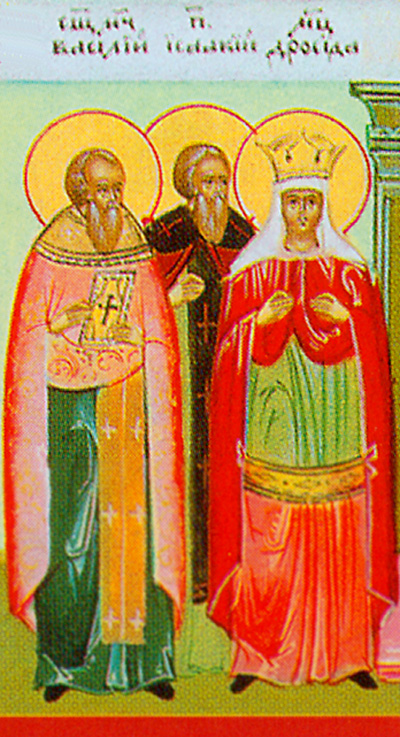
Martyr Drosίs, daughter of Emperor Trajan

The Holy Martyr Drosίs, and five Virgin Martyrs with her: Agalϊda (Αγλαϊδα), Apollinarίa (Ἀπολλιναρία), Daria (Δαρεία), Mamousa (Μαμούσα), and Thaϊs (Θαΐς).

Saint Drosίs was the daughter of Emperor Trajan (98-117), a fierce persecutor of Christians. In the year 99 he revived an earlier law which forbade secret gatherings, and applied it to the Christians. In the year 104 he issued a special edict against Christians.

Beginning in that year, the persecutions continued until the end of his reign. The bodies of martyred Christians often remained unburied in order to intimidate others. Five Christian virgins: Agalϊda, Apollinarίa, Daria, Mamousa, and Thaϊs, took upon themselves the task of burying such Christians. In secret, they took the Martyrs' bodies, anointed them with spices, wrapped them in shrouds, and buried them. When she learned of this, Drosίs, who was a secret Christian (but not yet baptized) asked the holy virgins to take her with them when they went to bury Christians.

Hadrian, an advisor to the Emperor, who was also the suitor of Drosίs, informed Trajan of the women's activities. A guard was posted over those who had been killed, with orders to arrest anyone who attempted to bury them. Saint Drosίs and the five virgins were caught on the very first night. Learning that one of the captives was his own daughter, Trajan ordered her to be held separately, hoping that she would change her mind.

The five Holy Virgin Martyrs were sentenced to burn in a furnace for melting copper. They went to their death courageously, and received their imperishable crowns of martyrdom. This copper, mingled with the ashes of the Martyrs, was used to make tripods for the new public bath which Trajan had built. As as long as these tripods stood in the bath, no one could enter it. Whoever crossed the threshold was struck dead at once. When the pagan priests realized why this was happening, they ordered the tripods to be removed and melted down. Then Hadrian suggested that the Emperor should have five bronze statues of naked virgins made to resemble the Martyrs, and place them before the entrance to the public bath.

When the statues were in place, Trajan saw in a dream five pure lambs pastured in Paradise, and the Shepherd who said to him, “O most wanton and wicked Caesar! Those whose images you placed there to be mocked have been taken away from you and brought here by the Good and Merciful Shepherd. In time your daughter, the pure lamb Drosίs, shall be here as well.”

When he awoke, Trajan was furious, and ordered two huge furnaces to be heated. Nearby, an imperial edict was posted: You who worship the Crucified one; save yourselves from a lot of suffering, and also spare us these labors. Offer sacrifice to the gods. If you do not wish to do this, however, then let each of you voluntarily cast himself into this furnace.”

Many Christians chose martyrdom.

When she heard of this, Saint Drosίs also decided to suffer martyrdom for Christ. She prayed in her prison, asking the Lord to set her free. God heard her prayer, and the guards fell asleep. Saint Drosίs went to the furnace, but she wondered: “How can I go to God without a wedding garment (i.e., without being baptized), for I am impure? But, O King of Kings, Lord Jesus Christ, for Your sake I give up my imperial rank, so that I might become the lowliest handmaiden in Your Kingdom. Baptize me Yourself by Your Holy Spirit.”

After praying in this manner, Saint Drosίs anointed herself with myrrh [chrism], which she had brought with her, and immersing herself in water three times, she said: “The handmaiden of God Drosίs is baptized in the Name of the Father, and of the Son, and of the Holy Spirit.”

The Saint hid for seven days, spending her time in fasting and prayer. Some Christians found her and learned from her everything that had occurred. On the eighth day, the Holy Martyr Drosίs went to the furnace and cast herself into the fire.1


1 Some sources state that Saint Drosίs reposed in peace. According to the calendar of the Russian Orthodox Church, however, she is listed as a martyr (Святая мученица Дросида).

Venerable Isaac the Confessor, Founder of the Dalmatian Monastery at Constantinople

Saint Isaac, the founder of the Dalmaton Monastery (Μονή Δαλμάτων) at Constantinople, lived during the IV century, in the reign of Emperor Valens (364-378), who was an adherent of the Arian heresy.

Saint Isaac was tonsured as a monk when he was young, and through his ascetical struggles in the desert, he acquired every virtue. He was also found worthy of receiving the gift of prophecy from God. When he learned that Orthodox Christians were being persecuted, and their churches were being closed or destroyed, he left the wilderness and went to Constantinople to console and encourage the Orthodox, and to oppose the heretics. At that time, the barbarian Goths along the Danube River were waging war against the Empire. They had captured Thrace and were advancing toward Constantinople.

As Emperor Valens was leaving the capital with his soldiers, Saint Isaac cried out, “Emperor, reopen the churches of the Orthodox, and then the Lord will help you!”

The Emperor ignored the Saint's words and continued on his way. The next day, Isaac ran out to warn the Emperor again. Valens, moved by Isaac's boldness and sincerity, was almost persuaded to do as he asked. However, one of his advisors (an Arian) convinced him not to grant the Saint's request. On the third day the Saint stood in Emperor's path and grabbed the bridle of his horse, repeating his request; sometimes in a pleading tone, and sometimes in a reproachful manner. He also threatened divine retribution if Valens did not honor his request. Offended by Isaac's audacity, Valens had him thrown into a deep pit filled with mud and thorns, from which it was impossible to escape.

With God’s help, however, Saint Isaac was able to get out of the pit. He overtook the Emperor and said, “You wanted to destroy me, but Angels pulled me out of the mire. Hear me! Reopen the churches for the Orthodox and you shall defeat the enemy. If you do not heed me, however, then you shall not return. You will be captured and burned alive. Learn from experience that it hurts you to kick against the goads" (Acts 26:14).1

The Emperor was astonished at the Saint's boldness and ordered his attendants Saturninus and Victor to seize the monk and keep him in prison until his return.

Saint Isaac’s prophecy was soon fulfilled. On August 9, 378 a fierce battle was fought near Adrianoupolis, during which the imperial army was defeated, and many excellent generals were killed. Valens and his chief of staff took refuge in a barn filled with straw, and the attackers set it ablaze. The two men were burnt alive, just as Isaac had foretold.

Back in Constantinople, some of the soldiers who survived the battle came to Isaac's prison cell and said to him, "Prepare to make your defense before the Emperor, who is coming to put you on trial."

Isaac replied, "The stench of his charred bones has assailed my nostrils for more than seven days."

When this event became known, the clergy and the people released Saint Isaac from prison. With great respect, they approached him in order to receive his blessing, Then the holy Emperor Theodosios the Great (379-395) came to the throne. On the advice of Saturninus and Victor, he summoned the Elder, according him much honor. Obeying his instructions, he banished the Arians from Constantinople and restored the churches to the Orthodox. Saint Isaac wanted to return to his desert, but Saturninus and Victor begged him not to leave the city, but to remain and protect it by his prayers.

Saint Isaac was present at the Second Ecumenical Council at Constantinople in 381, where he was responsible for much of its success because of his zeal in defending Orthodox doctrine.

Saturninus built a monastery for the Saint in Constantinople, where monks gathered around him. Saint Isaac was the monastery’s Igoumen and spiritual guide. He also nourished laypeople, and helped many of the poor and suffering.

Sensing his approaching death, Saint Isaac appointed Saint Dalmatios (August 3) to succeed him as the Igoumen. The monastery was later renamed for Saint Dalmatios (Δαλμάτιος).

Saint Isaac went to the Lord in the year 383. He is also commemorated with Saints Dalmatios and Faustos on August 3. In Greek usage, however, Saint Isaac is commemorated on May 30.


1 A Greek proverb signifying that resistance is futile. Examples may be found in the plays of Euripides (Bacchae); Aeschylus (Agamemnon & Prometheus); and in Pindar's second Pythian Ode).

Monastic Martyr Euthymius of Prodromou, Mount Athos

This holy New Martyr of Christ was born in Demitsana in the Peloponnesos. His parents were Panagiotes and Maria, and he was given the name Eleutherius in Baptism. Eleutherius was the youngest of five children (the others were George, Christos, John, and Katerina).

After attending school in Demetsana, Eleutherius and John traveled to Constantinople to enroll in the Patriarchal Academy. Later, they went to Jassy, Romania where their father and brothers were in business. Some time afterwards, Eleutherius decided to go to Mt. Athos to become a monk. Because of a war between Russia and Turkey, he was able to travel only as far as Bucharest. There he stayed with the French consul, then with an employee of the Russian consul.

Eleutherius began to pursue a life of pleasure, putting aside his thoughts of monasticism. When hostilities ceased, Eleutherius made his way to Constantinople in the company of some Moslems. On the way, he turned from Orthodoxy and embraced Islam. He was circumcised and given the name Reschid. Soon his conscience began to torment him for his denial of Christ. The other Moslems began to notice a change in his attitude, so they restricted his movements and kept a close watch on him.

One day Eleutherius was seen wearing a cross, so the others reported him to the master of the house, Rais Efendi. The master favored Eleutherius, which made the others jealous. He told them it was still too early for Eleutherius to give up all his Christian ways.

Rais Efendi and his household journeyed to Adrianople, arriving on a Saturday. Metropolitan Cyril, who later became Patriarch of Constantinople, was serving Vespers in one of the city’s churches. Eleutherius pretended to have letters for Metropolitan Cyril, but he sent someone else to receive them. When Eleutherius told this man that he wanted Christian clothes, he became suspicious and sent him away.

Back in Constantinople, Rais Efendi gave Eleutherius costly presents, hoping to influence him to remain a Moslem. Eleutherius, however, prayed that God would permit him to escape. He ran off at the first opportunity, seeking out a priest from the Peloponnesos who lived near the Patriarchate. After relating his story, Eleutherius asked the priest to help him get away. The priest refused to assist him, fearing reprisals if he should be caught. He gave Eleutherius some advice, then sent him away.

With some assistance from the Russian embassy, Eleutherius boarded a ship and sailed to Mt. Athos. At the Great Lavra Eleutherius was chrismated and received back into the Orthodox Church, and also became a monk with the name Euthymius.

Euthymius read the New Martyrologion of Saint Νikόdēmos (July 14), and was inspired by the example of the New Martyrs. He then became consumed with a desire to wipe out his apostasy with the blood of martyrdom.

Saint Euthymius went to Constantinople with a monk named Gregory, arriving on March 19, 1814. A few days later, on Palm Sunday, he received Holy Communion. Removing his monastic garb, he dressed himself as a Moslem and went to the palace of the Grand Vizier, Rusud Pasha. Saint Euthymius, holding palms in his hand, confessed that he was an Orthodox Christian, and wished to die for Christ. He denounced Mohammed and the Moslem religion, then trampled upon the turban he had worn on his head, which led the Vizier to believe that he was either drunk or crazy.

The valiant warrior of Christ assured the Vizier that he was in his right mind, and was not drunk. Euthymius was thrown into a dark cell and bound with chains. After an hour or so, they brought him out again. With flattery and promises of wealth, the Vizier tried to convince Euthymius to return to the Moslem faith. The saint boldly declared that Islam was a religion based on fables and falsehood, and that he would not deny Christ again even if he were to be tortured and slain.

The Grand Vizier ordered the saint to be beaten and returned to prison. After three hours, Saint Euthymius was brought before Rusud Pasha, who said to him, “Have you reconsidered, or do you remain stubborn?”

Euthymius replied, “There is only one true Faith, that of the Orthodox Christians. How can I believe in your false prophet Mohammed?”

Now the Vizier realized that he would never convince Euthymius to return to Islam, so he ordered him to be put to death by the sword. When the executioner attempted to tie the saint’s hands he said, “I came here voluntarily, so there is no need to bind my hands.Allow me to meet my death untied.”

Saint Euthymius was allowed to walk to the place of execution unbound. He went joyfully and unafraid, holding a cross in his right hand, and palms in his left. When they arrived at the site, Euthymius faced east and began to pray. He thanked God for making him worthy of martyrdom for His sake. He also prayed for his family and friends, asking God to grant all their petitions which are unto salvation.

Then Saint Euthymius kissed the cross he was holding, then knelt and bent his neck. The executioner struck a fierce blow with the sword, but this did not behead him. He struck again, and failed to kill him. Finally, he took a knife and slit the martyr’s throat.

Saint Euthymius was killed about noon on March 22, 1814 in Constantinople, thereby earning a place in the heavenly Kingdom where he glorifies the holy, consubstantial, and life-creating Trinity, the Father, the Son, and the Holy Spirit, forevermore.

The head of Saint Euthymius is in the Russian monastery of Saint Panteleimon on Mt Athos.

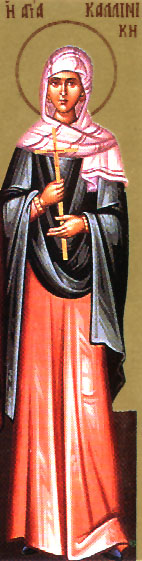
Martyrs Kalliniki and Basilissa

Saints Basilissa (Βασίλισσα) and Kalliniki (Καλλίνικη) were from Galatia. Since Saint Basilissa was wealthy, she gave money to Saint Kalliniki to go to the prison and distribute it to the Christians who were confined there for their sustenance, and so they would pray for her. She wished to prepare them for martyrdom and to stand by them so that they would not lose their courage amid their tribulations.

One day Saint Kalliniki was arrested and they asked her why she was giving the prisoners money. Since she did not know how to lie, she admitted the truth. That is why they tied her up and handed her over to the ruler. Afterward, Saint Basilissa was arrested and was brought before him in court. Both women boldly confessed Christ and were subjected to various tortures, in an attempt to make them deny their faith and offer sacrifice to the idols.

Since they could not be persuaded to do so, their sacred heads were cut off with swords. In this manner they defeated the devil and rejoiced in the Kingdom of Heaven. The martyrdom of the Holy Martyrs Basilissa and and Kalliniki took place in the year 252, during the reign of Emperor Gallus (251-253).

Daily Readings for Friday, March 21, 2025

3RD FRIDAY OF LENT

ABSTAIN FROM MEAT, FISH, DAIRY, EGGS, WINE, OLIVE OIL

James the Confessor, Thomas I, Patriarch of Constantinople, Philemon and Domninos

ISAIAH 13:2-13

On a bare hill raise a signal, cry aloud to them; wave the hand for them to enter the gates of the nobles. I myself have commanded my consecrated ones, have summoned my mighty men to execute my anger, my proudly exulting ones. Hark, a tumult on the mountains as of a great multitude! Hark, an uproar of kingdoms, of nations gathering together! The LORD of hosts is mustering a host for battle. They come from a distant land, from the end of the heavens, the LORD and the weapons of his indignation, to destroy the whole earth. Wail, for the day of the LORD is near; as destruction from the Almighty it will come! Therefore all hands will be feeble, and every man's heart will melt, and they will be dismayed. Pangs and agony will seize them; they will be in anguish like a woman in travail. They will look aghast at one another; their faces will be aflame. Behold, the day of the LORD comes, cruel, with wrath and fierce anger, to make the earth a desolation and to destroy its sinners from it. For the stars of the heavens and their constellations will not give their light; the sun will be dark at its rising and the moon will not shed its light. I will punish the world for its evil, and the wicked for their iniquity; I will put an end to the pride of the arrogant, and lay low the haughtiness of the ruthless. I will make men more rare than fine gold, and mankind than the gold of Ophir. Therefore I will make the heavens tremble, and the earth will be shaken out of its place, at the wrath of the LORD of hosts in the day of his fierce anger.

GENESIS 8:4-21

And in the seventh month, on the seventeenth day of the month, the ark came to rest upon the mountains of Ararat. And the waters continued to abate until the tenth month; in the tenth month, on the first day of the month, the tops of the mountains were seen. At the end of forty days Noah opened the window of the ark which he had made, and sent forth a raven; and it went to and fro until the waters were dried up from the earth. Then he sent forth a dove from him, to see if the waters had subsided from the face of the ground; but the dove found no place to set her foot, and she returned to him to the ark, for the waters were still on the face of the whole earth. So he put forth his hand and took her and brought her into the ark with him. He waited another seven days, and again he sent forth the dove out of the ark; and the dove came back to him in the evening, and lo, in her mouth a freshly plucked olive leaf; so Noah knew that the waters had subsided from the earth. Then he waited another seven days, and sent forth the dove; and she did not return to him any more. In the six hundred and first year, in the first month, the first day of the month, the waters were dried from off the earth; and Noah removed the covering of the ark, and looked, and behold, the face of the ground was dry. In the second month, on the twenty-seventh day of the month, the earth was dry. Then God said to Noah, "Go forth from the ark, you and your wife, and your sons and your sons' wives with you. Bring forth with you every living thing that is with you of all flesh – birds and animals and every creeping thing that creeps on the earth – that they may breed abundantly on the earth, and be fruitful and multiply upon the earth." So Noah went forth, and his sons and his wife and his sons' wives with him. And every beast, every creeping thing, and every bird, everything that moves upon the earth, went forth by families out of the ark. Then Noah built an altar to the LORD, and took of every clean animal and of every clean bird, and offered burnt offerings on the altar. And when the LORD smelled the pleasing odor, the LORD said in his heart, "I will never again curse the ground because of man, for the imagination of man's heart is evil from his youth; neither will I ever again destroy every living creature as I have done.

PROVERBS 10:31-11:12

The mouth of the righteous brings forth wisdom, but the perverse tongue will be cut off. The lips of the righteous know what is acceptable, but the mouth of the wicked, what is perverse. A false balance is an abomination to the LORD, but a just weight is his delight. When pride comes, then comes disgrace; but with the humble is wisdom. The integrity of the upright guides them, but the crookedness of the treacherous destroys them. Riches do not profit in the day of wrath, but righteousness delivers from death. The righteousness of the blameless keeps his way straight, but the wicked falls by his own wickedness. The righteousness of the upright delivers them, but the treacherous are taken captive by their lust. When the wicked dies, his hope perishes, and the expectation of the godless comes to nought. The righteous is delivered from trouble, and the wicked gets into it instead. With his mouth the godless man would destroy his neighbor, but by knowledge the righteous are delivered. When it goes well with the righteous, the city rejoices; and when the wicked perish there are shouts of gladness. By the blessing of the upright a city is exalted, but it is overthrown by the mouth of the wicked. He who belittles his neighbor lacks sense, but a man of understanding remains silent.

Saint James the Confessor, Bishop of Catania

Saint James, Bishop and Confessor was inclined toward the ascetic life from his early years. Saint James left the world and entered the Studite monastery, where he was tonsured. He led a strict life, full of works, fasting and prayer. Pious and well-versed in Holy Scripture, Saint James was elevated to the bishop’s throne of Catania (Sicily).

During the reign of the iconoclast emperor Constantine V Copronymos (741-775), Saint James was repeatedly urged not to venerate the holy icons. They exhausted him in prison, starved him, and beat him, but he bravely endured all these torments. Saint James died in exile.

Saint Cyril, Bishop of Catania

Saint Cyril was born in Antioch. He was a disciple of the Apostle Peter (June 29, January 16), who installed him as Bishop of Catania in Sicily. Saint Cyril wisely guided his flock; he was pious, and the Lord granted him the gift of wonderworking. By his prayer the bitter water in a certain spring lost its bitterness and became drinkable. This miracle converted many pagans to Christianity. Saint Cyril died in old age and was buried in Sicily.

Saint Thomas, Patriarch of Constantinople

Saint Thomas, Patriarch of Constantinople, was at first a deacon, and later under the holy Patriarch John IV the Faster (582-595) he was made “sakellarios” [sacristan] in the Great Church (Hagia Sophia). After the death of holy Patriarch Cyriacus (595-606), Saint Thomas was elevated to the Patriarchal throne in 607. The saint concerned himself in every possible way about the spiritual needs of his flock.

During the patriarchate of Saint Thomas, an ominous portent appeared in the land of Galatia (Asia Minor). The heavy crosses which were carried during church processions began to shake and to strike against each other. The clairvoyant Elder, Saint Theodore Sykeotes (April 22), explained the meaning of this portent. He said that discords and disasters awaited the Church, and the state was in danger of barbarian invasion. Hearing this, the saint became terrified and asked Saint Theodore to pray that God would take his soul before these predictions were fulfilled.

After the death of the holy Patriarch Thomas in 610, disorders started in the Church. Saint Thomas’s successor, Patriarch Sergius (610-638), fell into the Monothelite heresy. Through God’s dispensation, war broke out with Persia, which proved grievous for Byzantium. The Greek regions of Asia Minor were completely devastated, Jerusalem fell, and the Life-Creating Cross of the Lord was captured and taken to Persia. Thus, all the misfortunes portended by the miracle during the church procession came to pass.

Venerable Seraphim of Vyritsa

Basil Muraviev (the future Saint Seraphim) was born in 1865 in the town of Cheremovsky in the Yaroslavl province. His parents, Nicholas and Chione, were peasants. When Basil was ten years old, his father died, and he was left to care for his ailing mother and his sister Olga.

A kind neighbor took Basil with him to Saint Petersburg, and found him a job as a store clerk. The boy had a secret desire to become a monk, so one day he went to the Saint Alexander Nevsky Lavra to speak to one of the Elders about this. The Elder advised him to remain in the world and raise a family, then after their children had grown, he and his wife were to serve God in the monastic life.

Basil accepted these words as the will of God, and so he lived his life as the Elder had directed. Returning to the store, Basil continued to work and send money home to his family. When he was twenty-four years old, Basil married his wife Olga.

He started his own business as a furrier, and became very wealthy. He had a son, Nicholas and a daughter, Olga. After their daughter’s death, Basil and his wife agreed to live together as brother and sister from that time forward.

When he was around thirty, Basil gave away most of his wealth, donating money to various monasteries. When Nicholas was grown, Basil and Olga went to monasteries to serve God. Olga was tonsured in 1919 with the name Christina, and lived in the Resurrection-New Divyevo Monastery in Saint Petersburg. Later, she was tonsured into the schema and was given the name Seraphima. She died in 1945.

We do not know where Basil received monastic tonsure (some say it was on Mt Athos), nor the new name he was given at that time.

In 1927, he arrived at the Saint Alexander Nevsky Lavra, where he became Father Confessor to the monks. There he was tonsured into the schema with the name Seraphim. Soon it became apparent that Saint Seraphim had received from God the gifts of clairvoyance and healing, and many people came to him seeking his help and advice.

Bishop Alexei (Shimansky) of Novgorod came to the Elder in 1927 to ask if he should leave Russia, since many bishops and priests were facing arrest and execution under the Communist yoke. Before the bishop could utter a word, Saint Seraphim said, “Many now wish to leave Russia, but there is nothing to fear. You are needed here. You will become Patriarch and will rule for twenty-five years.”

A time of trial came for the Lavra. Monks were arrested, exiled, and sent to labor camps. Many of them were executed. Beginning in 1929, the Elder was arrested fourteen times. He continued his priestly ministry in the prison camps, where he strengthened and encouraged his fellow-prisoners.

In 1933, the Elder returned from the camps and settled in Vyritsa. This was a very beautiful place with forests and a river, and it was known for its healthy climate. Saint Seraphim’s health had deteriorated in the prison camps, and he had been beaten many times.

A wooden church in honor of the Kazan Icon of the Most Holy Theotokos had been built in Vyritsa in 1913 to commemorate the three hundredth anniversary of the Romanov dynasty. The upper church has two altars: one dedicated to the Kazan Icon, the other to Saint Nicholas. The lower church was dedicated to Saint Seraphim of Sarov.

After he had recovered somewhat, Father Seraphim began to receive visitors who came seeking advice and comfort from him. Many of those afflicted with illness received healing by his prayers. The authorities soon noticed the great numbers of people who came to him. His cell was searched many times, usually at night. Once, the police came to arrest the Elder, but a doctor told them that Father Seraphim would not survive the trip because of his many infirmities. They decided to leave him alone, and so the Lord preserved the life of His servant.

The Germans entered Vyritsa in September of 1941, but no one was harmed, and there was no looting. During the War, Father Seraphim became weak and now served only rarely in the chapel of Saint Seraphim. Starting in 1945, Father Alexei Kibardin began serving in the Kazan church.

By the spring of 1949, Saint Seraphim was very weak and had to remain in bed. Still, he permitted visitors to come to him as before.

Shortly before his death, the Most Holy Theotokos appeared to Saint Seraphim and told him to receive Holy Communion every day. Father Alexei Kibardin would bring him Communion at 2 AM, but once he overslept and did not come until 4 AM. He apologized to the Elder for his tardiness, and noticed that there was a certain radiance around the saint. The Elder said, “Father, do not worry. The holy angels have already brought me Communion.” Seeing his face, Father Alexei knew that this was absolutely true!

The Elder told Father Alexei to go to Moscow and inform Patriarch Alexei I that he would depart to the Lord in two weeks. When Father Alexei relayed the message, the Patriarch turned to the holy icons and crossed himself. When he turned around again, tears were streaming down his cheeks. “I have been Patriarch for four years,” he said. “Twenty-one years remain to me. This is what the holy Elder told me.” Patriarch Alexei died in 1970, just as Saint Seraphim foretold.

Saint Seraphim departed to the Lord on March 21, 1949 (April 3 N.S.). In the hours before his death, he asked that the Akathists to the Most Holy Theotokos, to Saint Seraphim of Sarov, and to Saint Nicholas be read. For a week after his blessed repose, a sweet fragrance permeated Vyritsa.

Saint Seraphim was buried in the cemetery next to the church of the Kazan Icon in Vyritsa. Great throngs of people came for the funeral, and Vyritsa became a place of pilgrimage.

The schemamonk Saint Seraphim was glorified by the Church of Russia in August of 2000.

Saint Serapion, Bishop of Thmuis in Lower Egypt

Saint Serapion lived in Egypt during the fourth century. He is known as “the Sindonite” because he wore only rough linen clothing (sindona). From the time of his youth he lived like the birds of the air (Matthew 6:26). He had no shelter, and for several days at a time he would eat no food, because he did not have money to buy bread. When he saw a beggar shivering from the cold, he gave him his sindon, and was left half-naked. He proved to be a prime example of philanthropy and mercy, distributing his own wealth, and whatever his faithful visitors gave him for himself, to the poor. Then he became a monk and lived in the desert of Sketis. He was dedicated to spreading the Word of God in many different ways.

Once he fell into the hands of a bandit, and by his powers of persuasion he managed to turn the tables on him, and made this robber a servant of God. He also managed to convert the Manichean heretic Lakedaimon to Orthodoxy.

A certain Greek philosopher, who wanted to test the monk’s honesty, gave him a gold coin and began to watch him. The Saint went to a bread merchant, took one loaf and gave the gold coin to the merchant, walking away with no idea of the coin’s value.

Saint Serapion led many people to the path of salvation in special ways. Once he sold himself into slavery to a Greek actor who wanted to convert to Christ. The actor was astonished by the righteous one’s holy life, and so he believed and was baptized with his family. He implored Saint Serapion to remain with him, not as a slave, but as a mentor and friend. The monk left, however, without taking the money that was offered to him.

Departing for Rome, Saint Serapion boarded a ship, but did not pay the sailors anything for his passage. At first, they began to reproach him for this, but when they saw that the Elder did not eat anything for five days, they began to feed him for the sake of God, and thereby fulfilled the commandment of the Lord. In Rome, the monk continued to travel, going from house to house, having nothing, gathering only spiritual riches for himself and for his neighbor.

Later he was made Bishop of Thmuis in Lower Egypt. He had been a disciple of Saint Anthony the Great (January 17), and later he wrote A Letter on the Death of Saint Anthony. He was also a friend and supporter of Saint Athanasios of Alexandria (January 18 & May 2). At the end of the nineteenth century a collection of liturgical texts, ascribed to Saint Serapion, was discovered.

In the end he returned to his beloved desert, where he reposed peacefully in deep old age in the year 370, an example for all the monks.