
3RD MONDAY OF LENT
ABSTAIN FROM MEAT, FISH, DAIRY, EGGS, WINE, OLIVE OIL
Alexis the Man of God, Paul the Righteous Martyr, Patrick the Enlightener of Ireland, Marinos the Martyr, Theocteristos the Confessor
ISAIAH 8:13-9:7
But the LORD of hosts, him you shall regard as holy; let him be your fear, and let him be your dread. And he will become a sanctuary, and a stone of offense, and a rock of stumbling to both houses of Israel, a trap and a snare to the inhabitants of Jerusalem. And many shall stumble thereon; they shall fall and be broken; they shall be snared and taken.” Bind up the testimony, seal the teaching among my disciples. I will wait for the LORD, who is hiding his face from the house of Jacob, and I will hope in him. Behold, I and the children whom the LORD has given me are signs and portents in Israel from the LORD of hosts, who dwells on Mount Zion. And when they say to you, “Consult the mediums and the wizards who chirp and mutter, ” should not a people consult their God? Should they consult the dead on behalf of the living? To the teaching and to the testimony! Surely for this word which they speak there is no dawn. They will pass through the land, greatly distressed and hungry; and when they are hungry, they will be enraged and will curse their king and their God, and turn their faces upward; and they will look to the earth, but behold, distress and darkness, the gloom of anguish; and they will be thrust into thick darkness. But there will be no gloom for her that was in anguish. In the former time he brought into contempt the land of Zebulun and the land of Naphtali, but in the latter time he will make glorious the way of the sea, the land beyond the Jordan, Galilee of the nations. The people who walked in darkness have seen a great light; those who dwelt in a land of deep darkness, on them has light shined. Thou hast multiplied the nation, thou hast increased its joy; they rejoice before thee as with joy at the harvest, as men rejoice when they divide the spoil. For the yoke of his burden, and the staff for his shoulder, the rod of his oppressor, thou hast broken as on the day of Midian. For every boot of the tramping warrior in battle tumult and every garment rolled in blood will be burned as fuel for the fire. For to us a child is born, to us a son is given; and the government will be upon his shoulder, and his name will be called “Wonderful Counselor, Mighty God, Everlasting Father, Prince of Peace.” Of the increase of his government and of peace there will be no end, upon the throne of David, and over his kingdom, to establish it, and to uphold it with justice and with righteousness from this time forth and for evermore. The zeal of the LORD of hosts will do this.
GENESIS 6:9-22
These are the generations of Noah. Noah was a righteous man, blameless in his generation; Noah walked with God. And Noah had three sons, Shem, Ham, and Japheth. Now the earth was corrupt in God’s sight, and the earth was filled with violence. And God saw the earth, and behold, it was corrupt; for all flesh had corrupted their way upon the earth. And God said to Noah, “I have determined to make an end of all flesh; for the earth is filled with violence through them; behold, I will destroy them with the earth. Make yourself an ark of gopher wood; make rooms in the ark, and cover it inside and out with pitch. This is how you are to make it: the length of the ark three hundred cubits, its breadth fifty cubits, and its height thirty cubits. Make a roof for the ark, and finish it to a cubit above; and set the door of the ark in its side; make it with lower, second, and third decks. For behold, I will bring a flood of waters upon the earth, to destroy all flesh in which is the breath of life from under heaven; everything that is on the earth shall die. But I will establish my covenant with you; and you shall come into the ark, you, your sons, your wife, and your sons’ wives with you. And of every living thing of all flesh, you shall bring two of every sort into the ark, to keep them alive with you; they shall be male and female. Of the birds according to their kinds, and of the animals according to their kinds, of every creeping thing of the ground according to its kind, two of every sort shall come in to you, to keep them alive. Also take with you every sort of food that is eaten, and store it up; and it shall serve as food for you and for them.” Noah did this; he did all that God commanded him.
PROVERBS 8:1-21
Does not wisdom call, does not understanding raise her voice?
On the heights beside the way, in the paths she takes her stand; beside the gates in front of the town, at the entrance of the portals she cries aloud:
To you, O men, I call, and my cry is to the sons of men.
O simple ones, learn prudence; O foolish men, pay attention.
Hear, for I will speak noble things, and from my lips will come what is right; for my mouth will utter truth; wickedness is an abomination to my lips.
All the words of my mouth are righteous; there is nothing twisted or crooked in them.
They are all straight to him who understands and right to those who find knowledge.
Take my instruction instead of silver, and knowledge rather than choice gold; for wisdom is better than jewels, and all that you may desire cannot compare with her.
I, wisdom, dwell in prudence, and I find knowledge and discretion.
The fear of the LORD is hatred of evil. Pride and arrogance and the way of evil and perverted speech I hate.
I have counsel and sound wisdom, I have insight, I have strength.
By me kings reign, and rulers decree what is just; by me princes rule, and nobles govern the earth.
I love those who love me, and those who seek me diligently find me.
Riches and honor are with me, enduring wealth and prosperity.
My fruit is better than gold, even fine gold, and my yield than choice silver.
I walk in the way of righteousness, in the paths of justice, endowing with wealth those who love me, and filling their treasuries.
Venerable Alexis the Man of God

Saint Alexis was born at Rome into the family of the pious and poverty-loving Euphemianus and Aglais. The couple was childless for a long time and constantly prayed the Lord to grant them a child. And the Lord consoled the couple with the birth of their son Alexis.
At six years of age the child began to read and successfully studied the mundane sciences, but it was with particular diligence that he read Holy Scripture. When he was a young man, he began to imitate his parents: he fasted strictly, distributed alms and beneath his fine clothing he secretly wore a hair shirt. Early on there burned within him the desire to leave the world and serve God. His parents, however, had arranged for Alexis to marry a beautiful and virtuous bride.
On his wedding night, Alexis gave her his ring and his belt (which were very valuable) and said, “Keep these things, Beloved, and may the Lord be with us until His grace provides us with something better.” Secretly leaving his home, he boarded a ship sailing for Mesopotamia.
Arriving in the city of Edessa, where the Icon of the Lord “Not-made-by-Hands” (August 16) was preserved, Alexis sold everything that he had, distributed the money to the poor and began to live near the church of the Most Holy Theotokos under a portico. The saint used a portion of the alms he received to buy bread and water, and he distributed the rest to the aged and infirm. Each Sunday he received the Holy Mysteries.
The parents sought the missing Alexis everywhere, but without success. The servants sent by Euphemianus also arrived in Edessa, but they did not recognize the beggar sitting at the portico as their master. His body was withered by fasting, his comeliness vanished, his stature diminished. The saint recognized them and gave thanks to the Lord that he received alms from his own servants.
The inconsolable mother of Saint Alexis confined herself in her room, incessantly praying for her son. His wife also grieved with her in-laws.
Saint Alexis dwelt in Edessa for seventeen years. Once, the Mother of God spoke to the sacristan of the church where the saint lived: “Lead into My church that Man of God, worthy of the Kingdom of Heaven. His prayer rises up to God like fragrant incense, and the Holy Spirit rests upon him.” The sacristan began to search for such a man, but was not able to find him for a long time. Then he prayed to the Most Holy Theotokos, beseeching Her to clear up his confusion. Again a voice from the icon proclaimed that the Man of God was the beggar who sat in the church portico.
The sacristan found Saint Alexis and brought him into the church. Many recognized him and began to praise him. The saint secretly boarded a ship bound for Cilicia, intending to visit the church of Saint Paul in Tarsus. But God ordained otherwise. A storm took the ship far to the West and it reached the coast of Italy. The saint journeyed to Rome and decided to live in his own house. Unrecognized, he humbly asked his father’s permission to settle in some corner of his courtyard. Euphemianus settled Alexis in a specially constructed cell and gave orders to feed him from his table.
Living at his parental home, the saint continued to fast and he spent day and night at prayer. He humbly endured insults and jeering from the servants of his father. The cell of Alexis was opposite his wife’s windows, and the ascetic suffered grievously when he heard her weeping. Only his immeasurable love for God helped the saint endure this torment. Saint Alexis dwelt at the house of his parents for seventeen years and the Lord revealed to him the day of his death. Then the saint, taking paper and ink, wrote certain things that only his wife and parents would know. He also asked them to forgive him for the pain he had caused them.
On the day of Saint Alexis’ death in 411, Archbishop Innocent (402-417) was serving Liturgy in the presence of the emperor Honorius (395-423). During the services a Voice was heard from the altar: “Come unto Me, all ye who labor and are heavy laden, and I will give you rest” (Mt.11:28). All those present fell to the ground in terror.
The Voice continued: “On Friday morning the Man of God comes forth from the body; have him pray for the city, that you may remain untroubled.” They began to search throughout Rome, but they did not find the saint. Thursday evening the Pope was serving Vigil in the Church of Saint Peter. He asked the Lord to show them where to find the Man of God.
After Liturgy the Voice was heard again in the temple: “Seek the Man of God in the house of Euphemianus.” All hastened there, but the saint was already dead. His face shone like the face of an angel, and his hand clasped the paper, and they were unable to take it. They placed the saint’s body on a cot, covered with costly coverings. The Pope and the Emperor bent their knees and turned to the saint, as to one yet alive, asking him to open his hand. And the saint heard their prayer. When the letter was read, the righteous one’s wife and parents tearfully venerated his holy relics.
The body of the saint was placed in the center of the city. The emperor and the Pope carried the body of the saint into the church, where it remained for a whole week, and then was placed in a marble crypt. A fragrant myrrh began to flow from the holy relics, bestowing healing upon the sick.
The venerable relics of Saint Alexis, the Man of God, were buried in the church of Saint Boniface. The relics were uncovered in the year 1216.
The Life of Saint Alexis, the Man of God, was always very popular in Russia.
Venerable Macarius the Wonderworker, Abbot of Kalyazin
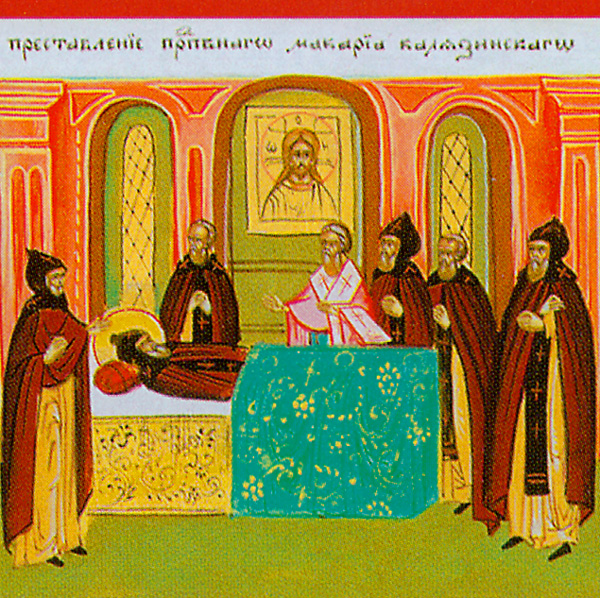
Saint Macarius of Kalyazin (in the world Matthew) was born in 1400 in the village of Gribkovo (Kozhino), near the city of Kashin, into the family of the boyar Basil Kozha. From youth he yearned for monasticism, but he married at the insistence of his parents.
After a year his parents died, and after three more years his wife Elena also reposed. Having nothing to bind him to his former life, Matthew became a monk at the Nikolaev Klobukov monastery. Desiring solitude, he left the city monastery with the abbot’s blessing, and he found a suitable place between two lakes, eighteen versts from Kashin. Here the monk raised a cross and founded a solitary wilderness monastery.
The boyar Ivan Kolyaga, to whom the nearby lands belonged, began to fear that a monastery would grow up there, and that monks would begin to cultivate the wastelands. The Enemy of our salvation planted such spite and enmity in the boyar, that he decided to kill the saint. Suddenly, he was stricken with a grievous illness. Fear of death awakened repentance in the boyar. Ivan Kolyaga was carried to the saint and told him of his evil intent, asking forgiveness.
“God forgive you”, the humble ascetic replied. Wishing to expiate his sin and to help the saint, the boyar gave his lands to the growing monastery. The monks built a temple dedicated to the Most Holy Trinity. Word of the boyar Kolyaga’s conversion brought many people to the monk, seeking salvation. Saint Macarius tonsured Kolyaga and named the monastery Kalyazin for him.
It became necessary to choose an igumen. Saint Macarius was then fifty-three years of age, but he considered himself unworthy of this dignity and he asked each of the older men coming to him to become the monastery’s priest and igumen. Yielding to the common will, the saint was made igumen by Bishop Moses of Tver.* The new igumen prepared for his first service at the altar of God with long solitary prayer, and then communed all the brethren with the Holy Mysteries.
In the rank of igumen, Saint Macarius labored to guide the brethren. The monastery had two chalices, a diskos and two plates fashioned by Saint Macarius on a lathe. He guided not only the monks, but also laypeople coming to the monastery, dealing with both the educated and the simple.
Despite his noble origin and his position of igumen, the saint wore ragged, frayed and patched clothing. In his conduct and his way of life Saint Macarius was so simple that the haughty heretic Vassian, sneeringly called him the “peasant of Kalyazin.” The saint preferred to hear himself mocked rather than praised. He went to solitary places, delighted to be alone with nature. Wild animals, sensing his holiness, walked with him like sheep, they submitted to him, and sometimes took food from him.
The spiritual stature of Saint Macarius was close to the spiritual stature of Saint Paphnutius of Borov (May 1, 1477). Not by chance did Saint Paphnutius’ disciple, Saint Joseph of Volokolamsk (September 9, 1515), visit Saint Macarius in 1478 and write down his impressions of him: “When I arrived at this place,” said Saint Macarius, “seven Elders came with me from the monastery of Klobukov. They were so excellent in virtues, fasting and monastic life, that all the brethren came to them to receive instruction and benefit. They enlightened all and taught them for their benefit. They affirmed the virtuous life, and censured those inclined to misconduct, and neither did they seek to do their own will.”
Though the humble igumen was silent about his own efforts, they were not hidden from Saint Joseph. Perceiving the holiness of the igumen, he accounted him blessed and spoke about the life of the monastery: “Such piety and decorum were in that monastery, where everything was done in harmony with the patristic and communal traditions, that even the great Elder Metrophanes Byvaltsev was amazed. He had just come from Mount Athos, where he spent nine years, and said to the brethren: ‘My efforts and my journey to the Holy Mountain were in vain, because one can find salvation in the Kalyazin monastery. Life here is similar to life in the cenobitic monasteries of the Holy Mountain.’”
From the moment Saint Macarius settled in the wilderness, he did not abandon his strict Rule because of old age. Even during his lifetime the saint repeatedly healed the paralyzed and the demon-possessed.
The saint reposed on March 17, 1483. At the time of his death they found heavy chains on him, about which no one knew. The incorrupt relics of Saint Macarius were uncovered on May 26, 1521 when ditches were dug for a new church. A Council of 1547 established his local festal celebration.
* The successor of Bishop Moses was Saint Macarius’ brother, Bishop Gennadius (Kozhin) (1460-1477). The nephew of Saint Macarius, Saint Paisius of Uglich (January 8 and June 6) was also famed for his sanctity. The Kalyazin monastery had a collection of the sermons of Saint Gregory the Theologian, which Saint Macarius had copied in his own hand.
Martyr Marinus

The Life of Saint Marinus has been preserved in the Byzantine Synaxaristḗs, which states that the Holy Martyr lived during a time when the Church was being persecuted, and that he was a zealous Christian. Therefore, when he saw the pagans offering sacrifices to their false "gods," he destroyed the altar and trampled upon the idols, confessing that he was a Christian. For that reason, he was arrested and beaten with whips, then he was suspended and his sides were raked, and the pagans also knocked out his teeth with stones and dragged him along the ground by his hair. After that, Saint Marinus was bound and brought before the archon, who, after subjecting the Martyr to further tortures, ordered him to be beheaded with a sword.
None of the surviving accounts specify the time and place of Saint Marinus's martyrdom.
Saint Patrick, Bishop of Armagh, Enlightener of Ireland
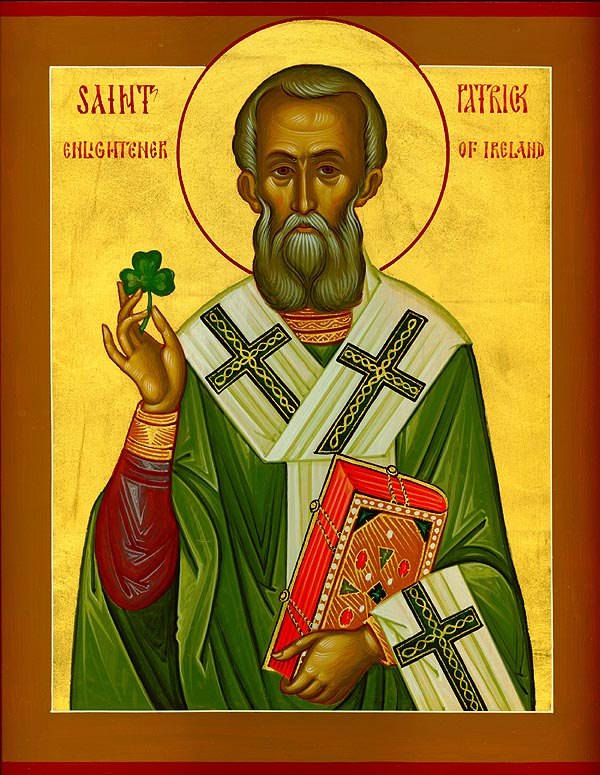
Saint Patrick, the Enlightener of Ireland was born around 385, the son of Calpurnius, a Roman decurion (an official responsible for collecting taxes). He lived in the village of Bannavem Taberniae, which may have been located at the mouth of the Severn River in Wales. The district was raided by pirates when Patrick was sixteen, and he was one of those taken captive. He was brought to Ireland and sold as a slave, and was put to work as a herder of swine on a mountain identified with Slemish in Co. Antrim. During his period of slavery, Patrick acquired a proficiency in the Irish language which was very useful to him in his later mission.
He prayed during his solitude on the mountain, and lived this way for six years. He had two visions. The first told him he would return to his home. The second told him his ship was ready. Setting off on foot, Patrick walked two hundred miles to the coast. There he succeeded in boarding a ship, and returned to his parents in Britain.
Some time later, he went to Gaul and studied for the priesthood at Auxerre under Saint Germanus (July 31). Eventually, he was consecrated as a bishop, and was entrusted with the mission to Ireland, succeeding Saint Palladius (July 7). Saint Palladius did not achieve much success in Ireland. After about a year he went to Scotland, where he died in 432.
Patrick had a dream in which an angel came to him bearing many letters. Selecting one inscribed “The Voice of the Irish,” he heard the Irish entreating him to come back to them.
Although Saint Patrick achieved remarkable results in spreading the Gospel, he was not the first or only missionary in Ireland. He arrived around 432 (though this date is disputed), about a year after Saint Palladius began his mission to Ireland. There were also other missionaries who were active on the southeast coast, but it was Saint Patrick who had the greatest influence and success in preaching the Gospel of Christ. Therefore, he is known as “The Enlightener of Ireland.”
His autobiographical Confession tells of the many trials and disappointments he endured. Patrick had once confided to a friend that he was troubled by a certain sin he had committed before he was fifteen years old. The friend assured him of God’s mercy, and even supported Patrick’s nomination as bishop. Later, he turned against him and revealed what Patrick had told him in an attempt to prevent his consecration. Many years later, Patrick still grieved for his dear friend who had publicly shamed him.
Saint Patrick founded many churches and monasteries across Ireland, but the conversion of the Irish people was no easy task. There was much hostility, and he was assaulted several times. He faced danger, and insults, and he was reproached for being a foreigner and a former slave. There was also a very real possibility that the pagans would try to kill him. Despite many obstacles, he remained faithful to his calling, and he baptized many people into Christ.
The saint’s Epistle to Coroticus is also an authentic work. In it he denounces the attack of Coroticus’ men on one of his congregations. The Breastplate (Lorica) is also attributed to Saint Patrick. In his writings, we can see Saint Patrick’s awareness that he had been called by God, as well as his determination and modesty in undertaking his missionary work. He refers to himself as “a sinner,” “the most ignorant and of least account,” and as someone who was “despised by many.” He ascribes his success to God, rather than to his own talents: “I owe it to God’s grace that through me so many people should be born again to Him.”
By the time he established his episcopal See in Armargh in 444, Saint Patrick had other bishops to assist him, many native priests and deacons, and he encouraged the growth of monasticism.

Saint Patrick is often depicted holding a shamrock, or with snakes fleeing from him. He used the shamrock to illustrate the doctrine of the Holy Trinity. Its three leaves growing out of a single stem helped him to explain the concept of one God in three Persons. Many people now regard the story of Saint Patrick driving all the snakes out of Ireland as having no historical basis.
Saint Patrick died on March 17, 461 (some say 492). There are various accounts of his last days, but they are mostly legendary. Muirchu says that no one knows the place where Saint Patrick is buried. Saint Columba of Iona (June 9) says that the Holy Spirit revealed to him that Patrick was buried at Saul, the site of his first church. A granite slab was placed at his traditional grave site in Downpatrick in 1899.
Hieromartyr Gabriel the Lesser

Saint Gabriel the Lesser was a major figure in the eighteenth-century Georgian Church. Few details of his life are known, but it is evident that the education he received was quite good for the period. Striving toward the monastic life but still living in the world, Gabriel tried in every way to close himself off from the vanity of the world. He kept a small sewing shop in Tbilisi and distributed most of his profits to the poor.
One day Saint Gabriel abandoned his business and set off for the Davit-Gareji Wilderness, where he was tonsured a monk.
Saint Gabriel occupied much of his time with writing, and his works left a significant mark on the spiritual literature of Georgia. He compiled several collections of patristic writings, and he also wrote original works of a theological nature. His original writings include An Explanation of the Hierarchical Liturgy, which describes in detail the meaning of every part of the service, Spiritual Stories of the Pious, The Life and Labors of Venerable Schemamonk Onisphore, A Short Story of Porphyry, and writings on the Nomocanon of the Sixth Ecumenical Council.
Among the brothers at his monastery, Saint Gabriel was distinguished by a remarkable capacity for love and a fervent desire to help others: he helped all, cared for all, and encouraged all. During the Great Fast in 1802, a certain archdeacon came from Tbilisi to Davit-Gareji Monastery, desiring to draw closer to the ascetic way of life. After some time, however, he became anxious to see his family and decided to return home. Saint Gabriel accompanied him on his way, but the two men were suddenly assailed by Dagestanis, and the holy father was killed. The brothers carried his relics back to the monastery and buried them there with great honor.
 Saint Peter Antiochian Orthodox Church