
2ND MONDAY OF LENT
ABSTAIN FROM MEAT, FISH, DAIRY, EGGS, WINE, OLIVE OIL
Quadratus the Martyr & his Companions, Anastasia of Alexandria, Michael Mauroudes the New-Martyr
ISAIAH 4:2-5:7
In that day the branch of the LORD shall be beautiful and glorious, and the fruit of the land shall be the pride and glory of the survivors of Israel. And he who is left in Zion and remains in Jerusalem will be called holy, every one who has been recorded for life in Jerusalem, when the Lord shall have washed away the filth of the daughters of Zion and cleansed the bloodstains of Jerusalem from its midst by a spirit of judgment and by a spirit of burning. Then the LORD will create over the whole site of Mount Zion and over her assemblies a cloud by day, and smoke and the shining of a flaming fire by night; for over all the glory there will be a canopy and a pavilion. It will be for a shade by day from the heat, and for a refuge and a shelter from the storm and rain. Let me sing for my beloved a love song concerning his vineyard: My beloved had a vineyard on a very fertile hill. He digged it and cleared it of stones, and planted it with choice vines; he built a watchtower in the midst of it, and hewed out a wine vat in it; and he looked for it to yield grapes, but it yielded wild grapes. And now, O inhabitants of Jerusalem and men of Judah, judge, I pray you, between me and my vineyard. What more was there to do for my vineyard, that I have not done in it? When I looked for it to yield grapes, why did it yield wild grapes? And now I will tell you what I will do to my vineyard. I will remove its hedge, and it shall be devoured; I will break down its wall, and it shall be trampled down. I will make it a waste; it shall not be pruned or hoed, and briers and thorns shall grow up; I will also command the clouds that they rain no rain upon it. For the vineyard of the LORD of hosts is the house of Israel, and the men of Judah are his pleasant planting; and he looked for justice, but behold, bloodshed; for righteousness, but behold, a cry!
GENESIS 3:21-4:7
And the LORD God made for Adam and for his wife garments of skins, and clothed them. Then the LORD God said, “Behold, the man has become like one of us, knowing good and evil; and now, lest he put forth his hand and take also of the tree of life, and eat, and live for ever”- therefore the LORD God sent him forth from the garden of Eden, to till the ground from which he was taken. He drove out the man; and at the east of the garden of Eden he placed the cherubim, and a flaming sword which turned every way, to guard the way to the tree of life. Now Adam knew Eve his wife, and she conceived and bore Cain, saying, “I have gotten a man with the help of the LORD.” And again, she bore his brother Abel. Now Abel was a keeper of sheep, and Cain a tiller of the ground. In the course of time Cain brought to the LORD an offering of the fruit of the ground, and Abel brought of the firstlings of his flock and of their fat portions. And the LORD had regard for Abel and his offering, but for Cain and his offering he had no regard. So Cain was very angry, and his countenance fell. The LORD said to Cain, “Why are you angry, and why has your countenance fallen? If you do well, will you not be accepted? And if you do not do well, sin is couching at the door; its desire is for you, but you must master it.”
PROVERBS 3:34-4:22
Toward the scorners he is scornful, but to the humble he shows favor. The wise will inherit honor, but fools get disgrace.
Hear, O sons, a father's instruction, and be attentive, that you may gain insight; for I give you good precepts: do not forsake my teaching. When I was a son with my father, tender, the only one in the sight of my mother, he taught me, and said to me, "Let your heart hold fast my words; keep my commandments, and live; do not forget, and do not turn away from the words of my mouth. Get wisdom; get insight. Do not forsake her, and she will keep you; love her, and she will guard you. The beginning of wisdom is this: Get wisdom, and whatever you get, get insight. Prize her highly, and she will exalt you; she will honor you if you embrace her. She will place on your head a fair garland; she will bestow on you a beautiful crown." Hear, my son, and accept my words, that the years of your life may be many. I have taught you the way of wisdom; I have led you in the paths of uprightness. When you walk, your step will not be hampered; and if you run, you will not stumble. Keep hold of instruction, do not let go; guard her, for she is your life. Do not enter the path of the wicked, and do not walk in the way of evil men. Avoid it; do not go on it; turn away from it and pass on. For they cannot sleep unless they have done wrong; they are robbed of sleep unless they have made some one stumble. For they eat the bread of wickedness and drink the wine of violence. But the path of the righteous is like the light of dawn, which shines brighter and brighter until full day. The way of the wicked is like deep darkness; they do not know over what they stumble.
My son, be attentive to my words; incline your ear to my sayings. Let them not escape from your sight; keep them within your heart.
Martyr Quadratus and those with him at Corinth
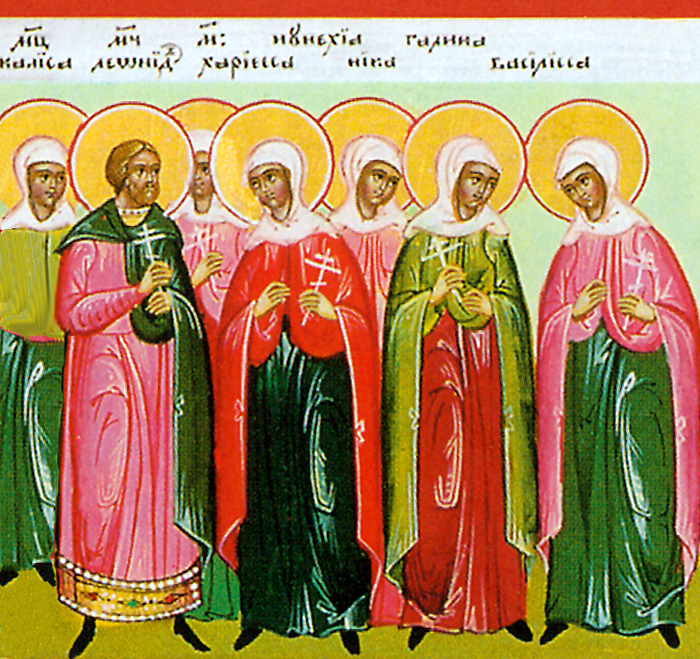
During a persecution against Christians (in the third century) a certain pious woman named Rufina fled from Corinth to a mountain, to escape from her pursuers. There she gave birth to a son Quadratus, and died soon afterward. By the Providence of God the infant remained alive and was nourished in miraculous manner: a cloud appeared over him, dropping a sweet dew into his mouth.
The childhood and youth of Saint Quadratus were spent in the wilderness. When he was a young man, he chanced upon Christians, who enlightened him with the light of the true Faith. Quadratus studied grammar, and later learned the physician’s art and attained great success in it. But most of all, Quadratus loved the wilderness solitude and he spent the greater part of his time in the hills, in prayer and meditation upon God. Many years passed, and his friends and followers frequently came to the saint to hear his instruction. Among them were Cyprian, Dionysius, Anectus, Paul, Crescens and many others.
By order of the impious emperor Decius (249-251), the military prefect Jason arrived at Corinth to torture and slay Christians. Since Quadratus was the eldest, he spoke for the rest. The saint bravely defended his faith in Christ the Savior, then they began the torture. Saint Quadratus, despite inhuman suffering, encouraged the others, urging them not to be afraid and to stand firmly for the Faith.
Unable to persuade any of them to deny Christ, Jason ordered the martyrs to be thrown to wild beasts to be torn apart. But the beasts did not touch them. They tied the saints to chariots by their feet and dragged them through the city, and many of the crowd threw stones at them. Finally, they condemned the martyrs to beheading by the sword. At the place of execution the martyrs requested for a certain time to pray, and then one after the other they bent their necks beneath the sword.
The remaining disciples of Saint Quadratus also suffered for Christ: Dionysius (another one) was stabbed in the night; Victorinus, Victor and Nikēphóros were crushed in a large stone press; Claudius’s hands and feet were cut off; Diodorus was thrown into a fire prepared for him; Serapion was decapitated; Papias and Leonidas were drowned in the sea. Many holy women also went voluntarily to suffer for Christ: Saints Chariessa, Nunechia, Basilissa, Nike, Galla, Galina, and Theodora were among them.
Martyr Quadratus and those with him at Nicomedia
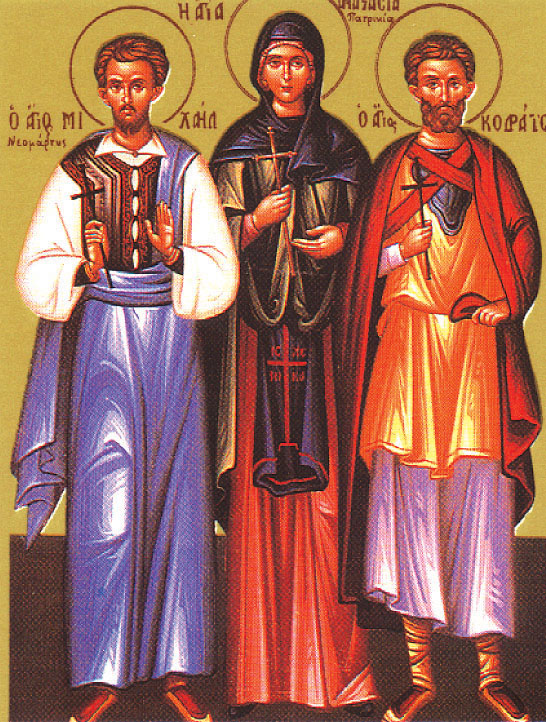
The Holy Martyrs Quadratus of Nicomedia, Saturinus, Rufinus and others suffered during the persecutions of the emperor Decius (249-251) and his successor Valerian (253-259).
Saint Quadratus was descended from an illustrious family. Possessing considerable wealth, the saint did not spare his means in helping fellow Christians, languishing in prison for the faith.
When the envoy of the impious Decius, the proconsul Perennius, arrived in Nicomedia, Saint Quadratus voluntarily appeared before him, in order to strengthen the courage of the imprisoned brethren by his self-sacrificing decision. At first Perennius attempted to lure Quadratus from Christ, promising him rewards and honors. Then, seeing the futility of his attempts, he cast the saint into prison and gave orders to lay him down on a bed of nails and to lay a large stone on him.
Setting out for Nicea, the proconsul commanded that all the imprisoned Christians be brought after him. In that number was Saint Quadratus. Upon arriving in the city, Saint Quadratus implored that they be led to the pagan temple. As soon as they untied his hands and feet, he began to overturn and destroy the idols. By order of the proconsul, they gave Quadratus over to torture. Enduring terrible torments, the saint held firm in spirit and by his act encouraged the other martyrs, whose wounds were seared with burning candles.
During the suffering of the martyrs, suddenly there shone a brilliant cloud, but the pagans found themselves in total darkness. In the ensuing silence was heard the singing of angels glorifying God. Many of those present confessed themselves Christians. Perennius ascribed the miracle to sorcery, and gave orders to take them to prison.
From Nicea the martyrs walked behind the proconsul to Apamea, then to Caesarea, Apollonia and the Hellespont, where they tortured them in all sorts of ways, hoping to make them deny Christ.
They tied Saint Quadratus into a sack filled with poisonous serpents, and threw it into a deep pit. On the following morning, everyone was astonished to see the martyr whole and unharmed. When they began to beat him mercilessly, two noblemen, Saturinus and Rufinus, were moved with pity for the martyr. This was observed, and Saturinus and Rufinus were beheaded.
Perennius subjected the martyr to even more fierce and refined tortures, but was not able to break his spirit. The saint lost his strength and was hardly able to move. For the last time the proconsul urged the martyr to abjure Christ. Marshalling his strength, the saint firmly replied, “Since childhood I have acknowledged Christ as the one and only God, and I know no other.”
The proconsul gave orders to light the fire, make the iron grate red-hot and throw the martyr on it. Having blessed himself with the Sign of the Cross, Saint Quadratus laid himself down upon the red-hot couch as upon a soft bed, emerging unharmed from the flames. In frustration, the proconsul gave orders to behead Saint Quadratus.
Saint Anastasia the Patrician of Alexandria

Saint Anastasia the Patrician of Alexandria lived in Constantinople and was descended from an aristocratic family. She was an image of virtue, and she enjoyed the great esteem of the emperor Justinian (527-565). Widowed at a young age, Anastasia decided to leave the world and save her soul far from the bustle of the capital. She secretly left Constantinople and went to Alexandria. She founded a small monastery not far from the city, and devoted herself entirely to God.
Several years later, the emperor Justinian was widowed and decided to search for Anastasia and marry her. As soon as she learned of this, Saint Anastasia journeyed to a remote skete to ask Abba Daniel (March 18) for help.
In order to safeguard Anastasia, the Elder dressed her in a man’s monastic garb and called her the eunuch Anastasius. Having settled her in one of the very remote caves, the Elder gave her a Rule of prayer and ordered her never to leave the cave and to receive no one. Only one monk knew of this place. His obedience was to bring a small portion of bread and a pitcher of water to the cave once a week, leaving it at the entrance. The nun Anastasia dwelt in seclusion for twenty-eight years. Everyone believed that it was the eunuch Anastasius who lived in the cave.
The Lord revealed to her the day of her death. Having learned of her approaching death, she wrote several words for Abba Daniel on a potsherd and placed it at the entrance to the cave. The Elder came quickly and brought everything necessary for her burial. He found the holy ascetic still alive, and he confessed and communed her with the Holy Mysteries. At Abba Daniel’s request, Saint Anastasia blessed him and the monk accompanying him. With the words: “Lord, into Thy hands I commend my spirit,” the saint died in peace (ca. 567-568).
When the grave was prepared, the Elder gave his disciple his outer garment and ordered him to dress the deceased “brother” in it. As he was putting on the rassa, the monk noticed that she was a woman, but he did not dare to say anything. However, when they returned to the monastery after they buried the nun, the disciple asked Abba Daniel whether he knew the “brother” was a woman, and the Elder related to the young monk the life of Saint Anastasia. Later, the abba’s narrative was written down and received wide acclaim.
The relics of Saint Anastasia were transferred to Constantinople in the year 1200, and put not far from the church of Hagia Sophia.
Saint John of Khakhuli the Oqropiri, also called Chrysostom
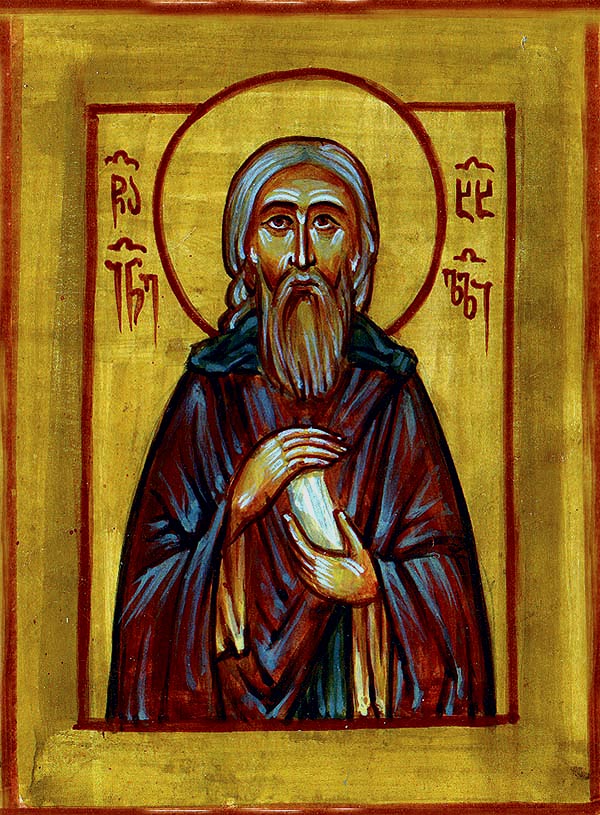
In the second half of the 10th century King Davit Kuropalates founded Khakhuli Monastery in the historical region of Tao, at the gorge of the Khakhuli River, where it joins the Tortumi River.
Once famed for its holiness and academic activity, today Khakhuli Monastery is a Turkish possession and has become a tourist site. Nevertheless, the Georgian nation continues to be illumined by its grace and the radiance of the Georgian faithful who labored there.
A contemporary of King Bagrat III (975-1014), Saint John of Khakhuli was a highly educated theologian, translator, and calligrapher. He has been called “Chrysostom” since he, like the beloved archbishop of Constantinople, delivered his sermons with extraordinary eloquence.
Some sources claim that Saint John was first consecrated bishop of Bolnisi and later transferred to the Khakhuli diocese. It is generally agreed, however, that he left Khakhuli around the year 1019 and traveled to Mt. Athos with Arsen of Ninotsminda and John Grdzelisdze.
One Georgian manuscript, however, suggests that Saint John was not a bishop at that time, and this has baffled Church historians to this day. In this manuscript it is written: “Pray for the blessed monk John Grdzelisdze and his spiritual son John Chrysostom, who labored to write this holy book.”
While laboring on Mt. Athos, Saint John faithfully assisted Saint Ekvtime of the Holy Mountain, and these spiritual brothers became close friends.
The countless good works he performed from the bishop’s throne, the title “Chrysostom,” and the many important writings accredited to him attest to the piety, wisdom, and patriotism of Saint John of Khakhuli. It is written in The Life of Giorgi of the Holy Mountain that Saint John reposed on Mt. Athos.
Saint Michael the New Martyr
No information available at this time.
 Saint Peter Antiochian Orthodox Church