
Here is the live stream for Orthros and Divine Liturgy – Sunday February 16, 2025 If you need, here are instructions for accessing this content from your phone, tablet, computer, or TV.
Monthly Archives: February 2025
Daily Readings for Sunday, February 16, 2025
SUNDAY OF THE PRODIGAL SON
NO FAST
Sunday of the Prodigal Son, Pamphilus the Martyr & his Companions, Flavianos, Patriarch of Constantinople, Romanos the Younger
ST. PAUL’S FIRST LETTER TO THE CORINTHIANS 6:12-20
Brethren, “all things are lawful for me, ” but not all things are helpful. “All things are lawful for me, ” but I will not be enslaved by anything. “Food is meant for the stomach and the stomach for food” — and God will destroy both one and the other. The body is not meant for immorality, but for the Lord, and the Lord for the body. And God raised the Lord and will also raise us up by his power. Do you not know that your bodies are members of Christ? Shall I therefore take the members of Christ and make them members of a prostitute? Never! Do you not know that he who joins himself to a prostitute becomes one body with her? For, as it is written, “The two shall become one flesh.” But he who is united to the Lord becomes one spirit with him. Shun immorality. Every other sin which a man commits is outside the body; but the immoral man sins against his own body. Do you not know that your body is a temple of the Holy Spirit within you, which you have from God? You are not your own; you were bought with a price. So glorify God in your body and in your spirit which belong to God.
LUKE 15:11-32
The Lord said this parable: “There was a man who had two sons; and the younger of them said to his father, ‘Father, give me the share of the property that falls to me.’ And he divided his living between them. Not many days later, the younger son gathered all he had and took his journey into a far country, and there he squandered his property in loose living. And when he had spent everything, a great famine arose in that country, and he began to be in want. So he went and joined himself to one of the citizens of that country, who sent him into his fields to feed swine. And he would gladly have filled his belly with the pods that the swine ate; and no one gave him anything. But when he came to himself he said, ‘How many of my father’s hired servants have bread enough and to spare, but I perish here with hunger! I will arise and go to my father, and I will say to him, ‘Father, I have sinned against heaven and before you; I am no longer worthy to be called your son; treat me as one of your hired servants.’ And he arose and came to his father. But while he was yet at a distance, his father saw him and had compassion, and ran and embraced him and kissed him. And the son said to him, ‘Father, I have sinned against heaven and before you; I am no longer worthy to be called your son.’ But the father said to his servants, ‘Bring quickly the best robe, and put it on him; and put a ring on his hand, and shoes on his feet; and bring the fatted calf and kill it, and let us eat and make merry; for this my son was dead, and is alive again; he was lost, and is found.’ And they began to make merry. Now his elder son was in the field; and as he came and drew near to the house, he heard music and dancing. And he called one of the servants and asked what this meant. And he said to him, ‘Your brother has come, and your father has killed the fatted calf, because he has received him safe and sound.’ But he was angry and refused to go in. His father came out and entreated him, but he answered his father, ‘Lo, these many years I have served you, and I never disobeyed your command; yet you never gave me a kid, that I might make merry with my friends. But when this son of yours came, who has devoured your living with harlots, you killed for him the fatted calf!’ And he said to him, ‘Son, you are always with me, and all that is mine is yours. It was fitting to make merry and be glad, for this your brother was dead, and is alive; he was lost, and is found.'”
Sunday of the Prodigal Son

The Sunday after the Sunday of the Publican and the Pharisee is the Sunday of the Prodigal Son. This parable of God’s forgiveness calls us to “come to ourselves” as did the prodigal son, to see ourselves as being “in a far country” far from the Father’s house, and to make the journey of return to God. We are given every assurance by the Master that our heavenly Father will receive us with joy and gladness. We must only “arise and go,” confessing our self-inflicted and sinful separation from that “home” where we truly belong (Luke 15:11-24).
After the Polyeleion at Matins, we first hear the lenten hymn “By the Waters of Babylon.” It will be sung for the next two Sundays before Lent begins, and it serves to reinforce the theme of exile in today’s Gospel.
Starting tomorrow, the weekday readings summarize the events of Holy Week. On Monday we read Saint Mark's account of the Entry into Jerusalem. On Tuesday we read how Judas went to the chief priests and offered to betray the Lord. On the night before His death Christ tells His disciples that one of them will betray Him. He also predicts that they will desert Him, and that Peter will deny Him three times. On Wednesday the Gospel describes how Judas betrayed the Savior with a kiss. Thursday's Gospel tells how Jesus was questioned by Pilate. On Friday we read the narrative of Christ's crucifixion and death.
Martyrs Pamphilius the Presbyter, Valens the Deacon, and those with them, at Caesarea in Palestine

The Holy Martyrs Pamphίlios the Presbyter, Valens the Deacon, Paul, Porphyrios, Séleukos, Theódoulos, Julian, Samuel, Elias, Daniel, Jeremiah, and Isaiah suffered martyrdom during the reign of Emperor Diocletian (284 – 305) at Caesarea in Palestine.
The holy Martyr Pamphίlios, a native of the city of Beirut, was educated at Alexandria, after which he was ordained as a priest at Caesarea. He devoted much labor to collating manuscripts and correcting the copyists' errors in the manuscripts of the New Testament. These texts were copied and distributed to anyone who wanted them. Thus, many pagans were converted to Christ by them.
His works were gathered into the extensive library of spiritual books available for the enlightenment of Christians. Saint Jerome (IV-V century) had deep respect for Saint Pamphίlios and considered himself fortunate to have located and acquired several of his manuscripts.
Actively assisting Saint Pamphίlios in proclaiming the faith in Christ were Saint Valens, a Deacon of the Church, and Elias, a man stooped with age and well-versed in the Holy Scriptures, and Saint Paul, ardent in his faith and love for Christ the Savior. All three were imprisoned for two years by Urban, the governor of Palestinian Caesarea.
During the rule of his successor Firmilian, 130 Christians were sentenced in Egypt and sent to Cilicia (Asia Minor) to work in the gold mines. Five young brothers accompanied them to the place of exile. On their return to Egypt they were detained at Caesarea and thrown into prison for confessing Christ.
These young men appeared before Firmilian, together with those previously imprisoned incarcerated: Saints Pamphίlios, Valens and Paul. The five Egyptian youths took the names of Old Testament Prophets, Elias, Jeremiah, Isaiah, Samuel, and Daniel. Asked where they were from, the youths said that they were citizens of Jerusalem, meaning the heavenly Jerusalem. Firmilian knew nothing of such a city, since Jerusalem had been razed to the ground by Emperor Titus in the year 70. Emperor Hadrian (117-138) built a new city on the site, which was called Aelia Capitolina.
Firmilian tortured the youths for a long time, trying to learn the location of this unknown city, and he tried to persuade them to apostatize. Accomplishing nothing, the governor sentenced them to be beheaded with a sword, along with Pamphίlios, Valens, and Paul.
Before this took place, one of Pamphilios' servants endured suffering. This was the eighteen-year-old youth Porphyrios, who was meek and humble. He had heard the death sentence for the condemned martyrs, and asked the governor for permission to bury the bodies after their execution. Because of this he was also sentenced to death, and was thrown into a fire.
A pious Christian named Séleukos, a former soldier, praised the deeds of the Martyrs. He went to Pamphίlios and told him of the martyric death of Saint Porphyrios. He was arrested by soldiers and, on Firmilian’s orders, he was beheaded with a sword, together with the others.
One of the governor’s servants, Theódoulos, was a man of venerable age, and a secret Christian. He met the Martyrs as they were being led to execution. He embraced them and asked them to pray for him. Soldiers brought him before Firmilian, at whose orders he was crucified.
The young Julian, a native of Cappadocia who had come to Caesarea, saw the bodies of the Saints which had been thrown to wild beasts without burial. Julian knelt down and venerated the bodies of the sufferers. Soldiers apprehended him and took him to the governor, who condemned him to be burnt alive. The bodies of all twelve Martyrs remained unburied for four days, but neither beasts nor birds would touch them. Embarrassed by this situation, the pagans permitted the Christians to take the bodies of the martyrs and bury them.
Although these twelve Martyrs came from various places, they were also united by their love for Christ, and from Him they received unfading crowns of glory.
Saint Maruthas, Bishop of Martyropolis in Mesopotamia
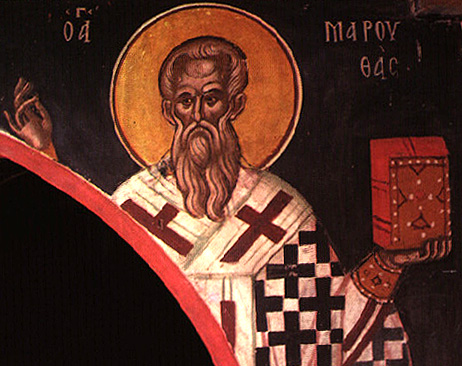
Saint Maruthas was Bishop of Tagrith (Martyropolis), a city which he founded between the Byzantine Empire and Persia. He was famed for his knowledge and his piety, he wrote about the martyrs, and he suffered for his faith in Christ under the Persian emperor Sapor. He also left behind other works in the Syrian language, among which the most famous are: “Commentary on the Gospel,” “Verses of Maruthas,” “Liturgy of Maruthas” and “The 73 Canons of the Ecumenical Council at Nicea” (325) with an account of the acts of the Council.
In the year 381 Saint Maruthas participated in the Second Ecumenical Council at Constantinople, convened against the heresy of Macedonius. In 383, he attended the Council of Antioch against the Messalians.
During the years 403-404 Saint Maruthas set off to Constantinople to plead with the emperor Arcadius to protect Persian Christians. He was twice sent by the emperor Theodosius the Younger to the Shah Izdegerd to secure the peace between the Empire and Persia.
In the year 414 Saint Maruthas, having done his duty as envoy to the court of Izdegerd, persuaded the Shah to a favorable disposition towards Christians, and he assisted greatly in the freedom of Christians in Persia. He rebuilt Christian churches razed during the persecution by the Persian ruler Sapor. He also located relics of saints who had suffered martyrdom and transferred them to Martyropolis. He died there in 422. The relics of Saint Maruthas were later transferred to Egypt and placed in a skete monastery of the Mother of God.
Persian Martyrs in Martyropolis in Mesopotamia
No information available at this time.
Saint Flavian, Archbishop of Antioch
Saint Flavian, Archbishop of Antioch, was a contemporary of Saint John Chrysostom. He attempted to obtain from the emperor Theodosius (379-395) a pardon for the citizens of Antioch, who had angered the emperor by destroying his statue. Saint Flavian’s death was peaceful and without illness. He is also commemorated on September 27.
Saint Nicholas, Equal of the Apostles, Archbishop of Japan

Saint Nicholas, Enlightener of Japan, was born Ivan Dimitrievich Kasatkin on August 1, 1836 in the village of Berezovsk, Belsk district, Smolensk diocese, where his father served as deacon. At the age of five he lost his mother. He completed the Belsk religious school, and afterwards the Smolensk Theological Seminary. In 1857 Ivan Kasatkin entered the Saint Peterburg Theological Academy. On June 24, 1860, in the academy temple of the Twelve Apostles, Bishop Nectarius tonsured him with the name Nicholas.
On June 29, the Feast of the foremost Apostles Peter and Paul, the monk Nicholas was ordained deacon. The next day, on the altar feast of the academy church, he was ordained to the holy priesthood. Later, at his request, Father Nicholas was assigned to Japan as head of the consular church in the city of Hakodate.
At first, the preaching of the Gospel in Japan seemed completely impossible. In Father Nicholas’s own words: “the Japanese of the time looked upon foreigners as beasts, and on Christianity as a villainous sect, to which only villains and sorcerers could belong.” He spent eight years in studying the country, the language, manners and customs of the people among whom he would preach.
In 1868, the flock of Father Nicholas numbered about twenty Japanese. At the end of 1869 Hieromonk Nicholas reported in person to the Synod in Peterburg about his work. A decision was made, on January 14, 1870, to form a special Russian Spiritual Mission for preaching the Word of God among the pagan Japanese. Father Nicholas was elevated to the rank of archimandrite and appointed as head of this Mission.
Returning to Japan after two years in Russia, he transferred some of the responsibility for the Hakodate flock to Hieromonk Anatolius, and began his missionary work in Tokyo. In 1871 there was a persecution of Christians in Hakodate. Many were arrested (among them, the first Japanese Orthodox priest Paul Sawabe). Only in 1873 did the persecution abate somewhat, and the free preaching of Christianity became possible.
In this year Archimandrite Nicholas began the construction of a stone building in Tokyo which housed a church, a school for fifty men, and later a religious school, which became a seminary in 1878.
In 1874, Bishop Paul of Kamchatka arrived in Tokyo to ordain as priests several Japanese candidates recommended by Archimandrite Nicholas. At the Tokyo Mission, there were four schools: for catechists, for women, for church servers, and a seminary. At Hakodate there were two separate schools for boys and girls.
In the second half of 1877, the Mission began regular publication of the journal “Church Herald.” By the year 1878 there already 4115 Christians in Japan, and there were a number of Christian communities. Church services and classes in Japanese, the publication of religious and moral books permitted the Mission to attain such results in a short time. Archimandrite Nicholas petitioned the Holy Synod in December of 1878 to provide a bishop for Japan.
Archimandrite Nicholas was consecrated bishop on March 30, 1880 in the Trinity Cathedral of Alexander Nevsky Lavra. Returning to Japan, he resumed his apostolic work with increased fervor. He completed construction on the Cathedral of the Resurrection of Christ in Tokyo, he translated the service books, and compiled a special Orthodox theological dictionary in the Japanese language.
Great hardship befell the saint and his flock at the time of the Russo-Japanese War. For his ascetic labor during these difficult years, he was elevated to the rank of Archbishop.
In 1911, half a century had passed since the young hieromonk Nicholas had first set foot on Japanese soil. At that time there were 33,017 Christians in 266 communities of the Japanese Orthodox Church, including 1 Archbishop, 1 bishop, 35 priests, 6 deacons, 14 singing instructors, and 116 catechists.
On February 3, 1912, Archbishop Nicholas departed peacefully to the Lord at the age of seventy-six. The Holy Synod of the Russian Orthodox Church glorified him on April 10, 1970, since the saint had long been honored in Japan as a righteous man, and a prayerful intercessor before the Lord.
New Martyr Elias
The Holy New Martyr Elias (Nikolayevich) was born in a Moscow village in the XIX century. He studied at the Moscow Theological Academy and married a devout woman named Eugenia. Then he was then ordained as a priest and served in the small church of a poorhouse, and in the parish of Saint Nicholas Tolmachev in Moscow, before the October revolution of 1917 broke out.
Saint Elias was a most pious priest. His church was a beacon of spiritual light for many believers. He was married, but he lived an ascetical life. In 1932 the Soviet secret police arrested and imprisoned him. He was exiled to the Krasnaya Visera River region. Matushka Eugenia spent the entire night in prayer and tears. But in the morning she fell asleep and then she saw the Theotokos in a dream, who told her not to be afraid.
Two years later, Matushka Eugenia visited him at his place of exile and brought him a Gospel and a small vial of holy water. The guards confiscated the Gospel. When they asked her what was in the vial, she replied that for them it was plain water, but for herself and her husband it was sacred, their medicine. The Saint looked as if he had been tortured. They did not allow him to serve, and this caused him immeasurable grief. He began to tell Eugenia of his martyrdom. When they brought him and many others to the place of exile, they were forced to walk on the surface of the melting snow. The thin layer of ice was breaking up beneath their feet and the "convicts" were sinking in the snow up to the waist. Wet to the bone, with nothing to eat or drink all day, they were forced to spend the night inside a hut. The exhausted men immediately fell to the floor and fell asleep as if dead. Only the Saint stayed awake. Around midnight he cried from the depths of his heart: "Lord, why have you forsaken me? I have served you so faithfully. I devoted my entire life to You. How many times have I read the Akathist Hymn and the Canons? I served in the church with reverence. Why, O Lord, have You forsaken me, and why do I suffer so much? O Most Holy Theotokos, Holy Hierarch Nicholas, Holy Father Seraphim, and all the Saints of God! After all my prayers to you, why am I tormented so much?"
Suddenly a divine visitation, like a flame, touched his aching soul and flooded it with otherworldly consolation. The light of faith secretly illumined his heart and ignited in him an inexpressible and irresistible love for Christ, which, as the Apostle Paul says, "he heard unspeakable words which no man may utter."1 When dawn came, he was a young man, born again as if he had been baptized in fire.
As he bade farewell to Matushka Eugenia, the Saint said to her: "You know, my heart is ablaze for Christ. I think I came here to understand that there is absolutely nothing better, nothing more wonderful than He. I wish to die for Him!"
When Matushka arrived back in Moscow, she learned that there had been a fire in the concentration camp and that Saint Elias was burned along with eleven other Christians.
1 2 Corinthians 12:4.
Daily Readings for Sunday, February 16, 2025
SUNDAY OF THE PRODIGAL SON
NO FAST
Sunday of the Prodigal Son, Pamphilus the Martyr & his Companions, Flavianos, Patriarch of Constantinople, Romanos the Younger
ST. PAUL’S FIRST LETTER TO THE CORINTHIANS 6:12-20
Brethren, “all things are lawful for me, ” but not all things are helpful. “All things are lawful for me, ” but I will not be enslaved by anything. “Food is meant for the stomach and the stomach for food” — and God will destroy both one and the other. The body is not meant for immorality, but for the Lord, and the Lord for the body. And God raised the Lord and will also raise us up by his power. Do you not know that your bodies are members of Christ? Shall I therefore take the members of Christ and make them members of a prostitute? Never! Do you not know that he who joins himself to a prostitute becomes one body with her? For, as it is written, “The two shall become one flesh.” But he who is united to the Lord becomes one spirit with him. Shun immorality. Every other sin which a man commits is outside the body; but the immoral man sins against his own body. Do you not know that your body is a temple of the Holy Spirit within you, which you have from God? You are not your own; you were bought with a price. So glorify God in your body and in your spirit which belong to God.
LUKE 15:11-32
The Lord said this parable: “There was a man who had two sons; and the younger of them said to his father, ‘Father, give me the share of the property that falls to me.’ And he divided his living between them. Not many days later, the younger son gathered all he had and took his journey into a far country, and there he squandered his property in loose living. And when he had spent everything, a great famine arose in that country, and he began to be in want. So he went and joined himself to one of the citizens of that country, who sent him into his fields to feed swine. And he would gladly have filled his belly with the pods that the swine ate; and no one gave him anything. But when he came to himself he said, ‘How many of my father’s hired servants have bread enough and to spare, but I perish here with hunger! I will arise and go to my father, and I will say to him, ‘Father, I have sinned against heaven and before you; I am no longer worthy to be called your son; treat me as one of your hired servants.’ And he arose and came to his father. But while he was yet at a distance, his father saw him and had compassion, and ran and embraced him and kissed him. And the son said to him, ‘Father, I have sinned against heaven and before you; I am no longer worthy to be called your son.’ But the father said to his servants, ‘Bring quickly the best robe, and put it on him; and put a ring on his hand, and shoes on his feet; and bring the fatted calf and kill it, and let us eat and make merry; for this my son was dead, and is alive again; he was lost, and is found.’ And they began to make merry. Now his elder son was in the field; and as he came and drew near to the house, he heard music and dancing. And he called one of the servants and asked what this meant. And he said to him, ‘Your brother has come, and your father has killed the fatted calf, because he has received him safe and sound.’ But he was angry and refused to go in. His father came out and entreated him, but he answered his father, ‘Lo, these many years I have served you, and I never disobeyed your command; yet you never gave me a kid, that I might make merry with my friends. But when this son of yours came, who has devoured your living with harlots, you killed for him the fatted calf!’ And he said to him, ‘Son, you are always with me, and all that is mine is yours. It was fitting to make merry and be glad, for this your brother was dead, and is alive; he was lost, and is found.'”
Sunday of the Prodigal Son
The Sunday after the Sunday of the Publican and the Pharisee is the Sunday of the Prodigal Son. This parable of God’s forgiveness calls us to “come to ourselves” as did the prodigal son, to see ourselves as being “in a far country” far from the Father’s house, and to make the journey of return to God. We are given every assurance by the Master that our heavenly Father will receive us with joy and gladness. We must only “arise and go,” confessing our self-inflicted and sinful separation from that “home” where we truly belong (Luke 15:11-24).
After the Polyeleion at Matins, we first hear the lenten hymn “By the Waters of Babylon.” It will be sung for the next two Sundays before Lent begins, and it serves to reinforce the theme of exile in today’s Gospel.
Starting tomorrow, the weekday readings summarize the events of Holy Week. On Monday we read Saint Mark's account of the Entry into Jerusalem. On Tuesday we read how Judas went to the chief priests and offered to betray the Lord. On the night before His death Christ tells His disciples that one of them will betray Him. He also predicts that they will desert Him, and that Peter will deny Him three times. On Wednesday the Gospel describes how Judas betrayed the Savior with a kiss. Thursday's Gospel tells how Jesus was questioned by Pilate. On Friday we read the narrative of Christ's crucifixion and death.
Martyrs Pamphilius the Presbyter, Valens the Deacon, and those with them, at Caesarea in Palestine
The Holy Martyrs Pamphίlios the Presbyter, Valens the Deacon, Paul, Porphyrios, Séleukos, Theódoulos, Julian, Samuel, Elias, Daniel, Jeremiah, and Isaiah suffered martyrdom during the reign of Emperor Diocletian (284 – 305) at Caesarea in Palestine.
The holy Martyr Pamphίlios, a native of the city of Beirut, was educated at Alexandria, after which he was ordained as a priest at Caesarea. He devoted much labor to collating manuscripts and correcting the copyists' errors in the manuscripts of the New Testament. These texts were copied and distributed to anyone who wanted them. Thus, many pagans were converted to Christ by them.
His works were gathered into the extensive library of spiritual books available for the enlightenment of Christians. Saint Jerome (IV-V century) had deep respect for Saint Pamphίlios and considered himself fortunate to have located and acquired several of his manuscripts.
Actively assisting Saint Pamphίlios in proclaiming the faith in Christ were Saint Valens, a Deacon of the Church, and Elias, a man stooped with age and well-versed in the Holy Scriptures, and Saint Paul, ardent in his faith and love for Christ the Savior. All three were imprisoned for two years by Urban, the governor of Palestinian Caesarea.
During the rule of his successor Firmilian, 130 Christians were sentenced in Egypt and sent to Cilicia (Asia Minor) to work in the gold mines. Five young brothers accompanied them to the place of exile. On their return to Egypt they were detained at Caesarea and thrown into prison for confessing Christ.
These young men appeared before Firmilian, together with those previously imprisoned incarcerated: Saints Pamphίlios, Valens and Paul. The five Egyptian youths took the names of Old Testament Prophets, Elias, Jeremiah, Isaiah, Samuel, and Daniel. Asked where they were from, the youths said that they were citizens of Jerusalem, meaning the heavenly Jerusalem. Firmilian knew nothing of such a city, since Jerusalem had been razed to the ground by Emperor Titus in the year 70. Emperor Hadrian (117-138) built a new city on the site, which was called Aelia Capitolina.
Firmilian tortured the youths for a long time, trying to learn the location of this unknown city, and he tried to persuade them to apostatize. Accomplishing nothing, the governor sentenced them to be beheaded with a sword, along with Pamphίlios, Valens, and Paul.
Before this took place, one of Pamphilios' servants endured suffering. This was the eighteen-year-old youth Porphyrios, who was meek and humble. He had heard the death sentence for the condemned martyrs, and asked the governor for permission to bury the bodies after their execution. Because of this he was also sentenced to death, and was thrown into a fire.
A pious Christian named Séleukos, a former soldier, praised the deeds of the Martyrs. He went to Pamphίlios and told him of the martyric death of Saint Porphyrios. He was arrested by soldiers and, on Firmilian’s orders, he was beheaded with a sword, together with the others.
One of the governor’s servants, Theódoulos, was a man of venerable age, and a secret Christian. He met the Martyrs as they were being led to execution. He embraced them and asked them to pray for him. Soldiers brought him before Firmilian, at whose orders he was crucified.
The young Julian, a native of Cappadocia who had come to Caesarea, saw the bodies of the Saints which had been thrown to wild beasts without burial. Julian knelt down and venerated the bodies of the sufferers. Soldiers apprehended him and took him to the governor, who condemned him to be burnt alive. The bodies of all twelve Martyrs remained unburied for four days, but neither beasts nor birds would touch them. Embarrassed by this situation, the pagans permitted the Christians to take the bodies of the martyrs and bury them.
Although these twelve Martyrs came from various places, they were also united by their love for Christ, and from Him they received unfading crowns of glory.
Saint Maruthas, Bishop of Martyropolis in Mesopotamia
Saint Maruthas was Bishop of Tagrith (Martyropolis), a city which he founded between the Byzantine Empire and Persia. He was famed for his knowledge and his piety, he wrote about the martyrs, and he suffered for his faith in Christ under the Persian emperor Sapor. He also left behind other works in the Syrian language, among which the most famous are: “Commentary on the Gospel,” “Verses of Maruthas,” “Liturgy of Maruthas” and “The 73 Canons of the Ecumenical Council at Nicea” (325) with an account of the acts of the Council.
In the year 381 Saint Maruthas participated in the Second Ecumenical Council at Constantinople, convened against the heresy of Macedonius. In 383, he attended the Council of Antioch against the Messalians.
During the years 403-404 Saint Maruthas set off to Constantinople to plead with the emperor Arcadius to protect Persian Christians. He was twice sent by the emperor Theodosius the Younger to the Shah Izdegerd to secure the peace between the Empire and Persia.
In the year 414 Saint Maruthas, having done his duty as envoy to the court of Izdegerd, persuaded the Shah to a favorable disposition towards Christians, and he assisted greatly in the freedom of Christians in Persia. He rebuilt Christian churches razed during the persecution by the Persian ruler Sapor. He also located relics of saints who had suffered martyrdom and transferred them to Martyropolis. He died there in 422. The relics of Saint Maruthas were later transferred to Egypt and placed in a skete monastery of the Mother of God.
Persian Martyrs in Martyropolis in Mesopotamia
No information available at this time.
Saint Flavian, Archbishop of Antioch
Saint Flavian, Archbishop of Antioch, was a contemporary of Saint John Chrysostom. He attempted to obtain from the emperor Theodosius (379-395) a pardon for the citizens of Antioch, who had angered the emperor by destroying his statue. Saint Flavian’s death was peaceful and without illness. He is also commemorated on September 27.
Saint Nicholas, Equal of the Apostles, Archbishop of Japan
Saint Nicholas, Enlightener of Japan, was born Ivan Dimitrievich Kasatkin on August 1, 1836 in the village of Berezovsk, Belsk district, Smolensk diocese, where his father served as deacon. At the age of five he lost his mother. He completed the Belsk religious school, and afterwards the Smolensk Theological Seminary. In 1857 Ivan Kasatkin entered the Saint Peterburg Theological Academy. On June 24, 1860, in the academy temple of the Twelve Apostles, Bishop Nectarius tonsured him with the name Nicholas.
On June 29, the Feast of the foremost Apostles Peter and Paul, the monk Nicholas was ordained deacon. The next day, on the altar feast of the academy church, he was ordained to the holy priesthood. Later, at his request, Father Nicholas was assigned to Japan as head of the consular church in the city of Hakodate.
At first, the preaching of the Gospel in Japan seemed completely impossible. In Father Nicholas’s own words: “the Japanese of the time looked upon foreigners as beasts, and on Christianity as a villainous sect, to which only villains and sorcerers could belong.” He spent eight years in studying the country, the language, manners and customs of the people among whom he would preach.
In 1868, the flock of Father Nicholas numbered about twenty Japanese. At the end of 1869 Hieromonk Nicholas reported in person to the Synod in Peterburg about his work. A decision was made, on January 14, 1870, to form a special Russian Spiritual Mission for preaching the Word of God among the pagan Japanese. Father Nicholas was elevated to the rank of archimandrite and appointed as head of this Mission.
Returning to Japan after two years in Russia, he transferred some of the responsibility for the Hakodate flock to Hieromonk Anatolius, and began his missionary work in Tokyo. In 1871 there was a persecution of Christians in Hakodate. Many were arrested (among them, the first Japanese Orthodox priest Paul Sawabe). Only in 1873 did the persecution abate somewhat, and the free preaching of Christianity became possible.
In this year Archimandrite Nicholas began the construction of a stone building in Tokyo which housed a church, a school for fifty men, and later a religious school, which became a seminary in 1878.
In 1874, Bishop Paul of Kamchatka arrived in Tokyo to ordain as priests several Japanese candidates recommended by Archimandrite Nicholas. At the Tokyo Mission, there were four schools: for catechists, for women, for church servers, and a seminary. At Hakodate there were two separate schools for boys and girls.
In the second half of 1877, the Mission began regular publication of the journal “Church Herald.” By the year 1878 there already 4115 Christians in Japan, and there were a number of Christian communities. Church services and classes in Japanese, the publication of religious and moral books permitted the Mission to attain such results in a short time. Archimandrite Nicholas petitioned the Holy Synod in December of 1878 to provide a bishop for Japan.
Archimandrite Nicholas was consecrated bishop on March 30, 1880 in the Trinity Cathedral of Alexander Nevsky Lavra. Returning to Japan, he resumed his apostolic work with increased fervor. He completed construction on the Cathedral of the Resurrection of Christ in Tokyo, he translated the service books, and compiled a special Orthodox theological dictionary in the Japanese language.
Great hardship befell the saint and his flock at the time of the Russo-Japanese War. For his ascetic labor during these difficult years, he was elevated to the rank of Archbishop.
In 1911, half a century had passed since the young hieromonk Nicholas had first set foot on Japanese soil. At that time there were 33,017 Christians in 266 communities of the Japanese Orthodox Church, including 1 Archbishop, 1 bishop, 35 priests, 6 deacons, 14 singing instructors, and 116 catechists.
On February 3, 1912, Archbishop Nicholas departed peacefully to the Lord at the age of seventy-six. The Holy Synod of the Russian Orthodox Church glorified him on April 10, 1970, since the saint had long been honored in Japan as a righteous man, and a prayerful intercessor before the Lord.
New Martyr Elias
The Holy New Martyr Elias (Nikolayevich) was born in a Moscow village in the XIX century. He studied at the Moscow Theological Academy and married a devout woman named Eugenia. Then he was then ordained as a priest and served in the small church of a poorhouse, and in the parish of Saint Nicholas Tolmachev in Moscow, before the October revolution of 1917 broke out.
Saint Elias was a most pious priest. His church was a beacon of spiritual light for many believers. He was married, but he lived an ascetical life. In 1932 the Soviet secret police arrested and imprisoned him. He was exiled to the Krasnaya Visera River region. Matushka Eugenia spent the entire night in prayer and tears. But in the morning she fell asleep and then she saw the Theotokos in a dream, who told her not to be afraid.
Two years later, Matushka Eugenia visited him at his place of exile and brought him a Gospel and a small vial of holy water. The guards confiscated the Gospel. When they asked her what was in the vial, she replied that for them it was plain water, but for herself and her husband it was sacred, their medicine. The Saint looked as if he had been tortured. They did not allow him to serve, and this caused him immeasurable grief. He began to tell Eugenia of his martyrdom. When they brought him and many others to the place of exile, they were forced to walk on the surface of the melting snow. The thin layer of ice was breaking up beneath their feet and the "convicts" were sinking in the snow up to the waist. Wet to the bone, with nothing to eat or drink all day, they were forced to spend the night inside a hut. The exhausted men immediately fell to the floor and fell asleep as if dead. Only the Saint stayed awake. Around midnight he cried from the depths of his heart: "Lord, why have you forsaken me? I have served you so faithfully. I devoted my entire life to You. How many times have I read the Akathist Hymn and the Canons? I served in the church with reverence. Why, O Lord, have You forsaken me, and why do I suffer so much? O Most Holy Theotokos, Holy Hierarch Nicholas, Holy Father Seraphim, and all the Saints of God! After all my prayers to you, why am I tormented so much?"
Suddenly a divine visitation, like a flame, touched his aching soul and flooded it with otherworldly consolation. The light of faith secretly illumined his heart and ignited in him an inexpressible and irresistible love for Christ, which, as the Apostle Paul says, "he heard unspeakable words which no man may utter."1 When dawn came, he was a young man, born again as if he had been baptized in fire.
As he bade farewell to Matushka Eugenia, the Saint said to her: "You know, my heart is ablaze for Christ. I think I came here to understand that there is absolutely nothing better, nothing more wonderful than He. I wish to die for Him!"
When Matushka arrived back in Moscow, she learned that there had been a fire in the concentration camp and that Saint Elias was burned along with eleven other Christians.
1 2 Corinthians 12:4.
Daily Readings for Saturday, February 15, 2025
SATURDAY OF PRODIGAL SON
NO FAST
Onesimus the Apostle of the 70, Our Righteous Father Anthimus the Elder of Chios, Onesimos, Patriarch of Constantinople, Eusebius the Righteous of Syria, Major the Martyr
ST. PAUL’S LETTER TO PHILEMON 1:1-25
PAUL, a prisoner for Christ Jesus, and Timothy our brother, To Philemon our beloved fellow worker, and Apphia our sister and Archippos our fellow soldier, and the church in your house: Grace to you and peace from God our Father and the Lord Jesus Christ. I thank my God always when I remember you in my prayers, because I hear of your love and of the faith which you have toward the Lord Jesus and all the saints, and I pray that the sharing of your faith may promote the knowledge of all the good that is ours in Christ. For I have derived much joy and comfort from your love, my brother, because the hearts of the saints have been refreshed through you. Accordingly, though I am bold enough in Christ to command you to do what is required, yet for love's sake I prefer to appeal to you – I, Paul, an ambassador and now a prisoner also for Christ Jesus – I appeal to you for my child, Onesimos, whose father I have become in my imprisonment. (Formerly he was useless to you, but now he is indeed useful to you and to me.) I am sending him back to you, sending my very heart. I would have been glad to keep him with me, in order that he might serve me on your behalf during my imprisonment for the gospel; but I preferred to do nothing without your consent in order that your goodness might not be by compulsion but of your own free will. Perhaps this is why he was parted from you for a while, that you might have him back for ever, no longer as a slave but more than a slave, as a beloved brother, especially to me but how much more to you, both in the flesh and in the Lord. So if you consider me your partner, receive him as you would receive me. If he has wronged you at all, or owes you anything, charge that to my account. I, Paul, write this with my own hand, I will repay it – to say nothing of your owing me even your own self. Yes, brother, I want some benefit from you in the Lord. Refresh my heart in Christ. Confident of your obedience, I write to you, knowing that you will do even more than I say. At the same time, prepare a guest room for me, for I am hoping through your prayers to be granted to you. Epaphras, my fellow prisoner in Christ Jesus, sends greetings to you, and so do Mark, Aristarchos, Demas, and Luke, my fellow workers. The grace of the Lord Jesus Christ be with your spirit. Amen.
LUKE 20:46-47; 21:1-4
The Lord said to his disciples, “Beware of the scribes, who like to go about in long robes, and love salutations in the market places and the best seats in the synagogues and the places of honor at feasts, who devour widows’ houses and for a pretense make long prayers. They will receive the greater condemnation.” He looked up and saw the rich putting their gifts into the treasury; and he saw a poor widow put in two copper coins. And he said, “Truly, I tell you, this poor widow has put in more than all of them; for they all contributed out of their abundance, but she out of her poverty put in all the living that she had.” Having said this, he proclaimed, “He who has ears let him hear.”
Apostle Onesimus of the Seventy

Saint Onesimus, Apostle of the Seventy in his youth was a servant of Philemon, a Christian of distinguished lineage, living in the city of Colossae, Phrygia. Guilty of an offense against his master and fearing punishment, Saint Onesimus fled to Rome, but as a runaway slave he wound up in prison. In prison he encountered the Apostle Paul, was enlightened by him, and was baptized.
In prison Saint Onesimus served the Apostle Paul like a son. Saint Paul was personally acquainted with Philemon, and wrote him a letter filled with love, asking him to forgive the runaway slave and to accept him like a brother. He sent Saint Onesimus with this letter to his master, depriving himself of help, of which he was very much in need.
After he received the letter, Saint Philemon not only forgave Onesimus, but also sent him back to Rome to the apostle. Saint Philemon (January 4, February 19, and November 22) was afterwards consecrated bishop of the city of Gaza.
After the death of the Apostle Paul, Saint Onesimus served the apostles until their end, and he was made a bishop. After the death of the holy apostles he preached the Gospel in many lands and cities: in Spain, Carpetania, Colossae, Patras. In his old age, Saint Onesimus occupied the bishop’s throne at Ephesus, after the Apostle Timothy. When they took Saint Ignatius the God-Bearer (December 20) to Rome for execution, Bishop Onesimus came to meet with him with other Christians, as Saint Ignatius mentions in his Epistle to the Ephesians.
During the reign of the emperor Trajan (89-117), Saint Onesimus was arrested and brought to trial before the eparch Tertillus. He held the saint in prison for eighteen days, and then sent him to prison in the city of Puteoli. After a certain while, the eparch sent for the prisoner and, convincing himself that Saint Onesimus maintained his faith in Christ, had him stoned, after which they beheaded the saint with a sword. A certain illustrious woman took the body of the martyr and placed it in a silver coffin. This took place in the year 109.
Venerable Paphnutius the Recluse of the Kiev Caves
Saint Paphnutius had the gift of tears, which Saint John of the Ladder says (Step 6:1) is preceded by the remembrance of death. For worldly people, this remembrance may lead to fear and distress, but for Saint Paphnutius it led to constant prayer and the guarding of his mind.
By remembering the hour of death and God’s judgment, Saint Paphnutius was able to free himself from worldly distractions and passions through prayer, repentance and fasting. This, in turn, led to tears.
Venerable Paphnutius and Euphrosynē of Alexandria
Our venerable Mother Euphrosynē was born at the beginning of the fifth century in the city of Alexandria. She was the only child of illustrious and wealthy parents. When she was twelve years old, her mother reposed, and so the girl was raised by her Father, Paphnutios, who was a very devout Christian. He was in the habit of visiting a certain monastery, where the Igoumen was his Spiritual Father.
When Euphrosynē turned eighteen, her father wanted her to marry. He went to the monastery to obtain the Igoumen's blessing for his daughter's wedding. The Igoumen talked with her and gave her his blessing, but Saint Euphrosynē longed for the monastic life. One day, she gave away her possessions to the poor, and then she snuck out of the house.
The Saint had decided to enter a monastery in order to spend her life in solitude and prayer, but she was afraid that her father was apt to find find her in a women’s monastery. Therefore, she disguised herself as a man and entered the same men's monastery which she had visited with her father from her childhood, calling herself Smaragdos. The monks did not recognize Euphrosynē dressed in men’s clothes, and so they received her into the monastery. The monks were impressed by her spiritual struggles and by her willingness to serve everyone.
There in a solitary cell, Saint Euphrosynē spent 38 years in spiritual endeavors, fasting and prayer, thereby attaining a high level of spiritual accomplishment.
Paphnutios was deeply saddened by the loss of his beloved daughter; more than once, on the advice of his Spiritual Father, he spoke to the "monk" Smaragdos, disclosing his grief and receiving spiritual comfort. Before her death, Saint Euphrosynē revealed her secret to her grieving parent and insisted that no one but he should prepare her body for burial. After he buried his daughter, Paphnutios distributed all his wealth to the poor and to the monastery, and then he was tonsured. For ten years, until the time of his own repose, he labored in his daughter's cell.
By her life, Saint Euphrosynē reminds us that we must renounce "worldly passions and live soberly, uprightly, and devoutly" (Titus 2:12). That is, after rejecting the desires of this vain and sinful world, we ought to live abstemiously, with justice toward our fellow human beings, and with piety toward God.
Saint Euphrosynē and her father are also commemorated on September 25.
Venerable Eusebius the Hermit of Syria

Saint Eusebius the Hermit lived in the fourth century and lived in asceticism on a mountain near the village of Asicha in Syria. He led a very strict life under the open sky, patiently enduring the summer heat and winter cold. He wore skins for clothing, and nourished himself on the pods of peas and beans.
Though he was elderly and infirm, he ate only fifteen figs during the Great Forty day Fast. When many people began to flock to Saint Eusebius, he went to a nearby monastery, built a small enclosure at the monastery walls and lived in it until his death.
Saint Eusebius died at the age of ninety, sometime after the year 400.
Vil'na Icon of the Mother of God

Today's celebration commemorates the transfer of the Icon from Moscow to Vil'na (Vilnius), Lithuania. According to local tradition, this Icon (of the Hodēgḗtria type) was painted by the Holy Evangelist Luke, and was brought from Palestine to Constantinople. For many years it belonged to the family of the Byzantine emperors. Later, they sent the Icon to the rulers of Galicia and Chervona Rus'.
After the fall of the Galician principality, the Icon became the property of the Great Princes of Moscow. It did not stay In Moscow very long, however. In 1495, Grand Duke Ivan III (1462-1505), blessed his daughter Elena with the Icon before giving her in marriage to the Lithuanian Grand Duke Alexander. Thus, the Icon came with her to the Lithuanian capital of Vil'na, where it remains today.
According to another legend, which is more credible, this Icon was brought to Moscow by Princess Sophia Palaiologina in 1472 when she married Ivan III. Both legends converge in all other details.
When Princess Elena died, the holy Icon of the Mother of God was placed above her tomb in the Cathedral of the Most Holy Theotokos.
After the relationship between the courts of Moscow and Lithuania came to an end, Ivan the Terrible (1530-1584) tried to bring the wonderworking Icon back to Moscow, offering Grand Duke Sigismund II of Lithuania (1520-1572) fifty noble Lithuanian prisoners in exchange, but Sigismund strongly opposed this, because all the clergy, both the Orthodox and the Uniates, did not want to lose this treasure.
The Icon remained In the Cathedral of the Mother of God until the XVIII century, Later, it was moved to the church of Saint John the Forerunner. Afterward, the Icon was transferred to Vil'na's Holy Trinity Monastery, which was then in possession of the Uniates, and the Cathedral of the Mother if God was also given to them.
Only in 1839 were Holy Trinity Monastery and the Hodēgḗtria Icon returned to the Orthodox. Since that time, the Icon of the Mother of God has been there with other local icons, and was honored by all the Orthodox. It has replaced her lost Ostro Bram (the Dawn Gates) Icon (which is commemorated on December 26 and April 14).
The Hodēgḗtria Icon is painted on four boards which have been joined together. Some are made of cypress wood, and the others of birch. It was restored in 1864.
In a monastery on the outskirts of Vil'na, there is another Vil'na Icon, which appeared in 1341. It is not unlike the Hodēgḗtria Icon. It is a full length depiction of the Mother of God, who stands on a crescent moon, and Holy Angels hold a crown over her pure head. In some variations of this Icon she stands on clouds, surrounded by Angels, and is wearing a crown.
The Vil'na Icon is also commemorated on April 14.
Icon of the Mother of God of Dalmatia
In Perm Gubernia, Shadrinsk county, on the banks of the Iseti River, is the Dalmatian Monastery of the Dormition. In the cathedral church of this monastery is a wonderworking Icon of the Dormition of the Mother of God, which belonged to Father Dalmatios (Δαλμάτιος), the founder of this monastery.
In the first half of the XVII century, a certain resident of Tobolsk, a nobleman by the name of Demetrios Mokrinsky, left his wife and children, and went to the Nev'yan Monastery (Tobolsk Diocese), where he was tonsured with the name Dalmatios, in honor of the fourth century ascetic Saint Dalmatios of Constantinople (August 3).
Since Father Dalmatios was known for his exalted life of asceticism and virtue, the brethren of the Nev'yan Monastery wanted to choose him as their Igoumen, but out of humility, the Elder would not accept such an august position with all its responsibilities. He left the monastery, taking with him an Icon of the Dormition of the Mother of God.
In 1644 he arrived in Perm Gubernia, where he settled in a cave on land owned by the Tyumen Tatar Ilegei. When Iligei discovered that a monk had settled on his property, and even intended to establish a monastery there, he was indignant. Gathering his relatives, he went with the intention of expelling Dalmatios. Iligei spent the night near the cave, beyond the River Iseti, waiting for dawn to make an unexpected attack on the recluse.
Father Dalmatios seemed to be in imminent danger of death, if he tried to resist or defend himself. He could not expect help from anyone anywhere, nor could he flee, since he did not know that an enemy lurked beyond the river in the darkness of night, ready to spill his blood at any moment. The monk did not require any human protection, however, for his protector was the Queen of Heaven.
When Iligei was asleep, the Mother of God appeared to him in a dream, wearing a crown and dressed in a crimson robe, holding a flaming sword in her hands. The Most Holy Theotokos strictly forbade him to harm Father Dalmatios, and ordered Iligei to give the monk some land for a monastery. Awakened by this terrible vision, the Tatar went to Father Dalmatios, accompanied by all his companions, and gave him a piece of land on which to build a monastery.
The Queen of Heaven's wondrous protection of Dalmatios occurred in 1646. In that same year, the Dalmatian Monastery was founded.
At the end of 1646, the newly-established monastery was attacked by the Kalmyks. They set fire to the monastery's buildings; some of the monks who fled were killed, and some were taken captive. During this time, only Dalmatios, the founder of the monastery, escaped death, saved by the wonderworking Icon. This was the same Icon of the Dormition of the Mother of God which he brought with him from the Nev'yan Monastery. When the Kalmyks went away, Elder Dalmatios returned to the same site and began working alone to rebuild the monastery. A few years later, because of his diligence, a wooden church was already standing on the site of the ruined monastery, and nearby there were also cells for monks. Pilgrims began to visit and made donations for the adornment of the monastery and the temple. From that time, word of the monastery quickly spread all over, not only in the places close by, but also in very remote places.
In 1651, less than twenty years after the founding of the Dalmatian Monastery, it was attacked again. This time it was attacked by the Siberian Prince Devlet-Girei. He ransacked and burned the monastery. The Icon of the Mother of God, however, remained unscathed, although the church completely burned down. In just one place, on the back of the board, there was a scorched spot where a certain Muslim had put his hand.
In 1702, the icon was restored by the Tobolsk iconographer Ivan Nikitin.
The monastery was restored by Archimandrite Isaac, the son of Father Dalmatios. He built a stone church in 1707, and in it he placed the wonderworking Icon of the Dormition of the Mother of God.
During the reign of Empress Catherine II, the monastery withstood a three-day siege by the troops of Emelian I. Pugachev, while the monks prayed before the Dalmatian Icon.
In 1800 the Icon was adorned with a gilded riza with silver crowns and precious gems, by order of Igoumen Gideon. In 1864 Archimandrite Methodios ordered a new silver and gilded riza from Moscow, decorated with precious stones. The Icon was in a special kiot, decorated with carvings, and was covered with a colorful silk curtain, which could be opened when necessary.
On April 19, 1852, many of the Monastery buildings, including the upper church, were destroyed by fire.
Once again, the Dalmatian Icon remained undamaged.
Every year on February 15th, and again on August 15th, the Monastery's Altar Feast, great crowds would travel to the Dalmatian Monastery in order to venerate the wonderworking Icon. The sick receive healing, according to their faith, from this wonderworking Icon of the Mother of God. This custom continued until 1917.
In the early 1920s, after the monastery was abolished, the monks went to other monasteries, taking the Dalmatian Icon with them. At present, there is no information about the location of the Icon.
Those who experience physical or spiritual suffering pray before the Dalmatian Icon of the Most Holy Theotokos for deliverance.
Saint Anthimus of Chios

Saint Anthimos (Argyrios K. Bagianos) was born on July 1, 1869 in the vicinity of Saint Luke at Livadion, Chios. His righteous and virtuous parents, Constantine and Argyro, took care to give their child a Christian education. The young Argyrios was endowed by the Holy Spirit with the spirit of wisdom; he was foreordained by God to shine forth as a chosen vessel and to become a great guide who would lead others to Christ. His entire childhood development and upbringing was apparently due to the strong and profound influence of his Christian family environment.
On Sundays Argyrios and his family attended services at the Monastery of Nea Moni.1 When he was eight years old he met Saint Nektarios, who was a Deacon at the time. After conversing with young Argyrios, he said to Igumen Pachomios, "Elder, do you see that child? Someday he will become a Saint."
Argyrios had little formal education, and was limited to simple elementary school knowledge. So with no theoretical knowledge of worldly acclaim, but with a good disposition, spiritual discernment, and with a particularly intense desire for the spiritual life, he advanced unwaveringly in the virtuous life with the precious gift of unshakable faith.
Divine love led him to renounce the world and its noisy turmoil, and to enter the monastic state where his virtues shone forth. The starting point for him to follow the path of monasticism was his visit to the Skete of the Holy Fathers of Chios for the restoration of his own wonderworking icon of the All Holy Virgin the Helper (Παναγία Βοηθεία), which he had received from his mother. Since that time, this icon remained an integral part of his entire life. The Theotokos became a source of inexhaustible strength for him in his later difficult struggles, and she was also a fount of refreshment and respite.
His guide in the ascetical life was the venerable Elder Pachomios of Sketis, by whom he was tonsured into the small Schema, and who renamed him Anthimos.
He submitted to Elder Pachomios and through unceasing prayer and fasting, and by the harsh struggles which he undertook with God’s good will, he grew great in asceticism and in virtue. His physical and spiritual struggles left him exhausted and ill. So, with the blessing of Father Pachomios, he returned to his home in order to recuperate. Saint Anthimos, however, did not abandon his struggles. Once his health was partially restored he retired to a small isolated cell on his father’s estates in Livadia, Chios, and continued his spiritual contests. At the same time he worked as a shoemaker in order to help his poor parents, and to show mercy to those who were afflicted.
In his cell, by unceasing prayer, and by studying the lives of the great ascetics, he was strengthened and he made progress in his spiritual formation, but he also provoked the demonic rage of the Evil One. He struggled severely and effectively, conducting multifaceted and victorious contests against the Evil One with ardent prayer, and each day he ascended the blessed Ladder of virtues and holiness. In 1909, at the age of forty, he was tonsured into the Great Schema by Hieromonk Andronikos, the successor of Father Pachomios.
The virtuous ascetic Anthimos was a chosen vessel and was ready for the office of the priesthood, but the local bishop refused to ordain him because of his lack of education. In 1910, he was invited to Adramyttium in Asia Minor by his godfather, Stephen Diomataris, for this purpose. The saint’s ordination by the Bishop of Smyrna was not a typical event.
In his case, there were signs of divine approval following the ordination. Earthquake, lightning, thunder, and a cataclysmic rainfall occurred at that sacred hour. The vigil lamps swayed, and one of them fell down. After the ordination there was calm, stillness, and joy from God. These physical phenomena revealed and bore witness to the fact that God was pleased by his ordination.
As long as he remained in Adramyttium, he shone forth in a dazzling way because of his virtue and holiness, by which he healed those in the region who were possessed by demons, something his fellow priests were unable to do. His spiritual radiance stirred up the passion of jealousy in his concelebrants. Wishing to free them from this passion, the Saint left Adramyttium in 1911 and went to Mount Athos, where the Hagiorite monks freely bestowed many honors upon him.
Returning to Chios, he was assigned as the priest for the home for lepers, which became a new setting for his virtues and charitable activities. The icon of the Panagia Ypapanti (the Meeting of the Lord), the protectress of the hospital for lepers, focuses on all her acts of kindness.
The Lady Theotokos, through the prayers of Saint Anthimos, performed countless miracles of healing the infirmities of the faithful, both those whose names are known and those who remain anonymous. This institution for unfortunate lepers became a spiritual center of physical and mental health. His entire ministry at the home for lepers shows his deepest faith and his very valuable contributions.
Here the greatness of the Saint is revealed. As the priest of that church, Saint Anthimos was always found with the lepers: he ate with them, he talked to them, and he communed them with the Spotless Mysteries. After the Divine Liturgy he rested.
In that hallowed atmosphere, he envisioned the establishment of a Monastery to shelter nuns who had fled there from Asia Minor following the exchange of populations (1922-1924).2 So his dreams moved forward toward their fulfillment. In 1927, after he had a vision of the Theotokos, he received permission to build such a monastery. He also built the magnificent temple dedicated the icon of the Mother of God the Helper (Παναγία Βοηθεία) in 1930. From that time he settled in the Monastery filled with devotion to the Most Holy Theotokos, and there he advanced in his life of asceticism, filled with a multitude of virtues and holiness through the intercession and help of the Theotokos, and he shepherded his flock with great affection and love, strengthening and consoling them with his sweet and simple speech, healing the sicknesses and afflictions of those who had recourse to him.
After his life-long ministry, now at the age of 90, fully ripe and full of days, with a dignity which was reminiscent of the great ascetics of the desert, he celebrated his last Divine Liturgy on January 27, 1960. A few days later he reposed in peace.
Saint Anthimos was glorified by the Church of Constantinople on August 13, 1992.
1 The monastery was dedicated to Saints Nikḗtas, John, and Joseph.
2 At that time many Greeks in Asia Minor were sent to Greece, and many Turks in Greece went to Turkey.
Daily Readings for Friday, February 14, 2025
FRIDAY OF PRODIGAL SON
NO FAST
Holy Father Auxentius of the Mountain, Cyril, Equal-to-the-Apostles & Teacher of the Slavs, Nicholas the New Martyr of Corinth, Abraham, Bishop of Carrhes in Mesopotamia
ST. JOHN’S FIRST UNIVERSAL LETTER 2:7-17
Brethren, I am writing you no new commandment, but an old commandment which you had from the beginning; the old commandment is the word which you have heard. Yet I am writing you a new commandment, which is true in him and in you, because the darkness is passing away and the true light is already shining. He who says he is in the light and hates his brother is in the darkness still. He who loves his brother abides in the light, and in it there is no cause for stumbling. But he who hates his brother is in the darkness and walks in the darkness, and does not know where he is going, because the darkness has blinded his eyes. I am writing to you, little children, because your sins are forgiven for his sake. I am writing to you, fathers, because you know him who is from the beginning. I am writing to you, young men, because you have overcome the evil one. I write to you, children, because you know the Father. I write to you, fathers, because you know him who is from the beginning. I write to you, young men, because you are strong, and the word of God abides in you, and you have overcome the evil one. Do not love the world or the things in the world. If any one loves the world, love for the Father is not in him. For all that is in the world, the lust of the flesh and the lust of the eyes and the pride of life, is not of the Father but is of the world. And the world passes away, and the lust of it; but he who does the will of God abides for ever.
MARK 14:3-9
At that time, while Jesus was at Bethany in the house of Simon the leper, as he sat at table, a woman came with an alabaster flask of ointment of pure nard, very costly, and she broke the flask and poured it over his head. But there were some who said to themselves indignantly, “Why was the ointment thus wasted? For this ointment might have been sold for more than three hundred denarii, and given to the poor.” And they reproached her. But Jesus said, “Let her alone; why do you trouble her? She has done a beautiful thing to me. For you always have the poor with you, and whenever you will, you can do good to them; but you will not always have me. She has done what she could; she has anointed my body beforehand for burying. And truly, I say to you, wherever the gospel is preached in the whole world, what she has done will be told in memory of her.”
Venerable Auxentius of Bithynia
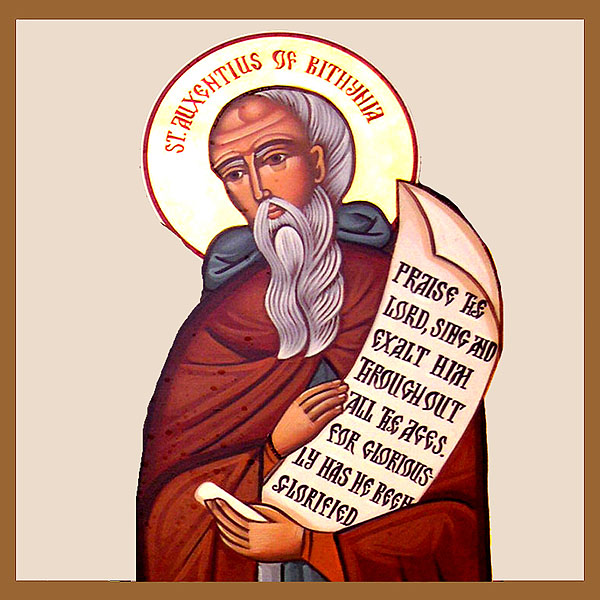
Saint Auxentius, by origin a Syrian, served at the court of the emperor Theodosius the Younger (418-450). He was known as a virtuous, learned and wise man, and he was, moreover, a friend of many of the pious men of his era.
Distressed by worldly vanity, Saint Auxentius was ordained to the holy priesthood, and then received monastic tonsure. After this he went to Bithynia and found a solitary place on Mount Oxia, not far from Chalcedon, and there he began the life of a hermit (this mountain was afterwards called Mt. Auxentius). The place of the saint’s efforts was discovered by shepherds seeking their lost sheep. They told others about him, and people began to come to him for healing. Saint Auxentius healed many of the sick and the infirm in the name of the Lord.
In the year 451 Saint Auxentius was invited to the Fourth Ecumenical Council at Chalcedon, where he denounced the Eutychian and Nestorian heresies. Familiar with Holy Scripture and learned in theology, Saint Auxentius easily bested those opponents who disputed with him. After the end of the Council, Saint Auxentius returned to his solitary cell on the mountain. With his spiritual sight he saw the repose of Saint Simeon the Stylite (459) from a great distance.
Saint Auxentius died about the year 470, leaving behind him disciples and many monasteries in the region of Bithynia. He was buried in the Monastery of Saint Hypatius at Rufiananas, Syria.
Repose of Saint Cyril, Equal of the Apostles and Teacher of the Slavs

Saint Cyril Equal of the Apostles, Teacher of the Slavs (Constantine in the schema), and his older brother Methodius (April 6), were Slavs, born in Macedonia in the city of Thessalonica.
Saint Cyril received the finest of educations, and from the age of fourteen he was raised with the son of the emperor. Later, he was ordained as a priest. Upon his return to Constantinople, he worked as a librarian of the cathedral church, and as a professor of philosophy. Saint Cyril successfully held debates with iconoclast heretics and with Moslems.
Yearning for solitude, he went to Mount Olympos to his older brother Methodius, but his solitude lasted only a short while. Both brothers were sent by the emperor Michael on a missionary journey to preach Christianity to the Khazars in the year 857. Along the way they stopped at Cherson and discovered the relics of the Hieromartyr Clement of Rome (November 25).
Arriving at the territory of the Khazars, the holy brothers spoke with them about the Christian Faith. Persuaded by the preaching of Saint Cyril, the Khazar prince together with all his people accepted Christianity. The grateful prince wanted to reward the preachers with rich presents, but they refused this and instead asked the prince to free and send home with them all the Greek captives. Saint Cyril returned to Constantinople together with 200 such captives set free.
In the year 862 began the chief exploit of the holy brothers. At the request of Prince Rostislav, the emperor sent them to Moravia to preach Christianity in the Slavic language. Saints Cyril and Methodius by a revelation from God compiled a Slavonic alphabet and translated the Gospel, Epistles, the Psalter and many Service books into the Slavonic language. They introduced divine services in Slavonic.
The holy brothers were then summoned to Rome at the invitation of the Roman Pope. Pope Adrian received them with great honor, since they brought with them the relics of the Hieromartyr Clement. Sickly by nature and in poor health, Saint Cyril soon fell ill from his many labors, and after taking the schema, he died in the year 869 at the age of forty-two. Before his death, he expressed his wish for his brother to continue the Christian enlightenment of the Slavs. Saint Cyril was buried in the Roman church of Saint Clement, whose own relics also rest there, brought to Italy from Cherson by the Enlighteners of the Slavs.
Venerable Isaac the Recluse of the Kiev Near Caves
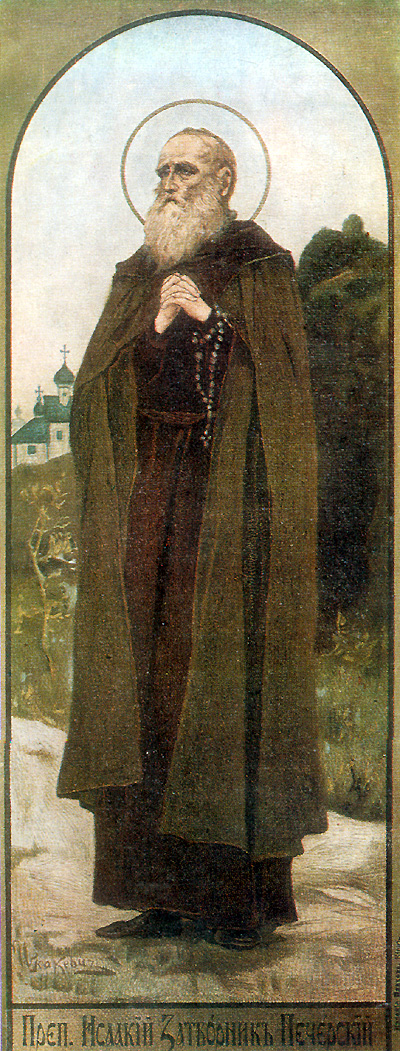
Saint Isaac was the first person in northern lands to live as a fool for Christ. His name in the world was Chern. Before becoming a monk, he was a rich merchant in the city of Toropets in the Pskov lands. Having distributed all his substance to the poor, he went to Kiev and received the monastic tonsure from Saint Anthony (July 10).
He led a very strict life of reclusion, eating only a single prosphora and a little water at the end of the day. After seven years as a hermit, he was subjected to a fierce temptation by the devil. Having mistaken the Evil One for Christ, he worshipped him, after which he fell down terribly crippled. Saints Anthony and Theodosius took care of him and nursed him. Only after three years did he begin to walk and to speak. He did not wish to attend church, but he was brought there by force.
Upon his return to health he took upon himself the exploit of holy foolishness, enduring beatings, nakedness and cold. Before his death he went into seclusion, where again he was subjected to an onslaught of demons, from which he was delivered by the Sign of the Cross and by prayer.
After his healing he spent about twenty years in asceticism. He died in the year 1090. His relics rest in the Caves of Saint Anthony, and part of them were transferred to Toropets by the igumen of the Kudin monastery in the year 1711. The Life of the Blessed Isaac was recorded by Saint Nestor in the Chronicles (under the year 1074). The account in the Kiev Caves Paterikon differs somewhat from that of Saint Nestor. In the Great Reading Menaion under April 27 is the “Account of Saint Isaac and his Deception by the Devil.”
12 Greeks who built the Dormition Cathedral in the Kiev Caves, Far Caves, Lavra

The Kiev Caves Icon of the Dormition of the Most Holy Theotokos (May 3) is one of the most ancient icons in the Russian Orthodox Church. The Mother of God entrusted it to four Byzantine architects, who in 1073 brought the icon to Saints Anthony and Theodosius of the Caves. The architects arrived at the monks’ cave and asked, “Where do you want to build the church?” The saints answered, “Go, the Lord will point out the place.”
“How is it that you, who are about to die, have still not designated the place?” the architects wondered. “And they gave us much gold.”
Then the monks summoned all the brethren and they began to question the Greeks, saying, “Tell us the truth. Who sent you, and how did you end up here?”
The architects answered, “One day, when each of us was asleep in his own home, handsome youths came to us at sunrise, and said, ‘The Queen summons you to Blachernae.’ We all arrived at the same time and, questioning one another we learned that each of us had heard this command of the Queen, and that the youths had come to each of us. Finally, we beheld the Queen of Heaven with a multitude of warriors. We bowed down to Her, and She said, ‘I want to build Myself a Church in Rus, at Kiev, and so I ask you to do this. Take enough gold for three years.’”
“We bowed down and asked, ‘Lady Queen! You are sending us to a foreign land. To whom are we sent?’ She answered, ‘I send you to the monks Anthony and Theodosius.’”
“We wondered, ‘Why then, Lady, do You give us gold for three years? Tell us that which concerns us, what we shall eat and what we shall drink, and tell us also what You know about it.’”
“The Queen replied, ‘Anthony will merely give the blessing, then depart from this world to eternal repose. The other one, Theodosius, will follow him after two years. Therefore, take enough gold. Moreover, no one can do what I shall do to honor you. I shall give you what eye has not seen, what ear has not heard, and what has not entered into the heart of man (1 Cor.2:9). I, Myself, shall come to look upon the church and I shall dwell within it.’”
“She also gave us relics of the holy martyrs Menignus, Polyeuctus, Leontius, Acacius, Arethas, James, and Theodore, saying, ‘Place these within the foundation.’ We took more than enough gold, and She said, ‘Come out and see the resplendent church.’ We went out and saw a church in the air. Coming inside again, we bowed down and said, ‘Lady Queen, what will be the name of the church?’”
“She answered, ‘I wish to call it by My own name.’ We did not dare to ask what Her name was, but She said again, ‘It will be the church of the Mother of God.’ After giving us this icon, She said, ‘This will be placed within.’ We bowed down to Her and went to our own homes, taking with us the icon we received from the hands of the Queen.”
After hearing this account, everyone glorified God, and Saint Anthony said, “My children, we never left this place. Those handsome youths summoning you were holy angels, and the Queen in Blachernae was the Most Holy Theotokos. As for those who appeared to be us, and the gold they gave you, the Lord only knows how He deigned to do this with His servants. Blessed be your arrival! You are in good company: the venerable icon of the Lady.” For three days Saint Anthony prayed that the Lord would show him the place for the church.
After the first night there was a dew throughout all the land, but it was dry on the holy spot. On the second morning throughout all the land it was dry, but on the holy spot it was wet with dew. On the third morning, they prayed and blessed the place, and measured the width and length of the church with a golden sash. (This sash had been brought long ago by the Varangian Shimon, who had a vision about the building of a church.) A bolt of lightning, falling from heaven by the prayer of Saint Anthony, indicated that this spot was pleasing to God. So the foundation of the church was laid.
The icon of the Mother of God was glorified by numerous miracles.
Translation of the Relics of Martyrs Michael and his councilor, Theodore, of Chernígov

The Right-believing Prince Michael of Chernigov and his Boyar Theodore were put to death by Batu of the Golden Horde on September 20, 1244. At first, some devout Russian Christians secretly took their relics. Later, the relics of the holy wonderworkers were transferred to the city of Vladimir, then to Chernigov, after Chernigov was ceded to the Poles in the year 1572. On February 14, 1578 Tsar Ivan the Terrible transferred their relics to a church which was dedicated to them in Moscow, with the blessing of Metropolitan Anthony.
In 1770 the relics of Saints Michael and Theodore were transferred to the Meeting of the Lord (Сретенский) cathedral, Since November 21,1774, they have been kept in a hidden place in Moscow's Holy Archangels Cathedral in the Kremlin.
The Holy Martyrs and Confessors Michael and Theodore are commemorated on September 20 (the day of their martyric death); on February 14 (the Translation of their Holy Relics in 1578; and on the Sunday before August 26 (Synaxis of the Moscow Saints).
Venerable Maron the Hermit of Syria

Saint Maron was born in the fourth century near the city of Cyrrhus in Syria. He spent almost all his time beneath the open sky in prayer, vigil, ascetical works and strict fasting. He obtained from God the gift of healing the sick and casting out demons. He counselled those who turned to him for advice to be temperate, to be concerned for their salvation, and to guard against avarice and anger.
Saint Maron, a friend of Saint John Chrysostom, died before 423 at an advanced age.
Some of Saint Maron’s disciples were James the Hermit (November 26), Limnius (February 23), and Domnina (March 1). Saint Maron founded many monasteries around Cyrrhus, and converted a pagan temple near Antioch into a Christian church.
Saint Abraham, Bishop of Charres, Mesopotamia

Saint Abraham, Bishop of Charres, lived during the mid-fourth and early fifth centuries, and was born in the city of Cyrrhus. In his youth he entered a monastery. Later he became a hermit in Lebanon, a place where many pagans lived.
Saint Abraham suffered much vexation from the pagans, who wanted to expel him from their area. He once saw tax-collectors beating those who were unable to pay. Moved to pity, he paid the taxes for them, and those people later accepted Christ.
The Christian inhabitants of this village built a church and they fervently besought Saint Abraham to accept the priesthood and become their pastor. The monk fulfilled their wish. Having encouraged his flock in the faith, he left them another priest in place of himself, and he again retired to a monastery.
For his deep piety he was made bishop of Charres; the saint constantly taught his pastors by his God-pleasing life. From the time of his accepting of the priesthood, he never used cooked food. The emperor Theodosius the Younger wanted to meet the bishop and made him an invitation. After he arrived in Constantinople, Saint Abraham soon died. His remains were solemnly transferred to the city of Charres and there given over to burial.
Saint Hilarion the New of Georgia
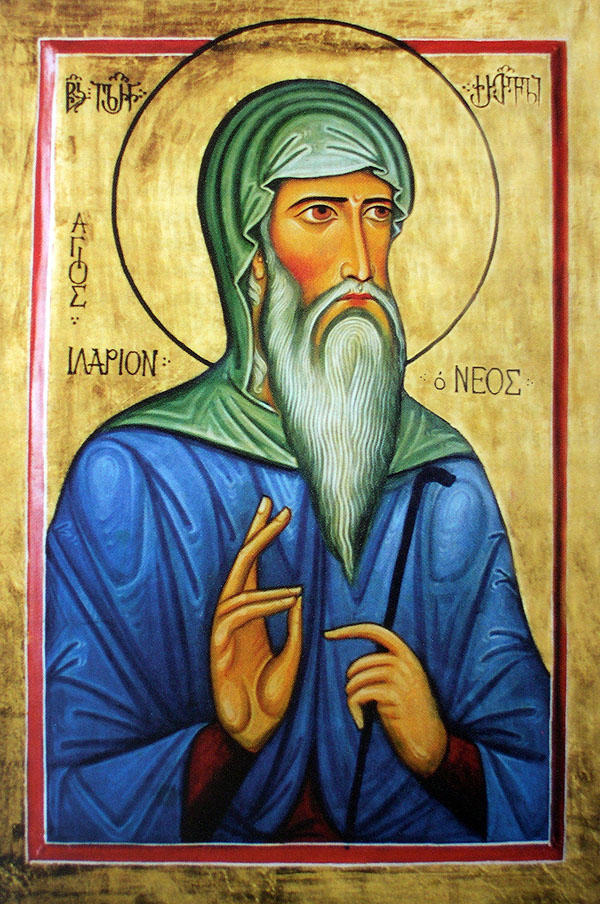
Holy Hiero-schema monk Hilarion the Georgian (Ise Qanchaveli in the world) was born in 1776 in the village of Losiantkhevi, in the Shorapani district of Kutaisi. His parents, Khakhuli and Mariam Qanchaveli, were pious and God-fearing nobles.
According to God’s will, Ise’s uncle, the hermit Hierodeacon Stepane, took his six-year-old nephew into his care. When Stepane reposed, Ise moved to Tabakini Monastery, but learning that a seminary had opened in Tbilisi, he set off for it. On his way he visited a certain Bishop Athanasios of Nikozi to receive his blessing, but the bishop, delighted by the youth’s fervent prayers, advised him to return home to his family: “My son, you will learn much more in the wilderness than you ever could in the classroom. Return home, and the Lord, having instructed you in prayer, will lead you on a path that will serve your people and the Church.”
Ise returned to the bosom of his family, and his father took him to Kutaisi to be raised in the court of the Imeretian king. King Solomon II (1789-1815) soon recognized that the young Ise stood above all the other courtiers in piety, and he appointed him to be his personal spiritual adviser and instructor. At the king’s suggestion, Ise married the Princess Mariam. Soon after his marriage, the humble nobleman was ordained to the priesthood and appointed confessor of the court church. Only two years later Princess Mariam reposed, leaving Fr. Ise a widower.
After the Russian annexation of Kartli-Kakheti, the imperial court of the tsar increased diplomatic correspondence with the court of King Solomon II. The king was urged likewise to unite the Imeretian Kingdom to Russia. Solomon summoned a council of noblemen, and it was decided that Imereti would remain independent, while maintaining friendly relations with Russia until the king’s death. However, it was agreed that since King Solomon had no heir, after his repose the court of the imperial tsar would acquire jurisdiction over the region.
But the political climate in Georgia became increasingly tense, and the ability of the Imeretian court to govern was severely undermined.
The court was suddenly besieged with cases of envy and treason, and it became necessary for the king to flee to Turkey. Protopresbyter Ise Qanchaveli accompanied King Solomon II to his place of exile and remained with him to the end of the king’s life.
After the king’s death in 1815, Fr. Ise received an amnesty from Tsar Alexander I (1801-1825) on behalf of the king and his court. Ise himself planned to go into reclusion in the village where he was born, but King Solomon’s widow, Queen Mariam, summoned him to Moscow where she was being held in “honorable captivity.” Fr. Ise brought to her a piece of the Life-giving Cross of our Lord, which had belonged to King Solomon, and the queen preserved her husband’s treasure in the court church.
But life at the imperial court was tiresome for the God-fearing Fr. Ise, so he exchanged his clothing for beggars’ rags and set off for Mt. Athos in the year 1819.
Fr. Ise appeared before the holy fathers of Mt. Athos as an unknown pilgrim, who had come to venerate the holy places. He first visited Ivḗron Monastery and from there crossed over the peninsula to Dionysiou Monastery.
In 1821 Ise was tonsured a monk and given the name Hilarion. He was presented with new monastic garments for the tonsure service, but asked permission to remain dressed in his own rags.
Fr. Hilarion fulfilled his every obedience with love. He was dispirited only by his ignorance of the Greek language, which prevented him from hearing and understanding the Word of God during the divine services. Finally he received permission from the abbot of Dionysiou to borrow some of the Georgian books from the large collection of sacred manuscripts at Ivḗron Monastery.
Upon arriving at the monastery, Fr. Hilarion went to venerate the Ivḗron Icon of the Mother of God. While praying on his knees before the icon, a Greek archimandrite whom he knew from Moscow saw and recognized him. He bowed before him, kissed his hands and cried out: “Fr. Ise! Holy Shepherd! Confessor of the king!”
Soon the news spread through all the monasteries of Mt. Athos that the spiritual father of the king had concealed himself as a beggar.
Everywhere the monks greeted him with great reverence. But Fr. Hilarion, ashamed of the attention, withdrew to the wilderness not far from the monastery.
At that time, in retaliation for the Greek Insurrection of 1821, the Turks were pillaging Greece and slaughtering the Christians. In 1822 a certain Abdul Robut-Pasha surrounded the Holy Mountain with an enormous army and commanded the abbots of all the monasteries to submit to his authority. Representatives of all the monasteries, including Fr. Hilarion and two others from Dionysiou were sent to Chromitsa to petition the pasha. Fr. Hilarion stood boldly before the pasha, burning with a desire to be martyred at the hands of an unbeliever.
Having learned that Fr. Hilarion was a Georgian, Robut-Pasha was overjoyed: he himself was also Georgian by descent but had been kidnapped by the Turks in his early adolescence.
The pasha proposed that Saint Hilarion leave the monastery and move to his palace in Thessalonica, promising him every kind of material wealth. But Fr. Hilarion refused and condemned the ruler’s unbelief. The furious pasha began to curse the Orthodox believers and all the Christian saints, among them the Most Holy Theotokos. The holy father was allowed no opportunity to reply to the pasha’s blasphemous remarks; instead they released him and took the other monks captive.
Having returned to the monastery, Fr. Hilarion regretted that he had not properly rebuffed the blasphemous pasha. His suffering was aggravated when the unbeliever continued to martyr and massacre other Christians. Finally he asked the abbot for his blessing and set off for the Turkish court in Thessalonica. There he stood before the pasha and fearlessly trampled upon his false teachings: “You sought to deny the virginity of the Most Holy Mother of God,” he charged. “Even your prophet Muhammad admits that Jesus was born without seed of a Virgin and that the mystery of the birth of God is necessarily beyond human comprehension. He is the True God, Who took on flesh for the salvation of mankind, to rescue fallen man from the curse of sin and death!”
The pasha began to argue, but Saint Hilarion told him, “You, the son of Christian parents, are on such a brutal rampage that you have deadened the pangs of conscience calling you back to the true Faith!”
The pasha laughed and answered that he was glad to have been delivered from the “ridiculous” Christian Faith. “I am indebted to the man who kidnapped me from my parents and sold me to the Turks,” he said, “and I have since rewarded him generously for his deed. If your Faith is indeed true, why have you fallen into the hands of the invaders? Why has your beloved God punished you so?”
“You misunderstand everything, Pasha,” answered Saint Hilarion.
“Does not a loving father take up the rod when his beloved son runs wild? Truly he does this not out of hatred but out of love, desiring to save the ignorant from grave misfortune. When the father sees that his child has corrected his behavior, he casts the rod into the fire. The Lord has permitted these sorrows to befall us because of our sins. You are a staff in the hands of the Lord: when He sees that we have mended our ways, He will cast you into the fire as well!”
For three consecutive days Saint Hilarion confronted the pasha in his palace, desiring to infuriate him to the point that he would order his execution. On the fourth day Saint Hilarion arrived at the palace and began to speak about the falseness of Muhammad and the Islamic faith.
Then the pasha provoked him even further, demanding, “What do you think—where will we go after death?”
Standing amidst believers of divers faiths, Saint Hilarion boldly answered that only those who truly believe in God, who are found in the bosom of the Orthodox Faith of Christ, will be saved. The enraged bystanders demanded that the insolent monk be executed, and Abdul Robut-Pasha finally ordered his death. Saint Hilarion prepared to meet death with joy, but a pair of the pasha’s servants, Georgians by descent, requested that the pasha repeal his death sentence, since it would be shameful for them to murder their fellow countryman.
They intended to send him in secret to Mt. Athos, but instead Saint Hilarion began to minister to the sick prisoners held in Thessalonica, and he selflessly dedicated himself to their service for six months. Then, according to God’s will, he set off again for Mt. Athos. Having returned to his monastery, Fr. Hilarion labored for three years as a hermit and afterwards withdrew to the tower of New Skete (a dependency of the Monastery of Saint Paul) to lead a life of strict asceticism.
On Fridays he kept a strict fast, and on other days he ate only tiny pieces of dried bread. These he would place in a narrow-mouthed jar and eat only what he was able to draw out with his hand. He drank just one glass of water a day. Throughout the period of his reclusion in the tower, demons tempted Saint Hilarion with terrible visions.
Once a group of faithful Christians desired to visit the hermit. As the elder received no one, they were not admitted. The pilgrims therefore decided to form a human ladder, standing one on top of the other in order to reach the small window of his cell. Fearing for their lives but not wanting to break his vow of reclusion, Saint Hilarion temporarily abandoned his cell and fled to the forest.
After some time, Saint Hilarion became physically weak from his strict ascetic labors and was forced to leave behind the solitary life. With the help of his faithful friend Benedict the Georgian, he gradually regained some of his strength and moved to the Ivḗron Monastery.
At the Ivḗron Monastery he took charge of the Georgian library, organized a catalog, and compiled twelve volumes of Lives of the Saints, which he entitled The Flower Garden. He presented the twelve volumes to the abbot of Zographou Monastery before the latter departed for Russia. In Russia the abbot published the twelve volumes in the Georgian language—without mention of the name of their compiler.
Saint Hilarion reposed at Saint Panteleimon Monastery, known as the Russikon, in a cell named for Great-martyr George, on February 14, 1864. Though he was desperately ill, Saint Hilarion continued to thank the Lord sincerely until his last day. “Glory to God!” he would say. “I desired martyrdom, but God did not grant it to me. Instead He sent me an illness which will be equal in merit to martyrdom if I am able to bear it!”
Prior to his death he asked his disciple, Father Savva, to bury his body in secret, but circumstances later required that his burial place be revealed. In 1867, during the vigil for the feast of the Ascension of our Lord, a group of monks opened Saint Hilarion’s burial vault and immediately sensed a sweet fragrance issuing forth from his body. At that moment one of the hermits saw a brilliant sphere of light shining like the sun over Fr. Hilarion’s cell.
The Holy Synod of the Georgian Apostolic Orthodox Church canonized Hieroschemamonk Hilarion (Qanchaveli) on October 17, 2002, and to differentiate him from Saint Hilarion the Georgian (commemorated November 19), called him “Hilarion Kartveli, Akhali” or “Hilarion the Georgian, the New.”
2/16 announcements
February 16, 2025
Sunday of the Prodigal Son
The theme of the third Sunday before Lent is RETURN FROM EXILE and the Gospel lesson of the Prodigal Son (Luke 15:11-32) is read. We are taught by this lesson that even as we stray from God, a banquet is set for our return. And we find that nothing in this fallen world truly satisfies, and thus we find ourselves on a pilgrimage of repentance – returning to God.
I Corinthians 6:12-20: Brethren, all things are lawful for me, but not all things are helpful. All things are lawful for me, but I will not be enslaved by anything. Food is meant for the stomach and the stomach for food; but God will destroy both one and the other. The body is not meant for immorality, but for the Lord, and the Lord for the body. And God raised the Lord and will also raise us up by His power. Do you not know that your bodies are members of Christ? Shall I therefore take the members of Christ and make them members of a prostitute? Never! Do you not know that he who joins himself to a prostitute becomes one body with her? For, as it is written, “The two shall become one flesh.” But he who is united to the Lord becomes one spirit with Him. Shun immorality. Every other sin which a man commits is outside the body; but the immoral man sins against his own body. Do you not know that your body is a temple of the Holy Spirit within you, which you have from God? You are not your own; you were bought with a price. So glorify God in your body, and in your spirit, which are God’s.
Luke 15:11-32: The Lord spoke this parable: “There was a man who had two sons; and the younger of them said to his father, ‘Father, give me the share of property that falls to me.’ And he divided his living between them. Not many days later, the younger son gathered all he had and took his journey into a far country, and there he squandered his property in loose living. And when he had spent everything, a great famine arose in that country, and he began to be in want. So he went and joined himself to one of the citizens of that country, who sent him into his fields to feed swine. And he would gladly have fed on the pods that the swine ate; and no one gave him anything. But when he came to himself he said, ‘How many of my father’s hired servants have bread enough and to spare, but I perish here with hunger! I will arise and go to my father, and I will say to him, “Father, I have sinned against heaven and before you; I am no longer worthy to be called your son; treat me as one of your hired servants.”’ And he arose and came to his father. But while he was yet at a distance, his father saw him and had compassion, and ran and embraced him and kissed him. And the son said to him, ‘Father, I have sinned against heaven and before you; I am no longer worthy to be called your son.’ But the father said to his servants, ‘Bring quickly the best robe, and put it on him; and put a ring on his hand, and shoes on his feet; and bring the fatted calf and kill it, and let us eat and make merry; for this my son was dead, and is alive again; he was lost, and is found.’ And they began to make merry. Now his elder son was in the field; and as he came and drew near to the house, he heard music and dancing. And he called one of the servants and asked what this meant. And he said to him, ‘Your brother has come, and your father has killed the fatted calf, because he has received him safe and sound.’ But he was angry and refused to go in. His father came out and entreated him, but he answered his father, ‘Lo, these many years I have served you, and I never disobeyed your command; yet you never gave me a kid that I might make merry with my friends. But when this son of yours came, who has devoured your living with harlots, you killed for him the fatted calf!’ And he said to him, ‘Son, you are always with me, and all that is mine is yours. It was fitting to make merry and be glad, for this your brother was dead, and is alive; he was lost, and is found.’”
Troparion of the Resurrection: The stone being sealed by the Jews, and thy pure body being guarded by the soldiers, thou didst arise on the third day, O Saviour, granting life to the world. Wherefore, the heavenly powers acclaimed thee, O Giver of life, crying, Glory to thy Resurrection, O Christ! Glory to thy kingdom! Glory to thy gracious providence, O only Lover of mankind.
Troparion of the Chains of St. Peter: O Holy Apostle, Peter, thou dost preside over the Apostles by the precious chains which thou didst bear. We venerate them with faith and beseech thee that by thine intercessions we be granted the great mercy.
Kontakion of the Prodigal Son: Foolishly I sprang away from Thy great fatherly glory, and dispersed in wicked deeds the riches that Thou didst give me. With the Prodigal I therefore cry unto Thee now: I have sinned against Thee, O compassionate Father. But receive me in repentance; make me as one of Thy hired servants, O Lord.
CALENDAR
UNTIL FURTHER NOTICE: All services listed on the calendar will be available through streaming and webcast. (Instructions can be found on the parish website.)
Sunday, February 16 (Sunday of the Prodigal Son)
8:50 a.m. – Orthros
9:00 a.m. – Christian Education
10:00 a.m. – Divine Liturgy (webcast)
Monday, February 17
Father Herman off
Tuesday, February 18
NO Services
Wednesday, February 19
5:20 p.m. – Catechism Class
6:30 p.m. – Daily Vespers
7:30 p.m. – Parish Council meeting
Thursday, February 20
NO Services
Friday, February 21
NO Services
Saturday, February 22 (Saturday of the Souls)
9:00 a.m. – Orthros followed by Divine Liturgy
4:30 p.m. – Choir Practice
5:00 p.m. – Catechism Class
6:00 p.m. – Great Vespers
Sunday, February 23 (Sunday of Meat Fare)
8:50 a.m. – Orthros
9:00 a.m. – Christian Education
10:00 a.m. – Divine Liturgy (webcast)
SPECIAL ANNOUNCEMENTS
The Eucharist Bread …was offered by the Meadows for the Divine Liturgy this morning.
Eucharist Bread Schedule:
Eucharist Bread Coffee Hour
February 16 Meadows Baker/Jimmy Jones
February 22 (Sat. a.m.) Davis Pigott/Ian Jones
(Saturday of the Souls) Koliva: Anastasia Jones
February 23 D. Root Ken Jones/Stewart
March 2 Karam TEENS FUNDRAISER MEAL
March 9 Brock Meadows/Brock
March 16 R. Root Dansereau/Alaeetawi
March 23 Pacurari Ellis/Zouboukos/Waites
March 24 (Mon. p.m.) Lasseter D. Root/Meadows
(Feast of the Annunciation)
March 30 Milnor Miller/Weatherly
Schedule for Epistle Readers – Page numbers refer to the Apostolos (book of the Epistles) located on the Chanters’ stand at the front of the nave. Please be sure to use this book when you read.
Reader Reading Page#
February 16 Ian Jones I Cor. 6:12-20 265
February 22 (Sat. a.m.) Kh. Sharon Meadows Thess. 4:13-17 412
February 23 Walt Wood I Cor. 8:8-9:2 273
March 2 Brenda Baker Rom. 13:11-14:4 279
March 9 Katie Miller Heb. 11:24-26, 32-40 281
March 16 Mary Martha Ellis Heb. 1:10-2:3 283
March 23 Kh. Sharon Meadows Heb. 4:14-5:6 285
March 24 (Mon. p.m.) Brenda Baker Heb. 2:11-18 376
March 30 Katie Miller Heb. 6:13-20 287
Also, please remember that we still need your tithes and offerings which may be placed in the tray that is passed during the Divine Liturgy, in the tithe box at the back of the nave or be mailed to: St. Peter Orthodox Church, P.O. Box 2084, Madison, MS 39130-2084.
Please remember the following in your prayers: Aidan Milnor, the Milnor family; Lamia Dabit and her family; Mary Greene (Lee and Kh. Sharon’s sister); Jay and Joanna Davis; Fr. Leo and Kh. Be’Be’ Schelver and their family; Marilyn (Kyriake) Snell; Jack and Jill Weatherly; Dn. Terry Algood and their family; Reader Basil and Brenda Baker and their family; Fr. Joseph Bittle; Rick Carlton; Very Rev. Fr. Nicholas and Kh. Jan Speier; Lee Greene; Fr. John and Kh. Janet Henderson and their family; Galina Singletary; Emily and Cole Parker.
Fr. Herman will be out of town February 14th-17th for Winter Camp St. Thekla. If you need a priest during this time, please contact Fr. James.
Calendar Items:
* The men of the parish meet for lunch at 11:00 a.m. on the first Thursday of the month.
* The Ladies meet at the church at 10:00 a.m. on the second Saturday of the month to pray the Akathist to the Mother of God, Nurturer of Children on behalf of our children.
* The Ladies meet for lunch at 1:00 p.m. on the last Tuesday of the month.
* This year’s dates for serving at Stewpot Ministries are Saturday, March 1st and Saturday, September 27th.
* Great Lent begins this year on Clean Monday, March 3rd. More details on services, etc. will available in the coming weeks.
* St. Peter will be hosting the Sunday of Orthodoxy vespers this year on Sunday afternoon, March 9th, beginning at 4:00 p.m. More information will be available very soon.
Fasting Discipline for February
The traditional fasting discipline (no meat, dairy, eggs, fish, wine or oil) is observed on Wednesdays and Fridays during the first and third weeks in February. However, there is no fasting during the week following the Sunday of the Pharisee and the Publican (February 9th). February 23rd is Meatfare Sunday after which meat will no longer be eaten until Pascha. During the week that follows, dairy products may be eaten on all days, including Wednesday and Friday.
Major Commemorations for February
February 16 Sunday of the Prodigal Son
February 22 Saturday of the Souls
February 23 Meatfare Sunday
February 24 The Forerunner (1st and and Discoveries)
Seating spaces in the Nave: As a gentle reminder, please be mindful of seating spaces in the Nave during Sunday Divine Liturgy. Due to our growth over the past few years seating has become a little more limited and there has been an overflow toward the back of the Nave near the Narthex, which makes it “tight” for the clergy to make the Great Entrance. While this is a good problem to have, and until we can begin work on the new Temple, please make sure there are enough spaces available in the “seating” area of the Nave for as many people as possible. This means we may have “squtch in” on the rows. Thank you for your help in this.
Quotable: “When a man leaves on a journey, he must know where he is going. Thus with Lent. Above all, Lent is a spiritual journey and its destination is Easter, ‘the Feast of Feasts’. It is the preparation for the ‘fulfillment of Pascha, the true Revelation’. We must begin, therefore, by trying to understand this connection between Lent and Easter, for it reveals something very essential, very crucial about our Christian faith and life.”
Alexander Schmemann, Great Lent
Worship: Sunday, February 23, 2025 (Sunday of Meat Fare; Sunday of the Last Judgement)
Scripture: I Corinthians 8:8-9:2; Matthew 25:31-46
Epistle Reader: Walt Wood
Prosphora: D. Root
Coffee Hour: Ken Jones/Stewart
Daily Readings for Thursday, February 13, 2025
THURSDAY OF PRODIGAL SON
NO FAST
Martinian of Palestine, Apostles Aquila and Priscilla, Eulogios, Patriarch of Alexandria, Symeon the Myrrhbearer of Serbia
ST. JOHN’S FIRST UNIVERSAL LETTER 1:8-10; 2:1-6
Brethren, if we say we have no sin, we deceive ourselves, and the truth is not in us. If we confess our sins, he is faithful and just, and will forgive our sins and cleanse us from all unrighteousness. If we say we have not sinned, we make him a liar, and his word is not in us. My little children, I am writing this to you so that you may not sin; but if any one does sin, we have an advocate with the Father, Jesus Christ the righteous; and he is the expiation for our sins, and not for ours only but also for the sins of the whole world. And by this we may be sure that we know him, if we keep his commandments. He who says "I know him" but disobeys his commandments is a liar, and the truth is not in him; but whoever keeps his word, in him truly love for God is perfected. By this we may be sure that we are in him: he who says he abides in him ought to walk in the same way in which he walked.
MARK 13:31-37: 14:1-2
The Lord said to his disciples, “Heaven and earth will pass away, but my words will not pass away. But of that day or that hour no one knows, not even the angels in heaven, nor the Son, but only the Father. Take heed, watch; for you do not know when the time will come. It is like a man going on a journey, when he leaves home and puts his servants in charge, each with his work, and commands the doorkeeper to be on the watch. Watch therefore — for you do not know when the master of the house will come, in the evening, or at midnight, or at cockcrow, or in the morning — lest he come suddenly and find you asleep. And what I say to you I say to all: Watch.” It was now two days before the Passover and the feast of Unleavened Bread. And the chief priests and the scribes were seeking how to arrest him by stealth, and kill him; for they said, “Not during the feast, lest there be a tumult of the people.”
Saints Martinian, Zoe, and Photina of Caesarea in Palestine

Saint Martinian went to live in the wilderness at the age of eighteen, not far from the city of Caesarea in Palestine. For twenty-five years, he devoted himself to ascetic deeds and silence, and he was granted the gift of healing illnesses and casting out demons. However, the Enemy of the human race would not stop troubling the holy ascetic with various temptations.
One day a prostitute overheard some citizens of Caesarea speaking of Saint Martinian's virtuous life, so she asked them why they were amazed by it. She said that he went to live in the desert because he could not endure the temptations of the flesh in the city. Furthermore, she made a wager with them that she could topple this pillar of virtue with her beauty and seduce him.
She came to him one night, dressed in shabby clothes, pretending that she had lost her way in the storm, and asking for shelter. Reluctantly, the saint allowed her to enter his cell, because he did not wish to be the cause of her death. He went into the inner room of his cell, telling her she would have to leave in the morning. After chanting Psalms according to his Rule, he went to sleep on the floor, but he was disturbed by carnal thoughts. Meanwhile, the wicked guest opened the bag she had been carrying and changed into her beautiful clothes and adorned herself with jewels.
When morning came, Saint Martinian came out to send the woman away. Though he was tempted by the woman’s beauty, he was determined not to fall into sin. Lighting a fire, he stepped into it, saying, “You want me to burn with temptation, but I will not give in to it. Instead, I choose to burn in this fire in order to preserve my purity and to escape the unquenchable fires of Hell."
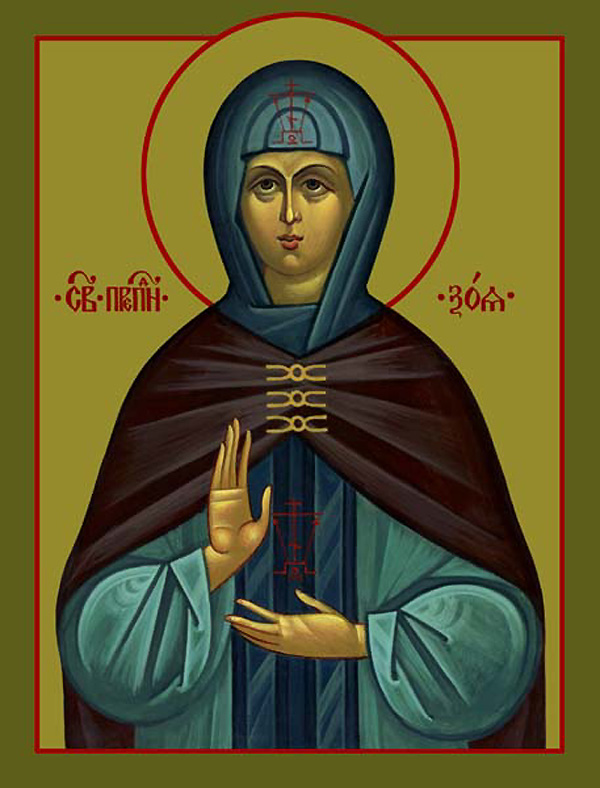
The woman was astonished at the lengths Saint Martinian was willing to go, and she realized how evil she was. She repented and asked the saint to guide her onto the way of salvation. He told her to go to Bethlehem, and enter the convent founded by Saint Paula (January 26). There she lived as a nun for twelve years in strict asceticism until her blessed repose. The woman’s name was Zoe.
After his burns healed, Saint Martinian went to an uninhabited rocky island, and lived on it under the open sky for several years, nourished by the provisions brought by a certain sailor from time to time. In return the monk wove baskets for him.
One day a ship was wrecked by a powerful storm, and a woman named Photina floated to the island on pieces of the wreckage Saint Martinian helped her to survive on the island. “Remain here,” he told her, “for I am leaving you bread and water, and in two months a boat will come and return you to the mainland."
Saint Martinian refused to stay on the island with the woman, believing that it would be better to drown than to burn with lust. He jumped into the sea and swam away, and a pair of dolphins carried him to dry land. Thereafter, Saint Martinian led the life of a wanderer. Later, he came to Athens and fell ill. Sensing the approach of death, he went into a church and lay upon the floor. God revealed to the Bishop of Athens who Saint Martinian was, and the hierarch buried his body with honor. This occurred around the year 422.
As for Saint Photina, she did not board the ship when it came to the island, electing to stay there by herself. She asked the captain of the ship to have his wife bring her men's clothing and some wool, promising to make clothes for his family. She also asked the woman to bring her bread and water in addition to the other supplies.
Saint Photina lived on the island for six years, and then she went to the Lord. Two months after her repose, the captain and his wife found her incorrupt relics and brought them to Caesarea in Palestine. He had a vision which revealed many details of Saint Photina's life, which he shared with the bishop. Then they buried her with great honor and reverence.
Venerable Stephen (in monasticism Simeon), the Myrrhgusher and Prince of Serbia
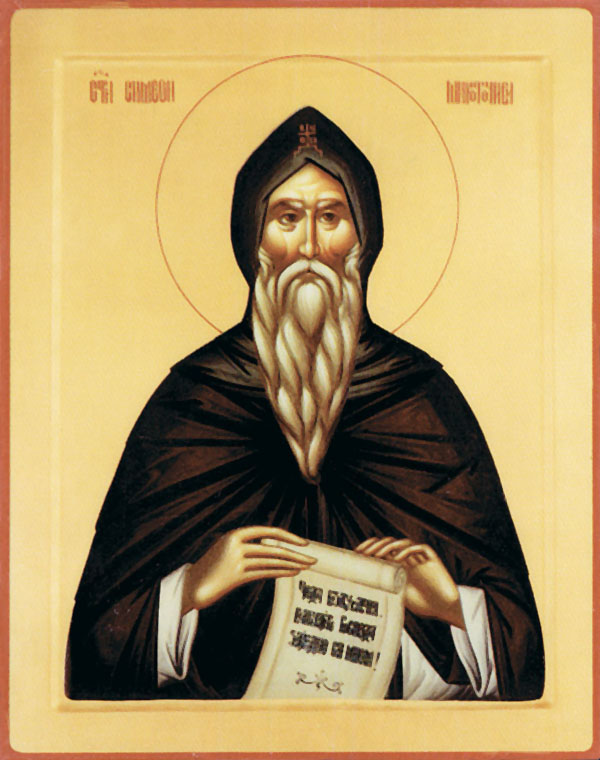
Saint Simeon the Myrrh-Gusher, King of Serbia Stephen Nemanya was the Great Zhupan of Serbia, and lived during the twelfth century. The saint toiled much for his fatherland: he united a large portion of the Serbian lands, and strove for the political independence of his country from the Byzantine Empire. In his zeal for the Orthodox Church, he defended his nation against heresy and false teaching.
At the age of eighty, Stephen went to Mt. Athos, where his son Saint Savva (January 12), was glorified by the holiness of his life. Together they restored the desolate Hilandar monastery, to which monks from various lands began to gather.
Saint Simeon was a great ascetic and wise guide for the monks. He died on February 13, 1200, and his relics began to exude myrrh. Saint Savva transported his father’s relics back to Serbia, and placed them in a church of the Most Holy Theotokos at the River Studenitsa. Saint Simeon had richly adorned this church while he was still ruler of Serbia.
Saint Eulogius, Archbishop of Alexandria

Saint Eulogius, Patriarch of Alexandria, was one of the enlightened hierarchs of the sixth century. At first he was igumen of the monastery of the Mother of God in Antioch, and then in 579 he was chosen as Patriarch of Alexandria, where he served for twenty-seven years. Throughout his life, the saint struggled vigorously against heresies. He was also a friend of Saint Gregory Dialogus (March 12), and some of their correspondence has been preserved.
Saint Eulogius died in 607 or 608. Saint Photius quotes from his writings, which reveal an Orthodox theology of the two natures of our Lord Jesus Christ. Only one of his sermons, for Palm Sunday, has survived in complete form.
Appearance of Christ to Saint Martin of
Tours
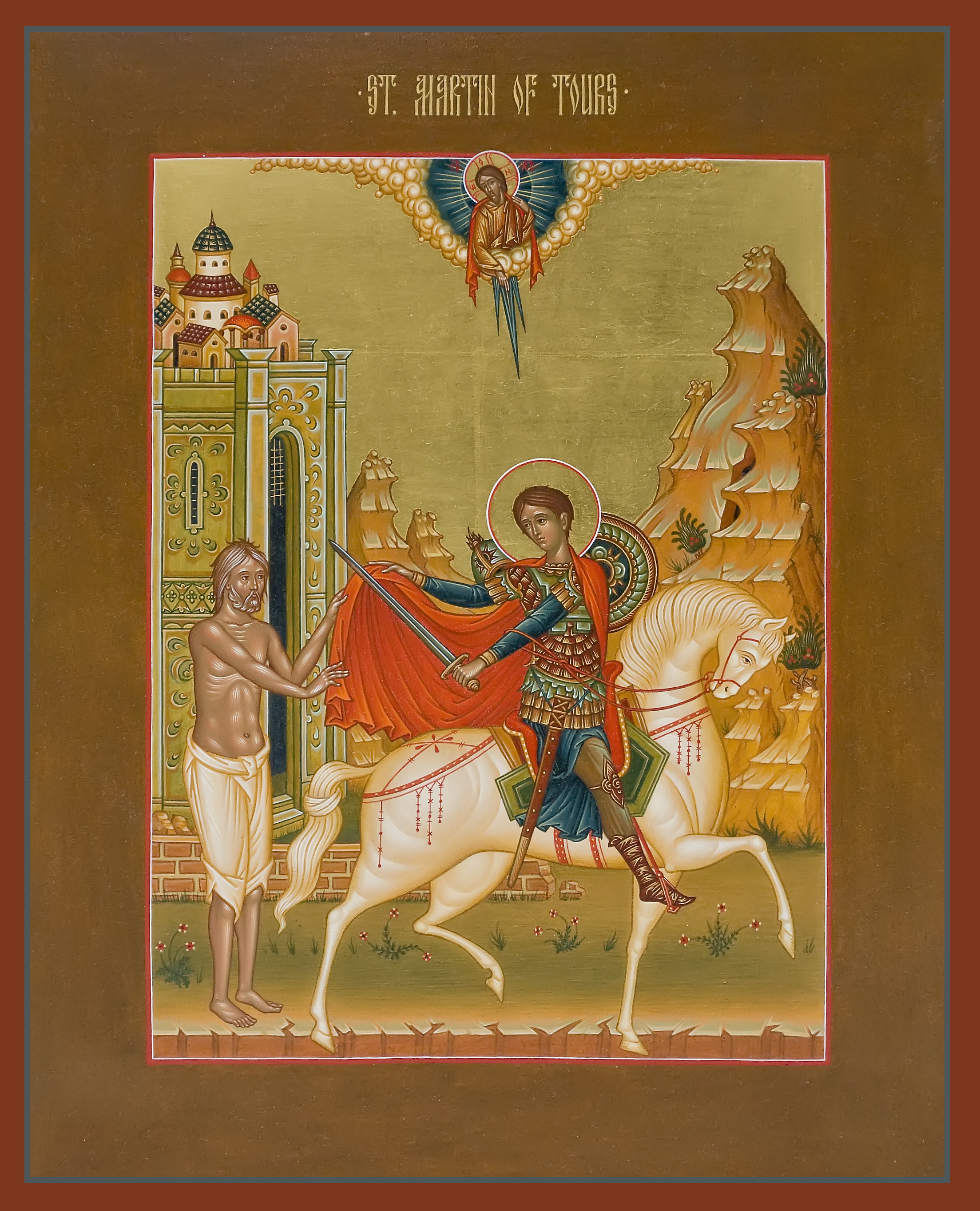
On February 13, the Russian Orthodox Church commemorates the appearance of Christ to Saint Martin of Tours (October 12 and November 11).
From childhood, Saint Martin was known for his compassionate heart and great pity for the poor. When he was twenty-two years old, even before he was baptized, he began to give away all his possessions to those in need, and soon he was left with just one set of clothes and a knife.
Saint Martin, like many young men, had to serve in the army for several years. One day, when the weather was very harsh and unusually cold, he met a man at the city gates of Amiens, almost naked, and begging for alms. Martin saw that people just walked past the man without taking any notice. Since Martin had already given away everything he owned, he had only his cloak and his uniform. No one else would help the beggar, so Martin felt that it was his responsibility to do something for him.
Recalling the Savior's words: "If anyone wishes to judge you and take away your tunic, let him have your cloak as well" (Matthew 5:40), Martin drew his sword and cut his cloak in two. Giving half to the beggar, he wrapped himself in the other half. Seeing him in the torn cloak, those standing by began to laugh at his strange appearance. Others, who had more sense, regretted the fact that they had done nothing for the man, although they could have clothed the beggar without uncovering themselves as Saint Martin did.
That night, in his sleep, Martin saw Christ wearing half of his cloak, which he had given the beggar. The Lord told him to look at Him and to notice that it was the same garment. Then the Savior said to the Angels who surrounded Him, "Martin is still just a catechumen, but he has clothed me in this garment."
Saint Martin did not become puffed up with pride because of this vision. Instead, he saw this as a sign of God's goodness, which confirmed Christ's words: "Truly, I say to you, inasmuch as you did it to one of the least of my brethren, you did it to me" (Matthew 25:40).
Because Saint Martin gave alms throughout his life, he was rewarded with the gift of working miracles. Let us follow his example so that we might be granted a small corner of Paradise.
Saint Seraphima
Saint Seraphima (Euthymia Euthymova Morgacheva, in the world), was born on September 14, 1806 in the village of Ningvo-Lomov in the diocese of Ryazan and lived an ascetical life at a monastery in Sezhenovo, Russia. She departed to the Lord in the year 1877.
Saint George, Archbishop of Mogilev, Belarus
Saint George (in the world Gregory Iosifovich Konissky) was born into a prominent family on November 20, 1717 in the town of Nezin. He studied at the Kiev Theological Academy and became a monk in the Kiev Caves Lavra.
Later he served as Archbishop of Mogilev, Belarus and reposed peacefully in the year 1795.
Daily Readings for Wednesday, February 12, 2025
WEDNESDAY OF PRODIGAL SON
NO FAST
Meletius, Archbishop of Antioch, Antonius, Archbishop of Constantinople, Meletios of Ypseni, Christos the New Martyr
ST. PETER’S SECOND UNIVERSAL LETTER 3:1-18
Beloved, this is now the second letter that I have written to you, and in both of them I have aroused your sincere mind by way of reminder; that you should remember the predictions of the holy prophets and the commandment of the Lord and Savior through your apostles. First of all you must understand this, that scoffers will come in the last days with scoffing, following their own passions and saying, "Where is the promise of his coming? For ever since the fathers fell asleep, all things have continued as they were from the beginning of creation." They deliberately ignore this fact, that by the word of God heavens existed long ago, and an earth formed out of water and by means of water, through which the world that then existed was deluged with water and perished. But by the same word the heavens and earth that now exist have been stored up for fire, being kept until the day of judgment and destruction of ungodly men.
But do not ignore this one fact, beloved, that with the Lord one day is as a thousand years, and a thousand years as one day. The Lord is not slow about his promise as some count slowness, but is forbearing toward you, not wishing that any should perish, but that all should reach repentance. But the day of the Lord will come like a thief, and then the heavens will pass away with a loud noise, and the elements will be dissolved with fire, and the earth and the works that are upon it will be burned up.
Since all these things are thus to be dissolved, what sort of persons ought you to be in lives of holiness and godliness, waiting for and hastening the coming of the day of God, because of which the heavens will be kindled and dissolved, and the elements will melt with fire! But according to his promise we wait for new heavens and a new earth in which righteousness dwells.
Therefore, beloved, since you wait for these, be zealous to be found by him without spot or blemish, and at peace. And count the forbearance of our Lord as salvation. So also our beloved brother Paul wrote to you according to the wisdom given him, speaking of this as he does in all his letters. There are some things in them hard to understand, which the ignorant and unstable twist to their own destruction, as they do the other scriptures. You therefore, beloved, knowing this beforehand, beware lest you be carried away with the error of lawless men and lose your own stability. But grow in the grace and knowledge of our Lord and Savior Jesus Christ. To him be the glory both now and to the day of eternity. Amen.
MARK 13:24-31
The Lord said to his disciples, “In those days, after that tribulation, the sun will be darkened, and the moon will not give its light, and the stars will be falling from heaven, and the powers in the heavens will be shaken. And then they will see the Son of man coming in clouds with great power and glory. And he will send out the angels, and gather his elect from the four winds, from the ends of the earth to the ends of heaven. From the fig tree learn its lesson: as soon as its branch becomes tender and puts forth its leaves, you know that summer is near. So also, when you see these things taking place, you know he is near, at the very gates. Truly, I say to you, this generation will not pass away before all these things take place. Heaven and earth will pass away, but my words will not pass away.”
Saint Meletius, Archbishop of Antioch
Saint Meletius, Archbishop of Antioch, was Bishop of Sebaste in Armenia (ca. 357), and afterwards he was summoned to Antioch by the emperor Constantius to help combat the Arian heresy, and was appointed to that See.
Saint Meletius struggled zealously against the Arian error, but through the intrigues of the heretics he was thrice deposed from his cathedra by the Emperor Constantius who had become surrounded by the Arians and had accepted their position. In all this Saint Meletius was distinguished by an extraordinary gentleness, and he constantly led his flock by the example of his own virtue and kindly disposition, supposing that the seeds of the true teaching sprout more readily on such soil.
Saint Meletius was the one who ordained the future hierarch Saint Basil the Great as deacon. Saint Meletius also baptized and encouraged another of the greatest luminaries of Orthodoxy, Saint John Chrysostom, who later eulogized his former archpastor.
After Constantius, the throne was occupied by Julian the Apostate, and the saint again was expelled, having to hide himself in secret places for his safety. Returning under the emperor Jovian in the year 363, Saint Meletius wrote his theological treatise, “Exposition of the Faith,” which facilitated the conversion of many of the Arians to Orthodoxy.
In the year 381, under the emperor Theodosius the Great (379-395), the Second Ecumenical Council was convened. In the year 380 the saint had set off on his way to the Second Ecumenical Council at Constantinople, and came to preside over it.
Before the start of the Council, Saint Meletius raised his hand displaying three fingers, and then withdrawing two fingers and leaving one extended he blessed the people, proclaiming: “We understand three hypostases, and we speak about a single nature.” With this declaration, a fire surrounded the saint like lightning. During the Council Saint Meletius fell asleep in the Lord. Saint Gregory of Nyssa honored the memory of the deceased with a eulogy.
Saint Meletius has left treatises on the consubstantiality of the Son of God with the Father, and a letter to the emperor Jovian concerning the Holy Trinity. The relics of Saint Meletius were transferred from Constantinople to Antioch.
Saint Alexei, Metropolitan of Moscow, Wonderworker of All Russia

Saint Alexei, Metropolitan of Moscow and All Russia the Wonderworker (in the world Eleutherios), was born in the year 1292 (or according to another source, 1304) at Moscow into the family of the noble Theodore Byakont, a descendant of the Chernigov princely line.
The Lord revealed to the future Saint his lofty destiny from early childhood. At twelve years of age Eleutherios went to a field and set nets to ensnare birds. He dozed off and suddenly he heard a voice: “Alexei! Why do you labor in vain? You are to be a catcher of men."
From this day on the boy abandoned childish games and spent much time in solitude. He often attended church, and when he was fifteen he decided to become a monk.
In 1320, he entered Moscow’s Theophany Monastery, where he spent more than twelve years in strict monastic struggles. The renowned ascetics of that monastery, the Elders Gerontios and Saint Stephen (July 14), the brother of Saint Sergius of Radonezh, were guides for him and his companions.
Metropolitan Theognostos, who noticed the virtuous life and spiritual gifts of Saint Alexei, bade the future Saint to leave the monastery and manage the ecclesiastical courts. The Saint fulfilled this office for twelve years. Toward the end of 1350, Metropolitan Theognostos had Alexei consecrated as Bishop of Vladimir. Following the Metropolitan's repose in the year 1354, Saint Alexei succeeded him.
During this period the Russian Church was torn by great rifts and quarrels, in part because of the pretensions of Metropolitan Romanos of Lithuania and Volhynia. In 1356, in order to put an end to the troubles and disturbances, the Saint went to Constantinople to see the Ecumenical Patriarch. Patriarch Kallistos gave Saint Alexei the right to be called, and to consider himself, as both Archbishop of Kiev and Great Russia with the title, “Most Venerable Metropolitan and Exarch.”
On his return journey, during a storm at sea, the ship was in danger of sinking. Saint Alexei prayed and vowed to build a temple to the Saint of that day on which the ship should come to shore. The storm subsided, and the ship arrived on August 16.
In spite of problems on every side, Saint Alexei devoted himself to his flock: he appointed bishops, and established cenobitic monasteries (on the model of the Trinity Lavra, founded by Saint Sergius), and he brought order to Russian relations with the Khans of the Horde. Saint Alexei journeyed more than once to the Golden Horde. In 1357 the Khan told the Great Prince that Saint Alexei should come to him and heal the blindness of his wife Taidulla.
“That is beyond my power,” Metropolitan Alexei replied, “but I believe that God, Who gave sight to the blind, will also help me.” By his prayers, and after sprinkling the Khan's wife with holy water, she was healed.
When Great Prince John died, his young son Demetrios (the future saint), then still a minor, was taken under the Saint Alexei's guardianship. The holy Hierarch had much difficulty in reconciling and appeasing the Princes, who obstinately refused to accept Moscow's authority. Nor did Vladyka Metropolitan neglect the work of establishing new monasteries.
In 1361 he founded a Monastery dedicated to the Icon of the Savior Not Made by Hands at the Yauza in Moscow. Andronikos, the disciple of Saint Sergius, was the first Igoumen of the Monastery, thus fulfilling the vow he had made on his return journey from Constantinople, when the ship was in danger.
Metropolitan Alexei also founded the Chudov Monastery1 in the Moscow Kremlin. Ancient monasteries were restored: the Annunciation Monastery at Nizhni-Novgorod, and Saints Constantine and Helen at Vladimir. In 1361 a women’s cenobitic monastery was named for him (Alekse'ev).
Saint Alexei reached the advanced age of seventy-eight, having spent twenty-four years upon the metropolitan cathedra. He reposed on February 12, 1378 and was buried at the Chudov Monastery in accordance with his last wishes. His relics were uncovered in a miraculous manner fifty years later, after which the memory of the great holy Hierarch and intercessor began to be commemorated.
Saint Alexei is also commemorated on May 20 (Recovery of his relics) and on October 5 (Synaxis of the Moscow Hierarchs).
1 The Monastery is dedicated to the Miracle of the Archangel Michael (September 6).
Saint Meletius, Archbishop of Khar'kov and Akhtyrsk

Saint Meletios, Archbishop of Khar'kov and Akhtyrsk (in the world Michael Ivanovich Leontovich), was born on November 6, 1784 in the village of Stara Stanzhara in the Poltava district.
In 1808 Michael Leontovich successfully completed the Ekaterinoslav religious Seminary. Since he was the best student, Archbishop Platon of Ekterinoslav sent him to Peterburg, to the Saint Alexander Nevsky Spiritual Academy.1 Graduating in 1814 with a Master's Degree, he was appointed as adjunct professor of Greek.
On March 11, 1817 they appointed Michael Leontovich as Secretary of the Academy Building Committee.
On July 30, 1817 he was transferred to the Kiev religious Seminary, serving in the position of Inspector, as well as Professor of Church History and Greek. When the Kiev Spiritual Academy opened on September 28, 1819, Michael became its first Inspector.
On February 11, 1820, on the eve of the Feast of Saint Meletios of Antioch, he was tonsured as a monk with the name Meletios, in the kathoikon of the Kiev-Bratsk Monastery, The tonsure was done by Metropolitan Eugene (Bolkhovitnikov). of Kiev. On February 22, 1820 the Monk Meletios was ordained to the diaconate by Metropolitan Eugene, and then as a Hieromonk on February 25.
On August 9, 1821 Hieromonk Meletios was appointed as Rector of the Mogilevsk religious Seminary and head of the Khutynsk Orshansk Monastery, and raised to the dignity of Archimandrite. In August 1823 he was appointed as Rector of the Pskov religious Seminary. On January 24,1824 Archimandrite Meletios was appointed as Rector of the Kiev Spiritual Academy.
In October 1826 the Holy Synod decided to name Archimandrite Meletios as Bishop of Chigirinsk, a vicar of the Kiev Diocese, and head of the Zlatoverkh Mikhailov Monastery. On October 19, 1826 he was elected as bishop, and on October 21, 1826 his consecration took place at Kiev's Holy Wisdom cathedral.
With paternal love, the Saint concerned himself with young foster-children, raising them in a spirit of devotion to the Church of Christ. He paid particular attention to the needy, widows, and orphans. He often visited those in prison and provided them the consolation of Divine Services in the prison churches. He was also concerned about the spiritual nourishment of the brethren of the Mikhailov Monastery. By his edifying discourses and personal example, he inspired the monks with the spirit of true asceticism. Saint Meletios said: "Humility is a protective sword, by which we pass over earth and Hades, to reach Heaven."
In April 1828 Saint Meletios was transferred to the cathedral in Perm.
Strict with himself, the Saint was also strict with others. To prepare candidates for accepting of the dignity of the priesthood, Saint Meletios himself wrote the so‑called "Ordinand's Catechism". In August 1831 Vladika was transferred to the See of Irkutsk, and elevated to the rank of Archbishop.
Vladika Meletios devoted much attention to the enlightenment of the lesser nations of Russia with the light of the Gospel. He founded churches in the north of Kamchatka, in the northeast parts of the Irkutsk Diocese and along the Aldan River, on the tract from Yakutsk to Okhotsk. He often reviewed his wide-spread Diocese, going to the shores of the Okhotsk and Arctic Seas, to the boundaries of North America, where Father John Veniaminov, the reknowned Apostle of Siberia (later known as Saint Innocent), the Apostle to America was.2 Journeying through Siberia and along the shores of the Pacific Ocean, Saint Meletios frequently interacted with the native peoples who professed Lamaism. Gently, he urged them to abandon their errors, and explained the Gospel truths to these pagan peoples: the Tungus, the Buryats, the Kamchadali, and also the inhabitants of the Kurile and Aleutian Islands.
Because of his tireless labors, Vladika's health began to deteriorate, and they transferred him to the Slobodsk-Ukraine See (later the See of Khar'kov and Akhtyrsk) in 1835.
Saint Meletios showed great interest in the institutions of spiritual learning, concerning himself with the life and education of the clergy.
The Archbishop raised questions about reopening the monasteries and spiritual schools which Empress Catherine II had closed. He also devoted much labor to the struggle with the schismatics.
On July 2, 1839 Saint Meletios led the service in the city of Akhtyrsk for the tenth anniversary of the appearance of the wonderworking Akhtyrsk Icon of the Mother of God.
The Saint's blessed repose occurred on the night of February 29, 1840. After receiving Holy Communion, he made the Sign of the Cross, and then he turned to everyone to say, "Forgive me." With those words, he departed to the Lord.
On March 4, 1840 Saint Meletios was buried by Bishop Iliodore of Kursk, in a crypt beneath the Church of the Cross at the Protection Monastery.
Immediately after his death, believers had great faith in the powerful intercession of Saint Meletios with God, and they received healing in sicknesses, comfort in sorrows, and deliverance from difficult circumstances. Believers in Khar'kov placed their trust in Saint Meletios during the terrible days of World War II. With miraculous advice, the Saint foretold the impending deliverance of the city from the enemy.
In 1948, with the blessing of His Holiness Patriarch Alexei, the coffin with the relics of Saint Meletios was transferred to the cathedral of the Annunciation.
On February 21, 1978, the Holy Synod of the Russian Orthodox Church "approved and blessed a Church Service and an Akathist to Saint Meletios, Archbishop of Khar'kov and Akhtyrsk," for use in all churches of the Moscow Patriarchate. The Service and Akathist to the holy Archpastor was composed by Archbishop Νikόdēmos of Khar'kov (later Metropolitan of Leningrad).
The shrine containing the Saint's relics, from which believers receive grace-filled help, the healing of ailments of the soul and body is located in the left (northern) aisle of the cathedral.
Saint Meletios is commemorated on February 12 (his Name Day) and on February 29 (the day of his repose).3
1 A Spiritual Academy ranks higher than a seminary.
2 Saint Innocent is commemorated on March 31 (the day of his repose), and on September 23 (the day of his glorification in 1977.
3 February 28 in non-Leap Years.
Venerable Mary (who was called Marinus), and her father, Venerable Eugene, at Alexandria

The Venerable Mary (called Marinus) and her father Eugene, lived at the beginning of the VI century in Bithynia (Bithynίa – in the northwestern region of Asia Minor). When Maria's mother died, her father decided to enter a monastery, but Maria also wished to betroth herself to Christ . But Mary could not bear to be separated from her father, and so she donned male clothing. Together they entered a monastery, not far from Alexandria, where she was tonsured with the name Marinus.
"Brother" Marinus excelled in the virtues, and was distinguished by humility and obedience. When, a few years later, Saint Mary's father reposed, she intensified her ascetical labors and received from the Lord the gift of healing those possessed by unclean spirits.
One day the "monk" Marinus, along with some other brethren, was sent out on monastery business, and on the way they had to spend the night at an inn. The innkeeper's daughter, who had sinned with a soldier, and became pregnant, believed that Mary was a man, and burned with desire for the young "monk." The daughter humiliated herself when Mary repulsed her, and the wanton woman sought revenge. Therefore, she accused the "monk" of seducing her, naming "him" as the father of her child. Then she became possessed by a demon. The innkeeper complained to the Igoumen of the monastery, who expelled the "brother" who had sinned. Mary did not deny the false accusation, but went out to live near the monastery wall. When a boy was born to the sinful daughter, the innkeeper brought him to the "monk" Marinus, leaving his grandson with her and departed. The Saint took the infant and raised him as her own.
After three years, the brethren begged the Igoumen to accept the "monk" Marinus into the monastery again. Very reluctantly the Igoumen gave in to their requests, assigning to "Brother Marinus" the most onerous obediences, which the nun fulfilled with the utmost zeal, continuing to bring up her supposed son.
Three years later, the Saint peacefully departed to the Lord in her cell. The brethren who came saw the deceased "monk" and the boy weeping over "him." When they began to prepare her body for burial, her secret was revealed. The Igoumen tearfully begged forgiveness from the deceased, and the innkeeper followed his example. The Saint's body was reverently buried in the monastery. The daughter of the innkeeper came to the Saint's tomb and openly confessed her sin, after which she was immediately healed of her demonic possession. Later, the boy who was brought up by the nun, became a monk.
The Saint's relics were transferred to Constantinople, and from there they were taken to Venice in 1113.
Saint Anthony, Patriarch of Constantinople
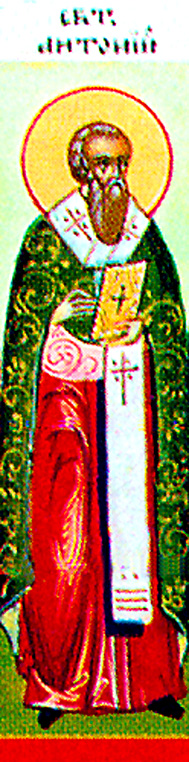
Saint Anthony, Patriarch of Constantinople, was a native of Asia, but lived in Constantinople from his youth. He was born around 829 of rich and pious parents. After the death of his mother, he entered a monastery at the age of twelve, where following the example of the igumen, he spent his nights in prayer and led a strict monastic life.
With the passage of time, and against his will, he was ordained to the holy priesthood. Later, at the insistence of the Patriarch, he was made an igumen. Serving in this rank, he tonsured his own father into monasticism. Saint Anthony was distinguished by his mercy, by his love and concern for the destitute, and he provided generous help to them.
Elevated to the Patriarchal throne at Constantinople in 893, Saint Anthony intensified his care for the destitute, and especially for their spiritual condition. With the assistance of the emperor Leo the Wise, Patriarch Anthony did much good for the Church, and encouraged piety in the people. He also built a monastery over the relics of Saint Kallia (February 12). Despite being stooped over with age, he went around all the churches, fulfilling the command of the Savior to be the servant of all the brethren.
In the year 895, advanced in age, Saint Anthony went peacefully to the Lord.
Saint Kristo the Gardener of Albania

The holy New Martyr Kristo was an Albanian who worked in a vegetable garden. At the age of forty, he decided to go to Constantinople to seek better business opportunities.
One day he was negotiating with a Turk who wished to purchase his entire stock of apples, but they were unable to agree on a price. The Turk became angry and accused Kristo of expressing a desire to become a Moslem. Kristo was brought before the authorities, and false witnesses were found to testify that he had indeed stated his intention to convert.
Kristo declared that he never said that he wished to become a Moslem. His testimony was discounted, however, because he was a Christian, and Moslem witnesses had contradicted him.
The saint was beaten and tortured the next day, but remained steadfast in his confession of Christ. Kaisarios Dapontes, a well known monk and author, visited Saint Kristo and got him freed from the place where he was chained. He brought food for him, but he refused to eat. “Why should I eat?” he asked. “I do not expect to live, so I may as well die hungering and thirsting for Christ.”
Since he refused to abandon the Orthodox Faith, Saint Kristo was sentenced to be beheaded. Before they led him away, Kristo gave Dapontes a metal file and told him to sell it and use the money to have memorial services offered for him.
On February 12, 1748 Saint Kristo the Gardener was beheaded, thereby receiving an imperishable crown of glory from Christ.
Ivḗron Icon of the Mother of God

During the reign of Emperor Theophilos (829-842) the Byzantine Empire was in turmoil because of the heresy of iconoclasm. In accordance with the Emperor’s orders, thousands of soldiers scoured the Empire, searching in every corner, city, and village for any hidden icons.
A pious widow living near the city of Nicaea had concealed an Icon of the Most Holy Theotokos in her home. Before long, the soldiers found it, and one of them stabbed it with his spear. By God’s grace this terrible deed was overshadowed by a miracle: blood began to flow from the wounded face of the Mother of God. The frightened soldiers ran away after witnessing this.
The widow spent the entire night keeping vigil and praying before the Icon of the Most Holy Theotokos. In the morning, by God’s will, she took the Icon to the sea and cast it upon the water. The holy Icon stood upright on the waves and began to drift westward.
Time passed, and one evening (circa 1004), the monks of Ivḗron Monastery on Mount Athos noticed a pillar of light, shining upon the sea like the sun. This miraculous sign lasted for several days, while the Fathers of the Holy Mountain gathered together and marveled. Finally they went down to the edge of the sea, where they beheld the pillar of light standing over the Icon of the Theotokos. When they approached, however, the Icon moved farther out to sea.
At that time a Georgian monk named Gabriel was living at the Ivḗron (Georgian) Monastery. The Theotokos appeared to the Athonite Fathers and told them that only Father Gabriel was worthy to retrieve the holy Icon from the sea. She also appeared to Father Gabriel and told him, “Go into the sea, and walk upon the waves with faith, and everyone shall witness my love and mercy for your Monastery.”
The monks found Father Gabriel and led him down to the sea, chanting hymns, and censing with holy incense. Father Gabriel walked upon the water as if it were dry land, and taking the Icon in his hands, he carried it back to shore. This miracle occurred on Bright Tuesday.
While the monks were celebrating a Service of thanksgiving, a cold, sweet spring miraculously gushed forth from the ground where the Icon was standing. Afterward, they took it into the church and placed in the sanctuary with great reverence.
The next morning one of the monks went to light the lamps in church and discovered that the Icon was no longer where they had put it; now it was on the wall near the entry gate. The monks took it down and returned it to the sanctuary, but the next day the Icon was found once again at the Monastery gate. This miracle recurred several times, until the All-Holy Virgin appeared to Father Gabriel, saying, “Inform the brethren that from now on they must not carry me away. For what I desire is not to be protected by you; but instead I shall protect you, both in this life, and in the age to come. As long as my Icon remains in the Monastery, the grace and mercy of my Son shall never be lacking!”
Filled with great joy, the monks built a small church near the Monastery gate in honor of the Mother of God, and placed the wonderworking Icon inside. This holy Icon came to be known as the “Ivḗron Mother of God” or Πορταΐτισσα in Greek.1 Through the intercession of the Most Holy Theotokos, many miracles have taken place and continue to take place throughout the world.
1 Πορταΐτισσα = The Gate-Keeper.
Saint Prochorus of Georgia

Saint Prochorus the Georgian, a descendant of the noble Shavteli family, was born at the end of the 10th century and grew up in a monastery. When he reached manhood he was ordained a hieromonk and labored for one year at the Lavra of Saint Savva in Jerusalem. Then, with the blessing of his spiritual father Ekvtime Grdzeli, he began the reconstruction of the Holy Cross Georgian Monastery near Jerusalem.
According to tradition, at this spot Abraham’s nephew Lot planted three trees—a cypress, a pine, and a cedar. Eventually these three trees miraculously grew into one large tree. When the Temple of Solomon was being built, this tree was cut down but left unused. It is said that the Cross on which Christ our Savior was crucified was constructed from the wood of this tree.
In the 4th century, the land on which the miraculous tree had grown was presented to Holy King Mirian, the first Christian king of Georgia. Then in the 5th century, during the reign of Holy King Vakhtang Gorgasali, the Holy Cross Monastery was founded on that land. The monastery was destroyed several times between the 7th and 9th centuries.
Finally, in the 11th century, King Bagrat Kuropalates offered much of his wealth to Fr. Prochorus for the restoration of the monastery. Saint Prochorus beautified the monastery, then gathered eighty monks and established the typicon (the monastic rule) for the community in accordance with that of the Saint Savva Lavra.
When Saint Prochorus had labored long and lived to an advanced age, he chose his disciple Giorgi to be the monastery’s next abbot.
Then he departed for the wilderness with two of his disciples, and after some time the righteous monk yielded up his spirit to God.
Beyond this, little is known about the life of Saint Prochorus. According to Georgian researchers and scholars, he was probably born sometime between 985 and 990. He spent the years 1010 to 1015 in Jerusalem, and labored at the Lavra of Saint Savva until 1025. He reposed in the year 1066, between the ages of 76 and 81.
Martyr Nicholas (Nikoloz) Dvali in Jerusalem
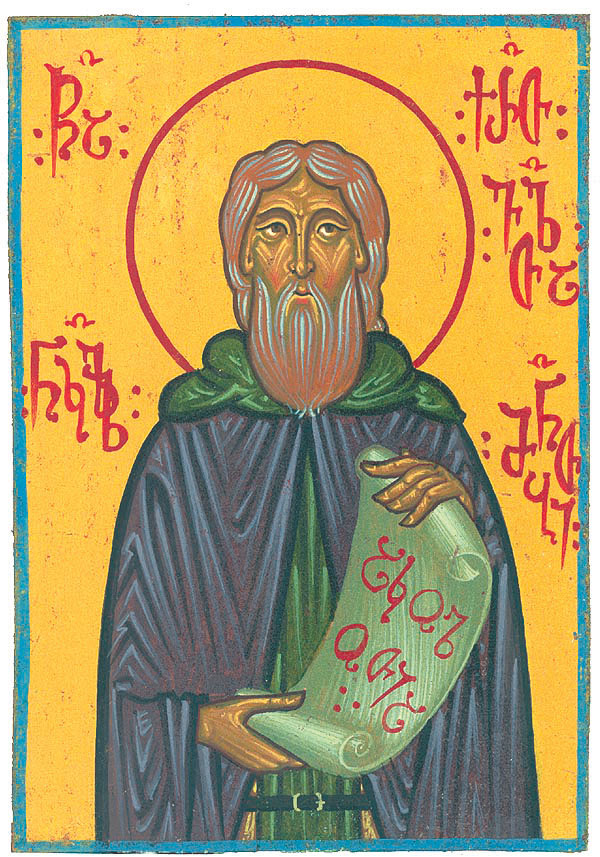
Saint Nikoloz Dvali the Martyr was born at the end of the 13th century to a God-fearing couple who directed his path toward the spiritual life.
At the age of twelve Nikoloz traveled to the Klarjeti Wilderness and was tonsured a monk. From there he made a pilgrimage to Jerusalem and remained in the holy city, settling at the Holy Cross Monastery. Burning with desire for the apostolic life, Monk Nikoloz was determined to die a martyr’s death.
In Jerusalem a group of godless men arrested and tormented Saint Nikoloz for publicly confessing the Christian Faith, but a group of Christians succeeded in rescuing him from prison. Then, in accordance with his abbot’s counsel, Saint Nikoloz relocated to a Georgian monastery on Cyprus. There the pious monk beseeched the Lord to make him worthy of the crown of martyrdom. One day, while he was praying before the icon of Saint John the Baptist, he heard a voice saying, “Nikoloz! Arise and go to Jerusalem. There you will find a Georgian monk who will teach you the way of righteousness and encourage you on the path of martyrdom. He has been appointed to guide you.”
Accordingly, Saint Nikoloz returned to Jerusalem, met the monk whom God had appointed, and informed him of what had been revealed. The Most Holy Theotokos and Saint John the Baptist appeared to Saint Nikoloz’s spiritual father, who had been praying intensely for guidance, and told him that it was the Lord’s will for Nikoloz to journey to Damascus.
While in Damascus, the holy father entered a mosque and openly confessed Christ to be the Savior, reproving those present for their folly. The angry Muslims seized Saint Nikoloz, beat him, and cast him into prison. After a great struggle, the metropolitan and local Christians succeeded in recovering him from captivity, but he immediately returned to the Muslims and began again to denounce their ungodly ways. Again they beat him mercilessly, lashed him five hundred times, and cast him in prison for a second time. But the holy martyr’s wounds were healed through the miraculous intercession of Saint John the Baptist, and after two months he was released from prison.
By chance the emir of the city caught a glimpse of Saint Nikoloz as he was preparing to return to Jerusalem. The emir recognized him and sent him to Dengiz, the emir of emirs. Dengiz flattered him and offered to convert him to Islam, but Saint Nikoloz bravely defended his faith in Christ. In response, Dengiz ordered his execution.
At the hour appointed by Dengiz, the blessed martyr turned to the east, joyfully bowed his neck to the sword, and prayed, “Glory to Thee, O Christ God, Who hast accounted me worthy to die for Thy name’s sake.” The sword pierced his neck, but the severed head glorified God seven times, crying out, “Glory to Thee, O Christ our God!”
The Persians burned the saint’s body, and for three days a pillar of light shone at the place where it lay.
When Saint Nikoloz’s spiritual father heard about his martyrdom, he prayed to God to reveal to him whether Nikoloz would be numbered among the saints. Then one day while he was reading, he saw a vision of a host of saints standing atop a mountain, illumined and surrounded by a cloud of incense. Among them the Great-martyr George shone especially brightly, and he called Saint Nikoloz, saying, “Nikoloz! Come and see the monk, your spiritual father. He has shed many tears for you.”
Nikoloz greeted his spiritual father, saying, “Behold me and the place where I am, and from this day cease your sorrowing for me.”
Saint Nikoloz Dvali was tortured to death on Tuesday, October 19, in the year 1314. The Georgian Church continues to commemorate him on that date.
Saint Bassian of Uglich
Venerable Bassian of Úglich was a disciple of the Saint Paisios of Uglich (+ June 6, 1504). He was born in the village of Rozhalov, located in the Kesovsk volost of the city of Bezhetsky Verkh,1 and he was descended from the family of the Shestikhinsky Princes (their ancestor is the right-believing Prince Theodore of Smolensk (+ September 19, 1299). Venerable Bassian entered the Protection Monastery when he was 33 years old, and soon he was tonsured by Saint Paisios.
He went through his obediences without murmuring and lived in great abstinence. In 1482, Saint Bassian discovered the Protection Icon of the Most Holy Theotokos on the banks of the Volga. After spending 20 years in the monastery of SaintPaisios, Bassian asked his blessing to live a life of silence. His instructor blessed him, saying, "Go, child desired by Christ, with His easy yoke (Matthew 11:30), and please the Lord. Soon you will form your own monastery and gather a monastic flock for the glory of the Most Holy Trinity."
In the year 1492 Saint Bassian left the Monastery and, after spending some time at the Saint Nicholas-Uleim Monastery,2 he went to a remote place 30 versts south of Uglich and began a solitary life of ascetical contests. But soon people found his secluded dwelling, and began coming to him for advice and guidance. In 1492 the Saint built a wooden church dedicated to the Most Holy Trinity, and soon those who wished to receive the monastic tonsure gathered there.
The Saint did not sever his contact with his instructor until his death, at which time he was with other disciples. After he had lived for 17 years at Holy Trinity Monastery, Saint Bassian reposed on February 12, 1509. Three years later, a certain Gerasimos was freed from an unclean spirit at the Saint's grave, and a man named Valerian was healed of his paralysis.
In 1548, during the construction of a stone church to replace the ancient wooden one, the Saint's incorrupt relics were found,over which a stone vault was built. The Monastery was restored in 1764, and Holy Trinity church became a parish church.The church has not survived to this day, and the Saint's burial place has been lost. The memory of "Venerable Vassian, theSuperior of Ryabov Hermitage" is noted in the "Description of the Russian Saints" (end of the XVII–XVIII centuries). Local veneration was tacitly approved by the inclusion of his name in the Synaxis of Rostov-Yaroslavl Saints (May 23).
1 Bezhetsky Verkh is located 20 versts from the town of Bezhetsk, Tver region. in the territory between the Mota River and the tributaries of the Volga, became part of the Moscow state, together with Novgorod.
2 The Pritection-Saint Nicholas Monastery, in which Saint Vassian was tonsured, is located three versts from the city of Uglich, on the left bank of the Volga.
3 The Saint Nicholas-Uleima Monastery is located 10 versts from Uglich at the confluence of the Uleyma and Vorzhekhoti rivers. The Saint's ascetical life was spent on the territory of the present day Yaroslavl Region (Yaroslavl Diocese).
Martyr Luke (Luka) of Jerusalem, the Georgian
The holy martyr Luka of Jerusalem lived in the 13th century. He was born to an honorable, pious Georgian family by the name of Mukhaisdze. After the repose of Luka’s father, his mother left her children and went to labor at a monastery in Jerusalem.
When Luka reached the age of twenty, he traveled to Jerusalem to visit his mother and venerate the holy places. After spending some time there he decided to remain and be tonsured a monk. He was later ordained a deacon and became fluent in Arabic. Soon the brothers of the monastery recognized his wisdom and asked him to guide them as abbot. For three years Luka directed the monastery in an exemplary manner.
But the devil was envious of the holy father and provoked a certain Shekh-Khidar, an influential Persian at the court of Sultan Penducht [probably Sultan Zakhir-Rukedin-Baibars-Bundukdar of Egypt (1260-1277)] to take up arms against Saint Luka. Sultan Penducht then transferred possession of the Holy Cross Monastery to Shekh-Khidar, who “treated the Georgian monks in a beastly manner and finally ousted them from the monastery altogether.” Fulfilling his God-given duty, the blessed Luka insisted on personally confronting Shekh-Khidar in defense of his brotherhood.
Luka’s Christian brothers and sisters warned him, saying, “Shekh-Khidar is threatening you…. Flee and hide from him!” But Luka paid no heed to their admonitions, certain that it was more fitting to die for Christ than to live for the world. As he had insisted, he himself approached Shekh-Khidar and asked for the release of the imprisoned fathers.
Luka told him that he was prepared to accept any demands. The wicked Persian leader demanded nothing from Luka except that he convert to Islam, promising to make him emir if he consented. When he refused, the furious Shekh-Khidar ordered Saint Luka’s beheading.
After the terrible deed had been performed, Saint Luka’s severed head turned toward the east and gave thanks to God with an expression of pure peace. Soon after, his precious body was set on fire at the command of the bewildered Shekh-Khidar. This occurred in 1277.
Daily Readings for Tuesday, February 11, 2025
BLAISE THE HIEROMARTYR OF SEBASTIA
NO FAST
Blaise the Hieromartyr of Sebastia, Theodora the Empress, Finding of the relics of Zachariah the Prophet, Father of the Holy Forerunner, George the Serbian
ST. PAUL’S LETTER TO THE HEBREWS 4:14-16; 5:1-6
BRETHREN, since we have a high priest who has passed through the heavens, Jesus, the Son of God, let us hold fast our confession. For we have not a high priest who is unable to sympathize with our weaknesses, but one who in every respect has been tempted as we are, yet without sin. Let us then with confidence draw near to the throne of grace, that we may receive mercy and find grace to help in time of need. For every high priest chosen from among men is appointed to act on behalf of men in relation to God, to offer gifts and sacrifices for sins. He can deal gently with the ignorant and wayward, since he himself is beset with weakness. Because of this he is bound to offer sacrifice for his own sins as well as for those of the people. And one does not take the honor upon himself, but he is called by God, just as Aaron was. So also Christ did not exalt himself to be made a high priest, but was appointed by him who said to him, ‘Thou art my Son, today I have begotten thee’; as he says also in another place, ‘Thou art a priest for ever, after the order of Melchizedek.’
MATTHEW 10:1, 5-8
At that time, Jesus called to him his twelve disciples and gave them authority over unclean spirits, to cast them out, and to heal every disease and every infirmity. These twelve Jesus sent out, charging them, “Go nowhere among the Gentiles, and enter no town of the Samaritans, but go rather to the lost sheep of the house of Israel. And preach as you go, saying, ‘The kingdom of heaven is at hand.’ Heal the sick, raise the dead, cleanse lepers, cast out demons. You received without paying, give without pay.”
Hieromartyr Blaise, Bishop of Sebaste

The Hieromartyr Blaise (Blasius), Bishop of Sebaste, was known for his righteous and devout life. Unanimously chosen by the people, he was consecrated Bishop of Sebaste. This occurred during the reign of the Roman emperors Diocletian (284-305) and Licinius (307-324), fierce persecutors of Christians. Saint Blaise encouraged his flock, visited the imprisoned, and gave support to the martyrs.
Many hid themselves from the persecutors by going off to desolate and solitary places. Saint Blaise also hid himself away on Mount Argeos, where he lived in a cave. Wild beasts came up to him and meekly waited until the saint finished his prayer and blessed them. The saint also healed sick animals by laying his hands upon them.
The refuge of the saint was discovered by servants of the governor Agrilaus, who had come to capture wild beasts to loose on the Christian martyrs. The servants reported to their master that Christians were hiding on the mountain, and he gave orders to arrest them. But those sent out found there only the Bishop of Sebaste. Glorifying God Who had summoned him to this exploit, Saint Blaise followed the soldiers.
Along the way the saint healed the sick and worked other miracles. Thus, a destitute widow complained to him of her misfortune. A wolf had carried off a small pig, her only possession. The bishop smiled and said to her, “Do not weep, your pig will be returned to you…” To the astonishment of everyone, the wolf came running back and returned his prey unharmed.
Agrilaus, greeting the bishop with words of deceit, called him a companion of the gods. The saint answered the greeting, but he called the gods devils. Then they beat him and led him off to prison.
On the next day, they subjected the saint to tortures again. When they led him back to the prison, seven women followed behind and gathered up the drops of blood. They arrested them and tried to compel them to worship the idols. The women pretended to consent to this and said that first they needed to wash the idols in the waters of a lake. They took the idols and threw them in a very deep part of the lake, and after this the Christians were fiercely tortured. The saints stoically endured the torments, strengthened by the grace of God, their bodies were transformed and became white as snow. One of the women had two young sons, who implored their mother to help them attain the Kingdom of Heaven, and she entrusted them to the care of Saint Blaise. The seven holy women were beheaded.
Saint Blaise was again brought before Agrilaus, and again he unflinchingly confessed his faith in Christ. The governor ordered that the martyr be thrown into a lake. The saint, going down to the water, signed himself with the Sign of the Cross, and he walked on it as though on dry land.
Addressing the pagans standing about on shore, he challenged them to come to him while calling on the help of their gods. Sixty-eight men of the governor’s retinue entered the water, and immediately drowned. The saint, however, heeding the angel who had appeared to him, returned to shore.
Agrilaus was in a rage over losing his finest servants, and he gave orders to behead Saint Blaise, and the two sons of the woman martyr entrusted to him. Before his death, the martyr prayed for the whole world, and especially for those honoring his memory. This occurred in about the year 316.
The relics of the Hieromartyr Blaise were brought to the West during the time of the Crusades, and portions of the relics are preserved in many of the lands of Europe [and his memory traditionally honored there on February 3].
We pray to Saint Blaise for the health of domestic animals, and for protection from wild beasts.
Venerable Demetrios, Wonderworker of Priluki, Vologda

Saint Demetrios (Dēmḗtrios) of Priluki, Wonderworker, was born into a rich merchant’s family in Pereyaslavl-Zalessk. From his youth the saint was uncommonly handsome. Receiving monastic tonsure at one of the Pereyaslavl monasteries, the saint later founded the Saint Nicholas cenobitic monastery on the Saints Boris and Gleb Hill at the shore of Lake Plescheevo near the city, and became its igumen.
In 1334 Saint Demetrios first met with Saint Sergius of Radonezh, who had come to Pereyaslavl to see Metropolitan Athanasius. From that time, he frequently conversed with Saint Sergius and became close with him. The fame of the Pereyaslavl igumen was so widespread that he became godfather to the children of Great Prince Demetrios Ioannovich. Under the influence of the Radonezh wonderworker, Saint Demetrios decided to withdraw to a remote place, and went north with his disciple Pachomius.
In the Vologda forests, at the River Velika, near the Avnezh settlement, they built a church of the Resurrection of Christ and they prepared to lay the foundations for a monastery. The local inhabitants were fearful that if a monastery were built there, their village would become monastery property. They demanded that the monks leave their territory, and wishing to be a burden to no one, they moved farther away.
Not far from Vologda, at the bend of a river in an isolated spot, Saint Demetrios decided to form the first of the cenobitic monasteries of the Russian North. The people of Vologda and the surrounding gladly consented to help the saint. The owners of the land intended for the monastery, Elias and Isidore, even trampled down a grain field, so that a temple might be built immediately. In 1371 the wooden Savior cathedral was built, and brethren began to gather.
Many disciples of the monk came there from Pereyaslavl. Saint Demetrios combined prayer and strict asceticism with kindliness. He fed the poor and hungry, he took in strangers, he conversed with those in need of consolation, and he gave counsel. He loved to pray in solitude. His Lenten food consisted of prosphora with warm water. Even on feastdays, he would not partake of the wine and fish permitted by the Rule. Both winter and summer he wore an old sheepskin coat, and even in his old age he went with the brethren on common tasks. The saint accepted contributions to the monastery cautiously, so that the welfare of the monastery would not be detrimental to those living nearby.
The Lord granted His servant the gift of clairvoyance, and he attained a high degree of spiritual perfection. Saint Demetrios died at an advanced age on February 11, 1392. The brethren approaching found him as though asleep, and his cell was filled with a wondrous fragrance.
Miracles from the relics of Saint Demetrios began in the year 1409, and during the fifteenth century his veneration spread throughout all Rus. And no later than the year 1440, the Priluki monk Macarius recorded his Life (Great Reading Menaion, February 11) based on the narratives of Saint Demetrios’s disciple Igumen Pachomius.
Saint Vsevolod (in Baptism Gabriel), Wonderworker of Pskov

Holy Prince Vsevolod of Pskov, in Baptism Gabriel, a grandson of Vladimir Monomakh, was born at Novgorod, where in the years 1088-1093 and 1095-1117 his father ruled as prince. His father was the holy prince Saint Mstislav-Theodore the Great (April 15). In the year 1117, when Great Prince Vladimir Monomakh gave Mstislav Kievan Belgorod as his “udel” (land-holding), practically making him co-ruler, young Vsevolod remained as his father’s vicar in the Novgorod principality.
Holy Prince Vsevolod did much good for Novgorod. Together with the Archbishop of Novgorod, Saint Niphon (April 8), he raised up many churches, among which were the cathedral of the Great Martyr George at the Yuriev monastery, and the church of Saint John the Forerunner at Opokakh, built in honor of the “angel” (i.e. patron saint) of his first-born son John, who had died in infancy (+ 1128).
In his Ustav (Law code) the prince granted a special charter of lands and privileges to the cathedral of Holy Wisdom (Hagia Sophia) and other churches. During a terrible famine, he exhausted his entire treasury to save people from perishing. Prince Vsevolod was a valiant warrior, he marched victoriously against the Yam and Chud peoples, but he never took up the sword for lucre or power.
In 1132, upon the death of holy Great Prince Mstislav, Vsevolod’s uncle Prince Yaropolk of Kiev fulfilled the last wishes of his brother and transferred Vsevolod to Pereyaslavl, then regarded as the eldest city after Kiev itself. But the younger sons of Monomakh, Yuri Dolgoruky and Andrew Dobry, were apprehensive lest Yaropolk make Vsevolod his successor at Kiev, and so they marched out against their nephew. Hoping to avoid internecine strife, Saint Vsevolod returned to Novgorod, but was received there with disaffection. The Novgorodians felt that the prince had been “raised” by them and should not have left them earlier. “Vsevolod went to Rus, to Pereslavl,” noted the Novgorod chronicler, “and kissed the cross against the Novgorodians, saying, ‘I will kill you.’”
Striving to restore good relations with Novgorod, the prince undertook a victorious campaign against the Chud people in 1133, and he annexed Yuriev to the Novgorod domain. But a harsh winter campaign in 1135-1136 against Suzdal was unsuccessful. The stubborn people of Novgorod would not heed their chastisement by God, and they could not forgive the prince for their defeat. The assembly decided to summon a prince from the hostile Monomakh line of the Olgovichi, and they condemned Saint Vsevolod to banishment. “You suffered exile at the hands of your own people,” we sing in the troparion to the saint. For a month and a half they held the prince and his family under guard at the archbishop’s palace. When Prince Svyatoslav Olgovich arrived on July 15, 1136, Vsevolod was released from his captivity.
Vsevolod went again to Kiev, and his uncle Yaropolk gave him the Vyshgorod district near Kiev, the place where Saint Olga (July 11) had lived in the tenth century during the rule of her son Svyatoslav, “preferring the cities of Kiev and Pskov.” Saint Olga came to the defense of her descendant in 1137 when the people of Pskov, recalling the campaigns of the Novgorod-Pskov army led by the prince, invited him to the Pskov principality, the native region of Saint Olga. He was the first Pskov prince, chosen by the will of the Pskov people.
Among the glorious works of Saint Vsevolod-Gabriel at Pskov was the construction of the first stone church dedicated to the Life-Creating Trinity, replacing a wooden church from the time of Saint Olga. On the icons of the saint, he is often depicted holding the church of the Holy Trinity.
Saint Vsevolod ruled as prince at Pskov for only a year. He died on February 11, 1138 at the age of forty-six. All of Pskov gathered at the funeral of the beloved prince, and the chanting of the choir could scarcely be heard over the people’s wailing.
The people of Novgorod sent an archpriest from the Sophia cathedral to take his holy relics back to Novgorod. The prince, however, did not want his body to rest in Novgorod. He would not allow Pskov to be deprived of his relics by the people of Novgorod, who had driven him out, and the coffin would not move from the spot. The Novgorod people wept bitterly and repented in their misfortune. Then they asked to be given just a small piece of his relics “for the protection of their city.” Through their prayers a fingernail fell from the saint’s hand. The Pskov people put Saint Vsevolod into the temple of the holy Great Martyr Demetrius. Beside the grave they placed the military armaments of the prince, a shield and sword, in the shape of a cross, with the Latin inscription, “I will yield my honor to no one.”
On November 27, 1192, the relics of holy Prince Vsevolod were uncovered and transferred into the Trinity cathedral, in which a chapel was consecrated in his honor.
The deep spiritual bond of the city of Saint Olga with the holy Prince Vsevolod was never broken. He always remained a Pskov wonderworker. At the siege of Pskov by Stephen Bathory in 1581, when the walls of the fortress were already breached and the Poles were ready to rush into the city, they brought the holy relics of Prince Vsevolod from the Trinity cathedral to the place of battle, and the enemy withdrew.
On April 22, 1834, on the first day of Pascha, the saint’s holy relics were solemnly transferred to a new shrine in the main church of the cathedral.
At the appearance of the wonderworking Pskov-Protection Icon (October 1), holy Prince Vsevolod-Gabriel stood among the heavenly defenders of Pskov.
Righteous Theodora, wife of Emperor Theophilus the Iconoclast

Holy Empress Theodora was the wife of the Byzantine emperor Theophilus the Iconoclast (829-842), but she did not share in the heresy of her husband and secretly venerated the holy icons. After the death of her husband, Saint Theodora governed the realm because her son Michael was a minor.
She convened a Council, at which the Iconoclasts were anathematized, and the veneration of icons was reinstated. Saint Theodora established the annual celebration of this event, the Triumph of Orthodoxy, on the first Sunday of the Great Fast. Saint Theodora did much for Holy Church and fostered a firm devotion to Orthodoxy in her son Michael.
When Michael came of age, she was retired from governing and spent eight years in the monastery of Saint Euphrosynē, where she devoted herself to ascetic struggles, and reading books that nourished her soul.
A copy of the Gospels, copied in her own hand, is known to exist. She died peacefully around the year 867.
In 1460, her relics were given by the Turks to the people of Kerkyra (Corfu).
Saint George, New Martyr of Sofia

The Holy Martyr George the New was born into an illustrious Bulgarian family, living in the capital city of Bulgaria, Sredets (now the city of Sofia). Saint George’s childless parents, John and Mary, in their declining years entreated the Lord to send them a child. Their prayer was answered, and they baptized the infant with the name of the holy Great Martyr George (April 23).
Young George received a fine upbringing, he attentively studied the Holy Scriptures, and he was pious and chaste. His parents died when George was twenty-five. At that time Bulgaria found itself under the rule of the Turks, who forcibly converted Christians to Islam.
Once, several Moslems tried to convert George. They put a fez on the saint’s head. This is a red circular hat which Moslems wear to enter their house of prayer. But George threw the fez on the ground. The Turks brought the martyr to their governor with beatings and abuse.
The governor was impressed with Saint George’s appearance and bearing, and he urged him to accept Islam, promising honors and wealth from Sultan Selim (1512-1520). The saint boldly and steadfastly confessed his faith in the Lord Jesus Christ, and reproached the errors of Islam. The governor in a rage gave orders to beat Saint George with rods, but the saint persevered in his confession of faith in Christ.
The governor ordered the tortures to be increased. The passion-bearer bore all his sufferings, calling on the Lord Jesus Christ for help. Then they led the martyr through the city to the beat of a drum and shouts: “Do not insult Mohammed nor abase the Moslem faith”.
Finally, a large fire was lit in the city, to burn Saint George. Weakened by his wounds, the saint fell to the ground. They threw him into the fire still alive, and they threw corpses of dogs on top of him so that Christians would not be able to find the relics of the martyr.
Suddenly, a heavy rain fell and extinguished the fire. With the onset of darkness, the place where the body of the martyr was thrown was illumined with a bright light. They gave permission to a certain Christian priest to take the venerable relics of the martyr for burial. Informed about the occurrence, Metropolitan Jeremiah and his clergy went to the place of execution. In the ashes of the fire they located the body of the holy Martyr George and carried it to the church of Saint George the Great Martyr in the city of Sredets.
On May 26, 1515 the holy relics of Saint George were removed from the grave, placed in a coffin, and then brought into the church, where they have remained ever since. The Church honors Saint George twice during the year: on February 11, the day of his martyrdom, and on May 26, the uncovering of his holy relics.
Saint Gobnata of Ballyvourney
Saint Gobnata was born in Co.Clare at the end of the fifth, or the beginning of the sixth century. Later she fled to the Aran Islands to escape from some enemy. An angel appeared to her one day and told her to leave that place and to keep walking until she found nine white deer. She saw three white deer at Clondrohid, Co. Cork, and decided to follow them. Then at Ballymakeera, she saw six white deer. Finally, at Ballyvourney she came upon nine white deer grazing in a wood. There she was given land for a women’s monastery by her spiritual Father Saint Abban of Kilabban, Co. Laois (March 16), and he installed her as abbess. Excavations in 1951 proved that indeed there had been an early Christian settlement on the site.
Saint Gobnata was renowned for her gift of healing, and there is a story of how she kept the plague from Ballyvourney. She is also famous for her skill as a bee-keeper.
One day, Saint Gobnata was watching from a hill overlooking a valley as an invading chieftain and his army came through, destroying crops and driving off cattle. She sent the bees to attack them, and they were thrown into such confusion that they left without their plunder.
The holy virgin Saint Gobnata fell asleep in the Lord on February 11. The exact year of her death is not known, but it probably occurred in the sixth century. Although she is regarded as the patron saint of Ballyvourney, she is venerated throughout southern Ireland. There are churches dedicated to her in Waterford and Kerry, for example, and she is also revered in Scotland.
Daily Readings for Monday, February 10, 2025
HIEROMARTYR HARALAMBOS
NO FAST
Hieromartyr Haralambos, Anastasios, Patriarch of Jerusalem, Porphyrios & Baptos the Monk-martyrs
ST. PAUL’S SECOND LETTER TO TIMOTHY 2:1-10
Timothy, my son, be strong in the grace that is in Christ Jesus, and what you have heard from me before many witnesses entrust to faithful men who will be able to teach others also. Share in suffering as a good soldier of Christ Jesus. No soldier on service gets entangled in civilian pursuits, since his aim is to satisfy the one who enlisted him. An athlete is not crowned unless he competes according to the rules. It is the hardworking farmer who ought to have the first share of the crops. Think over what I say, for the Lord will grant you understanding in everything.
Remember Jesus Christ, risen from the dead, descended from David, as preached in my gospel, the gospel for which I am suffering and wearing fetters like a criminal. But the word of God is not fettered. Therefore I endure everything for the sake of the elect, that they also may obtain salvation in Christ Jesus with its eternal glory.
JOHN 15:17-27; 16:1-2
The Lord said to his disciples: "This I command you, to love one another. If the world hates you, know that it has hated me before it hated you. If you were of the world, the world would love its own; but because you are not of the world, but I chose you out of the world, therefore the world hates you. Remember the word that I said to you, 'A servant is not greater than his master.' If they persecuted me, they will persecute you; if they kept my word, they will keep yours also. But all this they will do to you on my account, because they do not know him who sent me. If I had not come and spoken to them, they would not have sin; but now they have no excuse for their sin. He who hates me hates my Father also. If I had not done among them the works which no one else did, they would not have sin; but now they have seen and hated both me and my Father. It is to fulfill the word that is written in their law, 'They hated me without a cause.' But when the Counselor comes, whom I shall send to you from the Father, even the Spirit of truth, who proceeds from the Father, he will bear witness to me; and you also are witnesses, because you have been with me from the beginning. I have said all this to you to keep you from falling away. They will put you out of the synagogues; indeed, the hour is coming when whoever kills you will think he is offering service to God.
Hieromartyr Haralambos, Bishop of Magnesia in Thessaly, the Martyrs Porphyrius and Baptus, and three women Martyrs

The Hieromartyr Haralampus, Bishop of Magnesia, the martyrs Porphyrius and Baptus and three women martyrs suffered in the year 202.
Saint Haralampus, Bishop of Magnesia (Asia Minor), successfully spread faith in Christ the Savior, guiding people on the way to salvation. News of his preaching reached Lucian, the governor of the district, and the military commander Lucius. The saint was arrested and brought to trial, where he confessed his faith in Christ and refused to offer sacrifice to idols.
Despite the bishop’s advanced age (he was 113 years old), he was subjected to monstrous tortures. They lacerated his body with iron hooks, and scraped all the skin from his body. During this the saint turned to his tormentors, “I thank you, brethren, that you have restored my spirit, which longs to pass over to a new and everlasting life!”
Seeing the Elder’s endurance and his complete lack of malice, two soldiers (Porphyrius and Baptus) openly confessed Christ, for which they were immediately beheaded with a sword. Three women who were watching the sufferings of Saint Haralampus also began to glorify Christ, and were quickly martyred.
The enraged Lucius seized the instruments of torture and began to torture the holy martyr, but suddenly his forearms were cut off as if by a sword. The governor then spat in the face of the saint, and immediately his head was turned around so that he faced backwards.
Then Lucius entreated the saint to show mercy on him, and both torturers were healed through the prayers of Saint Haralampus. During this a multitude of witnesses came to believe in Christ. Among them also was Lucius, who fell at the feet of the holy bishop, asking to be baptized.
Lucian reported these events to the emperor Septimus Severus (193-211), who was then at Pisidian Antioch (western Asia Minor). The emperor ordered Saint Haralampus to be brought to him in Antioch. Soldiers twisted the saint’s beard into a rope, wound it around his neck, and used it to drag him along. They also drove an iron nail into his body. The emperor then ordered them to torture the bishop more intensely, and they began to burn him with fire, a little at a time. But God protected the saint, and he remained unharmed.
Many miracles were worked through his prayer: he raised a dead youth, and healed a man tormented by devils for thirty-five years, so that many people began to believe in Christ the Savior. Even Galina, the daughter of the emperor, began to believe in Christ, and twice smashed the idols in a pagan temple. On the orders of the emperor they beat the saint about the mouth with stones. They also wanted to set his beard on fire, but the flames burned the torturer.
Full of wickedness, Septimus Severus and an official named Crispus hurled blasphemy at the Lord, mockingly summoning Him to come down to the earth, and boasting of their own power and might. The Lord sent an earthquake, and great fear fell upon all, the impious ones were both suspended in mid-air held by invisible bonds, and only by the prayer of the saint were they put down. The dazed emperor was shaken in his former impiety, but again quickly fell into error and gave orders to torture the saint.
And finally, the emperor sentenced Saint Haralampus to beheading with a sword. During Saint Haralampus' final prayer, the heavens opened and the saint saw the Savior and a multitude of angels. The holy martyr asked Him to grant that the place where his relics would repose would never suffer famine or disease. He also begged that there would be peace, prosperity, and an abundance of fruit, grain, and wine in that place, and that the souls of these people would be saved. The Lord promised to fulfill his request and ascended to heaven, and the soul of the hieromartyr Haralampus followed after Him. By the mercy of God, the saint died before he could be executed. Galina buried the martyr’s body with great honor.
In Greek hagiography and iconography Saint Haralampus is regarded as a priest, while Russian sources seem to regard him as a bishop.
Synaxis of the Hierarchs of Novgorod, Buried in the Cathedral of the Holy Wisdom (Hagia Sophia) in Novgorod
The Synaxis of Novgorod Hierarchs is also celebrated on October 4 and on the third Sunday after Pentecost. On October 4, 1439 Saint John (September 7) appeared to the presiding hierarch Saint Euthymius (March 11) and ordered him to serve a special panikhida in memory of those buried at the Sophia cathedral (the Russian princes and Archbishops of Novgorod, and all Orthodox Christians) on the Feast of the Hieromartyr Hierotheus, first Bishop of Athens.
Then the incorrupt relics of Saint John (September 7) were uncovered. Afterwards, the Synaxis was established to mark the glorification of the Novgorod hierarchs. E.E. Golubinsky says that because these hierarchs remained unknown at the time of their glorification, he determined this date for their common celebration was established in the period between the time of the Moscow Council of 1549 and the time of the formation of the Holy Synod (E.E. Golubinsky, History of the Canonization of Saints in the Russian Church. Moscow, 1903, p. 157).
Included in the Synaxis of Novgorod hierarchs are: Saint Joachim of Korsun, first bishop of Novgorod (988-1030); Saint Luke the Jew, bishop (October 15, 1060); Saint Germanus, bishop (1078-1096); Saint Arcadius, bishop (September 18); Saint Gregory, archbishop (May 24, 1193); Saint Martyrius, archbishop (August 24, 1199); Saint Anthony, archbishop (October 8, 1231); Saint Basil the Lame, archbishop (July 3, 1352); Saint Simeon, archbishop (June 15, 1421); Saint Gennadius, archbishop (December 4); Saint Pimen, archbishop (1553-1571); Saint Aphthonius, metropolitan (April 6, 1653).
The relics of these saints were buried or transferred to Novgorod’s Sophia Cathedral (except for Saint Germanus, Saint Gennadius and Saint Pimen) therefore, in some sources their names are not included in the Synaxis.
Besides those mentioned, hierarchs who have separate commemorations are: Saint Nikḗtas the Hermit, bishop (January 31); Saint Niphon, bishop (April 8); Saint John, archbishop (September 7); Saint Theoctistus, archbishop (December 23); Saint Moses, archbishop (January 25); Saint Euthymius, archbishop (March 11); Saint Jonah, archbishop (November 5); Saint Serapion, archbishop (March 16.
The October 4 celebration was established in connection with the memory of the holy Prince Vladimir Yaroslavich of Novgorod (+ 1052), and the February 10 Synaxis of the Novgorod hierarchs is celebrated in connection with the holy Princess Anna of Novgorod (+ 1056).
Princess Anna of Novgorod

The Holy Princess Anna of Novgorod, wife of Great Prince Yaroslav the Wise, gave her children a true Christian upbringing, marked by a strong faith in God; and love of work, integrity and learning.
Her son Mstislav later became Great Prince of Kiev, and her daughter the queen of a western European realm. Saint Anna left the world and went into a monastery, where she ended her days in strict obedience and prayer in the year 1056.
Venerable Prochorus of the Kiev Near Caves

Saint Prochorus of the Caves was a native of Smolensk, and entered the Kiev Caves monastery under the igumen John (1089-1103). He was a great ascetic of strict temperance. In place of bread he ate pigweed (or orach), and so he was called “pigweed-eater.” Every summer, he gathered pigweed and made enough bread from it to last him for a whole year. He also ate prosphora from church now and then, and his only drink was water. Seeing the patience of Saint Prochorus, God transformed the usual bitterness of the pigweed into sweetness.
During the saint’s lifetime, a famine threatened Russia. Prochorus began to gather the pigweed even more zealously and to prepare his “bread”. Certain people followed his example, but they were not able to eat this weed because of its bitterness. Prochorus distributed his pigweed bread to the needy, and it tasted like it was made from fine wheat. Only the bread given with the blessing of Saint Prochorus was edible, and even pure and light in appearance. If anyone tried to prepare this bread himself, or take it without the saint’s blessing, it was not fit for consumption. This became known to the igumen and the brethren, and the fame of Prochorus spread far and wide.
After a certain while there was no salt at Kiev, and the people suffered because of this. Then the saint gathered ashes from all the cells, and began to distribute it to the needy. Through his prayers, the ashes became pure salt. The merchants, who hoped to take advantage of this shortage of salt for their own profit, became angry with Saint Prochorus for distributing free salt to the people.
Prince Svyatopolk confiscated the salt from Prochorus. When they transported it to the prince’s court, everyone saw that it was just ordinary ashes. After three days, Svyatopolk gave orders to discard it. Saint Prochorus blessed the people to take the discarded ashes, and they were again changed into salt.
This miracle reformed the fierce prince. He began to pray zealously, made peace with the igumen of the monastery of the Caves, and highly esteemed Saint Prochorus. When the last hour of the saint approached, the prince left his army and hastened to him, even though he was at war.
He received his blessing and with his own hands, carried the body of the saint to the cave and buried him. Returning to his army, Svyatopolk easily gained victory over the Polvetsians, turning them to flight and capturing their supply carts. Such was the great power of the prayer of Saint Prochorus.
The righteous one died in the year 1107, and was buried in the Near Caves. He is also commemorated on September 28 and on the second Sunday of Great Lent.
Venerable Longinus of Koryazhemsk, Vologda

Saint Longinus of Koryazhemsk first pursued asceticism at the monastery of Saint Paul of Obnora, and then lived at the Saints Boris and Gleb Solvychegod monastery. From there he settled with his friend Simon near Vychegda, toward the mouth of the Koryazhema river.
Here, deep in the countryside, ten versts from Solvychegod, the ascetics built cells and a chapel. When brethren gathered around them, they built a church named for Saint Nicholas, and built a monastery in which the saint was igumen. Near the church there was a well, dug out by Saint Longinus himself.
After his death in 1540 the saint’s body was buried, in accord with his last wishes, near the entrance to the church. Sixteen years later, it was placed inside the church.
The memory of Saint Longinus is celebrated with a special service, and there is a brief Life, compiled at a later time.
Virgin Martyrs Ennatha, Valentina and Paula, of Palestine

The Holy Virgin Martyrs Ennatha, Valentina and Paula suffered in the year 308 under the emperor Maximian II Galerius (305-311). Saint Ennatha came from the city of Gaza (in the south of Palestine), Saint Valentina was a native of Palestinian Caesarea, and Saint Paula was from the region of Caesarea.
Saint Ennatha was the first to be brought to trial before the governor Firmilian, bravely declaring herself a Christian. They beat her, and then they suspended her from a pillar and scourged her.
Saint Valentina, accused of not worshipping the gods, was led to a pagan temple to offer sacrifice, but she bravely hurled a stone at the sacrifice and turned her back on it. They beat her mercilessly and sentenced her to be beheaded along with Saint Ennatha.
Last of all, Saint Paula was brought, and they subjected her to many torments. With the help of God, however, she endured them with great patience and courage. Before her death Paula gave thanks to the Lord for strengthening her. Bowing to the Christians present, she bent her neck beneath the sword.
Icon of the Mother of God “Areovindus”

There is little information about the history of this Icon, and the story of its appearance is shrouded in mystery. We only know that the now lost original was painted around 845. However, there is reason to believe its iconographic type was the same as the Hagiosoritissa Icon.1 Copies of the ancient Icon were widespread in Byzantium during the 12th to the 15th centuries; apparently one of these came from that area to Russia.
The original version of the Icon represented the Virgin without the Child, but she held a scroll in her hands. On this scroll were the All Holy Virgin’s petitions concerning us, which are addressed to her Son. This gives us hope that the “Fire-appearing” Icon of the Mother of God, like her other icons, will help and protect us from all misfortune and adversity. Therefore, we pray before the Icon for everything that exceeds the limits of our strength and requires God’s help.
The face of the Theotokos is turned toward her right side, and her garments are bright red red in color. This is why the Icon is called “Fire-appearing,” or “Visible in Fire.”
1 The name Hagiosoritissa, “of the holy soros” (chest), is derived from the chapel of the holy soros, which was built next to the Blachernae church by Emperor Leo I to house the robe of the Most Holy Theotokos, which was brought from Palestine in 473 (see July 2). The Panagia Hagiosoritissa Icon is associated with this shrine. This icon type shows the Mother of God with both hands raised in supplication, as depicted in the Deisis row of the iconostasis.
Saint John Chimchimeli the Philosopher
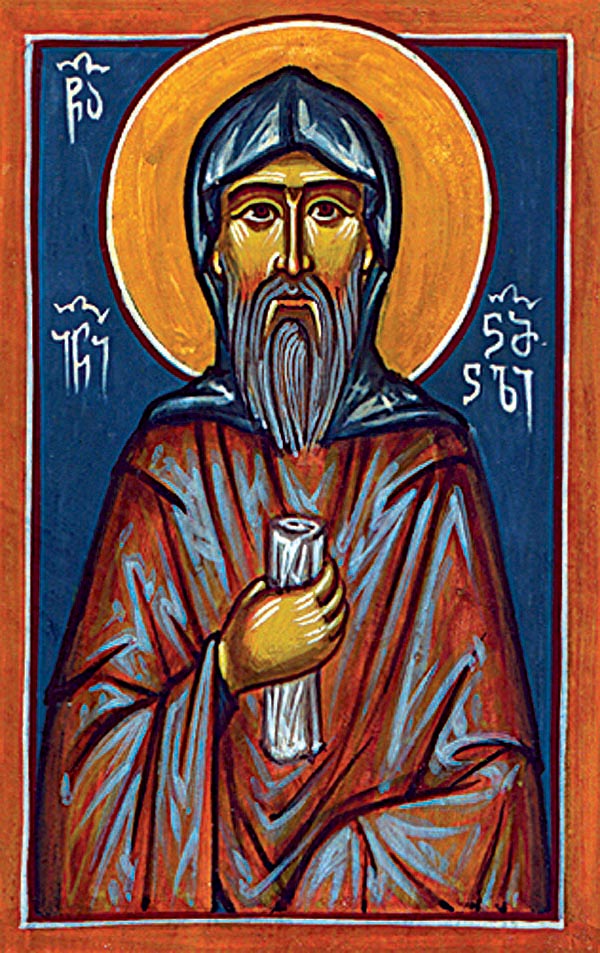
Little information about the life of Saint John of Chimchimeli has been preserved, but we know that he was a great translator, philosopher, and defender of the Georgian Christian Faith.
John received his education in present-day Bulgaria, at the literary school of the famous Petritsoni (now Bachkovo) Georgian Monastery.
One historian writes: “In his eulogy on the death of Saint Demetre the King, John the Philosopher of Chimchimeli brilliantly describes the glory, honor, and heroism of this holy man’s life.”
Saint John translated many exegetical compositions, including two commentaries on the Book of Ecclesiastes, one by Metrophanes of Smyrna (Metropolitan of Smyrna (857-880); his Commentary on Ecclesiastes is preserved only in Georgian) and the other by Olympiodorus of Alexandria (a 6th-century deacon who wrote a series of commentaries on the books of the Bible, not to be confused with the neoplatonist philosopher also of the 6th century). He also translated “An Explanation of the Gospel According to Saint Mark” and “An Explanation of the Gospel According to Saint Luke”, both by Blessed Theophylactus of Bulgaria.
The works of our Holy Father John of Chimchimeli are fundamental to the canon of Georgian theological literature.
In his work Pilgrimage, the eminent eighteenth-century historian Archbishop Timote (Gabashvili) mentions John of Chimchimeli among the holy fathers portrayed in the frescoes at the Holy Cross Monastery in Jerusalem.
In the second half of the 19th century the historian Mose Janashvili wrote, in his History of the Georgian Church, that John of Chimchimeli directed a literary school in the village of Gremi in Kakheti.
According to Janashvili, students at Saint John’s school were instructed in philosophy and theology as well as in the Greek, Syrian, and Arabic languages.
Saint Ioannikios, Father Confessor of the Dormition Holy Mountain Hermitage
Hieromonk Ioanikkios (in the world Trophimos N. Averkiev) was born in 1823 and was named Trophimos in Holy Baptism. His parents were Government-owned peasants in Orlov Province, and they had a large family. Trophimos was one of the younger children. The boy was quite bright and also very pious. He loved to be in church, and if his mother went to church for the Feast Days he always begged to go along. This, however, was not easy. The village where they lived was not near the church. They had to cross a stream on the way, and the bridge was so old and rotten that once Trophimos fell in and caused his mother to be delayed. Therefore, she did not always take him with her. Most of the time, she left him at home. When he stayed at home, Trophimos wept bitterly because she would not bring him to church. He felt drawn there by some “overpowering force,” as he expressed himself later in life.
One Sunday his father and mother went to church for the Divine Liturgy and took his older brothers, but they left him at home. After crying for some time, Trophimos went out into the yard, before which there was a field covered with grass. Then he noticed a beautiful stone church on a hillock. He was surprised to see it and wondered how it got there, so he started walking toward it in order to take a closer look at it. For a while he walked around the church, admiring its beauty. He tried to enter, but the door was locked. When his hand touched the door knob, it vanished, and there he was, standing in the middle of an empty field! This astonished him even more, and he could not understand anything for a while. When his parents came home, he hastened to tell them what had happened.
At first, they paid no attention to him, but later, when his father mentioned this at a meeting of all the peasants in the village, an old man stated that he had also had seen a church on that very spot at dawn. The peasants asked to see Trophimos and to hear the story from his own lips. When Trophimos was brought to the meeting, he told them in detail where he had seen the church in the field, and described what sort of church it was. He showed them the exact spot, and the men marked the spot with four stakes. They decided to collect money and to build a stone church there. Indeed, a church was needed because the parish church was far away. In addition, there was the stream to be crossed. In the spring, when the stream was full, it became difficult and dangerous to cross.
Since the peasants were wealthy, the required funds were soon collected, and they began to build a church in honor of the Kazan Icon of the Most Holy Theotokos (July 8, Oct. 22). In a few years the church was completed and consecrated, and on the outside it closely resembled the church that Trophimos had seen in a vision. When the boy was sixteen years old, he wanted to enter a monastery, so he begged his parents to give their blessing for him to go to Tolshev’s Savior-Transfiguration Monastery. His parents were very unhappy about this, especially his father. The young man became very sad and did not know what to do.
One night he had a dream wherein he saw a group of monks in a church in their mantiyas and klobuks. All of them went to the middle of the church and sang a divine hymn. Taking Trophimos by the hand they said, “Come with us, and do not be afraid of grieving your parents. It is God’s will that you be with us.”
Awakening from his dream, he decided to run off to the monastery in secret. He got ready, placing a piece of bread in a shepherd’s sack. Dressed in an old peasant’s coat, and without shoes, he left for the Tolshev Monastery. The road was not easy for him, but he arrived at the gates of the Monastery in the afternoon, and he saw a few monks standing there. Seeing the barefoot boy, they asked him why he had come. Trophimos replied that he had come in order to be a monk. One monk, an Elder with a grey beard, volunteered to take him to the Superior’s cells. This was Hieromonk Jacob from Sarov Hermitage, where he had been known and loved by Batushka Seraphim. Father Jacob led an ascetical life, and was respected by the brethren. Trophimos now sat in the waiting room, fearfully awaiting the Superior’s decision concerning him.
The Superior, a short, grey-headed old man, was surprised at the young man’s appearance because he was dressed in rags. He thought that Trophimos was a beggar seeking alms. When Father Jacob started to tell him that the young man wanted to be a monk, the Superior said that he was much too young, and he would never be able to endure the labors and the sorrows of the monastic life. So he advised him to go back home. When this did not work, and the young man remained unshaken, the Superior pretended to be angry and ordered a bundle of rods to be brought over, saying; “Now I will teach you not to wander needlessly and leave home in order to avoid work. Take off your shirt and I will punish you so that you will remember our monastery.”
The young man immediately removed his shirt and lay on the ground before the Superior to receive his punishment. Seeing his readiness and weakness, the Superior and Father Jacob looked at each other and changed their tone. The Superior told Trophimos to get up and to tell him in detail where he was from, and why he had come. Had he perhaps committed some crime and thought to hide in the monastery? After telling him everything in detail, Trophimos fell down on the floor, tearfully begging the Superior not to chase him away and to make him a monk.
The Superior ordered Father Jacob to take him to his cell and teach him the monastic Rule for novices. Father Jacob fed him and got him some clothes, making him his cell attendant. His cell was the very cell which the wonderworker Saint Tikhon of Zadonsk (August 13) had occupied when he lived at Tolshev Monastery in retirement. Here the holy bishop’s belongings were preserved. His chair stood in the corner, covered up. Elder Jacob never dared to sit in the chair himself, but Trophimos, who did not know the value of the chair, once tried to sit in it when the Elder was out of the cell, but he was pushed away by some force he did not understand. When Father Jacob returned Trophimos told him what had occurred. Father Jacob explained the chair’s significance to him and strictly forbade him to sit in it.
By his humility, obedience, and meekness, Trophimos soon won Father Jacob’s paternal love. Trophimos loved the order and customs of the monastery and had no time to become bored. He could only thank God and be happy that he lived in such a holy place. In particular he loved being in church when the monks all came to the center in their mantiyas and klobuks. He always wondered how he had been able to see all this in such detail in his dream. He was especially attracted to the mantiya, and when Father Jacob was not in the cell he would put it on and walk around the cell with measured footsteps. His greatest wish was to receive the mantiya and to be able to wear it to church. One day Father Jacob caught him in the cell wearing his mantiya. He forbade him to do this, explaining the spiritual meaning of the mantiya. He told him to pray to God, asking Him for His mercy, so that perhaps he might receive a mantiya in due time.
Trophimos was not destined to remain at Tolshev Hermitage, since his father did not wish it. He came to the monastery and bound his son’s legs so he could not get away. He brought him home that way and punished him severely for running away. The poor young man had to submit to his parents’ wishes for the time being, waiting for the time to come when he might fulfill his heartfelt desire. He had lived at Tolshev Monastery only three months, but in that short time it left its mark on the future course of his life.
His father’s death released Trophimos from his burdensome situation. Now the family’s finances were controlledby his mother and older brothers. His mother no longer tried to hold him there against his will, but blessed him to be a monk. She even gave him an icon of the Great Martyr George (April 23). He kept this icon as a great treasure and revered Saint George until the end of his life. After obtaining his identification papers, Trophimos went to Kiev to venerate the holy places. From there, he went to the Holy Mountain Hermitage in Kharkhov Province with the intention of remaining there for the rest of his life. He arrived on October 10, 1845 and went to see Igumen (later Archimandrite) Arsenios. The latter asked him detailed questions concerning the events of his past life. Then he accepted him into the monastery and assigned him to the kitchen for his obedience.
At first, Trophimos lived in the attic with his knapsack for two weeks, until the cold forced him to move elsewhere. Hieromonk Theodosios, the Father Confessor of the monks, who had come from Glinsk Hermitage with Father Arsenios, took him into his cell as his cell attendant. Trophimos lived behind a thin wall in the narrow entryway.
In the beginning, Father Theodosios treated him sternly, testing his character and intentions. He would leave money lying around in the cell, or he would leave some tea or sugar, as though he had forgotten to put them away, or perhaps he would leave some honey on the table and go out. After seeing that nothing was ever touched, he stopped doing this and began to trust Trophimos. Hieromonk Theodosios, who had received his spiritual formation under the guidance of the well-known Igumen of Glina Hermitage, Saint Philaretos (March 31, 1841) of holy life, was himself a strict ascetic. He often went into the woods with his prayer rope, walking about with his mind focused on the Jesus Prayer. When he returned from the forest his face was always radiant. So much so that at first his novice Trophimos feared this radiance, and he was afraid to approach him or talk to him.
Since Trophimos was illiterate, Father Theodosios saw to it that he learned to read. His instructor was Father Philotheos, who worked in the monastery office. He was not yet old, but he led a life of strict asceticism. Trophimos learned to read and write under his guidance. At the same time, he continued his careful study of the monastic Rule, taught by his Elder. After the evening Prayer Rule, Father Theodosios would dismiss the monk who came to him for Confession. Handing Trophimos a prayer rope, he made him repeat the Jesus Prayer slowly and in a loud voice. At first it was frightening for him to repeat the prayer under the watchful eye of his Elder, and his voice would tremble. The Elder noticed this and ordered him to be brave. In this fear, Father Theodosios saw in this the work of the Enemy, who especially hated the Jesus Prayer. As it happened, his fear soon disappeared and was replaced by a tender, compunctionate feeling, which produced abundant tears in him. Sometimes, because of these tears, he could scarcely say the words of the prayer.
This was a time of strict judgment for Trophimos under the Elder’s watchfulness. He would forget all the sins he had committed during the day, but all the details would come back to his mind during prayer. This brought about sincere repentance in him. After prayer, he would confess to his Elder and receive absolution. After this, Trophimos would feel an unusual lightness and joy in his soul. He went through all the trials of his novitiate before the eyes of his experienced Elder without concealing any of his transgressions from him. Almost unnoticed, he raised himself up.
The Psalter, the Holy Gospels, the Acts of the Apostles, and the Epistles became his favorite books. He always read a certain amount from each of them every day. He tried to do this without fail, often cutting short his night’s rest if he had no time to read during the day. Seeing his zeal, simplicity, and loyalty, his Elder sometimes told him some of the things that happened to him. Once, for example, he came back from the woods with his riasson and prayer rope badly torn. As he sewed up the sleeves of the riasson, Trophimos was amazed and wondered how the Elder could have torn them so much.
The Elder said, “I was battling with the devils in the forest. They jumped me, a whole bunch of them, and they wanted to tear the prayer ropes from my hands, screaming that I must not say the Jesus Prayer. God helped me, however. I held on to the prayer ropes, even though they were torn in many places, but the riasson really got it from them.” Father Theodosios strictly forbade him to mention this to any of the monks.
Father Theodosios did not have a bed, but slept on the floor. Noticing that there were bedbugs on the floor where the Elder slept, Trophimos brought a kettle of hot water, and wanted to pour it on them. The Elder would not allow this saying, “Their bites remind me of the never-resting worm which is ready for the sinners who have angered God. In this way they bring me to repentance. Do not deprive me of these insects so that I will not feel sorry later.”
Trophimos lived for about two and a half years in his obedience as cell attendant to Father Theodosios. In 1850, he was listed officially as a novice of the Holy Mountain Hermitage. On March 24, he was tonsured as a riassophore monk by Father Arsenios and was named Timon. At that time he was appointed as overseer of the caves.
On October 21, 1850 Hieromonk Theodosios, the Monastery’s Father Confessor, reposed. His death was a severe blow to his loyal spiritual son Timon, who shed bitter tears at the loss of his father, instructor, and benefactor. Father Arsenios gave him a wooden cross which belonged to Father Theodosios. He accepted it as a treasure in memory of his Elder. Later, Timon gave the cross to the Skete church, where it is a reminder of the labors and prayers of the great ascetic, Father Theodosios.
Following the repose of Father Theodosios, he received a certain comfort when he was appointed to serve the recluse Hieromonk John in his cave. Timon was quite attached to the recluse. He did everything he could for him, watching over him, and fulfilling all of his requests, even the smallest. Later, when others replaced Timon, the recluse often remembered how Timon always pleased him and was always sincerely predisposed toward him.
On April 2, 1854, Timon was tonsured into the mantiya and renamed Ioannikios. After this he was appointed as the sacristan (ризничий). This was not an easy obedience, for it required a lot of work. After a while he was appointed to the caves, and once again he served Hieromonk John, who lived there.
After he was ordained to the diaconate, he became even more diligent toward the church services, while continuing his labors of fasting and prayer in his cell. He acquired a fair number of spiritual books and read them with fervor, increasing his knowledge, and using them as guides in his life. In his spare time he liked to go into the woods and converse with God in seclusion. He practiced the Jesus Prayer with attentiveness (π ρο σοχή), and it became more and more a part of his soul. During one of his walks he ventured deep into the forest, and was taken by its seclusion and beauty as he sat down beside the roots of a large spruce tree. As soon as he touched the moss with his hand, he felt heat coming from it, as if from a stove. He was amazed by this, so he began to inspect the place carefully, and discovered that the moss had been placed there skillfully to conceal the entrance of a cave. Inside he saw a a small stove, and a table, upon which was a Psalter. A lampada was burning before an icon, but the occupant of the cave was not at home, giving Father Ioannikios a chance to examine the cave. Except for some old dried bread, some dried fruit, and a pitcher of water, there was nothing in the cave that indicated the hermit’s life of strict fasting. For some time he had been hearing rumors in the Holy Mountain Hermitage about solitaries who lived nearby in the forest, unknown to the world. It was said that they were living there even before the monastery was rebuilt.1 Archimandrite Arsenios, the Superior, was very uneasy about this because he feared that the secular authorities might regard these unknown persons as vagabonds without identification papers, and this could cause trouble for the newly reopened monastery. Father Arsenios discovered two of these hermits, and so he sent them away from the monastery in a peaceful manner. These two happened to be aged Elders, and soon afterward they completed the course of their lives in nearby villages.
With their departure Father Arsenios felt somewhat more at ease and stopped searching for the others. The brethren of the monastery continued to wonder if there were more hermits were living in the forest, because they saw thin, blackened people at the church services who were dressed like peasants. They avoided all contact with the monks and left quickly after the service, heading in the direction of the nearest farm.
Father Ioannikios realized that the cave he found must belong to one of these hermits, so he decided to wait for him to return. Soon a tall, very thin man of middle age arrived dressed in a white peasant’s shirt and carrying an armload of firewood from another part of the forest. The hermit was rather disturbed to find a guest waiting for him. He sighed deeply and said, “Apparently, it is God’s will that I leave here. I know you. You are the servant of God, Father Ioannikios. Perhaps you will not tell the Archimandrite about me, but I do not wish to place you in such a position. So tomorrow I shall leave here and go elsewhere.”
Then he invited Father Ioannikios to sit down and offered to let him taste some of his cooked dried pears. The hermit told him that his name was Leontios, and he was a soldier who had deserted. He had been living in that vicinity for about twenty years. Here he found an Elder, who was also a hermit, and who taught him to fast, to pray and to sing Psalms. When the Elder was dying he left him this cave. Father Ioannikios loved the hermit and, in his simplicity, he tried to persuade him to stay in the monastery with them. Not understanding, he offered to go to Father Arsenios with him, saying that he would probably be accepted into the monastery.
Sadly, the hermit shook his head and said, “I am a runaway soldier and have no identification whatsoever. Your Superior will not take me in without papers, so it is useless to ask him to do what is impossible. I thank you, Father, for your love, for which the Lord will reward you in Heaven. But now demonstrate your love and do not say anything to anyone in the monastery until tomorrow about finding my cave and seeing me here until I can move to a place farther away from the monastery. Also bow down before the Father Confessor Epiphanios and say to him that by God’s will Leontios left here and went farther away from those who would pursue him.”
After leaving the hermit, Father Ioannikios did as he requested, and said nothing to anyone about seeing him. About two days later, he went into the woods again, to the cave, thinking that he might find the hermit still there. However, the entrance to the cave was filled in with dirt, and there was no sign that anyone had lived there. When Father Ioannikios described to Father Epiphanios how he had found the hermit, the Confessor felt sorry for him. He said that he had known him for a long time, and that he was his Spiritual Father. He called him a true servant of God, and an ascetic of lofty spiritual life.
Several years later, a peasant came to Father Ioannikios from a nearby village, bringing him several pounds of beeswax. He said, “Leontios orders you to live a long life, and wishes you to know of his repose. The wax is given to you to make candles to be used in the services offered for the repose of his soul.” The hermit had lived beside the peasant’s beehives. He had lived a very strict ascetical life, and had departed to the Lord after a brief illness. Before his death, he had received the Holy Mysteries from the local priest.
Archimandrite Arsenios organized a Skete on the Holy Mountain with a church dedicated to Saint Arsenios the Great (May 8). He wanted to place a few monks from his monastery there, monks who loved ascetical struggles and who would lay a firm foundation for this place of seclusion and prayer. Father Ioannikios was also assigned to the Skete as a deacon. This was very much to his liking, since he had an inclination for solitude.
In 1859, Archimandrite Arsenios passed away after a lengthy illness. Father Germanus (later Archimandrite) was chosen by the brethren to succeed him, and he completed the work of establishing the Skete.
The life of Father Ioannikios was peaceful and quiet, and he served in the church in his capacity as a deacon. He labored in fasting and prayer, not sparing himself, and so he grew weaker in body. He began to spit up blood; he lost weight, and became thin and pale. Finally, he was put to bed in the monastery’s infirmary where he remained for about six months. Several times he was so close to death that the doctor lost all hope for his recovery.
More than once during his illness he saw before him the icon of the Holy Napkin (Aug. 16) and the image of the Lord’s face was life-sized. A beautiful fragrance came forth from it, which brought him untold joy and made him forget his illness. Once, when he was especially ill, those around him awaited his death. He saw the holy icon again, and it came so close to him that it touched his face. He heard a soft voice say, “Get up! Be half-healthy, and benefit the souls of your neighbors.”
From that moment, he felt that the terrible pain in his chest and side had vanished; some of his strength began to return, and he started to get better, which bewildered the doctor who said long ago that he would die. Truly, he never became completely healthy, but only “half-healthy,“ thin, weak, and bent over. Frequently, he spat up blood, but he got out of bed and was able to walk around, praying and serving in order to benefit the souls of his neighbors.
On August 24, 1864, he was ordained as a priest. Though weak and sickly, Father Ioannikios labored along with other priests who were healthy, young, and strong. He often did more than they did, and soon he was appointed as the Father Confessor for the pilgrims to the monastery. He performed this duty without any respite or laziness. He frequently confessed the pilgrims who came to the Holy Mountain Hermitage for the better part of the day, especially during the summer. On Feast Days it was often the case that between 2000 and 5000 pilgrims received Holy Communion.
The Lord gave him a special gift to be a Father Confessor: he knew how to obtain people’s love and trust. He knew at once, from his experience, the spiritual illnesses of those who came to him, and he also knew how to apply the right spiritual medicine for them. There were times, however, when he sought the advice of the very experienced and knowledgeable Elder Kyprianos, who was also his Father Confessor.
At first, Father Ioannikios admitted that “many women, pilgrims and nuns, would bother me with their tales of the supposed visions and miracles they had seen. They did not say what needs to be said in Confession, but wasted time flaunting their alleged holiness before me. So, I asked Batushka Kyprianos how to deal with such penitents.
“He advised me: ‘Order them to make prostrations for every vision or miracle that they disclose to you in a boastful way, and without need for it. Believe me; they will soon leave you in peace.’
“I began to follow his advice, and the women didn’t like it. They stopped coming to me for Confession, and went to other priests. They said I was rude. I was happy though, because they only caused difficulties without any benefit to anyone. Some would waste an hour telling of her visions, while others were waiting for Confession.”
Father Ioannikios disliked hypocrisy and self-proclaimed holiness. He scolded to their face those who tried to conceal their sinfulness under the guise of false virtue and holiness. For those who repented sincerely, however, he avoided making harsh demands, and did not impose severe penances. He said that one might vex the soul of a sinner and thereby cause more harm than good.
“It is not beneficial to deprive a penitent of Communion,” said Father Ioannikios. “Christianity is so weak now, especially among the learned, that even without depriving them, they seldom receive Communion. To deprive them would not be a punishment for them, but would only serve to make them weaker.”
He often substituted other means of penance, and even then with great care, according to each person’s strength and circumstances.
In addition to his duties as Father Confessor for the Monastery, Father Ioannikios was often sent to nearby villages to give Holy Communion, or to minister to those who were sick or dying. Here are some of the other things that Father Ioannikios related about his experience as a Father Confessor:
“Once, a peasant came to me late at night and asked me to go with him at once to give Holy Communion to his brother who was dying. I said to him, ‘Can this wait until morning? It will be easier to make the trip then, and it is better to give Communion before a person has any food. ’
“The peasant insisted that we must go immediately; saying that his brother had told him that he would not live through the night. So we went! We travelled through forests and over fields, and we saw wolves whose eyes shone like candles in the dark. At long last, we arrived at a small secluded village and his brother’s home. I went in and saw that the house had been tidied up. The table was covered with a cloth, and on it were lighted candles. I did not see the sick man anywhere, however.
“I was met by a thin and pale peasant, who was dressed decently in clean clothes. As it turned out, he was the one who wished to receive Holy Communion. I was amazed and said, ‘Since you are strong enough to be up, you could have waited to receive Communion in the morning, because only those who are dying may receive after eating food.’
“The man said that he was dying, and had very little time to live. He asked me to confess him right away and then give him Communion. He said, ‘I waited for you, Father. Glory be to God that I was able to wait this long. Please give me the Holy Mysteries now, for those who are sent for my soul are here, and are waiting until you do so.’
“After sending his family from the house, I started to confess him. I must admit that seldom have I heard such a Confession. His life was righteous, his feelings and his mind were so elevated and spiritual, his faith was so sincere, and his love for the Savior was so ardent that I was amazed how such an illiterate family man could acquire such virtues. He partook of the Holy Mysteries with great tenderness and heard the Prayers of Thanksgiving while sitting on a bench. He kissed the cross and my hand, and then peacefully gave his soul into God’s hands.
“Later, after questioning his family and his grieving wife, I learned that he had been ill for just a few days. He was not confined to bed, but sat up most of the time. From the start of his illness he ate no food. He told his wife that his time was up and he would die. He asked for a priest to come and give him Communion. Seeing that he was sitting up, his family was in no hurry to do so. Only in the evening of the day before he reposed, they heeded his request and believed him when he said he wouldn’t live until morning. He led an abstinent life; he was kind and ready to help anyone with his last piece of bread. He was most fervent in prayer, and the Lord manifested His grace in him, which was revealed clearly by his righteous death.”
“On another occasion, I was called to visit a sick woman. I entered the house and saw a woman, who was still young, standing before a mirror and putting a kerchief on her head. She was the sick person! I was quite upset and I reproached her sternly because she appeared to be healthy, but she wanted to receive the Holy Mysteries before she died. She listened to me meekly and said, ‘I asked you to come because I feel that my death is near. Do not think that you have been deceived because you found me by the mirror. I did not want to come to the holy chalice with my hair uncombed, so I did the best I could.’
“She asked me to confess her and give her Holy Communion. I began unwillingly, because I did not believe what she said, and she seemed to be completely healthy. She confessed and received Holy Communion with great reverence, as a true Christian ought to do. I didn’t even have time to put the holy chalice away and begin the Prayers of Thanksgiving. When I looked, she lay down and closed her eyes. I bent over her, but she had already departed to the Lord. She became sick after giving birth and had passed away, leaving an orphaned child.”
Near the Holy Mountain Monastery lived a landowner, a family man, of advanced years. He had cancer, which covered his face in one large wound. He suffered very much, and had to be fed with a spoon. The local priest refused to give him Holy Communion because of the stench which came from the open wound. The family turned to Father Ioannikios for help because the man wanted very much to receive Holy Communion. He looked at the sick man and decided that he could place the Holy Communion right into his mouth with a long-handled spoon, since it had not been eaten away by the cancer. He made such a spoon, confessed the man, and gave him Holy Communion. This made the man very happy.
From that time on, the suffering man frequently sent for Father Ioannikios in order to receive the Holy Mysteries from him, for it was the one joy in his life. The effect on Father Ioannikios was not insignificant. Many of the monks at the monastery marveled at how he was able to bear the stench, or even the sight of this terrible wound. They even thought that he would become ill himself by visiting this man. Father Ioannikios, however, having complete hope in God, did not fear the stench or the possibility of becoming infected. He continued to bring the Holy Mysteries to the man until the very end.
The feeling of compassion for the sick and the suffering was especially strong in Father Ioannikios. Very many pilgrims came to Holy Mountain Monastery from everywhere in the summertime. People from all walks of life, from peasants to those who were educated; and many of these were afflicted or possessed, and were brought to the monastery by relatives in the hope of a cure from the wonderworking icon of Saint Nicholas. Seeing the suffering of these unfortunates, who often screamed loudly with tumultuous voices, or went into convulsions, especially in church during the Divine Liturgy. Knowing that prayers of exorcism are to be read in such cases, Saint Ioannikios was motivated by faith, and he began to pray in this manner over the possessed, anointing them with holy oil in the name of the Lord.
Some of the monks did not approve of this, for they thought Father Ioannikios was too bold. However, Elder Kyprianos, the Father Confessor of the monastery, did not have enough nerve to pray over them himself, so he blessed the saint to do it with complete faith and humility of mind.
Father Kyprianos said that Father Ioannikios, as a faster and a man of prayer, was fully capable of dealing with such afflicted persons, because according to the Lord, “This kind is never expelled except by prayer and fasting” (Matthew 17:21, Mark 9:29). In truth, the prayers of Father Ioannikios over these people, said with firm faith before the Almighty Lord, often brought visible cures. Far from the monastery word spread that the Father Confessor was a healer and that he was able to cure the possessed by his prayers.
In the summertime, he was often seen after the services in front of the wonderworking icon of Saint Nicholas, praying over the possessed, whose ferocious screaming could be heard at that time. Some cursed him with the most horrible words; others blasphemed terribly, and some even tried to beat him. He did suffer from beatings more than once. He endured all of this meekly, however, attacking the evil demons through fasting and prayer, with which he prepared himself beforehand. Usually, he succeeded, and the sufferers would calm down. They would become humble and meek, and would start praying to God and weep, or they threw up a malodorous liquid on the floor, after which they were completely healed.
Once, an enormous man, a Cossack soldier from the vicinity of the Kuban River, was brought to him with a wild expression on his face. His relatives, two strong men, had dragged him there with great difficulty. The possessed man roared with an inhuman voice like a bear, or a wolf, or a pig. All of these were heard from the man at the same time, and his eyes glared with unspeakable hatred. In front of the cathedral of the Holy Mountain Monastery, which is on top of a hill, there is a wide stone stairway leading to the small square where the cathedral is situated. The two men dragged the possessed man to the stairs, but were unable to make him climb the stairs by any means. One of these men went into the cathedral to speak to Father Ioannikios. Fearlessly, the saint came out of the cathedral in his epitracheilion, ready to pray over the man, who was lying on the ground.
Suddenly, the man jumped up, seized Father Ioannikios, and threw him over his shoulder. He ran up the stairs and around the cathedral. Those who were present were terrified and did not know what to do. They ran after the man, and saw him on the ground by the cathedral’s western door. Father Ioannikios was all right and unharmed, and he sat on top of the man, holding him by his hair. His relatives ran up to bind the man’s hands and feet, but Father Ioannikios would not permit it. “Don’t touch him,” he said. “Leave him alone. He won’t run anymore. We’ve already had our battle, and you can see who won.” He pointed to the man, whose hair he held with a firm grip. Then he stood up and covered the man’s head with his epitracheilion, and began to read the prayers. The man lay quietly, breathing heavily, as though he were going to vomit. Finally, with a great effort, he threw up fetid, bloody foam so malodorous that those who stood nearby had to move away from him.
After this the man got up and began to make prostrations while facing the church and offering his heartfelt prayers. The next day he made his Confession to Father Ioannikios and partook of the Holy Mysteries, which he had avoided for the past five years. During Confession he explained that he had become possessed when he had dared to strike his mother.
From that moment, he experienced terrible suffering. He left the monastery, assured of his complete cure, and went home to Kuban. Later, he received instructions on how to conduct himself so that he would not become subjected to that same evil spirit again. Father Ioannikios said later that when the possessed man threw him over his shoulder and ran up the stairs, he suddenly felt a power within him which enabled him to overcome the man almost effortlessly, while calling upon the sweetest name of the Lord Jesus.
It was not only adults who were brought to Father Ioannikios, but even children who exhibited sure signs of possession. They spoke in foreign languages, foretold the future, and blasphemed so much that it was frightening. It was much easier to win them over than the adults, however. This was not simply because they were only children, but also because their innocent nature was much more receptive to God’s grace. There were cases where the possessed would relate in detail, and in a loud voice, whatever Father Ioannikios did or thought, or if he ate a little more than usual. They told him that all of his efforts to cast them out would be in vain. Therefore, he fasted even more, for he knew that prayer and fasting are the best weapons to use in healing those who are afflicted.
Not only were the saint’s prayers effective against evil spirits, but also in healing many other illnesses of people who came to him with sincere faith. Once, a young man, the son of a merchant from a nearby town, visited him in his cell. He told him of his sorrow at being a drunkard, because this caused his parents intense grief. He fell down at the feet of Father Ioannikios, begging to be released from this destructive passion, by his prayers. Father Ioannikios put on his epitracheilion and read the prayer for the sick, and then he anointed him with holy oil. He ordered him to drink a little holy water every morning before eating or drinking anything else.
After a while, the young man visited Father Ioannikios again and said that from the time that he prayed over him and anointed him with the holy oil, he felt such revulsion for wine that he could no longer endure the smell of it. He gave fervent thanks to Father Ioannikios for this. The saint advised him to continue to drink the holy water, ascribing his cure to the grace of God. Later, the young man became interested in monasticism and entered a monastery in Kursk province.
Feeling compassion for everyone, Saint Ioannikios was always ready to help a poor person in trouble and even went so far as to deny himself as much as possible.
A large throng of pilgrims usually visited the monastery on the Feast of the Transfer of the Relics of Saint Nicholas on May 9, and the church was very crowded during the services. Once, two well-dressed, still young women from Rostov on the Don River came for this Feast. One of them was pregnant and was so pressed by those in the church that she felt that her child was about to be born. The other woman got her out of the church with some difficulty, and her son was born in the monastery guesthouse. This created a disturbance and so the manager told Father Ioannikios what had happened, and asked him what to do. He wondered if he should ask the women to go to the nearby village.
“Why,” Father Ioannikios cried, “are we like animals to act in such a way?”
He went to the guesthouse himself and asked the other woman to come out and tell him right away about everything in detail. Then he sent other women pilgrims to the monastery to go and help them. He also sent for the parish priest to come and baptize the baby, because a Hieromonk is not permitted to do so, except in cases of great necessity. He himself became the child’s godfather2 and participated in this unforeseen event which befell these visitors so far from their home, for which they thanked him very much. The boy’s father, a wealthy merchant of Rostov, became a great benefactor of the Holy Mountain Hermitage and sincerely respected Father Ioannikios, keeping him informed about the child’s growth and accomplishments.
One of the saint’s extraordinary character traits was his love for children. Often, among the pilgrims, there were families with children, who received special attention from the Elder. He also had a child-like simplicity and trust, and he knew how to convey this to the youngsters so that they loved him and listened to him. He said, “The innocence of such children always evokes tenderness in me. One child looks like an angel of God, the purity of his soul just radiates from his face, especially at Holy Communion.”
Certain unfortunate persons, feeble-minded adults, may seem like children in their undeveloped minds. These also received the special love and protection of the kindly Father Ioannikios. We have already see how much he loved Theophilos, the blessed Fool for Christ (+ January 30, 1868), and how he cared for him during his illness, visiting him and gratifying all his wishes.
Theophilos was not the only one he befriended, however. Father Ioannikios always knew how to get along with those whose mental faculties were somewhat diminished. They always loved him and listened to him, and would frequently work along with the monks.
When Hieromonk Kyprianos, the monastery’s Father Confessor reposed, Father Ioannikios, in the humility and simplicity of his soul, did not wish to take his place. Some of the monks, however, desired this. Even Father Kyprianos himself pointed him out as a Confessor who was more experienced than anyone else. The Superior, Archimandrite Germanus, chose him as his own Father Confessor following the death of Father Kyprianos. This elevated him in the eyes of the entire monastery, but he always acted in such a way that he would not arouse anyone’s jealousy or give them cause to complain.
Frequently, he was sent out into the world by the Superior on the monastery’s business. Even though he was exposed to worldly turmoil, he preserved his spiritual tranquility by unceasing prayer. He also brought much benefit to those worldly people in whose company he happened to find himself. In particular, he loved to visit with his spiritual children who were living in the world. He completed his business quickly and in an expeditious manner. He did not like to sit around for very long. He performed his duties, and then went home to the monastery. His ill health also made such traveling and movement necessary for him. If he remained in his cell too long, the bleeding would start again. If he was traveling, it stopped right away. So it happened that he would leave the monastery feeling very weak, but when he returned he felt much stronger. Whether he was in a railroad car, at the train station, at an inn, or in the home of a peasant, he always tried to benefit his neighbor.
His cell was very simple. There were a few icons, a number of Church Service Books, some clothing, a poor man’s tea service, and a cheap clock. That was all. He always had books all over his cell. Some were opened, others had page markers. It was apparent that the Elder spent all his spare time in reading. A lampada always burned in his cell before the holy icons. He always advised people to prepare for, and to partake of, the Holy Mysteries of Christ as often as possible. He would say, “Someone who often prepares himself for receiving Holy Communion will improve in his inward being unconsciously, and even that is a great accomplishment. Our union with Christ through partaking of His Mysteries makes even our poor and insufficient preparation better by His grace. It renews us and recreates us, transforming us from carnal creatures to spiritual beings. Every person who partakes of the Holy Mysteries frequently will soon discover this and feel it within himself. Do not tell me that you are not prepared, or are unworthy to partake often. You are not prepared because of laziness, and in this way you do what the Enemy likes. He cannot endure anyone who prepares himself and receives Communion often, because this person is frightening and inaccessible to him. You are not worthy! Who among us can claim to be worthy of receiving the Body and Blood of our Lord? All of us are unworthy of this gift of God’s mercy! If we deprive ourselves of this gift by saying that we are unworthy, then we sin grievously, because we are pushing God away from ourselves. If we acknowledge our unworthiness, if we repent, and if we thirst to partake of the Holy Mysteries, then we receive help from above, and this becomes the means by which we partake of the Holy Mysteries uncondemned.”
Since he himself was cautious about manifestations from the spiritual world, Father Ioannikios always warned his Spiritual Children about believing in dreams or visions.
His simplicity was extraordinary, and often it was like that of a child. Since he was non-acquisitive, he always declined expensive gifts. If he was forced to accept, he would give all of it to the monastery, according to the strict cenobitic Rule. It was easy to make him happy with a small inexpensive gift. He preferred small sizes of books, such as the Psalter, the Holy Gospels, or the book of Canons. He had them in the smallest sizes one could obtain. His tea service was also quite small, almost like those made for children. Nothing made him happier than to be presented with a small drinking glass, or a tiny tea cup, or a small comb.
Several events occurred to make his poor health even worse. Once, while passing through the monastery yard, he saw that the crank on the water well was not working properly, and that the novice who was sent to repair it was unable to do so. The Elder came, and without stopping to think about it, he started to help. He climbed to the top of the structure and fell down into the well, where he might have drowned if the pulley hadn’t kept his head above the water. He bruised his shoulder, arm, and side very seriously on the wooden sides of the well. The monks came running and pulled him out of the well nearly unconscious, and he was ill for a long time afterward. This fall made his health even worse and, as he said himself, it was the precursor of his approaching death.
He found himself in danger once again, on one of his trips by train. He was rushing, as quickly as ever, to get into the coach. He missed his step, however, and fell between the car and the station platform. He was saved by his slender build, which allowed the train to pass over him, brushing him slightly with the wheels.
Even after this, he was sick for some time, and his side turned black and hard to the touch. As he lay beneath the train expecting to be killed, he prayed to the Mother of God asking her to deliver him from such a terrible death. Suddenly, he felt as if someone were pulling him toward the platform to a narrow space where he lay on his side and waited for the entire train to pass over him.
“Yes, my time is near, perceptibly near,” he said. He began to ask his friends not to forget him after his death, and to remember his parents Nikḗtas and Martha as well. “If you love me,” he said, “do not forget my parents. In this way you will show your love for me.”
On February 1, 1882 he was visited by the Superior, Father Germanus after Vespers, who found the Elder very ill. They sent for a doctor, who diagnosed him with acute pneumonia, and stated that his condition was grave. His Confessor, Hieromonk Arkadios, brought him the Holy Mysteries every day, and visited him often. His neighbor in the next cell, Hieromonk Dometios, was with him almost all the time and looked after him with rare love and devotion.
On February 8, he received the Mystery of Holy Unction. Toward evening on February 10, he became much worse. Now his death was very near, indeed. His Confessor read the Prayer for the dying over him. Father Germanus came to visit and stayed until the end, which was not long in coming. At 7:00 P.M. he passed peacefully and quietly away.
The crowds in the monastery were very large. Memorial Services were sung over him, and everyone wanted to bid him farewell in his cell. It was very stuffy because of the crowds, but his body remained incorrupt. There was no odor of death, but he was so thin that his body on the table looked like bones covered with skin.
On February 11, his body was taken from his cell to the church of the Protecting Veil by Hieromonk Paisios, the Confessor for the monks. On February 12, in the same church, the Superior, Archimandrite Germanus, solemnly served the Liturgy with other priests, and the Funeral Service took place afterward. The coffin was taken to the underground church in the caves and was buried there.
Saint Ioannikios was glorified on July 12, 2008.
1 The monastery was rebuilt after it was destroyed by the French in 1812.
2 According to Canon 4 of the Fourth Ecumenical Synod, a monk may not intrude upon or meddle in ecclesiastical affairs. See The Pedalion p. 248. The Interpretation of this Canon says that “monks must not become godfathers to children being baptized (except in cases of urgent necessity…”) Pedalion page 249.
Bishop Nikodim (Kononov) of Belgorod, National Ascetics of Piety of the XVIII-XIX Centuries, February Volume (Жизнеописания Отечественных подвижников благочестия 18 и 19 веков, февраль). This anonymous translation was edited by Archpriest Joseph Frawley.
 Saint Peter Antiochian Orthodox Church
You must be logged in to post a comment.