
CHEESEFARE THURSDAY
ABSTAIN FROM MEAT
Procopius the Confessor of Decapolis, Ephraim of Katounakia, Raphael of Brooklyn, Stephen the Monk, Gelasios the Actor and Martyr of Heliopolis, Nesios the Martyr
ST. JUDE’S FIRST UNIVERSAL LETTER 1:11-25
Beloved, woe to the ungodly, for they walk in the way of Cain, and abandon themselves for the sake of gain to Balaam's error, and perish in Korah's rebellion. These are blemishes on your love feasts, as they boldly carouse together, looking after themselves; waterless clouds, carried along by winds; fruitless trees in late autumn, twice dead, uprooted; wild waves of the sea, casting up the foam of their own shame; wandering stars for whom the nether gloom of darkness has been reserved for ever.
It was of these also that Enoch in the seventh generation from Adam prophesied, saying, "Behold, the Lord came with his holy myriads, to execute judgment on all, and to convict all the ungodly of all their deeds of ungodliness which they have committed in such an ungodly way, and of all the harsh things which ungodly sinners have spoken against him." These are grumblers, malcontents, following their own passions, loud-mouthed boasters, flattering people to gain advantage.
But you must remember, beloved, the predictions of the apostles of our Lord Jesus Christ; they said to you, "In the last time there will be scoffers, following their own ungodly passions." It is these who set up divisions, worldly people, devoid of the Spirit. But you, beloved, build yourselves up on your most holy faith; pray in the Holy Spirit; keep yourselves in the love of God; wait for the mercy of our Lord Jesus Christ unto eternal life. And convince some, who doubt; save some, by snatching them out of the fire; on some have mercy with fear, hating even the garment spotted by the flesh.
Now to him who is able to keep you from falling and to present you without blemish before the presence of his glory with rejoicing, to the only God, our Savior through Jesus Christ our Lord, be glory, majesty, dominion, and authority, before all time and now and for ever. Amen.
LUKE 23:1-31, 33, 44-56
At that time, the chief priests, the scribes, and elders of the people brought Jesus before Pilate. And they began to accuse him, saying, "We found this man perverting our nation, and forbidding us to give tribute to Caesar, and saying that he himself is Christ a king." And Pilate asked him, "Are you the King of the Jews?" And he answered him, "You have said so." And Pilate said to the chief priests and the multitudes, "I find no crime in this man." But they were urgent, saying, "He stirs up the people, teaching throughout all Judea, from Galilee even to this place.
When Pilate heard this, he asked whether the man was a Galilean. And when he learned that he belonged to Herod's jurisdiction, he sent him over to Herod, who was himself in Jerusalem at that time. When Herod saw Jesus, he was very glad, for he had long desired to see him, because he had heard about him, and he was hoping to see some sign done by him. So he questioned him at some length; but he made no answer. The chief priests and the scribes stood by, vehemently accusing him. And Herod with his soldiers treated him with contempt and mocked him; then, arraying him in gorgeous apparel, he sent him back to Pilate. And Herod and Pilate became friends with each other that very day, for before this they had been at enmity with each other.
Pilate then called together the chief priests and the rulers and the people, and said to them, "You brought me this man as one who was perverting the people; and after examining him before you, behold, I did not find this man guilty of any of your charges against him; neither did Herod, for he sent him back to us. Behold, nothing deserving death has been done by him; I will therefore chastise him and release him." Now he was obliged to release one man to them at the festival.
But they all cried out together, "Away with this man, and release to us Barabbas" — a man who had been thrown into prison for an insurrection started in the city, and for murder. Pilate addressed them once more, desiring to release Jesus; but they shouted out, "Crucify, crucify him!" A third time he said to them, "Why, what evil has he done? I have found in him no crime deserving death; I will therefore chastise him and release him." But they were urgent, demanding with loud cries that he should be crucified. And their voices prevailed. So Pilate gave sentence that their demand should be granted. He released the man who had been thrown into prison for insurrection and murder, whom they asked for; but Jesus he delivered up to their will.
And as they led him away, they seized one Simon of Cyrene, who was coming in from the country, and laid on him the cross, to carry it behind Jesus. And there followed him a great multitude of the people, and of women who bewailed and lamented him. But Jesus turning to them said, "Daughters of Jerusalem, do not weep for me, but weep for yourselves and for your children. For behold, the days are coming when they will say, 'Blessed are the barren, and the wombs that never bore, and the breasts that never gave suck!' Then they will begin to say to the mountains, 'Fall on us'; and to the hills, 'Cover us.' For if they do this when the wood is green, what will happen when it is dry?
And when they came to the place which is called The Skull, there they crucified him, and the criminals, one on the right and one on the left.
It was now about the sixth hour, and there was darkness over the whole land until the ninth hour, while the sun's light failed; and the curtain of the temple was torn in two. Then Jesus, crying with a loud voice, said, "Father, into your hands I commit my spirit!" And having said this he breathed his last. Now when the centurion saw what had taken place, he praised God, and said, "Certainly this man was innocent!" And all the multitudes who assembled to see the sight, when they saw what had taken place, returned home beating their breasts. And all his acquaintances and the women who had followed him from Galilee stood at a distance and saw these things.
Now there was a man named Joseph from the Jewish town of Arimathea. He was a member of the council, a good and righteous man, who had not consented to their purpose and deed, and he was looking for the kingdom of God. This man went to Pilate and asked for the body of Jesus. Then he took it down and wrapped it in a linen shroud, and laid him in a rock hewn tomb, where no one had ever yet been laid. It was the day of Preparation, and the sabbath was beginning. The women who had come with him from Galilee followed, and saw the tomb, and how his body was laid; then they returned, and prepared spices and ointments.
On the sabbath they rested according to the commandment.
Repose of Saint Raphael, Bishop of Brooklyn
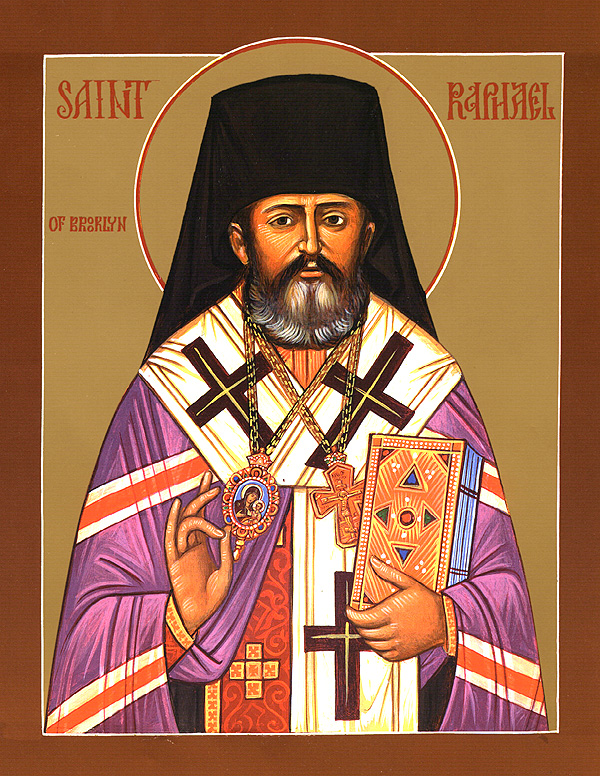
Saint Raphael, Bishop of Brooklyn (+1915)
Proclamation on the Glorification of Our Holy Father Bishop RAPHAEL (30-Apr-2000)
Our holy Father Raphael was born in Syria in 1860 to pious Orthodox parents, Michael Hawaweeny and his second wife Mariam, the daughter of a priest of Damascus. The exact date of Raphael’s birth is not known, but he estimated it to be on or near his Name Day, the Synaxis of the Holy Archangels Michael and Gabriel and all the Bodiless Powers of Heaven (November 8). Due to the violent persecution of Christians, at which time their parish priest, Saint Joseph of Damascus (July 10) and his companions were martyred, the Hawaweeny family was forced to flee to Beirut for their safety. It was here that the future saint first saw the light of day, and not in the city of his parents. Indeed, as the child’s life unfolded, it was evident that he would have no continuing city in this world, but would seek the city which is to come (Heb 13:14).
On the Feast of Theophany in 1861, he was baptized with the name Rafla, and later that spring the family was able to return to Damascus. The child attended elementary school, where he did very well, but in 1874 it appeared that Michael Hawaweeny would no longer be able to afford his son’s tuition. Fortunately, help came from Deacon Athanasius Atallah (later Metropolitan of Homs), who recommended to Patriarch Hierotheus of Antioch that Rafla be accepted as a student of the Patriarchate in preparation for the priesthood.
He was such a good student that he was selected to be a substitute teaching assistant in 1877. The following year he was appointed as a teacher of Arabic and Turkish. On March 28, 1879 he was tonsured as a monk by Patriarch Hierotheus, and served as His Beatitude’s personal attendant.
Since the Balamand Seminary had been closed in 1840, Patriarch JOACHIM III of Constantinople invited the Patriarch of Antioch to send at least one deserving student to study on scholarship at the School of Theology at Halki, and Saint Raphael was the one who was selected to go.
On December 8, 1885, he was ordained to the diaconate at the school chapel. In July of 1886, the young deacon received his Certificate of Theology, and returned to his homeland in the hope of serving the Church there. Patriarch Gerasimus of Antioch was impressed with Deacon Raphael, and often took him along on his pastoral visitations of his parishes. When His Beatitude could not be present, Deacon Raphael was asked to preach the Word of God to the people.
Deacon Raphael was not satisfied with the extent of his knowledge, and thirsted to learn even more. This did not stem from personal pride or ambition, but came from his fervent desire to benefit others. Truly, the words of King Solomon could be applied to Saint Raphael: “Give an opportunity to a wise man, and he will be wiser; instruct a just man, and he will receive more instruction” (Proverbs 9:9). Therefore, he asked Patriarch Gerasimus to permit him to do graduate studies at a school in Russia, promising to return and serve as the Patriarch’s Russian-language secretary. The Patriarch gave his blessing, and Deacon Raphael was accepted as a student at the Theological Academy of Kiev.
In 1889 Patriarch Gerasimus ordered the young deacon to take over as head of the Antiochian representation church in Moscow. He was ordained to the holy priesthood by Bishop SYLVESTER, the rector of the Academy, at the request of Patriarch Gerasimus. A month later, he was raised to the rank of archimandrite by Metropolitan IOANNIKII of Moscow, and was confirmed as head of the Antiochian representation church. After two years, Archimandrite Raphael was able to reduce the representation’s 65,000 ruble debt by 15,000 rubles. He also arranged for twenty-four Syrian students to come to Russia to further their education, hoping that they would return to Syria and teach others.
When Patriarch Gerasimus resigned in order to accept the See of Jerusalem, Archimandrite Raphael regarded this as an opportunity to free the Church of Antioch from its domination by foreign hierarchs. Burning with love for the Church of Antioch, and wishing to restore the administration of the church to its own native clergy and people, Archimandrite Raphael began a campaign of writing letters to some Antiochian bishops and influential laymen. He also wrote articles in the Russian press, drawing attention to the plight of Antioch. His courageous efforts did not meet with success, however, and there was a price to pay for his outspoken criticism.
In November of 1891 Metropolitan SPYRIDON, a Greek Cypriot, was elected as Patriarch of Antioch. Many Arabs believed that he had purchased the election by distributing 10,000 lira to several notable people in Damascus. Archimandrite Raphael refused to commemorate the new Patriarch during services at the representation church. As a result, he was suspended from his priestly functions by Patriarch SPYRIDON. Saint Raphael accepted his suspension, but continued to write articles in Russian newspapers in defense of the Antiochian cause. The Patriarchs of Antioch, Constantinople, Alexandria, and Jerusalem successfully petitioned the Tsar to forbid Russian newspapers from publishing his articles. With this door closed to him, Saint Raphael began to publish his writings in book form.
Eventually, Patriarch SPYRIDON wrote to the Assistant Overprocurator of Russia, a friend of Saint Raphael’s, asking him to persuade Father Raphael to ask for the Patriarch’s forgiveness. He did so, and the suspension was lifted. Saint Raphael was allowed to transfer from the jurisdiction of Antioch to the Church of Russia, and to remain there. He went to Kazan, taking a position as instructor in Arabic studies at the theological academy. He remained there until 1895 when he was invited by the Syrian Orthodox Benevolent Society of New York to come to that city to be the pastor of the Arab Orthodox community.
When the holy Apostle Paul had a vision of a man entreating him to come to Macedonia to help them (Acts 16:10), he set off on a great missionary journey. When Saint Raphael heard of the needs of his countrymen who were scattered in a strange land, he crossed the ocean to labor in yet another foreign country.
Archimandrite Raphael arrived in New York on November 2, 1895, and was welcomed by a delegation of Arab Christians who were awaiting their leader from Russia. On November 5, his first Sunday in America, he assisted Bishop NICHOLAS in serving the Divine Liturgy at the Russian church in New York city. Less than two weeks after his arrival, Archimandrite Raphael found a suitable place in lower Manhattan to set up a chapel, and furnished it with ecclesiastical items that he had brought with him from Russia. Bishop NICHOLAS blessed the new chapel, which was dedicated to Saint Nicholas of Myra.
This zealous pastor remained in New York teaching, preaching, and celebrating the divine services for his parishioners. It was not long, however, before he heard of smaller communities of Arab Christians scattered throughout the length and breadth of North America. Since these Arab immigrants had no pastor to care for them, it was not surprising that some should turn to other Christian traditions, or completely neglect their religious duties. This was an ongoing concern for Saint Raphael throughout the course of his ministry. Although he was not opposed to dialogue with non-Orthodox Christians, nor to friendly relations based on shared beliefs, Saint Raphael never lost sight of the clear line of distinction that exists between the Orthodox and the heterodox. He always insisted that any church unity must be based on the teachings of the seven Ecumenical Councils.
The Orthodoxy of Saint Raphael’s life and teaching was demonstrated over and over again by his words and his actions. He always upheld and defended the spotless Faith which was “delivered to the saints” (Jude 3). Although at first he did not understand the teachings of the heterodox, he later discovered how far removed they were from Orthodox doctrine. When he realized this, he took steps to protect his flock from harmful influences. He directed his people not to attend heterodox services lest they become confused by “divers and strange doctrines” (Heb 13:9). He believed it would be preferable for the head of the household to read the Hours at home from the Service Book when it was not possible to attend an Orthodox church.
In the summer of 1896, Saint Raphael undertook the first of several pastoral journeys across the continent. He visited thirty cities between New York and San Francisco, seeking out the Master’s lost sheep in cities, towns, and on isolated farms. He fed the spiritually hungry people with the Word of God in each place where he stopped. He performed marriages, baptisms, heard confessions, and celebrated the Divine Liturgy in the homes of the faithful where there was no church building. In other words, he zealously fulfilled his ministry as a preacher of the Gospel, enduring many hardships and afflictions, and he was watchful in all things concerning the care of his flock (2 Tim 4:5).
In 1898, with the blessing of Bishop Nicholas, Saint Raphael produced his first book in the New World — an Arabic language Service Book called The Book of True Consolation in the Divine Prayers. This book of liturgical services and prayers was very useful to priests in celebrating the divine services, and also to the people in their personal prayer life. The English version published by Archimandrite Seraphim Nassar is still being used today.
Between May-November 1898, Saint Raphael set off on his second pastoral tour. During this trip he became convinced of the need for Arabic-speaking priests to serve in the new churches he had established. When he returned to New York, he made a report to Bishop NICHOLAS expressing these concerns. With Bishop NICHOLAS’s blessing Saint Raphael was able to bring qualified priests from Syria. He also sought out educated laymen whom he could recommend for ordination. Both as an archimandrite and later as bishop, Saint Raphael would appoint pastors only after obtaining the blessing of the Russian hierarch who headed the American Mission.
This was the normal state of affairs in America at the time. Archimandrite Raphael welcomed Bishop Tikhon when the latter replaced Bishop NICHOLAS as the ruling bishop in America. On December 15, Saint Tikhon came to serve the Liturgy at the Syrian church of Saint Nicholas. Raphael told his people that their new Archpastor was one who “has been sent here to tend the flock of Christ — Russians, Slavs, Syro-Arabs, and Greeks — which is scattered across the entire North American continent.” At that time, of course, there were no parallel jurisdictions based on nationality. The Church united those of diverse backgrounds under the omophorion of the Russian Archbishop. This was the norm until the Russian Revolution disrupted church life in Russia, and also in America.
In March of 1899, Saint Raphael received permission from Bishop Tikhon to start collecting funds for a cemetery, and for building a new church to replace the chapel which was located in an old building on a dirty street. In the spring he left on another pastoral tour of forty-three cities and towns. Traveling by land and sea, and undeterred by the obstacles and difficulties before him, he spent seven months in the northeastern, southern, and midwestern regions of the United States. Saint Raphael ministered to Greeks and Russians as well as Arabs, performing weddings and baptisms, and regularizing the weddings of Orthodox people who had been married by non-Orthodox clergy. He also chrismated some children who had been baptized by Catholic priests.
In Johnstown, PA he reconciled those whose personal enmity threatened to divide the Arabic community. Although civil courts had been unable to make peace, Saint Raphael restored calm and put an end to the bitter feud. While in Johnstown, he received a telegram informing him that Metropolitan Meletios (Doumani), had been elected Patriarch of Antioch. With great joy Saint Raphael told his people that for the first time in 168 years, a native Arab had been chosen as primate of the Antiochian Church.
After the new Patriarch had been installed, Archimandrite Raphael was proposed to succeed Meletios as Metropolitan of Latakia. The Patriarch, however, stated that the Holy Synod could not elect Father Raphael because of his important work in America. In 1901, Metropolitan GABRIEL of Beirut wrote to Archimandrite Raphael asking him to be his auxiliary bishop, but he declined, saying that he could not leave his American flock. First, he wanted to build a permanent church, and to acquire a parish cemetery. The latter goal was achieved in August of 1901 when Father Raphael purchased a section of Mt Olivet cemetery on Long Island.
In December of 1901 Archimandrite Raphael was elected as Bishop of Zahleh. Patriarch Meletios sent a telegram congratulating him and asking him to return. Father Raphael thanked the Patriarch, but again declined higher office. He said that he wished to complete the project of building a temple for the Syrian community in New York. The following year, he bought an existing church building on Pacific Street in Brooklyn, and had it remodeled for Orthodox worship. Bishop Tikhon consecrated the church to the great joy of the faithful in attendance. Thus, Saint Raphael’s second major project was finished.
Since the number of parishes within the Diocese of North America was growing, Bishop Tikhon found it impossible to visit all of them. The diocese had to be reorganized in order to administer it more efficiently. Therefore, Bishop Tikhon submitted a plan to the Russian Holy Synod which would transfer the See from San Francisco to New York because most parishes and individuals were concentrated in the east. Since various ethnic groups required special attention and pastoral leadership, Bishop Tikhon proposed that Archimandrite Raphael be made his second vicar bishop (the Bishop of Alaska would be his first).
In 1903, the Holy Synod of Russia unanimously elected Archimandrite Raphael to be the Bishop of Brooklyn while retaining him as head of the Syro-Arab Orthodox Mission in North America. The Holy Synod announced the election to Patriarch Meletios, who was pleased by their decision. Bishop Tikhon wrote to Saint Raphael to inform him of his election, and Father Raphael sent him a letter of acceptance. Meanwhile, Father Innocent Pustynsky was consecrated as Tikhon’s first auxiliary bishop at Saint Petersburg’s cathedral of Our Lady of Kazan.
On the third Sunday of Lent in 1904, Saint Raphael became the first Orthodox bishop to be consecrated on American soil. Bishop Tikhon and Bishop Innocent performed the service at Saint Nicholas Cathedral in Brooklyn. The new bishop’s vestments were a gift from Tsar Nicholas II. Following his consecration, Bishop Raphael continued his pastoral labors, ordaining priests and assigning them to parishes, and helping Bishop Tikhon in the administration of the diocese.
At the end of 1904, Bishop Raphael announced his intention to publish a magazine called Al-Kalimat (The Word) as the official publication of the Syro-Arab mission. This would help to link the people and parishes of his diocese more closely together. Bishop Raphael knew that he could not visit all Orthodox Christians across North America in person, but through the ministry of the printed word, he could preach the word of salvation even to people he would never meet. The content was to be spiritual, moral, and churchly so that the magazine could reinforce people in their Faith. The Word would focus on five primary topics: dogmatic truths, ethical teaching, historical and contemporary ecclesiastical subjects, a chronicle of baptisms, weddings, etc., and official pronouncements. The first issue was printed in January 1905, and Saint Raphael considered this milestone as one equal in importance to the acquisition of Saint Nicholas Cathedral and the parish cemetery.
In July of 1905 Bishop Raphael consecrated the grounds for Saint Tikhon’s Monastery and blessed the orphanage at South Canaan, PA. Three days later, he presided at a conference of diocesan clergy at Old Forge, PA, because Archbishop Tikhon was in San Francisco. Among the clergy in attendance were three who would also be numbered among the saints: Father ALEXIS Toth, Father Alexander Hotovitzky, and Father John Kochurov (the last two would die as martyrs in Russia).
For the next ten years Bishop Raphael tended his growing flock. With the growth of his New York community came an increase in the number of children, and he was concerned about their future. He wanted to establish an evening school to educate them in a Christian atmosphere, because the future of the Church in this country depended upon the instruction of the youth. Children who did not speak Arabic were already going to non-Orthodox churches where Sunday school classes were conducted in English. Bishop Raphael saw the absolute necessity for using English in worship and in education for the future progress of the Syro-Arab Mission.
Taking heed of Saint Paul’s words to pray in a language that people understood (1 Cor.14:15-19), Saint Raphael recommended the use of the Service Book of the Holy Orthodox Catholic Apostolic Church (translated by Isabel Hapgood) in all of his parishes.
In March of 1907 Saint Tikhon returned to Russia and was replaced by Archbishop PLATON. Once again Saint Raphael was considered for episcopal office in Syria, being nominated to succeed Patriarch GREGORY as Metropolitan of Tripoli in 1908. The Holy Synod of Antioch removed Bishop Raphael’s name from the list of candidates, citing various canons which forbid a bishop being transferred from one city to another.
On the Sunday of Orthodoxy in 1911, Bishop Raphael was honored for his fifteen years of pastoral ministry in America. Archbishop PLATON presented him with a silver-covered icon of Christ and praised him for his work. In his humility, Bishop Raphael could not understand why he should be honored merely for doing his duty (Luke 17:10). He considered himself an “unworthy servant,” yet he did perfectly the work that fell to him (Saint Ignatius of Antioch, Letter to the Ephesians).
Toward the end of 1912, Bishop Raphael became ill while working in his office. Doctors diagnosed him with a heart ailment that eventually caused his death. After two weeks he felt strong enough to celebrate the Liturgy in his cathedral.
In 1913-1914 this missionary bishop continued to make pastoral visitations to various cities. In 1915 he fell ill again and spent two months at home, bearing his illness with patience. At 12:40 AM on February 14/27 he rested from his labors. They called him, but he did not answer. They shook him, but he was gone.
From his youth, Saint Raphael’s greatest joy was to serve the Church. When he came to America, he found his people scattered abroad, and he called them to unity. He never neglected his flock, but traveled throughout America, Canada, and Mexico in search of them so that he might care for them. He kept them from straying into strange pastures, and he protected them from spiritual harm. During twenty years of faithful ministry he nurtured them and helped them to grow. At the time of his death, the Syro-Arab Mission had thirty parishes with 25,000 faithful.
He was also a scholar, and the author of several books. He wrote many, if not most, of the articles that appeared in The Word. He served his own Arabic community, and also reached out to Greeks and Russians, speaking to them in their own language. He became fluent in English, and encouraged its use in church services and educational programs.
Saint Raphael came into contact with all sorts of people, and was a gentle father to them. He gained their love and respect by first loving them, and also through his charming personality and excellent character. He was always kind and merciful to others, but was strict with himself. He accomplished many good things during his earthly life, and now he joins the holy angels in offering ceaseless prayer and praise to God.
Through the prayers of the holy Bishop Raphael, may we also be made worthy of the heavenly Kingdom. Amen.
Venerable Prokopios the Confessor of Decapolis

Saint Prokopios lived during the VIII century in the region of Dekapolis, east of the Sea of Galilee. Forsaking the vainity of this world, Prokopios was tonsured in a certain monastery, where he labored for his salvation, devoting himself to a life of prayer and fasting. As he grew experienced in ascetical labors, he was adorned with virtue and purity of soul, so that other ascetics began to notice him. Meanwhile, about this time, the heresy of iconoclasm appeared. Prokopios was distressed by the policies of the wicked Emperor Leo the Isaurian, who regarded the Holy Icons as idols, and those who venerated them as idolaters.
The righteous Prokopios, together with other zealots of Orthodoxy, fought against the wicked heresy of the iconoclasts. He refuted their mindless madness and defeated them by declaring that Orthodox Christians do not worship icons, we venerate them, and that veneration passes to the original prototype. This brought upon him the wrath and disfavor of the Emperor. At his command, Saint Prokopios was arrested and subjected to cruel torments: he was flogged, beaten with rods, and raked with iron claws, and then was thrown into a dank dungeon. There Saint Prokopios and Saint Basil (February 28), his co-struggler in the monastic liife, languished until the death of Emperor Leo, when the Holy Confessors were released.
Saint Prokopios the Decapolite spent the remainder of his life in peace, guiding many on the path of virtue and salvation. He reposed at an advanced age, around the year 750.
Venerable Titus the Presbyter of the Kiev Near Caves
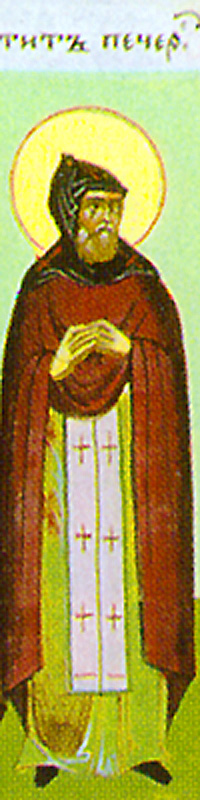
Saint Titus, Presbyter of the Near Caves, lived in great friendship with the deacon Evagrius, which later turned into a strong dislike and hostility. Although Hieromonk Titus tried several times to make peace with his former friend, the deacon Evagrius refused to be reconciled (Compare the story of the Martyr Nikēphóros on February 9).
When Saint Titus fell ill with a grievous illness and began to prepare himself for death, he asked for Evagrius to be brought to him in order to ask his forgiveness. The brethren brought Evagrius to the sickbed by force. Saint Titus tearfully begged him for forgiveness, but Evagrius remained obstinate. He declared that he would not forgive Titus in this world, nor in the world to come. As he said this, he fell dead, struck down by an angel. At that very instant, Saint Titus was healed, and got up out of bed. He revealed that the demons were all around him until he forgave Evagrius. When he had done so, the demons left him and attacked Evagrius, while radiant angels surrounded Saint Titus.
After this, Saint Titus increased his ascetic struggles, and received from God the gift of working miracles. He was also known for his great humility.
Saint Titus reposed around 1190. His memory is celebrated also on September 28 at the Synaxis of the Fathers of the Near Caves.
Venerable Titus the Soldier, of the Kiev Caves

Saint Titus was a soldier who was known for his bravery. One day, he was seriously wounded in battle. An illness caused by his wound forced him to leave the military service, so he entered the Kiev Caves Monastery. There he spent the rest of his life in prayer and repentance, and attained the heavenly Kingdom.
Venerable Thalelaios the Hermit of Syria
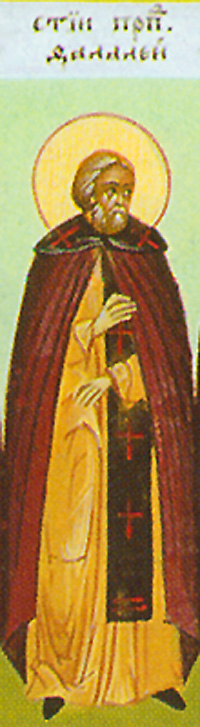
Saint Thalelaios (Thallélaios) lived during the fifth century, and is one of the Unmercenary Physicians. He was a native of Cilicia in Asia Minor, and entered the Monastery of Saint Savva the Sanctified, and there he was ordained as a presbyter. Later on, he moved to Syria, not far from the city of Gabala, where he found a ruined pagan temple surrounded by pagan graves, and he settled there in a tent. This place had an evil reputation, because the demons inhabiting the place frightened travellers and caused them much harm.
Here Thalelaios lived, praying day and night in complete solitude. The demons attacked the Saint frequently, trying to scare him with frightful apparitions and noises. But by the power of God Thallélaios was ultimately victorious over the Enemy, after which he was no longer troubled. Then he intensified his efforts even more: he built a small cell measuring three feet high and two feet wide. Since he was a tall man, he was unable to sit up in it, but had to rest his head on his knees. He remained in these cramped quarters for about ten years.
Bishop Theodoret of Cyrrhus visited Saint Thalelaios one day and found him reading the Gospel. He asked him why he had chosen live in such a way. The Saint said that he had many sins, and that he might receive eternal punishment, so he hoped to escape those torments by suffering voluntarily in his cell. The Bishop left, greatly edified by this answer.
The Lord granted to the ascetic the gift of wonderworking, and his miracles helped him to enlighten the pagan population. With the help of those he had converted to Christianity, he destroyed the pagan temple, and built a church in which there were daily Services.
Saint Thalelaios reposed at an advanced age around the year 460. In the book entitled Leimonarion, or Pratum [The Meadow], written by the Greek monk John Moskhos (+ 622), Saint Thallélaios is mentioned: “Abba Thalelaios was a monk for sixty years and he never ceased saying with tears, "Brethren, God has given us this time for repentance, and we must seek after Him’” (Chapter 59).
His Life is included in the Church History of Theodoret of Cyrrhus.
Saints Asclepius and James of Syria

Saints Asclepius and James were Syrian ascetics, and lived during the fifth century. Theodoret of Cyrrhus speaks of them. Saint Asclepius led an ascetic life of temperance in his native village and was not hindered by constant association with many people.
He had many imitators and followers. One of them was Saint James, who secluded himself in a small dwelling near the village of Nimuza. Up until the end of his life, the ascetic did not leave his hermitage, but spoke to visitors through a small aperture in the wall, cut at a angle so that no one was able to see him. He never kindled a fire or lit a lamp.
Saint Stephen of Constantinople
Saint Stephen, formerly a courtier under the emperor Mauricius (582-602), left his service, founded a hospice for the elderly at Armatia [Constantinople], and devoted himself totally to taking in strangers. He died peacefully in 614.
Martyrs Julian, Eunos, Beza, and Mekaro of Alexandria
The Holy Martyrs Julian, Eunos [Kronion] his servant, Beza [Bisos] the soldier and Mekaros suffered at the beginning of the reign of Decius (249-251) at Alexandria. Saint Julian, a very old man, suffered from gout and could neither stand nor get about. He was carried to the trial by his servants, one of whom, (Eunos) bravely confessed his faith in Christ, even though a second servant recanted.
They took Julian and Eunos through the city on camels, subjecting them to the jeering of pagans, and finally burned them in a fire. The soldier Saint Beza also suffered with them. Because he tried to defend the holy martyrs from insult, he was beheaded by the sword. Saint Mekaros of Lebanon was also burned.
Saint Leander of Seville

Saint Leander, the Bishop of Seville, teacher of the Church, and enlightener of Spain, lived in the VI century, and was the scion of an aristocratic family. his father Severian was a duke and belonged to an illustrious Byzantine clan, while his mother was the eldest daughter of the Visigoth King Levigid, who reigned in Seville, the capital of the Visigoth Kingdom. At a young age he entered a monastery, and was distinguished for his education and virtues. Therefore, the Church made him a Bishop in the year 579.
He founded a theological school with the aim of spreading Orthodoxy, but also for cultivating the sciences and the arts in general, for the people of that barbaric kingdom. The two royal children Hermenegὶld and Rekared, his nephews on his mother's side, were among the disciples of Saint Leander. Hermenegild was raised in the wellsprings of Orthodoxy. His faith in the Church was strengthened, thanks to his pious wife Ingard, the daughter of Sigebert, the King of the Franks. When his father transferred his capital to Toledo, he chose Seville as his home when a persecution of the Orthodox broke out. The heretic Levegild came into conflict with the Orthodox son of Hermenegild. Such was the intensification of the persecution and the fury of the heretics, as it has been written, that it did not leave anyone free anywhere. Both men, and the land itself, lost their former fertility. The heretical king besieged Seville and threw his son into a dark prison, where he strangled him on the Feast of Pascha in 586.
During this time, shortly before he was exiled along with other confessors of Orthodoxy, Saint Leander fled to Constantinople seeking the Emperor's help. It was there that he met Saint Gregory Dialogus (March 12) and was united to him by strong ties of friendship. When the persecution of the Orthodox reached its peak, King Levegild, afflicted with a fatal illness, changed his attitude, inviting Saint Leander to his deathbed and after he repented, he begged him to bring his successor Rekarὲd to the true Orthodox Faith. The new king, who heeded his former teacher, was converted and immediately undertook to convene the Third Council of Toledo, where he read to everyone the confessions of faith and the decisions of the Ecumenical Synod of Nicaea, and announced that the united peoples of the Goths and Suevians were returning to the unity of the Church. Saint Leander, who presided at the Council of Toledo, then decided to devote the remainder of his life to instructing his flock, first by his own example, and also through his inspired writings. He also prepared his brother, Saint Isidore, to succeed him as Bishop of Seville, and the Church of Spain. He even helped his sister, Saint Florentia, to become the founder and Igoumeness of forty monasteries and thousands of nuns, composing for them a monastic Typikon which was called "The Canons of Saint Leander." He also organized the Divine Services of the Church of Spain, which were called "Mozarabic."
The Holy Bishop of Seville, after enduring many adversities and trials, surrendered his holy soul to the Lord on February 27, 600 (or 601). His scroll reads: "The Orthodox Faith defined by the Council of Nicea is the weapon of the Church against the thorns of heresy."
 Saint Peter Antiochian Orthodox Church