
FRIDAY OF THE 16TH WEEK
ABSTAIN FROM MEAT, FISH, DAIRY, EGGS, WINE, OLIVE OIL
Parthenius, Bishop of Lampsacus, Luke of Mount Stirion, George the New Martyr of Crete, Theopemptos the Martyr & his Companions, The Synaxis of the New Martyrs of Russia, Afterfeast of the Presentation of Our Lord and Savior in the Temple, Richard, King of Wessex
ST. PETER’S SECOND UNIVERSAL LETTER 1:1-10
SIMON PETER, a servant and apostle of Jesus Christ, To those who have obtained a faith of equal standing with ours in the righteousness of our God and Savior Jesus Christ:May grace and peace be multiplied to you in the knowledge of God and of Jesus our Lord.His divine power has granted to us all things that pertain to life and godliness, through the knowledge of him who called us to his own glory and excellence, by which he has granted to us his precious and very great promise, that through these you may escape from the corruption that is in the world because of passion, and become partakers of the divine nature. For this very reason make every effort to supplement your faith with virtue, and virtue with knowledge, and knowledge with self-control, and self-control with steadfastness, and steadfastness with godliness, and godliness with brotherly affection, and brotherly affection with love. For if these things are yours and abound, they keep you from being ineffective or unfruitful in the knowledge of our Lord Jesus Christ. For whoever lacks these things is blind and shortsighted and has forgotten that he was cleansed from his old sins. Therefore, brethren, be the more zealous to confirm your call and election, for if you do this you will never fall.
MARK 13:1-8
At that time, as Jesus came out of the temple, one of his disciples said to him, "Look, Teacher, what wonderful stones and what wonderful buildings!" And Jesus said to him, "Do you see these great buildings? There will not be left here one stone upon another, that will not be thrown down." And as he sat on the Mount of Olives opposite the temple, Peter and James and John and Andrew asked him privately, "Tell us, when will this be, and what will be the sign when these things are all to be accomplished?" And Jesus began to say to them, "Take heed that no one leads you astray. Many will come in my name, saying, 'I am he!' and they will lead many astray. And when you hear of wars and rumors of wars, do not be alarmed; this must take place, but the end is not yet. For nation will rise against nation, and kingdom against kingdom; there will be earthquakes in various places, there will be famines; this is but the beginning of the sufferings.
Afterfeast of the Meeting of our Lord in the Temple

The fifth day of the Afterfeast of the Meeting of the Lord falls on February 7.
Saint Parthenios, Bishop of Lampsakos

Saint Parthenios, the Bishop of Lampsakos, was from the city of Melitopolis (Asia Minor), where his father Christopher served as a deacon. The young man could not read, but he learned the Holy Scriptures well, by attending the Divine Services in church. He had a kind heart and, when he went fishing, he distributed the proceeds to the poor. Filled with the grace of God from the age of eighteen, Saint Parthenios healed diseases, cast out demons, and worked other miracles in Christ's name.
Learning about the virtuous life of the young man, Bishop Philip of Melitopolis gave him an education and ordained him as a presbyter. In 325, during the reign of Constantine the Great, Archbishop Achilles of Kyzikos appointed him as Bishop of Lampsakos (in Asia Minor). Many pagans lived in the city, and the Hierarch was diligent in spreading the faith in Christ, and confirming it with many miracles and healings of the sick, according to God's will. People abandoned their pagan beliefs, and Bishop Parthenios visited Emperor Constantine the Great, requesting him to permit the destruction of pagan temples so that Christian churches could be built in their place. The Emperor received him with honor, and gave him a document authorizing him to destroy pagan temples, and provided him with the means to build a church. Returning to Lampsakos, Bishop Parthenios ordered the destruction of the pagan temples and built a beautiful church in the middle of the city.
Finding a large marble stone in one of the ruined temples, suitable for the Holy Altar in the church, the Bishop ordered work to begin on the stone so that it could be put on a wagon and taken to the church. Out of malice, the devil, who was enraged because the stone had been removed from the temple, overturned the wagon, and the stone killed the driver Eutykhianos. Saint Parthenios resurrected him by his prayers, and shamed the devil, who wanted to obstruct God's work.
The Hierarch's mercy was so great that he never refused to heal any of those who came to him, or the people he met on the roads, who were suffering from bodily ailments and possessed by unclean spirits. People stopped going to doctors, because Saint Parthenios freely healed every illness in the name of the Lord Jesus Christ.
By the great power of the name of Christ, the Hierarch cast out many demons from people, houses, and the waters of the sea. When the Bishop exorcised a demon from a certain man who had been possessed since childhood, the unclean spirit begged Saint Parthenios to give him another place to live. The Saint promised to show him such a place and, opening his mouth, he said to the demon: "Come and dwell in me." As if scorched by fire, the demon cried out, "How shall I enter the house of God?" and disappeared into desolate and impassable places. Expelled by the Saint the unclean spirit shouted that Divine fire was driving him into the fire of Gehenna. Thus, by showing people the great power of faith in Christ, the Saint converted many idolaters to the only true God.
The Saint's skull is located in the Monastery of Espigmenou on Mount Athos. Fragments of the Saint's relics are to be found in the Monasteries of the Great Cave at Kalavryta, Rovelistas of Arta, and Kykkos on Cyprus. Part of the Saint's skull is kept in the Holy Monastery of Makrymallē (Μακρυμάλλη). in the Holy Metropolis of Chalkida, in the center of the island of Euboea in Greece.
Venerable Luke of Hellas
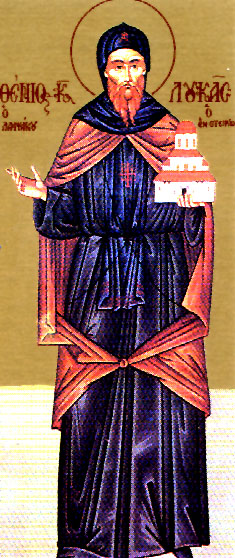
Saint Luke of Hellas was a native of the Greek village of Kastorion. The son of poor farmers, the saint from childhood had toiled much, working in the fields and shepherding the sheep. He was very obedient to his parents and very temperate in eating. He often gave his own food and clothing to the poor, for which he suffered reproach from his parents. He once gave away almost all the seed which was needed for planting in the fields. The Lord rewarded him for his charity, and the harvest gathered was greater than ever before.
As a child, he prayed fervently and often. His mother saw him more than once standing not on the ground, but in the air while he prayed.
After the death of his father, he left his mother and went to Athens, where he entered a monastery. But through the prayers of his mother, who was very concerned about him, the Lord returned him to his parental home in a miraculous manner. He spent four months there, then with his mother’s blessing he went to a solitary place on a mountain called Ioannou (or Ioannitsa). Here there was a church dedicated to the holy Unmercenaries Cosmas and Damian, where he lived an ascetical life in constant prayer and fasting. He was tonsured there by some Elders who were on pilgrimage. After this, Saint Luke redoubled his ascetic efforts, for which the Lord granted him the gift of foresight.
After a seven years on Ioannou, the saint moved to Corinth because of an invasion of the Bulgarian armies. Hearing about the exploits of a certain stylite at Patras, he went to see him, and remained for ten years to serve the ascetic with humility and obedience. Afterwards, the saint returned again to his native land and again began to pursue asceticism on Mount Ioannou.
The throngs of people flocking there disturbed his quietude, so with the blessing of his Elder Theophylactus, Saint Luke went with his disciple to a still more remote place at Kalamion. After three years, he settled on the desolate and arid island of Ampelon because of an invasion of the Turks. Steiris was another place of his ascetic efforts. Here brethren gathered to the monk, and a small monastery grew up, the church of which was dedicated to the Great Martyr Barbara. Dwelling in the monastery, the saint performed many miracles, healing sicknesses of soul and of body.
Foreseeing his end, the saint confined himself in a cell and for three months prepared for his departure. When asked where he was to be buried, the monk replied, “Throw my body into a ravine to be eaten by wild beasts.” When the brethren begged him to change these instructions, he commanded them to bury his body on the spot where he lay. Raising his eyes to heaven, he said, “Into Thy hands, O Lord, I commend my spirit!”
Saint Luke fell asleep in the Lord on February 7, 946. Later, a church was built over his tomb. Myrrh flowed from his holy relics, and many healings occurred.
1,003 Martyrs of Nicomedia
1003 Martyrs at Nicomedia, were servants of the four dignitaries Bassos, Eusebius, Eutychius and Basilides, who suffered for Christ with their wives (January 5) in the year 303 during the reign of the emperor Diocletian (284-305).
After the martyric death of their masters, the servants decided to follow their example, and they also confessed themselves Christians before Diocletian. Swayed neither by persuasion nor promises nor rewards, 1003 men, women, and small children were cut down by soldiers who formed a tight circle around them so that none of them remained alive.
Martyr Aule
Saint Aule suffered martyrdom in London during Diocletian’s persecution of Christians.
 Saint Peter Antiochian Orthodox Church