Here is the homily for Sunday, October 20, 2024.
You can also download the homily here .

MONDAY OF THE 8TH WEEK
NO FAST
Joannicius the Great, The Holy Hieromartyrs Nicander, Bishop of Myra, and Hermias the Presbyter, Porphyrios the Mime, Emperor John Batatze the Merciful, George Karslidis of Pontos
Brethren, as you have always obeyed, so now, not only as in my presence but much more in my absence, work out your own salvation with fear and trembling; for God is at work in you, both to will and to work for his good pleasure. Do all things without grumbling or questioning, that you may be blameless and innocent, children of God without blemish in the midst of a crooked and perverse generation, among whom you shine as lights in the world, holding fast the word of life, so that in the day of Christ I may be proud.
At that time, while Jesus was teaching, one of the multitude said to him, “Teacher, bid my brother divide the inheritance with me.” But he said to him, “Man, who made me a judge or divider over you?” And he said to them, “Take heed, and beware of all covetousness; for a man’s life does not consist in the abundance of his possessions. Therefore I tell you, do not be anxious about your life, what you shall eat, nor about your body, what you shall put on. For life is more than food, and the body more than clothing. Consider the ravens: they neither sow nor reap, they have neither storehouse nor barn, and yet God feeds them. Of how much more value are you than the birds! And which of you by being anxious can add a cubit to his span of life? If then you are not able to do as small a thing as that, why are you anxious about the rest? Consider the lilies, how they grow; they neither toil nor spin; yet I tell you, even Solomon in all his glory was not arrayed like one of these. But if God so clothes the grass which is alive in the field today and tomorrow is thrown into the oven, how much more will he clothe you, O men of little faith! And do not seek what you are to eat and what you are to drink, nor be of anxious mind. For all the nations of the world seek these things; and your Father knows that you need them. Instead, seek his kingdom, and these things shall be yours as well.”

Hieromartyr Seraphim, Archbishop of Uglich (in the world Semyon N. Samoylovich) was born on July 19, 1881 in the city of Myrgorod, Poltava governorate.
Semyon graduated from the Poltava Theological Seminary in 1902 and received a place as a teacher of Unalashkinskaya, a two-year school in Alaska. In 1905 he held the same position at Sitka, where he was tonsured into the mantiya by Bishop Innocent (Pustynsky) and a month later he was ordained as a Hieromonk. In 1906, Father Seraphim was rector of the Nugek Spiritual Mission in North America. In 1907-1908 he taught at Sitka Theological Seminary. In America, Vladyka was the associate of His Eminence Archbishop Tikhon, the future Patriarch, who valued the zealous missionary-ascetic highly.
In 1908, Father Seraphim was an assistant to the Vladikavkaz diocesan missionary, and in 1909 he was the Father Confessor of the Alexander Ardon Theological Seminary. In 1910, he was appointed first Vicar of the Mogilev Brotherhood First-Class Monastery, and then, at the request of His Eminence Archbishop Tikhon, who then held the Yaroslavl kathedra, he was transferred to the post of viceroy of Tolzhsk Yaroslavl Monastery.
There, Father Seraphim wrote a serious work on the history of the Tolzhsk Monastery, timed to coincide with its 600th anniversary. He started a beekeeping school for orphan boys, and at the beginning of the war he established an infirmary.
From 1915, Father Seraphim was the vicar of the Uglich Protection Monastery. In February 1920 he was consecrated as Bishop of Uglich, and vicar of the Yaroslavl Diocese.
Vladyka was a member of the so-called "Parallel Synod", which existed with the tacit approval of His Holiness Patriarch Tikhon in the Danilov Monastery. It was founded by the Hieromartyr Archbishop Theodore (Pozdeevsky) and it included prominent bishops: Archbishop Andrew (Ukhtomsky), Bishop Arseny (Zhadanovsky), Bishop Seraphim (Zvezdinsky), and Bishop Gouria (Stepanov).
The reason for the emergence of the "Parallel Synod" was that in the opinion of its members, the Patriarchal Synod, which was under the tight control of the G. P. U, was ineffective and was forced to stand in a conciliatory position. It was conceived as a "permanent Pre-Conciliar Conference" but its main purpose was the preparation of a secret Local Council capable of resolving Church problems without pressure from the authorities. The fundamental decisions of "Danilovtsy" were:
1. Affirmation of the principles of decentralization of Church life as the most effective way to resist the Bolsheviks' control over the Church;
2. Secret installations of bishops and priests. Thus, the "Parallel Synod" was the cornerstone on which the Catacomb Church began to be established.
From July 1922 Vladyka was in prison at Yaroslavl, and after his release in 1924 he was elevated to the rank of Archbishop by His Holiness Patriarch Tikhon. In 1925, Vladyka became the temporary administrator of the Yaroslavl Diocese.
Hieromartyr Metropolitan Joseph (Petrov), as one of the Deputies of the Patriarchal Locum Tenens, in case of his arrest, he appointed temporary Deputies in 1925, including Bishop Seraphim. In 1926, on December 16 (29), after the arrest of the Hieromartyr Metropolitan Joseph (Petrov), Vladyka issued an Epistle on assuming the office of Deputy Patriarchal Locum Tenens. He ran the Church until April 1927, then handed over the administration to Metropolitan Sergius (Stragorodsky), who had been released from prison.
It is known that in 1927 Vladyka was summoned to G. P. U. headquarters in Moscow, where he was offered to accept compromising conditions for the legalization of the Church, indicating who to appoint as members of the Synod. The Saint refused to do this, proposing its members of the Synod and among them Metropolitan Kirill (Smirnov). "After all, he's sitting there," the Chekists said.
"But you have him, free him," the Saint replied. After such a reply, he was soon arrested.
After the publication of Metropolitan Sergius' Declaration, the Saint joined the Yaroslavl Opposition, headed by the Hieromartyr Metropolitan Agathangel (commemorated on October 3). With regret, he wrote in January 1928 that he had "hastily and unconditionally" handed over the Deputy Rights to Metropolitan Sergius. He pleaded with Metropolitan Sergius to be courageous and publish another Declaration "to correct the first," which "detracts from service to the Truth, and God does not help lies."
He called on the Metropolitan to look to the oldest hierarch, Metropolitan Agathangel of Yaroslavl, and transfer the Deputy Rights to him. In April 1928, Metropolitan Sergius deprived Vladyka of his kathedra and suspended him from the priesthood. He was arrested and then expelled from Yaroslavl to Mogilev in the Buynichi Holy Spirit Monastery.
In his January 1929 Epistle to the Entire Church, the Saint continued to denounce the politics of Metropolitan Sergius and the grave sin of "the infatuation of our faint-hearted and weak brethren into the new renewal," for which he was soon arrested again (in February 1929) and sentenced to five years in a prison camp. But the Saint's Message was widely circulated throughout the country, and was published in Belgrade.
He was released from the camp and exiled for three years to the Northern Territory, where he headed the secret Church, assigning priests, and performing tonsures. According to the memoirs of his spiritual children, "he weakened physically, but he was strong in spirit." He believed that in an era of persecution there should be no centralized Church Administration. The Bishop must govern his Diocese himself.
Around 1934, Vladyka wrote another Epistle, in which Metropolitan Sergius was suspended from the priesthood for his uncanonical activities beginning in 1927. To approve this Epistle, a "small catacomb council" was held at Arkhangelsk, the decisions of which were to be the basis for all exiled bishops and clergy. There is evidence that the Patriarchal Deputy Metropolitan Peter (Polyansky) wrote from exile that the Russian Bishops themselves must rebuke Metropolitan Sergius for his uncanonical actions.
In May 1934, the Saint was arrested once again in Arkhangelsk on charges of creating a new "counter-revolutionary organization of supporters of the true Orthodox Church" and he was sentenced to five years in the Camps. He served his sentence in the Suslov branch of Siblaga. Vladyka was shot in the camp on October 22, 1937 (November 4 New Style).
He was canonized as a Saint with the New Martyrs and Confessors of Russia at the Jubilee Bishops' Council of Russia. In August of 2000, the Hieromartyr Seraphim was approved by the Orthodox Church for general Church veneration.
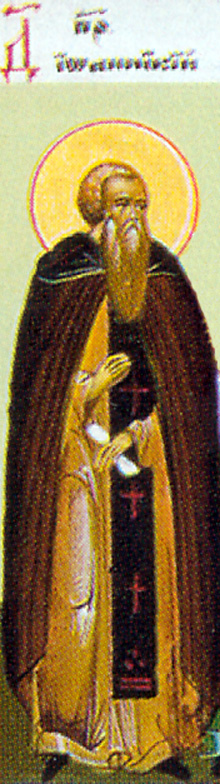
Saint Joannicius the Great was born in Bithynia in the year 752 in the village of Marikat. His parents were destitute and could not provide him even the basics of an education. From childhood he had to tend the family cattle, their sole wealth. Love for God and prayer completely dominated the soul of the child Joannicius. Often, having shielded the herd with the Sign of the Cross, he went to a secluded place and spent the whole day praying, and neither thieves nor wild beasts came near his herd.
By order of the emperor Leo IV (775-780), a multitude of officials went through the cities and towns to draft young men for military service. Young Joannicius was also drafted into the imperial army. He earned the respect of his fellow soldiers for his good disposition, but he was also a brave soldier who struck fear in the hearts of his enemies. Saint Joannicius served in the imperial army for six years. More than once he was rewarded by his commanders and the emperor. But military service weighed heavily on him; his soul thirsted for spiritual deeds and solitude.
Saint Joannicius, having renounced the world, longed to go at once into the wilderness. However, on the advice of an Elder experienced in monastic life, he spent a further two years at the monastery. Here the saint became accustomed to monastic obedience, to monastic rules and practices. He studied reading and writing, and he learned thirty Psalms of David by heart.
After this, commanded by God to go to a certain mountain, the monk withdrew into the wilderness. For three years he remained in deep solitude in the wilderness, and only once a month a shepherd brought him some bread and water. The ascetic spent day and night in prayer and psalmody. After each verse of singing the Psalms Saint Joannicius made a prayer, which the Orthodox Church keeps to this day in a somewhat altered form, “The Father is my hope, the Son is my refuge, the Holy Spirit is my protection.”
By chance, he encountered some of his former companions from military service. The saint fled the wilderness and withdrew to Mount Kountourea to hide himself from everyone. Only after twelve years of ascetic life did the hermit accept monastic tonsure. The saint spent three years in seclusion after being tonsured. Then he went to a place called Chelidon to see the great ascetic Saint George (February 21). The ascetics spent three years together. During this time Saint Joannicius learned the entire Psalter by heart. As he grew older, Saint Joannicius settled in the Antidiev monastery and dwelt there in seclusion until his death.
Saint Joannicius spent seventy years in ascetic deeds and attained to a high degree of spiritual perfection. Through the mercy of God the saint acquired the gift of prophecy, as his disciple Pachomius has related. The Elder also levitated above the ground when he prayed. Once, he crossed a river flooded to overflowing. The saint could make himself invisible for people and make others also hidden from sight.
Once, Saint Joannicius led Greek captives out of prison under the very eyes of the guards. Poison and fire, with which the envious wanted to destroy the saint, did him no harm, and predatory beasts did not touch him. He freed the island of Thasos from a multitude of snakes. Saint Joannicius also saved a young nun who was preparing to leave the monastery to marry; he took upon himself the agonized maiden’s suffering of passion, and by fasting and prayer, he overcame the seductive assault of the devil.
Foreseeing his death, Saint Joannicius fell asleep in the Lord on November 4, 846, at the age of 94.

The Hieromartyrs Nicander, Bishop of Myra, and Hermas the Presbyter, were disciples of the holy Apostle Paul’s follower and fellow ascetic, the holy Apostle Titus of the Seventy (August 25), and they were ordained by him to the priesthood.
Living the ascetic life amid incessant pastoral works, the saints converted many pagans to Christ. For this they were arrested and brought before the city prefect, Libanius. Neither flattery nor threats swayed the holy martyrs to renounce Christ. Then Libanius gave orders that they be tortured.
The saints endured fierce and inhuman torments: they were tied to horses and dragged over stones, their bodies were raked with iron hooks, and they were cast into a hot oven. The Lord helped them endure things that a mere man by his own strength could not endure. Towards the end, iron nails were hammered into their heads and hearts. They were thrown into a pit, then covered over with earth.
After enduring such a cruel death, now they live forever in the joy of the Lord (Mt. 25:21).
No information available at this time.

No information available at this time.

Among the multitude of saints we remember those Christians who dedicated their earthly lives to glorifying God and serving others. In a single lifetime they performed all the spiritual feats of the venerable and devout fathers, confessors, and martyrs.
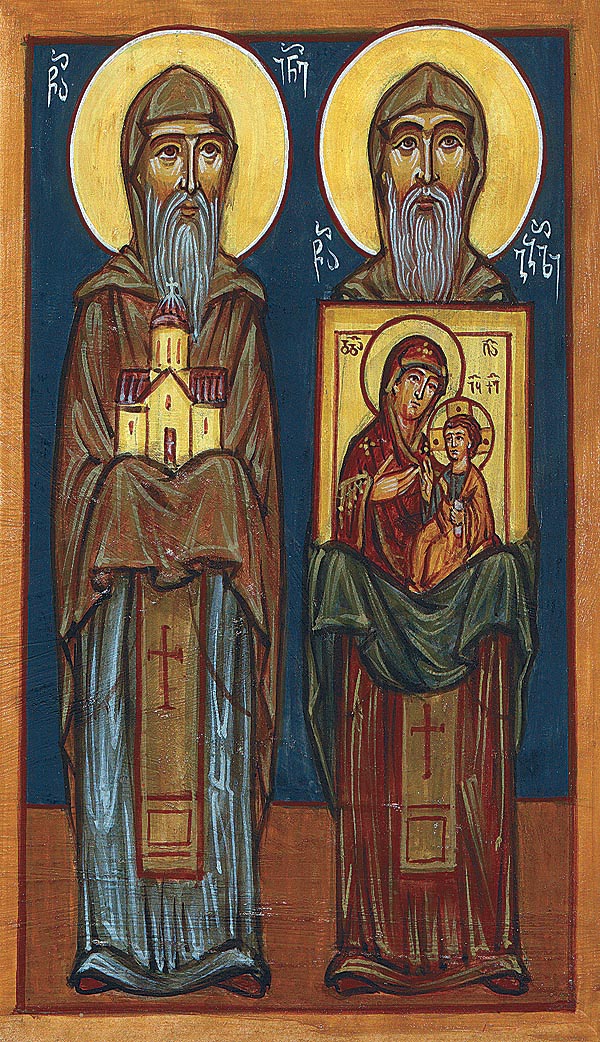
Among the saints canonized by the Georgian Church, only four have been called “Righteous.” They are Saint Ilia Chavchavadze, well known as the “father” and “uncrowned king” of the Georgian nation, and Saints John, Steven, and Isaiah the Georgians.
It is believed that Holy John, Steven, and Isaiah lived in Jerusalem and guarded the Tomb of our Lord. It is probable that the Georgian Orthodox Church proclaimed them deserving of exceptional honor in recognition of their dedicated service at the Tomb of the Savior.
For several centuries the Georgian Church has glorified the Righteous John, Steven, and Isaiah and asked for their intercessions before the Lord.
Blessed Simon of Yurievets was born in the city of Yurievets in the Povolzhsk or Volga region. Forsaken by his parents, the saint took upon himself the exploit of foolishness for Christ. Both winter and summer he went barefoot, dressed only in a shirt, so that his skin became blackened and withered from fasting.
Thoughtless people often were cruel to him, sometimes beating him. The holy fool never complained, but prayed for those who mistreated him. Blessed Simon was fond of praying on the porches of various churches. The ascetic exploit of self-denial cleansed his soul, and he received from God the gift of clairvoyance: he foresaw many things and predicted the future. Contemporaries, mentioning his name, beheld various miraculous signs.
Just before his death, the saint went to the house of the military commander Theodore Petelin. He, not knowing the saint, in a fit of anger gave orders to beat him. Saint Simon fell grievously ill. He summoned a priest, made his confession, received the Holy Mysteries of Christ and commended his soul to God. The commander later repented of his sin.
The city gathered for the saint’s funeral, and the body of Blessed Simon was buried in Theophany monastery. This occurred on November 4, 1584. In the year 1635, Patriarch Joasaph ordered the Theophany monastery’s Igumen Dionysius to compile an account of the life and miracles of Blessed Simon and gave a blessing to paint his icon. The Feast of Blessed Simon was established in the year 1635.
No information available at this time.
Here is the live stream for Orthros and Divine Liturgy – Sun. Nov. 3, 2024 If you need, here are instructions for accessing this content from your phone, tablet, computer, or TV.
5TH SUNDAY OF LUKE
NO FAST
5th Sunday of Luke, Acepsimas the Bishop, Joseph the Presbyter, & Aeithalas the Deacon, Martyrs of Persia, Dedication of the Temple of the Holy Great Martyr George in Lydda, George of Neapolis the New Martyr, Holy Father and New Hieromartyr Gregory of Neapolis, Theodore the Confessor, Bishop of Ancyra, Winifred of Treffynnon
Brethren, the God and Father of the Lord Jesus, he who is blessed for ever, knows that I do not lie. At Damascus, the governor under King Aretas guarded the city of Damascus in order to seize me, but I was let down in a basket through a window in the wall, and escaped his hands.
I must boast; there is nothing to be gained by it, but I will go on to visions and revelations of the Lord. I know a man in Christ who fourteen years ago was caught up to the third heaven — whether in the body or out of the body I do not know, God knows. And I know that this man was caught up into Paradise –whether in the body or out of the body I do not know, God knows — and he heard things that cannot be told, which man may not utter. On behalf of this man I will boast, but on my own behalf I will not boast, except of my weaknesses. Though if I wish to boast, I shall not be a fool, for I shall be speaking the truth. But I refrain from it, so that no one may think more of me than he sees in me or hears from me. And to keep me from being too elated by the abundance of revelations, a thorn was given me in the flesh, a messenger of Satan, to harass me, to keep me from being too elated. Three times I besought the Lord about this, that it should leave me; but he said to me, "My grace is sufficient for you, for my power is made perfect in weakness." I will all the more gladly boast of my weaknesses, that the power of Christ may rest upon me.
The Lord said, "There was a rich man, who was clothed in purple and fine linen and who feasted sumptuously every day. And at his gate lay a poor man named Lazaros, full of sores, who desired to be fed with what fell from the rich man's table; moreover the dogs came and licked his sores. The poor man died and was carried by the angels to Abraham's bosom. The rich man also died and was buried; and in Hades, being in torment, he lifted up his eyes, and saw Abraham far off and Lazaros in his bosom. And he called out, 'Father Abraham, have mercy upon me, and send Lazaros to dip the end of his finger in water and cool my tongue; for I am in anguish in this flame.' But Abraham said, 'Son, remember that you in your lifetime received your good things, and Lazaros in like manner evil things; but now he is comforted here, and you are in anguish. And besides all this, between us and you a great chasm has been fixed, in order that those who would pass from here to you may not be able, and none may cross from there to us.' And he said, 'Then I beg you, father, to send him to my father's house, for I have five brothers, so that he may warn them, lest they also come into this place of torment.' But Abraham said, 'They have Moses, and the prophets; let them hear them.' And he said, 'No, father Abraham; but if some one goes to them from the dead, they will repent.' He said to them, 'If they do not hear Moses and the prophets, neither will they be convinced if some one should rise from the dead.'

Martyrs Akepsimas the Bishop, Joseph the Presbyter and Aeithalas (Aeithalás) the Deacon of Persia were leaders of the Christian Church in the Persian city of Naesson. His flock devotedly loved their hierarch for his ascetic life and tireless pastoral work.
The emperor Sapor ordered his men to seek out and kill Christian clergy. Saint Akepsimas also was arrested, even though he was already an eighty-year-old man. They took him to the city of Arbela, where he came before the judge Ardarkh, a pagan priest of the sun god. The holy Elder refused to offer sacrifice to the Persian gods. For this he was fiercely beaten and thrown into prison, where on the following day the seventy-year-old priest Joseph and the deacon Aeithalas were severely beaten and thrown into jail with him. For three years the saints were held in confinement, and suffered from hunger and thirst.
Emperor Sapor came to the temple of the god of fire, located not far from Arbela, and wanted to take a look at the three holy martyrs. Exhausted and covered with festering wounds, the saints were brought before the emperor. When he asked them to worship the pagan gods they firmly refused, confessing their faith in Christ instead.
The holy bishop was beheaded, but the presbyter and deacon were taken into the city to be stoned.
The execution of the presbyter Joseph was prolonged for several hours. A guard was placed near the place of execution, so that Christians would not take the body of the holy martyr. On the fourth night a strong windstorm raged near the city, lightning killed the guard, the wind tossed stones about, and the body of Saint Joseph disappeared.
Deacon Aeithalas was taken to the village of Patrias, where he was stoned. Christians secretly buried his body. A tree grew on the saint’s grave, and its fruit brought healings.

The city of Lydda (Lod) is the birthplace of the Great Martyr George the Victorious. His mother's house was there, where he spent his childhood. The Holy Great Martyr George was a Roman soldier, he suffered under Emperor Diocletian in Nicomedia at the beginning of the IV century. His relics were transferred by Christians to their homeland, Lydda, and there he was buried.
The tomb where the relics of the Great Martyr were laid is now located in an Orthodox church dedicated to the Great Martyr George. In the temple itself there is a piece of the relics of Saint George, as well as the chain with which the Great Martyr was bound.
The first church was built here in the VI century. The temple was destroyed several times and was restored in its present form only in 1872, thanks to donations from Russia. The consecration of the restored temple took place on November 3, 1872, the anniversary of the day when it was first consecrated. The Russian Church remembers and celebrates this event until the present day. This Feast is included in the Menaion, in honor of the churches built and dedicated to Saint George in Russia.
It was also in Lydda that the Apostle Peter healed Aeneas, who had been lying paralyzed for eight years (Acts 9:32-35).
The glorious Martyrs Eudoxios, Agapios, Atticus, Marinus, Oceanus, Eustratios, Karterios, Nikopolitianos, Styrax, and Tobias were all soldiers in the city of Sebaste during the reign of Emperor Licinius. When they were examined by the lord of Seville, by Duke Marcellus, and also by Marcus Agricola, they boldly confessed that they were Christians, and were severely tortured in various ways. In the end they were thrown into the fire and burnt alive, thus they all received the unfading crown of martyrdom in the year 315.
These saints are commemorated on November 2 in Greek usage.
Saint Akepsimas, Hermit of Cyrrhus in Syria lived for sixty years in the desert, not far from Cairo. He devoted himself to fasting, silence and prayer. At the command of the patriarch, he came out of solitude and was consecrated a bishop. He died at a venerable old age.
Saint Snandulia of Persia is mentioned in the account of the martyrdom of Saints Joseph the priest and Aethalas the deacon. The historian Sozomen also describes their sufferings in his Church History (Book 2, ch. 13).
Snandulia was a devout Christian of the city of Arbela who visited those who suffered in prison for the sake of Christ. When she learned that Saints Joseph and Aethalas were in the prison, she went with her servants by night and bribed the guards with gold. They allowed her to take the saints to her home until daybreak. They were barely alive and unable to speak. She took them home and put them to bed, tending their wounds, and kissing their shattered hands and feet.
Saint Joseph recovered consciousness and saw Snandulia weeping. He told her that the compassion she had shown for him and for Aethalas was pleasing to God, but he thought that her bitter lamentations were contrary to Christian hope.
She replied, “When one is moved by compassion, it is natural to weep.”
“Nevertheless,” Saint Joseph said, “you should not weep for us, for tortures borne for the sake of Christ are followed by eternal joy.”
The two saints were returned to prison the next morning, as promised. After six months their wounds had healed to some extent. They could stand and walk a little, but Aethalas’s hands hung at his side limp and useless.
Zerothus was appointed as a judge, and he entered the city offering sacrifice to the gods in the various temples. Some of the priests told him about Saints Joseph and Aethalas, who had been tortured on the orders of Prince Ardasabor, the head of all the Magi of Persia. They explained to Zerothus that their execution was being delayed until they recovered from their wounds.
When he heard this, Zerothus ordered that the martyrs be brought before him. He used flattery and then threats in an attempt to persuade them to offer sacrifice to the pagan gods. When this proved unsuccessful, the judge had them beaten for a long time.
When they were brought before the judge again, Zerothus tried to get the saints to eat food which had been offered to the idols, but they refused. Then the judge had them beaten again, and ordered other Christians to stone them. Soldiers went to the homes of the Christians to force them to come to the judgment hall. They dug a hole and placed Saint Joseph in it, then put stones in the hands of the Christians and compelled them to stone him.
Saint Snandulia was among these Christians, but she refused to throw stones at the aged priest. Then they gave her a lance and told her to kill Saint Joseph. She said that she would rather drive the lance into her own heart than to wound the saint with it.
Saint Joseph was eventually killed by all the stones that were thrown at him, and the holy deacon Aethalas was also stoned in the same way.
Saint Snandulia stretched forth her arms to needful works and opened her hands to the needy (Proverbs 31:19-20), but she refused to lift her hands to do evil against Saint Joseph.

No information available at this time.
The Holy Princess Anna Vsevolodna was daughter of the Kievan Great Prince Vsevolod Yaroslavich (1078-1093) whose wife was daughter of the Byzantine Emperor Constantine Monomachos. She did not wish to marry, and as a virgin she took monastic tonsure in 1082 at the Andreiev Yanchinov monastery built for her at Kiev, but later destroyed under the Tatar invasion. The nun and princess Anna journeyed to Constantinople, from which she returned in the company of the newly-consecrated Metropolitan John the Eunuch. She died in the year 1112.

Saint Nicholas was the author of many church services, but little else about his life is known. He lived in the second half of the 13th century, and the last years of his life coincided with the reign of King Vakhtang III, the son of the holy king Demetre the Devoted.
Saint Nicholas was one of the greatest hymnographers and spiritual figures of his time, but few of his works have been preserved. Catholicos Anton I writes that Nicholas composed numerous canons and services, including a “Canon of Supplication for Rain.” Saint Nicholas enriched the spiritual literature of Georgia with his translations as well. Scholars and historians believe that, as the greatest liturgist of his time, he was probably asked to translate many prayers and services from Greek to Georgian.
Among them, they believe, was the “Canon for the Blessing of Holy Water.”
The famous 19th-century historian Platon Ioseliani writes that other church services belonging to the pen of Saint Nicholas are included among the manuscripts of the Ivḗron Monastery on Mt. Athos.
Saint Nicholas reposed peacefully in the year 1308.
Saint Akepsimas (Ἀκεψιμᾶς) lived in the IV century, during the reign of Emperor Theodosios the Great. After living a cenobitic life in which he was distinguished for his piety, he sought refuge in the desert. He made his home in a cave, and was fed by the meager gifts which nature provided. Sometimes pious people passed by and brought him food. The Saint kept a little, but only that which was necessary for his food, giving the rest to the poor. He would invite his benefactors into the cave where he lived. There he returned their kindness by teaching them the Word of God.
Saint Akepsimas performed many miracles, and departed peacefully to the Lord.
Here is the live stream for Great Vespers – Sat. Nov. 2, 2024 If you need, here are instructions for accessing this content from your phone, tablet, computer, or TV.
Here is the live stream for Orthros and Divine Liturgy – St. Raphael Sat. Nov. 2, 2024 If you need, here are instructions for accessing this content from your phone, tablet, computer, or TV.
SATURDAY OF THE 7TH WEEK
NO FAST
Bishop Raphael Hawaweeny of Brooklyn, The Holy Martyrs Acindynos, Pegasios, Aphthonios, Elpidophoros, and Anempodistos, Domnina, Domna, & Kyriaki, the Martyrs
Brethren, be steadfast, immovable, always abounding in the work of the Lord, knowing that in the Lord your labor is not in vain. Now concerning the contribution for the saints: as I directed the churches of Galatia, so you also are to do. On the first day of every week, each of you is to put something aside and store it up, as he may prosper, so that contributions need not be made when I come. And when I arrive, I will send those whom you accredit by letter to carry your gift to Jerusalem.
At that time, Jesus called the twelve together and gave them power and authority over all demons and to cure diseases, and he sent them out to preach the kingdom of God and to heal. And he said to them, "Take nothing for your journey, no staff, nor bag, nor bread, nor money; and do not have two tunics. And whatever house you enter, stay there, and from there depart. And wherever they do not receive you, when you leave that town shake off the dust from your feet as a testimony against them." And they departed and went through the villages, preaching the gospel and healing everywhere.

Saint Acindynus suffered martyrdom in Persia along with Saints Pegasias, Aphthonius, Elpidephorus, Anempodistus, and 7,000 other Christians at the time of King Sapor II (310-381). These saints were Sapor’s courtiers, and were secret Christians. When the king began his persecution against Christians, envious pagans denounced them to him. Summoned to Sapor’s presence for trial, the holy martyrs fearlessly confessed their faith in the Holy Trinity. The king ordered them to be beaten with whips.
Sapor told the people that Saints Acindynus, Pegasias, Anempodistus and Elpidephorus would have their heads cut off, and that he would not permit the Christians to bury their bodies.
A tremendous crowd accompanied these saints as they were led outside the city walls for execution, glorifying Christ. On Sapor’s orders, soldiers massacred all the Christians in the procession (about 7,000), including Saint Elpidephorus.
Acindynus, Pegasias, and Anempodistus were burned on the following day with the mother of the emperor. Christians came secretly by night to the place of execution, found the bodies of the holy martyrs unharmed by the fire, and they buried them with reverence.

Saint Marcian of Cyrrhus lived during the fourth century. He went into the desert, where he lived for many years in solitude, unceasing prayer, and strict fasting. He built a small cell, and settled in it. The saint never lit candles for reading at night when he fulfilled his Rule of prayer, for the cell was filled with a divine light.
After several years the monk accepted two disciples, settling them beside him, but he continued to live as a hermit. The Patriarch Flavian of Antioch (February 18) and other bishops entreated the monk to abandon his strict solitude for the benefit of Christians, but he would not agree.
However, while not quitting his cell, he taught those coming to him for instruction and he turned many away from heresy and led them to the Orthodox Faith. Before his end, Saint Marcian instructed his disciple Eusebius to bury him secretly far from his cell, in order to shun posthumous glory and avoid contention among those wanting his relics for nearby churches. Saint Marcian died in the year 388.

The Shuiu-Smolensk Wonderworking Icon of the Mother of God was painted in the years 1654-1655 in the Resurrection parish of the city of Shuiu, where an unrelenting pestilence raged. Trusting in the mercy of God and the intercession of the Mother of God, the parishioners of the Resurrection church commissioned a certain pious monk to paint the icon of the Smolensk Mother of God, an icon long attributed with being a rescuer of the Russian people from enemies and misfortune.
The parishioners spent the whole week in prayer and fasting while the image was being painted. When the icon was finished, the priest and the people took it to the church and set it in a specially built place. From that time the pestilence began to ease, at first in the area of the Resurrection parish, and then also in all the city.
From the Icon of the Mother of God many miracles of healing took place, especially of eye diseases. The icon is also celebrated on July 11, July 28, and Bright Tuesday.
COSMAS AND DAMIAN THE HOLY UNMERCENARIES OF ASIA, AND THEIR MOTHER THEODOTA
ABSTAIN FROM MEAT, FISH, DAIRY, EGGS
Cosmas and Damian the Holy Unmercenaries of Asia, and their mother Theodota, David the Righteous of Evia
Brethren, you are the body of Christ and individually members of it. And God has appointed in the church first apostles, second prophets, third teachers, then workers of miracles, then healers, helpers, administrators, speakers in various kinds of tongues. Are all apostles? Are all prophets? Are all teachers? Do all work miracles? Do all possess gifts of healing? Do all speak with tongues? Do all interpret? But earnestly desire the higher gifts. And I will show you a still more excellent way. If I speak in the tongues of men and of angels, but have not love, I am a noisy gong or a clanging cymbal. And if I have prophetic powers, and understand all mysteries and all knowledge, and if I have all faith, so as to remove mountains, but have not love, I am nothing. If I give away all I have, and if I deliver my body to be burned, but have not love, I gain nothing. Love is patient and kind; love is not jealous or boastful; it is not arrogant or rude. Love does not insist on its own way; it is not irritable or resentful; it does not rejoice at wrong, but rejoices in the right. Love bears all things, believes all things, hopes all things, endures all things. Love never ends.
At that time, Jesus called to him his twelve disciples and gave them authority over unclean spirits, to cast them out, and to heal every disease and every infirmity. These twelve Jesus sent out, charging them, “Go nowhere among the Gentiles, and enter no town of the Samaritans, but go rather to the lost sheep of the house of Israel. And preach as you go, saying, ‘The kingdom of heaven is at hand.’ Heal the sick, raise the dead, cleanse lepers, cast out demons. You received without paying, give without pay.”

The Holy Wonderworkers and Unmercenary Physicians Cosmas and Damian and their mother Saint Theodota were natives of Asia Minor (some sources say Mesopotamia). Their pagan father died while they were still quite small children. Their mother raised them in Christian piety. Through her own example, and by reading holy books to them, Saint Theodota preserved her children in purity of life according to the command of the Lord, and Cosmas and Damian grew up into righteous and virtuous men.
Trained and skilled as physicians, they received from the Holy Spirit the gift of healing people’s illnesses of body and soul by the power of prayer. They even treated animals. With fervent love for both God and neighbor, they never took payment for their services. They strictly observed the command of our Lord Jesus Christ, “Freely have you received, freely give.” (Mt. 10:8). The fame of Saints Cosmas and Damian spread throughout all the surrounding region, and people called them unmercenary physicians.
Once, the saints were summoned to a grievously ill woman named Palladia, whom all the doctors had refused to treat because of her seemingly hopeless condition. Through faith and through the fervent prayer of the holy brothers, the Lord healed the deadly disease and Palladia got up from her bed perfectly healthy and giving praise to God. In gratitude for being healed and wishing to give them a small gift, Palladia went quietly to Damian. She presented him with three eggs and said, “Take this small gift in the Name of the Holy Life-Creating Trinity, the Father, Son, and Holy Spirit.” Hearing the Name of the Holy Trinity, the unmercenary one did not dare to refuse.
When Saint Cosmas learned what had happened, became very sad, for he thought that his brother had broken their strict vow. On his deathbed he gave instructions that his brother should not be buried beside him. Saint Damian also died shortly afterward, and everyone wondered where Saint Damian’s grave should be. But through the will of God a miracle occurred. A camel, which the saints had treated for its wildness, spoke with a human voice saying that they should have no doubts about whether to place Damian beside Cosmas, because Damian did not accept the eggs from the woman as payment, but out of respect for the Name of God. The venerable relics of the holy brothers were buried together at Thereman (Mesopotamia).
Many miracles were worked after the death of the holy unmercenaries. There lived at Thereman, near the church of Cosmas and Damian, a certain man by the name of Malchus. One day he went on a journey, leaving his wife all alone for what would be a long time. He prayerfully entrusted her to the heavenly protection of the holy brothers. But the Enemy of the race of mankind took on the appearance of one of Malchus’ friends, and planned to kill the woman. A certain time went by, and this man went to her at home and said that Malchus had sent him to bring her to him. The woman believed him and went along. He led her to a solitary place intending to kill her. The woman, seeing that disaster threatened her, called upon God with deep faith.
Two fierce-some men then appeared, and the devil let go of the woman and fled, falling off a cliff. The two men led the woman home. At her own home, bowing to them deeply she asked, “My rescuers, to whom I shall be grateful to the end of my days, what are your names?”
They replied, “We are the servants of Christ, Cosmas and Damian,” and became invisible. The woman with trembling and with joy told everyone about what had happened to her. Glorifying God, she went up to the icon of the holy brothers and tearfully offered prayers of thanksgiving for her deliverance. And from that time the holy brothers were venerated as protectors of the holiness and inviolability of Christian marriage, and as givers of harmony to conjugal life. From ancient times, their veneration spread also to Russia.
The Unmercenary Saints Cosmas and Damian of Asia Minor should not be confused with the Unmercenary Saints Cosmas and Damian of Rome (July 1), or the Unmercenary Saints Cosmas and Damian of Arabia (October 17).
Saint Theodota was the mother of Holy Wonderworkers and Unmercenaries Cosmas and Damian of Mesopotamia. They were all natives of Asia Minor. Her pagan husband died while her children were still quite small, but she raised them in Christian piety. Through her own example, and by reading holy books to them, Saint Theodota preserved her children in purity of life according to the command of the Lord, and Cosmas and Damian grew up into righteous and virtuous men.

The Hieromartyrs John the Bishop and James the Presbyter (known as "the zealot"), lived during the reign of the Persian King Shapur II1 and preached the true Faith, and many devout persons were attracted to it. The Saints were arrested by Shapur and, after being subjected to cruel torments, they were beheaded in the year 332 (or 343). Thus, they received unfading crowns of martyrdom from Christ.
1 Shapur II, known as the Great, was a Persian king, who reigned from 310 to 381, and persecuted Christians.

The Holy Martyr Kyriaina (Κυριαίνα) was from Tarsus in Cilicia, and Saint Juliana was from the city of Roso. These virtuous women devoted themselves to works of charity and Christian philanthropy during the reign of Emperor Maximian Galerius (305-311). They cared for orphans, comforted poor widows and treated the sick without charging any fee. They knew how to read and write somewhat, but they were very eager and always found a way to support the faith of those who suffered from poverty, injustice, or other trials.
Many times they succeeded in bringing pagans to the light of Christ through the Gospel, and by their own patience and goodness.
The Saints were arrested by Marcian, the governor of Cilicia, who tried to make them to deny Christ, but they refused to do this. Therefore, Marcian had Kyriaina's hair and eyebrows shaved, and forced her to walk naked through the streets of Tarsus. Then she and Juliana were taken to the city of Roso, where they were burnt alive. They endured this horrible death with admirable steadfastness and self-denial, thereby obtaining the incorruptible crown of martyrdom from Christ.
The Holy Martyr Hermenegild, Prince of the Goths in Spain (+ 586), abandoned the Arian heresy and was converted to Orthodoxy. His father, Leovigild, was King of the Goths, and an Arian. Neither by flattery nor by threats was he able to sway his son to return to his former faith. Therefore, Leovigild gave orders to throw him into prison.
On Pascha, as Hermenegild lay there in his fetters, Leovigild sent an Arian bishop to the prison so that his son might receive the vile communion of the heretics. The king offered to free Hermenegild and restore him to his former position if he would partake of that communion. The saint, however, drove the Arian bishop away, upbraiding him for his heresy. An Orthodox priest came to the prison secretly and imparted the Life-Giving Mysteries of Christ to Saint Hermenegild.
When the Arian bishop reported Saint Hermenegild’s words to the king, he ordered him to be executed. After he was beheaded, angels were heard singing over his holy relics. The faithful glorified God when they heard of this, and the martyr’s father repented of his evil deed.
Although he did not accept Orthodoxy himself, he nonetheless permitted the holy Bishop Leander to convert his successor Rekhardt to the true Faith. After he became king, Rekhardt affirmed Orthodoxy in his domain.
The full account of Saint Hermenegild may be found in Saint Gregory the Great’s Dialogues (Book I, Ch. 31).
Saints Caesarius, Adrian, Dacius, Savva, Sabinian, Agrippa, and Thomas suffered martyrdom at Damascus in the seventh century.
Saint James was tonsured at Docheiariou monastery on Mount Athos. Moving to the neglected Georgian Skete of Saint John the Baptist, he restored it under the supervision of Elder Ignatius.
Fulfilling various obediences in the monastery, Saint James ascended to the heights of purity. He was granted heavenly revelations, as was the Apostle Paul (2 Corinthians 12:2-4), so the Saint also beheld the mansions of Paradise and the depths of Hades. By God's grace, Saint James was able to perceive the mysteries of human hearts, and the secret thoughts of those who came to him.
He was also found worthy of the gift of performing miracles. While visiting Aetolia with his disciples, he healed the sick and instructed all. The Turkish authorities fabricated false charges against the Saint, accusing him of fomenting rebellion. In this manner, they tried to force Saint James into renouncing Orthodoxy. Saint James and both of his disciples, Deacon James and the Monk Dionysios, endured the most severe torments for seventeen days, receiving the crown of martyrdom on November 1, 1520.
The relics of the Monastic Martyrs, glorified by miracles, were placed in the monastery of Saint Anastasia, the Deliverer from Potions, in the small town of Galatista, near Thessaloniki. In a short time, the fame of the holy relics attracted about 100 brethren to the monastery under the Igoumen Saint Theonas (April 4), who was himself a disciple of Saint James.
Saint Helen lived during the XVIII century at Sinope (Σινώπη), Pontus (in Asia Minor). She was a member of the pious Bekiaris family, and her parents raised her in the fear of God. She was especially influenced in her upbringing by her uncle, her father's brother, who taught at that time in the secret Greek school of Sinope. Under the Turkish yoke it was necessary to hold classes in the Orthodox Faith and the Greek language and history in hidden locations, often at night. The Moslem overlords did not forbid such schools, but they certainly discouraged them. School buildings could be seized and pupils were often harassed. Under such conditions, it was better to have clandestine schools in order to avoid persecution.
Saint Helen was fifteen years old and very beautiful. She was known for her obedience to her parents and by her fervent love for Christ. One day her mother sent her out to buy some thread from a shop in Kryonas. Helen had to pass by the home of Oukouzoglou Pasha, the governor of Sinope, who chanced to see her from his window. Her beauty inflamed his debauched soul, and he ordered that she be brought before him. When he found out who she was, he attempted to defile her, but an invisible force prevented him. Helen prayed silently to God, and He protected her.
The abominable man ordered his soldiers to lock Helen up in his house, but the Saint managed to escape and return to her family. When he discovered her missing, the Pasha became enraged and threatened everyone. He summoned the elders of the Sinope community and told them that unless Helen was brought to him, he would order a general slaughter of Christians.
The elders went to the Greek school to discuss the matter. They convinced Helen's father that he must sacrifice his daughter in order to prevent a massacre. He wept, but he was forced to accept this decision and so he brought Helen to the Pasha. The Pasha welcomed her with unspeakable joy, but again an invisible power hindered him when he tried to satisfy his lewd desires. During her ordeal, Saint Helen prayed to God, silently reciting the Six Psalms which she had learned at school from her uncle.
The Pasha renewed his efforts the next day, but yet again he was prevented from accomplishing his vile purpose. In his rage he had Helen thrown into the horrible damp prisons of Sinope. The following day he went to the prison and made another attempt to satisfy his unquenchable passion, but once more Christ protected the holy virgin. The Pasha then ordered that Helen be tortured and put to death. Her body was sewn up in a sack and was thrown into the sea. The sack did not sink, however, but floated upon the water while a light came from Heaven and illuminated her holy relics. The Turks were frightened and began to shout, "She's burning! She's burning!"
The sack floated to a spot called Gaei where, because of the depth of the water, the sea appears to be black. Here it sank. A few days later a Greek ship anchored near Gaei. The night watchman noticed a light coming from the bottom of the sea. Thinking that there was a treasure of gold, he informed the captain. Divers were sent down to bring up the treasure, but instead of perishable gold they discovered the holy relics of the Virgin Martyr Helen.
When the lawless Turks tortured the Saint they drove two nails into her head, and then they beheaded her. When the sack was opened they found a nail sticking out of her head and the hole that had been made by the second nail. The captain took Saint Helen's relics to Russia, and secretly brought her head to the church of the Theotokos at Sinope. The skull of the New Virgin Martyr Helen has worked many miracles at Sinope, particularly for those afflicted with headaches. At the place where the sack sank in the ocean fresh water came forth like a fountain of holy water (agiasmos). Ever since then, the spot has been known as Agiasmata.
During the exchange of populations between Greece and Turkey in 1924, the president Christos Kapharopoulos took the holy skull of Saint Helen to Thessaloniki. Today the skull, which emits a fragrant odor and works miracles, is preserved in the church of the Holy Great Martyr Marina in Ano Toumba. The relics of Saints Cosmas and Damian of Asia are also in that church, and their memory is celebrated together with that of Saint Helen on November 1.
A Church Service in honor of Saint Helen was composed by the learned monk Gerasimos of the Small Skete of Saint Anne on Mount Athos, the hymnographer of the Great Church (Constantinople). The Saint's skull continues to produce a fragrance, and works miracles up to the present day.
 Saint Peter Antiochian Orthodox Church