
Here is the live stream for Great Vespers – Sat. Nov. 9, 2024 If you need, here are instructions for accessing this content from your phone, tablet, computer, or TV.
Monthly Archives: November 2024
Daily Readings for Saturday, November 09, 2024
NEKTARIUS THE WONDERWORKER, METROPOLITAN OF PENTAPOLIS
NO FAST
Nektarius the Wonderworker, Metropolitan of Pentapolis, Onesiphorus and Porphyrius of Ephesus, Matrona, Abbess of Constantinople, Theoktisti of the Isle of Lesbos, Symeon the Translator
ST. PAUL’S LETTER TO THE EPHESIANS 5:8-19
Brethren, walk as children of light (for the fruit of light is found in all that is good and right and true), and try to learn what is pleasing to the Lord. Take no part in the unfruitful works of darkness, but instead expose them. For it is a shame even to speak of the things that they do in secret; but when anything is exposed by the light it becomes visible, for anything that becomes visible is light. Therefore it is said, “Awake, O sleeper, and arise from the dead, and Christ shall give you light.” Look carefully then how you walk, not as unwise men but as wise, making the most of the time, because the days are evil. Therefore do not be foolish, but understand what the will of the Lord is. And do not get drunk with wine, for that is debauchery; but be filled with the Spirit, addressing one another in psalms and hymns and spiritual songs, singing and making melody to the Lord with all your heart.
MATTHEW 4:25, 5:1-12
At that time, great crowds followed Jesus from Galilee and the Decapolis and Jerusalem and Judea and from beyond the Jordan. Seeing the crowds, he went up on the mountain, and when he sat down his disciples came to him. And he opened his mouth and taught them, saying: "Blessed are the poor in spirit, for theirs is the kingdom of heaven. Blessed are those who mourn, for they shall be comforted. Blessed are the meek, for they shall inherit the earth. Blessed are those who hunger and thirst for righteousness, for they shall be satisfied. Blessed are the merciful, for they shall obtain mercy. Blessed are the pure in heart, for they shall see God. Blessed are the peacemakers, for they shall be called sons of God. Blessed are those who are persecuted for righteousness' sake, for theirs is the kingdom of heaven. Blessed are you when men revile you and persecute you and utter all kinds of evil against you falsely on my account. Rejoice and be glad, for your reward is great in heaven.
Martyrs Onesiphorus and Porphyrius of Ephesus
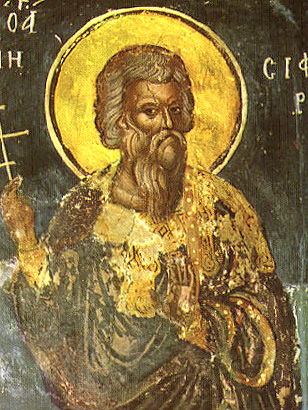
The Holy Martyrs Onesiphorus and Porphyrius of Ephesus suffered during the persecution against Christians by the emperor Diocletian (284-305). They beat them and burned them. After this, they tied the saints to wild horses, which dragged them over the stones, after which the Martyrs Onesiphorus and Porphyrius died. Believers gathered the remains of the saints and reverently buried them.
Venerable Matrona, Abbess of Constantinople
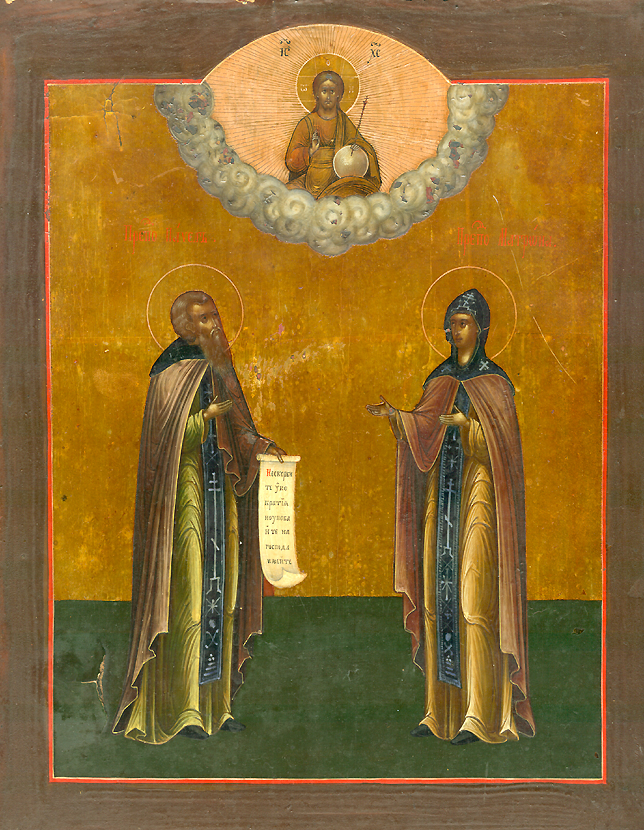
Saint Matrona, Abbess of Constantinople was born in the city of Perge Pamphylia (Asia Minor) in the fifth century. They gave her in marriage to a wealthy man named Dometian. When her daughter Theodota was born, they resettled in Constantinople. The twenty-five-year-old Matrona loved to walk to the temple of God. She spent entire days there, ardently praying to the Lord and weeping for her sins.
At the church the saint met two pious Eldresses, Eugenia and Susanna, who from their youth lived there in asceticism, work and prayer. Matrona began to imitate the God-pleasing life of an ascetic, humbling her flesh by abstinence and fasting, for which she had to endure criticism by her husband.
Her soul yearned for a full renunciation of the world. After long hesitation, Saint Matrona decided to leave her family and entreated the Lord to reveal whether her intent was pleasing to Him. The Lord heard the prayer of His servant. Once, during a light sleep, she had a dream that she had fled from her husband, who was in pursuit of her. The saint concealed herself in a crowd of monks approaching her, and her husband did not notice her. Matrona accepted this dream as a divine directive to enter a men’s monastery, where her husband would not think to look for her.
She gave her fifteen-year-old daughter to be raised by the Eldress Susanna, and having cut her own hair and disguised herself in men’s attire, she went to the monastery of Saint Bassion (October 10). There the Nun Matrona passed herself off as the eunuch Babylos and was accepted as one of the brethren. Apprehensive lest the monks learn that she was a woman, the saint passed her time in constant quietude and much work. The brethren marveled at the great virtue of Babylos.
One time the saint was working in the monastery vineyard with the other monks. The novice monk Barnabas noted that her ear-lobe was pierced and asked about it. “It is necessary, brother, to till the soil and not watch other people, which is not proper for a monk,” answered the saint.
After a certain while it was revealed in a dream to Saint Bassion, the igumen of the monastery, that the eunuch Babylos was a woman. It was also revealed to Acacius, igumen of the nearby Abraham monastery. Saint Bassion summoned Saint Matrona and asked in a threatening voice why she had entered the monastery: to corrupt the monks, or to shame the monastery.
With tears the saint told the igumen about all her past life, about her husband, hostile to her efforts and prayers, and about the vision directing her to go to the men’s monastery. Convinced that her intent was pure and chaste, Saint Bassion sent Saint Matrona to a women’s monastery in the city of Emesa. In this monastery the saint dwelt for many years, inspiring the sisters by her high monastic achievement. When the Abbess died, by the unanimous wish of the nuns the Nun Matrona became head of the convent.
The fame of her virtuous activities, and miraculous gift of healing, which she acquired from the Lord, spread far beyond the walls of the monastery. Dometian also heard about the deeds of the nun. When Saint Matrona learned that her husband was coming to the monastery and wanted to see her, she secretly went off to Jerusalem, and then to Mount Sinai, and from there to Beirut, where she settled in an abandoned pagan temple. The local inhabitants learned of her seclusion, and began to come to her. The holy ascetic turned many from their pagan impiety and converted them to Christ.
Women and girls began to settle by the dwelling of the nun and soon a new monastery was formed. Having fulfilled the will of God, revealed to her in a dream, the saint left Beirut and journeyed to Constantinople where she learned that her husband had died. With the blessing of her spiritual Father, Saint Bassion, the ascetic founded a women’s monastery in Constantinople, to which sisters from the Beirut convent she founded also transferred. The Constantinople monastery of Saint Matrona was known for its strict monastic rule and the virtuous life of its sisters.
In extreme old age Saint Matrona had a vision of the heavenly Paradise and the place prepared for her there after 75 years of monastic labor. At the age of one hundred, Saint Matrona blessed the sisters,and quietly fell asleep in the Lord.
Venerable Theoktίstē of the Isle of Lesbos
Saint Theoktίstē was born in the city of Methymna on the island of Lesbos. She was orphaned at an early age, so her relatives sent her to a monastery to be raised by the nuns. The girl was quite happy to forsake this sinful world. She loved the monastic life, the long Church Services, monastic obedience, the strict fasting, and unceasing prayer. She learned much of the chants, prayer, and psalmody by heart.
On the radiant Feast of Christ's Resurrection in the year 846, when Theoktίstē was eighteen years old, she left the Monastery with the blessing of the Igoumeness, and went to a nearby village to visit her sister, remaining there overnight. Some Arabs invaded the settlement, captured all the inhabitants, and forced them onto a ship. By morning, they were at sea.
The brigands took the captives to the desolate island of Paros so that they might examine them in order to set a price on each when they were sold at the slave market. The Lord helped the young maiden to escape, and the Arabs did not catch her. Saint Theoktίstē lived on the island for the next 35 years. An old church dedicated to the Most Holy Theotokos served as her abode, and her food was sunflower seeds. She spent all her time in prayer.
Once, a group of hunters landed upon the island. One of them, pursuing his prey, went far from the coast into the forest, and suddenly he saw the church and went inside in order to pray. Afterward, the hunter saw what seemed to be a human form in a dim corner, not far from the holy altar table, Brushing aside thick cobwebs. He drew nearer and heard a voice say, “Stay there, and come no closer, for I am a naked woman, and I am ashamed.”
The hunter gave the woman his outer garment and she came out from her place of concealment. He saw a grey-haired woman with worn face, who called herself Theoktίstē. In a faint voice, she told him of her life, which she had devoted to God.
When Saint Theoktίstē finished her story, she asked the hunter, if he should happen to come to this island again, to bring her a particle of the reserved Gifts. In all the time she had lived in the wilderness, she had not been able to partake of the Holy Mysteries of Christ even once.
A year later, in 881, the hunter returned to the island and brought a small vessel with a particle of the Holy Mysteries. Saint Theoktίstē approached the Holy Gifts and fell to the ground, praying with tears for a long time. Standing up, she took the vessel and received the Body and Blood of Christ "with faith, reverence, and in the fear of God."
The next day, the hunter found the dead body of Saint Theoktίstē in the church. After digging a shallow grave, he placed her in it. Then brazenly, he cut off one of her hands, in order to take a relic of the Saint with him. All night the ship was tossed upon a tempestuous sea. In the morning, it ended up at the very place from which it started. Then the man realized that his taking the relic was not pleasing to God.
Returning to the grave, he placed the hand with the Saint's body. Then the ship was able to sail away without difficulty. .On the journey, the hunter told his companions all that had happened on the island. After hearing his story, they all decided to return to Paros at once, that they might venerate the relics of the great ascetic, However, they did not find her holy body in the grave.
Venerable Onesiphorus the Confessor of the Kiev Near Caves
Saint Onesiphorus the Confessor of the Kiev Caves, Near Caves pursued the ascetic life in the Kiev Caves monastery. He was a presbyter and had the gift of clairvoyance. He died in the year 1148 and was buried in the Near Caves beside Saint Spyridon (October 31). His memory is also celebrated on September 28 and on the second Sunday of Great Lent.
Martyr Alexander of Thessalonica
The Martyr Alexander of Thessalonica was arrested by pagans for confessing the Christian Faith. Under the emperor Maximian (284-305)he not only admitted being a Christian, but when told to offer sacrifice to the gods, he overturned the idolatrous sacrifice in indignation. The emperor gave orders to behead the saint.
When the execution was done, the emperor and the executioner saw how an angel came forth bearing the soul of the holy Martyr Alexander up to the heavens. The emperor permitted Christians to bury the body of the saint with honor in the city of Thessalonica, which they did with joy.
Martyr Anthony of Apamea
The Holy Martyr Anthony, a Syrian, lived during the fifth century and was a stone-mason. With the blessing of the bishop of the Syrian city of Apamea, he started to build a church dedicated to the Holy Trinity. When the pagan townspeople learned of this, they rushed into his house by night and murdered him with a sword.
Venerable John the Short, of Egypt
Saint John the Dwarf of Egypt struggled in the Egyptian desert in the fifth century in the monastery of Saint Pimen the Great (August 27). It was to this monastery that the young John came with his brother Daniel.
Once, Saint John told his elder brother that he did not want to be concerned about clothing and food, and that he wished to live like the angels in Paradise. Daniel allowed him to go to a deserted place, so that he would be afflicted. John went out from the cell and removed his clothing. It was very cold at night, and after a week John became hungry.
One night John went back to the monastery and began to knock on the door of the cell. “Who is it?” Daniel asked.
“It is I, your brother John.”
Daniel replied, “John has become an angel, and is no longer among men.”
John continued to knock, but Daniel would not let him in until morning. Then he said, “You are a man and must work again if you want to eat.” Saint John wept bitterly, asking for forgiveness.
After being brought to his senses Saint John went to Saint Pimen, known for his firm and steadfast will, and having asked guidance, he promised to be obedient in all things. Testing the patience of the young monk, Saint Pimen gave him an unusual obedience. For three years Saint John carried water and poured it on a dry stick, until it became covered with leaves and bore abundant fruit. His Elder took the fruit to the brethren saying, “Take and eat the fruit of obedience.”
Later, Abba John himself became a guide of many people on the way of salvation, among whom were Saint Arsenius the Great (May 8) and Saint Thais (May 10).
Saint John was the author of the Life of Saint Paisius the Great (June 19).
Saint Eustolia of Constantinople
Saint Eustolia, a native of Rome, had come to Constantinople and entered one of the women’s monasteries. The virtuous and strict monastic life of the saint gained her the love and respect of the sisters. Not only monastics, but also many laypeople came to her for advice and consolation.
Saint Eustolia died in the year 610.
Saint Sopatra of Constantinople
Saint Sopatra of Constantinople was the daughter of the emperor Mauricius (582-602). She was inclined towards monasticism, and met Saint Eustolia in the church of the Most Holy Theotokos at Blachernae. After speaking with the saint, Sopatra finally decided to leave the world and submit her will to her guide, Saint Eustolia. She transformed the palace building, which her father had given her, into a monastery known for its strict monastic Rule.
Saint Sopatra died in the year 625.
Saint Nectarius Kephalas, Metropolitan of Pentapolis

Saint Nectarius, the great wonderworker of modern times, was born Anastasius Kephalas in Selebria, Thrace on October 1, 1846.
Since his family was poor, Anastasius went to Constantinople when he was fourteen in order to find work. Although he had no money, he asked the captain of a boat to take him. The captain told him to take a walk and then come back. Anastasius understood, and sadly walked away.
The captain gave the order to start the engines, but nothing happened. After several unsuccessful attempts, he looked up into the eyes of Anastasius who stood on the dock. Taking pity on the boy, the captain told him to come aboard. Immediately, the engines started and the boat began to move.
Anastasius found a job with a tobacco merchant in Constantinople, who did not pay him very much. In his desire to share useful information with others, Anastasius wrote down short maxims from spiritual books on the paper bags and packages of the tobacco shop. The customers would read them out of curiosity, and might perhaps derive some benefit from them.
The boy went about barefoot and in ragged clothing, but he trusted in God. Seeing that the merchant received many letters, Anastasius also wanted to write a letter. To whom could he write? Not to his parents, because there were no mail deliveries to his village. Not to his friends, because he had none. Therefore, he decided to write to Christ to tell Him of his needs.
“My little Christ,” he wrote. “I do not have an apron or shoes. You send them to me. You know how much I love you.”
Anastasius sealed the letter and wrote on the outside: “To the Lord Jesus Christ in Heaven.” On his way to mail the letter, he ran into the man who owned a shop opposite the one in which he worked. The man asked him where he was going, and Anastasius whispered something in reply. Seeing the letter in his hands, the man offered to mail it for him, since he was on his way to the post office.
The merchant put the letter in his pocket and assured Anastasius that he would mail it with his own letters. The boy returned to the tobacco shop, filled with happiness. When he took the letter from his pocket to mail it, the merchant happened to notice the address. Astonished and curious, the man could not resist opening the letter to read it. Touched by the boy’s simple faith, the merchant placed some money in an envelope and sent it to him anonymously. Anastasius was filled with joy, and he gave thanks to God.
A few days later, seeing Anastasius dressed somewhat better than usual, his employer thought he had stolen money from him and began to beat him. Anastasius cried out, “I have never stolen anything. My little Christ sent me the money.”
Hearing the commotion, the other merchant came and took the tobacco seller aside and explained the situation to him.
When he was still a young man, Anastasius made a pilgrimage to the Holy Land. During the voyage, the ship was in danger of sinking in a storm. Anastasius looked at the raging sea, and then at the captain. He went and stood beside the captain and took the helm, praying for God to save them. Then he took off the cross his grandmother had given him (containing a piece of the Cross of Christ) and tied it to his belt. Leaning over the side, he dipped the cross into the water three times and commanded the sea, “Silence! Be still.” At once, the wind died down and the sea became calm.
Anastasius was saddened, however, because his cross had fallen into the sea and was lost. As the boat sailed on, sounds of knocking seemed to come from the hull below the water line. When the ship docked, the young man got off and started to walk away.
Suddenly, the captain began shouting, “Kephalas, Kephalas, come back here.” The captain had ordered some men into a small boat to examine the hull in order to discover the source of the knocking, and they discovered the cross stuck to the hull. Anastasius was elated to receive his “Treasure,” and always wore it from that time forward. There is a photograph taken many years later, showing the saint in his monastic skufia. The cross is clearly visible in the photo.
On November 7, 1875, Anastasius received monastic tonsure at the Nea Moni Monastery on Chios, and the new name Lazarus. Two years later, he was ordained a deacon. On that occasion, his name was changed to Nectarius.
Later, when he was a priest, Father Nectarius left Chios and went to Egypt. There he was elected Metropolitan of Pentapolis. Some of his colleagues became jealous of him because of his great virtues, because of his inspiring sermons, and because of everything else which distinguished Saint Nectarius from them.
Other Metropolitans and bishops of the Patriarchate of Alexandria became filled with malice toward the saint, so they told Patriarch Sophronius that Nectarius was plotting to become patriarch himself. They told the patriarch that the Metropolitan of Pentapolis merely made an outward show of piety in order to win favor with the people. So the patriarch and his synod removed Saint Nectarius from his See. Patriarch Sophronius wrote an ambiguous letter of suspension which provoked scandal and speculation about the true reasons for the saint’s removal from his position.
Saint Nectarius was not deposed from his rank, however. He was still allowed to function as a bishop. If anyone invited him to perform a wedding or a baptism he could do so, as long as he obtained permission from the local bishop.
Saint Nectarius bore his trials with great patience, but those who loved him began to demand to know why he had been removed. Seeing that this was causing a disturbance in the Church of Alexandria, he decided to go to Greece. He arrived in Athens to find that false rumors about him had already reached that city. His letter of suspension said only that he had been removed “for reasons known to the Patriarchate,” and so all the slanders about him were believed.
Since the state and ecclesiastical authorities would not give him a position, the former Metropolitan was left with no means of support, and no place to live. Every day he went to the Minister of Religion asking for assistance. They soon tired of him and began to mistreat him.
One day, as he was leaving the Minister’s office, Saint Nectarius met a friend whom he had known in Egypt. Surprised to find the beloved bishop in such a condition, the man spoke to the Minister of Religion and Education and asked that something be found for him. So, Saint Nectarius was appointed to be a humble preacher in the diocese of Vitineia and Euboea. The saint did not regard this as humiliating for him, even though a simple monk could have filled that position. He went to Euboea to preach in the churches, eagerly embracing his duties.
Yet even here, the rumors of scandal followed him. Sometimes, while he was preaching, people began to laugh and whisper. Therefore, the blameless one resigned his position and returned to Athens. By then some people had begun to realize that the rumors were untrue, because they saw nothing in his life or conversation to suggest that he was guilty of anything. With their help and influence, Saint Nectarius was appointed Director of the Rizarios Seminary in Athens on March 8, 1894. He was to remain in that position until December of 1908.
The saint celebrated the services in the seminary church, taught the students, and wrote several edifying and useful books. Since he was a quiet man, Saint Nectarius did not care for the noise and bustle of Athens. He wanted to retire somewhere where he could pray. On the island of Aegina he found an abandoned monastery dedicated to the Holy Trinity, which he began to repair with his own hands.
He gathered a community of nuns, appointing the blind nun Xenia as abbess, while he himself served as Father Confessor. Since he had a gift for spiritual direction, many people came to Aegina to confess to him. Eventually, the community grew to thirty nuns. He used to tell them, “I am building a lighthouse for you, and God shall put a light in it that will shine forth to the world. Many will see this light and come to Aegina.” They did not understand what he was telling them, that he himself would be that beacon, and that people would come there to venerate his holy relics.
On September 20, 1920 the nun Euphemia brought an old man in black robes, who was obviously in pain, to the Aretaieion Hospital in Athens. This was a state hospital for the poor. The intern asked the nun for information about the patient.
“Is he a monk?” he asked.
“No, he is a bishop.”
The intern laughed and said, “Stop joking and tell me his name, Mother, so that I can enter it in the register.”
“He is indeed a bishop, my child. He is the Most Reverend Metropolitan of Pentapolis.”
The intern muttered, “For the first time in my life I see a bishop without a panagia or cross, and more significantly, without money.”
Then the nun showed the saint’s credentials to the astonished intern who then admitted him. For two months Saint Nectarius suffered from a disease of the bladder. At ten thirty on the evening of November 8, 1920, he surrendered his holy soul to God. He died in peace at the age of seventy-four.
In the bed next to Saint Nectarius was a man who was paralyzed. As soon as the saint had breathed his last, the nurse and the nun who sat with him began to dress him in clean clothing to prepare him for burial at Aegina. They removed his sweater and placed it on the paralyzed man’s bed. Immediately, the paralytic got up from his bed, glorifying God.
Saint Nectarius was buried at the Holy Trinity Monastery on Aegina. Several years later, his grave was opened to remove his bones (as is the custom in Greece). His body was found whole and incorrupt, as if he had been buried that very day.
Word was sent to the Archbishop of Athens, who came to see the relics for himself. Archbishop Chrysostomos told the nuns to leave them out in the sun for a few days, then to rebury them so that they would decay. A month or two after this, they opened the grave again and found the saint incorrupt. Then the relics were placed in a marble sarcophagus.
Several years later, the holy relics dissolved, leaving only the bones. The saint’s head was placed in a bishop’s mitre, and the top was opened to allow people to kiss his head.
Saint Nectarius was glorified by God, since his whole life was a continuous doxology to the Lord. Both during his life and after his death, Saint Nectarius has performed thousands of miracles, especially for those suffering from cancer. There are more churches dedicated to Saint Nectarius than to any other modern Orthodox saint.
Venerable Euthymius, founder of Dochiariou Monastery (Mount Athos—10th c.), and Venerable Neophytus, Co-founder of the Monastery
Saints Euthymius and Neophytus, founders of the Dochiariou Monastery on Mount Athos, an uncle and his nephew, belonged to the highest Byzantine aristocracy. Saint Euthymius, while still in the world, was the friend of Saint Athanasius of Mount Athos (July 5), and he later became a novice and disciple of the great ascetic. For his sincere love of the brethren, gentleness and his particular zeal in the ascetic life, Saint Athanasius granted the monk the duty of steward, which Saint Euthymius fulfilled as though entrusted to him by God Himself.
Saint Euthymius settled with several of the monks in the locale of Daphne, where he founded a monastery dedicated to Saint Nicholas, which he called Dochiariou in memory of his obedience. Guiding his own younger brethren, Saint Euthymius taught the necessity of attention towards self, to all the stirrings of the soul, explaining that the struggle of Christians, according to the Apostle Paul, is not “against flesh and blood, but against principalities, and against powers, and against the world-rulers of this darkness” (Eph 6:12).
The peaceful ascetic life of the monks was disturbed by the Saracens. The monk led all the brethren into the forest. Returning, they found the monastery razed to its very foundations. Saint Euthymius did not lose heart, and the monastery was rebuilt.
Saint Neophytus, in the world, was a companion of the emperor Nikēphóros Phocas (963-969). Upon the death of his parents he came to Mount Athos, where he was tonsured in the monastery of his uncle Saint Euthymius. Before his death, Saint Euthymius handed over the administration of the monastery to his nephew.
Under the spiritual guidance of Saint Neophytus, the small monastery grew into a Lavra. Asking the emperor Nikēphóros to become a benefactor of the monastery, Saint Neophytus enlarged the monastery to its present size. Saint Neophytus was deigned to be chosen “protos” (head of the governing Council of Elders of the Holy Mountain) and for many years he labored there. After taking leave of the Council in his declining years, he returned to the Dochiariou monastery, where peacefully he fell asleep in the Lord.
“Quick to Hear” Icon of the Mother of God

The wonderworking "Quick to Hear" Icon of the Mother of God is kept at Dokheiarίou Monastery on Mount Athos, and is believed to date from the XI century, during the time of Saint Neophytos, the Igoumen of the Monastery. After the wonderworking Portaitissa Icon, the most famous Icon on Mount Athos is an ancient fresco of the Panagia located outside on the east wall of the trapeza, and to the right of the entrance. In 1664 the Monk Neilos, the steward of the trapeza, often passed before the Icon holding a lit torch in his hand so he could carry out his duties in the trapeza. One day, he heard a voice say to him: "Do not come this way again with your torches, darkening my Icon with smoke."
Neilos did not pay much attention to the voice, thinking that someone was playing a joke on him. It was not long before he heard the voice again saying, "O monk, unworthy of the name, how long will you continue to darken my Icon with smoke?"
Upon hearing the voice, Neilos was struck blind. Then he remembered that he had heard the voice before, and realized that he deserved this punishment, for he did not heed the command of the Mother of God, but had ignored it in his ignorance.
The next morning, the brethren found him laying on the floor of the corridor before the Icon, unable to see them. When they learned why Neilos had been punished, the monks were terrified. From that time on, they passed by the Icon with great reverence, and hung an unsleeping lamp before it.
Neilos, however, did not want to return to his cell. He remained before the Icon in a stasidi, calling upon the Theotokos with tears and lamentations to forgive him for the sin he had committed. He begged her to restore his sight, as a sign of her forgiveness, so that he might gaze upon her Icon and glorify her.
He was not disappointed in his hopes, for the Mother of God heard the prayers of her repentant servant. He heard her voice a third time, saying, "Monk, your prayer has been heard. You are forgiven, and you shall receive your sight again. Declare to the other Fathers and brethren who struggle here that I am the Mother of God, and that after God, I am the shelter and help and mighty protector of this Monastery of the Archangels, providing for it as its defender and guide. From now on, let the monks come to me for all their needs, and I will hear them quickly, as well as all Orthodox Christians who come to me with reverence, for I am called Quick to Hear."
Very soon this miracle and the promise of the Theotokos became known throughout the Holy Mountain, and monks from the other Monasteries came to Dokheiarίou to venerate the Icon, and to see the monk who had regained his sight. The corridor was closed off and a chapel was built to house the "Quick to Hear" Icon. One of the most devout and accomplished Hieromonks is appointed to be present in the chapel. He is known as the prosmonarios (προσμονάριος), and he is there most of the time to chant Canons of Supplication before the Icon, which he censes every evening and morning, tending the chapel, and trimming the oil lamps.
The "Quick to Hear" Icon venerated not only on the Holy Mountain, but also by Orthodox Christians all over the world. Countless miracles of healing are worked by the Mother of God through her Holy Icon. The blind receive their sight, paralytics are healed, barren women conceive children, and captives are set free when they approach the Theotokos with faith and reverence.
A copy of the "Quick to Hear Icon" was painted on Mount Athos and was sent as a gift from the Russian and other devout monks of the Holy Mountain to Archbishop Tikhon (later Patriarch of Moscow) of the Aleutian Islands and North America. In May of 1906 that copy of the famous "Quick to Hear” Icon at Dokheiarίou Monastery was carried to Saint Tikhon's Monastery (in Waymart, PA) in a solemn Cross Procession, along with several others, including one of the Holy Great Martyr and Healer Panteleimon.
The relics of several saints were placed in the Icon. These include the Holy Great Martyr Theodore Stratēlátēs (Feb. 8), Saints Cosmas and Damian the Unmercenary Physicians, Saint Gregory Palamas, Archbishop of Thessaloniki (Nov. 14), and the Holy New Martyr Constantine of Mount Athos, who was born on the island of Hydra and suffered at the hands of the Turks on the island of Rhodes on November 14, 1800.
The "Quick to Hear" Icon is now on the iconostasis of Saint Tikhon's Monastery church.
Daily Readings for Friday, November 08, 2024
SYNAXIS OF THE ARCHANGEL MICHAEL & THE OTHER BODILESS POWERS: GABRIEL, RAPHAEL, URIEL, SALAPHIEL, JEGUDIEL, & BARACHIEL
ABSTAIN FROM MEAT, FISH, DAIRY, EGGS
Synaxis of the Archangel Michael & the other Bodiless Powers: Gabriel, Raphael, Uriel, Salaphiel, Jegudiel, & Barachiel
ST. PAUL’S LETTER TO THE HEBREWS 2:2-10
Brethren, if the message declared by angels was valid and every transgression or disobedience received a just retribution, how shall we escape if we neglect such a great salvation? It was declared at first by the Lord, and it was attested to us by those who heard him, while God also bore witness by signs and wonders and various miracles and by gifts of the Holy Spirit distributed according to his own will. For it was not to angels that God subjected the world to come, of which we are speaking. It has been testified somewhere, “What is man that thou art mindful of him, or the son of man, that thou carest for him? Thou didst make him for a little while lower than the angels, thou hast crowned him with glory and honor, putting everything in subjection under his feet.” Now in putting everything in subjection to him, he left nothing outside his control. As it is, we do not yet see everything in subjection to him. But we see Jesus, who for a little while was made lower than the angels, crowned with glory and honor because of the suffering of death, so that by the grace of God he might taste death for every one. For it was fitting that he, for whom and by whom all things exist, in bringing many sons to glory, should make the pioneer of their salvation perfect through suffering.
LUKE 10:16-21
The Lord said to his disciples, “He who hears you hears me, and he who rejects you rejects me, and he who rejects me rejects him who sent me.” The seventy returned with joy, saying, “Lord, even the demons are subject to us in your name!” And he said to them, “I saw Satan fall like lightning from heaven. Behold, I have given you authority to tread upon serpents and scorpions, and over all the power of the enemy; and nothing shall hurt you. Nevertheless do not rejoice in this, that the spirits are subject to you; but rejoice that your names are written in heaven.” In that same hour he rejoiced in the Holy Spirit and said, “I thank you, Father, Lord of heaven and earth, that you have hidden these things from the wise and understanding and revealed them to babes; yes, Father, for such was your gracious will.”
Synaxis of the Archangel Michael and the Other Bodiless Powers

The Synaxis of the Chief of the Heavenly Hosts, Archangel Michael and the Other Heavenly Bodiless Powers: Archangels Gabriel, Raphael, Uriel, Selaphiel, Jehudiel, Barachiel, and Jeremiel was established at the beginning of the fourth century at the Council of Laodicea, which met several years before the First Ecumenical Council. The 35th Canon of the Council of Laodicea condemned and denounced as heretical the worship of angels as gods and rulers of the world, but affirmed their proper veneration.
A Feastday was established in November, the ninth month after March (with which the year began in ancient times) since there are Nine Ranks of Angels. The eighth day of the month was chosen for the Synaxis of all the Bodiless Powers of Heaven since the Day of the Dread Last Judgment is called the Eighth Day by the holy Fathers. After the end of this age (characterized by its seven days of Creation) will come the Eighth Day, and then “the Son of Man shall come in His Glory and all the holy Angels with Him” (Mt. 25:31).
The Angelic Ranks are divided into three Hierarchies: highest, middle, and lowest.
The Highest Hierarchy includes: the Seraphim, Cherubim and Thrones.
The six-winged SERAPHIM (Flaming, Fiery) (Is 6:2) stand closest of all to the Most Holy Trinity. They blaze with love for God and kindle such love in others.
The many-eyed CHERUBIM (outpouring of wisdom, enlightenment) (Gen 3:24) stand before the Lord after the Seraphim. They are radiant with the light of knowledge of God, and knowledge of the mysteries of God. Through them wisdom is poured forth, and people’s minds are enlightened so they may know God and behold His glory.
The THRONES (Col 1:16) stand after the Cherubim, mysteriously and incomprehensibly bearing God through the grace given them for their service. They are ministers of God’s justice, giving to tribunals, kings, etc. the capacity for righteous judgment.
The Middle Angelic Hierarchy consists of three Ranks: Dominions, Powers, and Authorities:
DOMINIONS (Col 1:16) hold dominion over the angels subject to them. They instruct the earthly authorities, established by God, to rule wisely, and to govern their lands well. The Dominions teach us to subdue sinful impulses, to subject the flesh to the spirit, to master our will, and to conquer temptation.
POWERS (1 Pet 3:22) fulfill the will of God without hesitation. They work great miracles and give the grace of wonderworking and clairvoyance to saints pleasing to God. The Powers assist people in fulfilling obediences. They also encourage them to be patient, and give them spiritual strength and fortitude.
AUTHORITIES (1 Pet 3:22, Col 1:16) have authority over the devil. They protect people from demonic temptations, and prevent demons from harming people as they would wish. They also uphold ascetics and guard them, helping people in the struggle with evil thoughts.
The Lowest Hierarchy includes the three Ranks: Principalities, Archangels, and Angels:
PRINCIPALITIES (Col 1:16) have command over the lower angels, instructing them in the fulfilling of God’s commands. They watch over the world and protect lands, nations and peoples. Principalities instruct people to render proper honor to those in authority, as befits their station. They teach those in authority to use their position, not for personal glory and gain, but to honor God, and to spread word of Him, for the benefit of those under them.
ARCHANGELS (1 Thess 4:16) are messengers of great and wondrous tidings. They reveal prophecies and the mysteries of the faith. They enlighten people to know and understand the will of God, they spread faith in God among the people, illuminating their minds with the light of the Holy Gospel.
ANGELS (1 Pet 3:22) are in the lowest rank of the heavenly hierarchy, and closest to people. They reveal the lesser mysteries of God and His intentions, guiding people to virtuous and holy life. They support those who remain steadfast, and they raise up the fallen. They never abandon us and they are always prepared to help us, if we desire it.
All the Ranks of the Heavenly Powers are called angels, although each has its own name and position by virtue of their service. The Lord reveals His will to the highest ranks of the angels, and they in turn inform the others.
Over all the Nine Ranks, the Lord appointed the Holy Archangel Michael (his name in Hebrew means “who is like unto God”), the faithful servitor of God, as Chief Commander. He cast down from Heaven the arrogantly proud Lucifer and the other fallen spirits when they rebelled against God. Michael summoned the ranks of angels and cried out, “Let us attend! Let us stand aright before our Creator and do not consider doing what is displeasing unto God!”
According to Church Tradition, and in the church services to the Archangel Michael, he participated in many other Old Testament events.
During the Exodus of the Israelites from Egypt he went before them in the form of a pillar of cloud by day and a pillar of fire by night. Through him the power of the Lord was made manifest, annihilating the Egyptians and Pharaoh who were in pursuit of the Israelites. The Archangel Michael defended Israel in all its misfortunes.
He appeared to Joshua Son of Navi and revealed the will of the Lord at the taking of Jericho (Josh 5:13-16). The power of the great Chief Commander of God was manifest in the annihilation of the 185,000 soldiers of the Assyrian emperor Sennacherib (4/2 Kings 19:35); also in the smiting of the impious leader Heliodorus (2 Macc. 3: 24-26); and in the protection of the Three Holy Youths: Ananias, Azarias and Misail, thrown into the fiery furnace for their refusal to worship an idol (Dan 3:22-25).
Through the will of God, the Chief Commander Michael transported the Prophet Habbakuk (December 2) from Judea to Babylon, to give food to Daniel in the lions’ den (Dan. 14:33-37).
The Archangel Michael disputed with the devil over the body of the holy Prophet Moses (Jude 1:9).
The holy Archangel Michael showed his power when he miraculously saved a young man, cast into the sea by robbers with a stone about his neck on the shores of Mt Athos. This story is found in the Athonite Paterikon, and in the Life of Saint Neophytus of Docheiariou (November 9).
From ancient times the Archangel Michael was famed for his miracles in Rus. In the Volokolamsk Paterikon is a narrative of Saint Paphnutius of Borov with an account of Tatar tax-gatherers concerning the miraculous saving of Novgorod the Great: “Therefore Great Novgorod was never taken by the Hagarenes… when… for our sins the godless Hagarene emperor Batu devoured and set the Russian land aflame and came to Novgorod, and God and the Most Holy Theotokos shielded it with an appearance of Michael the Archangel, who forbade him to enter into it. He [Batu] was come to the Lithuanian city and came toward Kiev and saw the stone church, over the doors of which the great Archangel Michael had written and spoken to the prince his allotted fate, ‘By this we have forbidden you entry into Great Novgorod’.”
Intercession for Russian cities by the Most Holy Queen of Heaven always involved Her appearances with the Heavenly Hosts, under the leadership of the Archangel Michael. Grateful Rus acclaimed the Most Pure Mother of God and the Archangel Michael in church hymns. Many monasteries, cathedrals, court and merchant churches are dedicated to the Chief Commander Michael.
In old Kiev at the time of the accepting of Christianity, a cathedral of the Archangel was built, and a monastery also was named for him. Archangel cathedrals are found at Smolensk, Nizhni Novgorod, Staritsa, at Great Ustiug (beginning of the thirteenth century), and a cathedral at Sviyazhsk. In Rus there was not a city where there was not a church or chapel dedicated to the Archangel Michael.
One of the chief temples of the city of Moscow, the burial church in the Kremlin, is dedicated to him. Numerous and beautiful icons of the Chief Commander of the Heavenly Hosts are also in his Cathedral. One of these, the Icon “Blessed Soldiery,” was painted in the Dormition Cathedral of the Moscow Kremlin. The saintly soldiers, Russian princes, are depicted under the leadership of the Archangel Michael.
We invoke Saint Michael for protection from invasion by enemies and from civil war, and for the defeat of adversaries on the field of battle. He conquers all spiritual enemies.
Holy Scripture and Tradition give us the names of the Archangels:
Gabriel: strength (power) of God, herald and servitor of Divine omnipotence (Dan 8:16, Luke 1:26). He announces the mysteries of God.
Raphael: the healing of God, the curer of human infirmities (Tobit 3:16, 12:15)
Uriel: the fire or light of God, enlightener (2 Esdras 5:20). We pray for him to enlighten those with darkened minds.
Selaphiel: the prayer of God, impelling to prayer (2 Esdras 5:15). He prays to God for mankind.
Jehudiel: the glorifying of God, encouraging exertion for the glory of the Lord and interceding for the reward of efforts.
Barachiel: distributor of the blessings of God for good deeds, entreats the mercy of God for people.
Jeremiel: the raising up to God (2 Esdras 4:36)
On icons the Archangels are depicted in according to the character of their service:
Michael tramples the devil underfoot, and in his left hand holds a green date-tree branch, and in his right hand a spear with a white banner on which is outlined a scarlet cross, or sometimes a fiery sword.
Gabriel with a branch from Paradise, presented by him to the Most Holy Virgin, or with a shining lantern in his right hand and with a mirror made of jasper in his left.
Raphael holds a vessel with healing medications in his left hand, and with his right hand leads Tobias, carrying a fish for healing (Tobit 5-8).
Uriel in his raised right hand holds a naked sword at the level of his chest, and in his lowered left hand “a fiery flame.”
Selaphiel in a prayerful posture, gazing downwards, hands folded on the chest.
Jehudiel holds a golden crown in his right hand, in his left, a whip of three red (or black) thongs.
Barachiel is shown with a white rose on his breast.
Jeremiel holds balance-scales in his hand.
Each person has a guardian angel (Matt 18:10), and every nation also receives its own guardian angel from God (Dan. 10:13). When a church is consecrated, it also receives a guardian angel (Palladius, Dial. Ch. 10).
Saint Alexander of Guria

No information available at this time.
11/10 announcements
November 10, 2024
Twentieth Sunday after Pentecost
Galatians 1:11-19: Brethren, I would have you know that the Gospel which was preached by me is not man’s gospel. For I did not receive it from man, nor was I taught it, but it came through a revelation of Jesus Christ. For you have heard of my former life in Judaism, how I persecuted the Church of God violently and tried to destroy it; and I advanced in Judaism beyond many of my own age among my people; so extremely zealous was I for the traditions of my fathers. But when He Who had set me apart before I was born, and had called me through His grace, was pleased to reveal His Son to me, in order that I might preach Him among the Gentiles, I did not confer with flesh and blood, nor did I go up to Jerusalem to those who were Apostles before me, but I went away into Arabia; and again I returned to Damascus. Then after three years I went up to Jerusalem to visit Cephas, and remained with him fifteen days. But I saw none of the other Apostles except James the Lord’s brother.
Luke 10:25-37: At that time, a lawyer stood up to put Jesus to the test, saying, “Teacher, what shall I do to inherit eternal life?” Jesus said to him, “What is written in the Law? How do you read?” And the lawyer answered, “You shall love the Lord your God with all your heart, and with all your soul, and with all your strength, and with all your mind; and your neighbor as yourself.” And Jesus said to him, “You have answered right; do this, and you will live.” But the lawyer, desiring to justify himself, said to Jesus, “And who is my neighbor?” Jesus replied, “A man was going down from Jerusalem to Jericho, and he fell among robbers, who stripped him and beat him, and departed, leaving him half dead. Now by chance a priest was going down that road; and when he saw him he passed by on the other side. So likewise a Levite, when he came to the place and saw him, passed by on the other side. But a Samaritan, as he journeyed, came to where he was; and when he saw him, he had compassion, and went to him and bound up his wounds, pouring on oil and wine; then he set him on his own beast and brought him to an inn, and took care of him. And the next day he took out two denarii and gave them to the innkeeper, saying, ‘Take care of him; and whatever more you spend, I will repay you when I come back.’ Which of these three, do you think, proved neighbor to the man who fell among the robbers?” The lawyer said, “The one who showed mercy on him.” And Jesus said to him, “Go and do likewise.”
Troparion of the Resurrection: Let the heavens rejoice and the earth be glad; for the Lord hath done a mighty act with his own arm. He hath trampled down death and become the First-born from the dead. He hath delivered us from the depths of hades, granting the world the Great Mercy.
Troparion of the Chains of St. Peter: O Holy Apostle, Peter, thou dost preside over the Apostles by the precious chains which thou didst bear. We venerate them with faith and beseech thee that by thine intercessions we be granted the great mercy.
Kontakion of the Entrance of the Theotokos into the Temple: The all-pure temple of the Saviour, the most precious bridal-chamber and Virgin, the treasure-house of the glory of God, today enters the Temple of the Lord, bringing with her the grace which is in the divine Spirit; whom also the angels of God do celebrate in song; for she is the heavenly tabernacle.
CALENDAR
UNTIL FURTHER NOTICE: All services listed on the calendar will be available through streaming and webcast. (Instructions can be found on the parish website.)
Sunday, November 10 (Twentieth Sunday after Pentecost)
8:50 a.m. – Orthros
9:00 a.m. – Christian Education
10:00 a.m. – Divine Liturgy (webcast)
12:00 p.m. – POT LUCK MEAL
Monday, November 11
Father Herman off
Tuesday, November 12
NO Services
Wednesday, November 13 (John Chrysostom – repose)
5:20 p.m. – Catechism Class
6:30 p.m. – Daily Vespers
7:30 p.m. – Parish Council Meeting
Thursday, November 14 (Apostle Philip)
NO Services
Friday, November 15
NO Services
[FAST OF THE NATIVITY BEGINS]
Saturday, November 16 (Apostle Matthew)
8:30 a.m. – Workday at the church
4:30 p.m. – Choir Practice
5:00 p.m. – Catechism Class
6:00 p.m. – Great Vespers
Sunday, November 17 (Twenty-first Sunday after Pentecost)
8:50 a.m. – Orthros
9:00 a.m. – Christian Education
10:00 a.m. – Divine Liturgy (webcast)
SPECIAL ANNOUNCEMENTS
The Eucharist Bread …was offered by the Algoods for the Divine Liturgy this morning.
Eucharist Bread Schedule:
Eucharist Bread Coffee Hour
November 10 Algood POT LUCK MEAL
D. Root/Lively
November 17 Schelver Ellis/Zouboukos/Waites
November 20 (Wed. p.m.) Lasseter (Artos) NO Meal
(Entrance of the Theotokos into the Temple – Great Vespers with Litia & Artoklasia)
November 24 Jones Miller/Weatherly
Also, please remember that we still need your tithes and offerings which may be placed in the tray that is passed during the Divine Liturgy, in the tithe box at the back of the nave or be mailed to: St. Peter Orthodox Church, P.O. Box 2084, Madison, MS 39130-2084.
Schedule for Epistle Readers – Page numbers refer to the Apostolos (book of the Epistles) located on the Chanters’ stand at the front of the nave. Please be sure to use this book when you read.
Reader Reading Page#
November 10 Brenda Baker Gal. 1:11-19 188
November 17 Walt Wood Gal. 2:16-20 193
November 24 Brandon Strain Gal. 6:11-18 198
Please remember the following in your prayers: Aidan Milnor, the Milnor family; Lamia Dabit and her family; Mary Greene (Lee and Kh. Sharon’s sister); Jay and Joanna Davis; Fr. Leo and Kh. Be’Be’ Schelver and their family; Marilyn (Kyriake) Snell; Jack and Jill Weatherly; Sh. Charlotte Algood and their family; Reader Basil and Brenda Baker and their family; Fr. Joseph Bittle; Rick Carlton; Very Rev. Fr. Nicholas and Kh. Jan Speier; Lee Greene; Joseph, Amanda and Hunter Hines; Fr. John and Kh. Janet Henderson and their family; Galina Singletary; Emily and Cole Parker; Dane and Stephanie Skirtech.
Parents…please be reminded to monitor your children with the use of Magic Markers on and around the chairs in the Nave so that the chairs aren’t marked on. If younger children do need drawing as a means to keep calm, please use a pencil or colored pencil. Also, as a kind reminder, it is not appropriate during the Divine Services to have children watch some type of electronic device as means to keep them calm. May God give us all who are parents the grace to continue to guide our children always towards the Kingdom of God.
Calendar Items:
* The men of the parish meet for lunch at 11:00 a.m. on the first Thursday of the month.
* The Ladies meet at the church at 10:00 a.m. on the second Saturday of the month to pray the Akathist to the Mother of God, Nurturer of Children on behalf of our children.
* The Ladies meet for lunch at 1:00 p.m. on the last Tuesday of the month.
* The Fast of the Nativity will begin on Friday, November 15th.
* We will celebrate the Feast of the Entrance of the Theotokos into the Temple with Great Vespers with Litia and Artoklasia on Wednesday evening, November 20th, beginning at 6:30 p.m.
* Remaining Stewpot date for 2024 will be November 30th.
Fasting Discipline for November
The traditional fasting discipline (no meat, dairy, eggs, fish, wine or oil) is observed on Wednesdays and Fridays of the month until November 15th when the Fast of the Nativity begins.
During this fast the traditional fasting discipline is observed on each day of the week. Note, however, through December 19th there is a katlysis on Tuesdays and Thursdays when wine and oil are permitted, and on Saturdays and Sundays when fish, wine and oil are permitted.
Major Commemorations for November
November 13 John Chrysostom (repose)
November 14 Apostle Philip
November 16 Apostle Matthew
November 21 Entrance of the Theotokos into the Temple
November 25 Great-martyrs Catherine and Mercurios
November 30 Apostle Andrew the First-called
Quotable: “The enjoyment of this present life, though it seems to give delight and sweetness, is well thrust from us. At the very moment of its being it ceases to be, and for our joy repays us with sorrow sevenfold. Its happiness and its sorrow more frail than a shadow, and, like the traces of a ship passing over the sea, or a bird flying through the air, quickly disappear. But the hope of the life to come which the Christians preach is certain and quite sure; howbeit in this world it has tribulation, whereas our pleasures now are short-lived, and in the beyond they only win us correction and everlasting punishment without release. For the pleasures of life are temporary, but its pain eternal; while the Christians labors are temporary but their pleasure and gain immortal. Therefore, right it is to exchange the corruptible for the incorruptible.”
– St. John of Damascus
Worship: Sunday, November 17, 2024 (Twenty-first Sunday after Pentecost)
Scripture: Galatians 2:16-20; Luke 12:16-21
Epistle Reader: Walt Wood
Prosphora: Schelver
Coffee Hour: ellis/Zouboukos/Waites
Daily Readings for Thursday, November 07, 2024
THURSDAY OF THE 8TH WEEK
NO FAST
33 Martyrs of Melitene, Lazarus the Wonderworker, Martyr Athenodorus, Alexander the Martyr of Thessaloniki
ST. PAUL’S LETTER TO THE PHILIPPIANS 3:1-8
Brethren, rejoice in the Lord. To write the same things to you is not irksome to me, and is safe for you. Look out for the dogs, look out for the evil-workers, look out for those who mutilate the flesh. For we are the true circumcision, who worship God in spirit, and glory in Christ Jesus, and put no confidence in the flesh. Though I myself have reason for confidence in the flesh also. If any other man thinks he has reason for confidence in the flesh, I have more: circumcised on the eighth day, of the people of Israel, of the tribe of Benjamin, a Hebrew born of Hebrews; as to the law a Pharisee, as to zeal a persecutor of the church, as to righteousness under the law blameless. But whatever gain I had, I counted as loss for the sake of Christ. Indeed I count everything as loss because of the surpassing worth of knowing Christ Jesus my Lord. For his sake I have suffered the loss of all things, and count them as refuse, in order that I may gain Christ.
LUKE 13:1-9
At that time, there were some present who told Jesus of the Galileans whose blood Pilate had mingled with their sacrifices. And he answered them, "Do you think that these Galileans were worse sinners than all the other Galileans, because they suffered thus? I tell you, No; but unless you repent you will all likewise perish. Or those eighteen upon whom the tower in Siloam fell and killed them, do you think that they were worse offenders than all the others who dwelt in Jerusalem? I tell you, No; but unless you repent you will all likewise perish." And he told this parable: "A man had a fig tree planted in his vineyard; and he came seeking fruit on it and found none. And he said to the vinedresser, 'Lo, these three years I have come seeking fruit on this fig tree, and I find none. Cut it down; why should it use up the ground?' And he answered him, 'Let it alone, sir, this year also, till I dig about it and put on manure. And if it bears fruit next year, well and good; but if not, you can cut it down.'
33 Holy Martyrs of Melitene
The holy martyr Hieron was born in the city of Tiana in great Cappadocia. Raised by a pious mother, he was a kindly and good Christian.
The co-ruling emperors Diocletian (284-305) and Maximian (284-305) sent a large military detachment headed by Lysias to Cappadocia to eradicate Christianity there, and also to conscript healthy and strong men into the imperial army. Among those pressed into service, Lysias also ordered his men to draft Hieron, who was distinguished by his great physical strength and dexterity. But Hieron refused to serve emperors who persecuted Christians. When they attempted to seize him by force and bring him to Lysias, he took a stick and started beating the soldiers who had been sent to bring him. The soldiers scattered, ashamed of being defeated by a single man. Hieron then hid himself in a cave with eighteen other Christians. Lysias would not risk losing his soldiers by storming the cave.
Upon the advice of Cyriacus, one of Hieron’s friends, Lysias lifted the siege of the cave and withdrew his detachment. Then Cyriacus persuaded Hieron not to offer resistance to the authorities. He and the other new conscripts and accompanying soldiers were sent to the nearby city of Melitene.
Soon Hieron had a vision in his sleep, in which his impending martyrdom was foretold. Lysias told the soldiers gathered at Melitene to offer sacrifice to the pagan gods. Hieron and another thirty-two soldiers refused to do this, and openly confessed their faith in Christ. Then the persecutor gave orders to beat the martyrs, and to cut off Hieron’s arm at the elbow. After cruel tortures they threw the martyrs into prison barely alive, and they beheaded them four days later.
A certain rich and illustrious Christian by the name of Chrysanthus ransomed Hieron’s head from Lysias. When the persecutions finally ceased, he built a church on the place where they executed the holy martyrs, and he placed the venerable head in it. The bodies of all the executed saints were secretly buried by Christians. In reign of the emperor Justinian, during the construction of the church of Hagia Eirene (Holy Peace), the venerable relics were uncovered and found incorrupt.
The other martyrs are: Hesychius, Nicander, Athanasius, Mamas, Barachius, Callinicus, Theogenes, Nikon, Longinus, Theodore, Valerius, Xanthius, Theodoulus, Callimachus, Eugene, Theodochus, Ostrychius, Epiphanius, Maximian, Ducitius, Claudian, Theophilus, Gigantius, Dorotheus, Theodotus, Castrichius, Anicletus, Themelius, Eutychius, Hilarion, Diodotus and Amonitus.
Venerable Lazarus, Wonderworker of Mount Galesius Near Ephesus
Saint Lazarus the Wonderworker of Mt Galesius near Ephesus was born in Lydia, in the city of Magnesium. An educated young man who loved God, Lazarus became a monk at the monastery of Saint Savva, the founder of great ascetic piety in Palestine. He spent ten years within the walls of the monastery, winning the love and respect of the brethren for his intense monastic struggles.
Ordained to the holy priesthood by the Patriarch of Jerusalem, Saint Lazarus returned to his native country and settled near Ephesus, on desolate Mount Galesius. Here he saw a wondrous vision: a fiery pillar, rising up to the heavens, was encircled by angels singing, “Let God arise and let His enemies be scattered.”
On the place where the saint beheld this vision, he built a church in honor of the Resurrection of Christ and took upon himself the feat of pillar-dwelling. Monks soon began to flock to the great ascetic, thirsting for spiritual nourishment by the divinely-inspired words and blessed example of the saint, and a monastery was established there.
Having received a revelation about the day of his death, the saint told the brethren. Through the tearful prayers of all the monks, the Lord prolonged the earthly life of Saint Lazarus for another fifteen years.
Saint Lazarus died at 72 years of age, in the year 1053. The brethren buried the body of the saint at the pillar upon which he had struggled in asceticism. He was glorified by many miracles after his death.
Saint Lazarus is also commemorated on July 17.
The Discovery of the Relics of Venerable Zosimas, Abbot of Vorbozomsk
No information available at this time.
Finding of the relics of Venerable Cyril, Abbot of Novoezersk, Vologda

Saint Cyril the wonderworker of New Lake reposed on February 4, 1532.
In May 1648, during the reign of Alexei Mihailovich, a popular rebellion against Moscow broke out among some of those who were members of the Tsar's retinue. Peter Trahanitov, the head of the artillery, the Deacon Eleazar, and many others were killed and robbed. The rebellious crowd proceeded to the Beautiful Porch and demanded the extradition of the boyar Boris Morozov, the royal tutor and kinsman. They had already broken into his house and looted the property. The boyar, with some difficulty, managed to hide from the hands of the angry mob, and soon he took refuge in the Saint Cyril of White Lake Monastery. When Igoumen Amphilokhios and the brethren learned he would be staying with them, he sent the monk Jonah to him with the icon and the Life of Saint Cyril. The boyar graciously accepted the icon and was moved by the Saint's Life. After that, his soul was filled with joy and delight, but then his tormenting fears and grief returned, and he wanted to venerate Saint Cyril's grave.
After having a Moleben served at the grave and praying to the Saint with tears, the boyar said to the Igoumen and the brotherhood: "Holy Fathers, pray to God and His Most Pure Mother, and the venerable wonderworker Cyril for me. If God is merciful to me, by the prayers of Saint Cyril, and if I return to the royal city, and the great sovereign and his royal council take pity on me and restore me to my former rank, then I will build a stone church here in honor of the glorious Resurrection of Christ and in honor of Saint Cyril."
The delighted Igoumen and the brotherhood responded with their fervent good wishes. After distributing alms, the boyar returned to the Saint Cyril of White Lake Monastery. After a short time, after the excitement in Moscow subsided, the boyar was summoned by the Tsar and restored to his former position. The following year, in 1649, Morozov began to fulfill his promise. On September 4, at his orders, the Archimandrite Athanasios of the Saint Cyril of White Lake Monastery and the Elder Sabbatius Yushkov were at the foundation of the stone temple. In their presence they began to dig ditches, and when they came to the place where Saint Cyril's tomb was, a completely intact coffin was found among the roots of a tree.
Without a patriarchal decree and the blessing of the Metropolitan and the Archimandrite, Elder Sabbatius did not dare to take the coffin from the earth in order to open and to examine It. The coffin was placed on some boards, and the discovery was reported to Metropolitan Barlaam of Rostov, Patriarch Joseph, and the boyar Morozov. Morozov, after receiving the news, told the Tsar all this and informed him about the Life and miracles of the venerable Cyril. In October, the Patriarch, at the Tsar's suggestion, sent Archbishop Marcellus of Vologda with a Gramota instructing him to go to New Lake and examine the relics of the Saint, and move the relics to a temporary room, arrange a celebration, and report everything to the Tsar and Patriarch.
Archbishop Marcellus arrived at New Lake Monastery with Archimandrite Athanasios of Saint Cyril of White Lake Monastery and, from the same monastery, the cellarer Sabbatius with the Elders of the cathedral. On November 7, Igoumen Amphilokhios ordered them to remove the coffin from the earth, and then open it in order to inspect the Saint's relics and clothing. After the hierarch completed his inspection he placed the relics in a new coffin and moved it into the wooden church of the Resurrection of Christ.
On the Feast of the Dormition of the Theotokos Vespers was served at the cathedral in the evening. In the morning, before the Liturgy, a Moleben to the All-Merciful Savior, the Theotokos, and All Saints was served, with the blessing of water. Many sick persons were healed at the celebration. People took pieces of wood from the old coffin and brought them home because they had faith in their healing power.
Saint Cyril is commemorated on November 7 (the discovery of his relics), on January 23 (Synaxis of All Saints of Kostroma), and on the third Sunday after Pentecost (Synaxis of All Saints of Novgorod).
Martyrs Melasippus, Karina, their son, Antoninus, and forty children converted by their martyrdom, at Ancyra

The Martyrs Melasippus and Karina and their son Antoninus, and 40 children converted by their martyrdom at Ancyra suffered during the reign of the emperor Julian the Apostate in the city of Ancyra in Phrygia in the year 363. The holy Martyrs Melasippus and Karina, lacerated by iron hooks and exhausted, died under torture.
Their son Antoninus, whom the persecutor forced to watch the torture of his parents, spat in the face of the apostate emperor. For this he was subjected to cruel tortures, but he remained unharmed, and then he was beheaded. Forty other youths, seeing that the Lord had preserved His confessor Antoninus unharmed by tortures, believed in Christ, and they openly confessed their faith and endured martyrdom..
Martyrs Auctus, Taurion, and Thessalonica, at Amphipolis, in Macedonia
Saints Auctus and Taurion suffered martyrdom with Saint Thessalonica, the daughter of a pagan priest. When the impious father learned that his daughter had become a Christian, he ruthlessly beat her and threw her out of the house, with no means of providing for herself. Saints Auctus and Taurion attempted to intercede for the girl, and to reason with the embittered father. The pagan priest denounced them both to the authorities, and they were arrested.
After confessing their faith in Christ before the torturers and undergoing cruel torments, the saints were then beheaded. Soon after their martyric death, Saint Thessalonica also died. Her body was reverently buried in the city of Amphypolis in Macedonia, together with the holy Martyrs Auctus and Taurion.
“Joyful” Icon of the Mother of God

The “Joyful” (Взыграние) Icon of the Most Holy Theotokos appeared near Moscow on November 7, 1795. Nothing is known of the Icon's history, except that many miracles have taken place before it.
For many years, the Icon was one of the symbols of the Saint Nicholas – Ugresh Monastery (now called Dzerzhinsk). The history of the Monastery is associated with the name of the Holy Prince Dēmḗtrios of the Don, and the Battle of Kulikovo, 15 versts from Moscow. On his way there, he saw an icon of Saint Nicholas the Wonderworker in the branches of a tree. Not knowing where it came from, the Prince took it as a sign of God's blessing and vowed to establish a monastery on the site if he were victorious.
Thus, the Saint Nicholas – Ugresh Monastery was built, and also a cathedral church dedicated to Saint Nicholas, where the miraculous Icon of the Mother of God known as "Joyful" was later kept.
After the Revolution, the Icon disappeared when the Monastery was looted. By the mercy of God, one of the copies of the wonderworking Icon painted in 1814 has been preserved. Today, this ancient image is part of the collection of the Moscow State Museum.
However, in the Saint Nicholas – Ugresh Monastery there is another "Joyful" Icon of the Mother of God. At the beginning of the XXI century, believing Christians, who wished to remain anonymous, transferred a copy of that icon which they found at the Monastery in the 1990s. It belongs to the same iconographic type, but there are some differences from the original. There was Cross Procession as the brethren of the Monastery and its parishioners met the Icon at the gates, and it was placed in the Monastery's Holy Transfiguration Cathedral, where it is kept for the faithful to venerate.
Icons of this name are to be found in the Novodevichii Monastery in Moscow, and at Vatopedi Monastery on Mount Athos. In appearance, the “Joyful” Icon resembles the Πελαγονιτίσσα Icon, a variant of the Glykophylousa (“Sweet-Kissing”), or Eleousa (Merciful) type.
The Icon is sometimes called “Child Jumping for Joy.”
Martyr Theodotus of Ancyra
Saint Theodotus was an innkeeper. When seven virgins who lived near Corinth were drowned in a lake, he buried their bodies under the cover of night. For this reason, he was tortured and beheaded.
Daily Vespers – Wed. Nov. 6, 2024
Here is the live stream for Daily Vespers – Wed. Nov. 6, 2024 If you need, here are instructions for accessing this content from your phone, tablet, computer, or TV.
Daily Readings for Wednesday, November 06, 2024
PAUL THE CONFESSOR, PATRIARCH OF CONSTANTINOPLE
ABSTAIN FROM MEAT, FISH, DAIRY, EGGS, WINE, OLIVE OIL
Paul the Confessor, Patriarch of Constantinople, Luke the Monk of Taormina
ST. PAUL’S LETTER TO THE HEBREWS 8:1-6
Brethren, we have such a high priest, one who is seated at the right hand of the throne of the Majesty in heaven, a minister in the sanctuary and the true tent which is set up not by man but by the Lord. For every high priest is appointed to offer gifts and sacrifices; hence it is necessary for this priest also to have something to offer. Now if he were on earth, he would not be a priest at all, since there are priests who offer gifts according to the law. They serve a copy and shadow of the heavenly sanctuary; for when Moses was about to erect the tent, he was instructed by God, saying, “See that you make everything according to the pattern which was shown you on the mountain.” But as it is, he has obtained a ministry which is as much more excellent than the old as the covenant he mediates is better, since it is enacted on better promises.
LUKE 12:8-12
The Lord said to His disciples, "Every one who acknowledges me before men, the Son of Man also will acknowledge before the angels of God; but he who denies me before men will be denied before the angels of God. And every one who speaks a word against the Son of Man will be forgiven; but he who blasphemes against the Holy Spirit will not be forgiven. And when they bring you before the synagogues and the rulers and the authorities, do not be anxious how or what you are to answer or what you are to say; for the Holy Spirit will teach you in that very hour what you ought to say.
Saint Paul the Confessor, Archbishop of Constantinople

Saint Paul the Confessor, Archbishop of Constantinople, was chosen to the patriarchal throne after the death of Patriarch Alexander (+ 340), when the Arian heresy had again flared up. Many of the Arians were present at the Council which selected the new Archbishop of Constantinople. They revolted in opposition to the choice of Saint Paul, but the Orthodox at the Council were in the majority.
The emperor Constantius, ruling over the Eastern half of the Roman Empire, was an Arian. He was not in Constantinople for the election of the Archbishop, and so it took place without his consent. Upon his return, he convened a council which illegally deposed Saint Paul, and the emperor banished him from the capital. In place of the saint they elevated Eusebius of Nicomedia, an impious heretic. Archbishop Paul withdrew to Rome, where other Orthodox bishops were also banished by Eusebius.
Eusebius did not rule the Church of Constantinople for long. When he died, Saint Paul returned to Constantinople, and was greeted by his flock with love. But Constantius exiled the saint a second time, and so he returned to Rome. The Western emperor Constans wrote a harsh letter to his Eastern co-ruler, which he sent to Constantinople along with the holy exiled archpastor. The threats worked, and Saint Paul was reinstated upon the archepiscopal throne.
But soon the pious emperor Constans, a defender of the Orthodox, was treacherously murdered during a palace coup. They again banished Saint Paul from Constantinople and this time sent him off in exile to Armenia, to the city of Cucusus, where he endured a martyr’s death.
When the Archbishop was celebrating the Divine Liturgy, Arians rushed upon him by force and strangled him with his own omophorion. This occurred in the year 350. In 381, the holy Emperor Theodosius the Great solemnly transferred the relics of Saint Paul the Confessor from Cucusus to Constantinople. In 1326, the relics of Saint Paul were transferred to Venice.
Saint Athanasius the Great, a contemporary of Saint Paul, writes briefly about his exiles, “Saint Paul the first time was sent by Constantine to Pontus, the second time he was fettered with chains by Constantius, and then he was locked up in Mesopotamian Syngara and from there moved to Emesus, and the fourth time to Cappadocian Cucusus in the Taurian wilderness.”
Part of the Saint's skull is located in the Holy Monastery of Simonópetra on Mount Athos. The Saint's incorrupt relics are to be found in the Roman Catholic church of Saint George of Greater Venice. A fragment of the Saint's relics is located in the Saint Alexander Nevsky Lavra at Saint Petersburg.
Venerable Barlaam, Abbot of Khutyn, Novgorod

Saint Barlaam of Khutyn lived in the XII century, and was the son of a noble Novgorodian and spent his childhood in Novgorod. In his youth, retiring to the Lisich Monastery near the city, Barlaam was tonsured as a monk. Then he settled on a secluded hill above Volkhov, in an area called Khutyn, 10 versts from Novgorod. In his seclusion, Saint Barlaam led an austere solitary life, occupying himself with unceasing prayer, and keeping a very strict fast. He was a zealous ascetic in his labors: cutting timber in the forest, chopping firewood, and tilling the soil, fulfilling the words of the Holy Scriptures: "If anyone does not wish to work, neither let him eat" (2 Thessalonians 3:10).
Some of the inhabitants of Novgorod gathered around him, desiring to share the Saint's works and ascetical struggles. Instructing those who came to him, Saint Barlaam said, "My children, beware of all unrighteousness, and do not give in to envy or slander, don't be jealous, do not slander anyone. Refrain from anger, and do not practice usury. Beware of unjust judgment. Do not swear an oath falsely, but rather fulfill it. Do not indulge in carnal appetites. Always be meek and endure all things with love. This virtue is the beginning and the root of all goodness."
Soon a church was built in honor of the Transfiguration of the Lord, and a Monastery was founded. The Lord granted him the gift of miracles and clairvoyance in order to serve his neighbors. As Saint Barlaam’s life was drawing to a close, by God's will, Hieromonk Anthony came from Constantinople. He was the contemporary and friend of Saint Barlaam. The Saint turned to him and said, “My beloved brother, God’s blessings rest upon this Monastery. Now I leave it in your hands. Watch over it and care for it. Although in the body I am leaving you, I shall always be with you in spirit.”
After giving his final counsels to the brethren, commanding them to preserve the Orthodox Faith, and to abide in humility, Saint Barlaam fell asleep in the Lord on November 6, 1192.
The Church remembers Saint Barlaam three times during the year: on the day of his blessed repose (November 6), on the first Friday of the Apostles' Fast, and on the third Sunday after Pentecost (Synaxis of the Novgorod Saints).
In Slavonic practice, Saint Barlaam is commemorated during the Proskomedia along with the venerable God-bearing Fathers who have shone forth in asceticism (sixth particle).
Venerable Luke the Steward of the Kiev Caves

Saint Luke labored in asceticism at the Kiev Caves Monastery (Near Caves) in the XIII century, where he fulfilled the obedience of Steward. Nothing is known about his life before he came to the Kiev Caves Lavra.
In Ode 7 of the Canon for the Holy Fathers of the Near Caves, Saint Luke is praised as an "icon," and as one who kept the Lord's commandments.
Saint Luke is commemorated on November 6, and again with the Holy Fathers of the Near Caves of Saint Anthony (September 28) where his incorrupt relics lie.
Those who serve in the office of Steward at the Kiev Caves Lavra, honor him as their patron, and keep the icon of Saint Luke in their cell.
Repose of Saint Herman, Archbishop of Kazan
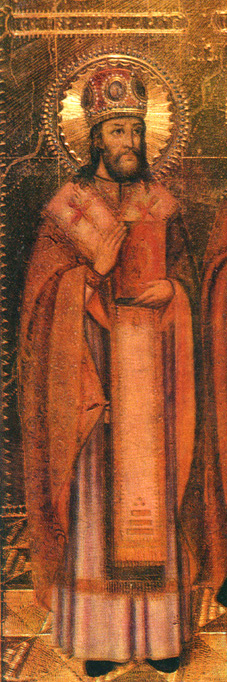
Saint Herman, Archbishop of Kazan, lived during the sixteenth century. He was born in the city of Staritsa, and was descended from the old boyar nobility of the Polevi. In his youth Gregory (his baptismal name) was tonsured at the Joseph-Volokolamsk monastery under Igumen Gurias, who later became Archbishop of Kazan (December 5). (Saint Gurias was head of the monastery from 1542 to 1551).
At the monastery Saint Herman occupied himself with copying books, and he was a close friend of Saint Maximus the Greek (January 21), who was living there in confinement. In 1551 the brethren of the Staritsa Dormition monastery, seeing his piety, chose him as their archimandrite.
Taking up the governance of this monastery with a pastoral zeal, Saint Herman concerned himself with its internal and external order, for he himself was a model of humility and meekness. He exhorted all to observe their monastic commitment strictly, and he introduced into his monastery the Rule of Saint Joseph of Volokolamsk (October 18).
But after two and a half years Archimandrite Herman left the Staritsa monastery, leaving its direction to the hieromonk Job (June 19), who afterwards was to become the first Patriarch of Moscow, and was an ascetic and sufferer for the Russian Land.
Saint Herman’s love for solitary struggles brought him to return to his original Volokolamsk monastery, where he strove toward salvation as a simple monk. However, when the new heretic Matthew Bashkin (who refused to acknowledge the Holy Mysteries and denied faith in the Holy Trinity) appeared at Moscow, Saint Herman and his own father (who had received tonsure at the Volokolamsk monastery with the name Philotheus) were summoned to the Moscow Council of 1553. The Council censured the heretic Bashkin and resolved to send him for correction to Saint Herman at the Volokolamsk monastery, since Saint Herman was known for his holy life and zeal for the faith in Christ.
In 1555, after the taking of Kazan, an archepiscopal See was established there. Saint Gurias, the former igumen of Volokolamsk monastery, was chosen as archbishop. He was entrusted with building the Dormition monastery in the city of Sviyazhsk for missionary purposes. By decree of Saint Gurias, Saint Herman was appointed as head of this new monastery in Sviyazhsk. A stone cathedral was built with a belltower and monastic cells. The igumen of the monastery lived very frugally in a cramped cell beneath the cathedral belltower. Saint Herman particularly concerned himself with acquiring a library for the monastery.
Soon his monastery became famous for its good works, and it became a center of enlightenment for the Kazan region.
On March 12, 1564, after the repose of Saint Gurias, Saint Herman was consecrated Bishop of Kazan. The short duration of his tenure there was marked nonetheless by his efforts to build churches and to enlighten the people of the region with the light of Christ.
In 1566, Ivan the Terrible summoned Saint Herman to Moscow and ordered that he be elected to the Metropolitan cathedra. At first, Saint Herman refused to have this burden imposed upon him. The Tsar would not tolerate any objection, however, and the saint was obliged to settle into the Metropolitan’s quarters until his elevation to the position of Metropolitan.
Seeing injustice among those of the Tsar’s inner circle, Saint Herman, true to his pastoral duty, attempted to admonish the Tsar. “You are not yet elevated to Metropolitan, and already you place constraints upon my freedom,” the Tsar told him through his aides. He ordered Saint Herman expelled from the Metropolitan’s quarters and that he be kept under surveillance.
The saint lived in disgrace for about two years, and died on November 6, 1567. They buried him in the church of Saint Nicholas the Hospitable. In 1595, at the request of the inhabitants of Sviyazhsk, the relics of the saint were transferred from Moscow to the Sviyazhsk Dormition monastery. Saint Hermogenes, then Metropolitan of Kazan, visited his grave.
Saint Herman is also commemorated on September 25 (first translation of his relics in 1595) and June 23 (second translation of his relics in 1714).
Venerable Barlaam of Keret Lake
No information available at this time.
Martyrs Tecusa, Alexandra, Claudia, Matrona, Polactia, Euphrosynē, and Athanasia, of Ancyra
No information available at this time.
Venerable Luke of Sicily

Saint Luke of Sicily was a native of the Sicilian city of Tauromenium. In his youth he left his parents and fiancée and went into the wilderness, where he spent many years in fasting and prayer. He lived the ascetic life at Mount Aetna.
Towards the end of his life Saint Luke, because of a revelation to him, founded a monastery. In order to become familiar with the rule and life of other monasteries, he visited many other cities. He died at Corinth in 820.
Holy Virgin Martyr Manatho
Saint Manathó (Μαναθῶ) suffered for Christ during the reign of Emperor Maximianus (286 – 305).
She was arrested with other martyrs and endured many torments because she was a Christian. Later she was led through the city naked and was mocked. Finally, she was burnt alive.
In Greek usage the Holy Virgin Martyr Manathó is commemorated on October 20
Daily Readings for Tuesday, November 05, 2024
TUESDAY OF THE 8TH WEEK
NO FAST
Galaktion & his wife Episteme, the Martyrs of Emesa, Hermas, Patrobos, Gaios, Linos, & Philologos, Apostles of the 70
ST. PAUL’S LETTER TO THE PHILIPPIANS 2:16-23
Brethren, I do not run in vain or labor in vain. Even if I am to be poured as a libation upon the sacrifical offering of your faith, I am glad and rejoice with you all. Likewise you also should be glad and rejoice with me. I hope in the Lord Jesus to send Timothy to you soon, so that I may be cheered by news of you. I have no one like him, who will be genuinely anxious for your welfare. They all look after their own interests, not those of Jesus Christ. But Timothy’s worth you know, how as a son with a father he has served with me in the gospel. I hope therefore to send him just as soon as I see how it will go with me.
LUKE 12:42-48
The Lord said, "Who then is the faithful and wise steward, whom his master will set over his household, to give them their portion of food at the proper time? Blessed is that servant whom his master when he comes will find so doing. Truly, I say to you, he will set him over all his possessions. But if that servant says to himself, 'My master is delayed in coming, ' and begins to beat the menservants and the maidservants, and to eat and drink and get drunk, the master of that servant will come on a day when he does not expect him and at an hour he does not know, and will punish him, and put him with the unfaithful. And that servant who knew his master's will, but did not make ready or act according to his will, shall receive a severe beating. But he who did not know, and did what deserved a beating, shall receive a light beating. Every one to whom much is given, of him will much be required; and of him to whom men commit much they will demand the more.
Martyrs Galaction and his wife, Epistemis, at Emesa
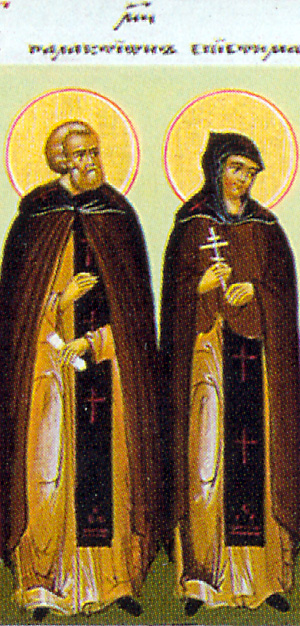
There was a rich and distinguished couple named Kletophon and Leukippe, who lived in the Syrian city of Emesa, and for a long time they were childless. They gave much gold to the pagan priests, but still they remained childless.
The city of Emesa was governed by a Syrian named Secundus, put there by the Roman Caesars. He was a merciless and zealous persecutor of Christians, and to intimidate them he ordered that the instruments of torture be displayed on the streets. The slightest suspicion of belonging to “the sect of the Galilean” (as thus Christians were called by the pagans), was enough to get a man arrested and handed over for torture. In spite of this, many Christians voluntarily surrendered themselves into the hands of the executioners, in their desire to suffer for Christ.
A certain old man by the name of Onuphrius concealed his monastic and priestly dignity beneath his beggar’s rags. He walked from house to house in Emesa, begging alms. At the same time, whenever he saw the possibility of turning people away from the pagan error, he preached about Christ.
Once, he came to the magnificent house of Leukippe. Accepting alms from her, he sensed that the woman was in sorrow, and he asked what was the cause of this sadness. She told the Elder about her familial misfortune. In consoling her, Onuphrius began to tell her about the one true God, about His omnipotence and mercy, and how He always grants the prayer of those turning to Him with faith. Hope filled the soul of Leukippe. She believed and accepted Holy Baptism. Soon after this it was revealed to her in a dream that she would give birth to a son, who would be a true follower of Christ. At first, Leukippe concealed her delight from her husband, but after the infant was born, she revealed the secret to her husband and also persuaded him to be baptized.
They named the baby Galaction and his parents raised him in the Christian Faith and provided him a fine education. He could make an illustrious career for himself, but Galaction sought rather an unsullied monastic life in solitude and prayer.
When Galaction turned twenty-four, his father resolved to marry him off and they found him a bride, a beautiful and illustrious girl by the name of Episteme. The son did not oppose the will of his father, but by the will of God, the wedding was postponed for a time. Visiting his betrothed, Galaction gradually revealed his faith to her. Eventually, he converted her to Christ and he secretly baptized her himself.
Besides Episteme he baptized also one of her servants, Eutolmius. The newly-illumined decided on the initiative of Galaction, to devote themselves to the monastic life. Leaving the city, they hid themselves away on Mount Publion, where there were two monasteries, one for men and the other for women. The new monastics had to take with them all the necessities for physical toil, since the inhabitants of both monasteries were both old and infirm.
For several years the monastics struggled in work, fasting and prayer. Once, Episteme had a vision in her sleep: she and Galaction stood in a wondrous palace before a radiant King, and the King bestowed golden crowns on them. This was a prefiguring of their impending martyrdom.
The pagans became aware of the existence of the monasteries, and a military detachment was sent to apprehend their inhabitants. But the monks and the nuns succeeded in hiding themselves in the hills. Galaction, however, had no desire to flee and so he remained in his cell, reading Holy Scripture. When Episteme saw that the soldiers were leading Galaction away in chains, she began to implore the Abbess to permit her to go also, since she wanted to accept torture for Christ together with her fiancé and teacher. The Abbess tearfully blessed Episteme to do so.
The saints endured terrible torments, while supplicating and glorifying Christ. Their hands and legs were cut off, their tongues were cut out, and then they were beheaded.
Eutolmius, the former servant of Episteme, and who had become her brother in Christ and fellow ascetic in monastic struggles, secretly buried the bodies of the holy martyrs. He later wrote an account of their virtuous life and their glorious martyrdom, for his contemporaries and for posterity.
Repose of Saint Jonah, Archbishop of Novgorod

Saint Jonah, Archbishop of Novgorod, in the world named John, was left orphaned early in life and was adopted by a certain pious widow living in Novgorod. She raised the child and sent him to school. Blessed Michael of Klops Monastery (January 11), who chanced to meet John on the street, foretold that he would become Archbishop of Novgorod. John received tonsure at the Otnya wilderness-monastery, 50 versts from the city, and he became igumen of this monastery. It was from here that the people of Novgorod chose him as their archbishop in 1458, after the death of Saint Euthymius (March 11).
Saint Jonah enjoyed great influence at Moscow, and during his time as hierarch, the Moscow princes did not infringe upon the independence of Novgorod. Saint Jonah, Metropolitan of Moscow (1449-1461), was a friend of the Novgorod Archbishop Saint Jonah, and wanted him to become his successor.
In 1463, Archbishop Jonah built the first church dedicated to Saint Sergius of Radonezh in the Novgorod region. Concerning himself over reviving traditions of the old days in the Novgorod Church, he summoned to Novgorod the renowned compiler of Saints’ Lives, Pachomius the Logothete, who wrote both the services and history of the best known Novgorod Saints, based on local sources.
And to this time period belongs also the founding of the Solovki monastery. Saint Jonah rendered much help and assistance in the organizing of the monastery. To Saint Zosimas he gave a special land-grant (in conjunction with the secular authorities of Novgorod), by which the whole of Solovki Island was granted to the new monastery.
The saint, after his many toils, and sensing the approach of his end, wrote a spiritual testament to bury his body at the Otnya monastery. On November 5, 1470, after he received the Holy Mysteries, the saint fell asleep in the Lord.
There has survived to the present day a Letter of Saint Jonah to Metropolitan Theodosius, written in 1464. The Life of the saint was written in the form of a short account in the year 1472 (included in the work, Memorials of Old Russian Literature, and also in the Great Reading Menaion of Metropolitan Macarius, under November 5). In 1553, after the uncovering of the relics of Archbishop Jonah, an account of this event was written by Saint Zenobius of Otnya (October 30). A special work relating the miracles of the saint is found in manuscripts of the seventeenth century.
Apostles Patrobus, Hermes, Linus, Gaius, and Philologus, of the Seventy

Saints Patrobus, Hermes, Linus, Gaius, and Philologus, Apostles of the Seventy, preached the Gospel in various cities, each enduring various hardships in their service as bishops.
Saint Patrobus (Rom 16:14) was Bishop of Neopolis (now Naples) and Puteoli in Italy.
Saint Hermes was bishop in the city of Philippoplis where he died a martyr.
Saint Linus (2 Tim 4:21) was a successor to the Apostle Peter at Rome.
Saint Gaius (Rom 16:23), was Bishop of Ephesus after Saint Timothy.
The Apostle Andrew consecrated Saint Philologus (Rom 16:15) as bishop of the city of Sinope (in the Black Sea region).
Saint Gregory, Archbishop of Alexandria

Saint Gregory the Archbishop of Alexandria lived in the ninth century. He was flogged and thrown into prison in the reign of Leo the iconoclast. He was left in prison without food until he died.
 Saint Peter Antiochian Orthodox Church
You must be logged in to post a comment.