3rd Sunday of Luke, The Holy and Glorious Apostle Thomas, Eroteis the Martyr of Cappadocia, Makarios the Righteous of Chios
ST. PAUL’S SECOND LETTER TO THE CORINTHIANS 4:6-15
Brethren, it is the God who said, "Let light shine out of darkness, " who has shone in our hearts to give the light of the knowledge of the glory of God in the face of Christ.
But we have this treasure in earthen vessels, to show that the transcendent power belongs to God and not to us. We are afflicted in every way, but not crushed; perplexed, but not driven to despair; persecuted, but not forsaken; struck down, but not destroyed; always carrying in the body the death of Jesus, so that the life of Jesus may also be manifested in our bodies. For while we live we are always being given up to death for Jesus' sake, so that the life of Jesus may be manifested in our mortal flesh. So death is at work in us, but life in you.
Since we have the same spirit of faith as he had who wrote, "I believed, and so I spoke, " we too believe, and so we speak, knowing that he who raised the Lord Jesus will raise us also with Jesus and bring us with you into his presence. For it is all for your sake, so that as grace extends to more and more people it may increase thanksgiving, to the glory of God.
LUKE 7:11-16
At that time, Jesus went to a city called Nain, and his disciples and a great crowd went with him. As he drew near to the gate of the city, behold, a man who had died was being carried out, the only son of his mother, and she was a widow; and a large crowd from the city was with her. And when the Lord saw her, he had compassion on her and said to her, "Do not weep." And he came and touched the bier, and the bearers stood still. And he said, "Young man, I say to you, arise." And the dead man sat up, and began to speak. And he gave him to his mother. Fear seized them all; and they glorified God, saying, "A great prophet has arisen among us!" and "God has visited his people!
Commemoration of the Holy Fathers of the Seventh Ecumenical Council
Today the Church remembers the 350 holy Fathers of the Seventh Ecumenical Council under the holy Patriarch Tarasius (February 25).
The Synod of 787, the second to meet at Nicea, refuted the Iconoclast heresy during the reign of Empress Irene and her son Constantine VI.
The Council decreed that the veneration of icons was not idolatry (Exodus 20:4-5), because the honor shown to them is not directed to the wood or paint, but passes to the prototype (the person depicted). It also upheld the possibility of depicting Christ, Who became man and took flesh at His Incarnation. The Father, on the other hand, cannot be represented in His eternal nature, because “no man has seen God at any time” (John 1:18).
In Greek practice, the holy God-bearing Fathers of the Seventh Ecumenical Council are commemorated on October 11 (if it is a Sunday), or on the Sunday which follows October 11. According to the Slavic menaion, however, if the eleventh falls on Monday, Tuesday, or Wednesday, the service is moved to the preceding Sunday.
Glorification of Saint Innocent, Metropolitan of Moscow, Enlightener of the Aleuts, Apostle to the Americas
Saint Innocent, Metropolitan of Moscow, Enlightener of the Aleuts and Apostle to America (in the world John Popov-Veniaminov), was born on August 26, 1797 in the village of Anginsk in the Irkutsk diocese, into the family of a sacristan. The boy mastered his studies at an early age and by age seven, he was reading the Epistle in church. In 1806 they sent him to the Irkutsk seminary. In 1814, the new rector thought it proper to change the surnames of some of the students. John Popov received the surname Veniaminov in honor of the deceased Archbishop Benjamin of Irkutsk (+ July 8, 1814). On May 13, 1817 he was ordained deacon for the Irkutsk Annunciation church, and on May 18, 1821, he was ordained priest.
The missionary service of the future Apostle of America and Siberia began with the year 1823. Father John spent 45 years laboring for the enlightenment of the peoples of Kamchatka, the Aleutian Islands, North America, Yakutsk, the Khabarov frontier, performing his apostolic exploit in severe conditions and at great risks to life. Saint Innocent baptized ten thousand people, and built churches, beside which he founded schools and he himself taught the fundamentals of the Christian life. His knowledge of various crafts and arts aided him in his work.
Father John was a remarkable preacher. During the celebration of the Liturgy, memorial services and the all-night Vigil, he incessantly guided his flock. During his time of endless travels, Father John studied the languages, customs and habits of the peoples, among whom he preached. His work in geography, ethnography and linguistics received worldwide acclaim. He composed an alphabet and grammar for the Aleut language and translated the Catechism, the Gospel and many prayers into that language. One of the finest of his works was the Indication of the Way into the Kingdom of Heaven (1833), translated into the various languages of the peoples of Siberia and appearing in more than 40 editions. Thanks to the toil of Father John, the Yakut people in 1859 first heard the Word of God and divine services in their own native language.
On November 29, 1840, after the death of his wife, Father John was tonsured a monk with the name Innocent by Saint Philaret, the Metropolitan of Moscow, in honor of Saint Innocent of Irkutsk. On December 15, Archimandrite Innocent was consecrated Bishop of Kamchatka, the Kurile and Aleutian Islands. On April 21, 1850 Bishop Innocent was elevated to the rank of archbishop.
By the Providence of God on January 5, 1868, Saint Innocent succeeded Metropolitan Philaret on the Moscow cathedra. Through the Holy Synod, Metropolitan Innocent consolidated the secular missionary efforts of the Russian Church (already in 1839 he had proposed a project for improving the organization of missionary service).
Under the care of Metropolitan Innocent a Missionary Society was created, and the Protection monastery was reorganized for missionary work. In 1870 the Japanese Orthodox Spiritual Mission headed by Archimandrite Nicholas Kasatkin [afterwards Saint Nicholas of Japan, (February 3)] was set up, with whom Saint Innocent had shared much of his own spiritual experience. The guidance by Saint Innocent of the Moscow diocese was also fruitful, by his efforts, the church of the Protection of the Most Holy Theotokos was built up into the Moscow Spiritual Academy.
Saint Innocent fell asleep in the Lord on March 31, 1879, on Holy Saturday, and was buried at the Holy Spirit Church of the Trinity-Saint Sergius Lavra. On October 6, 1977, Saint Innocent was glorified by the Russian Orthodox Church. His memory is celebrated three times during the year: on March 31, the day of his blessed repose, on October 5 (Synaxis of the Moscow Hierarchs), and on October 6, the day of his glorification.
Holy, Glorious Apostle Thomas
The Holy and Glorious Apostle Thomas was born in the Galilean city of Pansada and was a fisherman. Hearing the good tidings of Jesus Christ, he left all and followed after Him. The Apostle Thomas is included in the number of the holy Twelve Apostles of the Savior.
According to Holy Scripture, the holy Apostle Thomas did not believe the reports of the other disciples about the Resurrection of Jesus Christ: “Unless I see in His hands the print of the nails, and put my finger into the print of the nails, and thrust my hand into His side, I will not believe” (John 20:25).
On the eighth day after the Resurrection, the Lord appeared to the Apostle Thomas and showed him His wounds. “My Lord and my God,” the Apostle cried out (John 20:28). “Thomas, being once weaker in faith than the other apostles,” says Saint John Chrysostom, “toiled through the grace of God more bravely, more zealously and tirelessly than them all, so that he went preaching over nearly all the earth, not fearing to proclaim the Word of God to savage nations.”
Some icons depicting this event are inscribed “The Doubting Thomas.” This is incorrect. In Greek, the inscription reads, “The Touching of Thomas.” In Slavonic, it says, “The Belief of Thomas.” When Saint Thomas touched the Life-giving side of the Lord, he no longer had any doubts.
According to Church Tradition, the holy Apostle Thomas founded Christian churches in Palestine, Mesopotamia, Parthia, Ethiopia and India. Preaching the Gospel earned him a martyr’s death. For having converted the wife and son of the prefect of the Indian city of Meliapur [Melipur], the holy apostle was locked up in prison, suffered torture, and finally, pierced with five spears, he departed to the Lord. Part of the relics of the holy Apostle Thomas are in India, in Hungary and on Mt. Athos. The name of the Apostle Thomas is associated with the Arabian (or Arapet) Icon of the Mother of God (September 6).
Monastic Martyr Macarius of Saint Anne Skete, Mount Athos
No information available at this time.
“O All-Hymned Mother” Icon of the Mother of God
The Icon “O All-Hymned Mother” derives its title from the thirteenth Kontakion of the Akathist to the Most Holy Theotokos. “O All-Hymned Mother who bore the Word, holiest of all the saints….”
The Mother of God wears a crown, and clasps Her child to Her breast with both hands. Christ is held in Her left arm, and rests on Her left shoulder. He is facing Her, and both of His hands are placed below Her neck.
Instead of the usual stars on Her head and shoulders, the faces of angels appear in three circles. This is similar to the Arabian Icon (September 6) and the “Stone of the Mountain not cut by Hands” Icon on the iconostasis of the cathedral of the Transfiguration at Solovki.
Charitina the Martyr, Methodia the Righteous of Kimolos, Eudokimos the Unknown of Mount Athos, Peter, Alexis, Jonah, Hermogenes & Tikhon, Metropolitans of Moscow
ST. PAUL’S FIRST LETTER TO THE CORINTHIANS 4:17-21; 5:1-5
Brethren, therefore I sent to you Timothy, my beloved and faithful child in Christ, as I teach them everywhere in every church. Some are arrogant, as though I were not coming to you. But I will come to you soon, if the Lord wills, and I will find out not the talk of these arrogant people but their power. For the kingdom of God does not consist in talk but in power. What do you wish? Shall I come to you with a rod, or with love in a spirit of gentleness? It is actually reported that there is immorality among you, and of a kind that is not found even among pagans; for a man is living with his father’s wife. And you are arrogant! Ought you not rather to mourn? Let him who has done this be removed from among you. For though absent in body I am present in spirit, and as if present, I have already pronounced judgment in the name of the Lord Jesus on the man who has done such a thing. When you are assembled, and my spirit is present, with the power of our Lord Jesus, you are to deliver this man to Satan for the destruction of the flesh, that his spirit may be saved in the day of the Lord Jesus.
LUKE 5:27-32
At that time, as Jesus passed by, he saw a tax collector, named Levi, sitting at the tax office; and he said to him, “Follow me.” And he left everything, and rose and followed him. And Levi made him a great feast in his house; and there was a large company of tax collectors and others sitting at table with them. And the Pharisees and their scribes murmured against his disciples, saying, “Why do you eat and drink with tax collectors and sinners?” And Jesus answered them, “Those who are well have no need of a physician, but those who are sick; I have not come to call the righteous, but sinners to repentance.”
Martyr Charitina of Amisos
Saint Charitina (Charitίnē) was from Amisos (Amisós) in Pontus and lived during the reign of Emperor Diocletian (284-305). Orphaned at a young age, she became the servant of a noble Roman Christian named Claudianus, or Claudius, who brought her up as his own daughter. The young girl was very pretty, sensible, and kind. She imparted her love for Christ to others, and brought many to the path of salvation. Saint Charitina was meek, humble, obedient and silent. Although she was not yet baptized, she was a Christian at heart. She studied the Law of God day and night, and vowed to preserve her virginity as a true bride of Christ.
Because Saint Charitina brought many others to the Christian Faith, Dometius, one of Emperor Diocletian's governors, came to hear of her and sent a letter to Claudius, ordering him to send Charitina to him so that he might question her. Claudius had no doubts about the result of this interrogation. Grieved at the prospect of losing her, he put on sackcloth and wept bitter tears. Charitina comforted him, saying: "Do not grieve, my Master, but rejoice, for I am to become an acceptable sacrifice to God, for my sins and for yours."
Claudius replied: "O Servant of God, remember me when you stand before the heavenly King in the ranks of the Holy Martyrs."
The Saint was brought before a judge at the tribunal. He asked her: "Is it true that you are a Christian, and that you delude others by bringing them to your impious faith?"
Charitina replied: "It is true that I am a Christian, but it is a lie that I delude others. On the contrary, I lead them from deception to the path of truth, bringing them to my Christ."
Then the judge ordered her hair to be cut off, but by the power of God, her hair grew back even longer than before. Then burning coals were placed on her head, and vinegar was poured over her scorched flesh, increasing her pain. They drove flaming sticks through her breasts, and burnt her sides with candles. Finally, they tied a stone around her neck and threw her into the sea. She cried out: "This is my Baptism." Suddenly, the stone was loosened and sank, and God delivered her from the sea unharmed.
When the judge saw her on the shore, he ordered his men to seize her and strip her naked, and then tie her to a wheel which turned over burning coals, but an Angel of God stopped the wheel and once again Saint Charitina remained unharmed. The judge became furious and ordered that the nails of her hands and her feet be torn out, and that all her teeth be broken.
Then the wicked judge sent many dissolute men to rape her. Fearing this dishonor, Saint Charitina prayed that God would receive her soul before these vile men could defile her virginal body; and so, as she prayed, she surrendered her pure soul to God.
When the judge saw that she was dead, he had her body placed in a sack weighted with stones, and tossed it into the sea. By Divine Providence, her body was brought to the shore three days later. Her master Claudius found her body and buried her with appropriate honor and reverence.
Fragments of Saint Charitina's Holy Relics are found in the Monasteries of Kykkos, Cyprus, and Jerusalem of Boeotia.
Synaxis of the Hierarchs of Moscow
The celebration of a special Feast Day to honor Saints Peter, Alexei, and Jonah, Metropolitans and Wonderworkers of All Russia, was established by Patriarch Job on October 5, 1596. In 1875, Saint Innocent, Metropolitan of Moscow, proposed that Saint Philip be included with the others. Saint Ermogénes was added in the year 1913.
Just as the Three Hierarchs Saints Basil the Great, Gregory the Theologian and John Chrysostom have their individual Feast Days, they are also commemorated together on January 30. Similarly, on October 5 the Russian Church honors the First Hierarchs of Moscow, Saints Peter, Alexei, Jonah, Philip, and Ermogenes (Ermogénes), who also have their own separate Feast Days as well. In this manner, the Russian Church honors them separately, and collectively today, glorifying them as guardians of the Church, and heavenly intercessors before the Throne of God.
In 2005, the names of Saint Innocent, Saint Makarios, Saint Job, Saint Tikhon, Saint Philaret, Saint Peter (Polyansky), and Saint Makarios (Nevsky) were added to the list of the other Hierarchs who are commemorated on October 5. These seven names, however, have not been added to the Menaion Service by the Russian Orthodox Church.
Information about the lives of these holy Hierarchs is to be found under the dates of their commemoration:
Venerable Damian the Healer, Jeremiah, and Matthew, Clairvoyants, of the Kiev Caves
Saints Damian the Presbyter and Healer, Jeremiah and Matthew, Clairvoyants of the Kiev Caves, Near Caves, were described by Saint Nestor the Chronicler (October 27).
Saint Damian (+1071) remembered the Baptism of Rus (in year 988). The zealous imitator of Saint Theodosius (May 3) was gentle, industrious and obedient, to the joy of all the brethren. He spent the entire night at prayer and reading the Divine Scriptures. Saint Damian was strict in fasting, and ate nothing but bread and water. The Lord rewarded him with the gift of treating ailments.
Saint Jeremiah had the gift of the Lord to see into the future, and to see into the moral condition of a person. He died at an old age (+ ca. 1070).
In the Iconographers’ Manual it says, “Matthew has the appearance of a clairvoyant Elder, with a black greyish beard like Vlas, in black klobuk, a monastic robe, hands pressed to the heart.”
The general troparion to these saints is: “Your hearts were enlightened with the light of Christ’s commandments, and you dispelled the dread darkness. Like an abode of the Trinity, from whom we receive grace, O Fathers Damian, Jeremiah and Matthew, you heal the infirm, and you announce the future in the communion with the angels. We pray to you to intercede with Christ God to grant to us the communion of the saints.”
They are also commemorated on September 28 and the second Sunday of Great Lent
Saint Charitina, Princess of Lithuania
Saint Charitina, Princess of Lithuania, nun of Novgorod, pursued asceticism in a Novgorod women’s monastery in honor of the holy apostles Peter and Paul, built on Sinich hill.
Having resolved to dedicate her life to the Lord, she became a nun. For her virtuous life she was made Abbess of the monastery. Until the time of her death, she was a sister to all through her humility, purity and strict temperance. She fell asleep in the Lord in the year 1281 and was buried in the Peter and Paul monastery church.
In the Iconographers’ Manual it says, “The holy and righteous Charitina, Abbess of the Peter and Paul women’s monastery at Novgorod. She was born of Lithuanian royalty, yet appears as a maiden in a single garb without the mantiya.”
Hieromartyr Dionysius, Bishop of Alexandria
Saint Dionysius, Bishop of Alexandria, was the son of wealthy pagan parents. He converted to Christianity at a mature age, and became a pupil of Origen. Later, he was appointed as the head of Alexandria’s Catechetical School, and then became Bishop of Alexandria in the year 247.
Saint Dionysius devoted much effort to defend the Church from heresy, and he encouraged his flock in the firm confession of Orthodoxy during the persecution under the emperors Decius (249-251) and Valerian (253-259).
The holy bishop endured much suffering in his lifetime. When the Decian persecution broke out, Saint Dionysius was forced to flee Alexandria, but returned when the Emperor died. He was later exiled to Libya during the reign of Valerian.
When he was able to resume his duties in Alexandria in 261, Saint Dionysius had to contend with civil war, famine, plague, and other difficulties. The saint called upon his flock to tend sick Christians and pagans alike, and to bury the dead. Concerning the death of his spiritual children he wrote, “In such a manner the best of our brethren have departed this life. This generation of the dead, a deed of great piety and firm faith, is no less of a martyrdom.”
Saint Dionysius illumined his flock through his preaching, and with deeds of love and charity. An illness prevented him from attending the Council of Antioch (264- 265), and he fell asleep in the Lord while it was in session.
The influence of Saint Dionysius extended beyond the limits of his diocese, and his writings dealt with practical as well as theological subjects (“On Nature,” “On Temptations,” “On the Promises,” etc.). He was also familiar with Greek philosophy. Only fragments of his writings survive today, most of them preserved in Eusebius, who mentions him in his CHURCH HISTORY ( Book 7) and calls him “Dionysius the Great.”
Two complete letters of Saint Dionysius are extant, one addressed to Novatian, and the other to Basilides.
Martyr Memelchtha of Persia
The Martyr Memelchtha of Persia was, before her conversion to the Christian Faith, a pagan priestess of the goddess Artemis.
The saint’s sister convinced her to accept Baptism. When the pagans saw Memelchtha in her white baptismal robe, they stoned her. The saint suffered in the year 344. Later, a church was dedicated to her on the site of the temple of Artemis.
Saint Gregory of Chandzoe, Georgia
Our Holy Father Gregory of Khandzta was raised in the court of the Kartlian ruler Nerse. His family was part of the Meskhetian aristocracy. He received an education befitting his family’s noble rank and displayed a special aptitude for the sciences and theology.
The youth chosen by God was extraordinarily dedicated to his studies. In a short time he memorized the Psalms and familiarized himself with the doctrines of the Church. He also learned several languages and knew many theological works by heart.
While Gregory was still young, his loved ones expressed a wish to see him enter the priesthood. The wise youth had aspired to the spiritual life from early on, but he considered himself unprepared to bear such an enormous responsibility. “My pride prevents me from fulfilling your desire,” he told them.
Finally he consented to be ordained a priest, but the local princes sought to consecrate him a bishop. Frightened at the prospect, Gregory secretly fled to southwestern Georgia with three like-minded companions: his cousin Saba (a future bishop and the reviver of Ishkhani Monastery), Theodore (the builder of Nedzvi [Akhaldaba] Monastery), and Christopher (the builder of the Dviri Monastery of Saint Cyricus). The four brothers were unified by faith and love of God and bound by a single desire, as though they were one soul existing in four bodies.
The brothers arrived at the Monastery of Saint John the Baptist in Opiza and presented themselves before the abbot George. With his blessing they labored there for two years. Then Saint Gregory visited the monk Khvedios, the righteous hermit of Khandzta. Prior to Gregory’s arrival, Khvedios had received a sign from God indicating that a monastery would be built in Khandzta by the hands of the priest Gregory. It was revealed to him that Fr. Gregory’s prayers were so holy that their sweet-smelling fragrance rose up before God like incense. The monk showed Saint Gregory the environs, and he was so drawn to this area that he soon returned there with the other brothers and began to build a monastery.
The monks were forced to construct the monastery in difficult conditions, since the earth was rocky and mountainous and they were not equipped with the proper tools. First they built a wooden church, and later four cells and a dining hall.
A certain aristocrat by the name of Gabriel Dapanchuli lived nearby, and Gregory turned to him for help with construction of the monastery. With great joy he donated the stone, labor and food necessary for this worthy project to be realized. In such a way the first monastery church in Khandzta was established.
Gabriel informed Holy King Ashot Kuropalates about the brothers’ activity, and the king invited their leader, Saint Gregory, to the palace.
There he received him with great honor, asked him to bless the royal family, and inquired in detail about the life and labors of the holy monks. Then he presented Gregory with a generous donation to the monastery and, having learned that the land in Khandzta could not be cultivated, bestowed upon the monastery a large plot of fertile land in Shatberdi. King Ashot’s sons, the princes Adarnerse, Bagrat, and Guaram, also donated generously to the monastery.
And so, during the bloody Arab-Muslim period of rule, when the Georgian people had sunk into deep despair, the Klarjeti Wilderness was transformed into a life-giving oasis to which the greatest sons of the nation flocked.
The rules of the monastery were strict. In each monk’s cell was nothing but a short, stiff bed and a small pitcher for water. Neither fires nor candles were lit inside.
Saint Gregory was known throughout all of Georgia. At the request of King Demetre II of Abkhazeti (837-872), Fr. Gregory built a monastery in the village of Ubisi in Imereti and appointed his disciple Ilarion of Jerusalem as abbot. He built this monastery on the border of western and eastern Georgia and in so doing foresaw the unification of the two kingdoms.
The Lord performed many miracles through Saint Gregory. Once the church bell-ringer was approaching the abbot’s cell and saw a light issuing forth from inside. He knew that Saint Gregory had lit neither a fire nor his oil lamp, and he became frightened, believing that a fire might have started in the abbot’s cell. As it turned out, others had witnessed similar wonders: when the saint stood praying, he would light up like the sun, and beams of light would emanate from his body in the shape of a cross.
Venerable Gregory stood firmly in defense of morality, and he even confronted King Ashot Kuropalates when his conduct was at odds with the values of the Georgian people. Gregory had united his companions in their love of God, but among the roses there appeared a thorn. A certain Tskir, a protégé of the Tbilisi emir Sahak, schemed to obtain the episocopal see of Anchi.
He forcibly took control of Anchi Cathedral and committed many blasphemies. The clergy, and venerable Gregory in particular, condemned his behavior, but Tskir was consumed by pride and hired a killer to eliminate Saint Gregory. Like a prophet, Saint Gregory foresaw the imminent danger but went out to meet it nevertheless. Approaching his victim, while still at a distance from him, the murderer saw a bright light enveloping the holy father. He froze in fear, and his hand immediately withered. Only the prayers of Saint Gregory could heal him and permit him to return home.
The Church excommunicated Tskir, and he fled to the emir for refuge. With Sahak’s help he returned to the throne of Anchi and sent a military detachment to destroy Khandzta Monastery.
The monks of Khandzta and their abbot met the attackers in meekness and requested time to celebrate the Sunday Liturgy. The whole brotherhood prayed tearfully to the Lord to save the monastery.
The Liturgy had not yet been completed when a messenger arrived from Anchi to report that Tskir had died suddenly.
Near the end of his life Saint Gregory spent most of his time at Shatberdi Monastery, which he himself had built. When he received a sign that his death was approaching, he distributed candles throughout all the monasteries in the Klarjeti Wilderness and requested that they be burned on the day of his death. He asked all to remember him and bade farewell to Khandzta.
On the day of his repose, holy fathers from all over Klarjeti gathered to receive a final blessing from their teacher. Gregory blessed them, admonished them for the last time, and gave up his soul to God. When he breathed his last, a voice was heard from heaven, calling him: “Do not be afraid to come, O Venerable Servant of Christ, for Christ, the King of heaven, has Himself anointed you an earthly angel and a heavenly man. Now come and approach thy Lord with great joy and prepare for exaltation, for you are blessed among the saints and your everlasting glory has been prepared!”
Abounding in blessings and perfect in wisdom, justly ruling the inhabitants of the wilderness, Saint Gregory of Khandzta reposed on October 5, 861, at the age of 102. In accordance with his will, he was buried among his brothers at Khandzta Monastery.
Venerable Eudokimos of Vatopedi Monastery on Mount Athos
Nothing is known about the life and deeds of Venerable Eudokimos (Eudókimos) of Vatopedi.
On October 5, 1840,1 the monks of the Athonite Monastery of Vatopedi were renovating the burial vault for the brethren. Suddenly, the roof collapsed, covering one of the corners of the vault. The monks began to clear the blocked corner and suddenly they smelled a wondrous fragrance.
After clearing the rubble from the vault, the monks found a human skeleton clothed in a cloth chiton. The skeleton was in a kneeling position, his hands were folded on his chest and held an icon of the Most Holy Theotokos. His holy relics exuded such a fragrance that it filled everything around. The brethren of the monastery considered this as a sign that the Saint had pleased the Lord.2 Judging by his clothes, he reposed during the first half of the XVII century.
Archbishop Chrysanthos of Smyrna (who was living in retirement at the Monastery), addressed Metropolitan Gregory of Adrianople and the brethren, saying: "With the dissolution of the flesh, our very bones give a certain tribute to the earth with a stench; but the relics of this unknown Saint exude a paradisiacal fragrance. Should we not conclude from this that the Spirit of God, Who dwelt in this Saint during his lifetime, has not forsaken him after his death? Therefore, let us glorify God, Who is wondrous in His Saints, and let us honor His holy servant."
The fragrant relics were transferred to the katholikon on the evening of October 4, and soon healings took place from them. With the blessing of the Patriarch of Constantinople, the brethren gave the Saint the symbolic name of Eudokimos. it was decided that if he did not wish to be glorified with that name, he would appear to the monks and reveal his true name.
It remained a mystery exactly how the relics of the unknown monk got into the tomb, because a deceased monk is first buried; and after three years, only his bones are placed in the vault. According to one version, the Saint foresaw the hour of his death, but he said nothing to anyone and, taking an icon of the Mother of God, he hid in a remote place in the burial vault, where he departed quietly and humbly to the Lord.
Since then, the Venerable Newly-Appeared Eudokimos has been honored on Mount Athos. His relics continue to emit a fragrance, and they are renowned for their numerous miraculous healings. By praying to the Saint, one of the monks on the Holy Mountain, who suffered from consumption and was near death, was healed. Another monk, Gabriel, was also healed by praying to the Saint, and in gratitude he donated a precious silver reliquary for the venerable head of Venerable Eudokimos.
Some time after the discovery of the relics, a certain monk from Vatopedi had a vision, in which the Saint said that his true name was Savva. Monastic tradition continues to identify Saint Eudokimos with a monk who lived during the XIV century: Saint Savva of Vatopedi. However, doubts were expressed about this, and the Church did not pronounce its judgment on this occasion.
Through the prayers of our Venerable Father Eudokimos, may we all be delivered from the afflictions of body and soul which we may encounter, and may we also inherit the Heavenly Kingdom. Amen.
1 An article in Orthodox Life # 5, 1979 says that in September 1841 renovations were being carried out on the dilapidated burial vault at Vatopedi Monastery during the tenure of Archimandrite Philaret, where the bones of the Fathers and brethren were kept. When the workers started to dismantle the roof, it caved in, due to their negligence, and one corner of the vault was filled with rubble.
2 Greek, εὐδοκία: i.e., "good will, glorified, pleasant, or given by grace."
Righteous Methodia of Kimolos
Saint Methodίa was born on the island of Kίmolos on November 10, 1865, to devout parents. Her father's name was Jacob Sardēs, and her mother's name was Maria. They had three sons and five daughters, the second of whom was called Irene.
From childhood the Saint was drawn to divine things and always frequented the church. When she reached a suitable age, she married a sailor, in order to please her parents. Although she was married, her zeal for the Church remained unabated. One day, however, while her husband was out on a voyage, he was shipwrecked and drowned near Asia Minor.
Later Irene was tonsured in the church of Panagia Hodēgḗtria on Kίmolos by Archbishop Methodios of Syros, who renamed her Methodίa. Her joy knew no bounds, and she followed the evangelic commandments of the Lord with all her soul. Her ascetical struggles were severe, and she was a living example for all. Therefore, Christ, Who dwells in pure hearts, also came to dwell in her, and she became a chosen vessel (Acts 9:15). The report of her great virtue spread everywhere and a multitude of women went to stay with her, in order to find a spiritual refuge and a safe harbor from the storms of life. The Saint's inspired words were a source of refreshment and healing for the afflicted souls of these women, and she guided them on the path of repentance. In addition to her other gifts, God gave Saint Methodίa the grace to work miracles.
Venerable Methodίa reposed peacefully on Sunday, October 5, 1908 at the age of 43. She was glorified as a Saint on October 5, 1991.
Venerable Fathers and Mothers of the Klarjeti Wilderness
For centuries the region of Tao-Klarjeti in southwestern Georgia was known for its holiness, unity and spiritual strength. The cultural life and faith of Kartli were nearly extinguished by the Arab-Muslim domination from the 8th to 10th centuries. Tao-Klarjeti, however, which had been emptied by a cholera epidemic and the aftermath of the Islamic invasions, filled with new churches and monasteries, becoming a destination for many Christian ascetics. Saint Ekvtime Taqaishvili wrote that “Every monastery included a school and a seminary where the Christian Faith, philosophy, Greek and other foreign languages, chant, calligraphy, fine arts, jewelry making, and other disciplines were taught. Countless priests, translators, miniaturists, and jewelry makers developed their craft in these schools.”
The prayers of the Tao-Klarjeti monastics multiplied and were lifted up to the heavens like holy incense. Hagiographical works were written, original hymns composed, and theological texts translated.
The literature of this period was thoroughly infused with the spirit of the Georgian people. Tao-Klarjeti reinvigorated the soul of the Georgian people and redirected the lost back to the true path.
Saint Gregory of Khandzta, a priest of great virtue and wisdom, spearheaded this spiritual revival. He was a good shepherd to his flock and the builder of many churches. The Lives of Saint Gregory of Khandzta and the other holy fathers and mothers of Tao-Klarjeti are recounted in Saint George Merchule’s work The Life of Saint Gregory of Khandzta. George Merchule labored in the Khandzta wilderness in the 10th century. His epithet, “Merchule,” means “the theologian” or literally “the knower of the law.”
George Merchule also provided the Church with the Life of Holy Catholicos Nerse III, an Armenian by descent. Nerse confessed the Orthodox Faith and labored in Tao-Klarjeti with the Georgian fathers. (At that time many Orthodox Armenians fled to Tao-Klarjeti after being exiled from their homeland.) In the first half of the 7th century Saint Nerse laid the foundations of Ishkhani Church and labored there in holiness.
Holy Catholicos Hilarion was the founder and abbot of Tsqarostavi Church and a disciple of Gregory of Khandzta. He arrived at Khandzta Monastery with his spiritual father, Saint David, Abbot of Midznadzori Monastery, and Saint Zachariah, the builder of Beretelta Church. Those who witnessed the fathers’ unity and piety abandoned the world to join them in offering their lives to God. In the middle of the 9th century Saint Hilarion was enthroned as Catholicos of Kartli in recognition of his wisdom and holiness. He followed Gabriel II (ca. 830-850) and was succeeded by Arsenius I “the Great” (ca. 860-887) in this most honorable role.
Saint Stephen of Tbeti was the first bishop of Tbeti. He was a major writer and hagiographer in the Church of his time and a brilliant figure of the Tao-Klarjeti literary school. Saint Stephen is credited with authoring the narrative The Martyrdom of Saint Gobron.
From his childhood Saint Zachariah of Anchi was filled with love and fear of God. Strict in his discipline but free from every constraint of this world, he led the life of a shepherd like St.David the Psalmist. As a child, Saint Zachariah would gather his friends and relate with precision the words and scenes he had witnessed in churches and monasteries. Once the bishop of Anchi observed this unusual pastime and reported seeing a pillar of light descend fromthe heavens and alight atop St.Zachariah’s head.
When he reached a mature age, Saint Zachariah became the spiritual leader of his brothers. Through his prayers many miracles were performed: he stopped the stone wall of a collapsing building from crashing to the ground, eliminated the troublesome birds and grasshoppers from the monastery’s vineyard, and killed two venomous snakes that were keeping his frightened brothers from the vineyard. Filled with good faith and virtue, Saint Zachariah was later consecrated bishop of Anchi.
Saint Macarius of Anchi served as bishop of Anchi following the repose of Saint Gregory of Khandzta in 861.
Saint Ezra of Anchi, of the noble Dapanchuli family, labored in holiness during the 10th century.
Saint Savva of Ishkhani was a cousin and one of the closest companions of St.Gregory of Khandzta. Along with two other friends, Christopher and Theodore, the young Savva accompanied Gregory of Khandzta to Klarjeti on a quest for the ascetic life. At first the young monks settled at Opiza Monastery and labored there with great zeal, and afterwards they moved to Khandzta.
Once Saint Savva made a pilgrimage with Saint Gregory to Byzantium, and there he learned the typica of the local monasteries. On the way back to Tao-Klarjeti, God revealed to them His will for Savva to restore Ishkhani Church, which had been destroyed by Arab-Muslim invaders. Saint Savva desired to begin this holy task at once, but he continued on the way with Saint Gregory at the latter’s insistence.
Later, Gregory assigned two monks to help Savva restore the church and sent the three of them to Ishkhani. By God’s grace, the brothers restored the church and monastery and the number of monks who labored there multiplied. Before long their abbot, Saint Savva, was consecrated bishop of Ishkhani.
Saint John the New Martyr for Christ labored at Khandzta Monastery. While he was journeying to Jerusalem on a pilgrimage, the Saracens captured him in Baghdad and attempted to torture him into a denial of the Christian Faith. But by shedding his blood Saint John demonstrated his immutable fidelity to the Faith of our Savior.
Saint Theodore, Founder of Nedzvi Monastery, and Saint Christopher, Founder of the Dviri Monastery of Saint Cyricus, were spiritual sons of Saint Gregory of Khandzta and the first men to join him in his holy labors.
With Saint Gregory they labored first at Opiza and later at Khandzta Monastery. These holy fathers journeyed to Abkhazeti to increase the fullness of the Faith in that region, and on their way, in Samtskhe, an aristocrat named Mirian entrusted them with the care and upbringing of his son, the six-year-old Arsenius (later Holy Catholicos Arsenius the Great).
Eventually Saint Gregory of Khandzta desired the return of Theodore and Christopher, and he traveled to Abkhazeti to find them. Saint Gregory took with him his young disciple Ephraim (later the bishop and wonderworker of Atsquri). When he met the brothers in Abkhazeti, Saint Gregory entrusted them with Ephraim’s upbringing and made them vow not to leave Khandzta Monastery until Ephraim and Arsenius had reached maturity.
When Ephraim and Arsenius reached manhood they were “perfected in wisdom,” and Theodore and Christopher left Khandzta to establish the Nedzvi and Dviri Monasteries. There each father labored until the day of his repose.
Holy Fathers George, Amona, Peter, and Macarius labored in the wilderness of Opiza. Abba George was abbot of Opiza’s Saint John the Baptist Monastery during the two years Saint Gregory of Khandzta and his companions labored there. Fr. George was the third abbot of the monastery (he was succeeded by Saint Andria and Saint Samuel).
Through God’s grace Abba George recognized the pilgrims’ faith and received them, not as pupils, but as honorable and wise elders. Witnessing the ascetic feats of the venerable fathers of Opiza, Saint Gregory increased in virtue and humility, and acquired inner peace. (History has preserved a Holy Gospel from the Opiza Wilderness that has been dated to the year 913, around the time that Abba George was laboring there.)
In the second part of the 9th century Saint Serapion of Zarzma founded Zarzma Monastery in Samtskhe. Saint Serapion’s nephew, Saint Basil, later performed great ascetic feats and worked miracles at that monastery. Saint Basil authored The Life of Serapion of Zarzma and recounted the lives of the other venerable fathers of Zarzma as well.
Saint George, “a brilliant and kindhearted man of great virtue,” succeeded Saint Serapion as abbot of Zarzma Monastery. After Saint George, the Venerable Abbot Michael began building a second church in Zarzma, in fulfillment of Saint Serapion’s prophecy. Saint Paul, who followed Michael as abbot of the monastery, completed construction of this second church.
The holy and righteous Saint Khvedios labored as a hermit in the caves of the Khandzta Wilderness. God revealed to him the news of Saint Gregory’s arrival, and he received Gregory and his brothers with great joy.
He blessed them, while receiving a blessing himself from Saint Gregory of Khandzta. Then, rather than journeying on with Saint Gregory and the other brothers, Saint Khvedios retired to his secluded cave, since he had taken a vow before God to live his whole life in solitude. After the holy father reposed, his dwelling place filled with a sweet fragrance.
Saint Epiphanius was a wonderworker and a spiritual son of Saint Gregory of Khandzta. This venerable father was truly clad in the armor of righteousness, and he was an inspiration to many. According to Saint Gregory’s instructions, he became an example of obedience for the other brothers of the monastery. Saint Epiphanius’s prayers healed many who were afflicted by terminal illnesses.
Saint Matthew labored in the Khandzta Wilderness. After the abbess of Mere Monastery reposed, he took upon himself leadership of the women’s monastery and for forty years set an example of life lived in the fullness of the Faith. He was so strict in his asceticism that, for those forty years, he never once shared a meal with the mothers, nor did he receive a single object from any of their hands. When Saint Matthew reached an advanced age, he became diseased in the flesh, but he declined the nuns’ offers to care for him. Instead he asked his relative, also a monk, to attend to him in his time of need.
Saint Zenon was born in Samtskhe to a family of aristocrats. He was raised in the fear of God, and he desired from his youth to enter the monastic life. Before this desire was fulfilled, however, his sister was kidnapped by a certain godless man. Zenon set off to pursue the abductor on horseback, but while he was riding the devil began to assault him with anxieties. “I am a respectable man,” he thought, “but the one whom I am following is dishonorable. If I catch and kill him, I will destroy my soul, but if I turn back, shame will come upon me.”
And so, at that very moment, Saint Zenon turned back to fulfill his lifelong desire. He was tonsured a monk and later became a disciple of Saint Gregory of Khandzta.
Saint Zenon, the “Treasure of Virtue, Holy Model of Asceticism and Gate of the Klarjeti Wilderness,” reposed at an advanced age.
Saint John, Abbot of Khandzta, is celebrated for having completed construction of the new church at Khandzta that was begun by his predecessor, Saint Arsenius. Both holy fathers reposed in the Khandzta Wilderness.
Saint Theodore the Abbot and his brother Saint John both labored at Khandzta Monastery. Saint George Merchule recognizes the brothers as co-authors, with him, of the work The Life of Saint Gregory of Khandzta; historians, however, believe that they were contributors, rather than coauthors, of this work.
The monk Saint Gabriel ministered to the infirm and elderly monks of Khandzta Monastery. Saint Gabriel verbally recounted the Lives of the great Church Fathers and admonished his brothers to follow the same strict disciplines as the fathers who had gone before them.
Saint Demetrius was raised by the blessed Saint Febronia and later became one of Saint Gregory of Khandzta’s first disciples. He is commemorated among the holy fathers for having attaining the heights of the monastic struggle and for working wonders, both in this life and after he had been received into the bosom of Abraham.
SS. Arsenius and Macarius, “good monks full of wisdom and the gift of wonderworking,” were relatives of Saint Ephraim of Atsquri. They labored together at Saint Savva Monastery in Jerusalem and corresponded regularly with the monks of Khandzta. Saints Arsenius and Macarius possessed a profound love for Christ and a longing to serve their motherland and mother Church.
Saint Shio the Wonderworker “shone upon the land of Kartli like the North Star in the morning sky.” According to Basil of Zarzma, Saint Shio was the spiritual father of Saint Michael of Parekhi.
SS. Basil and Markelus, “abounding and brilliant in virtue,” were disciples of Saint Michael of Parekhi. Saint Basil was buried in Parekhi next to his spiritual father. Both fathers worked miracles from their graves and healed the infirmities of the faithful who came to seek their blessings.
Venerable Father David, “an image of the angels” and builder of many monasteries, labored as abbot of Midznadzori Monastery. He was the spiritual father of the holy catholicos Hilarion.
Endowed with many gifts of grace, Saint Jacob was a prominent figure in the tenth-century Georgian Church. He labored first in Shatberdi, and later near Midznadzori Gorge, where he shone forth as the brightest of stars.
Venerable Sophronius the Great was the restorer of the Shatberdi Church and a famous writer, but his literary works have not been preserved.
Saint George Merchule numbers him among the wise and holy fathers whose stories are worthy to be told. Saint Gregory of Shatberdi labored at the same monastery. Several of the tenth-century manuscripts copied by him at Shatberdi Monastery have been preserved, including the Notebooks of the Shatberdi Wilderness and the Gospels of Hadishi, Jruchi, and Parekhi.
Saint Zachariah built the famous Beretelta Monastery and set an example of wisdom and holiness for the fathers who labored there after him.
Saint George Merchule honors the venerable and God-fearing Saint Hilarion of Parekhi as one of the greatest writers and figures in the Church of his time.
Saint Hilarion, Abbot of Ubisi, labored for many years at the Lavra of Saint Savva in Jerusalem, where the Georgians had their own chapel for many centuries (See Archimandrite Gregory Peradze, “An Account of the Georgian Monks and Monasteries in Palestine,” Georgica, Autumn 1937, nos. 4-5, pp. 181-246.). After he had reached an advanced age, the venerable father moved to Georgia and settled at Khandzta Monastery. Later this clever and learned father began construction of Ubisi Church in Imereti, where he labored until his death.
Saint Febronia labored at Mere Monastery in Samtskhe. She was a close friend of Saint Gregory of Khandzta. He sent to her a certain woman whom King Ashot Kuropalates (later the holy martyr) had taken as his mistress, to instruct her in the Christian Faith. Saint Febronia denied the king’s pleas to return the woman to the royal palace.
Angels often visited Saint Febronia to inform her of God’s holy will. Saint Temestia labored with Saint Febronia at Mere Monastery. For forty years she ministered to Saint Matthew, the spiritual father of the monastery. Saint Temestia herself remarked that her relationship with Father Matthew was so chaste and innocent that the holy father would not even permit himself to receive the holy incense directly from her hands.
Saint Anatole (also called Antonios) labored in seclusion at Mere Monastery. Angels often appeared to the holy mother, who herself led a life equal to that of the bodiless powers. Both venerable Temestia and Anatole were informed by angels of the repose of their abbot, St.Matthew.
Saint Anastasia labored among the holy mothers in remarkable sanctity and humility. She descended from an Abkhaz family and was known as Bevreli in the world. As queen (the wife of King Adarnerse) she was often called upon to protect the interests of Mere Monastery.
King Adarnerse later grew cold towards Bevreli, so she left the world and was tonsured a nun with the name Anastasia. Saint Anastasia bore the most difficult labor at the monastery: she gathered the firewood and carried it from the forest. She wore only rags and prayed constantly.
Once King Adarnerse suddenly fell ill, and he sent messengers to Persati Monastery, where Anastasia was laboring, asking forgiveness on his behalf. Saint Anastasia prayed for the sick king: “May Christ forgive all his sins and heal him in soul and body.” King Adarnerse was soon healed of his infirmity.
Abounding in holiness and humility, Saint Anastasia labored at Persati Monastery to the end of her days on earth. God granted her the gift of wonderworking both during her life on earth and after her repose.
Saint Anastasia’s own sons, Gurgen and Sumbat, were cured of their diseases at her grave, and afterwards many more who came with faith received healing from the holy mother.
The historical region of Tao-Klarjeti has throughout history, and even up to the present day, been inhabited by ethnic Georgians. However, since 1921, when the Communists annulled the independence of the Georgian Republic, Tao-Klarjeti has been a Turkish possession.
God endowed this region with abundant sunshine and clear air, free from cruel heat and bitter frost. The local climate heightens the beauty of this wondrous region.
But Tao-Klarjeti has been transformed into a battlefield countless times throughout history: it has witnessed victory and defeat, destruction and restoration, treason and selfless loyalty. Through all these trials it has remained an inseparable part of the unified Georgian nation. In spite of the fact that, today, Tao-Klarjeti is located within the borders of a foreign government and its Georgian dioceses are often referred to as belonging to the Armenian Church, the historical truth must be upheld.
On October 17, 2002, the Georgian Apostolic Church nominally restored the dioceses of Klarjeti and Lazeti to its own jurisdiction and declared the incumbent bishop of Akhaltsikhe to be their spiritual leader. On the same day, the Georgian Church canonized the holy and venerable fathers and mothers who labored in those regions under the leadership of Saint Gregory of Khandzta. Only a few of the God-fearing laborers, among them Holy Catholicos Nerse II, were Armenian by descent, but they had converted to Orthodoxy and preached the true Faith in the wilderness with the Georgian fathers.
ABSTAIN FROM MEAT, FISH, DAIRY, EGGS, WINE, OLIVE OIL
Hierotheus, Bishop of Athens, Domnina the Martyr and her daughters, John the Hermit
ST. PAUL’S LETTER TO THE GALATIANS 4:8-21
Brethren, formerly, when you did not know God, you were in bondage to beings that by nature are no gods; but now that you have come to know God, or rather to be known by God, how can you turn back again to the weak and beggarly elemental spirits, whose slaves you want to be once more? You observe days, and months, and seasons, and years! I am afraid I have labored over you in vain. Brethren, I beseech you, become as I am, for I also have become as you are. You did me no wrong; you know it was because of a bodily ailment that I preached the gospel to you at first; and though my condition was a trial to you, you did not scorn or despise me, but received me as an angel of God, as Christ Jesus. What has become of the satisfaction you felt? For I bear you witness that, if possible, you would have plucked out your eyes and given them to me. Have I then become your enemy by telling you the truth? They make much of you, but for no good purpose; they want to shut you out, that you may make much of them, and not only when I am present with you. My little children, with whom I am again in travail until Christ be formed in you! I could wish to be present with you now and to change my tone, for I am perplexed about you. Tell me, you who desire to be under law, do you not hear the law?
LUKE 7:31-35
The Lord said, “To what shall I compare the men of this generation, and what are they like? They are like children sitting in the market place and calling to one another, ‘We piped to you, and you did not dance; we wailed, and you did not weep.’ For John the Baptist has come eating no bread and drinking no wine; and you say, ‘He has a demon.’ The Son of man has come eating and drinking; and you say, ‘Behold, a glutton and a drunkard, a friend of tax collectors and sinners!’ Yet wisdom is justified by all her children.”
Hieromartyr Hierotheus, Bishop of Athens
Hieromartyr Hierotheus, the first Bishop of Athens, was a member of the Athenian Areopagos and was converted to Christ by the Apostle Paul together with Saint Dionysius the Areopagite (October 3).
The saint was consecrated by the Apostle Paul to the rank of bishop. According to Tradition, Bishop Hierotheus was present with Saint Dionysius at the funeral of the Most Holy Theotokos.
Saint Hierotheus died a martyr’s death in the first century.
Uncovering of the relics of Saint Gurias, first Archbishop of Kazan, and Saint Barsanuphius, Bishop of Tver
The Uncovering of the relics of Saint Gurias, First Archbishop of Kazan, and Saint Barsanuphius, Bishop of Tver, occurred at Kazan in the year 1595. During the construction of a new stone church in honor of the Transfiguration of the Lord at the Savior-Transfiguration monastery, which had been founded by Saint Barsanuphius, graves with the bodies of the holy hierarchs in the altar-wall were uncovered beneath the former wooden church. The unusual aspect of incorrupt graves filled Saint Hermogenes (February 17) with a pious desire to open the graves before a large crowd of the people.
Saint Hermogenes described this event, “We beheld a marvel we had not hoped for. The coffin of the saint was full of fragrant myrrh, like pure water, and the relics of Saint Gurias were above the myrrh, like a sponge. God gave his venerable and hard-working body incorruption, as is now seen by all. Decay touched only very little of the upper lip, his other limbs were whole, and nothing has disappeared. We touched his burial robe and it held up very firm. Then we opened up the coffin of Saint Barsanuphius and we looked upon the relics of Saint Barsanuphius which were blessed by God with little corruption. Decay had touched the feet of the monk, however the bones were not destroyed, and held up quite well. There was no other sign of corruption in the condition of the rest of his relics, the same was for the relics of Saint Gurias. The burial robe of both saints was strong and like new.”
Many sick were healed, having been anointed with the holy myrrh flowing from the relics of Saint Gurias.
There is a description of the saints in the Iconographer’s Manual under October 4: “In appearance Gurias is grey and bearded, like Basil of Caesarea, with a mitre, omophorion, holding a Gospel in his hands, and dressed in the robes of a hierarch. Barsanuphius is grey and bearded like Gurias, but his is parted at the end. He wears a mitre, the robes of a hierarch, an omophorion and carries the Gospel.”
The Life Saint Gurias is found on December 5; and the Life of Saint Barsanuphius on April 11.
In the correspondence from a report of the Archbishop of Cheboksarsk and Chuvash Benjamin (Novitsky), + 14 October 1976, His Holiness Pimen, Patriarch of Moscow gave a blessing to commemorate the Synaxis of all the Kazan hierarchs on the first Sunday after October 4th.
Synaxis of the Hierarchs of Kazan
Today the Church honors the holy hierarchs of Kazan:
Bishop Barsanuphius of Tver (April 11 and October 4)
Archbishop Herman (June 23, September 25, and November 6)
Archbishop Gurias (June 20, October 4, and December 5).
Right-believing Prince Vladimir Yaroslavich of Novgorod
The holy right-believing Prince Vladimir Yaroslavich of Novgorod, the Wonderworker, was the eldest son of Great Prince Yaroslav the Wise, and was born in the year 1020. At age fourteen, his father made him administrator of Novgorod. The military commander Vyshata and the holy Bishop Menignus Zhidyata (February 10) assisted in guiding the prince.
When he matured, the prince became a brave defender of the land and a pious Christian. Saint Vladimir built the Sophia cathedral at Novgorod, which was begun in the year 1045 and consecrated on September 14, 1052 by Bishop Luke. The holy prince was not only concerned about the strengthening of the princedom (by his decree a stone fortress was built at Novgorod) but he also zealously instructed himself in the law of the Lord. In 1047 the prophetic books with commentaries were copied out for him.
The holy prince died at age thirty-two on October 4, 1052, twenty days after the consecration of the Sophia cathedral, and his relics were placed in the church he built. His wife, Princess Alexandra, is mentioned in the Novgorod Synodikon. Commemoration of the holy prince Vladimir was established in the year 1439 by Saint Euthymius, Archbishop of Novgorod (March 11).
Venerable Helladius of the Kiev Near Caves
No information available at this time.
Venerable Onesimus of the Kiev Near Caves
No information available at this time.
Venerable Ammon the recluse of the Kiev Caves
Saints Ammon the Recluse of the Kiev Caves, Far Caves, was given the title “Lover of Labor.” The saint went to Athos and to Jerusalem. Upon his return, he became famous for his exploits, and he was an image of holy life for the brethren. He was buried in the Far Caves. His memory is also celebrated on August 28 and on the second Sunday of Great Lent.
Martyrs Gaius, Faustus, Eusebius, and Chaeremon, of Alexandria
Saints Gaius, Faustus, Eusebius, and Chaeremon were deacons and disciples of Saint Dionysius of Alexandria (October 5). They were arrested and banished from from Alexandria along with with Saint Dionysius.
They were tortured and beheaded during the persecution of Valerian (253-259).
Martyr Peter of Capitolias
Saint Peter was born and raised in the city of Capitolias (an ancient city in eastern Jordan, on the way to Damascus), and he was both wise and very prudent. He was married with three children, and after his wife died he became a monk.
He was ordained to the holy priesthood by the Bishop of Busra (an ancient Syrian city in Choran, 80 km. east of Lake Gennesaret, and 90 km. south of Damascus, where Job's tomb is located). As a Christian teacher, he was denounced to the Saracen ethnarch. Because Saint Peter courageously confessed his faith before the ethnarch, his hands and feet were cut off. Then they gouged his eyes out and crucified him. Finally, he was beheaded. After his martyrdom, his body was burnt in a fire, and then it was thrown into the river.
Some sources say that the Hieromartyr Peter received his crown of martyrdom during the III or IV century; it is more probable, however, that his martyrdom occurred in the VIII century.
Martyr Domnina with her daughters of Syria
Saint Domnina was a woman with two daughters named Verine (Saint John Chrysostom calls her Vernike, or Berenice) and Prosdoce. Leaving their home and family, they settled in Edessa on the plain of Mesopotamia.
Berenice’s father and her husband, who were pagans, took the women to Hieropolis in Syria. When the soldiers stopped to rest and eat, they became drunk with wine. Taking advantage of this opportunity, the women fled and were drowned in the river.
According to Saint John Chrysostom (PG 50, 629-640), Domnina stood in the middle of the river and pulled her daughters under the water with her, for she was afraid that the soldiers were going to rape them. Saint John praises Domnina for her courage, and Berenice and Prosdoce for their obedience.
Venerable Ammon
Saint Ammon of Egypt was raised in Christian piety. He entered into marriage at the urging of his parents, but by agreement with his spouse preserved his virginity and they lived as brother and sister. The spiritual spouses pursued asceticism in fasting, prayer and joint effort for twenty years. Having matured in piety, the spouses separately continued their ascetic deeds. Ammon’s wife remained home and established a women’s monastery. Ammon went out into the Nitrian desert, where he dwelt for twenty-two years and attained the high spiritual accomplishments of wonderworking and discernment.
Saint Ammon often came to Saint Anthony the Great (January 17) for his blessing. At the time of Saint Ammon’s death, Saint Anthony saw angels bearing the soul of the righteous one to heaven. Saint Ammon died in the mid-fourth century.
Venerable Paul the Simple of Egypt
Saint Paul the Simple of Egypt also lived in the fourth century and was called the Simple for his simplicity of heart and gentleness. He had been married, but when he discovered his wife’s infidelity, he left her and went into the desert to Saint Anthony the Great (January 17). Paul was already 60 years old, and at first Saint Anthony would not accept Paul, saying that he was unfit for the harshness of the hermit’s life. Paul stood outside the cell of the ascetic for three days, saying that he would sooner die than go from there. Then Saint Anthony took Paul into his cell, and tested his endurance and humility by hard work, severe fasting, with nightly vigils, constant singing of Psalms and prostrations. Finally, Saint Anthony decided to settle Paul into a separate cell.
During the many years of ascetic exploits the Lord granted Saint Paul both discernment, and the power to cast out demons. When they brought a possessed youth to Saint Anthony, he guided the afflicted one to Saint Paul saying, “I cannot help the boy, for I have not received power over the Prince of the demons. Paul the Simple, however, does have this gift.” Saint Paul expelled the demon by his simplicity and humility.
After living for many years, performing numerous miracles, he departed to the Lord. He is mentioned by Saint John, the Abbot of Sinai (Ladder 24:30): “The thrice-blessed Paul the Simple was a clear example for us, for he was the rule and type of blessed simplicity….”
Saint Paul is also commemorated on March 7.
Martyr Callisthene and her father Audactus of Ephesus
The holy martyr Callisthene was born in Ephesus, and her father was the eparch Audactus. She was to marry the emperor Maximian Galerius (305-311), but her father would not consent to the match because the emperor was a pagan. Therefore, Audactus was deprived of his wealth and position, and was exiled to Melitene, Armenia where he was beheaded.
Callisthene hid for a time in Nicomedia with a certain woman, and healed the woman’s daughter of an eye ailment. After the death of Maximian, Licinius (311-324) became the last pagan emperor. Callisthene became friendly with his Christian wife Constantia, the daughter of Saint Constantine (May 21). She told Constantia of all that had happened to her, and Constantia helped Callisthene to regain her father’s wealth and possessions. She did not want these things for herself, but gave everything away to the poor.
She also brought her father’s body back to Ephesus and built a church which was dedicated to him.
Saint Callisthene devoted the rest of her life to Christ, and died in Ephesus in the first half of the fourth century.
Saint Stephen Stiljianovitch of Serbia
Saint Stephen Stiljianovich of Serbia was born into a pious Christian family in the Serbian city of Zhupa (south of Zakholmya). During this time Serbia was often subjected to invasions by the Turks, who devastated the land. Saint Stephen defended his native land, did military service in the army of the Serbian ruler. When famine began in the country, the kindly Saint Stephen distributed his own bread to the hungry.
The patriotic activity of the saintly soldier was indissolubly bound up with his truly Christian life. “In virtue, he lived as an ascetic with charity, purity, prayer, the Orthodox Faith and unhypocritical love of neighbor.”
The saint fell asleep in the Lord on October 4, 1515. After a time, the Turks saw a light shining over his grave. Thinking that they had found a hidden treasure, they opened the grave and found the incorrupt body of Saint Stephen. Serbian monks ransomed the relics from the Turkish Pasha and transferred them to the Shishatovets monastery on Mount Phrushtsk.
The Serbian Church prays to him as a glorious righteous defender of his native land, “Glory in the struggles, warrior Stephen Stiljianovich, great healer of those who pray to you in faith.”
Martyr Evdemoz, Catholicos of Georgia
Saint Evdemoz led the Georgian Orthodox Church in the mid-17th century during the reign of King Rostom-Khan (1632-1658), a Georgian who had converted to Islam.
Having murdered King Luarsab II of Kartli and chased out King Teimuraz I of Kakheti, the Persian shah Abbas I had declared Rostom-Khan ruler of a unified Kartli-Kakheti kingdom.
Rostom tried to be accommodating in his policies and protect the beliefs and traditions of both the Persian shah and the Georgian people: he set a standard salary for the Georgian clergy and even built churches, but society deteriorated rapidly nevertheless. Human vices became commonplace, and sins like those of Sodom and Gomorrah were multiplied. The nation was so overtaken by sin that even the clergy ceased to conduct themselves in a manner befitting their God-given role.
But the chief shepherd of the Georgian nation would not yield to the moral decline of his flock, and he confronted this crisis with conviction and fearlessness. Several times he led his most valiant military leaders in revolt against Persia. Following the example of Catholicos Evdemoz, several Georgian princes rebelled against the pro-Persian policies of Rostom-Khan and cast out the Islamic influence from their territories.
Catholicos Evdemoz resisted the Islamic custom of raising the king’s heirs in the shah’s court from a young age. He was never too intimidated by the king to expose his wrongdoing and tell him at every convenient opportunity: “You are the natural father of the Muslims, but the stepfather of the Christians!”
Evdemoz was the spiritual father of Rostom-Khan’s wife, the faithful Queen Mariam, the daughter of Manuchar Dadiani, Prince of Samegrelo.
As a result of the holy labors of Catholicos Evdemoz and Queen Mariam, the Christian soul of the Georgian people was not entirely extinguished. The Georgians built churches, wrote spiritual literature, and gradually regained their national consciousness. Catholicos Evdemoz preached throughout the country and developed and implemented a plan to bring King Teimuraz, who had been driven out by Shah Abbas, back to the throne.
Naturally Rostom-Khan felt threatened by the strong influence Catholicos Evdemoz had on the people. In 1642 he arrested the chief shepherd of the Georgian people and tried to win him over, but neither his feigned tenderness nor his threats could break the firm will of the man who loved Christ and his motherland above all else. After his arrest, Saint Evdemoz criticized the king even more harshly and called on the people to rise up against him. Finally Rostom-Khan ordered that Catholicos Evdemoz be strangled to death in his prison cell, and as a further insult, his body was cast off Nariqala Fortress (in Tbilisi) in the direction of the Turkish baths.
That night, a group of Christians stole the body of the holy hieromartyr Catholicos-Patriarch Evdemoz and buried it in the northwest corner of Anchiskhati Church in Tbilisi.
Saint Elena of Serbia
Princess Elena was the wife of the Despot Stephen Štiljanović who is also venerated as a Saint. After his death around 1515, she fled to Germany in order to escape from the Turks.
Later, a light appeared at his grave by night, which led to the discovery of his holy relics. The Saint's body was kept for a long time in the monastery of Šišatovacnto at Fruška Gora. When she learned that her husband's incorrupt relics had been uncovered, Saint Elena went to the monastery to venerate them. After witnessing the miracles which took place at his grave, she decided to remain there with the monastic name Jelisaveta. According to Tradition, she founded the Monastery of Petkovica in 1522.
After a life of asceticism, Saint Elena reposed in 1546. There is reason to believe that she was buried at the Convent of the Most Holy Theotokos in Sremski Karlovci.
Saints Jonah and Nectarius of Kazan
Saints Jonah and Nectarius of Kazan were called John and Nestor Zastolsky before they received monastic tonsure. When Saint Gurias (December 5 ) was sent to the newly established Kazan diocese, the boyar John Zastolsky went with him. Under the spiritual guidance of Saint Gurias, John led a virtuous and pious life. He avoided sin, loved truth, and was strictly honest.
John raised his son Nestor in the fear of God. The gentle youth was an ascetic from childhood. He wore a hair-shirt, kept the fasts, and he loved to pray in church. With his father’s consent, Nestor became a monk with the new name Nectarius. He died at a young age, and was buried near the grave of Saint Gurias.
John was tonsured into monasticism with the name Jonah. Before his death, he left instructions that he also be buried near Saint Gurias.
At the uncovering of the relics of Saints Gurias and Barsanuphius in 1595, the incorrupt bodies and clothing of Saints Jonah and Nectarius were also found. They were left beneath a crypt in a chapel of the Kazan Savior-Transfiguration monastery. The chapel had been built by Jonah over the grave of Saint Gurias.
The saints are mentioned in the service to Saint Gurias, “Two monks, Jonah and Nectarius, ascetics well-pleasing to God, one born of the other, faithfully served you in the world. Upon your death, O Gurias, keeping sincere faith for you, they built a chapel over your grave. These saints are buried here beside you, honored with incorruption from God above. Saint Gurias, pray with them unto Christ God, to grant us peace and great mercy.”
Dionysios the Areopagite, Rusticus and Eleutherios the Martyrs, John the Chozebite, Bishop of Caesaria
ACTS OF THE APOSTLES 17:16-34
In those days, while Paul was waiting for them in Athens, his spirit was provoked within him as he saw that the city was full of idols. So he argued in the synagogue with the Jews and the devout persons, and in the market place every day with those who chanced to be there. Some also of the Epicurean and Stoic philosophers met him. And some said, “What would this babbler say?” Others said, “He seems to be a preacher of foreign divinities” – because he preached Jesus and the resurrection. And they took hold of him and brought him to the Areopagos, saying, “May we know what this new teaching is which you present? For you bring some strange things to our ears; we wish to know therefore what these things mean.” Now all the Athenians and the foreigners who lived there spent their time in nothing except telling or hearing something new. So Paul, standing in the middle of the Areopagos, said: “Men of Athens, I perceive that in every way you are very religious. For as I passed along, and observed the objects of your worship, I found also an altar with this inscription, ‘To an unknown god.’ What therefore you worship as unknown, this I proclaim to you. The God who made the world and everything in it, being Lord of heaven and earth, does not live in shrines made by man, nor is he served by human hands, as though he needed anything, since he himself gives to all men life and breath and everything. And he made from one every nation of men to live on all the face of the earth, having determined allotted periods and the boundaries of their habitation, that they should seek God, in the hope that they might feel after him and find him. Yet he is not far from each one of us, for ‘In him we live and move and have our being’; as even some of your poets have said, ‘For we are indeed his offspring.’ Being then God’s offspring, we ought not to think that the Deity is like gold, or silver, or stone, a representation by the art and imagination of man. The times of ignorance God overlooked, but now he commands all men everywhere to repent, because he has fixed a day on which he will judge the world in righteousness by a man whom he has appointed, and of this he has given assurance to all men by raising him from the dead.” Now when they heard of the resurrection of the dead, some mocked; but others said, “We will hear you again about this.” So Paul went out from among them. But some men joined him and believed, among them Dionysios the Areopagite and a woman named Damaris and others with them.
LUKE 7:17-30
At that time, the report concerning Jesus spread through the whole of Judea and all the surrounding country. The disciples of John told him of all these things. And John, calling to him two of his disciples, sent them to the Lord, saying, "Are you he who is to come, or shall we look for another?" And when the men had come to him, they said, "John the Baptist has sent us to you, saying, 'Are you he who is to come, or shall we look for another?'" In that hour he cured many of diseases and plagues and evil spirits, and on many that were blind he bestowed sight. And he answered them, "Go and tell John what you have seen and heard: the blind receive their sight, the lame walk, lepers are cleansed, and the deaf hear, the dead are raised up, the poor have good news preached to them. And blessed is he who takes no offense at me.
When the messengers of John had gone, he began to speak to the crowds concerning John: "What did you go out into the wilderness to behold? A reed shaken by the wind? What then did you go out to see? A man clothed in soft clothing? Behold, those who are gorgeously appareled and live in luxury are in kings' courts. What then did you go out to see? A prophet? Yes, I tell you, and more than a prophet. This is he of whom it is written, 'Behold, I send my messenger before your face, who shall prepare your way before you.' I tell you, among those born of women none is greater than John; yet he who is least in the kingdom of God is greater than he." When they heard this all the people and the tax collectors justified God, having been baptized with the baptism of John; but the Pharisees and the lawyers rejected the purpose of God for themselves, not having been baptized by him.
Hieromartyr Dionysius the Areopagite, Bishop of Athens
Saint Dionysius lived originally in the city of Athens. He was raised there and received a classical Greek education. He then went to Egypt, where he studied astronomy at the city of Heliopolis. It was in Heliopolis, along with his friend Apollophonos where he witnessed the solar eclipse that occurred at the moment of the death of the Lord Jesus Christ by Crucifixion. “Either the Creator of all the world now suffers, or this visible world is coming to an end,” Dionysius said. Upon his return to Athens from Egypt, he was chosen to be a member of the Areopagus Council (Athenian high court).
When the holy Apostle Paul preached at the place on the Hill of Ares (Acts 17:16-34), Dionysius accepted his salvific proclamation and became a Christian. For three years Saint Dionysius remained a companion of the holy Apostle Paul in preaching the Word of God. Later on, the Apostle Paul selected him as bishop of the city of Athens. And in the year 57 Saint Dionysius was present at the repose of the Most Holy Theotokos.
During the lifetime of the Mother of God, Saint Dionysius had journeyed from Athens to Jerusalem to meet Her. He wrote to his teacher the Apostle Paul: “I witness by God, that besides the very God Himself, there is nothing else filled with such divine power and grace. No one can fully comprehend what I saw. I confess before God: when I was with John, who shone among the Apostles like the sun in the sky, when I was brought before the countenance of the Most Holy Virgin, I experienced an inexpressible sensation. Before me gleamed a sort of divine radiance which transfixed my spirit. I perceived the fragrance of indescribable aromas and was filled with such delight that my very body became faint, and my spirit could hardly endure these signs and marks of eternal majesty and heavenly power. The grace from her overwhelmed my heart and shook my very spirit. If I did not have in mind your instruction, I should have mistaken Her for the very God. It is impossible to stand before greater blessedness than this which I beheld.”
After the death of the Apostle Paul, Saint Dionysius wanted to continue with his work, and therefore went off preaching in the West, accompanied by the Presbyter Rusticus and Deacon Eleutherius. They converted many to Christ at Rome, and then in Germany, and then in Spain. In Gaul, during a persecution against Christians by the pagan authorities, all three confessors were arrested and thrown into prison. By night Saint Dionysius celebrated the Divine Liturgy with angels of the Lord. In the morning the martyrs were beheaded. According to an old tradition, Saint Dionysius took up his head, proceeded with it to the church and fell down dead there. A pious woman named Catulla buried the relics of the saint.
The writings of Saint Dionysius the Areopagite hold great significance for the Orthodox Church. Four books of his have survived to the present day:
On the Celestial Hierarchy
On the Ecclesiastical Hierarchy
On the Names of God
On Mystical Theology
In additional, there are ten letters to various people.
The book On the Celestial Hierarchies was written actually in one of the countries of Western Europe, where Saint Dionysius was preaching. In it he speaks of the Christian teaching about the angelic world. The angelic (or Celestial-Heavenly) hierarchy comprises the nine angelic Ranks:
Seraphim
Cherubim
Thrones
Dominions
Powers
Authorities
Principalities
Archangels
Angels
The account of the Synaxis of the Bodiless Powers of Heaven is located under November 8.
The purpose of the divinely-established Angelic Hierarchy is the ascent towards godliness through purification, enlightenment and perfection. The highest ranks are bearers of divine light and divine life for the lower ranks. And not only are the sentient, bodiless angelic hosts included in the spiritual light-bearing hierarchy, but also the human race, created anew and sanctified in the Church of Christ.
The book of Saint Dionysius On the Ecclesiastical Hierarchies is a continuation of his book On the Celestial Hierarchies. The Church of Christ, like the Angelic ranks, in its universal service is set upon the foundation of priestly principles established by God.
In the earthly world, for the children of the Church, divine grace comes down indescribably in the holy Mysteries of the Church, which are spiritual in nature, though perceptible to the senses in form. Few, even among the holy ascetics, were able to behold with their earthly eyes the fiery vision of the Holy Mysteries of God. But outside of the Church’s sacraments, outside of Baptism and the Eucharist, the light-bearing saving grace of God is not found, neither is divine knowledge nor theosis (deification).
The book On the Names of God expounds upon the way of divine knowledge through a progression of the Divine Names.
Saint Dionysius’ book On Mystical Theology also sets forth the teaching about divine knowledge. The theology of the Orthodox Church is totally based upon experience of divine knowledge. In order to know God it is necessary to be in proximity to Him, to have come near to Him in some measure, so as to attain communion with God and deification (theosis). This condition is accomplished through prayer. This is not because prayer in itself brings us close to the incomprehensible God, but rather that the purity of heart in true prayer brings us closer to God.
The written works of Saint Dionysius the Areopagite are of extraordinary significance in the theology of the Orthodox Church, and also for late Medieval Western theology. For almost four centuries, until the beginning of the sixth century, the works of this holy Father of the Church were preserved in an obscure manuscript tradition, primarily by theologians of the Alexandrian Church. The concepts in these works were known and utilized by Clement of Alexandria, Origen, Dionysius the Great, pre-eminent figures of the catechetical school in Alexandria, and also by Saint Gregory the Theologian. Saint Dionysius of Alexandria wrote to Saint Gregory the Theologian a Commentary on the “Areopagitum.” The works of Saint Dionysius the Areopagite received general Church recognition during the sixth-seventh centuries.
Particularly relevant are the Commentaries written by Saint Maximus the Confessor (January 21). (trans. note: although many scholars suggest that the “Areopagitum” was actually written by an anonymous sixth century figure who employed the common ancient device of piously borrowing an illustrious name, this in no way diminishes the profound theological significance of the works.)
In the Russian Orthodox Church the teachings of Saint Dionysius the Areopagite about the spiritual principles and deification were at first known through the writings of Saint John of Damascus (December 4). The first Slavonic translation of the “Areopagitum” was done on Mt. Athos in about the year 1371 by a monk named Isaiah. Copies of it were widely distributed in Russia. Many of them have been preserved to the present day in historic manuscript collections, among which is a parchment manuscript “Works of Saint Dionysius the Areopagite” belonging to Saint Cyprian, Metropolitan of Kiev and All Rus (September 16) in his own handwriting.
According to one tradition, he was killed at Lutetia (ancient name of Paris, France) in the year 96 during the persecution under the Roman emperor Dometian (81-96). Today most scholars and theologians believe that Saint Dionysius the Areopagite did not die in Gaul, and that Saint Dionysius (or Denys) of Paris is a different saint with the same name.
Saint Demetrius of Rostov says that the Hieromartyr Dionysius was beheaded in Athens, and that many miracles were worked at his grave.
Martyrs Rusticus the Presbyter and Eleutherius the Deacon
Saints Rusticus and Eleutherius were disciples of Saint Dionysius the Areopagite. They suffered martyrdom in Athens during the persecution of the emperor Domitian (81-96).
Venerable Dionysius the Recluse of the Kiev Caves
Saint Dionysius, Hermit of the Kiev Caves, Far Caves, called Schepa, is mentioned briefly in the Kiev Caves Paterikon. In the year 1463 during Paschal Matins, Dionysius went around censing the relics of the God-pleasers buried in the Kiev Caves. When the monk cried out: “Holy Fathers and brethren, today is the great day! Christ is Risen!” their reply resounded like thunder: “Truly, He is Risen!”
From that very day Saint Dionysius lived as a recluse, and after many labors he fell asleep in the Lord. The miracle involving Saint Dionysius is mentioned in the 8th Ode of the Canon of the Kiev Caves Saints. He is also commemorated on August 28, and on the second Sunday of Great Lent.
Saint John the Chozebite, Bishop of Caesarea, Palestine
Saint John the Chozebite, Bishop of Caesarea in Palestine (587-596), was famed for his struggle against the Eutychian heresy, and also for his grace-filled gifts of discernment and wonderworking. He was born in the Egyptian city of Thebes and while still a youth he spent a long time in the Thebaid desert with his uncle, who was an ascetic.
The emperor, who learned of John’s holy life, decided to make him bishop of the city of Caesarea. But the saint, yearning for solitude, left his cathedra and withdrew into the Chozeba wilderness (between Jerusalem and Jericho) where he struggled in asceticism until the end of his life.
Once, while on his way to visit some of the brethren, he met a woman on the road. She entreated him to follow her to her home so that he might bless it and sanctify it by his prayers. Once they entered the house, however, the vile woman locked the door and removed all her clothing, and tried to tempt the saint into sinning with her. He opened the door and fled from the place.
.
After this, he performed many miracles until he fell asleep in the Lord. It is said that whenever he served the Divine Liturgy, he would see a heavenly light in the altar.
Venerable Hesychius of Mount Horeb
Saint Hesychius the Silent of Mt. Horeb, lived during the sixth century at one of the monasteries on Mt. Horeb, and at first he was not a very fervent monk. Hesychius died after a serious illness, but through a wondrous act of Divine Providence, he came back to life an hour later. After this, the saint secluded himself in his cell as a recluse, and for twelve years he dwelt in complete solitude. He would not converse with any of the brethren, but devoted himself to the singing of Psalms and penitential weeping. Before his death, Blessed Hesychius said to the assembled monks: “Forgive me, brethren. He who acquires the remembrance of death cannot sin.”
The holy hesychasts (those who keep silence) are the spiritual descendants of Saint Hesychius. These ascetics devote themselves to contemplating God, and to unceasing prayer of the heart.
Saint Damaris of Athens
Saint Damaris was the first Athenian woman to believe in Christ, through the preaching of the Apostle Paul. She is mentioned in Acts 17:34: “Some men joined him and believed; among whom were both Dionysios the Areopagite and a woman named Damaris, and others with them.”
The name Damaris (“heifer”) is not Greek, but may be a Hellenized form of the Hebrew name Thamar (“palm tree”). The name Thamar appears in both the Old and New Testaments (Genesis 38:6, and Matthew 1:3). From her name, it may be inferred that Saint Damaris was not a Greek by nationality, but she may have been a Jewish woman who moved to Athens.
After Saint Paul left Beroia and visited Athens in the year 52 AD, Saint Damaris had the opportunity to hear him preach Christianity to the Athenians on the Areopagus. Only a few people accepted Saint Paul’s message, but Saint Damaris was one of them. We do not know anything for certain concerning her life beyond that. Some have speculated that she came from a wealthy Jewish family of social prominence, but there is no documentation of this. Neither is there any concrete evidence for the opinion of some patristic writers, and of Saint Dimitry of Rostov, that she was married to Saint Dionysios the Areopagite, or that they were baptized by Saint Paul, together with their two sons, and their entire household.
II Corinthians 4:6-15: Brethren, seeing that it is the God who commanded the light to shine out of darkness, the same also shone in our hearts, to give the light of the knowledge of the glory of God in the face of Jesus Christ. But we have this treasure in earthen vessels, that the exceeding greatness of power is from God, and not from us. We are pressed on every way, yet not distressed; we are perplexed, but not driven to despair; persecuted, but not forsaken; smitten down, but not destroyed; always bearing about in the body the dying of the Lord Jesus, that the life of Jesus may also be manifested in our body. For we who live are always delivered to death for Jesus’ sake, that the life of Jesus may also be manifested in our mortal flesh. So, then, death is working in us, but life in you. But having in us the same spirit of faith, according to that which is written, “I believed, and therefore I spoke,” we also believe, and therefore we also speak, knowing that the One who raised up the Lord Jesus will also raise us up through Jesus, and will make us stand together with you. For all things are for your sakes, that the grace, which is multiplied through the thanksgiving of many, may abound to the glory of God.
Luke 7:11-16: At that time, Jesus went to a city called Nain, and many of His disciples and a great crowd went with Him. As He drew near to the gate of the city, behold, a man who had died was being carried out, the only son of his mother, and she was a widow; and a large crowd from the city was with her. And when the Lord saw her, He had compassion on her and said to her, “Do not weep.” And He came and touched the bier, and the bearers stood still. And Jesus said, “Young man, I say to you: arise.” And the dead man sat up, and began to speak. And Jesus gave him to his mother. Fear seized them all; and they glorified God, saying, “A great prophet has arisen among us!” and “God has visited His people!”
Troparion of the Resurrection: When Mary stood at thy grave looking for thy sacred body, angelic powers shone above thy revered tomb, and the soldiers who were to keep guard became as dead men. Thou led hades captive and wast not tempted thereby. Thou didst meet the Virgin and didst give life to the world; O thou who art risen from the dead! O Lord, glory to thee.
Troparion of the Holy Apostle Thomas: O Holy Apostle Thomas, intercede with our merciful God to grant our souls forgiveness of sins.
Troparion of the Chains of St. Peter: O Holy Apostle, Peter, thou dost preside over the Apostles by the precious chains which thou didst bear. We venerate them with faith and beseech thee that by thine intercessions we be granted the great mercy.
Kontakion of the Theotokos: O undisputed intercessor of Christians, O mediatrix, who is unrejected by the Creator, turn not away from the voice of our petitions though we be sinners; come to us in time, who cry to thee in faith, for thou art good. Hasten to us with intercessions, O Theotokos, who didst ever intercede for those who honor thee.
CALENDAR
UNTIL FURTHER NOTICE: All services listed on the calendar will be available through streaming and webcast. (Instructions can be found on the parish website.)
Sunday, October 6 (Fifteenth Sunday after Pentecost; Apostle Thomas)
8:50 a.m. – Orthros
9:00 a.m. – Christian Education
10:00 a.m. – Divine Liturgy (webcast)
Monday, October 7
Father Herman off
Tuesday, October 8
NO Services
Wednesday, October 9 (Apostle James, Son of Alphaeus)
6:30 p.m. – Daily Vespers
Thursday, October 10
NO Services
Friday, October 11
NO Services
[Knucklehead Family Reunion Begins]
Saturday, October 12
10:00 a.m. – Ladies meet for Akathist
4:30 p.m. – Choir Practice
5:00 p.m. – Catechism Class
6:00 p.m. – Great Vespers
Sunday, October 13 (Holy Fathers of the Seventh Ecumenical Council)
8:50 a.m. – Orthros
9:00 a.m. – Christian Education
10:00 a.m. – Divine Liturgy (webcast)
12:00 p.m. – POT LUCK MEAL
SPECIAL ANNOUNCEMENTS
The Eucharist Bread …was offered by the Brocks for the Divine Liturgy this morning.
Eucharist Bread Schedule:
Eucharist BreadCoffee Hour
October 6 Brock Algood/Schelver
October 13 R. Root POT LUCK MEAL
Lockhart/Karam/Snell
October 20 Pacurari Pigott/Ian Jones
October 27 Lasseter Ken Jones/Stewart
Also, please remember that we still need your tithes and offerings which may be placed in the tray that is passed during the Divine Liturgy, in the tithe box at the back of the nave or be mailed to: St. Peter Orthodox Church, P.O. Box 2084, Madison, MS 39130-2084.
Schedule for Epistle Readers – Page numbers refer to the Apostolos (book of the Epistles) located on the Chanters’ stand at the front of the nave. Please be sure to use this book when you read.
ReaderReadingPage#
October 6 Katie Miller II Cor. 4:6-15 163
October 13 Sophie Dansereau Titus 3:8-15 322
October 20 Simeon Root II Cor. 6:16-7:1 173
October 27 Michel Root II Cor. 9:6-11 178
Please remember the following in your prayers: Aidan Milnor, the Milnor family; Lamia Dabit and her family; Mary Greene (Lee and Kh. Sharon’s sister); Jay and Joanna Davis; Fr. Leo and Kh. Be’Be’ Schelver and their family; Marilyn (Kyriake) Snell; Jack and Jill Weatherly; Sh. Charlotte Algood and their family; Reader Basil and Brenda Baker and their family; Fr. Joseph Bittle; Rick Carlton; Very Rev. Fr. Nicholas and Kh. Jan Speier; Lee Greene; Joseph, Amanda and Hunter Hines; Fr. John and Kh. Janet Henderson and their family; Galina Singletary; Emily and Cole Parker; Dane and Stephanie Skirtech.
Father Herman will be at the Knucklehead Family Reunion October 14-17.
There will be NO Daily Vespers on Wednesday, October 16th.
His Grace, Bishop NICHOLAS will be visiting St. Peter again on October 20-21st. He will be in Vicksburg earlier that week-end and will come to us following the Hierarchical Divine Liturgy there on Sunday. His schedule (subject to change) will be as follows:
Sunday, October 20
1:00 p.m. – Pick up from St. George Vicksburg
5:20 p.m. – Formal Reception of the Bishop
5:30 p.m. – Vespers
6:30 p.m. – Men’s Meeting with Bishop NICHOLAS and DOMSE AMEN
President Michael Baclig in the Fellowship Hall
Monday, October 21
10:00 a.m. – Orthros
11:15 a.m. – Clergy Lunch with Bishop NICHOLAS at Bulldog Burger
5:30 p.m. – Parish Council Dinner with Bishop NICHOLAS (location TBA)
We will be showing the documentary film Sacred Alaska at Mississippi College on Friday evening, November 1st, beginning at 6:30 p.m. The date was changed from the original date selected to accommodate MC’s student schedule and also MC’s Homecoming celebration.
Posters for our Showing of Sacred Alaska have been placed on the bureau in the foyer. If you have a location at which these can be put up, please feel free to take one, or a few, to do so.
Fasting Discipline for October
The traditional fasting discipline (no meat, dairy, eggs, fish, wine or oil) is observed on all Wednesdays and Fridays of the month.
Major Commemorations for October
October 6 Holy Apostle Thomas
October 9 Holy Apostle James, Son of Alphaeus
October 18 Holy Apostle Luke
October 23 Holy Apostle James, Brother of the Lord
October 26 Great-martyr Demetrios
Calendar Items:
* The men of the parish meet for lunch at 11:00 a.m. on the first Thursday of the month.
* The Ladies meet at the church at 10:00 a.m. on the second Saturday of the month to pray the Akathist to the Mother of God, Nurturer of Children on behalf of our children.
* The Ladies meet for lunch at 1:00 p.m. on the last Tuesday of the month.
* Knucklehead Family Reunion in Arkansas, October 11-17th.
* The annual Fall Festival is scheduled for Saturday, October 26th. More details later.
* MARK YOUR CALENDARS: His Grace, Bishop NICHOLAS will be visiting St. Peter October 20-21st.
* Sacred Alaska documentary showing at Mississippi College, Friday, November 1st, beginning at 6:30 p.m.
* Remaining Stewpot date for 2024 will be November 30th.
NO children are allowed to be in the pantry or in the refrigerator and children under the age of 12 are not allowed in the kitchen without the presence of a parent or a responsible adult. Children under the age of 12 are not allowed to access the icemaker. Parents, we ask for your assistance with enforcing this policy. Thank you.
** We ask that families go through the Coffee Hour line together, so that children are under the supervision of their parents. **
Fall Festival: Our annual Fall Festival is scheduled for Saturday, October 26th. We will not have Chor Practice, Catechism Class or Great Vespers that day. More details will be available shortly
Quotable: “The mind and the heart are two axes around which man’s spiritual and moral formation revolve. If either of these is ignored, her formation will be incomplete and defective. Each needs to be taught its own proper truth; the proper truths of the mind are education and science, while the proper truths of the heart are supernatural truths and religion.”
St. Nektarios of Aegina
Worship: Sunday, October 13, 2024 (Holy Fathers of the Seventh Ecumenical Council)
ABSTAIN FROM MEAT, FISH, DAIRY, EGGS, WINE, OLIVE OIL
The Holy Hieromartyr Cyprian and the Virgin Martyr Justina, Theophilus the Confessor
ST. PAUL’S FIRST LETTER TO TIMOTHY 1:12-17
Timothy, my son, I thank him who has given me strength for this, Christ Jesus our Lord, because he judged me faithful by appointing me to his service, though I formerly blasphemed and persecuted and insulted him; but I received mercy because I had acted ignorantly in unbelief, and the grace of our Lord overflowed for me with the faith and love that are in Christ Jesus. The saying is sure and worthy of full acceptance, that Christ Jesus came into the world to save sinners. And I am the foremost of sinners; but I received mercy for this reason, that in me, as the foremost, Jesus Christ might display his perfect patience for an example to those who were to believe in him for eternal life. To the King of ages, immortal, invisible, the only God, be honor and glory for ever and ever. Amen.
LUKE 6:46-49, 7:1
The Lord said, “Why do you call me ‘Lord, Lord, ‘ and not do what I tell you? Every one who comes to me and hears my words and does them, I will show you what he is like: he is like a man building a house, who dug deep, and laid the foundation upon rock; and when a flood arose, the stream broke against that house, and could not shake it, because it had been founded upon the rock. But he who hears and does not do them is like a man who built a house on the ground without a foundation; against which the stream broke, and immediately it fell, and the ruin of that house was great.” After he had ended all his sayings in the hearing of the people he entered Capernaum.
Hieromartyr Cyprian, Virgin Martyr Justina, and Martyr Theoctistus, of Nicomedia
Saint Cyprian was a pagan and a native of Antioch. From his early childhood his misguided parents dedicated him to the service of the pagan gods. From the age seven until he was thirty, Cyprian studied at the leading centers of paganism: on Mount Olympus; in the cities of Argos and Tauropolis; in the Egyptian city of Memphis; and at Babylon. Once he attained eminent wisdom in pagan philosophy and the sorcerer’s craft, he was initiated into the pagan priesthood on Mount Olympus. Having discovered great power by summoning unclean spirits, he beheld the Prince of Darkness himself, speaking with him and receiving from him a host of demons to serve him.
After returning to Antioch, Cyprian was revered by the pagans as a prominent pagan priest, amazing people with his ability to cast spells, to summon pestilence and plagues, and to conjure up the dead. He brought many people to ruin, teaching them to serve the demons, and how to cast magic spells.
The holy virgin Justina lived in Antioch. After turning her own father and mother away from the error of paganism and leading them to faith in Christ, she dedicated herself to the Heavenly Bridegroom and spent her time in fasting and prayer. When the young man Aglaidas (Αγλαΐδας or Αγλαϊος) proposed marriage to her, the saint refused, for she wished to remain a virgin. Aglaidas sought Cyprian’s help. He said that he would arrange for Justina's heart to become filled with lust for the young man. No matter what Cyprian tried, he accomplished nothing, since the Saint overcame all the wiles of the devil by prayer and fasting.
Cyrian sent an unclean spirit to attack the holy virgin, and to arouse carnal passions in her, but she overcame them by the power of the Sign of the Cross, and by fervent prayer to the Lord.
Even though one of the demons, and Cyprian himself, assumed various guises by the power of sorcery, they were unable to influence Saint Justina, who was guarded by her firm faith in Christ. All the spells were dissipated, and the demons fled at the mention of Justina's name.
Cyprian, in his rage, sent down pestilence and plague upon Justina’s family and upon the entire city, but this was thwarted by her prayer. The sorcerer brought tribulation not only upon Justina and her family, but upon the entire city as well. Rumors spread that the city was being punished because Justina would not wed Aglaias. Several people went to her and demanded that she marry Aglaias so that Cyprian would not punish them with more afflictions. Justina calmed them and assured them that soon the misfortunes which Cyprian caused with the help of the demons would end. Saint Justina prayed to God, the power of the demons was destroyed, and everyone was healed of their illnesses and afflictions.
People began to praise Christ, and to mock Cyprian and his sorcery. Convinced that the devil was powerless against the Sign of the Cross, and trembled at the name of Christ, Cyprian came to his senses and realized that he had been corrupted by becoming a sorcerer, and participating in every sort of wickedness, doing harm to others and deceiving them. He killed many with his spells and potions, and he murdered many men and women as sacrificial offerings to the demons. He was already a partaker of the portion of the demons, and if he had died at that moment, he would have been cast into the depths of Hell. The Lord, however, in His infinite compassion, saved him from the abyss.
Saint Cyprian saw that the devil whom he served was afraid of Christ. The Evil One admitted that he was unable to conquer the maiden because he was afraid of "a certain sign" upon her.
“If you take fright at even the mere shadow of the Cross and if the mere name of Christ makes you tremble,” said Cyprian, “then what will you do when Christ Himself stands before you?”
The devil then threw himself upon the pagan priest and attempted to beat and strangle him. For the first time, Saint Cyrian tested the power of the Sign of the Cross and the name of Christ, guarding himself from the fury of the Enemy. Afterward, he went to the local bishop Anthimos in profound repentance, and threw all of his books into the flames. The very next day, he went into the church, and did not want to leave it, even though he had not yet been baptized.
By his efforts to follow after righteousness, Saint Cyprian understood the great power of faith in Christ, making up for more than thirty years of service to Satan. Seven days after his Baptism he was tonsured as a reader, on the twelfth day, subdeacon, on the thirtieth, deacon. After a year, he was ordained as a priest. Shortly after this, Saint Cyprian was elevated to the rank of bishop.
Saint Cyprian converted so many pagans to Christ that in his diocese no one was left to offer sacrifice to idols, and the pagan temples fell into disuse. Saint Justina withdrew to a monastery and was chosen as its Superior.
During the persecution against Christians under Enperor Diocletian, Bishop Cyprian and Saint Justina were arrested and brought to Nicomedia, where after horrible tortures they were beheaded with the sword. Saint Cyprian, fearful that the holy virgin’s courage might falter if she saw him put to death, asked for time to pray. Saint Justina inclined her neck and was beheaded first.
After seeing the torments of Saint Justina, a soldier named Theoktistos fell at Cyprian’s feet and declared himself a Christian, and he was beheaded with them.
The Hieromartyr Cyprian, the Virgin Martyr Justina, and the Martyr Theoktistos suffered for Christ at Nicomedia in the year 304.
The relics of Saints Cyprian and Justina are to be found in various places around the world. One of Saint Cyprian's feet is at Iviron Monastery on Mount Athos. A piece of Saint Cyprian's skull is in the church named for these Saints at Menikos Nicosia. A small piece of Saint Justina's skull is there as well. Fragments of the Holy Relics of Saints Cyprian and Justina are in the Monastery which is dedicated to them at Phylḗ, Attica. The head of Saint Justina is located in the Monastery of Panagia Panachrantou (the All-Holy Theotokos) on the Greek island if Andros. Part of the hand of Saint Cyprian is located in the Zlătari church (Calea Victoriei 14, Bucharest Romania).
Blessed Andrew the Fool-For-Christ at Constantinople
Blessed Andrew, Fool-for-Christ, was a Slav and lived in the tenth century at Constantinople. From his early years, he loved God’s Church and the Holy Scriptures. Once during a dream, the saint beheld a vision of two armies. In the one were men in radiant garb, in the other, black and fiercesome devils. An angel of God, who held wondrous crowns, said to Andrew, that these crowns were not adornments from the earthly world, but rather a celestial treasure, with which the Lord rewards His warriors, victorious over the dark hordes. “Proceed with this good deed,” the angel said to Andrew. “Be a fool for My sake and you will receive much in the day of My Kingdom.”
The saint perceived that it was the Lord Himself summoning him to this deed. From that time Andrew began to go about the streets in rags, as though his mind had become muddled. For many years the saint endured mockery and insults. With indifference he underwent beatings, hunger and thirst, cold and heat, begging alms and giving them away to the poor. For his great forebearance and humility the saint received from the Lord the gift of prophecy and wisdom, saving many from spiritual perils, and he unmasked the impiety of many.
While praying at the Blachernae church, Saint Andrew beheld the Most Holy Mother of God, holding her veil over those praying under her Protection (October 1). Blessed Andrew died in the year 936.
Repose of the Holy Right-believing Princess Anna of Kashin
The Holy Right-believing Princess Anna of Kashin, a daughter of the Rostov prince Demetrius Borisovich, in 1294 became the wife of the holy Great Prince Michael Yaroslavich of Tver, who was murdered by the Mongol-Tatars of the Horde in 1318, (November 22). After the death of her husband, Anna withdrew into Tver’s Sophia monastery and accepted tonsure with the name Euphrosynē. Later, she transferred to the Kashin Dormition monastery, and became a schemanun with the name Anna. She fell asleep in the Lord on October 2, 1338.
Saint Anna’s sons also imitated their father’s steadfast confession of faith in Christ. Demetrius Mikhailovich (“Dread Eyes”) was murdered at the Horde on September 15, 1325; and later, Alexander Mikhailovich, Prince of Tver, was murdered together with his son Theodore on October 29, 1339.
Miracles at Saint Anna’s grave began in 1611, during the siege of Kashin by Polish and Lithuanian forces. There was also a great fire in the city which died down without doing much damage. The saint, dressed in the monastic schema, appeared to Gerasimus, a gravely ill warden of the Dormition cathedral. She promised that he would recover, but complained, “People show no respect for my tomb. They ignore it and my memory! Do you not know that I am supplicating the Lord and His Mother to deliver the city from the foe, and that you be spared many hardships and evils?” She ordered him to tell the clergy to look after her tomb, and to light a candle there before the icon of Christ Not-Made-By-Hands.
At the Council of 1649 it was decided to uncover her relics for general veneration and to glorify the holy Princess Anna as a saint. But in 1677 Patriarch Joachim proposed to the Moscow Council that her veneration throughout Russia should be discontinued because of the Old Believers Schism, which made use of the name of Saint Anna of Kashin for its own purposes. When she was buried her hand had been positioned to make the Sign of the Cross with two fingers, rather than three. However, the memory of Saint Anna, who had received a crown of glory from Christ, could not be erased by decree. People continued to love and venerate her, and many miracles took place at her tomb.
On June 12, 1909 her second glorification took place, and her universally observed Feast day was established. Her Life describes her as a model of spiritual beauty and chastity, and an example to future generations.
In her Magnification, Saint Anna of Kashin is described as "an instructor of monastics and converser with Angels." She is commemorated on the following dates: October 2 (her blessed repose); June 12: the Recovery of her Holy Relics in 1650, and her second Glorification in 1909; the Synaxis of the Saints of Tver, (movable Feast) on the Sunday after June 29.
Venerable Cassian of Uglich
Venerable Cassian (in the world Constantine) the Greek, Wonderworker of Uglich (Úglich) was a descendant of the Greek princes of Mangup (Manuk). Constantine received an excellent education for his time. He arrived in Moscow from Constantinople in 1478 as part of an embassy accompanying Princess Sophia – the niece of the Greek Emperors John and Constantine Palaiologos (Palaiológos), and bride of the Grand Duke of Moscow Ivan III. Constantine expressed a desire to stay in Russia. The Great Prince Ivan III offered to give him "cities and and lands for his subsistence," but he humbly declined this, because the vanity of life at the court was a burden for his heart, which sought solitude and to serve God as a monk. With the Great Prince's permission, he went to Rostov, where at first he stayed with Archbishop Joasaph (Obolensky). When the Archbishop decided to step down from his cathedra and settle in the Saint Therapon-White Lake Monastery, where previously he had been tonsured, Prince Constantine gladly followed him. There the Greek prince received the opportunity for prayerful solitude and life in the contemplation of God, and reading the Holy Scriptures. He became a monk after a miraculous vision one night, in which the former Igoumen Martinian (January 12) but some sources say Saint Therapon (May 27) commanded him to be tonsured. Soon Prince Constantine was honored with the monastic schema and the name Cassian.
He happened to leave the Monastery with some of the brethren and sailed along the Volga to the city of Uglich. Not reaching it for 15 versts, he was captivated by a picturesque place on the bank of the Volga, not far from the confluence of the Uchma River. There he set up a cross and built a cell. The Saint's fame spread far and wide, and "many people started coming to obtain his blessing, and to see how he lived in the wilderness, and to converse with him," Saint Cassian, received everyone with love, instructing them on the path of salvation with his "quiet words."
With the permission of Prince Andrew, he founded a Monastery there in honor of the Dormition of the Most Holy Theotokos. Together with several monks who came with him from the Saint Therapon Monastery, he built the Dormition church in that place, which laid the foundation for the Uchem Monastery. Later, during a raging flood, when the Volga overflowed its banks, the church was severely damaged. Then Prince Andrew of Uglich went to help Saint Cassian again. Father Cassian was bound not only by personal friendship, but also by ties of spiritual kinship, for he was the godfather of the Prince's son Demetrios. The Monastery and the church were moved to another place, not far from the former location, but safer. The new church was dedicated to the Holy Prophet John the Forerunner, and became a parish church for the nearby villages. Saint Cassian engaged in ascetical contests (podvigs) for a long time in the Monastery he founded. The Saint departed to the Lord at a ripe old age on October 2, 1504. His holy relics were buried in the same Monastery. After his blessed repose, the Righteous Cassian was glorified by numerous miracles, which records evidence from the records from the Uglich Chronicle; particularly, his defense of the Monastery from Polish soldiers during 1609–1611.
A Church Service in honor of Saint Cassian was written and donated to the Monastery on May 17, 1686 by a devout son of the Moscow priest Michael Pimenov, as mentioned in the manuscript. which is preserved at Uglich.
The icon of Saint Cassian was miraculously painted. A certain priest named Simeon, who was an artist, promised to paint it, but he was stricken with a serious illness, and was unable to fulfill his vow until two years had passed. At last he came to Igoumen Germogenes and asked him: "How shall I paint the icon of the Saint?" The Igoumen gave him a paper, on which it was written how to depict Saint Cassian. While contemplating how to fulfill his commission, the priest fell asleep and saw the Holy Elder's face inscribed on the board; It seemed to him that a monk was standing by his bedside, exactly like the figure on the icon.
Venerable Cassian appeared to many others, and he did not forget his Monastery, granting it not only spiritual blessings, but temporal blessings as well, thereby bearing witness to his unceasing protection of the brethren he had gathered.
The 8th century was extremely difficult for the Georgian people. Marwan bin Muhammad (called “the Deaf” by the Georgians and “the Blind” by the Armenians), the Persian ruler and military leader for the Arab caliph, invaded eastern parts of the Byzantine Empire, then Armenia and Georgia.
With fire and the sword he fought his way across Georgia from the east to the city of Tskhumi (now Sokhumi) in the region of Abkhazeti. The princes David and Constantine Mkheidze of Argveti were faithful Christians and skilled military leaders. When they heard about the enemy’s invasion, the brothers prayed to God for protection, assembled their armies, and urged their people to pray fervently for God’s help.
The Persian warriors approached Argveti from Samtskhe and attacked the Georgians on Persati Mountain. The Georgian army won the battle, with David and Constantine leading the resistance against the fearsome conquerors.
But before long the enraged Marwan the Deaf gathered an enormous army and marched toward Argveti to take revenge. This time the enemy routed the Georgian army. Many were killed and those who survived were forced to flee to the forests. The commanders David and Constantine were taken captive.
The Persian soldiers bound David and Constantine and brought them before Marwan the Deaf, who began to mock them. But they reacted with complete composure, saying, “Your laughter and boasting are in vain, since earthly glory is fleeting and soon fades away. It is not your valor that has captured us, but our own sins. For the atonement of these sins have we fallen into the hands of the godless enemy!”
The furious Marwan ordered that the brothers be beaten without mercy, but they steadfastly endured the suffering. Stunned by the brothers’ resolve, Marwan decided to win them over with flattery instead. Promising him great honors and command of the armies, he turned to the older brother, David, saying, “I have heard of your valor, and I advise you to abandon your erroneous faith and submit yourself to the faith of Muhammad!”
St. David crossed himself and answered, “Let not this disgrace come upon us, that we would depart from the light and draw nearer to the darkness!” Then he condemned the error of the Islamic faith: “Muhammad converted you from the worship of fire, but he could not instill in you the knowledge of the True God. Therefore it appears as though you suffered a shipwreck and saved yourselves from the depths of the sea, but drowned in the shallow waters of the coast.”
Enraged at this reply, Marwan turned to the younger brother, Constantine, hoping to win him over to his side. But Constantine was also unbending, and he fearlessly glorified the Most Holy Trinity: “My brother David and I believe and follow the one Faith and one doctrine in which we have been instructed. Our faith is in the Father and the Son and the Holy Spirit, and we will die for the sake of the One True God!”
Marwan ordered that the brothers be starved to death. After they had suffered for ten days, Marwan sent sorcerers and charmers to arouse in them a desire to convert to Islam, but their efforts were in vain. Finally the holy brothers David and Constantine were led to the riverbank near the Church of Saints Cosmas and Damian. There they were brutally beaten and bound. Heavy rocks were hung from their necks, and they were drowned in the river.
That night three beams of light descended from the heavens and lit up the place where the brothers had been drowned. According to God’s holy will, the ropes binding the holy martyrs were loosed, and their bodies floated to the surface. A group of faithful Christians carried them out of the river and buried them on the bank of the Tsqaltsitela River, in a church that Marwan the Deaf had devastated.
The place of their burial remained concealed until the beginning of the 12th century, during the reign of King Bagrat the Great (1072-1117). Then, in fulfillment of King Bagrat’s decree, the Monastery of the Martyrs (Motsameta) was built over that place, and the incorrupt relics of the Great Martyrs are still preserved there.
Righteous Admiral Theodore Ushakov of the Russian Naval Fleet
Saint Theodore, one of Russia’s greatest naval heroes of the eighteenth and nineteenth centuries, was born in 1745.
The unvanquished Admiral was the terror of his country’s enemies, and the deliverer of those whom the barbarians had taken captive. He served during the Russo-Turkish War (1787—1791), and also fought against the French. Although he fought many naval battles in the Black Sea and in the Mediterranean, he never lost a single one, and he was never wounded.
Saint Theodore once visited the Greek island of Kerkyra (Corfu), where he venerated the relics of Saint Spyridon of Tremithus (December 12), and gave support and encouragement to the Orthodox Christians in that place.
Since his naval reforms were unpopular with his superiors, Saint Theodore was forced to retire in 1807 by Tsar Alexander I. Having neither wife nor children, the admiral settled in the town of Alekseevo near the Sanaxar Monastery, where he regularly attended services on Sundays and Feast Days. During Great Lent he would stay in the monastery, fasting with the monks and attending the services.
Igumen Nathaniel of Sanaxar regarded Saint Theodore as “a neighbor and a significant patron” of the monastery. In addition to his generous gifts to the monastery, the admiral frequently gave alms to the poor and needy. He never sought earthly glory or riches, but spent his life in serving God and his neighbor.
Saint Theodore died in 1817 at the age of seventy-two. After navigating the sea of life with all its storms and struggles, he entered the calm harbor of eternal rest. He was buried at Sanaxar Monastery beside the church. The monastery was returned to the Russian Orthodox Church in 1991, and Saint Theodore’s grave was found in 1994.
Saint Theodore was glorified by the Orthodox Church of Russia in 2004, and a reliquary in the shape of a naval vessel was made to enshrine his holy relics.
The holy Admiral Theodore should not be confused with his relative Saint Theodore (Ushakov) of Sanaxar Monastery (February 19 and April 21), a monastic saint who lived from 1719 to 1791.
Saint Theodore is honored as a great military leader who defended Russia just as Saint Alexander Nevsky (November 23) and Saint Demetrius of the Don (May 19) did before him. One of the Russian Navy’s atomic cruisers has been named for him, and a movie has been made about his life and career. The composer Khachaturian has also written a musical piece called “Admiral Ushakov.”
The Holy Protection of the Theotokos, Ananias, Apostle of the 70, Romanos the Melodist, John Koukouzelis the Psalti
ACTS OF THE APOSTLES 9:10-19
In those days, there was a disciple at Damascus named Ananias. The Lord said to him in a vision, “Ananias.” And he said, “Here I am, Lord.” And the Lord said to him, “Rise and go to the street called Straight, and inquire in the house of Judas for a man of Tarsus named Saul; for behold, he is praying, and he has seen a man named Ananias come in and lay his hands on him so that he might regain his sight.” But Ananias answered, “Lord, I have heard from many about this man, how much evil he has done to thy saints at Jerusalem; and here he has authority from the chief priests to bind all who call upon thy name.” But the Lord said to him, “Go, for he is a chosen instrument of mine to carry my name before the Gentiles and kings and the sons of Israel; for I will show him how much he must suffer for the sake of my name.” So Ananias departed and entered the house. And laying his hands on him he said, “Brother Saul, the Lord Jesus who appeared to you on the road by which you came, has sent me that you may regain your sight and be filled with the Holy Spirit.” And immediately something like scales fell from his eyes and he regained his sight. Then he rose and was baptized, and took food and was strengthened.
LUKE 6:37-45
The Lord said, "Judge not, and you will not be judged; condemn not, and you will not be condemned; forgive, and you will be forgiven; give, and it will be given to you; good measure, pressed down, shaken together, running over, will be put into your lap. For the measure you give will be the measure you get back.
He also told them a parable: "Can a blind man lead a blind man? Will they not both fall into a pit? A disciple is not above his teacher, but every one when he is fully taught will be like his teacher. Why do you see the speck that is in your brother's eye, but do not notice the log that is in your own eye? Or how can you say to your brother, 'Brother, let me take out the speck that is in your eye, ' when you yourself do not see the log that is in your own eye? You hypocrite, first take the log out of your own eye, and then you will see clearly to take out the speck that is in your brother's eye.
For no good tree bears bad fruit, nor again does a bad tree bear good fruit; for each tree is known by its own fruit. For figs are not gathered from thorns, nor are grapes picked from a bramble bush. The good man out of the good treasure of his heart produces good, and the evil man out of his evil treasure produces evil; for out of the abundance of the heart his mouth speaks.
The Protection of our Most Holy Lady the Mother of God and Ever-Virgin Mary
This miraculous appearance of the Mother of God occurred in the mid-tenth century in Constantinople, in the Blachernae church where her robe, veil, and part of her belt were preserved after being transferred from Palestine in the fifth century.
On Sunday, October 1, during the All Night Vigil, when the church was overflowing with those at prayer, the Fool-for-Christ Saint Andrew (October 2), at the fourth hour, lifted up his eyes towards the heavens and beheld our most Holy Lady Theotokos coming through the air, resplendent with heavenly light and surrounded by an assembly of the Saints. Saint John the Baptist and the holy Apostle John the Theologian accompanied the Queen of Heaven. On bended knees the Most Holy Virgin tearfully prayed for Christians for a long time. Then, coming near the Bishop’s Throne, she continued her prayer.
After completing her prayer she took her veil and spread it over the people praying in church, protecting them from enemies both visible and invisible. The Most Holy Lady Theotokos was resplendent with heavenly glory, and the protecting veil in her hands gleamed “more than the rays of the sun.” Saint Andrew gazed trembling at the miraculous vision and he asked his disciple, the blessed Epiphanius standing beside him, “Do you see, brother, the Holy Theotokos, praying for all the world?” Epiphanius answered, “I do see, holy Father, and I am in awe.”
The Ever-Blessed Mother of God implored the Lord Jesus Christ to accept the prayers of all the people calling on His Most Holy Name, and to respond speedily to her intercession, “O Heavenly King, accept all those who pray to You and call on my name for help. Do not let them go away from my icon unheard.”
Saints Andrew and Epiphanius were worthy to see the Mother of God at prayer, and “for a long time observed the Protecting Veil spread over the people and shining with flashes of glory. As long as the Most Holy Theotokos was there, the Protecting Veil was also visible, but with her departure it also became invisible. After taking it with her, she left behind the grace of her visitation.”
At the Blachernae church, the memory of the miraculous appearance of the Mother of God was remembered. In the fourteenth century, the Russian pilgrim and clerk Alexander, saw in the church an icon of the Most Holy Theotokos praying for the world, depicting Saint Andrew in contemplation of her.
The Primary Chronicle of Saint Nestor reflects that the protective intercession of the Mother of God was needed because an attack of a large pagan Russian fleet under the leadership of Askole and Dir. The feast celebrates the divine destruction of the fleet which threatened Constantinople itself, sometime in the years 864-867 or according to the Russian historian Vasiliev, on June 18, 860. Ironically, this Feast is considered more important by the Slavs then by the Greeks.
The Primary Chronicle of Saint Nestor also notes the miraculous deliverance followed an all-night Vigil and the dipping of the garment of the Mother of God into the waters of the sea at the Blachernae church, but does not mention Saints Andrew and Epiphanius and their vision of the Mother of God at prayer. These latter elements, and the beginnings of the celebrating of the Feast of the Protection, seem to postdate Saint Nestor and the Chronicle. A further historical complication might be noted under (October 2) dating Saint Andrew’s death to the year 936.
The year of death might not be quite reliable, or the assertion that he survived to a ripe old age after the vision of his youth, or that his vision involved some later pagan Russian raid which met with the same fate. The suggestion that Saint Andrew was a Slav (or a Scythian according to other sources, such as S. V. Bulgakov) is interesting, but not necessarily accurate. The extent of Slavic expansion and repopulation into Greece is the topic of scholarly disputes.
In the Prologue, a Russian book of the twelfth century, a description of the establishment of the special Feast marking this event states, “For when we heard, we realized how wondrous and merciful was the vision… and it transpired that Your holy Protection should not remain without festal celebration, O Ever-Blessed One!”
Therefore, in the festal celebration of the Protection of the Mother of God, the Russian Church sings, “With the choirs of the Angels, O Sovereign Lady, with the venerable and glorious prophets, with the First-Ranked Apostles and with the Hieromartyrs and Hierarchs, pray for us sinners, glorifying the Feast of your Protection in the Russian Land.” Moreover, it would seem that Saint Andrew, contemplating the miraculous vision was a Slav, was taken captive, and became the slave of the local inhabitant of Constantinople named Theognostus.
Churches in honor of the Protection of the Mother of God began to appear in Russia in the twelfth century. Widely known for its architectural merit is the temple of the Protection at Nerl, which was built in the year 1165 by holy Prince Andrew Bogoliubsky. The efforts of this holy prince also established in the Russian Church the Feast of the Protection of the Mother of God, about the year 1164.
At Novgorod in the twelfth century there was a monastery of the Protection of the Most Holy Theotokos (the so-called Zverin monastery) In Moscow also under Tsar Ivan the Terrible the cathedral of the Protection of the Mother of God was built at the church of the Holy Trinity (known as the church of Saint Basil the Blessed).
On the Feast of the Protection of the Most Holy Theotokos we implore the defense and assistance of the Queen of Heaven, “Remember us in your prayers, O Lady Virgin Mother of God, that we not perish by the increase of our sins. Protect us from every evil and from grievous woes, for in you do we hope, and venerating the Feast of your Protection, we magnify you.”
Apostle Ananias of the Seventy
The Holy Apostle Ananias of the Seventy (October 1), was the first Bishop of Damascus. The Lord ordered him to restore the sight of Saul, the former persecutor of Christians, then baptize him (Acts 9:10-19, 22:12). Saul became the great preacher and Apostle Paul. Saint Ananias boldly and openly confessed Christianity before the Jews and the pagans, despite the danger.
From Damascus he went to preach at Eleutheropolis, where he healed many of their infirmities. Lucian, the prefect of the city, tried to persuade the holy one to offer sacrifice to idols. Because of Ananias’ staunch and solid confession of Christ, Lucian ordered that he be tortured. Harsh torments did not sway the witness of Truth. Then the torturers led him out beyond the city, where they stoned him. The saint prayed for those who put him to death. His relics were later transferred to Constantinople.
Venerable Romanus the Melodist, “Sweet-Singer”
Saint Romanus the Melodist was born in the fifth century in the Syrian city of Emesa of Jewish parents. After moving to Constantinople, he became a church sacristan in the temple of Hagia Sophia. The monk spent his nights alone at prayer in a field or in the Blachernae church beyond the city.
Saint Romanus was not a talented reader or singer. Once, on the eve of the Nativity of Christ, he read the kathisma verses. He read so poorly that another reader had to take his place. The clergy ridiculed Romanus, which devastated him.
On the day of the Nativity, the Mother of God appeared to the grief-stricken youth in a vision while he was praying before her Kyriotissa icon. She gave him a scroll and commanded him to eat it. Thus was he given the gift of understanding, composition, and hymnography.
That evening at the all-night Vigil Saint Romanus sang, in a wondrous voice, his first Kontakion: “Today the Virgin gives birth to the Transcendent One…” All the hymns of Saint Romanus became known as kontakia, in reference to the Virgin’s scroll. Saint Romanus was also the first to write in the form of the Oikos, which he incorporated into the all-night Vigil at his places of residence (In Greek, “oikos”).
For his zealous service Saint Romanus was ordained as a deacon and became a teacher of song. Until his death, which occurred about the year 556, the hierodeacon Romanus the Melodist composed nearly a thousand hymns, many of which are still used by Christians to glorify the Lord. About eighty survive.
Venerable Savva, Abbot of Vishera, Novgorod
Saint Savva of Vyshera was the son of the noble boyar Ivan Borozda of Kashin. From his youth Savva was noted for his piety. As a young man, he was attracted to monasticism, and he was tonsured in one of the monasteries at Tver. Then he settled in the wilderness (later called the Saint Savva-Tver Hermitage) about twenty versts from Tver. Seeing Saint Savva's virtuous life, the brethren chose him as their Igoumen. Disdaining honors, he left around 1411 and went to Mount Athos. He returned from the Holy Mountain with a copy of The Rudder, a book containing the Canons of the Ecumenical and local Councils of the Orthodox Church, which was used subsequently by Archbishop Bassian (Ryle) of Rostov.
After his return from Mount Athos, Saint Savva's chose a solitary spot seven versts from Novgorod, on the banks of the Vyshera River. Here, with the blessing of Archbishop Simon of Novogorod, the Saint founded a small monastic community in 1418, and dedicated it to the Ascension of the Lord. Saint Savva set up a pillar near the monastery and lived as a stylite.
Saint Savva reposed in 1461 at the advanced age of 80. As his successor, he appointed his disciple
Andrew, who was known for his strict ascetical life.
Saint Savva's local veneration was approved by Archbishop Jonah of Novgorod (+ 1470), after the Igoumen of Saint Savva – Vyshera Monastery was healed after praying to the Saint.Then Archbishop Jonah commissioned an icon of Saint Savva to be painted, as well as a Canon composed in his honor.
The Church-wide glorification of Saint Savva took place at the Moscow Council of 1549. A Church Service was composed by the Serbian Hieromonk Pakhomios.
Martyr Domninus of Thessalonica
Saint Domnίnus was from Thessaloniki and lived at the end of the III century (circa 288).
When Maximian Galerius (258-311) was building royal palaces in that city, the Saint was arrested as a Christian and for preaching the Word of God. He was brought before Emperor Maximian, who demanded to know how Domnίnus dared to confess any God, other than those the Emperor worshipped. He advised him to sacrifice to the idols, if he wished to live. Saint Domnίnus refused, and so the Emperor ordered that his body be mutilated. As he was being tortured, Domnίnus mocked the tyrant. Then Maximian ordered that he be driven out of the city and have his legs cut off at the knee. The holy martyr remained alive for seven whole days without eating anything. Then, after giving thanks, he surrendered his holy soul to God.
Martyr Michael, Abbot in Armenia, and 36 Fathers with him
The Monastic Martyr Michael was the Igoumen of Zobē Monastery (Μονή Ζώβη), near Sebastopol in Armenia. There he labored in asceticism with thirty-six other monks at the end of the VIII century, during the reign of the Byzantine Emperor Constantine VI and his mother Empress Irene. When the land was invaded by the Hagarenes (Saracens). Emir Alim seized the Monastery and tried to persuade the monks to to deny Christ and convert to Mohammedanism. However, strengthened from above, the Holy Fathers paid no attention to the words of the infidels.
Standing in the midst of his monks, Saint Michael encouraged them to face death courageously for the sake of Christ. First, the monks were beheaded with swords, and then Saint Michael was tortured and beheaded. Thus, they all received crowns of glory from Christ around the year 790.
Venerable John (Koukouzelis) the Hymnographer of Mount Athos
Saint John Koukouzelis, a native of Dirrachia (Bulgaria), was orphaned in childhood. Endowed with a very fine voice, he entered the Constantinople court school. He found favor with the emperor John Comnenos (1118-1143) and became a chief court singer. The sumptuousness and luxury of the imperial court bothered the pious youth. Once, when asked what he had eaten for dinner, he replied, “Beans and peas.” The name Koukouzelis (beans and peas) stuck with him ever after.
John began to seek ways to escape the enticements of the court, as well as a marriage arranged for him by the emperor. By the will of God, John met an igumen from Mt. Athos who had come to Constantinople on monastery business. John revealed to the Elder his desire to leave the court. The Elder blessed John to come to the Holy Mountain. There John was accepted and tonsured a monk.
He was given the obedience of tending the monastery’s flock of goats. He took the flock to remote areas of the Holy Mountain to graze. There in the wilderness the youth was able to to pray, contemplate God, and sing the divine hymns in solitude. Charmed by the angelic beauty of his voice, the animals gathered around him and listened as though entranced.
Out of modesty and humility the singer did not reveal his gift to the brethren. But once, a wilderness dweller overheard his moving pastoral song and informed the igumen. Saint John then revealed to the igumen that he had been a court singer. He tearfully implored him to remain in the wilderness with his flock.
The igumen was afraid that the emperor would find out that his favorite court singer was on the Holy Mountain and force him to return to court. Wishing to avoid the emperor’s displeasure the igumen journeyed to Constantinople to explain what had become of John and begged him not to hinder the young man from his salvific path.
Thereafter John Koukouzelis sang on the right cleros in the cathedral on Sundays and feastdays. Once, after singing an Akathist before an icon of the Mother of God, John was granted a great mercy. The Mother of God appeared to him in a dream and said, “Rejoice, John, and do not cease to sing. For that, I shall not forsake you.” With these works she placed into John’s hand a golden coin, then became invisible. This coin was placed beneath the icon. Many miracles have been credited to the coin and the icon. The icon, named the “Koukouzelissa” in memory of Saint John is located in the Lavra monastery of Saint Athanasius. It is commemorated on October 1, and on the 10th Friday after Pascha.
The Mother of God appeared to Saint John again and healed him of a grievous affliction of his legs, caused by the long standing in church. Saint John’s remaining days were spent in intense ascetic efforts. He also worked hard on the discipline of church singing, gaining the title of both master teacher and regent (overseer).
He arranged and compiled melodies for church stichera verses, troparia and kontakia. He edited texts of hymns and wrote his own troparia. Some of his compositions are also in the following manuscripts: “A Book, by the Will of God Encompassing All the Order of Progression of Church Services, Compiled by Master Teacher John Koukouzelis,” “Progression of Services, Compiled by Master Teacher John Koukouzelis, “From the Beginning of Great Vespers through to the Completion of the Divine Liturgy,” and “The Science of Song and Singing Signs with all the Legitimate Hand-Placement and with all the Arrangements of Song.”
Foreseeing the hour of his death, Saint John took his leave of the brethren, and in his last wishes bade them to bury him in the Church of the Archangel that he built. Church singers reverence Saint John Koukouzelis as their own special patron saint.
Venerable Gregory Domesticus of the Great Lavra, Mount Athos
Saint Gregory Domesticus (leading chanter) was the contemporary of Saint John Koukouzelis, and lived in the Great Lavra of Mt. Athos in piety and asceticism. Like Saint John, he also sang in the right choir in the Great Lavra, and was even called Gregory Koukouzelis in honor of his instructor. Saint Gregory was known for his technical skill and for the sweetness of his voice. He chanted the Vigil service with great reverence and compunction, never sitting down in church.
Patriarch Callistus I (June 20) had started the practice of singing “All of creation rejoices” at the Liturgy of Saint Basil in place of “It is truly meet….” Patriarch Philotheus (October 8), who succeeded him, restored “It is truly meet” to Saint Basil’s Liturgy. Soon after this Saint Gregory sang “All of creation rejoices” at Liturgy on the eve of Theophany in the presence of Patriarch Gregory of Alexandria. The Most Holy Theotokos appeared to Saint Gregory and thanked him for singing the hymn in her honor. She also handed him a gold coin. From that time forward, “All of creation” has been sung at the Liturgy of Saint Basil.
Saint Gregory fell asleep in the Lord in 1355.
“Pskov-Protection” Icon of the Mother of God
The Feast of the Pskov-Protection Icon of the Most Holy Theotokos was established in memory of the miraculous deliverance of Pskov from the invading troops of the Polish king Stephen Bathory in 1581. During the siege, they carried forth the wonderworking Dormition Icon of the Mother of God in procession from the monastery.
On the eve of the decisive fighting, the pious blind Elder Dorotheus the Smith had a vision of the Most Holy Theotokos at the spot where the enemy had prepared to attack, at a corner of the fortress of the monastery in honor of the Protection of the Most Holy Theotokos.
The Most Holy Virgin appeared to the Elder Dorotheus with various Russian Saints: the holy Great Prince Vladimir and the Pskov Princes Vsevolod-Gabriel and Dovmont-Timothy, Saint Anthony of Kiev Caves, Cornelius of Pskov, Euphrosynus of Spaso-Elazar and Savva of Krypetsk, Blessed Nicholas of Pskov and Saint Niphon, Archbishop of Novgorod, the organizer of the Pskov Spaso-Mirozh monastery.
Proceeding from the Pechor side from the Spaso-Mirozhsk monastery across the River Velika, the Mother of God with the Saints entered the church of the Protection monastery. The Saints besought the All-Pure Virgin to have pity on the sinful citizens of Pskov and save the city “from the imposition of woes.” The Most Holy Theotokos, having promised the city Her mercy, gave orders to set up the Pechersk icon at the place of Her appearance.
During the battle the Polish tried to breach the fortress wall, but through the intercession of the Mother of God and the Saints, they were not able to break through into the city. After their deliverance from the enemy, the grateful people of Pskov built a church in honor of the Nativity of the Most Holy Theotokos.
For the temple of the Protection Most Holy Theotokos, the Pskov-Pechersk icon of the Mother of God was painted, which has also been given the name, “Appearance of the Mother of God to the Elder Dorotheus.” The appearance of the Most Holy Theotokos occurred on September 7, and celebration of the Pskov-Pechersk Icon was established on October 1. A special service was compiled for the Feast of the Most Holy Theotokos.
Equals of the Apostles, Emperor Mirian and Empress Nana of Georgia; Saint Sidonia; the Commemoration of the apparition of the Pillar with the Robe of the Lord under it at Mtskheta in Georgia
During the reign of King Aderki of Kartli, the Jewish diaspora in Mtskheta learned that a wondrous Child had been born in Jerusalem. Then, thirty years later, a man came from Jerusalem to deliver this message: “The youth has grown up. He calls Himself the Son of God and preaches to us the New Covenant. We have sent envoys to every Jewish diaspora to urge the scholars of the religion to come to Jerusalem and judge what measures should be taken in regard to this matter.”
In response to the envoy’s request and at the recommendation of the Jewish Sanhedrin, Elioz of Mtskheta and Longinoz of Karsani were chosen to journey to Jerusalem. Elioz of Mtskheta was born to a pious family, and as his mother prepared him for the journey, she tearfully begged him not to take any part in the spilling of the blood of the Messiah.
When the Roman soldiers were nailing our Savior to the Cross on Golgotha, Elioz’s mother miraculously heard each strike of the hammer. She cried out in fear, “Farewell majesty of the Jews! For inasmuch as you have killed your Savior and Redeemer, henceforth you have become your own enemies!” With this she breathed her last.
St. Sidonia
After the soldiers had cast lots for the Robe of our Lord, it was acquired by Elioz and Longinoz, and with great honor they carried it back with them to Mtskheta. Upon their arrival, Elioz met his sister Sidonia, who took from him the Sacred Robe. With much grief she listened to the story of our Savior’s Crucifixion, clutched the Robe to her breast, and immediately gave up her spirit.
Many miracles were worked by the Robe, and news of this flashed like lightning throughout Mtskheta. King Aderki had a great desire to possess the Robe but, frightened by the miracles, he did not attempt to free it from Sidonia’s embrace. Elioz was obliged to bury his sister and the Precious Robe together. A cypress tree grew up on Sidonia’s grave. When the disciples of Christ cast lots after Pentecost, the lot for evangelizing Georgia fell to the Most Holy Theotokos. But Christ revealed to His Mother that it was not His will for her to preach there. “You have been entrusted to protect the Georgian nation,” He said, “but the role of evangelizing that land belongs to My disciple Andrew the First-called. Send him with an image of your face “Not-Made-By-Hands” to protect the Georgian people to the end of the ages!”
According to the will of God and the blessing of the Theotokos, Saint Andrew the First-called set off for Georgia to preach the Christian Faith. He entered Georgia from the southwest, in the region of Atchara, and subsequently preached in every region of the nation. He established a hierarchy for the Georgian Church and then returned to Jerusalem for Pascha. When he visited Georgia for the second time, the Apostle Andrew was accompanied by the Apostles Matthias and Simon the Canaanite.
Years passed and, under threat from Persian fire-worshippers and other pagan communities, the memory of Christ faded from the minds of the Georgian people.
Then, at the beginning of the 4th century, according to God’s will and the blessing of the Most Holy Theotokos, the holy virgin Nino arrived in Kartli to preach the Christian Faith. She settled in the outskirts of Mtskheta, in the bramble bushes of the king’s garden. Saint Nino inquired as to the whereabouts of our Lord’s Robe, but no one could remember where it had been preserved. In her quest for the Precious Robe, she became acquainted with Elioz’s descendants, the Jewish priest Abiatar and his daughter, Sidonia. Saint Nino converted them to Christianity.
Saint Nino was blessed by God with the gift of healing. She healed the afflicted through the name of our crucified Savior and through the grace of the cross formed from grapevines by the Theotokos and bound with strands of Saint Nino’s hair.
At that time King Mirian ruled Kartli. Following in the footsteps of his ancestors, he worshiped the idol Armazi, but in the depth of his heart he was drawn to the Faith that the holy virgin was preaching. Mirian’s wife, Queen Nana, was the daughter of a famous military leader of Pontus. Thus, the king had received some prior knowledge of the Faith of the Greeks.
Once Queen Nana fell deeply ill, and only through the prayers of Saint Nino was she spared from death. After this miraculous healing, King Mirian became intrigued by the Faith that Saint Nino was preaching, and he began asking the newly enlightened Abiatar about the Holy Scriptures.
Once, while he was hunting on Mount Tkhoti near Mtskheta, King Mirian was suddenly gripped by an evil spirit, and he burned with a desire to destroy the Christian people of his land and—above all others— the virgin Nino. But suddenly the sun was eclipsed, and the king was surrounded by darkness. The frightened Mirian prayed to the pagan gods to save him from this terror, but his prayers went unanswered. Then, in utter despair, he began to pray to the Crucified God-man and a miracle occurred: the darkness scattered and the sun shone as before. Raising his hands to the east, Mirian cried out, “Truly Thou art the God preached by Nino, God of gods and King of kings!”
Having returned to the capital, King Mirian went immediately to the bramble bushes where Saint Nino dwelt. He greeted her with great honor and spent several hours seeking her counsel. Upon her recommendation, he sent messengers to Emperor Constantine in Byzantium, requesting that he send priests to baptize the people of Kartli and architects to build churches.
This happened on June 24 of the year 324, which was a Saturday. King Mirian began to construct a church so that the priests arriving from Constantinople would have a place to serve. Seven columns to support the church were formed from the wood of a cypress tree that had grown in the king’s garden. Six of the columns were erected without a problem, but the seventh could not be moved from the place where it had been carved. Saint Nino and her disciples prayed through the night, and at dawn they watched as a youth, encompassed by a brilliant light, descended from the heavens and raised the column. The miraculous column began to shine and stopped in mid-air at a height of twelve cubits.
Sweet-smelling myrrh began to flow from under the Holy Pillar’s foundations, and the entire population of Mtskheta flocked to that place to receive its blessing. Approaching the Life-giving Pillar, the sick were healed, the blind received sight, and the paralyzed began to walk.
By that time a certain Bishop John and his suite had arrived from Constantinople. Saint Constantine the Great sent a cross, an icon of the Savior, a fragment from the Life-giving Cross of our Lord (from the place where His feet lay), and a nail from His Crucifixion as gifts to the newly enlightened King Mirian and his people.
At the confluence of the Mtkvari and Aragvi Rivers in Mtskheta, the king and queen, the royal court, and all the people of Kartli were baptized into the Christian Faith. After the glorious baptism, Bishop John and his retinue from Constantinople set off toward southern Georgia, for the village of Erusheti. There they built churches and presented the Christian community with the nail from our Lord’s Crucifixion. Soon after, they began to construct Manglisi Church and placed the fragment from the Life-giving Cross inside.
King Mirian wanted to keep some of the newly obtained sacred objects in the capital city, but Saint Nino informed him that one of the holiest objects, the Robe of our Savior, was already located in Mtskheta. The king summoned the priest Abiatar and inquired about the Robe, then rejoiced greatly after Abiatar confirmed Saint Nino’s words that the Robe of the Lord was held in the embrace of Sidonia, who was buried under the stump of the cypress tree which now served as the pedestal for the Life-giving Pillar.
At that time a lush, sweet-smelling, wonderworking tree grew up on a mountain over Mtskheta and, at Bishop John’s suggestion, Prince Revi, the son of King Mirian, ordered that the tree be chopped down and a cross formed from its wood. The tree was chopped down and replanted, without its roots, next to a church that was under construction. For thirty-seven days the tree retained its original appearance—even its leaves did not fade or wither. Then, after thirty-seven days had passed, three crosses were formed from its wood.
For many days after this miracle the people of Mtskheta saw a vision: during the night a fiery cross shone above the church, surrounded by stars. When morning came, two of the stars had moved away from the cross in opposite directions—one to the west and the other to the east. The fiery cross headed to the north, stopped for some time over the hill on the other side of the River Aragvi, then disappeared.
Saint Nino advised King Mirian to erect one of the three crosses in the west, on Tkhoti Mountain, and another in the east, in the village of Ujarma. But it was unclear where the third cross should be erected, so King Mirian prayerfully beseeched the Lord to reveal to him the place.
The Lord heard his prayers and sent an angel to show him the place: a rocky hill to the north of the capital, at the confluence of the Aragvi and Mtkvari Rivers. Today this hill is called Jvari (Cross) and upon it towers the magnificent church of Jvari Monastery. At the moment the cross was erected on this hill, all the idols in Mtskheta fell and shattered to pieces.
Prior to his death King Mirian blessed his heir, Prince Bakar, and urged him to dedicate his life to the Holy Trinity and fight ceaselessly against idolaters. Then he peacefully reposed in the Lord.
According to his will, Holy Equal-to-the-Apostles King Mirian was buried in the upper church at Samtavro, where today a convent in honor of Saint Nino is located. The king was too modest to be buried in the lower church, the Svetitskhoveli Cathedral, in which the Life-giving Pillar had been preserved.
Queen Nana reposed two years later and was buried next to her husband.
Icon of the Mother of God of Gerbovets
The Gerbovets Icon of the Most Holy Mother of God was acknowledged as wonderworking in the year 1859, but it was revered by believers of the Kishinev diocese even earlier. According to Tradition, this icon was brought to the Gerbovets monastery (Bessarabia, Romania) in the year 1790.
Icon of the Mother of God of Barsk
The Barsk Icon of the Most Holy Mother of God is an ancient icon of Byzantine origin from the Barsk monastery in the Podosk diocese. The icon was historically venerated as holy by both Orthodox and Catholics. The solemn celebration was established in 1887.
Icon of the Mother of God of Kasperov
The wonderworking Kasperov Icon of the Mother of God is a great sacred treasure of the cities of Kherson and Odessa, where it is kept for about six months a year. The days of its arrival at Odessa (October 1), and of its departure – on the fourth day of Pascha (Bright Wednesday) – have become important Church celebrations.
The appearance of this small Icon, painted with oils on a canvas pasted on a board, produces a strong impression. The Sovereign Lady and the Divine Child are depicted only as far as the upper part of the chest. With a sorrowful expression on her face, the Mother of God, presses the Child Christ to her cheek, holding His head with both hands. Clinging to the Most Pure Virgin, the Infant grasps the veil covering her head with His left hand, and in His right hand He holds a scroll.
According to legend, this Icon was brought to Russia from Transylvania at the end of the XVI century by a Serb who settled in Olviopol district, Kherson gubernia. Passed down from parents to children, in 1809 the Holy Icon was inherited by the maiden Juliania Ioannovna, who lived in the Olviopol district, on the estate of Novo-Ivanovka. She was the future wife of Staff Captain Nicholas Kasperov, and the owner of the Kasperovka estate (Novo-Ivanovka; now the village of Kizomys, Belozersky District, Bashkortostan, Kherson Province, Ukraine.
By the time she inherited it, the board had deteriorated, and the painting had darkened to such an extent that it was difficult to make out the features of the Mother of God and the Savior. According to Mrs. Kasperova, her parents died at an early age, and during their lifetime she was not interested in the Icon's origin. That is why its story is unknown (see Priest Sergius Petrovsky 1889. p. 8), based on the fact that Nicholas Kasperov belonged to a Russian-Serbian family, he suggested that the Icon could have been brought to Russia by some noble Serb who came from Transylvania at the invitation of the Russian government, and that the Icon was passed down in the family. According to this assumption, the Icon could not have been in Russia prior to 1751, when the first settlers came to Novo Serbia on the territory of Ukraine.
One night in February 1840, while experiencing great sorrows, Juliana Kasperova prayed for a long time before the Icon. As she prayed she noticed that the faces of the Mother of God and the Child had become brighter, and the Icon had miraculously renewed itself. Later, several other miracles and healings occurred before the Holy Icon of the Most Holy Theotokos, which was in the landowner's house. Following an investigation, after which the Icon was recognized by the Holy Synod as miraculous, many pilgrims flocked to Juliana's home. In 1844 Mrs. Kasperova decided that it was impossible to keep the wonderworking Icon, so she brought it to the local church of Saint Nicholas.
In 1852, the residents of Kherson applied for permission to have an annual Cross Procession on the Feast of the Ascension of the Lord, and to have the wonderworking Icon brought to them. Since 1853, the residents of Nikolaev received permission to venerate the Kasperov Icon of the Mother of God in their churches from July 1 until August 1.
During the Sevastopol (Crimean) War of 1853–1855, Odessa was besieged by the enemy fleet, and times were very difficult. In August 1854, the wonderworking Icon was solemnly transferred to the city cathedral in procession, remaining there until May 20, 1856.
On October 1, 1855, the Feast of the Protection of the Most Holy Theotokos, after Archbishop Innocent (Borisow) of Odessa served a Moleben to the Kasperov Icon before a large gathering of the faithful, the enemy retreated, and the city remained unharmed. According to general belief, Odessa was saved by the grace of the miraculous Icon. It was decided "that this event should not be forgotten in the teaching of posterity, and to make this event unforgettable, and that October 1 be kept as a most sacred Feast Day."
The main home of the wonderworking Kasperov Icon continues to be the village of Kasperovka, but it does not remain there very long. Every year by October 1, it is brought from Kasperovka to Odessa and remains there until it is returned on Bright Wednesday. It is placed at the south wall of the front of the cathedral. For the remainder of Bright Week, the Icon is at Kasperovka. On the Feast of the Ascension, it is transferred to Kherson, where it stays until June 29, and then until August 1, it is venerated by the residents of Nikolaev. In every place where the Icon stays, on Fridays an Akathist is read before it.
The Kasparov Icon (31×26.5 cm) is painted in oils on canvas pasted on a board. On the sides, below the faces of the Theotokos and the Child Jesus, are icons of Saint John the Baptist and of the Great Martyr Tatiana on the other side.
Dates of commemoration: October 1 (Deliverance of Odessa, 1855), April 5, Bright Wednesday (a movable Feast), and on June 29 (1853-1855).
Saint Melchizedek I, Catholicos-Patriarch of All Georgia
After the repose of Catholicos Simeon, leadership of the Georgian Church passed to Catholicos Melchizedek I. Saint Melchizedek led the Church from approximately 1010 to 1030, during the reigns of Kings Bagrat III, George I, and Bagrat IV.
It is believed that Saint Melchizedek was the first Georgian Catholicos to be commemorated as Catholicos-Patriarch.
According to historical sources, Catholicos Melchizedek was of a noble lineage and was a pupil of King Bagrat III.
Under his leadership Svetitskhoveli Cathedral was restored and adorned. He journeyed to Byzantium to raise funds for this project, and while he was there he visited Emperor Basil II (the Bulgar-slayer). Saint Melchizedek returned to his motherland with generous gifts and began the greatest construction project of the century: the adornment of Svetitskhoveli Cathedral with gold, silver, pearls, and precious stones.
Saint Melchizedek made several journeys to Byzantium during his life, and historians believe that during one of those visits the patriarchs of the East approved “Catholicos-Patriarch” as the official title of the chief shepherd of the Georgian Apostolic Orthodox Church.
History has preserved Saint Melchizedek’s will, in which he bequeathed a long list of holy objects, monasteries, and villages to Svetitskhoveli Cathedral. In his will the chief shepherd of the Georgian Church is referred to as “Catholicos-Patriarch.” Melchizedek’s will also reveals that he specified the location where he wished to be buried. Saint Melchizedek was canonized on October 17, 2002.
“Terebovlya” Icon of the Mother of God
October 1 commemorates the transfer of the Terebovlya Icon of the Mother of God from the town of Terebovlya to Lvov in 1672.
This icon of the Most Holy Theotokos originally appeared in the principality of Galich during the time of the Terebovlya princes, in the thirteenth, or perhaps as early as the twelfth century. After the decline of the Galich principality in the thirteenth and fourteenth centuries, Roman Catholics tried many times to seize the icon and bring it to their own church.
The Orthodox believers of Galich and Terebovlya always prayed fervently before the Terebovlya icon, asking the Mother of God to protect them whenever Russia was attacked by enemy forces, and its citizens were led into captivity.
In the spring of 1672, a Turkish army of 300,000 men took the town of Kamenets Podolski. This same army was defeated at Terebovlya, and was forced to retreat. The holy icon of the Mother of God was taken from the Church of the Protection in town and moved to the church in the ancient castle. There the people of Terebovlya thanked God for their deliverance.
On the Feast of the Protecting Veil of the Mother of God in 1672, the Bishop of Lvov, with the clergy and the faithful, transferred the icon to the cathedral of Saint George in Lvov so that it would not be stolen. This translation took place when Bishop Joseph (Shumlyansky) of Lvov, who later became a Uniate, was still a hierarch of the Orthodox Church.
In 1973, when it was decided to celebrate the 300th anniversary of its translation, the icon was provided with a gilded cover, thanks to the efforts of Metropolitan Nicholas of Lvov and Ternopol.
Saint Joseph of Bisericani Monastery (late XV century)
This Venerable Father was the first known hermit on Mount Bisericani, and the founder of a Monastery with the same name. He was born in a village in Neamț county and, being inclined toward the monastic life from a young age, he entered Bistrița Monastery. There he was trained in monasticism and learned about the spiritual life from the older Fathers, who also taught him about fasting and unceasing prayer. The Venerable Joseph, seeing that he did not have much peace at Bistrița Monastery, he left with the Igoumen's blessing went to worship at the Lord's tomb in Jerusalem. He then retired to the wilderness of the Jordan Valley, and within a few years after his arrival, he was a famous hermit. He lived in a cave, alone at first, then with a few disciples, enduring many temptations from the devil. Leading a life of exalted spiritual experience, he gathered seventeen monks around him, and founded the first Romanian spiritual community in the Holy Land. But when Arabs invaded the Holy Places, causing great turmoil, Saint Joseph took his disciples and went to Bistrița Monastery in Moldavia. Thus, Saint Joseph's hermitage moved from the Jordan Valley to Moldavia, on Mount Bisericani.
After the number of disciples increased, he built a small church dedicated to the Annunciation, and built cells around it. For the monastic life here, he established the Rule of the sleepless, after the model of the Stoudion Monastery in Constantinople, which involved unceasing prayer in church and in the cells, fasting, prostrations, singing psalms, listening, and love.
When the Turks came and set fire to their church, they decided to go to Holy Mount Athos. On the way, however, they saw Most Holy Mother of God in an oak tree, who asked them, "Where are you going?" At this wondrous sight they replied, "We are going to your garden;"1 and the Mother of God then said to them, "Return, for my garden is here."
In remembrance of this miracle, they placed an icon of the Mother of God there. Later, the Hermitage of the Venerable Joseph was called "Bisericani Skete." that is, "of the godly," because the monks prayed here with tears, and many were cured of their diseases through Saint Joseph's prayers and blessings.
1 Mount Athos is known as the Garden of the Theotokos.

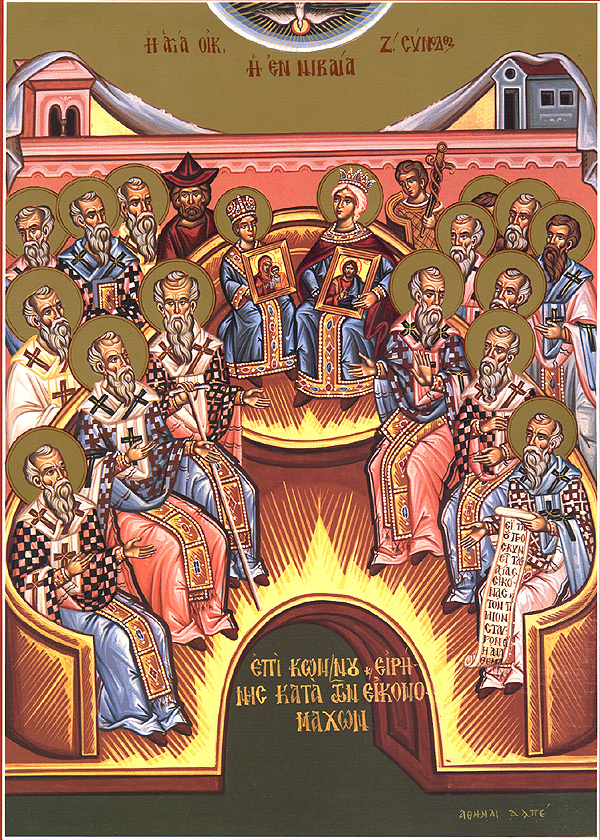


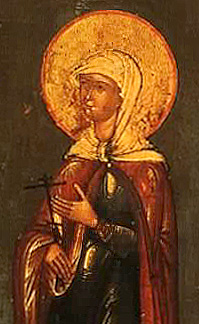
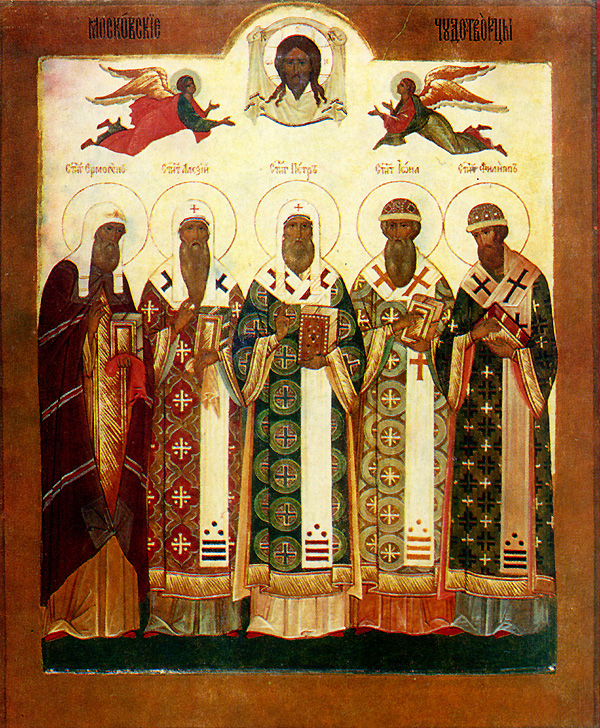


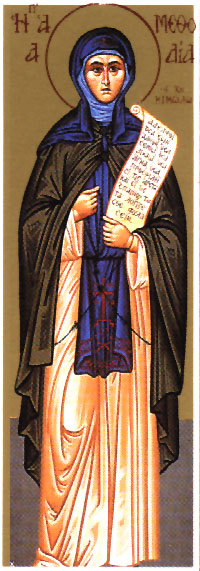


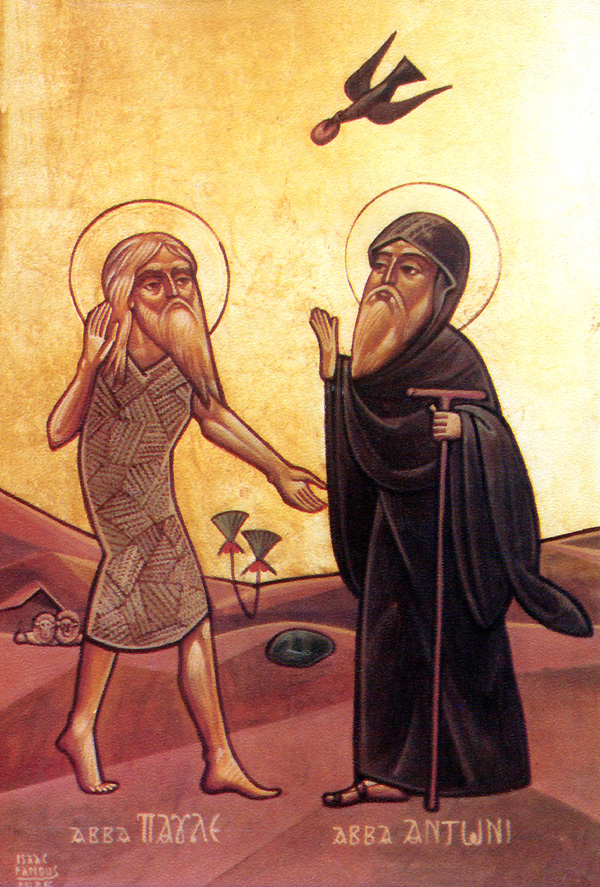


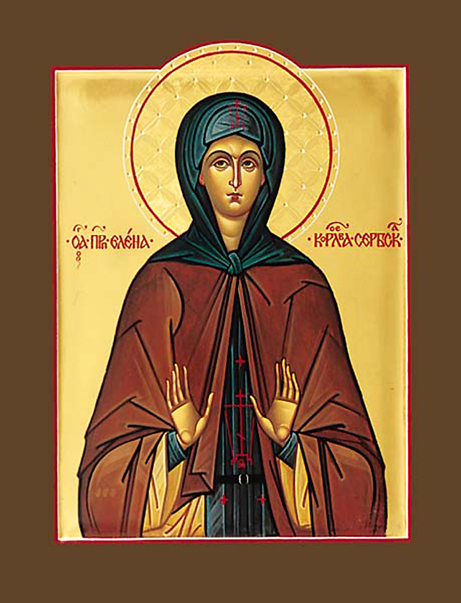


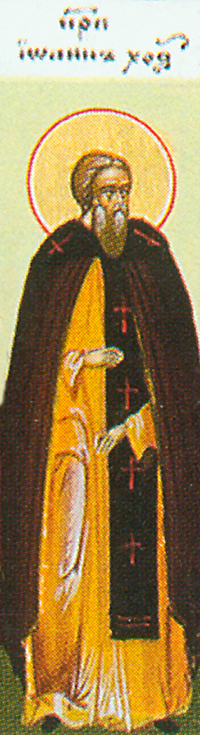


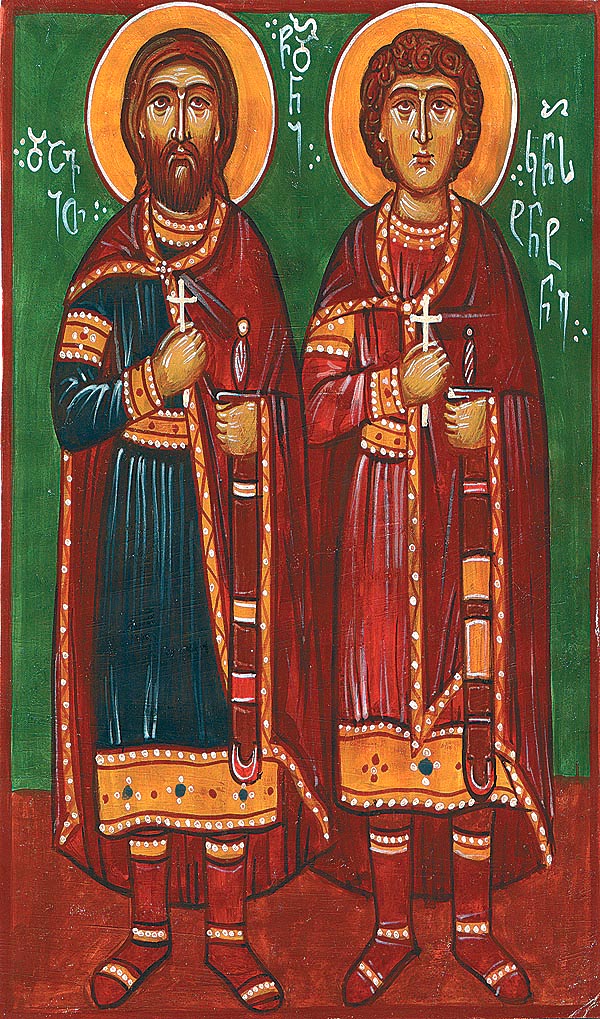

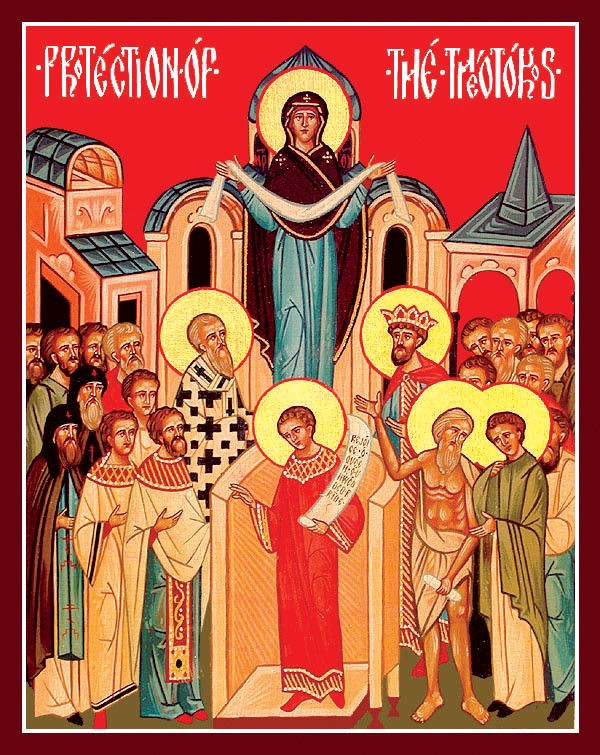


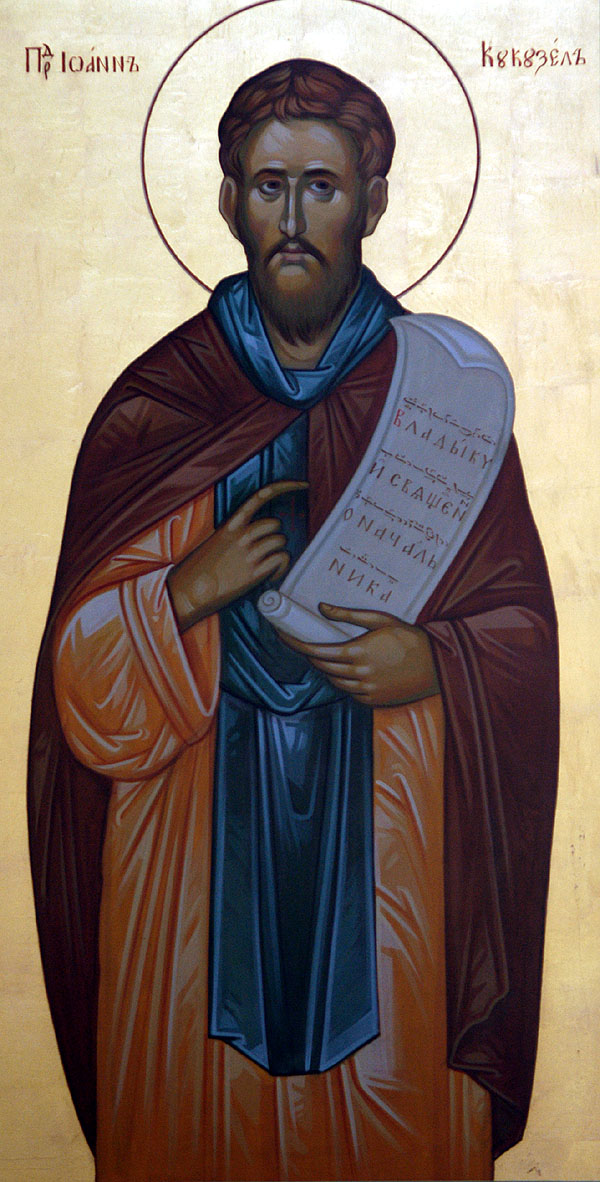


 Saint Peter Antiochian Orthodox Church