
6TH SUNDAY OF LUKE
NO FAST
6th Sunday of Luke, Artemius the Great Martyr of Antioch, Matrona the Righteous of Chios, Gerasimus of Cephalonia, Andronicus the Righteous Martyr
ST. PAUL’S SECOND LETTER TO THE CORINTHIANS 6:16-18; 7:1
Brethren, you are the temple of the living God; as God said, "I will live in them and move among them, and I will be their God, and they shall be my people. Therefore come out from them, and be separate from them, says the Lord, and touch nothing unclean; then I will welcome you, and I will be a father to you, and you shall be my sons and daughters, says the Lord Almighty.
Since we have these promises, beloved, let us cleanse ourselves from every defilement of body and spirit, and make holiness perfect in the fear of God.
LUKE 8:26-39
At that time, as Jesus arrived at the country of the Gadarenes, there met him a man from the city who had demons; for a long time he had worn no clothes and he lived not in a house but among the tombs. When he saw Jesus, he cried out and fell down before him, and said with a loud voice, "What have you to do with me, Jesus, Son of the Most High God? I beseech you, do not torment me." For he had commanded the unclean spirit to come out of the man. (For many a time it had seized him; he was kept under guard, and bound with chains and fetters, but he broke the bonds and was driven by the demon into the desert.) Jesus then asked him, "What is your name?" And he said, "Legion" for many demons had entered him. And they begged him not to command them to depart into the abyss. Now a large herd of swine was feeding there on the hillside; and they begged him to let them enter these. So he gave them leave. Then the demons came out of the man and entered the swine, and the herd rushed down the steep bank into the lake and were drowned. When the herdsmen saw what happened, they fled, and told it in the city and in the country. Then people went out to see what had happened, and they came to Jesus, and found the man from whom the demons had gone, sitting at the feet of Jesus, clothed and in his right mind; and they were afraid. And those who had seen it told them how he who had been possessed with demons was healed. Then all the people of the surrounding country of the Gadarenes asked him to depart from them; for they were seized with great fear; so he got into the boat and returned. The man from whom the demons had gone begged that he might be with him; but he sent him away, saying, "Return to your home, and declare how much God has done for you." And he went away, proclaiming throughout the whole city how much Jesus had done for him.
Greatmartyr Artemius at Antioch
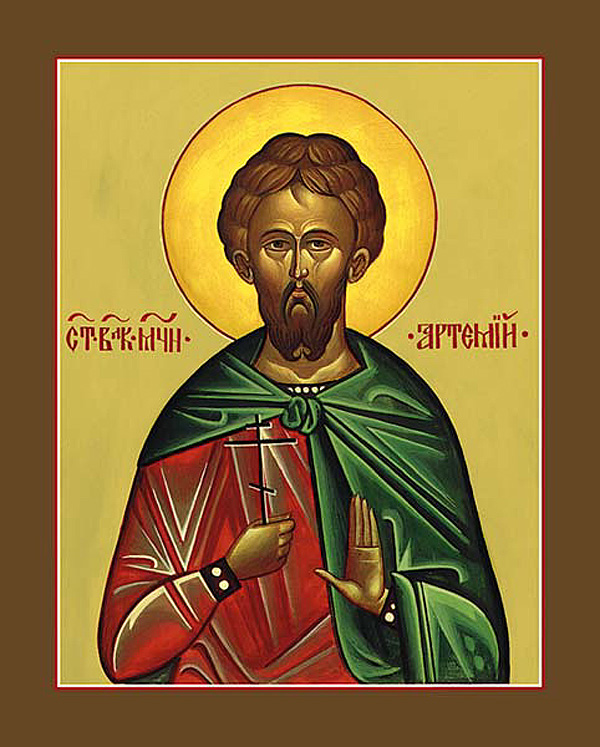
Holy Great Martyr Artemius of Antioch was a prominent military leader during the reigns of the emperor Constantine the Great (May 21), and his son and successor Constantius (337-361). Artemius received many awards for distinguished service and courage. He was appointed viceroy of Egypt. In this official position he did much for the spreading and strengthening Christianity in Egypt.
Saint Artemius was sent by the emperor Constantius to bring the relics of the holy Apostle Andrew from Patras, and the relics of the holy Apostle Luke from Thebes of Boeotia, to Constantinople. The holy relics were placed in the Church of the Holy Apostles beneath the table of oblation. The emperor rewarded him by making him ruler of Egypt.
The emperor Constantius was succeeded on the throne by Julian the Apostate (361-363). Julian in his desire to restore paganism was extremely antagonistic towards Christians, sending hundreds to their death. At Antioch he ordered the torture of two bishops unwilling to forsake the Christian Faith.
During this time, Saint Artemius arrived in Antioch and publicly denounced Julian for his impiety. The enraged Julian subjected the saint to terrible tortures and threw the Great Martyr Artemius into prison. While Artemius was praying, Christ, surrounded by angels, appeared to him and said, “Take courage, Artemius! I am with you and will preserve you from every hurt which is inflicted upon you, and I already have prepared your crown of glory. Since you have confessed Me before the people on earth, so shall I confess you before My Heavenly Father. Therefore, take courage and rejoice, you shall be with Me in My Kingdom.” Hearing this, Artemius rejoiced and offered up glory and thanksgiving to Him.
On the following day, Julian demanded that Saint Artemius honor the pagan gods. Meeting with steadfast refusal, the emperor resorted to further tortures. The saint endured all without a single moan. The saint told Julian that he would be justly recompensed for his persecution of Christians. Julian became furious and resorted to even more savage tortures, but they did not break the will of the saint. Finally the Great Martyr Artemius was beheaded.
His relics were buried by Christians. After the death of Saint Artemius, his prophecy about Julian the Apostate’s impending death came true.
Julian left Antioch for a war with the Persians. Near the Persian city of Ctesiphon, Julian came upon an elderly Persian, who agreed to betray his countrymen and guide Julian’s army. The old man deceived Julian and led his army into the Karmanite wilderness, where there was neither food nor water. Tired from hunger and thirst, Julian’s army battled against fresh Persian forces.
Divine retribution caught up with Julian the Apostate. During the battle he was mortally wounded by an unseen hand and an unseen weapon. Julian groaned deeply said, “You have conquered, Galilean!” After the death of the apostate emperor, the relics of the Great Martyr Artemius were transferred with honor from Antioch to Constantinople.
Saint Artemius is invoked by those suffering from hernias.
Righteous Child Artemius of Verkola

Holy Righteous Artemius of Verkola was born in the village of Dvina Verkhol around the year 1532. The son of pious parents, Artemius was a child who was courageous, meek and diligent for every good deed. On June 23, 1545 the twelve-year-old Artemius and his father were taken by surprise in a field by a thunderstorm. A clap of thunder broke right over their heads, and the child Artemius fell dead. People thought that this was a sign of God’s judgment, therefore they left the body in a pine forest without a funeral, and without burial.
Some years later, the village reader beheld a light over the place where the incorrupt body of the Righteous Artemius lay. Taken to the church of Saint Nicholas in 1577, the holy relics were shown to be a source of numerous healings. In this village a monastery was later built, called the Verkhol. In 1918, the impious Soviets chopped the holy relics into pieces and threw them into a well. The memory of Saint Artemius is also celebrated on October 20.
Venerable Gerasimus the New Ascetic of Cephalonia

Saint Gerasimus the New Ascetic of Cephalonia was born in the village of Trikkala in the Peloponessos. As a young adult, he became a monk on the island of Zakynthos. On the Holy Mountain he became a schemamonk and studied with the ascetics of Mt Athos. Receiving a blessing from the Elders, the monk went to Jerusalem to worship at the Life-bearing Tomb of the Savior. After visiting many holy places in Jerusalem, Mount Sinai, Antioch, Damascus, Alexandria and Egypt, he returned to Jerusalem where he became a lamp-lighter at the Sepulchre of the Lord.
The monk was ordained a deacon and then a priest by the Patriarch of Jerusalem, Germanus (1534-1579). Saint Gerasimus maintained the discipline of an ascetic. For solitude he withdrew to the Jordan, where he spent forty days without respite. Having received the Patriarch’s blessing for a life of silence, Saint Gerasimus withdrew to Zakynthos in solitude, eating only vegetation.
After five years he was inspired to go the island of Cephalonia, where he lived in a cave. He restored a church at Omala, and he founded a women’s monastery where he lived in constant toil and vigil for thirty years. He prayed on bent knees stretched out on the ground. For his exalted life he was granted a miraculous gift: the ability to heal the sick and cast out unclean spirits.
At 71 years of age, the venerable Gerasimus knew that he would soon die. He gave his blessing to the nuns and peacefully fell asleep in the Lord on August 15, 1579. Two years later, his grave was opened and his holy relics were found fragrant and incorrupt with a healing power.
Since the Feast of the Dormition falls on August 15, Saint Gerasimus is commemorated on August 16th. Today’s Feast celebrates the uncovering of his holy relics in 1581.
Venerable Matrona of Chios
Saint Matrona was born in the village of Volissos on Chios of wealthy and pious parents, Leon and Anna sometime in the fourteenth century. From her youth she showed an inclination for monasticism. One day she left her parents and went to live in an unpopulated area, where she founded a small monastery for women. Soon other nuns joined her in her ascetical struggles.
Saint Matrona worked many miracles both during her life and after her death, and was revered throughout Chios for her virtuous life and holiness. She showed charity to the poor, and was able to heal the sick.
The service to Saint Matrona was composed by Metropolitan Nikḗtas of Rhodes. It was found in a codex from 1455, which would indicate that she died sometime before this date.
Saint Matrona is also commemorated on July 15 (the finding of her head).
Icon of the Mother of God of Filersk

No information available at this time.
The Uncovering of the Relics of the Hieromartyr Νikόdēmos, Bishop of Belgorod
In Belogorod, an event of great spiritual significance occurred: the recovery of the relics of the Hieromartyr Νikόdēmos of Belgorod. Now, in the Cathedral of the Transfiguration of the Savior at Belgorod, the relics of two Belgorod Saints are buried. The shrine of Saint Joasaph of Belgorod (December 10) is under a canopy on the south side of the altar, and on the north side is a wooden chest with the newly-discovered relics of Bishop Νikόdēmos. His incorrupt relics were recovered from his burial place on October 20/November 2, 2012.
During the first week of Lent there were solemn services in the Transfiguration Cathedral, which were led by Metropolitan John of Belgorod and Stary Oskol. While the Magnification was being sung for the Hieromartyr Νikόdēmos, his revered relics were taken from the altar and placed on the kathedra, after which Vladyka knelt and read prayers before them. He also read the resolution of His Holiness Patriarch Kirill of Moscow and All Russia: “At the anniversary Bishops' Council in 2000 Bishop Νikόdēmos (Kononov) of Belgorod was numbered among the Holy New Martyrs and Confessors of the Russian Orthodox Church."
After identifying the remains, Patriarch Kirill determined: “Having recognized these remains as the relics of the Holy Martyr Νikόdēmos (Kononov), Bishop of Belgorod, let the Uncovering of the relics of the Holy Martyr Νikόdēmos be included in the Menaion of the Russian Orthodox Church.”
When the crypt was opened, the Hierarch's episcopal vestments were intact, but his miter and the Gospel were missing.
Saint Νikόdēmos is also commemorated on December 28.
 Saint Peter Antiochian Orthodox Church