

Monthly Archives: September 2024
Orthros and Divine Liturgy for the Procession of the Holy Cross – Sat. Sept. 14, 2024
Here is the live stream for Orthros and Divine Liturgy for the Procession of the Holy Cross – Sat. Sept. 14, 2024 If you need, here are instructions for accessing this content from your phone, tablet, computer, or TV.
Homily for Sunday, September 08, 2024
Homily for Sunday, September 01, 2024
Homily for Sunday, August 25, 2024
Daily Readings for Saturday, September 14, 2024
THE ELEVATION OF THE VENERABLE AND LIFE-GIVING CROSS
ABSTAIN FROM MEAT, FISH, DAIRY, EGGS
The Elevation of the Venerable and Life-Giving Cross, Commemoration of the 6th Ecumenical Council
ST. PAUL’S FIRST LETTER TO THE CORINTHIANS 1:18-24
Brethren, the word of the cross is folly to those who are perishing, but to us who are being saved it is the power of God. For it is written, “I will destroy the wisdom of the wise, and the cleverness of the clever I will thwart.” Where is the wise man? Where is the scribe? Where is the debater of this age? Has not God made foolish the wisdom of the world? For since, in the wisdom of God, the world did not know God through wisdom, it pleased God through the folly of what we preach to save those who believe. For Jews demand signs and Greeks seek wisdom, but we preach Christ crucified, a stumbling block to Jews and folly to Gentiles, but to those who are called, both Jews and Greeks, Christ the power of God and the wisdom of God.
JOHN 19:6-11, 13-20, 25-28, 30
At that time, when the chief priests and the officers saw him, they cried out, "Crucify him, crucify him!" Pilate said to them, "Take him yourselves and crucify him, for I find no crime in him." The Jews answered him, "We have a law, and by that law he ought to die, because he has made himself the Son of God.
When Pilate heard these words, he was the more afraid; he entered the praetorium again and said to Jesus, "Where are you from?" But Jesus gave no answer. Pilate therefore said to him, "You will not speak to me? Do you not know that I have power to release you, and power to crucify you?" Jesus answered him, "You would have no power over me unless it had been given you from above; therefore he who delivered me to you has the greater sin." When Pilate heard these words, he brought Jesus out and sat down on the judgment seat at a place called the Pavement, and in Hebrew, Gabbatha. Now it was the day of Preparation of the Passover; it was about the sixth hour. He said to the Jews, "Behold your King!" They cried out, "Away with him, away with him, crucify him!" Pilate said to them, "Shall I crucify your King?" The chief priests answered, "We have no king but Caesar." Then he handed him over to them to be crucified. So they took Jesus, and he went out, bearing his own cross, to the place called the place of a skull, which is called in Hebrew Golgotha. There they crucified him, and with him two others, one on either side, and Jesus between them. Pilate also wrote a title and put it on the cross; it read, "Jesus of Nazareth, the King of the Jews." Many of the Jews read this title, for the place where Jesus was crucified was near the city; and it was written in Hebrew, in Latin, and in Greek.
But standing by the cross of Jesus were his mother, and his mother's sister, Mary the wife of Clopas, and Mary Magdalene. When Jesus saw his mother, and the disciple whom he loved standing near, he said to his mother, "Woman, behold your son!" Then he said to the disciple, "Behold your mother!" And from that hour the disciple took her to his own home. Then when Jesus had received the vinegar, he said, "It is finished" and he bowed his head and gave up his spirit.
The Universal Exaltation of the Precious and Life-Giving Cross

The pagan Roman Emperors tried to obliterate the holy places where our Lord Jesus Christ suffered and rose from the dead, so that they would be forgotten. Emperor Hadrian (117-138) ordered that Golgotha and the Lord's Sepulchre be buried, and that a temple in honor of the pagan "goddess" Venus and a statue of Jupiter be placed there.
Pagans gathered at this place and offered sacrifice to idols. Eventually after 300 years, by Divine Providence, the Christian holy places, the Sepulchre of the Lord, and the Life-giving Cross, were discovered and opened for veneration. This took place under Emperor Constantine the Great (306-337) after his victory over Maxentius (in 312), who ruled the Western part of the Roman Empire, and over Licinius, the ruler of its Eastern part. In the year 323 Constantine became the sole ruler of the vast Roman Empire.
In 313 Saint Constantine issued the Edict of Milan, by which Christianity was legalized and persecutions against Christians in the Western half of the Empire were stopped. Although Licinius had signed the Edict of Milan in order to oblige Constantine, he continued his cruel persecutions against Christians. Only after his conclusive defeat did the Edict of Milan extend also to the Eastern part of the Empire. The Holy Equal of the Apostles Emperor Constantine, triumphing over his enemies in three wars, with God’s assistance, had seen the Sign of the Cross in the heavens. Written beneath were the words: “By this you shall conquer.”
Ardently desiring to find the Cross upon which our Lord Jesus Christ was crucified, Saint Constantine sent his mother, the pious Empress Helen (May 21), to Jerusalem, providing her with a letter to Saint Makarios, the Patriarch of Jerusalem. Saint Helen journeyed to the holy places connected with the earthly life of the Savior, building more than 80 churches, at Bethlehem the birthplace of Christ, and on the Mount of Olives where the Lord ascended to Heaven, and at Gethsemane where the Savior prayed before His sufferings, and where the Mother of God was buried after her Dormition.
Although the holy Empress Helen was no longer young, she set about completing the task with enthusiasm. In her search for the Life-giving Cross, she questioned both Christians and Jews, but for a long time her search remained unsuccessful. Finally, she was directed to a certain elderly Jew named Jude who stated that the Cross was buried beneath the temple of Venus. They demolished the pagan temple and, after praying, they began to excavate the ground. Soon the Lord's Tomb was uncovered. Not far from it were three crosses, and a board with the inscription ordered by Pilate, and four nails which had pierced the Lord’s Body (March 6).
In order to discover on which of the three crosses the Savior had been crucified, Patriarch Makarios alternately touched the crosses to a corpse. When the Cross of the Lord touched the dead man, he was restored to life. After witnessing the raising of the dead man, everyone was convinced that the Life-giving Cross had been found.
Christians came in a huge crowds to venerate the Holy Cross, beseeching Saint Makarios to lift the Cross, so that those far off could see it. Then the Patriarch and other spiritual leaders lifted the Holy Cross, and the people prostrated themselves before the Honorable Wood, saying “Lord have mercy." This solemn event occurred in the year 326.
During the discovery of the Life-giving Cross another miracle took place: a woman who was close to death was healed by the shadow of the Holy Cross. The elderly Jude (October 28) and other Jews believed in Christ and were baptized. Jude was given the name Kyriakos, and later he was consecrated as the Bishop of Jerusalem. He suffered a martyr’s death for Christ during the reign of Emperor Julian the Apostate (361-363).
Saint Helen took part of the Life-giving Wood and nails with her to Constantinople. Saint Constantine ordered a majestic and spacious church to built at Jerusalem in honor of the Resurrection of Christ, also including under its roof the Life-giving Tomb of the Lord and Golgotha. The church was built in ten years. Saint Helen did not survive until the dedication of the church, she reposed in the year 327. The church was consecrated on September 13, 335. On the following day, September 14, the festal celebration of the Exaltation of the Honorable and Life-giving Cross was established.
Another event connected to the Cross of the Lord is remembered also on this day: its return to Jerusalem from Persia after a fourteen year captivity. During the reign of the Byzantine Emperor Phokas (602-610) the Persian king Khozróēs II attacked Constantinople defeated the Greek army, plundered Jerusalem, capturing both the Life-giving Cross of the Lord and the Holy Patriarch Zachariah (609-633).
The Cross remained in Persia for fourteen years, and only under Emperor Herakleios (610-641), who defeated Khozróēs and concluded peace with his successor and son Syroes, was the Lord's Cross returned to the Christians.
With great solemnity the Life-giving Cross was transferred to Jerusalem. Emperor Herakleios, wearing a crown and his royal purple garments carried the Cross of Christ. The Emperor was accompanied by Patriarch Zachariah. At the gates by which they ascended Golgotha, the Emperor stopped suddenly and was unable to proceed. The holy Patriarch explained to the Emperor that an Angel of the Lord was blocking his way. Herakleios was told to remove his royal trappings and to walk barefoot, since He Who bore the Cross for the salvation of the world had made His way to Golgotha in all humility. Then Herakleios donned plain clothes, and without further hindrance, carried the Cross of Christ into the church.
In a sermon on the Exaltation of the Cross, Saint Andrew of Crete (July 4) says: “The Cross is exalted, and everything true is gathered together, the Cross is exalted, and the city makes solemn, and the people celebrate the feast."
Repose of Saint John Chrysostom, Archbishop of Constantinople

Saint John Chrysostom died on September 14, 407, but because of the feast of the Exaltation of the Life-Creating Cross of the Lord, the commemoration of the saint was transferred to November 13. On January 27 we commemorate the transfer of the holy relics of Saint John Chrysostom from Comana to Constantinople, and on January 30, the Synaxis of the Three Hierarchs.
Monastic Martyr Macarius of Dionysiou, Mount Athos
No information available at this time.
Monastic Martyr Joseph of Dionysiou, Mount Athos
Saint Joseph was a monk of Dionysiou Monastery on Mt. Athos, where he shone forth with the virtues of monastic life. He was an iconographer, and he painted the icon of the holy Archangels on the iconostasis of Dionysiou’s main church.
In obedience to the instructions of Igumen Stephen, Saint Joseph traveled to Constantinople with Eudocimus, who had apostasized from Orthodoxy to become a Moslem. Eudocimus repented, and wished to wipe out his sin through martyrdom.
When faced with torture and death, however, the unfortunate Eudocimus denied Christ again, blaming Joseph for turning him from Islam.
Saint Joseph was arrested and threatened with death. In spite of many tortures, he refused to convert to Islam. This holy martyr of Christ was hanged on February 17, 1819, and so he obtained an incorruptible crown of glory.
Some sources list his commemoration on February 17, while others list him on September 14 or October 26.
Icon of the Mother of God of Lesna

The Lesna Icon of the Mother of God appeared on the Feast of the Universal Exaltation of the Cross in the year 1683 and was found by Alexander Stelmashuk, a shepherd, who had gone into the woods in order to escape the heat. There he saw a small Icon in the branches of a pear tree, emitting a bright radiance. He fell to his knees in reverence, but then he was so overcome with fear that he ran to tell a friend about his discovery. The two shepherds went to the village priest, who went back with them to remove the Icon from the tree. They brought it to an Orthodox church in the village of Bukovich, not far from the town of Lesna.
When news of the Icon's miraculous appearance circulated throughout the surrounding area, Roman Catholic priests decided to use the Icon to convert the Orthodox to Catholicism. In 1686, when they met with opposition from the Orthodox faithful, they removed the Icon by force in 1686 and placed it in the Roman Catholic church at Lesna.
At the beginning of the eighteenth century, Catholic monks founded a large Roman church and monastery at Lesna, where the wonderworking Icon was. In 1863, the monks took part in the Polish revolt, and, by a decree of the Russian government, the Icon was returned to the Orthodox Church. The monastery was closed and turned into an Orthodox women’s monastery in 1885. A new iconostasis was built, but it was only two rows high so that people could see the Lesna Icon hanging in the High Place.
The Icon has worked many miracles, healing the sick, dispelling melancholy, and alleviating every sort of misfortune.
The Lesna Icon of the Mother of God is also commemorated on September 8 and on the Day of the Holy Trinity (Pentecost).
Repose of Saint Anthimus, Bishop of Georgia

Saint Anthimus of Iberia was one of the most highly educated people of his time. He was fluent in many languages, including Greek, Romanian, Old Slavonic, Arabic, and Turkish and well-versed in theology, literature, and the natural sciences. He was unusually gifted in the fine arts—in painting, engraving, and sculpture in particular. He was famed for his beautiful calligraphy. Finally, Saint Anthimus was a great writer, a renowned orator, and a reformer of the written Romanian language.
Little is known about the youth of Saint Anthimus. He was a native of the Samtskhe region in southern Georgia. His parents, John and Mariam, gave him the name Andria at Baptism. He accompanied King Archil to Russia and helped him to found a Georgian print shop there, but after he returned he was captured by Dagestani robbers and sold into slavery. Through the efforts of Patriarch Dositheus of Jerusalem, Anthimus was finally set free, but he remained in the patriarch’s service in order to further his spiritual education.
Already famed for his paintings, engravings, and calligraphy, Anthimus was asked by Prince Constantine Brincoveanu (1688-1714) of Wallachia (present-day Romania) to travel to his kingdom around the year 1691. After he had arrived in Wallachia, he began to manage a local print shop. The printing industry in that country advanced tremendously at that time, and the chief inspiration and driving force behind the great advances was the Georgian master Anthimus. He succeeded in making Wallachia a center of Christianity and a major publisher of books for all the East.
In 1694 Anthimus was enthroned as abbot of Snagov Monastery (in present-day Romania), where he soon founded a print shop. In the same year his new print shop published Guidelines for the Divine Services on May 21, All Saints’ Day. The book was signed by Subdeacon Michael Ishtvanovich, future founder of the first Georgian print shop.
In 1705 Anthimus, “the chosen among chosen abbots of Wallachia,” was consecrated bishop of Rimnicu Vilcea, and in 1708 he was appointed metropolitan of Hungro-Wallachia. The whole country celebrated his elevation. As one abbot proclaimed: “The divine Anthimus, a great man and son of the wise Iberian nation, has come to Wallachia and enlightened our land. God has granted him an inexhaustible source of wisdom, entrusted him to accomplish great endeavors, and helped to advance our nation by establishing for us a great printing industry.”
Under the direct leadership of Saint Anthimus, more than twenty churches and monasteries were erected in Wallachia. Of particular significance is All Saints’ Monastery, located in the center of Bucharest. The main gates of this monastery were made of oak and carved with traditional Georgian motifs by Saint Anthimus himself. The metropolitan also established rules for the monastery and declared its independence from the Church of Constantinople.
From the day of his consecration, Metropolitan Anthimus fought tirelessly for the liberation of Wallachia from foreign oppressors. On the day he was ordained he addressed his flock: “You have defended the Christian Faith in purity and without fault. Nevertheless, you are surrounded and tightly bound by the violence of other nations. You endure countless deprivations and tribulations from those who dominate this world…. Though I am unworthy and am indeed younger than many of you—like David, I am the youngest among my brothers— the Lord God has anointed me to be your shepherd. Thus I will share in your future trials and griefs and partake in the lot that God has appointed for you.”
His words were prophetic: In 1714 the Turks executed the Wallachian prince Constantine Brincoveanu, and in 1716 they executed Stefan Cantacuzino (1714-1716), the last prince of Wallachia.
In his place they appointed Nicholas Mavrokordatos, a Phanariote (a member of one of the principal Greek families of the Phanar, the Greek quarter of Constantinople, who, as administrators in the civil bureaucracy, exercised great influence in the Ottoman Empire after the Turkish conquest) who concerned himself only with the interests of the Ottoman Empire.
During this difficult time, Anthimus of Iberia gathered around him a group of loyal boyar patriots determined to liberate their country from Turkish and Phanariote domination. But Nicholas Mavrokordatos became suspicious, and he ordered Anthimus to resign as metropolitan. When Anthimus failed to do so, he filed a complaint with Patriarch Jeremiah of Constantinople.
Then a council of bishops, which did not include a single Romanian clergyman, condemned the “conspirator and instigator of revolutionary activity” to anathema and excommunication and declared him unworthy to be called a monk. But Nicholas Mavrokordatos was still unsatisfied and claimed that to deny Anthimus the title of Metropolitan of Hungro-Wallachia was insufficient punishment. He ordered Anthimus to be exiled far from Wallachia, to Saint Catherine’s Monastery on Mt. Sinai. Metropolitan Anthimus, beloved of the Romanian people, was escorted out of the city at night since the conspirators feared the reaction of the people.
But Metropolitan Anthimus never reached Mt. Sinai. On September 14, 1716, a band of Turkish soldiers stabbed Saint Anthimus to death on the bank of the Tundzha (Tunca) River where it flows through Adrianople, not far from Gallipoli, and cast his butchered remains into the river.
Thus ended the earthly life of one more Georgian saint—a man who had dedicated all of his strength, talent, and knowledge to the revival of Christian culture and the strengthening of the Wallachian people in the Orthodox Faith.
In 1992 the Romanian Church canonized Anthimus of Iberia and proclaimed his commemoration day to be September 14, the day of his repose. The Georgian Church commemorates him on June 13.
Daily Readings for Friday, September 13, 2024
FOREFEAST OF THE ELEVATION OF THE HOLY CROSS
ABSTAIN FROM MEAT, FISH, DAIRY, EGGS
Forefeast of the Elevation of the Holy Cross, The Consecration of the Church of the Holy Resurrection (Holy Sepulchre), Cornelius the Centurion & Martyr, Aristides the Philosopher, Hierotheos the Righteous of Iveron Monastery, Mount Athos
ST. PAUL’S LETTER TO THE HEBREWS 3:1-4
Holy brethren, who share in a heavenly call, consider Jesus, the apostle and high priest of our confession. He was faithful to him who appointed him, just as Moses also was faithful in all God’s house. Yet Jesus has been counted worthy of as much more glory than Moses as the builder of a house has more honor than the house. (For every house is built by some one, but the builder of all things is God.)
MATTHEW 16:13-19
At that time, when Jesus came into the district of Caesarea Philippi, he asked his disciples, “Who do men say that the Son of man is?” And they said, “Some say John the Baptist, others say Elijah, and others Jeremiah or one of the prophets.” He said to them, “But who do you say that I am?” Simon Peter replied, “You are the Christ, the Son of the living God.” And Jesus answered him, “Blessed are you, Simon Bar Jona! For flesh and blood has not revealed this to you, but my Father who is in heaven. And I tell you, you are Peter, and on this rock I will build my church, and the gates of Hades shall not prevail against it. I will give you the keys of the kingdom of heaven, and whatever you bind on earth shall be bound in heaven, and whatever you loose on earth shall be loosed in heaven.”
Forefeast of the Elevation of the Cross

The Forefeast of the Universal Exaltation of the Precious and Life-giving Cross is celebrated for only one day (September 13) and there are seven days of Afterfeast (September 15-21). The Leavetaking of the Feast falls on September 21.
The Feast of the Exaltation of the Cross is preceded by the Saturday and Sunday before the Exaltation, and it is followed by the Sunday after the Exaltation.
Today we also commemorate the Consecration of the church of the Resurrection at Jerusalem.
Saint Constantine the Great (May 21) built the church of the Resurrection on Golgotha. On September 13, 335, the Fathers of the Council of Tyre consecrated it and, at that time, ordained the annual commemoration of its consecration.
Commemoration of the Founding of the Church of the Resurrection (Holy Sepulchre) at Jerusalem

The Dedication of the Temple of the Resurrection of Christ at Jerusalem celebrates the dedication of the Church of the Resurrection, built by Saint Constantine the Great and his mother, the empress Helen.
After the voluntary Passion and Death on the Cross of our Lord and Savior Jesus Christ, the holy place of His suffering was long trampled on by pagans. When the Roman emperor Titus conquered Jerusalem in the year 70, he razed the city and destroyed the Temple of Solomon on Mount Moriah, leaving there not a stone upon a stone, as even the Savior foretold (Mt.13:1-2).
Later on the zealous pagan emperor Hadrian (117-138) built on the site of the Jerusalem destroyed by Titus a new city named Aelia Capitolina for him (Hadrian Aelius). It was forbidden to call the city by its former name.
He gave orders to cover the Holy Tomb of the Lord with earth and stones, and on that spot to set up an idol. On Golgotha, where the Savior was crucified, he constructed a pagan temple dedicated to the goddess Venus in 119. Before the statues they offered sacrifice to demons and performed pagan rites, accompanied by wanton acts.
In Bethlehem, at the place the Savior was born of the All-Pure Virgin, the impious emperor set up an idol of Adonis. He did all this intentionally, so that people would forget completely about Christ the Savior and that they would no loner remember the places where He lived, taught, suffered and arose in glory.
At the beinning of the reign of Saint Constantine the Great (306-337), the first of the Roman emperors to recognize the Christian religion, he and his pious mother the empress Helen decided to rebuild the city of Jerusalem. They also planned to build a church on the site of the Lord’s suffering and Resurrection, in order to reconsecrate and purify the places connected with memory of the Savior from the taint of foul pagan cults.
The empress Helen journeyed to Jerusalem with a large quantity of gold, and Saint Constantine the Great wrote a letter to Patriarch Macarius I (313-323), requesting him to assist her in every possible way with her task of the renewing the Christian holy places.
After her arrival in Jerusalem, the holy empress Helen destroyed all the pagan temples and reconsecrated the places desecrated by the pagans. She was zealous to find the Cross of our Lord Jesus Christ, and she ordered the excavation of the place where the temple of Venus stood. There they discovered the Sepulchre of the Lord and Golgotha, and they also found three crosses and some nails.
In order to determine upon which of the three crosses the Savior was crucified, Patriarch Macarius gave orders to place a dead person, who was being carried to a place of burial, upon each cross in turn. When the dead person was placed on the Cross of Christ, he immediately came alive. With the greatest of joy the empress Helen and Patriarch Macarius raised up the Life-Creating Cross and displayed it to all the people standing about.
The holy empress quickly began the construction of a large church which enclosed within its walls Golgotha, the place of the Crucifixion of the Savior, and the Sepulchre of the Lord, located near each other. The holy Apostle and Evangelist John wrote about this: "Now in the place where He was crucified, there was a garden, and in the garden a new tomb, in which no one had yet been laid. Therefore they laid Jesus there because of the Jewish preparation day, for the tomb was nearby" (John 19:41-42). The Church of the Resurrection was ten years in building, and the holy empress Helen did not survive to see its completion. She returned to Constantinople, and reposed in the year 327. After her arrival in Jerusalem, the holy empress built churches in Bethlehem, on the Mount of Olives, at Gethsemane and in many other places connected with the life of the Savior and events in the New Testament.
The construction of the church of the Resurrection, called "Martyrion" in memory of the sufferings of the Savior, was completed in the same year as the Council of Tyre, and in the thirtieth year of the reign of Saint Constantine the Great. Therefore, at the assembly of September 13, 335, the consecration of the temple was particularly solemn. Hierarchs of Christian Churches in many lands: Bythnia, Thrace, Cilicia, Cappadocia, Syria, Mesopotamia, Phoenicia, Arabia, Palestine, and Egypt, participated in the consecration of the church. The bishops who participated in the Council of Tyre, and many others, went to the consecration in Jerusalem. On this day all the city of Jerusalem was consecrated. The Fathers of the Church established September 13 as the commemoration of this remarkable event.
Hieromartyr Cornelius the Centurion

Soon after the sufferings of the Lord Jesus Christ on the Cross and His Ascension into Heaven, a centurion by the name of Cornelius settled at Caesarea in Palestine. He had lived previously in Thracian Italy. Although he was a pagan, he distinguished himself by deep piety and good deeds, as the holy Evangelist Luke says (Acts 10:1). The Lord did not disdain his virtuous life, and so led him to the knowledge of truth and to faith in Christ.
Once, Cornelius was praying in his home. An angel of God appeared to him and said that his prayer had been heard and accepted by God. The angel commanded him to send people to Joppa to find Simon, also called Peter. Cornelius immediately fulfilled the command.
While those people were on their way to Joppa, the Apostle Peter was at prayer, and he had a vision: three times a great sheet was lowered down to him, filled with all kinds of beasts and fowl. He heard a voice from Heaven commanding him to eat everything. When the apostle refused to eat food which Jewish Law regarded as unclean, the voice said: “What God hath cleansed, you must not call common” (Acts 10:15).
Through this vision the Lord commanded the Apostle Peter to preach the Word of God to the pagans. When the Apostle Peter arrived at the house of Cornelius in the company of those sent to meet him, he was received with great joy and respect by the host together with his kinsmen and comrades.
Cornelius fell down at the feet of the apostle and requested to be taught the way of salvation. Saint Peter talked about the earthly life of Jesus Christ, and spoke of the miracles and signs worked by the Savior, and of His teachings about the Kingdom of Heaven. Then Saint Peter told him of the Lord’s death on the Cross, His Resurrection and Ascension into Heaven. By the grace of the Holy Spirit, Cornelius believed in Christ and was baptized with all his family. He was the first pagan to receive Baptism.
He retired from the world and went preaching the Gospel together with the Apostle Peter, who made him a bishop. When the Apostle Peter, together with his helpers Saints Timothy and Cornelius, was in the city of Ephesus, he learned of a particularly vigorous idol-worship in the city of Skepsis. Lots were drawn to see who would go there, and Saint Cornelius was chosen.
In the city lived a prince by the name of Demetrius, learned in the ancient Greek philosophy, hating Christianity and venerating the pagan gods, in particular Apollo and Zeus. Learning about the arrival of Saint Cornelius in the city, he immediately summoned him and asked him the reason for his coming. Saint Cornelius answered that he came to free him from the darkness of ignorance and lead him to knowledge of the True Light.
The prince, not comprehending the meaning of what was said, became angry and demanded that he answer each of his questions. When Saint Cornelius explained that he served the Lord and that the reason for his coming was to announce the Truth, the prince became enraged and demanded that Cornelius offer sacrifice to the idols.
The saint asked to be shown the gods. When he entered the pagan temple, Cornelius turned towards the east and uttered a prayer to the Lord. There was an earthquake, and the temple of Zeus and the idols situated in it were destroyed. All the populace, seeing what had happened, were terrified.
The prince was even more vexed and began to take counsel together with those approaching him, about how to destroy Cornelius. They bound the saint and took him to prison for the night. At this point, one of his servants informed the prince that his wife and child had perished beneath the rubble of the destroyed temple.
After a certain while, one of the pagan priests, by the name of Barbates, reported that he heard the voice of the wife and son somewhere in the ruins and that they were praising the God of the Christians. The pagan priest asked that the imprisoned one be released, in gratitude for the miracle worked by Saint Cornelius, and the wife and son of the prince remained alive.
The joyful prince hastened to the prison in the company of those about him, declaring that he believed in Christ and asking him to bring his wife and son out of the ruins of the temple. Saint Cornelius went to the destroyed temple, and through prayer the suffering were freed.
After this the prince Demetrius, and all his relatives and comrades accepted holy Baptism. Saint Cornelius lived for a long time in this city, converted all the pagan inhabitants to Christ, and made Eunomios a presbyter in service to the Lord. Saint Cornelius died in old age and was buried not far from the pagan temple he destroyed.
Martyr Chronides of Alexandria and those with him

The Holy Martyr Chronides suffered for the Christian Faith in the third century with Saints Stratonicus, Serapion, Leontius and Seleucus. Saints Chronides, Leontius, and Serapion were from Egypt. After fierce torments for their confession of faith in Christ, the holy martyrs were savagely killed. Saints Chronides, Leontius and Serapion were bound hand and foot and cast into the sea. Their bodies were carried to shore by the waves, where Christians gave them burial.
Saint Seleucus both came from and suffered in Galatia, where after many tortures he and his wife were thrown to be eaten by wild beasts.
Saint Stratonicus was from Bithynian Nicomedia. Saint Stratonicus, after being tortured by order of the Bithynan governor, was bound to two bent tree trunks. His body was split in two (See also September 9).
Martyrs Macrobius and Gordian at Tomi in Romania and those with them
Saint Macrobius was from Paphlagonia, and suffered martyrdom with Saints Gordian, Elias, Zoticus, Lucian and Valerian.
Gordian, a native of Cappadocia, served with Macrobian in the imperial court, and they enjoyed the particular favor of the emperor. When he found out that they were Christians, he sent them to Scythia. There they met Zoticus, Lucian and Elias, who were also courageous confessors of Christ. First Saints Gordian and Macrobius suffered. After this Saints Elias, Zoticus, Lucian and Valerian were tortured and then beheaded in the city of Tomis in Scythia (Tomis, Romania). They suffered at Paphlagonia (Asia Minor) at the beginning of the fourth century during the reign of the Roman emperor Licinius (311-324).
Hieromartyr Julian of Galatia
Saint Julian was born at Ancyra, Galatia (in Asia Minor). He was a priest who boldly confessed Christ during the reign of Emperor Licinius (311-324). For this “crime,” he was arrested by the authorities. Since he refused to offer sacrifice to the idols, he was tortured and put to death, thereby receiving an imperishable crown of glory from Christ.
Saint Peter of Atroe
Saint Peter from Atroe was dedicated to God from childhood, and spent his whole life in exploits of fasting and unceasing prayer. He pursued asceticism in the city of Atroe, near Asian Olympos. A distinctive feature of the holy ascetic was his extreme temperance. During his lifetime, the saint worked many miracles and peacefully reposed in the time of Patriarch Tarasius of Constantinople (784-806).
Greatmartyr Ketevan, Queen of Georgia
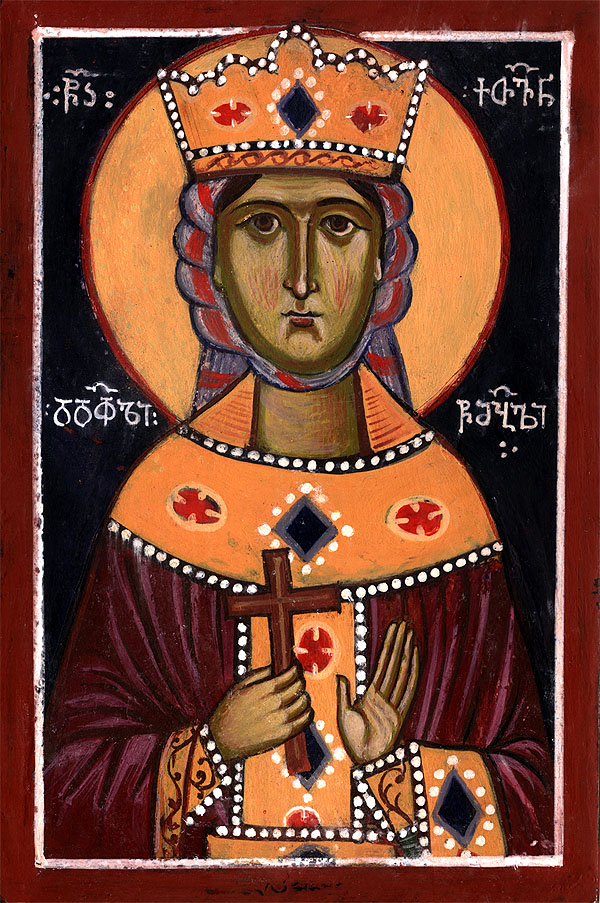
The holy Queen Ketevan was the daughter of Ashotan Mukhran-Batoni, a prominent ruler from the Bagrationi royal family. The clever and pious Ketevan was married to Prince David, heir to the throne of Kakheti. David’s father, King Alexander II (1574-1605), had two other sons, George and Constantine, but according to the law the throne belonged to David. Constantine was converted to Islam and raised in the court of the Persian shah Abbas I.
Several years after David and Ketevan were married, King Alexander stepped down from the throne and was tonsured a monk at Alaverdi. But after four months, in the year 1602, the young king David died suddenly. He was survived by his wife, Ketevan, and two children—a son, Teimuraz, and a daughter, Elene—and his father ascended the throne once more.
Upon hearing of David’s death and Alexander’s return to the royal throne, Shah Abbas commanded Alexander’s youngest son, Constantine-Mirza, to travel to Kakheti, murder his father and the middle brother, George, and seize the throne of Kakheti. As instructed, Constantine-Mirza beheaded his father and brother, then sent their heads, like a precious gift, to Shah Abbas.
Their headless bodies he sent to Alaverdi. (Since the beginning of the 11th century, Alaverdi had been the resting place of the Kakhetian kings.) The widowed Queen Ketevan was left to bury her father-in-law and brother-in-law.
But Constantine-Mirza was still unsatisfied, and he proposed to take Queen Ketevan as his wife.
Outraged at his proposition, the nobles of Kakheti rose up and killed the young man who had committed patricide and profaned his Faith and the throne. Having buried the wicked Constantine-Mirza with the honor befitting his royal ancestry, Ketevan sent generous gifts to Shah Abbas and requested that he proclaim her son, Teimuraz, the rightful heir to the throne.
While she was awaiting his reply, Ketevan assumed personal responsibility for the rule of Kakheti. Concerned that, if he denied this request, Kakheti would forcibly separate from him and unite with Kartli, Shah Abbas hastily sent Prince Teimuraz to Georgia, laden with great wealth.
In 1614 Shah Abbas informed King Teimuraz that his son would be taken hostage, and Teimuraz was forced to send his young son Alexander and his mother Ketevan to Persia. As a final attempt to divide the royal family of Kakheti, Shah Abbas demanded that the eldest prince, Levan, be brought before him, and he finally summoned King Teimuraz himself.
The shah’s intentions were clear: to hold all of the royal family in Persia and send his own viceroys to rule in Kakheti. He sought to eliminate King Luarsab II of Kartli as well, but Teimuraz and Luarsab agreed to attack the Persian army with joint forces and drive the enemy out of Georgia.
Shah Abbas sent his hostages, Queen Ketevan and her grandsons, deep into Persia, while he himself launched an attack on Kakheti.
With fire and the sword the godless ruler plundered all of Georgia. The royal palace was razed, churches and monasteries were destroyed, and entire villages were abandoned. By order of the shah, more than three hundred thousand Georgians were exiled to Persia, and their homes were occupied by Turkic tribes from Central Asia. Hunger and violence reigned over Georgia.
The defeated Georgian kings Teimuraz and Luarsab sought refuge with King George III of Imereti.
After they had spent five years exiled in Shiraz (Persia), the princes Alexander and Levan were separated from Ketevan and castrated in Isfahan. Alexander could not endure the suffering and died, while Levan went mad.
Saint Ketevan, meanwhile, remained a prisoner of the ruler of southeastern Persia, the ethnic Georgian imam Quli-Khan Undiladze, who regarded the widowed Queen of Kakheti with great respect. According to his command, Ketevan was not to discover the fate of her grandsons.
Queen Ketevan spent ten years in prison, praying for her motherland and loved ones with all her might and adhering to a strict ascetic regime. Constant fasting, prayer and a stone bed exhausted her previously pampered body, but in spirit she was courageous and full of vitality. She looked after those assigned to her care and instructed them in the spiritual life.
After some time Abbas resolved to convert Ketevan to Islam, and he announced his intention to marry her. He asked that his proposal be conveyed to her the same day she was informed of the fate of her grandsons. As a condition of their marriage, Abbas insisted that Ketevan renounce the Christian Faith and convert to Islam. In the case of her acquiescence, Imam Quli-Khan was to respect and honor her as a queen, and in the case of her refusal, to subject her to public torture.
The alarmed imam begged the queen to submit to the shah’s will and save herself, but the queen firmly refused and began to prepare for her martyrdom. (According to one foreign observer, her steadfastness delayed the Islamization of the Georgians in Persia: “In the course of a conversation at the court of Shah Abbas, where a young and recently converted Georgian was present, the question arose as to why it was that, while all young Georgians were forced to embrace Islam, their mothers were not. The explanation given by one of those present was that since the Queen would not change her faith Georgian mothers likewise refused.” (Z. Avalishvili, “Teimuraz I and His Poem ‘The Martyrdom of Queen Ketevan,’” Georgica [vol I, no. 4/5, 1937] pp. 22.)
Queen Ketevan was robed in festive attire and led out to a crowded square. Her persecutors subjected her to indescribable torment: they placed a red-hot copper cauldron on her head, tore at her chest with heated tongs, pierced her body with glowing spears, tore off her fingernails, nailed a board to her spine, and finally split her forehead with a red-hot spade.
Saint Ketevan’s soul departed from her body, and the executioners cast her mutilated body to the beasts. But the Lord God sent a miracle: her holy relics were illumined with a radiant light.
A group of French Augustinian missionary fathers, who had witnessed the inhuman tortures, wrapped Queen Ketevan’s body in linens scented with myrrh and incense and buried it in a Catholic monastery.
Some time later the holy relics of Great-martyr Ketevan were delivered to her son, Teimuraz, King of Kakheti.
Teimuraz wept bitterly for his mother and sons and buried the relics with great honor in the Alaverdi Cathedral of Saint George.
Venerable Hierotheus the Younger of Ivḗron, Mount Athos
According to Saint Νikόdēmos of the Holy Mountain, Saint Hierotheos was born in the year 1686 at Kalamata in the Peloponnḗsos, to wealthy and devout parents Dḗmo and Asēmina. Desiring to understand Divine wisdom as it is in the sciences and also as it is in monastic life, the pious young man showed great ability and diligence, studying the Latin and Greek languages as well as philosophy.
After the death of his parents, and wishing to continue his education, Saint Hierotheos first visited Mount Athos, which was renowned for its many instructors in the spiritual life. At first he was the disciple of a certain hermit near the cell of Saint Artemios (October 20), and then he joined the brethren of Ivḗron Monastery, where he received the monastic tonsure.
Saint Hierotheos soon journeyed to Constantinople on monastery business, and from there to Valakhia, where the Lord directed him to continue his interrupted education. After he had been taught by a certain Cypriot monk, Saint Hierotheos won the favor of Metropolitan Auxentios of Sofia because of his virtuous life, and was ordained as a deacon.
When he completed his education in Venice, Saint Hierotheos returned to the Holy Mountain. He settled near Ivḗron Monastery in the Khaga wilderness. According to the testimony of his contemporaries, he led a very strict solitary life. Through the Jesus Prayer the Saint discovered a deep love for neighbor and joyful sorrow (χαρμολύπη).1 At the request of the Igoumen of the Ivḗron Monastery, Saint Hierotheos was ordained to the priesthood by Metropolitan James of Neocaesarea, who was living there in retirement.
Giving in to the entreaties of the inhabitants of Skopelo, who had no priest, the self-denying ascetic forsook his solitude. He performed the Divine Services and preached for eight years, along with his Athonite disciples Hieromonk Meletios and the monks Joasaph and Simeon.
Foreseeing his own impending end, Saint Hierotheos and three disciples withdrew to the island of Yura, where those who were banished for life were sent. Weakened by his strict fasting, prayerful vigils and bodily illnesses, he could hardly walk in a small field. He departed to the Lord in the year 1745, and his disciples buried him on the island. After three years, his venerable head was transferred to the Ivḗron monastery. Many sick persons and those afflicted with bodily suffering were healed by praying to the Saint.
1 See The Ladder of Divine Ascent, Step 7.
Saint John of Prislop

Saint John was a monk of the Prislop Monastery in southwestern Romania at the turn of the sixteenth century. After several years in that place, he went into the mountains to lead a solitary ascetical life, struggling against the assaults of the demons.
One day, while Saint John was making a window in his cell, he was shot and killed by a hunter on the other side of the creek, who mistook him for a wild animal.
Saint John’s holy relics were later brought to Wallachia (southern Romania). He was glorified by the Orthodox Church of Romania in 1992.
Daily Readings for Thursday, September 12, 2024
APODOSIS OF THE NATIVITY OF OUR MOST HOLY LADY THE THEOTOKOS AND EVER-VIRGIN MARY
NO FAST
Apodosis of the Nativity of Our Most Holy Lady the Theotokos and Ever-Virgin Mary, Autonomos the Martyr, Hieromartyr Cornatus, Bishop of Iconium, Agirus, the Hieromartyr of Cornoutus, Bishop of Iconium, Daniel of Thassos, Julian the Martyr, Theodore the Hieromartyr of Alexandria
ST. PAUL’S SECOND LETTER TO THE CORINTHIANS 7:1-10
Brethren, let us cleanse ourselves from every defilement of body and spirit, and make holiness perfect in the fear of God.
Open your hearts to us; we have wronged no one, we have corrupted no one, we have taken advantage of no one. I do not say this to condemn you, for I said before that you are in our hearts, to die together and to live together. I have great confidence in you; I have great pride in you; I am filled with comfort. With all our affliction, I am overjoyed.
For even when we came into Macedonia, our bodies had no rest but we were afflicted at every turn –fighting without and fear within. But God, who comforts the downcast, comforted us by the coming of Titus, and not only by his coming but also by the comfort with which he was comforted in you, as he told us of your longing, your mourning, your zeal for me, so that I rejoiced still more. For even if I made you sorry with my letter, I do not regret it (though I did regret it), for I see that that letter grieved you, though only for a while. As it is, I rejoice, not because you were grieved, but because you were grieved into repenting; for you felt a godly grief, so that you suffered no loss through us. For godly grief produces a repentance that leads to salvation and brings no regret, but worldly grief produces death.
JOHN 11:47-54
At that time, the chief priests and the Pharisees gathered the council, and said, "What are we to do? For this man performs many signs. If we let him go on thus, every one will believe in him, and the Romans will come and destroy both our place and our nation." But one of them, Caiaphas, who was high priest that year, said to them, "You know nothing at all; you do not understand that it is expedient for you that one man should die for the people, and that the whole nation should not perish." He did not say this of his own accord, but being high priest that year he prophesied that Jesus should die for the nation, and not for the nation only, but to gather into one the children of God who are scattered abroad. So from that day on they took counsel how to put him to death.
Jesus therefore no longer went about openly among the Jews, but went from there to the country near the wilderness, to a town called Ephraim; and there he stayed with the disciples.
Leavetaking of the Nativity of the Mother of God

No information available at this time.
Hieromartyr Autonomus, Bishop in Italy
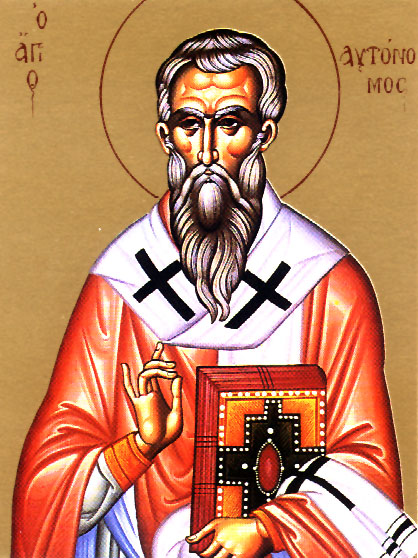
The Hieromartyr Autonomus was a bishop in Italy. During the time of the persecution against Christians under the emperor Diocletian (284-305), Saint Autonomus left his own country and resettled in Bithynia, in the locality of Soreus with a man named Cornelius. Saint Autonomus did his apostolic duty with zeal and converted to Christ so many pagans, that a large Church was formed, for which he consecrated a temple in the name of the Archangel Michael. For this church, the saint at first ordained Cornelius as deacon, and then presbyter. Preaching about Christ, Saint Autonomus visited also Lykaonia and Isauria.
The emperor Diocletian gave orders to arrest Saint Autonomus, but the saint withdrew to Claudiopolis on the Black Sea. In returning to Soreus, he had the priest Cornelius ordained bishop. Saint Autonomus then went to Asia, and when he had returned from there, he began to preach in the vicinity of Limna, near Soreus.
Once, the newly-converted destroyed a pagan temple. The pagans decided to take revenge on the Christians. Seizing their chance, the pagans rushed upon the church of the Archangel Michael when Saint Autonomus was serving Divine Liturgy there. After torturing Saint Autonomus they killed him, reddening the altar of the church with his martyr’s blood. The deaconess Maria removed the body of the holy martyr from beneath a pile of stones and buried it.
During the reign of Saint Constantine the Great, a church was built over the tomb of the saint. In the year 430, a certain priest had the old church pulled down. Not realizing that the martyr’s body had been buried beneath the church, he rebuilt the church in a new spot. But after another 60 years the relics of the saint were found incorrupt, and a church was then built in the name of the Hieromartyr Autonomus.
Venerable Bassian of Tiksnensk, Vologda
Saint Bassian of Tiksnensk [Totemsk] (in the world Basil) was a peasant from the village of Strelitsa (by other accounts, from the village of Burtsevo), near the city of Totma, and he was by trade a tailor. Leaving his family, he became a monk under Saint Theodosius of Totemsk in the Sumorinsk monastery at the River Sukhona, where he spent several years in works and obediences.
In 1594, the monk resettled not far from Totma, at the River Tiksna, near a church named for Saint Nicholas the Wonderworker. At first he lived at the church portico, but then he made himself a cell near the church. The monk visited at each divine service. For thirty years he wore chains on his body: on his shoulders a heavy chain, on his loins an iron belt, and on his head beneath his head covering an iron cap.
Yearning for solitude, the monk admitted no one to his cell, except his spiritual Father. He lived by the alms which they put by his small window. Saint Bassian died on September 12, 1624. Only at burial was it discovered how much he had humbled his flesh.
At the place of Saint Bassian’s ascetic struggles a monastery was established in honor of the Icon of the Savior Not-Made-by-Hands. Veneration of Saint Bassian began in the year 1647, when during a deadly plague, many received healing at his tomb. The Life of the monk was written in the year 1745 by the igumen Joseph.
Translation of the relics of Righteous Simeon of Verkhoturye

Saint Simeon of Verkhoturye was a nobleman, but he concealed his origin and led the life of a beggar. He walked through the villages and for free sewed half-coats and other clothes, primarily for the poor. While doing this he deliberately failed to sew something, either a glove, or a scarf, for which he endured abuse from his customers.
The ascetic wandered much, but most often he lived at a churchyard of the village of Merkushinsk not far from the city of Verkhoturye (on the outskirts of Perm). Saint Simeon loved nature in the Urals, and while joyfully contemplated its majestic beauty, he would raise up a thoughtful glance towards the Creator of the world. In his free time, the saint loved to go fishing in the tranquility of solitude. This reminded him of the disciples of Christ, whose work he continued, guiding the local people in the true Faith. His conversations were a seed of grace, from which gradually grew the abundant fruits of the Spirit in the Urals and in Siberia, where the saint is especially revered.
Saint Simeon of Verkhoturye died in 1642, when he was 35 years of age. He was buried in the Merkushinsk graveyard by the church of the Archangel Michael.
On September 12, 1704, with the blessing of Metropolitan Philotheus of Tobolsk, the holy relics of Saint Simeon were transferred from the church of the Archangel Michael to the Verkhoturye monastery in the name of Saint Nicholas.
Saint Simeon worked many miracles after his death. He frequently appeared to the sick in dreams and healed them, and he brought to their senses those fallen into the disease of drunkenness. A peculiarity of the saint’s appearances was that with the healing of bodily infirmities, he also gave instruction and guidance for the soul.
The memory of Saint Simeon of Verkhoturye is celebrated also on December 18, on the day of his glorification (1694).
Martyr Julian of Galatia and 40 Martyrs with him
The Holy Martyr Julian lived during the fourth century not far from the ancient city of Ancyra. A report was made to the governor of the district of Galatia that the Presbyter Julian was hiding in a certain cave with forty others of the same persuasion, and that he was celebrating divine services there. They arrested Saint Julian and demanded that he reveal where the remaining Christians were hidden, but he refused.
The pagans ordered the holy priest to offer sacrifice to their gods, but he would not consent to this, either. Then they stripped him and placed him on a red-hot iron grate. The martyr signed himself with the Sign of the Cross, and an angel of the Lord cooled the flame. Saint Julian remained unharmed.
When the governor asked who he was and how he had quenched the fire, the martyr said: “I am a servant of God.” The torturers brought forth an old woman, the mother of the saint, and they threatened her that if she did not persuade her son to offer sacrifice to idols, then they would torture her. The brave woman answered that if they defiled her body against her will, this would not make her guilty of sin before God. On the contrary, it would constitute an act of martyrdom.
The humiliated torturers sent the old woman away, but they condemned Saint Julian to death. In his prayer the saint gave fervent thanks to God and asked that he be given strength to endure the sufferings. Saint Julian also asked a special grace from God: that those who take earth from the place of his burial be granted forgiveness of sins and deliverance from passions, and that harmful insects and birds might not descend upon their fields.
Commending himself to God with the words: “Lord, accept my spirit in peace!” the martyr bent his neck beneath the sword, and a Voice summoned the martyr to the Heavenly Kingdom. This Voice was heard also by the forty Christians who had hidden themselves in the cave. Emboldened, they come forth to the place of Saint Julian’s sufferings, but they found him already dead. They all confessed themselves to be Christians, and they were arrested and brought to the governor, who ordered them beheaded.
Martyr Theodore of Alexandria
This Saint Theodore of Alexandria is not the same person as Saint Theodore the Bishop of Alexandria (December 3).
Today’s saint was a simple Christian who was thrown into prison for confessing Christ. Later, he was tortured and thrown into the sea, but remained unharmed.
Saint Theodore was beheaded and buried in Alexandria.
Saint Coronatus, Bishop of Nicomedia
The Hieromartyr Coronatus, Bishop of Nicomedia [Iconium], suffered for Christ in the persecution of Decius and Valerian (253-259) in the third century. The governor of Iconium, Perennius, through his interrogations and persecution, forced Christians to go into hiding. Saint Coronatus voluntarily appeared before Perennius. The torturers tightly bound the legs of the bishop with thin cords and led him through the city. The hieromartyr underwent excruciating sufferings, and blood flowed from the wounds on his legs, because the cords dug into his flesh. After terrible tortures, Bishop Coronatus was beheaded.
Venerable Athanasius of Serpukhov
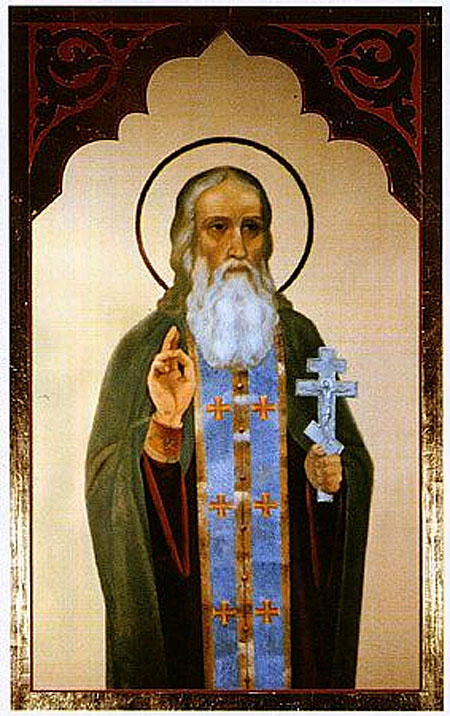
Saint Athanasius of Serpukhov (in the world Andrew) was born at Obonezh Pyatina into the family of the priest Auxentius and his wife Maria. He was, from youth, inclined towards prayer and renunciation of the world, and he sought a worthy guide in monastic labors.
At this time, news of Saint Sergius of Radonezh had already spread throughout the whole of Rus. The monastery of the Life-Creating Trinity at Makovets had become for everyone a luminous model of monastic organization. Here in the monastery, the cenobitic life transformed “the hateful discord of this world,” creating an oneness of spirit in an unity of love based on the example of the Divine Trinity Itself. The youth Andrew went from the outskirts of Novgorod to Abba Sergius at Makovets, following in his footsteps in search of spiritual perfection.
Named Athanasius in monasticism, in honor of Saint Athanasius the Great, the disciple and copier of the Life of Saint Anthony the Great, the founder of Egyptian monasticism, Saint Athanasius in turn became a worthy disciple of the great Igumen Sergius, the Father and teacher of Russian monasticism.
The disciples of Saint Sergius, in addition to the usual monastic obediences, received the holy abba’s blessing for special church services: copying books, painting icons, building churches. This added a genuine churchly quality to life, imparting churchly beauty and hymnology, a liturgical transfiguration of God’s world.
The favourite obedience of Abba Athansios, which he imposed upon himself, was copying books. The holy books were regarded by the Fathers as on the same level as the holy icons, the most important way to impart churchly ideas, those of theological and liturgical creativity.
The school of Saint Sergius, revealing to the Russian and to the Universal Church the whole extent of theological experiential knowledge of the Holy Trinity, is closely connected with the flourishing of church literature, with the necessity of interactive enrichment of the Russian Church by the literary works of the Byzantine Church and its theologians, and by the deep spiritual experience of the Russian ascetics.
In the year 1374, the Serpukhov prince Vladimir Andreevich the Brave, a colleague of Demetrius of the Don , turned to Saint Sergius with a request to found a monastery on his lands. Abba Sergius came to Serpukhov with his beloved disciple Athanasius, and having established the monastery of the Conception of the Most Holy Theotokos, he blessed Saint Athanasius to organize it, and then to be its igumen.
The monastery of Saint Athanasius was built near the city of Serpukhov, on the high bank of the River Nara. They therefore called it “Vysotskoi” [“of the heights”]. Hence also its title, with which entered into Russian Church history its founder and first igumen, Saint Athanasius of Vysotsk.
Abba Athanasius zealously set about the organization of the monastery entrusted to him. Many Russian ascetics arrived here, “on the heights,” for an heightened schooling in monasticism.
According to the teaching of Abba Athanasius, preserved for us by Epiphanius the Wise, to be a monk was no easy thing. “The duty of the monk consists in this, that he be vigilant in prayer and in divine precepts until midnight, and sometimes for the whole night. He should eat nothing but bread and water, oil even and wine would be altogether improper.” Through the words of the saint of God, many came to him at the monastery on the heights, “but then they slackened, and, unable to endure the work of ascetic struggle, they fled.”
Those ascetics of higher monastic worth remained with the holy abba. Therefore, it was to this monastery, to his disciple and fellow-ascetic Athanasius, that the God-bearing Abba Sergius of Radonezh sent his future successor, Saint Nikon (November 17) for tonsure and guidance in monastic endeavors. Saint Athanasius taught him: “Monks are called voluntary martyrs. Many holy martyrs suffered for a single hour and then died, but each day monks endure sufferings not from torturers, but from within, from the properties of the flesh and from mental enemies. There are struggles, and they suffer until their last breath.”
In 1478, after the death of Saint Alexis, Metropolitan of Moscow, the new Metropolitan, Saint Cyprian (September 16) arrived in Moscow. But Great Prince Demetrius of the Don wanted to establish his own priest and colleague Michael [Mitaya] as metropolitan, and he would not accept Metropolitan Cyprian. Instead, he expelled him from Moscow.
Saint Cyprian was in a difficult position. But he found support and sympathy among the pillars of Russian monasticism, Saints Sergius of Radonezh and Athanasius of Vysotsk. From the very beginning, they saw the canonical legitimacy of the Metropolitan in his dispute with the Great Prince and they supported him in the prolonged struggle (1478-1490) for the restoration of canonical order and unity in the Russian Church. Saint Cyprian had to journey several times during these years to Constantinople to participate in council deliberations concerning the governace of the Russian Church. On one of these journeys, with the blessing of holy Abba Sergius, Saint Athanasius of Vysotsk went to Constantinople with his friend the Metropolitan, leaving his own disciple, Saint Athanasius the Younger as the igumen of the Vysotsk monastery.
At Constantinople Saint Athanasius settled into the monastery of the holy Forerunner and Baptist John (Studion), where he found a cell for himself and for several disciples who had come with him. Saint Athanasius occupied himself with prayer and salvific theological books. The monk spent about twenty years in the capital of Church culture, working to translate books from the Greek language and copying Church books, which he then sent off to Rus. Thereby, he transmitted to the Russian Church not only a legacy of great Orthodox thought, but also the traditions of Constantinople’s masters of manuscript illumination, with their elegant penmanship and artistry of textual miniatures, achieving a harmony of content and form. A continuing creative connection was established between Saint Athanasius’s skillful copying of books at Constantinople and the calligraphic and iconographic school of the Vysotsk monastery at Serpukhov.
It was not by chance that it was especially at the Vysotsk monastery that the holy Igumen Nikon guided the future iconographer Saint Andrew Rublev (July 4), as once previously the God-bearing Abba Sergius had guided Nikon himself in this monastery to spiritual maturity and an understanding of the rejuvenating and transformative spirit of pure churchly beauty.
In this sacred service of churchly beauty, in constant liturgical activity for the glory of the Life-Originating Trinity, the life-bearing genius of Saint Andrew matured. God destined him for the great visual rendering of the theological and liturgical legacy of Saint Sergius, with the immortal wonderworking icon of the Most Holy Trinity for the iconostasis of the Trinity cathedral. In the iconographic creativity of Saint Andrew Rublev, just as in the temple-building activity of Saint Nikon, and in the hagiographic works of Epiphanius the Wise, we find embodiment and synthesis of the finest traditions of the Byzantine and Russian art.
This creative synthesis was served also by Saint Athanasius of Vysotsk all his life. Living at Constantinople, he continued to work for the Russian Church, and for his native land. To give but one example, he sent to the Vysotsk monastery ten icons of the finest Greek style. He and his disciples translated into the Slavonic language the “Four Hundred Chapters” of Saint Maximus the Confessor, the Chapters of Mark about church services, and the Discourses of Saint Simeon the New Theologian.
In the year 1401, just before his death, the venerable elder copied, and possibly translated himself, a Church Rule, distributed within the Russian Church under the title, “The Eye of the Church.”
Saint Athanasius spent his life in constant work with books. He died at Constantinople in old age in the year 1401 (or perhaps a bit later). Russian chroniclers note him as an elder “virtuous, learned, knowing the Holy Scriptures”, to which “at present his writings give witness.” His Life was written in the year 1697 by the hieromonk Karion [Istomin] of the Moscow Chudov monastery.
Saint Athanasius’s successor and disciple, Saint Athanasius the Younger, successfully directed the spiritual life of the brethren and gave an example by his own God-pleasing life. Saint Athanasius the Younger reposed after a long illness on September 12, 1395. In the ancient manuscripts of the saints it says of him: “Saint Athanasius, igumen of Vysotsk Conception monastery at Serpukhov, a new wonderworker who reposed in the year 6904 (1395) on the twelfth day of September, a disciple of Saint Athanasius, wondrous disciple of Saint Sergius, who later was at Constantinople and reposed there.”
Hieromartyr Dositheus of Tbilisi
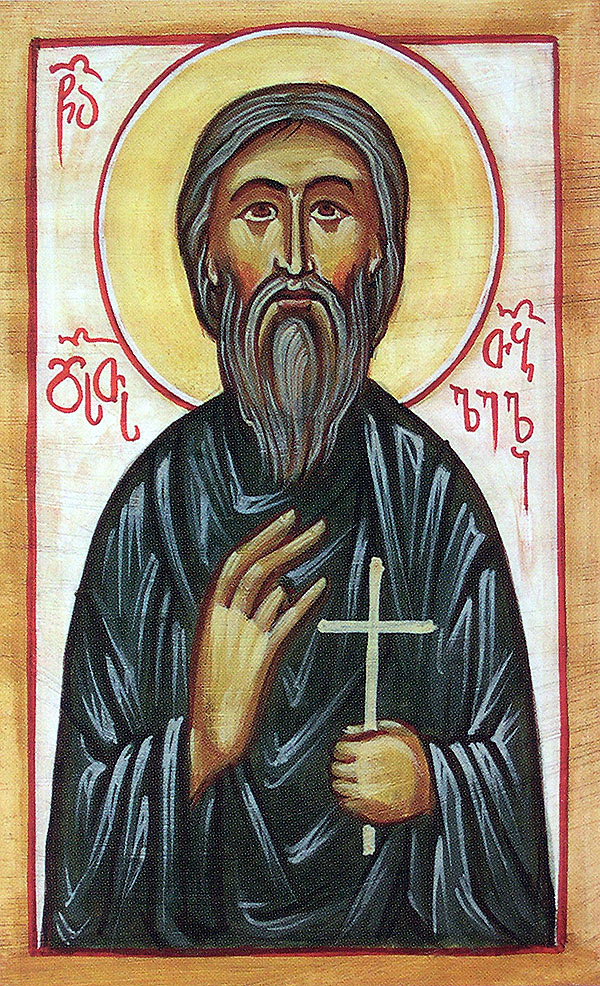
Thirty-five thousand Persian soldiers marched toward Georgia in the year 1795. The Georgian king Erekle II (1762-1798) and his two thousand soldiers declared war on the invaders as they were approaching Tbilisi. The Georgians won the first skirmish, but many perished in the fighting. The enemy was shaken and was preparing to flee the battleground, when several traitors reported to Aqa Muhammed Khan that King Erekle had lost nearly his entire army. This betrayal decided the fate of the battle: the one hundred fifty soldiers who remained in the Georgian army barely succeeded in saving the life of King Erekle, who had willed to perish on the battlefield with his soldiers.
All of Tbilisi was engulfed in flames. The plunderers murdered the people, set fire to the libraries, destroyed the print shop, and vandalized the churches and the king’s palace. They slaughtered the clergy in an especially cruel manner.
Unfortunately, history has not preserved the names of all those martyrs who perished in this tragedy, but we do know that a certain Metropolitan Dositheus of Tbilisi was killed because he would not abandon his flock. While the invaders simply killed most of the clergymen, from Saint Dositheus they demanded a renunciation of the Christian Faith. They commanded him to defile the True and Life-giving Cross of our Lord. But the holy hieromartyr Dositheus endured the greatest torments without yielding to the enemy, and he joyfully accepted death for Christ’s sake. The invaders slaughtered Christ’s devoted servant with their swords.
Saint Dositheus was martyred on September 12 in the year 1795.
Daily Readings for Wednesday, September 11, 2024
THEODORA OF ALEXANDRIA
ABSTAIN FROM MEAT, FISH, DAIRY, EGGS, WINE, OLIVE OIL
Theodora of Alexandria, Euphrosynos the Cook, Demetrios & Evanthea the Martyrs & their son Demetrianos, Sergius and Herman of Valaam, Finland, Afterfeast of the Nativity of the Theotokos, Deinol the First Bishop of Bangor
ST. PAUL’S SECOND LETTER TO THE CORINTHIANS 6:11-16
Brethren, our mouth is open to you, Corinthians; our heart is wide. You are not restricted by us, but you are restricted in your own affections. In return — I speak as to children — widen your hearts also.
Do not be mismated with unbelievers. For what partnership have righteousness and iniquity? Or what fellowship has light with darkness? What accord has Christ with Belial? Or what has a believer in common with an unbeliever? What agreement has the temple of God with idols? For we are the temple of the living God, as God said.
JOHN 12:19-36
At that time, the Pharisees took counsel against Jesus and said to one another, "You see that you can do nothing; look, the world has gone after him.
Now among those who went up to worship at the feast were some Greeks. So these came to Philip, who was from Bethsaida in Galilee, and said to him, "Sir, we wish to see Jesus." Philip went and told Andrew; Andrew went with Philip and they told Jesus. And Jesus answered them, "The hour has come for the Son of man to be glorified. Truly, truly, I say to you, unless a grain of wheat falls into the earth and dies, it remains alone; but if it dies, it bears much fruit. He who loves his life loses it, and he who hates his life in this world will keep it for eternal life. If any one serves me, he must follow me; and where I am, there shall my servant be also; if any one serves me, the Father will honor him.
Now is my soul troubled. And what shall I say? 'Father, save me from this hour?' No, for this purpose I have come to this hour. Father, glorify your name." Then a voice came from heaven, "I have glorified it, and I will glorify it again." The crowd standing by heard it and said that it had thundered. Others said, "An angel has spoken to him." Jesus answered, "This voice has come for your sake, not for mine. Now is the judgment of this world, now shall the ruler of this world be cast out; and I, when I am lifted up from the earth, will draw all men to myself." He said this to show by what death he was to die. The crowd answered him, "We have heard from the law that the Christ remains for ever. How can you say that the Son of man must be lifted up? Who is this Son of man?" Jesus said to them, "The light is with you for a little longer. Walk while you have the light, lest the darkness overtake you; he who walks in the darkness does not know where he goes. While you have the light, believe in the light, that you may become sons of light.
Afterfeast of the Nativity of the Mother of God

No information available at this time.
Venerable Theodora of Alexandria

Saint Theodora of Alexandria and her husband lived in Alexandria. Love and harmony ruled in their family, and this was hateful to the Enemy of salvation. Goaded on by the devil, a certain rich man was captivated by the youthful beauty of Theodora and began with all his abilities to lead her into adultery, but for a long time he was unsuccessful. Then he bribed a woman of loose morals, who led the unassuming Theodora astray by saying that a secret sin, which the sun does not see, is also unknown to God.
Theodora betrayed her husband, but soon came to her senses and realizing the seriousness of her fall, she became furious with herself, slapping herself on the face and tearing at her hair. Her conscience gave her no peace, and Theodora went to a renowned abbess and told her about her transgression. The abbess, seeing the repentance of the young woman, spoke to her of God’s forgiveness and reminded her of the sinful woman in the Gospel, who washed the feet of Christ with her tears and received from Him forgiveness of her sins. In hope of the mercy of God, Theodora said: “I believe my God, and from now on, I shall not commit such a sin, and I will strive to atone for my deed.”
At that moment Saint Theodora resolved to go off to a monastery to purify herself by labor and by prayer. She left her home secretly, and dressing herself in men’s clothes, she went to a men’s monastery, since she feared that her husband would find her in a women’s monastery.
The igumen of the monastery, in order to test the resolve of the newcomer, would not even bless her to enter the courtyard. Saint Theodora spent the night at the gates. In the morning, she fell down at the knees of the igumen, and said her name was Theodore from Alexandria, and entreated him to let her remain at the monastery for repentance and monastic labors. Seeing the sincere intent of the newcomer, the igumen consented.
Even the experienced monks were amazed at Theodora’s all-night prayers on bended knee, her humility, endurance and self-denial. The saint labored at the monastery for eight years. Her body, once defiled by adultery, now became a vessel of the grace of God and a receptacle of the Holy Spirit.
Once, the saint was sent to Alexandria to buy provisions. After blessing her for the journey, the igumen indicated that in case of a delay, she should stay over at the Enata monastery, which was on the way. Also staying at the guest house of the Enata monastery was the daughter of its igumen. She had come to visit with her father. Attracted by the comeliness of the young monk, she tried to seduce the monk Theodore into the sin of fornication, not knowing that it was a woman standing before her. Meeting with refusal, she committed sin with another guest and became pregnant. Meanwhile, the saint bought the food and returned to her own monastery.
After a certain while the father of the shameless girl, realizing that a transgression had occurred, began to question his daughter about the father of the child. The girl indicated that it was the monk Theodore. The father at once reported it to the Superior of the monastery where Saint Theodora labored in asceticism. The igumen summoned the saint and repeated the accusation. The saint firmly replied: “As God is my witness, I did not do this.” The igumen, knowing of Theodore’s purity and holiness of life, did not believe the accusation.
When the girl gave birth, the Enata monks brought the infant to the monastery where the ascetic lived, and began to reproach its monks for an unchaste life. But this time even the igumen believed the slanderous accusation and became angry at the innocent Theodore. They entrusted the infant into the care of the saint and threw her out of the monastery in disgrace.
The saint humbly submitted to this new trial, seeing in it the expiation of her former sin. She settled with the child not far from the monastery in a hut. Shepherds, out of pity, gave her milk for the infant, and the saint herself ate only wild vegetables.
Bearing her misfortune, the holy ascetic spent seven years in banishment. Finally, at the request of the monks, the igumen allowed her to return to the monastery with the child, and in seclusion she spent two years instructing the child.
The igumen of the monastery received a revelation from God that the sin of the monk Theodore was forgiven. The grace of God dwelt upon the monk Theodore, and soon all the monks began to witness to the signs worked through the prayers of the saint.
Once, during a drought, all the wells dried up. The igumen said to the brethren that only Theodore would be able to reverse the misfortune. Having summoned the saint, the igumen bade her to bring forth water, and the water in the well did not dry up afterwards. The humble Theodore said that the miracle was worked through the prayer and faith of the igumen.
Before her death, Saint Theodora shut herself in her cell with the child and instructed him to love God above all things. She told him to obey the igumen and the brethren, to preserve tranquility, to be meek and without malice, to avoid obscenity and silliness, to love non-covetousness, and not to neglect their communal prayer. After this, she prayed and, for the last time, she asked the Lord to forgive her sins. The child also prayed together with her. Soon the words of prayer faded from the lips of the ascetic, and she peacefully departed to a better world.
The Lord revealed to the igumen the spiritual accomplishments of the saint, and also her secret. The igumen, in order to remove any dishonor from the deceased, in the presence of the igumen and brethren of the Enata monastery, told of his vision and uncovered the bosom of the saint as proof.
The Enata igumen and brethren shrank back in terror at their great transgression. Falling down before the body of the saint, with tears they asked forgiveness of Saint Theodora. News of Saint Theodora reached her former husband. He received monastic tonsure at this same monastery where his wife had been. And the child, raised by the nun, also followed in the footsteps of his foster-mother. Afterwards, he became igumen of this very monastery.
Translation of the Relics of Venerable Sergius and Herman, Wonderworkers of Valaam

Saints Sergius and Herman settled on the island of Valaam in 1329. The brethren gathered by them spread the light of Orthodoxy in this frontier land. The Karelian people had begun to regard Christianity with renewed suspicion, with its authority in the fourteenth century being undermined by the Swedes, who sought to spread Catholicism by means of the sword.
Saints Sergius and Herman died about the year 1353. They are also commemorated on June 28 (Their holy repose).
Martyrs Demetrius, his wife Euanthia, and their son Demetrian, at Skepsis on the Hellespont
The Holy Martyrs Demetrius, his wife Euanthea, and their son Demetrian.
Saint Demetrius was a prince and prefect of the city of Skepsis in the Hellespont. Saint Cornelius the Centurion (September 13), the first Gentile converted to Christ by the Apostle Peter, came into his city preaching the Gospel.
Saint Cornelius sowed the seeds of Christianity among many of the inhabitants of Skepsis, and so the pagans arrested him and brought him to trial before the prefect Demetrius. In vain he demanded that the saint renounce Christ, and finally handed him over for torture.
Saint Cornelius bravely endured the torture, while in turn urging the prefect to forsake his pagan errors and turn to the true faith in Christ. Led into a temple of idols, Saint Cornelius destroyed the pagan temple and the idols standing in it by his prayer.
Persuaded of the truth of Christianity by the saint’s preaching and by his miracles, the prefect Demetrius himself came to believe in Christ and was baptized with all his family. Because the saints now believed in Christ, the pagans threw the newly-converted family into prison where they were starved to death.
Martyrs Diodorus, Didymus, and Diomedes, of Laodicea
Saints Diodorus, Didymus, and Diomedes were born in Laodicea in the fourth century, and suffered martyrdom in that city. They were flogged to death.
Martyr Ia and 9,000 Martyrs with her, of Persia
The Holy Martyr Ia was arrested along with 9,000 Christians by the Persian emperor Sapor II, and they were all brought to the Persian city of Bisada. The chief of the Persian sorcerers demanded that the saint renounce Christ, but she remained unyielding and so she was tortured. Then Saint Ia was thrown into prison. She was beheaded after repeated tortures.
According to Tradition, the sun was darkened at the time of her martyrdom, and the air was filled with a sweet fragrance.
Saint Euphrosynos the Cook of Alexandria

Our Holy Father Euphrosynos (Euphrósynos)1 the Cook was born into a peasant family, and had no schooling, but he was truly devout and faithful.
As an adult, he became a cook, and was able to save money out of his expenses by depriving himself, but only for the sake of almsgiving. His position as a cook permitted him to eat the best food first, but he never took advantage of this privilege. He ate his greens and olives gratefully, while the most appetizing meats and most tantalizing fish were cooking before him.
Later Euphrosynos went to a monastery, where his obedience was to work in the kitchen as a cook. In contrast to the meals that he used to prepare in secular hotels, he made very plain food in the monastery. To those who complained and mocked him, Euphrosynos meekly replied: "Good cooking is not useful for attaining the Kingdom of Heaven. The more the body craves pleasure, the more the soul will lose that which it truly needs. It is not my intention to punish you."
Some of the monks scorned him because of his coarse rustic background, but he endured their contempt in silence and was not disturbed by it. Saint Euphrosynos strove to please the Lord by his virtuous life, which he concealed from others, but the Lord Himself revealed to the monastic brethren just what spiritual heights their cook had attained.
In the same monastery there was a devout priest who prayed that he might know what good things are prepared for those who love God. One night, as he was sleeping, he found himself in a beautiful garden, where, to his astonishment, he beheld the most wondrous things. Then he saw Father Euphrosynos, the monastery cook standing in the garden and partaking of the good things of that place. As he approached the cook, he asked to whom the garden belonged, and how he came to be there.
Saint Euphrosynos replied, "This garden is reserved for God's elect, and by His great goodness, I also dwell here."
Then the priest asked him what he did in the garden. The Saint told him, "I have authority over all the things you see here. I rejoice and am filled with gladness and the spiritual enjoyment of them."
The priest questioned him again, "Can you give me something of these good things?"
"Certainly," he replied, "by God's grace, take whatever you wish."
Pointing to some apples, he inquired if he might have some of them. Taking a few of the apples, Saint Euphrosynos placed them in the priest's outer garment saying, "Receive that which you requested, and may you delight in them."
At that moment the semantron was heard, summoning the Fathers to the Midnight Service. When the priest awakened, he thought that his vision was just a dream. But when he reached for his outer garment, he found the apples which the cook had given him, and he could still smell their wonderful fragrance.
He got out of bed and then hurried to church. There he saw Euphrosynos and asked him where he had been that night. The Saint said, "Forgive me, Father, I have not been anywhere tonight. I have just come to church or the Service."
The priest urged him to tell the truth, so that God's glory might be made manifest. The humble Euphrosynos told him, "I was in the place where the good things are, which those who love God shall inherit, and which for many years you wished to behold. There you saw me enjoying the blessings of that garden; for God had deigned to reveal to you the blessings of the Just. He has performed this miracle through me, the lowly one."
"Father Euphrosynos, what did you give me from that garden?"
He replied, "The delightful and most fragrant apples which you just put on your bed. Forgive me, Father, for I am a worm and not a man."
When the service of Matins was over, the priest told the brethren about his vision and showed them the apples. They noticed the ineffable fragrance with spiritual joy, marveling at what the priest had told them. Rushing into the kitchen, they found that Saint Euphrosynos had already left the monastery, fleeing from the glory of men, and he could not be found.
The brethren shared the apples among themselves and, as a blessing, gave pieces to those who visited the monastery, especially for those in need of healing, for those who ate the apples were cured of their ailments. Many received benefit from the gift of Saint Euphrosynos. An account of this vision was written, not only on paper, but also in their hearts.
Finally, Saint Euphrosynos reposed in a remote Hēsykhastḗrion. The Church, knowing that a king or a philosopher is not more worthy to enter the Kingdom of Heaven than a cook, has numbered Euphrosynos the Cook among her Saints, for he knew God's will and lived according to it..
A fragment of the Saint's relics is located in the Monastery of Loukous in the Holy Metropolis of Mantineia and Kynouria in Greece.
1 The name Euphrosynos means gladness or delight.
Kazan – Kaplunovka Icon of the Mother of God (1689)
At the end of the XVII century, 20 versts from the city of Akhtyrka, in Kharkov province, in the village of Kaplunovka, on the Khukhra River, lived a pious priest, Father John Umanov. On September 11, 1689 a wonderworking Icon of the Mother of God was given to him.
On September 8, the Feast of the Nativity of the Theotokos, he saw an Elder in a dream who told him that in three days three iconographers would come to him: one in his seventies, another in his eighties, and the third in his nineties. The Elder ordered Father John to take a stack of icons from the oldest of the three, then return the first seven to him, and keep the eighth one, which would be a copy of the Kazan icon (July 8). In return, he promised the priest that he would obtain mercy and grace from the Mother of God.
After this dream, Father John fasted and served the Liturgy for three days. On the third day, as he was returning home from church, he saw three old iconographers walking toward him. He invited them to his home and welcomed them cordially, then the oldest iconographer took several icons from his pack, and the eighth, as predicted in his dream, was a copy of the Kazan Icon. The iconographers wanted to give him the Icon for free, but they agreed to take 15 kopecks for it. After that, they continued on their way.
Father Umanov put the Icon in his room and kept a lit candle before it day and night. On the eve of the third Sunday he saw a Virgin of extraordinary beauty in a dream, who touched his hand, said to him: "Priest John, do not keep me in your home, but take me to my church."
The church in Kaplunovka was dedicated to the Nativity of the Mother of God. When Father John awakened, his cell was illumined by a bright light. When he approached the Icon he noticed that from the eyes on the Mother of God's face, tears were streaming down the board. Immediately, he summoned some respected parishioners, and told them about the Icon and the events of the previous night. After he served a Moleben, the Icon was solemnly transferred to the church, where it became renowned for its miracles. The Icon began to be called Kaplunovskaya, from the name of the village.
A certain woman named Paraskevḗ, who was possessed by demons, heard about this miracle, and with faith she ran to the church and asked the priest to chant a Moleben for her health before the Icon of the Mother of God, and she was freed from the power of the devil. Feeling that she was her normal self, she thanked God and her Intercessor, the Most Holy Theotokos.
Father John served in the village for a long time after these events, and was consoled by the ever-increasing glory of the Icon. He also had the joy of seeing the national prominence that the Icon received during Charles XII's war with Peter the Great.
When the Swedish King Charles XII invaded Little Russia with his troops, Peter sought heavenly help, since he was going to meet him. He summoned Father John to Kharkov with the Kaplunovka Icon, which he kept with the army. Meanwhile, Charles and Ivan Mazepa reached Kaplunovka and stayed there to rest, occupying Father John's house. Several of the soldiers wanted to set fire to the church, but the wood they piled around the temple did not catch fire. Charles saw all this from the window and asked Mazepa for an explanation of why the soldiers could not burn the church. Mazepa said that it was probably guarded by the Mother of God, since her wonderworking Icon was located there. The Swedish King ordered them to bring to one of the residents of Kaplunovka to him. They found a man in the woods, and Charles began to ask him where Peter and his troops were. The man said that he was in Kharkov. Then Charles asked where the Icon of the Mother of God was. When he heard that it had been taken to the army, he told Mazepa, "If we could not set fire to the church when the Icon was not here, it is likely to be very bad for us when and where it is present."
Before the Battle of Poltava started, Peter ordered the Kaplunovka Icon to be carried past the ranks of the Russian army, and he prayed with tears before the Icon. Then, after the battle, Father John was summoned to Moscow with the Icon and from there he was sent home with the shrine. Peter made a silver gilt riza with precious stones for the Icon, and a silver icon case (kivot).
On June 14, 2020, the wonderworking Kaplunovka Icon of the Mother of God was donated to the Patriarchal Cathedral in honor of the Resurrection of Christ – the main temple of the Armed Forces of the Russian Federation.
The Kaplunovka Icon is also commemorated on July 8, the Feast Day of the Kazan Icon.
9/15 announcements
September 15, 2024
Sunday after the Elevation of the Holy Cross
Galatians 2:16-20: Brethren, you know that a man is not justified by works of the law but through faith in Jesus Christ. Even we have believed in Christ Jesus, in order to be justified by faith in Christ, and not by works of the law, because by works of the law shall no one be justified. But if, in our endeavor to be justified in Christ, we ourselves were found to be sinners, is Christ then an agent of sin? Certainly not! But if I build up again those things which I tore down, then I prove myself a transgressor. For I through the Law died to the Law, that I might live to God. I have been crucified with Christ; it is no longer I who live, but Christ Who lives in me; and the life I now live in the flesh I live by faith in the Son of God, Who loved me and gave Himself for me.
Mark 8:34-9:1: The Lord said, “If any man would come after Me, let him deny himself and take up his cross and follow Me. For whoever would save his life will lose it; and whoever loses his life for My sake and the Gospel’s will save it. For what does it profit a man, to gain the whole world and forfeit his soul? For what can a man give in return for his soul? For whoever is ashamed of Me and of My words in this adulterous and sinful generation, of him will the Son of man also be ashamed, when He comes in the glory of His Father with the holy angels.” And He said to them, “Truly, I say to you, there are some standing here who will not taste death before they see the Kingdom of God come with power.”
CALENDAR
UNTIL FURTHER NOTICE: All services listed on the calendar will be available through streaming and webcast. (Instructions can be found on the parish website.)
Sunday, September 15 (Sunday after the Elevation of the Cross)
8:50 a.m. – Orthros
9:00 a.m. – Christian Education
10:00 a.m. – Divine Liturgy (webcast)
Monday, September 16
Father Herman off
Tuesday, September 17
NO Services
Wednesday, September 18
6:30 p.m. – Daily Vespers
Thursday, September 19
NO Services
Friday, September 20
NO Services
Saturday, September 21
8:30 a.m. – Workday at the Church
4:30 p.m. – Choir Practice
6:00 p.m. – Great Vespers
Sunday, September 22 (Thirteenth Sunday after Pentecost)
8:50 a.m. – Orthros
9:00 a.m. – Christian Education
10:00 a.m. – Divine Liturgy (webcast)
SPECIAL ANNOUNCEMENTS
The Eucharist Bread …was offered by the Joneses for the Divine Liturgy for the Feast of the Elevation of the Cross yesterday morning and by the Davises for the Divine Liturgy this morning.
Eucharist Bread Schedule:
Eucharist Bread Coffee Hour
September 15 Davis Dansereau/Weatherly
September 22 D. Root Lasseter/Pacurari/Lavric
September 29 Karam Lockhart/Karam/Snell
Schedule for Epistle Readers – Page numbers refer to the Apostolos (book of the Epistles) located on the Chanters’ stand at the front of the nave. Please be sure to use this book when you read.
Reader Reading Page#
September 15 Brandon Strain Gal. 2:16-20 193
September 22 Katie Miller I Cor. 16:13-24 152
September 29 Mary Martha Ellis II Cor. 1:21-2:4 158
Please remember the following in your prayers: Aidan Milnor, the Milnor family; Lamia Dabit and her family; Mary Greene (Lee and Kh. Sharon’s sister); Jay and Joanna Davis; Fr. Leo and Kh. Be’Be’ Schelver and their family; Marilyn (Kyriake) Snell; Jack and Jill Weatherly; Sh. Charlotte Algood and their family; Reader Basil and Brenda Baker and their family; Fr. Joseph Bittle; Rick Carlton; Very Rev. Fr. Nicholas and Kh. Jan Speier; Lee Greene; Joseph, Amanda and Hunter Hines; Fr. John and Kh. Janet Henderson and their family; Galina Singletary; Emily and Cole Parker; Dane and Stephanie Skirtech.
Antidoron (Greek meaning “instead of the gifts”) is the blessed bread partaken of as a ‘fast breaker’ and an extra blessing after receiving Holy Communion. It is remaining bread from the loaf used in the pre-Liturgy service preparing the bread on the diskos and the wine in the chalice. This ‘extra’ bread is blessed during the hymn to the Theotokos during the Anaphora of the Divine Liturgy. Importantly, it is NOT consecrated to become the Body of Christ — and must be carefully distinguished from that — but NEVERTHELESS, we must do our best to treat it with due reverence and care.
Portions that are uneaten are disposed of by being placed outside where they are consumed by the elements or by animals. Unfortunately, we have recently been seeing an increase in crumbs being found on the nave floor after Divine Liturgy. Parents, please help the young ones to be careful to consume their pieces of antidoron completely, and, if crumbs should fall, be proactive in picking them up and placing them on the ground outside.
Also, please remember that we still need your tithes and offerings which may be placed in the tray that is passed during the Divine Liturgy, in the tithe box at the back of the nave or be mailed to: St. Peter Orthodox Church, P.O. Box 2084, Madison, MS 39130-2084.
His Grace, Bishop NICHOLAS will be visiting St. Peter again on October 20-21st. He will be in Vicksburg earlier that week-end and will come to us following the Hierarchical Divine Liturgy there on Sunday. More details will be available in the future.
We will be showing the documentary film Sacred Alaska at Mississippi College on Friday evening, November 1st, beginning at 6:30 p.m. The date was changed from the original date selected to accommodate MC’s student schedule and also MC’s Homecoming celebration. Further details will be available in the very near future.
NO children are allowed to be in the pantry or in the refrigerator and children under the age of 12 are not allowed in the kitchen without the presence of a parent or a responsible adult. Children under the age of 12 are not allowed to access the icemaker. Parents, we ask for your assistance with enforcing this policy. Thank you.
** We ask that families go through the Coffee Hour line together, so that children are under the supervision of their parents. **
The 2024 Fall Retreat will be held September 20-21 and will be hosted by St. Ignatius in Franklin, TN. Registration opened recently. Early Bird special will run until September 4th, after that the price for the retreat will increase. The link for registration was emailed out by Fr. Herman recently as well. If you did not receive it, please let him know as soon as possible. Hope to see you all there!
Calendar Items:
* The men of the parish meet for lunch at 11:00 a.m. on the first Thursday of the month.
* The Ladies meet at the church at 10:00 a.m. on the second Saturday of the month to pray the Akathist to the Mother of God, Nurturer of Children on behalf of our children.
* The Ladies meet for lunch at 1:00 p.m. on the last Tuesday of the month.
* The Ladies of St. Peter will meet during Coffee Hour TODAY.
* The Diocesan Fall Retreat will be held September 20-21 at St. Ignatius in Franklin, TN.
* MARK YOUR CALENDARS: His Grace, Bishop NICHOLAS will be visiting St. Peter October 20-21st.
* Remaining Stewpot date for 2024 will be November 30th.
Fasting Discipline for September
The traditional fasting discipline (no meat, dairy, eggs, fish, wine or oil) is observed on all Wednesdays and Fridays of the month. The feast of the Elevation of the Holy Cross on September 14th is also a strict fast day.
Major Commemorations for September
September 23 Conception of the Forerunner
September 24 Proto-martyr Thekla
September 26 Apostle John the Theologian (repose)
September 28 Venerable Chariton
Quotable: “That whoever wishes to be deemed worthy of the gift of noetic prayer must ask God for it with a fervent heart, living a noble, pure, blameless, and toilsome life; and he should continue his supplication to God even if he does not receive it quickly until he does receive it from the Father of lights, for God oftentimes does not immediately give what one asks for in order for the supplicant’s enduring patience to be manifested, and thus he will become even more fervent than before”
-The Watchful Mind, A Monk of Mount Athos
Worship: Sunday, September 22, 2024 (Thirteenth Sunday after Pentecost)
Scripture: I Corinthians 16:13-24; Luke 5:1-11
Epistle Reader: Katie Miller
Prosphora: D. Root
Coffee Hour: Lasseter/Pacurari/Lavric
 Saint Peter Antiochian Orthodox Church
You must be logged in to post a comment.