Monthly Archives: September 2024

Daily Readings for Thursday, September 19, 2024

THURSDAY OF THE 1ST WEEK

NO FAST

Trophimus, Sabbatius, & Dorymedon the Martyrs, Plato the new Hieromartyr of Patmos, Theodore of Tarsus, Archbishop of Canterbury, Afterfeast of the Holy Cross

ST. PAUL’S SECOND LETTER TO THE CORINTHIANS 10:7-18

Brethren, if any one is confident that he is Christ’s, let him remind himself that as he is Christ’s, so are we. For even if I boast a little too much of our authority, which the Lord gave for building you up and not for destroying you, I shall not be put to shame. I would not seem to be frightening you with letters. For they say, “His letters are weighty and strong, but his bodily presence is weak, and his speech of no account.” Let such people understand that what we say by letter when absent, we do when present. Not that we venture to class or compare ourselves with some of those who commend themselves. But when they measure themselves by one another, and compare themselves with one another, they are without understanding. But we will not boast beyond limit, but will keep to the limits God has apportioned us, to reach even to you. For we are not overextending ourselves, as though we did not reach you; we were the first to come all the way to you with the gospel of Christ. We do not boast beyond limit, in other men’s labors; but our hope is that you may be greatly enlarged, so that we may preach the gospel in lands beyond you, without boasting of work already done in another’s field. “Let him who boasts, boast of the Lord.” For it is not the man who commends himself that is accepted, but the man whom the Lord commends.

LUKE 4:16-22

At that time, Jesus came to Nazareth, where he had been brought up; and he went to the synagogue, as his custom was, on the sabbath day. And he stood up to read; and there was given to him the book of the prophet Isaiah. He opened the book and found the place where it was written, "The Spirit of the Lord is upon me, because he has anointed me to preach good news to the poor. He has sent me to proclaim release to the captives and recovering of sight to the blind, to set at liberty those who are oppressed, to proclaim the acceptable year of the Lord." And he closed the book, and gave it back to the attendant, and sat down; and the eyes of all in the synagogue were fixed on him. And he began to say to them, "Today this scripture has been fulfilled in your hearing." And all spoke well of him, and wondered at the gracious words which proceeded out of his mouth.

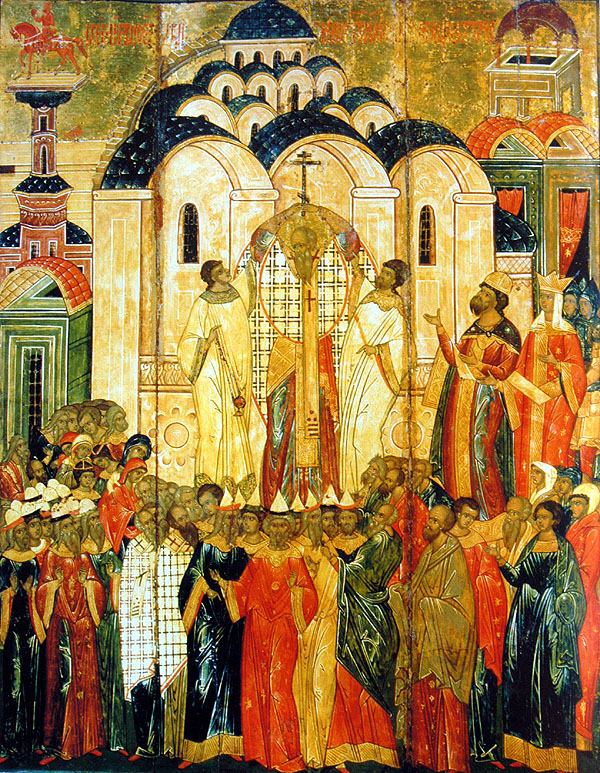
Afterfeast of the Elevation of the Cross

From September 15 until the Leavetaking, we sing “O come, let us worship and fall down before Christ. O son of God crucified in the flesh, save us who sing to Thee: Alleluia” at weekday Liturgies following the Little Entrance.

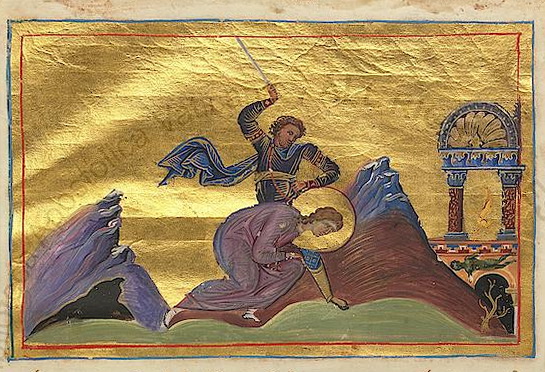
Martyrs Trophimus, Sabbatius, and Dorymedon of Synnada
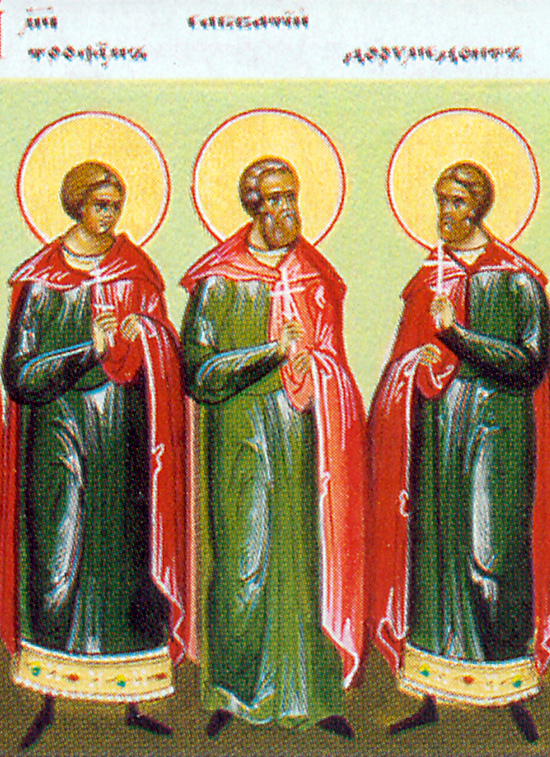
The Holy Martyrs Trophimus, Sabbatius and Dorymedon suffered for Christ during the reign of the Roman emperor Probus (276-282). A pagan festival was being celebrated in the city of Antioch. Sacrificial offerings were brought, the wine was poured, and vile acts were performed. The Christians Trophimus and Sabbatius arrived in the city just as the festival was taking place, and were saddened by this loud and indecent spectacle. They prayed that the Lord would guide the errant on the way of salvation. As they said this, the idolaters noticed their presence. Seeing that the strangers did not worship the idols, they arrested them and took them to the governor.

At their interrogation, the saints firmly confessed their faith. When they were told to renounce Christ, they resolutely refused to do so. Saint Sabbatius died under the fierce torment. Saint Trophimus was sent to the city of Synnada in Phrygia for even more terrible tortures.

For three days Saint Trophimus walked shod in iron sandals with sharp nails, driven on by a cavalry guard. The governor of Frigius, Dionysius, infamous as a torturer and executioner, used all manner of tortures to break the will of the brave Christian. Saint Trophimus merely repeated the words of Scripture: “many afflictions has the righteous one, but from them all will the Lord deliver him” (Ps 33/34:20).

The senator Dorymedon, a secret Christian, visited Saint Trophimus in prison, washing and binding his wounds. When the pagans learned that the senator would not participate in the festival of Castor and Pollux, they asked the reason for his refusal. He said that he was a Christian, and would not attend a festival in honor of the demons. He and Saint Trophimus were thrown to the wild beasts to be eaten by them, but the martyrs remained unharmed. Then they were beheaded with the sword.

Saint Theodore, Prince of Smolensk and Yaroslav, and his sons Saints David and Constantine

The holy right-believing Prince Theodore of Smolensk and Yaroslavl, nicknamed the “Black” [i.e. “dark” or “swarthy”], was born at a terrible time for Rus: the Mongol invasion of 1237-1239. At Baptism he was named for the holy Great Martyr Theodore Stratelates (February 8), who was particularly esteemed by the Russian warrior-princes.

Prince Theodore was famed for his military exploits. The child Theodore was not in the city when, through the prayers of the Most Holy Theotokos, the holy Martyr Mercurius (November 24) delivered Smolensk from being captured by Batu in the year 1239. They had taken him away and hidden him in a safe place during the warfare. In 1240 his father, Prince Rostislav died. He was a great-grandson of the holy Prince Rostislav of Smolensk and Kiev (March 14).

His elder brothers as heirs divided their father’s lands among themselves, allotting to the child Theodore the small holding of Mozhaisk. Here he spent his childhood, and here he studied Holy Scripture, the church services and military science.

In the year 1260, Prince Theodore was married to Maria Vasilievna, daughter of holy Prince Basil of Yaroslavl (July 3), and Theodore became Prince of Yaroslavl. They had a son named Michael, but Saint Theodore was soon widowed. He spent much of his time on military campaigns, and his son was raised by his mother-in-law, Princess Xenia.

In 1277, the allied forces of the Russian princes, in union with the Tatar forces, took part in a campaign in the Osetian land and in the taking of “its famed city Tetyakov.” In this war the allied forces won a complete victory. From the time of Saint Alexander Nevsky (November 23), the khans of the Golden Horde, seeing the uncrushable spiritual and the military strength of Orthodox Russia, were compelled to change their attitude. They began to draw the Russian princes into alliances, and the khans turned to them for military assistance.

The Russian Church made use of these providentially improved relations for the Christian enlightenment of the foreigners. Already in 1261, through the efforts of Saint Alexander Nevsky and Metropolitan Cyril III at Sarai, the capital of the Golden Horde, a diocese of the Russian Orthodox Church was established. In the year 1276, a Constantinople Council presided over by Patriarch John Bekkos (1275-1282) replied to questions of the Russian Bishop Theognostus of Sarai concerning the order for baptizing Tatars, and also for receiving Monophysite and Nestorian Christians among them into Orthodoxy.

During these years Prince Theodore was at the Horde. Having distinguished himself by military exploits on the Osetian campaign, he won the favorable attention of Khan Mengu-Temir, who regarded the Orthodox Church with respect, and who as Khan issued the first decree exempting the church from taxes for Metropolitan Cyril.

The Chronicles say: “The emperor Mengu-Temir and his empress were fond of Prince Theodore Rostislavich, and did not want to permit him return back to Rus because of his bravery and the comeliness of his face.”

Saint Theodore spent three years at the Horde. Finally, “the emperor sent him off with great honor,” and the prince arrived in Yaroslavl. His wife Maria had already died, and in the city Princess Xenia ruled with her grandson Michael. The people of Yaroslavl would not receive the prince returning from the Horde, “not allowing him to enter the city but saying to him, ‘this is Princess Xenia’s city, and Michael is our prince.’”

Saint Theodore had to return to the Horde. The empress, wife of khan Mengu-Temir, “had a great fondness for him and wished for him to marry her own daughter.” Such a marriage had tremendous significance for Rus. For a long time the Khan would not agree to it, regarding the Russian princes as mere vassals or subjects.

To give his daughter in marriage to a Russian prince meant to acknowledge him as an equal. More importantly, it meant that the khan would acknowledge the primacy of Orthodoxy, since before the wedding, the Tatar princess had to accept holy Baptism. The khan went along with this, since an alliance with Russia was very important for him, “and he ordered his daughter to be given to Prince Theodore, and for her to be baptized first, and he commanded that the Orthodox Faith not be insulted.” Thus Saint Theodore was married to the mighty khan's daughter, who was baptized with the name Anna. “The emperor held him in great esteem and commanded that he be seated opposite himself, he built him a palace, and gave him princes and nobles in retinue.”

There at the Golden Horde Saint Theodore’s sons, Prince David and Prince Constantine were also born. The tremendous influence which Saint Theodore gained at the Horde, he used to the glory of the Russian Land and the Russian Church. Orthodoxy gained strength among the Tatars, and the Horde began to adopt Russian customs, morals and piety. Russian merchants, architects, and skilled craftsmen carried Russian culture to the shores of the Don, the Volga, the Urals and even into Mongolia itself.

From this period archeologists find Orthodox icons, and crosses and lampadas, throughout all the former territories of the Golden Horde, since included as part of Russia. So began a great missionary movement of the Russian Church towards the East, and the enlightening of all the tribes with the light of the Gospel truth all the way to the Great Ocean (i.e. the Pacific). Russian Orthodox princes and their retinues, participating as allies in the Mongol campaigns, learned of and became familiar with the boundless expanses of Asia, Siberia and the Far East. In the year 1330, more than thirty years after the death of Saint Theodore, Chinese chronicles mention Russians in Peking.

Saint Theodore lived in Sarai until 1290, when “news reached him from Rus, from the city of Yaroslavl, that his first son, Prince Michael, had died.” Having given the prince rich gifts and a large retinue, the khan sent him back to Rus. Again he became the prince at Yaroslavl. Saint Theodore began zealously to concern himself with strengthening and building up his city and principality. He had a special love for the monastery of the Transfiguration of the Lord.

His fame resounded throughout Rus, and all the princes sought friendship and alliances with him. But most of all, he was fond of the son of Saint Alexander Nevsky, Andrew Alexandrovich, supporting him in all undertakings. When Prince Andrew became Great Prince of Vladimir, he went with him on military campaigns. He was gladdened by the victories, and he grieved over his defeat. In 1296, a bloody fratricidal war was just breaking out between two groups of princes: on the one side was Saint Theodore and Great Prince Andrew, and on the other side, Saint Michael of Tver (November 22) and Saint Daniel of Moscow (March 4). But with the help of God the bloodshed was successfully averted.

At a meeting of the princes (in 1296) Bishop Simeon of Vladimir and Bishop Ishmael of Sarai managed to bring peace to both sides. This fact, that holy Prince Theodore and Bishop Ishmael participated in the meeting, shows that Saint Theodore used all his diplomatic talents and influence at the Horde to establish peace in the Russian Land.

Saint Theodore the Black’s ties to his Smolensk origins were not sundered, though it would have been difficult for him to be Prince of Smolensk. Thus, in the year 1297, Saint Theodore went on a campaign to Smolensk to reclaim his lawful rights to the Smolensk principality, which had been usurped by his nephews. But he did not take the city and become the Prince of Smolensk again.

Soon after this campaign the holy warrior-prince became ill. On September 18, 1299 the saint gave orders that he be carried to the Savior-Transfiguration monastery, and there he received monastic tonsure. Towards the end of the ritual, Saint Theodore asked that the service be interrupted. With the blessing of the igumen, and to grant the wish of the dying prince, they carried him into the monastery courtyard, where a throng of the Yaroslavl people had already gathered. “And the prince repented before all the people, if he had sinned against anyone or held ill-feelings against anyone. He blessed all those who had sinned against him or borne him enmity, and begged their pardon. He accepted his responsibility for all his deeds before God and man.” Only after this did the humble warrior achieve his desire to finish his unusual and much-troubled life’s path by accepting the angelic schema.

All night the igumen and the brethren prayed over the holy prince. At the second hour of the night they began to ring the bell for Matins. Saint Theodore lay silently upon his monk’s cot and received the Holy Mysteries of Christ. When the monks began the third “Glory” of the Psalter, he made the Sign of the Cross and gave up his soul to the Lord. His appearance at the grave was extraordinary: “Wondrous indeed was the appearance of the blessed one. He lay upon the cot not as one dead, but as one alive. His face shone like as the rays of the sun, adorned by his venerable grey hair, bearing witness to his purity of soul and his benevolence.”

After him, his son Saint David (+ 1321) ruled at Yaroslavl. The second of his sons, Constantine, had evidently died earlier. The Church veneration of Prince Theodore in the Yaroslavl region began soon after his death. During the years 1322-1327, Bishop Prochorus of Rostov commissioned the famous Theodorov Gospel, adorned with miniatures, in memory of Saint Theodore. Previously, Bishop Prochorus had been igumen of the Savior-Transfiguration monastery at Yaroslavl. Actually, he knew the holy prince personally, and witnessed his tonsure and public repentance before the people. Historians think that the fine miniatures sewn into this precious manuscript had come from an earlier Gospel owned by Saint Theodore himself, and which he had brought with him to Yaroslavl as a blessing from his native Smolensk.

On March 5, 1463, at Yaroslavl the relics of holy Prince Theodore and his sons, David and Constantine were uncovered. The chronicler, an eyewitness to the event, recorded under that year: “At the city of Yaroslavl in the monastery of the Holy Savior they unearthed three Great Princes: Prince Theodore Rostislavich and his sons David and Constantine, and brought them above the ground. Great Prince Theodore was a man of great stature, and they placed his sons David and Constantine beside him. Their stature was less than his. They had lain in a single grave.” The physical appearance of the holy prince so impressed the eyewitnesses and those present at the uncovering of the relics, that an account of this was entered into the Prologue (lives of saints) in Saint Theodore’s Life, and also into the text of the Manual for Iconographers.

The Life of the holy Prince Theodore the Black was written shortly after the uncovering of the relics, by the hieromonk Anthony of the Yaroslav Savior monastery, with the blessing of the Metropolitan Philip of Moscow and All Rus. Another version of the Life was written by Andrew Yuriev at the Saint Cyril of White Lake monastery. A third and more detailed Life of Saint Theodore was included in the “Book of Ranks of Imperial Geneology,” compiled under Tsar Ivan the Terrible and Metropolitan Macarius.

The Russian people composed spiritual songs about Prince Theodore, which they sang over the centuries in “their destitute wanderings.” The verses glorify the saint’s piety and discernment, beneficence and kind-heartedness, and his concern for building and adorning churches. The complexity of historical destinies, the roughness of the era, the multitude of enemies (not personal, but enemies of Russia and the Church), reveal to us the great exploits of the saintly builders of the Russian Land.

Martyr Zosimas the Hermit of Cilicia

The Martyr Zosimas the Desert Dweller lived during the fourth century. Once, while hunting, Dometian, the governor of Sicily, saw the Elder calmly and amiably conversing with the beasts around him.

Seeing the hunters, the beasts fled. They then interrogated the Elder, asking who he was and why he lived in the wilderness. The Elder answered that he was a Christian called Zosimas, and that he could not live in the city with the enemies of the Lord Jesus Christ. Therefore, he lived alone among the wild animals.

Then Dometian said threateningly: “If you worship the Nazarene, I shall subject you to fierce tortures at Nazareth, and you will renounce Christ.”

When asked what kind of magic he used to tame wild beasts, Saint Zosimas replied, “I am a Christian.” At Nazareth the tortures began. They tied the Elder head downwards, with a large stone around his neck, and they began to lacerate his body with iron hooks.

The torturers taunted the sufferer: “If the beasts do listen to you, tell one of them to come here, and then we will believe in your God.” The holy martyr turned to God in prayer, and suddenly a huge lion came forth.

Everyone fled in terror, and the lion went up to the Elder, and began to lift the stone around the martyr’s neck with its paw in order to ease the suffering of the saint. The governor implored the martyr to keep the lion calm, and he gave orders to untie the saint, and to bring him to the emperor, but Saint Zosimas was already dead, having given up his pure soul to God.

Saint Theodore of Tarsus, Archbishop of Canterbury

Saint Theodore was the eighth Archbishop of Canterbury (668-690), and one of England’s great saints. He was a Greek from Tarsus, the home of Saint Paul. He was a highly-educated monk living in Rome who was quickly advanced through all the clerical ranks and consecrated as Archbishop of Canterbury at the age of sixty-five. Saint Adrian (January 9), an African who was the abbot of a monastery near Naples, was sent to assist Saint Theodore.

Saint Theodore arrived in Kent in 669, when he was almost seventy. In spite of his age, he was quite energetic, traveling throughout England founding churches and consecrating bishops to fill those Sees which were left vacant by an outbreak of plague. He also created new Sees and established a school in Canterbury where Greek was taught.

In Northumbria, Saint Theodore settled a dispute involving episcopal succession. Saint Wilfrid (October 12) had been elected Bishop of Lindisfarne (the See was later transferred to York), and he traveled to Gaul to be consecrated by a Roman bishop, because he would not accept consecration from a Celtic bishop. In the meantime, Saint Chad, or Ceadda (March 2), had been elected and uncanonically consecrated because Wilfrid remained in Gaul for three years. Although Saint Theodore deposed Saint Chad, he recognized his worthiness to be a bishop. He regularized the consecration, then sent Saint Chad to be Bishop of Mercia. Saint Wilfred was restored to his See.

Saint Theodore summoned a council of the entire English Church at Hertford in 672. Not only was this the first church council in England, it was the first assembly of any kind attended by representatives from all over the country. In 679 he convened another synod at Hatfield to maintain the purity of Orthodox doctrine and to condemn the heresy of Monothelitism.

Saint Theodore fell asleep in the Lord in 690, and his body remained incorrupt for a long time. Under his leadership, the English Church became united in a way that the various tribal kingdoms did not. The diocesean structures which he established continue to serve as the basis for church administration in England. He was respected for his administrative skills, and also for his moral and canonical decisions.

Right-believing Great Prince Igor of Kiev and Chernigov
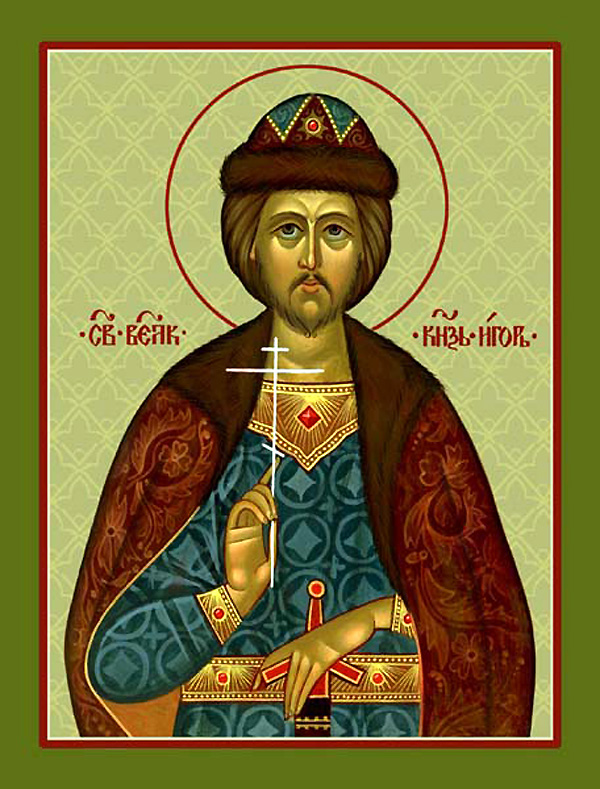
The Holy Prince Igor of Chernigov: The mid-twelfth century was a grievous time of incessant internecine strife over the Kiev principality between two princely factions: the Olegovichi and the Mstislavichi. They were all close relatives, they were all great-grandsons of Yaroslav the Wise. The Mstislavichi were called after their father, Saint Mstislav the Great (April 15), son of Vladimir Monomakh (from whence their other name: “Monomashichi”). The Olegovichi were called after the name of Oleg Sviatoslavich (+ 1115), known as “Gorislavich” because of his bitter [“gore”] fate. Oleg Gorislavich was the son of the Kievan prince Sviatoslav (+ 1076), who participated in the Transfer of the Relics of the holy Passion-Bearers Boris and Gleb in the year 1072 (May 2). Sviatoslav was the owner of two of the most remarkable theological collections of this time — the “Sviatoslav Izbornik [selections from the holy Fathers] of 1073” and the “Izbornik of 1076.”

In certain old Mesyateslovs [Menaia], Prince Sviatoslav himself was esteemed as a saint of God, but particularly famed were his two grandsons: Saint Nicholas Sviatosha (October 14), and Nicholas’s first cousin, the holy Martyr Prince Igor Olegovich, the son of Oleg Gorislavich.

Saint Nicholas Sviatosha and Saint Igor Olegovich represent two different paths of Christian sanctity in ancient Rus. Saint Nicholas forsook the world and his princely duties to become a simple monk. He died in peace, after nearly forty years at the monastery. Saint Igor, involved in the struggle for the Kiev principality by God’s will, would blot out the sin of princely strife by his own martyrdom.

In the year 1138 the Great-principality of Kiev was assumed by Igor’s elder brother, Vsevolod Olegovich (great-grandfather of Saint Michael of Chernigov). Although his rule lasted only a few years and was filled with constant wars, Prince Vsevolod considered Kiev as his own dominion to bequeath [a view partly in conflict with the complex “appanage” system, rotating princes on the basis of seniority], and he decided to bequeath it as an inheritance to his brother Igor. For this he cited the example of Prince Vladimir Monomakh and said, almost as if intentionally provoking the Monomashichei: “Vladimir appointed Mstislav, his son, to follow after him in Kiev, and Mstislav designated his brother Yaropolk. ‘And herewith I declare that if God should take me, I give Kiev over to my brother Igor.’”

The haughty words of Vsevolod, whom the Kievans did not love, became a pretext for inciting enmity against his brother Igor and all the Olegovichi. “We do not want him to inherit,” resolved the Kievan council. The ill-will and arrogance of the prince provoked the ill-will and arrogance of the Kievans. Saint Igor, dragged into the very center of events against his will, became an innocent victim of the growing hatred.

On August 1, 1146 Prince Vsevolod died, and the Kievans kissed the cross, accepting Igor as their new prince. Igor kissed the cross and promised he would rule the people of Kiev justly and defend them. But the Kievan nobles violated their oath of fidelity when they kissed the cross, and immediately invited the Mstislavichi to Kiev with their forces. Beneath Kiev a battle raged between the forces of Prince Igor and those of Izyaslav Mstislavich. Once again breaking their oath, the Kievan forces went to Izyaslav’s side during the battle. For four days Igor Olegovich hid himself in the marshes about Kiev. Then they took him captive, and took him to Kiev and put him in the “blockhouse.” This was on August 13. His princely rule lasted only two weeks.

In order to free a prisoner from the “blockhouse,” a dank log house without windows or doors, it was necessary to “chop” him out of there. The much-suffering Igor fell grievously ill, and they thought that he would die. Under these conditions the enemies of the prince decided “to chop him out” of prison and have him tonsured a schemamonk at the Theodorov monastery. With the help of God, the prince recovered his health. As a monk at the monastery, he spent his time weeping and praying.

The struggle for Kiev continued. Incited by pride and blind hatred, neither side wanted to give in. Determined to wipe out the line of the Olegovichi, and all its princes, the Kievan council in the following year decided to kill the prince-monk.

The Metropolitan and the clergy tried to reason with them and stop them. The prince ruling at Kiev, Izyaslav Mstislavich, and in particular his brother Vladimir, tried to avert this senseless bloodshed, and to save the holy martyr, but they themselves were in danger from the vicious mob.

The mob rushed into church during the Holy Liturgy and seized Igor, who was praying before the icon of the Mother of God, and they dragged him out to kill him. Prince Vladimir halted the mob at the gates of the monastery. Igor said to him: “Brother, will you forsake me?” Vladimir jumped down from his horse, wanting to help, and covered him with his princely cloak while saying to the Kievan people: “Brethren, do not commit murder!” According to the Chronicle, “Vladimir led Igor to his mother’s palace, and they rushed at Vladimir.”

Vladimir succeeded in pushing Igor into the palace and locking the gates. But the people broke down the gates, and seeing Igor “in the lofts,” they dragged the holy martyr down and murdered him on the stairway. The vicious mob was so intense, that they subjected the dead body of the sufferer to further beatings and abuse. Then they dragged him by his feet to the Desyatina (Tithe) church. They threw him on a cart, and then “hung him up in the marketplace.”

Thus did the holy martyr surrender his soul to the Lord, “and he put off the perishable robe of mankind, and was clothed in the imperishable and much-suffering robe of Christ.” When on the evening of the same day the body of Saint Igor was transferred to the church of Saint Michael, “God manifested a great sign, and the candles around him lit by themselves.” On the second morning the holy sufferer was buried in the monastery of Saint Simeon, on the outskirts of Kiev.

In the year 1150, Prince Sviatoslav Olegovich of Chernigov transferred the relics of his brother, Saint Igor, to Chernigov and put them in the cathedral of the Savior. The wonderworking Igorov icon of the Mother of God, before which the martyr prayed before his murder, is in the Dormition church of the Kiev Caves Lavra (the icon is commemorated on June 5).
Daily Readings for Wednesday, September 18, 2024

WEDNESDAY OF THE 1ST WEEK

ABSTAIN FROM MEAT, FISH, DAIRY, EGGS, WINE, OLIVE OIL

Eumenius the Wonderworker, Bishop of Gortynia, Ariadne the Martyr, Afterfeast of the Holy Cross

ST. PAUL’S SECOND LETTER TO THE CORINTHIANS 9:12-15; 10:1-7

Brethren, the rendering of this service not only supplies the wants of the saints but also overflows in many thanksgivings to God. Under the test of this service, you will glorify God by your obedience in acknowledging the gospel of Christ, and by the generosity of your contribution for them and for all others; while they long for you and pray for you, because of the surpassing grace of God in you. Thanks be to God for his inexpressible gift!
I, Paul, myself entreat you, by the meekness and gentleness of Christ – I who am humble when face to face with you, but bold to you when I am away! – I beg of you that when I am present I may not have to show boldness with such confidence as I count on showing against some who suspect us of acting in worldly fashion. For though we live in the world we are not carrying on a worldly war, for the weapons of our warfare are not worldly but have divine power to destroy strongholds. We destroy arguments and every proud obstacle to the knowledge of God, and take every thought captive to obey Christ, being ready to punish every disobedience, when your obedience is complete.
Look at what is before your eyes. If any one is confident that he is Christ's, let him remind himself that as he is Christ's, so are we.

LUKE 4:1-15

At that time Jesus returned from the Jordan, and was led by the Spirit for forty days in the wilderness, tempted by the devil. And he ate nothing in those days; and when they were ended, he was hungry. The devil said to him, "If you are the Son of God, command this stone to become bread." And Jesus answered him, "It is written, 'Man shall not live by bread alone.'" And the devil took him up, and showed him all the kingdoms of the world in a moment of time, and said to him, "To you I will give all this authority and their glory; for it has been delivered to me, and I will give it to whom I will. If you, then, will worship me, it shall all be yours." And Jesus answered him, "It is written, 'You shall worship the Lord your God, and him only shall you serve.'
And he took him to Jerusalem, and set him on the pinnacle of the temple, and said to him, "If you are the Son of God, throw yourself down from here; for it is written, 'He will give his angels charge of you, to guard you, ' and 'On their hands they will bear you up, lest you strike your foot against a stone.'" And Jesus answered him, "It is said, 'You shall not tempt the Lord your God.'" And when the devil had ended every temptation, he departed from him until an opportune time. And Jesus returned in the power of the Spirit into Galilee, and a report concerning him went out through all the surrounding country. And he taught in their synagogues, being glorified by all.

Afterfeast of the Elevation of the Cross

From September 15 until the Leavetaking, we sing “O come, let us worship and fall down before Christ. O son of God crucified in the flesh, save us who sing to Thee: Alleluia” at weekday Liturgies following the Little Entrance.

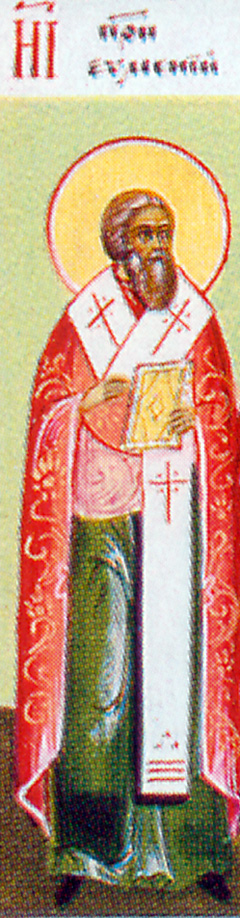
Saint Eumenius, Bishop of Gortyna

Saint Eumenius from the time of his youth was noted for his virtuous life. He strove to serve the One God and therefore he shunned worldly temptations. Concerned for the salvation of his soul, he distributed all his substance to the poor.

By the blessing of God Saint Eumenius was chosen as Bishop of Gortyna on the island of Crete. The saint, like a compassionate father, comforted his flock in their sorrows, and cared for the orphaned and indigent. His prayers were so strong before God that once, during a drought, he called forth abundant rain upon the earth.

Saint Eumenius wisely and zealously defended the Orthodox Faith against the Monophysite heresy. For his opposition to the heresy the saint was banished to the Thebaid, where he died in the seventh century. His body was then transferred and buried in Gortyna.

Martyr Ariádnē of Phrygia

The Holy Martyr Ariádnē was a slave of Tertullus, a prominent official of the city of Promissia, Phrygia in the reign of Emperor Hadrian (117–161). Although she was only a slave, Saint Ariádnē was wiser than many noble ladies, who were enslaved by worldly vanities and “every defilement of flesh and spirit" (2 Corinthians 7:1).

Once, on his son's birthday, when her master offered sacrifice to the pagan "gods," his Christian slave Ariádnē refused to participate in the wicked celebration. As a result, she was beaten and, after hanging her up, they raked her body with sharp iron hooks. Then the martyr was thrown into prison and starved for a long time in order to make her worship the idols. Saint Ariádnē, however, persisted in her confession of Christ, and it was impossible to convince her to offer sacrifice.

Realizing that the Saint would not change her mind, they released her. To avoid further pressure, she fled the city, but Tertullus sent men to follow her. Seeing that she was being pursued, the Holy Martyr ran, begging God to protect her from her enemies.

Suddenly, by her prayers, a crevice formed in the mountain, and Saint Ariádnē disappeared into it, and surrendered her soul to God. Other sources say that she fell off a cliff and was killed.

Martyrs Sophia, Irene, and Castor of Egypt

Saint Sophia endured martyrdom with Saints Castor and Irene in Alexandria.

Greatmartyr Prince Bidzini and Martyrs Princes Elizabar and Shalvi, of Georgia

In the 17th century the Persian aggressors razed churches, monasteries, and fortresses and drove out thousands of Georgian families to resettle them in remote provinces of Persia. The deserted territories were settled by Turkic tribes from Central Asia. In the chronicle The Life of Kartli it is written: “The name of Christ was not allowed to be uttered, except in a handful of mountainous regions: Tusheti, Pshavi, and Khevsureti.”

But the All-merciful Lord aroused a strong desire in the valiant prince Bidzina Choloqashvili of Kakheti and, together with Shalva and his uncle Elizbar, princes of Aragvi and Ksani provinces, he led a struggle to liberate Kakheti from the Tatars. (The Persian governor of Kakheti, Salim Khan (1656-1664), had been encouraging the Tatar tribesmen to profane the Christian churches.)

Fearing that the enemy, who had already conquered Kakheti, would soon move in and also dominate Kartli, the princes Bidzina, Shalva, and Elizbar united the forces of those two regions in preparation for the attack.

After much deliberation, Bidzina announced his intention to his father-in-law, Prince Zaal of Aragvi. Zaal’s soul was spiritually pained by the countless misfortunes and injustices his country had suffered, and he quickly pledged his support for the effort. He agreed to participate in the insurrection anonymously, while the Ksani rulers Shalva and Elizbar would command the armies.

On the moonless night of September 15, 1659, the feast of the Alaverdi church (The feast of Saint Joseph of Alaverdi) the united army of all eastern Georgia assembled and crossed over the mountains, past the village of Akhmeta, and launched a surprise attack on the Persians from Bakhtrioni Fortress and Alaverdi Church. The invader’s armies were so utterly crushed that their leader, Salim Khan, the Persian governor of Kakheti, barely succeeded in escaping from the avengers, after he had abandoned his family and army.

The victorious Georgian army offered prayers of thanksgiving to the Lord God and Great-martyr George, the protector of the Georgian people, who had appeared visibly to all during the battle, riding his white horse like a flash of lightning and leading the Georgians to victory.

The joy was great but short lived. The furious Shah Abbas II (1642-1667) ordered King Vakhtang V of Kartli (1658-1675) to deliver to him those who had instigated the insurrection.

Certain that they would receive no mercy from the shah, Georgia’s heroic liberators nevertheless set out for Persia without complaint. The shah received them with respect and generously bestowed gifts upon them, but then demanded that they renounce the Christian Faith. Neither bribery nor flattery would break their will, so the shah ordered his servants to arrest and torture them, strip off their clothing, and cast them, bound, under the blazing sun. Tormented by thirst and insect stings, the martyrs were periodically tempted to renounce Christ, but with God’s help they resisted every temptation.

Finally the enraged Salim Khan, the vassal of Shah Abbas, ordered the beheading of Elizbar and Shalva, hoping by this to break Bidzina’s resolve. But his efforts were in vain. “There is nothing sweeter than death for Christ’s sake!” Bidzina proclaimed.

The Ksani princes calmly bowed their heads, but the undersized executioners could not reach the stately princes with their swords. So the shah’s henchmen hacked each of the princes in two at the shins, then decapitated them after they had fallen to an accessible height.

But even the murder of his companions would not cause Saint Bidzina’s will to waver. So the enemies resolved to break his will by mockery. They draped the bound prince in a chadar (the veil worn by Muslim women), seated him on a donkey, and paraded him through the streets. Then they began to butcher him alive. One by one they cut off his fingers and toes, then they chopped off his hands and feet, then his arms and legs, until only his head remained unharmed. It was clear from the movement of his lips that the holy martyr was praying.

Then one of the persecutors pierced his heart with a spear. This happened in the year 1661. The mutilated bodies of the holy martyrs remained under the open sky for one day, and no one was permitted to go near them. During the night they were illumined by a brilliant light.

Then a group of Christians secretly buried the saints’ remains. Several years later Saint Shalva’s wife Ketevan and son David sent several of the faithful to Persia to bring back their relics. Crowds of believers gathered at the Kartli border to meet the holy relics and accompany them with hymns of rejoicing to their final resting place at the Ikorta Church of the Archangels.

Translation of the “Staro Rus” Icon of the Mother of God in Triumph to Russia

The Staro Rus Icon of the Mother of God was so named because for a long time it was in Staro Rus, where it had been brought by the Greeks from Olviopolis during the very first period of Christianity in Russia. The icon was in Staro Rus until the seventeenth century. In 1655 during a plague it was revealed to a certain inhabitant of the city of Tikhvin that the pestilence would cease if the wonderworking Staro Rus Icon were transferred there, and the Tikhvin Icon sent to Staro Rus.

After the transfer of the icons the plague ceased, but the people of Tikhvin did not return the icon and only in the eighteenth century did they give permission to make a copy of the Staro Rus Icon, which on May 4, 1768 was sent to Stara Russa. A feast was established in honor of this event. On September 17, 1888 the original was also returned to Staro Rus and a second Feast day established.

“The Healer” Icon of the Mother of God

The original icon known as “Tselitel’nitsa,” or “The Healer” was from the Tsilkan church in Kartali, Georgia. It was painted at the time of Saint Nino (January 14).

There is another icon with the same name in the Alexeev women’s monastery in Moscow, and many miracles took place before it at the end of the eightheenth century. Saint Demetrius of Rostov (September 21 and October 28) relates a story about this icon in his book THE BEDEWED FLEECE.

A cleric of the Navarninsky church, Vincent Bulvinensky, was in the habit of venerating the icon of the Mother of God whenever he entered the church. He would also recite the following prayer before the icon: “Hail, Virgin Theotokos full of grace, the Lord is with Thee. Blessed is the womb which bore Christ, and the breasts which nourished the Lord God, our Savior.”

In time, he found himself suffering from a dreadful affliction. His tongue began to putrefy, and he passed out from the pain. When he came to himself, he prayed his usual prayer to the Most Holy Theotokos.

As soon as he had finished his prayer, he saw a handsome young man at the head of his bed. The sufferer realized at once that this was his guardian angel. The angel looked at him with pity, calling on the Mother of God to heal him. Suddenly, the Theotokos appeared and healed the sick man who was so devoted to Her. He got out of bed and went to church, taking his place on the cliros for the service. Those present were astonished to see his recovery.

This miracle inspired the painting of “The Healer” icon depicting the Mother of God standing at the bed of the sick man.

Venerable Euphrosynē of Suzdal

Saint Euphrosynē of Suzdal was born in 1212. Although she was a princess, she entered a women’s monastery in Suzdal, where she was tonsured with the name Euphrosynē, in honor of Saint Euphrosynē of Alexandria (September 25).

After her death on September 25, 1250, many miracles took place at her grave. Believers were healed of various infirmities, and their prayers were answered.

On September 18, 1698, with the blessing of Patriarch Adrian, Metropolitan Hilarion of Suzdal glorified the nun Euphrosynē as a saint.

Venerable Hilarion of Optina

On the night of Pascha, April 8-9, 1805, Saint Hilarion (Ponamarov) was born in Kluch, the third son of Nikḗtas and Euphemia Ponamarov, who named him Rodion in honor of Saint Herodion of the Seventy. He always considered April 8, the day of his patron saint’s commemoration, as his birthday. After Rodion, a son and a daughter were born to the Ponamarovs. The daughter, however, died as a baby.

Nikḗtas Ponamarov worked in town as a tailor, and sometimes his business took him to the homes of the local landowners. Consequently, Rodion seldom saw his father until he was fifteen years old.

Rodion was a quiet, uncoordinated child who did not play much with other children, since they made fun of his clumsiness. Even members of his own family behaved in a rude manner toward him, and seldom showed him any affection. The way he was treated made him thoughtful and introspective.

One winter he was playing in the snow with some friends, using an old board as a sled. The board broke and left Rodion with a permanent scar on the finger of his left hand. Another time he injured himself on a saddle-horn while riding. These injuries also had an effect on his health, which was never robust.

The family moved to the Novopersk region of Voronezh in 1820, and Rodion lived there until he was twenty. He helped his father in his work, and gradually acquired skill as a tailor. His parents wanted him to follow this trade, even though his mother once foretold that he would be a monk. Rodion himself desired the monastic life even as a young child, but now he applied himself to tailoring, for he knew that this handicraft would be very useful in the monastery.

Rodion went to Moscow in December of 1825 in order to learn more about being a tailor, arriving with very little money, and with nowhere to stay. He worked with various tailors, but the work was difficult and he became ill. His poor health, he said in later life, probably saved him from falling into many vices. Having increased his proficiency as a tailor, Rodion left Moscow and returned home.

The family moved again in 1829, this time to Saratov. Rodion was engaged twice, but the Lord did not want him to follow this path. His first fiancée died after a short illness, and Rodion simply lost interest in the second.

Saratov was the home to many sectarians of all sorts, and the future saint became involved with certain activists who tried to refute their false teachings. Rodion’s missionary labors may have influenced many sectarians to return to the Orthodox Church. Because of some misunderstanding, however, Rodion and his friends were put on trial. As a result, the authorities kept Rodion under observation for the next four years. This scrutiny was hard for him to endure, and made it very difficult for him to conduct his affairs.

Through his study of the Holy Scripture and the writings of the holy Fathers, Rodion’s desire to become a monk was reawakened. Therefore, he decided to find the monastery which was most suitable for him. In 1837 and 1838 Rodion visited monasteries at Sarov, Suzdal, Rostov, Tikhvin, Moscow, Pochaev, and other places. Finally, he arrived before the gates of Optina. He was thirty-four years old.

At first, Rodion was placed in a cell next to Father Barlaam, a retired igumen of Valaam Monastery. Father Barlaam was a man of great spiritual stature, who had a profound influence on the young man, and became his first instructor in the Jesus Prayer. In later years, Elder Hilarion recalled visiting Father Barlaam to tell him of the various things he had seen or heard. Father Barlaam would ask, “Is that useful? It would be better for you not to see or hear anything. Try to examine your thoughts and your heart more often.” With his wise counsel, Father Barlaam helped Rodion in his spiritual growth as a monk.

Saint Anthony (August 7), the Superior of the Skete, was transferred to Maloyaroslavets on December 1, 1839. He was replaced by Saint Macarius (September 7), the monastery’s confessor. Rodion was assigned to be his cell attendant, remaining in this obedience until the Elder’s death in 1860. Rodion went to Father Macarius for Confession, and to Saint Leonid (October 11) for the daily revelation of his thoughts. In an effort to cleanse himself of the passions, Rodion renounced his own will and obeyed Elder Macarius in all things.

Father Macarius was very strict with the novices, and would not permit the slightest disobedience. He was never the first to bring up a person’s failures and shortcomings, but waited for him to confess his own negligence. He taught the novices to love their neighbor, and to bear their afflictions with patience.

From the time Rodion came to Optina, he had other obediences in addition to serving as cell attendant to Father Macarius. He also tended the flower and vegetable gardens, and worked as a baker, and a bee-keeper. He carried out every task assigned him without complaint.

While his spiritual progress was hidden from men, it was certainly noticed by the all-seeing God. In due course, he received the monastic tonsure and was given the name Hilarion. Father Macarius recognized his disciple’s spiritual maturity, and predicted that he and Saint Ambrose (October 10) would succeed him as Elders after his death. Elder Macarius therefore entrusted Father Hilarion and Father Ambrose with giving counsel to his many spiritual children.

As the closest disciple of Saint Macarius, Father Hilarion was chosen to be Superior of the Skete, and the monastery’s Father Confessor. He confessed all the brethren entrusted to him five times a year, once during each of the Fasts, and twice during Great Lent. Each monk was questioned about the details of his inner life, and was given advice on how to conduct himself in future. Once he finished hearing the Confession of the monks, Father Hilarion began confessing the nuns, and the men and women who came to him from various places. Although there were many people, Father Hilarion never refused anyone. He rarely gave his own opinion, but quoted from the Scriptures or the writings of the Fathers. Sometimes, he would tell people what Father Macarius had said in similar situations. He was very effective in giving advice, because he always practiced what he preached, and he had already experienced the things that were troubling his spiritual children.

The Elder led people to feel sorrow for their sins, and through his questions he brought them to an awareness of their spiritual state. Sometimes he would help them to remember sins which they had forgotten to confess, sins which might lie at the root of their spiritual infirmity. He gave penances according to a person’s age, health, and circumstances. He might require the penitent to read certain prayers, do prostrations, give alms, and to avoid those habits and amusements which are not fitting for a Christian. Many people received much benefit from confessing to him, and continued to live according to the advice he had given them. Not only were they cured of their spiritual afflictions, but sometimes Father Hilarion also healed them of their physical or mental illness as well.

Father Hilarion, by God’s providence, became seriously ill for two years. All during that time he did not ask God to let him recover. Instead, he asked to be given the patience to help him bear the illness. He received Holy Communion frequently, and twice he was given Holy Unction.

During the last thirty-three days of his life, Father Hilarion partook of the life-giving Mysteries of Christ every day. In the last four weeks of his life, the Elder was unable to lie down in bed because of water in his lungs. Therefore, he remained seated on a couch in front of a portrait of Father Macarius. He experienced great discomfort, and was not able to sleep very well.

Father Hilarion observed the cell rule of prayer until the last moments of his life. Early on the morning of September 18, 1873 he listened to the morning rule being read, and received Holy Communion at 1:00 A.M. Five hours later, he rested from his labors and gave his soul into the hands of God.

It is said that during Father Hilarion’s final illness, Saint Macarius appeared to him many times in his dreams. As he drew closer to death, these appearances became more frequent. He died with his prayer rope in his hands, and was buried next to his beloved Elder, Saint Macarius.

The Moscow Patriarchate authorized local veneration of the Optina Elders on June 13,1996. The work of uncovering the relics of Saints Leonid, Macarius, Hilarion, Ambrose, Anatole I, Barsanuphius and Anatole II began on June 24/July 7, 1998 and was concluded the next day. However, because of the church Feasts (Nativity of Saint John the Baptist, etc.) associated with the actual dates of the uncovering of the relics, Patriarch Alexey II designated June 27/July 10 as the date for commemorating this event. The relics of the holy Elders now rest in the new church of the Vladimir Icon of the Mother of God.

The Optina Elders were glorified by the Moscow Patriarchate for universal veneration on August 7, 2000.

Daily Readings for Tuesday, September 17, 2024

TUESDAY OF THE 1ST WEEK

NO FAST

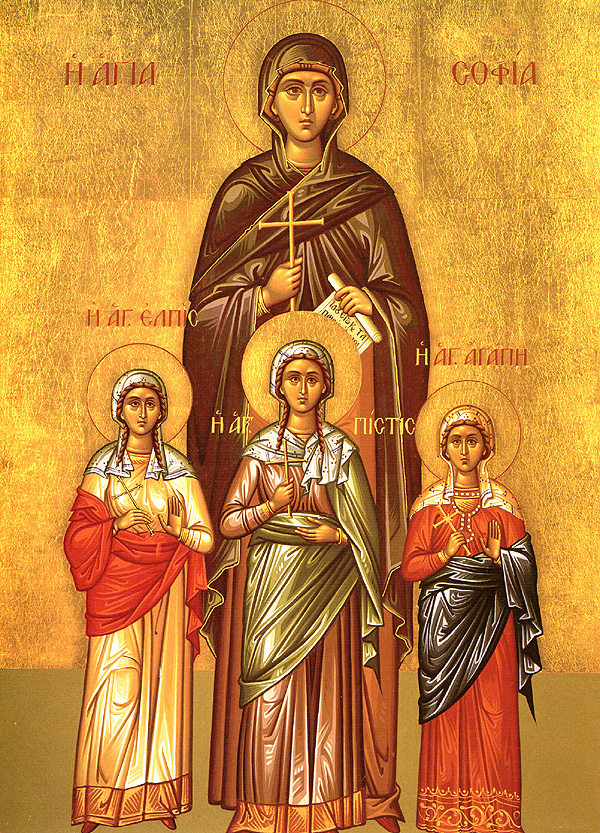
Sophia & her three daughters: Faith, Hope, and Love, Herakleides & Myron, Bishops of Cyprus, Afterfeast of the Holy Cross

ST. PAUL’S SECOND LETTER TO THE CORINTHIANS 8:16-24; 9:1-5

Brethren, thanks be to God who puts the same earnest care for you into the heart of Titus. For he not only accepted our appeal, but being himself very earnest he is going to you of his own accord. With him we are sending the brother who is famous among all the churches for his preaching of the gospel; and not only that, but he has been appointed by the churches to travel with us in this gracious work which we are carrying on, for the glory of the Lord and to show our good will. We intend that no one should blame us about this liberal gift which we are administering, for we aim at what is honorable not only in the Lord's sight but also in the sight of men. And with them we are sending our brother whom we have often tested and found earnest in many matters, but who is now more earnest than ever because of his great confidence in you. As for Titus, he is my partner and fellow worker in your service; and as for our brethren, they are apostles of the churches, the glory of Christ. So give proof, before the churches, of your love and of our boasting about you to these men.
Now it is superfluous for me to write to you about the offering for the saints, for I know your readiness of which I boast about you to the people of Macedonia, saying that Achaia has been ready since last year; and your zeal has stirred up most of them. But I am sending the brethren so that our boasting about you may not prove vain in this case, so that you may be ready, as I said you would be; lest if some Macedonians come with me and find that you are not ready, we be humiliated — to say nothing of you — for being so confident. So I thought it necessary to urge the brethren to go on to you before me, and arrange in advance for this gift you have promised, so that it may be ready not as an exaction but as a willing gift.

LUKE 3:23-38, 4:1

At that time, Jesus, when he began his ministry, was about thirty years of age, being the son (as was supposed) of Joseph, the son of Heli, the son of Matthat, the son of Levi, the son of Melchi, the son of Jannai, the son of Joseph, the son of Mattathias, the son of Amos, the son of Nahum, the son of Esli, the son of Naggai, the son of Maath, the son of Mattathias, the son of Semein, the son of Josech, the son of Joda, the son of Joanan, the son of Rhesa, the son of Zerubbabel, the son of Salathiel, the son of Neri, the son of Melchi, the son of Addi, the son of Cosam, the son of Elmadam, the son of Er, the son of Joshua, the son of Eliezer, the son of Jorim, the son of Matthat, the son of Levi, the son of Simeon, the son of Judah, the son of Joseph, the son of Jonam, the son of Eliakim, the son of Melea, the son of Menna, the son of Mattatha, the son of Nathan, the son of David, the son of Jesse, the son of Obed, the son of Boaz, the son of Sala, the son of Nahshon, the son of Amminadab, the son of Admin, the son of Arni, the son of Hezron, the son of Perez, the son of Judah, the son of Jacob, the son of Isaac, the son of Abraham, the son of Terah, the son of Nahor, the son of Serug, the son of Reu, the son of Peleg, the son of Eber, the son of Shelah, the son of Cainan, the son of Arphaxad, the son of Shem, the son of Noah, the son of Lamech, the son of Methuselah, the son of Enoch, the son of Jared, the son of Mahalaleel, the son of Cainan, the son of Enos, the son of Seth, the son of Adam, the son of God. And Jesus, full of the Holy Spirit, returned from the Jordan, and was led by the Spirit in the wilderness.

Afterfeast of the Elevation of the Cross

From September 15 until the Leavetaking, we sing “O come, let us worship and fall down before Christ. O son of God crucified in the flesh, save us who sing to Thee: Alleluia” at weekday Liturgies following the Little Entrance.

Martyr Sophia and her three daughters at Rome

The Holy Martyrs Saint Sophia and her Daughters Faith, Hope and Love were born in Italy. Their mother was a pious Christian widow who named her daughters for the three Christian virtues. Faith was twelve, Hope was ten, and Love was nine. Saint Sophia raised them in the love of the Lord Jesus Christ. Saint Sophia and her daughters did not hide their faith in Christ, but openly confessed it before everyone.

An official named Antiochus denounced them to the emperor Hadrian (117-138), who ordered that they be brought to Rome. Realizing that they would be taken before the emperor, the holy virgins prayed fervently to the Lord Jesus Christ, asking that He give them the strength not to fear torture and death. When the holy virgins and their mother came before the emperor, everyone present was amazed at their composure. They looked as though they had been brought to some happy festival, rather than to torture. Summoning each of the sisters in turn, Hadrian urged them to offer sacrifice to the goddess Artemis. The young girls remained unyielding.

Then the emperor ordered them to be tortured. They burned the holy virgins over an iron grating, then threw them into a red-hot oven, and finally into a cauldron with boiling tar, but the Lord preserved them.

The youngest child, Love, was tied to a wheel and they beat her with rods until her body was covered all over with bloody welts. After undergoing unspeakable torments, the holy virgins glorified their Heavenly Bridegroom and remained steadfast in the Faith.

They subjected Saint Sophia to another grievous torture: the mother was forced to watch the suffering of her daughters. She displayed adamant courage, and urged her daughters to endure their torments for the sake of the Heavenly Bridegroom. All three maidens were beheaded, and joyfully bent their necks beneath the sword.

In order to intensify Saint Sophia’s inner suffering, the emperor permitted her to take the bodies of her daughters. She placed their remains in coffins and loaded them on a wagon. She drove beyond the city limits and reverently buried them on a high hill. Saint Sophia sat there by the graves of her daughters for three days, and finally she gave up her soul to the Lord. Even though she did not suffer for Christ in the flesh, she was not deprived of a martyr’s crown. Instead, she suffered in her heart. Believers buried her body there beside her daughters.

The relics of the holy martyrs have rested at El’zasa, in the church of Esho since the year 777.

Martyr Theodota at Nicea

The Holy Martyr Theodota, a native of Cappadocia, suffered in the city of Nicea during the reign of the emperor Alexander Severus (222-235). At this time the governor of Cappadocia was a certain Symblicius. They told him that a rich woman named Theodota was confessing Christ. The governor summoned Theodota and for a long time urged her to turn from the true Faith.

Seeing the futility of his attempts, he gave Theodota over to torture. They suspended her and began to rake her with iron hooks, but she did not feel any pain. Then they put her in chains and led her away to a prison cell.

After eight days, when they led the saint out for new tortures, only faint traces of the tortures already endured remained on her body. The governor was amazed and asked, “Who are you?” The saint answered: “Your mind is darkened, but if you were sober, then you would have realized that I am Theodota.”

Symblicius commanded the martyr to be cast into a red-hot furnace. Flames shot out from the furnace and scorched those standing nearby, while those remaining unharmed shut the furnace and scattered in fright. After a certain while, pagan priests came and opened the furnace to scatter the ashes of the martyr, but they too were burned by the flames. Those remaining unhurt saw Saint Theodota unharmed. She stood in the midst of the flames between two youths in white raiment, and was glorifying the Lord. This apparition so terrified the pagans that they fell down as if dead. Later, they returned the saint to prison.

The invincibility of the martyr gave Symblicius no peace. He made a journey to Byzantium, on the return trip he stopped over at Ancyra and tried to get the better of Theodota. He gave orders to throw her all at once onto red-hot iron, but again the martyr remained unharmed.

Then Symblicius gave orders that the saint be taken to Nicea. There, in a pagan temple he wanted to compel her to offer sacrifice to the idols, but through the prayer of the saint, the idols fell and were shattered. The outraged governor gave orders to stretch the martyr out and saw through her body, but here also the power of God preserved the saint. The saw caused Theodota no harm, and the servants became exhausted. Finally, they beheaded the saint. Bishop Sophronius of Nicea buried her body.

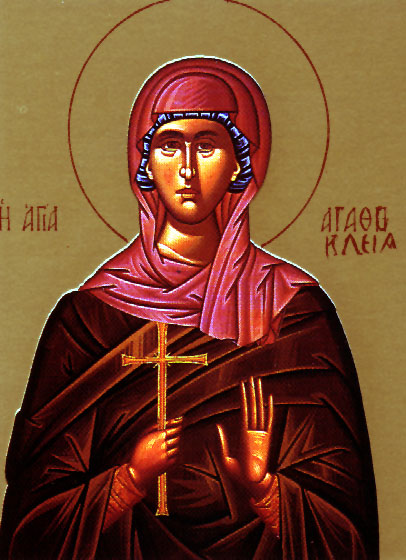
Martyr Agathocleia

The holy martyr Agathocleia was a servant in the home of a certain Christian named Nicholas. His wife Paulina was a pagan. For eight years Agathocleia underwent abuse from her mistress because of her faith. Paulina fiercely beat the servant, and made her walk barefoot over sharp stones.

Once in a fit of nastiness, Paulina broke her rib with a blow from a hammer, and then cut out her tongue. Nothing could make the saint give in to the demand of her mistress to worship idols. Then Paulina locked the martyr in prison and exhausted her with hunger. But Agathocleia did not perish: birds brought her food each day. Finally, in a fit of evil, Paulina went to the prison and murdered the holy martyr.

156 Martyrs of Palestine, including Bishops Peleus and Nilus, the Presbyter Zeno, the Noblemen Patermuthius and Elias, and others

The Holy Martyrs Peleus and Nilus, Bishops of Egypt, Presbyter Zeno, Patermuthius, Elias and another 151 Martyrs suffered during the reign of the emperor Maximian Galerius (305-311). The majority of them were Egyptians, but there were also some Palestinians among them. Firmilian, the governor of Palestine, arrested 156 Christians. They gouged out the eyes of the holy martyrs, cut the tendons of their feet, and subjected them to all manner of tortures. They beheaded 100 of the martyrs, and burned the rest.

Constantinople Icon of the Mother of God

There are two Icons called Constantinople which differ significantly from one other. According to Tradition, the Constantinople Icon of the Mother of God commemorated on April 25, is one of the Icons painted by the Holy Apostle and Evangelist Luke. How and under what circumstances this Constantinople Icon of the Mother of God appeared is unknown, but the date of its appearance is known: April 25, 1071. There is a legend that the Icon (or a copy) was brought from Constantinople in the middle of the XV century by Saint Euphrosynos of Pskov (May 15), who received it from the Patriarch of Constantinople. The revered Icon was in the Savior-Eleazar Monastery near Pskov, but, unfortunately, it was lost in the depths of the raging Tolba River, along with the ships of the Swedes, who had plundered the Savior-Eleazar Monastery and tried to remove its treasures.

Concerning the other Constantinople Icon of the Mother of God (commemorated on September 17) there is a legend that in ancient times two Greek monks from Constantinople were passing through Staraya Russ and served the Divine Liturgy there in the cathedral church. In remembrance of their stay, they left a miniature Icon of the Mother of God, engraved on a slate, in the cathedral. This miniature Icon soon became renowned for its miracles. Many believers flocked to this Holy Icon and took some water which was blessed by immersing the Icon in it, in order to heal sick infants.

There are copies of this Icon in Moscow: in the parish church of the Dormition of the Most Holy Theotokos, which is on Malaya Dmitrovka, in the village of Nizherov, Rostov district, Yaroslavl province, and in the Savior-Eleazar Monastery, 25 versts from Pskov. The original name of the Monastery was Sretensky1 – as a sign of the meeting of the Constantinople Icon of the Mother of God, which was brought to the Monastery after the Fall of Constantinople by Venerable Euphrosynos of Pskov, who received a copy from the Patriarch of Constantinople.


1 The Great Feast of the Meeting of our Lord and Savior Jesus Christ in the Temple.

Icon of the Mother of God of Macariev

The Makariev “Directress” Icon of the Mother of God appeared during the reign of Prince Basil the Dark (1425-1462) to Saint Macarius the Wonderworker, who labored in asceticism on the desolate shores of the River Unzha.

On September 17, 1442 at about the third hour of the morning, when Saint Macarius was finishing his usual morning Akathist to the Most Holy Theotokos, his cell was illumined suddenly by an unknown light. The monk became confused in spirit and fervently began to pray.

Beyond the cell walls he heard the angelic refrain: “Hail, Full of Grace, O Virgin Mother!” With fear and astonishment the monk went out from his cell and on the northwest horizon he saw the icon of the Mother of God, surrounded by a luminous radiance.

The icon approached towards the cell of the ascetic. With joyful trembling the monk fell to the ground and cried out: “Hail, Mother of God! Hail, Ever-Flowing Fountain issuing salvation to all the world and assuring protection and intercession to all the land of Galicia!”

He reverently took up the icon and placed it in his cell, thus it also came to be named the “Cell-Icon.” Afterwards, the disciples of the monk gave it the title of “Makariev.” On the place of the appearance of the holy icon a monastery was founded, and was also named Makariev. Copies of the Makariev Icon of the Mother of God were made, which became as renowned as the original.

9/29 announcements

September 29, 2024

Fourteenth Sunday after Pentecost

II Corinthians 1:21-2:4: Brethren, it is God who establishes us with you in Christ, and has commissioned us; He has put his seal upon us and given us His Spirit in our hearts as a guarantee. But I call God to witness against me—it was to spare you that I refrained from coming to Corinth. Not that we lord it over your faith; we work with you for your joy, for you stand firm in your faith. For I made up my mind not to make you another painful visit. For if I cause you pain, who is there to make me glad but the one whom I have pained? And I wrote as I did, so that when I came I might not suffer pain from those who should have made me rejoice, for I felt sure of all of you, that my joy would be the joy of you all. For I wrote you out of much affliction and anguish of heart and with many tears, not to cause you pain but to let you know the abundant love that I have for you.

Luke 6:31-36: The Lord said: “As you wish that men would do to you, do so to them. If you love those who love you, what credit is that to you? For even sinners love those who love them. And if you do good to those who do good to you, what credit is that to you? For even sinners do the same. And if you lend to those from whom you hope to receive, what credit is that to you? Even sinners lend to sinners, to receive as much again. But love your enemies, and do good, and lend, expecting nothing in return; and your reward will be great, and you will be sons of the Most High; for He is kind to the ungrateful and the selfish. Be merciful, even as your Father is merciful.”

Troparion of the Resurrection: Let us believers praise and worship the Word, co-eternal with the Father and the Spirit, born of the Virgin for our salvation; for he took pleasure in ascending the Cross in the flesh, to suffer death, and to raise the dead by his glorious Resurrection.

Troparion of St. Kyriakos: Thou didst prove to be a citizen of the desert, an angel in the flesh, and a wonderworker, O Kyriakos, our God-bearing Father. By fasting, vigil, and prayer thou didst obtain heavenly gifts, and thou healest the sick and the souls of them that have recourse to thee with faith. Glory to Him that hath given thee strength. Glory to Him that hath crowned thee. Glory to Him that worketh healings for all through thee.

Troparion of the Chains of St. Peter: O Holy Apostle, Peter, thou dost preside over the Apostles by the precious chains which thou didst bear. We venerate them with faith and beseech thee that by thine intercessions we be granted the great mercy.

Kontakion of the Theotokos: O undisputed intercessor of Christians, O mediatrix, who is unrejected by the Creator, turn not away from the voice of our petitions though we be sinners; come to us in time, who cry to thee in faith, for thou art good. Hasten to us with intercessions, O Theotokos, who didst ever intercede for those who honor thee.

CALENDAR

UNTIL FURTHER NOTICE: All services listed on the calendar will be available through streaming and webcast. (Instructions can be found on the parish website.)

Sunday, September 29 (Fourteenth Sunday after Pentecost)

8:50 a.m. – Orthros

9:00 a.m. – Christian Education

10:00 a.m. – Divine Liturgy (webcast)

Monday, September 30

Father Herman off

Tuesday, October 1 (Protection of the Theotokos)

NO Services

Wednesday, October 2

6:30 p.m. – Daily Vespers

Thursday, October 3

NO Services

11:00 a.m. – Men’s Lunch

Friday, October 4

NO Services

Saturday, October 5

4:30 p.m. – Choir Practice

6:00 p.m. – Great Vespers

Sunday, October 6 (Fifteenth Sunday after Pentecost)

8:50 a.m. – Orthros

9:00 a.m. – Christian Education

10:00 a.m. – Divine Liturgy (webcast)

SPECIAL ANNOUNCEMENTS

The Eucharist Bread …was offered by the Karams for the Divine Liturgy this morning.

Eucharist Bread Schedule:

Eucharist Bread Coffee Hour

September 29 Karam Lockhart/Karam/Snell

October 6 Brock Algood/Schelver

October 13 R. Root POT LUCK MEAL

Baker/Jimmy Jones

October 20 Pacurari Pigott/Ian Jones

October 27 Lasseter Ken Jones/Stewart

Also, please remember that we still need your tithes and offerings which may be placed in the tray that is passed during the Divine Liturgy, in the tithe box at the back of the nave or be mailed to: St. Peter Orthodox Church, P.O. Box 2084, Madison, MS 39130-2084.

Schedule for Epistle Readers – Page numbers refer to the Apostolos (book of the Epistles) located on the Chanters’ stand at the front of the nave. Please be sure to use this book when you read.

Reader Reading Page#

September 29 Mary Martha Ellis II Cor. 1:21-2:4 158

October 6 Katie Miller II Cor. 4:6-15 163

October 13 Sophie Dansereau Titus 3:8-15 322

October 20 Simeon Root II Cor. 6:16-7:1 173

October 27 Michel Root II Cor. 9:6-11 178

Father Herman and his family will be out of town October 2-9th for a family vacation. If you need a priest during this time, please contact one of the other priests.

Please remember the following in your prayers: Aidan Milnor, the Milnor family; Lamia Dabit and her family; Mary Greene (Lee and Kh. Sharon’s sister); Jay and Joanna Davis; Fr. Leo and Kh. Be’Be’ Schelver and their family; Marilyn (Kyriake) Snell; Jack and Jill Weatherly; Sh. Charlotte Algood and their family; Reader Basil and Brenda Baker and their family; Fr. Joseph Bittle; Rick Carlton; Very Rev. Fr. Nicholas and Kh. Jan Speier; Lee Greene; Joseph, Amanda and Hunter Hines; Fr. John and Kh. Janet Henderson and their family; Galina Singletary; Emily and Cole Parker; Dane and Stephanie Skirtech.

Antidoron (Greek meaning “instead of the gifts”) is the blessed bread partaken of as a ‘fast breaker’ and an extra blessing after receiving Holy Communion. It is remaining bread from the loaf used in the pre-Liturgy service preparing the bread on the diskos and the wine in the chalice. This ‘extra’ bread is blessed during the hymn to the Theotokos during the Anaphora of the Divine Liturgy. Importantly, it is NOT consecrated to become the Body of Christ — and must be carefully distinguished from that — but NEVERTHELESS, we must do our best to treat it with due reverence and care.

Portions that are uneaten are disposed of by being placed outside where they are consumed by the elements or by animals. Unfortunately, we have recently been seeing an increase in crumbs being found on the nave floor after Divine Liturgy. Parents, please help the young ones to be careful to consume their pieces of antidoron completely, and, if crumbs should fall, be proactive in picking them up and placing them on the ground outside.

His Grace, Bishop NICHOLAS will be visiting St. Peter again on October 20-21st. He will be in Vicksburg earlier that week-end and will come to us following the Hierarchical Divine Liturgy there on Sunday. More details will be available in the future.

We will be showing the documentary film Sacred Alaska at Mississippi College on Friday evening, November 1st, beginning at 6:30 p.m. The date was changed from the original date selected to accommodate MC’s student schedule and also MC’s Homecoming celebration. Further details will be available in the very near future.

Calendar Items:

* The men of the parish meet for lunch at 11:00 a.m. on the first Thursday of the month.

* The Ladies meet at the church at 10:00 a.m. on the second Saturday of the month to pray the Akathist to the Mother of God, Nurturer of Children on behalf of our children.

* The Ladies meet for lunch at 1:00 p.m. on the last Tuesday of the month.

* Knucklehead Family Reunion in Arkansas, October 11-17th.

* The annual Fall Festival is scheduled for Saturday, October 26th. More details later.

* MARK YOUR CALENDARS: His Grace, Bishop NICHOLAS will be visiting St. Peter October 20-21st.

* Sacred Alaska documentary showing at Mississippi College, Friday, November 1st, beginning at 6:30 p.m.

* Remaining Stewpot date for 2024 will be November 30th.

NO children are allowed to be in the pantry or in the refrigerator and children under the age of 12 are not allowed in the kitchen without the presence of a parent or a responsible adult. Children under the age of 12 are not allowed to access the icemaker. Parents, we ask for your assistance with enforcing this policy. Thank you.

** We ask that families go through the Coffee Hour line together, so that children are under the supervision of their parents. **

Fasting Discipline for October

The traditional fasting discipline (no meat, dairy, eggs, fish, wine or oil) is observed on all Wednesdays and Fridays of the month.

Major Commemorations for October

October 1 Protection of the Theotokos

October 6 Holy Apostle Thomas

October 9 Holy Apostle James, Son of Alphaeus

October 18 Holy Apostle Luke

October 23 Holy Apostle James, Brother of the Lord

October 26 Great-martyr Demetrios

Fall Festival: Our annual Fall Festival is scheduled for Saturday, October 26th. We will not have Chor Practice, Catechism Class or Great Vespers that day. More details will be available shortly

Quotable: “When someone is disturbed by temptations and tribulations (which it is necessary for him to experience in order to prove his endurance), if he loses faith by forgetting the words and consolation of God and his initial zeal and fervor for asceticism begins to drown, but then he cries out to Christ like Peter, Christ’s grace reaches out to him and strangely strengthens him with his help, that is, with some divine vision, and his souls’ zeal and fervor is renewed”

-The Watchful Mind, A Monk of Mount Athos

Worship: Sunday, October 6, 2024 (Fifteenth Sunday after Pentecost)

Scripture: II Corinthians 4:6-15; Luke 7:11-16

Epistle Reader: Katie Miller

Prosphora: Brock

Coffee Hour: Algood/Schelver

9/22 announcements

September 22, 2024

Thirteenth Sunday after Pentecost

I Corinthians 16:13-24: Brethren, be watchful, stand firm in your faith, be courageous, and be strong. Let all that you do be done in love. Now, brethren, you know that the household of Stephanas were the first converts in Achaia, and they have devoted themselves to the service of the saints; I urge you to be subject to such men and to every fellow worker and laborer. I rejoice at the coming of Stephanas and Fortunatus and Achaicus, because they have made up for your absence; for they refreshed my spirit as well as yours. Give recognition to such men. The churches of Asia send greetings. Aquila and Prisca, together with the church in their house, send you hearty greetings in the Lord. All the brethren send greetings. Greet one another with a holy kiss. I, Paul, write this greeting with my own hand. If anyone has no love for the Lord, let him be accursed. Our Lord, come! The grace of the Lord Jesus be with you. My love be with you all in Christ Jesus. Amen.

Luke 5:1-11: At that time, Jesus was standing by the lake of Gennesaret. And He saw two boats by the lake; but the fishermen had gone out of them and were washing their nets. Getting into one of the boats, which was Simon’s, Jesus asked him to put out a little from the land. And He sat down and taught the people from the boat. And when Jesus had finished speaking, He said to Simon, “Put out into the deep and let down your nets for a catch.” And Simon answered, “Master, we toiled all night and took nothing! But at Thy word I will let down the nets.” And when they had done this, they enclosed a great shoal of fish; and as their nets were breaking, they beckoned to their partners in the other boat to come and help them. And they came and filled both the boats, so that they began to sink. But when Simon Peter saw it, he fell down at Jesus’ knees, saying, “Depart from me, for I am a sinful man, O Lord.” For he was astonished, and all that were with him, at the catch of fish, which they had taken; and so also were James and John, sons of Zebedee, who were partners with Simon. And Jesus said to Simon, “Do not be afraid; henceforth you will be catching men.” And when they had brought their boats to land, they left everything and followed Him.

Troparion of the Resurrection: Having learned the joyful message of the Resurrection from the angel, the women Disciples cast from them their parental condemnation, and proudly broke the news to the Disciples, saying, Death has been spoiled. Christ God is risen, granting the world Great Mercy.

Troparion of the Hieromartyr Phocas: By choosing the Apostles’ way of life, thou hast succeeded to their throne. Inspired by God, thou didst find the way to divine contemplation through the practice of virtue. After teaching the Word of Truth without error, thou didst defend the Faith to the very shedding of thy blood, O Holy Martyr among bishops Phocas. Entreat the Lord our God to save our souls.

Troparion of the Chains of St. Peter: O Holy Apostle, Peter, thou dost preside over the Apostles by the precious chains which thou didst bear. We venerate them with faith and beseech thee that by thine intercessions we be granted the great mercy.

Kontakion of the Theotokos: O undisputed intercessor of Christians, O mediatrix, who is unrejected by the Creator, turn not away from the voice of our petitions though we be sinners; come to us in time, who cry to thee in faith, for thou art good. Hasten to us with intercessions, O Theotokos, who didst ever intercede for those who honor thee.

CALENDAR

UNTIL FURTHER NOTICE: All services listed on the calendar will be available through streaming and webcast. (Instructions can be found on the parish website.)

Sunday, September 22 (Thirteenth Sunday after Pentecost)

8:50 a.m. – Orthros

9:00 a.m. – Christian Education

10:00 a.m. – Divine Liturgy (webcast)

5:30 p.m. – Book Study with Father John

Monday, September 23 (Conception of the Forerunner)

Father Herman off

Tuesday, September 24 (Proto-martyr Thekla)

NO Services

1:00 p.m. – Ladies’ Lunch

Wednesday, September 25 (Apostle John the Theologian – repose)

5:20 p.m. – Catechism Class

6:30 p.m. – Daily Vespers

Thursday, September 26

NO Services

Friday, September 27

NO Services

Saturday, September 28 (Venerable Chariton)

4:30 p.m. – Choir Practice

5:00 p.m. – Catechism Class

6:00 p.m. – Great Vespers

Sunday, September 22 (Fourteenth Sunday after Pentecost)

8:50 a.m. – Orthros

9:00 a.m. – Christian Education

10:00 a.m. – Divine Liturgy (webcast)

SPECIAL ANNOUNCEMENTS

The Eucharist Bread …was offered by the Daniel Roots for the Divine Liturgy this morning.

Eucharist Bread Schedule:

Eucharist Bread Coffee Hour

September 22 D. Root Lasseter/Pacurari/Lavric

September 29 Karam Lockhart/Karam/Snell

October 6 Brock Algood/Schelver

October 13 R. Root POT LUCK MEAL

Baker/Jimmy Jones

October 20 Pacurari Pigott/Ian Jones

October 27 Lasseter Ken Jones/Stewart

Also, please remember that we still need your tithes and offerings which may be placed in the tray that is passed during the Divine Liturgy, in the tithe box at the back of the nave or be mailed to: St. Peter Orthodox Church, P.O. Box 2084, Madison, MS 39130-2084.

Schedule for Epistle Readers – Page numbers refer to the Apostolos (book of the Epistles) located on the Chanters’ stand at the front of the nave. Please be sure to use this book when you read.

Reader Reading Page#

September 22 Katie Miller I Cor. 16:13-24 152

September 29 Mary Martha Ellis II Cor. 1:21-2:4 158

October 6 Katie Miller II Cor. 4:6-15 163

October 13 Sophie Dansereau Titus 3:8-15 322

October 20 Simeon Root II Cor. 6:16-7:1 173

October 27 Michel Root II Cor. 9:6-11 178

Please remember the following in your prayers: Aidan Milnor, the Milnor family; Lamia Dabit and her family; Mary Greene (Lee and Kh. Sharon’s sister); Jay and Joanna Davis; Fr. Leo and Kh. Be’Be’ Schelver and their family; Marilyn (Kyriake) Snell; Jack and Jill Weatherly; Sh. Charlotte Algood and their family; Reader Basil and Brenda Baker and their family; Fr. Joseph Bittle; Rick Carlton; Very Rev. Fr. Nicholas and Kh. Jan Speier; Lee Greene; Joseph, Amanda and Hunter Hines; Fr. John and Kh. Janet Henderson and their family; Galina Singletary; Emily and Cole Parker; Dane and Stephanie Skirtech.

Antidoron (Greek meaning “instead of the gifts”) is the blessed bread partaken of as a ‘fast breaker’ and an extra blessing after receiving Holy Communion. It is remaining bread from the loaf used in the pre-Liturgy service preparing the bread on the diskos and the wine in the chalice. This ‘extra’ bread is blessed during the hymn to the Theotokos during the Anaphora of the Divine Liturgy. Importantly, it is NOT consecrated to become the Body of Christ — and must be carefully distinguished from that — but NEVERTHELESS, we must do our best to treat it with due reverence and care.

Portions that are uneaten are disposed of by being placed outside where they are consumed by the elements or by animals. Unfortunately, we have recently been seeing an increase in crumbs being found on the nave floor after Divine Liturgy. Parents, please help the young ones to be careful to consume their pieces of antidoron completely, and, if crumbs should fall, be proactive in picking them up and placing them on the ground outside.

His Grace, Bishop NICHOLAS will be visiting St. Peter again on October 20-21st. He will be in Vicksburg earlier that week-end and will come to us following the Hierarchical Divine Liturgy there on Sunday. More details will be available in the future.

We will be showing the documentary film Sacred Alaska at Mississippi College on Friday evening, November 1st, beginning at 6:30 p.m. The date was changed from the original date selected to accommodate MC’s student schedule and also MC’s Homecoming celebration. Further details will be available in the very near future.

NO children are allowed to be in the pantry or in the refrigerator and children under the age of 12 are not allowed in the kitchen without the presence of a parent or a responsible adult. Children under the age of 12 are not allowed to access the icemaker. Parents, we ask for your assistance with enforcing this policy. Thank you.

** We ask that families go through the Coffee Hour line together, so that children are under the supervision of their parents. **

Calendar Items:

* The men of the parish meet for lunch at 11:00 a.m. on the first Thursday of the month.

* The Ladies meet at the church at 10:00 a.m. on the second Saturday of the month to pray the Akathist to the Mother of God, Nurturer of Children on behalf of our children.

* The Ladies meet for lunch at 1:00 p.m. on the last Tuesday of the month.

* Knucklehead Family Reunion in Arkansas, October 11-17th.

* MARK YOUR CALENDARS: His Grace, Bishop NICHOLAS will be visiting St. Peter October 20-21st.

* The annual Fall Festival is scheduled for Saturday, October 26th. More details later.

* Sacred Alaska documentary showing at Mississippi College, beginning at 6:30 p.m.

* Remaining Stewpot date for 2024 will be November 30th.

Fasting Discipline for September

The traditional fasting discipline (no meat, dairy, eggs, fish, wine or oil) is observed on all Wednesdays and Fridays of the month.

Major Commemorations for September

September 23 Conception of the Forerunner

September 24 Proto-martyr Thekla

September 26 Apostle John the Theologian (repose)

September 28 Venerable Chariton

Fall Festival: Our annual Fall Festival is scheduled for Saturday, October 26th. We will not have Chor Practice, Catechism Class or Great Vespers that day. More details will be available shortly

Quotable: “When eros for God has departed, together with the love of heavenly things and the hope of paradise, then the lust of the world, carnal pleasure, and diabolical deception come to rule a man. In other words, he begins to live in prodigality and with spiritual indifference, having buried his conscience, and darkened and blinded the eyes of his heart”

-The Watchful Mind, A Monk of Mount Athos

Worship: Sunday, September 29, 2024 (Fourteenth Sunday after Pentecost)

Scripture: II Corinthians 1:21-2:4; Luke 6:31-36

Epistle Reader: Mary Martha Ellis

Prosphora: Karam

Coffee Hour: Lockhart/Karam/Snell

Daily Readings for Monday, September 16, 2024

EUPHEMIA THE GREAT MARTYR

NO FAST

Euphemia the Great Martyr, Sebastiana, Disciple of St. Paul the Apostle, Dorotheos the Hermit of Egypt, Melitina the Martyr, Afterfeast of the Holy Cross, Ninian the Enlightener of Scotland, Edith the Nun of Wilton Abbey

ST. PAUL’S SECOND LETTER TO THE CORINTHIANS 6:1-10

Brethren, working together with him, we entreat you not to accept the grace of God in vain. For he says, “At the acceptable time I have listened to you, and helped you on the day of salvation.” Behold, now is the acceptable time; behold, now is the day of salvation. We put no obstacle in any one’s way, so that no fault may be found with our ministry, but as servants of God we commend ourselves in every way: through great endurance, in afflictions, hardships, calamities, beatings, imprisonments, tumults, labors, watching, hunger; by purity, knowledge, forbearance, kindness, the Holy Spirit, genuine love, truthful speech, and the power of God; with the weapons of righteousness for the right hand and for the left; in honor and dishonor, in ill repute and good repute. We are treated as impostors, and yet are true; as unknown, and yet well known; as dying, and behold we live; as punished, and yet not killed; as sorrowful, yet always rejoicing; as poor, yet making many rich; as having nothing, and yet possessing everything.

LUKE 7:36-50

At that time, one of the Pharisees asked Jesus to eat with him, and he went into the Pharisee’s house, and took his place at table. And behold, a woman of the city, who was a sinner, when she learned that he was at table in the Pharisee’s house, brought an alabaster flask of ointment, and standing behind him at his feet, weeping, she began to wet his feet with her tears, and wiped them with the hair of her head, and kissed his feet, and anointed them with the ointment. Now when the Pharisee who had invited him saw it, he said to himself, “If this man were a prophet, he would have known who and what sort of woman this is who is touching him, for she is a sinner.” And Jesus answering said to him, “Simon, I have something to say to you.” And he answered, “What is it, Teacher?” “A certain creditor had two debtors; one owed five hundred denarii, and the other fifty. When they could not pay, he forgave them both. Now which of them will love him more?” Simon answered, “The one, I suppose, to whom he forgave more.” And he said to him, “You have judged rightly.” Then turning toward the woman he said to Simon, “Do you see this woman? I entered your house, you gave me no water for my feet, but she has wet my feet with her tears and wiped them with her hair. You gave me no kiss, but from the time I came in she has not ceased to kiss my feet. You did not anoint my head with oil, but she has anointed my feet with ointment. Therefore I tell you, her sins, which are many, are forgiven, for she loved much; but he who is forgiven little, loves little.” And he said to her, “Your sins are forgiven.” Then those who were at table with him began to say among themselves, “Who is this, who even forgives sins?” And he said to the woman, “Your faith has saved you; go in peace.”

Afterfeast of the Elevation of the Cross

From September 15 until the Leavetaking, we sing “O come, let us worship and fall down before Christ. O son of God crucified in the flesh, save us who sing to Thee: Alleluia” at weekday Liturgies following the Little Entrance.

Great Martyr Euphemia the All-praised

The Holy Great Martyr Euphemia (Euphēmia / Ευφημία) was the daughter of Christian parents, the senator Philophronos and his wife Theodosia. She suffered for Christ in the year 304 in the city of Chalcedon, on the Bosphorus opposite Constantinople, the Queen of Cities.

Priscus, the Proconsul of Chalcedon, issued a decree which required all the inhabitants of Chalcedon and the surrounding area to attend a pagan festival, in order to worship and offer sacrifice to the idol of Ares. He threatened grave torments for anyone who failed to appear. During this impious festival, 49 Christians were hidden in one house, where they worshiped the true God in secret. The young virgin Euphemia was among those who prayed there.

Soon their hiding place was discovered, and they were brought before Priscus to answer the charges against them. For nineteen days the martyrs were subjected to various torments, but none of them wavered in their faith, nor did they consent to offer sacrifice to the idol. The governor, beside himself with rage and not knowing any other way of forcing the Christians to abandon their faith, sent them to Emperor Diocletian for trial. He kept the youngest, the virgin Euphemia, hoping that she would not persevere if she were left all alone.

Separated from her fellow-Christians, Saint Euphemia fervently prayed that the Lord Jesus Christ would strengthen her for her impending ordeal. Priscus urged the Saint to offer sacrifice to the idol, promising her many rewards. When she refused, he ordered that she be tortured.

The martyr was tied to a wheel with sharp knives attached to it, which slashed her body. The Saint prayed aloud, and miraculously, the wheel stopped by itself and would not move despite all the efforts of the executioners. An angel of the Lord, came down from Heaven, removed Euphemia from the wheel, and healed her of her wounds, and the Saint gave thanks to God.

Priscus did not notice the miracle which had taken place, so he ordered the soldiers Victor and Sosthenes to take the Saint to a red-hot furnace. But the soldiers, seeing two Angels in the midst of the flames, refused to carry out the Proconsul's order and declared that they believed in the God Whom Euphemia worshipped. Boldly proclaiming that they were Christians, Victor and Sosthenes awaited punishment. They were sentenced to be devoured by wild beasts. In the arena, they begged God to forgive the sins they had committed, asking the Lord to receive them into the Heavenly Kingdom. A Divine voice was heard, and the two soldiers entered into eternal life. The beasts, however, did not harm their bodies.

Saint Euphemia, cast into the fire by other soldiers, did not suffer. With God's help she emerged unscathed after many other torments. Ascribing these things to sorcery, Priscus ordered a pit to be dug. Filling it with knives, he had it covered over with earth and grass, so that the martyr would not notice this trap.

Once again, Saint Euphemia remained safe, walking over the pit. Finally, she was sentenced to be devoured by wild beasts in the arena. Before her execution the Saint prayed that the Lord would deem her worthy of martyrdom. But none of the bears or lions attacked her, but only licked her feet. Finally, one she-bear wounded her foot, which bled slightly, and the Holy Great Martyr Euphemia died right away. As her soul departed, there was an earthquake. The city was shaken, the walls fell down, and the pagan temples crumbled. As Saint Euphemia lay dead in the sand, the guards and spectators fled in terror, so that the Saint's parents were able to take her body and bury it near Chalcedon.

Later, a majestic church was built over the grave of the Great Martyr Euphemia. The sessions of the Fourth Ecumenical Council took place there in the year 451. At that time, the Holy Great Martyr Euphemia confirmed the Orthodox confession of faith in a miraculous way, exposing the Monophysite heresy. That miracle is commemorated on July 11.

When the Persians captured Chalcedon in the year 617, the relics of the holy Great Martyr Euphemia were transferred to Constantinople (around the year 620). During the Iconoclast heresy, the reliquary containing Saint Euphemia's relics seems to have been thrown into the sea, but pious sailors recovered them. They were brought to the island of Lemnos, and they were returned to Constantinople in 796.

The incorrupt body of Saint Euphemia is in the Patriarchal Church of Saint George at the Phanar in Constantinople. Portions of her relics are to be found in Kykkos Monastery on Cyprus, and in the Saint Alexander Nevsky Lavra at Saint Petersburg.

Repose of Saint Cyprian, Metropolitan of Moscow and All Russia

Saint Cyprian, Metropolitan of Kiev and All Russia, was a Serb by origin, and struggled on Mt. Athos. By his pious life and education he came to the attention of Patriarch Philotheus of Constantinople (1354-1355, 1364-1376), who in 1375 consecrated Cyprian as Metropolitan of Kiev and Lithuania.

At the Constantinople Council it was decided to avoid a fragmentation of the Russian metropolia, and that “upon the death of Saint Alexis (February 12), he should become the Metropolitan of All Rus.” At Moscow, Saint Cyprian endured many sorrows from the Great Prince, so at first he lived either in Lithuania or at Constantinople. Only in the year 1390, in the time of Great Prince Basil Dimitrievich, was he accepted as primate at Moscow.

Saint Cyprian concerned himself with the correction of the service books. There are preserved autographic manuscripts of certain Slavonic translations by the saint, witnessing to his great scientific work. And by his pastoral epistles he encouraged the faith of the Church. His activity in the translation of liturgical literature is widely known.

Saint Sebastiana the Martyr, disciple of Saint Paul the Apostle, at Heraclea

The Holy Martyr Sebastiana was a follower of the holy Apostle Paul. During a persecution against Christians under the emperor Dometian (81-96), she was on trial as a Christian before the governor named Georgios in the city of Marcianopolis in the Mizea region.

Saint Sebastiana firmly confessed her faith in Christ, and for this she was subjected to cruel tortures. At first they beat her, and then they threw her into a red-hot oven, from which she emerged unharmed. They sent the saint to the city of Heraklea, where sentence was pronounced on her a second time.

The governor, named Pompian, gave orders to tie the saint to a tree and lacerate her body with roof-tiles. The martyr remained unbroken in her faith. Then the governor gave her to be eaten by wild beasts. There too, the Lord preserved the holy martyr, and the beasts refused to touch her. Then, by order of the governor, Saint Sebastiana was beheaded. Her body, thrown into the sea, was taken by angels to the island of Rhodes (in Thrace, in the Sea of Marmara).

Martyr Melitinḗ of Marcianopolis

The Holy Martyr Melitinḗ (Μελιτινή, or Μελιτίνη) lived in the city of Markianopolis in Thrace during the reign of Emperor Antoninus Pius (138-161). Antiochus was the ruler of Thrace at that time. Since he was a fierce persecutor of Christians, he ordered that Melitinḗ be arrested, because she was a devout Christian whose fiery preaching converted many pagans to Christ. The Lord blessed her with the gift of wonderworking and, by the power of her prayers, she shattered the idols of Apollo and Herakles. Antiochus tried to make her worship the pagan "gods," but his efforts were in vain.

Since the Saint could not be persuaded to deny Christ, she was handed over to the ruler's wife and some crafty women who tried to win her over her with flattery and kindness. Not only was Saint Melitinḗ not deceived or persuaded by their efforts, she converted the ruler's wife to Christianity. She who tried to conquer Melitinḗ was defeated. She wanted to make Melitinḗ an idolater, but she herself became a Christian. The two women, concealing this from Antiochus, worked together and brought many pagans to Christ.

The madman Antiochus was furious when he learned the truth, and had both women beheaded. Saint Melitinḗ walked bravely to her death, and to everlasting glory as well.

A certain Christian from Macedonia, whose name was Akakios, was passing through Markianopolis on his way back to his own country. Since Saint Melitinḗ's holy relics remained unburied, Akakios asked the ruler for them, intending to bury them in Macedonia. Antiochus did not suspect his godly intention, so he gave him the Saint's body. Akakios took the holy relics and placed them in a chest, and then he left for his own country in haste. While at sea, he became sick and died. The ship put in at a promontory on the island of Limnos in order to bury the Saint's relics. Akakios, who loved the martyrs, was also buried near the tomb of Saint Melitinḗ.

Martyrs Victor and Sosthenes at Chalcedon

Saints Victor and Sosthenes (Σωσθένης) are mentioned in the Life of the Holy Great Martyr Euphēmia (Ευφημία). The Proconsul Priscus ordered the soldiers Victor and Sosthenes to throw the Saint into a red-hot furnace. In the flames, however, they saw angels who prevented them from touching the Saint. When they refused to carry out the order, they were placed in shackles. Other soldiers, who threw Saint Euphēmia into the fire, were burnt by the flames escaping from the furnace, but inside the furnace, the martyr remained unharmed.

The Proconsul tried to make Victor and Sosthenes bow down to the idols, but they replied that they had come to know the true God. As they were led to the wild beasts, they begged the Lord to forgive the sins they had committed in their pagan delusion. Then a Divine voice came from Heaven, calling them to their rest, and they surrendered their souls to the Lord. The animals did not touch their bodies. Later, the two martyrs were buried secretly by some Christians.

In some calendars, such as the Roman Martyrology, the Saints' day of commemoration is listed as September 10.

Venerable Dorotheus the Hermit of Egypt

Saint Dorotheus, Egyptian Hermit, a native of the Thebaid region in Egypt, labored in asceticism for 60 years in the Skete desert, on the Western side of the River Nile. Palladius, Bishop of Helenopolis and author of the renowned Lausiac History, had been a disciple of Saint Dorotheus in his youth, and has preserved memories of him.

Saint Dorotheus led a austere and ascetic life. After finishing his prayers, he went into the noonday heat to gather stones along the seashore to build cells for the other hermits. By night the saint wove baskets, in exchange for which he received the supplies he needed in order to live.

Food for Saint Dorotheus consisted of bread and the meager grass in the wilderness. Once a day he partook of food and drank a little water. He did not lie down to sleep, but only dozed off sometimes at work, or after eating.

Once, Saint Dorotheus sent his disciple to fetch water, but he returned saying that he saw a snake in the well and that the water in the well was now poisoned. Saint Dorotheus went to the well himself, took up a ladle of water, and making the Sign of the Cross over it he drank it, saying: “Where the Cross is, there the demonic powers do no harm.” Saint Dorotheus died peacefully at an advanced age.

Martyr Ludmilla the grandmother of Saint Wenceslaus, Prince of the Czechs

The Holy Martyr Ludmilla, a Czech (Bohemian) princess, was married to the Czech prince Borivoy. Both spouses received holy Baptism from Saint Methodius, Archbishop of Moravia and Enlightener of the Slavs (Comm. 11 May).

As Christians, they showed concern for the enlightening of their subjects with the light of the true Faith, they built churches and invited priests to celebrate the divine services. Prince Borivoy died early at age 36. Saint Ludmilla, as a widow, led an austere, pious life and continued to be concerned for the Church during the reign of her son Bratislav, which lasted for 33 years.

Bratislav was married to Dragomira, with whom he had a son, Wenceslaus (Vyacheslav). After the death of Bratislav, eighteen-year-old Wenceslaus came on the throne. Taking advantage of the inexperience and youth of her son, Dragomira began to introduce pagan manners and customs in the country.

Saint Ludmilla, of course, opposed this. Dragomira came to hate her mother-in-law and tried to destroy her. When Saint Ludmilla moved away to the city of Techin, Dragomira sent two boyars in secret to murder her. Saint Ludmilla was praying at the time, and the two assassins entered the house and carried out Dragomira’s orders.

The relics of the holy Martyr Ludmilla were buried in Techin in the city wall. Numerous healings occurred at her grave. Prince Vyacheslav transferred the body of Saint Ludmilla to the city of Prague and placed it in the church of Saint George.

New Martyrs Isaac and Joseph of Georgia

The holy martyrs Isaac and Joseph the Georgians were born into a Muslim family, but their Georgian mother, a Christian, secretly raised them according to the Christian tradition.

The brothers were so firmly dedicated to the Faith that they journeyed to Byzantium to request that Emperor Nikēphóros I Phocas (802-811) permit them to settle in his capital. The pious ruler extended a warm welcome to the brothers, who were already well known and respected by the nobility of Theodosiopolis (Karnu).

Learning of the brothers’ intention, the emir of Theodosiopolis demanded to know the reason for their journey to Constantinople. The brothers answered him openly, citing their Christian Faith as the reason for their journey. Hearing this, the emir was infuriated, but he did not want to kill the brothers, since they were deeply respected by the people of his city. Instead he resolved to convert them from the Christian Faith.

Isaac and Joseph’s elderly father tearfully pleaded with them to deny Christ, while the emir promised them every honor and reward for betraying Him, and terrible suffering and death in the case of their refusal. But the holy brothers answered the emir, saying, “Remember that the flesh is like grass and every glory of this earth is like a flower that grows in the grass. When the grass withers, the flower also dies (c.f. Isaiah 40:6-7). Your threats of torture and death are for us rather absurd, for neither death, nor life, nor angels, nor principalities, nor powers, nor things present, nor things to come, nor height, nor depth, nor any other creature shall be able to separate us from the love of God which is in Christ Jesus our Lord (Rom. 8:38-9).”

The young men’s boldness enraged the emir, and he ordered his servants to execute them.

Before the holy brothers gave up their souls, they knelt to the ground and prayed: “O Holy King and Father of our Lord Jesus Christ, look down upon Thy servants with mercy and receive us as a holy sacrifice. Number us among Thy martyrs and make us worthy of the crown of righteousness, for every good and perfect gift is from above and comes down from Thee, the Father of lights (c.f. James 1:17)!”

Then they bowed their necks beneath the sword.

The executioners chopped off their heads, leaving their bodies untouched. That night their holy remains shone with a radiant light.

This miracle frightened the godless persecutors, and they ordered the local Christians to bury the holy martyrs’ remains. The local bishop and clergy committed their bodies to the earth with great reverence.

A church was later erected over the place where Saints Isaac and Joseph were laid to rest.

“Support of Humble” Icon of the Mother of God

The Support of the Humble Icon of the Mother of God appeared in 1420 in the city of Pskov at Kamennoye (Stony) Lake. The circumstances of its miraculous appearance are not known, but perhaps the Holy Icon was found by the people of Pskov as a consolation for the great calamities they endured during the reign of Basil II, suffering from pestilence and the invasion of the Lithuanian prince Vytautas, who came to conquer Pskov. In the Pskov Chronicle there are two testimonies concerning the Holy Icon.

One of them says: "In the summer of 6934 (1426) behind old Kolozh, at Kamennoye Lake, there was a sign: blood flowed from the Icon of the Most Holy Theotokos on September 16; this miracle occurred because the filthy Prince Vytautas had shed much Christian blood."

In another, more complete reference to the miraculous sign from this Icon, it says: "In the summer of the year, 6934 (1426), there was a sign from the Icon of the Most Holy Theotokos at Kamennoye Lake. At Basil's court blood flowed from the Icon's right eye, and dripped on the place where it stood; the Icon also dripped blood onto a towel as it was being escorted out of Pskov on September 16, the Feast of the Holy Great Martyr Euphēmίa."

Later, the Icon of the Mother of God was transferred to Pskov on September 16, and was placed in the cathedral church of the Life-Giving Trinity. In remembrance of this transfer, a celebration was established for the wonderworking Icon on that day.

In Holy Trinity Cathedral, much revered by the faithful of Pskov, there were many Orthodox shrines, among them the wonderworking Chirsk Icon of the Most Holy Theotokos (July 16), which has been preserved until our time; the Tikhvin Icon of the Mother of God (June 26); and many valuable church utensils, princely charters and other historical and cultural monuments. However, in the inventory of the sacristy of Holy Trinity Cathedral, compiled in the XIX century, there is no mention of the ancient Support of the Humble Icon, for in those days Pskov was often subject to devastating fires. It is likely that the ancient wonderworking Icon of the Mother of God was destroyed during one of those natural disasters.

Few copies of the wonderworking Icon are known. One of them, from the end of the XVII century, is located in Kiev's Florov – Ascension Convent, and the second is in the main church of the men's Monastery dedicated to the Entry of the Most Holy Theotokos into the Temple, at Kiev.

A XIX century copy of this Icon of the Mother of God was donated to the church of the Entry in 1992 by Schema-nun Theodora († 1994), who had it for fifty-five years. The Icon was placed in a special kiot, drawing many of the faithful by its extraordinary beauty. In August of 1993, the faces of the Virgin and her Divine Child were miraculously imprinted on the glass which covered the Icon, but did not come into contact with it. After a comprehensive study, conducted by Kievan scientists, it was discovered that the image on the glass was organic in origin and not man-made. At the same time, they were unable to give a scientific explanation for the miracle which occurred. The glass with its miraculous image was placed in a kiot beside the Support of the Humble Icon.

By an ukaz of the Synod of the Ukrainian Orthodox Church on November 9/ 22, 1995, the Support of the Humble Icon of the Mother of God in Kiev's Monastery of the Entry, was recognized as miraculous.

There are numerous testimonies of those who turned to the Most Holy Theotokos in prayer and received healing, and the Icon is adorned with several votive offerings.

New Hieromartyr Gregory (Raevskii) of Tver

No information available at this time.

Saint Procopius

Saint Procopius was born in Bohemia, in the village of Hotun. In his dignity of priest he toiled much to spread the Christian Faith in Czechia. By the River Zasava he founded a monastery in the name of Saint John the Forerunner, where he died in the year 1053.

Daily Readings for Sunday, September 15, 2024

SUNDAY AFTER HOLY CROSS

NO FAST

Sunday after Holy Cross, Nikitas the Great Martyr, Philotheos the Righteous, Bessarion of Larissa, Righteous Father Symeon, Archbishop of Thessolonica, John the New Martyr of Sfakion, Crete, Afterfeast of the Holy Cross, Porphyrios the Actor

ST. PAUL’S LETTER TO THE GALATIANS 2:16-20

Brethren, knowing that a man is not justified by works of the law but through faith in Jesus Christ, even we have believed in Christ Jesus, in order to be justified by faith in Christ, and not by works of the law, because by works of the law shall no one be justified. But if, in our endeavor to be justified in Christ, we ourselves were found to be sinners, is Christ then an agent of sin? Certainly not! But if I build up again those things which I tore down, then I prove myself a transgressor. For I through the law died to the law, that I might live to God. I have been crucified with Christ; it is no longer I who live, but Christ who lives in me; and the life I now live in the flesh I live by faith in the Son of God, who loved me and gave himself for me.

MARK 8:34-38; 9:1

The Lord said: "If anyone wishes to come after me, let him deny himself and take up his cross and follow me. For whoever would save his life will lose it; and whoever loses his life for my sake and the gospel's will save it. For what does it profit a man, to gain the whole world and forfeit his life? For what can a man give in return for his life? For whoever is ashamed of me and my words in this adulterous and sinful generation, of him will the Son of man also be ashamed, when he comes in the glory of his Father with the holy angels." And he said to them, "Truly, I say to you, there are some standing here who will not taste death before they see the kingdom of God come with power.

Afterfeast of the Elevation of the Cross

From September 15 until the Leavetaking, we sing “O come, let us worship and fall down before Christ. O son of God crucified in the flesh, save us who sing to Thee: Alleluia” at weekday Liturgies following the Little Entrance.

Greatmartyr Niketas the Goth

The Holy Great Martyr Niketas (Nikḗtas) was a Goth (a Germanic tribe). He was born and lived on the banks of the Danube River, suffering for Christ in the year 372. The Christian Faith was already spreading throughout the territory of the Goths at that time. Saint Niketas believed in Christ and was baptized by the Gothic bishop Theophilos, who participated in the First Ecumenical Council. Pagan Goths started to oppose the spread of Christianity, which resulted in a civil war.

After Fritigern, at the head of a Christian army, defeated the pagan Athanaric, the Christian Faith continued to spread among the Goths. The Arian bishop Ulfilas, the successor to Bishop Theophilos, created a Gothic alphabet and translated many spiritual books into the Gothic language, including the Holy Scriptures. Saint Niketas worked tirelessly among his fellow Goths to teach them about Christ. Through his personal example and inspired words, he brought many of them to the Christian Faith.

After his defeat, however, Athanaric managed to regroup his forces. He returned to his own country and regained his former power. Since he remained a pagan, he continued to hate the Christians and persecuted them, seeking revenge for the humiliation he had endured at their hands.

Saint Niketas had to contend against both visible and invisible enemies. In opposing these invisible enemies, he converted many pagans to Christ, and strengthened the faithful for the contest of martyrdom. Filled with zeal for God, the Saint denounced the persecutor Athanaric for his cruelty and impiety, because he subjected the Christians to severe torments.

Saint Niketas prevailed against both of these enemies. He trampled the devil underfoot, and defeated Athanaric in battle. The cruel tormentor was troubled because he was unable to convert Saint Niketas to his own impiety, and so he resolved to capture the Saint and put him to death.

Saint Niketas endured many tortures, and then he was thrown into a fire. Although his body was not burnt by the fire, he surrendered his soul to God, and his relics were illumined by a radiant light. By night, a Christian named Marianus, took the body of Saint Niketas, and buried it in Cilicia. Afterward, it was transferred to Constantinople. Part of the relics of the Great Martyr Niketas were later given to the monastery of Vysokie Dechani in Serbia. Thus Saint Niketas received an unfading crown of glory from Christ on September 15, 372.

We pray to Saint Niketas for the preservation of children from birth defects.

Uncovering of the relics Saint Acacius, Bishop of Melitene

Saint Acacius the Confessor lived during the Decian persecution, and was Bishop of Melitene, Armenia.

Arrested as a Christian, Saint Acacius was brought before the governor Marcianus, who ordered that he be tortured. He was not put to death, but was set free after a while, bearing the wounds of Christ on his body. He died in peace.

Saint Acacius the Confessor is also commemorated on March 31. He should not be confused with another Saint Acacius of Melitene (April 17) who lived in the fifth century.

Martyrs Theodotus, Asclepiodotus, and Maximus, of Adrianopolis

The Holy Martyr Theodotus suffered with Saints Maximus and Asklepiodote, at the beginning of the fourth century under the emperor Maximian Galerius (305-311). Eminent citizens of the city of Marcianopolis, Maximus, and Asklepiodote led a devout Christian life. By their example they brought many to faith in Christ and to holy Baptism.

During the persecution Tiris, the governor of Thrace, went around the city subject to him and persecuted those believing in Christ. He summoned Maximus and Asklepiodote before him and demanded they abandon the Christian Faith. When the martyrs refused, he ordered that they be beaten.

Then a certain pious man named Theodotus, began to reproach the governor for his inhumanity and cruelty. They seized him also, and hanging him on a tree, they tortured him with iron hooks. After this, they threw the three martyrs into prison. Tiris traveled for two weeks more and took the holy martyrs along with him.

In the city of Adrianopolis he put them to still greater tortures, commanding that their bodies be scorched with white-hot plates. In the midst of their suffering they heard a Voice from Heaven encouraging them to persevere. After several days of torture they threw the martyrs to be eaten by wild beasts in the circus, but instead the she-bear released upon Saints Maximus and Theodotus began to cuddle up to them.

Saint Asklepiodote was tied to a bull, but she seemed to be rooted to the spot, and did not budge. Tiris resumed the journey and stopped in the village of Saltis before reaching the city of Philippopolis. Again he urged the martyrs to renounce Christ. When they refused, he ordered them to be beheaded. God’s wrath overtook him when a bolt of lightning struck him as he sat upon the judgment seat.

Martyr Porphyrius the Actor

The Holy Martyr Porphyrios suffered during the reign of Julian the Apostate (361-363). Porphyrios was an actor and on the Emperor’s birthday he was performing in a play at the theater, where he was supposed to mock the Mystery of Holy Baptism.

During the play Porphyrios immersed himself in the water and said: “The servant of God, Porphyrios, is baptized in the Name of the Father, and of the Son, and of the Holy Spirit.”

By the grace of God, which he received after speaking these words, he emerged from the water and confessed himself a Christian before the entire audience. Julian ordered him to be tortured, and after being subjected to torture, he was beheaded. This took place in the city of Ephesus in the year 361.

Saint Porphyrios the actor (September 15) should not be confused with Saint Porphyrios the actor who lived during the reign of Aurelian (270-275), and is commemorated on November 4.

Uncovering of the relics of the Holy Protomartyr and Archdeacon Stephen

During the reign of Saint Constantine the Great (May 21), Saint Stephen appeared three times to a pious old priest named Lukianos and revealed to him the place where his relics had been hidden. He informed Patriarch John of Jerusalem, who went to the designated spot and found the sacred relics of the Holy Protomartyr Stephen.

When the Saint’s relics were discovered, there was a great earthquake and those who were present noticed a beautiful fragrance suffusing the whole area. It is said that angelic voices were heard from Heaven saying: “Glory to God in the highest, and on earth peace among men of good will” (Luke 2:14). That is to say, “Glory be to God in the highest places of Heaven, and here on this earth troubled by sin, may divine peace reign; for God has demonstrated His good will toward mankind, by the Incarnation of His Son.” Thus, the angels made it clear that the Protomartyr Stephen had endured martyrdom for the love and glory of God.

In 415, the relics of Saints Stephen, Gamaliel, and Νikόdēmos were miraculously discovered and solemnly transferred to Jerusalem by Archbishop John, along with Bishops Eutonius of Sebaste and Eleutherius of Jericho. From that time on, the relics began to work miracles of healing.

Subsequently, in the reign of the holy Emperor Theodosius the Younger (408-450), the relics of the holy Protomartyr Stephen were transferred from Jerusalem to Constantinople and placed in the church dedicated to the holy Deacon Laurence (August 10), and were transferred there on August 2, until a church could be built in honor of Saint Stephen.

Saint Stephen’s right hand is kept in the Serapion Chamber of the Trinity-Sergius Lavra.

Saint Philotheus the Presbyter in Asia Minor

The Holy Presbyter and Wonderworker Philotheus lived in the tenth century in the village of Mravin (or Myrmix) located in Bythnia in Asia Minor. He was a married priest, and had children. He devoted himself to deeds of prayer and fasting, and works of charity. Because of his holy life, Saint Philotheus received from God the gift of working miracles. The ascetic continually fed the hungry and helped the needy. Saint Philotheus died in peace. Myrrh flowed from his relics.

Venerable Joseph, Abbot of Alaverdi, Georgia

Blessed Abba Joseph of Alaverdi was a disciple and companion of Saint John of Zedazeni, who in the 6th century arrived in Georgia with twelve Syrian ascetics to spread the Christian Faith.

With the blessing of his teacher, Fr. Joseph settled in the village of Alaverdi in eastern Georgia. According to tradition, he carried with him a cross formed from the wood of the Life-giving Cross of our Savior.

At that time the region around Alaverdi was deserted and barren. One day the Lord sent a nobleman to hunt in the valley where the pious hermit dwelt among the wild animals. Seeing the saint, the nobleman guessed immediately that before him stood a holy man. He bowed before him, kissed him, and humbly asked what had brought him to this deserted place.

With the help of God, Saint Joseph aroused in the nobleman a divine love and an unquenchable desire for the Truth. The nobleman vowed to erect a church in the Alaverdi Wilderness, and he laid the foundations of Alaverdi Monastery in fulfillment of this vow. Venerable Joseph was overjoyed at the accomplishment of this God-pleasing work.

Soon the people began to hear stories about the holy elder who was laboring in Alaverdi. Crowds of the faithful flocked there to see him with their own eyes and hear the blessed Joseph’s preaching. As a result of his unceasing efforts, unbelief was uprooted, and the divine services of the Church were firmly established in that region. Many of the faithful were so drawn to Abba Joseph’s holy life, boundless love, and miracles that they left the world to join in his labors.

Gradually the number of hermits increased, and a large community was formed. Fr. Joseph was the first abbot of this brotherhood. Utterly exhausted from a life of God-pleasing ascesis and labors, Saint Joseph sensed the approach of death and prepared to stand before the Lord God. He gathered his disciples, blessed them, instructed them for the last time, appointed a new abbot, and peacefully departed to the Lord.

With great honor Fr. Joseph’s disciples buried him at the Alaverdi Church. Many miracles have since occurred over the grave of the venerable elder.

Saint Joseph the New of Partos, Metropolitan of Timishoara (Romania)

Saint Joseph the New was born in 1568 at Raguza in Dalmatia, and was given the name Jacob at his Baptism. When he was very young, his father died, and he was raised by his mother. At the age of twelve, he was sent to Ochrid to be schooled.

The young Jacob was called to live the monastic life when he was fifteen, and entered the monastery of the Mother of God. After five years, he traveled to Mount Athos, and was tonsured at the Pantokrator Monastery with the new name of Joseph. He fulfilled his various obediences in an exemplary manner, becoming perfected in virtue and holiness. He attained unceasing prayer of the heart, receiving from God the gift of tears. He also performed many miracles, healing the sick and the crippled. Some of the monasteries of the Holy Mountain would send for him so that he could heal those monks who were afflicted with severe bodily suffering.

On July 20, 1650, at the age of eighty-two, Saint Joseph was elected as Metropolitan of Timishoara. He was a wise and good shepherd to his flock, healing their physical and spiritual illnesses. Once he extinguished a fire in the western part of Timishoara by his prayers, when God sent a heavy rainfall.

After three years of archpastoral labors, he retired to the Partosh Monastery, where he was often visited by many of the faithful. The monastery was an important center of church activity in those days, and even had a school for training priests.

Metropolitan Joseph fell asleep in the Lord on August 15, 1656 when he was eighty-eight years old, and he was buried in the monastery church. He is commemorated on September 15.

He worked many miracles during his lifetime, and there are reports that his relics remained incorrupt after his death.

For more than 300 years the monks reverently tended his grave, then at his glorification on October 7, 1956 Saint Joseph’s relics were transferred into the cathedral at Timishoara. The casket containing his holy relics is adorned with carvings depicting scenes from his life.

An Akathist composed to honor Saint Joseph speaks of his many virtues.

Saint Bessarion, Archbishop of Larissa

Saint Bessarion, Archbishop of Larissa, lived during the sixteenth century and founded the Dusika monastery in Thessaly.

Saint Gerasimus

Saint Gerasimus founded a monastery in honor of the Holy Trinity near Makrinitsa in Zagora (Mizia). This monastery received the name Zurvia (Survias).

New Martyr John of Crete

The New Martyr John was from Crete, and worked as a farmer at New Ephesus (Kusantasi) in Asia Minor. He was a young man, and was engaged to be married.

On August 29, John and two friends from Crete went to a festival to celebrate the Feast of Saint John the Baptist. They were stopped by the Turks, and the two visitors were ordered to pay the head tax. The Cretans refused to pay, and got into a scuffle with the aga’s men. The Turks took a gun belonging to one of the Cretans, but then he grabbed it back from the Moslem. In the confusion, one of the aga’s men was killed and some of the others were stabbed.

Since John was not involved in the incident, he went back to his farm. The brother of the dead Moslem, however, wanted revenge. He knew that John was present when his brother was killed, so he had him arrested. John was thrown into prison, beaten, and was not allowed to have any visitors.

Saint John remained in prison for sixteen days. Then he was given the choice of saving his life by converting to Islam, or to remain a Christian and die. John stated, “I was born as an Orthodox Christian, and I shall die as an Orthodox Christian.”

Since John was an attractive young man, the kadi’s daughter became interested in him. If he were willing to convert, he could marry the girl and enjoy both wealth and position as a member of the kadi’s family. Even this was not enough to make him deny Christ.

Finally the Hagarenes grew tired of trying to convert John, and he was sentenced to death by hanging. As he was led to the place of execution, he kept saying, “Most Holy Theotokos, help me.” He also asked forgiveness of the Christians he met along the way.

Saint John suffered for Christ on September 15, 1811, and received the incorruptible crown of martyrdom. That night the martyr’s body shone with a bright light. After three days, permission was granted to bury his holy relics in the courtyard of the church of Saint George.

Icon of the Mother of God of Novonikḗta

This is one of the most ancient icons of the Mother of God. It appeared to the holy martyr Nikḗtas (+ September 15, 372). Saint Nikḗtas, a former soldier, was a disciple of Bishop Theophilos of the Goths. Even before he was baptized, he saw a Child in a dream, holding a Cross in His hand. When he awakened, he thought about this for a long time, but was unable to understand what this vision signified. A Christian girl named Juliana, who had a special revelation from God, told him to look down at his chest.

To his unspeakable surprise, Nikḗtas found an Icon of the Mother of God on his chest. She held her divine Child on her lap, and He was holding a Cross in His hand. "This is the same Icon I saw in my dream," the startled Nikḗtas cried. The appearance of the Icon made such an impression on him that he was baptized right away.

Soon afterward, the persecution of Christians began, and Saint Nikḗtas received the crown of martyrdom along with many other confessors. When he was being led to the place of execution, he had on his chest, under his clothes, the Icon of the Mother of God which had appeared to him.

It was established that the Novonikḗta Icon of the Mother of God should be commemorated on the day of Saint Nikḗtas's martyrdom.

The list of miracles from this Icon is in Moscow, in the court cathedral, which is dedicated to the All-Merciful Savior, at the Gate of Saint Nikḗtas.