Here is the homily for Sunday, August 18, 2024.
You can also download the homily here .

Here is the live stream for Orthros and Divine Liturgy – Sun. Aug. 18, 2024 If you need, here are instructions for accessing this content from your phone, tablet, computer, or TV.
8TH SUNDAY OF MATTHEW
NO FAST
8th Sunday of Matthew, Floros & Lauros the Monk-martyrs of Illyria, Leontus the martyr, Hermos the Martyr, John & George, Patriarchs of Constantinople, Relics of Arsenios the Righteous of Paros, Constantine the New Martyr of Capua, Matthew the New Martyr of Gerakari, Afterfeast of the Dormition of our Most Holy Lady the Theotokos and Ever Virgin Mary
Brethren, I appeal to you by the name of our Lord Jesus Christ, that all of you agree and that there be no dissensions among you, but that you be united in the same mind and the same judgment. For it has been reported to me by Chloe’s people that there is quarreling among you, my brethren. What I mean is that each one of you says, “I belong to Paul, ” or “I belong to Apollos, ” or “I belong to Cephas, ” or “I belong to Christ.” Is Christ divided? Was Paul crucified for you? Or were you baptized in the name of Paul? I thank God that I baptized none of you except Crispos and Gaius; lest any one should say that you were baptized in my name. (I did baptize also the household of Stephanas. Beyond that, I do not know whether I baptized any one else.) For Christ did not send me to baptize but to preach the gospel, and not with eloquent wisdom, lest the cross of Christ be emptied of its power.
At that time, Jesus saw a great throng; and he had compassion on them, and healed their sick. When it was evening, the disciples came to him and said, “This is a lonely place, and the day is now over; send the crowds away to go into the villages and buy food for themselves.” Jesus said, “They need not go away; you give them something to eat.” They said to him, “We have only five loaves here and two fish.” And he said, “Bring them here to me.” Then he ordered the crowds to sit down on the grass; and taking the five loaves and the two fish he looked up to heaven, and blessed, and broke and gave the loaves to the crowds. And they all ate and were satisfied. And they took up twelve baskets full of the broken pieces left over. And those who ate were about five thousand men, besides women and children. Then he made the disciples get into the boat and go before him to the other side, while he dismissed the crowds.

On the third day of the Afterfeast of the Dormition, the hymns at Vespers call upon us to “sing the praises of the pure and most holy Virgin.” She did not ascend to heaven in a chariot of fire, as did the Prophet Elias, but “He Who is truly the Sun of Righteousness” received her pure soul.
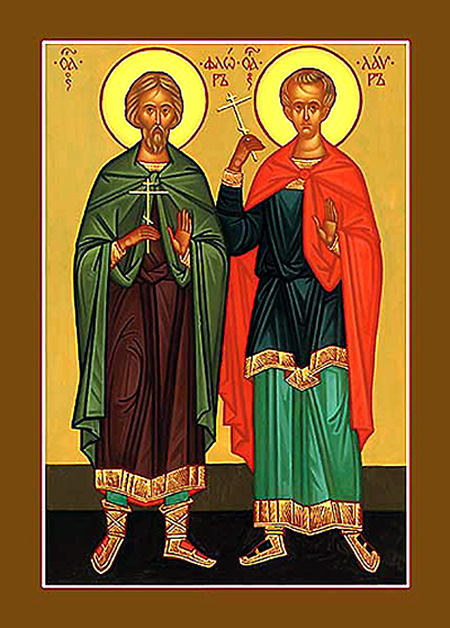
The Martyrs Florus and Laurus were brothers by birth not only in flesh but in spirit. They lived in the second century at Byzantium, and afterwards they settled in Illyria [now Yugoslavia]. By occupation they were stone-masons (their teachers in this craft were the Christians Proclus and Maximus, from whom also the brothers learned about life pleasing to God).
The prefect of Illyria, Likaion, sent the brothers to a nearby district for work on the construction of a pagan temple. The saints toiled at the structure, distributing to the poor the money they earned, while they kept strict fast and prayed without ceasing.
Once, the son of the local pagan-priest Mamertin carelessly approached the structure, and a chip of stone hit him in the eye, severely injuring him. Saints Florus and Laurus assured the upset father, that his son would be healed.
They brought the youth to consciousness and told him to have faith in Christ. After this, as the youth confessed Jesus Christ as the true God, the brothers prayed for him, and the eye was healed. In view of such a miracle, even the father of the youth believed in Christ.
When the construction of the temple was completed, the brothers gathered the Christians together, and going through the temple, they smashed the idols. In the eastern part of the temple they set up the holy Cross. They spent all night in prayer, illumined with heavenly light. Having learned of this, the head of the district condemned to burning the former pagan priest Mamertin and his son and 300 Christians.
The martyrs Florus and Laurus, having been sent back to the prefect Likaion, were thrown down an empty well and covered over with earth. After many years, the relics of the holy martyrs were uncovered incorrupt, and transferred to Constantinople. In the year 1200 the Novgorod pilgrim Anthony saw them. Stephen of Novgorod saw the heads of the martyrs in the Pantokrator monastery around the year 1350.
Saints Hermus (or Hermḗs), Serapίon, and Polyainus were from Rome and were distinguished for their zeal in spreading the faith, and refuting the polemics of the pagans. They were arrested and then brought before the authorities, but they remained steadfast in their profession of faith. Therefore, a series of brutal tortures awaited them. At first they were beaten mercilessly and then thrown into a dark, foul-smelling prison. There they were tormented with many deprivations and afflictions, but nothing could shake them.
Then they were taken from there, and after being bound securely with ropes, the mob dragged them over a rough terrain, filled with many sharp stones. Their flesh was torn and their heads were covered with wounds and blood. Their souls, however, were untouched, thus they flew to Christ the Savior to rest near Him forever.
Saints Emilian the Bishop, and with him Hilarion, Dionysius, and Hermippus were born and lived in Armenia. After the death of their parents, the hieromartyrs Emilian, Dionysius, and Hermippus (they were brothers), and their teacher Hilarion left their native land and arrived in Italy, in the city of Spoleto.
Saint Emilian began to preach the Gospel to the pagans. He won the deep respect of the Christian community because of his strict and virtuous life, and he was chosen bishop of the city of Trebium. He was consecrated by Marcellinus, the Bishop of Rome. After moving to Trebium, Saint Emilian converted many pagans to Christ, for which he was brought to trial before the emperor Maximian (284-305).
The saint suggested that the emperor see for himself the power of prayer to Christ. A man who had been crippled for a long time was brought before him. However much the pagan priests tried to heal him by appealing to the idols, they accomplished nothing. Then Saint Emilian prayed to the Lord and commanded the crippled man, in the name of Jesus Christ, to get up. The man stood up healthy and went home rejoicing.
This miracle was so convincing that the emperor was inclined to admit the truth about Christ, but the pagan priests told him that the saint had worked magic. He was subjected to fierce tortures, in which the Lord encouraged him, saying: “Fear not, Emilian, I am with you.”
They tied him to a wheel, threw him on hot tin, dunked him in a river, and put him in the arena to be eaten by wild beasts, but he remained unharmed. In view of all these miracles the people began to shout: “Great is the Christian God! Free His servant!” On this day 1000 men believed in Christ, and all received the crown of martyrdom.
In a rage, the governor ordered that the beasts be killed since they did not attack the saint. The martyr gave thanks to the Lord because even the wild beasts accepted death for Christ. They locked Saint Emilian in prison together with his brothers and teacher, and after fierce tortures the hieromartyrs Hilarion, Dionysius, and Hermippus were beheaded with the sword.
Saint Emilian was executed outside the city. When the executioner struck the martyr on the neck with a sword, it became soft like wax, and did not wound the saint. Soldiers fell on their knees to him asking forgiveness and confessing Christ as the True God. The saint prayed on his knees for them and asked the Lord to grant him a martyr’s death. His prayer was heard, and another executioner cut off the saint’s head. Seeing a milky liquid flowing from his wounds, many of the pagans believed in Christ and they buried the martyr’s body with honor.
Saint John V was Patriarch of Constantinople from 669-674. He lived during the reign of the emperor Constantine Pogonatos (668-685).
Saint George I was Patriarch of Constantinople from 678-683. He lived during the reign of the emperor Constantine Pogonatos (668-685).
Saint Macarius, Igumen of the Pelekete Monastery, was born at Constantinople in 785. While still a child, he lost his parents. The saint fervently read the Scriptures and came to realize that earthly things are temporary and perishable, and that heavenly things are permanent and imperishable. Therefore, he decided to devote his life entirely to God. He entered the Pelekete monastery in Bithynia, where at the time the igumen was the renowned ascetic, Saint Hilarion (March 28).
After the death of Saint Hilarion, Saint Macarius was unanimously chosen as igumen by the brethren. During the reign of the Byzantine Emperors Leo V the Armenian (813-820) and Michael II the Stammerer (820-829), Saint Macarius suffered as a confessor for the veneration of holy icons. He was sent to the island of Aphousia, where he died in about the year 830.

Saint John of Rila, the great spiritual ascetic of the Bulgarian Orthodox Church and Heavenly Protector of the Bulgarian nation, was born in the year 876 in the village of Skrino in the Sredets district [now Sofia].
After he had been orphaned, the boy became a cowherd in order to avoid people. Once the rich man beat him for losing a cow with its calf. The boy cried long and he prayed, that God would help him. When he found the cow with the calf, the water at that time flowed high and strong in the River Struma. The young cowherd prayed, he placed his own tattered shirt on the water, made the Sign of the Cross over it, took up the calf in his arms and went with it, as though on dry land, to the other bank of the river where the cow was.
The rich man, hidden in the forest, was frightened upon seeing this miracle. He rewarded the youth generously, then sent him away from his home. Having given away his things, the boy left his village. Where and when the saint took monastic tonsure is unknown.
At the very beginning he lived an ascetical life on top of a high and barren hill, eating only wild plants. His
cell was made from brushwood. After a short time, robbers fell upon him by night, beat him, and drove him away. Later, he found a deep cave and settled in it. Soon, his nephew Saint Luke also came to live there.
Luke secretly left the home of his parents and went into the wilderness where the Saint was living. After much effort, he succeeded in finding him. At first the blessed one, seeing him from afar, thought this was a demonic temptation, and so he prayed. Like many solitaries, Saint John was bothered by demons, who assumed the shape of wild animals and tried to force him to leave. As Luke approached, he made prostration and asked for Saint John's blessing. That convinced the ascetic that it was truly his nephew, and not a delusion. He blessed Luke and asked why he had come. The young man told him of his desire to share his way of life, and was permitted to remain. Luke emulated Saint John the Forerunner, who had lived in the wilderness from childhood.
Satan could not endure Saint John's holy life of prayer and fasting. Moved by the devil, an acquaintance of Luke's father found him overwhelmed by grief and upset by his son's disappearance, so he said, "Your brother John came by night, took your son, and has him even now. Unless you rescue the boy, he will become food for the wild beasts. Come, and I will show you where he is, and then you can go and take your child."
When Luke's father heard this, he became furious and cursed his innocent brother. When they came near the place, the acquaintance showed him John's cave from afar and departed. The brother went on and found the Saint. He reproached him, calling him a deceiver and an evil man who had stolen his son.
He tried to kill the venerable one with a heavy stick and some stones, but Saint John just stood there saying nothing. The father seized the boy and took him from the wilderness, intending to bring him back to the world. The blessed man, knew that the child would fall into the snares of the devil, was overcome with sorrow and tears. He fell to his knees and prayed: "Lord Jesus Christ, behold the affliction of my heart, and grant me a sign of Thy mercy. Thou hast said, 'Let the children come to me, and do not hinder them; for of such is the Kingdom of Heaven' (Matthew 19:24).
After they had walked a short distance, a snake bit Luke, and at once he died a painless death. The father did not know what to do. He returned to Saint John and repented of his actions. With profound sorrow, he revealed what had happened. Saint John told him to bury the boy and return to his home. The Saint was comforted in his sorrow and he glorified God, because by means of a physical death, He had saved the child from the future death of his soul. Saint John often visited the grave of his righteous nephew, which became his favorite place of solitude.
Saint John spent twelve years in the desolate cave, and then he went into the Rila wilderness and settled in the hollow of a tree. He fasted and prayed a great deal, wept incessantly, and ate only grass. Seeing such endurance, God caused beans to grow, which he ate for a long time. The beans and his exploits made him known to people.
Once a flock of frightened sheep ran along the hilly steep paths, and did not stop until the place where the monk lived. The shepherds, following after the flock, with astonishment saw the hermit, who amicably greeted them: “You arrive here hungry. Pick some of my beans and eat.” All ate and were satisfied. One gathered many beans in reserve. Along the way home he offered them to his comrades, but there were no beans in the pilfered pods. The shepherds turned back penitent, and the Elder stood there, saying with a smile: “See, children, these fruits are appointed by God for subsistence in the wilderness.”
From that time they began to bring to the monk the sick and those troubled by unclean spirits, which he healed by prayer. Fleeing celebrity, the monk went from his beloved tree-hollow and settled on a high and rocky crag difficult of access, where he dwelt for seven years under the open sky. Reports about the great ascetic reached even the Bulgarian king Peter (927-969), who wanted to meet him. Saint John wrote a letter, refusing such a meeting out of humility.
Later on Saint John accepted under him the guidance of monks, who built a monastery with a church in the cave where Saint John formerly lived. He wisely tended his flock and died on August 18, 946 at 70 years of age.
Five years before his end he wrote in his own hand “A Testament to Disciples,” one of the finest creations of Old Bulgarian literature. The holy life of the ascetic and the remarkable mercies of God through his prayers were a fine preaching of the Christian Faith in the newly-baptized Bulgarian land. In the uneasy time of struggle of Bulgaria with Byzantium, under the west Bulgarian king Samuel (976-1014), Saint John appeared to his disciples, commanding them to transfer his relics to Sredets (Sofia), where the Bulgarian Patriarch Damian (927-972) was hiding. It is presumed that the transfer of relics took place in the year 980.
Somewhat later, the right hand of Saint John of Rila was transferred to Russia (presumably to the city of Rila, where a church was constructed in the name of Saint John of Rila, with a chapel dedicated to the martyrs Florus and Laurus, on the day of their commemoration (August 18) on which he died).
The name of Saint John was known and loved by the Russian people from antiquity. Data about the death of the saint is preserved, especially in Russian sources (the Menaion for August in the twelfth century, in the Mazurinsk Chronicle).
In the year 1183, the Hungarian king Bela II (1174-1196), during a campaign against the Greeks, seized the chest with the relics of Saint John, together with other booty, and took it to the city of Esztergom.
In the year 1187, after he embellished the reliquary, he sent back the holy relics with great honor. On October 19, 1238 the relics of Saint John were solemnly transferred to the new capital, Trnovo, and put in a church dedicated to the saint. On July 1, 1469 the holy relics of Saint John of Rila were returned to the Rila monastery, where they rest to the present day, granting grace-filled help to all the believers.
Saint Sophronius lived in the eighteenth century. He left home on his wedding night and became a monk on Mount Athos. After living there for fifty years, he died in peace.
Today the Church commemorates the uncovering of the relics of Saint Arsenius of Paros (1800-1877), who was glorified by the Patriarchate of Constantinople in 1967.
The main Feast of Saint Arsenius, “the glory of Epirus and the boast of Paros,” is on January 31.
Saint Arsenius and his Elder stayed on Mount Athos for six years before being forced to leave by ignorant monks who were against the Kollyvades movement. The Kollyvades called for a strict adherence to holy Tradition, opposed performing memorial services on Sundays, and believed that Christians should receive Holy Communion more frequently than four times a year. They also practiced unceasing prayer of the heart (hesychasm), which was misunderstood by many people of that time. Some of the Athonite monks, in their ignorance, were highly critical of the Kollyvades, insulting and mistreating them, and forcing them into exile.
Father Daniel and Saint Arsenius left Athos when the anti-Kollyvades sentiments against frequent Communion were particularly intense. This was just before the start of the Greek War of Independence on March 25, 1821. After a brief stay at the Penteli Monastery near Athens, the two went to the island of Paros. Unable to remain there, they ultimately settled on the island of Pholegandros.
Since there were no teachers on the island, the inhabitants asked Father Daniel to permit Father Arsenius to teach their children. The Elder agreed to their request, and also had Father Arsenius ordained a deacon by the Metropolitan of Thira. After his ordination, the Greek government appointed Father Arsenius as a teacher. His teaching career lasted from 1829 to 1840.
Saints Barnabas and his nephew Sophronius were Athenians who lived on Mount Mela near Trebizond in Asia Minor. They died in the year 412.
Saint Christopher was born in Gazara, near Trebizond. He was the head of a monastery on Mount Mela in the second half of the seventh century (641-668).
The Hodēgḗtria (or “Directress”) Icon of the Mother of God. According to Tradition, this icon in the Mela monastery near Trebizond was painted by the Evangelist Luke.
Today we celebrate the memory of Four Ascetics in the desert whose names are unknown. Also 300 Saints who were burned in a fire for smashing idols.

The great Church figure and philosopher Saint Christodoulos was from the village of Sakara in the Imereti region. He possessed an exceptional knowledge of the Holy Scriptures and spoke several languages fluently. To support his prodigious understanding of the Christian Faith, Christodoulos became thoroughly acquainted with other creeds as well. To this purpose, he even memorized the Koran.
Once the Persian king Iamame arranged a debate on theological issues between the Muslims and the Christians, and he invited the elder Christodoulos to take part in this event. At first the king himself debated with the elder and suffered an upset. Then a certain pagan astrologer was brought to replace him, and when it became clear that he too was no match for the elder-philosopher, he summoned a renowned scholar to outwit him. In the debates with this scholar, Christodoulos freely cited both the Holy Scriptures and the Koran, and with his brilliant logic and rhetoric he triumphed over his rival. His challengers were disgraced.
In his work Pilgrimage, the famous 19th-century historian Archbishop Timote (Gabashvili) describes his journey to Mt. Athos and notes that Saint Christodoulos had labored with the monks of the Ivḗron Monastery.
Church historians believe that Saint Christodoulos labored first in Georgia, then moved to Mt. Athos, and finally to the island of Patmos.
Here is the live stream for Great Vespers – Sat. Aug. 17, 2024 If you need, here are instructions for accessing this content from your phone, tablet, computer, or TV.
8TH SATURDAY AFTER PENTECOST
NO FAST
Myron the Martyr of Cyzicus, Straton, Philip, Eutychian, & Cyprian the Martyrs of Nicomedea, Afterfeast of the Dormition of our Most Holy Lady the Theotokos and Ever Virgin Mary, Demetrios the New, Righteous-Martyr of Samaria, Eutychios, Eutychianos and Kassiani the siblings, Paul, Juliana, and those martyred with them (the executioners)
Brethren, let every person be subject to the governing authorities. For there is no authority except from God, and those that exist have been instituted by God. Therefore he who resists the authorities resists what God has appointed, and those who resist will incur judgment. For rulers are not a terror to good conduct but to bad. Would you have no fear of him who is in authority? Then do what is good, and you will receive his approval, for he is God’s servant for your own good. But if you do wrong, be afraid, for he does not bear the sword in vain; he is the servant of God to execute his wrath on the wrongdoer. Therefore one must be subject, not only to avoid God’s wrath but also for the sake of conscience. For the same reasons you also pay taxes, for the authorities are ministers of God, attending this very thing. Pay all of their dues, taxes to whom taxes are due, revenue to whom revenue is due, respect to whom respect is due, honor to whom honor is due. Owe no one anything, except to love one another, for he who loves his neighbor has fulfilled the law. The commandments, “You shall not commit adultery, You shall not kill, You shall not steal, You shall not covet, ” and any other commandment, are summed up in this sentence, “You shall love your neighbor as yourself.” Love does no wrong to a neighbor; therefore love is the fulfilling of the law.
The Lord said, "He who is not with me is against me, and he who does not gather with me scatters. Therefore I tell you, every sin and blasphemy will be forgiven men, but the blasphemy against the Spirit will not be forgiven. And whoever says a word against the Son of man will be forgiven; but whoever speaks against the Holy Spirit will not be forgiven, either in this age or in the age to come.
Either make the tree good, and its fruit good; or make the tree bad, and its fruit bad; for the tree is known by its fruit. You brood of vipers! How can you speak good, when you are evil? For out of the abundance of the heart the mouth speaks. The good man out of his good treasure brings forth good, and the evil man out of his evil treasure brings forth evil. I tell you, on the day of judgment men will render account for every careless word they utter; for by your words you will be justified, and by your words you will be condemned.

In some places, the Burial Service of the Theotokos is celebrated on August 17 using a special epitaphios with an icon depicting the Mother of God.

The Holy Martyr Myron was a presbyter in Achaia (Greece), and lived during the third century. He suffered in the year 250 under the emperor Decius (249-251). The presbyter was gentle and kind to people, but he was also courageous in the defense of his spiritual children.
On the Feast of the Nativity of Christ, he was celebrating the Divine Liturgy. The local governor Antipater came into the church with soldiers so as to arrest those praying there and to subject them to torture. Saint Myron began to plead for his flock, accusing the governor of cruelty, and for this the saint was delivered over to be tortured.
They took Saint Myron and struck his body with iron rods. They then threw the presbyter into a red-hot oven, but the Lord preserved the martyr, but about 150 men standing nearby were scorched by the fire. The governor then began to insist that the martyr worship idols. Saint Myron firmly refused to do this, so Antipater ordered the leather thongs to be cut from his skin. Saint Myron took one of the leather thongs and threw it in the face of his tormentor.
Falling into a rage, Antipater gave orders to strike Saint Myron all over his stripped body, and then to give the martyr to wild beasts to be eaten. The beasts would not touch him, however. Seeing himself defeated, Antipater in his blind rage committed suicide. They then took Saint Myron to the city of Cyzicus, where he was beheaded by the sword.

Venerable Alypios of the Caves was one of the first and best Russian iconographers. He was tonsured by Igoumen Nikon († March 23, 1088). Later, he was ordained as a Hieromonk. From a young age he labored in the Kiev Caves Monastery and studied iconography with the Greek masters who painted the church of the Caves in 1083. Saint Alypios was an eyewitness to a wondrous miracle: when the iconographers adorned the altar with paintings: an Icon of the Most Holy Theotokos imprinted itself on the wall. At the same time, the Icon shone brighter than the sun.
Saint Alypios always painted icons without asking for payment. If he learned that in some church the icons had become damaged, he took them with him and restored them without charge. If people paid him for his work, he set aside one third to purchase supplies for painting icons, one third as alms for the poor, and the remainder for his own needs. He also painted the Sven-Caves Icon of the Mother of God (May 3 & August 17). The Saint was never idle, and interrupted his iconography only to attend the Divine Services.
Saint Alypios was known for his gift of working miracles during his lifetime. He healed a man from Kiev who suffered from leprosy, anointing the patient's wounds with paints. Many of the icons painted by Saint Alypios were also miraculous. There were some instances when the Angels of God helped him to paint icons.
A certain man of Kiev built a church, and instructed two monks to have some icons painted for it. The monks hid the money and said nothing to Saint Alypios about it. After waiting a long time for the work to be completed, the man went to the Igoumen to complain about Saint Alypios. Only then did they discover that he had not been told of the commission. When they brought the boards provided by the customer, they found that beautiful icons had already been painted on them. When the church burned down, the icons remained intact. One of these icons (the Dormition of the Most Holy Theotokos), known as the Vladimir-Rostov Icon (August 15), was taken by Great Prince Vladimir Monomakh (1113-1125) to a church he had built at Rostov.
On another occasion, when the Saint was sick and near death, an Angel painted an icon depicting the Dormition of the Most Holy Theotokos. That same Angel received the soul of Saint Alypios, who reposed in 1114 and was buried in the Near Caves.
A twentieth century icon in the church of the Pskov Caves Monastery of the Dormition depicts Saint Alypios holding a copy of the “Assuage My Sorrows” Icon of the Most Holy Theotokos (January 25 and October 9).
Saint Alypios is also commemorated on the second Sunday of Great Lent, the Synaxis of All Saints of the Kiev Caves (movable Feast); and on September 28, the Synaxis of all the Venerable Fathers of the Near Caves of Saint Anthony.
The Holy Martyr Paul and his sister Juliana were executed under the emperor Aurelian (270-275) in the Phoenician city of Ptolemais. The emperor happened to visit Ptolemais, and among those who met him was Paul, who made the Sign of the Cross. They arrested him and threw him in prison.
On the following day, when they brought him to trial, he openly and boldly confessed his faith in Christ, for which he was subjected to fierce tortures. Juliana, seeing the suffering of her brother, began to denounce the emperor for his injustice and cruelty, for which she was also subjected to torture.
They beat the martyrs, tore their bodies with iron hooks, burned them over red-hot grates, but they were not able to break the wondrous endurance of the Lord’s confessors. Three soldiers torturing the saints were struck by the courageous spirit of the martyrs, and they in turn believed in Christ. These newly chosen of God were named Quadratus, Acacius and Stratonicus, and they were immediately executed.
The tormentor tried to seduce Saint Juliana with a promise to marry her, if she were to renounce Christ, but the saint refused the offer and remained steadfast. By order of the emperor they sent her to a brothel to be defiled. The Lord also preserved her there, and anyone who tried to touch the saint lost his sight. Then the enraged emperor commanded that they again burn the bodies of the saints. Those who saw the suffering of the saints began to murmur loudly, and Aurelian gave orders to behead the martyrs. With gladdened face the brother and sister went to execution singing, “For Thou hast saved us from those who afflicted us and hast shamed those who hated us” (Ps. 43/44:7).
The Martyrs Thyrsus, Leucius, Coronatus, and their Companions suffered in Bythnian Caesarea and Apollonia under the emperor Decius (249-251). [It is possible that Coronatus is the same person as Cornutus, whose commemoration is on September 12].
The Martyr Patroclus lived during the third century under the emperor Aurelian (270-275). He was a native of the city of Tricassinum (now the city of Troyes in France) and led a pious Christian life: he loved to pray, to read the Holy Scriptures, to fast and to be charitable to the poor. For this the Lord bestowed upon him the gift of wonderworking.
The emperor Aurelian summoned Saint Patroclus to himself and commanded him to worship idols, promising for this great honors and riches. The saint disdained idol worship saying that the emperor himself was a beggar.
“How can you call me, the emperor, a beggar?” asked Aurelian. The saint answered: “You possess many earthly treasures, but you do not have heavenly treasures. Since you do not believe in Christ and in the future life, you shall not receive the blessedness of Paradise. Therefore, you are poor.”
Aurelian sentenced him to beheading by the sword. Soldiers led him to the banks of the River Sequanum (now the Seine), but suddenly their eyes were clouded, and Saint Patroclus at this time went across the river on the water and began to pray on a hill on the other shore. Coming to themselves, some of the soldiers were astounded at the disappearance of the martyr and they glorified God, but others attributed the miracle to magic.
A pagan woman pointed out to the soldiers that Saint Patroclus was on the other bank of the river. Crossing over there, the soldiers killed the martyr. His body was buried by night by the priest Eusebius and deacon Liberius.

The Martyrs Straton, Philip, Eutychian and Cyprian suffered at Nicomedia. Visiting the circus, they taught people to abandon their idol-worship, and they converted many pagans to Christ. The governor, observing that the people were leaving the circus, summoned to himself the martyrs, who firmly confessed their faith in Christ. For this they were given over to wild beasts to be eaten. The beasts did not touch them, and the martyrs were then tortured and thrown into a fire.
Saint Theodoritus left home and went to the Solovki Monastery when he was only thirteen years old. The following year he was tonsured and placed under obedience to the wise Father Zosimas. For the next fifteen years he grew in wisdom and virtue, then was ordained a deacon by the Archbishop of Novgorod.
Saint Theodoritus spent one more year with his Elder, then asked for permission to visit other monasteries. At each place he spoke with experienced ascetics, deriving much spiritual profit from their conversation. After two years at the White Lake Monastery, Saint Theodoritus lived alone in the forest around the monastery. During his four years in the forest, he came into contact with other ascetics, from whom he learned many useful things.
Father Zosimas at Solovki, sensing that he would die soon, wrote to Saint Theodoritus asking him to return to him. He served his Elder for about a year, taking care of him during his final illness.
Saint Theodoritus then traveled to the mouth of the Kola River and undertook missionary labors among the Lapps with the Elder Metrophanes. The Lapps worshiped idols and did not live in towns or cities. The monks learned their language so they could teach them about Christ, and also translated prayers for them.
Saint Theodoritus labored among the Lapps for twenty years. He was ordained to the holy priesthood in Novgorod, and later returned to the Lapps and established a monastery. He then spent two years in the Novgorod area as igumen of a monastery. Later, he was raised to the rank of archimandrite and became the igumen of the Savior-Saint Euthymius Monastery at Suzdal for five years.
In 1554 Saint Theodoritus was slandered and confined for two years at the White Lake Monastery. Upon his release, he went to live in a monastery at Yaroslav. Tsar Ivan the Terrible sent him to Constantinople in 1558 to discuss his coronation with the Patriarch.
Saint Theodoritus returned to Russia with the Patriarch’s reply, and the Tsar gave him twenty-five silver coins and a sable coat. Not wishing to acquire material possessions, the saint sold the coat and gave the money away to the poor.
Searching for peace, he went to the monastery at Priluki in Vologda. From there, Saint Theodoritus made two visits to the Lapps whom he had converted. He departed to the Lord on August 17, 1571 at the Solovki Monastery where he had been tonsured.

The Kiev Caves Icon of the Dormition of the Most Holy Theotokos is one of the most ancient icons in the Russian Orthodox Church. The Mother of God entrusted it to four Byzantine architects, who in 1073 brought the icon to Saints Anthony and Theodosius of the Caves. The architects arrived at the monks’ cave and asked, “Where do you want to build the church?” The saints answered, “Go, the Lord will point out the place.”
“How is it that you, who are about to die, have still not designated the place?” the architects wondered. “And they gave us much gold.”
Then the monks summoned all the brethren and they began to question the Greeks, saying, “Tell us the truth. Who sent you, and how did you end up here?”
The architects answered, “One day, when each of us was asleep in his own home, handsome youths came to us at sunrise, and said, ‘The Queen summons you to Blachernae.’ We all arrived at the same time and, questioning one another we learned that each of us had heard this command of the Queen, and that the youths had come to each of us. Finally, we beheld the Queen of Heaven with a multitude of warriors. We bowed down to Her, and She said, ‘I want to build Myself a Church in Rus, at Kiev, and so I ask you to do this. Take enough gold for three years.’”
“We bowed down and asked, ‘Lady Queen! You are sending us to a foreign land. To whom are we sent?’ She answered, ‘I send you to the monks Anthony and Theodosius.’”
“We wondered, ‘Why then, Lady, do You give us gold for three years? Tell us that which concerns us, what we shall eat and what we shall drink, and tell us also what You know about it.’”
“The Queen replied, ‘Anthony will merely give the blessing, then depart from this world to eternal repose. The other one, Theodosius, will follow him after two years. Therefore, take enough gold. Moreover, no one can do what I shall do to honor you. I shall give you what eye has not seen, what ear has not heard, and what has not entered into the heart of man (1 Cor.2:9). I, Myself, shall come to look upon the church and I shall dwell within it.’”
“She also gave us relics of the holy martyrs Menignus, Polyeuctus, Leontius, Acacius, Arethas, James, and Theodore, saying, ‘Place these within the foundation.’ We took more than enough gold, and She said, ‘Come out and see the resplendent church.’ We went out and saw a church in the air. Coming inside again, we bowed down and said, ‘Lady Queen, what will be the name of the church?’”
“She answered, ‘I wish to call it by My own name.’ We did not dare to ask what Her name was, but She said again, ‘It will be the church of the Mother of God.’ After giving us this icon, She said, ‘This will be placed within.’ We bowed down to Her and went to our own homes, taking with us the icon we received from the hands of the Queen.”
Having heard this account, everyone glorified God, and Saint Anthony said, “My children, we never left this place. Those handsome youths summoning you were holy angels, and the Queen in Blachernae was the Most Holy Theotokos. As for those who appeared to be us, and the gold they gave you, the Lord only knows how He deigned to do this with His servants. Blessed be your arrival! You are in good company: the venerable icon of the Lady.” For three days Saint Anthony prayed that the Lord would show him the place for the church.
After the first night there was a dew throughout all the land, but it was dry on the holy spot. On the second morning throughout all the land it was dry, but on the holy spot it was wet with dew. On the third morning, they prayed and blessed the place, and measured the width and length of the church with a golden sash. (This sash had been brought long ago by the Varangian Shimon, who had a vision about the building of a church.) A bolt of lightning, falling from heaven by the prayer of Saint Anthony, indicated that this spot was pleasing to God. So the foundation of the church was laid.
The icon of the Mother of God was glorified by numerous miracles. Two friends, John and Sergius, sealed their friendship before it. After many years John fell mortally ill. He gave part of his wealth to the the Caves monastery, and he gave Sergius the portion for his five-year-old son for safekeeping. He also entrusted his son Zachariah to his guardianship. When Zachariah turned fifteen, he asked for his inheritance, but Sergius persisted in saying that John had distributed everything to the poor. He even went into the Dormition church and swore before the wonderworking icon that he had taken nothing.
When he attempted to kiss the icon, he was not able to come near it. He went to the doors and suddenly shouted, “Saints Anthony and Theodosius! Let me not be struck down for my dishonesty. Entreat the Most Holy Theotokos to drive away the multitude of demons which torment me. Let the gold and silver be taken away. It is sealed up in my granary.” Zachariah gave away all his inheritance to the Caves monastery, where he also himself was tonsured a monk. From that time, no one would take oaths before the wonderworking icon (March 24).
More than once the icon defended the land from enemy invasion. In 1677, when the Turks laid siege to Chigirin and danger threatened Kiev, they carried the icon around the city for almost the entire day of August 27. The Mother of God blessed Russian armies going to the Battle of Poltava (1709). In 1812 they carried the icon around Kiev again. The icon is commemorated twice during the year: May 3 and August 15.
Saint Leucius of Volokolamsk was the founder of the Dormition monastery on the Ruza River (the monastery was located 32 versts from the city of Volokolamsk and 2 versts from the village of Seredo-Stratilatsk).
Saint Leucius was a disciple of Saint Paphnutius of Borov (May 1) and an associate of Saint Joseph of Volokolamsk (September 9). The time of the founding of the monastery by Saint Leucius might perhaps be determined from the remnants of the Life of Saint Daniel of Pereyaslavl (April 7). Saint Daniel upon his arrival at the Borov monastery in the year 1466 was entrusted by Saint Paphnutius to the Elder Leucius as an experienced ascetic in the spiritual life.
After ten years, i.e. in 1476, the Elder and his disciple settled in the Volokolamsk region, where they dwelt together for another two years in founding the monastery. After this Saint Daniel went to Pereyaslavl. It is conjectured that Saint Leucius was 62 years of age at the founding of the monastery. Having raised up a monastery, he became known throughout the surrounding region for his ascetic life. According to Tradition, Saint Leucius died in extreme old age at the end of the fifteenth century. He was buried in the monastery he founded.
In the manuals of iconography the monk is listed under July 27: “He was greyed, and a beard like Saint Sergius, his hair uncovered, a schema on his shoulders, in his hands a staff, and monastic garb.”
The commemoration of Saint Leucius is observed both on December 14 and on August 17, on the Feast of the Holy Martyr Leucius.
Saint Philip of Sukhona was a hermit on Mt. Yankov, on the left bank of the Sukhona River, two versts from the city of Ustiug. The Ustiug inhabitants built a monastery at the place of his ascetic deeds, so as to learn monastic life under his guidance.
In the year 1654, they built a church in honor of the Mother of God “Of the Sign,” with a chapel in the name of Saint Philip, Metropolitan of Moscow. Brethren soon gathered. Saint Philip, while refusing no one his guidance, would not, in his humility, accept the office of igumen. He died at the monastery as a simple monk on August 17, 1662.
The Svena Icon of the Mother of God has two commemorations: May 3, the Feast of Saint Theodosios of the Caves, and August 17, the Feast of Saint Alypios of the Caves.
The Svena Icon of the Mother of God was painted by Saint Alypios of the Caves († August 17, 1114). It depicts the Mother of God sitting on a throne, with the Divine Child on her lap. To the right of the throne stands Saint Theodosios, and on the left is Saint Anthony of the Caves. Prior to 1288 it was kept in the Kiev Caves Monastery, where it became famous for miracles, and in 1288 it was transferred to the Bryansk Svena Monastery, which is dedicated to the Dormition of the Most Holy Theotokos.
Prince Roman of Chernigov became blind while in Bryansk. Hearing of the miracles from an Icon painted by Saint Alypios, the prince sent a messenger to the Monastery asking that the Icon be brought to him at Bryansk so that he might be healed. The Icon was sent with a priest along the Desna River. During the voyage, the boat landed on the right bank of the Svena River. After spending the night, the travelers went by boat the next morning to pray before the Icon, but they did not find it there. Then they saw it on a hill opposite the Svena River, among the branches of an oak tree. News of this reached Prince Roman, and he was led to the Icon on foot. The prince prayed fervently and promised to build a monastery at this place, and donate to it all the lands that he could see from the hill. After he prayed, the prince began to see light. First he saw a path, then close objects and finally, all the surrounding area. Then the prince had a Moleben served, and built a wooden church in honor of the Dormition of the Most Holy Theotokos. The tree on which the Icon had rested was cut down and used to make boards for other icons. At the same time, the annual commemoration of the Svena Icon was established for May 3.
The Icon became renowned for healing the blind, deliverance from demonic possession, and protection from enemies.
One of its most significant miracles was revealed in 1812, when Bryansk was under the threat of invasion by Napoleon's troops. Residents of the city organized a Cross Procession, carrying the Svena Icon of the Mother of God in their arms, and offering prayers to their Protectress so that she would save the city from the French invasion. Their prayers were heard and the enemy bypassed the city.
Every year, on August 17, there was a Cross Procession in remembrance of the miracle at Bryansk, but this ended after the Revolution. The Monastery was closed in 1924, and all the buildings, including the XVIII century Dormition Cathedral, were destroyed. No one knows what would have happened to the ancient wonderworking Icon if it had not been rescued by the famous art historian Nicholas Pomerantsev (1891-1986). He brought the Icon to Moscow, and had it restored. After the most difficult painstaking work, it was placed in the Tretyakov Gallery, where it is kept to this day.
The Armatia Icon of the Mother of God was in Constantinople at the Armatian monastery. The place where the monastery was located, was called “Armation” or “of the Armatians” and received its name from the military magister Armatias, nephew of the tyrant Basiliscus, and a contemporary of the emperor Zeno (474-491).
The celebration of the wonderworking icon was established to commemorate deliverance from the Iconoclast heresy. The Seventh Ecumenical Council of 787 drew up dogmatic definitions about icon veneration based on Holy Scripture and Church Tradition.
The Armatia Icon of the Most Holy Theotokos is commemorated twice during the year, on July 21 and August 17.
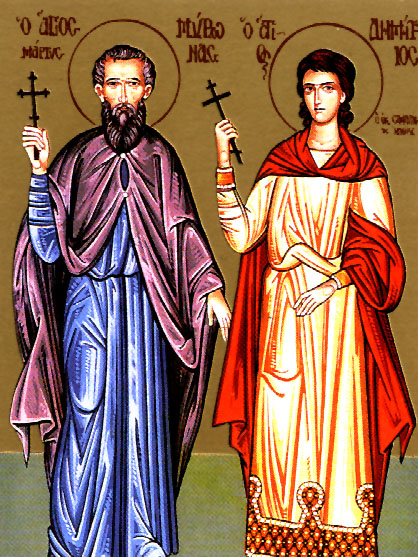
The holy monk Demetrios was born in the village of Samarina, in the Pindos region of Greece in the late XVIII century. He became a monk in the monastery of his homeland, where he exhausted his body and soul with fasting. After Ali Pasha's 1808 suppression of an insurrection inspired by Father Euthymios Vlakhavas, Saint Demetrios came out of his monastery and went to the neighboring villages preaching the Word of God, comforting the villagers, and giving them hope. Ali Pasha thought that Father Demetrios had also been preaching rebellion, but the monk said that he was only trying to strengthen the Christians in their faith, and urging them to respect the law. The Pasha did not believe him, so he ordered him to be subjected to cruel tortures.
The executioners pierced his arms with nails and then placed pieces of wood under the nails of his hands and feet. An iron band was placed around his forehead. This was tightened and produced excruciating pain. All the while they told him to name his fellow conspirators. Saint Demetrios remained silent, and he was thrown into prison. Later, he was hanged upside down, with a fire under his head. A certain Turk, after witnessing the courage of the Saint, believed in Christ and then he suffered martyrdom.
Next, Ali Pasha sealed Demetrios into a wall, leaving only his head out to prolong the torture. The Martyr survived for ten days, then he surrendered his soul to God on August 17,1808.

The holy Father Tbeli Abuseridze lived and labored in the 13th century. His father John, the archduke of Upper Atchara, perished in a battle with the Turks. After Tbeli’s mother was widowed, she was tonsured a nun and given the name Katherine. Tbeli’s brothers, Abuseri and Bardan, were also well-known figures in their time.
Saint Tbeli received an education befitting his noble rank and succeeded in fully developing his natural abilities.
Saint Tbeli left an indelible mark on the history of Georgian culture as a hymnographer, an astronomer, an expert in sacred music, and a scholar of diverse interests. We know from his works that he built a church in honor of Saint George in the village of Khikhani (in upper Atchara), and it has been suggested that he composed most of his works, including a chronicle of his own ancestry, in that village. He had seven children whom he brought there, and at the end of his chronicle he left a second testament, commanding that his family’s future generations be brought there as well.
Saint Tbeli contributed immensely to the life of Gelati Academy. Historians believe it was there that he received the broad education that allowed him to express himself in so many different fields. Saint Tbeli’s collection of hymns to Saint John the Baptist, Saint John the Theologian, and Saint John Chrysostom reveals his true piety and talent as a writer of the Church. The profound theological ideas, the symbolic and mystical comprehension of phenomena, the “knowledge of the visible” and “comprehension of the invisible” evident in this work paint Saint Tbeli as one equally endowed as both a scholar and a theologian.
Saint Tbeli was fascinated by the science of chronology, and he compiled a work called Chronicles: Complete Commentaries and Rules to address some of the problems related to chronology. Combining a solid understanding of astronomy and history, this work conveys the cosmic meaning of the Julian calendar and Christian eschatology. Saint Tbeli’s famous hagiographical work The New Miracle of Great-martyr George contains valuable historical information about the Abuseridze family’s efforts to revive Georgian culture during the ancient feudal epoch.
While pursuing his literary and scholarly interests, Saint Tbeli also labored as a holy and God-fearing pastor. (Scholars believe that the saint was a bishop of Tbeti, from which he received his appellation Tbeli.) The Georgian Apostolic Church has numbered our Holy Father Tbeli Abuseridze among the saints in recognition of the countless good deeds he performed on behalf of the Church and its people.
TRANSLATION OF THE IMAGE OF OUR LORD AND GOD AND SAVIOR, JESUS CHRIST
ABSTAIN FROM MEAT, FISH, DAIRY, EGGS, WINE, OLIVE OIL
Translation of the Image of Our Lord and God and Savior, Jesus Christ, Diomedes the Physician & Martyr of Tarsus, Timothy of Euripus, founder of the Monastery of Pentele, Holy Monk Penteles, Gerasimus of Cephalonia, The Six Martyrs Dorotheos, Sarantis, Jacob, Seraphim, Demetrios and Basil who contested in Megara, Joseph the Hesychast, Nicodemus the New Martyr of Meteora, Afterfeast of the Dormition of our Most Holy Lady the Theotokos and Ever Virgin Mary, Manuel and John the New Martyrs, Stamatios the Martyr, Apostolos the New-Martyr
TIMOTHY, my son, those who serve well as deacons gain a good standing for themselves and also great confidence in the faith which is in Christ Jesus. I hope to come to you soon, but I am writing these instructions to you so that, if I am delayed, you may know how one ought to behave in the household of God, which is the church of the living God, the pillar and bulwark of the truth. Great indeed, we confess, is the mystery of our religion:
God was manifested in the flesh, justified in the Spirit, seen by angels, preached among the nations, believed on in the world, taken up in glory.
Now the Spirit expressly says that in later times some will depart from the faith by giving heed to deceitful spirits and doctrines of demons, through the pretensions of liars whose consciences are seared, who forbid marriage and enjoin abstinence from foods which God created to be received with thanksgiving by those who believe and know the truth. For everything created by God is good, and nothing is to be rejected if it is received with thanksgiving; for then it is consecrated by the word of God and prayer.
At that time, when the days drew near for him to be received up, he set his face to go to Jerusalem. And he sent messengers ahead of him, who went and entered a village of the Samaritans, to make ready for him; but the people would not receive him, because his face was set toward Jerusalem. And when his disciples James and John saw it, they said, "Lord, do you want us to bid fire come down from heaven and consume them as Elijah did?" But he turned and rebuked them, and he said, "You do not know what manner of spirit you are of; for the Son of man came not to destroy men's lives but to save them." And they went on to another village.
As they were going along the road, he said to those who followed him, "All things have been delivered to me by my Father; and no one knows who the Son is except the Father, or who the Father is except the Son and any one to whom the Son chooses to reveal him." Then turning to the disciples he said privately, "Blessed are the eyes which see what you see! For I tell you that many prophets and kings desired to see what you see, and did not see it, and to hear what you hear, and did not hear it.
And he went on his way through towns and villages, teaching, and journeying towards Jerusalem.
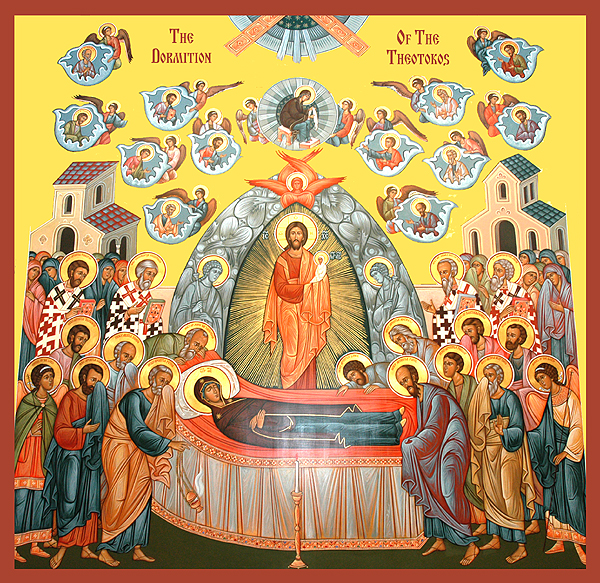
In today’s hymns at Vespers, the Mother of God is praised as “only created being to pass from earth to heaven in the flesh.”

The Transfer of the Icon of our Lord Jesus Christ Not-Made-by-Hands from Edessa to Constantinople occurred in the year 944. Eusebius, in his History of the Church (I:13), relates that when the Savior was preaching, Abgar was the ruler of Edessa. He was stricken with leprosy all over his body. Reports of the great miracles performed by the Lord spread throughout Syria (Mt.4:24) and even reached Abgar. Without having seen the Savior, Abgar believed in Him as the Son of God. He wrote a letter requesting Him to come and heal him. He sent his own portrait painter Ananias to Palestine with this letter, and commissioned him to paint a likeness of the Divine Teacher.
Ananias arrived in Jerusalem and saw the Lord surrounded by many people. He was not able to get close to Him because of the large crowd which had gathered to hear the Savior. Then he stood on a high rock and tried to paint Christ's portrait from afar, but this attempt did not succeed. Then the Savior saw him, called him by name, and gave him a short letter for Abgar in which He praised the ruler's faith. He also promised to send His disciple to heal him of his leprosy and guide him to salvation.
Then the Lord asked for some water and a cloth to be brought to Him. After washing His Face, He dried it with the cloth, and His Divine countenence was imprinted upon it. Ananias brought the cloth and the Savior's letter to Edessa. Reverently, Abgar pressed the holy object to his face and received partial healing. Only a small trace of the terrible affliction remained until the arrival of the disciple promised by the Lord. This was Saint Thaddeus, an Apostle of the Seventy (August 21), who preached the Gospel and baptized Abgar and all the people of Edessa. Abgar attached the Holy Napkin to a board and placed it in a gold frame adorned with pearls. Then he placed it in a niche above the city gates. On the gateway over the Icon he inscribed the words, “O Christ God, let no one who hopes on Thee be put to shame.”
For many years the inhabitants had the pious custom of bowing down before the Icon whenever they went forth from the gates. Later, one of Abgar's great-grandsons, who ruled Edessa, fell into idolatry, and decided to remove the Icon from the city wall and to replace it with an idol. In a vision the Lord ordered the Bishop of Edessa to hide His Icon. The bishop came by night with his clergy, lit a lampada before the Icon, and placed a ceramic tile in front of the Icon to protect it, and then he sealed the niche with bricks.
As time passed, the people forgot about the Icon. But in the year 545, when the Persian emperor Chozroes I besieged Edessa and the city's position seemed hopeless, the Most Holy Theotokos appeared to Bishop Eulabios and ordered him to remove the Icon from the sealed niche, saying that it would save the city from the enemy. When he opened the niche, the bishop found the Holy Mandylion, and the lampada was still burning before the Icon, and an exact copy was produced upon the tile protecting the Icon.
The Persians lit a huge fire outside the city walls. Bishop Eulabios carried the Icon Not-Made-by-Hands around the city walls, and a violent wind turned the flames back on the Persians. The defeated Persian army retreated from the city.
In his Church History, the sixth century writer Evagrios Scholastikos refers to the Holy Mandylion (or Napkin) as The Icon made by God (Η θεοτεύκος εἰκών).
In the year 630 Arabs seized Edessa, but they did not hinder the veneration of the Holy Napkin, the fame of which had spread throughout the entire East. In the year 944, the emperor Constantine Porphyrogenitos (912-959) wanted to transfer the Icon to Constantinople, so he paid a ransom to the emir of the city for it. With great reverence the Icon of the Savior Not-Made-by-Hands and the letter which He had written to Abgar, were brought to Constantinople by clergy.
On August 16, the icon of the Savior was placed in the Pharos church of the Most Holy Theotokos. There are several traditions concerning what happened later to the Icon Not-Made-by-Hands. According to one, Crusaders stole it during occupation of Constantinople (1204-1261), but the ship on which the sacred object was taken, perished in the waters of the Sea of Marmora.
According to another tradition, the Icon Not-Made-by-Hands was transported to Genoa in 1362, where it is preserved in a monastery dedicated to the Apostle Bartholomew. It is known that the Icon Not-Made-by-Hands repeatedly produced exact copies of itself. One of these, named “On the tile,” was made when Ananias hid the Icon in the wall on his way to Edessa. Another, imprinted on a cloak, wound up in Georgia. Possibly, the various traditions about the original Icon Is explained by the existence of several exact copies.
During the time of the Iconoclast heresy, the defenders of the holy icons, who shed their blood for them, sang the Troparion to the Icon Not-Made-by-Hands. In proof of the validity of venerating icons, Pope Gregory II (715-731) sent a letter to the Byzantine Enperor, in which he mentioned Abgar's healing, and the sojourn of the Icon Not-Made-by-Hands at Edessa as a commonly known fact.
The Icon Not-Made-by-Hands was put on the standards of the Russian army, in order to protect them from the enemy. In the Russian Orthodox Church it is a pious custom for a believer to read the Troparion for the Icon of the Savior Not-Made-by-Hands when entering the temple, together with other prayers.
According to the Prologue, there are four known Icons of the Savior Not-Made-by-Hands:
The Feast of the Transfer of the Icon Not-Made-by-Hands is observed along with the Afterfeast of the Dormition. The commemoration of the third Icon Not-Made-by-Hands mentioned above is called the “The Savior on Linen Cloth.”
The particular reverence for this Feast in the Russian Orthodox Church is also expressed in iconography, and the Icon Not-Made-by-Hands was one of the most widely distributed.

The Martyr Diomedes (Diomḗdēs) was born in Tarsus in Cilicia, and studied the medical arts. His scientific knowledge did not make him proud, but he retained the piety in which his parents raised him. And since the Lord, the Physician of bodies and souls, "spoke to them about the Kingdom of God, and healed those who had need of healing" (Luke 9:11), so did Diomedes emulate his Lord and God, practicing his medical profession charitably and without charge. Not only did he heal their bodies, he also treated their souls. He proclaimed the saving truth of the Gospel to the sick, and he brought many souls to Christ the Savior.
Divine zeal brought Diomedes as far as Nicaea in Bithynίa. There he healed the sick, and taught and nurtured their faith. When Diocletian began his persecution against the Christians, the activities of Diomedes were reported to the Emperor, who ordered his arrest. But before he could be arrested, God called him to Himself, and the soldiers found him dead. Even though he was dead, they beheaded him in order to prove that Diocletian's orders had been carried out. Then the soldiers were struck blind. The Emperor commanded them to take the head back and place it with the body. As soon as the soldiers did this, their sight was restored and they believed in Christ.
The Church venerates Saint Diomedes as an Unmercenary Physician and he is mentioned during the Mystery of Holy Unction.

Saint Cherimon was an ascetic in Egypt in the Skete desert monastery, either at the end of the fourth century, or the beginning years of the fifth century. His name is remembered in the Lausiac History of Palladius and in the alphabetic Paterikon.
His cave stood at a distance of 40 stadia from church and 12 stadia from a spring of water. The saint died at handicraft at more than 100 years of age. Saint Cherimon is remembered by Saint Theodore the Studite (November 11) in the Lenten Triodion, in the Service for Cheesefare Saturday, in the 6th Ode of the Matins canon.

Tradition ascribes a very ancient origin to this famous Icon. It is regarded as one of the icons painted by the Holy Evangelist Luke. It is not known by whom or when the Icon was brought to Russia, but at the beginning of the XII century it was kept in an old wooden chapel near the city of Kitezh.
This Icon got its name from the Great Prince Yaroslav (+ 1246), who in Holy Baptism was named Theodore, in honor of Saint Theodore Stratēlatēs (February 8). According to Tradition, his elder brother, Saint George (February 4), found the Icon in the wooden chapel near Gorodets. When he attempted to take the Icon from the chapel it could not be moved. Realizing that the Mother of God wanted her Icon to remain there, Prince George built the Monastery of Saint Theodore on the site.
During Batu Khan's invasion in 1238, the Gorodets Monastery and other Russian monasteries were burnt and left in ruins. When the citizens of Gorodets fled the city at the approach of the Khan, they did not have time to take the Icon with them. Even though objects made of stone and iron were destroyed, the wooden Icon was preserved and later revealed.
On August 16, 1239, Saint Alexander Nevsky's younger brother, Prince Basil of Kostroma, later the Great Prince of Vladimir, got lost in the woods while chasing a wild animal. He saw an Icon in a pine1 tree, but when the Prince tried to remove the Icon from the tree, it suddenly rose up into the air. Struck by this miracle, Prince Basil returned to the city and told the clergy and the people about his vision. Then the people went into the forest and there they found the Icon where Prince Basil said it was. Everyone fell to their knees and prayed to the Mother of God. Then the priests were able to remove the Icon and take it to the cathedral church. Soon people flocked to the newly-revealed Icon from the Kostroma region. The residents said that when the Prince was hunting in the forest, some sort of soldier, who was dressed in rich clothing, walked through the city, carrying an Icon in his hands. The warrior resembled the icon of the Holy Great Martyr Theodore Stratēlatēs (February 8), to whom the Kostroma cathedral was dedicated. Therefore, the Icon was known as the Saint Theodore Icon. On the site of its appearance, on the banks of the Zaprudnya River the Prince founded a monastery dedicated to the Icon of Christ not made by hands, which is commemorated on August 16, the very day of the Saint Theodore Icon's appearance. Although the Kostroma Cathedral burned down, the Saint Theodore Icon was found in the ashes three days later, completely unharmed.
In 1260, the Tatars approached Kostroma, and the city was threatened with complete ruin. All the hopes of the inhabitants and the Prince rested upon the Mother of God, and they prayed that she would save the city. Before the battle, Prince Basil remembered that when Great Prince Andrew Bogolyubsky fought against the Kama Bulgarians, he took the wonderworking Vladimir Icon with him and, by the gracious help of the Mother of God, the enemy was completely routed. Following Saint Andrew's example, Prince Basil of Kostroma took the Saint Theodore Icon from the cathedral and carried it with his army. When the battle began, the Icon was moved behind the army, and the priests served Molebens. The two enemy armies converged, and a great miracle occurred. Dazzling rays of light, brighter and hotter than the rays of the sun, shone from the Virgin's face, blinding and scorching the Tatars, who panicked and fled in a disorderly retreat. Prince Basil set up a Cross where the Icon had stood during the battle, in remembrance of this miracle. The place itself, the people, and the nearby lake were called "holy." Subsequently, a village sprang up by the lake, and it too was called "Holy Lake."
Not long afterward, the Kostroma cathedral caught fire again. When they rushed to save the wonderworking Icon, they saw it hovering in the air above the flames. People thought that the Mother of God wanted the Icon to be taken from the city because of the sins of its inhabitants. Crying out, they implored the Mother of God not to leave the city. Then the Icon descended and settled on the ground in the middle of the square. Soon a small wooden church was built to house the Icon, which was later replaced by a stone church.
The name of the Saint Theodore Icon is also associated with the accession of Tsar Michael Romanov to the throne in 1613. Ambassadors were sent from Moscow to Kostroma, consisting of clergy, boyars, and persons of every rank. They brought the Vladimir Icon with them, and also an icon of the Moscow wonderworkers. At Kostroma, the delegation was met by a host of clergy with the Saint Theodore Icon, then everyone went to Ipatiev Monastery, where young Michael lived with his aged mother, Schematic-nun Martha.
In the cathedral church, Michael was "implored" to accept the crown. Young Michael refused to accept this heavy yoke, and his mother didn't want to let him go. She remained adamant despite their pleas. Finally, the former head of the delegation, Archbishop Theodoret of Ryazan, took the Vladimir Icon in his hands, and Abraham Palitsyn, the cellarer of Holy Trinity Monastery, took the icon of the Holy Moscow wonderworkers and firmly said to her: "Why have we brought these Icons of the Most Holy Sovereign Lady and of the Moscow wonderworkers with us on such a long journey? If you refuse to obey us, then consent for the sake of the Mother of God and the great Saints, and do not anger the Lord God." Martha was unable to maintain her opposition, and she prostrated herself before the Saint Theodore Icon saying, "Your will be done, O Sovereign Lady! Into your hands I surrender my son; guide him on the true path, for his benefit and for that of our land!" Michael begged his mother not to give in, but finally she did, and he had to accept. He was proclaimed as Tsar right away.
In remembrance of this event, an annual celebration was appointed for March 14. Tsar Michael brought a copy of the Icon with him to Moscow and placed it in the court church of the Nativity of the Theotokos, which is on the Seni. He greatly revered the Saint Theodore Icon, so in 1636 he restored and adorned it. At Kostroma Cathedral he bestowed great gifts; he ordered that seven pounds of wax be provided from Kostroma's customs revenues for an unsleeping candle to burn before the Icon. He ordered the Kostroma clergy to serve Molebens before the Icon, and the voivodes to take part in Cross Processions, dressed as archers and gunners.
On May 4, 1636, during the sanctification of the Icon which was restored by the Tsar, a young man named Moses, who suffered from a falling disease, and whose body was swollen and covered with scabs, was standing in the crowd and received instant healing.
In 1834, Lieutenant-General Ilovaysky was in Kostroma to venerate the Saint Theodore Icon and spoke of a miracle that his grandfather, a Cossack ataman, had experienced. His grandfather was taken prisoner by the highlanders. As he languished in captivity, it was revealed to him in a dream that he would be delivered by the grace of the Saint Theodore Icon. He was ordered to run without any fear, and he did manage to escape unnoticed. For a while, he hid from his pursuers in an oak tree, he walked 600 versts, and lived on fruits and roots. During this time he read the Troparion to the Saint Theodore Icon. At last, he came to his own city of Cherkassk. Then he walked to Kostroma on a pilgrimage to the Saint Theodore Icon, then he removed the copy of the Icon from the church and brought it on foot to Moscow. There he had the Icon covered with a gold riza and he returned home with it.
The Saint Theodore Icon is kept in Kostroma's Dormition Cathedral. Every year processions are made with it: on the Feast of Pentecost at Ipatiev Monastery; and on August 16 in the Spaso-Zaprudenskaya church, at the place where it was found. The Icon is commemorated twice a year: at the Dormition Cathedral on March 14, in remembrance of the end of the Time of Troubles in Russia, and on August 16, the day of the Icon's appearance.
1Various accounts say the tree was either pine, fir, or spruce.

No information available at this time.
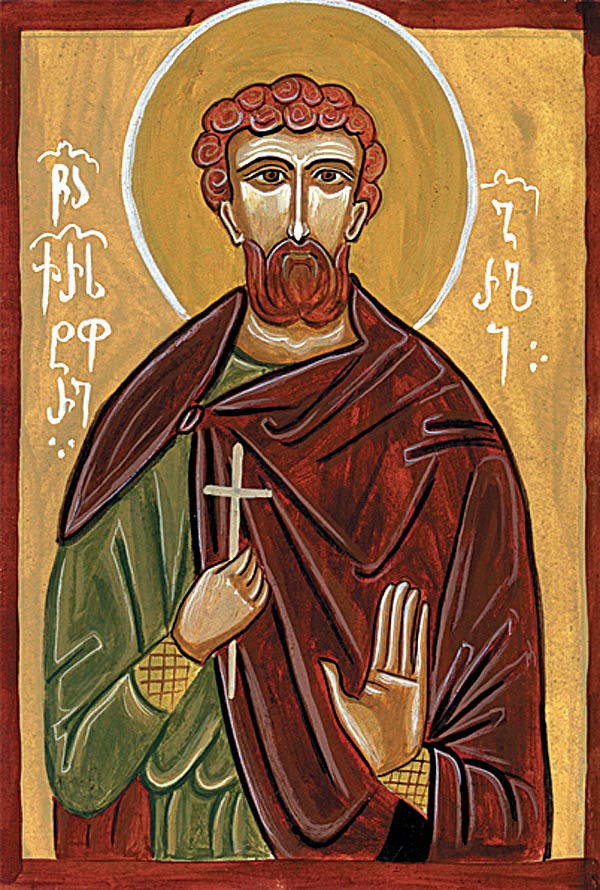
It is commonly believed that Saint Christopher Guruli was martyred, but little information exists about him to prove this. Christopher’s name has been preserved in the nation’s memory, and he is commemorated in the Church calendar.
The Georgian ancestry of Holy Martyr Christopher is indicated by his appellation, “Guruli,” which means “from the province of Guria (in western Georgia).” From this, Church historians have been led to believe that Holy Martyr Christopher labored in Georgia.
No information available at this time.
No information available at this time.
Saint Joachim of Osogov was one of four great hermits of Bulgaria. He inspired hundreds and thousands of people to Christian asceticism by his ascetic efforts. He lived in the eleventh century, unknown by anyone, in a cave on a mountain of Osogov.
No information available at this time.
No information available at this time.
No information available at this time.
Hieromartyr Νikόdēmos of Meteora struggled in Thessaly, and suffered in the year 1551.
The New Martyr Stamatius was a native of the city of Volos, Thessaly. They accused him of accepting Islam, but he bravely confessed himself a Christian and was beheaded by the sword at Constantinople in 1680.

Saint Gerasimus the New Ascetic of Cephalonia was born in the village of Trikkala in the Peloponessos. As a young adult, he became a monk on the island of Zakynthos. On the Holy Mountain he became a schemamonk and studied with the ascetics of Mt Athos. Receiving a blessing from the Elders, the monk went to Jerusalem to worship at the Life-bearing Tomb of the Savior. After visiting many holy places in Jerusalem, Mount Sinai, Antioch, Damascus, Alexandria and Egypt, he returned to Jerusalem where he became a lamp-lighter at the Sepulchre of the Lord.
The monk was ordained a deacon and then a priest by the Patriarch of Jerusalem, Germanus (1534-1579). Saint Gerasimus maintained the discipline of an ascetic. For soltitude he withdrew to the Jordan, where he spent forty days without respite. Having received the Patriarch’s blessing for a life of silence, Saint Gerasimus withdrew to Zakynthos in solitude, eating only vegetation.
After five years he was inspired to go the the island of Cephalonia, where he lived in a cave. He restored a church at Omala, and he founded a women’s monastery where he lived in constant toil and vigil for thirty years. He prayed on bent knees stretched out on the ground. For his exalted life he was granted a miraculous gift: the ability to heal the sick and cast out unclean spirits.
At 71 years of age, the venerable Gerasimus knew that he would soon die. He gave his blessing to the nuns and peacefully fell asleep in the Lord on August 15, 1579. Two years later, his grave was opened and his holy relics were found fragrant and incorrupt with a healing power.
Since the Feast of the Dormition falls on August 15, Saint Gerasimus is commemorated on August 16th. Today’s Feast celebrates the uncovering of his holy relics in 1581.
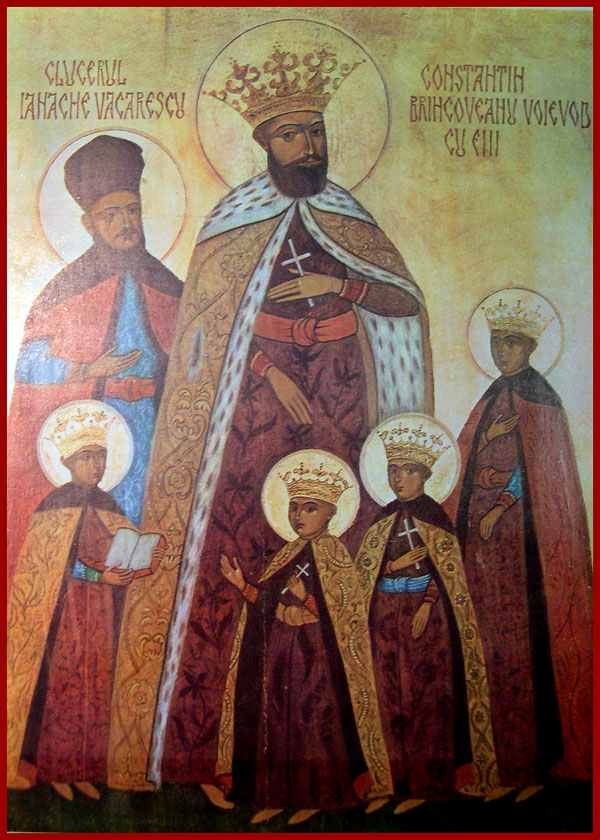
The holy Prince Constantine Brancoveanu, the son of Prince Matthew Basarab, was born in 1654. When his parents died, he was raised and educated by his uncle, Constantine Cantacuzino. When another uncle, Prince Serban Cantacuzino died on on October 19, 1688, Constantine was chosen to succeed him as Prince of the Romanian Land (Wallachia). Saint Constantine was a wise and just ruler who was guided by Christian principles, and worked for the benefit of his people. He also built and restored many churches and monasteries. His philanthropy extended even into Transylvania and Moldavia, which were ruled by others.
In 1714, after a reign of twenty-five years, Saint Constantine, his sons (Saints Constantine the Younger, Stephen Brancoveanu, Radu Brancoveanu, and Matthew Brancoveanu) and his sons-in-law were arrested by soldiers sent to Bucharest by Sultan Ahmed III (1703-1730). The prisoners were brought to Constantinople, where they were tortured for four months. Prince Constantine was told that if he and his sons wanted to escape death, they would have to convert to Islam and pay a large sum of money. Constantine did not have the money required by the Turks, and he did not wish to convert to the Moslem faith.
Seeing that neither tortures nor threats would induce the prisoners to forsake Christ, the Turks sentenced them to death. Before his own execution, Saint Constantine had to watch as his sons were beheaded before his eyes.
On the Feast of the Dormition (August 15), the sixty-year-old prince, his sons, and his counsellor Ianache Vacarescu died as martyrs for Christ. Their bodies were left unburied for three days, then they were thrown into the sea. Their relics were recovered by Orthodox Christians who brought them to the Monastery of the Theotokos on the island of Chalki.
Saint Constantine’s wife Marica brought his holy relics back to Bucharest and placed them in the church of Saint George the New, which he had founded. He was glorified by the Orthodox Church of Romania in 1992.
THE DORMITION OF OUR MOST HOLY LADY THE THEOTOKOS AND EVER VIRGIN MARY
NO FAST
The Dormition of our Most Holy Lady the Theotokos and Ever Virgin Mary
Brethren, have this mind among yourselves, which is yours in Christ Jesus, who, though he was in the form of God, did not count equality with God a thing to be grasped, but emptied himself, taking the form of a servant, being born in the likeness of men. And being found in human form he humbled himself and became obedient unto death, even death on a cross. Therefore God has highly exalted him and bestowed on him the name which is above every name, that at the name of Jesus every knee should bow, in heaven and on earth and under the earth, and every tongue confess that Jesus Christ is Lord, to the glory of God the Father.
At that time, Jesus entered a village; and a woman called Martha received him into her house. And she had a sister called Mary, who sat at the Lord’s feet and listened to his teaching. But Martha was distracted with much serving; and she went to him and said, “Lord, do you not care that my sister has left me to serve you alone? Tell her then to help me.” But the Lord answered her, “Martha, Martha, you are anxious and troubled about many things; one thing is needful. Mary has chosen the good portion, which shall not be taken away from her.” As he said this, a woman in the crowd raised her voice and said to him, “Blessed is the womb that bore you, and the breasts that you sucked!” But he said, “Blessed rather are those who hear the word of God and keep it!”
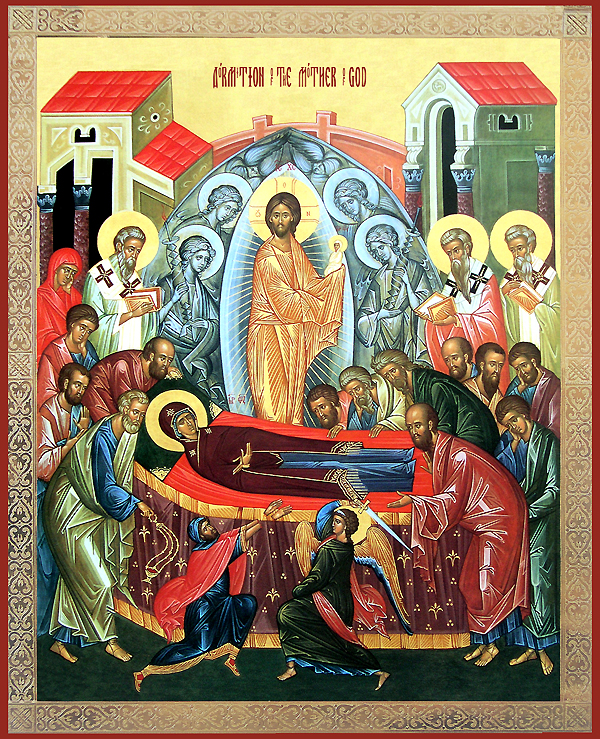
The Dormition of our Most Holy Lady Theotokos and Ever-Virgin Mary: After the Ascension of the Lord, the Mother of God remained in the care of the Apostle John the Theologian, and during his journeys She lived at the home of his parents, near the Mount of Olives. She was a source of consolation and edification both for the Apostles and for all the believers. Conversing with them, She told them about miraculous events: the Annunciation, the seedless and undefiled Conception of Christ born of Her, about His early childhood, and about His earthly life. Like the Apostles, She helped plant and strengthen the Christian Church by Her presence, Her discourse and Her prayers.
The reverence of the Apostles for the Most Holy Virgin was extraordinary. After the receiving of the Holy Spirit on the day of Pentecost, the Apostles remained at Jerusalem for about ten years attending to the salvation of the Jews, and wanting moreover to see the Mother of God and hear Her holy discourse. Many of the newly-enlightened in the Faith even came from faraway lands to Jerusalem, to see and to hear the All-Pure Mother of God.
During the persecution initiated by King Herod against the young Church of Christ (Acts 12:1-3), the Most Holy Virgin and the Apostle John the Theologian withdrew to Ephesus in the year 43. The preaching of the Gospel there had fallen by lot to the Apostle John the Theologian. The Mother of God was on Cyprus with Saint Lazarus the Four-Days-Dead, where he was bishop. She was also on Holy Mount Athos. Saint Stephen of the Holy Mountain says that the Mother of God prophetically spoke of it: “Let this place be my lot, given to me by my Son and my God. I will be the Patroness of this place and intercede with God for it.”
The respect of ancient Christians for the Mother of God was so great that they preserved what they could about Her life, what they could take note of concerning Her sayings and deeds, and they even passed down to us a description of Her outward appearance.
According to Tradition, based on the words of the Hieromartyrs Dionysius the Areopagite (October 3) and Ignatius the God-Bearer (December 20), Saint Ambrose of Milan (December 7) had occasion to write in his work “On Virgins” concerning the Mother of God: “She was a Virgin not only in body, but also in soul, humble of heart, circumspect in word, wise in mind, not overly given to speaking, a lover of reading and of work, and prudent in speech. Her rule of life was to offend no one, to intend good for everyone, to respect the aged, not envy others, avoid bragging, be healthy of mind, and to love virtue.
“When did She ever hurl the least insult in the face of Her parents? When was She at discord with Her kin? When did She ever puff up with pride before a modest person, or laugh at the weak, or shun the destitute? With Her there was nothing of glaring eyes, nothing of unseemly words, nor of improper conduct. She was modest in the movement of Her body, Her step was quiet, and Her voice straightforward; so that Her face was an expression of soul. She was the personification of purity.
“All Her days She was concerned with fasting: She slept only when necessary, and even then, when Her body was at rest, She was still alert in spirit, repeating in Her dreams what She had read, or the implementation of proposed intentions, or those planned yet anew. She was out of Her house only for church, and then only in the company of relatives. Otherwise, She seldom appeared outside Her house in the company of others, and She was Her own best overseer. Others could protect Her only in body, but She Herself guarded Her character.”
According to Tradition, that from the compiler of Church history Nikēphóros Callistus (fourteenth century), the Mother of God “was of average stature, or as others suggest, slightly more than average; Her hair golden in appearance; Her eyes bright with pupils like shiny olives; Her eyebrows strong in character and moderately dark, Her nose pronounced and Her mouth vibrant bespeaking sweet speech; Her face was neither round nor angular, but somewhat oblong; the palm of Her hands and fingers were longish…
In conversation with others She preserved decorum, neither becoming silly nor agitated, and indeed especially never angry; without artifice, and direct, She was not overly concerned about Herself, and far from pampering Herself, She was distinctly full of humility. Regarding the clothing which She wore, She was satisfied to have natural colors, which even now is evidenced by Her holy head-covering. Suffice it to say, a special grace attended all Her actions.” [Nikēphóros Callistus borrowed his description from Saint Epiphanius of Cyprus (May 12), from the “Letter to Theophilus Concerning Icons.”]
The circumstances of the Dormition of the Mother of God were known in the Orthodox Church from apostolic times. Already in the first century, the Hieromartyr Dionysius the Areopagite wrote about Her “Falling-Asleep.” In the second century, the account of the bodily ascent of the Most Holy Virgin Mary to Heaven is found in the works of Meliton, Bishop of Sardis. In the fourth century, Saint Epiphanius of Cyprus refers to the tradition about the “Falling Asleep” of the Mother of God. In the fifth century, Saint Juvenal, Patriarch of Jerusalem, told the holy Byzantine Empress Pulcheria: “Although there is no account of the circumstances of Her death in Holy Scripture, we know about them from the most ancient and credible Tradition.” This tradition was gathered and expounded in the Church History of Nikēphóros Callistus during the fourteenth century.
At the time of Her blessed Falling Asleep, the Most Holy Virgin Mary was again at Jerusalem. Her fame as the Mother of God had already spread throughout the land and had aroused many of the envious and the spiteful against Her. They wanted to make attempts on Her life; but God preserved Her from enemies.
Day and night She spent her time in prayer. The Most Holy Theotokos went often to the Holy Sepulchre of the Lord, and here She offered up fevent prayer. More than once, enemies of the Savior sought to hinder Her from visiting her holy place, and they asked the High Priest for a guard to watch over the Grave of the Lord. The Holy Virgin continued to pray right in front of them, yet unseen by anyone.
In one such visit to Golgotha, the Archangel Gabriel appeared to Her and announced Her approaching departure from this life to eternal life. In pledge of this, the Archangel gave Her a palm branch. With these heavenly tidings the Mother of God returned to Bethlehem with the three girls attending Her (Sepphora, Abigail, and Jael). She summoned Righteous Joseph of Arimathea and other disciples of the Lord, and told them of Her impending Repose.
The Most Holy Virgin prayed also that the Lord would have the Apostle John come to Her. The Holy Spirit transported him from Ephesus, setting him in that very place where the Mother of God lay. After the prayer, the Most Holy Virgin offered incense, and John heard a voice from Heaven, closing Her prayer with the word “Amen.” The Mother of God took it that the voice meant the speedy arrival of the Apostles and the Disciples and the holy Bodiless Powers.
The faithful, whose number by then was impossible to count, gathered together, says Saint John of Damascus, like clouds and eagles, to listen to the Mother of God. Seeing one another, the Disciples rejoiced, but in their confusion they asked each other why the Lord had gathered them together in one place. Saint John the Theologian, greeting them with tears of joy, said that the time of the Virgin’s repose was at hand.
Going in to the Mother of God, they beheld Her lying upon the bed, and filled with spiritual joy. The Disciples greeted Her, and then they told her how they had been carried miraculously from their places of preaching. The Most Holy Virgin Mary glorified God, because He had heard Her prayer and fulfilled Her heart’s desire, and She began speaking about Her imminent end.
During this conversation the Apostle Paul also appeared in a miraculous manner together with his disciples Dionysius the Areopagite, Saint Hierotheus, Saint Timothy and others of the Seventy Apostles. The Holy Spirit had gathered them all together so that they might be granted the blessing of the All-Pure Virgin Mary, and more fittingly to see to the burial of the Mother of the Lord. She called each of them to Herself by name, She blessed them and extolled them for their faith and the hardships they endured in preaching the Gospel of Christ. To each She wished eternal bliss, and prayed with them for the peace and welfare of the whole world.
Then came the third hour (9 A.M.), when the Dormition of the Mother of God was to occur. A number of candles were burning. The holy Disciples surrounded her beautifully adorned bed, offering praise to God. She prayed in anticipation of Her demise and of the arrival of Her longed-for Son and Lord. Suddenly, the inexpressible Light of Divine Glory shone forth, before which the blazing candles paled in comparison. All who saw it took fright. Descending from Heaven was Christ, the King of Glory, surrounded by hosts of Angels and Archangels and other Heavenly Powers, together with the souls of the Forefathers and the Prophets, who had prophesied in ages past concerning the Most Holy Virgin Mary.
Seeing Her Son, the Mother of God exclaimed: “My soul doth magnify the Lord, and my spirit hath rejoiced in God My Savior, for He hath regarded the low estate of His Handmaiden” (Luke 1:46-48) and, rising from Her bed to meet the Lord, She bowed down to Him, and the Lord bid Her enter into Life Eternal. Without any bodily suffering, as though in a happy sleep, the Most Holy Virgin Mary gave Her soul into the hands of Her Son and God.
Then began a joyous angelic song. Accompanying the pure soul of the God-betrothed and with reverent awe for the Queen of Heaven, the angels exclaimed: “Hail, Full of Grace, the Lord is with Thee, blessed art Thou among women! For lo, the Queen, God’s Maiden comes, lift up the gates, and with the Ever-Existing One, take up the Mother of Light; for through Her salvation has come to all the human race. It is impossible to gaze upon Her, and it is impossible to render Her due honor” (Stikherion on “Lord, I Have Cried”). The Heavenly gates were raised, and meeting the soul of the Most Holy Mother of God, the Cherubim and the Seraphim glorified Her with joy. The face of the Mother of God was radiant with the glory of Divine virginity, and from Her body there came a sweet fragrance.
Miraculous was the life of the All-Pure Virgin, and wondrous was Her Repose, as Holy Church sings: “In Thee, O Queen, the God of all hath given thee as thy portion the things that are above nature. Just as in the Birth-Giving He did preserve Thine virginity, so also in the grave He did preserve Thy body from decay” (Canon 1, Ode 6, Troparion 1).
Kissing the all-pure body with reverence and in awe, the Disciples in turn were blessed by it and filled with grace and spiritual joy. Through the great glorification of the Most Holy Theotokos, the almighty power of God healed the sick, who with faith and love touched the holy bed.
Bewailing their separation from the Mother of God, the Apostles prepared to bury Her all-pure body. The holy Apostles Peter, Paul, James and others of the Twelve Apostles carried the funeral bier upon their shoulders, and upon it lay the body of the Ever-Virgin Mary. Saint John the Theologian went at the head with the resplendent palm-branch from Paradise. The other saints and a multitude of the faithful accompanied the funeral bier with candles and censers, singing sacred songs. This solemn procession went from Sion through Jerusalem to the Garden of Gethsemane.
With the start of the procession there suddenly appeared over the all-pure body of the Mother of God and all those accompanying Her a resplendent circular cloud, like a crown. There was heard the singing of the Heavenly Powers, glorifying the Mother of God, which echoed that of the worldly voices. This circle of Heavenly singers and radiance accompanied the procession to the very place of burial.
Unbelieving inhabitants of Jerusalem, taken aback by the extraordinarily grand funeral procession and vexed at the honor accorded the Mother of Jesus, complained of this to the High Priest and scribes. Burning with envy and vengefulness toward everything that reminded them of Christ, they sent out their own servants to disrupt the procession and to set the body of the Mother of God afire.
An angry crowd and soldiers set off against the Christians, but the circular cloud accompanying the procession descended and surrounded them like a wall. The pursuers heard the footsteps and the singing, but could not see any of those accompanying the procession. Indeed, many of them were struck blind.
The Jewish priest Athonios, out of spite and hatred for the Mother of Jesus of Nazareth, wanted to topple the funeral bier on which lay the body of the Most Holy Virgin Mary, but an angel of God invisibly cut off his hands, which had touched the bier. Seeing such a wonder, Athonios repented and with faith confessed the majesty of the Mother of God. He received healing and joined the crowd accompanying the body of the Mother of God, and he became a zealous follower of Christ.
When the procession reached the Garden of Gethsemane, then amidst the weeping and the wailing began the last kiss to the all-pure body. Only towards evening were the Apostles able to place it in the tomb and seal the entrance to the cave with a large stone.
For three days they did not depart from the place of burial, praying and chanting Psalms. Through the wise providence of God, the Apostle Thomas was not to be present at the burial of the Mother of God. Arriving late on the third day at Gethsemane, he lay down at the tomb and with bitter tears asked that he might be permitted to look once more upon the Mother of God and bid her farewell. The Apostles out of heartfelt pity for him decided to open the grave and permit him the comfort of venerating the holy relics of the Ever-Virgin Mary. Having opened the grave, they found in it only the grave wrappings and were thus convinced of the bodily ascent of the Most Holy Virgin Mary to Heaven.
On the evening of the same day, when the Apostles had gathered at a house to strengthen themselves with food, the Mother of God appeared to them and said: “Rejoice! I am with you all the days of your lives.” This so gladdened the Apostles and everyone with them, that they took a portion of the bread, set aside at the meal in memory of the Savior (“the Lord’s Portion”), and they exclaimed : “Most Holy Theotokos, save us”. (This marks the beginning of the rite of offering up the “Panagia” (“All-Holy”), a portion of bread in honor of the Mother of God, which is done at monasteries to the present day).
The sash of the Mother of God, and Her holy garb, preserved with reverence and distributed over the face of the earth in pieces, have worked miracles both in the past and at present. Her numerous icons everywhere pour forth signs and healings, and Her holy body, taken up to Heaven, bears witness to our own future life there. Her body was not left to the vicissitudes of the transitory world, but was incomparably exalted by its glorious ascent to Heaven.
The Feast of the Dormition of the Most Holy Theotokos is celebrated with special solemnity at Gethsemane, the place of Her burial. Nowhere else is there such sorrow of heart at the separation from the Mother of God, and nowhere else such joy, because of Her intercession for the world.
The holy city of Jerusalem is separated from the Mount of Olives by the valley of Kedron on Josaphat. At the foot of the Mount of Olives is the Garden of Gethsemane, where olive trees bear fruit even now.
The holy Ancestor-of-God Joachim had himself reposed at 80 years of age, several years after the Entry of the Most Holy Theotokos into the Temple (November 21). Saint Anna, having been left a widow, moved from Nazareth to Jerusalem, and lived near the Temple. At Jerusalem she bought two pieces of property: the first at the gates of Gethsemane, and the second in the valley of Josaphat. At the second locale she built a tomb for the members of her family, and where also she herself was buried with Joachim. It was there in the Garden of Gethsemane that the Savior often prayed with His disciples.
The most-pure body of the Mother of God was buried in the family tomb. Christians honored the sepulchre of the Mother of God, and they built a church on this spot. Within the church was preserved the precious funeral cloth, which covered Her all-pure and fragrant body.
The holy Patriarch Juvenal of Jerusalem (420-458) testified before the emperor Marcian (450-457) as to the authenticity of the tradition about the miraculous ascent of the Mother of God to Heaven, and he sent to the empress, Saint Pulcheria (September 10), the grave wrappings of the Mother of God from Her tomb. Saint Pulcheria then placed these grave-wrappings within the Blachernae church.
Accounts have been preserved, that at the end of the seventh century a church had been built atop the underground church of the Dormition of the Most Holy Theotokos, and that from its high bell-tower could be seen the dome of the Church of the Resurrection of the Lord. Traces of this church are no longer to be seen. And in the ninth century near the subterranean Gethsemane church a monastery was built, in which more than 30 monks struggled.
Great destruction was done the Church in the year 1009 by the despoiler of the holy places, Hakim. Radical changes, the traces of which remain at present, also took place under the crusaders in the year 1130. During the eleventh to twelfth centuries the piece of excavated stone, at which the Savior had prayed on the night of His betrayal disappeared from Jerusalem. This piece of stone had been in the Gethsemane basilica from the sixth century.
But in spite of the destruction and the changes, the overall original cruciform (cross-shaped) plan of the church has been preserved. At the entrance to the church along the sides of the iron gates stand four marble columns. To enter the church, it is necessary to go down a stairway of 48 steps. At the 23rd step on the right side is a chapel in honor of the holy Ancestors-of-God Joachim and Anna together with their graves, and on the left side opposite, the chapel of Saint Joseph the Betrothed with his grave. The right chapel belongs to the Orthodox Church, and the left to the Armenian Church (since 1814).
The church of the Dormition of the Theotokos has the following dimensions: in length it is 48 arshin, and in breadth 8 arshin [1 arshin = 28 inches]. At an earlier time the church had also windows beside the doors. The whole temple was adorned with a multitude of lampadas and offerings. Two small entrances lead into the burial-chamber of the Mother of God. One enters through the western doors, and exits at the northern doors. The burial-chamber of the All-Pure Virgin Mary is veiled with precious curtains. The burial place was hewn out of stone in the manner of the ancient Jewish graves and is very similar to the Sepulchre of the Lord. Beyond the burial-chamber is the altar of the church, in which Divine Liturgy is celebrated each day in the Greek language.
The olive woods on the eastern and northern sides of the temple was acquired from the Turks by the Orthodox during the seventh and eighth centuries. The Catholics acquired the olive woods on the east and south sides in 1803, and the Armenians on the west side in 1821.
On August 12, at Little Gethsemane, at the second hour of the night, the head of the Gethsemane church celebrates Divine Liturgy. With the end of Liturgy, at the fourth hour of the morning, he serves a short Molieben before the resplendent burial shroud, lifts it in his hands and solemnly carries it beyond the church to Gethsemane proper where the holy sepulchre of the Mother of God is situated. All the members of the Russian Spiritual Mission in Jerusalem, with the head of the Mission presiding, participate each year in the procession (called the “Litania”) with the holy burial shroud of the Mother of God.
The rite of the Burial of the Mother of God at Gethsemane begins customarily on the morning of August 14. A multitude of people with hierarchs and clergy at the head set off from the Jerusalem Patriarchate (nearby the Church of the Resurrection of Christ) in sorrowful procession. Along the narrow alley-ways of the Holy City the funeral procession makes its way to Gethsemane. Toward the front of the procession an icon of the Dormition of the Most Holy Theotokos is carried. Along the way, pilgrims meet the icon, kissing the image of the All-Pure Virgin Mary and lift children of various ages to the icon. After the clergy, in two rows walk the black-robed monks and nuns of the Holy City: Greeks, Roumanians, Arabs, Russians. The procession, going along for about two hours, concludes with Lamentations at the Gethsemane church. In front the altar, beyond the burial chamber of the Mother of God, is a raised-up spot, upon which rests the burial shroud of the Most Holy Mother of God among fragrant flowers and myrtle, with precious coverings.
“O marvelous wonder! The Fount of Life is placed in the grave, and the grave doth become the ladder to Heaven…” Here at the grave of the All-Pure Virgin, these words strike deep with their original sense and grief is dispelled by joy: “Hail, Full of Grace, the Lord is with Thee, granting the world, through Thee, great mercy!”
Numerous pilgrims, having kissed the icon of the Dormition of the Most Holy Theotokos, following an ancient custom, then stoop down and go beneath it.
On the day of the Leave-taking of the feast (August 23), another solemn procession is made. On the return path, the holy burial shroud is carried by clergy led by the Archimandrite of Gethsemane.
There is an article in the “Journal of the Moscow Patriarchate”, 1979, No. 3 regarding the rite of the litany and Feast of the Dormition of the Mother of God in the Holy Land.
Today flowers are blessed in church, and people keep them in their homes. During times of family strife or illness, the flower petals are placed in the censer with the incense, and the whole house is censed. See the Prayer at the Sanctification of any Fragrant Herbage.
Saint Macarius the Roman was born at the end of the fifteenth century into a wealthy family of Rome. His parents raised him in piety and gave him an excellent education. He might have expected a successful career in public service, but he did not desire honors or earthly glory. Instead, he focused on how to save his soul.
He lived in an age when the Christian West was shaken by the Protestant Reformation. While others around him were pursuing luxury and lascivious pleasures, he studied the Holy Scriptures and the writings of the Fathers. Saint Macarius was grieved to see so many darkened by sin and worldly vanity, and was disturbed by the rebellions and conflicts within the Western Church. With tears, he asked God to show him the path of salvation, and his prayer did not go unanswered. He came to realize that he would find the safe harbor of salvation in the Orthodox Church.
Saint Macarius left Rome secretly, and set out for Russia without money, and wearing an old garment. After many sufferings on his journey, he arrived in Novgorod, where he rejoiced to see so many churches and monasteries. One of these monasteries had been founded three centuries before by his fellow countryman, Saint Anthony the Roman (August 3).
Saint Macarius came to the banks of the River Svir, where Saint Alexander of Svir (April 17 and August 30) had founded the monastery of the Holy Trinity. Saint Alexander received Macarius into the Orthodox Church and tonsured him as a monk. Macarius, however longed for the solitary life. He moved to an island on the River Lezna, forty-five miles from Novgorod, where he engaged in ascetical struggles and unceasing prayer.
The winters were very cold, and the summers were hot and humid. The marshy area was also a breeding ground for mosquitos, which tormented the saint. Saint Macarius survived on berries, roots, and herbs. Sometimes bears would come to him for food, and they allowed him to pet them.
Such a great lamp of the spiritual life could not remain hidden for long. One rainy night someone knocked on his door and asked him to open it. Several people, who seemed to be hunters, entered his cell. Astonished by his appearance, and the divine light shining from his face, the men asked for his blessing. They told him they had come to the forest to hunt, and only by the prayers of the saint did God permit them to find him.
“It is not my sinful prayers,” he told them, “but the grace of God which led you here.”
After feeding them, he spoke and prayed with them, then showed them the way out of the marsh. Saint Macarius was concerned that his peace would be disturbed, now that his dwelling place was known. His fears were justified, because many people sought him out to ask for his advice and prayers.
The holy ascetic decided to move even farther into the wilderness, choosing an elevated place on the left bank of the Lezna. Even here, however, he was not able to conceal himself for very long. Sometimes a pillar of fire would rise up into the sky at night above his place of refuge. During the day, the grace of God was made manifest by a fragrant cloud of smoke. Drawn by these signs, the local inhabitants of the region were able to find him once more.
Some of his visitors begged Saint Macarius to permit them to live near him and to be guided by his counsels. Seeing that this was the Lord’s will, he did not refuse them. He blessed them to build cells, and this was the foundation of his monastery.
In 1540, they built a wooden church dedicated to the Dormition of the Most Holy Theotokos. Saint Macarius was ordained to the holy priesthood by Bishop Macarius of Novgorod, who later became Metropolitan of All Russia. The hierarch also appointed Saint Macarius as igumen of the monastery.
Saint Macarius was an example to the others, and was given the gifts of clairvoyance and wonderworking from God. He wore himself out with his labors and vigils, encouraging others not to become faint-hearted in their own struggles.
After several years, he entrusted the monastery to one of his disciples, and returned to the island where he had first lived. There he fell asleep in the Lord on August 15, 1550. His disciples buried him outside on the left side of the Dormition church which he had founded.
The Hermitage of Saint Macarius was never a prosperous monastery with many monks, but it was distinguished by the high level of spiritual life. In the seventeenth century, many of the monasteries near Novgorod were plundered by Swedish invaders. The Hermitage of Saint Macarius was also burned in 1615, and some of the monks were put to the sword.
By the eighteenth century, the monastery had become a dependency of the Saint Alexander Nevsky Lavra in Saint Petersburg. The Empress Catherine closed it in 1764, just as she had closed other monasteries, and it was designated as a parish church. Although pilgrims still came to venerate the saint’s relics and to celebrate his Feast Day, the buildings soon fell into ruin.
In the mid-nineteenth century, some benefactors restored the two churches and the miraculous healing spring which the saint himself had dug. About this time an old priest was living there, and he celebrated the church services until his death. In 1894, the monastery began to function once more under the noted missionary Hieromonk Arsenius, who introduced the Athonite Typikon. The monastery was destroyed by the Soviets in 1932.
Saint Macarius the Roman is commemorated on August 15 (the date of his repose), and also on January 19 (his nameday).
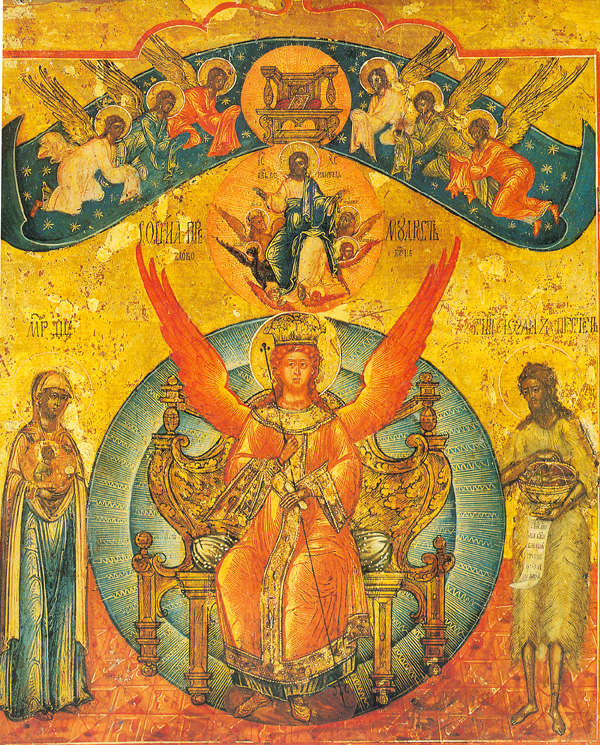
The wonderworking "Sophia, the Wisdom of God" Icon of the Mother of God is found in many churches in Russia. There are two main types: Kiev and Novgorod.
The first icon of "Sophia, the Wisdom of God" appeared in Novgorod in the XV century, although the first church in Russia dedicated to her was built in 989 in Novgorod, and the next in 1037 at Kiev.
The central figure on the Icon is the Almighty in the form of a winged Fiery Angel, who sits on a golden throne supported by seven pillars. He is dressed in royal garb and girded with a precious belt, on His head is a royal crown. In His right hand He holds a scepter with a cross at the top, and with His left he presses a scroll to His chest. On the sides are depicted the Mother of God with the Divine Infant, and Saint John the Baptist with a scroll on which it reads: "I testify." Above the head of the Angel Christ the Savior is blessing, even higher is a golden throne with an open book on it – a symbol of the Divine presence. On both sides of the throne three Angels are kneeling.
The fact that the Fiery Angel is Christ can be ascertained from the words of the Apostle Paul, who says: "we preach Christ crucified, a scandal to the Jews, and folly to the Gentiles. Christ, the power of God and the wisdom of God … And of Him you are in Christ Jesus, who became wisdom for us from God, both righteousness and sanctification and redemption" (1 Corinthians 1:23-24; 30).
In the Book of Revelation Saint John the Evangelist describes the Son of Man as "clothed with a long robe and girt with a golden girdle around his breast; his head and his hair were white as white wool, white as snow; his eyes were like a flame of fire, his feet were like burnished bronze, refined as in a furnace, and his voice was like the sound of many waters …" (Revelation 1:13-15).
This wooden icon in a gilded silver riza is a copy of the ancient Sophia Icon from Emperor Justinian's church in Constantinople, and dates back to the time of the construction of the Novgorod Cathedral.
This image was renowned for numerous miracles. According to legend, in 1542, a woman suffering from an affliction of the eyes was healed after praying before the Icon, as it is written in the Novgorod Chronicle: "The Wisdom of God forgave the woman, who was sick." The image of Holy Wisdom is an expression of the power and action of the Wisdom of God, and therefore it is presented in a fiery form.
All the numerous copies of the "Sophia, the Wisdom of God" Icon have as their prototype either the Kiev or Novgorod icons. The celebration of the Kiev Icon takes place on September 8, and the Novgorod icon on August 15.
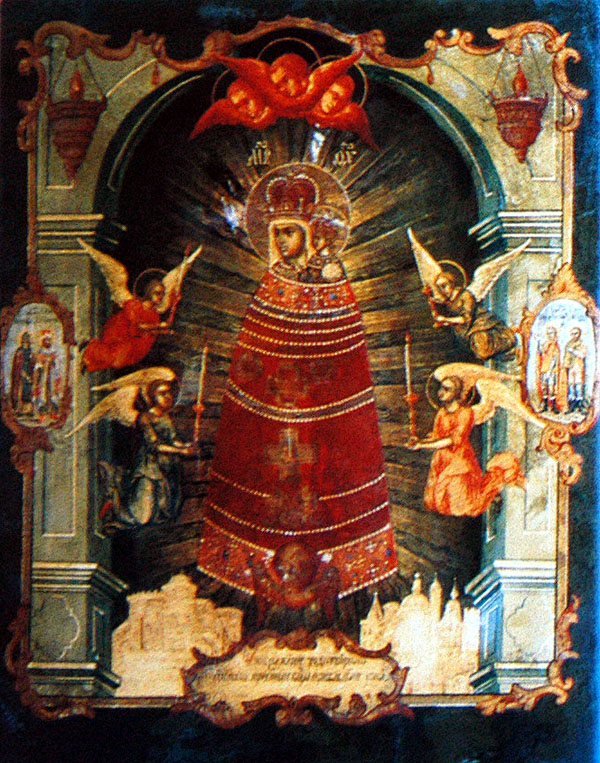
This unusual icon comes from the Russian town of Rybinsk, in Yaroslavl province. The Mother of God and the Divine Child are wrapped in what appears to be a priest’s phelonion, and Angels are depicted on either side, holding lighted candles. Beneath the Virgin’s feet and on her head Cherubim are depicted with outstretched wings.The model for this Icon is a statue in the town of Loreto in Italy, which is wrapped in a similar covering.
The “Enlightener of minds” Icon (Подательница ума) reflects the deep faith of Orthodox Christians in the power of the All Holy Virgin to intercede before God and His Son to bestow both temporal and spiritual blessings. Foremost among these is enlightenment of the mind and heart through Divine Truth.
For this reason, parents whose children are slow learners, either in matters of the Faith or in secular knowledge, often turn to the Most Holy Theotokos and her Divine Child, Who is the fount of the loftiest wisdom and knowledge, praying for their children’s minds be strengthened and that they may retain what they are taught. People also entreat the Mother of God to help them overcome delusion and mental illness.
The Enlightener of Minds icon is commemorated on August 15.
Here is the live stream for Orthros and Divine Liturgy – Feast of the Dormition of the Theotokos – Wed. Aug. 14, 2024 If you need, here are instructions for accessing this content from your phone, tablet, computer, or TV.
August 18, 2024
Eighth Sunday after Pentecost
I Corinthians 1:10-17: Brethren, I appeal to you, by the Name of our Lord Jesus Christ, that all of you agree and that there be no dissension among you, but that you be united in the same mind and the same judgment. For it has been reported to me by Chloe’s people that there is quarreling among you, my brethren. What I mean is that each one of you says, “I belong to Paul,” or “I belong to Apollos,” or “I belong to Cephas,” or “I belong to Christ.” Is Christ divided? Was Paul crucified for you? Or were you baptized in the name of Paul? I thank God that I baptized none of you except Crispos and Gaius; lest anyone should say that you were baptized in my name. (I did baptize also the household of Stephanas. Beyond that, I do not know whether I baptized anyone else.) For Christ did not send me to baptize but to preach the Gospel, and not with eloquent wisdom, lest the cross of Christ be emptied of its power.
Matthew 14:14-22: At that time, when Jesus went ashore he saw a great throng; and he had compassion on them, and healed their sick. When it was evening, the disciples came to Him and said, “This is a lonely place, and the day is now over; send the crowds away to go into the villages and buy food for themselves.” Jesus said, “They need not go away; you give them something to eat.” They said to Him, “We have only five loaves here and two fish.” And He said, “Bring them here to Me.” Then He ordered the crowds to sit down on the grass; and taking the five loaves and the two fish He looked up to Heaven, and blessed, and broke and gave the loaves to the disciples, and the disciples gave them to the crowds. And they all ate and were satisfied. And they took up twelve baskets full of the broken pieces left over. And those who ate were about five thousand men, besides women and children. Then Jesus made the disciples get into the boat and go before Him to the other side, while He dismissed the crowds.
Troparion of the Resurrection: Thou didst shatter death by thy Cross; thou didst open paradise to the thief; thou didst turn the mourning of the ointment-bearing women into joy, and didst bid thine Apostles proclaim warning that thou hast risen, O Christ, granting the world Great Mercy.
Troparion of the Dormition: In thy birth-giving, O Theotokos, thou didst keep and preserve virginity; and in thy falling-asleep thou hast not forsaken the world; for living thou wast translated, being the Mother of Life. Wherefore, by thine intercessions, deliver our souls from death.
Troparion of the Chains of St. Peter: O Holy Apostle, Peter, thou dost preside over the Apostles by the precious chains which thou didst bear. We venerate them with faith and beseech thee that by thine intercessions we be granted the great mercy.
Kontakion of the Dormition: Verily, the Theotokos, who is ever watchful in intercessions, who is never rejected, neither tomb nor death could control. But being the Mother of Life, he who dwelt in her ever-virgin womb didst translate her to life.
CALENDAR
UNTIL FURTHER NOTICE: All services listed on the calendar will be available through streaming and webcast. (Instructions can be found on the parish website.)
Sunday, August 18 (Eighth Sunday after Pentecost)
8:50 a.m. – Orthros
10:00 a.m. – Divine Liturgy (webcast)
Monday, August 19
Father Herman off
Tuesday, August 20
NO Services
Wednesday, August 21
5:20 p.m. – Catechism Class
6:30 p.m. – Daily Vespers
Thursday, August 22
NO Services
Friday, August 23
NO Services
Saturday, August 24
4:30 p.m. – Choir Practice
6:00 p.m. – Great Vespers
Sunday, August 25 (Ninth Sunday after Pentecost; Apostles Bartholomew and Titus)
8:50 a.m. – Orthros
10:00 a.m. – Divine Liturgy (webcast)
SPECIAL ANNOUNCEMENTS
The Eucharist Bread …was offered by the Lasseters for the Feast of the Dormition of the Theotokos this past Wednesday evening and by the Bakers for the Divine Liturgy this morning.
Eucharist Bread Schedule:
Eucharist Bread Coffee Hour
August 18 Baker Ken Jones/Stewart
August 25 Henderson Meadows/Brock
September 1 Algood Dansereau/Alaeetawi
September 7 (Sat. p.m.) Meadows (Artoklasia Bread)
September 8 Schelver POT LUCK MEAL
(Feast of the Nativity of the Theotokos) Ellis/Zouboukos/Waites
September 14 (Sat. a.m.) Jones D. Root/Lively
(Feast of the Elevation of the Cross)
September 15 Davis Miller/Weatherly
September 22 D. Root Lasseter/Pacurari/Lavric
September 29 Karam Lockhart/Karam/Snell
Schedule for Epistle Readers – Page numbers refer to the Apostolos (book of the Epistles) located on the Chanters’ stand at the front of the nave. Please be sure to use this book when you read.
Reader Reading Page#
August 18 Ian Jones I Cor. 1:10-17 124
August 25 Brenda Baker I Cor. 3:9-17 130
September 1 Walt Wood I Tim. 2:1-7 303
September 8 Reader Basil Baker Gal. 6:11-18 198
September 14 (Sat. a.m.) Reader Chad Miller I Cor. 1:18-24 311
September 15 Brandon Strain Gal. 2:16-20 193
September 22 Katie Miller I Cor. 16:13-24 152
September 29 Mary Martha Ellis II Cor. 1:21-2:4 158
Also, please remember that we still need your tithes and offerings which may be placed in the tray that is passed during the Divine Liturgy, in the tithe box at the back of the nave or be mailed to: St. Peter Orthodox Church, P.O. Box 2084, Madison, MS 39130-2084.
Please remember the following in your prayers: Aidan Milnor, the Milnor family; Lamia Dabit and her family; Mary Greene (Lee and Kh. Sharon’s sister); Jay and Joanna Davis; Fr. Leo and Kh. Be’Be’ Schelver and their family; Marilyn (Kyriake) Snell; Jack and Jill Weatherly; Sh. Charlotte Algood and their family; Reader Basil and Brenda Baker and their family; Fr. Joseph Bittle; Rick Carlton; Very Rev. Fr. Nicholas and Kh. Jan Speier; Lee Greene; Joseph, Amanda and Hunter Hines; Fr. John and Kh. Janet Henderson and their family; Galina Singletary; Emily and Cole Parker; Dane and Stephanie Skirtech.
NO children are allowed to be in the pantry or in the refrigerator and children under the age of 12 are not allowed in the kitchen without the presence of a parent or a responsible adult. Children under the age of 12 are not allowed to access the icemaker. Parents, we ask for your assistance with enforcing this policy. Thank you.
** We ask that families go through the Coffee Hour line together, so that children are under the supervision of their parents. **
Calendar Items:
* The men of the parish meet for lunch at 11:00 a.m. on the first Thursday of the month.
* The Ladies meet at the church at 10:00 a.m. on the second Saturday of the month to pray the Akathist to the Mother of God, Nurturer of Children on behalf of our children. However, we will NOT have the Akathist on September 14th due to Orthros and Divine Liturgy for the Feast of the Elevation of the Cross.
* The Ladies meet for lunch at 1:00 p.m. on the last Tuesday of the month.
* We will celebrate the Feast of the Nativity of the Theotokos with Great Vespers with Litia and Artoklasia on Saturday evening, beginning at 6:00 p.m. with Festal Orthros and Divine Liturgy for the feast on Sunday morning at the usual times.
* The Feast of the Elevation of the Holy Cross will be celebrated with Festal Orthros followed by Divine Liturgy on Saturday morning, September 14th, beginning at 9:00 a.m.
* The Diocesan Fall Retreat will be held September 20-21 at St. Ignatius in Franklin, TN.
* Remaining Stewpot date for 2024 will be November 30th.
The 2024 Fall Retreat will be held September 20-21 and will be hosted by St. Ignatius in Franklin, TN. Registration opened recently. Early Bird special will run until September 4th, after that the price for the retreat will increase. So please make sure you register before Septmber 4th! The link for registration was emailed out by Fr. Herman this past week as well. If you did not receive it, please let him know as soon as possible. Hope to see you all there!
Fasting Discipline for August
Following the 15th, the traditional fasting discipline (no meat, dairy, eggs, fish, wine or oil) is observed on the remaining Wednesdays and Fridays of the month. The feast of the Beheading of the Forerunner on August 29th is also a strict fast day.
Major Commemorations for August
August 25 Apostles Bartholomew and Titus
August 29 Beheading of the Forerunner
August 31 Deposition of the Belt of the Theotokos
Quotable: “The Lord is always waiting for us to unite ourselves with Him in love; but instead, we drift further and further away from Him. We know that there can be no life without love. This means that there is no life without God, for God is Love. But His love is not according to the understanding of the world. The love that the world gives us consists of suffering and enslavement, because the spirits of evil interfere with it. There is a little bit of love, but mostly it is just enslavement.”
Elder Thaddeus
Worship: Sunday, August 25, 2024 (Ninth Sunday after Pentecost; Apostles Bartholomew and Titus)
Scripture: I Corinthians 3:9-17; Matthew 14:22-34
Epistle Reader: Brenda Baker
Prosphora: Henderson
Coffee Hour: Meadows/Brock
8TH WEDNESDAY AFTER PENTECOST
ABSTAIN FROM MEAT, FISH, DAIRY, EGGS, WINE, OLIVE OIL
Forefeast of the Dormition of our Most Holy Lady the Theotokos and Ever Virgin Mary, The Holy Prophet Michaias (Micah), Holy Hieromartyr Marcellus, Bishop of Apameia, Holy New Martyr Symeon of Trapezoundos (1653)
Brethren, let any one who thinks that he stands take heed lest he fall. No temptation has overtaken you that is not common to man. God is faithful, and he will not let you be tempted beyond your strength, but with the temptation will also provide the way of escape, that you may be able to endure it. Therefore, my beloved, shun the worship of idols. I speak as to sensible men: judge for yourselves what I say. The cup of blessing which we bless, is it not a communion in the blood of Christ? The bread which we break, is it not a communion in the body of Christ? Because there is one bread, we who are many are one body, for we all partake of the one bread. Consider Israel according to the flesh: are not those who eat the sacrifices partners in the altar? What do I imply then? That food offered to idols is anything, or that an idol is anything? No, I imply that what pagans sacrifice they offer to demons and not to God. I do not want you to be partners with demons. You cannot drink the cup of the Lord and the cup of the demons. You cannot partake of the table of the Lord and the table of the demons. Shall we provoke the Lord to jealousy? Are we stronger than he?
At that time, Jesus strictly charged the disciples to tell no one that he was the Christ. From that time Jesus began to show his disciples that he must go to Jerusalem and suffer many things from the elders and chief priests and scribes, and be killed, and on the third day be raised. And Peter took him and began to rebuke him, saying, "God forbid, Lord! This shall never happen to you." But he turned and said to Peter, "Get behind me, Satan! You are a hindrance to me; for you are not on the side of God, but of men." Then Jesus told his disciples, "If any man would come after me, let him deny himself, and take up his cross and follow me.
The Troparion of the Forefeast invites us to gather on this day in gladness, for the Theotokos is about to depart from earth to heaven.

The Prophet Micah, the sixth of the Twelve Minor Prophets, was descended from the Tribe of Judah and was a native of the city of Moresheth, to the south of Jerusalem. His prophetic service began around the year 778 before Christ and continued for almost 50 years under the kings of Judah: Jotham, Ahaz, and Righteous Hezekiah (721-691 B.C., August 28).
He was a contemporary of the Prophet Isaiah. His denunciations and predictions were in regard to the separate kingdoms of Judah and Israel. He foresaw the misfortunes threatening the kingdom of Israel before its destruction, and the sufferings of Judah during the incursions under the Assyrian emperor Sennacherib.
To him belongs a prophecy about the birth of the Savior of the world: “And thou, Bethlehem, house of Ephratha, art too few in number to be reckoned with the thousands of Judah; yet out of thee shall come forth to Me, one who is to be a ruler in Israel, and His goings forth were from the beginning, even from eternity” (Mic. 5: 2). From the words of the Prophet Jeremiah (Jer. 26: 18-19), the Jews evidently were afraid to kill the Prophet Micah. His relics were discovered in the fourth century after the Birth of Christ at Baraphsatia, through a revelation to the Bishop of Eleutheropolis, Zeuinos.
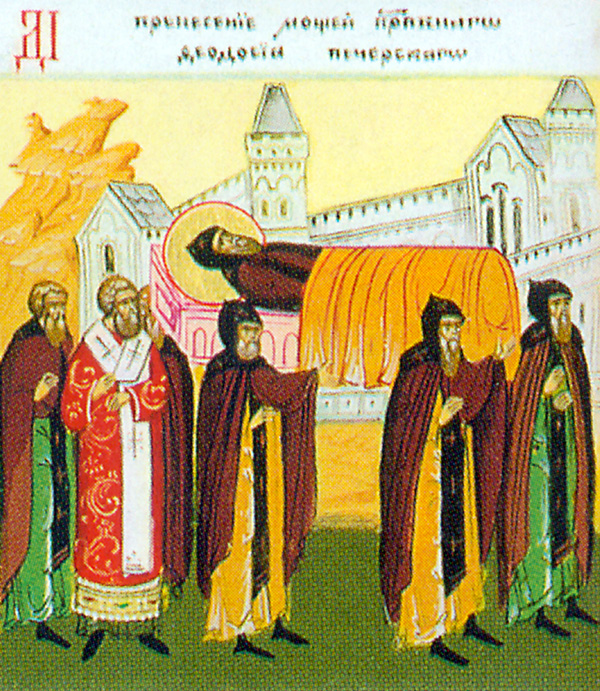
Saint Theodosius of the Caves was the Father of monasticism in Russia. He was born at Vasilevo, not far from Kiev. From his youth he felt an irresistible attraction for the ascetic life, and led an ascetic lifestyle while still in his parental home. He disdained childish games and attractions, and constantly went to church. He asked his parents to let him study the holy books, and through his evident abilities and rare zeal, he quickly learned to read the books, so that everyone was amazed at his intellect.
When he was fourteen, he lost his father and remained under the supervision of his mother, a strict and domineering woman who loved her son very much. Many times she chastised her son for his yearning for asceticism, but he remained firmly committed to his path.
At the age of twenty-four, he secretly left his parental home and Saint Anthony at the Kiev Caves monastery blessed him to receive monastic tonsure with the name Theodosius. After four years his mother found him and with tearfully begged him to return home, but the saint persuaded her to remain in Kiev and to become a nun in the monastery of Saint Nicholas at the Askold cemetery.
Saint Theodosius toiled at the monastery more than others, and he often took upon himself some of the work of the other brethren. He carried water, chopped wood, ground up the grain, and carried the flour to each monk. On cold nights he uncovered his body and let it be food for gnats and mosquitoes. His blood flowed, but the saint occupied himself with handicrafts, and sang Psalms. In church he appeared before others and, standing in one place, he did not leave it until the end of services. He also listened to the readings with particular attention.
In 1054 Saint Theodosius was ordained a hieromonk, and in 1057 he was chosen igumen. The fame of his deeds attracted a number of monks to the monastery, at which he built a new church and cells, and he introduced the cenobitic rule of the Studion monastery, a copy of which he commissioned at Constantinople. As igumen, Saint Theodosius continued his arduous duties at the monastery. He usually ate only dry bread and cooked greens without oil. He spent his nights in prayer without sleep, and the brethren often took notice of this, although the chosen one of God tried to conceal his efforts from others.
No one saw when Saint Theodosius dozed lightly, and usually he rested while sitting. During Great Lent the saint withdrew into a cave near the monastery, where he struggled unseen by anyone. His attire was a coarse hairshirt worn next to his body. He looked so much like a beggar that it was impossible to recognize in this old man the renowned igumen, deeply respected by all who knew him.
Once, Saint Theodosius was returning from Great Prince Izyaslav. The coachman, not recognizing him, said gruffly, “You, monk, are always on holiday, but I am constantly at work. Take my place, and let me ride in the carriage.” The holy Elder meekly complied and drove the servant. Seeing how nobles along the way bowed to the monk driving the horses, the servant took fright, but the holy ascetic calmed him, and gave him a meal at the monastery. Trusting in God’s help, the saint did not keep a large supply of food at the monastery, and therefore the brethren were in want of their daily bread. Through his prayers, however, unknown benefactors appeared at the monastery and furnished the necessities for the brethren.
The Great Princes, and especially Izyaslav, loved to listen to the spiritual discourses of Saint Theodosius. The saint was not afraid to denounce the mighty of this world. Those unjustly condemned always found a defender in him, and judges would review matters at the request of the igumen. He was particularly concerned for the destitute. He built a special courtyard for them at the monastery where anyone in need could receive food and drink. Sensing the approach of death, Saint Theodosius peacefully fell asleep in the Lord in the year 1074. He was buried in a cave which he dug, where he secluded himself during fasting periods.
The relics of the ascetic were found incorrupt in the year 1091. Saint Theodosius was numbered among the saints in 1108. Of the written works of Saint Theodosius six discourses, two letters to Great Prince Izyaslav, and a prayer for all Christians have survived to our time.
The Life of Saint Theodosius was written by Saint Nestor the Chronicler (October 27), a disciple of the great Abba, only thirty years after his repose, and it was always one of the favorite readings of the Russian nation. The Life of Saint Theodosius is found under September 28.
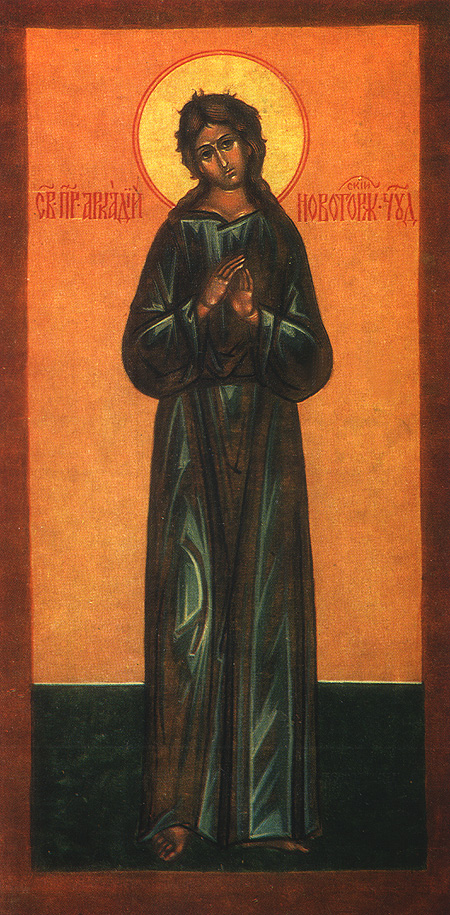
On August 14, 1798 the holy relics of Saint Arcadius were placed in a stone coffin, which had
served as the resting place of his Elder, Saint Ephraim until 1572.
Saint Arcadius is also commemorated on December 13 (the day of his blessed repose), July 11 (the transfer of his relics in 1677), and June 11 (the discovery of his relics).
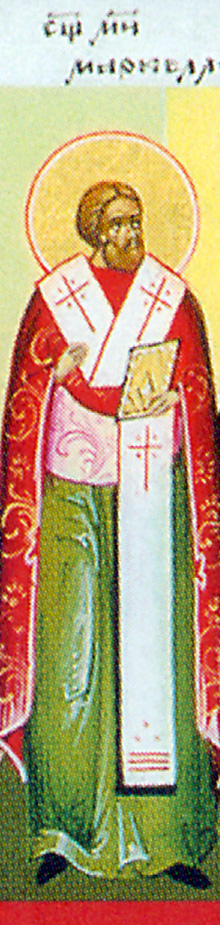
The Hieromartyr Marcellus, Bishop of Apamea, was born of illustrious parents on the island of Cyprus. Having received a fine education, he occupied a high civil office. Everyone marveled at his purity of life, mildness, kindness and eloquence. In the year 375, the saint left his wife and children, and devoted himself to a monastic life in Syria. The people of Apamea, having him come to the city on some practical matter, elected him as bishop.
From the account of Theodoret of Cyrrhus we learn that Saint Marcellus received permission from the emperor Saint Theodosius the Great (379-395) to destroy a strongly built temple of Jupiter at Apamea, but the saint didn’t know how to accomplish this. A certain worker promised to help him. He undermined three of the huge columns, propping them up temporarily with olive wood. Then he tried to set them afire, but the wood would not burn. When Saint Marcellus learned of this, he performed the Lesser Blessing of Water, and he commanded that this water be faithfully sprinkled around the wood. After this, the wood burned quickly, the columns fell down and the whole pagan temple collapsed in upon itself.
When soldiers near Aulona in the Apamea district demolished another pagan temple, the saint, watching from a distance, was seized by pagans and thrown into a fire. The killers were found, and the saint’s sons wanted to take revenge. A local Council forbade them to do this, decreeing that it would be wrong to avenge such a death as the saint had received. Instead, they ought to give thanks to God.

The “Conversational" Icon of the Mother of God received its name because it depicts the Mother of God and Saint Nicholas of Myra conversing with the sacristan George, also called Yurysh. This event occurred soon after the appearance of the Tikhvin Icon of the Most Holy Theotokos in 1383, when the Mother of God herself commanded George to say that the metal cross on the newly-built temple at Tikhvin should be replaced with a wooden one.
A chapel dedicated to Saint Nicholas the Wonderworker was built on the spot where the vision occurred. The chapel burned down several times (the first time was in 1390, at the same time as the church of the Tikhvin Icon of the Most Holy Theotokos). In 1515, a wooden church was built, and a Monastery was also founded in honor of the Icon.
One of the most revered of these "Conversational" icons was in the town of Pavlovsk in the Zvenigorod district of Moscow. A young peasant woman, Theodosia Vasilieva, lived in Pavlovsk. and suffered from attacks of a severe illness: she would be stricken with terrible pains in her head, and limbs, exhausting her strength and forcing her into bed. In 1848, during a particularly harsh and prolonged attack, she had a dream in which she held an Icon of the Mother of God, chipped and blackened with age. From the Icon, Theodosia heard a voice say: "Restore me, I shall be a helper of Christians. How many years have I been lying in this forlorn place, and no one has bothered to find and restore me?"
"How shall I find you?" asked Theodosia.
"When you mind, you shall find," came the reply.
Three days later, Theodosia felt well enough to make her way to the local church. Entering the narthex, she saw on the wall the same "Conversational" icon she had beheld in her dream. The old Icon had been relegated to the church basement, where it had lain neglected for many years until, in 1846, a church custodian rescued it and placed it in the narthex. Theodosia collected some money and the Icon was taken to Moscow for restoration.
On the night before the Icon returned to Pavlovsk, Theodosia saw the restored Icon in a dream and heard a voice directing her to take the Icon home and have a Moleben served before it, which she did. At the start of the Moleben, Theodosia had a seizure, but after she was sprinkled with holy water, she came to herself. She drank some holy water and then afterward she felt strong enough to carry the Icon back to the church by herself. Soon she made a complete recovery.
When Metropolitan Philaret of Moscow was informed of the miracle, he instructed the priests to make a weekly report of any other miracles. Among these were the healings of another peasant girl named Natalia, and of a peasant named Paul, both of whom suffered from epileptic seizures.
We pray before the "Converser" Icon of the Mother of God for success in building, for construction in general, and for the restoration and preservation of Orthodox churches and monasteries.
The Narva Icon of the Mother of God became famous in the year 1558, when the Russian army attacked the city of Narva. In one of the houses where Russian merchants had once lived, drunken Germans grabbed an icon of the Mother of God that had been left behind. Mocking the holy thing, they threw it into a fire under a kettle, in which they were brewing beer. Flames shot out from the kettle and engulfed the roof of the house.
At that very moment a storm blew up, and spread the fire throughout all the city. Taking advantage of the confusion, the Russian army advanced and took the city. The Wonderworking Icon of the Most Holy Theotokos, and an icon of Saint Nicholas, were found in the ashes unharmed.
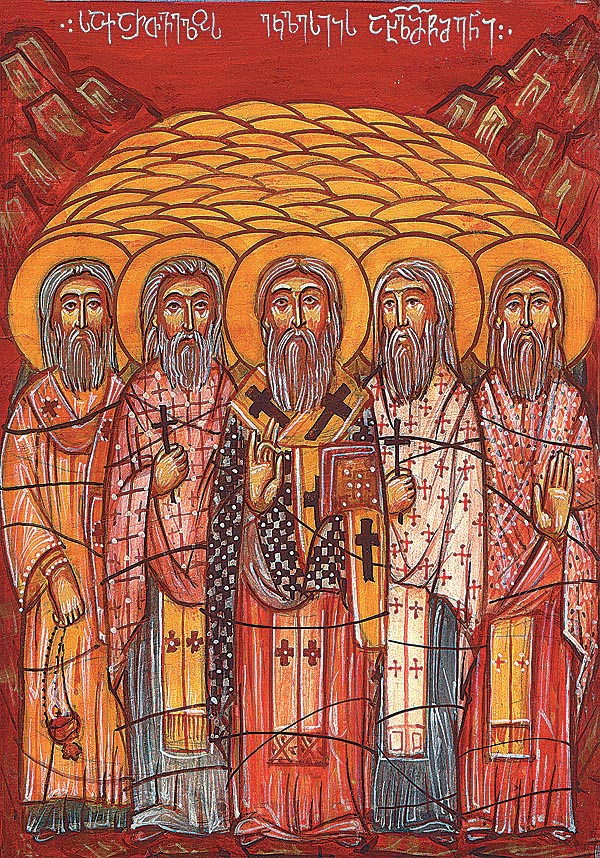
Metropolitan Nazarius of Kutaisi-Gaenati was born in 1872 in the village of Didi Jikhaishi in Imereti. His forefathers belonged to a long lineage of clergy, and the future metropolitan was nurtured in the Church from the earliest years of his youth.
Nazarius (known in the world as Joseph) received his education at Kutaisi Theological School. In 1892 he graduated with honors from Tbilisi Seminary and began to serve in the Church, first as a deacon and later (from February 9, 1893) as a priest. In 1904, after a series of personal tragedies (first his wife died, then his two daughters), Nazarius was tonsured a monk. On November 4, 1918, he was enthroned as Metropolitan of Kutaisi.
The years 1922 to 1923 marked a difficult period in the history of the Georgian Church. The Bolsheviks razed twelve hundred churches, destroyed much of the Church’s wealth, burnt many rare manuscripts, and persecuted spiritual leaders—particularly Georgian nationalists.
On February 10, 1921, following the Red Army’s invasion of Georgia, the treasures of the Sioni and Svetitskhoveli Cathedrals were carried away to Kutaisi for safekeeping. Patriarch Leonid gave his blessing for four boxes of holy objects to be buried under the porch at Metropolitan Nazarius’s residence, which was located on the grounds of the Bagrati Cathedral.
After the Bolsheviks secured their occupation of Georgia, they discovered where the treasures had been buried and arrested Metropolitan Nazarius. They accused him of agitating against the government and concealing the possessions of the Church. During the court proceedings the metropolitan was asked for whom he had hidden the treasure, and he answered, “For the Church and the Georgian people!”
The court sentenced Nazarius to the most severe punishment—execution by a firing squad—but the sentence was subsequently rescinded. In the end, the Bolsheviks imprisoned the hierarch and confiscated his personal belongings.
In April of 1924 Metropolitan Nazarius received amnesty and was released after two years in prison. He returned to his diocese, which was undergoing many trials. He was not permitted to return to his own residence, but was obliged to live with his brother, while his former home was transformed into a storage facility.
On August 14, 1924, a delegation from the village of Simoneti came to the metropolitan to request that he consecrate their local church. At the appointed time, the metropolitan arrived in Simoneti with his retinue and consecrated the church. That night, a group of Chekists (Soviet security agents) broke into the house where Metropolitan Nazarius and his entourage were staying, bound and beat them, and then dragged them to the village council. Without an investigation, the Troika (a Soviet extraordinary council of three judges) sentenced to death Metropolitan Nazarius and four other clergymen—Priest Herman Jajanidze, Priest Hierotheos Nikoladze, Priest Simon Mchedlidze, and Archdeacon Besarion Kukhianidze. A layman, Axalmotsameni, was also sentenced to death. They were shot to death in the Sapichkhia Forest.
In 1994, with the blessing of Catholicos-Patriarch Ilia II, the full Ecclesiastical Council of the Georgian Church resolved with one accord to canonize Metropolitan Nazarius and the clergymen who were martyred with him. At the same time, the council canonized all the Orthodox Christians who, for their Faith and the independence of their homeland, became victims of the totalitarian regime. They were proclaimed the “New Martyrs of the Georgian Church.”
 Saint Peter Antiochian Orthodox Church
You must be logged in to post a comment.